
M912 - M912M - Tablette tactile GIGABYTE - Notice d'utilisation et mode d'emploi gratuit
Retrouvez gratuitement la notice de l'appareil M912 - M912M GIGABYTE au format PDF.


| Type de produit | Tablette tactile / Netbook convertible |
| Processeur | Intel Atom N270 1,6 GHz |
| Système d'exploitation | Microsoft Windows XP / Linux / Vista |
| Mémoire vive | DDRII-533 SO-DIMM, 1 slot, max 2 Go |
| Écran | 8,9 pouces, tactile, résolution 1280x768 ou 1024x600, rotation 180° |
| Disque dur | 2,5 pouces S-ATA, 120/160/250 Go |
| Connectique | 3x USB, Mic, Casque, VGA, RJ45, Lecteur SD/MMC/MS, ExpressCard |
| Audio | Haut-parleurs 1,5 W x2 |
| Webcam | 1,3 mégapixels CMOS |
| Réseau sans fil | Wi-Fi 802.11b/g, Bluetooth 2.1 |
| Clavier | 80 touches |
| Batterie | Li-ion 4500 mAh (standard) / 4900 mAh (option) |
| Alimentation | Adaptateur secteur 100-240V, sortie 12V 3A |
| Dimensions | 235 x 180 x 28-42 mm |
| Poids | 1,3 kg |
| Température de fonctionnement | 10°C à 35°C |
| Sécurité | Verrou Kensington, mot de passe BIOS |
| Garantie | 1 an mondiale, 1 an batterie |
| Entretien | Nettoyer avec appareil éteint, chiffon doux ; ne pas couvrir les aérations |
| Pièces détachées | Batterie, adaptateur secteur, stylet (en option) |
FOIRE AUX QUESTIONS - M912 - M912M GIGABYTE
Note : Pour maintenir la capacité maximale, déchargez complètement la batterie de temps en temps avant de la recharger.
Questions des utilisateurs sur M912 - M912M GIGABYTE
0 question sur cet appareil. Repondez a celles que vous connaissez ou posez la votre.
Poser une nouvelle question sur cet appareil
Téléchargez la notice de votre Tablette tactile au format PDF gratuitement ! Retrouvez votre notice M912 - M912M - GIGABYTE et reprennez votre appareil électronique en main. Sur cette page sont publiés tous les documents nécessaires à l'utilisation de votre appareil M912 - M912M de la marque GIGABYTE.
MODE D'EMPLOI M912 - M912M GIGABYTE
Copyright © 2008
All Right Reserved - Printed in China
M912 Netbook User's Manual
Original Issue: 2008/07
This manual guides you in setting up and using your new Netbook PC. Information in the manual has been carefully checked for accuracy and is subject to change without notice.
No part of this manual may be reproduced, stored in a retrieval system, or transmitted, in any form or by any means, electronic, mechanical, photocopy, recording, or otherwise, without prior written consent.
Trademarks
Product names used herein are for identification purposes only and may be the trademarks of their respective companies. Microsoft ^® , MS-DOS, Windows ^® , and Windows ^® Sound System are trademarks of Microsoft Corporation.
Intel ^® , Atom ^TM is registered trademarks of Intel Corporation.
Sound Blaster, Sound Blaster Pro are trademarks of Creative Technology.
All other brands or product names mentioned in this manual are trademarks or registered trademarks of their respective companies.
Safety Instructions
Use the following safety guidelines to help protect yourself and your Netbook.
When Using Your M912 Netbook Computer

CAUTION: Do not operate your portable computer for an extended period of time with the base resting directly on your body. With extended operation, heat can build up in the base. Allowing sustained contact with the skin can cause discomfort or a burn.
- Do not attempt to service the Netbook yourself. Always follow installation instructions closely.
- Do not carry a battery in your pocket, purse, or other container where metal objects (such as car keys) could short-circuit the battery terminals. The resulting excessive current flow can generate extremely high temperature and may cause burns to your skin.
- Be sure that nothing rests on your AC adapter's power cable and that the cable is not located where it can be tripped over or stepped on.
- While you are using the computer or charging the battery, place the AC adapter in a ventilated area, like on a desktop or on the floor. Do not cover the AC adapter with papers or other items that may prevent ventilation. Also, do not use the AC adapter while it is inside a carrying case.
-
Do not insert objects into the air vent of your Netbook computer. Doing so can cause short-circuiting and may result in fire or electrical shock.
-
Use only the AC adapter and batteries that are supplied by your Netbook manufacturer. Using other types of battery or AC adapter may heighten the risk of fire or explosion.
- Incorrectly placed batteries may result in an explosion.
- Replace only with the same or compatible battery recommended by the manufacturer.
- Please discard used batteries according to the manufacturer's instructions.
-
Before you connect your Netbook to a power source, ensure that the voltage rating of the AC adapter matches that of the available power source.
-
115 V/60 Hz in most of North and South America and some Far Eastern countries such as South Korea.
- 100 V/50 Hz in eastern Japan and 100 V/60Hz in western Japan.
- 230 V/50 Hz in most of Europe, the Middle East, and the Far East.
-
If you use an extension cord with your AC adapter, ensure that the total ampere rating of all devices plugged into the extension cord does not exceed its total capacity.
-
When removing battery from your Netbook, first turn off the system, disconnect the AC adapter from the electrical outlet, then remove the battery.
- To avoid risk of an electrical shock, do not connect or disconnect any cables, or perform maintenance or reconfiguration of this product during a thunderstorm.
- Do not throw batteries into fire, doing so may cause explosion. Check with local authorities first for battery disposal instructions.
-
When setting up your Netbook for work, place it on a level surface.
-
When traveling, do not check your Netbook as baggage. You can put your Netbook through an X-ray security machine, but never put your Netbook through a metal detector. If you have your Netbook checked by hand, be sure to have a charged battery ready in case you are asked to turn on your Netbook.
- When traveling with the hard drive removed from your Netbook, wrap the drive in an insulated material, such as cloth or paper. If you have the drive checked by hand, you may be asked to install the drive into your Netbook. Your can have the hard drive checked through an X-ray machine, but never put the drive through a metal detector.
- When traveling, do not place your Netbook in the overhead storage compartment where it could shift around. Do not drop your Netbook or subject it to other mechanical shocks.
- Protect your Netbook, battery, and hard drive from environmental hazards such as dirt, dust, food, liquids, extreme temperature, and direct exposure to sunlight.
- When you move your Netbook in environments where there is a substantial difference of temperature or humidity level, condensation may form on or within your Netbook. To avoid damaging your Netbook, please allow sufficient time for the moisture to evaporate before continue using.
NOTICE: When taking your Netbook from a colder to a warmer environment or vice versa, allow your Netbook enough time to adapt to the new environment before turning on power.
- When unplugging the power cord, please make sure that you pull on its connector or on its strain relief loop, and not on the power cord itself. As you pull out the connector, please ensure that it is
pulled out evenly in order not to bend its connecting pins. Also, before you connect the power cord, make sure that both connectors are correctly oriented and aligned.
- Before you clean your Netbook, turn it off first, unplug it from its power source, and remove the battery.
- Handle interior components with care. When removing a component, please hold it by the edge and not on the connecting pins (such as the memory module).

When using your telephone equipments, safety instructions should always be followed in order to prevent fire, electrical shock or injuries, these instructions include:
- Do not use this product near water, for example, near a bathtub, washing basins, kitchen/laundry sinks, wet basements or swimming pools.
- Avoid using cordless phones during an electrical storm as lightening may cause electrical shocks.
- Do not use the telephone to report a gas leak within the leakage area.
WARNING: Void of Warranty
* If the battery is not properly handled, there may be a risk of explosion; make sure you are using the same or compatible battery.
* Please discard used batteries according to the instructions given by the manufacturer.
* Please be aware that use of cracked, severely scratched or poor quality discs may damage the optical drive and corrupt data in the disc. Such discs may break while drive operates in high-speed, in this case, your product warranty may be voided.
Regulatory Notices
Federal Communications Commission Notice
This equipment has been tested and found to comply with the limits for a Class B digital service, pursuant to Part 15 of the FCC rules. These limits are designed to provide reasonable protection against harmful interference in a residential installation.
Any changes or modifications made to this equipment may void the user's authority to operate this equipment. This equipment generates, uses, and can radiate radio frequency energy. If not installed and used in accordance with the instructions, may cause harmful interference to radio communications. However, there is no guarantee that interference will not occur in a particular installation. If this equipment does cause harmful interference to radio or television reception, which can be determined by turning the equipment off and on, the user is encouraged to try to correct the interference by one or more of the following measures:
- Reorient or relocate the receiving antenna.
- Increase the separation between the equipment and receiver.
- Connect the equipment into an outlet on a circuit different from that to which the receiver is connected.
- Consult the dealer or an experienced radio/TV technician for help.
- All external cables connecting to this basic unit must be shielded.
For cables connecting to PCMCIA cards, see the option manual or installation instructions.
Federal Communications Commission (FCC) PART 68 Warning
This equipment complies with Part 68 of the FCC Rules. On the bottom of the computer is a label that contains, among other information, the FCC Registration Number and Ringer Equivalence Number (REN) for this equipment. You must, upon request, provide this information to your telephone company.
FCC Part 68 Registration Number: 6CTTAI - 25876 - FB - E REN: 0.8B
The REN is useful to determine the quantity of devices you may connect to your telephone and still have those devices ring when your number is called. In most, but not all areas, the sum of the REN's of all devices should not exceed five (5.0). To be certain of the number of devices you may connect to your line, as determined by the REN, you should call your local telephone company to determine the maximum REN for your calling area.
If your MODEM causes harm to the telephone network, the local Telephone Company may discontinue your service temporarily. If possible, they will notify you in advance. However, if advanced notice isn't practical, you will be notified as soon as possible. You will be informed of your right to file a complaint with the FCC.
Your telephone company may make changes in its facilities, equipment, operations, or procedures that could affect the proper functioning for your equipment. I they do, you will be notified in advance to give you an opportunity to maintain an uninterrupted telephone service.
CE Notice (European Union)
This symbol CE indicates this M912 Netbook computer complies with the EMC Directive and the European Union's Low Voltage Directive. This symbol also indicates that M912 meets the following technical standards:
- EN 55022 — “Limitations and Methods of Measurement for the Radio Interferences of Information Technology Equipment.”
- EN 55024 — “Information technology equipment - Immunity characteristics - Limits and methods of measurement.”
- EN 61000-3-2 — “Electromagnetic compatibility (EMC) - Chapter 3: Limits - Section 2: Limits on the harmonic current emissions (Equipment input current up to and including 16 A per phase).”
- EN 61000-3-3 — “Electromagnetic compatibility (EMC) - Chapter 3: Limits - Section 3: Limits on the voltage fluctuations and flicker in low-voltage power supply systems for equipment with rate current up to and including 16 A.”
• EN 60950 — “Safety of Information Technology Equipment.”

NOTE: EN 55022 emissions requirements provide for two classifications
• Class A governs commercial use
• Class B is governs residential use
BSMI Notice (Taiwan Only)
Most Netbook computers are classified by the Bureau of Standards, Meteorology and Inspection (BSMI) as Class B information technology equipment (ITE).

R32323
The symbol above must be attached to the product indicating compliance with the BSMI standard.

natural_image
Illustration of hands reaching for a stack of books with a document and question mark, symbolizing inquiry or investigation (no text present)Preface
Congratulations on your purchase of a Netbook computer! Your new Netbook features the most innovative features in portable computing technology. It combines state-of-the-art ergonomics with sophisticated architecture, providing you with a personal computer that is compact, powerful, and easy to use. Designed for a wide range of general, business, and personal productivity applications, this Netbook is an ideal choice for use in the office, at home, and on the road.
This Manual contains all the information you need to set up and use your Netbook computer. It describes all of its features in a thorough yet easy-to-read manner.
Content
Safety Instructions....I
Regulatory Notices ....III
Preface V
Chapter 1 Introducing Your Netbook
1.1 Panoramic View....2
1.2 Left Side 3
1.3 Right Side....3
1.4 Cover Side......4
1.5 Bottom Side....4
1.6 Status Indicators....5
1.7 Turning Your Netbook On and Off....6
1.8 Keyboard Function 6
1.9 Using the Touchpad 8
1.10 Using the built-in camera....8
1.11 Using the Audio 8
1.12 Using the Wireless Lan (WLAN)....9
1.13 Using the Battery Pack....9
1.14 Connection the AC Adapter....10
1.15 Installing M912 Device Drivers....11
1.16 Touch Screen Calibration....11
1.17 Use your M912 as a Tablet PC 12
1.18 Operating Temperature 12
Chapter 2 Battery
2.1 Battery Pack....14
2.2 Recharging The Battery Pack....14
2.3 Question And Answers....14
2.4 Battery Maintenance....15
2.5 Power Consumption 15
2.6 Reducing Power Consumption....15
2.7 Removing The Battery Pack....16
2.8 Connecting System To AC Adapter.... 16
Chapter 3 The BIOS Setup Program
3.1 Activate the BIOS Setup Utility....18
3.2 Using the Advanced CMOS Setup 20
3.3 Security....21
3.4 Set Boot priority order....22
3.5 How to Exit the Setup Program 23
Chapter 4 Troubleshooting / Q&A
4.1 Troubleshooting....26
4.2 Q&A 28
Appendix I Specification 31
Appendix II Recovery Update Notices....33
Appendix III Service Centers 37
Chapter 1 Introducing Your Netbook
This chapter will show you how to operate your M912 SERIES Netbook computer, including connecting the AC adaptor, turning the computer on/off, using touch-pad, keyboard, hot keys, battery, and so on. If you are new to computers and to the operating system, this chapter will guide you through some of the new exciting features.
1.1 Panoramic View
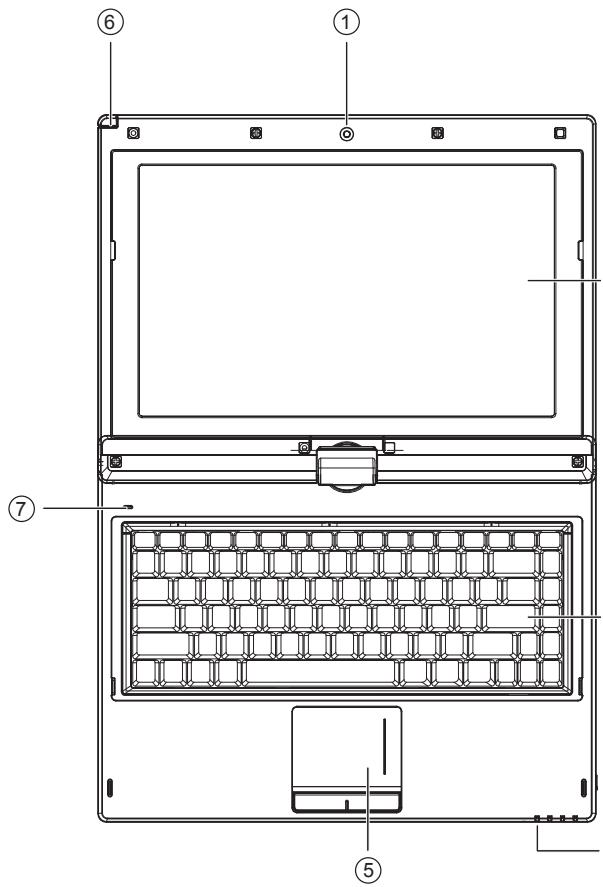
| No. | Item | Function |
| 1 | Web camera | Built-in 1.3M camera |
| 2 | LCD | To display the content output form the system |
| 3 | Keyboard | To input characters and numbers |
| 4 | Four system LEDs | Four LED lights of system signal |
| 5 | Touchpad | To function as mouse |
| 6 | Stylus Pen Slot | To place the stylus pen. |
| 7 | Internal Mic | Build-in internal mic. |
1.2 Left Side
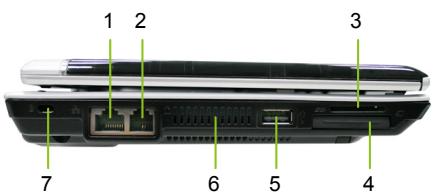
| No. | Item | Function |
| 1 | LAN RJ45 Jack | To connect LAN |
| 2 | RJ11 Phone Port (optional) | To connect Phone Line |
| 3 | Media Card Slot(SD/MMC/MS) | To connect SD/MMC/MS Card |
| 4 | Express Card slot | To connect an Express Card. |
| 5 | USB port | To connect peripheral equipment with USB interface. |
| 6 | Air Vent | To vent heat from Netbook. |
| 7 | Kensington lock | To connect compatible kensington lock. |
1.3 Right Side
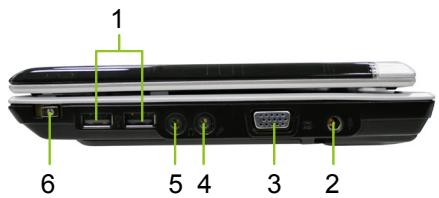
| No. | Item | Function |
| 1 | USB port | To connect peripheral equipment with USB interface. |
| 2 | DC-in hole | To connect AC adapter to power on Netbook. |
| 3 | VGA Port | To connect VGA monitor. |
| 4 | Line out | To connect equipment to output sound. |
| 5 | MIC jack | To connect MIC to input audio signal. |
| 6 | Power key | Power on switch. |
1.4 Cover Side
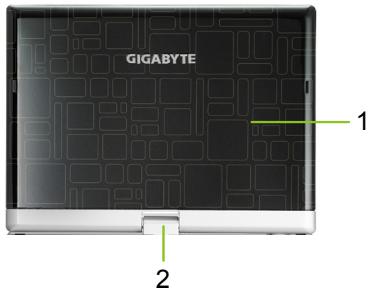
| No. | Item | Function |
| 1 | Cover | To Protect the Netbook |
| 2 | Axle | To turn the touch panel in 180 tolerance |
1.5 Bottom Side
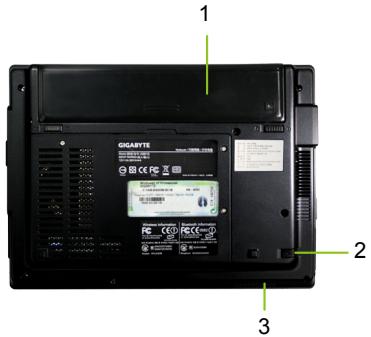
| No. | Item | Function |
| 1 | Battery Pack | Installed in the battery compartment, to supply power to Netbook when AC power is disconnected. |
| 2 | Stylus Pen Slot | To place the stylus pen (optional) |
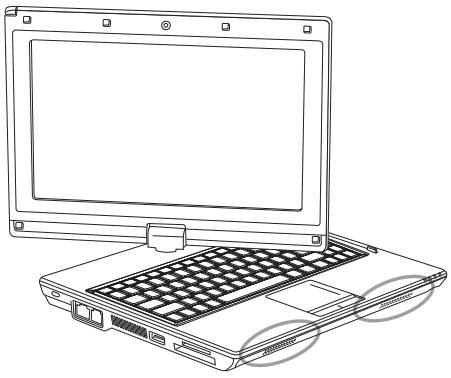
| 3 | Speaker | To output the audio sound from the system. |
1.6 Status Indicators
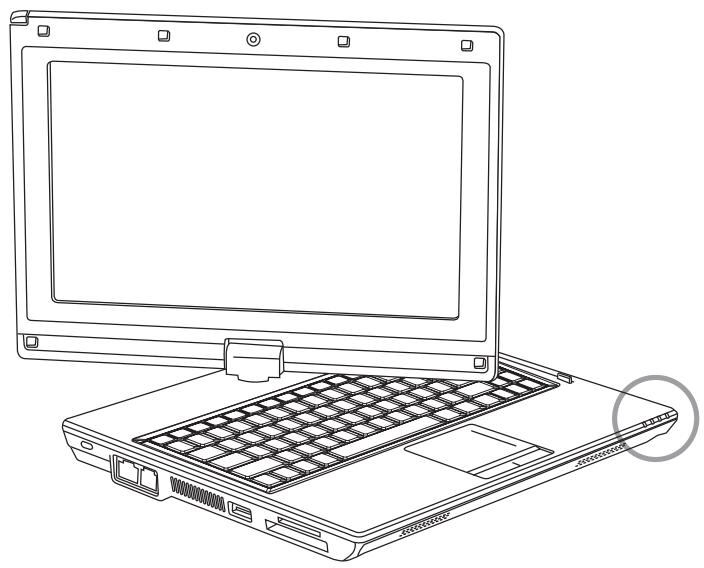
natural_image
Line drawing of a laptop computer with visible keyboard and port, no text or symbols present| Icon | Item | Function | |
 | WLAN Status | Wireless on/off status. | |
 | HDD | Netbook is reading from, or writing to hard disk. | |
 | Power status | Blue off | System is turned off or in hibernation mode. |
| Blue flashing | System is in Standby mode. | ||
| Blue on | System is in operating. | ||
 | Battery status | Blue off | Recharging is finished or Netbook is not powered by AC adapter. |
| Blue on | Battery is in recharging. | ||
1.7 Turning Your Netbook On and Off
Turning on the power
Open the Netbook lid, press and hold the power switch for one or two seconds. The power indicator will glow blue once the computer is powered on.
Turning off the power
If you are not going to use your Netbook computer for a while, it is best to turn off its power. Before turning off power, close all program first and shut down the operating system.
After turning off your Netbook computer, make it a habit to leave the LCD panel open for a while after it has been used for an extended period of time. This allows the interior of your Netbook computer to cool off. Closing the panel will force the heat up against the LCD screen, and doing so after a while may damage the screen. More importantly, never close the LCD panel for a long period of time when the computer is on or when the power saving function is disabled.
Suspend mode
You can adjust default power management settings in the Power Option/Advanced dialog box. The Power Options dialog box provides several operating functions after your computer has been idle for a while.
1.8 Keyboard Functions
M912 Netbook computer is equipped with a standard typewriter-layout keyboard and has extra features.
![Esc ~ F1 F2 F3 F4 F5 F6 F7 F8 F9 F10 F11 F12 F13 I @ # $ % ^ & 7 * 8 ( 9 ) / - + Back Space I 2 3 4 5 € 6 7 8 9 0 = ← ← Tab Q W E R T Y U 4 I 5 O 6 P * [ ] I\ Caps Lock A S D F G H J 1 K 2 L 3 : - " Enter Shift Z X C V B N M 0 < , > . P * ↑ Ctrl Fn Alt Alt Gr Home PgUp End 12.025X13.0 (K2045) 75.625X13.0 (K2057) 12.025X13.0 (K2045) 15.4X13.0 (K2047)](/content/2024/11/220710/images/1580cb30430c3117d42d06fcf58560524017bceb382bcf3f2df8b9c837e31654.jpg)
| Icon | Description |
| Caps Lock | Press Caps Lock to set all the characters input are capital letters. |
| Num Lk | To turn on the numeric keypad overlay, press Num Lk. |
| Scrl Lk (Fn+Num LK) | Press this key to scroll the screen under some programs. |
| [c5CG] | Press this key to activate Windows® START menu. |
 | Press this key to function as the right key of mouse. |
Fn Combination Keys (Hot Keys)
Use □ Fn key combined with other keys to activate, close or set special functions. These combinations are also called Hot Keys. To use the Hot Keys, press and hold down
| Icon | Description |
| Fn+F1 | HibernationPress this key combination to make system enter hibernation mode.In this mode, the back light of the LCD panel would be turned off and a host of internal devices would enter into a stage of lower power consumption. |
| Fn+F2 | Wireless LANTo activate Wireless LAN. |
| Fn+F3 | Brightness decreasingPress this key combination to decrease the brightness of the LCD. |
| Fn+F4 | Brightness increasingPress this key combination to increase the brightness of the LCD. |
| Fn+F5 | LCD / Video-out SwitchPress this key combination to switch between :LCD mode only;Video-out mode only;LCD and Video-out simultaneously modeNotice : This function works under certain setting of OS, please refer to your instruction of OS. |
| Fn+F6 | Touch Screen Enable/DisablePress this key combination to enable/disable Touch Screen function. |
| Fn+F7 | MutePress this combination to open/close output of audio signal. |
| Fn+F8 | Voice weakeningPress this key combination to weaken the voice output.Notice: This function works under certain setting of OS, please refer to your instruction of OS. |
| Fn+F9 | Voice strengtheningPress this key combination to strengthen the voice output.Notice: This function works under certain setting of OS, please refer to your instruction of OS. |
1.9 Using the Touchpad
The built-in touch pad is a PS/2-compatible pointing devise that senses movement on its surface. This means that cursor responds as you move your finger on the surface of the touchpad. The central location on the palm rest provides optimum comfort and support. The following teaches you how to use the touch pad:
■ Move your finger across the touch pad to move the cursor.
■ Press the left and right buttons located on the edge of the touch pad to do selection and execution functions. These two buttons are similar to the left and right buttons on a mouse. Tapping on the touch pad produces similar results.
1.10 Using the built-in camera
The availability of the function depend on the configuration of Netbook you bought. The model you bought may be equipped with a built-in camera, and the built-in camera adds video functionality to instant messaging software and video editing software.

●●●●●●●●●●●●●●●●●●●●
Tips: For using the built-in camera, see the help file on the utility software.

●●●●●●●●●●●●●●●●●●●●
Tips: The built-in camera cannot be shared by more than on software application. If another application is using the camera, exit the application before using the built-in camera.
1.11 Using the Audio
natural_image
Line drawing of a laptop computer with a grid-patterned keyboard and ventilation slots (no text or symbols)You can Control volume under your Windows operation system: Click the volume icon 📋 on task bar and use the button to adjust volume.
Or you can double click the volume icon 📋 to activate Volume Control to adjust control items of volume.

●●●●●●●●●●●●●●●●●●●●●
Tips: You can use Fn combination keys to adjust volume. Please refer to "FN combination keys".
Please adjust the voice down before your connect an external audio equipment, such as earphone or MIC.
1.12 Using the Wireless LAN (WLAN)
You can use Wireless LAN to connect to the network and use the Internet in your home and office, so there is no need anymore to pull cables or wires.
Connecting and using the wireless network
You can use the Function key (1.8 Using the Launch Keys) or Fn combination keys (1.8 Keyboard Function) to turn on wireless Lan Right-click the Wireless network icon on the Taskbar and select View available wireless network
Select AP (Access Point) you want to connect to and type necessary information. Click Connect. And If you place the mouse pointer on the Wireless network icon on the Taskbar, you can see the status of the wireless network.

●●●●●●●●●●●●●●●●●●●
Tips: You can learn details by referring to instruction document of wireless network.

●●●●●●●●●●●●●●●●●●●
The availability of the functions depend on the configuration of Netbook you bought, see the Spec to see whether your model supports the function.

●●●●●●●●●●●●●●●●●●●
Notice: Creating security settings for the wireless LAN is important, we assume no responsibility for any security problems that may arise from the use of the wireless LAN.
1.13 Using the Battery Pack
M912 Netbook computer is designed to operate with one of the following power sources:
■ AC power (using the AC adapter connected to an electrical outlet)
■ Lithium-Ion (Li-Ion) battery pack
You should use the AC adapter whenever possible; use the battery pack only when AC power is unavailable. The rechargeable Li-Ion battery pack allows you to operate your Netbook computer without an external power source. When you use the AC adapter to connect your Netbook to a power outlet, the internal battery will begin to recharge. While the battery is charging, the Battery Charge icon on the indicator panel will be on. Once the battery is fully charged, the Battery Charge icon will turn off. Quick charging time is 2.5 hours for the Lithium-Ion (Li-Ion) battery when the computer is turned off, while the normal battery charging time is 3.5 hours.
- Operating a fax modem, video, or audio equipment can increase the use of your computer's power.
■ Decreasing monitor brightness can also save power.
When the battery is not fully charged, allow your battery to be charged completely before using it (i.e., before disconnecting AC power). Calibrating the battery before use is also highly recommended.
■ Li-Ion Battery is vulnerable; do not charge it with other power adapter, otherwise fire or explosion may occur.
Replacing the Battery
The battery will gradually weaken over time. We recommend that you replace your battery when you notice a significant decrease of battery capacity.
To change the battery pack, follow the steps below:
- Turn off the computer.
- Close the lid and flip the computer over.
- Slide the battery latch. Continue to hold it until the battery is removed.
- Make sure the replacement battery is properly oriented before inserting it into the battery compartment.
Note: The battery can not be charged to 100% when remaining battery is no less than 95% . It is based on the supplier's advice, and to extend charging frequency and battery life.
Maintenance of the AC Adapter
■ Do not connect the adapter to any other device.
- Do not step on the power cord or place heavy objects on top of it. Carefully route the power cord and keep cables away from all traffic.
- When unplugging the power cord, do not pull on the cord itself but on the plug instead.
If you are using an extension cord, make sure that the devices plugged onto the cord do not exceed its total capacity. Furthermore, the devices plugged into the electrical outlet shall not exceed the fuse's total ampere rating.
■ Please verify power voltage before connecting the electrical cord to the power outlet. If you are uncertain of its power specification, please consult with your local vendors or power company for more details.
1.14 Connecting the AC Adapter
The AC adapter converts AC power to DC power and reduces the voltage supplied to the computer. It can automatically adjust to any voltage from 100 to 240 volts and outputs power at 12V, (12V, 3.0A for M912), allowing you to use your Netbook computer in almost any region.
CAUTION: Use only the AC adapter and the power cord we recommend. Using the wrong adapter may damage your computer. We assume no responsibilities for damages arising from misuse of AC adapters.

To properly connect the adapter, follow the steps as below:
- Connect the power cord to the AC adapter.
- Connect the AC adapter to the DC power port of your computer.
- Connect the AC adapter power cord to an AC outlet.
1.15 Installing M912 Device Drivers
If your M912 Netbook Computer already has an operating system installed, it is best to install all necessary device drivers in order for the hardware to properly function.
Before installing drivers, check with your vendors to see if they have already installed all the drivers with the operating system, if not, please follow the steps below:
- You can find the Utility Driver CD like the one shown below:
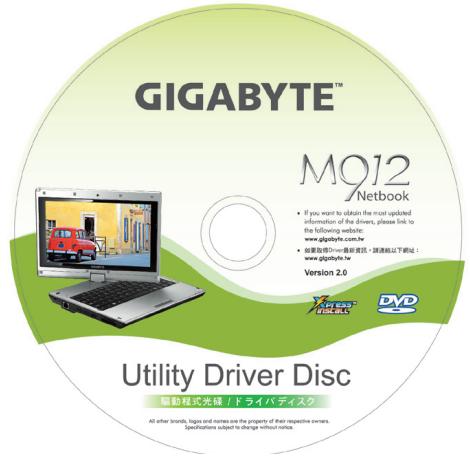
- Put the CD into the CD R-W or DVD-RW (optional) Drive. An Auto Run installation screen will appear.
1.16 Touch Screen Calibration
If your M912 Netbook Computer already has an operating system installed, it is best to install all necessary device drivers in order for the hardware to properly function.
The stylus pen together with the system touch-screen LCD display provides you a touch-screen operation by emulating the industry standard mouse left click. Below are the two conditions that you need to calibrate your touch-screen.
- The first time Windows is installed and boot up. The active cursor is shifted; not exactly the same position where the stylus pen tip is tapped.
- Periodically when you find the active cursor is shifted away from the screen position where the stylus pen tip is tapped.
To calibrate the touch-screen, go into Desktop Manu => PenMount Control => Device => PenMount 6000 USB Resistive Digitizer => Configure => Calibrate => Standard Calibration. In the Setting screen, select Calibrate. Then follow instruction to complete calibration.
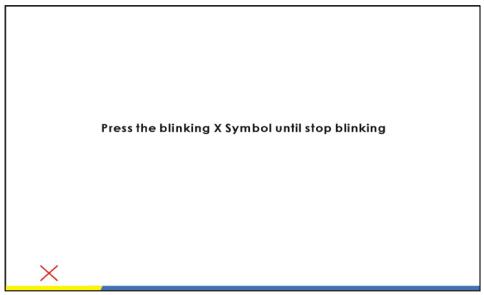

●●●●●●●●●●●●●●●●●●●
Note: You need to set screen display resolution to right resolution 1280x768 or 1024x600 (depends on your hardware specification) before proceeding with the calibration.
1.17 Use your M912 as a Tablet PC
The screen of M912 is convertible to simulate a Tablet PC. Follow the steps to use this function.
- Open the lid (the screen display) of M912.
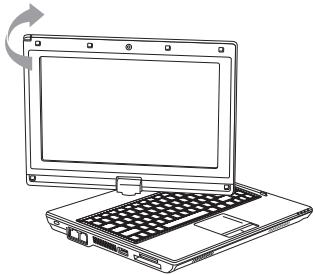
- On the top center above the keyboard is the pivot connecting the display panel to the bottom case. There is a sign " 🔊"
natural_image
Line drawing of a laptop with a keyboard and front panel, showing the open lid and base (no text or symbols)- Follow the sign to turn the screen clockwise up to 180 degree so that the screen is facing out.
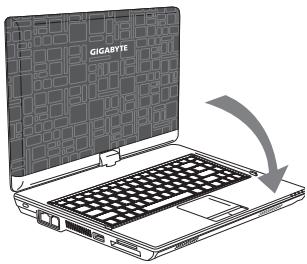
natural_image
Diagram of a laptop with a grid-patterned back cover and a curved arrow indicating rotation (no text or symbols)-
Lay the turned screen down into the flat position. The keyboard will be covered by the display. Use the stylus or simply touch the screen to operate M912 as a Tablet PC.
-
When done with Tablet PC, reverse the above instruction (erect the screen to 90 degree, turn counterclockwise to 180 degree) to set M912 back to original position.
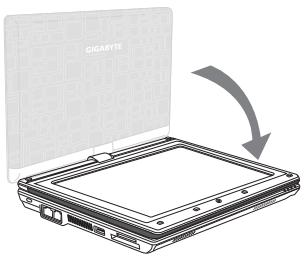
natural_image
Diagram of a laptop with a GIGARYTE logo and a curved arrow indicating rotation or change (no text or symbols on the device itself)* Attention: Please note that the screen can only rotate at 180 degree clockwise. Be sure to turn the screen according to the sign. Forcing the screen to turn at the wrong angle will cause serious damage to M912.
1.18 Operating Temperature
Operating Temperature : 10°C to 35°C
natural_image
Illustration of a battery and two charging devices with no text or symbolsChapter 2 Battery
2.1 Battery Pack
Your Netbook is equipped with a high-energy rechargeable Lithium Ion (Li-Ion) battery pack. Battery life will vary depending on the product configuration, product model, applications loaded on the product, power management settings of the product, and the product features used by the customer. As with all batteries, the maximum capacity of this battery will decrease with time and usage.
2.2 Recharging The Battery Pack
Your Netbook supports both on-line and off-line recharge. Follow the procedure below to recharge battery:
■ Make sure the battery pack is installed in the Netbook.
■ Connect the AC adapter to the Netbook and to an electrical outlet.
When a battery pack is being recharged, its battery LED (located at the upper left corner of LCD display) would be lit. For details on the LEDs, please refer to Chapter 1.3. When the Netbook is OFF, a depleted Li-Ion battery will take three hours to recharge.
2.3 Questions And Answers
Q: I can feel a mild heat next to the battery pack. Is it normal?
A: The battery will generate heat during recharging and discharging. There is a protection circuit inside the Netbook to prevent overheating. User needs not to worry.
Q: My battery operation time is not as long as it should be. Why?
A: The battery is heat sensitive and can only be charged to its maximum if the battery and its environmental temperature remain within 15-25°C (59-77°F). The more the temperature deviates from this range during recharging, the less chance there is for the battery to be fully charged. In order to recharge the pack to its full capacity, users are requested to cool down the unit by unplugging the AC Adapter. Wait until it is cooled down. Then plug in the AC Adapter to start recharging again.
Q: I did not use my spare battery for a few days. Even though it was fully recharged, there wasn't as much power left as a newly charged one. Why?
A: The batteries will self-discharge (1% per day for Li-Ion) when they are not being recharged. To make sure a battery pack is fully charged, recharge before use. Always keep the battery inside the Netbook and have the AC adapter connected whenever possible.
Q: I did not use my spare battery for months. I have problem in recharging it.
A: If you happen to leave your battery pack to go through an extended period of self-discharge, say more than three months, the battery voltage level will become too low and needs to be Pre-Charged (to bring the battery voltage level high enough) before it automatically (for Li-Ion only) resumes its normal Fast Charge. Pre-Charge may take 30 minutes. Fast Charge usually takes 2\~3 hours.
2.4 Battery Maintenance
To maintain the battery pack's maximum capacity, you should occasionally let the Netbook deplete its battery power completely before recharging.
To carry out a complete depletion of the battery, disconnect the AC adapter and let your Netbook consume the remaining battery power. To speed up the depletion, use the HDD as much as possible. When the battery is empty, wait for the Netbook to cool down (especially the battery). The temperature should be within 15-25°C (59-77°F). Then insert the AC adapter to recharge the battery.
2.5 Power Consumption
The Windows ^™ operating system has incorporated the latest state-of-the-art ACPI (Advanced Configuration Power Interface) power management methodology. In order to fully utilize the power of your battery packs, it would be a good idea for you to spend sometime to acquire a basic understanding of the power management concept from your operating system.
In Windows ^™ Operating Systems, you can go through Power Options of the Control Panel according to the version of Windows ^™ Operating System the Netbook applies. We shall not describe them in details.
2.6 Reducing Power Consumption
Although your Netbook (together with the operating system) is capable of power conservation, there are measures you can take to reduce the power consumption:
■ Use the AC power whenever possible.
■ Try to use the HDD drive to read and write files, instead of using the external USB FDD.
■ Disable unused devices, such as Web Cam, WLAN, Bluetooth ^® , and etc.
■ Decrease LCD panel brightness through Windows.
Note: Whenever system is powered on or powered off, make sure the battery pack is installed in the battery pack compartment.
2.7 Removing The Battery Pack
This battery pack can easily be removed and replaced. Make sure that the computer is properly shutdown before changing the battery pack. If you would like to change the battery pack while power is on, make sure this battery pack is not the only electrical source to the system unit. Follow the steps below to remove the battery pack.
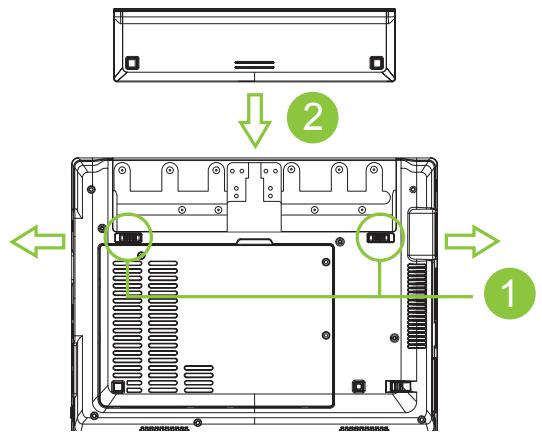
■ Make sure the system is properly shutdown.
■ Flip the system upside down as shown.
■ Push the battery lock to the unlock position as shown by #1.
■ Push the battery latch to the unlock position as shown by #2.
■ Remove the battery pack as shown by #3.
To insert the battery pack, reverse the steps above.
2.8 Connecting System To AC Adapter
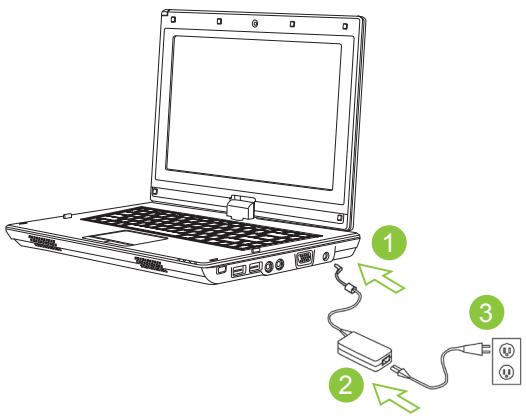
■ Connect AC adapter to system unit as shown by #1.
■ Connect AC power cord to AC adapter as shown by #2.
■ Connect other end of power cord to an electrical outlet as shown by #3.

natural_image
Abstract illustration of stylized human figures walking on a curved road (no text or symbols)Chapter 3 The BIOS Setup program
The BIOS Setup Utility is a hardware configuration program built into your Netbook's BIOS (basic input/output system). Your Netbook is already properly configured and optimized, and you do not need to run this utility. However, if you encounter configuration problems, you may need to run it.
This chapter will introduce:
■ Activate the BIOS Setup Utility
Security
■ Setup Boot priority order
■ Recover original setting
3.1 Activate the BIOS Setup Utility
To activate the BIOS Setup Utility, press F2 during POST.
| PhoenixBIOS Setup Utility | ||||
| Main | Advanced | Security | Boot | Exit |
| System Time : [xx : xx : xx] | Item Specific Help | |||
| System Date : [xx / xx / xxxx] | ||||
| IDE Channel 0 Master [xx-xxx] | ||||
| SATA Port 0 [xxxxxxxx xxxxx] | ||||
| System Memory : xxx xx | ||||
| Extended Memory : xxxxxx xx | ||||
| F1 Help ↑↓ Select Item -/+ Change Values F9 Setup Defaults ESC Exit ↔ Select Menu Enter Select Sub-Menu F10 Save and Exit | ||||
The setup utility menu bar has six main screens. Following is general introduction on these six items:
| Menu | Description |
| Main | The Main screen displays a summary of your Netbook hardware information, and also includes basic setup parameters. |
| Advanced | This screen contains parameters involving your hardware devices. |
| Security | The Security screen contains parameters that help safeguard and protect your Netbook from unauthorized use. |
| Boot | To set the order of booting equipments, enabling or disabling equipments. |
| Exit | To exit the interface of setting system. |

Tips: For more information about Menu and Keys, please refer to the help information of respective selection. There may be difference of BIOS setting between different versions of BIOS of different batch of Netbook produced.

Notice: The BIOS of your Netbook has been initialized to best settings. It's advised you not to change it if not so necessary.

Tips: The pictures showed at this chapter may be different from those showed by your Netbook due to different versions of BIOS. Please set pictures of your Netbook as standard.
System Time
Allows you to change the system time using the hour:minute:second format of your Netbook computer.
Enter the current time for reach field and use the
You can also change the system time from your operating system.
System Date
Allows you to set the system date using the month/date/year format. Enter the current time for reach field and use the
You can also change the system time from your operating system.
System BIOS Version
Display the BIOS version.
IDE Channel 0 Master
This field display various parameters for the hard disk drive.
SATA Port 1
This field is for information only as the BIOS automatically detects the SATA Hard disk drive information.
System Memory
This field reports the amount of base (or conventional) memory found by the BIOS during Power-On Self-Test (POST).
Extended Memory
This field reports the amount of extended memory found by the BIOS during Power-On Self-Test (POST).
| Phoenix BIOS Setup Utility | ||||
| Main | Advanced | Security | Boot Exit | |
| Primary Master [IC25N060ATMR04-0-(PM)] | Item Specific Help | |||
| Type: LBA Format Total Sectors: Maximum Capacity Multi-Sector Transfers: LBA Mode Control: 32 Bit I/O: Transfer Mode: Ultra DMA Mode: | [Auto] 312581808 160GB SATA1 [16 Sectors] [Enabled] [Disabled] [FPIO 4 / DMA 2] [Mode 5] | User = vou enter parameters of hard-disk drive installed at this connection. Auto = autotypes hard- disk drive installed here. CD-ROM = a CD-ROM drive is installed here. ATAPI Removable = Removable disk drive is Installed here. | ||
| F1 Help ↑↓ Select Item -/+ Change Values F9 Setup Defaults Esc Exit ←→ Select Menu Enter Select F10 Save and Exit ➤ Sub-Menu | ||||
Use the Type field to select the drive type installed. You can select different drive types as CD-ROM, User, Auto, ATAPI Removable, IDE Removable, Other ATAPI or None by pressing
Press
3.2 Using the Advanced CMOS Setup
| Phoenix BIOS Setup Utility | ||||
| Main | Advanced | Security | Boot | Exit |
| Item Specific Help | ||||
| Installed O/S: Reset Configuration Data: Large Disk Access Moede: Local Bus IDE adapter NumLock: SATA - Device 31, Function 2: AHCI Configuration: Legacy USB Support: Boot-time Diagnostic screen: QuickBoot Mode: Extended Memory Testing IGD - LCD panel Type: Keyboard Language: Root port ASPM Support: ASPM Latency Checking: | [WinXP] [No] [DOS] [Primary] [Off] [Enhanced] [Enabled] [Enabled] [Disabled] [Enabled] [Just zero it] [1280x768 LVDS] [Disabled] [Auto] [Enabled] | Select the operating system installed on your system which you will use most Commonly. Note: An incorrect setting can cause some operating systems to display unexpected behavior. | ||
| F1 Help ↑↓ Select Item -/+ Change F9 Setup Defaults Values Esc Exit ←→ Select Menu Enter Select F10 Save and Exit ➤ Sub-Menu | ||||
Installed O/S
Select the operating system installed on your system which you will use most commonly. Note: An incorrect setting can cause some operating systems to display unexpected behavior.
Reset Configuration Data
Select 'Yes' if you want to clear the Extended System Configuration Data (ESCD) area.
Large Disk Access Mode
UNIX, Novell NetWare, or other operating systems, select 'Other'. If you are installing new software and the drive fails, change this selection and try again. Different operating systems require different representations of drive geometries.
Local Bus IDE adapter
Enable the integrated local bus IDE adapter.
NumLock
Selects Power-on state for NumLock
SATA – Device 31, Function 2
Compatible:SATA Driver = Primary on SATA Controller, in Legacy Mode. PATA Driver = Secondary on SATA Controller, in Legacy Mode.
Enhanced:SATA Driver = Primary on SATA Controller, in Native Mode. PATA Drive = Primary on PATA Controller, in Legacy Mode.
AHCI Configuration
Enhanced AHCI: WinXP-SP1+IAA driver supports AHCI mode.
Legacy USB Support
Enable support for Legacy Universal Serial Bus.
Boot-time Diagnostic Screen
Display the diagnostic screen during boot.
QuickBoot Mode
Allows the system to skip certain tests while booting. This will decrease the time needed to boot the system.
Extended Memory Testing
Determines which type of tests will be performed on extended memory (above 1M).
IGD - LCD Panel Type
Select the LCD Panel used by the Internal Graphics Device by selecting the appropriate setup item.
Keyboard Language
Set propriety language for your keyboard.
Root Port ASPM Support
Control ASPM support for all the enabled Root Ports. Auto = will set APMC to the highest common supported ASPM between the Port and Endpoint.
ASPM Latency Checking
Enabled: Enables ASPM latency checking when enabling ASPM. Note: Does not check below switches. Disabled: ASPM latencies are ignored when enabling ASPM.
3.3 Security
The Security screen contains parameters that help safeguard and protect your Netbook from unauthorized use.
| PhoenixBIOS Setup Utility | ||||
| Main Advanced Security Boot Exit | ||||
| Supervisor Password Is : Clear User Password Is : Clear Set Supervisor Password [Enter] Set User Password [Enter]Password on boot: [Disabled] Fixed disk boot sector: [Normal] Diskette access : [Supervisor] | Item Specific Help | |||
| Supervisor Password Controls access to the setup utility. | ||||
| F1 Help ↑↓ Select Item -/+ Change Values F9 Setup Defaults ESC Exit ↔ Select Menu Enter Select Sub-Menu F10 Save and Exit | ||||
Supervisor Password Is
Shows that your Netbook computer is under controlled by Supervisor Password or not.
User Password Is
Shows that your Netbook computer is under controlled by User Password or not.
Set Supervisor Password
With this setting, only authorized user can enter the system. Follow the below to set:
■ Select menu Security.
■ Select "Set Supervisor Password" and then press "Enter".
■ Input the desired password twice.
- When the box of Setup Notice shows password information, press "Enter
Set User Password
It's always the same to set user passport as that of supervisor password. But the former can only enter OS, not BIOS Setup.
Password on Boot
This setting is to select whether password of supervisor and/or user is needed when booting.
Fixed disk boot sector
This setting is to select whether to have Write Protect on hard disk boot section to anti virus or not.

●●●●●●●●●●●●●●●●●●●●●
Notice: Do not lose the password of your system. In the event of this, you should have to refer to GIGABYTE service center.
3.4 Set Boot priority order
With this setting, you can set the order of booting the hardware of Netbook.
| PhoenixBIOS Setup Utility | ||||
| Main Advanced Security Boot Exit | ||||
| Boot priority order: 1: IDE HDD: xxxxxx xxxxxxxxxxxxx 2: IDE CDROM: xxx xxxxxxxxxxxxx 3: USB HDD : 4: USB KEY: 5: USB CDROM: 6: USB FDC: 7: PCI LAN: | Item Specific Help | |||
| Keys used to view or config devices: Up and Down arrows select a device. <+> and <-> moves the device up or down. <f> and <r> specifies the device fixed or removable. <x> exclude or include the device to boot. <Shift + 1> enables or disables a device. <1 - 4> Loads default boot sequence. | ||||
| F1 Help ↑↓ Select Item -/+ Change Values F9 Setup Defaults ESC Exit ↔ Select Menu Enter Select Sub-Menu F10 Save and Exit | ||||
To select the boot device, you can use the up or down arrow key, then press <+> to move up the device in the list or press <-> to move down the device in the list. To exit from this menu, press
3.5 How to Exit the Setup Program
| PhoenixBIOS Setup Utility | |
| Main Advanced Security Boot Exit | |
| Exit Saving Changes Exit Discarding Changes Load Setup Defaults Discard Changes Save Changes | Item Specific Help |
| Exit System Setup and save your changes to C#OS. | |
| F1 Help ↑↓ Select Item -/+ Change Values F9 Setup Defaults ESC Exit ↔ Select Menu Enter Select Sub-Menu F10 Save and Exit | |
Exit Saving Changes:
Save the settings by user and exit the BIOS setting menu.
Exit Discarding Changes:
Not save the settings by user and exit the BIOS setting menu.
Load Setup Defaults:
Recovery all the default setting by manufacturer.

●●●●●●●●●●●●●●●●●●●●
Tips: If you change the BIOS settings and can not return to original settings, you can return to original settings by "Load Setup Defaults".
Discard Changes:
User can discard current settings and return to last settings.
Save Changes:
User can save the settings but will not exit the BIOS setting menu.

Chapter 4 Troubleshooting / Q&A
This chapter contains advice and solutions to a few basic troubles you might encounter when you use Netbook. Please refer to this chapter and follow the instructions to solve troubles.
4.1 Troubleshooting

●●●●●●●●●●●●●●●●●●●●
Warning: Under the condition that you can't handle trouble, please refer to your dealer to get professional service.
AC Adapter
| Trouble | Solution |
| No power supplies to Netbook | Make sure the AC adapter is well connected to the power source and Netbook. |
| Check the cable and plug to make sure they are OK. If they are broken, please contact your local dealer ASAP. |
Battery pack
| Trouble | Solution |
| No power supplies to Netbook | The remaining power in battery pack may be not enough to power on the machine. Connect AC Adapter to recharge it. |
| Can’t be recharged after connecting AC Adapter | Check temperature of battery pack’s surface.Battery pack can’t be recharged if its temperature is too high or too low. Recharged it after its temperature is the same with the normal environment one. |
| If battery pack is fully discharged, it won’t be recharged at once. Please wait for some minutes. | |
| If the power indicators of battery pack are always not lit up, its life may be over. Please contact your dealer to buy another one. |
| Battery life depends on using condition of Net-book. You can change the settings in Power Manager of OS to save power. | |
| Battery life is not as long as it should be | Battery pack can’t exert its full capacity if it works when not fully recharged frequently. Power Netbook by battery pack until its power drops to a critically low level and the machine emits a high-pitched beep or displays a warning message; after that, recharge battery pack to make battery pack work longer. |
Keyboard
| Trouble | Solution |
| Press character keys but number displayed instead of character | Check if Num Lock is activated. |
| Confusing display | Make sure there is not certain software to configure to the keyboard. |
Hard disc drive (HDD)
| Trouble | Solution |
| HDD can’t be booted | Operating system was corrupted by incorrect operating or virus. Try to clean virus and then configure your operating system correctly. |
| The documents of your OS maybe run in error, please refer to the manual of your OS. | |
| HDD performs very slowly | There is too much file fragment. Use disk defrag tools to rearrange the programs on the hard disk. |
LCD
| Trouble | Solution |
| The screen is blank | Press hot key Fn + F5 to change the display mode if certain external monitor is connected. |
| Make sure the system isn't in the mode of Hibernation or Standby. |
Printer
| Trouble | Solution |
| The data can’t be output from Netbook to printer | Make sure printer is powered on.Make sure its cable is OK and its USB interface is well connected to Netbook. |
| Make sure your printer is compatible to your Netbook. | |
| Error printing | Please refer to the user’s manual of your printer for help. |
Audio
| Trouble | Solution |
| No sound emitted | Adjust sound controller. |
| Check the setting of sound volume of software. | |
| Check if the ear phone is firmly connected. | |
| Check the Devices Manager of Windows. Be sure the Sound function has been activated and isn't interfered with other hardware. |
USB
| Trouble | Solution |
| Equipments connected can’t work | Check and be sure USB port of Netbook is firmly connected with the USB cord of the equipment. |
| Be sure the driver of the equipment is installed correctly. |
Stand by / Hibernation
| Trouble | Solution |
| Can’t enter into Standby /Hibernation | Please check if the Windows Media Player is running. If Yes, the Netbook can’t enter into Standby or Hibernation mode. Please close Windows Media Player. |
LAN
| Trouble | Solution |
| Can’t be connected | Be sure the RJ45 connector is firmly connected to the Network Hub or Switch. |
| Can’t be booted | Check the configuration of hardware in BIOS Setup Utility and activate the function of LAN Waken. |
4.2 Q&A
My computer switches to hibernation mode much too quickly, and I have to constantly hit a key or move the mouse to bring back the screen. What can I do?
This is part of Windows Power Management. Access Power Management by clicking on Start / Control Panel / Performance and Maintenance / Power Options, and change the time next to the “Turn off monitor” option to the time you want. You have the choice of either adjusting time for the power supply or for the battery.
I've heard that cleaning and rearranging files on the hard drive will improve program's launch speed, how do I do this?
Good disk maintenances can improve program launch speed. This normally includes deleting unnecessary files, and defragmenting hard disk so that files can be more efficiently grouped. Windows contains maintenance utilities for these tasks; run Disk Cleanup to remove unnecessary files, and Disk Defragmenter to defragment fragmented file blocks. For more
information about these utilities, please refer to your Windows documentation.
What kind of external microphone can I use with my notebook computer?
You will need to use a self-amplifying microphone.
There are echoes coming from my speakers. What can I do?
Double click on the Speaker icon on the task bar. Then, under Microphone Balance, check the Mute box.
Because of a software problem, I was unable to shut the computer down from Windows, I pressed the power button to power off the computer, but it didn't work. How can I force a power off?
Make sure you press the power button for at least 4 seconds. Normally, this will force the computer to shut off.
Why can't I charge the battery of my portable computer after it was out of use for some time?
After your portable computer has not been used for a long time (say: more than one month), the battery will enter into low voltage protection mode. Under this circumstance, restoring to normal voltage will require the battery to be slowly charged for several hours. Once the battery has been fully charged, your computer will resume to normal operation.
My computer says: "CMOS Battery Low", what should I do?
If your computer is without power (i.e. unplug the computer power source from the power outlet and remove the battery pack from it) for over 45 days, you would lose the information stored in CMOS.
Please follow the steps below to reconfigure your CMOS settings:
- Press F2 to enter into the BIOS setup utility.
- Select "Load Optional Defaults?". When you see the following prompt, choose
and then press . - Select "Save Changes and Exit", select
and press to restart your computer.
◆How to unplug or eject devices
- In the notification area next to your task bar, double-click the Safe Removal icon. Safe Removal displays a list of Plug and Play devices that support safe removal and that are currently attached to the system.
If you do not see the Safe Removal icon, your device does not support safe removal, and you cannot unplug or eject your device using Safe Removal.
-
In Safely Remove Hardware, in the list of devices, select the device that you want to unplug or eject, and then click Stop. This tells the system that you will be unplugging or ejecting the device.
-
In Stop a Hardware device, click OK.
A notification appears stating that it is now safe to unplug or eject the device.
Caution
- Unplugging or ejecting a device that supports safe removal without first using the Safe Removal application to warn the system can cause data to be lost or your system to become unstable. For example, if a device is unplugged during a data transfer, data loss is likely. If you use Safe Removal, however, you can warn the system before you unplug or eject a device, preventing possible loss of data.
Note
- For removable storage devices that can safely be removed while the system is on, the system disables write caching by default. It does this so the devices can be removed without loss of data. When write caching is disabled, however, the system will likely experience slower performance, so be sure to enable write caching when you have finished removing the device.
natural_image
Illustration of a computer monitor with a document, no text or symbols presentAppendix I Specification
Processor
Intel ^® Atom 1.6GHz N270
OS
■ Microsoft Windows XP compliance / Linux/ VISTA
Core Logic
Intel® 945GSE
Memory
■ DDRII-533 SO-DIMM X 1, Max 2 GB
For the compatible HDDs & RAMs by model, please refer to GIGABYTE AVL List
Video Interface
Intel® 945GSE
Display
■ 8.9"LCD panel/WXGA 1280x768, w/Touch screen, as 180° rotation angle
■ 8.9"LCD panel/WSVGA 1024x600, w/Touch screen, as 180° rotation angle (Optional)
Hard Disk Drive
■ 2.5",9.5mm S-ATA HDD 120/160/250GB
Optical Drive
■ External ODD by USB connection
Input Device
■ 80 key keyboard/Touch Pad
I/O Port
USB X 3, Mic in/Earphone out/D-SUB
■ RJ45 / SD/MMC/MS Card Reader / Express card
Audio
■ Speaker 1.5 watt x 2
Bluetooth
■ BlueTooth 2.1 built-in
Web Camera
■ 1.3M pixel CMOS camera
LAN/Wierless LAN
■ 802.11b/g by mini-card
Keyboard
■ 80 key keyboard
Protection
■ Kensington lock
Battery
■ Li-ion 4500mAh, Battery (Standard)
■ Li-ion 4900mAh, Battery (Optional)
Dimension & Weight
235 x 180 x 28\~42mm
1.3kg
Service
■ 1 year global warranty
■ 1 year battery warranty
■ More service information, please refer to
■ http://www.gigabyte.com.tw

●●●●●●●●●●●●●●●●●●●
Tips: The above specification is for users' reference. The final configuration depends on the Netbook users bought.

Appendix II Recovery Update Notices
How to restore your Netbook to factory defaults
Time to restore: When your computer is infected by virus or there is any other reason that you want to restore your operation system to the factory defaults.
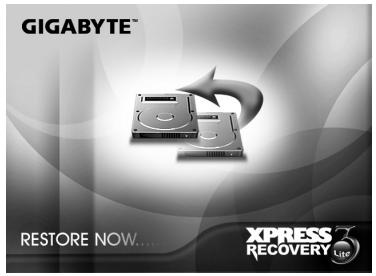
Execute Xpress Recovery3 Lite (XR3 Lite) Professional Recovery Utility. Please take the following procedures:
-
Start up your computer first. Restart your computer if it has already booted into system.
-
Right after you see the startup screen (such as trademark, logo or text), the DOS screen will appear. Press F9.
* F9 is a typical hotkey to restore professional settings. Please consult with your computer manufacture if your hotkey doesn't function.
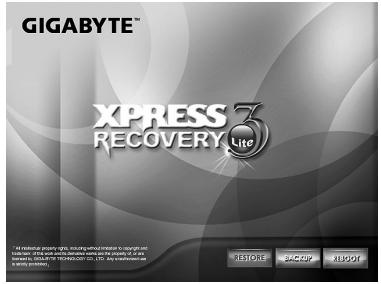
- There are four options on the menu: "RESTORE" (to restore data), "ABOUT" (to display XR3 software related information) and "REBOOT" (to cancel the recovery and restart the computer). We recommend you to select "RESTORE" to restore factory defaults
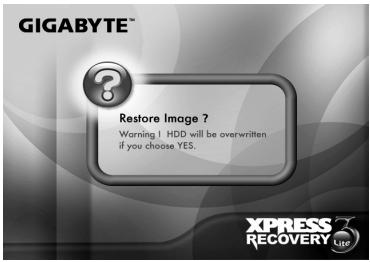
- Then the prompt "Restore Image?" will appear on the menu. We recommend you to select "YES" to restore an image file.* "Image file" is a compressed file that compresses all the Windows operation system data. Recovery an image file allows you to restore your operation system to factory defaults.
- After all the selections have been made, the screen shows "RESTORE NOW...", indicating your computer is now recovering the operation system data. When the recovery is complete, the computer will automatically restart and restore to factory defaults.
natural_image
Illustration of a person standing on a globe with a satellite dish, no text or symbols presentAppendix III Service Centers
This appendix will list our global service centers for your M912 Netbook computer.
Taiwan GIGABYTE Service Center
6F, No.36, Jien-Yi Rd., Chung-Ho, Taipei Hsien, Taiwan.
TEL: +886-2-8227-6136
FAX: +886-2-8227-6163
WEB Address (English): http://www.gigabyte.com.tw/
WEB Address (Chinese): http://www.gigabyte.tw/
U.S.A. G.B.T. INC.
TEL: +1 (626) 854-9338
FAX: +1 (626) 854-9339
WEB Address: http://www.gigabyte.us
China G.B.T. TECH. TRADING CO., LTD.
WEB Address: http://www.gigabyte.com.cn/
Shenzhen
TEL: +86-755-8240-8099
FAX: +86-755-8240-8066
Guangzhou
TEL: +86-20-87540700
FAX: +86-20-87544306
Beijing
TEL: +86-10-62102838
FAX: +86-10-62102848
Chengdu
TEL: +86-28-85236930
FAX: +86-28-85256822
Wuhan
TEL: +86-27-87851312
FAX: +86-27-87851330
Xian
TEL: +86-29-85531943
FAX: +86-29-85519336
Shenyang
TEL: +86-24-83992901
FAX: +86-24-83992909
Russia
Moscow Representative Office of Giga-Byte Technology Co., Ltd.
TEL: +7-495-9136685
WEB Address: http://www.gigabyte.ru/
Germany
HAMBURG Representative Office of Giga-Byte Technology Co., Ltd.
TEL: +49 40 25330433
Address: BULLENKOPPEL 16 22047 HAMBURG
- Safety Instructions
- WARNING: Void of Warranty
- Regulatory Notices
- Federal Communications Commission Notice
- Federal Communications Commission (FCC) PART 68 Warning
- CE Notice (European Union)
- BSMI Notice (Taiwan Only)
- Preface
- Content
- Chapter 1 Introducing Your Netbook
- Chapter 2 Battery
- Chapter 3 The BIOS Setup Program
- Chapter 4 Troubleshooting / Q&A
- Panoramic View
- Left Side
- Right Side
- Cover Side
- Bottom Side
- Status Indicators
- Turning Your Netbook On and Off
- Turning on the power
- Turning off the power
- Suspend mode
- Keyboard Functions
- Fn Combination Keys (Hot Keys)
- Using the Touchpad
- Using the built-in camera
- Using the Audio
- Using the Wireless LAN (WLAN)
- Connecting and using the wireless network
- Using the Battery Pack
- Replacing the Battery
- Maintenance of the AC Adapter
- Connecting the AC Adapter
- Installing M912 Device Drivers
- Touch Screen Calibration
- ●●●●●●●●●●●●●●●●●●●
- Use your M912 as a Tablet PC
- Operating Temperature
- Battery Pack
- Recharging The Battery Pack
- Questions And Answers
- Battery Maintenance
- Power Consumption
- Reducing Power Consumption
- Removing The Battery Pack
- Connecting System To AC Adapter
- Activate the BIOS Setup Utility
- System Time
- System Date
- System BIOS Version
- IDE Channel 0 Master
- SATA Port 1
- System Memory
- Extended Memory
- Using the Advanced CMOS Setup
- Installed O/S
- Reset Configuration Data
- Large Disk Access Mode
- Local Bus IDE adapter
- NumLock
- SATA – Device 31, Function 2
- AHCI Configuration
- Legacy USB Support
- Boot-time Diagnostic Screen
- QuickBoot Mode
- Extended Memory Testing
- IGD - LCD Panel Type
- Keyboard Language
- Root Port ASPM Support
- ASPM Latency Checking
- Security
- Supervisor Password Is
- User Password Is
- Set Supervisor Password
- Set User Password
- Password on Boot
- Fixed disk boot sector
- Set Boot priority order
- How to Exit the Setup Program
- Exit Saving Changes:
- Exit Discarding Changes:
- Load Setup Defaults:
- Discard Changes:
- Save Changes:
- Troubleshooting
- Q&A
- Caution
- Note
- Appendix I Specification
- Processor
- OS
- Core Logic
- Memory
- Video Interface
- Display
- Hard Disk Drive
- Optical Drive
- Input Device
- I/O Port
- Audio
- Bluetooth
- Web Camera
- LAN/Wierless LAN
- Keyboard
- Protection
- Battery
- Dimension & Weight
- Service
- Appendix II Recovery Update Notices
- Appendix III Service Centers
- Taiwan GIGABYTE Service Center
- U.S.A. G.B.T. INC.
- China G.B.T. TECH. TRADING CO., LTD.
Marque : GIGABYTE
Modèle : M912 - M912M
Catégorie : Tablette tactile