
ZOB65802XK - Four encastrable ZANUSSI - Notice d'utilisation et mode d'emploi gratuit
Retrouvez gratuitement la notice de l'appareil ZOB65802XK ZANUSSI au format PDF.



| Type de produit | Four encastrable |
| Marque | Zanussi |
| Modèle | ZOB65802XK |
| Capacité | 72 L |
| Poids net | 30.3 kg |
| Alimentation | Électrique |
| Classe énergétique | A |
| Consommation énergétique (conventionnel) | 0.93 kWh/cycle |
| Consommation énergétique (chaleur tournante) | 0.85 kWh/cycle |
| Nombre de fonctions | 9 |
| Fonctions principales | Chaleur tournante, Chaleur tournante PLUS (vapeur), Gril, Pizza, Décongélation |
| Type de chaleur | Électrique |
| Nombre de positions de grille | 5 |
| Éclairage intérieur | Lampe halogène remplaçable |
| Nettoyage | Aqua Cleaning, nettoyage manuel |
| Sécurité | Arrêt automatique, sécurité enfants, thermostat de sécurité |
| Accessoires fournis | Grille métallique, plaque de cuisson en aluminium, lèchefrite |
| Type de programmateur | Électronique avec affichage |
| Commandes | Boutons rétractables |
| Pièces détachées disponibles | Lampe (300°C), joint de porte, grilles, etc. |
| Garantie | Consultez les conditions de garantie fournies |
FOIRE AUX QUESTIONS - ZOB65802XK ZANUSSI
Questions des utilisateurs sur ZOB65802XK ZANUSSI
0 question sur cet appareil. Repondez a celles que vous connaissez ou posez la votre.
Poser une nouvelle question sur cet appareil
Téléchargez la notice de votre Four encastrable au format PDF gratuitement ! Retrouvez votre notice ZOB65802XK - ZANUSSI et reprennez votre appareil électronique en main. Sur cette page sont publiés tous les documents nécessaires à l'utilisation de votre appareil ZOB65802XK de la marque ZANUSSI.
MODE D'EMPLOI ZOB65802XK ZANUSSI

User Manual
Benutzerinformation
2
24
USER MANUAL
Oven
Backofen
Safety information____2
Safety instructions____3
Product description____5
Before first use____5
Daily use____6
Clock functions. 8
Using the accessories.____9
Additional functions____10
Hints and tips____10
Care and cleaning_18
Troubleshooting 20
Installation____22
Energy efficiency____23
Subject to change without notice.
⚠ Safety information
Before the installation and use of the appliance, carefully read the supplied instructions. The manufacturer is not responsible for any injuries or damages that are the result of incorrect installation or usage. Always keep the instructions in a safe and accessible location for future reference.
Children and vulnerable people safety
- This appliance can be used by children aged from 8 years and above and persons with reduced physical, sensory or mental capabilities or lack of experience and knowledge if they have been given supervision or instruction concerning the use of the appliance in a safe way and understand the hazards involved.
- Do not let children play with the appliance.
- Keep all packaging away from children and dispose of it appropriately.
- Keep children and pets away from the appliance when it operates or when it cools down. Accessible parts are hot.
- If the appliance has a child safety device, this should be activated.
- Children shall not carry out cleaning and user maintenance of the appliance without supervision.
- Children aged 3 years and under must be kept away from this appliance when it is in operation at all times.
General Safety
- Only a qualified person must install this appliance and replace the cable.
- WARNING: The appliance and its accessible parts become hot during use. Care should be taken to avoid touching heating elements. Children less than 8 years of age shall be kept away unless continuously supervised.
- Always use oven gloves to remove or put in accessories or ovenware.
- Before maintenance cut the power supply.
- Ensure that the appliance is switched off before replacing the lamp to avoid the possibility of electric shock.
- Do not use a steam cleaner to clean the appliance.
- Do not use harsh abrasive cleaners or sharp metal scrapers to clean the glass door since they can scratch the surface, which may result in shattering of the glass.
- If the mains power supply cable is damaged, it must be replaced by the manufacturer, its Authorised Service Centre or similarly qualified persons to avoid an electrical hazard.
- To remove the shelf supports first pull the front of the shelf support and then the rear end away from the side walls. Install the shelf supports in the opposite sequence.
Safety instructions
Installation

WARNING!
Only a qualified person must install this appliance.
- Remove all the packaging.
- Do not install or use a damaged appliance.
- Follow the installation instruction supplied with the appliance.
- Always take care when moving the appliance as it is heavy. Always use safety gloves and enclosed footwear.
- Do not pull the appliance by the handle.
- Keep the minimum distance from the other appliances and units.
- Make sure that the appliance is installed below and adjacent safe structures.
- The sides of the appliance must stay adjacent to appliances or to units with the same height.
- The appliance is equipped with an electric cooling system. It must be operated with the electric power supply.
Electrical connection

WARNING!
Risk of fire and electrical shock.
- All electrical connections should be made by a qualified electrician.
- The appliance must be earthed.
- Make sure that the electrical information on the rating plate agrees with the power supply. If not, contact an electrician.
- Always use a correctly installed shockproof socket.
- Do not use multi-plug adapters and extension cables.
- Make sure not to cause damage to the mains plug and to the mains cable. Should the mains cable need to be replaced, this must be carried out by our Authorised Service Centre.
-
Do not let mains cables touch or come near the appliance door, especially when the door is hot.
-
The shock protection of live and insulated parts must be fastened in such a way that it cannot be removed without tools.
- Connect the mains plug to the mains socket only at the end of the installation. Make sure that there is access to the mains plug after the installation.
- If the mains socket is loose, do not connect the mains plug.
- Do not pull the mains cable to disconnect the appliance. Always pull the mains plug.
- Use only correct isolation devices: line protecting cut-outs, fuses (screw type fuses removed from the holder), earth leakage trips and contactors.
- The electrical installation must have an isolation device which lets you disconnect the appliance from the mains at all poles. The isolation device must have a contact opening width of minimum 3 mm.
- This appliance complies with the E.E.C. Directives.
Use

WARNING!
Risk of injury, burns and electrical shock or explosion.
- This appliance is for household use only.
- Do not change the specification of this appliance.
- Make sure that the ventilation openings are not blocked.
- Do not let the appliance stay unattended during operation.
- Deactivate the appliance after each use.
- Be careful when you open the appliance door while the appliance is in operation. Hot air can release.
- Do not operate the appliance with wet hands or when it has contact with water.
- Do not apply pressure on the open door.
- Do not use the appliance as a work surface or as a storage surface.
- Open the appliance door carefully. The use of ingredients with alcohol can cause a mixture of alcohol and air.
- Do not let sparks or open flames to come in contact with the appliance when you open the door.
- Do not put flammable products or items that are wet with flammable products in, near or on the appliance.

WARNING!
Risk of damage to the appliance.
- To prevent damage or discoloration to the enamel:
- do not put aluminium foil directly on the bottom of the appliance.
- do not put water directly into the hot appliance.
- do not keep moist dishes and food in the appliance after you finish the cooking.
- be careful when you remove or install the accessories.
- Discoloration of the enamel has no effect on the performance of the appliance.
- Use a deep pan for moist cakes. Fruit juices cause stains that can be permanent.
- This appliance is for cooking purposes only. It must not be used for other purposes, for example room heating.
- Always cook with the oven door closed.
- If the appliance is installed behind a furniture panel (e.g. a door) make sure the door is never closed when the appliance is in operation. Heat and moisture can build up behind a closed furniture panel and cause subsequent damage to the appliance, the housing unit or the floor. Do not close the furniture panel until the appliance has cooled down completely after use.
Care and cleaning

WARNING!
Risk of injury, fire, or damage to the appliance.
- Before maintenance, deactivate the appliance and disconnect the mains plug from the mains socket.
- Make sure the appliance is cold. There is the risk that the glass panels can break.
- Replace immediately the door glass panels when they are damaged. Contact the Authorised Service Centre.
- Be careful when you remove the door from the appliance. The door is heavy!
- Clean regularly the appliance to prevent the deterioration of the surface material.
- Clean the appliance with a moist soft cloth. Only use neutral detergents. Do not use any abrasive products, abrasive cleaning pads, solvents or metal objects.
- If you use an oven spray, obey the safety instructions on the packaging.
- Do not clean the catalytic enamel (if applicable) with any kind of detergent.
Internal light
- The type of light bulb or halogen lamp used for this appliance is only for household appliances. Do not use it for house lighting.

WARNING!
Risk of electrical shock.
■ Before replacing the lamp, disconnect the appliance from the power supply.
- Only use lamps with the same specifications.
Disposal

WARNING!
Risk of injury or suffocation.
Product description
General overview
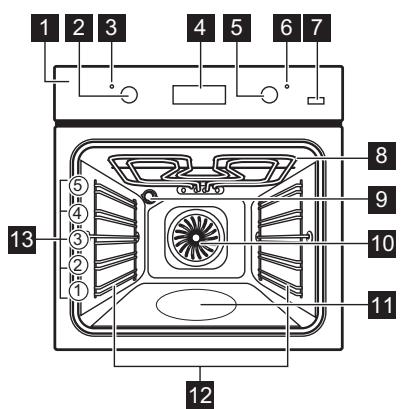
Accessories
- Wire shelf
For cookware, cake tins, roasts. - Aluminium baking tray
Before first use

WARNING!
Refer to Safety chapters.

To set the Time of day refer to "Clock functions" chapter.
- Disconnect the appliance from the mains supply.
- Cut off the mains electrical cable close to the appliance and dispose of it.
- Remove the door catch to prevent children or pets from becoming trapped in the appliance.
Service
- To repair the appliance contact an Authorised Service Centre.
- Use original spare parts only.
1 Control panel
2 Knob for the oven functions
3 Power lamp / symbol
4 Electronic programmer
5 Knob for the temperature
6 Temperature indicator / symbol
7 Plus Steam button
8 Heating element
9 Lamp
10 Fan
11 Cavity embossment
12 Shelf support, removable
13 Shelf positions
For cakes and biscuits.
- Grill- / Roasting pan
To bake and roast or as pan to collect fat.
Initial Cleaning
Remove all accessories and removable shelf supports from the appliance.

Refer to "Care and cleaning" chapter.
Clean the appliance and the accessories before first use.
Put the accessories and the removable shelf supports back to their initial position.
Preheating
Preheat the empty appliance to burn off the remaining grease.

For True Fan Cooking PLUS function refer to "Activating the True Fan Cooking PLUS function".
Daily use

WARNING!
Refer to Safety chapters.
Retractable knobs
To use the appliance, press the control knob. The control knob comes out.
Activating and deactivating the appliance

It depends on the model if your appliance has lamps, knob symbols or indicators:
- The lamp comes on when the appliance operates.
- The symbol shows whether the knob controls the oven functions or the temperature.
-
The indicator comes on when the oven heats up.
-
Set the function □ and the maximum temperature.
- Let the appliance operate for 1 hour.
- Set the function □ and set the maximum temperature.
- Let the appliance operate for 15 minutes.
- Set the function 📋, press the Plus Steam button 📋 and set the maximum temperature.
-
Let the appliance operate for 15 minutes. Accessories can become hotter than usual. The appliance can emit an odour and smoke. This is normal. Make sure that the airflow in the room is sufficient.
-
Turn the knob for the oven functions to select an oven function.
- Turn the knob for the temperature to select a temperature.
- To deactivate the appliance turn the knobs for the oven functions and temperature to the off position.
Oven functions
| Oven function | Application | |
| luned | Off position | The appliance is off. |
| dead | Light | To activate the lamp without a cooking function. |
| head | Top / Bottom Heat | To bake and roast food on one shelf position. |
 | Bottom Heat | To bake cakes with crispy bottom and to preserve food. |
 | Grilling | To grill flat food and to toast bread. |
 | Fast Grilling | To grill flat food in large quantities and to toast bread. |
 | Pizza Setting | To bake food on one shelf position for a more intensive browning and a crispy bottom. Set the temperature 20 - 40 °C lower than for Top / Bottom Heat. |
 | True Fan Cooking | To bake on up to three shelf positions at the same time and to dry food. Set the temperature 20 - 40 °C lower than for Top / Bottom Heat. |
| True Fan Cooking PLUS | To add humidity during the cooking. To get the right colour and crispy crust during baking. To give more juiciness during reheating. | |
 | Defrost | This function can be used for defrosting frozen foods, such as vegetables and fruits. The defrosting time depends on the amount and size of the frozen food. |
Activating the True Fan Cooking PLUS function
This function allows to have an improvement of humidity during the cooking.

WARNING!
Risk of burns and damage to the appliance.
Released humidity can cause burns:
- Open the appliance door with care after the True Fan Cooking PLUS function stops.

Refer to "Hints and tips" chapter.
- Open the oven door.
-
Fill the cavity embossment with tap water. The maximum capacity of the cavity embossment is 250 ml.
Fill the cavity embossment with water only when the oven is cold. -
Put food in the appliance and close the oven door.
-
Set the True Fan Cooking PLUS function:

- Press the Plus Steam button 📁. The Plus Steam button works only with the True Fan Cooking PLUS function.
The indicator comes on.
- Turn the knob for the temperature to select a temperature.

CAUTION!
Do not refill the cavity embossment with water during cooking or when the oven is hot.
- To deactivate the appliance, press the Plus Steam button 📋, turn the knobs for the oven functions and temperature to the off position.
The indicator of the Plus Steam button goes out.
- Remove water from the cavity embossment.

WARNING!
Make sure that the appliance is cool before you remove the remaining water from the cavity embossment.
Display
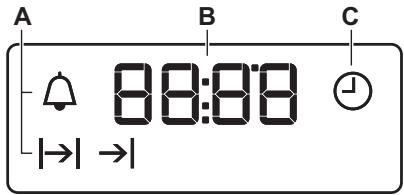
A. Function indicators
B. Time display
C. Function indicator
Buttons
| Button | Function | Description |
| — | MINUS | To set the time. |
| ➊ | CLOCK | To set a clock function. |
| + | PLUS | To set the time. |
| Plus Steam | To activate the True Fan Cooking PLUS func-tion. |
Clock functions
Clock functions table
| Clock function | Application | |
| ➊ | TIME OF DAY | To set, change or check the time of day. |
| |→| | DURATION | To set how long the appliance operates. |
| →| | END | To set when the appliance deactivates. |
| |→|→| | TIME DELAY | To combine DURATION and END function. |
| ➁ | MINUTE MINDER | To set countdown time. This function has no effect on the operation of the appliance. |
Setting and changing the time
You must set the time before you operate the oven.
The ⏻ flashes when you connect the appliance to the electrical supply, when there was a power cut or when the timer is not set.
Press the + or - to set the correct time.
After approximately five seconds, the flashing stops and the display shows the time of day you set.
To change the time of day press ⏻ again and again until ⏻ starts to flash.
Setting the DURATION
-
Set an oven function and temperature.
-
Press ① again and again until starts to flash.
- Press + or — to set the DURATION time. The display shows || .
- When the time ends, || flashes and an acoustic signal sounds. The appliance deactivates automatically.
- Press any button to stop the acoustic signal.
- Turn the knob for the oven functions and the knob for the temperature to the off position.
Setting the END
- Set an oven function and temperature.
- Press ① again and again until →| starts to flash.
- Press + or — to set the time.
The display shows →|.
- When the time ends, | flashes and an acoustic signal sounds. Press any button to stop the signal.
- Turn the knob for the oven functions and the knob for the temperature to the off position.
- The appliance deactivates automatically.
Setting the TIME DELAY
- Set an oven function and temperature.
- Press ① again and again until starts to flash.
Using the accessories
- Press + or — to set the time for DURATION.
- Press ⚠️.
- Press + or — to set the time for END.
- Press ⚠️ to confirm.
Appliance turns on automatically later on, works for the set DURATION time and stops at the set END time. At the set time an acoustic signal sounds.
- Turn the knob for the oven functions and the knob for the temperature to the off position.
- The appliance deactivates automatically.
Setting the MINUTE MINDER
- Press ⚙️ again and again until ⏱️ starts to flash.
- Press + or — to set the necessary time. The Minute Minder starts automatically after 5 seconds.
- When the set time ends, an acoustic signal sounds. Press any button to stop the acoustic signal.
- Turn the knob for the oven functions to the off position.
Cancelling the clock functions
- Press the Ⓐ again and again until the necessary function indicator starts to flash.
- Press and hold —.
The clock function goes out after some seconds.

WARNING!
Refer to Safety chapters.
Inserting the accessories
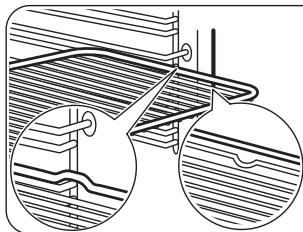
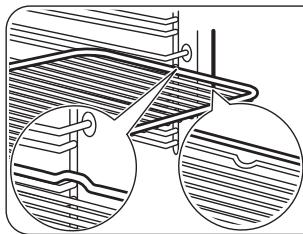
Wire shelf:
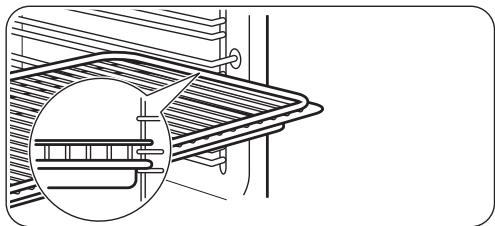
Push the shelf between the guide bars of the shelf support and make sure that the feet point down.
natural_image
Technical illustration of a mechanical assembly with two circular insets showing internal components (no text or symbols)Deep pan:
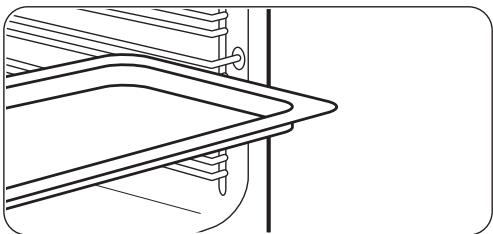
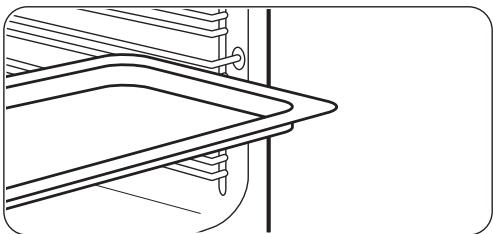
Push the deep pan between the guide bars of the shelf support.
natural_image
Pure technical line drawing of a mechanical component or bracket (no text or symbols)Wire shelf and the deep pan together:
Push the deep pan between the guide bars of the shelf support and the wire shelf on the guide bars above and make sure that the feet point down.
Additional functions
Cooling fan
When the appliance operates, the cooling fan activates automatically to keep the surfaces of the appliance cool. If you deactivate the appliance, the cooling fan can continue to operate until the appliance cools down.
Hints and tips

WARNING!
Refer to Safety chapters.

The temperature and baking times in the tables are guidelines only. They depend on the recipes and the quality and quantity of the ingredients used.
General information
- The appliance has five shelf positions. Count the shelf positions from the bottom of the appliance floor.
- The appliance has a special system which circulates the air and constantly recycles the steam. With this system you can cook in a steamy environment and keep the food soft inside and crusty outside. It decreases the cooking time and energy consumption to a minimum.
- Moisture can condense in the appliance or on the door glass panels. This is normal. Always stand back from the appliance when you open the appliance door while cooking.
natural_image
Technical line drawing of a mechanical assembly with a magnified inset showing internal components (no text or symbols)
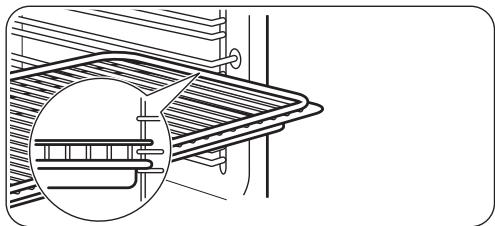
Small indentation at the top increase safety. The indentations are also anti-tip devices. The high rim around the shelf prevents cookware from slipping of the shelf.
Safety thermostat
Incorrect operation of the appliance or defective components can cause dangerous overheating. To prevent this, the oven has a safety thermostat which interrupts the power supply. The oven activates again automatically when the temperature drops.
To decrease the condensation, operate the appliance for 10 minutes before cooking.
- Clean the moisture after each use of the appliance.
- Do not put the objects directly on the appliance floor and do not put aluminium foil on the components when you cook. This can change the baking results and cause damage to the enamel.
Baking cakes
- Do not open the oven door before 3/4 of the set cooking time is up.
- If you use two baking trays at the same time, keep one empty level between them.
Cooking meat and fish
- Use a deep pan for very fatty food to prevent the oven from stains that can be permanent.
- Leave the meat for approximately 15 minutes before carving so that the juice does not seep out.
- To prevent too much smoke in the oven during roasting, add some water into the deep pan. To prevent the smoke
condensation, add water each time after it dries up.
Cooking times
Cooking times depend on the type of food, its consistency, and volume.
Initially, monitor the performance when you cook. Find the best settings (heat setting, cooking time, etc.) for your cookware, recipes and quantities when you use this appliance.
Bakery products
| Food | Water in the cavity em-bossment (ml) | Tempera-ture (°C) | Time (min) | Shelf position | Comments |
| Bread | 100 | 180 | 35 - 40 | 2 | Use baking tray.1) |
| Bread rolls | 100 | 200 | 20 - 25 | 2 | Use baking tray.1) |
| Homestyle piz-za | 100 | 230 | 10 - 20 | 2 | Use baking tray.1) |
| Focaccia | 100 | 200 - 210 | 10 - 20 | 2 | Use baking tray.1) |
| Cookies, scones, crois-sants | 100 | 150 - 180 | 10 - 20 | 2 | Use baking tray.1) |
| Plum cake, apple pie, cinnamon rolls | 100 - 150 | 160 - 180 | 30 - 60 | 2 | Use cake mould.1) |
1) Preheat in an empty oven for 5 minutes before cooking.
Cook from frozen
| Food | Water in the cavity embossment (ml) | Temperature (°C) | Time (min) | Shelf position |
| Pizza frozen | 150 | 200 - 210 | 10 - 20 | 2^1) |
| Frozen lasagna | 200 | 180 - 200 | 35 - 50 | 2^1) |
| Frozen croissant | 150 | 170 - 180 | 15 - 25 | 2^1) |
1) Preheat in an empty oven for 10 minutes before cooking.
True Fan Cooking PLUS
Before preheating fill the cavity embossment with water only when the oven is cold.
Refer to "Activating the True Fan Cooking PLUS function"
Food regeneration
| Food | Water in the cavity embossment (ml) | Temperature (°C) | Time (min) | Shelf position |
| Bread | 100 | 110 | 15 - 25 | 2 |
| Bread rolls | 100 | 110 | 10 - 20 | 2 |
| Homestyle pizza | 100 | 110 | 15 - 25 | 2 |
| Focaccia | 100 | 110 | 15 - 25 | 2 |
| Vegetables | 100 | 110 | 15 - 25 | 2 |
| Rice | 100 | 110 | 15 - 25 | 2 |
| Pasta | 100 | 110 | 15 - 25 | 2 |
| Meat | 100 | 110 | 15 - 25 | 2 |
Roasting
| Food | Water in the cavity em-bossment (ml) | Tempera-ture (°C) | Time (min) | Shelf position | Comments |
| Roast pork | 200 | 180 | 65 - 80 | 2 | Pyrex round tray |
| Roast beef | 200 | 200 | 50 - 60 | 2 | Pyrex round tray |
| Chicken | 200 | 210 | 60 - 80 | 2 | Pyrex round tray |
Baking and roasting table
1) Preheat the oven for 10 minutes.
Cakes
| Food | Top / Bottom Heat | True Fan Cooking | Time (min) | Comments | ||
| Tempera-ture (°C) | Shelf po-sition | Tempera-ture (°C) | Shelf po-sition | |||
| Whisked recipes | 170 | 2 | 160 | 3 (2 and 4) | 45 - 60 | In a cake mould |
| Shortbread dough | 170 | 2 | 160 | 3 (2 and 4) | 20 - 30 | In a cake mould |
| Buttermilk cheesecake | 170 | 1 | 165 | 2 | 60 - 80 | In a 26 cm cake mould |
| Apple cake (Apple pie) ^1) | 170 | 2 | 160 | 2 (left and right) | 80 - 100 | In two 20 cm cake moulds on a wire shelf |
| Strudel | 175 | 3 | 150 | 2 | 60 - 80 | In a baking tray |
| Jam-tart | 170 | 2 | 165 | 2 (left and right) | 30 - 40 | In a 26 cm cake mould |
| Sponge cake | 170 | 2 | 160 | 2 | 50 - 60 | In a 26 cm cake mould |
| Christmas cake / Rich fruit cake^1) | 160 | 2 | 150 | 2 | 90 - 120 | In a 20 cm cake mould |
| Plum cake^1) | 175 | 1 | 160 | 2 | 50 - 60 | In a bread tin |
| Small cakes - one level | 170 | 3 | 140 - 150 | 3 | 20 - 30 | In a baking tray |
| Small cakes - two levels | - | - | 140 - 150 | 2 and 4 | 25 - 35 | In a baking tray |
| Small cakes - three levels | - | - | 140 - 150 | 1, 3 and 5 | 30 - 45 | In a baking tray |
| Biscuits / pastry stripes - one level | 140 | 3 | 140 - 150 | 3 | 30 - 35 | In a baking tray |
| Biscuits / pastry stripes - two levels | - | - | 140 - 150 | 2 and 4 | 35 - 40 | In a baking tray |
| Biscuits / pastry stripes - three levels | - | - | 140 - 150 | 1, 3 and 5 | 35 - 45 | In a baking tray |
| Meringues - one level | 120 | 3 | 120 | 3 | 80 - 100 | In a baking tray |
| Meringues-two levels^1) | - | - | 120 | 2 and 4 | 80 - 100 | In a baking tray |
| Buns^1) | 190 | 3 | 190 | 3 | 12 - 20 | In a baking tray |
| Eclairs - one level | 190 | 3 | 170 | 3 | 25 - 35 | In a baking tray |
| Eclairs - two levels | - | - | 170 | 2 and 4 | 35 - 45 | In a baking tray |
| Plate tarts | 180 | 2 | 170 | 2 | 45 - 70 | In a 20 cm cake mould |
| Rich fruit cake | 160 | 1 | 150 | 2 | 110 - 120 | In a 24 cm cake mould |
| Victoria sandwich | 170 | 1 | 160 | 2 (left and right) | 50 - 60 | In a 20 cm cake mould |
Bread and pizza
| Food | Top / Bottom Heat | True Fan Cooking | Time (min) | Comments | ||
| Tempera-ture (°C) | Shelf po-sition | Tempera-ture (°C) | Shelf po-sition | |||
| White bread 1) | 190 | 1 | 190 | 1 | 60 - 70 | 1 - 2 pieces, 500 gr per piece |
| Rye bread | 190 | 1 | 180 | 1 | 30 - 45 | In a bread tin |
| Bread rolls 1) | 190 | 2 | 180 | 2 (2 and 4) | 25 - 40 | 6 - 8 rolls in a baking tray |
| Pizza1) | 230 - 250 | 1 | 230 - 250 | 1 | 10 - 20 | In a baking tray or a deep pan |
| Scones1) | 200 | 3 | 190 | 3 | 10 - 20 | In a baking tray |
1) Preheat the oven for 10 minutes.
1) Preheat the oven for 10 minutes.
Flans
| Food | Top / Bottom Heat | True Fan Cooking | Time (min) | Comments | ||
| Tempera-ture (°C) | Shelf po-sition | Tempera-ture (°C) | Shelf po-sition | |||
| Pasta flan | 200 | 2 | 180 | 2 | 40 - 50 | In a mould |
| Vegetable flan | 200 | 2 | 175 | 2 | 45 - 60 | In a mould |
| Quiches1) | 180 | 1 | 180 | 1 | 50 - 60 | In a mould |
| Lasagne1) | 180 - 190 | 2 | 180 - 190 | 2 | 25 - 40 | In a mould |
| Cannelloni1) | 180 - 190 | 2 | 180 - 190 | 2 | 25 - 40 | In a mould |
Meat
| Food | Top / Bottom Heat | True Fan Cooking | Time (min) | Comments | ||
| Tempera-ture (°C) | Shelf po-sition | Tempera-ture (°C) | Shelf po-sition | |||
| Beef | 200 | 2 | 190 | 2 | 50 - 70 | On a wire shelf |
| Pork | 180 | 2 | 180 | 2 | 90 - 120 | On a wire shelf |
| Veal | 190 | 2 | 175 | 2 | 90 - 120 | On a wire shelf |
| English roast beef, rare | 210 | 2 | 200 | 2 | 50 - 60 | On a wire shelf |
| English roast beef, medi-um | 210 | 2 | 200 | 2 | 60 - 70 | On a wire shelf |
| English roast beef, well done | 210 | 2 | 200 | 2 | 70 - 75 | On a wire shelf |
| Shoulder of pork | 180 | 2 | 170 | 2 | 120 - 150 | With rind |
| Shin of pork | 180 | 2 | 160 | 2 | 100 - 120 | 2 pieces |
| Lamb | 190 | 2 | 175 | 2 | 110 - 130 | Leg |
| Chicken | 220 | 2 | 200 | 2 | 70 - 85 | Whole |
| Turkey | 180 | 2 | 160 | 2 | 210 - 240 | Whole |
| Duck | 175 | 2 | 220 | 2 | 120 - 150 | Whole |
| Goose | 175 | 2 | 160 | 1 | 150 - 200 | Whole |
| Rabbit | 190 | 2 | 175 | 2 | 60 - 80 | Cut in pieces |
| Hare | 190 | 2 | 175 | 2 | 150 - 200 | Cut in pieces |
| Pheasant | 190 | 2 | 175 | 2 | 90 - 120 | Whole |
Fish
| Food | Top / Bottom Heat | True Fan Cooking | Time (min) | Comments | ||
| Tempera-ture (°C) | Shelf po-sition | Tempera-ture (°C) | Shelf po-sition | |||
| Trout / Sea bream | 190 | 2 | 175 | 2 | 40 - 55 | 3 - 4 fish |
| Tuna fish / Salmon | 190 | 2 | 175 | 2 | 35 - 60 | 4 - 6 fillets |
Grilling

Preheat the empty oven for 3 minutes before cooking.
| Food | Quantity | Temperature (°C) | Time (min) | Shelf position | ||
| Pieces | (g) | 1st side | 2nd side | |||
| Fillet steaks | 4 | 800 | max. | 12 - 15 | 12 - 14 | 4 |
| Beef steaks | 4 | 600 | max. | 10 - 12 | 6 - 8 | 4 |
| Sausages | 8 | - | max. | 12 - 15 | 10 - 12 | 4 |
| Pork chops | 4 | 600 | max. | 12 - 16 | 12 - 14 | 4 |
| Chicken (cut in 2) | 2 | 1000 | max. | 30 - 35 | 25 - 30 | 4 |
| Kebabs | 4 | - | max. | 10 - 15 | 10 - 12 | 4 |
| Breast of chicken | 4 | 400 | max. | 12 - 15 | 12 - 14 | 4 |
| Hamburger | 6 | 600 | max. | 20 - 30 | - | 4 |
| Fish fillet | 4 | 400 | max. | 12 - 14 | 10 - 12 | 4 |
| Toasted sandwiches | 4 - 6 | - | max. | 5 - 7 | - | 4 |
| Food | Quantity | Temperature (°C) | Time (min) | Shelf position | ||
| Pieces | (g) | 1st side | 2nd side | |||
| Toast | 4 - 6 | - | max. | 2 - 4 | 2 - 3 | 4 |
Defrost
| Food | Quantity (g) | Defrosting time (min) | Further defrost-ing time (min) | Comments |
| Chicken | 1000 | 100 - 140 | 20 - 30 | Place the chicken on an up-turned saucer placed on a large plate. Turn halfway through. |
| Meat | 1000 | 100 - 140 | 20 - 30 | Turn halfway through. |
| Meat | 500 | 90 - 120 | 20 - 30 | Turn halfway through. |
| Trout | 150 | 25 - 35 | 10 - 15 | - |
| Strawberries | 300 | 30 - 40 | 10 - 20 | - |
| Butter | 250 | 30 - 40 | 10 - 15 | - |
| Cream | 2 x 200 | 80 - 100 | 10 - 15 | Cream can also be whipped when still slightly frozen in places. |
| Gateau | 1400 | 60 | 60 | - |
Drying - True Fan Cooking
- Cover trays with grease proof paper or baking parchment.
- For a better result, stop the oven halfway through the drying time, open the door and
let it cool down for one night to complete the drying.
Vegetables
| Food | Temperature (°C) | Time (h) | Shelf position | |
| 1 position | 2 positions | |||
| Beans | 60 - 70 | 6 - 8 | 3 | 1 / 4 |
| Peppers | 60 - 70 | 5 - 6 | 3 | 1 / 4 |
| Vegetables for sour | 60 - 70 | 5 - 6 | 3 | 1 / 4 |
| Mushrooms | 50 - 60 | 6 - 8 | 3 | 1 / 4 |
| Herbs | 40 - 50 | 2 - 3 | 3 | 1 / 4 |
Fruit
| Food | Temperature (°C) | Time (h) | Shelf position | |
| 1 position | 2 positions | |||
| Plums | 60 - 70 | 8 - 10 | 3 | 1 / 4 |
| Apricots | 60 - 70 | 8 - 10 | 3 | 1 / 4 |
| Apple slices | 60 - 70 | 6 - 8 | 3 | 1 / 4 |
| Pears | 60 - 70 | 6 - 9 | 3 | 1 / 4 |
Care and cleaning

WARNING!
Refer to Safety chapters.
Notes on cleaning
- Clean the front of the appliance with a soft cloth with warm water and a cleaning agent.
- To clean metal surfaces, use a dedicated cleaning agent.
- Clean the appliance interior after each use. Fat accumulation or other food remains may result in a fire. The risk is higher for the grill pan.
- Clean stubborn dirt with a special oven cleaner.
- Clean all accessories after each use and let them dry. Use a soft cloth with warm water and a cleaning agent.
- If you have nonstick accessories, do not clean them using aggressive agents, sharpedged objects or a dishwasher. It can cause damage to the nonstick coating.
Stainless steel or aluminium appliances

Clean the oven door with a damp cloth or sponge only. Dry it with a soft cloth.
Do not use steel wool, acids or abrasive materials as they can damage the oven surface. Clean the oven control panel with the same precautions.
Cleaning the cavity embossment
The cleaning procedure removes limestone residue from the cavity embossment after cooking with steam.

We recommend to do the cleaning procedure at least every 5 - 10 True Fan Cooking PLUS cycles.
- Put 250 ml of white vinegar into the cavity embossment at the bottom of the oven. Use maximum 6% vinegar without herbs.
- Let the vinegar dissolve the residual limestone at the ambient temperature for 30 minutes.
- Clean the cavity with warm water and a soft cloth.
Cleaning the door gasket
- Regularly do a check of the door gasket. The door gasket is around the frame of the oven cavity. Do not use the appliance if the door gasket is damaged. Contact an Authorised Service Centre.
- To clean the door gasket, refer to the general information about cleaning.
Removing the shelf supports
To clean the oven, remove the shelf supports.
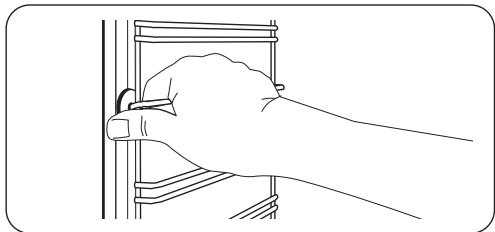
- Pull the front of the shelf support away from the side wall.
natural_image
Line drawing of a hand holding a small object near a vertical panel (no text or symbols)- Pull the rear end of the shelf support away from the side wall and remove it.
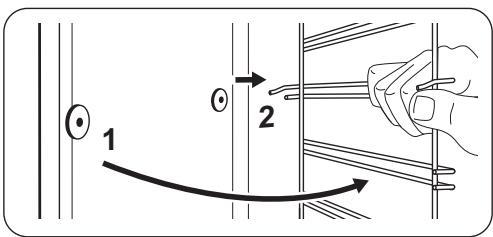
Install the shelf supports in the opposite sequence.
Aqua Cleaning
The Aqua cleaning procedure uses humidity to help remove remaining fat and food particles from the oven.
- Put 200 ml of water into the cavity embossment at the bottom of the oven.
- Set the True Fan Cooking PLUS function and press the Plus Steam button.
- Set the temperature to 90 °C.
- Let the appliance operate for 30 minutes.
- Deactivate the appliance and let it cool down.
- When the appliance is cool, clean the inside of the oven with a soft cloth.

WARNING!
Make sure that the appliance is cool before you touch it. There is a risk of burns.
Cleaning the oven door
The oven door has two glass panels. You can remove the oven door and the internal glass panel to clean it.

The oven door can close if you try to remove the internal glass panel before you remove the oven door.

CAUTION!
Do not use the appliance without the internal glass panel.
natural_image
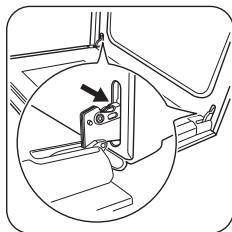
Diagram of a car interior showing a lever mechanism with an arrow indicating direction (no text or symbols present)1 Open the door fully and hold the two door hinges.
natural_image
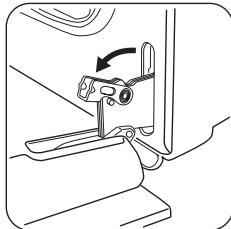
Line drawing of a mechanical clamp or bracket assembly with an arrow indicating rotation (no text or symbols)2 Lift and turn the levers on the two hinges.
natural_image
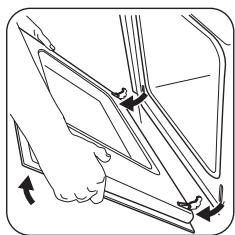
Illustration of a hand holding a folder with arrows indicating movement (no text or symbols)3 Close the oven door halfway to the first opening position. Then pull forward and remove the door from its seat.
4 Put the door on a soft cloth on a stable surface.
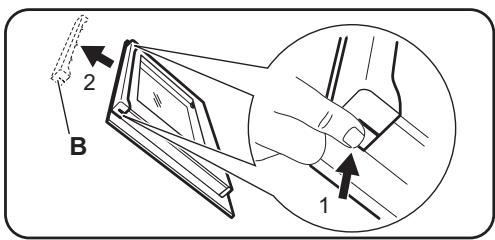
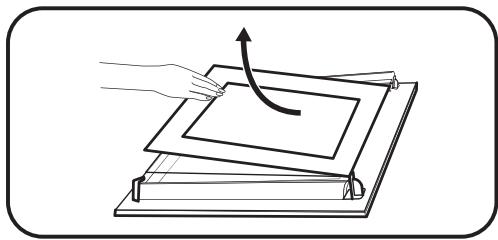
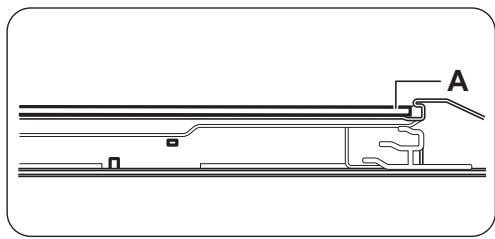
Hold the door trim (B) on the top edge of the door at the two sides and push inwards to release the clip seal. Pull the door trim to the front to remove it.
natural_image
Illustration of a hand pressing down on a tilted rectangular object with an arrow indicating motion (no text or symbols)Hold the door glass panel by its top edge and carefully pull it out. Make sure the glass slides out of the supports completely.
Clean the glass panel with water and soap. Dry the glass panel carefully.
When the cleaning is completed, install the glass panel and the oven door. Do the above steps in the opposite sequence.
The screen-printing zone must face the inner side of the door. Make sure that after the installation the surface of the glass panel frame on the screen-printing zones is not rough when you touch it.
Make sure that you install the internal glass panel in the seats correctly.
natural_image
Pure technical line drawing of a mechanical assembly without any text, numbers, or symbolsReplacing the lamp
Put a cloth on the bottom of the interior of the appliance. It prevents damage to the lamp glass cover and the cavity.
Troubleshooting

WARNING!
Danger of electrocution! Disconnect the fuse before you replace the lamp.
The lamp and the lamp glass cover can be hot.

CAUTION!
Always hold the halogen lamp with a cloth to prevent grease residue from burning on the lamp.
- Deactivate the appliance.
- Remove the fuses from the fuse box or deactivate the circuit breaker.
The back lamp
- Turn the lamp glass cover counterclockwise to remove it.
- Clean the glass cover.
- Replace the lamp with a suitable 300^ C heat-resistant lamp.
- Install the glass cover.

WARNING!
Refer to Safety chapters.
What to do if...
| Problem | Possible cause | Remedy |
| The oven does not heat up. | The oven is deactivated. | Activate the oven. |
| The oven does not heat up. | The clock is not set. | Set the clock. |
| The oven does not heat up. | The necessary settings are not set. | Make sure that the settings are correct. |
| The oven does not heat up. | The fuse is blown. | Make sure that the fuse is the cause of the malfunction. If the fuse is blown again and again, contact a qualified electrician. |
| The lamp does not operate. | The lamp is defective. | Replace the lamp. |
| Steam and condensation settle on the food and in the cavity of the oven. | You left the dish in the oven for too long. | Do not leave the dishes in the oven for longer than 15 - 20 minutes after the cooking process ends. |
| The display shows "12.00". | There was a power cut. | Reset the clock. |
| There is no good cooking performance using the True Fan Cooking PLUS function. | You did not activate the True Fan Cooking PLUS function. | Refer to "Activating the True Fan Cooking PLUS function". |
| There is no good cooking performance using the True Fan Cooking PLUS function. | You did not fill the cavity embossment with water. | Refer to "Activating the True Fan Cooking PLUS function". |
| There is no good cooking performance using the True Fan Cooking PLUS function. | You did not activate correctly the True Fan Cooking PLUS function with the Plus Steam button. | Refer to "Activating the True Fan Cooking PLUS function". |
| You want to activate the True Fan Cooking function, but the indicator of the Plus Steam button is on. | The True Fan Cooking PLUS function operates. | Push the Plus Steam button [icon] to stop the True Fan Cooking PLUS function. |
| The water in the cavity embossment does not boil. | The temperature is too low. | Set the temperature at least to 110 °C.Refer to “Hints and tips” chapter. |
| The water comes out of the cavity embossment. | There is too much water in the cavity embossment. | Deactivate the oven and make sure that the appliance is cold. Wipe the water with a cloth or sponge. Add the correct amount of water to the cavity embossment. Refer to the specific procedure. |
Service data
If you cannot find a solution to the problem yourself, contact your dealer or an Authorised Service Centre.
The necessary data for the service centre is on the rating plate. The rating plate is on the front frame of the appliance cavity. Do not remove the rating plate from the appliance cavity.
We recommend that you write the data here:
| Model (MOD.) | ...... |
| Product number (PNC) | ...... |
| Serial number (S.N.) | ...... |

WARNING!
Refer to Safety chapters.
Building In
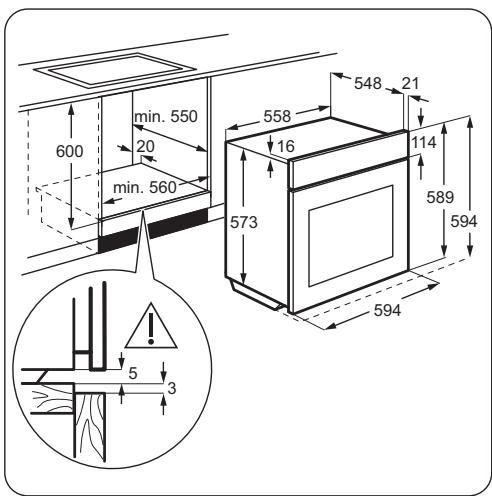

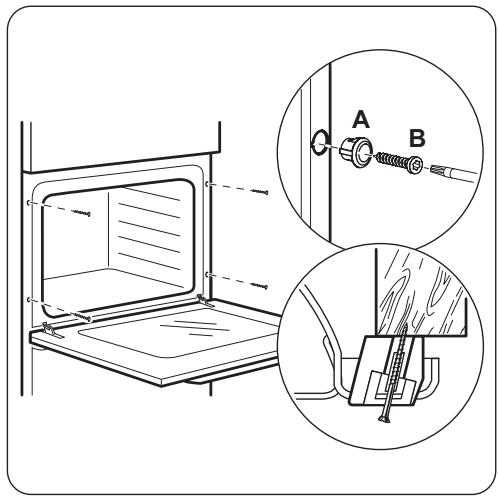
Securing the appliance to the cabinet
Electrical installation

The manufacturer is not responsible if you do not follow the safety precautions from the Safety chapters.
This appliance is supplied only with a main cable.
Cable
Cable types applicable for installation or replacement:
H07 RN-F, H05 RN-F, H05 RRF, H05 VV-F, H05 V2V2-F (T90), H05 BB-F
For the section of the cable refer to the total power on the rating plate. You can also refer to the table:
| Total power (W) | Section of the cable (mm2) |
| maximum 1380 | 3 x 0.75 |
| maximum 2300 | 3 x 1 |
| maximum 3680 | 3 x 1.5 |
The earth cord (green / yellow cable) must be 2 cm longer than phase and neutral cables (blue and brown cables).
Product Fiche and information according to EU 65-66/2014
| Supplier's name | Zanussi |
| Model identification | ZOB65802XX |
| Energy Efficiency Index | 100.0 |
| Energy efficiency class | A |
| Energy consumption with a standard load, conventional mode | 0.93 kWh/cycle |
| Energy consumption with a standard load, fan-forced mode | 0.85 kWh/cycle |
| Number of cavities | 1 |
| Heat source | Electricity |
| Volume | 72 l |
| Type of oven | Built-In Oven |
| Mass | 30.3 kg |
EN 60350-1 - Household electric cooking appliances - Part 1: Ranges, ovens, steam ovens and grills - Methods for measuring performance.
Energy saving

The appliance contains features which help you save energy during everyday cooking.
General hints
Make sure that the oven door is closed properly when the appliance operates and keep it closed as much as possible during the cooking.
Use metal dishes to improve energy saving.
When possible, do not preheat the oven before you put the food inside.
ENVIRONMENTAL CONCERNS
When the cooking duration is longer than 30 minutes, reduce the oven temperature to minimum 3 - 10 minutes before the end of the cooking time, depending on the duration of the cooking. The residual heat inside the oven will continue to cook.
Use the residual heat to warm up other dishes.
Cooking with fan
When possible, use the cooking functions with fan to save energy.
Keep food warm
Choose the lowest possible temperature setting to use residual heat and keep a meal warm.
Recycle the materials with the symbol 📋. Put the packaging in applicable containers to recycle it. Help protect the environment and human health and to recycle waste of electrical and electronic appliances. Do not dispose
appliances marked with the symbol 📄 with the household waste. Return the product to your local recycling facility or contact your municipal office.
Sicherheitshinweise____24
Sicherheitsanweisungen____25
Gerätebeschreibung.____28
Vor der ersten Inbetriebnahme ____28
Täglicher Gebrauch____29
Uhrfunktionen____31
Verwendung des Zubehörs ____32
Zusatzfunktionen____33
Tipps und Hinweise____33
Reinigung und Pflege____41
Fehlersuche_44
Montage_46
Energieeffizienz_47
Änderungen vorbehalten.
⚠ Sicherheitshinweise
Lesen Sie vor der Montage und dem Gebrauch des Geräts zuerst die Gebrauchsanleitung. Bei Verletzungen oder Schäden infolge nicht ordnungsgemäßer Montage oder Verwendung des Geräts übernimmt der Hersteller keine Haftung. Bewahren Sie die Anleitung immer an einem sicheren und zugänglichen Ort zum späteren Nachschlagen auf.
Sicherheit von Kindern und schutzbedürftigen Personen
- Das Gerät kann von Kindern ab 8 Jahren und Personen mit eingeschränkten physischen, sensorischen oder geistigen Fähigkeiten oder mit mangelnder Erfahrung und/oder mangelndem Wissen nur dann verwendet werden, wenn sie durch eine für ihre Sicherheit zuständige Person beaufsichtigt werden oder in die sichere Verwendung des Geräts eingewiesen wurden und die mit dem Gerät verbundenen Gefahren verstanden haben.
- Kinder dürfen nicht mit dem Gerät spielen.
- Halten Sie sämtliches Verpackungsmaterial von Kindern fern und entsorgen Sie es auf angemessene Weise.
- Halten Sie Kinder und Haustiere während des Betriebs oder der Abkühlphase vom Gerät fern. Berührbare Teile sind heiß.
- Falls Ihr Gerät mit einer Kindersicherung ausgestattet ist, empfehlen wir, diese einzuschalten.
- Kinder dürfen keine Reinigung und Wartung ohne Beaufsichtigung durchführen.
- Kinder bis zu 3 Jahren sind während des Betriebs unbedingt von dem Gerät fernzuhalten.
Allgemeine Sicherheit
- Die Montage des Geräts und der Austausch des Kabels muss von einer Fachkraft vorgenommen werden.
- WARNUNG: Das Gerät und die zugänglichen Geräteteile werden während des Betriebs heiß. Seien Sie vorsichtig und berühren Sie niemals die Heizelemente. Halten Sie Kinder unter 8 Jahren vom Gerät fern, wenn sie nicht ständig beaufsichtigt werden.
- Verwenden Sie zum Anfassen des Zubehörs und der Töpfe wärmeisolierende Handschuhe.
- Trennen Sie das Gerät vor Wartungsarbeiten von der Stromversorgung.
- Vergewissern Sie sich, dass das Gerät ausgeschaltet ist, bevor Sie die Lampe austauschen, um einen Stromschlag zu vermeiden.
- Reinigen Sie das Gerät nicht mit einem Dampfstrahlreiniger.
- Benutzen Sie zum Reinigen der Glastür keine scharfen Scheuermittel oder Metallschwämmchen; sie könnten die Glasfläche verkratzen und zum Zersplittern der Scheibe führen.
- Wenn das Netzkabel beschädigt ist, muss es vom Hersteller, seinem autorisierten Kundenservice oder einer gleichermaßen qualifizierten Person ausgetauscht werden, um Gefahren durch elektrischen Strom zu vermeiden.
- Ziehen Sie die Einhängegitter erst vorne und dann hinten von der Seitenwand weg und nehmen Sie sie heraus. Führen Sie zum Einsetzen der Einhängegitter die obigen Schritte in umgekehrter Reihenfolge durch.
Sicherheitsanweisungen
Montage

WARNUNG!
Nur eine qualifizierte Fachkraft darf den elektrischen Anschluss des Geräts vornehmen.
- Entfernen Sie das gesamte Verpackungsmaterial.
- Montieren Sie ein beschädigtes Gerät nicht und benutzen Sie es nicht.
- Halten Sie sich an die mitgelieferte Montageanleitung.
- Seien Sie beim Bewegen des Gerätes vorsichtig, da es sehr schwer ist. Tragen Sie
stets Sicherheitshandschuhe und festes Schuhwerk.
- Ziehen Sie das Gerät nicht am Griff.
- Die Mindestabstände zu anderen Geräten und Küchenmöbeln sind einzuhalten.
- Stellen Sie sicher, dass das Gerät unterhalb von bzw. zwischen sicheren Konstruktionen montiert wird.
- Die Seiten des Geräts dürfen nur an Geräte oder Einheiten in gleicher Höhe angrenzen.
- Das Gerät ist mit einem elektrischen Kühlsystem ausgestattet. Es muss an die Stromversorgung angeschlossen werden.
Elektrischer Anschluss

WARNUNG!
Brand- und Stromschlaggefahr.
- Alle elektrischen Anschlüsse sind von einem geprüften Elektriker vorzunehmen.
- Das Gerät muss geerdet sein.
- Stellen Sie sicher, dass die elektrischen Daten auf dem Typenschild den Daten Ihrer Stromversorgung entsprechen. Wenden Sie sich anderenfalls an eine Elektrofachkraft.
- Schließen Sie das Gerät unbedingt an eine sachgemäß installierte Schutzkontaktsteckdose an.
- Verwenden Sie keine Mehrfachsteckdosen oder Verlängerungskabel.
- Achten Sie darauf, Netzstecker und Netzkabel nicht zu beschädigen. Falls das Netzkabel des Geräts ersetzt werden muss, lassen Sie diese Arbeit durch unseren autorisierten Kundendienst durchführen.
- Achten Sie darauf, dass das Netzkabel die Gerätetür nicht berührt oder in ihre Nähe gelangt, insbesondere wenn die Tür heiß ist.
- Alle Teile, die gegen direktes Berühren schützen, sowie die isolierten Teile müssen so befestigt werden, dass sie nicht ohne Werkzeug entfernt werden können.
- Stecken Sie den Netzstecker erst nach Abschluss der Montage in die Steckdose. Stellen Sie sicher, dass der Netzstecker nach der Montage noch zugänglich ist.
- Falls die Steckdose lose ist, schließen Sie den Netzstecker nicht an.
- Ziehen Sie nicht am Netzkabel, wenn Sie das Gerät vom Netzstrom trennen möchten. Ziehen Sie stets am Netzstecker.
- Verwenden Sie nur geeignete Trenneinrichtungen: Überlastschalter, Sicherungen (Schraubsicherungen müssen
aus dem Halter entfernt werden können), Erdschlüsse, Kontakte.
- Die elektrische Installation muss eine Trenneinrichtung aufweisen, mit der Sie das Gerät allpolig von der Stromversorgung trennen können. Die Trenneinrichtung muss mit einer Kontaktöffnungsbreite von mindestens 3 mm ausgeführt sein.
- Das Gerät entspricht den EWG-Richtlinien.
Gebrauch

WARNUNG!
Verletzungs-, Verbrennungs-, Stromschlag- oder Explosionsgefahr.
- Dieses Gerät ist ausschließlich zur Verwendung im Haushalt bestimmt.
- Nehmen Sie keine technischen Änderungen am Gerät vor.
- Die Lüftungsöffnungen dürfen nicht abgedeckt werden.
- Lassen Sie das Gerät bei Betrieb nicht unbeaufsichtigt.
- Schalten Sie das Gerät nach jedem Gebrauch aus.
- Gehen Sie beim Öffnen der Tür vorsichtig vor, wenn das Gerät in Betrieb ist. Es kann heiße Luft austreten.
- Bedienen Sie das Gerät nicht mit feuchten oder nassen Händen oder wenn es mit Wasser in Kontakt gekommen ist.
- Üben Sie keinen Druck auf die geöffnete Gerätetür aus.
- Benutzen Sie das Gerät nicht als Arbeits- oder Abstellfläche.
- Öffnen Sie die Gerätetür vorsichtig. Bei der Verwendung von Zutaten, die Alkohol enthalten, kann ein Alkohol-Luftgemisch entstehen.
- Achten Sie beim Öffnen der Tür darauf, dass keine Funken oder offenen Flammen in das Geräts gelangen.
- Platzieren Sie keine entflammbaren Produkte oder Gegenstände, die mit entflammbaren Produkten benetzt sind, im Gerät, auf dem Gerät oder in der Nähe des Geräts.

WARNUNG!
Das Gerät könnte beschädigt werden.
- Um Beschädigungen und Verfärbungen der Emailbeschichtung zu vermeiden:
- Legen Sie keine Alufolie direkt auf den Boden des Geräts.
- Stellen Sie kein Wasser in das heiße Gerät.
- Lassen Sie nach dem Ausschalten des Geräts kein feuchtes Geschirr oder feuchte Speisen im Backofeninnenraum stehen.
- Gehen Sie beim Herausnehmen oder Einsetzen der Innenausstattung sorgfältig vor.
- Verfärbungen der Emailbeschichtung haben keine Auswirkung auf die Leistung des Geräts.
- Verwenden Sie für feuchte Kuchen das tiefe Blech. Fruchtsäfte können bleibende Flecken verursachen.
- Dieses Gerät ist nur zum Kochen bestimmt. Jeder andere Gebrauch ist als bestimmungsfremd anzusehen, zum Beispiel das Beheizen eines Raums.
- Die Backofentür muss bei Betrieb stets geschlossen sein.
- Ist das Gerät hinter einer Möbelfront (z.B. einer Tür) installiert, achten Sie darauf, dass die Tür während des Gerätebetriebs nicht geschlossen wird. Hinter einer geschlossenen Möbelfront können sich Hitze und Feuchtigkeit ansammeln und das Gerät, Gehäuse oder den Boden beschädigen. Schließen Sie die Möbelfront nicht, bevor das Gerät nach dem Gebrauch vollständig abgekühlt ist.
Reinigung und Pflege

WARNUNG!
Verletzungs-, Brandgefahr sowie Risiko von Schäden am Gerät.
- Schalten Sie das Gerät immer aus und ziehen Sie den Netzstecker aus der Steckdose, bevor Reinigungsarbeiten durchgeführt werden.
- Vergewissern Sie sich, dass das Gerät abgekühlt ist. Es besteht die Gefahr, dass die Glasscheiben brechen.
- Ersetzen Sie die Türglasscheiben umgehend, wenn sie beschädigt sind. Wenden Sie sich an den autorisierten Kundendienst.
-
Gehen Sie beim Aushängen der Tür vorsichtig vor. Die Tür ist schwer!
-
Reinigen Sie das Gerät regelmäßig, um eine Verschlechterung des Oberflächenmaterials zu verhindern.
- Reinigen Sie das Gerät mit einem weichen, feuchten Tuch. Verwenden Sie ausschließlich Neutralreiniger. Benutzen Sie keine Scheuermittel, scheuernde Reinigungsschwämmchen, Lösungsmittel oder Metallgegenstände.
- Falls Sie ein Backofenspray verwenden, befolgen Sie bitte unbedingt die Anweisungen auf der Verpackung.
- Reinigen Sie die katalytische Emailbeschichtung (falls vorhanden) nicht mit Reinigungsmitteln.
Backofenbeleuchtung
- Die Leuchtmittel in diesem Gerät sind nur für Haushaltsgeräte geeignet. Benutzen Sie diese nicht für die Raumbeleuchtung.

WARNUNG!
Stromschlaggefahr.
- Trennen Sie das Gerät von der Stromversorgung, bevor Sie die Lampe austauschen.
- Verwenden Sie dazu eine Lampe mit der gleichen Leistung.
Entsorgung

WARNUNG!
Verletzungs- und Erstickungsgefahr.
- Trennen Sie das Gerät von der Stromversorgung.
- Schneiden Sie das Netzkabel in der Nähe des Geräts ab, und entsorgen Sie es.
- Entfernen Sie das Türschloss, um zu verhindern, dass sich Kinder oder Haustiere im Gerät einschließen.
Service
- Wenden Sie sich zur Reparatur des Geräts an einen autorisierten Kundendienst.
- Verwenden Sie ausschließlich Originalersatzteile.
Gesamtansicht
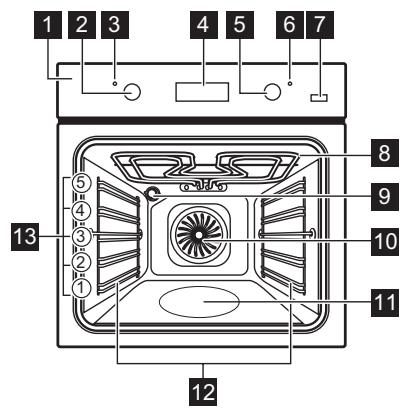
Zubehör
- Kombirost
Für Kochgeschirr, Kuchenformen, Braten. - Aluminiumbackblech
Für Kuchen und Plätzchen.
Vor der ersten Inbetriebnahme

WARNUNG!
Siehe Kapitel "Sicherheitshinweise".

Einstellen der Tageszeit siehe Kapitel „Uhrfunktionen“.
Erste Reinigung
Nehmen Sie die Zubehörteile und die herausnehmbaren Einhängegitter aus dem Gerät.

Siehe Kapitel „Reinigung und Pflege“.
Reinigen Sie das Gerät und die Zubehörteile vor der ersten Inbetriebnahme. Setzen Sie das Zubehör und die herausnehmbaren Einhängegitter wieder in ihrer ursprünglichen Position ein.
1 Bedienfeld
2 Backofen-Einstellknopf
3 Betriebskontrolllampe/-symbol
4 Elektronischer Programmspeicher
5 Temperaturwahlknopf
6 Temperaturanzeige/-symbol
7 Plus Dampf-Taste
8 Heizelement
9 Backofenbeleuchtung
10 Ventilator
11 Garraumvertiefung
12 Einhängegitter, herausnehmbar
13 Einschubebenen
- Brat- und Fettpfanne
Zum Backen und Braten oder zum Auffangen von abtropfendem Fett.
Vorheizen
Heizen Sie das leere Gerät vor, um Fettreste zu verbrennen.

Zur Funktion Heißluft mit Ringheizkörper PLUS, siehe „Einschalten der Funktion Heißluft mit Ringheizkörper PLUS“.
- Stellen Sie die Funktion □ und die Höchsttemperatur ein.
- Lassen Sie das Gerät 1 Stunde lang eingeschaltet.
- Stellen Sie die Funktion ▼ und stellen Sie die Höchsttemperatur ein.
- Lassen Sie das Gerät 15 Minuten lang eingeschaltet.
- Stellen Sie die Funktion 📋 ein, drücken Sie die Taste Plus Dampf 📋 und stellen Sie die Höchsttemperatur ein.
- Lassen Sie das Gerät 15 Minuten lang eingeschaltet.
Täglicher Gebrauch

WARNUNG!
Siehe Kapitel "Sicherheitshinweise".
Versenkbare Knöpfe
Drücken Sie zum Benutzen des Geräts auf den versenkbaren Knopf. Der Knopf kommt dann heraus.
Ein- und Ausschalten des Geräts

Je nach Modell besitzt Ihr Gerät Kontrolllampen, Knopfsymbole oder Anzeigen:
- Die Lampe leuchtet, während das Gerät in Betrieb ist.
- Das Symbol zeigt an, ob der Knopf eine Ofenfunktion oder die Temperatur regelt.
-
Die Anzeige leuchtet während der Aufheizphase des Backofens auf.
-
Drehen Sie den Backofen-Einstellknopf auf die gewünschte Ofenfunktion.
- Drehen Sie den Temperaturwahlknopf auf die gewünschte Temperatur.
- Zum Ausschalten des Geräts drehen Sie den Backofen-Einstellknopf und den Temperaturwahlknopf auf Aus.
Ofenfunktionen
| Ofenfunktion | Anwendung | |
| Gesamt | Stellung Aus | Das Gerät ist ausgeschaltet. |
| Gesamt | Backofenbeleuchtung | Einschalten der Backofenlampe, ohne dass eine Garfunktion eingeschaltet ist. |
| Gesamt | Ober-/Unterhitze | Zum Backen und Braten auf einer Ebene. |
| Gesamt | Unterhitze | Zum Backen von Kuchen mit knusprigen Böden und zum Einkochen von Lebensmitteln. |
| Gesamt | Grillstufe 1 | Zum Grillen flacher Lebensmittel und zum Toasten von Brot. |
Gesamt | Grillstufe 2Pizzastufe | Zum Grillen flacher Lebensmittel in größeren Mengen und zum Toasten von Brot.Zum Backen auf einer Ebene für Gerichte mit einer intensiveren Bräunung und einem knusprigen Boden. Stellen Sie eine 20 - 40 °C niedrigere Backofentemperatur als bei Ober-/Unterhitze ein. |
  | Heißluft mit Ringheizkörper | Zum Backen auf bis zu drei Einschubebenen und zum Dörren von Lebensmitteln.Stellen Sie eine 20 - 40 °C niedrigere Backofentemperatur als bei Ober-/Unterhitze ein. |
| Heißluft mit Ringheizkörper PLUS | Zum Hinzufügen von Feuchtigkeit beim Garen. Für die richtige Farbe und eine knusprige Kruste beim Backen. Für saftigere Speisen beim Aufwärmen. | |
| [5GYS] | Auftauen | Diese Funktion kann zum Auftauen von Tiefkühlgerichten wie z. B. Gemüse und Obst verwendet werden. Die Auftauzeit hängt ab von der Menge und Größe der Tiefkühlgerichte. |
Einschalten der Funktion Heißluft mit Ringheizkörper PLUS
Mit Hilfe dieser Funktion lässt sich die Feuchtigkeit während des Garvorgangs verbessern.

WARNUNG!
Verbrennungsgefahr sowie Risiko von Schäden am Gerät.
Wasserdampf kann Verbrennungen verursachen:
- Vorsicht beim Öffnen der Gerätetür nach dem Betrieb von Heißluft mit Ringheizkörper PLUS.

Siehe Kapitel „Tipps und Hinweise“.
- Öffnen Sie die Backofentür.
-
Füllen Sie die Garraumvertiefung mit Leitungswasser.
Die maximale Kapazität der Garraumvertiefung beträgt 250 ml. Füllen Sie die Garraumvertiefung nur bei kaltem Backofen mit Wasser. -
Stellen Sie die Speisen in das Gerät und schließen Sie die Backofentür.
-
Schalten Sie die Funktion Heißluft mit
Ringheizkörper PLUS ein: 🎨️ 🎩️.
- Drücken Sie die Taste Plus Dampf 📋. Die Taste Plus Dampf kann nur zusammen mit der Funktion Heißluft mit Ringheizkörper PLUS eingeschaltet werden.
Die Kontrolllampe leuchtet auf.
- Drehen Sie den Temperaturwahlknopf auf die gewünschte Temperatur.

VORSICHT!
Füllen Sie die Garraumvertiefung nicht wieder auf, während der Garvorgang läuft oder der Backofen heiß ist.
- Zum Ausschalten des Geräts drücken Sie die Taste Plus Dampf 📂 und drehen Sie den Backofen-Einstellknopf und den Temperaturwahlknopf auf Aus.
Die Kontrolllampe der Taste Plus Dampf erlischt.
- Entfernen Sie das Wasser aus der Garraumvertiefung.

WARNUNG!
Stellen Sie sicher, dass das Gerät abgekühlt ist, bevor Sie das verbleibende Wasser aus der Garraumvertiefung entfernen.
Display
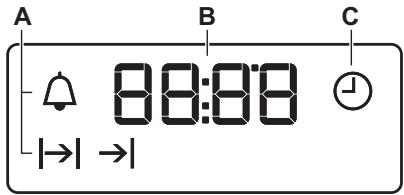
A. Funktionsanzeigen
B. Zeitanzeige
C. Funktionsanzeige
Tasten
| Taste | Funktion | Beschreibung |
| — | MINUS | Einstellen der Zeit. |
| (see) | UHR | Einstellen einer Uhrfunktion. |
| (see) | PLUS | Einstellen der Zeit. |
| (see) | Plus Dampf | Einschalten der Funktion Heißluft mit Ringheizkörper PLUS. |
Uhrfunktionen
Tabelle der Uhrfunktionen
| Uhrfunktion | Anwendung | |
 | TAGESZEIT | Einstellen, ändern oder abfragen der Tageszeit. |
| [42HB] | DAUER | Einstellen der Einschaltdauer für das Gerät. |
| [4KKY] | ENDE | Einstellen, wann das Gerät ausgeschaltet werden soll. |
| [-(4AWZ)] | ZEITVORWAHL | Kombinieren der Funktionen DAUER und ENDE. |
| [YWBC] | KURZZEIT-WECKER | Zum Einstellen einer Countdown-Zeit. Diese Funktion hat keine Auswirkung auf den Gerätebetrieb. |
Einstellen und ändernder Uhrzeit
Die Uhrzeit muss vor der Inbetriebnahme des Backofens eingestellt werden.
Die Anzeige ⏻ blinkt, wenn Sie das Gerät an die Stromversorgung anschließen, nach einem Stromausfall und wenn der Timer nicht eingestellt ist.
Stellen Sie die Uhrzeit mit + oder - ein.
Nach etwa fünf Sekunden hört die Anzeige auf zu blinken und zeigt die eingestellte Uhrzeit an. Drücken Sie zum Ändern der Uhrzeit mehrmals die Taste ①, bis ② anfängt zu blinken.
Einstellen der DAUER
- Stellen Sie eine Ofenfunktion und die Temperatur ein.
-
Drücken Sie Ⓔ wiederholt, bis |→| anfängt zu blinken.
-
Die DAUER wird mit + oder — eingestellt. Im Display erscheint |→|.
- Nach Ablauf der Zeit blinkt und es ertönt ein akustisches Signal. Das Gerät wird automatisch ausgeschaltet.
- Drücken Sie eine beliebige Taste, um das akustische Signal abzustellen.
- Drehen Sie den Backofen-Einstellknopf und den Temperaturwahlknopf auf die Aus-Position.
Einstellen von ENDE
- Stellen Sie eine Ofenfunktion und die Temperatur ein.
- Drücken Sie ⚠ wiederholt, bis →|anfängt zu blinken.
- Die Zeit wird mit + oder — eingestellt. Im Display erscheint → l.
- Nach Ablauf der Zeit blinkt → und es ertönt ein akustisches Signal. Drücken Sie eine beliebige Taste, um das Signal abzustellen.
- Drehen Sie den Backofen-Einstellknopf und den Temperaturwahlknopf auf die Aus-Position.
- Das Gerät wird automatisch ausgeschaltet.
Einstellen der ZEITVORWAHL
- Stellen Sie eine Ofenfunktion und die Temperatur ein.
- Drücken Sie ⚠ wiederholt, bis |→| anfängt zu blinken.
- Die DAUER wird mit + oder - eingestellt.
Verwendung des Zubehörs
- Drücken Sie ⚠️.
- Das ENDE wird mit + oder — eingestellt.
- Mit ⚠ bestätigen.
Das Gerät wird zu einem späteren Zeitpunkt automatisch eingeschaltet, bleibt für die eingestellte DAUER eingeschaltet und schaltet zum Zeitpunkt ENDE ab. Nach Ablauf der eingestellten Zeit ertönt ein Signalton.
- Drehen Sie den Backofen-Einstellknopf und den Temperaturwahlknopf auf die Aus-Position.
- Das Gerät wird automatisch ausgeschaltet.
Einstellen des KURZZEIT-WECKERS
- Drücken Sie ⏻ wiederholt, bis ♗ anfängt zu blinken.
- Drücken Sie + oder -, um die gewünschte Zeit einzustellen.
Der Kurzzeit-Wecker wird automatisch nach fünf Sekunden eingeschaltet.
- Nach Ablauf der eingestellten Zeit ertönt ein akustisches Signal. Drücken Sie eine beliebige Taste, um das akustische Signal abzustellen.
- Drehen Sie den Backofen-Einstellknopf in die Position Aus.
Ausschalten der Uhrfunktionen
- Drücken Sie ⚠ wiederholt, bis die Anzeige für die gewünschte Funktion blinkt.
- Halten Sie — gedrückt.
Nach einigen Sekunden wird die Uhrfunktion ausgeschaltet.

WARNUNG!
Siehe Kapitel "Sicherheitshinweise".
Einsetzen des Zubehörs
Kombirost:
Schieben Sie den Kombirost zwischen die Führungsschienen der Einhängegitter, mit den Füßen nach unten zeigend.
natural_image
Technical diagram showing two views of a mechanical assembly with hatched patterns and pipe fittings (no text or symbols)Tiefes Blech:
Schieben Sie das tiefe Blech zwischen die Führungsschienen der Einhängegitter.
natural_image
Pure technical line drawing of a mechanical component or bracket (no text or symbols)Kombirost und tiefes Blech zusammen:
Schieben Sie das tiefe Blech zwischen die Führungsschienen der Einhängegitter und den Kombirost in die Führungsschienen darüber. Achten Sie darauf, dass die Füße nach unten zeigen.
Zusatzfunktionen
Kühlgebläse
Wenn das Gerät in Betrieb ist, wird automatisch das Kühlgebläse eingeschaltet, um die Geräteflächen zu kühlen. Nach dem Abschalten des Geräts kann das Kühlgebläse weiterlaufen, bis das Gerät abgekühlt ist.
Sicherheitsthermostat
Ein unsachgemäßer Gebrauch des Geräts oder defekte Bestandteile können zu einer
Tipps und Hinweise
natural_image
Technical line drawing of a mechanical assembly with an inset magnified detail (no text or symbols)
Die kleine Einkerbung auf der Oberseite erhöht die Sicherheit. Diese Einkerbungen dienen auch als Kippsicherung. Durch den umlaufend erhöhten Rand des Rosts ist das Kochgeschirr gegen Abrutschen vom Rost gesichert.
gefährlichen Überhitzung führen. Um dies zu verhindern, ist der Backofen mit einem Sicherheitsthermostat ausgestattet, der die Stromzufuhr unterbrechen kann. Die Wiedereinschaltung des Backofens erfolgt automatisch bei Temperaturabfall.

WARNUNG!
Siehe Kapitel "Sicherheitshinweise".

Die Temperaturen und Backzeiten in den Tabellen sind nur Richtwerte. Sie sind abhängig von den Rezepten, der Qualität und der Menge der verwendeten Zutaten.
Allgemeine Informationen
- Das Gerät hat fünf Einschubebenen. Die Einschubebenen werden vom Boden des Backofens aus gezählt.
-
Das Gerät ist mit einem exklusiven Umluft- und Dampfsystem zur Regelung der Luftzirkulation und des Dampfkreislaufs ausgerüstet. Das Garen mit Dampf macht Ihre Speisen innen weich und außen knusprig. Gardauer und Energieverbrauch werden dabei auf ein Minimum reduziert.
-
Es kann sich Feuchtigkeit im Gerät oder an den Glastüren niederschlagen. Das ist normal. Stehen Sie beim Öffnen der Tür während des Betriebs stets in sicherer Entfernung zum Gerät. Um die Kondensation zu reduzieren, heizen Sie das Gerät immer 10 Minuten vor dem Garen vor.
- Wischen Sie das Gerät nach jedem Gebrauch mit einem Tuch trocken.
- Stellen Sie keine Gegenstände direkt auf den Backofenboden und bedecken Sie das Kochgeschirr nicht mit Aluminiumfolie. Dies könnte das Garergebnis beeinträchtigen und die Emailbeschichtung beschädigen.
Backen von Kuchen
- Die Backofentür nicht öffnen, bevor 3/4 der Backzeit abgelaufen ist.
- Wenn Sie zwei Backbleche gleichzeitig nutzen, lassen Sie eine Ebene dazwischen frei.
Garen von Fleisch und Fisch
- Setzen Sie beim Garen von Speisen mit hohem Fettgehalt ein tiefes Blech ein, damit keine hartnäckigen Flecken im Backofen verbleiben.
- Das Fleisch vor dem Anschneiden mindestens 15 Minuten ruhen lassen, damit der Fleischsaft nicht ausläuft.
- Um die Rauchentwicklung beim Braten zu vermindern, geben Sie etwas Wasser in das tiefe Blech. Um die Kondensierung des Rauchs zu vermeiden, geben Sie jedes Mal, wenn das Wasser verdampft ist, erneut Wasser in das tiefe Blech.
Garzeiten
Die Garzeiten hängen von der Art des Garguts, seiner Konsistenz und der Menge ab.
Beobachten Sie den Garfortschritt. Finden Sie heraus, welche Geräteeinstellungen (Garstufe, Gardauer usw.) für Ihr Kochgeschirr, Ihre Rezepte und die von Ihnen zubereiteten Garmengen am besten geeignet sind.
Heißluft mit Ringheizkörper PLUS

Füllen Sie die Garraumvertiefung nur bei kaltem Backofen und vor dem Vorheizen mit Wasser.
Siehe „Einschalten der Funktion Heißluft mit Ringheizkörper PLUS“
Backwaren
| Gargut | Wassermenge in der Vertiefung (ml) | Temperatur (°C) | Dauer (Min.) | Ebene | Bemerkungen |
| Brot | 100 | 180 | 35 - 40 | 2 | Backblech verwenden.1) |
| Brötchen | 100 | 200 | 20 - 25 | 2 | Backblech verwenden.1) |
| Hausgemachte Pizza | 100 | 230 | 10 - 20 | 2 | Backblech verwenden.1) |
| Focaccia | 100 | 200 - 210 | 10 - 20 | 2 | Backblech verwenden.1) |
| Plätzchen, Scones, Croissants | 100 | 150 - 180 | 10 - 20 | 2 | Backblech verwenden.1) |
| Pflaumenku-chen, Apfelku-chen, Zimtschnecken | 100 - 150 | 160 - 180 | 30 - 60 | 2 | Kuchenform verwenden.1) |
1) Den leeren Backofen 5 Minuten vorheizen.
Gefroren in den Backofen geben
| Gargut | Wassermenge in der Vertiefung (ml) | Temperatur (°C) | Dauer (Min.) | Ebene |
| Pizza, gefroren | 150 | 200 - 210 | 10 - 20 | 2^1) |
| Lasagne, gefroren | 200 | 180 - 200 | 35 - 50 | 2^1) |
| Croissant, gefroren | 150 | 170 - 180 | 15 - 25 | 2^1) |
1) Den leeren Backofen 10 Minuten vorheizen.
Speisen aufwärmen
| Gargut | Wassermenge in der Vertiefung (ml) | Temperatur (°C) | Dauer (Min.) | Ebene |
| Brot | 100 | 110 | 15 - 25 | 2 |
| Brötchen | 100 | 110 | 10 - 20 | 2 |
| Hausgemachte Pizza | 100 | 110 | 15 - 25 | 2 |
| Focaccia | 100 | 110 | 15 - 25 | 2 |
| Gemüse | 100 | 110 | 15 - 25 | 2 |
| Reis | 100 | 110 | 15 - 25 | 2 |
| Nudelauflauf | 100 | 110 | 15 - 25 | 2 |
| Fleisch | 100 | 110 | 15 - 25 | 2 |
Braten
| Gargut | Wassermenge in der Vertiefung (ml) | Temperatur (°C) | Dauer (Min.) | Ebene | Bemerkungen |
| Schweinebra- ten | 200 | 180 | 65 - 80 | 2 | Rundes Pyrex-Blech |
| Roastbeef | 200 | 200 | 50 - 60 | 2 | Rundes Pyrex-Blech |
| Hähnchen | 200 | 210 | 60 - 80 | 2 | Rundes Pyrex-Blech |
Back- und Brattabelle
Kuchen
1) Backofen 10 Min. vorheizen.
| Gargut | Ober-/Unterhitze | Heißluft mit Ringheizkörper | Dauer (Min.) | Bemerkungen | ||
| Temperatur (°C) | Ebene | Temperatur (°C) | Ebene | |||
| Rührteig | 170 | 2 | 160 | 3 (2 und 4) | 45 - 60 | In einer Ku-chenform |
| Mürbeteig | 170 | 2 | 160 | 3 (2 und 4) | 20 - 30 | In einer Ku-chenform |
| Buttermilch-Käsekuchen | 170 | 1 | 165 | 2 | 60 - 80 | In einer Ku-chenform (26 cm) |
| Apfelkuchen 1) | 170 | 2 | 160 | 2 (links und rechts) | 80 - 100 | 2 Kuchenfor-men (20 cm) auf dem Kombirost |
| Strudel/Stol- len | 175 | 3 | 150 | 2 | 60 - 80 | Auf dem Backblech |
| Marmela-denkuchen | 170 | 2 | 165 | 2 (links und rechts) | 30 - 40 | In einer Ku-chenform (26 cm) |
| Biskuit | 170 | 2 | 160 | 2 | 50 - 60 | In einer Ku-chenform (26 cm) |
| Stollen/ Üppiger Früchteku- chen1) | 160 | 2 | 150 | 2 | 90 - 120 | In einer Ku-chenform (20 cm) |
| Rosinenku- chen1) | 175 | 1 | 160 | 2 | 50 - 60 | In einer Brot-form |
| Kleine Ku-chen - eine Ebene | 170 | 3 | 140 - 150 | 3 | 20 - 30 | Auf dem Backblech |
| Kleine Ku-chen - zwei Ebenen | - | - | 140 - 150 | 2 und 4 | 25 - 35 | Auf dem Backblech |
| Kleine Ku-chen - drei Ebenen | - | - | 140 - 150 | 1, 3 und 5 | 30 - 45 | Auf dem Backblech |
| Plätzchen/Feingebäck - eine Ebene | 140 | 3 | 140 - 150 | 3 | 30 - 35 | Auf dem Backblech |
| Plätzchen/Feingebäck - zwei Ebenen | - | - | 140 - 150 | 2 und 4 | 35 - 40 | Auf dem Backblech |
| Plätzchen/Feingebäck - drei Ebenen | - | - | 140 - 150 | 1, 3 und 5 | 35 - 45 | Auf dem Backblech |
| Baisers – eine Ebene | 120 | 3 | 120 | 3 | 80 - 100 | Auf dem Backblech |
| Baisers – zwei Ebenen 1) | - | - | 120 | 2 und 4 | 80 - 100 | Auf dem Backblech |
| Rosinenbrötchen1) | 190 | 3 | 190 | 3 | 12 - 20 | Auf dem Backblech |
| Blätterteig – eine Ebene | 190 | 3 | 170 | 3 | 25 - 35 | Auf dem Backblech |
| Blätterteig – zwei Ebenen | - | - | 170 | 2 und 4 | 35 - 45 | Auf dem Backblech |
| Törtchen | 180 | 2 | 170 | 2 | 45 - 70 | In einer Ku-chenform (20 cm) |
| Üppiger Früchteku-chen | 160 | 1 | 150 | 2 | 110 - 120 | In einer Ku-chenform (24 cm) |
| Englischer Sandwichku-chen à la Victoria | 170 | 1 | 160 | 2 (links und rechts) | 50 - 60 | In einer Ku-chenform (20 cm) |
Brot und Pizza
| Gargut | Ober-/Unterhitze | Heißluft mit Ringheiz-körper | Dauer (Min.) | Bemerkungen | ||
| Temperatur (°C) | Ebene | Temperatur (°C) | Ebene | |||
| Weißbrot1) | 190 | 1 | 190 | 1 | 60 - 70 | 1 - 2 Stück, 500 g pro Stück |
| Roggenbrot | 190 | 1 | 180 | 1 | 30 - 45 | In einer Brot-form |
| Brötchen1) | 190 | 2 | 180 | 2 (2 und 4) | 25 - 40 | 6 - 8 Bröt-chen auf ei-nem Back-blech |
| Pizza1) | 230 - 250 | 1 | 230 - 250 | 1 | 10 - 20 | Backblech oder tiefes Blech |
| Scones1) | 200 | 3 | 190 | 3 | 10 - 20 | Auf dem Backblech |
1) Backofen 10 Min. vorheizen.
Pudding
| Gargut | Ober-/Unterhitze | Heißluft mit Ringheiz-körper | Dauer (Min.) | Bemerkungen | ||
| Temperatur (°C) | Ebene | Temperatur (°C) | Ebene | |||
| Nudelauflauf | 200 | 2 | 180 | 2 | 40 - 50 | In einer Auflaufform |
| Gemüseauflauf | 200 | 2 | 175 | 2 | 45 - 60 | In einer Auflaufform |
| Quiche1) | 180 | 1 | 180 | 1 | 50 - 60 | In einer Auflaufform |
| Lasagne1) | 180 - 190 | 2 | 180 - 190 | 2 | 25 - 40 | In einer Auflaufform |
| Cannelloni1) | 180 - 190 | 2 | 180 - 190 | 2 | 25 - 40 | In einer Auflaufform |
1) Backofen 10 Min. vorheizen.
Fleisch
| Gargut | Ober-/Unterhitze | Heißluft mit Ringheiz-körper | Dauer (Min.) | Bemerkungen | ||
| Temperatur (°C) | Ebene | Temperatur (°C) | Ebene | |||
| Rindfleisch | 200 | 2 | 190 | 2 | 50 - 70 | Kombirost |
| Schweine-fleisch | 180 | 2 | 180 | 2 | 90 - 120 | Kombirost |
| Kalb | 190 | 2 | 175 | 2 | 90 - 120 | Kombirost |
| Roastbeef, englisch | 210 | 2 | 200 | 2 | 50 - 60 | Kombirost |
| Roastbeef, medium | 210 | 2 | 200 | 2 | 60 - 70 | Kombirost |
| Roastbeef, durch | 210 | 2 | 200 | 2 | 70 - 75 | Kombirost |
| Schweine-schulter | 180 | 2 | 170 | 2 | 120 - 150 | Mit Schwarte |
| Schweinsha-xe | 180 | 2 | 160 | 2 | 100 - 120 | 2 Stück |
| Lamm | 190 | 2 | 175 | 2 | 110 - 130 | Keule |
| Hähnchen | 220 | 2 | 200 | 2 | 70 - 85 | Ganz |
| Pute | 180 | 2 | 160 | 2 | 210 - 240 | Ganz |
| Ente | 175 | 2 | 220 | 2 | 120 - 150 | Ganz |
| Gans | 175 | 2 | 160 | 1 | 150 - 200 | Ganz |
| Hasenbraten | 190 | 2 | 175 | 2 | 60 - 80 | Zerlegt |
| Hase | 190 | 2 | 175 | 2 | 150 - 200 | Zerlegt |
| Fasan | 190 | 2 | 175 | 2 | 90 - 120 | Ganz |
Fisch
| Gargut | Ober-/Unterhitze | Heißluft mit Ringheiz-körper | Dauer (Min.) | Bemerkungen | ||
| Temperatur (°C) | Ebene | Temperatur (°C) | Ebene | |||
| Forelle/Seebrasse | 190 | 2 | 175 | 2 | 40 - 55 | 3 - 4 Fische |
| Thunfisch/Lachs | 190 | 2 | 175 | 2 | 35 - 60 | 4 - 6 Filets |
Grillstufe 1

Leeren Backofen 3 Minuten vorheizen.
| Gargut | Menge | Temperatur (°C) | Dauer (Min.) | Ebene | ||
| Stück | (g) | Erste Seite | Zweite Seite | |||
| Filetsteaks | 4 | 800 | max. | 12 - 15 | 12 - 14 | 4 |
| Beefsteaks | 4 | 600 | max. | 10 - 12 | 6 - 8 | 4 |
| Grillwürste | 8 | - | max. | 12 - 15 | 10 - 12 | 4 |
| Schweinskotelett | 4 | 600 | max. | 12 - 16 | 12 - 14 | 4 |
| Hähnchen, 2 halbe | 2 | 1000 | max. | 30 - 35 | 25 - 30 | 4 |
| Spieße | 4 | - | max. | 10 - 15 | 10 - 12 | 4 |
| Hähnchen-brustfilet | 4 | 400 | max. | 12 - 15 | 12 - 14 | 4 |
| Hamburger | 6 | 600 | max. | 20 - 30 | - | 4 |
| Fischfilet | 4 | 400 | max. | 12 - 14 | 10 - 12 | 4 |
| Belegte Toastbrote | 4 - 6 | - | max. | 5 - 7 | - | 4 |
| Toast | 4 - 6 | - | max. | 2 - 4 | 2 - 3 | 4 |
Auftauen
| Gargut | Menge (g) | Auftauzeit (Min.) | Zusätzliche Auftauzeit (Min.) | Bemerkungen |
| Hähnchen | 1000 | 100 - 140 | 20 - 30 | Legen Sie zunächst eine umgedrehte Untertasse auf einen großen Teller, und legen Sie dann das Hähnchen darauf. Nach der Hälfte der Zeit wenden. |
| Fleisch | 1000 | 100 - 140 | 20 - 30 | Nach der Hälfte der Zeit wenden. |
| Fleisch | 500 | 90 - 120 | 20 - 30 | Nach der Hälfte der Zeit wenden. |
| Forelle | 150 | 25 - 35 | 10 - 15 | - |
| Erdbeeren | 300 | 30 - 40 | 10 - 20 | - |
| Butter | 250 | 30 - 40 | 10 - 15 | - |
| Sahne | 2 x 200 | 80 - 100 | 10 - 15 | Sahne lässt sich auch mit noch leicht gefrorenen Stellen gut aufschlagen. |
| Kuchen | 1400 | 60 | 60 | - |
Dörren - Heißluft mit Ringheizkörper
- Verwenden Sie mit Butterbrot- oder Backpapier belegte Bleche.
- Sie erzielen ein besseres Ergebnis, wenn Sie nach halber Dörrzeit den Backofen
ausschalten, öffnen und am besten über Nacht auskühlen lassen.
Gemüse
| Gargut | Temperatur (°C) | Dauer (Std.) | Ebene | |
| 1 Ebene | 2 Ebenen | |||
| Bohnen | 60 - 70 | 6 - 8 | 3 | 1 / 4 |
| Paprika | 60 - 70 | 5 - 6 | 3 | 1 / 4 |
| Suppengemüse | 60 - 70 | 5 - 6 | 3 | 1 / 4 |
| Pilze | 50 - 60 | 6 - 8 | 3 | 1 / 4 |
| Kräuter | 40 - 50 | 2 - 3 | 3 | 1 / 4 |
Obst
| Gargut | Temperatur (°C) | Dauer (Std.) | Ebene | |
| 1 Ebene | 2 Ebenen | |||
| Pflaumen | 60 - 70 | 8 - 10 | 3 | 1 / 4 |
| Aprikosen | 60 - 70 | 8 - 10 | 3 | 1 / 4 |
| Apfelscheiben | 60 - 70 | 6 - 8 | 3 | 1 / 4 |
| Birnen | 60 - 70 | 6 - 9 | 3 | 1 / 4 |
Reinigung und Pflege

WARNUNG!
Siehe Kapitel "Sicherheitshinweise".
Hinweise zur Reinigung
- Feuchten Sie ein weiches Tuch mit warmem Wasser und etwas Reinigungsmittel an, und
reinigen Sie damit die Vorderseite des Geräts.
- Reinigen Sie die Metalloberflächen mit einem geeigneten Reinigungsmittel.
- Reinigen Sie den Geräteinnenraum nach jedem Gebrauch. Fettansammlungen und Speisereste könnten einen Brand verursachen. Bei der Brat- und Fettpfanne ist das Risiko besonders hoch.
- Entfernen Sie hartnäckige Verschmutzungen mit speziellen Backofenreinigern.
- Reinigen Sie alle Zubehörteile nach jedem Gebrauch und lassen Sie sie trocknen. Feuchten Sie ein weiches Tuch mit warmem Wasser und etwas Reinigungsmittel an.
- Zubehörteile mit Antihaftbeschichtung dürfen nicht mit aggressiven Reinigungsmitteln, scharfkantigen Gegenständen oder im Geschirrspüler gereinigt werden. Andernfalls kann die Antihaftbeschichtung beschädigt werden.
Geräte mit Edelstahl- oder Aluminiumfront:

Reinigen Sie die Backofentür nur mit einem feuchten Tuch oder Schwamm und trocknen Sie sie mit einem weichen Tuch ab. Verwenden Sie keine Stahlwolle, Säuren oder Scheuermittel, da diese die Oberflächen beschädigen können. Reinigen Sie das Bedienfeld auf gleiche Weise.
Reinigen der Garraumvertiefung
Der Reinigungsvorgang entfernt Kalkrückstände aus der Vertiefung im Boden nach dem Garvorgang mit Dampf.

Wir empfehlen einen Reinigungsvorgang nach 5 - 10 Garvorgängen mit Heißluft mit Ringheizkörper PLUS.
-
Geben Sie 250 ml Weißweinessig in die Garraumvertiefung im Boden des Backofens.
Benutzen Sie einen höchstens 6 %-igen Weißweinessig ohne Kräuter. -
Lassen Sie den Weißweinessig bei Umgebungstemperatur 30 Minuten lang verdampfen, damit die Kalkrückstände entfernt werden.
-
Reinigen Sie die Vertiefung mit warmem Wasser und einem weichen Tuch.
Reinigen der Türdichtung
- Die Türdichtung muss regelmäßig überprüft werden. Die Türdichtung ist im Rahmen des Garraums angebracht. Nehmen Sie das Gerät nicht in Betrieb, wenn die Türdichtung beschädigt ist. Wenden Sie sich an den Kundendienst.
- Lesen Sie in den allgemeinen Informationen zur Reinigung nach, was bei der Reinigung der Türdichtung beachtet werden muss.
Entfernen der Einhängegitter
Entfernen Sie zur Reinigung des Backofens die Einhängegitter.
- Ziehen Sie das Einhängegitter vorne von der Seitenwand weg.
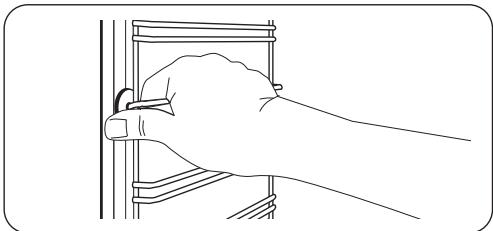
natural_image
Line drawing of a hand holding a small object, no text or symbols present- Ziehen Sie das Einhängegitter hinten von der Seitenwand weg und nehmen Sie es heraus.
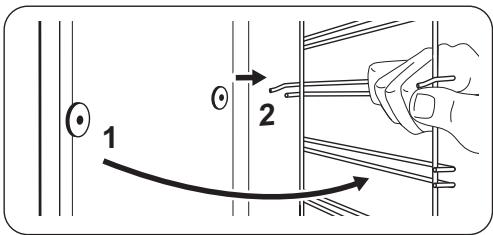
Führen Sie zum Einsetzen der Einhängegitter die obigen Schritte in umgekehrter Reihenfolge durch.
Aqua-Reinigungsfunktion
Bei der Aqua-Reinigungsfunktion werden mithilfe von Feuchtigkeit Fett- und Speisereste aus dem Backofen entfernt.
-
Geben Sie 200 ml Wasser in die Garraumvertiefung im Boden des Backofens.
-
Stellen Sie die Funktion Heißluft mit Ringheizkörper PLUS 🎨 ein und drücken Sie die Taste Plus Dampf 🎨.
- Stellen Sie die Temperatur auf 90 °C ein.
- Lassen Sie das Gerät 30 Minuten lang eingeschaltet.
- Schalten Sie das Gerät aus und lassen Sie es abkühlen.
- Wenn das Gerät abgekühlt ist, reinigen Sie den Innenraum des Backofens mit einem weichen Tuch.

WARNUNG!
Stellen Sie sicher, dass das Gerät abgekühlt ist, bevor Sie es anfassen. Es besteht Verbrennungsgefahr.
Reinigen der Backofentür
Die Backofentür hat zwei Glasscheiben. Die Backofentür und die innere Glasscheibe können zur Reinigung ausgebaut werden.

Beachten Sie, dass die Backofentür zuklappen kann, wenn Sie versuchen, die innere Glasscheibe abzunehmen, solange die Tür noch am Gerät montiert ist.

VORSICHT!
Verwenden Sie das Gerät nicht ohne die innere Glasscheibe.
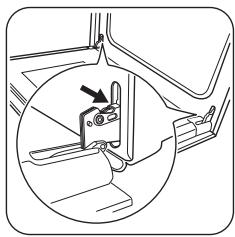
natural_image
Diagram of a car interior showing a hand valve mechanism inside a vehicle (no text or labels)1 Klappen Sie die Backofentür ganz auf und greifen Sie an die beiden Türscharniere.
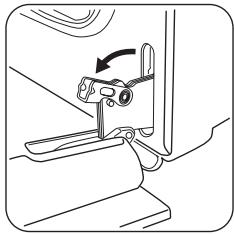
natural_image
Diagram of a mechanical clamp or bracket assembly with an arrow indicating rotation (no text or symbols present)2 Heben Sie die Hebel der beiden Scharniere an, und klappen Sie sie nach vorn.
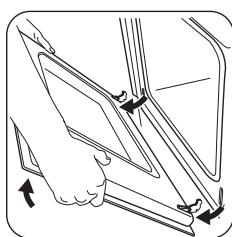
natural_image
Illustration of a hand holding a folder with arrows indicating movement (no text or symbols)4 Legen Sie die Backofentür auf ein weiches Tuch auf einer stabilen Fläche.
3 Schließen Sie die Backofentür halb bis zur ersten Raststellung. Anschließend ziehen Sie sie nach vorn aus der Halterung heraus.
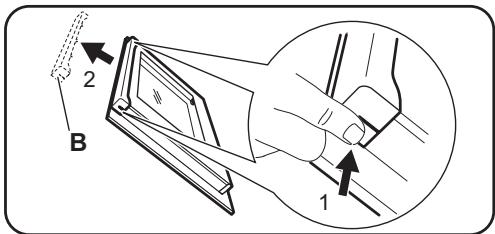
Fassen Sie die Türabdeckung (B) an der Oberkante der Tür an beiden Seiten an. Drücken Sie sie nach innen, um den Schnappverschluss zu lösen. Ziehen Sie die Türabdeckung nach vorne, um sie abzunehmen.
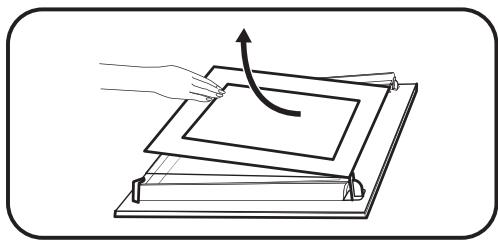
natural_image
Diagram of a hand pressing down on a tilted rectangular object with an arrow indicating rotation (no text or symbols)Halten Sie die Oberkante der Türglasscheibe fest und ziehen Sie vorsichtig heraus. Achten Sie darauf, dass die Glasscheiben vollständig aus den Halterungen gezogen werden.
Reinigen Sie die Glasscheibe mit Wasser und Spülmittel. Trocknen Sie die Glasscheibe sorgfältig ab.
Nach der Reinigung müssen die Glasscheibe und die Backofentür wieder eingebaut werden. Führen Sie die oben aufgeführten Schritte in umgekehrter Reihenfolge durch.
Der bedruckte Bereich muss zur Innenseite der Tür zeigen. Vergewissern Sie sich nach der Montage, dass sich der Glasscheibenrahmen an den bedruckten Bereichen nicht rau anfühlt.
Achten Sie darauf, die innere Glasscheibe richtig in die Aufnahmen einzusetzen..
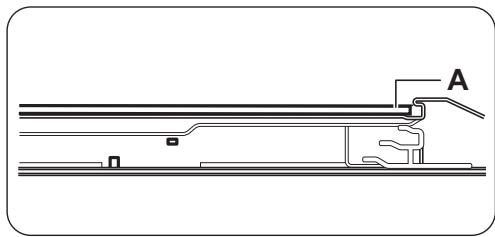
natural_image
Pure technical diagram of a mechanical assembly with no text, numbers, or symbolsAustauschen der Lampe
Legen Sie ein Tuch unten in den Garraum des Geräts. Auf diese Weise schützen Sie die Glasabdeckung der Backofenlampe und den Innenraum des Backofens.

WARNUNG!
Stromschlaggefahr! Schalten Sie die Sicherung aus, bevor Sie die Lampe austauschen.
Die Lampe und die Glasabdeckung der Lampe können heiß werden.
Fehlersuche

WARNUNG!
Siehe Kapitel "Sicherheitshinweise".
Was tun, wenn ...
| Störung | Mögliche Ursache | Abhilfe |
| Der Backofen heizt nicht. | Der Backofen ist ausgeschaltet. | Schalten Sie den Backofen ein. |
| Der Backofen heizt nicht. | Die Uhr ist nicht eingestellt. | Stellen Sie die Uhr ein. |
| Der Backofen heizt nicht. | Die erforderlichen Einstellungen wurden nicht vorgenommen. | Vergewissern Sie sich, dass die Einstellungen korrekt sind. |
| Der Backofen heizt nicht. | Die Sicherung ist durchgebrannt. | Vergewissern Sie sich, dass die Sicherung der Grund für die Störung ist. Brennt die Sicherung wiederholt durch, wenden Sie sich an eine zugelassene Elektrofachkraft. |

VORSICHT!
Halogenlampen immer mit einem Tuch anfassen, um ein Einbrennen von Fett (Fingerabdrücken) zu vermeiden.
- Schalten Sie das Gerät aus.
- Entfernen Sie die Sicherungen aus dem Sicherungskasten, oder schalten Sie den Schutzschalter aus.
Rückwandlampe
- Drehen Sie die Glasabdeckung der Lampe gegen den Uhrzeigersinn, und nehmen Sie sie ab.
- Reinigen Sie die Glasabdeckung.
- Ersetzen Sie die Lampe durch eine geeignete, bis 300 °C hitzebeständige Lampe.
- Bringen Sie die Glasabdeckung wieder an.
| Störung | Mögliche Ursache | Abhilfe |
| Die Lampe funktioniert nicht. | Die Lampe ist defekt. | Tauschen Sie die Lampe aus. |
| Dampf und Kondenswasser schlagen sich auf den Speisen und im Garraum nieder. | Die Speisen standen zu lange im Backofen. | Lassen Sie die Speisen nach Beendigung des Gar- oder Backvorgangs nicht länger als 15 - 20 Minuten im Backofen stehen. |
| Das Display zeigt „12.00“ an. | Es gab einen Stromausfall. | Stellen Sie die Uhrzeit neu ein. |
| Bei Heißluft mit Ringheizkörper PLUS ist die Garleistung nicht zufriedenstellend. | Sie haben die Funktion Heißluft mit Ringheizkörper PLUS nicht eingeschaltet. | Siehe „Einschalten der Funktion Heißluft mit Ringheizkörper PLUS“. |
| Bei Heißluft mit Ringheizkörper PLUS ist die Garleistung nicht zufriedenstellend. | Sie haben die Garraumvertiefung nicht mit Wasser gefüllt. | Siehe „Einschalten der Funktion Heißluft mit Ringheizkörper PLUS“. |
| Bei Heißluft mit Ringheizkörper PLUS ist die Garleistung nicht zufriedenstellend. | Sie haben die Funktion Heißluft mit Ringheizkörper PLUS nicht richtig mit der Taste Plus Dampf eingeschaltet. | Siehe „Einschalten der Funktion Heißluft mit Ringheizkörper PLUS“. |
| Sie möchten die Funktion Heißluft mit Ringheizkörper einschalten, aber die Kontrolllampe der Taste Plus Dampf leuchtet. | Die Funktion Heißluft mit Ringheizkörper PLUS ist in Betrieb. | Drücken Sie die Taste Plus Dampf um die Funktion Heißluft mit Ringheizkörper PLUS auszuschalten. |
| Das Wasser in der Garraumver-tiefung kocht nicht. | Die Temperatur ist zu niedrig. | Stellen Sie die Temperatur auf mindestens 110 °C ein. Siehe Kapitel „Tipps und Hinweise“. |
| Das Wasser tritt aus der Gar-raumvertiefung aus. | Es befindet sich zu viel Wasser in der Garraumvertiefung. | Schalten Sie den Backofen aus und achten Sie darauf, dass das Gerät abgekühlt ist. Nehmen Sie das Wasser mit einem Schwamm oder Tuch auf. Füllen Sie die korrekte Wassermenge in die Gar-raumvertiefung. Siehe entsprechenden Vorgang. |
Servicedaten
Wenn Sie das Problem nicht selbst lösen können, wenden Sie sich an den Händler oder einen autorisierten Kundendienst.
Die vom Kundendienst benötigten Daten finden Sie auf dem Typenschild. Das Typenschild
befindet sich am Frontrahmen des Garraums. Entfernen Sie das Typenschild nicht vom Garraum.
Wir empfehlen, hier folgende Daten zu notieren:
| Modell (MOD.) | ...... |
| Produktnummer (PNC) | ...... |
| Seriennummer (S.N.) | ...... |
Montage

WARNUNG!
Siehe Kapitel "Sicherheitshinweise".
Montage
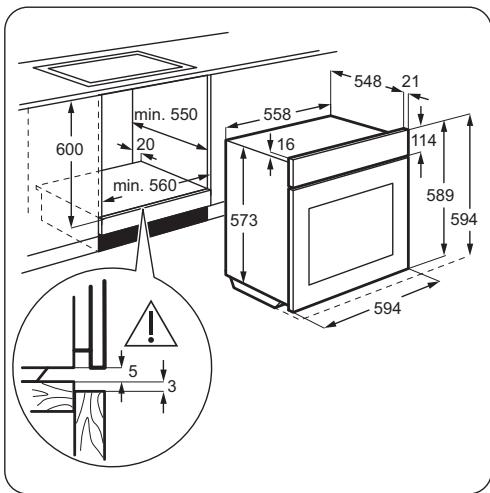
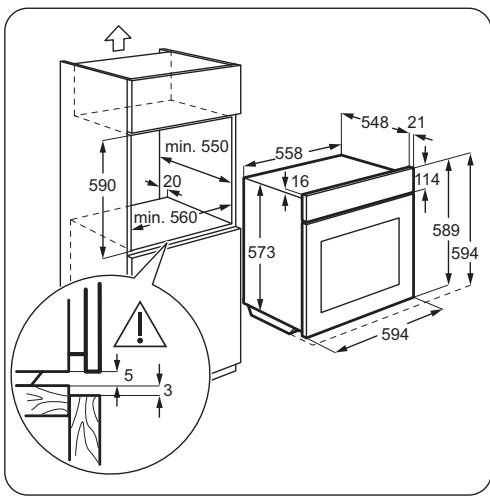
Befestigung des Geräts im Möbel
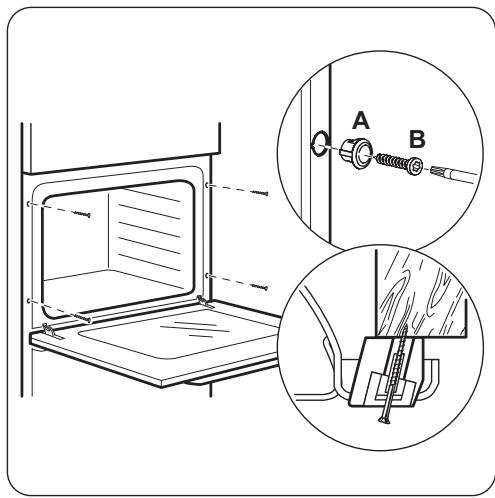
Elektrischer Anschluss

Der Hersteller haftet nicht für
Schäden, die aufgrund der
Nichtbeachtung der in den
Sicherheitshinweisen beschriebenen
Sicherheitsvorkehrungen entstehen.
Das Gerät wird nur mit einem Netzkabel geliefert.
Kabel
Einsetzbare Kabeltypen für Montage oder Austausch:
H07 RN-F, H05 RN-F, H05 RRF, H05 VV-F, H05 V2V2-F (T90), H05 BB-F
Näheres zum Kabelquerschnitt siehe Gesamtleistung auf dem Typenschild. Weitere Informationen finden Sie in der Tabelle:
| Gesamtleistung (W) | Kabelquerschnitt (mm2) |
| maximal 1380 | 3 x 0.75 |
| maximal 2300 | 3 x 1 |
| maximal 3680 | 3 x 1.5 |
Energieeffizienz
Die Erdleitung (gelb/grünes Kabel) muss 2 cm länger sein als die Phasenleitung und der Nullleiter (blaues und braunes Kabel).

Produktdatenblatt und Informationen gemäß EU 65-66/2014
| Herstellername | Zanussi |
| Modellidentifikation | ZOB65802XX |
| Energieeffizienzindex | 100.0 |
| Energieeffizienzklasse | A |
| Energieverbrauch bei Standardbeladung, Ober-/Unterhitze | 0.93 kWh/Programm |
| Energieverbrauch bei Standardbeladung, Heißluft | 0.85 kWh/Programm |
| Anzahl der Garräume | 1 |
| Wärmequelle | Strom |
| Fassungsvermögen | 72 l |
| Backofentyp | Einbau-Backofen |
| Gewicht | 30.3 kg |
EN 60350-1 - Elektrische Kochgeräte für den Hausgebrauch - Teil 1: Herde, Backöfen, Dampfgarer und Grillgeräte - Verfahren zur Messung der Gebrauchseigenschaften.
Energie sparen

Das Gerät verfügt über Funktionen, mit deren Hilfe Sie beim täglichen Kochen Energie sparen können.
Allgemeine Tipps
Achten Sie darauf, dass die Backofentür während des Betriebs vollständig geschlossen ist, und öffnen Sie sie nicht öfter als erforderlich.
Verwenden Sie Kochgeschirr aus Metall, um mehr Energie zu sparen.
Heizen Sie, wenn möglich, den Backofen nicht vor, bevor Sie die Speisen hineingeben.
Beträgt die Garzeit mehr als 30 Minuten, reduzieren Sie die Ofentemperatur je nach Gardauer 3 - 10 Minuten vor Ablauf des Garvorgangs auf die Mindesttemperatur. Durch die Restwärme des Backofens werden die Speisen weiter gegart.
Nutzen Sie die Restwärme, um andere Speisen aufzuwärmen.
Garen mit Heißluft
Nutzen Sie, wenn möglich, die Garfunktionen mit Heißluft, um Energie zu sparen.
Warmhalten von Speisen
Wählen Sie die niedrigste Temperatureinstellung, wenn Sie die Restwärme zum Warmhalten von Speisen nutzen möchten.
Recyceln Sie Materialien mit dem Symbol 📊. Entsorgen Sie die Verpackung in den entsprechenden Recyclingbehältern. Recyceln Sie zum Umwelt- und Gesundheitsschutz elektrische und elektronische Geräte. Entsorgen
Sie Geräte mit diesem Symbol ✉ nicht mit dem Hausmüll. Bringen Sie das Gerät zu Ihrer örtlichen Sammelstelle oder wenden Sie sich an Ihr Gemeindeamt.

www.zanussi.com/shop


CE
- USER MANUAL
- ⚠ Safety information
- Children and vulnerable people safety
- General Safety
- Safety instructions
- Installation
- WARNING!
- Electrical connection
- Use
- Care and cleaning
- Internal light
- Disposal
- Product description
- General overview
- Accessories
- Before first use
- Service
- Initial Cleaning
- Preheating
- Daily use
- Retractable knobs
- Activating and deactivating the appliance
- It depends on the model if your appliance has lamps, knob symbols or indicators:
- Activating the True Fan Cooking PLUS function
- CAUTION!
- Display
- Clock functions
- Setting and changing the time
- Setting the DURATION
- Setting the END
- Setting the TIME DELAY
- Using the accessories
- Setting the MINUTE MINDER
- Cancelling the clock functions
- Inserting the accessories
- Additional functions
- Cooling fan
- Hints and tips
- General information
- Safety thermostat
- Baking cakes
- Cooking meat and fish
- Cooking times
- True Fan Cooking PLUS
- Baking and roasting table
- Grilling
- Drying - True Fan Cooking
- Notes on cleaning
- Stainless steel or aluminium appliances
- Cleaning the cavity embossment
- Cleaning the door gasket
- Removing the shelf supports
- Aqua Cleaning
- Cleaning the oven door
- Replacing the lamp
- Troubleshooting
- The back lamp
- Service data
- Electrical installation
- Cable
- Energy saving
- General hints
- ENVIRONMENTAL CONCERNS
- Cooking with fan
- Keep food warm
- ⚠ Sicherheitshinweise
- Sicherheit von Kindern und schutzbedürftigen Personen
- Allgemeine Sicherheit
- Sicherheitsanweisungen
- Montage
- WARNUNG!
- Elektrischer Anschluss
- Gebrauch
- Reinigung und Pflege
- Backofenbeleuchtung
- Entsorgung
- Zubehör
- Vor der ersten Inbetriebnahme
- Erste Reinigung
- - Brat- und Fettpfanne
- Vorheizen
- Täglicher Gebrauch
- Versenkbare Knöpfe
- Ein- und Ausschalten des Geräts
- Je nach Modell besitzt Ihr Gerät Kontrolllampen, Knopfsymbole oder Anzeigen:
- Einschalten der Funktion Heißluft mit Ringheizkörper PLUS
- VORSICHT!
- Uhrfunktionen
- Einstellen und ändernder Uhrzeit
- Einstellen der DAUER
- Einstellen von ENDE
- Einstellen der ZEITVORWAHL
- Verwendung des Zubehörs
- Einstellen des KURZZEIT-WECKERS
- Ausschalten der Uhrfunktionen
- Einsetzen des Zubehörs
- Zusatzfunktionen
- Kühlgebläse
- Sicherheitsthermostat
- Tipps und Hinweise
- Allgemeine Informationen
- Backen von Kuchen
- Garen von Fleisch und Fisch
- Garzeiten
- Heißluft mit Ringheizkörper PLUS
- Back- und Brattabelle
- Grillstufe 1
- Dörren - Heißluft mit Ringheizkörper
- Hinweise zur Reinigung
- Geräte mit Edelstahl- oder Aluminiumfront:
- Reinigen der Garraumvertiefung
- Reinigen der Türdichtung
- Entfernen der Einhängegitter
- Aqua-Reinigungsfunktion
- Reinigen der Backofentür
- Austauschen der Lampe
- Fehlersuche
- Rückwandlampe
- Servicedaten
- Kabel
- Energieeffizienz
- Energie sparen
- Allgemeine Tipps
- Garen mit Heißluft
- Warmhalten von Speisen
- www.zanussi.com/shop
Marque : ZANUSSI
Modèle : ZOB65802XK
Catégorie : Four encastrable