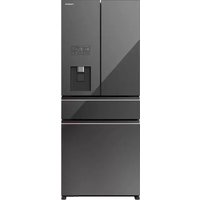
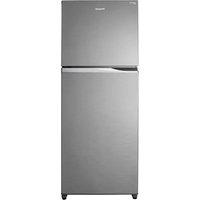
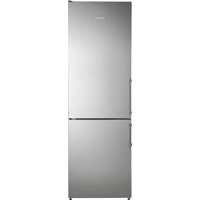
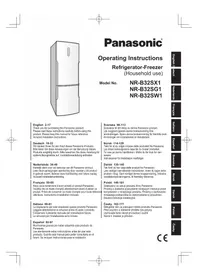
NR-BC40MSAS - Réfrigérateur PANASONIC - Notice d'utilisation et mode d'emploi gratuit
Retrouvez gratuitement la notice de l'appareil NR-BC40MSAS PANASONIC au format PDF.


| Type de produit | Réfrigérateur combiné |
| Capacité totale | 400 litres |
| Dimensions approximatives | H 186 cm x L 60 cm x P 65 cm |
| Poids | 75 kg |
| Classe énergétique | A++ |
| Alimentation électrique | 220-240 V, 50 Hz |
| Consommation énergétique annuelle | 250 kWh |
| Fonctions principales | Réfrigération, congélation, contrôle de la température |
| Système de refroidissement | Froid ventilé |
| Entretien et nettoyage | Nettoyage régulier des surfaces intérieures et extérieures, dégivrage si nécessaire |
| Pièces détachées et réparabilité | Disponibilité des pièces détachées auprès des revendeurs agréés |
| Sécurité | Protection contre les surcharges électriques, système de verrouillage de porte |
| Compatibilités | Compatible avec les accessoires Panasonic |
| Garantie | 2 ans |
FOIRE AUX QUESTIONS - NR-BC40MSAS PANASONIC
Questions des utilisateurs sur NR-BC40MSAS PANASONIC
0 question sur cet appareil. Repondez a celles que vous connaissez ou posez la votre.
Poser une nouvelle question sur cet appareil
Téléchargez la notice de votre Réfrigérateur au format PDF gratuitement ! Retrouvez votre notice NR-BC40MSAS - PANASONIC et reprennez votre appareil électronique en main. Sur cette page sont publiés tous les documents nécessaires à l'utilisation de votre appareil NR-BC40MSAS de la marque PANASONIC.
MODE D'EMPLOI NR-BC40MSAS PANASONIC
Panasonic®
Operating Instructions
Refrigerator-Freezer
(Household use)
Model No. NR-BC40SSX1
Thank you for purchasing the Panasonic product
CONTENTS
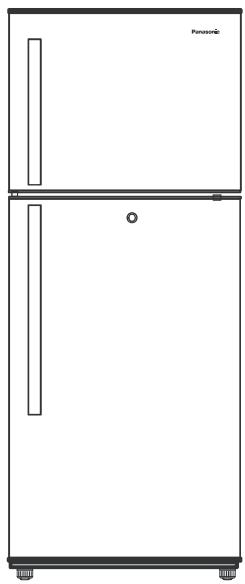
* Picture is only for illustration
Introduction
Installation
Operation
Appendix
Caring for the environment 2
. Safety instructions 2
Choosing the right location 5
- Door Handle Install Instructions. 6
- Parts and their functions 7
Introduction of Function. 8
- Refrigerator compartment. 10
How to make ice. 10
Do and Don'ts 11
- When moving or transporting the refrigerator.12
- Cleaning and maintenance 13
- Cleaning 13
- Changing the Internal Light. 14
- When Shutting off the refrigerator 14
Troubleshooting 15
- Specifications 16
-
This appliance is intended to be used in household and similar applications such as
-
staff kitchen areas in shops, offices and other working environments;
- farm houses and by clients in hotels, motels and other residential type environments;
- bed and breakfast type environments;
-
catering and similar non-retail applications.
-
Please read these instructions carefully and follow safety precautions before using this product.
- Please keep product purchase documents like invoice copy with this operating instructions manual for warranty claim purpose.
Customer Care No.: 1800 103 1333 , 1800 108 1333 ( Toll Free)
E-mail : helpline@in.panasonic.com
Caring for the environment
Disposing of the packaging

Please recycle where possible (e.g. cardboard, plastic bags, adhesive tape and polystyrene) and make sure you dispose of all other packing materials safely.
Keep the packaging out of the reach of babies and young children, to avoid injury or suffocation.
Before disposing of your old appliance
Please follow either the disposal instructions from the manufacturer of the old appliance, or local disposal regulations for the appliance. Where this is not available, please follow the three step instructions below.
- Remove the plug from the socket.
- Cut the supply cord off, and safely dispose of it with the mains plug still attached.
-
Until the old appliance is collected, or you take it to a Recycling Centre, make sure it's out the reach of small children.
-
Remove all sealing materials from the door and leave all the shelves and drawers in place. This way, children are less likely to climb in and become trapped.
Safety instructions
| Do not | Indicates the appliance must be earthed to prevent electric shock |
| Make sure you do this | Do not take apart |
Indicates risk of death or serious injury.
This appliance is not intended for use by persons (including children) with reduced physical, sensory or mental capabilities, or lack of experience and knowledge, unless they have been given supervision or instruction concerning use of the appliance by a person responsible for their safety. Children should be supervised to ensure that they do not play with the appliance.

Make sure the supply cord and plug are not squashed or damaged.
- A damaged power plug or cord can cause short-circuit, fire or electric shock.
- If the supply cord is damaged, it must be replaced by the manufacturer, its service agent or similarly qualified persons in order to avoid a hazard.
DO NOT ATTEMPT TO REPLACE IT YOURSELF.

Do not use a multiple socket adaptor and plug several appliances into the same socket adaptor.
- This can cause overheating, fire or short circuit.
Do not pinch, knot, or bend the supply cord, or place heavy objects on it.
- This increases the risk of fire or electric shock. If the supply cord or plug of the appliance is damaged, it must be replaced by the manufacturer, its service agent or similarly qualified person in order to avoid a hazard.
Do not unplug the refrigerator by pulling on the supply cord.
- This can damage to the supply cord. Always grip the plug and pull firmly from the socket.
Do not place any water container on the top of the refrigerator.
- Water can damage insulation of electrical components and cause short circuit, fire or electric shock.
Do not spray inflammable gas near the refrigerator.
- This can cause explosion or fire.
Do not spray water onto or into the refrigerator.
- This can cause fire or electric shock.
Do not touch the power plug with wet hands.
- This can cause electric shock.
Do not install the refrigerator in a damp place, or where it may come into contact with water.
- Deteriorated insulation of electrical parts can cause short circuit, electric shock or fire.
Do not store volatile or flammable substances in the refrigerator.
- Flammable substances such as benzene, thinners, alcohol, ether and Liquid Petroleum Gas (LPG) can cause explosions.
Do not store pharmaceuticals or other temperature-sensitive products in the refrigerator.
- You should not store products that require strict temperature controls in the refrigerator.
Do not let children climb, swing or hang on the refrigerator door.
- This can cause serious injury, as well as damaging the refrigerator.
Do not operate the refrigerator in the presence of explosive fumes or flammable gas.
- This can cause explosion or fire.
Do not store petrol or other flammable liquids and vapours in the refrigerator, or use them near the appliance.
- This can cause explosion or fire.

Do not try to disassemble, repair or modify the refrigerator yourself.
- You may injure yourself – or others – with burns or electric shock, or damage the refrigerator. If your appliance needs alterations or repair, please consult authorized service centre.

Ensure that the refrigerator is plugged into an earthed mains socket. DO NOT plug into an unearthed mains socket.

Remove any dirt or dust from the plug's pins before connecting to the power supply.
- Dust build-up on the plug can cause insulation failure, especially in humid conditions. This can cause short circuit, fire or electric shock. Unplug the supply cord and wipe it with a dry cloth. Never use a wet or damp cloth.
Plug your appliance into the socket, making sure the connection is secure.
- A loosely connected power plug can cause fire or electric shock.
Unplug the refrigerator before cleaning and servicing.
- Failure to do this can cause electric shock.
If you smell burning or see smoke coming from the refrigerator, disconnect the power immediately and please consult authorized service centre.
LED RADIATION
DO NOT VIEW DIRECTLY WITH OPTICAL INSTRUMENTS CLASS 1M LED PRODUCT
Indicates risk of injury or damage to property.

Do not put glass bottles or containers in the freezer.
- When the contents freeze, the glass may break.
Do not touch the inside walls of the freezer or items stored in the freezer with wet hands.
- Your skin can become frozen onto the interior wall, or items stored in the freezer.

If there's a power cut, avoid opening the refrigerator frequently or putting unchilled food in it.
- This can cause the temperature in the refrigerator to rise and spoil food stored inside and can cause problem to health.
If you're not going to use the refrigerator for a long time, unplug it from the mains.
Also, be careful of the gap between the fridge and freezer doors, especially if they are both open at the same time.
- This may cause personal injury.
When opening the refrigerator, be careful not to pinch your fingers at the "pinch point" Areas (Gasket side).
- This can cause personal injury.
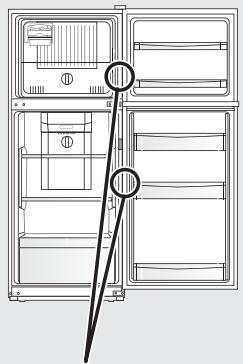
Potential pinch point (Gasket side)
- Picture is only for illustration
Choosing the right location
Install the refrigerator in a location which satisfies the following criteria:
- Where the refrigerator will not be exposed to direct sunlight
- Where the refrigerator will be at a distance from heating appliances, cooking appliances and other sources of heat
- A location which is well-ventilated and dry
- Where the floor is sturdy and level
Place a solid board underneath if the refrigerator is to be installed on top of a carpet or vinyl floor. The board will protect the floor from becoming deformed and discoloured.
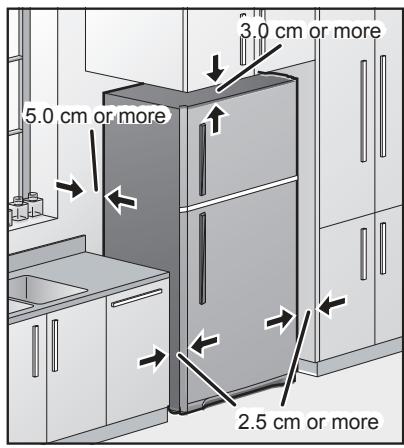
Provide clearance to allow heat to dissipate
Residual heat is always being emitted from the refrigerator while it is operating.
Provide sufficient clearance around the refrigerator to allow this heat to dissipate so that its cooling ability is not impaired.
Dimensions -NR-BC40* (cm) : L 69.6 x B 73.5 x H 171.2 (With Door)
Dimensions -NR-BC40* (cm) : L 69.0 x B 61.5 x H 171.2 (Without Door)
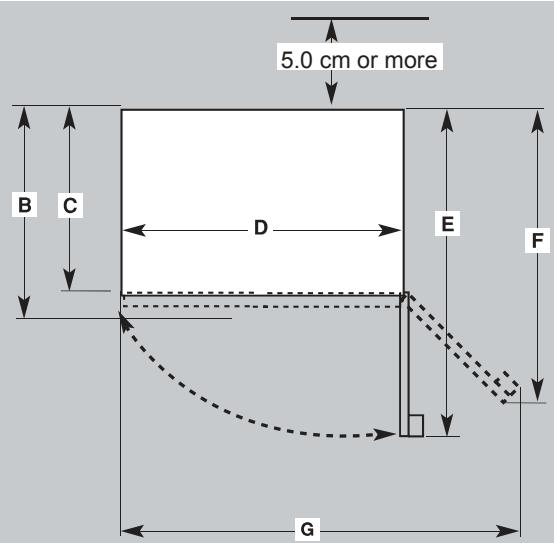
| Location | Depth w/handle B | Depth C | Cab. width D | Depth doors open 90° E | Depth open door stopper F | Width w/ handle open door stopper G |
| Size NR-BC40* | 73.5 | 61. | 69. | 128. | 115. | 118.0 |
NOTE: All dimensions in cm (if not specified)
Door Handle Installation Instruction
Note: Figures in the user manual are only for reference. The actual product may differ slightly. The refrigerator must be disconnected from the source of electrical supply before attempting the installation of accessory.
| 1 Take out the two crisscross-screw from the poly-bag provided inside the refrigerator, and install them into the door holes, turn the screws till to the bottom. | 2 Mount the handle in suitable direction (see marking on the handle). |
| ① ① | ② ② |
| 3 Tighten the screws at the side of the handle with the help of key provided in the bag. | 4 Cover the screw with the cap provided in the bag. |
| ③ ③ | ④ ④ |
Note : Follow similar steps for freezer door also. Standard Accessories: Crisscross Screw : 4 nos.
Crisscross Screw Cap : 4 nos. Special Key : 1 no.
Parts and their functions
Interior and foods stored
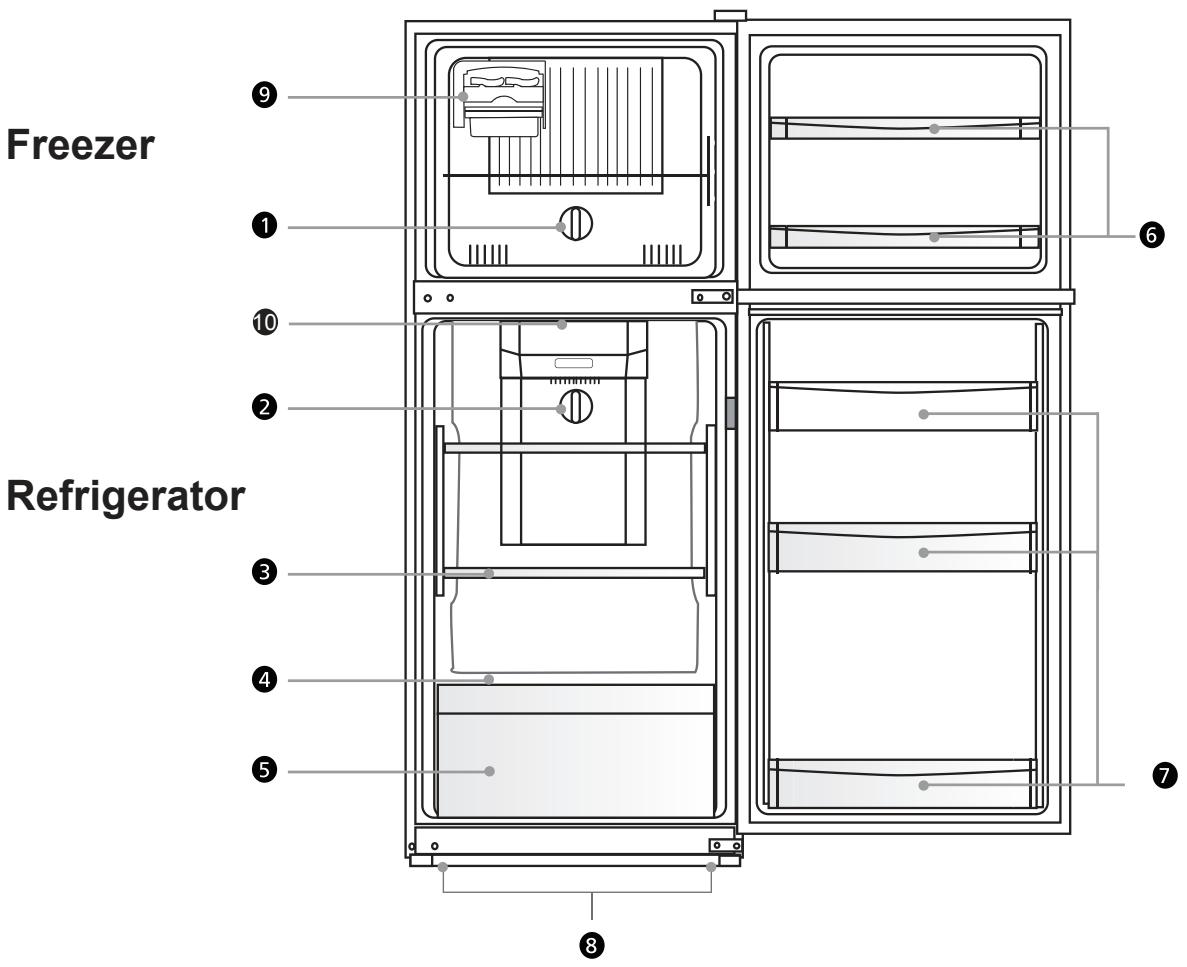
- Temperature Control Dial
- Temperature Control Panel
- Adjustable Shelves
- Vegetable Case Cover
- Vegetable Case
- Freezer Door Rack
- Refrigerator Door Rack
- Levelling Feet
- Ice Tray
- LED
Introduction of Function
Switching On Your Unit
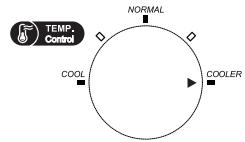
| Control setting | Freezer | Refrigerator |
| Under normal use, we recommend the food freezer and fresh-food storage knob is used to adjust the temperature in the “NORMAL”. | TEMP, Control COLD COLDER | NORMAL TEMP, Control COOL COOLER |
| When ambient temperature around the refrigerator is below 10℃ for a long time or fast freeze is needed, we recommend food freezer knob is adjusted to the “right zone” position, and the fresh-food storage knob is adjusted to the “COOLER”. | TEMP, Control COLD COLDER | NORMAL TEMP, Control COOL COOLER |
When ambient temperature around the refrigerator is above 43^ for a long time or fast cooling is needed, it is recommended the food freezer knob is adjusted to the "left zone", and the fresh-food storage knob is adjusted to the "COOLER".
Tips: When fresh-food storage knob is adjusted to the right zone (as shown in figure on the right), fast cooling is realized, but adjusting to this position for a long time, the fresh-food storage temperatures may be lower than 0^ .
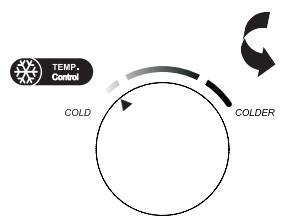
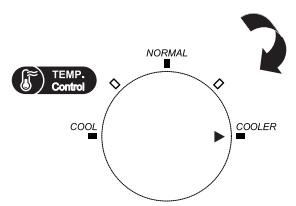
Tips: When the frozen compartment air shutter is placed in COLD position, the fresh compartment can be rapidly cooled, but if being placed in COLD position for a long time, the temperature inside fresh compartment may be reduced to below 0^ .
Introduction of Function
Tips for Keeping Food in the Unit
Cooked meats/fishes should always be stored on a shelf above raw meats/fishes to avoid bacterial transfer. Keep raw meats/fishes in a container which is large enough to collect juices and cover it properly. Place the container on the lowest shelf.
Leave space around your food, to allow air to circulate inside the unit. Ensure all parts of the unit are kept cool.
To prevent transfer of favours and drying out, pack or cover the food separately. Fruit and vegetables do not need to be wrapped.
Always let pre-cooked food cool down before you put in the unit. This will help to maintain the internal temperature of the unit.
To prevent cold air escaping from the unit, try to limit the number of mes you open the door. We recommend that you only open the door when you need to put food in or take food out.
Food storage tips
| Freezer | Frozen foods, meats, fish, ice cream, etc. | |
| Fridge | Butter, dairy products, eggs, drinks, seasonings, cooked foods, etc. | |
| Meats, fish, ham, sausages, etc. | ||
| Vegetables, fruits, etc. stored at low temperatures | ||
| Vegetables, fruits, etc. |
Refrigerator compartment
Put the food which are short-term storage or to eat at any time in the refrigerator compartment.
Although regulating temperature will enable average temperature of the majority preservation of food. Therefore, refrigerator compartment only use as a short-term food storage.
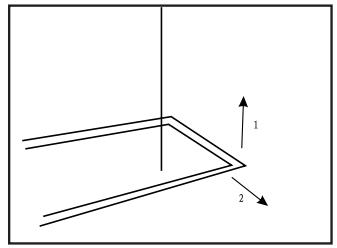
- Adjustment of adjustable shelves
According to the needs of food storage, you can adjust the shelf to proper position; To facilitate the use of it or adjustment the location, the shelf can be set to slip so that you can use and adjust it easily. when you want to clear the shelf, please move the shelf by the direction(1), pull out the shelf by the direction(2).
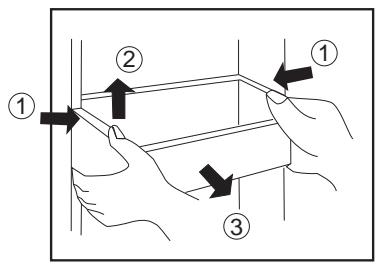
- Height adjustment and cleaning of rack.
Push the rack by the direction ① from both side, lift the rack by the direction ② and then pull it out by the direction ③ After cleaning to install the rack by the opposite direction. You can aslo adjust the position according to the height of stored food.
How to make ice
- Gently pull out the ice tray and fill the ice tray with water to the water level line. Then carefully replace the ice tray horizontally.
- When the ice cubes are ready, twist the tray as shown in the image
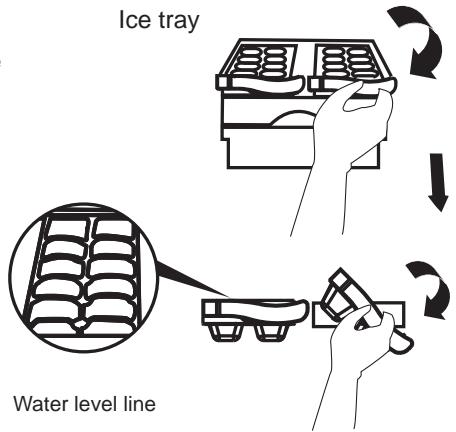
* Picture is only for illustration
Notes:
- In order to make ice cubes quickly, set the freezer to the lowest temperature, or turn the knob to colder setting. This will make the temperature of the freezer lower.
- Do not over-fill with water. It may become difficult to remove the ice cubes from ice tray and any trickle of water into the ice box will make the ice cubes freeze together.
Do and Don'ts
- The refrigerator use alternating current supply which is 220 - 240V / 50Hz . If the voltage, fluctuations is large (Over the scope of 198 - 264V ), it may cause some failures, such as the refrigerator does not start, The main control board and compressor bum and the compressor works with abnormal voice. etc. At this time you must install an automatic voltage regulator which is above 1000W for use. The refrigerator power's cord with a threeplug (grounding)complies with the standard three-socket (grounding). Don't cut off or remove the third pin of the power cord under any circumstances. After the refrigerator is installed, Plugs should be able to reach to facilitate use. the power Plug must be firmly contacted with the socket, otherwise it might cause fire.
- Do not grasp and drag the power cord to pull out the refrigerator plugs. Hold the plug firmly, and pull out the plug from the socket directly. Do not let power lines are pinned by the refrigerator or trampled by people. Be careful when the refrigerator will be removed from walls. Do not roll or damage power lines, Do not use power lines and plugs When they were damaged or worn out. Go to the service center which the factory assigns to replace power lines if they were worn out or damaged.
- When inflammable gas is leaked, such as coal gas, close the gas valve, Open the doors and windows, Do not pull out or plug in plugs of the refrigerator and other appliances.
- Do not store explosive substances such as aerosol cans with a flammable propellant in this appliance.
- Do not use flammable solvent near refrigerator, so as to avoid fire.
- To ensure safety, do not place power outlets, voltage regulated power supply, microwave ovens and other appliances on refrigerator table. Do not use other ppliances in refrigerator(except recommended models), In order to avoid electromagnetic interference and other accidents.
- Do not let children go into the refrigerator or climb up the refrigerator. In order to avoid the children are closed in it or the refrigerator falls to hurt children.
- After the refrigerator is running, Do not touch the icy surface of the freezer with hands, particularly hands are wet, It may cause frostbite.
- The gap between door and door and the gap between door and refrigerator body are very narrow. Be careful not to stretch hands into these areas to prevent fingers from injuring. Do not let the children near the refrigerator when open and close the doors.
- Do not spray and rinse the refrigerator with water and do not install the refrigerator in the wet place or the place which water or rain splashes so as not to affect the electrical insulation of the refrigerator.
- Never dismantle refrigerator personally, never transform refrigerator and damage cooling pipes. Maintenance of refrigerator must be carried out by professionals.
- Do not put bottled of beer, drinks in the freezer. It may freeze the contents to break the bottle.
- Pull out the plug when power failure or cleaning. Wait for 5 minutes or longer when reconnecting the plug. It may damage the compressor due to continuous start.
- Before you dispose your old refrigerator, take off the door, remove the door seals and the shelves place the door and rack in the right position so as to avoid the children climb inside to cause accidents.
- This product is for household refrigerator, according to the regulation of government standard Household refrigerators are only for food storage not for other uses, such as storage of blood, drugs and biological products.
When moving or transporting the refrigerator
- Before moving or transporting the refrigerator
Remove all the food and ice inside the refrigerator, and disconnect the power plug.
1 Raise the levelling feet, and pull the refrigerator toward the front.
2 Drain off the water from the bottom of the rear panel. (as shown in the figure).
Place a towel or napkin on the floor and then tilt the refrigerator towards the rear to drain the water from the back side of the refrigerator.
Note:
- Wipe the wet floor first before moving refrigerator to prevent slippage.
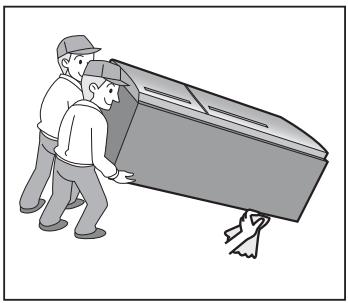
- Moving or transporting the refrigerator
The refrigerator must be transported by at least four persons.
Each person takes hold of the refrigerator at one of its four corners.
- Do not take hold of the doors.
- Tape the doors completely shut so that they will not open.
- Do not hold by handles while moving, lifting or transporting the refrigerator.
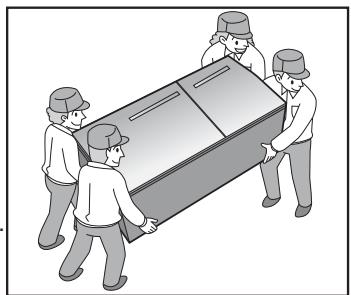
Note:
- Bear in mind that water remaining inside the refrigerator may spill out.
Cleaning and maintenance
Conduct periodic cleaning and maintenance to ensure that the refrigerator will be kept clean and that it will continue to operate for a long time to come.
Before cleaning or conducting maintenance, be absolutely sure to disconnect the power plug from the power outlet. Do not connect or disconnect the power plug with wet hands. Doing so may result in an electric shock or injury.
Do not use the following items for cleaning:
- Alkaline cleaning agents (these may dissolve the plastic parts)
- Abrasive cleaners, soap powders, very hot or boiling water, brushes, acids, benzene, paint thinners, alcohol, etc. (these may mar the surfaces, paint and plastic parts)
Cleaning
Wipe off easily removable dirt using a cloth dipped in lukewarm water.
Wipe off stubborn dirt using a cloth dipped in some diluted neutral detergent used in the kitchen.
Then take up the remaining detergent using a cloth dipped in lukewarm water.
To complete the cleaning, be absolutely sure to wipe the surfaces dry to take up the remaining moisture.
Do not use cleaning agents (containing abrasive cleaners, or chemical mixture), and wipe off food stains, seasoning or dirt on the door as soon as possible.
- Interior, door rack , adjustable shelf and vegetable case
Be absolutely sure to wipe off edible oils, butter and other types of fats and oils on the plastic parts.
Otherwise, the plastic parts may be damaged. The door rack, adjustable shelf and vegetable case can be removed. If they are very dirty or smelly, remove and wash them.
- Door opening seal
A dirty or damaged seal will allow the cold air inside to escape.
As soon as the seal becomes dirty, wipe off the dirt immediately.
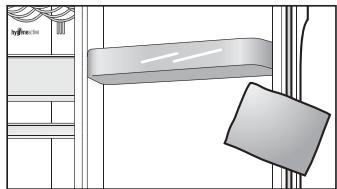
- Exterior of refrigerator
If the exterior becomes dirty, wipe off the dirt. Also, allowing dust to accumulate on the power plug can cause a fire. At periodic intervals, remove the dust using a dry cloth, etc.
Control panel
Wipe the panel using a soft cloth which has been dipped in lukewarm water and then wrung out.
The control panel is made from delicate materials.
As such, take care not to damage its surface.
Note:
Do not wash the door rack, adjustable shelf and vegetable case, or other parts in a dishwasher. Doing so will cause the gilt on the parts or their plating to peel off or the parts to be damaged.
Cleaning and maintenance
Changing the Internal Light
CAUTION Setting the refrigerator control to off does not remove power to the light circuit. CAUTION: Light source may be hot.
LED parameter: 2 W
1) Unplug the refrigerator.
2) The LED is located at the top of the compartment near the opening.
3) Replace with an appliance LED of the same or lower wattage.
4) Plug the refrigerator back in.
If lamp or lamp cover is damaged or if anything appears questionable, contact your dealer or an authorized service centre. Do not attempt to repair, replace or disassemble any damaged parts, etc. yourself.
Care When Handling / Moving Your Unit
Hold the unit around its sides or base when moving it. Under no circumstances should it be lifted by holding the edges of the top surface. Confirm leveling of feet after moving.
Servicing
The Unit should be serviced by an authorized Engineer only and genuine parts should be used. Repair carried out by inexperienced person or by customer may cause injury or serious malfunction.
Switching off for Long Periods of Time
When the unit is not in use for a long period of time, disconnect it from the mains supply, empty all food and clean the appliance, leaving the door ajar to prevent from unpleasant smells.
When Shutting off the refrigerator
- When Power failure
You Should minimize the frequency of opening the door, and it is not appropriate to add to fresh foods in the refrigerator.
- When discarding the refrigerator
Before you throw away your old refrigerator, make sure take off the doors, so as to avoid the children climb inside to cause accidents.
Troubleshooting
The following simple symptom can be handled by customer.

Notes:
The refrigerator enclosure may emit heat during operation specially in summer, this is caused by the radiation of the condenser, and it is a normal phenomenon.
Condensation: condensation phenomenon will be detected on the exterior surface and door seals of the freezer when the ambient humidity is high, this is a normal phenomenon, and the condensation can be wiped away with a dry towel.
Buzz: Buzz will be generated by running compressor specially when starting up or shutting down.
For more information, please contact the Panasonic authorized service center or your retailer from where you purchased this product.
Tips for Energy Saving
- Install the refrigerator in a dry, cool and well-ventilated location. The colder the ambient temperature, the better the efficiency. (Please refer to Page 5 for dimensions and clearance)
-
The combination of door rack and adjustable shelf that result in the largest in volume and the most efficient use of energy for the refrigerator.
-
Remove the ice tray & ice box and adjustable shelf in the freezer.
-
All door racks and adjustable shelves are in the same position as shown under section "Parts and their functions".
-
Do not over fill the refrigerator to allow the air to circulate.
- Open the doors only when necessary and as briefly as possible.
- Occasionally clean the ventilation openings at the bottom of the refrigerator with a vacuum cleaner, etc.
(Take care not to damage the refrigerant pipe at the back of refrigerator)
Specifications
| MODEL | NR-BC40SSX1 |
| COLOR | SS |
| FREEZER STAR RATING | *** |
| TOTAL GROSS VOLUME | 400 L |
| TOTAL STORAGE VOLUME | 374 L |
| STORAGE FRIDGE VOLUME | 282 L |
| STORAGE FREEZER VOLUME | 92 L |
| PRODUCT DIMENSIONS (L x B x H) | 69.6 x 73.5 x 171.2 cm |
| NET WEIGHT | 68 kg |
| RATED VOLTAGE | 220-240 V ~ |
| RATED FREQUENCY | 50 Hz |
| REFRIGERANT | R600 a |
| BLOWING AGENT | Cyclopentane |
*This refrigerator's volume is calculated based on ISO 15502.
[India only]
Declaration of Conformity with the requirements of the E - Waste (Management) Rules-2016
The Product is in conformity with the requirements of the reduction of hazardous substances of the E-Waste Rules-2016
The content of hazardous substance with the exemption of the applications listed in SCHEDULE II of the E-Waste Rules-2016
- Lead (Pb) – not over 0.1% by weight;
- Cadmium (Cd) – not over 0.01% by weight;
- Mercury (Hg) – not over 0.1% by weight;
- Hexavalent chromium (Cr^6+) – not over 0.1% by weight;
- Polybrominated biphenyls (PBBs) – not over 0.1% by weight;
- Polybrominated diphenyl ethers (PBDEs) – not over 0.1% by weight.
![PANASONIC NR-BC40MSAS - [India only] - 1](/content/2024/12/211280/images/4b718efa93623b0e1c3cd987bbde701a5677342a29c6b3dc48546476aa7842f8.jpg)
For the purpose of recycling to facilitate effective utilization of resources, please return this product to a nearby authorized collection center, registered dismantler or recycler, or Panasonic service center when disposing of this product.
Customer care number ( Toll free ) : 1800 103 1333
1800 108 1333
Please see the Panasonic website for further information on collection centers,etc. or call the customer care toll-free number
http://www.panasonic.com/in/corporate/sustainability/panasonic-india-i-recycle-program.html
![PANASONIC NR-BC40MSAS - [India only] - 2](/content/2024/12/211280/images/5094086b226cc8158ed3439f6c0e5128d3e198053bacb6ff673d6140f69b7362.jpg)
![PANASONIC NR-BC40MSAS - [India only] - 3](/content/2024/12/211280/images/7790f591da03641aff0fc388d1b23b0fc6f04f58bc87fa4f08848b0b62a3d01e.jpg)
![PANASONIC NR-BC40MSAS - [India only] - 4](/content/2024/12/211280/images/19e9137c43246fdacdac2c199c08cdb309442670e89771dd692ed4a1f151fa80.jpg)
Panasonic India Pvt. Ltd.
Website: www.panasonic.com
M1216-0
Printed in China