
OFFICE 3832 - Imprimante multifonction HP - Notice d'utilisation et mode d'emploi gratuit
Retrouvez gratuitement la notice de l'appareil OFFICE 3832 HP au format PDF.


| Type de produit | Imprimante multifonction couleur PageWide |
| Dimensions (L x P x H) | 530 x 463 x 457 mm (modèle dn, fermé) |
| Poids | 22,2 kg (modèle dn) |
| Alimentation électrique | 100-240 V CA, 50/60 Hz |
| Consommation électrique | Moins de 1 W en veille, 850 W max en impression |
| Fonctions principales | Impression, numérisation, copie |
| Vitesse d'impression (A4) | Jusqu'à 50 ppm en mode Professionnel, 75 ppm en mode Bureau |
| Résolution d'impression | Jusqu'à 1200 x 1200 dpi |
| Capacité papier standard | 550 feuilles (bac 1: 50, bac 2: 500) |
| Format de papier supporté | A4, A5, A6, B5, Letter, Legal, enveloppes, étiquettes |
| Impression recto-verso automatique | Oui |
| Connectivité | Ethernet 10/100/1000, USB 2.0 Hi-Speed, port USB avant, NFC/Wi-Fi Direct (en option) |
| Affichage | Écran tactile couleur |
| Mémoire | 1,28 Go (extensible à 2 Go) |
| Stockage intégré | 4 Go eMMC (modèle dn) ou 320 Go disque dur (modèle xh) |
| Systèmes d'exploitation supportés | Windows XP à 10, OS X 10.9 à 10.11, Linux, UNIX |
| Impression mobile | HP ePrint, AirPrint, Google Cloud Print, impression Android |
| Niveaux sonores | Environ 53 dB(A) (impression), 29 dB(A) (veille) |
| Cartouches compatibles | HP 981A/X/Y (noir, cyan, magenta, jaune) |
| Entretien et nettoyage | Nettoyage du chemin papier, calibration des couleurs, remplacement du collecteur d'encre |
| Sécurité | Mot de passe administrateur, IPsec, chiffrement du disque dur, module TPM en option |
| Pièces détachées et réparabilité | Collecteur d'encre, plateaux, capots, carte contrôleur – disponibles en pièces CSR |
| Garantie | 1 an (standard, selon pays) |
FOIRE AUX QUESTIONS - OFFICE 3832 HP
Questions des utilisateurs sur OFFICE 3832 HP
0 question sur cet appareil. Repondez a celles que vous connaissez ou posez la votre.
Poser une nouvelle question sur cet appareil
Téléchargez la notice de votre Imprimante multifonction au format PDF gratuitement ! Retrouvez votre notice OFFICE 3832 - HP et reprennez votre appareil électronique en main. Sur cette page sont publiés tous les documents nécessaires à l'utilisation de votre appareil OFFICE 3832 de la marque HP.
MODE D'EMPLOI OFFICE 3832 HP
User Guide
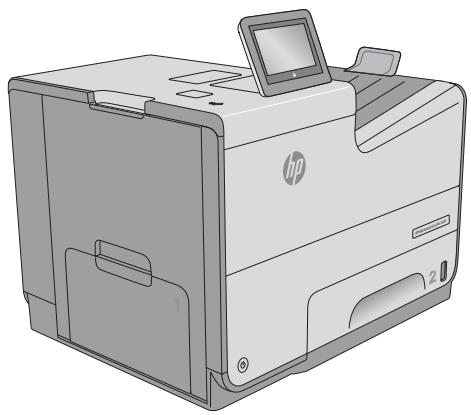
556dn
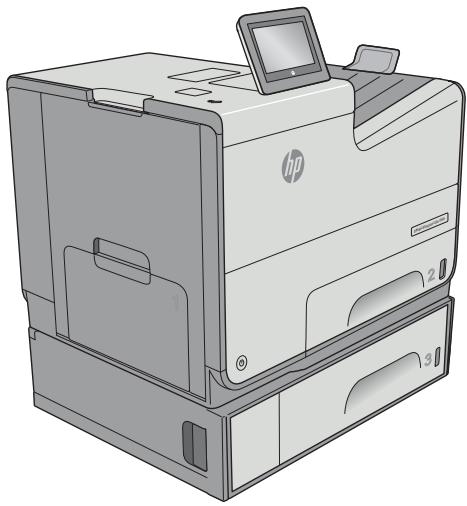
556xh

HP PageWide Enterprise Color 556
User Guide
Copyright and License
Copyright 2016 HP Development Company, L.P.
Reproduction, adaptation, or translation without prior written permission is prohibited, except as allowed under the copyright laws.
The information contained herein is subject to change without notice.
The only warranties for HP products and services are set forth in the express warranty statements accompanying such products and services. Nothing herein should be construed as constituting an additional warranty. HP shall not be liable for technical or editorial errors or omissions contained herein.
Edition 1, 5/2016
Trademark Credits
Adobe®, Adobe Photoshop®, Acrobat®, and PostScript® are trademarks of Adobe Systems Incorporated.
Apple and the Apple logo are trademarks of Apple Computer, Inc., registered in the U.S. and other countries. iPod is a trademark of Apple Computer, Inc. iPod is for legal or rightholderauthorized copying only. Don't steal music.
Microsoft, Windows, Windows XP, and Windows Vista are U.S. registered trademarks of Microsoft Corporation.
UNIX® is a registered trademark of The Open Group.
Table of contents
1 Printer overview 1
Printer views 2
Printer front view 2
Printer back view 3
Interface ports 4
Control-panel view 5
Printer specifications 7
Technical specifications 7
Supported operating systems 8
Mobile printing solutions 10
Printer dimensions 11
Power consumption, electrical specifications, and acoustic emissions 15
Operating-environment range 15
Printer hardware setup and software installation 16
2 Paper trays 17
Load paper to Tray 1 (multi-purpose tray) 18
Introduction 18
Tray 1 paper orientation 19
Use alternative letterhead mode 22
Enable Alternative Letterhead Mode by using the printer control-panel menus 22
Load paper to Tray 2 23
Introduction 23
Tray 2 paper orientation 24
Use alternative letterhead mode 26
Enable Alternative Letterhead Mode by using the printer control-panel menus 26
Load paper to Tray 3 27
Introduction 27
Tray 3 paper orientation 28
Use alternative letterhead mode 30
Enable Alternative Letterhead Mode by using the printer control-panel menus 30
Load paper to the 3× 500 -sheet paper feeder 31
Introduction 31
3x500-sheet tray paper orientation 32
Use alternative letterhead mode 35
Enable Alternative Letterhead Mode by using the printer control-panel menus 35
Load and print envelopes 36
Introduction 36
Print envelopes 36
Envelope orientation 36
Load and print labels 38
Introduction 38
Manually feed labels 38
Label orientation 39
3 Supplies, accessories, and parts 41
Order supplies, accessories, and parts 42
Ordering 42
Supplies and accessories 42
Customer self-repair parts 43
Replace the cartridges 45
Introduction 45
Cartridge information 45
Remove and replace the cartridge 47
Replace the ink-collection unit 50
Introduction 50
Remove and replace the ink-collection unit 50
4 Print 53
Print tasks (Windows) 54
How to print (Windows) 54
Automatically print on both sides (Windows) 56
Manually print on both sides (Windows) 56
Print multiple pages per sheet (Windows) 57
Select the paper type (Windows) 57
Additional print tasks 58
Print tasks (OS X) 59
How to print (OS X) 59
Automatically print on both sides (OS X) 59
Manually print on both sides (OS X) 59
Print multiple pages per sheet (OS X) 60
Select the paper type (OS X) 60
Additional print tasks 61
Store print jobs on the printer to print later or print privately 62
Introduction 62
Create a stored job (Windows) 62
Create a stored job (OS X) 64
Print a stored job 64
Delete a stored job 65
Information sent to printer for Job Accounting purposes 65
Mobile printing 66
Introduction 66
Wireless Direct Print and NFC Printing 66
HP ePrint via email 67
HP ePrint software 68
AirPrint 68
Google Cloud Print 68
Android embedded printing 69
Print from the USB port 70
Introduction 70
Enable the USB port for printing 70
Print USB documents 71
5 Manage the printer 73
Advanced configuration with HP Embedded Web Server (EWS) 74
Introduction 74
How to access the HP Embedded Web Server (EWS) 74
HP Embedded Web Server features 75
Information tab 75
General tab 76
Print tab 77
Troubleshooting tab 77
Security tab 78
HP Web Services tab 78
Networking tab 78
Other Links list 80
Advanced configuration with HP Utility for OS X 81
Open HP Utility 81
HP Utility features 81
Configure IP network settings 83
Printer sharing disclaimer 83
View or change network settings 83
Rename the printer on a network 83
Manually configure IPv4 TCP/IP parameters from the control panel 84
Manually configure IPv6 TCP/IP parameters from the control panel 84
Link speed and duplex settings 85
Printer security features 87
Introduction 87
Security statements 87
Assign an administrator password 87
IP Security 88
Lock theformatter 88
Encryption support: HP High Performance Secure Hard Disks 88
Energy-conservation settings 89
Introduction 89
Optimize speed or energy usage 89
Set the sleep timer and configure the printer to use 1 watt or less of power 89
Set the sleep schedule 90
HP Web Jetadmin 92
Software and firmware updates 93
6 Solve problems 95
Customer support 96
Control panel help system 97
Restore factory settings 98
Introduction 98
Method one:Restore factory settings from the printer control panel 98
Method two: Restore factory settings from the HP Embedded Web Server (network-connected printers only) 98
A "Cartridge is low" or "Cartridge is very low" message displays on the printer control panel 99
Change the "Very Low" settings 99
For products with fax capability 99
Order supplies 100
Printer does not pick up paper or misfeeds 101
Introduction 101
The printer does not pick up paper 101
The printer picks up multiple sheets of paper 103
Clear paper jams 107
Introduction 107
Jam locations 107
Auto-navigation for clearing jams 108
Experiencing frequent or recurring paper jams? 108
Clear jams in the left door 109
Clear jams in Tray 1 (multipurpose tray) 110
Clear jams in Tray 2 114
Clear jams in Tray 3 116
Clear jams in the 3x500-sheet feeder 118
Clear jams in the ink-collection unit area 121
Clear jams in the output bin 124
Improve print quality 125
Introduction 125
Print from a different software program 125
Check the paper-type setting for the print job 125
Check the paper type setting (Windows) 125
Check the paper type setting (OS X) 126
Check cartridge status 126
Clean the printer 127
Print a cleaning page 127
Visually inspect the cartridge 127
Check paper and the printing environment 127
Step one: Use paper that meets HP specifications 127
Step two: Check the environment 128
Step three: Set the individual tray alignment 128
Adjust color settings (Windows) 128
Print and interpret the print quality page 130
Calibrate the printer to align the colors 130
Try a different print driver 130
Solve wired network problems 132
Introduction 132
Poor physical connection 132
The computer is using the incorrect IP address for the printer 132
The computer is unable to communicate with the printer 132
The printer is using incorrect link and duplex settings for the network 133
New software programs might be causing compatibility problems 133
The computer or workstation might be set up incorrectly 133
The printer is disabled, or other network settings are incorrect 133
Solve wireless network problems 134
Introduction 134
Wireless connectivity checklist 134
The printer does not print after the wireless configuration completes 135
The printer does not print, and the computer has a third-party firewall installed 135
The wireless connection does not work after moving the wireless router or printer 135
Cannot connect more computers to the wireless printer 135
The wireless printer loses communication when connected to a VPN 136
The network does not appear in the wireless networks list 136
The wireless network is not functioning 136
Perform a wireless network diagnostic test 136
Reduce interference on a wireless network 137
Index 139
1 Printer overview
- Printer views
- Printer specifications
- Printer hardware setup and software installation
For more information:
The following information is correct at the time of publication. For current information, see www.hp.com/support/pagewidecolor556.
HP's all-inclusive help for the printer includes the following information:
Install and configure
Learn and use
- Solve problems
Download software and firmware updates
- Join support forums
Find warranty and regulatory information
Printer views
- Printer front view
- Printer back view
- Interface ports
Control-panel view
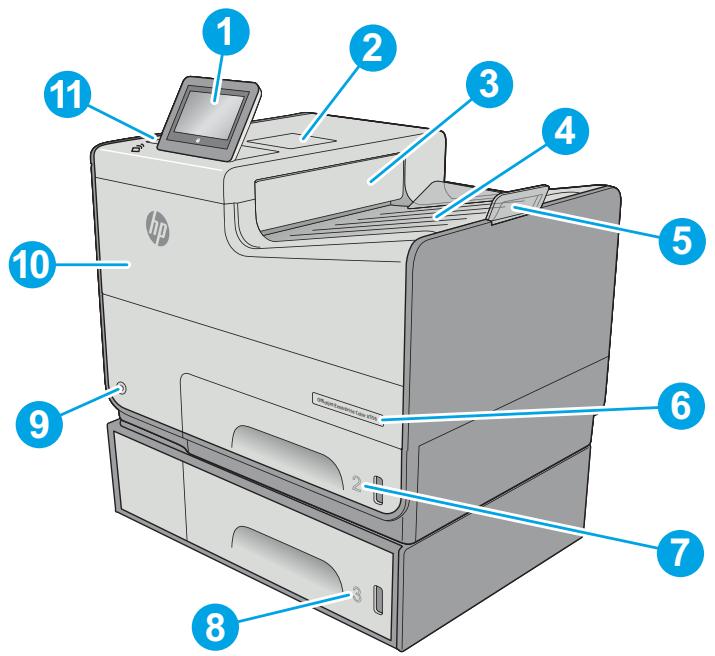
Printer front view
| 1 | Control panel with color touchscreen display (tilts up for easier viewing) |
| 2 | Hardware integration pocket (for connecting accessory and third-party devices) |
| 3 | Output ejector flap |
| 4 | Output bin |
| 5 | Output bin extension |
| 6 | Model name |
| 7 | Tray 2 |
| 8 | Tray 3 (included with the xh model, optional for the dn model) |
| 9 | On/off button |
| 10 | Cartridge door |
| 11 | Easy-access USB port (on the side of the control panel) |
| Insert a USB flash drive for printing or scanning without a computer or to update the printer firmware. | |
| NOTE: An administrator must enable this port before use. |
Printer back view
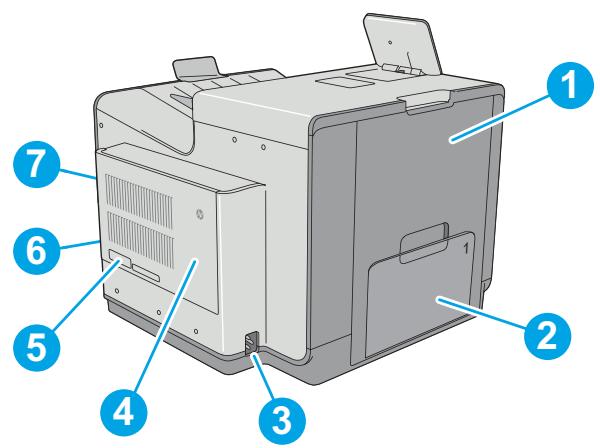
| 1 | Left door (access to the ink-collection unit and for clearing jams) |
| 2 | Tray 1 |
| 3 | Power connection |
| 4 | Formatter cover |
| 5 | Serial number and product number label |
| 6 | Formatter (contains the interface ports) |
| 7 | Slot for a cable-type security lock (on the rear cover of the printer) |
Interface ports
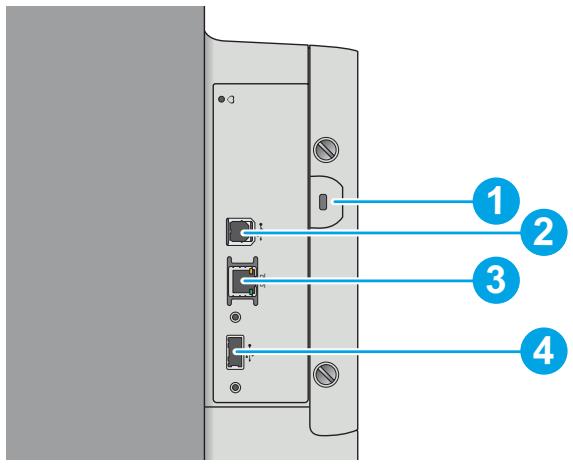
1 Slot for a cable-type security lock
2 Hi-Speed USB 2.0 printing port
3 Local area network (LAN) Ethernet (RJ-45) network port
4 USB port for connecting external USB devices (this port might be covered)
NOTE: For easy-access USB printing, use the USB port near the control panel.

NOTE: Tilt the control panel for easier viewing.
The Home screen provides access to the printer features and indicates the current status of the printer.
Return to the Home screen at any time by touching the Home button on the left side of the printer control panel, or touch the Home button in the upper-left corner of most screens.

NOTE: The features that appear on the Home screen can vary, depending on the printer configuration.
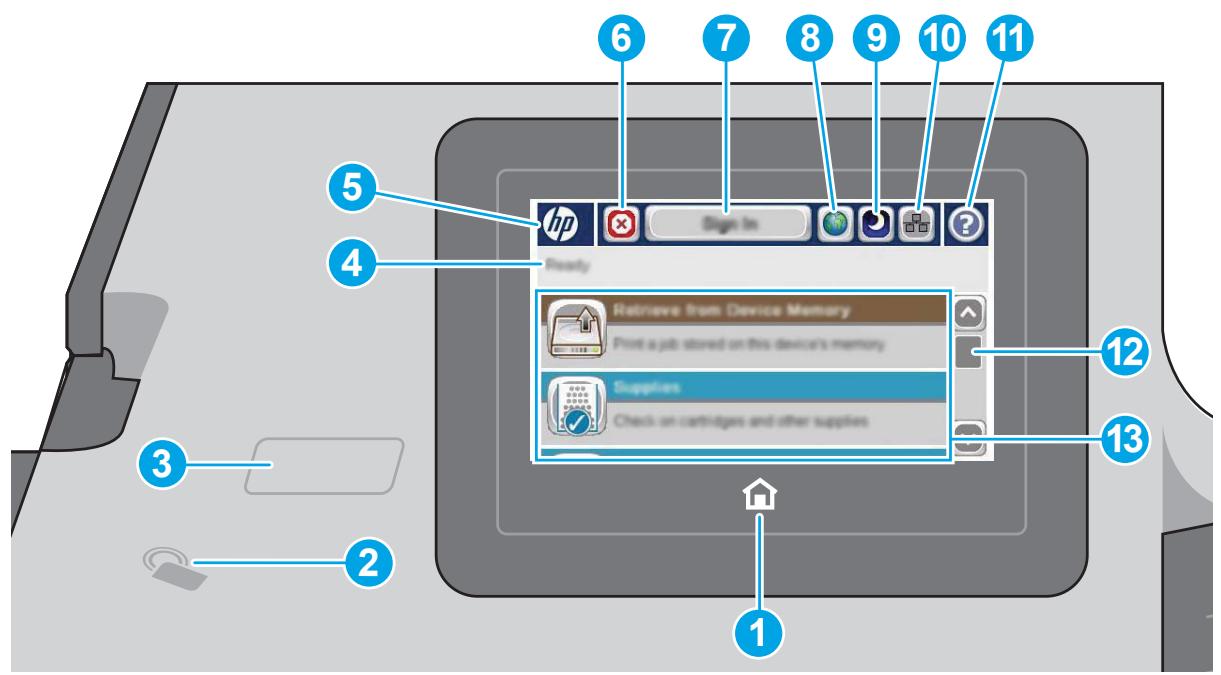
| 1 | Home button | Touch the Home button to return to the printer Home screen at any time. |
| 2 | Near-field communication icon (xh models only) | This icon indicates the printer includes integrated HP near-field communication (NFC) and Wireless Direct Print |
| 3 | Easy-access USB port | Insert a USB flash drive for printing or scanning without a computer or to update the printer firmware. |
| 4 | Printer status | The status line provides information about the overall printer status. |
| 5 | HP logo or Home button | NOTE: An administrator must enable this port before use. On any screen other than the Home screen, the HP logo changes to a Home button. Touch the Home button to return to the Home screen. |
| 6 | Stop button | Touch the Stop button to pause the current job. The Job Status screen opens and provides options to cancel or continue the job. |
| 7 | Sign In or Sign Out button | Touch the Sign In button to access secured features. Touch the Sign Out button to sign out of the printer. The printer restores all options to the default settings. NOTE: This button displays only if the administrator has configured the printer to require permission for access to features. |
| 8 | Language Selection button | Touch the Language Selection button to select the language for the control-panel display. |
| 9 | Sleep button | Touch the Sleep button to put the printer into Sleep mode. |
| 10 | Network button | Touch the Network button to find information about the network connection. |
| 11 | Help button | Touch the Help button to open the embedded help system. Insert a USB flash drive for printing or scanning without a computer or to update the printer firmware. NOTE: An administrator must enable this port before use. |
| 12 | Scroll bar | Use the scroll bar to see the complete list of available features. |
| 13 | Features | Depending on the printer configuration, the features that appear in this area can include any of the following items: • Quick Sets • Retrieve from USB • Retrieve from Device Memory • Job Status • Supplies • Trays • Administration • Device Maintenance |
Printer specifications

IMPORTANT: The following specifications are correct at the time of publication, but they are subject to change. For current information, see www.hp.com/support/pagewidecolor556.
Technical specifications
Supported operating systems
- Mobile printing solutions
- Printer dimensions
Power consumption, electrical specifications, and acoustic emissions
- Operating-environment range
Technical specifications
| Model name | 556dn | 556xh | |
| Product number | G1W46A | G1W47A | |
| Paper handling | Tray 1 (50-sheet capacity) | ✓ | ✓ |
| Tray 2 (500-sheet capacity) | ✓ | ✓ | |
| Tray 3 (500-sheet capacity) | Optional | ✓ | |
| Printer stand | Optional | Optional | |
| 3 x 500-sheet paper feeder and stand (combined 1,500-sheet capacity) | Optional | Optional | |
| Automatic duplex printing | ✓ | ✓ | |
| Connectivity | 10/100/1000 Ethernet LAN connection with IPv4 and IPv6 | ✓ | ✓ |
| Hi-Speed USB 2.0 | ✓ | ✓ | |
| Easy-access USB port for printing without a computer and upgrading the firmware | ✓ | ✓ | |
| Hardware Integration Pocket for connecting accessory and third-party devices | ✓ | ✓ | |
| HP Internal USB Ports | Optional | Optional | |
| Integrated HP near-field communication (NFC) and Wireless Direct Print functionality for printing from mobile devices | Optional | ✓ | |
| HP Jetdirect 3000w NFC/Wireless Accessory for printing from mobile devices | Optional | Optional | |
| HP Jetdirect 2900nw Print Server accessory for wireless connectivity | Optional | Optional | |
| Memory | 1.28 GB base memory | ✓ | ✓ |
| NOTE: The base memory is expandable to 2.0 GB by adding a DIMM memory module. | |||
| Mass storage | 4 GB embedded Multi-Media Controller (eMMC) | ✓ | Not supported |
| 320 GB HP Secure High-Performance Hard Disk | Not supported | ✓ | |
| Security | HP Trusted Platform Module for encrypting all data that passes through the printer | Optional | Optional |
| Control-panel display and keyboard | Color touchscreen control panel | ✓ | ✓ |
| Prints 50 pages per minute (ppm) on A4 and 50 ppm on letter-size paper in Professional mode. | ✓ | ✓ | |
| Prints 75 ppm on A4 and 75 ppm on letter-size paper in General Office mode | |||
| Easy-access USB printing (no computer required) | ✓ | ✓ | |
| Store jobs in the printer memory to print later or print privately | ✓ | ✓ |
Supported operating systems
The following information applies to the Printer-Specific Windows PCL 6 and HP print drivers for OS X and to the in-box software installation CD.
Windows: The HP Software Installer CD installs the "HP PCL.6" version 3 print driver, the "HP PCL 6" version 3 print driver, or the "HP PCL-6" version 4 print driver, depending on the Windows operating system, along with optional software when using the full software installer. Download the "HP PCL.6" version 3 print driver, the "HP PCL 6" version 3 print driver, and the "HP PCL-6" version 4 print driver from the printer-support Web site for this printer: www.hp.com/support/pagewidecolor556.
OS X: Mac computers are supported with this printer. Download HP Easy Start either from 123.hp.com or from the Print Support page, and then use HP Easy Start to install the HP print driver. HP Easy Start is not included in the in-box CD.
- Go to 123.hp.com.
- Follow the steps provided to download the printer software.
Linux: For information and print drivers for Linux, go to hplipopensource.com/hplip-web/index.html.
UNIX: For information and print drivers for UNIX®, go to www.hp.com/go/unixmodelscripts.
Table 1-1 Supported operating systems and print drivers
| Operating system | Print driver installed (from the software installer CD for Windows, or the installer on the Web for OS X) | Notes |
| Windows® XP SP3, 32-bit | The "HP PCL.6" printer-specific print driver is installed for this operating system as part of the basic software installation. The basic installer installs the driver only. | The full software installer is not supported for this operating system. Microsoft retired mainstream support for Windows XP in April 2009. HP will continue to provide best effort support for the discontinued XP operating system. |
| Windows Vista®, 32-bit | The "HP PCL.6" printer-specific print driver is installed for this operating system as part of the basic software installation. The basic installer installs the driver only. | The full software installer is not supported for this operating system. |
| Windows Server 2003 SP2, 32-bit | The "HP PCL.6" printer-specific print driver is installed for this operating system as part of the basic software installation. The basic installer installs the driver only. | The full software installer is not supported for this operating system. Microsoft retired mainstream support for Windows Server 2003 in July 2010. HP will continue to provide best effort support for the discontinued Server 2003 operating system. |
| Windows 7 SP1, 32-bit and 64-bit | The "HP PCL 6" printer-specific print driver is installed for this operating system as part of the full software installation. | |
| Windows 8, 32-bit and 64-bit | The "HP PCL-6" printer-specific print driver is installed for this operating system as part of the basic software installation. The basic installer installs the driver only. | The full software installer is not supported for this operating system. Windows 8 RT support is provided through Microsoft IN OS Version 4, 32-bit driver. |
| Windows 8.1, 32-bit and 64-bit | The "HP PCL-6" printer-specific print driver is installed for this operating system as part of the basic software installation. The basic installer installs the driver only. | The full software installer is not supported for this operating system. Windows 8.1 RT support is provided through Microsoft IN OS Version 4, 32-bit driver. |
| Windows 10, 32-bit and 64-bit | The "HP PCL-6" printer-specific print driver is installed for this operating system as part of the basic software installation. The basic installer installs the driver only. | The full software installer is not supported for this operating system. |
| Windows Server 2008 SP2, 32-bit | The "HP PCL.6" printer-specific print driver is installed for this operating system as part of the basic software installation. The basic installer installs the driver only. | The full software installer is not supported for this operating system. |
| Windows Server 2008 SP2, 64-bit | The "HP PCL 6" printer-specific print driver is installed for this operating system as part of the basic software installation. The basic installer installs the driver only. | The full software installer is not supported for this operating system. |
| Windows Server 2008 R2, SP 1, 64-bit | The "HP PCL 6" printer-specific print driver is installed for this operating system as part of the basic software installation. The basic installer installs the driver only. | The full software installer is not supported for this operating system. |
| Windows Server 2012, 64-bit | The software installer does not support Windows Server 2012 but the printer-specific print drivers do support it. | Download the driver from the HP Web site, and use the Windows Add Printer tool to install it. |
| Windows Server 2012 R2, 64-bit | The software installer does not support Windows Server 2012 but the printer-specific print drivers do support it. | Download the driver from the HP Web site, and use the Windows Add Printer tool to install it. |
| OS X 10.9 Mavericks, OS X 10.10 Yosemite, OS X 10.11 El Capitan | The HP print driver is available for download from HP Easy Start. The HP installer software for OS X is not included in the in-box CD. | For OS X, download the installer from HP Easy Start. 1. Go to 123.hp.com. 2. Follow the steps provided to download the printer software. |

NOTE: For a current list of supported operating systems, go to www. hp.com/support/pagewidecolor556 for HP's all-inclusive help for the printer.

NOTE: For details on client and server operating systems and for HP UPD driver support for this printer, go to www.hp.com/go/upd. Under Additional information, click the links.
Table 1-2 Minimum system requirements
| Windows | OS X |
| CD-ROM drive, DVD drive, or an Internet connection | Internet connection |
| Dedicated USB 1.1 or 2.0 connection or a network connection | 1 GB of available hard-disk space |
| 400 MB of available hard-disk space | |
| 1 GB RAM (32-bit) or 2 GB RAM (64-bit) |
Mobile printing solutions
The printer supports the following software for mobile printing:
HP ePrint software

NOTE: The HP ePrint Software supports the following operating systems: Windows 7 SP 1 (32-bit and 64-bit); Windows 8 (32-bit and 64-bit); Windows 8.1 (32-bit and 64-bit); Windows 10 (32-bit and 64-bit); and OS X versions 10.9 Mavericks, 10.10 Yosemite, and 10.11 El Capitan.
HP ePrint via email (Requires HP Web Services to be enabled and the printer to be registered with HP Connected)
HP ePrint app (Available for Android, iOS, and Blackberry)
ePrint Enterprise app (Supported by all printers using ePrint Enterprise Server Software)
Google Cloud Print
AirPrint
Android Printing
Printer dimensions
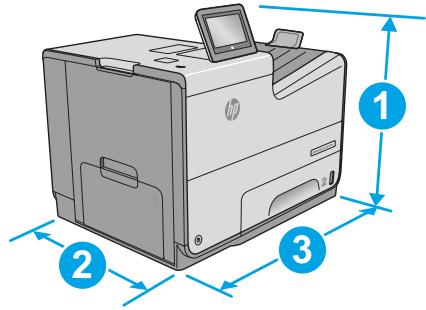
Figure 1-1 Dimensions for the dn model
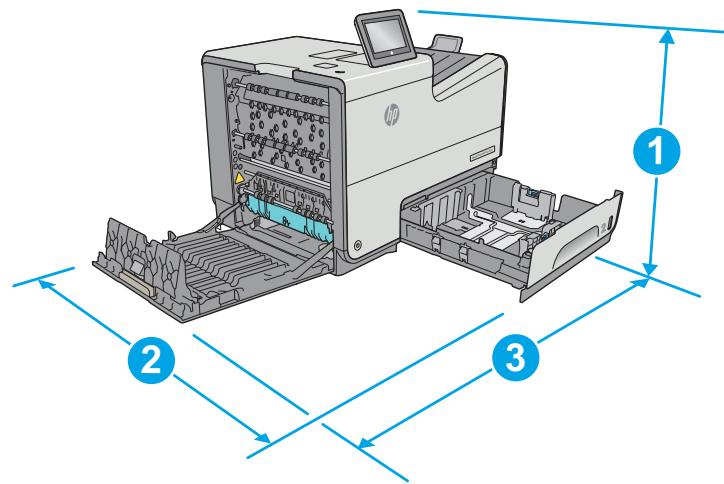
| Printer fully closed | Printer fully opened | |
| 1. Height | 457 mm (17.9 in) | 457 mm (17.9 in) |
| 2. Depth | 463 mm (18.2 in) | 745 mm (29.3 in) |
| 3. Width | 530 mm (20.8 in) | 934 mm (36.7 in) |
| Weight | 22.2 kg (48.9 lb) |
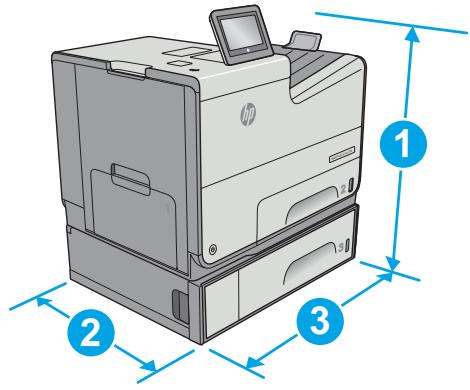
Figure 1-2 Dimensions for the xh model
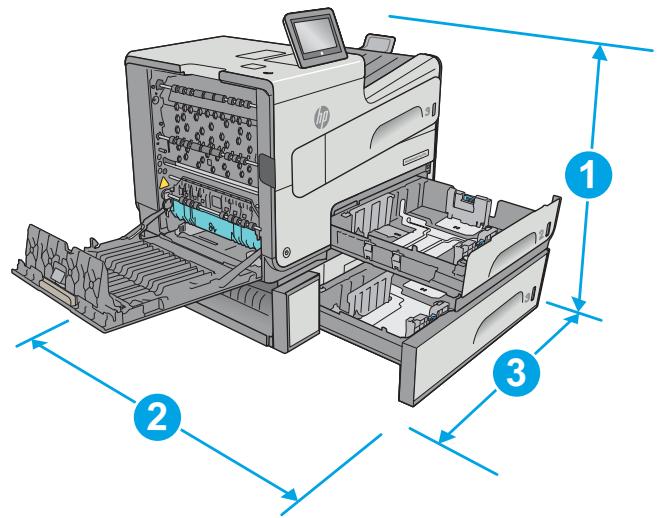
| Printer fully closed | Printer fully opened | |
| 1. Height | 597 mm (23.5 in) | 597 mm (23.5 in) |
| 2. Depth | 463 mm (18.2 in) | 745 mm (29.3 in) |
| 3. Width | 530 mm (20.8 in) | 1038 mm (40.8 in) |
| Weight | 34.1 kg (75.2 lb) |
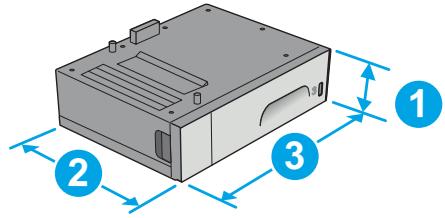
Figure 1-3 Dimensions for Tray 3
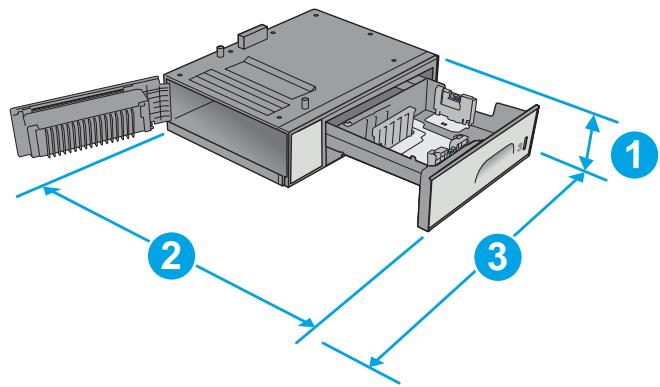
| 1. Height | 138 mm (5.4 in) |
| 2. Depth | Tray closed: 396 mm (15.5 in) |
| Tray opened: 678 mm (26.6 in) | |
| 3. Width | Lower-left door closed: 514 mm (20.2 in) |
| Lower-left door opened: 1038 mm (40.8 in) | |
| Weight | 5.4 kg (11.8 lb) |

Figure 1-4 Dimensions for the printer stand
| 1. Height | 640 mm (25.1 in) |
| 2. Depth | Tray closed: 669 mm (26.3 in) |
| Tray opened: 810 mm (31.8 in) |
| 3. Width | Lower-left door closed: 669 mm (26.3 in) |
| Lower-left door opened: 1040 mm (40.9 in) | |
| Weight | 31.2 kg (69 lb) |
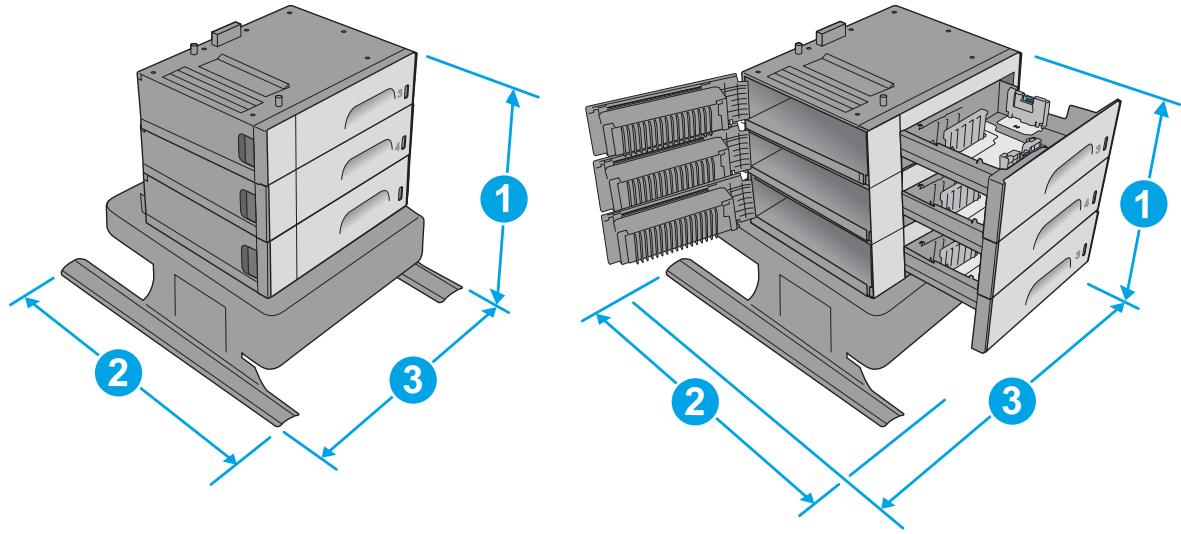
Figure 1-5 Dimensions for the 3 × 500 -sheet paper feeder and stand
| 1. Height | 642 mm (25.2 in) |
| 2. Depth | Tray closed: 669 mm (26.3 in) |
| Tray opened: 795 mm (31.2 in) | |
| 3. Width | Lower-left door closed: 669 mm (26.3) |
| Lower-left door opened: 1040 mm (40.9 in) | |
| Weight | 35.8 kg (79 lb) |
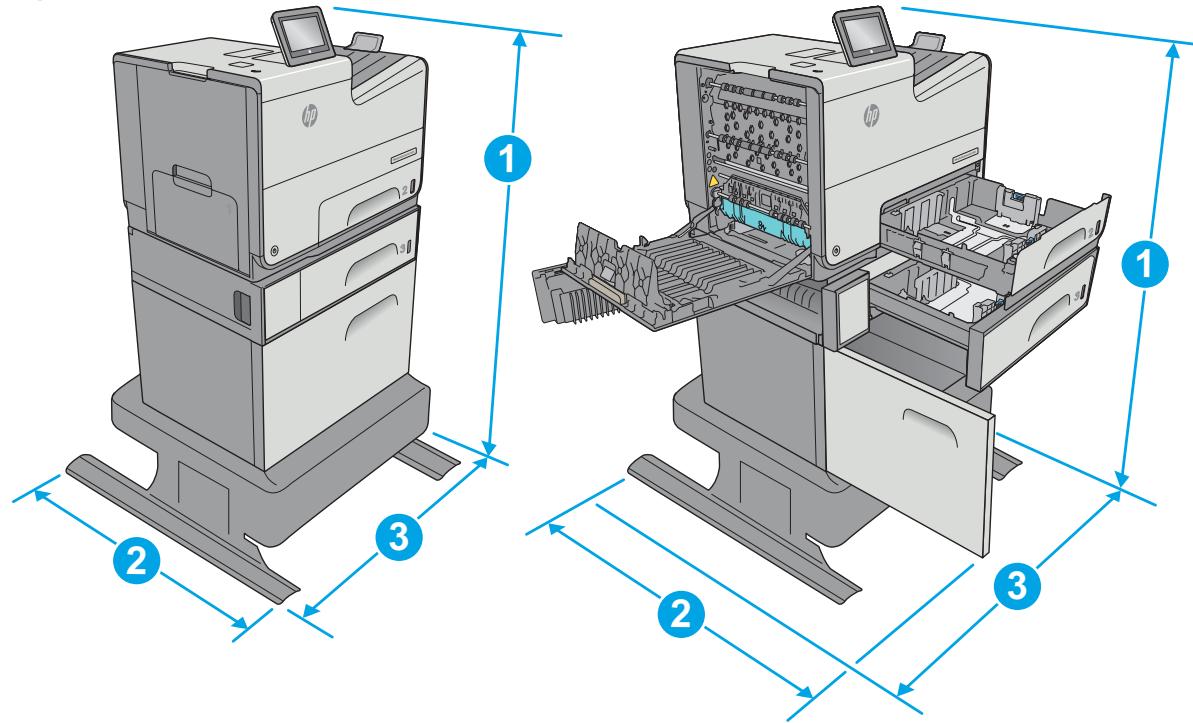
Figure 1-6 Dimensions for the xh model with the printer stand
| Printer and accessories fully closed | Printer and accessories fully opened | |
| 1. Height | 1297 mm (48.6 in) | 1297 mm (48.6 in) |
| 2. Depth | 669 mm (26.3 in) | 810 mm (31.8 in) |
| 3. Width | 669 mm (26.3 in) | 1040 mm (40.9 in) |
| Weight | 59.9 kg (132.2 lb) |
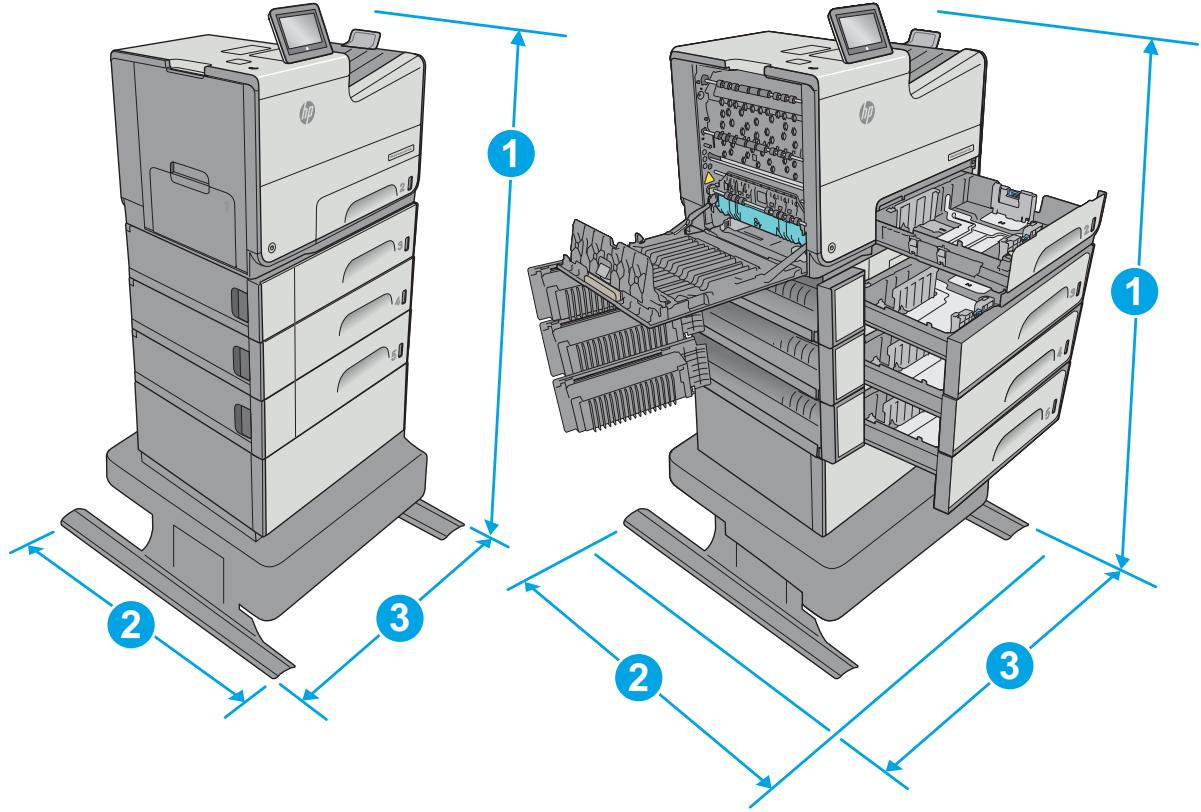
Figure 1-7 Dimensions for the dn model with the 3 × 500 -sheet paper feeder and stand
| Printer and accessories fully closed | Printer and accessories fully opened | |
| 1. Height | 1099 mm (43.2 in) | 1099 mm (43.2 in) |
| 2. Depth | 669 mm (26.3 in) | 795 mm (31.2 in) |
| 3. Width | 669 mm (26.3 in) | 1040 mm (40.9 in) |
| Weight | 58 kg (127.9 lb) |
1 These values are subject to change. For current information, go to www.hp.com/support/pagewidecolor556.
2 Do not extend more than one paper tray at a time.
Power consumption, electrical specifications, and acoustic emissions
See www.hp.com/support/pagewidecolor556 for current information.
CAUTION: Power requirements are based on the country/region where the printer is sold. Do not convert operating voltages. This will damage the printer and void the printer warranty.
Operating-environment range
Table 1-3 Operating-environment specifications
| Environment | Recommended | Allowed |
| Temperature | 17° to 25°C (62.6° to 77°F) | 15° to 30°C (59° to 86°F) |
| Relative humidity | 30% to 70% relative humidity (RH) | 10% to 80% (RH) |
| Altitude | Not applicable | 0 to 3048 m (0 to 10,000 ft) |
Printer hardware setup and software installation
For basic setup instructions, see the Hardware Installation Guide that came with the printer. For additional instructions, go to HP support on the Web.
Go to www.hp.com/support/pagewidecolor556 for HP's all-inclusive help for the printer. Find the following support:
Install and configure
Learn and use
- Solve problems
Download software and firmware updates
- Join support forums
Find warranty and regulatory information
2 Paper trays
- Load paper to Tray 1 (multi-purpose tray)
- Load paper to Tray 2
Load paper to Tray 3 - Load paper to the 3 × 500 -sheet paper feeder
- Load and print envelopes
- Load and print labels
For more information:
The following information is correct at the time of publication. For current information, see www.hp.com/support/pagewidecolor556.
HP's all-inclusive help for the printer includes the following information:
Install and configure
Learn and use
- Solve problems
Download software and firmware updates
- Join support forums
Find warranty and regulatory information
Load paper to Tray 1 (multi-purpose tray)
Introduction
The following information describes how to load paper into Tray 1. This tray holds up to 50 sheets of 75g / m^2 (20 lb) paper or 5 envelopes.

NOTE: Select the correct paper type in the print driver before printing.

CAUTION: To avoid jams, never add or remove paper from Tray 1 during printing.
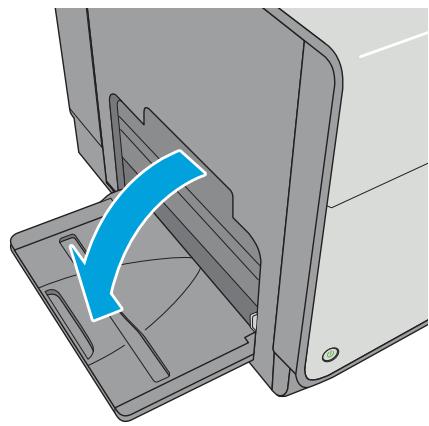
- Open Tray 1.
- Pull out the tray extension to support the paper.

- Spread the paper guides to the correct size, and then load paper in the tray. For information about how to orient the paper, see Tray 1 paper orientation on page 19.
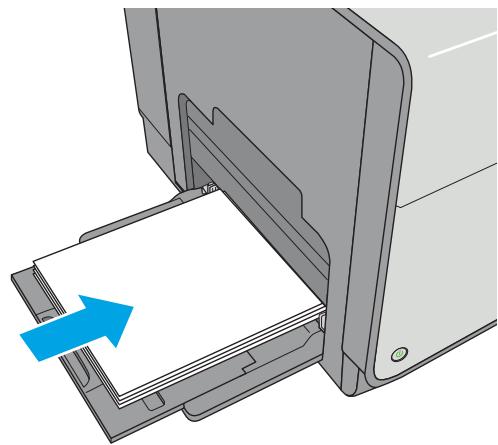
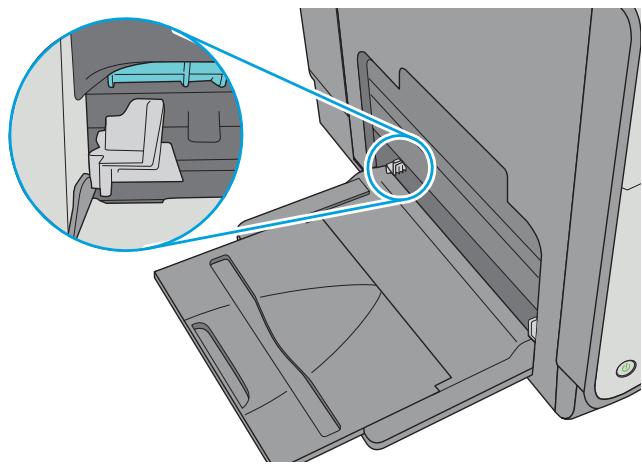
- Make sure that the paper fits under the fill line on the paper guides.
NOTE: The maximum stack height is 5 mm (0.2 in), or approximately 50 sheets of 75g paper.
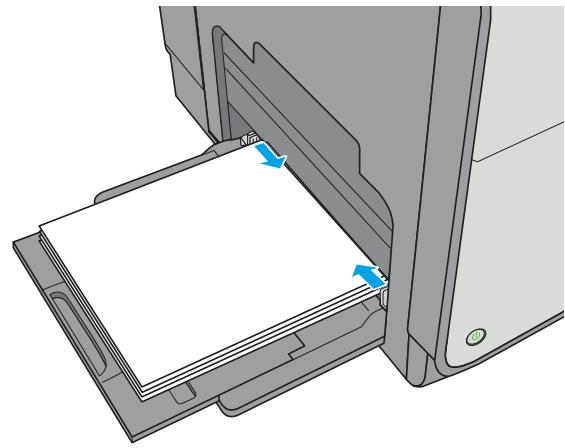
- Adjust the side guides so that they lightly touch the paper stack, but do not bend it.
Tray 1 paper orientation
When using paper that requires a specific orientation, load it according to the information in the following table.

NOTE: The Alternative Letterhead Mode settings affects the way to load letterhead or preprinted paper. This setting is disabled by default. When using this mode, load paper as for automatic duplex printing. For more information, see Use alternative letterhead mode on page 22
| Paper type | Image Orientation | Duplex mode | Paper size | How to load paper |
| Letterhead or preprinted | Portrait | 1-sided printing | Letter, Legal, Executive, Statement, Oficio (8.5 x 13), 3 x 5, 4 x 6, 5 x 7, 5 x 8, A4, A5, A6, RA4, B5 (JIS), B6 (JIS), L (90 x 130 mm), 10 x 15 cm, Oficio (216 x 340), 16K 195 x 270 mm, 16K 184 x 260 mm, 16K 197 x 273 mm, Japanese Postcard (Postcard (JIS)), Double Japan Postcard Rotated (Double Postcard (JIS)) | Face-down Top edge leading into the printer |
| Automatic 2-sided printing or with Alternative Letterhead Mode enabled | Letter, Legal, Executive, Oficio (8.5 x 13), A4, RA4, B5 (JIS), Oficio (216 x 340) | Face-up Bottom edge leading into the printer | ||
| Landscape | 1-sided printing | Letter, Legal, Executive, Statement, Oficio (8.5 x 13), 3 x 5, 4 x 6, 5 x 7, 5 x 8, A4, A5, A6, RA4, B5 (JIS), B6 (JIS), L (90 x 130 mm), 10 x 15 cm, Oficio (216 x340), 16K 195 x 270 mm, 16K 184 x 260 mm, 16K 197 x 273 mm, Japanese Postcard (Postcard (JIS)), Double Japan Postcard Rotated (Double Postcard (JIS)) | Face-down Top edge toward the back of the printer | |
| Automatic 2-sided printing or with Alternative Letterhead Mode enabled | Letter, Legal, Executive, Oficio (8.5 x 13), A4, RA4, B5 (JIS), Oficio (216 x 340) | Face-up Top edge toward the back of the printer | ||
| Prepunched | Portrait and landscape | 1-sided printing | Letter, Legal, Executive, Statement, Oficio (8.5 x 13), 3 x 5, 4 x 6, 5 x 7, 5 x 8, A4, A5, A6, RA4, B5 (JIS), B6 (JIS), L (90 x 130 mm), 10 x 15 cm, Oficio (216 x 340), 16K 195 x 270 mm, 16K 184 x 260 mm, 16K 197 x 273 mm, Japanese Postcard (Postcard (JIS)), Double Japan Postcard Rotated (Double Postcard (JIS)) | Holes toward the back of the printer |
| Automatic 2-sided printing or with Alternative Letterhead Mode enabled | Letter, Legal, Executive, Oficio (8.5 x 13), A4, RA4, B5 (JIS), Oficio (216 x 340) | Holes toward the back of the printer |
Use alternative letterhead mode
Use the Alternative Letterhead Mode feature to load letterhead or preprinted paper into the tray the same way for all jobs, whether printing to one side of the sheet of paper or to both sides. When using this mode, load paper as for automatic duplex printing.
To use the feature, enable it by using the printer control-panel menus.
Enable Alternative Letterhead Mode by using the printer control-panel menus
- Press the Home button on the product control panel.
- Open the following menus:
Administration
Manage Trays
Alternative Letterhead Mode
- Select Enabled, and then touch the Save button.
Load paper to Tray 2
Introduction
The following information describes how to load paper in Tray 2. This tray holds up to 500 sheets of 75g / m^2 (20 lb) paper.
CAUTION: Do not extend more than one paper tray at a time.
- Open the tray.
NOTE: Do not open this tray while it is in use.
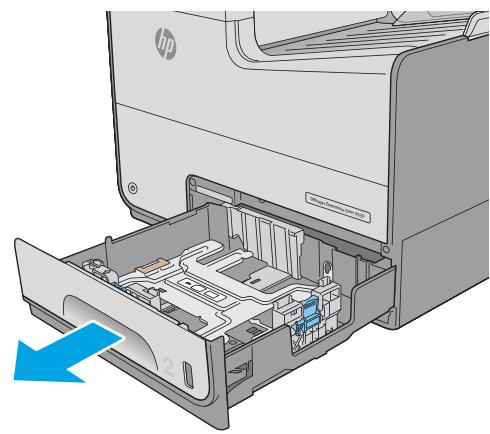
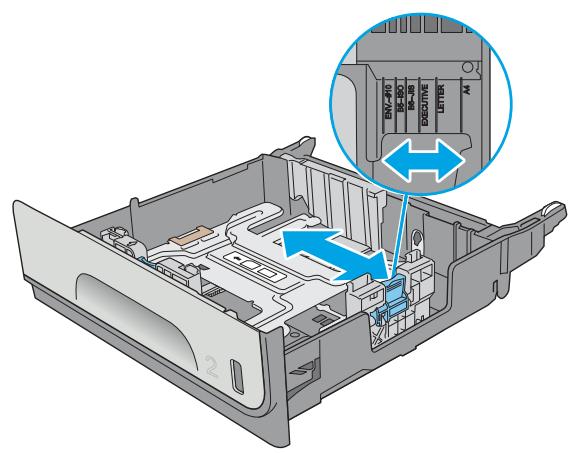
- Before loading paper, adjust the paper-width guides by squeezing the adjustment latches and sliding the guides to the size of the paper being used. The edge of the tray guide should line up exactly with the marking on the tray.
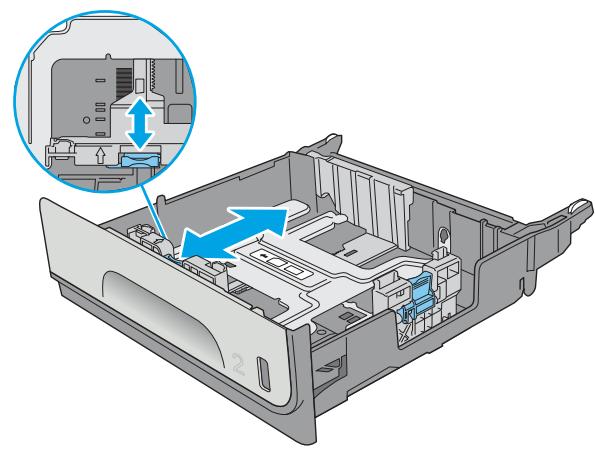
- Adjust the paper-length guide by squeezing the adjustment latch and sliding the guide to the size of the paper being used.
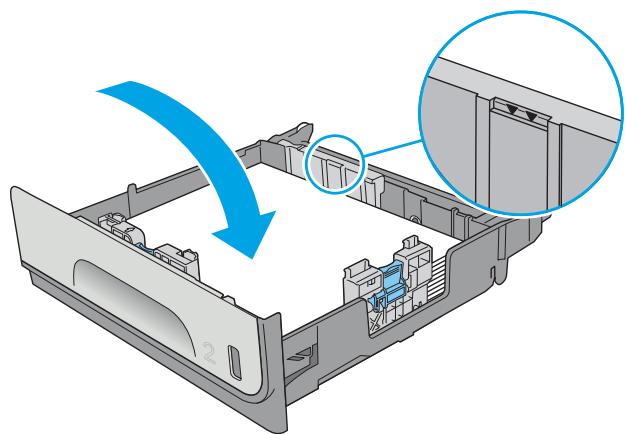
- Load paper into the tray. Check the paper to verify the guides lightly touch the stack, but do not bend it. For information about how to orient the paper, see Tray 2 paper orientation on page 24.
NOTE: Do not adjust the paper guides tightly against the paper stack. Adjust them to the indentations or markings in the tray.
NOTE: To prevent jams, adjust the paper guides to the correct size and do not overfill the tray. Be sure that the top of the stack is below the tray full indicator.
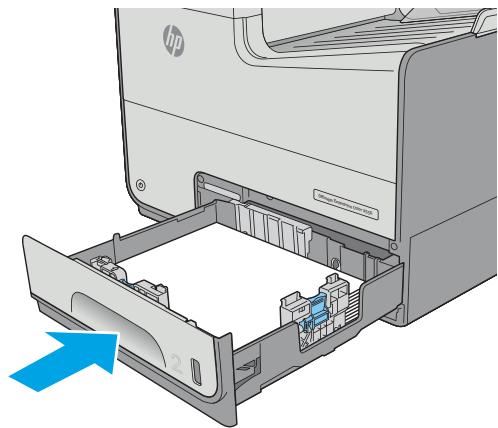
- Close the tray.
Tray 2 paper orientation
When using paper that requires a specific orientation, load it according to the information in the following table.

NOTE: The Alternative Letterhead Mode settings affects the way to load letterhead or preprinted paper. This setting is disabled by default. When using this mode, load paper as for automatic duplex printing. For more information, see Use alternative letterhead mode on page 26
| Paper type | Image Orientation | Duplex mode | Paper size | How to load |
| Letterhead or preprinted | Portrait | 1-sided printing | Letter, Executive, Statement, A4, A5, B5 (JIS), 16K 195 x 270 mm, 16K 184 x 260 mm, 16K 197 x 273 mm | Face-up Top edge toward the right |
| Automatic 2-sided printing or with Alternative Letterhead Mode enabled | Letter, Executive, Oficio (8.5 x 13), A4, B5 (JIS) | Face-down Top edge toward the left | ||
| Landscape | 1-sided printing | Letter, Executive, Statement, A4, A5, B5 (JIS), 16K 195 x 270 mm, 16K 184 x 260 mm, 16K 197 x 273 mm | Face-up Top edge toward the back of the printer | |
| Automatic 2-sided printing or with Alternative Letterhead Mode enabled | Letter, Executive, Oficio (8.5 x 13), A4, B5 (JIS) | Face-down Top edge toward the back of the printer | ||
| Prepunched | Portrait and landscape | 1-sided printing | Letter, Executive, Statement, A4, A5, B5 (JIS), 16K 195 x 270 mm, 16K 184 x 260 mm, 16K 197 x 273 mm | Holes toward the back of the printer |
| Automatic 2-sided printing or with Alternative Letterhead Mode enabled | Letter, Executive, Oficio (8.5 x 13), A4, B5 (JIS) | Holes toward the back of the printer |
Use alternative letterhead mode
Use the Alternative Letterhead Mode feature to load letterhead or preprinted paper into the tray the same way for all jobs, whether printing to one side of the sheet of paper or to both sides. When using this mode, load paper as for automatic duplex printing.
To use the feature, enable it by using the printer control-panel menus.
Enable Alternative Letterhead Mode by using the printer control-panel menus
- Press the Home button on the product control panel.
- Open the following menus:
Administration
Manage Trays
Alternative Letterhead Mode
- Select Enabled, and then touch the Save button.
Load paper to Tray 3
Introduction
The following information describes how to load paper in Tray 3. These trays hold up to 500 sheets of 75 g/m2 (20 lb) paper.
CAUTION: Do not extend more than one paper tray at a time.
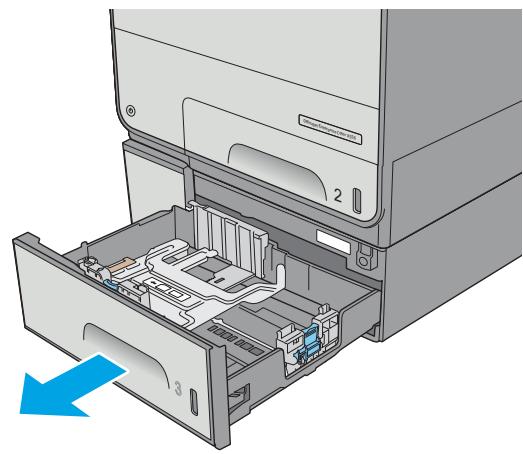
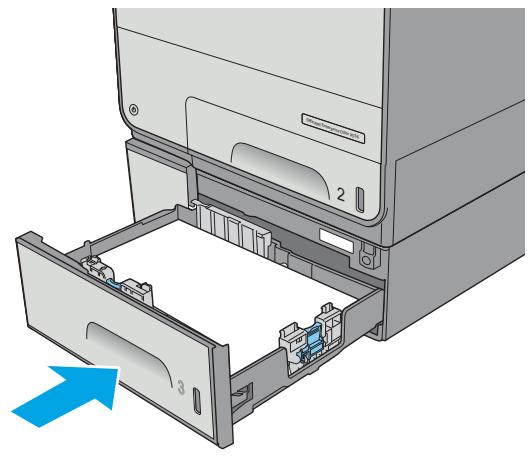
- Open the tray.
NOTE: Do not open this tray while it is in use.
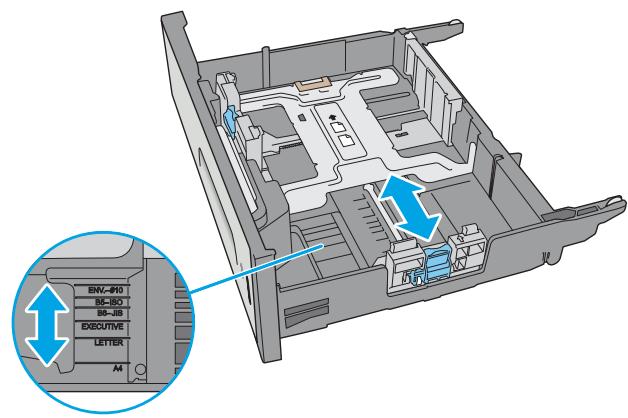
- Before loading paper, adjust the paper-width guides by squeezing the adjustment latches and sliding the guides to the size of the paper being used. The edge of the tray guide should line up exactly with the marking on the tray.
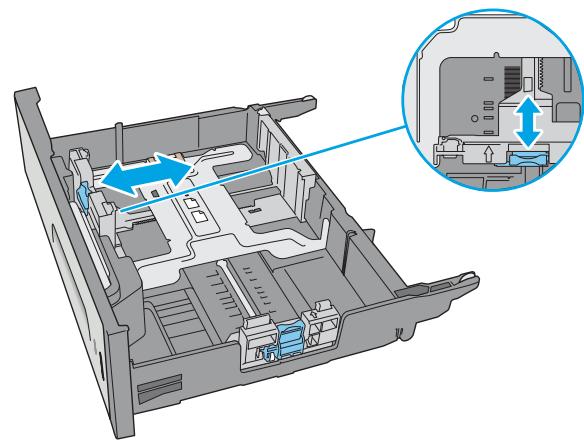
- Adjust the paper-length guide by squeezing the adjustment latch and sliding the guide to the size of the paper being used.
- Load paper into the tray. Check the paper to verify the guides lightly touch the stack, but do not bend it. For information about how to orient the paper, see Tray 3 paper orientation on page 28.
NOTE: To prevent jams, adjust the paper guides to the correct size and do not overfill the tray. Be sure that the top of the stack is below the tray full indicator.
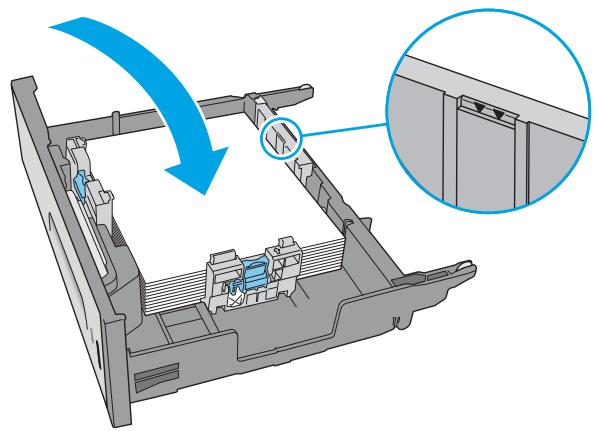
- Close the tray.
Tray 3 paper orientation
When using paper that requires a specific orientation, load it according to the information in the following table.

NOTE: The Alternative Letterhead Mode settings affects the way to load letterhead or preprinted paper. This setting is disabled by default. When using this mode, load paper as for automatic duplex printing. For more information, see Use alternative letterhead mode on page 30
| Paper type | Image Orientation | Duplex mode | Paper size | How to load paper |
| Letterhead or preprinted | Portrait | 1-sided printing | Letter, Legal, Executive, Statement, Oficio (8.5 x 13), A4, A5, RA4, B5 (JIS), Oficio (216 x 340), 16K 195 x 270 mm, 16K 184 x 260 mm, 16K 197 x 273 mm | Face-up Top edge toward the right |
| Automatic 2-sided printing or with Alternative Letterhead Mode enabled | Letter, Legal, Executive, Oficio (8.5 x 13), A4, RA4, B5 (JIS), Oficio (216 x 340) | Face-downTop edge toward the left | ||
| Landscape | 1-sided printing | Letter, Legal, Executive, Statement, Oficio (8.5 x 13), A4, A5, RA4, B5 (JIS), Oficio (216 x 340), 16K 195 x 270 mm, 16K 184 x 260 mm, 16K 197 x 273 mm | Face-upTop edge toward the back of the printer | |
| Automatic 2-sided printing or with Alternative Letterhead Mode enabled | Letter, Legal, Executive, Oficio (8.5 x 13), A4, RA4, B5 (JIS), Oficio (216 x 340) | Face-downTop edge toward the back of the printer | ||
| Prepunched | Portrait and landscape | 1-sided printing | Letter, Legal, Executive, Statement, Oficio (8.5 x 13), A4, A5, RA4, B5 (JIS), Oficio (216 x 340), 16K 195 x 270 mm, 16K 184 x 260 mm, 16K 197 x 273 mm | Holes toward the back of the printer |
| Automatic 2-sided printing or with Alternative Letterhead Mode enabled | Letter, Legal, Executive, Oficio (8.5 x 13), A4, RA4, B5 (JIS), Oficio (216 x 340) | Holes toward the back of the printer |
Use alternative letterhead mode
Use the Alternative Letterhead Mode feature to load letterhead or preprinted paper into the tray the same way for all jobs, whether printing to one side of the sheet of paper or to both sides. When using this mode, load paper as for automatic duplex printing.
To use the feature, enable it by using the printer control-panel menus.
Enable Alternative Letterhead Mode by using the printer control-panel menus
- Press the Home button on the product control panel.
- Open the following menus:
Administration
Manage Trays
Alternative Letterhead Mode
- Select Enabled, and then touch the Save button.
Load paper to the 3 x 500-sheet paper feeder
Introduction
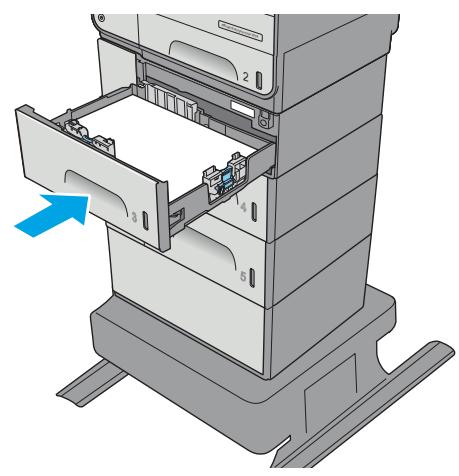
The following information describes how to load paper in any of the trays in the 3 × 500 -sheet paper feeder. Each tray holds up to 500 sheets of 75~g / m^2 (20 lb) paper.
CAUTION: Do not extend more than one paper tray at a time.
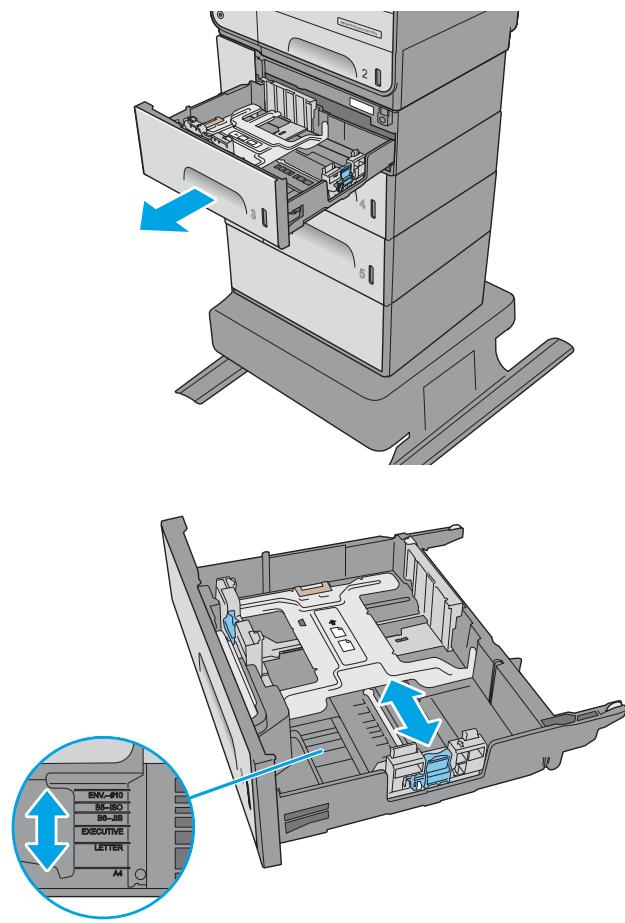
- Open the tray.
NOTE: Do not open this tray while it is in use. - Before loading paper, adjust the paper-width guides by squeezing the adjustment latches and sliding the guides to the size of the paper being used. The edge of the tray guide should line up exactly with the marking on the tray.
- Adjust the paper-length guide by squeezing the adjustment latch and sliding the guide to the size of the paper being used.
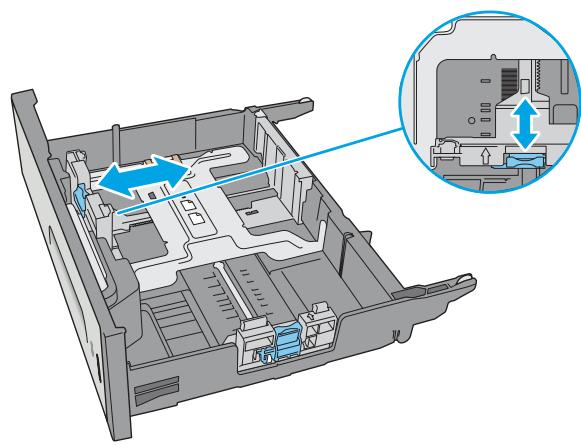
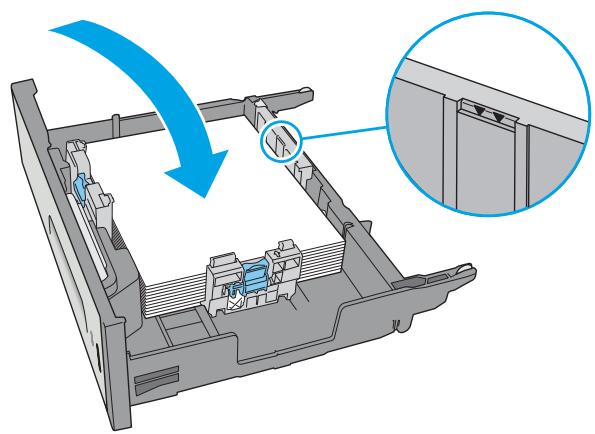
- Load paper into the tray. Check the paper to verify the guides lightly touch the stack, but do not bend it. For information about how to orient the paper, see 3 x 500-sheet tray paper orientation on page 32.
- Close the tray.
3 x 500-sheet tray paper orientation
When using paper that requires a specific orientation, load it according to the information in the following table.

NOTE: The Alternative Letterhead Mode settings affects the way to load letterhead or preprinted paper. This setting is disabled by default. When using this mode, load paper as for automatic duplex printing. For more information, see Use alternative letterhead mode on page 35
| Paper type | Image orientation | Duplex mode | Paper size | How to load paper |
| Preprinted or letterhead | Portrait | 1-sided printing | Letter, Legal, Executive, Statement, Oficio (8.5 x 13), A4, A5, RA4, B5 (JIS), Oficio (216 x 340), 16K 195 x 270 mm, 16K 184 x 260 mm, 16K 197 x 273 mm | Face-upTop edge toward the right |
| Automatic 2-sided printing or with Alternative Letterhead Mode enabled | Letter, Legal, Executive, Oficio (8.5 x 13), A4, RA4, B5 (JIS), Oficio (216 x 340) | Face-downTop edge toward the left | ||
| Landscape | 1-sided printing | Letter, Legal, Executive, Statement, Oficio (8.5 x 13), A4, A5, RA4, B5 (JIS), Oficio (216 x 340), 16K 195 x 270 mm, 16K 184 x 260 mm, 16K 197 x 273 mm | Face-upTopedge toward the back of the printer | |
| Automatic 2-sided printing or with Alternative Letterhead Mode enabled | Letter, Legal, Executive, Oficio (8.5 x 13), A4, RA4, B5 (JIS), Oficio (216 x 340) | Face-down Top edge toward the back of the printer | ||
| Prepunched | Portrait | 1-sided printing | Letter, Legal, Executive, Statement, Oficio (8.5 x 13), A4, A5, RA4, B5 (JIS), Oficio (216 x 340), 16K 195 x 270 mm, 16K 184 x 260 mm, 16K 197 x 273 mm | Holes toward the back of the printer |
| Automatic 2-sided printing or with Alternative Letterhead Mode enabled | Letter, Legal, Executive, Oficio (8.5 x 13), A4, RA4, B5 (JIS), Oficio (216 x 340) | Holes toward the back of the printer |
Use alternative letterhead mode
Use the Alternative Letterhead Mode feature to load letterhead or preprinted paper into the tray the same way for all jobs, whether printing to one side of the sheet of paper or to both sides. When using this mode, load paper as for automatic duplex printing.
To use the feature, enable it by using the printer control-panel menus.
Enable Alternative Letterhead Mode by using the printer control-panel menus
- Press the Home button on the product control panel.
- Open the following menus:
Administration
Manage Trays
Alternative Letterhead Mode
- Select Enabled, and then touch the Save button.
Load and print envelopes
Introduction
The following information describes how to print and load envelopes. Use only Tray 1 or Tray 2 to print on envelopes. Tray 1 holds up to 5 envelopes. Tray 2 holds up to 30 envelopes.
To print envelopes using the manual feed option, follow these steps to select the correct settings in the print driver, and then load the envelopes into the tray after sending the print job to the printer.
Print envelopes
- From the software program, select the Print option.
- Select the printer from the list of printers, and then click or tap the Properties or Preferences button to open the print driver.

NOTE: The name of the button varies for different software programs.

NOTE: To access these features from a Windows 8 or 8.1 Start screen, select Devices, select Print, and then select the printer.
- Click or tap the Paper/Quality tab.
- In the Paper size drop-down list, select the correct size for the envelopes.
- In the Paper type drop-down list, select Envelope.
- In the Paper source drop-down list, select Manual feed.
- Click the OK button to close the Document Properties dialog box.
- In the Print dialog box, click the OK button to print the job.
Envelope orientation
| Tray | Envelope size | How to load |
| Tray 1 | Envelope #9, Envelope #10, Envelope Monarch, Envelope DL, Japanese Envelope Chou #3, Japanese Envelope Chou #4 | Face-down Top edge toward the front of the printer |
| Envelope B5, Envelope C5, Envelope C6 | Face-down Top edge leading into the printer | |
| Tray 2 | Envelope #10, Envelope DL, Japanese Envelope Chou #3 | Face-up Top edge toward the right of the printer |
| Envelope B5, Envelope C5 | Face-up Top edge toward the right of the printer |
Load and print labels
Introduction
The following information describes how to print and load labels.
To print labels using the manual feed option, follow these steps to select the correct settings in the print driver, and then load the labels into the tray after sending the print job to the printer. When using manual feed, the printer waits to print the job until it detects the tray has been opened and closed.
Manually feed labels
- From the software program, select the Print option.
- Select the printer from the list of printers, and then click or tap the Properties or Preferences button to open the print driver.

NOTE: The name of the button varies for different software programs.

NOTE: To access these features from a Windows 8 or 8.1 Start screen, select Devices, select Print, and then select the printer.
- Click or tap the Paper/Quality tab.
- In the Paper size drop-down list, select the correct size for the sheets of labels.
- In the Paper type drop-down list, select Labels.
- In the Paper source drop-down list, select Manual feed.

NOTE: When using manual feed, the printer prints from the lowest-numbered tray that is configured for the correct size of paper, so it is not necessary to specify a particular tray. For example, if Tray 2 is configured for labels, the printer will print from Tray 2. If Tray 3 is installed and configured for labels, but Tray 2 is not configured for labels, the printer will print from Tray 3.
- Click the OK button to close the Document Properties dialog box.
- In the Print dialog box, click the OK button to print the job.
- Load sheets of labels face-up with the top of the sheet toward the right side of the printer.
Label orientation
| Tray | How to load |
| Tray 1 | Face-down Top edge leading into the printer |
| Tray 2 | Face-up Top edge toward the right of the printer |
| Tray 3 and the 3 x 500-sheet paper feeder trays | Face-up Top edge toward the right of the printer |
3 Supplies, accessories, and parts
Order supplies, accessories, and parts
- Replace the cartridges
- Replace the ink-collection unit
For more information:
The following information is correct at the time of publication. For current information, see www.hp.com/support/pagewidecolor556.
HP's all-inclusive help for the printer includes the following information:
Install and configure
Learn and use
- Solve problems
Download software and firmware updates
- Join support forums
Find warranty and regulatory information
Order supplies, accessories, and parts
Ordering
| Order supplies and paper | www.hp.com/go/suresupply |
| Order genuine HP parts or accessories | www.hp.com/buy/parts |
| Order through service or support providers | Contact an HP-authorized service or support provider. |
| Order using the HP Embedded Web Server (EWS) | To access, in a supported Web browser on your computer, enter the printer IP address or host name in the address/URL field. The EWS contains a link to the HP SureSupply Web site, which provides options for purchasing Original HP supplies. |
Supplies and accessories
| Item | Description | Cartridge number | Part number |
| Supplies | |||
| HP 981A Black Original PageWide Cartridge | Standard-capacity replacement black cartridge | 981A | J3M71A |
| HP 981X High Yield Black Original PageWide Cartridge | High-capacity replacement black cartridge | 981X | L0R12A |
| HP 981Y Extra High Yield Black Original PageWide Cartridge | Extra high-capacity replacement black cartridge | 981Y | L0R16A |
| HP 981A Cyan Original PageWide Cartridge | Standard-capacity replacement cyan cartridge | 981A | J3M68A |
| HP 981X High Yield Cyan Original PageWide Cartridge | High-capacity replacement cyan cartridge | 981X | L0R09A |
| HP 981Y Extra High Yield Cyan Original PageWide Cartridge | Extra high-capacity replacement cyan cartridge | 981Y | L0R13A |
| HP 981A Yellow Original PageWide Cartridge | Standard-capacity replacement yellow cartridge | 981A | J3M70A |
| HP 981X High Yield Yellow Original PageWide Cartridge | High-capacity replacement yellow cartridge | 981X | L0R11A |
| HP 981Y Extra High Yield Yellow Original PageWide Cartridge | Extra high-capacity replacement yellow cartridge | 981Y | L0R15A |
| HP 981A Magenta Original PageWide Cartridge | Standard-capacity replacement magenta cartridge | 981A | J3M69A |
| HP 981X High Yield Magenta Original PageWide Cartridge | High-capacity replacement magenta cartridge | 981X | L0R10A |
| HP 981Y Extra High Yield Magenta Original PageWide Cartridge | Extra high-capacity replacement magenta cartridge | 981Y | L0R14A |
| Ink-Collection unit | Replacement ink-collection unit | Not applicable | B5L09A |
| Accessories | |||
| HP PageWide Enterprise 500-sheet Paper Tray | Optional Tray 3 (1 x 500-sheet paper feeder) | Not applicable | G1W43A |
| HP PageWide Enterprise Printer Stand | Optional stand to support the printer | Not applicable | G1W44A |
| Includes installation instructions | |||
| HP PageWide Enterprise 3 x 500-sheet Paper Feeder and Stand | Optional 3 x 500-sheet paper feeder with a stand to support the printer | Not applicable | G1W45A |
| Includes installation instructions | |||
| Ink-Collection unit | Replacement ink-collection unit | Not applicable | B5L09A |
| HP 1GB DDR3 x32 144-Pin 800MHz SODIMM | Optional DIMM for expanding the memory | Not applicable | E5K48 |
| HP Trusted Platform Module | Automatically encrypts all data that passes through the printer | Not applicable | F5S62A |
| HP Jetdirect 2900nw Print Server | USB wireless print server accessory | Not applicable | J8031A |
| HP Jetdirect 3000w NFC/Wireless Accessory | NFC and Wireless Direct Print accessory for “touch” printing from mobile devices | Not applicable | J8030A |
| HP Internal USB Ports | Optional USB ports for connecting third-party devices | Not applicable | B5L28A |
Customer self-repair parts
Customer Self-Repair (CSR) parts are available for HP PageWide printers to reduce repair time. More information about the CSR program and benefits can be found at www.hp.com/go/csr-support and www.hp.com/go/csr-faq.
Genuine HP replacement parts can be ordered at www.hp.com/buy/parts or by contacting an HP-authorized service or support provider. When ordering, one of the following will be needed: part number, serial number (found on back of printer), product number, or printer name.
- Parts listed as Mandatory self-replacement are to be installed by customers, unless you are willing to pay HP service personnel to perform the repair. For these parts, on-site or return-to-depot support is not provided under the HP printer warranty.
- Parts listed as Optional self-replacement can be installed by HP service personnel at your request for no additional charge during the printer warranty period.
| Item | Description | Self-replacement options | Part number |
| Ink-collection Unit | Replacement ink-collection unit | Mandatory | B5L09 |
| Left Door Assembly, Tray 1 Kit | Replacement left door and Tray 1 | Optional | G1W46-67901 |
| Tray 2 Assembly Kit | Replacement Tray 2 | Mandatory | G1W46-67904 |
| Tray 3 Assembly Kit | Replacement Tray 3 | Mandatory | G1W46-67905 |
| Tray 4 Assembly Kit | Replacement Tray 4 | Mandatory | G1W46-67906 |
| Tray 5 Assembly Kit | Replacement Tray 5 | Mandatory | G1W46-67907 |
| Printer stand kit | Replacement printer stand | Mandatory | G1W44A |
| 3 x 500-sheet Paper feeder and stand | Replacement 3 x 500-sheet paper feeder and stand | Mandatory | G1W45A |
| Flap-Eject Assembly Kit | Replacement output ejector flap | Mandatory | G1W46-67902 |
| Control-panel Assembly Kit | Replacement touchscreen control panel | Mandatory | G1W46-67908 |
| USB cover | Replacement easy access USB cover | Mandatory | G1W46-40004 |
| HIP2 cover | Replacement HIP2 cover | Mandatory | G1W46-40008 |
| HP Jetdirect 2900nw Print Server | Replacement USB wireless print server accessory | Mandatory | J8031-61001 |
| HP Jetdirect 3000w NFC/Wireless Accessory | Replacement Wireless Direct Print accessory for “touch” printing from mobile devices | Mandatory | J8030-61001 |
| HP 1GB DDR3 x32 144-Pin 800MHz SODIMM | Replacement memory DIMM | Mandatory | E5K48-67902 |
| HP Trusted Platform Module | Replacement HP Trusted Platform Module | Mandatory | F5S62-61001 |
| Internal USB Port kit | Replacement internal USB port | Mandatory | B5L28-67902 |
| 320 GB Hard Disk Drive Kit | Replacement hard-disk drive | Optional | G1W46-67903 |
| FIPS HDD 140 Encrypted 500GB kit | Replacement 500GB hard-disk drive | Mandatory | B5L29-67903 |
| PCA- eMMC Kit | Replacement eMMC kit | Mandatory | 5851-6436 |
Replace the cartridges
Introduction
- Cartridge information
- Remove and replace the cartridge
Introduction
The following information provides details about the cartridges for the printer, and it includes instructions to replace them.
Cartridge information
This printer indicates when the cartridge level is low and very low. The actual cartridge life remaining can vary. Consider having a replacement cartridge available to install when print quality is no longer acceptable.
To purchase cartridges or check cartridge compatibility for the printer, go to HP SureSupply at www.hp.com/go/suresupply. Scroll to the bottom of the page and verify that the country/region is correct.
The printer uses four colors and has a different cartridge for each color: yellow (Y), cyan (C), magenta (M), and black (K).
| Item | Description | Cartridge number | Part number |
| Supplies | |||
| HP 981A Black Original PageWide Cartridge | Standard-capacity replacement black cartridge | 981A | J3M71A |
| HP 981X High Yield Black Original PageWide Cartridge | High-capacity replacement black cartridge | 981X | L0R12A |
| HP 981Y Extra High Yield Black Original PageWide Cartridge | Extra high-capacity replacement black cartridge | 981Y | L0R16A |
| HP 981A Cyan Original PageWide Cartridge | Standard-capacity replacement cyan cartridge | 981A | J3M68A |
| HP 981X High Yield Cyan Original PageWide Cartridge | High-capacity replacement cyan cartridge | 981X | L0R09A |
| HP 981Y Extra High Yield Cyan Original PageWide Cartridge | Extra high-capacity replacement cyan cartridge | 981Y | L0R13A |
| HP 981A Yellow Original PageWide Cartridge | Standard-capacity replacement yellow cartridge | 981A | J3M70A |
| HP 981X High Yield Yellow Original PageWide Cartridge | High-capacity replacement yellow cartridge | 981X | L0R11A |
| HP 981Y Extra High Yield Yellow Original PageWide Cartridge | Extra high-capacity replacement yellow cartridge | 981Y | L0R15A |
| HP 981A Magenta Original PageWide Cartridge | Standard-capacity replacement magenta cartridge | 981A | J3M69A |
| HP 981X High Yield Magenta Original PageWide Cartridge | High-capacity replacement magenta cartridge | 981X | LOR10A |
| HP 981Y Extra High Yield Magenta Original PageWide Cartridge | Extra high-capacity replacement magenta cartridge | 981Y | LOR14A |

NOTE: High-yield cartridges contain more pigment than standard cartridges for increased page yield. For more information, go to www.hp.com/go/learnaboutsupplies.
Do not remove the cartridge from its package until it is time to replace it.

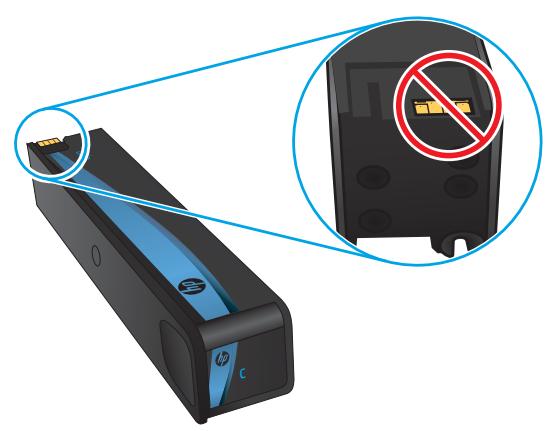
CAUTION: To prevent damage to the cartridge do not touch the gold-colored metal contacts of the cartridge.
The following illustration shows the cartridge components.
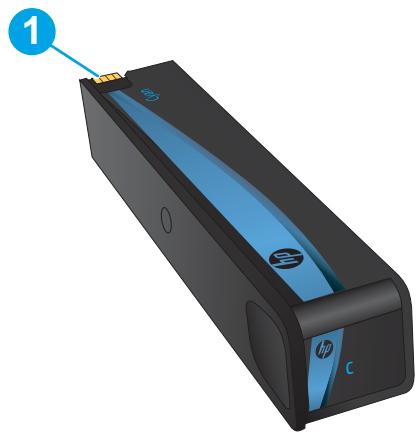
1
Metal connector. Do not touch. Fingerprints may cause supply error messages. Dust may also cause supply error messages; do not leave cartridges outside the printer for prolonged periods of time.

NOTE: Information about recycling used cartridges is in the cartridge box.
Remove and replace the cartridge
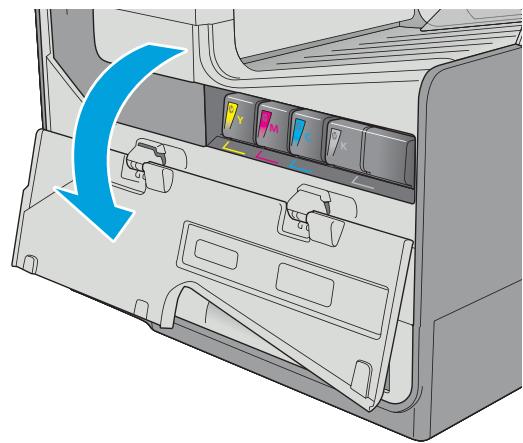
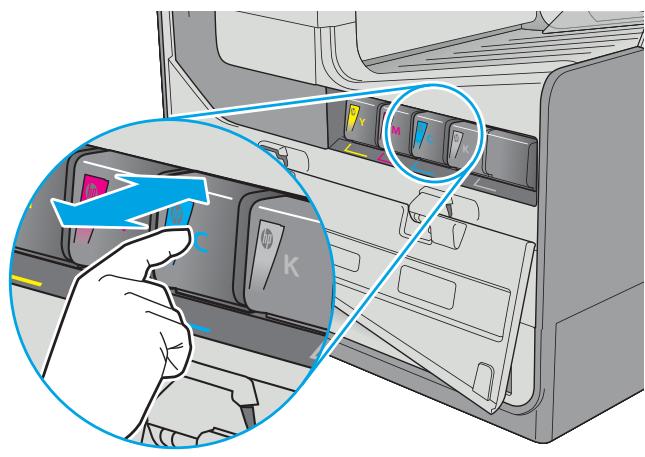
- Open the cartridge door.
- Push the old cartridge inward to unlock it.
- Grasp the edge of the old cartridge and then pull the cartridge straight out to remove it.
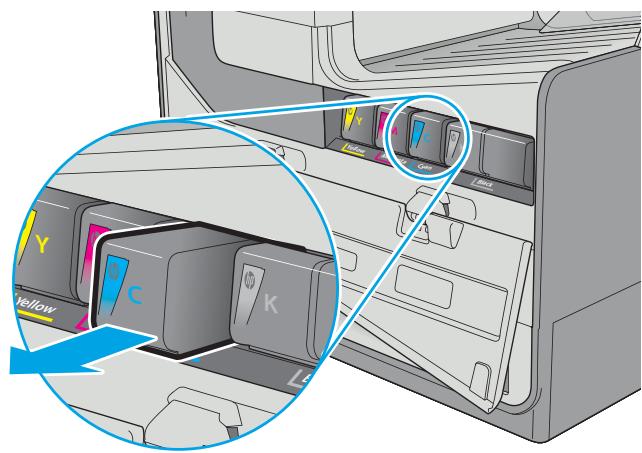
- Remove the new cartridge from the packaging.
- Do not touch the gold-colored metal contacts of the cartridge. Fingerprints on the contacts can cause print-quality problems.
- Insert the new cartridge into the product. Make sure the cartridge is firmly in place.
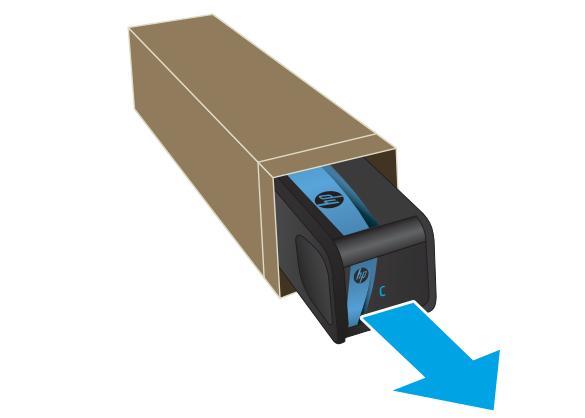
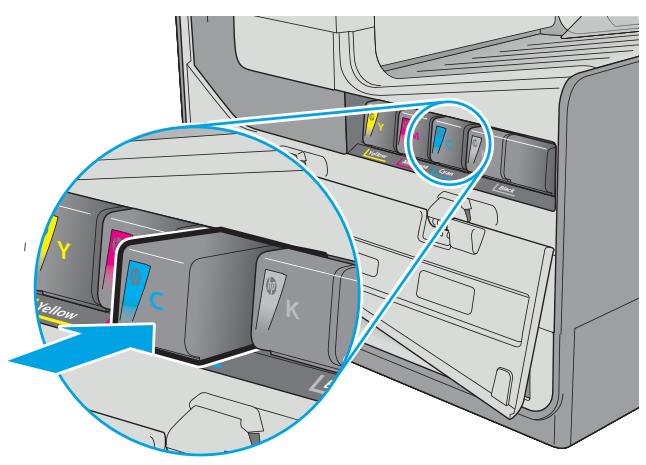
- Close the cartridge door.
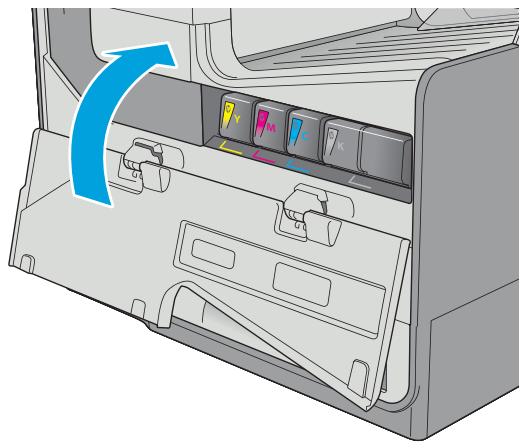
- Pack the used cartridge in the box that the new cartridge came in. See the enclosed recycling guide for information about recycling.
HP helps you recycle your Original HP cartridges—it's easy and free with the HP Planet Partners program, available in more than 50 countries/regions around the world1).
To find information about how to recycle used HP cartridges, please go to www.hp.com/recycle.
1) Program availability varies. For more information, visit www.hp.com/recycle.
Replace the ink-collection unit
Introduction
- Remove and replace the ink-collection unit
Introduction
The following information provides details about the ink-collection unit for the printer, and it includes instructions to replace it.
The printer indicates when the ink-collection unit is nearly full and when it is completely full. When it is completely full, printing stops until the ink-collection unit is replaced.
To purchase a ink-collection unit (part number B5L09A), go to the HP Parts Store at www.hp.com/buy/parts.

NOTE: The ink-collection unit is designed for a single use. Do not attempt to empty the ink-collection unit and reuse it. Doing so could lead to pigment being spilled inside the printer, which could result in reduced print quality. After use, return the ink-collection unit to HP's Planet Partners program for recycling.
Remove and replace the ink-collection unit
-
Open the left door.
-
Remove the ink-collection unit by pulling it out with both hands. Set the unit aside, upright, on a piece of paper to prevent spills.
CAUTION: When pulling out the ink-collection unit, avoid making direct contact with the black cylinder to prevent pigment smear on skin or clothes.
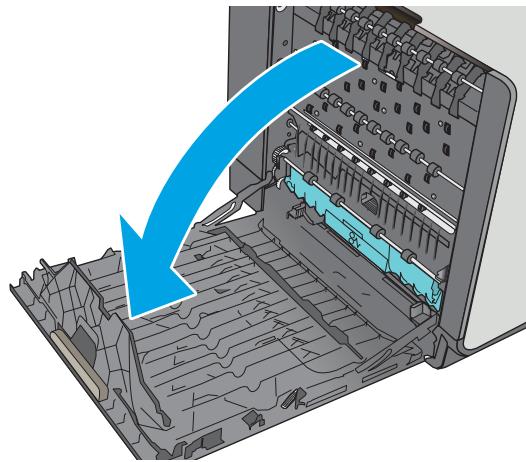
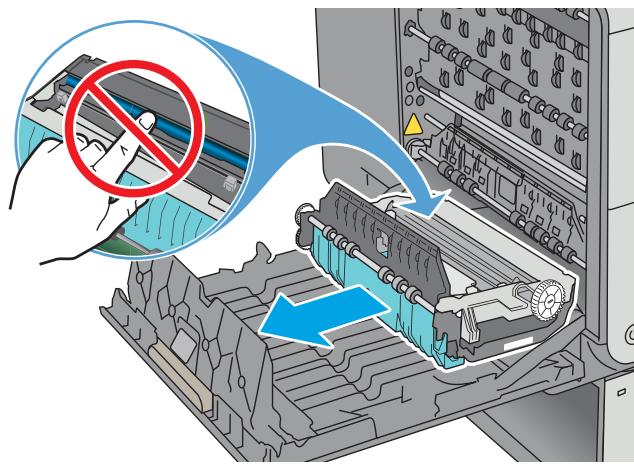
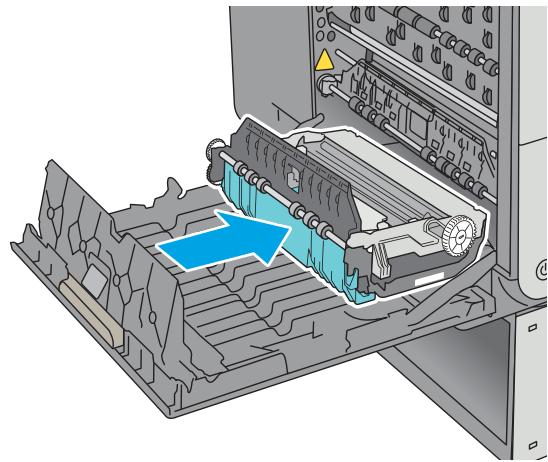
- Remove the new ink-collection unit from its packaging.
- Install the ink-collection unit.
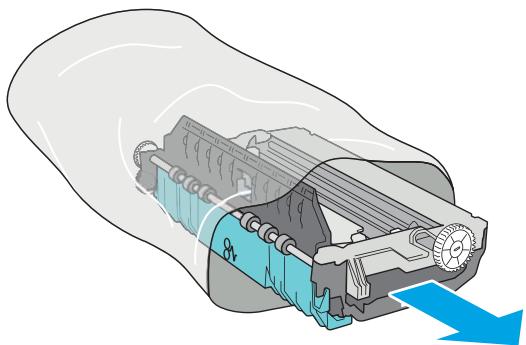
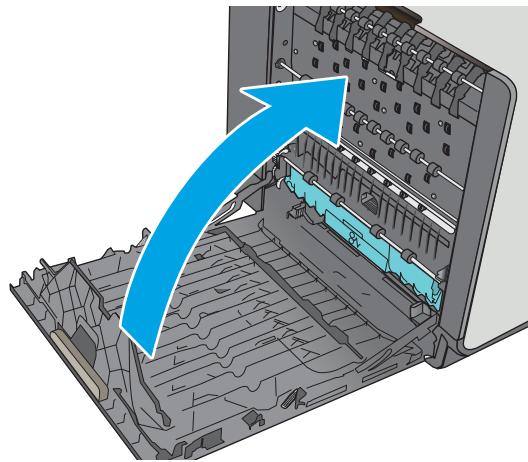
- Close the left door.
4 Print
Print tasks (Windows)
- Print tasks (OS X)
- Store print jobs on the printer to print later or print privately
- Mobile printing
Print from the USB port
For more information:
The following information is correct at the time of publication. For current information, see www.hp.com/support/pagewidecolor556.
HP's all-inclusive help for the printer includes the following information:
Install and configure
Learn and use
- Solve problems
Download software and firmware updates
- Join support forums
Find warranty and regulatory information
Print tasks (Windows)
How to print (Windows)
The following procedure describes the basic printing process for Windows.
- From the software program, select the Print option.
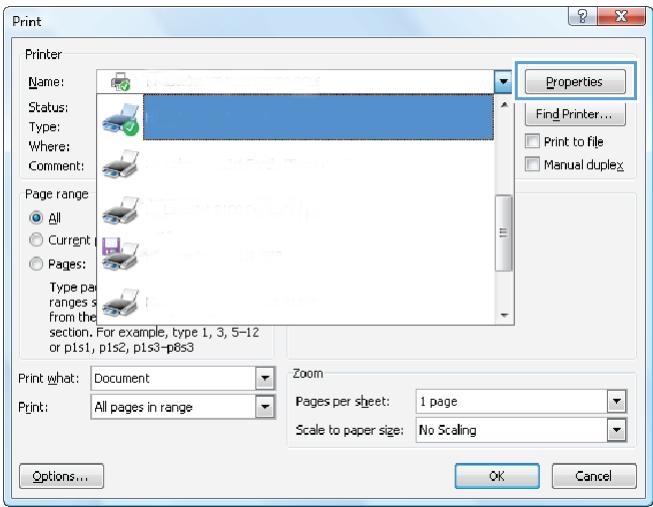
- Select the printer from the list of printers. To change settings, click or tap the Properties or Preferences button to open the print driver.
NOTE: The name of the button varies for different software programs.
NOTE: To access these features from a Windows 8 or 8.1 Start screen app, select Devices, select Print, and then select the printer.
NOTE: For more information, click the Help (?) button in the print driver.
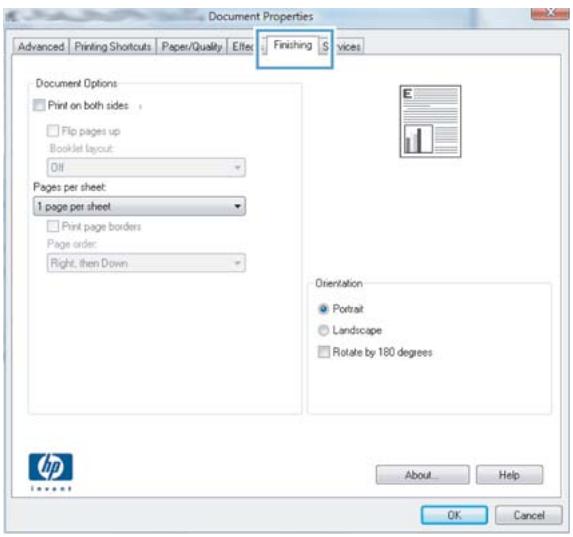
NOTE: The print driver might look different than what is shown here, but the steps are the same.
- Click or tap the tabs in the print driver to configure the available options. For example, set the paper orientation on the Finishing tab, and set the paper source, paper type, paper size, and quality settings on the Paper/Quality tab.
- Click or tap the OK button to return to the Print dialog box. Select the number of copies to print from this screen.
- Click or tap the OK button to print the job.
Automatically print on both sides (Windows)
Use this procedure for printers that have an automatic duplexer installed. If the printer does not have an automatic duplexer installed, or to print on paper types that the duplexer does not support, print on both sides manually.
- From the software program, select the Print option.
- Select the printer from the list of printers, and then click or tap the Properties or Preferences button to open the print driver.
NOTE: The name of the button varies for different software programs.
NOTE: To access these features from a Windows 8 or 8.1 Start screen app, select Devices, select Print, and then select the printer.
- Click or tap the Finishing tab.
- Select the Print on both sides check box. Click the OK button to close the Document Properties dialog box.
- In the Print dialog box, click the OK button to print the job.
Manually print on both sides (Windows)
Use this procedure for printers that do not have an automatic duplexer installed or to print on paper that the duplexer does not support.
- From the software program, select the Print option.
- Select the printer from the list of printers, and then click or tap the Properties or Preferences button to open the print driver.
NOTE: The name of the button varies for different software programs.
NOTE: To access these features from a Windows 8 or 8.1 Start screen app, select Devices, select Print, and then select the printer.
- Click or tap the Finishing tab.
- Select the Print on both sides (manually) check box. Click the OK button to print the first side of the job.
- Retrieve the printed stack from the output bin, and place it in Tray 1.
- If prompted, touch the appropriate control panel button to continue.
Print multiple pages per sheet (Windows)
- From the software program, select the Print option.
- Select the printer from the list of printers, and then click or tap the Properties or Preferences button to open the print driver.
NOTE: The name of the button varies for different software programs.
NOTE: To access these features from a Windows 8 or 8.1 Start screen app, select Devices, select Print, and then select the printer.
- Click or tap the Finishing tab.
- Select the number of pages per sheet from the Pages per sheet drop-down list.
- Select the correct Print page borders, Page order, and Orientation options. Click the OK button to close the Document Properties dialog box.
- In the Print dialog box, click the OK button to print the job.
Select the paper type (Windows)
- From the software program, select the Print option.
- Select the printer from the list of printers, and then click or tap the Properties or Preferences button to open the print driver.
NOTE: The name of the button varies for different software programs.
NOTE: To access these features from a Windows 8 or 8.1 Start screen app, select Devices, select Print, and then select the printer.
- Click or tap the Paper/Quality tab.
- From the Paper type drop-down list, click the More... option.
- Expand the list of Type is: options.
- Expand the category of paper types that best describes your paper.
- Select the option for the type of paper you are using, and then click the OK button.
- Click the OK button to close the Document Properties dialog box. In the Print dialog box, click the OK button to print the job.
If the tray needs to be configured, a tray configuration message displays on the printer control panel.
- Load the tray with the specified type and size of paper, and then close the tray.
- Touch the OK button to accept the detected type and size, or touch the Modify button to choose a different paper size or type.
- Select the correct type and size, and then touch the OK button.
Additional print tasks
Go to www.hp.com/support/pagewidecolor556.
Instructions are available for performing specific print tasks, such as the following:
Create and use printing shortcuts or presets
- Select the paper size, or use a custom paper size
- Select the page orientation
Create a booklet
Scale a document to fit a specific paper size
- Print the first or last pages of the document on different paper
- Print watermarks on a document
Print tasks (OS X)
How to print (OS X)
The following procedure describes the basic printing process for OS X.
- Click the File menu, and then click the Print option.
- Select the printer.
- Click Show Details or Copies & Pages, and then select other menus to adjust the print settings.

NOTE: The name of the item varies for different software programs.
- Click the Print button.
Automatically print on both sides (OS X)

NOTE: This information applies to printers that include an automatic duplexer.

NOTE: This feature is available if you install the HP print driver. It might not be available if you are using AirPrint.
- Click the File menu, and then click the Print option.
- Select the printer.
- Click Show Details or Copies & Pages, and then click the Layout menu.

NOTE: The name of the item varies for different software programs.
- Select a binding option from the Two-Sided drop-down list.
- Click the Print button.
Manually print on both sides (OS X)

NOTE: This feature is available if you install the HP print driver. It might not be available if you are using AirPrint.
- Click the File menu, and then click the Print option.
- Select the printer.
- Click Show Details or Copies & Pages, and then click the Manual Duplex menu.

NOTE: The name of the item varies for different software programs.
- Click the Manual Duplex box, and select a binding option.
- Click the Print button.
-
Go to the printer, and remove any blank paper that is in Tray 1.
-
Retrieve the printed stack from the output bin and place it with the printed-side facing down in the input tray.
- If prompted, touch the appropriate control panel button to continue.
Print multiple pages per sheet (OS X)
- Click the File menu, and then click the Print option.
- Select the printer.
- Click Show Details or Copies & Pages, and then click the Layout menu.

NOTE: The name of the item varies for different software programs.
- From the Pages per Sheet drop-down list, select the number of pages that you want to print on each sheet.
- In the Layout Direction area, select the order and placement of the pages on the sheet.
- From the Borders menu, select the type of border to print around each page on the sheet.
- Click the Print button.
Select the paper type (OS X)
- Click the File menu, and then click the Print option.
- Select the printer.
- Click Show Details or Copies & Pages, and then click the Media & Quality menu or the Paper/Quality menu.

NOTE: The name of the item varies for different software programs.
- Select from the Media & Quality or Paper/Quality options.

NOTE: This list contains the master set of options available. Some options are not available on all printers.
Media Type: Select the option for the type of paper for the print job.
- Print Quality: Select the resolution level for the print job.
- Edge-To-Edge Printing: Select this option to print close to the paper edges.
- Click the Print button.
Additional print tasks
Go to www.hp.com/support/pagewidecolor556.
Instructions are available for performing specific print tasks, such as the following:
Create and use printing shortcuts or presets
- Select the paper size, or use a custom paper size
- Select the page orientation
Create a booklet
Scale a document to fit a specific paper size
- Print the first or last pages of the document on different paper
Print watermarks on a document
Store print jobs on the printer to print later or print privately
Introduction
The following information provides procedures for creating and printing documents that are stored on the printer. These jobs can be printed at a later time or printed privately.
Create a stored job (Windows)
Create a stored job (OS X)
Print a stored job
Delete a stored job
Information sent to printer for Job Accounting purposes
Create a stored job (Windows)
Store jobs on the printer for private or delayed printing.

NOTE: The print driver might look different than what is shown here, but the steps are the same.
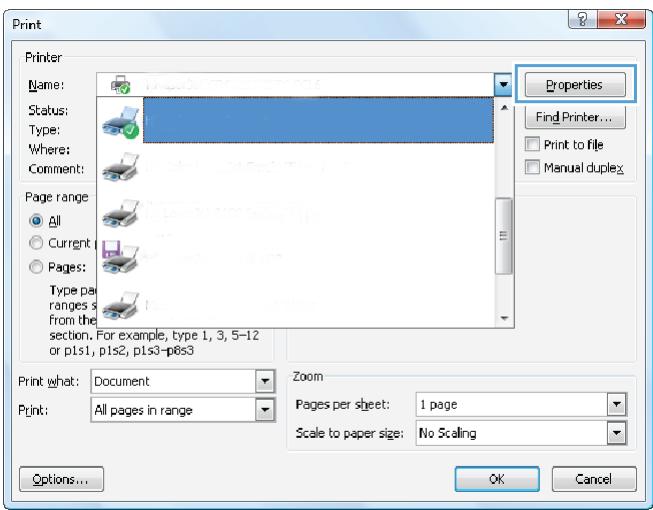
- From the software program, select the Print option.
- Select the printer from the list of printers, and then select Properties or Preferences (the name varies for different software programs).

NOTE: The name of the button varies for different software programs.

NOTE: To access these features from a Windows 8 or 8.1 Start screen app, select Devices, select Print, and then select the printer.
3. Click the Job Storage tab.
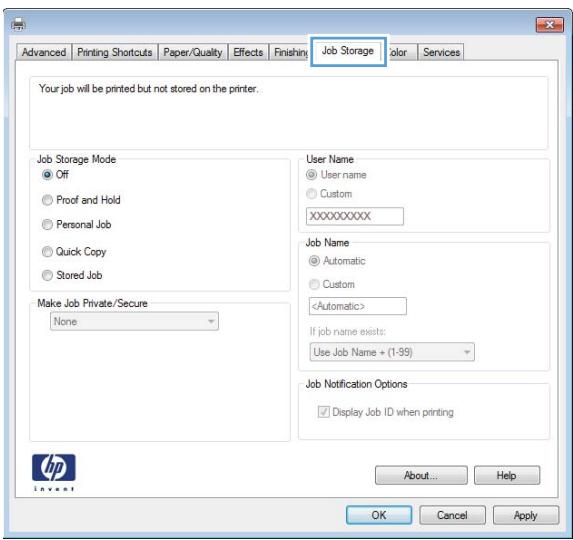
4. Select a Job Storage Mode option.
Proof and Hold: Print and proof one copy of a job, and then print more copies.
- Personal Job: The job does not print until you request it at the printer control panel. For this job-storage mode, you can select one of the Make Job Private/Secure options. If you assign a personal identification number (PIN) to the job, you must provide the required PIN at the control panel. If you encrypt the job, you must provide the required password at the control panel. The print job is deleted from memory after it prints and is lost if the printer loses power.
- Quick Copy: Print the requested number of copies of a job and store a copy of the job in the printer memory so you can print it again later.
- Stored Job: Store a job on the printer and allow other users to print the job at any time. For this job-storage mode, you can select one of the Make Job Private/Secure options. If you assign a personal identification number (PIN) to the job, the person who prints the job must provide the required PIN at the control panel. If you encrypt the job, the person who prints the job must provide the required password at the control panel.
- To use a custom user name or job name, click the Custom button, and then enter the user name or the job name.
Select which option to use if another stored job already has that name:
- Use Job Name + (1-99): Append a unique number to the end of the job name.
-
Replace Existing File: Overwrite the existing stored job with the new one.
-
Click the OK button to close the Document Properties dialog box. In the Print dialog box, click the OK button to print the job.
- For information about how to print the job, see the topic for "Print a stored job."
Create a stored job (OS X)
Store jobs on the printer for private or delayed printing.
- Click the File menu, and then click the Print option.
- In the Printer menu, select the printer.
- By default, the print driver displays the Copies & Pages menu. Open the menus drop-down list, and then click the Job Storage menu.
- In the Mode drop-down list, select the type of stored job.
Proof and Hold: Print and proof one copy of a job, and then print more copies.
- Personal Job: The job does not print until someone requests it at the printer control panel. If the job has a personal identification number (PIN), provide the required PIN at the control panel. The print job is deleted from memory after it prints and is lost if the printer loses power.
- Quick Copy: Print the requested number of copies of a job and store a copy of the job in the printer memory to print it again later.
- Stored Job: Store a job on the printer and allow other users to print the job at any time. If the job has a personal identification number (PIN), the person who prints the job must provide the required PIN at the control panel.
- To use a custom user name or job name, click the Custom button, and then enter the user name or the job name.
Select which option to use if another stored job already has that name.
- Use Job Name + (1-99): Append a unique number to the end of the job name.
-
Replace Existing File: Overwrite the existing stored job with the new one.
-
If you selected the Stored Job or Personal Job option in step 3, you can protect the job with a PIN. Type a 4-digit number in the Use PIN to Print field. When other people attempt to print this job, the printer prompts them to enter this PIN number.
- Click the Print button to process the job.
Print a stored job
Use the following procedure to print a job that is stored in the printer memory.
- Touch or press the Home button on the printer control panel.
- Select Retrieve from Device Memory.
- Select the name of the folder where the job is stored.
- Select the name of the job. If the job is private or encrypted, enter the PIN or password.
- Adjust the number of copies, and then touch the Start button or press the OK button to print the job.
Delete a stored job
When you send a stored job to the printer memory, the printer overwrites any previous jobs with the same user and job name. If a job is not already stored under the same user and job name, and the printer needs additional space, the printer might delete other stored jobs starting with the oldest. You can change the number of jobs that the printer can store from the General Settings menu on the printer control panel.
Use this procedure to delete a job that is stored in the printer memory.
- Touch or press the Home button on the printer control panel.
- Select Retrieve from Device Memory.
- Select the name of the folder where the job is stored.
- Select the name of the job, and then select the Delete button.
- If the job is private or encrypted, enter the PIN or the password, and then select the Delete button.
Information sent to printer for Job Accounting purposes
Printing jobs sent from drivers on the client (e.g., PC) may send personally identifiable information to HP's Printing and Imaging devices. This information may include, but is not limited to, user name and client name from which the job originated that may be used for job accounting purposes, as determined by the Administrator of the printing device. This same information may also be stored with the job on the mass storage device (e.g., disk drive) of the printing device when using the job storage feature.
Mobile printing
Introduction
HP offers multiple mobile and ePrint solutions to enable easy printing to an HP printer from a laptop, tablet, smartphone, or other mobile device. To see the full list and to determine the best choice, go to www.hp.com/go/LaserJetMobilePrinting.
- Wireless Direct Print and NFC Printing
HP ePrint via email
HP ePrint software
AirPrint
Google Cloud Print
Android embedded printing
Wireless Direct Print and NFC Printing
HP provides Wireless Direct Print and NFC (Near Field Communication) printing for printers with a supported HP Jetdirect 3000w NFC/Wireless Accessory. This accessory is available as an option for HP Enterprise printers that include a hardware-integration pocket (HIP2).
Wireless Direct Print and NFC printing enable Wi-Fi capable (mobile) devices to make a wireless network connection directly to the printer without using a wireless router.
The printer does not need to be connected to the network for this mobile walk-up printing to work.
Use Wireless Direct Print to print wirelessly from the following devices:
iPhone, iPad, or iPod touch using Apple AirPrint or the HP ePrint app
Android mobile devices using the HP ePrint App or the Android embedded print solution
PC and Mac devices using the HP ePrint Software
For more information on wireless printing, go to www.hp.com/go/wirelessprinting.
NFC and Wireless Direct Print capabilities can be enabled or disabled from the printer control panel.
- From the Home screen on the printer control panel, scroll to and select the Administration menu.
- Open the following menus:
Network Settings
- Wireless Menu
- Wireless Direct
- Select On to enable wireless printing.

NOTE: In environments where more than one model of the same printer is installed, it might be helpful to provide each printer a more unique Wireless Direct Name for easier printer identification for HP Wireless Direct printing. The Wireless Direct Name is also available on the How to Connect Page by touching the Network button from the Home screen on the printer control panel.
Follow this procedure to change the printer Wireless Direct Name:
- From the Home screen on the printer control panel, scroll to and select the Administration menu.
- Open the following menus:
Network Settings
- Wireless Menu
- Wireless Direct
- Wireless Direct Name
- Select the Wireless Direct Name area.
- Use the keyboard to change the name.
- Select OK.
HP ePrint via email
Use HP ePrint to print documents by sending them as an email attachment to the printer's email address from any email enabled device.
To use HP ePrint, the printer must meet these requirements:
The printer must be connected to a wired or wireless network and have Internet access.
HP Web Services must be enabled on the printer, and the printer must be registered with HP Connected.
Follow this procedure to enable HP Web Services and register with HP Connected:
- Open the HP Embedded Web Server (EWS):
a. From the Home screen on the printer control panel, touch the Network button to display the IP address or host name.
b. Open a Web browser, and in the address line, type the IP address or host name exactly as it displays on the printer control panel. Press the Enter key on the computer keyboard. The EWS opens.

https://10.10.XXXXX/

NOTE: If the Web browser displays a message indicating that accessing the website might not be safe, select the option to continue to the website. Accessing this website will not harm the computer.
- Click the HP Web Services tab.
- Select the option to enable Web Services.

NOTE: Enabling Web Services might take several minutes.
- Go to www.hpconnected.com to create an HP ePrint account and complete the setup process.
HP ePrint software
The HP ePrint software makes it easy to print from a Windows or Mac desktop or laptop computer to any HP ePrint-capable printer. This software makes it easy to find HP ePrint-enabled printers that are registered to your HP Connected account. The target HP printer can be located in the office or at locations across the globe.
- Windows: After installing the software, open the Print option from within your application, and then select HP ePrint from the installed printers list. Click the Properties button to configure print options.
- OS X: After installing the software, select File, Print, and then select the arrow next to PDF (in the bottom left of the driver screen). Select HP ePrint.
For Windows, the HP ePrint software supports TCP/IP printing to local printers on the network (LAN or WAN) and that support UPD PostScript®.
Windows and OS X both support IPP printing to LAN or WAN network-connected printers that support ePCL.
Windows and Mac also both support printing PDF documents to public print locations and printing using HP ePrint via email through the cloud.
Go to www.hp.com/go/eprintsoftware for drivers and information.

NOTE: The HP ePrint software is a PDF workflow utility for Mac, and is not technically a print driver.

NOTE: HP ePrint Software does not support USB printing.
AirPrint
Direct printing using Apple's AirPrint is supported for iOS 4.2 or later and from Mac computers running OS X 10.7 Lion and newer. Use AirPrint to print directly to the printer from an iPad, iPhone (3GS or later), or iPod touch (third generation or later) in the following mobile applications:
Mail
Photos
Safari
iBooks
- Select third-party applications

NOTE: Before using AirPrint with a USB connection, verify the version number. AirPrint versions 1.3 and earlier do not support USB connections.
Google Cloud Print
Google Cloud Print is a mobile printing solution available to Gmail account users that allows you to print over the web from anywhere, including your phone or tablet, to any printer.
For more information, go to www.google.com/cloudprint/learn/printers.html, and then select the HP link.
Android embedded printing
HP's print solution for Android and Kindle enables mobile devices to automatically find and print to HP printers that are on a network.
The printer must be connected to the same network (sub-net) as the Android device.
HP print solutions are embedded in some Android and Kindle devices and available for others at: play.google.com.
For more information on how to use Android embedded printing and which Android devices are supported, go to www.hp.com/go/LaserJetMobilePrinting.
Print from the USB port
Introduction
This printer features easy-access USB printing, for quickly printing files without sending them from a computer. The printer accepts standard USB flash drives in the USB port near the control panel. It supports the following types of files:
. pdf
- .prn
pcl
.ps
- .cht
Enable the USB port for printing
The USB port is disabled by default. Before using this feature, enable the USB port. Use one of the following methods to enable the port:
Method one: Enable the USB port from the printer control-panel menus
- Press the Home button on the printer control panel.
- Open the following menus:
Administration
General Settings
- Enable Retrieve from USB
- Select the Enabled option, and then touch the Save button or press the OK button.
Method two: Enable the USB port from the HP Embedded Web server (network-connected printers only)
- Open the HP Embedded Web Server (EWS):
a. From the Home screen on the printer control panel, touch the Network button to display the IP address or host name.
b. Open a Web browser, and in the address line, type the IP address or host name exactly as it displays on the printer control panel. Press the Enter key on the computer keyboard. The EWS opens.

https://10.10.XX.XXX/

NOTE: If the Web browser displays a message indicating that accessing the website might not be safe, select the option to continue to the website. Accessing this website will not harm the computer.
- Open the Print tab.
-
On the left side of the screen, click Retrieve from USB Setup.
-
Select the Enable Retrieve from USB check box.
- Click Apply.
Print USB documents
- Insert the USB flash drive into the easy-access USB port.
NOTE: The port might be covered. For some printers, the cover flips open. For other printers, pull the cover straight out to remove it.
- The printer detects the USB flash drive. Touch or press the OK button to access the drive, or, if prompted, select the Retrieve from USB option from the list of available applications. The Retrieve from USB screen opens.
- Select the name of the document to print.
NOTE: The document might be in a folder. Open folders as necessary.
- To adjust the number of copies, select Copies, and then use the keypad to change the number of copies.
- Touch the Start button or press the OK button to print the document.
5 Manage the printer
Advanced configuration with HP Embedded Web Server (EWS)
Advanced configuration with HP Utility for OS X
- Configure IP network settings
- Printer security features
Energy-conservation settings
HP Web Jetadmin
- Software and firmware updates
For more information:
The following information is correct at the time of publication. For current information, see www.hp.com/support/pagewidecolor556.
HP's all-inclusive help for the printer includes the following information:
Install and configure
Learn and use
- Solve problems
Download software and firmware updates
- Join support forums
Find warranty and regulatory information
Advanced configuration with HP Embedded Web Server (EWS)
Introduction
How to access the HP Embedded Web Server (EWS)
HP Embedded Web Server features
Introduction
Use the HP Embedded Web Server to manage printing functions from a computer instead of the printer control panel.
View printer status information
Determine the remaining life for all supplies and order new ones
View and change tray configurations
View and change the printer control-panel menu configuration
View and print internal pages
Receive notification of printer and supplies events
View and change network configuration
The HP Embedded Web Server works when the printer is connected to an IP-based network. The HP Embedded Web Server does not support IPX-based printer connections. Internet access is not needed to open and use the HP Embedded Web Server.
When the printer is connected to the network, the HP Embedded Web Server is automatically available.

NOTE: The HP Embedded Web Server is not accessible beyond the network firewall.
How to access the HP Embedded Web Server (EWS)
- From the Home screen on the printer control panel, touch the Network button to display the IP address or host name.
- Open a Web browser, and in the address line, type the IP address or host name exactly as it displays on the printer control panel. Press the Enter key on the computer keyboard. The EWS opens.

https://10.10.XX.XX/

NOTE: If the Web browser displays a message indicating that accessing the website might not be safe, select the option to continue to the website. Accessing this website will not harm the computer.
To use the HP Embedded Web Server, the browser must meet the following requirements:
Windows® 7
- Internet Explorer (version 8.x or greater)
Google Chrome (version 34.x or greater) - Firefox (version 20.x or greater)
Windows® 8 or greater
- Internet Explorer (version 9.x or greater)
Google Chrome (version 34.x or greater) - Firefox (version 20.x or greater)
OSX
- Safari (version 5.x or greater)
Google Chrome (version 34.x or greater)
Linux
Google Chrome (version 34.x or greater)
- Firefox (version 20.x or greater)
HP Embedded Web Server features
Information tab
General tab
Print tab
Troubleshooting tab
Security tab
HP Web Services tab
Networking tab
Other Links list
Information tab
Table 5-1 HP Embedded Web Server Information tab
| Menu | Description |
| Device Status | Shows the printer status and shows the estimated life remaining of HP supplies. The page also shows the type and size of paper set for each tray. To change the default settings, click the Change Settings link. |
| Job Log | Shows a summary of all jobs the printer has processed. |
| Configuration Page | Shows the information found on the configuration page. |
| Supplies Status Page | Shows the status of the supplies for the printer. |
| Event Log Page | Shows a list of all printer events and errors. Use the HP Instant Support link (in the Other Links area on all HP Embedded Web Server pages) to connect to a set of dynamic Web pages that help solve problems. These pages also show additional services available for the printer. |
| Usage Page | Shows a summary of the number of pages the printer has printed, grouped by size, type, and paper print path. |
| Device Information | Shows the printer network name, address, and model information. To customize these entries, click the Device Information menu on the General tab. |
| Control Panel Snapshot | Shows an image of the current screen on the control panel display. |
| Upload a print-ready file from the computer to print. The printer uses the default print settings to print the file. | |
| Printable Reports and Pages | Lists the internal reports and pages for the printer. Select one or more items to print or view. |
General tab
Table 5-2 HP Embedded Web Server General tab
| Menu | Description |
| Alerts | Setup email alerts for various printer and supplies events. |
| Control Panel Administration Menu | Shows the menu structure of the Administration menu on the control panel. NOTE: Configure settings on this screen, or the HP Embedded Web Server provides more advanced configuration options than are available through the Administration menu. |
| AutoSend | Configure the printer to send automated emails regarding printer configuration and supplies to specific email addresses. |
| Edit Other Links | Add or customize a link to another Web site. This link displays in the Other Links area on all HP Embedded Web Server pages. |
| Ordering Information | Enter information about ordering replacement cartridges. This information displays on the supplies status page. |
| Device Information | Name the printer and assign an asset number to it. Enter the name of the primary contact who will receive information about the printer. |
| Language | Set the language in which to display the HP Embedded Web Server information. |
| Date and Time | Set the date and time or synchronize with a network time server. |
| Energy Settings | Set or edit a wake time, sleep time, and sleep delay for the printer. Set a different schedule for each day of the week and for holidays. Set which interactions with the printer cause it to wake from sleep mode. |
| Backup and Restore | Create a backup file that contains printer and user data. If necessary, use this file to restore data to the printer. |
| Restore Factory Settings | Restore printer settings to the factory defaults. |
| Solution Installer | Install third-party software programs that can enhance the printer functionality. |
| Firmware Upgrade | Download and install printer firmware upgrade files. |
| Statistics Services | Provides connection information about third-party job-statistics services. |
Table 5-3 HP Embedded Web Server Print tab
| Menu | Description |
| Retrieve from USB Setup | Enable or disable the Retrieve from USB menu on the control panel. |
| Manage Stored Jobs | Enable or disable the ability to store jobs in the printer memory.Configure job-storage options. |
| Adjust Paper Types | Override the factory-default mode settings if print quality problems occur when using a specific paper type. |
| Restrict Color (Color printers only) | Permit or restrict color printing.Specify permissions for individual users or for jobs that are sent from specific software programs. |
| General Print Settings | Configure settings for all print jobs. |
| Manage Trays | Configure settings for paper trays. |
Troubleshooting tab
Table 5-4 HP Embedded Web Server Troubleshooting tab
| Menu | Description |
| General Troubleshooting | Select from a variety of reports and tests to help solve problems with the printer. |
| Online Help | Obtain QR codes and Web links to solution pages for the printer. |
| Diagnostic Data | Export printer information to a file that can be useful for detailed problem analysis. |
| NOTE: This item is available only if an administrator password is set from the Security tab. | |
| Calibration/Cleaning | Enable the automatic cleaning feature, create and print the cleaning page, and select an option to calibrate the printer immediately. |
| (Color printers only) | |
| Firmware Upgrade | Download and install printer firmware upgrade files. |
| Restore Factory Settings | Restore printer settings to factory defaults. |
Table 5-5 HP Embedded Web Server Security tab
| Menu | Description |
| General Security | Settings for general security, including the following: · Configure an administrator password to restrict access to certain features on the printer. · Set PJL password for processing PJL commands. · Set file system access and firmware upgrade security. · Enable or disable the Host USB port on the control panel or the USB connectivity port on the formatter for printing directly from a computer. · View the status of all security settings. |
| Access Control | Configure access to printer functions for specific individuals or groups, and select the method individuals use to sign in to the printer. |
| Protect Stored Data | Configure and manage the internal hard drive for the printer. Configure settings for jobs that are stored on the printer hard drive. |
| Certificate Management | Install and manage security certificates for access to the printer and the network. |
| Web Service Security | Allow resources on this printer to be accessed by web pages from different domains. If no sites are added to the list, then all sites are trusted. |
| Self Test | Verify that the security functions are running according to expected system parameters. |
HP Web Services tab
Use the HP Web Services tab to configure and enable HP Web Services for this printer. It is necessary to Enable HP Web Services to use the HP ePrint feature.
Table 5-6 HP Embedded Web Server HP Web Services tab
| Menu | Description |
| Web Services Setup | Connect this printer to HP Connected on the Web by enabling HP Web Services. |
| Web Proxy | Configure a proxy server if there are issues enabling HP Web Services or connecting the printer to the Internet. |
| HP-ePrint Debugging | Enable features for solving problems with connecting to HP ePrint services. |
Networking tab
Use the Networking tab to configure and secure network settings for the printer when it is connected to an IP-based network. This tab does not display if the printer is connected to other types of networks.
Table 5-7 HP Embedded Web Server Networking tab
| Menu | Description |
| Wireless Direct Print Settings | Configure Wireless Direct Print for printers that include embedded Wireless Direct Print and NFC printing or that have a wireless accessory installed. |
| NOTE: The configuration options available depend on the print server model. | |
| TCP/IP Settings | Configure TCP/IP settings for IPv4 and IPv6 networks. |
| NOTE: The configuration options available depend on the print server model. | |
| Network Settings | Configure IPX/SPX, AppleTalk, DLC/LLC, and SNMP settings, depending on the print server model. |
| Other Settings | Configure general printing protocols and services supported by the print server. The available options depend on the print server model, but can include firmware update, LPD queues, USB settings, support information, and refresh rate. |
| AirPrint | Enable, set up, or disable network printing from Apple supported printers. |
| Select Language | Change the language displayed by the HP Embedded Web Server. This page displays if the Web pages support multiple languages. Optionally, select supported languages through language-preference settings in the browser. |
| Settings | View and restore current security settings to factory-default values. |
| Configure security settings using the Security Configuration Wizard. | |
| NOTE: Do not use the Security Configuration Wizard to configure security settings using network-management applications, such as HP Web Jetadmin. | |
| Authorization | Control configuration management and use of this printer, including the following: |
| • Set or change the administrator password to control access to configuration parameters. | |
| • Request, install, and manage digital certificates on the HP Jetdirect print server. | |
| • Limit host access to this printer through an Access Control List (ACL) (for selected print servers on IPv4 networks only). | |
| Mgmt. Protocols | Configure and manage security protocols for this printer, including the following: |
| • Set the security management level for the HP Embedded Web Server, and control traffic over HTTP and HTTPS. | |
| • Configure the SNMP (Simple Network Management Protocol) operation. Enable or disable the SNMP v1/v2c or SNMP v3 agents on the print server. | |
| • Control access through protocols that may not be secure, such as printing protocols, print services, discovery protocols, name resolution services, and configuration-management protocols. | |
| 802.1X Authentication (For selected HP Jetdirect models only) | Configure 802.1X authentication settings on the Jetdirect print server as required for client authentication on the network, and reset the 802.1X authentication settings to factory-default values. |
| CAUTION: When changing the 802.1X authentication settings; the printer might lose its connection. To reconnect, it might be necessary to reset the print server to a factory-default state and reinstall the printer. | |
| IPsec/Firewall (For selected HP Jetdirect models only) | View or configure a Firewall policy or an IPsec/Firewall policy. |
| Announcement Agent (For selected HP Jetdirect models only) | Enable or disable the HP Device Announcement Agent, set the configuration server, and configure mutual authentication using certificates. |
| Network Statistics | Display network statistics that are collected and stored on the HP Jetdirect print server. |
| Protocol Info | View a list of network-configuration settings on the HP Jetdirect print server for each protocol. |
| Configuration Page | View the HP Jetdirect configuration page, which contains status and configuration information. |
Other Links list

NOTE: Configure which links display in the Other Links list by using the Edit Other Links menu on the General tab. The following are the default links.
Table 5-8 HP Embedded Web Server Other Links list
| Menu | Description |
| Product Support | Connect to the support site for the printer to search for help on various topics. |
| Shop for Supplies | Connect to the HP SureSupply Web site for information on purchasing original HP supplies, such as cartridges and paper. |
| HP Instant Support | Connect to the HP Web site to find solutions to printer problems. |
Advanced configuration with HP Utility for OS X
Use the HP Utility to check printer status or to view or change printer settings from the computer.
Use the HP Utility when the printer is connected with a USB cable or is connected to a TCP/IP-based network.
Open HP Utility
- At the computer, open the System Preferences menu, and then click Print & Fax, Print & Scan, or Printers & Scanners.
- Select the printer in the list.
- Click the Options & Supplies button.
- Click the Utility tab.
- Click the Open Printer Utility button.
HP Utility features
The HP Utility toolbar includes these items:
Devices: Click this button to show or hide Mac products found by the HP Utility.
- All Settings: Click this button to return to the HP Utility main view.
HP Support: Click this button to open a browser and go to the HP support Web site.
Supplies: Click this button to open the HP SureSupply Web site.
- Registration: Click this button to open the HP registration Web site.
Recycling: Click this button to open the HP Planet Partners Recycling Program Web site.
HP Utility consists of pages that are opened by clicking in the All Settings list. The following table describes the tasks available with HP Utility.
| Item | Description |
| Supplies Status | Shows the printer supplies status and provides links for ordering supplies online. |
| Device Information | Shows information about the currently selected printer. |
| File Upload | Transfers files from the computer to the printer. |
| Upload Fonts | Transfers font files from the computer to the printer. |
| HP Connected | Accesses the HP Connected Web site. |
| Update Firmware | Transfers a firmware update file to the printer. |
| NOTE: This option is available only after opening the View menu and selecting the Show Advanced Options item. | |
| Commands | Sends special characters or print commands to the printer after the print job. |
| NOTE: This option is available only after opening the View menu and selecting the Show Advanced Options item. | |
| Supplies Management | Configs how the printer should behave when supplies are nearing the end of their estimated life. |
| Trays Configuration | Changes the default tray settings. |
| Output Devices | Manages settings for optional output accessories. |
| Duplex Mode | Turns on the automatic two-sided printing mode. |
| E-mail Alerts | Configs automatic email alerts for certain printer conditions, such as when supplies need to be replaced, trays are empty, doors are open, or a paper jam has occurred. |
| Resolution | Sets the default print resolution. |
| Protect Direct Ports | Disables printing over USB or parallel ports. |
| Stored Jobs | Manages print jobs that are stored on the printer hard disk. |
| Network Settings | Configs the network settings, such as the IPv4 and IPv6 settings. |
| Additional Settings | Provides access to the HP Embedded Web Server. |
Configure IP network settings
- Printer sharing disclaimer
View or change network settings - Rename the printer on a network
- Manually configure IPv4 TCP/IP parameters from the control panel
- Manually configure IPv6 TCP/IP parameters from the control panel
- Link speed and duplex settings
Printer sharing disclaimer
HP does not support peer-to-peer networking, as the feature is a function of Microsoft operating systems and not of the HP printer drivers. Go to Microsoft at www.microsoft.com.
View or change network settings
Use the HP Embedded Web Server to view or change IP configuration settings.
- Open the HP Embedded Web Server (EWS):
a. From the Home screen on the printer control panel, touch the Network button to display the IP address or host name.
b. Open a Web browser, and in the address line, type the IP address or host name exactly as it displays on the printer control panel. Press the Enter key on the computer keyboard. The EWS opens.

https://10.10.XX.XXX/

NOTE: If the Web browser displays a message indicating that accessing the website might not be safe, select the option to continue to the website. Accessing this website will not harm the computer.
- Click the Networking tab to obtain network information. Change settings as needed.
Rename the printer on a network
To rename the printer on a network so that it can be uniquely identified, use the HP Embedded Web Server.
- Open the HP Embedded Web Server (EWS):
a. From the Home screen on the printer control panel, touch the Network button to display the IP address or host name.
b. Open a Web browser, and in the address line, type the IP address or host name exactly as it displays on the printer control panel. Press the Enter key on the computer keyboard. The EWS opens.

https://10.10.XX.XXX/

NOTE: If the Web browser displays a message indicating that accessing the website might not be safe, select the option to continue to the website. Accessing this website will not harm the computer.
- Open the General tab.
- On the Device Information page, the default printer name is in the Device Name field. You can change this name to uniquely identify this printer.

NOTE: Completing the other fields on this page is optional.
- Click the Apply button to save the changes.
Manually configure IPv4 TCP/IP parameters from the control panel
Use the control-panel Administration menus to manually set an IPv4 address, subnet mask, and default gateway.
- From the Home screen on the printer control panel, scroll to and touch the Administration button.
- Open the following menus:
Network Settings
- Jetdirect Menu
TCP/IP
- IPV 4 Settings
- Config Method
- Select the Manual option, and then touch the Save button.
- Open the Manual Settings menu.
- Touch the IP Address, Subnet Mask, or Default Gateway option.
- Touch the first field to open a keypad. Enter the correct digits for the field, and then touch the OK button.
- Repeat the process for each field, and then touch the Save button.
Manually configure IPv6 TCP/IP parameters from the control panel
Use the control-panel Administration menus to manually set an IPv6 address.
- From the Home screen on the printer control panel, scroll to and touch the Administration button.
- To enable manual configuration, open the following menus:
Network Settings
- Jetdirect Menu
TCP/IP
- IPV 6 Settings
- Address
- Manual Settings
- Enable
- Select the On option, and then touch the Save button.
- To configure the address, touch the Address button and then touch the field to open a keypad.
- Use the keypad to enter the address, and then touch the OK button.
- Touch the Save button.
Link speed and duplex settings

NOTE: This information applies only to Ethernet networks. It does not apply to wireless networks.
The link speed and communication mode of the print server must match the network hub. For most situations, leave the printer in automatic mode. Incorrect changes to the link speed and duplex settings might prevent the printer from communicating with other network devices. To make changes, use the printer control panel.

NOTE: The printer setting must match the setting for the network device (a network hub, switch, gateway, router, or computer).

NOTE: Making changes to these settings causes the printer to turn off and then on. Make changes only when the printer is idle.
- From the Home screen on the printer control panel, scroll to and touch the Administration button.
- Open the following menus:
Network Settings
- Jetdirect Menu
- Link Speed
-
Select one of the following options:
-
Auto: The print server automatically configures itself for the highest link speed and communication mode allowed on the network.
10T Half: 10 megabytes per second (Mbps), half-duplex operation
10T Full: 10 Mbps, full-duplex operation
10T Auto: 10 Mbps, automatic-duplex operation
100TX Half: 100 Mbps, half-duplex operation
100TX Full: 100 Mbps, full-duplex operation
100TX Auto: 100 Mbps, automatic-duplex operation
1000T Full: 1000 Mbps, full-duplex operation
- Touch the Save button. The printer turns off and then on.
Printer security features
Introduction
The printer includes several security features to restrict who has access to configuration settings, to secure data, and to prevent access to valuable hardware components.
Security statements
- Assign an administrator password
IP Security
- Lock theformatter
- Encryption support: HP High Performance Secure Hard Disks
Security statements
The printer supports security standards and recommended protocols that help you keep the printer secure, protect critical information on your network, and simplify the way you monitor and maintain the printer.
Assign an administrator password
Assign an administrator password for access to the printer and the HP Embedded Web Server so that unauthorized users cannot change the printer settings.
- Open the HP Embedded Web Server (EWS):
a. From the Home screen on the printer control panel, touch the Network button to display the IP address or host name.
b. Open a Web browser, and in the address line, type the IP address or host name exactly as it displays on the printer control panel. Press the Enter key on the computer keyboard. The EWS opens.

https://10.10.XX.XXX/

NOTE: If the Web browser displays a message indicating that accessing the website might not be safe, select the option to continue to the website. Accessing this website will not harm the computer.
- Click the Security tab.
- Open the General Security menu.
- In the area labeled Set the Local Administrator Password, enter the name to associate with the password in theUsername field.
- Enter the password in the New Password field, and then enter it again in the Verify Password field.

NOTE: To change an existing password, first enter the existing password in the Old Password field.
- Click the Apply button.

NOTE: Make note of the password and store it in a safe place.
Some features on the printer control panel can be secured so that unauthorized people cannot use them. When a feature is secured, the printer prompts you to sign in before you can use it. You can also sign in without waiting for a prompt by selecting Sign In from the printer control panel.
Typically, the credentials for signing in to the printer are the same as for signing in to the network. Consult the network administrator for this printer if you have questions about which credentials to use.
- From the Home screen on the printer control panel, select Sign In.
- Follow the prompts to enter the credentials.

NOTE: To maintain security for the printer, select Sign Out when you have finished using the printer.
IP Security
IP Security (IPsec) is a set of protocols that control IP-based network traffic to and from the printer. IPsec provides host-to-host authentication, data integrity, and encryption of network communications.
For printers that are connected to the network and have an HP Jetdirect print server, you can configure IPsec by using the Networking tab in the HP Embedded Web Server.
Lock theformatter
The formatter has a slot that you can use to attach a security cable. Locking the formatter prevents someone from removing valuable components from it.
Encryption support: HP High Performance Secure Hard Disks
The hard disk provides hardware-based encryption so you can securely store sensitive data without impacting printer performance. This hard disk uses the latest Advanced Encryption Standard (AES) and has versatile time-saving features and robust functionality.
Use the Security menu in the HP Embedded Web Server to configure the disk.
Energy-conservation settings
Introduction
- Optimize speed or energy usage
- Set the sleep timer and configure the printer to use 1 watt or less of power
- Set the sleep schedule
Optimize speed or energy usage
By default the product stays warm between jobs to optimize speed and print the first page of jobs faster. To conserve energy, set the product to cool between jobs. The product has four incremental settings to optimize for speed or energy usage.
- From the Home screen on the product control panel, scroll to and touch the Administration button.
- Open the following menus:
General Settings
Energy Settings
Optimum Speed/Energy Usage
- Select the option that you want to use, and then touch the Save button.

NOTE: The default setting is Faster first page.
Set the sleep timer and configure the printer to use 1 watt or less of power
The printer has several options for the energy-saving sleep timer feature. The time delay to enter the Sleep/ Auto Off state is adjustable, and the power usage during the Sleep/Auto Off state varies according to selection for the wake option.
- From the Home screen on the printer control panel, scroll to and touch the Administration button.
- Open the following menus:
General Settings
Energy Settings
- Sleep Timer Settings
- Select Sleep /Auto Off After, enter the appropriate time period, and then touch the Save button.

NOTE: The sleep-mode default time is 0 minutes. The printer enters sleep mode immediately after each job completes.
-
Select one of the Wake/Auto On to These Events options.
-
All events: The printer wakes when it receives any print job (through the USB port, network port, or wireless connection), or when someone presses a button on the control panel, or opens any door or tray.
Network port: The printer wakes when it receives a print job sent through the network port, or when someone presses a button on the control panel, or opens any door or tray. With this setting, the printer uses 1 watt or less of power while in the Sleep/Auto Off state. - Power button only: The printer wakes only when someone presses the power button. With this setting, the printer uses 1 watt or less of power while in the Sleep/Auto Off state.
Set the sleep schedule
Use the Sleep Schedule feature to configure the printer to automatically wake or go into Sleep/Auto Off mode at specific times on specific days of the week.

NOTE: Configure the date and time settings before setting the Sleep Schedule feature.
- From the Home screen on the printer control panel, scroll to and touch the Administration button.
- Open the following menus:
General Settings
- Date/Time Settings
-
Open the Date/Time Format menu and configure the following settings:
-
Date Format
Time Format -
Touch the Save button.
-
Open the Date/Time menu and configure the following settings:
-
Date/Time
Time Zone
If you are in an area that uses daylight savings time, select the Adjust for Daylight Savings box.
- Touch the Save button.
- Touch the back-arrow button to return to the Administration screen.
-
Open the following menus:
-
General Settings
Energy Settings -
Sleep Schedule
-
Touch the Add button, and then select the type of event to schedule: Wake or Sleep.
- Configure the following settings:
Time
Event Days
- Touch the OK button, and then touch the Save button.
HP Web Jetadmin
HP Web Jetadmin is an award-winning, industry-leading tool for efficiently managing a wide variety of networked HP products, including printers, multifunction printers, and digital senders. This single solution allows you to remotely install, monitor, maintain, troubleshoot, and secure your printing and imaging environment — ultimately increasing business productivity by helping you save time, control costs, and protect your investment.
HP Web Jetadmin upgrades are periodically made available to provide support for specific product features. Go to www.hp.com/go/webjetadmin for more information.
Software and firmware updates
HP regularly updates features that are available in the printer firmware. To take advantage of the most current features, update the printer firmware. Download the most recent firmware update file from the Web:
Go to www.hp.com/support/pagewidecolor556. Click Drivers & Software.
6 Solve problems
- Customer support
Control panel help system - Restore factory settings
A "Cartridge is low" or "Cartridge is very low" message displays on the printer control panel - Printer does not pick up paper or misfeeds
Clear paper jams - Improve print quality
- Solve wired network problems
- Solve wireless network problems
For more information:
The following information is correct at the time of publication. For current information, see www.hp.com/support/pagewidecolor556.
HP's all-inclusive help for the printer includes the following information:
Install and configure
Learn and use
- Solve problems
Download software and firmware updates
- Join support forums
Find warranty and regulatory information
Customer support
| Get telephone support for your country/region | Country/region phone numbers are on the flyer that was in the box with the printer or at www.hp.com/support/. |
| Have the printer name, serial number, date of purchase, and problem description ready | |
| Get 24-hour Internet support, and download software utilities and drivers | www.hp.com/support/pagewidecolor556 |
| Order additional HP service or maintenance agreements | www.hp.com/qo/carepack |
| Register the printer | www.registererhp.com |
Control panel help system
The printer has a built-in Help system that explains how to use each menu or screen. To open the Help system, press the Help button on the control panel.
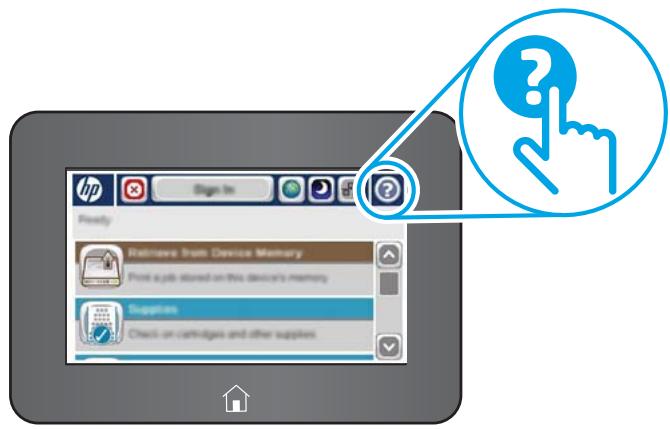
Some Help screens include animations that show specific procedures, such as clearing paper jams.
If the printer alerts of an error or warning, press the Help button to open a message that describes the problem. The message also contains instructions to help solve the problem.
Restore factory settings
Introduction
Use one of the following methods to restore the printer to the original settings from the factory.

NOTE: Restoring factory settings sets most of the printer settings to their factory defaults. However, some settings are not changed, such as language, date, time, and some network configuration settings.
Method one: Restore factory settings from the printer control panel
- From the Home screen on the printer control panel, scroll to and touch the Administration button.
- Open the following menus:
General Settings
- Restore Factory Settings
- A verification message advises that completing the restore function might result in loss of data. Select Restore to complete the process.

NOTE: The printer restarts automatically after the reset operation completes.
Method two: Restore factory settings from the HP Embedded Web Server (network-connected printers only)
- Open the HP Embedded Web Server (EWS):
a. From the Home screen on the printer control panel, touch the Network button to display the IP address or host name.
b. Open a Web browser, and in the address line, type the IP address or host name exactly as it displays on the printer control panel. Press the Enter key on the computer keyboard. The EWS opens.

https://10.10.XXXXX/

NOTE: If the Web browser displays a message indicating that accessing the website might not be safe, select the option to continue to the website. Accessing this website will not harm the computer.
- Open the General tab.
- On the left side of the screen, click Restore Factory Settings.
- Click the Reset button.

NOTE: The printer restarts automatically after the reset operation completes.
A “Cartridge is low” or “Cartridge is very low” message displays on the printer control panel
Cartridge is low: The printer indicates when a cartridge level is low. Actual cartridge life remaining may vary. Consider having a replacement available to install when print quality is no longer acceptable. The cartridge does not need to be replaced now.
Cartridge is very low: The printer indicates when the cartridge level is very low. Actual cartridge life remaining may vary. Consider having a replacement available to install when print quality is no longer acceptable. The cartridge does not need to be replaced now unless the print quality is no longer acceptable.
Once an HP cartridge has reached Very Low, HP's Premium Protection Warranty on that cartridge has ended.

NOTE: This printer is not designed to use continuous ink systems. To resume printing, remove continuous ink system and install genuine HP (or compatible) cartridges.

NOTE: This printer is designed for ink cartridges to be used until they are empty. Refilling cartridges prior to depletion may cause your printer to fail. If this happens, insert a new cartridge (either genuine HP or compatible) to continue printing.
Change the "Very Low" settings
You can change the way the printer reacts when supplies reach the Very Low state. You do not have to re-establish these settings when you install a new cartridge.
- From the Home screen on the product control panel, scroll to and select Supplies.
- Open the following menus:
Manage Supplies
Supply Settings
- Black Cartridge or Color Cartridges
- Very Low Settings
-
Select one of the following options:
-
Select the Stop option to set the printer to stop printing when the cartridge reaches the Very Low threshold.
- Select the Prompt to continue option to set the printer to stop printing when the cartridge reaches the Very Low threshold. You can acknowledge the prompt or replace the cartridge to resume printing.
- Select the Continue option to set the printer to alert you that the cartridge is very low, and to continue printing beyond the Very Low setting without interaction. This can result in unsatisfactory print quality.
For products with fax capability
When the printer is set to the Stop or Prompt to continue option, there is some risk that faxes will not print when the printer resumes printing. This can occur if the printer has received more faxes than the memory can hold while the printer is waiting.
The printer can print faxes without interruption when it passes the Very Low threshold if you select the Continue option for the cartridge, but print quality might degrade.
Order supplies
| Order supplies and paper | www.hp.com/go/suresupply |
| Order through service or support providers | Contact an HP-authorized service or support provider. |
| Order using the HP Embedded Web Server (EWS) | To access, in a supported Web browser on your computer, enter the printer IP address or host name in the address/URL field. The EWS contains a link to the HP SureSupply Web site, which provides options for purchasing Original HP supplies. |
Printer does not pick up paper or misfeeds
Introduction
The following solutions can help solve problems if the printer is not picking up paper from the tray or is picking up multiple sheets of paper at one time. Either of these situations can result in paper jams.
The printer does not pick up paper
The printer picks up multiple sheets of paper
The printer does not pick up paper
If the printer does not pick up paper from the tray, try these solutions.
- Open the printer and remove any jammed sheets of paper. Verify that no torn remnants of paper remain inside the printer.
- Load the tray with the correct size of paper for the job.
-
Make sure the paper size and type are set correctly on the printer control panel.
-
Make sure the paper guides in the tray are adjusted correctly for the size of paper. Adjust the guides to the appropriate indentation in the tray. The arrow on the tray guide should line up exactly with the marking on the tray.

NOTE: Do not adjust the paper guides tightly against the paper stack. Adjust them to the indentations or markings in the tray.
The following images show examples of the paper-size indentations in the trays for various printers. Most HP printers have markings similar to these.
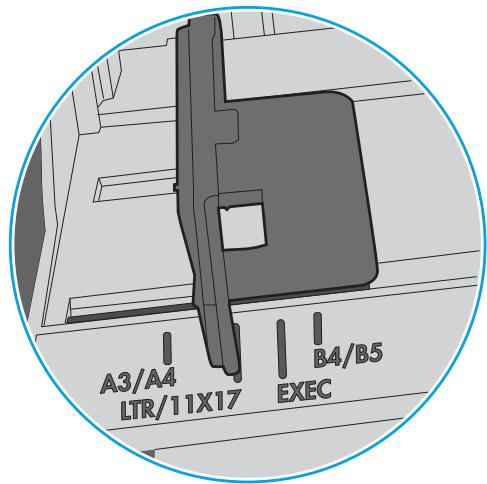
Figure 6-1 Size markings for Tray 1 or the multipurpose tray
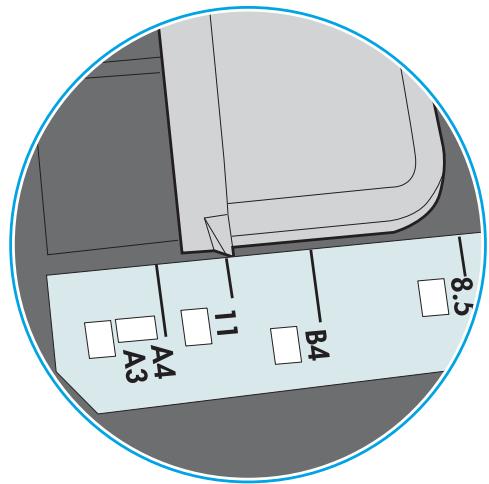
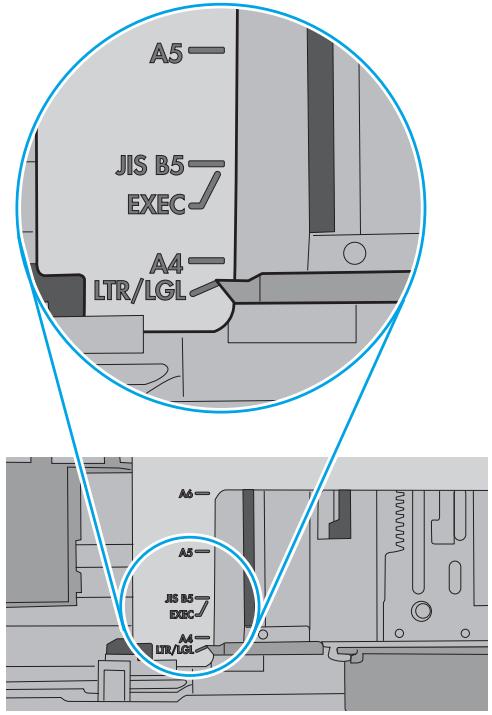
Figure 6-2 Size markings for cassette trays
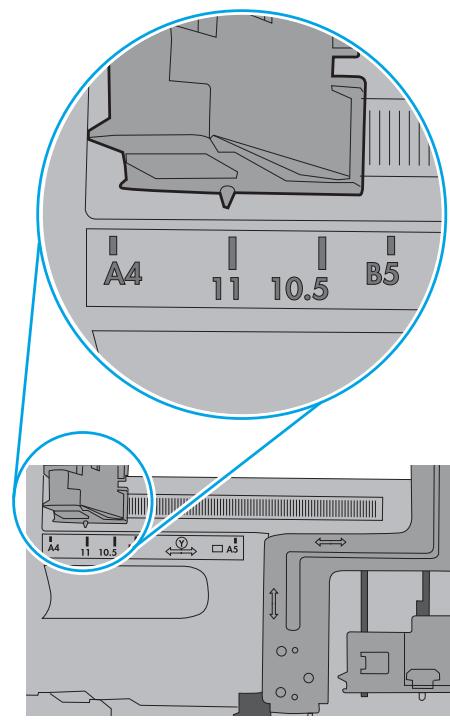
- Verify that the humidity in the room is within specifications for this printer and that paper is being stored in unopened packages. Most reams of paper are sold in moisture-proof wrapping to keep paper dry.
In high-humidity environments, paper at the top of the stack in the tray can absorb moisture, and it might have a wavy or uneven appearance. If this happens, remove the top 5 to 10 sheets of paper from the stack.
In low-humidity environments, excess static electricity can cause sheets of paper to stick together. If this happens, remove the paper from the tray, and flex the stack by holding it at each end and bringing the ends up to form a U shape. Then, rotate the ends down to reverse the U shape. Next, hold each side of the stack of paper, and repeat this process. This process releases individual sheets without introducing static electricity. Straighten the paper stack against a table before returning it to the tray.
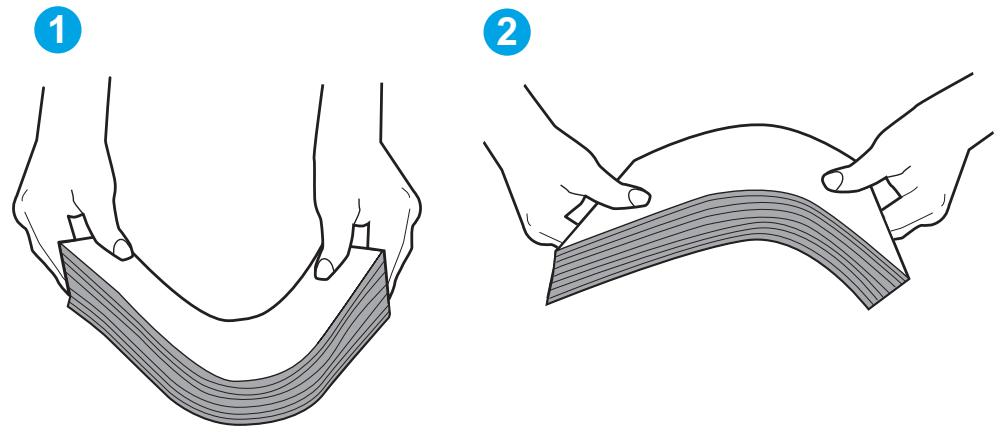
Figure 6-3 Technique for flexing the paper stack
- Check the printer control panel to see if it is displaying a prompt to feed the paper manually. Load paper, and continue.
- The rollers above the tray might be contaminated. Clean the rollers with a lint-free cloth dampened with warm water. Use distilled water, if it is available.
CAUTION: Do not spray water directly on to the printer. Instead, spray water on the cloth or dab the cloth in water and wring it out before cleaning the rollers.
The following image shows examples of the roller location for various printers.
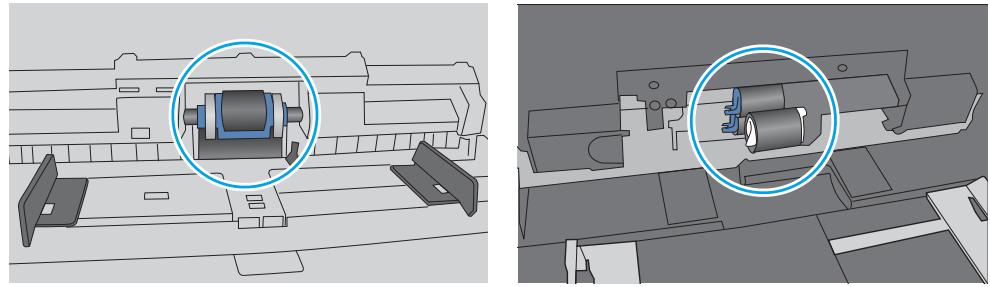
Figure 6-4 Roller locations for Tray 1 or the multipurpose tray
The printer picks up multiple sheets of paper
If the printer picks up multiple sheets of paper from the tray, try these solutions.
- Remove the stack of paper from the tray and flex it, rotate it 180 degrees, and flip it over. Do not fan the paper. Return the stack of paper to the tray.

NOTE: Fanning the paper introduces static electricity. Instead of fanning the paper, flex the stack by holding it at each end and bringing the ends up to form a U shape. Then, rotate the ends down to reverse the U shape. Next, hold each side of the stack of paper, and repeat this process. This process releases individual sheets without introducing static electricity. Straighten the paper stack against a table before returning it to the tray.
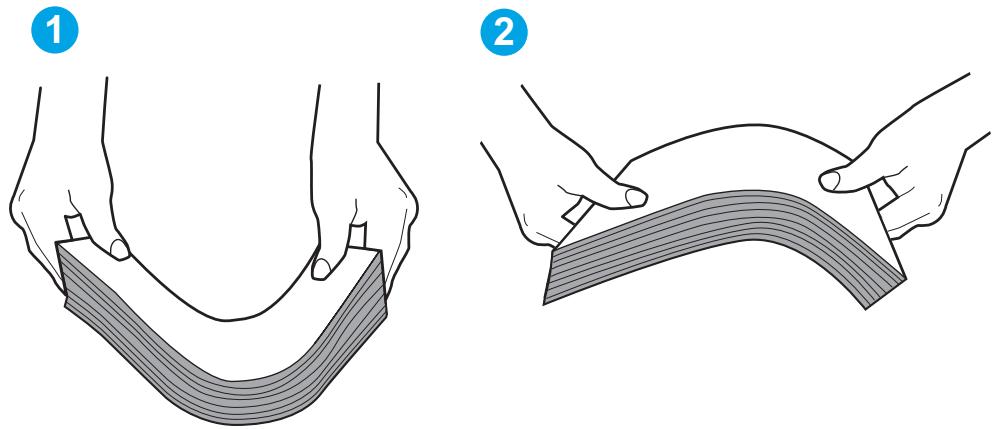
Figure 6-5 Technique for flexing the paper stack
- Use only paper that meets HP specifications for this printer.
- Verify that the humidity in the room is within specifications for this printer, and that paper is being stored in unopened packages. Most reams of paper are sold in moisture-proof wrapping to keep paper dry.
In high-humidity environments, paper at the top of the stack in the tray can absorb moisture, and it might have a wavy or uneven appearance. If this happens, remove the top 5 to 10 sheets of paper from the stack.
In low-humidity environments, excess static electricity can cause sheets of paper to stick together. If this happens, remove the paper from the tray, and flex the stack as described above.
-
Use paper that is not wrinkled, folded, or damaged. If necessary, use paper from a different package.
-
Make sure the tray is not overfilled by checking the stack-height markings inside the tray. If it is overfilled, remove the entire stack of paper from the tray, straighten the stack, and then return some of the paper to the tray.
The following images show examples of the stack-height markings in the trays for various printers. Most HP printers have markings similar to these. Also make sure that all sheets of paper are below the tabs near the stack-height marks. These tabs help hold the paper in the correct position as it enters the printer.
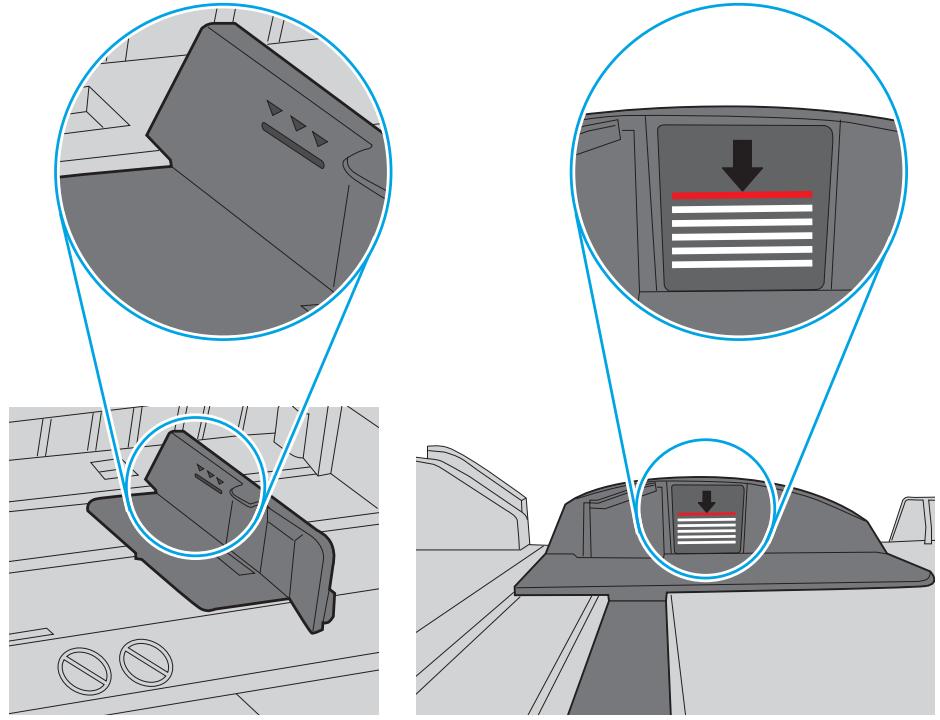
Figure 6-6 Stack-height markings
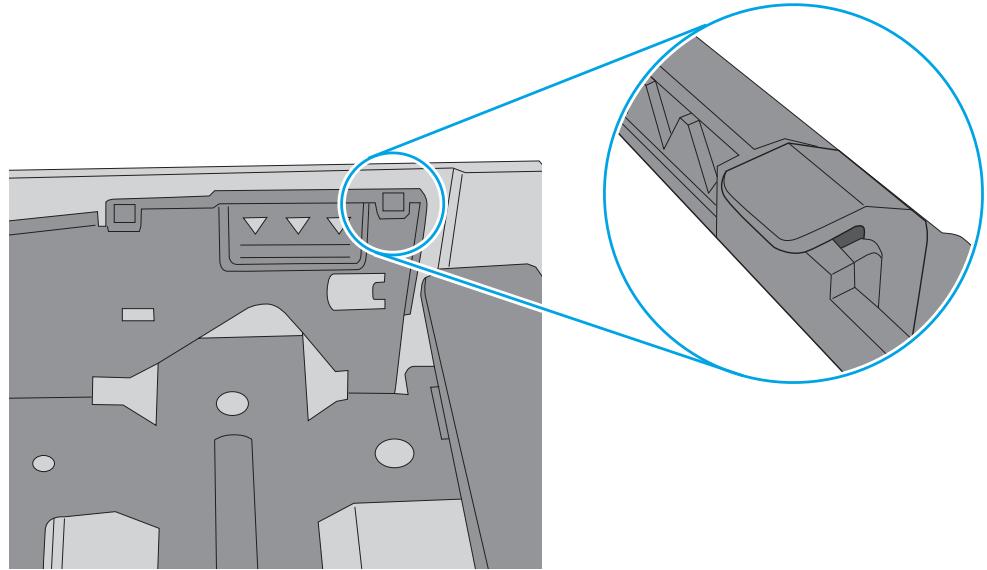
Figure 6-7 Tab for the paper stack
- Make sure the paper guides in the tray are adjusted correctly for the size of paper. Adjust the guides to the appropriate indentation in the tray. The arrow on the tray guide should line up exactly with the marking on the tray.

NOTE: Do not adjust the paper guides tightly against the paper stack. Adjust them to the indentations or markings in the tray.
The following images show examples of the paper-size indentations in the trays for various printers. Most HP printers have markings similar to these.
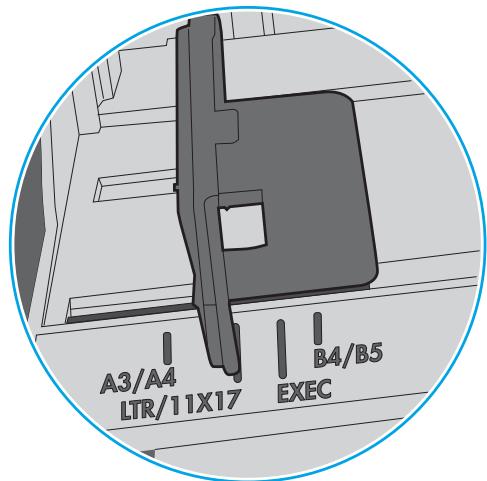
Figure 6-8 Size markings for Tray 1 or the multipurpose tray
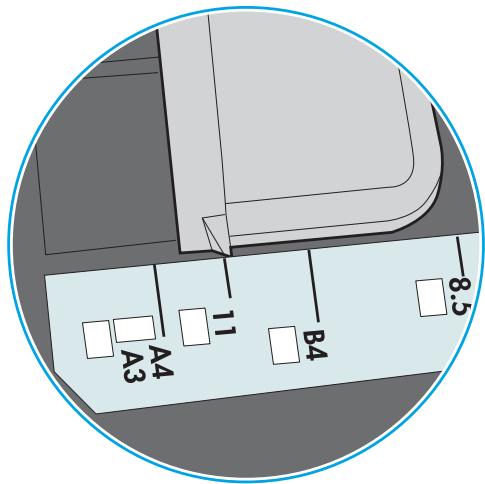
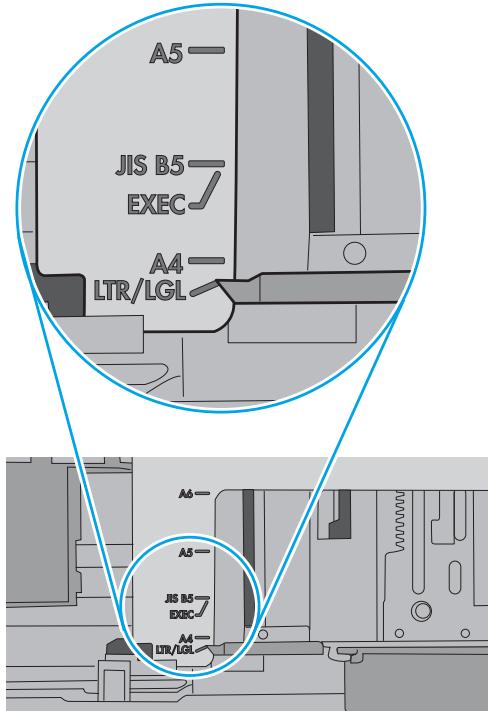
Figure 6-9 Size markings for cassette trays
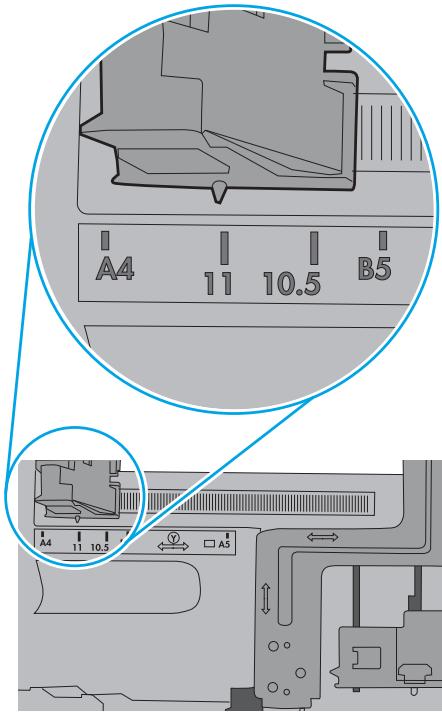
- Make sure the printing environment is within recommended specifications.
Clear paper jams
Introduction
The following information includes instructions for clearing paper jams from the printer.
Jam locations
- Auto-navigation for clearing jams
Experiencing frequent or recurring paper jams?
- Clear jams in the left door
- Clear jams in Tray 1 (multipurpose tray)
Clear jams in Tray 2
Clear jams in Tray 3
Clear jams in the 3x500-sheet feeder
- Clear jams in the ink-collection unit area
Clear jams in the output bin
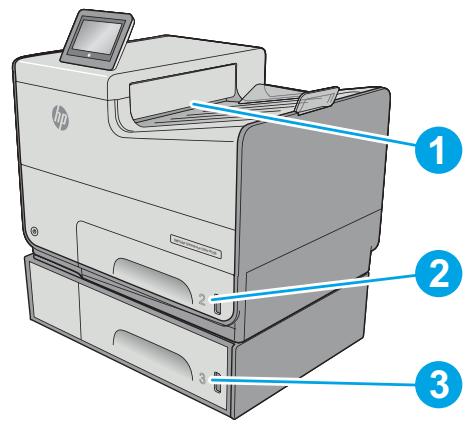
Jam locations
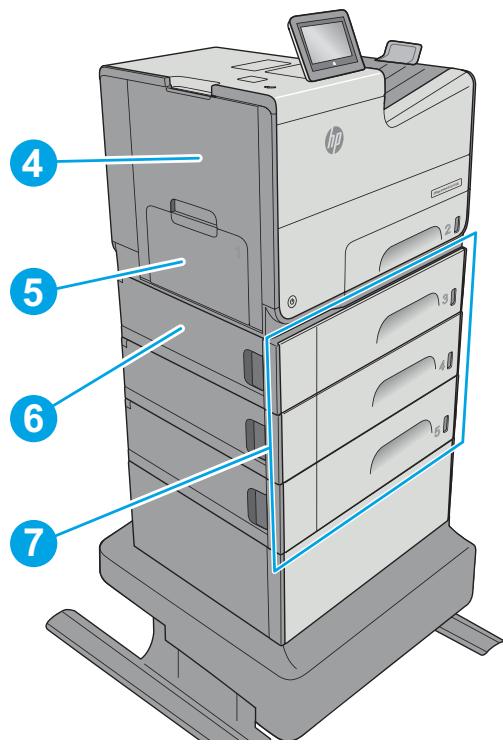
| 1 | Output bin |
| 2 | Tray 2 |
| 3 | Tray 3 |
| 4 | Left door and ink-collection unit area |
| 5 | Tray 1 |
| 6 | Lower-left door |
| 7 | Optional 3x500-sheet paper feeder |
Auto-navigation for clearing jams
The auto-navigation feature assists in clearing jams by providing step-by-step instructions on the control panel. When you complete a step, the printer displays instructions for the next step until you have completed all steps in the procedure.
Experiencing frequent or recurring paper jams?
To reduce the number of paper jams, try these solutions.
- Use only paper that meets HP specifications for this printer.
- Use paper that is not wrinkled, folded, or damaged. If necessary, use paper from a different package.
- Use paper that has not previously been printed or copied on.
- Make sure the tray is not overfilled. If it is, remove the entire stack of paper from the tray, straighten the stack, and then return some of the paper to the tray.
- Make sure the paper guides in the tray are adjusted correctly for the size of paper. Adjust the guides so they are touching the paper stack without bending it.
- Make sure that the tray is fully inserted in the printer.
- If you are printing on heavy, embossed, or perforated paper, use the manual feed feature and feed sheets one at a time.
- Open the Trays menu on the printer control panel. Verify that the tray is configured correctly for the paper type and size.
- Make sure the printing environment is within recommended specifications.
Clear jams in the left door
The following information describes how to clear paper jams in the left door. When a jam occurs, the control panel displays an animation that assists in clearing the jam.
- Open the left door.
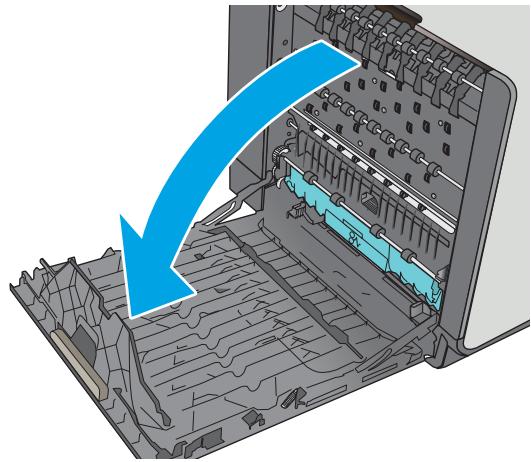
- Gently pull out any jammed paper from the rollers and delivery area. If the paper tears, make sure to remove all remnants.
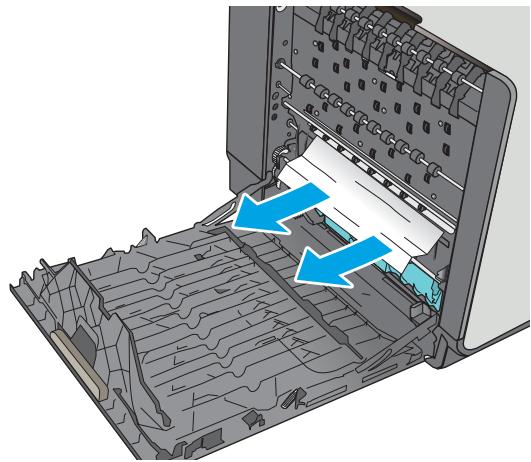
- Close the left door.
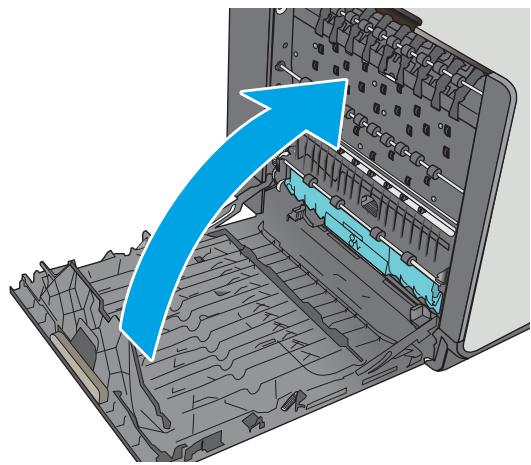
Clear jams in Tray 1 (multipurpose tray)
Use the following procedure to check for paper in all possible jam locations related to Tray 1. When a jam occurs, the control panel displays an animation that assists in clearing the jam.
- If most of the sheet of paper is visible in the tray, slowly pull the jammed paper out of the printer. Make sure that the entire sheet is removed. If it tears, continue with the following steps to find the remnants.
If most of the sheet of paper has been pulled inside the printer, continue with the following steps. - Pull Tray 2 completely out of the printer by pulling and lifting up slightly
- Remove the jammed paper from the feed rollers inside the printer. First pull the paper to the right, and then pull it forward to remove it.
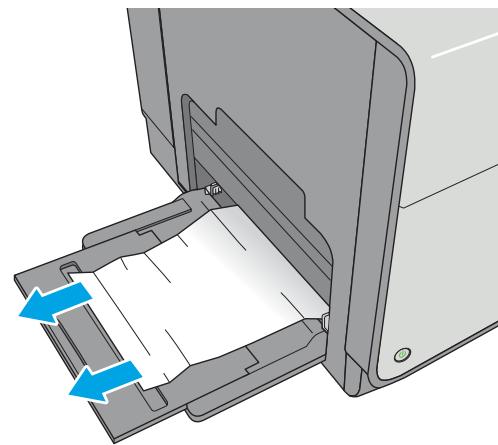
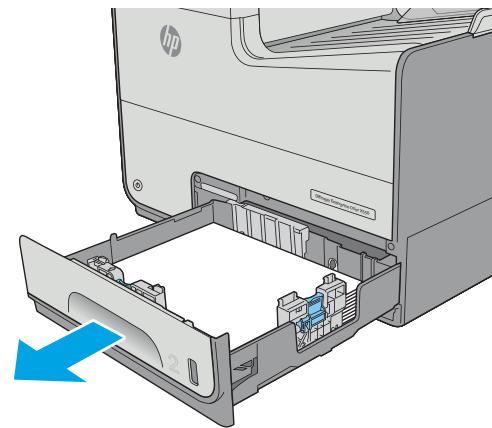
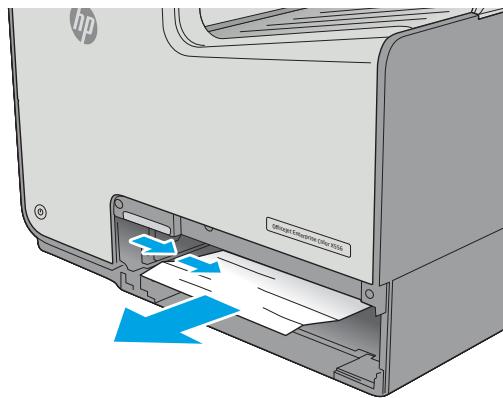
- Remove any jammed or damaged sheets of paper. Verify that the tray is not overfilled and that the paper guides are adjusted correctly.
- Open the left door.
- Gently pull out any jammed paper from the rollers and delivery area. If the paper tears, make sure to remove all remnants.
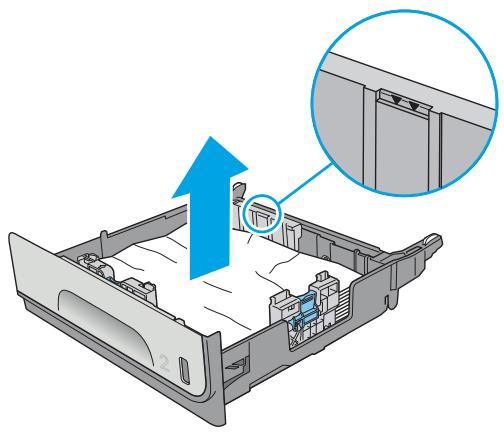
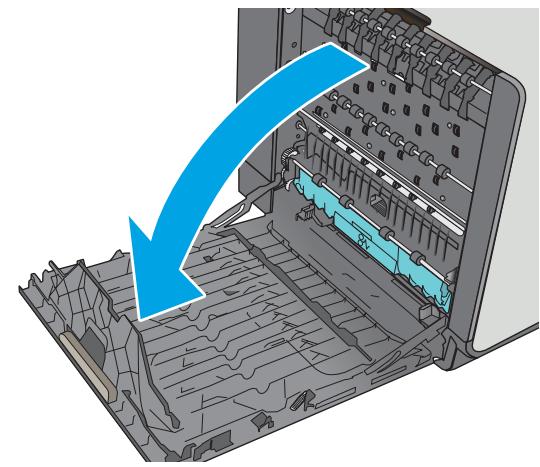
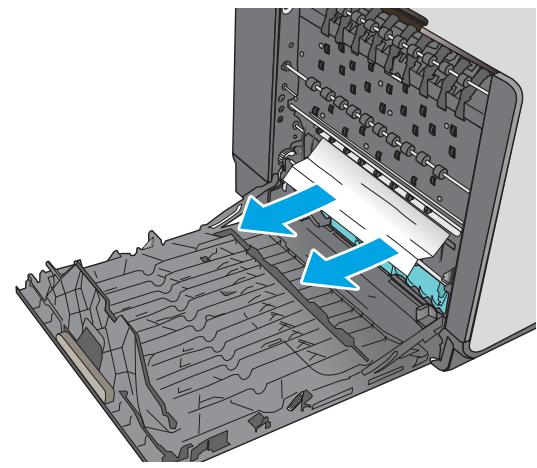
- Remove the ink-collection unit by pulling it out with both hands. Set the unit aside, upright, on a piece of paper to prevent spills.
CAUTION: When removing the ink-collection unit, avoid making direct contact with the black cylinder to prevent pigment smear on skin or clothes. - Lower the platen by pressing down on the green tab. This will cause the printer to try to feed the sheet through the print zone. You might need to gently pull on the sheet if it does not feed. Remove the sheet.
- Lift the green tab to return the platen to the operating position.
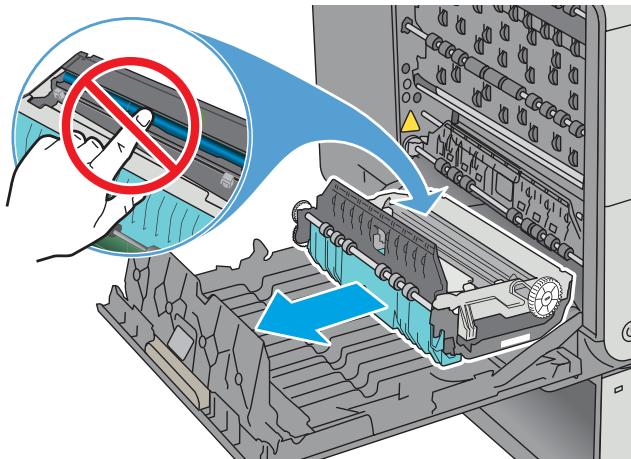
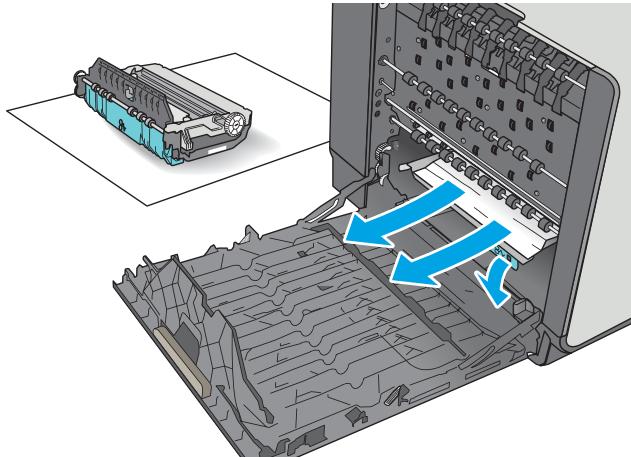
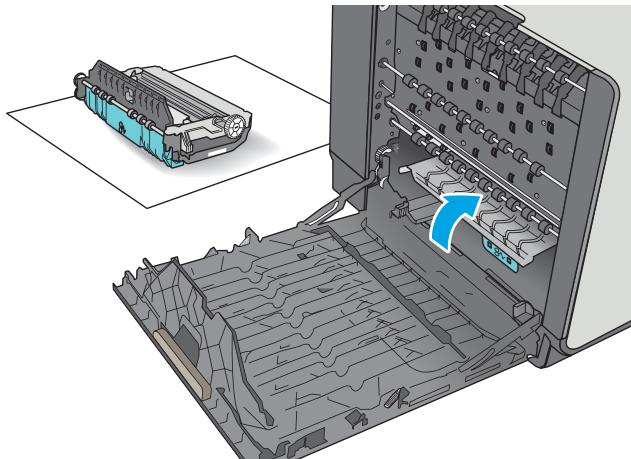
- Install the ink-collection unit.
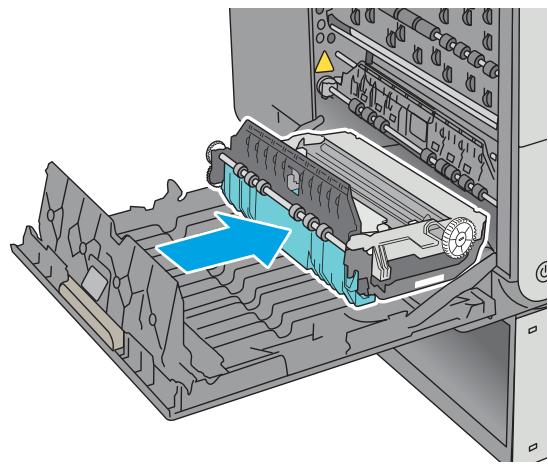
- Close the left door.
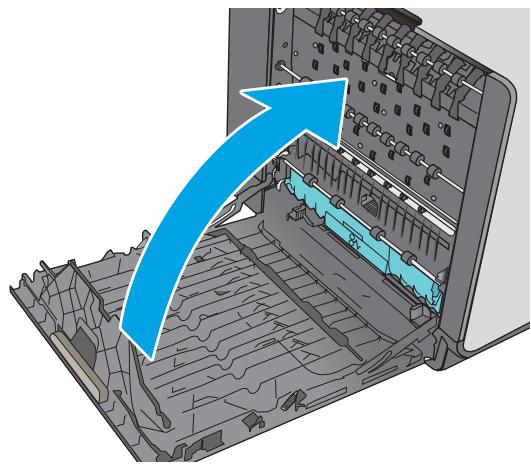
Clear jams in Tray 2
Use the following procedure to clear jams in Tray 2. When a jam occurs, the control panel displays an animation that assists in clearing the jam.
- Pull the tray completely out of the printer by pulling and lifting up slightly
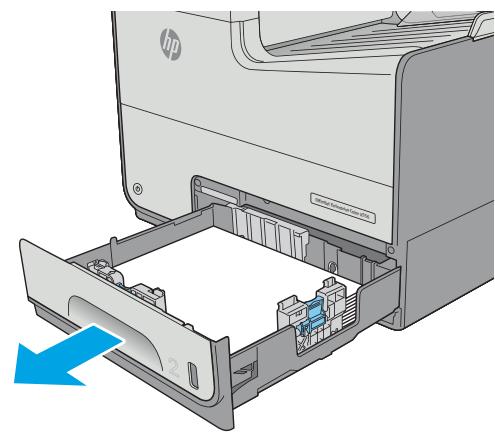
- Remove the jammed paper from the feed rollers inside the printer. First pull the paper to the right, and then pull it forward to remove it.
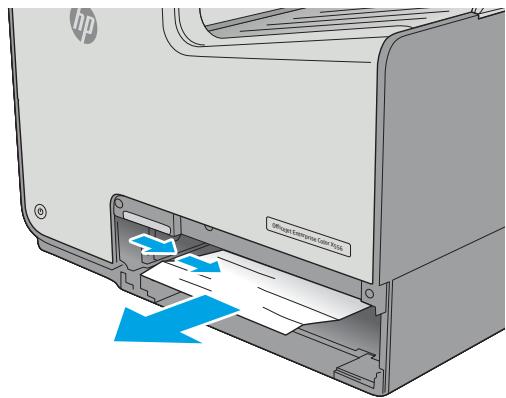
- Remove any jammed or damaged sheets of paper. Verify that the tray is not overfilled and that the paper guides are adjusted correctly.
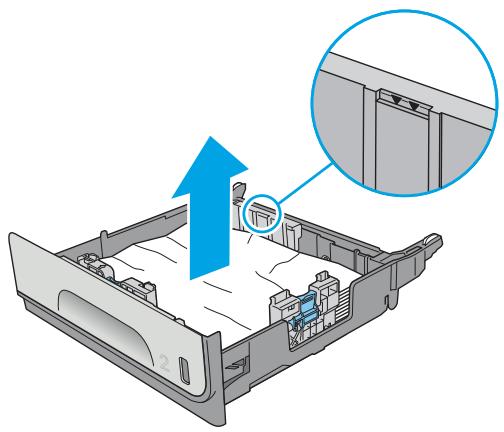
- Reinsert and close the tray.
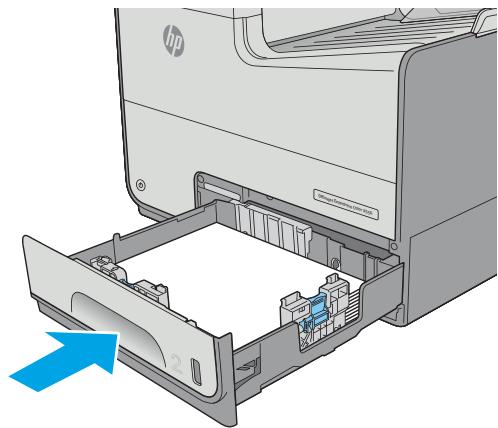
Clear jams in Tray 3
Use the following procedure to check for paper in all possible jam locations related to Tray 3. When a jam occurs, the control panel displays an animation that assists in clearing the jam.
- Open the lower-left door.
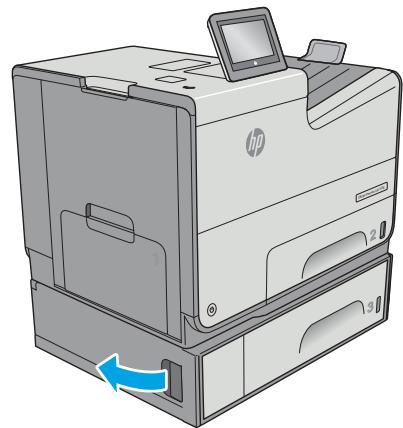
- Gently pull out any jammed paper.
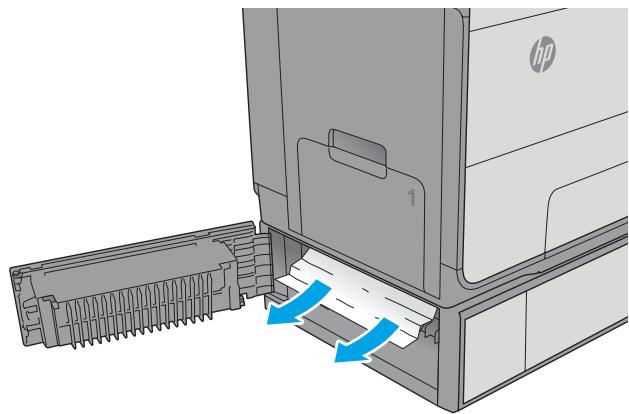
- Close the lower-left door.
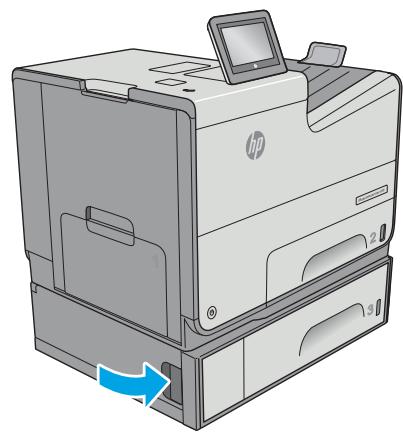
- Pull the tray completely out of the printer by pulling and lifting it up slightly.
- Remove any jammed or damaged sheets of paper. Verify that the tray is not overfilled and that the paper guides are adjusted correctly.
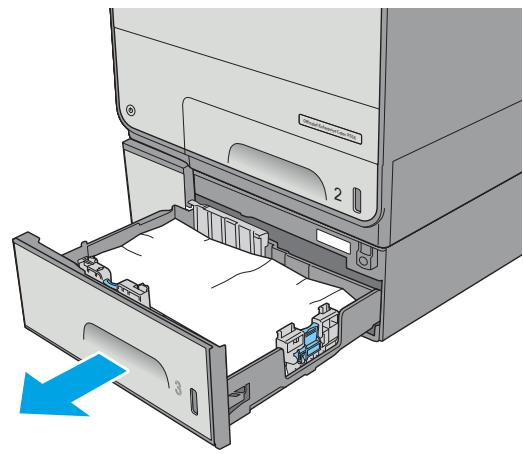
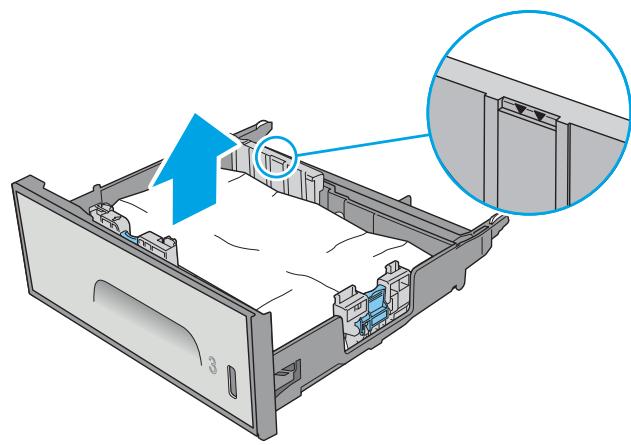
- Remove any paper from the feed rollers inside the printer. First pull the paper to the right to release it, and then pull it forward to remove it.
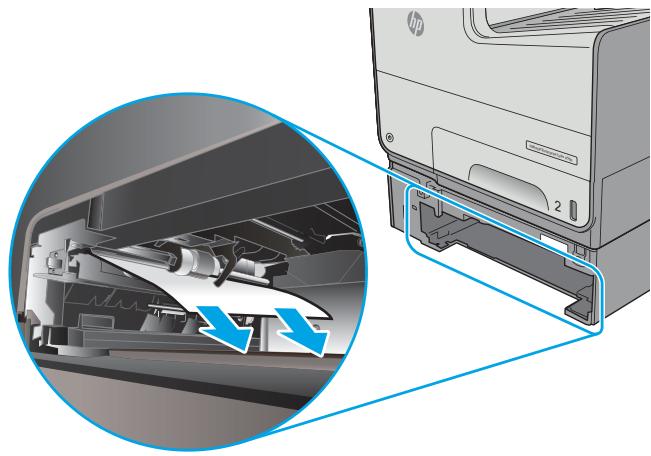
- Reinsert and close the tray.
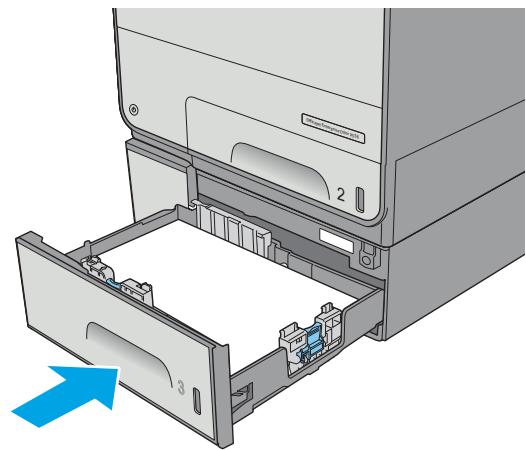
Clear jams in the 3x500-sheet feeder
Use the following procedure to check for paper in all possible jam locations related to the 3x500-sheet feeder. When a jam occurs, the control panel displays an animation that assists in clearing the jam.

NOTE: The following procedure shows Tray 3. The method to clear jams in Trays 4 and 5 is the same.
- Open the lower-left door.
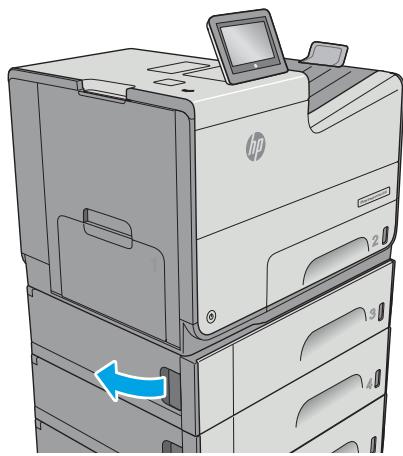
- Gently pull out any jammed paper.
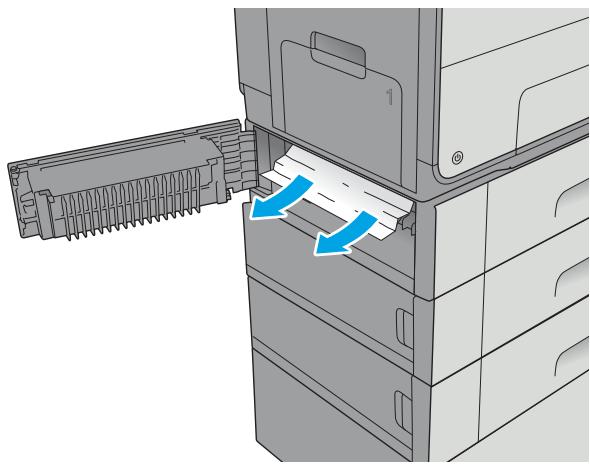
- Close the lower-left door.
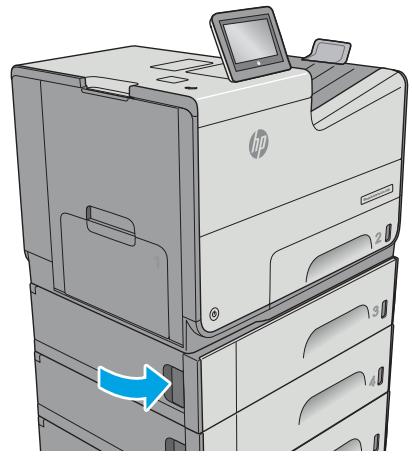
- Pull the tray completely out of the printer by pulling and lifting it up slightly.
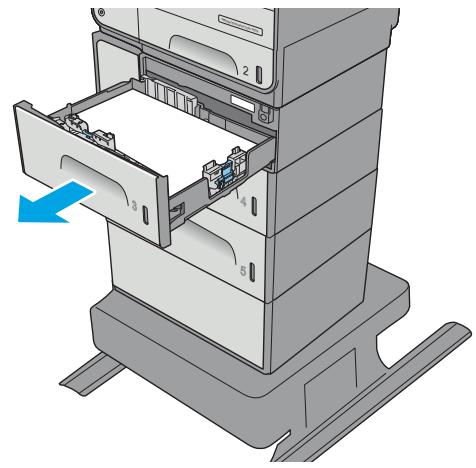
- Remove any jammed or damaged sheets of paper. Verify that the tray is not overfilled and that the paper guides are adjusted correctly.
- Remove any paper from the feed rollers inside the printer. First pull the paper to the right to release it, and then pull it forward to remove it.
- Reinsert and close the tray.
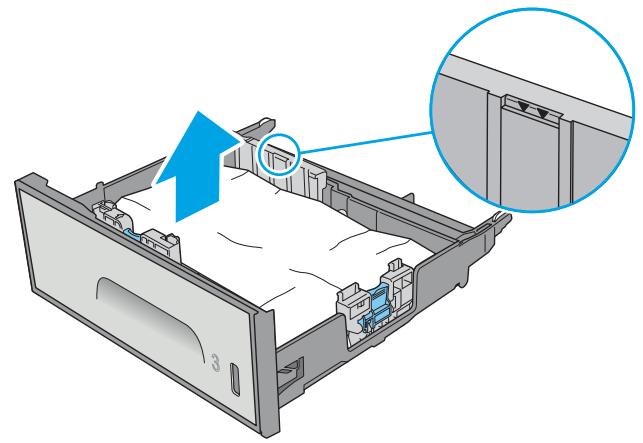
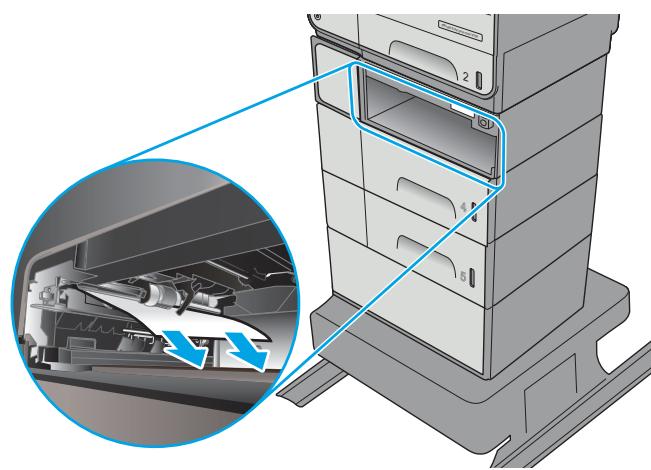
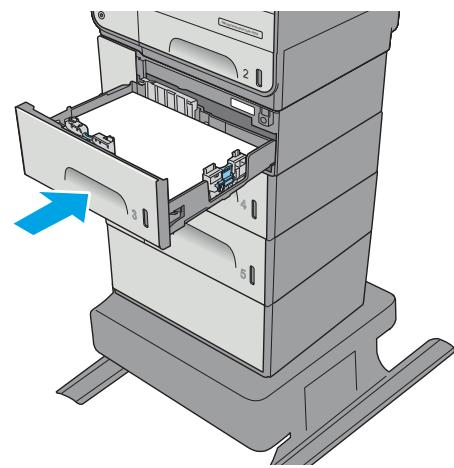
Clear jams in the ink-collection unit area
The following information describes how to clear paper jams in the ink-collection unit. When a jam occurs, the control panel displays an animation that assists in clearing the jam.
- Open the left door.
- Gently pull out any jammed paper from the rollers and delivery area. If the paper tears, make sure to remove all remnants.
- Remove the ink-collection unit by pulling it out with both hands. Set the unit aside, upright, on a piece of paper to prevent spills.
CAUTION: When pulling out the ink-collection unit, avoid making direct contact with the black cylinder to prevent pigment smear on skin or clothes.
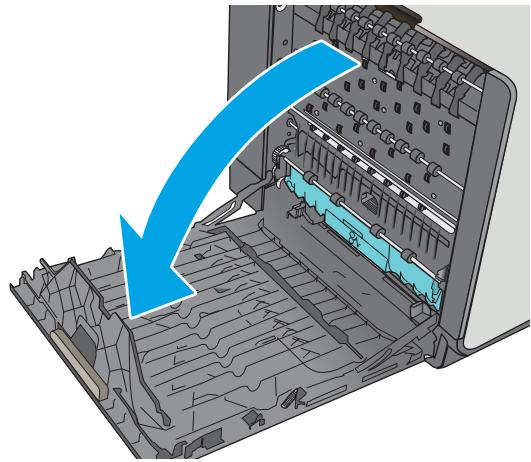
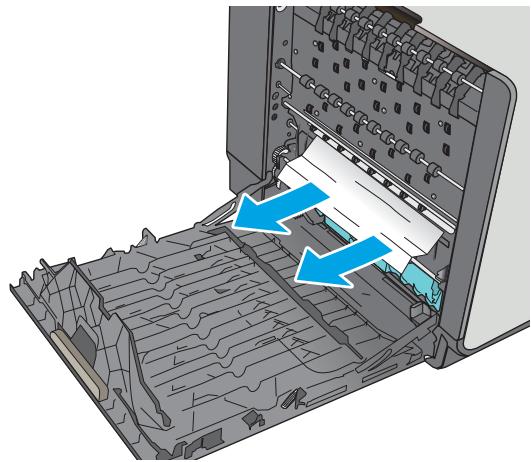
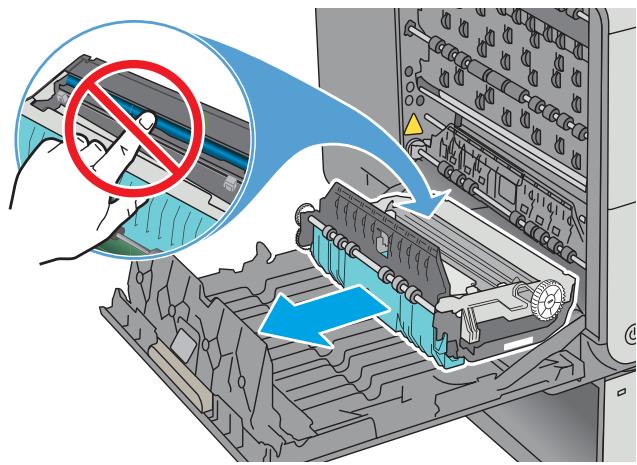
- Lower the platen by pressing down on the green tab. This will cause the printer to try to feed the sheet through the print zone. You might need to gently pull on the sheet if it does not feed. Remove the sheet.
- Lift the green tab to return the platen to the operating position.
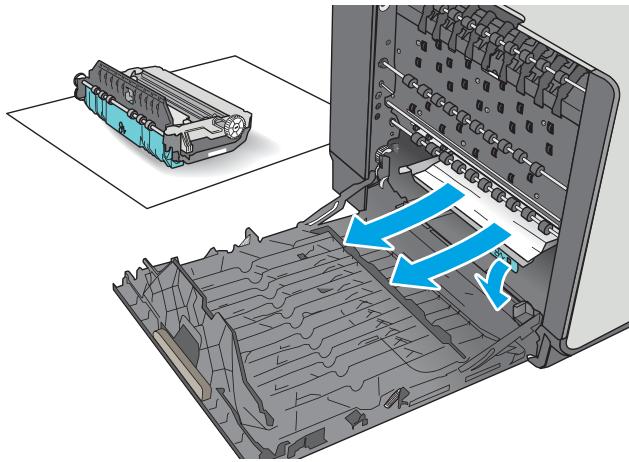
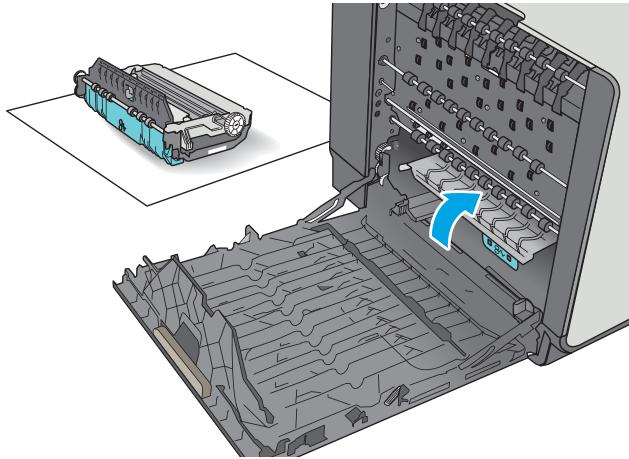
- Install the ink-collection unit.
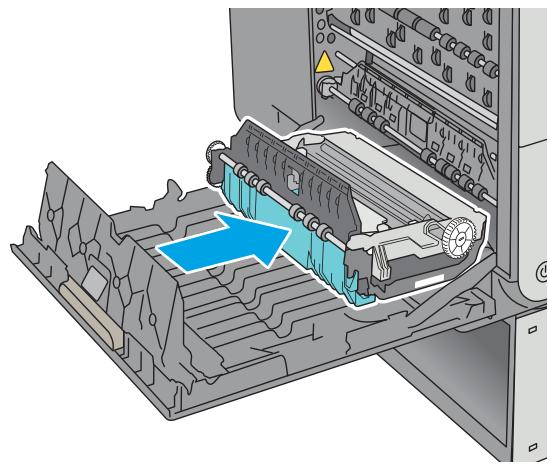
- Close the left door.
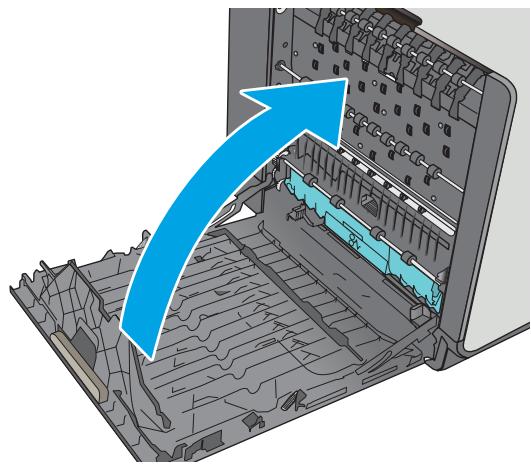
Clear jams in the output bin
Use the following procedure to clear jams in the output bin. When a jam occurs, the control panel displays an animation that assists in clearing the jam.
- If paper is visible in the output bin, grasp the leading edge of the paper and remove it.
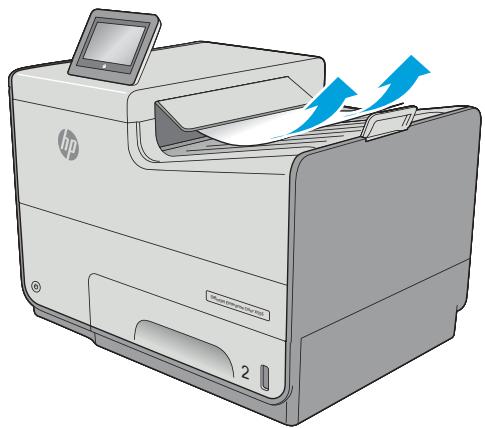
- Open and then close the left door to clear the message.
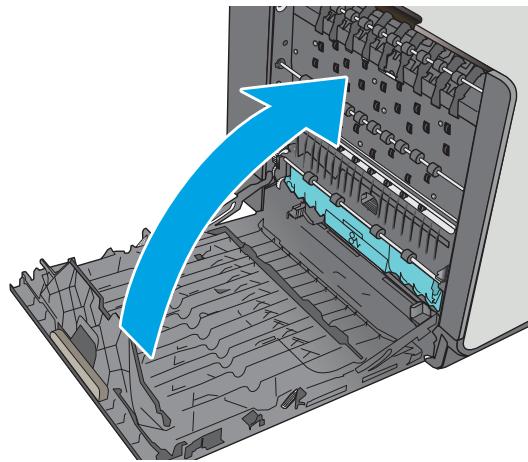
Improve print quality
Introduction
- Print from a different software program
Check the paper-type setting for the print job
Check cartridge status
Clean the printer - Visually inspect the cartridge
Check paper and the printing environment
Adjust color settings (Windows)
Print and interpret the print quality page - Calibrate the printer to align the colors
Try a different print driver
If the printer is having print-quality problems, try the following solutions in the order presented to resolve the issue.
Print from a different software program
Try printing from a different software program. If the page prints correctly, the problem is with the software program from which you were printing.
Check the paper-type setting for the print job
Check the paper type setting when printing from a software program and the printed pages have smears, fuzzy or dark print, curled paper, or small areas of missing pigment.
Check the paper type setting (Windows)
- From the software program, select the Print option.
- Select the printer, and then click the Properties or Preferences button.
- Click the Paper/Quality tab.
- From the Paper Type drop-down list, click the More... option.
- Expand the list of Type is: options.
- Expand the category of paper types that best describes your paper.
- Select the option for the type of paper you are using, and click the OK button.
- Click the OK button to close the Document Properties dialog box. In the Print dialog box, click the OK button to print the job.
Check the paper type setting (OS X)
- Click the File menu, and then click the Print option.
- In the Printer menu, select the printer.
- By default, the print driver displays the Copies & Pages menu. Open the menus drop-down list, and then click the Finishing menu.
- Select a type from the Media Type drop-down list.
- Click the Print button.
Check cartridge status
Follow these steps to check the estimated life remaining in the cartridges and if applicable, the status of other replaceable maintenance parts.
Step one: Print the supplies status page
- From the Home screen on the printer control panel, select Supplies.
- The status of all supply items is listed on the screen.
- To print or view a report of the status of all supply items, including the genuine HP part number for reordering the supply, select Manage Supplies. Select Supplies Status, and then select either Print or View.
Step two: Check supplies status
- Look at the supplies status report to check the percent of life remaining for the cartridges and if applicable, the status of other replaceable maintenance parts.
Print quality problems can occur when using a cartridge that is at its estimated end of life. The supplies status page indicates when a supply level is very low. After an HP supply has reached the very low threshold, HP's premium protection warranty on that supply has ended.
The cartridge does not need to be replaced now unless the print quality is no longer acceptable. Consider having a replacement available to install when print quality is no longer acceptable.
If you determine that you need to replace a cartridge or other replaceable maintenance parts, the supplies status page lists the genuine HP part numbers.
- Check to see if you are using a genuine HP cartridge.
A genuine HP cartridge has the words "HP" on it, or has the HP logo on it. For more information on identifying HP cartridges go to www.hp.com/go/learnaboutsupplies.
Clean the printer
Print a cleaning page
During the printing process paper and dust particles can accumulate inside the printer and can cause print-quality issues such as smears, streaks, lines, or repeating marks.
Follow these steps to clean the printer's paper path.
- From the Home screen on the printer control panel, select Device Maintenance
-
Open the following menus:
-
Calibration/Cleaning
- Cleaning Page
A Cleaning message displays on the printer control panel. The cleaning process takes a few minutes to complete. Do not turn the printer off until the cleaning process has finished. When it is finished, discard the printed page.
Visually inspect the cartridge
- Remove the cartridge from the product, and verify that there is no debris in the cartridge path.
- Examine the metal connector of the cartridge.
CAUTION: Do not touch the metal connector on the edge of the cartridge. Fingerprints on the metal connector can cause print-quality problems.
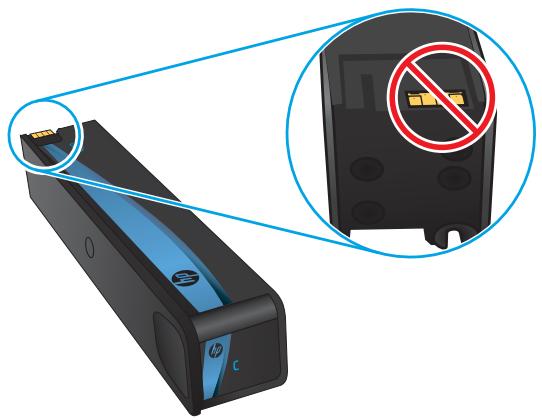
- If you see any scratches, or other damage on the metal connector, replace the cartridge.
- If the metal connector does not appear to be damaged, push the cartridge gently back into its slot until it locks in place. Print a few pages to see if the problem has resolved.
Follow these steps to inspect each cartridge.
Check paper and the printing environment
Step one: Use paper that meets HP specifications
Some print-quality problems arise from using paper that does not meet HP specifications.
Always use a paper type and weight that this printer supports.
Use paper that is of good quality and free of cuts, nicks, tears, spots, loose particles, dust, wrinkles, voids, staples, and curled or bent edges.
Use paper that has not been previously printed on.
Use paper that does not contain metallic material, such as glitter.
- Use paper that is designed for use in HP PageWide printers. Do not use paper that is designed only for use in laser printers.
Use paper that is not too rough. Using smoother paper generally results in better print quality.
Step two: Check the environment
The environment can directly affect print quality and is a common cause for print-quality or paper-feeding issues. Try the following solutions:
- Move the printer away from drafty locations, such as open windows or doors, or air-conditioning vents.
Make sure the printer is not exposed to temperatures or humidity outside of printer specifications. - Do not place the printer in a confined space, such as a cabinet.
- Place the printer on a sturdy, level surface.
- Remove anything that is blocking the vents on the printer. The printer requires good air flow on all sides, including the top.
- Protect the printer from airborne debris, dust, steam, grease, or other elements that can leave residue inside the printer.
Step three: Set the individual tray alignment
Follow these steps when text or images are not centered or aligned correctly on the printed page when printing from specific trays.
- From the Home screen on the printer control panel, select Administration.
- Open the following menus:
General Settings
- Print Quality
- Image Registration
- Select the tray to adjust.
- Select Print Test Page, and then follow the instructions on the printed pages.
- Select Print Test Page again to verify the results, and then make further adjustments if necessary.
- Touch the Save button to save the new settings.
Adjust color settings (Windows)
When printing from a software program, follow these steps if colors on the printed page to not match colors on the computer screen, or if the colors on the printed page are not satisfactory.
Change the color theme
- From the software program, select the Print option.
- Select the printer, and then click the Properties or Preferences button.
- Click the Color tab.
- Select the HP EasyColor check box to clear it.
-
Select a color theme from the Color Themes drop-down list.
-
Default (sRGB): This theme sets the printer to print RGB data in raw device mode. When using this theme, manage color in the software program or in the operating system for correct rendering.
- Vivid (sRGB): The printer increases the color saturation in the midtones. Use this theme when printing business graphics.
- Photo (sRGB): The printer interprets RGB color as if it were printed as a photograph using a digital mini lab. The printer renders deeper, more saturated colors differently than with the Default (sRBG) theme. Use this theme when printing photos.
- Photo (Adobe RGB 1998): Use this theme with printing digital photos that use the AdobeRGB color space rather than sRGB. Turn off color management in the software program when using this theme.
- None: No color theme is used.
-
Custom Profile: Select this option to use a custom input profile to accurately control color output (for example, to emulate a specific printer). Download custom profiles from www.hp.com.
-
Click the OK button to close the Document Properties dialog box. In the Print dialog box, click the OK button to print the job.
Change the color options
- From the software program, select the Print option.
- Select the printer, and then click the Properties or Preferences button.
- Click the Color tab.
- Select the HP EasyColor check box to clear it.
- Click the Automatic or Manual setting.
Automatic setting: Select this setting for most color print jobs
- Manual setting: Select this setting to adjust the color settings independently from other settings. Click the Settings button to open the manual color-adjustment window.

NOTE: Changing color settings manually can impact output. HP recommends that only color graphics experts change these settings.
- Click the Print in Grayscale option to print a color document in black and shades of gray. Use this option to print color documents for photocopying or faxing. Also use this option to print draft copies.
- Click the OK button to close the Document Properties dialog box. In the Print dialog box, click the OK button to print the job.
Print and interpret the print quality page
Use the print-quality-troubleshooting pages to help diagnose and solve color print-quality problems.
- From the Home screen on the printer control panel, scroll to and touch the Administration button.
- Open the following menus:
Troubleshooting
- Print Quality Pages
- Print PQ Troubleshooting Pages
- Touch the Print button to print the page.
Follow the instructions on the print-quality troubleshooting procedure page.
Calibrate the printer to align the colors
Calibration is a printer function that optimizes print quality.
Follow these steps to resolve print-quality problems such as misaligned color, colored shadows, blurry graphics, or other print-quality issues.
- From the Home screen on the product control panel, scroll to and touch the Device Maintenance button.
-
Open the following menus:
-
Calibration/Cleaning
Full Calibration -
Touch the Start button to start the calibration process.
A Calibrating message will display on the product control panel. The calibration process takes a few minutes to complete. Do not turn the product off until the calibration process has finished.
- Wait while the product calibrates, and then try printing again.
Try a different print driver
Try a different print driver when printing from a software program and the printed pages have unexpected lines in graphics, missing text, missing graphics, incorrect formatting, or substituted fonts.
Download any of the following drivers from the HP Web site: www.hp.com/support/pagewidecolor556.
HP PCL.6 driver
HP PCL 6 driver
HP PCL-6 driver
- Provided as the default driver on the printer CD. This driver is automatically installed unless you select a different one.
Recommended for all Windows environments - Provides the overall best speed, print quality, and printer-feature support for most users
Developed to align with the Windows Graphic Device Interface (GDI) for the best speed in Windows environments - Might not be fully compatible with third-party and custom software programs that are based on PCL 5
| HP UPD PS driver | Recommended for printing with Adobe® software programs or with other highly graphics-intensive software programsProvides support for printing from postscript emulation needs, or for postscript flash font support |
| HP UPD PCL 5 | Recommended for general office printing in Windows environmentsCompatible with previous PCL versions and older printersThe best choice for printing from third-party or custom software programsThe best choice when operating with mixed environments, which require the printer to be set to PCL 5 (UNIX, Linux, mainframe)Designed for use in corporate Windows environments to provide a single driver for use with multiple printer modelsPreferred when printing to multiple printer models from a mobile Windows computer |
| HP UPD PCL 6 | Recommended for printing in all Windows environmentsProvides the overall best speed, print quality, and printer feature support for most usersDeveloped to align with Windows Graphic Device Interface (GDI) for best speed in Windows environmentsMight not be fully compatible with third-party and custom software programs that are based on PCL 5 |
Solve wired network problems
Introduction
Check the following items to verify that the printer is communicating with the network. Before beginning, print a configuration page from the printer control panel and locate the printer IP address that is listed on this page.
Poor physical connection
The computer is using the incorrect IP address for the printer
The computer is unable to communicate with the printer
The printer is using incorrect link and duplex settings for the network
New software programs might be causing compatibility problems
The computer or workstation might be set up incorrectly
The printer is disabled, or other network settings are incorrect

NOTE: HP does not support peer-to-peer networking, as the feature is a function of Microsoft operating systems and not of the HP print drivers. For more information, go to Microsoft at www.microsoft.com.
Poor physical connection
- Verify that the printer is attached to the correct network port using a cable of the correct length.
- Verify that cable connections are secure.
- Look at the network port connection on the back of the printer, and verify that the amber activity light and the green link-status light are lit.
- If the problem continues, try a different cable or port on the hub.
The computer is using the incorrect IP address for the printer
- Open the printer properties and click the Ports tab. Verify that the current IP address for the printer is selected. The printer IP address is listed on the printer configuration page.
- If you installed the printer using the HP standard TCP/IP port, select the box labeled Always print to this printer, even if its IP address changes.
- If you installed the printer using a Microsoft standard TCP/IP port, use the hostname instead of the IP address.
- If the IP address is correct, delete the printer and then add it again.
The computer is unable to communicate with the printer
- Test network communication by pinging the network.
a. Open a command-line prompt on your computer.
For Windows, click Start, click Run, type cmd, and then press Enter.
For OS X, go to Applications, then Utilities, and open Terminal.
b. Type ping followed by the IP address for your printer.
c. If the window displays round-trip times, the network is working.
- If the ping command failed, verify that the network hubs are on, and then verify that the network settings, the printer, and the computer are all configured for the same network.
The printer is using incorrect link and duplex settings for the network
HP recommends leaving these settings in automatic mode (the default setting). If you change these settings, you must also change them for your network.
New software programs might be causing compatibility problems
Verify that any new software programs are correctly installed and that they use the correct print driver.
The computer or workstation might be set up incorrectly
- Check the network drivers, print drivers, and the network redirection settings.
- Verify that the operating system is configured correctly.
The printer is disabled, or other network settings are incorrect
- Review the configuration page to check the status of the network protocol. Enable it if necessary.
- Reconfigure the network settings if necessary.
Solve wireless network problems
Introduction
- Wireless connectivity checklist
The printer does not print after the wireless configuration completes
The printer does not print, and the computer has a third-party firewall installed
The wireless connection does not work after moving the wireless router or printer
- Cannot connect more computers to the wireless printer
The wireless printer loses communication when connected to a VPN
The network does not appear in the wireless networks list
The wireless network is not functioning
Perform a wireless network diagnostic test
- Reduce interference on a wireless network
Introduction
Use the troubleshooting information to help resolve issues.

NOTE: To determine whether HP NFC and Wireless Print Direct printing are enabled on your printer, print a configuration page from the printer control panel
Wireless connectivity checklist
- Verify that the network cable is not connected.
- Verify that the printer and the wireless router are turned on and have power. Also make sure that the wireless radio in the printer is turned on.
- Verify that the service set identifier (SSID) is correct. Print a configuration page to determine the SSID. If you are not sure the SSID is correct, run the wireless setup again.
- With secured networks, verify that the security information is correct. If the security information is incorrect, run the wireless setup again.
- If the wireless network is working correctly, try accessing other computers on the wireless network. If the network has Internet access, try connecting to the Internet over a wireless connection.
- Verify that the encryption method (AES or TKIP) is the same for the printer as it is for the wireless access point (on networks using WPA security).
- Verify that the printer is within the range of the wireless network. For most networks, the printer must be within 30m (100 ft) of the wireless access point (wireless router).
-
Verify that obstacles do not block the wireless signal. Remove any large metal objects between the access point and the printer. Make sure poles, walls, or support columns containing metal or concrete do not separate the printer and wireless access point.
-
Verify that the printer is located away from electronic devices that might interfere with the wireless signal. Many devices can interfere with the wireless signal including motors, cordless phones, security system cameras, other wireless networks, and some Bluetooth devices.
- Verify that the print driver is installed on the computer.
- Verify that you have selected the correct printer port.
- Verify that the computer and printer connect to the same wireless network.
For OS X, verify that the wireless router supports Bonjour.
The printer does not print after the wireless configuration completes
- Make sure that the printer is turned on and in the ready state.
- Turn off any third-party firewalls on your computer.
- Make sure that the wireless network is working correctly.
- Make sure that your computer is working correctly. If necessary, restart the computer.
- Verify that you can open the printer HP Embedded Web Server from a computer on the network.
The printer does not print, and the computer has a third-party firewall installed
- Update the firewall with the most recent update available from the manufacturer.
- If programs request firewall access when you install the printer or try to print, make sure you allow the programs to run.
- Temporarily turn off the firewall, and then install the wireless printer on the computer. Enable the firewall when you have completed the wireless installation.
The wireless connection does not work after moving the wireless router or printer
- Make sure that the router or printer connects to the same network that your computer connects to.
- Print a configuration page.
- Compare the service set identifier (SSID) on the configuration page to the SSID in the printer configuration for the computer.
- If the numbers are not the same, the devices are not connecting to the same network. Reconfigure the wireless setup for the printer.
Cannot connect more computers to the wireless printer
- Make sure that the other computers are within the wireless range and that no obstacles block the signal. For most networks, the wireless range is within 30m (100 ft) of the wireless access point.
- Make sure that the printer is turned on and in the ready state.
- Make sure there are not more than 5 concurrent Wireless Print Direct users.
-
Turn off any third-party firewalls on your computer.
-
Make sure that the wireless network is working correctly.
- Make sure that your computer is working correctly. If necessary, restart the computer.
The wireless printer loses communication when connected to a VPN
Typically, you cannot connect to a VPN and other networks at the same time.
The network does not appear in the wireless networks list
Make sure the wireless router is turned on and has power.
The network might be hidden. However, you can still connect to a hidden network.
The wireless network is not functioning
- Make sure that the network cable is not connected.
- To verify if the network has lost communication, try connecting other devices to the network.
- Test network communication by pinging the network.
a. Open a command-line prompt on your computer.
For Windows, click Start, click Run, type cmd, and then press Enter.
For OS X, go to Applications, then Utilities, and open Terminal.
b. Type ping followed by the router IP address.
c. If the window displays round-trip times, the network is working.
- Make sure that the router or printer connects to the same network that the computer connects to.
a. Print a configuration page.
b. Compare the service set identifier (SSID) on the configuration report to the SSID in the printer configuration for the computer.
c. If the numbers are not the same, the devices are not connecting to the same network. Reconfigure the wireless setup for the printer.
Perform a wireless network diagnostic test
From the printer control panel, you can run a diagnostic test that provides information about the wireless network settings.
- From the Home screen on the printer control panel, scroll to and touch the Administration button.
- Open the following menus:
Troubleshooting
Diagnostic Tests
- Select Run Wireless Test to start the test. The printer prints a test page that shows test results.
Reduce interference on a wireless network
The following tips can reduce interference in a wireless network:
- Keep the wireless devices away from large metal objects, such as filing cabinets, and other electromagnetic devices, such as microwaves and cordless telephones. These objects can disrupt radio signals.
- Keep the wireless devices away from large masonry structures and other building structures. These objects can absorb radio waves and lower signal strength.
- Position the wireless router in a central location in line of sight with the wireless printers on the network.
Index
Symbols/Numerics
3x500-sheet paper feeder loading 31
3x500-sheet paper feeder and stand part number 42
3x500-sheet feeder jams 118
500-sheet paper tray part number 42
A
accessories
ordering 42
part numbers 42
weight 11
accessories,
dimensions 11
acoustic specifications 15
AirPrint 68
alternative letterhead mode 22, 26, 30, 35
Android devices printing from 69
B
bin, output
jams,clearing 124
locating 2
Bonjour
identifying 74
browser requirements
HP embedded Web Server 74
C
calibrate
colors 130
cartridge
low threshold settings 99
using when low 99
cartridge status 126
cartridges
part numbers 43
replacing 45
change
cartridge 45
checklist
wireless connectivity 134
cleaning
paper path 127
color options
changing,Windows 128
color theme
changing,Windows 128
colors
calibrate 130
control panel
help 97
locating 2
locating features 5
customer support
online 96
D
default gateway, setting 84
deleting
stored jobs 65
dimensions,
accessories 11
printer 11
DIMM
part number 42
double-sided printing
Mac 59
Windows 56
drivers, supported 8
duplex printing
Mac 59
duplex printing (double-sided)
settings (Windows) 56
Windows 56
duplexing
manually (Mac) 59
manually (Windows) 56
E
easy-access USB printing 70
electrical specifications 15
Embedded Web Server
changing network settings 83
changing printer name 83
opening 83
Embedded Web Server (EWS)
assigning passwords 87
features 74
network connection 74
energy use, optimizing
envelopes, loading 36
Ethernet (RJ-45)
locating 4
Explorer, versions supported
HP Embedded Web Server 74
F
fax port
locating 4
file upload, Mac 81
firmware
update,Mac 81
fonts
upload, Mac 81
formatter
locating 3
G
gateway, setting default 84
general configuration HP Embedded Web Server 76
H
hard disks encrypted 88
hard drive part number 42
Help button locating 5
help,control panel 97
Hi-Speed USB 2.0 printing port locating 4
Home button locating 5
HP Customer Care 96
HP Embedded Web Server changing network settings 83
changing printer name 83
general configuration 76
HP Web Services 78
information pages 75
network settings 78
opening 83
other links list 80
print settings 77
security settings 78
troubleshooting tools 77
HP Embedded Web Server (EWS) features 74 network connection 74
HP ePrint 67
HP ePrint software 68
HP Utility 81
HP Utility for Mac Bonjour 81 features 81
HP Utility, OS X 81
HP Web Jetadmin 92
HP Web Services enabling 78
information pages HP Embedded Web Server 75
ink-collection unit jams 121 locating 3
input tray loading 18
interface ports
locating 4
Internet Explorer, versions supported HP Embedded Web Server 74
IP Security 88
IPsec 88
IPv4 address 84
IPv6 address 84
J
jams 3x500-sheet feeder 118
auto-navigation 108
causes of 108
ink-collection unit 121
locations 107
output bin,clearing 124
paper path,clearing 109
Jetadmin, HP Web 92
jobs,stored creating (Windows) 62
deleting 65
Mac settings 64
printing 64
K
keypad
locating 2
L
labels printing on 38
LAN port locating 4
left door jams,clearing 109
loading paper in 3 x 500-sheet paper feeder 31
loading paper input tray 18
local area network (LAN) locating 4
lock
formatter 88
M
Mac driver settings Job Storage 64
managing network 83
manual duplex
Mac 59
Windows 56
memory included 7
mobile printing Android devices 69
mobile printing, software supported 10
multiple pages per sheet printing (Mac) 60 printing (Windows) 57
N
Near Field Communication printing 66
Netscape Navigator, versions supported HP embedded Web Server 74
network printer name, changing 83 settings, changing 83
settings, viewing 83
network duplex settings, changing 85
network link speed settings, changing 85
network settings HP Embedded Web Server 78
networks default gateway 84 HP Web Jetadmin 92
IPv4 address 84
IPv6 address 84
subset mask 84
supported 7
NFC accessory part number 42
NFC printing 66
0
on/off buttonlocating 2
online help, control panel 97 online support 96
operating systems, supported 8 ordering
supplies and accessories 42
OSX HPUt
other links list
HP Embedded Web Server 80
output bin
jams,clearing 124
locating 2
P
pages per minute 7
pages per sheet
selecting (Mac) 60
selecting (Windows) 57
paper
jams 108
loading 3 x 500-sheet paper
feeder 31
selecting 127
Tray 2 orientation 33
paper jams
3x500-sheet feeder 118
ink-collection unit 121
locations 107
paper path
jams,clearing 109
paper pickup problems
solving 101, 103
paper trays
part numbers 42
paper type
selecting (Windows) 57
paper types
selecting (OS X) 60
paper,ordering 42
part number
3 x 500-sheet paper feeder and stand 42
500-sheet paper tray 42
DIMM 42
NFC accessory 42
printer stand 42
USB ports 42
wireless print server 42
part numbers
accessories 42
cartridges 43
paper trays 42
replacement parts 43
supplies 42, 43
ports
locating 4
power
consumption 15
power connection
locating 3
power switch
locating 2
power usage
1 watt or less 89
print drivers,supported 8
print on both sides
Mac 59
manually,Windows 56
Windows 56
print settings
HP Embedded Web Server 77
primer
weight 11
printer stand
part number 42
primer,
dimensions 11
printing
from USB storage accessories 70
stored jobs 64
printing on both sides
settings (Windows) 56
private printing 62
product number
locating 3
R
replacement parts
part numbers 43
restore factory settings 98
RJ-45 port
locating 4
S
security settings
HP Embedded Web Server 78
security
encrypted hard disk 88
serial number
locating 3
settings
restore factory 98
Sign In button
locating 5
Sign Out button
locating 5
sleep mode 89
software
HP Utility 81
specifications
electrical and acoustic 15
speed, optimizing 89
Start Copy button
locating 5
status
HP Utility, Mac 81
storage, job
Mac settings 64
store print jobs 62
stored jobs
creating (Mac) 64
creating (Windows) 62
deleting 65
printing 64
storing jobs
with Windows 62
subset mask 84
supplies
low threshold settings 99
ordering 42
part numbers 42,43
status, viewing with HP Utility for
Mac 81
using when low 99
supplies status 126
support
online 96
system requirements
HP Embedded Web Server 74
minimum 10
T
TCP/IP
manually configuring IPv4
parameters 84
manually configuring IPv6
parameters 84
technical support
online 96
touchscreen
locating features 5
Tray 1
jams,clearing 110
loading envelopes 36
Tray 2
jams,clearing 114,116
paper orientation 33
trays
capacity 7
included 7
jams,clearing 114,116
locating 2
troubleshooting
jams 108
network problems 132
paper feed problems 101
wired network 132
wireless network 134
troubleshooting tools
HP Embedded Web Server 77
two-sided printing
settings (Windows) 56
U
USB port
enabling 70
locating 4
USB ports
part number 42
USB storage accessories
printing from 70
W
Web browser requirements
HP Embedded Web Server 74
Web sites
customer support 96
HP Web Jetadmin, downloading 92
weight,
accessories 11
printer 11
Wireless Direct Print 66
wireless network
troubleshooting 134
wireless network interference 137
wireless print server
part number 42
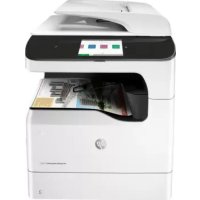
- User Guide
- HP PageWide Enterprise Color 556
- Copyright and License
- Trademark Credits
- Table of contents
- Printer overview 1
- Paper trays 17
- Supplies, accessories, and parts 41
- Print 53
- Manage the printer 73
- Printer security features 87
- Energy-conservation settings 89
- HP Web Jetadmin 92
- Software and firmware updates 93
- Solve problems 95
- Restore factory settings 98
- A "Cartridge is low" or "Cartridge is very low" message displays on the printer control panel 99
- Printer does not pick up paper or misfeeds 101
- Clear paper jams 107
- Improve print quality 125
- Check cartridge status 126
- Visually inspect the cartridge 127
- Adjust color settings (Windows) 128
- Solve wired network problems 132
- Solve wireless network problems 134
- Printer overview
- For more information:
- Printer views
- Printer back view
- Interface ports
- Printer specifications
- Supported operating systems
- Mobile printing solutions
- Printer dimensions
- Power consumption, electrical specifications, and acoustic emissions
- Operating-environment range
- Printer hardware setup and software installation
- Paper trays
- Load paper to Tray 1 (multi-purpose tray)
- Introduction
- Tray 1 paper orientation
- Use alternative letterhead mode
- Enable Alternative Letterhead Mode by using the printer control-panel menus
- Load paper to Tray 2
- Tray 2 paper orientation
- Load paper to Tray 3
- Tray 3 paper orientation
- Load paper to the 3 x 500-sheet paper feeder
- x 500-sheet tray paper orientation
- Load and print envelopes
- Print envelopes
- Envelope orientation
- Load and print labels
- Manually feed labels
- Label orientation
- Supplies, accessories, and parts
- Order supplies, accessories, and parts
- Ordering
- Supplies and accessories
- Customer self-repair parts
- Replace the cartridges
- Cartridge information
- Remove and replace the cartridge
- Replace the ink-collection unit
- Remove and replace the ink-collection unit
- Print tasks (Windows)
- How to print (Windows)
- Automatically print on both sides (Windows)
- Manually print on both sides (Windows)
- Print multiple pages per sheet (Windows)
- Select the paper type (Windows)
- Additional print tasks
- Print tasks (OS X)
- How to print (OS X)
- Automatically print on both sides (OS X)
- Manually print on both sides (OS X)
- Print multiple pages per sheet (OS X)
- Select the paper type (OS X)
- Store print jobs on the printer to print later or print privately
- Create a stored job (Windows)
- Click the Job Storage tab.
- Select a Job Storage Mode option.
- Create a stored job (OS X)
- Print a stored job
- Delete a stored job
- Information sent to printer for Job Accounting purposes
- Mobile printing
- Wireless Direct Print and NFC Printing
- HP ePrint via email
- HP ePrint software
- AirPrint
- Google Cloud Print
- Android embedded printing
- Print from the USB port
- Enable the USB port for printing
- Method one: Enable the USB port from the printer control-panel menus
- Method two: Enable the USB port from the HP Embedded Web server (network-connected printers only)
- Print USB documents
- Manage the printer
- Advanced configuration with HP Embedded Web Server (EWS)
- How to access the HP Embedded Web Server (EWS)
- Windows® 7
- Windows® 8 or greater
- OSX
- Linux
- HP Embedded Web Server features
- Information tab
- General tab
- Troubleshooting tab
- HP Web Services tab
- Networking tab
- Other Links list
- Advanced configuration with HP Utility for OS X
- Open HP Utility
- HP Utility features
- Configure IP network settings
- Printer sharing disclaimer
- View or change network settings
- Rename the printer on a network
- Manually configure IPv4 TCP/IP parameters from the control panel
- Manually configure IPv6 TCP/IP parameters from the control panel
- Link speed and duplex settings
- Printer security features
- Security statements
- Assign an administrator password
- IP Security
- Lock theformatter
- Encryption support: HP High Performance Secure Hard Disks
- Energy-conservation settings
- Optimize speed or energy usage
- Set the sleep timer and configure the printer to use 1 watt or less of power
- Set the sleep schedule
- HP Web Jetadmin
- Software and firmware updates
- Solve problems
- Customer support
- Control panel help system
- Restore factory settings
- Method one: Restore factory settings from the printer control panel
- Method two: Restore factory settings from the HP Embedded Web Server (network-connected printers only)
- A “Cartridge is low” or “Cartridge is very low” message displays on the printer control panel
- Change the "Very Low" settings
- For products with fax capability
- Order supplies
- Printer does not pick up paper or misfeeds
- The printer does not pick up paper
- The printer picks up multiple sheets of paper
- Clear paper jams
- Auto-navigation for clearing jams
- Experiencing frequent or recurring paper jams?
- Clear jams in the left door
- Clear jams in Tray 1 (multipurpose tray)
- Clear jams in Tray 2
- Clear jams in Tray 3
- Clear jams in the 3x500-sheet feeder
- Clear jams in the ink-collection unit area
- Clear jams in the output bin
- Improve print quality
- Print from a different software program
- Check the paper-type setting for the print job
- Check the paper type setting (Windows)
- Check the paper type setting (OS X)
- Check cartridge status
- Step one: Print the supplies status page
- Step two: Check supplies status
- Clean the printer
- Print a cleaning page
- Visually inspect the cartridge
- Check paper and the printing environment
- Step one: Use paper that meets HP specifications
- Step two: Check the environment
- Step three: Set the individual tray alignment
- Adjust color settings (Windows)
- Change the color theme
- Change the color options
- Print and interpret the print quality page
- Calibrate the printer to align the colors
- Try a different print driver
- Solve wired network problems
- Poor physical connection
- The computer is using the incorrect IP address for the printer
- The computer is unable to communicate with the printer
- The printer is using incorrect link and duplex settings for the network
- New software programs might be causing compatibility problems
- The computer or workstation might be set up incorrectly
- The printer is disabled, or other network settings are incorrect
- Solve wireless network problems
- Wireless connectivity checklist
- The printer does not print after the wireless configuration completes
- The printer does not print, and the computer has a third-party firewall installed
- The wireless connection does not work after moving the wireless router or printer
- Cannot connect more computers to the wireless printer
- The wireless printer loses communication when connected to a VPN
- The network does not appear in the wireless networks list
- The wireless network is not functioning
- Perform a wireless network diagnostic test
- Reduce interference on a wireless network
- Index
- Symbols/Numerics
- A
- B
- C
- D
- E
- F
- G
- J
- K
- L
- M
- N
- 0
- P
- R
- S
- T
Marque : HP
Modèle : OFFICE 3832
Catégorie : Imprimante multifonction