MODE D'EMPLOI LASERJET PRO MFP M277DW HP
Guide de l'utilisateur
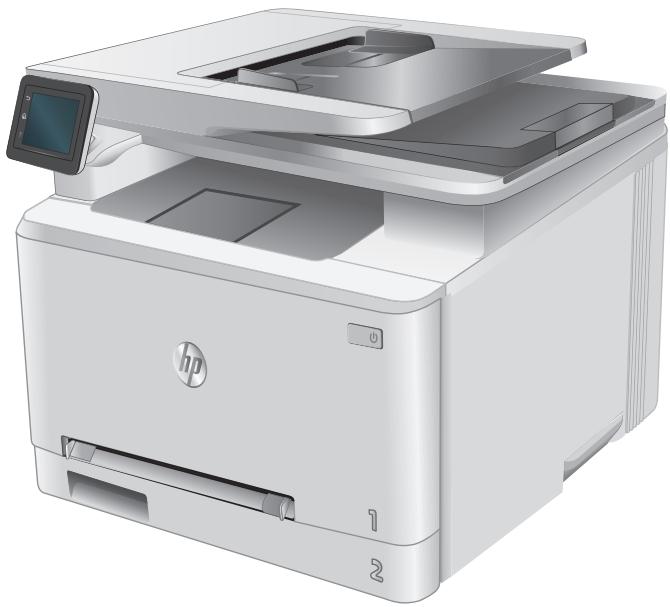

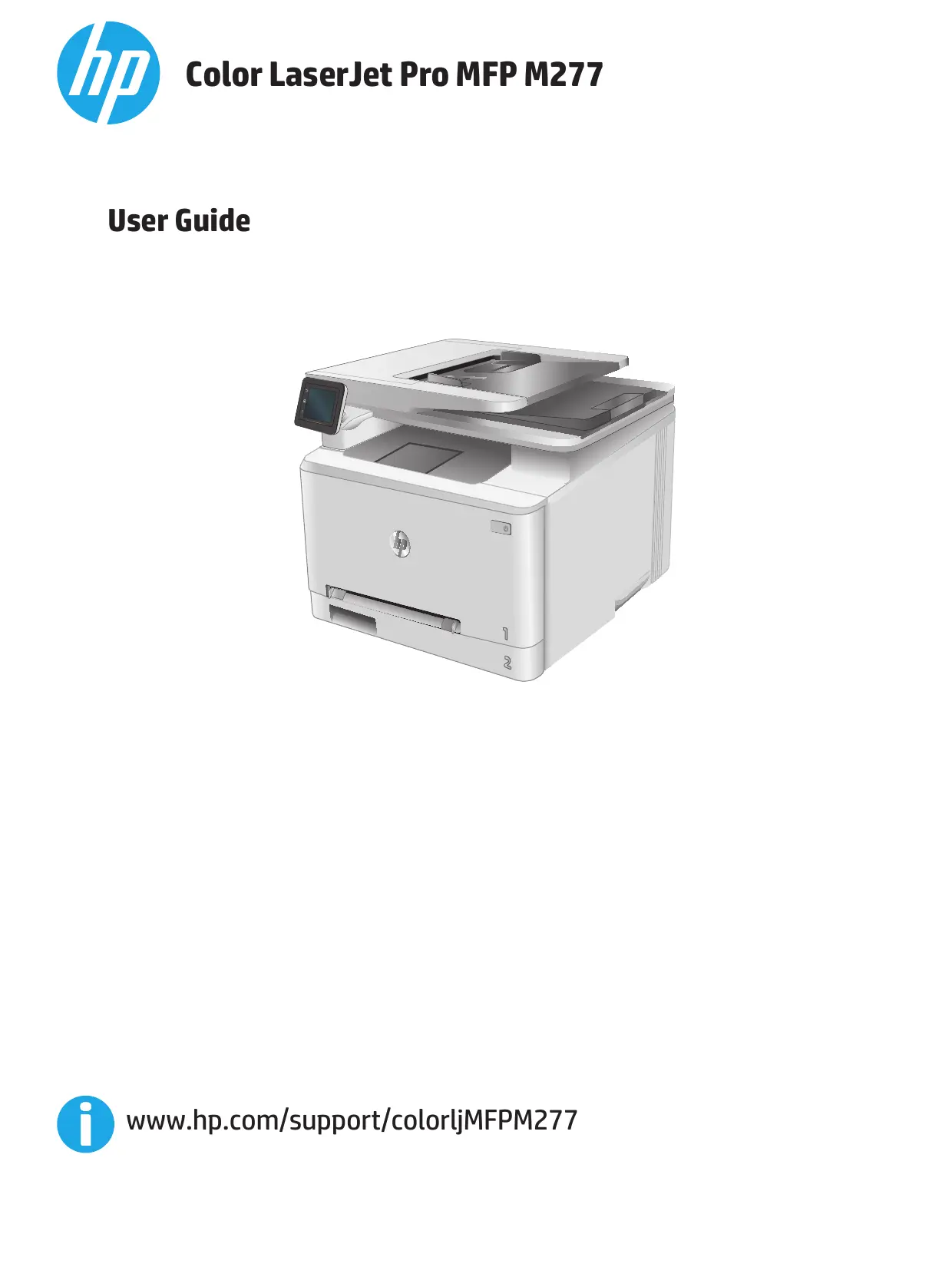
HP Color LaserJet Pro MFP M277
Guide de l'utilisateur
Copyright et licence
© 2015 Copyright Hewlett-Packard Development Company, L.P.
La reproduction, l'adaptation ou la traduction sans autorisation écrite préalable est interdite, sauf dans les cas autorisés par les lois sur le droit d'auteur.
Les informations contenues dans ce document sont sujettes à modification sans préavis.
Les seules garanties pour les produits et services HP sont énoncées dans les déclarations de garantie expresses accompagnant ces produits et services. Rien dans ce document ne doit être interprété comme constituant une garantie supplémentaire. HP ne saurait être tenu responsable des erreurs techniques ou éditoriales ou des omissions contenues dans ce document.
Numéro de pièce : B3Q10-90908
Édition 1, 4/2015
Crédits de marques
Adobe, Adobe Photoshop, Acrobat et PostScript sont des marques d'Adobe Systems Incorporated.
Apple et le logo Apple sont des marques d'Apple Computer, Inc., déposées aux États-Unis et dans d'autres pays. iPod est une marque d'Apple Computer, Inc. iPod est destiné à la copie légale ou autorisée par les titulaires de droits. Ne volez pas de musique.
Microsoft, Windows, Windows XP et Windows Vista sont des marques déposées de Microsoft Corporation aux États-Unis.
UNIX® est une marque déposée de The Open Group.
Sommaire
1 Aperçu du produit 1
Vues du produit 2
Vue avant du produit 2
Vue arrière du produit 3
Vue du panneau de commande 4
Disposition de l'écran d'accueil 5
Utilisation de l'écran tactile du panneau de commande 6
Spécifications du produit 7
Introduction 7
Spécifications techniques 7
Systèmes d'exploitation pris en charge 8
Solutions d'impression mobile 9
Dimensions du produit 11
Consommation électrique, spécifications électriques et émissions acoustiques 12
Plage de l'environnement d'exploitation 12
Configuration matérielle du produit et installation du logiciel 13
2 Bacs à papier 15
Charger du papier dans la fente d'alimentation feuille par feuille (bac 1) 16
Introduction 16
Charger du papier dans la fente d'alimentation prioritaire feuille par feuille 16
Charger une enveloppe dans la fente d'alimentation prioritaire feuille par feuille (bac 1) 17
Orientation du papier dans le bac 1 19
Charger du papier dans le bac 2 20
Introduction 20
Charger du papier dans le bac 2 20
Charger des enveloppes dans le bac 2 22
Orientation du papier dans le bac 2 25
3 Consommables, accessoires et pièces 27
Commander des consommables, accessoires et pièces 28
Commande 28 Fournitures et accessoires 28 Pièces de réparation par le client 28
Remplacement des cartouches de toner 30
Introduction 30 Retrait et remplacement des cartouches de toner 31
4 Impression 37
Tâches d'impression (Windows) 38
Comment imprimer (Windows) 38 Impression recto verso automatique (Windows) 39 Impression recto verso manuelle (Windows) 39 Impression de plusieurs pages par feuille (Windows) 40 Sélection du type de papier (Windows) 40
Tâches d'impression (OS X) 41
Comment imprimer (OS X) 41 Impression recto verso automatique (OS X) 41 Impression recto verso manuelle (OS X) 41 Impression de plusieurs pages par feuille (OS X) 41 Sélection du type de papier (OS X) 42
Impression mobile 43
Introduction 43 Impression Wi-Fi Direct et NFC (modèles sans fil uniquement) 43 HP ePrint par e-mail 44 Logiciel HP ePrint 44 AirPrint 45 Impression intégrée Android 45
Utilisation de l'impression USB sans fil 46
5 Copie 47
Effectuer une copie 48
Copie recto verso (duplex) 49
Copie recto verso automatique 49 Copie recto verso manuelle 49
Numérisation à l'aide du logiciel HP Scan (Windows) 52 Numérisation à l'aide du logiciel HP Scan (OS X) 53 Numérisation vers une clé USB 54 Configuration de la numérisation vers un dossier réseau 55
Introduction 55
Utilisation de l'assistant de numérisation vers un dossier réseau (Windows) 55
Configuration de la fonction de numérisation vers un dossier réseau via le serveur Web intégré HP (Windows) 55
Configuration de la fonction de numérisation vers un dossier réseau sur un Mac 56
Numérisation vers un dossier réseau 58
Configuration de la numérisation vers un e-mail 59
Introduction 59
Utilisation de l'assistant de numérisation vers un e-mail (Windows) 59
Configuration de la fonction de numérisation vers un e-mail via le serveur Web intégré HP (Windows) 59
Configuration de la fonction de numérisation vers un e-mail sur un Mac 61
Numérisation vers un e-mail 63
Tâches de numérisation supplémentaires 64
7 Télécopie 65
Configuration pour l'envoi et la réception de télécopies 66
Avant de commencer 66
Étape 1 : Identifier le type de connexion téléphonique 66
Étape 2 : Configurer le télécopieur 67
Ligne téléphonique dédiée 67
Ligne vocale/télécopie partagée 68
Ligne vocale/télécopie partagée avec répondeur 69
Étape 3 : Configurer l'heure, la date et l'en-tête du télécopieur 71
Assistant d'installation HP Fax 71
Panneau de commande du produit 71
Serveur Web intégré HP (EWS) et boîte à outils HP Device (Windows) 72
Étape 4 : Effectuer un test de télécopie 72
Envoyer une télécopie 74
Applications de télécopie prises en charge 74
Envoyer une télécopie en composant manuellement depuis le panneau de commande du produit 74
Fax depuis le scanner à plat 74
Fax depuis le chargeur de documents 75
Utiliser les numéros abrégés et les entrées de numérotation de groupe 75
Annuler un fax 76
Envoyer un fax à l'aide du logiciel HP (Windows) 77
Créer, modifier et supprimer des entrées de numéros abrégés 78
Utiliser le panneau de commande pour créer et modifier le répertoire de fax 78
Utiliser les données du répertoire d'autres programmes 78
Supprimer des entrées du répertoire 78
8 Gérer le produit 79
Utiliser les applications HP Web Services 80
Changer le type de connexion du produit (Windows) 81
Configuration avancée avec le serveur Web intégré HP (EWS) et HP Device Toolbox (Windows) 82
Configuration avancée avec HP Utility pour OS X 85
Ouvrir HP Utility 85
Fonctionnalités HP Utility 85
Configurer les paramètres réseau IP 88
Introduction 88
Avis de non-responsabilité concernant le partage d'imprimante 88
Afficher ou modifier les paramètres réseau 88
Renommer le produit sur un réseau 88
Configurer manuellement les paramètres TCP/IP IPv4 à partir du panneau de commande 89
Fonctionnalités de sécurité du produit 90
Introduction 90
Attribuer ou modifier le mot de passe système à l'aide du serveur Web intégré 90
Paramètres d'économie 91
Introduction 91
Imprimer avec EconoMode 91
Configurer le paramètre Veille/Arrêt automatique après 91
Définir le délai d'arrêt et configurer le produit pour utiliser 1 watt ou moins d'énergie 91
Configurer le paramètre d'arrêt différé 92
HP Web Jetadmin 93
Mettre à jour le firmware 94
Méthode 1 : Mettre à jour le firmware à l'aide du panneau de commande 94
Méthode 2 : Mettre à jour le firmware à l'aide de l'utilitaire de mise à jour du firmware 95
9 Résoudre les problèmes 97
Assistance clientèle 98
Système d'aide du panneau de commande 99
Restaurer les paramètres d'usine 100
Un message « Cartouche faible » ou « Cartouche très faible » s'affiche sur le panneau de commande du produit 101
Modifier les paramètres « Très faible » 101
Pour les produits avec fonction fax 101
Commander des fournitures 102
Le produit ne ramasse pas le papier ou provoque des bourrages 103
Introduction 103
Le produit ne ramasse pas le papier 103
Le produit ramasse plusieurs feuilles de papier 103
Le chargeur de documents se bloque, de traverse ou ramasse plusieurs feuilles de papier 103
Dégager les bourrages papier 105
Introduction 105
Vous rencontrez des bourrages papier fréquents ou récurrents ? 105
Emplacements des bourrages papier 106
Dégager les bourrages papier dans le chargeur de documents 107
Dégager les bourrages papier dans la fente d'alimentation feuille à feuille (bac 1) 109
Dégager les bourrages papier dans le bac 2 111
Dégager les bourrages papier dans la porte arrière et la zone du four 113
Dégager les bourrages papier dans le bac de sortie 115
Dégager les bourrages papier dans l'unité recto verso (modèles recto verso uniquement) 116
Améliorer la qualité d'impression 117
Introduction 117
Imprimer à partir d'un autre logiciel 117
Vérifier le paramètre de type de papier pour le travail d'impression 117
Vérifier le paramètre de type de papier (Windows) 117
Vérifier le paramètre de type de papier (OS X) 118
Vérifier l'état de la cartouche de toner 118
Imprimer et interpréter la page de qualité d'impression 119
Nettoyer le produit 119
Imprimer une page de nettoyage 119
Vérifier la vitre du scanner pour détecter la saleté et les traces 120
Inspecter visuellement la cartouche de toner 120
Vérifier le papier et l'environnement d'impression 120
Première étape : utiliser un papier conforme aux spécifications HP 120
Deuxième étape : vérifier l'environnement 121
Étalonner le produit pour aligner les couleurs 121
Vérifier d'autres paramètres de travail d'impression 121
Vérifiez les paramètres EconoMode 122
Ajustez les paramètres de couleur (Windows) 122
Essayez un autre pilote d'impression 123
Améliorer la qualité des copies et des numérisations 125
Introduction 125
Vérifiez que la vitre du scanner est propre et sans traces 125
Éliminer les lignes ou les stries lors de l'utilisation du chargeur de documents 126
Vérifiez les paramètres du papier 126
Vérifiez les paramètres de réglage de l'image 126
Optimiser pour le texte ou les images 127
Vérifiez la résolution du scanner et les paramètres de couleur sur l'ordinateur 127
Directives sur la résolution et la couleur 127
Couleur 128
Copie bord à bord 128
Nettoyez les rouleaux d'alimentation et le patin de séparation du chargeur de documents 128
Améliorer la qualité des images de télécopie 130
Introduction 130
Vérifiez que la vitre du scanner est propre et sans traces 130 Vérifiez les paramètres de résolution d'envoi de télécopie 131 Vérifiez les paramètres de correction d'erreurs 131 Vérifiez le paramètre d'ajustement à la page 131 Nettoyez les rouleaux de prise et le séparateur du chargeur de documents 131 Envoyez vers un autre télécopieur 133 Vérifiez le télécopieur de l'expéditeur 133
Résoudre les problèmes de réseau filaire 134
Introduction 134 Mauvaise connexion physique 134 L'ordinateur utilise une adresse IP incorrecte pour le produit 134 L'ordinateur ne peut pas communiquer avec le produit 134 Le produit utilise des paramètres de liaison et de duplex incorrects pour le réseau 135 De nouveaux logiciels peuvent causer des problèmes de compatibilité 135 L'ordinateur ou la station de travail peut être configuré incorrectement 135 Le produit est désactivé ou d'autres paramètres réseau sont incorrects 135
Résoudre les problèmes de réseau sans fil 136
Introduction 136 Liste de contrôle pour la connectivité sans fil 136 Le produit n'imprime pas après la configuration sans fil 137 Le produit n'imprime pas et l'ordinateur a un pare-feu tiers installé 137 La connexion sans fil ne fonctionne pas après avoir déplacé le routeur sans fil ou le produit 137 Impossible de connecter plus d'ordinateurs au produit sans fil 137 Le produit sans fil perd la communication lorsqu'il est connecté à un VPN 138 Le réseau n'apparaît pas dans la liste des réseaux sans fil 138 Le réseau sans fil ne fonctionne pas 138 Effectuez un test de diagnostic du réseau sans fil 138 Réduisez les interférences sur un réseau sans fil 138
Résoudre les problèmes de télécopie 140
Introduction 140 Liste de contrôle pour le dépannage de la télécopie 140 Résoudre les problèmes généraux de télécopie 141 Les télécopies sont envoyées lentement 141 La qualité de télécopie est médiocre 142 La télécopie est coupée ou imprimée sur deux pages 143
Index 145
1 Présentation du produit
Vues du produit Spécifications du produit Configuration matérielle du produit et installation du logiciel
Rendez-vous sur www.hp.com/support/colorljMFPM277.
L'aide complète de HP pour le produit comprend les informations suivantes :
Installez et configurez - Apprenez et utilisez - Résolvez les problèmes - Téléchargez les mises à jour logicielles - Rejoignez les forums d'assistance - Trouvez les informations de garantie et réglementaires
Vues du produit
Vue avant du produit Vue arrière du produit Vue du panneau de commande
Vue avant du produit
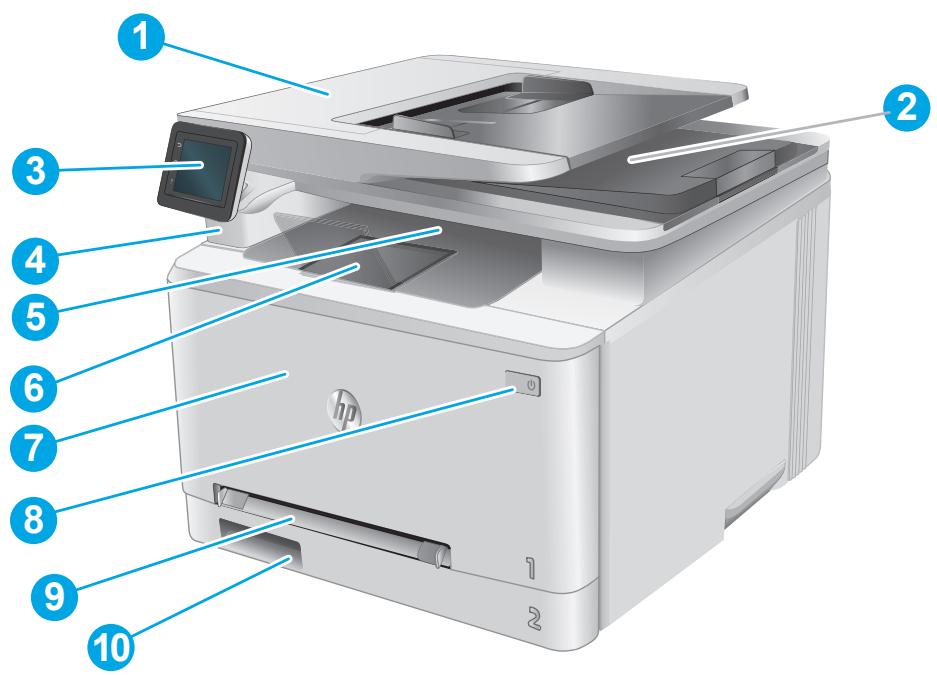
1 Chargeur de documents 2 Scanner 3 Panneau de commande (s'incline vers le haut pour une meilleure visibilité) 4 Port USB direct pour l'impression et la numérisation sans ordinateur 5 Bac de sortie 6 Extension du bac de sortie 7 Porte avant (permet l'accès à la cartouche de toner) 8 Bouton marche/arrêt 9 Fente d'alimentation prioritaire pour une seule feuille (bac 1) 10 Bac d'entrée principal (bac 2)




C
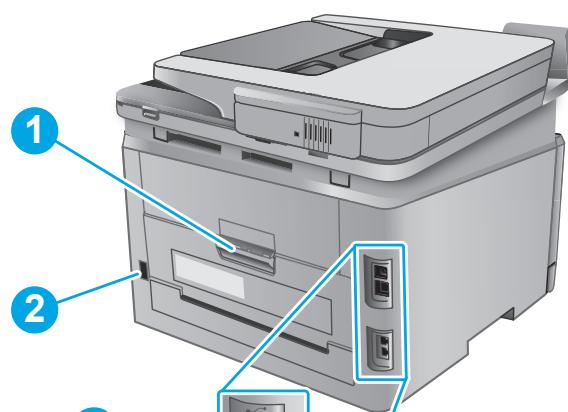
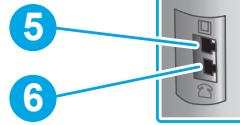
1 Porte arrière (permet l'accès pour débloquer les bourrages) 2 Connexion d'alimentation 3 Port USB 4 Port Ethernet 5 Port de ligne fax 6 Port téléphonique fax 7 Duplexeur (modèles duplex uniquement) 8 Étiquette avec numéro de série et numéro de produit

| 1 | HP Back button | Returns to the previous screen |
| 2 | Home button | Provides access to the Home screen |
| 3 | Help button | Provides access to the control-panel help system |
| 4 | Color touchscreen | Provides access to menus, help animations, and product information. |
| 5 | Home page screen indicator | The display indicates which Home screen the control panel is currently displaying. |

REMARQUE : Bien que le panneau de commande ne dispose pas d'un bouton Annuler standard, un bouton Annuler apparaît sur l'écran tactile pendant de nombreux processus du produit. Cela permet aux utilisateurs d'annuler un processus avant que le produit ne le termine.
Disposition de l'écran d'accueil
L'écran d'accueil donne accès aux fonctionnalités du produit et indique l'état actuel du produit. Revenez à l'écran d'accueil à tout moment en touchant le bouton Accueil sur le panneau de commande du produit.

REMARQUE : Les fonctionnalités qui apparaissent sur l'écran d'accueil peuvent varier en fonction de la configuration du produit.

Comment utiliser le panneau de commande à écran tactile
Utilisez les actions suivantes pour utiliser le panneau de commande à écran tactile du produit.
| Action | Description | Example |
| Touch | Touch an item on the screen to select that item or open that menu. Also, when scrolling through menus, briefly touch the screen to stop the scrolling. | Touch the Setup button to open the Setup menu. |
| Swipe | Touch the screen and then move the finger horizontally to scroll the screen sideways. | Swipe the Home screen to access the Setup button. |
| Scroll | Touch the screen, and then, without lifting the finger, move the finger vertically to move the screen. | Scroll through the Setup menu. |
Spécifications du produit
Introduction

IMPORTANT : Les spécifications suivantes sont correctes au moment de la publication, mais elles sont sujettes à modification. Pour des informations à jour, consultez www.hp.com/support/colorljMFPM277.
Spécifications techniques Systèmes d'exploitation pris en charge Solutions d'impression mobile Dimensions du produit Consommation électrique, spécifications électriques et émissions acoustiques - Plage de fonctionnement
Spécifications techniques
| Model name | | M277n | M277dw |
| Product number | | B3Q10A | B3Q11A |
| Paper handling | Single-sheet priority feed slot (Tray 1) | ✓ | ✓ |
| Tray 2 (150-sheet capacity) | ✓ | ✓ |
| Automatic duplex printing | Not available | ✓ |
| Connectivity | 10/100/1000 Ethernet LAN connection with
IPv4 and IPv6 | ✓ | ✓ |
| Hi-Speed USB 2.0 | ✓ | ✓ |
| Print server for wireless network connectivity | Not available | ✓ |
| Easy-access USB port | ✓ | ✓ |
| HP near field communication (NFC) and Wi-Fi
Direct for printing from mobile devices | Not available | ✓ |
| Control-panel display and
input | Color touchscreen control panel | ✓ | ✓ |
| Print | Prints 18 pages per minute (ppm) on A4 and
19 ppm on letter-size paper | ✓ | ✓ |
| Easy-access USB printing (no computer
required) | ✓ | ✓ |
| Fax | | ✓ | ✓ |
| Copy and Scan | Copies 19 pages per minute (ppm) | ✓ | ✓ |
| NOTE: Copy and scan
speeds are subject to
change. For the most current
information, go to
www.hp.com/support/
colorljMFPM277. | Scans 26 ppm | | |
| Model name | M277n | M277dw |
| Product number | B3Q10A | B3Q11A |
| 50-page document feeder | ✓ | ✓ |
| Scan to E-mail, Scan to USB, and Scan to Network Folder options | ✓ | ✓ |
Systèmes d'exploitation pris en charge
Les informations suivantes s'appliquent aux pilotes d'impression Windows PCL 6 et OS X spécifiques au produit et au CD d'installation du logiciel fourni.
Windows : Le CD d'installation du logiciel HP installe le pilote HP PCL.6 ou HP PCL 6 selon le système d'exploitation Windows, ainsi que des logiciels optionnels lors de l'utilisation de l'installateur complet.
Ordinateurs Mac et OS X : Les ordinateurs Mac et les appareils mobiles Apple sont pris en charge avec ce produit. Le pilote d'impression OS X et l'utilitaire d'impression sont disponibles en téléchargement sur hp.com et peuvent également être disponibles via Apple Software Update. Le logiciel d'installation HP pour OS X n'est pas inclus dans le CD fourni. Suivez ces étapes pour télécharger le logiciel d'installation OS X :
- Allez sur www.hp.com/support/colorljMFPM277.
- Sélectionnez Options de support, puis sous Options de téléchargement, sélectionnez Pilotes, logiciels et firmware.
- Cliquez sur la version du système d'exploitation, puis cliquez sur le bouton Télécharger.
| Operating system | Driver installed | Notes |
| Windows® XP SP3 or later, 32-bit | The HP PCL 6 product-specific print driver is installed for this operating system as part of the basic software installation. The basic installer installs the driver and scan application only. | The full software installation is not supported for this operating system.
Use UPD drivers for 64-bit operating systems.
Microsoft retired mainstream support for Windows XP in April 2009. HP will continue to provide best-effort support for the discontinued XP operating system. |
| Windows Vista®, 32-bit | The HP PCL 6 product-specific print driver is installed for this operating system as part of the basic software installation. The basic Installer installs the driver only. | The full software installation is not supported for this operating system.
Use UPD drivers for 64-bit operating systems. |
| Windows Server 2003 SP2 or later, 32-bit | The HP PCL 6 product-specific print driver is installed for this operating system as part of the basic software installation. The basic installer installs the driver only. | The full software installation is not supported for this operating system.
Use UPD drivers for 64-bit operating systems.
Microsoft retired mainstream support for Windows Server 2003 in July 2010. HP will continue to provide best-effort support for the discontinued Server 2003 operating system. |
| Windows 7 SP1 or later, 32-bit and 64-bit | The HP PCL 6 product-specific print driver is installed for this operating system as part of the full software installation. | |
| Windows 8, 32-bit and 64-bit | The HP PCL 6 product-specific print driver is installed for this operating system as part of the full software installation. | Windows 8 RT support is provided through Microsoft IN OS Version 4, 32- bit driver. |
| Windows 8.1, 32-bit and 64-bit | The HP PCL 6 product-specific print driver is installed for this operating system as part of the full software installation. | Windows 8.1 RT support is provided through Microsoft IN OS Version 4, 32- bit driver. |
| Windows Server 2008 SP2, 32-bit | The HP PCL.6 product-specific print driver is installed for this operating system as part of the basic software installation. | |
| Windows Server 2008 SP2, 64-bit | The HP PCL.6 product-specific print driver is installed for this operating system as part of the basic software installation. | |
| Windows Server 2008 R2, SP 1, 64-bit | The HP PCL 6 product-specific print driver is installed for this operating system as part of the full software installation. | |
| Windows Server 2012, 64-bit | The software installer does not support Windows Server 2012 but the HP PCL 6 and HP PCL-6 version 4 product-specific print drivers do support it. | Download the driver from the HP Web site www.hp.com/support/colorljMFPM277, and use the Windows Add Printer tool to install it. |
| Windows Server 2012 R2, 64 bit | The software installer does not support Windows Server 2012 but the HP PCL 6 and HP PCL-6 version 4 product-specific print drivers do support it. | Download the driver from the HP Web site www.hp.com/support/colorljMFPM277, and use the Windows Add Printer tool to install it. |
| OS X 10.7 Lion, OS X 10.8 Mountain Lion, and OS X 10.9 Mavericks | The OS X print driver and print utility are available for download from hp.com and may also be available via Apple Software Update. The HP installer software for OS X is not included in the in-box CD. | For OS X, download the full installer from the support Web site for this product.
1. Go to www.hp.com/support/colorljMFPM277.
2. Select Support Options, and then under Download Options select Drivers, Software & Firmware.
3. Click the operating system version, and then click the Download button. |

REMARQUE : Pour une liste à jour des systèmes d'exploitation pris en charge, consultez www.hp.com/support/colorljMFPM277 pour l'aide complète de HP pour ce produit.

REMARQUE : Pour plus de détails sur les systèmes d'exploitation clients et serveurs et pour le support des pilotes HP UPD PCL6, UPD PCL 5 et UPD PS pour ce produit, consultez www.hp.com/go/upd et cliquez sur l'onglet Spécifications.
Solutions d'impression mobile
Le produit prend en charge les logiciels suivants pour l'impression mobile :
Logiciel HP ePrint

REMARQUE : Le logiciel HP ePrint prend en charge les systèmes d'exploitation suivants : Windows Vista® (32 bits et 64 bits) ; Windows 7 SP 1 (32 bits et 64 bits) ; Windows 8 (32 bits et 64 bits) ; Windows 8.1 (32 bits et 64 bits) ; et OS X versions 10.6 Snow Leopard, 10.7 Lion, 10.8 Mountain Lion et 10.9 Mavericks.
HP ePrint par e-mail (nécessite que les services Web HP soient activés et que le produit soit enregistré auprès de HP Connected) Application HP ePrint (disponible pour Android, iOS et Blackberry) Application ePrint Enterprise (prise en charge sur tous les produits avec le logiciel serveur ePrint Enterprise) Application HP All-in-One Remote pour appareils iOS et Android Google Cloud Print AirPrint Impression Android
Dimensions du produit
Figure 1-1 Dimensions des modèles M277n
| Product fully closed | Product fully open |
| 1. Height | 322.2 mm (12.7 in) | 578 mm (22.8 in) |
| 2. Depth | 384 mm (15.1 in) | 849 mm (33.4 in) |
| 3. Width | 392 mm (15.4 in) | 392 mm (15.4 in) |
| Weight (with cartridges) | 17.4 kg (38.4 lb) | |
Figure 1-2 Dimensions des modèles M277dw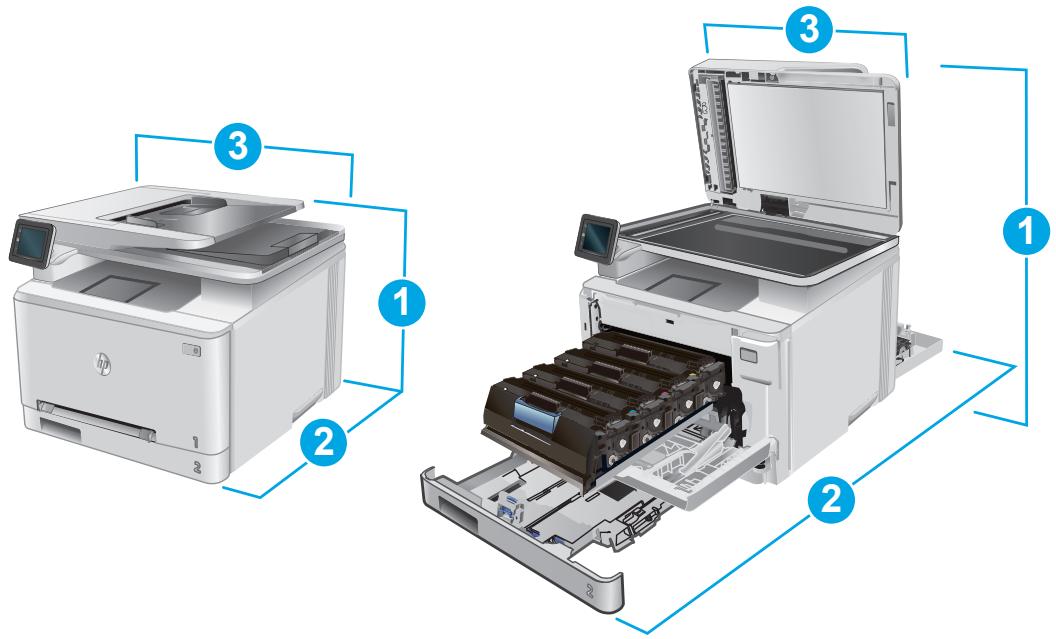
| Product fully closed | Product fully open |
| 1. Height | 322.2 mm (12.7 in) | 578 mm (22.8 in) |
| 2. Depth | 417 mm (16.4 in) | 1002 mm (39.4 in) |
| 3. Width | 392 mm (15.4 in) | 392 mm (15.4 in) |
| Weight (with cartridges) | 18.3 kg (40.3 lb) | |
Consommation électrique, spécifications électriques et émissions acoustiques
Voir www.hp.com/support/colorljMFPM277 pour des informations à jour.
ATTENTION : Les exigences d'alimentation sont basées sur le pays/la région où le produit est vendu. Ne convertissez pas les tensions de fonctionnement. Cela endommagerait le produit et annulerait la garantie du produit.
Plage de l'environnement de fonctionnement
Tableau 1-1 Spécifications de l'environnement de fonctionnement
| Environment | Recommended | Allowed |
| Temperature | 17° to 27°C (62.6° to 80.6°F) | 15° to 30°C (59° to 86°F) |
| Relative humidity | 30% to 70% relative humidity (RH) | 10% to 80% RH |
| Altitude | Not applicable | 0 to 3048 m (0 to 10,000 ft) |
Configuration matérielle du produit et installation du logiciel
Pour les instructions de configuration de base, consultez le Guide d'installation matérielle fourni avec le produit. Pour des instructions supplémentaires, consultez le support HP sur le Web.
Rendez-vous sur www.hp.com/support/colorljMFPM277 pour obtenir l'aide complète de HP pour le produit. Trouvez le support suivant :
Installer et configurer Apprendre et utiliser - Résoudre les problèmes Télécharger les mises à jour logicielles - Rejoindre les forums de support Trouver les informations de garantie et réglementaires
2 Bacs à papier
Chargez le papier dans la fente d'alimentation mono-feuille (bac 1) - Chargez le papier dans le bac 2
Rendez-vous sur www.hp.com/support/colorljMFPM277.
L'aide complète de HP pour ce produit comprend les informations suivantes :
Installer et configurer - Apprendre et utiliser - Résoudre les problèmes - Télécharger les mises à jour logicielles - Rejoindre les forums d'assistance - Trouver des informations sur la garantie et la réglementation
Chargement du papier dans la fente d'alimentation mono-feuille (bac 1)
Introduction
Utilisez la fente d'alimentation prioritaire mono-feuille pour imprimer des documents d'une seule page, des documents nécessitant plusieurs types de papier ou des enveloppes.
- Chargement du papier dans la fente d'alimentation prioritaire mono-feuille
- Charger une enveloppe dans la fente d'alimentation prioritaire mono-feuille (bac 1) Orientation du papier dans le bac 1
Chargement du papier dans la fente d'alimentation prioritaire mono-feuille
- Écartez les guides de largeur du papier dans la fente d'alimentation prioritaire mono-feuille.
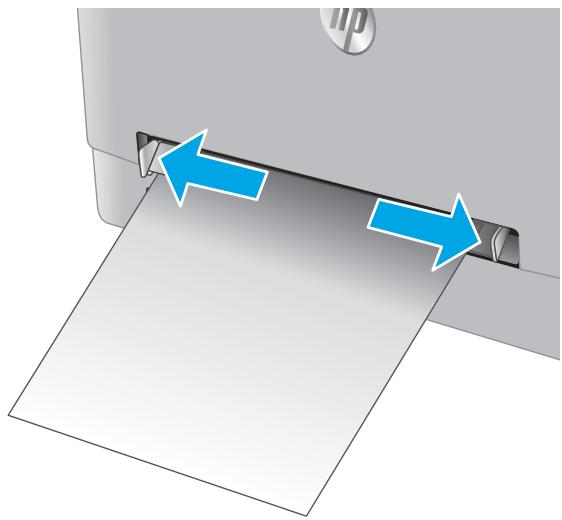
- Placez le bord supérieur de la feuille à l'ouverture, puis ajustez les guides latéraux pour qu'ils touchent légèrement la feuille sans la plier.
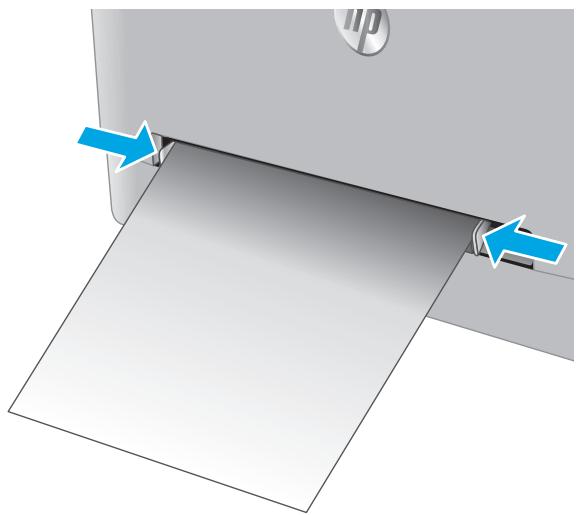
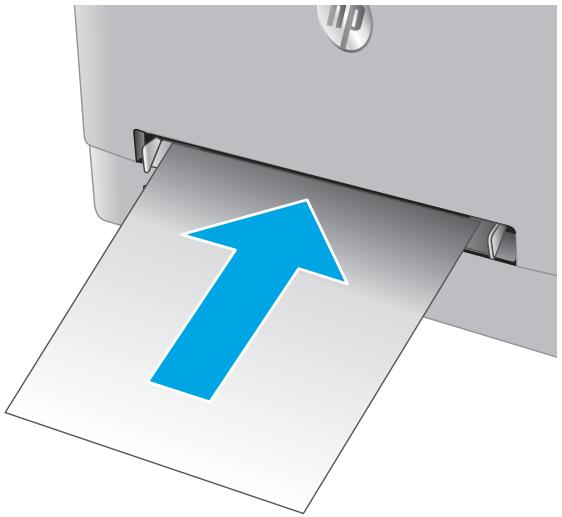
- Insérez la feuille dans la fente et maintenez-la. Le produit entraînera partiellement la feuille dans le chemin du papier. Pour plus d'informations sur l'orientation du papier, reportez-vous à la section Orientation du papier dans le bac 1, page 19.
REMARQUE : Selon la taille du papier, vous devrez peut-être soutenir la feuille avec les deux mains jusqu'à ce qu'elle avance dans le produit.
- Sur l'ordinateur, lancez le processus d'impression à partir du logiciel. Assurez-vous que le pilote est configuré pour le type et le format de papier corrects pour le papier imprimé depuis la fente d'alimentation prioritaire pour feuille unique.
Charger une enveloppe dans la fente d'alimentation prioritaire pour feuille unique (bac 1)
- Écartez les guides de largeur du papier dans la fente d'alimentation prioritaire pour feuille unique.
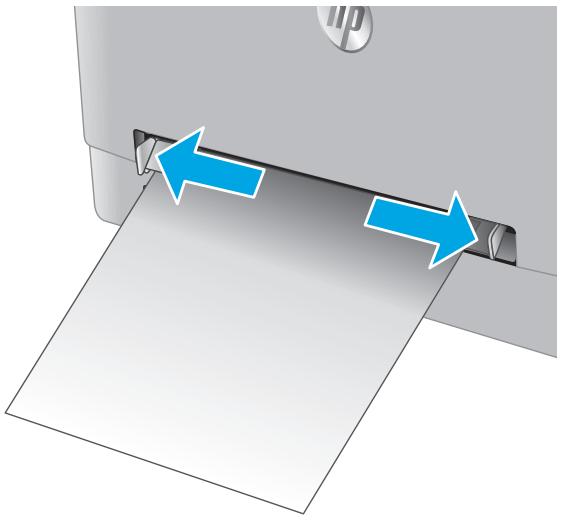
- Placez le bord droit de l'enveloppe, face vers le haut, à l'ouverture, puis ajustez les guides latéraux afin qu'ils touchent légèrement l'enveloppe, sans la plier.
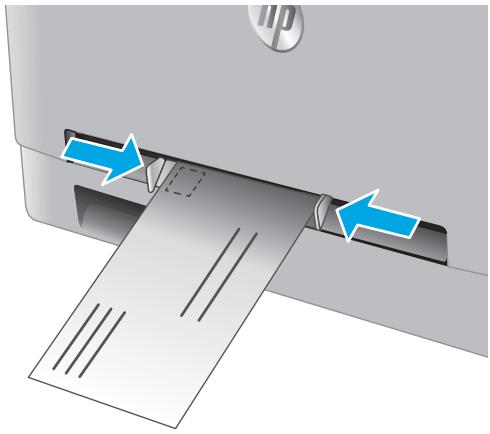
- Insérez l'enveloppe dans la fente et maintenez-la. Le produit entraînera partiellement l'enveloppe dans le chemin du papier.
REMARQUE : Selon la taille de l'enveloppe, vous devrez peut-être la soutenir à deux mains jusqu'à ce qu'elle avance dans le produit.

- Sur l'ordinateur, lancez le processus d'impression à partir du logiciel. Assurez-vous que le pilote est configuré pour le type et le format de papier corrects pour l'enveloppe imprimée depuis la fente d'alimentation prioritaire pour feuille unique.
Orientation du papier dans le bac 1
Lorsque vous utilisez du papier nécessitant une orientation spécifique, chargez-le conformément aux informations du tableau suivant.
| Paper type | Output | How to load paper |
| Letterhead or preprinted | 1-sided printing | Face-up
Top edge leading into the product |
| Letterhead or preprinted | 2-sided printing | Face-down
Top edge away from the product |
| Prepunched | 1-sided printing or 2-sided printing | Face-up
Holes toward the left side of the product |
Charger du papier dans le bac 2
Introduction
Les informations suivantes décrivent comment charger du papier dans le bac 2.
- Charger du papier dans le bac 2
- Charger des enveloppes dans le bac 2 Orientation du papier dans le bac 2
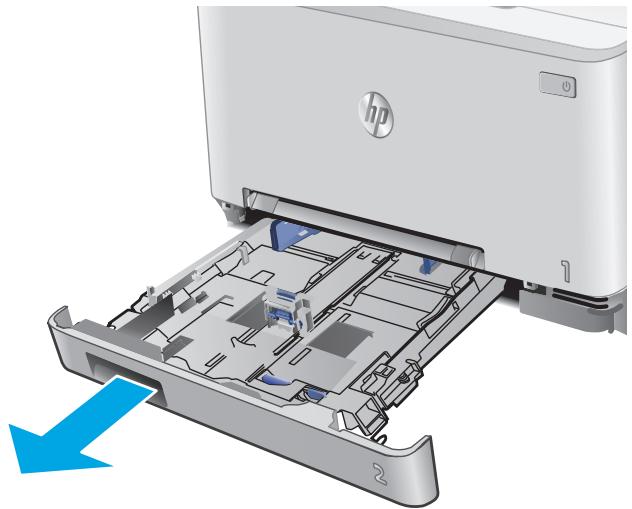
Charger du papier dans le bac 2
- Ouvrez le bac.
- Ajustez les guides papier en les faisant glisser à la taille du papier utilisé.
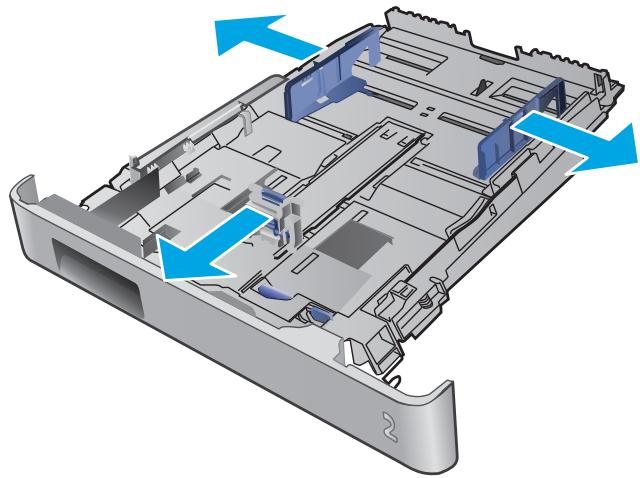
- Pour charger du papier au format legal, étendez le devant du bac en appuyant sur le loquet bleu et en tirant le devant du bac.
REMARQUE : Lorsqu'il est chargé avec du papier au format legal, le bac 2 dépasse d'environ 51 mm (2 pouces) à l'avant du produit.

- Chargez le papier dans le bac.

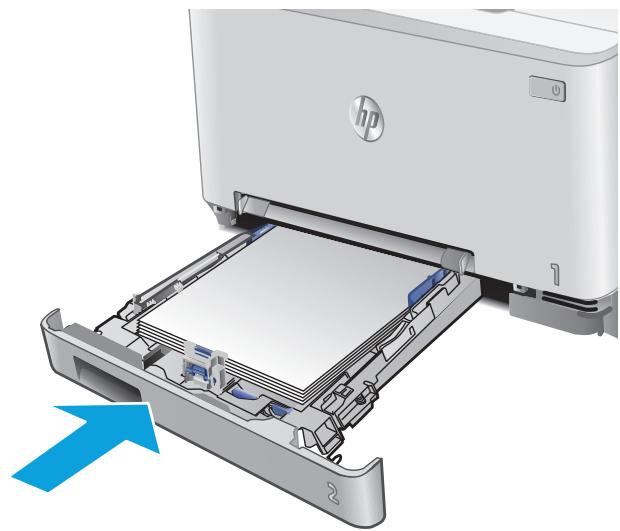
- Assurez-vous que la pile de papier est bien plate aux quatre coins. Faites glisser les guides de longueur et de largeur du papier contre la pile. REMARQUE : Pour éviter les bourrages, ne remplissez pas trop le bac. Assurez-vous que le haut de la pile est sous l'indicateur de niveau de remplissage.
- Après avoir vérifié que la pile de papier est sous l'indicateur de niveau de remplissage, fermez le bac.

Chargement des enveloppes dans le bac 2
- Ouvrez le bac.

- Ajustez les guides papier en les faisant glisser à la taille des enveloppes utilisées.
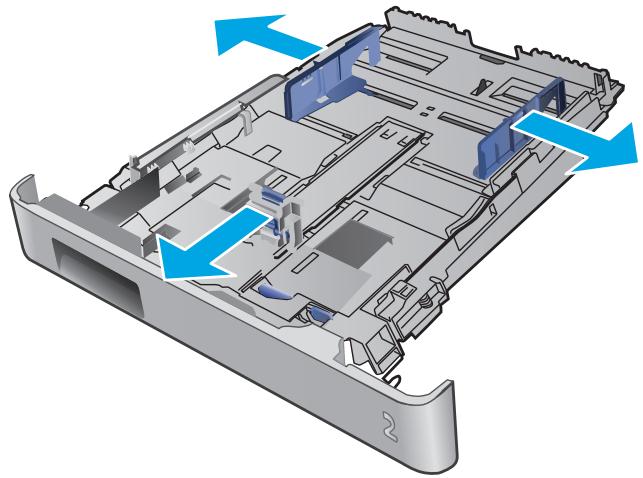
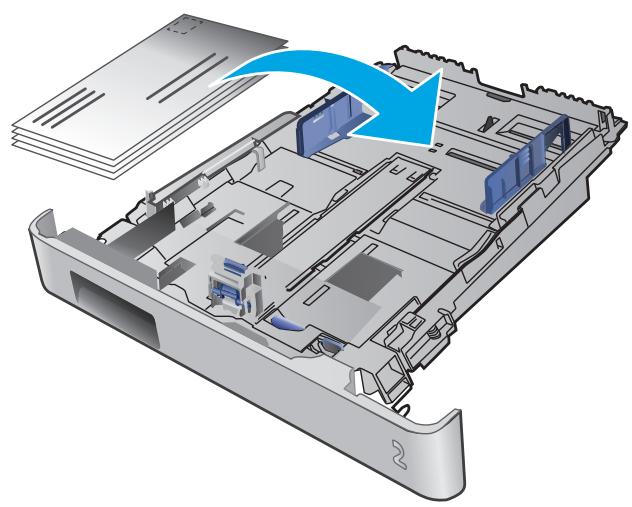
- Chargez les enveloppes dans le bac.
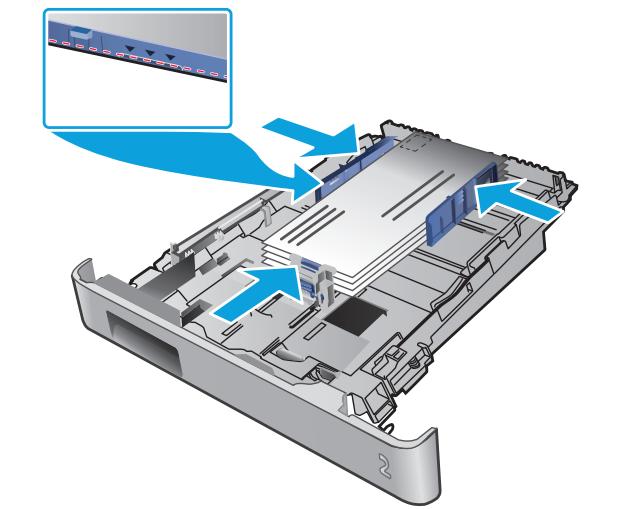
- Assurez-vous que la pile d'enveloppes est bien plate aux quatre coins. Faites glisser les guides de longueur et de largeur contre la pile. REMARQUE : Pour éviter les bourrages, ne remplissez pas trop le bac. Assurez-vous que le haut de la pile est sous l'indicateur de niveau de remplissage. ATTENTION : Charger plus de cinq enveloppes dans le bac 2 peut provoquer des bourrages.
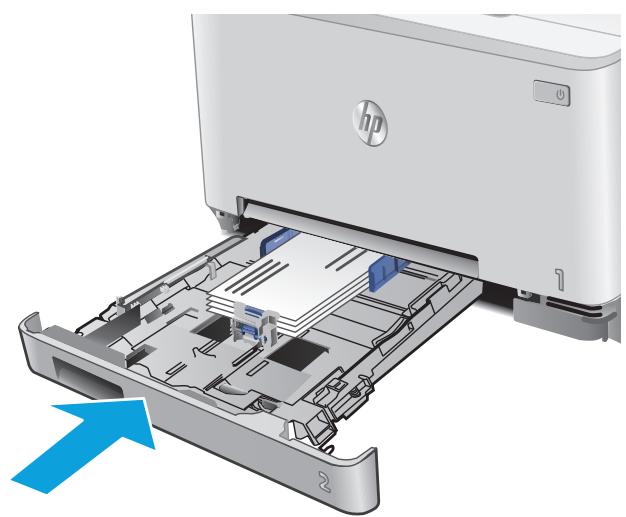
- Après avoir vérifié que la pile est sous l'indicateur de niveau de remplissage, fermez le bac.
Orientation du papier dans le bac 2
Lorsque vous utilisez du papier nécessitant une orientation spécifique, chargez-le conformément aux informations du tableau suivant.
| Paper type | Output | How to load paper |
| Letterhead or preprinted | 1-sided printing | Face-up
Top edge toward the product |
| Letterhead or preprinted | 2-sided printing | Face-down
Top edge away from the product |
| Prepunched | 1-sided printing or 2-sided printing | Face-up
Holes toward the left side of the product |
3 Fournitures, accessoires et pièces
Commandez des fournitures, des accessoires et des pièces - Remplacez les cartouches de toner
Rendez-vous sur www.hp.com/support/colorljMFPM277.
L'aide complète de HP pour ce produit comprend les informations suivantes :
Installer et configurer - Apprendre et utiliser - Résoudre les problèmes - Télécharger les mises à jour logicielles - Rejoindre les forums d'assistance - Trouver des informations sur la garantie et la réglementation
Commandez des fournitures, des accessoires et des pièces
Commande
| Order supplies and paper | www.hp.com/go/suresupply |
| Order genuine HP parts or accessories | www.hp.com/buy-parts |
| Order through service or support providers | Contact an HP-authorized service or support provider. |
| Order using the HP Embedded Web Server (EWS) | To access, in a supported Web browser on the computer, enter the product IP address or host name in the address/URL field. The EWS contains a link to the HP SureSupply Web site, which provides options for purchasing Original HP supplies. |
Fournitures et accessoires
| Item | Description | Cartridge number | Part number |
| Supplies |
| HP 201A Black Original LaserJet Toner Cartridge | Standard-capacity replacement black toner cartridge | 201A | CF400A |
| HP 201X High Yield Black Original LaserJet Toner Cartridge | High-capacity replacement black toner cartridge | 201X | CF400X |
| HP 201A Cyan Original LaserJet Toner Cartridge | Standard-capacity replacement cyan toner cartridge | 201A | CF401A |
| HP 201X High Yield Cyan Original LaserJet Toner Cartridge | High-capacity replacement cyan toner cartridge | 201X | CF401X |
| HP 201A Yellow Original LaserJet Toner Cartridge | Standard-capacity replacement yellow toner cartridge | 201A | CF402A |
| HP 201X High Yield Yellow Original LaserJet Toner Cartridge | High-capacity replacement yellow toner cartridge | 201X | CF402X |
| HP 201A Magenta Original LaserJet Toner Cartridge | Standard-capacity replacement magenta toner cartridge | 201A | CF403A |
| HP 201X High Yield Magenta Original LaserJet Toner Cartridge | High-capacity replacement magenta toner cartridge | 201X | CF403X |
| Accessories |
| USB 2.0 printer cable | A-to-B cable (2-meter standard) | | C6518A |
Pièces réparables par le client
Les pièces réparables par le client (CSR) sont disponibles pour de nombreux produits HP LaserJet afin de réduire le temps de réparation. Pour plus d'informations sur le programme CSR et ses avantages, consultez www.hp.com/go/csr-support et www.hp.com/go/csr-faq.
Les pièces de rechange HP d'origine peuvent être commandées sur www.hp.com/buy/parts ou en contactant un fournisseur de services ou d'assistance agréé HP. Lors de la commande, l'un des éléments suivants sera nécessaire : numéro de pièce, numéro de série (situé à l'arrière de l'imprimante), numéro de produit ou nom du produit.
- Les pièces répertoriées comme à remplacement obligatoire par le client doivent être installées par les clients, sauf si vous acceptez de payer le personnel de service HP pour effectuer la réparation. Pour ces pièces, le support sur site ou le retour en atelier n'est pas fourni dans le cadre de la garantie du produit HP.
- Les pièces répertoriées comme à remplacement facultatif par le client peuvent être installées par le personnel de service HP à votre demande sans frais supplémentaires pendant la période de garantie du produit.
| Item | Description | Self-replacement options | Part number |
| Single-sheet priority feed slot tray | Replacement tray for single-sheet priority feed slot (Tray 1) | Mandatory | RM2-5865-000 |
| 150-sheet paper input tray | Replacement cassette for Tray 2 | Mandatory | RM2-5886-000 |
Remplacez les cartouches de toner
Introduction
Ce produit indique lorsque le niveau de la cartouche de toner est faible. La durée de vie réelle restante de la cartouche de toner peut varier. Pensez à avoir une cartouche de remplacement disponible à installer lorsque la qualité d'impression n'est plus acceptable.
Pour acheter des cartouches ou vérifier la compatibilité des cartouches avec le produit, rendez-vous sur HP SureSupply à l'adresse www.hp.com/go/suresupply. Faites défiler la page jusqu'en bas et vérifiez que le pays/région est correct.
Le produit utilise quatre couleurs et possède une cartouche de toner différente pour chaque couleur : jaune (J), magenta (M), cyan (C) et noir (N). Les cartouches de toner se trouvent derrière la porte avant.
| Item | Description | Cartridge number | Part number |
| HP 201A Black Original LaserJet Toner Cartridge | Standard-capacity replacement black toner cartridge | 201A | CF400A |
| HP 201X High Yield Black Original LaserJet Toner Cartridge | High-capacity replacement black toner cartridge | 201X | CF400X |
| HP 201A Cyan Original LaserJet Toner Cartridge | Standard-capacity replacement cyan toner cartridge | 201A | CF401A |
| HP 201X High Yield Cyan Original LaserJet Toner Cartridge | High-capacity replacement cyan toner cartridge | 201X | CF401X |
| HP 201A Yellow Original LaserJet Toner Cartridge | Standard-capacity replacement yellow toner cartridge | 201A | CF402A |
| HP 201X High Yield Yellow Original LaserJet Toner Cartridge | High-capacity replacement yellow toner cartridge | 201X | CF402X |
| HP 201A Magenta Original LaserJet Toner Cartridge | Standard-capacity replacement magenta toner cartridge | 201A | CF403A |
| HP 201X High Yield Magenta Original LaserJet Toner Cartridge | High-capacity replacement magenta toner cartridge | 201X | CF403X |
Ne retirez pas la cartouche de toner de son emballage avant de l'installer.
ATTENTION : Pour éviter d'endommager la cartouche de toner, ne l'exposez pas à la lumière plus de quelques minutes. Si la cartouche de toner doit être retirée du produit pendant une période prolongée, placez-la dans son emballage en plastique d'origine ou couvrez-la avec un objet opaque et léger.
L'illustration suivante montre les composants de la cartouche de toner.
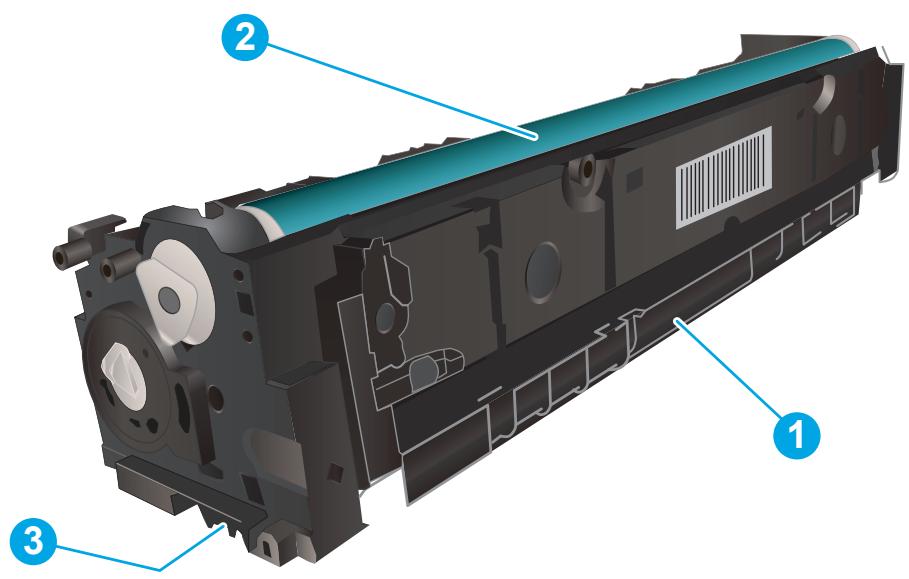
| 1 | Handle |
| 2 | Imaging drum |
| 3 | Memory chip |
ATTENTION : Si du toner se dépose sur les vêtements, essuyez-le avec un chiffon sec et lavez les vêtements à l'eau froide. L'eau chaude fixe le toner dans le tissu.
REMARQUE : Des informations sur le recyclage des cartouches de toner usagées se trouvent dans la boîte de la cartouche de toner.
Retirer et remplacer les cartouches de toner
- Ouvrez la porte avant.

- Saisissez la poignée bleue du tiroir des cartouches de toner, puis tirez le tiroir vers l'extérieur.
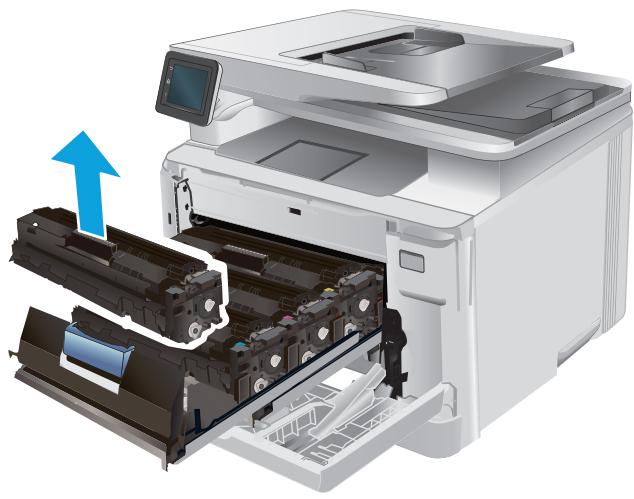
- Saisissez la poignée de la cartouche de toner, puis tirez la cartouche de toner vers le haut pour la retirer.
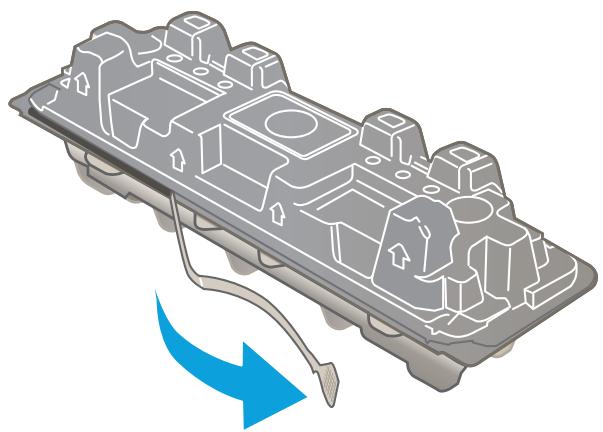
- Sortez la nouvelle cartouche de toner de sa boîte, puis tirez sur la languette de libération de l'emballage.

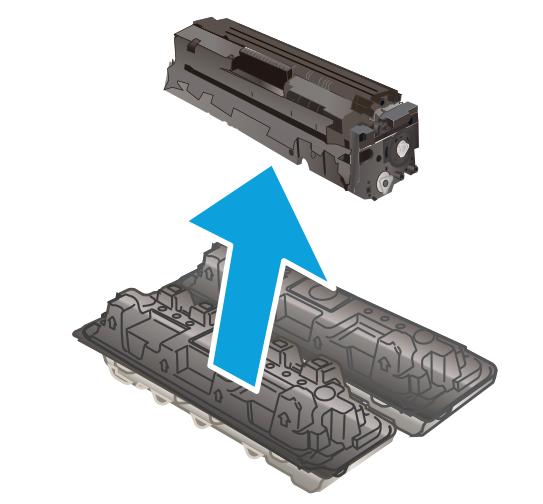
- Retirez la cartouche de toner de la coque d'emballage ouverte.
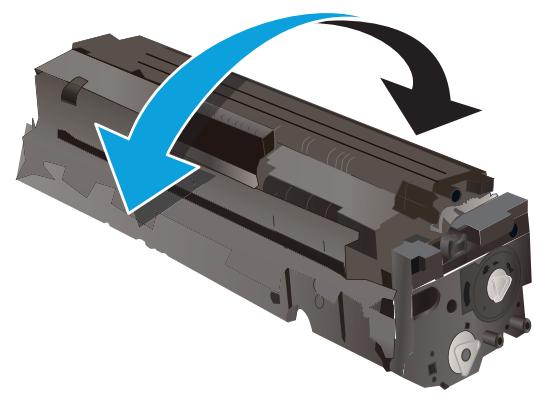
- Basculez doucement la cartouche de toner d'avant en arrière pour répartir le toner uniformément à l'intérieur de la cartouche.
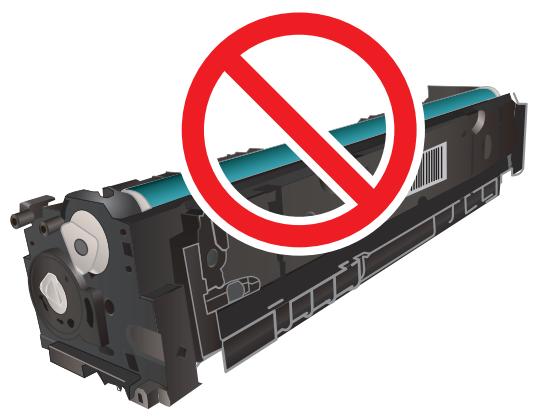
- Ne touchez pas le tambour d'imagerie situé sous la cartouche de toner. Les traces de doigts sur le tambour d'imagerie peuvent entraîner des problèmes de qualité d'impression.
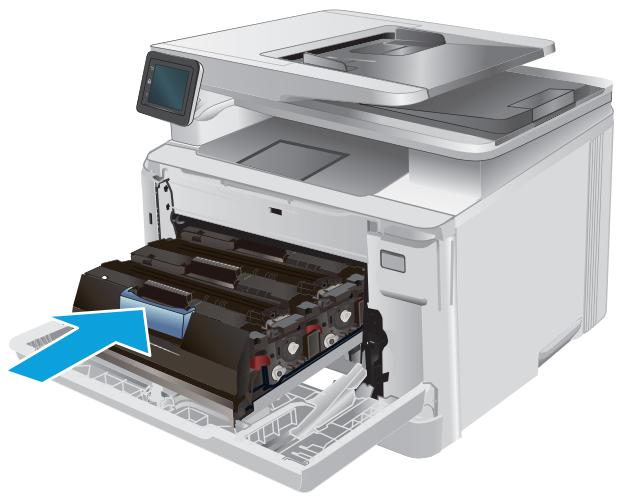
- Insérez la nouvelle cartouche de toner dans le tiroir. Assurez-vous que la puce de couleur de la cartouche correspond à celle du tiroir.

- Fermez le tiroir de cartouches de toner.
- Fermez la porte avant.

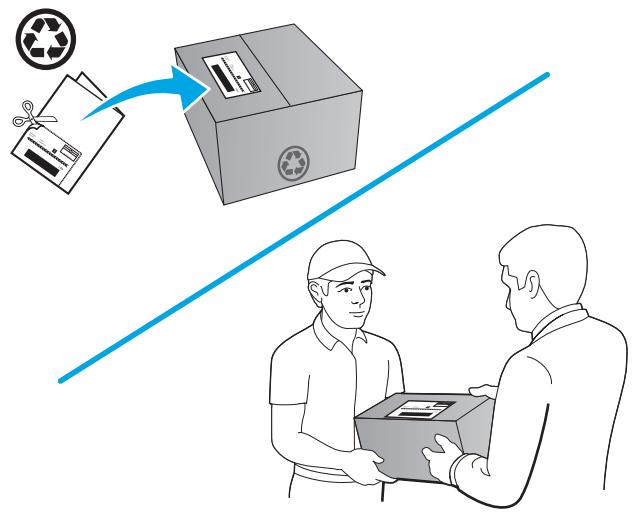
- Placez la cartouche de toner usagée dans l'emballage de la nouvelle cartouche.
- Utilisez l'étiquette prépayée et pré-adressée pour renvoyer la cartouche usagée à HP pour recyclage (si disponible).


http://www.hp.com/recycle
4 Impression
Tâches d'impression (Windows) - Tâches d'impression (OS X) Impression mobile Utiliser l'impression USB sans fil
Rendez-vous sur www.hp.com/support/colorljMFPM277.
L'assistance complète de HP pour le produit comprend les informations suivantes :
Installer et configurer Apprendre et utiliser - Résoudre les problèmes Télécharger les mises à jour logicielles - Rejoindre les forums d'assistance Trouver les informations de garantie et réglementaires
Tâches d'impression (Windows)
Comment imprimer (Windows)
La procédure suivante décrit le processus d'impression de base pour Windows.
- Dans le logiciel, sélectionnez l'option Imprimer.
- Sélectionnez le produit dans la liste des imprimantes. Pour modifier les paramètres, cliquez ou appuyez sur le bouton Propriétés ou Préférences pour ouvrir le pilote d'impression.
REMARQUE : Le nom du bouton varie selon les logiciels.
REMARQUE : Pour accéder à ces fonctionnalités depuis l'écran de démarrage de Windows 8 ou 8.1, sélectionnez Périphériques, puis Imprimer, puis sélectionnez l'imprimante.
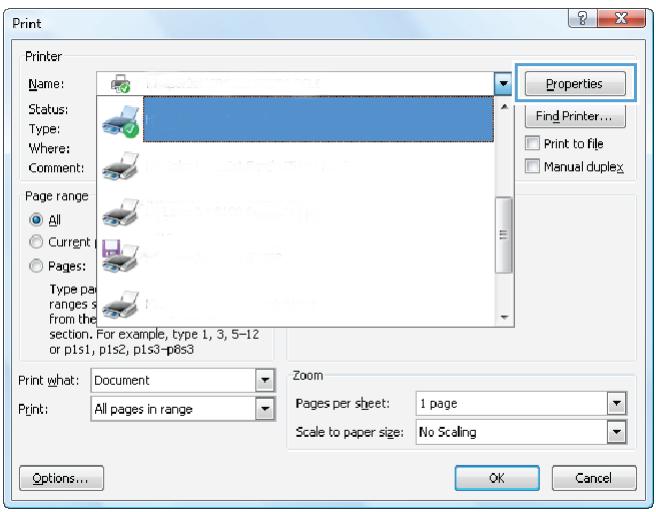
- Cliquez ou appuyez sur les onglets du pilote d'impression pour configurer les options disponibles. Par exemple, définissez l'orientation du papier dans l'onglet Finition, et la source du papier, le type de papier, la taille du papier et les paramètres de qualité dans l'onglet Papier/Qualité.
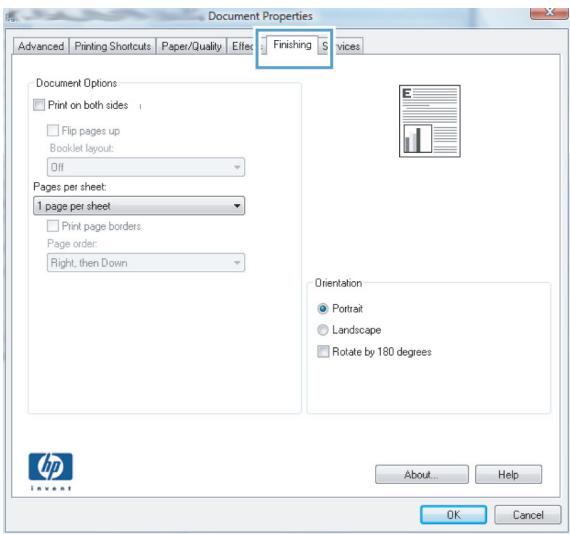
- Cliquez ou appuyez sur le bouton OK pour revenir à la boîte de dialogue Imprimer. Sélectionnez le nombre de copies à imprimer à partir de cet écran.
- Cliquez ou appuyez sur le bouton OK pour imprimer le travail.
Imprimer automatiquement en recto verso (Windows)
Utilisez cette procédure pour les produits équipés d'un module d'impression recto verso automatique. Si le produit n'est pas équipé d'un module d'impression recto verso automatique, ou pour imprimer sur des types de papier que le module ne prend pas en charge, vous pouvez imprimer manuellement sur les deux faces.
- Dans le logiciel, sélectionnez l'option Imprimer.
- Sélectionnez le produit dans la liste des imprimantes, puis cliquez ou appuyez sur le bouton Propriétés ou Préférences pour ouvrir le pilote d'impression.
REMARQUE : Le nom du bouton varie selon les logiciels.
REMARQUE : Pour accéder à ces fonctionnalités depuis l'écran de démarrage de Windows 8 ou 8.1, sélectionnez Périphériques, puis Imprimer, puis sélectionnez l'imprimante.
- Cliquez ou touchez l'onglet Finition.
- Cochez la case Imprimer sur les deux faces. Cliquez sur le bouton OK pour fermer la boîte de dialogue Propriétés du document.
- Dans la boîte de dialogue Imprimer, cliquez sur le bouton OK pour imprimer le travail.
Impression manuelle sur les deux faces (Windows)
Utilisez cette procédure pour les produits qui n'ont pas de module recto verso automatique installé ou pour imprimer sur du papier que le module recto verso ne prend pas en charge.
- Dans le logiciel, sélectionnez l'option Imprimer.
- Sélectionnez le produit dans la liste des imprimantes, puis cliquez ou touchez le bouton Propriétés ou Préférences pour ouvrir le pilote d'impression.
REMARQUE : Le nom du bouton varie selon les logiciels.
REMARQUE : Pour accéder à ces fonctionnalités à partir de l'écran de démarrage de Windows 8 ou 8.1, sélectionnez Périphériques, puis Imprimer, puis sélectionnez l'imprimante.
- Cliquez ou touchez l'onglet Finition.
- Cochez la case Imprimer sur les deux faces (manuellement). Cliquez sur le bouton OK pour imprimer le premier côté du travail.
- Récupérez la pile imprimée dans le bac de sortie et placez-la dans le bac 1.
- Si vous y êtes invité, touchez le bouton approprié du panneau de commande pour continuer.
Imprimer plusieurs pages par feuille (Windows)
- Dans le logiciel, sélectionnez l'option Imprimer.
- Sélectionnez le produit dans la liste des imprimantes, puis cliquez ou appuyez sur le bouton Propriétés ou Préférences pour ouvrir le pilote d'impression.
REMARQUE : Le nom du bouton varie selon les logiciels. REMARQUE : Pour accéder à ces fonctionnalités à partir de l'écran de démarrage de Windows 8 ou 8.1, sélectionnez Périphériques, puis Imprimer, puis sélectionnez l'imprimante.
- Cliquez ou appuyez sur l'onglet Finition.
- Sélectionnez le nombre de pages par feuille dans la liste déroulante Pages par feuille.
- Sélectionnez les options correctes Imprimer les bordures de page, Ordre des pages et Orientation. Cliquez sur le bouton OK pour fermer la boîte de dialogue Propriétés du document.
- Dans la boîte de dialogue Imprimer, cliquez sur le bouton OK pour imprimer le travail.
Sélectionnez le type de papier (Windows)
- Dans le logiciel, sélectionnez l'option Imprimer.
- Sélectionnez le produit dans la liste des imprimantes, puis cliquez ou appuyez sur le bouton Propriétés ou Préférences pour ouvrir le pilote d'impression.
REMARQUE : Le nom du bouton varie selon les logiciels.
REMARQUE : Pour accéder à ces fonctionnalités à partir de l'écran de démarrage de Windows 8 ou 8.1, sélectionnez Périphériques, puis Imprimer, puis sélectionnez l'imprimante.
- Cliquez ou appuyez sur l'onglet Papier/Qualité.
- Dans la liste déroulante Type de papier, sélectionnez le type de papier qui décrit le mieux le papier utilisé, puis cliquez sur le bouton OK.
- Cliquez sur le bouton OK pour fermer la boîte de dialogue Propriétés du document. Dans la boîte de dialogue Imprimer, cliquez sur le bouton OK pour imprimer le travail.
Tâches d'impression (OS X)
Comment imprimer (OS X)
La procédure suivante décrit le processus d'impression de base pour OS X.
- Cliquez sur le menu Fichier, puis sur l'option Imprimer.
- Sélectionnez le produit.
- Cliquez sur Afficher les détails, puis sélectionnez d'autres menus pour ajuster les paramètres d'impression.
- Cliquez sur le bouton Imprimer.
Imprimer automatiquement en recto verso (OS X)

REMARQUE : Ces informations s'appliquent aux produits qui incluent un module d'impression recto verso automatique.

REMARQUE : Cette fonctionnalité est disponible si vous installez le pilote d'impression HP. Elle peut ne pas être disponible si vous utilisez AirPrint.
- Cliquez sur le menu Fichier, puis sur l'option Imprimer.
- Sélectionnez le produit.
- Cliquez sur Afficher les détails, puis sur le menu Disposition.
- Sélectionnez une option de reliure dans la liste déroulante Recto verso.
- Cliquez sur le bouton Imprimer.
Imprimer manuellement en recto verso (OS X)

REMARQUE : Cette fonctionnalité est disponible si vous installez le pilote d'impression HP. Elle peut ne pas être disponible si vous utilisez AirPrint.
- Cliquez sur le menu Fichier, puis sur l'option Imprimer.
- Sélectionnez le produit.
- Cliquez sur Afficher les détails, puis sur le menu Recto verso manuel.
- Cliquez sur la case Recto verso manuel et sélectionnez une option de reliure.
- Cliquez sur le bouton Imprimer.
- Rendez-vous sur le produit et retirez tout papier vierge du bac 1.
- Récupérez la pile imprimée dans le bac de sortie et placez-la face imprimée vers le bas dans le bac d'alimentation.
- Si vous y êtes invité, touchez le bouton approprié du panneau de commande pour continuer.
Imprimer plusieurs pages par feuille (OS X)
- Cliquez sur le menu Fichier, puis sur l'option Imprimer.
- Sélectionnez le produit.
- Cliquez sur Afficher les détails, puis sur le menu Mise en page.
- Dans la liste déroulante Pages par feuille, sélectionnez le nombre de pages que vous souhaitez imprimer sur chaque feuille.
- Dans la zone Sens de la mise en page, sélectionnez l'ordre et l'emplacement des pages sur la feuille.
- Dans le menu Bordures, sélectionnez le type de bordure à imprimer autour de chaque page sur la feuille.
- Cliquez sur le bouton Imprimer.
Sélectionnez le type de papier (OS X)
- Cliquez sur le menu Fichier, puis sur l'option Imprimer.
- Sélectionnez le produit.
- Cliquez sur Afficher les détails, puis sur le menu Médias et qualité ou le menu Papier/Qualité.
- Sélectionnez un type dans la liste déroulante Type de support.
- Cliquez sur le bouton Imprimer.
Impression mobile
Introduction
HP propose plusieurs solutions mobiles et ePrint pour permettre l'impression sans fil vers une imprimante HP depuis un ordinateur portable, une tablette, un smartphone ou un autre appareil mobile. Pour voir la liste complète et déterminer le meilleur choix, rendez-vous sur www.hp.com/go/LaserJetMobilePrinting (en anglais uniquement).
Wi-Fi Direct et impression NFC (modèles sans fil uniquement) HP ePrint par e-mail Logiciel HP ePrint AirPrint Impression intégrée Android
Wi-Fi Direct et impression NFC (modèles sans fil uniquement)
La technologie Wi-Fi Direct et NFC (Near Field Communication) permet d'imprimer à partir d'un appareil mobile sans fil, sans nécessiter de connexion à un réseau ou à Internet.
Les capacités NFC permettent une connexion d'impression directe et facile pour les appareils mobiles grâce au toucher de l'appareil à l'autre.
Utilisez Wi-Fi Direct pour imprimer sans fil à partir des appareils suivants :
iPhone, iPad ou iPod touch avec Apple AirPrint ou l'application HP ePrint ; appareils mobiles Android avec l'application HP ePrint ou la solution d'impression intégrée Android ; PC et Mac avec le logiciel HP ePrint.
Activer ou désactiver Wi-Fi Direct
Les capacités Wi-Fi Direct doivent d'abord être activées à partir du panneau de commande du produit.
- Depuis l'écran d'accueil du panneau de commande du produit, touchez le bouton Informations de connexion.
- Ouvrez les menus suivants :
Wi-Fi Direct - Paramètres Activé/Désactivé
- Touchez l'élément de menu Activé. Toucher le bouton Désactivé désactive l'impression Wi-Fi Direct.
Pour plus d'informations sur l'impression sans fil, consultez www.hp.com/go/wirelessprinting.
Pour plus d'informations sur l'impression avec Wi-Fi Direct, consultez la page d'accueil du support produit : www.hp.com/support/colorljMFPM277.
HP ePrint par e-mail
Utilisez HP ePrint pour imprimer des documents en les envoyant en pièce jointe à l'adresse e-mail du produit depuis tout appareil compatible e-mail.
Pour utiliser HP ePrint, le produit doit répondre à ces exigences :
Le produit doit être connecté à un réseau filaire ou sans fil et avoir accès à Internet. Les services Web HP doivent être activés sur le produit, et le produit doit être enregistré auprès de HP Connected ou du HP ePrint Center.
- Depuis l'écran d'accueil du panneau de commande du produit, touchez le bouton Informations de connexion.
- Ouvrez les menus suivants :
ePrint - Paramètres - Activer les services Web
- Touchez le bouton Imprimer pour lire les conditions d'utilisation. Touchez le bouton OK pour accepter les conditions d'utilisation et activer les services Web HP. Le produit active les services Web, puis imprime une page d'informations. La page d'informations contient le code d'imprimante que vous utiliserez pour enregistrer ce produit HP auprès de HP Connected ou du HP ePrint Center.
- Rendez-vous sur www.hpconnected.com ou www.hp.com/go/eprintcenter pour créer un compte HP ePrint et terminer la configuration du processus d'ePrint par e-mail.
Rendez-vous sur www.hp.com/support/colorljMFPM277 pour consulter des informations d'assistance supplémentaires pour ce produit.
Logiciel HP ePrint
Le logiciel HP ePrint facilite l'impression à partir d'un ordinateur de bureau ou portable Windows ou Mac vers tout produit compatible HP ePrint. Ce logiciel facilite la recherche de produits compatibles HP ePrint enregistrés sur votre compte HP Connected. L'imprimante HP cible peut se trouver au bureau ou à des endroits dans le monde entier.
Windows : après l'installation du logiciel, ouvrez l'option Imprimer depuis votre application, puis sélectionnez HP ePrint dans la liste des imprimantes installées. Cliquez sur le bouton Propriétés pour configurer les options d'impression. - Mac : après l'installation du logiciel, sélectionnez Fichier, Imprimer, puis sélectionnez la flèche à côté de PDF (en bas à gauche de l'écran du pilote). Sélectionnez HP ePrint.
Pour Windows, le logiciel HP ePrint prend en charge l'impression TCP/IP vers des imprimantes réseau locales sur le réseau (LAN ou WAN) vers des produits prenant en charge UPD PostScript®.
Windows et Mac prennent tous deux en charge l'impression IPP vers des produits connectés au réseau LAN ou WAN prenant en charge ePCL.
Windows et Mac prennent également en charge l'impression de documents PDF vers des lieux d'impression publics et l'impression via HP ePrint par e-mail via le cloud.
Rendez-vous sur www.hp.com/go/eprintsoftware pour les pilotes et les informations.

REMARQUE : Le logiciel HP ePrint est un utilitaire de flux de travail PDF pour Mac, et n'est pas techniquement un pilote d'impression.

REMARQUE : le logiciel HP ePrint ne prend pas en charge l'impression USB.
AirPrint
L'impression directe via AirPrint d'Apple est prise en charge pour iOS 4.2 ou version ultérieure et pour les Mac sous OS X 10.7 Lion ou version ultérieure. Utilisez AirPrint pour imprimer directement sur le produit depuis un iPad, un iPhone (3GS ou version ultérieure) ou un iPod touch (troisième génération ou version ultérieure) dans les applications mobiles suivantes :
Mail, Photos, Safari, iBooks - Sélectionnez des applications tierces
Pour utiliser AirPrint, le produit doit être connecté au même réseau sans fil que l'appareil Apple. Pour plus d'informations sur l'utilisation d'AirPrint et sur les produits HP compatibles avec AirPrint, consultez le site Web d'assistance de ce produit :
www.hp.com/support/colorljMFPM277

REMARQUE : AirPrint ne prend pas en charge les connexions USB.
Impression intégrée Android
La solution d'impression intégrée de HP pour Android et Kindle permet aux appareils mobiles de trouver et d'imprimer automatiquement sur les imprimantes HP connectées à un réseau sans fil ou à portée sans fil pour l'impression sans fil. La solution d'impression est intégrée aux systèmes d'exploitation pris en charge, il n'est donc pas nécessaire d'installer des pilotes ou de télécharger un logiciel.
Pour plus d'informations sur l'utilisation de l'impression intégrée Android et sur les appareils Android pris en charge, consultez www.hp.com/support/colorljMFPM277.
Utiliser l'impression USB directe
- Insérez la clé USB dans le port USB direct sur le produit.
- Le menu Clé USB s'ouvre avec les options suivantes :
- Imprimer des documents, Afficher et imprimer des photos
- Numériser vers une clé USB
- Pour imprimer un document, touchez l'écran Imprimer des documents, puis touchez le nom du dossier sur la clé USB où le document est stocké. Lorsque l'écran récapitulatif s'ouvre, vous pouvez le toucher pour ajuster les paramètres. Touchez le bouton Imprimer pour imprimer le document.
- Pour imprimer des photos, touchez l'écran Visualiser et imprimer des photos, puis touchez l'image d'aperçu pour sélectionner chaque photo à imprimer. Touchez le bouton Terminé. Lorsque l'écran récapitulatif s'ouvre, vous pouvez le toucher pour ajuster les paramètres. Touchez le bouton Imprimer pour imprimer les photos.
- Récupérez le travail imprimé dans le bac de sortie et retirez la clé USB.
5 Copie
Faire une copie Copier sur les deux faces (recto verso)
Allez sur www.hp.com/support/colorljMFPM277.
L'aide complète de HP pour ce produit comprend les informations suivantes :
Installer et configurer Apprendre et utiliser - Résoudre les problèmes Télécharger les mises à jour logicielles - Rejoindre les forums d'assistance Trouver les informations de garantie et réglementaires
Faire une copie
- Chargez le document sur la vitre du scanner conformément aux indicateurs sur le produit.
- Depuis l'écran d'accueil du panneau de commande du produit, touchez le bouton Copie.
- Pour optimiser la qualité de copie pour différents types de documents, touchez le bouton Paramètres, puis faites défiler et touchez le bouton Optimiser. Balayez l'écran du panneau de commande pour faire défiler les options, puis touchez une option pour la sélectionner. Les paramètres de qualité de copie suivants sont disponibles :
- Sélection automatique : utilisez ce paramètre lorsque vous n'êtes pas concerné par la qualité de la copie. C'est le paramètre par défaut.
- Mixte : utilisez ce paramètre pour les documents contenant un mélange de texte et de graphiques. Texte : utilisez ce paramètre pour les documents contenant principalement du texte. Image : utilisez ce paramètre pour les documents contenant principalement des graphiques.
- Touchez Nombre de copies, puis utilisez le clavier numérique de l'écran tactile pour ajuster le nombre de copies.
- Touchez le bouton Noir ou Couleur pour démarrer la copie.
Copie recto verso (duplex)
- Copie recto verso automatique
- Copie recto verso manuelle
Copie recto verso automatique
- Chargez les documents originaux dans le chargeur de documents, la première page face vers le haut et le haut de la page en premier.
- Ajustez les guides papier à la taille du document.
- Sur l'écran d'accueil du panneau de commande du produit, touchez le bouton Copier.
- Touchez le bouton Paramètres.
- Faites défiler et touchez le bouton Recto verso.
- Faites glisser votre doigt parmi les options, puis touchez une option pour la sélectionner.
- Touchez le bouton Noir ou Couleur pour lancer la copie.
Copier manuellement en recto verso
- Placez le document face vers le bas sur la vitre du scanner, le coin supérieur gauche de la page dans le coin supérieur gauche de la vitre. Fermez le scanner.
- Sur l'écran d'accueil du panneau de commande du produit, touchez le bouton Copier.
- Touchez le bouton Paramètres.
- Faites défiler et touchez le bouton Recto verso.
- Faites glisser votre doigt parmi les options, puis touchez une option pour la sélectionner.
- Touchez le bouton Noir ou Couleur pour lancer la copie.
- Le produit vous invite à charger le document original suivant. Placez-le sur la vitre, puis touchez le bouton OK.
- Répétez ce processus jusqu'à ce que vous ayez numérisé la dernière page. Touchez le bouton Terminé pour finir d'imprimer les copies.
6 Numérisation
- Numérisation à l'aide du logiciel HP Scan (Windows)
- Numérisation à l'aide du logiciel HP Scan (OS X)
- Numérisation vers une clé USB
- Configuration de la numérisation vers un dossier réseau
- Numérisation vers un dossier réseau
- Configuration de la numérisation vers un e-mail
- Numérisation vers un e-mail Tâches de numérisation supplémentaires
Rendez-vous sur www.hp.com/support/colorljMFPM277.
L'aide complète de HP pour ce produit comprend les informations suivantes :
Installer et configurer - Apprendre et utiliser - Résoudre les problèmes - Télécharger les mises à jour logicielles - Rejoindre les forums d'assistance - Trouver des informations sur la garantie et la réglementation
Numérisation à l'aide du logiciel HP Scan (Windows)
Utilisez le logiciel HP Scan pour lancer la numérisation à partir de votre ordinateur. Vous pouvez enregistrer l'image numérisée dans un fichier ou l'envoyer vers une autre application logicielle.
- Chargez le document dans le chargeur de documents ou sur la vitre du scanner conformément aux indicateurs sur le produit.
- Cliquez sur Démarrer, puis sur Programmes (ou Tous les programmes dans Windows XP).
- Cliquez sur HP, puis sélectionnez votre produit.
- Cliquez sur HP Scan, sélectionnez un raccourci de numérisation, puis ajustez les paramètres si nécessaire.
- Cliquez sur Numériser.

REMARQUE : Cliquez sur Paramètres avancés pour accéder à plus d'options.
Cliquez sur Créer un nouveau raccourci pour créer un ensemble de paramètres personnalisé et l'enregistrer dans la liste des raccourcis.
Numérisation à l'aide du logiciel HP Scan (OS X)
Utilisez le logiciel HP Scan pour lancer la numérisation à partir du logiciel sur votre ordinateur.
- Chargez le document dans le chargeur de documents ou sur la vitre du scanner conformément aux indicateurs sur le produit.
- Ouvrez HP Scan, qui se trouve dans le dossier Hewlett-Packard dans le dossier Applications.
- Suivez les instructions à l'écran pour numériser le document.
- Lorsque vous avez numérisé toutes les pages, cliquez sur Fichier puis sur Enregistrer pour les enregistrer dans un fichier.
Numérisation vers une clé USB
- Chargez le document sur la vitre du scanner conformément aux indicateurs sur le produit.
- Insérez une clé USB dans le port USB direct.
- Depuis l'écran d'accueil du panneau de commande du produit, touchez le bouton Numériser.
- Touchez l'écran Numériser vers une clé USB.
- Touchez le bouton Numériser pour numériser et enregistrer le fichier. Le produit crée un dossier nommé HPSCANS sur la clé USB et enregistre le fichier au format .PDF ou .JPG avec un nom de fichier généré automatiquement.

REMARQUE : Lorsque l'écran récapitulatif s'ouvre, vous pouvez le toucher pour ajuster les paramètres.
Vous pouvez également modifier le nom du dossier.
Configuration de la numérisation vers un dossier réseau
Introduction
Pour utiliser cette fonction de numérisation, le produit doit être connecté à un réseau. Cette fonction n'est pas disponible tant que vous ne l'avez pas configurée. Pour configurer cette fonction, utilisez l'assistant de configuration de numérisation vers un dossier réseau (Windows), qui est installé dans le groupe de programmes HP du produit lors de l'installation complète du logiciel. Vous pouvez également utiliser le serveur Web intégré HP pour configurer ces fonctions. Les instructions suivantes décrivent la configuration de la fonction à l'aide de l'assistant de numérisation vers un dossier réseau et du serveur Web intégré HP.
Utilisez l'assistant de numérisation vers un dossier réseau (Windows) - Configurez la fonction de numérisation vers un dossier réseau via le serveur Web intégré HP (Windows) - Configurez la fonction de numérisation vers un dossier réseau sur un Mac
Utilisation de l'assistant de numérisation vers un dossier réseau (Windows)
Certains produits HP incluent l'installation du pilote à partir d'un CD logiciel. À la fin de cette installation, une option permet de configurer la numérisation vers un dossier et l'e-mail. Les assistants de configuration incluent les options de configuration de base.
Après l'installation, accédez à l'assistant de configuration en cliquant sur le bouton Démarrer, en sélectionnant l'élément Programmes ou Tous les programmes, puis en cliquant sur l'élément HP. Cliquez sur l'élément correspondant au nom du produit, puis cliquez sur l'assistant de numérisation vers un dossier réseau pour démarrer le processus de configuration.
- Pour ajouter un nouveau dossier réseau, cliquez sur le bouton Nouveau.
- Saisissez l'adresse du dossier réseau ou cliquez sur le bouton Parcourir pour localiser un dossier à partager. Saisissez le nom d'affichage qui apparaîtra sur le panneau de commande. Cliquez sur le bouton Suivant.
- Pour partager le dossier avec d'autres utilisateurs, cochez la case correspondante. Saisissez le code PIN de sécurité si nécessaire. Cliquez sur le bouton Suivant.
- Saisissez le nom d'utilisateur et le mot de passe. Cliquez sur le bouton Suivant.
- Vérifiez les informations et assurez-vous que tous les paramètres sont corrects. En cas d'erreur, cliquez sur le bouton Retour pour corriger l'erreur. Lorsque vous avez terminé, cliquez sur le bouton Enregistrer et tester pour tester la configuration et terminer l'installation.
Configuration de la fonction Numériser vers un dossier réseau via le serveur Web intégré HP (Windows)
- Ouvrez le serveur Web intégré HP (EWS) :
a. Sur l'écran d'accueil du panneau de commande du produit, touchez le bouton Informations de connexion, puis touchez le bouton Connecté au réseau ou le bouton Wi-Fi réseau activé pour afficher l'adresse IP ou le nom d'hôte.
b. Ouvrez un navigateur Web et, dans la barre d'adresse, saisissez l'adresse IP ou le nom d'hôte exactement tel qu'il s'affiche sur le panneau de commande du produit. Appuyez sur la touche Entrée du clavier de l'ordinateur. L'EWS s'ouvre.

https://10.10.XX.XXX/

REMARQUE : Si le navigateur Web affiche un message concernant un problème de certificat de sécurité du site Web lors de la tentative d'ouverture de l'EWS, cliquez sur Continuer vers ce site Web (non recommandé).
Choisir Continuer vers ce site Web (non recommandé) n'endommagera pas l'ordinateur lors de la navigation dans l'EWS pour le produit HP.
- Cliquez sur l'onglet Numériser.
- Dans le volet de navigation de gauche, cliquez sur le lien Configuration du dossier réseau.
- Sur la page Configuration du dossier réseau, cliquez sur le bouton Nouveau.
a. Dans la section Informations sur le dossier réseau, saisissez le nom d'affichage et le chemin réseau. Si nécessaire, saisissez le nom d'utilisateur et le mot de passe du réseau.

REMARQUE : Le dossier réseau doit être partagé pour que cette fonction fonctionne. Il peut être partagé uniquement pour vous ou pour d'autres utilisateurs.
b. Facultatif : Pour sécuriser le dossier contre tout accès non autorisé, saisissez un code PIN dans la section Sécuriser l'accès au dossier avec un code PIN. Ce code PIN sera requis à chaque utilisation de la fonction de numérisation vers un dossier réseau. c. Dans la section Paramètres de numérisation, ajustez les paramètres de numérisation.
Examinez toutes les informations, puis cliquez sur Enregistrer et tester pour enregistrer les informations et tester la connexion, ou sur Enregistrer uniquement pour enregistrer uniquement les informations.
Configurer la fonction Numériser vers dossier réseau sur un Mac
- Utilisez l'une des méthodes suivantes pour ouvrir l'interface du serveur Web intégré (EWS).
Utiliser un navigateur Web pour ouvrir le serveur Web intégré HP (EWS)
a. Sur l'écran d'accueil du panneau de commande du produit, touchez le bouton Informations de connexion, puis touchez le bouton Réseau connecté ou le bouton Réseau Wi-Fi activé pour afficher l'adresse IP ou le nom d'hôte. b. Ouvrez un navigateur Web et, dans la barre d'adresse, saisissez l'adresse IP ou le nom d'hôte exactement tel qu'il s'affiche sur le panneau de commande du produit. Appuyez sur la touche Entrée du clavier de l'ordinateur. L'EWS s'ouvre.

https://10.10.XX.XXX/

REMARQUE : si le navigateur Web affiche un message concernant un problème de certificat de sécurité du site Web lors de la tentative d'ouverture de l'EWS, cliquez sur Continuer vers ce site Web (non recommandé).
Choisir Continuer vers ce site Web (non recommandé) n'endommagera pas l'ordinateur lors de la navigation dans l'EWS pour le produit HP.
Utiliser l'utilitaire HP pour ouvrir le serveur Web intégré HP (EWS)
a. Ouvrez l'utilitaire HP en cliquant sur l'icône Utilitaire HP dans le Dock, ou cliquez sur le menu Aller, puis double-cliquez sur Utilitaire HP. b. Dans l'utilitaire HP, cliquez soit sur Paramètres supplémentaires, puis sur Ouvrir le serveur Web intégré, soit sur Numériser vers e-mail. L'EWS s'ouvre.
- Cliquez sur l'onglet Numériser.
- Dans le volet de navigation de gauche, cliquez sur le lien Configuration du dossier réseau.
- Sur la page Configuration du dossier réseau, cliquez sur le bouton Nouveau.
- Dans la section Informations sur le dossier réseau, saisissez le Nom d'affichage et le Chemin réseau. Si nécessaire, saisissez le Nom d'utilisateur réseau et le Mot de passe. Dans la section Sécuriser l'accès au dossier avec un code PIN, saisissez le code PIN.

REMARQUE : Vous pouvez attribuer un code PIN de sécurité à 4 chiffres pour empêcher des personnes non autorisées d'enregistrer des numérisations dans le dossier réseau. Le code PIN doit être saisi sur le panneau de commande du produit à chaque numérisation.
Dans la section Paramètres de numérisation, ajustez les paramètres de numérisation.
- Vérifiez toutes les informations, puis cliquez sur Enregistrer et tester pour enregistrer les informations et tester la connexion, ou sur Enregistrer uniquement pour enregistrer uniquement les informations.

REMARQUE : Pour créer des dossiers réseau supplémentaires, répétez ces étapes pour chaque dossier.
Numériser vers un dossier réseau
Utilisez le panneau de commande du produit pour numériser un document et l'enregistrer dans un dossier sur le réseau.

REMARQUE : Pour utiliser cette fonction, le produit doit être connecté à un réseau et la fonction Numériser vers un dossier réseau doit être configurée à l'aide de l'assistant de configuration de numérisation vers un dossier réseau (Windows) ou du serveur Web intégré HP.
- Chargez le document sur la vitre du scanner conformément aux indicateurs sur le produit.
- Sur l'écran d'accueil du panneau de commande du produit, touchez le bouton Numériser.
- Touchez l'élément Numériser vers un dossier réseau.
- Dans la liste des dossiers réseau, sélectionnez le dossier dans lequel vous souhaitez enregistrer le document.
- L'écran du panneau de commande affiche les paramètres de numérisation.
Si vous souhaitez modifier l'un des paramètres, touchez le bouton Paramètres, puis modifiez les paramètres. Si les paramètres sont corrects, passez à l'étape suivante.
- Touchez le bouton Numériser pour démarrer le travail de numérisation.
Configuration de la numérisation vers e-mail
Introduction
Pour utiliser cette fonction de numérisation, le produit doit être connecté à un réseau. Cette fonction de numérisation n'est pas disponible tant que vous ne l'avez pas configurée. Pour configurer cette fonction, utilisez l'assistant de configuration de numérisation vers e-mail (Windows), qui est installé dans le groupe de programmes HP pour le produit dans le cadre de l'installation complète du logiciel. Vous pouvez également utiliser le serveur Web intégré HP pour configurer cette fonction. Les instructions suivantes décrivent la configuration de la fonction à l'aide de l'assistant de configuration de numérisation vers e-mail et du serveur Web intégré HP.
Utilisez l'assistant de numérisation vers e-mail (Windows) - Configurez la fonction de numérisation vers e-mail via le serveur Web intégré HP (Windows) - Configurez la fonction de numérisation vers e-mail sur un Mac
Utilisation de l'assistant de numérisation vers e-mail (Windows)
Certains produits HP incluent l'installation du pilote à partir d'un CD logiciel. À la fin de cette installation, une option permet de configurer la numérisation vers un dossier et vers e-mail. Les assistants de configuration incluent les options de configuration de base.
Après l'installation, accédez à l'assistant de configuration en cliquant sur le bouton Démarrer, en sélectionnant l'élément Programmes ou Tous les programmes, puis en cliquant sur l'élément HP. Cliquez sur l'élément correspondant au nom du produit, puis cliquez sur Assistant de numérisation vers e-mail pour démarrer le processus de configuration.
- Pour ajouter une nouvelle adresse e-mail sortante, cliquez sur le bouton Nouveau.
- Saisissez l'adresse e-mail. Cliquez sur le bouton Suivant.
- Dans la zone Nom d'affichage, saisissez le nom à afficher pour cette adresse e-mail, puis cliquez sur Suivant.

REMARQUE : Pour sécuriser le profil e-mail, saisissez un code PIN à 4 chiffres. Une fois qu'un code PIN de sécurité est attribué à un profil, le code PIN doit être saisi sur le panneau de commande du produit avant que le produit puisse envoyer un e-mail à l'aide de ce profil.
- Saisissez le nom ou l'adresse IP du serveur SMTP et le numéro de port du serveur SMTP. Si le serveur SMTP sortant nécessite une authentification de sécurité supplémentaire, cochez la case intitulée Authentification de connexion e-mail et saisissez l'identifiant et le mot de passe requis. Cliquez sur le bouton Suivant lorsque vous avez terminé.

REMARQUE : Si vous ne connaissez pas le nom du serveur SMTP, le numéro de port SMTP ou les informations d'authentification, contactez le fournisseur de services e-mail/Internet ou l'administrateur système pour obtenir ces informations. Les noms de serveurs SMTP et les numéros de port sont généralement faciles à trouver en effectuant une recherche sur Internet. Par exemple, utilisez des termes comme « nom du serveur smtp gmail » ou « nom du serveur smtp yahoo » pour rechercher.
- Examinez les informations et vérifiez que tous les paramètres sont corrects. S'il y a une erreur, cliquez sur le bouton Retour pour corriger l'erreur. Lorsque vous avez terminé, cliquez sur le bouton Enregistrer et tester pour tester la configuration et terminer la configuration.

REMARQUE : Créez des profils de courrier électronique sortant supplémentaires pour numériser à partir de plusieurs comptes de messagerie.
Configurez la fonction Numériser vers e-mail via le serveur Web intégré HP (Windows)
- Ouvrez le serveur Web intégré HP (EWS) :
a. Sur l'écran d'accueil du panneau de commande du produit, touchez le bouton Informations de connexion, puis touchez le bouton Réseau connecté ou Réseau Wi-Fi activé pour afficher l'adresse IP ou le nom d'hôte. b. Ouvrez un navigateur Web, puis dans la barre d'adresse, saisissez l'adresse IP ou le nom d'hôte exactement tel qu'il s'affiche sur le panneau de commande du produit. Appuyez sur la touche Entrée du clavier de l'ordinateur. L'EWS s'ouvre.

https://10.10.XX.XXX/

REMARQUE : Si le navigateur Web affiche un message concernant un problème de certificat de sécurité du site Web lors de l'ouverture de l'EWS, cliquez sur Continuer sur ce site Web (non recommandé).
Choisir Continuer sur ce site Web (non recommandé) n'endommagera pas l'ordinateur lors de la navigation dans l'EWS pour le produit HP.
- Cliquez sur l'onglet Numériser.
- Dans le volet de navigation de gauche, cliquez sur le lien Configuration de la numérisation vers e-mail.
- Sur la page Configuration de la numérisation vers e-mail, une liste de paramètres à configurer s'affiche. Ces paramètres sont également répertoriés dans le volet de navigation de gauche. Pour commencer, cliquez sur le lien Profils de courrier sortant.
- Sur la page Profils de courrier sortant, cliquez sur le bouton Nouveau.
Dans la zone Adresse e-mail, saisissez l'adresse e-mail et le nom à afficher. - Dans la zone Paramètres du serveur SMTP, saisissez l'adresse du serveur SMTP et le port SMTP. Le port par défaut est déjà saisi et, dans la plupart des cas, il n'est pas nécessaire de le modifier.

REMARQUE : Si vous utilisez Google™ Gmail pour le service de messagerie, cochez la case Toujours utiliser une connexion sécurisée (SSL/TLS).
- Dans la zone Authentification SMTP, cochez la case Le serveur SMTP exige une authentification pour les messages électroniques sortants afin de configurer l'identifiant et le mot de passe SMTP si nécessaire.
Demandez à votre administrateur réseau ou à votre fournisseur d'accès Internet les informations de configuration du serveur SMTP. Si le serveur SMTP exige une authentification, vous devez également connaître l'identifiant et le mot de passe SMTP. Les noms de serveurs SMTP et de ports sont généralement faciles à trouver en effectuant une recherche sur Internet. Par exemple, utilisez des termes comme "gmail smtp server name" ou "yahoo smtp server name".
- Dans la zone Code PIN facultatif, saisissez un code PIN. Ce code sera requis à chaque envoi d'e-mail utilisant cette adresse e-mail. Dans la zone Préférences de message électronique, configurez les préférences de message.
Examinez toutes les informations, puis cliquez sur Enregistrer et tester pour enregistrer les informations et tester la connexion, ou sur Enregistrer uniquement pour enregistrer uniquement les informations.
- Pour ajouter des adresses e-mail au carnet d'adresses accessible depuis le produit, cliquez sur le lien Carnet d'adresses e-mail et saisissez les informations requises. Vous pouvez configurer des adresses e-mail individuelles ou des groupes d'e-mails.
- Pour configurer les options par défaut, cliquez sur le lien Options d'e-mail. Saisissez l'objet de l'e-mail par défaut, le texte du corps et d'autres paramètres de numérisation.
Configurer la fonction Numériser vers e-mail sur un Mac
- Utilisez l'une des méthodes suivantes pour ouvrir l'interface du serveur Web intégré (EWS).
Utiliser un navigateur Web pour ouvrir le serveur Web intégré HP (EWS)
a. Sur l'écran d'accueil du panneau de commande du produit, touchez le bouton Informations de connexion, puis touchez le bouton Réseau connecté ou le bouton Réseau Wi-Fi activé pour afficher l'adresse IP ou le nom d'hôte. b. Ouvrez un navigateur Web et, dans la barre d'adresse, saisissez l'adresse IP ou le nom d'hôte exactement tel qu'il s'affiche sur le panneau de commande du produit. Appuyez sur la touche Entrée du clavier de l'ordinateur. L'EWS s'ouvre.

https://10.10.XXXXX/

REMARQUE : si le navigateur Web affiche un message concernant un problème de certificat de sécurité du site Web lors de la tentative d'ouverture de l'EWS, cliquez sur Continuer vers ce site Web (non recommandé).
Choisir Continuer vers ce site Web (non recommandé) n'endommagera pas l'ordinateur lors de la navigation dans l'EWS pour le produit HP.
Utiliser l'utilitaire HP pour ouvrir le serveur Web intégré HP (EWS)
a. Ouvrez l'utilitaire HP en cliquant sur l'icône HP Utility dans le Dock, ou cliquez sur le menu Aller, puis double-cliquez sur HP Utility. b. Dans l'utilitaire HP, cliquez sur Paramètres supplémentaires, puis sur Ouvrir le serveur Web intégré, ou cliquez sur Numériser vers e-mail. L'EWS s'ouvre.
- Cliquez sur l'onglet Numériser.
- Dans le volet de navigation de gauche, cliquez sur le lien Configuration de la numérisation vers e-mail.
- Sur la page Configuration de la numérisation vers e-mail, une liste de paramètres à configurer s'affiche. Ces paramètres sont également répertoriés dans le volet de navigation de gauche. Pour commencer, cliquez sur le lien Profils d'e-mail sortants.
- Sur la page Profils d'e-mail sortants, cliquez sur le bouton Nouveau.
Dans la zone Adresse e-mail, saisissez l'adresse e-mail et le nom à afficher. - Dans la zone Paramètres du serveur SMTP, saisissez l'adresse du serveur SMTP et le port SMTP. Le port par défaut est déjà saisi et, dans la plupart des cas, il n'est pas nécessaire de le modifier.

REMARQUE : Si vous utilisez Google™ Gmail pour le service de messagerie, cochez la case Toujours utiliser une connexion sécurisée (SSL/TLS).
- Dans la zone Authentification SMTP, cochez la case Le serveur SMTP requiert une authentification pour les messages électroniques sortants afin de configurer l'identifiant et le mot de passe SMTP si nécessaire.

REMARQUE : Demandez à votre administrateur réseau ou à votre fournisseur d'accès Internet les informations de configuration du serveur SMTP. Si le serveur SMTP requiert une authentification, vous devez également connaître l'identifiant et le mot de passe SMTP. Les noms de serveurs SMTP et de ports sont généralement faciles à trouver en effectuant une recherche sur Internet. Par exemple, utilisez des termes comme "gmailsmtp server name" ou "yahoosmtp server name".
- Dans la zone Code PIN facultatif, saisissez un code PIN. Ce code sera demandé à chaque envoi d'e-mail à l'aide de cette adresse e-mail. Dans la zone Préférences de message électronique, configurez les préférences de message.
- Pour ajouter des adresses e-mail au carnet d'adresses accessible depuis le produit, cliquez sur le lien Carnet d'adresses e-mail et saisissez les informations requises. Vous pouvez configurer des adresses e-mail individuelles ou des groupes d'e-mail.
- Pour configurer les options par défaut, cliquez sur le lien Options d'e-mail. Saisissez l'objet de l'e-mail par défaut, le texte du corps et d'autres paramètres de numérisation.
- Cliquez sur Enregistrer et tester pour terminer la configuration.

REMARQUE : Créez des profils d'e-mail sortants supplémentaires pour numériser à partir de plusieurs comptes de messagerie.
Numériser vers e-mail
Utilisez le panneau de commande du produit pour numériser un fichier directement vers une adresse e-mail. Le fichier numérisé est envoyé à l'adresse en tant que pièce jointe d'un message électronique.

REMARQUE : Pour utiliser cette fonction, le produit doit être connecté à un réseau et la fonction Numériser vers e-mail doit être configurée à l'aide de l'Assistant de configuration de la numérisation vers e-mail (Windows) ou du serveur Web intégré HP.
- Chargez le document sur la vitre du scanner conformément aux indicateurs sur le produit.
- Depuis l'écran d'accueil du panneau de commande du produit, touchez le bouton Scanner.
- Touchez l'élément Numériser vers e-mail.
- Touchez l'élément Envoyer un e-mail.
- Sélectionnez l'adresse De que vous souhaitez utiliser. C'est ce qu'on appelle également un "profil d'e-mail sortant".

REMARQUE : Si la fonctionnalité PIN a été configurée, saisissez le PIN et touchez le bouton OK. Cependant, un PIN n'est pas requis pour utiliser cette fonctionnalité.
- Touchez le bouton À et choisissez l'adresse ou le groupe auquel vous souhaitez envoyer le fichier. Touchez le bouton Terminé lorsque vous avez terminé.
Pour envoyer le message à une adresse différente, touchez à nouveau Nouveau et saisissez l'adresse e-mail.
- Touchez le bouton Objet si vous souhaitez ajouter une ligne d'objet.
- Touchez le bouton Suivant.
- L'écran du panneau de commande affiche les paramètres de numérisation.
Si vous souhaitez modifier l'un des paramètres, touchez le bouton Paramètres, puis modifiez les paramètres. Si les paramètres sont corrects, passez à l'étape suivante.
- Touchez le bouton Scanner pour démarrer le travail de numérisation.
Tâches de numérisation supplémentaires
Rendez-vous sur www.hp.com/support/colorljMFPM277.
Des instructions sont disponibles pour effectuer des tâches de numérisation spécifiques, telles que les suivantes :
Comment numériser une photo ou un document général, comment numériser en texte modifiable (OCR), comment numériser plusieurs pages dans un seul fichier.
7 Télécopie
- Configurer l'envoi et la réception de télécopies, envoyer une télécopie.
- Envoyer une télécopie à l'aide du logiciel HP (Windows), créer, modifier et supprimer des entrées de numérotation abrégée.
Rendez-vous sur www.hp.com/support/colorljMFPM277.
L'aide complète de HP pour ce produit comprend les informations suivantes :
Installer et configurer, apprendre et utiliser, résoudre les problèmes, télécharger les mises à jour logicielles, rejoindre les forums d'assistance, trouver les informations de garantie et réglementaires.
Configurer l'envoi et la réception de télécopies
Avant de commencer - Étape 1 : Identifier le type de connexion téléphonique, Étape 2 : Configurer la télécopie, Étape 3 : Configurer l'heure, la date et l'en-tête de la télécopie, Étape 4 : Effectuer un test de télécopie.
Avant de commencer
Assurez-vous que le produit a été entièrement configuré avant de connecter le service de télécopie.

REMARQUE : Utilisez le câble téléphonique et les adaptateurs fournis avec le produit pour connecter le produit à la prise téléphonique.

REMARQUE : Dans les pays/régions qui utilisent des systèmes téléphoniques en série, un adaptateur est fourni avec le produit. Utilisez l'adaptateur pour connecter d'autres appareils de télécommunication à la même prise téléphonique à laquelle le produit est connecté.
Suivez les instructions de chacune des quatre étapes suivantes :
Étape 1 : Identifiez le type de connexion téléphonique à la page 66.
Étape 2 : Configurez le télécopieur à la page 67.
Étape 3 : Configurez l'heure, la date et l'en-tête du télécopieur à la page 71.
Étape 4 : Effectuez un test de télécopie à la page 72.
Étape 1 : Identifiez le type de connexion téléphonique
Passez en revue les types d'équipements et de services suivants pour déterminer la méthode de configuration à utiliser. La méthode utilisée dépend de l'équipement et des services déjà installés sur le système téléphonique.

REMARQUE : Le produit est un appareil analogique. HP recommande d'utiliser le produit sur une ligne téléphonique analogique dédiée.
Ligne téléphonique dédiée : Le produit est le seul équipement ou service connecté à la ligne téléphonique. Appels vocaux : Les appels vocaux et les télécopies utilisent la même ligne téléphonique. Répondeur : Un répondeur répond aux appels vocaux sur la même ligne téléphonique que celle utilisée pour les télécopies. Messagerie vocale : Un service d'abonnement à la messagerie vocale utilise la même ligne téléphonique que le télécopieur. Service de sonnerie distinctive : Un service de la compagnie de téléphone qui permet d'associer plusieurs numéros de téléphone à une seule ligne téléphonique, chaque numéro ayant un motif de sonnerie différent ; le produit détecte le motif de sonnerie qui lui est attribué et répond à l'appel. Modem d'accès commuté : Un ordinateur utilise la ligne téléphonique pour se connecter à Internet via une connexion commutée. Ligne DSL : Un service de ligne d'abonné numérique (DSL) de la compagnie de téléphone ; ce service peut être appelé ADSL dans certains pays/régions.
- Système téléphonique PBX ou RNIS : Un système téléphonique à autocommutateur privé (PBX) ou un système de réseau numérique à intégration de services (RNIS). Système téléphonique VoIP : Voix sur protocole Internet (VoIP) via un fournisseur Internet.
Étape 2 : Configurez le télécopieur
Cliquez sur le lien ci-dessous qui décrit le mieux l'environnement dans lequel le produit enverra et recevra des télécopies, puis suivez les instructions de configuration.
Ligne téléphonique dédiée à la page 67 - Ligne vocale/télécopie partagée à la page 68 - Ligne vocale/télécopie partagée avec répondeur à la page 69
Seules les instructions pour trois des types de connexion sont incluses ici. Pour plus d'informations sur la connexion du produit avec d'autres types de connexion, consultez le site Web de support www.hp.com/support/colorljMFPM277.

REMARQUE : Ce produit est un télécopieur analogique. HP recommande d'utiliser le produit sur une ligne téléphonique analogique dédiée. Pour un environnement numérique, tel que DSL, PBX, RNIS ou VoIP, assurez-vous d'utiliser les filtres corrects et de configurer correctement les paramètres numériques. Pour plus d'informations, contactez le fournisseur de services numériques.

REMARQUE : ne connectez pas plus de trois appareils à la ligne téléphonique.

REMARQUE : la messagerie vocale n'est pas prise en charge avec ce produit.
Ligne téléphonique dédiée
Suivez ces étapes pour configurer le produit sur une ligne téléphonique dédiée sans services supplémentaires.
- Connectez le câble téléphonique au port fax du produit et à la prise téléphonique murale.

REMARQUE : certains pays/régions peuvent nécessiter un adaptateur pour le câble téléphonique fourni avec le produit.

REMARQUE : sur certains produits, le port fax peut être au-dessus du port téléphonique. Reportez-vous aux icônes sur le produit.

- Configurez le produit pour répondre automatiquement aux appels de fax.
a. Allumez le produit. b. Sur l'écran d'accueil du panneau de commande du produit, touchez le bouton Configuration.
c. Touchez le menu Configuration du fax. d. Touchez le menu Configuration de base. e. Touchez le paramètre Mode de réponse. f. Touchez l'option Automatique.
- Passez à l'étape 3 : Configurez l'heure, la date et l'en-tête du fax à la page 71.
Ligne vocale/fax partagée
Suivez ces étapes pour configurer le produit sur une ligne vocale/fax partagée.
- Débranchez tous les appareils connectés à la prise téléphonique.
- Connectez le câble téléphonique au port fax du produit et à la prise téléphonique murale.

REMARQUE : Certains pays/régions peuvent nécessiter un adaptateur pour le câble téléphonique fourni avec le produit.

REMARQUE : Sur certains produits, le port fax peut être situé au-dessus du port téléphone. Reportez-vous aux icônes sur le produit.
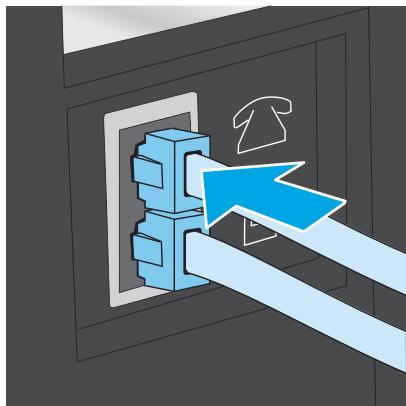
- Retirez la fiche du port de sortie de ligne téléphonique à l'arrière du produit, puis connectez un téléphone à ce port.
- Configurez le produit pour répondre automatiquement aux appels de fax.
a. Allumez le produit. b. Sur l'écran d'accueil du panneau de commande du produit, touchez le bouton Configuration. c. Touchez le menu Configuration du fax. d. Touchez le menu Configuration de base. e. Touchez le paramètre Mode de réponse, puis touchez l'option Automatique.
- Configurez le produit pour vérifier la tonalité avant d'envoyer un fax.

REMARQUE : Cela empêche le produit d'envoyer un fax pendant qu'une personne est au téléphone.
a. Sur l'écran d'accueil du panneau de commande du produit, touchez le bouton Configuration. b. Touchez le menu Configuration du fax. c. Touchez le menu Configuration avancée. d. Touchez le paramètre Détecter la tonalité, puis touchez Activé.
- Passez à l'étape 3 : Configurer l'heure, la date et l'en-tête du fax à la page 71.
Ligne vocale/fax partagée avec un répondeur
Suivez ces étapes pour configurer le produit sur une ligne vocale/fax partagée avec un répondeur.
- Débranchez tous les appareils connectés à la prise téléphonique.
- Retirez la fiche du port de sortie de ligne téléphonique à l'arrière du produit.
- Connectez le câble téléphonique au port fax du produit et à la prise téléphonique murale.
REMARQUE : Certains pays/régions peuvent nécessiter un adaptateur pour le câble téléphonique fourni avec le produit.
REMARQUE : Sur certains produits, le port fax peut être situé au-dessus du port téléphone. Reportez-vous aux icônes sur le produit.
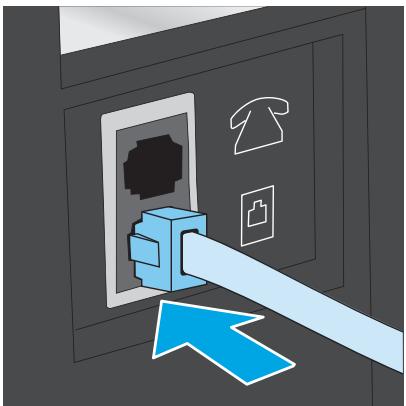
- Branchez le câble téléphonique du répondeur sur le port de sortie de ligne téléphonique à l'arrière du produit.

REMARQUE : Connectez le répondeur directement au produit, sinon le répondeur pourrait enregistrer les tonalités de fax d'un télécopieur émetteur et le produit pourrait ne pas recevoir les télécopies.

REMARQUE : Si le répondeur ne dispose pas d'un téléphone intégré, connectez un téléphone au port OUT du répondeur pour plus de commodité.

REMARQUE : Sur certains produits, le port fax peut être situé au-dessus du port téléphone. Reportez-vous aux icônes sur le produit.
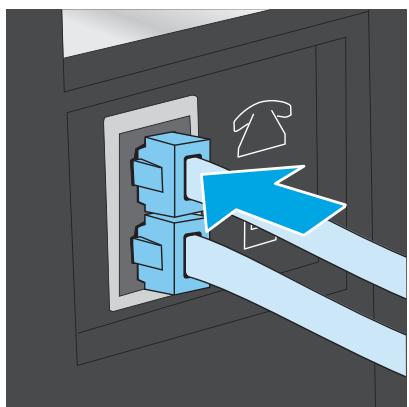
- Configurez le paramètre de sonneries avant réponse sur le produit.
a. Allumez le produit. b. Sur l'écran d'accueil du panneau de commande du produit, touchez le bouton Configuration. c. Touchez le menu Configuration du fax. d. Touchez le menu Configuration de base. e. Touchez l'option Sonneries avant réponse. f. Utilisez le clavier numérique du panneau de commande du produit pour régler le nombre de sonneries sur 5 ou plus, puis touchez le bouton OK. g. Touchez le bouton Accueil pour revenir au menu principal.
- Réglez le produit pour répondre automatiquement aux appels de fax.
a. Sur l'écran d'accueil du panneau de commande du produit, touchez le bouton Configuration. b. Touchez le menu Configuration du fax. c. Touchez le menu Configuration de base. d. Touchez le paramètre Mode de réponse, puis touchez l'option Automatique. e. Touchez le bouton Accueil pour revenir au menu principal.
- Réglez le produit pour vérifier la tonalité avant d'envoyer un fax.

REMARQUE : Cela empêche le produit d'envoyer un fax pendant que quelqu'un est au téléphone.
a. Sur l'écran d'accueil du panneau de commande du produit, touchez le bouton Configuration. b. Touchez le menu Configuration du fax. c. Touchez le menu Configuration avancée. d. Touchez le paramètre Détection de tonalité, puis touchez le bouton Activé.
- Passez à l'étape 3 : Configurer l'heure, la date et l'en-tête du fax à la page 71.
Configurez les paramètres de fax du produit en utilisant l'une des méthodes suivantes :
Assistant d'installation de télécopie HP à la page 71 (méthode recommandée) Panneau de commande du produit à la page 71 Serveur Web intégré HP (EWS) et HP Device Toolbox (Windows) à la page 72 (si le logiciel est installé)

REMARQUE : Aux États-Unis et dans de nombreux autres pays/régions, le réglage de l'heure, de la date et des autres informations d'en-tête de télécopie est une exigence légale.
Assistant d'installation de télécopie HP
Accédez à l'assistant d'installation de télécopie après la configuration initiale et l'installation du logiciel en suivant ces étapes.
- Cliquez sur Démarrer, puis sur Programmes.
- Cliquez sur HP, cliquez sur le nom du produit, puis cliquez sur Assistant d'installation de télécopie HP.
- Suivez les instructions à l'écran de l'assistant d'installation de télécopie HP pour configurer les paramètres de télécopie.
- Passez à l'étape 4 : Exécuter un test de télécopie à la page 72.
Panneau de commande du produit
Pour utiliser le panneau de commande afin de définir la date, l'heure et l'en-tête, procédez comme suit.
- Depuis l'écran d'accueil, touchez le bouton Configuration.
- Touchez le menu Configuration de la télécopie.
- Touchez le menu Configuration de base.
- Faites défiler et touchez le bouton Heure/Date.
- Sélectionnez l'horloge sur 12 heures ou sur 24 heures.
- Utilisez le clavier pour saisir l'heure actuelle, puis touchez le bouton OK.

REMARQUE : Touchez le bouton 123 pour ouvrir un clavier contenant des caractères spéciaux, si nécessaire.
- Sélectionnez le format de la date.
- Utilisez le clavier pour saisir la date actuelle, puis touchez le bouton OK.
- Touchez le menu En-tête de télécopie.
- Utilisez le clavier pour saisir le numéro de télécopie, puis touchez le bouton OK.

REMARQUE : Le nombre maximal de caractères pour le numéro de télécopie est de 20.
- Utilisez le clavier pour saisir le nom de l'entreprise ou l'en-tête, puis touchez le bouton OK.

REMARQUE : Le nombre maximal de caractères pour l'en-tête de télécopie est de 25.
- Passez à l'étape 4 : Exécutez un test de télécopie à la page 72.
- Démarrez l'EWS HP à partir du menu Démarrer ou d'un navigateur Web.
a. Cliquez sur le bouton Démarrer, puis cliquez sur l'élément Programmes. b. Cliquez sur le groupe de votre produit HP, puis cliquez sur l'élément HP Device Toolbox.
Navigateur Web
a. Depuis l'écran d'accueil du panneau de commande du produit, touchez le bouton Informations de connexion, puis touchez le bouton Réseau connecté ou le bouton Réseau Wi-Fi activé pour afficher l'adresse IP ou le nom d'hôte. b. Ouvrez un navigateur Web, puis dans la barre d'adresse, saisissez l'adresse IP ou le nom d'hôte exactement tel qu'il s'affiche sur le panneau de commande du produit. Appuyez sur la touche Entrée du clavier de l'ordinateur. L'EWS s'ouvre.

https://10.10.XXXXX/

REMARQUE : si le navigateur Web affiche un message concernant un problème de certificat de sécurité du site Web lors de la tentative d'ouverture de l'EWS, cliquez sur Continuer vers ce site Web (non recommandé).
Choisir Continuer vers ce site Web (non recommandé) n'endommagera pas l'ordinateur lors de la navigation dans l'EWS pour le produit HP.
- Cliquez sur l'onglet Fax.
- Suivez les instructions à l'écran pour configurer les paramètres de fax.
- Passez à l'étape 4 : Exécuter un test de fax à la page 72.
Étape 4 : Exécuter un test de fax
Exécutez un test de fax pour vous assurer que le fax est configuré correctement.
- Depuis l'écran d'accueil, touchez le bouton Configuration.
- Faites défiler et touchez le menu Service.
- Touchez le menu Service de fax.
- Touchez l'option Exécuter le test de fax. Le produit imprime un rapport de test.
- Examinez le rapport.
Si le rapport indique que le produit a réussi le test, le produit est prêt à envoyer et recevoir des télécopies. - Si le rapport indique que le produit a échoué au test, examinez le rapport pour plus d'informations sur la résolution du problème. La liste de contrôle de dépannage des télécopies contient plus d'informations sur la résolution des problèmes de télécopie.
Envoyer une télécopie
Applications de télécopie prises en charge - Envoyer une télécopie en composant manuellement depuis le panneau de commande du produit Télécopie depuis le scanner à plat Télécopie depuis le chargeur de documents Utiliser les numéros abrégés et les entrées de numérotation de groupe Annuler une télécopie
Applications de télécopie prises en charge
Le programme de télécopie PC fourni avec le produit est le seul programme de télécopie PC qui fonctionne avec le produit. Pour continuer à utiliser un programme de télécopie PC précédemment installé sur l'ordinateur, utilisez le modem déjà connecté à l'ordinateur ; il ne fonctionnera pas via le modem du produit.
Envoyer une télécopie en composant manuellement depuis le panneau de commande du produit
- Placez le document dans le chargeur de documents ou sur la vitre du scanner à plat.
- Sur le panneau de commande du produit, touchez le bouton Télécopie.
- Utilisez le clavier numérique pour saisir le numéro de télécopie.
- Touchez le bouton Démarrer la télécopie pour envoyer la télécopie.
Télécopie depuis le scanner à plat
- Placez le document face vers le bas sur la vitre du scanner.
- Depuis l'écran d'accueil du panneau de commande du produit, touchez le bouton Télécopie.
- Utilisez le clavier numérique pour saisir le numéro de télécopie.
- Appuyez sur le bouton Démarrer la télécopie.
- Le produit vous demande de confirmer que vous envoyez depuis la vitre du scanner. Appuyez sur le bouton Oui.
- Le produit vous demande de charger la première page. Appuyez sur le bouton OK.
- Le produit numérise la première page, puis vous demande de charger une autre page. Si le document comporte plusieurs pages, appuyez sur le bouton Oui. Continuez ce processus jusqu'à avoir numérisé toutes les pages.
- Lorsque vous avez numérisé la dernière page, appuyez sur le bouton Non à l'invite. Le produit envoie la télécopie.
Télécopie depuis le chargeur de documents
- Insérez les originaux dans le chargeur de documents face vers le haut.
ATTENTION : Pour éviter d'endommager le produit, n'utilisez pas un original contenant du ruban correcteur, du liquide correcteur, des trombones ou des agrafes. Ne chargez pas non plus de photographies, de petits originaux ou d'originaux fragiles dans le chargeur de documents.

- Ajustez les guides papier jusqu'à ce qu'ils soient bien ajustés contre le papier.

- Sur l'écran d'accueil du panneau de commande du produit, appuyez sur le bouton Télécopie.
- Utilisez le clavier numérique pour saisir le numéro de télécopie.
- Appuyez sur le bouton Démarrer la télécopie.
Utilisation des numéros abrégés et des entrées de numérotation de groupe

REMARQUE : Les entrées du répertoire téléphonique doivent être configurées à l'aide du menu Télécopie avant d'utiliser le répertoire pour envoyer des télécopies.
- Chargez le document sur la vitre du scanner ou dans le chargeur de documents.
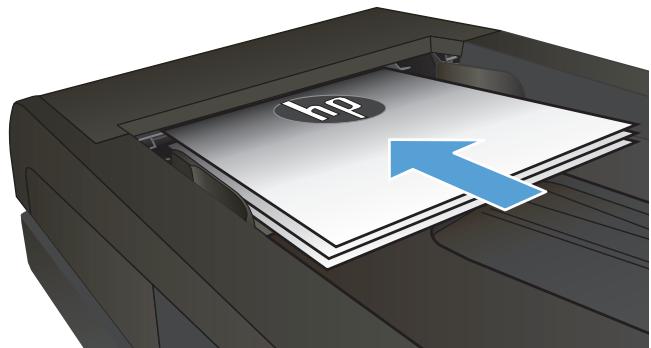
- Depuis l'écran d'accueil du panneau de commande du produit, touchez le bouton Fax.
- Sur le clavier, touchez l'icône du répertoire de fax.
- Touchez le nom de la personne ou du groupe que vous souhaitez utiliser.
- Touchez le bouton Démarrer la télécopie.
Annuler une télécopie
Annuler la télécopie en cours
Touchez le bouton Annuler sur le panneau de commande. Toutes les pages qui n'ont pas été transmises sont annulées. Toucher le bouton Annuler arrête également les travaux de numérotation de groupe.
Annuler un travail de télécopie en attente
Utilisez cette procédure pour annuler un travail de télécopie dans les situations suivantes :
Le produit attend de rappeler après avoir rencontré un signal occupé, un appel sans réponse ou une erreur de communication.
La télécopie est programmée pour être envoyée à une heure ultérieure.
- Depuis l'écran d'accueil, touchez le bouton Fax.
- Touchez le bouton Menu Fax.
- Touchez le bouton Options d'envoi.
- Touchez le bouton État des travaux de télécopie.
- Touchez le numéro de fax du travail que vous voulez annuler.
Envoyer un fax à l'aide du logiciel HP (Windows)
- Chargez le document.
- Si vous chargez un original sur la vitre du scanner, placez-le face vers le bas, dans le coin arrière gauche de la vitre du scanner.
- Si vous chargez plusieurs pages dans le chargeur de documents, chargez les pages face vers le haut, puis ajustez les guides papier jusqu'à ce qu'ils soient bien contre le papier.

REMARQUE : Si des documents se trouvent à la fois dans le chargeur de documents et sur la vitre du scanner, le produit traite le document dans le chargeur de documents et non celui sur la vitre du scanner.
- Cliquez sur Démarrer, cliquez sur Programmes (ou Tous les programmes dans Windows XP), puis cliquez sur HP.
- Cliquez sur le nom du produit, puis cliquez sur HP Envoyer un fax. Le logiciel de fax s'ouvre.
- Saisissez le numéro de fax d'un ou de plusieurs destinataires.
- Cliquez sur Envoyer maintenant.
Créer, modifier et supprimer des entrées de numérotation abrégée
Vous pouvez stocker les numéros de fax fréquemment composés (jusqu'à 120 entrées) soit comme numéros de fax individuels, soit comme groupes de numéros de fax.
Utilisez le panneau de commande pour créer et modifier le répertoire de fax - Utiliser les données de répertoire d'autres programmes - Supprimer les entrées du répertoire
Utilisez le panneau de commande pour créer et modifier le répertoire téléphonique du fax.
- Depuis l'écran d'accueil du panneau de commande du produit, touchez le bouton Fax.
- Touchez le bouton Menu Fax.
- Touchez le bouton Configuration du répertoire.
- Touchez le bouton Configuration individuelle ou Configuration de groupe pour créer une entrée de numérotation abrégée.
- Touchez un numéro non attribué dans la liste.
- Utilisez le clavier pour saisir un nom pour l'entrée, puis touchez le bouton OK.
- Utilisez le clavier pour saisir le numéro de fax pour l'entrée, puis touchez le bouton OK.
Utiliser les données du répertoire d'autres programmes

CONSEIL : Avant de pouvoir importer un répertoire d'un autre programme, vous devez utiliser la fonction d'exportation de cet autre programme.
HP Device Toolbox peut importer les informations de contact des répertoires des logiciels suivants.
Microsoft Outlook - Lotus Notes Microsoft Outlook Express Un répertoire précédemment exporté depuis le logiciel Device Toolbox d'un autre produit HP
Supprimer les entrées du répertoire
Vous pouvez supprimer toutes les entrées du répertoire programmées dans le produit.

ATTENTION : Une fois les entrées du répertoire supprimées, elles ne peuvent pas être récupérées.
- Depuis l'écran d'accueil du panneau de commande du produit, touchez le bouton Fax.
- Touchez le bouton Menu Fax.
- Touchez le bouton Configuration du répertoire.
- Touchez le bouton Supprimer une entrée. Ou, pour supprimer toutes les entrées, touchez le bouton Tout supprimer.
- Touchez l'entrée que vous souhaitez supprimer.
- Touchez le bouton OK pour confirmer la suppression.
8 Gérer le produit
Utiliser les applications HP Web Services - Modifier le type de connexion du produit (Windows) Configuration avancée avec le serveur Web intégré HP (EWS) et HP Device Toolbox (Windows) Configuration avancée avec HP Utility pour OS X - Configurer les paramètres réseau IP Paramètres de sécurité du produit Paramètres d'économie HP Web Jetadmin Mettre à jour le firmware
Rendez-vous sur www.hp.com/support/colorljMFPM277.
L'aide complète de HP pour le produit comprend les informations suivantes :
Installer et configurer Apprendre et utiliser - Résoudre les problèmes Télécharger les mises à jour logicielles - Rejoindre les forums d'assistance Trouver les informations de garantie et réglementaires
Utiliser les applications HP Web Services
Plusieurs applications innovantes sont disponibles pour ce produit et peuvent être téléchargées directement depuis Internet. Pour plus d'informations et pour télécharger ces applications, rendez-vous sur le site Web HP Connected à l'adresse www.hpcconnected.com.
Pour utiliser cette fonctionnalité, le produit doit être connecté à un ordinateur ou à un réseau disposant d'une connexion Internet. Les services Web HP doivent être activés sur le produit.
- Depuis l'écran d'accueil du panneau de commande du produit, touchez le bouton Informations de connexion.
- Ouvrez les menus suivants :
ePrint - Paramètres
- Touchez le bouton Activer les services Web.
Après avoir téléchargé une application depuis le site Web HP Connected, elle est disponible dans le menu Applications du panneau de commande du produit. Ce processus active à la fois les services Web HP et le bouton Applications.
Modifier le type de connexion du produit (Windows)
Si vous utilisez déjà le produit et souhaitez modifier son mode de connexion, utilisez le raccourci Reconfigurer votre périphérique HP sur le bureau de votre ordinateur pour changer la connexion. Par exemple, vous pouvez reconfigurer le produit pour utiliser une adresse sans fil différente, pour vous connecter à un réseau filaire ou sans fil, ou pour passer d'une connexion réseau à une connexion USB. Vous pouvez modifier la configuration sans insérer le CD du produit. Après avoir sélectionné le type de connexion souhaité, le programme accède directement à la partie de la procédure d'installation du produit qui doit être modifiée.
Utilisez le serveur Web intégré HP pour gérer les fonctions d'impression depuis votre ordinateur au lieu du panneau de commande du produit.
Afficher les informations d'état du produit, déterminer la durée de vie restante de tous les consommables et en commander de nouveaux, afficher et modifier les configurations des bacs, afficher et modifier la configuration du menu du panneau de commande du produit, afficher et imprimer les pages internes, recevoir des notifications sur les événements du produit et des consommables, afficher et modifier la configuration réseau.
Le serveur Web intégré HP fonctionne lorsque le produit est connecté à un réseau IP. Le serveur Web intégré HP ne prend pas en charge les connexions de produit basées sur IPX. Vous n'avez pas besoin d'avoir accès à Internet pour ouvrir et utiliser le serveur Web intégré HP.
Lorsque le produit est connecté au réseau, le serveur Web intégré HP est automatiquement disponible.

REMARQUE : La boîte à outils HP Device Toolbox n'est disponible que si vous avez effectué une installation complète lors de l'installation du produit. Selon la façon dont le produit est connecté, certaines fonctionnalités peuvent ne pas être disponibles.

REMARQUE : Le serveur Web intégré HP n'est pas accessible au-delà du pare-feu du réseau.
- Cliquez sur le bouton Démarrer, puis sur l'élément Programmes.
- Cliquez sur le groupe de votre produit HP, puis sur l'élément HP Device Toolbox.
Ouvrez le serveur Web intégré HP (EWS) à partir d'un navigateur Web.
- Sur l'écran d'accueil du panneau de commande du produit, touchez le bouton Informations de connexion, puis touchez le bouton Réseau connecté ou le bouton Réseau Wi-Fi activé pour afficher l'adresse IP ou le nom d'hôte.
- Ouvrez un navigateur Web, puis dans la barre d'adresse, saisissez l'adresse IP ou le nom d'hôte exactement tel qu'il s'affiche sur le panneau de commande du produit. Appuyez sur la touche Entrée du clavier de l'ordinateur. L'EWS s'ouvre.

https://10.10.XX.XX/

REMARQUE : Si le navigateur Web affiche un message concernant un problème de certificat de sécurité du site Web lors de l'ouverture de l'EWS, cliquez sur Continuer sur ce site Web (non recommandé).
Choisir Continuer sur ce site Web (non recommandé) n'endommagera pas l'ordinateur lors de la navigation dans l'EWS pour le produit HP.
| Tab or section | Description |
| Home tab
Provides product, status, and configuration information. | Device Status: Shows the product status and shows the approximate percent life remaining of HP supplies.
Supplies Status: Shows the approximate percent life remaining of HP supplies. Actual supply life remaining can vary. Consider having a replacement supply available to install when print quality is no longer acceptable. The supply does not need to be replaced unless the print quality is no longer acceptable.
Device Configuration: Shows the information found on the product configuration page.
Network Summary: Shows the information found on the product network configuration page.
Reports: Print the configuration and supplies status pages that the product generates.
Event Log: Shows a list of all product events and errors. |
| System tab
Provides the ability to configure the product from your computer. | Device Information: Provides basic product and company information.
Paper Setup: Change the default paper-handling settings for the product.
Print Quality: Change the default print-quality settings for the product.
EcoSMART Console: Change the default times for entering Sleep mode or Auto Power Down mode. Configure which events cause the product to wake.
Paper Types: Configure print modes that correspond to the paper types that the product accepts.
System Setup: Change the system defaults for the product.
Service: Perform the cleaning procedure on the product.
Save and Restore: Save the current settings for the product to a file on the computer. Use this file to load the same settings onto another product or to restore these settings to this product at a later time.
Administration: Set or change the product password. Enable or disable product features.
NOTE: The System tab can be password-protected. If this product is on a network, always consult with the administrator before changing settings on this tab. |
| Print tab
Provides the ability to change default print settings from your computer. | Printing: Change the default product print settings, such as number of copies and paper orientation. These are the same options that are available on the control panel.
PCL5c: View and change the PCL5c settings.
PostScript: Turn off or on the Print PS Errors feature. |
| Fax tab
(Fax products only) | Receive Options: Configure how the product handles incoming faxes.
Phone Book: Add or delete entries in the fax phone book.
Junk Fax List: Set fax numbers to block from sending faxes to the product.
Fax Activity Log: Review recent fax activity for the product. |
| Scan tab
(MFP models only) | Configure the Scan to Network Folder and Scan to E-mail features. |
| ● Network Folder Setup: Configure folders on the network to which the product can save a scanned file. |
| ● Scan to E-mail Setup: Begin the process to set up the Scan to E-mail feature. |
| ● Outgoing E-mail Profiles: Set an email address that will appear as the “from” address for all emails sent from the product. Configure the SMTP Server information. |
| ● E-mail Address Book: Add or delete entries in the email address book. |
| ● E-mail Options: Configure a default subject line and body text. Configure default scan settings for emails. |
| Networking tab
(Network-connected products only) | Network administrators can use this tab to control network-related settings for the product when it is connected to an IP-based network. It also allows the network administrator to set up Wireless Direct functionality. This tab does not appear if the product is directly connected to a computer. |
| Provides the ability to change network settings from your computer. |
| HP Web Services tab | Use this tab to set up and use various Web tools with the product. |
Configuration avancée avec HP Utility pour OS X
Utilisez HP Utility pour vérifier l'état du produit ou pour afficher ou modifier les paramètres du produit à partir de votre ordinateur.
Vous pouvez utiliser HP Utility lorsque le produit est connecté avec un câble USB ou est connecté à un réseau TCP/IP.
Ouvrir HP Utility
- Sur l'ordinateur, ouvrez le menu Préférences Système, puis cliquez sur Imprimantes et fax, Imprimantes et scanners ou Imprimantes et scanners.
- Sélectionnez le produit dans la liste.
- Cliquez sur le bouton Options et fournitures.
- Cliquez sur l'onglet Utilitaire.
- Cliquez sur le bouton Ouvrir l'utilitaire d'imprimante.
Fonctionnalités de l'utilitaire HP
La barre d'outils de l'utilitaire HP comprend les éléments suivants :
Périphériques : cliquez sur ce bouton pour afficher ou masquer les produits Mac détectés par l'utilitaire HP. - Tous les paramètres : cliquez sur ce bouton pour revenir à la vue principale de l'utilitaire HP. Support HP : cliquez sur ce bouton pour ouvrir un navigateur et accéder au site Web de support HP. Fournitures : cliquez sur ce bouton pour ouvrir le site Web HP SureSupply. - Enregistrement : cliquez sur ce bouton pour ouvrir le site Web d'enregistrement HP. Recyclage : cliquez sur ce bouton pour ouvrir le site Web du programme de recyclage HP Planet Partners.
L'utilitaire HP se compose de pages que vous ouvrez en cliquant dans la liste Tous les paramètres. Le tableau suivant décrit les tâches que vous pouvez effectuer avec l'utilitaire HP.
| Item | Description |
| Supplies Status | Show the product supplies status and provides links for ordering supplies online. |
| Device Information | Show information about the currently selected product, including the product Service ID (if assigned), the firmware version (FW Version), the Serial Number, and the IP address. |
| Commands | Send special characters or print commands to the product after the print job.
NOTE: This option is available only after you open the View menu and select the Show Advanced Options item. |
| Color Usage
(Color products only) | Show information about color jobs that the product has produced. |
| File Upload | Transfer files from the computer to the product. You can upload the following types of files:HP LaserJet printer command language (.PRN)Portable document format (.PDF)Postscript (.PS)Text (.TXT) |
| Power Management | Configure the product economy settings. |
| Update Firmware | Transfer a firmware update file to the product.NOTE: This option is available only after you open the View menu and select the Show Advanced Options item. |
| HP Connected | Access the HP Connected Web site. |
| Upload Fonts | Upload fonts from the computer to the product. |
| Message Center | Display error events that have occurred with the product. |
| Duplex Mode | Turn on the automatic two-sided printing mode. |
| Network Settings(Network-connected products only) | Configure the network settings, such as the IPv4 settings, IPv6 settings, Bonjour settings, and other settings. |
| Supplies Management | Configure how the product should behave when supplies are nearing the end of their estimated life. |
| Trays Configuration | Change paper size and type for each of the trays. |
| Additional Settings | Open the HP Embedded Web Server (EWS) for the product.NOTE: USB connections are not supported. |
| Proxy Server Settings | Configure a proxy server for the product. |
| Basic Fax Settings(MFP fax models only) | Set up the fields in the fax header and configure how the product answers incoming calls. |
| Fax Forwarding(MFP fax models only) | : Set up the product to send the incoming faxes to a different number. |
| Fax Logs(MFP fax models only) | View the logs of all faxes. |
| Fax Speed Dials(MFP fax models only) | Add fax numbers to the speed dial list. |
| Junk Fax Blocking(MFP fax models only) | Store the fax numbers you want to block. |
| Scan to E-mail(MFP products only) | Open the HP Embedded Web Server (EWS) page for configuring settings for scanning to email. |
| Scan to Network Folder(MFP products only) | Open the HP Embedded Web Server (EWS) page for configuring settings for scanning to a network folder. |
Introduction
Utilisez les sections suivantes pour configurer les paramètres réseau du produit.
- Avertissement sur le partage d'imprimante Afficher ou modifier les paramètres réseau
- Renommer le produit sur un réseau
- Configurer manuellement les paramètres TCP/IP IPv4 à partir du panneau de commande
Avertissement sur le partage d'imprimante
HP ne prend pas en charge les réseaux poste à poste, car cette fonctionnalité est une fonction des systèmes d'exploitation Microsoft et non des pilotes d'imprimante HP. Consultez Microsoft à l'adresse www.microsoft.com.
Afficher ou modifier les paramètres réseau
Utilisez le serveur Web intégré HP pour afficher ou modifier les paramètres de configuration IP.
- Ouvrez le serveur Web intégré HP (EWS) :
a. Sur l'écran d'accueil du panneau de commande du produit, touchez le bouton Informations de connexion, puis touchez le bouton Réseau connecté ou le bouton Réseau Wi-Fi activé (q) pour afficher l'adresse IP ou le nom d'hôte. b. Ouvrez un navigateur Web et, dans la barre d'adresse, saisissez l'adresse IP ou le nom d'hôte exactement tel qu'il s'affiche sur le panneau de commande du produit. Appuyez sur la touche Entrée du clavier de l'ordinateur. L'EWS s'ouvre.

https://10.10.XXXXX/

REMARQUE : Si le navigateur Web affiche un message concernant un problème de certificat de sécurité du site Web lors de l'ouverture de l'EWS, cliquez sur Continuer sur ce site Web (non recommandé).
Choisir Continuer sur ce site Web (non recommandé) n'endommagera pas l'ordinateur lors de la navigation dans l'EWS pour le produit HP.
- Cliquez sur l'onglet Réseau pour obtenir les informations réseau. Modifiez les paramètres si nécessaire.
Renommer le produit sur un réseau
Si vous souhaitez renommer le produit sur un réseau afin qu'il puisse être identifié de manière unique, utilisez le serveur Web intégré HP.
- Ouvrez le serveur Web intégré HP (EWS) :
a. Sur l'écran d'accueil du panneau de commande du produit, touchez le bouton Informations de connexion, puis touchez le bouton Réseau connecté ou le bouton Réseau Wi-Fi activé pour afficher l'adresse IP ou le nom d'hôte.
b. Ouvrez un navigateur Web et, dans la barre d'adresse, saisissez l'adresse IP ou le nom d'hôte exactement tel qu'il s'affiche sur le panneau de commande du produit. Appuyez sur la touche Entrée du clavier de l'ordinateur. L'EWS s'ouvre.

https://10.10.XX.XXX/

REMARQUE : Si le navigateur Web affiche un message concernant un problème de certificat de sécurité du site Web lors de l'ouverture de l'EWS, cliquez sur Continuer sur ce site Web (non recommandé).
Choisir Continuer sur ce site Web (non recommandé) n'endommagera pas l'ordinateur lors de la navigation dans l'EWS pour le produit HP.
- Ouvrez l'onglet Système.
- Sur la page Informations sur le périphérique, le nom de produit par défaut se trouve dans le champ État du périphérique. Vous pouvez modifier ce nom pour identifier ce produit de manière unique.

REMARQUE : Le remplissage des autres champs de cette page est facultatif.
- Cliquez sur le bouton Appliquer pour enregistrer les modifications.
Utilisez les menus du panneau de commande pour définir manuellement une adresse IPv4, un masque de sous-réseau et une passerelle par défaut.
- Depuis l'écran d'accueil du panneau de commande du produit, touchez le bouton Configuration.
- Faites défiler et touchez le menu Configuration réseau.
- Touchez le menu Méthode de configuration IPv4, puis touchez le bouton Manuel.
- Utilisez le clavier de l'écran tactile pour saisir l'adresse IP, puis touchez le bouton OK. Touchez le bouton Oui pour confirmer.
- Utilisez le clavier de l'écran tactile pour saisir le masque de sous-réseau, puis touchez le bouton OK. Touchez le bouton Oui pour confirmer.
- Utilisez le clavier de l'écran tactile pour saisir la passerelle par défaut, puis touchez le bouton OK. Touchez le bouton Oui pour confirmer.
Fonctions de sécurité du produit
Introduction
Le produit comprend plusieurs fonctions de sécurité pour restreindre l'accès aux paramètres de configuration, sécuriser les données et empêcher l'accès aux composants matériels précieux.
- Assign or change the system password using the Embedded Web Server
Assign or change the system password using the Embedded Web Server
Assign an administrator password for access to the product and the HP Embedded Web Server so that unauthorized users cannot change the product settings.
- Open the HP Embedded Web Server (EWS):
a. From the Home screen on the product control panel, touch the Connection Information button, and then touch the Network Connected button or the Network Wi-Fi ON (q) button to display the IP address or host name. b. Open a Web browser, and in the address line, type the IP address or host name exactly as it displays on the product control panel. Press the Enter key on the computer keyboard. The EWS opens.

https://10.10.XX.XXX/

NOTE: If the Web browser displays a "There is a problem with this website's security certificate" message when attempting to open the EWS, click "Continue to this website (not recommended)".
Choosing "Continue to this website (not recommended)" will not harm the computer while navigating within the EWS for the HP product.
- Click the Security tab.
- Open the General Security menu.
- In the area labeled "Set the Local Administrator Password", enter the name to associate with the password in the "Username" field.
- Enter the password in the "New Password" field, and then enter it again in the "Verify Password" field.

NOTE: To change an existing password, first enter the existing password in the "Old Password" field.
- Click the Apply button.

NOTE: Make note of the password and store it in a safe place.
Paramètres d'économie
Introduction
Le produit comprend plusieurs fonctions d'économie pour économiser l'énergie et les fournitures.
- Imprimer avec EconoMode
- Configurer le paramètre Veille/Arrêt automatique après
- Définir le délai d'arrêt et configurer le produit pour utiliser 1 watt ou moins
- Configurer le paramètre Arrêt différé
Imprimer avec EconoMode
Ce produit dispose d'une option EconoMode pour imprimer des brouillons de documents. L'utilisation d'EconoMode peut utiliser moins de toner. Cependant, l'utilisation d'EconoMode peut également réduire la qualité d'impression.
HP ne recommande pas l'utilisation à plein temps d'EconoMode. Si EconoMode est utilisé à plein temps, la réserve de toner pourrait durer plus longtemps que les pièces mécaniques de la cartouche de toner. Si la qualité d'impression commence à se dégrader et n'est plus acceptable, envisagez de remplacer la cartouche de toner.

REMARQUE : Si cette option n'est pas disponible dans votre pilote d'impression, vous pouvez la définir à l'aide du serveur Web intégré HP.
- Dans le programme logiciel, sélectionnez l'option Imprimer.
- Sélectionnez le produit, puis cliquez sur le bouton Propriétés ou Préférences.
- Cliquez sur l'onglet Papier/Qualité.
- Cochez la case EconoMode.
- Sur l'écran d'accueil du panneau de commande du produit, touchez le bouton Configuration.
- Ouvrez les menus suivants :
Configuration du système Paramètres d'énergie - Veille / Arrêt automatique après
- Sélectionnez le délai pour la mise en veille / arrêt automatique.

REMARQUE : Après l'arrêt du produit, la consommation électrique est de 1 watt ou moins.
- Sur l'écran d'accueil du panneau de commande du produit, touchez le bouton Configuration.
- Ouvrez les menus suivants :
Configuration du système Paramètres d'énergie - Arrêt après
- Sélectionnez le délai pour l'arrêt automatique.

REMARQUE : La valeur par défaut est de 4 heures.
- Sur le panneau de commande du produit, touchez le bouton Configuration.
- Ouvrez les menus suivants :
Configuration du système Paramètres d'énergie Délai d'arrêt
- Sélectionnez l'une des options de délai :
- Aucun délai : le produit s'éteint après une période d'inactivité déterminée par le paramètre Arrêt après.
- Lorsque les ports sont actifs : lorsque cette option est sélectionnée, le produit ne s'éteint pas à moins que tous les ports soient inactifs. Une liaison réseau active ou une connexion fax empêchera le produit de s'éteindre.
HP Web Jetadmin
HP Web Jetadmin est un outil primé et leader du secteur pour gérer efficacement une large gamme de produits réseau HP, notamment les imprimantes, les produits multifonctions et les serveurs de numérisation. Cette solution unique vous permet d'installer, de surveiller, de maintenir, de dépanner et de sécuriser à distance votre environnement d'impression et de numérisation, ce qui augmente finalement la productivité de l'entreprise en vous faisant gagner du temps, en contrôlant les coûts et en protégeant votre investissement.
Des mises à niveau de HP Web Jetadmin sont périodiquement disponibles pour prendre en charge des fonctionnalités spécifiques du produit. Rendez-vous sur www.hp.com/go/webjetadmin et cliquez sur le lien Aide et documentation pour en savoir plus sur les mises à niveau.
Mettre à jour le firmware
HP propose périodiquement des mises à jour de produits, de nouvelles applications Web Services et de nouvelles fonctionnalités pour les applications Web Services existantes. Suivez ces étapes pour mettre à jour le firmware du produit pour un produit unique. Lorsque vous mettez à jour le firmware, les applications Web Services se mettent à jour automatiquement.
Il existe deux méthodes prises en charge pour effectuer une mise à jour du firmware sur ce produit. Utilisez une seule des méthodes suivantes pour mettre à jour le firmware du produit.
Méthode une : Mettre à jour le firmware à l'aide du panneau de commande
Utilisez ces étapes pour charger le firmware à partir du panneau de commande (uniquement pour les produits connectés au réseau) et/ou configurer le produit pour charger automatiquement les futures mises à jour du firmware. Pour les produits connectés par USB, passez à la méthode deux.
- Assurez-vous que le produit est connecté à un réseau filaire (Ethernet) ou sans fil avec une connexion Internet active.

REMARQUE : Le produit doit être connecté à Internet pour mettre à jour le firmware via une connexion réseau.
- Depuis l'écran d'accueil du panneau de commande du produit, ouvrez le menu Configuration.
- Pour les panneaux de commande à écran tactile, touchez le bouton Configuration.
- Pour les panneaux de commande standard, appuyez sur le bouton flèche gauche ou droite.
- Faites défiler et ouvrez le menu Service, puis ouvrez le menu LaserJet Update.

REMARQUE : Si l'option LaserJet Update n'est pas répertoriée, utilisez la méthode deux.
- Vérifiez les mises à jour.
- Pour les panneaux de commande à écran tactile, touchez Vérifier les mises à jour maintenant.
- Pour les panneaux de commande standard, sélectionnez Vérifier les mises à jour.

REMARQUE : Le produit vérifie automatiquement les mises à jour et, si une version plus récente est détectée, le processus de mise à jour démarre automatiquement.
- Configurez le produit pour qu'il mette automatiquement à jour le firmware lorsque des mises à jour sont disponibles.
Depuis l'écran d'accueil du panneau de commande du produit, ouvrez le menu Configuration.
- Pour les panneaux de commande à écran tactile, touchez le bouton Configuration.
- Pour les panneaux de commande standard, appuyez sur le bouton fléché gauche ou droit.
Faites défiler et ouvrez le menu Service, ouvrez le menu Mise à jour LaserJet, puis sélectionnez le menu Gérer les mises à jour.
Configurez le produit pour qu'il mette automatiquement à jour le firmware.
- Pour les panneaux de commande à écran tactile, définissez l'option Autoriser les mises à jour sur OUI, puis définissez l'option Vérifier automatiquement sur ACTIVÉ.
- Pour les panneaux de commande standard, définissez l'option Autoriser les mises à jour sur OUI, puis définissez l'option Vérification automatique sur ACTIVÉ.
Méthode 2 : Mettre à jour le firmware à l'aide de l'utilitaire de mise à jour du firmware
Suivez ces étapes pour télécharger et installer manuellement l'utilitaire de mise à jour du firmware à partir du site HP.com.

REMARQUE : Cette méthode est la seule option de mise à jour du firmware disponible pour les produits connectés à l'ordinateur via un câble USB. Elle fonctionne également pour les produits connectés à un réseau.
- Accédez à www.hp.com/go/support, cliquez sur le lien Pilotes et logiciels, saisissez le nom du produit dans le champ de recherche, appuyez sur la touche ENTRÉE, puis sélectionnez le produit dans la liste des résultats de recherche.
- Sélectionnez le système d'exploitation.
- Dans la section Firmware, localisez l'utilitaire de mise à jour du firmware.
- Cliquez sur Télécharger, puis sur Exécuter, puis cliquez à nouveau sur Exécuter.
- Lorsque l'utilitaire démarre, sélectionnez le produit dans la liste déroulante, puis cliquez sur Envoyer le micrologiciel.

REMARQUE : Pour imprimer une page de configuration afin de vérifier la version du micrologiciel installée avant ou après la mise à jour, cliquez sur Imprimer la configuration.
- Suivez les instructions à l'écran pour terminer l'installation, puis cliquez sur le bouton Quitter pour fermer l'utilitaire.
9 Résoudre les problèmes
- Assistance clientèle Système d'aide du panneau de commande
- Restaurer les paramètres d'usine par défaut Un message « Cartouche faible » ou « Cartouche très faible » s'affiche sur le panneau de commande du produit Le produit ne prend pas le papier ou fait des bourrages papier Éliminer les bourrages papier
- Améliorer la qualité d'impression
- Améliorer la qualité des images de copie et de numérisation
- Améliorer la qualité des images de télécopie
- Résoudre les problèmes de réseau filaire
- Résoudre les problèmes de réseau sans fil Résoudre les problèmes de télécopie
Rendez-vous sur www.hp.com/support/colorljMFPM277.
L'aide complète de HP pour le produit comprend les informations suivantes :
Installez et configurez, apprenez et utilisez, résolvez les problèmes, téléchargez les mises à jour logicielles, rejoignez les forums d'assistance, trouvez les informations de garantie et réglementaires.
Assistance clientèle
| Get telephone support for your country/region | Country/region phone numbers are on the flyer that was in the box with your product or at www.hp.com/support/ |
| Have the product name, serial number, date of purchase, and problem description ready | |
| Get 24-hour Internet support, and download software utilities and drivers | www.hp.com/support/colorljMFPM277 |
| Order additional HP service or maintenance agreements | www.hp.com/go/carepack |
| Register your product | www.registerholder.hp.com |
Système d'aide du panneau de commande
Le produit dispose d'un système d'aide intégré qui explique comment utiliser chaque écran. Pour ouvrir le système d'aide, touchez le bouton Aide dans le coin supérieur droit de l'écran.
Pour certains écrans, l'aide s'ouvre sur un menu global où vous pouvez rechercher des sujets spécifiques. Vous pouvez parcourir la structure du menu en touchant les boutons du menu.
Certains écrans d'aide comprennent des animations qui vous guident à travers des procédures, comme le débourrage.
Pour les écrans qui contiennent des paramètres pour des travaux individuels, l'aide s'ouvre sur un sujet qui explique les options de cet écran.
Si le produit vous signale une erreur ou un avertissement, touchez le bouton Aide pour ouvrir un message qui décrit le problème. Le message contient également des instructions pour vous aider à résoudre le problème.
Restaurer les paramètres d'usine par défaut
La restauration des paramètres d'usine par défaut rétablit tous les paramètres du produit et du réseau aux valeurs par défaut d'usine. Cela ne réinitialise pas le compteur de pages, le format du bac ni la langue. Pour restaurer le produit aux paramètres d'usine par défaut, suivez ces étapes.
ATTENTION : La restauration des paramètres d'usine par défaut rétablit tous les paramètres aux valeurs par défaut d'usine et supprime également toutes les pages stockées dans la mémoire.
- Sur le panneau de commande du produit, touchez le bouton Configuration.
- Faites défiler et touchez le menu Service.
- Faites défiler et touchez le bouton Restaurer les paramètres par défaut, puis touchez le bouton OK.
Le produit redémarre automatiquement.
Un message « Cartouche faible » ou « Cartouche très faible » s'affiche sur le panneau de commande du produit.
Cartouche faible : le produit indique lorsque le niveau de la cartouche de toner est faible. La durée de vie restante réelle de la cartouche de toner peut varier. Pensez à avoir une cartouche de remplacement disponible à installer lorsque la qualité d'impression n'est plus acceptable. Il n'est pas nécessaire de remplacer la cartouche de toner maintenant.
Cartouche très faible : le produit indique lorsque le niveau de la cartouche de toner est très faible. La durée de vie restante réelle de la cartouche de toner peut varier. Pensez à avoir une cartouche de remplacement disponible à installer lorsque la qualité d'impression n'est plus acceptable. Il n'est pas nécessaire de remplacer la cartouche de toner maintenant, sauf si la qualité d'impression n'est plus acceptable.
Une fois qu'une cartouche de toner HP a atteint le niveau Très faible, la garantie de protection Premium HP sur cette cartouche de toner a pris fin.
Modifier les paramètres « Très faible »
Vous pouvez modifier la façon dont le produit réagit lorsque les consommables atteignent l'état Très faible. Vous n'avez pas à rétablir ces paramètres lorsque vous installez une nouvelle cartouche de toner.
- Depuis l'écran d'accueil du panneau de commande du produit, touchez le bouton Configuration.
- Ouvrez les menus suivants :
Configuration du système Paramètres des consommables - Cartouche noire ou Cartouches couleur - Paramètre Très faible
- Sélectionnez l'une des options suivantes :
- Sélectionnez l'option Continuer pour configurer le produit afin de vous alerter que la cartouche de toner est très faible, mais de continuer à imprimer.
- Sélectionnez l'option Arrêter pour configurer le produit afin d'arrêter l'impression jusqu'à ce que vous remplaciez la cartouche de toner.
- Sélectionnez l'option Inviter pour configurer le produit afin d'arrêter l'impression et de vous inviter à remplacer la cartouche de toner. Vous pouvez accepter l'invite et continuer à imprimer. Une option configurable par le client sur ce produit est « Inviter à me rappeler dans 100 pages, 200 pages, 300 pages, 400 pages ou jamais ». Cette option est fournie pour la commodité du client et n'est pas une indication que ces pages auront une qualité d'impression acceptable.
Pour les produits avec fonction fax
Lorsque le produit est réglé sur l'option Arrêt ou Invite, il existe un risque que les télécopies ne soient pas imprimées lorsque le produit reprend l'impression. Cela peut se produire si le produit a reçu plus de télécopies que la mémoire ne peut en contenir pendant que le produit attend.
Le produit peut imprimer les télécopies sans interruption lorsqu'il franchit le seuil Très bas si vous sélectionnez l'option Continuer pour la cartouche de toner, mais la qualité d'impression peut se dégrader.
Commander des fournitures
| Order supplies and paper | www.hp.com/go/suresupply |
| Order through service or support providers | Contact an HP-authorized service or support provider. |
| Order using the HP Embedded Web Server (EWS) | To access, in a supported Web browser on your computer, enter the product IP address or host name in the address/URL field. The EWS contains a link to the HP SureSupply Web site, which provides options for purchasing Original HP supplies. |
Le produit ne ramasse pas le papier ou présente des bourrages
Introduction
Les solutions suivantes peuvent aider à résoudre les problèmes si le produit ne ramasse pas le papier du bac ou s'il ramasse plusieurs feuilles à la fois.
Le produit ne ramasse pas le papier Le produit ramasse plusieurs feuilles Le chargeur de documents bourre, de travers, ou ramasse plusieurs feuilles
Le produit ne ramasse pas le papier
Si le produit ne ramasse pas le papier du bac, essayez ces solutions.
- Ouvrez le produit et retirez toute feuille de papier coincée.
- Chargez le bac avec le format de papier correct pour votre travail.
- Assurez-vous que le format et le type de papier sont correctement réglés sur le panneau de commande du produit.
- Assurez-vous que les guides papier du bac sont réglés correctement pour le format de papier. Ajustez les guides à l'encoche appropriée dans le bac.
- Vérifiez le panneau de commande du produit pour voir si le produit attend que vous confirmiez une invite pour alimenter le papier manuellement. Chargez le papier et continuez.
- Les rouleaux au-dessus du bac peuvent être encrassés. Nettoyez les rouleaux avec un chiffon non pelucheux humidifié d'eau tiède.
Le produit prend plusieurs feuilles de papier
Si le produit prend plusieurs feuilles de papier dans le bac, essayez ces solutions.
- Retirez la pile de papier du bac et flexez-la, faites-la pivoter de 180 degrés et retournez-la. Ne pas éventer le papier. Remettez la pile de papier dans le bac.
- Utilisez uniquement du papier conforme aux spécifications HP pour ce produit.
- Utilisez du papier qui n'est ni froissé, ni plié, ni endommagé. Si nécessaire, utilisez du papier provenant d'un autre paquet.
- Assurez-vous que le bac n'est pas trop rempli. Si c'est le cas, retirez toute la pile de papier du bac, redressez la pile, puis remettez une partie du papier dans le bac.
- Assurez-vous que les guides papier du bac sont réglés correctement pour le format du papier. Ajustez les guides à l'encoche appropriée dans le bac.
- Assurez-vous que l'environnement d'impression respecte les spécifications recommandées.
Le chargeur de documents se bloque, de travers, ou prend plusieurs feuilles de papier

REMARQUE : Ces informations s'appliquent uniquement aux produits multifonctions.
L'original peut contenir des éléments tels que des agrafes ou des notes autocollantes qui doivent être retirés. Vérifiez que tous les rouleaux sont en place et que le capot d'accès aux rouleaux à l'intérieur du chargeur de documents est fermé.
Assurez-vous que le capot supérieur du chargeur de documents est fermé. - Les pages peuvent ne pas être placées correctement. Redressez les pages et ajustez les guides papier pour centrer la pile. Les guides papier doivent toucher les côtés de la pile de papier pour fonctionner correctement. Assurez-vous que la pile de papier est droite et que les guides sont contre la pile. Le bac d'alimentation du chargeur de documents ou le bac de sortie peut contenir plus que le nombre maximal de pages. Assurez-vous que la pile de papier se trouve sous les guides dans le bac d'alimentation et retirez les pages du bac de sortie. Vérifiez qu'il n'y a pas de morceaux de papier, d'agrafes, de trombones ou d'autres débris dans le chemin du papier. Nettoyez les rouleaux du chargeur de documents et le patin de séparation. Utilisez de l'air comprimé ou un chiffon propre et non pelucheux humidifié d'eau tiède. Si des erreurs d'alimentation se produisent encore, remplacez les rouleaux. - Sur l'écran d'accueil du panneau de commande du produit, faites défiler et touchez le bouton Fournitures. Vérifiez l'état du kit du chargeur de documents et remplacez-le si nécessaire.
Éliminer les bourrages papier
Introduction
Les informations suivantes comprennent des instructions pour éliminer les bourrages papier de l'imprimante.
- Vous rencontrez des bourrages papier fréquents ou récurrents ? Emplacements des bourrages papier Éliminez les bourrages papier dans le chargeur de documents Éliminez les bourrages papier dans la fente d'alimentation feuille par feuille (bac 1) Éliminez les bourrages papier dans le bac 2
- Éliminez les bourrages papier dans la porte arrière et la zone du four Éliminez les bourrages papier dans le bac de sortie Éliminez les bourrages papier dans l'unité recto verso (modèles recto verso uniquement)
Vous rencontrez des bourrages papier fréquents ou récurrents ?
Suivez ces étapes pour résoudre les problèmes de bourrages papier fréquents. Si la première étape ne résout pas le problème, passez à l'étape suivante jusqu'à ce que le problème soit résolu.
- Si le papier est coincé dans l'imprimante, éliminez le bourrage, puis imprimez une page de configuration pour tester l'imprimante.
- Vérifiez que le bac est configuré pour le format et le type de papier corrects sur le panneau de commande de l'imprimante. Ajustez les paramètres papier si nécessaire.
a. Sur le panneau de commande de l'imprimante, appuyez sur le bouton Configuration ou touchez-le. b. Ouvrez le menu Configuration du système. c. Ouvrez le menu Configuration du papier. d. Sélectionnez le bac dans la liste. e. Sélectionnez Type de papier, puis sélectionnez le type de papier qui se trouve dans le bac. f. Sélectionnez Format du papier, puis sélectionnez le format du papier qui se trouve dans le bac.
- Éteignez l'imprimante, attendez 30 secondes, puis rallumez-la.
- Imprimez une page de nettoyage pour éliminer l'excès de toner à l'intérieur de l'imprimante.
a. Sur le panneau de commande de l'imprimante, appuyez sur le bouton Configuration ou touchez-le. b. Ouvrez le menu Service. c. Sélectionnez Page de nettoyage.
d. Chargez du papier ordinaire de format lettre ou A4 lorsque vous y êtes invité. e. Touchez le bouton OK pour lancer le processus de nettoyage.
L'imprimante imprime la première face, puis vous invite à retirer la page du bac de sortie et à la recharger dans le bac 1, en conservant la même orientation. Attendez la fin du processus. Jetez la page imprimée.
- Imprimez une page de configuration pour tester l'imprimante.
a. Sur le panneau de commande de l'imprimante, appuyez sur le bouton Configuration ou touchez-le. b. Ouvrez le menu Rapports. c. Sélectionnez Rapport de configuration.
Si aucune de ces étapes ne résout le problème, le produit peut nécessiter une réparation. Contactez le support client HP.
Emplacements des bourrages papier
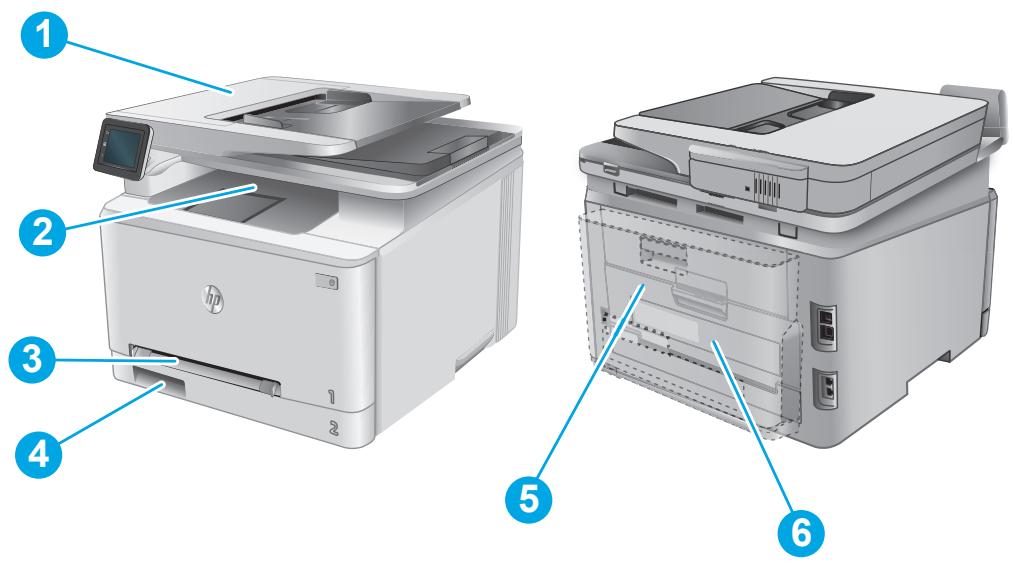
| 1 | Document feeder | See Clear paper jams in the document feeder on page 107. |
| 2 | Output bin | See Clear paper jams in the output bin on page 115. |
| 3 | Single-sheet priority feed slot (Tray 1) | See Clear paper jams in the single-sheet slot (Tray 1) on page 109. |
| 4 | Tray 2 | See Clear paper jams in Tray 2 on page 111. |
| 5 | Rear door and fuser area | See Clear paper jams in the rear door and the fuser area on page 113. |
| 6 | Duplexer (duplex models only) | See Clear paper jams in the duplexer (duplex models only) on page 116. |
Dégager les bourrages papier dans le chargeur de documents
Les informations suivantes décrivent comment dégager les bourrages papier dans le chargeur de documents. En cas de bourrage, le panneau de commande affiche une animation qui aide à dégager le bourrage.
- Ouvrez le capot du chargeur de documents.
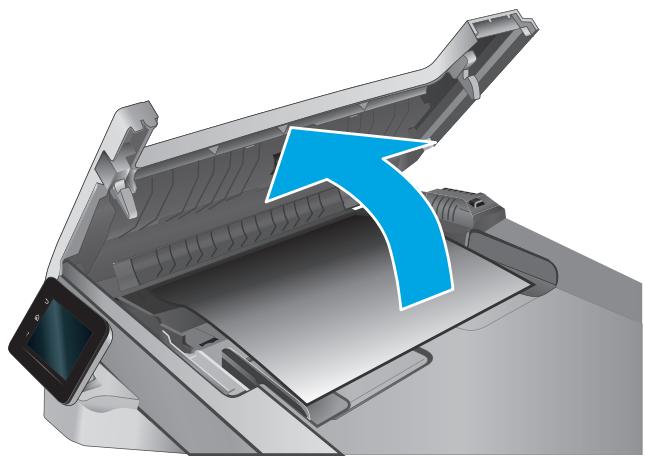
- Retirez tout papier coincé.
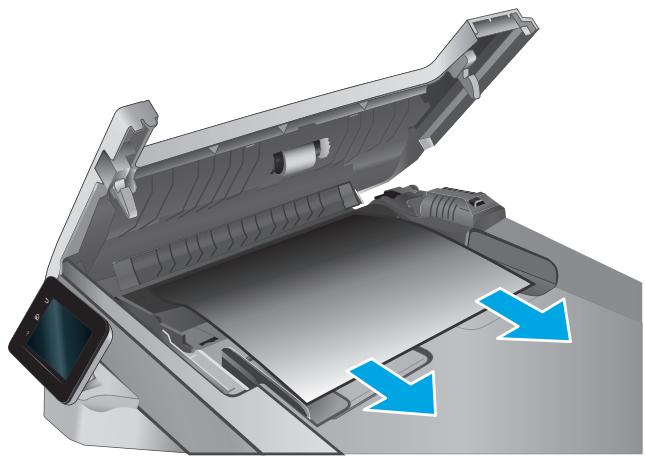
- Fermez le capot du scanner.

- Soulevez le bac d'alimentation du chargeur de documents pour mieux accéder au bac de sortie du chargeur, puis retirez tout papier coincé de la zone de sortie.
- Ouvrez le capot du scanner. Si du papier est coincé derrière le support en plastique blanc, retirez-le délicatement.

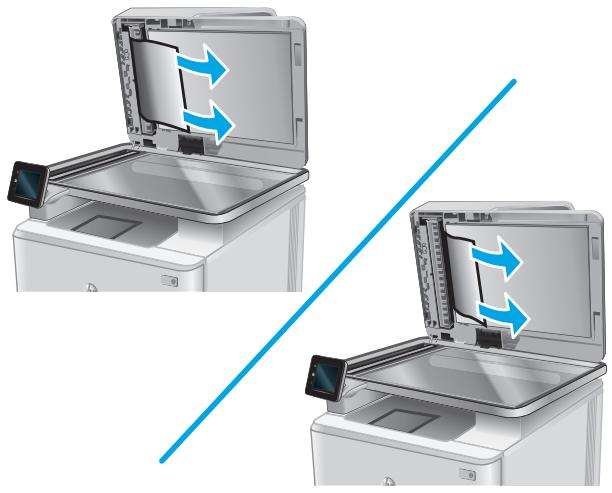
- Abaissez le capot du scanner.
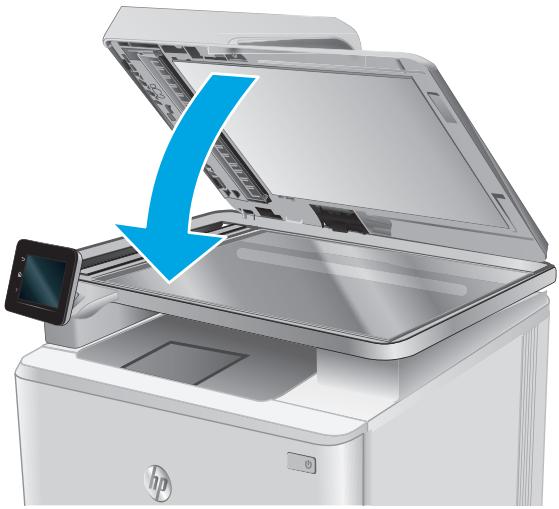

REMARQUE : Pour éviter les bourrages, assurez-vous que les guides du bac d'alimentation du chargeur de documents sont ajustés contre le document. Retirez toutes les agrafes et trombones des documents originaux.
Dégager les bourrages papier dans la fente d'alimentation une feuille (bac 1)
En cas de bourrage, le panneau de commande affiche une animation qui aide à dégager le bourrage.
- Tirez complètement le bac 2 hors du produit.
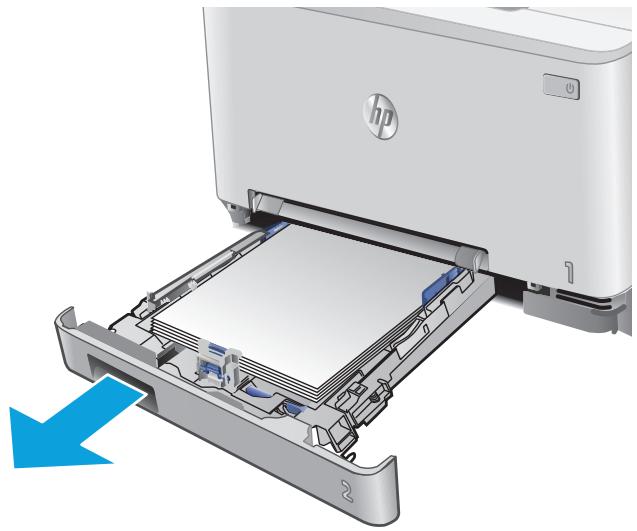
- Appuyez sur la fente d'alimentation prioritaire une feuille, puis retirez le bac de la fente d'alimentation.
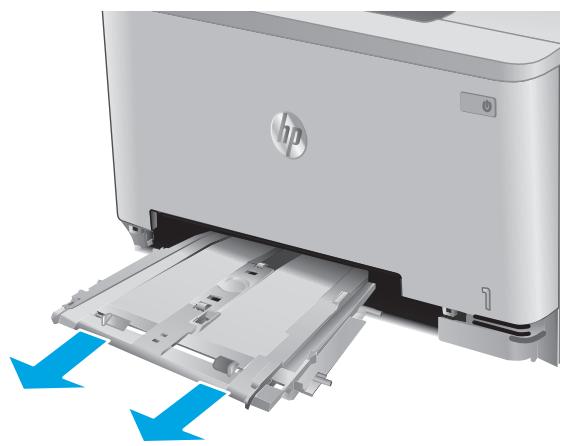
- Tirez doucement sur tout papier coincé pour le sortir directement de la fente d'alimentation prioritaire pour feuille unique.

- Poussez le plateau de la fente d'alimentation prioritaire pour feuille unique dans le produit.

- Réinsérez et fermez le bac 2.
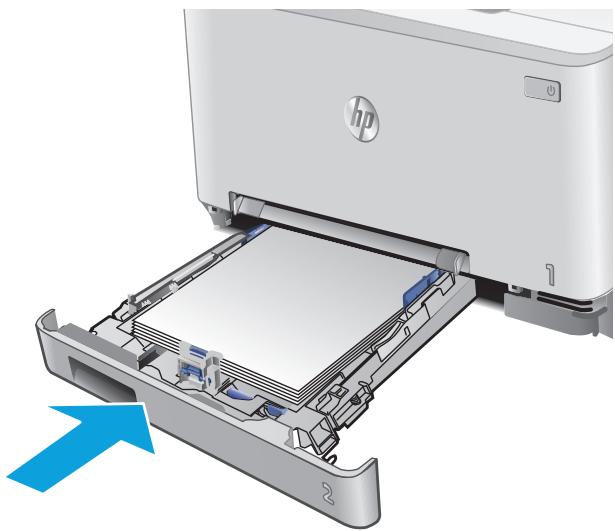
Dégager les bourrages papier dans le bac 2
Utilisez la procédure suivante pour vérifier s'il y a un bourrage papier dans le bac 2. En cas de bourrage, le panneau de commande affiche une animation qui vous aide à dégager le bourrage.
- Tirez complètement le bac hors du produit.
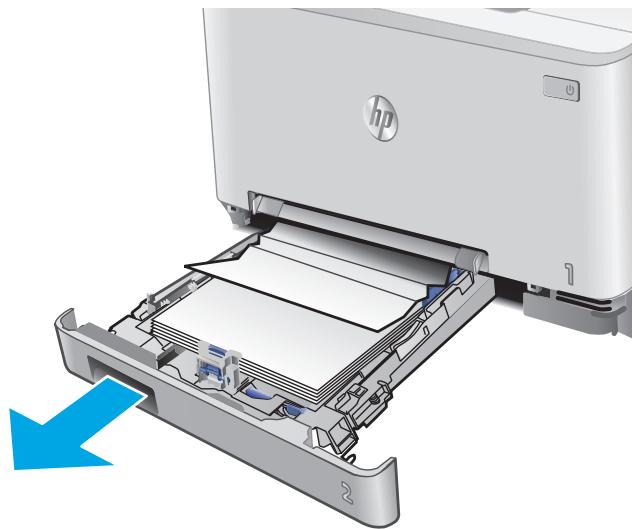
- Retirez toute feuille de papier coincée ou endommagée.

- Si aucun papier coincé n'est visible, ou si le papier coincé est suffisamment profond dans la cavité du bac 2 pour être difficile à retirer, appuyez sur la fente d'alimentation prioritaire pour feuille unique, puis retirez le plateau de la fente.
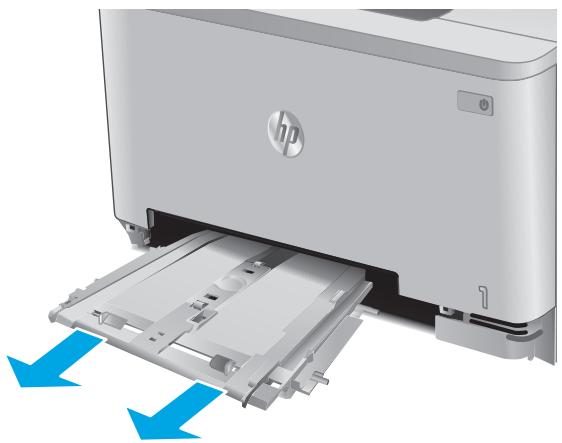
- Retirez toute feuille de papier coincée ou endommagée.
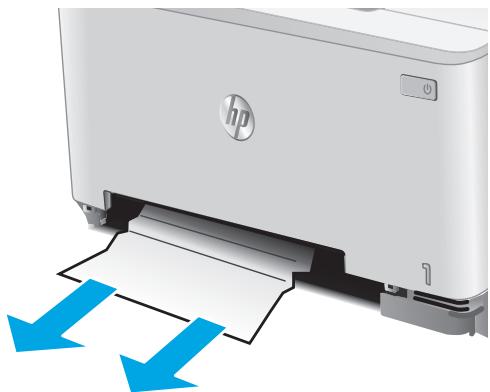
- Poussez le plateau de la fente d'alimentation prioritaire pour feuille unique dans le produit.

- Réinsérez et fermez le bac 2.

Dégager les bourrages papier dans la porte arrière et la zone du four
Utilisez la procédure suivante pour vérifier s'il y a du papier dans la porte arrière. En cas de bourrage, le panneau de commande affiche une animation qui vous aide à dégager le bourrage.
ATTENTION : Le four est situé au-dessus de la porte arrière et il est chaud. N'essayez pas d'atteindre la zone au-dessus de la porte arrière tant que le four n'a pas refroidi.
- Ouvrez la porte arrière.
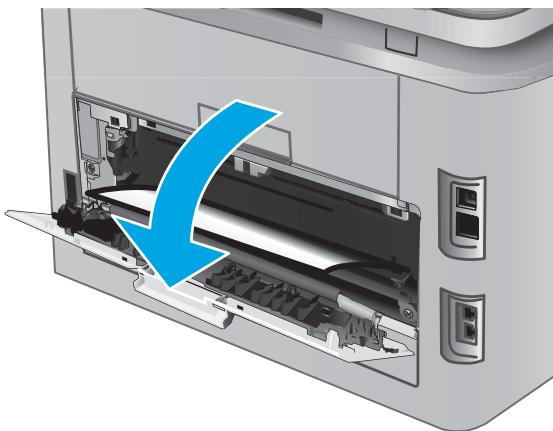
- Retirez délicatement tout papier coincé dans les rouleaux au niveau de la porte arrière.
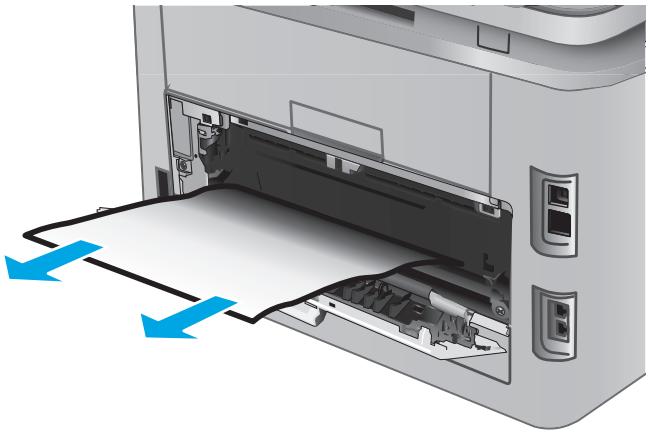
- Fermez la porte arrière.

Dégager les bourrages papier dans le bac de sortie
Utilisez la procédure suivante pour dégager les bourrages dans le bac de sortie. En cas de bourrage, le panneau de commande affiche une animation qui vous aide à dégager le bourrage.
- Si du papier est visible dans le bac de sortie, saisissez le bord avant et retirez-le.
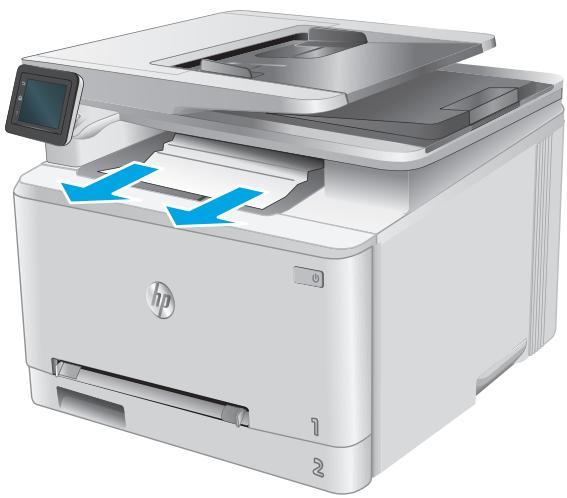
Dégager les bourrages papier dans l'unité recto verso (modèles avec recto verso uniquement)
Utilisez la procédure suivante pour vérifier la présence de papier dans l'unité recto verso. En cas de bourrage, le panneau de commande affiche une animation qui vous aide à dégager le bourrage.
- À l'arrière du produit, ouvrez l'unité recto verso.

- Retirez toute feuille de papier coincée ou endommagée.
ATTENTION : Le four est situé au-dessus de la porte arrière et il est chaud. N'essayez pas d'atteindre la zone au-dessus de la porte arrière tant que le four n'a pas refroidi.
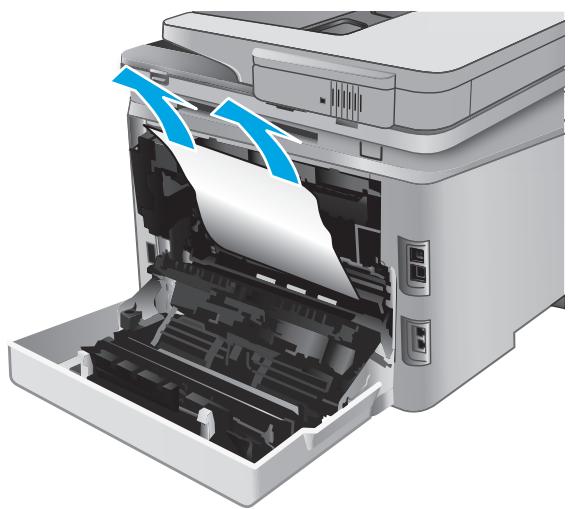
- Fermez l'unité recto verso.

Améliorer la qualité d'impression
Introduction
Si le produit rencontre des problèmes de qualité d'impression, essayez les solutions suivantes dans l'ordre présenté pour résoudre le problème.
Si le produit rencontre des problèmes de qualité de numérisation, de télécopie ou de copie, essayez les solutions suivantes et consultez également « Améliorer la qualité de numérisation », « Améliorer la qualité de télécopie » ou « Améliorer la qualité de copie » pour d'autres solutions.
- Imprimez à partir d'un autre logiciel. Vérifiez le paramètre de type de papier pour le travail d'impression. Vérifiez l'état de la cartouche de toner.
- Imprimez et interprétez la page de qualité d'impression. Nettoyez le produit.
- Inspectez visuellement la cartouche de toner. Vérifiez le papier et l'environnement d'impression.
- Calibrez le produit pour aligner les couleurs. Vérifiez d'autres paramètres du travail d'impression. Essayez un autre pilote d'impression.
Imprimez à partir d'un autre logiciel.
Essayez d'imprimer à partir d'un autre logiciel. Si la page s'imprime correctement, le problème vient du logiciel à partir duquel vous imprimiez.
Vérifiez le paramètre de type de papier pour le travail d'impression.
Vérifiez le paramètre de type de papier lors de l'impression à partir d'un logiciel et si les pages imprimées présentent des bavures, un texte flou ou foncé, du papier gondolé, des points de toner dispersés, du toner en vrac ou de petites zones de toner manquant.
Vérifiez le paramètre de type de papier (Windows).
- Dans le logiciel, sélectionnez l'option Imprimer.
- Sélectionnez le produit, puis cliquez sur le bouton Propriétés ou Préférences.
- Cliquez sur l'onglet Papier/Qualité.
- Dans la liste déroulante Type de papier, cliquez sur l'option Plus...
- Développez la liste des options Type :.
- Développez la catégorie de types de papier qui décrit le mieux votre papier.
- Sélectionnez l'option correspondant au type de papier utilisé, puis cliquez sur le bouton OK.
- Cliquez sur le bouton OK pour fermer la boîte de dialogue Propriétés du document. Dans la boîte de dialogue Imprimer, cliquez sur le bouton OK pour imprimer le travail.
Vérification du paramètre de type de papier (OS X)
- Cliquez sur le menu Fichier, puis sur l'option Imprimer.
- Dans le menu Imprimante, sélectionnez le produit.
- Par défaut, le pilote d'impression affiche le menu Copies et pages. Ouvrez la liste déroulante des menus, puis cliquez sur le menu Finition.
- Sélectionnez un type dans la liste déroulante Type de support.
- Cliquez sur le bouton Imprimer.
Vérification de l'état des cartouches de toner
Consultez la page d'état des consommables pour obtenir les informations suivantes :
Pourcentage estimé de durée de vie restante de la cartouche - Nombre approximatif de pages restantes - Numéros de référence des cartouches de toner HP - Nombre de pages imprimées
Utilisez la procédure suivante pour imprimer la page d'état des consommables :
- Sur l'écran d'accueil du panneau de commande du produit, touchez le bouton Consommables.
- Touchez le bouton Rapport pour imprimer la page d'état des consommables.
- Vérifiez le pourcentage de durée de vie restante des cartouches de toner et, le cas échéant, l'état des autres pièces de maintenance remplaçables.
Des problèmes de qualité d'impression peuvent survenir lors de l'utilisation d'une cartouche de toner qui approche de sa fin de vie estimée. La page d'état des consommables indique quand le niveau d'un consommable est très bas. Une fois qu'un consommable HP a atteint le seuil de niveau très bas, la garantie de protection premium HP sur ce consommable a expiré.
La cartouche de toner ne doit pas être remplacée immédiatement, sauf si la qualité d'impression n'est plus acceptable. Pensez à avoir une cartouche de rechange disponible à installer lorsque la qualité d'impression ne sera plus acceptable.
Si vous déterminez que vous devez remplacer une cartouche de toner ou d'autres pièces de maintenance remplaçables, la page d'état des consommables répertorie les numéros de pièces HP d'origine.
- Vérifiez si vous utilisez une cartouche HP d'origine.
Une cartouche de toner HP d'origine porte les mots "HP" ou "Hewlett-Packard", ou le logo HP. Pour plus d'informations sur l'identification des cartouches HP, consultez www.hp.com/go/learnaboutsupplies.
Hewlett Packard ne peut pas recommander l'utilisation de consommables non HP, qu'ils soient neufs ou reconditionnés. Comme ce ne sont pas des produits HP, HP ne peut pas influencer leur conception ni contrôler leur qualité. Si vous utilisez une cartouche de toner rechargée ou reconditionnée et que la qualité d'impression ne vous satisfait pas, remplacez la cartouche de toner par une cartouche de toner HP d'origine.
Imprimez et interprétez la page de qualité d'impression
- Depuis l'écran d'accueil, touchez le bouton Configuration.
- Touchez le bouton Rapports.
- Touchez le bouton Page de qualité d'impression.
Cette page contient cinq bandes de couleur, divisées en quatre groupes comme indiqué dans l'illustration suivante. En examinant chaque groupe, vous pouvez isoler le problème à une cartouche de toner particulière.
1
2
3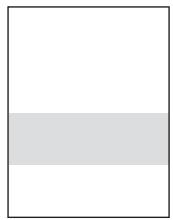
4
| Section | Toner cartridge |
| 1 | Yellow |
| 2 | Cyan |
| 3 | Black |
| 4 | Magenta |
- Si des points ou des traînées n'apparaissent que dans l'un des groupes, remplacez la cartouche de toner correspondant à ce groupe.
- Si des points apparaissent dans plusieurs groupes, imprimez une page de nettoyage. Si cela ne résout pas le problème, déterminez si les points sont toujours de la même couleur ; par exemple, si des points magenta apparaissent dans les cinq bandes de couleur. Si les points sont tous de la même couleur, remplacez cette cartouche de toner.
- Si des traînées apparaissent dans plusieurs bandes de couleur, contactez HP. Un composant autre que la cartouche de toner est probablement à l'origine du problème.
Nettoyez le produit
Imprimez une page de nettoyage
Pendant le processus d'impression, du papier, du toner et des particules de poussière peuvent s'accumuler à l'intérieur du produit et provoquer des problèmes de qualité d'impression tels que des points de toner ou des éclaboussures, des bavures, des traînées, des lignes ou des marques répétitives.
Utilisez la procédure suivante pour imprimer une page de nettoyage.
- Sur l'écran d'accueil du panneau de commande du produit, touchez le bouton Configuration.
- Touchez le menu Service.
- Touchez le bouton Page de nettoyage.
- Chargez du papier ordinaire de format lettre ou A4 lorsque vous y êtes invité.
- Touchez le bouton OK pour lancer le processus de nettoyage.
Le produit imprime la première face, puis vous invite à retirer la page du bac de sortie et à la recharger dans le bac 1, en conservant la même orientation. Attendez la fin du processus. Jetez la page imprimée.
Vérifiez que la vitre du scanner est propre et sans traces.
Avec le temps, des particules peuvent s'accumuler sur la vitre du scanner et le support en plastique blanc, ce qui peut affecter les performances. Utilisez la procédure suivante pour nettoyer le scanner.
- Appuyez sur le bouton d'alimentation pour éteindre le produit, puis débranchez le câble d'alimentation de la prise électrique.
- Ouvrez le capot du scanner.
- Nettoyez la vitre du scanner et le support en plastique blanc sous le capot avec un chiffon doux ou une éponge humidifiée avec un nettoyant pour vitres non abrasif.
ATTENTION : N'utilisez pas de produits abrasifs, d'acétone, de benzène, d'ammoniac, d'alcool éthylique ou de tétrachlorure de carbone sur aucune partie du produit ; ils pourraient l'endommager. Ne versez pas de liquide directement sur la vitre ou la plaque de verre. Ils pourraient s'infiltrer et endommager le produit.
- Séchez la vitre et les parties en plastique blanc avec un chiffon doux ou une éponge en cellulose pour éviter les traces.
- Branchez le câble d'alimentation sur une prise, puis appuyez sur le bouton d'alimentation pour allumer le produit.
Inspectez visuellement la cartouche de toner
- Retirez la cartouche de toner du produit et vérifiez que le ruban de scellement a été retiré.
- Vérifiez que la puce mémoire n'est pas endommagée.
- Examinez la surface du tambour d'imagerie de la cartouche de toner.
ATTENTION : Ne touchez pas le rouleau (tambour d'imagerie) de la cartouche. Les empreintes digitales sur le tambour d'imagerie peuvent causer des problèmes de qualité d'impression.
- Si vous voyez des rayures, des empreintes digitales ou d'autres dommages sur le tambour d'imagerie, remplacez la cartouche de toner.
- Si le tambour d'imagerie ne semble pas endommagé, secouez doucement la cartouche de toner plusieurs fois et réinstallez-la. Imprimez quelques pages pour voir si le problème est résolu.
Vérifiez le papier et l'environnement d'impression
Première étape : utilisez un papier conforme aux spécifications HP
Certains problèmes de qualité d'impression proviennent de l'utilisation d'un papier qui ne respecte pas les spécifications HP.
Utilisez toujours un type et un grammage de papier pris en charge par ce produit. - Utilisez un papier de bonne qualité, sans coupures, entailles, déchirures, taches, particules libres, poussière, plis, vides, agrafes, ni bords incurvés ou pliés. Utilisez un papier qui n'a pas déjà été imprimé.
Utilisez un papier sans matière métallique, comme les paillettes. Utilisez un papier conçu pour les imprimantes laser. N'utilisez pas de papier conçu uniquement pour les imprimantes à jet d'encre. Utilisez un papier qui n'est pas trop rugueux. L'utilisation d'un papier plus lisse donne généralement une meilleure qualité d'impression.
Deuxième étape : vérifiez l'environnement
L'environnement peut affecter directement la qualité d'impression et est une cause fréquente de problèmes de qualité d'impression ou d'alimentation papier. Essayez les solutions suivantes :
- Éloignez le produit des endroits exposés aux courants d'air, comme les fenêtres ou portes ouvertes, ou les bouches de climatisation. Assurez-vous que le produit n'est pas exposé à des températures ou une humidité en dehors des spécifications du produit.
- Ne placez pas le produit dans un espace confiné, comme une armoire.
- Placez le produit sur une surface stable et plane.
- Retirez tout ce qui bloque les évents du produit. Le produit nécessite une bonne circulation d'air sur tous les côtés, y compris le dessus.
- Protégez le produit des débris en suspension, de la poussière, de la vapeur, de la graisse ou d'autres éléments qui peuvent laisser des résidus à l'intérieur du produit.
Calibrez le produit pour aligner les couleurs
Le calibrage est une fonction du produit qui optimise la qualité d'impression.
Suivez ces étapes pour résoudre les problèmes de qualité d'impression tels que les couleurs désalignées, les ombres colorées, les graphiques flous ou d'autres problèmes de qualité d'impression.
- Sur le panneau de commande du produit, touchez le bouton Configuration.
- Ouvrez les menus suivants :
Configuration du système - Qualité d'impression - Étalonnage des couleurs - Étalonner maintenant
- Un message « Étalonnage en cours » s'affiche sur le panneau de commande du produit. Le processus d'étalonnage prend quelques minutes. Ne mettez pas le produit hors tension tant que l'étalonnage n'est pas terminé.
- Attendez que le produit ait terminé l'étalonnage, puis réessayez d'imprimer.
Vérifiez les autres paramètres du travail d'impression
Lorsque vous imprimez à partir d'un logiciel, suivez ces étapes pour résoudre le problème en ajustant d'autres paramètres du pilote d'impression.
Vérifiez les paramètres du mode EconoMode
HP déconseille l'utilisation permanente du mode EconoMode. Si le mode EconoMode est utilisé en permanence, la réserve de toner peut durer plus longtemps que les pièces mécaniques de la cartouche de toner. Si la qualité d'impression commence à se dégrader et n'est plus acceptable, envisagez de remplacer la cartouche de toner.

REMARQUE : Cette fonction est disponible avec le pilote d'impression PCL 6 pour Windows. Si vous n'utilisez pas ce pilote, vous pouvez activer la fonction via le serveur Web intégré HP.
Suivez ces étapes si la page entière est trop sombre ou trop claire.
- Dans le logiciel, sélectionnez l'option Imprimer.
- Sélectionnez le produit, puis cliquez sur le bouton Propriétés ou Préférences.
- Cliquez sur l'onglet Papier/Qualité, puis localisez la zone Qualité d'impression.
- Si la page entière est trop sombre, utilisez ces paramètres :
- Sélectionnez l'option 600 dpi.
- Cochez la case EconoMode pour l'activer.
Si toute la page est trop claire, utilisez ces paramètres :
- Sélectionnez l'option FastRes 1200.
- Décochez la case EconoMode pour la désactiver.
- Cliquez sur le bouton OK pour fermer la boîte de dialogue Propriétés du document. Dans la boîte de dialogue Imprimer, cliquez sur le bouton OK pour lancer l'impression.
Ajuster les paramètres de couleur (Windows)
Suivez ces étapes si les couleurs de la page imprimée ne correspondent pas à celles de l'écran de l'ordinateur, ou si les couleurs de la page imprimée ne sont pas satisfaisantes.
Changer le thème de couleur
- Dans le logiciel, sélectionnez l'option Imprimer.
- Sélectionnez le produit, puis cliquez sur le bouton Propriétés ou Préférences.
- Cliquez sur l'onglet Couleur.
- Décochez la case HP EasyColor pour la désélectionner.
- Sélectionnez un thème de couleurs dans la liste déroulante Thèmes de couleurs.
- Par défaut (sRGB) : ce thème configure le produit pour imprimer les données RVB en mode brut. Avec ce thème, gérez les couleurs dans le logiciel ou dans le système d'exploitation pour un rendu correct.
- Vif (sRGB) : le produit augmente la saturation des couleurs dans les tons moyens. Utilisez ce thème pour imprimer des graphiques professionnels.
- Photo (sRGB) : le produit interprète les couleurs RVB comme s'il s'agissait d'une impression photo réalisée dans un mini-laboratoire numérique. Le produit rend les couleurs plus profondes et plus saturées différemment du thème Par défaut (sRGB). Utilisez ce thème pour imprimer des photos.
- Photo (Adobe RVB 1998) : utilisez ce thème pour imprimer des photos numériques qui utilisent l'espace colorimétrique Adobe RVB plutôt que sRVB. Désactivez la gestion des couleurs dans le logiciel lorsque vous utilisez ce thème.
- Aucun : aucun thème de couleurs n'est utilisé.
- Profil personnalisé : sélectionnez cette option pour utiliser un profil d'entrée personnalisé afin de contrôler précisément la sortie des couleurs (par exemple, pour émuler un produit HP Color LaserJet spécifique). Téléchargez les profils personnalisés sur www.hp.com.
- Cliquez sur le bouton OK pour fermer la boîte de dialogue Propriétés du document. Dans la boîte de dialogue Imprimer, cliquez sur le bouton OK pour imprimer le travail.
Modifier les options de couleur
- Dans le logiciel, sélectionnez l'option Imprimer.
- Sélectionnez le produit, puis cliquez sur le bouton Propriétés ou Préférences.
- Cliquez sur l'onglet Couleur.
- Décochez la case HP EasyColor pour la désélectionner.
- Cliquez sur le réglage Automatique ou Manuel.
Réglage automatique : sélectionnez ce réglage pour la plupart des travaux d'impression couleur. - Réglage manuel : sélectionnez ce réglage pour ajuster les paramètres de couleur indépendamment des autres paramètres. Cliquez sur le bouton Paramètres pour ouvrir la fenêtre de réglage manuel des couleurs.

REMARQUE : La modification manuelle des paramètres de couleur peut affecter la sortie. HP recommande que seuls les experts en graphisme couleur modifient ces paramètres.
- Cliquez sur l'option Imprimer en niveaux de gris pour imprimer un document couleur en noir et nuances de gris. Utilisez cette option pour imprimer des documents couleur destinés à la photocopie ou à la télécopie. Utilisez également cette option pour imprimer des brouillons ou pour économiser le toner couleur.
- Cliquez sur le bouton OK pour fermer la boîte de dialogue Propriétés du document. Dans la boîte de dialogue Imprimer, cliquez sur le bouton OK pour imprimer le travail.
Essayez un autre pilote d'impression
Vous devrez peut-être utiliser un autre pilote d'impression lors de l'impression à partir d'un logiciel si les pages imprimées présentent des lignes inattendues dans les graphiques, du texte manquant, des graphiques manquants, un formatage incorrect ou des polices substituées.
Téléchargez l'un des pilotes suivants à partir du site Web HP : www.hp.com/support/colorljMFPM277.
| HP PCL 6 driver | Provided as the default driver on the product CD. This driver is automatically installed unless you select a different one.Recommended for all Windows environmentsProvides the overall best speed, print quality, and product-feature support for most usersDeveloped to align with the Windows Graphic Device Interface (GDI) for the best speed in Windows environmentsMight not be fully compatible with third-party and custom software programs that are based on PCL 5 |
| HP UPD PS driver | Recommended for printing with Adobe® software programs or with other highly graphics-intensive software programsProvides support for printing from postscript emulation needs, or for postscript flash font support |
| HP UPD PCL 5 | Recommended for general office printing in Windows environmentsCompatible with previous PCL versions and older HP LaserJet productsThe best choice for printing from third-party or custom software programsThe best choice when operating with mixed environments, which require the product to be set to PCL 5 (UNIX, Linux, mainframe)Designed for use in corporate Windows environments to provide a single driver for use with multiple product modelsPreferred when printing to multiple product models from a mobile Windows computer |
| HP UPD PCL 6 | Recommended for printing in all Windows environmentsProvides the overall best speed, print quality, and printer feature support for most usersDeveloped to align with Windows Graphic Device Interface (GDI) for best speed in Windows environmentsMight not be fully compatible with third-party and custom software programs that are based on PCL 5 |
Améliorer la qualité de copie et de numérisation
Introduction
Si le produit présente des problèmes de qualité d'image, essayez les solutions suivantes dans l'ordre présenté pour résoudre le problème.
- Vérifiez que la vitre du scanner est propre et sans traces
- Éliminez les lignes ou les stries lors de l'utilisation du chargeur de documents Vérifiez les paramètres du papier
- Vérifiez les paramètres de réglage de l'image
- Optimisez pour le texte ou les images Vérifiez les paramètres de résolution et de couleur du scanner sur l'ordinateur
- Copie bord à bord Nettoyez les rouleaux d'alimentation et le patin de séparation du chargeur de documents
Essayez d'abord ces quelques étapes simples :
Utilisez le scanner à plat plutôt que le chargeur de documents. Utilisez des originaux de haute qualité. - Lors de l'utilisation du chargeur de documents, chargez correctement le document original dans le chargeur, en utilisant les guides papier, pour éviter des images floues ou de travers.
Si le problème persiste, essayez ces solutions supplémentaires. Si elles ne résolvent pas le problème, consultez « Améliorer la qualité d'impression » pour d'autres solutions.
Vérifiez que la vitre du scanner est propre et sans traces
Avec le temps, des particules de débris peuvent s'accumuler sur la vitre du scanner et le support en plastique blanc, ce qui peut affecter les performances. Suivez la procédure suivante pour nettoyer le scanner.
- Appuyez sur le bouton d'alimentation pour éteindre le produit, puis débranchez le câble d'alimentation de la prise électrique.
- Ouvrez le capot du scanner.
- Nettoyez la vitre du scanner et le support en plastique blanc sous le capot du scanner avec un chiffon doux ou une éponge humidifiée avec un nettoyant pour vitres non abrasif.
ATTENTION : n'utilisez pas de produits abrasifs, d'acétone, de benzène, d'ammoniaque, d'alcool éthylique ou de tétrachlorure de carbone sur une partie quelconque du produit ; ces produits peuvent l'endommager. Ne versez pas de liquide directement sur la vitre ou la plaque ; ils pourraient s'infiltrer et endommager le produit.
- Séchez la vitre et les parties en plastique blanc avec une peau de chamois ou une éponge en cellulose pour éviter les traces.
- Branchez le câble d'alimentation sur une prise, puis appuyez sur le bouton d'alimentation pour mettre le produit sous tension.
Éliminer les lignes ou les stries lors de l'utilisation du chargeur de documents
Si des lignes ou des stries apparaissent sur les documents copiés ou numérisés lors de l'utilisation du chargeur de documents, suivez la procédure ci-dessous pour nettoyer les débris de la vitre du chargeur de documents. Les débris peuvent inclure de la poussière, de la poussière de papier ou de toner, des résidus d'adhésif de notes autocollantes, du liquide correcteur ou du ruban adhésif, de l'encre, des empreintes digitales, etc.
- Ouvrez le capot du scanner.
- Repérez la bande de verre d'un pouce à gauche de la vitre principale du scanner, puis utilisez un chiffon doux non pelucheux humidifié avec de l'eau pour nettoyer la bande de verre.
ATTENTION : n'utilisez pas de produits abrasifs, d'acétone, de benzène, d'ammoniaque, d'alcool éthylique ou de tétrachlorure de carbone sur une partie quelconque du produit ; ces produits peuvent l'endommager. Ne versez pas de liquide directement sur la vitre ou la plaque ; ils pourraient s'infiltrer et endommager le produit.
- Sur le dessous du capot du scanner, au-dessus de la bande de verre, utilisez un chiffon doux non pelucheux humidifié avec de l'eau pour nettoyer la bande de plastique supérieure.
- Séchez la bande de verre et la bande supérieure avec un chiffon doux et sec pour éviter les traces, puis réessayez de copier ou de numériser.
Vérifiez les paramètres du papier
- Sur l'écran d'accueil du panneau de commande du produit, touchez le bouton Copier.
- Touchez le bouton Paramètres, puis faites défiler et touchez le bouton Papier.
- Dans la liste des formats de papier, touchez le nom du format de papier qui se trouve dans le bac.
- Dans la liste des types de papier, touchez le nom du type de papier qui se trouve dans le bac.
Vérifiez les paramètres de réglage de l'image.
- Depuis l'écran d'accueil, touchez le bouton Copie.
- Touchez le bouton Paramètres, puis faites défiler et touchez le bouton Réglage de l'image.
- Touchez le nom du paramètre que vous souhaitez régler.
- Luminosité : règle le réglage clair/sombre.
- Contraste : règle le contraste entre les zones les plus claires et les plus sombres de l'image.
- Netteté : règle la clarté des caractères de texte.
- Suppression de l'arrière-plan : règle l'obscurité de l'arrière-plan de l'image. Ceci est particulièrement utile pour les documents originaux imprimés sur du papier de couleur. Équilibre des couleurs : règle les teintes de rouge, de vert et de bleu.
- Gris : règle la vivacité des couleurs.
- Touchez les boutons - ou + pour régler la valeur du paramètre, puis touchez le bouton OK.
- Réglez un autre paramètre, ou touchez la flèche retour pour revenir au menu principal de copie.
Optimiser pour le texte ou les images
- Depuis l'écran d'accueil du panneau de commande du produit, touchez le bouton Copier.
- Touchez le bouton Paramètres, puis faites défiler et touchez le bouton Optimiser.
- Touchez le nom du paramètre que vous souhaitez ajuster.
- Sélection automatique : utilisez ce paramètre lorsque la qualité de la copie ne vous préoccupe pas. C'est le paramètre par défaut.
- Mixte : utilisez ce paramètre pour les documents contenant un mélange de texte et de graphiques. Texte : utilisez ce paramètre pour les documents contenant principalement du texte. Image : utilisez ce paramètre pour les documents contenant principalement des graphiques.
Vérifiez la résolution du scanner et les paramètres de couleur sur l'ordinateur
Si vous imprimez une image numérisée et que la qualité n'est pas celle attendue, vous avez peut-être sélectionné une résolution ou un paramètre de couleur dans le logiciel du scanner qui ne correspond pas à vos besoins. La résolution et la couleur affectent les caractéristiques suivantes des images numérisées :
Netteté de l'image, texture des dégradés (lisse ou rugueuse), temps de numérisation, taille du fichier.
La résolution de numérisation est mesurée en pixels par pouce (ppp).

REMARQUE : Les niveaux de ppp de numérisation ne sont pas interchangeables avec les niveaux de dpi (points par pouce) d'impression.
La couleur, les niveaux de gris et le noir et blanc définissent le nombre de couleurs possibles. Vous pouvez régler la résolution matérielle du scanner jusqu'à 1200 ppp.
Le tableau des directives de résolution et de couleur répertorie des conseils simples que vous pouvez suivre pour répondre à vos besoins de numérisation.

REMARQUE : Le fait de régler la résolution et la couleur sur une valeur élevée peut créer des fichiers volumineux qui occupent de l'espace disque et ralentissent le processus de numérisation. Avant de définir la résolution et la couleur, déterminez comment vous allez utiliser l'image numérisée.
Directives relatives à la résolution et à la couleur
Le tableau suivant décrit les paramètres de résolution et de couleur recommandés pour différents types de travaux de numérisation.

REMARQUE : La résolution par défaut est de 200 ppp.
| Intended use | Recommended resolution | Recommended color settings |
| Fax | 150 ppi | ● Black and White |
| Email | 150 ppi | • Black and White, if the image does not require smooth gradation
• Grayscale, if the image requires smooth gradation
• Color, if the image is in color |
| Edit text | 300 ppi | • Black and White |
| Print (graphics or text) | 600 ppi for complex graphics, or if you want to significantly enlarge the document | • Black and White for text and line art
• Grayscale for shaded or colored graphics and photos |
| 300 ppi for normal graphics and text |
| 150 ppi for photos | • Color, if the image is in color |
| Display on screen | 75 ppi | • Black and White for text
• Grayscale for graphics and photos
• Color, if the image is in color |
Couleur
Vous pouvez définir les valeurs de couleur sur les paramètres suivants lors de la numérisation.
| Setting | Recommended use |
| Color | Use this setting for high-quality color photos or documents in which the color is important. |
| Black and White | Use this setting for text documents. |
| Grayscale | Use this setting when file size is an issue or when you want to scan a document or photograph quickly. |
Copie bord à bord
Le produit ne peut pas imprimer entièrement bord à bord. Il existe une bordure non imprimable de 4 mm (1/6 de pouce) autour de la page.
Considérations relatives à l'impression ou à la numérisation de documents avec des bords rognés :
- Lorsque l'original est plus petit que le format de sortie, éloignez l'original de 4 mm (1/6 de pouce) du coin indiqué par l'icône sur le scanner. Recopiez ou numérisez dans cette position.
- Lorsque l'original a la taille de la sortie imprimée souhaitée, utilisez la fonction Réduire/Agrandir pour réduire l'image afin que la copie ne soit pas rognée.
Nettoyez les rouleaux d'entraînement et le patin de séparation du chargeur de documents
Si le chargeur de documents rencontre des problèmes de gestion du papier, tels que des bourrages ou des alimentations multiples, nettoyez les rouleaux du chargeur et le patin de séparation.
- Ouvrez le capot d'accès du chargeur de documents.
- Utilisez un chiffon humide non pelucheux pour essuyer les deux rouleaux d'entraînement et le patin de séparation afin d'éliminer la saleté.
ATTENTION : N'utilisez pas de produits abrasifs, d'acétone, de benzène, d'ammoniaque, d'alcool éthylique ou de tétrachlorure de carbone sur toute partie du produit ; ces produits peuvent l'endommager. Ne versez pas de liquides directement sur la vitre ou la plaque en verre. Ils pourraient s'infiltrer et endommager le produit.
- Fermez le capot d'accès du chargeur de documents.

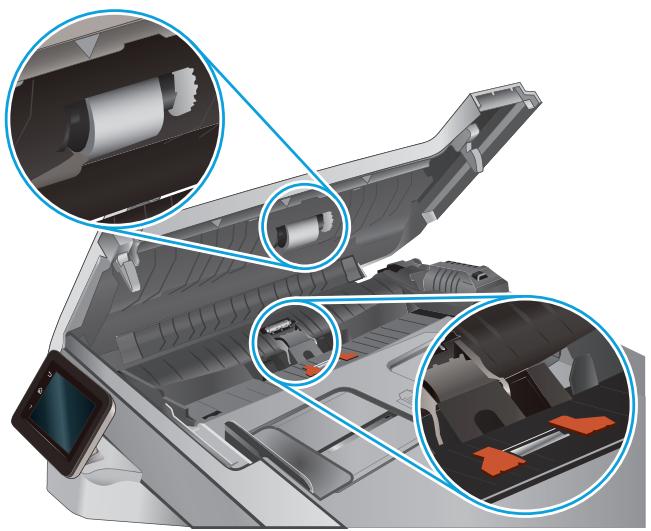

Améliorer la qualité d'image des télécopies
Introduction
Si le produit rencontre des problèmes de qualité d'image, essayez les solutions suivantes dans l'ordre présenté pour résoudre le problème.
- Vérifiez que la vitre du scanner est propre et sans traces. Vérifiez les paramètres de résolution d'envoi de télécopie. Vérifiez les paramètres de correction d'erreurs. Vérifiez le paramètre Ajuster à la page. Nettoyez les rouleaux d'entraînement et le patin de séparation du chargeur de documents.
- Envoyez vers un autre télécopieur. Vérifiez le télécopieur de l'expéditeur.
Essayez d'abord ces quelques étapes simples :
Utilisez le scanner à plat plutôt que le chargeur de documents. Utilisez des originaux de haute qualité. - Lorsque vous utilisez le chargeur de documents, insérez correctement le document original dans le chargeur, en utilisant les guides papier, pour éviter des images floues ou de travers.
Si le problème persiste, essayez ces solutions supplémentaires. Si elles ne résolvent pas le problème, consultez « Améliorer la qualité d'impression » pour d'autres solutions.
Vérifiez que la vitre du scanner est propre et sans traces
Avec le temps, des particules de débris peuvent s'accumuler sur la vitre du scanner et le support en plastique blanc, ce qui peut affecter les performances. Utilisez la procédure suivante pour nettoyer le scanner.
- Appuyez sur le bouton d'alimentation pour éteindre le produit, puis débranchez le câble d'alimentation de la prise électrique.
- Ouvrez le capot du scanner.
- Nettoyez la vitre du scanner et le support en plastique blanc situé sous le capot du scanner avec un chiffon doux ou une éponge humidifiée avec un nettoyant pour vitres non abrasif.
ATTENTION : N'utilisez pas de produits abrasifs, d'acétone, de benzène, d'ammoniaque, d'alcool éthylique ou de tétrachlorure de carbone sur une partie du produit ; ces produits peuvent l'endommager. Ne versez pas de liquides directement sur la vitre ou la plaque de verre. Ils pourraient s'infiltrer et endommager le produit.
- Séchez la vitre et les parties en plastique blanc avec une peau de chamois ou une éponge en cellulose pour éviter les traces.
- Branchez le câble d'alimentation sur une prise, puis appuyez sur le bouton d'alimentation pour allumer le produit.
Vérifiez les paramètres de résolution d'envoi de télécopie
Si le produit n'a pas pu envoyer une télécopie parce que le télécopieur récepteur n'a pas répondu ou était occupé, le produit tente de recomposer le numéro en fonction des options de recomposition en cas d'occupation, de non-réponse et d'erreur de communication.
- Sur l'écran d'accueil du panneau de commande du produit, touchez le bouton Configuration.
- Touchez le menu Configuration de la télécopie.
- Touchez le menu Configuration avancée.
- Ouvrez le menu Résolution de télécopie.
Vérifiez les paramètres de correction d'erreurs
En général, le produit surveille les signaux sur la ligne téléphonique pendant l'envoi ou la réception d'une télécopie. Si le produit détecte une erreur pendant la transmission et que le paramètre de correction d'erreurs est activé, le produit peut demander que la partie de la télécopie soit renvoyée. La valeur par défaut définie en usine pour la correction d'erreurs est Activée.
Vous ne devez désactiver la correction d'erreurs que si vous rencontrez des problèmes d'envoi ou de réception de télécopies et que vous acceptez les erreurs de transmission. La désactivation de ce paramètre peut être utile lorsque vous essayez d'envoyer ou de recevoir une télécopie à l'étranger, ou si vous utilisez une connexion téléphonique par satellite.
- Sur l'écran d'accueil du panneau de commande du produit, touchez le bouton Configuration.
- Touchez le menu Services.
- Touchez le menu Services de télécopie.
- Touchez le bouton Correction d'erreur, puis touchez le bouton Activé.
Vérifiez le paramètre Ajuster à la page.
Si le produit a imprimé un fax hors de la page, activez la fonction Ajuster à la page à partir du panneau de commande du produit.

REMARQUE : assurez-vous que le paramètre de format de papier par défaut correspond au format du papier dans le bac.
- Depuis l'écran d'accueil du panneau de commande du produit, touchez le bouton Configuration.
- Touchez le menu Configuration de la télécopie.
- Touchez le menu Configuration avancée.
- Touchez le bouton Ajuster à la page, puis touchez le bouton Activé.
Nettoyez les rouleaux d'alimentation et le patin de séparation du chargeur de documents.
Si le chargeur de documents rencontre des problèmes de manipulation du papier, tels que des bourrages ou des alimentations multiples, nettoyez les rouleaux et le patin de séparation du chargeur de documents.
- Ouvrez le capot d'accès du chargeur de documents.
- Utilisez un chiffon humide non pelucheux pour essuyer les deux rouleaux d'alimentation et le patin de séparation afin d'éliminer la saleté.
ATTENTION : N'utilisez pas de produits abrasifs, d'acétone, de benzène, d'ammoniaque, d'alcool éthylique ou de tétrachlorure de carbone sur une partie quelconque du produit ; ces produits peuvent l'endommager. Ne versez pas de liquides directement sur la vitre ou la plaque. Ils pourraient s'infiltrer et endommager le produit.
- Fermez le capot d'accès du chargeur de documents.

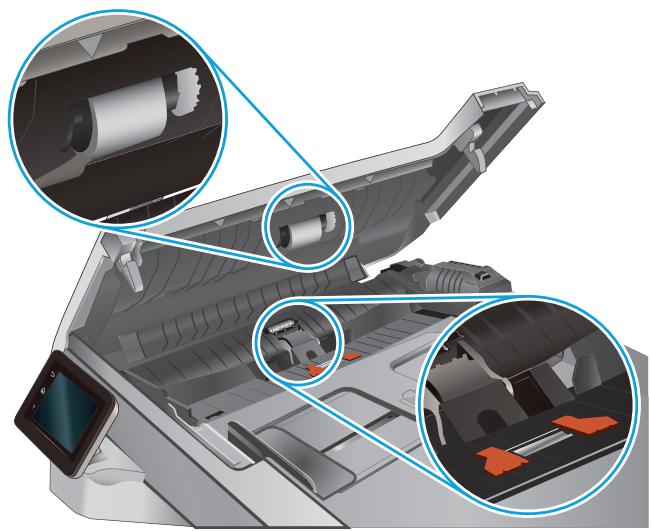

Envoyez vers un autre télécopieur
Essayez d'envoyer le fax vers un autre télécopieur. Si la qualité du fax est meilleure, le problème est lié aux paramètres ou à l'état des consommables du télécopieur du destinataire initial.
Vérifiez le télécopieur de l'expéditeur
Demandez à l'expéditeur d'essayer d'envoyer depuis un autre télécopieur. Si la qualité du fax est meilleure, le problème vient du télécopieur de l'expéditeur. Si un autre télécopieur n'est pas disponible, demandez à l'expéditeur d'envisager les modifications suivantes :
Assurez-vous que le document original est sur du papier blanc (et non coloré). - Augmentez la résolution du fax, le niveau de qualité ou les paramètres de contraste. Si possible, envoyez le fax à partir d'un logiciel informatique.
Résoudre les problèmes de réseau filaire
Introduction
Vérifiez les éléments suivants pour vous assurer que le produit communique avec le réseau. Avant de commencer, imprimez une page de configuration à partir du panneau de commande du produit et localisez l'adresse IP du produit indiquée sur cette page.
Mauvaise connexion physique L'ordinateur utilise une adresse IP incorrecte pour le produit L'ordinateur ne peut pas communiquer avec le produit Le produit utilise des paramètres de liaison et de duplex incorrects pour le réseau De nouveaux logiciels peuvent causer des problèmes de compatibilité L'ordinateur ou la station de travail peut être configuré de manière incorrecte Le produit est désactivé, ou d'autres paramètres réseau sont incorrects

REMARQUE : HP ne prend pas en charge la mise en réseau poste à poste, car cette fonctionnalité est une fonction des systèmes d'exploitation Microsoft et non des pilotes d'impression HP. Pour plus d'informations, consultez Microsoft à l'adresse www.microsoft.com.
Mauvaise connexion physique
- Vérifiez que le produit est connecté au bon port réseau à l'aide d'un câble de la longueur appropriée.
- Vérifiez que les connexions des câbles sont sécurisées.
- Regardez la connexion du port réseau à l'arrière du produit et vérifiez que le voyant d'activité ambre et le voyant de liaison verte sont allumés.
- Si le problème persiste, essayez un autre câble ou un autre port sur le concentrateur.
L'ordinateur utilise une adresse IP incorrecte pour le produit.
- Ouvrez les propriétés de l'imprimante et cliquez sur l'onglet Ports. Vérifiez que l'adresse IP actuelle du produit est sélectionnée. L'adresse IP du produit est répertoriée sur la page de configuration du produit.
- Si vous avez installé le produit à l'aide du port TCP/IP standard HP, cochez la case intitulée Toujours imprimer sur cette imprimante, même si son adresse IP change.
- Si vous avez installé le produit à l'aide d'un port TCP/IP standard Microsoft, utilisez le nom d'hôte au lieu de l'adresse IP.
- Si l'adresse IP est correcte, supprimez le produit puis ajoutez-le à nouveau.
L'ordinateur ne peut pas communiquer avec le produit.
- Testez la communication réseau en envoyant une commande ping au réseau.
a. Ouvrez une invite de commande sur votre ordinateur.
Pour Windows, cliquez sur Démarrer, cliquez sur Exécuter, tapez cmd, puis appuyez sur Entrée. Pour OS X, accédez à Applications, puis Utilitaires, et ouvrez Terminal.
b. Tapez ping suivi de l'adresse IP de votre produit. c. Si la fenêtre affiche des temps d'aller-retour, le réseau fonctionne.
- Si la commande ping a échoué, vérifiez que les concentrateurs réseau sont allumés, puis vérifiez que les paramètres réseau, le produit et l'ordinateur sont tous configurés pour le même réseau.
Le produit utilise des paramètres de liaison et de duplex incorrects pour le réseau.
Hewlett-Packard recommande de laisser ces paramètres en mode automatique (le paramètre par défaut). Si vous modifiez ces paramètres, vous devez également les modifier pour votre réseau.
De nouveaux logiciels peuvent être à l'origine de problèmes de compatibilité
Vérifiez que tous les nouveaux logiciels sont correctement installés et qu'ils utilisent le pilote d'impression approprié.
L'ordinateur ou la station de travail peut être mal configuré
- Vérifiez les pilotes réseau, les pilotes d'impression et les paramètres de redirection réseau.
- Vérifiez que le système d'exploitation est configuré correctement.
Le produit est désactivé ou d'autres paramètres réseau sont incorrects
- Consultez la page de configuration pour vérifier l'état du protocole réseau. Activez-le si nécessaire.
- Reconfigurez les paramètres réseau si nécessaire.
Résoudre les problèmes de réseau sans fil
Introduction
Utilisez les informations de dépannage pour vous aider à résoudre les problèmes.

REMARQUE : Pour déterminer si HP NFC et l'impression directe sans fil HP sont activés sur votre produit, imprimez une page de configuration à partir du panneau de commande du produit. Si une page intitulée Sans fil est incluse, l'impression HP Jetdirect 2800w NFC et sans fil direct est activée sur le produit.
- Liste de contrôle pour la connectivité sans fil Le produit n'imprime pas après la configuration sans fil Le produit n'imprime pas et l'ordinateur a un pare-feu tiers installé La connexion sans fil ne fonctionne pas après avoir déplacé le routeur sans fil ou le produit Impossible de connecter plus d'ordinateurs au produit sans fil Le produit sans fil perd la communication lorsqu'il est connecté à un VPN Le réseau n'apparaît pas dans la liste des réseaux sans fil Le réseau sans fil ne fonctionne pas Effectuer un test de diagnostic du réseau sans fil
- Réduire les interférences sur un réseau sans fil
Liste de contrôle pour la connectivité sans fil
- Vérifiez que le câble réseau n'est pas connecté.
- Vérifiez que le produit et le routeur sans fil sont allumés et sous tension. Assurez-vous également que la radio sans fil du produit est activée.
- Vérifiez que l'identifiant d'ensemble de services (SSID) est correct. Imprimez une page de configuration pour déterminer le SSID. Si vous n'êtes pas sûr que le SSID est correct, relancez la configuration sans fil.
- Pour les réseaux sécurisés, vérifiez que les informations de sécurité sont correctes. Si les informations de sécurité sont incorrectes, relancez la configuration sans fil.
- Si le réseau sans fil fonctionne correctement, essayez d'accéder à d'autres ordinateurs du réseau sans fil. Si le réseau a un accès Internet, essayez de vous connecter à Internet via une connexion sans fil.
- Vérifiez que la méthode de chiffrement (AES ou TKIP) est la même pour le produit que pour le point d'accès sans fil (sur les réseaux utilisant la sécurité WPA).
- Vérifiez que le produit se trouve dans la portée du réseau sans fil. Pour la plupart des réseaux, le produit doit se trouver à moins de 30 m (100 pieds) du point d'accès sans fil (routeur sans fil).
- Vérifiez que les obstacles ne bloquent pas le signal sans fil. Retirez tout grand objet métallique entre le point d'accès et le produit. Assurez-vous que les poteaux, murs ou colonnes de soutien contenant du métal ou du béton ne séparent pas le produit et le point d'accès sans fil.
- Vérifiez que le produit est éloigné des appareils électroniques qui pourraient interférer avec le signal sans fil. De nombreux appareils peuvent interférer avec le signal sans fil, notamment les moteurs, les téléphones sans fil, les caméras de système de sécurité, d'autres réseaux sans fil et certains appareils Bluetooth.
- Vérifiez que le pilote d'impression est installé sur l'ordinateur.
- Vérifiez que vous avez sélectionné le bon port d'imprimante.
- Vérifiez que l'ordinateur et le produit se connectent au même réseau sans fil. Pour OS X, vérifiez que le routeur sans fil prend en charge Bonjour.
Le produit n'imprime pas après la configuration sans fil terminée.
- Assurez-vous que le produit est allumé et à l'état prêt.
- Désactivez tout pare-feu tiers sur votre ordinateur.
- Assurez-vous que le réseau sans fil fonctionne correctement.
- Assurez-vous que votre ordinateur fonctionne correctement. Si nécessaire, redémarrez l'ordinateur.
- Vérifiez que vous pouvez ouvrir le serveur Web intégré HP du produit à partir d'un ordinateur du réseau.
Le produit n'imprime pas et l'ordinateur a un pare-feu tiers installé.
- Mettez à jour le pare-feu avec la mise à jour la plus récente disponible auprès du fabricant.
- Si des programmes demandent l'accès au pare-feu lors de l'installation du produit ou lors d'une tentative d'impression, assurez-vous de les autoriser à s'exécuter.
- Désactivez temporairement le pare-feu, puis installez le produit sans fil sur l'ordinateur. Réactivez le pare-feu une fois l'installation sans fil terminée.
La connexion sans fil ne fonctionne plus après avoir déplacé le routeur sans fil ou le produit.
- Assurez-vous que le routeur ou le produit se connecte au même réseau que celui auquel votre ordinateur se connecte.
- Imprimez une page de configuration.
- Comparez l'identifiant de réseau sans fil (SSID) sur la page de configuration avec le SSID dans la configuration de l'imprimante pour l'ordinateur.
- Si les numéros ne sont pas identiques, les périphériques ne se connectent pas au même réseau. Reconfigurez la configuration sans fil du produit.
Impossible de connecter d'autres ordinateurs au produit sans fil
- Assurez-vous que les autres ordinateurs se trouvent dans la portée du réseau sans fil et qu'aucun obstacle ne bloque le signal. Pour la plupart des réseaux, la portée sans fil est d'environ 30 m (100 pieds) du point d'accès sans fil.
- Assurez-vous que le produit est allumé et à l'état prêt.
- Désactivez tout pare-feu tiers sur votre ordinateur.
- Assurez-vous que le réseau sans fil fonctionne correctement.
- Assurez-vous que votre ordinateur fonctionne correctement. Si nécessaire, redémarrez l'ordinateur.
Le produit sans fil perd la communication lorsqu'il est connecté à un VPN
En règle générale, vous ne pouvez pas vous connecter à un VPN et à d'autres réseaux en même temps.
Le réseau n'apparaît pas dans la liste des réseaux sans fil
Assurez-vous que le routeur sans fil est allumé et sous tension. Le réseau peut être masqué. Cependant, vous pouvez toujours vous connecter à un réseau masqué.
Le réseau sans fil ne fonctionne pas
- Assurez-vous que le câble réseau n'est pas connecté.
- Pour vérifier si le réseau a perdu la communication, essayez de connecter d'autres appareils au réseau.
- Testez la communication réseau en envoyant une commande ping au réseau.
a. Ouvrez une invite de commande sur votre ordinateur.
Pour Windows, cliquez sur Démarrer, cliquez sur Exécuter, tapez cmd, puis appuyez sur Entrée. - Pour OS X, allez dans Applications, puis Utilitaires, et ouvrez Terminal.
b. Tapez ping suivi de l'adresse IP du routeur. c. Si la fenêtre affiche des temps d'aller-retour, le réseau fonctionne.
- Assurez-vous que le routeur ou le produit est connecté au même réseau que celui auquel l'ordinateur est connecté.
a. Imprimez une page de configuration. b. Comparez l'identifiant d'ensemble de services (SSID) sur le rapport de configuration avec le SSID dans la configuration de l'imprimante pour l'ordinateur. c. Si les numéros ne sont pas identiques, les périphériques ne sont pas connectés au même réseau. Reconfigurez la configuration sans fil du produit.
À partir du panneau de commande du produit, vous pouvez exécuter un test de diagnostic qui fournit des informations sur les paramètres du réseau sans fil.
- Depuis l'écran d'accueil du panneau de commande du produit, touchez le bouton Configuration.
- Ouvrez le menu Diagnostics automatiques.
- Touchez le bouton Exécuter le test sans fil pour démarrer le test. Le produit imprime une page de test qui affiche les résultats du test.
Réduire les interférences sur un réseau sans fil
Les conseils suivants peuvent réduire les interférences dans un réseau sans fil :
- Gardez les périphériques sans fil à l'écart des grands objets métalliques, tels que les classeurs, et d'autres dispositifs électromagnétiques, tels que les micro-ondes et les téléphones sans fil. Ces objets peuvent perturber les signaux radio.
- Gardez les périphériques sans fil à l'écart des grandes structures en maçonnerie et d'autres structures de bâtiment. Ces objets peuvent absorber les ondes radio et réduire la force du signal.
- Placez le routeur sans fil dans un endroit central, en ligne de mire avec les produits sans fil du réseau.
Résoudre les problèmes de télécopie
Introduction
Utilisez les informations de dépannage de la télécopie pour résoudre les problèmes.
Liste de contrôle de dépannage de la télécopie - Résoudre les problèmes généraux de télécopie
Liste de contrôle de dépannage de la télécopie
- Plusieurs solutions possibles sont disponibles. Après chaque action recommandée, réessayez d'envoyer une télécopie pour voir si le problème est résolu.
- Pour de meilleurs résultats lors du dépannage de la télécopie, assurez-vous que la ligne du produit est connectée directement à la prise téléphonique murale. Déconnectez tous les autres périphériques connectés au produit.
- Vérifiez que le cordon téléphonique est connecté au bon port à l'arrière du produit.
- Vérifiez la ligne téléphonique à l'aide du test de télécopie :
a. Sur l'écran d'accueil du panneau de commande du produit, touchez le bouton Configuration, puis touchez le menu Service. b. Sélectionnez le menu Service de télécopie. c. Sélectionnez l'option Exécuter le test de télécopie. Le produit imprime un rapport de test de télécopie.
Le rapport contient les résultats possibles suivants :
Réussi : Le rapport contient tous les paramètres de télécopie actuels pour examen. - Échec : Le rapport indique la nature de l'erreur et contient des suggestions pour résoudre le problème.
- Vérifiez que le micrologiciel du produit est à jour :
a. Imprimez une page de configuration à partir du menu Rapports du panneau de commande pour obtenir le code de date actuel du micrologiciel. b. Allez sur wwwHp.com/go/support, cliquez sur le lien Pilotes et logiciels, tapez le nom du produit dans le champ de recherche, appuyez sur la touche ENTRÉE, puis sélectionnez le produit dans la liste des résultats de recherche. c. Sélectionnez le système d'exploitation. d. Sous la section Micrologiciel, localisez l'utilitaire de mise à jour du micrologiciel.

REMARQUE : assurez-vous d'utiliser l'utilitaire de mise à jour du micrologiciel spécifique au modèle d'imprimante.
e. Cliquez sur Télécharger, cliquez sur Exécuter, puis cliquez à nouveau sur Exécuter. f. Lorsque l'utilitaire se lance, sélectionnez le produit dans la liste déroulante, puis cliquez sur Envoyer le micrologiciel.

REMARQUE : pour imprimer une page de configuration afin de vérifier la version du micrologiciel installé avant ou après le processus de mise à jour, cliquez sur Imprimer la configuration.
g. Suivez les instructions à l'écran pour terminer l'installation, puis cliquez sur le bouton Quitter pour fermer l'utilitaire.
- Vérifiez que la télécopie a été configurée lors de l'installation du logiciel du produit.
Depuis l'ordinateur, dans le dossier des programmes HP, exécutez l'utilitaire de configuration de télécopie.
- Vérifiez que le service téléphonique prend en charge la télécopie analogique.
- Si vous utilisez un RNIS ou un PBX numérique, contactez votre fournisseur de services pour obtenir des informations sur la configuration d'une ligne de télécopie analogique.
- Si vous utilisez un service VoIP, modifiez le paramètre Vitesse de télécopie sur Lent (V.29) à partir du panneau de commande. Demandez si votre fournisseur de services prend en charge la télécopie et quelle est la vitesse de modem de télécopie recommandée. Certaines entreprises peuvent exiger un adaptateur.
- Si vous utilisez un service DSL, assurez-vous qu'un filtre est inclus sur la connexion de la ligne téléphonique au produit. Contactez le fournisseur de services DSL, ou achetez un filtre DSL si vous n'en avez pas. Si un filtre DSL est installé, essayez un autre filtre car les filtres peuvent être défectueux.
Résoudre les problèmes généraux de télécopie
- Les télécopies sont envoyées lentement La qualité de télécopie est médiocre
- La télécopie est coupée ou imprimée sur deux pages
Les télécopies sont envoyées lentement.
Le produit rencontre une mauvaise qualité de ligne téléphonique.
- Réessayez d'envoyer la télécopie lorsque les conditions de ligne se seront améliorées.
- Vérifiez auprès du fournisseur de services téléphoniques que la ligne prend en charge la télécopie.
- Désactivez le paramètre de correction d'erreurs.
a. Ouvrez le menu Configuration. b. Ouvrez le menu Service. c. Ouvrez le menu Service de télécopie. d. Ouvrez le menu Correction d'erreurs. e. Sélectionnez le paramètre Désactivé.
REMARQUE : cela peut réduire la qualité de l'image.
Utilisez du papier blanc pour l'original. N'utilisez pas de couleurs telles que le gris, le jaune ou le rose. - Augmentez le paramètre de vitesse de télécopie.
a. Ouvrez le menu Configuration. b. Ouvrez le menu Configuration de télécopie. c. Ouvrez le menu Configuration avancée. d. Ouvrez le menu Vitesse de télécopie. e. Sélectionnez le paramètre correct.
- Divisez les gros travaux de télécopie en sections plus petites, puis envoyez-les individuellement.
- Modifiez les paramètres de télécopie sur le panneau de commande pour une résolution inférieure.
a. Ouvrez le menu Configuration. b. Ouvrez le menu Configuration de télécopie. c. Ouvrez le menu Configuration avancée. d. Ouvrez le menu Résolution de télécopie. e. Sélectionnez le paramètre correct.
La qualité de la télécopie est médiocre
La télécopie est floue ou pâle.
- Augmentez la résolution de télécopie lors de l'envoi de télécopies. La résolution n'affecte pas les télécopies reçues.
a. Ouvrez le menu Configuration. b. Ouvrez le menu Configuration du fax. c. Ouvrez le menu Configuration avancée. d. Ouvrez le menu Résolution du fax. e. Sélectionnez le réglage correct.

REMARQUE : L'augmentation de la résolution ralentit la vitesse de transmission.
- Activez le paramètre Correction d'erreurs à partir du panneau de commande.
a. Ouvrez le menu Configuration. b. Ouvrez le menu Service. c. Ouvrez le menu Service de fax. d. Ouvrez le menu Correction d'erreurs. e. Sélectionnez le réglage Activé.
- Vérifiez les cartouches de toner et remplacez-les si nécessaire.
- Demandez à l'expéditeur d'assombrir le contraste sur le télécopieur émetteur, puis renvoyez le fax.
Le fax est coupé ou imprimé sur deux pages
- Définissez le paramètre Format papier par défaut. Les fax sont imprimés sur un format de papier unique en fonction des paramètres de Format papier par défaut.
a. Ouvrez le menu Configuration. b. Ouvrez le menu Configuration du système. c. Ouvrez le menu Configuration du papier. d. Ouvrez le menu Format papier par défaut. e. Sélectionnez le réglage correct.
- Définissez le type et le format de papier pour le bac utilisé pour les fax.
- Activez le paramètre Ajuster à la page pour imprimer les fax plus longs sur du papier lettre ou A4.
a. Ouvrez le menu Configuration. b. Ouvrez le menu Configuration du fax. c. Ouvrez le menu Configuration avancée. d. Ouvrez le menu Ajuster à la page. e. Sélectionnez le réglage Activé.

REMARQUE : Si le paramètre Ajuster à la page est désactivé et que le Format papier par défaut est défini sur Lettre, un original au format légal est imprimé sur deux pages.
Index
A
accessoires
commande 28
numéros de pièces 28
spécifications acoustiques 12
AirPrint 45
appareils Android
impression à partir de 45
applications
téléchargement 80
menu Applications 80
B
bacs de sortie
localisation 2
configuration requise du navigateur
serveur Web intégré HP 82
calibrer
couleurs 121
cartouche
remplacement 30
liste de contrôle
dépannage fax 140
connectivité sans fil 136
nettoyage
vitre 120, 125, 130
chemin du papier 119
options de couleur
modification, Windows 122
thème de couleur
modification, Windows 122
couleurs
calibrage 121
panneau de commande
aide 99
localisation 2
boutons du panneau de commande
localisation 4
copie
bords des documents 128
copies multiples 48
optimisation pour le texte ou les images 127
réglage du format et du type de papier 126
copies simples 48
documents recto-verso 49
couvercles, localisation 2
assistance clientèle
en ligne 98
D
paramètres par défaut, restauration 100
dimensions, produit 11
chargeur de documents 49
copie de documents recto verso 49
envoi de télécopies à partir de 75
bourrages 107
problèmes d'alimentation papier 103
copie recto verso 49
impression recto verso
Mac 41
Windows 39
pilotes, pris en charge 8
duplex 49
impression recto verso
Mac 41
impression recto verso (biface)
paramètres (Windows) 39
Windows 39
unité recto verso
bourrages 116
recto verso
manuellement (Mac) 41
manuellement (Windows) 39
E
paramètre EconoMode 91, 122
paramètres économiques 91
caractéristiques électriques 12
Serveur Web intégré (EWS), attribution de mots de passe 90
fonctionnalités 82
enveloppes
chargement dans le bac 1 16
orientation 19
Explorer, versions prises en charge
Serveur Web intégré HP 82
F
paramètres d'usine, restauration 100
télécopie
résoudre les problèmes généraux 141
numéros abrégés 75
ports de télécopie
localisation 3
dépannage de la télécopie
checklist 140
télécopie
depuis le chargeur de documents 75
depuis le scanner à plat 74
four
bourrages 113
G
vitre, nettoyage 120, 125, 130
H
aide, panneau de commande 99
assistance clientèle HP 98
boîte à outils HP Device, utilisation 82
serveur Web intégré HP (EWS)
fonctions 82
HPePrint 44
logiciel HP ePrint 44
serveur Web intégré HP (EWS), utilisation 82
logiciel HP Scan (OS X) 53
logiciel HP Scan (Windows) 52
utilitaire HP 85
utilitaire HP pour Mac
Bonjour 85
fonctionnalités 85
utilitaire HP, Mac 85
HP Web Jetadmin 93
services Web HP
applications 80
activation 80
1
ports d'interface
localisation 3
Internet Explorer, versions prises en charge
Serveur Web intégré HP 82
J
bourrages
chargeur de documents 107
duplexeur 116
four 113
emplacements 106
bac de sortie 115
volet arrière 113
fente d'alimentation prioritaire une feuille 109
bac 1 109
bac 2 111
Jetadmin, HP Web 93
L
étiquettes
impression (Windows) 40
chargement
papier dans le bac 1 16
papier dans le bac 2 20
M
Macintosh
utilitaire HP 85
kits de maintenance
numéros de pièces 28
recto verso manuel
Mac 41
Windows 39
mémoire
puce mémoire (toner)
localisation 30
impression mobile
appareils Android 45
solutions d'impression mobile 7
impression mobile, logiciel
pris en charge 9
plusieurs pages par feuille
impression (Mac) 41
impression (Windows) 40
N
impression par communication en champ proche 43
Netscape Navigator, versions prises en charge
serveur Web intégré HP 82
installation du réseau 81
port réseau
localisation 3
réseaux
HP Web Jetadmin 93
installation du produit 81
pris en charge 7
impression NFC 43
nombre de copies, modification 48
0
bouton marche/arrêt, localisation 2
aide en ligne, panneau de commande 99
assistance en ligne 98
systèmes d'exploitation (OS)
pris en charge 7
systèmes d'exploitation pris en charge 8
commande
fournitures et accessoires 28
SE (système d'exploitation)
pris en charge 7
bac de sortie
dégager les bourrages 115
localisation 2
P
pages par minute 7
pages par feuille
sélection (Mac) 41
sélection (Windows) 40
papier
chargement du bac 1 16
Chargement du bac 2 20
sélection de 120
orientation du bac 1 19
orientation du bac 2 25
bourrages papier
chargeur de documents 107
recto-verso 116
four 113
emplacements 106
bac de sortie 115
porte arrière 113
fente d'alimentation prioritaire feuille unique 109
bac 1 109
bac 2 111
problèmes de prise de papier
résolution de problèmes 103
type de papier
sélection (Windows) 40
types de papier
sélection (Mac) 42
papier, commande 28
numéros de pièces
accessoires 28
pièces de rechange 28
cartouches d'agrafes 28
fournitures 28
cartouche de toner 28
cartouches de toner 28
répertoire, fax
ajout d'entrées 75
alimentation
consommation 12
connexion d'alimentation
localisation 3
interrupteur d'alimentation, localisation 2
pilotes d'impression, pris en charge 8
supports d'impression
chargement dans le bac 1 16
impression recto verso
Mac 41
manuellement, Windows 39
Windows 39
impression
à partir de clés USB 46
impression recto verso
paramètres (Windows) 39
étiquette du produit et du numéro de série
localisation 3
R
porte arrière
bourrages 113
pièces de rechange
numéros de pièces 28
remplacement
cartouches de toner 30
restauration des paramètres d'usine 100
S
scanner
télécopie depuis 74
nettoyage du verre 120, 125, 130
numérisation
à partir du logiciel HP Scan (OS X)
53
à partir du logiciel HP Scan
(Windows) 52
emplacement du verrou de sécurité
localisation 3
étiquette du numéro de série
localisation 3
paramètres
restauration des valeurs par défaut d'usine
100
arrêt après délai
réglage 91
bac d'alimentation prioritaire pour feuille unique
bourrages 109
chargement 16
orientation du papier 19
délai de veille
réglage 91
logiciel
HP Utility 85
résolution des problèmes
télécopie 141
papier spécial
impression (Windows) 40
spécifications
électriques et acoustiques 12
numéros abrégés
programmation 75
cartouches d'agrafes
numéros de pièces 28
état
HP Utility, Mac 85
consommables
paramètres de seuil bas 101
commande 28
numéros de pièces 28
remplacement des cartouches de toner 30
état, affichage avec HP Utility pour
Mac 85
utilisation en cas de niveau bas 101
état des consommables 118
support
en ligne 98
configuration requise
Serveur Web intégré HP 82
assistance technique
en ligne 98
cartouche de toner
vérification des dommages 120
paramètres de seuil bas 101
numéros de pièces 28
utilisation en cas de niveau bas 101
cartouches de toner
composants 30
numéros de pièces 28
remplacement 30
état du toner 118
transparents
impression (Windows) 40
bac 1
bourrages 109
chargement 16
orientation du papier 19
bac 2
bourrages 111
chargement 20
orientation du papier 25
bacs
capacité 7
inclus 7
localisation 2
dépannage
télécopies 140
problèmes réseau 134
réseau filaire 134
réseau sans fil 136
copie recto verso 49
impression recto verso
paramètres (Windows) 39
U
clés USB
impression à partir de 46
port USB
localisation 3
W
port USB direct
localisation 2
impression USB sans fil 46
Configuration requise pour le navigateur Web
Serveur Web intégré HP 82
Services Web
applications 80
activation 80
Sites Web
assistance clientèle 98
HP Web Jetadmin, téléchargement
93
poids, produit 11
Impression Wi-Fi Direct 43
réseau sans fil
dépannage 136
interférence de réseau sans fil 138