
NAP 150 - Amplificateur de puissance NAIM - Notice d'utilisation et mode d'emploi gratuit
Retrouvez gratuitement la notice de l'appareil NAP 150 NAIM au format PDF.



| Marque | NAIM |
| Modèle | NAP 150 |
| Type de produit | Amplificateur de puissance stéréo |
| Puissance de sortie (continue, 8 ohms) | 50 W par canal |
| Puissance transitoire | 250 VA |
| Consommation au repos | 10 VA |
| Gain en tension | +29 dB |
| Impédance d'entrée | 18 kΩ |
| Réponse en fréquence | -3 dB à 3 Hz et 50 kHz |
| Sortie d'alimentation pour préampli | 24 V, 0,3 A |
| Dimensions (H x L x P) | 69,4 x 432 x 301 mm |
| Poids | 7,5 kg |
| Alimentation secteur | 100 / 115 / 230 V, 50/60 Hz |
| Interrupteur d'alimentation | Panneau arrière |
| Protection thermique | Coupure secteur si la température extérieure atteint 70 °C, réarmement automatique après refroidissement (jusqu'à 30 min) |
| Câbles d'enceintes | Uniquement câble Naim Audio, connecteurs spécifiques fournis, longueur recommandée 3,5 m minimum |
| Entrées | 1 x DIN 4 broches (pour signal audio et alimentation préampli) |
| Sorties enceintes | Connecteurs Naim Audio |
| Mise à la terre | La terre secteur doit toujours être connectée |
| Compatibilité préampli | Peut alimenter un préampli Naim compatible (24 V, 0,3 A) |
| Entretien | Nettoyage des fiches par débranchement/reconnexion ; ne pas utiliser de produits chimiques |
| Réparabilité | Réparations uniquement par un revendeur agréé Naim ou l'usine |
FOIRE AUX QUESTIONS - NAP 150 NAIM
Questions des utilisateurs sur NAP 150 NAIM
0 question sur cet appareil. Repondez a celles que vous connaissez ou posez la votre.
Poser une nouvelle question sur cet appareil
Téléchargez la notice de votre Amplificateur de puissance au format PDF gratuitement ! Retrouvez votre notice NAP 150 - NAIM et reprennez votre appareil électronique en main. Sur cette page sont publiés tous les documents nécessaires à l'utilisation de votre appareil NAP 150 de la marque NAIM.
MODE D'EMPLOI NAP 150 NAIM

Introduction
Naim Audio products are always conceived with performance as the top priority and careful installation will help ensure that their full potential is achieved. This manual begins with statutory safety warnings and general installation tips for all Naim Audio products. Product specific information begins in Section 6.
1 Equipment Installation
Normally your Naim equipment will have been installed by the dealer who sold it to you even if you live outside their immediate vicinity. Your dealer is responsible for making sure that the system sounds exactly as it should and information given here is not intended to reduce this responsibility in any way.
2 Cables and Connections
Please do not modify the standard interconnect cables supplied with your Naim equipment. This is important for safety as well as performance. One end of each cable is marked with a band to establish its correct orientation. The band always marks the end that connects to the signal source.
Loudspeaker leads are also very important. Naim loudspeaker cable is correct for your system and your dealer will make up leads to suit your equipment installation. The leads should each be at least 3.5 metres long and of equal length. The recommended maximum is 20 metres. Loudspeaker leads are, like interconnect leads, directional, and should be connected so that the printed arrow points towards the speakers. Using alternative loudspeaker cable will degrade performance, and may even damage your amplifier. An exception to these loudspeaker cable constraints is the NAP 6-50 multi-room power amplifier. The NAP 6-50 is designed to be tolerant of both a wide variety of cable types, and cable runs well in excess of 20m. The loudspeaker connectors supplied with all Naim amplifiers and loudspeakers have been specifically designed to make a robust mechanical connection. It is essential that these are used in order to comply with current European safety regulations.
All the plugs and sockets supplied with your Naim equipment have been chosen because they make the best possible connection for their purpose. A poor contact will degrade the signal substantially and plugs and sockets should look clean and free from corrosion. The easiest way to clean them is to switch off the equipment, pull the plugs out of their sockets, and push them back in again. Special contact cleaners and contact enhancers should not be used as they tend to deposit a film which is very difficult to remove and may degrade the sound.
3 Getting Started
3.1 switching on and off
Source components and power supplies for cd players, tuners, preamplifiers and crossovers should be switched on before switching on the power amplifier(s). Always switch the amplifier(s) off and wait about a minute for the power supply capacitors to discharge before connecting or disconnecting any leads. Always use the power switch on the product rather than a mains outlet switch.
3.2 running in
Your Naim equipment will take a considerable time to run in before it performs at its best. The duration varies, but under some conditions you will find that the sound continues to improve for as much as five weeks. Better and more consistent performance will be achieved if the system is left switched on for long periods. It is worth remembering however that all electronic equipment can be damaged by lightning. Please read the warnings section.
CONTENTS
Page Section
1 1 Equipment Installation
1 2 Cables and connections
1 3 Getting Started
3.1 switching on and off
3.2 running in
2 3.3 mains supply
3.4 siting the equipment
3.5 if you have a problem
2 4Warnings
3 5 Connection
5.1 mains lead
5.2 non-rewireable mains plugs
5.3 fuse carrier
5.4 plug fuses
4 6 NAP 500
5 7 NAP 500 Connection and Specifications
6 8 NAP 300
7 9 NAP 300 Connection and Specifications
8 10 NAP 250
9 11 NAP 250 Connection and Specifications
10 12 NAP V145
11 13 NAP V145 Connection and Specifications
12 14 NAP 200 & NAP 150
13 15 NAP 200 & NAP 150 Connection and Specifications
14 16 NAP V175
15 17 NAP V175 Connection and Specifications
16 Standards Declaration
3.3 mains supply
Where fused plugs are used 13 amp fuses should be fitted. Fuses of a lower rating will fail after a period of use.
A hi-fi system usually shares a mains circuit with other household equipment some of which can cause distortion of the mains waveform. In some Naim equipment such distortion can lead to a mechanical hum from the transformers. The hum is not transmitted through the speakers and has no effect on the performance of the system but is purely local to the transformer itself. A separate fused mains circuit (like that reserved for electric cookers) may reduce transformer hum. Such a circuit (ideally with a 30 or 45 Amp rating) will also have a lower impedance, supply cleaner power, and consequently improve system performance.
Do not wire voltage dependent resistors or noise suppressors into mains plugs. They degrade the mains supply and the sound.
IMPORTANT
In order to comply with current European safety regulations it is essential that the Naim loudspeaker connectors supplied with amplifiers and loudspeakers are used.
Do not under any circumstances allow anyone to modify your Naim equipment without first checking with the factory, your dealer, or your distributor. Unauthorized modifications will invalidate your guarantee.
For your own safety do not under any circumstances open Naim equipment without first disconnecting the mains.
The following label is attached to all mains powered equipment:
WARNING
THIS APPARATUS
MUST BE EARTHED
3.4 siting the equipment
Power supplies and amplifiers should be located a reasonable distance away from other equipment. This separation will stop transformer radiation causing hum audible from the loudspeakers. The maximum separation distance for connected equipment is that allowed by the standard interconnect lead.
Some Naim equipment is extremely heavy. Ensure that your equipment rack or table can easily support the weight and is stable.
3.5 if you have a problem
Legal consumer protection varies from country to country. In most territories a dealer must be prepared to take back any Naim equipment he has sold you if he cannot make it work to your satisfaction in your own home. A problem may be due to a fault in any part of the system or its installation so it is essential to make full use of your local dealer's diagnostic skills on site. Please contact your local distributor, or Naim at the address in the back of this manual, if any difficulties cannot be resolved. Some Naim equipment is made in special versions for different territories and this makes it impracticable to arrange international guarantees. Please establish the guarantee arrangements with your own dealer at the time of sale. We are always available to offer help and advice.
It is essential that repairs and updates are only carried out by an authorised Naim dealer, or at the factory by Naim itself. Many components are made, tested or matched specially for Naim and appropriate replacements are often unobtainable from non-specialist sources.
4Warnings
Naim equipment is designed to offer the finest sound quality that can be achieved avoiding compromise wherever possible. This can lead to circumstances that may be unfamiliar. The material that follows contains advice specifically related to Naim equipment as well as more general warnings about the use of domestic audio products. Please read it carefully.
The transformers in Naim power amplifiers and power supplies may sometimes make a mechanical noise caused by distortion of the mains waveform. Naim transformers are large in size and have heavy gauge secondary windings making them relatively sensitive to such distortion. A separate mains circuit for your hi-fi system may reduce the effect while also giving an overall improvement in sound quality. It may be necessary however to take account of mechanical transformer noise when siting your equipment.
In some circumstances, depending on where you live and the earthing arrangements in your home, you may experience radio frequency interference. Controls on broadcasting in some territories allow very high levels of radio frequency radiation and both the choice and exact siting of equipment may be critical. If there is a known problem in your locality it is advisable to arrange for a home demonstration before purchase to find out if Naim equipment is likely to be affected. Susceptibility to radio frequency interference is related to the wide internal bandwidth necessary for high sound quality. Systems incorporating moving coil phono preamplifiers and active crossovers are more likely to suffer. A radio frequency filter kit is available for some Naim equipment but sound quality will be progressively compromised as more elements of the kit are fitted. In situations of extreme radio interference Naim equipment may be unsuitable.
Your Naim hi-fi system can be damaged by lightning. Power amplifiers are particularly at risk and should be turned off when there is risk of lightning strike. For complete protection all mains plugs and any aerial cables should be disconnected when not in use.
Equipment must not be exposed to dripping or splashing and no objects filled with liquid, such as vases, should be placed on the equipment.
Use of non-standard speaker cables or interconnects may invalidate your guarantee.
5 Connection
5.1 mains lead
As the colours of the wires in the mains lead of this apparatus may not correspond with the coloured markings identifying the terminals in your plug proceed as follows:
The wire which is coloured GREEN-AND-YELLOW must be connected to the terminal in the plug which is marked by the letter E or by the safety earth symbol or coloured green or green-and-yellow.
The wire which is coloured BLUE must be connected to the terminal in the plug which is marked with the letter N or coloured black.
The wire which is coloured BROWN must be connected to the terminal in the plug which is marked with the letter L or coloured red.
5.2 non-rewireable mains plugs
If a non-rewireable plug is cut from a mains lead (for whatever purpose) the plug MUST be disposed of in a way to render it totally unusable. Considerable shock hazard exists if the cut-off plug is inserted into a mains outlet.
5.3 fuse carrier
Should the plug fuse carrier be damaged or lost, the correct replacement must be obtained from your dealer, or from Naim Audio direct. Do not use the plug until the fuse carrier is replaced.
5.4 plug fuses
Replace only with ASTA or BS 1362 approved fuses.
NOTE
This equipment has been tested and found to comply with the relevant EMC and Safety Standards, and, where applicable, also complies with the limits for a class B digital device, pursuant to Part 15 of the FCC Rules.
These limits are designed to provide reasonable protection against harmful interference in a residential installation. This equipment generates, uses and can radiate radio frequency and, if not installed and used in accordance with the instructions, may cause harmful interference to radio communications. However, there is no guarantee that interference will not occur in a particular installation. If this equipment does cause harmful interference to radio or television reception, which can be determined by turning off and on, the user is encouraged to try to correct the interference by one or more of the following measures:
- Reorient or relocate the receiving antenna.
- Increase the separation between the equipment and the receiver.
- Connect the equipment into an outlet on a circuit different from that to which the receiver is connected.
- Consult your Naim dealer or an experienced radio/TV technician for help.
NAP 500
6 Installation and Operation
The NAP 500 and NA PS500 should be installed in their final operating locations before connecting cables or switching on. Switch on the source and preamplifier components, with the volume turned down, before switching on the NAP 500. The NAP 500 power button is located on the front panel of the NA PS500 Power Supply.
Care should be taken when siting the NAP 500 to ensure that the top and bottom ventilation grids are not blocked e.g. by carpet if the unit is to be placed on the floor.
The NAP 500 is very heavy and care should be taken when lifting or moving it. Make sure that the surface it is to be placed on can support the full weight.
6.1 connections notes
The negative input and output connections for each channel are common. The mains earth (ground) should always be connected regardless of what other equipment is used in conjunction with Naim power amplifiers. This only grounds the case and the electrostatic screen within the transformer, and is not connected to the signal negative. In order to avoid hum loops, the signal negative of the whole system should be connected to the mains earth (ground) in one place. This should be the primary signal source.
Note: Each channel of the NAP 500 is a "bridged" amplifier, so none of the speaker outlet sockets (+ or -) is at earth potential. Avoid connecting mains powered equipment such as electrostatic speakers, sub-wooers and headphone energisers that do not have a floating earth. No plug which is connected directly or indirectly to earth potential should be attached to any speaker outlet (+ or -).
6.2 protection notes
In the NAP 500 the fan speed is increased in response to an increase in amplifier dissipation. If the amplifier reaches 70°C due to prolonged running at high level or to airflow being blocked, the output will be interrupted and the fan will run at full speed until it has cooled down. This may take a few minutes.
It is not necessary to switch the amplifier off, but it may be advisable to mute the preamplifier or turn the volume down to avoid surprises when it comes back on.
OPERATION OF THE AMPLIFIER'S THERMAL PROTECTION SUGGESTS PROLONGED USE AT TOO HIGH A VOLUME LEVEL. YOUR LOUDSPEAKERS MAY BE AT RISK IF THIS IS THE CASE. THE VOLUME SHOULD BE REDUCED.
6.3 loudspeaker cable and connectors
Only Naim Audio speaker cable should be used to connect a loudspeaker to the output of the NAP 500. Custom Naim Audio loudspeaker connectors are supplied to make the connection. IN ORDER TO COMPLY WITH CURRENT EUROPEAN SAFETY REGULATIONS IT IS ESSENTIAL THAT THESE ARE USED.
DAMAGE TO THE AMPLIFIER MAY RESULT IF "HIGH DEFINITION" CABLE OR ANY OTHER SPECIAL CABLE IS USED TO CONNECT THE LOUDSPEAKERS.
NAP 500 Connection & Specifications
7.1 NAP 500 connection to NA PS500 Power Supply
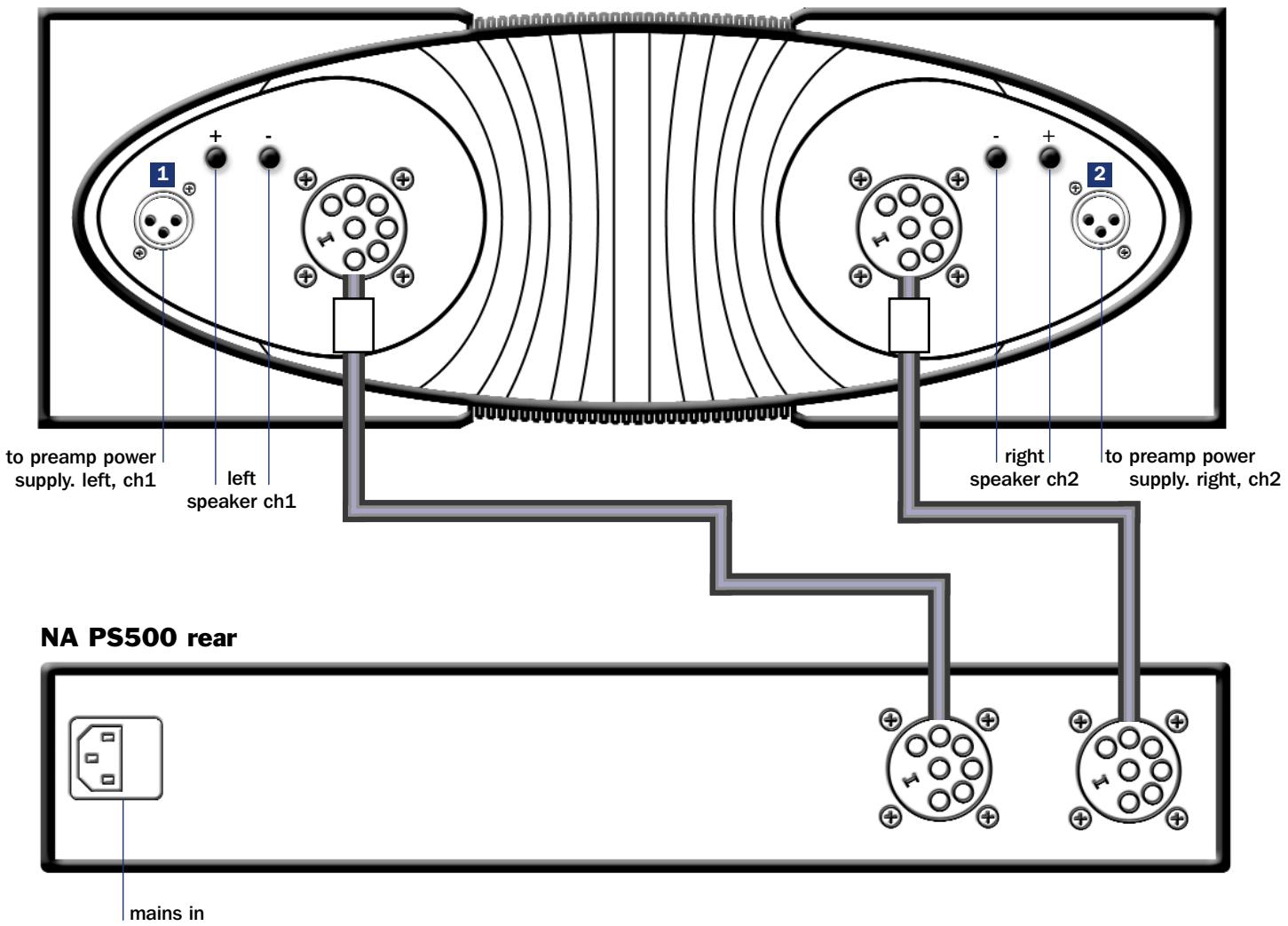
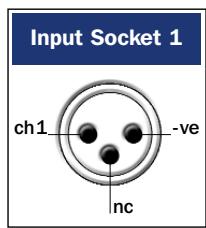
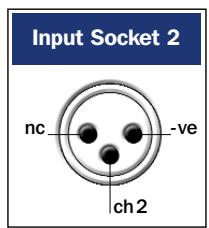
7.2 Specifications
NAP 500 & NA PS500
Power Output
| Continuous, 8 ohms | 140 Watts per channel |
| Transient | 700VA |
| Quiescent Power Consumption | 60VA |
| Voltage Gain | +29dB |
| Input Impedance | 18 kilohms |
| Frequency response | -3dB @ 1.5Hz and 100kHz |
| Mains Supply: | 100V. 115V. 230V - 50/60Hz |
| Case size (H x W x D) | |
| NAP 500 | 160 x 432 x 375mm |
| NA PS500 | 87 x 432 x 314mm |
Weight
| NAP 500 | 25.0kg |
| NA PS500 | 15.4kg |
NAP 300
8 Installation and Operation
The NAP 300 and NA PS300 should be installed in their final operating locations before connecting cables or switching on. Switch on the source and preamplifier components, with the volume turned down, before switching on the NAP 300. The NAP 300 power button is located on the front panel on the NA PS300 Power Supply.
Care should be taken when siting the NAP 300 to ensure that the underside fan inlet and rear outlet are not obstructed e.g by carpet in the case of the inlet.
The NAP 300 is very heavy and care should be taken when lifting or moving it. Make sure that the surface it is to be placed on can support the full weight.
8.1 connections notes
The negative input and output connections for each channel are common. The mains earth (ground) should always be connected regardless of what other equipment is used in conjunction with Naim power amplifiers. This only grounds the case and the electrostatic screen within the transformer, and is not connected to the signal negative. In order to avoid hum loops, the signal negative of the whole system should be connected to the mains earth (ground) in one place. This should be the primary signal source.
8.2 protection notes
In the NAP 300 the fan speed is increased in response to an increase in amplifier dissipation. If the amplifier reaches 70°C due to prolonged running at high level or to airflow being blocked, the output will be interrupted and the fan will run at full speed until it has cooled down. This may take a few minutes.
It is not necessary to switch the amplifier off, but it may be advisable to mute the preamplifier or turn the volume down to avoid surprises when it comes back on.
OPERATION OF THE AMPLIFIER'S THERMAL PROTECTION SUGGESTS PROLONGED USE AT TOO HIGH A VOLUME LEVEL. YOUR LOUDSPEAKERS MAY BE AT RISK IF THIS IS THE CASE. THE VOLUME SHOULD BE REDUCED.
8.3 loudspeaker cable and connectors
Only Naim Audio speaker cable should be used to connect a loudspeaker to the output of the NAP 300. Custom Naim Audio loudspeaker connectors are supplied to make the connection. IN ORDER TO COMPLY WITH CURRENT EUROPEAN SAFETY REGULATIONS IT IS ESSENTIAL THAT THESE ARE USED.
DAMAGE TO THE AMPLIFIER MAY RESULT IF “HIGH DEFINITION” CABLE OR ANY OTHER SPECIAL CABLE IS USED TO CONNECT THE LOUDSPEAKERS.
NAP 300 Connection & Specifications
9.1 NAP 300 connection to NA PS300 Power Supply
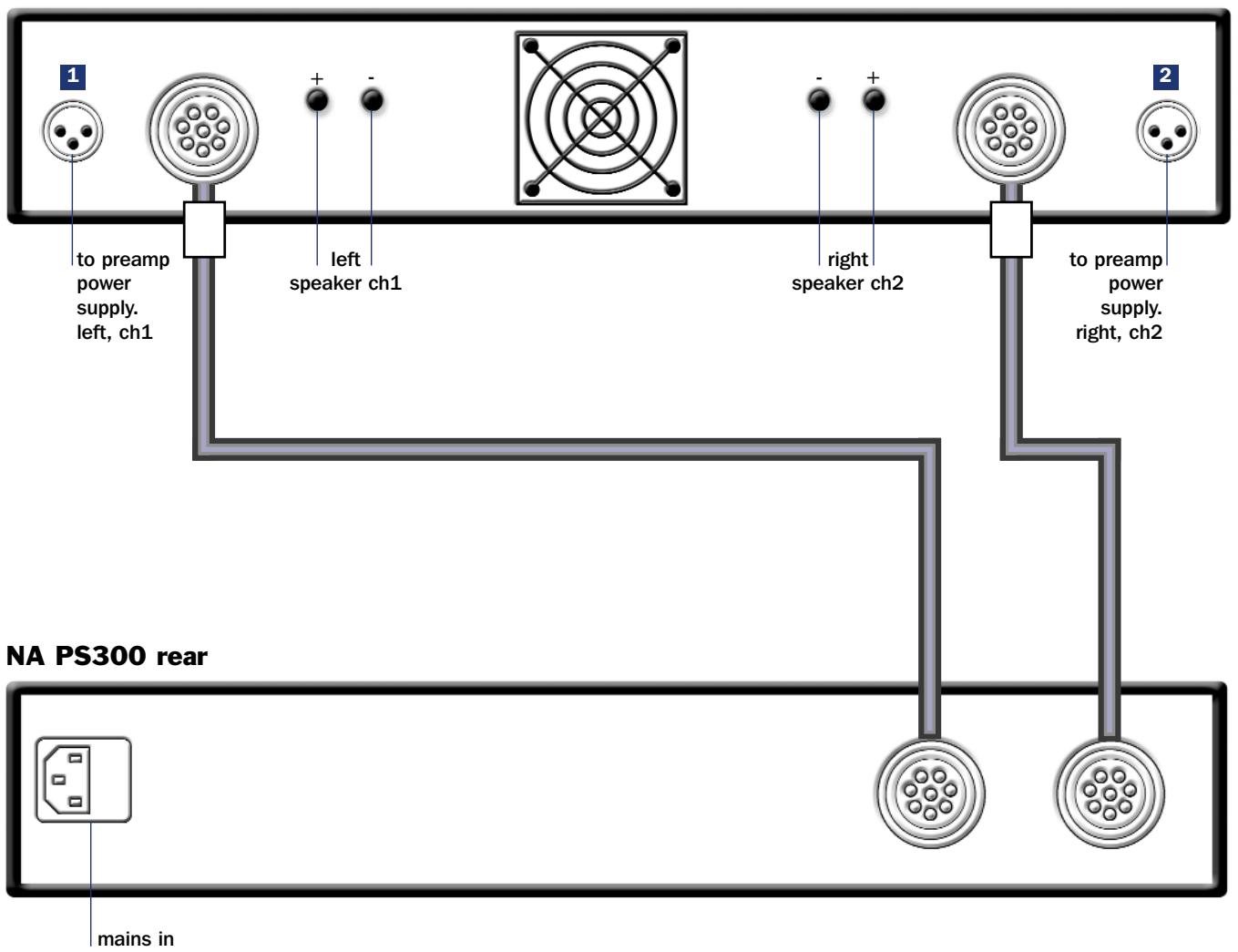
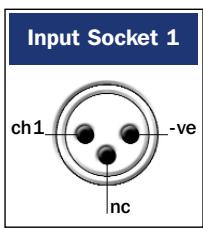
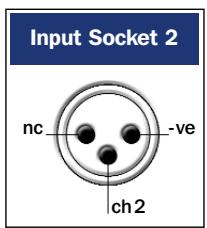
9.2 Specifications
NAP 300 & NA PS300
Power Output
Continuous, 8 ohms 90 Watts per channel
Transient 500VA
Quiescent Power Consumption 27VA
Voltage Gain +29dB
Input Impedance 18 kilohms
Frequency response -3dB @ 2Hz and 70kHz
Mains Supply: 100V. 115V. 230V - 50/60Hz
Case size (H x W x D)
NAP 300 87× 432× 314mm
NA PS300 87 x 432 x 314mm
Weight
NAP 300 10.7kg
NA PS300 14.1kg
NAP 250
10 Installation and Operation
The NAP 250 should be installed in its final operating location before connecting cables or switching on. Switch on the source and preamplifier components, with the volume turned down, before switching on the NAP 250. The NAP 250 power button is located on the front panel.
The NAP 250 is very heavy and care should be taken when lifting or moving it. Make sure that the surface it is to be placed on can support the full weight.
10.1 connection notes
The negative input and output connections are all common. The mains earth should always be connected regardless of what other equipment is used. This only grounds the case and the electrostatic screen within the transformer, and is not connected to the signal negative. In order to avoid hum loops, the signal negative of the whole system should be connected to the mains earth (ground) in one place. This should be the primary signal source.
10.2 protection notes
If the amplifier's external case reaches 70°C due to prolonged running at high power, the mains supply will be interrupted and the illuminated logo will switch off until the amplifier has cooled down. This may take up to thirty minutes.
OPERATION OF THE AMPLIFIER'S THERMAL PROTECTION SUGGESTS PROLONGED USE AT TOO HIGH A VOLUME LEVEL. YOUR LOUDSPEAKERS MAY BE AT RISK IF THIS IS THE CASE. THE VOLUME SHOULD BE REDUCED.
10.3 loudspeaker cable and connectors
Only Naim Audio speaker cable should be used to connect a loudspeaker to the output of the NAP 250. Custom Naim Audio loudspeaker connectors are supplied to make the connection. IN ORDER TO COMPLY WITH CURRENT EUROPEAN SAFETY REGULATIONS IT IS ESSENTIAL THAT THESE ARE USED.
DAMAGE TO THE AMPLIFIER MAY RESULT IF “HIGH DEFINITION” CABLE OR ANY OTHER SPECIAL CABLE IS USED TO CONNECT THE LOUDSPEAKERS.
NAP 250 Connection & Specifications
11.1 NAP 250 Rear
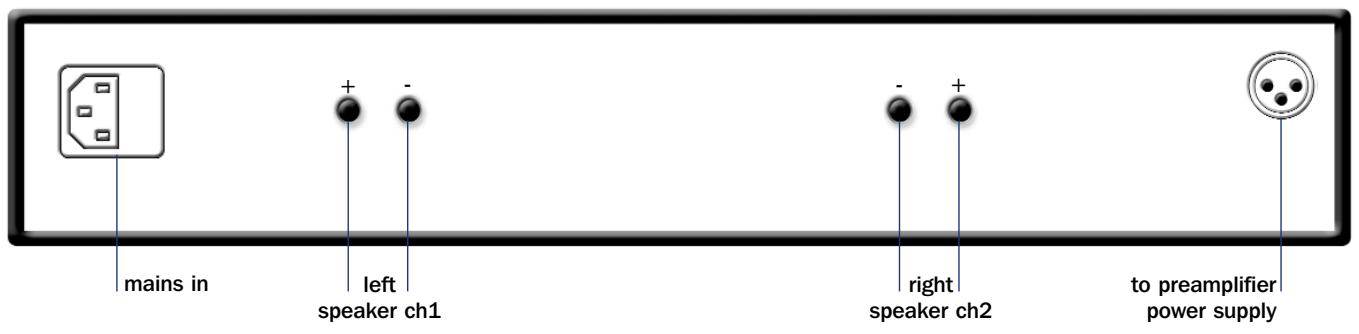
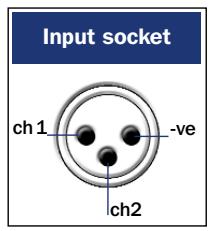
11.2 Specifications
NAP 250
Power Output:
Continuous, 8 ohms
Transient
Quiescent Power Consumption
Voltage Gain
Input Impedance
Frequency response
Case size (H x W x D)
Mains Supply:
Weight:
80 Watts per channel
400 VA
25VA
+29dB
18 kilohms
-3dB @ 2Hz and 65kHz
87× 432× 314mm
100V. 115V. 230V - 50/60Hz
15.8kg
NAP V145
12 Installation and Operation
The NAP V145 is a mono power amplifier intended for use in audio-visual home-theatre systems.
The NAP V145 should be installed in its final operating location before connecting cables or switching on. Switch on the source and preamplifier components, with the volume turned down, before switching on the NAP V145. The NAP V145 power button is located on the front panel.
The NAP V145 is very heavy and care should be taken when lifting or moving it. Make sure that the surface it is to be placed on can support the full weight.
12.1 connection notes
The negative input and output connections are all common. The mains earth should always be connected regardless of what other equipment is used. This only grounds the case and the electrostatic screen within the transformer, and is not connected to the signal negative. In order to avoid hum loops, the signal negative of the whole system should be connected to the mains earth (ground) in one place. This should be the primary signal source.
12.2 protection notes
If the amplifier's external case reaches 70°C due to prolonged running at high power, the mains supply will be interrupted and the illuminated logo will switch off until the amplifier has cooled down. This may take up to thirty minutes.
OPERATION OF THE AMPLIFIER'S THERMAL PROTECTION SUGGESTS PROLONGED USE AT TOO HIGH A VOLUME LEVEL. YOUR LOUDSPEAKERS MAY BE AT RISK IF THIS IS THE CASE. THE VOLUME SHOULD BE REDUCED.
12.3 loudspeaker cable and connectors
Only Naim Audio speaker cable should be used to connect a loudspeaker to the output of the NAP V145. Custom Naim Audio loudspeaker connectors are supplied to make the connection. IN ORDER TO COMPLY WITH CURRENT EUROPEAN SAFETY REGULATIONS IT IS ESSENTIAL THAT THESE ARE USED.
DAMAGE TO THE AMPLIFIER MAY RESULT IF "HIGH DEFINITION" CABLE OR ANY OTHER SPECIAL CABLE IS USED TO CONNECT THE LOUDSPEAKERS.
NAP V145 Connection & Specifications
13.1 NAP V145 Rear
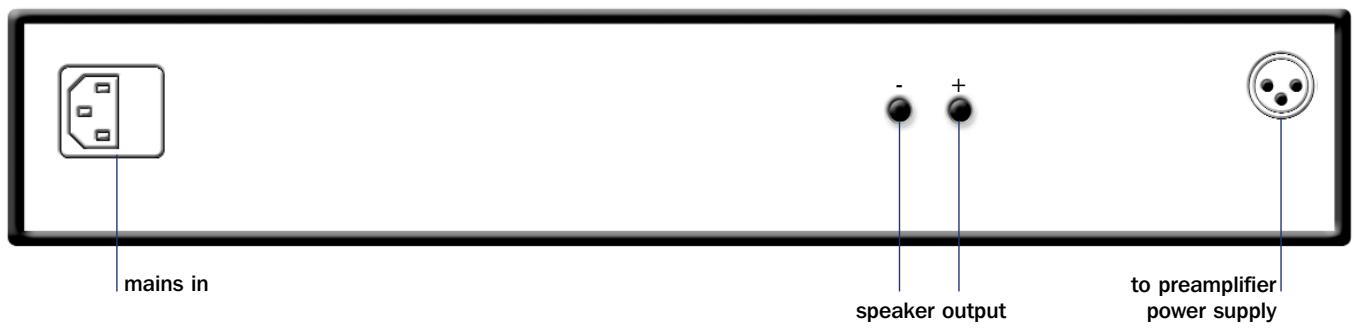
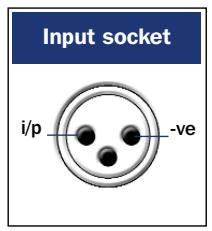
13.2 Specifications
NAP V145
Power Output:
Continuous, 8 ohms
80 Watts
Transient
400 VA
Quiescent Power Consumption
15VA
Voltage Gain
+29dB
Input Impedance
18 kilohms
Frequency response
-3dB @ 2Hz and 65kHz
Case size (H x W x D)
87× 432× 314mm
Mains Supply:
100V. 115V. 230V - 50/60Hz
Weight:
15.8kg
NAP 200 & NAP 150
14 Installation and Operation
The NAP 200 or NAP 150 should be installed in its final operating location before connecting cables or switching on. Switch on the source and preamplifier components, with the volume turned down, before switching on the NAP 200 or NAP 150. The NAP 200 power button is located on the front panel. The NAP 150 power button is located on the rear panel.
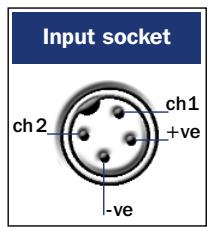
Both the NAP 200 and NAP 150 can provide power for an appropriate Naim Audio preamplifier. The power supply output is carried on the DIN input socket.
The NAP 200 and NAP 150 are heavy and care should be taken when lifting or moving them. Make sure that the surface they are to be placed on can support their full weight.
14.1 connection notes
The negative input and output connections are all common. The mains earth should always be connected regardless of what other equipment is used. This only grounds the case and the electrostatic screen within the transformer, and is not connected to the signal negative. In order to avoid hum loops, the signal negative of the whole system should be connected to the mains earth (ground) in one place. This should be the primary signal source.
14.2 protection notes
If the amplifier's external case reaches 70°C due to prolonged running at high power, the mains supply will be interrupted and the illuminated logo will switch off until the amplifier has cooled down. This may take up to thirty minutes.
OPERATION OF THE AMPLIFIER'S THERMAL PROTECTION SUGGESTS PROLONGED USE AT TOO HIGH A VOLUME LEVEL. YOUR LOUDSPEAKERS MAY BE AT RISK IF THIS IS THE CASE. THE VOLUME SHOULD BE REDUCED.
14.3 loudspeaker cable and connectors
Only Naim Audio speaker cable should be used to connect a loudspeaker to the output of the amplifier. Custom Naim Audio loudspeaker connectors are supplied to make the connection. IN ORDER TO COMPLY WITH CURRENT EUROPEAN SAFETY REGULATIONS IT IS ESSENTIAL THAT THESE ARE USED.
DAMAGE TO THE AMPLIFIER MAY RESULT IF "HIGH DEFINITION" CABLE OR ANY OTHER SPECIAL CABLE IS USED TO CONNECT THE LOUDSPEAKERS.
NAP 200 & NAP 150 Connection & Specifications
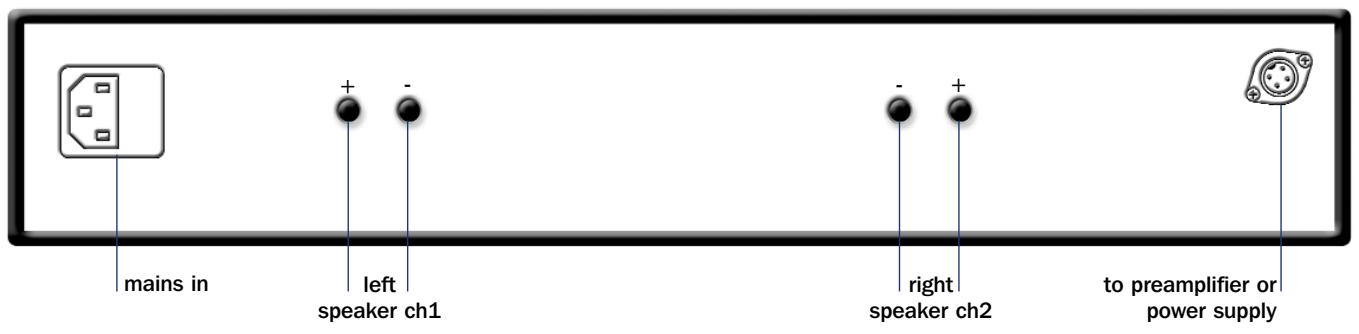
15.1 NAP 200 Rear
15.2 Specifications
NAP 200
Power Output:
Continuous, 8 ohms 70 Watts per channel
Transient 300 VA
Quiescent Power Consumption 11VA
Voltage Gain +29dB
Input Impedance 18 kilohms
Frequency response -3dB @ 2Hz and 65kHz
Power Supply Output 24V,0.3A
Case size (H x W x D) 87 x 432 x 314mm
Mains Supply: 100V. 115V. 230V - 50/60Hz
Weight: 11.6kg
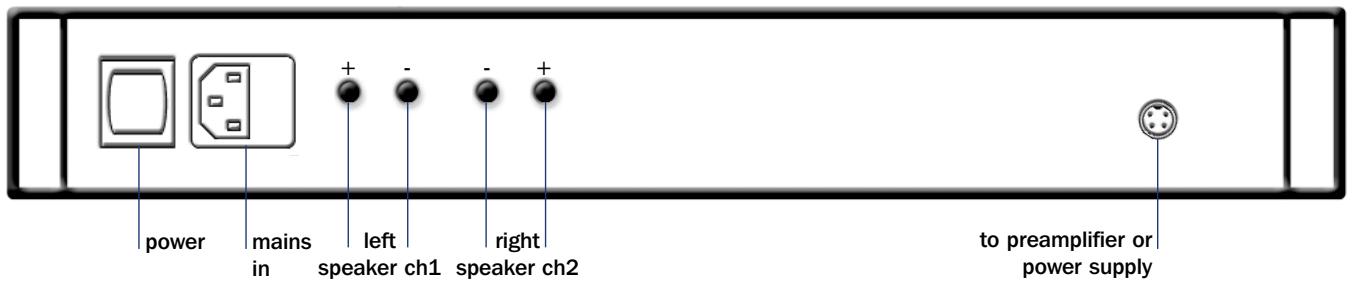
15.3 NAP 150 Rear
15.4 Specifications
NAP 150
Power Output:
Continuous, 8 ohms 50 Watts per channel
Transient 250 VA
Quiescent Power Consumption 10VA
Voltage Gain +29dB
Input Impedance 18 kilohms
Frequency response -3dB @ 3Hz and 50kHz
Power Supply Output 24V,0.3A
Case size (H x W x D) 69.4 x 432 x 301mm
Mains Supply: 100V. 115V. 230V - 50/60Hz
Weight: 7.5kg
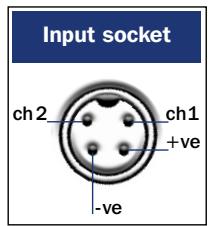
NAP V175
16 Installation and Operation
The NAP V175 is a three channel power amplifier intended for use in audio-visual home-theatre systems. The three channels provide audio power to drive a centre channel speaker and a pair of either main front or surround channel speakers. Audio line level input is via two 4-pin DIN sockets - one for the centre channel and one for the main or surround pair.
The NAP V175 should be installed in its final operating location before connecting cables or switching on. Switch on the source and preamplifier components, with the volume turned down, before switching on the NAP V175. The NAP V175 power button is located on the rear panel.
The NAP V175 is heavy and care should be taken when lifting or moving it. Make sure that the surface it is to be placed on can support the full weight.
16.1 connection notes
The mains earth grounds only the case and the electrostatic screen within the transformer and is not connected to the signal negative. The mains earth must always be connected to "ground" regardless of any other equipment used. In order to avoid hum-loops the signal negative of the whole system should be connected to the mains earth in one place. This should be the primary signal source.
16.2 operation and protection
Once installed the NAP V175 is intended to remain permanently powered up via its rear panel switch. If the internal heatsink reaches 70°C due to prolonged running at very high dissipation the mains supply will be interrupted and the indicator light will go off until the amplifier has cooled down. This may take up to thirty minutes.
OPERATION OF THE AMPLIFIER'S THERMAL PROTECTION SUGGESTS PROLONGED USE AT TOO HIGH A VOLUME LEVEL. YOUR LOUDSPEAKERS MAY BE AT RISK IF THIS IS THE CASE. THE VOLUME SHOULD BE REDUCED.
16.3 loudspeaker cable and connectors
Only Naim Audio speaker cable should be used to connect a loudspeaker to the output of the NAP V175. Custom Naim Audio loudspeaker connectors are supplied to make the connection. IN ORDER TO COMPLY WITH CURRENT EUROPEAN SAFETY REGULATIONS IT IS ESSENTIAL THAT THESE ARE USED.
DAMAGE TO THE AMPLIFIER MAY RESULT IF “HIGH DEFINITION” CABLE OR ANY OTHER SPECIAL CABLE IS USED TO CONNECT THE LOUDSPEAKERS.
NAP V175 Connection & Specifications
17.1 NAP V175 Rear
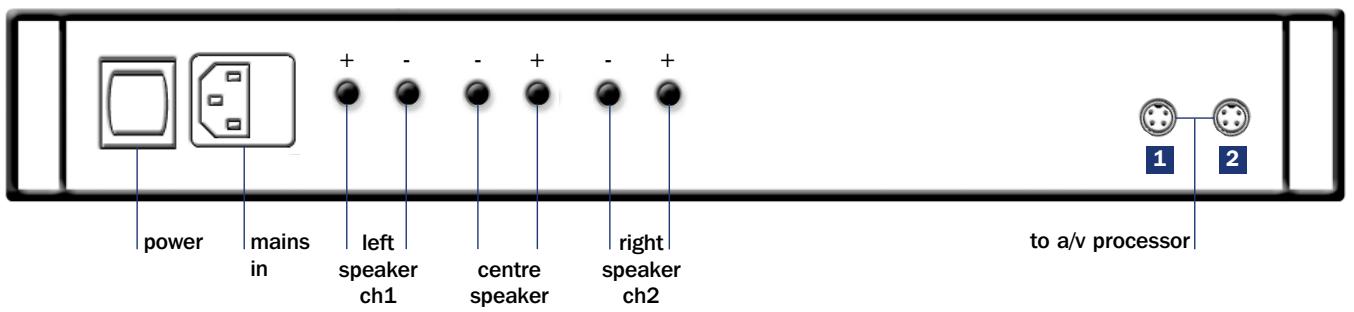
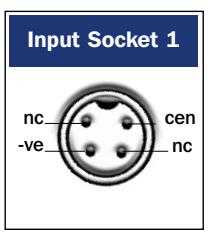
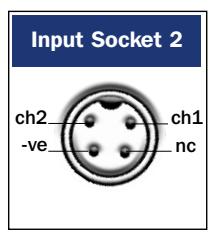
17.2 Specifications
NAP V175
Power Output:
Continuous, 8 ohms
Quiescent Power Consumption
Channels
Voltage Gain
Input Impedance
Frequency response
Case size (H x W x D)
Mains Supply:
Weight:
50 Watts per channel
13VA
Three
+29dB
18 kilohms
-3dB @ 3Hz and 50kHz
69.4 x 432 x 301mm
100V. 115V. 230V - 50/60Hz
7.9kg
Declaration of conformity to appropriate standards
Manufacturer
Naim Audio Limited, Southampton Road, Salisbury, England, SP1 2LN
Products
NAP 500, NA PS500, NAP 300, NA PS300, NAP 250, NAP V145, NAP 200, NAP 150, NAP V175
Safety
HD 195-S6
EN 60 065
EMC
Emissions Tested to:
Immunity Tested to:
In accordance with:
EN 55013 - Sound and television broadcast receivers and associated equipment
EN55020 - Electromagnetic immunity of broadcast receivers and associated equipment
CISPR 16-1 - Radio disturbance and immunity measuring apparatus
CISPR 16-2 Methods of measurement of disturbances and immunity
IEC 801-2 8KV (air gap) 4KV (contact) (performance criterion B)
IEC 801-3 3V/m 20dB (performance criterion A)
IEC 801-4 1KV (AC lines) 0.5KV (signal lines) (performance criterion B)



- INTRODUCTION
- 1 EQUIPMENT INSTALLATION
- 2 CABLES AND CONNECTIONS
- 3 GETTING STARTED
- 3.1 SWITCHING ON AND OFF
- 3.2 RUNNING IN
- CONTENTS
- 3.3 MAINS SUPPLY
- IMPORTANT
- 3.4 SITING THE EQUIPMENT
- 3.5 IF YOU HAVE A PROBLEM
- 4WARNINGS
- 5 CONNECTION
- 5.1 MAINS LEAD
- 5.2 NON-REWIREABLE MAINS PLUGS
- 5.3 FUSE CARRIER
- 5.4 PLUG FUSES
- NOTE
- NAP 500
- 6 INSTALLATION AND OPERATION
- 6.1 CONNECTIONS NOTES
- 6.2 PROTECTION NOTES
- 6.3 LOUDSPEAKER CABLE AND CONNECTORS
- NAP 500 CONNECTION & SPECIFICATIONS
- 7.1 NAP 500 CONNECTION TO NA PS500 POWER SUPPLY
- 7.2 SPECIFICATIONS
- NAP 500 & NA PS500
- NAP 300
- 8 INSTALLATION AND OPERATION
- 8.1 CONNECTIONS NOTES
- 8.2 PROTECTION NOTES
- 8.3 LOUDSPEAKER CABLE AND CONNECTORS
- NAP 300 CONNECTION & SPECIFICATIONS
- 9.1 NAP 300 CONNECTION TO NA PS300 POWER SUPPLY
- 9.2 SPECIFICATIONS
- NAP 300 & NA PS300
- NAP 250
- 10 INSTALLATION AND OPERATION
- 10.1 CONNECTION NOTES
- 10.2 PROTECTION NOTES
- 10.3 LOUDSPEAKER CABLE AND CONNECTORS
- NAP 250 CONNECTION & SPECIFICATIONS
- 11.1 NAP 250 REAR
- 11.2 SPECIFICATIONS
- NAP V145
- 12 INSTALLATION AND OPERATION
- 12.1 CONNECTION NOTES
- 12.2 PROTECTION NOTES
- 12.3 LOUDSPEAKER CABLE AND CONNECTORS
- NAP V145 CONNECTION & SPECIFICATIONS
- 13.1 NAP V145 REAR
- 13.2 SPECIFICATIONS
- NAP 200 & NAP 150
- 14 INSTALLATION AND OPERATION
- 14.1 CONNECTION NOTES
- 14.2 PROTECTION NOTES
- 14.3 LOUDSPEAKER CABLE AND CONNECTORS
- NAP 200 & NAP 150 CONNECTION & SPECIFICATIONS
- 15.2 SPECIFICATIONS
- NAP 200
- 15.4 SPECIFICATIONS
- NAP 150
- NAP V175
- 16 INSTALLATION AND OPERATION
- 16.1 CONNECTION NOTES
- 16.2 OPERATION AND PROTECTION
- 16.3 LOUDSPEAKER CABLE AND CONNECTORS
- NAP V175 CONNECTION & SPECIFICATIONS
- 17.1 NAP V175 REAR
- 17.2 SPECIFICATIONS
- DECLARATION OF CONFORMITY TO APPROPRIATE STANDARDS
- MANUFACTURER
- PRODUCTS
- SAFETY
- EMC
Marque : NAIM
Modèle : NAP 150
Catégorie : Amplificateur de puissance