
VP6 - Carte mère ABIT - Notice d'utilisation et mode d'emploi gratuit
Retrouvez gratuitement la notice de l'appareil VP6 ABIT au format PDF.


| Type de produit | Carte mère |
| Marque | ABIT |
| Modèle | VP6 |
| Chipset | VIA Apollo Pro 133A (VT82C694X + VT82C686B) |
| Processeurs supportés | Intel Pentium III (FC-PGA) simple ou double, jusqu’à 1 GHz, FSB 100/133 MHz |
| Socket(s) | 2 x Socket 370 (ZIF) |
| Mémoire vive (RAM) | 4 x DIMM 168 broches, SDRAM PC100/PC133, max 2 Go, support ECC |
| Emplacements d'extension | 1 x AGP 4X (3,3 V), 5 x PCI |
| Stockage IDE | 4 canaux IDE (2 standard + 2 RAID) : IDE1/IDE2 (Ultra ATA/33/66/100), IDE3/IDE4 via HPT370 (RAID 0/1/0+1) |
| Ports USB | 4 ports USB (2 à l'arrière + 2 via en-tête) |
| Connecteurs I/O arrière | PS/2 clavier, PS/2 souris, 2 x COM (RS-232), 1 x parallèle (EPP/ECP), 2 x USB |
| En-têtes internes | IrDA, Wake-on-LAN, Wake-on-Modem, SM Bus, 2 x USB additionnels, FAN CPU, FAN châssis |
| Contrôleur RAID | HighPoint HPT370 – support ATA-100, RAID 0, 1, 0+1, jusqu’à 4 périphériques IDE |
| BIOS | Award BIOS Plug-and-Play, fonction Soft Menu III pour réglages CPU, protection antivirus |
| Dimension | 305 x 245 mm (format ATX) |
| Alimentation requise | ATX, veille 5 VSB 720 mA pour Wake-on-LAN/Modem |
| Fonction de surveillance | Monitoring matériel intégré (tensions, température CPU/système, vitesse ventilateurs) |
| Contenu du coffret | Carte mère, 2 nappes IDE ATA-66/100, nappe disquette, CD pilotes, manuel, câble USB additionnel |
| Entretien | Déconnecter l'alimentation avant nettoyage ; utiliser un chiffon doux et sec. Éviter les liquides |
| Sécurité | Décharger l'électricité statique avant toute manipulation (bracelet antistatique conseillé). Ne pas toucher les circuits imprimés |
| Réparabilité | Pieces détachées non disponibles individuellement. Pour toute panne, contacter le revendeur ou ABIT |
FOIRE AUX QUESTIONS - VP6 ABIT
Questions des utilisateurs sur VP6 ABIT
0 question sur cet appareil. Repondez a celles que vous connaissez ou posez la votre.
Poser une nouvelle question sur cet appareil
Téléchargez la notice de votre Carte mère au format PDF gratuitement ! Retrouvez votre notice VP6 - ABIT et reprennez votre appareil électronique en main. Sur cette page sont publiés tous les documents nécessaires à l'utilisation de votre appareil VP6 de la marque ABIT.
MODE D'EMPLOI VP6 ABIT
Copyright and Warranty Notice
The information in this document is subject to change without notice and does not represent a commitment on part of the vendor, who assumes no liability or responsibility for any errors that may appear in this manual.
No warranty or representation, either expressed or implied, is made with respect to the quality, accuracy or fitness for any particular part of this document. In no event shall the manufacturer be liable for direct, indirect, special, incidental or consequential damages arising from any defect or error in this manual or product.
Product names appearing in this manual are for identification purpose only and trademarks and product names or brand names appearing in this document are the property of their respective owners.
This document contains materials protected under International Copyright Laws. All rights reserved. No part of this manual may be reproduced, transmitted or transcribed without the expressed written permission of the manufacturer and authors of this manual.
If you do not properly set the motherboard settings, causing the motherboard to malfunction or fail, we cannot guarantee any responsibility.
| As of December 31, | ||
| 2017 | 2016 | |
| (In thousands) | ||
| Amounts Payable and Commitments: | ||
| Amounts payable to NagraStar | 1,485,937 | 1,485,937 |
CHAPTER 1. INTRODUCTION OF VP6 FEATURES. 1-1
1-1. FEATURES OF THIS MOTHERBOARD 1-1
1-2. SPECIFICATIONS 1-2
1-3. ITEM CHECKLIST 1-3
1-4. LAYOUT DIAGRAM 1-4
CHAPTER 2. INSTALLING THE MOTHERBOARD. 2-1
2-1. INSTALLING THE MOTHERBOARD TO THE CHASSIS 2-1
2-2. INSTALLATION OF THE INTEL® PENTIUM III (FC-PGA) PROCESSORS 2-2
2-3. DUAL PROCESSOR KNOWLEDGE YOU SHOULD KNOW 2-3
2-4. INSTALLING SYSTEM MEMORY 2-3
2-5. CONNECTORS, HEADERS AND SWITCHES 2-5
CHAPTER 3. INTRODUCING THE BIOS. 3-1
3-1. CPU SETUP [SOFT MENU™ III] 3-2
3-2. STANDARD CMOS FEATURES SETUP MENU 3-5
3-3. ADVANCED BIOS FEATURES SETUP MENU 3-9
3-4. ADVANCED CHIPSET FEATURES SETUP MENU 3-13
3-5. INTEGRATED PERIPHERALS 3-17
3-6. POWER MANAGEMENT SETUP MENU 3-21
3-7. PNP/PCI CONFIGURATIONSETPUMLN 3-28
3-8. PC HEALTH STATUS 3-32
3-9. LOADFAIL-SAFEDEFAULTS 3-33
3-10. LOAD OPTIMIZED DEFAULTS 3-33
3-11. SET PASSWORD 3-34
3-12. SAVE & EXIT SETUP 3-35
3-13. EXIT WITHOUT SAVING 3-36
CHAPTER 4. RAID SETTING GUIDE 4-1
4-1. THE FEATURES OF RAID ON THE VP6 4-1
4-2. RAID SETUP ON THE VP6 4-1
4-3. THE BIOS SETTING MENU 4-2
4-3-1. OPTION 1: CREATE RAID 4-2
4-3-2. OPTION 2: DELETE RAID 4-4
4-3-3. OPTION 3: DUPLICATE MIRROR DISK 4-4
4-3-4. OPTION 4: CREATE SPARE DISK 4-5
4-3-5. OPTION 5: REMOVE SPARE DISK 4-5
4-3-6. OPTION 6: SET DRIVE MODE. 4-5
4-3-7. OPTION 7: SELECT BOOT DISK 4-6
CHAPTER 5. HPT370 SOFTWARE INSTALLATION.. 5-1
5-1. DOS 5-1
5-2. WINDOWS 9x.. 5-1
5-3. WINDOWS NT® 4.0 5-5
5-4. WINDOWS 2000 5-9
5-5. HPT370 DISK ARRAY UTILITY INSTALLATION GUIDE 5-13
APPENDIX A. INSTALLING THE VIA SERVICE PACK DRIVERS FOR WINDOWS® 98 SE. A-1
APPENDIX B. INSTALLING THE VIA USB FILTER DRIVER FOR WINDOWS® 98 SE. B-1
APPENDIX C. INSTALLING THE VIA SERVICE PACK DRIVERS FOR WINDOWS NT 4.0 SERVER / WORKSTATION....C-1
APPENDIX D. INSTALLING THE VIA SERVICE PACK DRIVERS FOR WINDOWS® 2000....................................D-1
APPENDIX E. BIOS UPDATE GUIDE. E-1
APPENDIX F. INSTALLING THE VIA HARDWARE MONITOR SYSTEMF-1
APPENDIX G. TROUBLESHOOTING (NEED ASSISTANCE?) .........G-1
APPENDIX H. HOW TO GET TECHNICAL SUPPORT. .H-1
Chapter 1. Introduction of VP6 Features
1-1. Features of This Motherboard
This motherboard is designed for Intel's new generation of Intel® Pentium® III processors. It supports the Intel® Pentium® III (Dual or Single) processors, with the FC-PGA 370-Pin design. Up to 2 GB of the memory, newer support I/O and Green PC functions.
The VP6 uses the VIA Apollo Pro 133A chipset with the addition of 133MHz capability for both the CPU and SDRAM interfaces, increasing the speed of the system and memory buses from 100MHz to 133MHz . The VP6 provides you expandability for the USB port. It can give you a maximum of four USB ports to connect to USB peripherals. The additional two USB port plugs and cable kit are a standard feature.
The VP6 offers Ultra ATA-100 capability. This provides speedier HDD throughput that boosts overall system performance. UP to eight IDE devices can be supported by your system. Eight of these can be either Ultra ATA-33 IDE devices, Ultra ATA-66 IDE devices or Ultra ATA-100 IDE devices. The VP6 also supports RAID. RAID levels 0, 1 and 0 + 1 are all supported (HDD connected to IDE3 & IDE4).
The VT82C686B PSIPC (PCI Super I/O Integrated Peripheral Controller) has built-in hardware monitoring functions. This will monitor and protect your computer, ensuring a safe computing environment. It also supports the PS/2 keyboard, PS/2 mouse and hot key wake up features, letting you easily wake up your system through these devices. This motherboard can provide high performance and dual processor operation for workstations and severs.
The VP6 uses ABIT's BIOS Technology - Soft Menu III. The ABIT Soft Menu III technology not only lets you configure CPU settings easily but also lets you have a greater choice of CPU FSB clock settings.
The VP6 provides high flexibility to users building Pentium® III level systems. It provides the option of 100/133MHz CPU and memory bus combinations. You can choose the different combinations and don't need to upgrade many new components to change to this motherboard.
The VP6 has built-in hardware monitoring functions (you can refer to Appendix F for detailed information), which can monitor and protect your computer ensuring a safe computing environment. The motherboard can provide high performance for servers and meets the requirements for desktop systems multimedia demands of the future.
1-2. Specifications
1. CPU
- Supports Intel® Pentium® III 500 ~ 1GHz processors (Based on FC-PGA package, both dual or single processors)
Supports 100 and 133MHz CPU external clock speeds - Reserves support for future Intel® Pentium® III processors
2. Chipset
- VIA chipset (VT82C694X and VT82C686B)
Supports Ultra DMA/33, Ultra DMA/66 and Ultra DMA/100 IDE protocol
Supports Advanced Configuration and Power Management Interface (ACPI) - Accelerated Graphics Port connector supports AGP 1X/2X/4X mode (Sideband) 3.3V device
HighPoint Technologies, Inc. HPT 370 chipset:
Supports ATA-100 specifications
- Automatically fine tunes each IDE/ATAPI device to the best performance
- Concurrent PIO and bus master access (ATA port accessible during DMA transfer)
Detailed specifications:
- Ultra DMA 100MB/sec data transfer rate
- RAID 0 (stripping mode for boosting performance)
- RAID 1 (mirroring mode for data security)
- RAID 0 + 1 (stripping and mirroring)
- Two independent ATA channels
256 Byte FIFO per ATA channels - Compliant with Plug & Play
-
Up to 4 IDE devices supported
-
Drive Modes Support
Ultra 5/4/3/2/1/0
PIO 4/3/2/1/0
DMA 2/1/0
BIOS Support
- Friendly UI for RAID functions settings
-
Auto detects and supports Ultra Mode(ATA/EIDE) transfers
Recognizes drives up to 128 GB -
Operating System Supports
-
Microsoft® DOS® 5.X and above
- Microsoft® Windows® 95/98
- Microsoft® Windows® 2000
- Microsoft® Windows® NT4.0
3. Memory (System Memory)
- Four 168-pin DIMM sockets support SDRAM modules
Supports up to 2GB MAX. (8, 16, 32, 64, 128, 256 and 512MB SDRAM)
Supports ECC
4. System BIOS
- CPU SOFT MENU™ III, can easily set the processor parameters
- Award Plug and Play BIOS supports APM and DMI
Write-ProTECT Anti-Virus function by AWARD BIOS
5. Multi I/O Functions
- Two Channels of bus master IDE ports support Ultra DMA 33/66/100 (up to 4 HDD devices)
- Two Channels of bus master IDE ports support Ultra DMA 33/66/100 (up to 4 HDD devices)
- One PS/2 keyboard and One PS/2 mouse connector
- One floppy port connector (up to 2.88MB)
- One parallel port connector (EPP/ECP)
- Two serial port connectors
- Two USB connectors
- On board USB header for two extra USB channels
Built-in IrDA TX-RX header
6. Miscellaneous
ATX form factor
- One AGP slot, five PCI slots
Built-in Wake on LAN header
Built-in Wake On Modem header
Built-in SM bus header
- Hardware monitoring : Included fan speed, voltages, CPU and system environment temperature
- Board size: 305 * 245 mm
-
Supports Wake On LAN and Modem, but your ATX power supply 5V standby power must be able to provide at least a 720mA current capacity. Otherwise, the functions may not work normally.
-
The 66MHz/100MHz/133MHz bus speeds are supported but not guaranteed due to the PCI, processor and chipset specifications.
- Specifications and information contained in this manual are subject to change without notice.
Note
All brand names and trademarks are the property of their respective owners.
1-3. Item Checklist
Check that your package is complete. If you discover any damaged or missing items, please contact your retailer or dealer.
One VP6 Motherboard
v Two 80-wire/40-pin ribbon cable for master and slave Ultra DMA/66, Ultra DMA/100 or Ultra DMA/33 IDE devices
One ribbon cable for 5.25" and 3.5" floppy disk devices
One compact disc for support drivers and utilities
One user's manual for the motherboard
One USB cable
Optional: DB-20 (Debug Card)
1-4. Layout Diagram
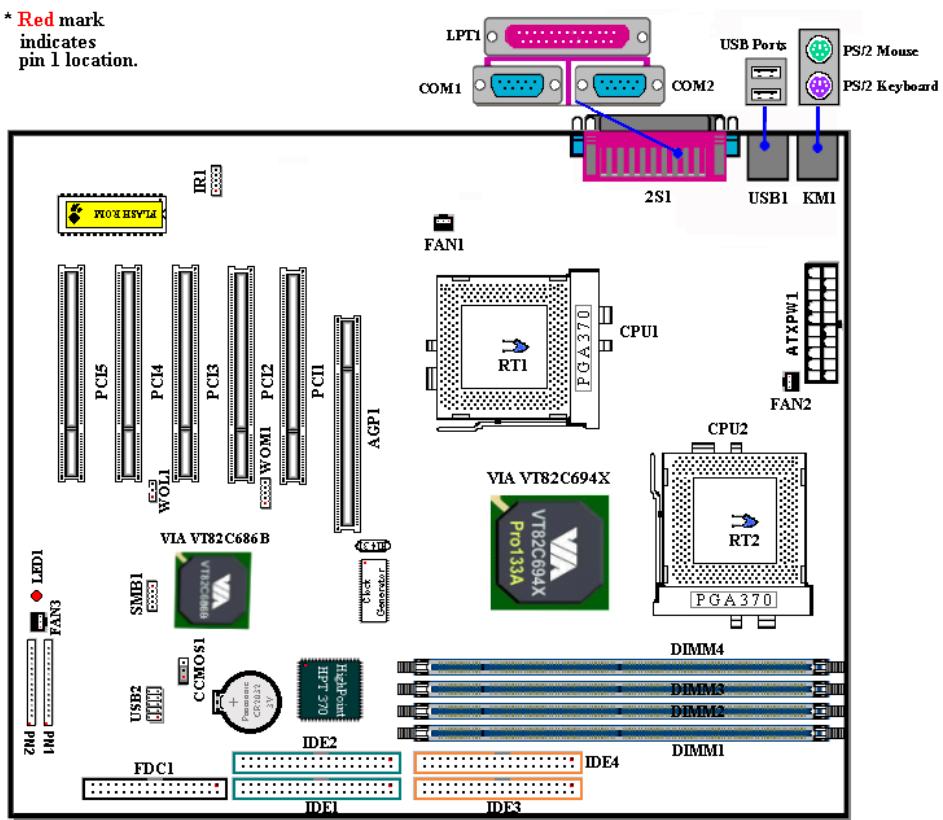
Figure 1-1. VP6 Motherboard component location
Chapter 2. Installing the Motherboard
This VP6 motherboard not only provides all standard equipment for classic personal computers, but also provides great flexibility for meeting future upgrade demands. This chapter will introduce step by step all of the standard equipment and will also present, as completely as possible, future upgrade capabilities. This motherboard is able to support all Intel® Pentium® III (FC-PGA) processors now on the market. (For details, see specifications in Chapter 1.)
This chapter is organized according the following features:
2-1. Installing the Motherboard to the Chassis
2-2. Installation of the Intel Pentium III (FC-PGA) CPU
2-3. Installing System Memory
2-4. Connectors, Headers and Switches

Before Proceeding with the Installation

Before you install or unplug any connectors or add-on cards, please remember to turn the ATX power supply switch off (fully turn the +5V standby power off), or take the power cord off. Otherwise, you may cause the motherboard components or add-on cards to malfunction or be damaged.
User Friendly Instructions
Our objective is to enable the novice computer user to perform the installation by himself. We have attempted to write this document in a very clear, concise and descriptive manner to help overcome any obstacles you may face during installation. Please read our instructions carefully and follow them step-by-step.
2-1. Installing the Motherboard to the Chassis
Most computer chassis will have a base on which there will be many mounting holes that allows the motherboard to be securely attached and at the same time, prevents short circuits. There are two ways to attach the motherboard to the base of chassis:
with studs
or with spacers
Please refer to figure 2-1, which shows the studs and spacers. There may be several types, but all look like the figures below:
In principle, the best way to attach the motherboard is with studs. Only if you are unable to do this should you attach the board with spacers. Take a careful look at the motherboard and you will see
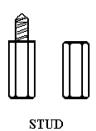
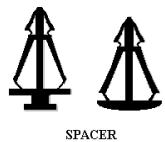
Figure 2-1. The outline of stub and spacer
many mounting holes on it. Line these holes up with the mounting holes on the base. If the holes line up and there are screw holes this means you can attach the motherboard with studs. If the holes line up and there are only slots, this means you can only attach the motherboard with spacers. Take the tip of the spacers and insert them into the slots. After doing this to all the slots, you can slide the motherboard into position aligned with the slots. After the motherboard has been positioned, check to make sure everything is OK before putting the casing back on.
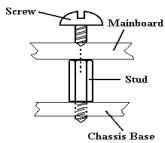
Figure 2-2 shows you the way to affix the motherboard using studs or spacers:
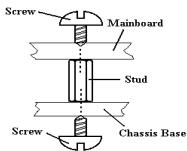

Figure 2-2. The way we fixed the motherboard
Note
If the motherboard has mounting holes, but they don't line up with the holes on the base and there are no slots to attach the spacers, don't worry, you can still attach the spacers to the mounting holes. Just cut the bottom portion of spacers (the spacer they may be a little hard to cut, so be careful with your hands). In this way you can still attach the motherboard to the base without worrying about short circuits. Sometimes you may need to use the plastic springs to isolate the screw from the motherboard PCB surface, because the circuit wire may be near by the hole. Be careful, don't let the screw contact any the printed circuit wire or parts on the PCB that are near the fixing hole, otherwise it may damage the board or cause board malfunctioning.
2-2. Installation of the Intel® Pentium® III (FC-PGA) processors
The Intel® Pentium® III (FC-PGA) package processor installation is easy, like the Socket 7 Pentium® processors before. Because it uses the "Socket 370" ZIF (Zero Insertion Force) socket, it lets you easily fix the processor into its position firmly. Figure 2-3 shows you what the 370 socket looks like, and how to open the lever. Its pin count is more than the socket 7. Therefore, a Pentium level processor cannot be inserted into the socket 370.
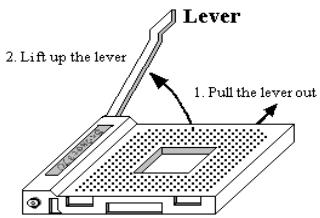
Figure2.3. Socket 370 and open its lever
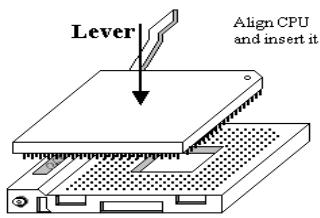
Figure 2-4. Install the CPU into socket 370
When you raise the lever, you have to loosen the socket lock. Please raise the lever to the end, and prepare to insert the processor. Next, you need to align the processor pin 1 to the socket pin 1. If you put it in the wrong direction, you will not be able to insert the processor easily, and processor pins will not fully go into the socket. If that is the case, please change the direction, until it easily and fully inserts into the 370 socket. See Figure 2-4.
When you finish the above, push the lever down to its original position, and you should feel the lever lock up the 370 socket. You have then finished the processor installation.
2-3. Dual Processor Knowledge You Should Know
The VP6 is designed for sever lever and workstation environments. The VP6 supports Intel® SMP (Symmetric Multiple Processor) specs, it is equipped with two Socket 370 sockets with which you can install two Pentium® III processors. Of course, you can also install only one Pentium® III processor as well. When you install a single Pentium® III processor to one of each Socket 370 socket, no specific boot processor socket needs to be selected.
To install two Pentium® III processors, there are some things you need to be aware of, otherwise, you will not be able to boot your system. The following values must be identical for both processors:
- Processor speed
L2 cache size - Operating voltages
NOTE: If the processor operating voltages for either VCC core or VCC L2 do not match, the computer will not boot.
For best performance, you should use an OS (Operating System) that supports multi-processors. These OSes which can support multi-processor functions include: Microsoft Windows NT (3.5x, 4.x and 5.x), Windows 2000, SCO UNIX, FreeBSD 3.0 or later, Linux, etc.
Of course, you can use Microsoft® Windows® 3.1, Windows® 95 or Windows® 98 SE, but they do not support the SMP specs, the two processors' performance will be the same as using a single processor.
2-4. Installing System Memory
This motherboard provides four 168-pin DIMM sites for memory expansion. The DIMM sockets support 1Mx64 (8MB), 2Mx64 (16MB), 4Mx64 (32MB), 8Mx64 (64MB), 16Mx64 (128MB), 32Mx64 (256MB) and 64Mx64 (256MB) or double sided DIMM modules. Minimum memory size is 8MB and maximum memory size is 2GB SDRAM. There are four memory module sockets on the system board. (Total eight banks)
In order to create a memory array, certain rules must be followed. The following set of rules allows for optimum configurations.
- The memory array is 64 or 72 bits wide. (depending on with or without parity)
- Those modules should be populated in DIMM1 to DIMM4 by orders.
Supports single and double density DIMMS.
Table 2-1. Valid Memory Configurations
| Bank | Memory Module | Total Memory |
| Bank 0, 1 (DIMM1) | 8MB, 16MB, 32MB, 64MB, 128MB, 256MB, 512MB | 8MB ~ 512MB |
| Bank 2, 3 (DIMM2) | 8MB, 16MB, 32MB, 64MB, 128MB, 256MB, 512MB | 8MB ~ 512MB |
| Bank 4, 5 (DIMM3) | 8MB, 16MB, 32MB, 64MB, 128MB, 256MB, 512MB | 8MB ~ 512MB |
| Bank 6, 7 (DIMM3) | 8MB, 16MB, 32MB, 64MB, 128MB, 256MB, 512MB | 8MB ~ 512MB |
| Total System Memory | 8MB ~ 2GB | |
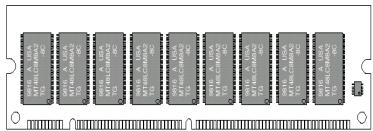
Figure 2-5 PC100/PC133 Module and Component Mark
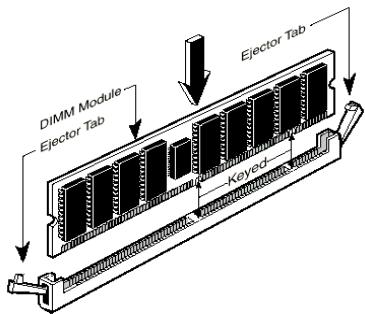
Figure 2-6. Memory module installation
Generally, installing SDRAM modules to your motherboard is an easy thing to do. You can refer to figure 2-5 to see what a 168-pin PC100 & PC133 SDRAM module looks like.
Unlike installing SIMMs, DIMMs may be "snapped" directly into the socket. Note: Certain DIMM sockets have minor physical differences. If your module doesn't seem to fit, please do not force it into the socket as you may damage your memory module or DIMM socket.
The following procedure will show you how to install a DIMM module into a DIMM socket.
Step 1. Before you install the memory module, please place the computer power switch in the off position and disconnect the AC power cord from your computer.
Step 2. Remove the computer's chassis cover.
Step 3. Before touching any electronic components, make sure you first touch an unpainted, grounded metal object to discharge any static electricity stored on your clothing or body.
Step 4. Locate your computer's 168-pin memory expansion DIMM socket.
Step 5. Insert the DIMM module into the expansion socket as shown in the illustration. Note how the module is keyed to the socket. You can refer to figure 2-6 for the details. This ensures the DIMM module will be plugged into the socket in one way only. Firmly press the DIMM module into the DIMM socket, making certain the module is completely seated in the DIMM socket.
Step 6. Once the DIMM module has been installed, the installation is complete and the computer's cover can be replaced. Or you can continue to install other devices and add-on cards that are mentioned in the following section.
Note
When you install a DIMM module fully into the DIMM socket, the eject tab should be locked into the DIMM module very firmly and fit into its indentation on the both sides.
It is difficult, from the outside, to distinguish between PC100 and PC133 SDRAM modules. The only way you can identify them is to look at the sticker on the RAM module. The sticker will show you the RAM module structure.
2-5. Connectors, Headers and Switches
Inside the case of any computer, several cables and plugs have to be connected. These cables and plugs are usually connected one-by-one to connectors located on the motherboard. You need to carefully pay attention to any connection orientation the cables may have and, if any, notice the position of the first pin of the connector. In the explanations that follow, we will describe the significance of the first pin.
We will show you all of the connectors, headers and switches here, and tell you how to connect them. Please pay attention and read the entire section for necessary information before attempting to finish all of the hardware installation inside the computer chassis.
Figure 2-7 shows you all of the connectors and headers that we'll discuss in the next section, you can use this diagram to visually locate each connector and header we describe.
All connectors, headers and switches mentioned here, will depend on your system configuration. Some features you may (or may not) have and need to connect or configure depending on the peripheral. If your system doesn't have such add-on cards or switches you can ignore some special feature connectors.
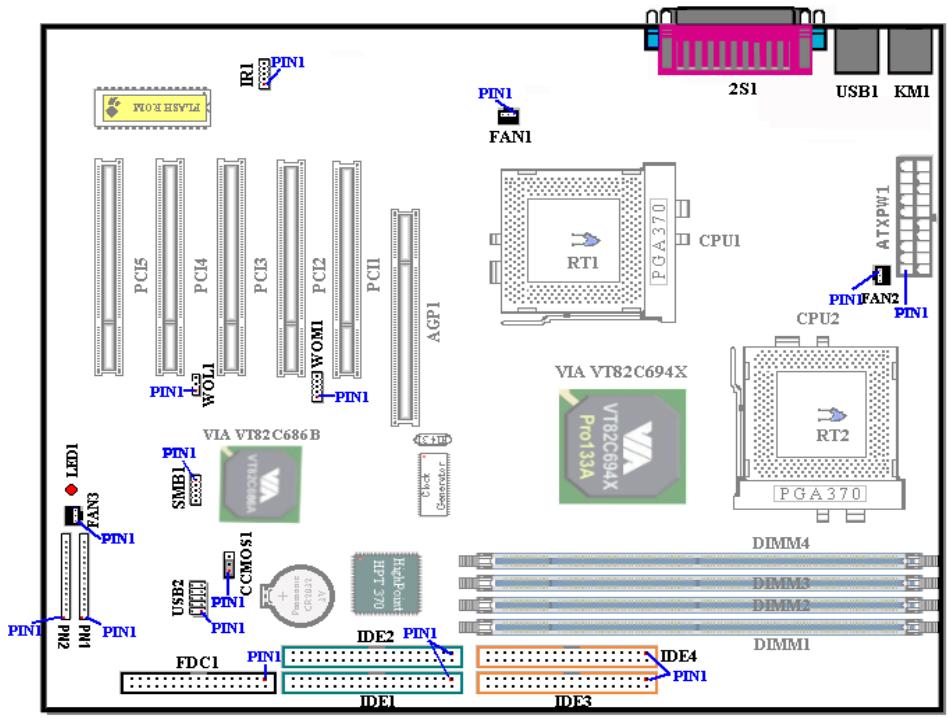
Figure 2-7. All Connectors and Headers for the VP6
First, Let's see the headers that the VP6 uses, and what their functions are.
(1).ATXPW1:ATX Power Input Connector
Caution
If the power supply connectors are not properly attached to the ATXPW1 power supply, the power supply or add-on cards may be damaged.
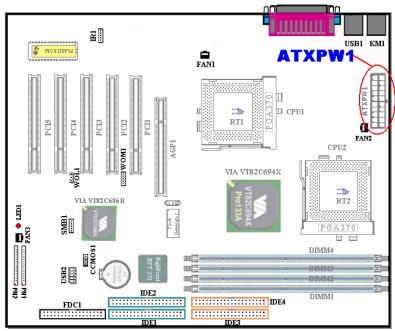
Attach the connector from the power supply to the ATXPW1 connector here. Remember you have to push the connector from the ATX power supply firmly to the end with the ATXPWR1 connector, insuring that you have a good connection.
Note: Watch the pin position and the orientation
(2). FAN1, FAN2 & FAN3 header
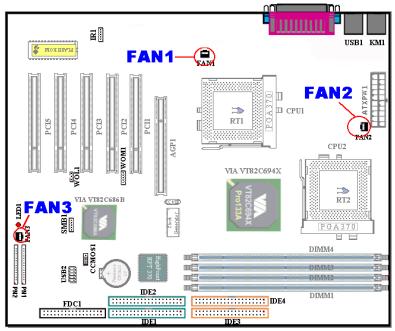
Attach the connector from the CPU1 fan to the header named FAN1, connector from the CPU2 fan to the header named FAN2, connector from the chassis fan to the header FAN3.
You must attach the CPU fan to the processor, or your processor will work abnormally or may be damaged by overheating. Also, if you want the computer case's internal temperature to be kept steady and not too high, you had better connect the chassis fan to reach this goal.
Note: Watch the pin position and the orientation
(3). IR1: IR Header (Infrared)
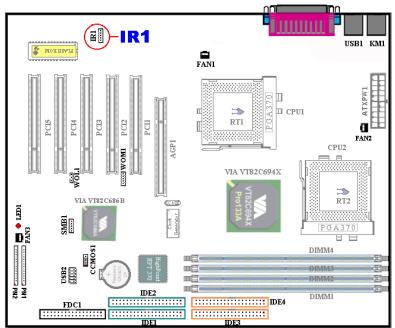
There is a specific orientation for pins 1 through 5, attach the connector from the IR KIT or IR device to the IR1 header. This motherboard supports standard IR transfer rates.
Note: Watch the pin position and the orientation
| Pin Number | Name or significance of signal | Pin Number | Name or significance of signal |
| 1 | +5V | 4 | Ground |
| 2 | No Connection | 5 | IR_TX |
| 3 | IR_RX |
Note: Watch the pin position and the orientation
(4). WOM1: Wake On Modem Header
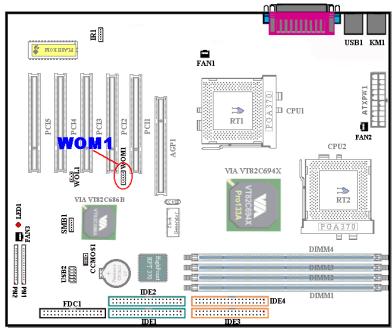
If you have an internal modem adapter that supports this feature, then you can connect the specific cable from the internal modem adapter to this header. This feature lets you wake up your computer via remote control through the modem.
There are three types of WOL, "Remote Wake-Up high (RWU-high)", "Remote Wake-Up low (RWU-low)", and "Power Management Event (PME)". This motherboard supports the type of "Remote Wake-Up low (RWU-low)" only.
Note: Watch the pin position and the orientation
(5). WOL1: Wake on LAN Header
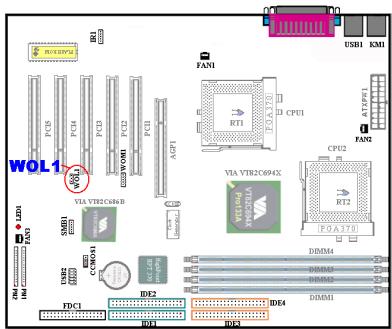
If you have a network adapter that supports this feature, then you can connect the specific cable from the network adapter to this header. This feature lets you wake up your computer via remote control through a local area network. You may need a specific utility to control the wake up event, like using the PCnet Magic Packet utility or other similar utilities.
Note: Watch the pin position and the orientation
(6). SMB1: System Management Bus Connector
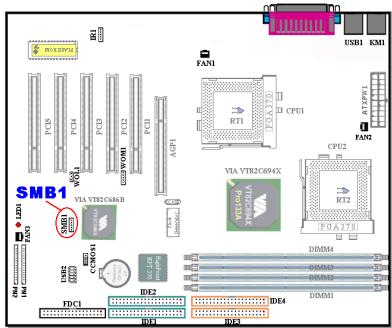
This connector is reserved for the system management bus (SM Bus). The SM Bus is a specific implementation of an I^2C bus. I^2C is a multi-master bus which means that multiple chips can be connected to the same bus and each one can act as a master by initiating a data transfer. If more than one master simultaneously tries to control the bus, an arbitration procedure decides which master gets priority. You can connect the ABIT Postman to this header, or other devices which utilizes the SM Bus.
Note: Watch the pin position and the orientation
(7). RT1 & RT2 Thermister:
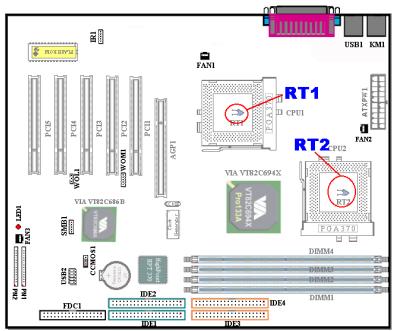
The RT1 thermistor is used to detect the CPU1 temperature. The RT2 thermistor is used to detect the CPU2 temperature.
(8). USB2 Headers: Additional USB Plugs Header
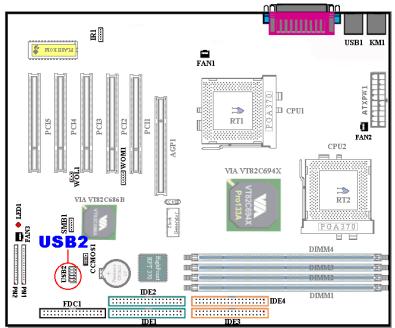
| Pin number | Name or significance of signal |
| 1 | NC |
| 2 | NC |
| 3 | VCC0 |
| 4 | VCC1 |
| 5 | Data - |
| 6 | Data1 - |
| 7 | Data + |
| 8 | Data1 + |
| 9 | Ground |
| 10 | Ground |
This header is for connecting the additional USB ports plugs. You can use the special USB port cable. It provides you an additional two USB plugs. You can fix these USB plugs on the back panel.
(9). CCMOS1: CMOS Discharge Jumper

Jumper CCMOS1 discharges CMOS memory. When you install the motherboard, make sure this jumper is set for normal operation (pin 1 and 2 shorted). See figure 2-8.
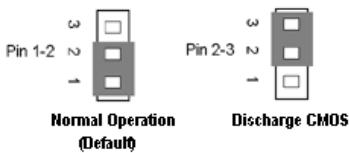
Figure 2-8. CCMOS1 jumper
Note
Before you clear the CMOS, you have to first turn the power off (including the +5V standby power). Otherwise, your system may work abnormally or malfunction.
(10). PN1 and PN2 Headers
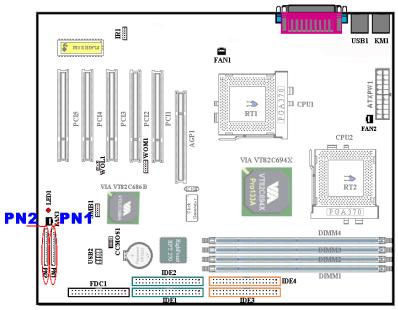
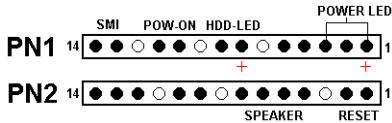
Figure 2-9.The definition of PN1 and PN2 pins
PN1 and PN2 are switches and indicators for the chassis's front panel, there are several functions that come from these two headers. You have to watch the pin position and the orientation, or you may cause system malfunctions. Figure 2-9 shows you the PN1 and PN2 functions of the pins.
PN1 (Pin 1-2-3): Power LED Headers
There is a specific orientation for pins 1 through 3. Insert the three-threaded power LED cable into pins 1 3 Check to make sure the correct pins go into the correct connectors on the motherboard. If you install them in the wrong direction, the power LED light will not illuminate correctly.
Note: Watch the power LED pin position and orientation.
PN1 (Pin 7-8): HDD LED Header
Attach the cable from the case's front panel HDD LED to this header. If you install it in the wrong direction, the LED light will not illuminate correctly.
Note: Watch the HDD LED pin position and the orientation.
PN1 (Pin 10-11): Power on Switch Header
Attach the cable from the case's front panel power switch to this header.
PN1 (Pin 13-14): Hardware Suspend Switch (SMI Switch) Header
Attach the cable from the case's front panel suspend switch (if there is one) to this header. Use this switch to enable/disable the power management function by hardware.
Note: If ACPI function is enabled, this function will not work.
PN2 (Pin 1-2): Hardware Reset Switch Header
Attach the cable from the case's front panel Reset switch to this header. Press and hold the reset button for at least one second to reset the system.
PN2 (Pin 4-5-6-7): Speaker Header
Attach the cable from the system speaker to this header.
Let's now see the I/O connectors that the VP6 uses, and what their functions are.
(11). FDC1 Connector
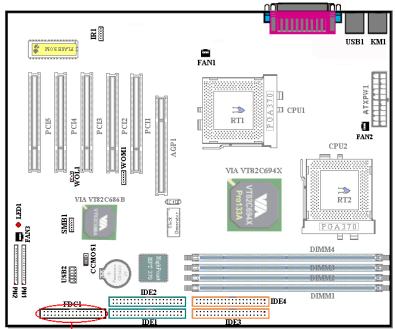
FDC1
This 34-pin connector is called the "floppy disk drive connector". You can connect a 360K, 5.25", 1.2M, 5.25", 720K, 3.5", 1.44M, 3.5" or 2.88M, 3.5" floppy disk drive, you can even connect a 3 Mode floppy disk drive (it's a 3 1 / 2 drive used in Japanese computer systems).
A floppy disk drive ribbon cable has 34 wires and two connectors to provide the connection of two floppy disk drives. After connecting the single end to the FDC1, connect the two connectors on the other end to the floppy disk drives. In general, people only install one floppy disk drive on their computer system.
Note
A red mark on a wire typically designates the location of pin 1. You need to align the wire pin 1 to the FDC1 connector pin 1, then insert the wire connector into the FDC1 connector.
(12). IDE1 and IDE2 Connectors
An IDE hard disk drive ribbon cable has 40 wires and two connectors to provide a connection for two IDE hard disk drives. After connecting the single end to the IDE1 (or IDE2), connect the two connectors on the
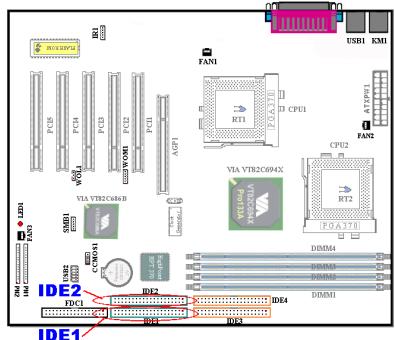
Before you install a hard disk, there are some things you need to be aware of:
"Primary" refers to the first connector on the motherboard, that is, the IDE1 connector on the motherboard.
"Secondary" refers to the second connector on the motherboard, that is, the IDE2 connector on the motherboard.
Two hard disks can be connected to each connector: The first HDD is referred to as the "Master", the second HDD is referred to as the "Slave".
For performance issues, we strongly suggest you not install the CD-ROM drive on the same IDE channel with hard disk. Otherwise, the system performance on this channel may drop. (dropping by how much depends on your CD-ROM drive performance.)
Note
- The Master or Slave status of the hard disk drive is set on the hard disk itself. Please refer to the hard disk drive user's manual.
- A red mark on a wire typically designates the location of pin 1. You need to align the wire pin 1 to the IDE1 (IDE2) connector pin 1, then insert the wire connector into the IDE1 (IDE2) connector.
(13) IDE3 and IDE4 Connectors
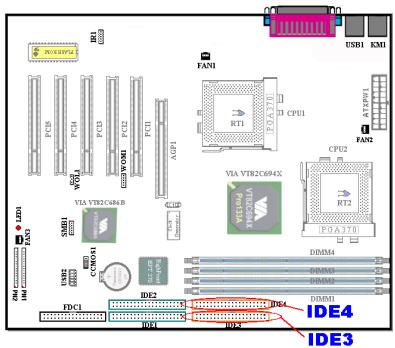
VP6's built-in HighPoint HPT370 chipset can provide you the capability to support ATA-100 specifications. It provides two IDE channels (IDE3, IDE4) that also support ATA-100 specifications, and it allows for four additional IDE devices in your computer system.
Note
To connect ATA-100 devices on IDE3 or IDE4, an Ultra ATA-66 cable is required.
There are four requirements for attaining Ultra ATA-66 and ATA-100:
- The drive must support Ultra ATA-66 or ATA-100.
- The motherboard and system BIOS (or an add-in controller) must support Ultra ATA/66 and ATA-100.
- The operating system must support Direct Memory Access (DMA), Microsoft® Windows® 98, Windows® 98 SE and Windows® 95B (OSR2) support DMA.
- The cable must be an 80-pin conductor. The length should not exceed 18 inches. If all of the above requirements are met, you can enjoy the Ultra ATA/66 and ATA-100 features of your computer system.
How to install the Ultra ATA-66 Cable Assembly:
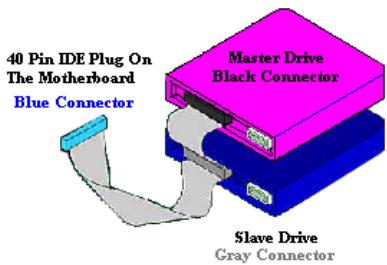
Figure 2-10. How to connect an ATA/66 Cable to the Motherboard
The BLUE connector MUST be plugged into the motherboard or your system will not work.
Each connector on the Ultra ATA-66 cable assembly has a small polarization tab centrally located on the body of the plastic. This fits into the matching slot on the mating plugs on the motherboard and the drives, thus assuring positive mating (pin #1 to pin #1)
The red line on the cable should be aligned with pin #1. On the drives this will result in the red line facing the power connector. Attach the BLUE connector to the appropriate 40 pin IDE plug on the motherboard.
- Attach the BLACK connector to the mating plug on the master hard drive. Attach the GREY connector to the
mating plug on the slave drive (secondary hard drive, CD-ROM, or tape drive). Please refer figure 2-10.
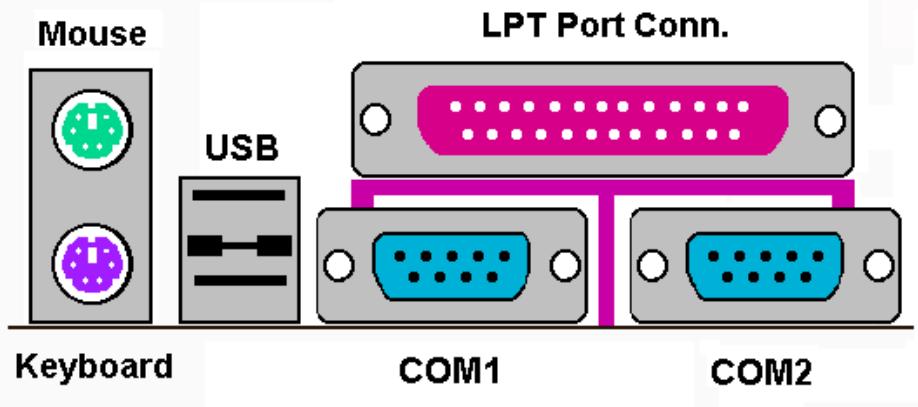
Figure 2-11. VP6 back panel connectors
Figure 2-11 shows the VP6 back panel connectors, these connectors are for connecting outside devices to the motherboard. We will describe which devices will attach to these connectors below.
KM1 Lower: PS/2 Keyboard Connector
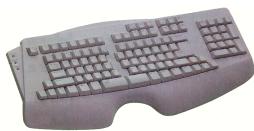
Attach a PS/2 keyboard connector to this 6-pin Din-connector. If you use an AT keyboard, you can go to a computer store to purchase an AT to ATX converter adapter, then you can connect your AT keyboard to this connector. We suggest you use a PS/2 keyboard for best compatibility.
KM1 Upper: PS/2 Mouse Connector
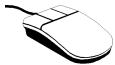
Attach a PS/2 mouse to this 6-pin Din-connector.
USB Port Connectors
This motherboard provides two USB ports. Attach the USB connector from the individual device to these connectors.
You can attach USB devices such as a, scanner, digital speakers, monitor, mouse, keyboard, hub, digital camera, joystick etc. to one of each USB connector. You must make sure your operating system supports this feature and you may need to install an additional driver for individual devices. Please refer to your device user's manual for detailed information.
Serial Port COM1 & COM2 Port Connector
This motherboard provides two COM ports, you can connect an external modem, mouse or other devices that support this communication protocol to these connectors.
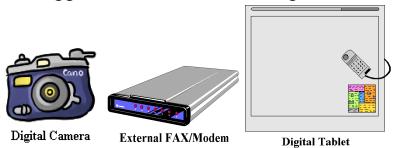
You can decide which external devices you want to connect to COM1 and COM2. Each COM port can only have one device connected at a time.
Parallel Port Connector
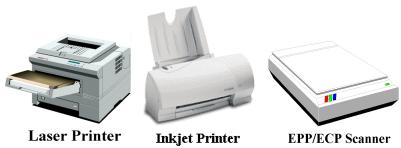
This parallel port is also called an "LPT" port, because it usually connects to the printer. You can connect other devices that support this communication protocol, like an EPP/ECP scanner, etc.
Note
This chapter contains many color drawing diagram and photos, we strongly recommend you to read this chapter use the PDF file we gave you that store in the CD-Title. It will provide you the better look and clearly color identify.

Chapter 3. Introducing the BIOS
The BIOS is a program located on a Flash Memory chip on the motherboard. This program will not be lost when you turn the computer off. This program is also referred to as the boot program. It is the only channel the hardware circuit has to communicate with the operating system. Its main function is to manage the setup of the motherboard and interface card parameters, including simple parameters such as time, date, hard disk drive, as well as more complex parameters such as hardware synchronization, device operating mode, CPU SOFT MENU™ III features and setup of CPU speed. The computer will operate normally, or will operate at its best, only if all of these parameters are correctly configured through the BIOS.

Figure 3-1. CMOS Setup Utility
Don't change the parameters inside the BIOS unless you fully understand the consequences
The parameters inside the BIOS are used to setup the hardware synchronization or the device-operating mode. If the parameters are not correct, they will produce errors, the computer will crash, and sometimes you will not even be able to boot the computer after it has crashed. We recommend that you do not change the parameters inside the BIOS unless you are very familiar with them. If you are not able to boot your computer anymore, please refer to the section "Erase CMOS data" in Chapter 2.
When you start the computer, the BIOS program controls it. The BIOS first operates an auto-diagnostic test called POST (Power On Self Test) for all of the necessary hardware. It then configures the parameters of the hardware synchronization, and detects all of the hardware. Only when these tasks are completed does it give up control of the computer to the program at the next level, which is the operating system (OS). Since the BIOS is the only channel for hardware and software to communicate, it is the key factor for system stability, and in insuring that your system performs at its best. After the BIOS has achieved the auto-diagnostic and auto-detection operations, it will display the following message:
PRESS DEL TO ENTER SETUP
The message will be displayed for three to five seconds, if you press the key, you will access the BIOS Setup menu. At that moment, the BIOS will display the following screen:
CMOS Setup Utility - Copyright (C) 1984-2000 Award Software
- SoftMenu III Setup
Standard CMOS Features
Advanced BIOS Features
Advanced Chipset Features
Integrated Peripherals
Power Management Setup
PnP/PCI Configurations
Esc : Quit F9:Menu in BIOS F10:Save&Exit Setup
PC Health Status
Load Fail-Safe Defaults
Load Optimized Defaults
Set Password
Save & Exit Setup
Exit Without Saving
↑↓→← :Select Item
Change CPU's Clock & Voltage
In the BIOS Setup main menu of Figure 3-1, you can see several options. We will explain these options step by step in the following pages of this chapter, but let us first see a short description of the function keys you may use here:
- Press Esc to quit the BIOS Setup.
- Press (up, down, left, right) to choose, in the main menu, the option you want to confirm or to modify.
- Press F10 when you have completed the setup of BIOS parameters to save these parameters and to exit the BIOS Setup menu.
- Press Page Up/Page Down or +/- keys when you want to modify the BIOS parameters for the active option.
Computer Knowledge: CMOS Data
Maybe you have heard somebody saying that his or her CMOS DATA was lost. What is the CMOS? Is it important? The CMOS is the memory used to store the BIOS parameters that you have configured. This memory is passive. You can read its data, and you can also store data in it. But this memory has to be powered by a battery, in order to avoid any loss of its data when the computer is turned off. Since you may have to change the CMOS battery when it is out of power and if doing so, you will loose all CMOS data, therefore, we recommend that you write down all the parameters of your hardware, or to put a label with these parameters on your hard disk.
3-1. CPU Setup [SOFT MENU™ III]
The CPU can be setup through a programmable switch (SOFT MENU™ III), that replaces the traditional manual hardware configuration. This feature allows the user to more easily complete the installation procedures. You can install the CPU without configuring any jumpers or switches. The CPU must be setup according to its specifications.
In the first option, you can press
![ABIT VP6 - 3-1. CPU Setup [SOFT MENU™ III] - 1](/content/2025/01/174598/images/b2dbf39e57085c71ddea4db6d9c94a6c8b890ceb21aa996aab6c9a1c5a326455.jpg)
Figure 3-2. CPU SOFT MENU III
CPU Name:
Intel Pentium III MMX
CPU Operating Speed:
This option sets the CPU speed. In this field, the CPU speed is indicated like this: CPU speed = External clock * Multiplier factor , select the CPU speed according to the type and the speed of your CPU. For Intel Pentium® III processors, you can choose the following settings:
>450 (100) >500 (100) >533 (133) >550 (100) >600 (100) >600 (133)
650(100) >667(133) >700(100) >733(133) >750(100) >800(100)
800(133) >850(100) >866(133) >900(100) >933(133) >1000(133)
User Define
User defined external clock and multiplier factor:
User Defined

Warning

The wrong settings of the multiplier and external clock in certain circumstances may cause CPU damage. Setting the working frequency higher than the specifications of PCI or of processor may cause abnormal memory module functioning, system hangs, hard disk drive data loss, abnormal functioning of the VGA card, or abnormal functioning with other add-on cards. Using non-specification settings for your CPU is not the intention of this explanation, for which should be used for engineering testing only, not for normal applications.
If you use non-specification settings for normal operation, your system may not be stable, and may affect system reliability. Also, we do not guarantee the stability and compatibility for settings that are not within specification, and any damage of any elements on the motherboard or peripherals, is not our responsibility.
Ext. Clock (PCI):
66MHz (1/2) >100MHz (1/3) >133MHz (1/4) >68MHz (1/2)
75MHz(1/2) >80MHz (1/2) >83MHz (1/2) >103MHz (1/3)
105MHz (1/3) >110MHz (1/3) >112MHz (1/3) >115MHz (1/3)
120MHz (1/3) >124MHz (1/4) >140MHz (1/4) >150MHz (1/4)
Note
CPU bus speed above 100MHz / 133MHz is supported but not guaranteed due to the PCI, processor and chipset specs.
Multiplier Factor:
You can choose the following multiplier factors:
3 3.5 4 4.5 5 5.5 6 6.5 7
> 7.5 > 8 > 8.5 > 9 > 9.5 > 10 > 10.5 > 11 > 11.5
12
However, differences will exist because of the various brands and types available.
Speed Error Hold:
The default setting is "Disabled". If you change the setting to "Enabled" when the CPU speed setting is wrong, the system will hold.
Normally, we do not recommend that you use the "User Define" option to setup CPU speed and multiplier factors. This option is for setup of future CPUs whose specifications are still unknown. The specifications of all present CPUs are included in the default settings. Unless you are very familiar with all CPU parameters, it is very easy to make mistakes when you define the external clock and the multiplier factor by yourself.
Solution in case of booting problem due to invalid clock setup:
Normally, if the CPU clock setup is wrong, you will not be able to boot. In this case, turn the system off then on again. The CPU will automatically use its standard parameters to boot. You can then enter the BIOS Setup again and set up the CPU clock. If you can't enter the BIOS setup, you must try turning the system on a few times (3~4 times) or press the "INSERT" key when turning on and the system will automatically use its standard parameters to boot. You can then enter BIOS SETUP again and set up the new parameters.
When you change your CPU:
This motherboard has been designed in such a way that you can turn the system on after having inserted a CPU in the socket without having to configure any jumpers or DIP switches. But if you change your CPU, normally you just have to turn off the power supply, change the CPU and then, set up the CPU parameters through SOFT MENU™ III. However, if the new CPU is slower than the old one (and is the same brand and type), we offer you two methods to successfully complete the CPU change operation.
Method 1: Setup up the CPU at the lowest speed for its brand. Turn the power supply off and change the CPU. Then turn the system on again, and set up the CPU parameters through SOFT MENU™ III.
Method 2: Since you have to open the computer case when you change the CPU, it would be a good idea to use the CCMOS jumper to erase the parameters of the original CPU and to enter BIOS Setup to set up CPU parameters again.
Attention
After setting up the parameters and leaving the BIOS SETUP, and having verified that the system can be booted, do not press the Reset button or turn off the power supply. Otherwise the BIOS will not read correctly, the parameters will fail and you must enter SOFT MENU™ III again to set up the parameters all over again.
DRAMClock:
Three options are available: Host CLK HCLK-PCICLK HCLK+PCICLK. The default setting is Host CLK. This option is used to set the working speed of SDRAM. It is the same as CPU working frequency, plus or minus PCI clock. An SDRAM working speed of over 133MHz will stay at 133MHz .
CPU Power Supply:
This option allows you to switch between CPU default and user-defined voltages.
CPU Default: The system will detect the CPU type and select the proper voltage automatically. When it is enabled, the option "Core Voltage" will show the current voltage setting that is defined by the CPU and this will not be changeable. We recommend using this CPU default setting and not changing it unless the current CPU type and voltage setting can not be detected or is not correct.
User Define: This option lets the user select the voltage manually. You can change the values of the "Core Voltage" and "VCC3 Voltage" option lists by using the and arrow keys.
CPU Hardwired IOQ:
Two options are available: 1 level 4 level. The default setting is 4 level. This option will affect the pipeline depth between the processor and chipset. Choose "4 level" to get faster performance, and "1 level" to get better stability.
3-2. Standard CMOS Features Setup Menu
This contains the basic configuration parameters of the BIOS. These parameters include date, hour, VGA card, FDD and HDD settings.
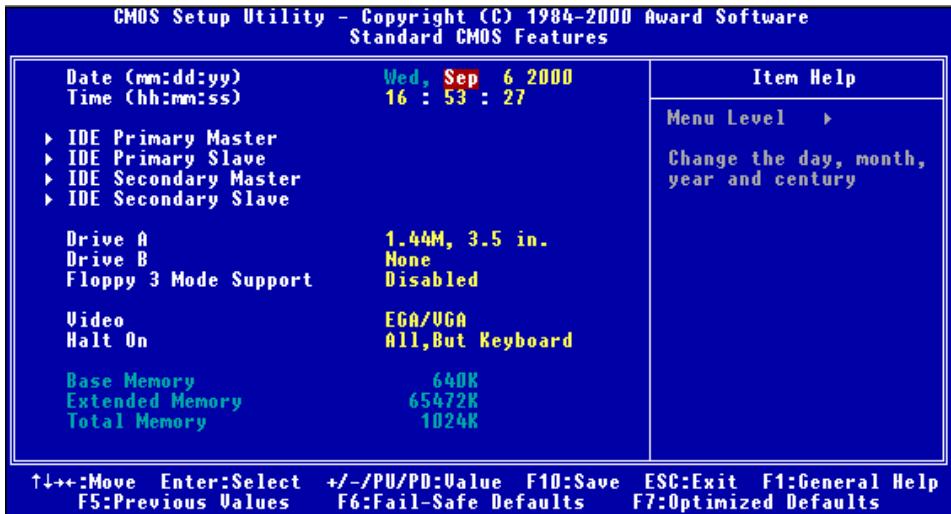
Figure 3-3A. Standard CMOS Setup Screen Shot
Date (mm:dd:yy):
You can set the date in this item: month (mm), date (dd) and year (yy).
Time (hh:mm:ss):
You can set the time in this item: hour (hh), minute (mm) and second (ss).
IDE Primary Master / Slave and IDE Secondary Master / Slave:
These items have a sub-menu to let you choose further options. You can refer to figure 3-3B to check what options are available.
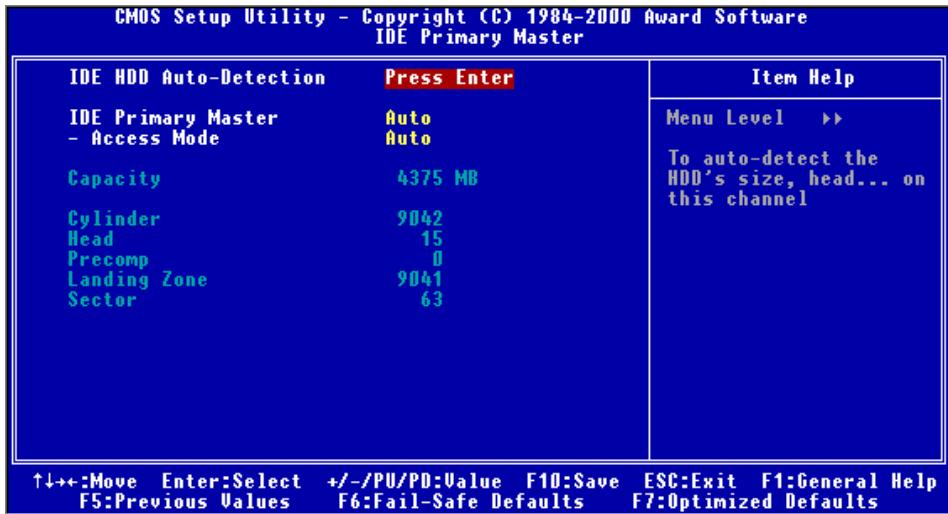
Figure 3-3B. IDE Primary Master Setup Screen Shot
IDE HDD Auto-Detection:
Press the Enter key for the BIOS to auto detect all detailed parameters of the hard disk drivers (HDD). If auto detection is successful, the correct values will be shown in the remaining items of this menu.
Note
A new IDE HDD must be first formatted, otherwise it can not read/write. The basic step in using a HDD is to run FDISK, and then FORMAT the drive. Most current HDDs have already been subjected to low-level format at the factory, so you can probably skip this operation. Remember though, the primary IDE HDD must have its partition set to active within the FDISK procedure.
If you are using an old HDD that is already formatted, auto detection can not detect the correct parameters. You may need to do a low-level format or set the parameters manually, and then check if the HDD is working.
IDE Primary Master:
Three settings are available: Auto, Manual and None. If you choose Auto, the BIOS will automatically check what kind of hard disk you are using. If you want to set the HDD parameters yourself, make sure you fully understand the parameters, and be sure to refer to the manual provided by the HDD manufacture to get the settings right.
Access Mode:
Since old operating systems were only able to support HDDs with capacities no bigger than 528MB, any hard disk with more than 528MB was unusable. AWARD BIOS features a solution to this problem: you can, according to your operating system, choose four operating modes: NORMAL LBA LARGE Auto.
The HDD auto detection option in the sub-menu will automatically detect the parameters of your hard disk and the mode supported.
> Auto:
The BIOS detects your HDD access mode and makes the decisions.
Normal mode:
Standard normal mode supports hard disks of up to 528MB or less. This mode directly uses positions indicated by Cylinders (CYLS), Heads, and Sectors to access data.
LBA (Logical Block Addressing) mode:
The earlier LBA mode can support HDD capacities of up to 8.4GB, and this mode uses a different method to calculate the position of disk data to be accessed. It translates Cylinders (CYLS), Heads and Sectors into a logical address where data is located. The Cylinders, Heads, and Sectors displayed in this menu do not reflect the actual structure of the hard disk, they are just reference values used to calculate actual positions. Currently, all high capacity hard disks support this mode, that's why we recommend you use this mode. Currently, the BIOS can support the INT 13h extension function, enabling the LBA mode to support hard disk drive capacities exceeding 8.4GB.
Large Mode:
When the number of cylinders (CYLs) of the hard disk exceeds 1024 and DOS is not able to support it, or if your operating system does not support LBA mode, you should select this mode.
Capacity:
This item auto displays your HDD size. Note that this size is usually slightly greater than the size given by a disk checking program of a formatted disk.
Note
All the items below are available when you set the item Primary IDE Master to Manual.
Cylinder:
When disks are placed directly above one another along the shaft, the circular vertical "slice" consisting of all the tracks located in a particular position is called a cylinder. You can set the number of cylinders for a HDD. The minimum number you can enter is 0, the maximum number you can enter is 65536.
Head:
This is the tiny electromagnetic coil and metal pole used to create and read back the magnetic patterns on the disk (also called the read/write head). You can configure the number of read/write heads. The minimum number you can enter is 0, the maximum number you can enter is 255.
Precomp:
The minimum number you can enter is 0, the maximum number you can enter is 65536.
Warning
Setting a value of 65536 means no hard disk exists.
Landing Zone:
This is a non-data area on the disk's inner cylinder where the heads can rest when the power is turned off. The minimum number you can enter is 0, the maximum number you can enter is 65536.
Sector:
The minimum segment of track length that can be assigned to stored data. Sectors usually are grouped into blocks or logical blocks that function as the smallest units of data permit. You can configure this item to sectors per track. The minimum number you can enter is 0, the maximum number you can enter is 255.
Driver A & Driver B:
If you have installed the floppy disk drive here, then you can select the type of floppy drive it can support. Six options are available: None 360K, 5.25 in. 1.2M, 5.25 in. 720K, 3.5 in. 1.44M, 3.5 in. 2.88M, 3.5 in.
Floppy 3 Mode Support:
Four options are available: Disabled Driver A Driver B Both. The default setting is Disabled. 3 Mode floppy disk drives (FDD) are 31/2 drives used in Japanese computer systems. If you need to access data stored in this kind of floppy, you must select this mode, and of course you must have a 3 Mode floppy drive.
Video:
You can select the VGA modes for your video adapter, four options are available: EGA/VGA CGA 40 CGA 80 MONO. The default setting is EGA/VGA.
Halt On:
You can select which type of error will cause the system to halt. Five options are available: All Errors No Errors All, But Keyboard All, But Diskette All, But Disk/Key.
You can see your system memory list in the lower right box, it shows the Base Memory, Extended Memory and total Memory size configurations in your system. It is detected by the system during boot-up procedure.
3-3. Advanced BIOS Features Setup Menu
In each item, you can press
Attention
Advanced BIOS Features Setup Menu has already been set for maximum operation. If you do not really understand each of the options in this menu, we recommend you use the default values.
CMOS Setup Utility - Copyright (C) 1984-2000 Award Software Advanced BIOS Features
Virus Warning
CPU Level 1 Cache
CPU Level 2 Cache
CPU L2 Cache ECC Checking
Processor Number Feature
Quick Power On Self Test
First Boot Device
Second Boot Device
Third Boot Device
Boot Other Device
Swap Floppy Drive
Boot Up Floppy Seek
Boot Up NumLock Status
Typematic Rate Setting
Typematic Rate (Chars/Sec)
Typematic Delay (Msec)
Security Option
MPS Version Control For OS
OS Select For DRAM > 64MB
Disabled
Enabled
Enabled
Enabled
Enabled
Enabled
Floppy
HDD-0
LS120
Enabled
Disabled
Disabled
0n
Enabled
30
250
Setup
1.1
Non-0S2
+ + - Move Enter:Select
F5:Previous Values
+/-/PU/PD:Value F10:Save
F6:Fail-Safe Defaults
ESC:Exit F1:General Help
F7:Optimized Defaults

Figure 3-4A. Advanced BIOS Features Setup Upper Screen
Figure 3-4B. Advanced BIOS Features Setup Lower Screen
Virus Warning:
This item can be set to Enabled or Disabled, the default setting being Disabled.
When this feature is enabled, if there is any attempt from software or an application to access the boot sector or the partition table, the BIOS will warn you that a boot virus is attempting to access the hard disk.
CPU Level 1 Cache:
This item is used to enable or to disable the CPU level 1 cache. When the cache is set to Disabled it is much slower, so the default setting for this item is Enabled since it will speed up memory access. Some old and very poorly written programs will make the computer malfunction or crash if the system speed is too high. In this case, you should disable this feature. The default setting is Enabled.
CPU Level 2 Cache:
This item is used to enable or to disable the CPU level 2 cache. When the external cache is enabled, it will speed up memory access, and the system works faster. The default setting is Enabled.
CPU L2 Cache ECC Checking:
This item is used to enable or to disable the CPU level 2 cache ECC checking function. The default setting is Enabled.
Processor Number Feature
This feature can let the program read the data inside your processor. This feature only works with Intel® Pentium® III processors. When you install a Pentium® III processor on your motherboard and boot your system, this item will appear in the BIOS.
Two items will be available: Enabled and Disabled. When you choose Enabled, the specific program can read your processor's serial number. When you choose Disabled it will not allow the program to read your processor's serial number. The default setting is Enabled.
Quick Power On Self Test:
After the computer has been powered on, the BIOS of the motherboard will run a series of tests in order to check the system and its peripherals. If the Quick Power on Self-Test feature is enable, the BIOS will simplify the test procedures in order to speed up the boot process. The default setting is Enabled.
First Boot Device:
When the computer boots up, the BIOS attempts to load the operating system from the devices in the sequence selected in these items: floppy disk drive A, LS/ZIP devices, hard drive C, SCSI hard disk drive or CD-ROM. There are ten options for the boot sequence that you can choose (The default setting is Floppy.).
Floppy LS120 HDD-0 SCSI CDROM HDD-1 HDD-2 HDD-3 ZIP100 LAN ATA100RAID Disabled.
Second Boot Device:
Description is the same as the First Boot Device, the default setting is HDD-0.
Third Boot Device:
Description is same as the First Boot Device, the default setting is LS120
Boot Other Device:
Two options are available: Enabled or Disabled. The default setting is Enabled. This setting allows the BIOS to try three kinds of boot devices that set from the above three items.
Swap Floppy Drive:
This item can be set as Enabled or Disabled. The default setting is Disabled. When this feature is enabled, you don't need to open the computer case to swap the position of floppy disk drive connectors. Drive A can be set as drive B and drive B can be set as drive A.
Boot Up Floppy Seek:
When the computer boots up, the BIOS detects if the system has an FDD or not. When this item is enabled, if the BIOS detects no floppy drive, it will display a floppy disk drive error message. If this item is disabled, the BIOS will skip this test. The default setting is Disabled.
Boot Up NumLock Status:
On: At boot up, the Numeric Keypad is in numeric mode. (Default Settings)
Off: At boot up, the Numeric Keypad is in cursor control mode.
Typematic Rate Setting:
This item allows you to adjust the keystroke repeat rate. When set to Enabled, you can set the two keyboard typematic controls that follow (Typematic Rate and Typematic Rate Delay). If this item is set to Disabled, the BIOS will use the default setting. The default setting is Enabled.
Typematic Rate (Chars/Sec):
When you press a key continuously, the keyboard will repeat the keystroke according to the rate you have set (Unit: characters/second). Eight options are available: 6 8 10 12 15 20 24 30 Back to 6. The default setting is 30.
Typematic Delay (Msec):
When you press a key continuously, if you exceed the delay you have set here, the keyboard will automatically repeat the keystroke according to a certain rate (Unit: milliseconds). Four options are available: 250 500 750 1000 Back to 250. The default setting is 250.
Security Option:
This option can be set to System or Setup. The default setting is Setup. After you have created a password through PASSWORD SETTING, this option will deny access to your system (System) or modification of computer setup (BIOS Setup) by unauthorized users.
SYSTEM: When you choose System, a password is required each time the computer boots up. If the correct password is not given, the system will not start.
SETUP: When you choose Setup, a password is required only when accessing the BIOS Setup. If you have not set a password in the PASSWORD SETTING option, this option is not available.
To disable security, select Set Password at main menu and then you will be asked to enter password. Do not type anything and just press the Enter key and it will disable security. Once security is disabled, the system will boot and you can enter the BIOS setup menu freely
Notice
Don't forget your password. If you forget the password, you will have to open the computer case and clear all information in the CMOS before you can start up the system. But by doing this, you will have to reset all previously set options.
MPS Version Control For OS:
This option specifies which version of MPS this motherboard will use.
This item can be set as 1.1 or 1.4. MPS means Multi-Processor Specification, if you use an older OS for dual processor executing, please set this option to 1.1.
OS Select For DRAM > 64MB:
When the system memory is bigger than 64MB, the communication method between the BIOS and the operating system will differ from one operating system to another. If you use OS/2, select OS2; if you are using another operating system, select Non-OS2. The default setting is Non-OS2.
Report No FDD For WIN 95:
When using Windows® 95 without a floppy drive, please set this item to Yes. Otherwise, set it to No. The default setting is No.
Video BIOS Shadow:
This option is used to define whether the BIOS on the video card uses the shadow feature or not. You should set this option to Enabled, otherwise the display performance of the system will greatly decrease.
Shadowing address ranges:
This option allows you to decide if the ROM BIOS area of an interface card at a specific address uses the shadow feature or not. If you have no interface card using this memory block, don't enable this option.
You have six address ranges you can select:
C8000-CBFFF Shadow, CC000-CFFFF Shadow, D0000-D3FFF Shadow, D4000-D7FFF Shadow, D8000-DBFFF Shadow, DC000-DFFFF Shadow.
Computer Knowledge: SHADOW
What is the SHADOW? The BIOS of standard video or interface cards is stored in ROM, and it is often very slow. With the Shadow feature, the CPU reads the BIOS on the VGA card and copies it into RAM. When the CPU runs this BIOS, the operation is sped up.
Delay IDE Initial (Sec):
This item is used to support some old models or special types of hard disks or CD-ROMs. They may need a longer amount of time to initialize and prepare for activation. Since the BIOS may not detect those kinds of devices during system booting. You can adjust the value to fit such devices. Larger values will give more delay time to the device. The minimum number you can enter is 0, the maximum number you can enter is 15. The default setting is 0.
3-4. Advanced Chipset Features Setup Menu
The Chipset Features Setup Menu is used to modify the contents of the buffers in the chipset on the motherboard. Since the parameters of the buffers are closely related to hardware, if the setup is not correct or is false, the motherboard will become unstable or you will not be able to boot up. If you don't know the hardware very well, use default values (i.e. use the LOAD SETUP DEFAULTS option).
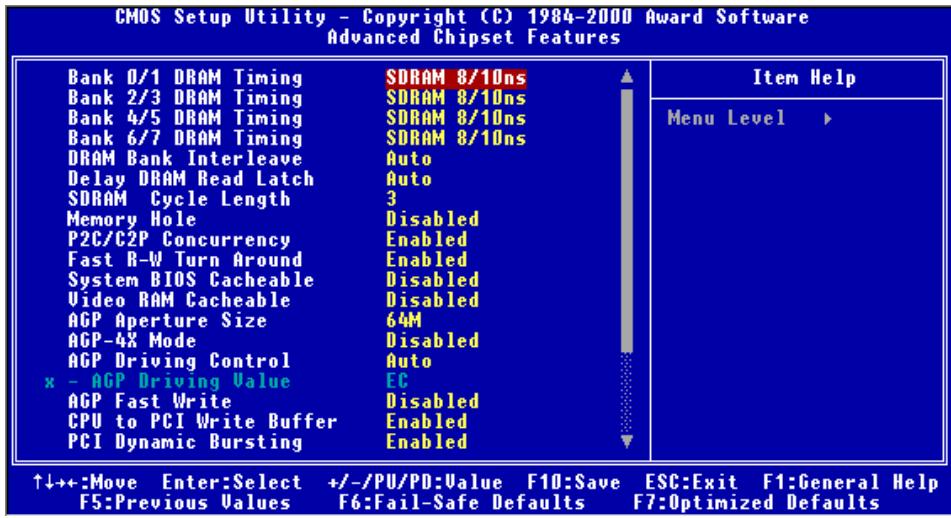
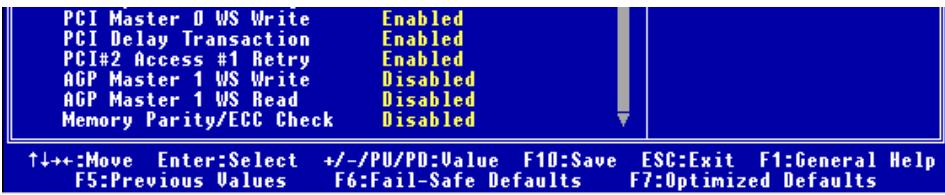
Figure 3-5A. Advanced Chipset Features Setup Upper Screen
Figure 3-5B. Advanced Chipset Features Setup Lower Screen
You can use the arrow keys to move between the items. Use PgUP, PgDn, + or - key to change the values. When you have finished setting up the chipset, press ESC to go back to the main menu.

The parameters in this screen are for system designers, service personnel, and technically competent users only. Do not reset these values unless you understand the consequences of your changes.
Bank 0/1, 2/3, 4/5, 6/7 DRAM Timing:
The DRAM timing of Bank 0/1, 2/3, 4/5, 6/7 in this field is set by the motherboard manufacturer, depending on whether memory module preset. For end users, we do not suggest that you to change the setting unless you actually know what kind of memory module you are using.
The Choices are: SDRAM 8/10ns Normal Medium Fast Turbo Back to SDRAM 8/10ns. The default setting is SDRAM 8/10ns.
DRAM Bank Interleave:
Four options are available: Auto Disabled 2-Way 4-Way. The default setting is Auto. Depending on your SDRAM module structure, the 4-Way setting can make the performance best. If you choose the wrong setting, the computer system will not run in a stable manner. For detailed information on your SDRAM module, please ask your SDRAM module manufacturer.
Delay DRAM Read Latch:
Five options are available: Auto No Delay 0.5ns 1.0ns 1.5ns. The default setting is Auto. This option can increase the DRAM signal strength to give you better compatibility for DRAM modules.
SDRAM Cycle Length:
Two options are available: 2 or 3. This option sets the CAS latency timing of the DRAM system memory access cycle when the SDRAM system memory is installed on the motherboard. The default setting is 3.
Memory Hole:
Two options are available: Disabled or 15M - 16M. The default setting is Disabled. This option is used to free up the memory block 15M-16M. Some special peripherals need to use a memory block located between 15M and 16M, and this memory block has a size of 1M. We recommend that you disable this option.
P2C/C2P Concurrence:
Two options are available: Disabled or Enabled. The default setting is Enabled. This item allows you to enable/disable the PCI to CPU, CPU to PCI concurrency.
Fast R-W Turn Around:
Two options are available: Disabled or Enabled. The default setting is Disabled. This item controls the DRAM timing. It allows you to enable/disable the fast read/write turn around.
System BIOS Cacheable:
Two options are available: Disabled or Enabled. The default setting is Disabled. When you select Enabled, you get faster system BIOS executing speed via the L2 cache.
Video RAM Cacheable:
Two options are available: Disabled or Enabled. The default setting is Disabled. When you select Enabled, you get faster video RAM executing speed via the L2 cache. You must check your VGA adapter manual to find out if any compatibility problems exist.
AGP Aperture Size:
Six options are available: 256M 128M 64M 32M 16M Back to 256M . The default setting is 64M . This option specifies the amount of system memory that can be used by the AGP device. The aperture is a portion of the PCI memory address range dedicated for graphics memory address space. Host cycles that hit the aperture range are forwarded to the AGP without any translation. See www.agpforum.org for AGP information.
AGP-4X Mode:
Two options are available: Disabled or Enabled. The default setting is Disabled. If you use the older AGP adapter that does not support AGP 4X mode, you need to set this item to Disabled.
AGP Driving Control:
Two options are available: Auto or Manual. The default setting is Auto allows you to adjust the AGP driving force. Choosing Manual to key in an AGP Driving Value is described within the next section. It is recommended this field be set at Auto in order to avoid any errors in your system.
AGP Driving Value:
This item allows you to adjust the AGP driving force. You can key in the HEX number into this section. The minimum number is 00, and maximum number is FF.
AGP Fast Write:
Two options are available: Disabled or Enabled. The default setting is Disabled. If your AGP adapter can support this function, then you can choose Enabled. Otherwise, choose No Support.
CPU to PCI Write Buffer:
Two options are available: Disabled or Enabled. The default setting is Enabled. When enabled, up to four words of data can be written to the PCI bus without interrupting the CPU. When disabled, a write buffer is not used and the CPU read cycle will not be completed until the PCI bus signals that it is ready to receive the data. Because the CPU speed runs faster than the PCI bus, the CPU must wait as the PCI bus receives data before starting each write cycle.
PCI Dynamic Bursting:
Two options are available: Disabled or Enabled. The default setting is Enabled. When Enabled, every write transaction goes to the write buffer. Burstable transactions then burst on the PCI bus and nonburstable transactions don't. Which means, when you set to disabled, if the write transaction is a burst transaction, the information goes to the write buffer and burst transfers are performed on the PCI bus later. If the transaction is not a burst transaction, PCI write will occur immediately. (it will be active after a write buffer flush)
PCI Master 0 WS Write:
Two options are available: Disabled or Enabled. The default setting is Enabled. When Enabled, writes to the PCI bus are executed with zero wait state (immediately) when PCI bus is ready to receive data. If disabled, the system will wait one state before data is written to the PCI bus.
PCI Delay Transaction:
Two options are available: Disabled or Enabled. The default setting is Enabled. The chipset has an embedded 32-bit posted write buffer to support delay transactions cycles. Select Enabled to support compliance with PCI specification version 2.1.
PCI#2 Access #1 Retry:
Two options are available: Disabled or Enabled. The default setting is Enabled. This item allows you enable/disable the PCI #2 Access #1 Retry. When you set the PCI#2 Access#1 to Enabled, the AGP bus will attempt to access the PCI bus at a limited time period before being disconnected. When you set it to Disabled, the AGP bus will try to access the PCI bus until it successfully accesses the PCI bus.
AGP Master 1 WS Write:
Two options are available: Disabled or Enabled. The default setting is Disabled. This implements a single delay when writing to the AGP Bus. When you set it to Disabled, two-wait states are used by the system, allowing for greater stability.
AGP Master 1 WS Read:
Two options are available: Disabled or Enabled. The default setting is Disabled. This implements a single delay when reading to the AGP Bus. By default, two-wait states are used by the system, allowing for greater stability.
Memory Parity/ECC Check:
Two options are available: Disabled or Enabled. The default setting is Disabled. This item can allow BIOS to check if the memory is a parity/ECC module or not.
3-5. Integrated Peripherals
In this menu, you can change the onboard I/O device, I/O port address and other hardware settings.
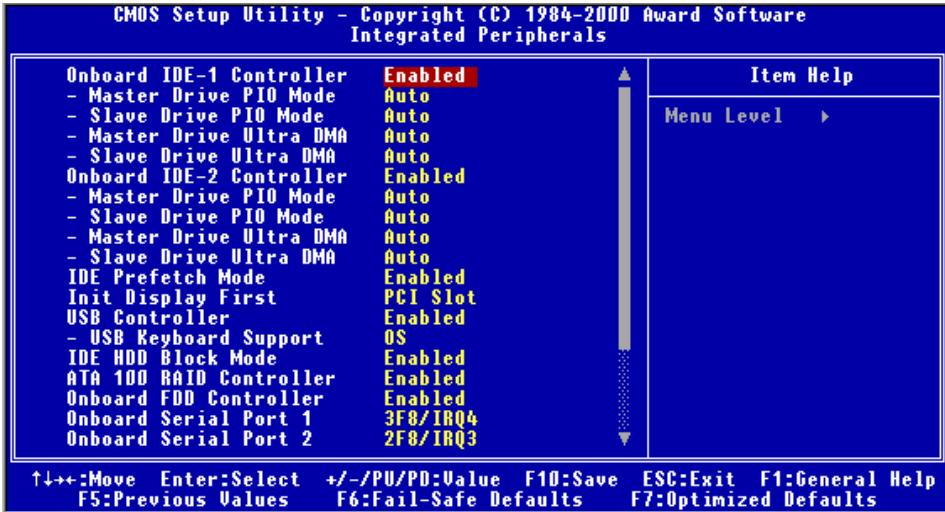
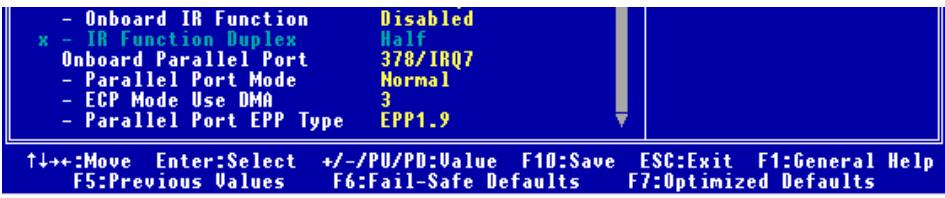
Figure 3-6A. Integrated Peripherals Menu Upper Screen
Figure 3-6B. Integrated Peripherals Menu Lower Screen
Onboard IDE-1 Controller:
The onboard IDE 1 controller can be set as Enabled or Disabled.
Master Drive PIO Mode:
Auto: The BIOS can auto-detect the transfer mode of the IDE devices in order to set its data transfer rate. (Default)
You can select the PIO mode from 0 to 4 of the IDE devices in order to set its data transfer rate.
Slave Drive PIO Mode:
Auto: The BIOS can auto-detect the transfer mode of the IDE devices in order to set its data transfer rate. (Default)
You can select the PIO mode from 0 to 4 of the IDE devices in order to set its data transfer rate.
Master Drive Ultra DMA:
Ultra DMA is a DMA data transfer protocol that utilizes ATA commands and the ATA bus to allow DMA commands to transfer data at a maximum burst rate of 100MB / sec .
Auto: When you select Auto, the system automatically determines the optimal data transfer rate for each IDE device. (Default)
Disabled: If you encounter the problem of using Ultra DMA devices, you can try to Disable this item.
Slave Drive Ultra DMA:
Auto: When you select Auto, the system automatically determines the optimal data transfer rate for each IDE device. (Default)
Disabled: If you encounter the problem of using Ultra DMA devices, you can try to Disable this item.
Onboard IDE-2 Controller:
The onboard IDE-2 controller can be set at Enabled or Disabled.
Master Drive PIO Mode:
Auto: The BIOS can auto-detect the transfer mode of the IDE devices in order to set its data transfer rate. (Default)
You can select the PIO mode from 0 to 4 of the IDE devices in order to set its data transfer rate.
Slave Drive PIO Mode:
Auto: The BIOS can auto-detect the transfer mode of the IDE devices in order to set its data transfer rate. (Default)
You can select the PIO mode from 0 to 4 of the IDE devices in order to set its data transfer rate.
Master Drive Ultra DMA: Ultra DMA is a DMA data transfer protocol that utilizes ATA commands and the ATA bus to allow DMA commands to transfer data at a maximum burst rate of 100MB / sec .
Auto: When you select Auto, the system automatically determines the optimal data transfer rate for each IDE device. (Default)
Disabled: If you encounter a problem using Ultra DMA devices, you can try to Disable this item.
Slave Drive Ultra DMA:
Auto: When you select Auto, the system automatically determines the optimal data transfer rate for each IDE device. (Default)
Disabled: If you encounter the problem of using Ultra DMA devices, you can try to Disable this item.
PIO MODE 0~4 reflects the IDE device data transfer rate. The higher the MODE value is, the better is the IDE device data transfer rate. But it does not mean that you can select the highest MODE value just as you like, you first have to be sure that your IDE device supports this MODE, otherwise the hard disk will not be able to operate normally.
IDE Prefetch Mode:
Two options are available: Disabled or Enabled. The default setting is Enabled. The onboard IDE drive interfaces support IDE prefetching, for faster drive accesses. If you install a primary and/or secondary add-in IDE interface which does not support prefetching, set this field to Disabled.
Init Display First:
Two options are available: PCI Slot or AGP. The default setting is PCI Slot. When you install more than one display card, you can choose either a PCI display card (PCI Slot) or an AGP display card (AGP) to activate the display boot-up screen. If you only installed one display card, the BIOS will detect which slot (AGP or PCI) you installed it, resulting in everything being taken care of by the BIOS.
USB Controller:
Two options are available: Disabled or Enabled. The default setting is Enabled. This should be enabled if your system has USB installed on the system board and you wish to use it. Even when so equipped, if you add a higher performance controller, you will need to disable this feature. If you choose disable this item, the "USB Keyboard Support" item will disappear in Chipset Features Setup menu.
USB Keyboard Support: Two options are available: BIOS and OS. The default setting is OS . If your operating system supports a USB keyboard, please set it to OS . Only in some situations, such as in a pure DOS environment that does not support a USB keyboard, should you set it to BIOS.
IDE HDD Block Mode:
This item can be set as Enabled or Disabled.
Most of the new hard disk drives (IDE drives) support multi-sector transfers. This feature speeds up hard disk drive access performance and reduces the time necessary to access data. When this item is enabled, the BIOS will automatically detect if your hard disk drive supports this feature or not and will choose the right settings for you. (The default is Enabled)
ATA 100 RAID Controller:
Two options are available: Disabled or Enabled. The default setting is Enabled. If your motherboard is the VP6, it has the built-in HighPoint 370 chipset which can support ATA/100 specifications.
Onboard FDD Controller:
Two options are available: Disabled or Enabled. The default setting is Enabled. This is set to Enable or Disable the Onboard FDD Controller. If you add a higher performance controller, you will need to disable this feature.
Onboard Serial Port 1:
This item allows you to determine which I/O addresses the onboard serial port 1 controller uses. Six options are available: Auto Disabled 3F8/IRQ4 2F8/IRQ3 3E8/IRQ4 2E8/IRQ3 Back to Auto. The default setting is 3F8/IRQ4.
Onboard Serial Port 2:
This item allows you to determine which I/O addresses the onboard serial port 2 controller uses. Six options are available: Auto Disabled 3F8/IRQ4 2F8/IRQ3 3E8/IRQ4 2E8/IRQ3 Back to Auto. The default setting is 2F8/IRQ3.
If you choose "Disabled", then the item "Onboard IR Function" will disappear.
Onboard IR Function:
Three options are available: Disabled HPSIR ASKIR (Amplitude Shift Keyed IR). The default setting is Disabled.
When you select the item HPSIR or ASKIR, then the following two items will appear.
IR Function Duplex: Two options are available: Half or Full. The default setting is Half. Select the value required by the IR device connected to the IR port. Full-duplex mode permits simultaneous two-direction transmission. Half-duplex mode permits transmission in one direction only at a time.
Onboard Parallel Port:
Four options are available: 378/IRQ7 278/IRQ5 Disabled 3BC/IRQ7. The default setting is 378/IRQ7. Select a logical LPT port name and matching address for the physical parallel (printer) port.
Parallel Port Mode:
Four options are available: Normal EPP ECP ECP/EPP. Default is Normal mode. Select an operating mode for the onboard parallel (printer) port. Normal (SPP, Standard Parallel Port), EPP (Extended Parallel Port), ECP (Extended Capabilities Port) or ECP plus EPP.
Select Normal unless you are certain your hardware and software both support EPP or ECP mode. According to what you select, either of the following items will appear.
ECP Mode Use DMA: When the mode selected for the onboard parallel port is ECP or ECP/EPP, the DMA channel selected can be Channel 1 or Channel 3.
Parallel Port EPP Type: Two options are available: EPP1.7 EPP1.9. The default setting is EPP 1.9. When the mode selected for the parallel port mode is EPP, the two EPP version options are available.
3-6. Power Management Setup Menu
The difference between Green PCs and traditional computers is that Green PCs have a power management feature. With this feature, when the computer is powered on but inactive, the power consumption is reduced in order to save energy. When the computer operates normally, it is in Normal mode. In this mode, the Power Management Program will control the access to video, parallel ports, serial ports and drives, and the operating status of the keyboard, mouse and other device. These are referred to as Power Management Events. In cases where none of these events occur, the system enters the power saving mode. When one of the controlled events occurs, the system immediately returns to normal mode and operates at its maximum speed. Power saving modes can be divided into three modes according to their power consumption: Doze Mode, Standby Mode, and Suspend Mode. The four modes proceed in the following sequence:
Normal Mode Doze Mode Standby Mode Suspend Mode

The system consumption is reduced according the following sequence:
Normal > Doze > Standby > Suspend
- In the Main Menu, select "Power Management Setup" and press "Enter". The following screen is displayed:
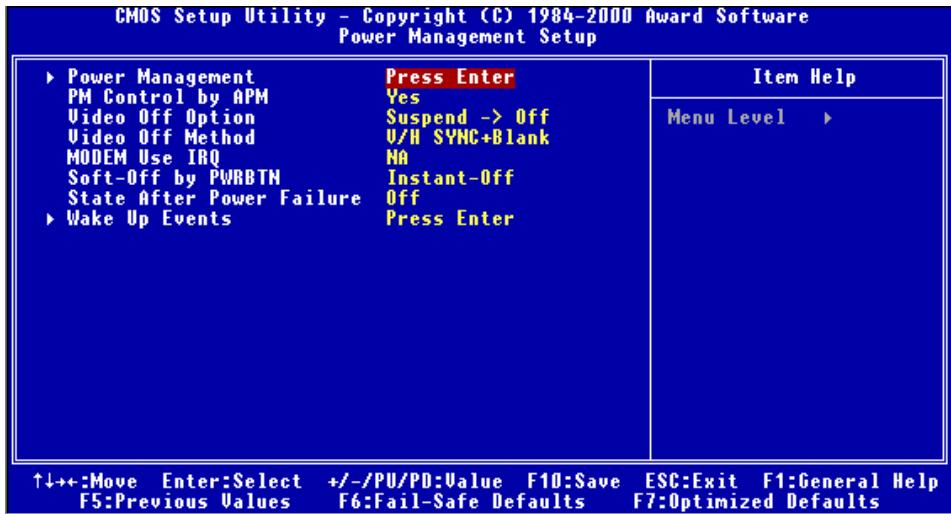
Figure 3-7A. Power Management Setup Main Menu
- Use the arrow keys to go to the item you want to configure. To change the settings, use the PgUP, PgDn, + or - keys.
- After you have configured the Power Management feature, press Esc to go back to the Main Menu.
We are now going to briefly explain the options in this menu:
ACPI Function (Advanced Configuration and Power Interface):
ACPI gives the operating system direct control over the power management and Plug and Play functions of a computer.
The ACPI functions are always "Enabled". If you want ACPI functions to work normally, you should ensure two things. One is that your operating system must support ACPI, as of now only Microsoft® Windows® 98 and Windows® 2000 support these functions. The second thing is that all devices and add-on cards in your system, must fully support ACPI, both hardware and software (drivers). If you want to know if your devices or add-on cards support ACPI or not, please contact the device or add-on card manufacturers for more information. If you want to know more about ACPI specifications, please go to the address below for more detailed information:
http://www.teleport.com/~acpi/acpihtml/home.htm
ACPI requires an ACPI-aware operating system. ACPI features include:
- Plug and Play (including bus and device enumeration) and APM functionality normally contained in the BIOS.
- Power management control of individual devices, add-in cards (some add-in cards may require an ACPI-aware driver), video displays, and hard disk drives.
- A Soft-off feature that enables the operating system to power off the computer.
Support for multiple wake up events (see Table 3-1).
Support for a front panel power and sleep mode switch. Table 3-2 describes the system states based on how long the power switch is pressed, and depending on how ACPI is configured with an ACPI-aware operating system.
Note
Because the ACPI functions are always Enabled, the SMI switch function will not work.
System States and Power States
Under ACPI, the operating system directs all system and device power state transitions. The operating system puts devices in and out of low-power states based on user preferences and knowledge of how devices are being used by applications. Devices that are not being used can be turned off. The operating system uses information from applications and user settings to put the system as a whole into a low-power state.
The table below describes which devices or specific events can wake the computer from specific states.
Table 3-1: Wake Up Device and Events
| These device/events can wake up the computer...... | ......from this state |
| Power switch | Sleeping mode or power off mode |
| RTC alarm | Sleeping mode or power off mode |
| LAN | Sleeping mode or power off mode |
| Modem | Sleeping mode or power off mode |
| IR command | Sleeping mode |
| USB | Sleeping mode |
| PS/2 keyboard | Sleeping mode |
| PS/2 mouse | Sleeping mode |
| Sleep button | Sleeping mode |
Table 3-2: Effect of Pressing the Power Switch
| If the system is in this state...... | ......and the power switch is pressed for | ......the system enters this state |
| Off | Less than four seconds | Power on |
| On | More than four seconds | Soft off/Suspend |
| On | Less than four seconds | Fail safe power off |
| Sleep | Less than four seconds | Wake up |
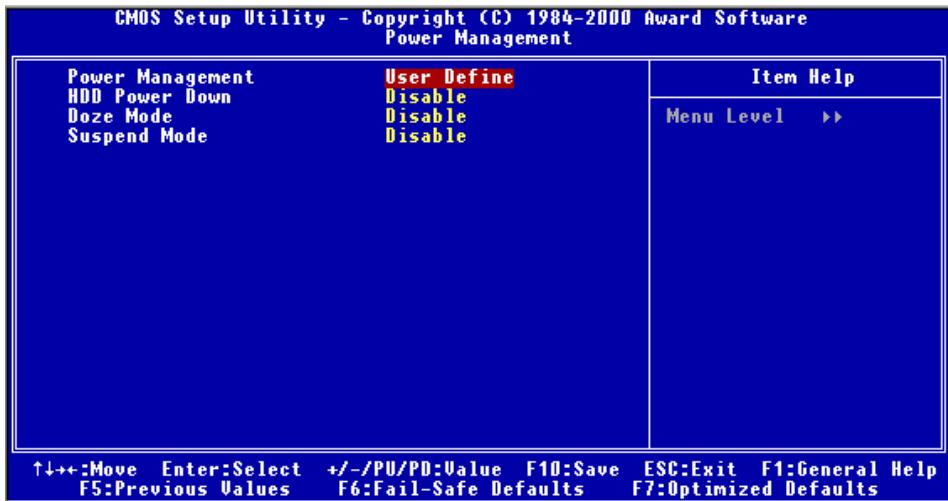
Power Management:
Figure 3-7B. Power Management Setup Menu
This item allows you to select the type (or degree) of power saving and is directly related to the following modes:
- HDD Power Down
2.Doze Mode - Suspend Mode
There are three options for power management, three of which have fixed mode settings:
User Define
"User Define" defines the delay for accessing the power modes.
HDD Power Down: Disabled 1 Min 2 Min 3 Min 4 Min 5 Min 6 Min 7 Min 8 Min 9 Hour 10 Min 11 Min 12 Min 13 Min 14 Min 15 Min. The default setting is Disabled.
Doze Mode: Disabled 1 Min 2 Min 4 Min 6 Min 8 Min 10 Min 20 Min 30 Min 40 Min 1 Hour. The default setting is Disabled.
Suspend Mode: Disabled 1 Min 2 Min 4 Min 6 Min 8 Min 10 Min 20 Min 30 Min 40 Min 1 Hour. The default setting is Disabled.
HDD Power Down:
Sixteen items available: Disable 1 Min 2 Min 3 Min 4 Min 5 Min 6 Min 7 Min 8 Min 9 Min 10 Min 11 Min 12 Min 13 Min 14 Min 15 Min Back to Disable. The default setting is Disable.
If the system has not accessed data on the hard disk drive during the specified time period, the engine of the HDD will stop in order to save electricity. You can set 1 to 15 minutes or select Disable according to your use of the HDD.
Doze Mode:
Eleven items are available: Disabled 1 Min 2 Min 4 Min 6 Min 8 Min 10 Min 20 Min 30 Min 40 Min 1 Hour Back to Disable. The default setting is Disable.
When the setting selected for "Power Management" is "User Define", you can define for this mode any delay from 1 minute to 1 hour. If no power management event occurs during this time period, meaning that the computer is inactive during this period, the system will enter the Doze power saving mode. If this mode is disabled, the system will enter the next mode in the sequence (suspend mode).
Suspend Mode:
Eleven items are available: Disabled 1 Min 2 Min 4 Min 6 Min 8 Min 10 Min 20 Min 30 Min 40 Min 1 Hour Back to Disable. The default setting is Disabled.
When the setting selected for "Power Management" is "User Define", you can define for this mode any delay from 1 minute to 1 hour. If no power management event occurs during this time period, meaning the computer is inactive during this period, the system will enter the Suspend power saving mode. The CPU stops working completely.
If this mode is disabled, the system will not enter the suspend mode.
> Min Saving
When these two saving modes are enabled, the system is set up for minimum power savings.
Doze Mode = 1 Hour
Suspend Mode = 1 Hour
Max Saving
When the two saving modes are enabled, the system is set up for maximum power savings.
Doze Mode = 1 Min
Suspend Mode = 1 Min
PM Control by APM:
Power Management is completely controlled by the APM.
Two options are available: Yes or No. The default setting is Yes. APM stands for Advanced Power Management, it is a power management standard set by Microsoft®, Intel® and other major manufacturers.
Video Off Option:
Select the saving mode in which the video is switched off.
Always On
The video will never be switched off in the "no power saving" mode.
Suspend Off
The video will only be switched off in Suspend mode. (Default setting)
All Modes Off
The video will be switched off in all power saving modes.
Video Off Method:
Three video off methods are available: "Blank Screen", "V/H SYNC + Blank" and "DPMS Support". The default is "V/H SYNC + Blank".
If this setting does not shut off the screen, select "Blank Screen". If your monitor and video card support DMPS standard, select "DPMS Support".
Modem Use IRQ:
Eight items are available: 3 4 5 7 9 10 11 NA Back to 3. The default setting is NA . You can specify the IRQ for modem use.
Soft-Off by PWRBTN:
Two items available: Instant-Off or Delay 4 Sec. The default setting is Instant-Off. It is activated when the user presses the power button for more than four seconds while the system is in the working state, then the system will transition to the soft-off (Power off by software). This is called the power button over-ride.
State After Power Failure:
Three items are available: Auto On Off. The default setting is Off. If your computer power fails or an abnormal power shutdown occurs, the computer will return to either its previous state, the power on state, or the power off state.
Wake Up Events:
When one of the specified events occurs, the count down for entry into the power saving mode goes back to zero. Since the computer will enter a power saving mode only after a specified inactivity delay (time specific for Doze, Standby and Suspend modes) and after there has been no activity during this time period,
any event will cause the computer to re-count the time elapsed. Resuming events include operations or signals that cause the computer to resume time counting.
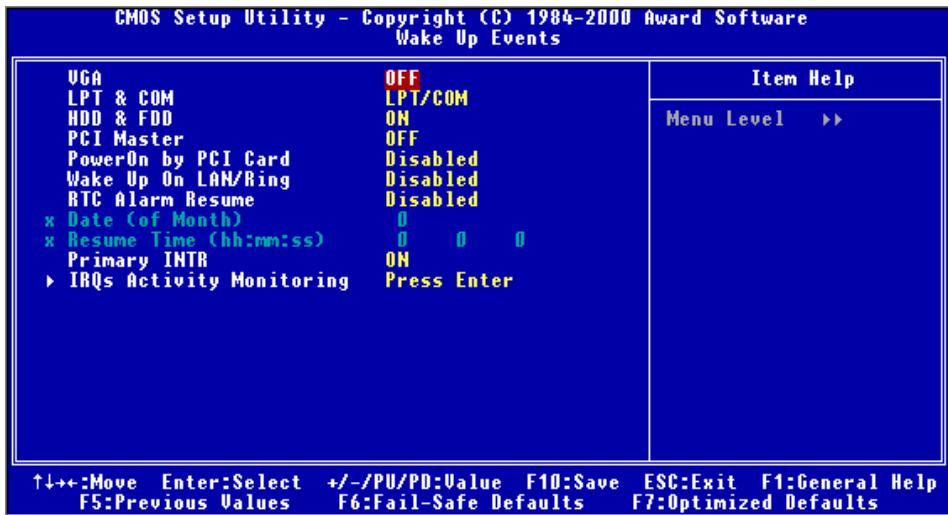
Figure 3-7C. Wake Up Events Setup Menu
VGA:
Two items available: On or Off. The default setting is Off. When set to On, any event occurring at a VGA port will awaken a system, which has been powered down.
LPT & COM:
Four items available: LPT/COM None LPT COM. The default setting is LPT/COM. When set to LPT/COM, any event occurring at a LPT (printer) /COM (serial) port will awaken a system which has been powered down.
HDD & FDD:
Two items available: On or Off. The default setting is On. When set to On, any event occurring at a hard disk drive or floppy drive port will awaken a system, which has been powered down.
PCI Master:
Two items available: On or Off. The default setting is Off. When set to On, any event occurring at PCI Master signal will awaken a system, which has been powered down.
PowerOn by PCI Card:
Two items available: Disabled or Enabled. The default setting is Disabled. When set to Enabled, any event occurring to the PCI card will awaken a system, which has been powered down.
> Wake Up On LAN/Ring:
Two items available: Disabled or Enabled. The default setting is Disabled. When set to Enabled, any event occurring to the LAN/Modem Ring will awaken a system, which has been powered down.
RTC Alarm Resume:
Two items available: Disabled or Enabled. The default setting is Disabled. When Enabled, your can set the date and time at which the RTC (real-time clock) alarm awakens the system from Suspend mode.
Date (of Month) / Resume Time (hh:mm:ss):
You can set the Date (of month) and Resume Time (hh:mm:ss), and any event occurring will awaken the system, which has been powered down.
Primary INTR:
Two items available: On or Off. The default setting is On . When set to On, any event occurring on the below list will awaken a system which has been powered down.
IROs Activity Monitoring
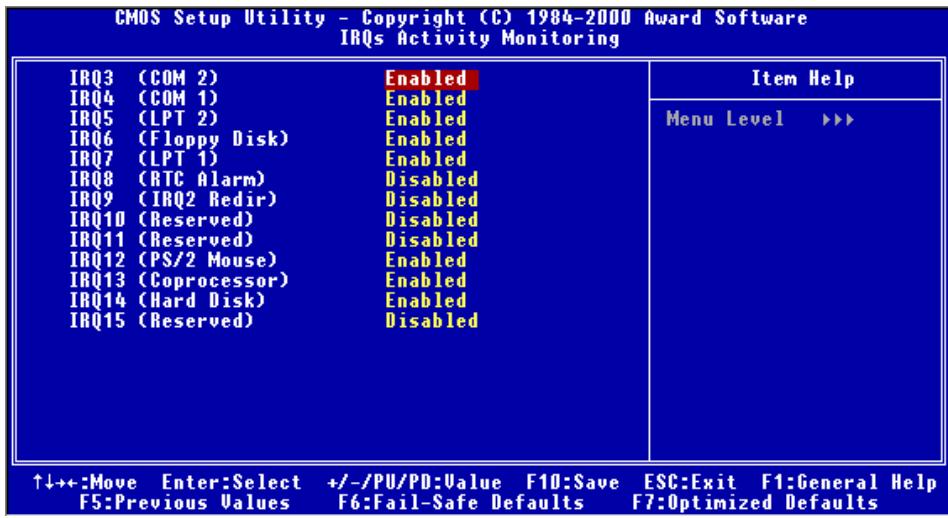
Figure 3-7D. IRQs Activity Monitoring Setup Menu
The following is a list of IRQ's, Interrupt ReQuests, which can be exempted much as the COM ports and LPT ports above can. When an I/O device wants to gain the attention of the operating system, it signals by causing an IRQ to occur. When the operating system is ready to respond to the request, it interrupts itself and performs the service.
As above, the choices are On and Off.
When set On, activity will neither prevent the system from going into a power management mode nor awaken it. Each item has three options: Primary Secondary Disabled.
IRQ3 (COM 2): The default setting is Enabled.
IRQ4 (COM 1): The default setting is Enabled.
IRQ5 (LPT 2): The default setting is Enabled.
IRQ6 (Floppy Disk): The default setting is Enabled.
IRQ7 (LPT 1): The default setting is Enabled.
IRQ8 (RTC Alarm): The default setting is Disabled.
IRQ9 (IRQ2 Redir): The default setting is Disabled.
IRQ10 (Reserved): The default setting is Disabled.
IRQ11 (Reserved): The default setting is Disabled.
IRQ12 (PS/ 2 Mouse): The default setting is Enabled.
IRQ13 (Coprocessor): The default setting is Enabled.
IRQ14 (Hard Disk): The default setting is Enabled.
IRQ15 (Reserved): The default setting is Disabled.
3-7. PNP/PCI Configurations Setup Menu
In this menu, you can change the INT# and IRQ of the PCI bus and other hardware settings.
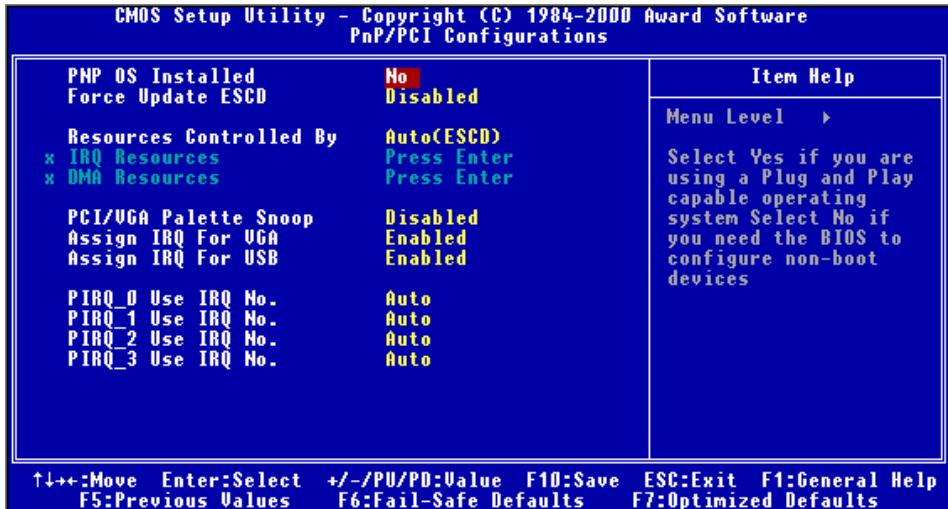
Figure 3-8A. PNP/PCI Configurations Setup Menu
PNP OS Installed:
Device resource assigned by PnP OS or BIOS. Two items available: Yes or No. The default setting is No.
Force Update ESCD:
Two options are available: Disabled or Enabled. The default setting is Disabled. Normally, you leave this field Disabled. Select Enabled to reset Extended System Configuration Data (ESCD) when you exit Setup if you have installed a new add-on and the system reconfiguration has caused such a serious conflict that the operating system cannot boot.
Computer Knowledge: ESCD (Extended System Configuration Data)
The ESCD contains the IRQ, DMA, I/O port, memory information of the system. This is a specification and a feature specific to the Plug & Play BIOS.
Resources Controlled By:
When resources are controlled manually, assign each system interrupt as one of the following types, depending on the type of device using the interrupt:
Legacy ISA devices compliant with the original PC AT bus specification, requiring a specific interrupt (such as IRQ4 for serial port 1).
PCI/ISA PnP devices compliant with the Plug and Play standard, whether designed for the PCI or ISA bus architecture.
Two options are available: Auto (ESCD) or Manual. The default setting is Auto (ESCD). The Award Plug and Play BIOS has the capability to automatically configure all of the boot and Plug and Play compatible devices. If you select Auto (ESCD), all of the interrupt request (IRQ) and DMA assignment fields disappear, as the BIOS automatically assigns them. But if you have trouble in assigning the interrupt resource automatically, you can select Manual to set which IRQ and DMA are assigned to PCI/ISA PnP or legacy ISA cards.
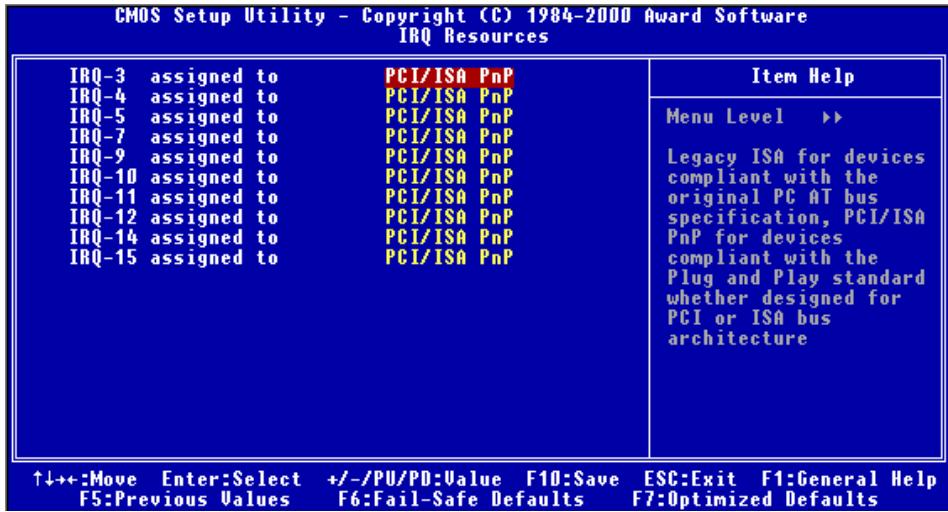
Figure 3-8B. IRQ Resources Setup Menu
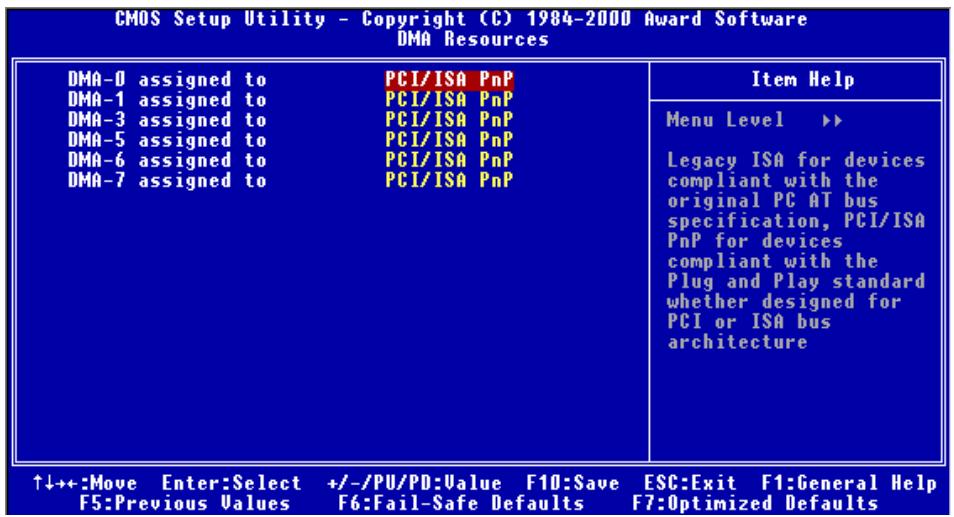
Figure 3-8C. DMA Resources Setup Menu
PCI /VGA Palette Snoop:
This option allows the BIOS to preview the VGA Status, and to modify the information delivered from the Feature Connector of the VGA card to the MPEG Card. This option can solve the display inversion to black problem after you have used the MPEG card.
Assign IRQ For VGA :
Two options are available: Disabled or Enabled. The default setting is Enabled. Name the interrupt request (IRQ) line assigned to the USB/VGA/ACPI (if any) on your system. Activity of the selected IRQ always awakens the system.
You can assign an IRQ for the PCI VGA or Disabled.
Assigned IRQ For USB:
Two options are available: Disabled or Enabled. The default setting is Enabled. If you need another IRQ to be freed up, you can choose to disable this item, and you can get an IRQ. But in some situations in Windows® 95, it may cause the USB port to malfunction or have other problems!
PIRO_0 Use IRQ No.~PIRO_3 Use IRQ No.:
Eleven options are available: Auto, 3, 4, 5, 7, 9, 10, 11, 12, 14, 15. Default setting is Auto. This item allows the system to automatically specify the IRQ number for the device installed on PCI slots. Which means, the system can specify the fixed IRQ number for the device installed on the PCI slots (PCI slot 1 to PCI slot 5). This is a useful function when you want to fix the IRQ for a specific device.
For example, if you want to move your hard disk to another computer and don't want to re-install Windows NT, then you can specify the IRQ for the device installed on the new computer to fit the original computer settings.
Note
If you specify the IRQ in this item, then you cannot specify the same IRQ to the ISA bus, otherwise, it will cause a hardware conflict.
This feature is for the operating system which will record and fix the PCI configuration status, if you want to change it.
For the relations between the hardware layout of PIRQ (the signals from the VIA VT82C686A/B chipset), INT# (means PCI slot IRQ signals) and devices, please refer to the table below:
| Signals | PCI slot 1 | PCI slot 2 | PCI slot 3 | PCI Slot 4 | PCI slot 5 | HPT370 Controller |
| PIRQ_0 Assignment | INT A | INT B | INT B | INT D | INT C | INT C |
| PIRQ_1 Assignment | INT B | INT D | INT A | INT A | INT D | X |
| PIRQ_2 Assignment | INT C | INT C | INT D | INT B | INT A | X |
| PIRQ_3 Assignment | INT D | INT A | INT C | INT C | INT B | X |
- USB used INT D.
Each PCI slot has four INT#s (INT A~INT D), and the AGP slot has two INT# (INTA and INT B).
Note
- PCI slot 1 shares IRQ signals with the AGP slot.
PCI-4 and USB controllers share an IRQ. - If you want to install two PCI cards into those PCI slots that share IRQ with one another at the same time, you must make sure that your OS and PCI devices' driver support IRQ sharing function.
- PCI slot 5 shares IRQ signals with the HPT370 IDE controller (supports ATA/100). The driver for HPT 370 IDE controller supports IRQ sharing with other PCI devices. But if you install a PCI card that doesn't allow IRQ sharing with other devices into PCI slot 5, you may encounter some problems. Furthermore, if your Operating System doesn't allow peripheral devices to share IRQ signals with each other, such as Windows® NT for example, you can't install a PCI card into PCI slot 5.
- HPT 370 IDE controller is designed to support high-speed and high performance mass storage devices. Thus we suggest that you don't connect non-disk devices that use ATA/ATAPI interfaces, such as CD-ROM to HPT 370 IDE connector (IDE3 & IDE4).
3-8. PC Health Status
You can check the fan speeds and power supply voltages of your computer system. The features are useful for monitoring all the important parameters within your computer system. We call it the PC Health Status.
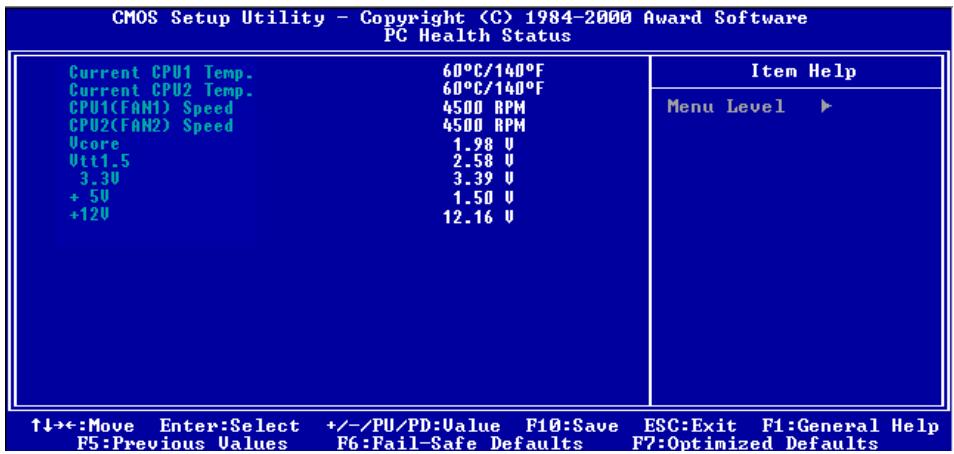
Figure 3-9. PC Health Status Screen Shot
All Voltages, Fans Speed and Thermal Monitoring:
These items list the current states of the CPU and environment (using RT1 and RT2 to detect them.) temperatures as well as fan speeds (CPU fan and power fan). It can not be changed by the user.
The following items list the voltage states of the system power. It is also unchangeable.
Note
The hardware monitoring features for temperatures, fans and voltages will occupy the I/O address from 294H to 297H. If you have a network adapter, sound card or other add-on cards that might use those I/O addresses, please adjust your add-on card I/O address, to avoid the use of those addresses.
3-9. Load Fail-Safe Defaults
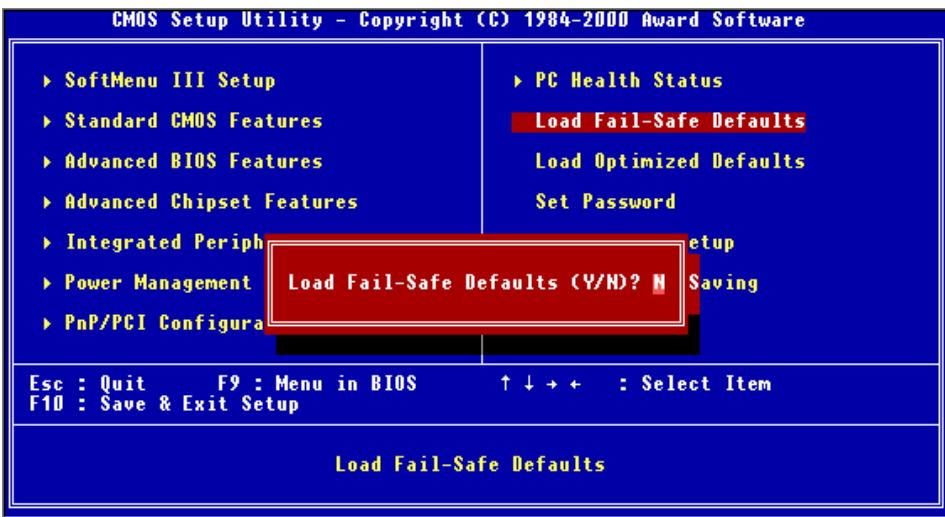
Figure 3-10. Load Fail-Safe Defaults Screen Shot
When you press
Load Fail-Safe Defaults (Y/N)? N
Pressing 'Y' loads the BIOS default values for the most stable, minimal-performance system operations.
3-10. Load Optimized Defaults
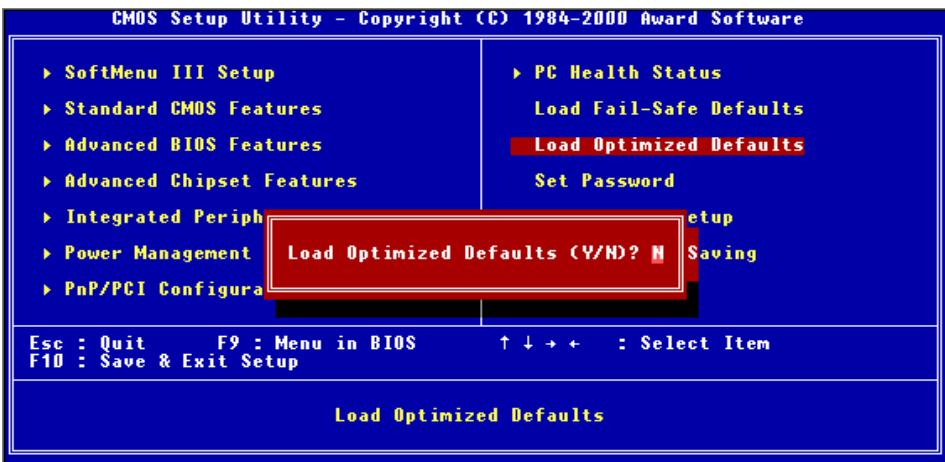
Figure 3-11. Load Optimized Defaults Screen Shot
When you press
Load Optimized Defaults (Y/N)? N
Pressing 'Y' loads the default values that are factory settings for optimal performance system operations.
3-11. Set Password
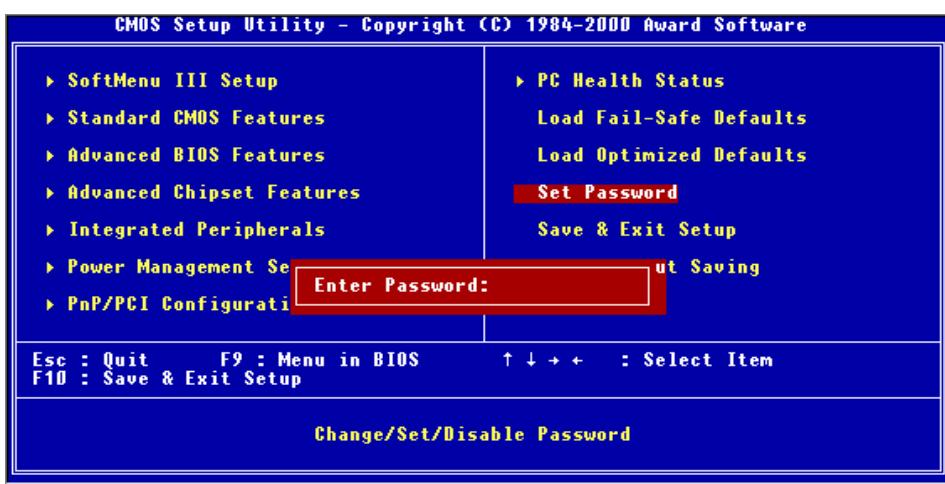
Figure 3-12. Set Password Screen Shot
Set Password: Can enter, but do not have the right to change the options of the setup menus. When you select this function, the following message will appear at the center of the screen to assist you in creating a password.
ENTER PASSWORD:
Type the password, up to eight characters in length, and press
To disable a password, just press
password DISABLED.
When a password has been enabled, you will be prompted to enter it every time you try to enter Setup. This prevents an unauthorized person from changing any part of your system configuration.
Additionally, when a password is enabled, you can also require the BIOS to request a password every time your system is rebooted. This would prevent unauthorized use of your computer.
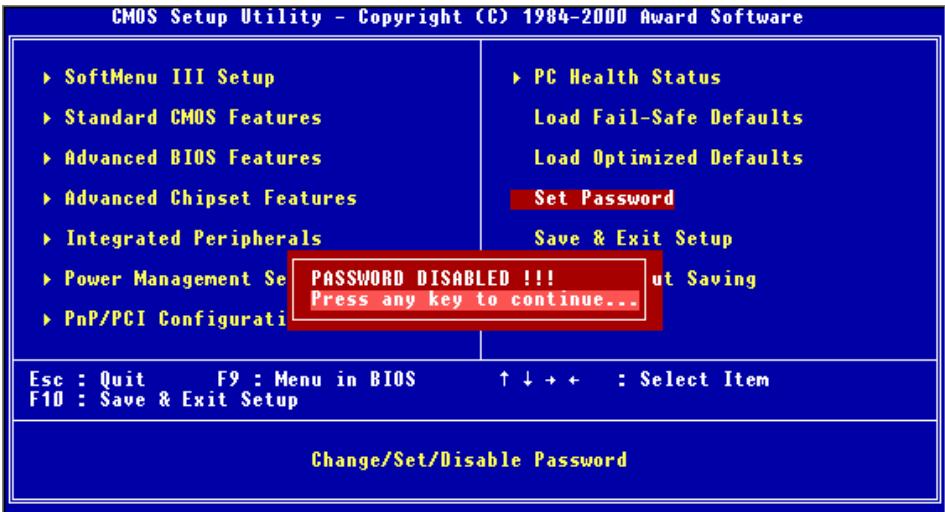
Figure 3-13. Password Disabled Screen Shot
You determine when the password is required within the BIOS Features Setup Menu and its Security option. If the Security option is set to "System", the password will be required both at boot and at entry to Setup. If set to "Setup", prompting only occurs when trying to enter Setup.
3-12. Save & Exit Setup
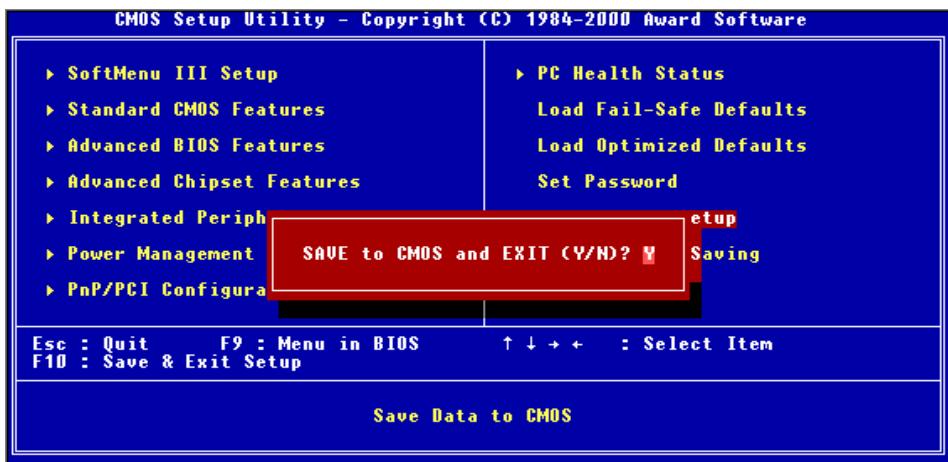
Figure 3-14. Save & Exit Setup Screen Shot
Pressing <Enter> on this item asks for confirmation:
Save to CMOS and EXIT (Y/N)? Y
Pressing "Y" stores the selections made in the menus in CMOS - a special section of memory that stays on after you turn your system off. The next time you boot your computer, the BIOS configures your system according to the Setup selections stored in CMOS. After saving the values the system is restarted again.
3-13. Exit Without Saving
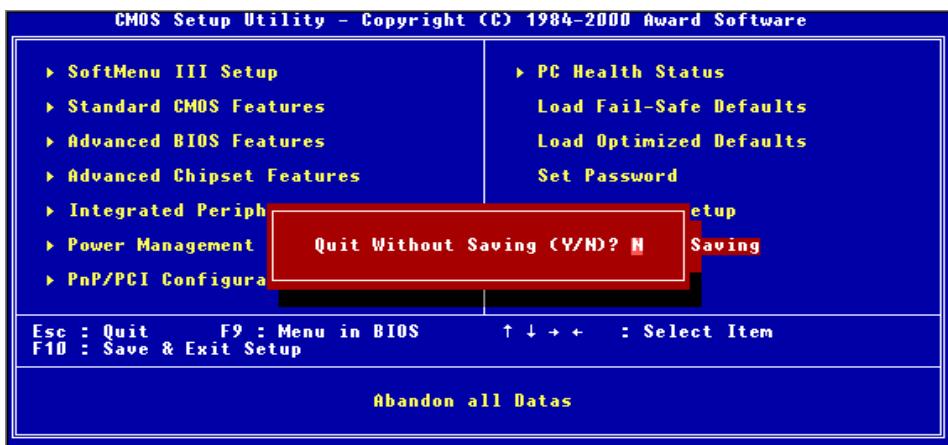
Figure 3-15. Exit Without Saving Screen Shot
Pressing <Enter> on this item asks for confirmation:
Quit without saving (Y/N)? Y
This allows you to exit Setup without storing in CMOS any change. The previous selections remain in effect. This exits the Setup utility and restarts your computer.
Chapter 4. RAID Setting Guide
For detail RAID introduction, please go to our WEB sites "Technological Terms", or you can search for further RAID information on internet. We do not describe it in great depth in this manual.
4-1. The features of RAID on the VP6
The VP6 supports Striping (RAID 0), Mirroring (RAID 1), or Striping/Mirroring (RAID 0 + 1 ) operation. For the striping operation, the identical drives can read and write data in parallel to increase performance. The Mirroring operation creates a complete backup of your files. Striping with Mirroring operation offers both high read/write performance and fault tolerance although requiring 4 hard disks in order to do so.
4-2. RAID SETUP on the VP6
Enter Advanced BIOS Features in the BIOS setup. Change the settings of First Boot Device, Second Boot Device and Third Boot Device to read ATA-100. See Figure 4-1
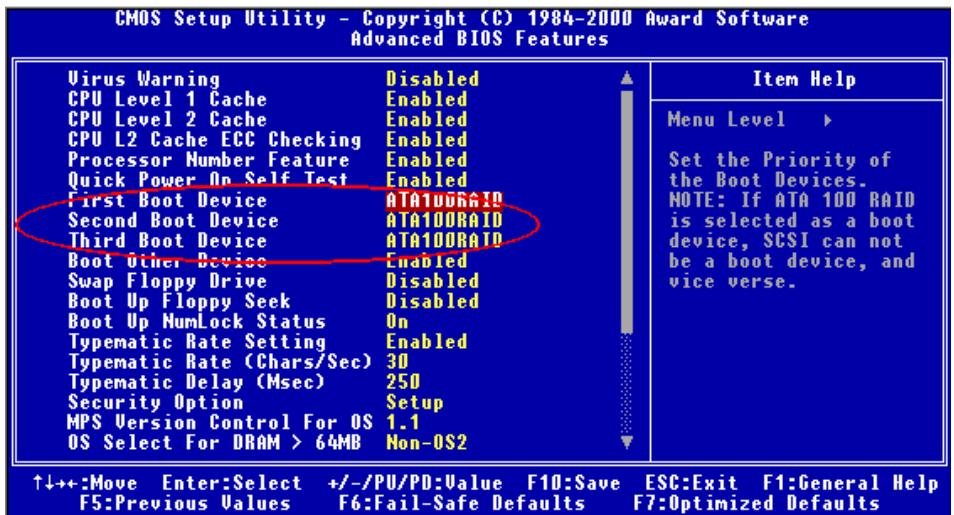
Figure 4-1. RAID settings in BIOS
4-3. The BIOS Setting Menu
Reboot your system. Press <CTRL> and
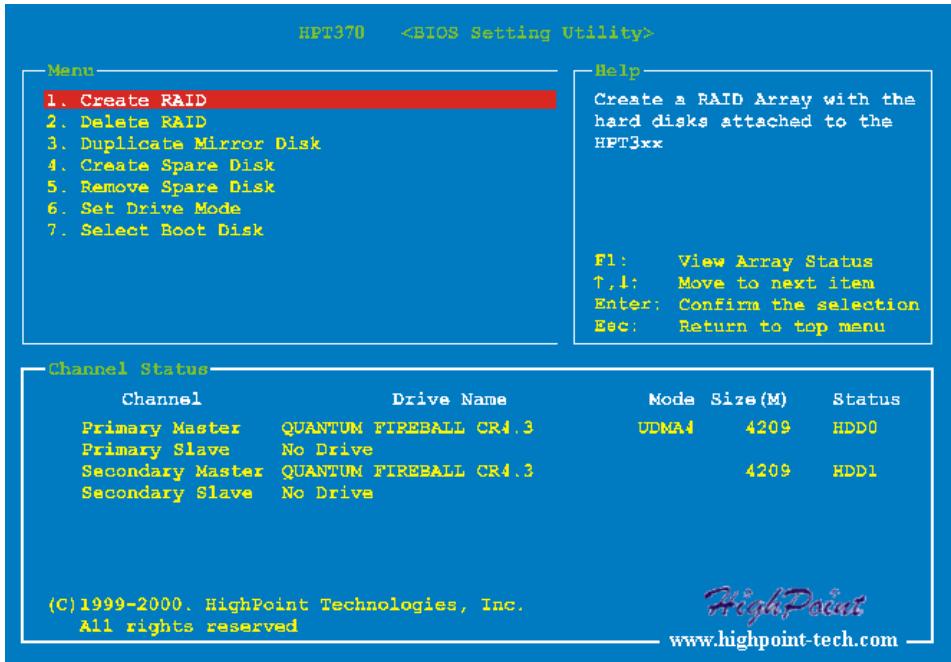
For selecting the option in the menu, you may:
- Press F1 to view array status.
- Press (up, down arrow) to choose the option you want to confirm or to modify.
- Press Enter to confirm the selection.
- Press Esc to return to top menu.
NOTE
If you want to create a RAID 0 (striping) array or RAID 0 + 1 array, all data in your hard disk will first be erased! Please backup the hard disk data before starting to create these RAID arrays. If you want to create a RAID 1 (mirroring) array, please be sure which hard disk is the source disk and which one is the destination disk. If you make a mistake, you may copy the blank data to the source disk, which will result in both hard disks becoming blank!
4-3-1. OPTION 1: Create RAID
This item allows you to create a RAID array.
After you had selected the function you want in the main menus, you may press the
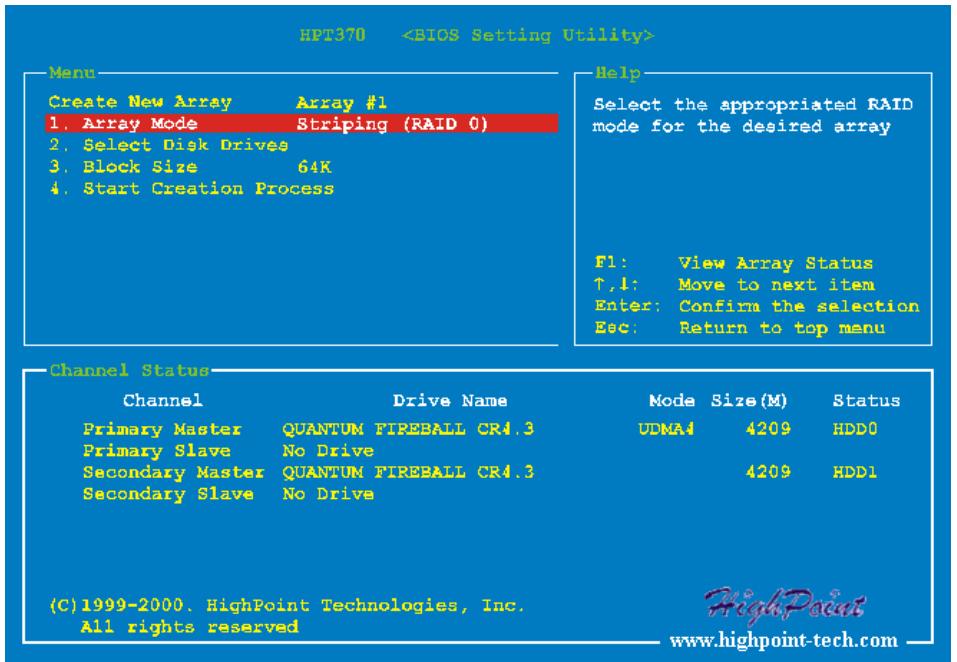
Array Mode:
This item allows you to select the appropriate RAID mode for the desired array. There are four modes to choose.
Striping (RAID 0):
This item is recommended for high performance usage. Requires at least 2 disks.
Mirror (RAID 1):
This item is recommended for data security usage. Requires at least 2 disks.
Striping and Mirror (RAID +1 ):
This item is recommended for data security and high performance usage. Allows Mirroring with a Strip Array. Requires four drives.
Span (JBOD):
This item is recommended for high capacity without redundancy or performance features usage. Requires at least 2 disks.
Select Disk Drives:
This item allows you to select the disk drives to be used with the RAID array.
Block Size:
This item allows you to select the block size of the RAID array. There are five options: 4K, 8K, 16K, 32K, and 64K.
Start Creation Process:
After you have made your selection, choose this item and press
4-3-2. OPTION 2: Delete RAID
This item allows you to remove a RAID Array on this IDE RAID controller card.
Note: After you have made and confirmed this selection, all the data stored in the hard disk will be lost. (The entire partition configuration will be deleted too.)
4-3-3. OPTION 3: Duplicate Mirror Disk
This item allows you to select the disk you wish to duplicate in preparation for a "Mirror Disk Array".
After you have selected the function you want in the main menu, you may press the
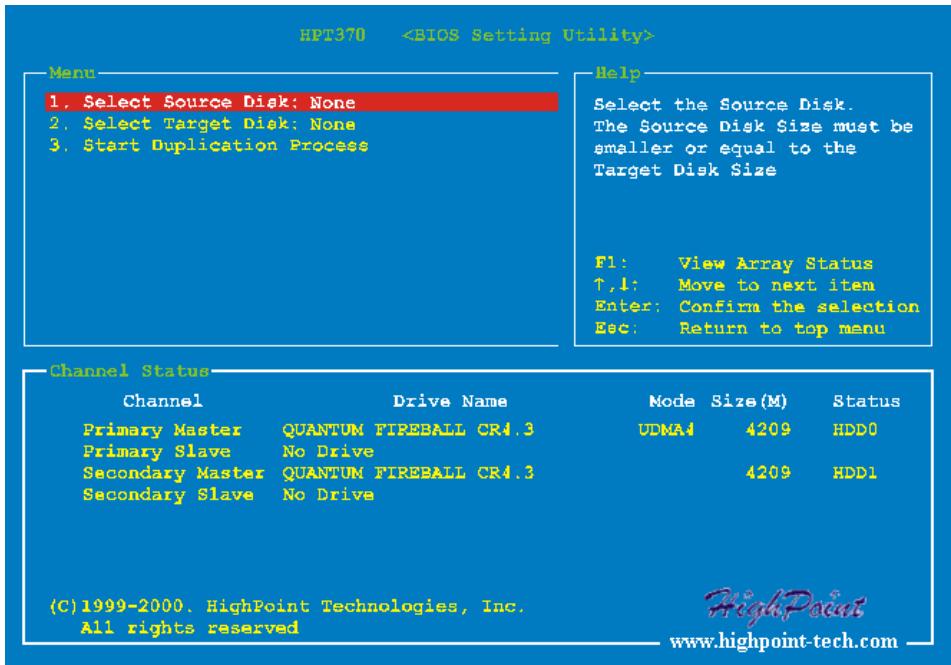
Select Source Disk:
This item is to select the source disk. The size of source disk must be smaller or equal to the one of target disk.
Select Target Disk:
This item is to select the target disk. The size of target disk must be greater or equal to the one of source disk.
Start Duplicating Process:
After you had selected this item, the BIOS setting will take up to 30 minutes to run the duplication. Please wait or you may press <Esc> to cancel.
4-3-4. OPTION 4: Create Spare Disk
This item allows you to select the disk to be used as a spare for a Mirror Disk Array.
4-3-5. OPTION 5: Remove Spare Disk
This item allows you to remove the spare disk from a Mirror Disk Array.
4-3-6. OPTION 6: Set Drive Mode
This item allows you to select the drive transfer mode for the hard disk(s).
Use the up/down arrow to select the menu option to "Set Drive Mode" and press
4-3-7. OPTION 7: Select Boot Disk
This item allows you to select the boot disk among the hard disk(s).
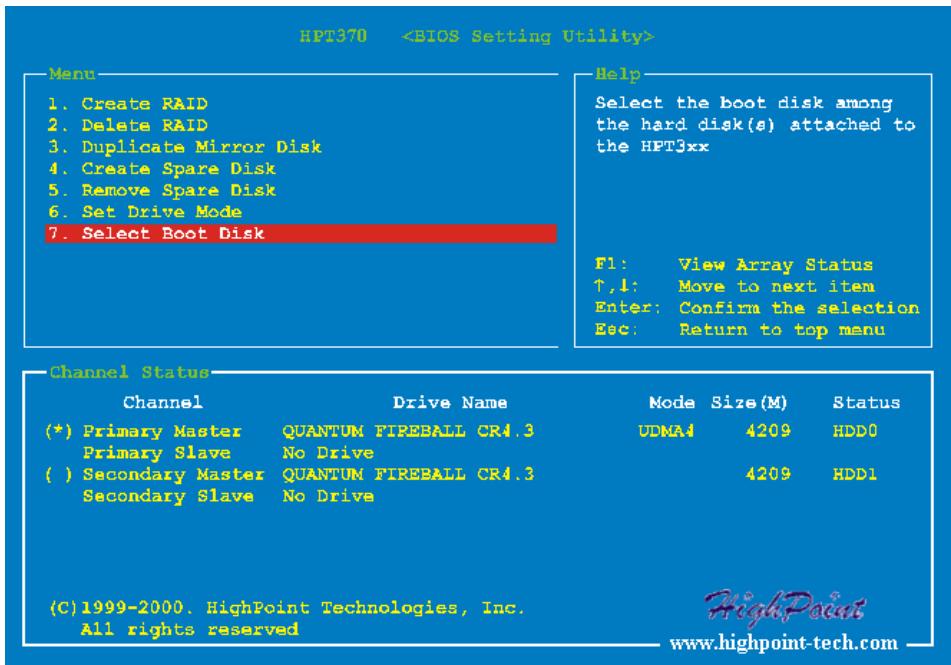
Use the up/down arrow to select the menu option to "Select Boot Disk" and press
Chapter 5. HPT370 Software Installation
Here we will show you the driver installation procedure under various operating systems.
5-1. DOS
This IDE RAID BIOS supports DOS® 5.x (or above) and Windows® 3.1x without the software driver.
5-2. Windows® 9x
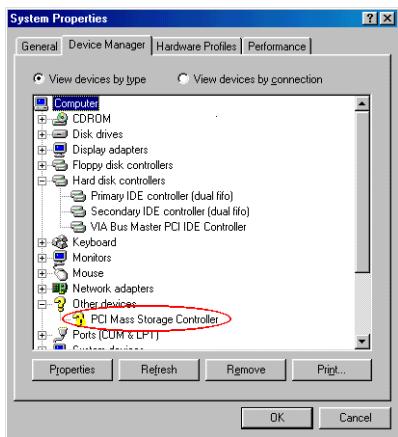
- After the Windows® 9x operating system had been installed and rebooted successfully, go to the "Control Panel" → "System Properties" → "Device Manager". You can see the driver is not yet installed, and there is a device of "PCI Mass Storage Controller" under "Other devices".
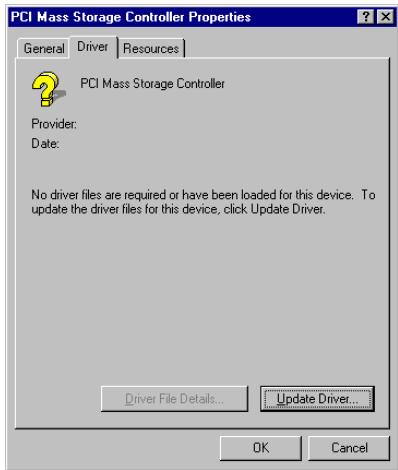
- Click the right button of your mouse on the "? PCI Mass Storage Controller", and then go to "Driver" tab. Click "Update Driver..." to go to on.
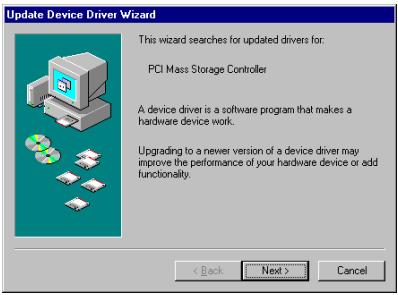
- The wizard is going to install the PCI Mass Storage Controller. Click "Next" to go to the next step.
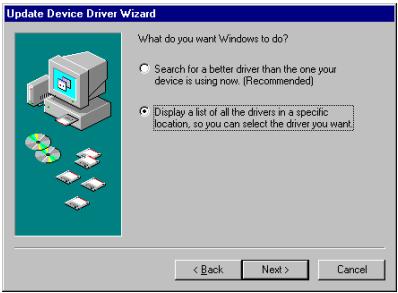
- Choose "Display a list of all the drivers in a specific location..." and click "Next" to go on.
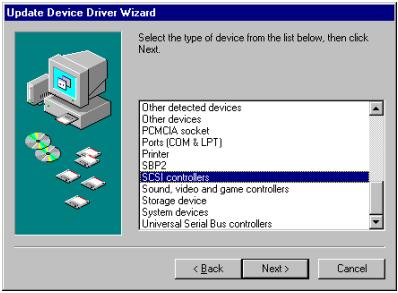
- Choose "SCSI controllers" and click "Next >" to go on.
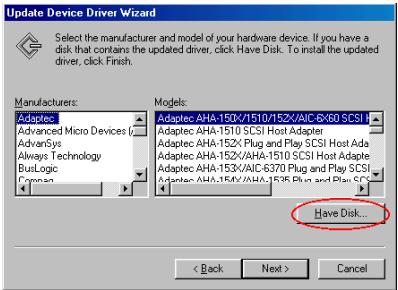
- Click "Have Disk..." to go on.
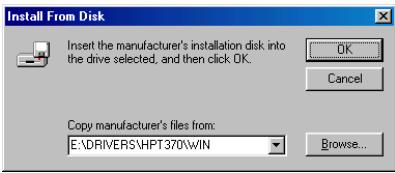
- Insert the driver disk and type the path in the text box "a:\WIN" ("a: is your floppy drive letter), or "E:\DRIVERS\HPT370\Win" (E:\is your CD-ROM drive letter).
Click "OK" to go on.
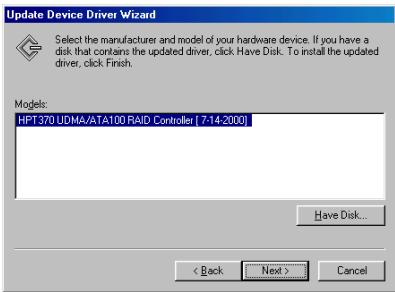
- Step 8: Choose "HPT370 UDMA/ATA100 RAID Controller" and click "Next" to go on.
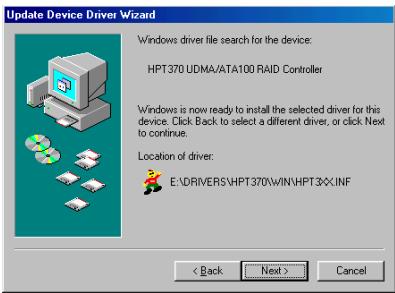
- Windows is now ready to install the driver. Click "Next >" to go on.
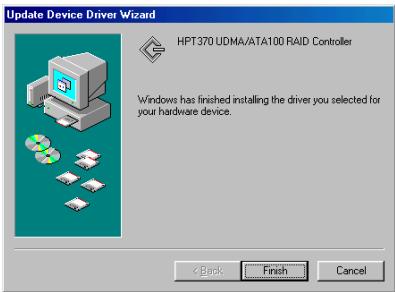
-
Windows has finished installing the driver. Click "Finish" to end the installation.
-
Click "Yes" to restart the system.
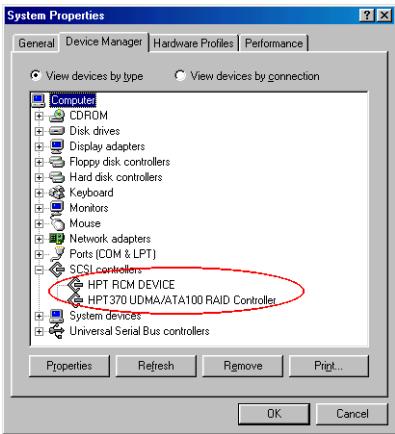
- After rebooting the system, go to the "Control Panel" "System Properties" "Device Manager". Now you can see the driver is installed under the item of "SCSI controllers".
5-3. Windows NT® 4.0
Note
Before you start to install Windows NT 4.0, you have to create a driver disk for the HPT370 IDE RAID controller. You can copy the Ultra ATA-100 driver files from the CD-Title that comes with this motherboard. The path for the Ultra ATA-100 driver files is "E:\Drivers\Hpt370\Nt". (E is your CD-ROM drive letter)
Please note two things before you copy the driver files to diskette. Firstly, the driver files must be copied to the root directory of the diskette. Secondly, you have to set your system to "Show all files". Otherwise you will be unable to copy some important system files to diskette.
Installing drivers during Windows NT installation
If the NT 4.0 is first installed on the ATA-100 drive connected to the VP6 motherboard, follow the following installation procedure:
- Set your system to boot from "Drive A" and then insert the Windows NT installation diskette 1/3. Power on your computer.
Installation Note
If you are installing NT 4.0 from a CD-ROM, please press the "F6" key immediately when the message "Setup is inspecting your computer's hardware configuration..." appears. Then press "S" to configure an additional adapter (HPT370 IDE RAID controller).
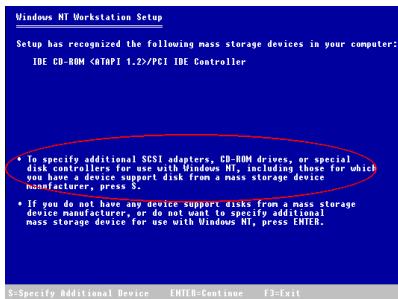
- The setup program will display a message about installing mass storage devices (see figure left) while you install NT4.0. Please press "S" to install the hpt370 driver
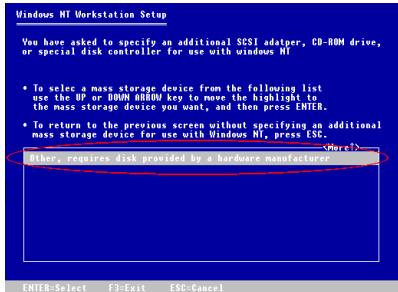
- Select "Other, requires disk provided by a hardware manufacturer", and then press
.
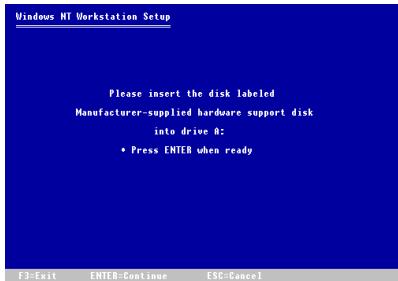
- Insert the driver disk into drive A and press
.
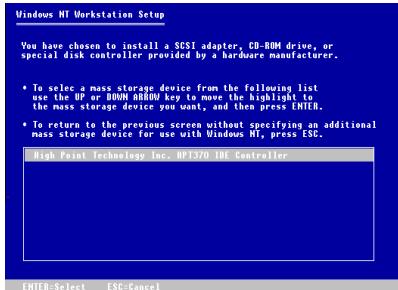
- Use the UP or DOWN arrow key to move the highlight to the mass storage device you want and press
to continue setup.
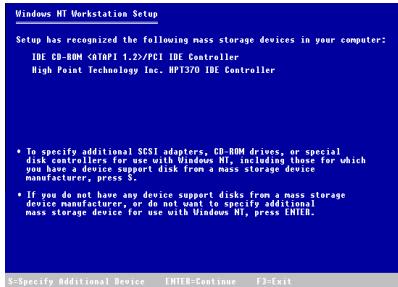
- Windows NT setup has recognized this HPT370 IDE controller
Press
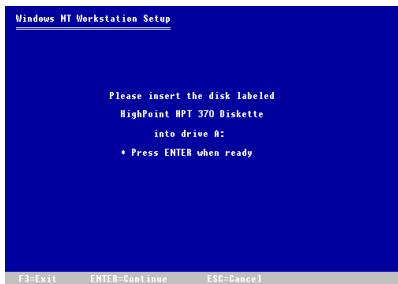
- After you configure your hard disk and specify the installation path, the NT setup will ask you to insert this HPT 370 IDE controller driver disk into drive A again. Insert the driver disk, and then press
to continue setup.
If you have followed the steps described above, you should be finished installing your HPT 370 IDE controller. For the rest of Windows NT installation steps, please follow the instructions displayed in the NT setup program.
Installing drivers with existing Windows NT:
If there is an existing NT 4.0 file system, you can install the HPT 370 IDE controller into the existing system by the following procedure:
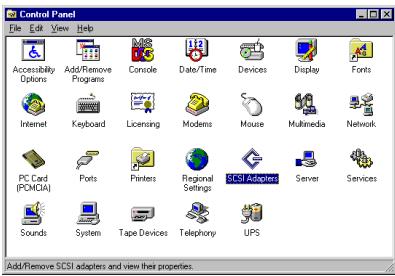
- Go to "Control Panel", and then enter "SCSI Adapters".
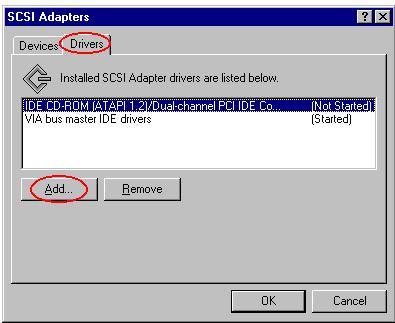
- Select "Drivers", and then click "Add...".
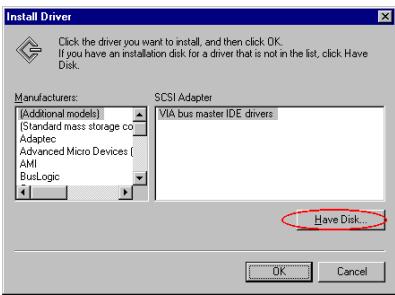
- Click "Have Disk..." to go on.
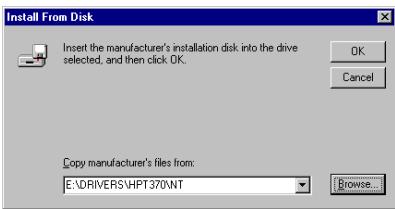
- Insert this HPT 370 IDE controller driver disk into drive A, and then click "OK". or
"E:\DRIVERS\HPT370\NT" (E:\ is your CD-ROM drive letter).
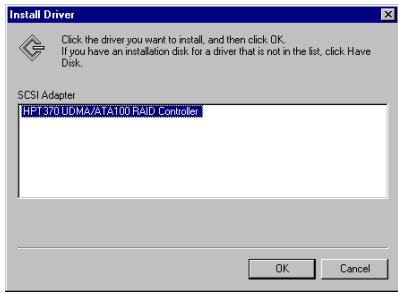
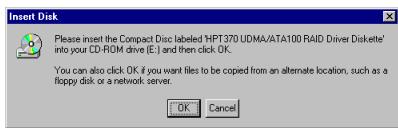
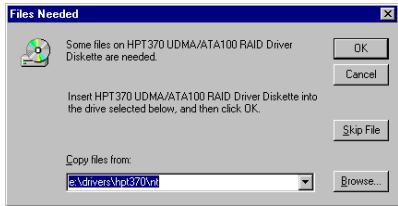
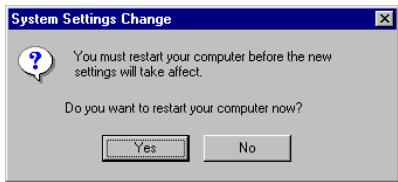
- Click "OK" to go on.
- Insert the CD into your CD-ROM driver and click "OK" to go on.
- Choose path E:\drivers\hpt370\nt and click "OK" to go on.
- Click "Yes" to restart your computer.
5-4. Windows® 2000
Note
If you want to install the Windows® 2000 operating system on the hard drive utilizing the HPT 370 controller, you have to use the Windows® 2000 system disc to boot your computer system. The screen will then show that the "Setup is inspecting your computer's..." After that, the lower screen will show "Press F6 if you need to install a third party SCSI or RAID driver..." At this time, please press the "F6" button on your keyboard. From this point, please refer to section 5-3 Windows® NT 4.0 installation procedure. The following procedure is used only when you don't want to install the Windows® 2000 operating system onto the hard drive utilizing the HPT 370 controller.
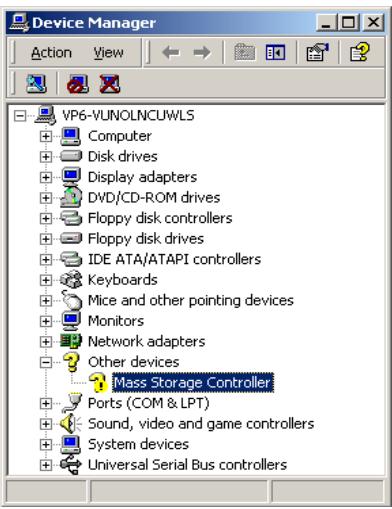
- After the Windows® 2000 operating system had been installed and rebooted successfully, go to the "Device Manager". You can see the driver is not yet installed, and there is a device of "? Mass Storage Controller" under "Other devices".
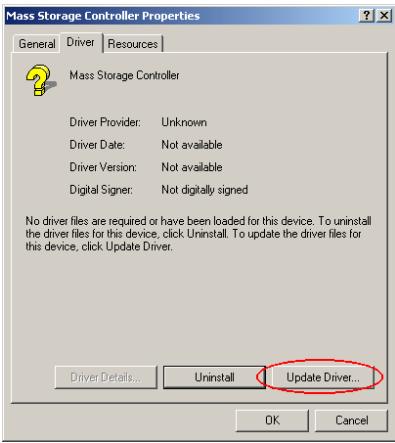
- Click the right button of your mouse on the "? Mass Storage Controller", and then go to "Driver" tab. Click "Update Driver..." to go to on.
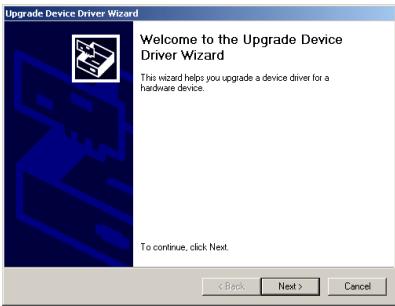
- The wizard is going to install the Mass Storage Controller. Click "Next" to go to the next step.
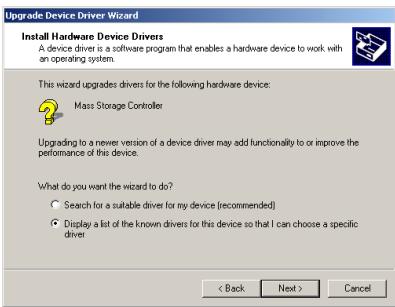
- Choose "Display a list of all the drivers in a specific location..." and click "Next" to go on.
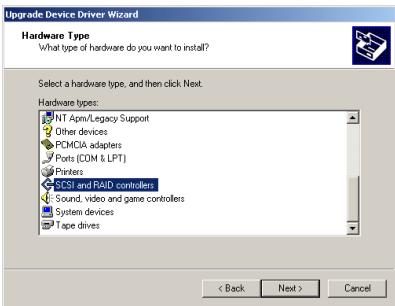
- Choose "SCSI and RAID controllers" and click "Next >" to go on.
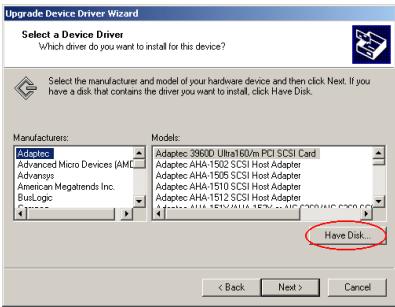
- Click "Have Disk..." to go on.
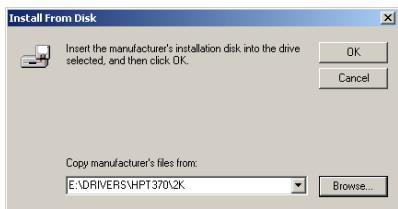
- Insert the HPT 370 IDE driver disk that comes with the VP6 and type the path in the text box "A:\2K" ("a:\" is your floppy drive letter), or "E:\DRIVERS\HPT370\2k" (E:\ is your CD-ROM drive letter).
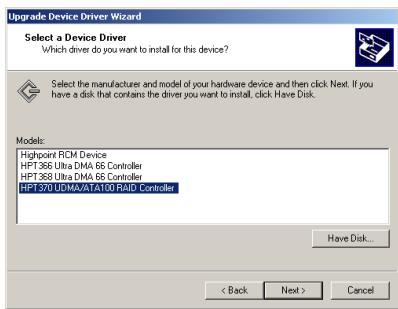
- Choose "HPT370 UDMA/ATA100 RAID Controller" and click "Next >" to go on.
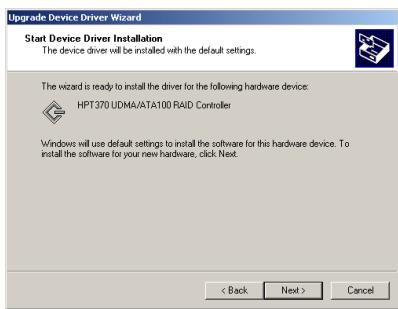
- Windows is now ready to install the driver. Click "Next" to go on.
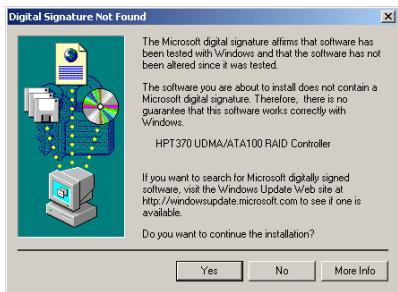
- Click "Yes" to go on.
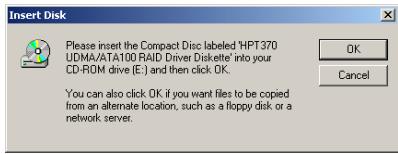
- Insert the CD into your CD-ROM driver and click "OK" to go on.
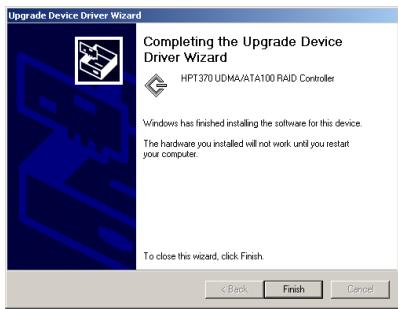
- Windows has finished installing the driver. Click "Finish" to end the installation.
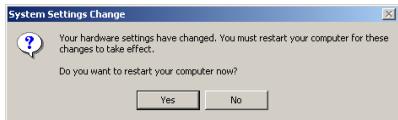
- Click "Yes" to restart the system.
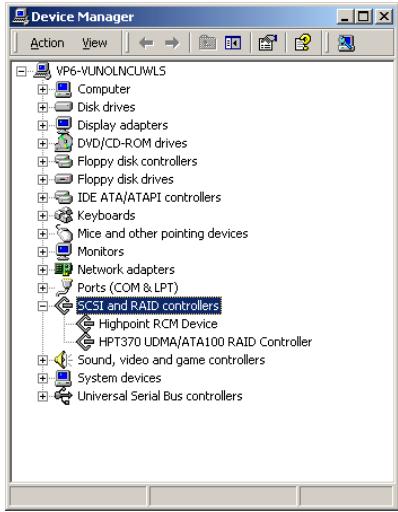
- Go to the "Control Panel" "System Properties" "Device Manager". Now you can see the driver is installed under the item of "SCSI and RAID controllers".
5-5. HPT370 Disk Array Utility Installation Guide
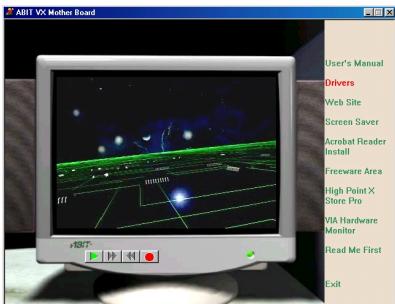
In order to provide you with the on-screen monitoring function about the device information of disk array, you may install the "HPT370 Disk Array Utility" onto your system. Please insert the VP6 CD-Title into your CD-ROM drive. It should execute the program automatically. If not, you can go to the CD location and execute the execution file from the main directory of the CD-Title. After it is executed, you will see the screen shot left. Move the cursor to "Driver" and click on it to go to the next step.
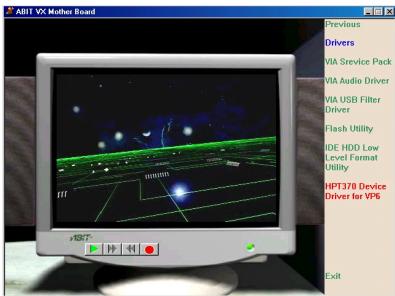
Move the cursor to "HPT370 Device Driver for VP6" and click on it to go to the next step.
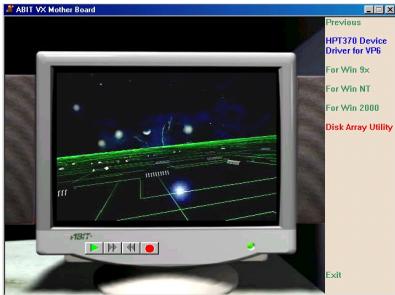
Move the cursor to "Disk Array Utility" and click on it to go to the next step.
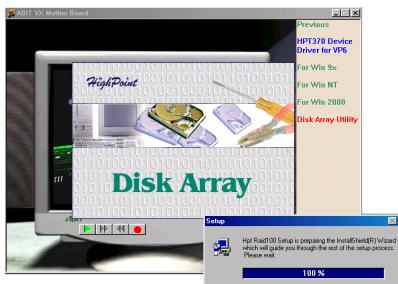
Now you will see the install shield loading.
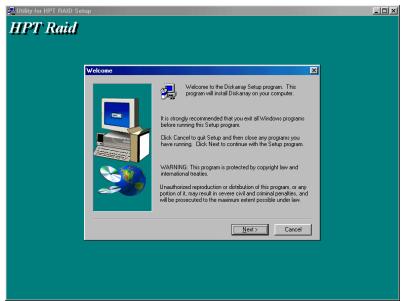
You will now see the welcome screen and its dialogue box. Click "Next" to go on.
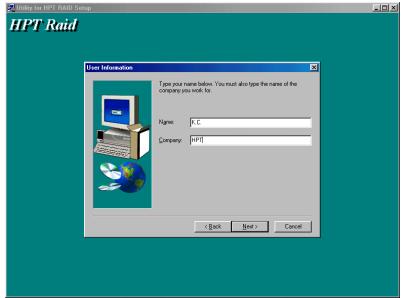
Type in the information of your name and company and then click "Next" to go on.
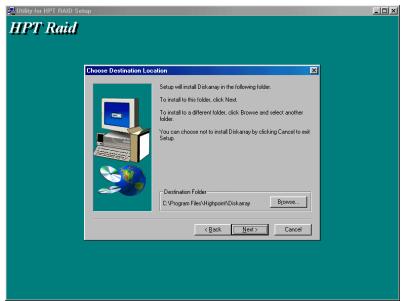
Now you can choose the folder for the destination location you want. We suggest you use the default folder as the destination location. When you are sure of the folder, click "Next> to go on.
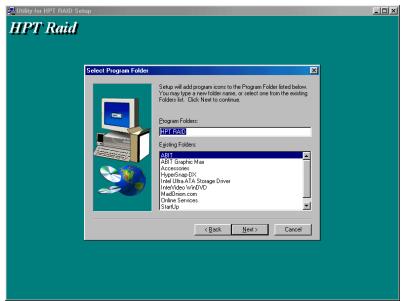
Now you can select the program folder. The setup wizard will add program icons to those program folders listed. Click "Next" to go on.
The system will start copying files. Click "Next" to go on.
When the installation is completed, choose "Yes, I want to restart my computer now." In the check box and click "Finish" to end the setup.
After the system restarts, you can run this "Stripe & Mirror Settings" monitoring program.
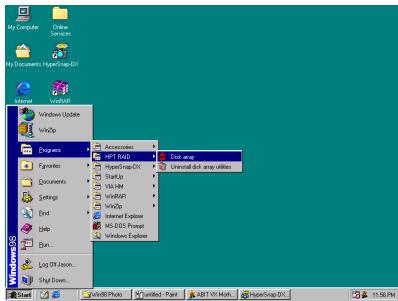
Move the cursor to where the execution file is, shown left.
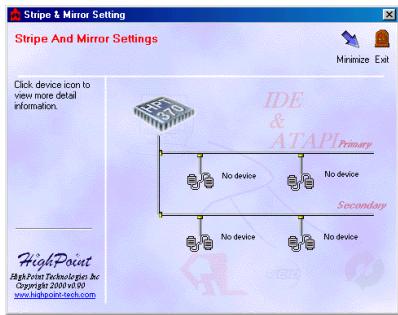
The monitoring screen pops up. Note that there will be a shortcut icon appear in the tool bar. This is used for bringing out the screen again after you have clicked the "Minimize" icon in the upper right corner of the screen. This short cut icon will disappear after you click the "Exit" icon.
Now you are in the monitoring screen. Your current device allocation is viewable at a glance. Move the cursor to the drive icon you want to view and click on it

Appendix A. Installing the VIA Service Pack Drivers for Windows® 98 SE
After you've installed Windows® 98, you need to install the VIA Service Pack drivers. We will tell you step by step in the following section how to do this.
Note
You have to install the VIA Service Pack drivers before you install the VGA and audio drivers. After installing Windows® the quality of your display will be poor because it will be set to 640480 and 16 color. For the best screen capture quality, install the VGA drivers and set the desktop to 800600 using True Color.
Note
Details of the Windows® 98 SE operating system will not be mentioned in this manual. If you have any problems with Windows® 98 SE installation, operations and settings please refer to your Windows® 98 SE user's manual or other resources provided by Microsoft® Corporation.
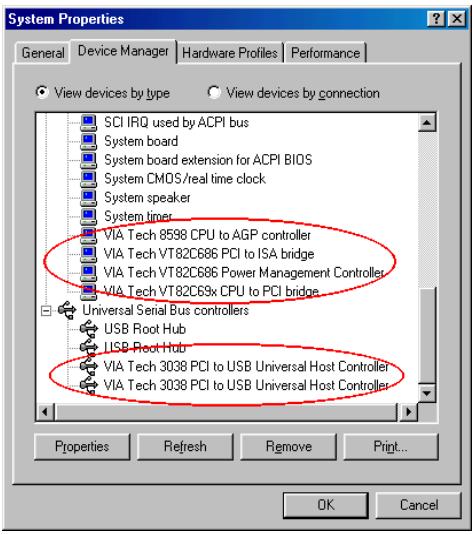
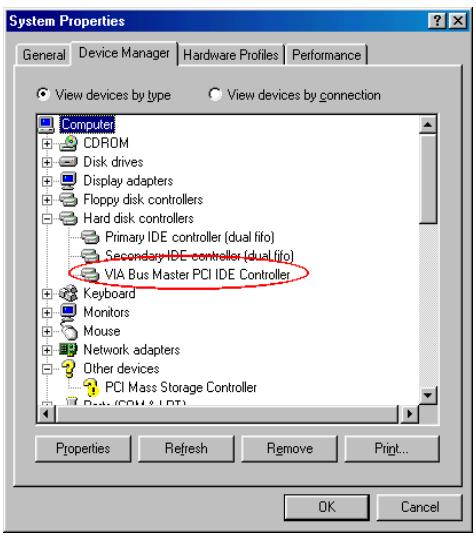
First, go to check the System Properties Device Manager. We will show you several places that identify the VIA chipset and controller. Some items will illicit questions.
Exit the device manager and insert the VP6 CD-Title into your CD-ROM drive, it should execute the program automatically. If not, you can go to the CD location and execute the execution file at the main directory of this CD-Title. After it has been executed you will see the screen below.
- Move the cursor to "Drivers" and click on it. You will go to the next screen.
- Move the cursor to "VIA Service Pack" and click on it. Go to the next screen.
- Move the cursor to "Install" and click on it. Go to the next screen.
- Now you will see the install shield loading.
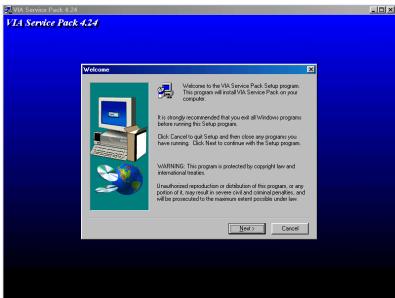
- You will now see the welcome screen and its dialogue box. Click "Next" to go on.
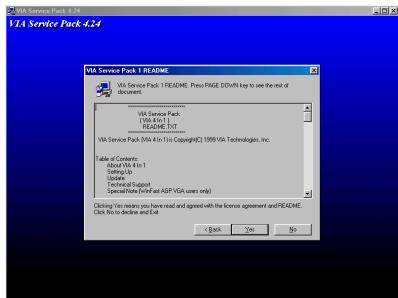
- The service pack readme screen will appear. Click the "Yes" button to go on.
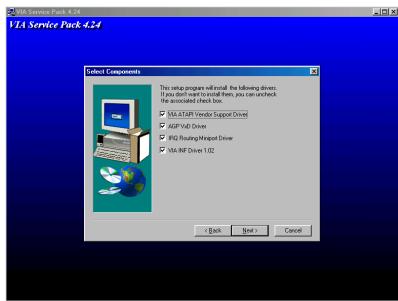
- This setup program will install the four kinds of drivers. Please check which drivers you want to install. When you choose the items, please click the "Next>” button to continue.
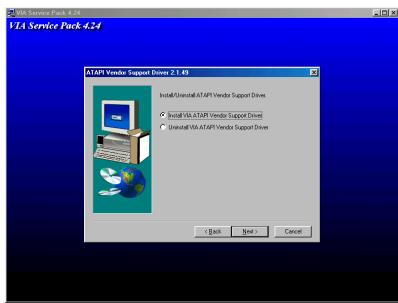
- Choose the "Install VIA ATAPI Vendor Support Driver" and click the "Next> button to go on.
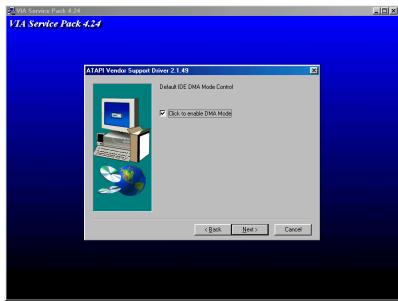
- Choose "enable DMA Mode" and then click the "Next>" button.
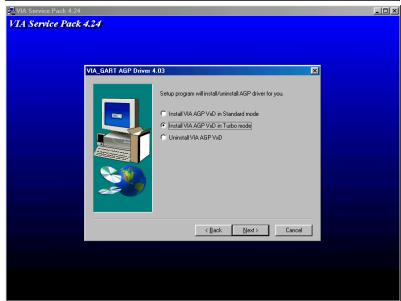
- Choose the AGP VxD driver mode then click the "Next> button.
Note: What is the difference between "Standard" & "Turbo" mode
Installing in "Turbo" mode will give your graphics card the enhanced speed and performance while "Standard" mode offers increased system stability.
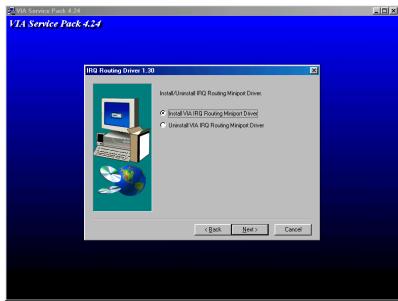
- Choose "Install VIA IRQ Routing Miniport Driver", then click the "Next" button.
- The installer will show the install progress percentage.
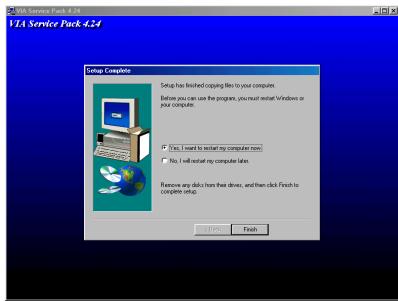
-
When the installation is complete, the installer will ask you to restart your computer. We suggest that you choose "Yes, I want to restart my computer now" and then click the "Finish" button to restart your computer to finish the driver installation.
-
When your computer system restarts, you will see the Windows® 98 SE start the update process and several new hardware devices will be found and updated. When restarting Windows® 98 SE, the CD-ROM drives will fail to be found in the updating process. If the prompt dialogue box asks you to put the Windows® 98 SE CD into the CD-ROM drive, just ignore this message and let it go to the next process.
- Go to check the System Properties Device Manager. It will show you several places that identify the VIA chipset and controller.
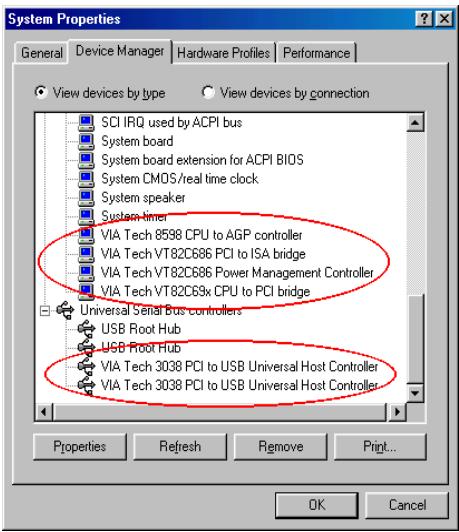
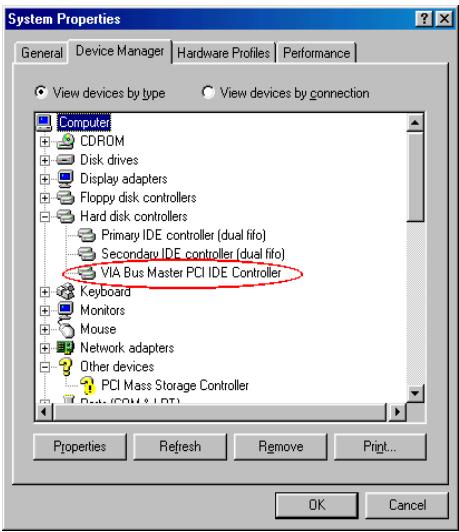
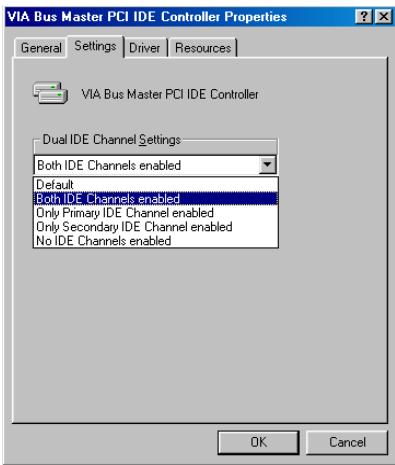
- After restarting your computer, check the System Properties Device Manager, then choose the item Hard disk controllers VIA Bus Master PCI IDE Controller then click the right button of the mouse. The VIA Bus Master PCI IDE Controller Properties screen will appear. Choose "Settings", then select the item "Both IDE Channels enabled" to enable the UDMA 100 function for both IDE channels.
Problem under Windows® 95 OSR2
If your operating system is Windows® 95 OSR2, install the VIA service pack and Microsoft® usbsupp.exe for USB devices support. Then restart Windows and go to System Properties Device Manager. There will be question marks before "PCI Universal Serial Bus" and "VIA PCI to USB Universal Host Controller".
To make these question marks disappear, remove these items and then restart Windows. When Windows completes loading, these devices will return to normal and the question marks will be gone.
Appendix B. Installing the VIA USB Filter Driver for Windows® 98 SE
We will show you how to install the VIA USB filter drivers for the Windows® 98 SE operating system.
- Move the cursor to "Drivers" and click on it. You will go to the next screen.
- Move the cursor to "VIA USB Filter Driver" and click on it. Go to the next screen.
- Move the cursor to "Install" and click on it. Go to the next screen.
- The installer will show the install progress percentage.
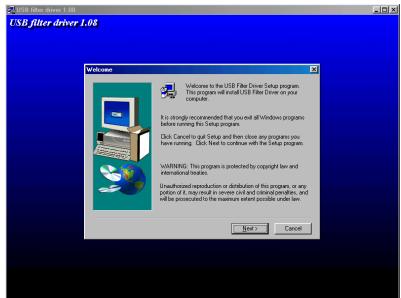
- You will now see the welcome screen and its dialogue box. Click "Next" to go on.
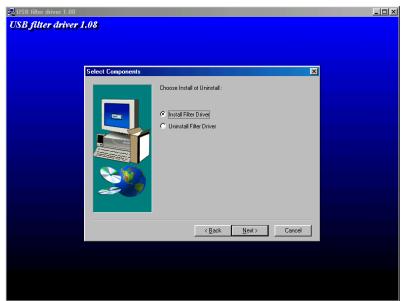
- Choose the "Install Filter Driver" and then click the "Next>" button to go on.
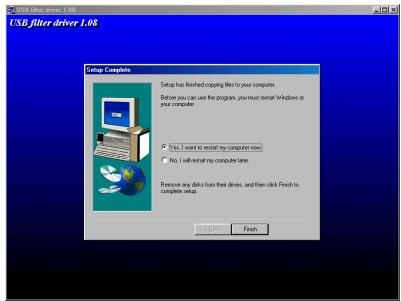
- When the installation is complete, the installer will ask you to restart your computer. We suggest that you choose "Yes, I want to restart my computer now" and then click the "Finish" button to restart your computer to finish driver installation.
Appendix C. Installing the VIA Service Pack Drivers for Windows® NT 4.0 Server / Workstation
In this section we will show you how to install the VIA Service Pack drivers to your Windows NT 4.0 Server/Workstation operating system. All the screen shots are taken from the Windows NT 4.0 server version. Before you install the VIA Service Pack drives, please install Windows NT 4.0 Service Pack 5 (or latest version) first, and then you can install the VIA Service Pack drivers.
Note
Details of the Windows NT 4.0 Server/Workstation operating system are not mentioned in this manual. If you have any problems with the settings, operating or installing Windows NT 4.0 Server/Workstation, please refer to your Windows NT 4.0 Server/Workstation user's manual or other resources provided by Microsoft Corporation.
Note
For the Windows NT 4.0 Server/Workstation operating system, you don't need to install the IDE-USB drivers. All you have to install is the Windows NT 4.0 Service Pack 5 (or latest version) first.
Insert the VP6 CD-Title into your CD-ROM drive. It should execute the program automatically. If not, you can go to the CD location and execute the execution file from the main directory of this CD-Title. After it is executed, you will see the screen below.
- Move the cursor to "Drivers" and click on it. This will bring you to the next screen.
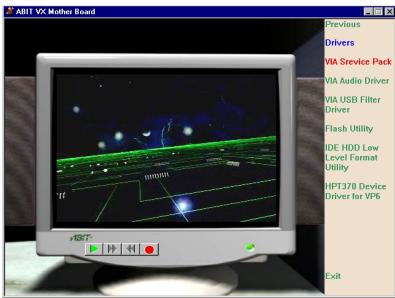
- Move the cursor to "VIA Service Pack" and click on it. Go to the next screen.
- Move the cursor to "Install" and click on it. Go to the next screen.
- The install shield is now loading.
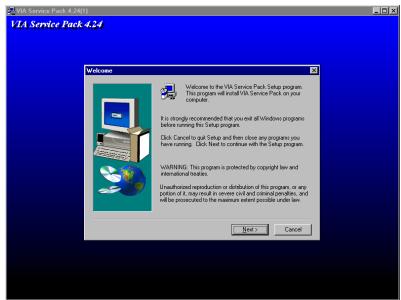
- The "Welcome" screen and its dialogue box appears. Click the "Next> button to go on.
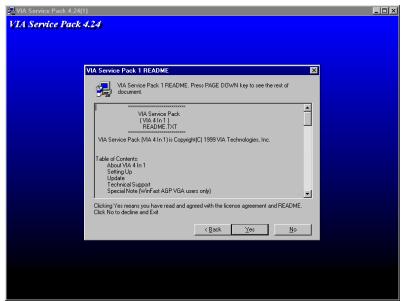
- The readme screen will appear next. Click the "Yes" button to continue.
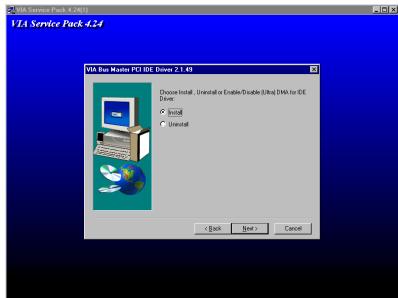
- Choose "Install" and then click the "Next>" button to go on.
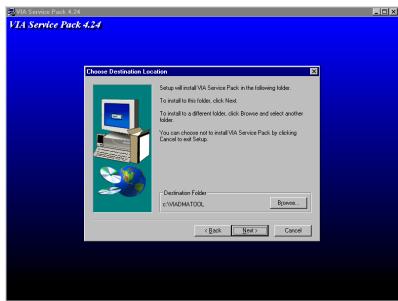
- Now you can choose the folder for the destination location you want the drivers installed. We suggest you use the default folder as the destination location. After checking the folder click "Next >".
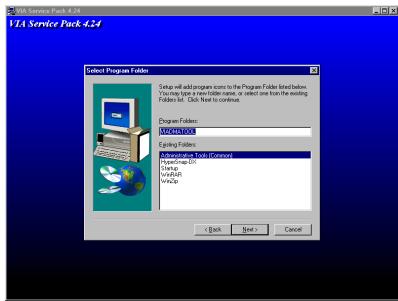
- You can choose the name of the program folder. We suggest you use the default program folder name. After checking the program folder name then click the "Next>" button.
The program will start to install the drivers the system needs.
The installer will show the install progress percentage.
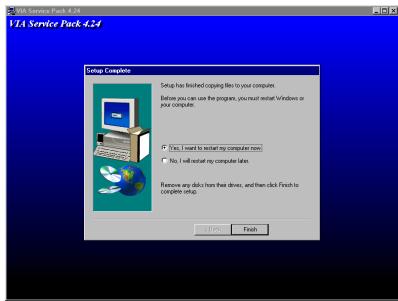
- When installation is complete, the installer will ask you to restart your computer. We suggest you choose "Yes, I want to restart my computer now" and then click the "Finish" button to restart your computer to finish the driver updating.
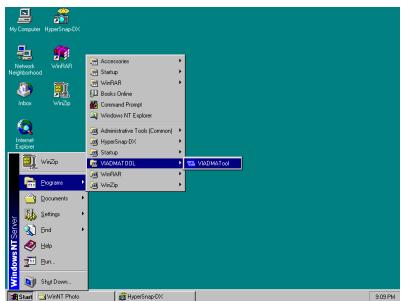
- When you restart Windows, you can see the VIA DMA Tools program group.
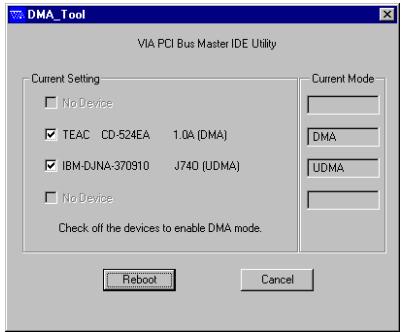
- You can see the details about your IDE device.
Appendix D. Installing the VIA Service Pack Drivers for Windows® 2000
After you've installed Windows® 2000 operation system, you need to install the VIA Service Pack drivers. We will tell you step by step in the following section how to do this.
Note
You have to install the VIA Service Pack drivers before you install the VGA and audio drivers. After installing Windows® the quality of your display will be poor because it will be set to 640480 and 16 color. For the best screen capture quality, install the VGA drivers and set the desktop to 800600 using True Color.
Note
Details of the Windows® 2000 operating system are not mentioned in this manual. If you have any problems with the settings, operating or installing Windows® 2000, please refer to your Windows® 2000 user's manual or other resources provided by Microsoft® Corporation.
Insert the VP6 CD-Title into your CD-ROM drive, it should execute the program automatically. If not, you can go to the CD location and execute the execution file at the main directory of this CD-Title. After it has been executed you will see the screen below.
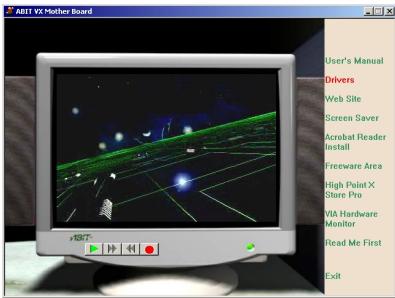
- Move the cursor to "Drivers" and click on it. You will go to the next screen.
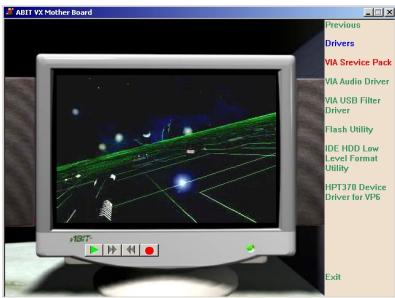
- Move the cursor to "VIA Service Pack" and click on it. Go to the next screen.
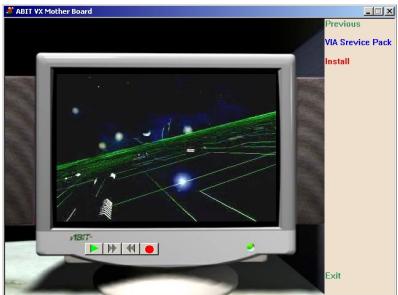
- Move the cursor to "Install" and click on it. Go to the next screen.
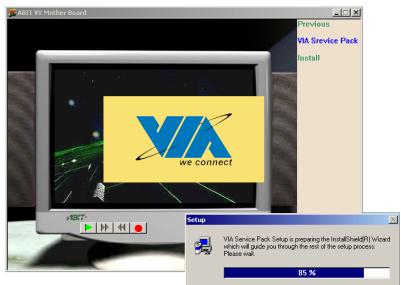
- The install shield is now loading.
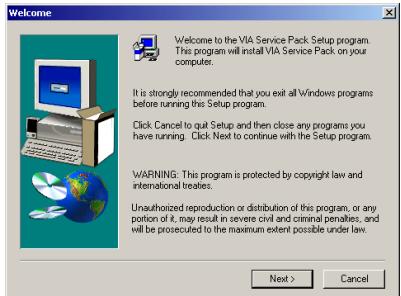
- The welcome screen and its dialogue box appear. Click "Next" to go on.
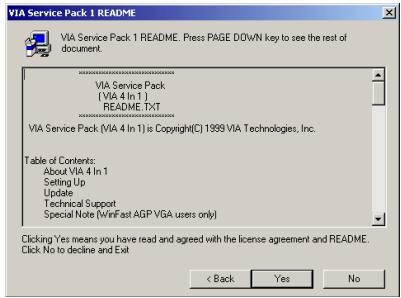
- The service pack readme screen appears. Click the "Yes" button to go on.
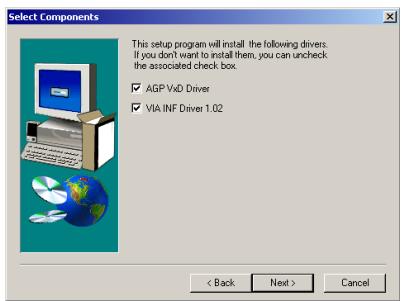
- This setup program will install the drivers. Please check which drivers you want to install. After choosing the item, click the "Next" button to continue.
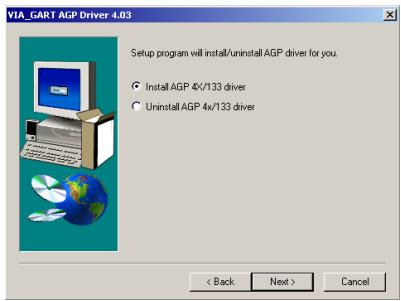
- Choose the "Install AGP 4X/133 driver" and then click the "Next>" button to go on.
The installer will show the install progress percentage.
- When the installation is complete, the installer will ask you to restart your computer. Choose "Yes, I want to restart my computer now" then click the "Finish" button to restart your computer to finish the driver installation.
NOTE
When you restart your computer, the system will find the new hardware devices and then ask you to restart your computer. You may need to repeat this procedure several times, after which the system will resume normal operation.

Appendix E. BIOS Update Guide
We will use the SE6 as an example, all other models follow the same process.
First, know your motherboard's model name and version number. You can find it on one slot of the motherboard. Each motherboard always has the label at the same place as shown in the photo below.
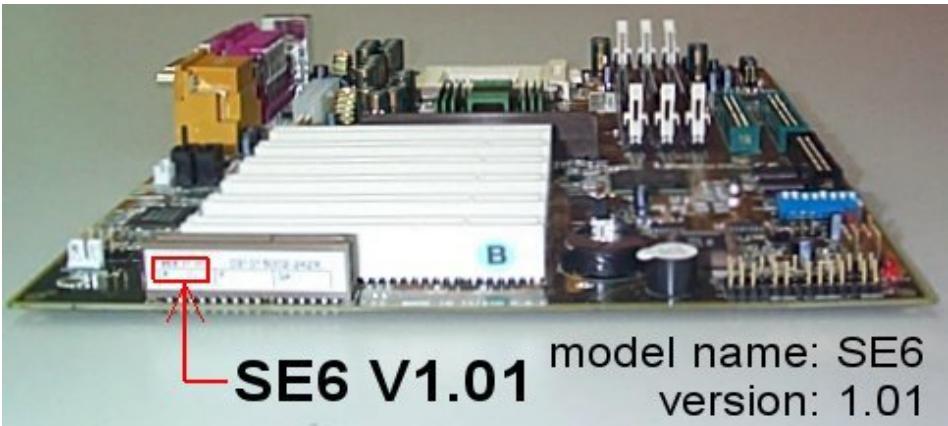
You will find the model name and version on the white sticker.
- Know the current BIOS ID.
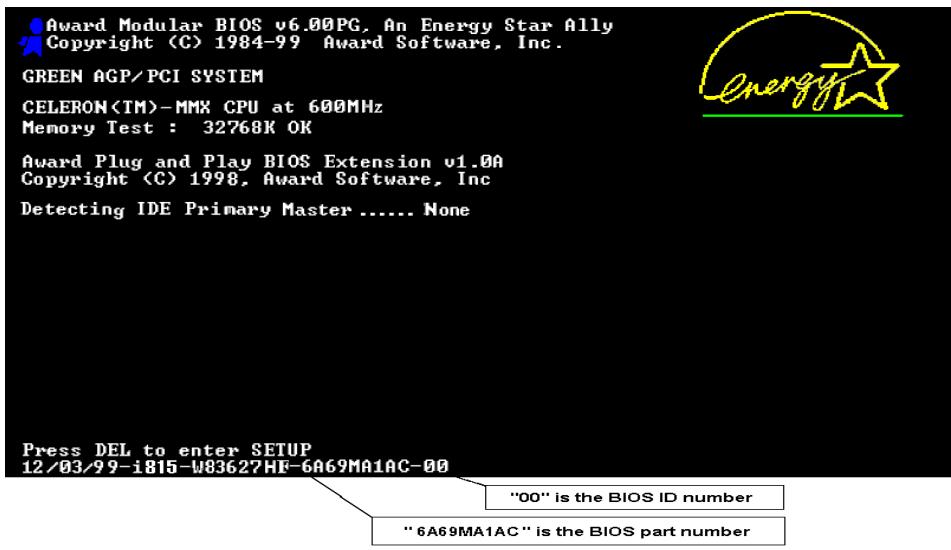
For example, in this case, the current BIOS ID is "00". If you already have the latest BIOS, no any update action is necessary. If your BIOS is not the latest BIOS, go on to the next step.
- Download the correct BIOS file from our Web site.
[SE6]
Filename: SE6SW.EXE
Date: 07/06/2000
ID: SW
NOTE:
- Fixes SCSI HDD detection problem when booting from SCSI CD-ROM and executing FDISK.
- Supports 512MB memory modules.
- Sets the In-Order Queue Depth default to 4, increasing the integrated video performance.
Go to our Web site and choose the correct BIOS file and download it.
- Double click the download file, it will self-extract to .bin file.
LHA's SFX 2.13S (c) Yoshi, 1991
SE6_SW.BIN
- Make a bootable floppy disk and copy the necessary files onto it.
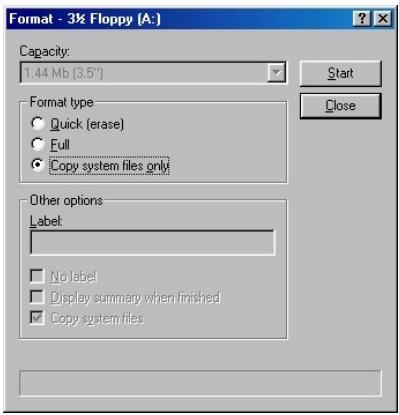
You may make a floppy disk bootable either in Explorer or in the DOS prompt mode.
[c:]format a:/s
After formatting and transferring the system to the floppy disk, copy two files into it. One is the BIOS flash utility "awdflash.exe" and the other is the decompressed BIOS binary file.
6. Boot off floppy disk.
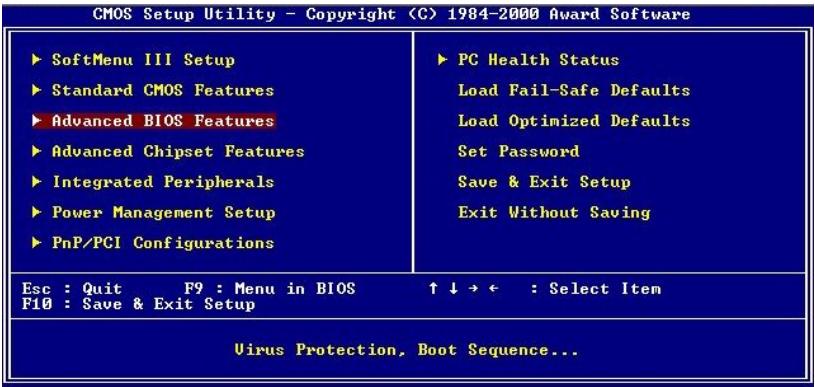
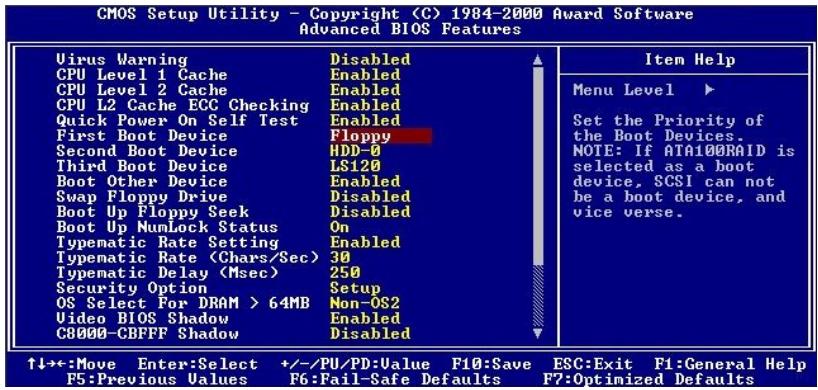
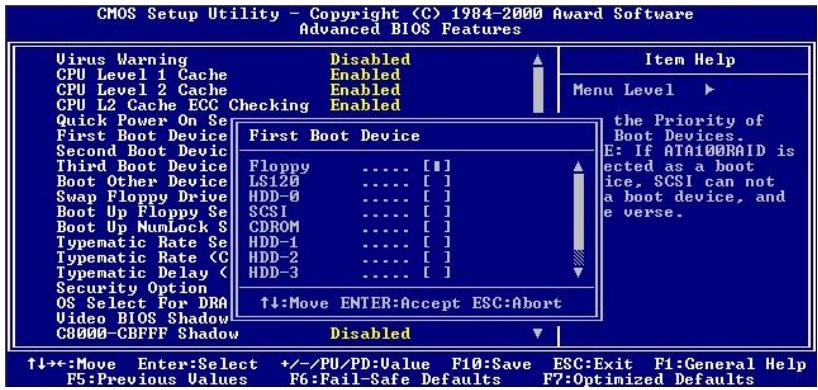
Please set the first boot sequence as "floppy" in BIOS and boot off the floppy disk.
- Flash the BIOS in pure DOS mode.
After successfully booting off of the floppy, execute the flash utility according to these instructions.
A:\>awdflash se6_sw.bin /cc /cd /cp /py /sn /cks /r_
Note
During the updating, the progress will be measured by white blocks. The last four blue blocks of the flash update process represent the "BIOS boot block". The BIOS boot block is used to prevent the BIOS from becoming corrupt during programming. It should not be programmed every time. If this "BIOS boot block" remains intact when the BIOS becomes corrupt during programming, then you can boot from a bootable floppy next time you boot your computer. This allows you to flash your BIOS again without the need for technical support from the dealer.
Appendix F. Installing the VIA Hardware Monitor System
The VIA Hardware Monitor System is a self-diagnostic system for PCs. It will protect PC hardware by monitoring several critical items including power supply voltages, CPU & system fan speeds, and CPU and system temperatures. These items are important for the operation of the system; errors may result in permanent damage to the PC. Once any item is out of its normal range, a warning message will pop up and remind the user to take proper measures.
The following description will show you how to install the VIA Hardware Monitor System and use it. Insert the VP6 CD-Title into your CD-ROM drive. It should execute the program automatically. If not, you can go to the CD location and execute the execution file from the main directory of this CD-Title. After it is executed, you will see the screen below.
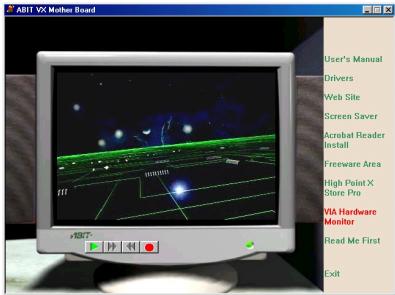
- Click "VIA Hardware Monitor".
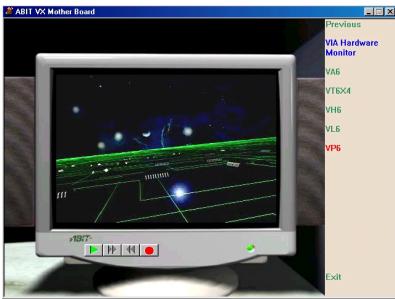
- Click the "Install" button to start installing the VIA hardware monitor system utility.
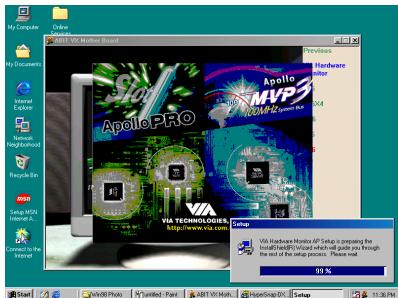
- You will see the install shell activate.
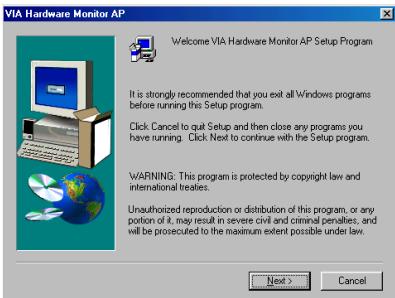
- The "Welcome" screen and its dialogue box will appear. Click the "Next>" button to go on.
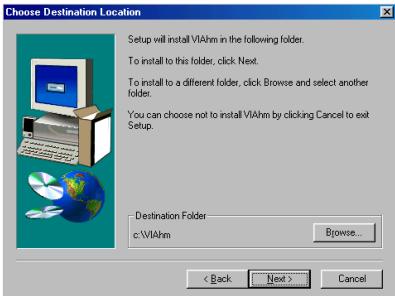
- Now you can choose the folder for the destination location you want to install the drivers. We suggest you use the default folder as the destination location. After checking the folder click "Next >".
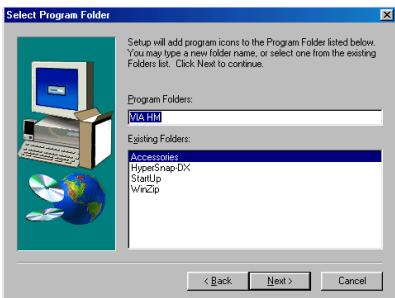
- You can choose the name of the program folder. We suggest you use the default program folder name. After checking the program folder name then click the "Next> button.
The program will start to install the drivers the system needs.
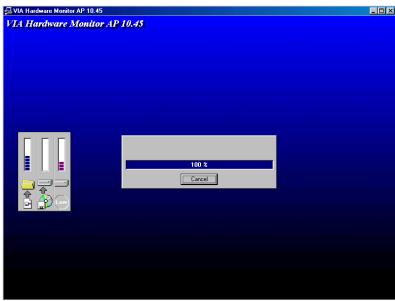
- The installer will show the install progress percentage.
When the installation is complete, the installer will automatically terminate the install process.
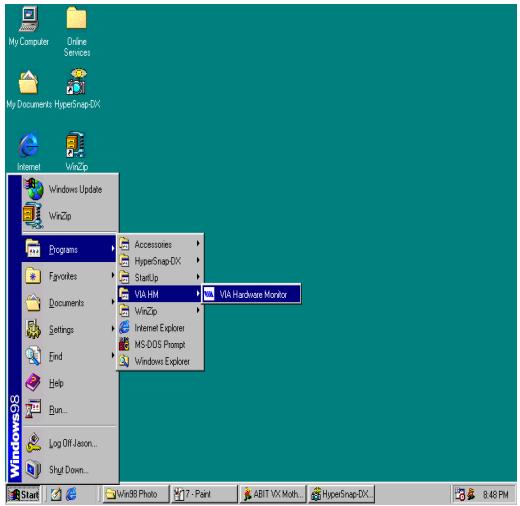
- When the installation is complete, choose "Programs" from the "Start" toolbar. You can see the program group "VIA HM" and an item called "VIA Hardware Monitor". Click it, and then you can see the screen below.
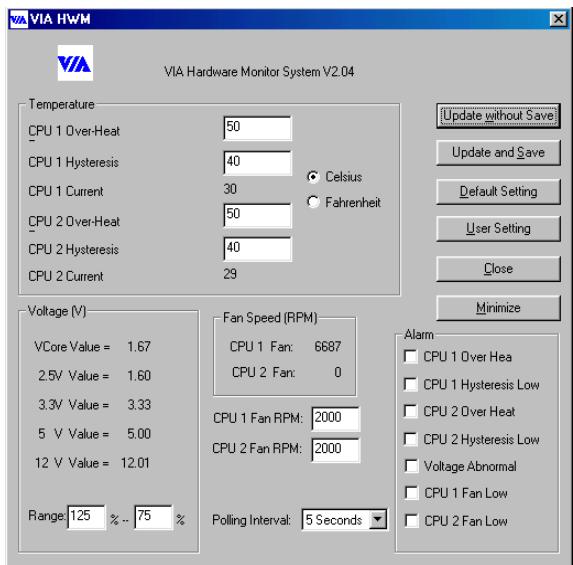
- This screen shows the VIA hardware monitor system screen. It shows the information about system temperature, voltages and fan speed. Some items can let you set the warning range; you can set your system to make optimum value settings.

Appendix G. Troubleshooting (Need Assistance?)
If you have a problem during operation, in order to help our technical support personnel quickly determine the problem with your motherboard and give you the answers you need, before filling in the technical support form, eliminate any peripheral that is not related to the problem, and indicate it on the form. Fax this form to your dealer or to the company where you bought the hardware in order to benefit from our technical support. (You can refer to the examples given below)

Example 1: With a system including: motherboard (with CPU, DRAM, COAST...) HDD, CD-ROM, FDD, VGA CARD, MPEG CARD, SCSI CARD, SOUND CARD, etc. After the system is assembled, if you cannot boot up, check the key components of the system using the procedure described below. First remove all interface cards except the VGA card and try to reboot.
If you still cannot boot up:
Try installing another brand/model VGA card and see if the system will start. If it still does not start, note the VGA card model, motherboard model, Bios identification number, CPU on the technical support form (refer to main instructions), and describe the problem in the problem description space provided.
If you can boot up:
Insert the interface cards you have removed back into the system, one by one and try to start the system each time you insert a card, until the system will not start. Keep the VGA card and the interface card that caused the problem inserted on the motherboard, remove any other cards or peripheral, and start again. If you still cannot start, note the information related to both cards in the add-on Card space provided, and don't forget to indicate the motherboard model, version, BIOS identification number, CPU (refer to main instructions), and give a description of the problem.

Example 2: With a system including the motherboard (with CPU, DRAM, COAST...) HDD, CD-ROM, FDD, VGA CARD, LAN CARD, MPEG CARD, SCSI CARD, SOUND CARD, after assembly and after having installed the Sound Card Driver, when you restart the system, when it runs the Sound Card Driver, it resets automatically. This problem may be due to the Sound Card Driver. During the Starting DOS... procedure, press SHIFT (BY-PASS) key, to skip CONFIG.SYS and AUTOEXEC.BAT; edit CONFIG.SYS with a text editor, and in function the line that loads the Sound Card Driver, add a remark REM, in order to disable the Sound Card Driver. See the example below.
CONFIG.SYS:
DEVICE=C:\DOS\HIMEM.SYS
DEVICE=C:\DOS\EMM386.EXE HIGHSCAN
DOS=HIGH, UMB
FILES=40
BUFFERS=36
REM DEVICEHIGH=C:\PLUGPLAY\DWCFGMG.SYS
LASTDRIVE = Z
Restart the system. If the system starts and does not reset, you can be sure that the problem is due to the Sound Card Driver. Write down the Sound Card model, motherboard model, BIOS identification number on the technical support file (refer to main instructions), and describe the problem in the space provided.
Main instructions...
To fill in this "Technical Support Form", refer to the step-by-step instructions given below:
1*.MODEL: Note the model number given in your user's manual.
Example: VP6, VH6, VL6, etc...
2. Motherboard model number (REV): Note the motherboard model number labeled on the motherboard as "REV:..*".
Example: REV: 1.01
- BIOS ID and Part Number: See next page for an example.
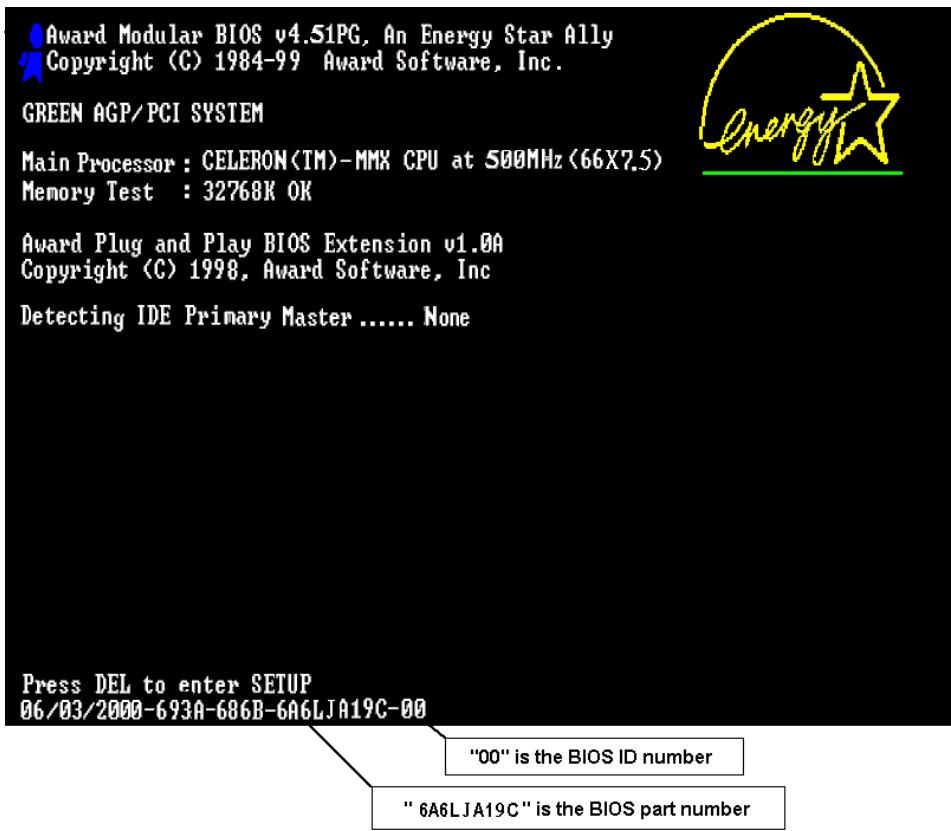
- DRIVER REV: Note the driver version number indicated on the DEVICE DRIVER disk (if have) as
"Release *." For example:
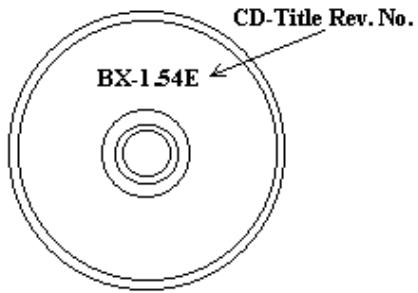
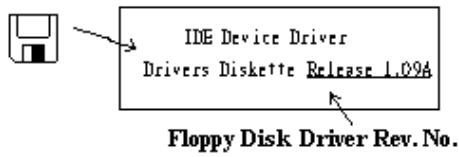
5*. OS/APPLICATION: Indicate the operating system and the applications you are running on the system.
Example: MS-DOS® 6.22, Windows® 95, Windows® NT....
6^* . CPU: Indicate the brand and the speed (MHz) of your CPU.
Example: (A) In the "Brand" space, write "Intel", in the "Specifications" space, write "Pentium® II MMX 300MHz".
- HDD: Indicate the brand and specifications of your HDD(s), specify if the HDD is using IDE1 or IDE2. If you know the disk capacity, indicate it and check ("✓") "□"; in case you give no indication, we will consider that your HDD is "IDE1" Master.
Example: In the "HDD" space, check the box, in the Brand space, write "Seagate", in the Specifications space, write "ST31621A (1.6GB)".
- CD-ROM Drive: Indicate the brand and specifications of your CD-ROM drive. Specify if it uses IDE1 or IDE2, and check ("✓") "☐"; in case you give no indication, we will consider that your CD-ROM is "IDE2" Master.
Example: In the "CD-ROM drive" space, check the box, in the Brand space, write "Mitsumi", in the Specifications space, write "FX-400D".
- System Memory (DRAM): Indicate the brand and specifications (SIMM / DIMM) of your system memory. For example:
In the Brand space, write "Panasonic", in the Specifications space, write "SIMM-FP DRAM 4MB-06".
Or, in the Brand, write "NPNX", in the Specifications space, write "SIMM-EDO DRAM 8MB-06".
Or, in the Brand space, write "SEC", in the Specifications space, write "DIMM-S DRAM 8MB-G12".
- ADD-ON CARD: Indicate which add-on cards you are absolutely sure is related to the problem.
If you cannot identify the problem's origin, indicate all the add-on cards inserted into your system.
Note
Items between the ** are absolutely necessary.
Technical Support Form

Company Name:

Phone Number:

Contact Person:

Fax Number:

E-mail Address:
| Model | * | BIOS ID # | * |
| Motherboard Model No. | DRIVER REV | ||
| OS/Application | * | ||
| Hardware name | Brand | Specifications | |
| CPU | * | ||
| HDD IDE1 IDE2 | |||
| CD- IDE1 ROM IDE2 Drive | |||
| System Memory (DRAM) | |||
| ADD-ON CARD | |||
Problem Description:
Appendix H. How to Get Technical Support
(From our website) http://www.ubit.com.tw
(In North America) http://www.abit-usa.com
(In Europe) http://www.abit.nl
Thank you for choosing ABIT products. ABIT sells all our products through distributors, resellers and system integrators, we have no direct sales to end-users. Before sending email for tech support, please check with your resellers or integrators if you need any services. They are the ones who sold you your system and they should know best as to what can be done. How they serve you is a good reference for future purchases.
We appreciate every customer and would like to provide the best service to you. Providing fast service to our customers is our top priority. However we receive many phone calls and a huge amount of email from all over the world. At the present time it is impossible for us to respond to every single inquiry. Therefore it is quite possible that if you send an email to us that you may not receive a response.
We have done many compatibility tests and reliability tests to make sure our products have the best quality and compatibility. In case you need service or technical support, please understand the constraint we have and always check with the reseller who sold the product to you first.
To expedite service, we recommend that you follow the procedures outlined below before contacting us. With your help, we can meet our commitment to provide the best service to the greatest number of ABIT customers:
- Check the Manual. It sounds simple but we have taken a lot of care in making a well-written and thorough manual. It is full of information that doesn't only pertain to motherboards. The CD-ROM included with your board will have the manual as well as drivers. If you don't have either one go to our Program Download Area of the website or FTP server at:
http://www.ubit.com.tw/download/index.htm - Download latest BIOS, software or drivers. Please go to our Program Download area on our website to check to see if you have the latest BIOS. They are developed over periods of time to fix bugs or incompatibilities. Also please make sure you have the latest drivers from your peripheral cards makers!
- Check the ABIT Technical Terms Guide and FAQ on our website. We are trying to expand and make the FAQs more helpful and information rich. Let us know if you have any suggestions. For hot topics check out our HOT FAQ!
- Internet Newsgroups. They are a great source of information and many people there can offer help. ABIT's Internet News group, alt.comp.periphs.mainboard.abit, is an ideal forum for the public to exchange information and discuss experiences they have had with ABIT products. Many times you will see that your question has already been asked before. This is a public Internet news group and it is reserved for free discussions, Here is a list of some of the more popular ones:
alt.comp.perips.mainboard.abit
comp.sys.ibm.pc.hardware.chips
alt.comp.hardware.overclocking
alt.comp.hardware.homebuilt
alt.comp.hardware.pc-homebuilt
Ask your reseller. Your ABIT authorized distributor should be able to provide the fastest solution to your technical problem. We sell our products through distributors who sell to resellers and stores. Your reseller should be very familiar with your system configuration and should be able to solve your problem much more efficiently than we could. After all, your reseller regards you as an important customer who may purchase more products and who can urge your friends to buy from him or her as well. They integrated and sold the system to you. They should know best what your system configuration is and your problem. They should have reasonable return or refund policies. How they serve you is also a good reference for your next purchase.
- Contacting ABIT. If you feel that you need to contact ABIT directly you can send email to the ABIT technical support department. First, please contact the support team for the branch office closest to you. They will be more familiar with local conditions and problems and will have better insight as to which resellers offer what products and services. Due to the huge number of emails coming in every day and other reasons, such as the time required for problem reproduction, we will not be able to reply to every email. Please understand that we are selling through distribution channels and don't have the resources to serve every end-user. However, we will try to do our best to help every customer. Please also remember that for many of our technical support team English is a second language, you will have a better chance of getting a helpful answer if your question can be understood in the first place. Be sure to use very, simple, concise language that clearly states the problem, avoid rambling or flowery language and always list your system components. Here is the contact information for our branch offices:
In North America and South America please contact:
ABIT Computer (USA) Corporation
46808 Lakeview Blvd.
Fremont, California 94538 U.S.A.
sales@abit-usa.com
technical@abit-usa.com
Tel: 1-510-623-0500
Fax: 1-510-623-1092
In the UK and Ireland:
ABIT Computer Corporation Ltd.
Caxton Place, Caxton Way,
Stevenage, Herts SG1 2UG, UK
abituksales@compuserve.com
abituktech@compuserve.com
Tel: 44-1438-741 999
Fax: 44-1438-742 899
In Germany and Benelux (Belgium, Netherlands, Luxembourg) countries:
AMOR Computer B.V. (ABIT's European Office)
Van Coehoornstraat 7a,
5916 PH Venlo, The Netherlands
sales@abit.nl
technical@abit.nl
Tel: 31-77-3204428
Fax: 31-77-3204420
All other territories not covered above please contact:
Taiwan Head Office
When contacting our headquarters please note we are located in Taiwan and we are 8+ GMT time. In addition, we have holidays that may be different from those in your country.
ABIT Computer Corporation
3F-7, No. 79, Sec. 1, Hsin Tai Wu Rd.
Hsi Chi, Taipei Hsien
Taiwan, R.O.C.
sales@abit.com.tw
market@abit.com.tw
technical@abit.com.tw
Tel: 886-2-2698-1888
Fax: 886-2-2698-1811
RMA Service. If your system has been working but it just stopped, but you have not installed any new software or hardware recently, it is likely that you have a defective component. Please contact the reseller from whom you bought the product. You should be able to get RMA service there.
- Reporting Compatibility Problems to ABIT. Because of tremendous number of email messages we receive every day, we are forced to give greater weight to certain types of messages than to others. For this reason, any compatibility problem that is reported to us, giving detailed system configuration information and error symptoms will receive the highest priority. For the other questions, we regret that we may not be able to reply directly. But your questions may be posted to the Internet news group in order that a larger number of users can have the benefit of the information. Please check the news group from time to time.
- Listed below are some chipset vendors' WEB site addresses for your reference:
ALi's WEB site: http://www.ali.com.tw/
Hightpoint Technology Inc.'s WEB site: http://www.highpoint-tech.com/
Intel's WEB site: http://www.intel.com/
SiS' WEB site: http://www.sis.com.tw/
VIA's WEB site: http://www.via.com.tw/
Thank you, ABIT Computer Corporation http://www.abit.com.tw


- Copyright and Warranty Notice
- CHAPTER 1. INTRODUCTION OF VP6 FEATURES. 1-1
- CHAPTER 2. INSTALLING THE MOTHERBOARD. 2-1
- CHAPTER 3. INTRODUCING THE BIOS. 3-1
- CHAPTER 4. RAID SETTING GUIDE 4-1
- CHAPTER 5. HPT370 SOFTWARE INSTALLATION.. 5-1
- Chapter 1. Introduction of VP6 Features
- 1-1. Features of This Motherboard
- 1-2. Specifications
- CPU
- Chipset
- HighPoint Technologies, Inc. HPT 370 chipset:
- Memory (System Memory)
- System BIOS
- Multi I/O Functions
- Miscellaneous
- Note
- 1-3. Item Checklist
- 1-4. Layout Diagram
- Chapter 2. Installing the Motherboard
- Before Proceeding with the Installation
- User Friendly Instructions
- 2-1. Installing the Motherboard to the Chassis
- 2-2. Installation of the Intel® Pentium® III (FC-PGA) processors
- 2-3. Dual Processor Knowledge You Should Know
- 2-4. Installing System Memory
- 2-5. Connectors, Headers and Switches
- (1).ATXPW1:ATX Power Input Connector
- Caution
- (2). FAN1, FAN2 & FAN3 header
- (3). IR1: IR Header (Infrared)
- (4). WOM1: Wake On Modem Header
- (5). WOL1: Wake on LAN Header
- (6). SMB1: System Management Bus Connector
- (7). RT1 & RT2 Thermister:
- (8). USB2 Headers: Additional USB Plugs Header
- (9). CCMOS1: CMOS Discharge Jumper
- (10). PN1 and PN2 Headers
- PN1 (Pin 1-2-3): Power LED Headers
- PN1 (Pin 7-8): HDD LED Header
- PN1 (Pin 10-11): Power on Switch Header
- PN1 (Pin 13-14): Hardware Suspend Switch (SMI Switch) Header
- PN2 (Pin 1-2): Hardware Reset Switch Header
- PN2 (Pin 4-5-6-7): Speaker Header
- (11). FDC1 Connector
- (12). IDE1 and IDE2 Connectors
- IDE3 and IDE4 Connectors
- How to install the Ultra ATA-66 Cable Assembly:
- KM1 Lower: PS/2 Keyboard Connector
- KM1 Upper: PS/2 Mouse Connector
- USB Port Connectors
- Serial Port COM1 & COM2 Port Connector
- Parallel Port Connector
- Chapter 3. Introducing the BIOS
- PRESS DEL TO ENTER SETUP
- CMOS Setup Utility - Copyright (C) 1984-2000 Award Software
- - SoftMenu III Setup
- Computer Knowledge: CMOS Data
- 3-1. CPU Setup [SOFT MENU™ III]
- CPU Name:
- CPU Operating Speed:
- User Defined
- Warning
- Speed Error Hold:
- Solution in case of booting problem due to invalid clock setup:
- When you change your CPU:
- Attention
- DRAMClock:
- CPU Power Supply:
- CPU Hardwired IOQ:
- 3-2. Standard CMOS Features Setup Menu
- Date (mm:dd:yy):
- Time (hh:mm:ss):
- IDE Primary Master / Slave and IDE Secondary Master / Slave:
- IDE HDD Auto-Detection:
- IDE Primary Master:
- Access Mode:
- > Auto:
- Normal mode:
- LBA (Logical Block Addressing) mode:
- Large Mode:
- Capacity:
- Cylinder:
- Head:
- Precomp:
- Landing Zone:
- Sector:
- Driver A & Driver B:
- Floppy 3 Mode Support:
- Video:
- Halt On:
- 3-3. Advanced BIOS Features Setup Menu
- CMOS Setup Utility - Copyright (C) 1984-2000 Award Software Advanced BIOS Features
- Virus Warning:
- CPU Level 1 Cache:
- CPU Level 2 Cache:
- CPU L2 Cache ECC Checking:
- Processor Number Feature
- Quick Power On Self Test:
- First Boot Device:
- Second Boot Device:
- Third Boot Device:
- Boot Other Device:
- Swap Floppy Drive:
- Boot Up Floppy Seek:
- Boot Up NumLock Status:
- Typematic Rate Setting:
- Typematic Rate (Chars/Sec):
- Typematic Delay (Msec):
- Security Option:
- Notice
- MPS Version Control For OS:
- OS Select For DRAM > 64MB:
- Report No FDD For WIN 95:
- Video BIOS Shadow:
- Shadowing address ranges:
- Computer Knowledge: SHADOW
- Delay IDE Initial (Sec):
- 3-4. Advanced Chipset Features Setup Menu
- Bank 0/1, 2/3, 4/5, 6/7 DRAM Timing:
- DRAM Bank Interleave:
- Delay DRAM Read Latch:
- SDRAM Cycle Length:
- Memory Hole:
- P2C/C2P Concurrence:
- Fast R-W Turn Around:
- System BIOS Cacheable:
- Video RAM Cacheable:
- AGP Aperture Size:
- AGP-4X Mode:
- AGP Driving Control:
- AGP Driving Value:
- AGP Fast Write:
- CPU to PCI Write Buffer:
- PCI Dynamic Bursting:
- PCI Master 0 WS Write:
- PCI Delay Transaction:
- PCI#2 Access #1 Retry:
- AGP Master 1 WS Write:
- AGP Master 1 WS Read:
- Memory Parity/ECC Check:
- 3-5. Integrated Peripherals
- Onboard IDE-1 Controller:
- Master Drive PIO Mode:
- Slave Drive PIO Mode:
- Master Drive Ultra DMA:
- Slave Drive Ultra DMA:
- Onboard IDE-2 Controller:
- Slave Drive Ultra DMA:
- IDE Prefetch Mode:
- Init Display First:
- USB Controller:
- IDE HDD Block Mode:
- ATA 100 RAID Controller:
- Onboard FDD Controller:
- Onboard Serial Port 1:
- Onboard Serial Port 2:
- Onboard IR Function:
- Onboard Parallel Port:
- Parallel Port Mode:
- 3-6. Power Management Setup Menu
- ACPI Function (Advanced Configuration and Power Interface):
- System States and Power States
- User Define
- HDD Power Down:
- Doze Mode:
- Suspend Mode:
- > Min Saving
- PM Control by APM:
- Video Off Option:
- Video Off Method:
- Modem Use IRQ:
- Soft-Off by PWRBTN:
- State After Power Failure:
- Wake Up Events:
- VGA:
- LPT & COM:
- HDD & FDD:
- PCI Master:
- PowerOn by PCI Card:
- > Wake Up On LAN/Ring:
- RTC Alarm Resume:
- Primary INTR:
- IROs Activity Monitoring
- 3-7. PNP/PCI Configurations Setup Menu
- PNP OS Installed:
- Force Update ESCD:
- Computer Knowledge: ESCD (Extended System Configuration Data)
- Resources Controlled By:
- PCI /VGA Palette Snoop:
- Assign IRQ For VGA :
- Assigned IRQ For USB:
- PIRO_0 Use IRQ No.~PIRO_3 Use IRQ No.:
- 3-8. PC Health Status
- All Voltages, Fans Speed and Thermal Monitoring:
- 3-9. Load Fail-Safe Defaults
- 3-10. Load Optimized Defaults
- Load Optimized Defaults (Y/N)? N
- 3-11. Set Password
- ENTER PASSWORD:
- password DISABLED.
- 3-12. Save & Exit Setup
- Save to CMOS and EXIT (Y/N)? Y
- 3-13. Exit Without Saving
- Quit without saving (Y/N)? Y
- Chapter 4. RAID Setting Guide
- 4-1. The features of RAID on the VP6
- 4-2. RAID SETUP on the VP6
- 4-3. The BIOS Setting Menu
- 4-3-1. OPTION 1: Create RAID
- Array Mode:
- Striping (RAID 0):
- Mirror (RAID 1):
- Striping and Mirror (RAID +1 ):
- Span (JBOD):
- Select Disk Drives:
- Block Size:
- Start Creation Process:
- 4-3-2. OPTION 2: Delete RAID
- 4-3-3. OPTION 3: Duplicate Mirror Disk
- Select Source Disk:
- Select Target Disk:
- Start Duplicating Process:
- 4-3-4. OPTION 4: Create Spare Disk
- 4-3-5. OPTION 5: Remove Spare Disk
- 4-3-6. OPTION 6: Set Drive Mode
- 4-3-7. OPTION 7: Select Boot Disk
- Chapter 5. HPT370 Software Installation
- 5-1. DOS
- 5-2. Windows® 9x
- 5-3. Windows NT® 4.0
- Installing drivers during Windows NT installation
- Installation Note
- Installing drivers with existing Windows NT:
- 5-4. Windows® 2000
- 5-5. HPT370 Disk Array Utility Installation Guide
- Appendix A. Installing the VIA Service Pack Drivers for Windows® 98 SE
- Note: What is the difference between "Standard" & "Turbo" mode
- Problem under Windows® 95 OSR2
- Appendix B. Installing the VIA USB Filter Driver for Windows® 98 SE
- Appendix C. Installing the VIA Service Pack Drivers for Windows® NT 4.0 Server / Workstation
- Appendix D. Installing the VIA Service Pack Drivers for Windows® 2000
- Appendix E. BIOS Update Guide
- [SE6]
- NOTE:
- Boot off floppy disk.
- Appendix F. Installing the VIA Hardware Monitor System
- Appendix G. Troubleshooting (Need Assistance?)
- Main instructions...
- Technical Support Form
- Appendix H. How to Get Technical Support
- In North America and South America please contact:
- All other territories not covered above please contact:
- Taiwan Head Office
- ABIT Computer Corporation
Marque : ABIT
Modèle : VP6
Catégorie : Carte mère