K2 QUAD 110 - Quad GAS GAS - Notice d'utilisation et mode d'emploi gratuit
Retrouvez gratuitement la notice de l'appareil K2 QUAD 110 GAS GAS au format PDF.


| Caractéristiques | Détails |
|---|---|
| Type de produit | Quad tout-terrain |
| Caractéristiques techniques principales | Moteur 110cc, 4 temps, refroidissement par air |
| Alimentation | Essence sans plomb |
| Dimensions approximatives | Longueur : 1300 mm, Largeur : 800 mm, Hauteur : 850 mm |
| Poids | 90 kg |
| Vitesse maximale | 45 km/h |
| Type de transmission | Automatique avec marche arrière |
| Freins avant | Disques hydrauliques |
| Freins arrière | Tambour |
| Utilisation recommandée | Pour les enfants à partir de 10 ans sous surveillance |
| Entretien et nettoyage | Vérification régulière de l'huile moteur, nettoyage du filtre à air |
| Pièces détachées et réparabilité | Disponibilité des pièces chez les revendeurs agréés |
| Sécurité | Port du casque obligatoire, protection des yeux recommandée |
| Garantie | 2 ans limitée |
| Informations générales | Quad idéal pour l'initiation à la conduite tout-terrain |
FOIRE AUX QUESTIONS - K2 QUAD 110 GAS GAS
Questions des utilisateurs sur K2 QUAD 110 GAS GAS
0 question sur cet appareil. Repondez a celles que vous connaissez ou posez la votre.
Poser une nouvelle question sur cet appareil
Téléchargez la notice de votre Quad au format PDF gratuitement ! Retrouvez votre notice K2 QUAD 110 - GAS GAS et reprennez votre appareil électronique en main. Sur cette page sont publiés tous les documents nécessaires à l'utilisation de votre appareil K2 QUAD 110 de la marque GAS GAS.
MODE D'EMPLOI K2 QUAD 110 GAS GAS

QUAD 110
4 STROKE
MANUAL DEL USUARIO
USER MANUAL
MANUEL D'ENTRETIEN
LIBRETTO D'USO
BETRIEBSANLEITUNG
GAS GAS

QUAD 110
4 STROKE
SERVICE MANUAL
FOREWORD
Thanks for purchasing QUAD 110 - 4 STROKE. This manual includes important safety information. It provides information about special techniques and skills necessary to ride this vehicle. It also includes the details to operate and necessary maintenance procedure to perform safely.
IMPORTANT SAFETYMESSAGE:
- PAY ATTENTION TO THE CAUTION AND WARNING LABELS ON THIS QUAD.
- READ THIS MANUAL BEFORE OPERATING THIS QUAD. MAKE SURE YOU UNDERSTAND ALL INSTRUCTION. ALSO KEEP ALL INFORMATION IN MIND WHILE OPERATING THIS QUAD.
- ANYONE UNDER AGE 16 SHOULD NEVER BE ALLOWED TO OPÉRATE QUAD 110 - 4 STROKE.
- KEEP THIS MANUAL IN THE WATERPROOF PLACTIC BAG AND STORED IN THE COMPARTMENT PROVIDED BY YOU QUAD.
- FAILURE TO FOLLOW THE WARNINGS CONTAINED IN THIS MANUAL CAN RESULT IN SERIOUS INJURY OR DEATH.
- NEVER CARRY A PASSENGER ON THIS QUAD.
IMPORTANT NOTICE TO PARENTS AND ADULTS:
- THIS QUAD IS NOT A TOY.
- YOU SHOULD UNDERSTAND THE INSTRUCTIONS AND WARNINGS IN THIS MANUAL BEFORE YOU LET YOUR CHILD RIDE THIS QUAD. THEN BE SURE YOUR CHILD UNDERSTANDS AND WILL FOLLOW THEM.
- THIS QUAD SHOULD ONLY BE OPERATED UNDER THE DIRECT SUPERVISION OF AN ADULT.
- NEVER EXCEED YOUR RIDING CAPABILITIES.
- THIS QUAD CAN BE HAZARDOUS TO OPÉRATE, AVOID EXCESSIVE SPEED, ON PAVED SURFACES, SHARP TURNS, AND UNEVEN TERRAIN.
- ADULTS SHOULD ADJUST THE THROTTLE FOR SLOWER SPEEDS.
- NEVER RIDE THIS QUAD DURING LOW LIGHT CONDITIONS.
- CHILDREN DIFFER IN SKILLS. SOME CHILDREN MAY NOT BE ABLE TO OPÉRATE AN QUAD SAFETY. PARENTS SHOULD PERMIT CONTINUED USE ONLY IF THEY DETERMINE THAT THE CHILD HAS THE ABILITY TO OPÉRATE THE QUAD SAFETY.
- IF YOUR CHILD ISINEXPERIENCED IN RIDING QUAD, HE OR SHE SHOULD TAKE A TRAINING COURSE BEFORE OPERATING THIS QUAD.
Whenever you see the symbols shown below, heed their instructions. Always follow safe operating and maintenance practices.
WARNING
HAZARD
Failure to heed WARNING...
WHATCANHAPPEN
WARNING: identify special instructions or procedures which, if not correctly followed, could result in serious injury or death.
HOW TO AVOID THE HAZARD
Read all WARNINGS in this manual carefully and for your safety be sure to follow their instruction.
CAUTION
This caution symbol identifies special instruction Or procedures which, if not strictly observed, could. Result in damage to or destruction of equipment.
NOTE
This note symbol indicates points of particular interest for more efficient and convenient operation.
FAILURE TO FOLLOW THE WARNINGS CONTAINED IN THIS MANUAL CAN RESULT IN SERIOUS INJURY OR DEATH.
IMPORTANT NOTICE
Off-road vehicle riding is a wonderful sport, and we hope you will enjoy it to the fullest.
This vehicle is designed and manufactured for off-road use only. It is illegal and unsafe to operate this vehicle on any public road, street and highway.
This vehicle complies with all applicable off-road noise and spark arrester laws and regulations in effect at the time of manufacture. Please check your local riding laws and regulations before operating this vehicle.
Read this manual carefully and completely before starting your new quad.
It contains important safety information. Never operate this quad without proper instruction. Beginner should take a training course before operating this vehicle.
Never allow a child under the age 16 to operate this quad. Use of this quad by children under 16 years of age can lead to severe injury of death of the child. Even youths starting at age 16 may not have the skills, abilities, or judgment needed to operate this quad safety. Therefore youths starting at age 16 should have adult supervision even after they attend a training course. To protect your safety, make sure you use your vehicle legally, show concern for the environment, and respect the rights of other people.
WARNING
Indicate a potential hazard that could result in personal injury or death.
TABLE OF CONTENTS
FORWORD 1
IMPORTANT NOTICE 4
SAFETY INFORMATION 6
LOCATION OF THE WARNING AND
SPECIFICATION LABELS 11
VEHICLE IDENTIFICATION 15
CONTROL FUNCTIONS. 16
PRE-OPERATION INSPECTION 25
OPERATION 30
RIDING YOUR QUAD 33
PERIODIC MAINTENANCE AND
ADJUSTENT 39
CLEAN AND STORAGE 45
SPECIFICATIONS. 47
WARRANTY TERMS AND CONDITIONS 49
SAFETY INFORMATION
AN QUAD IS NOT A TOY AND CAN BE HAZARDOUS TO OPERATE. An quad handles differently from other vehicles including motorcycle and cars. A collision or rollover can occur quickly, even during routine maneuvers such as turning and driving on hills or over obstacles, if you fail to take proper precautions. SEVERE INJURY OR DEATH can result if you do not follow these instructions:
- Read this manual and all labels carefully and follow the operating procedures described.
- Never operate an quad without proper instruction. Take a training course. Beginners should receive training from a certified instructor.
- Always follow the age recommendation:
- A child under 6 years old should never operate an quad with engine size greater than 50 c.c.
- A child under 12 years old should never operate an quad with engine size greater than 70 c.c.
- A child under 16 years old should never operate an quad with engine size greater than 90 c.c.
- Never allow a child under age 16 to operate quad without adult supervision, and never allow continued
use of an quad by a child if he or she does not have the abilities to operate it safely.
- Never carry a passenger on an quad.
- Never operate an quad on any public road, street or highway, even a dirt or gravel one. Never consume alcohol or drugs before or while operating this quad.
- Never operate an quad without wearing an approved motorcycle helmet that fits properly. You should also wear eye protection (face shield or goggles), gloves, bots, long-sleeved shirt or jacket, and long pants.
- Always avoid operating an quad on any paved surfaces, including driveways, sidewalks, streets and parking lots.
- Always go slowly and be extra careful when operating on unfamiliar terrain. Always be alert to changing terrain conditions when operating the quad.
- Always follow proper procedures for turning as described in this manual. Practice turning at low speeds before attempting to turn at faster speeds.
- Do not turn at excessive speed. Never operate on excessively rough, slippery or loose terrain until you have learned and practiced the skill necessary to control the quad on such terrain. Always be especially cautious on these kinds of terrain. Always
keep both hands on the handlebars and both feet on the footrests of the quad during operation. - Always inspect your quad each time you use it to make sure it is in safe operating condition. Always follow the inspection and maintenance procedures and schedules described in this manual.
- Never attempt wheelies, jumps, or other stunts.
- Never operate at speeds too fast for your skills or the conditions. Always go at a speed that is proper for the terrain, visibility and operating conditions, and your experience.
- Never exceed the stated load capacity for an quad. Cargo should be properly distributed and securely attached. Reduce speed and follow instructions in this manual for carrying cargo or pulling a trailer. Allow greater distance for braking.
- Never modify an quad through improper installation or use of accessories.
- Never operate the quad on hills too steep for the quad or for your abilities. Practice on smaller hills before attempting larger hills.
- Always follow proper procedures for climbing hills as described in this manual. Check the terrain carefully before you start up any hill. Never climb hills
with excessively slippery or loose surfaces. Shift your weight forward. Never open the throttle suddenly or make sudden gear changes. Never go over the top of a hill at high speed.
-
Always use the size and type tires specified in this manual. Always maintain proper tire pressure as described in this manual.
-
Never attempt to operate over large obstacles, such as large rocks or fallen trees. Always follow proper procedures when operating over obstacles as described in this manual. Always use proper procedures if you stall or roll backwards when climbing a hill. To avoid stalling, use proper gear and maintain a steady speed when climbing a hill. If you stall or roll backwards, follow the special procedure for braking described in this manual. Dismount on the uphill side or to a side if pointed straight uphill. Turn the quad around and remount, follow the procedure described in this manual.
-
Always be careful when skidding or sliding. Learn to safety control skidding or sliding by practicing at low speeds and on level, smooth terrain. On extremely slippery surface, such as ice, go slowly and be very cautious in order to reduce the chance of skidding or sliding out of control.
-
Never operate an quad in fast flowing water or in water deeper than the recommended in this manual. Remember that wet brakes may have reduced stopping ability. Test your brakes after leaving water. If necessary, apply them several times to let friction dry out the linings. Always follow proper procedures for going down hills and for braking on hills as described in this manual. Check the terrain carefully before you start down any hill. Shift your weight backward. Never go down a hill at high speed. Avoid going down a hill at an angle that will cause the quad to lean sharply to one side. Go straight down the hill where possible.
-
Always follow proper procedures for crossing the side of a hill as described in this manual. Avoid hills with excessively slippery or loose surface. Shift your weight to the uphill side of the quad. Never attempt to turn the quad around on any hill until you have mastered the turning technique described in this manual on level ground. Avoid crossing the side of a steep hill if possible. Always check for obstacles before operating in a new area.
WARNING
When transporting the QUAD in another vehicle, make sure it is placed upright and its fuel cock is in the "OFF" position. Otherwise, gasoline may leak out from the fuel tank or carburetor.
WHAT CAN HAPPEN
Gasoline is poisonous and can cause injuries.
HOW TO AVOID THE HAZARD
If you swallow some gasoline or breathe a lot of gasoline vapor, or get some gasoline into your eyes, see your doctor right away. If gasoline spills on your skin, wash with water and soap immediately. If gasoline spills on your clothes, change your clothes immediately.
POTENTIAL HAZARD
Improper handling of gasoline.
WHAT CAN HAPPEN
Gasoline can catch and you could be burned.
HOW TO AVOID THE HAZARD
Always shut down the engine while refueling. Do not refuel immediately after the engine has been running and is still very hot. Do not spill gasoline on the exhaust muffler/pipe or engine when refueling. Never refuel while smoking, or while in the vicinity of sparks, open flames, or other sources of ignition such as the pilot lights of clothes dryers or water heaters.
WARNING
POTENTIAL HAZARD
Starting or running the engine in a closed area.
WHAT CAN HAPPEN
Exhaust smokes are poisonous and may cause people unconsciousness and death within a short time.
HOW TO AVOID THE HAZARD
Always start and operate your quad in an area with adequate ventilation.
LOCATION OF THE WARNING AND SPECIFICATION LABELS
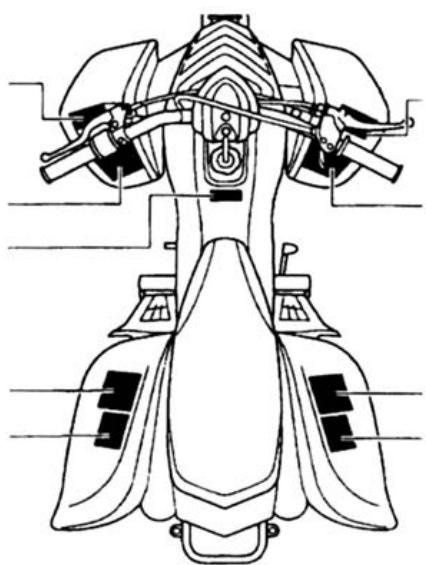
Read and understand all of the labels on this quad. They contain important information for safe and proper operation of your quad.
Never remove any labels from your vehicle. If any label becomes difficult to read or comes off, a replacement label is available from your dealer.

WARNING

Operation of this ATV by children under the age of 16 increases the risk of severe injury of death. NEVER permit children under age 16 to operate this ATV.
THIS VEHICLE IS AN ALL- TERRAIN VEHICLE AND IS NOT INTENDED FOR USE ON PUBLIC HIGHWAYS.

WARNING
Improper QUAD use can result in SEVERE INJURY or DEATH.
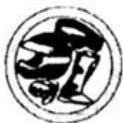
ALWAYS USE AN APPROVED HELMET AND PROTECTIVE GEAR
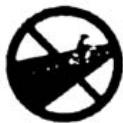
NEVER USE ON PUBLIC ROADS
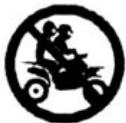
NEVER CARRY PASSEYGERS
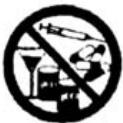
NEVER USE WITH DRUGS OR ALCOHOL
NEVER operate:
- without proper training or instruction.
- at speeds too fast for your skills or the conditions.
- on public roads-a collision can occur with another vehicle.
- with a passenger-passengers affect balance and steering and increase risk of losing control.
ALWAYS:
- use proper riding techniques to avoid vehicle overturns on hills and rough terrain and in turns.
- avoid paved surfaces-pavement may seriously affect handling and control.
LOCATE AND READ OWNERiS MANUAL. FOLLOW ALL INSTRUCTIONS AND WARNINGS.

WARNING
IMPROPER TIRE PRESSURE OR OVERLOADING CAN CAUSE LOSS OF CONTROL.
LOSS OF CONTROL CAN RESULT IN SEVERE INJURY OR DEATH.
OPERATING TIRE PRESSURE:Set with tires cold
Recommended: FRONT: 20 kPa, {0,20 kgf/cm³} 2,9 psi REAR: 20 kPa, {0,20 kgf/cm³}, 2,9 psi
- Minimum: FRONT: 17 kPa, {0,17 kgf/cm³}, 2,5 psi REAR: 17 kPa, {0,17 kgf/cm³}, 2,5 psi
- Never set tire pressure below minimum. It could cause the tire to dislodge from the rim.
LOADING
- Maximum Vehicle load:95kg,(209lbs).
Includes weight of operator, cargo and accessories.

WARNING
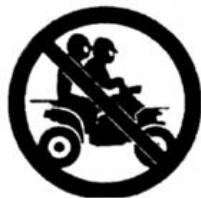
NEVER ride as a passenger
Passengers can cause a loss of control, resulting in SEVERE INJURY or DEATH.
VEHICLE IDENTIFICATION
Identification number records
Record the vehicle identification number and engine number in the follow spaces provided for assistance when ordering spare parts from your dealer or for reference in case the quad is stolen.
Vehicle identification number
The vehicle identification number is stamped into the frame. This vehicle identification num-ber is used to identify your quad.
-
Vehicle Identification Number:
-
Engine Number:
CONTROL FUNCTIONS
WARNING
Indicates a potential hazard that could result in serious injury or death. Main switch.
Functions of the respective switch positions are as follows: ON
The engine can be started only at this position: OFF
All electrical circuits are switched off. The key can be removed in this position.
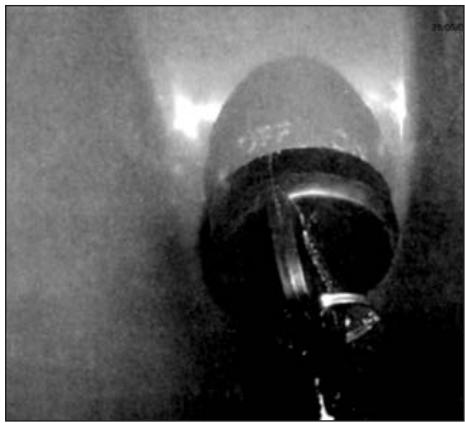
Indicator lights
Neutral indicator light "N"
This indicator light comes on when the transmission is in neutral.
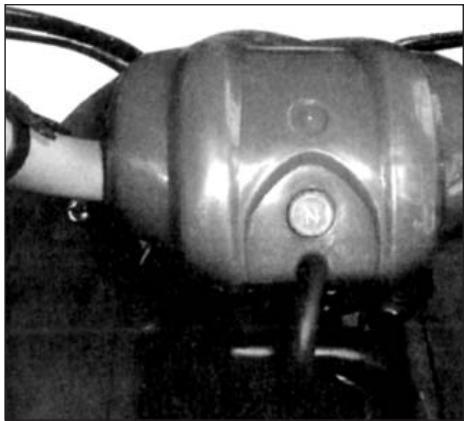
Handlebar Switches
Placed in left handlebar:
- Headlight switch (Blue button)
- Engine stop switch (Red button)
- Start switch (Yellow button)
Headlight switch
HL: Headlight on.
: Headlight switch:
To gain longer life of the battery, always start the engine with the headlight switch at off position.
Engine stop switch "ENG. STOP"
The engine stop switch controls ignition and can be used at all times to stop the engine, especially in an emergency. The engine will not start when this switch is in "OFF" position.
Start switch "Start"
Push this switch to let the starter motor crank the engine.
To start the engine, also see page 32 formore details.
NOTE
If the starter switch is pushed with the main switch "ON" and the engine stop switch "OFF", the starter motor will be activated but the en-gine will not start. To start the engine, make sure the engine stop switch at "RUN" position.
Throttle lever
Accelerate: Press the throttle level.
Decelerate: Release the throttle level. The spring of the level will return to the position prior pressing and the engine will return to an idle. Before starting the engine, check the Throttle level to make sure it is operating Smoothly. Make sure it return to idle position As soon as the level is released.
WARNING
POTENTIAL HAZARD
Malfunction of throttle.
WHAT CAN HAPPEN
The throttle level could be hard to operate, cause it difficult to speed up or slow down when you need to. This could cause an accident.
HOW TO AVOID THE HAZARD
Always check the operation of the throttle level before you start the engine. If it does work smoothly, check for the reason. Correct the problem before riding this QUAD. Consult your dealer if you cannot find or Solve the problem by yourself.
Speed limiter
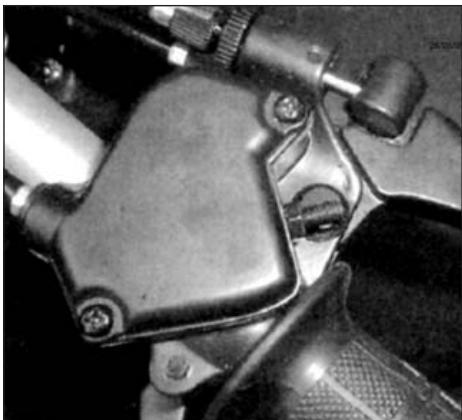
There is a screw on throttle box, which is de-signed to keep the throttle from fully opening, even the throttle lever is pushed to The maximum. Screwing in the adjuster limits the maximum engine power available and de-creases the maximum speed of the vehicle. Your quad was delivered with an adjustable speed limiter. We recommends that all beginners start off with the speed limiter screw turned in to limit the speed while they learn. Once the beginner becomes more familiar with operating the quad, the screw maybe gradually turned out to increase maximum speed. Adults should decide when to adjust the quad for more power as the riding skills of their youngster improve. Once the rider can oper-ate with
full skill at top speed permitted by Adjusting the speed limiter alone, the air intake restrictor plate can be removed. See page 41 about the Instruction of removing the air Intake restrictor. Adjusting for maximum Throttle lever moment without removing the air intake restrictor plate will cause the engine to run roughly at higher speeds.
WARNING
POTENTIAL HAZARD
Adjust the speed limiter and throttle improper.
WHAT CAN HAPPEN
The throttle cable could be damaged and cause improper throttle operation. You could lost control, have accident or be injured.
HOW TO AVOID THE HAZARD
Do not turn the speed adjuster out more than 20 mm (0.8 in).
Front Brake Lever
The front brake lever is located on the right handlebar. Pull the lever toward handlebar to apply the front brake. Check the free play of front brake lever. The normal free play is between 10 to 20mm . (0.4 to 0.8 in.) You can adjust the brake lever by turning the adjuster.
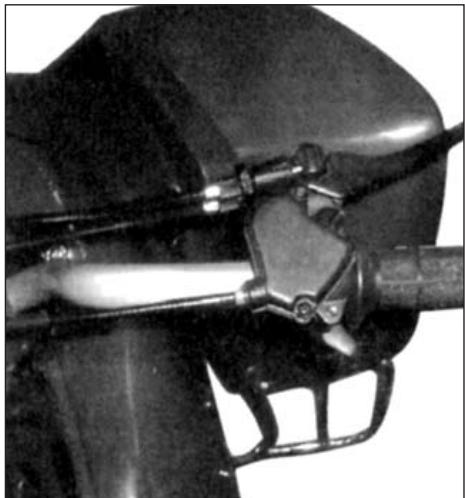
Rear brake lever and pedal
The rear brake lever is located on the left handlebar and the brake pedal is located on right side of the engine. Pull the lever toward the handlebar or push down on the pedal to apply the rear brake.
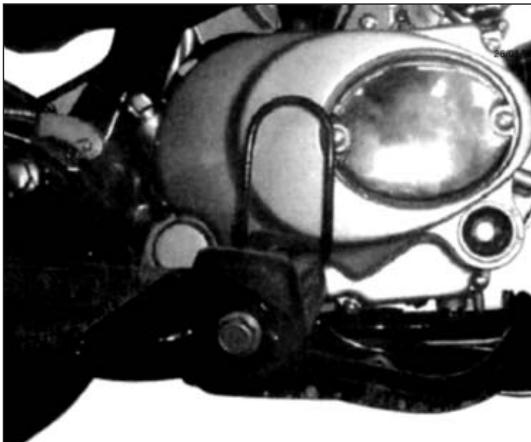
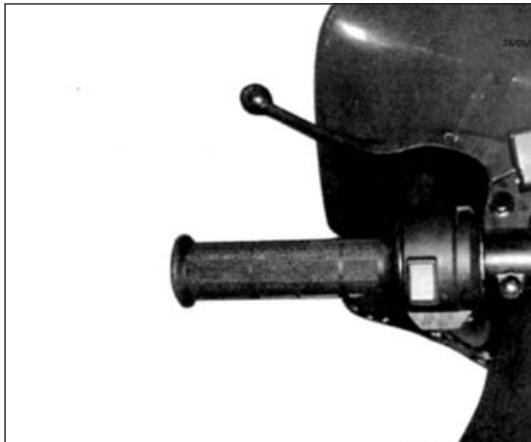
Parking brake
Apply the rear brake lever then push down the lock plate to apply the parking brake. To release the parking brake lock, squeeze the brake lever then the parking brake will release automatically.
WARNING
POTENTIAL HAZARD
Operate the parking brake improperly.
WHAT CAN HAPPEN
The quad could start moving unexpectedly if the parking brake is not applied before starting the engine. This could cause loss of control or a collision.
If you ride the quad without releasing the parking brake, it could cause the brake over-heat to lose braking performance and cause an accident.
HOW TO AVOID THE HAZARD
- Always set the parking brake before starting the engine.
- Always make sure to release the parking brake before you start to ride.
- Do not change the gear to Reverse before the quad stops completely.
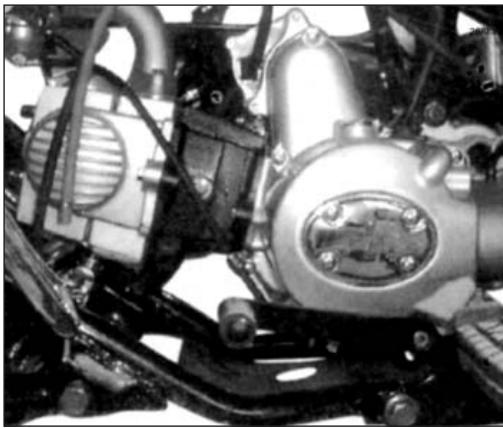
Gear shift pedal
This quad is equipped with a semi-automatic 4-speed transmission. The gear shift pedal is located on the left side of engine. Push down the gear shift pedal to change the gears as 3 2-M N R . Move the pedal upward to change the gears as R N 1 2 3 . Shut off the throttle completely when performing gear shift or it will damage the engine.
Fuel cock
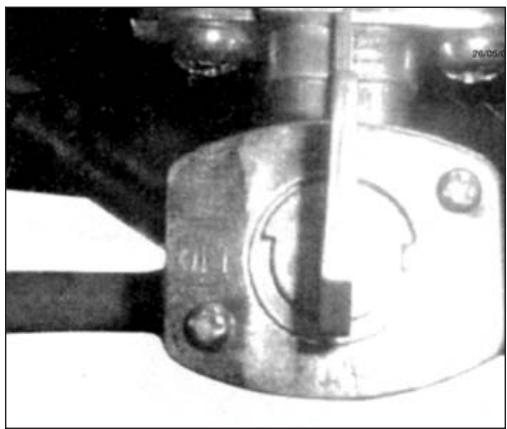
The fuel cock is below the fuel tank. To switch the fuel cock at three positions:
ON: Fuel flows to carburetor while the lever is in this position.
OFF: Fuel will not flow while the lever is in this position.
RES: Turn the lever to this position if you run out of fuel while riding. The fill the fuel tank as soon as possible. Turn the lever to the "ON" position after refueling.
NOTE
Always turn the lever in "OFF" position when the engine is not running.
Fuel tank cap
To remove the fuel tank cap, turn the cap counterclockwise.
Seat
Removing the seat by pulling the seat lock lever upward and pull up the seat at the rear. Insert the projection on the front of the seat into the holder and push down on the seat at rear to install the seat.
NOTE:
Always make sure the seat is securely fitted.
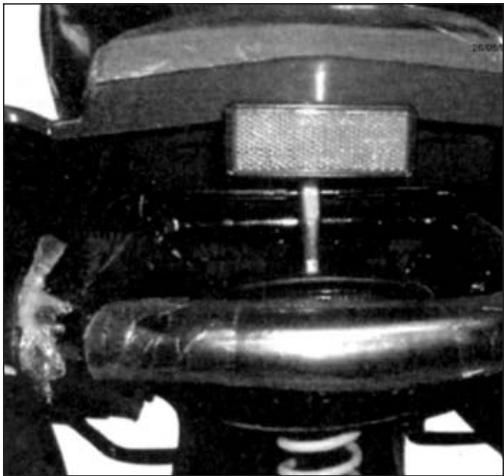
Choke lever
To start a cold engine, use the choke lever. See page 31 about the proper operation to start a cold engine.
PRE-OPERATION INSPECTION
Always check the following points before using this QUAD:
| INSPECTION ITEM | INSPECTION PROCEDURE |
| Brakes | Check the operation, condition and free play |
| Adjust if necessary | |
| Fuel | Check the fuel Level |
| Fill fuel if necessary | |
| Engine oil | Check engine oil level |
| Fill the engine oil if necessary | |
| Final gear oil | Check for leakage |
| Throttle | Check for proper operation of throttle cable |
| Battery | Check the level of fluid |
| Switches | Fill distilled water if necessary |
| Check all switches | |
| Fittings and Fasteners | Check all fittings and Fasteners |
| Wheels and Tires | Check tire pressure, wear and damage |
WARNING
POTENTIAL HAZARD
Failure to check the quad before operating.
Failure to maintain the quad properly.
WHAT CAN HAPPEN
It could cause an accident or equipment damage.
HOW TO AVOID THE HAZARD
Always check your quad carefully each time before your use it to be sure the quad is in safe operation condition.
Always follow inspection and maintenance procedure as shown in the owner's manual.
Brakes
- Brake operation.
Test the brakes at slow speed after starting to make sure they are working properly. If any of the brakes does not provide proper braking function, inspect the brake for wear (see page 42).
- Brake pedal and brake levers Check the correct free play in the brake pedal and brake levers. Adjust it if the free play is incorrect (see page 42).
WARNING
POTENTIAL HAZARD
Improperly operating brakes while riding.
WHAT CAN HAPPEN
The braking ability could lose and cause an accident.
HOW TO AVOID THE HAZARD
Always check the brakes every time before you start to ride. Do not ride the QUAD if you find there is any problem with the brakes. Find your dealer to inspect it if you cannot correct the problem by yourself according to the adjustment procedures provided in this manual.
Fuel
Always fill regular unleaded gasoline to your quad. Do not use leaded gasoline, it will cause damage to internal engine parts. If knocking or pinging occurs, use a different brand of gasoline or premium unleaded fuel.
WARNING
Do not overfill the fuel tank. Be careful not to spill fuel, especially on the engine or ex-haust pipe. Make sure the fuel tank cap is closed securely. Do not refuel right after the engine has been running and is still very hot.
Engine Oil
Always fill engine oil according to ambient temperature recommended as follows: Ambient temperature / Recommended oil: 5-C~45-C(40°F~120°F) / SAE20W40 -10°C~35°C(10°F~100°F) / SAE10W30 -20°C~0-C(0°F~30°F) / SAE 5W30
Make sure the engine oil is at specified level. Add oil as necessary (see page 40).
Final gear oil
SAE 80W90 hypoid gear oil may be used for all conditions.
Make sure the gear oil is at specified level. Add oil as necessary (see page 40).
Throttle lever
Check the throttle lever and see it operates correctly. It must open smoothly and return back to idle position when released.
Battery
Check fluid level and fill as necessary. Always use only distilled water to refill it (see page 44).
Switches
Check the operation of engine stop switch, starter switch, main switch and fuel cock. Repair as necessary for proper operation.
Fittings and Fasteners
Always check the tightness of chassis before riding this quad. Take the quad to your dealer or refer to this manual for Correct tightening torque.
Tires
The tire gauge is equipped with this quad and located in the tool bag under the seat. Measure tire pressure by the tire gauge and set the front and rear tires pressure to 20kPa (2.9psi)
WARNING
POTENTIAL HAZARD
Operating this quad with Improper tires, or with improper or uneven tire pressure.
WHAT CAN HAPPEN
Operating this quad with Improper tires, or with improper or uneven tire pressure could cause loss of control and an accident.
HOW TO AVOID THE HAZZARD
- Always set the front and rear tires pressure to be 20kPa (2.9psi).
- Always use size 19 7-8 as front tires.
- Always use size 18 9.5-8 as rear tires.
- When the tire groove decreases to 3 mm (0.12 in) due to wear, replace the tire.
OPERATION
WARNING
Indicates a potential hazard that could result in serious injury or death.
WARNING
POTENTIAL HAZARD
Operating quad without being familiar with all controls.
WHAT CAN HAPPEN
Loss of control, which could cause an accident or injury.
HOW TO AVOID THE HAZARD
Read this manual carefully. If you don't understand any control or function, ask your dealer.
Starting a cold engine
- Set the parking brake.
- Turn the fuel cock to "ON"
- Turn the engine stop switch to "RUN"
- Turn the main switch to "ON"
- Shift the transmission gear to neutral.
- Push down the choke lever to the end.
- Complete close the throttle lever.
- Push the start switch to crank the engine
- Pull up the chock lever to the middle position (warming up position.) until the engine runs then release the start button. If the en gine fails to start, release the start button, then push it again. Each cranking should not be more than 10 seconds.
- Keep warming up the engine for 5 min. then pull up the choke lever to top.
To start out and accelerate:
- Apply the rear brakes.
- Release the throttle lever.
- Shift into first gear then release the shift pedal.
- Release the rear brake.
- Open the throttle gradually.
- Once the engine has reached adequate speed, release the throttle lever.
- Shift into second gear then release the Shift pedal.
- Open the throttle gradually.
- Follow the same procedure when shifting To the third and fourth gears.
WARNING
Always release the shift pedal before opening the throttle, or the engine could wheeie and will cause an accident.
To decelerate:
- Release the throttle.
- Apply the brakes smoothly and evenly.
- Shift to lower gear once the engine has sufficiently slowed.
WARNING
POTENTIAL HAZARD
Apply a lower gear when the engine speed is too high.
WHAT CAN HAPPEN
The wheel could stop rotating. This could cause an accident, loss of control, injury and damage the engine.
HOW TO AVOID THE HAZARD
Always shift to lower gear before you make sure that the engine has sufficiently slowed.
Engine break-in
The most important period in the life of your engine is between 0 and 20 hours. Please read the following information very carefully.
- Do not put an excessive load on the quad for first several hours of running.
- Never continuous operation above half throttle.
- Cool off the engine for ten minutes after every hour of operation.
- Vary the speed of the engine from time to time.
Parking
When parking, stop the engine and shift into neutral. Turn the fuel cock to "OFF" position and apply the parking brake. Never parking on hills or other inclines.
Loading
This quad is not designed to carry any cargo or tow a trailer. Never exceed the maximum loading capacity as 100 kg (220 lb) which including the total weight of rider and accessories. Always choose the accessories that is equivalent in design and quality.
WARNING
Overloading this quad or carrying or towing cargo could cause changes in vehicle handling which could lead to an accident. Never exceed the stated loading capacity for this quad.
RIDING YOUR QUAD
WARNING
Indicates a potential hazard that could result in serious injury or death.
Know you QUAD before riding
This quad is for recreation use. This section, riding your quad, provides general quad riding instructions for recreational riding. The skills and techniques described in this section are appropriate for all types of riding. Riding this quad requires special skills. Take the time to learn the basic techniques well before attempting more difficult maneuvers.
For your safety, be sure you have read this Owner's Manual completely and understand the operation of the controls before you begin to ride. Read all caution and warning labels on your quad and pay particular attention to the safety information on pages 6-10.
RIDE WITH GARE AND JUDGMENT
Get training if you are inexperienced
Beginners should get training from a certified instructor. Start at slow speeds first to be familiar with this quad even if you are an experienced rider. Do not operate at maximum performance until you are totally familiar with the quad's handling and performance characteristics. Take the time to learn the basic techniques well before attempting more difficult maneuvers.
Never allow children under 16 years old to ride this quad
A child under 16 should never operate an quad with engine size greater than 90 c.c.
This quad is designed to carry the opera-tor only, Never carry a passenger
The long seat is to allow the operator to shift position as needed during operation. It is not a design for carrying passenger.
Apparel
Always wear an approved motorcycle helmet that fits properly. You should also wear eye protection (face shield or goggles), gloves, boots, long-sleeve jacket and long pants.
Do not operate after consuming alcohol or drugs
Operator's performance capability is reduced by the influence of alcohol or drugs.
Pre-operation checks
Always perform the pre-operation checks listed on the page 27 before riding for safety and proper care of your quad.
During operation
Always keep your feet on the footboards during operation. Otherwise your feet may contact the wheel and could cause injury. Avoid wheelies and jumping. You may loose control of the quad or overturn.
Exhaust system
The exhaust system on the quad is very hot during and following operation. Never touch the exhaust system. Park the quad in a place where pedestrians or children are not likely to touch it.
Be careful where you ride
- This quad is designed for off-road use only.
Riding on paved surfaces can cause loss of control. Do not ride on any public road, street, or highway. Riding on public roads can result in collisions with other vehicles.
-
Know the terrain where you ride. Ride cautiously in unfamiliar areas. Stay alert for roots, holes or rocks in the terrain, and other hidden hazards which may cause the quad to upset.
-
When riding in an area where you might not easily be seen, mount a caution flag on the quad.
-
Do not ride on private property without getting permission. Do not ride in areas posted "No Tres-passing".
-
Select a large, flat area off-road to become familiar with your quad. Make sure that this area is free of obstacles and other riders. You should practice control of the brake, throttle, gear shifting and turning techniques in the area before trying more difficult terrain.
-
Set the parking brake and follow the instruction on
page 32 to start the engine. Once it has warmed up you are ready to begin riding your quad. As you get on the quad, be sure not to accidentally move the shift pedal. Don't touch the engine and exhaust pipe.
Turning you quad
To achieve maximum traction while riding off-Road, the two rear wheels are mounted sol-idly on one axle and turn together at the same speed. Therefore, unless the wheel on the inside of the turn is allowed to slip or lose some traction, the quad will resist turning. A special turning technique must be used to allow the quad to make turns quickly and easily. It is essential that this skill be learned first at low speed.
Climbing uphill
Use proper riding skill to avoid vehicle over-turns on hills. Be sure that you can maneuver your quad well on flat ground before attempting any incline
and then practice riding first on gentle slopes. Try more difficult climbs only after you have learned more skills. In all cases avoid inclines with slippery or loose surfaces, or obstacles that might cause you to loose control. It is important when you climbing a hill to make sure that your weight is transferred forward on the quad. This can be accomplished by leaning forward and, on steeper inclines, standing on the footboards and leaning forward over the handlebars. If you are climbing a hill and you find that you have not properly judged your ability to make it to the top, you should turn the quad around while you still have forward motion (provided you have the room to do so) and descend the hill. If your quad has stalled or stopped and you believe you can continue up the hill, restart carefully to make sure you do not lift the front wheels which could cause you to loose control. If you are unable to continue up the correct the steering when riding on loose surfaces by pointing the front wheels slightly
uphill. When riding on slopes be sure not to make sharp turns either up or down hill. If your quad does begin to tip over, gradually steer in the downhill direction of there are no obstacles in your path. As you regain proper balance, gradually steer again in the direction you wish to travel.
Crossing through shallow water
The quad can be used to cross slow moving, shallow water of up to a maximum of 20cm (7.9 inches) in depth. Before entering the water, choose your path cautiously. Enter where there is no sharp drop off, and avoid rocks or other obstacles which may be slippery or upset the quad. Ride slowly and Carefully. Test your brakes after leaving the water. Do not continue to ride your quad without verifying that you have regained proper braking ability.
Riding over rough terrain
Riding over rough terrain should be done with
caution. Look out for obstacles which could cause damage to the quad or could lead to an upset or accident. Be sure to keep your feet firmly fixed on the footboards at all times. Avoid jumping the quad as loss of control and damage to the quad may result.
Sliding and skidding
Care should be used when riding on loose or slippery surfaces since the quad may slide. If unexpected and uncorrected, sliding could cause an accident. To reduce the possibility for the front wheels to slide in loose or slippery conditions, putting your weight over the front wheels will sometimes help. If the rear wheels of your quad start to slide sideways, control can usually be regained (if there is place to do so) by steering in the direction of the slide. Applying the brakes or accelerating is not recommended until you have corrected the slide. With practice, over a period of time, skill at controlled
sliding can be improved. The terrain should be chosen carefully before attempting such maneuvers, since both stability and control are reduced. Bear in mind that sliding maneuvers should always be avoided on extremely slippery surfaces such as ice, since all control may be lost.
What to do of if ...
This section is designed to be a reference guide only. Make sure to read each section on riding techniques completely.
What to do ...?
-
If your quad doesn't turn when you want it to: Bring the quad to a stop and practice the turning maneuvers again. Be sure you are positioning your weight on the footboard to the outside of the turn. Put your weight over the front wheels for better control (see page 36).
-
If your quad begins to tip while turning: Lean more
into the turn to regain balance. If necessary, gradually release the throttle and/or steer to the outside of the turn (see page 36).
-
If your quad can't make it up a hill you are trying to climb: Turn the quad around if you still have forward. If not, stop, dismount on the uphill side of the quad and physically turn the quad around. If the quad starts to slip backwards DO NOT USE THE REAR BRAKE the quad may tip over on top of you. Dismount the quad on the uphill side (see pages 36-37).
-
If your quad is crossing a sloping surface: Be sure to ride with your weight positioned towards the uphill side of the quad to keep proper balance. If the quad starts to tip, steer down the hill (if there are no
obstacles in your way) to get balance again. If you discover that the quad is going to tip over, dismount on the uphill side (see page 37).
-
If your quad meets shallow water: Ride slowly and carefully through slow moving water, watching for obstacles. Be sure to let water drain from the quad and CHECK YOUR BRAKES FOR PROPER OPERATION when you come out of the water. Do not continue to ride your quad until you have regained ad-equate braking ability.
-
If your quad starts to slide sideways: Steer in the direction of the slide if you have the place. Applying the brakes or accelerating is not recommended until you have corrected the slide.
PERIODIC MAINTENANCE AND ADJUSTMENT
Periodic check, adjustment and lubrication will keep your machine in the securest and most efficient condition possible. Security is an obligation of the machine owner. The most important points of machine inspection, ad-justment and lubrication are explained on the following pages.
Owner's manual and tool kit
Your are advised to put this owner's manual and low-pressure tire gauge in the vinyl bag and always carry them along with the owner's tool kit under the seat. The service information included in this manual is designed to provide you, the owner, with the essential information for completing your own
preventive maintenance and minor repairs. The tools provided in the Owner's tool kit are enough for this purpose, except that a torque wrench is also necessary to correctly tighten nuts and bolts.
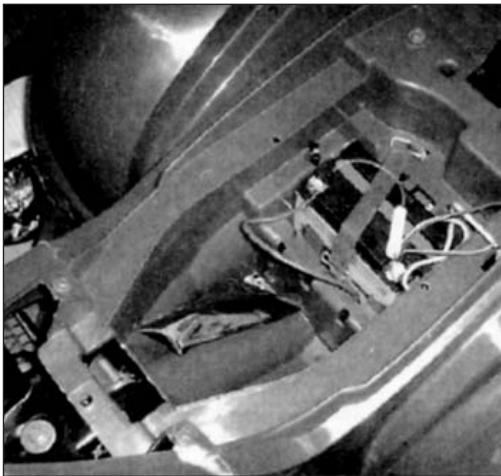
Engine oil
Engine oil level measurement
- Place the ATV on a level surface.
- Warm up the engine for several minutes and stop it.
- Remove the dipstick and wipe it off with a clean rag. Insert the dipstick in the filler holewithout screwing it in.
- Remove the dipstick and check the oil level.
- The oil level should be between the maximum and minimum marks. If the level is low, add oil to raise it to the proper level.
Engine oil replacement
- Place the ATV on a level position.
- Warm up the engine for several minutes and stop it.
- Place an container under the engine.
- Remove the dipstick and drain bolt to drain the oil.
- Check the O-ring and replace if damaged.
6.Install the drain bolt and tighten to specification. -
Fill the engine with oil and equip the dipstick.
-
Warm up the engine for several minutes at idle speed. Inspect oil leakage while warming up.
Final gear oil
Final gear oil measurement
- Place the ATV on a level surface.
- Remove the dipstick and wipe it off with a clean rag. Insert the dipstick in the filler hole without screwing it in.
- Remove the dipstick and check the oil.
- The oil level should be between the maximum and minimum marks. If the level is low, add oil to raise it to the proper level.
- Equip the dipstick.
Final gear oil replacement
- Place the ATV on a level position.
- Place a container under the final gear case
- Remove the dipstick and drain bolt to drain the oil.
- Equip the drain bolt and tighten to specification.
- Fill the final gear case with oil.
-
Equip the dipstick.
-
Inspect oil leakage. If oil leakage is found, check for the reason.
Spark plug inspection
The spark plug is an important engine component and is easy to check. The condition of the spark plug can indicate the condition of the engine. For example, a very white center electrode porcelain color could indicate an intake air leak or carburetion problem for that cylinder. Do not attempt to diagnose such problems yourself.
Instead, take the quad to your dealer. You should regularly remove and inspect the spark plug because heat and deposits will cause the spark plug to slowly break down and erode. If electrode erosion becomes excessive, you should replace the spark plug with one of the proper type.
Before installing the spark plug, measure the electrode gap with a feeler gauge and adjust to specification.
When equipping the spark plug, always clean the gasket surface and use a new gasket. Wipe off any grime from the threads and tighten to the specified torque.
Air filter cleaning
- Remove the front cover by removing the screws.
- Remove the air filter case cover by unhooking the fasteners.
- Remove the air filter element by unhooking the fastener.
- Wash the air filter element gently but totally in solvent.
- Press the excess solvent out of the air filter element and let it dry.
- Check the air filter element. If damaged, replace it.
- Apply foam air filter oil or other quality foam air filter oil to the air filter element. If foam air filter oil is not useful, SAE 10W30 motor oil may be used.
- Equip the air filter element, the air filter case cover and the front cover.
Air intake restrictor plate removal
To get full engine performance ability, removing the air intake restrictor plate is required.
- Remove the air filter element. (See Air filter cleaning for removal and installation procedures.)
- Remove the air intake restrictor plate.
- Equip the air filter element.
Carburetor adjustment
The carburetor is a principal part of the engine and requires very complex adjustment. Most adjusting should be left to your dealer who is professional and experienced on this.
However, the idling speed may be performed by the owner as a part of the usual maintenance routine.
Idle speed adjustment
- Start the engine and warm it up for a few minutes at nearly 1,000 to 2,000 r/min. Sometimes rev the engine to 4,000 to 5,000 r/min.
The engine is earm when it quickly responds to the throttle.
- Connect the tachometer and set the idle to he specified idling speed by adjusting the throttle stop screw. Turn the screw in to increase engine speed, and out to decrease engine speed.
Valve clearance adjustment
The proper valve clearance changes with use, eading to incorrect fuel/air supply or engine noise. To prevent this, the valve clearance must be adjusted periodically. This adjustment however, should be left to a professional service, technician.
Cam chain adjustment
The cam chain will loosen with use, resulting in improper valve timing and engine noise. To prevent this, the cam chain tensioner must be adjusted regularly. This adjustment should be left to your dealer.
Front and rear brake shoe inspection
A wear indicator is provided on each brake. The indicators allow inspecting of brake shoe wear without disassembling the brake. Apply the brake and check the position of the indicator. If the indicator reaches the wear limit line, ask your dealer to replace the shoes as a set.
Front brake lever free play adjustment
The front brake lever free play should be adjusted to 10-12 mm (0.4~0.5 in) at the brake lever pivot. If the free play is improper, adjust as follows:
- Release the upper locknut and fully turn in the adjusting bolt.
- Release the lower locknut.
- Turn the lower adjusting bolt specified free play is obtained.
-
Tighten the lower locknut.
-
While applying the front brake, turn out the upper adjusting bolt until the upper and lower cable lengths are equal. The cable joint will become vertical.
- Tighten the upper locknut.
Rear brake lever and pedal adjustment
- Brake lever free play adjustment
a. Release the brake cable locknut.
b. Turn the adjusting bolt at the brake lever until brake lever free play is 5 8 Mm (0.20-0.30 in).
c. Tighten the locknut. - Brake pedal free play adjustment
a. Turn the brake rod adjusting nut at the rear wheel nub until brake pedal free play is 20-30 mm (0.8-1.2 in).
Clutch adjustment
- Remove the rubber cap.
- Release the locknut.
- Slowly turn the adjusting bolt clockwise until resistance is felt. Then turn it 1/8counterclock wise.
- Tighten the locknut to the specified torque.
- Equip the rubber cap safely.
Cable inspection and lubrication
Lubricate the inner cables and the cable ends. If the cables do not operate evenly, ask your dealer to replace them.
Knuckle shaft and steering shaft lubrication
Lubricate the pivot points. Use a grease gun.
Wheel removal
- Raise the wheel by placing a suitable stand under the frame.
- Remove the nuts from the wheel.
- Remove the wheel assembly
Wheel installation
When installing the wheel, reverse the removal procedure.
Tighten the wheel nuts to the specified torques.
Battery
Inspect the level of the battery fluid and see if the terminals are tight. Add distilled water if the fluid level is low.
Replenishing the battery fluid
A poorly maintained battery will corrode and discharge quickly. The battery fluid should be checked at least once a month.
- The level should be between the upper and lower lever marks. Use only distilled water if refilling is necessary.
- Disconnect the negative (-) lead.
- Disconnect the positive (+) lead and remove the battery.
- When the machine is not to be used for a month or longer, remove the battery and put it in a cool, dark place. Thoroughly recharge the battery before reusing.
- If the battery is to be stored for a longer period
than the above, check the specific gravity at least once a month and recharge the battery when it is too low.
- Always make sure the connections are right when putting the battery back in the machine. Make sure the breather hose is properly connected and is not damaged or obstructed.
Fuse replacement
- The fuse case is placed under the seat.
- If the fuse is blown, turn off the main switch and equip a new fuse of the specified amperage. Then turn on the switches. If the fuse immediately blows again, consult your dealer.
CLEANING AND STORAGE
Cleaning
Frequent, thorough cleaning of your machine will not only enhance its appearance but will improve its general performance and extend the useful life of many components.
- Before cleaning the machine.
a. Block off the end of the exhaust pipe to prevent water entry. A plastic bag and strong rubber band may be used.
b. Assure the spark plug and all filler caps are correctly installed. - If the engine case is extremely greasy, apply degreaser with a paintbrush. Do not apply degreaser to the wheel axles.
- Rinse the dirt and degreaser off with a garden hose. Use only sufficient pressure to do the job.
- Once the majority of the dirt has been hosed off, wash all surfaces with warm water and mild, detergent-type soap. An old tooth-brush or bottle brush is handy for hard-to-get-at places.
-
Rinse the machine off immediately with clean water and dry all surfaces with a chamois, clean towel or cloth.
-
Clean the seat with a vinyl upholstery cleaner to keep the cover pliable and glossy.
- Automotive type wax may be applied to all painted and chrome plated surfaces. Avoid combination cleaner-waxes. Many contain abrasives which may mar the paint or protective finish. When finished, start the engine and let it idle for several minutes.
Storage
Long term storage (60 days or more) of your machine will request some protective procedures to guard against deterioration. After completely cleaning the machine, prepare for storage as follows:
- Fill the fuel tank with fresh fuel.
- Remove the spark plug, pour about one tablespoon of SAE 10W30 or 20W40 motor oil in the spark plug hole and reinstall the spark plug. Ground the spark plug wire and turn the engine over several times to coat the cylinder wall with oil.
- Lubricate all control cables.
- Block up the frame to raise all wheels off the ground.
-
Tie a plastic bag over the exhaust pipe outlet to prevent moisture from entering.
-
If storing in a damp or salty atmosphere, coat all exposed metal surfaces with a light film of oil. Do not apply oil to any rubber parts or the seat cover.
-
Remove the battery and charge it. Store it in a dry place and recharge it once a month. Do not store the battery in an extremely warm or cold place (less than 0^ (30^) or more than 30C (90^) .
SPECIFICATION
| Model | QUAD 110 - 4 STROKE |
| Dimension: | |
| Overall length | 1.540 mm |
| Overall width | 860 mm |
| Overall height | 950 mm |
| Seat height | 670 mm |
| Wheel base | 1.040 mm |
| Min. ground clearance | 100 mm |
| Minimum turning radius | 2.400 mm |
| Dry weight: | 116 kg (256 lbs) |
| Engine: | |
| Type | Air cooled, 4-stroke, 3 speeds |
| Cylinder arrangement | Single cylinder |
| Displacement | 107 cm³ |
| Bore Stroke | 52,4 49,5 mm |
| Compression ratio | 9.6:1 |
| Starting system | Electric starter |
SPECIFICATION
| Model | QUAD 110 - 4 STROKE |
| Lubrication systems | Wet sump |
| Rider Capacity | 1 person |
| Engine Oil Capacity | 0,95 L |
| Gear Oil Capacity | 0,12 L |
| Fuel Capacity | 7,8 L |
| Starting | Electric |
| Transmission | Semi-automatic |
| Front Suspension | Leading arm |
| Rear Suspension | Swing arm |
| Front/Rear Brakes | Drum |
| Parking Brake | Mechanical Lock |
| Front Tires/PSI | 19 7-8/2,9 psi |
| Rear Tires/PSI | 18 9,50-8/2,9 psi |
| Neutral Indicator | Standard (green) |
| Max. Load Capacity | 95 kg (209 lb) |
| Battery (Green) | 12 V-7 A |
WARRANTY TERMS AND CONDITIONS
(According to Law decree 23/2003 on the 10th of July, covering Warranties on Consumer Item Sales)
Warranty terms of the manufacturer GASGAS Motos, S.A.
The company GAS GAS MOTOS, S.A. (hereafter referred to as "GG"), with this present document guarantees the consumer, the purchaser of a vehicle manufactured by GG, that both the materials and the manufacturing are free of defects in accordance with the highest standards of quality. Consequently, GG with this document guarantees the consumer (hereafter referred to as the "purchaser"), in accordance with the conditions set out below, the repair, free of charge, of any defect in materials or that might result from faulty manufacture that is detected in a new motorcycle within the period covered by this Warranty and with no limit on the number of kilometres covered or hours of use.
Warranty Period
The period covered by this Warranty will begin on the day of delivery of the vehicle to the purchaser by a GG authorised dealer, or in the case of demonstration models, on the date in which the vehicle is used for the first time. The seller will be responsible for any unwarranted faults that become apparent within the period established in the Law decree 23/2003 on the 10th of July covering Warranties on Consumer Goods Sold from the time of delivery and in accordance with the Directive 1999/44/EC for other members of the European Community. For countries outside the European Community, the Warranty Period will be determined by the existing regulations in those countries. Nevertheless, should the fault appear during the first six months after the delivery of the motorcycle, it will be presumed that the said fault existed at the time of delivery; from the end of the sixth month onwards, the purchaser must demonstrate that the unwarranted fault existed at the moment of delivery. During the first six months subsequent to the delivery of the repaired vehicle, the seller will be responsible for any unwarranted faults arising out of the repair.
Any defects detected in the product must be brought to the attention of a GG authorised dealer within the Warranty Period. If the last day of this period is a Sunday or an official holiday, the Warranty period will be extended such that the last day of the period covered will be the first working day after the Sunday or official holiday.
Those claims under Warranty for defects not brought to the attention of a GG authorised dealer before the end of the Warranty Period will be excluded.
Obligation of the purchaser
GG will have the right to reject any claims under Warranty in the event that:
a) The purchaser has failed to submit the vehicle to any of the inspections and/or maintenance work required in the Users' Manual, or has exceeded the date set for such inspections or maintenance work. Also excluded from guarantee are those faults that appeared prior to the dates established for an inspection or maintenance work where the latter was not carried out, or was carried out later than the date established.
b) An inspection, maintenance or repair has been performed on the vehicle by third parties not recognised or authorised by GG.
c) Any maintenance or repair has been carried out on the vehicle that violates the technical requirements, specifications and/or instructions indicated by the manufacturer.
d) Spare parts whose use has not been authorised by GG have been used during the course of maintenance work or repairs to the vehicle, or in the event that the vehicle has been used with fuels, lubricants or other liquids (including, amongst others, cleaning products) that have not been expressly mentioned in the specifications set out in the User's Manual.
e) The vehicle has been altered or modified in any way or fitted with components other than those expressly authorised by GG as accepted components of the vehicle.
f) The vehicle has been stored or transported in a way that is not in accordance to the corresponding technical requirements.
g) The vehicle has been used for special purposes other than ordinary use, such as competition, races or record breaking attempts.
h) The vehicle has been directly or indirectly damaged as a result of a fall or an accident.
Warranty exclusions
The following items are not covered by this Warranty:
a) Worn parts, including, without any limitation, spark plugs, batteries, petrol filters, oil filter elements, (secondary) chains, engine output pinions, rear sprockets, air filters, brake discs, brake pads, clutch plates and discs, bulbs, fuses, carbon brushes, footrest rubbers, tyres, inner tubes, cables and other rubber components
b) Lubricants (for example, oil, grease, etc.) and working fluids (for example, battery liquid, coolant, etc.)
c) Inspection, adjustments and other maintenance tasks, as well as all kinds of cleaning work
d) Damage to the paint-work and consequent corrosion due to external causes, such as stones, salt, industrial fumes and other environmental impact, or inadequate cleaning with inappropriate products
e) Any damages caused as a result of the defects, as well as any expenses incurred either directly or indirectly as a consequence of the defects (for example, communication costs, accommodation expenses, car hire costs, public transport costs, breakdown truck fees, courier costs, etc.), as well as other financial losses (for example, those caused by the loss of the use of the vehicle, loss of income, time lost, etc.)
f) Any acoustic or aesthetic phenomenon that does not significantly affect the condition or use of the motorcycle (for example, small or hidden imperfections, noise or vibrations that are normal in use, etc.)
g) Phenomena that are the result of the ageing of the vehicle (for example, discolouring of painted or metallic coated surfaces).
Various
1.- GG shall have the prerogative to decide, at its own discretion, whether to repair or replace defective parts. Where parts are replaced, ownership of the parts removed shall pass to GG without any other consideration. The GG authorised dealer, to whom the making good of the defects has been entrusted, is not authorised to make any declarations that are binding on GG.
2.- In case of doubt regarding the existence of a defect, or a visual or material inspection is required, GG reserves the right to demand the return of the parts which are the object of a claim under Warranty, or to arrange an inspection of the defect by an expert from GG. Any additional obligations arising out of guarantees on parts replaced free of charge, or any other service rendered free of charge, are excluded from the effects of this present warranty. The Warranty on parts replaced within the Warranty Period will end at the expiry date for the Warranty Period of the product concerned.
3.- Should it prove to be the case that a defect can not be repaired, the purchaser guaranteed shall have the right to the cancellation of the contract (payment of compensation) or a partial refund of the purchase price (discount), instead of repairing the motorcycle.
4.- Any claims against Warranty by the purchaser under the terms of the sale contract with the corresponding authorised dealer shall not be affected by the terms of this present Warranty. Neither will this present Warranty affect those additional contractual rights acquired by the purchaser under the general commercial terms and conditions of the authorised dealer. However, such additional rights may only be exercised through claims against the authorised dealer.
5.- Should the purchaser resell the product within the Warranty Period, the duration and conditions of the present Warranty will remain unaltered, in such a way as that the rights to make claims under the present Warranty in accordance with the terms and conditions set out in this present document shall be transferred to the new owner of the motorcycle.
Notes
Notes

GASGAS
RECOMIENDA EL USO DE ACEITE:
RECOMMENDSTHEUSEOFOIL:
RECOMMANDE L'USAGE DE L'HUILE:
CONSIGLIA L'USO D'OLIO:
EMPFIEHLT DEN GEBRAUCH VON ÖL:

Global Racing Oil
JUNIO / JUNE / JUIN / GIUGNO / JUNI 2006