
CP432J5 - Lave-vaisselle CONSTRUCTA - Notice d'utilisation et mode d'emploi gratuit
Retrouvez gratuitement la notice de l'appareil CP432J5 CONSTRUCTA au format PDF.


| Type de produit | Lave-vaisselle encastrable / sous plan |
| Marque | CONSTRUCTA |
| Modèle | CP432J5 |
| Dimensions (L x P x H) | 60 x 57 x 82 cm (estimation standard) |
| Poids net | Environ 45 kg |
| Alimentation électrique | 230 V, 50 Hz, 10 A |
| Pression d'eau | 0,05 MPa - 1 MPa |
| Capacité | 12 couverts standard |
| Programmes de lavage | Plusieurs programmes dont intensif, éco, rapide, etc. |
| Adoucisseur d'eau | Oui, réglable |
| Bac à sel régénérant | Oui, avec indicateur de niveau |
| Distributeur de produit de rinçage | Oui, réglable |
| Matériau de la cuve | Inox |
| Fonction Aqua-Stop | Oui (sur certains modèles) |
| Sécurité enfants | Verrouillage de porte (selon modèle) |
| Niveau sonore | Environ 48 dB(A) |
| Consommation d'eau (programme éco) | Environ 12 L |
| Consommation d'énergie (programme éco) | Environ 1 kWh |
| Indicateur de sel et de rinçage | Oui, sur le panneau de commande |
| Raccordement eau | Eau froide recommandée, max 60°C |
| Longueur du câble d'alimentation | Environ 1,5 m |
FOIRE AUX QUESTIONS - CP432J5 CONSTRUCTA
Questions des utilisateurs sur CP432J5 CONSTRUCTA
0 question sur cet appareil. Repondez a celles que vous connaissez ou posez la votre.
Poser une nouvelle question sur cet appareil
Téléchargez la notice de votre Lave-vaisselle au format PDF gratuitement ! Retrouvez votre notice CP432J5 - CONSTRUCTA et reprennez votre appareil électronique en main. Sur cette page sont publiés tous les documents nécessaires à l'utilisation de votre appareil CP432J5 de la marque CONSTRUCTA.
MODE D'EMPLOI CP432J5 CONSTRUCTA
[constructa
en Instructions for use
en Index
Safety instructions 4
Getting to know your appliance . . 6
Water softener 7
Filling in the Salt 8
Filling the rinse-aid container 9
Not suitable for the dishwasher . . 10
Arranging crockery, glasses, etc.
in the dishwasher 10
Detergents 14
Programme overview 16
Washing the dishes 17
Maintenance and care 18
Fault finding 20
Customer Service 22
Information 23
Installation 24
Waste disposal 25
Safety instructions
Delivery
- Immediately check the packaging and dishwasher for any damage which may have been caused in transit. Do not use a damaged appliance, but consult your supplier.
- Please dispose of packaging material properly:
Installation
Install and connect the appliance according to the installation and assembly instructions.
- The dishwasher must NOT be connected to the power supply during installation.
- Ensure that the protective conductor system of the domestic electricity supply has been installed correctly.
- Electrical connection conditions must correspond with the specifications on the rating plate of the dishwasher.
If the dishwasher is to be installed in a high-sided unit, ensure that the unit is attached properly and also at the rear.
Built-under and built-in appliances should always be installed under a continuous work surface which is attached to the adjacent cupboards, in order to ensure that the appliance is entirely stable.
- After the appliance has been installed, the mains plug should still be easily accessible.
- Not on all models: The plastic housing on the water input contains an electrically operated valve. The connecting wires are inside the inlet hose. Do not cut through this hose and do not immerse the plastic housing in water.

Warning
For safety reasons, if the appliance is not fitted in a recess, thereby making a side wall accessible, the door hinge area should be covered at the side. (Risk of injury)
Covers are available as optional accessories from customer services or specialist stores.
In daily use

Warning
Knives and other utensils with sharp points must be placed in the baskets either flat or with the points downwards.
- Use the dishwasher only in the household and only for its designed purpose, i.e. for washing domestic dishes.
- Do not lean or sit on the open door. The appliance could tip.
- Please note that free-standing appliances may tip over if the baskets are overloaded.
- The water in the appliance is not drinking water.
- Do not add any solvents to the washing chamber. Danger of explosion!
- Open the door carefully when the programme is still running. Water could spray out of the appliance.
- To prevent injuries, e.g. caused by stumbling, open the dishwasher only briefly in order to load and unload the dishwasher.
- Read and observe the safety information and instructions for use on the packaging for cleaning and rinsing agents.
Children in the household
- Do not let infants play or operate the dishwasher.
- Keep cleaning and rinsing agents out of the reach of infants. These may cause chemical burns in the mouth, throat and eyes or asphyxiation.
- Keep infants away from the open dishwasher. It could contain residue of the cleaning agent.
If the appliance is installed at eye-level, ensure when opening and closing the door that children are not caught or crushed between the appliance door and the cupboard door situated below.
Child-proof lock*
- some models
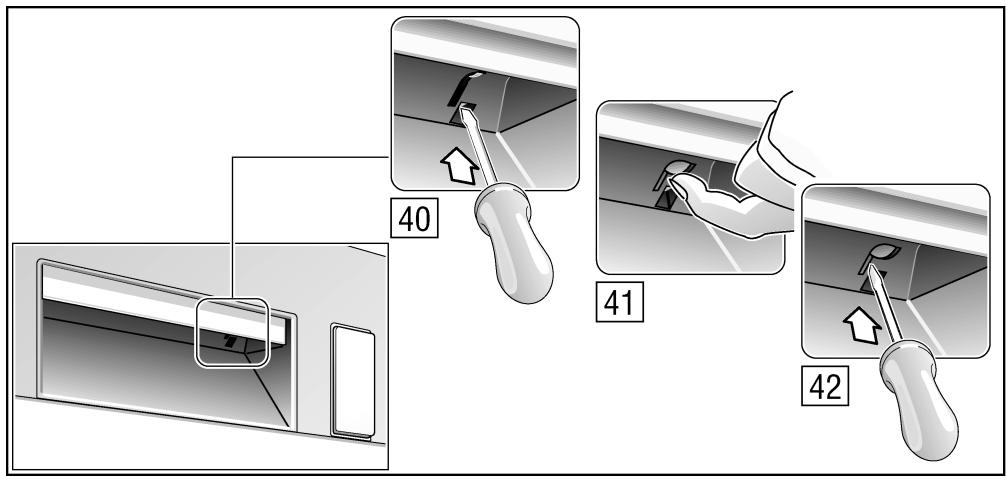
Comply with the drawings in the back of the envelope.
40 Switch on the child-proof lock
41 Open the door with child-proof lock switched on
42 Switch off the child-proof lock
When the door is open, the child-proof lock offers no protection.
If a fault occurs
- Repairs or other work on the dishwasher should only be carried out by a qualified specialist.
- The dishwasher must be disconnected from the electricity supply before any repairs or other work are started. Pull the mains plug out of the wall socket or switch off at the fuse box. Grasp the plug to remove it from the socket; do not tug on the cable. Turn the water off at the tap.
When disposing of old appliances
- Appliances that have reached the end of their service life should be rendered inoperable in order to exclude the possibility of subsequent accidents. Pull the mains plug out of the wall socket, cut through the connecting cable and disable the door lock.
Take the appliance to a designated waste disposal centre.

Warning
Children could get locked in the appliance (risk of suffocation) or get stuck in other positions.
Therefore: Remove the mains plug, cut the mains wire and set aside. Damage the door lock so that the door can no longer be closed.
en
Getting to know your appliance
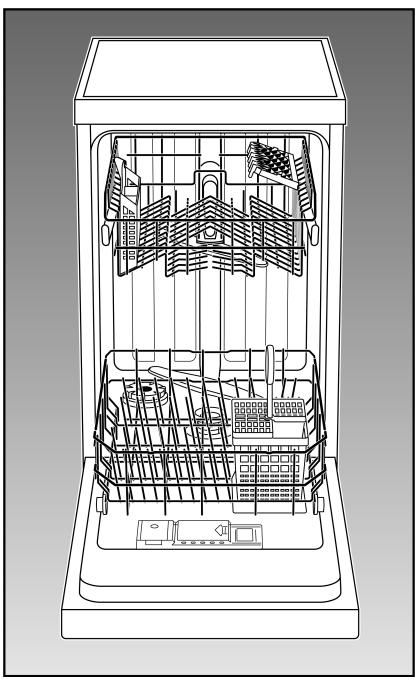
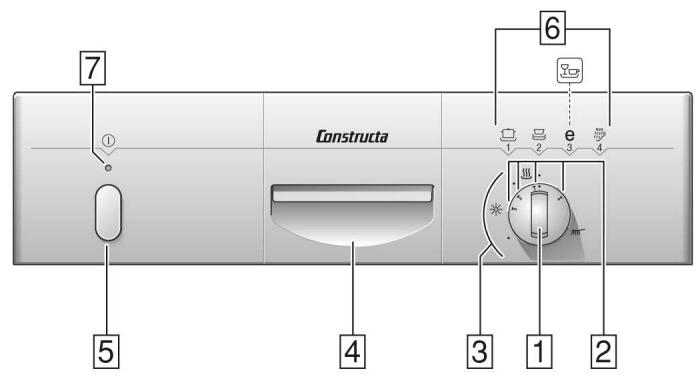
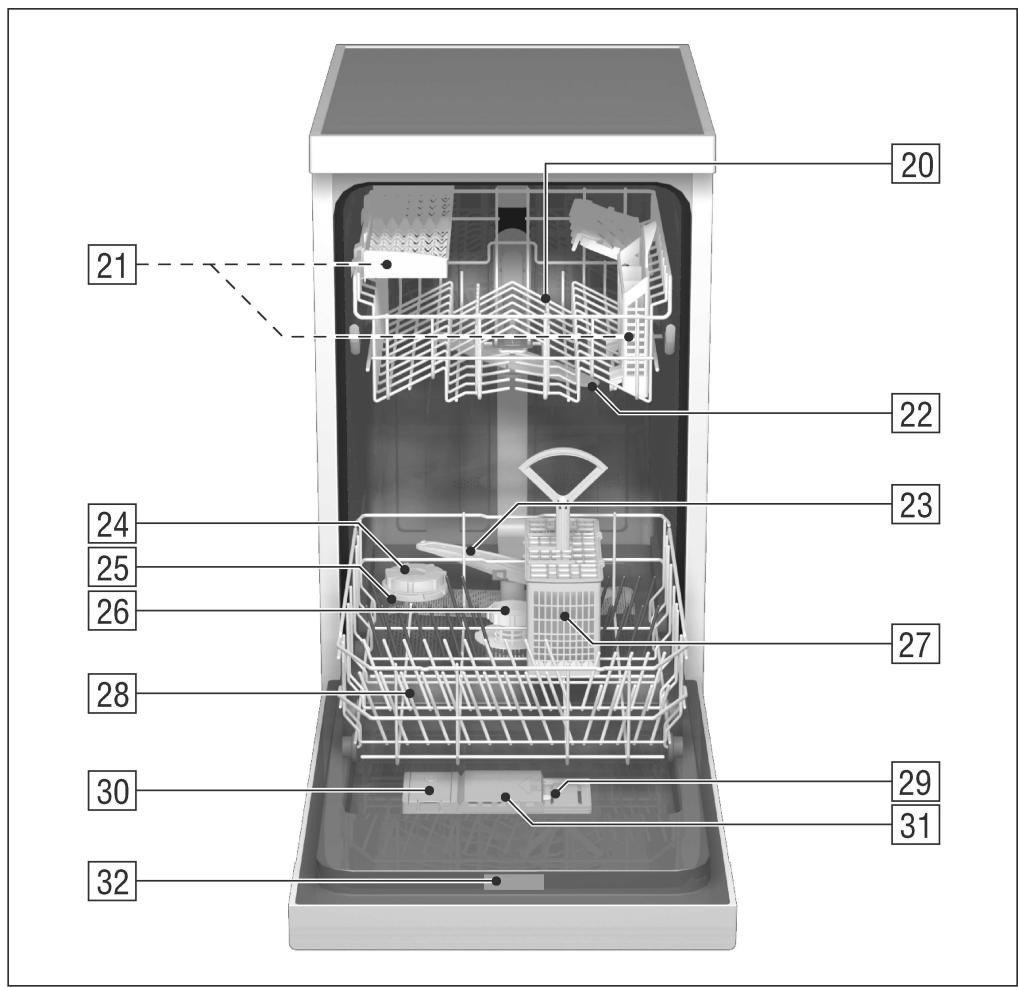
Diagrams of the control panel and the interior of the appliance can be found in the envelope at the front. Individual positions are referred to in the text.
Control panel
1 Programme selector
2 Start position
3 Programme sequence indicator
4 Door handle
5 Main switch (ON/OFF)
6 Programme overview
7 Indicator light *
- on applicable models
Appliance interior
20 Upper basket with 2-tiered cup rack
21 Additional cutlery basket for the top basket *
22 Upper spray arm
23 Lower spray arm
24 Container for special salt with level indicator *
25 Switch for setting water hardness
26 Filters
27 Cutlery basket
28 Lower basket
29 Lock for detergent dispenser
30 Container for rinse-aid, with level indicator
31 Detergent compartment
32 Nameplate
- not on all models
You will need to purchase the following before using the dishwasher for the first time:
- special salt for use in dishwashers
-detergent
-rinse-aid
Only use products, which are suitable for dishwashers.
Water softener
In order to rinse dishes and glasses satisfactorily, the dishwasher requires soft water, i.e. containing little or no lime, otherwise water stains will be left behind on crockery and glasses, etc.
If the tap water exceeds a certain level of hardness, it must be softened, i.e.
decalcified, so that it can be used in the dishwasher.
This is achieved by adding a special salt to the water softener inside the dishwasher.
The water softener, that is the required amount of salt, is set up according to how hard the tap water is.
Setting up the water softener
Determine the level of hardness of your tap water. Your local water company or service agent can help you with this.
- Identify setting from the following water hardness table.
Water hardness table
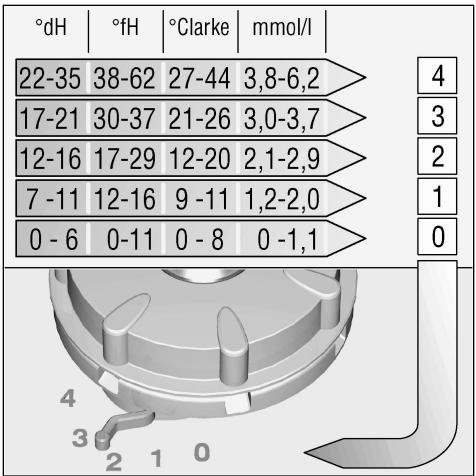
- Set the water hardness switch 25 to the appropriate level.
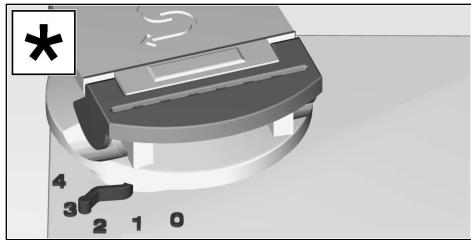
* not included with all models
Filling in the Salt
- Open the screw-type cap of the compartment [24].

Warning
Before switching on the appliance for the first time, pour approx. 1 litre of water into the salt dispenser.
- Then refill with salt (not cooking salt) until the salt container is full (max. 1.5kg ). When you refill the salt, water is being displaced and drains off.
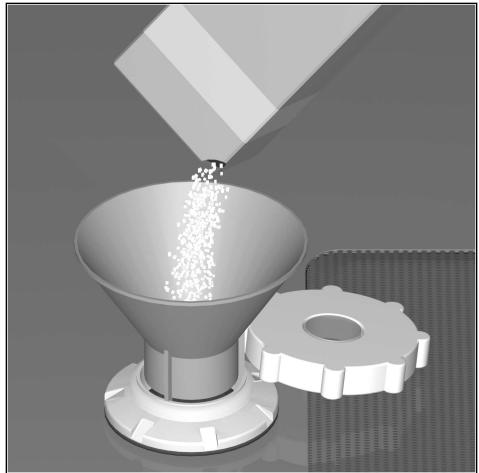
Refill with salt always just before switching on the appliance in order to prevent corrosion. As a result, any salt solution which has run over will be immediately diluted and flushed out.
- Then clean the filling area of salt residues and screw the compartment lid back on without tilting the lid.
If the switch is set to "0", it is not necessary to add any salt, as none is consumed while the dishwasher is operating. If the switch is set between "1" and "4", then salt must be added.

Warning
Do not pour detergent into the container for special salt. This would destroy the water softener.
LOW SALT indicator
Salt should be added as soon as the coloured dot in the lid on the salt container 24 is no longer visible.
Depending on the washing frequency and the hardness setting, the regeneration salt may not have to be topped up for several months.
Filling the rinse-aid container
The purpose of a rinse-aid is to prevent the formation of water marks on tableware and utensils, and to ensure that glasses are clean and sparkling. The rinse-aid is consumed during the washing process.
- Fold back the lid on the rinse-aid container 30.
To open the lid, press the mark (1^) on the rinse-aid lid and simultaneously lift the lid off the lug (2^) .
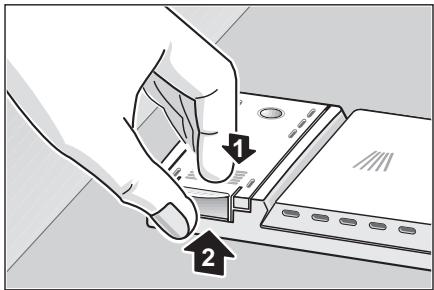
Pour the rinse-aid into the filler hole until the level indicator turns dark.
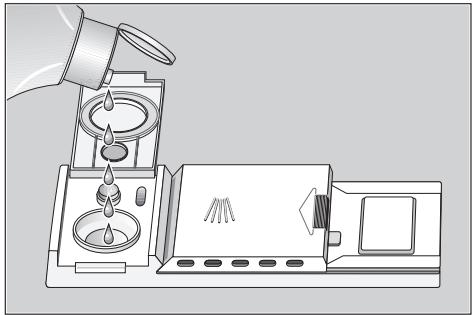
- Close the lid, ensuring that you hear it snap closed.
Use only rinse aid for domestic dishwashers. Spilt rinse aid may result in excessive foam formation in the next rinse cycle. Therefore, remove any spilt rinse aid with a cloth.
Adjusting the amount of rinse-aid
The amount of rinse-aid added to the water can be varied by adjusting the stepless control. The rinse-aid control has been set to "4" in the factory.
Do not alter the setting of the rinse-aid control unless streaks (turn knob towards "−") or water marks (turn knob towards "+" are left on the dishes.
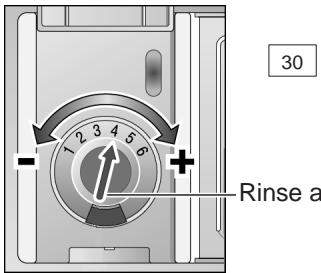
Rinse aid controller
LOW RINSE-AID indicator
As long as the LOW RINSE-AID indicator on the dispenser 30 is dark, there is sufficient rinse-aid in the dishwasher.
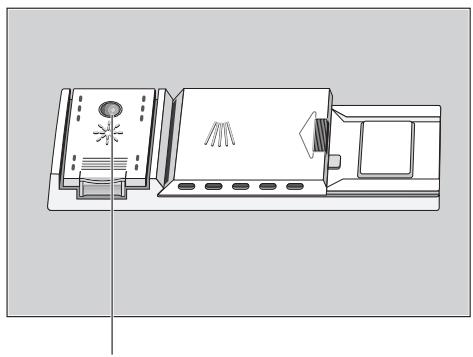
LOW RINSE-AID indicator
en
Not suitable for the dishwasher
The following should not be cleaned in the dishwasher:
- Wooden cutlery and utensils - these will leach out and become unsightly; even the utilised stickers are not suitable for the temperatures which occur.
- Sensitive ornamental glasses, craft utensil and vases, special antique or irretrievable utensils. These ornaments are not dishwasher-proof.
- Plastic parts sensitive to hot water.
Copper and tin utensils. - Utensils which are soiled with ash, wax, lubricating grease or ink.
- Absorbent materials such as sponges and cloths.
Aluminium and silver parts have a tendency to discolour and fade during the wash cycle. Even some types of glass (e.g. crystal glass objects) may turn cloudy after many wash cycles.
Recommendation:
In future buy utensils which are identified as dishwasher-proof.
Damage to glassware and other dishes
Possible causes:
type of glass or manufacturing process
chemical composition of detergent
water temperature and duration of dishwasher programme.
Suggested remedy:
Use glassware or porcelain dishes that have been marked 'dishwasher-proof' by the manufacturer.
- Use a mild detergent that is described as 'kind to dishes'. If necessary, seek further information from detergent manufacturers.
- Select a programme with as low a temperature and as short a duration as possible.
- To prevent damage, take glass and cutlery out of the dishwasher as soon as possible after the programme has ended.
Arranging crockery, glasses, etc. in the dishwasher
Loading the dishwasher
- Scrape off any large amounts of left-over food. It is not necessary to rinse the dishes under running water.
-
Place objects in the dishwasher in such a way that
-
items such as cups, glasses, pots/pans, etc. are stood upside down,
- curved items, or those with recesses, should be at a slant so that water can run off,
they are stacked securely and cannot tip over, - they do not prevent the spray arms from rotating while washing takes place.
Very small items should not be washed in the dishwasher as they could easily fall out of the baskets.
Removing the dishes
To prevent water dripping from the top basket onto the dishes in the lower basket, we recommend that you empty the lower basket first and then the top basket.
Cups and glasses
Upper basket 20
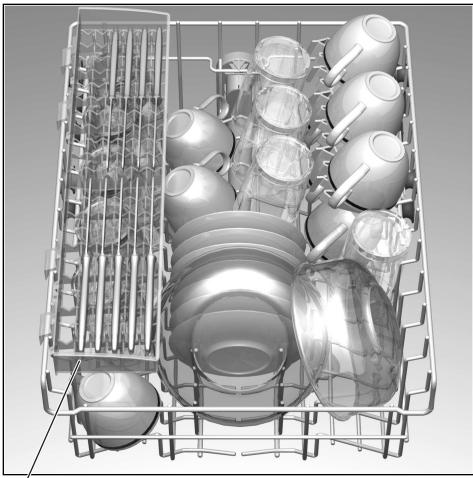
* not included with all models
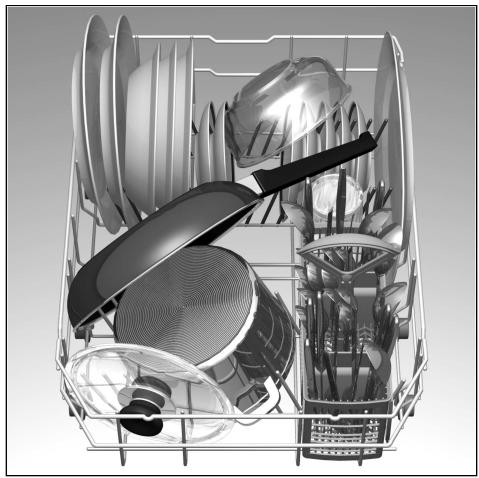
Pots and pans
Lower basket 28
Cutlery
Cutlery should be placed in the dishwasher always unsorted and with the eating surface pointing downwards. The spray jet is then better able to reach the individual parts.
To prevent injuries, place long, pointed accessories and knives on the étagère (some models) or on the knife shelf (available as an accessory).
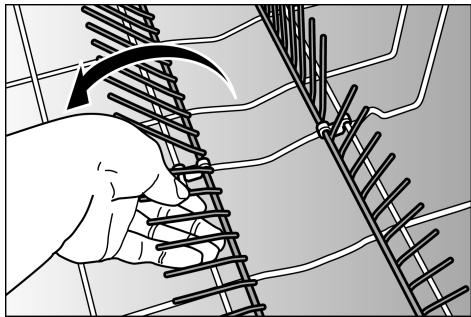
Folding spikes *
- on applicable models
To improve stacking of pots and pans, the spikes can be folded down.
Shelf *
- not on all models
Lean tall glasses and those with long stems against the shelf – not against other items to be washed.
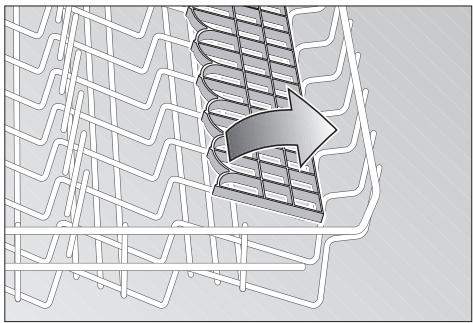
Place glasses, cups and small bowls on the additional cup rack. The additional cup rack can be swivelled in or out as required.
en
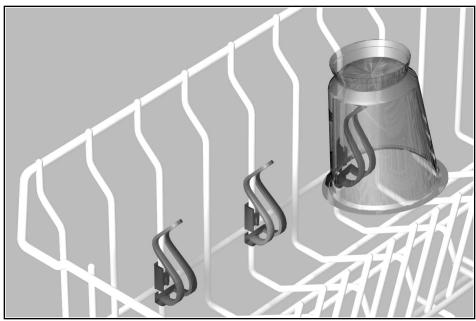
Small accessories holder*
- some models
Light-weight plastic accessories, e.g. cups, lids, etc. can be held securely in the small accessories holder.
Adjusting position of basket *
- not on all models
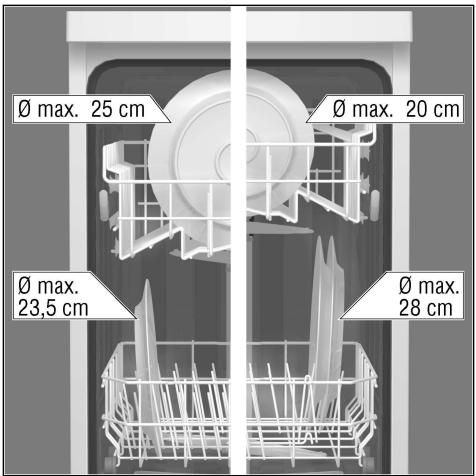
The top basket can be inserted on either its upper or lower rollers, according to requirement. This enables more height to be gained for bigger dishes in either the top or bottom basket.
Select one of the two following procedures according to the design of the top basket for your appliance model:
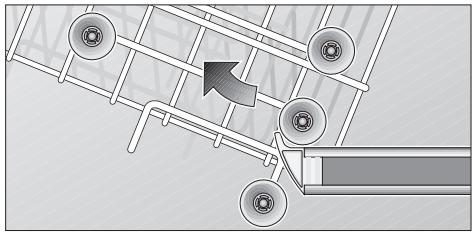
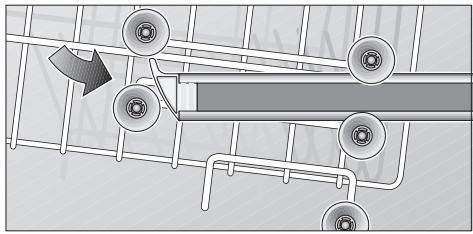
Top basket with upper and lower roller pairs
- Pull out the top basket.
- Remove the top basket and re-attach it to the upper or lower rollers.
Top basket with side levers (Rackmatic)
- Pull out the top basket.
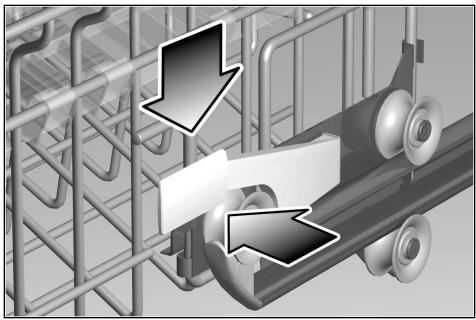
- To lower the basket, press in succession the two levers on the left and right sides of the basket. Always take hold of the side of the basket on the upper edge, otherwise the basket will not drop smoothly (and may damage the utensils).
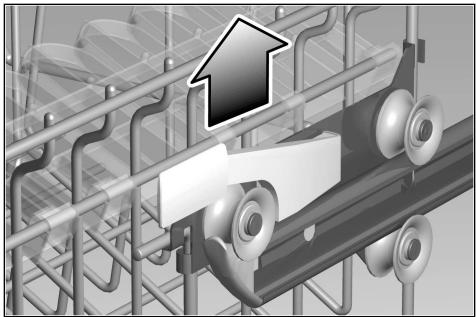
- To raise the basket, take hold of the basket on the upper edge and pull upwards.
Before you re-insert the basket, ensure that it is at the same height on both sides. Otherwise, the appliance door cannot be closed and the upper spray arm will not connect to the water circuit.
Baking sheet spray head *
- some models
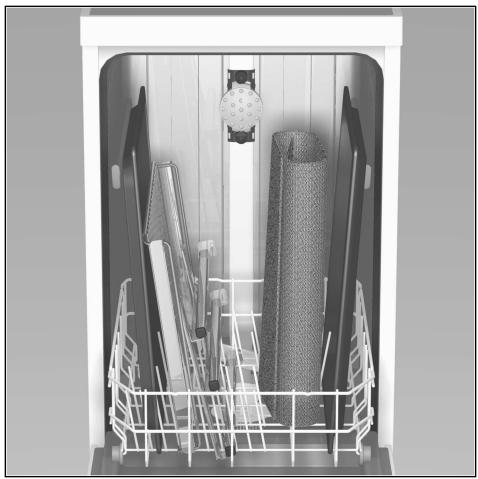
You can clean large baking sheets or grilles with the baking sheet spray head. To do this, remove the top basket and insert the spray head as illustrated in the diagram.
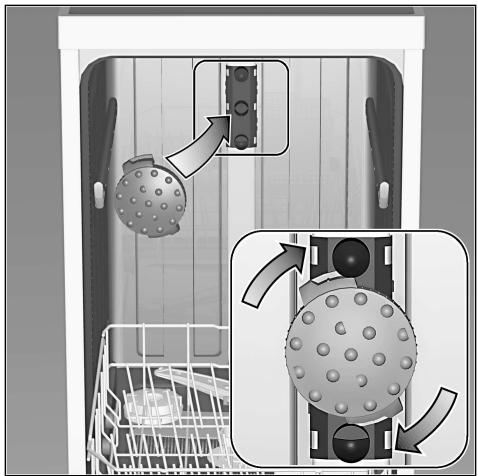
To ensure that the spray jet can reach all parts, arrange the baking sheets as illustrated (max. 2 baking sheets and 2 grilles).
Detergents
Information about detergents
You can use any brand of liquid or powder detergent, as well as tablets, that have been specifically designed for use in domestic dishwashers. (Do not use normal washing-up liquid!)
Nowadays there are three types of dishwasher detergent available:
- those containing phosphates and chlorine,
- those containing phosphates but no chlorine,
- those containing neither phosphates nor chlorine.
When a phosphate-free detergent is used in conjunction with hard water, there is a greater possibility that white marks will be left behind on crockery and glasses, etc. These can be avoided by pouring an increased amount of detergent into the dispenser.
Chlorine-free detergents have a reduced bleaching effect. This can mean that tea stains are not completely removed or plastic items become discoloured.
This can be resolved by:
- selecting a higher temperature programme, or
- increasing the amount of detergent, or
- using a detergent that contains chlorine.
Check the label on the detergent packaging to determine whether a particular product is suitable for use with silverware.
If you have any further questions, we recommend that you contact the customer advice departments of the various detergent manufacturers.
Detergent compartment with measuring marks
The side of the detergent compartment is marked with lines to help you determine how much powder to add.
The capacity of the detergent container is 15ml up to the bottom line and 25ml up to the middle line. When the compartment is full it contains 40ml .
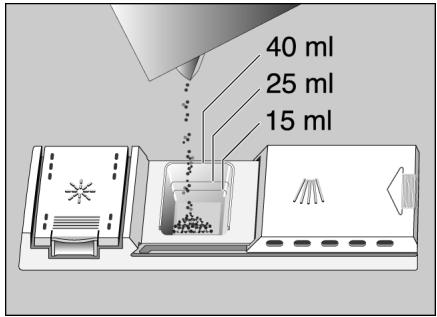
If the detergent dispenser 31 is still closed, press the lock 29 to open the detergent dispenser.
Adding detergent
- Fill the dispenser 31 with detergent.
Please observe the manufacturer's instructions printed on the detergent packaging when determining the correct dosage.

Important
Due to the different solvency properties of the detergent tablets supplied by various manufacturers, the cleaning efficiency of the detergent may not be fully utilised by short programmes. It is recommended to use washing powder for these programmes.
If using the "Intensive" programme (some models), also pour approx. 10 - 15ml of detergent onto the appliance door. If using tablets, also place a tablet on the appliance door.

Reduce costs!
If your dishes are only moderately dirty, you may be able to use less detergent than recommended.
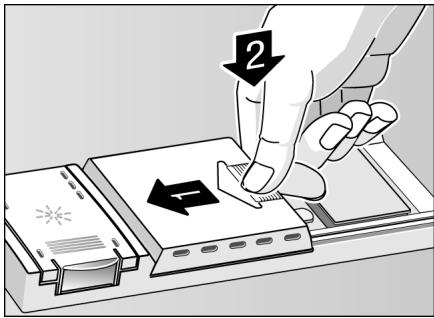
- Close the lid on the detergent compartment.
Press down the lid (1) until it clicks shut (2).
If you are using detergent in tablet form, read the manufacturer's
recommendations on the packaging in order to
determine where the tablets should be placed inside the dishwasher (e.g. in cutlery basket, detergent compartment, etc.).
Make sure that the lid on the detergent compartment is closed, even if you are using tablets.
CAUTION IMPORTANT NOTE ON THE USE OF COMBINED CLEANING PRODUCTS
Please note the following when using "combined cleaning products" which eliminate the need for a rinsing agent or salt, for example:
- Some products with a built-in rinsing agent are only used to their full effect in certain programmes.
- This type of product does not generally produce the desired effect with automatic programmes.
- Products which eliminate the need for regeneration salt can only be used within a certain water hardness range.
If you wish to use these combined products, please read the instructions carefully and heed any notes on the packaging.
Contact the manufacturer of the cleaning agent if you have any questions, particularly if:
the crockery is very wet once the programme has finished.
limescale deposits are formed.
Any problems which arise as a direct result of the use of these products are not covered by our warranty.
Programme overview
This overview lists the max. possible number of programmes. The programmes supplied with your appliance are indicated on the fascia.

Programme selection
The most appropriate programme can be identified by comparing the type of crockery, cutlery, etc., as well as the amount and condition of food remains, with the details contained in the programme overview.

Reduce costs!
If only a small number of dishes have been loaded into the dishwasher, selecting a programme that operates at the next lowest temperature will usually suffice.
Programme data
The programme data (duration, energy and water consumption) can be found in the summary of instructions and refers to standard conditions. Greater deviations may be caused by:
- different quantities of utensils
- inlet temperature of the water
water pressure
ambient temperature - mains voltage tolerances
and appliance-specific tolerances (e.g. temperature, water flow rate, etc.)
The water consumption values refer to water hardness value 2.
Washing the dishes
Switching on the appliance
Turn on the tap fully.
- Check once again that the spray arms can rotate freely.
- Select a programme with the programme selector 1 (rotate in a clockwise direction only).
- Press the main switch 5. The indicator light 7 illuminates. The programme starts.
Programme sequence indicator
While the dishes are being washed, the programme selector rotates in a clockwise direction and indicates how far the programme has progressed.
End of programme
The programme has ended when the pump noise is no longer audible and the programme selector has reached its initial position (12 o'clock position).
Switching the dishwasher OFF
Several minutes after the programme has ended:
- Set the main switch 5 to OFF. The indicator light 7 extinguishes.
- Turn the water tap off. (Does not apply when Aqua-Stop unit has been fitted) It is not necessary to reset the programme selector.
- Remove dishes, etc. when they have cooled down.
en
Interrupting the programme
- Set the main switch 5 to OFF.
- Indicator lights extinguish.
If the hot water was switched ON or the appliance has already heated up and then the appliance door opened, leave the door ajar for several minutes and then close. Otherwise, the appliance door may fly open due to expansion.
In order to resume the programme, set the main switch to ON again.
Changing the programme
- Switch off the main switch 5.
- Set the programme selector 1 to the new programme (rotate in a clockwise direction only!).
- Switch on the main switch 5 again.
Check whether the detergent dispenser is still closed. Otherwise, refill with detergent.

Note
If the power supply is disconnected while the appliance is operating, e.g. by switching off the appliance or due to a power failure, all settings remain stored. Operation continues automatically as soon as the power supply is restored.
Maintenance and care
A regular inspection and maintenance of your machine will help to prevent faults. This saves time and prevents problems. Therefore you should occasionally have a careful look inside your dishwasher.
Overall condition of the machine
- Check spray arm for grease and limescale deposits.
If you find such deposits: - Fill the detergent dispenser with detergent, start the appliance without utensils in the programme which has the highest wash temperature.
Clean the appliance with detergents/ appliance cleaners which are particularly suitable for use with dishwashers.
- Regularly wipe the door seal with a damp cloth to remove deposits.
Never use a steam cleaner to clean your dishwasher. The manufacturer is not liable for any consequential damage.
Regularly wipe the front of the appliance and panel with a damp cloth; water and a little washing-up liquid will suffice.
Do not use sponges with a rough surface or abrasive detergents, as these could scratch the surfaces.

Attention!
Never use other chlorinated household detergents! Health hazard!
Dishwasher salt
Check the LOW SALT indicator 24. Top up with salt, if required.
Rinse-aid
Check the level of liquid in the rinse-aid container 30. Top up with rinse-aid, if required.
Filters
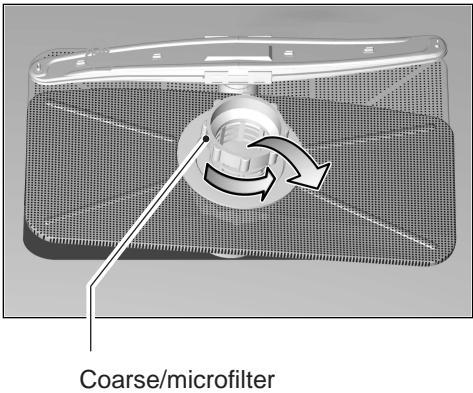
The filters 26 prevent large particles of food in the water from reaching the pump. These particles may occasionally block the filters.
- When the appliance has finished washing, check the filters for particles of food and, if required, clean.
After undoing the coarse micro-filter, the filter unit can be removed. Remove any particles of food and rinse the filters under running water. - Insert the filter unit and tighten the coarse micro-filter.
Spray arms
Lime and remnants of food in the washing water can block the nozzles in the spray arms 22 and 23 and the arm mountings.
- Inspect the nozzles in the spray arms for blocked holes due to remnants of food.
If necessary, pull the lower arm upwards and lift it off.
Unscrew the upper spray arm 22 - Clean both spray arms under running water.
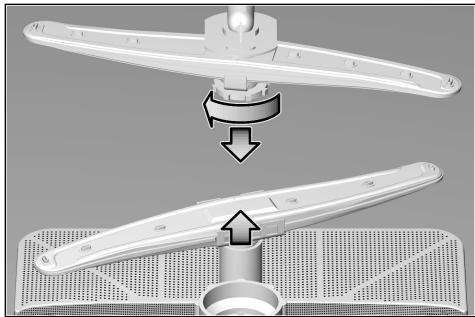
- Refit the spray arms. Ensure that the lower arm has locked into place and the upper one is screwed tight.
en
Pump *
- on applicable models
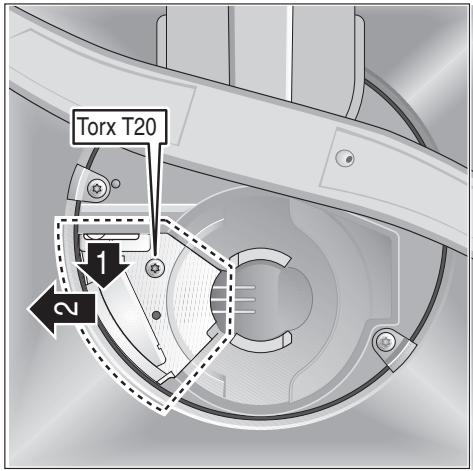
Larger remnants of food that have not been trapped by the filters and have been left in the water can cause a blockage in the pump. The water is no longer pumped out of the dishwasher and it can be seen covering the filter.
Proceed as follows:
- First, always disconnect the appliance from the power supply.
Ladle out as much water as possible. - Remove the filters 26
- Undo the screw in the cover (Torx T 20) and remove the cover.
- Inspect the inside and remove any obstructions that you find.
- Re-insert the cover and screw down.
- Re-insert the filters and screw down.
Fault finding
Resolving minor problems yourself
Experience has shown that you can resolve most problems that arise during normal daily usage yourself, without having to call out a service engineer. Not only does this save costs, but it also means that the appliance is available for use again that much sooner. The following list of common occurrences and their remedies should help you identify the causes of most problems.
Problems ...

Attention
Remember: Repairs may be carried out by a technician only. If a component has to be replaced, ensure that only original spare parts are used. Improper repairs or use of non-original spare parts may cause considerable damage and put the user at considerable risk.
... when the appliance is switched on
The appliance does not start.
The mains fuse has tripped.
The appliance plug has not been inserted.
The appliance door has not been shut properly.
The tap has not been turned on.
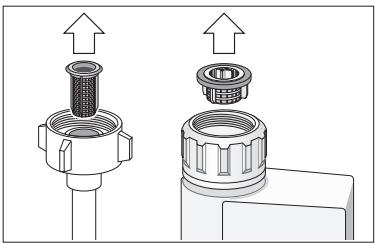
The filter on the water supply hose is blocked.
Switch off the appliance and pull out the mains plug. Turn off the tap. Then clean the filter which is situated at the connection of the supply hose. Finally, restore the power, turn on the tap and switch on the appliance.
... with the appliance itself
Lower spray arm rotates with difficulty
Spray arm is blocked by small items or food remains.
-
Lid in detergent compartment cannot be closed
-
Detergent compartment has been overfilled.
- Mechanism is clogged with remnants of detergent. Indicator lamps do not extinguish after washing has finished.
Remnants of detergent stuck inside dispenser
Compartment was damp when it was filled up with detergent.
Compartment must be dry before detergent is added.
Water remains inside appliance after programme has ended
- Blockage or kink in drainage hose.
Pump is jammed. - Filters are blocked.
The programme is still running. Wait for the programme to end.
... during washing
-
Unusual amount of foam is created
-
Normal washing up liquid has been poured into the rinse-aid container.
-
Remove any spilled rinse aid with a cloth as it could otherwise lead to excessive foaming during the next washing cycle.
-
Appliance stops suddenly while washing is taking place
Cut in electricity supply to appliance.
Water supply has been interrupted.
-
Knocking sound can be heard while washing is taking place
-
A spray arm is knocking against the dishes inside the appliance.
Rattling sound can be heard while washing is taking place
- Crockery has not been stacked properly inside the appliance.
- Knocking sound coming from inlet valves
- This is caused by the way the water pipes have been laid and it has no effect upon the way the appliance functions. There is no remedy for this.
... with the dishes, cutlery, etc.
-
Remnants of food are stuck to the dishes, cutlery, etc.
-
Dishwasher was not loaded properly. Jets of water could not reach all parts of the dishes, etc.
- Too many items in the rack.
- Items in the rack were touching each other.
Not enough detergent was added to dispenser. - Selected wash programme was not intensive enough.
Rotation of spray arm was obstructed by dish, etc.
Nozzles in spray arm are blocked by remnants of food. - Filters are blocked.
-
Filters have been incorrectly fitted.
Waste-water pump is jammed. -
Plastic items are discoloured
Not enough detergent was added to dispenser.
en
- White stains are left on crockery, glasses have a milky appearance
Not enough detergent was added to input compartment.
Amount of rinse-aid was set too low.
- Although water is quite hard, no salt has been put in appliance.
Water softener was set too low.
- Lid on salt container is not screwed tight.
If you used a phosphate-free detergent, try a detergent containing phosphates and compare results.
-
Dishes, cutlery, etc. have not been dried
-
Selected programme did not include drying function.
Amount of rinse-aid was set too low. -
Items were removed from dishwasher too soon.
-
Glasses have a dull appearance
Amount of rinse-aid was set too low.
Tea stains or traces of lipstick have not been completely removed
- Detergent does not have a sufficient bleaching effect.
Traces of rust on cutlery
Cutlery is not sufficiently rustproof.
Salt content in washing water is too high.
- Lid on salt container is not screwed tight.
-
Too much salt was spilt while filling container.
-
Glasses become clouded and discoloured; coating cannot be wiped off
-
Unsuitable detergent was used.
- Glasses are not dishwasher-proof.
Smears left behind on glasses and cutlery; glasses have acquired a metallic appearance
Amount of rinse-aid set too high.
Customer Service
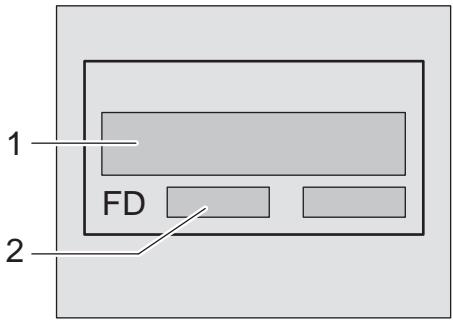
Please call your local service agent, if you are not able to resolve any problem yourself. The name of your nearest service agent is shown in the Customer Service address list. When you call, please provide details of the model number (1) and the production (FD) number (2) which are shown on the nameplate 32 on the appliance door.

Attention
Please note that a visit by the customer service technician in the event of a fault or one of the problems previously discussed is not free of charge even during the warranty period.
Information
Disposal
Old appliances are not worthless rubbish. Valuable raw materials can be reclaimed by recycling old appliances.
Pull out the mains plug of the redundant appliance. Cut off the power cord and discard with mains plug.
To prevent children from locking themselves in the appliance and suffocating, destroy the door lock and childproof lock (if fitted).
You received your new appliance in a protective shipping carton. All packaging materials are environmentally friendly and recyclable.
Please contribute to a better environment by disposing of packaging materials in an environmentally-friendly manner. All plastic parts of the appliance are identified by internationally standardised symbols (e.g. >PS< polystyrene).
When the appliance is being disposed of, the plastic waste can be sorted for environmentally-friendly recycling.
Please ask your dealer or inquire at your local authority about current means of disposal.
Keep children away from shipping carton and packaging components. Danger of suffocation from folding cartons and plastic film.
Notes on comparison tests
You will find details of the conditions for the comparison tests on the additional "Notes on comparison tests" sheet. The consumption values for the relevant programmes are given in the introduction.
General
Built-under and integrated appliances which are subsequently installed as free-standing appliances must be secured to prevent them from falling over, e.g. by screwing them to the wall or by installing them under a continuous worktop which is screwed to the adjoining units.
- For Swiss version only: The appliance can be installed without difficulty between wooden and plastic walls in a kitchen range. If the appliance is not connected via a plug, the installation side must feature an all-pole disconnector with a contact gap of at least 3mm in order to satisfy the relevant safety regulations.
en
Installation
The dishwasher must be connected by a qualified technician to ensure correct operation. The specifications for supply, drainage and connected load must fulfil the required criteria as stated in the following paragraphs or in the installation instructions.
Install the appliance in the following sequence:
- Check the delivery
Install the appliance - Connect the waste water
- Connect the fresh water
- Connect the power supply
Delivery
Your dishwasher was checked at the factory to ensure that it was in perfect working order. This may have left some small water stains in the dishwasher. These will disappear after the first rinse cycle.
Installation
The required installation dimensions can be found in the installation instructions. Using the height-adjustable feet, adjust the appliance until it is level. Ensure that the appliance is standing firmly.
Waste water connection
See the installation instructions for the required connection steps. If required, attach a siphon with drainage spigot. Using the enclosed parts, connect the waste water hose to the drainage spigot of the siphon.
Ensure that the drainage hose is not kinked, crushed or twisted (ensure that there is no sealing cover which prevents the water water from flowing away!).
Fresh water connection
Using the enclosed parts, connect the fresh water connection to the tap according to the installation instructions. Ensure that the fresh water connection is not kinked, crushed or twisted.
When replacing the appliance, always connect a new water supply hose to the water supply. The old supply hose must not be re-used.
Water pressure:
Minimum 0,05 MPa (0,5 bar) – maximum 1 MPa (10 bar).
If the water pressure is higher, install a pressure reducing valve.
Flow rate:
Minimum of 10 litres per minute.
Water temperature:
We recommend that you use cold water. If you do use hot water, the temperature should not exceed 60^ .
Electrical connection
Connect the appliance only to 230V alternating current via a correctly installed socket with protective conductor.
See rating plate for required fusing 32 The socket must be attached near the dishwasher and be freely accessible. The connection may be modified by an electrician only.
Use only a residual-current-operated circuit-breaker which features the symbol. Only this circuit breaker guarantees compliance with the currently valid regulations.
Removing the appliance
It is essential, when removing the appliance, to observe the following sequence: First, disconnect the appliance from the power supply.
Pull out the mains plug.
Turn off the water supply.
Disconnect the waste water and fresh water connections.
Loosen the fastening screws under the worktop. If fitted, remove the base panel. Pull out the appliance, carefully pulling the hose behind.
Transporting the dishwasher
Drain water from the dishwasher. Secure all loose parts. The appliance should only be transported in an upright position.
If the appliance is not kept upright during transport, any water left inside may seep into the control module and cause subsequent errors with programme functions.
Protection from freezing temperatures
If the appliance is installed in a location where there is a risk of freezing temperatures (e.g. in a holiday home), all water must be completely drained out of the interior.
Turn OFF the tap, disconnect the supply hose and allow to drain.
Waste disposal
Disposal
Old appliances are not worthless rubbish. Valuable raw materials can be reclaimed by recycling old appliances.
Pull out the mains plug of the redundant appliance. Cut off the power cord and discard with mains plug.
To prevent children from locking themselves in the appliance and suffocating, destroy the door lock and childproof lock (if fitted).
You received your new appliance in a protective shipping carton. All packaging materials are environmentally friendly and recyclable.
Please contribute to a better environment by disposing of packaging materials in an environmentally-friendly manner. All plastic parts of the appliance are identified by internationally standardised symbols (e.g. >PS< polystyrene).
When the appliance is being disposed of, the plastic waste can be sorted for environmentally-friendly recycling.
Please ask your dealer or inquire at your local authority about current means of disposal.
Disposal of the packaging
- Please dispose of the packaging material in an environmentally friendly manner.
Keep children away from shipping carton and packaging components. Danger of suffocation from folding cartons and plastic film.
Corrugated cardboard consists mainly of wastepaper.
- The moulded polystyrene parts do not contain any chlorofluorohydrocarbons.
- The polyethylene film (PE) consists partly of secondary raw materials.
- The wooden frames (if fitted) are made of untreated residual wood.
- The hoops (if fitted) consist of polypropylene (PP).
en
Disposal of redundant appliances
- Make redundant appliances unusable to prevent subsequent accidents.
- Dispose of the appliance in an environmentally friendly manner.

Warning
Children could become locked in the appliance (risk of suffocation) or find themselves in other dangerous situations. Therefore: Pull out the mains plug, sever and dispose of the power cord. Destroy the door lock so that the door can no longer be closed.
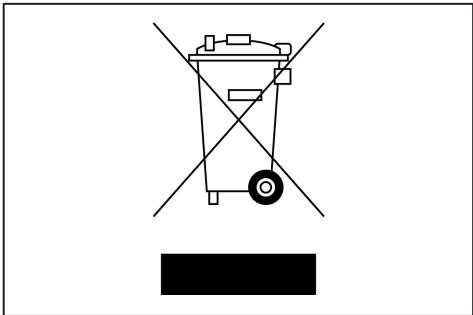
This appliance is labelled in accordance with European Directive 2002/96/EG concerning used electrical and electronic appliances (waste electrical and electronic equipment - WEEE). The guideline determines the framework for the return and recycling of used appliances as applicable throughout the EU.
AQUA-STOP Warranty.
(not applicable to appliances without Aqua-Stop)
In addition to warranty claims against the seller based on the sales agreement and in addition to our appliance warranty we shall replace the appliance under the following conditions:
- If damage is caused by water due to a malfunction of our Aqua-Stop system, we shall make good the damage in the case of private consumers.
- This liability warranty is valid for the service life of the appliance.
- The warranty claim is subject to correct installation and connection of the appliance in accordance with our instructions. "This also includes correct installation of the Aqua-Stop extension (original accessory)." Our warranty does not cover defective supply lines or fittings up to the Aqua-Stop connection on the tap.
- In principle, it is not necessary to monitor an appliance fitted with Aqua-Stop during operation or to secure it afterwards by turning off the tap. You should only turn off the tap if you are absent from home for a prolonged period, e.g. on holiday for several weeks.
Constructa GmbH
Carl-Wery-Straße 34
81739 München
To book an engineer visit and product advice
Please find the contact data of all countries in the enclosed customer service list.
CONSTRUCTA-NEFF VERTRIEBS-GMBH
Postfach 100 250
80076Munchen
9000 137 936 en (8511-1)
450R
- [constructa
- en Index
- Safety instructions
- Delivery
- Installation
- Warning
- In daily use
- Children in the household
- Child-proof lock*
- If a fault occurs
- When disposing of old appliances
- en
- Getting to know your appliance
- Control panel
- Appliance interior
- You will need to purchase the following before using the dishwasher for the first time:
- Water softener
- Setting up the water softener
- Water hardness table
- Filling in the Salt
- LOW SALT indicator
- Filling the rinse-aid container
- Adjusting the amount of rinse-aid
- LOW RINSE-AID indicator
- Not suitable for the dishwasher
- The following should not be cleaned in the dishwasher:
- Recommendation:
- Damage to glassware and other dishes
- Possible causes:
- Suggested remedy:
- Arranging crockery, glasses, etc. in the dishwasher
- Loading the dishwasher
- Removing the dishes
- Cups and glasses
- Pots and pans
- Cutlery
- Folding spikes *
- Shelf *
- Small accessories holder*
- Adjusting position of basket *
- Top basket with upper and lower roller pairs
- Top basket with side levers (Rackmatic)
- Baking sheet spray head *
- Detergents
- Information about detergents
- Detergent compartment with measuring marks
- Adding detergent
- Important
- Reduce costs!
- CAUTION IMPORTANT NOTE ON THE USE OF COMBINED CLEANING PRODUCTS
- Programme overview
- Programme selection
- Programme data
- Washing the dishes
- Switching on the appliance
- Programme sequence indicator
- End of programme
- Switching the dishwasher OFF
- Interrupting the programme
- Changing the programme
- Note
- Maintenance and care
- Overall condition of the machine
- Attention!
- Dishwasher salt
- Rinse-aid
- Filters
- Spray arms
- Pump *
- Fault finding
- Resolving minor problems yourself
- Problems ...
- Attention
- ... when the appliance is switched on
- ... with the appliance itself
- ... during washing
- ... with the dishes, cutlery, etc.
- Customer Service
- Information
- Disposal
- Notes on comparison tests
- General
- Waste water connection
- Fresh water connection
- Water pressure:
- Flow rate:
- Water temperature:
- Electrical connection
- Removing the appliance
- Transporting the dishwasher
- Protection from freezing temperatures
- Waste disposal
- Disposal of the packaging
- Disposal of redundant appliances
- AQUA-STOP Warranty.
- To book an engineer visit and product advice
- CONSTRUCTA-NEFF VERTRIEBS-GMBH
Marque : CONSTRUCTA
Modèle : CP432J5
Catégorie : Lave-vaisselle