
TL RC - Appareil photo sans miroir LEICA - Notice d'utilisation et mode d'emploi gratuit
Retrouvez gratuitement la notice de l'appareil TL RC LEICA au format PDF.


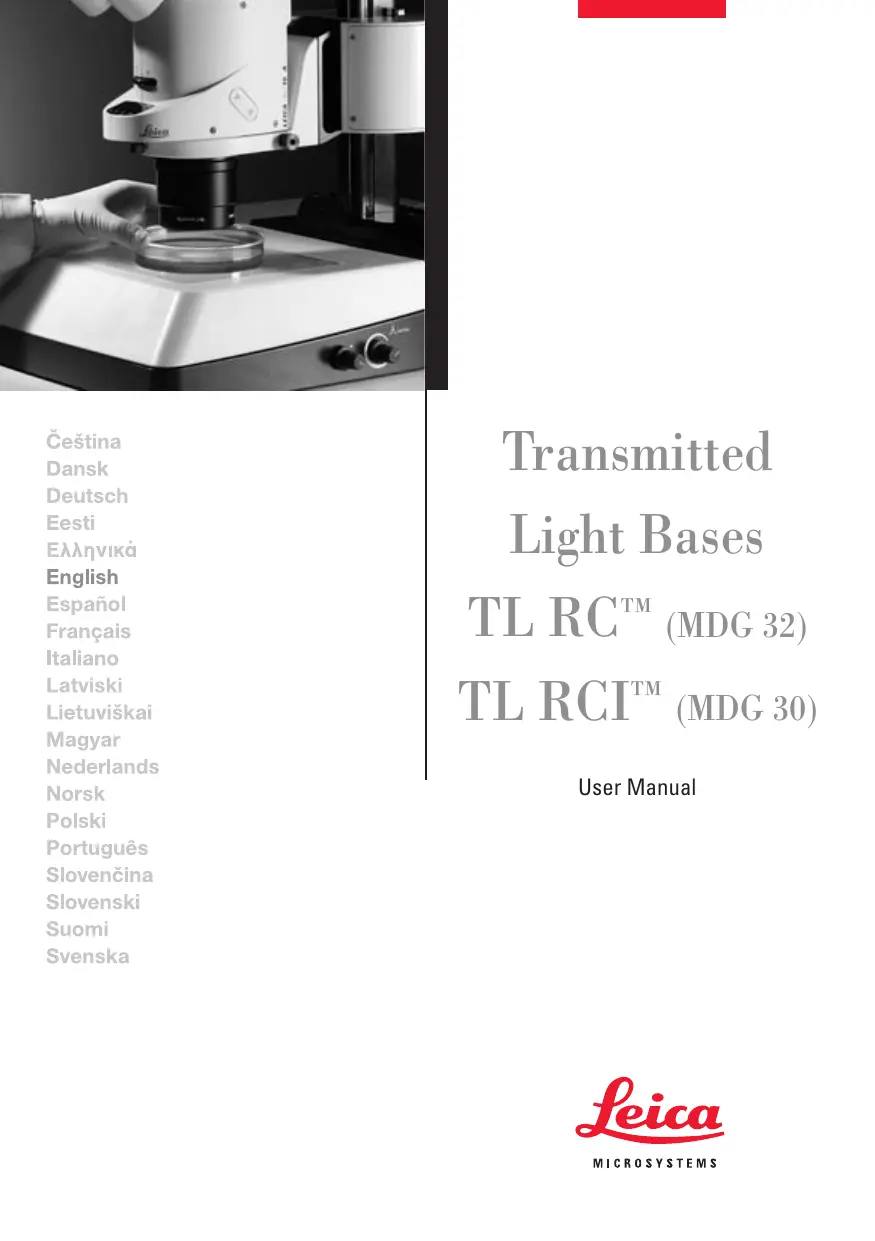

| Type de produit | Base de lumière transmise pour stéréomicroscopes Leica série M |
| Marque | LEICA |
| Modèle | TL RC |
| Dimensions (L x H x P) | 340 x 390 x 95 mm |
| Poids | 6,0 kg |
| Alimentation | Source de lumière froide externe avec guide de lumière (fibre f=10 mm, tuyau f=13 mm) |
| Zone éclairée | 35 mm |
| Types d'éclairage | Fond clair, fond noir, lumière oblique, contraste de relief (RC) |
| Miroir de déviation | Intégré, rotatif et coulissant, côtés plan et concave |
| Porte-filtre | Jusqu'à 3 filtres (accessoires) |
| Platine standard | En verre, 220 x 170 x 4 mm, incluse |
| Température ambiante | 10 à 40 °C |
| Entretien et nettoyage | Protéger de l'humidité, des vapeurs et des produits corrosifs ; nettoyer avec un chiffon doux ; ne pas lubrifier les surfaces coulissantes |
| Sécurité | Débrancher avant maintenance ; éviter tout contact avec les ampoules chaudes ; utiliser uniquement des pièces d'origine Leica |
| Pièces détachées et réparabilité | Réparations réservées au personnel Leica agréé ; pièces de rechange disponibles auprès de Leica Microsystems |
| Informations générales | Conforme à la déclaration CE ; élimination selon les réglementations locales |
| Accessoires optionnels | Platine IsoPro™, platine de glissement, platine de polarisation, système de thermorégulation Leica MATS, souris USB Leica, etc. |
FOIRE AUX QUESTIONS - TL RC LEICA
Questions des utilisateurs sur TL RC LEICA
0 question sur cet appareil. Repondez a celles que vous connaissez ou posez la votre.
Poser une nouvelle question sur cet appareil
Téléchargez la notice de votre Appareil photo sans miroir au format PDF gratuitement ! Retrouvez votre notice TL RC - LEICA et reprennez votre appareil électronique en main. Sur cette page sont publiés tous les documents nécessaires à l'utilisation de votre appareil TL RC de la marque LEICA.
MODE D'EMPLOI TL RC LEICA
Tchèque
Danois
Allemand
Estonien
Grec
Anglais
Espagnol
Français
Italien
Letton
Lituanien
Hongrois
Néerlandais
Norvégien
Polonais
Portugais
Slovaque
Slovène
Finnois
Suédois
Transmis
Bases lumineuses
TL RC TM (MDG 32)
TL RCITM (MDG 30)
Manuel d'utilisation
Sommaire
Page
Vues d'ensemble
Concept de sécurité 4
Symboles 5
Consignes de sécurité 6
Commandes 8
Assemblage 10
Fonctionnement
Contraste en relief 12
Miroir de renvoi de trajet 12
Platine croisée IsoProTM 12
Intensité lumineuse et température de couleur 12
Souris USB 13
Méthodes en lumière transmise 14
Affichage en relief 14
Filtre 16
Remplacement de la lampe 16
Entretien, maintenance 17
Schéma d'extension 18
Contenu de la livraison 19
Plan coté 20
Caractéristiques techniques 22
Cher utilisateur,
Nous vous remercions vivement de la confiance que vous accordez à Leica Microsystems. Nous espérons que le travail avec nos produits de haute qualité et performants vous apportera satisfaction et succès.
Lors de la conception de nos instruments, nous avons accordé une grande importance à une utilisation simple et intuitive. Cependant, prenez le temps de lire le manuel d'utilisation afin de vous familiariser avec l'utilisation optimale de tous les avantages et options de votre stéréomicroscope. Si vous avez des questions, veuillez consulter votre représentant Leica local. Vous trouverez l'adresse du représentant local le plus proche ainsi que des informations précieuses sur les produits et services de Leica Microsystems sur notre site Web à l'adresse www.leica-microsystems.com.
Nous sommes à votre service avec plaisir. Le SERVICE CLIENT est une priorité pour nous, non seulement avant la vente, mais aussi après.
Leica Microsystems (Switzerland) Ltd. Stereo & Macroscope Systems www.stereomicroscopy.com
Le manuel d'utilisation
Ce manuel d'utilisation est disponible en 20 langues supplémentaires sur notre CD-ROM interactif. Les manuels d'utilisation et les mises à jour sont également disponibles en téléchargement sur notre site Web à l'adresse www.stereomicroscopy.com.
Le présent manuel d'utilisation décrit les consignes de sécurité, le montage et la manipulation des bases à lumière transmise TL RCTM et TL RCITM.
Concept de sécurité
1.1 Le manuel d'utilisation
Les bases à lumière transmise TL RCTM / TL RCI sont livrées avec un CD-ROM interactif contenant tous les manuels pertinents en 20 langues supplémentaires. Conservez ce CD-ROM dans un endroit sûr, à la disposition de l'utilisateur. Les manuels d'utilisation et les mises à jour sont également disponibles en téléchargement et en impression sur notre site Web à l'adresse www.stereomicroscopy.com.
Les bases à lumière transmise TL RCTM et TL RCITM sont un module de la série de stéréomicroscopes Leica M. Ce manuel d'utilisation décrit les fonctions spéciales de la base à lumière transmise et contient des instructions importantes pour la sécurité d'exploitation, la maintenance et les pièces accessoires.
Le manuel d'utilisation M2-105-0 des stéréomicroscopes Leica M contient des règles de sécurité supplémentaires pour le stéréomicroscope, les accessoires et les accessoires électriques, ainsi que des instructions de maintenance.
Vous pouvez combiner la base à lumière transmise TL RCTM avec toute source de lumière froide et un guide de lumière en fibre de verre (f = 10 mm actif, tube de sortie f = 13 mm). Veuillez lire le manuel d'utilisation et les exigences de sécurité du fournisseur.
Avant l'assemblage, la mise en service et l'utilisation, veuillez lire les manuels d'utilisation mentionnés ci-dessus. En particulier, respectez toutes les consignes de sécurité.
Pour maintenir l'appareil dans son état d'origine et garantir un fonctionnement sûr, l'utilisateur doit suivre les instructions et les avertissements contenus dans ces manuels d'utilisation.
1.1.1 Symboles utilisés

Avertissement de danger
Ce symbole indique des informations qui doivent être lues et respectées. Le non-respect de ces instructions
- peut présenter des dangers pour le personnel !
- peut entraîner des dysfonctionnements et des dommages aux instruments.

Avertissement de tension électrique dangereuse
Ce symbole indique des informations particulièrement importantes qui doivent être lues et respectées. Le non-respect de ces instructions peut entraîner
- des dangers pour le personnel !
- des dysfonctionnements et des dommages aux instruments.

Avertissement - surface chaude
Ce symbole vous avertit de points chauds tangibles, tels que les ampoules.

Informations importantes
Ce symbole indique des informations ou explications supplémentaires destinées à clarifier.
Action
Ce symbole dans le texte indique que certaines opérations doivent être effectuées.
Notes explicatives
- Ce symbole indique des notes et explications supplémentaires fournies dans le texte.
Figures
(1.5) Les numéros entre parenthèses dans les descriptions se rapportent aux figures et aux éléments de ces figures. Exemple (1.3) : la figure 1 se trouve, par exemple, à la page 8 et l'élément 3 est le porte-filtre.
1.2 Consignes de sécurité
Description
Les bases à lumière transmise TL RCTM et TL RCITM répondent aux exigences les plus élevées en matière d'observation et de documentation des stéréomicroscopes Leica de la série M. Elles contiennent un miroir à renvoi d'angle, un dispositif pour l'éclairage partiel de la pupille et la génération de contraste en relief, un verre dépoli, un condenseur supplémentaire et des lentilles de Fresnel. Le support complet se compose de :
- Base à lumière transmise TL RCTM ou TL RCITM
- Support de 300 mm ou 500 mm de long avec entraînement de mise au point, mise au point manuelle grossière/fine ou motorisée, plaque de verre pour platine, transparente, 220 × 170 × 4 mm, source de lumière et guide de lumière selon les besoins
Accessoires :
Platine à glissement Leica MATS Thermocontrol System avec platine chauffante - Ensemble de polarisation et bien plus encore (voir schéma d'extension)
Utilisations prévues
Les bases à lumière transmise TL RCTM et TL RCI™ sont utilisées dans l'assemblage des stéréomicroscopes Leica de la série M via la colonne à trépied et le support de microscope. Elles peuvent être combinées avec toute source de lumière froide et guide de lumière, et permettent d'observer des spécimens transparents avec un contraste de relief et une lumière transmise directe. La base à lumière transmise TL RCI™ possède une lampe halogène intégrée qui facilite particulièrement le contrôle par le logiciel Leica Application Suite (LAS).
Utilisations interdites
Si vous utilisez la base à lumière transmise TL RCTM/TL RCITM, ses composants et les accessoires d'une manière autre que celle décrite dans le manuel d'utilisation, des dommages peuvent être causés aux personnes ou aux objets.
Ne jamais :
- Modifier, reconstruire ou démonter des pièces, sauf si cela est spécifiquement indiqué dans ce manuel.
- Laisser des personnes non autorisées ouvrir des parties de l'instrument. Utiliser la base à lumière transmise TL RCTM/TL RCI pour des examens et des opérations sur l'œil humain.
Les unités ou composants accessoires décrits dans le manuel d'utilisation ont été vérifiés pour leur sécurité et les dangers possibles. Consultez toujours le bureau Leica responsable ou l'usine principale de Wetzlar à tout moment s'il est nécessaire d'ajuster l'unité ou de la combiner avec des composants non Leica qui dépassent le cadre de ce manuel.
Tout réglage non autorisé de l'unité ou toute utilisation inappropriée annule la garantie.
Lieu d'utilisation
Utilisez uniquement la base à lumière transmise TL RCTM/TL RCITM dans des pièces fermées, sans poussière et entre +10°C et +40°C. Assurez-vous que les pièces sont exemptes de vapeurs d'huile ou d'autres vapeurs chimiques et d'humidité extrême. - Installez les composants électriques à au moins 10 cm des murs et des objets combustibles. - Évitez les grandes fluctuations de température, la lumière directe du soleil et les vibrations. Cela peut provoquer des mesures erronées ou des microphotographies défectueuses. Dans les zones climatiques chaudes, ou chaudes et humides, la base à lumière transmise TL RCTM/TL RCITM nécessite des soins particuliers pour empêcher la formation de champignons.
Responsabilités de la personne responsable de l'instrument
Assurez-vous que
La base à lumière transmise TL RCTM/TL RCITM et les accessoires ne sont utilisés, entretenus et réparés que par du personnel autorisé et formé. - Le personnel qui utilise l'instrument a lu et compris ce manuel d'utilisation, en particulier les consignes de sécurité, et les respecte.
Réparations, travaux d'entretien
- Les réparations ne peuvent être effectuées que par des ingénieurs de maintenance formés par Leica Microsystems ou par votre propre personnel technique autorisé. Seules des pièces d'origine Leica Microsystems peuvent être utilisées.
- Avant d'ouvrir les appareils, coupez l'alimentation et débranchez les câbles secteur.

Si vous touchez le circuit électrique de l'instrument, vous pouvez recevoir une décharge électrique.
Transport
- Utilisez l'emballage d'origine pour expédier ou transporter la base à lumière transmise TL RCTM/TL RCI™ et les composants accessoires.
- Pour éviter tout dommage dû aux vibrations, retirez et emballez spécialement tous les composants mobiles que vous avez installés vous-même, conformément au manuel d'utilisation.
Intégration dans des produits tiers
Les points suivants doivent être respectés si des produits Leica sont intégrés dans des produits tiers : Le fabricant du système complet ou la personne qui le met sur le marché est responsable du respect des réglementations, lois et directives de sécurité applicables.
Élimination
Les produits décrits ici doivent être éliminés conformément aux lois et réglementations locales applicables.
Exigences légales
Respectez les réglementations générales et locales relatives à la prévention des accidents et à la protection de l'environnement.
Déclaration UE de conformité
La base à lumière transmise TL RCTM/TL RCI et les accessoires ont été construits selon l'état de l'art et sont munis d'une déclaration UE de conformité.
Commandes
Fig. 1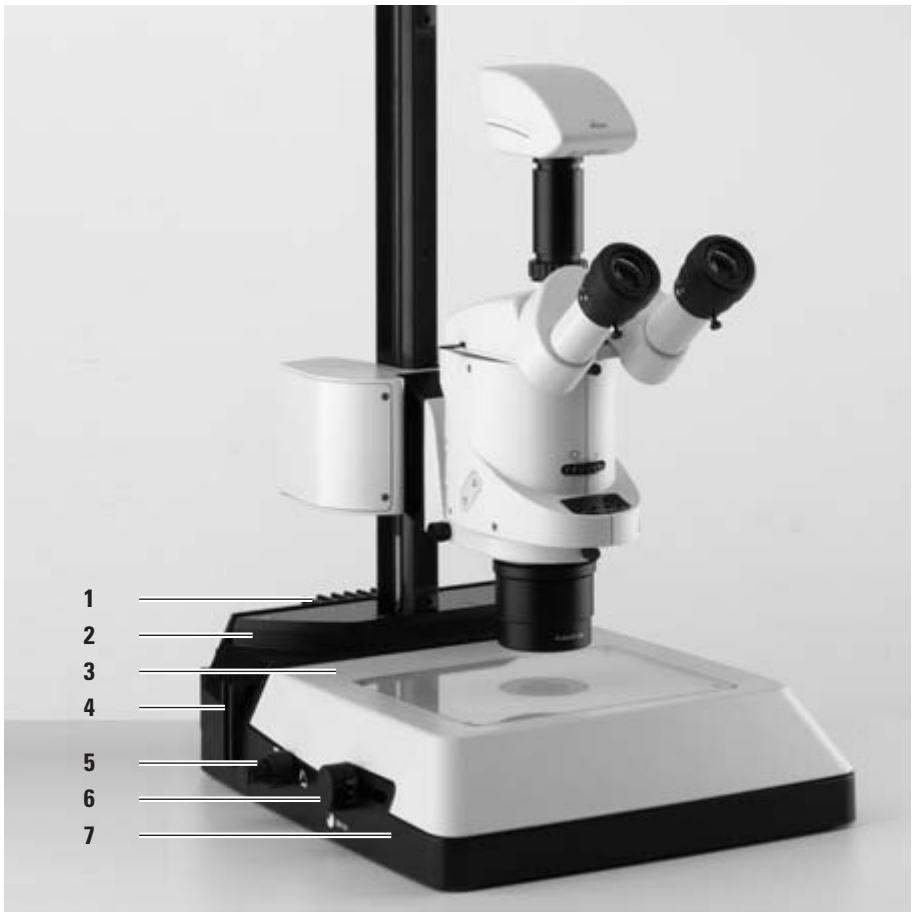
1 Élément de refroidissement de l'éclairage halogène intégré (TL RCI™ uniquement) 2 Plaque d'adaptation pour un montage facile des entraînements de mise au point 3 Platine standard 10 447 269 4 Support de filtre pour jusqu'à trois filtres 5 Bouton de commande pour les volets supérieur et inférieur du contraste Rottermann™ 6 Bouton pour faire pivoter et déplacer latéralement le miroir 7 Base de lumière transmise TL RCI™
Fig. 2 Plaque d'adaptation poteau vertical - base de lumière transmise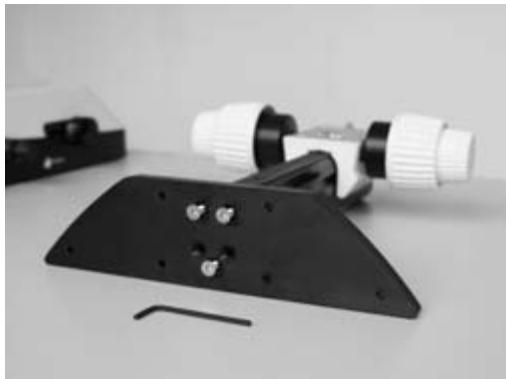
Fig. 3 Adaptateur entre l'entraînement de mise au point et le support du microscope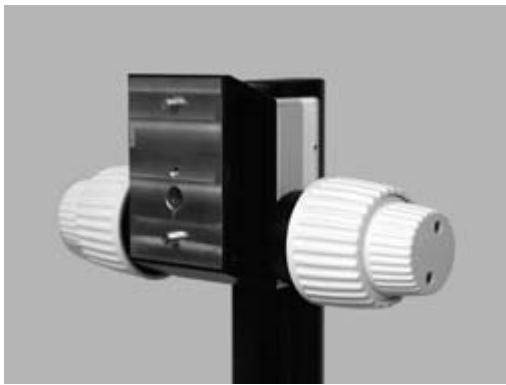
Fig. 4 Face arrière de la base de lumière transmise TL RCI™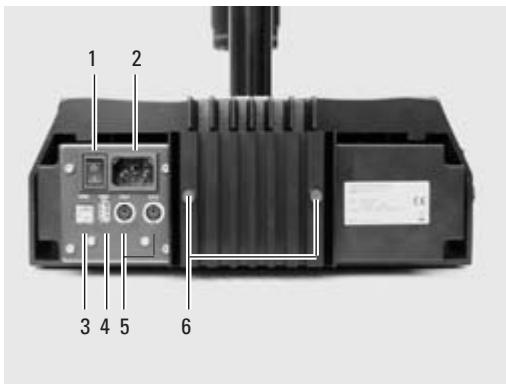
Fig. 5 Souris USB pour le contrôle du TL RCI™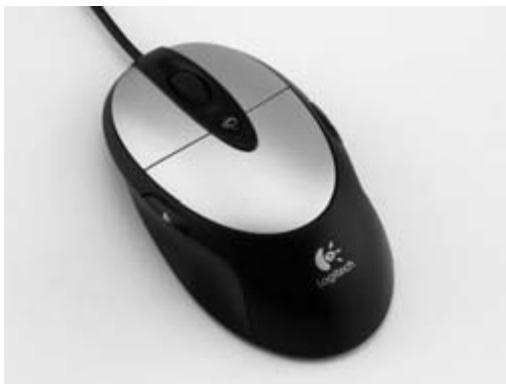
1 Interrupteur d'alimentation 2 Prise d'alimentation 3 Prise USB de type B 4 Prise USB de type A 5 2× Can-Bus 6 Vis pour le remplacement de la lampe halogène

Avant de déballer, assurez-vous que personne ne puisse être blessé par une pièce qui tombe ou qui bascule.
3.1 Déballage de la base
La base est livrée avec la plaque d'adaptation fixée. La platine sélectionnée (platine croisée IsoPro™ ou platine standard 10447269) et l'entraînement de mise au point devront être montés ultérieurement. Assurez-vous que les appareils sont déballés sur une surface plane, suffisamment grande et antidérapante.
3.2 Assemblage de la platine
La base de lumière transmise TL RCTM/ RCI™ peut être équipée de deux platines différentes. La platine sélectionnée est montée sur la base avant la mise en service. Les deux platines peuvent être facilement échangées à tout moment.
Le paragraphe suivant suppose que la base est sans la platine montée. Le démontage s'effectue dans l'ordre inverse des étapes suivantes.
3.2.1 Platine standard
Retirez la plaque de verre de l'encoche rectangulaire de la platine standard. Positionnez la platine sur la base de lumière transmise de manière à ce que les quatre trous soient alignés avec ceux de la base. Fixez la platine à la base avec les quatre vis Allen fournies. Réinsérez la plaque de verre dans la platine standard.
3.2.2 Platine croisée IsoPro™
Avant de monter la platine croisée IsoPro™ sur la base, l'axe contenant les boutons de commande est fixé en option sur le côté gauche ou droit de la platine croisée.
Si les commandes doivent être montées sur le côté gauche, la tige d'engrenage sur la face inférieure de la platine croisée doit être dévissée et réinstallée dans le sens inverse.
Retirez la plaque de verre de la platine croisée. Retournez la platine croisée et placez-la sur une surface antidérapante. Changez la tige d'engrenage (6.2) du côté gauche vers le côté droit. Passez les deux étapes suivantes pour monter les commandes.
Assemblage des commandes
Retirez la plaque de verre de la platine croisée. Retournez la platine croisée et placez-la sur une surface antidérapante. Fixez l'axe avec les boutons de commande (6.1) sur le côté souhaité. L'attache s'enclenche magnétiquement dans la platine croisée. Fixez l'axe avec les deux vis Allen fournies. Fixez le rail de protection sur la platine croisée.
Assemblage de la platine croisée
Placez la platine croisée sur la base. Tirez délicatement la partie supérieure de la platine croisée vers l'utilisateur, en fixant la partie inférieure sur la base à lumière transmise. Fixez la platine croisée uniformément sur les trois trous filetés. Poussez la platine croisée complètement vers l'arrière contre la butée, en direction de la colonne. Réinsérez la plaque de verre dans la platine standard.
3.3 Colonne de mise au point
Dévissez la plaque adaptatrice (1.2) de la base à l'aide de la clé Allen fournie. Fixez votre colonne de mise au point en bas avec les trois vis Allen (2). Refixez la plaque adaptatrice à sa position d'origine.
3.4 Assemblage de l'adaptateur intermédiaire
Montez l'adaptateur fourni entre la colonne et le porte-microscope, pour compenser la distance accrue entre la commande de mise au point et l'axe optique.
Fixez l'adaptateur (3) sur la colonne de mise au point pour que les broches s'enclenchent dans les évidements. Fixez l'adaptateur à l'aide de la clé Allen fournie.
3.5 Assemblage de l'équipement
Après avoir monté l'adaptateur sur la colonne de mise au point, le porte-microscope, le porte-optique et l'ensemble de l'équipement peuvent être assemblés comme d'habitude.
3.6 Connexion de la source de lumière froide à la base TL RC™
Poussez l'extrémité appropriée du guide de lumière froide dans la face arrière de la base. Pour plus d'informations sur l'utilisation des sources de lumière froide, reportez-vous aux instructions fournies séparément.
3.7 Connexion du câble d'alimentation (TL RCI™)
Assurez-vous que l'interrupteur d'alimentation (4.1) sur la base est réglé sur "0". Insérez le câble d'alimentation dans la prise secteur (4.2), puis connectez-le à une prise mise à la terre.
Fig. 6 Face arrière de la platine croisée IsoPro™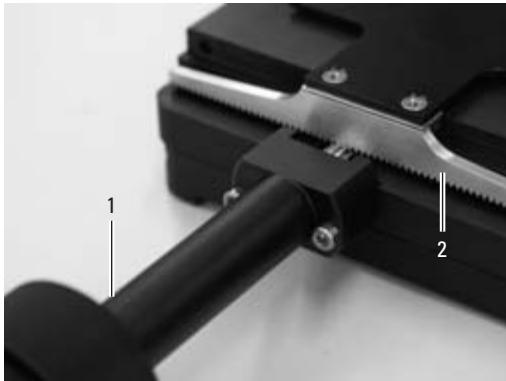
1 Axe avec commandes 2 Tige d'engrenage, montée sur la platine croisée
Fig. 7 Commandes de la platine croisée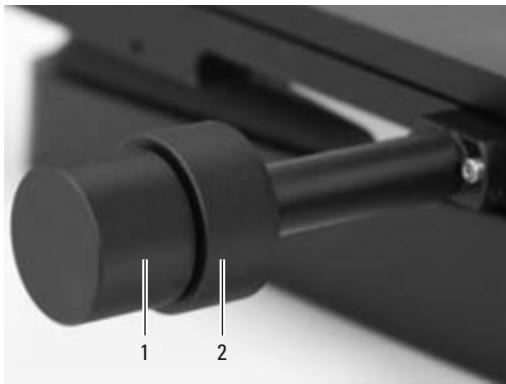
1 Bouton de commande pour le déplacement en direction x 2 Bouton de commande pour le déplacement en direction y
4.1 Interrupteur pour le réglage du contraste de relief
Utilisez les deux interrupteurs (8.1 et 8.2) sur le côté gauche de la base à lumière transmise TL RCTM/TL RCI pour actionner les deux volets intégrés. L'interrupteur extérieur (8.1) contrôle le contraste de relief inversé. L'interrupteur intérieur (8.2) contrôle le contraste de relief positif. Selon la position du volet, une partie de l'ouverture de la lentille de Fresnel intégrée est couverte, ce qui provoque différents effets de contraste. Les structures de phase apparaissent généralement comme des images spatiales en relief - comme des collines en contraste de relief positif et comme des creux en contraste de relief inversé.
Le contraste peut être augmenté sans relief en réglant les deux diaphragmes à 45°. Une zone éclairée en forme de fente apparaît. La fente peut être déplacée sur tout le champ de vision et basculer rapidement entre la vue en relief positif et négatif par une inclinaison précise du miroir de renvoi. L'effet dynamique permet de distinguer facilement les structures de phase des structures d'amplitude.
Selon les propriétés de l'objet (indice de réfraction par rapport à l'environnement) et votre propre sensibilité, il peut arriver que vous deviez utiliser les interrupteurs pour le contraste de relief positif et inversé dans l'ordre inverse. Ces interrupteurs sont décrits ci-dessous.
C'est-à-dire qu'au lieu de l'interrupteur supérieur (8.1), l'interrupteur inférieur (8.2) contrôle le contraste de relief inversé. Au lieu de l'interrupteur inférieur (8.2), l'interrupteur supérieur (8.1) contrôle le contraste de relief positif.
4.2 Miroir de renvoi
Le miroir de renvoi intégré présente un côté plat et un côté concave et peut être tourné et déplacé. Le côté concave a été spécialement conçu pour les caractéristiques optiques des objectifs à haute
Ouverture numérique. À l'aide du bouton rotatif noir (8.1) situé sur le côté gauche du socle à lumière transmise, vous pouvez tourner et pousser le miroir de renvoi de faisceau d'avant en arrière.
Le creux concave de la poignée montre le côté concave du miroir et permet une utilisation intuitive sans contact visuel à tout moment.
Selon l'angle et la position du miroir, l'angle d'incidence de la lumière change au niveau de l'échantillon, ce qui permet de passer d'un champ clair en lumière transmise, à un éclairage oblique, puis à un éclairage de type champ sombre.
Le bouton rotatif noir (8.1) sur le côté gauche du socle à lumière transmise est utilisé pour :
- Faire pivoter le miroir de renvoi de faisceau du côté plat au côté concave.
- Incliner légèrement le miroir pour diriger le faisceau lumineux plus ou moins verticalement à travers le plan de l'objet.
- Déplacer le miroir de renvoi de faisceau (vers l'avant/vers l'arrière).
4.3 Utilisation de la platine croisée IsoPro™
Pour déplacer la platine dans la direction X, tournez le bouton extérieur (7.1). Pour déplacer la platine dans la direction Y, tournez la bague intérieure autour du bouton (7.2).
4.4 Intensité lumineuse et température de couleur
4.4.1 Socle à lumière transmise TL RC™
Veuillez respecter le manuel d'utilisation et en particulier les consignes de sécurité des fabricants du guide de lumière et de la source de lumière froide.
Allumez la source de lumière froide conformément au manuel d'utilisation du fabricant, puis connectez, activez et réglez l'intensité lumineuse.
Fig. 8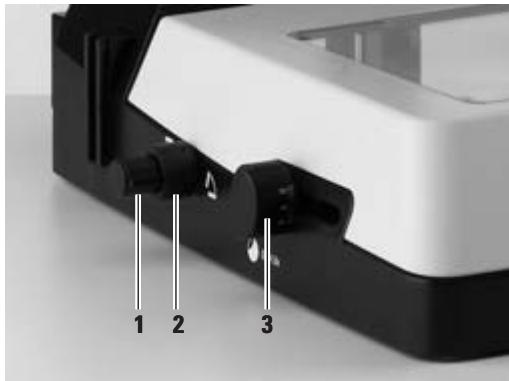
1 Interrupteur pour contrôler le contraste de relief inversé 2 Interrupteur pour contrôler le contraste de relief positif 3 Miroir de renvoi de faisceau
4.4.2 Base à lumière transmise TL RCI™
La base à lumière transmise TL RCI™ dispose de deux potentiomètres électroniques pour contrôler séparément l'intensité du colorant (9.1) et la température du colorant (9.2).
Réglez l'intensité du colorant à l'aide du potentiomètre avant (9.1) selon vos besoins. Avec le potentiomètre arrière (9.2), réglez la température du colorant pour adapter la teinte à vos exigences.
Le contrôle de la température du colorant sert également d'obturateur électronique :
Pour interrompre le processus, appuyez sur le potentiomètre (9.2). Pour rallumer l'éclairage, appuyez à nouveau sur le potentiomètre. L'électronique revient aux réglages précédemment sélectionnés.
Fig. 8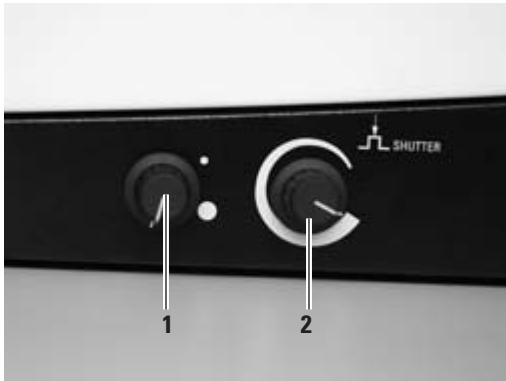
1 Potentiomètre de contrôle de l'intensité de l'éclairage IsoCol™ 2 Potentiomètre de contrôle de la température du colorant
4.5 Souris USB Leica (TL RCI™ uniquement)
La souris USB Leica contrôle l'IsoCol™ et la fonction de gradation de la base TL RCI™.
Connectez la souris (5) au port USB approprié de la base (4.4). - Par défaut, la molette de la souris est assignée au contrôle IsoCol™. Faites défiler la molette vers l'avant (éloignée de l'utilisateur) pour augmenter l'intensité de l'éclairage en mode IsoCol™. Faites défiler la molette vers l'arrière (vers l'utilisateur) pour diminuer l'intensité de l'éclairage en mode IsoCol™. Cliquez brièvement sur la molette pour allumer ou éteindre l'éclairage. Pour basculer entre le mode IsoCol™ et le mode de gradation, maintenez la molette enfoncée pendant plus de 2 secondes. - L'intensité en mode de gradation change de manière analogue au mode IsoCol™.
4.6 Méthodes avec lumière transmise
4.6.1 Éclairage vertical en champ clair
Convient aux préparations colorées en amplitude avec un contraste suffisant.
Les deux interrupteurs doivent être en position horizontale. Les volets sont ouverts. À l'aide du bouton rotatif noir (8.3) sur le côté gauche de la base à lumière transmise, déplacez le miroir de renvoi vers la colonne jusqu'à la butée. Selon l'ouverture de l'objectif utilisé, tournez le côté plan ou concave du miroir de renvoi vers le haut. Tournez le miroir de renvoi jusqu'à la position d'encoche à 45°.
Les faisceaux lumineux sont dirigés verticalement à travers l'objet. Cela donne un champ clair précis avec une luminosité maximale.
4.6.2 Lumière transmise inclinée
Convient aux objets semi-transparents et opaques tels que les foraminifères et les œufs de poissons.
Les deux interrupteurs doivent être placés en position horizontale. Les volets sont ouverts. Tournez le miroir de repli (8.3) pour que les faisceaux lumineux traversent l'objet en diagonale. Déplacez le miroir de repli jusqu'à ce que l'information requise soit visible.
4.6.3 Éclairage asymétrique en fond noir
Les deux interrupteurs doivent être placés en position horizontale. Les volets sont ouverts. Tournez le miroir de repli (8.3) pour que les faisceaux lumineux traversent l'objet de manière rasante.
Plus les rayons lumineux sont déviés à plat dans les objets, plus le fond apparaît sombre.
Une lumière transmise similaire à un fond noir est créée. Les contours, les bords fins et les structures sont mis en évidence de manière lumineuse par la diffraction de la lumière sur le fond sombre.
4.6 Affichage en relief
Position de départ
À l'aide du bouton rotatif noir (8.3) sur le côté droit du socle à lumière transmise, déplacez le miroir de repli vers la colonne jusqu'à ce qu'il atteigne la butée. Tournez le miroir de repli jusqu'à la position d'encoche à 45°.
4.6.1 Contraste de relief positif
Les deux interrupteurs doivent être placés en position horizontale. Les volets sont ouverts. Tournez l'interrupteur intérieur (8.2) près de la position verticale. Le volet inférieur est fermé. Il y a un contraste de relief positif. Les structures de phase agissent comme des collines. Intensifiez ou atténuez l'effet en inclinant le miroir de repli.
4.6.2 Contraste de relief négatif
Tournez l'interrupteur intérieur (8.2) près de la position horizontale. Le volet inférieur est ouvert. Tournez l'interrupteur supérieur (8.1) près de la position verticale. Le volet supérieur est fermé. Il y a un contraste de relief négatif. Les structures de phase apparaissent comme des creux. Intensifiez ou atténuez l'effet en inclinant le miroir de repli (8.3).
4.6.3 Contraste de relief dynamique
Placez les deux interrupteurs à environ 45 degrés. Les volets sont réglés à 45 degrés. Une zone éclairée en forme de fente apparaît. La fente peut être déplacée sur tout le champ de vision et peut être rapidement commutée entre les vues en relief positif et négatif par une inclinaison précise du miroir de repliement (8.3). L'effet dynamique permet de distinguer facilement les structures de phase des structures d'amplitude.
4.6.4 Limites
Les méthodes de relief donnent de bons résultats du zoom moyen jusqu'à un niveau de grossissement élevé et avec les objectifs 1×, 1,6× et 2×. Dans la moitié inférieure de l'échelle du zoom et avec des objets plus faibles, il peut arriver que le champ objet ne soit pas éclairé de manière homogène. Nous recommandons d'utiliser la base à lumière transmise avec des objectifs de 1× et plus, et non avec des objectifs à longue distance focale.
Fig. 10 Positions des interrupteurs pour contrôler la lumière transmise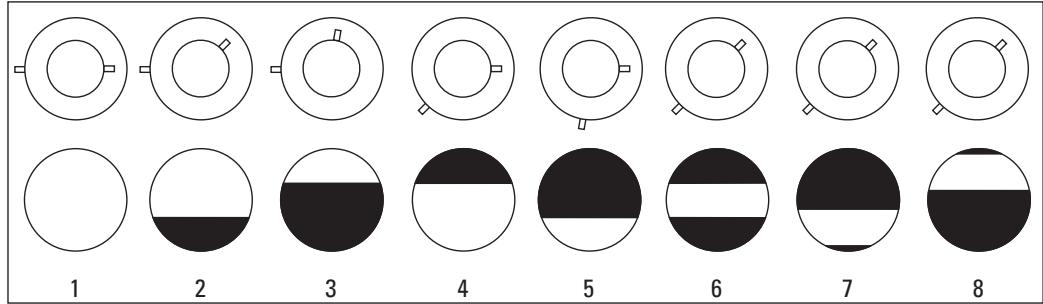
1 Position de l'interrupteur avec lumière transmise : les deux volets sont ouverts. 2 Position de l'interrupteur avec contraste de relief positif, moyen. 3 Position de l'interrupteur avec contraste de relief positif, fort. 4 Position de l'interrupteur avec contraste de relief inversé, moyen. 5 Position de l'interrupteur avec contraste de relief inversé, fort. 6 Position de l'interrupteur avec contraste augmenté sans relief. 7 Position de l'interrupteur avec contraste augmenté sans relief, miroir de repliement incliné. 8 Position de l'interrupteur avec contraste augmenté sans relief, miroir de repliement incliné.
4.7 Filtre
Les bases à lumière transmise TL RCTM et TL RCI peuvent être équipées de jusqu'à trois filtres simultanément, disponibles en accessoire (voir schéma d'extension page 18/19). Les filtres individuels sont également disponibles pour les clients sur demande spéciale.
Éteignez la source de lumière ou appuyez (TL RCI™) sur l'interrupteur de l'obturateur (9.2). Retirez le filtre vide d'un emplacement de filtre disponible sur le porte-filtre. Insérez le filtre souhaité. Réactivez la source de lumière.
4.8 Changement de la lampe halogène (TL RCI™)

Il est absolument nécessaire de débrancher
le cordon d'alimentation de la base avant de changer la lampe afin d'éviter tout choc électrique !

La lampe halogène devient très chaude pendant
le fonctionnement. Laissez la base éteinte pendant environ 10 minutes pour permettre le refroidissement et éviter les brûlures !
Desserrez les deux boulons de l'élément de refroidissement (11.1). Retirez délicatement tout l'élément de refroidissement, y compris la lampe. Retirez le porte-lampe (11.2) en le tirant du rail de guidage. Retirez soigneusement la lampe avec sa douille du porte-lampe. Retirez la lampe (11.3) de la douille.

Ne touchez jamais la nouvelle lampe halogène avec
Ne touchez pas l'ampoule à mains nues, car cela réduirait considérablement sa durée de vie !
Poussez la nouvelle ampoule dans le culot. Effectuez toutes les étapes ci-dessus dans l'ordre inverse.
Fig. 11 Socle à lumière transmise TL RCI™, boîtier de lampe ouvert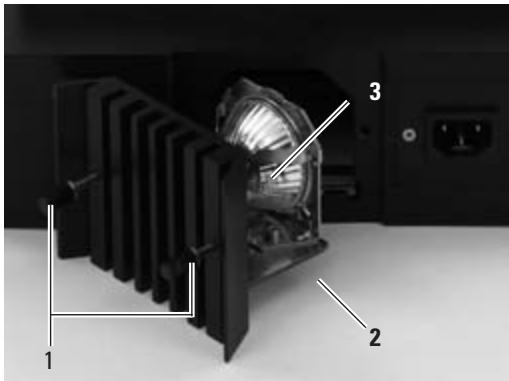
1 Vis pour desserrer les ailettes de refroidissement 2 Support de lampe 3 Lampe halogène 12V/20W
Entretien et maintenance
Dans ce chapitre
nous souhaitons vous expliquer et vous aider à comprendre la manipulation soigneuse de votre précieux instrument, et vous fournir quelques conseils pour un entretien et un nettoyage appropriés.
Nous garantissons la qualité
Vous utilisez un instrument de précision doté de nombreuses fonctionnalités.
Comme il se doit pour de tels instruments, nous garantissons la qualité de nos produits. Cette garantie couvre tous les défauts de fabrication et de matériaux de l'équipement d'origine, mais pas les dommages résultant d'une utilisation inappropriée ou d'une négligence.
Veuillez manipuler votre précieux instrument optique avec le soin approprié. Si vous le faites, vous pourrez profiter de nombreuses décennies de service précis de cet équipement sans aucune détérioration. C'est la réputation de notre équipement.
Si votre équipement ne fournit plus un service précis, veuillez contacter votre représentant de service agréé, votre distributeur Leica ou directement Leica Microsystems (Suisse) SA, CH-9435 Heerbrugg.

Protégez vos instruments
- Protégez-les de l'humidité, des vapeurs, des acides, des bases et des matériaux corrosifs. Ne stockez aucun produit chimique à proximité de l'instrument.
- Protégez-les d'une utilisation ou d'une manipulation inappropriée. N'utilisez jamais de connecteurs ou de fils électriques non conformes ; ne démontez jamais les systèmes optiques ou les composants mécaniques, sauf si une référence particulière est faite à cette fin dans les instructions.
- Protéger contre l'huile et la graisse. Les surfaces de glissement et les composants mécaniques ne doivent jamais être lubrifiés.


Schéma d'expansion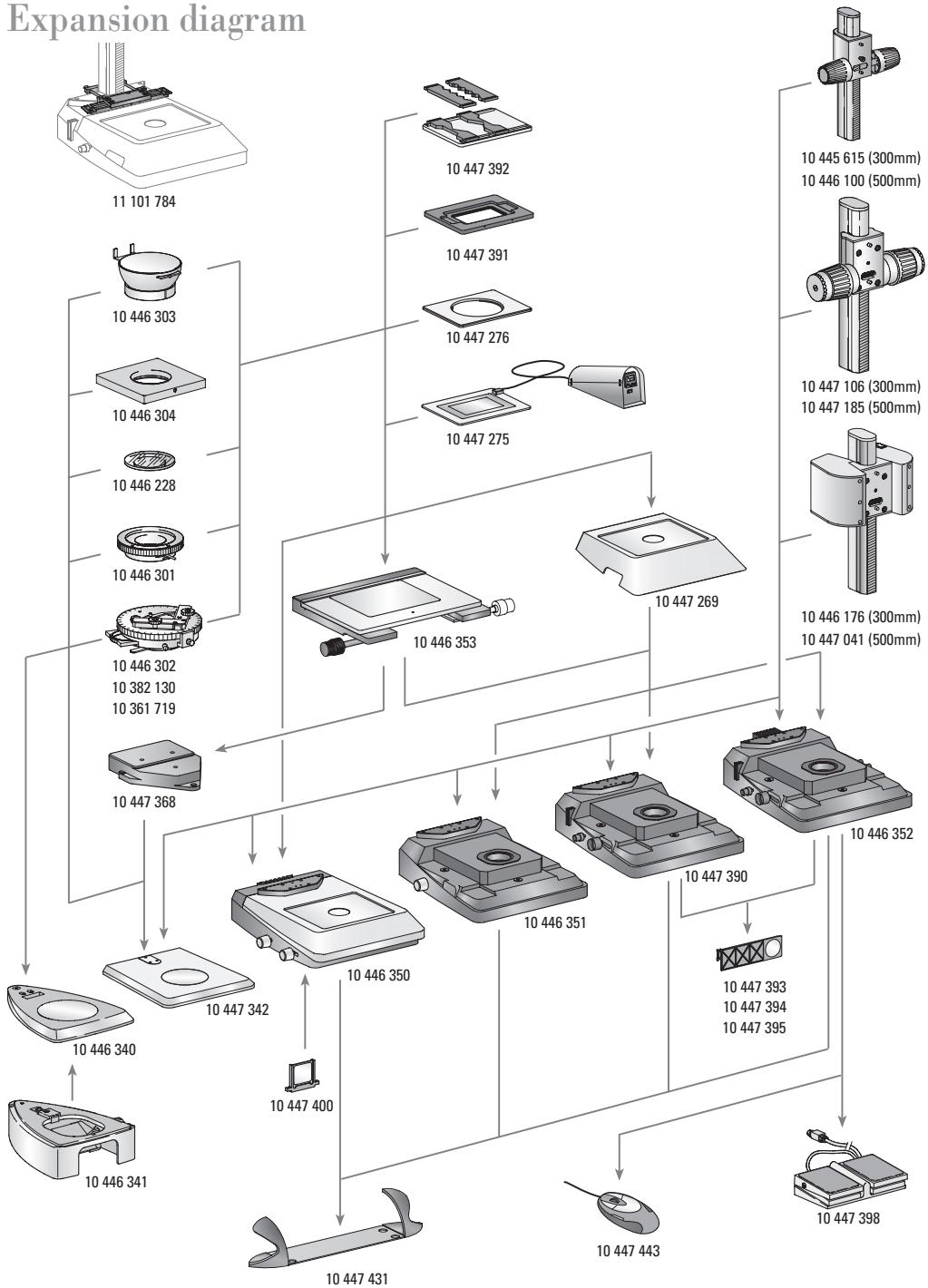
Contenu de la livraison
| 10 446 340 | Incident-light bases | 10 445 615 | Focusing drive |
| 10 446 341 | Incident-light base for S series | 10 445 615 | Focusing drive with 300mm profile column for incident and transmitted-light bases |
| 10 447 342 | Transmitted-light sub-base for incident-light base S series | 10 446 100 | Focusing drive with 500mm profile column for incident and transmitted-light bases |
| 10 446 350 | Incident-light base for M series | 10 446 100 | Focusing drive, fast/fine, with 300mm profile column for incident and transmitted-light bases |
| 10 446 351 | Transmitted-light base TL BDF | 10 447 106 | Focusing drive, fast/fine, with 300mm profile column for incident and transmitted-light bases |
| 10 447 390 | Transmitted-light base TL RCTM for external cold light sources | 10 447 106 | Focusing drive, fast/fine, with 300mm profile column for incident and transmitted-light bases |
| 10 446 352 | TL RCTM transmitted-light base with integrated halogen illumination | 10 447 185 | Focusing drive, fast/fine, with 500mm profile column for incident and transmitted-light bases |
| Stages | |||
| 10 447 269 | Standard stage for transmitted-light bases TL BDF, TL RCTM and TL RCTM | 10 446 176 | Motorized focus drive with 300mm column and power adaptor for incident and transmitted-light bases |
| 10 446 353 | Cross-stage for transmitted-light bases TL BDF, TL RCTM, TL RCTM and incident-light base (with adapter 10 447 368) | 10 447 041 | Motorized focus drive with 500mm column and power adapter for incident and transmitted-light bases |
| 10 447 368 | Adapter between cross-stage and incident-light base 10 447 342 | Filter | |
| 10 447 400 | Day light filter for basis TL ST | ||
| 10 447 275 | Thermo stage Leica MATS TL with controller | 10 447 394 | BG38 Fluorescent filter for transmitted-light bases TL RCTM/RCITM |
| 10 447 276 | Adapter for stages with ∅120mm | ||
| 10 447 391 | Stage for LifeOnStage accessory | 10 447 395 | UV filter for bases TL RCTM/RCITM |
| 10 447 392 | Universal carrier for Petri inserts, object carriers (up to four pieces) etc. | 10 447 393 | Filter ND (gray filter) for bases TL RCTM/RCITM |
| 11 101 784 | Column adapter for micromanipulation | Illumination | |
| 10 447 443 | Leica USB mouse, freely assignable five key mouse for connecting to transmitted-light bases TL RCTM or PC | ||
| 10 446 301 | Sliding stage, ∅120mm | ||
| 10 446 302 | Polarization stage, ∅120mm | ||
| 10 382 130 | Objective guide for polarization stage | 10 443 401 | USB cable to connect TL RCTM basis to a PC |
| 10 361 719 | Compensator Red I for Pol rotating stage | 10 447 398 | Foot switch with CAN bus connector |
| 10 446 303 | Cup stage, ∅120mm | ||
| 10 446 304 | Universal carrier, ∅120mm | Ergo accessories | |
| 10 446 228 | Glass insert with Pol, ∅120mm | 10 447 431 | Leica ErgoRest (palm rest to prevent |
Dimensions de la base à lumière transmise TL RCTM
Dimensions en mm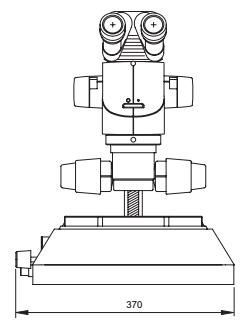
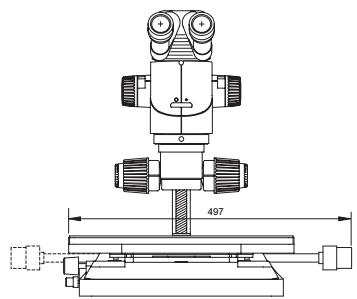
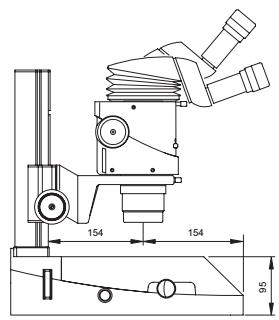
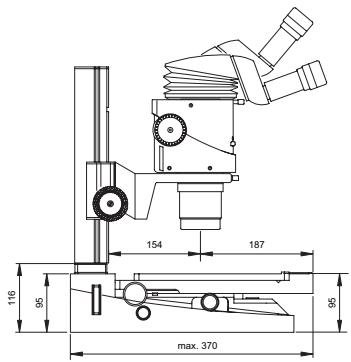
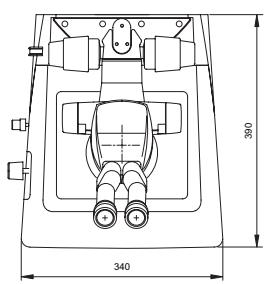
Base à lumière transmise TL RCTM avec platine standard 10 447 269 Base à lumière transmise TL RC™ avec platine croisée IsoPro™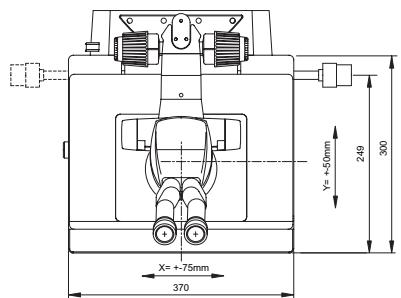
Dimensions de la base à lumière transmise TL RCITM
Dimensions en mm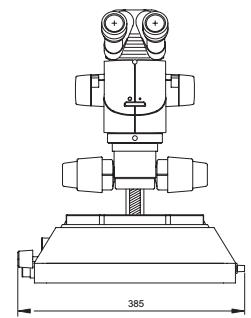
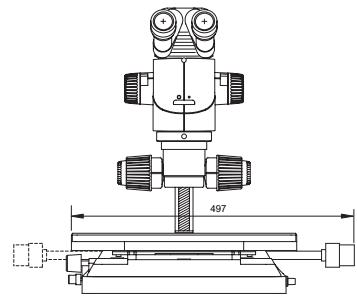
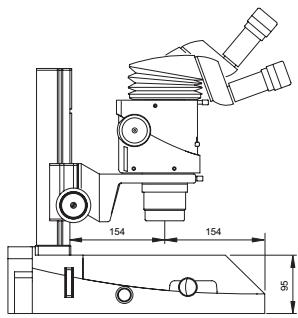
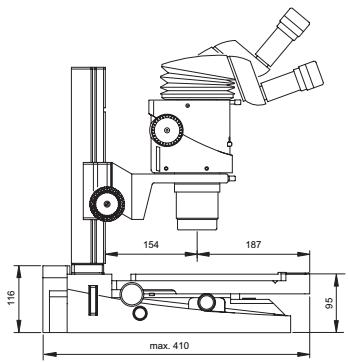
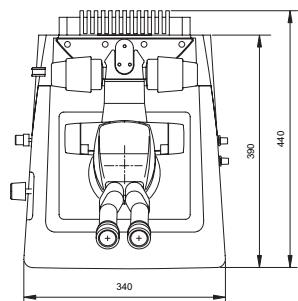
Base à lumière transmise TL RCI™ avec platine standard 10 447 269 Base à lumière transmise TL RCI™ avec platine croisée IsoPro™
Données techniques
| Leica TL RCTM | Leica TL RCTTM | |
| Light source | external via cold light source | Halogen lamp 12V/20W |
| Fast exchange of illuminant | - | yes |
| Illuminated area | 35mm | 35mm |
| Power Connector | - | Input Voltage 100 - 240 V~ |
| - | Frequency 50 - 60 Hz | |
| - | Energy consumption 30 W max. | |
| - | Ambient temperature 10 - 40 °C | |
| Connectors | Connection for cold light guide active f=10mm End pipe f=13mm | 1×USB Type A, 1×USB Type B 2×CAN-BUS |
| Weight | 6.0 kg | 7.2 kg |
| Illumination types | ||
| Bright field | yes | yes |
| Dark field | yes* | yes* |
| Oblique light | yes | yes |
| Relief contrast system (RCTM) | yes | yes |
| CCIC (Constant Color Intensity Control) | no | yes |
| Internal shutter/Lamp control | yes** | yes |
| Integrated filter holder | yes | yes |
| Coated optic to raise color temperature | yes | yes |
| Matching of high num. aperture | yes*** | yes*** |
| Remote control possibility AntiShock™ Pads | yes***** yes | yes yes |
| Size of the base (W×H×D, in mm) | 340×390×95 | 340×440×95 |
- unilatéral avec source de lumière froide Leica CLS150 LS miroir concave *** avec source de lumière externe
Leica Microsystems – la marque pour des produits exceptionnels
La mission de Leica Microsystems est d'être le premier fournisseur mondial de solutions innovantes répondant aux besoins de nos clients en matière de vision, de mesure, de lithographie et d'analyse de microstructures.
Leica, la marque leader pour les microscopes et les instruments scientifiques, est issue de cinq noms de marques, tous avec une longue tradition : Wild, Leitz, Reichert, Jung et Cambridge Instruments. Pourtant, Leica symbolise à la fois l'innovation et la tradition.
Leica Microsystems - une entreprise internationale avec un réseau solide de services clients
Australie : Gladesville, NSW Tél. +1 800 625 286 Fax +61 2 9817 8358 Autriche : Vienne Tél. +43 1 486 80 50 0 Fax +43 1 486 80 50 30 Canada : Richmond Hill/Ontario Tél. +1 905 762 20 00 Fax +1 905 762 89 37 Chine : Hong Kong Tél. +8522 564 6699 Fax +8522 564 4163 Danemark : Herlev Tél. +45 44 5401 01 Fax +45 44 5401 11 France : Rueil-Malmaison Cédex Tél. +33 1 4732 8585 Fax +33 1 4732 8586 Allemagne : Bensheim Tél. +49 6251 1360 Fax +49 6251 136 155 Italie : Milan Tél. +39 02 57 486 1 Fax +39 02 5740 3273 Japon : Tokyo Tél. +81 3 543 596 09 Fax +81 3 543 596 15 Corée : Séoul Tél. +82 2 514 6543 Fax +82 2 514 6548 Pays-Bas : Rijswijk Tél. +31 70 41 32 130 Fax +31 70 41 32 109 Portugal : Lisbonne Tél. +35 1 213 814 766 Fax +35 1 213 854 668 Singapour : Tél. +65 6 77 97 823 Fax +65 6 77 30 628 Espagne : Barcelone Tél. +34 93 494 9530 Fax +34 93 494 9532 Suède : Sollentuna Tél. +46 8 625 45 45 Fax +46 8 625 45 10 Suisse : Glattbrugg Tél. +41 44 809 34 34 Fax +41 44 809 34 44 Royaume-Uni : Milton Keynes Tél. +44 1908 246 246 Fax +44 1908 609 992 USA : Bannockburn/Illinois Tél. +1 800 248 0123 Fax +1 847 405 0164
et des représentants de Leica Microsystems dans plus de 100 pays.
Conformément au certificat ISO 9001, Leica Microsystems (Switzerland) Ltd, Business Unit Stereo & Macroscope Systems dispose d'un système de gestion qui répond aux exigences de la norme internationale pour le management de la qualité. De plus, la production répond aux exigences de la norme internationale ISO 14001 pour le management environnemental.
Les sociétés du groupe Leica Microsystems opèrent à l'international dans quatre secteurs d'activité, où nous nous classons parmi les leaders du marché.
- Systèmes de microscopie
Notre expertise en microscopie est la base de toutes nos solutions pour la visualisation, la mesure et l'analyse de microstructures dans les sciences de la vie et l'industrie. Avec la technologie laser confocale et les systèmes d'analyse d'images, nous offrons des possibilités de visualisation tridimensionnelle et proposons de nouvelles solutions pour la cytogénétique, la pathologie et les sciences des matériaux.
Préparation des échantillons
Nous fournissons des systèmes et services complets pour les applications cliniques d'histo- et de cytopathologie, la recherche biomédicale et l'assurance qualité industrielle. Notre gamme de produits comprend des instruments, des systèmes et des consommables pour l'infiltration et l'inclusion des tissus, des microtomes et des cryostats, ainsi que des colorateurs et des coverslippers automatisés.
Équipement médical
Les technologies innovantes de nos microscopes chirurgicaux offrent de nouvelles approches thérapeutiques en microchirurgie.
- Équipement pour semi-conducteurs
Nos systèmes automatisés de mesure et d'inspection de pointe et nos systèmes de lithographie par faisceau d'électrons font de nous le fournisseur de premier choix pour les fabricants de semi-conducteurs du monde entier.



- TRANSMIS
- BASES LUMINEUSES
- TL RC TM (MDG 32)
- TL RCITM (MDG 30)
- SOMMAIRE
- VUES D'ENSEMBLE
- FONCTIONNEMENT
- CHER UTILISATEUR
- LE MANUEL D'UTILISATION
- CONCEPT DE SÉCURITÉ
- SYMBOLES UTILISÉS
- AVERTISSEMENT DE DANGER
- AVERTISSEMENT DE TENSION ÉLECTRIQUE DANGEREUSE
- AVERTISSEMENT - SURFACE CHAUDE
- INFORMATIONS IMPORTANTES
- ACTION
- NOTES EXPLICATIVES
- FIGURES
- CONSIGNES DE SÉCURITÉ
- DESCRIPTION
- ACCESSOIRES
- UTILISATIONS PRÉVUES
- UTILISATIONS INTERDITES
- NE JAMAIS
- LIEU D'UTILISATION
- RESPONSABILITÉS DE LA PERSONNE RESPONSABLE DE L'INSTRUMENT
- ASSUREZ-VOUS QUE
- RÉPARATIONS, TRAVAUX D'ENTRETIEN
- SI VOUS TOUCHEZ LE CIRCUIT ÉLECTRIQUE DE L'INSTRUMENT, VOUS POUVEZ RECEVOIR UNE DÉCHARGE ÉLECTRIQUE
- TRANSPORT
- INTÉGRATION DANS DES PRODUITS TIERS
- ÉLIMINATION
- EXIGENCES LÉGALES
- DÉCLARATION UE DE CONFORMITÉ
- COMMANDES
- DÉBALLAGE DE LA BASE
- ASSEMBLAGE DE LA PLATINE
- PLATINE STANDARD
- PLATINE CROISÉE ISOPRO™
- ASSEMBLAGE DES COMMANDES
- ASSEMBLAGE DE LA PLATINE CROISÉE
- COLONNE DE MISE AU POINT
- ASSEMBLAGE DE L'ADAPTATEUR INTERMÉDIAIRE
- ASSEMBLAGE DE L'ÉQUIPEMENT
- CONNEXION DE LA SOURCE DE LUMIÈRE FROIDE À LA BASE TL RC™
- CONNEXION DU CÂBLE D'ALIMENTATION (TL RCI™)
- INTERRUPTEUR POUR LE RÉGLAGE DU CONTRASTE DE RELIEF
- MIROIR DE RENVOI
- UTILISATION DE LA PLATINE CROISÉE ISOPRO™
- INTENSITÉ LUMINEUSE ET TEMPÉRATURE DE COULEUR
- SOCLE À LUMIÈRE TRANSMISE TL RC™
- BASE À LUMIÈRE TRANSMISE TL RCI™
- SOURIS USB LEICA (TL RCI™ UNIQUEMENT)
- MÉTHODES AVEC LUMIÈRE TRANSMISE
- ÉCLAIRAGE VERTICAL EN CHAMP CLAIR
- LUMIÈRE TRANSMISE INCLINÉE
- ÉCLAIRAGE ASYMÉTRIQUE EN FOND NOIR
- AFFICHAGE EN RELIEF
- POSITION DE DÉPART
- CONTRASTE DE RELIEF POSITIF
- CONTRASTE DE RELIEF NÉGATIF
- CONTRASTE DE RELIEF DYNAMIQUE
- LIMITES
- FILTRE
- CHANGEMENT DE LA LAMPE HALOGÈNE (TL RCI™)
- ENTRETIEN ET MAINTENANCE
- DANS CE CHAPITRE
- NOUS GARANTISSONS LA QUALITÉ
- PROTÉGEZ VOS INSTRUMENTS
- CONTENU DE LA LIVRAISON
- DIMENSIONS DE LA BASE À LUMIÈRE TRANSMISE TL RCTM
- DIMENSIONS DE LA BASE À LUMIÈRE TRANSMISE TL RCITM
- DONNÉES TECHNIQUES
- LEICA MICROSYSTEMS – LA MARQUE POUR DES PRODUITS EXCEPTIONNELS
- LEICA MICROSYSTEMS - UNE ENTREPRISE INTERNATIONALE AVEC UN RÉSEAU SOLIDE DE SERVICES CLIENTS
- ET DES REPRÉSENTANTS DE LEICA MICROSYSTEMS DANS PLUS DE 100 PAYS
- SYSTÈMES DE MICROSCOPIE
- PRÉPARATION DES ÉCHANTILLONS
- ÉQUIPEMENT MÉDICAL
- ÉQUIPEMENT POUR SEMI-CONDUCTEURS
Marque : LEICA
Modèle : TL RC
Catégorie : Appareil photo sans miroir