CRYOEMBEDDING - Équipement de microscopie électronique LEICA - Notice d'utilisation et mode d'emploi gratuit
Retrouvez gratuitement la notice de l'appareil CRYOEMBEDDING LEICA au format PDF.


| Type de produit | Système de cryo-inclusion pour microscopie électronique |
| Marque | Leica Microsystems |
| Modèle | Precision Cryoembedding System |
| Utilisation | Inclusion et orientation d'échantillons pour coupes congelées dans un cryostat |
| Composants inclus | 3 barres de puits (18, 24, 30 mm), 6 petites platines, 4 grandes platines, 4 extracteurs de chaleur, 1 bac de rangement, 16 lames de distribution, 1 planche à découper/grille de congélation, 1 extracteur de chaleur surélevé, 1 pince à inclusion coudée et accessoires |
| Techniques supportées | Face Down Cryoembedding, Frozen Block Cryoembedding, Paper Cryoembedding |
| Matériau | Acier inoxydable (barres, platines, blocs de congélation) |
| Dimensions | Barres de puits : 18, 24 et 30 mm ; platines de tailles variées |
| Poids | Environ 1,5 kg (kit complet) |
| Alimentation | Aucune (système manuel utilisant la température du cryostat) |
| Température d'utilisation | Températures cryostatiques typiques (-20°C à -30°C) |
| Temps de congélation | 20 à 60 secondes selon la taille de l'échantillon et la technique |
| Fonctions principales | Orientation précise des échantillons, inclusion rapide, conservation de l'orientation lors du trimmage |
| Entretien et nettoyage | Nettoyer les composants avec un chiffon doux après usage ; stocker au froid dans le cryostat |
| Sécurité | Utiliser uniquement dans un cryostat ; porter des gants de protection ; manipuler les lames avec précaution |
| Pièces détachées | Composants individuels disponibles (barres, platines, etc.) |
| Réparabilité | Réparation possible par Leica Microsystems ou un revendeur agréé |
| Garantie | Garantie standard Leica (non spécifiée dans le manuel) |
| Compatibilité | Conçu pour cryostats Leica (ex. CM1850) ; compatible avec la plupart des cryostats standard |
| Informations générales | Développé par le Dr. Stephen Peters ; marque de confiance en microscopie |
FOIRE AUX QUESTIONS - CRYOEMBEDDING LEICA
Questions des utilisateurs sur CRYOEMBEDDING LEICA
0 question sur cet appareil. Repondez a celles que vous connaissez ou posez la votre.
Poser une nouvelle question sur cet appareil
Téléchargez la notice de votre Équipement de microscopie électronique au format PDF gratuitement ! Retrouvez votre notice CRYOEMBEDDING - LEICA et reprennez votre appareil électronique en main. Sur cette page sont publiés tous les documents nécessaires à l'utilisation de votre appareil CRYOEMBEDDING de la marque LEICA.
MODE D'EMPLOI CRYOEMBEDDING LEICA

Précision
Système de cryo-enrobage
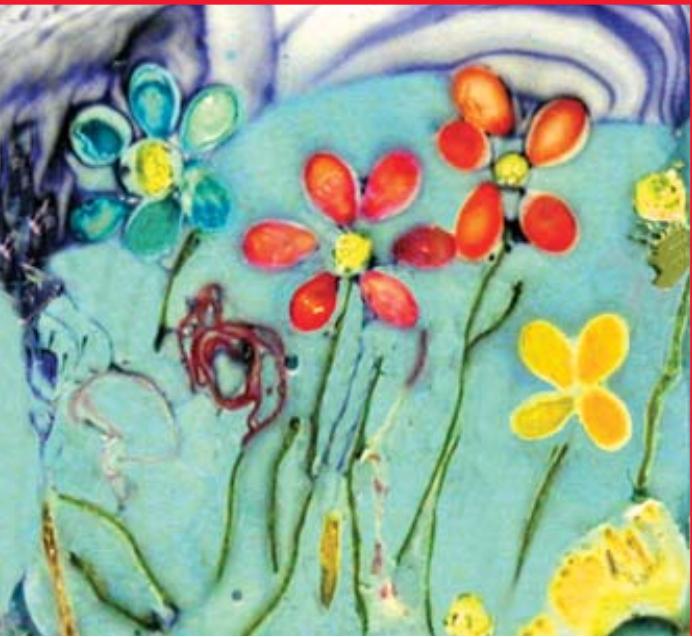
Les coupes congelées deviennent une œuvre d'art !
Système de cryo-enrobage de précision
Obtenez facilement une orientation correcte des échantillons et un enrobage parfait grâce à l'unique système de cryo-enrobage de précision. Le système Precision a été développé par le pathologiste américain, le Dr Stephen Peters, pour accélérer et améliorer les coupes congelées et raccourcir le processus d'apprentissage des résidents en pathologie. Les composants individuels du système peuvent être utilisés dans diverses procédures d'enrobage pour enrober parfaitement et orienter correctement presque tout type d'échantillon. Le processus s'effectue confortablement à l'intérieur du cryostat à l'aide de barres de puits en acier inoxydable, de mandrins et de blocs de congélation. Étant donné que les composants du système de cryo-enrobage de précision sont stockés à basse température, la plupart des échantillons gèlent en 20 à 60 secondes, selon leur taille et la technique de congélation choisie. Cela réduit considérablement le temps de traitement. Et vos échantillons plats et bien orientés seront conservés pendant le processus de parage ! Que demander de plus ?
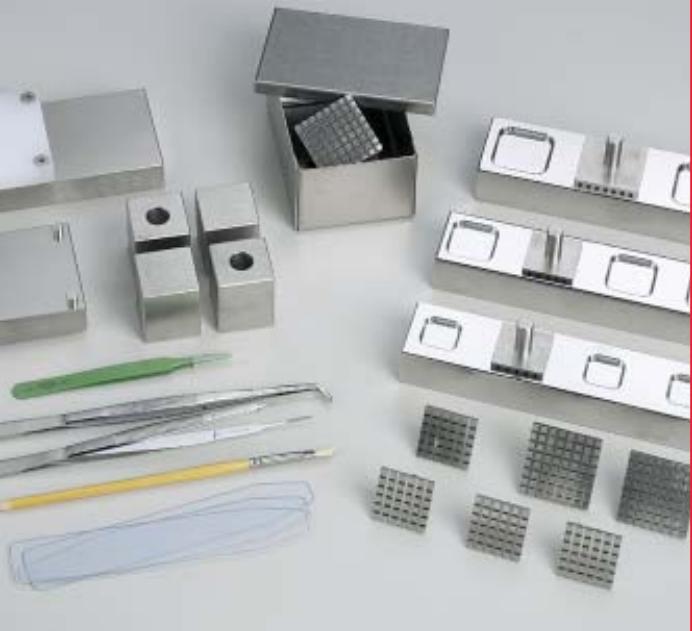
Le système de cryo-enrobage de précision comprend :
- 3 barres de puits en 3 tailles (18, 24 et 30 mm)
- 6 petites platines (mandrins), 4 grandes platines (mandrins), 4 extracteurs de chaleur sur platine
- 1 bac de rangement pour platines, 16 lames de distribution
- 1 planche à découper/grille de congélation, 1 extracteur de chaleur surélevé
- 1 paire de pinces d'enrobage coudées et accessoires
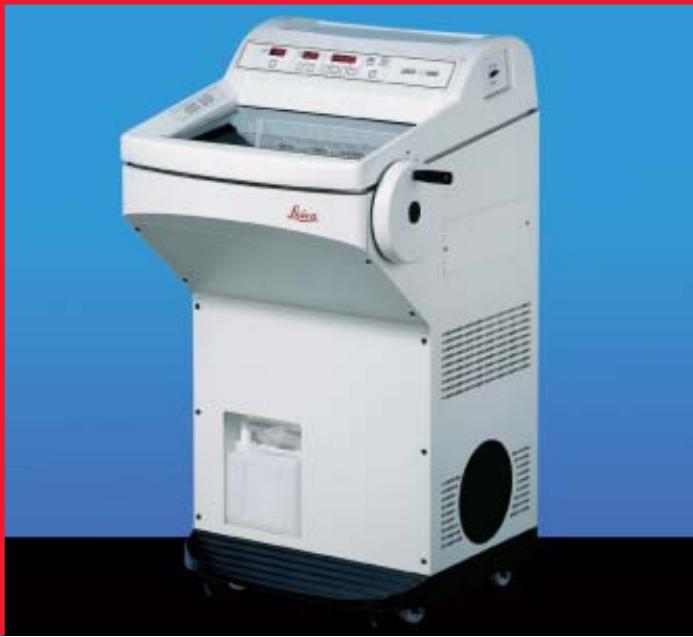
Composants de cryo-enrobage dans la chambre cryostatique Leica CM1850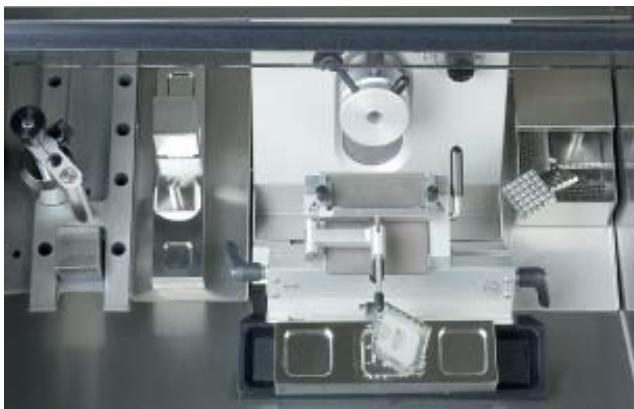
Accessoires de cryo-enrobage de précision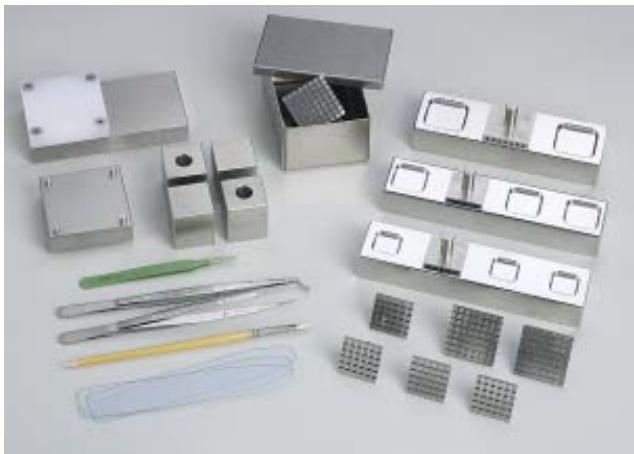
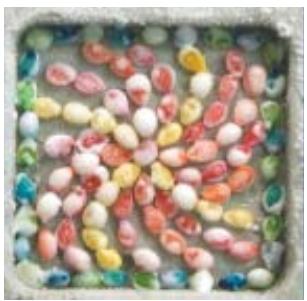
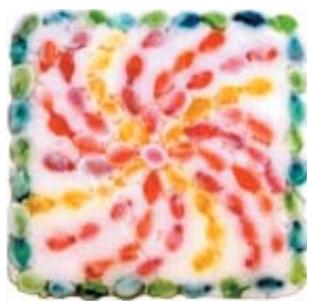
Cryo-enrobage face vers le bas
Orientation parfaite et plane
Tout échantillon, qu'il soit en une ou plusieurs pièces, de grande ou de petite taille, solide ou liquide, peut être inclus à plat et dans un seul plan.
Technique
- Orientez précisément le ou les échantillons, face vers le bas, sur une lame de distribution en plastique mince.
- Touchez le bord d'un échantillon avec la base froide du puits d'inclusion et retirez doucement la lame de distribution tout en positionnant l'échantillon. Répétez si nécessaire.
- Remplissez légèrement le puits avec le milieu d'inclusion.
- Placez une chaussette sur le puits.
- Placez un bloc de congélation sur la tige de la chaussette.
- Retirez le bloc de congélation et tapotez la tige de la chaussette lorsque la congélation est terminée (généralement 20 à 60 secondes) pour retirer le bloc inclus du puits d'inclusion.
Les résultats
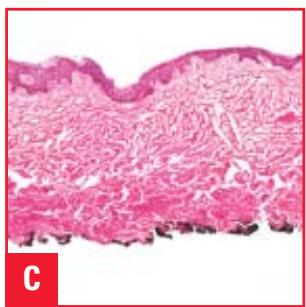
A : Bloc paré B : Coupe colorée sur lame C : Photomicrographie
Cryo-inclusion en bloc congelé
Orientation précise sur chant
Les échantillons sont inclus et congelés dans leur intégralité, puis cartographiés et coupés en morceaux plats et fermes. Les morceaux plats encore congelés sont ensuite inclus sur chant. Cette technique est parfaite pour les échantillons souples, tubulaires, enroulés ou angulaires et est particulièrement utile pour les résections de marges.
Technique
- Placez l'échantillon face vers le bas sur la grille de congélation.
- Recouvrez l'échantillon d'une couche de milieu d'enrobage.
- Recouvrez l'échantillon avec le bloc de congélation surélevé approprié.
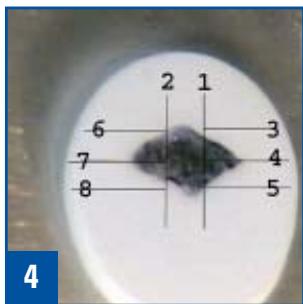
- Une fois complètement congelé, cartographiez l'échantillon.
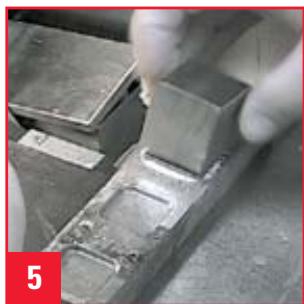
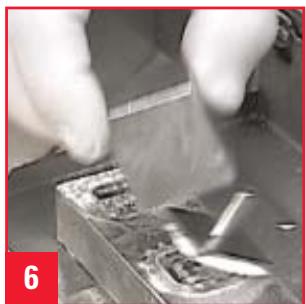
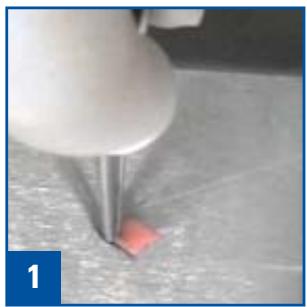
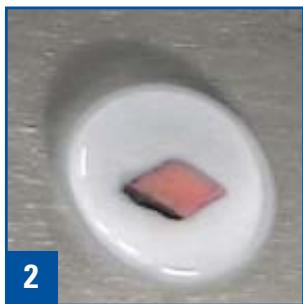
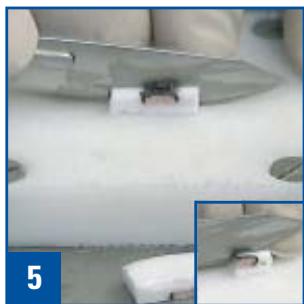
- Coupez le bloc enrobé en morceaux sur la planche à découper froide, en gardant les morceaux au froid sur la surface métallique adjacente. (La photo principale, n°5 à gauche, montre la section centrale tandis que l'encart montre une marge longitudinale.)
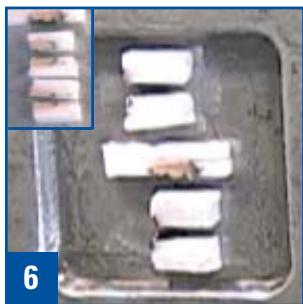
- Placez les morceaux coupés face vers le bas (les morceaux sont face vers le haut dans l'encart photo n°6) dans le puits d'enrobage et congelez-les en suivant la procédure décrite dans Cryo-enrobage face vers le bas.
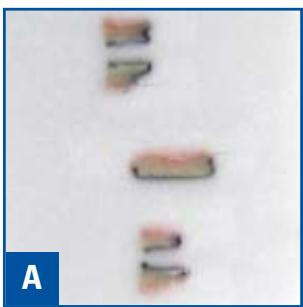
Les résultats
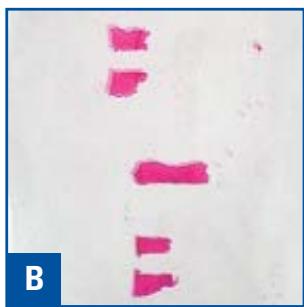
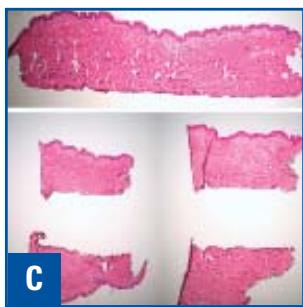
A : Bloc paré B : Coupe colorée sur lame C : Photomicrographie (coupes repositionnées sur la photo)
Cryo-enrobage sur papier
Positionnement correct des échantillons difficiles
Cette technique est utilisée pour maintenir l'orientation d'échantillons délicats ou fragiles, ou pour disposer plusieurs échantillons afin qu'ils restent dans le même plan pour la coupe.
Technique
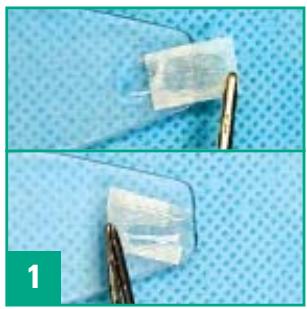
- Trempez un petit morceau de papier à lentille dans le milieu d'enrobage et aplatissez-le sur la lame de distribution.
- Placez le(s) échantillon(s) sur le papier à lentille et orientez-les de manière appropriée. Laissez une extrémité du papier dépasser du bord de la lame de distribution.
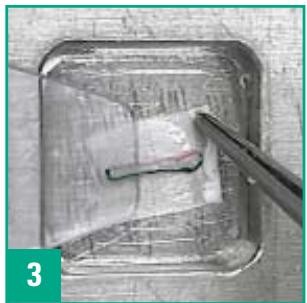
- Touchez le papier à lentille avec le fond froid du puits d'enrobage et retirez doucement la lame de distribution. L'échantillon restera correctement positionné sur le papier à lentille.
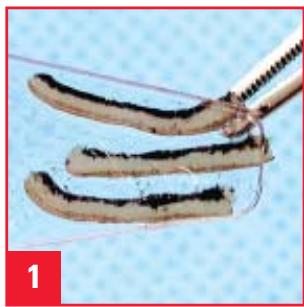
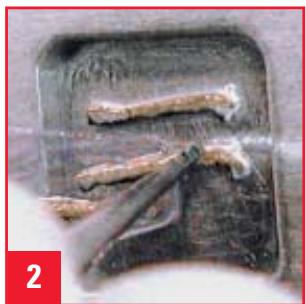
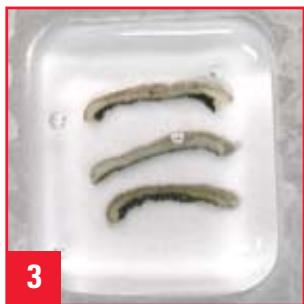
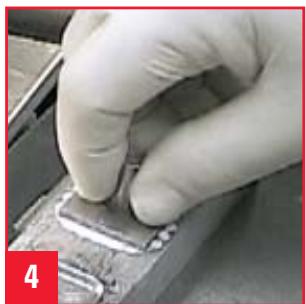
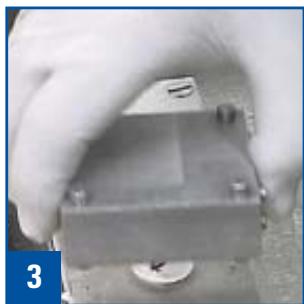
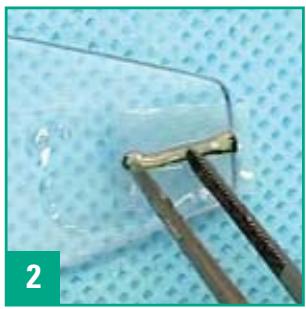
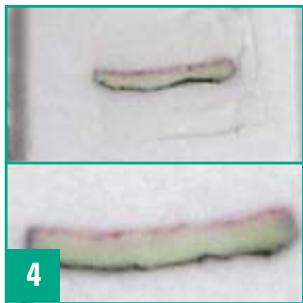
- Parer à travers le papier sur la partie de parage de la lame, puis déplacer vers une partie propre et tranchante pour couper l'échantillon. (Bloc non paré dans la partie supérieure de la photo n°4, bloc paré dans la partie inférieure.)
Les résultats
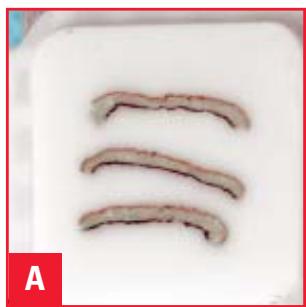
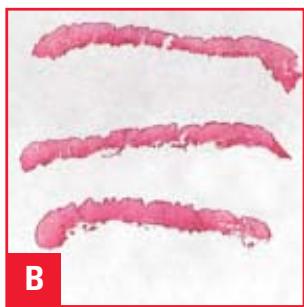
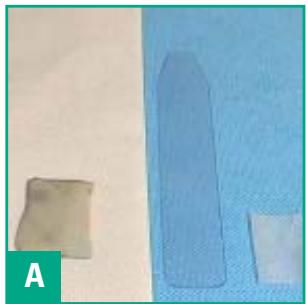
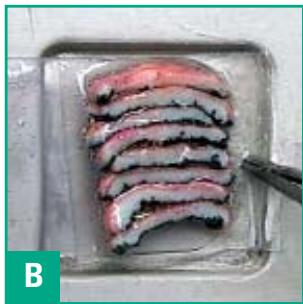
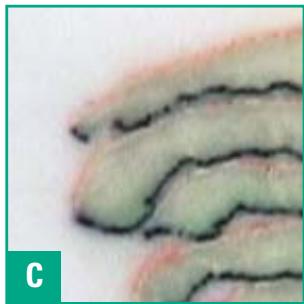
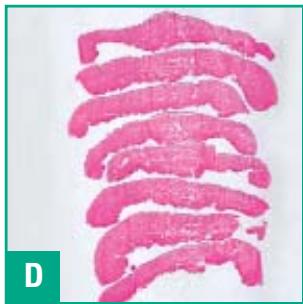
A : Spécimen entier non disséqué, lame de distribution et papier de lentille B : Spécimen disséqué avec bordure à l'encre C : Bloc enrobé D : Coupes colorées sur lame
Leica Microsystems – la marque pour des produits exceptionnels
La mission de Leica Microsystems est d'être le premier choix mondial pour des solutions innovantes répondant aux besoins de nos clients en matière de vision, de mesure, de lithographie et d'analyse de microstructures.
Leica, la marque leader pour les microscopes et les instruments scientifiques, est issue de cinq noms de marque ayant tous une longue tradition : Wild, Leitz, Reichert, Jung et Cambridge Instruments. Pourtant, Leica symbolise à la fois l'innovation et la tradition.
Leica Microsystems – une entreprise internationale avec un solide réseau de services clients
| Australia: | Gladesville | Tel. +61 2 9879 9700 | Fax +61 2 9817 8358 |
| Austria: | Vienna | Tel. +43 1 486 80 50 0 | Fax +43 1 486 80 50 30 |
| Canada: | Richmond Hill/Ontario | Tel. +1 905 762 2000 | Fax +1 905 762 8937 |
| Denmark: | Herlev | Tel. +45 4454 0101 | Fax +45 4454 0111 |
| France: | Rueil-Malmaison | Tel. +33 1 473 285 85 | Fax +33 1 473 285 86 |
| Germany: | Bensheim | Tel. +49 6251 136 0 | Fax +49 6251 136 155 |
| Italy: | Milan | Tel. +39 0257 486.1 | Fax +39 0257 40 3273 |
| Japan: | Tokyo | Tel. +81 3 5435 9600 | Fax +81 3 5435 9615 |
| Korea: | Seoul | Tel. +82 2 514 65 43 | Fax +82 2 514 65 48 |
| Netherlands: | Rijswijk | Tel. +31 70 4132 100 | Fax +31 70 4132 109 |
| People's Rep. of China: | Hong Kong | Tel. +852 2564 6699 | Fax +852 2564 4163 |
| Portugal: | Lisbon | Tel. +351 21 388 9112 | Fax +351 21 385 4668 |
| Singapore | Tel. +65 6779 7823 | Fax +65 6773 0628 | |
| Spain: | Barcelona | Tel. +34 93 494 95 30 | Fax +34 93 494 95 32 |
| Sweden: | Sollentuna | Tel. +46 8 625 45 45 | Fax +46 8 625 45 10 |
| Switzerland: | Glattbrugg | Tel. +41 1 809 34 34 | Fax +41 1 809 34 44 |
| United Kingdom: | Milton Keynes | Tel. +44 1908 246 246 | Fax +44 1908 609 992 |
| USA: | Bannockburn/llinois | Tel. +1 847 405 0123 | Fax +1 847 405 0164 |
et des représentants de Leica Microsystems dans plus de 100 pays.
Les sociétés du groupe Leica Microsystems opèrent à l'international dans quatre segments d'activité, où nous nous classons parmi les leaders du marché.
• Systèmes de microscopie
Notre expertise en microscopie est la base de toutes nos solutions pour la visualisation, la mesure et l'analyse de microstructures dans les sciences de la vie et l'industrie. Grâce à la technologie laser confocale et aux systèmes d'analyse d'images, nous offrons des possibilités de visualisation tridimensionnelle et proposons de nouvelles solutions pour la cytogénétique, la pathologie et les sciences des matériaux.
- Préparation des échantillons
Nous fournissons des systèmes et services complets pour les applications cliniques d'histo- et de cytopathologie, la recherche biomédicale et l'assurance qualité industrielle. Notre gamme de produits comprend des instruments, des systèmes et des consommables pour l'infiltration et l'enrobage des tissus, des microtomes et des cryostats, ainsi que des colorateurs et des coverslippers automatisés.
Équipement médical
Les technologies innovantes de nos microscopes chirurgicaux offrent de nouvelles approches thérapeutiques en microchirurgie.
- Équipement pour semi-conducteurs
Nos systèmes automatisés de mesure et d'inspection de pointe, ainsi que nos systèmes de lithographie par faisceau d'électrons, font de nous le fournisseur de premier choix pour les fabricants de semi-conducteurs du monde entier.


- PRÉCISION
- SYSTÈME DE CRYO-ENROBAGE
- SYSTÈME DE CRYO-ENROBAGE DE PRÉCISION
- LE SYSTÈME DE CRYO-ENROBAGE DE PRÉCISION COMPREND
- CRYO-ENROBAGE FACE VERS LE BAS
- ORIENTATION PARFAITE ET PLANE
- TECHNIQUE
- LES RÉSULTATS
- CRYO-INCLUSION EN BLOC CONGELÉ
- ORIENTATION PRÉCISE SUR CHANT
- CRYO-ENROBAGE SUR PAPIER
- POSITIONNEMENT CORRECT DES ÉCHANTILLONS DIFFICILES
- LEICA MICROSYSTEMS – LA MARQUE POUR DES PRODUITS EXCEPTIONNELS
- SYSTÈMES DE MICROSCOPIE
- PRÉPARATION DES ÉCHANTILLONS
- ÉQUIPEMENT MÉDICAL
- ÉQUIPEMENT POUR SEMI-CONDUCTEURS
Marque : LEICA
Modèle : CRYOEMBEDDING
Catégorie : Équipement de microscopie électronique