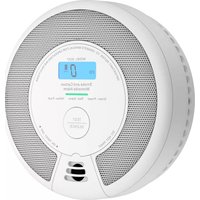
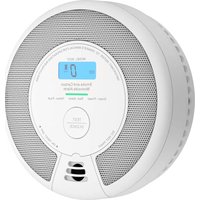
SC07 - Détecteur X-Sense - Notice d'utilisation et mode d'emploi gratuit
Retrouvez gratuitement la notice de l'appareil SC07 X-Sense au format PDF.


| Type de produit | Détecteur de fumée |
| Marque | X-Sense |
| Modèle | SC07 |
| Dimensions | Diamètre 10 cm × Hauteur 4 cm |
| Poids | 150 g (avec piles) |
| Alimentation | 2 piles AA (1,5 V) ou pile lithium scellée (selon version) |
| Autonomie des piles | 10 ans (pile lithium) ou 1 an (piles AA) |
| Capteur | Photodlectrique (détection de fumée à combustion lente) |
| Sensibilité | 0,05 - 0,15 dB/m (conforme à la norme EN 14604) |
| Niveau sonore de l'alarme | 85 dB à 3 mètres |
| Fonctions principales | Détection de fumée, alarme sonore, bouton test/silence, indicateur de batterie faible |
| Entretien et nettoyage | Test mensuel (bouton test), nettoyage semestriel avec aspirateur ou chiffon sec |
| Sécurité | Conforme à la norme EN 14604, certification CE |
| Pièces détachées et réparabilité | Piles remplaçables uniquement ; appareil non réparable par l'utilisateur |
| Température de fonctionnement | 0 °C à 40 °C |
| Humidité de fonctionnement | 10 % à 85 % (sans condensation) |
| Garantie | Garantie limitée de 10 ans (selon les conditions) |
| Utilisation recommandée | Intérieur résidentiel, chambres, couloirs, salons |
| Contenu de l'emballage | Détecteur, support de fixation, piles (selon version), notice d'utilisation |
FOIRE AUX QUESTIONS - SC07 X-Sense
Questions des utilisateurs sur SC07 X-Sense
0 question sur cet appareil. Repondez a celles que vous connaissez ou posez la votre.
Poser une nouvelle question sur cet appareil
Téléchargez la notice de votre Détecteur au format PDF gratuitement ! Retrouvez votre notice SC07 - X-Sense et reprennez votre appareil électronique en main. Sur cette page sont publiés tous les documents nécessaires à l'utilisation de votre appareil SC07 de la marque X-Sense.
MODE D'EMPLOI SC07 X-Sense
X-SENSE
Combination Smoke and Carbon Monoxide Alarm Alarma Combinada de Humo y Monóxido de Carbono
10-Year Sealed Battery Operated
Operada por una batería sellada de 10 años
User Manual
Manual de usuario
Model: SC01/SC02/SC07/SC08

Conforms with UL 217 & UL 2034 standards
Email: support@x-sense.com
X-Sense Innovations Co., Ltd.
F1.05 SC0105
Contents
English 01-29
Español 30-60
English
· 01 ·
This user manual contains important information about your combination smoke & carbon monoxide alarm's operation. To ensure proper use and trouble-free operation, please read this manual carefully and store it in a safe place for future reference.
Package Contents
1 x Alarm Unit
1 x Mounting Bracket
3 × Screws
3 x Anchor Plugs
1 × User Manual
1 × Warranty Card
2 × Carbon Monoxide Safety Stickers
Introduction
All X-Sense combination smoke & carbon monoxide alarms conform with regulatory requirements, including UL 217 & UL 2034 standards and are designed to detect both smoke and carbon monoxide.
This unit adopts photoelectric technology to detect smoke which is generally more sensitive than ionization technology. It is effective at detecting large particles, which tend to be produced in greater amounts by smoldering fires and may smolder for hours before bursting into flame. Sources of these fires may include cigarettes burning in couches or bedding.
Carbon monoxide (CO) is odorless, tasteless and invisible – it's a silent killer. Using electrochemical sensing technology, this unit can detect increased levels of carbon monoxide early, protecting your family from the dangers of carbon monoxide.
Note: For maximum protection, use smoke & CO alarms on each level and in every bedroom of your home.
THIS EQUIPMENT SHOULD BE INSTALLED IN ACCORDANCE WITH THE NATIONAL FIRE PROTECTION ASSOCIATION'S STANDARD 72
(National Fire Protection Association, Batterymarch Park, Quincy, MA02269).
NEVER IGNORE THE SOUND OF THE ALARM!
Determining what type of alarm has sounded is easy with your X-Sense combination smoke & carbon monoxide alarms. The alarm sounder will inform you of the type of situation occurring.
When the Smoke Alarm Sounds:
Smoke alarms are designed to minimize false alarms. Cigarette smoke will not normally set off the alarm, unless the smoke is blown directly into the alarm. This unit contains nuisance alarm protection, which will reduce the impact of cooking particles. However, large quantities of combustible particles from spills or broiling could still cause the unit to alarm. Careful location of the unit away from the kitchen area will give the maximum nuisance alarm protection. Combustion particles from cooking may set off the alarm if located too close to the cooking area. Large quantities of combustible particles are generated from spills or when broiling. Using the fan on a range hood which vents to the outside (non-recirculating type) will also help remove these combustible products from the kitchen. If the alarm sounds, check for fires first. If a fire is discovered, follow these steps. Become thoroughly familiar with these items, and review with all family members!
*Alert small children in the home. Children sleep very sound and may not be awakened by the sound of the smoke alarms.
*Leave immediately using one of your planned escape routes. Every second counts, so don't stop to get dressed or pick up valuables.
*Before opening inside doors, look for smoke seeping in around the edges, and feel with the back of your hand. If the door is hot, use your second exit. If you feel it's safe, open the door very slowly and be prepared to close immediately if smoke and heat rush in.
*If the escape route requires you to go through smoke, crawl low under the smoke where the air is clearer.
*Go to your predetermined meeting place. When two people have arrived, one should leave to call 911 from a neighbor's home, and the other should stay to perform a head count.
*Do not reenter under any circumstance until fire officials give the go-ahead.
*There are situations where a smoke alarm may not be effective to protect against fire as noted by the NFPA and UL Std. 217. For instance:
- Smoking in bed.
- Leaving children unsupervised.
- Cleaning with flammable liquids, such as gasoline.
- Fires where the victim is intimate with a flaming initiated fire; for example, when a person's clothes catch fire while cooking.
- Fires where the smoke is prevented from reaching the detector due to a closed door or other obstruction.
- Incendiary fires where the fire grows so rapidly that an occupant's egress is blocked even with properly located detectors.

WARNING:
Actuation of your CO Alarm indicates the presence of Carbon Monoxide (CO) which can kill you.
When the Carbon Monoxide Alarm Sounds:
(1) Operate the test/reset button.
(2) Call your emergency services (Fire Dept. or 911).
PHONE NUMBER
(3) Immediately move to fresh air - outdoors or by an open door/window. Do a head count to check that all persons are accounted for. Do not reenter the premises nor move away from the open door/window until the emergency services responders have arrived, the premises has been aired out, and your alarm remains in its normal condition.
(4) After following steps 1-3, if your alarm reactivates within a 24-hour period, repeat steps 1-3 and call a qualified appliance technician to investigate for sources of CO from fuel-burning equipment and appliances, and inspect for proper operation of this equipment. If problems are identified during this inspection, have the equipment serviced immediately. Note any combustion equipment not inspected by the technician and consult the manufacturer's instructions, or contact the manufacturer directly, for more information about CO safety and this equipment. Make sure that motor vehicles are not, and have not been, operating in an attached garage or adjacent to the residence.
Technical Specifications
| Power supply | 10-year sealed lithium battery |
| Sensor type | Smoke: Photoelectric |
| CO: Electrochemical | |
| Product life | About 10 years |
| Safety standards | Conforms with UL 217 & UL 2034 standards |
| Smoke sensitivity | 0.97-1.79%/ft OBS |
| CO sensitivity | 70 ppm: 60-240 minutes |
| 150 ppm: 10-50 minutes | |
| 400 ppm: 4-15 minutes | |
| Standby current | < 6 μA (avg.) |
| Alarm current | < 60 mA (avg.) |
| Best operating ambient temperature | 40-100 °F (4.4-37.8 °C) |
| Operating relative humidity | ≤ 85% RH (non-condensing) |
| Alarm loudness | ≥ 85 dB at 9.84 ft (3 m) @ 3.2 ± 0.3 kHz pulsing alarm |
| Silence duration | Smoke: ≤ 9 minutes; CO: ≤ 6 minutes |
Product Overview
CAUTION!
THIS SMOKE AND CO ALARM IS DESIGNED FOR INDOOR USE ONLY. DO NOT EXPOSE TO RAIN OR MOISTURE. DO NOT KNOCK OR DROP THE ALARM. DO NOT OPEN OR TAMPER WITH THE ALARM AS THIS COULD CAUSE MALFUNCTION.
Test & Silence Button
The Test & Silence button is used to test the unit's electronics and to silence the unit during an alarm. When testing the alarm weekly, you should first wake up your alarm by pressing the test button; once the alarm has woken up, the LCD display will activate, then press the test button again until you hear a short beep, indicating that the alarm has entered the test mode. To save power, the alarm is designed to automatically turn off the LCD display if there has been no operation for 5 minutes.
Note: After a test has begun, the alarm will sound and the red LED will flash. This does not indicate that smoke/CO is present.
If you press the test button during an alarm state, the unit will enter the silence mode.
CO silence mode: press the test button during an alarm state, the unit will enter the silence mode. If the CO density still exceeds the alarm threshold within 6 minutes, the unit will enter another alarm state. Otherwise, the unit will exit from silence mode after 9 minutes.
Note: If the smoke or CO concentration has reached an alarm level, silence mode cannot be enabled. This unit will continue to alarm until the smoke or CO concentration has decreased to a low level.
Alarm Sounder
The alarm will sound when there is smoke or CO present, when testing the alarm, and when there is a fault.
LED Indicator
The LED indicator will flash in conjunction with the alarm sounder. Therefore, it will flash during the following states: when powering on, in standby mode, during smoke or CO alarm states, when exiting an alarm state, during test mode, when there is low battery, in silence mode, when there is a fault and when the unit is at the end of its life.
Low Battery
The LED indicator will flash yellow together with one beep every 60 seconds.
THE UNIT MUST BE DEACTIVATED (see "Deactivation of the Alarm" section) AND REPLACED AS SOON AS POSSIBLE.
(If you press the test button when there is low battery, the low battery signal will temporarily cease for 10 hours; if you press the test button again, the unit will enter the test mode and then the standby mode.)
End of Life
Once the maximum lifetime (10 years) is reached, the alarm delivers 2 beeps and the LED indicator will flash yellow twice every 30 seconds. This end-of-life signal can be temporarily silenced for 3 days by pressing the test button.
The end-of-life silence feature can only be used for a total of 30 days. After 30 days, the end-of-life signal cannot be silenced.
Different working modes and states are shown in the below table:
| Mode | LED Indicator | Audible Alarm | Remarks |
| Powering on | Blinks 8 cycles (yellow/green/red) in sequence. | None. | |
| Standby mode | Flashes green once every 60 seconds. | None. | |
| Alarm mode | Flashes red 3 times every 1.5 seconds. | 3 long beeps every 1.5 seconds. | Smoke alarm. |
| First 4 minutes: flashes red 4 times every 5.8 seconds. After 4 minutes: flashes red 4 times every 60 seconds. | First 4 minutes: 4 quick beeps every 5.8 seconds. After 4 minutes: 4 quick beeps every 60 seconds. | CO alarm. | |
| Flashes green once every second for 5 seconds. | None. | Exiting an alarm: When the smoke or CO concentration drops below the alarm threshold, the alarm signal stops. | |
| Test mode | 2 sets of 3 red flashes followed by 2 sets of 4 red flashes. | 2 sets of 3 long beeps followed by 2 sets of 4 quick beeps. | |
| Silence mode | Flashes red once every 5 seconds. | None. | After 9 minutes, the unit will exit silence mode. |
| Flashes green 3 times. | None. | Exiting silence mode. | |
| Low battery | Flashes yellow once every 60 seconds. | One beep every 60 seconds. | |
| Fault | Flashes yellow 1 or 2 times every 40 seconds. | 2 beeps every 40 seconds. | Smoke malfunction mode. |
| Flashes yellow 3 or 4 times every 40 seconds. | CO malfunction mode. | ||
| End of life | Flashes yellow 2 times every 30 seconds. | 2 beeps every 30 seconds. |
LCD Display
While detecting CO, the LCD will display different indications to help you understand what to do, as shown below:
| LCD Display | LED Status | Alarm Sound | Unit Status | Solutions |
| If a CO concentration of 30-999 ppm exists for a certain time period, the screen will be backlit blue, and the LED indicator will flash red 4 times every 5.8 seconds. After 4 minutes, it will flash red 4 times per minute. | The alarm delivers beeps and the LED indicator will flash with the same frequency. | Dangerous CO concentration has been detected. | Refer to "If the Smoke/CO Alarm Sounds". |
| If a CO concentration of 30-999 ppm exists for a very short time, the LED indicator will flash green once every 60 seconds. | No sound. | CO has been detected, but has not reached alarm status. Potential dangerous conditions exist. | Check if there are any sources of CO gas, such as from burning, cooking, etc. If such gas sources exist, please cut them off as soon as possible. Open the doors and windows to ventilate the room and immediately move to fresh air. | |
| The LED indicator flashes red 3 times for 2 cycles and then 4 times for 2 cycles, finally flashing once. | The alarm delivers beeps and the LED indicator will flash with the same frequency. | The unit is self-checking (the test button has been pressed). | None. | |
| The LED indicator flashes yellow, green and red in sequence. | One short beep. | The unit has been powered on. | None. | |
| The LED indicator flashes green once every 60 seconds. | None. | The unit is working normally with good battery life. | None. | |
| The LCD display alternates between "Lb" and current CO level. The LED indicator flashes yellow once every 60 seconds. | One quick beep every 60 seconds. | Low battery warning. | As the battery is not replaceable, you will need to replace the unit. | |
| The LED indicator flashes yellow 1 time every 40 seconds. | Two quick beeps every 40 seconds. | Smoke malfunction. | If "Err" continues to display, the unit has malfunctioned and must be replaced immediately. | |
| The LED indicator flashes yellow 2 times every 40 seconds. | Smoke malfunction. | |||
| The LED indicator flashes yellow 3 times every 40 seconds. | CO malfunction. | |||
| The LED indicator flashes yellow 4 times every 40 seconds. | CO malfunction. | |||
| The LED indicator flashes yellow twice every 30 seconds. | Two quick beeps every 30 seconds. | End of life. | Replace the unit immediately. |
Fire Safety Tips
Follow these safety rules to prevent hazardous situations:
-
Use smoking materials properly. Never smoke in bed.
-
Keep matches or lighters away from children.
-
Store flammable materials in proper containers.
-
Keep electrical appliances in good condition and don't overload electrical circuits.
-
Keep stoves, barbecue grills, fireplaces and chimneys grease-free and debris-free.
-
Never leave anything cooking on the stove unattended.
-
Keep portable heaters and open flames, like candles, away from flammable materials.
-
Don't let rubbish accumulate.
-
Keep alarms clean, and test them weekly.
-
Replace alarms immediately if they are not working properly. Smoke alarm that do not work cannot alert you to a fire.
-
Keep at least one working fire extinguisher on every floor, and an additional one in the kitchen.
-
Have fire escape ladders or other reliable means of escape from an upper floor in case stairs are blocked.
Basic Safety Information

IMPORTANT!
- DANGERS, WARNINGS, AND CAUTIONS ALERT YOU TO IMPORTANT OPERATING INSTRUCTIONS OR TO POTENTIALLY HAZARDOUS SITUATIONS. PAY SPECIAL ATTENTION TO THESE SITUATIONS.
- THIS COMBINATION SMOKE & CARBON MONOXIDE ALARM IS ONLY APPROVED FOR HOME USE.
- THIS CARBON MONOXIDE ALARM IS DESIGNED TO DETECT CARBON MONOXIDE FROM ANY SOURCE OF COMBUSTION.
- CONSTANT EXPOSURES TO HIGH OR LOW HUMIDITY MAY REDUCE BATTERY LIFE.
- SMOKE ALARMS ARE NOT TO BE USED WITH DETECTOR GUARDS UNLESS THE COMBINATION HAS BEEN EVALUATED AND FOUND SUITABLE FOR THAT PURPOSE.

CAUTION!
THIS SMOKE & CARBON MONOXIDE ALARM HAS TWO SEPARATE ALARMS WHICH WORK INDEPENDENTLY. THE CARBON MONOXIDE ALARM IS NOT DESIGNED TO DETECT FIRE OR ANY OTHER GAS. IT WILL ONLY INDICATE THE PRESENCE OF CARBON MONOXIDE GAS AT THE SENSOR. CARBON MONOXIDE GAS MAY BE PRESENT IN OTHER AREAS. THE SMOKE ALARM WILL ONLY INDICATE THE PRESENCE OF SMOKE THAT REACHES THE SENSOR. THE SMOKE ALARM IS NOT DESIGNED TO DETECT GAS, HEAT OR FLAMES.

WARNING!
- NEVER IGNORE ANY ALARM. FAILURE TO RESPOND CAN RESULT IN SERIOUS INJURY OR DEATH.
- THE SILENCE FEATURE IS ONLY FOR YOUR CONVENIENCE AND WILL NOT CORRECT A PROBLEM. ALWAYS CHECK YOUR HOME FOR A POTENTIAL PROBLEM AFTER ANY ALARM. FAILURE TO DO SO CAN RESULT IN INJURY OR DEATH.
- TEST THIS SMOKE/CO ALARM ONCE A WEEK. IF THE ALARM EVER FAILS TO TEST CORRECTLY, REPLACE IT IMMEDIATELY! IF THE ALARM CANNOT WORK PROPERLY, IT WILL NOT ALERT YOU TO A PROBLEM.
-
THIS PRODUCT IS INTENDED FOR USE IN ORDINARY INDOOR LOCATIONS OF FAMILY LIVING UNITS. IT IS NOT DESIGNED TO MEASURE CO LEVELS IN COMPLIANCE WITH OCCUPATIONAL SAFETY AND HEALTH ADMINISTRATION (OSHA) COMMERCIAL OR INDUSTRIAL STANDARDS. INDIVIDUALS WITH MEDICAL CONDITIONS THAT MAY MAKE THEM MORE SENSITIVE TO CARBON MONOXIDE MAY CONSIDER USING WARNING DEVICES WHICH PROVIDE AUDIBLE AND VISUAL SIGNALS FOR CARBON MONOXIDE CONCENTRATIONS UNDER 30 PPM. FOR ADDITIONAL INFORMATION ON CARBON MONOXIDE AND YOUR MEDICAL CONDITION CONTACT YOUR PHYSICIAN.
-
THE REPLACEMENT DATE THAT APPEARS ON THE DEVICE IS THE DATE BEYOND WHICH THE DEVICE MAY NO LONGER DETECT CARBON MONOXIDE ACCURATELY AND SHOULD BE IMMEDIATELY REPLACED.
- THIS DEVICE IS DESIGNED TO PROTECT INDIVIDUALS FROM THE ACUTE EFFECTS OF CARBON MONOXIDE EXPOSURE. IT MAY NOT FULLY SAFEGUARD INDIVIDUALS WITH SPECIFIC MEDICAL CONDITIONS. IF IN DOUBT, CONSULT A MEDICAL PRACTITIONER.
Installation Instructions
- Prioritize the installation of an alarm in the bedroom and walkways, and make sure you can hear the alarm from all sleeping areas. In a home with several bedrooms, install an alarm in every bedroom. If you install only one smoke alarm in your home, install the alarm near to all bedrooms where possible, and not in a basement or furnace room.
- Install an alarm above the stairway and on every floor of the house.
- Smoke, heat and anything burning will spread horizontally after rising to the ceiling, so install the alarm in the middle of the ceiling where possible. Ensure the alarm is within working distance of all corners of the room.
- If an alarm cannot be installed in the middle of a ceiling, install at a distance of 20 inches (50 cm) away from the corners of the room.
- If an alarm is installed on a wall, it should be at a distance of 4-12 inches (10-30 cm) below the ceiling.
- If the length of a room or hall is beyond 30 feet (900 cm), you will need to install several alarms in the same space.

- When the wall or ceiling is angled, the alarm needs to be installed within 3 feet (90 cm) of the highest wall or ceiling point (measured horizontally) in the room.


Recommended Placement
WARNING!
- THIS ALARM SHOULD BE INSTALLED BY A COMPETENT PERSON.
- INSTALLATION OF THE ALARM SHOULD NOT BE USED AS A SUBSTITUTE FOR PROPER INSTALLATION, USE AND MAINTENANCE OF FUEL BURNING APPLIANCES INCLUDING APPROPRIATE VENTILATION AND EXHAUST SYSTEMS.


FIRE EXTINGUISHERS

SMOKE ALARMS

CARBON MONOXIDE ALARMS

SMOKE & CO ALARMS
Note: Kitchens should be installed with smoke alarms which have the silence mode.
How to Install This Alarm
IMPORTANT!
THIS COMBINATION SMOKE/CO ALARM IS DESIGNED TO BE MOUNTED ON THE CEILING OR WALL.
WARNING!
FAILURE TO PROPERLY INSTALL AND ACTIVATE THIS ALARM WILL PREVENT PROPER OPERATION OF THE ALARM AND WILL PREVENT ITS RESPONSE TO FIRE HAZARDS OR CO.
Locations to Avoid
WARNING - This product is intended for use in ordinary indoor locations of family living units. It is not designed to measure compliance with the Occupational Safety and Health Administration (OSHA) commercial or industrial standards.
- Do not install in garages, kitchens, furnace rooms or bathrooms! Do not install within 5 ft or 1.5 m of cooking appliances.
-
Do not install within 3 ft (0.9 m) of the following: The door to a kitchen, or a bathroom that contains a tub or shower, forced air supply ducts used for heating or cooling, ceiling or whole house ventilating fans, or other high air flow areas. Avoid excessively dusty, dirty or greasy areas. Dust, grease or household chemicals can contaminate the alarm's sensors, causing the alarm to not operate properly.
-
Place the alarm where drapes or other objects will not block the sensors. Smoke and CO must be able to reach the sensors to accurately detect these conditions. Do not install in peaks of vaulted ceilings, "A" frame ceilings or gabled roofs. Keep out of damp and humid areas.
- Install at least one (1) foot away from fluorescent lights, as electronic noise may cause nuisance alarms. Do not place in direct sunlight and keep out of insect-infested areas. Extreme temperatures will affect the sensitivity of the smoke/CO alarm. Do not install in areas where the temperature is colder than 40 °F (4.4 °C) or hotter than 100 °F (37.8 °C), such as garages and unfinished attics. Do not install in areas where the relative humidity (RH) is above 85%. Place away from doors and windows that open to the outside.
- Smoke alarms are not to be used with detector guards unless the combination (alarm and guard) has been evaluated and found suitable for that purpose.
Mounting Steps
- Drill three ∅ 6.0 mm holes in the wall or ceiling, then insert three plastic anchor plugs into the holes with a hammer.
- Attach the mounting bracket to the surface of the wall or ceiling with three screws and mount the alarm into the bracket by pushing them together and twisting the unit clockwise.
- Test the unit by using the Test/Silence button. Ensure the unit sounds in an alarm pattern.
Note: This model is equipped with a feature that automatically activates the alarm when the alarm is attached to the mounting bracket for the first time.

natural_image
Technical line drawing of a mechanical component with exploded view and assembly details (no text or symbols)Deactivation of the Alarm
! WARNING!
- DO NOT DEACTIVATE THE ALARM UNIT UNTIL THE END-OF-LIFE SIGNAL HAS BEEN HEARD.
- ONCE THE MAXIMUM LIFETIME (10 YEARS) IS REACHED, THE ALARM DELIVERS 2 BEEPS EVERY 30 SECONDS.
- ONCE THE ALARM IS DEACTIVATED, IT WILL NO LONGER FUNCTION. IT CANNOT BE REACTIVATED AND MUST BE REPLACED.
To Deactivate the Alarm
Pressing the Test/Silence button can silence the end-of-life signal for up to 3 days.
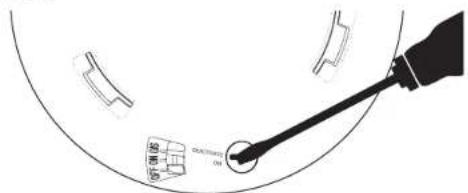
- Peel back the shaded label obstructing the "DIS" setting, and break the thin plastic guard, as below.
- Twist the plastic pin upwards to the "DIS" position or insert a screwdriver into the slot and turn the dial clockwise to the "DIS" position.
- Dispose of the alarm.
- Replace the alarm.
· 22 ·
Weekly Test
WARNING!
- NEVER USE AN OPEN FLAME OF ANY KIND TO TEST THIS UNIT. YOU MIGHT ACCIDENTALLY DAMAGE OR SET FIRE TO THE UNIT OR TO YOUR HOME.
- NEVER USE A VEHICLE EXHAUST TO TEST THIS UNIT. EXHAUST FUMES MAY CAUSE PERMANENT DAMAGE AND VOID YOUR WARRANTY.
- DO NOT STAND CLOSE TO THE ALARM WHEN THE ALARM IS SOUNDING. EXPOSURE AT CLOSE RANGE MAY BE HARMFUL TO YOUR HEARING. WHEN TESTING, STEP AWAY WHEN THE ALARM BEGINS TO SOUND.
Maintenance
To keep your smoke/CO alarm in good working order, follow these simple steps:
1. Verify the unit's alarm sound and indicators are working properly by testing the unit once a week.
2. Remove the unit from the ceiling/wall and clean the alarm cover and vents with a soft brush attachment once a month to remove dust and dirt.
3. Never use detergents or other solvents to clean the unit.
4. Avoid spraying air fresheners, hair spray or other aerosols near the alarm.
5. Do not paint the unit. Paint will seal the vents and interfere with the sensor's ability to detect smoke or CO. Never attempt to disassemble the unit or clean inside. Doing so will void your warranty.
6. When removed, place the smoke/CO alarm back in its proper location as soon as possible, to assure continuous protection from fire or carbon monoxide poisoning.
7. When household cleaning supplies or similar contaminants are used, the area should be ventilated.
If the Smoke Alarm Sounds
- Don't panic; stay calm. Follow your family's escape plan.
- Get out of the house as quickly as possible. Don't stop to get dressed or collect anything.
· 23 ·
- Feel doors with the back of your hand before opening them.
- If a door is cool, open it slowly. Don't open a hot door. Keep doors and windows closed, unless you must escape through them.
- Cover your nose and mouth with a cloth (preferably damp).
- Take short, shallow breaths.
- Meet at your planned meeting place outside your home, and do a head count to make sure everybody got out safely.
- Call the Fire Department as soon as possible from outside. Give your address, then your name.
- Never go back inside a burning building for any reason.
- Contact your Fire Department for ideas on making your home safer.
If the CO Alarm Sounds
- Keep calm and immediately move to fresh air. Open all doors and windows to increase the rate of ventilation. Stop using all fuel-burning appliances and ensure, if possible, that they are turned off, e.g. for gas appliances, isolate the emergency control valve.
- If the alarm continues to be activated, then evacuate the premises. Leave the doors and windows open, and only re-enter the building when the alarm has stopped. In multi-occupancy and multi-storey premises, ensure that all the occupants are alerted to the risk.
- Get medical help for anyone suffering the effects of carbon monoxide poisoning, and advise that carbon monoxide inhalation is suspected.
- Telephone the appropriate appliance servicing and/or maintenance agency or, when necessary, the relevant fuel supplier on their emergency number or the national Gas Emergency Service Provider, if appropriate, so that the source of carbon monoxide emissions can be identified and corrected. Unless the reason for the alarm is obviously spurious, do not use the fuel-burning appliances again, until they have been checked and cleared for use by a competent person according to national regulations.
What You Need to Know About CO
CO cannot be seen, smelled or tasted and can be fatal. The build-up of CO in the blood is called the carboxyhemoglobin (COHb) level and interferes with the body's ability to supply itself with oxygen. Depending on the concentration, CO can kill in minutes. The most common sources of CO are malfunctioning gas appliance used for heating and cooking, vehicles running in an attached garage, blocked chimneys or flues, portable fuel burning heaters, fireplaces, fuel powered tools and operating a grill in an enclosed space.
Indications of carbon monoxide poisoning include symptoms similar to the flu, but with no fever. Other symptoms include dizziness, fatigue, weakness, headache, nausea, vomiting, sleepiness and confusion. Everyone is susceptible to the danger of CO, but experts agree that unborn babies, small children, pregnant women, senior citizens and people with heart or respiratory problems are at the highest risk for serious injury or death. Every year a qualified technician should inspect and clean your heating system, vents, chimney, and flues.
The following symptoms are related to carbon monoxide poisoning and should be discussed with all members of the household:
Mild exposure: Slight headache, nausea, vomiting, fatigue (often described as "Flu-like" symptoms).
Medium exposure: Severe throbbing headache, drowsiness, fast heart rate. Extreme exposure: Unconsciousness, cardiorespiratory failure, death.
The above levels of exposure relate to healthy adults. Levels differ for those at high risk. Exposure to high levels of carbon monoxide can be fatal or cause permanent damage and disabilities. Many cases of reported carbon monoxide poisoning indicate that while victims are aware they are not well, they become so disoriented they are unable to save themselves by either exiting the building, or calling for assistance. Also, young children and household pets may be the first affected. Familiarization with the effects of each level is important.
Fire Safety Information
Poisoning indicates that while victims are aware they are not well, they become so disoriented they are unable to save themselves by either exiting the building or calling for assistance. Also, young children and household pets may be the first affected. Familiarization with the effects of each level is important.
Escape Plan
Prepare and practice a home escape plan twice a year, including drills at night. Know two ways out of every room (door & window) and identify a meeting place outside the home where everyone will gather once they have exited the residence. When two people have reached the meeting place, one should leave to call 911 while the second person stays to account for additional family members. Establish a rule that once you're out, you never reenter under any circumstance!
Fire Prevention
Never smoke in bed, or leave cooking food unattended. Teach children never to play with matches or lighters! Train everyone in the home to recognize the alarm pattern, voice message warning and to leave the home using their escape plan when it's heard. Know how to do "Stop, Drop and Roll" if clothes catch on fire, and how to crawl low under smoke. Install and maintain fire extinguishers on every level of the home and in the kitchen, basement and garage. Know how to use a fire extinguisher prior to an emergency. Second level and higher occupied rooms with windows should have an escape ladder.
Current studies have shown smoke alarms may not awaken all sleeping
individuals, and that it is the responsibility of individuals in the household that are capable of assisting others to provide assistance to those who may not be awakened by the alarm sound, or to those who may be incapable of safely evacuating the area unassisted.
The Following Conditions Can Result in Transient CO Situations:
- Excessive spillage or reverse venting of fuel-burning appliances caused by outdoor ambient conditions, such as wind direction and/or velocity, including high gusts of wind, heavy air in the vent pipes (cold/humid air with extended periods between cycles).
- Negative pressure resulting from the use of exhaust fans.
- Simultaneous operation of several fuel-burning appliances competing for limited internal air.
- Vent pipe connections vibrating loose from clothes dryers, furnaces, or water heaters.
- Obstructions in, or unconventional, vent pipe designs which can amplify the above situations.
- Extended operation of unvented fuel-burning devices (range, oven, fireplace, etc.).
• Temperature inversions which can trap exhaust gases near the ground. - A car idling in an open or closed attached garage, or near a home.
Industry Safety Standards
NFPA (National Fire Protection Association)
For your information, the National Fire Alarm Code, NFPA 72, reads as follows: 11.5.1 Required Detection.
Where required by applicable laws, codes, or standards for a specific type of occupancy, approved single- and multiple-station smoke alarms shall be installed as follows:
(1) In all sleeping rooms and guest rooms
(2) Outside of each separate dwelling unit sleeping area, within 6.4 m (21 ft) of any door to a sleeping room, the distance measured along a path of travel
(3) On every level of a dwelling unit, including basements
(4) On every level of a residential board and care occupancy (small facility), including basements and excluding crawl spaces and unfinished attics
(5) In the living area(s) of a guest suite
(6) In the living area(s) of a residential board and care occupancy
(Reprinted with permission from NFPA 72*, National Fire Alarm Code Copyright © 2007 National Fire Protection Association, Quincy, MA 02269. This reprinted material is not the complete and official position of the National Fire Protection Association, on the referenced subject which is represented only by the standard in its entirety.)
(National Fire Alarm Code ^® and NFPA 72 ^® are registered trademarks of the National Fire Protection Association, Inc., Quincy, MA 02269.)
Smoke Detection—Are More Smoke Alarms Desirable?
The required number of smoke alarms might not provide reliable early warning protection for those areas separated by a door from the areas protected by the required smoke alarms. For this reason, it is recommended that the householder consider the use of additional smoke alarms for those areas for increased protection. The additional areas include the basement, bedrooms, dining room, furnace room, utility room, and hallways not protected by the required smoke alarms. The installation of smoke alarms in kitchens, attics (finished or unfinished), or garages is not normally recommended, as these locations occasionally experience conditions that can result in improper operation.
California State Fire Marshall
Early warning fire detection is best achieved by the installation of fire detection equipment in all rooms and areas of the household as follows: A smoke alarm installed in each separate sleeping area (in the vicinity, but outside the bedrooms), heat or smoke detectors in the living rooms, dining rooms, bedrooms, kitchens, hallways, attics, furnace rooms, closets, utility and storage rooms, basements and attached garages.
Consumer Product Safety Commission
The Consumer Product Safety Commission (CPSC) recommends the use of at least one CO Alarm per household, located near the sleeping area.
Manufacturer and Service Information
X-Sense Innovations Co., Ltd.
Address: B4-503-D, Tower B, Kexing Science Park, No. 15 Keyuan Road, Technology Park Community, Yuehai Avenue, Nanshan District, Shenzhen, 518057, CHINA
Email: support@x-sense.com
Este manual de usuario contiene información importante con respeto a la operación de su alarma combinada de humo y monóxido de carbono. Para garantizar uso adecuado y operación sin problemas, por favor lea este manual atentamente y consérvelo en un lugar seguro para su referencia futura.
Contenidos del Paquete
1 × Unidad de Alarma
1 x Soporte de Montaje
3 × Tornillos
3 × Tapones de Anclaje
1 x Manual de Usuario
1 × Tarjeta de garantía
2 × Etiquetas adhesivas de los riesgos del monóxido de carbono
Introducción
Todas las alarmas de humo y monóxido de carbono X-Sense cumplen con los requisitos reglamentarios, incluidos los estándares UL 217 & UL 2034 y están diseñadas para detectar humo y monóxido de carbono.
Esta unidad adopta tecnología fotoeléctrica para detectar humo que normalmente es más sensible que la tecnología de ionización. Es muy eficaz a detectar partículas grandes, que tienden a ser producidas en grandes cantidades por los incendios que arden y pueden arder por muchas horas antes de estallar en llamas. Fuentes de estos incendios pueden ser por cigarrillos que se están quemando en el sofá o en la cama.
Monóxido de Carbono (CO) es inodoro, insípido e invisible – es un asesino silencioso. Usando tecnología sensible electroquímica, esta unidad puede detectar aumentos de niveles de monóxido de carbono temprano, protegiendo su familia de los peligros del monóxido de carbono.
Nota: Para máxima protección, use alarmas de humo y de CO en cada piso y en cada dormitorio de su hogar.
ESTE EQUIPO DEBE SER INSTALADO DE ACUERDO CON EL ESTÁNDAR 72 DE LA ASOCIACIÓN NACIONAL DE PROTECCIÓN CONTRA INCENDIOS (NATIONAL FIRE PROTECTION ASSOCIATION, BATTERYMARCH PARK, QUINCY, MA 02269.)
NUNCA IGNORE EL SONIDO DE LA ALARMA!
Determinar el tipo de alarma que ha sonado es fácil con su alarma combinada de humo y CO X-Sense. La sirena de alarma le informará del tipo de situación que esta ocurriendo.
Cuando La Alarma de Humo Suena:
Las alarmas de humo son diseñadas a minimizar las alarmas falsas. El humo del cigarrillo normalmente no encenderá la alarma, a menos que el humo halla sido volado directamente a la alarma. Esta unidad contiene protección contra las alarmas de molesta, lo que reducirá el impacto de las partículas de cocinar. Sin embargo, grandes cantidades de partículas de combustibles por derrames o asados todavía podrían hacer la unidad emite una alarma. La ubicación cuidadosa de la unidad lejos del área de la cocina proporcionará máxima protección contra las alarmas de molestia. Las partículas de combustión de cocinar pueden hacer activar la alarma si la alarma esta ubicada cerca del área de cocinar. Grandes cantidades de partículas combustibles son generadas por derramos o cuando está asando. El uso de un ventilador de campana extractora que ventila hacia el exterior (tipo no de recirculación) también ayudará a eliminar los productos combustibles de la cocina. Si la alarma suena, primero verifique si hay un fuego. Si descubre un fuego, siga estos pasos. ¡Familiarícese completamente con estos puntos, y reviselos con todas la personas de su familia!
* Alerte a los niños pequeños en el hogar. Los niños duermen muy profundo y puede ser que no se despierten por el sonido de la alarmas de humo.
* Salga inmediatamente usando una de sus rutas de escape planeadas. Cada segundo cuenta, no se detenga a vestirse o buscar objetos de valor.
* Antes de abrir puertas interiores, busque rastros de humo alrededor de los bordes de la puerta y toque con el dorso de su mano. Si la puerta está caliente, use su segunda salida. Si siente que es seguro, abra la puerta muy lentamente y prepárese a cerrarla inmediatamente si el humo y calor entran rápido.
* Si la ruta de escape requiere salir atravesando humo, gatee por debajo del humo donde el aire esta mas despejado.
* Vaya a su lugar de reunión predeterminado. Cuando hayan llegado dos personas, una debe ir al hogar del vecino para llamar al servicio de emergencia, y la otra persona debe quedarse para contar a cada persona.
* No vuelva a entrar bajo ninguna circunstancia hasta que los bomberos le den la orden.
* Hay situaciones en las que una alarma de humo puede no ser efectiva para la protección contra incendios, como lo nota el estándar 217 de la NFPA y UL. Por ejemplo:
- Fumar en la cama
- Dejar a niños sin supervisión
- Limpieza con líquidos inflamables, como la gasolina.
- Incendios donde la víctima esta cerca con un fuego iniciado por llamas; por ejemplo, cuando la ropa de una persona se incendia mientras esta cocinando. - Incendios donde el humo es impedido a alcanzar la alarma debido a una puerta cerrada u otra obstrucción.
- Incendios incendiarios donde el fuego crece tan rápidamente que la salida del ocupante esta bloqueada incluso con detectores ubicados adecuadamente.

ADVERTENCIA:
Activación de su alarma de CO indica la presencia de monóxido de carbono (CO) lo que puede matarlo.
Que Hacer Cuando Suena la Alarma de Monóxido de Carbono:
- Presione el botón de prueba/reinicio.
NÚMERO DE TELEFONO
-
Llame a sus servicios de emergencia (Departamento de bomberos, o 911).
-
Muévase inmediatamente a un área con aire fresco – al exterior o junto a una puerta/ventana. Cuente todas las personas para estar seguro que todos se tienen en cuenta. No vuelva a entrar al lugar ni se aleje de la puerta/ventana abierta hasta que los servicios de emergencia hayan llegado, el lugar haya sido aireado y su alarma se quede en la condición de función normal.
NÚMERO DE TELEFONO
- Después de seguir los pasos de arriba 1-3, si su alarma se reactiva dentro de un periodo de 24 horas, repita los pasos 1-3 y llame a un técnico calificado en electrodomésticos para investigar las fuentes de CO de los equipos y aparatos que queman combustible, e inspeccionar el funcionamiento correcto de los equipos. Si se identifican problemas durante esta inspección, repare el equipo inmediatamente. Haga nota de cualquier equipo de combustión que no haya sido inspeccionado por el técnico y consulte las instrucciones del fabricante, o hable directamente con los fabricantes para obtener más información sobre la seguridad de CO y el equipo en cuestión. Asegúrese que los vehículos no estén y no hayan estado operando en un garaje adjunto o adyacente a la residencia.
Especificaciones Técnicas
| Alimento de Batería | Batería de litio sellada de 10 años |
| Tipo de sensor | Humo: Fotoeléctrico |
| CO: Electroquímico | |
| Vida útil del producto | Como 10 años |
| Estándares de Seguridad | UL 217 & UL 2034 |
| Sensibilidad al humo | 3,18-5,87 % obs/m (0,97-1,79 % obs/pie) |
| Sensibilidad de CO | 70 ppm: 60-240 minutos |
| 150 ppm: 10-50 minutos | |
| 400 ppm: 4-15 minutos | |
| Corriente de Espera | < 6 μA (promedio) |
| Corriente de Alarma | < 60 mA (promedio) |
| Mejor funcionamiento de temperatura ambiente | 4,4-37,8 °C (40-100 °F) |
| Humedad Relativa de Operación | ≤ 85% RH (sin-condensación) |
| Volumen de la Alarma | ≥ 85 dB a 3 metros (9,84 pies) @ 3,2 ± 0.3 kHz alarma pulsante |
| Duración de Silencio | Humo: ≤ 9 minutos; CO: ≤ 6 minutos |
Descripción del Producto
¡PRECAUCIÓN!
ESTA ALARMA DE HUMO Y CO ESTA DISEÑADA SOLAMENTE PARA USO INTERIOR. NO LA EXPONGA A LA LLUVIA NI A LA HUMEDAD. NO LA CHOQUE NI DEJE CAER LA ALARMA. NO ABRA NI MANOSEE LA ALARMA, POR QUE PODRÍA CAUSAR MAL FUNCIONAMIENTO.
Botón de Prueba Silencio
El botón de Prueba & Silencio se usa para probar los componentes electrónicos de la unidad y para silenciar la unidad durante una alarma. Cuando pruebe la alarma semanalmente, primero debe despertar su alarma presionando el botón de prueba; cuando la alarma se haya despertado, la pantalla de LCD se activará, luego presione el botón de prueba otra vez hasta que escuche un pitido corto, lo que indica que la alarma ha entrado en el modo de prueba. Para ahorrar energía, la alarma está diseñada para apagar la pantalla LCD automáticamente si no hay ninguna operación por 5 minutos.
Nota: Después de que haya comenzada la prueba, la alarma sonará y la luz roja de LED parpadeara. Esto no indica que haya humo/CO presente.
Si presiona el botón de prueba durante el estado de alarma, la unidad entrará el modo de silencio.
Modo de Silencio de CO: Presione el botón de prueba durante un estado de alarma, la unidad entrara el modo de silencio. Si la densidad de CO todavía excede el límite de la alarma en 6 minutos, la unidad entrara a otro estado de alarma. Si no, la unidad saldrá del modo de silencio después de 9 minutos.
Nota: Si la concentración de humo o CO ha alcanzado el nivel de alarma, el modo de silencio no puede ser activado. Esta unidad continuará a sonar la alarma hasta que la concentración de humo o CO haya disminuido a un nivel bajo.
Sirena de Alarma
La alarma sonara cuando hay humo o CO presente, durante la prueba de la alarma y cuando hay falla.
Indicador LED
El indicador LED parpadeará junto con la sirena de la alarma. Por lo tanto, parpadeará durante los siguientes estados: cuando se enciende, en modo de espera, durante los estados de alarma de humo o CO, al salir de el estado de alarma, durante el modo de prueba, cuando tiene batería baja, en modo de silencio, cuando hay una falla y cuando la unidad está al final de su vida útil.
Batería Baja
El indicador LED parpadeará en amarillo junto con un pitido cada 60 segundos.
LA UNIDAD DEBE SER DESACTIVADA. (Iea la sección "Desactivación de la alarma") Y REEMPLAZAR LO MAS PRONTO POSIBLE.
(Si presiona el botón de prueba cuando la batería esta baja, la señal de batería baja parará temporalmente por 10 horas; si presiona el botón de prueba otra vez, la unidad entrará al modo de prueba y luego al modo de espera.)
Fin de Vida Útil
Una vez que se alcanza la vida útil máxima (10 años), la alarma emite 2 pitidos y el indicador parpadeará en amarillo dos veces cada 30 segundos. Esta señal del final de vida útil puede ser silenciada temporalmente por 3 días al presionar el botón de prueba.
La función de silencio al final de la vida útil solo se puede usar por un total de 30 días. Después de 30 días, la señal de fin de vida útil no puede silenciarse.
En la siguiente tabla se muestran los diferentes estados y modos de operación:
| Modo | Indicador LED | Alarma Audible | Notas |
| Encendiendo | Parpadea 8 ciclos (amarillo/verde/rojo) en secuencia. | Ninguna. | |
| Modo de espera | Parpadea verde una vez cada 60 segundos. | Ninguna. | |
| Modo de alarma | Parpadea rojo 3 veces cada 1,5 segundos. | 3 bips largos cada 1,5 segundos. | Alarma de humo. |
| Primeros 4 minutos: parpadea rojo 4 veces cada 5,8 segundos.Después de 4 minutos: parpadea rojo 4 veces cada 60 segundos. | Primeros 4 minutos: 4 bips cortos cada 5,8 segundos.Después de 4 minutos: 4 bips cortos cada 60 segundos. | Alarma de CO. | |
| Parpadea verde una vez cada segundo por 5 segundos. | Ninguna. | Salir del modo de alarma: cuando la concentración de humo o CO disminuye a un nivel menor al umbral de alarma, la alarma se detiene. | |
| Modo de prueba | 2 sets de 3 parpadeos rojos seguidos de 2 sets de 4 parpadeos rojos. | 2 sets de 3 bips largos seguidos de 2 sets de 4 bips cortos. | |
| Modo de silencio | Parpadea rojo una vez cada 5 segundos. | Ninguna. | Después de 9 minutos, la unidad saldrá del modo de silencio. |
| Parpadea verde 3 veces. | Ninguna. | Saliendo del modo de silencio. |
| Batería baja | Parpadea amarillo una vez cada 60 segundos. | Un bip cada 60 segundos. | |
| Error | Parpadea amarillo 1 o 2 veces cada 40 segundos. | 2 bips cada 40 segundos. | Modo de error de humo. |
| Parpadea amarillo 3 o 4 veces cada 40 segundos. | Modo de error de CO. | ||
| Fin de vida útil | Parpadea amarillo 2 veces cada 30 segundos. | 2 bips cada 30 segundos. |
Pantalla LCD
Mientras una detección de CO, la pantalla LCD va a desplegar diferentes indicaciones para ayudarle a entender qué hacer, como se muestra abajo:
| Pantalla de LCD | Estado de LED | Sonido de Alarma | Estado de la unidad | Soluciones |
| Si una concentración de CO de 30 a 999 ppm existe por un cierto periodo de tiempo, la pantalla encenderá una luz de fondo azul y el indicador LED rojo parpadeará 4 veces cada 5.8 segundos. Después de 4 minutos, parpadea en rojo 4 veces por minuto. | La alarma emite pitidos y el indicador LED parpadeará con la misma frecuencia. | Peligroso Ha sido detectado concentración de CO. | Consulte la sección "Que hacer cuando suena la alarma". | |
| Si existe una concentración de CO de 30 a 999 ppm por un tiempo muy corto, el indicador LED verde parpadeará una vez cada 60 segundos. | No sonido. | Ha detectado CO, pero no ha alcanzado el estado de alarma. Existe posiblemente una condición peligrosa. | Identifique si hay alguna fuente de gas de CO como de quemaduras, cocina, etc. Si existe una fuente de gas, por favor córtelos lo antes posible. Abra las puertas y ventanas para ventilar la habitación e inmediatamente muévase al aire fresco. | |
| El indicador LED rojo parpadea 3 veces por 2 ciclos, se repite 4 veces por 2 ciclos y finalmente parpadea una vez. | La alarma emite pitidos y el indicador LED parpadeará con el misma frecuencia. | La unidad esta auto chequeando (el botón de prueba fue presionado). | Ninguno. | |
| El indicador LED parpadea amarilla, verde y rojo en secuencia. | Un pitido corto. | La unidad ha sido encendida. | Ninguno. | |
| El indicador LED parpadea verde una vez cada 60 segundos. | Ninguno. | La unidad esta trabajando normalmente con buena vida útil de batería. | Ninguno. |
| La pantalla LCD alterna entre "LB" y el nivel presente de CO.El indicador LED parpadea amarillo cada 60 segundos. | 1 pitido rápido cada 60 segundos. | Advertencia de nivel de baterías bajas. | Como la batería no es reemplazable, necesitará reemplazar toda la unidad. | |
| El indicador LED parpadea amarillo 1 vez cada 40 segundos. | 2 pitidos rápidos cada 40 segundos. | Mal funcionamiento de humo. | Si continua desplegando "Err", la unidad ha funcionado mal y debe de ser reemplazada inmediatamente. | |
| El indicador LED parpadea amarillo 2 veces cada 40 segundos. | Mal funcionamiento de humo. | |||
| El indicador LED parpadea amarillo 3 veces cada 40 segundos. | Mal funcionamiento de CO. | |||
| El indicador LED parpadea 4 veces cada 40 segundos. | Mal funcionamiento de CO. | |||
| El indicador LED parpadea amarillo 2 veces cada 30 segundos. | 2 pitidos rápidos cada 30 segundos. | Final de vida útil. | Reemplace la unidad inmediatamente. |
Consejos de Seguridad contra Incendios
Siga estas reglas de seguridad para prevenir situaciones peligrosas:
- Use materiales para fumar adecuadamente. Nunca fume en la cama.
- Mantenga los fósforos o encendedores lejos del alcance de los niños.
-
Almacene los materiales inflamables en contenedores adecuados.
-
Mantenga los aparatos eléctricos en buenas condiciones y no sobrecargue los circuitos eléctrico.
-
Mantenga las estufas, parillas, y chimeneas sin de grasa y sin residuos.
-
Nunca deje cocinando nada en la estufa sin vigilancia.
-
Mantenga los calentadores portátiles y las llamas abiertas, como velas, lejos de materiales inflamables.
-
No deje que la basura se acumule.
-
Mantenga las alarmas limpias y pruébelas semanalmente.
-
Reemplace las alarmas inmediatamente si no trabajan correctamente. Las alarmas de humo que no trabajan no puede avisarle de un incendio.
-
Mantenga al menos un extintor de fuego en cada piso, y uno adicional en la cocina.
-
Tenga una escalera de escape de incendio u otros medios confiables para escapar de un piso alto en caso que las escaleras estén bloqueadas.
Información Básica de Seguridad
! ¡IMPORTANTE!
- LOS PELIGROS, ADVERTENCIAS, Y PRECAUCIONES LO ALERTAN A INSTRUCCIONES DE FUNCION IMPORTANTES O A SITUACIONES POTENCIALMENTE PELIGROSAS. PRESTE ATENCION ESPECIAL A ESTAS SITUACIONES.
- ESTA ALARMA COMBINADA DE HUMO Y MONOXIDO DE CARBONO SOLO ESTA APROVADA PARA USO EN CASA.
- ESTA ALARMA DE MONOXIDO DE CARBONO ESTA DISEÑADA PARA DETECTAR MONOXIDO DE CARBONO DE CUALQUIER FUENTE DE COMBUSTION.
- LAS EXPOSICIONES CONSTANTES A LA HUMEDAD ALTA O BAJA PUEDEN REDUCIR LA VIDA UTIL DE LA BATERIA.
- ALARMAS DE HUMO NO HAN DE SER USADAS CON GUARDIAS DE DETECTORES A MENOS QUE LA COMBINACION HA SIDO EVALUADA Y SE ENCUENTRE ADECUADA PARA ESE PROPOSITO.

¡PRECAUCION!
ESTA ALARMA DE HUMO Y MONOXIDO DE CARBONO TIENE DOS ALARMAS SEPARADAS QUE FUNCIONAN INDEPENDIENTEMENTE. LA ALARMA DE MONOXIDO DE CARBONO NO ESTA DISEÑADA PARA DETECTAR FUEGO O CUALQUIER OTRO GAS. SOLO INDICADARA AL SENSOR LA PRESENCIA DE EL GAS DE MONOXIDO DE CARBONO. LA ALARMA DE HUMO SOLO INDICARA LA PRESENCIA DE HUMO QUE ALCANZA EL SENSOR. LA ALARMA DE HUMO NO ESTA DISENADA A DETECTAR GAS, CALOR, O LLAMAS.

¡ADVERTENCIA!
- NUNCA IGNORE NIGUNA ALARMA. FALTA DE RESPONDER PUEDE RESULTAR EN DAÑO GRAVE O MUERTE.
- LA FUNCION DE SILENCIO ES SOLO PARA SU CONVENENCIA Y NO CORREGIRA UN PROBLEMA. SIEMPRE REVISE SU CASA POR UN PROBLEMA POTENCIAL DESPUES DES CUALQUIER ALARMA. FALLA DE HACERLO PUEDE RESULTAR EN DAÑO O MUERTE.
- PRUEBE ESTA ALARMA DE HUMO/CO UNA VEZ A LA SEMANA. SI LA ALARMA FALLA A PROBAR CORRECTAMENTE, ¡REEMPLAZELA INMEDIATAMENTE! SI LA ALARMA NO FUNCIONA CORRECTAMENTE, NO ALERTARA DE UN PROBLEMA.
- ESTE PRODUCTO ESTA DISEÑADO PARA USO EN UN UBICACIONES INTERIORES ORDINARIAS DE LAS UNIDADES DE VIVIENDA DE FAMILIA. NO ESTA DISEÑADO A MEDIR NIVELES DE CO EN CUMPLIMIENTO CON LAS NORMAS COMERCIALES O INDUSTRIALES DE LA ADMINISTRACION DE SEGURIDAD Y SALUD (OSHA). INDIVID UOS CON CONDICIONES MEDICAS QUE PUEDEN HACERLOS MAS SENSIBLES AL MONOXIDO DE CARBONO PUEDEN CONSIDERAR USAR APARATOS DE ADVERTEN
CIA QUE PROPORCIONEN SEÑALES AUDIBLES Y VISUALES PARA LAS CONCENTRA CIONES DE MONOXIDO DE CARBONO A MENOS DE 30 PPM. PARA INFORMACION ADICIONAL SOBRE EL MONOXIDO DE CARBONO Y SU CONDICION MEDICA, COMU NIQUESE CON SU MEDICO.
- LA FECHA DE REEMPLAZAMIENTO QUE APARECE EN EL APARATO ES LA FECHA MAS ALLA DE LA QUE EL APARATO PUEDE NO DETECTAR MONOXIDO DE CARBO NO Y DEBE REEMPLAZARLO INMEDIATAMENTE.
- ESTE APARATO ESTA DISEÑADO PARA PROTEGER A INDIVIDUOS DE LOS EFECTOS AGUDOS DE LA EXPOSICIÓN DE MONOXIDO DE CARBON. NO PUEDE COMPLETA MENTE ASEGURAR A INDIVIDUOS CON CONDICIONES MEDICAS ESPECIFICAS. EN CASO DE DUDA, CONSULTE A UN MEDICO.
Instrucciones de Instalación
- Priorice la instalación de una alarma de humo en el dormitorio y los pasillos, y asegúrese de que puede oír la alarma en todas las áreas de dormir. En un hogar con varios dormitorios, instale una alarma en cada uno. Si instala una sola alarma en su hogar, instale la alarma cerca de todos los dormitorios si es posible y no en un sótano ni en el cuarto de la calefacción.
- Instale una alarma encima de la escalera y en cada piso de la casa.
-
Humo, calor y todo lo que se quema se difunden horizontalmente y después se elevan al techo, así que instale la alarma en el centro del techo cuando es posible. Asegúrese que la alarma esté dentro de distancia de trabajo todos los rincones de el cuarto.
-
Si una alarma no se puede instalar en el centro del techo, instálela a una distancia de 50 centímetros (20 pulgadas) lejos de las esquinas de el cuarto.
- Si una alarma se instala en una pared lateral, debe estar a una distancia de 10-30 centímetros (4-12 pulgadas) por debajo del techo.
- Si la longitud de el cuarto o pasillo está mas allá de 900 centímetros (30 pies), necesitara instalar varias alarmas en el mismo espacio.

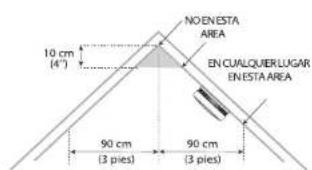
- Cuando la pared o el techo están inclinados, la alarma debe instalarse a no más de 90 cm (3 pies) de distancia del punto más alto (medido horizontalmente) de la pared o techo en la habitación.

Colocación Recomendada

¡ADVERTENCIA!
- ESTA ALARMA DEBE DE SER INSTALADO POR UNA PERSONA COMPETENTE.
- LA INSTALACIÓN DE ESTA ALARMA NO DEBE SER USADA COMO UN SUBSTITUTO DE LA INSTALACIÓN, USO O MANTENIMIENTO ADECUADO DE OTROS APARATOS QUE QUEMAN COMBUSTIBLES INCLUYENDO VENTILACIÓN ADECUADA Y SISTEMAS DE ESCAPE.
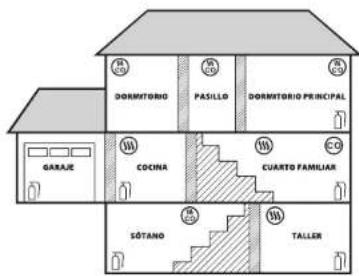

EXTINTORES DE INCENDIO

ALARMAS DE HUMO

ALARMAS DE MONÓXIDO

ALARMAS DE HUMO & CO
Nota: en las cocinas deben instalarse detectores de humo con modo de silencio.
Como Instalar Esta Alarma

¡IMPORTANTE!
ESTA ALARMA COMBINADA DE HUMO/CO ESTA DISEÑADA PARA SER MONTADA EN EL TECHO O PARED.

¡ADVERTENCIA!
FALTA DE INSTALAR Y ACTIVAR ESTA ALARMA CORRECTAMENTE EVITARA EL FUNCIONAMIENTO ADECUADO DE LA ALARMA Y EVITARA SU REACCION A PELIGROS DE INCENDIOS O CO.
Ubicaciones que Evitar
ADVERTENCIA - Este producto esta diseñado para uso en un ubicaciones interiores ordinarias de las unidades de vivienda de familia. No esta diseñado a medir cumplimiento con las normas comerciales o industriales de la Administración de Seguridad y Salud (OSHA).
- No la instale en garajes, cocinas, cuartos de calderas o baños. No lo instale a menos de 1,5 metros o 5 pies de distancia de cualquier aparato de cocina.
-
No la instale dentro de 0,9 metros (3 pies) de los siguientes lugares: la puerta de la cocina o un baño que contenga una bañera o ducha, tuberías de suministro de aire forzado usados para calentar o enfriar, ventiladores de techo o venti lación de toda la casa u otras áreas de alto nivel de flujo de aire. Evite las áreas excesivamente polvosas, sucias o grasosas. El polvo, la grasa o los productos químicos de casa pueden contaminar los sensores de la alarma, haciendo que la alarma no funcione correctamente.
-
Coloque la alarma donde cortinas u otros objetos no bloqueen los sensores. El humo y el CO deben poder alcanzar los sensores para detectar con precisión estas condiciones. No la instale en picos de techos abovedados, techos con marco "A" o techos a dos aguas. Mantenerla lejos de áreas húmedas y mojadas.
- Instale al menos de 0,3 metros o un pie de distancia de luces fluorescentes, ya que el ruido electrónico podría causar alarmas molestas. No la coloque a la luz directa del sol y manténgala lejos de áreas infectadas de insectos. Las temperaturas extremas afectarán la sensibilidad de la alarma de humo/CO. No la instale en áreas donde la temperatura sea más fría que 4,4 °C (40 °F) o más caliente que 37,8 °C (100 °F) como los garajes o sótanos que no están terminados. No la instale en áreas donde la humedad relativa (HR) sea mas alta de 85%. Colocar lejos de puertas y ventanas que se abran hacia el exterior.
- Alarmas de humo no han de ser usadas con guardias de detectores a menos que la combinación ha sido evaluada y se encuentre adecuada para ese propósito.
Pasos de Montaje
- Perfore tres hoyos de ∅ 6,0 mm en la pared o el techo, luego inserte tres tapones de anclaje de plástico en los hoyos con un martillo.
- Fije el soporte de montaje a la superficie de la pared o el techo con tres tornillos y monte la alarma en el soporte presionándolos y girando la unidad según las agujas del reloj.
- Pruebe la unidad usando el botón Prueba/Silencio. Asegúrese de que la unidad suena en forma de alarma.
Nota: Este modelo está equipado con una característica que automáticamente activa la alarma cuando la alarma se conecta al soporte de montaje de soporte la primera vez.

natural_image
Technical line drawing of a mechanical clutch assembly with mounting holes and internal components (no text or symbols)Desactivación de la Alarma

¡ADVERTENCIA!
- NO DESACTIVE LA UNIDAD DE ALARMA HASTA QUE ESCUCHE LA SEÑAL DE FINAL DE VIDA UTIL.
- UNA VEZ QUE ALCANZE LA VIDA MAXIMA (10 AÑOS), LA ALARMA EMITIRA 2 PITIDOS CADA 30 SEGUNDOS.
- UNA VEZ QUE LA ALARMA SEA DESACTIVADA, YA NO FUNCIONARA. NO PUEDE SER REACTIVADA Y DEBE SER REEMPLAZADA.
Para Desactivar la Alarma
Presionar el botón de Prueba/Silencio puede silenciar la señal de final de vida útil por 3 días.
- Despegue la etiqueta sombreada que obstruye el ajuste "DIS" y rompa el protector de plástico delgado, como se muestra abajo.
- Gire la clavija de plástico hacia arriba hasta la posición "DIS" o inserte un destornilla dor en el espacio y gire el disco en el sentido del reloj hasta la posición "DIS".
- Deseche la alarma.
- Reemplace la alarma.

Prueba Semanal

¡ADVERTENCIA!
-
NUNCA UTILICE UNA LLAMA ABIERTA DE NINGUN TIPO PARA PROBAR ESTA UNIDAD. PODRIA ACCIDENTALMENTE DAÑAR O HACER INCENDIO A LA UNIDAD O LA CASA.
-
NUNCA UTILICE EL ESCAPE DE UN VEHICULO PARA PROBAR ESTA UNIDAD. LOS VAPORES DE ESCAPE PUEDEN CAUSER DAÑOS PERMANENTE Y ANULAR SU GARANTIA.
- NO SE PARE CERCA DE LA ALARMA CUANDO LA ALARMA ESTA SONANDO. EXPOSICION A CORTA DISTANCIA PUEDE DAÑAR A SU AUDICION. CUANDO HAGA LA PRUEBA, ALEJESE DE LA ALARMA CUANDO EMPIEZE A SONAR.
Mantenimiento
Para mantener su alarma en buen funcionamiento, usted debe seguir los pasos siguientes:
- Compruebe la unidad una vez a la semana para verificar que el sonido de la alarma y que los indicadores están funcionando correctamente.
- Retire la unidad del techo/pared y limpie la cubierta de la alarma y la abertura de ventilación con un cepillo suave una vez al mes para quitar el polvo y la suciedad.
- Nunca use detergentes o disolventes para limpiar la alarma.
- Evite rociar ambientadores, spray para el pelo u otros aerosoles cerca de la alarma.
- No pinte la unidad. La pintura puede sellar las aberturas de ventilación e impedir con la habilidad del sensor para detectar humo o CO. Nunca intente desarmar la unidad o limpiar el interior. Eso anulará su garantía.
-
Cuando se retire la alarma, coloque la alarma de humo/CO de regreso en su lugar adecuado tan pronto como sea posible para asegurar protección continuada contra incendios o intoxicación por monóxido de carbono.
-
Cuando se usen productos de limpieza de casa o contaminantes similares, el área debe estar ventilada.
QUE HACER SI SUENA SUENA LA ALARMA DE HUMO
- No se asuste; mantenga la calma. Siga el plan de escape de su familia.
- Salga de la casa lo más rápido posible. No se detenga a vestirse o recoger nada.
- Sienta las puertas con el dorso de su mano antes de abrirlas.
- Si una puerta se siente fría, ábrala lentamente. No abra una puerta caliente. Mantenga las puertas y ventanas cerradas, a menos que deba escapar por ellas.
- Cubra su nariz y su boca con un paño (preferible húmedo).
- Tome respiraciones cortos y poco profundos.
- Vaya a su lugar de encuentro predeterminado afuera de su casa, y cuente a todas las personas para asegurarse que todos salieron seguros.
- Llame al Departamento de bomberos lo antes posible cuando este afuera. Dé su dirección y su nombre.
- Nunca vuelva a entrar a un edificio en llamas por ninguna razón.
- Comuníquese con su Departamento de Bomberos para obtener ideas sobre como hacer que su hogar mas seguro.
Si Suena la Alarma de CO
- Mantenga la calma y muévase inmediatamente al aire fresco. Abra todas las puertas y ventanas para aumentar la velocidad de ventilación. Pare de usar
todos los aparatos que queman combustible y asegúrese, si es posible, que estén apagados, por ejemplo, para aparatos de gas, aislar la válvula de control de emergencia.
- Si la alarma continúa siendo activada, evacue el lugar. Deje todas las puertas y ventanas abiertas, y solo vuelva a entrar al edificio hasta que la alarma haya detenido. En lugares de varias ocupaciones y de varios pisos, asegúrese de que todos los ocupantes estén alertados del riesgo.
- Obtenga ayuda médica para cualquier persona que sufra los efectos de la intoxicación por monóxido de carbono y avise que se sospecha inhalación de monóxido de carbono.
- Llame a la agencia de mantenimiento y/o mantenimiento de electrodomésticos apropiado o, cuando sea necesario, al proveedor de combustible correspondiente a su numero de emergencia o al Proveedor nacional de emergencia de gas, si es adecuado, para que la fuente de emisiones de monóxido de carbono pueda ser identificada y corregida. A menos que la razón de la alarma sea obviamente falsa, no vuelva a usar los aparatos que queman combustibles, hasta que hayan sido revisados y aprobados por una persona competente de acuerdo con las regulaciones nacionales.
Lo que Necesita Saber sobre el CO
CO no puede ver, oler o probar y puede ser fatal. La acumulación de CO en la sangre se llama carboxihemoglobina (COHb) e interfiere la capacidad del cuerpo para suministrarse oxígeno. Dependiendo de la concentración, CO puede matar en minutos. Las fuentes más comunes de CO son aparatos de gas para calentar y cocinar que están fallando, vehículos que estén corriendo en el garaje adjunto a la casa, chimeneas o tiros bloqueados, calentadores portátiles de combustión,
chimeneas, herramientas que usan combustible y el uso de parilla en un área cerrada.
Las indicaciones de intoxicación por monóxido de carbono incluyen síntomas similares a los de la gripe, pero sin fiebre. Otros síntomas incluyen mareos, fatiga, debilidad, dolor de cabeza, náuseas, vómitos, sueño y desorientación. Todas las personas son susceptibles al peligro de CO, pero los expertos afirman que los bebes en el vientre, niños pequeños, mujeres embarazadas, las personas mayores y las personas con problemas cardíacos o respiratorios tienen el mayor riesgo de daño grave o muerte. Cada año, un técnico calificado debe inspeccionar y limpiar su sistema de calefacción, conductos de ventilación, chimenea, y conductos de tiro.
Los siguientes síntomas están relacionados con la intoxicación con monóxido de carbono y deben ser discutidos con todos los miembros de la casa:
Exposición leve: Dolor de cabeza leve, náuseas, vómitos, fatiga (a menudo descrita como síntomas "similares a los de la gripe").
Exposición mediana: dolor de cabeza intenso y pulsante, somnolencia, ritmo cardíaco acelerado.
Exposición extrema: Pérdida de consciencia, fallo cardiorrespiratorio, muerte. Los niveles de exposición enumerados arriba se refieren a adultos sanos. Los niveles difieren para aquellos en alto riesgo. La exposición a altos niveles de monóxido de carbono pueden ser fatal o causar daños y discapacidades permanentes. Muchos casos reportados de intoxicación con monóxido de carbono indican que mientras las víctimas que están conscientes de que no están bien, se desorientan a tal extremo que son incapaces de salvarse a si mismas ya sea saliendo del edificio o pidiendo ayuda. Además, los niños pequeños y las mascotas domesticas pueden ser los primeros afectados. Es importante familiarizarse con los efectos de cada nivel.
Información de Seguridad contra Incendios
La intoxicación indica que mientras las víctimas están conscientes, no están bien, se desorientan a tal extremo que son incapaces de salvarse a si mismas ya sea saliendo del edificio o llamando a ayuda. Además, los niños pequeños y las mascotas domesticas pueden ser los primeros afectados. Es importante familiarizarse con los efectos de cada nivel.
Plan de Escape
Prepare y practique un plan de escape de su hogar dos veces al año incluyendo dos simulacros por la noche. Conozca dos maneras de salir de cada cuarto (puerta y ventana) e identifique un lugar donde reunirse afuera de la casa donde todos se reunirán una vez que hayan salido de la residencia. Cuando hayan llegado dos personas, una debe ir a llamar al servicio de emergencia mientras la segunda persona debe quedarse para contar los miembros adicionales de la familia. ¡Establezca una regla que una vez que estén afuera, nunca se debe reingresar bajo ninguna circunstancia!
Prevención de Incendio
Nunca fume en la cama, o deje la comida cocinándose sin supervisión. ¡Enseñe a los niños a nunca jugar con fósforos o encendedores! Entrene a todos los que viven en la casa para que reconozcan el patrón de la alarma, la advertencia del mensaje de voz y para que salgan de la casa usando su plan de escape cuando se escuche. Sepa cómo "Parar, caer, y rodar" si su ropa se prende en fuego, y cómo gatear debajo del humo. Instale y mantenga extinguidores de incendio en cada nivel de la casa y en la cocina, el sótano y el garaje. Sepa cómo usar un extinguidor antes de una emergencia. Los cuartos en el segundo piso y mas altos con ventanas deben tener escaleras de escape.
Estudios actuales han demostrado que las alarmas de humo no pueden despertar a todos los individuos que están durmiendo, y que es la responsabilidad de individuos de que viven en la hogar que son capaces de asistir a otros a brindar asistencia las personas que no puedan ser despertadas por el sonido de la alarma, o a aquellos que pueden ser incapaces de evacuar con seguridad el área sin asistencia.
Las siguientes condiciones pueden causar situaciones transitorias de CO:
- Derrarne excesivo o revertir la ventilación de los aparatos que queman combustible causado por las condiciones ambientales del exterior, como la dirección y/o la velocidad del viento, incluyendo ráfagas altas de viento; aire pesado en las tuberías de ventilación (aire frio/húmedo con periodos prolongados entre los ciclos).
- Presión negativa resultante del uso de ventiladores de escape.
- Operación simultaneo de varios aparatos que queman combustible y que compiten por un aire interno limitado.
- Conexiones de los tubos de ventilación que vibran sueltos en las secadoras de ropa, hornos o calentadores de agua.
- Obstrucciones, o diseños que no son convencionales, de tubos de ventilación que pueden amplificar las situaciones mencionadas arriba.
- Operación extendida de aparatos de combustión sin ventilación (estufa, horno, chimenea, etc.).
- Inversiones de temperatura que pueden atrapar gases de escape cerca del suelo.
- Un carro corriendo en un garaje adjunto abierto o cerrado, o cerca de una casa.
Estándares industriales de seguridad
NFPA (National Fire Protection Association [Asociación Nacional de Protección contra Incendios])
Para su información, el código nacional de alarmas de incendios, NFPA 72, estipula lo siguiente:
11.5.1 Detección requerida. Donde se requiera por leyes vigente, códigos o estándares para un tipo específico de vivienda, alarmas aprobadas simples o de estaciones múltiples se instalarán de la siguiente manera:
(1) En todos los dormitorios y habitaciones para huéspedes (2) Afuera de cada área habitable separada, a 6,4 m (21 pies) de cualquier puerta hacia un dormitorio (la distancia debe ser medida a lo largo de un camino transitable)
(3) En cada piso de una unidad habitable, incluyendo sótanos (4) En cada piso de residencias e instalaciones de cuidado (pequeñas), incluyendo sótanos y excluyendo semisó tanos y áticos inacabados.
(5) En el (los) cuarto(s) de estar de una suite de huéspedes (6) En el (los) cuarto(s) de estar de residencias o instalaciones de cuidado (Reimpreso con el permiso de NFPA 72°, Código Nacional de Alarmas de Incendio Copyright © 2007 National Fire Protection Association, Quincy, MA 02269. Este material reimpreso no representa la posición oficial ni completa de la Asociación Nacional de Protección contra Incendios, acerca del tema referido, la cual se encuentra representada solo en el estándar completo.)
(National Fire Alarm Code* and NFPA* son marcas registradas de la National Fire Protection Association, Inc., Quincy, MA 02269.)
Detección de humo: ¿es deseable tener más alarmas de humo?
El número requerido de alarmas de humo puede no proveer alertas de protección temprana de manera confiable, para aquellas áreas separadas por una puerta de las áreas con la requerida protección de alarmas de humo. Por ende, se recomienda que el ocupante considere el uso de alarmas de humo adicionales para esas áreas, para una mejor protección. Las áreas adicionales incluyen: sótano, dormitorios, comedor, cuarto de calefacción, lavadero y pasillos sin la requerida protección de alarmas de humo. La instalación de alarmas de humo en cocinas, áticos (acabados o inacabados) o garajes no se recomienda normalmente, ya que estos lugares experimentan ocasionalmente condiciones que pueden resultar en una incorrecta operación.
Jefe estatal de bomberos de California
La alerta temprana de detección de incendios se consigue mejor por medio de la instalación de equipos de detección de incendios en todas las habitaciones y áreas de una casa como sigue: una alarma de humo instalada en cada área para dormir (en las inmediaciones, pero afuera de los dormitorios) y detectores de calor o humo en los cuartos de estar, comedores dormitorios, cocinas, pasillos, áticos, cuartos de calefacción, closets, lavaderos, cuartos de almacenaje, sótanos y garajes anexos.
Comisión de Seguridad de Productos del Consumidor
La Comisión de Seguridad de Productos del Consumidor [Consumer Product Safety Commission (CPSC)] recomienda el uso de al menos una alarma de CO por hogar, localizada cerca del área de dormir.
Información de Fabricante y Servicio
X-Sense Innovations Co., Ltd.
Dirección: B4-503-D, Torre B, Parque de las Ciencias Kexing, Calle Keyuan No. 15, Comunidad Parque Tecnológico, Avenida Yuehai, Distrito Nanshan, Shenzhen, 518057, CHINA
Correo Electronico: support@x-sense.com
- X-SENSE
- Combination Smoke and Carbon Monoxide Alarm Alarma Combinada de Humo y Monóxido de Carbono
- Contents
- Package Contents
- Introduction
- THIS EQUIPMENT SHOULD BE INSTALLED IN ACCORDANCE WITH THE NATIONAL FIRE PROTECTION ASSOCIATION'S STANDARD 72
- NEVER IGNORE THE SOUND OF THE ALARM!
- When the Smoke Alarm Sounds:
- WARNING:
- When the Carbon Monoxide Alarm Sounds:
- Product Overview
- CAUTION!
- Test & Silence Button
- Alarm Sounder
- LED Indicator
- Low Battery
- THE UNIT MUST BE DEACTIVATED (see "Deactivation of the Alarm" section) AND REPLACED AS SOON AS POSSIBLE.
- End of Life
- LCD Display
- Fire Safety Tips
- Basic Safety Information
- IMPORTANT!
- WARNING!
- Installation Instructions
- Recommended Placement
- How to Install This Alarm
- Locations to Avoid
- Mounting Steps
- Deactivation of the Alarm
- ! WARNING!
- To Deactivate the Alarm
- Weekly Test
- Maintenance
- If the Smoke Alarm Sounds
- If the CO Alarm Sounds
- What You Need to Know About CO
- Fire Safety Information
- Escape Plan
- Fire Prevention
- The Following Conditions Can Result in Transient CO Situations:
- Industry Safety Standards
- California State Fire Marshall
- Consumer Product Safety Commission
- Manufacturer and Service Information
- Contenidos del Paquete
- Introducción
- NUNCA IGNORE EL SONIDO DE LA ALARMA!
- Cuando La Alarma de Humo Suena:
- ADVERTENCIA:
- Que Hacer Cuando Suena la Alarma de Monóxido de Carbono:
- Descripción del Producto
- ¡PRECAUCIÓN!
- Botón de Prueba Silencio
- Sirena de Alarma
- Indicador LED
- Batería Baja
- LA UNIDAD DEBE SER DESACTIVADA. (Iea la sección "Desactivación de la alarma") Y REEMPLAZAR LO MAS PRONTO POSIBLE.
- Fin de Vida Útil
- Pantalla LCD
- Consejos de Seguridad contra Incendios
- Información Básica de Seguridad
- ! ¡IMPORTANTE!
- ¡PRECAUCION!
- ¡ADVERTENCIA!
- Instrucciones de Instalación
- Colocación Recomendada
- Como Instalar Esta Alarma
- ¡IMPORTANTE!
- Ubicaciones que Evitar
- Pasos de Montaje
- Desactivación de la Alarma
- Para Desactivar la Alarma
- Prueba Semanal
- Mantenimiento
- QUE HACER SI SUENA SUENA LA ALARMA DE HUMO
- Si Suena la Alarma de CO
- Lo que Necesita Saber sobre el CO
- Información de Seguridad contra Incendios
- Plan de Escape
- Prevención de Incendio
- Las siguientes condiciones pueden causar situaciones transitorias de CO:
- Estándares industriales de seguridad
- Detección de humo: ¿es deseable tener más alarmas de humo?
- Jefe estatal de bomberos de California
- Comisión de Seguridad de Productos del Consumidor
- Información de Fabricante y Servicio
Marque : X-Sense
Modèle : SC07
Catégorie : Détecteur