
ZX 33 - Lave-linge ZEROWATT - Notice d'utilisation et mode d'emploi gratuit
Retrouvez gratuitement la notice de l'appareil ZX 33 ZEROWATT au format PDF.


| Type de produit | Lave-linge à chargement frontal |
| Marque | Zerowatt |
| Modèle | ZX 33 |
| Capacité de lavage | 5 kg |
| Hauteur | 85 cm |
| Largeur | 60 cm |
| Profondeur | 55 cm |
| Poids net | 62 kg |
| Alimentation électrique | 220-240 V ~ 50 Hz |
| Puissance absorbée | 2200 W |
| Classe énergétique | C (ancien classement) |
| Vitesse d'essorage maximale | 800 tr/min |
| Nombre de programmes | 12 |
| Fonctions principales | Lavage coton, synthétiques, délicats, laine, lavage à froid, essorage, vidange, arrêt cuve pleine, départ différé |
| Niveau sonore (lavage/essorage) | 58 dB / 76 dB |
| Consommation d'eau par cycle | 50 L |
| Sécurité | Sécurité enfant, verrouillage de porte, protection contre les fuites, arrêt automatique en cas de problème |
| Entretien et nettoyage | Nettoyage régulier du filtre, du tiroir à lessive et du joint de porte |
| Pièces détachées disponibles | Bandeau de commande, pompe de vidange, résistance chauffante, courroie, charnières |
| Indice de réparabilité | 7,5/10 |
| Pays de fabrication | Italie |
FOIRE AUX QUESTIONS - ZX 33 ZEROWATT
Questions des utilisateurs sur ZX 33 ZEROWATT
0 question sur cet appareil. Repondez a celles que vous connaissez ou posez la votre.
Poser une nouvelle question sur cet appareil
Téléchargez la notice de votre Lave-linge au format PDF gratuitement ! Retrouvez votre notice ZX 33 - ZEROWATT et reprennez votre appareil électronique en main. Sur cette page sont publiés tous les documents nécessaires à l'utilisation de votre appareil ZX 33 de la marque ZEROWATT.
MODE D'EMPLOI ZX 33 ZEROWATT

ZEROWATT
Via Busa 19
24020 Nese/Bergamo/Italia
La Ditta costruttrice declina ogni responsabilità per eventuali errori di stampa contenuti nel presente libretto. Si riserva inoltre il diritto di apportare le modifiche che si renderanno utili ai propri prodotti senza compromettere le caratteristiche essenziali.
The manufacturer declines all responsibility in the event of any printing mistakes in this booklet. The manufacturer also reserves the right to make appropriate modifications to its products without changing the essential characteristics.
Cod. 90489307

ZEROWATT
Lavabiancheria
Washing machine
Istruzioni per l'uso
Instructions for use

natural_image
Illustration of a single washing machine with front panel and side control buttons (no text or symbols)Prefazione
Leggete queste istruzioni per l'uso e tutte le altre informazioni accluse alla lavatrice, e comportatevi di conseguenza. Conservate tutta la documentazione per le successive consultazioni o per eventuali successivi proprietari.
Attenzione: questo apparecchio dovrà essere destinato solo all'uso domestico.
Avvertenze per lo smaltimento
Tutti i materiali d'imballaggio impiegati sono ecologici e riciclabili. Si prega di contribuire ad uno smaltimento ecologico dell'imballaggio.
Il vostro fornitore o l'amministrazione comunale sapranno informarvi sulle attuali forme di smaltimento.
Gli apparecchi dismessi non sono rifiuti senza valore! Attraverso una rottamazione ecologica possono essere recuperati materiali pregiati.
Attenzione: estrarre la spina di alimentazione degli apparecchi dismessi. Tagliare il cavo di collegamento ed eliminarlo insieme alla spina.
Volendo eliminare una vecchia lavatrice si abbia cura di rendere inservibile la chiusura della portella oblo per evitare che i bambini possano chiudersi nella macchina.
| Indice | Pagina |
| Prefazione | 1 |
| Note generali alla consegna | 3 |
| Prescrizioni di sicurezza | 3 |
| Consultazione rapida | 4 |
| Consigli utili per l'utente | 5 |
| Super Silent | 5 |
| Descrizione comandi | 6 |
| Cassetto detersivo | 9 |
| Selezione programmi | 10 |
| Il lavaggio | 10 |
| Tabella programmi | 14 |
| Detersivi, additivi e dosaggi | 16 |
| Pulizia e manutenzione ordinaria | 18 |
| Ricerca guasti | 20 |
| Servizio assistenza clienti | 21 |
| Dati tecnici | 22 |
| Messa in opera, installazione | 23 |
| Contents | Page |
| Preface | 26 |
| General delivery notes | 27 |
| Notes on safety | 27 |
| Quick start (quick reference) | 28 |
| Useful advice for the user | 29 |
| Super Silent | 29 |
| Description of controls | 30 |
| Detergent drawer | 33 |
| Programme selector | 34 |
| The main wash | 34 |
| Programme Table | 38 |
| Detergents, washing aids and amounts to use | 40 |
| Cleaning and routine maintenance | 42 |
| Investigating malfunctions | 44 |
| Technical data | 46 |
| Setting up, installation | 47 |
Note generali alla consegna
Alla consegna controlli che con la macchina ci siano:
- Manuale d'istruzione
- Certificati di garanzia
- Tappi
- Fascette per tubo scarico (per modelli profondità 33-40 cm.)
- Tubo carico
- Targhetta con la legenda programmi (inserita nell'apposita sede ricavata all'interno dell'impugnatura del cassetto detersivo)
e controlli che non abbia subito danni durante il trasporto, in caso contrario chiami il Servizio Assistenza Tecnica Autorizzato a Lei più vicino (vedi Servizio assistenza clienti).
Prescrizioni di sicurezza
Attenzione: per qualsiasi intervento di pulizia e manutenzione della lavatrice
A) Tolga la spina.
B) Chiuda il rubinetto dell'acqua.
C) Zerowatt correda tutte le sue macchine di messa a terra. Si assicuri che l'impianto elettrico sia provvisto di messa a terra in caso contrario richieda l'intervento di personale qualificato.
D) Non tocchi l'apparecchio con mani piedi bagnati o umidi. Non usi l'apparecchio a piedi nudi.
E) È sconsigliato l'uso di adattatori, prese multiple e/o prolunghe.
Attenzione: durante il lavaggio l'acqua può andare a 90°C.
F) Prima di aprire l'oblò si assicuri che non vi sia acqua nel cestello.
G) Non permetta che l'apparecchio sia usato dai bambini o da incapaci, senza sorveglianza.
H) Non tiri il cavo di alimentazione o l'apparecchio stesso, per staccare la spina dalla presa di corrente.
I) Non lasci esposto l'apparecchio ad agenti atmosferici (pioggia, sole, ecc...).
L) In caso di trasloco non sollevi mai l'apparecchio dalle manopole o dal cassetto del detersivo.
Durante il trasporto non appoggi mai l'oblò al carrello.
M) Importante!
Nel caso si installi l'apparecchio su un pavimento ricoperto da tappeti o con moquette si deve fare attenzione che le aperture di ventilazione alla base dell'apparecchio non vengano ostruite.
N) Sollevare l'apparecchio in due persone.
O) In caso di guasto e/o di cattivo funzionamento dell'apparecchio, lo spenga, chiuda il rubinetto dell'acqua e non manometta l'elettrodomestico.
Per l'eventuale riparazione si rivolga solamente al Servizio Assistenza Tecnica Autorizzato e richieda l'utilizzo di ricambi originali.
Il mancato rispetto di quanto sopra può compromettere la sicurezza dell'apparecchio.
P) Qualora si rendesse necessaria la sostituzione del cavo di alimentazione dell'apparecchio, rivolgersi al Servizio Assistenza Tecnica Autorizzato.
Consultazione rapida
Lavaggio
— Aprire l'oblò con l'apposito tasto apertura oblò (fig. 1, pag. 6)
- Selezionare la biancheria ed introdurla all'interno della macchina
- Chiudere l'oblò
- Introdurre il detersivo nelle vaschette come indicato dalla tabella programmi di questo manuale d'uso
- Impostare il programma
- Premere i tasti supplementari (se desiderati)
- Premere il tasto avvio/arresto (pag. 6)
Dopo il lavaggio
- Spegnere la lavabiancheria premendo il tasto avvio/arresto
- Attendere per 2 minuti circa il disinserimento del bloccaporta
- Aprire l'oblò ed estrarre la biancheria
Consigli utili per gli utenti
Brevi suggerimenti per un utilizzo del proprio elettrodomestico nel rispetto dell'ambiente e con il massimo risparmio.
Caricare al massimo la propria lavabiancheria
Per eliminare eventuali sprechi di energia, acqua o detersivo si raccomanda di utilizzare la massima capacità di carico della propria lavabiancheria.
E possibile infatti risparmiare fino al 50% di energia con un carico pieno effettuato con un unico lavaggio rispetto a due lavaggi a mezzo carico.
Quando serve veramente il prelavaggio?
Solamente per carichi particolarmente sporchi!
Si risparmia dal 5 al 15% di energia evitando di selezionare l'opzione prelavaggio per biancheria normalmente sporca.
Quale temperatura di lavaggio selezionare?
L'utilizzo di smacchiatori prima del lavaggio in lavabiancheria riduce la necessità di lavare a temperature superiori a 60°C.
È possibile risparmiare fino al 50% utilizzando la temperatura di lavaggio di 60°C.


natural_image
Isometric line drawing of a mechanical housing or enclosure with internal components (no text or symbols)(Solo per alcuni modelli).
L'abbattimento della rumorosità è la nuova frontiera tecnologica raggiunta dai prodotti Zerowatt.
La missione delle nuove serie Super Silent è di migliorare la qualità della vita di chi usa le lavatrici (frontali e carica dall'alto) e la lavastoviglie Zerowatt.
Le modifiche introdotte nei modelli Super Silent sono diverse e di forte impatto: 7 pannelli laterali
fonoassorbenti sui lati della macchina, un foglio di
polionda sul fondo, l'insonorazione totale del motore, l'insonorazione totale della pompa di scarico, la vasca in materiale fonoassorbente (il Silitech).
Rispetto ai corrispondenti prodotti non insonorizzati risulta che i modelli Super Silent abbattono di circa il 25% la rumorosità. Da un'analisi tecnica del mercato Europeo risulta che i nuovi modelli sono Zerowatt sono ai massimi livelli di silenziosità.
Descrizione comandi
Nella tabella seguente sono illustrati e/o descritti tutti i simboli dei comandi presenti nei vari modelli di lavatrici. Individuare quelli presenti sul cruscotto del vostro modello.
Tasto avvio/arresto •
Premere per avviare l'apparecchio. Al termine del ciclo premere nuovamente per sollevare il tasto e spegnere l'apparecchio. Segnalazione luminosa di funzionamento. Si accende quando il tasto avvio/arresto viene premuto.
Tasto apertura oblò
Uno speciale dispositivo di sicurezza impedisce l'immediata apertura dell'oblò alla fine del lavaggio. Al termine del ciclo di lavaggio attenda 2 minuti prima di aprire l'oblò.
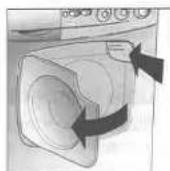
Fig. 1
Manopola
PROGRAMMI

Attenzione: non ruoti mai la manopola in senso antiorario (La ruoti in senso orario e non prema il tasto avvio/arresto prima della selezione del programma.
Le tabelle nel capitolo relativo al lavaggio descrivono i vari programmi e ne indicano il numero o simbolo da impostare.
Manopola
TEMPERATURA LAVAGGIO

Può ruotarla nei due sensi
Questa lavatrice è dotata di questo dispositivo per impostare la temperatura di lavaggio desiderata. Si consiglia di non superare mai la temperatura indicata nell'etichetta posta all'interno dei capi. Nel capitolo riguardante la tabella programmi sono indicate le temperature e i cicli più adatti
per ciascun tipo di tessuto.
Per la salvaguardia dei tessuti, nel caso con il termostato regolabile si impostino accidentalmente temperature più alte da quelle previste per ciascun programma (vedi tabella programmi), la macchina ridurrà automaticamente la temperatura.
Manopola
VARIAZIONE CENTRIFUGA

Può ruotarla nei due sensi
La fase di centrifuga è molto importante per la preparazione ad una buona asciugatura ed il vostro modello è dotato della massima flessibilità per ogni vostra esigenza. Agendo sulla manopola, è possibile ridurre la velocità massima fino alla completa eliminazione della centrifuga (posizione ②). Nei programmi misti, sintetici e delicatissimi la lavabiancheria riduce automaticamente la centrifuga a 400 giri. Per la salvaguardia dei tessuti, non è possibile aumentare tale velocità.
Nota: il modello è dotato di un dispositivo elettronico che controlla il corretto bilanciamento della biancheria. Nel caso che il carico risulti leggermente sbilanciato, la macchina provvederà a riequilibrarlo automaticamente per poi effettuare la normale centrifuga. Se dopo diversi tentativi non vi dovesse riuscire, effettuerà una centrifuga a velocità ridotta. Nel caso di carichi eccessivamente sbilanciati la fase della centrifuga viene soppressa. Questo serve a contenere le vibrazioni, a migliorare la silenziosità e la durata della lavabiancheria.
Tasto
SUPER RISCIACQUO

Premendo il tasto viene aggiunta più acqua nei risciacqui. Questo risulta particolarmente importante per evitare irritazioni da residui di detersivo nelle persone con pelli particolarmente delicate. Si suggerisce inoltre di utilizzare il tasto super risciacquo in caso di lavaggio di tessuti molto sporchi, per i quali si è dovuto impiegare molto detersivo, oppure nel lavaggio di capi di spugna le cui fibre tendono maggiormente a trattenere il detersivo.
Tasto


Premendo questo pulsante, che funziona solo nei programmi misti e lana, il ciclo si arresta all'ultimo risciacquo lasciando l'acqua in vasca. I tessuti rimangono così immersi nell'acqua evitando di ammassarsi e di formare pieghe difficili da togliere.
Rilasciando il pulsante il ciclo termina con la fase di scarico e centrifuga.
Volendo effettuare solo lo scarico senza la centrifuga, per ottenere la massima distensione delle pieghe, occorre:
- spegnere la macchina (premere il pulsante Avvio/Arresto);
- impostare il programma Z;
- riaccendere la macchina (premendo il pulsante Avvio/Arresto);
- rilasciare il tasto Non Stiro.
Tasto


Premendo il pulsante, attivo solo nel ciclo lana, viene variato il numero delle rotazioni del cesto da 55 a 35 rotazioni al minuto.
Questo consente un lavaggio extra delicato particolarmente consigliato per lana e per tessuti delicatissimi.
Cassetto detersivo
Il cassetto detersivo è suddiviso in 4 vaschette:
- la prima contrassegnata con "I", serve per il detersivo di prelavaggio.
- la seconda contrassegnata con "Il", serve per il detersivo di lavaggio.

Attenzione: si ricordi che alcuni detersivi sono di difficile asportazione. In questo caso Le consigliamo l'uso dell'apposito contenitore da porre nel cestello.
Questo assicura che il sapone liquido vada nel cesto solo al momento in cui è necessario. - la terza, contrassegnata con "△" serve per il candeggiante.
La macchina è predisposta al prelievo automatico del candeggiante durante il primo risciacquo dei cicli cotone.
Attenzione: nella terza e quarta vaschetta mettere solo prodotti liquidi.
- la quarta, contrassegnata con “✿”, serve per additivi speciali, ammorbidenti, profumi inamidanti, azzurranti, ecc.
La macchina è predisposta al prelievo automatico degli additivi durante l'ultimo risciacquo in tutti i cicli di lavaggio.
Selezione programmi
Per trattare i vari tipi di tessuto e le varie gradazioni di sporco, la lavatrice ha 3 fasce di programmi diversi per tipo di lavaggio, temperatura e durata (vedere tabella programmi di lavaggio).
1. Tessuti resistenti

I programmi sono realizzati per sviluppare il massimo grado di lavaggio e i risciacqui, intervallati da fasi di centrifuga, assicurano una perfetta sciacquatura.
La centrifuga finale assicura un'ottima strizzatura.
2. Tessuti misti e sintetici

Il lavaggio ed il risciacquo sono ottimizzati nei ritmi di rotazione del cesto e nei livelli di acqua. La centrifuga ad azione delicata, assicura una ridotta formazione di pieghe sui tessuti.
3. Tessuti delicatissimi


È un nuovo concetto di lavaggio in quanto alterna momenti di lavoro a momenti di pausa, particolarmente indicato per il lavaggio di tessuti molto delicati quali la Pura Lana Vergine. Il lavaggio e i risciacqui sono eseguiti con alto livello di acqua per assicurare le migliori prestazioni.
Il lavaggio
Riduzione automatica dei consumi
La lavabiancheria è dotata di un sistema per la Riduzione Automatica dei Consumi (detto capacità variabile automatica).
Con tale dispositivo la macchina è in grado di dosare la quantità di acqua necessaria a lavare e a risciasquare la biancheria in funzione del carico effettuato.
Ciò consente di ridurre il consumo di acqua e dell'energia elettrica necessaria a riscaldarla al minimo indispensabile, senza tuttavia attuare alcun compromesso sulle prestazioni di lavaggio e risciacquo.
Infatti l'acqua e l'energia utilizzate saranno sempre promozionali alla quantità di capi messi a lavare.
La lavabiancheria le garantisce quindi eccezionali risultati di lavaggio nel rispetto dell'ambiente e con un considerevole risparmio di denaro.
Scelta della biancheria
- Si raccomanda di lavare esclusivamente tessuti lavabili con acqua e detersivo e non a secco.
- Se si devono lavare tappetoni, copriletti o altri indumenti pesanti è bene non centrifugare.
- Dividere la biancheria in base al tipo di tessuto, allo sporco e alla temperatura di lavaggio: osservare l'etichetta posta sui tessuti.
Biancheria da lavare ad alta temperatura

Biancheria colorata e facilmente trattabile


Biancheria delicata e lana


- La biancheria contrassegnata con i seguenti simboli è inadatta per il lavaggio nella lavatrice:
Biancheria da lavare manualmente

Da lavare a secco
Per tessuti molto delicati quali tende, biancheria intima, collants ecc., è consigliabile l'utilizzo di un sacchetto di rete.
- Indumenti e biancheria di lana, per poter essere lavati in lavatrice, devono essere contrassegnati con il simbolo "Pura Lana Vergine" 📄 e avere inoltre l'indicazione "non infeltrisce" oppure "lavabile in lavatrice".
- La biancheria nuova colorata ha spesso perdite di colore.
Queste possono essere trasmesse ad altri tessuti più chiari durante il processo di lavaggio.
Per questo motivo consigliamo di effettuare il primo lavaggio dei colorati a parte. Successivamente i capi colorati non stingenti possono essere lavati con capi bianchi solo fino a 40°C.
Attenzione: durante la selezione dei capi da lavare
- si assicuri che nella biancheria da lavare non vi siano oggetti metallici (ad esempio fermagli, spille di sicurezza, spilli, monete, ecc...);
- abbottoni le federe, chiuda le cerniere lampo, gancetti a occhielli, annodi cinghie sciolte e lunghi nastri di vestaglie;
- asporti dalle tendine anche i rulli di scorrimento;
- osservi attentamente le etichette sui tessuti;
- se durante la selezione vede delle macchie resistenti, le asporti con del detersivo speciale o con un'apposita pasta di lavaggio.


- Le consigliamo di non fare un carico ci soli capi in tessuto di spugna che assorbendo molta acqua diventano troppo pesanti.
Il modo giusto di lavare
Preparazione della biancheria
A) Fate la cernita dei capi di biancheria.

Carico della biancheria
B) Aprite l'oblò.
C) Introducete la biancheria nella lavatrice. Richiudete l'oblò assicurandosi che nessun capo di biancheria ostruisca la chiusura stessa.

Introduzione del detersivo
D) Aprite il cassetto, scegliete il detersivo e dosatelo secondo le istruzioni del produttore e i consigli di pag. 16. Aggiungete le eventuali sostanze ausiliari (vedi pag. 16). Richiudete il cassetto.
Selezione del programma di lavaggio
Attenzione: nell'impostare il programma si assicuri che il tasto avvio/arresto non sia inserito.
Fate riferimento alla tabella dei programmi o alla legenda dei programmi sulla macchina, per scegliere il programma più adatto.
Il programma viene scelto ruotando la manopola programmi in senso orario e facendo coincidere il numero del programma con l'indice.
Eventualmente premete i pulsanti supplementari. Regolate la temperatura con la manopola di regolazione temperatura.
Regolate la velocità della centrifuga con l'apposita manopola.
Premete il tasto avvio/arresto.
Il programma ha inizio. La lampada spia di controllo si accende.
Proseguimento del programma
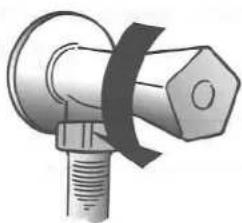
Assicuratevi che il rubinetto dell'acqua sia aperto e che lo scarico sia in posizione regolare. In caso abbiate selezionato lo stop con acqua in vasca effettuate il drenaggio della biancheria (vedere descrizione tasto Non Stiro).
natural_image
Mechanical component diagram showing a bolt and nut assembly (no text or symbols)Dopo la fine del programma
Attendete lo sblocco dell'oblò (2 minuti dalla fine del programma).
Spegnete la macchina rilasciando il tasto avvio/arresto ed aprite l'oblò premendo il tasto apertura oblò. Estraete la biancheria. Chiudete il rubinetto dell'acqua.
Tabella dei programmi
| TIPO DI TESSUTO | SIMBOLO ETICHETTA | PROGRAMMA PER | CARCO MAX KG. 4/5/ | SELEZ PROG. | SELEZ TEMP. °C |
| Trattamento preliminare ^21 | 4/5 | PRE | Fino a 50° | ||
| Tessuti resistenti Cotone, lino, carapa | 95° | Intensivo - Malto sporco ^11 | 4/5 | 1 | Fino a 90° |
| Catone, misti resistenti | 60° | Sporco normale | 4/5 | 2 | Fino a 60° |
| Catone, misti | 50° | Colorati resistenti | 4/5 | 3 | Fino a 50° |
| 40° | Poco sporco - Colori delicati | 4/5 | 4 | Fino a 40° | |
| Catone | Risciacqui energetici | - | 5 | - | |
| Catone, lino | Appretto, profumo, ammorbidente Centrifuga energetica | - | 6 | - | |
| Tessuti misti e sintetici Misti resistenti | 60° | Molto sporco ^11 | 2/2 | 7 | Fino a 60° |
| Misti, cotone, sintetici | 50° | Sporco normale | 2/2 | 8 | Fino a 50° |
| Sintetici (Nylon, Perlon) misti di cotone | 40° | Colorati delicati | 2/2 | 9 | Fino a 40° |
| 30° | Poco sporco | 2/2 | 10 | Fino a 30° | |
| Misti, sintetici delicati | Risciacqui delicati | - | 11 | - | |
| Appretto, profumo, ammorbidente Centrifuga delicata | - | 12 | - | ||
| Tessuti delicatissimi Blancheria in lana Simetici (Dralon, Acrylica Trevira) | LANA "LAVABIE in LAVATRICE" ^11 | 1/1 | 13 | Fino a 40° | |
| Tende | 1,5/1,5 | 14 | Fino a 30° | ||
| Risciacqui delicati | - | 15 | - | ||
| Misti, sintetici delicati, lana | Appretto, profumo, ammorbidente Centrifuga delicata | - | 16 | - | |
| Per biancheria da non centrifugare | Solo scarico | - | Z | - |
| CARICO DIFERSIVO | |||
| I | II | △ | |
| ● | |||
| ● | ● | ● | |
| ● | ● | ● | |
| ● | ● | ● | |
| ● | ● | ● | |
| ● | |||
| ● | |||
| ● | ● | ||
| ● | ● | ||
| ● | ● | ||
| ● | ● | ||
| ● | |||
| ● | |||
| ● | ● | ||
| ● | ● | ||
| ● | |||
| ● | |||
Note da considerare
- Capacità di carico di biancheria asciutta riferita al modello posseduto.
In caso di biancheria con elevato grado di sporco è consigliata la riduzione del carico di circa 1÷1,5 Kg per ogni modello di lavablancheria.
Nei programmi indicati △ può essere eseguito il candeggio automatico mettendo il candeggiante liquido nella vaschatta △.
1) Programma secondo Norma EN 60456.
2) Programma: Trattamento Preliminare PRE
Può essere utilizzato per tutti i capi particolarmente sporchi.
Dash - Scelto e raccomandato da Zerowatt
Quando costruiamo un nuovo modello di lavatrice, lo sottoponiamo a tutti i possibili test. Ed uno dei più importanti è quello che permette ai nostri esperti di individuare il detersivo idoneo a risolvere i problemi di bucato. Dash ha saputo rispondere alle nostre esigenze: far funzionare bene la lavatrice, non compromettere la durata, raggiungere i migliori risultati di lavaggio. Questa costante eccellenza di risultati, che era l'obiettivo principale del test che abbiamo effettuato, ha determinato la nostra scelta e la nostra raccomandazione. La funzione primaria di un detersivo che risponde a tutte le esigenze dei lavaggio è quella di collaborare con l'accua per rimuovere lo sporco dai tessuti, trattenendolo in sospensione affinché sia eliminato al momento dello scarico e controllare il volume della schiuma che si forma nella lavatrice, sempre senza danneggiare le fibre dei capi del bucato. Dash soddisfa pienamente queste esigenze, perché contiene elementi d'alta qualità, frutto delle più avanzate ricerche, che assicurano eccellenti risultati in tutte le condizioni. Dash lo puoi trovare in polvere, liquido e nella nuova formula compatta di DASH ULTRA.

Detersivi, additivi e dosaggi
Scelta del detersivo
Detersivi di tipo universale
- Detersivi in polvere per lavaggio pieno con supplemento di candeggiante, particolarmente adatti per l'impiego in programmi ad alte temperature di lavaggio (60°C ed oltre), per biancheria con forte grado di sporco e biancheria macchiata.
- Detersivi Iquidi, particolarmente adatti per sporco causato da grasso, ad esempio grasso cutaneo, cosmetici ed olio. Questi detersivi non sono tanto adatti per il lavaggio di biancheria macchiata, poiché non hanno candeggiante.
- Detersivi biologici. Piena potenza di lavaggio non viene però ottenuta con tutti i prodotti offerti.
Detersivi speciali
- Detersivi per biancheria colorata e biancheria delicata, senza supplemento di candeggiante, spesso anche senza sostanze ottiche di schiarimento, con cura del colore.
- Detersivi per pieno lavaggio, senza supplemento di candeggianti ed enzimi, particolarmente adatti per la cura delle fibre di lana.
- Detersivi per tendine con sostanze schiarenti otticamente e resistenti alla luce, per evitare l'ingiallimento attraverso l'influenza dei raggi solari.
- Detersivi speciali per l'utilizzazione programmata di sostanze chimiche secondo il tipo del tessuto, il grado di sporco e la durezza dell'acqua. In questo caso detersivi di base, dolcificanti, candeggianti/sali contro macchie possono essere dosati separatamente.
Sostanze ausiliarie di lavaggio
- Addolcitore anticalcare, permette l'impiego di quantitativi ridotti di detersivo in abitazioni dove il grado di durezza dell'acqua è da duro a durissimo.
- Sostanze di pretrattamento, per il trattamento programmato preliminare di macchie. La loro utilizzazione permette l'eventuale susseguente lavaggio con temperatura bassa di lavaggio o con detersivi senza candeggianti.
- Ammorbidente, impedisce la carica statica in tessuti sintetici e rende la biancheria più soffice. Se siete in possesso di un'asciugabiancheria i capi di vestiario diventano morbidi e soffici anche senza l'impiego di ammorbidente.
Non introdurre solventi nella lavatrice!
Conservare il detersivo e i prodotti per la cura della biancheria fuori dalla portata dei bambini.
Prima di versare il detersivo, accertarsi che nel cassetto per il detersivo non siano presenti eventuali corpi estranei.
Sulle confezioni dei detersivi sono riportate di solito le indicazioni per il dosaggio. Attenersi a tali indicazioni.
Dosaggi
Utilizzate soltanto detersivi adatti per l'impiego in lavatrice.
Otterrete il migliore effetto di lavaggio con minimo impiego di prodotti chimici ed un'ottimale cura della biancheria se oltre alla scelta del tipo di detersivo considerate anche il grado di sporco della biancheria.
Il quantitativo di detersivo dipende da:
- la durezza dell'acqua a seconda del grado di durezza dell'acqua e del tipo di detersivo impiegato, è possibile ridurre il quantitativo di detersivo.
- Il grado di sporco a seconda del grado di sporco è possibile ridurre il quantitativo di detersivo.
- Il quantitativo di biancheria in caso di piccoli quantitativi di biancheria è possibile ridurre il quantitativo di detersivo.
Dosaggio del detersivo in polvere
Per detersivi a normale e bassa concentrazione: per biancheria normalmente sporca scegliere un programma senza prelavaggio.
Introdurre il detersivo nello scomparto II del cassetto.
Per biancheria molto sporca scegliere un programma con prelavaggio.
Mettere 1/4 del detersivo nello scomparto I, 3/4 nello scomparto II del cassetto.
Impiegando addolcitori per acqua separati, introdurre prima il detersivo, quindi l'addolcitore nello scomparto II.
Per detersivi da bucato ad alta concentrazione senza cariche, osservare esattamente quanto indicato sulle confezioni per il tipo e quantitativo di dosaggio.
Per evitare il verificarsi di difficoltà di prelievo, usare i mezzi di dosaggio contenuti nelle confezioni dei detersivi.
Dosaggio del detersivo liquido
I detersivi liquidi possono essere usati, in base a quanto indicato sulle relative confezioni, per tutti i programmi senza prelavaggio utilizzando l'apposito contenitore da porre nel cestello o per i modelli che ne sono provvisti la bacinella per detersivi liquidi.
Pulizia e manutenzione ordinaria
Per la Sua lavatrice, all'esterno non usi abrasivi alcool e/o diluenti, basta solo una passata con un panno umido. La lavatrice ha bisogno di pochissime manutenzioni:
- Pulizia vaschette.
- Pulizia filtro.
Pulizia vaschette
Anche se non strettamente necessario è bene pulire saltuariamente le vaschette da detersivo candeggiante e additivi.
A) Per questa operazione basta che le estragga con una leggera forza.
B) Pulisca tutto il contenuto sotto un getto d'acqua.
C) Reinserisca il tutto nella propria sede.
Pulizia filtro
La lavatrice è dotata di uno speciale filtro in grado di trattenere i residui più grossi che potrebbero bloccare lo scarico (monete, bottoni, etc.) che possono così essere facilmente recuperati.
Per la pulizia operare nel seguente modo:
- Premere dal basso verso l'alto (pos. A-A) ottenendo uno scalzamento dello zoccolo.
- Utilizzare lo zoccolo per raccogliere l'acqua residua del filtro.
- Allentare con cacciavite la vite che fissa il filtro ruotare il filtro in senso antiorario fino all'arresto, estrario e pulirlo. Dopo aver pulito rimontarlo seguendo in senso contrario le operazioni precedentemente descritte.
- Riagganciare lo zoccolo.

natural_image
Illustration of hands assembling or handling a mechanical component (no text or symbols visible)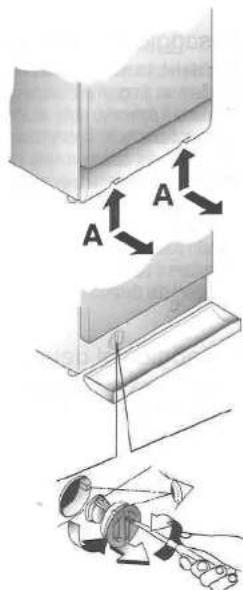
Traslochi o lunghi periodi di fermo macchina
Per eventuali traslochi o qualora la macchina restasse ferma a lungo in luoghi non riscaldati, è necessario svuotare completamente da ogni residuo di acqua tutti i tubi.
A corrente disinserita, stacchi il tubo dalla fascetta e lo porti, verso il basso, sul catino, fino alla completa fuoriuscita dell'acqua.
Al termine ripeta l'operazione in senso inverso.

natural_image
Illustration of a medical procedure showing hand positioning, cable insertion, and catheter placement (no text or symbols)Ricerca guasti
Da cosa può dipendere se...
Difetti che potete eliminare personalmente
| ANOMALIA | CAUSA | RIMEDIO |
| 1. Non funziona con qualsiasi programma | Spina corrente elettrica non inserita nella presa.Tasto interruttore generale non inserito.Manca energia elettrica.Fusibile impianto domestico guasto.Oblo aperto. | Inserire la spina.Inserire tasto interruttore generale.Controllare.Controllare.Chiudere l'oblo. |
| 2. Non carica acqua | Vedi cause 1.Rubinetto dell'acqua chiuso.Programmatore non correttamente posizionato. | Controllare.Aprire il rubinetto acqua.Posizionare programmatore correttamente. |
| 3. Non scarica acqua | Tubo di scarico piegato.Presenza corpi estranei nel filtro. | Raddrizzare tubo di scarico.Ispezionare filtro. |
| 4. Presenza di acqua sul pavimento attorno alla lavabiancheria | Perdita della guarnizione posta tra rubinetto e tubo carico. | Sostituire guarnizione e stringere bene tubo e rubinetto. |
| 5. Non centrifuga | La lavabiancheria non ha ancora scaricato l'acqua."Esclusione centrifuga" inserita (solo per alcuni modelli). | Attendere alcuni minuti, la macchina scarichera.Disinserire tasto o ruotare manopola "esclusione centrifuga". |
| 6. Forti vibrazioni durante la centrifuga | Lavabiancheria non perfettamente in piano.Staffe di trasporto non ancora asportate.Carico biancheria non uniformemente distribuito. | Regolare gli appositi piedini regolabili.Asportare staffe di trasporto.Distribuire in modo uniforme la biancheria. |
| 7. L'oblò non si apre | Non sono pascati duo minuti dalla fine del programma. | Attendere duo minuti. |
Durante le centrifughe la macchina fa un rumore diverso! Questo perché è munita di un motore a collettore che consente migliori prestazioni funzionali.
Non si vede l'acqua nel cesto! Questo perché le nuove macchine usano poca acqua, ottenendo gli stessi risultati di lavaggio e risciacquo.
Attenzione:
L'utilizzo di detersivi ecologici senza fosfati può produrre i seguenti effetti:
- l'acqua di scarico dei risciacqui risulta più torbida per la presenza di zeoliti in sospensione senza che l'efficacia del risciacquo ne risulti pregiudicata;
- presenza di polvere bianca (zeoliti) sulla biancheria al termine del lavaggio che non si ingloba nei tessuti e non ne altera il colore.
- La presenza di schiuma nell'acqua dell'ultimo risciacquo non è necessariamente indice di una cattiva sciacquatura.
- I tensioattivi anionici presenti nelle formulazioni dei detersivi per lavabiancheria, risultano spesso difficilmente allontanabili dalla biancheria stessa e, anche in minima quantità, possono produrre vistosi fenomeni di formazione di schiuma.
- L'esecuzione di ulteriori cicli di risciacquo, in casi come questi, non comporta alcun beneficio.
Servizio Assistenza Clienti
L'apparecchio è corredato da un certificato di garanzia che Le permette di usufruire gratuitamente del Servizio di Assistenza Tecnica Zerowatt, (denominata GIAS) salvo l'addebito di un diritto fisso di chiamata, per il periodo di un anno dalla data d'acquisto. Ricordi di spedire la parte A del certificato di garanzia, per la necessaria convalida entro 10 giorni dalla data di acquisto.
La parte B dovrà essere da Lei conservata, debitamente compilata, per essere esibita al Servizio Assistenza Tecnica Autorizzato, in caso di necessità di intervento, insieme alla ricevuta fiscale rilasciata dal rivenditore al momento dell'acquisto.
Qualora la Sua lavabiancheria presenti anomalie o mal funzionamenti, prima di rivolgersi al Servizio Assistenza Tecnica Autorizzato, Le consigliamo di effettuare i controlli indicati a pag. 20.
Se il problema dovesse persistere, componendo il "Numero Utile" sotto indicato, sarà messa in contatto direttamente, al costo di una normale telefonata, con il Servizio Assistenza Tecnica Autorizzato a Lei più vicino.
Servizio Assistenza Tecnica
199.123.123
È importante che comunichiate al Servizio Assistenza Tecnica Autorizzato la sigla del prodotto ed il numero di serie che troverete sul certificato di garanzia e sulla targa matricola (14 o 16 caratteri che iniziano con la cifra 3) posta sul frontale della lavabiancheria (zona oblo, fig. 2, pag 22). In questo modo Vi preghiamo di contribuire ad evitare trasferte inutili del tecnico, risparmiando così i costi a ciò connessi.
| Dati tecnici | KG 4 | KG 5 | |
| ■ Carico biancheria asciutta ■ Pressione di alimentazione dell'acqua Dimensioni ■ Larghezza ■ Profondità ■ Altezza | 4 Kg (0,5÷10 bar) 0,05÷1 MPa 60 cm 33 cm 85 cm | 5 Kg (0,5÷10 bar) 0,05÷1 MPa 60 cm 40-52 cm 85 cm | |
| N.B.: Per quanto riguarda i valori inerenti i dati elettrici, vedere targnetta dati applicata sul frontale della lavabiancheria nella zona oblo (fig. 2). CE Apparecchio conforme alle Direttive Europee 89/336/CEE, 73/23/CEE e successive modifiche. | |||
Messa in opera installazione
Dopo aver estratto la macchina dall'imballo procedere come segue:
Operare sul retro della macchina
1) Svitare il tirante centrale A, le 2 viti laterali C e rimuovere la traversa staffaggio D e il relativo distanziale in plastica.
2) Svitare N° 2 tiranti B e rimuoverli. Così facendo cadranno all'interno della macchina N° 2 distanziali in plastica.
3) Inclinare in avanti la macchina e togliere i distanziali in plastica sopraccitati.
4) Richiudere i fori utilizzando i tappi racchiusi nella busta istruzioni.
5) Applichi il foglio di polionda sul fondo come mostrato.
6) Mettere in piano la macchina agendo sui due piedini anteriori regolabili.
Modifica della posizione del tubo di scarico F per modelli profondità: 33 cm. - 40 cm.
Smontare il pannello posteriore togliendo le viti. Sganciare e togliere i semitappi I, richiamare il tubo di scarico e posizionarlo nel foro che si intende utilizzare, dopo avere tolto il tappo H. Inserire nei fori le due fascette F. Se si sceglie l'uscita dal lato opposto del mobile, fermare il tubo facendolo obbligatoriamente passare per le due fascette fissate sul bordo inferiore avendo cura di tenerlo ben teso lungo il percorso. Stringere le fascette. Chiudere il foro rimasto libero, con il tappo H. Ad operazioni ultimate utilizzare i semitappi I per agganciare il tubo nella sede del lato esterno del mobile e rifissare il pannello posteriore.


Attenzione: si consiglia di conservare la traversa, i tiranti e le viti per immobilizzare la macchina in caso di trasporto futuro. La Casa Costruttrice non risponde di eventuali danni provocati all'apparecchio per l'inosservanza delle norme relative allo sbloccaggio. Tutte le spese di installazione sono a carico dell'utente.
Collegamento idraulico
La macchina è dotata di un tubo di carico con le estremità munite di ghiere filettate da 3/4" da allacciare tra il raccordo filettato dell'apparecchio e la sorgente dell'acqua fredda.
L'apparecchio deve essere collegato esclusivamente alla sorgente di acqua fredda.
Il collegamento con sorgenti di acqua calda, cioè a temperatura maggiore di 40°, può danneggiare alcuni tessuti delicati.

natural_image
Illustration of a hand inserting a plug into a door panel, with no text or symbols present.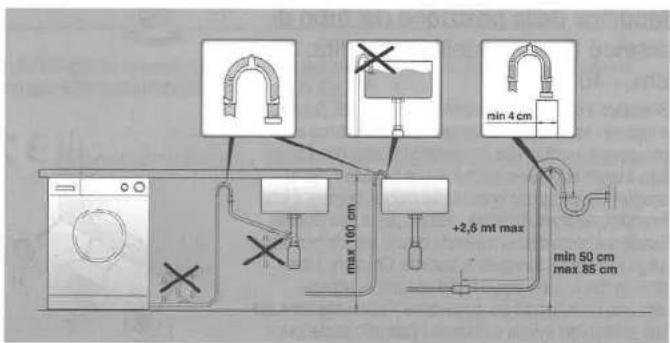
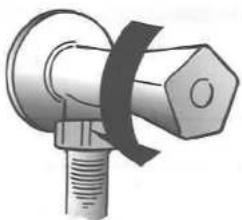
Attenzione: dopo ogni lavaggio è consigliabile chiudere il rubinetto di carico per isolare la lavatrice dal circuito idraulico.
Nel caso in cui venga modificata la posizione di collegamento del tubo di carico, accertarsi che la ghiera filettata da 3/4" del tubo di carico sia ben allacciata al raccordo dell'elettrovalvola.
Per consentire il corretto funzionamento della lavabiancheria è necessario che l'estremità terminale (bocca) del tubo di scarico sia posta ad un'altezza minima di 50 cm e massima di 85 cm da terra.
Collegamento elettrico e consigli di sicurezza
Le lavatrici vengono fornite per funzionare con tensione 230 V, monofase 50 Hz. Assicurarsi che il contatore sia dimensionato per erogare almeno 3,0 kW, quindi collegare la spina di alimentazione con una presa di 10 A, con polo di terra. Verificare che la presa di corrente della Vostra abitazione sia completa di presa di "terra". La presa dell'abitazione e la spina dell'apparecchio devono essere dello stesso tipo. In generale è sconsigliabile l'uso di adatatore prese multiple e/o prolunghe. Tutte le lavabiancherie Zerowatt sono costruite con tutti i requisiti di sicurezza previsti dall'Istituto del Marchio di Qualità.
Preface
Read these instructions for use and all other information enclosed with the washing machine and act accordingly.
Keep all documentation for future reference or for any future owners.
Note: this machine is solely for domestic use.
Notes on disposal
All packaging material used is environmentally-friendly and recyclable. Please help dispose of the packaging via environmentally-friendly means.
Your supplier or local council will be able to give you details of current means of disposal.
Appliances which are finished with are not worthless rubbish! Valuable materials can be salvaged via scrap reprocessing.
Note: pull out the mains plug from appliances which are finished with. Cut the power cable and dispose of it, together with the plug.
When disposing of an old washing machine, please ensure that the porthole lock is rendered inoperable to prevent children shutting themselves in the appliance.
General delivery notes
On delivery check that there is the following with the appliance:
- Instruction manual
– Certificate of guarantee
- Caps
- The clips for the outlet hose (Depths: 33-40 cm)
- Inlet hose
- Plate inscribed with programme details (inserted in special slot in the handle of the detergent drawer)
and check that no damage has occurred during transit, and if so, call your nearest Authorised Technical Support Service agent (see Customer Service)
Safety notes.
Note:
for any cleaning or maintenance procedure for the washing machine
A) Pull out the plug
B) Turn off the tap
C) Zerowatt equips all its appliances with earthing. Ensure that the mains supply is earthed, and if it is not, seek assistance from a qualified person.
CE Appliance complies with European Directive 89/336/EEC, 73/23/EEC and subsequent amendments.
D) Do not touch the appliance when hands or feet are wet or damp. Do not use the appliance with bare feet.
E) The use of adapters, multiple connectors and/or extensions is not recommended.
Note:
water temperature can reach 90°C during the wash cycle
F) Check there is no water left in the drum before opening the door.
G) Do not allow children or unauthorised persons to use the appliance without supervision.
H) Do not pull the power cable or the appliance itself to remove the plug from the socket.
I) The appliance must not be exposed to weather conditions (rain, direct sun, etc...)
L) When moving the appliance never lift it by the controls or by the detergent drawer. When in transit never rest the porthole against the trolley.
M) N.B! If the appliance is installed on a carpeted floor ensure that the ventilation holes on the base of the appliance are not obstructed.
N) The appliance should be lifted by two people.
O) If the appliance is not running properly or breaks down, switch it off, turn off the tap and do not tamper with the appliance. Consult only the Authorised Technical Support Service for possible repair and ask them to use original spare parts.
Failure to comply with the above can compromise the safety of the appliance.
P) If the appliance's power cable should ever need replacing, consult the Authorised Technical Support Service.
Quick start (quick reference)
Washing
— Open the porthole with the special OPEN DOOR button (Fig. 1, pag. 30)
— Select laundry and put it in the machine
- Close the porthole
- Put detergent in the compartments as indicated in the programme table in this instruction manual
- Select programme
- Press additional function buttons (if required)
- Press the on/off button (Pag. 30)
After washing
- Switch off the washing machine by pressing the * button
- Wait about two minutes for the door locking device to disengage
- Open the porthole and remove the laundry
Useful advice for users
Tips on using your domestic appliance in the most environmentally-friendly and economical way
Do a full load in your washing machine
To prevent any possible waste of energy, water or detergent we recommend that you put a full load in your washing machine.
An energy saving of up to 50% can be achieved by carrying out a single wash with a full load, compared with two washes each with half a load.
When is prewashing really needed?
Only with particularly dirty loads!
Energy savings of 5 to 15% are made by not selecting the prewash option for normally soiled laundry.
Which wash temperature should you choose?
Using stain removers before machine washing reduces the need to wash at temperatures over 60°C.
Energy savings of up to 50% can be made by using a 60°C wash temperature.

(Some models only).
The victory over noise is the new tecnological frontier crossed by Zerowatt products. The mission of the new Super Silent series is to improve the quality of life for the users of Zerowatt washing machines (front and top loaders) and dishwashers.
Many significant modifications have been introduced to the Super Silent models: 7 soundproof side panels and a sheet of corrugated material on the bottom. The motor
has been completely soundproofed as has the discharge pump. The tub id made of sound-absorbent material (Sillitech).
Super Silent models are approximately 25% quieter than other similar products without soundproofing. A technical analysis of the European market reveals that the new Zerowatt Super Silent models are amongs the best in the terms of noise reduction.

natural_image
Isometric technical drawing of a mechanical housing or enclosure with internal components (no text or symbols)Description of controls
In the following table you will find all the symbols described on the control panels of the various models of washing machines. To identify those described in your panel.
On/off button

Press to start the appliance. At the end of the cycle press again to reset the button and switch off the appliance. Machine on indicator light is illuminated when the on/off button is depressed.
Door open button
A special safety device prevents the porthole from being opened immediately after the end of the cycle. Wait for 2 minutes after the wash cycle has finished before opening the porthole.
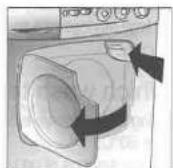
Fig. 1
PROGRAMME

Selector
Note: never turn the knob anti-clockwise (Turn it clockwise and do not press the on/off button before selecting the programme.)
The tables in the washing section describe the various programmes and give the number or symbol to select for them.
WASH
TEMPERATURE

Selector
Can be turned in either direction
This washing machine is equipped with this device for setting the wash temperature you want. We recommend that the temperature shown on the label inside garments should never be exceeded.
The most suitable temperature and cycle for each type of fabric is shown in the section covering the programme table.
To protect fabrics if the variable thermostat has been accidentally set for higher temperatures than those expected for each programme (see programme table), the machine will lower the temperature automatically.
VARIABLE SPIN

Selector
Can be turned in either direction
The spin stage plays a very important role in preparing the laundry for efficient drying and model offers maximum flexibility to suit all your requirements.
The selector can be turned to reduce the maximum spin speed, right up to eliminating the spin completely (position Ⓞ).
In programmes for mixed fibres, synthetics and delicates, the washing machines automatically lowers the spin speed to 400 rpm.
In order not to damage fabrics, it is not possible to increase this spin speed.
Note: the model is fitted with an electronic device that checks the load is balanced correctly.
If the load is slightly unbalanced, the machine will rebalance it automatically so as to the carry out the normal spin.
If, after several attempts, balance is not restored, a reduced spin speed will be used.
If load are seriously unbalanced the spin stage will be cancelled.
This helps limit vibration, reduce noise output and improve the washing machine's lifespan.
SUPER RINSE

Button
Pressing this button causes more water to be added at the rinse stage. This is particularly important for avoiding skin irritation from detergent residues for people with particularly sensitive skin.
Using the super rinse button is also recommended when washing heavily soiled fabrics, requiring the use of a lot of detergent, or when washing items made of toweling, whose fibres have a greater tendency to retain detergent.
ANTI
CREASE

Button
Pressing this button, which operates only during the mixed wash and wool cycles, means the cycle stops at the final rinse stage, leaving the drum filled with water.
The garments thus stay immersed in the water, preventing them from bunching up and forming creases that are difficult to remove.
When the button is reset the cycle ends with the water being pumped out followed by the spin stage.
If only pumping out is required, without spin, to minimise creasing you must:
- switch off the machine (press the On/Off button);
- select programme Z;
- switch on the machine again (by pressing the On/Off button);
— reset the Anti-crease button.
DELICATE
WASH

Button
Pressing the button, active only in the woll cycle, reduces the drum rotation frequency from 55 to 35 rotations per minute.
This produces an extra delicate wash, particularly recommended for wool and very delicate fabrics.
Detergent drawer
The detergent draw is split into 4 compartments:
- the first, labelled «I», is for detergent for prewash
– the second, labelled «II», is for detergent for main wash
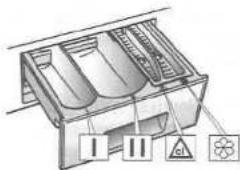
Note: some detergents are difficult to remove. For these, we recommend you use the special dispenser which is placed in the drum.
This ensures that the liquid detergent is dispersed in the drum only when needed.
- the third, labelled "△", is for bleaching agents.
The machine is programmed to automatically take up the bleach during the first rinse in cotton cycles.
Note: only put liquid products in the third and fourth compartments.
- the fourth, labelled "✿" is for special additives, fabric softeners, fragrances, starch, brighteners etc.
The machine is programmed to automatically take up additives during the final rinse stage for all wash cycles.
Programme selector
The washing machine has 3 different programme groups according to type of wash, temperature and duration for handling the various types of fabric (see wash programme table).
1. Colourfast fabric

The programmes are designed for maximum washing and rinsing.
With spin stages in between, they guarantee the laundry is rinsed perfectly.
The final spin stage ensures laundry is wrung out as much as possible.
2. Mixed fibres and synthetics

Washing and rinsing performance is optimised through drum rotation speeds and water level. The delicate action spin minimises creasing.
3. Delicate fabrics


This is a new concept in washing, with a cycle that comprises alternate periods of activity and pauses, particularly suitable for washing very delicate fabrics, such as Pure New Wool. Wash and rinsing are carried out using a high water level to get the best results.
Main wash
Automatic reduction in consumption
The washing machine is fitted with an Automatic Reduction in Consumption system (known as automatic variable capacity).
This system enables the machine to use the amount of water needed to wash and rinse the laundry in relation to the particular load.
That results in a reduction in the amount of water used and electricity needed to heat it to the minimum required, without in any way compromising the washing and rinsing performance.
In fact the amount of water and electricity used will always be appropriate for the amount of washing.
The washing machine therefore ensures you achieve excellent washing results whilst respecting the environment and saving you a considerable amount of money.
Sorting the laundry
- It is recommended you wash only items which are washable with water and detergent and not dry-clean items.
- If you need to wash rugs, bedspreads or other heavy items, it is best not to spin them.
- Sort the laundry according to fabric type, degree of soiling and wash temperature: follow the labelling in the garments.
Laundry for hot wash 95°

Coloured, easy-care materials


Delicates and wool 40° 30°
- Items labelled with the following symbols are not suitable for machine washing:
Wash by hand

Dry clean
For very delicate items, such as net curtains, underwear, tights etc., you are advised to use a laundry net or wash bag.
- Woollen items must be labelled with the «Pure New Wool» symbol to be washed in the machine 📋, and must also be labelled «non-matting» or «machine washable».
- Colour often leaks from new coloured items.
This can then colour other lighter items being washed.
We therefore recommend that coloured items should be washed for the first time separately.
For future washes, non colourfast items can only be washed with whites up to 40°C.
Note: when sorting laundry
- check there are no metal objects in the laundry (such as paper clips, safety pins, pins, coins etc...);
- button up pillowcases, fasten zips, hook & eye fasteners, belts and long dressing gown cords;
- remove curtain hooks;
– pay close attention to the labels on items - if you notice stubborn stains whilst sorting the laundry, remove them using a special detergent or a special stain remover.


- We recommend that you do not do a full load of just towelling items as these become too heavy since they absorb a lot of water.
The correct way to wash
Preparing the laundry
A) Select the laundry.
Loading the laundry
B) Open the porthole.
C) Put the laundry in the washing machine. Close the porthole again, ensuring that no items of laundry are obstructing the lock.
Putting detergent in machine
D) Open the drawer, choose the detergent and put in the correct amount, according to the manufacturer's instructions and the advice on page 40. Add any other laundry aids (see page 40). Close the drawer again.

natural_image
Illustration of a washing machine with a basket and stacked bricks beside it (no text or symbols)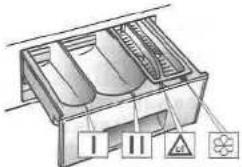
Selecting the wash programme
Note: when setting the programme, make sure that the on/off button is not depressed.
Refer to the programme table or the programme descriptions on the machine to select the most suitable programme.
The programme is selected by turning the programme selector clockwise and aligning the programme number with the pointer. Press additional function buttons if necessary. Set the temperature using the temperature control knob.
Set the spin speed with the special knob.
Press the on/off button.
The programme starts. The indicator light is illuminated.
Continuing with the programme
Check that the tap is turned on and that the discharge hose is positioned correctly. If you have set the machine to stop with water still in the drum, drain the water away (see description of water in drum off button).
natural_image
Mechanical component diagram showing a bolt and nut assembly (no text or symbols)When the programme is finished
Wait for the porthole lock to be released (about 2 minutes after the programme has finished). Switch off the machine by resetting the on/off button and open the porthole by pressing the door open button. Remove the laundry. Turn off the tap.
Programme table
| FABRIC | SYMBOLON LABEL | PROGRAM FOR | WEIGHTMAX KG.4/5" | SELECT.PROG. | SELECT.TEMP.°C |
| Pre washing2 | 4/5 | PRE | Up to 50° | ||
| Resistants fabricsCotton, linen | 95° | Intensive - Heavily soiled1 | 4/5 | 1 | Up to 90° |
| Cotton, mixed resistants | 60° | Normally soiled | 4/5 | 2 | Up to 60° |
| Cotton, mixed | 50° | Cotton resistant | 4/5 | 3 | Up to 50° |
| 40° | Lightly soiled - Delicates colours | 4/5 | 4 | Up to 40° | |
| Cotton | Energetic rinsing | - | 5 | - | |
| Cotton, linen | Conditioner, fragrance, softenerEnergetic spin | - | 6 | - | |
| Mixed fabrics and syntheticsMixed, resistants | 60° | Heavily soiled1 | 2/2 | 7 | Up to 60° |
| Cotton, mixed fabrics,syntherics | 50° | Normal soiling | 2/2 | 8 | Up to 50° |
| Synthetics (nylon, perian),mixed cotton | 40° | Colour fast | 2/2 | 9 | Up to 40° |
| 30° | Lightly soiled | 2/2 | 10 | Up to 30° | |
| Mixed, delicate synthetics | Delicate rinsing | - | 11 | - | |
| Conditioner, fragrance, softenerDelicate spin | - | 12 | - | ||
| Very delicate fabricsWalenSynthetics (Dralon, Acryl,Trevira) | "MACHINE WASHABLE" woollers11 | 1/1 | 13 | Up to 40° | |
| 30° | Curtains | 1,5/1,5 | 14 | Up to 30° | |
| Delicate rinsing | - | 15 | - | ||
| Mixed, delicate synthetics,wool | Conditioner, fragrance, softenerDelicate spin | - | 16 | - | |
| For fabrics that shouldnot be spin | Drain only | - | Z | - |
| CHARGE DETERGENT | |||
| I | II | △ | |
| ● | |||
| ● | ● | ● | |
| ● | ● | ● | |
| ● | ● | ● | |
| ● | ● | ● | |
| ● | |||
| ● | |||
| ● | ● | ||
| ● | ● | ||
| ● | ● | ||
| ● | ● | ||
| ● | |||
| ● | |||
| ● | ● | ||
| ● | ● | ||
| ● | |||
| ● | |||
Please, read these notes
- Washing capacity of dry clothes, according to the model used.
In case of heavily soiled clothes we recommend to reduce the load by 1÷1,5 kg. in any model of w/m used.
In the programs as shown in the table, automatic bleaching is possible by pouring the liquid bleach into the detergent draw △.
1) Programmes according to EN 60456.
2) Programmes Pre-washing PRE Can be used for any heavily soiled clothes.
Get the best results from your new Zerowatt machine
To ensure you get the best results from your new Zerowatt machine it is important to use the right detergent in your everyday wash.
There are many detergents available in the market and making a choice from the wide range available can often be confusing. At Zerowatt we regularly test many different types of detergent to assess which give the best wash results in our machines. We found only one brand always lives up to our exacting standards and provides outstanding cleaning across a broad range of dirt and stains, as well as providing high levels of fabric care. Thats why Zerowatt gave Ariel their official seal of approval.

Detergents, washing aids and amounts to use
Choice of detergent
General purpose detergents
- Powder detergents, for a thorough wash, with bleaching agent, particularly suitable for use in hot wash programmes (60°C and over), for heavily soiled and stained laundry.
- Liquid detergents, particularly suitable for grease stains, such as greasy skin marks, cosmetics and oil.
- These detergents are not suitable for washing stained laundry, as they do not contain bleach.
- Biological detergents, not all the products available give a really through wash.
Special detergents
- Detergents for coloureds and delicates, without added bleach, also often without any optical brightening agents, to preserve the colour.
- Detergents for a thorough wash, without added bleach or enzymes, particularly suitable for handling woollen fibres.
- Detergents for curtains with optical brightening agents, resistant to light, to prevent yellowing from sunlight.
- Special detergents for programmed use of chemical substances, depending on fabric type, degree of soiling and water hardness. Here basic detergents, softeners, bleaches/stain removers can be added separately.
Additional laundry aids
— Water softener, means less detergent can be used where water hardness is classed as hard to very hard.
- Prewash substances, for the programmed treatment of stains prior to the main wash. Using them means the subsequent wash can be at a low temperature or with bleach-free detergents.
- Fabric softener, prevents static build-up in synthetic fabrics and softens fabrics. If you own a tumble dryer, clothes are softened even without the use of a fabric softener.
Do not put solvents in the washing machine!
Keep detergents and other laundry products out of children's reach.
Before pouring in the detergent check that there are no foreign bodies in the detergent drawer. Dosage details are usually shown on the detergent packaging. Follow those instructions.
Dosages
Only use detergents which are suitable for use in a washing machine. You will obtain the best results from your wash with the minimum use of chemical products and the best care for your laundry if you take into consideration the degree of soiling as well as the type of detergent to choose.
The amount of detergent to use depends on:
- water hardness, depending on the hardness of the water and the type of detergent used, it is possible to reduce the amount of detergent.
- the degree of soiling, it is possible to reduce the amount of detergent used depending on the degree of soiling.
- amount of laundry, it is possible to reduce the amount of detergent when washing only a small amount of laundry.
The amounts shown on pack for detergents for washing delicates often already refer to a reduced wash size.
Follow the dosage instructions!
Dosage for powder detergent
For normal and low concentration detergents: for normally soiled laundry choose a programme without prewash.
Put the detergent in compartment II of the drawer.
For heavily soiled laundry, choose a programme with prewash.
Put 14 of the detergent in compartment I, 34 in compartment II of the drawer.
When using water softeners, first put in the detergent, then add the softener to compartment II. For highly concentrated detergents not in single dose format, follow what is shown on pack exactly as regards type and amount of dosage.
To avoid the difficulty of checking if the detergent has been taken up, use the dosage aids provided in the detergent packaging.
Liquid detergent dosage
Liquid detergents may be used in accordance with the instructions on the relevant packaging, for all programmes without prewash, by using the special container which is placed in the drum or, for those models that have it, in the special insert for liquid detergents.
Cleaning and routine maintenance
Do not use alcohol-based scourers and/or thinners on the outside of your washing machine, just a wipe with a damp cloth will suffice. The washing machine needs very little maintenance:
– Cleaning the drawer compartments.
- Cleaning the filter.
Cleaning the drawer compartments
Even if it is not strictly necessary, it is good to clean the compartments for bleaching detergents and additives occasionally.
A) To do this you just need to pull them out firmly, but without forcing them.
B) Clean everything in the compartment under running water.
C) Put everything back in its proper place.
Cleaning the filter
The washing machine is fitted with a special filter for handling large deposits which could block the discharge hose (coins, buttons etc.) and which can, therefore, be easily retrieved.
The cleaning operation is as follows:
- Press from the bottom to the top (pos.A-A) removing the plinth.
- Use the plinth to gather the water still in the filter.
- Use a screwdriver to loosen the screw holding the filter, turn the filter anticlockwise until it stops, remove it and clean it. After cleaning it, reassemble it following the previous instructions in reverse order.
- Replace the plinth.

natural_image
Illustration of a hand holding a test tube with a magnified inset showing internal components (no text or symbols)
Transporting the appliance or long periods when appliance is not in use
If the appliance is being transported or is out of use for long periods in unheated places, all remaining water must be completely removed from all hoses.
Ensure mains power is off, then unclip the hose and point it downwards into a basin until all the water has emptied out.
When finished, repeat the operation in the reverse order.

natural_image
Illustration of a hand holding a small component with arrows indicating direction, next to a medical device (no text or symbols present)Investigating malfunctions
What might be the cause of...
Defects you can remedy yourself
| MALFUNCTION | CAUSE | REMEDY |
| 1. Does not work on any programme | Plug not in socket.Not switched on.Power failure.Fuse blown.Porthole open. | Plug it in.Switch on.Check.Check.Close porthole. |
| 2. Does not fill with water | See cause 1.Tap turned off.Programme selector not correctly positioned. | Check.Turn on tap.Position programme selector correctly. |
| 3. Water does not drain away | Kink in discharge hose.Foreign bodies in filter | Straighten discharge hose.Examine filter. |
| 4. Water on floor around the washing machine | Leaking gasket between tap and water inlet hose. | Replace gasket and tighten hose and tap well. |
| 5. Does not spin | Water has not yet drained away.«No spin» selected (certain models only). | Wait a few minutes for machine to empty.Reset button or turn «no spin» knob. |
| 6. Machine vibrates a lot during spin | Washing machine not completely level.Transit brackets not removed yet.Load not distributed evenly. | Adjust the special adjustable feet.Remove transit brackets.Rearrange the laundry evenly. |
| 7. Porthole will not open | Two minutes have not elapsed since the programme finished. | Wait two minutes. |
The machine makes a different noise when spinning! This is because it has a manifold motor for better performance.
The water cannot be seen in the drum! This is because new machines do not use much water, yet achieve the same standard of washing and rinsing.
Note:
The use of environmentally-friendly, phosphate-free detergents can have the following effects: - waste water from rinsing may be cloudier because of the presence of zeolites held in suspension, without the rinse performance being adversely affected;
– presence of white powder (zeolites) on laundry after washing, which is not absorbed by the fabric and does not alter the colour of the fabric.
- The presence of foam in the final rinsing water is not necessarily an indication of poor rinsing.
- Anionic surfactants used in washing detergent formulae often prove to be difficult to remove from the laundry itself and, even in small quantities, can still cause considerable foam production.
- Carrying out more rinse cycles does not serve any purpose in such cases.

| Technical data | KG 4 | KG 5 | |
| ■ Max. load of dry laundry■ Water pressure | 4 Kg(0,5÷10 bar)0,05÷1 MPa | 5 Kg(0,5÷10 bar)0,05÷1 MPa | |
| Measurements■ Width■ Depth■ Height | 60 cm33 cm85 cm | 60 cm40-52 cm85 cm |
NB: For specifications regarding electrical data, see the data panel on the front of the washing machine (porthole area).

Appliance complies with European Directive 89/336/EEC, 73/23/EEC and subsequent amendments.
Installation
After removing the machine from the packaging, proceed as follows:
On the back of the machine
1) Unscrew the centre brace A, the two side screws C and remove the transverse bracket D and the relevant plastic spacer.
2) Unscrew the 2 B braces and remove them. This will cause 2 plastic spacers to fall into the machine.
3) Tilt the machine forward and remove the above-mentioned plastic spacers.
4) Cover the holes using the caps enclosed in the instructions envelope.
5) Apply the sheet of «pollonda» to the base as shown.


6) Level the machine using the two adjustable rear feet.
How to change the position of the outlet hose F for models having following depths: 33 cm. - 40 cm.
Remove the back panel by loosening the screws. Remove the plugs I; take the outlet hose and put it into the hole that you want to use, after having removed the plug H. To insert into the holes two clips F. If you choose the outlet to be positioned on the opposite side of the cabinet, fasten the hose by passing it under the two clips F on the lower edge, making sure that the hose is kept well-straight. To tigh ten the clips Stop the hole that is still open, using the plug H. Finally, fasten the hose on the outer side of the cabinet using the semi-plugs I and then reposition the back panel.


Note: we recommend you keep the transverse bracket, braces and screws to immobilise the machine for future transit. The Manufacturers will not be responsible for any possible damage to the machine caused by not following the rules relating to releasing the mechanism. The user is responsible for all costs of installation.
Water supply
The machine has an inlet hose with fl» threaded ferrules fitted to the ends to attach between the threaded connector on the appliance and the cold water supply.
The appliance must only be connected to the cold water supply.
Connection to a warm water supply, that is over 40^ , may damage certain delicate fabrics.

natural_image
Illustration of a hand using a tool to clean or store items from a window (no text or symbols visible)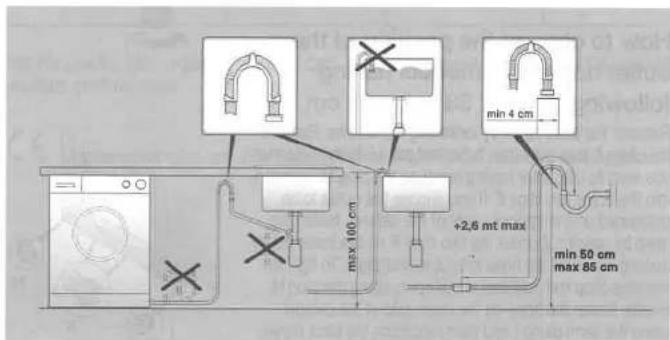
Note: it is advisable to turn off the tap after each wash to isolate the washing machine from the water supply.
If the inlet hose's connection point is changed, check that the fl» threaded ferrule on the inlet hose is firmly attached to the electrovalve connector.
For the washing machine to function properly the terminal end of the discharge hose (mouth) must be at a minimum of 50 cm and a maximum of 85 cm from the ground.
Electricity supply and safety advice
Washing machines are supplied to operate at a voltage of 230V, 50 Hz single-phase. Check that the conductor is powerful enough to supply at least 3.0 kW, then connect the plug to a 10A earthed socket.
Check that the electricity supply to your home has an earthing system.
The socket in your home and the plug on the appliance must be of the same type.
It is generally not advisable to use multiple adapters and/or extension leads.
All Zerowatt washing machines comply with the safety requirements laid down by the Quality Trademark Institute.
- ZEROWATT
- Prefazione
- Avvertenze per lo smaltimento
- Note generali alla consegna
- Prescrizioni di sicurezza
- Attenzione: per qualsiasi intervento di pulizia e manutenzione della lavatrice
- Attenzione: durante il lavaggio l'acqua può andare a 90°C.
- Consultazione rapida
- Lavaggio
- Dopo il lavaggio
- Consigli utili per gli utenti
- Caricare al massimo la propria lavabiancheria
- Quando serve veramente il prelavaggio?
- Quale temperatura di lavaggio selezionare?
- (Solo per alcuni modelli).
- Descrizione comandi
- Tasto avvio/arresto •
- Tasto apertura oblò
- Manopola
- PROGRAMMI
- TEMPERATURA LAVAGGIO
- Può ruotarla nei due sensi
- VARIAZIONE CENTRIFUGA
- Tasto
- SUPER RISCIACQUO
- Cassetto detersivo
- Selezione programmi
- Tessuti resistenti
- Tessuti misti e sintetici
- Tessuti delicatissimi
- Il lavaggio
- Riduzione automatica dei consumi
- Scelta della biancheria
- Attenzione: durante la selezione dei capi da lavare
- Il modo giusto di lavare
- Preparazione della biancheria
- Carico della biancheria
- Introduzione del detersivo
- Selezione del programma di lavaggio
- Proseguimento del programma
- Dopo la fine del programma
- Dash - Scelto e raccomandato da Zerowatt
- Detersivi, additivi e dosaggi
- Scelta del detersivo
- Detersivi di tipo universale
- Detersivi speciali
- Sostanze ausiliarie di lavaggio
- Non introdurre solventi nella lavatrice!
- Dosaggi
- Dosaggio del detersivo in polvere
- Dosaggio del detersivo liquido
- Pulizia e manutenzione ordinaria
- Pulizia vaschette
- Pulizia filtro
- Traslochi o lunghi periodi di fermo macchina
- Ricerca guasti
- Attenzione:
- Servizio Assistenza Clienti
- Messa in opera installazione
- Collegamento idraulico
- Collegamento elettrico e consigli di sicurezza
- Preface
- Notes on disposal
- General delivery notes
- Safety notes.
- Note:
- Quick start (quick reference)
- Washing
- After washing
- Useful advice for users
- Do a full load in your washing machine
- When is prewashing really needed?
- Which wash temperature should you choose?
- (Some models only).
- Description of controls
- On/off button
- Door open button
- PROGRAMME
- Selector
- WASH
- TEMPERATURE
- Can be turned in either direction
- VARIABLE SPIN
- SUPER RINSE
- Button
- ANTI
- CREASE
- DELICATE
- Detergent drawer
- Programme selector
- Colourfast fabric
- Mixed fibres and synthetics
- Delicate fabrics
- Main wash
- Automatic reduction in consumption
- Sorting the laundry
- Delicates and wool 40° 30°
- Wash by hand
- Dry clean
- Note: when sorting laundry
- The correct way to wash
- Selecting the wash programme
- Continuing with the programme
- When the programme is finished
- Get the best results from your new Zerowatt machine
- Detergents, washing aids and amounts to use
- Choice of detergent
- General purpose detergents
- Special detergents
- Additional laundry aids
- Do not put solvents in the washing machine!
- Dosages
- Dosage for powder detergent
- Liquid detergent dosage
- Cleaning and routine maintenance
- Cleaning the drawer compartments
- Cleaning the filter
- Transporting the appliance or long periods when appliance is not in use
- Investigating malfunctions
- Installation
- How to change the position of the outlet hose F for models having following depths: 33 cm. - 40 cm.
- Water supply
- Note: it is advisable to turn off the tap after each wash to isolate the washing machine from the water supply.
- Electricity supply and safety advice
Marque : ZEROWATT
Modèle : ZX 33
Catégorie : Lave-linge