BT50QT-9 - Scooter Baotian - Notice d'utilisation et mode d'emploi gratuit
Retrouvez gratuitement la notice de l'appareil BT50QT-9 Baotian au format PDF.


Questions des utilisateurs sur BT50QT-9 Baotian
0 question sur cet appareil. Repondez a celles que vous connaissez ou posez la votre.
Poser une nouvelle question sur cet appareil
Téléchargez la notice de votre Scooter au format PDF gratuitement ! Retrouvez votre notice BT50QT-9 - Baotian et reprennez votre appareil électronique en main. Sur cette page sont publiés tous les documents nécessaires à l'utilisation de votre appareil BT50QT-9 de la marque Baotian.
MODE D'EMPLOI BT50QT-9 Baotian
BAOTIAN 宝田
User's Manual
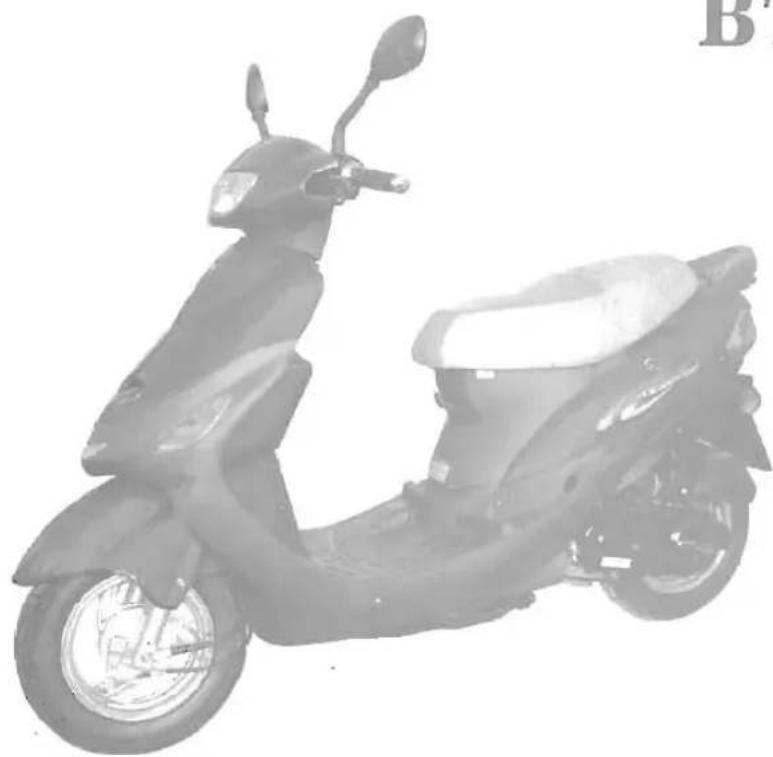
BT50QT-9
natural_image
Side view of a black electric scooter with visible wheels and front wheel (no text or symbols)Preface
Thank you very much for purchasing 'BAOTIAN' brand motorcycle of model BT50QT-9 developed by BAO TIAN MOTORCYCLE INDUSTRIAL CO., LTD. And welcome to join the driver's line if BAOTIAN motorcycle.
With its extraordinary advantages of excellent quality, smart appearance and shape of legerity, our product will surely bring the utmost pleasure and convenience to your life.
This manual gives you information about the general structure, function, operation and maintenance methods of BT50QT-9. In order to enable your beloved motorcycle to render a best performance and a longer life, please read this manual carefully, pay particular attention to the running-in part in it and follow all the operating instruction. It is of great importance to make your riding safer and more comfortable. Experienced staffs in our sale agency and the maintenance shop will also offer excellent service for you.
- Please take an initial examination of your motorcycle after the first 300km running in our designated maintenance shop, and take regular examination in every 1000km thereafter.
● All the direction, illustration and specification included in this manual are based on the latest product information. Please be noted that they may be different from the actual status of the motorcycle if there is new revision on its specification, and no further advice will be given.
● This motorcycle was designed and manufactured which complied with e-mark-the safety standard of Europe Union, the maximum speed is 45km/h. Please do NOT change any parts without professional advice and use non-original parts in case of avoiding danger to driver and the broken of traffic laws.
● This handbook is base on the item of BT50QT-9A(disk brake, 1 seat). Also introduced the different parts of BT50QT-9B(disk brake, 1 seat), BT50QT-9C(drum brake, 2 seats) BT50QT-9D(disk brake, 2 seats). Please notice it.
CONTENTS
Guidance 1
Names of parts 3
Controlling parts 4
Starting lever 6
Fuel tank 6
Fuel and machine oil 6
Pre-riding inspection 7
Engine starting 8
Running-in 8
Regular maintenance 10
Tools 15
Technical Parameters 16
Electrical Circuit Chart 18
Guidance
Please keep safety in your mind and observe the regulations of transportation while enjoying your riding. Pay attention to the following rules:
- Pre-riding inspection
Please read the details in the relevant chapter for your safety
- Helmet
Do remember to wear helmet while riding.
- Being familiar with motorcycle operation
It is of great importance to ensure your safety getting familiar with motorcycle operation.
- Speed limitation
Drive at proper speed in accordance with the road condition, the weather and your driving skill.
- Position of the label
WARNING
It is dangerous to drive on the wet road. Do not make an abrupt turning while accelerating and keep proper distance from other vehicles.
6.Positions of the numbers
The frame number and the engine number are for the purpose of registering the motorcycle. When your motorcycle needs inspection, repair or other special service, the number will enable you to get good service from our sale agency. Please note. down your number here:
□ The frame number: ____
□ The engine number:
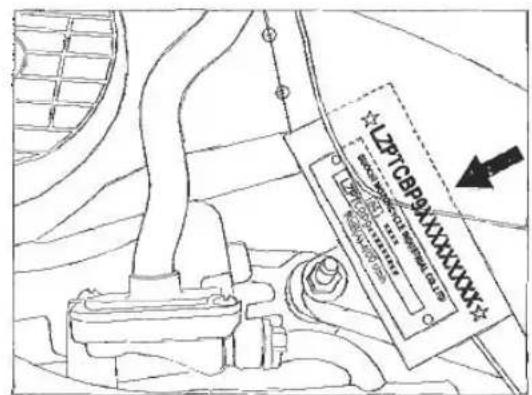
text_image
LZPTCBP9XXXXXXX ←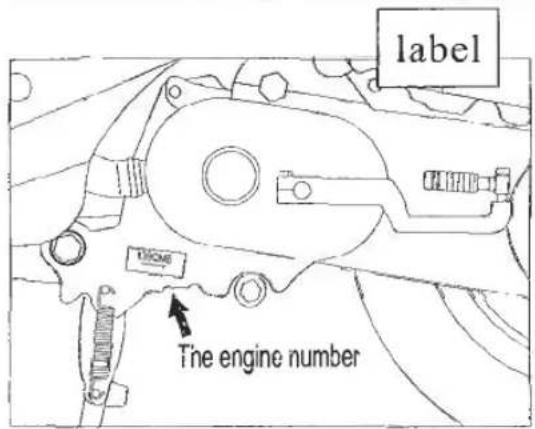
text_image
label The engine number□ Names of parts
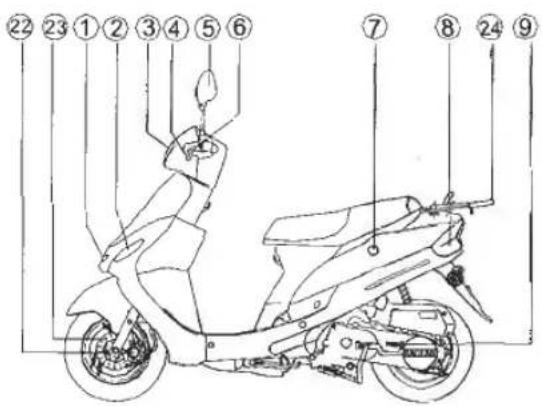
text_image
Diagram of an electric scooter with numbered parts for identification(Disk brake/2 seat)
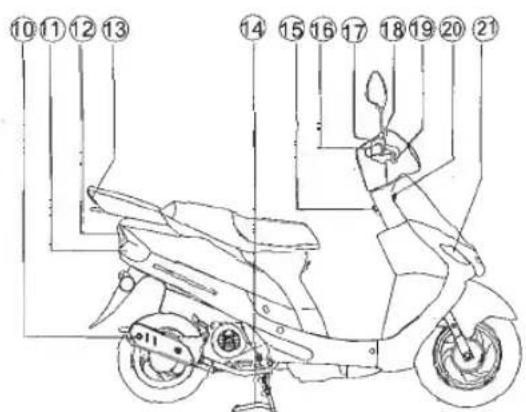
text_image
Technical diagram of a scooter with numbered parts for identificationdrum brake/1 seat)
(1) Front signal light
(2) Left front turning light
(3) Head light
(4) Rear brake lever
(5) Rear-view mirrors
(6) left switches
(19) Front brake lever
(22)brake Disk
(7) Seat lock
(8) Left rear turning light
(9) Starting pedal
(10) Muffler
(11) Right rear turning light
(12) Rear light
(20) Ignition switch
(23)brake assy.
(13) Rear signal light
(14) stand
(15) Helmet hook
(16) Throttle control lever
(17)Meters
(18)light switches
(21) Right front turning light
(24)hand-hold
□ Controlling parts
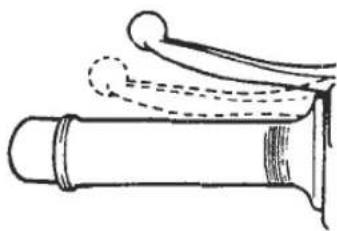
1. Rear brake lever
Hold it tight and the rear brake functions
natural_image
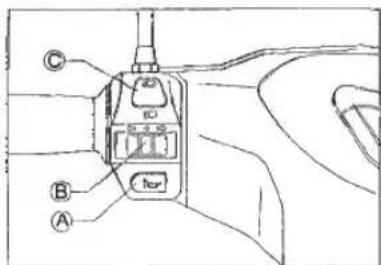
Simple line drawing of a cylindrical object with a curved handle and dashed outline (no text or symbols)2. Switches on the left handle
text_image
Diagram of a walkie-talkie with labeled parts A, B, and C for device status or functionA. Horn button
B. Turning signal switch
Left turning light
→ right turning light
C. Switch for high/low beam lights
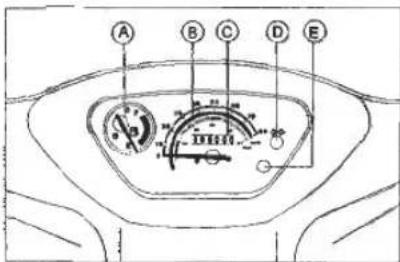
3. Meters and indicating lights
text_image
A B C D E ###A. Speedometer indicates the speed in km/hour
B. Odometer indicates the total distance the motor-cycle has run.
C. Fuel gauge.
D. High beam indicator
E. Turning lights indicator
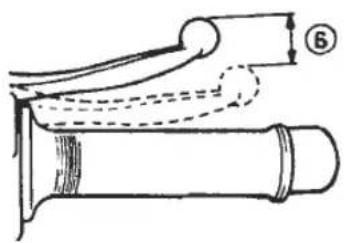
4. Front brake lever
Press it tightly and the front brake functions.
natural_image
Diagram of a mechanical component with dashed lines indicating internal structure (no text or symbols)5. Switches on the right handle
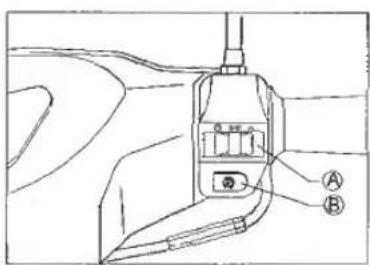
text_image
Technical diagram of a walkie-talkie with labeled parts A and BA. Head light switch
B. Ignition button
When the ignition switch is at ON position, hold the brake and push the button, and then the engine works
6. Gnition switch
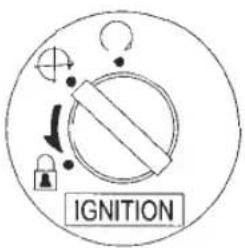
text_image
IGNITIONOFF The whole circuit is cut. Engine and lights cannot be operated and the key can be withdrawn.
ON Engine cannot be started and all the lights can be operated. The key cannot be withdrawn.
LOCK Turn the steering handle fully to the left, slightly press the key and turn it to the position lock. Then the key can be taken out.
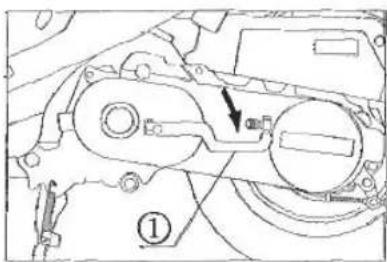
□ Starting lever
Starting lever is for kicking start of the engine.
natural_image
Mechanical assembly diagram showing a gear mechanism with no visible text or symbols□ Fuel tank
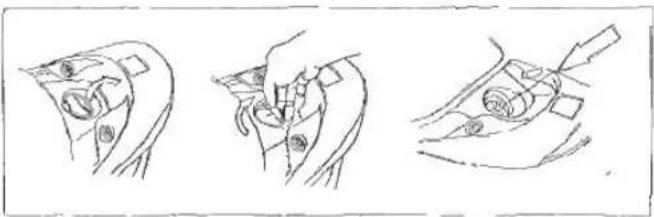
Usage of the cap:
- Insert the key.
- Turn it clockwise and take off the cap.
- Fix the notch and then press the cap on.
natural_image
Three-step line drawing showing hand positioning of a device with buttons and a magnified view (no text or symbols)
Warning:
◆ Turn off the engine when refilling the tank.
◆ Turn off the cap slowly.
◆ Align the mark "△" on the cap to the, mark "↑" on the tank.
◆ Don't overfill the gasoline over the designated scale
◆ Do not add anything into the gasoline.
□ Fuel and engine oil
A. Gasoline
High-quality fuel is essential to the engine.
Any sand in the fuel is absolutely prohibited.
93# gasoline and unleaded gasoline is preferred.
B. Engine oil
SAE-15w/40#
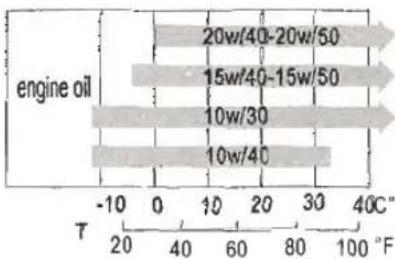
bar
| engine oil | T (°F) | | :--- | :--- | | 20w/40-20w/50 | -10 | | 15w/40-15w/50 | 0 | | 10w/30 | 10 | | 10w/40 | 30 | The chart displays a single bar for each energy range. The x-axis is labeled 'T' with a scale from -10 to 40°C, and the y-axis is labeled 'engine oil'. The right-side arrow indicates the direction of the measurement.Pre-riding inspection
Please check the following parts before you drive.
| No. | Items | Inspection content |
| 1 | Steering bar | 1.Flexibility 2.No gap or loosing appearance |
| 2 | Brake system | 1.Interval between front brake and rear brake 2.No break on the cable3.Flexible function |
| 3 | Tires | 1.Proper pressure 2.No crack or cutting |
| 4 | Fuel | Sufficient fuel |
| 5 | Engine oil | Sufficient engine oil |
| 6 | Lights | Workable |
| 7 | Horn | Workable |
| 8 | Gear oil | With normal stock |
| 9 | Throttle | 1. Proper gap 2.Flexible function 3.Proper control lever returning |
| 10 | All the bolts and nuts | No loosing appearance. |
□ Engine starting
-
Please check the volume of machine oil and gasoline before starting. The main stand should be stood up while starting the engine.
-
Turn the ignition switch to the "ON" position.
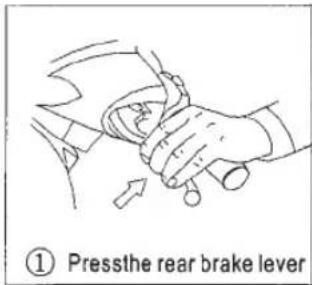
text_image
① Pressthe rear brake lever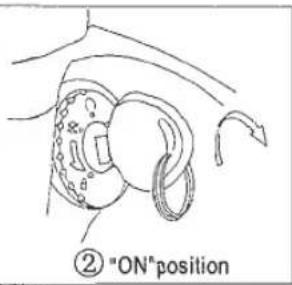
text_image
② "ON"position| Warning: |
| ◆Press the rear brake lever in case that the motorcycle rushes forwards abruptly. |
3. Engine Starting
Push the starting button and then the engine starts.

natural_image
Line drawing of a hand holding a device with a knob, showing a finger movement (no text or symbols)| Warning: |
| ◆ 5 seconds is the maximum limit for each starting and 10 seconds is the minimum interval.◆ Stop pressing the starting button immediately after the engine starts.◆ Do not press the starting button while the engine is running, or the start motor will be damaged.◆ When using electric starting, please press the rear brake lever in advance to get through the circuit and start the motor.◆ When using electric starting, don't operate the starting motor continually, or it may cause damage to the starting motor and the battery.◆ Warm up the engine after cold starting, (abort 3 |
4. Kick Starting
Press the brake handle, tread the starting grip heavily and then the engine will start.
| Warning: |
| ◆ After the engine starts, the starting grip should be turned to its original position. Otherwise, it will affect the driver's safety.◆ Please don't start the engine in malventilated places because the wasted gas with CO is harmful to human beings |
Running in
To maintain your motorcycle running in a good condition, please follow the below rules during the new running-in period.
| Distance(km) | Speed limitation (km/h) |
| 0-200 | 25 |
| 200-1000 | 35 |
| 1000---- | ≤slant 45 |
☐ Regular maintenance
| Item\Interval | Km | 300 | 1000 | 3000 | 6000 | 12000 |
| Month | New motor | 1 | 3 | 6 | 12 | |
| Battery | I | I | I | I | I | |
| Nuts on tank cap and exhausting tub* | I | F | F | f | F | |
| Cylinder cap, cylinder and muffler* | -- | C | C | C | C | |
| Carburetor | I | I | -- | -- | I | |
| Air cleaner | Clean it between every 2000km | |||||
| Spark plug | I | -- | I | |||
| Fuel line | Replace every four years | |||||
| Clutch * | -- | -- | -- | I | I | |
| V-strap | -- | -- | -- | I | I | |
| Engine oil | R | R | Replace every 3000km | |||
| Brake * | I | I | I | I | I | |
| Front fork and steering * | I | I | -- | I | I | |
| Rear suspension | I | I | -- | I | I | |
| Tires | I | I | I | I | I | |
| Fastening nuts and bolts | I | F | -- | F | F | |
| Gear oil | R | Replace every 5000km / 5Month | ||||
| Start motor | -- | -- | -- | -- | I | |
NOTE: I=Inspect and clean, adjust, replace or lubricate as necessary: C=Clear, R=Replace, F=fastened Service more frequently when riding in dusty areas.
1. Battery
12V/4Ah battery
① When the voltage is less than 11.5V, please use kicking start in stead of electric starting
② Place the ignition switch to OFF position before battery replacement.
③ Electrode identification: "+"-red line, "-"black line.
④ Change a new battery every 4 years.
2. Carburetor and idle speed adjustment
① Keep the engine warmed up for 2-3 minutes.
② Adjust the lidling speed screw to set the engine at speed If abort 1800 rpm. The idle speed adjusting screw.
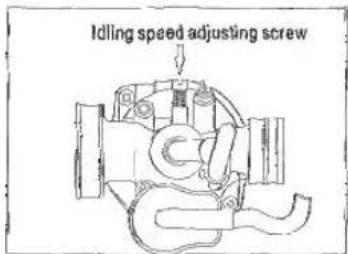
text_image
Idling speed adjusting screwWarning:
It has been fully adjusted to the highest position when manufactured.
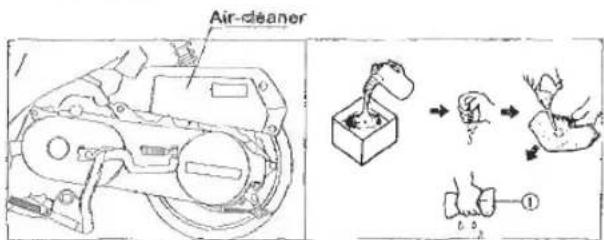
3. Air cleaner
text_image
Air-cleaner ①① Pour the non-inflammable detergent into a basin and immerse the core of air cleaner Into the detergent for cleaning.
② Press the core to squeeze the detergent out of it by the palms. Never twist it in case that it is broken.
③ Immerse the core into engine oil.
④ Squeeze the excessive oil out If if but keep it lightly oil immersed.
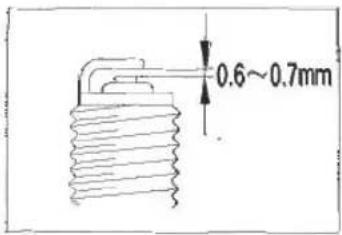
4. Spark plug
◆ Clean the carbon deposit on the spark plug with a piece of hard wire or steel needle.
◆Adjust the gap to 0.6-0.7mm with a thickness gauge.
◆Use (NGK) C7HSA when replacement is needed.
text_image
0.6~0.7mm5.Fuel
Refill the recommended unleaded gasoline with an octane number of 93# or higher when the indicating needle points to the red area in the fuel gauge.
NOTE: Unleaded gasoline will extend spark plug and catalytic converter life.
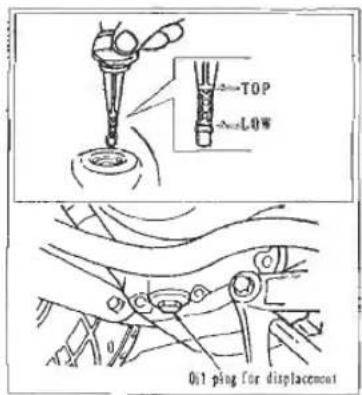
6. Engine oil
Replace the engine oil with the engine warmed up.
text_image
TOP LOW Oil-ping for displacement① Remove the oil dipstick.
② Remove the oil plug to drain the used oil.
③ Reinstall the oil plug, paying attention to the tightness.
④ Refill 0.8 L recommended flesh oil
⑤ Fasten all the nuts and screws.
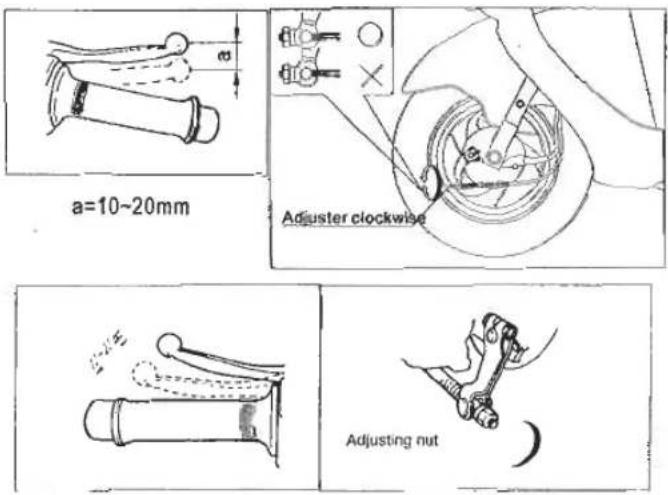
7. Brake system
Normal free stroke of the brake lever is about 10-20mm.
①The front brake Turn the adjusting nut to get a proper stroke
②The rear brake
Turn the adjusting nut to get a proper stroke.
| Warning: |
| ◆FREE STROKE means the distance between the positions from free status to the beginning performance of the brake.◆Pay attention to the sensitivity of the brake. |
☆ Front brake(Disk brake BT50QT-9B & BT50QT-9D)
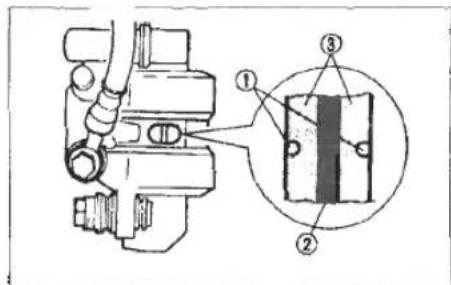
◆ Grip the brake handle and check the wear & tear indicator. If the wear and tear indicator. If the indicator nearly touched the brake disk, please ask the appointed maintainer to change the brake shoes
text_image
Technical diagram of a mechanical assembly with numbered components and a magnified inset showing internal structure.①wear & tear indicator ②Brake disk ③Brake shoes
◆Check the following items of brake system before driving the motorcycle:
① Check if there is any leakage ;
② Check if there is any leakage or crack on the oil pressed hose;
③ The brake handlebar should be kept with a certain free swing distance from 10\~20mm, and kept a certain re-grip power;
④ Abrasion situation of the brake shoes.
◆Brake oil level
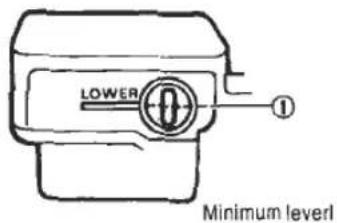
① It has been filled the special brake oil before the motorcycle leaves the factory. User should fill or change the qualified brake oil (such
text_image
LOWER ① Minimum leveras No.DOT3 & DOT4 brake oil) from the appointed maintenance station. Never change or mix other oil, otherwise it would damage the brake system.
②If the brake oil is insufficient, it might be possible for the air to come into the brake system, and result in the failure of the system
Warning:
Brake oil is corrosive material. It would damage and corrupt the painting of the part. It should be cleanout if the oil splash on the part. If the oil sprayed on the skin or eyes, it should be cleaning quickly with a lot of water.
8. Tires
Insufficient tire pressure hastens wear of them and affects the riding stability. Please check the tire pressure and tread depth when applying regular maintenance.
①Tire pressure: front 200 kpa rear 225 kpa.
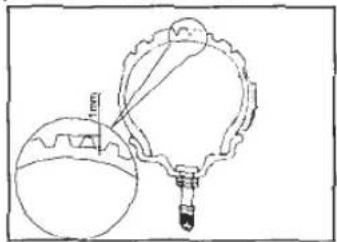
②Tread depth: It is suggested to replace a new tire when the tread depth is less than 1 mm.
natural_image
Simple line drawing of a laboratory flask with a bulb and a bulb-like structure, no text or symbols present.Warning:
◆ The standard tire is 3.0-10-42J for front and rear. The use of tire other than standard may cause trouble.
◆ Tire inflation pressures and the general tire condition are extremely important to the pro-per performance and safety of the vehicle.
9. Starting motor
Check the fastening bolts and the carbon brush, and replace them if necessary.
10. Fuse
Fuse is linked with the outer line of the battery. When a light or circuit fails suddenly, check the fuse first.
Warning:
◆The fuse cannot be replaced by any iron or aluminum wire.
11.Gear oil
Please use the recommended gear oil: SAE10W-4D Total capacity :110ml
Replacing capacity :100ml
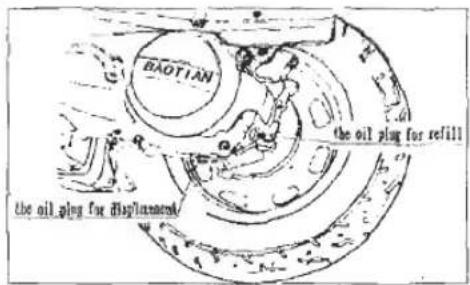
How to change gear oil
● Stand the scooter
● Take off the oil plug on the gear oil sprue
- 1 Take off the oil plug for displacement, let off all the oil
● Tighten the oil plug for displacement
●efill the oil from gear oil sprue, tighten the oil plug After refilling
text_image
BAOTIAN the oil plug for refill the oil plug for displungerAfter supplement, please make sure you have locked the oil then check screw
□Tools
A full set of tools is offered for your daily use.
Technical Parameters
| Items | Specifications | |
| Size | Length | 1660mm |
| Width | 680mm | |
| Height | 1070mm | |
| Wheel base | 1195mm | |
| Min. distance above ground | 80mm | |
| Weight | Unloaded weight | 85kg |
| Loaded weight | 75kg / 150 kg (1 seat / 2 seats) | |
| Mass weight | 165kg / 235kg(1 seat / 2 seats) | |
| Capacity | Max. Speed | 45km/h (e-mark) or 60 km/h |
| Min. Speed | ≤1.8km/h | |
| Slope | ≥6° | |
| Turning Conner | ≥45° | |
| Dia. Of turning Conner | ≤3200mm | |
| Circuit system | Spark plug | (NGK)C7HSA |
| Battery | 12V/4AH | |
| Fuse | 10A | |
| Headlight | 12V 35W | |
| Tuning lights | 12V 10W | |
| Brake light | 12V 21W/8W | |
| Indicating lights | 12V 5W | |
Regular maintenance
| Volume of the fuel tankVolume of the engine oil tank | 6.5L1L | |
| Engine | Model | BT139QMB1 cylinder, cooled by forced air,4 stroke139*41.5mm49.5ml10.5:12.2 kW /7500(r/min)2.9 N • M/7000(r/min)PZ18JPolyurethane plastic coreCDIElectric/kicking startForced air-cooledPressure/splash |
| TypeCylinderBore and strokeCylinder volumeCompression ratioMax. powerMax. torqueCarburetorAir cleanerIgnition typeStarting modeCooling modeLubrication | ||
| Frame | Steel tube frame | |
| Suspension | Front absorberRear cushion | Rock-arm variable-pitch spring & hydraulic damping shock absorberSingle damping shock absorberVariable-pitch spring & hydraulic damping shock absorber |
| Brake system | Expansion braking shoe | |
| Tires | 3.00-10 42J | |
Technical Parameters
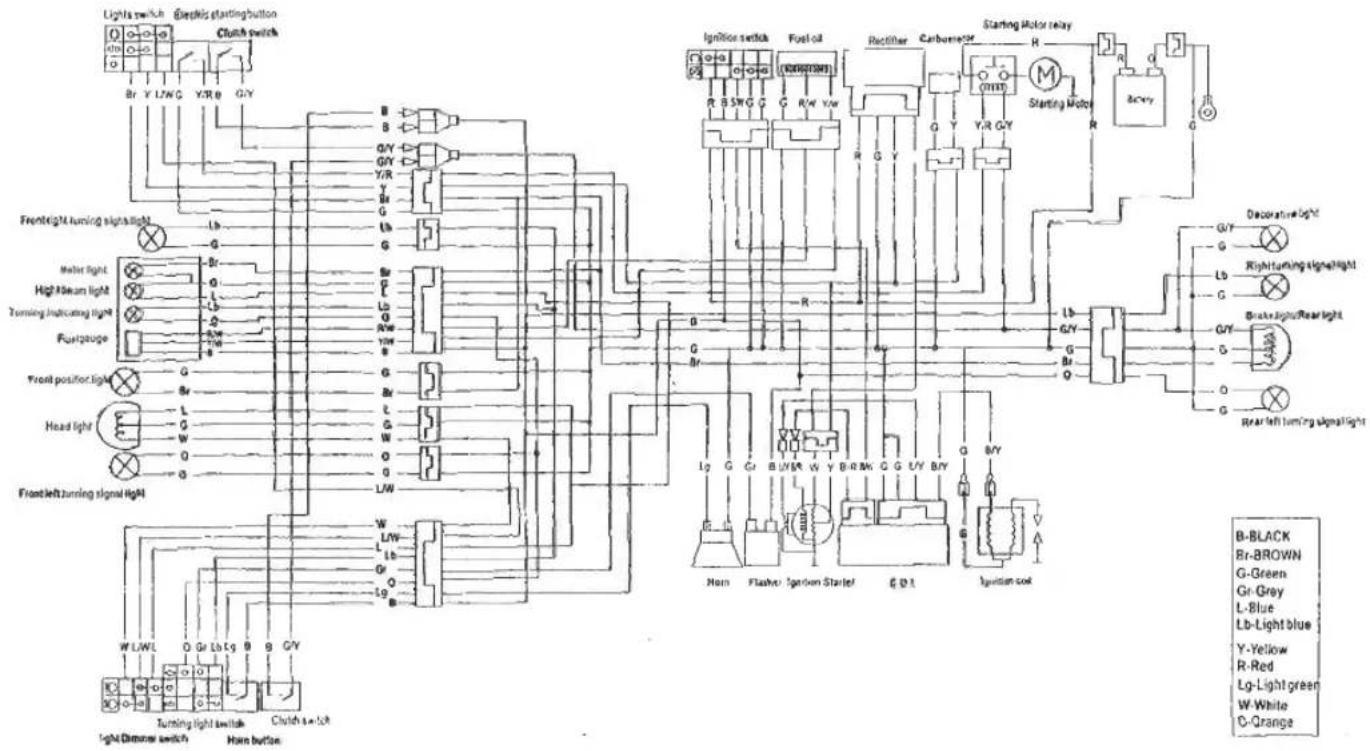
flowchart
graph TD
    A["Light switch"] --> B["Clutch switch"]
    B --> C["Frontlight turning signal light"]
    C --> D["Motor light"]
    D --> E["Turning indicating light"]
    E --> F["Found gauge"]
    F --> G["Front positive light"]
    G --> H["Head light"]
    H --> I["Front left turning signal light"]

    J["Light Dimmer switch"] --> K["Turning light switch"]
    K --> L["Clutch switch"]

    M["Ingitor switch"] --> N["Fuel oil"]
    N --> O["Rectifier"]
    O --> P["Carburner"]
    P --> Q["Starting Motor"]
    Q --> R["Starter Motor"]

    S["Ignition coil"] --> T["Motor"]
    U["Refrigerator"] --> V["Refrigerator"]
    W["Electric light"] --> X["Electric light"]

    Y["Blacklight"] --> Z["Blacklight"]
    AA["Rear left turning signal light"] --> AB["Rear left turning signal light"]

    AC["B-Black"] --> AD["B-Black"]
    AE["B-BROWN"] --> AF["B-BROWN"]
    AG["G-Green"] --> AH["G-Green"]
    AI["Gr-Grey"] --> AJ["Gr-Grey"]
    AK["L-Blue"] --> AL["L-Blue"]
    AM["Lb-Light blue"] --> AN["Lb-Light blue"]
    AO["Y-Yellow"] --> AP["Y-Yellow"]
    AQ["R-Red"] --> AR["R-Red"]
    AS["Lg-Light green"] --> AT["Lg-Light green"]
    AU["W-White"] --> AV["W-White"]
    AW["C-Orange"] --> AX["C-Orange"]