
WorkForce Pro WF-C869 - Nyomtató EPSON - Ingyenes használati útmutató
Találja meg az eszköz kézikönyvét ingyenesen WorkForce Pro WF-C869 EPSON PDF formátumban.


Felhasználói kérdések a következőről WorkForce Pro WF-C869 EPSON
0 kérdés erről a készülékről. Válaszolj azokra, amiket ismersz, vagy tedd fel a sajátod.
Tegyél fel egy új kérdést erről a készülékről
Töltse le az útmutatót a következőhöz Nyomtató PDF formátumban ingyenesen! Találja meg kézikönyvét WorkForce Pro WF-C869 - EPSON és vegye vissza elektronikus eszközét a kezébe. Ezen az oldalon közzé van téve az eszköze használatához szükséges összes dokumentum. WorkForce Pro WF-C869 márka EPSON.
HASZNÁLATI ÚTMUTATÓ WorkForce Pro WF-C869 EPSON
WF-C869R
User's Guide
Copyright
Copyright
No part of this publication may be reproduced, stored in a retrieval system, or transmitted in any form or by any means, electronic, mechanical, photocopying, recording, or otherwise, without the prior written permission of Seiko Epson Corporation. No patent liability is assumed with respect to the use of the information contained herein. Neither is any liability assumed for damages resulting from the use of the information herein. The information contained herein is designed only for use with this Epson product. Epson is not responsible for any use of this information as applied to other products.
Neither Seiko Epson Corporation nor its affiliates shall be liable to the purchaser of this product or third parties for damages, losses, costs, or expenses incurred by the purchaser or third parties as a result of accident, misuse, or abuse of this product or unauthorized modifications, repairs, or alterations to this product, or (excluding the U.S.) failure to strictly comply with Seiko Epson Corporation's operating and maintenance instructions.
Seiko Epson Corporation and its affiliates shall not be liable for any damages or problems arising from the use of any options or any consumable products other than those designated as Original Epson Products or Epson Approved Products by Seiko Epson Corporation.
Seiko Epson Corporation shall not be held liable for any damage resulting from electromagnetic interference that occurs from the use of any interface cables other than those designated as Epson Approved Products by Seiko Epson Corporation.
© 2016 Seiko Epson Corporation. All rights reserved.
The contents of this manual and the specifications of this product are subject to change without notice.
Trademarks
Trademarks
☐ EPSON® is a registered trademark, and EPSON EXCEED YOUR VISION or EXCEED YOUR VISION is a trademark of Seiko Epson Corporation.
□ PRINT Image Matching™ and the PRINT Image Matching logo are trademarks of Seiko Epson Corporation. Copyright © 2001 Seiko Epson Corporation. All rights reserved.
□ Epson Scan 2 software is based in part on the work of the Independent JPEG Group.
□ libtiff
Copyright © 1988-1997 Sam Leffler
Copyright © 1991-1997 Silicon Graphics, Inc.
Permission to use, copy, modify, distribute, and sell this software and its documentation for any purpose is hereby granted without fee, provided that (i) the above copyright notices and this permission notice appear in all copies of the software and related documentation, and (ii) the names of Sam Leffler and Silicon Graphics may not be used in any advertising or publicity relating to the software without the specific, prior written permission of Sam Leffler and Silicon Graphics.
THE SOFTWARE IS PROVIDED "AS-IS" AND WITHOUT WARRANTY OF ANY KIND, EXPRESS, IMPLIED OR OTHERWISE, INCLUDING WITHOUT LIMITATION, ANY WARRANTY OF MERCHANTABILITY OR FITNESS FOR A PARTICULAR PURPOSE.
IN NO EVENT SHALL SAM LEFFLER OR SILICON GRAPHICS BE LIABLE FOR ANY SPECIAL, INCIDENTAL, INDIRECT OR CONSEQUENTIAL DAMAGES OF ANY KIND, OR ANY DAMAGES WHATSOEVER RESULTING FROM LOSS OF USE, DATA OR PROFITS, WHETHER OR NOT ADVISED OF THE POSSIBILITY OF DAMAGE, AND ON ANY THEORY OF LIABILITY, ARISING OUT OF OR IN CONNECTION WITH THE USE OR PERFORMANCE OF THIS SOFTWARE.
□ Microsoft®, Windows®, and Windows Vista® are registered trademarks of Microsoft Corporation.
□ Apple, Macintosh, Mac OS, OS X, Bonjour, Safari, iPad, iPhone, iPod touch, and iTunes are trademarks of Apple Inc., registered in the U.S. and other countries. AirPrint and the AirPrint logo are trademarks of Apple Inc.
☐ Google Cloud Print™, Chrome™, Chrome OS™, and Android™ are trademarks of Google Inc.
☐ Albertus, Arial, Coronet, Gill Sans, Joanna and Times New Roman are trademarks of The Monotype Corporation registered in the United States Patent and Trademark Office and may be registered in certain jurisdictions.
☐ ITC Avant Garde Gothic, ITC Bookman, Lubalin Graph, Mona Lisa, ITC Symbol, Zapf Chancery and Zapf Dingbats are trademarks of International Typeface Corporation registered in the U.S. Patent and Trademark Office and may be registered in certain other jurisdictions.
☐ Clarendon, Eurostile and New Century Schoolbook are trademarks of Linotype GmbH registered in the U.S. Patent and Trademark Office and may be registered in certain other jurisdictions.
□ Wingdings is a registered trademark of Microsoft Corporation in the United States and other countries.
☐ CG Omega, CG Times, Garamond Antiqua, Garamond Halbfett, Garamond Kursiv, Garamond Halbfett Kursiv are trademarks of Monotype Imaging, Inc. and may be registered in certain jurisdictions.
□ Antique Olive is a trademark of M. Olive.
☐ Marigold and Oxford are trademarks of AlphaOmega Typography.
☐ Helvetica, Optima, Palatino, Times and Univers are trademarks of Linotype Corp. registered in the U.S. Patent and Trademark Office and may be registered in certain other jurisdictions in the name of Linotype Corp. or its licensee Linotype GmbH.
☐ PCL is the registered trademark of Hewlett-Packard Company.
Trademarks
□ Adobe, the Adobe logo, Acrobat, Photoshop, PostScript®3™, and Reader are either registered trademarks or trademarks of Adobe Systems Incorporated in the United States and/or other countries.
Arcfour
This code illustrates a sample implementation of the Arcfour algorithm.
Copyright © April 29, 1997 Kalle Kaukonen. All Rights Reserved.
Redistribution and use in source and binary forms, with or without modification, are permitted provided that this copyright notice and disclaimer are retained.
THIS SOFTWARE IS PROVIDED BY KALLE KAUKONEN AND CONTRIBUTORS "AS IS" AND ANY EXPRESS OR IMPLIED WARRANTIES, INCLUDING, BUT NOT LIMITED TO, THE IMPLIED WARRANTIES OF MERCHANTABILITY AND FITNESS FOR A PARTICULAR PURPOSE ARE DISCLAIMED. IN NO EVENT SHALL KALLE KAUKONEN OR CONTRIBUTORS BE LIABLE FOR ANY DIRECT, INDIRECT, INCIDENTAL, SPECIAL, EXEMPLARY, OR CONSEQUENTIAL DAMAGES (INCLUDING, BUT NOT LIMITED TO, PROCUREMENT OF SUBSTITUTE GOODS OR SERVICES; LOSS OF USE, DATA, OR PROFITS; OR BUSINESS INTERRUPTION) HOWEVER CAUSED AND ON ANY THEORY OF LIABILITY, WHETHER IN CONTRACT, STRICT LIABILITY, OR TORT (INCLUDING NEGLIGENCE OR OTHERWISE) ARISING IN ANY WAY OUT OF THE USE OF THIS SOFTWARE, EVEN IF ADVISED OF THE POSSIBILITY OF SUCH DAMAGE.
□ microSDHC Logo is a trademark of SD-3C, LLC.
Note: microSDHC is built into the product and cannot be removed.

Intel® is a registered trademark of Intel Corporation.
☐ The N-Mark is a trademark or registered trademark of NFC Forum, Inc. in the United States and in other countries.
☐ The SuperSpeed USB Trident Logo is a registered trademark of USB Implementers Forum, Inc.
☐ General Notice: Other product names used herein are for identification purposes only and may be trademarks of their respective owners. Epson disclaims any and all rights in those marks.
Contents
Contents
Copyright
Trademarks
About This Manual
Introduction to the Manuals. 10
Marks and Symbols....10
Descriptions Used in this Manual. 11
Operating System References....11
Important Instructions
Safety Instructions....12
Printer Advisories and Warnings. 13
Advisories and Warnings for Setting Up/ Using the Printer....13
Advisories and Warnings for Using the Printer with a Wireless Connection....14
Advisories and Warnings for Using the Touchscreen. 15
Advisories and Warnings for Using the Optional Cabinet. 15
Protecting Your Personal Information....15
Printer Basics
Part Names and Functions....16
Control Panel. 20
Buttons and Lights....20
Basic Screen Configuration....21
Touch Screen Operations. 21
Icons displayed in the LCD Screen. 22
Entering Characters. 23
Job/Status Screen Configuration. 24
Viewing Animations....25
Registering Your Favorite Settings as a Preset. . . . . .25
Menu Options for Presets....25
Network Settings
Network Connection Types. 27
Ethernet Connection. 27
Wi-Fi Connection. 27
Wi-Fi Direct (Simple AP) Connection. . . . . . . . 28
Connecting to a Computer....28
Connecting to a Smart Device.... 30
Making Wi-Fi Settings from the Printer....30
Making Wi-Fi Settings Manually....31
Making Wi-Fi Settings by Push Button Setup (WPS)....32
Making Wi-Fi Settings by PIN Code Setup (WPS)....33
Making Wi-Fi Direct (Simple AP) Connection Settings....34
Making Advanced Network Settings....34
Checking the Network Connection Status. . . . . . . 36
Network Icon. 37
Checking Detailed Network Information from the Control Panel....37
Printing a Network Connection Report. .....37
Printing a Network Status Sheet. 41
Replacing or Adding New Access Points. 42
Changing the Connection Method to a Computer. . 42
Changing the Network Connection to Ethernet from the Control Panel. 44
Disabling Wi-Fi from the Control Panel. . . . . . . . . . 44
Disconnecting Wi-Fi Direct (Simple AP) Connection from the Control Panel. 44
Restoring the Network Settings from the Control Panel. 45
Administrator Settings
Locking the Printer Settings Using an Administrator's Password. 46
Unlocking the Printer Settings. 46
User Feature Restrictions. 46
Loading Paper
Paper Handling Precautions. 47
Available Paper and Capacities. 48
List of Detected Paper Sizes.... 51
List of Paper Type. 51
Loading Paper in the Paper Cassette. 52
Loading Paper in the Rear Paper Feed. . . . . . . . . . . 54
Placing Originals
Available Originals for the ADF. 57
Placing Originals on the ADF. 57
Placing Originals on the ADF for 2-up Copying. .60
Placing Originals on the Scanner Glass. 60
Contents
Managing Contacts
Registering or Editing Contacts. 63
Registering or Editing Grouped Contacts. . . . . . . 64
Registering Frequently Used Contacts. . . . . . . . . . . . 64
Register Contacts on a Computer....65
Backing up Contacts using a Computer....65
Printing
Printing from the Control Panel. 66
Printing JPEG Files from a Memory Device....66
Printing PDF or TIFF Files from a Memory Device. 67
Menu Options for Memory Device. 67
Printing from a Computer....69
Authenticating Users in the Printer Driver when User Feature Restriction Is Enabled (for Windows Only). 69
Printing Basics - Windows....70
Printing Basics - Mac OS X. . . . . . . . . . . . . . . . . . . . . . . . . . . . . . . . . . . . . . . . . . . 71
Printing on 2-Sides. 73
Printing Several Pages on One Sheet. . . . . . . . . 75
Printing to Fit the Paper Size....76
Printing Multiple Files Together (for Windows Only)....78
Printing One Image on Multiple Sheets to Create a Poster (for Windows Only). 79
Printing Using Advanced Features. 85
Printing Using a PostScript Printer Driver.....88
Printing Using a PostScript Printer Driver - Windows....88
Printing Using a PostScript Printer Driver - Mac OS X. 90
Setting Items for the PostScript Printer Driver. . . 92
Printing from Smart Devices. 93
Using Epson iPrint....93
Using AirPrint....96
Printing the Password Setting File. 96
Canceling Printing....97
Canceling Printing - Job/Status Menu. . . . . . . . 97
Canceling Printing - Windows. 97
Canceling Printing - Mac OS X. 98
Copying
Copying Basics....99
Basic Menu Options for Copying. 99
Advanced Menu Options for Copying. . . . . . . . 101
Scanning
Scanning Using the Control Panel....104
Scanning to a Network Folder or FTP Server. . . 104
Scanning to an Email. 107
Scanning Using Document Capture Pro. . . . . . 109
Scanning to a Memory Device.... 111
Scanning to the Cloud. 113
Scanning to a Computer (WSD). 115
Scanning from a Computer....117
Authenticating Users on Epson Scan 2 when Using Access Control. 117
Scanning Using Epson Scan 2....117
Scanning from Smart Devices....120
Installing Epson iPrint. 120
Scanning Using Epson iPrint....120
Scanning by Touching Smart Devices to the N-Mark. 121
Faxing
Setting Up a Fax. 123
Connecting to a Phone Line....123
Making Basic Fax Settings....127
Sending Faxes. 131
Basic Fax Sending Operations....131
Various Ways of Sending Faxes. 134
Receiving Faxes. 140
Setting Receiving Mode.... 140
Various Ways of Receiving Faxes. 141
Saving and Forwarding Received Faxes (Unconditional Save/Forward).... 144
Saving and Forwarding Received Faxes from a Specified Sender or at a Specified Time (Conditional Save/Forward). 150
Using the Fax Box Features. 160
Using the Inbox. 160
Using the Confidential Box....161
Using the Stored Documents Box. 162
Using the Polling Send Box. 162
Using the Board Box. 163
Using Other Faxing Features....164
Printing Fax Report and List. 164
Setting Security for Faxing. 165
Checking Fax Jobs. 166
Menu Options for Fax Mode....168
Recipient....168
Fax Settings....168
More....170
Menu Options for Fax Settings.... 171
Contents
Quick Operation Button....171
Send Settings....171
Receive Settings. 172
Report Settings. 176
Basic Settings....176
Security Settings....177
Check Fax Connection....178
Fax Setting Wizard....178
Menu Options for User Settings. 178
Menu Options for Fax Box. 179
Replacing Ink Supply Units and Other Consumables
Checking the Status of the Remaining Ink and the Maintenance Box. 180
Checking the Status of the Remaining Ink and the Maintenance Box - Control Panel. . . . 180
Checking the Status of the Remaining Ink and the Maintenance Box - Windows....180
Checking the Status of the Remaining Ink and the Maintenance Box - Mac OS X. . . . . . . 180
Ink Supply Unit Codes....181
Ink Supply Unit Handling Precautions....181
Replacing Ink Supply Units. 183
Maintenance Box Code. 183
Maintenance Box Handling Precautions. . . . . . . 183
Replacing the Maintenance Box. 183
Maintenance Rollers Codes....184
Replacing Maintenance Rollers in Paper Cassette 1. 184
Replacing Maintenance Rollers in Paper Cassette 2 to 4. 188
Maintaining the Printer
Adjusting the Print Quality....193
Checking and Cleaning the Print Head. . . . . . . . 194
Checking and Cleaning the Print Head - Control Panel....194
Checking and Cleaning the Print Head - Windows. 195
Checking and Cleaning the Print Head - Mac OS X. 195
Aligning Ruled Lines.... 195
Adjusting the Print Quality for Each Paper Type. . 196
Cleaning the Paper Path....196
Cleaning the Paper Path for Ink Smears. . . . . . 196
Cleaning the Paper Path for Paper Feeding Problems (Paper Cassette).... 197
Cleaning the ADF. 197
Cleaning the Scanner Glass. 200
Saving Power....201
Saving Power - Control Panel. 201
Menu Options for Settings
Menu Options for General Settings. 202
Basic Settings....202
Printer Settings. 203
Network Settings. 208
Web Service Settings. 209
System Administration Settings. 209
Menu Options for Print Counter.....209
Menu Options for Supply Status. 210
Menu Options for Maintenance. 210
Menu Options for Language. 211
Menu Options for Printer Status/Print. . . . . . . . . 211
Network: 211
Print Status Sheet: 211
Menu Options for Contacts Manager. . . . . . . . . . . . 212
Menu Options for User Settings. 212
Menu Options for Authentication Device Status. . .212
Menu Options for Epson Open Platform Information. 213
Network Service and Software Information
Epson Connect Service....214
Web Config. 214
Running Web Config on a Web Browser. . . . . . 215
Running Web Config on Windows. 215
Running Web Config on Mac OS X. 216
Windows Printer Driver. 216
Restricting Settings for the Windows Printer Driver....217
Making Operation Settings for the Windows Printer Driver. 217
Mac OS X Printer Driver. 218
Making Operation Settings for the Mac OS X Printer Driver. 218
Epson Scan 2 (Scanner Driver)....219
Document Capture Pro. 219
PC-FAX Driver (Fax Driver)....220
FAX Utility. 220
EPSON Software Updater....221
EpsonNet Config. 222
Contents
Uninstalling Applications. 222
Uninstalling Applications - Windows.....222
Uninstalling Applications - Mac OS X. ..... 223
Installing Applications. 224
Installing a PostScript Printer Driver.....224
Installing the Epson Universal Printer Driver (for Windows Only). 227
Updating Applications and Firmware. 227
Updating the Printer's Firmware using the Control Panel. 228
Solving Problems
Checking the Printer Status. 229
Checking Messages on the LCD Screen. . . . . . 229
Error Code on the Status Menu. 231
Checking the Printer Status - Windows. . . . . . 236
Checking the Printer Status - Mac OS X. . . . . . .236
Checking the Software Status.... 236
Removing Jammed Paper. 236
Paper Does Not Feed or Eject Correctly. . . . . . . . 237
Paper Jams. 237
Paper Feeds at a Slant. 238
Several Sheets of Paper are Fed at a Time. . . . . . 238
Paper Does Not Feed from the Optional Paper Cassette Units. 238
Paper Does Not Feed Correctly After Replacing the Maintenance Rollers. . . . . . . . 238
Paper Out Error Occurs. 238
Original Does Not Feed in the ADF. . . . . . . . . . 238
Paper is Not Stacked in Order. 239
Paper is Ejected in an Unexpected Direction. . . 239
Power and Control Panel Problems....240
Power Does Not Turn On. 240
Power Does Not Turn Off. 240
Power Turns Off Automatically....240
LCD Screen Gets Dark. 240
Touchscreen Does Not Respond. 240
Cannot Operate from the Control Panel. . . . . 240
Cannot Print from a Computer....241
When You Cannot Make Network Settings.....242
Cannot Connect from Devices Even Though Network Settings are No Problems. 242
Checking the SSID Connected to the Printer. . . 244
Checking the SSID for the Computer.....244
Suddenly the Printer Cannot Print over a Network Connection. 245
Suddenly the Printer Cannot Print Using a USB Connection. 246
Cannot Print from an iPhone or iPad. 246
Printing is Paused. 246
Printout Problems. 247
Printout is Scuffed or Color is Missing. . . . . . . 247
Banding or Unexpected Colors Appear. . . . . . 247
Colored Banding Appears at Intervals of Approximately 3.3 cm....247
Blurry Prints, Vertical Banding, or Misalignment. 248
Print Quality is Poor. 248
Paper Is Smeared or Scuffed. 249
Paper is Smeared During Automatic 2-Sided Printing....250
Printed Photos are Sticky. 250
Images or Photos are Printed in Unexpected Colors. 251
The Position, Size, or Margins of the Printout Are Incorrect. 251
Printed Characters Are Incorrect or Garbled. . . 251
The Printed Image Is Inverted....252
Mosaic-Like Patterns in the Prints. . . . . . . . . . . . 252
Uneven Colors, Smears, Dots, or Straight Lines Appear in the Copied Image. . . . . . . . . . . . 252
Moiré (Cross-Hatch) Patterns Appear in the Copied Image. 252
An Image of the Reverse Side of the Original Appears in the Copied Image. 253
The Printout Problem Could Not be Cleared. . . 253
Other Printing Problems. 253
Printing Is Too Slow....253
Printing Slows Down Dramatically During Continuous Printing. 254
Cannot Cancel Printing from a Computer Running Mac OS X v10.6.8....254
PostScript Printer Driver Problems....254
Printer Does Not Print While Using PostScript Printer Driver.... 254
Printer Does Not Print Correctly While Using PostScript Printer Driver....255
Print Quality Is Poor While Using PostScript Printer Driver. 255
Printing Is Too Slow While Using PostScript Printer Driver. 255
Cannot Start Scanning....255
Scanned Image Problems. 256
Uneven Colors, Dirt, Spots, and so on Appear when Scanning from the Scanner Glass. . . . . . 256
Straight Lines Appear when Scanning from ADF. 256
The Image Quality Is Rough....257
Offset Appears in the Background of Images. . . 257
Text is Blurred. 257
Contents
Moiré Patterns (Web-Like Shadows) Appear... 257
Cannot Scan the Correct Area on the Scanner Glass. 258
Text is Not Recognized Correctly when Saving as a Searchable PDF....258
Cannot Solve Problems in the Scanned Image. . 258
Other Scanning Problems....259
Scanning Speed Is Slow....259
Cannot Send the Scanned Image by Email. . . . 259
Scanning Stops when Scanning to PDF/Multi-TIFF....260
Problems when Sending and Receiving Faxes. . . . 260
Cannot Send or Receive Faxes. 260
Cannot Send Faxes. 261
Cannot Send Faxes to a Specific Recipient. . . . 262
Cannot Send Faxes at a Specified Time. ..... 262
Cannot Receive Faxes. 263
Cannot Save Received Faxes to a Memory Device....263
Memory Full Error Occurs. 263
Sent Fax Quality Is Poor. 264
Faxes Are Sent at the Wrong Size. 264
Received Fax Quality Is Poor....265
Cannot Receive A3 Size Faxes. 265
Received Faxes Are Not Printed. 265
Pages are Blank or only a Small Amount of Text is Printed on the Second Page in Received Faxes. 266
Other Faxing Problems....266
Cannot Make Calls on the Connected Telephone. 266
Answering Machine Cannot Answer Voice Calls. 266
Sender's Fax Number Not Displayed on Received Faxes or the Number Is Wrong. . . . . 266
Other Problems. 266
Slight Electric Shock when Touching the Printer....266
Operation Sounds Are Loud. 267
The Date and Time Are Incorrect. 267
Memory Device Is not Recognized. 267
Cannot Save Data to a Memory Device. . . . . . 267
Forgot Your Password....267
Application Is Blocked by a Firewall (for Windows Only)....268
"!" Is Displayed on the Photo Selection Screen. . 268
Installing the Optional Units
Optional Cabinet Code....269
Installing the Optional Cabinet. 269
Optional Paper Cassette Unit Code. 274
Installing the Optional Paper Cassette Units. . . . . 274
Setting the Optional Paper Cassette Unit in the Printer Driver....279
Appendix
Technical Specifications. 281
Printer Specifications. 281
Scanner Specifications. 282
Interface Specifications....282
Fax Specifications....282
Network Function List. 283
Wi-Fi Specifications. 285
Ethernet Specifications. 285
Security Protocol....286
PostScript Level 3 Compatibility....286
Supported Third Party Services....286
External USB Device Specifications. 286
Dimensions. 287
Electrical Specifications. 288
Environmental Specifications. 289
System Requirements. 289
Font Information. 290
Available Fonts for PostScript. 290
Available Fonts for PCL (URW)....291
List of Symbol Sets. 292
Regulatory Information. 295
Standards and Approvals. 295
German Blue Angel. 296
Restrictions on Copying. 296
Moving and Transporting the Printer. 297
Moving the Printer....297
Moving the Printer While the Optional Paper Cassette Units are Attached. 299
Moving the Printer While the Optional Cabinet is Attached. 300
Transporting the Printer....301
Accessing an External USB Device From a
Computer....301
Using an Email Server. 302
Configuring Mail Server....302
Email Server Setting Items. 303
Checking an Email Server Connection.....303
Where to Get Help. 304
Technical Support Web Site. 304
Contacting Epson Support. 304
About This Manual
Introduction to the Manuals
The following manuals are supplied with your Epson printer. As well as the manuals, check the various types of help information available from the printer itself or from the Epson software applications.
☐ Important Safety Instructions (paper manual)
Provides you with instructions to ensure the safe use of this printer.
□ Start Here (paper manual)
Provides you with information on setting up the printer and installing the software.
□ User's Guide (digital manual)
This manual. Provides overall information and instructions on using the printer, on network settings when using the printer on a network, and on solving problems.
□ Administrator's Guide (digital manual)
Provides network administrators with information on management and printer settings.
You can obtain the latest versions of the above manuals with the following methods.
□ Paper manual
Visit the Epson Europe support website at http://www.epson.eu/Support, or the Epson worldwide support website at http://support.epson.net/.
Digital manual
Start EPSON Software Updater on your computer. EPSON Software Updater checks for available updates of Epson software applications and the digital manuals, and allows you to download the latest ones.
Related Information
→ "EPSON Software Updater" on page 221
Marks and Symbols

Caution:
Instructions that must be followed carefully to avoid bodily injury.

Important:
Instructions that must be observed to avoid damage to your equipment.
Note:
Provides complementary and reference information.

Related Information
Links to related sections.
About This Manual
Descriptions Used in this Manual
☐ Screenshots of the printer driver and the Epson Scan 2 (scanner driver) screens are from Windows 10 or Mac OS X v10.11.x. The content displayed on the screens varies depending on the model and situation.
□ Illustrations of the printer used in this manual are examples only. Although there may be slight differences depending on the model, the method of operation is the same.
☐ Some of the menu items on the LCD screen vary depending on the model and settings.
Operating System References
Windows
In this manual, terms such as "Windows 10", "Windows 8.1", "Windows 8", "Windows 7", "Windows Vista", "Windows XP", "Windows Server 2012 R2", "Windows Server 2012", "Windows Server 2008 R2", "Windows Server 2008", "Windows Server 2003 R2", and "Windows Server 2003" refer to the following operating systems. Additionally, "Windows" is used to refer to all versions.
□ Microsoft® Windows® 10 operating system
□ Microsoft® Windows® 8.1 operating system
□ Microsoft® Windows® 8 operating system
□ Microsoft® Windows® 7 operating system
□ Microsoft® Windows Vista® operating system
□ Microsoft® Windows® XP operating system
□ Microsoft® Windows® XP Professional x64 Edition operating system
□ Microsoft® Windows Server® 2012 R2 operating system
□ Microsoft® Windows Server® 2012 operating system
□ Microsoft® Windows Server® 2008 R2 operating system
□ Microsoft® Windows Server® 2008 operating system
□ Microsoft® Windows Server® 2003 R2 operating system
□ Microsoft® Windows Server® 2003 operating system
Mac OS X
In this manual, "Mac OS X v10.11.x" refers to OS X El Capitan, "Mac OS X v10.10.x" refers to OS X Yosemite, "Mac OS X v10.9.x" refers to OS X Mavericks, and "Mac OS X v10.8.x" refers to OS X Mountain Lion. Additionally, "Mac OS X" is used to refer to "Mac OS X v10.11.x", "Mac OS X v10.10.x", "Mac OS X v10.9.x", "Mac OS X v10.8.x", "Mac OS X v10.7.x", and "Mac OS X v10.6.8".
Important Instructions
Important Instructions
Safety Instructions
Read and follow these instructions to ensure safe use of this printer. Make sure you keep this manual for future reference. Also, be sure to follow all warnings and instructions marked on the printer.
☐ Some of the symbols used on your printer are to ensure safety and proper use of the printer. Visit the following Web site to learn the meaning of the symbols.
http://support.epson.net/symbols
☐ Use only the power cord supplied with the printer and do not use the cord with any other equipment. Use of other cords with this printer or the use of the supplied power cord with other equipment may result in fire or electric shock.
□ Be sure your AC power cord meets the relevant local safety standard.
□ Never disassemble, modify, or attempt to repair the power cord, plug, printer unit, scanner unit, or options by yourself, except as specifically explained in the printer's manuals.
□ Unplug the printer and refer servicing to qualified service personnel under the following conditions:
The power cord or plug is damaged; liquid has entered the printer; the printer has been dropped or the casing damaged; the printer does not operate normally or exhibits a distinct change in performance. Do not adjust controls that are not covered by the operating instructions.
Place the printer near a wall outlet where the plug can be easily unplugged.
☐ Do not place or store the printer outdoors, near excessive dirt or dust, water, heat sources, or in locations subject to shocks, vibrations, high temperature or humidity.
☐ Take care not to spill liquid on the printer and not to handle the printer with wet hands.
☐ Keep the printer at least 22 cm away from cardiac pacemakers. Radio waves from this printer may adversely affect the operation of cardiac pacemakers.
☐ If the LCD screen is damaged, contact your dealer. If the liquid crystal solution gets on your hands, wash them thoroughly with soap and water. If the liquid crystal solution gets into your eyes, flush them immediately with water. If discomfort or vision problems remain after a thorough flushing, see a doctor immediately.
□ Avoid using a telephone during an electrical storm. There may be a remote risk of electric shock from lightning
☐ Do not use a telephone to report a gas leak in the vicinity of the leak.
Important Instructions
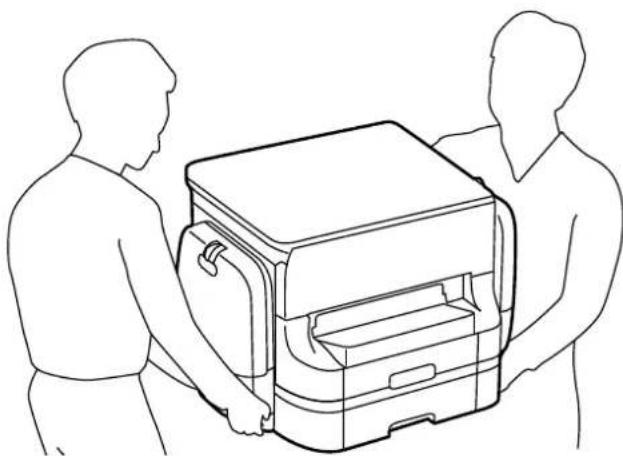
☐ The printer is heavy and should not be lifted or carried by less than two people. When lifting the printer, two or more people should assume the correct positions as shown below.
natural_image
Line drawing of two people handling a large box (no text or symbols)☐ Be careful when you handle used ink supply units, as there may be some ink around the ink supply port.
☐ If ink gets on your skin, wash the area thoroughly with soap and water.
☐ If ink gets into your eyes, flush them immediately with water. If discomfort or vision problems continue after a thorough flushing, see a doctor immediately.
☐ If ink gets into your mouth, see a doctor right away.
☐ Do not disassemble the ink supply unit and the maintenance box; otherwise ink may get into your eyes or on your skin.
☐ Do not shake ink supply units too vigorously; otherwise ink may leak from the ink supply units.
☐ Keep ink supply units and maintenance box out of the reach of children.
Printer Advisories and Warnings
Read and follow these instructions to avoid damaging the printer or your property. Make sure you keep this manual for future reference.
Advisories and Warnings for Setting Up/Using the Printer
☐ Do not block or cover the vents and openings in the printer.
□ Use only the type of power source indicated on the printer's label.
□ Avoid using outlets on the same circuit as photocopiers or air control systems that regularly switch on and off.
□ Avoid electrical outlets controlled by wall switches or automatic timers.
□ Keep the entire computer system away from potential sources of electromagnetic interference, such as loudspeakers or the base units of cordless telephones.
☐ The power-supply cords should be placed to avoid abrasions, cuts, fraying, crimping, and kinking. Do not place objects on top of the power-supply cords and do not allow the power-supply cords to be stepped on or run over. Be particularly careful to keep all the power-supply cords straight at the ends and the points where they enter and leave the transformer.
Important Instructions
☐ If you use an extension cord with the printer, make sure that the total ampere rating of the devices plugged into the extension cord does not exceed the cord's ampere rating. Also, make sure that the total ampere rating of all devices plugged into the wall outlet does not exceed the wall outlet's ampere rating.
☐ If you plan to use the printer in Germany, the building installation must be protected by a 10 or 16 amp circuit breaker to provide adequate short-circuit protection and over-current protection for the printer.
☐ When connecting the printer to a computer or other device with a cable, ensure the correct orientation of the connectors. Each connector has only one correct orientation. Inserting a connector in the wrong orientation may damage both devices connected by the cable.
Place the printer on a flat, stable surface that extends beyond the base of the printer in all directions. The printer will not operate properly if it is tilted at an angle.
☐ When storing or transporting the printer, avoid tilting it, placing it vertically, or turning it upside down; otherwise ink may leak.
☐ Allow space above the printer so that you can fully raise the document cover.
☐ Leave enough space in front of the printer for the paper to be fully ejected.
☐ Avoid places subject to rapid changes in temperature and humidity. Also, keep the printer away from direct sunlight, strong light, or heat sources.
☐ Do not insert objects through the slots in the printer.
☐ Do not put your hand inside the printer during printing.
☐ Do not touch the white flat cable inside the printer.
☐ Do not use aerosol products that contain flammable gases inside or around the printer. Doing so may cause fire.
☐ Do not move the print head by hand; otherwise, you may damage the printer.
☐ Be careful not to trap your fingers when closing the document cover.
☐ Do not press too hard on the scanner glass when placing the originals.
□ Always turn the printer off using the ⏻ button. Do not unplug the printer or turn off the power at the outlet until the ⏻ light stops flashing.
Before transporting the printer, make sure that the print head is in the home (far right) position, and the ink supply units are removed.
☐ If you are not going to use the printer for a long period, be sure to unplug the power cord from the electrical outlet.
Advisories and Warnings for Using the Printer with a Wireless Connection
☐ Radio waves from this printer may negatively affect the operation of medical electronic equipment, causing them to malfunction. When using this printer inside medical facilities or near medical equipment, follow directions from the authorized personnel representing the medical facilities, and follow all posted warnings and directions on the medical equipment.
☐ Radio waves from this printer may negatively affect the operation of automatically controlled devices such as automatic doors or fire alarms, and could lead to accidents due to malfunction. When using this printer near automatically controlled devices, follow all posted warnings and directions on these devices.
Important Instructions
Advisories and Warnings for Using the Touchscreen
☐ The LCD screen may contain a few small bright or dark spots, and because of its features it may have an uneven brightness. These are normal and do not indicate that it is damaged in any way.
☐ Only use a dry, soft cloth for cleaning. Do not use liquid or chemical cleaners.
☐ The exterior cover of the touchscreen could break if it receives a heavy impact. Contact your dealer if the panel surface chips or cracks, and do not touch or attempt to remove the broken pieces.
☐ Press the touchscreen gently with your finger. Do not press force or operate with your nails.
☐ Do not use sharp objects such as ball point pens or sharp pencils to perform operations.
☐ Condensation inside the touchscreen due to abrupt changes in temperature or humidity may cause performance to deteriorate.
Advisories and Warnings for Using the Optional Cabinet
☐ This cabinet is exclusively designed to install this printer on top as well as the optional paper cassette units. Do not install any other products except for the specified printer and paper cassette unit.
☐ Do not climb on the cabinet or place heavy object on it.
☐ Make absolutely sure both stands are attached securely, otherwise the printer may fall.
☐ Secure the printer or the optional paper cassette unit to the cabinet using the two attachments and screws supplied with the cabinet.
☐ When using the printer, make sure you lock the casters at the front of the cabinet.
☐ Do not move the cabinet when the casters are locked.
☐ When moving the cabinet with the printer or the optional paper cassette unit installed, avoid moving over uneven or rough surfaces.
Protecting Your Personal Information
When you give the printer to someone else or dispose of it, erase all the personal information stored in the printer's memory by selecting the menus on the control panel as described below.
Settings > General Settings > System Administration > Restore Default Settings > Clear All Data and Settings
Printer Basics
Part Names and Functions
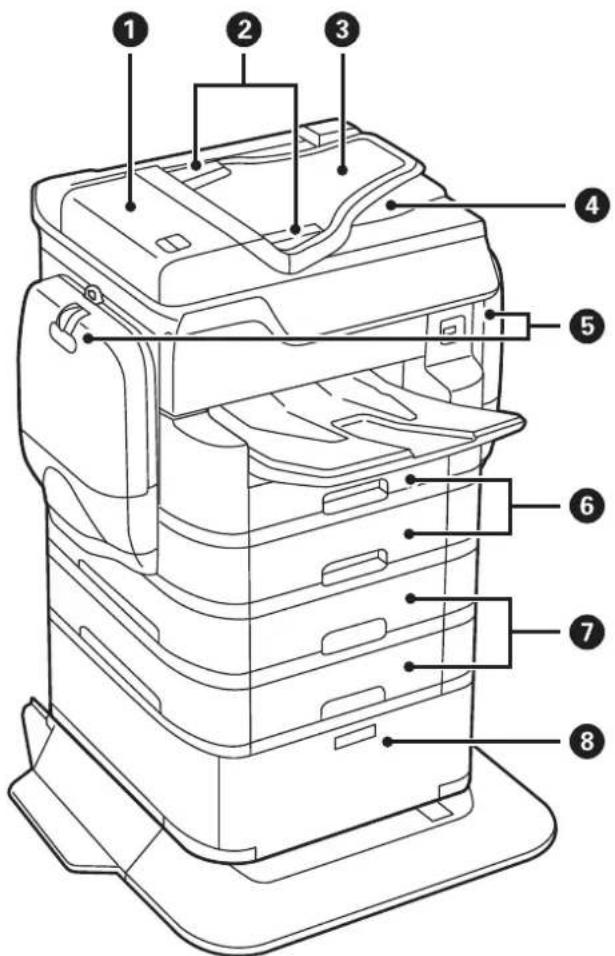
| 12 | ADF (Automatic Document Feeder) cover (F)ADF edge guides | Open when removing jammed originals in the ADF.Feed originals straight into the printer. Slide to the edges of the originals. |
| 3 | ADF input tray (F) | Feeds originals automatically. |
| 45 | ADF output trayInk cases (P1, P2) | Holds originals ejected from the ADF.Insert the ink supply units. |
| 6 | Paper cassette 1, Paper cassette 2 (C1, C2) | Loads paper. |
| 78 | Paper cassette 3, Paper cassette 4 (C3, C4)Cabinet | Optional paper cassette units. Loads paper.Optional cabinet. Stores paper or other consumables. |
Printer Basics
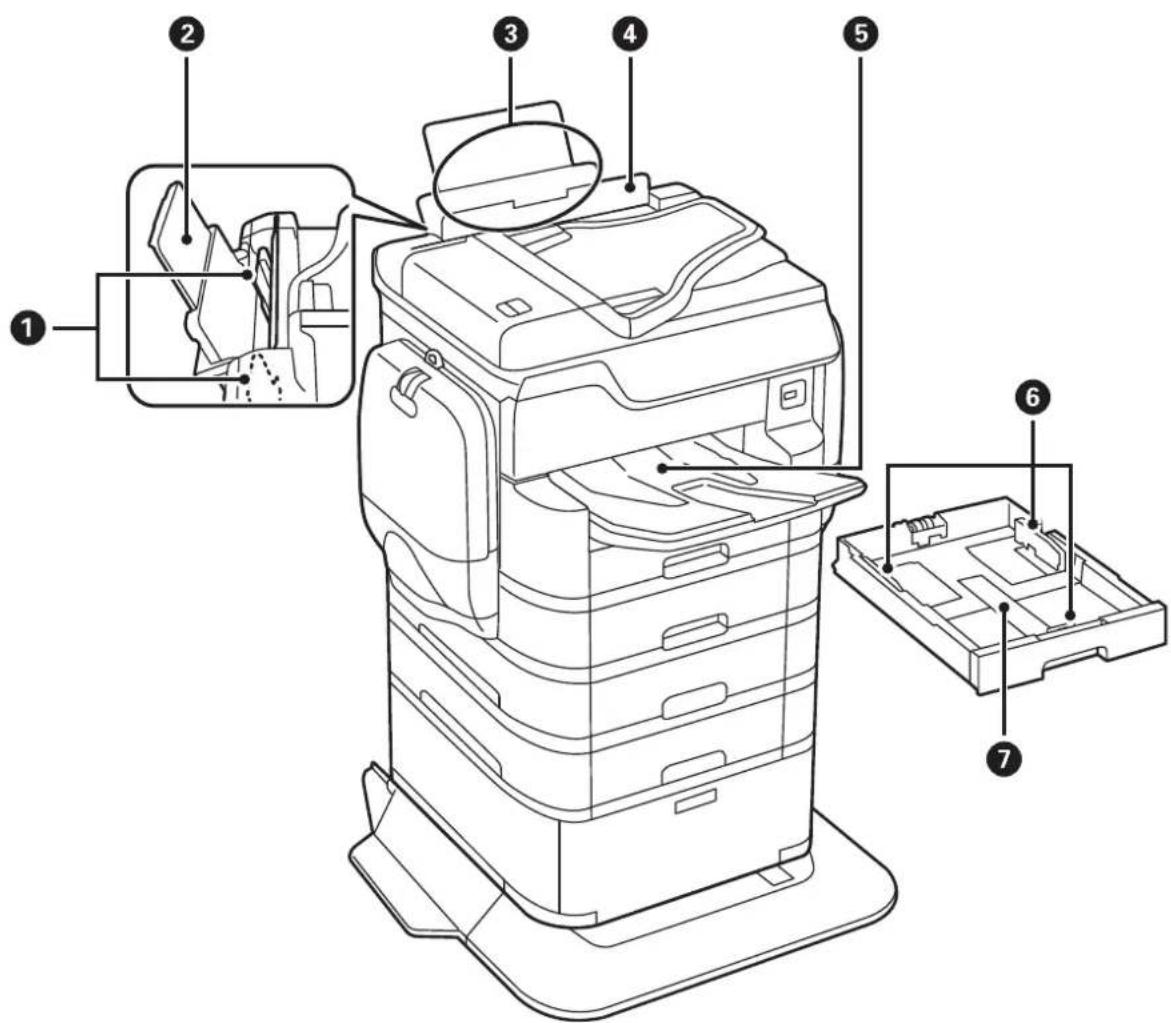
| 1 | Edge guides | Feed the paper straight into the printer. Slide to the edges of the paper. |
| 2 | Paper support | Supports loaded paper. |
| 3 | Rear paper feed (B1) | Loads paper. |
| 4 | Feeder guard | Prevents foreign substance from entering the printer. Usually keep this guard closed. |
| 5 | Output tray | Holds the ejected paper. |
| 6 | Edge guides | Feed the paper straight into the printer. Slide to the edges of the paper. |
| 7 | Paper cassette | Loads paper. |
Printer Basics
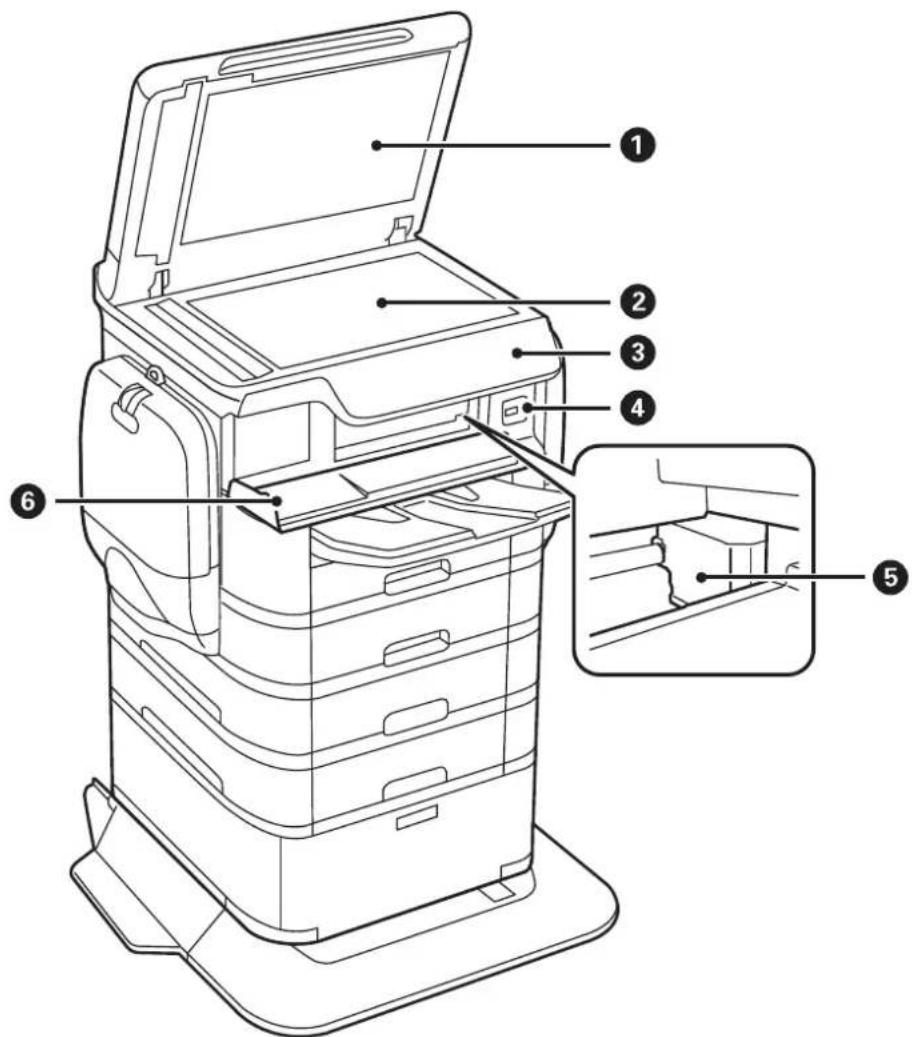
| 1 | Document cover | Blocks external light while scanning. |
| 2 | Scanner glass | Scans placed originals. |
| 3 | Control panel | Indicates the printer's status and allows you to make print settings. |
| 4 | External interface USB port | Connects memory devices. |
| 5 | Print head | Fires ink. |
| 6 | Front cover (A) | Open when removing jammed paper inside the printer. |
Printer Basics

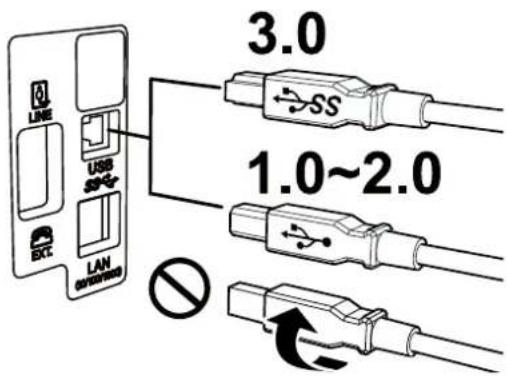
Important:
Note the insertion direction when using a USB 1.0 to 2.0 cable, otherwise the printer may be damaged.
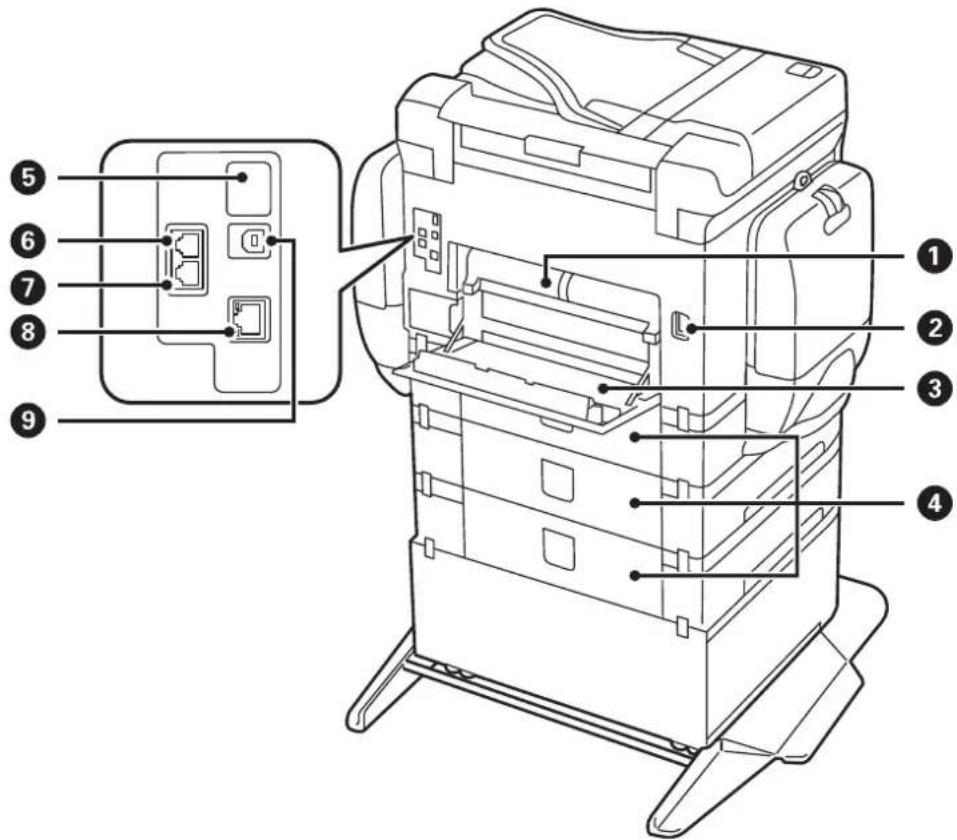
| 1 | Rear cover 2 (D2) | Remove when removing jammed paper. |
| 2 | AC inlet | Connects the power cord. |
| 3 | Rear cover 1 (D1) | Open when replacing the maintenance box or maintenance rollers, or removing jammed paper. |
| 4 | Rear cover (E) | Cover for optional paper cassette units.Open when replacing the maintenance rollers or removing jammed paper. |
Printer Basics
| 5 | Service USB port | USB port for future use.Do not remove the sticker. |
| 6 | LINE port | Connects a phone line. |
| 7 | EXT. port | Connects external phone devices. |
| 8 | LAN port | Connects a LAN cable. |
| 9 | USB port | Connects a USB cable. |
Control Panel
Buttons and Lights

| 1 | Turns the printer on or off.Unplug the power cord when the power light is off. |
| 2 | Pass a smart device over this mark to print or scan from the smart device directly. |
| 3 | Turns on when received documents that have not yet been read, printed, or saved, are stored in the printer's memory. |
| 4 | Displays the home screen. |
| 5 | Displays menus and messages. |
| 6 | Logs you out if you log in to a printer on which Access Control is set to On.This menu is not available when the user restriction feature is disabled. |
| 7 | Displays the solutions when you are in trouble. |
| 8 | Stops the current operation. |
| 9 | Pauses the current job and allows you to interrupt another job. Press this button again to restart a paused job. |
| 10 | Resets the current settings to user default settings. If user default settings have not been made, resets to the factory default. |
| 11 | Displays the Paper Setting screen. You can select the paper size and paper type settings for each paper source. |
Printer Basics
| 12 | Displays the Job/Status menu. You can check the printer's status and job history.The error light on the left flashes or turns on when an error occurs.The data light on the right flashes when the printer is processing data. It turns on when there are queued jobs. |
| 13 | Enters numbers, characters, and symbols. |
| 14 | Displays the Contacts list. You can register, edit or delete the contacts. |
| 15 | Clears number settings such as the number of copies. |
Basic Screen Configuration
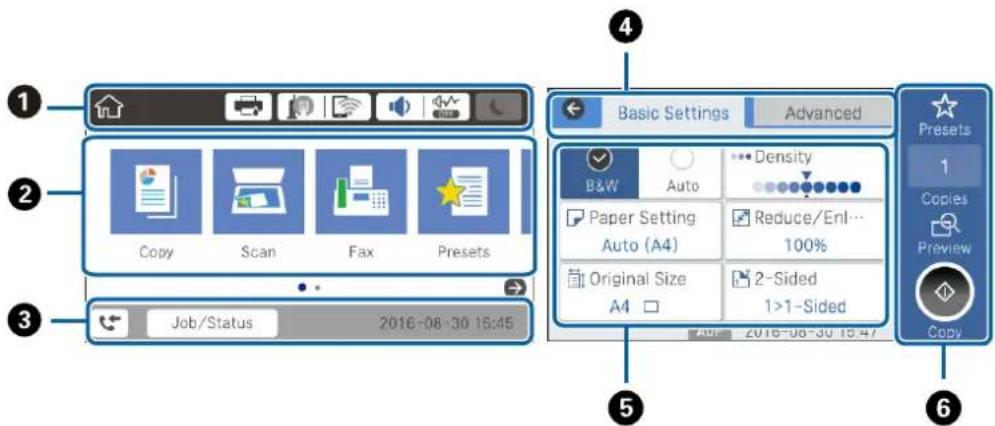
| 1 | Indicates items that have been setup for the printer as icons. Tap to check the current settings or access each setting menu. |
| 2 | Displays each mode. You can add or change the sequence. |
| 3 | Indicates an ongoing job and the printer's status. Tap message to display theJob/Statusmenu.Displays the date and time when the printer is not working or there are no errors. |
| 4 | Switch tabs. |
| 5 | Indicates the setting items. Tap each item to set or change the settings.The grayed out items are not available. Tap the item to check why they are unavailable. |
| 6 | Execute the current settings. Available functions vary depending on each mode. |
Touch Screen Operations
The touchscreen is compatible with the following operations.
| Tap |  | Press or select the items or the icons. |
Printer Basics
| Flick |  | Scroll the screen swiftly. |
| Slide |  | Hold and move the items around. |
Icons displayed in the LCD Screen
The following icons are displayed on the LCD screen depending on the printer's status.
 | Displays the Supply Status screen. You can check the approximate ink levels and the approximate service life of the maintenance box. | |
 | Indicates the network connection status. Tap the icon to check and change the current settings. This is the shortcut for the following menu. Settings > General Settings > Network Settings > Wi-Fi Setup | |
 | The printer is not connected to a wired (Ethernet) network or unset it. | |
 | The printer is connected to a wired (Ethernet) network. | |
 | The printer is not connected to a wireless (Wi-Fi) network. | |
 | The printer is searching for SSID, unset IP address, or having a problem with a wireless (Wi-Fi) network. | |
 | The printer is connected to a wireless (Wi-Fi) network. | |
| The number of bars indicates the signal strength of the connection. The more bars there are, the stronger the connection. | ||
 | The printer is not connected to a wireless (Wi-Fi) network in Wi-Fi Direct (Simple AP) mode. | |
 | The printer is connected to a wireless (Wi-Fi) network in Wi-Fi Direct (Simple AP) mode. | |
Printer Basics
 | Displays theDevice Sound Settingsscreen. You can setMuteandQuiet Mode.You can also access theSoundmenu from this screen. This is the shortcut for the following menu.Settings >General Settings >Basic Settings >Sound | |
  | Indicates whether or notQuiet Modeis set for the printer. When this feature is enabled, the noise made by printer operations is reduced, but print speed may slow down. However, noises may not be reduced depending on the selected paper type and print quality. | |
 | Indicates thatMuteis set for the printer. | |
 | Tap the icon to enter sleep mode. When the icon is grayed out, the printer cannot enter sleep mode. | |
 | Indicates that the user restriction feature is enabled. Tap this icon to log in to the printer. You need to select a user name and then enter a password. Contact your printer administrator for login information. | |
 | Indicates that a user with access permission has logged in.Tap the icon to logout. | |
 | Displays theFax Data Informationscreen. | |
 | Indicates that the settings have been changed from the user default or the factory default. | |
| [0CWD] | Indicates that there is additional information. Tap the icon to displays the message. | |
| [17W8] | Indicates a problem with the items. Tap the icon to check how to solve the problem. | |
 | Indicates that there is data that has not yet been read, printed, or saved. The number displayed indicates the number of data items. | |
Entering Characters
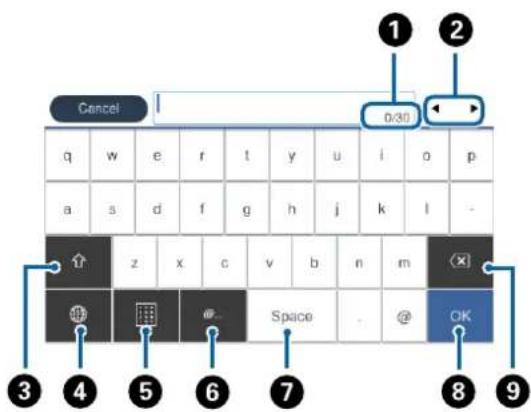
You can enter characters and symbols by using on-screen keyboard when you register a contact, make network settings, and so on.
Note:
Available icons vary depending on the setting item.
| 1 | Indicates the character count. |
| 2 | Moves the cursor to the input position. |
Printer Basics
| 3 | Switches between upper case and lower case or numbers and symbols. |
| 4 | Switches the character type. You can enter alphanumeric, symbols, and special characters such as umlauts and accents. |
| 5 | Changes the keyboard layout. |
| 6 | Enters frequently used email domain addresses or URLs by simply selecting the item. |
| 7 | Enters a space. |
| 8 | Enters character. |
| 9 | Deletes a character to the left. |
Job/Status Screen Configuration
Press the ⓘ button to display the Job/Status menu. You can check the status of the printer or the jobs.
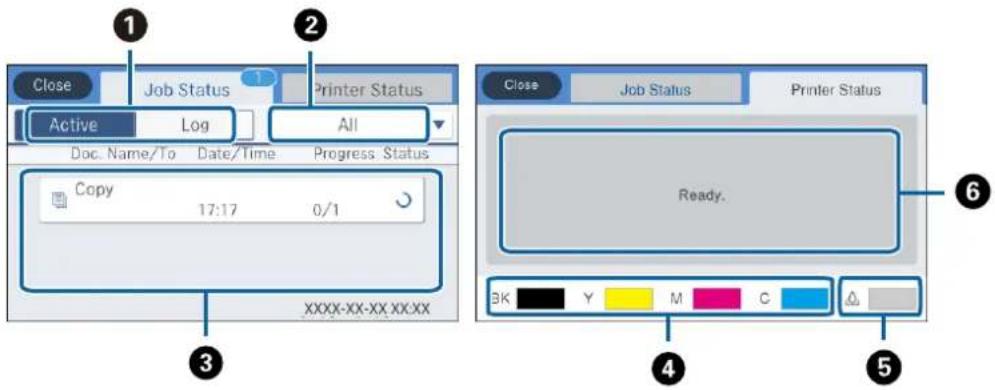
| 1 | Switches the displayed lists. |
| 2 | Filter the jobs by functional. |
| 3 | When Active is selected, displays the list of ongoing jobs and jobs waiting to be processed.When Log is selected, displays the job history.You can cancel jobs or check the error code displayed in the history when the job has failed. |
| 4 | Indicates the approximate ink levels. |
| 5 | Indicates the approximate service life of the maintenance box. |
| 6 | Displays any errors that have occurred in the printer. Select the error from the list to display the error message. |
Related Information
→ "Error Code on the Status Menu" on page 231
Printer Basics
Viewing Animations
You can view animations of operating instructions such as loading paper or removing jammed paper on the LCD screen.
☐ Tap ☐ on the right of the LCD screen: Displays the help screen. Tap How To and select the items that you want to view.
☐ Tap How To at the bottom of the operation screen: Displays the context-sensitive animation.
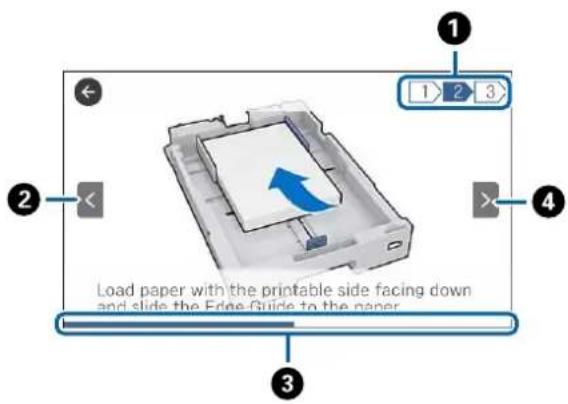
| 1 | Indicates the total number of steps and the current step number.In the example above, it shows step 2 from 3 steps. |
| 2 | Returns to the previous step. |
| 3 | Indicates your progress through the current step. The animation repeats when the progress bar reaches the end. |
| 4 | Moves to next step. |
Registering Your Favorite Settings as a Preset
You can register frequently used copy, fax, and scan settings as presets. You can register up to 50 entries. If you cannot edit the presets, they may have been locked by the administrator. Contact your printer administrator for assistance.
To register a preset, tap Presets from the home screen, tap Add New, and then select the feature for which you want to register a preset. Make the necessary settings, tap ⭐, and then enter a name for the preset.
To load a registered preset, select the preset from the list.
You can also register the current address and settings to tap 📂 on the screen of each feature.
To change the registered settings, change the settings on the screen for each feature and tap 📂. Tap Register on Presets and then select the target that you want to overwrite.
Menu Options for Presets
Tap > on the registered preset to display the details of the registered settings. You can change the registered name by tapping the name on the details screen.
Printer Basics

Delete the registered preset.
Add /Remove:
Add or clear the registered preset to the home screen as a short-cut icon.
Use This Setting:
Load the registered preset.
Network Settings
Network Connection Types
You can use the following connection methods.
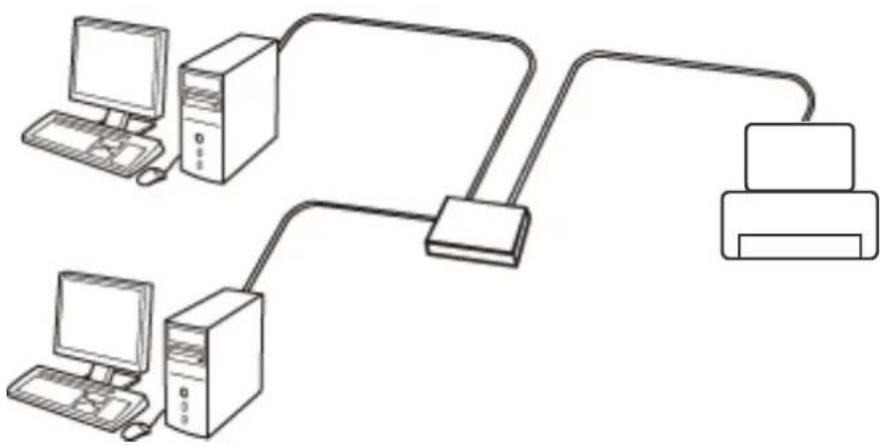
Ethernet Connection
Connect the printer to a hub with an Ethernet cable.
flowchart
graph TD
    A["Computer 1"] --> B["Server"]
    C["Computer 2"] --> B
    B --> D["Printer"]
    B --> E["Server"]
    style A fill:#f9f,stroke:#333
    style C fill:#f9f,stroke:#333
    style D fill:#ccf,stroke:#333
    style E fill:#ccf,stroke:#333
Related Information
→ "Making Advanced Network Settings" on page 34
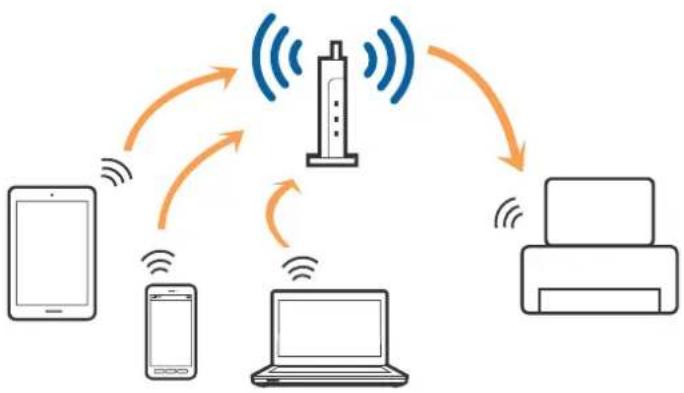
Wi-Fi Connection
Connect the printer and the computer or smart device to the access point. This is the typical connection method for home or office networks where computers are connected by Wi-Fi through the access point.
flowchart
graph TD
    A["Mobile Device"] -->|Signal| B["Central Tower"]
    C["Mobile Device"] -->|Signal| B
    D["Mobile Device"] -->|Signal| B
    E["Mobile Device"] -->|Signal| B
    F["Mobile Device"] -->|Signal| B
    B --> G["Printer"]
    style B fill:#f9f,stroke:#333
Network Settings
Related Information
→ "Connecting to a Computer" on page 28
→ "Connecting to a Smart Device" on page 30
→ "Making Wi-Fi Settings from the Printer" on page 30
Wi-Fi Direct (Simple AP) Connection
Use this connection method when you are not using Wi-Fi at home or at the office, or when you want to connect the printer and the computer or smart device directly. In this mode, the printer acts as an access point and you can connect up to four devices to the printer without having to use a standard access point. However, devices directly connected to the printer cannot communicate with each other through the printer.
Note:
Wi-Fi Direct (Simple AP) connection is a connection method designed to replace Ad Hoc mode.
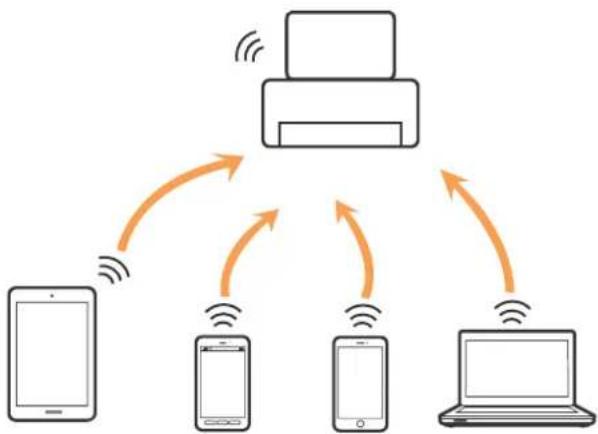
flowchart
graph TD
    A["Printer"] -->|Wireless Signal| B["Mobile Device"]
    B -->|Wireless Signal| C["Mobile Device"]
    C -->|Wireless Signal| D["Mobile Device"]
    D -->|Wireless Signal| E["Laptop"]
    E -->|Wireless Signal| F["Laptop"]
    F -->|Wireless Signal| G["Printer"]
    G -->|Wireless Signal| H["Printer"]
The printer can be connected by Wi-Fi or Ethernet, and Wi-Fi Direct (Simple AP) connection simultaneously. However, if you start a network connection in Wi-Fi Direct (Simple AP) connection when the printer is connected by Wi-Fi, the Wi-Fi is temporarily disconnected.
Related Information
→ "Making Wi-Fi Direct (Simple AP) Connection Settings" on page 34
Connecting to a Computer
We recommend using the installer to connect the printer to a computer. You can run the installer using one of the following methods.
☐ Setting up from the website
Access the following website, and then enter the product name. Go to Setup, and then start setting up.
http://epson.sn
☐ Setting up using the software disc (only for the models that come with a software disc and users with computers with disc drives.)
Insert the software disc into the computer, and then follow the on-screen instructions.
Network Settings
Selecting the Connection Methods
Follow the on-screen instructions until the following screen is displayed, and then select the connection method of the printer to the computer.
Windows
Select the connection type and then click Next.
![Install Navi (XXXX Series) Start Setup Connecting your License Agreement System Check Installation Connection Setting Additional Installation Finish Wi-Fi Connection (Recommended) Establishes a wireless connection with the Ethernet Connection Select this if you are using a wired network and wish to connect with an Ethernet cable. USB connection Connect the _ to a computer using a USB cable. The computer is connected to the wireless network. You can use the _ by selecting [Wi-Fi Connection]. Advanced configuration Setup Complete Cancel Next](/content/2026/05/1106518/images/fe31c16e66c34ebc1dc04a8aee64e3b252cb984dbc4fcccb43fbb323da9ca56b.jpg)
Network Settings
□ Mac OS X
Select the connection type.
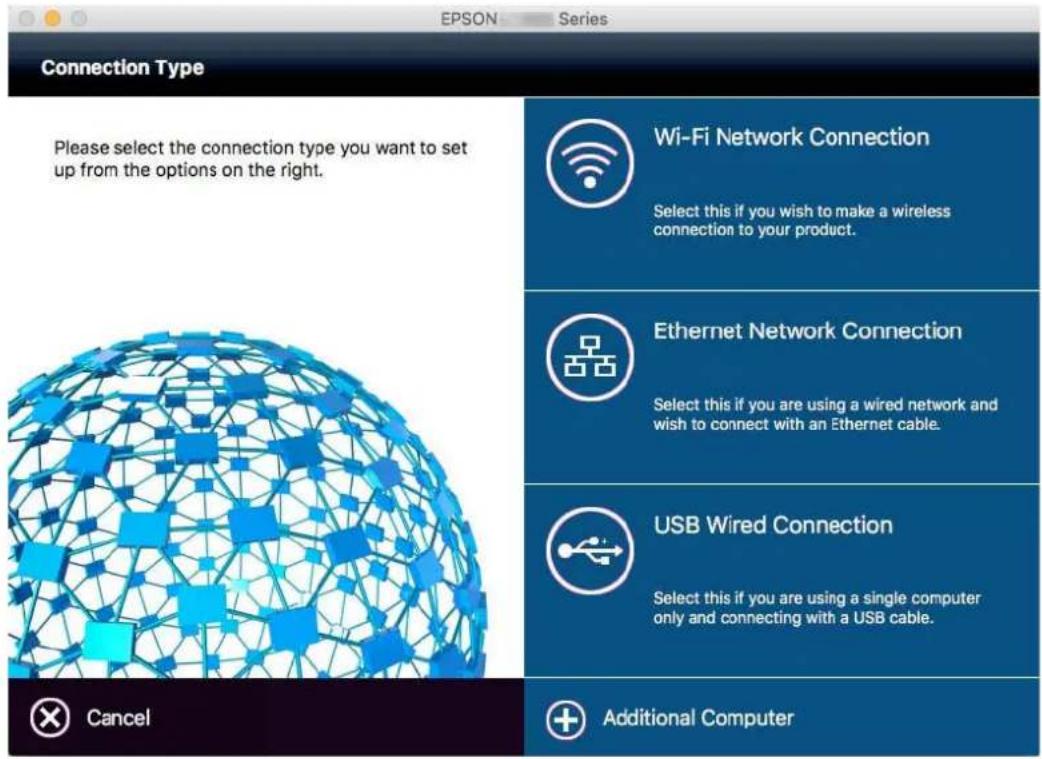
Follow the on-screen instructions. The necessary software is installed.
Connecting to a Smart Device
You can use the printer from a smart device when you connect the printer to the same Wi-Fi network (SSID) as the smart device. To use the printer from a smart device, set up from the following website. Access to the website from the smart device that you want to connect to the printer.
http://epson.sn> Setup
Note:
If you want to connect a computer and a smart device to the printer at the same time, we recommend connecting the computer first.
Making Wi-Fi Settings from the Printer
You can make network settings from the printer's control panel in several ways. Choose the connection method that matches the environment and conditions that you are using. If you know the information for the access point such as SSID and password, you can make settings manually. If the access point supports WPS, you can make settings by using push button setup.
After connecting the printer to the network, connect to the printer from the device that you want to use (computer, smart device, tablet, and so on.)
Network Settings
Related Information
→ "Making Wi-Fi Settings Manually" on page 31
→ "Making Wi-Fi Settings by Push Button Setup (WPS)" on page 32
→ "Making Wi-Fi Settings by PIN Code Setup (WPS)" on page 33
→ "Making Wi-Fi Direct (Simple AP) Connection Settings" on page 34
Making Wi-Fi Settings Manually
You can manually set up the information necessary to connect to an access point from the printer's control panel. To set up manually, you need the SSID and password for an access point.
Note:
If you are using an access point with its default settings, the SSID and password are on the label. If you do not know the SSID and password, contact the person who set up the access point, or see the documentation provided with the access point.
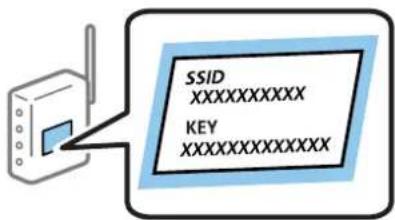
- Tap 📋 on the home screen.
- Tap Router.
- Tap Start Setup.
If the network connection is already set up, the connection details are displayed. Tap Change to Wi-Fi connection. or Change Settings to change the settings.
- Tap Wi-Fi Setup Wizard.
- Select the SSID for the access point.
Note:
☐ If the SSID you want to connect to is not displayed on the printer's control panel, tap Search Again to update the list. Still not displayed, tap Enter Manually, and then enter the SSID directly.
☐ If you do not know the SSID, check if it is written on the label of the access point. If you are using the access point with its default settings, use the SSID written on the label.
- Tap the Enter Password field, and then enter the password.
Note:
☐ The password is case-sensitive.
☐ If you do not know the password, check if it is written on the label of the access point. If you are using the access point with its default settings, use the password written on the label. The password may also be called a "Key", a "Passphrase", and so on.
☐ If you do not know the password for the access point, see the documentation provided with the access point, or contact the person who set it up.
- When you have setup finished, tap Start Setup.
Network Settings
- Tap OK to finish.
Note:
If you fail to connect, load A4 size plain paper, and then tap Print Check Report to print a connection report.
- Tap Close on the network connection settings screen.
Related Information
→ "Entering Characters" on page 23
→ "Checking the Network Connection Status" on page 36
→ "When You Cannot Make Network Settings" on page 242
Making Wi-Fi Settings by Push Button Setup (WPS)
You can automatically set up a Wi-Fi network by pressing a button on the access point. If the following conditions are met, you can set up by using this method.
☐ The access point is compatible with WPS (Wi-Fi Protected Setup).
☐ The current Wi-Fi connection was established by pressing a button on the access point.
Note:
If you cannot find the button or you are setting up using the software, see the documentation provided with the access point.
-
Tap on the home screen.
-
Tap Router.
-
Tap Start Setup.
If the network connection is already set up, the connection details are displayed. Tap Change to Wi-Fi connection. or Change Settings to change the settings.
-
Tap Push Button Setup(WPS).
-
Hold down the [WPS] button on the access point until the security light flashes.
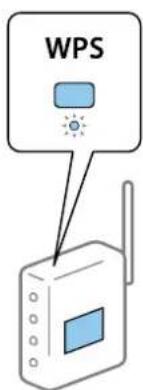
If you do not know where the [WPS] button is, or there are no buttons on the access point, see the documentation provided with your access point for details.
- Tap Start Setup.
Network Settings
7. Tap Close.
The screen automatically closes after a specific length of time if you do not tap Close.
Note:
If connection fails, restart the access point, move it closer to the printer, and try again. If it still does not work, print a network connection report and check the solution.
- Tap Close on the network connection settings screen.
Related Information
→ "Checking the Network Connection Status" on page 36
→ "When You Cannot Make Network Settings" on page 242
Making Wi-Fi Settings by PIN Code Setup (WPS)
You can automatically connect to an access point by using a PIN code. You can use this method to set up if an access point is capable of WPS (Wi-Fi Protected Setup). Use a computer to enter a PIN code into the access point.
-
Tap 📋 on the home screen.
-
Tap Router.
-
Tap Start Setup.
If the network connection is already set up, the connection details are displayed. Tap Change to Wi-Fi connection. or Change Settings to change the settings.
-
Tap Others > PIN Code Setup(WPS)
-
Use your computer to enter the PIN code (an eight digit number) displayed on the printer's control panel into the access point within two minutes.
Note:
See the documentation provided with your access point for details on entering a PIN code.
-
Tap Start Setup.
-
Tap Close.
The screen automatically closes after a specific length of time if you do not tap Close.
Note:
If connection fails, restart the access point, move it closer to the printer, and try again. If it still does not work, print a connection report and check the solution.
- Tap Close on the network connection settings screen.
Related Information
→ "Checking the Network Connection Status" on page 36
→ "When You Cannot Make Network Settings" on page 242
Network Settings
Making Wi-Fi Direct (Simple AP) Connection Settings
This method allows you to connect the printer directly to devices without an access point. The printer acts as an access point.

Important:
When you connect from a computer or smart device to the printer using the Wi-Fi Direct (Simple AP) connection, the printer is connected to the same Wi-Fi network (SSID) as the computer or smart device and the communication is established between them. Since the computer or smart device is automatically connected to the other connectable Wi-Fi network if the printer is turned off, it is not connected to the previous Wi-Fi network again if the printer is turned on. Connect to the printer's SSID for Wi-Fi Direct (Simple AP) connection from the computer or smart device again. If you do not want to connect every time you turn the printer on or off, we recommend using Wi-Fi network by connecting the printer to an access point.
- Tap


on the home screen.
- Tap
Wi-Fi Direct.
- Tap
Start Setup.
If you have made Wi-Fi settings, the detailed connection information is displayed. Go to step 5.
- Tap
Start Setup.
- Che
ck the SSID and password displayed on the printer's control panel. On the computer's network connection, en or the smart device's Wi-Fi screen, select the SSID shown on the printer's control panel to connect.
Note:
You can check the connection method on the Web site. To access the Web site, scan the QR code displayed on the printer's control panel using the smart device or enter the URL (http://epson.sn) on the computer, and then go to Setup.
- Ente
er the password displayed on the printer's control panel on the computer or smart device.
- A
r the connection is established, tap OK or Close on the printer's control panel.
Note:
You can also make Wi-Fi Direct (Simple AP) connection settings from a smart device. See Tips on the following Web site.
http://epson.sn > Support
Related Information
→ "Checking the Network Connection Status" on page 36
→ "When You Cannot Make Network Settings" on page 242
Making Advanced Network Settings
You can change the network device name, TCP/IP setup, proxy server and so on. Check your network environment before making changes.
- Tap Settings on the home screen.
- Tap General Settings > Network Settings > Advanced.
Network Settings
- Tap the menu item for settings, and then select or specify the setting values.
Related Information
→ "Setting Items for Advanced Network Settings" on page 35
Setting Items for Advanced Network Settings
Select the menu item for settings, and then select or specify the setting values.
Device Name
You can enter the following characters.
☐ Character limits: 2 to 15 (you must enter at least 2 characters)
□ Usable characters: A to Z, a to z, 0 to 9, -.
☐ Characters you cannot use at the top: 0 to 9.
□ Characters you cannot use at the bottom: -
TCP/IP
Auto
Select when you are using an access point at home or you are allowing the IP address to be acquired automatically by DHCP.
Manual
Select when you do not want the printer's IP address to be changed. Enter the addresses for IP Address, Subnet Mask, and Default Gateway, and make DNS Server settings according to your network environment.
□ Proxy Server
Do Not Use
Select when you are using the printer in a home network environment.
Use
Select when you are using a proxy server in your network environment and you want to set it to the printer. Enter the proxy server address and port number.
□ Email Server
☐ Server Settings You can select the server from Off, POP before SMTP, or SMTP-AUTH.
□ Connection Check
You can check the connection for e-mail server. See Administrator's Guide if an error occurs when performing Connection Check.
IPv6 Address
Enable
Select this when using an IPv6 address.
□ Disable
Select this when using an IPv4 address.
Network Settings
MS Network Sharing
□ Enable
Use MS Network service.
□ Disable
Disables the MS Network service.
☐ File Sharing
Enables or disables the file sharing function.
NFC
Enable
Enables the printer's NFC function. You can print and scan by touching the smart device to the N-Mark.
□ Disable
Disables the printer's NFC function.
Link Speed & Duplex
Select an appropriate Ethernet speed and duplex setting. If you select a setting other than Auto, make sure the setting corresponds to the settings on the hub you are using.
Auto
☐ 10BASE-T Half Duplex
10BASE-T Full Duplex
☐ 100BASE-TX Half Duplex
100BASE-TX Full Duplex
☐ Redirect HTTP to HTTPS
Enable
Enables the redirect function for HTTP to HTTPS.
□ Disable
Disables the redirect function for HTTP to HTTPS.
□ Disable IPsec/IP Filtering
Disables the IPsec/IP filtering function if you cannot connect to the printer because of the security settings.
□ Disable IEEE802.1X
Disables the IEEE802.1X function if you cannot connect to the printer because of the security settings.
Checking the Network Connection Status
You can check the network connection status in the following way.
Network Settings
Network Icon
You can check the network connection status and strength of the radio wave using the network icon on the printer's home screen.
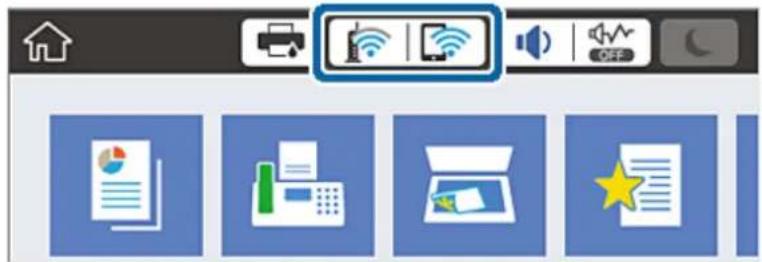
Related Information
→ "Icons displayed in the LCD Screen" on page 22
Checking Detailed Network Information from the Control Panel
When your printer is connected to the network, you can also view other network-related information by selecting the network menus you want to check.
- Tap Settings on the home screen.
- Tap General Settings > Network Settings > Network Status.
- To check the information, select the menus that you want to check.
□ Wired LAN/Wi-Fi Status
Displays the network information (device name, connection, signal strength, obtain IP address, and so on) for Ethernet or Wi-Fi connections.
□ Wi-Fi Direct Status
Displays whether Wi-Fi Direct is enabled or disabled, and the SSID, password and so on for Wi-Fi Direct connections.
□ Email Server Status
Displays the network information for email server.
□ Print Status Sheet
Prints a network status sheet. The information for Ethernet, Wi-Fi, Wi-Fi Direct, and so on is printed on two or more pages.
Printing a Network Connection Report
You can print a network connection report to check the status between the printer and the access point.
- Load papers.
- Tap Settings on the home screen.
Network Settings
- Tap General Settings > Network Settings > Connection Check.
The connection check starts.
-
Tap Print Check Report.
-
Tap Print to print the network connection report.
If an error has occurred, check the network connection report, and then follow the printed solutions.
- Tap Close.
The screen automatically closes after a specific length of time if you do not tap Close.
Related Information
→ "Messages and Solutions on the Network Connection Report" on page 38
Messages and Solutions on the Network Connection Report
Check the messages and error codes on the network connection report, and then follow the solutions.
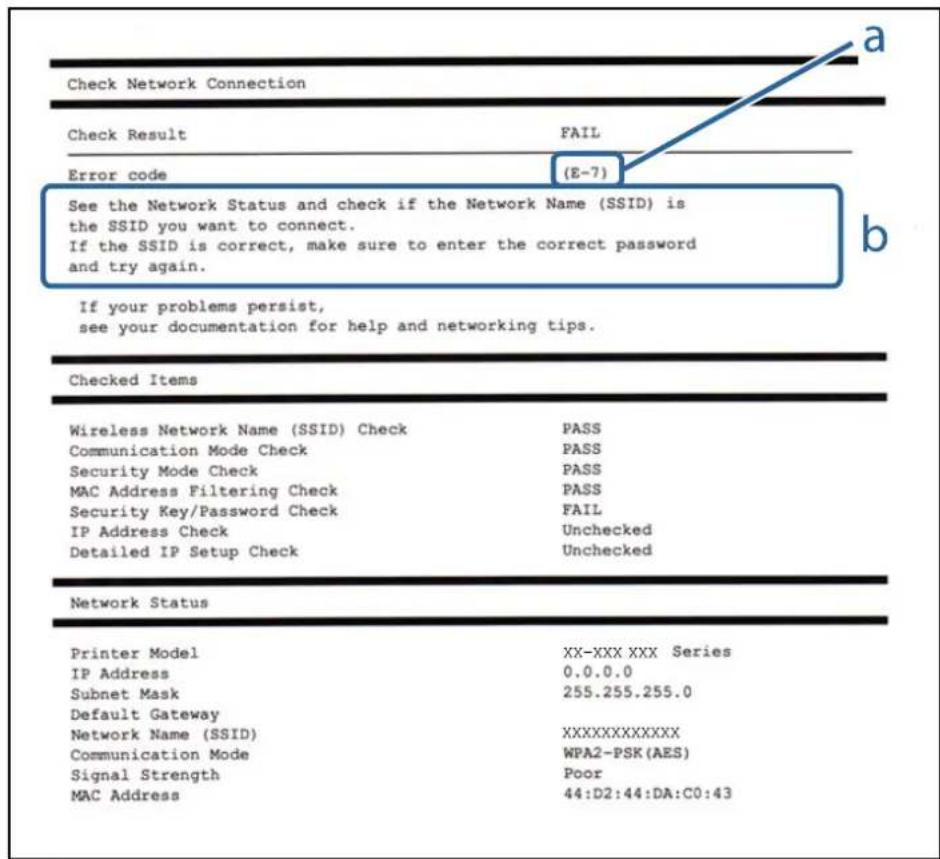
a. Error code
b. Messages on the Network Environment
Network Settings
a. Error code
| Code | Solution |
| E-1 | Make sure that the Ethernet cable is connected to the printer, a hub, or other network devices.Make sure that the hub or other network devices are turned on. |
| E-2 | Make sure that the access point is turned on. |
| E-3 | Check that the computer or other devices are connected correctly to the access point. |
| E-7 | Place the printer close to the access point. Remove any obstacles between them.If you have entered the SSID manually, check if it is correct. Check the SSID from the Network Status part on the network connection report.To establish a network using push button setup, check that the access point supports WPS. If it does not support WPS, you cannot establish a network using push button setup.Check that only ASCII characters (alphanumeric characters and symbols) are used for the SSID. The printer cannot display an SSID which contains any characters other than ASCII characters.Check the SSID and password before connecting to the access point. If you are using an access point with its default settings, the SSID and password are on the label. If you do not know the SSID and password, contact the person who set up the access point, or see the documentation provided with the access point.When you want to connect to an SSID generated using the tethering function on a smart device, check the SSID and password in the documentation provided with the smart device.If the Wi-Fi connection is suddenly disconnected, check the following. If any of these are applicable, reset the network settings using the installer. You can run it from the following website.http://epson.sn > SetupAnother smart device was added to the network using push button setup.The Wi-Fi network was set up using any method other than push button setup. |
| E-5 | Make sure the access point's security type is set to one of the following. If it is not, change the security type on the access point, and then reset the printer's network settings.WEP-64 bit (40 bit)WEP-128 bit (104 bit)WPA PSK (TKIP/AES)*WPA2 PSK (TKIP/AES)*WPA (TKIP/AES)WPA2 (TKIP/AES)*:WPA PSK is also known as WPA Personal. WPA2 PSK is also known as WPA2 Personal. |
| E-6 | Check if the MAC address filtering is disabled. If it is enabled, register the printer's MAC address so that it is not filtered. See the documentation provided with the access point for details. You can check the printer's MAC address from the Network Status part on the network connection report.If the access point's shared authentication is enabled on the WEP security method, make sure the authentication key and index are correct. |
| E-8 | Enable DHCP on the access point when the printer's Obtain IP Address is set to Auto.If the printer's Obtain IP Address is set to Manual, the IP address you manually set is out of range (for example: 0.0.0.0) and it is disabled. Set a valid IP address from printer's control panel or Web Config. |
Network Settings
| Code | Solution |
| E-9 | Check the following.☐ Devices are turned on.☐ You can access the Internet and other computers or network devices on the same network from the devices you want to connect to the printer.If it still does not work after checking the above, reset the network settings using the installer. You can run it from the following website.http://epson.sn > Setup |
| E-10 | Check the following.☐ Other devices on the network are turned on.☐ Network addresses (IP address, subnet mask, and default gateway) are correct if you have set the printer's Obtain IP Address to Manual.Reset the network address if these are incorrect. You can check the IP address, subnet mask, and default gateway from theNetwork Statusparton the network connection report.When DHCP is enabled, change the printer's Obtain IP Address to Auto. If you want to set the IP address manually, check the printer's IP address from theNetwork Statusparton the network connection report, and then select Manual on the network settings screen. Set the subnet mask to [255.255.255.0]. |
| E-11 | Check the following.☐ The default gateway address is correct when you set the printer's TCP/IP Setup to Manual.☐ The device that is set as the default gateway is turned on.Set the correct default gateway address. You can check the default gateway address from theNetwork Statuspart on the network connection report. |
| E-12 | Check the following.☐ Other devices on the network are turned on.☐ The network addresses (IP address, subnet mask, and default gateway) are correct if you are entering them manually.☐ The network addresses for other devices (subnet mask and default gateway) are the same.☐ The IP address does not conflict with other devices.If it still does not work after checking the above, try the following.☐ Make network settings on the computer that is on the same network as the printer using the installer. You can run it from the following website.http://epson.sn > Setup☐ You can register several passwords on an access point that uses the WEP security type. If several passwords are registered, check if the first registered password is set on the printer. |
Network Settings
| Code | Solution |
| E-13 | Check the following.☐ Network devices such as an access point, hub, and router are turned on.☐ The TCP/IP Setup for network devices has not been set up manually. (If the printer's TCP/IP Setup is set automatically while the TCP/IP Setup for other network devices is performed manually, the printer's network may differ from the network for other devices.)If it still does not work after checking the above, try the following.☐ Make network settings on the computer that is on the same network as the printer using the installer. You can run it from the following website.http://epson.sn > Setup☐ You can register several passwords on an access point that uses the WEP security type. If several passwords are registered, check if the first registered password is set on the printer. |
b. Messages on the Network Environment
| Message | Solution |
| *Multiple network names (SSID) that match your entered network name (SSID) have been detected. Confirm network name (SSID). | The same SSID may be set on several access points. Check the settings on the access points, and change the SSID. |
| The Wi-Fi environment needs to be improved. Turn the wireless router off and then turn it on. If the connection does not improve, see the documentation for the wireless router. | After moving the printer closer to the access point and removing any obstacles between them, turn the access point on. If it still does not connect, see the documentation supplied with the access point. |
| *No more devices can be connected.Disconnect one of the connected devices if you want to add another one. | You can simultaneously connect up to four computers and smart devices in Wi-Fi Direct (Simple AP) connection. To add another computer or smart device, disconnect one of the connected devices first. |
Related Information
→ "Connecting to a Computer" on page 28
→ "Web Config" on page 214
→ "When You Cannot Make Network Settings" on page 242
Printing a Network Status Sheet
You can check the detailed network information by printing it.
- Load papers.
- Tap Settings on the home screen.
- Tap General Settings > Network Settings > Network Status.
- Tap Print Status Sheet.
Network Settings
- Check the message, and then tap Print.
The network status sheet is printed.
- Tap Close.
The screen automatically closes after a specific length of time if you do not tap Close.
Replacing or Adding New Access Points
If the SSID changes due to the replacement of an access point, or an access point is added and a new network environment is established, re-set the Wi-Fi settings.
Related Information
→ "Changing the Connection Method to a Computer" on page 42
Changing the Connection Method to a Computer
Using the installer and re-set up in a different connection method.
☐ Setting up from the website
Access the following website, and then enter the product name. Go to Setup, and then start setting up.
http://epson.sn
☐ Setting up using the software disc (only for the models that come with a software disc and users with computers with disc drives.)
Insert the software disc into the computer, and then follow the on-screen instructions.
Selecting Change the Connection Methods
Follow the on-screen instructions until the following screen is displayed.
Network Settings
Windows
Select Change or re-set the connection method on the Select Software Installation screen, and then click Next.
![Install Navi [XXXXSeries] Start Setup License Agreement System Check Installation Connection Setting Additional Installation Finish Setup Complete Select Software Installation Re-install the essential software Select this to re-install software and change the connection settings. Install application software Select this to install additional Epson printing and scanning applications. Change or re-set the connection method Select this if the network environment has changed because of replacement of the access point or if you want to change or re-set the connection method between the and computer. Cancel Back Next](/content/2026/05/1106518/images/11e04386cdc9e602fd0fd921d9064310810d9ef3777aaa7398d9f9853ccb1a61.jpg)
□ Mac OS X
Select how you want to connect the printer to your computer.
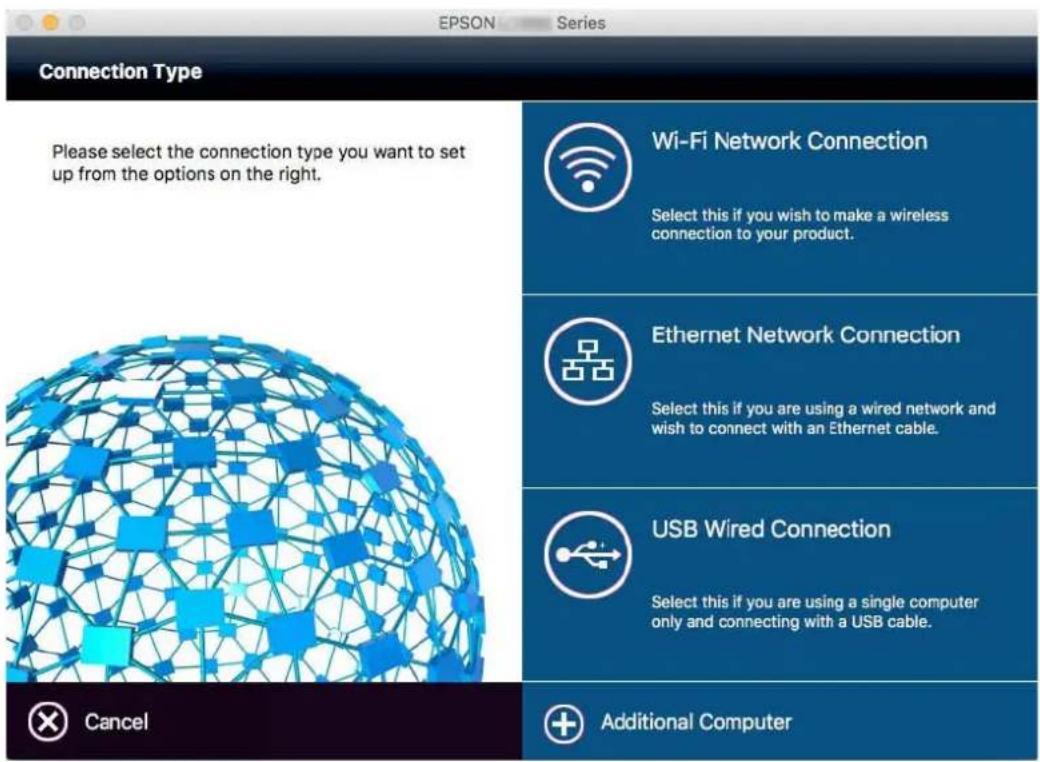
Changing the Network Connection to Ethernet from the Control Panel
Follow the steps below to change the network connection to Ethernet from Wi-Fi using the control panel.
- Tap Settings on the home screen.
- Tap General Settings > Network Settings > Wired LAN Setup.
- Check the message, and then tap Start Setup.
- Check the message, and then tap OK.
The screen automatically closes after a specific length of time if you do not tap OK. - Connect the printer to a router using an Ethernet cable.
Disabling Wi-Fi from the Control Panel
When Wi-Fi is disabled, the Wi-Fi connection is disconnected.
- Tap 📋 on the home screen.
- Tap Router. The network status is displayed.
- Tap Change Settings.
- Tap Others > Disable Wi-Fi.
- Check the message, and then tap Start Setup.
- When a completion message is displayed, tap Close. The screen automatically closes after a specific length of time if you do not tap Close.
Disconnecting Wi-Fi Direct (Simple AP) Connection from the Control Panel
Note:
When Wi-Fi Direct (Simple AP) connection disabled, all computers and smart devices connected to the printer in Wi-Fi Direct (Simple AP) connection are disconnected. If you want to disconnect a specific device, disconnect from the device instead of the printer.
-
Tap 📋 on the home screen.
-
Tap Wi-Fi Direct. The Wi-Fi Direct information is displayed.
Network Settings
- Tap Change Settings.
- Tap Disable Wi-Fi Direct.
- Check the message, and then tap Disable the settings..
- When a completion message is displayed, tap Close.
The screen automatically closes after a specific length of time if you do not tap Close.
Restoring the Network Settings from the Control Panel
You can restore all network settings to their defaults.
- Tap Settings on the home screen.
- Tap General Settings > System Administration > Restore Default Settings > Network Settings.
- Check the message, and then tap Yes.
- When a completion message is displayed, tap Close.
The screen automatically closes after a specific length of time if you do not tap Close.
Administrator Settings
Administrator Settings
Locking the Printer Settings Using an Administrator's Password
You can set an administrator's password to lock the printer settings so that they cannot be changed by other users. A password prompt is displayed on the screen if the administrator's lock is set.
You cannot change settings without entering the password. This password is also required when you make settings using Web Config or EpsonNet Config.

Important:
Do not forget the password. If you forget the password, contact Epson support.
- Tap Settings on the home screen.
- Tap General Settings > System Administration > Security Settings > Admin Settings > Admin Password.
- Tap Register, and then enter a password.
- Enter the password again.
- Tap Lock Setting, and then enable it.
Unlocking the Printer Settings
- Tap Settings on the home screen.
- Tap General Settings > System Administration.
- Enter the administrator's password.
- Tap Security Settings > Admin Settings.
- Enter the administrator's password again.
- Tap Lock Setting, and then disable it.
User Feature Restrictions
The administrator can restrict printer features for individual users. To use a restricted feature, the user has to enter an ID and password on the control panel. Use this feature to prevent misuse of the printer.
Use Web Config to configure restriction settings on a computer. See the Administrator's Guide for more details.
Loading Paper
Loading Paper
Paper Handling Precautions
☐ Read the instruction sheets supplied with the paper.
☐ To achieve high-quality printouts with genuine Epson paper, use the paper in the environment stated on the sheets supplied with the paper.
☐ Fan and align the edges of the paper before loading. Do not fan or curl photo paper. Doing so may damage the printable side.
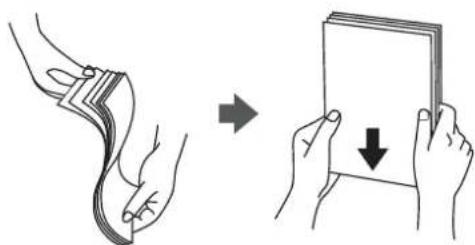
☐ If the paper is curled, flatten it or curl it slightly in the opposite direction before loading. Printing on curled paper may cause paper jams and smears on the printout.

☐ Do not use paper that is wavy, torn, cut, folded, damp, too thick, too thin, or paper that has stickers stuck to it. Using these types of paper causes paper jams and smears on the printout.
☐ Make sure you are using long-grain paper. If you are not sure what type of paper you are using, check the paper packaging or contact the manufacturer to confirm the paper specifications.
☐ Do not use short-grain paper with a width of less than 105 mm.
☐ Fan and align the edges of the envelopes before loading. When the stacked envelopes are puffed up with air, press them down to flatten them before loading.
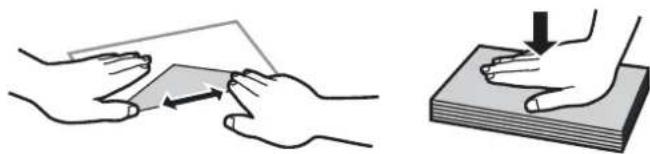
natural_image
Illustration showing two hand positions: one folding a sheet, the other pressing down on a stack of papers (no text or symbols)☐ Do not use envelopes that are curled or folded. Using these envelopes causes paper jams and smears on the printout.
☐ Do not use envelopes with adhesive surfaces on the flaps or window envelopes.
☐ Avoid using envelopes that are too thin, as they may curl during printing.
Loading Paper
Related Information
→ "Printer Specifications" on page 281
Available Paper and Capacities
Epson recommends using genuine Epson paper to ensure high-quality printouts.
Genuine Epson Paper
Note:
Genuine Epson paper is not available when printing with the Epson universal printer driver.
| Media Name | Size | Loading Capacity (Sheets) | 2-Sided Print-ing | ||
| Paper Cassette 1 | Paper Cassette 2 to 4 | Rear Paper Feed | |||
| Epson Bright White Ink Jet Pa-per | A4 | 200 | 400 | 50 | Auto, Manual*1 |
| Epson Ultra Glos-sy Photo Paper | A4, 13×18 cm (5×7 in.), 10×15 cm (4×6 in.) | - | - | 20 | - |
| Epson Premium Glossy Photo Pa-per | A3+*2, A3 | - | - | 10 | - |
| A4, 13×18 cm (5×7 in.), 16:9 wide size (102×181 mm), 10×15 cm (4×6 in.) | - | - | 20 | - | |
| Epson Premium Semigloss Photo Paper | A3+*2, A3 | - | - | 10 | - |
| A4, 10×15 cm (4×6 in.) | - | - | 20 | - | |
| Epson Photo Pa-per Glossy | A3+ | - | - | 10 | - |
| A4, 13×18 cm (5×7 in.), 10×15 cm (4×6 in.) | - | - | 20 | - | |
| Epson Matte Pa-per-Heavyweight | A3+*2, A3 | - | - | 10 | - |
| A4 | - | - | 20 | - | |
| Epson Photo Quality Ink Jet Paper | A3 | - | - | 50 | - |
| A4 | - | - | 70 | - | |
*1 Only use the rear paper feed to print 2-sided print jobs manually. You can load up to 30 sheets for paper with one side already printed.
*2 Only printing from computer is available.
Loading Paper
Note:
☐ The availability of paper varies by location. For the latest information on paper available in your area, contact Epson support.
☐ When printing on genuine Epson paper at a user defined size, only Standard or Normal print quality settings are available. Although some printer drivers allow you to select a better print quality, the printouts are printed using Standard or Normal.
Commercially Available Paper
Note:
8K (270×390 mm), 16K (195×270 mm) and the half letter sizes are not available when printing with the PostScript printer driver.
| Media Name | Size | Loading Capacity (Sheets or Envelopes) | 2-Sided Print-ing | ||
| Paper Cassette1 | Paper Cassette2 to 4 | Rear PaperFeed | |||
| Plain paper | A3, B4 | Up to the line indicated by the triangle symbol on the edge guide. | 50 | Auto, Manual*1*2 | |
| Copy paper | 85 | ||||
| Letterhead | Legal, Letter*3,A4, Executive*3,B5, A5, 16K(195×270 mm),8K (270×390mm) | ||||
| Recycled paper | |||||
| Color paper | |||||
| Preprinted paper | |||||
| High qualityplain paper | Half letter*3, A6,B6 | Up to the line in-dicated by the triangle symbol on the edge guide. | - | 85 | Manual*1*2 |
| User Defined(mm)*355×127 to329×1200 | - | - | 1 | Manual | |
| User Defined(mm)*3100×148 to297×431.8 | Up to the line in-dicated by the triangle symbol on the edge guide. | - | - | - | |
| User Defined(mm)*3148×210 to297×431.8 | Up to the line indicated by the triangle symbol on the edge guide. | 50 | Auto, Manual*1*2 | ||
Loading Paper
| Media Name | Size | Loading Capacity (Sheets or Envelopes) | 2-Sided Print-ing | ||
| Paper Cassette 1 | Paper Cassette 2 to 4 | Rear Paper Feed | |||
| Thick paper (91 to 150 g/m2) | A3, B4, Legal, 8K (270×390 mm) | 150 | 250 | 20 | Auto, Manual*1 |
| Letter*3, A4, Executive*3, B5, A5, 16K (195×270 mm) | 300 | 40 | |||
| Half letter*3, A6, B6 | 150 | - | 40 | Manual*1 | |
| User Defined (mm)*355×127 to 329×1200 | - | - | 1 | Manual | |
| User Defined (mm)*3100×148 to 297×431.8 | 150 | - | - | - | |
| User Defined (mm)*3148×210 to 297×431.8 | 150 | 250 | 20 | Auto, Manual*1 | |
| Thick paper (151 to 200 g/m2) | A3, B4, Legal, 8K (270×390 mm) | 120 | 200 | 15 | Manual*1 |
| Letter*3, A4, Executive*3, B5, A5, 16K (195×270 mm) | 250 | 30 | Manual*1 | ||
| Half letter*3, A6, B6 | 120 | - | 30 | Manual*1 | |
| User Defined (mm)*355×127 to 329×1200 | - | - | 1 | Manual | |
| User Defined (mm)*3100×148 to 297×431.8 | 120 | - | - | - | |
| User Defined (mm)*3148×210 to 297×431.8 | 120 | 200 | 15 | Manual*1 | |
Loading Paper
| Media Name | Size | Loading Capacity (Sheets or Envelopes) | 2-Sided Print-ing | ||
| Paper Cassette 1 | Paper Cassette 2 to 4 | Rear Paper Feed | |||
| Thick paper(201 to 256 g/m2) | A3, B4, Legal, 8K(270×390 mm) | - | - | 10 | Manual |
| Letter*3, A4, Executive*3, B5, A5,Half letter*3, A6,B6, 16K (195×270mm) | 20 | ||||
| User Defined(mm)*3 | 1 | ||||
| 55×127 to329×1200 | |||||
| Envelope | Envelope #10,Envelope DL, En-velope C6 | - | - | 10 | - |
| Envelope C4 | - | - | 1 | - | |
*1 Only use the rear paper feed to print 2-sided print jobs manually.
*2 You can load up to 30 sheets for paper with one side already printed.
*3 Only printing from computer is available.
Related Information
→ "Part Names and Functions" on page 16
→ "Technical Support Web Site" on page 304
List of Detected Paper Sizes
When you enable Paper Size Auto Detect, the following paper sizes are detected automatically when they are loaded in the paper cassette.
A6, B6, A5, Half letter, B5, A4, Letter, B4, Legal, A3, Ledger
Similar paper sizes such as A4 and Letter may not be detected correctly. If Half letter, Letter, Legal, and Leger sizes are detected as A5, A4, B4, and A3 sizes, press the button and then set the correct size.
If the sizes cannot be automatically detected, press the button, disable the Paper Size Auto Detect feature, and then set the paper size that you loaded.
List of Paper Type
To obtain optimum printing results, select the paper type that suits the paper.
Loading Paper
| Media Name | Media Type | |||
| Control Panel | Printer Driver | PostScript Printer Driver | Epson Universal Printer Driver | |
| Copy paper, Plain paperEpson Bright White Ink Jet Paper | plain papers | plain papers | Plain | Plain |
| Letterhead | Letterhead | Letterhead | Letterhead | Letterhead |
| Recycled paperColored paperPreprinted paper | RecycledColorPreprinted | RecycledColorPreprinted | RecycledColorPreprinted | RecycledColorPreprinted |
| High quality plain paperEpson Ultra Glossy Photo PaperEpson Premium Glossy Photo Paper | High Quality Plain PaperUltra GlossyPrem. Glossy | High quality plain paperEpson Ultra GlossyEpson Premium Glossy | High quality plain paperEpson Ultra GlossyEpson Premium Glossy | High quality plain paper- |
| Epson Premium Semigloss Photo Paper | Prem. Semigloss | Epson Premium Semigloss | Epson Premium Semigloss | - |
| Epson Photo Paper Glossy | Glossy | Photo Paper Glossy | Photo Paper Glossy | - |
| Epson Matte Paper-HeavyweightEpson Photo Quality Ink Jet PaperThick paper(91 to 150 g/m2)Thick paper(151 to 200 g/m2) | MatteMatteThick-Paper1Thick-Paper2 | Epson MatteEpson MatteThick-Paper1Thick-Paper2 | Epson MattePhoto Quality Ink Jet PaperThick-Paper1Thick-Paper2 | - - - - - - - - - - - - - - - - - - - - - - - - - - - - - - - - - - - - - - - - - - - - - - - - - - - - - - - - - - - - - - - - - - - - - - - - - - - - - - - - - - - - - - - - - - - - - - - - - - - - - |
| Thick paper(201 to 256 g/m2) | Thick-Paper3 | Thick-Paper3 | Thick-Paper3 | Thick-Paper3 |
| Envelope | Envelope | Envelope | Envelope | Envelope |
Loading Paper in the Paper Cassette
Note:
If the optional cabinet and the paper cassette units are installed, do not pull out two or more paper cassettes at the same time.
Loading Paper
- Check that the printer is not operating, and then pull out the paper cassette.
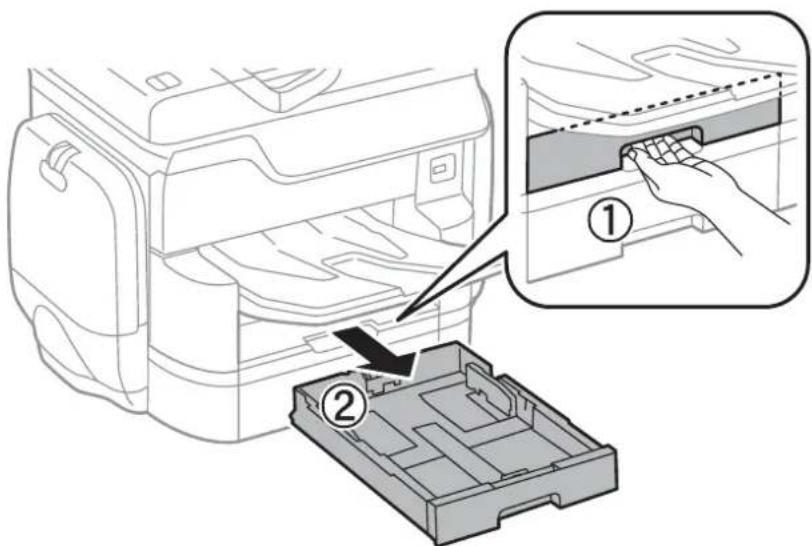
- Slide the front edge guide to its maximum position, and then slide the side edge guides to adjust to the paper size you want to use.
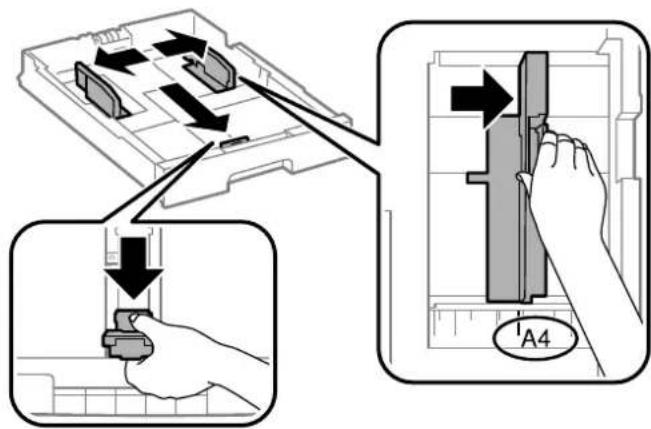
- Load paper with the printable side facing down, and then slide the front edge guide to the edge of the paper.
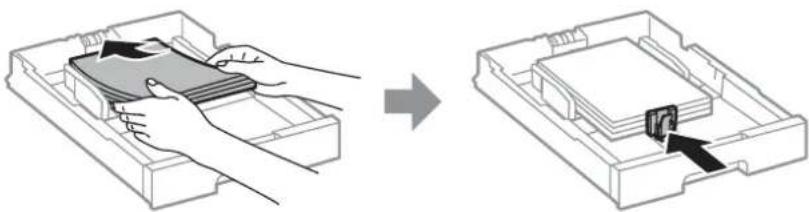
natural_image
Diagram showing two steps of inserting a device into a plastic tray (no text or symbols present)
Important:
Do not load more than the maximum number of sheets specified for the paper. For plain paper, do not load above the line just under the triangle symbol inside the edge guide.
Loading Paper
- Check that the paper size label matches the size of the paper loaded in the paper cassette. If it does not match, remove the holder and change the paper size indicated on the label.
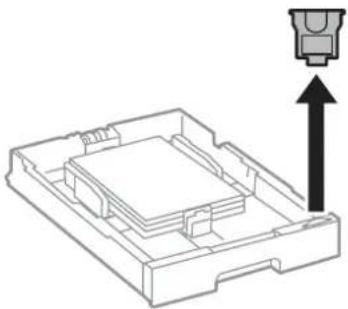
natural_image
Technical line drawing of a mechanical component with an upward arrow indicating assembly or force (no text or symbols present)-
Insert the paper cassette all the way.
-
When loading a paper type that differs from the last time, set the paper type on the control panel.
Press the 📁 button, select the paper cassette in which you loaded the paper, and then set the paper type.
Note:
You also need to set the paper size when loading paper other than the following sizes.
A3, B4, A4, B5, A5, B6, A6
Related Information
→ "Paper Handling Precautions" on page 47
→ "Available Paper and Capacities" on page 48
→ "List of Detected Paper Sizes" on page 51
Loading Paper in the Rear Paper Feed
- Open the feeder guard and pull out the paper support.
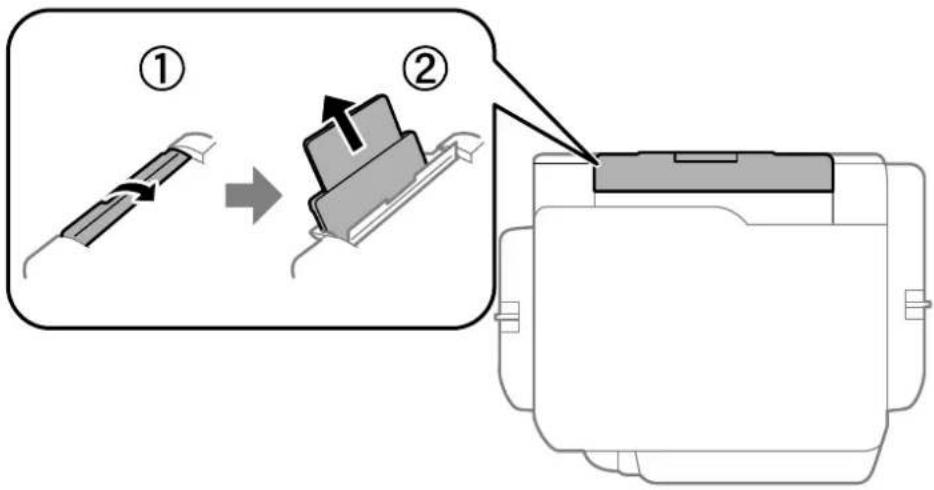
Loading Paper
- Slide the edge guides.
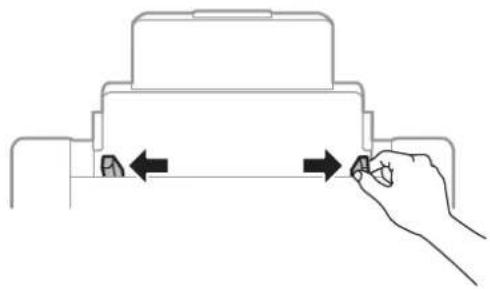
natural_image
Line drawing of a hand pressing down on a mechanical component with arrows indicating motion (no text or symbols)- Load paper at the center of the rear paper feed with the printable side facing up.
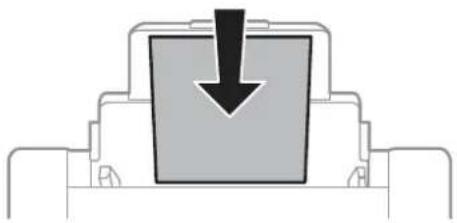
natural_image
Diagram of a mechanical component with a downward arrow indicating force or direction (no text or symbols)
Important:
☐ Do not load more than the maximum number of sheets specified for the paper. For plain paper, do not load above the line just under the triangle symbol inside the edge guide.
☐ Load paper short edge first. However, when you have set the long edge as the width of the user defined size, load paper long edge first.
□ Envelopes

flowchart
graph TD
    A["Start"] --> B{Step 1}
    B -->|Downward Arrow| C["Step 2"]
    C --> D["End"]
□ Pre-punched paper
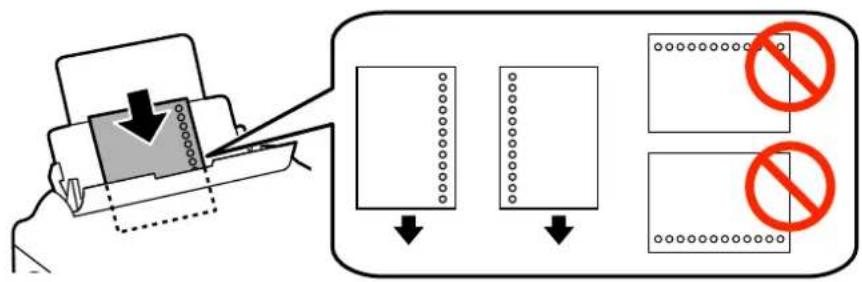
Loading Paper
Note:
☐ Load a single sheet of defined size plain paper with binding holes at the left or right.
☐ Adjust the print position of your file to avoid printing over the holes.
☐ Automatic 2-sided printing is not available for pre-punched paper.
- Slide the edge guides to the edges of the paper.
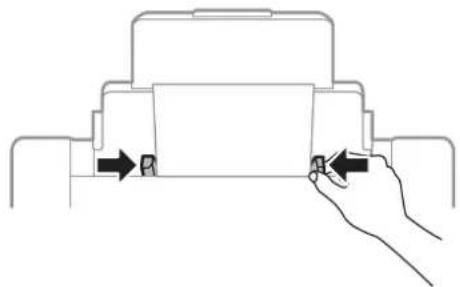
natural_image
Line drawing of a hand pressing down on a mechanical component (no text or symbols)- On the control panel, set the size and type of the paper you loaded in the rear paper feed.
Note:
☐ You can also display the paper size and paper type settings screen by pressing the button on the control panel.
☐ Return the remaining paper to its package. If you leave it in the printer, the paper may curl or the print quality may decline.
Related Information
→ "Paper Handling Precautions" on page 47
→ "Available Paper and Capacities" on page 48
→ "List of Detected Paper Sizes" on page 51
Placing Originals
Placing Originals
Place originals on the scanner glass or the ADF. Use the scanner glass for originals that the ADF does not support.
You can scan multiple originals and both sides of the originals at the same time with the ADF.
Available Originals for the ADF
| Available Paper Sizes | A6 landscape to A3/Ledger (Maximum 297×431.8 mm) |
| Paper Type | Plain paper, High-quality paper, Recycled paper |
| Paper Thickness (Weight of Paper) | 52 to 128 g/m ^2 |
| Loading Capacity | 50 sheets or 5.5 mm |
Even when the original meets the specifications for media that can be placed in the ADF, it may not feed from the ADF or the scan quality may decline depending on the paper properties or quality.

Important:
Do not feed photographs or valuable original artwork into the ADF. Misfeeding may wrinkle or damage the original. Scan these documents on the scanner glass instead.
To prevent paper jams, avoid placing the following originals in the ADF. For these types, use the scanner glass.
☐ Originals that are torn, folded, wrinkled, deteriorated, or curled
☐ Originals with binder holes
☐ Originals held together with tape, staples, paper clips etc.
☐ Originals that have stickers or labels stuck to them
☐ Originals that are cut irregularly or not right angled
☐ Originals that are bound
☐ OHPs, thermal transfer paper, or carbon backs
Placing Originals on the ADF
- Align the edges of the originals.
User's Guide
Placing Originals
- Slide the ADF edge guides.
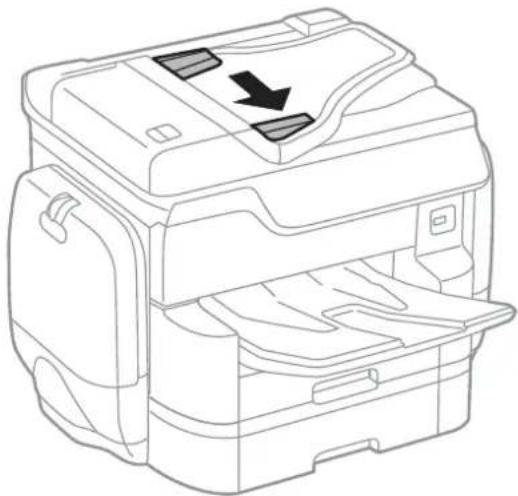
natural_image
Line drawing of a printer with an open base and internal compartments, showing no text or symbols.- Place the originals in the center of the ADF, facing up.
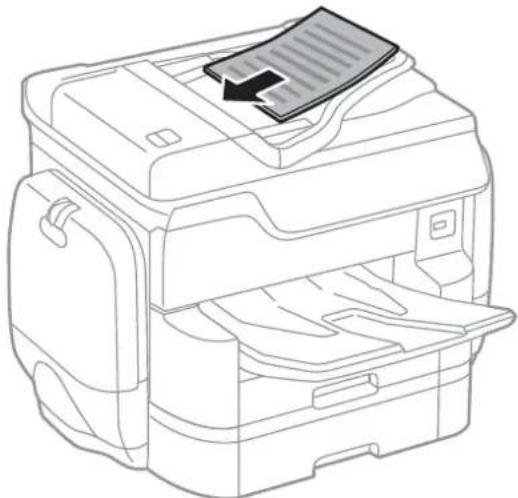
natural_image
Line drawing of a printer with a paper feeding into a rack (no text or symbols)Placing Originals

Important:
☐ Do not load originals above the line just under the triangle symbol inside the ADF edge guide.
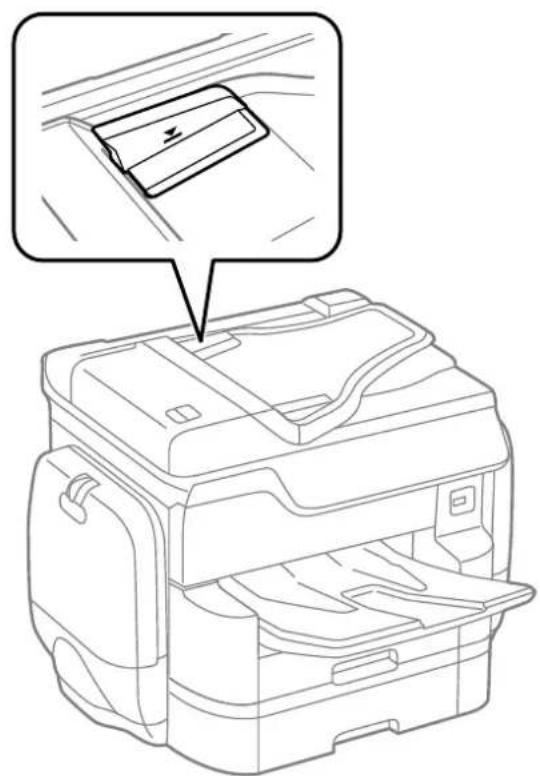
natural_image
Line drawing of a printer with an open lid and a magnified inset showing the paper's edge detail (no text or symbols)☐ Do not add originals while scanning.
Note:
You can place originals smaller than A4 size with the long edge facing toward the ADF.
- Slide the ADF edge guides to the edges of the originals.
The size of the originals is automatically detected.
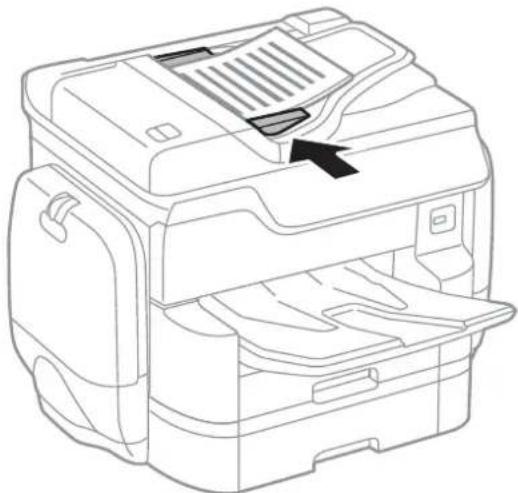
natural_image
Line drawing of a printer with an arrow pointing to the top panel (no text or symbols present)Placing Originals
Note:
Some sizes may not be automatically detected. In this situation, manually select the size of the originals.
Related Information
→ "Available Originals for the ADF" on page 57
Placing Originals on the ADF for 2-up Copying
Place the originals in the direction shown in the illustration, and then select the orientation setting.
☐ Placing the originals in the up direction: Select Up Direction on the control panel as described below.
Copy > Advanced > Orientation (Original) > Up Direction
Place the originals on the ADF in the direction of the arrow.
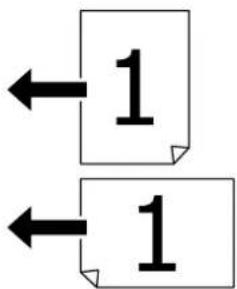
flowchart
graph TD
    A["1"] --> B["1"]
    B --> C["1"]
☐ Placing the originals in the left direction: Select Left Direction on the control panel as described below.
Copy > Advanced > Orientation (Original) > Left Direction
Place the originals on the ADF in the direction of the arrow.
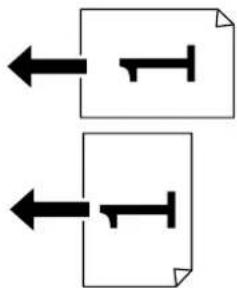
flowchart
graph TD
    A["Step 1"] --> B["Step 2"]
    B --> C["Step 3"]
Placing Originals on the Scanner Glass

Caution:
Be careful not to trap your fingers when closing the document cover. Otherwise you may be injured.

Important:
When placing bulky originals such as books, prevent exterior light from shining directly onto the scanner glass.
Placing Originals
- Open the document cover.
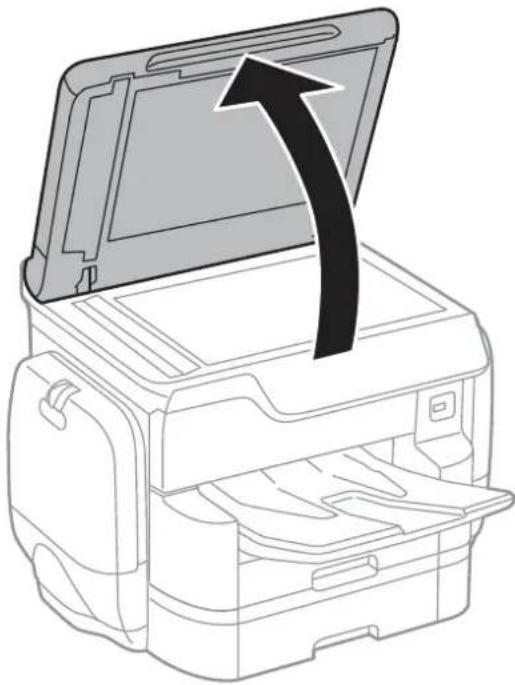
natural_image
Line drawing of a printer with an open lid and arrow indicating rotation (no text or symbols)-
Remove any dust or stains on the scanner glass.
-
Place the original face-down and slide it to the corner mark.
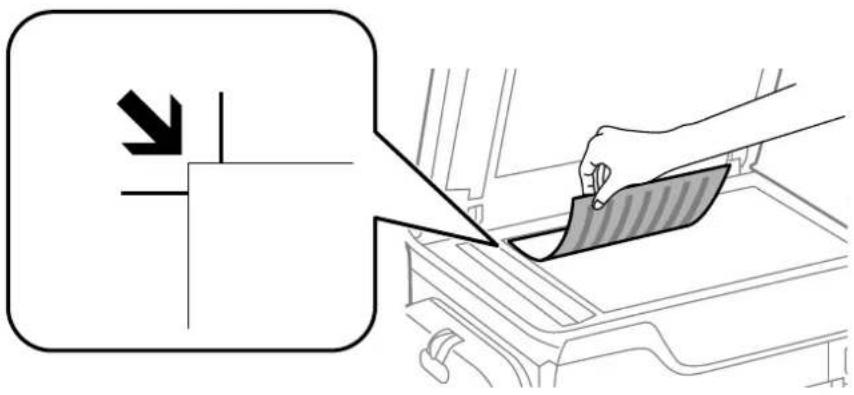
Note:
☐ A range of 1.5 mm from the top edge or left edge of the scanner glass is not scanned.
☐ When originals are placed in the ADF and on the scanner glass, priority is given to the originals in the ADF.
- Close the cover gently.
The size of the originals is automatically detected. If the size is not detected, place the originals again.

Important:
Do not apply too much force to the scanner glass or the document cover. Otherwise, they may be damaged.
Note:
Some sizes may not be automatically detected. In this situation, manually select the size of the originals.
User's Guide
Placing Originals
- Remove the originals after scanning.
Note:
If you leave the originals on the scanner glass for a long time, they may stick to the surface of the glass.
Managing Contacts
Managing Contacts
Registering a contacts list allows you to easily enter destinations. You can register up to 2,000 entries, and you can use the contacts list when you enter a fax number, enter a destination for attaching a scanned image to an email, and saving a scanned image to a network folder.
You can also register contacts in the LDAP server.
See the Administrator's Guide to register contacts in the LDAP server.
Registering or Editing Contacts
Note:
Before registering contacts, make sure you have also configured the email server settings to use the email address.
See the Administrator's Guide for details.
-
Tap Settings on the home screen.
-
Tap Contacts Manager, and then tap Register/Delete.
-
Do one of the following.
☐ To register a new contact, tap Add Entry, and then tap Add Contact.
☐ To edit a contact, select the target contact, and then tap Edit.
☐ To delete a contact, select the target contact, tap Delete, and then tap Yes. You do not have to perform following procedures.
Note:
You can register an address that is registered in the LDAP server in the local contacts list of the printer. Display an entry, and then tap Register to Contacts.
- When registering a new contact, select the type of contact you want to register. Skip this procedure when you want to edit or delete a contact.
☐ Fax: Register a contact (fax number) to send a fax.
☐ Email: Register an email address to send a scanned image.
☐ Network Folder/FTP: Register a network folder to save a scanned image
- Make the necessary settings.
Note:
When entering a fax number, enter an external access code at the beginning of the fax number if your phone system is PBX and you need the access code to get an outside line. If the access code has been set in the Line Type setting, enter a hash (#) instead of the actual access code. To add a pause (pause for three seconds) during dialing, enter a hyphen (-).
- Tap OK.
Related Information
→ "Using an Email Server" on page 302
Managing Contacts
Registering or Editing Grouped Contacts
Adding contacts to a group allows you to send a fax or send a scanned image by an email to multiple destinations at the same time.
-
Tap Settings on the home screen.
-
Tap Contacts Manager, and then tap Register/Delete.
-
Do one of the following.
☐ To register a new group, tap Add Entry, and then tap Add Group.
☐ To edit a group, select the target group, and then tap Edit.
☐ To delete a group, select the target group, tap Delete, and then tap Yes. You do not have to perform following procedures.
- When registering a new group, select the type of group you want to register. Skip this procedure when you want to edit a group.
☐ Fax: Register a contact (fax number) to send a fax.
☐ Email: Register an email address to send a scanned image.
-
Enter or edit the Group Name for the group.
-
Tap Contact(s) Added to the Group (Required).
-
Select the contacts that you want to register in the group.
Note:
☐ You can register up to 200 contacts.
☐ To deselect a contact, tap it again.
-
Tap Close.
-
Make the other necessary settings.
☐ Registry Number: Set the number for a group.
☐ Index Word: Set index word for the group.
☐ Assign to Frequent Use: Register as a frequently used group. The group is displayed at the top of the screen where you specify the address.
- Tap OK.
Registering Frequently Used Contacts
When you register frequently used contacts, the contacts are displayed at the top of the screen where you specify the address.
- Tap Settings on the home screen.
- Tap Contacts Manager, and then tap Frequent.
Managing Contacts
-
Tap the type of contact you want to register.
-
Tap Edit.
Note:
To edit the order of the contacts, tap Sort.
- Select frequently used contacts that you want to register, and then tap OK.
Note:
☐ To deselect a contact, tap it again.
☐ You can search for addresses from the contacts list. Enter the search keyword into the box on the top of the screen.
- Tap Close.
Register Contacts on a Computer
Using EpsonNet Config or Web Config, you can create a contact list on your computer and import it to the printer. See the Administrator's Guide for details.
Related Information
→ "EpsonNet Config" on page 222
Backing up Contacts using a Computer
Using EpsonNet Config or Web Config, you can back up the contact data stored in the printer to the computer. See the Administrator's Guide for details.
Contacts data may be lost due to a printer malfunction. We recommend that you make a backup of the data whenever you update the data. Epson shall not be responsible for the loss of any data, for backing up or recovering data and/or settings even during a warranty period.
Related Information
→ "EpsonNet Config" on page 222
Printing
Printing from the Control Panel
You can print data from an external USB device connected to your printer.
Printing JPEG Files from a Memory Device
Note:
If you have more than 999 images on your memory device, images are automatically divided into groups and the group selection screen is displayed. Images are sorted by the date they were taken.
- Connect the memory device to the printer's external interface USB port.
- Tap Memory Device on the home screen.
- Tap JPEG.
The images on the memory device are displayed as thumbnails.
Tap ☐ to change the Display order or make settings for Select All Images, Cancel Image Selection, and Select Group.
- Tap the files you want to print.
Selected images have check marks on them.
To preview one image, tap Single View. You can enlarge the image by tapping ☐. Tap < or > to preview the previous or next image.
- Tap Proceed to Print to make the print settings.
- Set the paper source and the color mode that you want to use on the Basic Settings tab.
- Set the other items on the Advanced tab as necessary.
For more information on detailed settings, see the menus for Memory Device.
-
Enter the number of prints by using the keypad.
-
Tap ◆ to start printing.
-
Remove the memory device from the printer.
Related Information
→ "Loading Paper in the Paper Cassette" on page 52
→ "Loading Paper in the Rear Paper Feed" on page 54
→ "JPEG Settings" on page 67
Printing
Printing PDF or TIFF Files from a Memory Device
- Connect the memory device to the printer's external interface USB port.
- Tap Memory Device on the home screen.
- Tap PDF or TIFF.
The files on the memory device are displayed as a list.
To change the order of the files, tap ↓↑.
- Tap the file you want to print.
- Set the paper source and the color mode that you want to use on the Basic Settings tab.
- Set the other items on the Advanced tab as necessary.
For more information on detailed settings, see the menus for the memory device.
- Enter the number of prints by using the keypad.
- Tap ◆ to start printing.
- Remove the memory device from the printer.
Related Information
→ "Loading Paper in the Paper Cassette" on page 52
→ "Loading Paper in the Rear Paper Feed" on page 54
→ "PDF Settings" on page 68
→ "TIFF Settings" on page 68
Menu Options for Memory Device
Tap Memory Device on the printer's home screen to make various print settings for the file on the memory device.
JPEG Settings
Menu (Options) :
Make settings for ordering, selecting, and deselecting image data.
Basic Settings:
Paper Setting
Specify the paper source settings which you want to print on.
□ Color Mode
Select a color setting whether you normally print in B&W or Color.
Printing
Advanced:
Layout
Select the way of layout the JPEG files. 1-up is for printing a file per a page. 20-up is for printing 20 files per a page. Index is for making index printing with information.
□ Fit Frame
Select On to crop the image to fit into the selected print layout automatically. If the aspect ratio of the image data and the paper size is different, the image is automatically enlarged or reduced so that the short sides match the short sides of the paper. The long side of the image is cropped if it extends beyond the long side of the paper. This feature may not work for panorama photos.
Quality
Select Best for higher quality printing, but the printing speed may be slower.
Date
Select the format of the date the photo was taken or saved. The date is not printed for some layouts.
□ Fix Photo
Select this mode to improve the brightness, contrast, and saturation of the photo automatically. To turn off automatic improvement, select Enhance Off.
□ Fix Red-Eye
Select On to automatically fix the red-eye effect in photos. Corrections are not applied to the original file, only to the printouts. Depending on the type of photo, parts of the image other than the eyes may be corrected.
PDF Settings
You can make print settings for PDF format files on your memory devices.
↓↑ (Display order):
Select a sort setting to display the files on the LCD screen.
Basic Settings:
□ Paper Setting
Specify the paper source settings which you want to print on.
□ Color Mode
Select a color setting whether you normally print in B&W or Color.
Advanced:
□ 2-Sided
Select On to print PDF files using 2-Sided printing. You can also select the binding method by tapping Binding(Copy).
□ Print Order
Select the order for printing multi-page PDF files.
TIFF Settings
You can make print settings for TIFF format files in you memory devices.
Printing
↓↑ (Display order):
Make a sort setting to display the file on the LCD screen.
Basic Settings:
□ Paper Setting
Specify the paper source settings which you want to print on.
□ Color Mode
Select a color setting whether you normally print in B&W or Color.
Advanced:
Layout
Select the way of layout the Multi-TIFF file to print a page. 1-up is to print a file per a page. 20-up is to print 20 files per a page. Index is to make index printing with information.
□ Fit Frame
Select On to crop the photo to fit into the selected photo layout automatically. If the aspect ratio of the image data and the paper size is different, the image is automatically enlarged or reduced so that the short sides match the short sides of the paper. The long side of the image is cropped if it extends beyond the long side of the paper. This feature may not work for panorama photos.
Quality
Select Best for higher quality printing, but the printing speed may be slower.
□ Print Order
Select the order for printing multi-page TIFF files.
Date
Select the format of the date the photo was taken or saved. The date is not printed for some layouts.
Printing from a Computer
If you cannot change some of the printer driver settings, they may have been restricted by the administrator. Contact your printer administrator for assistance.
Authenticating Users in the Printer Driver when User Feature Restriction Is Enabled (for Windows Only)
When the user feature restriction is enabled, a user ID and password are required to print. Register the user ID and password in the printer driver. If you do not know the password, contact your printer administrator.
- Access the printer driver window.
- Click Printer and Option Information on the Maintenance tab.
- Select Save Access Control settings, click Settings, and then enter the user name and the password.
Related Information
→ "Windows Printer Driver" on page 216
Printing
Printing Basics - Windows
Note:
☐ See the online help for explanations of the setting items. Right-click an item, and then click Help.
☐ Operations may differ depending on the application. See the application's help for details.
- Load paper in the printer.
- Open the file you want to print.
- Select Print or Print Setup from the File menu.
- Select your printer.
- Select Preferences or Properties to access the printer driver window.
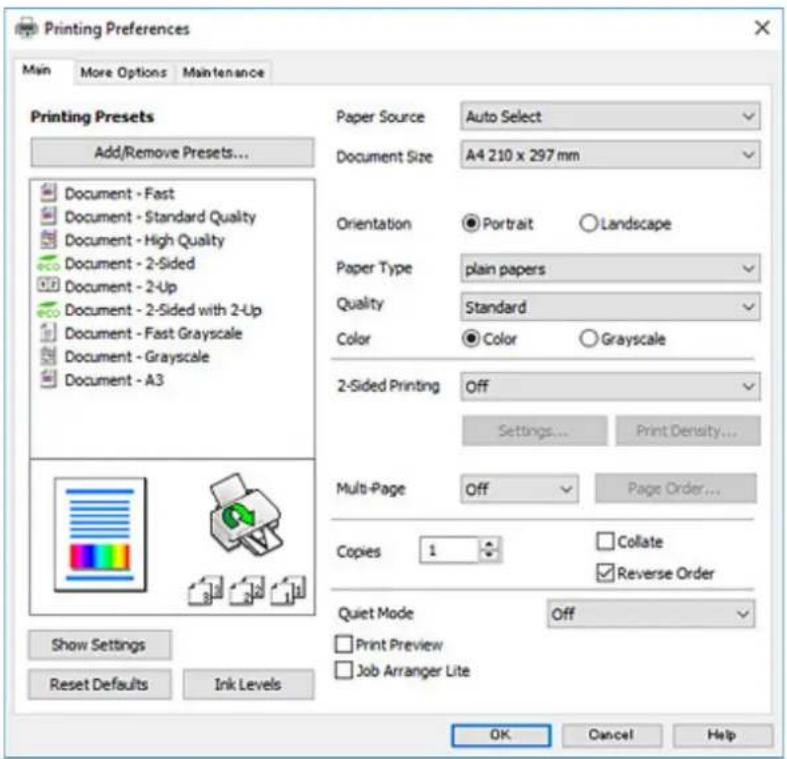
- Make the following settings.
☐ Paper Source: Select the paper source in which you loaded the paper. If the printer has only one paper source, this item is not displayed.
☐ Document Size: Select the paper size you loaded in the printer.
☐ Orientation: Select the orientation you set in the application.
☐ Paper Type: Select the type of paper you loaded.
☐ Quality: Select the print quality. Selecting High provides higher quality printing, but the printing speed may be slower.
☐ Color: Select Grayscale when you want to print in black or shades of gray.
Printing
Note:
☐ If you are printing high-density data on plain paper, letterhead, or preprinted paper, select Standard-Vivid as the Quality setting to make your printout vivid.
☐ When printing on envelopes, select Landscape as the Orientation setting.
-
Click OK to close the printer driver window.
-
Click Print.
Related Information
→ "Available Paper and Capacities" on page 48
→ "Loading Paper in the Paper Cassette" on page 52
→ "Loading Paper in the Rear Paper Feed" on page 54
→ "List of Paper Type" on page 51
Printing Basics - Mac OS X
Note:
Explanations in the section use TextEdit as an example. Operations and screens differ depending on the application. See the application's help for details.
- Load paper in the printer.
- Open the file you want to print.
- Select Print from the File menu or another command to access the print dialog.
If necessary, click Show Details or ▼ to expand the print window.
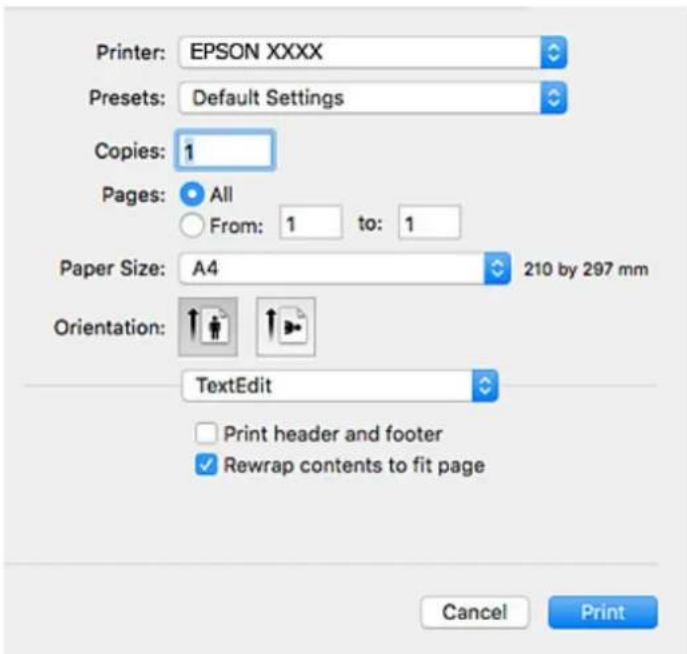
Printing
- Make the following settings.
☐ Printer: Select your printer.
☐ Presets: Select when you want to use the registered settings.
☐ Paper Size: Select the paper size you loaded in the printer.
☐ Orientation: Select the orientation you set in the application.
Note:
☐ If the above setting menus are not displayed, close the print window, select Page Setup from the File menu, and then make settings.
☐ When printing on envelopes, select landscape orientation.
- Select Print Settings from the pop-up menu.
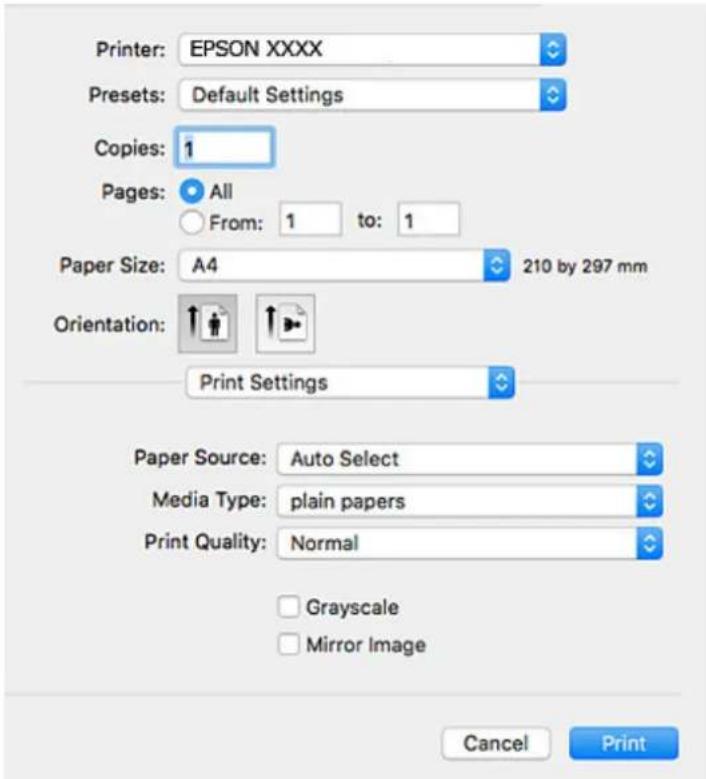
Note:
On Mac OS X v10.8.x or later, if the Print Settings menu is not displayed, the Epson printer driver has not been installed correctly.
Select System Preferences from the menu > Printers & Scanners (or Print & Scan, Print & Fax), remove the printer, and then add the printer again. See the following to add a printer.
http://epson.sn
- Make the following settings.
☐ Paper Source: Select the paper source in which you loaded the paper. If the printer has only one paper source, this item is not displayed.
☐ Media Type: Select the type of paper you loaded.
Printing
☐ Print Quality: Select the print quality.
Selecting a higher quality setting may reduce the printing speed.
☐ Grayscale: Select to print in black or shades of gray.
7. Click Print.
Related Information
→ "Available Paper and Capacities" on page 48
→ "Loading Paper in the Paper Cassette" on page 52
→ "Loading Paper in the Rear Paper Feed" on page 54
→ "List of Paper Type" on page 51
Printing on 2-Sides
You can use either of the following methods to print on both sides of the paper.
☐ Automatic 2-sided printing
☐ Manual 2-sided printing (for Windows only)
When the printer has finished printing the first side, flip the paper over to print on the other side.
You can also print a booklet that can be created by folding the printout. (For Windows only)
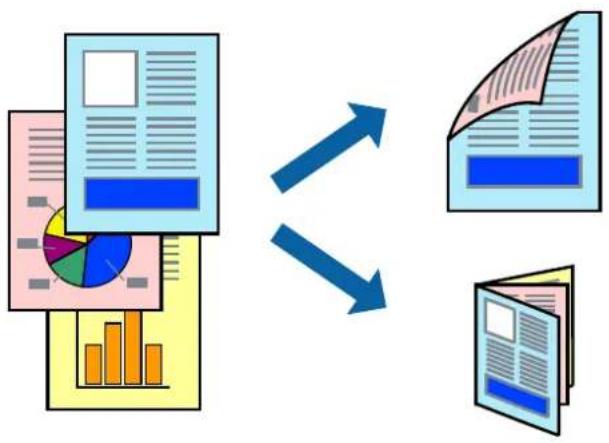
flowchart
graph TD
    A["Document Submission"] --> B["Data Collection"]
    B --> C["Output"]
    D["Document Export"] --> E["Document Review"]
    E --> F["Output"]
Note:
☐ If you do not use paper that is suitable for 2-sided printing, the print quality may decline and paper jams may occur.
☐ Depending on the paper and the data, ink may bleed through to the other side of the paper.
Related Information
→ "Available Paper and Capacities" on page 48
Printing
Printing on 2-Sides - Windows
Note:
☐ Manual 2-sided printing is available when EPSON Status Monitor 3 is enabled. If EPSON Status Monitor 3 is disabled, access the printer driver, click Extended Settings on the Maintenance tab, and then select Enable EPSON Status Monitor 3.
☐ Manual 2-sided printing may not be available when the printer is accessed over a network or is used as a shared printer.
- Load paper in the printer.
- Open the file you want to print.
- Access the printer driver window.
- Select Auto (Long-edge binding), Auto (Short-edge binding), Manual (Long-edge binding), or Manual (Short-edge binding) from 2-Sided Printing on the Main tab.
- Click Settings, make the appropriate settings, and then click OK.
Note:
To print a folded booklet, select Booklet.
- Click Print Density, select the document type from Select Document Type, and then click OK.
The printer driver automatically sets the Adjustments options for that document type.
Note:
☐ Printing may be slow depending on the combination of options selected for Select Document Type in the Print Density Adjustment window and for Quality on the Main tab.
☐ For manual 2-sided printing, the Print Density Adjustment setting is not available.
-
Set the other items on the Main and More Options tabs as necessary, and then click OK.
-
Click Print.
For manual 2-sided printing, when the first side has finished printing, a pop-up window is displayed on the computer. Follow the on-screen instructions.
Related Information
→ "Loading Paper in the Paper Cassette" on page 52
→ "Loading Paper in the Rear Paper Feed" on page 54
→ "Printing Basics - Windows" on page 70
Printing on 2-Sides - Mac OS X
- Load paper in the printer.
- Open the file you want to print.
- Access the print dialog.
- Select Two-sided Printing Settings from the pop-up menu.
Printing
- Select the bindings and Document Type.
Note:
□ Printing may be slow depending on the Document Type setting.
☐ If you are printing high-density data such as photos or graphs, select Text & Graphics or Text & Photos as the Document Type setting. If scuffing occurs or the image bleeds through to the reverse side, adjust the print density and ink drying time by clicking the arrow mark next to Adjustments.
-
Set the other items as necessary.
-
Click Print.
Related Information
→ "Loading Paper in the Paper Cassette" on page 52
→ "Loading Paper in the Rear Paper Feed" on page 54
→ "Printing Basics - Mac OS X" on page 71
Printing Several Pages on One Sheet
You can print two or four pages of data on a single sheet of paper.
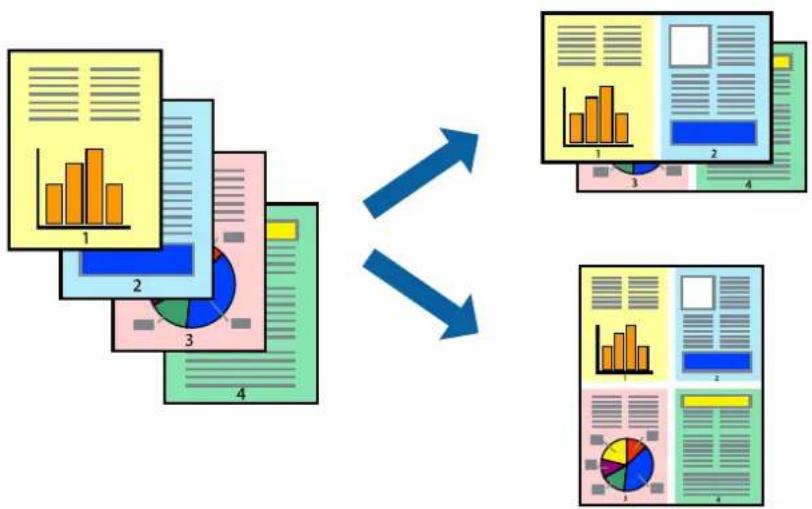
flowchart
graph TD
    A["Input Data"] --> B["Processing Step 1"]
    B --> C["Processing Step 2"]
    C --> D["Output Format 1"]
    C --> E["Output Format 2"]
    D --> F["Final Output Format 3"]
    E --> G["Final Output Format 4"]
Printing Several Pages on One Sheet - Windows
- Load paper in the printer.
- Open the file you want to print.
- Access the printer driver window.
- Select 2-Up or 4-Up as the Multi-Page setting on the Main tab.
- Click Page Order, make the appropriate settings, and then click OK to close the window.
- Set the other items on the Main and More Options tabs as necessary, and then click OK.
Printing
7. Click Print.
Related Information
→ "Loading Paper in the Paper Cassette" on page 52
→ "Loading Paper in the Rear Paper Feed" on page 54
→ "Printing Basics - Windows" on page 70
Printing Several Pages on One Sheet - Mac OS X
- Load paper in the printer.
- Open the file you want to print.
- Access the print dialog.
- Select Layout from the pop-up menu.
- Set the number of pages in Pages per Sheet, the Layout Direction (page order), and Border.
- Set the other items as necessary.
- Click Print.
Related Information
→ "Loading Paper in the Paper Cassette" on page 52
→ "Loading Paper in the Rear Paper Feed" on page 54
→ "Printing Basics - Mac OS X" on page 71
Printing to Fit the Paper Size
You can print to fit the paper size you loaded in the printer.
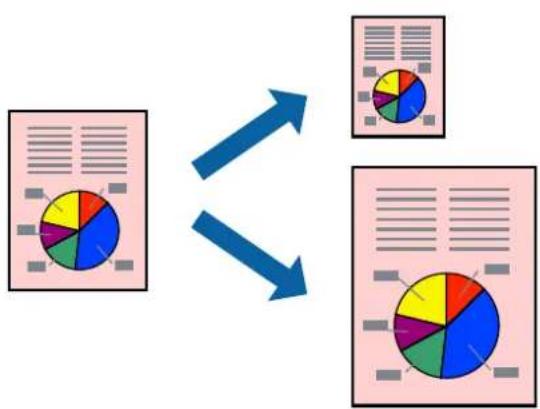
flowchart
graph TD
    A["Document 1"] --> B["Document 2"]
    A --> C["Document 3"]
    A --> D["Document 4"]
    A --> E["Document 5"]
    B --> F["Document 6"]
    C --> G["Document 7"]
    D --> H["Document 8"]
    E --> I["Document 9"]
Printing
Printing to Fit the Paper Size - Windows
-
Load paper in the printer.
-
Open the file you want to print.
-
Access the printer driver window.
-
Make the following settings on the More Options tab.
☐ Document Size: Select the paper size you set in the application.
☐ Output Paper: Select the paper size you loaded in the printer.
Fit to Page is selected automatically.
Note:
If you want to print a reduced image at the center of the page, select Center.
-
Set the other items on the Main and More Options tabs as necessary, and then click OK.
-
Click Print.
Related Information
→ "Loading Paper in the Paper Cassette" on page 52
→ "Loading Paper in the Rear Paper Feed" on page 54
→ "Printing Basics - Windows" on page 70
Printing to Fit the Paper Size - Mac OS X
- Load paper in the printer.
- Open the file you want to print.
- Access the print dialog.
- Select the size of the paper you set in the application as the Paper Size setting.
- Select Paper Handling from the pop-up menu.
- Select Scale to fit paper size.
- Select the paper size you loaded in the printer as the Destination Paper Size setting.
- Set the other items as necessary.
- Click Print.
Related Information
→ "Loading Paper in the Paper Cassette" on page 52
→ "Loading Paper in the Rear Paper Feed" on page 54
→ "Printing Basics - Mac OS X" on page 71
Printing
Printing Multiple Files Together (for Windows Only)
Job Arranger Lite allows you to combine several files created by different applications and print them as a single print job. You can specify the print settings for combined files, such as layout, print order, and orientation.
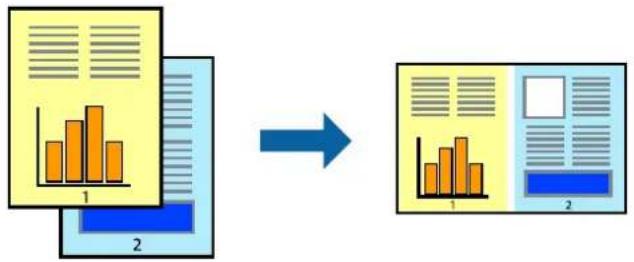
flowchart
graph LR
    A["Document Input"] --> B["Transformation"]
    B --> C["Output Section 1"]
    B --> D["Output Section 2"]
- Load paper in the printer.
- Open the file you want to print.
- Access the printer driver window.
- Select Job Arranger Lite on the Main tab.
- Click OK to close the printer driver window.
- Click Print.
The Job Arranger Lite window is displayed and the print job is added to the Print Project.
- With the Job Arranger Lite window opened, open the file that you want to combine with the current file, and then repeat steps 3 to 6.
Note:
☐ If you close the Job Arranger Lite window, the unsaved Print Project is deleted. To print later, select Save from the File menu.
☐ To open a Print Project saved in Job Arranger Lite, click Job Arranger Lite on the printer driver's Maintenance tab. Next, select Open from the File menu to select the file. The extension of the saved files is "ecl".
- Select the Layout and Edit menus in Job Arranger Lite to edit the Print Project as necessary. See the help of Job Arranger Lite for details.
- Select Print from the File menu.
Related Information
→ "Loading Paper in the Paper Cassette" on page 52
→ "Loading Paper in the Rear Paper Feed" on page 54
→ "Printing Basics - Windows" on page 70
Printing
Printing One Image on Multiple Sheets to Create a Poster (for Windows Only)
This feature allows you to print one image on multiple sheets of paper. You can create a larger poster by taping them together.
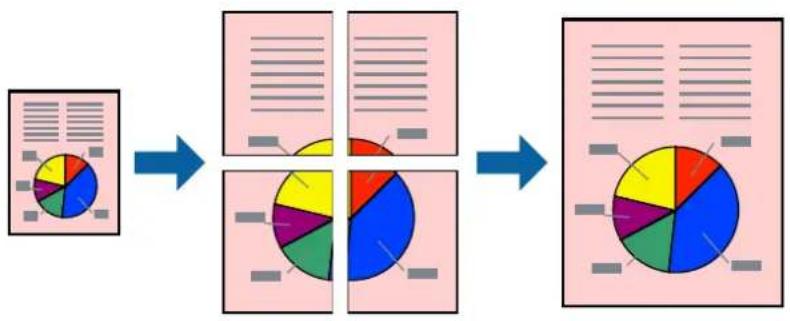
flowchart
graph LR
    A["Document Image"] --> B["Representation"]
    B --> C["Text Blocks"]
    C --> D["Output Text Blocks"]
- Load paper in the printer.
- Open the file you want to print.
- Access the printer driver window.
- Select 2x1 Poster, 2x2 Poster, 3x3 Poster, or 4x4 Poster from Multi-Page on the Main tab.
- Click Settings, make the appropriate settings, and then click OK.
Note:
Print Cutting Guides allows you to print a cutting guide.
- Set the other items on the Main and More Options tabs as necessary, and then click OK.
- Click Print.
Related Information
→ "Loading Paper in the Paper Cassette" on page 52
→ "Loading Paper in the Rear Paper Feed" on page 54
→ "Printing Basics - Windows" on page 70
Printing
Making Posters Using Overlapping Alignment Marks
Here is an example of how to make a poster when 2x2 Poster is selected, and Overlapping Alignment Marks is selected in Print Cutting Guides.
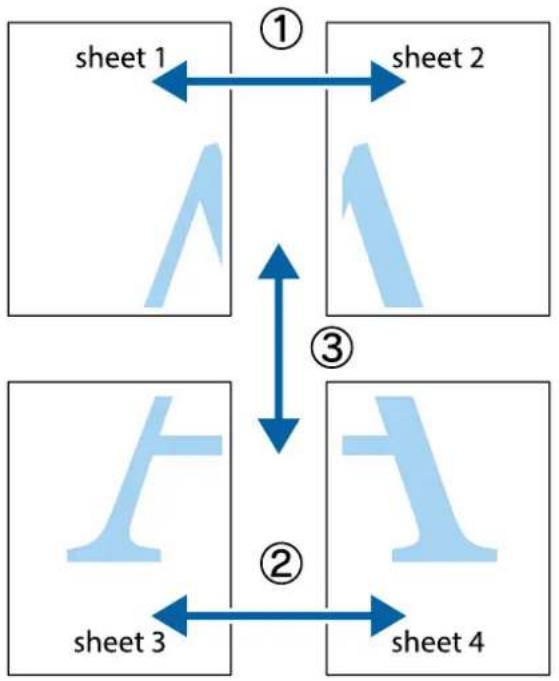
flowchart
graph TD
    A["sheet 1"] -->|①| B sheet2
    B sheet2 --> C["Sheet 1"]
    C --> D["Sheet 2"]
    D --> E["Sheet 2"]
    E --> F["Sheet 3"]
    F --> G["Sheet 3"]
    G --> H["Sheet 4"]
    H --> I["Sheet 4"]
    I --> J["Sheet 4"]
    style A fill:#cce5ff,stroke:#333
    style B fill:#cce5ff,stroke:#333
    style C fill:#cce5ff,stroke:#333
    style D fill:#cce5ff,stroke:#333
    style E fill:#cce5ff,stroke:#333
    style F fill:#cce5ff,stroke:#333
    style G fill:#cce5ff,stroke:#333
    style H fill:#cce5ff,stroke:#333
    style I fill:#cce5ff,stroke:#333
    style J fill:#cce5ff,stroke:#333
- Prepare Sheet 1 and Sheet 2. Cut off the margins of Sheet 1 along the vertical blue line through the center of the top and bottom cross marks.
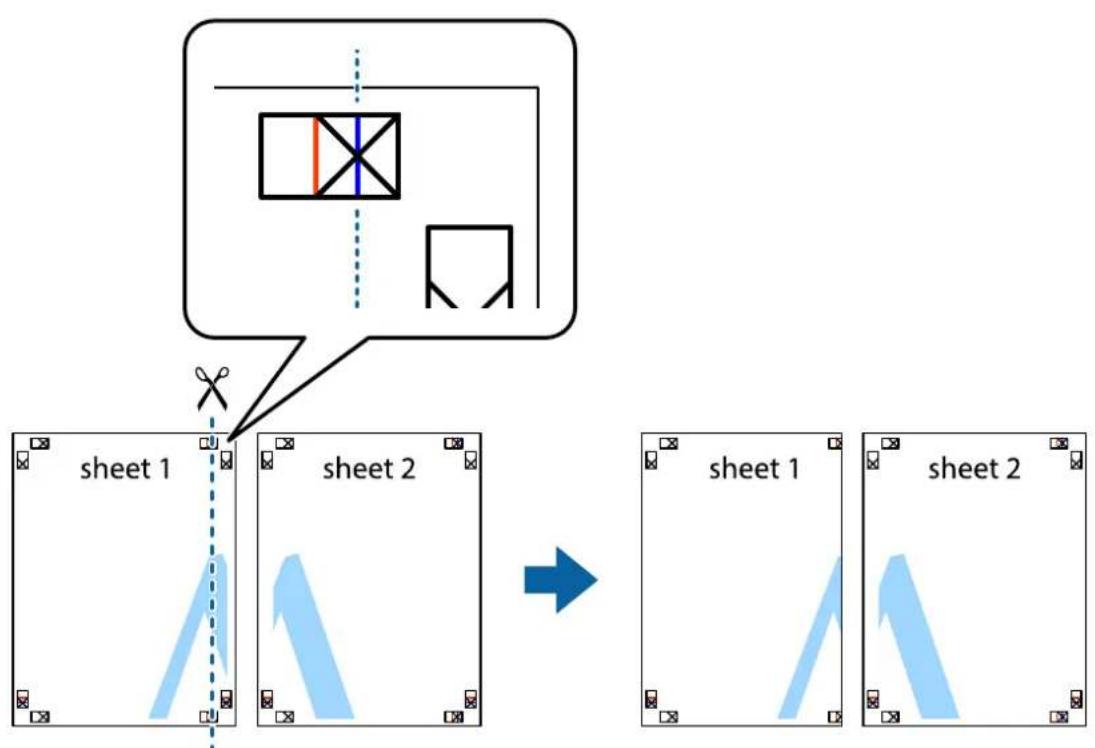
flowchart
graph TD
    A["sheet 1"] --> B["cutting scissors"]
    C sheet 2 --> D["after merging"]
    style A fill:#f9f,stroke:#333
    style B fill:#ccf,stroke:#333
    style C fill:#cfc,stroke:#333
    style D fill:#fcc,stroke:#333
Printing
- Place the edge of Sheet 1 on top of Sheet 2 and align the cross marks, then temporarily tape the two sheets together from the back.
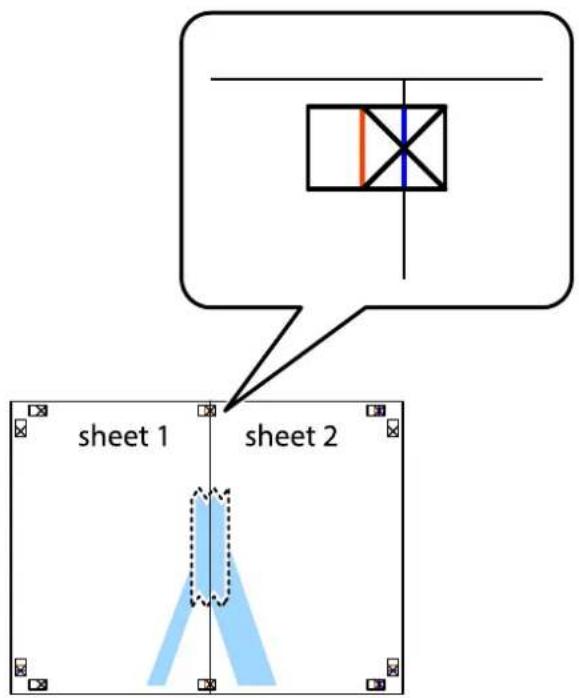
- Cut the taped sheets in two along the vertical red line through the alignment markers (this time, the line to the left of the cross marks).
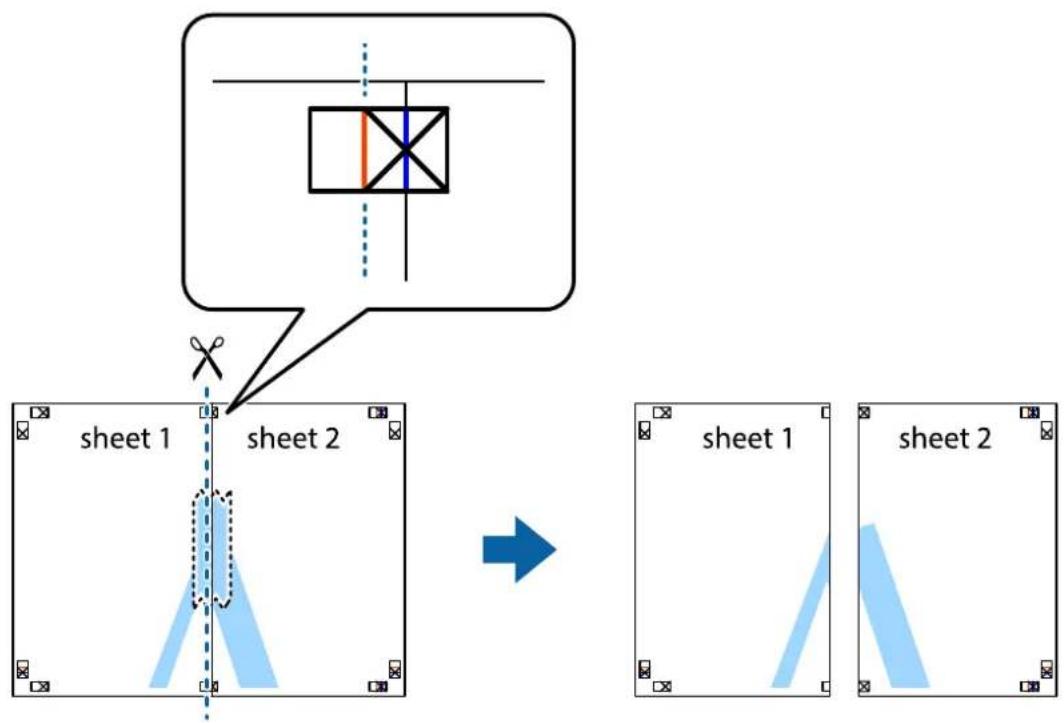
flowchart
graph TD
    A["sheet 1"] --> B["sheet 2"]
    B --> C["before diagram"]
    D_sheet1["sheet 1"] --> E_sheet2["sheet 2"]
    style A fill:#f9f,stroke:#333
    style B fill:#ccf,stroke:#333
    style C fill:#cfc,stroke:#333
    style D fill:#fcc,stroke:#333
    style E fill:#cff,stroke:#333
User's Guide
Printing
- Tape the sheets together from the back.
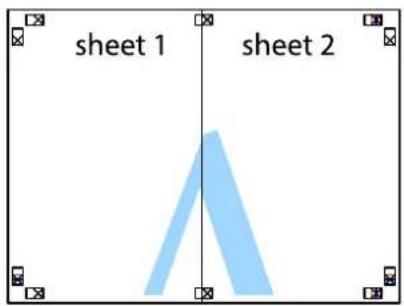
-
Repeat steps 1 to 4 to tape Sheet 3 and Sheet 4 together.
-
Cut off the margins of Sheet 1 and Sheet 2 along the horizontal blue line through the center of the left and right side cross marks.
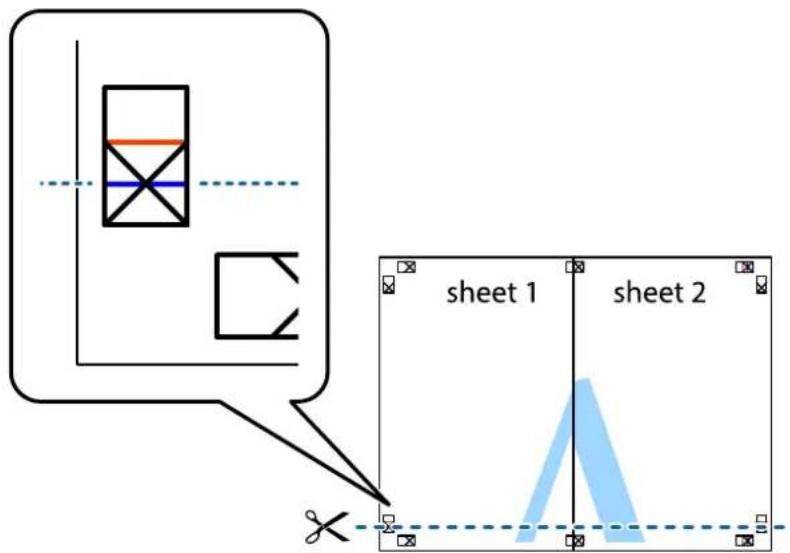
Printing
- Place the edge of Sheet 1 and Sheet 2 on top of Sheet 3 and Sheet 4 and align the cross marks, and then temporarily tape them together from the back.
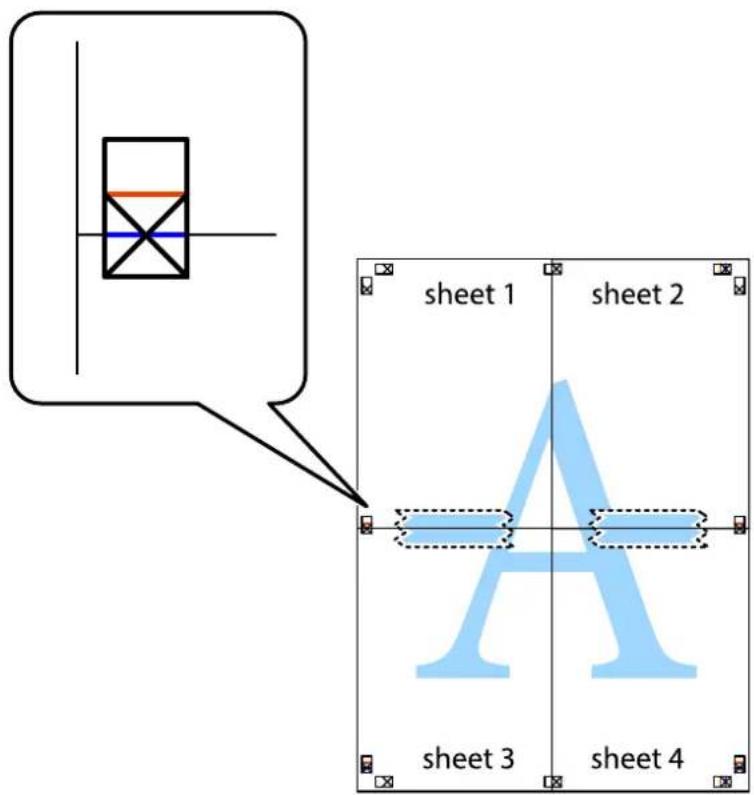
Printing
- Cut the taped sheets in two along the horizontal red line through the alignment markers (this time, the line above the cross marks).
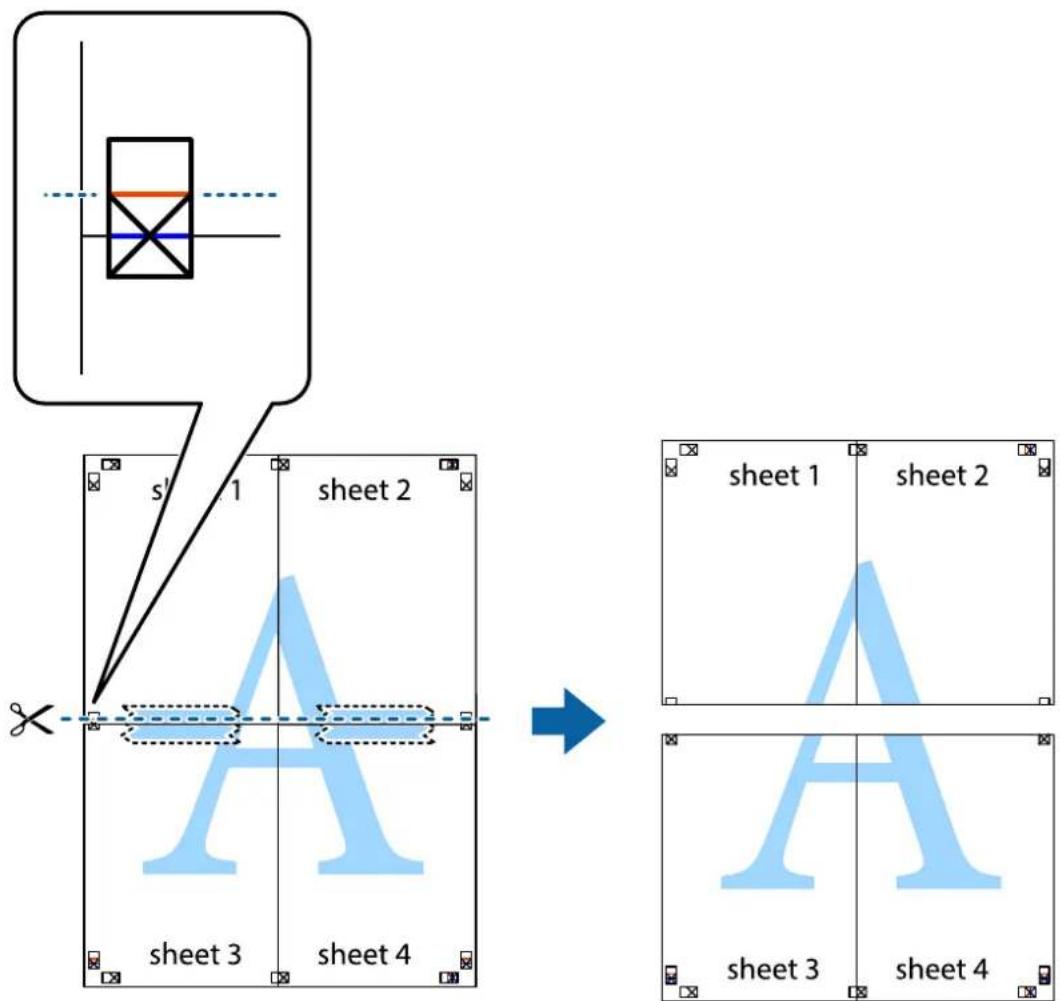
- Tape the sheets together from the back.
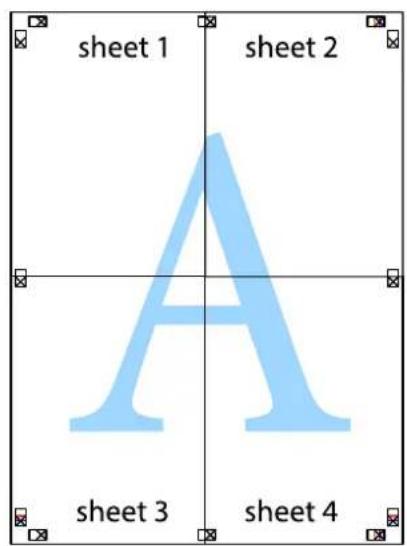
Printing
- Cut off the remaining margins along the outer guide.
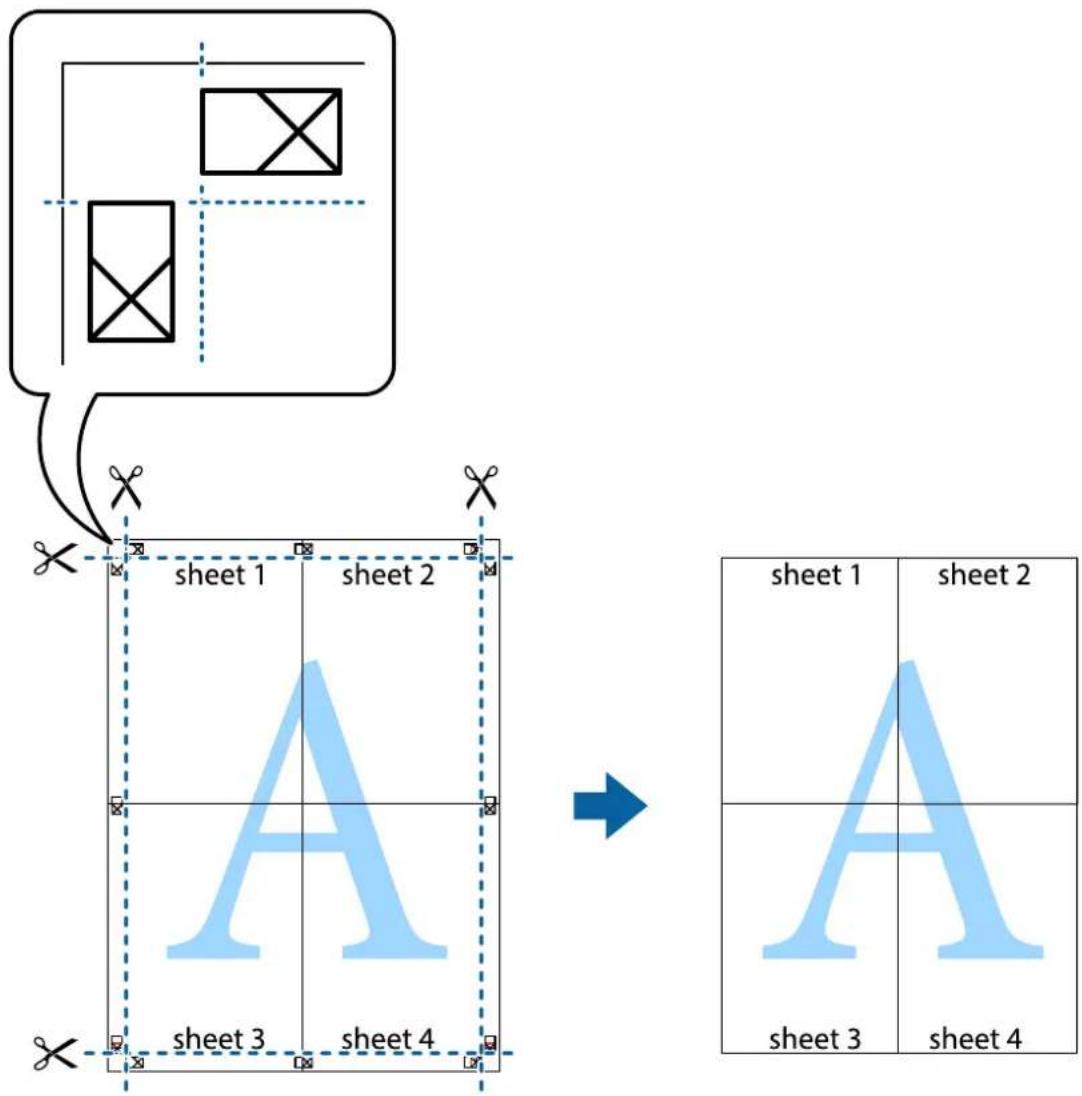
Printing Using Advanced Features
This section introduces a variety of additional layout and printing features available on the printer driver.
Related Information
→ "Windows Printer Driver" on page 216
→ "Mac OS X Printer Driver" on page 218
Adding a Printing Preset to Print Easily
If you create your own preset of frequently used print settings on the printer driver, you can print easily by selecting the preset from the list.
User's Guide
Printing
Windows
To add your own preset, set items such as the Document Size and Paper Type on the Main or More Options tab, and then click Add/Remove Presets in Printing Presets.
Note:
To delete an added preset, click Add/Remove Presets, select the preset name you want to delete from the list, and then delete it.
Mac OS X
Access the print dialog. To add your own preset, set items such as the Paper Size and Media Type, and then save the current settings as the preset in the Presets setting.
Note:
To delete an added preset, click Presets > Show Presets, select the preset name you want to delete from the list, and then delete it.
Printing a Reduced or Enlarged Document
You can reduce or enlarge the size of a document by a specific percentage.
Windows
Set the Document Size on the More Options tab. Select Reduce/Enlarge Document, Zoom to, and then enter a percentage.
Mac OS X
Note:
Operations differ depending on the application. See the application's help for details.
Select Page Setup (or Print) from the File menu. Select the printer from Format For, select the paper size, and then enter a percentage in Scale. Close the window, and then print following the basic printing instructions.
Related Information
→ "Printing Basics - Mac OS X" on page 71
Adjusting the Print Color
You can adjust the colors used in the print job.
PhotoEnhance produces sharper images and more vivid colors by automatically adjusting the contrast, saturation, and brightness of the original image data.
Note:
☐ These adjustments are not applied to the original data.
☐ PhotoEnhance adjusts the color by analyzing the location of the subject. Therefore, if you have changed the location of the subject by reducing, enlarging, cropping, or rotating the image, the color may change unexpectedly. If the image is out of focus, the tone may be unnatural. If the color is changed or becomes unnatural, print in a mode other than PhotoEnhance.
Windows
Select the method of color correction from Color Correction on the More Options tab.
User's Guide
Printing
If you select Automatic, the colors are automatically adjusted to match the paper type and print quality settings. If you select Custom and click Advanced, you can make your own settings.
Mac OS X
Access the print dialog. Select Color Matching from the pop-up menu, and then select EPSON Color Controls. Select Color Options from the pop-up menu, and then select one of the available options. Click the arrow next to Advanced Settings and make the appropriate settings.
Printing an Anti-Copy Pattern (for Windows Only)
You can print documents with invisible letters such as "Copy". These letters appear when the document is photocopied so that the copies can be distinguished from the original. You can also add your own anti-copy pattern.
Note:
This feature is only available when the following settings are selected.
□ Paper Type: plain papers
Quality: Standard
☐ Auto 2-sided printing: Disabled
☐ Color Correction: Automatic
☐ Short Grain Paper: Disabled
Click Watermark Features on the More Options tab, and then select an anti-copy pattern. Click Settings to change details such as the size and density.
Printing a Watermark (for Windows Only)
You can print a watermark such as "Confidential" on your printouts. You can also add your own watermark.

Click Watermark Features on the More Options tab, and then select a watermark. Click Settings to change details such as the density and position of the watermark.
Printing a Header and Footer (for Windows Only)
You can print information such as a user name and printing date as headers or footers.
Click Watermark Features in the More Options tab, and then select Header/Footer. Click Settings and select necessary items from the drop-down list.
Printing
Setting a Password for a Print Job (for Windows Only)
You can set a password for a print job to prevent printing until the password is entered on the printer's control panel.
Select Confidential Job on the More Options tab, and then enter a password.
To print the job, tap Confidential Job from the home screen, and then select the job and enter the password.
Printing Using a PostScript Printer Driver
Printing Using a PostScript Printer Driver - Windows
- Load paper in the printer.
- Open the file you want to print.
- Access the PostScript printer driver window.
- Select the orientation you set in the application as the Orientation on the Layout tab.
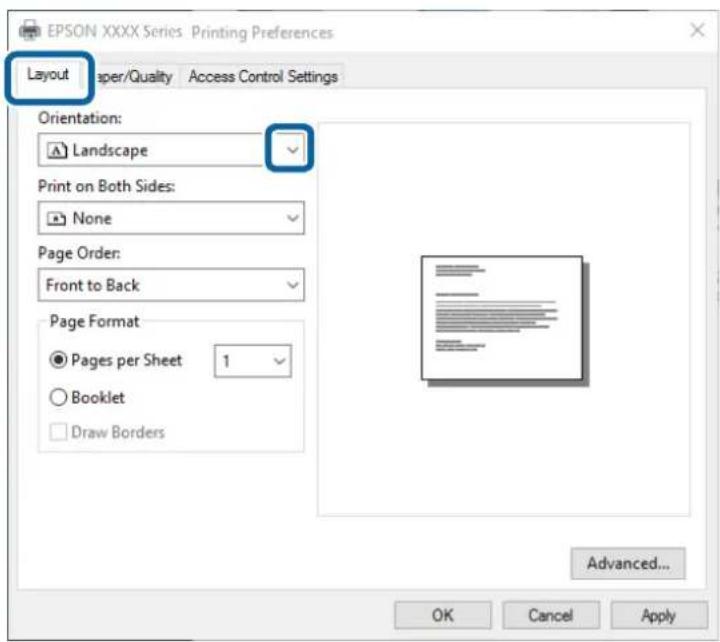
Printing
5. Make the following settings on the Paper/Quality tab.
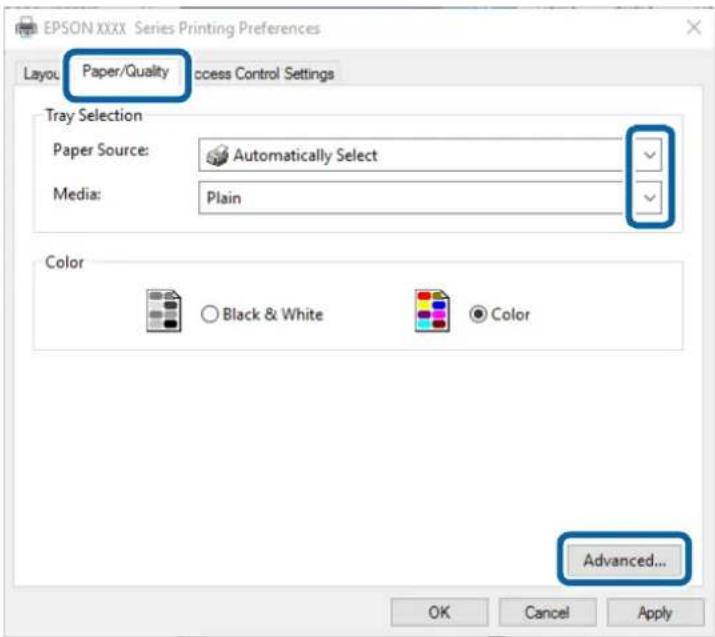
☐ Paper Source: Select the paper source in which you loaded the paper.
☐ Media: Select the type of paper you loaded.
6. Click Advanced, make the following settings, and then click OK.
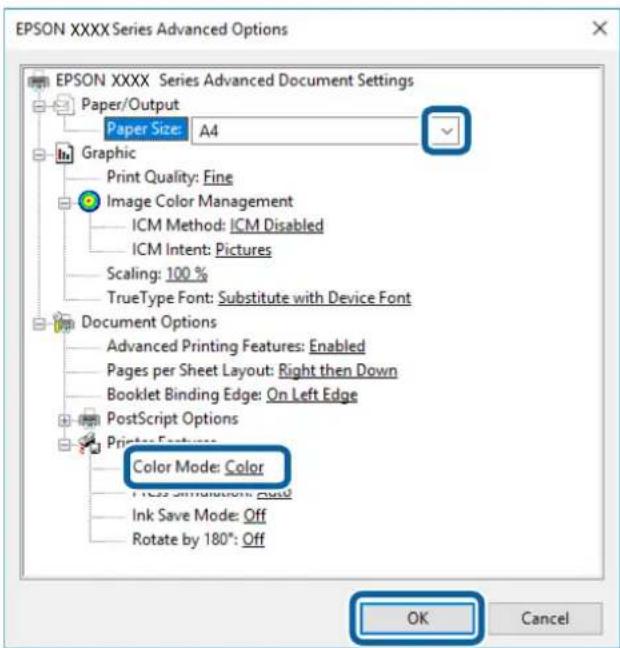
☐ Paper Size: Select the paper size you loaded in the printer.
☐ Color Mode: Select to print in full color or monochrome.
7. Click OK.
Printing
8. Click Print.
Related Information
→ "Available Paper and Capacities" on page 48
→ "Loading Paper in the Paper Cassette" on page 52
→ "Loading Paper in the Rear Paper Feed" on page 54
→ "List of Paper Type" on page 51
Printing Using a PostScript Printer Driver - Mac OS X
- Load paper in the printer.
- Open the file you want to print.
- Access the print dialog.
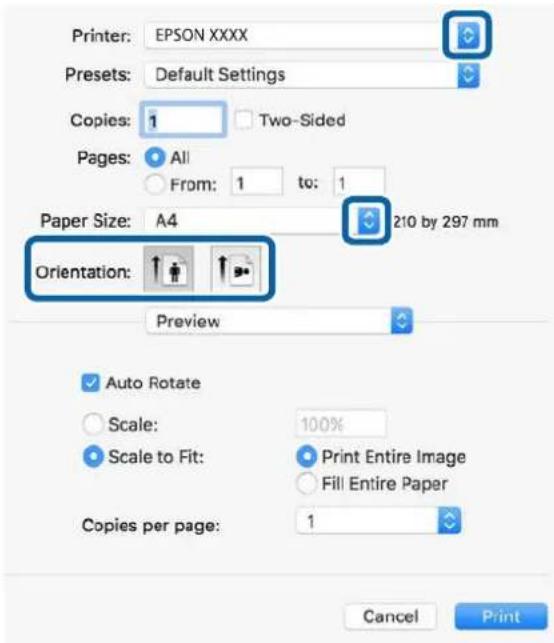
- Make the following settings.
☐ Printer: Select your printer.
☐ Paper Size: Select the paper size you loaded in the printer.
☐ Orientation: Select the orientation you set in the application.
Printing
- Select Paper Feed from the pop-up menu, and then select the paper source in which you loaded the paper.
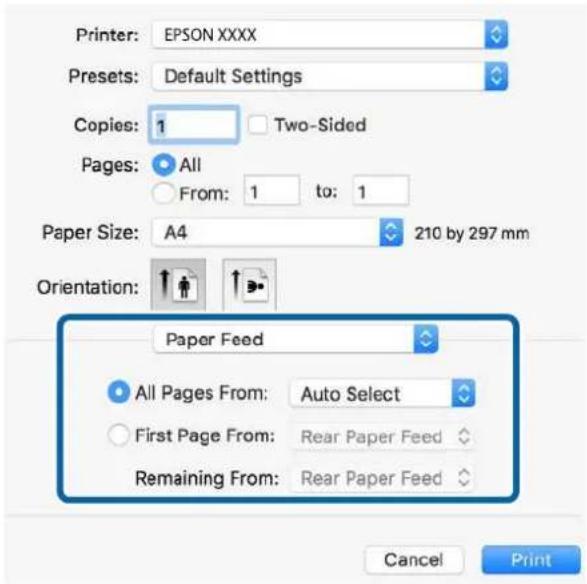
- Select Printer Features from the pop-up menu, select Quality as the Feature Sets setting, and then select the type of paper you loaded as the MediaType setting.
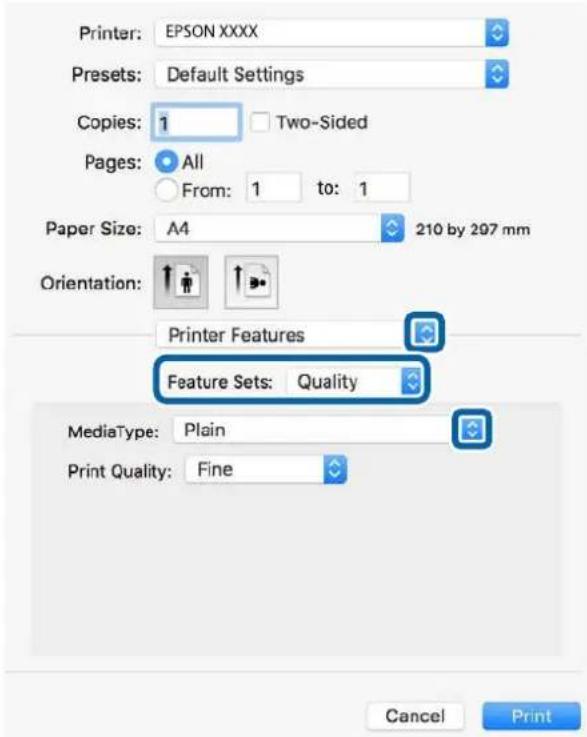
Printing
- Select Color as the Feature Sets setting, and then select the setting for Color Mode.
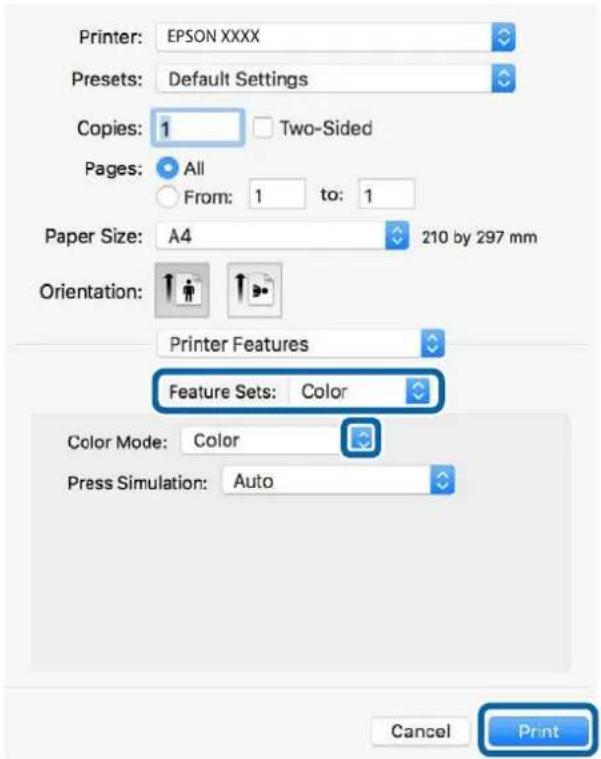
- Click Print.
Related Information
→ "Available Paper and Capacities" on page 48
→ "Loading Paper in the Paper Cassette" on page 52
→ "Loading Paper in the Rear Paper Feed" on page 54
→ "List of Paper Type" on page 51
Setting Items for the PostScript Printer Driver
Note:
The availability of these settings varies by model.
| Color Mode | Select whether to print in color or in monochrome. |
| Press Simulation | You can select a CMYK ink color to simulate when you print by reproducing the CMYK ink color of the offset press. |
| Ink Save Mode | Conserves ink by reducing the print density. |
| Rotate by 180° | Rotates the data 180 degrees before printing. |
Printing from Smart Devices
Using Epson iPrint
Epson iPrint is an application that allows you to print photos, documents, and web pages from a smart device such as a smartphone or tablet. You can use local print, printing from a smart device that is connected to the same wireless network as your printer, or remote print, printing from a remote location over the Internet. To use remote print, register your printer in the Epson Connect service.

EPSON
Related Information
→ "Epson Connect Service" on page 214
Installing Epson iPrint
You can install Epson iPrint on your smart device from the following URL or QR code.
http://ipr.to/c

Printing Using Epson iPrint
Start Epson iPrint from your smart device and select the item you want to use from the home screen.
Printing
The following screens are subject to change without notice.
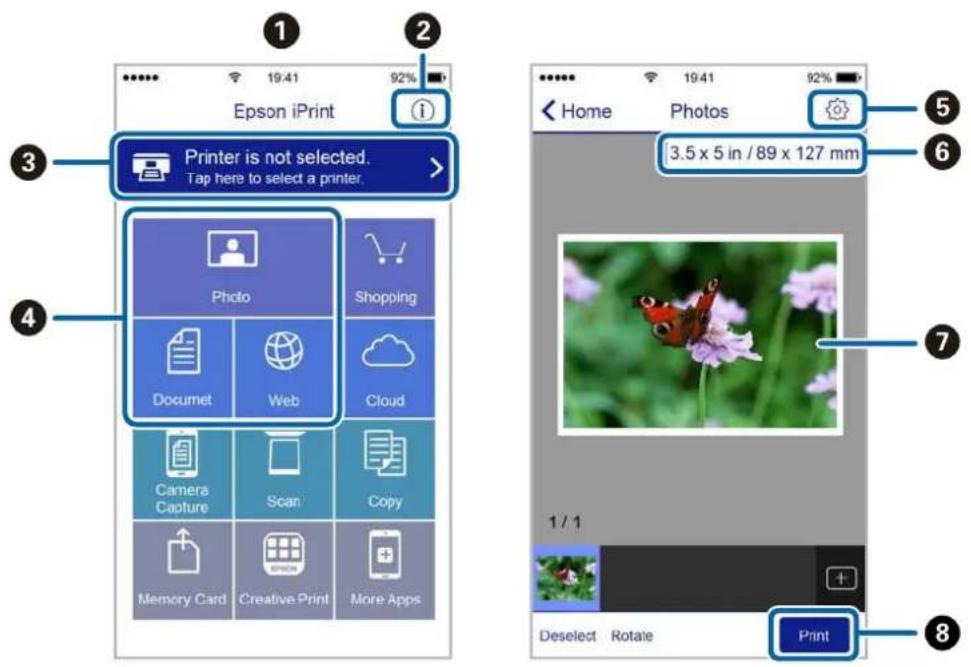
| 1 | Home screen displayed when the application is started. |
| 2 | Displays information on how to setup the printer and a FAQ. |
| 3 | Displays the screen where you can select the printer and make printer settings. Once you have selected the printer, you do not need to select it again from the next time. |
| 4 | Select what you want to print such as photos, documents, and web pages. |
| 5 | Displays the screen to make print settings such as paper size and paper type. |
| 6 | Displays the paper size. When this is displayed as a button, press it to display the paper settings currently set on the printer. |
| 7 | Displays photos and documents you selected. |
| 8 | Starts printing. |
Note:
To print from the document menu using iPhone, iPad, and iPod touch running iOS, start Epson iPrint after transferring the document you want to print using the file sharing function in iTunes.
Printing by Touching Smart Devices to the N-Mark
You can simply connect and print by touching your smart device to the printer's N-Mark.
Make sure that you prepare the following before using this feature.
☐ Enable the NFC function on your smart device.
Only Android 4.0 or later supports NFC (Near Field Communication).
The location and NFC functions vary depending on the smart device. See the documentation provided with your smart device for details.
User's Guide
Printing
☐ Install Epson iPrint on your smart device.
Touch your smart device to the printer's N-Mark to install it.
☐ Enable Wi-Fi Direct on your printer.
See the Administrator's Guide for details.
- Load paper in the printer.
- Touch your smart device to the printer's N-Mark.
Epson iPrint starts.
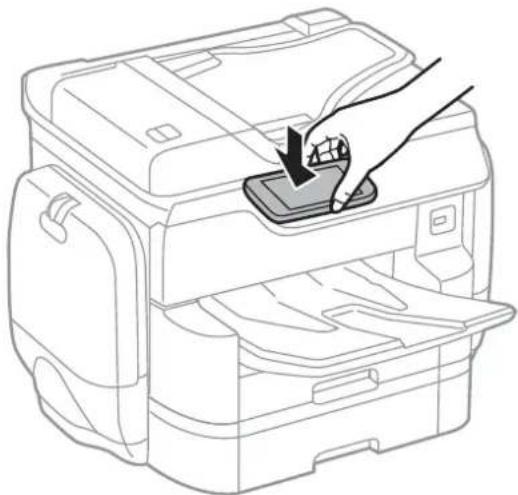
natural_image
Line drawing of a printer with a hand inserting a pencil into the cover (no text or symbols)Note:
☐ The printer may not be able to communicate with the smart device when there are obstacles such as metal between the printer's N-Mark and the smart device.
□ Administrators may block this feature. In this case, smart devices only make a sound and do not start any applications even if you touch them to the printer's N-Mark.
-
Select the file you want to print in Epson iPrint.
-
On the preview screen with the Print icon, touch the smart device to the printer's N-Mark. Printing starts.
Related Information
→ "Loading Paper in the Paper Cassette" on page 52
→ "Loading Paper in the Rear Paper Feed" on page 54
→ "Loading Paper in the Paper Cassette" on page 52 → "Loading Paper in the Rear Paper Feed" on page 54
Printing
Using AirPrint
AirPrint enables instant wireless printing from iPhone, iPad, and iPod touch with the latest version of iOS, and Mac with the latest version of OS X.
Note:
If you disabled paper configuration messages on your product control panel, you cannot use AirPrint. See the link below to enable the messages, if necessary.
- Load paper in your product.
- Set up your product for wireless printing. See the link below.
http://epson.sn
- Connect your Apple device to the same wireless network that your product is using.
- Print from your device to your product.
Note:
For details, see the AirPrint page on the Apple website.
Related Information
→ "Loading Paper in the Paper Cassette" on page 52
→ "Loading Paper in the Rear Paper Feed" on page 54
Printing the Password Setting File
Password protected files are stored in the printer's memory without being printed. To print the job, enter the password for the confidential job on the control panel. You can make the print timing on your own that prevent from reading to the outsiders by leaving on the printer's output tray.
- Load paper in the printer.
- Tap Confidential Job on the home screen.
- Select your user name.
- Enter the password.
Printing
- Select the job you want to print.
The selected job has a check mark next to it. - Tap ◆ to start printing.
Related Information
→ "Loading Paper in the Paper Cassette" on page 52
→ "Loading Paper in the Rear Paper Feed" on page 54
Canceling Printing
Note:
☐ In Windows, you cannot cancel a print job from the computer once it has been completely sent to the printer. In this case, cancel the print job by using the printer's control panel.
☐ When printing several pages from Mac OS X, you cannot cancel all of the jobs by using the control panel. In this case, cancel the print job from the computer.
☐ If you have sent a print job from Mac OS X v10.6.8 through the network, you may not be able to cancel printing from the computer. In this case, cancel the print job by using the printer's control panel.
Canceling Printing - Job/Status Menu
Note:
You can also cancel the ongoing jobs by tapping ☑ on the printer's control panel.
- Press the ⓘ button to display Job/Status screen.
- Tap Job Status tab > Active.
Ongoing print jobs and jobs that are standing by are shown in the list. - Select the job that you want to cancel.
- Tap Cancel.
Related Information
→ "Job/Status Screen Configuration" on page 24
Canceling Printing - Windows
- Access the printer driver window.
- Select the Maintenance tab.
- Click Print Queue.
- Right-click on the job you want to cancel and then select Cancel.
Printing
Related Information
→ "Windows Printer Driver" on page 216
Canceling Printing - Mac OS X
- Click the printer icon in the Dock.
- Select the job you want to cancel.
- Cancel the job.
□ Mac OS X v10.8.x or later
Click ✗ next to the progress meter.
☐ Mac OS X v10.6.8 to v10.7.x Click Delete.
Copying
Copying Basics
This section explains the steps for basic copying.
- Place the originals.
If you want to copy multiple originals or make 2-sided copies, place all of the originals on the ADF.
-
Tap Copy on the home screen.
-
Check the settings in Basic Settings.
Tap the setting item to change it as necessary.
Note:
☐ If you tap Advanced, you can make settings such as Multi-Page or Original Type.
☐ If you tap ☆, you can register frequently used copy settings as presets.
☐ If the combination of paper related settings you require is not available, ! is displayed. Tap the icon to check the details, and then change the settings.
-
Tap the value of the number of copies, and then enter the number of copies using the on-screen keypad.
-
Tap 📄, and then check the scanned image and the settings such as the paper size.
-
Tap ◊.
Related Information
→ "Placing Originals" on page 57
→ "Basic Menu Options for Copying" on page 99
→ "Advanced Menu Options for Copying" on page 101
Basic Menu Options for Copying
Note:
The items may not be available depending on other settings you made.
Color Mode:
Select whether to copy in color or in monochrome.
B&W
Copies the original in black and white (monochrome).
□ Color
Copies the original in color.
Copying
Density:
Increase the level of density when the copying results are faint. Decrease the level of density when ink smears.
Paper Setting:
Select the paper source that you want to use. When Auto is selected, a suitable size is fed automatically depending on the auto detected original size and the specified magnification ratio.
Reduce/Enlarge:
Configures the magnification ratio of the enlargement or reduction. Tap the value and specify the magnification used to enlarge or reduce the original within a range of 25 to 400%.
Auto
Detects the scan area and automatically enlarges or reduces the original to fit to the paper size you selected. When there are white margins around the original, the white margins from the corner
mark (↘) of the scanner glass are detected as the scan area, but the margins at the opposite side may be cropped.
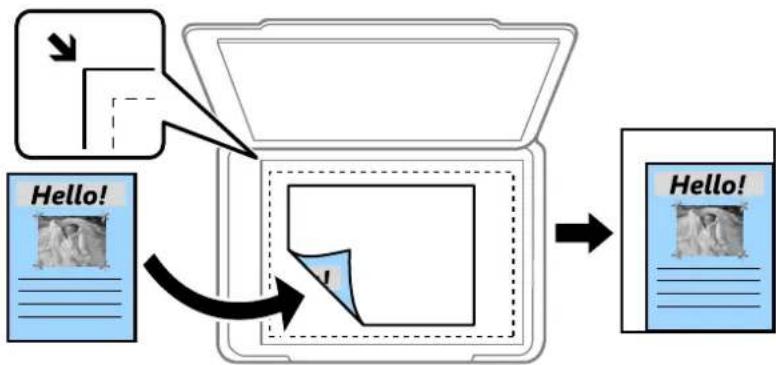
flowchart
graph TD
    A["Hello!"] --> B["Blank Form"]
    B --> C["Hello! Image"]
    style A fill:#cce5ff,stroke:#333
    style C fill:#cce5ff,stroke:#333
□ Reduce to Fit Paper
Copies the scanned image at a smaller size than the Reduce/Enlarge value to fit within the paper size. If the Reduce/Enlarge value is larger than the paper size, data may be printed beyond the edges of the paper.
□ Actual Size
Copies at 100 % magnification.
□ A3→A4 and others
Automatically enlarges or reduces the original to fit to a specific paper size.
Original Size:
Select the size of your original. When you select Auto Detect, the size of your original is automatically detected. When copying non-standard size originals, select the size closest to your original.
2-Sided:
Select 2-sided layout.
□ 1→1-Sided
Copies one side of an original onto a single side of paper.
Copying
□ 2→2-Sided
Copies both sides of a double-sided original onto both sides of a single sheet of paper. Select the orientation of your original and the binding position of the original and the paper.
□ 1→2-Sided
Copies two single-sided originals onto both sides of a single sheet of paper. Select the orientation of your original and the binding position of the paper.
□ 2→1-Sided
Copies both sides of a double-sided original onto one side of two sheets of paper. Select the orientation of your original and the binding position of the original.
Advanced Menu Options for Copying
Note:
The items may not be available depending on other settings you made.
Multi-Page:
Select the copy layout.
□ Single Page
Copies a single-sided original onto a single sheet.
□ 2-up
Copies two single-sided originals onto a single sheet in 2-up layout. Select the layout order and the orientation of your original.
□ 4-up
Copies four single-sided originals onto a single sheet in 4-up layout. Select the layout order and the orientation of your original.
Original Type:
Select the type of your original. Copies in optimal quality to match the type of original.
Finishing:
Select how to eject the paper for multiple copies of multiple originals.
☐ Group (Same Pages)
Copies the originals by page as a group.
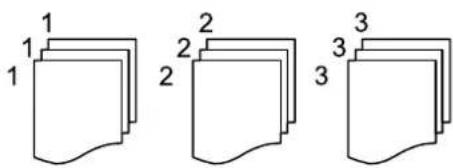
Copying
Collate (Page Order)
Copies the originals collated in order and sorted into sets.
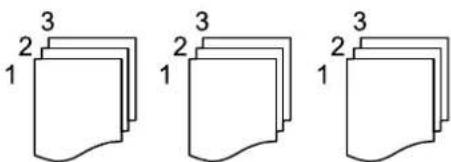
Mixed Size Originals:
You can place the following combination of sizes in the ADF at the same time. A3 and A4; B4 and B5. When using these combinations, originals are copied at the actual size of the originals. Place your originals by aligning the width of the originals as shown below.

natural_image
Simple diagram showing two overlapping rectangular blocks with a black arrow pointing left (no text or symbols)Orientation (Original):
Select the orientation of your original.
Book →2Pages:
Copies two facing pages of a booklet onto separate sheets of paper.
Select which page of a booklet to scan.
Image Quality:
Adjust image settings.
Contrast
Adjust the difference between the bright and dark parts.
Saturation
Adjust the vividness of the colors.
☐ Red Balance, Green Balance, Blue Balance
Adjust the density for each color.
Sharpness
Adjust the outline of the image.
□Hue Regulation
Adjust the color tone of the skin. Tap + to make it cold (increase green) and tap - to make it warm (increase red).
□ Remove Background
Adjust the density of the background color. Tap + to make it bright (white) and tap - to make it dark (black).
Binding Margin:
Select the binding position, margin, and orientation of your original for 2-sided copy.
Copying
Reduce to Fit Paper:
Copies the scanned image at a smaller size than the Reduce/Enlarge value to fit within the paper size. If the Reduce/Enlarge value is larger than the paper size, data may be printed beyond the edges of the paper.
Remove Shadow:
Removes shadows that appear around copies when copying thick paper or that appear in the center of copies when copying a booklet.
Remove Punch Holes:
Removes the binding holes when copying.
ID Card Copy:
Scans both sides of an ID card and copies onto one side of paper.
Scanning
Scanning Using the Control Panel
Scanning to a Network Folder or FTP Server
You can save the scanned image to a specified folder on a network. You can specify the folder by entering a folder path directly, but it may be easier if you register the folder information in the contacts list first.
Note:
Before you use this feature, make sure the printer's Date/Time and Time Difference settings are correct. Access the menus from Settings > General Settings > Basic Settings > Date/Time Settings.
☐ You can check destination before scanning. Select Settings > General Settings > Scan Settings, and then enable Confirm Recipient.
- Place the originals.
Note:
If you want to scan multiple originals or make a 2-sided scan, place all of the originals on the ADF.
-
Tap Scan on the home screen.
-
Tap Network Folder/FTP.
-
Specify the folder.
☐ To select from frequently used addresses: Tap the icons displayed on the screen.
☐ To enter the folder path directly: Tap Keyboard. Select Communication Mode, enter the folder path as the Location (Required), and then make other folder settings.
Enter the folder path in the following format.
When using SMB as the communication mode: \host name\folder name
When using FTP as the communication mode: ftp://host name/folder name
☐ To select from the contacts list: Tap Contacts, select a contact, and then tap Close.
You can search for a folder from the contacts list. Enter the search keyword into the box at the top of the screen.
Note:
You can print the history of the folder in which documents are saved by tapping
- Tap Scan Settings, and then check settings such as the save format, and change them if necessary.
Note:
Tap to save your settings as a preset.
- Tap ◊.
Related Information
→ "Managing Contacts" on page 63
Scanning
→ "Placing Originals" on page 57
→ "Registering Your Favorite Settings as a Preset" on page 25
Menu Options for Scanning to a Folder
Note:
The items may not be available depending on other settings you made.
Edit Location:
□ Communication Mode
Select the communication mode.
□ Location (Required)
Enter a folder path in which to save the scanned image.
□ User Name
Enter a user name for the specified folder.
Password
Enter a password for the specified folder.
□ Connection Mode
Select the connection mode.
Port Number
Enter a port number.
Contacts:
Select a folder in which to save the scanned image from the contacts list. You do not need to make location settings when you have selected a folder from the contacts list.
Color Mode:
Select whether to scan in color or in monochrome.
File Format:
Select the format in which to save the scanned image.
□ Compression Ratio
Select how much to compress the scanned image.
PDF Settings
When you have selected PDF as the save format setting, use these settings to protect PDF files.
To create a PDF file that requires a password when opening, set Document Open Password. To create a PDF file that requires a password when printing or editing, set Permissions Password.
Resolution:
Select the scanning resolution.
2-Sided:
Scan both sides of the original.
Scanning
□ Orientation (Original)
Select the orientation of the original.
Binding(Original)
Select the binding direction of the original.
Scan Area:
Select the scan area. To crop the white space around the text or image when scanning, select Auto Cropping. To scan at the maximum area of the scanner glass, select Max Area.
□ Orientation (Original)
Select the orientation of the original.
Original Type:
Select the type of your original.
Density:
Select the contrast of the scanned image.
Remove Shadow:
Remove the shadows of the original that appear in the scanned image.
□ Surround
Remove the shadows at the edge of the original.
□ Center
Remove the shadows of the binding margin of the booklet.
Remove Punch Holes:
Remove the punch holes that appear in the scanned image. You can specify the area to erase the punch holes by entering a value in the box on the right.
□ Erasing Position
Select the position to remove the punch holes.
□ Orientation (Original)
Select the orientation of the original.
File Name:
☐ Filename Prefix:
Enter a prefix for the name of the images in alphanumeric characters and symbols.
□ Add Date:
Add the date to the file name.
□ Add Time:
Add the time to the file name.
Clear All Settings
Resets the scan settings to their defaults.
Scanning
Scanning to an Email
You can send scanned image files by email directly from the printer through a pre-configured email server. Before using this feature, you need to configure the email server.
See the Administrator's Guide for details.
You can specify the email address by entering directly, but it may be easier if you register the email address in the contacts list first.
Note:
Before you use this feature, make sure the printer's Date/Time and Time Difference settings are correct. Access the menus from Settings > General Settings > Basic Settings > Date/Time Settings.
☐ By using the Document Capture Pro function on the control panel instead of this function, you can send emails directly. Before using this function, make sure you have registered a job to send emails in Document Capture Pro and that the computer is turned on.
☐ You can check destination before scanning. Select Settings > General Settings > Scan Settings, and then enable Confirm Recipient.
- Place the originals.
Note:
If you want to scan multiple originals or make 2-sided scans, place all of the originals in the ADF.
-
Tap Scan on the home screen.
-
Tap Email.
-
Specify the addresses.
☐ To select frequently used addresses: Tap the icons displayed on the screen.
☐ To enter the email address manually: Tap Keyboard, enter the email address, and then tap OK.
☐ To select from the contacts list: Tap Contacts, select a contact or a group, and then tap Close.
You can search for the address from the contacts list. Enter the search keyword into the box at the top of the screen.
☐ To select from the history list: Tap History, select a contact, and then tap Close.
Note:
☐ The number of recipients you selected is displayed on the right of the screen. You can send emails to up to 10 addresses and groups.
If groups is included in recipients, you can select up to 200 individual addresses in total, taking addresses in the groups into account.
☐ Tap the address box at the top of the screen to display the list of selected addresses.
☐ Tap ☐ to display or print the sending history, or change the email server settings.
- Tap Scan Settings, and then check settings such as the save format, and change them if necessary.
Note:
Tap to save your settings as a preset.
- Tap ◊.
Scanning
Related Information
→ "Configuring Mail Server" on page 302
→ "Managing Contacts" on page 63
→ "Scanning Using Document Capture Pro" on page 109
→ "Placing Originals" on page 57
→ "Registering Your Favorite Settings as a Preset" on page 25
Menu Options for Scanning to an Email
Note:
The items may not be available depending on other settings you made.
Color Mode:
Select whether to scan in color or in monochrome.
File Format:
Select the format in which to save the scanned image.
□ Compression Ratio
Select how much to compress the scanned image.
PDF Settings
When you have selected PDF as the save format setting, use these settings to protect PDF files.
To create a PDF file that requires a password when opening, set Document Open Password. To create a PDF file that requires a password when printing or editing, set Permissions Password.
Resolution:
Select the scanning resolution.
2-Sided:
Scan both sides of the original.
□ Orientation (Original)
Select the orientation of the original.
□ Binding(Original)
Select the binding direction of the original.
Scan Area:
Select the scan area. To crop the white space around the text or image when scanning, select Auto Cropping. To scan at the maximum area of the scanner glass, select Max Area.
□ Orientation (Original)
Select the orientation of the original.
Original Type:
Select the type of your original.
Density:
Select the contrast of the scanned image.
Scanning
Remove Shadow:
Remove the shadows of the original that appear in the scanned image.
□ Surround
Remove the shadows at the edge of the original.
□ Center
Remove the shadows of the binding margin of the booklet.
Remove Punch Holes:
Remove the punch holes that appear in the scanned image. You can specify the area to erase the punch holes by entering a value in the box on the right.
□ Erasing Position
Select the position to remove the punch holes.
□ Orientation (Original)
Select the orientation of the original.
Subject:
Enter a subject for the email in alphanumeric characters and symbols.
Attached File Max Size:
Select the maximum file size that can be attached to the email.
File Name:
☐ Filename Prefix:
Enter a prefix for the name of the images in alphanumeric characters and symbols.
□ Add Date:
Add the date to the file name.
□ Add Time:
Add the time to the file name.
Clear All Settings
Resets the scan settings to their defaults.
Scanning Using Document Capture Pro
You can scan the original using the settings specified in Document Capture Pro. Set the operation mode on the control panel before scanning.
Related Information
→ "Placing Originals" on page 57
→ "Document Capture Pro" on page 219
Scanning
Setting Operation Mode
Before scanning, set the operation mode on the control panel to match the computer on which Document Capture Pro is installed.
-
Tap Settings from the home screen.
-
Tap General Settings > Scan Settings > Document Capture Pro.
-
Select the operation mode.
☐ Client Mode: Select this if Document Capture Pro is installed on Windows or Mac OS X.
☐ Server Mode: Select this if Document Capture Pro is installed on a Windows Server. Next, enter the server address.
- If you have changed the operation mode, check that the settings are correct, and then tap OK.
Scanning Using the Document Capture Pro Settings
Before scanning, prepare the followings.
☐ Install Document Capture Pro on your computer (server) and create the job.
☐ Connect the printer and the computer (server) to the network.
☐ Set the operation mode on the control panel.
- Place the originals.
Note:
If you want to scan multiple originals or make 2-sided scans, place all of the originals in the ADF.
- Tap Scan on the home screen.
- Tap Document Capture Pro.
- Tap Select Computer., and then select the computer on which you created the job in Document Capture Pro.
Note:
☐ The printer's control panel displays up to 100 computers on which Document Capture Pro is installed.
☐ If you have selected Option > Network Scanning Settings, and enabled Protect with password in Document Capture Pro or Document Capture, enter a password.
☐ If Server Mode is set as the operation mode, you do not need to perform this step.
- Tap Select Job., and then select the job.
Note:
☐ If you have selected Protect with password in the settings in Document Capture Pro Server, enter a password.
☐ If you have set only one job, you do not need to select the job. Proceed to the next step.
-
Tap the area in which the job content is displayed, and then check the job details.
-
Tap ◊.
Scanning
Scanning to a Memory Device
You can save the scanned image to a memory device.
-
Insert a memory device into the printer's external interface USB port.
-
Place the originals.
Note:
If you want to scan multiple originals or make 2-sided scans, place all of the originals in the ADF.
-
Tap Scan on the home screen.
-
Tap Memory Device.
-
Set items on Basic Settings such as the save format.
-
Tap Advanced, and then check settings, and change them if necessary.
Note:
Tap to save your settings as a preset.
- Tap ◊.
Related Information
→ "Part Names and Functions" on page 16
→ "Placing Originals" on page 57
→ "Registering Your Favorite Settings as a Preset" on page 25
Basic Menu Options for Scanning to a Memory Device
Note:
The items may not be available depending on other settings you made.
B&W/Color:
Select whether to scan in color or in monochrome.
Resolution:
Select the scanning resolution.
Scan Area:
Select the scan area. To crop the white space around the text or image when scanning, select Auto Cropping. To scan at the maximum area of the scanner glass, select Max Area.
□ Orientation (Original)
Select the orientation of the original.
File Format:
Select the format in which to save the scanned image.
Scanning
□ Compression Ratio Select how much to compress the scanned image.
☐ PDF Settings When you have selected PDF as the save format setting, use these settings to protect PDF files. To create a PDF file that requires a password when opening, set Document Open Password. To create a PDF file that requires a password when printing or editing, set Permissions Password.
2-Sided:
Scan both sides of the original.
- Orientation (Original)
Select the orientation of the original.
☐ Binding(Original) Select the binding direction of the original.
Original Type:
Select the type of your original.
Advanced Menu Options for Scanning to a Memory Device
Note:
The items may not be available depending on other settings you made.
Density:
Select the contrast of the scanned image.
Remove Shadow:
Remove the shadows of the original that appear in the scanned image.
☐ Surround
Remove the shadows at the edge of the original.
☐ Center
Remove the shadows of the binding margin of the booklet.
Remove Punch Holes:
Remove the punch holes that appear in the scanned image. You can specify the area to erase the punch holes by entering a value in the box on the right.
☐ Erasing Position
Select the position to remove the punch holes.
☐ Orientation (Original)
Select the orientation of the original.
File Name:
☐ Filename Prefix: Enter a prefix for the name of the images in alphanumeric characters and symbols.
Scanning
□ Add Date:
Add the date to the file name.
□ Add Time:
Add the time to the file name.
Clear All Settings
Resets the scan settings to their defaults.
Scanning to the Cloud
You can send scanned images to cloud services. Before using this feature, make settings using Epson Connect. See the following Epson Connect portal website for details.
https://www.epsonconnect.com/
http://www.epsonconnect.eu (Europe only)
-
Make sure that you have made settings using Epson Connect.
-
Place the originals.
Note:
If you want to scan multiple originals or make a 2-sided scan, place all of the originals on the ADF.
-
Tap Scan on the home screen.
-
Tap Cloud.
-
Tap + on the top of the screen, and then select a destination.
-
Set items on Basic Settings such as the save format.
-
Tap Advanced, and then check settings, and change them if necessary.
Note:
Tap to save your settings as a preset.
- Tap ◊.
Related Information
→ "Placing Originals" on page 57
Basic Menu Options for Scanning to the Cloud
Note:
The items may not be available depending on other settings you made.
B&W/Color:
Select whether to scan in color or in monochrome.
Scanning
2-Sided:
Scan both sides of the original.
□ Orientation (Original)
Select the orientation of the original.
Binding(Original)
Select the binding direction of the original.
JPEG/PDF:
Select the format in which to save the scanned image.
Scan Area:
Select the scan area. To crop the white space around the text or image when scanning, select Auto Cropping. To scan at the maximum area of the scanner glass, select Max Area.
□ Orientation (Original)
Select the orientation of the original.
Advanced Menu Options for Scanning to the Cloud
Note:
The items may not be available depending on other settings you made.
Original Type:
Select the type of your original.
Density:
Select the contrast of the scanned image.
Remove Shadow:
Remove the shadows of the original that appear in the scanned image.
□ Surround
Remove the shadows at the edge of the original.
Center
Remove the shadows of the binding margin of the booklet.
Remove Punch Holes:
Remove the punch holes that appear in the scanned image. You can specify the area to erase the punch holes by entering a value in the box on the right.
□ Erasing Position
Select the position to remove the punch holes.
□ Orientation (Original)
Select the orientation of the original.
Clear All Settings
Resets the scan settings to their defaults.
Scanning
Scanning to a Computer (WSD)
Note:
☐ This feature is only available for computers running Windows 10/Windows 8.1/Windows 8/Windows 7/Windows Vista.
☐ If you are using Windows 7/Windows Vista, you need to setup your computer in advance using this feature.
- Place the originals.
Note:
If you want to scan multiple originals, place all of the originals on the ADF.
- Tap Scan on the home screen.
- Tap Computer (WSD).
- Select a computer.
- Tap ◊.
Related Information
→ "Placing Originals" on page 57
Setting Up a WSD Port
This section explains how to set up a WSD port for Windows 7/Windows Vista.
Note:
For Windows 10/Windows 8.1/Windows 8, the WSD port is set up automatically.
The following is necessary to set up a WSD port.
☐ The printer and the computer are connected to the network.
☐ The printer driver is installed on the computer.
- Turn the printer on.
- Click start, and then click Network on the computer.
- Right-click the printer, and then click Install.
Click Continue when the User Account Control screen is displayed.
Scanning
Click Uninstall and start again if the Uninstall screen is displayed.
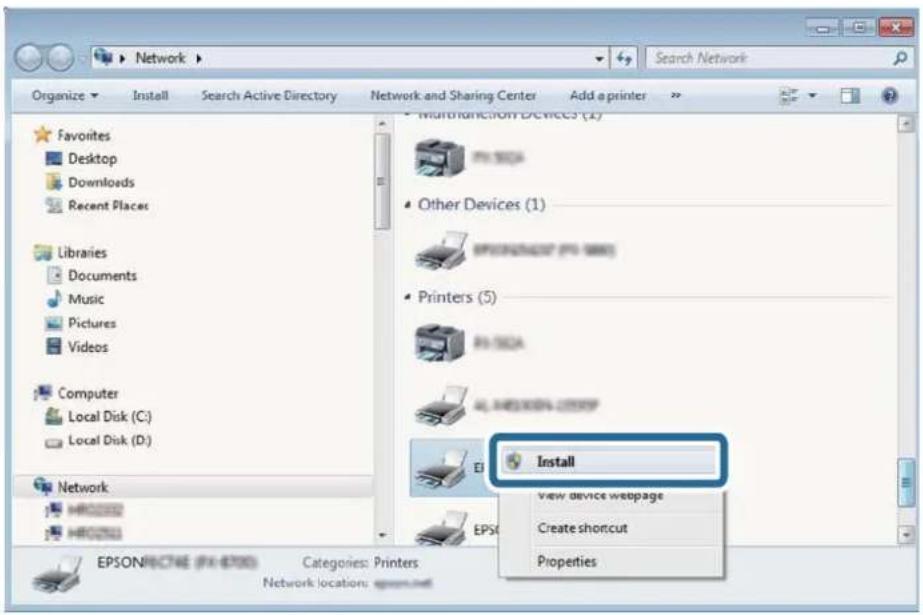
Note:
The printer name you set on the network and model name (EPSON XXXXXX (XX-XXXX)) are displayed on the network screen. You can check the printer's name set on the network from the printer's control panel or by printing a network status sheet.
- Click Your device is ready to use.
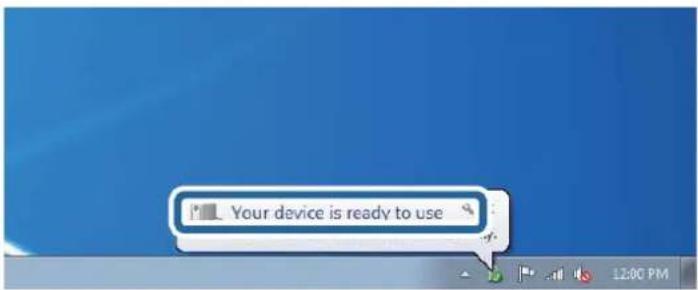
- Check the message, and then click Close.
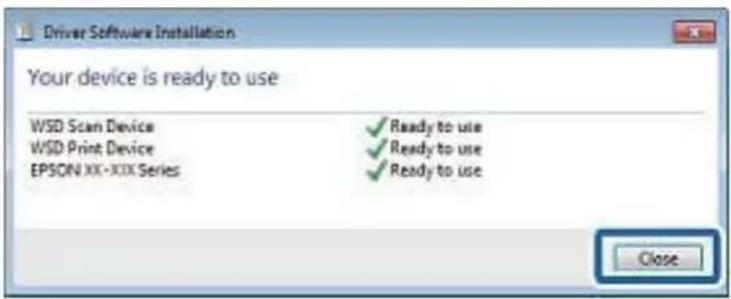
- Open the Devices and Printers screen.
Windows 7
Click start > Control Panel > Hardware and Sound (or Hardware) > Devices and Printers.
Scanning
Windows Vista
Click start > Control Panel > Hardware and Sound > Printers.
- Check that an icon with the printer's name on the network is displayed.
Select the printer name when using with WSD.
Related Information
→ "Printing a Network Status Sheet" on page 41
Scanning from a Computer
Authenticating Users on Epson Scan 2 when Using Access Control
When the access control function is enabled for a printer, you need to register a user name and password when scanning using Epson Scan 2. If you do not know the password, contact your printer administrator.
- Start Epson Scan 2.
- On the Epson Scan 2 screen, make sure that your printer is selected in the Scanner list.
- Select Settings from the Scanner list to open the Scanner Settings screen.
- Click Access Control.
- On the Access Control screen, enter the User Name and the Password for an account that has permission to scan.
- Click OK.
Scanning Using Epson Scan 2
You can scan using the scanner driver "Epson Scan 2". You can scan originals using detailed settings that are suitable for text documents.
See the Epson Scan 2 help for an explanation of each setting item.
- Place the original.
Note:
If you want to scan multiple originals, place them in the ADF.
- Start Epson Scan 2.
Scanning
3. Make the following settings on the Main Settings tab.
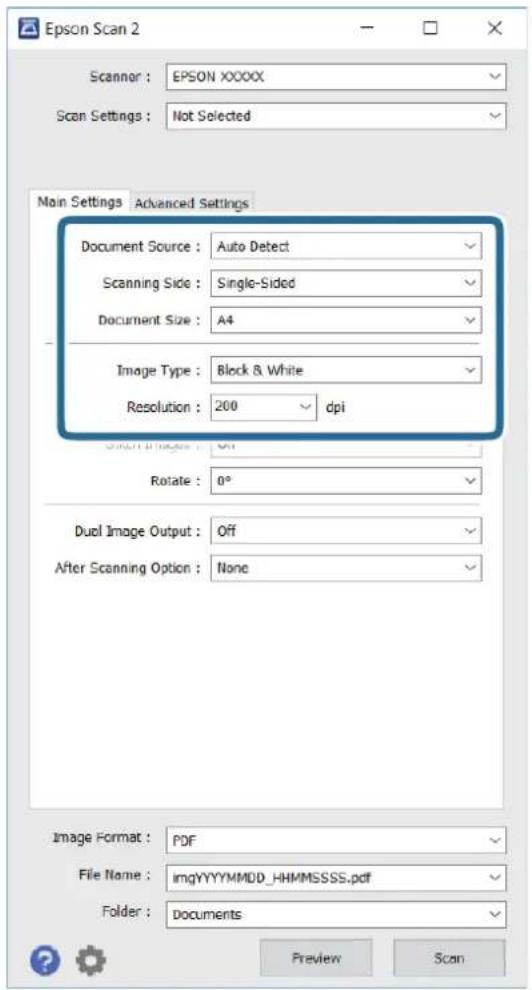
☐ Document Source: Select the source where the original is placed.
☐ Scanning Side: Select the side of the original you want to scan when scanning from ADF.
☐ Document Size: Select the size of the original you placed.
☐ Image Type: Select the color for saving the scanned image.
☐ Resolution: Select the resolution.
4. Make other scan settings if necessary.
☐ You can preview the scanned image by clicking the Preview button. The preview window opens, and the previewed image is displayed.
When you preview using the ADF, the original is ejected from the ADF. Place the ejected original again.
Scanning
☐ On the Advanced Settings tab, you can make detailed image adjustment settings that are suitable for text documents, such as the following.
☐ Unsharp Mask: You can enhance and sharpen the outlines of the image.
☐ Descreening: You can remove moiré patterns (web-like shadows) that appear when scanning printed papers such as a magazine.
☐ Text Enhancement: You can make blurred letters in the original clear and sharp.
☐ Auto Area Segmentation: You can make letters clear and images smooth when performing black and white scanning for a document that contains images.
Note:
The items may not be available depending on other settings you made.
5. Set the file saving settings.
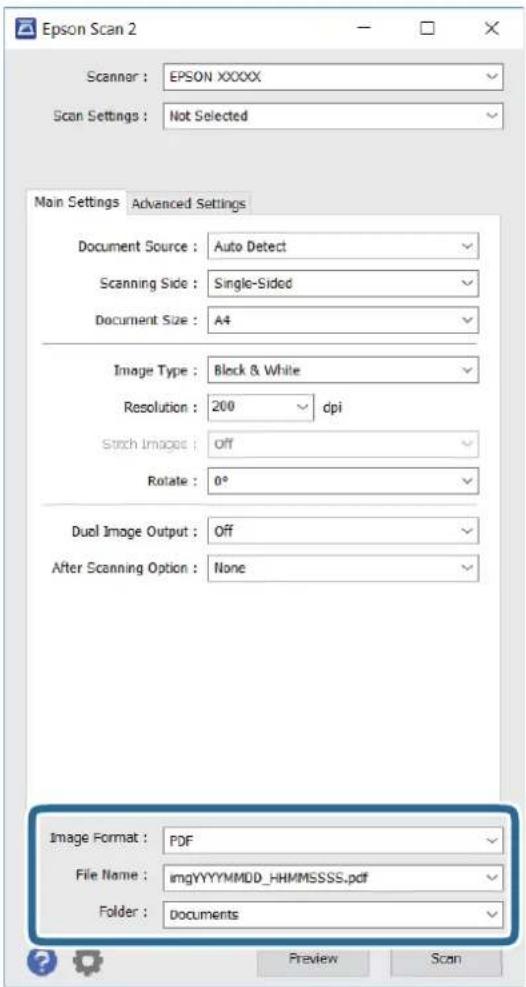
☐ Image Format: Select the save format from the list.
You can make detailed settings for each save format except BITMAP and PNG. Select Options from the list after selecting the save format.
☐ File Name: Confirm the save file name displayed.
You can change settings for the file name by selecting Settings from the list.
Scanning
☐ Folder: Select the save folder for the scanned image from the list. You can select another folder or create a new folder by selecting Select from the list.
- Click Scan.
Related Information
→ "Placing Originals" on page 57
→ "Epson Scan 2 (Scanner Driver)" on page 219
Scanning from Smart Devices
Epson iPrint is an application that allows you to scan photos and documents from a smart device, such as a smartphone or tablet, that is connected to the same wireless network as your printer. You can save the scanned data on a smart device or to Cloud services, send it by email, or print it.

Installing Epson iPrint
You can install Epson iPrint on your smart device from the following URL or QR code.
http://ipr.to/c

Scanning Using Epson iPrint
Start Epson iPrint from your smart device and select the item you want to use from the home screen.
Scanning
The following screens are subject to change without notice.
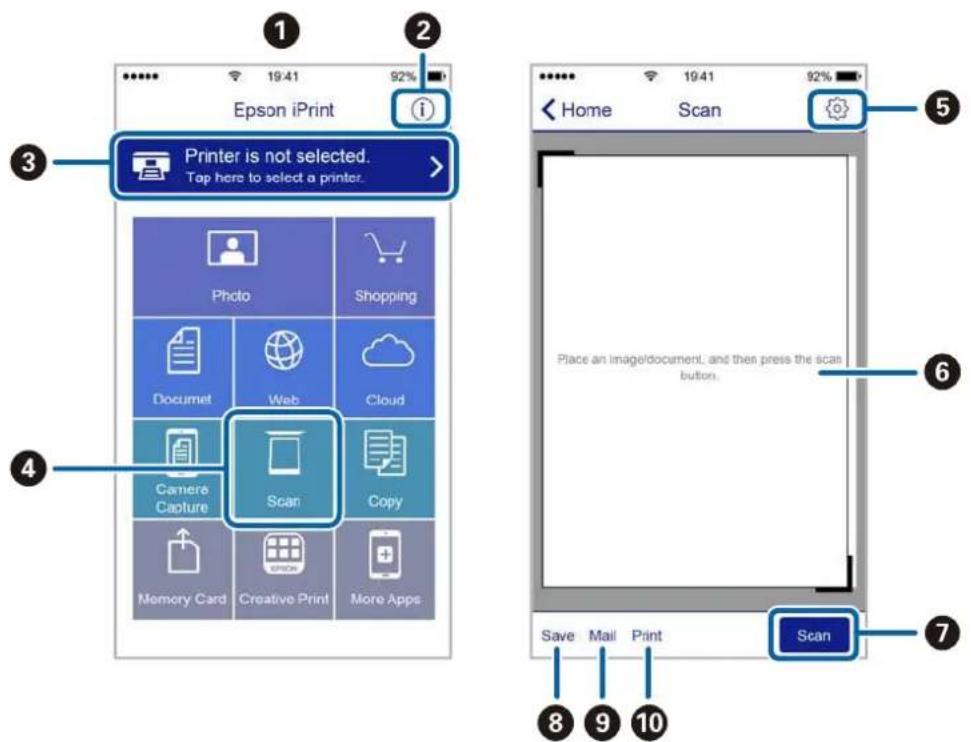
| 1 | Home screen displayed when the application is started. |
| 2 | Displays information on how to setup the printer and a FAQ. |
| 3 | Displays the screen where you can select the printer and make printer settings. Once you have selected the printer, you do not need to select it again from the next time. |
| 4 | Displays the scanning screen. |
| 5 | Displays the screen where you can make scan settings such as resolution. |
| 6 | Displays scanned images. |
| 7 | Starts scanning. |
| 8 | Displays the screen where you can save scanned data to a smart device or Cloud services. |
| 9 | Displays the screen where you can send scanned data by email. |
| 10 | Displays the screen where you can print scanned data. |
Scanning by Touching Smart Devices to the N-Mark
You can simply connect and scan by touching your smart device to the printer's N-Mark.
Make sure that you prepare the following before using this feature.
Scanning
□ Enable the NFC function on your smart device.
Only Android 4.0 or later supports NFC. (Near Field Communication)
The location and NFC functions vary depending on the smart device. See the documentation provided with your smart device for details.
□ Installed Epson iPrint on your smart device.
Touch your smart device to the printer's N-Mark to install it.
□ Enable the Wi-Fi Direct on your printer.
See Administrator's Guide for details.
-
Place the originals in the printer.
-
Touch your smart device to the printer's N-Mark.
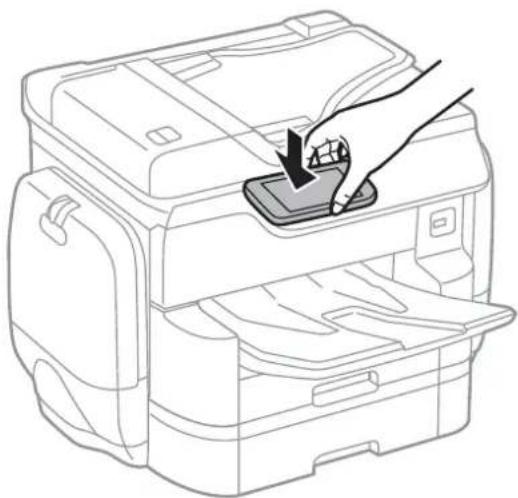
natural_image
Line drawing of a printer with a hand inserting a pencil into the cover (no text or symbols)Note:
☐ The printer may not be able to communicate with the smart device when there are obstacles such as metal between the printer's N-Mark and the smart device.
□ Administrators may block this feature. In this case, smart devices only make a sound and do not start any applications even if you touch them to the printer's N-Mark.
Epson iPrint starts.
-
Select the scan menu in Epson iPrint.
-
Touch the smart device to the printer's N-Mark again.
Scanning starts.
Faxing
Setting Up a Fax
Connecting to a Phone Line
Compatible Telephone Lines
You can use the printer over standard analogue telephone lines (PSTN = Public Switched Telephone Network) and PBX (Private Branch Exchange) telephone systems.
You may not be able to use the printer with the following phone lines or systems.
☐ VoIP phone line such as DSL or fiber-optic digital service
☐ Digital phone line (ISDN)
☐ Some PBX telephone systems
☐ When adapters such as terminal adapters, VoIP adapters, splitters, or DSL router are connected between the telephone wall jack and the printer
Connecting the Printer to a Phone Line
Connect the printer to a telephone wall jack using an RJ-11 (6P2C) phone cable. When connecting a telephone to the printer, use a second RJ-11 (6P2C) phone cable.
Depending on the area, a phone cable may be included with the printer. If it is included, use that cable.
You may need to connect the phone cable to an adapter provided for your country or region.
Note:
Remove the cap from the EXT. port of the printer only when connecting your telephone to the printer. Do not remove the cap if you are not connecting your telephone.
In areas where lightning strikes occur frequently, we recommend that you use a surge protector.
User's Guide
Faxing
Connecting to a Standard Phone Line (PSTN) or PBX
Connect a phone cable from the telephone wall jack or PBX port to the LINE port on the back of the printer.
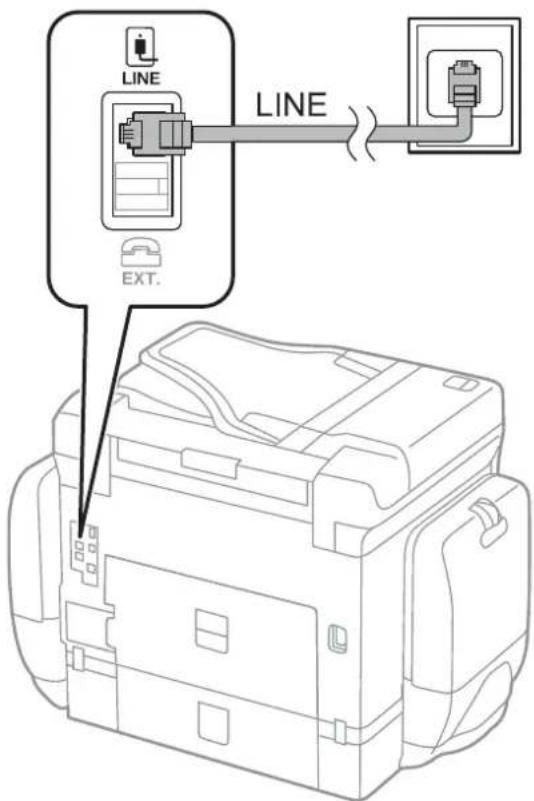
Related Information
→ "Making Settings for a PBX Phone System" on page 129
Connecting to DSL or ISDN
Connect a phone cable from the DSL modem or the ISDN terminal adapter to the LINE port on the back of the printer. See the documentation provided with the modem or the adapter for more details.
Faxing
Note:
If your DSL modem is not equipped with a built-in DSL filter, connect a separate DSL filter.
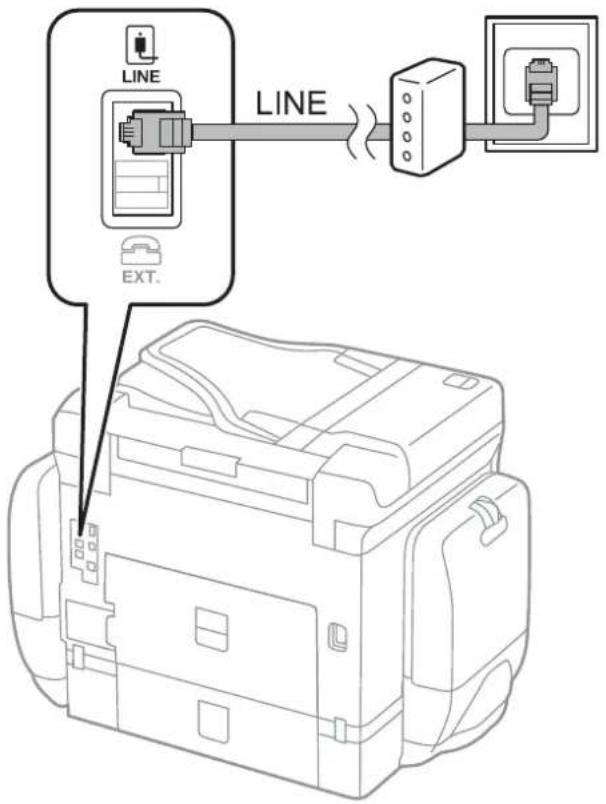
Connecting Your Phone Device to the Printer
When using the printer and your telephone on a single phone line, connect the telephone to the printer.
Note:
☐ If your phone device has a fax function, disable the fax function before connecting. See the manuals that came with the phone device for details.
☐ If you connect an answering machine, make sure the printer's Rings to Answer setting is set higher than the number of rings your answering machine is set to answer a call.
Faxing
- Remove the cap from the EXT. port on the back of the printer.
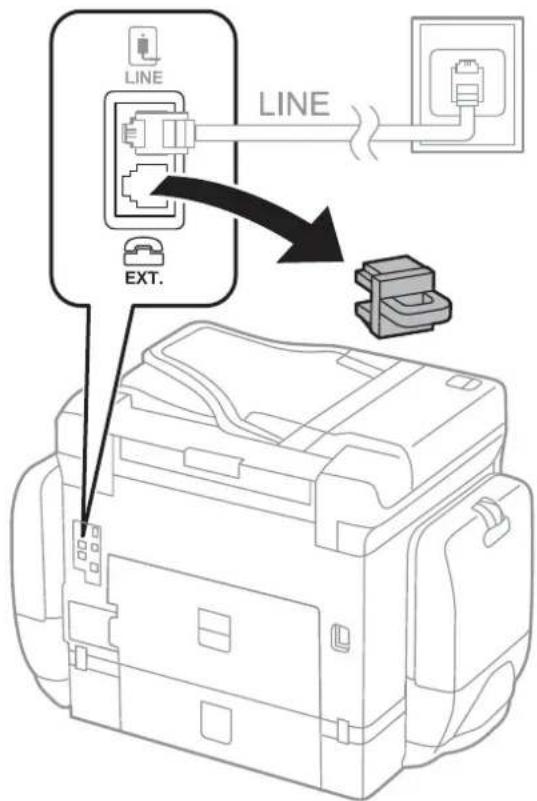
- Connect the phone device and the EXT. port with a phone cable.
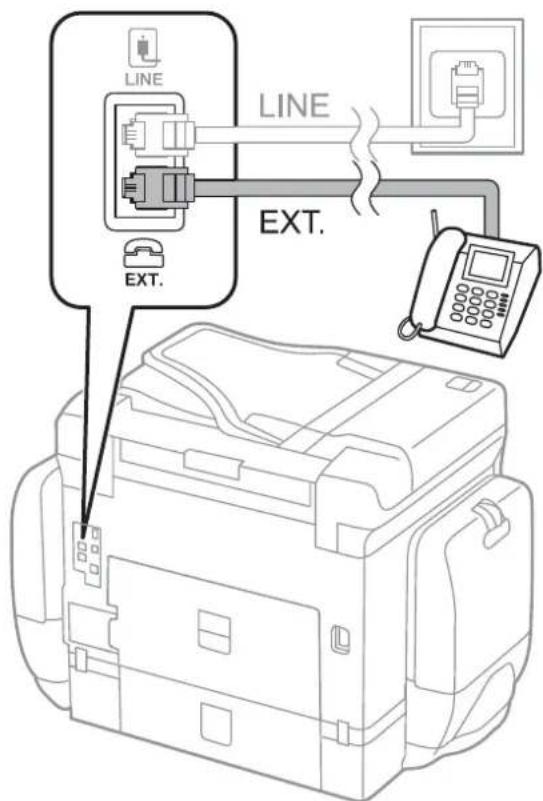
Faxing
Note:
When sharing a single phone line, make sure you connect the phone device to the EXT. port of the printer. If you split the line to connect the phone device and the printer separately, the phone and the printer do not work correctly.
3. Tap Fax.
4. Pick up the handset.
The connection is established when Send is enabled as the following screen.
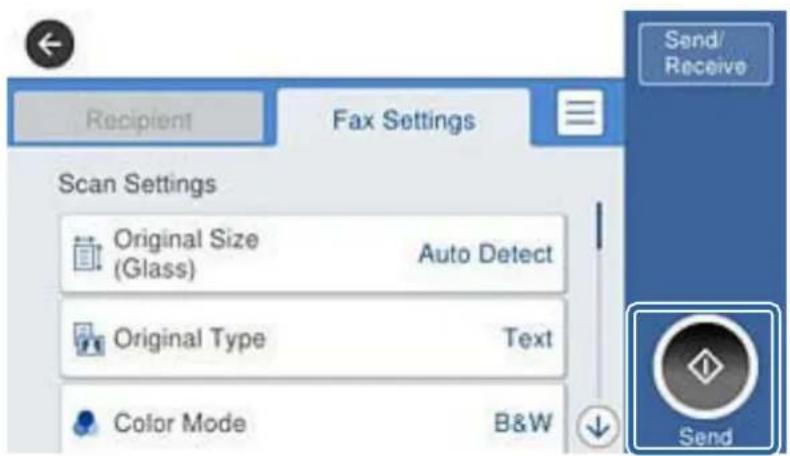
Related Information
→ "Settings for the Answering Machine" on page 141
Making Basic Fax Settings
First make basic fax settings such as Receive Mode using the Fax Setting Wizard, and then configure the other settings as necessary.
The Fax Setting Wizard is automatically displayed when the printer is turned on for the first time. Once you have made the settings, you do not need to make them again unless the connection environment is changed.
If an administrator has locked the settings, only the administrator can make the settings.
Making Basic Fax Settings Using the Fax Setting Wizard
Make basic settings by following the on-screen instructions.
- Connect the printer to the phone line.
Note:
Because an automatic fax connection check runs at the end of the wizard, make sure you connect the printer to the phone line before starting the wizard.
-
Tap Settings on the home screen.
-
Tap General Settings > Fax Settings > Fax Setting Wizard.
Faxing
- On the Confirmation screen, tap OK.
The wizard begins.
- On the fax header entry screen, enter the sender name such as your company name, and then tap OK.
Note:
Your sender name and your fax number appear as the header for outgoing faxes.
-
On the phone number entry screen, enter your fax number, and then tap OK.
-
On the Distinctive Ring Detection (DRD) Setting screen, make the following settings.
☐ If you have subscribed to a distinctive ring service from your telephone company: Tap Proceed, and then select the ring pattern to be used for incoming faxes. Receive Mode is automatically set to Auto.
☐ If you do not need to set this option: Tap Skip, and then go to the next step.
Note:
☐ Distinctive ring services, offered by many telephone companies (the service name differs by company), allows you to have several phone numbers on one phone line. Each number is assigned a different ring pattern. You can use one number for voice calls and another for fax calls. Select the ring pattern assigned to fax calls in DRD.
☐ Depending on the region, On and Off are displayed as the DRD options. Select On to use the distinctive ring feature.
- On the Receive Mode Setting screen, select whether you are using your phone device connected to the printer.
☐ When connected: Tap Yes, and then go to the next step.
☐ When not connected: Tap No, and then go to step 9. Receive Mode is set to Auto.
- On the Receive Mode Setting screen, select whether you want to receive faxes automatically.
☐ To receive automatically: Tap Yes. Receive Mode is set to Auto.
☐ To receive manually: Tap No. Receive Mode is set to Manual.
- On the Proceed screen, check the settings you made, and then tap Proceed.
To correct or change settings, tap ←.
- Tap Start Checking to run the fax connection check, and when the screen prompts you to print the check result, tap Print.
A report of the check result that shows the connection status is printed.
Note:
☐ If there are any errors reported, follow the instructions on the report to solve them.
☐ If the Select Line Type screen is displayed, select the line type.
- When you are connecting the printer to a PBX phone system or terminal adapter, select PBX.
- When you are connecting the printer to a standard phone line (PSTN), select Disable on the Confirmation screen displayed. However, setting this to Disable may cause the printer to skip the first digit of a fax number when dialing and send the fax to the wrong number.
Related Information
→ "Connecting the Printer to a Phone Line" on page 123
→ "Setting Receiving Mode" on page 140
→ "Making Settings for a PBX Phone System" on page 129
→ "Menu Options for Fax Settings" on page 171
Faxing
Making Basic Fax Settings Individually
You can make fax settings without using the fax setting wizard by selecting each setting menu individually. The settings configured using the wizard can also be changed. For more details, see the list of menus in fax settings.
Related Information
→ "Menu Options for Fax Settings" on page 171
Making Settings for a PBX Phone System
Make the following settings when using the printer in offices that use extensions and require external access codes, such as 0 and 9, to get an outside line.
- Tap Settings on the home screen.
- Tap General Settings > Fax Settings > Basic Settings.
- Tap Line Type, and then tap PBX.
-
On the Access Code screen, tap Use.
-
Tap the Access Code box, enter the external access code used for your phone system, and then tap OK. The access code is stored in the printer.
Note:
When sending a fax to an outside fax number, enter # (hash) instead of the actual access code. The printer replaces the # with the stored access code when dialing. Using # helps avoid connection problems when connecting to an outside line.
Making Paper Source Settings to Receive Faxes
You can set the printer so that specific paper sources are not used for printing received documents and fax reports. By default, all of the paper sources are enabled for fax printing. Use this feature if you do not want to use paper in a specific paper source for fax printing.
- Tap Settings on the home screen.
- Tap General Settings > Printer Settings > Paper Source Settings > Auto Select Settings > Fax.
- Tap each box of the paper source that you do not want to use for printing faxes.
The paper source setting is changed to Off and is disabled for printing faxes.
Saving the Operation Time for Sending Faxes
The quick memory send feature starts sending the fax when the printer finishes scanning the first page. If you do not enable this feature, the printer starts sending after saving all of the scanned images to memory. By using this feature you can reduce the overall operation time as scanning and sending are performed in parallel.
- Tap Settings on the home screen.
- Tap General Settings > Fax Settings > Send Settings.
User's Guide
Faxing
- Tap the Quick memory send box to set this to On.
Related Information
→ "Send Settings" on page 171
Printing Information for Received Faxes
You can set to print reception information in the footer of the received fax, even if the sender has not set the header information. The reception information includes the received date and time, sender's ID, reception ID (such as " #001"), and page number (such as "P1"). When Split Page Settings is enabled, the split page number is also included.
- Tap Settings on the home screen.
- Tap General Settings > Fax Settings > Receive Settings.
- Tap Print Settings, and then tap the Add Reception Information box to set this to On.
Related Information
→ "Print Settings" on page 174
Printing Received Faxes on 2-Sides
You can print multiple pages of received documents on both sides of the paper.
- Tap Settings on the home screen.
- Tap General Settings > Fax Settings > Receive Settings.
- Tap Print Settings, and then tap 2-Sided.
- Tap the 2-Sided box to set this to On.
- In Binding(Copy), select Short Side or Long Side.
- Tap OK.
Related Information
→ "Print Settings" on page 174
Printing Received Faxes by Splitting Pages
Make split page settings when the size of the received document is larger than the size of the paper loaded in the printer.
- Tap Settings on the home screen.
- Tap General Settings > Fax Settings > Receive Settings.
Faxing
- Tap Print Settings > Split Page Settings > Delete Print Data After Split.
- Select the options for deleting print data after splitting.
- If you select Off in step 4, tap OK and go to step 7. If you select Delete Top or Delete Bottom, go to step 6.
- In Threshold, set the threshold, and then tap OK.
- Tap Overlap When Split.
- Tap the Overlap Print When Split box to set this to On.
- In Overlapping Width, set the width, and then tap OK.
Related Information
→ "Print Settings" on page 174
Making Print Settings to Receive Reduced or Split Faxes (Acting Print)
Make print settings when the size of the received document is larger than the size of the paper loaded in the printer.
- Tap Settings on the home screen.
- Tap General Settings > Fax Settings > Receive Settings.
- Tap Print Settings > Acting Print, and then select the options.
☐ Off: Select this option if you do not want to use this function.
☐ On(Split to pages): Select this to print the received document by splitting it with other paper sizes. For example, when the received fax is A3 size, the fax is printed at A4 size on 2 pages without shrinking the image.
☐ On (Reduce to Fit): Select this to print the received document by shrinking. For example, when the received fax is A3 size, the fax is printed at A4 size by shrinking the image.
Sending Faxes
Basic Fax Sending Operations
Send faxes in color or monochrome (B&W).
Note:
☐ When sending a fax in monochrome, you can preview the scanned image on the LCD screen before sending.
☐ If you have enabled the Save Failure Data feature, failed faxes are saved, and you can resend them from i.
Faxing
Sending Faxes Using the Control Panel
You can enter fax numbers for recipients and send faxes by using the control panel. The printer automatically dials the recipients and sends the fax.
Note:
☐ When sending a fax in monochrome, you can preview the scanned image on the LCD screen before sending.
☐ You can reserve up to 50 monochrome fax jobs even while the phone line is in use for a voice call, sending another fax, or receiving a fax. You can check or cancel reserved fax jobs from i.
☐ If the fax number is busy or there is some problem, the printer automatically redials after one minute.
- Place the originals.
Note:
You can send up to 100 pages in one transmission; however depending on the remaining amount of memory, you may not be able to send faxes even with less than 100 pages.
-
Tap Fax on the home screen.
-
Specify the recipient.
You can send the same monochrome fax to up to 200 recipients. However, a color fax can only be sent to one recipient at a time.
☐ To enter manually: Enter numbers using the numerical keypad on the LCD screen, and then tap OK.
- To add a pause (pause for three seconds during dialing), enter a hyphen(-).
- If you have set an external access code in Line Type, enter "#" (hash) instead of the actual external access code at the beginning of the fax number.
☐ To select from the contacts list: Tap Contacts, tap the check box to add a check mark to a contact, and then tap Proceed.
☐ To select from the sent fax history: Tap Recent, and then select a recipient.
Note:
☐ When Direct Dialing Restrictions in Security Settings is enabled, you can only select fax recipients from the contacts list or the sent fax history. You cannot manually enter a fax number.
☐ To delete recipients you entered, display the list of recipients by tapping on the field of a fax number or the number of recipients on the LCD screen, select the recipient from the list, and then select Remove.
- Tap the Fax Settings tab, and then make settings such as the resolution and the sending method as necessary.
When you set Color Mode to Color, proceed to step 6.
Note:
☐ To send 2-sided originals, enable ADF 2-Sided. However, you cannot send in color with this setting.
Tap (Presets) on the fax top screen to save the current settings and the recipients in Presets. Recipients may not be saved depending on how you specified the recipients, such as entering a fax number manually.
- When sending a fax in monochrome, tap on the fax top screen to confirm the scanned document.
To send the fax as is, tap Start Sending, and then go to step 7. Otherwise, cancel the preview by tapping Cancel.
☐ ← → ↑ ↓: Moves the screen in the direction of the arrows.
□ : Reduces or enlarges.
Faxing
☐ < > : Moves to the previous or the next page.
Note:
☐ You cannot send the fax in color after previewing.
☐ When Direct Send is enabled, you cannot preview.
☐ When the preview screen is left untouched for 20 seconds, the fax is sent automatically.
☐ The image quality of a sent fax may be different from what you previewed depending on the capability of the recipient machine.
6. Tap ◊.
Note:
☐ To cancel sending, tap ☑.
☐ It takes longer to send a fax in color because the printer performs scanning and sending simultaneously. While the printer is sending a fax in color, you cannot use the other features.
7. When sending is complete, remove the originals.
Related Information
→ "Placing Originals" on page 57
→ "Menu Options for Fax Mode" on page 168
→ "Checking Fax Jobs" on page 166
→ "Managing Contacts" on page 63
→ "Registering Your Favorite Settings as a Preset" on page 25
Sending Faxes Dialing from the External Phone Device
You can send a fax by dialing using the connected telephone when you want to talk over the phone before sending a fax, or when the recipient's fax machine does not switch to the fax automatically.
- Place the originals.
Note:
You can send up to 100 pages in one transmission.
- Pick up the handset of the connected telephone, and then dial the recipient's fax number using the phone.
- Tap Fax on the home screen.
- Tap the Fax Settings tab, and then make settings such as the resolution and the sending method as necessary.
- When you hear a fax tone, tap ◊, and then hang up the handset.
Note:
When a number is dialed using the connected telephone, it takes longer to send a fax because the printer performs scanning and sending simultaneously. While sending the fax, you cannot use the other features.
- When sending is complete, remove the originals.
Faxing
Related Information
→ "Placing Originals" on page 57
→ "Fax Settings" on page 168
Sending Faxes After Confirming the Recipient's Status
You can send a fax while listening to sounds or voices through the printer's speaker while dialing, communicating, and transmitting. You can also use this feature when you want to receive a fax from a fax polling service by following audio guidance.
- Place the originals.
- Tap Fax on the home screen.
- Tap the Fax Settings tab, and then make settings such as the resolution and the sending method as necessary. When you have finished making settings, tap the Recipient tab.
- Tap and then specify the recipient.
Note:
You can adjust the sound volume of the speaker.
- When you hear a fax tone, tap Send/Receive at the upper right corner of the LCD screen, and then tap Send.
Note:
When receiving a fax from a fax polling service, and you hear the audio guidance, follow the guidance to make the printer operations.
-
Tap ◊.
-
When sending is complete, remove the originals.
Related Information
→ "Sending Faxes Using the Control Panel" on page 132
→ "Receiving Faxes by Polling (Polling Receive)" on page 142
→ "Placing Originals" on page 57
→ "Menu Options for Fax Mode" on page 168
Various Ways of Sending Faxes
Sending Many Pages of a Monochrome Document (Direct Send)
When sending a fax in monochrome, the scanned document is temporarily stored in the printer's memory. Therefore, sending a lot of pages may cause the printer to run out of memory and stop sending the fax. You can avoid this by enabling the Direct Send feature, however, it takes longer to send the fax because the printer performs scanning and sending simultaneously. You can use this feature when there is only one recipient.
Tap Fax on the home screen, tap the Fax Settings tab, and then tap the Direct Send box in the Fax Send Settings group to set this to On.
Faxing
Sending a Fax Preferentially (Priority Send)
You can send an urgent document ahead of the other faxes waiting to be sent.
Tap Fax on the home screen, tap the Fax Settings tab, and then tap the Priority Send box in the Fax Send Settings group to set this to On.
Note:
You cannot send your document preferentially while one of the following is in progress because the printer cannot accept another fax.
□ Sending a monochrome fax with Direct Send enabled
□ Sending a color fax
□ Sending a fax using a connected telephone
□ Sending a fax sent from the computer
Sending Faxes at a Specified Time (Send Fax Later)
You can set to send a fax at a specified time. Only monochrome faxes can be sent when the time to send is specified.
- Tap Fax on the home screen.
- Specify the recipient.
- Tap the Fax Settings tab.
- Tap the Send Fax Later box in the Fax Send Settings group to set this to On.
- Tap the Time box, enter the time you want to send the fax, and then press OK.
- Tap OK to apply the settings.
Note:
To cancel the fax, cancel it from ⓘ.
Related Information
→ "Sending Faxes Using the Control Panel" on page 132
→ "Placing Originals" on page 57
→ "Fax Settings" on page 168
→ "Checking Fax Jobs" on page 166
Sending a Fax with a Selected Header
You can send a fax with sender information that is suitable for the recipient. You need to register multiple headers of sender information in advance in the printer by following the steps below.
Registering Multiple Headers for Sending Faxes
You can register up to 21 fax headers as sender information.
Faxing
- Tap Settings on the home screen.
- Tap General Settings > Fax Settings > Basic Settings.
- Tap > Header, tap the Your Phone Number box, there enter your phone number, and then tap OK.
- Tap one of the boxes under the Fax Header list, enter the fax header information, and then tap OK.
Related Information
→ "Basic Settings" on page 176
Sending a Fax with a Selected Header
When you send a fax, you can select header information for the recipient. To use this feature, you must register multiple headers in advance.
- Tap Fax on the home screen.
- Tap the Fax Settings tab.
- Tap Add Sender Information in the Fax Send Settings group.
- Select where you want to add your sender information.
□ Outside of Image: Sends a fax with header information in the top white margin of the fax. This keeps the header from overlapping with the scanned image, however, the fax received by the recipient may be printed across two sheets depending on the size of the originals.
☐ Inside of Image: Sends a fax with header information approximately 7 mm lower than the top of the scanned image. The header may overlap with the image, however, the fax received by the recipient will not be split into two documents.
☐ Off: Sends a fax with no header information.
-
Tap Fax Header, select the header you want to use, and then tap OK.
-
Tap one of the Additional Information options as necessary.
Related Information
→ "Fax Settings" on page 168
Sending a Fax Notification
You can send an email containing information on the results of sending the fax.
Note:
To use this feature, you must do the followings on advance:
☐ Make mail server settings in the printer
☐ Register the email address to which you want to send the results
- Tap Fax on the home screen.
Faxing
- Tap the Fax Settings tab.
- Tap Notify Send Result in the Fax Send Settings group.
- Tap the Notify Send Result box to set this to On.
- On the Notify Send Result screen, Tap Recipient, and then select the recipient who will receive the notification.
Sending a Fax and Backing Up the Data
When scanning a fax, you can automatically save the scanned document to the printer's memory. This feature is available when:
□ sending a fax in monochrome
□ sending a fax using the Send Fax Later feature
□ sending a fax using the Batch Send feature
□ sending a fax using the Store Fax Data feature
□ sending a fax using the Polling Send/Board feature
Note:
Documents that fail to be sent can also be backed up to be sent later.
- Tap Fax on the home screen.
- Tap the Fax Settings tab.
- Tap Backup in the Fax Send Settings group.
- Tap the Fax Send Settings box to set this to On.
- Tap Backup Destination, and then specify a recipient.
Related Information
→ "Fax Settings" on page 168
Sending a Fax with a Subaddress(SUB) and Password(SID)
You can send a fax to the confidential box or the relay box of the recipient's fax machine. Recipients can receive the fax securely, or send the fax to specified forwarding destinations.
To use this feature, you must register the recipient with a subaddress and password to Contacts before you send the fax.
Tap Fax on the home screen. Tap Contacts and select a recipient with a registered subaddress and password. You can also select the recipient from Recent if it was sent with a subaddress and password.
Faxing
Sending Faxes On Demand (Using Polling Send/Bulletin Board Box)
Using the Polling Send feature, you can store up to 100 pages of a single document in monochrome for polling fax. The stored document is sent upon request from another fax machine that has a polling receive feature.
Up to 10 bulletin boards are also available. Note that the fax machine of the recipient must support the subaddress/password feature.
Registering a Polling Send/Bulletin Board Box
- Tap Fax Box on the home screen, and then tap Polling Send/Board.
- Tap the Polling Send/Board box or one of the boxes named Unregistered Bulletin Board.
- If a password entry screen is displayed, enter the password.
-
If you are registering a bulletin board, Do all of the following:
☐ Tap Name (Required), enter the name, and then tap OK
☐ Tap Subaddress(SEP), enter the subaddress, and then tap OK
☐ Tap Password(PWD), enter the password, and then tap OK -
Tap the boxes shown below such as Notify Send Result and make the appropriate settings as necessary.
Note:
If you set a password in Box Open Password, you will be asked to enter the password the next time you open the box. -
Tap OK.
To change or delete, tap Fax Box on the home screen, tap the box you want to change or delete, tap 📋, and then follow the on-screen instructions.
Storing a Document in the Polling Send/Bulletin Board Box
- Tap Fax Box on the home screen, and then tap Polling Send/Board.
-
Tap the Polling Send box or one of the bulletin board boxes that have already been registered. If the password entry screen is displayed, enter the password to open the box.
-
Tap Add Document.
-
On the fax top screen that is displayed, tap ◆ to scan and store the document.
To check the document you stored, tap Fax Box on the home screen, tap the box containing the document you want to check, and then tap Check Document. On the screen that is displayed, you can view, print or delete the scanned document.
Related Information
→ "Sending Faxes Using the Control Panel" on page 132
→ "Placing Originals" on page 57
→ "More" on page 170
Faxing
→ "Checking Fax Jobs" on page 166
Storing a Fax Without Specifying a Recipient (Store Fax Data)
You can store up to 100 pages of a single document in monochrome. This allows you to save the time spent scanning the document when you need to send the same document frequently.
- Tap Fax on the home screen.
- Tap Menu (More).
- Tap Extended Fax > Store Fax Data to set this to On.
- Tap Close until the fax top screen appears.
- Tap ◊ to store the document.
You can view the stored document. Tap Fax Box on the home screen, tap Stored Documents, and then tap the left of the box containing the document you want to view. If you want to delete the document, tap 📋 on the right of the box, and then follow the on-screen instructions.
Related Information
→ "Sending Faxes Using the Control Panel" on page 132
→ "Placing Originals" on page 57
→ "More" on page 170
→ "Checking Fax Jobs" on page 166
Sending Multiple Faxes to the Same Recipient at Once (Batch Send)
If there are multiple faxes waiting to be sent to the same recipient, you can set the printer to group them together to send them at once. Up to 5 documents (up to 100 pages in total) can be sent at one time. This helps you save on connection fees by reducing the number of transmission times.
Tap Settings on the home screen, tap General Settings > Fax Settings > Send Settings, and then tap the Batch Send box to make the setting to On.
Note:
☐ Scheduled faxes are also grouped together when the recipient and the time to send the fax match.
☐ Batch Send is not applied to the following fax jobs.
☐ Monochrome fax with Priority Send enabled
☐ Monochrome fax with Direct Send enabled
□ Color faxes
☐ Faxes sent from the computer
Faxing
Sending Different Size Documents Using ADF (Continuous Scan(ADF))
If you place different sized originals in the ADF, all of the originals are sent at the largest size among them. You can send them in their original sizes by sorting and placing them by size, or placing them one by one.
Before placing originals, make the following setting.
Tap Fax on the home screen, tap the Fax Settings tab, and then tap the Continuous Scan(ADF) box in the Scan Settings group to set this to On. Follow the on-screen instructions to place originals.
The printer stores the scanned documents, and sends as one document.
Note:
If you leave the printer untouched for 20 seconds after prompted to set the next originals, the printer stops storing and starts sending the document.
Sending a Fax from a Computer
You can send faxes from the computer by using the FAX Utility and PC-FAX driver. See the help of FAX Utility and PC-FAX driver for the operating instructions.
Related Information
→ "PC-FAX Driver (Fax Driver)" on page 220
→ "FAX Utility" on page 220
Receiving Faxes
Setting Receiving Mode
You can set Receive Mode using the Fax Setting Wizard. When you set up the fax feature for the first time, we recommend using the Fax Setting Wizard. If you want to change the Receive Mode settings individually, follow the steps below.
- Tap Settings on the home screen.
- Tap General Settings > Fax Settings > Basic Settings > Receive Mode.
- Select how to receive.
☐ Auto: Recommended for heavy fax users. The printer automatically receives a fax after the number of rings you specified.

Important:
When you do not connect a telephone to the printer, select the Auto mode.
☐ Manual: Recommended for users who do not fax often, or who want to receive a fax after answering calls with the connected telephone. When receiving a fax, pick up the handset, and then operate the printer.
Note:
If you enable the Remote Receive feature, you can start receiving a fax just by using the connected telephone.
Faxing
Related Information
→ "Making Basic Fax Settings Using the Fax Setting Wizard" on page 127
→ "Receiving Faxes Manually" on page 141
→ "Receiving Faxes Using a Connected Telephone (Remote Receive)" on page 142
Settings for the Answering Machine
You need settings to use an answering machine.
☐ Set the Receive Mode of the printer to Auto.
☐ Set the Rings to Answer setting of the printer to a higher number than the number of rings for the answering machine. Otherwise, the answering machine cannot receive voice calls to record voice messages. See the manuals that came with the answering machine for its settings.
The Rings to Answer setting may not be displayed depending on the region.
Related Information
→ "Basic Settings" on page 176
Various Ways of Receiving Faxes
Receiving Faxes Manually
When you connect a telephone and set the Receive Mode setting of the printer to Manual, follow the steps below to receive faxes.
- When the telephone rings, pick up the handset.
-
When you hear a fax tone, tap Fax on the home screen of the printer.
Note:
If you enable the Remote Receive feature, you can start receiving a fax just by using the connected telephone. -
Tap Send/Receive.
-
Tap Receive.
-
Tap ◆, and then hang up the handset.
Related Information
→ "Receiving Faxes Using a Connected Telephone (Remote Receive)" on page 142
→ "Saving Received Faxes in the Inbox (Unconditional Save/Forward)" on page 144
→ "Making Paper Source Settings to Receive Faxes" on page 129
Faxing
Receiving Faxes Using a Connected Telephone (Remote Receive)
To receive a fax manually, you need to operate the printer after you pick up the handset of the telephone. By using the Remote Receive feature, you can start receiving a fax just by operating the phone.
The Remote Receive feature is available for telephones that support tone dialing.
Related Information
→ "Receiving Faxes Manually" on page 141
Setting Up Remote Receive
- Tap Settings on the home screen.
- Tap General Settings > Fax Settings > Basic Settings > Remote Receive.
- After enabling Remote Receive, enter a two digit code (0 to 9, *, and # can be entered) in the Start Code field.
- Tap OK, and then tap OK again.
Using Remote Receive
- When the telephone rings, pick up the handset.
- When you hear a fax tone, enter the start code using the telephone.
- After confirming that the printer has started receiving the fax, hang up the handset.
Receiving Faxes by Polling (Polling Receive)
You can receive a fax stored on another fax machine by dialing the fax number. Use this feature to receive a document from a fax information service. However, if the fax information service has an audio guidance feature that you need to follow to receive a document, you cannot use this feature.
Note:
To receive a document from a fax information service that uses audio guidance, just dial the fax number using the On Hook feature or the connected telephone, and operate the phone and the printer following the audio guidance.
- Tap Fax on the home screen.
- Tap Menu (More).
- Tap Extended Fax.
- Tap the Polling Receive box to set this to On.
- Tap Close, and then tap Close again.
Faxing
- Enter the fax number.
Note:
When Direct Dialing Restrictions in Security Settings is enabled, you can only select fax recipients from the contact list or the sent fax history. You cannot manually enter a fax number.
- Tap ◊.
Related Information
→ "Sending Faxes After Confirming the Recipient's Status" on page 134
→ "Sending Faxes Dialing from the External Phone Device" on page 133
Receiving Faxes from a Board with a Subaddress (SEP) and Password (PWD) (Polling Receive)
You can receive faxes from a board stored on another fax machine with a subaddress (SEP) and password (PWD) feature. To use this feature, you need to register the contact with the subaddress (SEP) and password (PWD) in the contact list in advance.
- Tap Fax on the home screen.
- Tap (More).
- Tap Extended Fax.
- Tap the Polling Receive box to set this to On.
- Tap Close, and then tap Close again.
- Tap Contacts, and then select the contact with the registered subaddress (SEP) and password (PWD) to match the destination board.
- Tap ◊.
Related Information
→ "Managing Contacts" on page 63
Making Settings for Blocking Junk Faxes
You can block junk faxes.
- Tap Settings on the home screen.
- Tap General Settings > Fax Settings > Basic Settings > Rejection Fax.
- Tap Rejection Fax and then enable the following options.
☐ Rejection Number List: Reject faxes that are in the Rejection Number List.
☐ Fax Header Blank Blocked: Reject faxes that have blank header information.
Faxing
☐ Unregistered Contacts: Reject fax that have not been registered in the contact list.
- If you use the Rejection Number List, tap ←, and then tap Edit Rejection Number List and edit the list.
Related Information
→ "Basic Settings" on page 176
Saving and Forwarding Received Faxes (Unconditional Save/Forward)
You can set to save and forward received faxes from unspecified senders.
Note:
You can use the Conditional Save/Forward feature to save or forward received faxes from a specified sender or at a specified time.
The printer provides the following features to save and forward received faxes.
Saving in the printer's inbox
☐ Saving in an external memory device
□ Saving on a computer
☐ Forwarding to another fax machine, an email address, or to a shared folder on a network
Note:
☐ The above features can be used at the same time. If you do use them all at the same time, received documents are saved to the inbox, to an external memory device, on a computer, and forwarded to the specified destination.
☐ When there are received documents that have not been read, saved or forwarded yet, the number of the unprocessed jobs is displayed on the 📊 on the home screen.
Related Information
→ "Saving Received Faxes in the Inbox (Unconditional Save/Forward)" on page 144
→ "Saving Received Faxes in an External Memory Device (Unconditional Save/Forward)" on page 146
→ "Saving Received Faxes on a Computer (Unconditional Save/Forward)" on page 147
→ "Forwarding Received Faxes (Unconditional Save/Forward)" on page 148
→ "Sending Email Notifications on the Results of Processing Received Faxes (Unconditional Save/Forward)" on page 149
→ "Notification of Unprocessed Received Faxes" on page 166
Saving Received Faxes in the Inbox (Unconditional Save/Forward)
You can set to save received faxes in the printer's inbox. Up to 200 documents can be saved. If you use this feature, received documents are not automatically printed. You can view them on the printer's LCD screen and print only when needed.
Note:
Saving 200 documents may not be possible depending on the usage conditions such as the file size of saved documents, and using of multiple fax saving features at a time.
Faxing
Related Information
→ "Setting to Save Received Faxes in the Inbox (Unconditional Save/Forward)" on page 145
→ "Checking the Received Faxes on the LCD Screen (Unconditional Save/Forward)" on page 145
→ "Using the Inbox" on page 160
Setting to Save Received Faxes in the Inbox (Unconditional Save/Forward)
- Tap Settings on the home screen.
- Tap General Settings > Fax Settings > Receive Settings > Save/Forward Settings > Unconditional Save/Forward.
If a message is displayed, check the content, and then tap OK. - Tap the Save to Inbox box to set this to On.
If a message is displayed, check the content, and then tap OK. - Tap Close.
- Tap Common Settings.
- Tap Operation Fax Data Full, and then select the option to use when the inbox is full.
□ Receive and print faxes: The printer prints all received documents that cannot be saved in the Inbox.
□ Reject incoming faxes: The printer does not answer incoming fax calls. - You can set a password for the inbox. Tap Inbox Password Settings, and then set the password. Tap Close after setting the password.
Note:
You cannot set a password when Receive and print faxes is selected.
Checking the Received Faxes on the LCD Screen (Unconditional Save/Forward)
- Tap Fax Box on the home screen.
Note:
When there are received faxes that have not been read, the number of unread documents is displayed on the home screen.
-
Tap Inbox/Confidential > Inbox.
-
If the inbox has been password protected, enter the inbox password or the administrator password.
-
Select the fax you want to view from the list.
The contents of the fax are displayed.
☐ Rotates the image to the right by 90 degrees.
□ ← → ↑ ↓ : Moves the screen in the direction of the arrows.
☐ : Reduces or enlarges.
Faxing
☐ < > : Moves to the previous or the next page.
☐ To hide the operation icons, tap anywhere on the preview screen except for the icons. Tap again to display the icons.
- Select whether to print or delete the document you have viewed, and then follow the on-screen instructions.

Important:
If the printer runs out of memory, receiving and sending faxes is disabled. Delete documents that you have already read or printed.
Related Information
→ "Notification of Unprocessed Received Faxes" on page 166
→ "Menu Options for Fax Settings" on page 171
Saving Received Faxes in an External Memory Device (Unconditional Save/Forward)
You can set to convert received documents into PDF format and save them in an external memory device connected to the printer. You can also set to automatically print the documents while saving them in the memory device.

Important:
Received documents are saved in the printer's memory temporarily before the documents are saved in the memory device connected to the printer. Because a memory full error disables sending and receiving faxes, keep the memory device connected to the printer. The number of documents that have saved in the printer's memory temporarily is displayed on the 📊 on the home screen.
- Connect an external memory device to the printer.
- Tap Settings on the home screen.
- Tap General Settings > Fax Settings > Receive Settings > Save/Forward Settings > Unconditional Save/Forward.
If a message is displayed, check the content, and then tap OK.
- Tap Save to Memory Device.
- Select Yes. To print the documents automatically while saving them in the memory device, select Yes and Print.
- Check the message that is displayed, and then tap Create.
A folder for saving received documents is created in the memory device.
Related Information
→ "Notification of Unprocessed Received Faxes" on page 166
Faxing
Saving Received Faxes on a Computer (Unconditional Save/Forward)
You can set to convert received documents into PDF format and save them on a computer connected to the printer. You can also set to automatically print the documents while saving them on the computer.
You need to use FAX Utility to make the setting. Install FAX Utility on the computer.
The Windows FAX Utility instructions differ depending on the version being used. This document provides the instructions for Version 1.XX. For Windows FAX Utility Version 2.XX, see Basic Operations in the FAX Utility Online Help. To check which version you are using, right-click the FAX Utility title bar, and then click Version Information.

Important:
☐ Set the printer's receive mode to Auto.
Received documents are saved in the printer's memory temporarily before the documents are saved on the computer that is set to save the faxes. Because a memory full error disables sending and receiving faxes, keep the computer that is set to save the faxes turned on. The number of documents that have saved in the printer's memory temporarily is displayed on the 📊 on the home screen.
- Start FAX Utility on the computer connected to the printer.
- Open the setting screen of FAX Utility.
Note:
If a password entry screen is displayed, enter the password. If you do not know the password, contact your printer administrator.
Windows
Click Fax Settings for Printer, select the printer, and then click Received Fax Output Settings.
□ Mac OS X
Click Fax Receive Monitor, select the printer, and then click Receive Settings.
- Click Save faxes on this computer, and then click Browse to specify the folder to save received documents.
- Make the other settings as necessary.
Note:
For details on the setting items and instructions, see the FAX Utility help settings screen.
- Send the settings information to your printer.
Windows
Click OK.
□ Mac OS X
Click Send.
If you want to save and print at the same time, go to the next step.
- On the printer's control panel, select Settings > General Settings > Fax Settings > Receive Settings.
Faxing
- Select Save/Forward Settings, Unconditional Save/Forward, Save to Computer, and then select Yes and Print.
Note:
To stop saving received document on the computer, set Save to Computer to No. You can also use FAX Utility to change the setting, however, changing from FAX Utility is not allowed while there are received faxes that have not been saved on the computer.
Related Information
→ "Setting Receiving Mode" on page 140
→ "FAX Utility" on page 220
→ "Notification of Unprocessed Received Faxes" on page 166
Forwarding Received Faxes (Unconditional Save/Forward)
You can set to forward received documents to another fax machine, or convert the documents into PDF format and forward them to a shared folder on a network or to an email address. Forwarded documents are deleted from the printer. First register the forwarding destinations to the contacts list. To forward to an email address, you also need to configure the email server settings.
Note:
☐ Color documents cannot be forwarded to another fax machine. They are processed as documents that failed to be forwarded.
Before you use this feature, make sure the printer's Date/Time and Time Difference settings are correct. Access the menus from Settings > General Settings > Basic Settings > Date/Time Settings.
-
Tap Settings on the home screen.
-
Tap General Settings > Fax Settings > Receive Settings > Save/Forward Settings > Unconditional Save/Forward.
If a message is displayed, check the content, and then tap OK.
- Tap Forward.
- Select Yes.
Note:
To print the documents automatically while forwarding them, select Yes and Print.
- Tap Add Entry.
- Select forwarding destinations from the contacts list.
Note:
You can specify up to five forwarding destinations. Tap the check mark to select the destination. Tap the mark again to cancel the selection.
- When you have finished selecting forwarding destinations, tap Close.
- Check that the forwarding destinations you selected are correct, and then tap OK.
Faxing
- In Options When Forwarding Failed, select whether to print received documents or save them in the printer's inbox when forwarding fails.

Important:
When the inbox is full, sending and receiving faxes is disabled. You should delete the documents from the inbox once they have been checked. The number of documents that have failed to be forwarded is displayed on the home screen, in addition to other unprocessed jobs.
- Tap OK.
If a message is displayed, check the content, and then tap OK.
-
Tap Close.
-
When forwarding to an email address, you can specify a subject for the email. Tap Common Settings, tap the box under Forward Settings, and then enter the subject.
Note:
☐ If you have selected a shared folder on a network or an email address as the forwarding destination, we recommend that you test if you can send a scanned image to the destination in the scan mode. Select Scan > Email, or Scan > Network Folder/FTP from the home screen, select the destination, and then start scanning.
☐ You can set to receive a new fax notification on a Windows computer when received documents are saved to a shared folder on a network. Use FAX Utility to make the settings. For details, see the help of FAX Utility.
Related Information
→ "Receive Settings" on page 172
→ "Managing Contacts" on page 63
→ "Using an Email Server" on page 302
→ "Checking the Received Faxes on the LCD Screen (Unconditional Save/Forward)" on page 145
→ "Notification of Unprocessed Received Faxes" on page 166
→ "Scanning to an Email" on page 107
→ "Scanning to a Network Folder or FTP Server" on page 104
→ "FAX Utility" on page 220
Sending Email Notifications on the Results of Processing Received Faxes (Unconditional Save/Forward)
You can send an email containing the results of processing the received fax.
-
Tap Settings on the home screen.
-
Tap General Settings > Fax Settings > Receive Settings > Save/Forward Settings > Unconditional Save/Forward.
If a message is displayed, check the content, and then tap OK.
- Tap Email Notifications.
Faxing
- Enable the following options as necessary.
Note:
The following options can be used at the same time.
☐ Notify on Receive: send email to the recipient when the printer has finished receiving the fax.
☐ Notify on Print: send email to the recipient when the printer has finished printing the received fax.
☐ Notify on Save: send email to the recipient when the printer has finished saving the received document to the memory device.
☐ Notify on Forward: send email to the recipient when the printer has finished forwarding the received fax.
-
Tap the box under Recipient.
-
Select a recipient from the contacts list.
Note:
You can specify one recipient only. Tap the check mark to select the recipient. Tap the mark again to clear the selection.
-
When you have finished selecting the recipient, tap Close.
-
Tap OK.
Saving and Forwarding Received Faxes from a Specified Sender or at a Specified Time (Conditional Save/Forward)
You can set to save and forward received faxes from a specified sender or at a specified time.
Note:
You can use the Unconditional Save/Forward feature to save or forward received faxes from an unspecified sender.
The printer provides the following features to save and forward received faxes.
☐ Saving in the inbox or the confidential box
☐ Saving in an external memory device
Forwarding to another fax machine, an email address, or to a shared folder on a network
Note:
☐ The above features can be used at the same time. If you do use them all at the same time, received documents are saved to the inbox or confidential box, to an external memory device, and forwarded to the specified destination.
☐ When there are received documents that have not been read, saved or forwarded yet, the number of the unprocessed jobs is displayed on the 📊.
Related Information
→ "Setting Conditions for Saving and Forwarding Received Faxes (Conditional Save/Forward)" on page 151
→ "Saving Received Faxes in the Inbox or the Confidential Box (Conditional Save/Forward)" on page 152
→ "Saving Received Faxes in an External Memory Device (Conditional Save/Forward)" on page 154
→ "Forwarding Received Faxes (Conditional Save/Forward)" on page 155
→ "Printing Received Faxes (Conditional Save/Forward)" on page 157
→ "Sending Email Notifications on the Results of Processing Received Faxes (Conditional Save/Forward)" on page 158
Faxing
→ "Notification of Unprocessed Received Faxes" on page 166
Setting Conditions for Saving and Forwarding Received Faxes (Conditional Save/Forward)
- Tap Settings on the home screen.
- Tap General Settings > Fax Settings > Receive Settings > Save/Forward Settings.
- Tap from one of the unregistered boxes under Conditional Save/Forward.
Note:
You can change the conditions by tapping on the registered box.

- Tap the box under Name, and then enter name for the condition.
- Tap the box under Condition(s).
- Select the conditions and make the settings.
Note:
The following options can be used at the same time.
☐ Sender Fax Number match: When the sender fax number matches, the received document is saved and forwarded. Tap Sender Fax Number match, and then select options. Scroll the screen to the bottom, and then tap the Fax Number box and enter the phone number (maximum 20 digit).
☐ Subaddress(SUB) perfect match: When the subaddress (SUB) matches perfectly, the received document is saved and forwarded. Tap Subaddress(SUB) perfect match, and then tap the top box to set this to On, and then tap the Subaddress(SUB) box and enter the subaddress(SUB).
☐ Password(SID) perfect match: When the password (SID) matches perfectly, the received document is saved and forwarded. Tap Password(SID) perfect match, and then tap the top box to set this to On, and then tap the Password(SID) box and enter the password.
☐ Receiving Time: Saves and forwards documents received during the specified time period. Tap Receiving Time, and then tap the Receiving Time box to set this to On. Set the time period in Start Time and End Time.
- When you have finished making settings, tap Close to return to the Conditional Save/Forward screen, and then tap OK to save the conditions.
Faxing
Saving Received Faxes in the Inbox or the Confidential Box (Conditional Save/Forward)
You can set to save received faxes in the printer's inbox and confidential box. You can save up to 200 documents in total.
Note:
Saving 200 documents may not be possible depending on the usage conditions such as the file size of saved documents, and using of multiple fax saving features at a time.
Related Information
→ "Setting to Save Received Faxes in the Inbox and Confidential Box (Conditional Save/Forward)" on page 152
→ "Checking the Received Faxes on the LCD Screen (Conditional Save/Forward)" on page 153
→ "Using the Inbox" on page 160
→ "Using the Confidential Box" on page 161
Setting to Save Received Faxes in the Inbox and Confidential Box (Conditional Save/Forward)
- Tap Settings on the home screen.
- Tap General Settings > Fax Settings > Receive Settings > Save/Forward Settings.
- Select the registered box under Conditional Save/Forward.
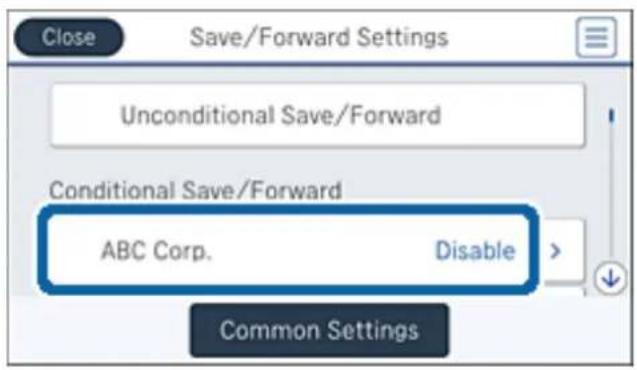
-
Tap Enable.
-
Tap
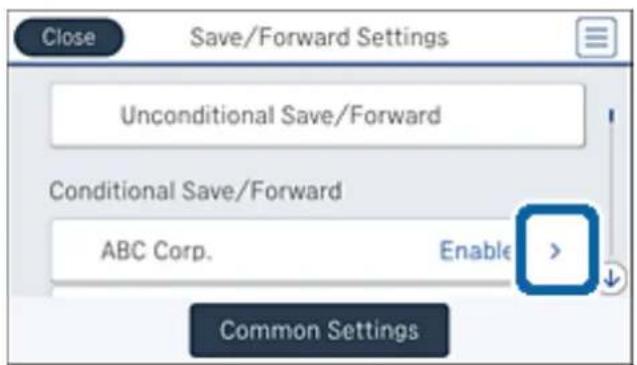
Faxing
-
Check the conditions.
-
Tap the box under Save/Forward Destination.
-
Tap Save to Fax Box.
-
Tap the top box to set this to On.
-
Select the box in which to save the document.
Note:
If the inbox or the confidential box has been password protected, enter the password.
-
Tap OK three times to return to the Save/Forward Settings screen.
-
Tap Common Settings.
-
Tap Operation Fax Data Full, and then select the option to use when the inbox is full.
□ Receive and print faxes: The printer prints all received documents that cannot be saved in the Inbox.
□ Reject incoming faxes: The printer declines incoming fax calls.
- You can set a password for the inbox if necessary. Tap Inbox Password Settings and setup the password. Tap Close after setting the password.
Note:
You cannot set a password if you selected Receive and print faxes.
Checking the Received Faxes on the LCD Screen (Conditional Save/Forward)
- Tap Fax Box on the home screen.
Note:
When there are received faxes that have not been read, the number of unread documents is displayed on the 📊 on the home screen.
-
Tap Inbox/Confidential.
-
Select the inbox or the confidential box you want to view.
-
If the inbox, or the confidential box has been password protected, enter the inbox password, the confidential box password, or the administrator password.
-
Select the fax you want to view from the list.
The contents of the fax are displayed.
☐ Rotates the image to the right by 90 degrees.
☐ ← → ↑ ↓ : Moves the screen in the direction of the arrows.
□ : Reduces or enlarges.
☐ < > : Moves to the previous or the next page.
☐ To hide the operation icons, tap anywhere on the preview screen except for the icons. Tap again to display the icons.
Faxing
- Select whether to print or delete the document you have viewed, and then follow the on-screen instructions.

Important:
If the printer runs out of memory, receiving and sending faxes is disabled. Delete documents that you have already read or printed.
Related Information
→ "Notification of Unprocessed Received Faxes" on page 166
→ "Menu Options for Fax Settings" on page 171
Saving Received Faxes in an External Memory Device (Conditional Save/Forward)
You can set to convert received documents into PDF format and save them in an external memory device connected to the printer.

Important:
Received documents are saved in the printer's memory temporarily before the documents are saved in the memory device connected to the printer. Because a memory full error disables sending and receiving faxes, keep the memory device connected to the printer. The number of documents that have saved in the printer's memory temporarily is displayed on the 📊 on the home screen.
- Connect an external memory device to the printer.
- Tap Settings on the home screen.
- Tap General Settings > Fax Settings > Receive Settings > Save/Forward Settings.
- Select the registered box under Conditional Save/Forward.
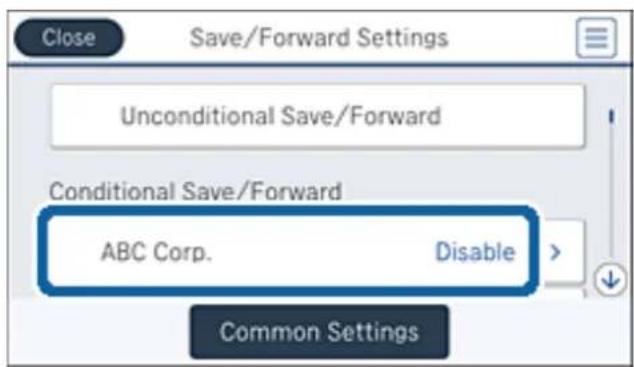
- Tap Enable.
Faxing
- Tap
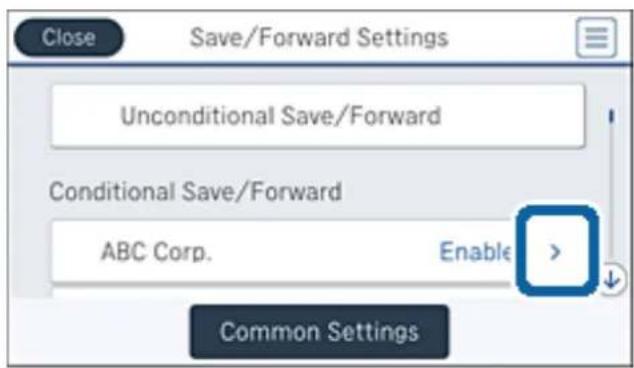
- Check the conditions.
- Tap the box under Save/Forward Destination.
- Tap Save to Memory Device.
- Tap the Save to Memory Device box to set this to On.
- Check the message displayed on the screen, and then tap Create. A folder to save received documents is created in the memory device.
- Tap OK three times to return to the Save/Forward Settings screen.
Related Information
→ "Notification of Unprocessed Received Faxes" on page 166
Forwarding Received Faxes (Conditional Save/Forward)
You can set to forward received documents to another fax machine, or convert the documents into PDF format and forward them to a shared folder on a network or to an email address. Forwarded documents are deleted from the printer. First register the forwarding destinations to the contacts list. To forward to an email address, you also need to configure the email server settings.
Note:
☐ Color documents cannot be forwarded to another fax machine. They are processed as documents that failed to be forwarded.
Before you use this feature, make sure the printer's Date/Time and Time Difference settings are correct. Access the menus from Settings > General Settings > Basic Settings > Date/Time Settings.
- Tap Settings on the home screen.
- Tap General Settings > Fax Settings > Receive Settings > Save/Forward Settings.
Faxing
- Select the registered box under Conditional Save/Forward.
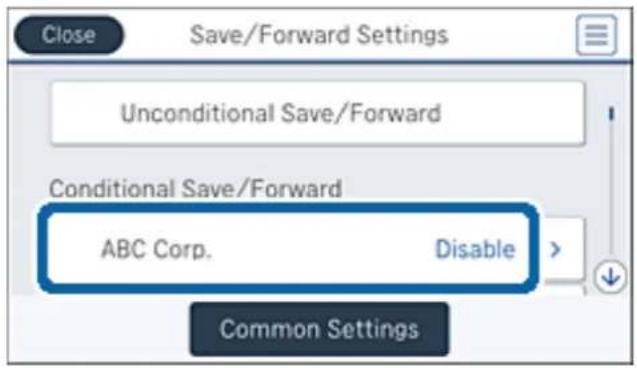
-
Tap Enable.
-
Tap
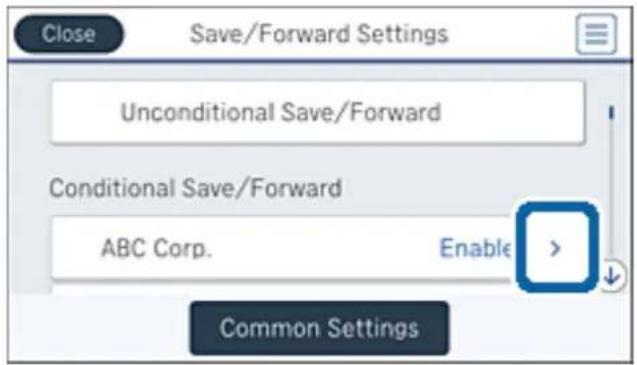
-
Check the conditions.
-
Tap the box under Save/Forward Destination.
-
Tap Forward.
-
Tap the top box to set this to On.
-
Tap Add Entry.
-
Select forwarding destinations from the contacts list.
Note:
You can specify one forwarding destination only. Tap the check mark to select the destination. Tap the mark again to clear the selection.
-
When you have finished selecting the forwarding destination, tap Close.
-
Check that the forwarding destination you selected is correct, and then tap OK.
Faxing
- In Options When Forwarding Failed, select whether to print received documents or save them in the printer's inbox when forwarding fails.

Important:
When the inbox is full, sending and receiving faxes is disabled. You should delete the documents from the inbox once they have been checked. The number of documents that have failed to be forwarded is displayed on the home screen, in addition to other unprocessed jobs.
-
Tap OK three times to return to the Save/Forward Settings screen.
-
When forwarding to an email address, you can specify a subject for the email. Tap Common Settings > Forward Settings, and enter the subject.
Note:
☐ If you have selected a shared folder on a network or an email address as the forwarding destination, we recommend that you test if you can send a scanned image to the destination in the scan mode. Select Scan > Email, or Scan > Network Folder/FTP from the home screen, select the destination, and then start scanning.
☐ You can set to receive a new fax notification on a Windows computer when received documents are saved to a shared folder on a network. Use FAX Utility to make the settings. For details, see the help of FAX Utility.
Related Information
→ "Receive Settings" on page 172
→ "Managing Contacts" on page 63
→ "Using an Email Server" on page 302
→ "Checking the Received Faxes on the LCD Screen (Conditional Save/Forward)" on page 153
→ "Notification of Unprocessed Received Faxes" on page 166
→ "Scanning to an Email" on page 107
→ "Scanning to a Network Folder or FTP Server" on page 104
→ "FAX Utility" on page 220
Printing Received Faxes (Conditional Save/Forward)
You can set to print received documents that meet conditions for saving or forwarding.
- Tap Settings on the home screen.
- Tap General Settings > Fax Settings > Receive Settings > Save/Forward Settings.
Faxing
- Select the registered box under Conditional Save/Forward.
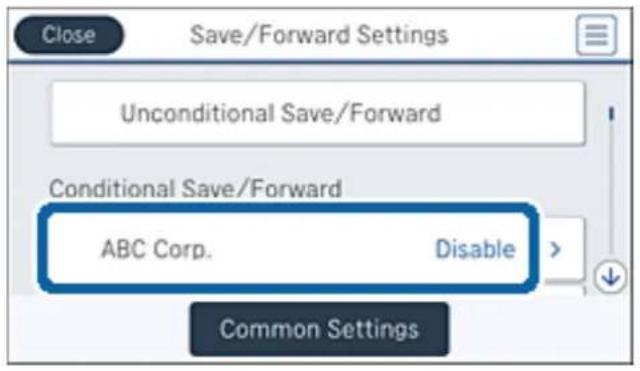
-
Tap Enable.
-
Tap
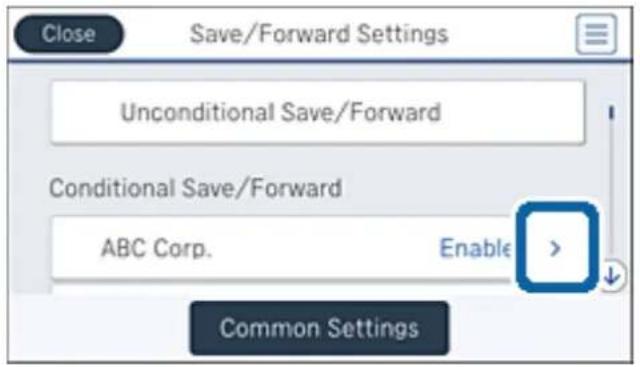
- Check the conditions.
- Tap the box under Save/Forward Destination.
- Tap the Print box to set this to On.
- Tap OK twice to return to the Save/Forward Settings screen.
Related Information
→ "Print Settings" on page 174
Sending Email Notifications on the Results of Processing Received Faxes (Conditional Save/Forward)
You can send an email containing the results of processing the received fax.
- Tap Settings on the home screen.
- Tap General Settings > Fax Settings > Receive Settings > Save/Forward Settings.
Faxing
- Select the registered box under Conditional Save/Forward.
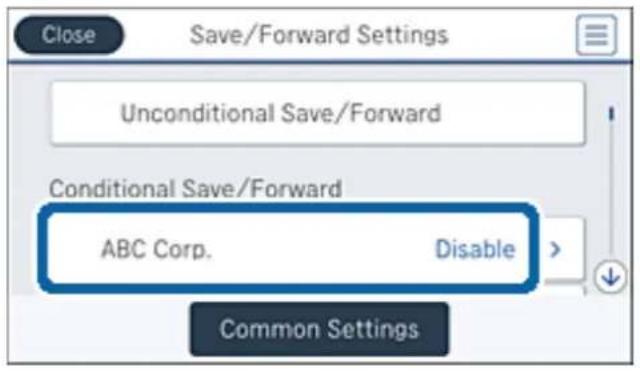
-
Tap Enable.
-
Tap
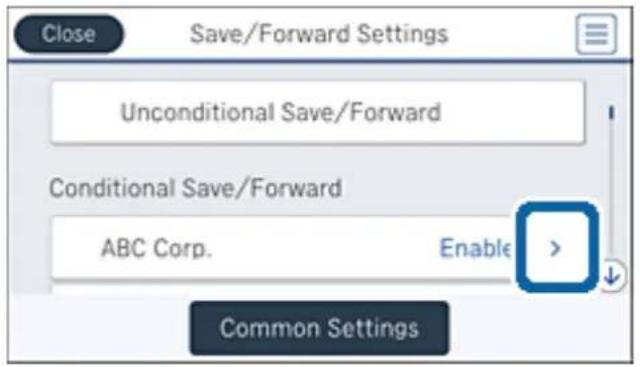
- Check the conditions.
- Tap the box under Email Notifications.
- Enable the following options as necessary.
Note:
The following options can be selected at the same time.
☐ Notify on Receive: send email to the recipient when the printer has finished receiving the fax.
☐ Notify on Save: send email to the recipient when the printer has finished saving the received document to the memory device.
☐ Notify on Forward: send email to the recipient when the printer has finished forwarding the received fax.
☐ Notify on Print: send email to the recipient when the printer has finished printing the received fax.
- Tap the box under Recipient.
- Select a recipient from the contacts list.
Note:
You can specify one recipient only. Tap the check mark to select the recipient. Tap the mark again to clear the selection.
- When you have finished selecting the recipient, tap Close.
Faxing
- Tap OK twice to return to the Save/Forward Settings screen.
Using the Fax Box Features
The Fax Box is made up of five boxes.
☐ Inbox: Saves the received document.
☐ Confidential Box: Saves the received document. You can receive confidential faxes by specifying a document storage destination using the Conditional Save/Forward setting.
□ Stored Documents Box: Stores the document to be sent.
☐ Polling Send Box: Stores the document for polling send.
☐ Board Box: Stores the document for selective polling send.
Related Information
→ "Using the Inbox" on page 160
→ "Using the Confidential Box" on page 161
→ "Using the Stored Documents Box" on page 162
→ "Using the Polling Send Box" on page 162
→ "Using the Board Box" on page 163
Using the Inbox
You can set to save received faxes in the printer's inbox. Up to 200 documents can be saved in the inbox and the confidential box in total. If you use this feature, received documents are not automatically printed. You can view them on the printer's LCD screen and print only when needed.
Note:
Saving 200 documents may not be possible depending on the usage conditions such as the file size of saved documents, and using of multiple fax saving features at a time.
Related Information
→ "Checking the Received Documents in the Inbox" on page 160
→ "Making Settings for the Inbox" on page 161
Checking the Received Documents in the Inbox
You can check the received documents stored in the printer's inbox.
- Tap Fax Box on the home screen.
- Tap Inbox/Confidential.
- Tap the Inbox box.
User's Guide
Faxing
- Select the fax you want to check.
The content of the document is displayed.
Making Settings for the Inbox
You can print, save to a memory device, or delete the document saved in the inbox. You can also setup a password and clear the inbox settings.
- Tap Fax Box on the home screen.
- Tap Inbox/Confidential.
- Tap the Inbox box.
- Tap Menu.
- Select the menu you want to use, and then follow the on-screen instructions.
Using the Confidential Box
You can set to save received faxes in the printer's confidential box. Up to 200 documents can be saved in the inbox and the confidential box in total.
Note:
Saving 200 documents may not be possible depending on the usage conditions such as the file size of saved documents, and using of multiple fax saving features at a time.
Related Information
→ "Checking the Received Documents in the Confidential Box" on page 161
→ "Making Settings for the Confidential Box" on page 161
Checking the Received Documents in the Confidential Box
You can check the received documents stored in the printer's confidential box.
- Tap Fax Box on the home screen.
- Tap Inbox/Confidential.
- Tap one of the Confidential boxes.
- Select the fax you want to check.
The content of the document is displayed.
Making Settings for the Confidential Box
You can print, save to a memory device, or delete the document saved in the confidential box. You can also setup a password and clear the confidential box settings.
User's Guide
Faxing
-
Tap Fax Box on the home screen.
-
Tap Inbox/Confidential.
-
Tap one of the Confidential boxes.
-
Tap Menu.
-
Select the menu you want to use, and then follow the on-screen instructions.
Using the Stored Documents Box
You can store 10 documents (up to 100 monochrome pages per document) in the printer's stored documents box.
Note:
Saving 10 documents may not be possible depending on the usage conditions such as the file size of stored documents.
Related Information
→ "Checking the Documents in the Stored Documents Box" on page 162
→ "Making Settings for the Stored Documents Box" on page 162
Checking the Documents in the Stored Documents Box
You can check the documents stored in the printer's stored documents box.
-
Tap Fax Box on the home screen.
-
Tap Stored Documents.
-
Select the document you want to check.
The content of the document is displayed.
Making Settings for the Stored Documents Box
You can store fax data in the stored documents box. You can also print, save to a memory device, or delete the document saved in the stored documents box, and setup a password for opening the box.
-
Tap Fax Box on the home screen.
-
Tap Stored Documents.
-
Tap Menu.
-
Select the menu you want to use, and then follow the on-screen instructions.
Using the Polling Send Box
You can store up to 100 pages of a single document in monochrome in the printer's polling send box.
Faxing
Related Information
→ "Registering a Polling Send/Bulletin Board Box" on page 138
→ "Storing a Document in the Polling Send/Bulletin Board Box" on page 138
→ "Checking the Documents in the Polling Send Box" on page 163
→ "Making Settings for the Polling Send Box" on page 163
Checking the Documents in the Polling Send Box
You can check the documents stored in the printer's polling send box.
- Tap Fax Box on the home screen.
- Tap Polling Send/Board.
- Tap the Polling Send box.
- Tap Check Document.
The content of the document is displayed.
Making Settings for the Polling Send Box
You can delete documents stored in the polling send box. You can also setup a password for opening the box, automatically delete document settings after polling send, and send an email notification of the results of processing the document.
- Tap Fax Box on the home screen.
- Tap Polling Send/Board.
- Tap the Polling Send box.
- Tap Nenu.
- Select the menu you want to use, and then follow the on-screen instructions.
Using the Board Box
You can store a single document (up to 100 pages in monochrome) in one of the printer's board boxes. The printer has 10 board boxes allowing you to store up to 10 documents in total.
Note:
Storing 10 documents may not be possible depending on the usage conditions such as the file size of stored documents.
Related Information
→ "Registering a Polling Send/Bulletin Board Box" on page 138
→ "Storing a Document in the Polling Send/Bulletin Board Box" on page 138
→ "Checking the Documents in the Board Box" on page 164
→ "Making Settings for the Board Boxes" on page 164
Faxing
Checking the Documents in the Board Box
You can check the documents stored in the printer's board box.
-
Tap Fax Box on the home screen.
-
Tap Polling Send/Board.
-
Tap one of the Board boxes.
-
Tap Check Document.
The content of the document is displayed.
Making Settings for the Board Boxes
You can make subaddress and password settings for the board boxes. You can also setup a password for opening the box, delete document settings after polling send, send an email notification of the results of processing the document, delete the document, and clear the box settings.
- Tap Fax Box on the home screen.
- Tap Polling Send/Board.
- Tap one of the Board boxes.
- Tap Nenu.
- Select the menu you want to use, and then follow the on-screen instructions.
Using Other Faxing Features
Printing Fax Report and List
Printing Fax Report Manually
- Tap Fax on the home screen.
- Tap Menu (More).
- Tap Fax Report.
- Select the report you want to print, and then follow the on-screen instructions.
Note:
You can change the report format. From the home screen, select Settings > General Settings > Fax Settings > Report Settings, and then change the Attach Image to Report or Report Format settings.
Faxing
Related Information
→ "More" on page 170
→ "Report Settings" on page 176
Setting Up to Print Fax Reports Automatically
You can make settings to print the following fax reports automatically.
Transmission Report
From the home screen, tap Fax > Fax Settings > Transmission Report, and then select Print or Print on Error.
Forwarding Report
From the home screen, tap Settings > General Settings > Fax Settings > Report Settings > Forwarding Report, and then select Print or Print on Error.
Fax Log Auto Print
From the home screen, tap Settings > General Settings > Fax Settings > Report Settings > Fax Log Auto Print, and then select On(Every 30) or On(Time).
Related Information
→ "Menu Options for User Settings" on page 178
→ "Report Settings" on page 176
Setting Security for Faxing
You can make security settings to prevent sending a fax to the wrong recipient, or prevent received documents from being leaked or lost. You can also delete backed-up fax data.
- Tap Settings on the home screen.
- Tap General Settings > Fax Settings > Security Settings.
- Select the menu, and then make the settings.
Related Information
→ "Security Settings" on page 177
Faxing
Checking Fax Jobs
Notification of Unprocessed Received Faxes
When there are unprocessed received documents, the number of unprocessed jobs is displayed on the ☐ on the home screen. See the table below for a definition of the "unprocessed".
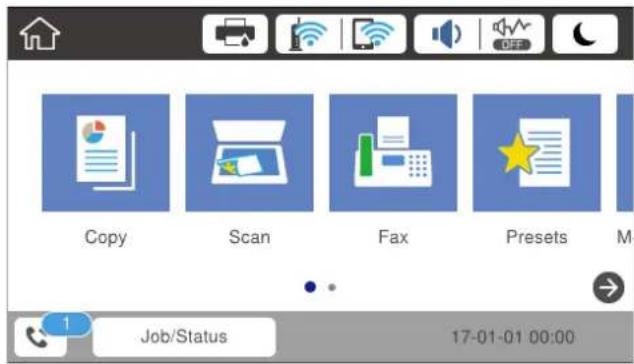
| Received Fax Save/Forward Setting | Unprocessed Status |
| Printing^*1 | Received documents are waiting to be printed or printing is in progress. |
| Saving in the inbox or the confidential box | There are unread received documents in the inbox or the confidential box. |
| Saving in an external memory device | There are received documents that have not been saved in the device because there is no device containing a folder specifically created to save received documents connected to the printer or for other reasons. |
| Saving on a computer | There are received documents that have not been saved on the computer because the computer is in sleep mode or for other reasons. |
| Forwarding | There are received documents that have not been forwarded or failed to be forwarded*2. |
*1 : When you have not set any of the fax save/forward settings, or when you have set to print received documents while saving them to an external memory device or a computer.
*2 : When you have set to save documents that could not be forwarded in the inbox, there are unread documents that failed to be forwarded in the inbox. When you have set to print documents that failed to be forwarded, printing is not complete.
Note:
If you are using more than one of the fax save/forward settings, the number of unprocessed jobs may be displayed as "2" or "3" even if only one fax has been received. For example, if you have set to save faxes in the inbox and on a computer and one fax is received, the number of unprocessed jobs is displayed as "2" if the fax has not been saved to the inbox and on a computer.
Related Information
→ "Saving Received Faxes in the Inbox (Unconditional Save/Forward)" on page 144
→ "Saving Received Faxes in the Inbox or the Confidential Box (Conditional Save/Forward)" on page 152
"Saving Received Faxes in an External Memory Device (Unconditional Save/Forward)" on page 146
→ "Saving Received Faxes in an External Memory Device (Conditional Save/Forward)" on page 154
Faxing
→ "Saving Received Faxes on a Computer (Unconditional Save/Forward)" on page 147
→ "Forwarding Received Faxes (Unconditional Save/Forward)" on page 148
→ "Forwarding Received Faxes (Conditional Save/Forward)" on page 155
→ "Checking the Received Faxes on the LCD Screen (Unconditional Save/Forward)" on page 145
→ "Checking the Received Faxes on the LCD Screen (Conditional Save/Forward)" on page 153
→ "Checking Fax Jobs in Progress" on page 167
Checking Fax Jobs in Progress
You can check, cancel, print, or resend the following fax documents.
□ Received documents that have not been printed yet
□ Documents that have not be sent yet
☐ Documents that have failed to be sent (if you have enabled Save Failure Data)
□ Received documents that have not been saved on a computer or in an external memory device
- Tap Job/Status on the home screen.
- Tap the Job Status tab, and then tap Active.
- Select a job to check.
Related Information
→ "Job/Status Screen Configuration" on page 24
Checking the Fax Job History
You can check the history of sent or received fax jobs. The received fax logs include the received documents so that you can reprint them. You cannot print or resend sent documents from the sent log.
- Tap Job/Status on the home screen.
- Tap the Job Status tab, and then tap Log.
- Select a job to check.
Note:
All the received documents are stored in Log so that you can reprint them, but they are deleted in chronological order when the printer runs out of memory.
Related Information
→ "Job/Status Screen Configuration" on page 24
Menu Options for Fax Mode
Recipient
Select the menus on the control panel as described below.
Fax > Recipient
□ Direct Input
Manually enter a fax number.
□ Contacts
Select a recipient from the contacts list. You can also add or edit a contact.
Recent
Select a recipient from the sent fax history. You can also add the recipient to the contacts list.
Fax Settings
Select the menus on the control panel as described below.
Fax > Fax Settings
Quick Operation Button:
☐ Quick Operation Button 1
Allows you to quickly access the menu you use often. Use the following menu to register the frequently used menu.
Settings > General Settings > Quick Operation Button > Quick Operation Button 1
☐ Quick Operation Button 2
Allows you to quickly access the menu you use often. Use the following menu to register the frequently used menu.
Settings > General Settings > Quick Operation Button > Quick Operation Button 2
☐ Quick Operation Button 3
Allows you to quickly access the menu you use often. Use the following menu to register the frequently used menu.
Settings > General Settings > Quick Operation Button > Quick Operation Button 3
Scan Settings:
☐ Original Size (Glass)
Select the size and orientation of the original you placed on the scanner glass.
☐ Original Type
Select the type of your original.
□ Color Mode
Select whether to scan in color or in monochrome.
Faxing
Resolution
Select the resolution of the outgoing fax.
□ Density
Sets the density of the outgoing fax.
Remove Background
Detects the paper color (background color) of the original document, and removes or lightens the color. Depending on the darkness and vividness of the color, it may not be removed or lightened
Sharpness
Enhances or defocuses the outline of the image.
□ ADF 2-Sided
Scans both sides of originals placed in the ADF and sends a monochrome fax.
□ Continuous Scan(ADF)
When sending a fax from the ADF, you cannot add originals in the ADF after starting scanning. If you place different sized originals in the ADF, all of the originals are sent at the largest size among them. Enable this option so that the printer asks if you want to scan another page after an original in the ADF has finished scanning. Then you can sort and scan your originals by size and send them as a single fax.
Fax Send Settings:
Direct Send
Sends monochrome faxes to a single recipient as soon as the connection is made, without saving the scanned image to memory. If you do not enable this option, the printer starts the transmission after saving the scanned image to memory and may cause a memory full error when sending many pages. By using this option, you can avoid the error, but it takes longer to send the fax. You cannot use this option when using the ADF 2-Sided option and when sending a fax to multiple recipients.
□ Priority Send
Sends the current fax before other faxes waiting to be sent.
□ Send Fax Later
Sends a fax at a time you specified. Only a monochrome fax is available when using this option.
☐ Add Sender Information
☐ Add Sender Information:
Select the position where you want to include the header information (sender name and fax number) in the outgoing fax, or not to include the information.
Select Off to send a fax with no header information.
Select Outside of Image to send a fax with header information in the top white margin of the fax. This keeps the header from overlapping with the scanned image, however, the fax received by the recipient may be printed across two sheets depending on the size of the originals.
Select Inside of Image to send a fax with header information approximately 7 mm lower than the top of the scanned image. The header may overlap with the image, however, the fax received by the recipient will not be split into two documents.
☐ Fax Header: Select the header for the recipient. To use this feature, you should register multiple headers in advance.
☐ Additional Information: Select the information you want to add.
Faxing
□ Notify Send Result Sends a notification after you send a fax.
☐ Transmission Report Prints a transmission report automatically after you send a fax. Select Print on Error to print a report only when an error occurs.
☐ Backup Saves a backup of the sent fax that is scanned and saved to the printer's memory automatically.
More
Select the menus on the control panel as described below.
Fax > menu (More)
Transmission Log:
You can check the history of sent or received fax jobs.
Fax Report:
□ Last Transmission
Prints a report for the previous fax that was sent or received through polling.
Fax Log
Prints a transmission report. You can set to print this report automatically using the following menu.
Settings > General Settings > Fax Settings > Report Settings > Fax Log Auto Print
□ Stored Fax Documents
Prints a list of fax documents stored in the printer's memory, such as unfinished jobs.
Fax Settings List
Prints the current fax settings.
☐ Conditional Save/Forward list
Prints the Conditional Save/Forward List.
Protocol Trace
Prints a detailed report for the previous fax that was sent or received.
Extended Fax:
□ Polling Receive
Connects to the fax number you entered and receives a fax stored on the fax machine. You can use this option for receiving a fax from a fax information service.
□ Polling Send/Board
The Polling Send/Board is made up of one polling send box and ten board boxes. The polling send box stores one scanned document (up to 100 monochrome pages) for polling and sends it automatically when another fax machine requests it using the device's polling receive function. Each board box stores one scanned document for polling and sends it automatically when another fax machine requests it using the device's polling receive function and subaddress function.
Faxing
Store Fax Data
Stores ten scanned document (up to 100 monochrome pages) and allows you to send it whenever necessary.
Fax Box:
Access the Fax Box feature. For details, see the page that describes Fax Box settings.
Fax Settings:
Access the Fax Settings feature. For details, see the page that describes Fax Settings.
Related Information
→ "Menu Options for Fax Box" on page 179
→ "Menu Options for Fax Settings" on page 171
Menu Options for Fax Settings
Select the menus on the control panel as described below.
Settings > General Settings > Fax Settings
Quick Operation Button
Select the menus on the control panel as described below.
Settings > General Settings > Fax Settings > Quick Operation Button
Quick Operation Button 1:
Registers a shortcut allowing you to quickly access the menu you use often. You can access the button from the following menu.
Fax > Fax Settings > Quick Operation Button 1
Quick Operation Button 2:
Registers a shortcut allowing you to quickly access the menu you use often. You can access the button from the following menu.
Fax > Fax Settings > Quick Operation Button 2
Quick Operation Button 3:
Registers a shortcut allowing you to quickly access the menu you use often. You can access the button from the following menu.
Fax > Fax Settings > Quick Operation Button 3
Send Settings
Select the menus on the control panel as described below.
Settings > General Settings > Fax Settings > Send Settings
Faxing
Auto Rotation:
An A4 size original placed in the ADF or on the scanner glass with its long edge facing to the left is sent as an A3 size fax. Enable this to rotate the scanned image to send it at A4 size.
Quick memory send:
The quick memory send feature starts sending the fax when the printer finishes scanning the first page. If you do not enable this feature, the printer starts sending after saving all of the scanned images to memory. By using this feature you can reduce the overall operation time as scanning and sending are performed in parallel.
Batch Send:
When there are multiple faxes waiting to be sent to the same recipient, this groups them together to send them at once. Up to five documents (up to 100 pages in total) can be sent at one time. This helps you save on connection fees by reducing the number of transmission times.
Auto Redial Count:
Select the number of times that the printer automatically redials if the fax number is busy or a problem occurs.
Auto Redial Interval:
Select the time that the printer automatically redials if the fax number is busy or a problem occurs.
Save Failure Data:
Saves documents that failed to be sent in the printer's memory. You can resend the documents from the Job/Status.
Receive Settings
Select the menus on the control panel as described below.
Settings > General Settings > Fax Settings > Receive Settings
Save/Forward Settings
Select the menus on the control panel as described below.
Settings > General Settings > Fax Settings > Receive Settings > Save/Forward Settings
Unconditional Save/Forward
You can set to save received documents in the inbox, on a memory device, or on a computer, or forward the documents.
Save to Inbox:
Saves received faxes in the printer's inbox.
Save to Computer:
Converts received documents into PDF format and saves them on a computer connected to the printer.
Faxing
Save to Memory Device:
Converts received documents into PDF format and saves them to an external memory device connected to the printer.
Forward:
You can set to forward received documents to another fax machine, or convert the documents into PDF format and forward them to a shared folder on a network or to an email address. Forwarded documents are deleted from the printer. First register the forwarding destinations to the contacts list. To forward to an email address, you also need to configure the email server settings.
Email Notifications:
Sends an email notification when receiving, printing, saving to a memory device, or forwarding faxes is complete.
Conditional Save/Forward
You can set to save received documents in the inbox, on a memory device, or forward the documents, according to the conditions you set in advance.
To switch between enabling or disabling the conditions, tap anywhere in the box except for
To register the conditions, tap
Name:
Enter name of the condition.
Condition(s):
Select conditions and make settings.
☐ Sender Fax Number match
When the sender fax number matches, the received document is saved and forwarded.
☐ Subaddress(SUB) perfect match
When the subaddress (SUB) matches perfectly, the received document is saved and forwarded.
☐ Password(SID) perfect match
When the password (SID) matches perfectly, the received document is saved and forwarded.
□ Receiving Time
Saves and forwards documents received during the specified time period.
Save/Forward Destination:
Select the destination to save and forward received documents that match the conditions.
□ Save to Fax Box
Saves received faxes in the printer's inbox or confidential box.
Faxing
☐ Save to Memory Device Converts received documents into PDF format and saves them to an external memory device connected to the printer.
☐ Forward You can set to forward received documents to another fax machine, or convert the documents into PDF format and forward them to a shared folder on a network or to an email address. Forwarded documents are deleted from the printer. First register the forwarding destinations to the contacts list. To forward to an email address, you also need to configure the email server settings.
□ Print Select whether or not to print.
Email Notifications:
Sends an email notification when receiving, printing, saving to a memory device, or forwarding faxes is complete.
Transmission Report:
Prints a transmission report automatically after you send a fax. Select Print on Error to print a report only when an error occurs.
Common Settings
Inbox settings:
☐ Operation Fax Data Full Select the operation to perform when the inbox is full. Select Receive and print faxes to print all received documents that cannot be saved in the inbox. Select Reject incoming faxes to decline incoming fax calls.
☐ Inbox Password Settings Password protects the inbox to restrict users from viewing received faxes. Select Change to change the password, and select Reset to cancel password protection. When changing or resetting the password, you need the current password.
Forward Settings:
When forwarding to an email address, you can specify a subject for the email.
Menu (Menu)
Print Conditional Save/Forward list
Tap at top right of the screen. Prints the Conditional Save/Forward List.
Print Settings
Select the menus on the control panel as described below.
Settings > General Settings > Fax Settings > Receive Settings > Print Settings
Faxing
Auto Reduction:
Reduces large received documents to fit on the paper in the paper source. Reducing may not always be possible depending on the received data. If this is turned off, large documents are printed at their original size on multiple sheets, or a blank second page may be ejected.
Split Page Settings:
Make split page settings when the size of the received document is larger than the size of the paper loaded in the printer.
Acting Print:
Make print settings when the size of the received document is larger than the size of the paper loaded in the printer.
Auto Rotation:
Rotates a landscape-oriented A5, B5, A4, or Letter size received document so that it is printed on the correct paper size. This setting is applied when two or more paper sources are set for fax printing in Paper Source Settings > Auto Select Settings, and the paper size settings of the paper sources are A3 and A4, B4 and B5, or A4 and A5.
Add Reception Information:
Prints reception information in the header of the received fax, even if the sender does not set the header information. The reception information includes the received date and time, sender's ID, reception ID (such as "#001"), and page number (such as "P1"). When Split Page Settings is enabled, the split page number is also included.
2-Sided:
You can print multiple pages of received documents on both sides of the paper.
Print Start Timing:
Select options to start printing the received documents.
All Pages Received: After receiving all of the pages, printing starts from the first page. If the Collation Stack feature is enabled, printing starts from the last page and then the pages are arranged in the correct order.
First Page Received: Starts printing when the first page is received, and then prints in order as the pages are received. If the printer cannot start printing, such as when it is printing other jobs, the printer starts printing received pages as a batch when it is available.
Collation Stack:
Prints received documents from the last page (print in descending order) so that the printed documents are stacked in the correct page order. When the printer is running low on memory, this feature may not be available.
Print Suspend Time:
Saves documents received during the specified time period in the printer's memory without printing them. At the time specified to restart printing, the documents are automatically printed. This feature can be used for noise prevention at night or to prevent confidential documents from being disclosed while you are away. Before using this feature, make sure there is enough free memory. Even before the restarting time, you can check and print the received documents individually from Job/Status.
User's Guide
Faxing
Quiet Mode:
Reduces the noise the printer makes when printing faxes, however, print speed may be reduced.
Report Settings
Select the menu on the control panel as described below.
Settings > General Settings > Fax Settings > Report Settings
Forwarding Report:
Prints a report after forwarding a received document.
Backup Error Report:
Prints a report when a backup error for sending faxes occurs.
Fax Log Auto Print:
Prints the fax log automatically. Select On(Every 30) to print a log every time 30 fax jobs are completed. Select On(Time) to print the log at a specified time. However, if the number of fax jobs exceeds 30, the log is printed before the specified time.
Attach Image to Report:
Prints a Transmission Report with an image of the first page of the sent document. Select On(Large Image) to print the upper part of the page without reducing. Select On(Small Image) to print the entire page reducing it to fit onto the report.
Report Format:
Select a format for fax reports other than Protocol Trace. Select Detail to print with error codes.
Output Method:
Select an output method for fax reports.
Basic Settings
Select the menus on the control panel as described below.
Settings > General Settings > Fax Settings > Basic Settings
Fax Speed:
Select the fax transmission speed. We recommend selecting Slow(9,600bps) when a communication error occurs frequently, when sending/receiving a fax to/from abroad, or when you are using an IP (VoIP) phone service.
ECM:
Automatically corrects errors in the fax transmission (Error Correction Mode), mostly caused by telephone line noise. If this is disabled, you cannot send or receive documents in color.
Faxing
Dial Tone Detection:
Detects a dial tone before starting to dial. If the printer is connected to a PBX (Private Branch Exchange) or digital phone line, the printer may fail to start dialing. In this situation, change the Line Type setting to PBX. If this does not work, disable this feature. However, disabling this feature may drop the first digit of a fax number and send the fax to the wrong number.
Dial Mode:
Select the type of phone system to which you have connected the printer. When set to Pulse, you can temporarily switch the dialing mode from pulse to tone by pressing * ("T" is entered) while entering numbers on the fax top screen. Depending on the region, this setting may not be displayed.
Line Type:
Select the line type to which you have connected the printer. When using the printer in an environment that uses extensions and requires an external access code, such as 0 and 9, to get an outside line, select PBX and register the access code. Once you have registered the access code, enter # (hash) instead of the access code when sending a fax to an outside fax number. For an environment that uses a DSL modem or terminal adapter, setting to PBX is also recommended.
Header:
Enter your sender name and fax number. These appear as a header on outgoing faxes. You can enter up to 40 characters for your name, and up to 20 digits for your fax number.
Receive Mode:
Select the receive mode.
DRD:
If you have subscribed to a distinctive ring service from your telephone company, select the ring pattern to be used for incoming faxes. The distinctive ring service, offered by many telephone companies (the service name differs by company), allows you to have several phone numbers on one phone line. Each number is assigned different ring pattern. You can use one number for voice calls and another for fax calls. Depending on the region, this option may be On or Off.
Rings to Answer:
Select the number of rings that must occur before the printer automatically receives a fax.
Remote Receive:
When you answer an incoming fax call on a phone connected to the printer, you can start receiving the fax by entering the code using the phone.
Rejection Fax:
Select options to reject junk faxes.
Receiving Paper Size:
Select the maximum paper size for faxes that the printer can receive.
Security Settings
Select the menus on the control panel as described below.
Faxing
Settings > General Settings > Fax Settings > Security Settings
Direct Dialing Restrictions:
Enable this to disable the manual entry of recipient's fax numbers allowing the operator to select recipients only from the contacts list or sent history. Select Enter Twice to require the operator to enter the fax number again when the number was manually entered.
Confirm Address List:
Displays a recipient confirmation screen before starting the transmission.
Backup Data Auto Clear:
To prepare for an unexpected power off due to an electricity failure or an incorrect operation, the printer temporarily stores backup copies of sent and received documents in its memory. Enable this option to automatically erase the backups when sending or receiving a document completes successfully and the backups become unnecessary.
Clear Backup Data:
Erases all backup copies temporarily stored in the printer's memory. Run this before you give the printer to someone else or dispose of it.
Check Fax Connection
Select the menus on the control panel as described below.
Settings > General Settings > Fax Settings > Check Fax Connection
Checks if the printer is connected to the phone line and ready for fax transmission, and prints the check result on A4 size plain paper.
Fax Setting Wizard
Select the menus on the control panel as described below.
Settings > General Settings > Fax Settings > Fax Setting Wizard
Select to make basic fax settings by following the on-screen instructions. For details, see the page that describes basic fax settings.
Menu Options for User Settings
Select the menus on the control panel as described below.
Settings > User Settings > Fax
The settings made in this menu become your default settings for sending faxes. For explanations on the setting items, see the Fax Settings in Fax mode.
Related Information
→ "Fax Settings" on page 168
Menu Options for Fax Box
Tap Fax Box on the home screen on the control panel.
Inbox/Confidential:
Tap to access the Inbox/Confidential box.
Stored Documents:
Tap to access the Stored Documents box.
Polling Send/Board:
Tap to access the Polling Send/Board box.
For details, see the page that describes Fax Box settings.
Related Information
→ "Using the Fax Box Features" on page 160
Replacing Ink Supply Units and Other Consumables
Checking the Status of the Remaining Ink and the Maintenance Box
You can check the approximate ink levels and the approximate service life of the maintenance box from the control panel or the computer.
Checking the Status of the Remaining Ink and the Maintenance Box - Control Panel
Tap on the home screen.
The indicator on the far right indicates the available space in the maintenance box.
Checking the Status of the Remaining Ink and the Maintenance Box - Windows
- Access the printer driver window.
- Click EPSON Status Monitor 3 on the Maintenance tab, and then click Details.
Note: If EPSON Status Monitor 3 is disabled, click Extended Settings on the Maintenance tab, and then select Enable EPSON Status Monitor 3.
Related Information
→ "Windows Printer Driver" on page 216
Checking the Status of the Remaining Ink and the Maintenance Box - Mac OS X
- Select System Preferences from the menu > Printers & Scanners (or Print & Scan, Print & Fax), and then select the printer.
- Click Options & Supplies > Utility > Open Printer Utility.
- Click EPSON Status Monitor.
Ink Supply Unit Codes
The following are the codes for genuine Epson ink supply units.
| Black | Cyan | Magenta | Yellow |
| T9741 | T9742 | T9743 | T9744 |
| T9731 | T9732 | T9733 | T9734 |
Epson recommends the use of genuine Epson ink supply units. Epson cannot guarantee the quality or reliability of non-genuine ink. The use of non-genuine ink may cause damage that is not covered by Epson's warranties, and under certain circumstances, may cause erratic printer behavior. Information about non-genuine ink levels may not be displayed.
Note:
☐ Ink supply unit codes may vary by location. For the correct codes in your area, contact Epson support.
☐ Not all ink supply units are available in all regions.
☐ For users in Europe, visit the following website for information on Epson's ink supply unit yields.
http://www.epson.eu/pageyield
Related Information
→ "Technical Support Web Site" on page 304
Ink Supply Unit Handling Precautions
Read the following instructions before replacing ink supply units.
Handling precautions
☐ Store ink supply units at normal room temperature and keep them away from direct sunlight.
☐ Epson recommends using the ink supply unit before the date printed on the package.
☐ For best results, store ink supply unit packages with their bottom down.
☐ After bringing an ink supply unit inside from a cold storage site, allow it to warm up at room temperature for at least 12 hours before using it.
☐ Do not remove the transparent seal from the ink supply area; otherwise the ink supply unit may become unusable.
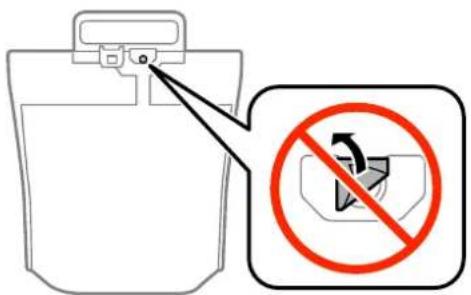
Replacing Ink Supply Units and Other Consumables
☐ Do not touch the sections shown in the illustration. Doing so may prevent normal operation and printing.
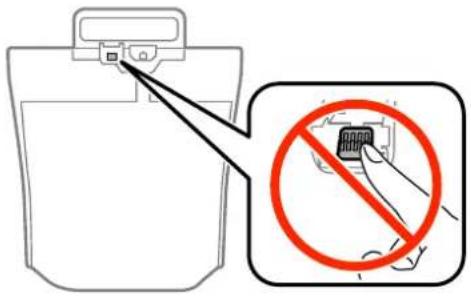
☐ Install all ink supply units; otherwise you cannot print.
☐ Do not turn off the printer during ink charging. If the ink charging is incomplete, you may not be able to print.
☐ Do not leave the printer with the ink supply units removed; otherwise, ink remaining in the print head nozzles may dry out and you may not be able to print.
☐ If you need to remove an ink supply unit temporarily, make sure you protect the ink supply area from dirt and dust. Store the ink supply unit in the same environment as the printer. Because the ink supply port is equipped with a valve designed to contain the release of excess ink, there is no need to supply your own covers or plugs.
☐ Removed ink supply units may have ink around the ink supply port, so be careful not to get any ink on the surrounding area when removing the ink supply units.
☐ This printer uses ink supply unit equipped with a green chip that monitors information such as the amount of remaining ink for each ink supply unit. This means that even if the ink supply unit is removed from the printer before it is expended, you can still use the ink supply unit after reinserting it back into the printer.
☐ To ensure you receive premium print quality and to help protect your print head, a variable ink safety reserve remains in the ink supply unit when your printer indicates to replace the ink supply unit. The yields quoted for you do not include this reserve.
☐ Although the ink supply units may contain recycled materials, this does not affect printer function or performance.
☐ Specifications and appearance of the ink supply unit are subject to change without prior notice for improvement.
☐ Do not disassemble or remodel the ink supply unit, otherwise you may not be able to print normally.
☐ Do not drop or knock the ink supply unit against hard objects; otherwise, the ink may leak.
☐ You cannot use the ink supply units that came with the printer for the replacement.
☐ Quoted yields may vary depending on the images that you are printing, the paper type that you are using, the frequency of your prints and environmental conditions such as temperature.
Consumption of Ink
☐ To maintain optimum print head performance, some ink is consumed from all ink supply units not only during printing but also during maintenance operations such as print head cleaning.
☐ When printing in monochrome or grayscale, color inks instead of black ink may be used depending on the paper type or print quality settings. This is because a mixture of color inks is used to create black.
☐ The ink in the ink supply units supplied with your printer is partly used during initial setup. In order to produce high quality printouts, the print head in your printer will be fully charged with ink. This one-off process consumes a quantity of ink and therefore these ink supply units may print fewer pages compared to subsequent ink supply units.
Replacing Ink Supply Units
When a message is displayed prompting you to replace the ink supply units, tap How To and then view the animations displayed on the control panel to learn how to replace the ink supply units.
Related Information
→ "Ink Supply Unit Codes" on page 181
→ "Ink Supply Unit Handling Precautions" on page 181
Maintenance Box Code
Epson recommends the use of a genuine Epson maintenance box.
The following is the code for the genuine Epson maintenance box.
T6714
Maintenance Box Handling Precautions
Read the following instructions before replacing the maintenance box.
☐ Do not touch the green chip on the side of the maintenance box. Doing so may prevent normal operation and printing.
☐ Do not remove the film on the top of the box; otherwise ink may leak.
☐ Do not tilt the used maintenance box until after it is sealed in the plastic bag; otherwise ink may leak.
□ Keep the maintenance box out of direct sunlight.
☐ Do not replace the maintenance box during printing; otherwise, ink may leak.
☐ Do not reuse a maintenance box which has been removed and left detached for a long period. Ink inside the box will have solidified and no more ink can be absorbed.
☐ Do not remove the maintenance box except when replacing it; otherwise ink may leak.
Replacing the Maintenance Box
In some print cycles a very small amount of surplus ink may be collected in the maintenance box. To prevent ink leakage from the maintenance box, the printer is designed to stop printing when the absorbing capacity of the maintenance box has reached its limit. Whether and how often this is required will vary according to the number of pages you print, the type of material that you print and the number of cleaning cycles that the printer performs.
When a message is displayed prompting you to replace the maintenance box, refer to the animations displayed on the control panel. The need for replacement of the box does not mean that your printer has ceased to operate in accordance with its specifications. The Epson warranty does not cover the cost of this replacement. It is a user-serviceable part.
Note:
When it is full, you cannot print until the maintenance box is replaced to avoid ink leakage. However, you can perform operations such as sending faxes and saving data to an external USB device.
Replacing Ink Supply Units and Other Consumables
Related Information
→ "Maintenance Box Code" on page 183
→ "Maintenance Box Handling Precautions" on page 183
Maintenance Rollers Codes
Epson recommends the use of genuine Epson maintenance rollers.
The following are the codes.
Maintenance rollers of paper cassette 1: S210048
Maintenance rollers of paper cassette 2 to 4: S210049
Replacing Maintenance Rollers in Paper Cassette 1
There are two places for replacing the maintenance rollers: on the back of the printer (two rollers) and on the paper cassette (one roller).
- Remove the new maintenance rollers from their package.

Important:
☐ The maintenance rollers for the paper cassette 1 and paper cassette 2 to 4 are different. Check the direction of the arrow at the center of the maintenance rollers, and make sure the maintenance rollers are the ones for paper cassette 1. If you attach the wrong rollers, the printer may not feed the paper.
natural_image
Diagram showing concentric circles with arrows pointing to a circular target, next to a rounded rectangle with an arrow (no text or symbols)☐ Be careful not to stain the surface of the maintenance rollers. If dust collects on the surface of the maintenance rollers, clean the rollers by using a soft and moist cloth. Using a dry cloth may damage the surface of the rollers.
- Turn off the printer by pressing the ⏻ button, and then unplug the power cord.
Replacing Ink Supply Units and Other Consumables
3. Pull out paper cassette 1.
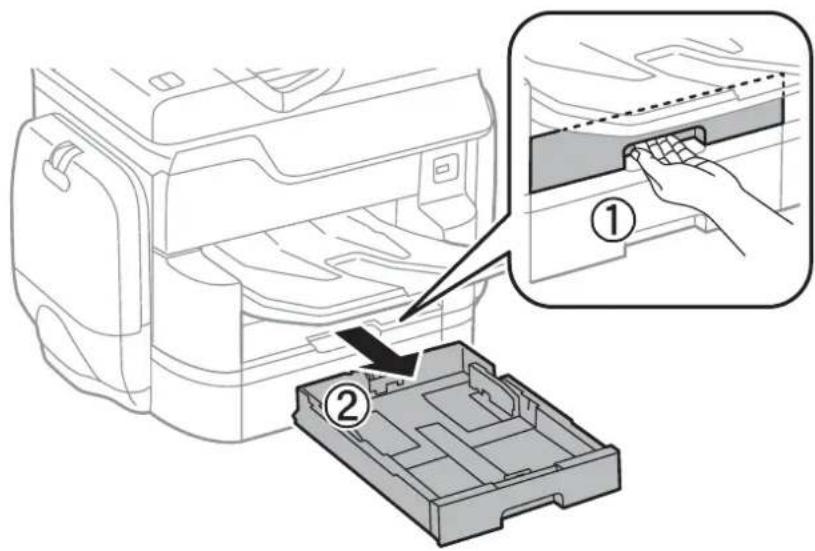
4. Turn the printer around, and open rear cover 1.
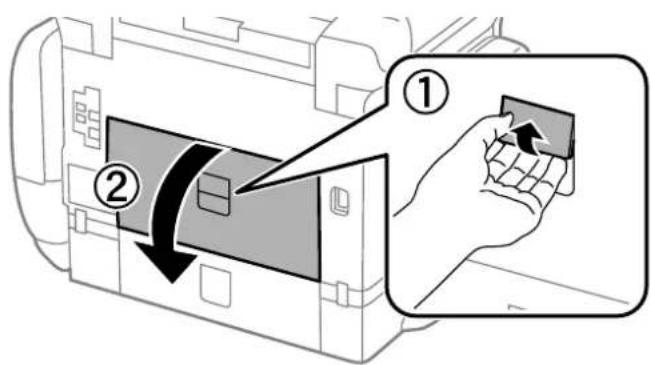
5. Pull out rear cover 2.
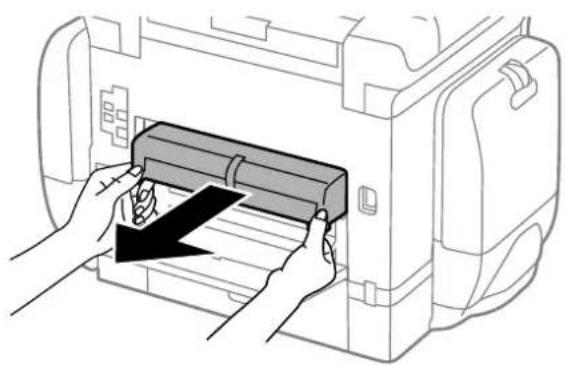
natural_image
Illustration of hands inserting a printer into a machine (no text or symbols visible)Replacing Ink Supply Units and Other Consumables
- Remove the cover inside the back of the printer.
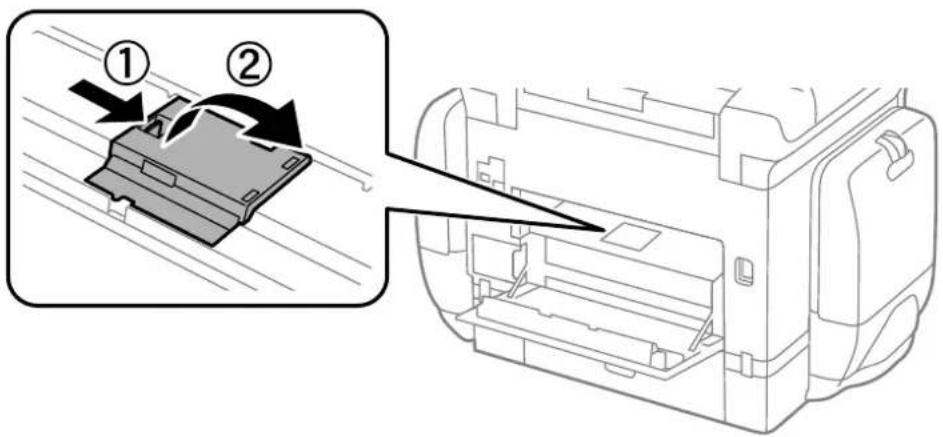
- Slide out the two used maintenance rollers, and remove them.
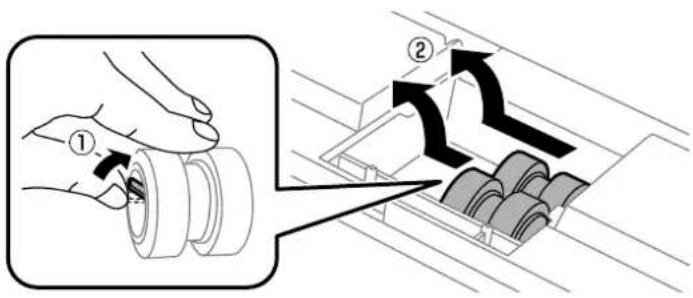
- Insert two new maintenance rollers until they click into place.
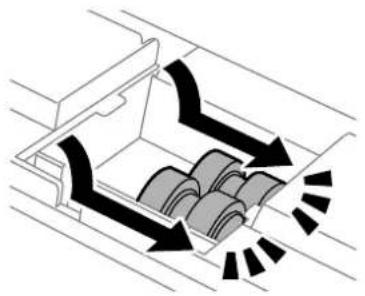
natural_image
Diagram of a mechanical device with arrows indicating flow or movement, no text or symbols presentNote:
Insert the maintenance rollers by rolling them so that you can insert them smoothly.
- Reattach the cover inside the back of the printer.
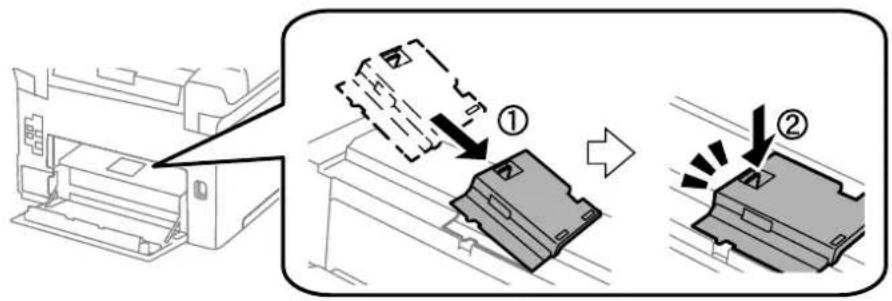
Replacing Ink Supply Units and Other Consumables
- Release the lever.
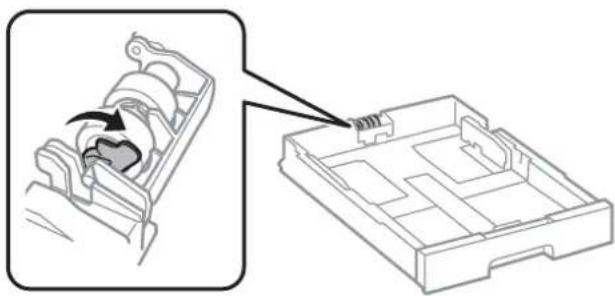
natural_image
Technical illustration of a mechanical component with an inset showing a gear mechanism (no text or symbols)- Slide the maintenance roller toward the lever, and then remove them by taking the shaft out of the holder.
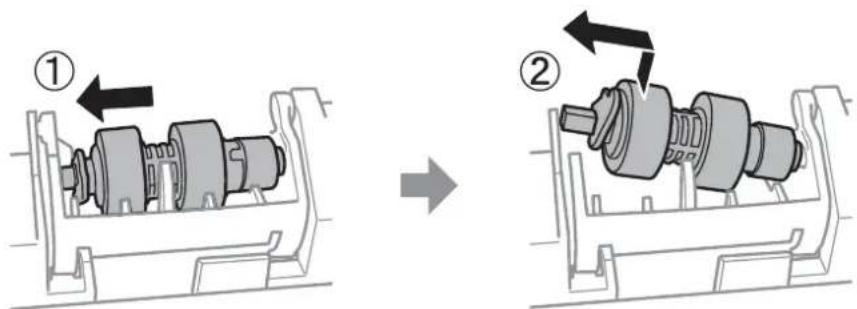
- Insert the shaft of the new maintenance roller into the hole in the holder, and then slide the shaft on the lever side along the slot while it is facing the flat surface at the front.
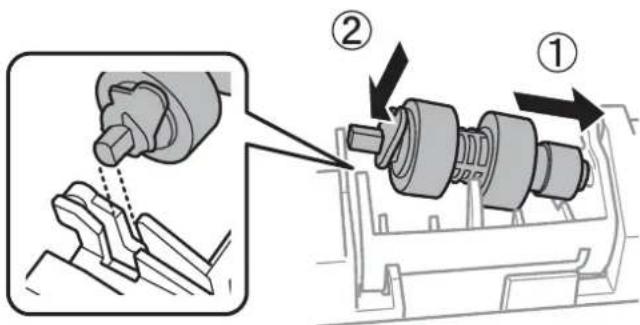
- Lock the lever.
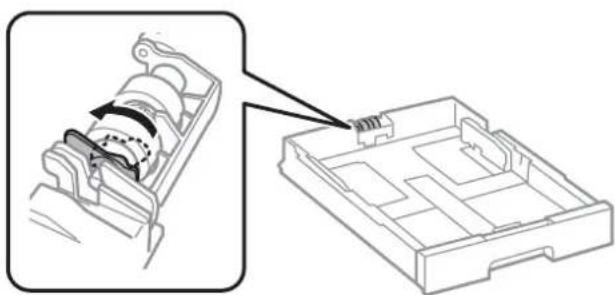
natural_image
Technical illustration of a mechanical assembly with a close-up view of internal components (no text or symbols)- Insert rear cover 2, close rear cover 1, and then insert the paper cassette.
Replacing Ink Supply Units and Other Consumables
- Turn on the printer, select Settings > Maintenance > Maintenance Roller Information>Reset Maintenance Roller Counter, and then select the paper cassette in which you replaced the maintenance rollers.
Related Information
→ "Maintenance Rollers Codes" on page 184
Replacing Maintenance Rollers in Paper Cassette 2 to 4
There are two places for replacing the maintenance rollers: on the back of the printer (two rollers) and on the paper cassette (one roller).
- Remove the new maintenance rollers from their package.

Important:
☐ The maintenance rollers for the paper cassette 1 and paper cassette 2 to 4 are different. Check the direction of arrow on the center of the maintenance rollers, and make sure the maintenance rollers are the ones for paper cassette 2 to 4. If you attach the wrong rollers, the printer may not feed the paper.
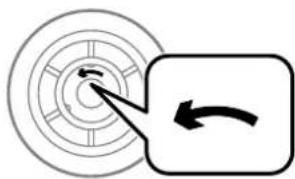
natural_image
Diagram showing concentric circles with arrows pointing to a central point, next to a rectangular box with an arrow indicating rotation (no text or symbols)☐ Be careful not to stain the surface of the maintenance rollers. If the dust collects on the surface of the maintenance rollers, clean the rollers by using a soft and moist cloth. Using a dry cloth may damage the surface of the rollers.
- Turn off the printer by pressing the ⏻ button, and then unplug the power cord.
User's Guide
Replacing Ink Supply Units and Other Consumables
- Pull out the paper cassette for which you want to replace the rollers.
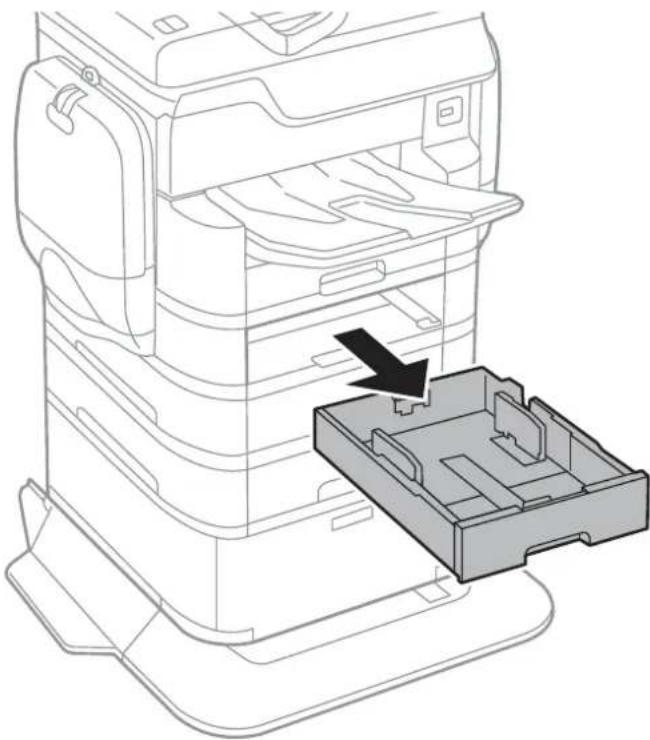
natural_image
Line drawing of a printer's internal structure showing the base case and top view of the printer casing (no text or symbols)- Turn the printer around, and then open the printer's rear cover.
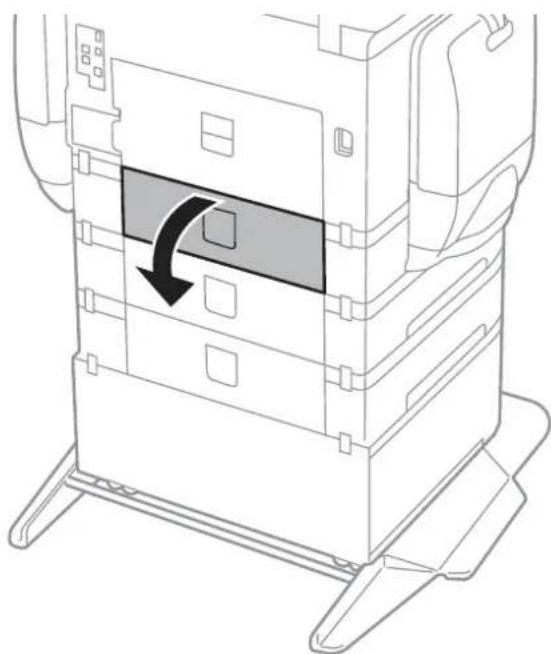
natural_image
Diagram of a mechanical device with a highlighted section and directional arrow indicating rotation (no text or symbols present)User's Guide
Replacing Ink Supply Units and Other Consumables
- Remove the screws by a screwdriver and remove the cover on the rear of inside the printer.
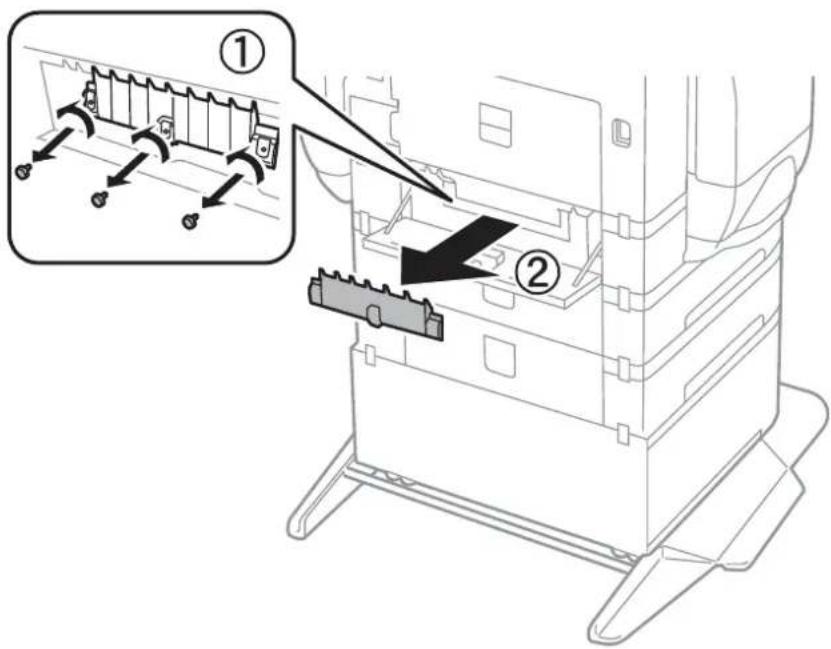
- Slide out two used maintenance rollers, and remove both of them.
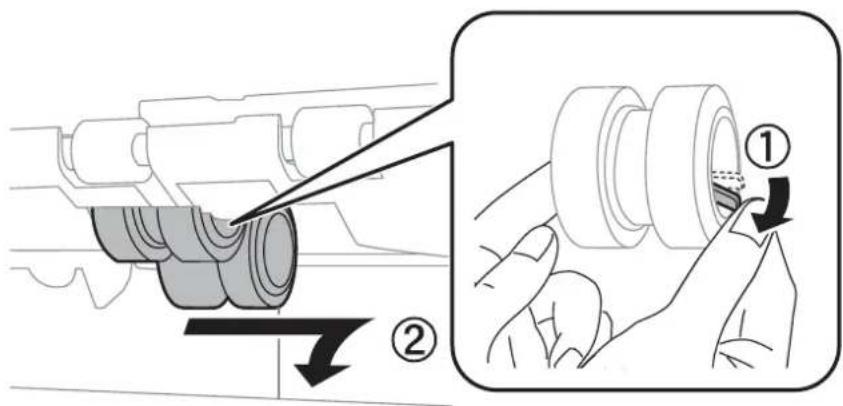
- Insert two new maintenance rollers until they click into place.
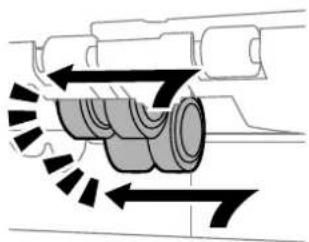
natural_image
Mechanical diagram showing gear meshing with directional arrows indicating motion (no text or symbols)Note:
Insert the maintenance rollers by rolling them so that you can insert them smoothly.
Replacing Ink Supply Units and Other Consumables
- Release the lever.
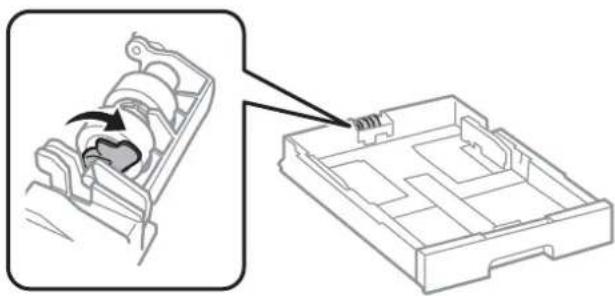
natural_image
Technical illustration of a mechanical component with an inset showing a gear mechanism (no text or symbols)- Slide the maintenance roller toward the lever, and then remove them by taking the shaft out of the holder.
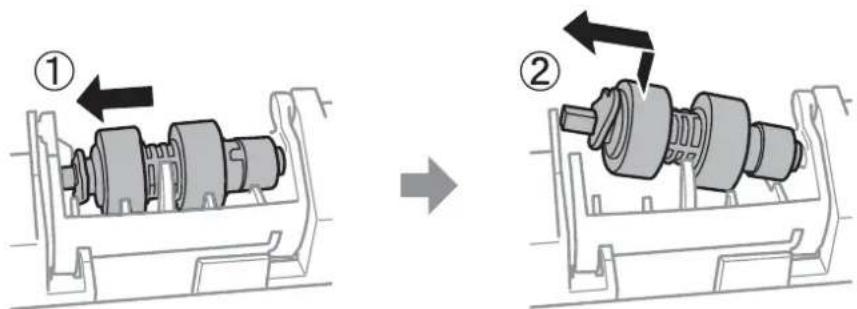
- Insert the shaft of the new maintenance roller into the hole in the holder, and then slide the shaft on the lever side along the slot while it is facing the flat surface at the front.
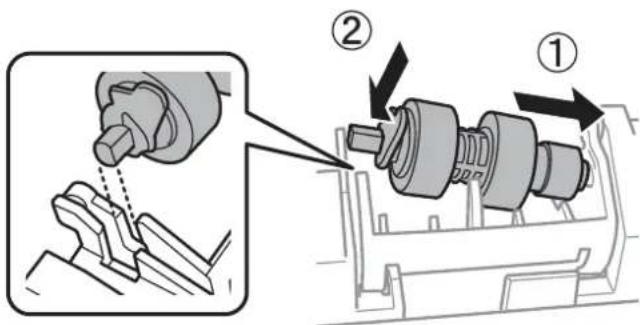
- Lock the lever.
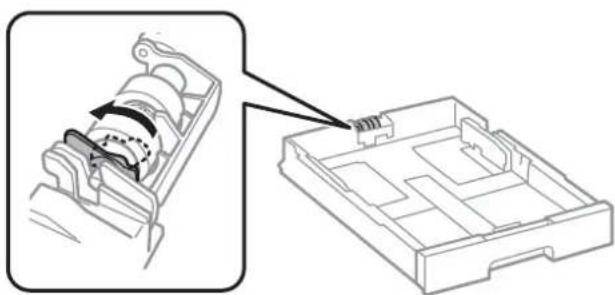
natural_image
Technical illustration of a mechanical component with a close-up view showing internal structure (no text or symbols)-
Fasten the screws to attach the cover back on, and close the rear cover.
-
Insert the paper cassette.
User's Guide
Replacing Ink Supply Units and Other Consumables
- Turn on the printer, select Settings > Maintenance > Maintenance Roller Information > Reset Maintenance Roller Counter, and then select the paper cassette in which you replaced the maintenance rollers.
Related Information
→ "Maintenance Rollers Codes" on page 184
Maintaining the Printer
Maintaining the Printer
Adjusting the Print Quality
If you notice a misaligned vertical lines, blurred images, or horizontal banding, adjust the print quality.
- Load A4-size plain paper in the printer.
- Tap Settings on the home screen.
- Tap Maintenance > Print Quality Adjustment.
- Follow the on-screen instructions to check the printer to improve print quality.
If a message is displayed recommending that you clean the print head, perform print head cleaning.
- Follow the on-screen instructions to print the patterns for print head alignment, and then align the print head.
☐ This pattern allows you to perform alignment if vertical ruled lines appear misaligned or your printouts look blurry.
Find and enter the number for the pattern that has the least misaligned vertical line.
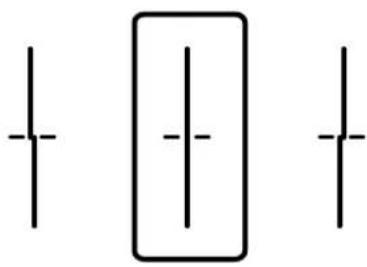
natural_image
Pure electrical circuit lines without any symbols☐ This pattern allows you to perform alignment if you see horizontal banding at regular intervals. Find and enter the number for the least separated and overlapping pattern.
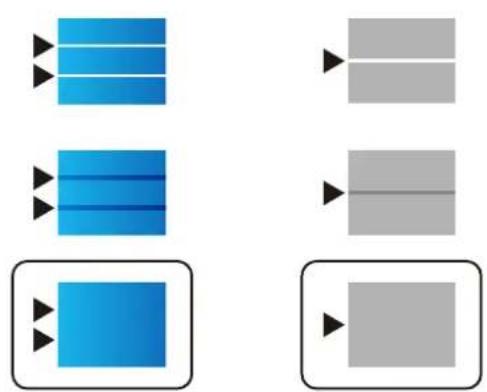
flowchart
graph TD
    A["Blue Block 1"] --> B["Gray Block 1"]
    C["Blue Block 2"] --> D["Gray Block 2"]
    E["Blue Block 3"] --> F["Gray Block 3"]
    G["Blue Block 4"] --> H["Gray Block 4"]
Related Information
→ "Loading Paper in the Paper Cassette" on page 52
Maintaining the Printer
Checking and Cleaning the Print Head
If the nozzles are clogged, the printouts become faint, there is visible banding, or unexpected colors appear. When print quality has declined, use the nozzle check feature and check if the nozzles are clogged. If the nozzles are clogged, clean the print head. You can perform a nozzle check and head cleaning from the control panel or the computer.

Important:
Do not open the ink case or turn off the printer during head cleaning. If the head cleaning is incomplete, you may not be able to print.
Note:
☐ Because print head cleaning uses some ink, clean the print head only if quality declines.
☐ When ink is low, you may not be able to clean the print head. Replace the ink supply unit first.
☐ If print quality has not improved after repeating nozzle check and head cleaning about four times, wait for at least six hours without printing, and then run the nozzle check again and repeat the head cleaning if necessary. We recommend to turn off the printer. If print quality has still not improved, contact Epson support.
☐ To prevent the print head from drying out, do not unplug the printer while the power is on.
Checking and Cleaning the Print Head - Control Panel
- Load A4-size plain paper in the printer.
- Tap Settings on the home screen.
- Tap Maintenance > Print Head Nozzle Check.
- Follow the on-screen instructions to print the nozzle check pattern.
- Examine the printed pattern. If there are broken lines or missing segments as shown in the "NG" pattern, the print head nozzles may be clogged. Go to the next step. If you cannot see any broken lines or missing segments as in the following "OK" pattern, the nozzles are not clogged. Tap OK to close the nozzle check feature.
OK
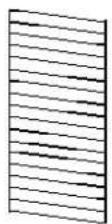
NG
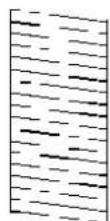
- Tap NG, and then follow the on-screen instructions to clean the print head.
- When cleaning is finished, print the nozzle check pattern again. Repeat cleaning and printing the pattern until all lines are printed completely.
Maintaining the Printer
Related Information
→ "Loading Paper in the Paper Cassette" on page 52
Checking and Cleaning the Print Head - Windows
- Load A4-size plain paper in the printer.
- Access the printer driver window.
- Click Nozzle Check on the Maintenance tab.
- Follow the on-screen instructions.
Related Information
→ "Loading Paper in the Paper Cassette" on page 52
→ "Windows Printer Driver" on page 216
Checking and Cleaning the Print Head - Mac OS X
- Load A4-size plain paper in the printer.
- Select System Preferences from the menu > Printers & Scanners (or Print & Scan, Print & Fax), and then select the printer.
- Click Options & Supplies > Utility > Open Printer Utility.
- Click Nozzle Check.
- Follow the on-screen instructions.
Related Information
→ "Loading Paper in the Paper Cassette" on page 52
Aligning Ruled Lines
If vertical lines look misaligned, align the ruled lines.
- Load A4-size plain paper in the printer.
- Tap Settings on the home screen.
- Tap Maintenance > Ruled Line Alignment.
- Follow the on-screen instructions to print an alignment pattern.
Maintaining the Printer
- Follow the on-screen instructions to align the ruled lines. Find and enter the number for the pattern that has the least misaligned vertical line.
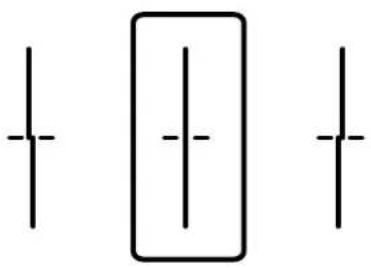
natural_image
Pure electrical circuit lines without any symbolsRelated Information
→ "Loading Paper in the Paper Cassette" on page 52
Adjusting the Print Quality for Each Paper Type
If print quality does not improve after using the Print Quality Adjustment feature, you can adjust the print quality for each paper type. See the Administrator's Guide for details.
Cleaning the Paper Path
When the printouts are smeared or paper does not feed correctly, clean the roller inside.

Important:
Do not use tissue paper to clean the inside of the printer. The print head nozzles may be clogged with lint.
Cleaning the Paper Path for Ink Smears
-
Load A3-size plain paper in the paper source that you want to clean.
-
Tap Settings on the home screen.
-
Tap Maintenance > Paper Guide Cleaning.
-
Select the paper source, and then follow the on-screen instructions to clean the paper path.
Note:
Repeat this procedure until the paper is not smeared with ink. If the printouts are still smeared, clean the other paper sources.
Related Information
→ "Loading Paper in the Paper Cassette" on page 52
Maintaining the Printer
Cleaning the Paper Path for Paper Feeding Problems (Paper Cassette)
When paper is not fed from paper cassette correctly, clean the roller inside.
- Pull out the paper cassette.
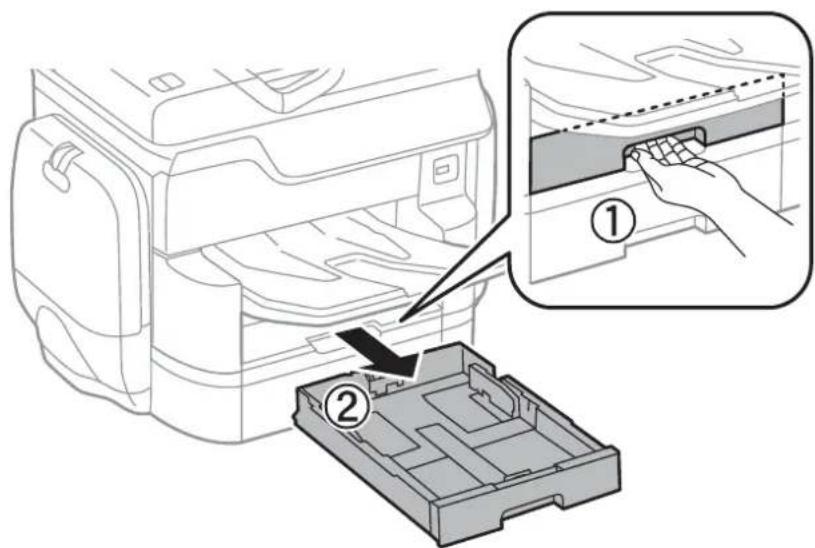
- Wipe the roller using a soft, moist cloth.
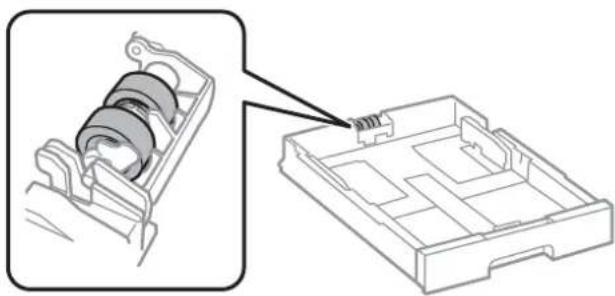
natural_image
Technical illustration of a mechanical component with a magnified inset showing internal structure (no text or symbols)
Important:
Using a dry cloth may damage the surface of the roller.
- Insert the paper cassette.
Cleaning the ADF
When the copied or scanned images from the ADF are smeared or the originals do not feed in the ADF correctly, clean the ADF.

Important:
Never use alcohol or thinner to clean the printer. These chemicals can damage the printer.
Maintaining the Printer
1. Open the ADF cover.
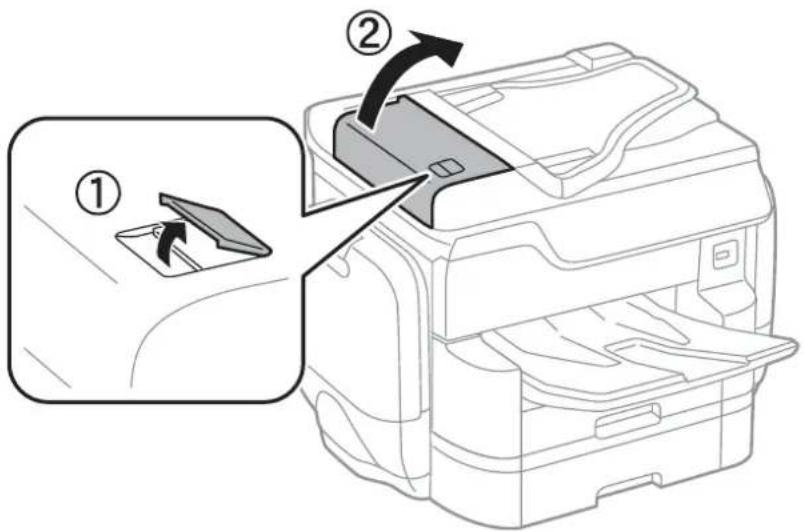
2. Use a soft, moist cloth to clean the roller and the interior of the ADF.
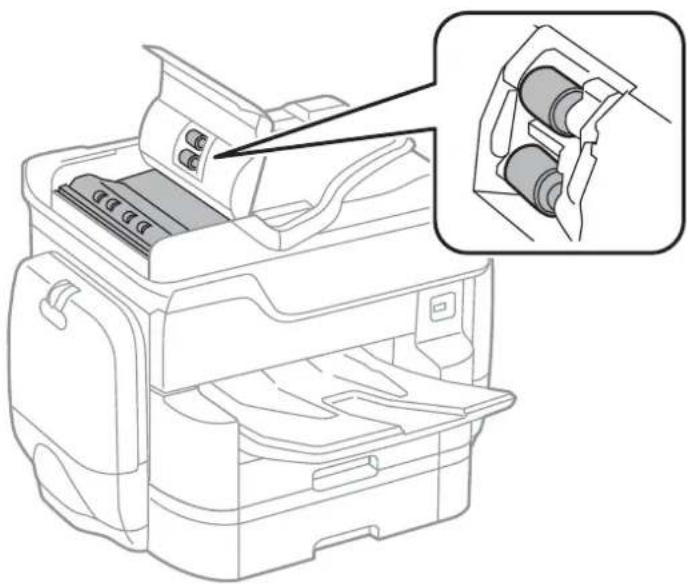
natural_image
Line drawing of a printer internal structure with an inset showing a close-up of its internal components (no text or symbols present)
Important:
Using a dry cloth may damage the surface of the roller. Use the ADF after the roller has dried.
User's Guide
Maintaining the Printer
- Open the document cover.
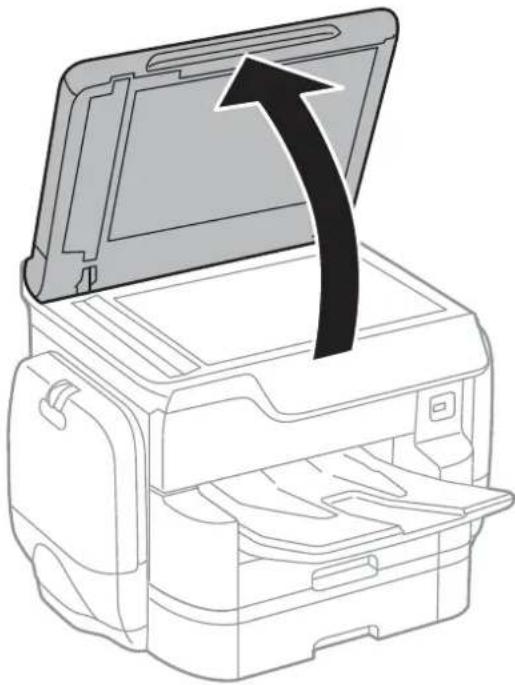
natural_image
Line drawing of a printer with an open lid and arrow indicating rotation (no text or symbols)- Clean the part that is shown in the illustration.
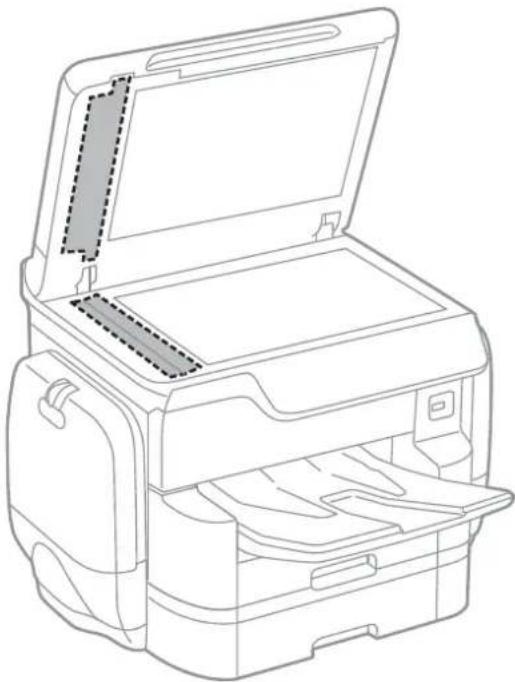
natural_image
Line drawing of an open printer with internal compartments and handlebars (no text or symbols)Maintaining the Printer

Important:
☐ If the glass surface is stained with grease or some other hard-to-remove material, use a small amount of glass cleaner and a soft cloth to remove it. Wipe off all remaining liquid.
☐ Do not press the glass surface too hard.
☐ Be careful not to scratch or damage the surface of the glass. A damaged glass surface can decrease the scan quality.
Cleaning the Scanner Glass
When the copies or scanned images are smeared, clean the scanner glass.

Caution:
Be careful not to trap your hand or fingers when opening or closing the document cover. Otherwise you may be injured.

Important:
Never use alcohol or thinner to clean the printer. These chemicals can damage the printer.
- Open the document cover.
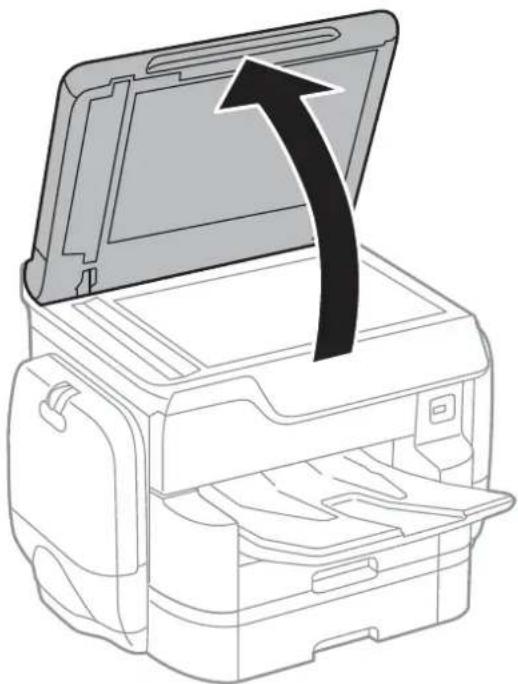
natural_image
Line drawing of a printer with an open lid and arrow indicating rotation (no text or symbols)Maintaining the Printer
- Use a soft, dry, clean cloth to clean the surface of the scanner glass.

Important:
☐ If the glass surface is stained with grease or some other hard-to-remove material, use a small amount of glass cleaner and a soft cloth to remove it. Wipe off all remaining liquid.
☐ Do not press the glass surface too hard.
☐ Be careful not to scratch or damage the surface of the glass. A damaged glass surface can decrease the scan quality.
Saving Power
The printer enters sleep mode or turns off automatically if no operations are performed for a set period. You can adjust the time before power management is applied. Any increase will affect the product's energy efficiency. Please consider the environment before making any change.
Depending on the location of purchase, the printer may have a feature that turns it off automatically if it is not connected to the network for 30 minutes.
Saving Power - Control Panel
- Tap Settings on the home screen.
- Tap General Settings > Basic Settings.
- Do one of the following.
☐ Select Sleep Timer or Power Off Settings > Power Off If Inactive or Power Off If Disconnected, and then make settings.
☐ Select Sleep Timer or Power Off Timer, and then make settings.
Note:
Your product may have the Power Off Settings or Power Off Timer feature depending on the location of purchase.
Menu Options for Settings
Menu Options for Settings
Tap Settings on the home screen of the printer to make various settings.
Menu Options for General Settings
Select the menus on the control panel as described below.
Settings > General Settings
Basic Settings
Select the menus on the control panel as described below.
Settings > General Settings > Basic Settings
LCD Brightness:
Adjust the brightness of the LCD screen.
Sound:
Adjust the volume and select the type of the sound.
Sleep Timer:
Adjust the time period to enter a sleep mode (energy saving mode) when the printer has not performed any operations. The LCD screen turns black when the setting time passes.
Power Off Settings:
Power Off If Inactive
Select this setting to turn the printer off automatically if it is not used for a specified period of time. Any increase will affect the product's energy efficiency. Please consider the environment before making any change.
Power Off If Disconnected
Select this setting to turn the printer off after 30 minutes when all network ports including the LINE port are disconnected. This feature may not be available depending on your region.
Date/Time Settings:
Date/Time
Enter the current date and time.
□ Daylight Saving Time
Select the summer time setting that applies to your area.
□ Time Difference
Enter the time difference between your local time and UTC (Coordinated Universal Time).
Menu Options for Settings
Country/Region:
Select the country or region in which you are using your printer. If you change the country or region, your fax settings return to their defaults and you must select them again.
Language:
Select the language used on the LCD screen.
Start-up Screen:
Specify the initial menu displayed on the LCD screen when the printer turns on and Operation Time Out is enable.
Edit Home:
Change the layout of the icons on the LCD screen. You can also add, delete, and replace icons.
Wall Paper:
Change the background color of the LCD screen.
Operation Time Out:
Select On to return to the initial screen when no operations have been performed for the specified time. When user restrictions have been applied and no operations are performed for the specified time, you are logged out and returned to the initial screen.
Keyboard:
Change the layout of the keyboard on the LCD screen.
Default Screen(Job/Status):
Select the default information you want to display when you press the ⓘ button.
Related Information
→ "Saving Power" on page 201
→ "Entering Characters" on page 23
Printer Settings
Select the menus on the control panel as described below.
Settings > General Settings > Printer Settings
Paper Source Settings:
Paper Setting:
Select the paper source to specify the paper size and paper type you loaded. When Paper Size
Auto Detect is enabled, the printer detects the paper size you loaded.
Rear Paper Feed Priority:
Select On to give printing priority to paper loaded in the rear paper feed.
Menu Options for Settings
A4/Letter Auto Switching:
Select On to feed paper from the paper source set as A4 size when there is no paper source set as Letter, or feed from the paper source set as Letter size when there is no paper source set as A4.
Auto Select Settings:
Select On for any of following settings to automatically print on paper from any source containing paper that matches your paper settings.
□ Copy
Fax
□ Other
Error Notice:
Select On to display an error message when the selected paper size or type does not match the loaded paper.
Paper Setup Auto Display:
Select On to display the Paper Setting screen when loading paper in the paper source. If you disable this feature, you cannot print from an iPhone or iPad using AirPrint.
Printing Language:
Select the printing language for the USB interface or the network interface.
Universal Print Settings:
These print settings are applied when you print by an external device without using the printer driver.
Top Offset:
Adjust the top margin of the paper.
Left Offset:
Adjust the left margin of the paper.
Top Offset in Back:
Adjust the top margin for the back of the page when performing 2-sided printing.
Left Offset in Back:
Adjust the left margin for the back margin of the page when performing 2-sided printing.
Check Paper Width:
Select On to check the paper width before printing. This prevents printing beyond the edges of the paper when the paper size setting are incorrect, but may reduce the printing speed.
Skip Blank Page:
Skips blank pages in the print data automatically.
Menu Options for Settings
PDL Print Configuration:
Common Settings:
□ Paper Size
Select the default paper size for PCL or PostScript printing.
☐ Paper Type
Select the default paper type for PCL or PostScript printing.
☐ Orientation
Select the default orientation for PCL or PostScript printing.
☐ Quality
Select the print quality for PCL or PostScript printing.
☐ Ink Save Mode
Select On to save ink by reducing the print density.
☐ Print Order
Last Page on Top:
Starts printing from the first page of a file.
First Page on Top:
Starts printing from the last page of a file.
☐ Number of Copies
Set the number of copies to print.
☐ Binding Margin
Select the binding position.
☐ Auto Paper Ejection
Select On to eject paper automatically when printing is stopped during a print job.
☐ 2-Sided Printing
Select On to perform 2-sided printing.
PCL Menu:
☐ Font Source
Resident
Select to use a font preinstalled on the printer.
Download
Select to use a font you have downloaded.
☐ Font Number
Select the default font number for the default font source. The available number varies depending on the settings you made.
☐ Pitch
Set the default font pitch if the font is scalable and of fixed-pitch. You can select from 0.44 to 99.99 cpi (characters per inch), in 0.01 increments.
This item may not appear depending on the font source or font number settings.
Menu Options for Settings
Height
Set the default font height if the font is scalable and proportional. You can select from 4.00 to 999.75 points, in 0.25 increments.
This item may not appear depending on the font source or font number settings.
Symbol Set
Select the default symbol set. If the font that you selected in the font source and the font number setting is not available in the new symbol set setting, the font source and the font number settings are automatically replaced with the default value, IBM-US.
Form
Set the number of lines for the selected paper size and orientation. This also causes a line spacing (VMI) change, and the new VMI value is stored in the printer. This means that later changes in the page size or orientation settings cause changes in the Form value based on the stored VMI.
□ CR Function
Select the line feed command when printing with a driver from a specific operating system.
LF Function
Select the line feed command when printing with a driver from a specific operating system.
□ Paper Source Assign
Set the assignment for the paper source select command. When 4 is selected, the commands are set as compatible with the HP LaserJet 4. When 4K is selected, the commands are set as compatible with the HP LaserJet 4000, 5000, and 8000. When 5S is selected, the commands are set as compatible with the HP LaserJet 5S.
PS3 Menu:
Error Sheet
Select On to print a sheet showing the status when an error occurs during PostScript or PDF printing.
□ Coloration
Select the color mode for PostScript printing.
Image Protect
Select Off to lower the print quality automatically if the printer's memory becomes full.
Binary
Select On when printing data that contains binary images. The application may send the binary data even if the printer driver setting is set to ASCII, but you can print the data when this feature is enabled.
□ Text Detection
This feature is available when Printing Language is set to PS3. Converts a text file to a PostScript file when printing.
PDF Page Size
Select the paper size when printing a PDF file. If Auto is selected, the paper size is determined based on the size of the first page.
Auto Error Solver:
Select an action to perform when a 2-sided printing error or a memory full error occurs.
Menu Options for Settings
□ On
Displays a warning and prints in single-sided mode when a 2-sided printing error occurs, or prints only what the printer could process when a memory full error occurs.
□ Off
Displays an error message and cancels printing.
Memory Device Interface:
□ Memory Device:
Select Enable to allow the printer to access an inserted memory device. If Disable is selected, you cannot save data to the memory device with the printer. This prevents confidential documents from being removed illegally.
File Sharing:
Select whether to give write access to the memory device from a USB-connected computer or a network-connected computer.
Thick Paper:
Select On to prevent ink from smearing on your printouts, however, this may lower the print speed.
Quiet Mode:
Select On to reduce noise during printing, however, this may lower the print speed. Depending on the paper type and print quality settings you selected, there may be no difference in the printer's noise level.
Ink Drying Time:
Select the ink drying time you want to use when performing 2-sided printing. The printer prints the other side after printing one side. If your printout is smeared, increase the time setting.
Bidirectional:
Select On to change the print direction; Prints while the print head moves to the left and to the right. If vertical or horizontal ruled lines on your printout look blurred or misaligned, disabling this feature may solve the problem; however, doing so may reduce print speed.
PC Connection via USB:
Select Enable to allow a computer to access the printer when connected by USB. When Disable is selected, printing and scanning that is not sent over a network connection is restricted.
USB I/F Timeout Setting:
Specify the length of time in seconds that must elapse before ending USB communication with a computer after the printer receives a print job from a PostScript printer driver or PCL printer driver. If the job ending is not clearly defined from a PostScript printer driver or PCL printer driver, it can cause endless USB communication. When this occurs, the printer ends communication after the specified time has elapsed. Enter 0 (zero) if you do not want to end communication.
Related Information
→ "Loading Paper" on page 47
→ "Printing JPEG Files from a Memory Device" on page 66
→ "Printing PDF or TIFF Files from a Memory Device" on page 67
Menu Options for Settings
Network Settings
Select the menus on the control panel as described below.
Settings > General Settings > Network Settings
Wi-Fi Setup:
Set up or change wireless network settings. Choose the connection method from the following and then follow the instructions on the LCD panel.
Router
Wi-Fi Direct
Wired LAN Setup:
Set up or change a network connection that uses a LAN cable and router. When this is being used, WiFi connections are disabled.
Network Status:
Displays or prints the current network settings.
Connection Check:
Checks the current network connection and prints a report. If there are any problems with the connection, see the report to solve the problem.
Advanced:
Make the following detailed settings.
Device Name
TCP/IP
□ Proxy Server
□ Email Server
IPv6 Address
MS Network Sharing
NFC
Link Speed & Duplex
☐ Redirect HTTP to HTTPS
□ Disable IPsec/IP Filtering
□ Disable IEEE802.1X
Related Information
→ "Making Wi-Fi Settings Manually" on page 31
→ "Making Wi-Fi Settings by Push Button Setup (WPS)" on page 32
→ "Making Wi-Fi Settings by PIN Code Setup (WPS)" on page 33
→ "Making Wi-Fi Direct (Simple AP) Connection Settings" on page 34
→ "Checking Detailed Network Information from the Control Panel" on page 37
→ "Printing a Network Status Sheet" on page 41
Menu Options for Settings
→ "Checking the Network Connection Status" on page 36
→ "Changing the Network Connection to Ethernet from the Control Panel" on page 44
→ "Making Advanced Network Settings" on page 34
Web Service Settings
Select the menus on the control panel as described below.
Settings > General Settings > Web Service Settings
Epson Connect Services:
Displays whether the printer is registered and connected to Epson Connect.
You can register to the service by tapping Register and follow the instructions.
When you have registered, you can change the following settings.
□ Suspend/Resume
□ Unregister
For details, see the following web site.
https://www.epsonconnect.com/
http://www.epsonconnect.eu (Europe only)
Google Cloud Print Services:
Displays whether the printer is registered and connected to Google Cloud Print services.
When you have registered, you can change the following settings.
□ Enable/Disable
□ Unregister
For details on registering to Google Cloud Print services, see the following web site.
https://www.epsonconnect.com/
http://www.epsonconnect.eu (Europe only)
Related Information
→ "Epson Connect Service" on page 214
System Administration Settings
Administrators use this feature. See the Administrator's Guide for details.
Menu Options for Print Counter
Select the menus on the control panel as described below.
Settings > Print Counter
Menu Options for Settings
Displays the total number of prints, B&W prints, and color prints from the time you purchased the printer. Tap Print Sheet when you want to print the result.
Menu Options for Supply Status
Select the menu on the control panel as described below.
Settings > Supply Status
Displays the approximate level of the ink and service life of the maintenance box. When an exclamation mark is displayed, ink is running low or the maintenance box is nearly full. When a x icon is displayed, you need to replace the item as ink is expended or the maintenance box is full.
Menu Options for Maintenance
Select the menus on the control panel as described below.
Settings > Maintenance
Print Quality Adjustment:
Select this feature if there are any problems with your print outs. You can check for clogged nozzles and clean the print head if necessary, and then adjust some parameters to improve print quality.
Print Head Nozzle Check:
Select this feature to check if the print head nozzles are clogged. The printer prints a nozzle check pattern.
Print Head Cleaning:
Select this feature to clean clogged nozzles in the print head.
Ruled Line Alignment:
Select this feature to align vertical lines.
Paper Guide Cleaning:
Select this feature if there are ink stains on the internal rollers. The printer feeds paper to clean the internal rollers.
Remove Paper:
Select this feature if there are still some torn pieces of paper inside the printer even after removing jammed paper. The printer increase the space between the print head and the surface of the paper to make it easier to remove torn pieces.
Maintenance Roller Information:
□ Maintenance Roller Status
Displays the status of the maintenance rollers for the selected paper cassette.
Menu Options for Settings
☐ Reset Maintenance Roller Counter
After replacing maintenance rollers, reset the counter for the paper cassette in which you replaced the maintenance rollers.
Print Quality Adjustment per Paper:
Depending on the paper type, ink feathering is differs. Select this feature if there is banding in the print outs or misalignment for a specific paper type.
Related Information
→ "Adjusting the Print Quality" on page 193
→ "Checking and Cleaning the Print Head" on page 194
→ "Aligning Ruled Lines" on page 195
→ "Adjusting the Print Quality for Each Paper Type" on page 196
→ "Cleaning the Paper Path" on page 196
Menu Options for Language
Select the menus on the control panel as described below.
Settings > Language
Select the language used on the LCD screen.
Menu Options for Printer Status/Print
Select the menus on the control panel as described below.
Settings > Printer Status/Print
Network:
Displays the current network settings.
Print Status Sheet:
Configuration Status Sheet:
Print information sheets showing the current printer status and settings.
Supply Status Sheet:
Print information sheets showing the status of consumables.
Usage History Sheet:
Print information sheets showing the usage history of the printer.
PS3 Font List:
Print a list of fonts that are available for a PostScript printer.
Menu Options for Settings
PCL Font List:
Print a list of fonts that are available for a PCL printer.
Menu Options for Contacts Manager
Select the menus on the control panel as described below.
Settings > Contacts Manager
Register/Delete:
Register and/or delete contacts for the Fax, Scan to Email, and Scan to Network Folder/FTP menus.
Frequent:
Register frequently used contacts to access them quickly. You can also change the order of the list.
Print Contacts:
Print your contact list.
View Options:
Change the way the contact list is displayed.
Search Options:
Change the method for searching contacts.
Menu Options for User Settings
Select the menus on the control panel as described below.
Settings > User Settings
You can change the default settings of the following menus.
□ Scan to Network Folder/FTP
□ Scan to Email
□ Scan to Memory Device
□ Scan to Cloud
□ Copy Settings
Fax
Menu Options for Authentication Device Status
Select the menus on the control panel as described below.
Settings > Authentication Device Status
Displays the status of the authentication device.
Menu Options for Epson Open Platform Information
Select the menus on the control panel as described below.
Settings > Epson Open Platform Information
Displays the status of the Epson Open Platform.
Network Service and Software Information
Network Service and Software Information
This section introduces the network services and software products available for your printer from the Epson website or the supplied software disc.
Epson Connect Service
By using Epson Connect service available on the Internet, you can print from your smartphone, tablet PC, or laptop, anytime and practically anywhere.
The features available on the Internet are as follows.
| Email Print | Epson iPrint remote print | Scan to Cloud | Remote Print Driver |
| √ | √ | √ | √ |
See the Epson Connect portal website for details.
https://www.epsonconnect.com/
http://www.epsonconnect.eu (Europe only)
Web Config
Web Config is an application that runs in a web browser, such as Internet Explorer and Safari, on a computer or smart device. You can confirm the printer status or change the network service and printer settings. To use the Web Config, connect the printer and the computer or device to the same network.
Note:
The following browsers are supported.
| OS | Browser |
| Windows XP SP3 or later | Internet Explorer 8 or later, Firefox*, Chrome* |
| Mac OS X v10.6.8 or later | Safari*, Firefox*, Chrome* |
| iOS* | Safari* |
| Android 2.3 or later | Default browser |
| Chrome OS* | Default browser |
* Use the latest version.
Network Service and Software Information
Running Web Config on a Web Browser
1. Check the printer's IP address.
Tap the network icon on the printer's home screen, and then tap the active connection method to confirm the printer's IP address.
Note:
You can also check the IP address by printing the network connection report.
2. Launch a Web browser from a computer or smart device, and then enter the printer's IP address.
Format:
IPv4: http://the printer's IP address/
IPv6: http://[the printer's IP address]/
Examples:
IPv4: http://192.168.100.201/
IPv6: http://[2001:db8::1000:1]/
Note:
Using the smart device, you can also run Web Config from the maintenance screen of Epson iPrint.
Related Information
→ "Printing Using Epson iPrint" on page 93
→ "Printing a Network Connection Report" on page 37
Running Web Config on Windows
When connecting a computer to the printer using WSD, follow the steps below to run Web Config.
1. Access the devices and printers screen in Windows.
Windows 10
Right-click the start button or press and hold it, and then select Control Panel > View devices and printers in Hardware and Sound.
☐ Windows 8.1/Windows 8/Windows Server 2012 R2/Windows Server 2012
Select Desktop > Settings > Control Panel > View devices and printers in Hardware and Sound (or Hardware).
□ Windows 7/Windows Server 2008 R2
Click the start button, and select Control Panel > View devices and printers in Hardware and Sound.
□ Windows Vista/Windows Server 2008
Click the start button, and select Control Panel > Printers in Hardware and Sound.
2. Right-click on your printer and select Properties.
3. Select the Web Service tab and click the URL.
Network Service and Software Information
Running Web Config on Mac OS X
- Select System Preferences from the menu > Printers & Scanners (or Print & Scan, Print & Fax), and then select the printer.
- Click Options & Supplies> Show Printer Webpage.
Windows Printer Driver
The printer driver controls the printer according to the commands from an application. Making settings on the printer driver provides the best printing results. You can also check the status of the printer or keep it in top operating condition using the printer driver utility.
Note:
You can change the language of the printer driver. Select the language you want to use from the Language setting on the Maintenance tab.
Accessing the printer driver from applications
To make settings that apply only to the application you are using, access from that application.
Select Print or Print Setup from the File menu. Select your printer, and then click Preferences or Properties.
Note:
Operations differ depending on the application. See the application's help for details.
Accessing the printer driver from the control panel
To make settings that apply to all of the applications, access from the control panel.
Windows 10
Right-click the start button or press and hold it, and then select Control Panel > View devices and printers in Hardware and Sound. Right-click on your printer, or press and hold it and then select Printing preferences.
☐ Windows 8.1/Windows 8/Windows Server 2012 R2/Windows Server 2012
Select Desktop > Settings > Control Panel > View devices and printers in Hardware and Sound. Right-click on your printer, or press and hold it and then select Printing preferences.
□ Windows 7/Windows Server 2008 R2
Click the start button, and select Control Panel > View devices and printers in Hardware and Sound. Right-click on your printer and select Printing preferences.
□ Windows Vista/Windows Server 2008
Click the start button, and select Control Panel > Printers in Hardware and Sound. Right-click on your printer and select Select printing preferences.
☐ Windows XP/Windows Server 2003 R2/Windows Server 2003
Click the start button, and select Control Panel > Printers and Other Hardware > Printers and Faxes. Right-click on your printer and select Printing preferences.
Accessing the printer driver from the printer icon on the task bar
The printer icon on the desktop task bar is a shortcut icon allowing you to quickly access the printer driver.
If you click the printer icon and select Printer Settings, you can access the same printer settings window as the one displayed from the control panel. If you double-click this icon, you can check the status of the printer.
Network Service and Software Information
Note:
If the printer icon is not displayed on the task bar, access the printer driver window, click Monitoring Preferences on the Maintenance tab, and then select Register the shortcut icon to the taskbar.
Starting the utility
Access the printer driver window. Click the Maintenance tab.
Restricting Settings for the Windows Printer Driver
You can lock some settings of the printer driver so that other users cannot change them.
Note:
Log on to your computer as an administrator.
- Open the Optional Settings tab in printer properties.
☐ Windows 10
Right-click the start button or press and hold it, and then select Control Panel > View devices and printers in Hardware and Sound. Right-click on your printer, or press and hold it and then select Printer properties. Click the Optional Settings tab.
Windows 8.1/Windows 8/Windows Server 2012R2/Windows Server 2012
Select Desktop > Settings > Control Panel > View devices and printers in Hardware and Sound. Right-click on your printer, or press and hold it and then select Printer properties. Click the Optional Settings tab.
Windows 7/Windows Server 2008 R2
Click the start button, and select Control Panel > View devices and printers in Hardware and Sound. Right-click on your printer, and then select Printer properties. Click the Optional Settings tab.
Windows Vista/Windows Server 2008
Click the start button, and select Control Panel > Printers in Hardware and Sound. Right-click on your printer, and then select Properties. Click the Optional Settings tab.
Windows XP/Windows Server 2003 R2/Windows Server 2003
Click the start button, and select Control Panel > Printers and Other Hardware > Printers and Faxes. Right-click on your printer, and then select Properties. Click the Optional Settings tab.
-
Click Driver Settings.
-
Select the feature that you want to restrict.
See the online help for explanations of the setting items.
- Click OK.
Making Operation Settings for the Windows Printer Driver
You can make settings such as enabling EPSON Status Monitor 3.
- Access the printer driver window.
- Click Extended Settings on the Maintenance tab.
Network Service and Software Information
- Make the appropriate settings, and then click OK.
See the online help for explanations of the setting items.
Related Information
→ "Windows Printer Driver" on page 216
Mac OS X Printer Driver
The printer driver controls the printer according to the commands from an application. Making settings on the printer driver provides the best printing results. You can also check the status of the printer or keep it in top operating condition using the printer driver utility.
Accessing the printer driver from applications
Click Page Setup or Print on the File menu of your application. If necessary, click Show Details (or ▼) to expand the print window.
Note:
Depending on the application being used, Page Setup may not be displayed in the File menu, and the operations for displaying the print screen may differ. See the application's help for details.
Starting the utility
Select System Preferences from the menu > Printers & Scanners (or Print & Scan, Print & Fax), and then select the printer. Click Options & Supplies > Utility > Open Printer Utility.
Making Operation Settings for the Mac OS X Printer Driver
Accessing the Operation Settings Window of the Mac OS X Printer Driver
Select System Preferences from the menu > Printers & Scanners (or Print & Scan, Print & Fax), and then select the printer. Click Options & Supplies > Options (or Driver).
Operation Settings of the Mac OS X Printer Driver
☐ Thick paper and envelopes: Prevents the ink from smearing when printing on thick paper. However, this may reduce print speed.
☐ Skip Blank Page: Avoids printing blank pages.
☐ Quiet Mode: Reduces the noise the printer makes, however, may reduce print speed.
☐ Output documents for filing: Feed the paper so that it is easy to file when printing landscape data or 2-sided printing. Envelope printing is not supported.
☐ High Speed Printing: Prints when the print head moves in both directions. The print speed is faster, but the quality may decline.
☐ Warning Notifications: Allows the printer driver to display warning notifications.
Network Service and Software Information
☐ Establish bidirectional communication: Usually, this should be set to On. Select Off when acquiring the printer information is impossible because the printer is shared with Windows computers on a network or for any other reason.
☐ Lower Cassette: Add the optional paper cassette units to the paper source.
Epson Scan 2 (Scanner Driver)
Epson Scan 2 is an application for controlling scanning. You can adjust the size, resolution, brightness, contrast, and quality of the scanned image.
Note:
You can also start Epson Scan 2 from a TWAIN-compliant scanning application.
Starting on Windows
Note:
For Windows Server operating systems, you need to install the Desktop Experience feature.
Windows 10
Click the start button, and then select EPSON > Epson Scan 2.
☐ Windows 8.1/Windows 8/Windows Server 2012 R2/Windows Server 2012
Enter the application name in the search charm, and then select the displayed icon.
☐ Windows 7/Windows Vista/Windows XP/Windows Server 2008 R2/Windows Server 2008/Windows Server 2003 R2/Windows Server 2003
Click the start button, and then select All Programs or Programs > EPSON > Epson Scan 2> Epson Scan 2.
Starting on Mac OS X
Note:
Epson Scan 2 does not support the Mac OS X fast user switching feature. Turn off fast user switching.
Select Go > Applications > Epson Software > Epson Scan 2.
Related Information
→ "Installing Applications" on page 224
Document Capture Pro
Document Capture Pro is an application that allows you to configure settings for scanned images sent from the printer to a computer over a network.
Document Capture Pro is for Windows. For Mac OS X, use Document Capture, and for Windows Server, use Document Capture Pro Server.
You can configure various scan settings on the computer such as the file saving format, a folder to save, and forwarding destination, and save as a scan job. You can save up to 30 scan jobs and run those jobs from the computer or from the printer using the control panel. Tap Scan > Document Capture Pro from the home screen.
See the Document Capture Pro help for details on using the application.
Network Service and Software Information
Starting on Windows
Windows 10
Click the start button, and then select Epson Software > Document Capture Pro.
☐ Windows 8.1/Windows 8/Windows Server 2012 R2/Windows Server 2012
Enter the application name in the search charm, and then select the displayed icon.
☐ Windows 7/Windows Vista/Windows XP/Windows Server 2008 R2/Windows Server 2008/Windows Server 2003 R2/Windows Server 2003
Click the start button, and select All Programs or Programs > Epson Software > Document Capture Pro.
Starting on Mac OS X
Select Go > Applications > Epson Software > Document Capture.
Related Information
→ "Installing Applications" on page 224
PC-FAX Driver (Fax Driver)
PC-FAX driver is an application that allows you to send a document created on a separate application as a fax directly from the computer. PC-FAX driver is installed when you install FAX Utility. See the application's help for details.
Note:
☐ Windows Server operating systems are not supported.
☐ The operation differs depending on the application you used to create the document. See the application's help for details.
Accessing from Windows
In the application, select Print or Print Setup from the File menu. Select your printer (FAX), and then click Preferences or Properties.
Accessing from Mac OS X
In the application, select Print from the File menu. Select your printer (FAX) as the Printer setting, and then select Fax Settings or Recipient Settings from the pop-up menu.
FAX Utility
FAX Utility is an application that allows you to configure various settings for sending faxes from a computer. You can create or edit the contacts list to be used when sending a fax, configure to save received faxes in PDF format on the computer, and so on. See the application's help for details.
Note:
☐ Windows Server operating systems are not supported.
Before installing the FAX Utility, make sure you have installed the printer driver for this printer; this does not include the PostScript printer driver and Epson universal printer driver.
Network Service and Software Information
Starting on Windows
Windows 10
Click the start button, and select Epson Software > FAX Utility.
□ Windows 8.1/Windows 8
Enter the application name in the search charm, and then select the displayed icon.
□ Windows 7/Windows Vista/Windows XP
Click the start button, and select All Programs (or Programs) > Epson Software > FAX Utility.
Starting on Mac OS X
Select System Preferences from the menu > Printers & Scanners (or Print & Scan, Print & Fax), and then select the printer (FAX). Click Options & Supplies > Utility > Open Printer Utility.
Related Information
→ "Installing Applications" on page 224
EPSON Software Updater
EPSON Software Updater is an application that checks for new or updated software on the internet and installs it. You can also update the printer's firmware and manual.
Note:
Windows Server operating systems are not supported.
Starting on Windows
Windows 10
Click the start button, and then select Epson Software > EPSON Software Updater.
□ Windows 8.1/Windows 8
Enter the application name in the search charm, and then select the displayed icon.
□ Windows 7/Windows Vista/Windows XP
Click the start button, and then select All Programs (or Programs) > Epson Software > EPSON Software Updater.
Note:
You can also start EPSON Software Updater by clicking the printer icon on the task bar on the desktop, and then selecting Software Update.
Starting on Mac OS X
Select Go > Applications > Epson Software > EPSON Software Updater.
Related Information
→ "Installing Applications" on page 224
EpsonNet Config
EpsonNet Config is an application that allows you to set the network interface addresses and protocols. See the operations guide for EpsonNet Config or the application's help for more details.
Starting on Windows
Windows 10
Click the start button, and then select EpsonNet > EpsonNet Config.
☐ Windows 8.1/Windows 8/Windows Server 2012 R2/Windows Server 2012
Enter the application name in the search charm, and then select the displayed icon.
☐ Windows 7/Windows Vista/Windows XP/Windows Server 2008 R2/Windows Server 2008/Windows Server 2003 R2/Windows Server 2003
Click the start button, and select All Programs (or Programs) > EpsonNet > EpsonNet Config V4 > EpsonNet Config.
Starting on Mac OS X
Select Go > Applications > Epson Software > EpsonNet > EpsonNet Config V4 > EpsonNet Config.
Related Information
→ "Installing Applications" on page 224
Uninstalling Applications
Log in to your computer as an administrator. Enter the administrator password if the computer prompts you.
Uninstalling Applications - Windows
-
Press the ⏻ button to turn off the printer.
-
Quit all running applications.
-
Open Control Panel:
☐ Windows 10 Right-click the start button or press and hold it, and then select Control Panel.
☐ Windows 8.1/Windows 8/Windows Server 2012 R2/Windows Server 2012 Select Desktop > Settings > Control Panel.
Windows 7/Windows Vista/Windows XP/Windows Server 2008 R2/Windows Server 2008/Windows Server 2003 R2/Windows Server 2003 Click the start button and select Control Panel.
Network Service and Software Information
- Open Uninstall a program (or Add or Remove Programs):
Windows 10/Windows 8.1/Windows 8/Windows 7/Windows Vista/Windows Server 2012 R2/Windows Server 2012/Windows Server 2008 R2/Windows Server 2008 Select Uninstall a program in Programs.
☐ Windows XP/Windows Server 2003 R2/Windows Server 2003 Click Add or Remove Programs.
-
Select the application you want to uninstall.
-
Uninstall the applications:
Windows 10/Windows 8.1/Windows 8/Windows 7/Windows Vista/Windows Server 2012 R2/Windows Server 2012/Windows Server 2008 R2/Windows Server 2008 Click Uninstall/Change or Uninstall.
☐ Windows XP/Windows Server 2003 R2/Windows Server 2003 Click Change/Remove or Remove.
Note:
If the User Account Control window is displayed, click Continue.
- Follow the on-screen instructions.
Uninstalling Applications - Mac OS X
- Download the Uninstaller using EPSON Software Updater.
Once you have downloaded the Uninstaller, you do not need to download it again each time you uninstall the application. - Press the ⏻ button to turn off the printer.
- To uninstall the printer driver or PC-FAX driver, select System Preferences from the menu > Printers & Scanners (or Print & Scan, Print & Fax), and then remove the printer from the enabled printers list.
- Quit all running applications.
- Select Go > Applications > Epson Software > Uninstaller.
- Select the application you want to uninstall, and then click Uninstall.

Important:
The Uninstaller removes all drivers for Epson inkjet printers on the computer. If you use multiple Epson inkjet printers and you only want to delete some drivers, delete all of them first, and then install the necessary printer driver again.
Note:
If you cannot find the application you want to uninstall in the application list, you cannot uninstall using the Uninstaller. In this situation, select Go >Applications >Epson Software, select the application you want to uninstall, and then drag it to the trash icon.
Related Information
→ "EPSON Software Updater" on page 221
Installing Applications
Connect your computer to the network and install the latest version of applications from the website.
Note:
Log on to your computer as an administrator. Enter the administrator password if the computer prompts you.
☐ When reinstalling an application, you need to uninstall it first.
-
Quit all running applications.
-
When installing the printer driver or Epson Scan 2, disconnect the printer and the computer temporarily.
Note:
Do not connect the printer and the computer until you are instructed to do so.
- Install the applications by following the instructions on the website below.
http://epson.sn
Note:
☐ Install Document Capture Pro from the website below. http://support.epson.net/ (outside Europe) http://assets.epson-europe.com/gb/en/document_capture_pro/index.html (Europe)
☐ If you are using a Windows computer and unable to download the applications from the website, you can install them from the supplied CD except for Document Capture Pro.
Related Information
→ "Uninstalling Applications" on page 222
Installing a PostScript Printer Driver
Installing a PostScript Printer Driver Using USB Interface - Windows
-
Turn off all virus protection applications.
-
Insert the software disc that came with the printer into the computer, and download the "Driver/PostScript/eppsnt.inf" file.
Note:
If your computer does not have a CD/DVD drive, download the printer driver from the Epson support website.
http://www.epson.eu/Support (Europe)
http://support.epson.net/ (outside Europe)
- Connect the printer to the computer with a USB cable, and then turn on the printer.
Note:
For Windows Vista/Windows XP, when the Found New Hardware screen appears, click Ask me again later.
Network Service and Software Information
- Add a printer.
Windows 10
Right-click the start button or press and hold it, and then select Control Panel > View devices and printers in Hardware and Sound and then click Add a Printer.
☐ Windows 8.1/Windows 8/Windows Server 2012 R2/Windows Server 2012
Select Desktop > Settings > Control Panel > View devices and printers in Hardware and Sound, and then click Add a Printer.
□ Windows 7/Windows Server 2008 R2
Click the start button, select Control Panel > View devices and printers in Hardware and Sound, and then click Add a Printer.
□ Windows Vista/Windows Server 2008
Click the start button, select Control Panel > Printers in Hardware and Sound, and then click Add a Printer.
☐ Windows XP/Windows Server 2003 R2/Windows Server 2003
Click the start button, select Control Panel > Printers and Other Hardware > Printers and Faxes > Add a Printer, and then click Next.
- Add a local printer.
☐ Windows 10/Windows 8.1/Windows 8/Windows Server 2012 R2/Windows Server 2012
Click The printer that I want isn't listed, select Add a local printer or network printer with manual settings, and then click Next.
☐ Windows 7/Windows Vista/Windows Server 2008 R2/Windows Server 2008
Click Add a local printer.
☐ Windows XP/Windows Server 2003 R2/Windows Server 2003
Select Local printer attached to this computer, clear Automatically detect and install my Plug and Play printer, and then click Next.
- Select Use an existing port, select USB001 (Virtual printer port for USB), and then click Next.
- Click Have Disk, specify the "eppsnt.inf" file that is on the software disc or that you have downloaded from the website, and then click OK.
- Select your printer, and then click Next.
- Follow the on-screen instructions for the rest of the installation.
Installing a PostScript Printer Driver Using Network Interface - Windows
-
Turn off all virus protection applications.
-
Insert the software disc that came with the printer into the computer, and download the "Driver/PostScript/eppsnt.inf" file.
Note:
If your computer does not have a CD/DVD drive, download the printer driver from the Epson support website.
http://www.epson.eu/Support (Europe)
http://support.epson.net/ (outside Europe)
Network Service and Software Information
3. Add a printer.
Windows 10
Right-click the start button or press and hold it, and then select Control Panel > View devices and printers in Hardware and Sound and then click Add a Printer.
☐ Windows 8.1/Windows 8/Windows Server 2012 R2/Windows Server 2012
Select Desktop > Settings > Control Panel > View devices and printers in Hardware and Sound, and then click Add a Printer.
□ Windows 7/Windows Server 2008 R2
Click the start button, select Control Panel > View devices and printers in Hardware and Sound, and then click Add a Printer.
□ Windows Vista/Windows Server 2008
Click the start button, select Control Panel > Printers in Hardware and Sound, and then click Add a Printer.
☐ Windows XP/Windows Server 2003 R2/Windows Server 2003
Click the start button, select Control Panel > Printers and Other Hardware > Printers and Faxes > Add a Printer, and then click Next.
4. Add a local printer.
☐ Windows 10/Windows 8.1/Windows 8/Windows Server 2012 R2/Windows Server 2012
Click The printer that I want isn't listed, select Add a local printer or network printer with manual settings, and then click Next.
☐ Windows 7/Windows Vista/Windows Server 2008 R2/Windows Server 2008
Click Add a local printer.
☐ Windows XP/Windows Server 2003 R2/Windows Server 2003
Select Local printer attached to this computer, clear Automatically detect and install my Plug and Play printer, and then click Next.
5. Select Create a new port, select Standard TCP/IP Port, and then click Next.
Note:
For Windows XP/Windows Server 2003 R2/Windows Server 2003, when the Add Standard TCP/IP Printer Port Wizard screen appears, click Next.
6. Enter the printer's IP address, and then click Next.
Note:
☐ Tap the network icon on the printer's home screen, and then tap the active connection method to confirm the printer's IP address.
☐ For Windows XP/Windows Server 2003 R2/Windows Server 2003, when the Add Standard TCP/IP Printer Port Wizard screen appears, click Finish.
7. Click Have Disk, specify the "eppsnt.inf" file that is on the software disc or that you have downloaded from the website, and then click OK.
8. Select your printer, and then click Next.
9. Follow the on-screen instructions for the rest of the installation.
Network Service and Software Information
Installing a PostScript Printer Driver - Mac OS X
Download the printer driver from the Epson Support website, and then install it.
http://www.epson.eu/Support (Europe)
http://support.epson.net/ (outside Europe)
You need the IP address of the printer while installing the printer driver.
Tap the network icon on the printer's home screen, and then tap the active connection method to confirm the printer's IP address.
Adding the Printer Driver (for Mac OS X Only)
- Select System Preferences from the menu > Printers & Scanners (or Print & Scan, Print & Fax).
- Click +, and then select Add Other Printer or Scanner.
- Select your printer, and then click Add.
Note:
☐ If your printer is not listed, check that it is correctly connected to the computer and that the printer is on.
☐ For a USB, IP, or Bonjour connection, set the optional paper cassette unit manually after adding the printer driver.
Installing the Epson Universal Printer Driver (for Windows Only)
The Epson universal printer driver is the universal PCL6 compatible print driver. Once you install this printer driver ^* , you can print from every Epson printer that supports this printer driver.
* Since this is a generic printer driver, printing features are limited compared to the printer driver specifically designed for this printer.
Connect the printer to the same network as the computer, and then follow the procedure below to install the printer driver.
- Download the executable file of the driver from the Epson support website.
http://www.epson.eu/Support (Europe only)
http://support.epson.net/
- Double-click the executable file.
- Follow the on-screen instructions for the rest of the installation.
Note:
If you are using a Windows computer and you cannot download the driver from the website, install it from the software disc that came with the printer. Access "Driver\Universal".
Updating Applications and Firmware
You may be able to clear certain problems and improve or add functions by updating the applications and the firmware. Make sure you use the latest version of the applications and firmware.
Network Service and Software Information
-
Make sure that the printer and the computer are connected, and the computer is connected to the internet.
-
Start EPSON Software Updater, and update the applications or the firmware.

Important:
Do not turn off or unplug the printer until the update is complete; otherwise, the printer may malfunction.
Note:
If you cannot find the application you want to update in the list, you cannot update using the EPSON Software Updater. Check for the latest versions of the applications from your local Epson website.
http://www.epson.com
Related Information
→ "EPSON Software Updater" on page 221
Updating the Printer's Firmware using the Control Panel
If the printer is connected to the Internet, you can update the printer's firmware using the control panel. You can also set the printer to regularly check for firmware updates and notify you if any are available.
-
Tap Settings on the home screen.
-
Tap General Settings > System Administration > Firmware Update > Update.
Note:
Tap Notification > On to set the printer to regularly check for available firmware updates.
- Tap Start Checking.
The printer starts searching for available updates.
- If a message is displayed on the LCD screen informing you that a firmware update is available, follow the on-screen instructions to start the update.

Important:
☐ Do not turn off or unplug the printer until the update is complete; otherwise, the printer may malfunction.
☐ If the firmware update is not completed or is unsuccessful, the printer does not start up normally and "Recovery Mode" is displayed on the LCD screen the next time the printer is turned on. In this situation, you need to update the firmware again using a computer. Connect the printer to the computer with a USB cable. While "Recovery Mode" is displayed on the printer, you cannot update the firmware over a network connection. On the computer, access your local Epson website, and then download the latest printer firmware. See the instructions on the website for the next steps.
Solving Problems
Checking the Printer Status
Checking Messages on the LCD Screen
If an error message is displayed on the LCD screen, follow the on-screen instructions or the solutions below to solve the problem.
| Error Messages | Solutions |
| Printer error. Turn the power off and on again. For details, see your documentation. | Remove any paper or protective material in the printer and the paper cassette. If the error message is still displayed after turning the power off and on again, contact Epson support.When the following error codes are displayed, check the paper for the maximum number of sheets that can be loaded in each paper source.000181, 000184, 000201, 000204, 000221, 000224 |
| Printer error. For details, see your documentation. Non-printing features are available. | The printer may be damaged. Contact Epson support or an authorised Epson service provider to request repairs. However, non-printing features such as scanning are available. |
| Printer error. For details, see your documentation. | The printer may be damaged. Contact Epson support or an authorised Epson service provider to request repairs. |
| Paper out in XX.Load paper. Paper Size: XX/Paper Type: XXToo many paper cassette units are installed. Turn the power off and uninstall the extra units. See your documentation for details.Unsupported Paper Cassette Units have been installed. Turn the power off and uninstall. For details, see your documentationCannot print because XX is out of order. You can print from another cassette. | Load paper, and then insert the paper cassette all the way.You can install up to two optional paper cassette units. For other optional paper cassette units, uninstall them by following the reverse steps to installation.Unsupported optional paper cassette units have been installed.Uninstall them by following the reverse steps to installation.Turn the power off and on again, and then reinsert the paper cassette. If the error message is still displayed, contact Epson support or an authorised Epson service provider to request repairs. |
| Maintenance Roller in XX is nearing the end of its service life. | The maintenance rollers need to be replaced periodically. Paper is not fed correctly from the paper cassette when it is time for replacement.Prepare new maintenance rollers. |
| Maintenance Roller in XX is at the end of its service life. Replace it and reset the maintenance roller counter. | Replace the maintenance rollers. After replacing the rollers, tap Settings > Maintenance > Maintenance Roller Information > Reset Maintenance Roller Counter, and then select the paper cassette for which you replaced the maintenance rollers. |
| You need to replace Ink Supply Unit(s). | To ensure you receive premium print quality and to help protect your print head, a variable ink safety reserve remains in the ink supply unit when your printer indicates it is time to replace the ink supply unit.Replace to new ink supply units. |
Solving Problems
| Error Messages | Solutions |
| Paper Setup Auto Display is set to Off. Some features such as paper size and type settings may be unavailable. For details, see your documentation. | If Paper Setup Auto Display is disabled, you cannot use AirPrint. |
| No dial tone is detected. | This problem might be resolved by tapping Settings > General Settings > Fax Settings > Basic Settings > Line Type, and then selecting PBX. If your phone system requires an external access code to get an outside line, set the access code after selecting PBX. Use # (hash) instead of the actual access code when entering an outside fax number. This makes connection more secure.If the error message is still displayed, set the Dial Tone Detection settings to disabled. However, disabling this feature may drop the first digit of a fax number and send the fax to the wrong number. |
| Failed to receive faxes because the fax data capacity is full. Touch the Job/Status at the bottom of the Home Screen for details. | Received faxes may accumulate without being processed due to the following reasons.☐ Cannot print because a printer error has occurred.Clear the printer error. To check the details and solutions to the error, press the i button and then tap Printer Status.☐ Cannot save in the computer or the memory device.To check whether or not received faxes have been saved, press the i button and then tap Job Status. To save received faxes, turn on the computer or connect a memory device to the printer. |
| The combination of the IP address and the subnet mask is invalid. See your documentation for more details. | Enter the correct IP address or default gateway. Contact your network administrator for assistance. |
| Update the root certificate to use cloud services. | Run Web Config, and then update the root certificate. |
| Check if the port settings of printer (such as IP Address) or printer driver is correct by a computer. | Make sure the printer port is selected correctly in Property > Port from the Printer menu as follows.Select "USBXXX" for a USB connection, or "EpsonNet Print Port" for a network connection. |
| Recovery Mode | The printer has started in recovery mode because the firmware update failed. Follow the steps below to try to update the firmware again.1. Connect the computer and the printer with a USB cable. (During recovery mode, you cannot update the firmware over a network connection.)2. Visit your local Epson website for further instructions. |
Related Information
→ "Contacting Epson Support" on page 304
→ "Installing the Optional Units" on page 269
→ "Replacing Maintenance Rollers in Paper Cassette 1" on page 184
→ "Replacing Maintenance Rollers in Paper Cassette 2 to 4" on page 188
→ "Installing Applications" on page 224
→ "Updating Applications and Firmware" on page 227
Solving Problems
Error Code on the Status Menu
If a job does not complete successfully, check the error code displayed on the history of each job. You can check the error code by pressing the ⓘ button, and then tapping Job Status. See the following table to find the problem and its solution.
| Code | Problem | Solution |
| 001 | The product was turned off by a power failure. | - |
| 101 | The memory is full. | Try the methods below to reduce the size of the print job.☐ Lower the print quality and the resolution.☐ Change the format setting.☐ Reduce the number of images, letters or fonts used in the print job. |
| 102 | Collated printing has failed due to a lack of available memory. | ☐ Tap Settings > General Settings > System Administration > Clear Internal Memory Data > PDL Font, Macro, and then clear the fonts and the macros that you have downloaded.☐ Try the methods below to reduce the size of the print job. If you do not want to use these methods, try printing one copy at a time.☐ Lower the print quality and the resolution.☐ Change the format setting.☐ Reduce the number of images, letters or fonts used in the print job. |
| 103 | Printing quality has been lowered due to a lack of available memory. | If you do not want to lower the print quality, try the following methods to reduce the size of the print job.☐ Change the format setting.☐ Reduce the number of images, letters or fonts used in the print job. |
| 104 | Reverse printing has failed due to a lack of available memory. | ☐ Tap Settings > General Settings > System Administration > Clear Internal Memory Data > PDL Font, Macro, and then clear the fonts and the macros that you have downloaded.☐ If you want to print in reverse, try the following methods to reduce the size of the print job.☐ Lower the print quality and the resolution.☐ Change the format setting.☐ Reduce the number of images, letters or fonts used in the print job. |
| 106 | Cannot print from the computer due to the access control settings. | Contact your printer administrator. |
Solving Problems
| Code | Problem | Solution |
| 107 | User authentication failed. The job has been canceled. | Make sure that the user name and password are correct.Tap Settings > General Settings > System Administration > Security Settings > Access Control. Enable the user restriction function, and then allow the job without an authentication information. |
| 108 | Confidential job data was deleted when the printer was turned off. | - |
| 109 | The received fax was already deleted. | - |
| 110 | The job was printed on one side only because the paper loaded does not support double sided printing. | If you want to perform 2-sided printing, load paper that supports 2-sided printing. |
| 111 | Available memory is running low. | Try the methods below to reduce the size of the print job.Lower the print quality and the resolution.Change the format setting.Reduce the number of images, letters or fonts used in the print job. |
| 120 | Cannot communicate with the server that is connected using an open platform. | Make sure there are no errors on the server or the network. |
| 201 | The memory is full. | Print received faxes from Job Status in Job/Status.Delete received faxes saved in the inbox from Job Status in Job/Status.If you are sending a monochrome fax to a single destination, you can send it by using Direct Send.Divide your originals in two or more to send them in several batches. |
| 202 | The line was disconnected by the recipient machine. | Wait for a while and then try again. |
| 203 | The product cannot detect the dial tone. | Make sure that the phone cable is connected correctly and the phone line is working.When the printer is connected to the PBX or the terminal adapter, change the Line Type setting to PBX.Tap Settings > General Settings > Fax Settings > Basic Settings > Dial Tone Detection, and then disable the dial tone setting. |
| 204 | The recipient machine is busy. | Wait for a while and then try again. |
| 205 | The recipient machine does not answer. | Wait for a while and then try again. |
| 206 | The phone cable is incorrectly connected to the LINE and EXT. port of the product. | Check the connection of the LINE port and the EXT. port of the printer. |
| 207 | The product is not connected to the phone line. | Connect the phone cable to the phone line. |
Solving Problems
| Code | Problem | Solution |
| 208 | The fax could not be sent to some of the specified recipients. | Print a Fax Log or Last Transmission report for previous faxes from Fax Report in the Fax mode to check the failed destination. When the Save Failure Data setting is enabled, you can resend a fax from Job Status in Job/Status. |
| 301 | There is not enough storage space available to save the data in the memory device. | Increase the storage space in the memory device.Reduce the number of documents.Lower the scanning resolution or increase the compression ratio to reduce the size of the scanned image. |
| 302 | The memory device is write-protected. | Disable write protection on the memory device. |
| 303 | No folder has been created to save the scanned image. | Insert another memory device. |
| 304 | The memory device has been removed. | Reinsert the memory device. |
| 305 | An error occurred while saving the data to the memory device. | If the external device is accessed from a computer, wait for a while and then try again. |
| 306 | The memory is full. | Wait until other ongoing jobs are finished. |
| 311 | A DNS error has occurred. | Tap Settings > General Settings > Network Settings > Advanced > TCP/IP, and then check the DNS settings.Check the DNS settings for the server, the computer, or the access point. |
| 312 | An authentication error has occurred. | Tap Settings > General Settings > Network Settings > Advanced > Email Server > Server Settings, and then check the server settings. |
| 313 | A communication error has occurred. | Print a network connection report to check if the printer is connected to the network.Tap Settings > General Settings > Network Settings > Advanced > Email Server > Server Settings to check the email server settings. You can check the cause of the error by running connection check.The authentication method of the settings and the email server may not match. When you select Off as the authentication method, make sure the authentication method of the email server is set to None. |
| 314 | The data size exceeds the maximum size for attached files. | Increase the Attached File Max Size setting in the scan settings.Lower the scanning resolution or increase the compression ratio to reduce the size of the scanned image. |
| 315 | The memory is full. | Retry after other ongoing jobs are finished. |
Solving Problems
| Code | Problem | Solution |
| 321 | A DNS error has occurred. | ☐ Tap Settings > General Settings > Network Settings > Advanced > TCP/IP, and then check the DNS settings.☐ Check the DNS settings for the server, the computer, or the access point. |
| 322 | An authentication error has occurred. | Check the Location settings. |
| 323 | A communication error has occurred. | ☐ Check the Location settings.☐ Print a network connection report to check if the printer is connected to the network. |
| 324 | A file with the same name already exists in the specified folder. | ☐ Delete the file with the same name.☐ Change the file name prefix in File Settings. |
| 325 | There is not enough storage space available in the specified folder. | ☐ Increase the storage space in the specified folder.☐ Reduce the number of documents.☐ Lower the scanning resolution or increase the compression ratio to reduce the size of the scanned image. |
| 326 | ||
| 327 | The memory is full. | Wait until other ongoing jobs are finished. |
| 328 | The destination was wrong or the destination does not exist. | Check the Location settings. |
| 331 | A communication error occurred. | Print a network connection report to check if the printer is connected to the network. |
| 332 | There is not enough storage space available to save the scanned image in the destination storage. | Reduce the number of documents. |
| 333 | The destination could not be found because the destination information was uploaded to the server before sending the scanned image. | Select the destination again. |
| 334 | An error occurred while sending the scanned image. | - |
| 341 | A communication error has occurred. | ☐ Check the connections for the printer and the computer. If you are connecting over a network, print a network connection report to check if the printer is connected to the network.☐ Make sure that Document Capture Pro is installed on the computer. |
| 401 | There is not enough storage space available to save the data in the memory device. | Increase the storage space in the memory device. |
| 402 | The memory device is write-protected. | Disable write protection on the memory device. |
| 404 | The memory device has been removed. | Reinsert the memory device. |
| 405 | An error occurred while saving the data to the memory device. | ☐ Reinsert the memory device.☐ Use a different memory device on which you have created a folder using the Create Folder to Save function. |
Solving Problems
| Code | Problem | Solution |
| 411 | A DNS error has occurred. | Tap Settings > General Settings > Network Settings > Advanced > TCP/IP, and then check the DNS settings.Check the DNS settings for the server, the computer, or the access point. |
| 412 | An authentication error has occurred. | Tap Settings > General Settings > Network Settings > Advanced > Email Server > Server Settings, and then check the server settings. |
| 413 | A communication error has occurred. | Tap Settings > General Settings > Network Settings > Advanced > Email Server > Server Settings to check the email server settings. You can check the cause of the error by running connection check.The authentication method of the settings and the email server may not match. When you select Off as the authentication method, make sure the authentication method of the email server is set to None.Print a network connection report to check if the printer is connected to the network. |
| 421 | A DNS error has occurred. | Tap Settings > General Settings > Network Settings > Advanced > TCP/IP, and then check the DNS settings.Check the DNS settings for the server, the computer, or the access point. |
| 422 | An authentication error has occurred. | Tap Settings > General Settings > Fax Settings >Receive Settings > Save/Forward Settings, and then check the settings of the folder selected in Destination. |
| 423 | A communication error has occurred. | Print a network connection report to check if the printer is connected to the network.Tap Settings > General Settings > Fax Settings >Receive Settings > Save/Forward Settings, and then check the settings of the folder selected in Destination. |
| 425 | There is not enough storage space available in the forwarding destination folder. | Increase the storage space in the forwarding destination folder. |
| 428 | The destination was wrong or the destination does not exist. | Tap Settings > General Settings > Fax Settings >Receive Settings > Save/Forward Settings, and then check the settings of the folder selected in Destination. |
Related Information
→ "Connecting to a Phone Line" on page 123
→ "Printing a Network Connection Report" on page 37
→ "Checking an Email Server Connection" on page 303
→ "Epson Connect Service" on page 214
Solving Problems
→ "Menu Options for Fax Settings" on page 171
→ "Available Paper and Capacities" on page 48
Checking the Printer Status - Windows
- Access the printer driver window.
- Click EPSON Status Monitor 3 on the Maintenance tab, and then click Details.
You can check the printer status, ink levels, and error status.
Note:
If EPSON Status Monitor 3 is disabled, click Extended Settings on the Maintenance tab, and then select Enable EPSON Status Monitor 3.
Related Information
→ "Windows Printer Driver" on page 216
Checking the Printer Status - Mac OS X
- Select System Preferences from the menu > Printers & Scanners (or Print & Scan, Print & Fax), and then select the printer.
- Click Options & Supplies > Utility > Open Printer Utility.
- Click EPSON Status Monitor.
You can check the printer status, ink levels, and error status.
Checking the Software Status
You may be able to clear the problem by updating the software to the latest version. To check the software status, use the software update tool.
Related Information
→ "EPSON Software Updater" on page 221
→ "Updating Applications and Firmware" on page 227
Removing Jammed Paper
Follow the on-screen instructions on the printer's control panel to locate and remove the jammed paper including any torn pieces. The LCD screen displays an animation that shows you how to remove jammed paper.
Solving Problems

Caution:
Never touch the buttons on the control panel while your hand is inside the printer. If the printer starts operating, it could cause an injury. Be careful not to touch the protruding parts to avoid injury.

Important:
Remove the jammed paper carefully. Removing the paper vigorously may cause damage to the printer.
Note:
If any torn pieces of paper remain, tap Settings > Maintenance > Remove Paper after clearing the paper jam error. This helps you to remove the remaining pieces of paper.
Paper Does Not Feed or Eject Correctly
Check the following points, and then take the appropriate actions to solve the problem.
Place the printer on a flat surface and operate in the recommended environmental conditions.
☐ Use paper supported by this printer.
☐ Follow the paper handling precautions.
☐ Do not load more than the maximum number of sheets specified for the paper. For plain paper, do not load above the line indicated by the triangle symbol on the edge guide.
☐ Make sure the paper size and paper type settings match the actual paper size and paper type loaded in the printer.
□ Clean the roller inside the printer.
Related Information
→ "Environmental Specifications" on page 289
→ "Paper Handling Precautions" on page 47
→ "Available Paper and Capacities" on page 48
→ "List of Paper Type" on page 51
→ "Cleaning the Paper Path for Paper Feeding Problems (Paper Cassette)" on page 197
Paper Jams
☐ Load paper in the correct direction, and slide the edge guides against the edges of the paper.
☐ Do not open the rear cover while printing. This causes a paper jam.
Related Information
→ "Removing Jammed Paper" on page 236
→ "Loading Paper in the Paper Cassette" on page 52
→ "Loading Paper in the Rear Paper Feed" on page 54
Solving Problems
Paper Feeds at a Slant
Load paper in the correct direction, and slide the edge guides against the edges of the paper.
Related Information
→ "Loading Paper in the Paper Cassette" on page 52
→ "Loading Paper in the Rear Paper Feed" on page 54
Several Sheets of Paper are Fed at a Time
When several sheets of paper are fed at a time during manual 2-sided printing, remove any paper which is loaded in the printer before you reload the paper.
Paper Does Not Feed from the Optional Paper Cassette Units
If you have added optional paper cassette units, you need to make settings in the printer driver. When the printer driver is updated, the optional paper cassette unit settings are cleared. Make the settings again.
Related Information
→ "Setting the Optional Paper Cassette Unit in the Printer Driver" on page 279
Paper Does Not Feed Correctly After Replacing the Maintenance Rollers
The maintenance rollers may not have been replaced correctly. Check if they have been installed correctly.
Related Information
→ "Replacing Maintenance Rollers in Paper Cassette 1" on page 184
→ "Replacing Maintenance Rollers in Paper Cassette 2 to 4" on page 188
Paper Out Error Occurs
When a paper out error occurs although paper is loaded in the rear paper feed, reload paper in the center of the rear paper feed.
Original Does Not Feed in the ADF
☐ Use originals supported by the ADF.
☐ Load originals in the correct direction, and slide the ADF edge guides against the edges of the originals.
□ Clean the inside of the ADF.
Solving Problems
☐ Do not load originals above the line indicated by the triangle symbol on the ADF.
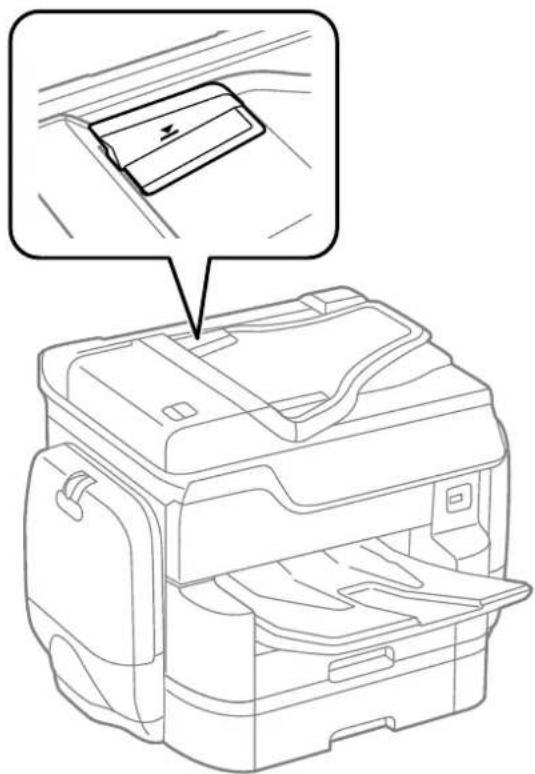
natural_image
Line drawing of a printer's front view showing internal compartments and a close-up of the cover (no text or symbols)☐ Check that the ADF icon is on at the bottom of the screen. If it is off, place the originals again.
Related Information
→ "Available Originals for the ADF" on page 57
→ "Placing Originals on the ADF" on page 57
→ "Cleaning the ADF" on page 197
Paper is Not Stacked in Order
If you pull the lever on the center of the output tray, the problem may be improved, but the holding capacity will be reduced.
Paper is Ejected in an Unexpected Direction
If paper is ejected in an unexpected direction when landscape pages and portrait pages are mixed, or 2-sided printing and 1-sided printing are mixed, enable the Output documents for filing setting in the printer driver. This ejects pages in the same direction for easy filing.
Windows
Select Output documents for filing in Extended Settings on the Maintenance tab.
Solving Problems
□ Mac OS X
Select System Preferences from the menu > Printers & Scanners (or Print & Scan, Print & Fax), and then select the printer. Click Options & Supplies > Options (or Driver). Select On as the Output documents for filing setting.
Power and Control Panel Problems
Power Does Not Turn On
☐ Make sure the power cord is securely plugged in.
☐ Hold down the ⏻ button for a little longer.
Power Does Not Turn Off
Hold down the ⏻ button for a little longer. If you still cannot turn off the printer, unplug the power cord. To prevent the print head from drying out, turn the printer back on and turn it off by pressing the ⏻ button.
Power Turns Off Automatically
☐ Tap Settings > General Settings > Basic Settings > Power Off Settings, and then disable the Power Off If Inactive and Power Off If Disconnected settings.
☐ Tap Settings > General Settings > Basic Settings, and then disable the Power Off Timer Setting.
Note:
Your product may have the Power Off Settings or Power Off Timer feature depending on the location of purchase.
LCD Screen Gets Dark
The printer is in sleep mode. Tap anywhere on the LCD screen to return it to its former state.
Touchscreen Does Not Respond
☐ If you stick a protective label on the touchscreen, the optical touch screen may not respond.
☐ Turn off the printer, and then wipe the screen using a soft, dry cloth. If the screen is smeared, it may not respond.
Cannot Operate from the Control Panel
When the user feature restriction is enabled, a user ID and password are required to print. If you do not know the password, contact your printer administrator.
Cannot Print from a Computer
Checking the connection
□ Connect the USB cable securely to the printer and the computer.
☐ If you are using a USB hub, try to connect the printer directly to the computer.
☐ If you connect the printer to a SuperSpeed USB port using a USB 2.0 cable, a communication error may occur on some computers. In this case, re-connect the printer using one of the following methods.
□ Use a USB 3.0 cable.
□ Connect to a Hi-Speed USB port on the computer.
□ Connect to a SuperSpeed USB port other than the port that generated the communication error.
☐ If you cannot print over a network, see the page that describes the network connection method from the computer.
Checking the software and data
□ Install the printer driver.
☐ If you are printing a large data size image, the computer may run out of memory. Print the image at a lower resolution or a smaller size.
Checking the printer status from the computer (Windows)
Click Print Queue on the printer driver's Maintenance tab, and then check the following.
☐ Check if there are any paused print jobs.
Cancel printing if necessary.
☐ Make sure the printer is not offline or pending.
If the printer is offline or pending, clear the offline or pending setting from the Printer menu.
☐ Make sure the printer is selected as the default printer from the Printer menu (there should be a check mark on the menu item).
If the printer is not selected as the default printer, set it as the default printer.
☐ Make sure the printer port is selected correctly in Property > Port from the Printer menu as follows. Select "USBXXX" for a USB connection, or "EpsonNet Print Port" for a network connection.
Checking the printer status from the computer (Mac OS X)
☐ The printer may not print when the user feature restriction is enabled. Contact your printer administrator.
☐ Make sure the printer status is not Pause.
Select System Preferences from the menu > Printers & Scanners (or Print & Scan, Print & Fax), and then double-click the printer. If the printer is paused, click Resume (or Resume Printer).
Related Information
→ "Connecting to a Computer" on page 28
→ "Installing Applications" on page 224
→ "Canceling Printing" on page 97
When You Cannot Make Network Settings
☐ Turn off the devices you want to connect to the network. Wait for about 10 seconds, and then turn on the devices in the following order; access point, computer or smart device, and then printer. Move the printer and computer or smart device closer to the access point to help with radio wave communication, and then try to make network settings again.
☐ Tap Settings > General Settings > Network Settings > Connection Check, and then print the network connection report. If an error has occurred, check the network connection report and then follow the printed solutions.
Related Information
→ "Printing a Network Connection Report" on page 37
→ "Messages and Solutions on the Network Connection Report" on page 38
Cannot Connect from Devices Even Though Network Settings are No Problems
If you cannot connect from the computer or smart device to the printer even though the network connection report does not show any problems, see the following.
☐ When you are using multiple access points at the same time, you may not be able to use the printer from the computer or smart device depending on the settings of the access points. Connect the computer or smart device to the same access point as the printer.
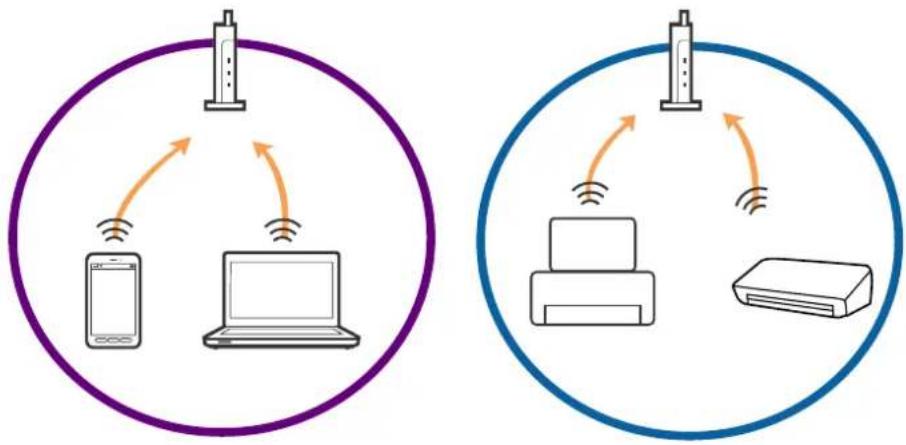
flowchart
graph TD
    subgraph_Left_Circle["Circle"]
        A["Smartphone"] -->|Wireless| B["Laptop"]
        C["Mobile Device"] -->|Wireless| B
        D["Desktop"] -->|Wireless| B
    end
    subgraph_Right_Circle["Circle"]
        E["Server"] -->|Wireless| F["Hardware"]
        G["Computer"] -->|Wireless| F
        H["Desktop"] -->|Wireless| F
    end
Solving Problems
☐ You may not be able to connect to the access point when the access point has multiple SSIDs and devices are connected to different SSIDs on the same access point. Connect the computer or smart device to the same SSID as the printer.
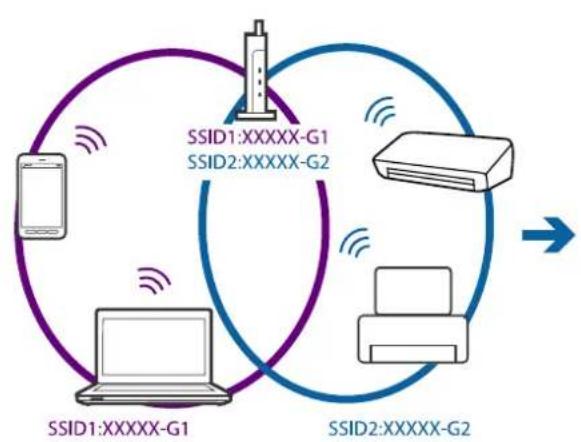
flowchart
graph TD
    A["Mobile Device"] -->|SSID1:XXXXX-G1| B["Server"]
    C["Desktop"] -->|SSID2:XXXXX-G2| B
    B --> D["Printer"]
    style A fill:#f9f,stroke:#333
    style C fill:#f9f,stroke:#333
    style B fill:#bbf,stroke:#333
    style D fill:#bbf,stroke:#333
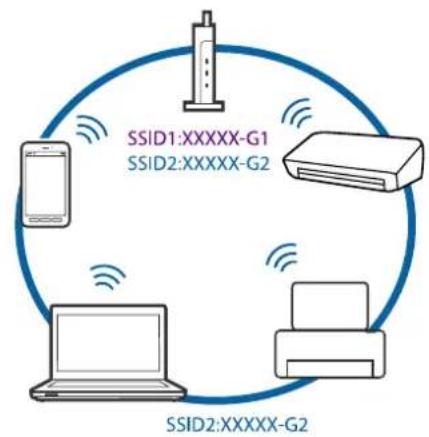
flowchart
graph TD
    A["Device 1"] -->|SSID1:XXXXXX-G1| B["Router"]
    C["Device 2"] -->|SSID2:XXXXXX-G2| D["Laptop"]
    E["Device 3"] -->|SSID2:XXXXXX-G2| F["Printer"]
☐ An access point that is compliant with both IEEE802.11a and IEEE802.11g has SSIDs of 2.4 GHz and 5 GHz. If you connect the computer or smart device to a 5 GHz SSID, you cannot connect to the printer because the printer only supports communication over 2.4 GHz. Connect the computer or smart device to the same SSID as the printer.
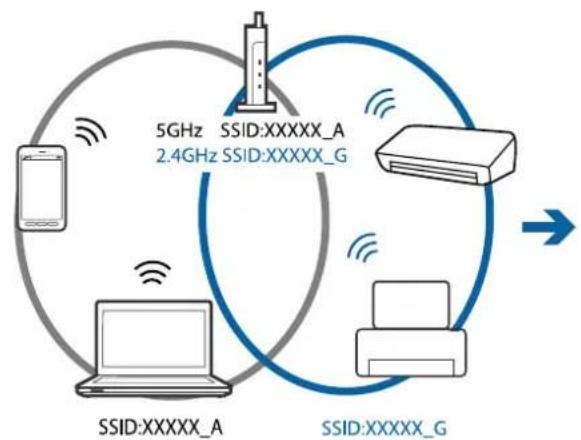
flowchart
graph TD
    A["Mobile Device"] -->|5GHz SSID:XXXXXX_A\n2.4GHz SSID:XXXXXX_G| B["Device"]
    B --> C["Server"]
    C --> D["Printer"]
    D --> E["Computer"]
    E --> F["SSID:XXXXXX_A"]
    F --> G["SSID:XXXXXX_G"]
    G --> H["Output"]
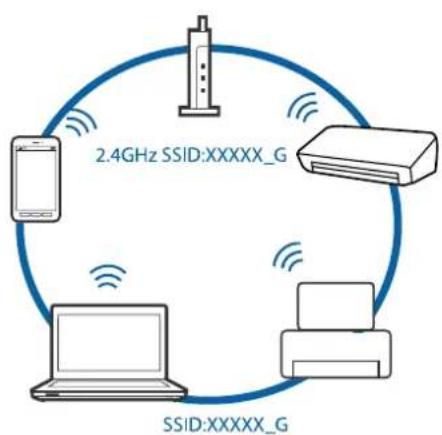
flowchart
graph TD
    A["Mobile Device"] -->|2.4GHz SSID:XXXXG| B["Server"]
    B --> C["Printer"]
    C --> D["Laptop"]
    D --> E["Server"]
    E --> F["Printer"]
    style A fill:#f9f,stroke:#333
    style B fill:#ccf,stroke:#333
    style C fill:#cfc,stroke:#333
    style D fill:#fcc,stroke:#333
    style E fill:#cff,stroke:#333
    style F fill:#ffc,stroke:#333
☐ Most access points have a privacy separator feature that blocks communication between connected devices. If you cannot communicate between the printer and the computer or smart device even if they are connected to the same network, disable the privacy separator on the access point. See the manual provided with the access point for details.
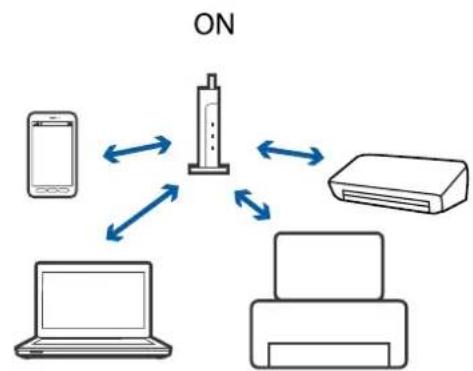
flowchart
graph TD
    A["Mobile Phone"] <--> B["Device"]
    C["Laptop"] <--> B
    D["Printer"] <--> B
    B <--> E["Printer"]
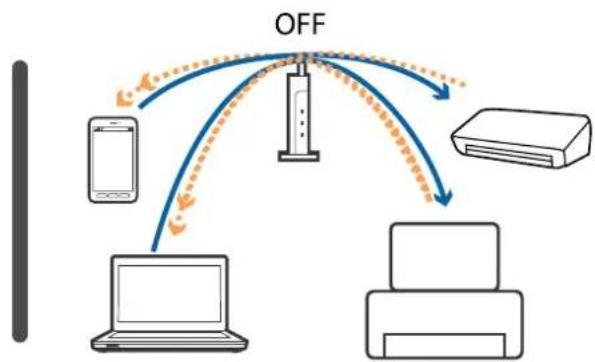
flowchart
graph TD
    A["Smartphone"] -->|OFF| B["Printer"]
    C["Laptop"] -->|OFF| B
    D["Printer"] -->|OFF| B
    B -->|Signal| E["Off"]
Solving Problems
Related Information
→ "Checking the SSID Connected to the Printer" on page 244
→ "Checking the SSID for the Computer" on page 244
Checking the SSID Connected to the Printer
Tap Settings > General Settings > Network Settings > Network Status. You can check the SSID for Wi-Fi and Wi-Fi Direct from each menu.
Checking the SSID for the Computer
Windows
Click in the task tray on the desktop. Check the name of the connected SSID from the list displayed.
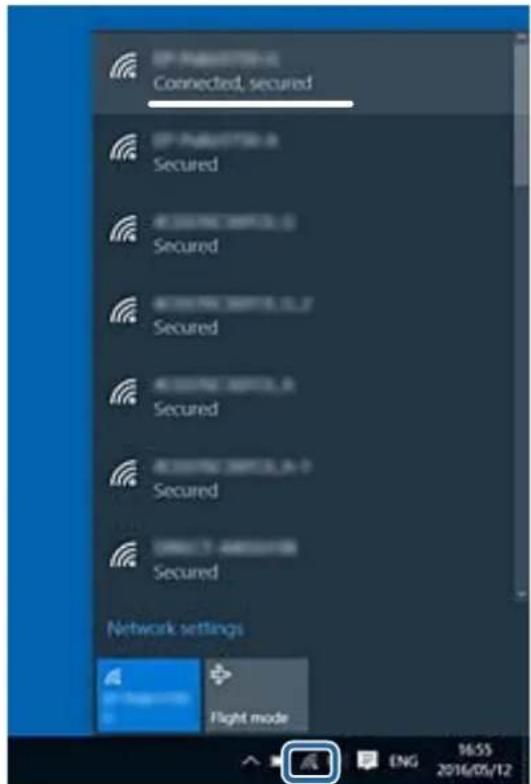
Solving Problems
Mac OS X
Click the Wi-Fi icon at the top of the computer screen. A list of SSIDs is displayed and the connected SSID is indicated with a check mark.
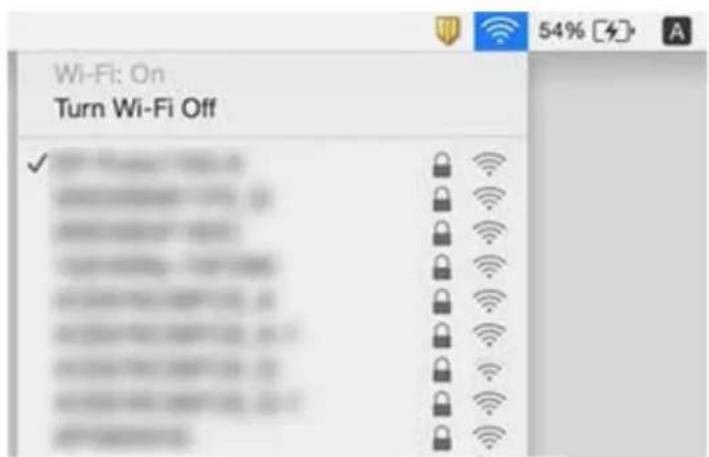
Suddenly the Printer Cannot Print over a Network Connection
Checking the network environment
☐ When you have changed your access point or provider, try making network settings for the printer again. Connect the computer or smart device to the same SSID as the printer.
☐ Turn off the devices you want to connect to the network. Wait for about 10 seconds, and then turn on the devices in the following order; access point, computer or smart device, and then printer. Move the printer and computer or smart device closer to the access point to help with radio wave communication, and then try to make network settings again.
Checking the computer
In Windows, click Print Queue on the printer driver's Maintenance tab, and then check the following.
☐ Check if there are any paused print jobs.
Cancel printing if necessary.
☐ Make sure the printer is not offline or pending.
If the printer is offline or pending, clear the offline or pending setting from the Printer menu.
☐ Make sure the printer is selected as the default printer from the Printer menu (there should be a check mark on the menu item).
If the printer is not selected as the default printer, set it as the default printer.
☐ Check if the selected port is correct in Printer Properties > Port.
Checking the network connection report
Tap Settings > General Settings > Network Settings > Connection Check, and then print the network connection report. If the report shows that the network connection failed, check the network connection report and then follow the printed solutions.
Solving Problems
Checking the network connection of the computer
Try accessing any website from your computer to make sure that your computer's network settings are correct. If you cannot access any website, there is a problem on the computer. Check the network connection of the computer.
Related Information
→ "Checking the SSID Connected to the Printer" on page 244
→ "Printing a Network Connection Report" on page 37
→ "Messages and Solutions on the Network Connection Report" on page 38
→ "Windows Printer Driver" on page 216
Suddenly the Printer Cannot Print Using a USB Connection
☐ Disconnect the USB cable from the computer. Right-click on the printer icon displayed on the computer, and then select Remove Device. Next, connect the USB cable to the computer and try a test print. If printing is possible, the setup is complete.
☐ Re-set the USB connection following the steps in [Changing a Connection Method to a Computer] in this manual.
Related Information
→ "Changing the Connection Method to a Computer" on page 42
Cannot Print from an iPhone or iPad
☐ Connect the iPhone or iPad to the same network (SSID) as the printer.
☐ Enable Paper Setup Auto Display in the following menus.
Settings > General Settings > Printer Settings > Paper Source Settings > Paper Setup Auto Display
☐ Enable the AirPrint setting on Web Config.
Related Information
→ "Connecting to a Smart Device" on page 30
→ "Web Config" on page 214
Printing is Paused
Keeping the covers of the printer open during printing pauses the pint job. Close the covers if you have opened them during printing.
Printout Problems
Printout is Scuffed or Color is Missing
If you have not used the printer for a long time, the print head nozzles may be clogged and ink drops may not be discharged. Perform a nozzle check, and then clean the print head if any of the print head nozzles are clogged.
Related Information
→ "Checking and Cleaning the Print Head" on page 194
Banding or Unexpected Colors Appear

natural_image
Abstract landscape with vertical stripes, green and yellow stripes, and blue sky with clouds (no text or symbols)The print head nozzles may be clogged. Perform a nozzle check to check if the print head nozzles are clogged. Clean the print head if any of the print head nozzles are clogged.
Related Information
→ "Checking and Cleaning the Print Head" on page 194
Colored Banding Appears at Intervals of Approximately 3.3 cm

natural_image
Small brown and white dog sitting on grass, no visible text or symbols☐ Select the appropriate paper type setting for the type of paper loaded in the printer.
☐ Align the print head using the Print Quality Adjustment feature.
☐ When printing on plain paper, print using a higher quality setting.
Solving Problems
Related Information
→ "List of Paper Type" on page 51
→ "Adjusting the Print Quality" on page 193
Blurry Prints, Vertical Banding, or Misalignment

natural_image
Close-up of yellow banana seed pods against a green background (no text or symbols)enthalten alle Aufdruck. W ↓ 5008 "Regel
Align the print head using the Print Quality Adjustment feature.
Related Information
→ "Adjusting the Print Quality" on page 193
Print Quality Does Not Improve Even After Aligning the Print Head
During bidirectional (or high speed) printing, the print head prints while moving in both directions, and vertical lines may be misaligned. If print quality does not improve, disable the bidirectional (or high speed) setting. Disabling this setting may slow down printing speed.
□ Control panel
Disable Bidirectional in Settings > General Settings > Printer Settings.
Windows
Clear High Speed on the printer driver's More Options tab.
□ Mac OS X
Select System Preferences from the menu > Printers & Scanners (or Print & Scan, Print & Fax), and then select the printer. Click Options & Supplies > Options (or Driver). Select Off as the High Speed Printing setting.
Related Information
→ "Menu Options for Memory Device" on page 67
Print Quality is Poor
Check the following if the print quality is poor due to blurry prints, banding, missing colors, faded colors, and misalignment in the prints.
Checking the printer
Use the Print Quality Adjustment feature.
Solving Problems
☐ Perform a nozzle check, and then clean the print head if any of the print head nozzles are clogged.
□ Align the print head.
Checking the paper
☐ Use paper supported by this printer.
☐ Do not print on paper that is damp, damaged, or too old.
☐ If the paper is curled or the envelope is puffed up, flatten it.
☐ Do not stack the paper immediately after printing.
Dry the printouts completely before filing or displaying them. When drying the printouts, avoid direct sun light, do not use a dryer, and do not touch the printed side of paper.
☐ When printing images or photos, Epson recommends using genuine Epson paper rather than plain paper. Print on the printable side of the genuine Epson paper.
Checking the print settings
☐ Select the appropriate paper type setting for the type of paper loaded in the printer.
☐ Print using a higher quality setting.
☐ If you have selected Standard-Vivid as the quality setting on the Windows printer driver, change to Standard. If you have selected Normal-Vivid as the quality setting on the Mac OS X printer driver, change to Normal.
Checking the ink supply unit
☐ Try to use genuine Epson ink supply units. This product is designed to adjust colors based on the use of genuine Epson ink supply units. The use of non-genuine ink supply units may cause print quality to decline.
☐ Epson recommends using the ink supply unit before the date printed on the package.
Related Information
→ "Adjusting the Print Quality" on page 193
→ "Available Paper and Capacities" on page 48
→ "List of Paper Type" on page 51
→ "Paper Handling Precautions" on page 47
Paper Is Smeared or Scuffed
☐ When horizontal banding appears or the top or bottom of the paper is smeared, load paper in the correct direction and slide the edge guides to the edges of the paper.

Solving Problems
☐ When vertical banding appears or the paper is smeared, clean the paper path.

Place the paper on a flat surface to check if it is curled. If it is, flatten it.
☐ When printing on thick paper, the print head is close to the printing surface and the paper may be scuffed. In this case, enable the reduce scuff setting. If you enable this setting, print quality may decline or printing may slow down.
□ Control panel
Tap Settings > General Settings > Printer Settings from the home screen, and then enable Thick Paper.
Windows
Click Extended Settings on the printer driver's Maintenance tab, and then select Thick Paper and Envelopes.
If the paper is still scuffed after selecting the Thick Paper and Envelopes setting, select Short Grain Paper in the Extended Settings window of the printer driver.
□ Mac OS X
Select System Preferences from the menu > Printers & Scanners (or Print & Scan, Print & Fax), and then select the printer. Click Options & Supplies > Options (or Driver). Select On as the Thick paper and envelopes setting.
☐ When performing manual 2-sided printing, make sure that the ink is completely dry before reloading the paper.
Related Information
→ "Loading Paper in the Paper Cassette" on page 52
→ "Loading Paper in the Rear Paper Feed" on page 54
→ "Cleaning the Paper Path for Ink Smears" on page 196
Paper is Smeared During Automatic 2-Sided Printing
When using the automatic 2-sided printing feature and printing high density data such as images and graphs, set the print density to lower and the drying time to longer.
Related Information
→ "Printer Settings" on page 203
Printed Photos are Sticky
You may be printing on the wrong side of the photo paper. Make sure you are printing on the printable side.
When printing on the wrong side of the photo paper, you need to clean the paper path.
Solving Problems
Related Information
→ "Cleaning the Paper Path for Ink Smears" on page 196
Images or Photos are Printed in Unexpected Colors
When printing from the control panel or from the Windows printer driver, the Epson auto photo adjustment setting is applied by default depending on the paper type. Try change the setting.
□ Control panel
Change the Fix Photo setting from Auto to any other option. If changing the setting does not work, select Enhance Off as the Fix Photo setting.
□ Windows printer driver
On the More Options tab, select Custom in Color Correction, and then click Advanced. Change the Scene Correction setting from Auto Correct to any other option. If changing the setting does not work, use any color correction method other than PhotoEnhance in Color Management.
Related Information
→ "Menu Options for Memory Device" on page 67
→ "Adjusting the Print Color" on page 86
The Position, Size, or Margins of the Printout Are Incorrect
☐ Load paper in the correct direction, and slide the edge guides against the edges of the paper.
☐ When placing the originals on the scanner glass, align the corner of the original with the corner indicated by a symbol on the frame of the scanner glass. If the edges of the copy are cropped off, move the original slightly away from the corner.
☐ When placing the originals on the scanner glass, clean the scanner glass and the document cover. If there is dust or stains on the glass, the copy area may extend to include the dust or stains, resulting in the wrong copying position or small images.
☐ Select the appropriate Original Size in the copy settings.
☐ Select the appropriate paper size setting.
☐ Adjust the margin setting in the application so that it falls within the printable area.
Related Information
→ "Loading Paper in the Paper Cassette" on page 52
→ "Loading Paper in the Rear Paper Feed" on page 54
→ "Placing Originals on the Scanner Glass" on page 60
→ "Cleaning the Scanner Glass" on page 200
→ "Printable Area" on page 281
Printed Characters Are Incorrect or Garbled
☐ Connect the USB cable securely to the printer and the computer.
Solving Problems
☐ Cancel any paused print jobs.
☐ Do not put the computer manually into the Hibernate mode or the Sleep mode while printing. Pages of garbled text may be printed next time you start the computer.
☐ If you use the printer driver you had previously used, printed characters may be garbled. Make sure that the printer driver you are using is for this printer. Check the printer name on the top of the printer driver window.
Related Information
→ "Canceling Printing" on page 97
The Printed Image Is Inverted
Clear any mirror image settings in the printer driver or the application.
□ Windows Clear Mirror Image on the printer driver's More Options tab.
☐ Mac OS X Clear Mirror Image from the print dialog's Print Settings menu.
Mosaic-Like Patterns in the Prints
When printing images or photos, print using high-resolution data. Images on websites are often low resolution although they look good enough on the display, and so print quality may decline.
Uneven Colors, Smears, Dots, or Straight Lines Appear in the Copied Image
□ Clean the paper path.
□ Clean the scanner glass.
□ Clean the ADF.
☐ Do not press too hard on the original or the document cover when you are placing the originals on the scanner glass.
☐ When the paper is smeared, lower the copy density setting.
Related Information
→ "Cleaning the Paper Path for Ink Smears" on page 196
→ "Cleaning the Scanner Glass" on page 200
→ "Cleaning the ADF" on page 197
→ "Basic Menu Options for Copying" on page 99
Moiré (Cross-Hatch) Patterns Appear in the Copied Image
Change the reduce and enlarge setting or place the original at a slightly different angle.
Solving Problems
Related Information
→ "Basic Menu Options for Copying" on page 99
An Image of the Reverse Side of the Original Appears in the Copied Image
☐ For a thin original, place the original on the scanner glass and then place a piece of black paper over it.
☐ Lower the copy density setting on the control panel.
Related Information
→ "Basic Menu Options for Copying" on page 99
The Printout Problem Could Not be Cleared
If you have tried all of the solutions and have not solved the problem, try uninstalling and then reinstalling the printer driver.
Related Information
→ "Uninstalling Applications" on page 222
→ "Installing Applications" on page 224
Other Printing Problems
Printing Is Too Slow
☐ Close any unnecessary applications.
☐ Lower the quality setting. High quality printing slows down the printing speed.
☐ Enable the bidirectional (or high speed) setting. When this setting is enabled, the print head prints while moving in both directions, and the printing speed increases.
Control Panel
From the home screen, tap Settings > General Settings > Printer Settings > Bidirectional, and then enable it.
Windows
Select High Speed on the printer driver's More Options tab.
Mac OS X
Select System Preferences from the menu > Printers & Scanners (or Print & Scan, Print & Fax), and then select the printer. Click Options & Supplies > Options (or Driver). Select On as the High Speed Printing setting.
Solving Problems
☐ Disable quiet mode. This feature slows down the printing speed.
Control Panel
Tap ON on the home screen, and then disable Quiet Mode.
Windows
Select Off as the Quiet Mode setting on the printer driver's Main tab.
□ Mac OS X
Select System Preferences from the menu > Printers & Scanners (or Print & Scan, Print & Fax), and then select the printer. Click Options & Supplies > Options (or Driver). Select Off as the Quiet Mode setting.
☐ For 2-sided printing, one side of paper is printed and dried, and then the other side is printed. Because the drying time differs depending on the environment, such as temperature or humidity, or the print data, the printing speed may be slower.
Printing Slows Down Dramatically During Continuous Printing
Printing slows down to prevent the printer mechanism from overheating and being damaged. However, you can continue printing. To return to normal printing speed, leave the printer idle for at least 30 minutes. Printing speed does not return to normal if the power is off.
Cannot Cancel Printing from a Computer Running Mac OS X v10.6.8
If you want to stop printing from your computer, make the following settings.
Run Web Config, and then select Port9100 as the Top Priority Protocol setting in AirPrint Setup. Select System Preferences from the menu > Printers & Scanners (or Print & Scan, Print & Fax), remove the printer, and then add the printer again.
PostScript Printer Driver Problems
Note:
The menu items and text on the printer driver vary depending on your computer's environment.
Printer Does Not Print While Using PostScript Printer Driver
☐ Set the Printing Language setting to Auto or PS3 on the control panel.
☐ If you cannot print text data, even when Text Detection is enabled on the control panel, set the Printing Language setting to PS3.
☐ In Windows, if a large number of jobs are sent, the printer may not print. Select Print directly to the printer on the Advanced tab in the printer properties.
Related Information
→ "Printer Settings" on page 203
Solving Problems
Printer Does Not Print Correctly While Using PostScript Printer Driver
☐ If the file is created in an application that allows you to change the data format, such as Adobe Photoshop, make sure that the settings in the application match the settings in the printer driver.
☐ EPS files made in binary format may not be printed correctly. Set the format to ASCII when making EPS files in an application.
☐ For Windows, the printer cannot print binary data when it is connected to the computer using a USB interface. Set the Output Protocol setting on the Device Settings tab in the printer properties to ASCII or TBCP.
☐ For Windows, select the appropriate substitution fonts on the Device Settings tab in the printer properties.
Print Quality Is Poor While Using PostScript Printer Driver
You cannot make color settings on the Paper/Quality tab in the printer driver. Click Advanced, and then set the Color Mode setting.
Printing Is Too Slow While Using PostScript Printer Driver
Set the Print Quality setting to Fast in the printer driver.
Cannot Start Scanning
☐ When the access control function is enabled for a printer, you need to enter a user ID and password when scanning. If you do not know the password, contact your system administrator.
☐ When the access control function is enabled, Mac OS X might not be able to scan. Contact your system administrator.
☐ If you are scanning with the ADF, check that the document cover and ADF cover are closed.
☐ Connect the USB cable securely to the printer and the computer. If you are using a USB hub, try to connect the printer directly to the computer.
☐ If you connect the printer to a SuperSpeed USB port using a USB 2.0 cable, a communication error may occur on some computers. In this case, re-connect the printer using one of the following methods.
☐ Use a USB 3.0 cable.
☐ Connect to a Hi-Speed USB port on the computer.
☐ Connect to a SuperSpeed USB port other than the port that generated the communication error.
☐ If you scan at a high resolution over a network, a communication error may occur. Lower the resolution.
☐ Make sure that the correct printer (scanner) is selected on Epson Scan 2.
Check whether or not the printer is recognized when using Windows
In Windows, make sure the printer (scanner) is displayed in Scanner and Camera. The printer (scanner) should be displayed as "EPSON XXXXX (printer name)". If the printer (scanner) is not displayed, uninstall and then reinstall Epson Scan 2. See the following to access Scanner and Camera.
Solving Problems
Windows 10
Right-click the start button or press and hold it, select Control Panel, enter "Scanner and Camera" in the search charm, click View scanners and cameras, and then check if the printer is displayed.
☐ Windows 8.1/Windows 8/Windows Server 2012 R2/Windows Server 2012
Select Desktop > Settings > Control Panel, enter "Scanner and Camera" in the search charm, click Show Scanner and Camera, and then check if the printer is displayed.
□ Windows 7/Windows Server 2008 R2
Click the start button and select Control Panel, enter "Scanner and Camera" in the search charm, click View scanners and cameras, and then check if the printer is displayed.
□ Windows Vista/Windows Server 2008
Click the start button, select Control Panel > Hardware and Sound > Scanners and Cameras, and then check if the printer is displayed.
☐ Windows XP/Windows Server 2003 R2/Windows Server 2003
Click the start button, select Control Panel > Printers and Other Hardware > Scanner and Cameras, and then check if the printer is displayed.
Related Information
→ "Uninstalling Applications" on page 222
→ "Installing Applications" on page 224
Scanned Image Problems
Uneven Colors, Dirt, Spots, and so on Appear when Scanning from the Scanner Glass
□ Clean the scanner glass.
☐ Remove any trash or dirt that adheres to the original.
☐ Do not press with too much force on the original or the document cover. If you press with too much force, blurring, smudges, and spots may occur.
Related Information
→ "Cleaning the Scanner Glass" on page 200
Straight Lines Appear when Scanning from ADF
□ Clean the ADF.
Straight lines may appear in the image when trash or dirt gets into the ADF.
☐ Remove any trash or dirt that adheres to the original.
Related Information
→ "Cleaning the ADF" on page 197
Solving Problems
The Image Quality Is Rough
☐ In Epson Scan 2, adjust the image using items on the Advanced Settings tab, and then scan.
☐ If the resolution is low, try increasing the resolution and then scanning.
Related Information
→ "Scanning Using Epson Scan 2" on page 117
Offset Appears in the Background of Images
Images on the back of the original may appear in the scanned image.
☐ In Epson Scan 2, select the Advanced Settings tab, and then adjust the Brightness.
This feature may not be available depending on the settings on the Main Settings tab > Image Type or other settings on the Advanced Settings tab.
☐ In Epson Scan 2, select the Advanced Settings tab, and then Image Option > Text Enhancement.
☐ When scanning from the scanner glass, place black paper or a desk pad over the original.
Related Information
→ "Scanning Using Epson Scan 2" on page 117
→ "Placing Originals" on page 57
Text is Blurred
☐ In Epson Scan 2, select the Advanced Settings tab, and then Image Option > Text Enhancement.
☐ In Epson Scan 2, when Image Type on the Main Settings tab is set to Black & White, adjust the Threshold on the Advanced Settings tab. When you increase the Threshold, black becomes stronger.
☐ If the resolution is low, try increasing the resolution and then scanning.
Related Information
→ "Scanning Using Epson Scan 2" on page 117
Moiré Patterns (Web-Like Shadows) Appear
If the original is a printed document, moiré patterns (web-like shadows) may appear in the scanned image.
☐ On the Advanced Settings tab in Epson Scan 2, set Descreening.
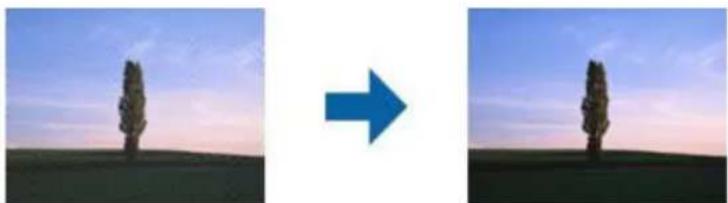
natural_image
Two side-by-side photos showing a tall tree on a hill under a twilight sky, with a blue arrow pointing from the right image to the left image.Solving Problems
☐ Change the resolution, and then scan again.
Related Information
→ "Scanning Using Epson Scan 2" on page 117
Cannot Scan the Correct Area on the Scanner Glass
☐ Make sure the original is placed correctly against the alignment marks.
☐ If the edge of the scanned image is missing, move the original slightly away from the edge of the scanner glass.
☐ When scanning from the control panel and selecting the auto scan area cropping function, remove any trash or dirt from the scanner glass and document cover. If there is any trash or dirt around the original, the scanning range expands to include it.
Related Information
→ "Placing Originals" on page 57
→ "Cleaning the Scanner Glass" on page 200
Text is Not Recognized Correctly when Saving as a Searchable PDF
☐ On the Image Format Options window in Epson Scan 2, check that Text Language is set correctly on the Text tab.
☐ Check that the original is placed straight.
☐ Use an original with clear text. Text recognition may decline for the following types of originals.
☐ Originals that have been copied a number of times
☐ Originals received by fax (at low resolutions)
☐ Originals on which the letter spacing or line spacing is too small
☐ Originals with ruled lines or underlining over the text
☐ Originals with hand-written text
□ Originals with creases or wrinkles
☐ In Epson Scan 2, when Image Type on the Main Settings tab is set to Black & White, adjust the Threshold on the Advanced Settings tab. When you increase the Threshold, the black color area becomes larger.
☐ In Epson Scan 2, select the Advanced Settings tab, and then Image Option > Text Enhancement.
Related Information
→ "Scanning Using Epson Scan 2" on page 117
Cannot Solve Problems in the Scanned Image
If you have tried all of the solutions and have not solved the problem, initialize the Epson Scan 2 settings using Epson Scan 2 Utility.
Solving Problems
Note:
Epson Scan 2 Utility is an application that comes with Epson Scan 2.
- Start Epson Scan 2 Utility.
□ Windows 10/Windows Server 2016
Click the start button, and then select EPSON > Epson Scan 2 Utility.
☐ Windows 8.1/Windows 8/Windows Server 2012 R2/Windows Server 2012
Enter the application name in the search charm, and then select the displayed icon.
☐ Windows 7/Windows Vista/Windows XP/Windows Server 2008 R2/Windows Server 2008/Windows Server 2003 R2/Windows Server 2003
Click the start button, and then select All Programs or Programs > EPSON > Epson Scan 2 > Epson Scan 2 Utility.
Mac OS
Select Go > Applications > Epson Software > Epson Scan 2 Utility.
- Select the Other tab.
- Click Reset.
Note:
If initialization does not solve the problem, uninstall and re-install Epson Scan 2.
Related Information
→ "Uninstalling Applications" on page 222
→ "Installing Applications" on page 224
Other Scanning Problems
Scanning Speed Is Slow
☐ Lower the resolution, and then scan again. When the resolution is high, scanning may take some time.
☐ The scanning speed may be reduced depending on the image adjustment features in Epson Scan 2.
☐ On the Configuration screen which is displayed by clicking the ⚙ button in Epson Scan 2, if you set Quiet Mode on the Scan tab, the scanning speed may be reduced.
Related Information
→ "Scanning Using Epson Scan 2" on page 117
Cannot Send the Scanned Image by Email
Make sure you have configured the email server settings.
Solving Problems
Related Information
→ "Configuring Mail Server" on page 302
Scanning Stops when Scanning to PDF/Multi-TIFF
☐ When scanning using Epson Scan 2, you can continuously scan up to 999 pages in PDF format and up to 200 pages in Multi-TIFF format. When scanning using the control panel, you can continuously scan up to 50 pages in single-sided scanning using the ADF, and up to 100 pages in 2-sided scanning using the ADF and when scanning using the scanner glass.
☐ When scanning large volumes, we recommend scanning in grayscale.
☐ Increase the free space on the computer's hard disk. Scanning may stop if there is not enough free space.
☐ Try scanning at a lower resolution. Scanning stops if the total data size reaches the limit.
Related Information
→ "Scanning Using Epson Scan 2" on page 117
Problems when Sending and Receiving Faxes
Cannot Send or Receive Faxes
☐ Use Check Fax Connection on the control panel to run the automatic fax connection check. Try the solutions printed on the report.
☐ Check the error code displayed for the failed fax job, and try the solutions described in the error code list.
☐ Check the Line Type setting. Setting to PBX may solve the problem. If your phone system requires an external access code to get an outside line, register the access code to the printer, and enter # (hash) at the beginning of a fax number when sending.
☐ If a communication error occurs, change the Fax Speed setting to Slow(9,600bps) on the control panel.
☐ Check that the telephone wall jack works by connecting a phone to it and testing it. If you cannot make or receive calls, contact your telecommunication company.
☐ To connect to a DSL phone line, you need to use a DSL modem equipped with a built-in DSL filter, or install a separate DSL filter to the line. Contact your DSL provider.
☐ If you are connecting to a DSL phone line, connect the printer directly to a telephone wall jack to see if the printer can send a fax. If it works, the problem may be caused by the DSL filter. Contact your DSL provider.
☐ Enable the ECM setting on the control panel. Color faxes cannot be sent or received when ECM is off.
☐ To send or receive faxes using the computer, make sure that the printer is connected using a USB cable or a network, and that the PC-FAX Driver have been installed on the computer. The PC-FAX Driver is installed together with FAX Utility.
Solving Problems
☐ In Windows, make sure the printer (fax) is displayed in Devices and Printers, Printer, or Printers and Other Hardware. The printer (fax) is displayed as "EPSON XXXXX (FAX)". If the printer (fax) is not displayed, uninstall and then re-install the FAX Utility. See the following to access Devices and Printers, Printer, or Printers and Other Hardware.
☐ Windows 10 Right-click on the start button, or press and hold it and then select Control Panel > View devices and printers in Hardware and Sound.
Windows 8.1/Windows 8 Select Desktop > Settings > Control Panel > View devices and printers in Hardware and Sound or Hardware.
Windows 7 Click the start button, and select Control Panel > View devices and printers in Hardware and Sound or Hardware.
Windows Vista Click the start button, and select Control Panel > Printers in Hardware and Sound.
Windows XP Click the start button, and select Settings > Control Panel > Printers and Other Hardware > Printers and Faxes.
☐ In Mac OS X, check the following.
☐ Select System Preferences from the menu > Printers & Scanners (or Print & Scan, Print & Fax), and then make sure the printer (fax) is displayed. The printer (fax) is displayed as "FAX XXXX (USB)" or "FAX XXXX (IP)". If the printer (fax) is not displayed, click [+] and then register the printer (fax).
☐ Select System Preferences from the menu > Printers & Scanners (or Print & Scan, Print & Fax), and then double-click the printer (fax). If the printer is paused, click Resume (or Resume Printer).
Related Information
→ "Check Fax Connection" on page 178
→ "Basic Settings" on page 176
→ "Error Code on the Status Menu" on page 231
→ "Making Settings for a PBX Phone System" on page 129
→ "Connecting the Printer to a Phone Line" on page 123
→ "Uninstalling Applications" on page 222
→ "Installing Applications" on page 224
Cannot Send Faxes
☐ If the user restriction feature has been enabled, a user name and password are required to operate the printer. Contact your administrator if you do not know the password.
☐ If the user restriction feature has been enabled, and you send a fax from a computer, user authentication is performed using the user name and password set in the printer driver. When you cannot send a fax due to an authentication error, contact your administrator.
☐ Set up the header information for outgoing faxes on the control panel. Some fax machines automatically reject incoming faxes that do not include header information.
Solving Problems
☐ If you have blocked your caller ID, unblock it. Some phones or fax machines automatically reject anonymous calls.
☐ Ask the recipient if the fax number is correct and the recipient's fax machine is ready to receive a fax.
☐ Check if you accidentally sent a fax using the subaddress feature. If you select a recipient with a subaddress from the contact list, the fax may be sent using the subaddress feature.
☐ When sending faxes using the subaddress feature, ask the recipient if their fax machine is capable of receiving faxes using the subaddress feature.
☐ When sending faxes using the subaddress feature, check that the subaddress and password are correct. Check with the recipient that the subaddress and password match.
Related Information
→ "Basic Settings" on page 176
→ "Cannot Send or Receive Faxes" on page 260
→ "Sending a Fax with a Subaddress(SUB) and Password(SID)" on page 137
→ "Sending Faxes On Demand (Using Polling Send/Bulletin Board Box)" on page 138
Cannot Send Faxes to a Specific Recipient
Check the following if you cannot send faxes to a specific recipient due to an error.
☐ If the recipient machine does not pick up your call within 50 seconds after the printer has finished dialing, the call ends with an error. Dial using the On Hook feature or using a connected telephone to check how long it takes before you hear a fax tone. If it takes more than 50 seconds, add pauses after the fax number to send the fax. Tap ☐ to enter the pause. A hyphen is entered as the pause mark. One pause is about three seconds. Add multiple pauses as needed.
☐ If you have selected the recipient from the contacts list, verify that the registered information is correct. If the information is correct, select the recipient from the contacts list, tap Edit and change Fax Speed to Slow(9,600bps).
Related Information
→ "Sending Faxes After Confirming the Recipient's Status" on page 134
→ "Sending Faxes Dialing from the External Phone Device" on page 133
→ "Managing Contacts" on page 63
→ "Cannot Send or Receive Faxes" on page 260
Cannot Send Faxes at a Specified Time
Set the date and the time correctly on the control panel.
Related Information
→ "Sending Faxes at a Specified Time (Send Fax Later)" on page 135
→ "Basic Settings" on page 202
Solving Problems
Cannot Receive Faxes
☐ If you have subscribed to a call forwarding service, the printer may not be able to receive faxes. Contact the service provider.
☐ If you have not connected a telephone to the printer, set the Receive Mode setting to Auto on the control panel.
☐ Under the following conditions, the printer runs out of memory and cannot receive faxes. See the troubleshooting for information on handling a memory full error.
☐ 200 received documents have been saved in the inbox and the confidential box in total.
☐ The printer's memory is full (100%).
☐ When receiving faxes using the subaddress feature, check that the subaddress and password are correct. Check with the sender that the subaddress and password match.
☐ Check if the sender's fax number has been registered to the Rejection Number List. Faxes sent from numbers that have been added to this list are blocked when Rejection Number List in Rejection Fax is enabled.
☐ Check if the sender's fax number is registered in the contact list. Faxes sent from numbers that have not been registered to this list are blocked when Unregistered Contacts in Rejection Fax is enabled.
☐ Ask the sender if header information is setup on their fax machine. Faxes that do not include header information are blocked when Fax Header Blank Blocked in Rejection Fax is enabled.
Related Information
→ "Basic Settings" on page 176
→ "Cannot Send or Receive Faxes" on page 260
→ "Memory Full Error Occurs" on page 263
→ "Receiving Faxes from a Board with a Subaddress (SEP) and Password (PWD) (Polling Receive)" on page 143
→ "Setting Conditions for Saving and Forwarding Received Faxes (Conditional Save/Forward)" on page 151
Cannot Save Received Faxes to a Memory Device
Check if the memory device is connected to the printer, and then check the Receive Settings.
Related Information
→ "Saving Received Faxes in an External Memory Device (Unconditional Save/Forward)" on page 146
→ "Saving Received Faxes in an External Memory Device (Conditional Save/Forward)" on page 154
Memory Full Error Occurs
☐ If the printer has been set to save received faxes in the inbox or the confidential box, delete faxes you have already read from the inbox or the confidential box.
☐ If the printer has been set to save received faxes on a computer, turn on the computer that is set to save the faxes. Once the faxes are saved in the computer, they are deleted from the printer's memory.
☐ If the printer has been set to save received faxes on a memory device, connect the device, in which you have created a folder to save faxes, to the printer. Once the faxes are saved in the device, they are deleted from the printer's memory. Make sure that the device has enough available memory and is not write protected.
Solving Problems
□ Even though the memory is full, you can send a monochrome fax by using the Direct Send feature. Or you can also send a fax by dialing from the external phone device, or by using the On Hook feature. You can also divide your originals into two or more to send them in several batches.
☐ If the printer cannot print a received fax due to a printer error, such as a paper jam, the memory full error may occur. Clear the printer problem, and then contact the sender and ask them to send the fax again.
Related Information
→ "Saving Received Faxes in the Inbox (Unconditional Save/Forward)" on page 144
→ "Saving Received Faxes in the Inbox or the Confidential Box (Conditional Save/Forward)" on page 152
→ "Saving Received Faxes on a Computer (Unconditional Save/Forward)" on page 147
→ "Saving Received Faxes in an External Memory Device (Unconditional Save/Forward)" on page 146
→ "Saving Received Faxes in an External Memory Device (Conditional Save/Forward)" on page 154
→ "Sending Many Pages of a Monochrome Document (Direct Send)" on page 134
→ "Sending Faxes Dialing from the External Phone Device" on page 133
→ "Sending Faxes After Confirming the Recipient's Status" on page 134
→ "Removing Jammed Paper" on page 236
Sent Fax Quality Is Poor
□ Clean the scanner glass.
□ Clean the ADF.
☐ Change the Original Type setting on the control panel. If your originals contain both text and photos, select Photo.
□ Change the Density setting on the control panel.
☐ If you are not sure about the capabilities of the recipient fax machine, enable the Direct Send feature or select Fine as the Resolution setting.
If you select Super Fine or Ultra Fine for a monochrome fax, and send the fax without using the Direct Send feature, the printer may automatically lower the resolution.
□ Enable the ECM setting on the control panel.
Related Information
→ "Fax Settings" on page 168
→ "Basic Settings" on page 176
→ "Cleaning the Scanner Glass" on page 200
→ "Cleaning the ADF" on page 197
Faxes Are Sent at the Wrong Size
Before you send an A3 size document, ask the recipient if the recipient's machine supports A3 size. If you see OK (Reduced Size) in the fax transmission report, the recipient's fax machine does not support A3 size.
☐ When sending a fax using the scanner glass, place the original correctly aligning its corner with the origin mark. Select your original size on the control panel.
Solving Problems
☐ Clean the scanner glass and the document cover. If there is dust or stains on the glass, the scanning area may extend to include the dust or stains, resulting in the wrong scanning position or small images.
Related Information
→ "Fax Settings" on page 168
→ "Placing Originals" on page 57
→ "Cleaning the Scanner Glass" on page 200
Received Fax Quality Is Poor
□ Enable the ECM setting on the control panel.
☐ Contact the sender and ask them to send using a higher quality mode.
☐ Reprint the received fax. Select Log from Job/Status to reprint the fax.
Related Information
→ "Basic Settings" on page 176
→ "Checking the Fax Job History" on page 167
Cannot Receive A3 Size Faxes
☐ Check that the paper size setting of the paper source that contains A3 paper has been set to A3, and that the paper source is set for use with the fax feature. Select Settings > General Settings > Printer Settings > Paper Source Settings > Auto Select Settings > Fax, and then check the enabled paper source(s).
☐ Check that A3 is selected in Receiving Paper Size. Select Settings > General Settings > Fax Settings > Basic Settings > Receiving Paper Size, and then check that A3 is selected.
Related Information
→ "Printer Settings" on page 203
→ "Basic Settings" on page 176
Received Faxes Are Not Printed
☐ If an error has occurred on the printer, such as a paper jam, the printer cannot print received faxes. Check the printer.
☐ If the printer has been set to save received faxes in the inbox or the confidential box, the received faxes are not automatically printed. Check the Receive Settings.
Related Information
→ "Checking the Printer Status" on page 229
→ "Removing Jammed Paper" on page 236
→ "Saving Received Faxes in the Inbox (Unconditional Save/Forward)" on page 144
→ "Saving Received Faxes in the Inbox or the Confidential Box (Conditional Save/Forward)" on page 152
Solving Problems
Pages are Blank or only a Small Amount of Text is Printed on the Second Page in Received Faxes
You can print on one page by using the Delete Print Data After Split feature in Split Page Settings. Select Delete Top or Delete Bottom in Delete Print Data After Split, and then adjust Threshold.
Related Information
→ "Print Settings" on page 174
Other Faxing Problems
Cannot Make Calls on the Connected Telephone
Connect the telephone to the EXT. port on the printer, and pick up the receiver. If you cannot hear a dial tone through the receiver, connect the phone cable correctly.
Related Information
→ "Connecting Your Phone Device to the Printer" on page 125
Answering Machine Cannot Answer Voice Calls
On the control panel, set the printer's Rings to Answer setting to a number higher than the number of rings for your answering machine.
Related Information
→ "Basic Settings" on page 176
→ "Settings for the Answering Machine" on page 141
Sender's Fax Number Not Displayed on Received Faxes or the Number Is Wrong
The sender may not have set the fax header information or may have set it incorrectly. Contact the sender.
Other Problems
Slight Electric Shock when Touching the Printer
If many peripherals are connected to the computer, you may feel a slight electric shock when touching the printer. Install a ground wire to the computer that is connected to the printer.
Solving Problems
Operation Sounds Are Loud
If operations sounds are too loud, enable Quiet Mode. Enabling this feature may reduce printing speed.
□ Control panel
Tap OFF on the home screen, and then enable Quiet Mode.
□ Windows printer driver
Enable Quiet Mode on the Main tab.
□ Mac OS X printer driver
Select System Preferences from the menu > Printers & Scanners (or Print & Scan, Print & Fax), and then select the printer. Click Options & Supplies > Options (or Driver). Select On as the Quiet Mode setting.
□ Epson Scan 2
Click the ⚙ button to open the Configuration window. Next, set the Quiet Mode on the Scan tab.
The Date and Time Are Incorrect
Set the date and the time correctly on the control panel. After a power failure caused by a lightning strike or if the power is left off for a long time, the clock may show the wrong time.
Related Information
→ "Basic Settings" on page 202
Memory Device Is not Recognized
Enable the memory device in the Memory Device Interface settings on the control panel.
Related Information
→ "Printer Settings" on page 203
Cannot Save Data to a Memory Device
☐ Check that the memory device is not write protected.
☐ Check that the memory device has enough available memory. If the available memory is low, data cannot be saved.
Related Information
→ "External USB Device Specifications" on page 286
Forgot Your Password
If you forget the administrator's password, contact Epson support.
User's Guide
Solving Problems
Related Information
→ "Contacting Epson Support" on page 304
Application Is Blocked by a Firewall (for Windows Only)
Add the application to the Windows Firewall allowed program in security settings on the Control Panel.
"!" Is Displayed on the Photo Selection Screen
"!" is displayed on the LCD screen when the image file is not supported by the product.
Related Information
→ "Supported Data Specifications" on page 287
Installing the Optional Units
Installing the Optional Units
Optional Cabinet Code
The following is the code for the optional cabinet.
For worldwide users: Optional Cabinet (C12C932891)
For users in India: Optional Cabinet (C12C932901)
Installing the Optional Cabinet
The cabinet can be attached to the printer and the optional paper cassette units.

Caution:
☐ Make sure you turn off the printer, unplug the power cord from the printer, and disconnect any cables before starting installation. Otherwise, the power cord may be damaged resulting in fire or electric shock.
☐ Lock the casters of the cabinet before starting installation. If the cabinet moves unexpectedly, you may be injured.
☐ When lifting the printer, place your hands in the positions shown below. If you lift the printer holding other positions, the printer may fall or you may trap your fingers when placing the printer.
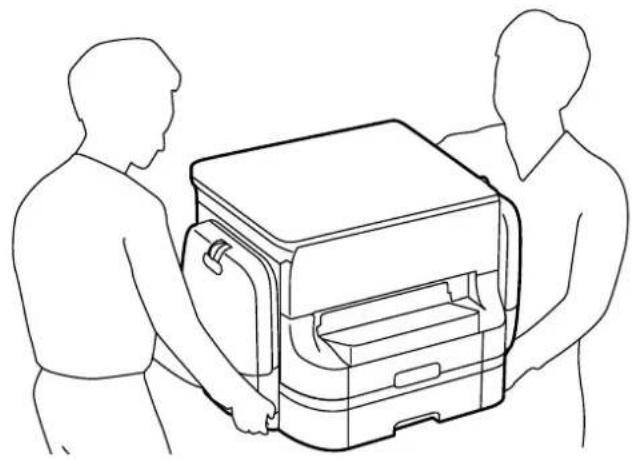
natural_image
Line drawing of two people handling a large box (no text or symbols)- Turn off the printer by pressing the ⏻ button, and then unplug the power cord.
- Disconnect any connected cables.
Note:
if the optional paper cassette unit has been installed, uninstall it as well.
Installing the Optional Units
- Remove the output tray.
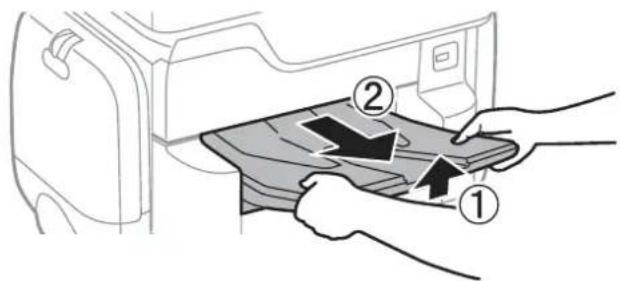
-
Remove the cabinet from the box, and then remove any protective materials.
-
Check the items supplied.
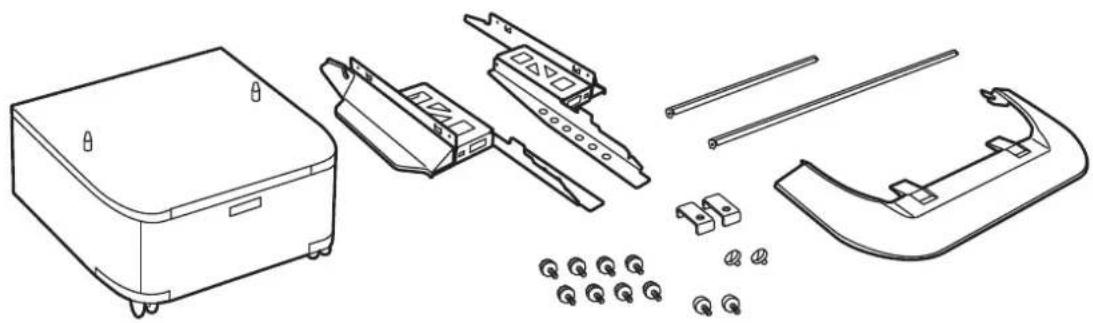
natural_image
Exploded view diagram of a mechanical assembly with components like a box, bracket, and guide rails (no text or labels)Note:
The shape of the stands may differ from this illustration.
- Place the stands inside the cabinet's casters.
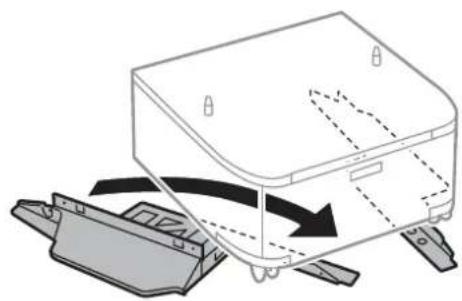
natural_image
Diagram of a printer or printer device with an arrow indicating rotation or movement, no text or symbols present.- Secure the stands with the attachments and screws.
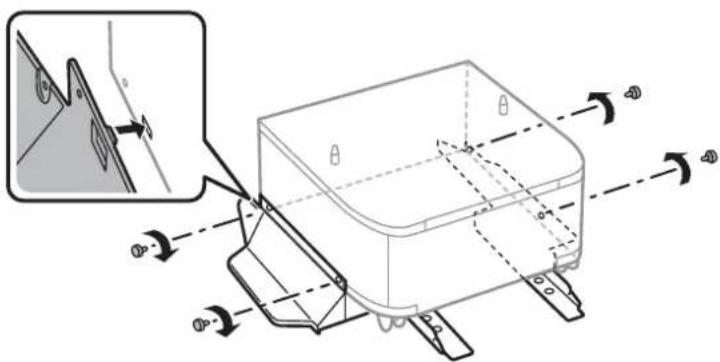
Installing the Optional Units

Important:
Make absolutely sure both stands are attached securely, otherwise the printer may fall.
- Secure the reinforcing bars with the attachments and screws.
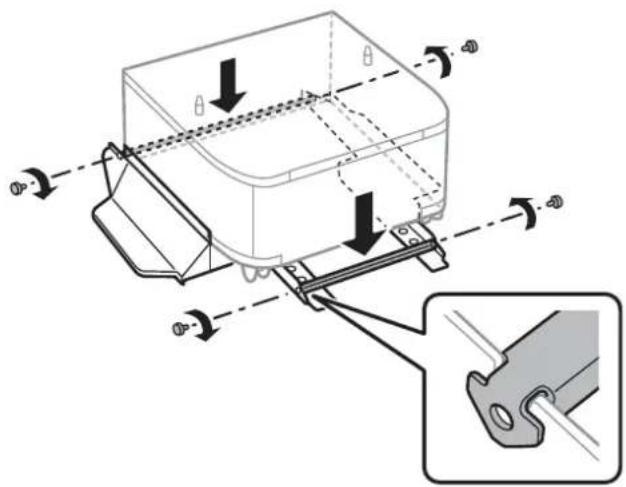
- Place the cabinet on a flat surface and lock the casters at the front.
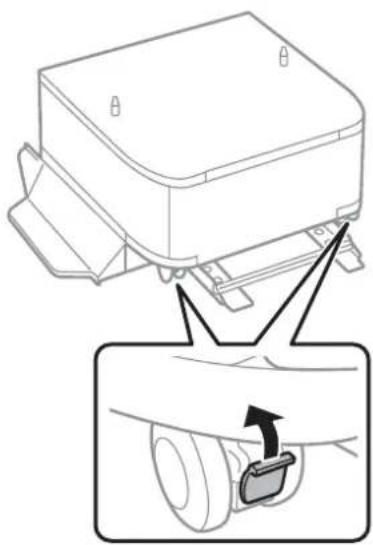
natural_image
Diagram of a mechanical component with a close-up inset showing a belt buckle assembly (no text or symbols)User's Guide
Installing the Optional Units
- Seucre the cover to the stands.
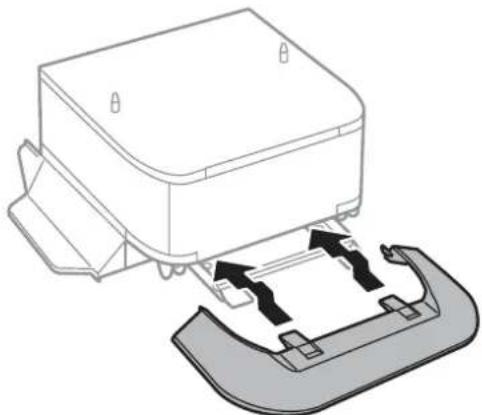
natural_image
Technical line drawing of a printer or printer with a base cover and paper clip, showing internal components (no text or symbols)- Pull out the paper cassette.
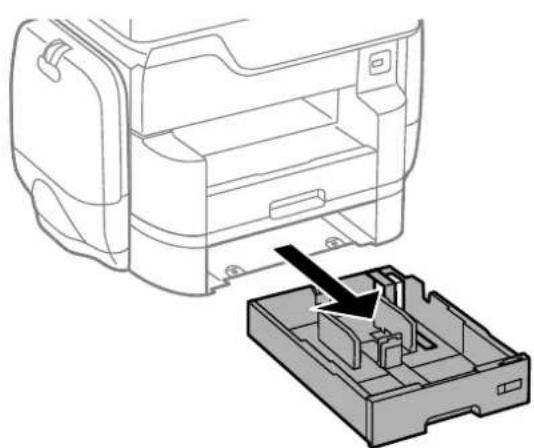
natural_image
Technical line drawing of a device rear panel with an inset showing internal components (no text or symbols)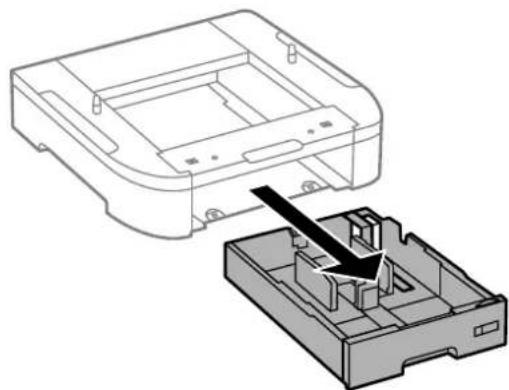
natural_image
Technical illustration of a device housing with an arrow indicating a component or assembly (no text or symbols present)Installing the Optional Units
- Lower the printer or an optional paper cassette unit gently onto the cabinet aligning the corners, and then secure them with the screws.
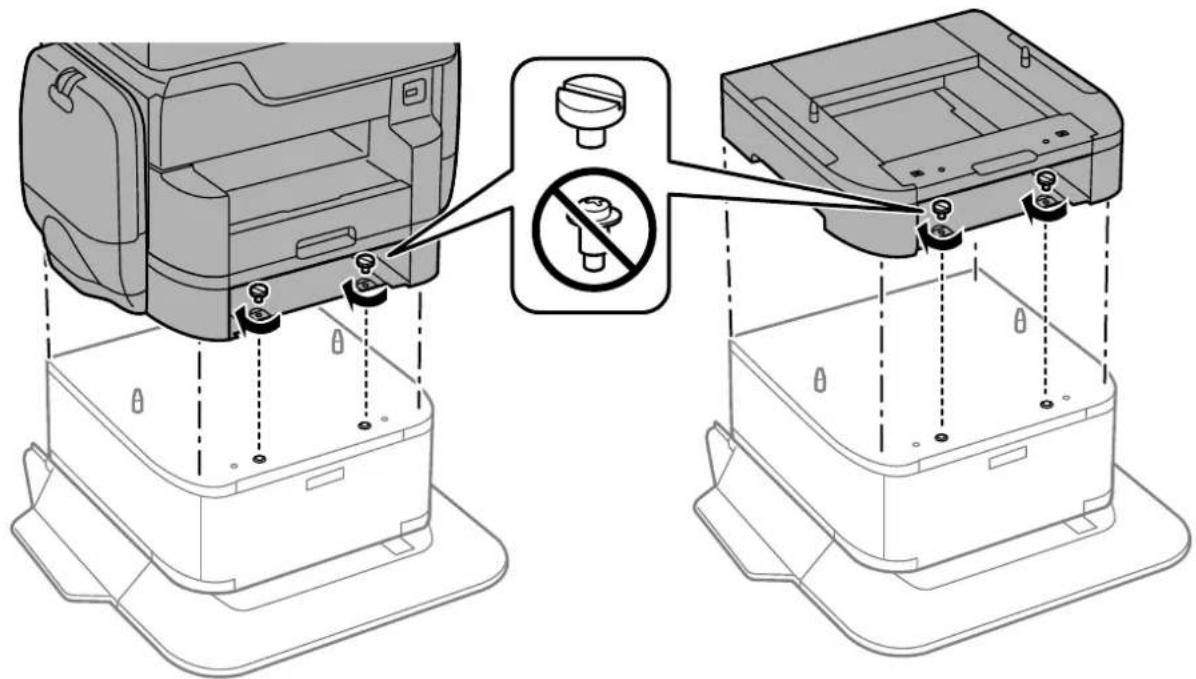
Note:
Some screws will be left over after assembly.
- Secure the printer or an optional paper cassette unit at the back with the attachments and screws.
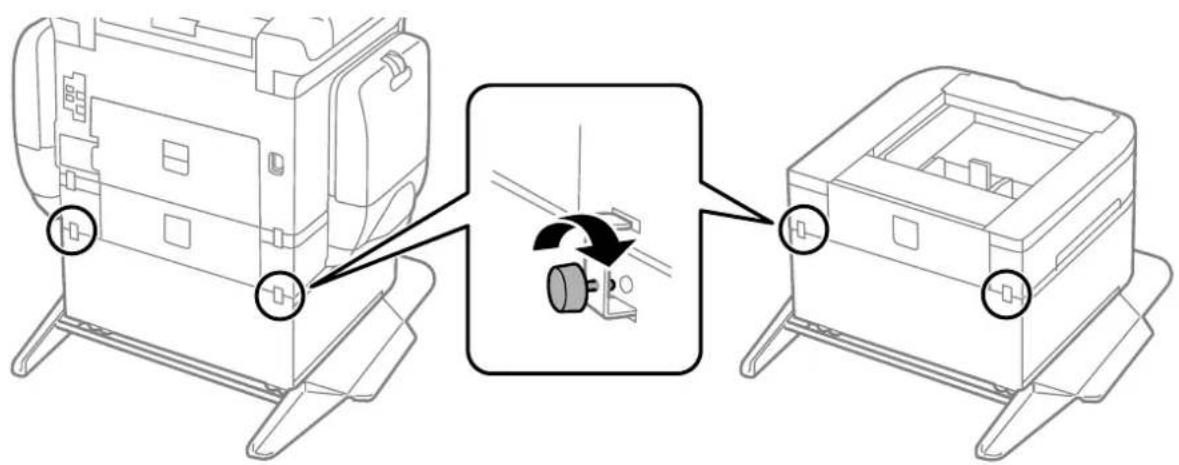
- Insert the paper cassette.
Installing the Optional Units
- Insert the output tray.
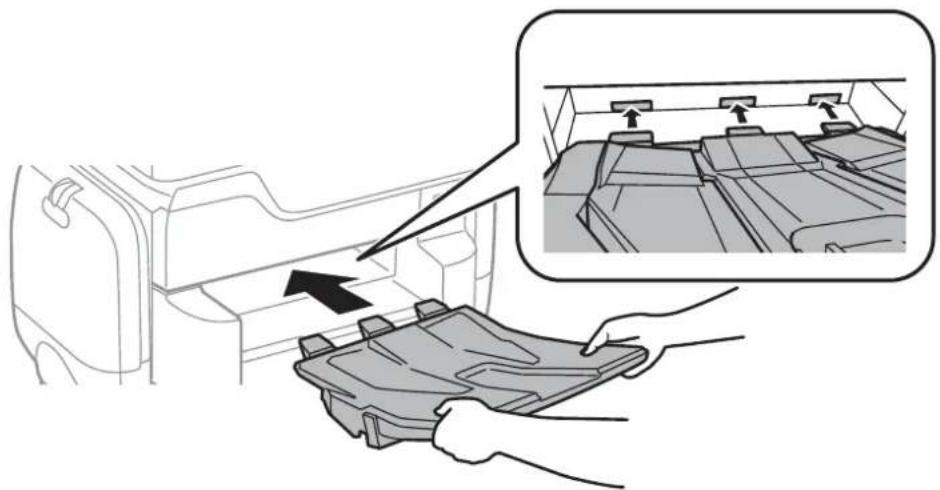
natural_image
Illustration of a hand placing a plastic tray into a car chassis, with an inset showing a close-up of the tray structure (no text or symbols present)- Connect the cables and plug in the printer.
Note:
When uninstalling the cabinet, turn off the printer, unplug the power cord, disconnect any cables, and then perform the installation procedure in reverse.
Related Information
→ "Optional Cabinet Code" on page 269
Optional Paper Cassette Unit Code
The following is the code for the optional paper cassette unit.
For worldwide users: Optional Cassette Unit (C12C932611)
For users in India: Optional Cassette Unit (C12C932621)
Installing the Optional Paper Cassette Units
You can install up to 2 paper cassette units.
Installing the Optional Units

Caution:
☐ Make sure you turn off the printer, unplug the power cord from the printer, and disconnect any cables before starting installation. Otherwise, the power cord may be damaged resulting in fire or electric shock.
☐ When lifting the printer, place your hands in the positions shown below. If you lift the printer holding other positions, the printer may fall or you may trap your fingers when placing the printer.
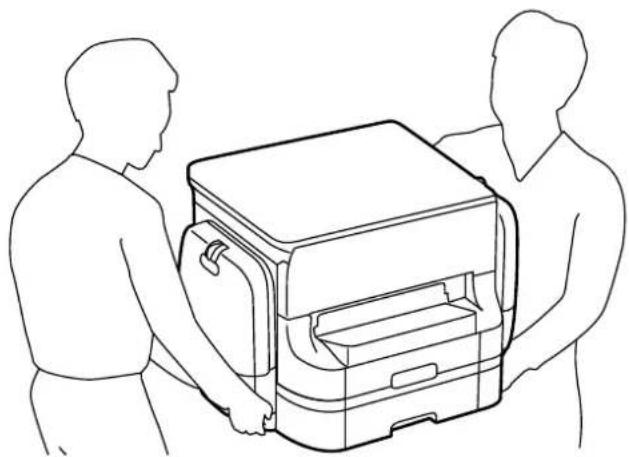
natural_image
Line drawing of two people handling a large box (no text or symbols)
Important:
If you are using the optional cabinet, install it under the bottom of the paper cassette unit in advance.
- Turn off the printer by pressing the ⏻ button, and then unplug the power cord.
- Disconnect any connected cables.
Note:
If other optional paper cassette units have been installed, uninstall them as well.
- Remove the output tray.
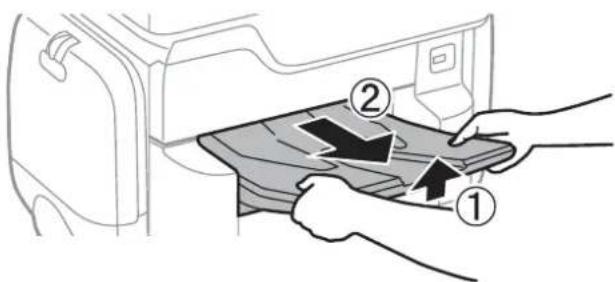
- Remove the optional paper cassette unit from its box, and then remove any protective materials.
User's Guide
Installing the Optional Units
- Check the items supplied.
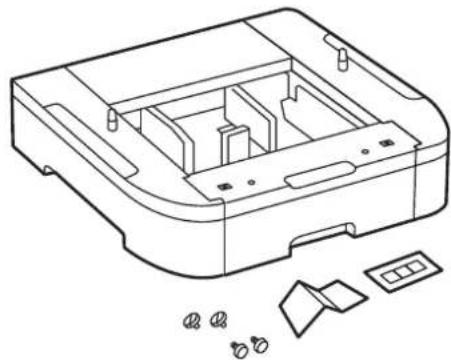
natural_image
Technical line drawing of a device casing with internal compartments and exploded view (no text or symbols)-
Place the optional paper cassette unit where you want to set up the printer.
-
Pull out the paper cassette.
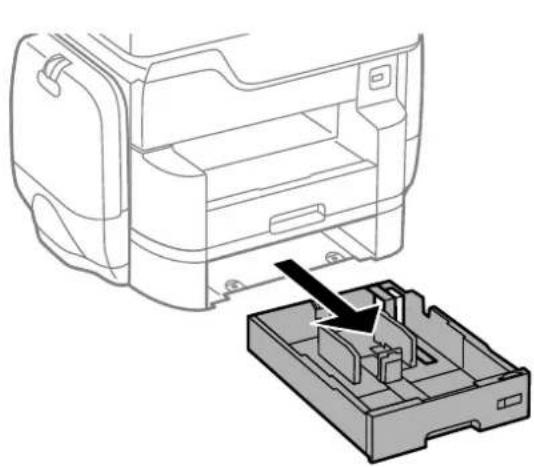
natural_image
Technical line drawing of a mechanical component with an inset showing internal components (no text or symbols)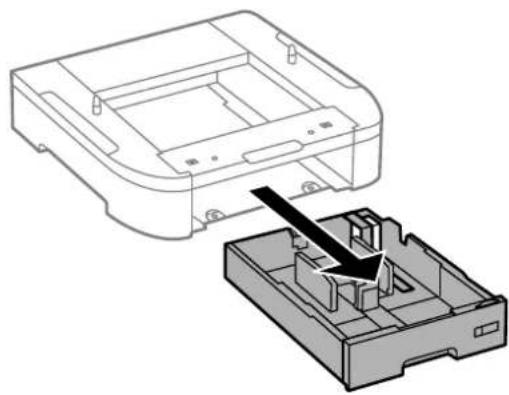
natural_image
Technical illustration of a device housing with an arrow indicating assembly or component (no text or symbols present)- If you use multiple optional cassette units, stack all optional paper cassette units on top of each other, and then secure them with the screws.
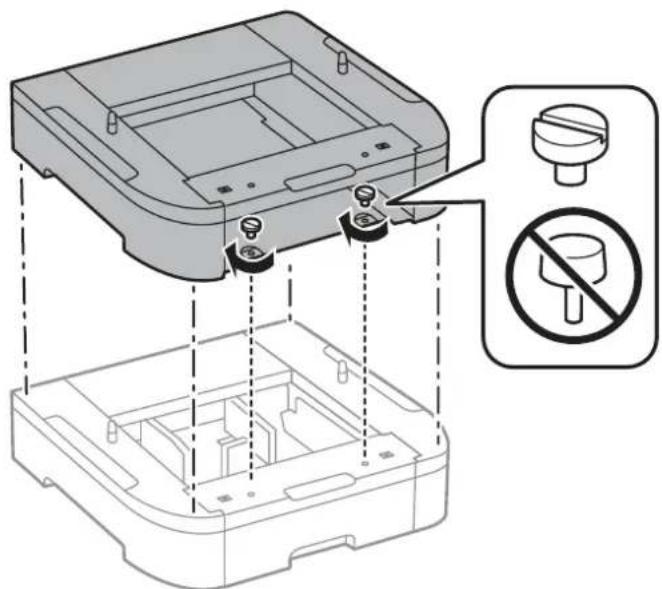
User's Guide
Installing the Optional Units
- Lower the printer gently onto the optional paper cassette aligning the corners, and then secure them with the screws.
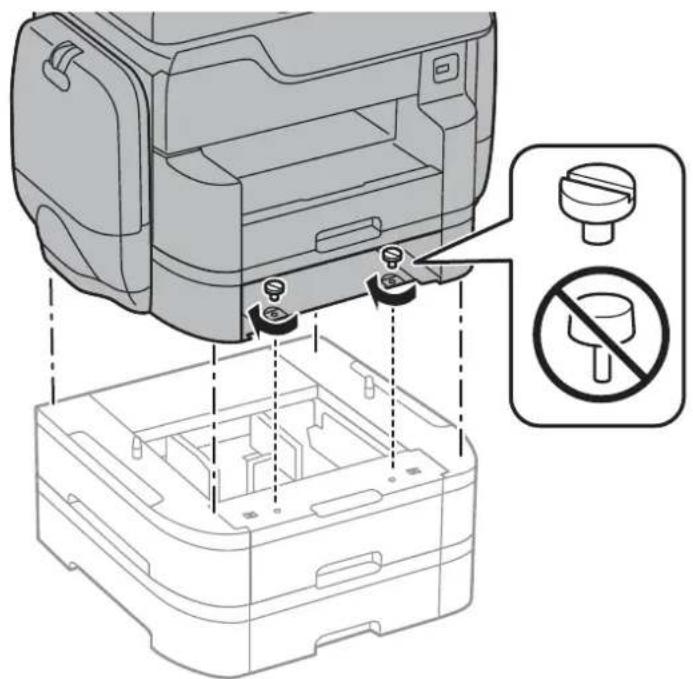
Note:
Some screws will be left over after assembly.
- Secure the optional paper cassette unit and the printer at the back with the attachments and screws.
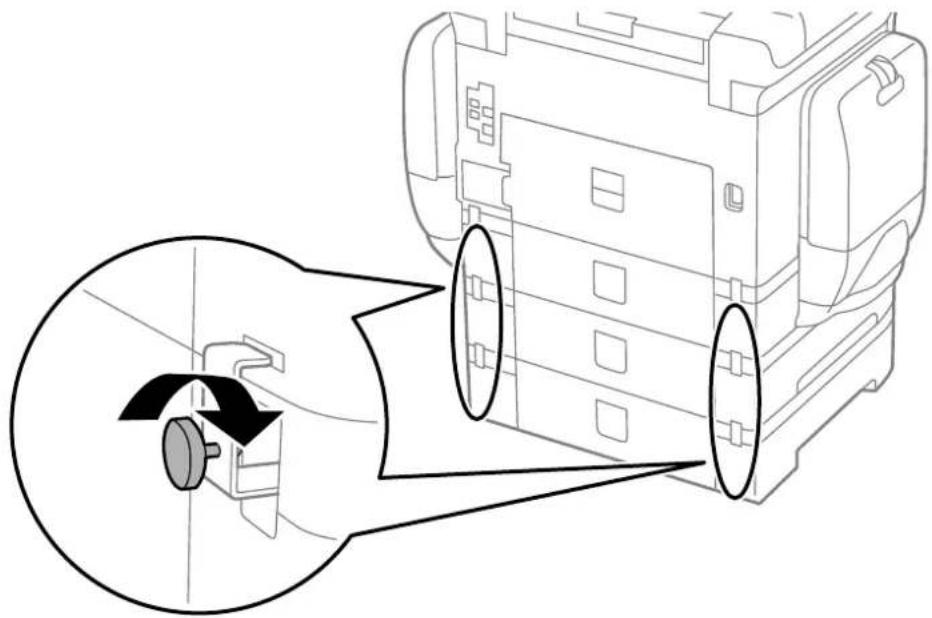
natural_image
Technical line drawing of a mechanical component with an inset showing a close-up of a rotating knob (no text or symbols present)User's Guide
Installing the Optional Units
- Insert a label showing the size of the paper to be loaded in the cassette into the holder.
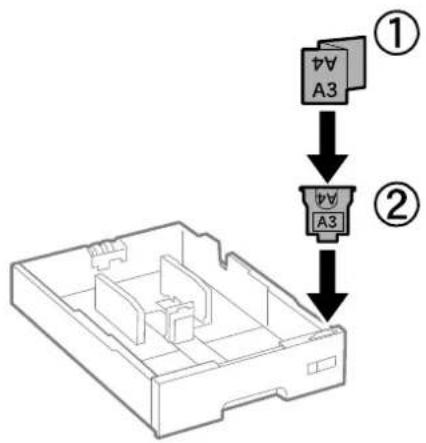
flowchart
graph TD
    A["① A3"] --> B["② A3"]
    style A fill:#f9f,stroke:#333
    style B fill:#ccf,stroke:#333
- Insert the paper cassette.
- Place the sticker indicating the cassette number.
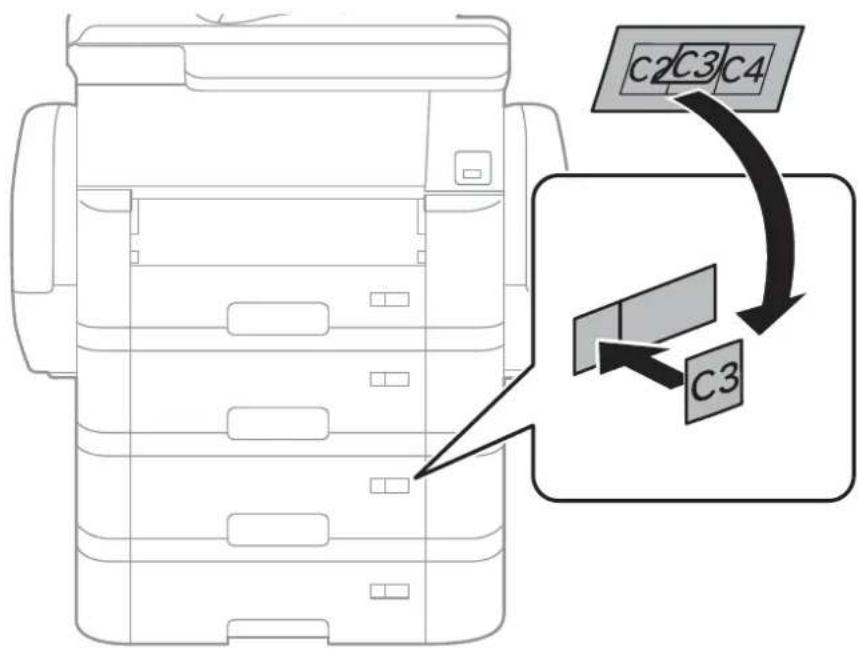
Installing the Optional Units
- Insert the output tray.
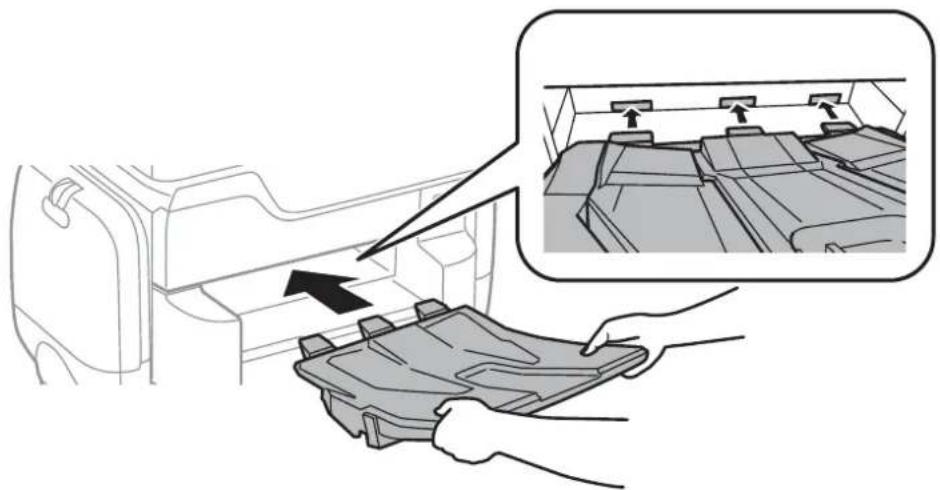
natural_image
Illustration of a hand placing a plastic tray into a vehicle chassis, with an inset showing a rack assembly (no text or symbols present)-
Reconnect the power cord and any other cables, and then plug in the printer.
-
Turn on the printer by pressing the ⏻ button.
-
Press the button, and check that the optional cassette unit that you installed is displayed on the Paper Setting screen.
Note:
When uninstalling the optional paper cassette unit, turn off the printer, unplug the power cord, disconnect any cables, and then perform the installation procedure in reverse.
Proceed with the printer driver settings.
Related Information
→ "Optional Paper Cassette Unit Code" on page 274
→ "Installing the Optional Cabinet" on page 269
Setting the Optional Paper Cassette Unit in the Printer Driver
To use the installed optional paper cassette unit, the printer driver needs to acquire the necessary information.
Setting the Optional Paper Cassette Unit in the Printer Driver - Windows
Note:
Log on to your computer as an administrator.
- Open the Optional Settings tab from the printer properties.
Windows 10
Right-click on the start button, or press and hold it and then select Control Panel > View devices and printers in Hardware and Sound. Right-click on your printer, or press and hold it, select Printer properties, and then click the Optional Settings tab.
Installing the Optional Units
☐ Windows 8.1/Windows 8/Windows Server 2012 R2/Windows Server 2012
Select Desktop > Settings > Control Panel > View devices and printers in Hardware and Sound. Right-click on your printer, or press and hold it, select Printer properties, and then click the Optional Settings tab.
□ Windows 7/Windows Server 2008 R2
Click the start button, and select Control Panel > View devices and printers in Hardware and Sound. Right-click on your printer, select Printer properties, and then click the Optional Settings tab.
□ Windows Vista/Windows Server 2008
Click the start button, and then select Control Panel > Printers in Hardware and Sound. Right-click on your printer, select Property, and then click Optional Settings.
☐ Windows XP/Windows Server 2003 R2/Windows Server 2003
Click the start button, and select Control Panel > Printers and Other Hardware > Printers and Faxes. Right-click on your printer, select Property, and then click the Optional Settings tab.
- Select Acquire from Printer, and then click Get.
Optional Paper Sources information is displayed in Current Printer Information.
- Click OK.
Setting the Optional Paper Cassette Unit in the Printer Driver - Mac OS X
- Select System Preferences from the menu > Printers & Scanners (or Print & Scan, Print & Fax), and then select the printer. Click Options & Supplies > Options (or Driver).
- Set Lower Cassette according to the number of paper cassettes.
- Click OK.
Appendix
Technical Specifications
Printer Specifications
| Print Head Nozzle Placement | Black ink nozzles: 800Color ink nozzles: 800 for each color | |
| Weight of Paper * | Plain Paper | 64 to 90 g/m2(17 to 24lb) |
| Thick Paper | 91 to 256 g/m2(25 to 68 lb) | |
| Envelopes | Envelope #10, DL, C6: 75 to 90 g/m2(20 to 24 lb)Envelope C4: 80 to 100 g/m2(21 to 26 lb) | |
* Even when the paper thickness is within this range, the paper may not feed in the printer or print result may adversely affected depending on the paper property or quality.
Printable Area
Printable Area for Single Sheets
Print quality may decline in the shaded areas due to the printer's mechanism.
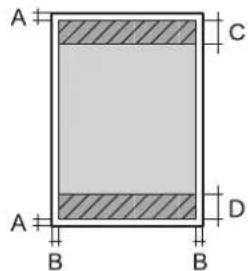
| A | 3.0 mm (0.12 in.) |
| B | 3.0 mm (0.12 in.) |
| C | 49.0 mm (1.93 in.) |
| D | 54.0 mm (2.13 in.) |
Printable Area for Envelopes
Print quality may decline in the shaded areas due to the printer's mechanism.
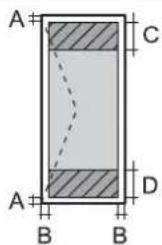
| A | 3.0 mm (0.12 in.) |
| B | 5.0 mm (0.20 in.) |
| C | 54.0 mm (2.13 in.) |
| D | 49.0 mm (1.93 in.) |
Appendix
Scanner Specifications
| Scanner Type | Flatbed |
| Photoelectric Device | CIS |
| Effective Pixels | 14040×20400 pixels (1200 dpi) |
| Maximum Document Size | 297×431.8 mm (11.7×17 in.)A3,Ledger |
| Scanning Resolution | 1200 dpi (main scan)2400 dpi (sub scan) |
| Output Resolution | 50 to 9600 dpi in 1 dpi increments |
| Color Depth | Color☐ 30 bits per pixel internal (10 bits per pixel per color internal)☐ 24 bits per pixel external (8 bits per pixel per color external)Grayscale☐ 16 bits per pixel internal☐ 8 bits per pixel externalBlack and white☐ 16 bits per pixel internal☐ 1 bits per pixel external |
| Light Source | LED |
Interface Specifications
| For Computer | SuperSpeed USB |
| For External USB Devices | Hi-Speed USB |
Fax Specifications
| Fax Type | Walk-up black and white and color fax capability (ITU-T Super Group 3) |
| Supported Lines | Standard analogue telephone lines, PBX (Private Branch Exchange) telephone systems |
| Speed | Up to 33.6 kbps |
Appendix
| Resolution | MonochromeStandard: 8 pel/mm×3.85 line/mm (203 pel/in.×98 line/in.)Fine: 8 pel/mm×7.7 line/mm (203 pel/in.×196 line/in.)Super Fine: 8 pel/mm×15.4 line/mm (203 pel/in.×392 line/in.)Ultra Fine: 16 pel/mm×15.4 line/mm (406 pel/in.×392 line/in.)Color200×200 dpi |
| Page Memory | Up to 550 pages (when received ITU-T No.1 chart in monochrome draft mode) |
| Redial^* | 2 times (with 1 minute intervals) |
| Interface | RJ-11 Phone Line, RJ-11 Telephone set connection |
* The specifications may differ by country or region.
Network Function List
| Functions | Supported | Remarks | ||
| Network Interfaces | Ethernet | ✓ | - | |
| Wi-Fi | Infrastructure | ✓ | - | |
| Ad hoc | - | - | ||
| Wi-Fi Direct (Simple AP) | ✓ | - | ||
| Concurrent Connection | Ethernet and Wi-Fi Direct (Simple AP) | ✓ | - | |
| Wi-Fi (Infrastructure) and Wi-Fi Direct (Simple AP) | ✓ | - | ||
Appendix
| Functions | Supported | Remarks | ||
| Panel Operation | Wi-Fi Setup | Wi-Fi Setup Wizard | ✓ | - |
| Push Button Setup (WPS) | ✓ | - | ||
| PIN Code Setup | ✓ | - | ||
| Wi-Fi Auto Connect | ✓ | - | ||
| Epson iPrint Connection | - | - | ||
| Wi-Fi Direct Setup | ✓ | - | ||
| General Network Setup (device name, TCP/IP address, DNS server, proxy Server) | ✓ | - | ||
| Network Connection Check | ✓ | - | ||
| Network Status | ✓ | - | ||
| Network Status Sheet Printing | ✓ | - | ||
| Disable Wi-Fi | ✓ | - | ||
| Restore the Factory Default Settings | ✓ | - | ||
| File Sharing Setup | ✓ | External USB storage only | ||
| Network Printing | EpsonNet Print (Windows) | IPv4 | ✓ | - |
| Standard TCP/IP (Windows) | IPv4, IPv6 | ✓ | - | |
| WSD Printing (Windows) | IPv4, IPv6 | ✓ | Windows Vista or later | |
| Bonjour Printing (Mac OS X) | IPv4, IPv6 | ✓ | - | |
| IPP Printing (Windows, Mac OS X) | IPv4, IPv6 | ✓ | - | |
| UPnP Printing | IPv4 | - | Information appliance | |
| PictBridge Printing (Wi-Fi) | IPv4 | - | Digital camera | |
| Epson Connect (Email Print) | IPv4 | ✓ | - | |
| AirPrint (iOS, Mac OS X) | IPv4, IPv6 | ✓ | iOS 5 or later, Mac OS X v10.7 or later | |
| Google Cloud Print | IPv4, IPv6 | ✓ | - | |
Appendix
| Functions | Supported | Remarks | ||
| Network Scanning | Epson Scan 2 | IPv4, IPv6 | √ | - |
| Event Manager | IPv4 | - | - | |
| Document Capture Pro(Win) / Document Capture(Mac) | IPv4 | √ | - | |
| Epson Connect (Scan to Cloud) | IPv4 | √ | - | |
| AirPrint (Scan) | IPv4, IPv6 | √ | Mac OS X v10.9 or later | |
| ADF (2-sided scanning) | √ | - | ||
| Fax | Send a fax | IPv4 | √ | - |
| Receive a fax | IPv4 | √ | - | |
| AirPrint (Faxout) | IPv4, IPv6 | √ | Mac OS X v10.8 or later | |
Wi-Fi Specifications
| Standards | IEEE802.11b/g/n*1 |
| Frequency Range | 2.4 GHz |
| Maximum Radio-Frequency Power Transmitted | 19.8 dBm (EIRP) |
| Coordination Modes | Infrastructure, Wi-Fi Direct (Simple AP)*2 |
| Wireless Securities | WEP (64/128bit), WPA2-PSK (AES)*3, WPA2-Enterprise |
*1 IEEE802.11n is only available for the HT20.
*2 Not supported for IEEE 802.11b.
*3 Complies with WPA2 standards with support for WPA/WPA2 Personal.
Ethernet Specifications
| Standards | IEEE802.3i (10BASE-T)*1 |
| IEEE802.3u (100BASE-TX) | |
| IEEE802.3ab (1000BASE-T)*1 | |
| IEEE802.3az (Energy Efficient Ethernet)*2 | |
| Communication Mode | Auto, 10Mbps Full duplex, 10Mbps Half duplex, 100Mbps Full duplex, 100Mbps Half duplex |
| Connector | RJ-45 |
Appendix
*1 Use a category 5e or higher STP (Shielded twisted pair) cable to prevent risk of radio interference.
*2 The connected device should comply with IEEE802.3az standards.
Security Protocol
| IEEE802.1X*IPsec/IP Filtering | |
| SSL/TLS | HTTPS Server/Client |
| IPPS | |
| SMTPS (STARTTLS, SSL/TLS) | |
| SNMPv3 | |
* You need to use a device for connection that complies with IEEE802.1X.
PostScript Level 3 Compatibility
The PostScript used on this printer is compatible with PostScript Level 3.
Supported Third Party Services
| AirPrint | PrintScan | iOS 5 or later/Mac OS X v10.7.x or laterMac OS X v10.9.x or later |
| Fax | Mac OS X v10.8.x or later | |
| Google Cloud Print | ||
External USB Device Specifications
| Devices | Maximum Capacities |
| MO Drive* | 1.3 GB |
| Hard Disk Drive*USB Flash Drive | 2 TB (formatted in FAT, FAT32, or exFAT.) |
* We do not recommend using external USB devices that are powered by USB. Use only external USB devices with independent AC power sources.
You cannot use the following devices:
☐ A device that requires a dedicated driver
☐ A device with security settings (password, encryption, and so on)
☐ A device with a built-in USB hub
Appendix
Epson cannot guarantee all operations of externally connected devices.
Supported Data Specifications
| File Format | JPEG taken by digital cameras DCF*1version 1.0 or 2.0*2compliantTIFF 6.0 compliant images as belowRGB full color images (not compressed)Binary images (not compressed or CCITT encoded)PDF Version 1.7 compliant data file |
| Image Size | Horizontal: 80 to 10200 pixelsVertical: 80 to 10200 pixels |
| File Size | Less than 2 GB |
| Maximum Number of Files | JPEG: 9990*3TIFF: 999PDF: 999 |
*1 Design rule for Camera File system.
*2 Photo data stored on digital cameras with a built-in memory is not supported.
*3 Up to 999 files can be displayed at a time. (If the number of files exceeds 999, the files are displayed in groups.)
Note:
"!" is displayed on the LCD screen when the printer cannot recognize the image file. In this situation, if you select a multiple image layout, blank sections will be printed.
Dimensions
Only the printer
| Dimensions | StorageWidth: 787 mm (31.0 in.)Depth: 758 mm (29.8 in.)Height: 621 mm (24.4in.)PrintingWidth: 787 mm (31.0 in.)Depth: 866 mm (34.1 in.)Height: 699 mm (27.5in.) |
| Weight* | Approx. 64.1 kg (141.3 lb) |
* Without the ink supply units and the power cord.
Appendix
Printers with options
These are the dimensions of printers with 2 optional paper cassette units and an optional cabinet.
| Dimensions | StorageWidth: 787 mm (31.0 in.)Depth: 873 mm (34.4 in.)Height: 1162 mm (45.7in.)PrintingWidth: 787 mm (31.0 in.)Depth: 873 mm (34.4 in.)Height: 1240 mm (48.8in.) |
| Weight* | Approx. 111.5 kg (245.8 lb) |
* Without the ink supply units and the power cord.
Electrical Specifications
| Model | 100 to 240 V Model | 220 to 240 V Model |
| Rated Frequency Range | 50 to 60 Hz | 50 to 60 Hz |
| Rated Current | 1.3 to 0.7 A | 0.8 A |
| Power Consumption (with USB Connection) | Standalone copying: Approx. 40 W(ISO/IEC24712)Ready mode: Approx. 20 WSleep mode: Approx. 1.6 WPower off: Approx. 0.45 W | Standalone copying: Approx. 40 W(ISO/IEC24712)Ready mode: Approx. 20 WSleep mode: Approx. 1.7 WPower off: Approx. 0.45 W |
Note:
☐ Check the label on the printer for its voltage.
☐ For European users, see the following Website for details on power consumption.
http://www.epson.eu/energy-consumption
Appendix
Environmental Specifications
| Operation | Use the printer within the range shown in the following graph. |
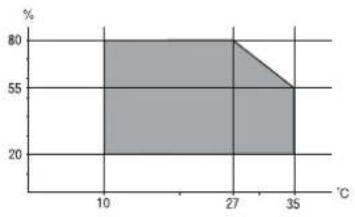 | |
| Temperature: 10 to 35°C (50 to 95°F) | |
| Humidity: 20 to 80% RH (without condensation) | |
| Storage | Temperature: -20 to 40°C (-4 to 104°F)* |
| Humidity: 5 to 85% RH (without condensation) |
* You can store for one month at 40°C (104°F).
Environmental Specifications for Ink Supply Units
| Storage Temperature | -20 to 40 °C (-4 to 104 °F)* |
| Freezing Temperature | -23 °C (9.4 °F)Ink thaws and is usable after approximately 12 hours at 25 °C (77 °F). |
* You can store for one month at 40 °C (104 °F).
System Requirements
☐ Windows 10 (32-bit, 64-bit)/Windows 8.1 (32-bit, 64-bit)/Windows 8 (32-bit, 64-bit)/Windows 7 (32-bit, 64-bit)/Windows Vista (32-bit, 64-bit)/Windows XP SP3 or later (32-bit)/Windows XP Professional x64 Edition SP2 or later/Windows Server 2012 R2/Windows Server 2012/Windows Server 2008 R2/Windows Server 2008/Windows Server 2003 R2/Windows Server 2003 SP2 or later
☐ Mac OS X v10.11.x/Mac OS X v10.10.x/Mac OS X v10.9.x/Mac OS X v10.8.x/Mac OS X v10.7.x/Mac OS X v10.6.8
Note:
☐ Mac OS X may not support some applications and features.
☐ The UNIX File System (UFS) for Mac OS X is not supported.
Font Information
Available Fonts for PostScript
| Font Name | Family | HP Equivalent |
| Nimbus Mono | Medium, Bold, Italic, Bold Italic | Courier |
| Letter Gothic | Medium, Bold, Italic | Letter Gothic |
| Nimbus Mono PS | Regular, Bold, Oblique, Bold Oblique | CourierPS |
| Nimbus Roman No4 | Medium, Bold, Italic, Bold Italic | CG Times |
| URW Classico | Medium, Bold, Italic, Bold Italic | CG Omega |
| URW Coronet | - | Coronet |
| URW Clarendon Condensed | - | Clarendon Condensed |
| URW Classic Sans | Medium, Bold, Italic, Bold Italic | Univers |
| URW Classic Sans Condensed | Medium, Bold, Italic, Bold Italic | Univers Condensed |
| Antique Olive | Medium, Bold, Italic | Antique Olive |
| Garamond | Antiqua, Halbfett, Kursiv, Kursiv Halbfett | Garamond |
| Mauritius | - | Marigold |
| Algiers | Medium, Extra Bold | Albertus |
| NimbusSansNo2 | Medium, Bold, Italic, Bold Italic | Arial |
| Nimbus Roman No9 | Medium, Bold, Italic, Bold Italic | Times New Roman |
| Nimbus Sans | Medium, Bold, Oblique, Bold Oblique | Helvetica |
| Nimbus Sans Narrow | Medium, Bold, Oblique, Bold Oblique | Helvetica Narrow |
| Palladio | Roman, Bold, Italic, Bold Italic | Palatino |
| URW Gothic | Book, Demi, Book Oblique, Demi Oblique | ITC Avant Garde |
| URW Bookman | Light, Demi, Light Italic, Demi Italic | ITC Bookman |
| URW Century Schoolbook | Roman, Bold, Italic, Bold Italic | New Century Schoolbook |
| Nimbus Roman | Medium, Bold, Italic, Bold Italic | Times |
| URW Chancery Medium Italic | - | ITC Zapf Chancery Italic |
| Symbol | - | Symbol |
| URW Dingbats | - | Wingdings |
| Dingbats | - | ITC Zapf Dingbats |
| Standard Symbol | - | SymbolIPS |
Appendix
Available Fonts for PCL (URW)
Scalable Font
| Font Name | Family | HP Equivalent | Symbol Set for PCL5 |
| Nimbus Mono | Medium, Bold, Italic, Bold Italic | Courier | 1 |
| Letter Gothic | Medium, Bold, Italic | Letter Gothic | 1 |
| Nimbus Mono PS | Regular, Bold, Oblique, Bold Oblique | CourierPS | 3 |
| Nimbus Roman No4 | Medium, Bold, Italic, Bold Italic | CG Times | 2 |
| URW Classico | Medium, Bold, Italic, Bold Italic | CG Omega | 3 |
| URW Coronet | - | Coronet | 3 |
| URW Clarendon Condensed | - | Clarendon Condensed | 3 |
| URW Classic Sans | Medium, Bold, Italic, Bold Italic | Univers | 2 |
| URW Classic Sans Condensed | Medium, Bold, Italic, Bold Italic | Univers Condensed | 3 |
| Antique Olive | Medium, Bold, Italic | Antique Olive | 3 |
| Garamond | Antiqua, Halbfett, Kursiv, Kursiv Halbfett | Garamond | 3 |
| Mauritius | - | Marigold | 3 |
| Algiers | Medium, Extra Bold | Albertus | 3 |
| NimbusSansNo2 | Medium, Bold, Italic, Bold Italic | Arial | 3 |
| Nimbus Roman No9 | Medium, Bold, Italic, Bold Italic | Times New | 3 |
| Nimbus Sans | Medium, Bold, Oblique, Bold Oblique | Helvetica | 3 |
| Nimbus Sans Narrow | Medium, Bold, Oblique, Bold Oblique | Helvetica Narrow | 3 |
| Palladio | Roman, Bold, Italic, Bold Italic | Palatino | 3 |
| URW Gothic | Book, Demi, Book Oblique, Demi Oblique | ITC Avant Garde Gothic | 3 |
| URW Bookman | Light, Demi, Light Italic, Demi Italic | ITC Bookman | 3 |
| URW Century Schoolbook | Roman, Bold, Italic, Bold Italic | New Century Schoolbook | 3 |
| Nimbus Roman | Medium, Bold, Italic, Bold Italic | Times | 3 |
| URW Chancery Medium Italic | - | ITC Zapf Chancery Medium Italic | 3 |
| Symbol | - | Symbol | 4 |
| URW Dingbats | - | Wingdings | 5 |
| Dingbats | - | ITC Zapf Dingbats | 6 |
| Standard Symbol | - | SymbolPS | 4 |
Appendix
| Font Name | Family | HP Equivalent | Symbol Set for PCL5 |
| URW David | Medium, Bold | HP David | 7 |
| URW Narkis | Medium, Bold | HP Narkis | 7 |
| URW Miryam | Medium, Bold, Italic | HP Miryam | 7 |
| URW Koufi | Medium, Bold | Koufi | 8 |
| URW Naskh | Medium, Bold | Naskh | 8 |
| URW Ryadh | Medium, Bold | Ryadh | 8 |
Bitmap Font
| Font Name | Symbol Set |
| Line Printer | 9 |
OCR/Barcode Bitmap Font (for PCL5 only)
| Font Name | Family | Symbol Set |
| OCR A | - | 10 |
| OCR B | - | 11 |
| Code39 | 9.37cpi, 4.68cpi | 12 |
| EAN/UPC | Medium, Bold | 13 |
Note:
Depending on the print density, or on the quality or color of the paper, OCR A, OCR B, Code39, and EAN/UPC fonts may not be readable. Print a sample and make sure the fonts can be read before printing large quantities.
List of Symbol Sets
Your printer can access a variety of symbol sets. Many of these symbol sets differ only in the international characters specific to each language.
When you are considering which font to use, you should also consider which symbol set to combine with the font.
Note:
Since most software handles fonts and symbols automatically, you will probably never need to adjust the printer's settings. However, if you are writing your own printer control programs, or if you are using older software that cannot control fonts, refer to the following sections for symbol set details.
Appendix
List of Symbol Sets for PCL 5
| Symbol Set Name | Attribute | Font Classification | ||||||||||||
| 1 | 2 | 3 | 4 | 5 | 6 | 7 | 8 | 9 | 10 | 11 | 12 | 13 | ||
| Norweg1 | 0D | ✓ | ✓ | ✓ | - | - | - | - | - | - | - | - | - | - |
| Roman Extension | 0E | - | - | - | - | - | - | - | - | ✓ | - | - | - | - |
| Italian | 0I | ✓ | ✓ | ✓ | - | - | - | - | - | - | - | - | - | - |
| ECM94-1 | 0N | ✓ | ✓ | ✓ | - | - | - | - | - | ✓ | - | - | - | - |
| Swedis2 | 0S | ✓ | ✓ | ✓ | - | - | - | - | - | - | - | - | - | - |
| ANSI ASCII | 0U | ✓ | ✓ | ✓ | - | - | - | ✓ | ✓ | - | - | - | - | - |
| UK | 1E | ✓ | ✓ | ✓ | - | - | - | - | - | - | - | - | - | - |
| French2 | 1F | ✓ | ✓ | ✓ | - | - | - | - | - | - | - | - | - | - |
| German | 1G | ✓ | ✓ | ✓ | - | - | - | - | - | - | - | - | - | - |
| Legal | 1U | ✓ | ✓ | ✓ | - | - | - | - | - | ✓ | - | - | - | - |
| 8859-2 ISO | 2N | ✓ | ✓ | ✓ | - | - | - | - | - | ✓ | - | - | - | - |
| Spanish | 2S | ✓ | ✓ | ✓ | - | - | - | - | - | - | - | - | - | - |
| ISO 8859/4 Latin 4 | 4N | ✓ | ✓ | ✓ | - | - | - | - | - | - | - | - | - | - |
| Roman-9 | 4U | ✓ | ✓ | ✓ | - | - | - | - | - | - | - | - | - | - |
| PsMath | 5M | ✓ | ✓ | ✓ | - | - | - | ✓ | ✓ | - | - | - | - | - |
| 8859-9 ISO | 5N | ✓ | ✓ | ✓ | - | - | - | - | - | ✓ | - | - | - | - |
| WiTurkish | 5T | ✓ | ✓ | ✓ | - | - | - | - | - | - | - | - | - | - |
| MsPublishin | 6J | ✓ | ✓ | ✓ | - | - | - | - | - | - | - | - | - | - |
| VeMath | 6M | ✓ | ✓ | ✓ | - | - | - | - | - | - | - | - | - | - |
| 8859-10ISO | 6N | ✓ | ✓ | ✓ | - | - | - | - | - | ✓ | - | - | - | - |
| DeskTop | 7J | ✓ | ✓ | ✓ | - | - | - | - | - | - | - | - | - | - |
| Math-8 | 8M | ✓ | ✓ | ✓ | - | - | - | ✓ | ✓ | - | - | - | - | - |
| Roman-8 | 8U | ✓ | ✓ | ✓ | - | - | - | - | - | ✓ | - | - | - | - |
| WiE.Europe | 9E | ✓ | ✓ | ✓ | - | - | - | - | - | - | - | - | - | - |
| Pc1004 | 9J | ✓ | ✓ | ✓ | - | - | - | - | - | - | - | - | - | - |
| 8859-15ISO | 9N | ✓ | ✓ | ✓ | - | - | - | - | - | ✓ | - | - | - | - |
| PcTk437 | 9T | ✓ | ✓ | ✓ | - | - | - | - | - | - | - | - | - | - |
| Windows | 9U | ✓ | ✓ | ✓ | - | - | - | - | - | - | - | - | - | - |
Appendix
| Symbol Set Name | Attribute | Font Classification | ||||||||||||
| 1 | 2 | 3 | 4 | 5 | 6 | 7 | 8 | 9 | 10 | 11 | 12 | 13 | ||
| PsText | 10J | ✓ | ✓ | ✓ | - | - | - | - | - | - | - | - | - | - |
| IBM-US | 10U | ✓ | ✓ | ✓ | - | - | - | - | - | ✓ | - | - | - | - |
| IBM-DN | 11U | ✓ | ✓ | ✓ | - | - | - | - | - | ✓ | - | - | - | - |
| McText | 12J | ✓ | ✓ | ✓ | - | - | - | - | - | - | - | - | - | - |
| PcMultiling | 12U | ✓ | ✓ | ✓ | - | - | - | - | - | ✓ | - | - | - | - |
| VeInternati | 13J | ✓ | ✓ | ✓ | - | - | - | - | - | - | - | - | - | - |
| PcEur858 | 13U | ✓ | ✓ | ✓ | - | - | - | - | - | - | - | - | - | - |
| VeUS | 14J | ✓ | ✓ | ✓ | - | - | - | - | - | - | - | - | - | - |
| PiFont | 15U | ✓ | ✓ | ✓ | - | - | - | - | - | - | - | - | - | - |
| PcE.Europe | 17U | ✓ | ✓ | ✓ | - | - | - | - | - | - | - | - | - | - |
| Unicode 3.0 | 18N | ✓ | ✓ | ✓ | - | - | - | ✓ | ✓ | - | - | - | - | - |
| WiBALT | 19L | ✓ | ✓ | ✓ | - | - | - | - | - | - | - | - | - | - |
| WiAnsi | 19U | ✓ | ✓ | ✓ | - | - | - | - | - | - | - | - | - | - |
| PcBlt775 | 26U | ✓ | ✓ | ✓ | - | - | - | - | - | - | - | - | - | - |
| Pc866Cyr | 3R | ✓ | ✓ | - | - | - | - | - | - | - | - | - | - | - |
| Greek8 | 8G | ✓ | ✓ | - | - | - | - | - | - | - | - | - | - | - |
| WinGrk | 9G | ✓ | ✓ | - | - | - | - | - | - | - | - | - | - | - |
| WinCyr | 9R | ✓ | ✓ | - | - | - | - | - | - | - | - | - | - | - |
| Pc851Grk | 10G | ✓ | ✓ | - | - | - | - | - | - | - | - | - | - | - |
| ISOCyr | 10N | ✓ | ✓ | - | - | - | - | - | - | ✓ | - | - | - | - |
| Pc8Grk | 12G | ✓ | ✓ | - | - | - | - | - | - | - | - | - | - | - |
| ISOGrk | 12N | ✓ | ✓ | - | - | - | - | - | - | - | - | - | - | - |
| Pc866Ukr | 14R | ✓ | ✓ | - | - | - | - | - | - | - | - | - | - | - |
| Hebrew7 | 0H | ✓ | - | - | - | - | - | ✓ | - | - | - | - | - | - |
| 8859-8 ISO | 7H | ✓ | - | - | - | - | - | ✓ | - | - | - | - | - | - |
| Hebrew8 | 8H | ✓ | - | - | - | - | - | ✓ | - | - | - | - | - | - |
| Pc862Heb | 15H | ✓ | - | - | - | - | - | ✓ | - | - | - | - | - | - |
| PC-862, Hebrew | 15Q | ✓ | - | - | - | - | - | ✓ | - | - | - | - | - | - |
| Arabic8 | 8V | - | - | - | - | - | - | - | ✓ | - | - | - | - | - |
| HPWARA | 9V | - | - | - | - | - | - | - | ✓ | - | - | - | - | - |
Appendix
| Symbol Set Name | Attribute | Font Classification | ||||||||||||
| 1 | 2 | 3 | 4 | 5 | 6 | 7 | 8 | 9 | 10 | 11 | 12 | 13 | ||
| Pc864Ara | 10V | - | - | - | - | - | - | - | √ | - | - | - | - | - |
| Symbol | 19M | - | - | - | √ | - | - | - | - | - | - | - | - | - |
| Wingdings | 579L | - | - | - | - | √ | - | - | - | - | - | - | - | - |
| ZapfDigbats | 14L | - | - | - | - | - | √ | - | - | - | - | - | - | - |
| OCR A | 0O | - | - | - | - | - | - | - | - | - | √ | - | - | - |
| OCR B | 1O | - | - | - | - | - | - | - | - | - | - | √ | - | - |
| OCR B Extension | 3Q | - | - | - | - | - | - | - | - | - | - | √ | - | - |
| Code3-9 | 0Y | - | - | - | - | - | - | - | - | - | - | - | √ | - |
| EAN/UPC | 8Y | - | - | - | - | - | - | - | - | - | - | - | - | √ |
Regulatory Information
Standards and Approvals
Standards and Approvals for U.S. Model
| Safety | UL60950-1CAN/CSA-C22.2 No.60950-1 |
| EMC | FCC Part 15 Subpart B Class BCAN/CSA-CEI/IEC CISPR 22 Class B |
This equipment contains the following wireless module.
Manufacturer: Askey Computer Corporation
Type: WLU6320-D69 (RoHS)
This product conforms to Part 15 of the FCC Rules and RSS-210 of the IC Rules. Epson cannot accept responsibility for any failure to satisfy the protection requirements resulting from a non-recommended modification of the product. Operation is subject to the following two conditions: (1) this device may not cause harmful interference, and (2) this device must accept any interference received, including interference that may cause undesired operation of the device.
To prevent radio interference to the licensed service, this device is intended to be operated indoors and away from windows to provide maximum shielding. Equipment (or its transmit antenna) that is installed outdoors is subject to licensing.
This equipment complies with FCC/IC radiation exposure limits set forth for an uncontrolled environment and meets the FCC radio frequency (RF) Exposure Guidelines in Supplement C to OET65 and RSS-102 of the IC radio
Appendix
frequency (RF) Exposure rules. This equipment should be installed and operated so that the radiator is kept at least 7.9 inches (20 cm) or more away from a person's body (excluding extremities: hands, wrists, feet and ankles).
Standards and Approvals for European Model
For European users
Hereby, Seiko Epson Corporation declares that the following radio equipment model is in compliance with Directive 2014/53/EU. The full text of the EU declaration of conformity is available at the following website.
http://www.epson.eu/conformity
C522A
For use only in Ireland, UK, Austria, Germany, Liechtenstein, Switzerland, France, Belgium, Luxembourg, Netherlands, Italy, Portugal, Spain, Denmark, Finland, Norway, Sweden, Iceland, Croatia, Cyprus, Greece, Slovenia, Malta, Bulgaria, Czech, Estonia, Hungary, Latvia, Lithuania, Poland, Romania, and Slovakia.
Epson cannot accept responsibility for any failure to satisfy the protection requirements resulting from a non-recommended modification of the products.
CE
Standards and Approvals for Australian Model
EMC
AS/NZS CISPR22 Class B
Epson hereby declares that the following equipment Models are in compliance with the essential requirements and other relevant provisions of AS/NZS4268:
C522A
Epson cannot accept responsibility for any failure to satisfy the protection requirements resulting from a non-recommended modification of the products.
German Blue Angel
See the following website to check whether or not this printer meets the standards for the German Blue Angel.
http://www.epson.de/blauerengel
Restrictions on Copying
Observe the following restrictions to ensure the responsible and legal use of the printer.
Copying of the following items is prohibited by law:
☐ Bank bills, coins, government-issued marketable securities, government bond securities, and municipal securities
☐ Unused postage stamps, pre-stamped postcards, and other official postal items bearing valid postage
□ Government-issued revenue stamps, and securities issued according to legal procedure
Appendix
Exercise caution when copying the following items:
□ Private marketable securities (stock certificates, negotiable notes, checks, etc.), monthly passes, concession tickets, etc.
Passports, driver's licenses, warrants of fitness, road passes, food stamps, tickets, etc.
Note:
Copying these items may also be prohibited by law.
Responsible use of copyrighted materials:
Printers can be misused by improperly copying copyrighted materials. Unless acting on the advice of a knowledgeable attorney, be responsible and respectful by obtaining the permission of the copyright holder before copying published material.
Moving and Transporting the Printer

Caution:
☐ When carrying the printer, lift it using a stable position. Lifting the printer using an unstable position may result in injury.
Because this printer is heavy, it should always be carried by two or more people when unpacking and transporting.
☐ When lifting the printer, place your hands in the positions shown below. If you lift the printer holding other positions, the printer may fall or you may trap your fingers when placing the printer.
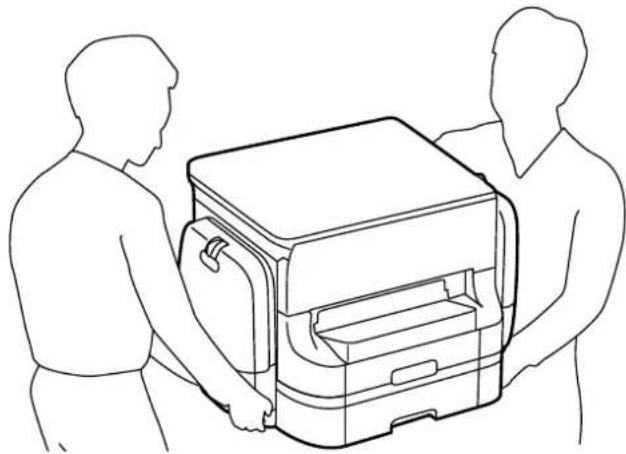
natural_image
Line drawing of two people handling a large box (no text or symbols)☐ When carrying the printer, do not tilt it more than 10 degrees; otherwise the printer may fall.
Moving the Printer

Caution:
Do not attach the output tray to the ADF as it is unstable. If the printer moves unexpectedly while it is being moved, you may be injured.
Appendix
-
Turn off the printer by pressing the ⏻ button.
-
Make sure the power light turns off, and then unplug the power cord.

Important:
Unplug the power cord when the power light is off. Otherwise, the print head does not return to the home position causing the ink to dry, and printing may become impossible.
-
Disconnect all cables such as the power cord and USB cable.
-
Remove the output tray.
-
Remove all of the paper from the printer.
-
Make sure there are no originals on the printer.
-
Store the paper support.
-
Open the ink case.
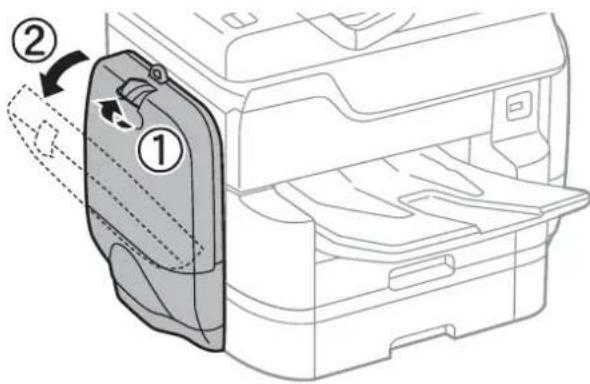
- Push the handle on the ink supply unit.
The ink supply unit will pop out.
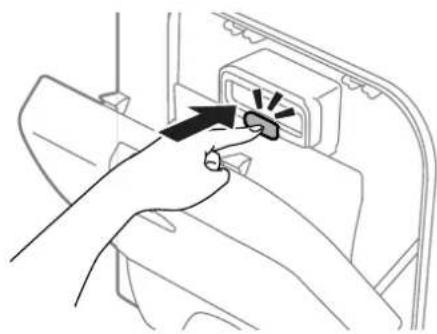
natural_image
Line drawing of a hand pressing a button on a device (no text or symbols)Appendix
- Lift up the ink supply unit.
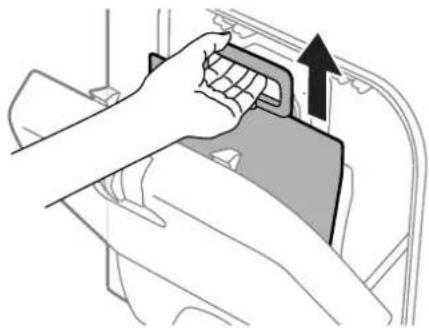
natural_image
Illustration of a hand inserting a component into a car interior (no text or symbols)Note:
☐ If you cannot lift up the ink supply unit, pull the handle forward.
□ Transport the removed ink supply units with the ink supply port facing up and the ink supply units laying down.
☐ Do not drop or knock the ink supply unit against hard objects; otherwise, the ink may leak.
- Close the ink case.
- Open another ink case on the opposite side of the printer, remove all ink supply units.
The printer is ready to be moved.
Related Information
→ "Part Names and Functions" on page 16
Moving the Printer While the Optional Paper Cassette Units are Attached
Complete the steps for moving the printer and then remove paper cassette 3 and 4. Next, perform the steps in the following images.
①
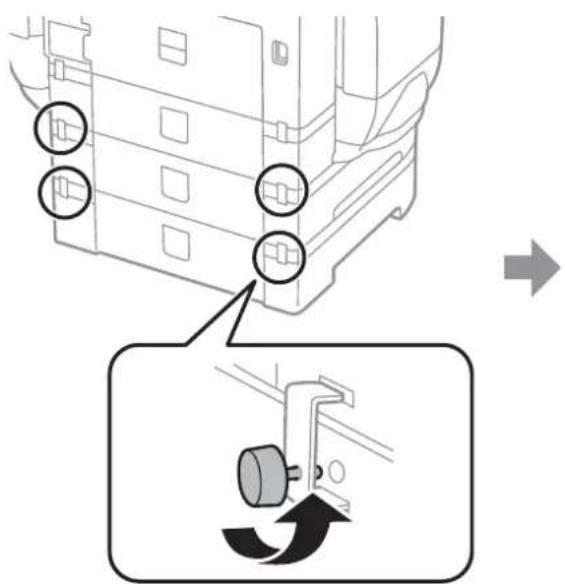
②
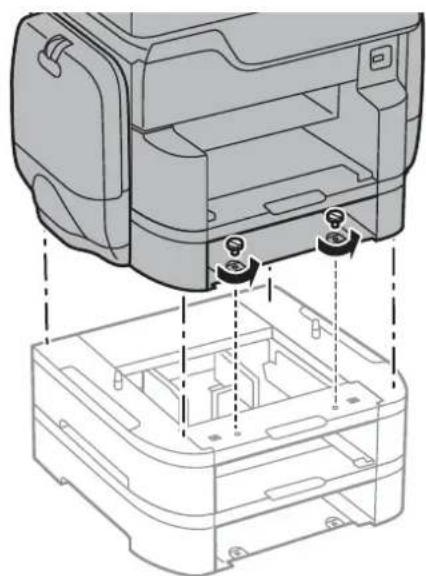
natural_image
Technical line drawing of a device's internal components, showing top and side views with no text or symbolsAppendix
Related Information
→ "Moving the Printer" on page 297
Moving the Printer While the Optional Cabinet is Attached
Before moving the printer, uninstall the cabinet's stand. Complete the steps for moving the printer, and then perform the steps in the following images.
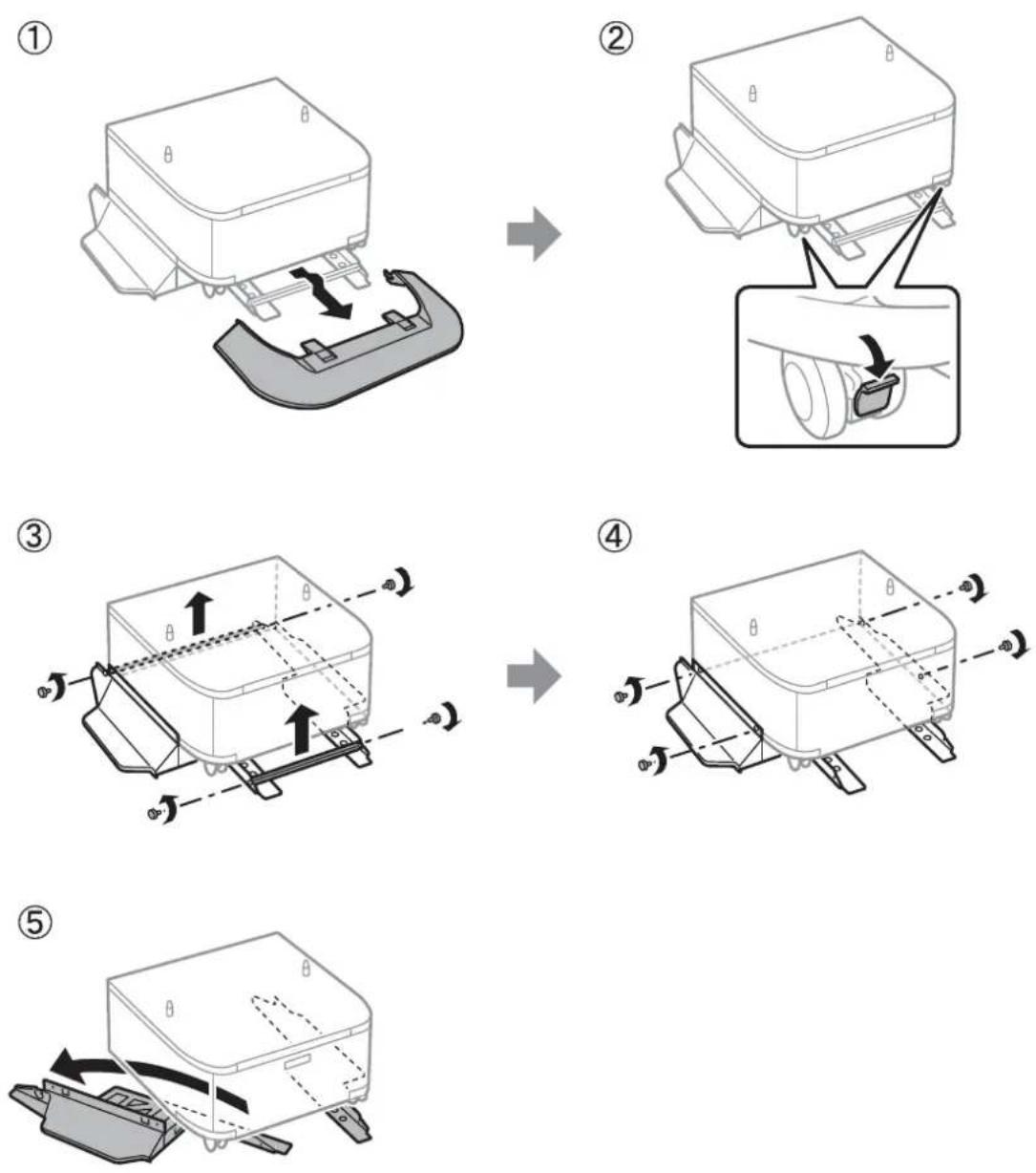
Related Information
→ "Moving the Printer" on page 297
Appendix
Transporting the Printer
Uninstall the optional cabinet and paper cassette units, and then pack the printer in its box using the protective materials.
-
Uninstall the optional paper cassette units and cabinet if installed.
-
Follow the steps for moving the printer.
-
Pack the printer in its box using the protective material.
☐ When storing or transporting the printer, avoid tilting it, placing it vertically, or turning it upside down; otherwise ink may leak.
☐ Remove the ink supply units before you transport the printer; otherwise ink may leak during transporting. After the transportation, re-install the ink supply units as soon as possible to prevent the print head drying out.
☐ Leave the maintenance box installed; otherwise ink may leak during transporting.
Note:
If print quality has declined the next time you print, clean and align the print head.
Related Information
→ "Checking and Cleaning the Print Head" on page 194
→ "Adjusting the Print Quality" on page 193
Accessing an External USB Device From a Computer
You can write or read data on an external USB device such as a USB flash drive that has been inserted in the printer from a computer.

Important:
When sharing an external device inserted in the printer between computers connected over USB and over a network, write access is only allowed to the computers that are connected by the method you selected on the printer. To write to the external USB device, select a connection method from the following menu on the printer's control panel.
Settings > General Settings > Printer Settings > Memory Device Interface > File Sharing.
Note:
It takes a while to recognize data from a computer if a large external USB device, such as 2TB HDD, is connected.
Windows
Select an external USB device in Computer or My Computer. The data on the external USB device is displayed.
Note:
If you connected the printer to the network without using the software disc or Web Installer, map a USB port as a network drive. Open Run and enter a printer name \XXXXX or a printer's IP address \XXX.XXX.XXX.XXX to Open:. Right-click a device icon displayed to assign the network. The network drive appears in Computer or My Computer.
Appendix
Mac OS X
Select a corresponding device icon. The data on the external USB device is displayed.
Note:
☐ To remove an external USB device, drag and drop the device icon to the trash icon. Otherwise, data in the shared drive may not be displayed correctly when another external USB device is inserted.
☐ To access an external storage device through the network, select Go > Connect to Server from the menu on the desktop Enter a printer name cifs://XXXXX or smb://XXXXX (Where "xxxxx" is the printer name) in the Server Address, and then click Connect.
Using an Email Server
To use email features, such as scan or fax forwarding features, you need to configure the email server.
Configuring Mail Server
Check the following before configuring the email server.
☐ The printer is connected to the network.
☐ The email server information, such as the documents from your service provider that you used to setup the email on your computer.
Note:
If you use a free email service, such as Internet email, search the Internet to get the email server information you need.
- Tap Settings on the home screen.
- Tap General Settings > Network Settings > Advanced.
- Tap Email Server > Server Settings.
- Select the authentication method of the email server you are using.

Important:
The following authentication methods are available.
□ Off
□ POP before SMTP
SMTP-AUTH
Contact your internet service provider to confirm the authentication method of the email server.
The printer may not be able to communicate with an email server even if the authentication method is available since security may be enhanced (for example SSL communication is necessary). Visit the Epson support website for the latest information.
http://www.epson.eu/Support (Europe)
http://support.epson.net/ (outside Europe)
Appendix
5. Make the appropriate settings.
The necessary settings vary depending on the authentication method. Enter the information for the email server you are using.
6. Tap Proceed.
Note:
☐ If an error message is displayed, check if the email server settings are correct.
☐ When you cannot send an email even if the connection check succeeds, check the authentication method for the email server you are using.
Related Information
→ "Email Server Setting Items" on page 303
Email Server Setting Items
| Items | Explanations |
| Authenticated Account | If you select SMTP-AUTH or POP before SMTP as the Authentication Method, enter the user name (email address) registered to the email server within 255 characters or less. |
| Authenticated Password | If you select SMTP-AUTH or POP before SMTP as the Authentication Method, enter the password of the authenticated account within 20 characters or less. |
| Sender's Address | Specify the email address that the printer uses to send emails. You can specify the existing email address. To make it clear that the email is being sent from the printer, you can acquire an address specifically for the printer and enter it here. |
| SMTP Server Address | Enter the server address of the server that sends the email (SMTP server). |
| SMTP Server Port Number | Enter the port number of the server that sends the email (SMTP server). |
| POP3 Server Address | If you select POP before SMTP as the Authentication Method, enter the server address of the server that receives the email (POP3 server). |
| POP3 Server Port Number | If you select POP before SMTP as the Authentication Method, enter the port number of the email server that receives the email (POP3 server). |
| Secure Connection | If you select SMTP-AUTH or Off as the Authentication Method, select the method of the secure connection. |
Checking an Email Server Connection
- Tap Settings on the home screen.
- Tap General Settings > Network Settings > Advanced.
Appendix
- Tap Email Server > Connection Check to check that the printer is connected to the email server.
Note:
☐ If an error message is displayed, check if the email server settings are correct.
☐ When you cannot send an email even if the connection check succeeds, check the authentication method for the email server you are using.
Where to Get Help
Technical Support Web Site
If you need further help, visit the Epson support website shown below. Select your country or region and go to the support section of your local Epson website. The latest drivers, FAQs, manuals, or other downloadables are also available from the site.
http://support.epson.net/
http://www.epson.eu/Support (Europe)
If your Epson product is not operating properly and you cannot solve the problem, contact Epson support services for assistance.
Contacting Epson Support
Before Contacting Epson
If your Epson product is not operating properly and you cannot solve the problem using the troubleshooting information in your product manuals, contact Epson support services for assistance. If Epson support for your area is not listed below, contact the dealer where you purchased your product.
Epson support will be able to help you much more quickly if you give them the following information:
□ Product serial number
(The serial number label is usually on the back of the product.)
□ Product model
□ Product software version
(Click About, Version Info, or a similar button in the product software.)
☐ Brand and model of your computer
☐ Your computer operating system name and version
□ Names and versions of the software applications you normally use with your product
Note:
Depending on the product, the dial list data for fax and/or network settings may be stored in the product's memory. Due to breakdown or repair of a product, data and/or settings may be lost. Epson shall not be responsible for the loss of any data, for backing up or recovering data and/or settings even during a warranty period. We recommend that you make your own backup data or take notes.
Appendix
Help for Users in Europe
Check your Pan-European Warranty Document for information on how to contact Epson support.
Help for Users in Taiwan
Contacts for information, support, and services are:
World Wide Web
http://www.epson.com.tw
Information on product specifications, drivers for download, and products enquiry are available.
Epson HelpDesk
Phone: +886-2-80242008
Our HelpDesk team can help you with the following over the phone:
☐ Sales enquiries and product information
☐ Product usage questions or problems
□ Enquiries on repair service and warranty
Repair service center:
http://www.tekcare.com.tw/branchMap.page
TekCare corporation is an authorized service center for Epson Taiwan Technology & Trading Ltd.
Help for Users in Australia
Epson Australia wishes to provide you with a high level of customer service. In addition to your product manuals, we provide the following sources for obtaining information:
Internet URL
http://www.epson.com.au
Access the Epson Australia World Wide Web pages. Worth taking your modem here for the occasional surf! The site provides a download area for drivers, Epson contact points, new product information and technical support (e-mail).
Epson Helpdesk
Phone: 1300-361-054
Epson Helpdesk is provided as a final backup to make sure our clients have access to advice. Operators on the Helpdesk can aid you in installing, configuring and operating your Epson product. Our Pre-sales Helpdesk staff can provide literature on new Epson products and advise where the nearest dealer or service agent is located. Many types of queries are answered here.
We encourage you to have all the relevant information on hand when you ring. The more information you prepare, the faster we can help solve the problem. This information includes your Epson product manuals, type of computer, operating system, application programs, and any information you feel is required.
User's Guide
Appendix
Transportation of Product
Epson recommends retaining product packaging for future transportation.
Help for Users in New Zealand
Epson New Zealand wishes to provide you with a high level of customer service. In addition to your product documentation, we provide the following sources for obtaining information:
Internet URL
http://www.epson.co.nz
Access the Epson New Zealand World Wide Web pages. Worth taking your modem here for the occasional surf! The site provides a download area for drivers, Epson contact points, new product information and technical support (e-mail).
Epson Helpdesk
Phone: 0800 237 766
Epson Helpdesk is provided as a final backup to make sure our clients have access to advice. Operators on the Helpdesk can aid you in installing, configuring and operating your Epson product. Our Pre-sales Helpdesk staff can provide literature on new Epson products and advise where the nearest dealer or service agent is located. Many types of queries are answered here.
We encourage you to have all the relevant information on hand when you ring. The more information you prepare, the faster we can help solve the problem. This information includes your Epson product documentation, type of computer, operating system, application programs, and any information you feel is required.
Transportation of Product
Epson recommends retaining product packaging for future transportation.
Help for Users in Singapore
Sources of information, support, and services available from Epson Singapore are:
World Wide Web
http://www.epson.com.sg
Information on product specifications, drivers for download, Frequently Asked Questions (FAQ), Sales Enquiries, and Technical Support via e-mail are available.
Epson HelpDesk
Toll Free: 800-120-5564
Our HelpDesk team can help you with the following over the phone:
☐ Sales enquiries and product information
☐ Product usage questions or problem troubleshooting
□ Enquiries on repair service and warranty
Appendix
Help for Users in Thailand
Contacts for information, support, and services are:
World Wide Web
http://www.epson.co.th
Information on product specifications, drivers for download, Frequently Asked Questions (FAQ), and e-mail are available.
Epson Hotline
Phone: 66-2685-9899
Email: support@eth.epson.co.th
Our Hotline team can help you with the following over the phone:
☐ Sales enquiries and product information
☐ Product usage questions or problems
□ Enquiries on repair service and warranty
Help for Users in Indonesia
Contacts for information, support, and services are:
World Wide Web
http://www.epson.co.id
☐ Information on product specifications, drivers for download
☐ Frequently Asked Questions (FAQ), Sales Enquiries, questions through e-mail
Epson Hotline
Phone: +62-1500-766
Fax: +62-21-808-66-799
Our Hotline team can help you with the following over the phone or fax:
☐ Sales enquiries and product information
□ Technical support
Epson Service Center
| Province | Company Name | Address | PhoneE-mail |
| DKI JAKARTA | ESS Jakarta MG.DUA | RUKO MANGGA DUA MALL NO. 48 JL.ARTERI MANGGA DUA - JAKARTA UTARA-DKI | (+6221)62301104jkt-technical1@epson-indonesia.co.id |
Appendix
| Province | Company Name | Address | PhoneE-mail |
| NORTH SUMATERA | ESC Medan | Kompleks Graha Niaga, Jl. Bambu II No. A-4, Medan- 20114 | (+6261)42066090/42066091mdn-technical@epson-indonesia.co.id |
| WEST JAWA | ESC Bandung | JL. CIHAMPELAS NO. 48A-BANDUNG JABAR 40116 | (+6222)4207033bdg-technical@epson-indonesia.co.id |
| DI YOGYAKARTA | ESC Yogyakarta | YAP Square, Blok A No.6 Jl. C Simanjutak YOGYAKARTA - DIY | (+62274)581065ygy-technical@epson-indonesia.co.id |
| EAST JAWA | ESC Surabaya | HITECH MALL LT.2 BLOK A NO. 24 JL. KUSUMA BANGSA NO. 116 -118 - SURABAYA JATIM | (+6231)5355035sby-technical@epson-indonesia.co.id |
| SOUTH SULAWESI | ESC Makassar | JL. GUNUNG BAWAKARAENG NO. 68E - MAKASSAR SULSEL | (+62411)328212mksr-technical@epson-indonesia.co.id |
| WEST KALIMANTAN | ESC Pontianak | JL. NUSA INDAH I NO. 40A PONTIANAK KALBAR 78117 | (+62561)735507pontianak-technical@epson-indonesia.co.id |
| PEKANBARU | ESC PEKANBARU | JL. TUANKU TAMBUSAI NO. 353 - PEKANBARU RIAU | (+62761)21420pkb-technical@epson-indonesia.co.id |
| DKI JAKARTA | ESS JAKARTA KEIAI | WISMA KEIAI LT. 1 JL. JEND. SUDIRMAN KAV. 3 JAKPUS DKI JAKARTA | (+6221)5724335ess.support@epson-indonesia.co.id |
| EAST JAWA | ESS SURABAYA | JL. JAWA NO. 2-4 KAV. 29, RUKO SURYA INTI, SURABAYA - JATIM | (+6231)5014949esssby.support@epson-indonesia.co.id |
| BANTEN | ESS SERPONG | Ruko mall WTC MATAHARI no. 953 SERPONG - Banten | (+6221)53167051esstag.support@epson-indonesia.co.id |
| CENTRAL JAWA | ESS SEMARANG | Komplek Ruko Metro Plaza Blok C20 , Jl. MT Haryono No 970 Semarang - Jawa tengah | (+6224)8313807esssmg.support@epson-indonesia.co.id |
| EAST KALIMANTAN | ESC SAMARINDA | Jl. KH. Wahid Hasyim (M. Yamin) Kel. Sempaja Selatan Kec. Samarinda Utara Samarinda- Kalimantan Timur (samping kantor pos) | (+62541)7272904escsmd.support@epson-indonesia.co.id |
| SOUTH SUMATERA | ESC PALEMBANG | Jl. H.M. Rasyid Nawawi no.249, kelurahan 9 ilir Palembang - Sumsel | (+62711)311330escplg.support@epson-indonesia.co.id |
Appendix
| Province | Company Name | Address | PhoneE-mail |
| EAST JAVA | ESC JEMBER | Jl. Panglima Besar Sudirman No.1 D JEMBER - JAWA TIMUR (Depan Balai Penelitian dan Pengolahan Kakao) | (+62331) 486468,488373jmr-admin@epson-indonesia.co.idjmr-technical@epson-indonesia.co.id |
| NORTH SULAWESI | ESC MANADO | Tekno @Megamall, Megamall LG TK-21 Jl. Piere Tendean Kawasan Megamas Boulevard Manado 95111 | (+62431)7210033MND-ADMIN@EPSON-INDONESIA.CO.ID |
For other cities not listed here, call the Hot Line: 08071137766.
Help for Users in Hong Kong
To obtain technical support as well as other after-sales services, users are welcome to contact Epson Hong Kong Limited.
Internet Home Page
http://www.epson.com.hk
Epson Hong Kong has established a local home page in both Chinese and English on the Internet to provide users with the following information:
□ Product information
□ Answers to Frequently Asked Questions (FAQs)
☐ Latest versions of Epson product drivers
Technical Support Hotline
You can also contact our technical staff at the following telephone and fax numbers:
Phone: 852-2827-8911
Fax: 852-2827-4383
Help for Users in Malaysia
Contacts for information, support, and services are:
World Wide Web
http://www.epson.com.my
☐ Information on product specifications, drivers for download
☐ Frequently Asked Questions (FAQ), Sales Enquiries, questions through e-mail
Epson Call Centre
Phone: +60 1800-8-17349
☐ Sales enquiries and product information
Appendix
☐ Product usage questions or problems
□ Enquiries on repair services and warranty
Head Office
Phone: 603-56288288
Fax: 603-5628 8388/603-5621 2088
Help for Users in India
Contacts for information, support, and services are:
World Wide Web
http://www.epson.co.in
Information on product specifications, drivers for download, and products enquiry are available.
Helpline
☐ Service, product information, and ordering consumables (BSNL Lines)
Toll-free number: 18004250011
Accessible 9am to 6pm, Monday through Saturday (Except public holidays)
□ Service (CDMA & Mobile Users)
Toll-free number: 186030001600
Accessible 9am to 6pm, Monday through Saturday (Except public holidays)
Help for Users in the Philippines
To obtain technical support as well as other after sales services, users are welcome to contact the Epson Philippines Corporation at the telephone, fax numbers and e-mail address below:
World Wide Web
http://www.epson.com.ph
Information on product specifications, drivers for download, Frequently Asked Questions (FAQ), and E-mail Enquiries are available.
Epson Philippines Customer Care
Toll Free: (PLDT) 1800-1069-37766
Toll Free: (Digital) 1800-3-0037766
Metro Manila: (+632)441-9030
Web Site: https://www.epson.com.ph/contact
E-mail: customercare@epc.epson.som.ph
Our Customer Care team can help you with the following over the phone:
☐ Sales enquiries and product information
☐ Product usage questions or problems
User's Guide
Appendix
□ Enquiries on repair service and warranty
Epson Philippines Corporation
Trunk Line: +632-706-2609
Fax: +632-706-2665


- WF-C869R
- User's Guide
- Copyright
- Trademarks
- Contents
- About This Manual
- Important Instructions
- Printer Basics
- Network Settings
- Administrator Settings
- Loading Paper
- Placing Originals
- Managing Contacts
- Printing
- Copying
- Scanning
- Faxing
- Replacing Ink Supply Units and Other Consumables
- Maintaining the Printer
- Menu Options for Settings
- Network Service and Software Information
- Solving Problems
- Installing the Optional Units
- Appendix
- Introduction to the Manuals
- Related Information
- Marks and Symbols
- Descriptions Used in this Manual
- Operating System References
- Windows
- Mac OS X
- Safety Instructions
- Printer Advisories and Warnings
- Advisories and Warnings for Setting Up/Using the Printer
- Advisories and Warnings for Using the Printer with a Wireless Connection
- Advisories and Warnings for Using the Touchscreen
- Advisories and Warnings for Using the Optional Cabinet
- Protecting Your Personal Information
- Important:
- Control Panel
- Buttons and Lights
- Basic Screen Configuration
- Touch Screen Operations
- Icons displayed in the LCD Screen
- Entering Characters
- Note:
- Job/Status Screen Configuration
- Viewing Animations
- Registering Your Favorite Settings as a Preset
- Menu Options for Presets
- Network Connection Types
- Ethernet Connection
- Wi-Fi Connection
- Wi-Fi Direct (Simple AP) Connection
- Connecting to a Computer
- Selecting the Connection Methods
- □ Mac OS X
- Connecting to a Smart Device
- Making Wi-Fi Settings from the Printer
- Making Wi-Fi Settings Manually
- Making Wi-Fi Settings by Push Button Setup (WPS)
- Tap Close.
- Making Wi-Fi Settings by PIN Code Setup (WPS)
- Making Wi-Fi Direct (Simple AP) Connection Settings
- Making Advanced Network Settings
- Setting Items for Advanced Network Settings
- Checking the Network Connection Status
- Network Icon
- Checking Detailed Network Information from the Control Panel
- Printing a Network Connection Report
- Messages and Solutions on the Network Connection Report
- b. Messages on the Network Environment
- Printing a Network Status Sheet
- Replacing or Adding New Access Points
- Changing the Connection Method to a Computer
- Selecting Change the Connection Methods
- Changing the Network Connection to Ethernet from the Control Panel
- Disabling Wi-Fi from the Control Panel
- Disconnecting Wi-Fi Direct (Simple AP) Connection from the Control Panel
- Restoring the Network Settings from the Control Panel
- Locking the Printer Settings Using an Administrator's Password
- Unlocking the Printer Settings
- User Feature Restrictions
- Paper Handling Precautions
- Available Paper and Capacities
- Genuine Epson Paper
- Commercially Available Paper
- List of Detected Paper Sizes
- List of Paper Type
- Loading Paper in the Paper Cassette
- Loading Paper in the Rear Paper Feed
- Available Originals for the ADF
- Placing Originals on the ADF
- Placing Originals on the ADF for 2-up Copying
- Placing Originals on the Scanner Glass
- Registering or Editing Contacts
- Registering or Editing Grouped Contacts
- Registering Frequently Used Contacts
- Register Contacts on a Computer
- Backing up Contacts using a Computer
- Printing from the Control Panel
- Printing JPEG Files from a Memory Device
- Printing PDF or TIFF Files from a Memory Device
- Menu Options for Memory Device
- JPEG Settings
- Basic Settings:
- Advanced:
- PDF Settings
- TIFF Settings
- ↓↑ (Display order):
- Printing from a Computer
- Authenticating Users in the Printer Driver when User Feature Restriction Is Enabled (for Windows Only)
- Printing Basics - Windows
- Printing Basics - Mac OS X
- Click Print.
- Printing on 2-Sides
- Printing on 2-Sides - Windows
- Printing on 2-Sides - Mac OS X
- Printing Several Pages on One Sheet
- Printing Several Pages on One Sheet - Windows
- Printing Several Pages on One Sheet - Mac OS X
- Printing to Fit the Paper Size
- Printing to Fit the Paper Size - Windows
- Printing to Fit the Paper Size - Mac OS X
- Printing Multiple Files Together (for Windows Only)
- Printing One Image on Multiple Sheets to Create a Poster (for Windows Only)
- Making Posters Using Overlapping Alignment Marks
- Printing Using Advanced Features
- Adding a Printing Preset to Print Easily
- Printing a Reduced or Enlarged Document
- Adjusting the Print Color
- Printing an Anti-Copy Pattern (for Windows Only)
- Printing a Watermark (for Windows Only)
- Printing a Header and Footer (for Windows Only)
- Setting a Password for a Print Job (for Windows Only)
- Printing Using a PostScript Printer Driver
- Printing Using a PostScript Printer Driver - Windows
- Make the following settings on the Paper/Quality tab.
- Click Advanced, make the following settings, and then click OK.
- Click OK.
- Click Print.
- Printing Using a PostScript Printer Driver - Mac OS X
- Setting Items for the PostScript Printer Driver
- Printing from Smart Devices
- Using Epson iPrint
- Installing Epson iPrint
- Printing Using Epson iPrint
- Printing by Touching Smart Devices to the N-Mark
- Using AirPrint
- Printing the Password Setting File
- Canceling Printing
- Canceling Printing - Job/Status Menu
- Canceling Printing - Windows
- Canceling Printing - Mac OS X
- Copying Basics
- Basic Menu Options for Copying
- Color Mode:
- Density:
- Paper Setting:
- Reduce/Enlarge:
- Original Size:
- 2-Sided:
- Advanced Menu Options for Copying
- Multi-Page:
- Original Type:
- Finishing:
- Mixed Size Originals:
- Orientation (Original):
- Book →2Pages:
- Image Quality:
- Binding Margin:
- Scanning Using the Control Panel
- Scanning to a Network Folder or FTP Server
- Menu Options for Scanning to a Folder
- Edit Location:
- Contacts:
- File Format:
- Resolution:
- Scan Area:
- Remove Shadow:
- Remove Punch Holes:
- File Name:
- Clear All Settings
- Scanning to an Email
- Menu Options for Scanning to an Email
- Subject:
- Attached File Max Size:
- Scanning Using Document Capture Pro
- Setting Operation Mode
- Scanning Using the Document Capture Pro Settings
- Scanning to a Memory Device
- Basic Menu Options for Scanning to a Memory Device
- Advanced Menu Options for Scanning to a Memory Device
- Scanning to the Cloud
- Basic Menu Options for Scanning to the Cloud
- JPEG/PDF:
- Advanced Menu Options for Scanning to the Cloud
- Scanning to a Computer (WSD)
- Setting Up a WSD Port
- Scanning from a Computer
- Authenticating Users on Epson Scan 2 when Using Access Control
- Scanning Using Epson Scan 2
- Make the following settings on the Main Settings tab.
- Make other scan settings if necessary.
- Set the file saving settings.
- Scanning from Smart Devices
- Scanning Using Epson iPrint
- Scanning by Touching Smart Devices to the N-Mark
- Setting Up a Fax
- Connecting to a Phone Line
- Compatible Telephone Lines
- Connecting the Printer to a Phone Line
- Connecting to a Standard Phone Line (PSTN) or PBX
- Connecting to DSL or ISDN
- Connecting Your Phone Device to the Printer
- Tap Fax.
- Pick up the handset.
- Making Basic Fax Settings
- Making Basic Fax Settings Using the Fax Setting Wizard
- Making Basic Fax Settings Individually
- Making Settings for a PBX Phone System
- Making Paper Source Settings to Receive Faxes
- Saving the Operation Time for Sending Faxes
- Printing Information for Received Faxes
- Printing Received Faxes on 2-Sides
- Printing Received Faxes by Splitting Pages
- Making Print Settings to Receive Reduced or Split Faxes (Acting Print)
- Sending Faxes
- Basic Fax Sending Operations
- Sending Faxes Using the Control Panel
- Tap ◊.
- When sending is complete, remove the originals.
- Sending Faxes Dialing from the External Phone Device
- Sending Faxes After Confirming the Recipient's Status
- Various Ways of Sending Faxes
- Sending Many Pages of a Monochrome Document (Direct Send)
- Sending a Fax Preferentially (Priority Send)
- Sending Faxes at a Specified Time (Send Fax Later)
- Sending a Fax with a Selected Header
- Registering Multiple Headers for Sending Faxes
- Sending a Fax Notification
- Sending a Fax and Backing Up the Data
- Sending a Fax with a Subaddress(SUB) and Password(SID)
- Sending Faxes On Demand (Using Polling Send/Bulletin Board Box)
- Registering a Polling Send/Bulletin Board Box
- Storing a Document in the Polling Send/Bulletin Board Box
- Storing a Fax Without Specifying a Recipient (Store Fax Data)
- Sending Multiple Faxes to the Same Recipient at Once (Batch Send)
- Sending Different Size Documents Using ADF (Continuous Scan(ADF))
- Sending a Fax from a Computer
- Receiving Faxes
- Setting Receiving Mode
- Settings for the Answering Machine
- Various Ways of Receiving Faxes
- Receiving Faxes Manually
- Receiving Faxes Using a Connected Telephone (Remote Receive)
- Setting Up Remote Receive
- Using Remote Receive
- Receiving Faxes by Polling (Polling Receive)
- Receiving Faxes from a Board with a Subaddress (SEP) and Password (PWD) (Polling Receive)
- Making Settings for Blocking Junk Faxes
- Saving and Forwarding Received Faxes (Unconditional Save/Forward)
- Saving Received Faxes in the Inbox (Unconditional Save/Forward)
- Setting to Save Received Faxes in the Inbox (Unconditional Save/Forward)
- Checking the Received Faxes on the LCD Screen (Unconditional Save/Forward)
- Saving Received Faxes in an External Memory Device (Unconditional Save/Forward)
- Saving Received Faxes on a Computer (Unconditional Save/Forward)
- Forwarding Received Faxes (Unconditional Save/Forward)
- Sending Email Notifications on the Results of Processing Received Faxes (Unconditional Save/Forward)
- Saving and Forwarding Received Faxes from a Specified Sender or at a Specified Time (Conditional Save/Forward)
- Setting Conditions for Saving and Forwarding Received Faxes (Conditional Save/Forward)
- Saving Received Faxes in the Inbox or the Confidential Box (Conditional Save/Forward)
- Setting to Save Received Faxes in the Inbox and Confidential Box (Conditional Save/Forward)
- Checking the Received Faxes on the LCD Screen (Conditional Save/Forward)
- Saving Received Faxes in an External Memory Device (Conditional Save/Forward)
- Forwarding Received Faxes (Conditional Save/Forward)
- Printing Received Faxes (Conditional Save/Forward)
- Sending Email Notifications on the Results of Processing Received Faxes (Conditional Save/Forward)
- Using the Fax Box Features
- Using the Inbox
- Checking the Received Documents in the Inbox
- Making Settings for the Inbox
- Using the Confidential Box
- Checking the Received Documents in the Confidential Box
- Making Settings for the Confidential Box
- Using the Stored Documents Box
- Checking the Documents in the Stored Documents Box
- Making Settings for the Stored Documents Box
- Using the Polling Send Box
- Checking the Documents in the Polling Send Box
- Making Settings for the Polling Send Box
- Using the Board Box
- Checking the Documents in the Board Box
- Making Settings for the Board Boxes
- Using Other Faxing Features
- Printing Fax Report and List
- Printing Fax Report Manually
- Setting Up to Print Fax Reports Automatically
- Transmission Report
- Forwarding Report
- Fax Log Auto Print
- Setting Security for Faxing
- Checking Fax Jobs
- Notification of Unprocessed Received Faxes
- Checking Fax Jobs in Progress
- Checking the Fax Job History
- Menu Options for Fax Mode
- Recipient
- Fax > Recipient
- Fax Settings
- Fax > Fax Settings
- Scan Settings:
- Fax Send Settings:
- More
- Menu Options for Fax Settings
- Quick Operation Button
- Send Settings
- Auto Rotation:
- Quick memory send:
- Batch Send:
- Auto Redial Count:
- Auto Redial Interval:
- Save Failure Data:
- Receive Settings
- Save to Memory Device:
- Forward:
- Email Notifications:
- Conditional Save/Forward
- Name:
- Condition(s):
- Save/Forward Destination:
- Auto Reduction:
- Split Page Settings:
- Acting Print:
- Add Reception Information:
- Print Start Timing:
- Collation Stack:
- Print Suspend Time:
- Report Settings
- Basic Settings
- Dial Tone Detection:
- Dial Mode:
- Line Type:
- Header:
- Receive Mode:
- DRD:
- Rings to Answer:
- Remote Receive:
- Rejection Fax:
- Receiving Paper Size:
- Security Settings
- Settings > General Settings > Fax Settings > Security Settings
- Check Fax Connection
- Fax Setting Wizard
- Menu Options for User Settings
- Menu Options for Fax Box
- Checking the Status of the Remaining Ink and the Maintenance Box
- Checking the Status of the Remaining Ink and the Maintenance Box - Control Panel
- Checking the Status of the Remaining Ink and the Maintenance Box - Windows
- Checking the Status of the Remaining Ink and the Maintenance Box - Mac OS X
- Ink Supply Unit Codes
- Ink Supply Unit Handling Precautions
- Handling precautions
- Consumption of Ink
- Replacing Ink Supply Units
- Maintenance Box Code
- Maintenance Box Handling Precautions
- Replacing the Maintenance Box
- Maintenance Rollers Codes
- Replacing Maintenance Rollers in Paper Cassette 1
- Pull out paper cassette 1.
- Turn the printer around, and open rear cover 1.
- Pull out rear cover 2.
- Replacing Maintenance Rollers in Paper Cassette 2 to 4
- Adjusting the Print Quality
- Checking and Cleaning the Print Head
- Checking and Cleaning the Print Head - Control Panel
- Checking and Cleaning the Print Head - Windows
- Checking and Cleaning the Print Head - Mac OS X
- Aligning Ruled Lines
- Adjusting the Print Quality for Each Paper Type
- Cleaning the Paper Path
- Cleaning the Paper Path for Ink Smears
- Cleaning the Paper Path for Paper Feeding Problems (Paper Cassette)
- Cleaning the ADF
- Open the ADF cover.
- Use a soft, moist cloth to clean the roller and the interior of the ADF.
- Cleaning the Scanner Glass
- Caution:
- Saving Power
- Saving Power - Control Panel
- Menu Options for General Settings
- Country/Region:
- Language:
- Start-up Screen:
- Edit Home:
- Wall Paper:
- Operation Time Out:
- Keyboard:
- Default Screen(Job/Status):
- Printer Settings
- Settings > General Settings > Printer Settings
- Paper Source Settings:
- A4/Letter Auto Switching:
- Auto Select Settings:
- Error Notice:
- Paper Setup Auto Display:
- Printing Language:
- Universal Print Settings:
- Top Offset:
- Left Offset:
- Top Offset in Back:
- Left Offset in Back:
- Check Paper Width:
- Skip Blank Page:
- PDL Print Configuration:
- Common Settings:
- PCL Menu:
- PS3 Menu:
- Auto Error Solver:
- Settings > General Settings > Network Settings
- Wi-Fi Setup:
- Wired LAN Setup:
- Network Status:
- Connection Check:
- Web Service Settings
- Settings > General Settings > Web Service Settings
- System Administration Settings
- Menu Options for Print Counter
- Settings > Print Counter
- Menu Options for Supply Status
- Menu Options for Maintenance
- Menu Options for Language
- Menu Options for Printer Status/Print
- Menu Options for Contacts Manager
- Menu Options for Authentication Device Status
- Menu Options for Epson Open Platform Information
- Epson Connect Service
- Web Config
- Running Web Config on a Web Browser
- Check the printer's IP address.
- Launch a Web browser from a computer or smart device, and then enter the printer's IP address.
- Running Web Config on Windows
- Access the devices and printers screen in Windows.
- Right-click on your printer and select Properties.
- Select the Web Service tab and click the URL.
- Running Web Config on Mac OS X
- Windows Printer Driver
- Accessing the printer driver from applications
- Accessing the printer driver from the control panel
- Accessing the printer driver from the printer icon on the task bar
- Starting the utility
- Restricting Settings for the Windows Printer Driver
- Making Operation Settings for the Windows Printer Driver
- Mac OS X Printer Driver
- Making Operation Settings for the Mac OS X Printer Driver
- Accessing the Operation Settings Window of the Mac OS X Printer Driver
- Operation Settings of the Mac OS X Printer Driver
- Epson Scan 2 (Scanner Driver)
- Starting on Windows
- Starting on Mac OS X
- Document Capture Pro
- PC-FAX Driver (Fax Driver)
- Accessing from Windows
- Accessing from Mac OS X
- FAX Utility
- EPSON Software Updater
- EpsonNet Config
- Uninstalling Applications
- Uninstalling Applications - Windows
- Uninstalling Applications - Mac OS X
- Installing Applications
- Installing a PostScript Printer Driver
- Installing a PostScript Printer Driver Using USB Interface - Windows
- Installing a PostScript Printer Driver Using Network Interface - Windows
- Add a printer.
- Add a local printer.
- Select Create a new port, select Standard TCP/IP Port, and then click Next.
- Enter the printer's IP address, and then click Next.
- Click Have Disk, specify the "eppsnt.inf" file that is on the software disc or that you have downloaded from the website, and then click OK.
- Select your printer, and then click Next.
- Follow the on-screen instructions for the rest of the installation.
- Installing a PostScript Printer Driver - Mac OS X
- Adding the Printer Driver (for Mac OS X Only)
- Installing the Epson Universal Printer Driver (for Windows Only)
- Updating Applications and Firmware
- Updating the Printer's Firmware using the Control Panel
- Checking the Printer Status
- Checking Messages on the LCD Screen
- Error Code on the Status Menu
- Checking the Printer Status - Windows
- Checking the Printer Status - Mac OS X
- Checking the Software Status
- Removing Jammed Paper
- Paper Does Not Feed or Eject Correctly
- Paper Jams
- Paper Feeds at a Slant
- Several Sheets of Paper are Fed at a Time
- Paper Does Not Feed from the Optional Paper Cassette Units
- Paper Does Not Feed Correctly After Replacing the Maintenance Rollers
- Paper Out Error Occurs
- Original Does Not Feed in the ADF
- Paper is Not Stacked in Order
- Paper is Ejected in an Unexpected Direction
- Power and Control Panel Problems
- Power Does Not Turn On
- Power Does Not Turn Off
- Power Turns Off Automatically
- LCD Screen Gets Dark
- Touchscreen Does Not Respond
- Cannot Operate from the Control Panel
- Cannot Print from a Computer
- Checking the connection
- Checking the software and data
- Checking the printer status from the computer (Windows)
- Checking the printer status from the computer (Mac OS X)
- When You Cannot Make Network Settings
- Cannot Connect from Devices Even Though Network Settings are No Problems
- Checking the SSID Connected to the Printer
- Checking the SSID for the Computer
- Suddenly the Printer Cannot Print over a Network Connection
- Checking the network environment
- Checking the computer
- Checking the network connection report
- Checking the network connection of the computer
- Suddenly the Printer Cannot Print Using a USB Connection
- Cannot Print from an iPhone or iPad
- Printing is Paused
- Printout Problems
- Printout is Scuffed or Color is Missing
- Banding or Unexpected Colors Appear
- Colored Banding Appears at Intervals of Approximately 3.3 cm
- Blurry Prints, Vertical Banding, or Misalignment
- enthalten alle Aufdruck. W ↓ 5008 "Regel
- Print Quality Does Not Improve Even After Aligning the Print Head
- Print Quality is Poor
- Checking the printer
- Checking the paper
- Checking the print settings
- Checking the ink supply unit
- Paper Is Smeared or Scuffed
- Paper is Smeared During Automatic 2-Sided Printing
- Printed Photos are Sticky
- Images or Photos are Printed in Unexpected Colors
- The Position, Size, or Margins of the Printout Are Incorrect
- Printed Characters Are Incorrect or Garbled
- The Printed Image Is Inverted
- Mosaic-Like Patterns in the Prints
- Uneven Colors, Smears, Dots, or Straight Lines Appear in the Copied Image
- Moiré (Cross-Hatch) Patterns Appear in the Copied Image
- An Image of the Reverse Side of the Original Appears in the Copied Image
- The Printout Problem Could Not be Cleared
- Other Printing Problems
- Printing Is Too Slow
- Printing Slows Down Dramatically During Continuous Printing
- Cannot Cancel Printing from a Computer Running Mac OS X v10.6.8
- PostScript Printer Driver Problems
- Printer Does Not Print While Using PostScript Printer Driver
- Printer Does Not Print Correctly While Using PostScript Printer Driver
- Print Quality Is Poor While Using PostScript Printer Driver
- Printing Is Too Slow While Using PostScript Printer Driver
- Cannot Start Scanning
- Check whether or not the printer is recognized when using Windows
- Scanned Image Problems
- Uneven Colors, Dirt, Spots, and so on Appear when Scanning from the Scanner Glass
- Straight Lines Appear when Scanning from ADF
- The Image Quality Is Rough
- Offset Appears in the Background of Images
- Text is Blurred
- Moiré Patterns (Web-Like Shadows) Appear
- Cannot Scan the Correct Area on the Scanner Glass
- Text is Not Recognized Correctly when Saving as a Searchable PDF
- Cannot Solve Problems in the Scanned Image
- Other Scanning Problems
- Scanning Speed Is Slow
- Cannot Send the Scanned Image by Email
- Scanning Stops when Scanning to PDF/Multi-TIFF
- Problems when Sending and Receiving Faxes
- Cannot Send or Receive Faxes
- Cannot Send Faxes
- Cannot Send Faxes to a Specific Recipient
- Cannot Send Faxes at a Specified Time
- Cannot Receive Faxes
- Cannot Save Received Faxes to a Memory Device
- Memory Full Error Occurs
- Sent Fax Quality Is Poor
- Faxes Are Sent at the Wrong Size
- Received Fax Quality Is Poor
- Cannot Receive A3 Size Faxes
- Received Faxes Are Not Printed
- Pages are Blank or only a Small Amount of Text is Printed on the Second Page in Received Faxes
- Other Faxing Problems
- Cannot Make Calls on the Connected Telephone
- Answering Machine Cannot Answer Voice Calls
- Sender's Fax Number Not Displayed on Received Faxes or the Number Is Wrong
- Other Problems
- Slight Electric Shock when Touching the Printer
- Operation Sounds Are Loud
- The Date and Time Are Incorrect
- Memory Device Is not Recognized
- Cannot Save Data to a Memory Device
- Forgot Your Password
- Application Is Blocked by a Firewall (for Windows Only)
- "!" Is Displayed on the Photo Selection Screen
- Optional Cabinet Code
- Installing the Optional Cabinet
- Optional Paper Cassette Unit Code
- Installing the Optional Paper Cassette Units
- Setting the Optional Paper Cassette Unit in the Printer Driver
- Setting the Optional Paper Cassette Unit in the Printer Driver - Windows
- Setting the Optional Paper Cassette Unit in the Printer Driver - Mac OS X
- Technical Specifications
- Printable Area
- Printable Area for Single Sheets
- Printable Area for Envelopes
- Network Function List
- Wi-Fi Specifications
- Ethernet Specifications
- Security Protocol
- PostScript Level 3 Compatibility
- Supported Third Party Services
- External USB Device Specifications
- Dimensions
- Printers with options
- Electrical Specifications
- Environmental Specifications
- Environmental Specifications for Ink Supply Units
- System Requirements
- Font Information
- Available Fonts for PCL (URW)
- Bitmap Font
- OCR/Barcode Bitmap Font (for PCL5 only)
- List of Symbol Sets
- Regulatory Information
- Standards and Approvals
- Standards and Approvals for U.S. Model
- Standards and Approvals for European Model
- CE
- Standards and Approvals for Australian Model
- German Blue Angel
- Restrictions on Copying
- Moving and Transporting the Printer
- Moving the Printer
- Moving the Printer While the Optional Paper Cassette Units are Attached
- Moving the Printer While the Optional Cabinet is Attached
- Transporting the Printer
- Accessing an External USB Device From a Computer
- Using an Email Server
- Configuring Mail Server
- Make the appropriate settings.
- Tap Proceed.
- Checking an Email Server Connection
- Where to Get Help
- Technical Support Web Site
- Contacting Epson Support
- Before Contacting Epson
- Help for Users in Europe
- Help for Users in Taiwan
- World Wide Web
- Epson HelpDesk
- Repair service center:
- Help for Users in Australia
- Internet URL
- Transportation of Product
- Help for Users in New Zealand
- Help for Users in Singapore
- Help for Users in Thailand
- Epson Hotline
- Help for Users in Indonesia
- Help for Users in Hong Kong
- Internet Home Page
- Technical Support Hotline
- Help for Users in Malaysia
- Epson Call Centre
- Head Office
- Help for Users in India
- Helpline
- Help for Users in the Philippines
- Epson Philippines Customer Care
- Epson Philippines Corporation
Márka : EPSON
Modell : WorkForce Pro WF-C869
Kategória : Nyomtató