IN1910N - Televizor DELL - Besplatni korisnički priručnik
Pronađite besplatno priručnik za uređaj IN1910N DELL u PDF formatu.


Pitanja korisnika o IN1910N DELL
0 pitanje o ovom uređaju. Odgovorite na one koje znate ili postavite svoje.
Postavi novo pitanje o ovom uređaju
Preuzmite upute za vaš Televizor u PDF formatu besplatno! Pronađite svoj priručnik IN1910N - DELL i uzmite svoju elektroničku napravu natrag u ruke. Na ovoj stranici objavljeni su svi dokumenti potrebni za korištenje vaše naprave. IN1910N marke DELL.
KORISNIČKI PRIRUČNIK IN1910N DELL
Dell™ IN1910N Flat Panel Monitor User's Guide
About Your Monitor
Setting Up the Monitor
Operating the Monitor
Solving Problems
Appendix
Notes, Notices, and Cautions

NOTE: A NOTE indicates important information that helps you make better use of your computer.

NOTICE: A NOTICE indicates either potential damage to hardware or loss of data and tells you how to avoid the problem.

CAUTION: A CAUTION indicates a potential for property damage, personal injury, or death.
Information in this document is subject to change without notice.
© 2009 Dell Inc. All rights reserved.
Reproduction of these materials in any manner whatsoever without the written permission of Dell Inc. is strictly forbidden.
Trademarks used in this text: Dell and the DELL logo are trademarks of Dell Inc; Microsoft and Windows are either trademarks or registered trademarks of Microsoft Corporation in the United States and/or other countries; As an ENERGY STAR partner, Dell Inc. has determined that this product meets the ENERGY STAR guidelines for energy efficiency.
Other trademarks and trade names may be used in this document to refer to either the entities claiming the marks and names or their products. Dell Inc. disclaims any proprietary interest in trademarks and trade names other than its own.
Model IN1910Nb/IN1910Nf
March 2009 Rev. A00
Back to Contents Page
About Your Monitor
Dell™ IN1910N Flat Panel Monitor User's Guide
Package Contents
Product Features
Identifying Parts and Controls
Monitor Specifications
Plug and Play Capability
LCD Monitor Quality & Pixel Policy
Maintenance Guidelines
Package Contents
Your monitor ships with the components shown below. Ensure that you have received all the components and contact Dell if something is missing.

NOTE: Some items may be optional and may not ship with your Monitor. Some features or media may not be available in certain countries.
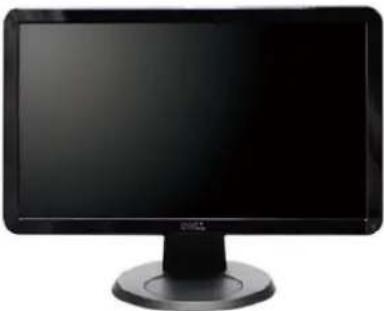 | • Monitor with stand | |
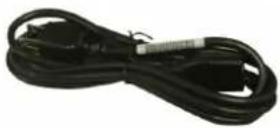 | • Power Cable | |
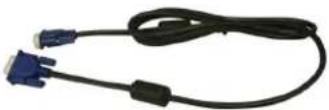 | • VGA Cable | |
 | 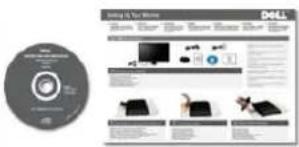 | • Drivers and Documentation media• Quick Setup Guide• Safety Information |
Product Features
The IN1910N flat panel display has an active matrix, thin-film transistor (TFT), liquid crystal display (LCD). The monitor features include:
■ 18.5-inch (469.9 mm) viewable area display.
■ 1366 x 768 resolution, plus full-screen support for lower resolutions.
■ Tilt adjustment capability.
■ Removable pedestal and Video Electronics Standards Association (VESA) 100 mm mounting holes for flexible mounting solutions.
■ Plug and play capability if supported by your system.
■ On-Screen Display (OSD) adjustments for ease of set-up and screen optimization.
■ Software and documentation CD which includes an information file (INF), Image Color Matching File (ICM), and product documentation.
■ Energy Saver feature for Energy Star compliance.
■ Security lock slot.
Identifying Parts and Features
Front View
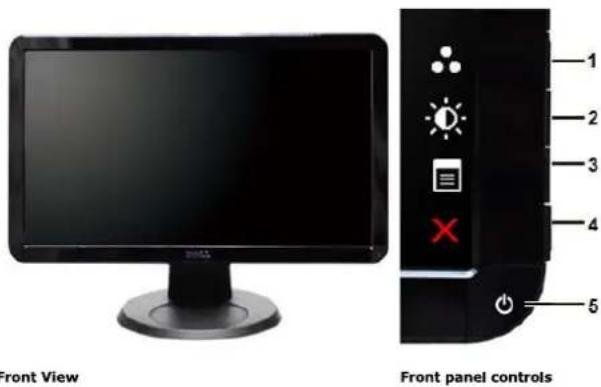
Front View
Label Description
Shortcut keys
1-2
*The default settings are Preset Modes Select and Brightness/Contrast Select.
1 Preset Modes Select
2 Brightness/Contrast Select
3 OSD menu select
4 EXIT
5 Power button (with power light indicator)
Back View
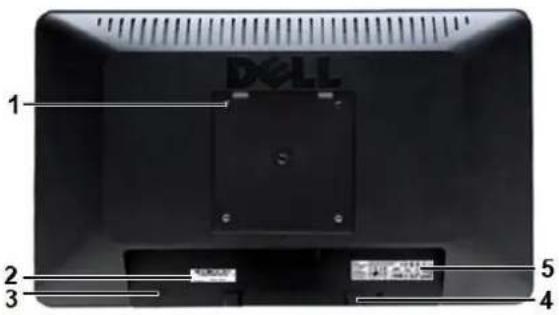
text_image
1 2 3 4 5 DELLBack view
| Label | Description/Use | |
| 1 | VESA mounting holes (100 mm) (behind attached base plate) | To mount the monitor. |
| 2 | Barcode serial number label | To contact Dell for technical support. |
| 3 | Security lock slot | To help secure your monitor. |
| 4 | Dell Soundbar mounting brackets | To attach the optional Dell Soundbar. |
| 5 | Regulatory rating label | Lists the regulatory approvals. |
Side View
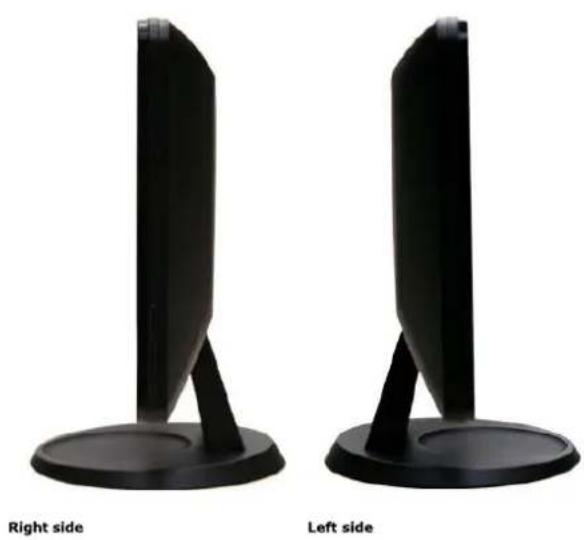
natural_image
Two black plastic stand holders, labeled 'Right side' and 'Left side', shown side by side (no additional text or symbols)Bottom View
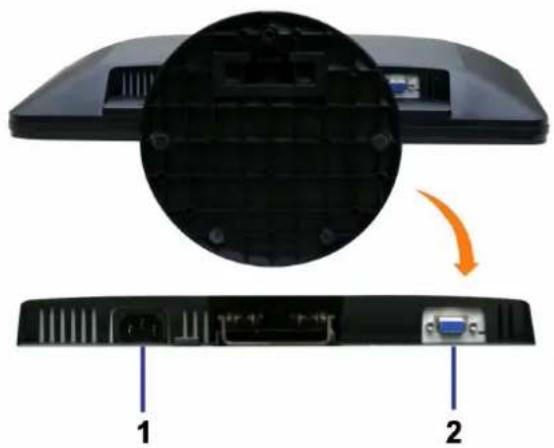
natural_image
Back view of a computer monitor showing internal components and a circular diagram highlighting the interior space (no text or symbols)Bottom view
Label Description
1 AC power cord connector
2 VGA connector
Monitor Specifications
Power Management Modes
If you have VESA's DPMS™ compliance display card or software installed in your PC, the monitor can automatically reduce its power consumption when not in use. This is referred to as Power Save Mode. If input from a keyboard, mouse or other input devices is detected by the computer, the monitor will automatically "wake up". The following table shows the power consumption and signaling of this automatic power-saving feature:
| VESA Modes | Horizontal Sync | Vertical Sync | Video | Power Indicator | Power Consumption |
| Normal operation | Active | Active | Active | White | 16 W (maximum) |
| Active-off mode | Inactive | Inactive | Blanked | Amber | Less than 1 W |
| Switch off | - | - | - | Off | Less than 1 W |
NOTE: This monitor is ENERGY STAR®-compliant.

NOTE: Zero power consumption in OFF mode can only be achieved by disconnecting the main cable from the monitor.
Pin Assignments
VGA Connector
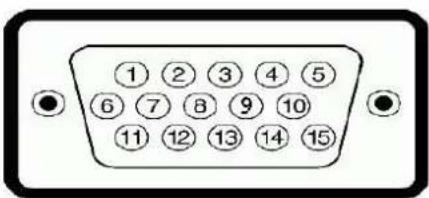
text_image
①②③④⑤ ⑥⑦⑧⑨⑩ ⑪⑫⑬⑭⑮Pin Number
15-pin Side of the Connected Signal Cable
| 1 | Video-Red |
| 2 | Video-Green |
| 3 | Video-Blue |
| 4 | GND |
| 5 | Self-test |
| 6 | GND-R |
| 7 | GND-G |
| 8 | GND-B |
| 9 | Computer 5V/3.3V |
| 10 | GND-sync |
| 11 | GND |
| 12 | DDC data |
| 13 | H-sync |
| 14 | V-sync |
| 15 | DDC clock |
Flat Panel Specifications
| Screen type | Active matrix - TFT LCD |
| Panel type | TN |
| Screen dimensions | 18.5 inches (18.5-inch viewable image size) |
| Preset display area: Horizontal Vertical | 409.8 mm (16.1 inches)230.4 mm (9.1 inches) |
| Pixel pitch | 0.30 mm |
| Viewing angle | 160° (vertical) typical, 160° (horizontal) typical |
| Luminance output | 250 CD/m ^2 (typical) |
| Contrast ratio | 1000 to 1 (typical) |
| Faceplate coating | Antiglare with hard-coating 3H |
| Backlight | CCFL edgelight system |
| Response Time | 5 ms typical |
| Color Depth | 16.7 mil colors |
| Color Gamut | 85 %* |
* IN1910N Color Gamut (Typical) is based on CIE1976 (85%) and CIE1931 (72%).
Resolution
| Horizontal scan range | 30 kHz to 83 kHz (automatic) |
| Vertical scan range | 56 Hz to 76 Hz (automatic) |
| Maximum preset resolution | 1366 x 768 at 60 Hz |
Preset Display Modes
| VGA, 720 x 400 | 31.5 | 70.0 | 28.3 | -/+ |
| VGA, 640 x 480 | 31.5 | 60.0 | 25.2 | -/- |
| VESA, 640 x 480 | 37.5 | 75.0 | 31.5 | -/- |
| VESA, 800 x 600 | 37.9 | 60.3 | 40.0 | +/+ |
| VESA, 800 x 600 | 46.9 | 75.0 | 49.5 | +/+ |
| VESA, 1024 x 768 | 48.4 | 60.0 | 65.0 | -/- |
| VESA, 1024 x 768 | 60.0 | 75.0 | 78.8 | +/+ |
| VESA, 1366 x 768 | 47.7 | 59.8 | 85.5 | +/+ |
Electrical
| Video input signals | Analog RGB, 0.7 Volts +/- 5%, positive polarity at 75 ohm input impedance |
| Synchronization input signals | Separate horizontal and vertical synchronizations, polarity-free TTL level, SOG (Composite SYNC on green) |
| AC input voltage/frequency/current | 100 to 240 VAC/50 or 60 Hz ± 3 Hz/2.0A (Max.) |
| Inrush iso surge current | 120 V: 30 A (Max.)240 V: 60 A (Max.) |
Physical Characteristics
| Connector type | D-sub: blue connector |
| Signal cable type | D-sub: Detachable, Analog, 15 pin, shipped attached to the monitor |
| Dimensions (with stand) | |
| Height | 344.0 mm (13.54 inches) |
| Width | 453.7 mm (17.86 inches) |
| Depth | 204.8 mm (8.06 inches) |
| Dimensions (without stand) | |
| Height | 273.8 mm (10.78 inches) |
| Width | 453.7 mm (17.86 inches) |
| Depth | 59.2 mm (2.33 inches) |
| Stand dimensions | |
| Height | 129.4 mm (5.09 inches) |
| Width | 204.8 mm (8.06 inches) |
| Depth | 204.8 mm (8.06 inches) |
| Weight | |
| Weight with packaging | 4.7 kg (10.36 lb) |
| Weight with stand assembly and cables | 4.1 kg (9.04 lb) |
| Weight without stand assembly (for wall mount or VESA mount considerations - no cables) | 3.4 kg (7.5 lb) |
| Weight of stand assembly | 0.35 kg (0.77 lb) |
Environmental
| Temperature | |
| Operating | 0° to 40°C (32° to 104°F) |
| Non-operating | Storage: -20° to 60°C (-4° to 140°F)Shipping: -20° to 60°C (-4° to 140°F) |
| Humidity | |
| Operating | 10% to 80% (non-condensing) |
| Non-operating | Storage: 5% to 90% (non-condensing)Shipping: 5% to 90% (non-condensing) |
| Altitude | |
| Operating | 3,048 m (12,000 ft) max |
| Non-operating | 9,144 m (40,000 ft) max |
| Thermal dissipation | 85.32 BTU/hour (maximum)54.61 BTU/hour (typical) |
Plug and Play Capability
You can install the monitor in any Plug and Play-compatible system. The monitor automatically provides the computer system with its Extended Display Identification Data (EDID) using Display Data Channel (DDC) protocols so that the system can configure itself and optimize the monitor settings. If required, the user can select different settings, but in most cases monitor installation is automatic.
LCD Monitor Quality & Pixel Policy
During the LCD Monitor manufacturing process, it is not uncommon for one or more pixels to become fixed in an unchanging state. The visible result is a fixed pixel that appears as an extremely tiny dark or bright discolored spot. When the pixel remains permanently lit, it is known as a "bright dot." When the pixel remains black, it is known as a "dark dot." In almost every case, these fixed pixels are hard to see and do not detract from display quality or usability. A display with 1 to 5 fixed pixels is considered normal and within competitive standards. For more information, see Dell Support site at: support.dell.com.
Maintenance Guidelines
Caring for Your Monitor

CAUTION: Read and follow the Safety Instructions before cleaning the monitor.

CAUTION: Before cleaning the monitor, unplug the monitor from the electrical outlet.
For best practices, follow the instructions in the list below while unpacking, cleaning, or handling your monitor:
- To clean your antistatic screen, lightly dampen a soft, clean cloth with water. If possible, use a special screen-cleaning tissue or solution suitable for the antistatic coating. Do not use benzene, thinner, ammonia, abrasive cleaners, or compressed air.
- Use a lightly-dampened, warm cloth to clean the monitor. Avoid using detergent of any kind as some detergents leave a milky film on the monitor.
- If you notice a white powder when you unpack your monitor, wipe it off with a cloth.
- Handle your monitor with care as dark-colored monitors may scratch and show white scuff marks more than lighter-colored monitors.
• To help maintain the best image quality on your monitor, use a dynamically changing screen saver and turn off your monitor when not in use.
Back to Contents Page
Back to Contents Page
Appendix
Dell™ IN1910N Flat Panel Monitor User's Guide
Safety Instructions
FCC Notice (U.S. Only) and Other Regulatory Information
Contacting Dell
CAUTION: Safety Instructions

CAUTION: Use of controls, adjustments, or procedures other than those specified in this documentation may result in exposure to shock, electrical hazards, and/or mechanical hazards.
For information on safety instructions, see the Safety Information that ships with your monitor.
FCC Notice (U.S. Only) and Other Regulatory Information
For FCC notices and other regulatory information, see the regulatory compliance website located at www.dell.com/regulatory_compliance.
Contacting Dell
For customers in the United States, call 800-WWW-DELL (800-999-3355).

NOTE: If you do not have an active Internet connection, you can find contact information on your purchase invoice, packing slip, bill, or Dell product catalog.
Dell provides several online and telephone-based support and service options. Availability varies by country and product, and some services may not be available in your area. To contact Dell for sales, technical support, or customer service issues:
- Visit support.dell.com.
- Verify your country or region in the Choose A Country/Region drop-down menu at the bottom of the page.
- Click Contact Us on the left side of the page.
- Select the appropriate service or support link based on your need.
- Choose the method of contacting Dell that is convenient for you.
Back to Contents Page
Back to Contents Page
Setting Up Your Monitor
Dell™ IN1910N Flat Panel Monitor
If you have a Dell™ desktop or a Dell™ portable computer with internet access
-
Go to http://support.dell.com, enter your service tag, and download the latest driver for your graphics card.
-
After installing the drivers for your Graphics Adapter, attempt to set the resolution to 1366x768 again.
NOTE: If you are unable to set the resolution to 1366x768, please contact Dell™ to inquire about a Graphics Adapter that supports these resolutions.
Back to Contents Page
Setting Up Your Monitor
Dell™ IN1910N Flat Panel Monitor
If you have a non Dell™ desktop, portable computer, or graphics card
- Right-click on the desktop and click Properties.
- Select the Settings tab.
- Select Advanced.
- Identify your graphics controller supplier from the description at the top of the window (e.g. NVIDIA, ATI, Intel etc.).
- Please refer to the graphics card provider website for updated driver (for example, http://www.ATI.com OR http://www.NVIDIA.com).
- After installing the drivers for your Graphics Adapter, attempt to set the resolution to 1366x768 again.
NOTE: If you are unable to set the resolution to 1366x768, please contact the manufacturer of your computer or consider purchasing a graphics adapter that will support the video resolution of 1366x768.
Back to Contents Page
Operating the Monitor
Dell™ IN1910N Flat Panel Monitor User's Guide
Using the Front Panel Controls
Using the On-Screen Display (OSD) Menu
Setting the Maximum Resolution
Using the Dell Soundbar (Optional)
Using the Tilt
Using the Front Panel
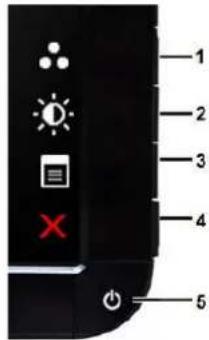
Use the control buttons on the side of the monitor to adjust the characteristics of the image being displayed. As you use these buttons to adjust the controls, an OSD shows the numeric values of the characteristics as they change.
text_image
1 2 3 4 5| 1-2 | Shortcut keys | Use this button for direct access to the control menu that you define in the personalize menu.*The default settings are Preset Modes Select and Brightness/Contrast Select. |
| 1 | Preset Modes Select | Use this button for different display preset modes on your monitor. |
| 2 | Brightness/Contrast | Use this button to access the "Brightness/Contrast" control menu. |
| 3 | OSD Menu | Use this button to open the On-Screen Display (OSD). See Using the OSD Menu. |
| 4 | × Exit | Use this button to exit the OSD menu. |
| 5 | Power button(with power light indicator) | Use the power button to turn the monitor on and off.The white light indicates that the monitor is on and fully functional. An amber light indicates power save mode. |
Using the On-Screen Display (OSD) Menu
NOTE: If you change the settings and then either proceed to another menu, or exit the OSD menu, the monitor automatically saves the changes. The changes are also saved if you change the settings and then wait for the OSD menu to disappear.
- Press any key to launch the OSD menu and press ☐ to display the main menu.
Main Menu for Analog (VGA) Input

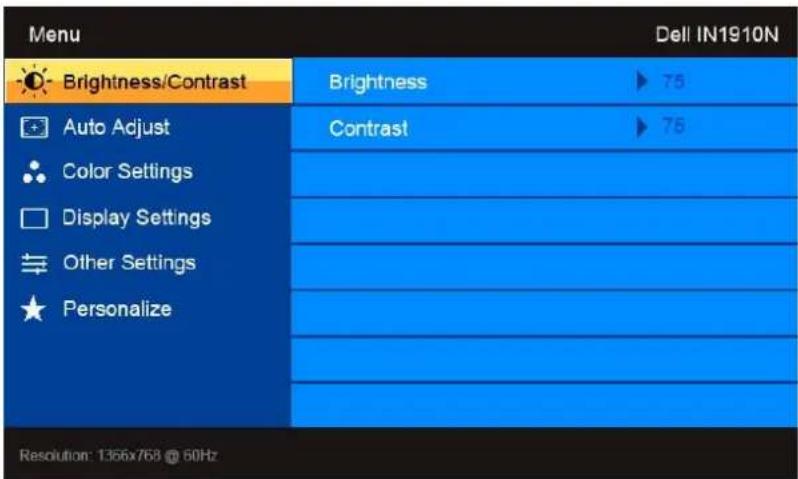
text_image
Menu Brightness/Contrast Brightness ▶ 75 Auto Adjust Contrast ▶ 75 Color Settings Display Settings Other Settings Personalize Resolution: 1366x768 @ 60Hz- Press the √ and ∧ buttons to move between the setting options. As you move from one icon to another, the option name is highlighted. See the table for a complete list of all the options available for the monitor.
- Press the → button once to activate the highlighted option.
- Press the V and A buttons to select the desired parameter.
- Press the → button to enter the slide bar and then use the √ and ∧ buttons, according to the indicators on the menu, to make your changes.
- Press the button to return to the main menu or exit the OSD menu.
| Icon | Menu and Submenus | Description | |
| Brightness/Contrast | Allows you to adjust the brightness and contrast. | ||
| Menu Dell IN1910N | |||
| Brightness/Contrast Brightness 75 | |||
| Auto Adjust Contrast 76 | |||
| Color Settings | |||
| Display Settings | |||
| Other Settings | |||
| Personalize | |||
| Resolution: 1356x758 @ 50Hz | |||
| Brightness | Brightness adjusts the luminance of the backlight. Press the ▲ button to increase the brightness and Press the √ button to decrease the brightness (min 0 ~ max 100). | ||
| Contrast | Adjust the Brightness first, and then adjust the Contrast only if further adjustment is necessary. Press the ▲ button to increase contrast and press the √ button to decrease contrast (min 0 ~ max 100). The Contrast function adjusts the degree of difference between the darkest and lightest areas on the monitor screen. | ||
| Back | Press the ➔ button to go back to or exit the main menu. | ||
| Auto Adjust | Even though your computer recognizes your monitor on startup, the Auto Adjustment function optimizes the display settings fo with your particular setup. | ||
| Auto Adjustment in Progress.. | |||
| NOTE: In most cases, Auto Adjust produces the best image for your configuration. | |||
| Color Settings | Use the color settings to adjust the Image mode and color format. | ||
| Menu Dell IN1910N | |||
| Brightness/Contrast | Input Color Format RGB | ||
| Auto Adjust | Mode Selection Graphics | ||
| Color Settings | Preset Modes Standard | ||
| Display Settings | Reset Color Settings | ||
| Other Settings | |||
| Personalize | |||
| Resolution: 1366x768 @ 60Hz | |||
| Input Color Format | Allows you to set the color format. | ||
| Mode Selection | Allows you to set the display mode to Graphics or Video. If your computer is connected to your monitor, choose Graphics. If a D STB, or VCR is connected to your monitor, choose Video. | ||
| Preset modes | |||
| VGA/DVI-D input | |||
| Standard | Mode suitable for desktop applications. | ||
| Multimedia | Mode for multimedia applications, e.g., video playback. | ||
| Game | Mode suitable for gaming applications. | ||
| Warm | Select warm mode to obtain a red tint. This color setting is typically used for color-intensive applications (photograph image edi multimedia, movies, etc.). | ||
| Cool | Select cool mode to obtain a bluish tint. This color setting is typically used for text based applications (spreadsheets, programm text editors, etc.). | ||
| Custom (RGB) | Use the √ or ▲ button to increase or decrease each of the three colors (R, G, B) independently, in single-digit increments, fro 100. | ||
| Video input | |||
| Movie | Mode suitable for movie playback. | ||
| Game | Mode suitable for game applications. | ||
| Sports | Mode suitable for sports scenes. | ||
| Nature | Mode suitable for nature scenes. | ||
| Hue | This feature can make the video image color shift from green to purple. Use this feature to adjust the skin tone. Use √ or ∧ to adjust the hue from '0' to '100'. | ||
| √ increases the green hue in the image | |||
| ▲ increases the purple hue in the image | |||
| NOTE: Hue adjustment is only available for video input. | |||
| Saturation | Allows you to adjust the color saturation of the video image. Use √ or ∧ button to adjust the saturation from '0' to '100' | ||
| √ makes video image looks monochrome | |||
| ▲ makes video image looks colorful | |||
| NOTE: Saturation adjustment is only available for video input. | |||
| Demo Mode | Vertically splits the screen into two segments. The left half of the screen in the normal mode and the right half of the screen is displayed in the color enhanced mode. | ||
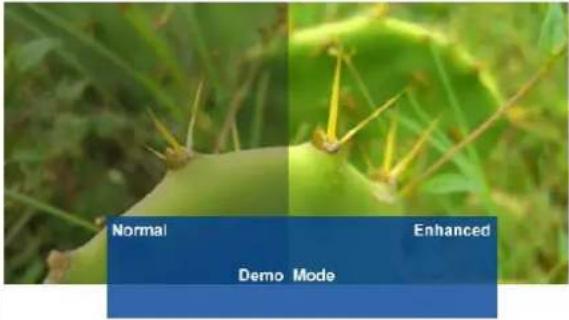 | |||
| Reset Color Settings | NOTE: Demo Mode is only available for video input. | ||
| Returns your monitor color settings to the factory default settings. | |||
| Back | Press the ➔ button to go back to or exit the main menu. | ||
| Display Settings | |||
Display Settings
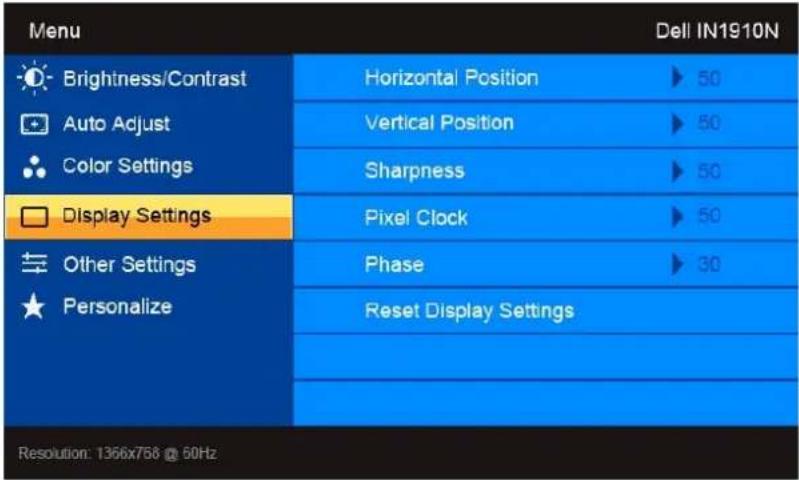 | ||
| Horizontal Position | Use the √ and ∧ buttons to adjust image left and right. Minimum is '0' (-). Maximum is '100' (+). | |
| Vertical Position | Use the √ and ∧ buttons to adjust image up and down. Minimum is '0' (-). Maximum is '100' (+). | |
| Sharpness | This feature can make the image look sharper or softer. Use √ or ∧ to adjust the sharpness from '0' to '100'. | |
| Pixel Clock | The Phase and Pixel Clock adjustments allow you to adjust your monitor to your preference. These settings are accessed through main OSD menu, by selecting 'Display Settings'.Use the √ and ∧ buttons to adjust for best image quality. | |
| Phase | If satisfactory results are not obtained using the Phase adjustment, use the Pixel Clock (coarse) adjustment and then use Phase (fine), again. | |
| Reset Display Setting | Resets the display settings to the factory default settings. | |
| Back | Press the ➔ button to go back to or exit the main menu. | |
| †† | Other Settings | 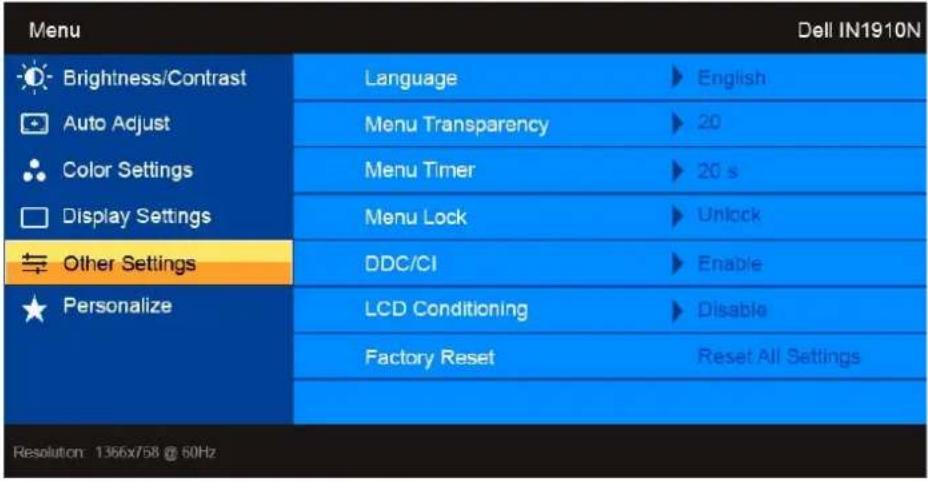 |
| Language | Language option to set the OSD display to one of 6 languages (English, Espanol, Francais, Deutsch, Japanese, Simplified Chinese) | |
| Menu Transparency | Allows you to adjust the OSD background from opaque to transparent. | |
| Menu Timer | OSD Hold Time: Sets the amount of time the OSD will remain active after the last time you pressed a button.Use the √ and ∧ buttons to adjust the slider in 5 second increments, from 5 to 60 seconds. | |
| Menu Lock | Controls user access to adjustments. When selected, no user adjustments are allowed. All buttons are locked except the button. | |
| DDC/CI | NOTE:When the OSD is locked, pressing the ➔ button takes you directly to the OSD settings menu, with 'OSD Lock' pre-sel on entry. Choose "Unlock" and allow user access to all applicable settings.DDC/CI (Display Data Channel/Command Interface) allows your monitor parameters (brightness, color balance, etc.) to be adj using software on your computer. You can disable this feature by selecting "Disable".Enable this feature for best user experience and optimum performance of your monitor. | |
| LCD Conditioning | WARNING MESSAGE Dell IN1910NThe function of adjusting display setting using PC application will be disabled.Do you wish to disable DDC/CI function?NoYesIf an image appears to be retained on the monitor, select LCD Conditioning to help eliminate any image retention. Using the L Conditioning feature may take several hours. Severe cases of image retention are known as burn-in, the LCD Conditioning feal does not remove burn-in. | |
| WARNING MESSAGE Dell IN1910NThis feature will help reduce minor cases of image retention. Depending on the degree of image retention, the program may take some time to run.Do you want to continue?NoYesLCD Conditioning is currently in progress. Press any button on the monitor to terminate LCD Conditioning at any time.Reset all OSD settings to the factory default settings. | ||
| Factory Reset | Press ➔ button to go back to or exit the main menu. | |
| Back | ||
| ### | Personalize | There are 2 shortcut keys on the front panel. Select one control menu for each shortcut key to allow direct access. |
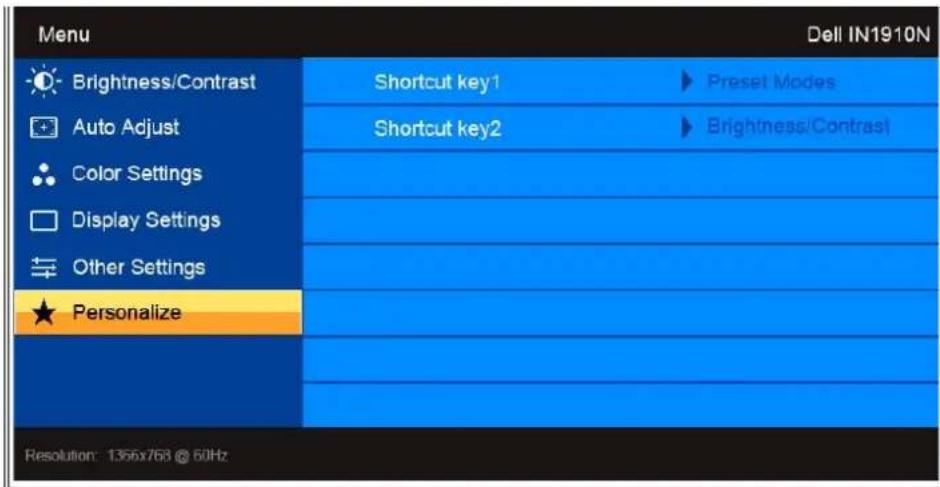
text_image
Menu Dell IN1910N Brightness/Contrast Auto Adjust Color Settings Display Settings Other Settings Personalize Shortcut key1 Shortcut key2 Preset Modes Brightness/Contrast Resolution: 1356x768 @ 60HzOSD Warning Messages
When the monitor does not support a particular resolution mode you will see the following message :
MESSAGE
Dell IN1910N
The current input timing is not supported by the monitor display.
Please change your input timing to 1366x768 @ 60Hz or any other monitor
listed timing as per the monitor specifications.
This means that the monitor cannot synchronize with the signal that it is receiving from the computer. See Monitor Specifications for the Horizontal and Vertical frequency ranges addressable by this monitor. The recommended mode is 1366x768.
When monitor enters Power Save mode, the following message appears :
MESSAGE
Dell IN1910N
Entering Power Save Mode.
Activate the computer and wake up the monitor to gain access to the OSD
If you press any button other than the power button the following message will appear:
MESSAGE
Dell IN1910N
There is no signal coming from your computer.
Press any key on the keyboard or mouse to wake it up.
If VGA input is selected and VGA cable is not connected, a floating dialog box as shown below appears.

No VGA cable
Dell IN1910N
Setting the Maximum Resolution
To set the maximum resolution for the monitor.
- Right-click on the desktop and select Properties.
- Select the Settings tab.
- Set the screen resolution to 1366x768.
- Click OK
If you do not see 1366x768 as an option, you may need to update your graphics driver. Depending on your computer, complete one of the following procedures.
If you have a Dell desktop or portable computer:
- Go to support.dell.com, enter your service tag, and download the latest driver for your graphics card.
If you are using a non-Dell computer (portable or desktop):
- Go to the support site for your computer and download the latest graphic drivers.
- Go to your graphics card website and download the latest graphic drivers.
Using the Dell Soundbar (Optional)
The Dell Soundbar is a stereo two channel system mountable on Dell flat panel displays. The Soundbar has a rotary volume and on/off control to adjust the overall system level, a blue LED for power indication, and two audio headset jacks.
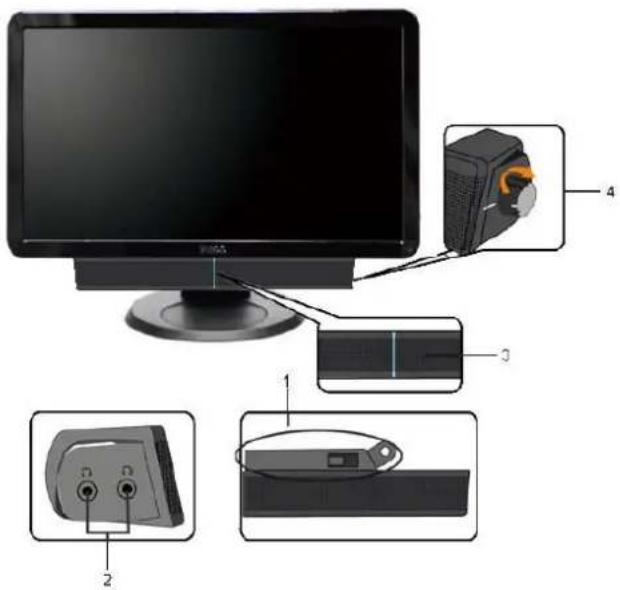
text_image
Diagram showing a computer monitor connected to four labeled components, including a CD and drive unit.- Attach mechanism
- Headphone connectors
- Power indicator
- Power/Volume control
Using the Tilt
Tilt
With the built-in pedestal, you can tilt the monitor for the most comfortable viewing angle.
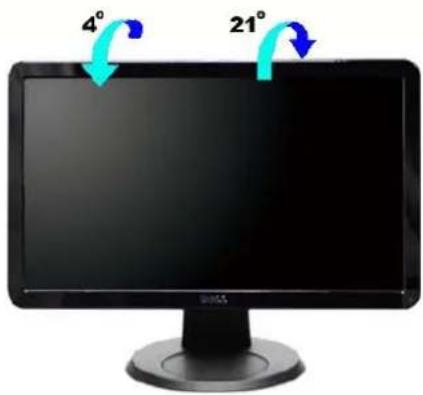
text_image
4° 21°
NOTE: The base is detached when the monitor is shipped from the factory.
Back to Contents Page
Setting Up Your Monitor
Dell™ IN1910N Flat Panel Monitor
Important instructions to set the display resolution to 1366x768 (Maximum)
For optimal display performance while using the Microsoft Windows® operating systems, set the display resolution to 1366 x 768 pixels by performing the following steps:
- Right-click on the desktop and click Properties.
- Select the Settings tab.
- Move the slider-bar to the right by pressing and holding the left-mouse button and adjust the screen resolution to 1366x768.
- Click OK.
If you do not see 1366x768 as an option, you may need to update your graphics driver. Please choose the scenario below that best describes the computer system you are using, and follow the provided directions:
1: If you have a Dell™ desktop or a Dell™ portable computer with internet access.
2: If you have a non Dell™ desktop, portable computer, or graphics card.
Dell™ IN1910N Flat Panel Monitor
User Guide
- Important instructions to set the display resolution to 1366x768 (Maximum)
Information in this document is subject to change without notice.
© 2009 Dell Inc. All rights reserved.
Reproduction of these materials in any manner whatsoever without the written permission of Dell Inc. is strictly forbidden.
Trademarks used in this text: Dell and the DELL logo, are trademarks of Dell Inc; Microsoft and Windows are either registered trademarks or trademarks of Microsoft Corporation in the United States and/or other countries. As an ENERGY STAR partner, Dell Inc. has determined that this product meets the ENERGY STAR guidelines for energy efficiency.
Other trademarks and trade names may be used in this document to refer to either the entities claiming the marks and names or their products. Dell Inc. disclaims any proprietary interest in trademarks and trade names other than its own.
Model IN1910Nb/IN1910NF
May 2009
Rev. A00
Back to Contents Page
Setting Up the Monitor
Dell™ IN1910N Flat Panel Monitor User's Guide
Attaching the Base
Connecting the Monitor
- Attaching the Soundbar (Optional)
Removing the Base
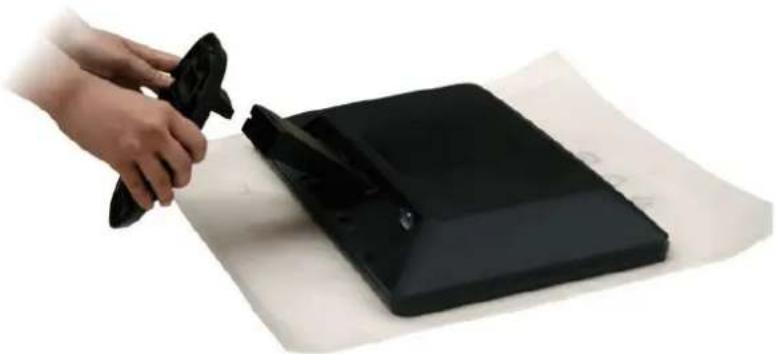
Attaching the Base
natural_image
Hand using a black plastic tool to cut a black rectangular object on a white sheet (no text or symbols visible)
NOTE: The base is detached when the monitor is shipped from the factory.
After placing the monitor panel on a soft cloth or cushion, complete the following steps to attach the base.
- Place the monitor on a flat surface.
- Attach the base to the monitor.
Connecting Your Monitor

CAUTION: Before you begin any of the procedures in this section, follow the safety instructions.
To connect your monitor to the computer perform the following steps/instructions:
- Turn off your computer and disconnect the power cable.
- Connect the blue (analog VGA) display connector cable to the corresponding video port on the back of your computer.
Connecting the blue VGA cable
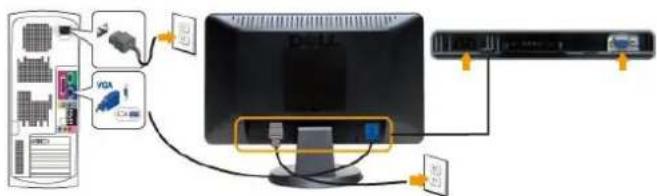
text_image
Diagram showing connections between a computer monitor, VGA, and network ports with labeled components
NOTE: The Graphics are used for the purpose of illustration only. Appearance of the the computer may vary.
After you have completed connecting the VGA cable, follow the procedure below to complete your monitor setup:
-
Plug the power cables for your computer and monitor into a nearby outlet.
-
Turn on the monitor and the computer. If your monitor displays an image, installation is complete. If it does not display an image, see Solving Problems.
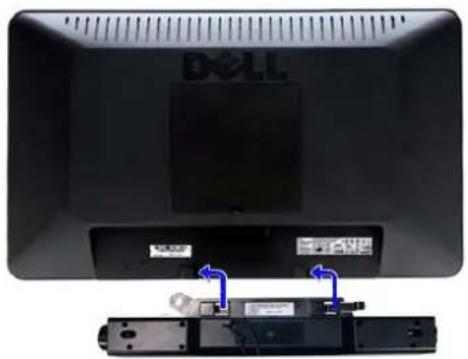
Attaching the Soundbar (Optional)
natural_image
Back view of a Dell monitor with ventilation grille and two blue arrows pointing to a component (no text or symbols visible)- Working from the rear of the monitor, attach the Soundbar by aligning the two slots with the two tabs along the bottom rear of the monitor.
- Slide the Soundbar to the left until it snaps into place.
- Connect the Soundbar with the DC power connector.
- Insert the mini stereo plug from the rear of the Soundbar into the computer's audio output jack.

NOTICE: Do not use with any device other than the Dell Soundbar
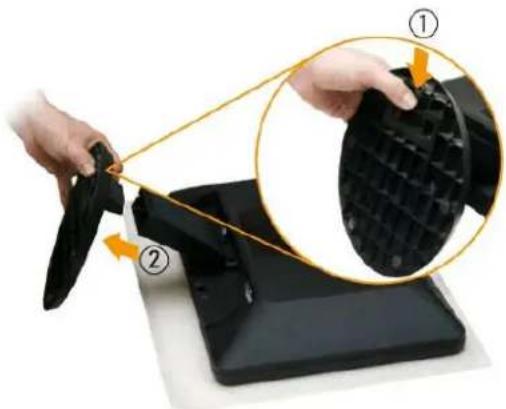
Removing the Base
natural_image
Close-up of hands holding a black Waffle-shaped device with a magnified inset showing the internal grid pattern (no text or symbols)After placing the monitor panel on a soft cloth or cushion, complete the following steps to remove the base.
- Pull down the tab on the bottom of the base.
- Detach the base away from the monitor.
Back to Contents Page
Back to Contents Page
Solving Problems
Dell™ IN1910N Flat Panel Monitor User's Guide
Self-Test
Built-in Diagnostics
Common Problems
Product-Specific Problems
Troubleshooting the Dell™ Soundbar (Optional)

CAUTION: Before you begin any of the procedures in this section, follow the Safety Instructions.
Self-Test
Your monitor provides a self-test feature that allows you to check whether your monitor is functioning properly. If your monitor and computer are properly connected but the monitor screen remains dark, run the monitor self-test by performing the following steps:
- Turn off both your computer and the monitor.
- Unplug the video cable from the back of the computer. To ensure proper Self-Test operation, remove the Analog (blue connector) cable from the back of computer.
- Turn on the monitor.
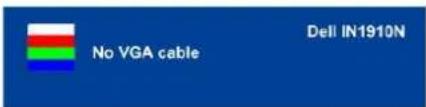
The floating dialog box should appear on-screen (against a black background) if the monitor cannot sense a video signal and is working correctly. While in self-test mode, the power LED remains white. Also, the dialog shown below will continuously scroll through the screen.
text_image
No VGA cable Deli IN1910N- This box also appears during normal system operation, if the video cable becomes disconnected or damaged.
- Turn off your monitor and reconnect the video cable; then turn on both your computer and the monitor.
If your monitor screen remains blank after you have performed Step 5, check your video controller and computer system.
Built-in Diagnostics
Your monitor has a built-in diagnostic tool that helps you determine if the screen abnormality you are experiencing is an inherent problem with your monitor, or with your computer and video card.

NOTE: You can run the built-in diagnostics only when the video cable is unplugged and the monitor is in self-test mode.
To run the built-in diagnostics:
- Ensure that the screen is clean (no dust particles on the surface of the screen).
- Unplug the video cable(s) from the back of the computer or monitor. The monitor then goes into the self-test mode.
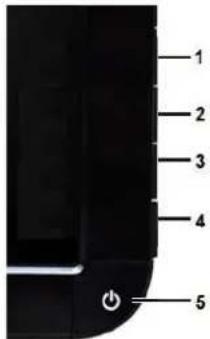
- On the front panel, press and hold the shortcut button 1 and shortcut button 4 keys on the front panel, simultaneously for 2 seconds. A gray screen appears.
text_image
1 2 3 4 5- Carefully inspect the screen for abnormalities.
- Press the shortcut button 4 key on the front panel again. The color of the screen changes to red.
- Inspect the display for any abnormalities.
- Repeat steps 5 and 6 to inspect the display in green, blue, and white colored screens.
The test is complete when the white screen appears. To exit, press the shortcut button 4 again.
If you do not detect any screen abnormalities upon using the built-in diagnostic tool, the monitor is functioning properly. Check the video card and computer.
OSD Warning Messages
For OSD-related issues, see OSD Warning Messages.
Common Problems
The following table contains general information about common monitor problems that you might encounter and the possible solutions.
| Common Symptoms | What You Experience | Possible Solutions |
| No Video/Power LED off | No picture | ·Ensure that the video cable connecting the monitor and the computer is properly co secure.·Verify that the power outlet is functioning properly using any other electrical equipment.·Ensure that the power button is depressed fully. |
| No Video/Power LED on | No picture or no brightness | ·Increase brightness & contrast controls via OSD.·Perform monitor self-test feature check.·Check for bent or broken pins in the video cable connector.·Run the built-in diagnostics. |
| Poor Focus | Picture is fuzzy, blurry, or ghosting | ·Perform Auto Adjust via OSD.·Adjust the Phase and Pixel Clock controls via OSD.·Eliminate video extension cables.·Reset the monitor to Factory Settings.·Change the video resolution to the correct aspect ratio (16:9). |
| Shaky/Jittery Video | Wavy picture or fine movement | ·Perform Auto Adjust via OSD.·Adjust the Phase and Pixel Clock controls via OSD.·Reset the monitor to Factory Settings.·Check environmental factors.·Relocate the monitor and test in another room. |
| Missing Pixels | LCD screen has spots | ·Cycle power on-off.·Pixel that is permanently off is a natural defect that can occur in LCD technology.·Run the built-in diagnostics. |
| Stuck-on Pixels | LCD screen has bright spots | ·Cycle power on-off.·Pixel that is permanently off is a natural defect that can occur in LCD technology.·Run the built-in diagnostics. |
| Brightness Problems | Picture too dim or too bright | ·Reset the monitor to Factory Settings.·Auto Adjust via OSD.·Adjust brightness & contrast controls via OSD. |
| Geometric Distortion | Screen not centered correctly | ·Reset the monitor to Factory Settings.·Auto Adjust via OSD.·Adjust brightness & contrast controls via OSD. |
| Horizontal/Vertical Lines | Screen has one or more lines | ·Reset the monitor to Factory Settings.·Perform Auto Adjust via OSD.·Adjust Phase and Pixel Clock controls via OSD.·Perform monitor self-test feature check and determine if these lines are also in self-1·Check for bent or broken pins in the video cable connector. |
| Synchronization Problems | Screen is scrambled or appears torn | ·Reset the monitor to Factory Settings.·Perform Auto Adjust via OSD.·Adjust Phase and Pixel Clock controls via OSD.·Perform monitor self-test feature check to determine if scrambled screen appears in mode.·Check for bent or broken pins in the video cable connector.·Restart the computer in the safe mode. |
| Safety Related Issues | Visible signs of smoke or sparks | ·Do not perform any troubleshooting steps.·Contact Dell immediately. |
| Intermittent Problems | Monitor turns on & off | ·Ensure that the video cable connecting the monitor to the computer is connected pre secure.Reset the monitor to Factory Settings.Perform monitor self-test feature check to determine if the intermittent problem occu mode. |
| Missing Color | Picture lacks color | Perform monitor self-test feature check.Ensure that the video cable connecting the monitor to the computer is connected pr secure.Check for bent or broken pins in the video cable connector. |
| Wrong Color | Picture color is not good | Change the Color Setting Mode in the Color Settings OSD to Graphics or Video depe application.Try a different Color Preset Setting in Color Settings OSD. Adjust R/G/B value in Colo OSD if the Color Management is turned off.Change the Input Color Format to PC RGB or YPbPr in the Advance Setting OSD. |
| Image retention from a static image left on the monitor for a long period of time | Faint shadow from the static image displayed appears on the screen | Use the Power Management feature to turn off the monitor at all times when not in information, seePower Management Modes).Alternatively, use a dynamically changing screensaver. |
Product-Specific Problems
| SPECIFIC SYMPTOMS | WHAT YOU EXPERIENCE | POSSIBLE SOLUTIONS |
| Screen image is too small | Image is centered on screen, but does not fill entire viewing area | Perform monitor reset on "Factory Reset" |
| Cannot adjust the monitor with the buttons on the front panel | OSD does not appear on the screen | Turn the monitor off and unplug the power cord and then plug back and power on |
| No Input Signal when user controls pressed | No picture, the LED light is amber. When the monitor button is pressed, the message "No VGA cable" will appear. | Check the signal source. Ensure that the computer is not in power saving by moving or pressing any key on the keyboard.Check whether the signal cable is plugged in and seated properly. Re-plug the signal necessary.Re-boot the computer or video player. |
| The monitor will not fill the entire screen. | The picture does not fill the height or width of the screen. | Due to the non-standard formats of DVDs, the monitor may not show the full screen. |
Troubleshooting the Dell™ Soundbar (Optional)
| COMMON SYMPTOMS | WHAT YOU EXPERIENCE | POSSIBLE SOLUTIONS |
| No Sound | Soundbar has power - power indicator is on. | Plug the audio line-in cable into the computer's audio out jack.Set all Windows volume controls to their maximum.Play some audio content on the computer (i.e., audio CD, or MP3).Turn the Power/Volume knob on the Soundbar clockwise to a higher volume settingClean and reseat the audio line-in plug.Test the Soundbar using another audio source (i.e., portable CD player). |
| Distorted Sound | Computer's sound card is used as the audio source. | Clear any obstructions between the Soundbar and the user.Confirm that the audio line-in plug is completely inserted into the jack of the soundSet all Windows volume controls to their midpoints.Decrease the volume of the audio application.Turn the Power/Volume knob on the Soundbar counter-clockwise to a lower volumeClean and reseat the audio line-in plug.Troubleshoot the computer's sound card.Test the Soundbar using another audio source (i.e., portable CD player). |
| Distorted Sound | Other audio source is used. | Clear any obstructions between the Soundbar and the user.Confirm that the audio line-in plug is completely inserted into the jack of the audio :Decrease the volume of the audio source.Turn the Power/Volume knob on the Soundbar counter-clockwise to a lower volumeClean and reseat the audio line-in plug. |
| Unbalanced Sound Output | Sound from only one side of Soundbar | Clear any obstructions between the Soundbar and the user.Confirm that the audio line-in plug is completely inserted into the jack of the sound source.Set all Windows audio balance controls (L-R) to their midpoints.Clean and reseat the audio line-in plug.Troubleshoot the computer's sound card.Test the Soundbar using another audio source (i.e., portable CD player). |
| Low Volume | Volume is too low | Clear any obstructions between the Soundbar and the user.Turn the Power/Volume knob on the Soundbar clockwise to the maximum volume seSet all Windows volume controls to their maximum.Increase the volume of the audio application.Test the Soundbar using another audio source (i.e., portable CD player). |
Back to Contents Page