P2217Wh - Televizor DELL - Besplatni korisnički priručnik
Pronađite besplatno priručnik za uređaj P2217Wh DELL u PDF formatu.


Pitanja korisnika o P2217Wh DELL
0 pitanje o ovom uređaju. Odgovorite na one koje znate ili postavite svoje.
Postavi novo pitanje o ovom uređaju
Preuzmite upute za vaš Televizor u PDF formatu besplatno! Pronađite svoj priručnik P2217Wh - DELL i uzmite svoju elektroničku napravu natrag u ruke. Na ovoj stranici objavljeni su svi dokumenti potrebni za korištenje vaše naprave. P2217Wh marke DELL.
KORISNIČKI PRIRUČNIK P2217Wh DELL
User's Guide
Dell P1917S/P1917SWh/P2017H/P2217/P2217Wh
Model No.: P1917S/P1917SWh/P2017H/P2217/P2217Wh
Regulatory model: P1917Sc/P1917Sf/P2017Hc/P2217c/P2217t
Notes, Cautions, and Warnings

NOTE: A NOTE indicates important information that helps you make better use of your computer.

CAUTION: A CAUTION indicates potential damage to hardware or loss of data if instructions are not followed.

WARNING: A WARNING indicates a potential for property damage, personal injury or death.
Information in this document is subject to change without notice. © 2016–2020 Dell Inc. All rights reserved.
Reproduction of these materials in any manner whatsoever without the written permission of Dell Inc. is strictly forbidden.
Trademarks used in this text: Dell and the DELL logo are trademarks of Dell Inc.; Microsoft and Windows are either trademarks or registered trademarks of Microsoft. Corporation in the United States and/or other countries, Intel is a registered trademark of Intel Corporation in the U.S. and other countries; and ATI is a trademark of Advanced Micro Devices, Inc. ENERGY STAR is a registered trademark of the U.S. Environmental Protection Agency. As an ENERGY STAR partner, Dell Inc. has determined that this product meets the ENERGY STAR guidelines for energy efficiency.
Other trademarks and trade names may be used in this document to refer to either the entities claiming the marks and names or their products. Dell Inc. disclaims any proprietary interest in trademarks and trade names other than its own.
Contents
About your monitor .... 5
Package contents....5
Product features 7
Identifying parts and controls 8
Monitor specifications....12
Universal serial bus (USB) interface 26
Plug and play capability 29
LCD monitor quality and pixel policy....29
Maintenance guidelines....29
Setting up the monitor 30
Attaching the stand 30
Connecting your monitor 32
Organizing cables 34
Disconnecting the monitor stand....35
Wall mounting (optional) 36
Operating your monitor 37
Power on the monitor....37
Using the front panel controls 37
Using the on-screen display (OSD) menu 39
Setting up your monitor....56
Using the Tilt, Swivel, and Vertical Extension....57
Troubleshooting....59
Self-test 59
Built-in diagnostics 62
Common problems 63
Product-specific problems 65
Universal serial bus (USB) specific problems....66
Appendix 67
FCC notices (U.S. Only) and other regulatory information....67
Contacting Dell....67
Package contents
Your monitor ships with the components shown below. Ensure that you have received all the components and Contacting Dell if something is missing.

NOTE: Some items may be optional and may not ship with your monitor. Some features or media may not be available in certain countries.
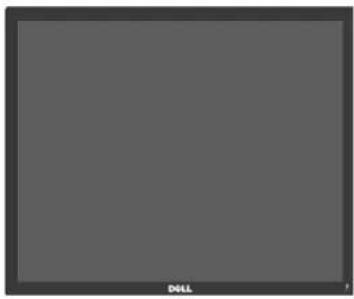 | Monitor(P1917S/P1917SWh) | |
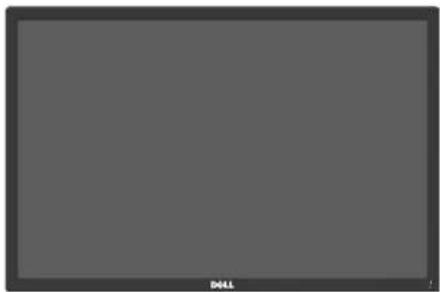 | Monitor(P2017H/P2217/P2217Wh) | |
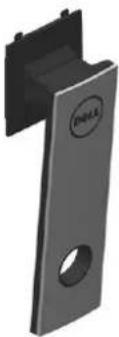 | Stand riser | |
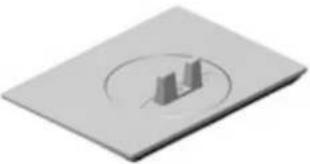 | Stand base | |
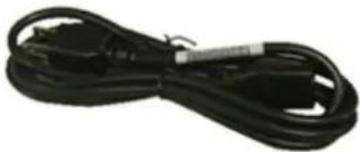 | Power cable (varies by country) | |
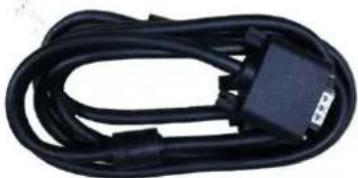 | VGA cable | |
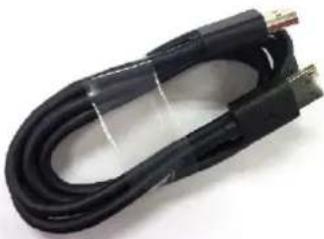 | DP Cable | |
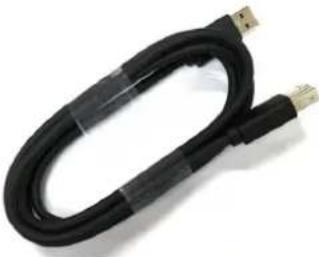 | USB 3.0 Upstream Cable (Enables the USB Ports on the Monitor) | |
 | 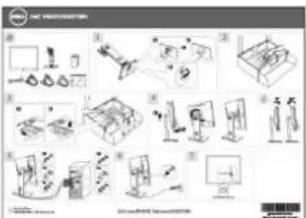 | ·Quick Setup Guide ·Safety and Regulatory Information |
Product features
The Dell P1917S/P1917SWh/P2017H/P2217/P2217Wh flat panel display has an active matrix, Thin-Film Transistor (TFT), Liquid Crystal Display (LCD), and LED backlight. The monitor features include:
- P1917S/P1917SWh:48.0 cm (18.9 inch) viewable area display (measured diagonally). 1280 x 1024 resolution, plus full-screen support for lower resolutions.
- P2017H:49.5 cm (19.5 inch) viewable area display (measured diagonally). 1600 x 900 resolution, plus full-screen support for lower resolutions.
- P2217/P2217Wh:55.9 cm (22.0 inch) viewable area display (measured diagonally). 1680 x 1050 resolution, plus full-screen support for lower resolutions.
• Plug and play capability if supported by your system.
• VGA, HDMI and DisplayPort connectivity.
• Equipped with 1 USB upstream port and 2 USB2.0 / 2 USB3.0 downstream ports.
- On-Screen Display (OSD) adjustments for ease of set-up and screen optimization.
• Security-cable slot.
• Tilt,swivel,height and rotate adjustment capabilities.
- Removable stand and Video Electronics Standards Association (VESA™) 100 mm mounting holes for flexible mounting solutions.
• 0.3 W power consumption when in the sleep mode.
- Optimize eye comfort with a flicker-free screen and ComfortView feature which minimizes blue light emission.
Identifying parts and controls
Front View
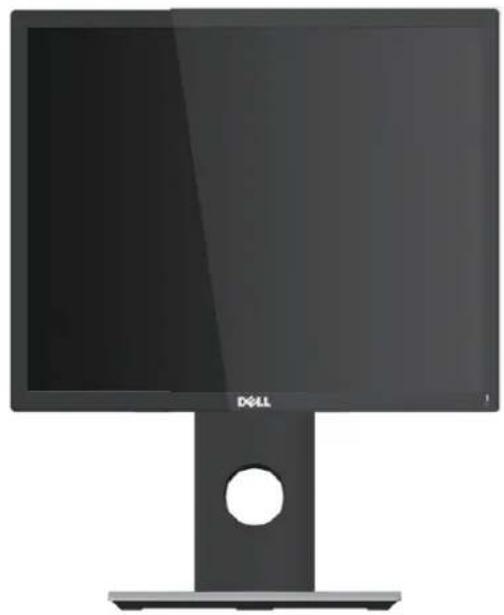
natural_image
Front view of a black Dell computer monitor with a circular button on the stand (no visible text or symbols beyond branding)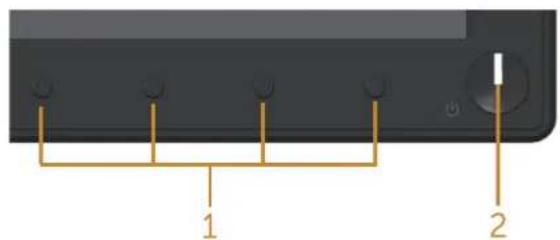
text_image
1 2Front panel controls
| Label | Description |
| 1 | Function buttons (For more information, see Operating your monitor) |
| 2 | Power on/off button (with LED indicator) |

NOTE: For displays with glossy bezels the user should consider the placement of the display as the bezel may cause disturbing reflections from surrounding light and bright surfaces.
Back View
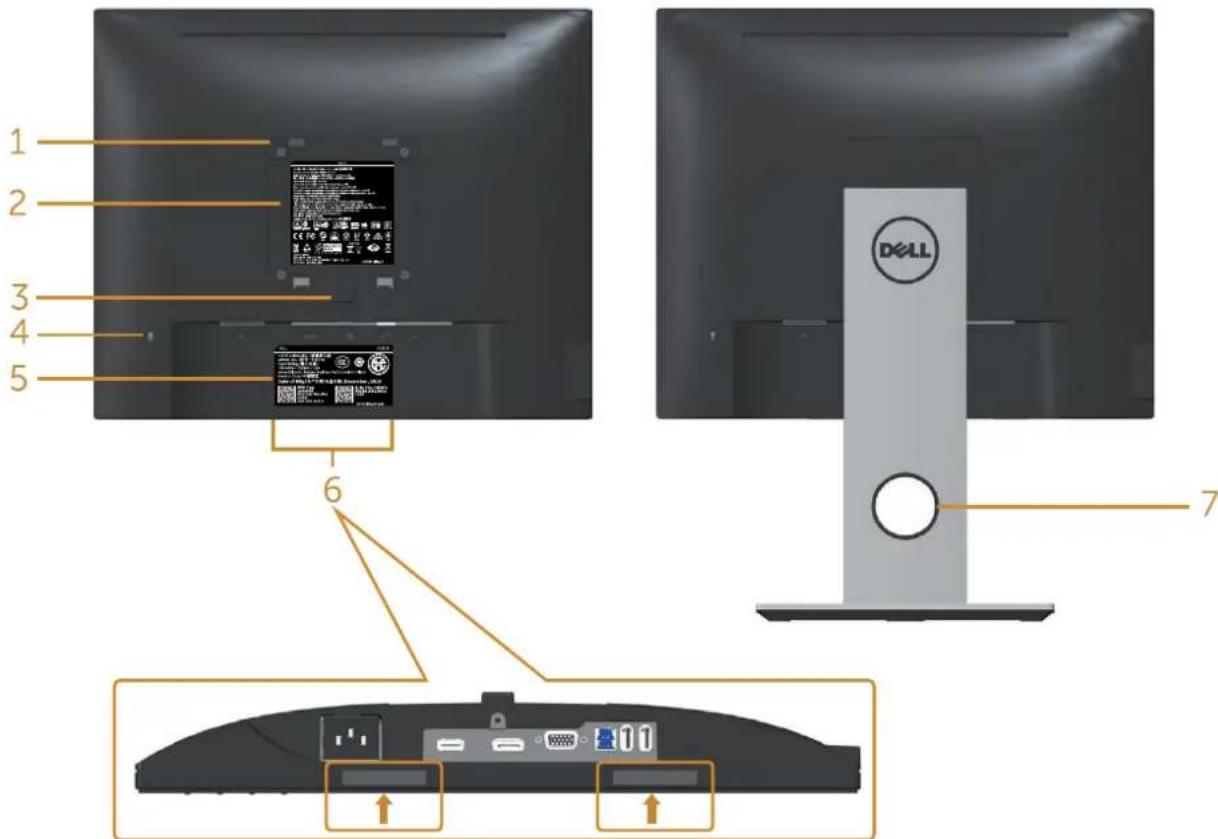
text_image
1 2 3 4 5 6 7 DELLBack View without monitor stand
Back View with monitor stand
| Label | Description | Use |
| 1 | VESA mounting holes (100 mm x 100 mm - behind attached VESA Cover) | Wall mount monitor using VESA-compatible wall mount kit (100 mm x 100 mm). |
| 2 | Regulatory label | Lists the regulatory approvals. |
| 3 | Stand release button | Release stand from monitor. |
| 4 | Security lock slot | Secures monitor with security lock(sold separately). |
| 5 | Barcode, serial number, and Service Tag label | Refer to this label if you need to contact Dell for technical support. |
| 6 | Dell Soundbar mounting slots | Attaches the optional Dell Soundbar.NOTE: Please remove the plastic strip covering the mounting slots before affixing the Dell Soundbar. |
| 7 | Cable management slot | Use to organize cables by placing them through the slot. |
Side View

natural_image
Side view of a computer monitor with a black top and side panel, labeled with number 1 (no text or symbols on the device itself)| Label | Description | Use |
| 1 | USB downstream port | Connect your USB device.NOTE: To use this port, you must connect the USB cable (shipped with your monitor) to the USB-upstream port on the monitor and to your computer. |
Bottom View
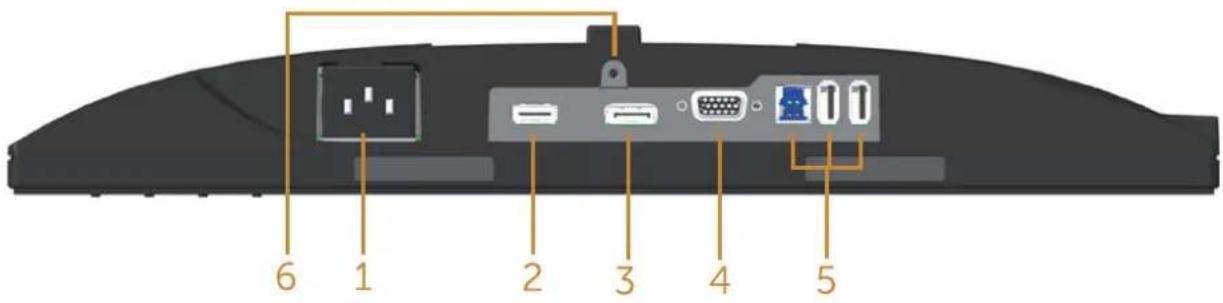
text_image
6 1 2 3 4 5Bottom view without monitor stand
| Label | Description | Use |
| 1 | Power port | Connect the power cable. |
| 2 | HDMI port | Connect your computer with HDMI cable(optional). |
| 3 | DP port | Connect your computer to the monitor using a DP cable. |
| 4 | VGA port | Connect your computer with VGA cable. |
| 5 | USB connector (x2 downstream, x1 upstream) | Connect the USB cable that came with your monitor to the computer. Once the cable is connected, you can use the USB connectors on the rear side and bottom side of the monitor. |
| 6 | Stand lock feature | To lock the stand to the monitor using a M3 x 6mm screw (screw not included). |
Monitor specifications
| Model | P1917S/P1917SWh | P2017H |
| Screen type | Active matrix - TFT LCD | |
| Panel type | In-Plane Switching Technology | |
| Viewable image | ||
| Diagonal | 479.96 mm (18.90 in) | 494.11 mm (19.45 in) |
| Horizontal, Active Area | 374.78 mm (14.76 in) | 433.92 mm (17.08 in) |
| Vertical, Active Area | 299.83 mm (11.80 in) | 236.34 mm (9.30 in) |
| Area | 1123.70 cm^2 (174.17 in^2) | 1025.53 cm^2 (158.96 in^2) |
| Pixel pitch | 0.293 mm x 0.293 mm | 0.271 mm x 0.263 mm |
| Pixel per inch (PPI) | 86 | 94 |
| Viewing angle (vertical / horizontal) | 178° (vertical) typical178° (horizontal) typical | |
| Brightness | 250 cd/ m^2 (typical) | |
| Contrast ratio | 1000: 1 (typical)4 Million: 1 (Dynamic) | |
| Aspect ratio | 5:4 | 16:9 |
| Display screen coating | Anti-glare with 3H hardness | |
| Backlight | White LED edgelight system | |
| Response time | 6 ms (gray to gray - fast mode)8 ms (typical - normal mode) | |
| Color depth | 16.7 million colors | |
| Color support | 84% (CIE 1976), 72% (CIE 1931) | |
| Built-in devices | USB 3.0 super-speed hub (with 1x USB 3.0 upstream port, 2x USB 3.0 downstream ports and 2x USB2.0 downstream ports) | |
| Dell display manager compatibility | Yes | |
| Connectivity | 1xDP (ver 1.2)1xHDMI (ver 1.4)1xVGA1xUSB3.0 port - Upstream2xUSB3.0 port - Side2xUSB2.0 port - Bottom | |
| Border width (edge of monitor to active area) | 16.9mm (Top)15.4mm(Left/Right)17.6mm(Bottom) | 18.1mm (Top)13.8mm(Left/Right)18.8mm(Bottom) |
| Security | Security lock slot (cable lock sold separately) | |
| Adjustability | Height adjustable stand (130mm)Tilt (5°/21°)Swivel (45°)Pivot (90°) | |
| Model | P2217/P2217Wh | |
| Screen type | Active matrix - TFT LCD | |
| Panel type | Twisted Nematic | |
| Viewable image | ||
| Diagonal | 558.68 mm (22.00 in) | |
| Horizontal, Active Area | 473.76 mm (18.65 in) | |
| Vertical, Active Area | 296.10 mm (11.66 in) | |
| Area | 1402.80 cm^2 (217.43 in^2) | |
| Pixel pitch | 0.282 mm x 0.282 mm | |
| Pixel per inch (PPI) | 90 | |
| Viewing angle (vertical / horizontal) | 160° (vertical) typical170° (horizontal) typical | |
| Brightness | 250 cd/ m^2 (typical) | |
| Contrast ratio | 1000: 1 (typical)4 Million: 1 (Dynamic) | |
| Aspect ratio | 16:10 | |
| Display screen coating | Anti-glare with 3H hardness | |
| Backlight | White LED edgelight system | |
| Response time | 5 ms (black to white) | |
| Color depth | 16.7 million colors | |
| Color Support | 84% (CIE 1976), 72% (CIE 1931) | |
| Built-in devices | USB 3.0 super-speed hub (with 1x USB 3.0 upstream port, 2x USB 3.0 downstream ports and 2x USB2.0 downstream ports) | |
| Dell display manager compatibility | Yes | |
| Connectivity | 1xDP (ver 1.2)1xHDMI (ver 1.4)1xVGA1xUSB3.0 port - Upstream2xUSB3.0 port - Side2xUSB2.0 port - Bottom | |
| Border width (edge of monitor to active area) | 16.8mm (Top)14.8mm(Left/Right)17.5mm(Bottom) | |
| Security | Security lock slot (cable lock sold separately) | |
| Adjustability | Height adjustable stand (130mm)Tilt (5°/21°)Swivel (45°)Pivot (90°) | |
Resolution specifications
| Model | P1917S/P1917SWh | P2017H | P2217/P2217Wh |
| Horizontal scan range | 30 kHz to 81 kHz (automatic) | 30 kHz to 83 kHz (automatic) | |
| Vertical scan range | 56 Hz to 76 Hz (automatic) | ||
| Maximum preset resolution | 1280 x 1024 at 60 Hz | 1600 x 900 at 60 Hz | 1680 x 1050 at 60 Hz |
Supported video modes
| Model | P1917S/P1917SWh/P2017H/P2217/P2217Wh |
| Video display capabilities (VGA, HDMI & DP playback) | 480i, 480p, 576i, 576p, 720p, 1080i, 1080p |
Preset display modes
P1917S/P1917SWh
| Display Mode | Horizontal Frequency (kHz) | Vertical Frequency (Hz) | Pixel Clock (MHz) | Sync Polarity (Horizontal / Vertical) |
| VESA, 720 x 400 | 31.5 | 70.1 | 28.3 | -/+ |
| VESA, 640 x 480 | 31.5 | 60.0 | 25.2 | -/- |
| VESA, 640 x 480 | 37.5 | 75.0 | 31.5 | -/- |
| VESA, 800 x 600 | 37.9 | 60.3 | 40.0 | +/+ |
| VESA, 800 x 600 | 46.9 | 75.0 | 49.5 | +/+ |
| VESA, 1024 x 768 | 48.4 | 60.0 | 65.0 | -/- |
| VESA, 1024 x 768 | 60.0 | 75.0 | 78.8 | +/+ |
| VESA, 1152 x 864 | 67.5 | 75.0 | 108.0 | +/+ |
| VESA, 1280 x 1024 | 64.0 | 60.0 | 108.0 | +/+ |
| VESA, 1280 x 1024 | 80.0 | 75.0 | 135.0 | +/+ |
P2017H
| Display Mode | Horizontal Frequency (kHz) | Vertical Frequency (Hz) | Pixel Clock (MHz) | Sync Polarity (Horizontal / Vertical) |
| VESA, 720 x 400 | 31.5 | 70.1 | 28.3 | -/+ |
| VESA, 640 x 480 | 31.5 | 60.0 | 25.2 | -/- |
| VESA, 640 x 480 | 37.5 | 75.0 | 31.5 | -/- |
| VESA, 800 x 600 | 37.9 | 60.3 | 40.0 | +/+ |
| VESA, 800 x 600 | 46.9 | 75.0 | 49.5 | +/+ |
| VESA, 1024 x 768 | 48.4 | 60.0 | 65.0 | -/- |
| VESA, 1024 x 768 | 60.0 | 75.0 | 78.8 | +/+ |
| VESA, 1152 x 864 | 67.5 | 75.0 | 108.0 | +/+ |
| VESA, 1600 x 900 | 60.0 | 60.0 | 108.0 | +/+ |
P2217/P2217Wh
| Display Mode | Horizontal Frequency (kHz) | Vertical Frequency (Hz) | Pixel Clock (MHz) | Sync Polarity (Horizontal / Vertical) |
| VESA, 720 x 400 | 31.5 | 70.1 | 28.3 | -/+ |
| VESA, 640 x 480 | 31.5 | 60.0 | 25.2 | -/- |
| VESA, 640 x 480 | 37.5 | 75.0 | 31.5 | -/- |
| VESA, 800 x 600 | 37.9 | 60.3 | 40.0 | +/+ |
| VESA, 800 x 600 | 46.9 | 75.0 | 49.5 | +/+ |
| VESA, 1024 x 768 | 48.4 | 60.0 | 65.0 | -/- |
| VESA, 1024 x 768 | 60.0 | 75.0 | 78.8 | +/+ |
| VESA, 1152 x 864 | 67.5 | 75.0 | 108.0 | +/+ |
| VESA, 1280 x 1024 | 64.0 | 60.0 | 108.0 | +/+ |
| VESA, 1280 x 1024 | 80.0 | 75.0 | 135.0 | +/+ |
| VESA, 1680 x 1050 | 65.29 | 60.0 | 146.25 | -/+ |
Electrical specifications
| Model | P1917S/P1917SWh/P2017H/P2217/P2217Wh |
| Video input signals | Analog RGB, 0.7 Volts +/-5%, positive polarity at 75 ohm input impedanceHDMI 1.4, 600mV for each differential line,100 ohm input impedance per differential pairDisplayPort 1.2**, 600mV for each differential line, 100 ohm input impedance per differential pair |
| AC input voltage/frequency/current | 100 VAC to 240 VAC / 50 Hz or 60 Hz ± 3 Hz / 1.5A (typical) |
| Inrush current | 120 V: 30 A (Max.) at 0°C (cold start)240 V: 60 A (Max.) at 0°C (cold start) |
Physical characteristics
| Model | P1917S/P1917SWh | P2017H | P2217/P2217Wh |
| Signal cable type | Digital: detachable, HDMI, 19 pins.Digital: detachable, DP, 20 pins.Analog: detachable, D-Sub, 15 pinsUniversal Serial Bus: USB, 9 pins | ||
| Dimensions (with stand) | |||
| Height (extended) | 499.3 mm (19.66 in) | 468.8 mm (18.46 in) | 497.4 mm (19.58 in) |
| Height (compressed) | 369.3 mm (14.54 in) | 338.8 mm (13.34 in) | 367.4 mm (14.46 in) |
| Width | 405.6 mm (15.97 in) | 461.5 mm (18.17 in) | 503.4 mm (19.82 in) |
| Depth | 180.0 mm (7.09 in) | 180.0 mm (7.09 in) | 180.0 mm (7.09 in) |
| Dimensions (without stand) | |||
| Height | 334.3 mm (13.16 in) | 273.2 mm (10.76 in) | 330.4 mm (13.01 in) |
| Width | 405.6 mm (15.97 in) | 461.5 mm (18.17 in) | 503.4 mm (19.82 in) |
| Depth | 50.3 mm (1.98 in) | 50.1 mm (1.97 in) | 50.3 mm (1.98 in) |
| Stand dimensions | |||
| Height (extended) | 400.8 mm (15.78 in) | 400.8 mm (15.78 in) | 400.8 mm (15.78 in) |
| Height (compressed) | 354.4 mm (13.95 in) | 354.4 mm (13.95 in) | 354.4 mm (13.95 in) |
| Width | 242.6 mm (9.55 in) | 242.6 mm (9.55 in) | 242.6 mm (9.55 in) |
| Depth | 180.0 mm (7.09 in) | 180.0 mm (7.09 in) | 180.0 mm (7.09 in) |
| Weight | |||
| Weight with packaging | 6.61 kg (14.57 lb) | 6.13 kg (13.51 lb) | 7.03 kg (15.49 lb) |
| Weight with stand assembly and cables | 5.13 kg (11.31 lb) | 4.73 kg (10.42 lb) | 5.33 kg (11.75 lb) |
| Weight without stand assembly (no cables) | 2.60 kg (5.73 lb) | 2.40 kg (5.29 lb) | 3.00 kg (6.61 lb) |
| Weight of stand assembly | 2.10 kg (4.63 lb) | 2.10 kg (4.63 lb) | 2.10 kg (4.63 lb) |
| Front-frame gloss | 2 - 4 | 2 - 4 | 2 - 4 |
Environmental characteristics
| Model | P1917S/P1917SWh | P2017H | P2217/P2217Wh |
| Temperature | |||
| Operating | 0°C to 40°C (32°F to 104°F)Storage: -20°C to 60°C (-4°F to 140°F)Shipping: -20°C to 60°C (-4°F to 140°F) | ||
| Non-operating | |||
| Humidity | |||
| Operating | 20% to 80% (non-condensing)Storage: 10% to 90% (non-condensing)Shipping: 10% to 90% (non-condensing) | ||
| Non-operating | |||
| Altitude | |||
| Operating (maximum) | 5,000 m (16,400 ft) | ||
| Non-operating(maximum) | 12,192 m (40,000 ft) | ||
| Thermal dissipation | 129.7 BTU/hour(maximum) | 133.1 BTU/hour(maximum) | 136.6 BTU/hour(maximum) |
| 47.8 BTU/hour(typical) | 44.4 BTU/hour(typical) | 51.2 BTU/hour(typical) | |
| Compliant Standards | |||
| P2217 | P1917S/P1917SWh/P2217Wh | ||
| Energy Star certified Monitor (Except for China)EPEAT registered where applicable.EPEAT registration varies by country.Seewww.epeat.netfor registration status by country.TCO-certified displayBFR/PVC- Free monitor (excluding external cables)Energy Gauge shows the energy level being consumed by the monitor in real time | Energy Star certified MonitorEPEAT registered where applicable.EPEAT registration varies by country.Seewww.epeat.netfor registration status by country.TCO-certified displayBFR/PVC- Free monitor (excluding external cables)Energy Gauge shows the energy level being consumed by the monitor in real time | ||
Power management modes
If you have VESA's DPM™ compliance display card or software installed in your PC, the monitor can automatically reduce its power consumption when not in use. This is referred to as Power Save Mode*. If the computer detects input from the keyboard, mouse or other input devices, the monitor automatically resumes functioning. The following table shows the power consumption and signaling of this automatic power saving feature.
* Zero power consumption in off mode can only be achieved by disconnecting the main cable from the monitor.
P1917S/P1917SWh
| VESA Modes | Horizontal Sync | Vertical Sync | Video | Power Indicator | Power Consumption |
| Normal operation | Active | Active | Active | White | 35 W (maximum)**13.3 W (typical, without USB load) |
| Active-off mode | Inactive | Inactive | Blanked | White (Glowing ) | Less than 0.3 W |
| Switch off | - | - | - | Off | Less than 0.3 W |
| Power Consumption P_ON | 9.95 W | ||||
| Total Energy Consumption (TEC) | 31.99 kWh | ||||
P2017H
| VESA Modes | Horizontal Sync | Vertical Sync | Video | Power Indicator | Power Consumption |
| Normal operation | Active | Active | Active | White | 39 W (maximum)**13 W (typical,without USB load) |
| Active-off mode | Inactive | Inactive | Blanked | White (Glowing ) | Less than 0.3 W |
| Switch off | - | - | - | Off | Less than 0.3 W |
| Energy Star | Power Consumption |
| P_ON | 12.0 W |
| TEC | 42.3 kWh |
P2217/P2217Wh
| VESA Modes | Horizontal Sync | Vertical Sync | Video | Power Indicator | Power Consumption |
| Normal operation | Active | Active | Active | White | 37 W (maximum)**14.25 W (typical, without USB load) |
| Active-off mode | Inactive | Inactive | Blanked | White (Glowing ) | Less than 0.3 W |
| Switch off | - | - | - | Off | Less than 0.3 W |
| Power Consumption P_ON | 11.62 W | ||||
| Total Energy Consumption (TEC) | 37.1 kWh | ||||
** Maximum power consumption with max luminance, and USB active.
This document is informational only and reflects laboratory performance. Your product may perform differently, depending on the software, components and peripherals you ordered and shall have no obligation to update such information. Accordingly, the customer should not rely upon this information in making decisions about electrical tolerances or otherwise. No warranty as to accuracy or completeness is expressed or implied.

NOTE: P2217 is ENERGY STAR certified (Except for China). NOTE: P1917S/P1917SWh/P2217Wh is ENERGY STAR certified.

This product qualifies for ENERGY STAR in the factory default settings which can be restored by "Factory Reset" function in the OSD menu. Changing the factory default settings or enabling other features may increase power consumption that could exceed the ENERGY STAR specified limit.

NOTE:
P_ON : Power consumption of On Mode as defined in Energy Star 8.0 version.
TEC: Total energy consumption in kWh as defined in Energy Star 8.0 version.
The OSD functions only in the normal operation mode. When any button is pressed
in the Active-off mode, the following message will be displayed:
Dell P1917S/P1917SWh
No VGA signal from your device.
Press any key on the keyboard or move the mouse to wake it up. If there is no display, press the monitor button again to select the correct input source.
Dell P2017H
No VGA signal from your device.
Press any key on the keyboard or move the mouse to wake it up. If there is no display, press the monitor button again to select the correct input source.
Dell P2217/P2217Wh
No VGA signal from your device.
Press any key on the keyboard or move the mouse to wake it up. If there is no display, press the monitor button again to select the correct input source.
Activate the computer and the monitor to gain access to the OSD.
Pin assignments
VGA connector
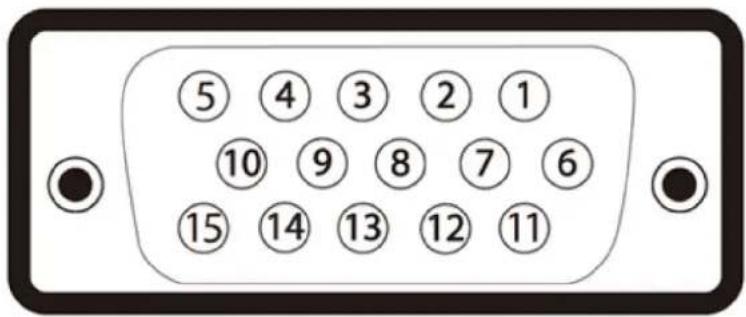
text_image
⑤ ④ ③ ② ① ⑩ ⑨ ⑧ ⑦ ⑥ ⑮ ⑭ ⑬ ⑭ ⑮| Pin Number | 15-pin Side of the Connected Signal Cable |
| 1 | Video-Red |
| 2 | Video-Green |
| 3 | Video-Blue |
| 4 | GND |
| 5 | Self-test |
| 6 | GND-R |
| 7 | GND-G |
| 8 | GND-B |
| 9 | Computer 5V/3.3V |
| 10 | GND-sync |
| 11 | GND |
| 12 | DDC data |
| 13 | H-sync |
| 14 | V-sync |
| 15 | DDC clock |
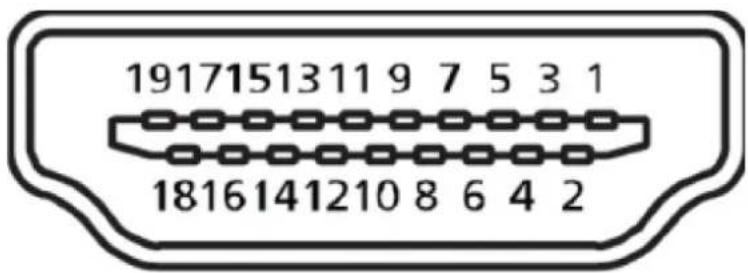
text_image
1917151311 9 7 5 3 1 1816141210 8 6 4 2| Pin Number | 19-pin Side of the Connected Signal Cable |
| 1 | T.M.D.S. Data 2+ |
| 2 | T.M.D.S. Data 2 Shield |
| 3 | T.M.D.S. Data 2- |
| 4 | T.M.D.S. Data 1+ |
| 5 | T.M.D.S. Data 1 Shield |
| 6 | T.M.D.S. Data 1 - |
| 7 | T.M.D.S. Data 0+ |
| 8 | T.M.D.S. Data 0 Shield |
| 9 | T.M.D.S. Data 0- |
| 10 | T.M.D.S. Clock + |
| 11 | T.M.D.S. Clock Shield |
| 12 | T.M.D.S. Clock - |
| 13 | CEC |
| 14 | Reserved (N.C. on device) |
| 15 | SCL |
| 16 | SDA |
| 17 | DDC/CEC Ground |
| 18 | +5V Power |
| 19 | Hot Plug Detect |
DisplayPort connector
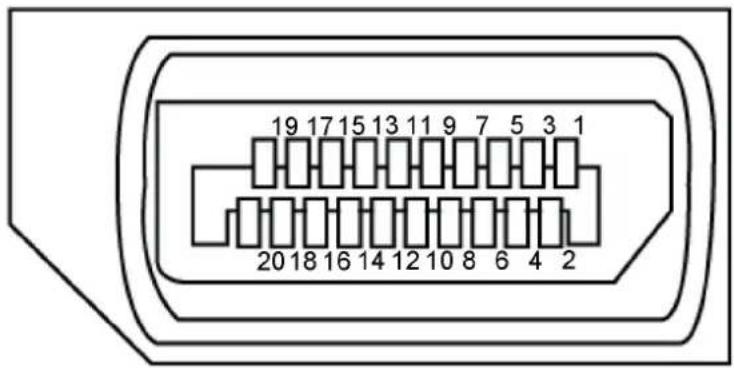
text_image
19 17 15 13 11 9 7 5 3 1 20 18 16 14 12 10 8 6 4 2| Pin Number | 20-pin Side of the Connected Signal Cable |
| 1 | ML3 (n) |
| 2 | GND |
| 3 | ML3 (p) |
| 4 | ML2 (n) |
| 5 | GND |
| 6 | ML2 (p) |
| 7 | ML1 (n) |
| 8 | GND |
| 9 | ML1 (p) |
| 10 | ML0 (n) |
| 11 | GND |
| 12 | ML0 (p) |
| 13 | GND |
| 14 | GND |
| 15 | AUX (p) |
| 16 | GND |
| 17 | AUX (n) |
| 18 | Hot Plug Detect |
| 19 | Re-PWR |
| 20 | +3.3 V DP_PWR |
Universal serial bus (USB) interface
This section gives you information about the USB ports that are available on the monitor.

NOTE: This monitor is Super-Speed USB 3.0 and High-Speed USB 2.0 compatible.
| Transfer Speed | Data Rate | Power Consumption* |
| Super-speed | 5 Gbps | 4.5 W (Max, each port) |
| High speed | 480 Mbps | 4.5 W (Max, each port) |
| Full speed | 12 Mbps | 4.5 W (Max, each port) |
| Transfer Speed | Data Rate | Power Consumption* |
| High speed | 480 Mbps | 2.5 W (Max, each port) |
| Full speed | 12 Mbps | 2.5 W (Max, each port) |
| Low speed | 1.5 Mbps | 2.5 W (Max, each port) |
USB 3.0 upstream connector
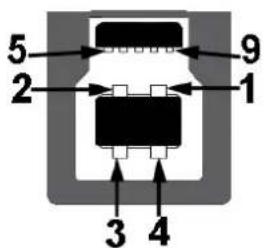
text_image
5 2 9 1 3 4| Pin Number | 9-pin Side of the Connector |
| 1 | VCC |
| 2 | D- |
| 3 | D+ |
| 4 | GND |
| 5 | SSTX- |
| 6 | SSTX+ |
| 7 | GND |
| 8 | SSRX- |
| 9 | SSRX+ |
USB 3.0 downstream connector
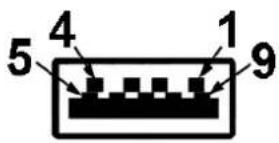
text_image
5 4 1 9| Pin Number | 9-pin Side of the Connector |
| 1 | VCC |
| 2 | D- |
| 3 | D+ |
| 4 | GND |
| 5 | SSRX- |
| 6 | SSRX+ |
| 7 | GND |
| 8 | SSTX- |
| 9 | SSTX+ |
USB 2.0 Downstream Connector
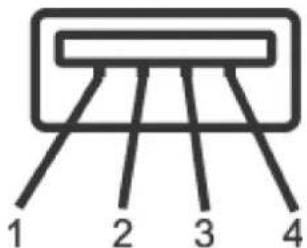
text_image
1 2 3 4| Pin Number | 4-pin Side of the Connector |
| 1 | VCC |
| 2 | DMD |
| 3 | DPD |
| 4 | GND |
USB Ports
• 1 x USB 3.0 upstream - bottom
• 2 x USB 2.0 downstream - bottom
• 2 x USB 3.0 downstream - side
NOTE: USB 2.0 functionality requires a USB 2.0-capable computer.
NOTE: The monitor's USB interface works only when the monitor is On or in the power save mode. If you turn Off the monitor and then turn it On, the attached peripherals may take a few seconds to resume normal functionality.
Plug and play capability
You can install the monitor in any Plug and Play-compatible system. The monitor automatically provides the computer system with its Extended Display Identification Data (EDID) using Display Data Channel (DDC) protocols so the system can configure itself and optimize the monitor settings. Most monitor installations are automatic, you can select different settings if desired. For more information about changing the monitor settings, see Operating your monitor.
LCD monitor quality and pixel policy
During the LCD Monitor manufacturing process, it is not uncommon for one or more pixels to become fixed in an unchanging state which are hard to see and do not affect the display quality or usability. For more information on Dell Monitor Quality and Pixel Policy, see Dell Support site at: www.dell.com/support/monitors.
Maintenance guidelines
Cleaning your monitor

WARNING: Before cleaning the monitor, unplug the monitor power cable from the electrical outlet.

CAUTION: Read and follow the Safety instructions before cleaning the monitor.
For best practices, follow the instructions in the list below while unpacking, cleaning or handling your monitor:
- To clean your anti-static screen, lightly dampen a soft, clean cloth with water. If possible, use a special screen-cleaning tissue or solution suitable for the anti-static coating. Do not use benzene, thinner, ammonia, abrasive cleaners or compressed air.
- Use a lightly-dampened, warm cloth to clean the monitor. Avoid using detergent of any kind as some detergents leave a milky film on the monitor.
- If you notice white powder when you unpack your monitor, wipe it off with a cloth.
- Handle your monitor with care as a darker-colored monitor may get scratched and show white scuff marks more than a lighter-colored monitor.
- To help maintain the best image quality on your monitor, use a dynamically changing screen saver and turn off your monitor when not in use.
Attaching the stand

NOTE: The stand is detached when the monitor is shipped from the factory.

NOTE: This is applicable for a monitor with a stand. When any other stand is bought, please refer to the respective stand setup guide for the set up instructions.
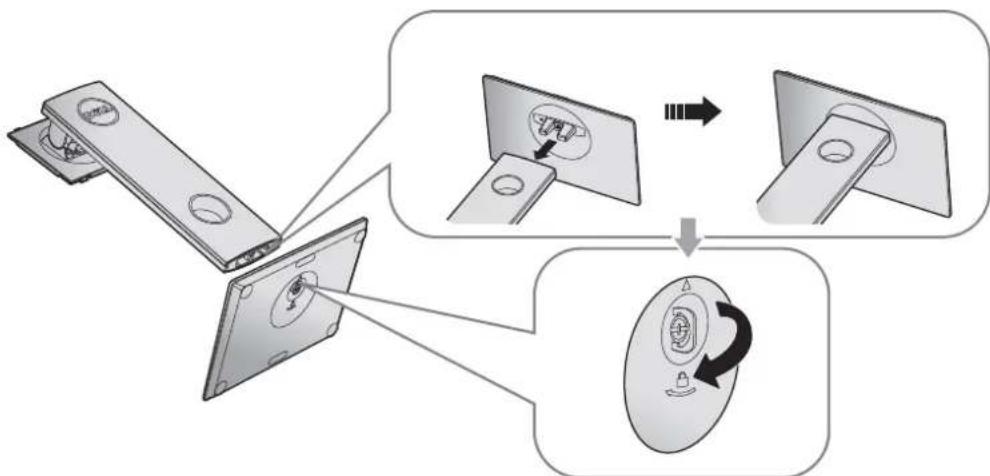
To attach the monitor stand.
- Follow the instructions on the flaps of carton to remove the stand from the top cushion that secures it.
- Insert the stand base blocks fully into the stand slot.
- Lift the screw handle and turn the screw clockwise.
- After fully tightening the screw, fold the screw handle flat within the recess.
flowchart
graph TD
    A["Device with circular holes"] --> B["Disassembly into a panel"]
    B --> C["Assembly to a device with a circular component"]
    C --> D["Rotation arrow indicates rotation"]
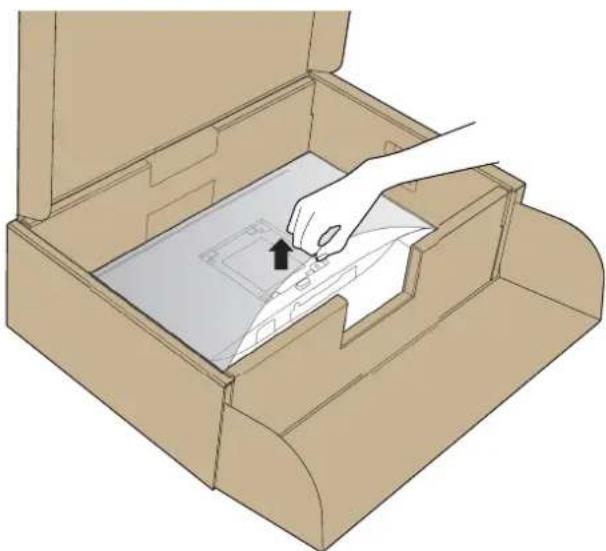
- Lift the cover, as shown, to expose the VESA area for stand assembly.
natural_image
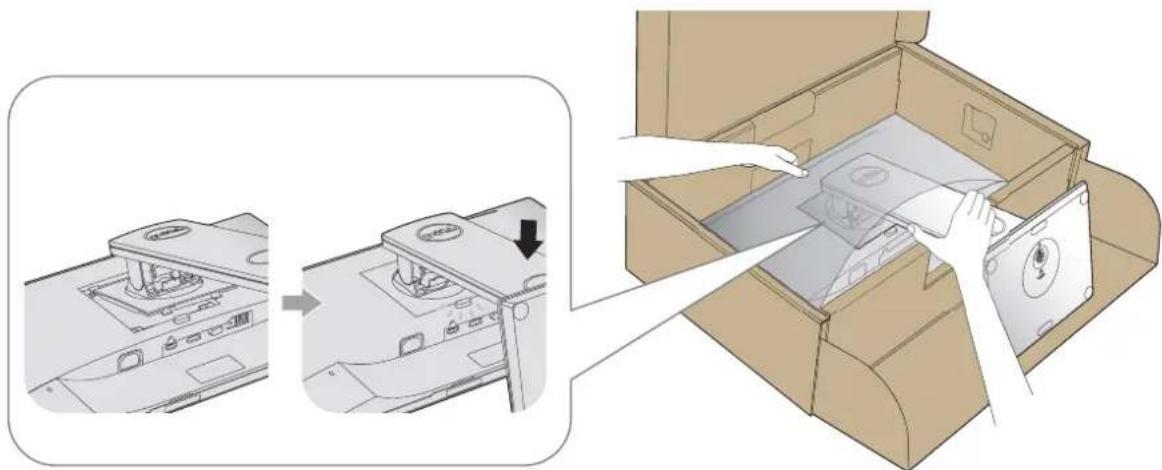
Illustration of a hand placing a paper into a cardboard box with a paper sheet inside (no text or symbols)- Attach the stand assembly to the monitor.
a. Fit the two tabs on the upper part of the stand to the groove on the back of the monitor.
b. Press the stand down till it snaps into place.
natural_image
Illustration of a device's open box with a hand inserting a paper into it, showing internal components and a close-up of the lid (no text or symbols present)- Place the monitor upright.

NOTE: Lift the monitor carefully to prevent it from slipping or falling.
Connecting your monitor

WARNING: Before you perform any of the procedures in this section, follow the Safety instructions.

NOTE: Do not connect all cables to the computer at the same time. It is recommend to route the cables through the cable-management slot before you connect them to the monitor.
To connect your monitor to the computer:
- Turn off your computer and disconnect the power cable.
- Connect the VGA, HDMI or DP cable from your monitor to the computer.
Connecting the VGA cable
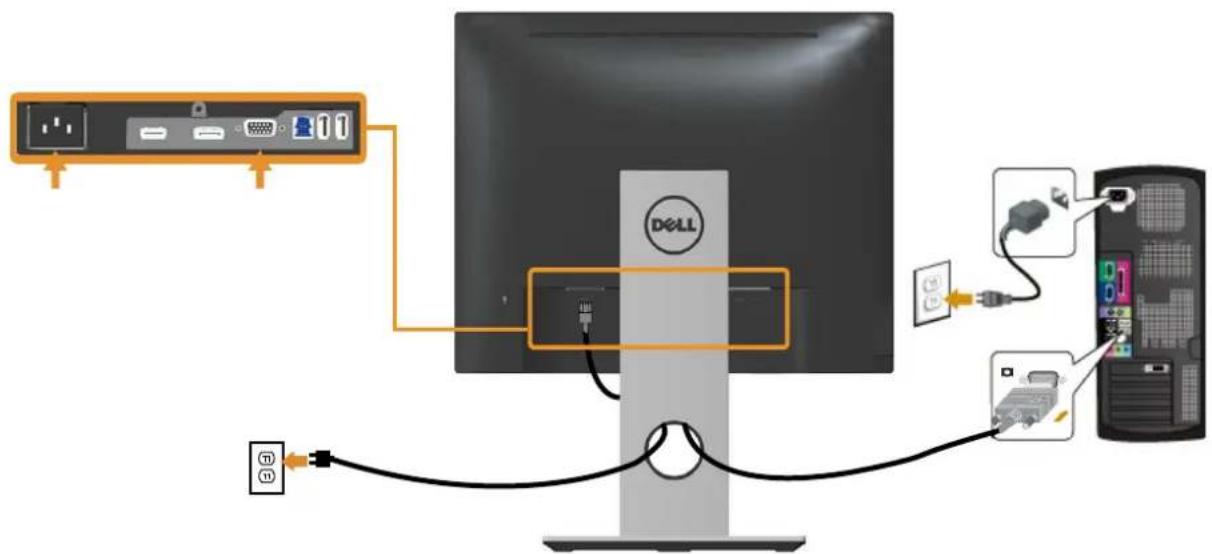
text_image
Diagram showing connections between a Dell monitor, connected to a computer interface with labeled components and cable routing.Connecting the HDMI cable (optional)
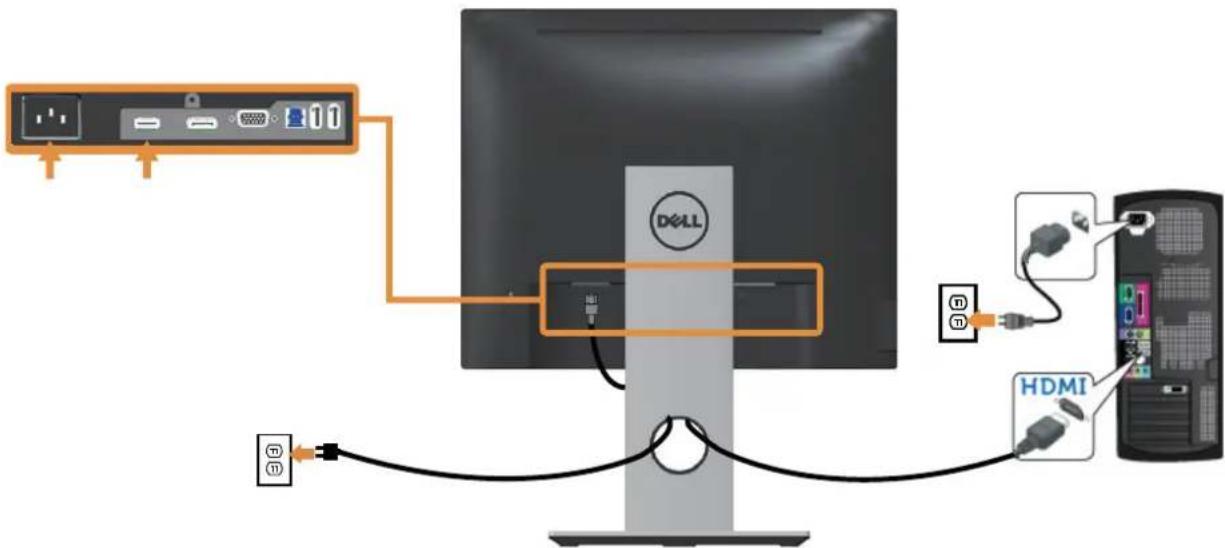
text_image
Diagram showing connections between a Dell monitor, HDMI, and ports with labeled componentsConnecting the DP cable
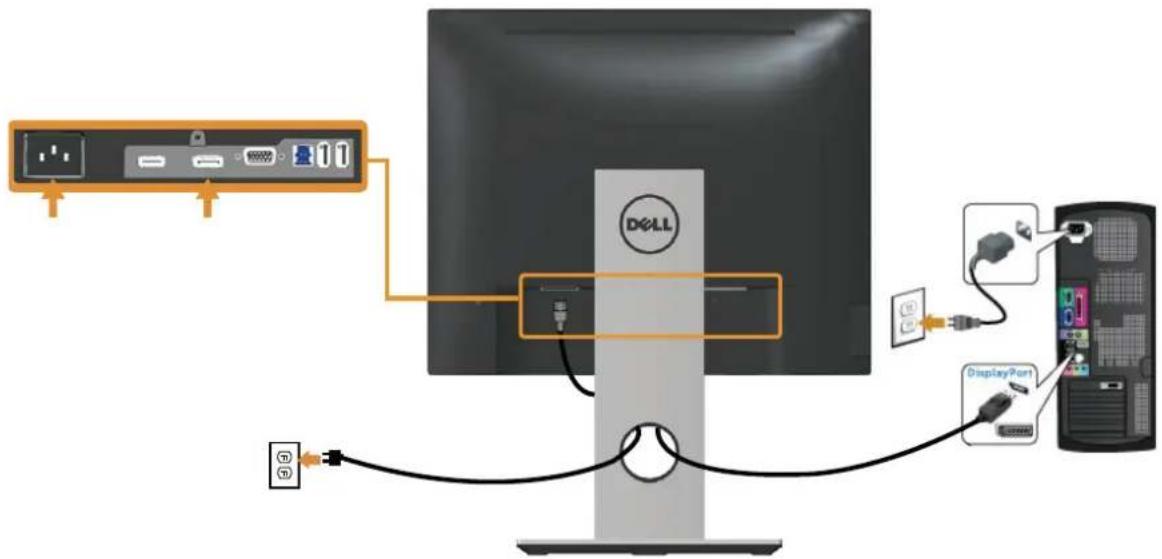
text_image
Diagram showing connections between a Dell monitor, an Apple TV port, and cable ports with labeled components.Connecting the USB 3.0 cable
After you have completed connecting the DP/HDMI cable, follow the procedures below to connect the USB 3.0 cable to the computer and complete your monitor setup:
- Connect the upstream USB 3.0 port (cable supplied) to an appropriate USB 3.0 port on your computer. (See Bottom View for details.)
- Connect the USB 3.0 peripherals to the downstream USB 3.0 ports on the monitor.
- Plug the power cables for your computer and monitor into a nearby outlet.
- Turn on the monitor and the computer.
If your monitor displays an image, installation is complete. If it does not display an image, see Universal serial bus (USB) specific problems. - Use the cable slot on the monitor stand to organize the cables.
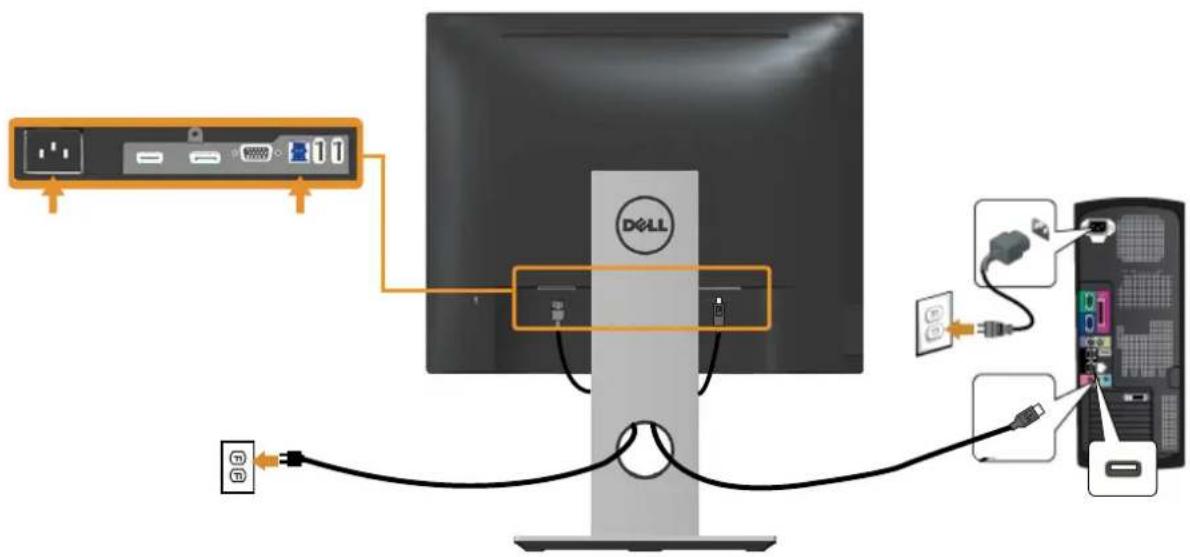
text_image
Diagram showing connections between a Dell monitor and a computer tower, with labeled ports and cable links.Organizing cables
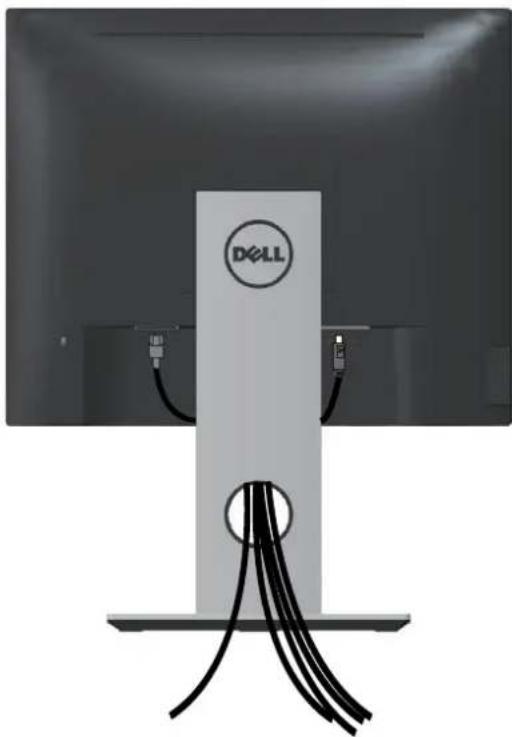
Use the cable-management slot to organize the cables connected to your monitor.
natural_image
Exterior view of a Dell electric vehicle charging station with black cables and connectors (no text or symbols visible)Disconnecting the monitor stand

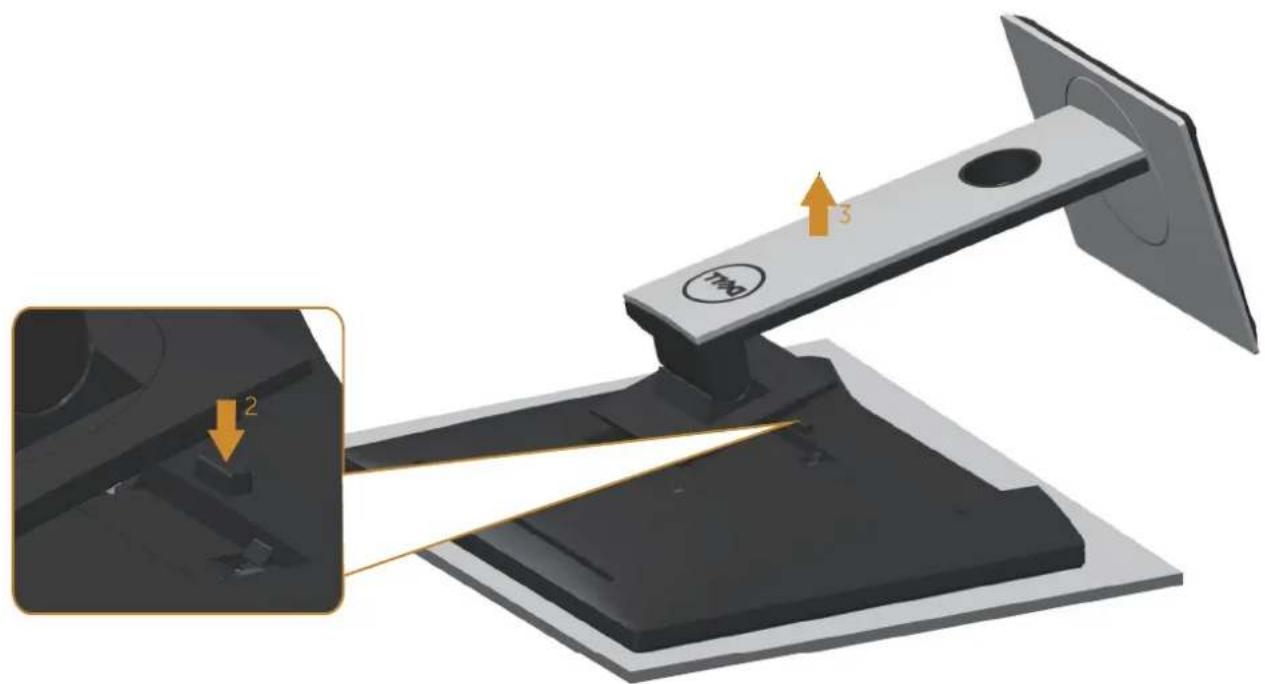
NOTE: To prevent scratches on the LCD screen while removing the stand, ensure that the monitor is placed on a soft and clean surface.

NOTE: This is applicable for a monitor with a stand. When any other stand is bought, please refer to the respective stand setup guide for the set-up instructions.
To remove the stand:
- Place the monitor on a soft cloth or cushion.
- Press and hold the stand release button.
- Lift the stand up and away from the monitor.
text_image
Technical diagram of a mechanical device with labeled components and directional arrows indicating assembly or movement.Wall mounting (optional)
text_image
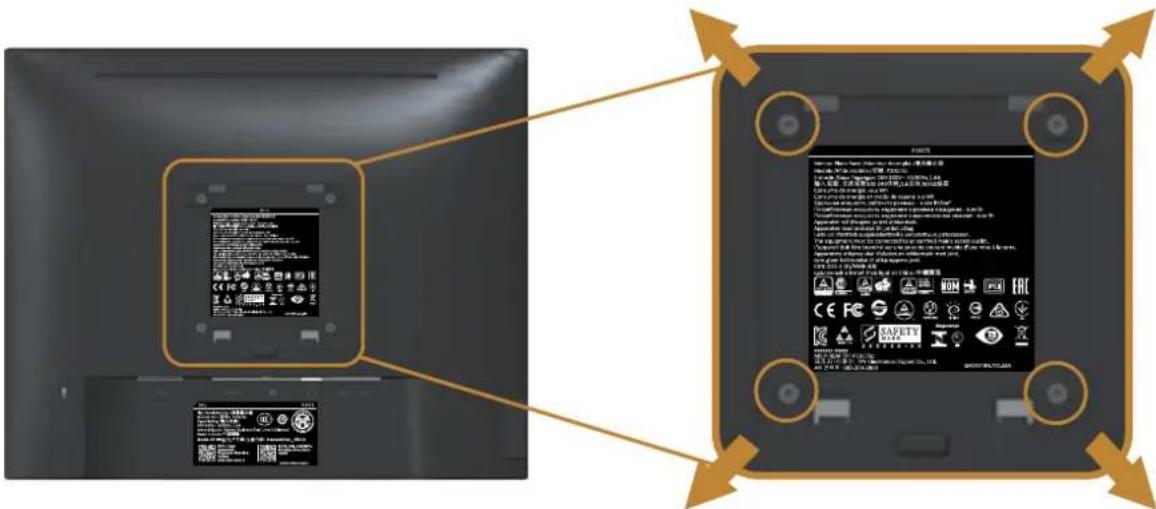
Diagram showing device placement and navigation of a tablet device, with labeled buttons and icons for safety and security.(Screw dimension: M4 x 10 mm).
Refer to the instructions that come with the VESA-compatible wall mounting kit.
- Place the monitor panel on a soft cloth or cushion on a stable, flat table.
- Remove the stand.
- Use a screwdriver to remove the four screws securing the plastic cover.
- Attach the mounting bracket from the wall mounting kit to the monitor.
- Mount the monitor on the wall by following the instructions that comes with the wall mounting kit.

NOTE: For use only with UL or CSA or GS-listed wall mount bracket with minimum weight/load bearing capacity of 12.00 kg
Power on the monitor
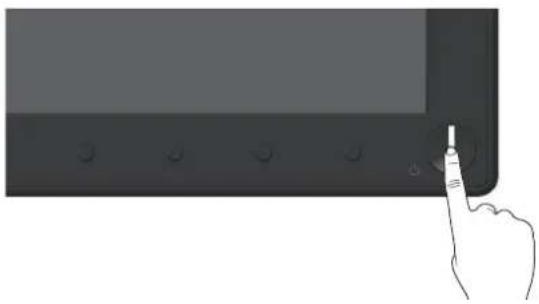
Press the ⏻ button to turn on the monitor.
natural_image
Hand pointing at a black electronic device with five buttons (no text or symbols visible)Using the front panel controls
Use the control buttons on the front of the monitor to adjust the image being displayed.
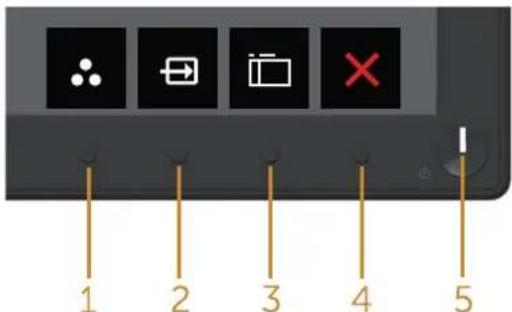
text_image
1 2 3 4 5The following table describes the front panel buttons:
| Front Panel Button | Description | |
| 1 |  | Use this button to choose from a list of preset modes. |
| Shortcut key/Preset Modes | ||
| 2 |  | Use the input source menu to select between the different video signals that may be connected to your monitor. |
| Shortcut key/Input source | ||
| 3 |  | Use the menu button to launch the on-screen display (OSD) and select the OSD menu. See Accessing the OSD menu. |
| Menu | ||
| 4 |  | Use this button to go back to the main menu or exit the OSD main menu. |
| Exit | ||
| 5 | Power On/Off button (with LED indicator) | Use the power button to turn the monitor on and off.Solid white light indicates the monitor is turned on. Blinking white light indicates it is in power-save mode. |
OSD controls
Use the buttons on the front of the monitor to adjust the image settings.
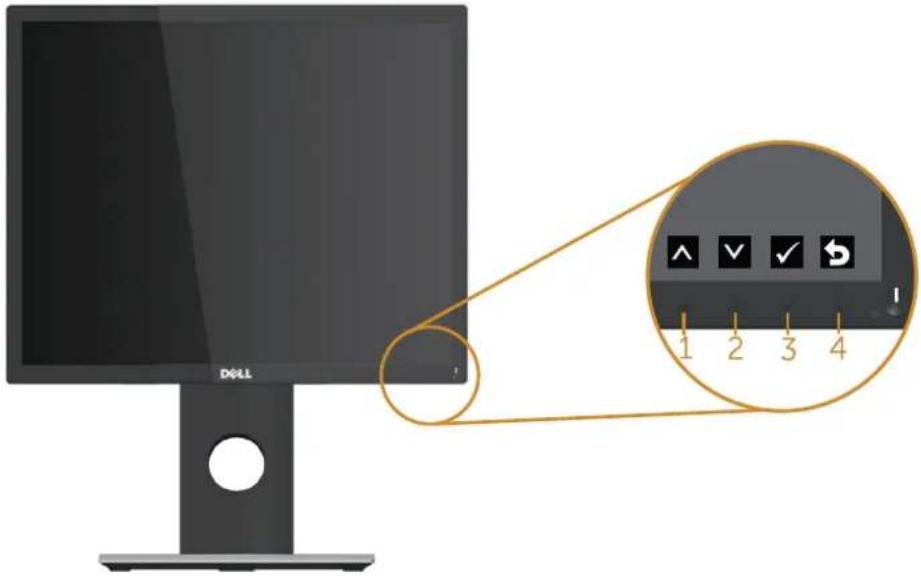
text_image
DOLL 1 2 3 4| Front Panel Button | Description | |
| 1 |  | Use the up button to increase values or move up in a menu. |
| Up | ||
| 2 |  | Use the down button to decrease values or move down in a menu. |
| Down | ||
| 3 |  | Use the OK button to confirm your selection in a menu. |
| OK | ||
| 4 |  | Use the back button to go back to the previous menu. |
| Back | ||
Using the on-screen display (OSD) menu
Accessing the OSD menu

NOTE: Any changes you make are automatically saved when you move to another menu, exit the OSD menu, or wait for the OSD menu to automatically close.
- Press the button to display the OSD main menu.
Main menu for analog (VGA) input
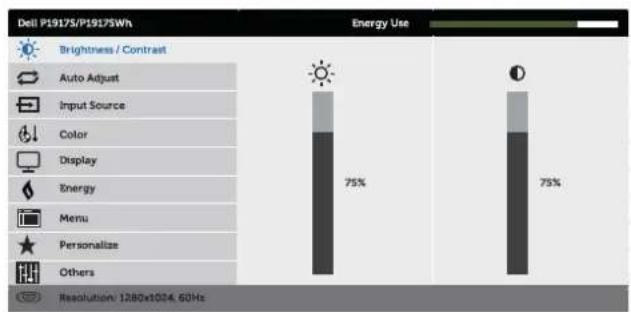
bar
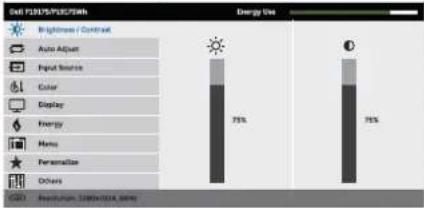
Dell P19175/P19175Wh | Category | Energy Use (%) | |---|---| | Brightness / Contrast | 75 | | Auto Adjust | 75 | | Input Source | 75 | | Color | 75 | | Display | 75 | | Energy | 75 | | Menu | 75 | | Personalize | 75 | | Others | 75 | Resolution: 1280x1024.60Hz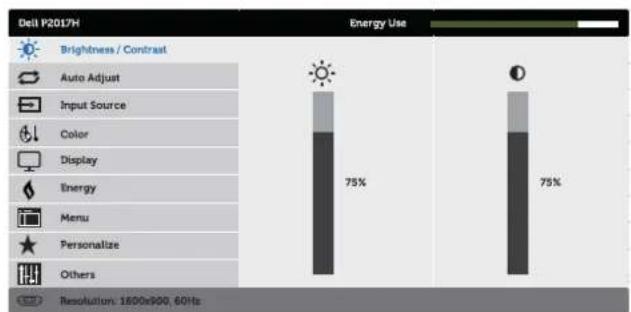
bar
Dell P2017H | Component | Percentage (%) | | :--- | :--- | | Brightness / Contrast | 75 | | Auto Adjust | 75 | | Input Source | 75 | | Color | 75 | | Display | 75 | | Energy | 75 | | Menu | 75 | | Personalize | 75 | | Others | 75 | Resolution: 1600x900, 60Hz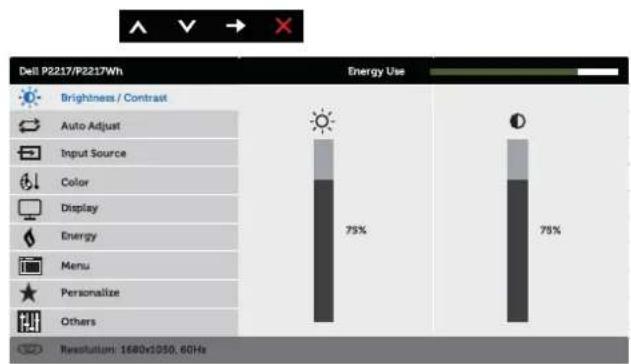
bar_stacked
| Source | Percentage (%) | | :--- | :--- | | Light Grey | 75 | | Dark Grey | 25 |
- Press the ⚠ and ⨁ buttons to move between the setting options. As you move from one icon to another, the option is highlighted.
- Press the ➕ button once to activate the highlighted option.
- Press ⬆ and ⬇ button to select the desired parameter.
- Press → and then use the ∧ and ∨ buttons, according to the indicators on the menu, to make your changes.
- Select the ⓑ button to return to the main menu.
| Icon | Menu and Submenus | Description | |
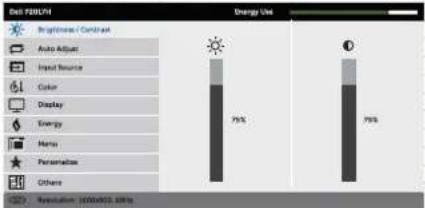
 | Brightness/Contrast | Use this menu to activate brightness/contrast adjustment. | |
 |  | ||
| AY8D4 | |||
| Brightness | Brightness adjusts the luminance of the backlight. Press the ▲ button to increase the brightness and press the √ button to decrease the brightness (min. 0 / max. 100).NOTE: Manual adjustment of brightness is disabled when dynamic contrast is switched on. | ||
| Contrast | Adjust the brightness first, and then adjust the contrast only if further adjustment is necessary. Press the ▲ button to increase the contrast and press the √ button to decrease the contrast (min. 0 / max. 100).The contrast function adjusts the degree of difference between darkness and lightness on the monitor screen. | ||

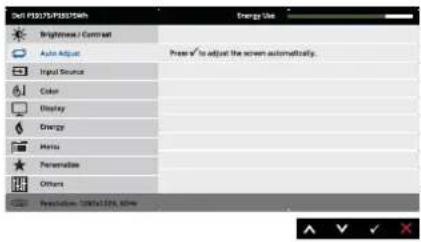
Auto Adjust
Use this key to activate automatic setup and adjust menu.
text_image
Brightness / Contrast Auto Adjust Input Source Color Display Energy Menu Parameters Others Presets: 100%+100% select Press √ to adjust the screen automatically.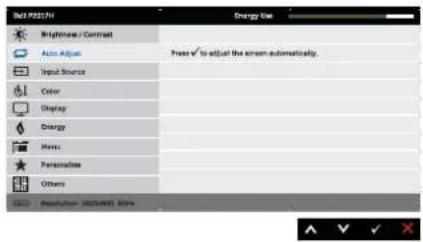
text_image
Lightwave / Contrast Auto Adjust Input Source Color Display Energy Menu Personalize Others Resolution: 360MHz, 50%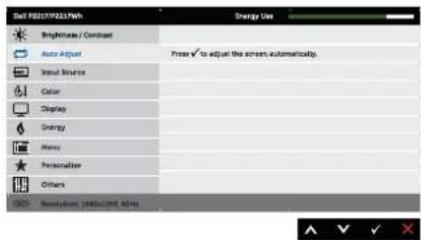
text_image
Net POST/PRESS/PH Energy Use Brightness / Contrast Auto Adjust Press √ to adjust the screen automatically. Input Resource Color Display Energy Menu Personalizer Others OK! Download: 100% or 100%The following dialog appears on a black screen as the monitor self-adjusts to the current input:
Auto Adjustment in Progress...
Auto adjustment allows the monitor to self-adjust to the incoming video signal. After using auto adjustment, you can further tune your monitor by using the pixel clock (coarse) and phase (fine) controls under display settings.
NOTE: Auto adjust does not occur if you press the button while there are no active video input signals or attached cables.
This option is only available when you are using the analog (VGA) connector.
| Input Source | Use the input source menu to select between the different video signals that may be connected to your monitor. | ||
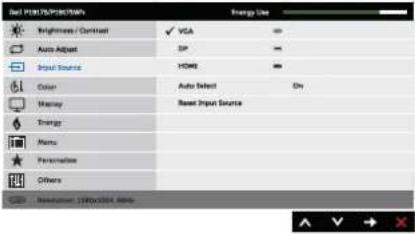 | 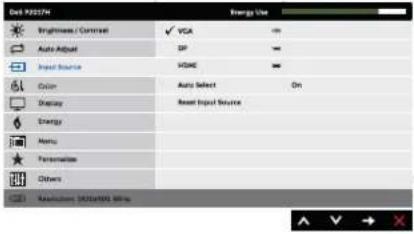 | ||
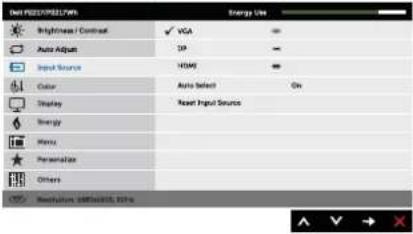 | |||
| VGA | Select VGA input when you are using the analog (VGA) connector. Push ➕ to select the VGA input source. | ||
| DP | Select DP input when you are using the DP connector. Push ➕ to select the DP input source. | ||
| HDMI | Select HDMI input when you are using the HDMI connector. Push ➕ to select the HDMI input source. | ||
| Auto Select | Select auto select to scan for available input signals. | ||
| Reset Input Source | Select this option to restore default Input Source. | ||
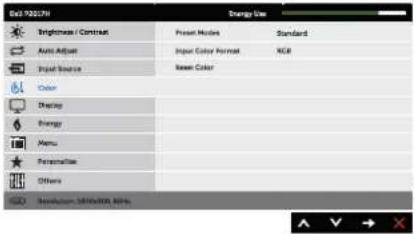
 | Color | Use color to adjust the color setting mode. | |
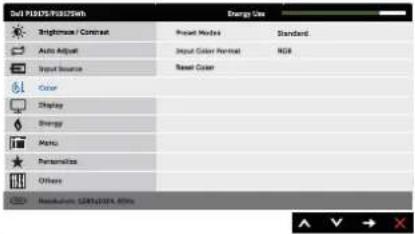 |  | ||
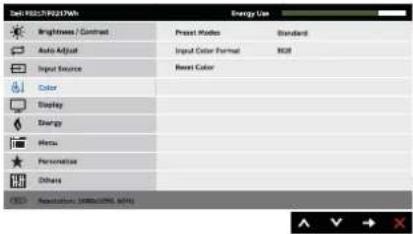 | |||
| Preset Modes | When you select preset modes, you can choose standard, comfortview, multimedia, movie, game, warm, cool, or custom color from the list.Standard: Loads the monitor's default color settings. This is the default preset mode.ComfortView: Decreases the level of blue light emitted from the screen to make viewing more comfortable for your eyes.Multimedia: Loads color settings ideal for multimedia applications.Movie: Loads color settings ideal for movies.Game: Loads color settings ideal for most gaming applications.Warm: Increases the color temperature. The screen appears warmer with a red/yellow tint.Cool: Decreases the color temperature. The screen appears cooler with a blue tint.Custom Color: Allows you to manually adjust the color settings.Press the ∧ and √ buttons to adjust the three colors (R, G, B) values and create your own preset color mode.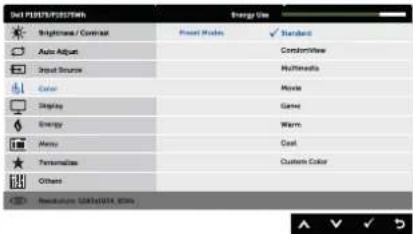 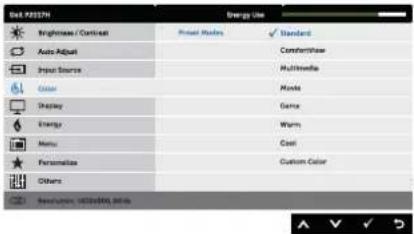 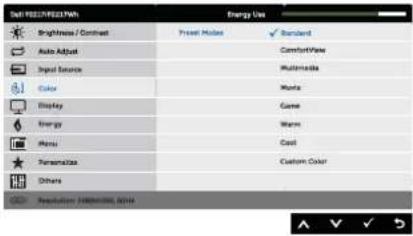 | ||
| Input Color Format | Allows you to set the video input mode to:RGB: Select this option if your monitor is connected to a computer or DVD player using the HDMI cable.YPbPr: Select this option if your DVD player supports only YPbPr output.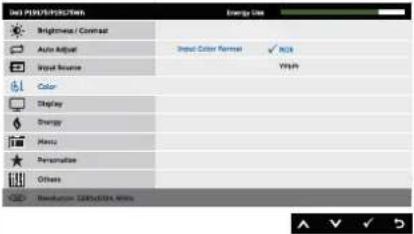 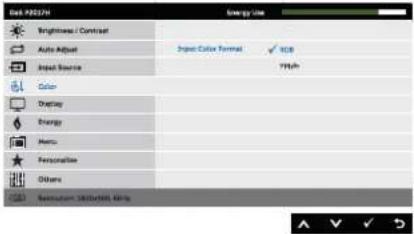 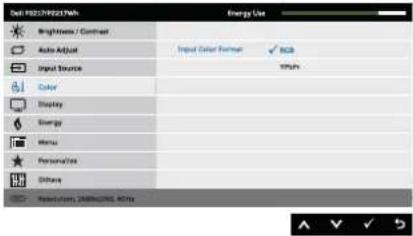 | ||
| Hue | This feature can shift the color of the video image to green or purple. This is used to adjust the desired flesh tone color. Use ∧ or √ to adjust the hue from 0 to 100. Press ∧ to increase the green shade of the video image. Press √ to increase the purple shade of the video image.NOTE: Hue adjustment is available only when you select Movie or Game preset mode. | ||
| Saturation | This feature can adjust the color saturation of the video image. Use ∧ or √ to adjust the saturation from 0 to 100. Press ∧ to increase the monochrome appearance of the video image. Press √ to increase the colorful appearance of the video image.NOTE: Saturation adjustment is available only when you select movie or game preset mode. | ||
| Reset Color | Allows your monitor color settings to the factory settings. | ||
| Display | Use the display to adjust image. 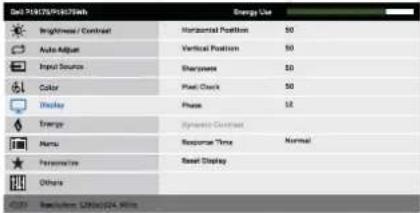 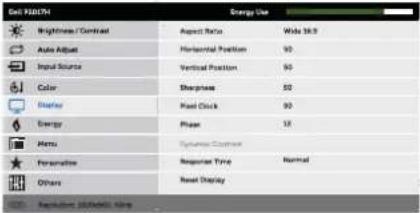 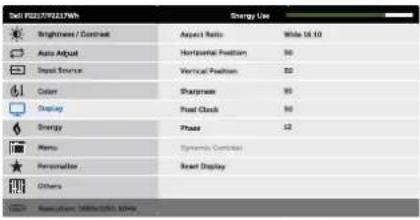 | ||
| Aspect Ratio | Adjusts the image ratio to wide 16:9, 4:3 or 5:4(for P2017H). Adjusts the image ratio to wide 16:10, 4:3 or 5:4(for P2217/P2217Wh). | ||
| Horizontal Position | Use ▲ or ▼ the buttons to adjust image left and right. Minimum is 0 (-). Maximum is 100 (+). | ||
| Vertical Position | Use the ▲ or ▼ buttons to adjust image up and down. Minimum is 0 (-). Maximum is 100 (+). | ||
| Sharpness | This feature can make the image look sharper or softer. Use ▲ or ▼ to adjust the sharpness from 0 to 100. | ||
| Pixel Clock | The phase and pixel clock adjustments allow you to adjust your monitor to your preference. Use ▲ or ▼ buttons to adjust for best image quality. Minimum is 0 (-). Maximum is 100 (+). | ||
| Phase | If satisfactory results are not obtained using the phase adjustment, use the pixel clock (coarse) adjustment and then use phase (fine), again. Minimum is 0 (-). Maximum is 100 (+). | ||
| Dynamic Contrast | Allows you to increase the level of contrast to provide sharper and more detailed image quality. Press the ➕ button to select the dynamic contrast on or off. NOTE: Dynamic contrast provides higher contrast if you select game or movie preset mode. | ||
| Response Time | User can select between fast or normal. (for P1917S/ P1917SWh and P2017H only) | ||
| Reset Display | Select this option to restore default display settings. | ||
 | Energy | 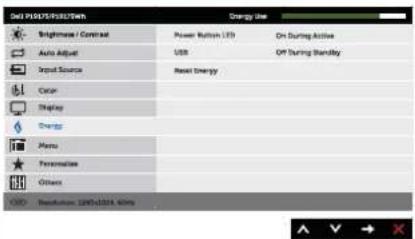 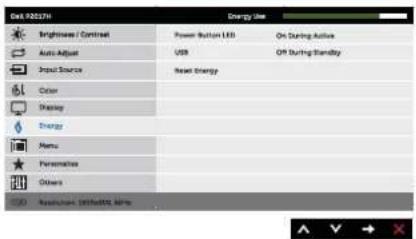 | |
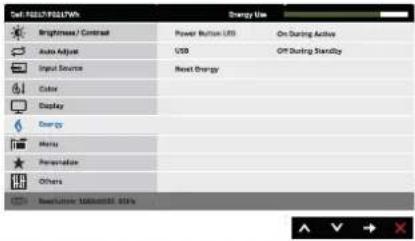 | |||
| Power Button LED | Allows you to set the power LED indicator on during active or off during active to save energy. | ||
| USB | Allows you to enable or disable USB function during monitor standby mode. NOTE: USB ON/OFF under standby mode is only available when USB upstream cable unplugged. This option will be grey out when USB upstream cable plug in. | ||
| Reset Energy | Select this option to restore default Energy settings. | ||
| Menu | Select this option to adjust the settings of the OSD, such as, the languages of the OSD, the amount of time the menu remains on screen and so on. | ||
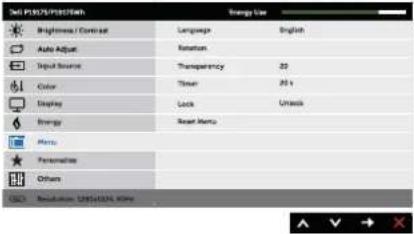 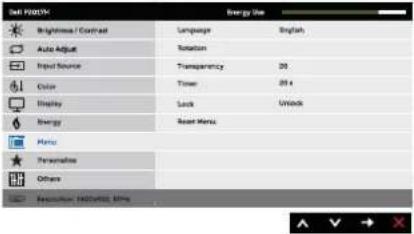 | |||
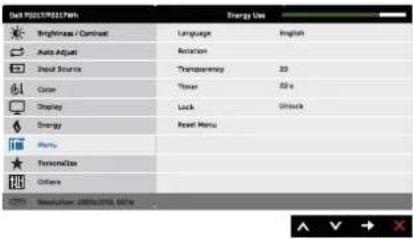 | |||
| Language | Language options set the OSD display to one of the eight languages (English, Spanish, French, German, Brazilian Portuguese, Russian, Simplified Chinese, or Japanese). | ||
| Rotation | Rotates the OSD by 90 degrees counter-clockwise. | ||
| Transparency | Select this option to change the menu transparency by pressing the ∧ and ∨ buttons from 0 to 100. | ||
| Timer | OSD hold time: sets the length of time the OSD will remain active after the last time you pressed a button. Use ∧ or ∨ to adjust the slider in 1 second increments, from 5 to 60 seconds. | ||
| Lock | Controls user access to adjustments. When lock is selected, no user adjustments are allowed. All buttons are locked. NOTE: When the OSD is locked, pressing the menu key takes you directly to the OSD settings menu, with 'OSD Lock' pre-selected on entry. Press and hold ⬆ key for 6 seconds to unlock and allow user access to all applicable settings. | ||
| Reset Menu | Reset all OSD settings to the factory preset values. | ||
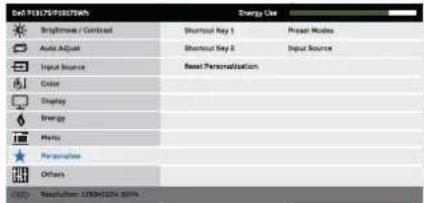
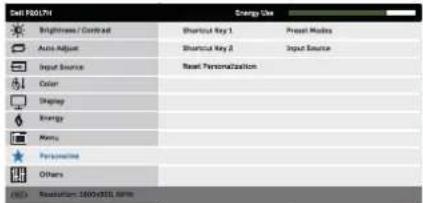
 | Personalize | Users can choose a feature from shortcut key 1, shortcut key 2, reset personalization, preset modes or input source and set it as a shortcut key. | |
 |  | ||
| KA2G | |||
| Shortcut Key 1 | User can select one of the following: preset modes, brightness/contrast, auto adjust, input source, aspect ratio(option), rotation to set the shortcut key 1. | ||
| Shortcut Key 2 | User can select one of the following: preset modes, brightness/contrast, auto adjust, input source, aspect ratio(option), rotation to set the shortcut key 2. | ||
| Reset Personalization | Allows you to restore shortcut key to the default setting. | ||
 | Others | 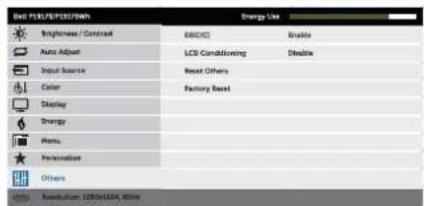 | 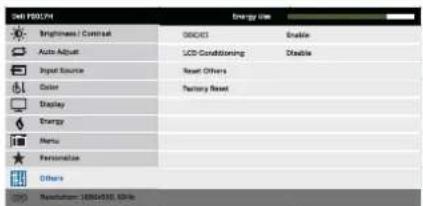 |
| Z6YZ | |||
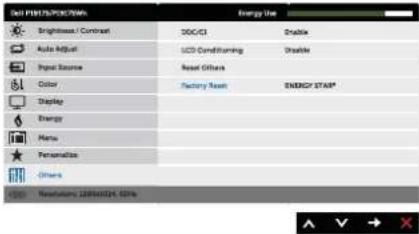
| DDC/CI | DDC/CI (display data channel/command interface) allows your monitor parameters (brightness, color balance and etc.) to be adjustable via the software on your computer. You can disable this feature by selecting disable. Enable this feature for best user experience and optimum performance of your monitor.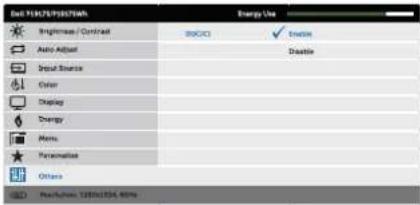 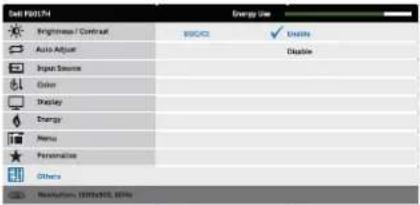 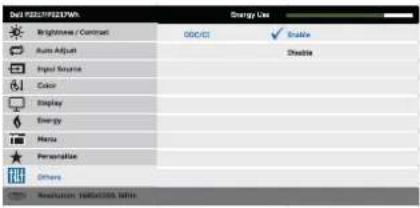 [A V V 5] [A V V 5] | ||
| LCD Conditioning | Helps reduce minor cases of image retention. Depending on the degree of image retention, the program may take some time to run. To start LCD conditioning, select Enable.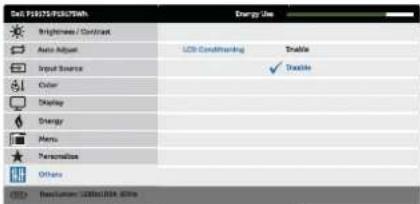 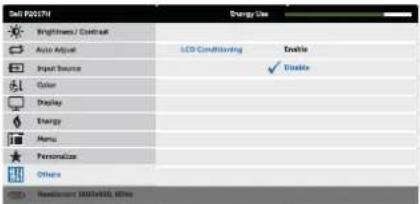 [A V V 5] [A V V 5] 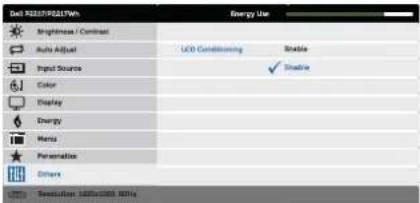 [A V V 5] [A V V 5] | ||
| Reset Other | Reset all settings under the Others setting menu to the factory preset values. | ||
| Factory Reset | Restore all preset values to the factory default settings. These are also the settings for ENERGY STAR® tests. | ||
 |  | ||

NOTE: Your monitor has a built-in feature to automatically calibrate the brightness to compensate for LED aging.
OSD warning messages
When the Dynamic Contrast feature is enabled (in these preset modes: Game or Movie), the manual brightness adjustment is disabled.
Dell P1917S/P1917SWh
To allow manual adjustment of brightness, the Dynamic Contrast will be switched off.
Do you want to continue?
No
Yes
Dell P2017H
To allow manual adjustment of brightness, the Dynamic Contrast will be switched off.
Do you want to continue?
No
Yes
Dell P2217/P2217Wh
To allow manual adjustment of brightness, the Dynamic Contrast will be switched off.
Do you want to continue?
No
Yes
When the monitor does not support a particular resolution mode, the following message is displayed:
Dell P1917S/P1917SWh
The current input timing is not supported by the monitor display.
Please change your input timing to 1280x1024, 60Hz or any
other monitor listed timing as per the monitor specifications.

Dell P2017H
The current input timing is not supported by the monitor display.
Please change your input timing to 1600x900, 60Hz or any
other monitor listed timing as per the monitor specifications.

Dell P2217/P2217Wh
The current input timing is not supported by the monitor display.
Please change your input timing to 1680x1050, 60Hz or any
other monitor listed timing as per the monitor specifications.

This means that the monitor cannot synchronize with the signal that it is receiving from the computer. See Monitor specifications for the Horizontal and Vertical frequency ranges addressable by this monitor. Recommended mode is 1280 x 1024 (for P1917S/P1917SWh) or 1600 x 900 (for P2017H) or 1680 x 1050 (for P2217/P2217Wh).
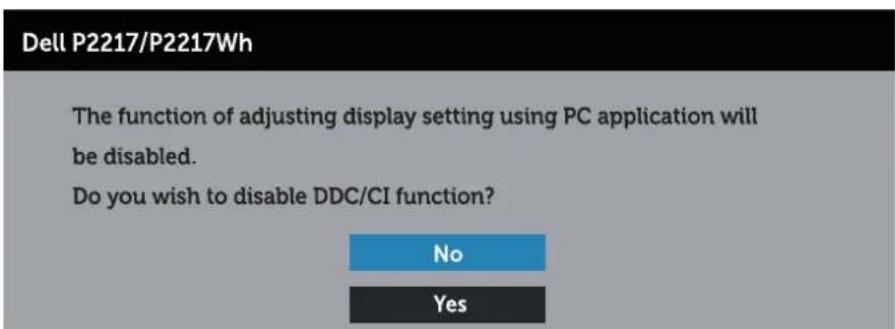
Before the DDC/CI function is disabled, the following message is displayed:
Dell P1917S/P1917SWh
The function of adjusting display setting using PC application will be disabled.
Do you wish to disable DDC/CI function?
No
Yes
Dell P2017H
The function of adjusting display setting using PC application will be disabled.
Do you wish to disable DDC/CI function?
No
Yes
text_image
Dell P2217/P2217Wh The function of adjusting display setting using PC application will be disabled. Do you wish to disable DDC/CI function? No YesWhen the monitor enters the Power Save Mode, the following message appears:
| Dell P1917S/P1917SWh |
| Entering Power Save Mode. |
| Dell P2017H |
| Entering Power Save Mode. |
| Dell P2217/P2217Wh |
| Entering Power Save Mode. |
If you press any button other than the power button, the following messages will appear depending on the selected input:
text_image
Dell P1917S/P1917SWh No VGA signal from your device. Press any key on the keyboard or move the mouse to wake it up. If there is no display, press the monitor button again to select the correct input source.
text_image
Dell P2017H No VGA signal from your device. Press any key on the keyboard or move the mouse to wake it up. If there is no display, press the monitor button again to select the correct input source.Dell P2217/P2217Wh

No VGA signal from your device.
Press any key on the keyboard or move the mouse to wake it up. If there is no display, press the monitor button again to select the correct input source.
If VGA, HDMI, or DP cable is not connected, a floating dialog box as shown below appears. The monitor will enter Power Save Mode after 4 minutes if left at this state.
Dell P1917S/P1917SWh

No VGA Cable
The display will go into Power Save Mode in 4 minutes.

text_image
www.dell.com/support/monitorsDell P2017H

No VGA Cable
The display will go into Power Save Mode in 4 minutes.

text_image
www.dell.com/support/monitorsDell P2217/P2217Wh

No VGA Cable
The display will go into Power Save Mode in 4 minutes.

text_image
www.dell.com/support/monitorsor
Dell P1917S/P1917SWh

No HDMI Cable
The display will go into Power Save Mode in 4 minutes.

text_image
www.dell.com/support/monitorsDell P2017H

No HDMI Cable
The display will go into Power Save Mode in 4 minutes.

text_image
www.dell.com/support/monitorsDell P2217/P2217Wh

No HDMI Cable
The display will go into Power Save Mode in 4 minutes.

text_image
www.dell.com/support/monitorsor
Dell P1917S/P1917SWh

No DP Cable
The display will go into Power Save Mode in 4 minutes.

text_image
www.dell.com/support/monitorsDell P2017H

No DP Cable
The display will go into Power Save Mode in 4 minutes.

text_image
www.dell.com/support/monitorsDell P2217/P2217Wh

No DP Cable
The display will go into Power Save Mode in 4 minutes.

text_image
www.dell.com/support/monitorsSee Troubleshooting for more information.
Setting up your monitor
Setting the maximum resolution
To set the maximum resolution for the monitor:
In Windows® 8, and Windows® 8.1:
- For Windows 8 and Windows 8.1, select the Desktop tile to switch to classic desktop.
- Right-click on the desktop and click Screen resolution.
- Click the dropdown list of the Screen Resolution and select 1280 x 1024 (for P1917S/P1917SWh) or 1600 x 900 (for P2017H) or 1680 x 1050 (for P2217/P2217Wh).
- Click OK.
In Windows® 10:
- Right-click on the desktop and click Display settings.
- Click Advanced display settings.
- Click the dropdown list of Resolution and select 1280 x 1024 (for P1917S/P1917SWh) or 1600 x 900 (for P2017H) or 1680 x 1050 (for P2217/P2217Wh).
- Click Apply.
If you do not see 1280 x 1024 (for P1917S/P1917SWh) or 1600 x 900 (for P2017H) or 1680 x 1050 (for P2217/P2217Wh) as an option, you may need to update your graphics driver. Depending on your computer, complete one of the following procedures:
If you have a Dell desktop or portable computer:
- Go to www.dell.com/support, enter your computer's Service Tag, and download the latest driver for your graphics card.
If you are using a non-Dell computer (portable or desktop):
- Go to the support site for your computer and download the latest graphic drivers.
- Go to your graphics card website and download the latest graphic drivers.
Using the Tilt, Swivel, and Vertical Extension

NOTE: This is applicable for a monitor with a stand. When any other stand is bought, please refer to the respective stand setup guide for set up instructions.
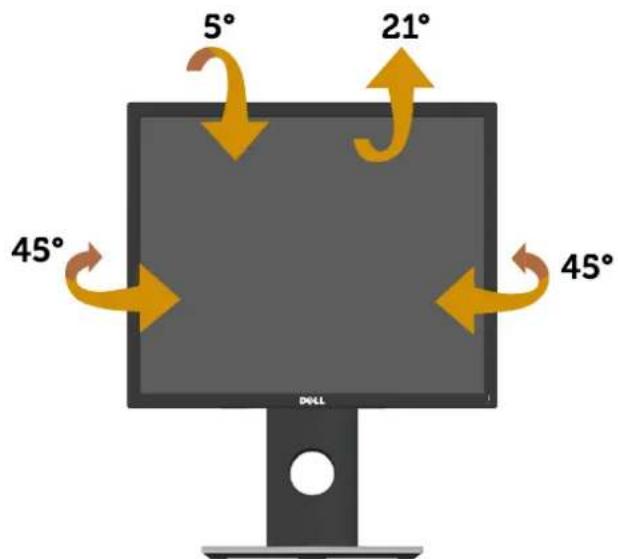
Tilt, Swivel
With the stand attached to the monitor, you can tilt and swivel the monitor for the most comfortable viewing angle.
text_image
5° 21° 45° 45° DOLL
NOTE: The stand is detached when the monitor is shipped from the factory.
Vertical Extension

NOTE: The stand extends vertically up to 130 mm. The figure below illustrates how to extend the stand vertically.
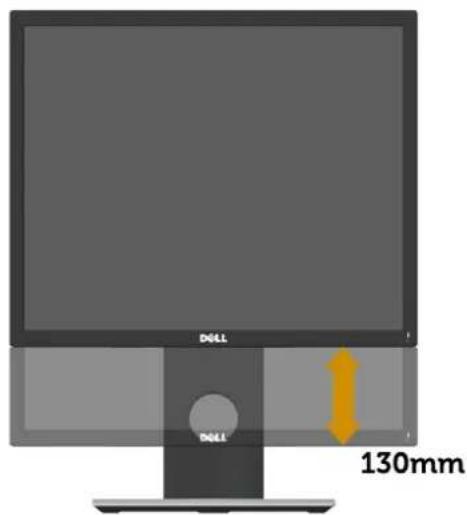
text_image
Dell Dell 130mmRotating the Monitor
Before you rotate the monitor, your monitor should be fully vertically extended (Vertical Extension) and fully tilted up to avoid hitting the bottom edge of the monitor.
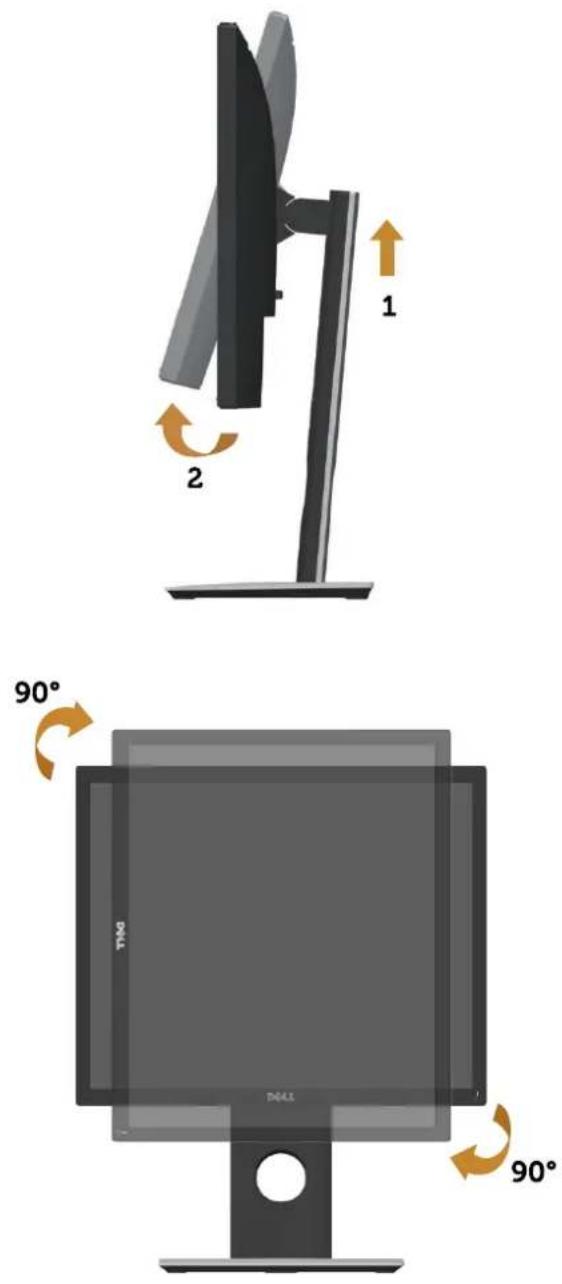
text_image
Diagram showing a computer monitor with two labeled parts and 90-degree rotation arrows indicating orientation.NOTE: To use the Display Rotation function (Landscape versus Portrait view) with your Dell computer, you require an updated graphics driver that is not included with this monitor. To download the graphics driver, go to www.dell.com/support and see the Download section for Video Drivers for latest driver updates.
NOTE: When in the Portrait View Mode, you may experience performance degradation in graphic-intensive applications (3D Gaming and etc.).

WARNING: Before you begin any of the procedures in this section, follow the Safety instructions.
Self-test
Your monitor provides a self-test feature that allows you to check if your monitor is functioning properly. If your monitor and computer are properly connected but the monitor screen remains dark, run the monitor self-test by performing the following steps:
- Turn off both your computer and the monitor.
- Disconnect all video cables from the monitor. This way, the computer doesn't have to be involved.
- Turn on the monitor.
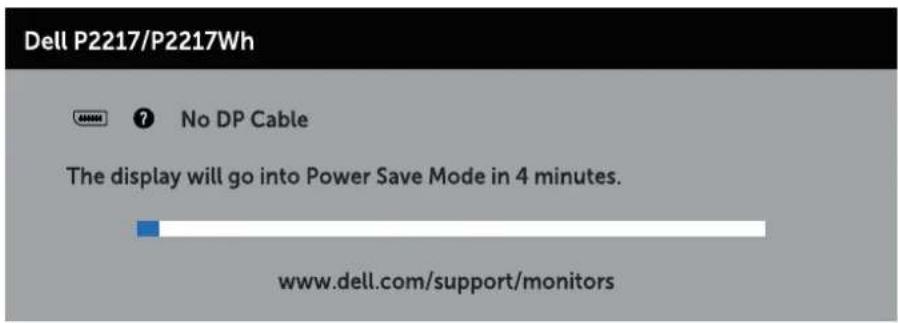
If the monitor is working correctly, it detects that there is no signal and one of the following message appears. While in self-test mode, the power LED remains white.
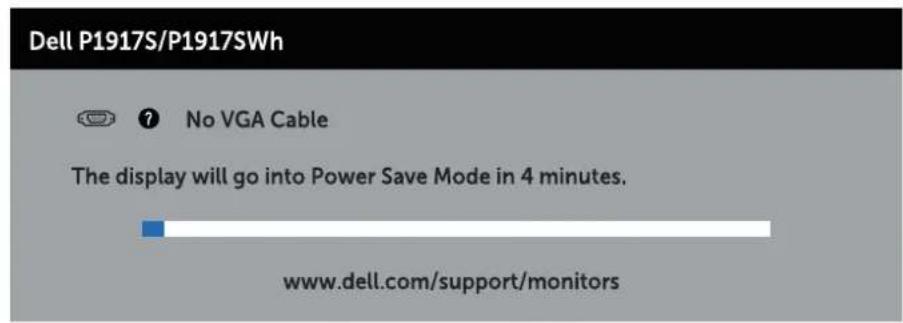
text_image
Dell P1917S/P1917SWh No VGA Cable The display will go into Power Save Mode in 4 minutes. www.dell.com/support/monitors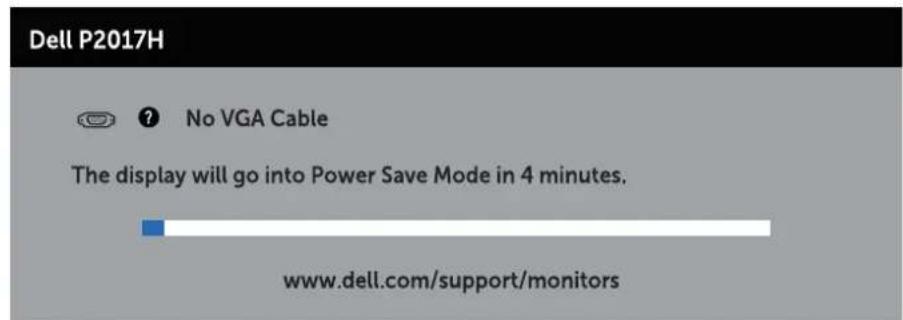
text_image
Dell P2017H No VGA Cable The display will go into Power Save Mode in 4 minutes. www.dell.com/support/monitors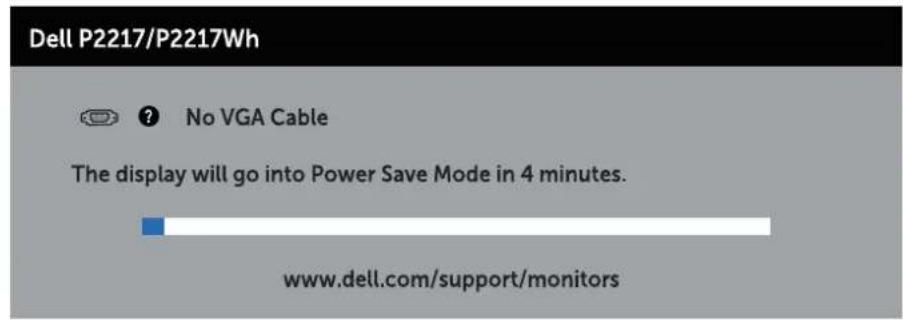
text_image
Dell P2217/P2217Wh No VGA Cable The display will go into Power Save Mode in 4 minutes. www.dell.com/support/monitorsor
Dell P1917S/P1917SWh


No HDMI Cable
The display will go into Power Save Mode in 4 minutes.
www.dell.com/support/monitors
Dell P2017H


No HDMI Cable
The display will go into Power Save Mode in 4 minutes.
www.dell.com/support/monitors
Dell P2217/P2217Wh


No HDMI Cable
The display will go into Power Save Mode in 4 minutes.
www.dell.com/support/monitors
or
Dell P1917S/P1917SWh


No DP Cable
The display will go into Power Save Mode in 4 minutes.
www.dell.com/support/monitors
Dell P2017H


No DP Cable
The display will go into Power Save Mode in 4 minutes.
www.dell.com/support/monitors
text_image
Dell P2217/P2217Wh No DP Cable The display will go into Power Save Mode in 4 minutes. www.dell.com/support/monitors
NOTE: This box also appears during normal system operation, if the video cable is disconnected or damaged.
- Turn off your monitor and reconnect the video cable; then turn on both your computer and the monitor.
If your monitor remains dark after you reconnect the cables, check your video controller and computer.
Built-in diagnostics
Your monitor has a built-in diagnostic tool that helps you determine if any screen abnormality you experience is an inherent problem with your monitor, or with your computer and video card.

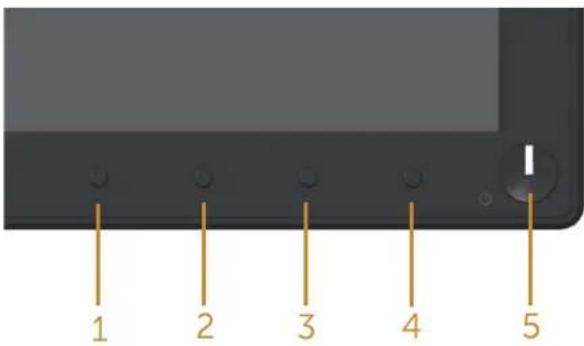
NOTE: You can run the built-in diagnostics only when the video cable is unplugged and the monitor is in self-test mode.
text_image
1 2 3 4 5To run the built-in diagnostics:
-
Ensure that the screen is clean (no dust particles on the surface of the screen).
-
Unplug the video cable(s) from the back of the computer or monitor. The monitor then goes into the self-test mode.
-
Press and hold button 1 for 5 seconds. A gray screen appears.
-
Carefully inspect the screen for abnormalities.
-
Press button 1 on the front panel again. The color of the screen changes to red.
-
Inspect the display for any abnormalities.
-
Repeat steps 5 and 6 to inspect the display in green, blue, black, white and text screens.
The test is complete when the text screen appears. To exit, press button 1 again. If you do not detect any screen abnormalities upon using the built-in diagnostic tool, the monitor is functioning properly. Check the video card and computer.
Common problems
The following table contains general information about common monitor problems you might encounter and the possible solutions:
| Common Symptoms | Possible Solutions |
| No video/power LED off | ·Ensure that the video cable connecting the monitor and the computer is properly connected and secure.·Verify that the power outlet is functioning properly using any other electrical equipment.·Ensure that the correct input source is selected via the Input source menu. |
| No video/power LED on | ·Increase brightness and contrast controls using the OSD.·Perform monitor self-test feature check.·Check for bent or broken pins in the video cable connector.·Run the built-in diagnostics.·Ensure that the correct input source is selected via the Input source menu. |
| Poor focus | ·Eliminate video extension cables.·Reset the monitor to Factory Settings (Factory Reset).·Change the video resolution to the correct aspect ratio. |
| Shaky/jittery video | ·Reset the monitor to Factory Settings (Factory Reset).·Check environmental factors.·Relocate the monitor and test in another room. |
| Missing pixels | ·Cycle power on-off.·Pixel that is permanently Off is a natural defect that can occur in LCD technology.·For more information on Dell Monitor Quality and Pixel Policy, see Dell Support site at www.dell.com/support/monitors. |
| Stuck-on pixels | ·Cycle power on-off.·Pixel that is permanently off is a natural defect that can occur in LCD technology.·For more information on Dell Monitor Quality and Pixel Policy, see Dell Support site at www.dell.com/support/monitors. |
| Brightness problems | ·Reset the monitor to Factory Settings (Factory Reset).·Adjust brightness & contrast controls via OSD. |
| Geometric distortion | ·Reset the monitor to Factory Settings (Factory Reset).·Adjust horizontal & vertical controls via OSD. |
| Horizontal/vertical lines | ·Reset the monitor to Factory Settings (Factory Reset).·Perform monitor self-test feature check and determine if these lines are also in self-test mode.·Check for bent or broken pins in the video cable connector.·Run the built-in diagnostics. |
| Synchronization problems | Reset the monitor to Factory Settings (Factory Reset).Perform monitor self-test feature check to determine if the scrambled screen appears in self-test mode.Check for bent or broken pins in the video cable connector.Restart the computer in the safe mode. |
| Safety related issues | Do not perform any troubleshooting steps.Contact Dell immediately. |
| Intermittent problems | Ensure that the video cable connecting the monitor to the computer is connected properly and is secure.Reset the monitor to Factory Settings (Factory Reset).Perform monitor self-test feature check to determine if the intermittent problem occurs in self-test mode. |
| Missing color | Perform monitor self-test feature check.Ensure that the video cable connecting the monitor to the computer is connected properly and is secure.Check for bent or broken pins in the video cable connector. |
| Wrong color | Change the Color Setting Mode in the Color Settings OSD to Graphics or Video depending on the application.Try different Preset Modes in Color settings OSD. Adjust R/G/B value in Custom Color in Color settings OSD.Change the Input Color Format to RGB or YPbPr in the Color settings OSD.Run the built-in diagnostics. |
| Image retention from a static image left on the monitor for a long period of time | Use the Power Management feature to turn off the monitor at all times when not in use (for more information, see Power management modes).Alternatively, use a dynamically changing screensaver. |
| Video ghosting or overshooting | Change the Response Time in the Display OSD to Fast or Normal depending on your application and usage. |
Product-specific problems
| Specific Symptoms | Possible Solutions |
| Screen image is too small | Check the Aspect Ratio setting in the Display settings OSD.Reset the monitor to Factory Settings (Factory Reset). |
| Cannot adjust the monitor with the buttons on the side panel | Turn off the monitor, unplug the power cord, plug it back, and then turn on the monitor.Check if the OSD menu is locked. If yes, press and hold the button above the power button for 6 seconds to unlock. (For more information, see Lock). |
| No input signal when user controls are pressed | Check the signal source. Ensure the computer is not in standby or sleep mode by moving the mouse or pressing any key on the keyboard.Check if the video cable is plugged in properly. Disconnect and reconnect the video cable if necessary.Reset the computer or video player. |
| The picture does not fill the entire screen | Due to different video formats (aspect ratio) of DVDs, the monitor may display in full screen.Run the built-in diagnostics. |
Universal serial bus (USB) specific problems
| Specific Symptoms | Possible Solutions |
| USB interface is not working | Check that your monitor is turned On.Reconnect the upstream cable to your computer.Reconnect the USB peripherals (downstream connector).Switch Off and then turn On the monitor again.Reboot the computer.Some USB devices like external portable HDD require higher electric current; connect the device directly to the computer system. |
| Supre Speed USB 3.0 interface is slow | Check that your computer is USB 3.0-capable..Some computers have USB 3.0, USB 2.0, and USB 1.1 ports. Ensure that the correct USB port is used.Ensure that the correct USB port is used.Reconnect the upstream cable to your computer.Reconnect the USB peripherals (downstream connector).Reboot the computer. |
| Wireless USB peripherals stop working when a USB 3.0 device is plugged in | Increase the distance between the USB 3.0 peripherals and the wireless USB receiver.Position your wireless USB receiver as close as possible to the wireless USB peripherals.Use a USB-extender cable to position the wireless USB receiver as far away as possible from the USB 3.0 port. |
WARNING: Safety Instructions

WARNING: Use of controls, adjustments, or procedures other than those specified in this documentation may result in exposure to shock, electrical hazards, and/or mechanical hazards.
For information on safety instructions, see the Safety, Environmental, and Regulatory Information (SERI).
FCC notices (U.S. Only) and other regulatory information
For FCC notices and other regulatory information, see the regulatory compliance website located at www.dell.com/regulatory_compliance.
Contacting Dell
To contact Dell for sales, technical assistance, or customer service issues:
- Go to www.dell.com/contactdell.
- Verify your country or region in the Choose a Country/Region drop-down list at the bottom of the page.
- Select the appropriate service or support link based on your requirement or choose the method of contacting Dell that is convenient for you. Dell provides several online and telephone-based support and service options. Availability varies by country and product, and some services may not be available in your area.

NOTE: If you do not have an active internet connection, you can find contact information on your purchase invoice, packing slip, bill, or Dell product catalog.