BreadPlus XBM-6430 - Bread maker Heinner - Free user manual and instructions
Find the device manual for free BreadPlus XBM-6430 Heinner in PDF.


| Product Type | Bread Maker |
| Brand | Heinner |
| Model | BreadPlus XBM-6430 |
| Power | 680 W |
| Voltage | 220-240 V ~ 50/60 Hz |
| Capacity | 2 lb (max loaf size) |
| Programs | 12 automatic programs including Basic, Whole Wheat, French, Gluten-Free, Dough, Jam, Cake, and more |
| Crust Control | 3 settings: Light, Medium, Dark |
| Delay Timer | Up to 13 hours |
| Keep Warm Function | Up to 1 hour |
| Viewing Window | Yes, for monitoring baking progress |
| Pan Type | Non-stick coated inner pan |
| Dimensions (W x D x H) | 30 x 25 x 35 cm |
| Weight | 5.5 kg |
| Material | Stainless steel and plastic |
| Safety Features | Auto shut-off; overheating protection |
| Cleaning | Wipe exterior with damp cloth; removable pan and kneading paddle are dishwasher safe |
| Spare Parts Available | Kneading paddle, measuring cup, measuring spoon |
| Warranty | 2 years |
| Certifications | CE, RoHS |
Frequently Asked Questions - BreadPlus XBM-6430 Heinner
User questions about BreadPlus XBM-6430 Heinner
0 question about this device. Answer the ones you know or ask your own.
Ask a new question about this device
Download the instructions for your Bread maker in PDF format for free! Find your manual BreadPlus XBM-6430 - Heinner and take your electronic device back in hand. On this page are published all the documents necessary for the use of your device. BreadPlus XBM-6430 by Heinner.
USER MANUAL BreadPlus XBM-6430 Heinner
natural_image
Black and silver coffee maker with digital display and control buttons (no visible text or symbols)• Masina de facut paine cu 12 programe, 700W
- Capacitate:750-1150g
- Culoare: Negru
Programul 3 Wholewheat
4. Retete cu preparare rapida (programul Quick)
Paine cu banane si nuci
Grup 1 de ingrediente
Unt (topit) 2 linguri
Lapte 1 lingura
Banana zdrobita 1 cana
Ou 1
Programul 6 Fastbake
Copyright © 2013 Network One Disbuon. All rights reserved.
hp://www.heinner.com, hp://www.nod.ro

Europolis Logisc Park, Italia Street, 1-7, Chaijna, Ilfov, Romania
Tel: +40 21 211 18 56, www.heinner.ro, www.nod.ro
HEINNER
BREAD MAKER
BreadPlus 6430
Model: XBM-6430
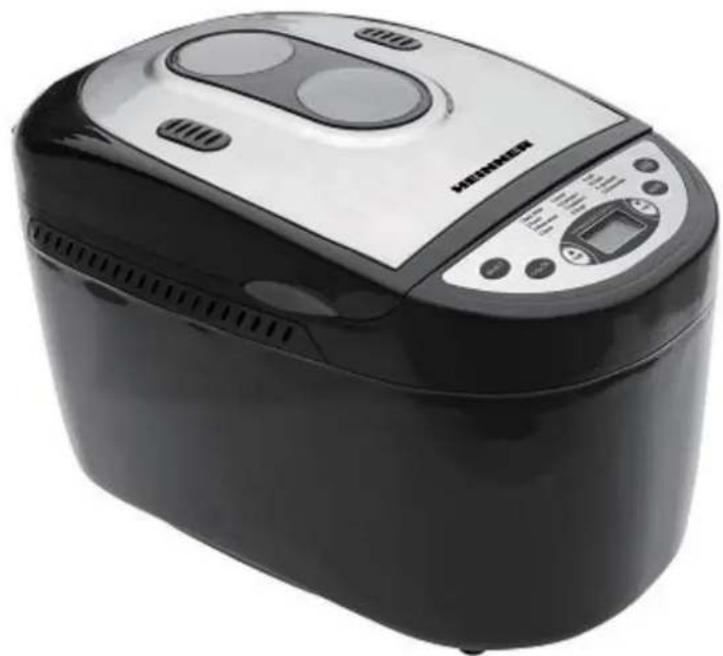
natural_image
Black and silver coffee maker with digital display and control buttons (no visible text or symbols)- Bread Maker, 12 programs, 700W
• Capacity: 750-1150g - Color: Black
Thank you for choosing this product!
I. Introducon
Please read this instrucon manual carefully before using it and kee it for later informaon
This manual is conceived for offering you all of the necessary info regarding instalaon, using and maintenance of the machine. For a correctly and safely use of the machine, please, read this manual before instalaon and using.
II. Package contents
Bread maker machine + accessories
Instrucon manual
Warranty card

III. Safety regulaons
The use of any electrical appliance requires the following of basic common sense safety rules. Primarily there is danger of personal injury and secondly the danger of damage the property and the appliance. These are indicated in the text by the following two convenons:
WARNING: Danger of personal injury
IMPORTANT: Damage to the appliance
In addition we oer the following essenal safety advice.
- Always locate your appliance away from the edge of a worktop.
- Do not let the mains lead hang over the edge of a worktop where a child could reach it.
- Check that the voltage on the rang plate of your appliance corresponds with your house electricity supply which must be A.C. (Alternang Current). If the socket outlets in your home are not suitable for the plug supplied with this appliance, the plug should be removed and the appropriate one ed.
- Ensure that the appliance is used on a rm, at surface.
- Do not use outdoors.
- To protect against electrical shock, do not immerse cord or plug in water or other liquid.
- The mains lead should reach from the socket to the base unit without straining the connecons.
-
WARNING: Do not touch hot surfaces. Use over mis or oven gloves when removing the hot bread pan. Do not cover the steam vent openings under any circumstances.
-
WARNING: Avoid contact with moving parts.
-
Extreme cauon must be observed when moving an appliance with hot contents.
-
Do not use Breadmaker for storage purposes nor insert any utensils, as they may create a re or electric shock hazard.
-
Do not use use the appliance with wet or moist hands.
-
If the mains lead of this appliance is damaged do not use it.
-
Do not let the lead run across an open space e.g. between a low socket and table. Do not let the lead run across a cooker or toaster or other hot area which might damage the cable.
-
If faulty, please return this unit to authorized service, the repaird must be done by authorized people only.
-
Never allow a child to operate this appliance. Children are vulnerable in the kitchen particularly when unsupervised and if appliances are being used or cooking is being carried out. Teach children to be aware of dangers in the kitchen, warm them of the dangers of reaching up to areas where they cannot see properly or should not be reaching.
-
The use of accessory achments not recommended by the manufacturer may cause damage to the Breadmaker.
-
Do not place the appliance on or near heat sources such as gas or electric stove ovens, or burners.
-
To avoid damaging the appliance, do not place the baking pan or any object on the top of the unit.
-
Do not clean with scouring pads. Do not wash the baking pan, kneading blade measuring cup or spoon in a dishwasher.
-
The baking pan must be in place prior to switching on the appliance.
-
Always remove the plug from the socket whenever the machine is not in use, when aaching accessory parts, cleaning the machine or whenever a disturbance occurs. Pull on the plug, not the cable.
-
WARNING: THIS APPLIANCE MUST BE EARTHED
-
Should the fuse in the 13 amp plug require changing a 13 amp BS1362 fuse must be ed.
-
The plug removed from the mains lead, if severed, must be destroyed as a plug with bared exible cord is hazardous if engaged into a live socket outlet.
IV. Before rst use
Before rst use, please take a few minutes to read this instrucon book and to nd a place to keep it handy for reference. Pay parcular aenon to the safety instrucons.
- Carefully unpack the breadmaker and remove all packaging materials.
- Remove any dust that may have accumulated during packing
- Wipe the baking pan, kneading blade and outside surface of the breadmaker with a clean, damp cloth. The bread pan is non-sck coated. Do not use scouring pads or any abrasives on any part of the breadmaker.
- For rst me use use oil, buer or margarine to grease the bread pan and bake empty for about 10 minutes (select the Extrabake program).
- Clean once more.
- Place the kneading blade on the axle in the baking pan
In manufacture it is necessary to lightly grease some parts of the appliance. This may result in the unit eming some vapour when rst used, this is normal.
V. About this breadmaker
A Fruit and Nut beep signals when extra ingredients can be added so they don't get chopped by the kneading blade.
There is a crusty seng to create that extra crusty loaf (certain programs only).
VI. About the recipes
The recipes in this booklet have been thoroughly tested to ensure best results. On the same me it is recommended to respect the indicaon from special bread oor package.
- Always add ingredients in the order they are listed in the recipe.
- Accurate measuring of ingredients is vital. Do not use large amounts.
VII. Components
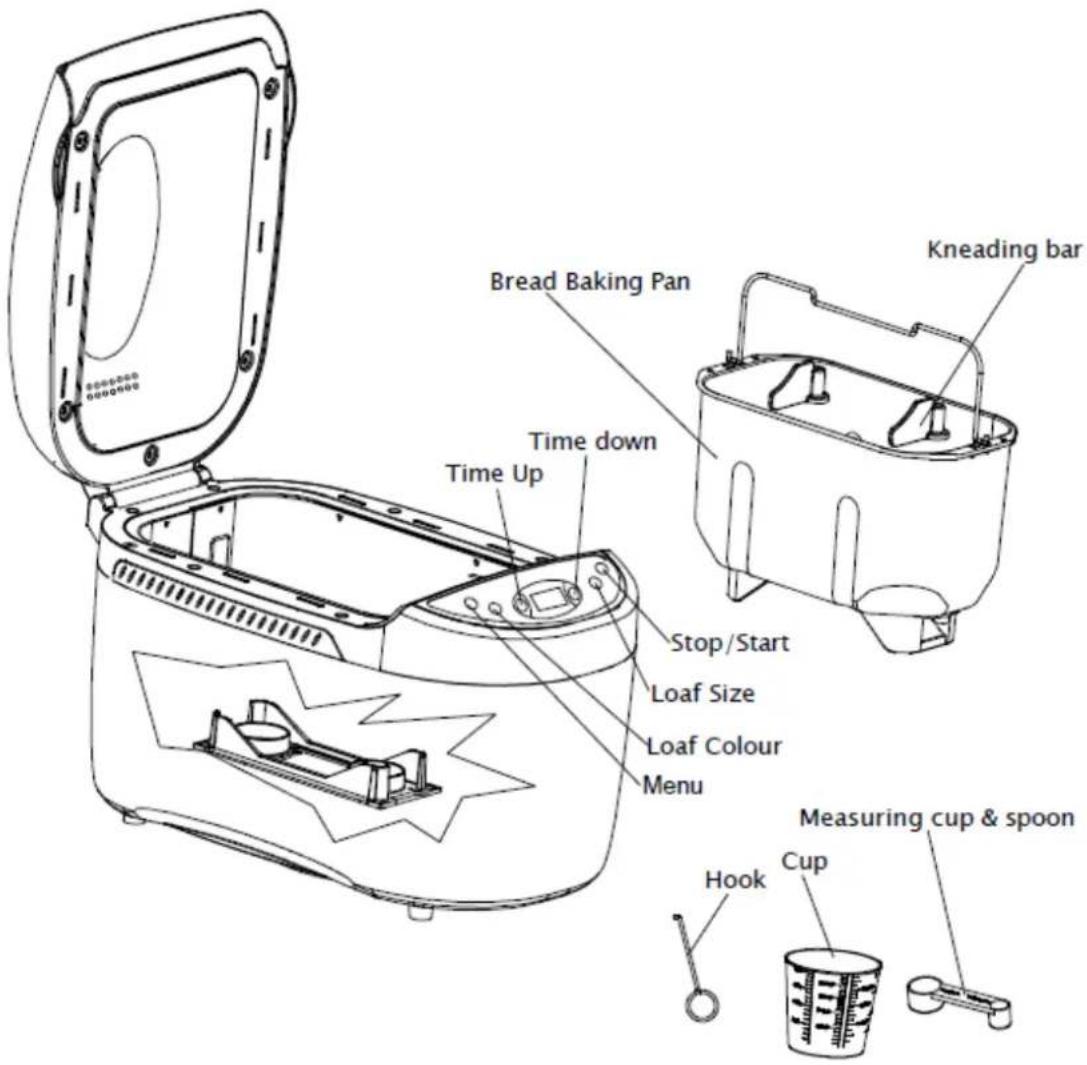
VIII. Control panel buons, display & funcons
Display window
Color: Shows browning level selected;
Size: Shows weight selected;
Program: Shows the program number;
Shows me le before compleon (3:20, for example: 3 hours and
20minutes; 0:20 is for 20 minutes)
Show temperature warning - see 'Troubleshoong'
Timer delay buons
Use to delay the start of bread for selecng crust colour from light, making (all programs except Fastbake) medium or dark (certain programs only).
Start: Press to start for approx 1 second, a beep program sounds and the colon (:) ashes and the program starts;
➢ Stop: Press to stop for approx 2 seconds. When the breadmaker is switched on beep sounds to conrm;
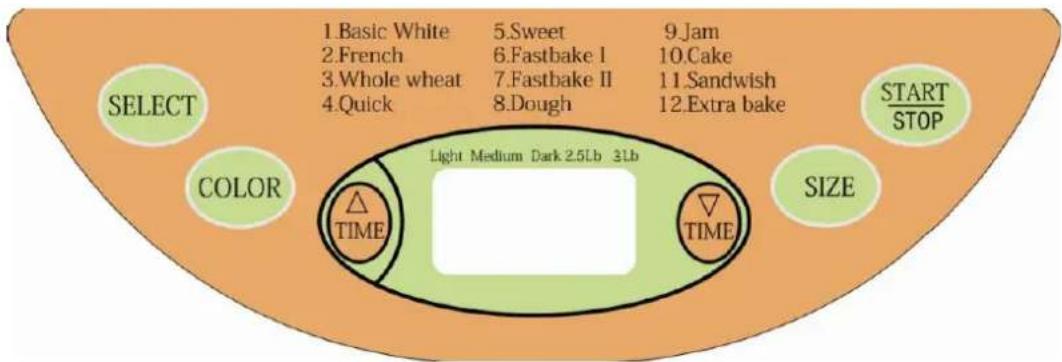
Menu Buton: For choosing the bread making from the list 1 to 12;
Loaf size buon: The loaf size defaults to crusty. For loaves (2lb and 2.5lbs) press loaf size once.
IX. Program descripons
- Basic white (3:00 si 2:53):
- For white and brown bread. Also for avored breads with added herbs and raisins.
- French (3:50 si 3:40):
- For the baking of light weight bread such as French bread which has a crisper crust and light texture;
- Wholewheat (3:40 si 3:32):
- For the baking of bread containing significant amounts of whole-wheat. This seng has longer preheat me to allow the grain to soak up the water and expand. It is not advised to use the delay mer as this can produce poor results:
4. Quick (1:40):
- For white bread that is required in a shorter me. Bread baked on this setting is usually smaller with a dense texture;
5. Sweet (2:55 si 2:50):
- For the baking of sweet type bread which gives a crisper crust than on basic seng. The crisper crust is produced by the sugar 'burning';
- Kneading rise and baking 2LB bread in a short me;
7. Ultra fast - II (00: 58):
- Kneading rise and baking 2.5LB bread in a short me;
8. Dough (1:30):
- This seng only makes the dough and will not bake the nal bread. Remove the dough and shape it to make bread rolls, pizza, etc. Any dough can be prepared on this seng. Do not exceed 1kg (2lb) of combined ingredients;
9. Jam (1:20):
- Use this seng for making jam from fresh fruits and marmalade. Do not increase the quantity or allow the recipe to boil over the pan into baking chamber. Should this happen, stop the machine immediately. Remove the pan carefully, allow cooling a lile and cleaning thoroughly;
10. Cake (2:50):
- This seng will mix ingredients and then bake for a preset me. It is required to mix two groups of ingredients in bowls before adding to the bread maker (see cake recipes);
11. Sandwich (3:00 si 2:55):
- This is to bake light textured bread but with a soer and thicker crust;
12. Extra bake (1:00):
- This seng is bake only and can be used to increase the baking me on selected sengs. This is especially useful to help 'set' jams and marmalade. When started the default me is 1 hour (1:00) minimum and counts down in 10 minute intervals. You will have to manually switch this o by pressing the stop buon, when you have completed the Extra bake process. It is advised that you check the condion of the bread or jam aer 10 minutes and at 10 minute intervals. Pressing ▲ increases the me in increments of 10 minutes. When selecng Extra bake straight aer another program, if the message H:HH is displayed, open the lid, remove the pan and allow to cool for 10 minutes. When cool, replace the baking pan and its contents, set program and press start;
X. Using your bread maker
1. Take out the pan:
- Open the lid and remove the pan by liing the handle, turning an-clockwise and liing out. Place on the work surface. It is important that the pan is lled with ingredients outside the machine so that any accidental spillage is not ignited by the heang elements
2. Aach the blade:
- Aach the kneading blade to the sha, by pushing on;
3. Measure ingredients:
- Measure the ingredients required and add them all into the pan in the order listed. See later secon 'Measuring your ingredients');
- When adding the yeast to the baking pan, take care that the yeast does not come into contact with the water or any other liquid, as it will start to acvate immediately;
- Use tepid water 21-28°C;
4. Put pan back in:
- Place the baking pan back in the bread maker, turning clockwise to lock into place. Close the lid;
5. Plug in:
- Plug into the power supply. The bread maker will automatically be set to basic bread menu and normal me;
• Every me you press a buon you will hear a beep to conrm;
6. Select program:
- Choose the desired seng from the list by pressing the Menu buon;
7. Select weight:
- Press Loaf size buon to choose between crusty and small/large. The seng defaults to crusty when the bread maker is switched on;
8. Select color:
- Choose desired crust color by pressing color buon;
9. Select the delay me:
- If you wish the bread to be ready later, set the me delay now, as described in next secon;
10. Start:
- Press the Start Stop buon to start the machine. The remaining me will count down in one minute increments;
11. Progress:
- The breadmaker will automatically proceed through the programmed stages as shown in the 'Baking cycle mes' secon. If the breadmaker has a program selected that has a second kneading process, beeps sound to inform that fruits and/or nuts may be added,
- It is possible that steam will escape through the vents during baking, this is normal;
12. Finish:
- When the program is completed and the bread is baked the display shows 0:00 and the beeper will sound;
13. Keep warm:
- The keep warm funcon will circulate hot air for a further 60 minutes on most sengs (see 'Baking cycle mes' secon). For best results, remove the baking pan and loaf within this period or when the initial program is completed. 10 beeps will be heard when the keep warm period is nished;
14. Remove the food:
- Press Stop. Open the lid. WARNING: Use oven gloves when removing the baking pan (talking care as it is very hot)
15. Turn out the bread:
- Allow the bread to cool in the pan for 15 minutes, then turn the pan upside down and tap the bread from the pan onto a rack to cool. Fill the pan with warm water immediately to prevent the blade from scking to the sha. Occasionally the kneading blade will stay in the loaf. Wait unl the loaf is cool and then remove the blade with a wooden or plasc utensil to avoid damage to the non-sck surface
16. Always unplug the appliance aer use:
- Do not open the lid whilst the bread maker is operang as this will act the quality of the bread, especially its ability to rise properly. Only open the lid when the recipe needs you to add additional ingredients, see recipes;
Room temperature note:
The bread maker will work well in a wide range of temperatures, but there could be a dience in loaf size between a very warm room and a very cold room. We recommend the room temperature should be between 15°C and 34°C.
Using the mer:
Use the mer when you want the bread ready later, or in the morning. A maximum of 13 hours can be set. Check if funcon is available by consulng 'Baking cycle mes' secon. Do not use this funcon with recipes that use perishable ingredients such as eggs, fresh milk, sour cream, or cheese.
- Decide when you want the bread to be ready and calculate the dierence in me between now and then. For example, if you want a loaf at 8am, and it is now 7:30 p.m., the dierence is 12½ hours;
- Enter this me by pressing 'Time T' and 'Time S' buons. Arrows will move me up or down in 10-minute increments. Aer you have pressed Start, the colon will ash.
- If you have selected the wrong me press stop for 2 seconds. The mer will go back to the program me, repeat step 1 and 2
- The mer delay is up to a maximum of 13 hours. This is when the bread will be ready to be removed from the machine, see page 8 item 14 'Remove the food';
Beeper:
The beeper sounds:
- when pressing any buon;
- during the second kneading cycle of certain programs to indicate that cereals, fruit, nuts or other ingredients can be added;
- when the program nishes;
- when keep warm nishes.
Power interrupon
Aer a brief power supply failure
- If the program has not yet reached rise 1, press start and the program will connue using the automac repeat funcon; If it has gone beyond this point the process must be started from the very beginning. The ingredients will have to be discarded and you must start again with fresh ingredients;
Slicing and storing bread:
- For best results place bread on a wire rack and allow to cool for 15-30 minutes before slicing. Use an electric knife or a sharp knife with a serrated blade for even slices; Store unused bread ghtly covered in a plasc bag at room temperature for up to three days. If weather is hot and humid, store in the refrigerator overnight;
- For longer storage (up to one month), place bread in a ghtly covered container in the freezer;
- If you store the bread in the refrigerator, leave it out to bring it to room temperature before serving
Slicing and storing bread:
- Since homemade bread has no preservaves it tends to dry out and become stale faster than commercially made bread;
- Leover slightly hardened bread may be cut into 1.3 cm (half inch) or 2.5 cm (1 inch) cubes and used in favourite recipes to make croutons, bread pudding or stung.
Care and cleaning:
Cauon : To prevent electrical shock, unplug the unit before cleaning!
- Walt unl the bread maker has cooled;
- IMPORTANT: Do not immerse or splash either the body or lid in any liquid as this may cause damage and/or electric shock;
- Exterior: Wipe the lid and outer body of the unit with a damp cloth or slightly dampened sponge;
- Interior: Use a damp cloth or sponge to wipe the interior of the bread maker;
- Baking pan : Clean the baking pan with warm water, soap is not necessary. Avoid scratching the non-sck surface. Dry it thoroughly before placing it back in the baking chamber;
- Do not wash the baking pan, measuring cup, spoon or kneading blades in the dishwasher;
- Do not soak the baking pan for long periods as this could interfere with the working of the drive sha;
- If the paddle becomes stuck in the bread pan, pour hot water over it and allow to soak for 30 minutes. This will enable you to remove the paddle more easily;
- Be sure the appliance is completely cooled before storing away;
Do not use any of these when cleaning : paint thinner, benzene, steel wool pads, polishing powder, chemical dust cloth.
Special care for the non-sck nish:
- Avoid damaging the coang. Do not use metal utensils such as spatulas, knives or forks; The coang may change colour aer long use, this is only caused by moisture and steam and will not aect the performance of the unit or quality of your bread'
The hole in the center of the kneading blade should be cleaned, then add a drop of cooking oil and replace it on the spindle in the baking pan. This will prevent sicking of the blade;
Keep all air vents and openings clear of dust
Storing the unit:
Be sure to dry all parts before storing including wiping any moisture from the viewing window.
Close the lid and do not store anything on top of the lid.
Note: DO NOT use abrasive or strong household cleaners as these will damage the non-sck surface of the Bread Maker.
Know your ingredients - Understanding baking:
- It is oen said that cooking is an art relying on the creavity of the chef while baking bread is much more of a science.
- This means that the process of combining our, water and yeast results in a reason that produces bread. You have to remember that when the ingredients combine with each other they produce a specic result.
Read the following informaon carefully to gain a beer understanding of the importance that each ingredient plays in the bread making process;
XI. Ingredients
Important note on ours
Flours, while visibly similar, can be very dierent by virtue of how they were grown, milled, stored, etc. You may nd that you will have to experiment with dierent brands of our to help you make that perfect loaf. Storage is also very important, as all ours should be kept in an airght container;
All-purpose our/plain our
- All-purpose our is a blend of rened hard and so wheat ours especially suitable for making cake. This type of our should be used for recipes in the cake/quick bread secon
Strong white our/bread our
- Bread our is a high gluten/protein our that has been treated with conditioners that give dough a greater suitability for kneading. Bread our typically has a higher gluten concentraon than all-purpose our, however, depending on dierent milling pracces, this may vary. Strong plain our or bread our is recommended for use with this bread maker;
Whole wheat our/whole meal our
- Whole wheat our/whole meal our is milled from the enre wheat kernel which contains the bran and germ and makes it heavier and richer in nutrients than while our. Breads made with this our are usually smaller and heavier than white loaves.
- To overcome this whole wheat our/whole meal our can be mixed with Bread our or strong plain our to produce a high light textured bread
Self-rising our
- Self-rising our contains unnecessary leavening ingredients that will interfere with bread and cake making. It is not recommended for use.
Bran
- Bran (unprocessed) & Wheat Germ are the coarse outer porons of the wheat or rye grains separated from our by siing or bolng. They are oen added in small quanes to bread for nutritional enrichment, heartless and avor. They are also used to enhance the texture of bread.
Oatmeal
- Oatmeal comes from rolled or steel-cut oats. They are used primarily to enhance avor and texture
Other ingredients
Yeasts (acve dry yeast):
- Yeast through a fermentaon process produces gas (carbon dioxide) necessary to make the bread rise. Yeast must be able to feed on sugar and our carbohydrates in order to produce this gas. Fast acon granular yeast is used in all recipes that call for yeast
- There are basically three different types of yeast available, fresh, traditional dry acne and fast acon. It is recommended that fast acon yeast be used.
- Fresh or compressed cake yeast is not recommended as they will produce poor results. Store yeast according to manufacturer's instrucons. Ensure your yeast is fresh by checking its expiraon date. Once a package or can of yeast is opened it is important that the remaining contents be immediately resealed and refrigerated as soon as possible for future use. Oen bread or dough, which fails to rise, is due to stale yeast being used
The following test can be used to determine whether your yeast is stale and inacve:
- Place half a cup of lukewarm water into a small bowl or cup;
- Sr 1 tsp. of sugar into the water then sprinkle 2 tsp. of yeast over the surface;
- Place bowl or cup in a warm area and allow to sit for 10 minutes undisturbed;
- The mixture should foam and produce a strong yeast aroma. If this does not occur, discard mixture and start again with another packet of dried yeast.
Sugar
- Sugar is important for the color and avor of breads. It is also food for the yeast as it is part of the fermentaon process. Arcial sweeteners cannot be used as a substitute for sugar as the yeast will not react properly with them;
Salt
- Salt is necessary to balance the avor of breads and cakes, as well as for the crust color that develops during baking. Salt also limits the growth of yeast so the amounts shown in the recipes should not be increased. For dietary reasons it may be reduced, however, your baking may suer;
Liquids/ milk
- Liquids such as milk or a combinaon of powdered milk and water can be used when making bread. Milk will improve avor provide a velvety texture and soen the crust, while water alone will produce a crispier crust. Some liquids call for juice (orange, apple, etc) to be added as a avor enhancer.
•
Note: For most recipes we suggest the use of dry skimmed milk.
Eggs
- Eggs add richness and a velvety texture to bread dough's and cakes;
Sunower oil
- 'Shortens' or tenderizes the texture of yeast breads. Buer or margarine can be used as a substitute. If buer or margarine is used direct from the refrigerator it should be soened for easier blending during the mixing cycle t;
Baking powder
- Baking powder is a raising agent used in cakes. This type of raising agent does not require rising me before baking as the chemical reacon works when liquid ingredients are added;
Bicarbonate of soda
- Bicarbonate of soda is another raising agent not to be confused or substated for baking powder. It also does not require rising me before baking as the chemical reacon works during the baking process;
Measuring ingredients
- The key and most important step when using your bread maker is measuring your ingredients precisely and accurately. It is extremely important to measure each liquid and dry ingredient properly or it could result in a poor or unacceptable baking result. The ingredients must also be added into the baking pan in the order that they are given in each recipe
Liquid and dry measurements are done somewhat dierently and are as follows:
Liquid measurements
- Use the cup provided. When reading amounts, the measuring cup must be placed on a horizontal at surface and viewed at eye level (not on an angle). The liquid level line must be aligned to the mark of measurement. A 'guessmate' is not good enough as it could throw out the critical balance of the recipe.
Dry measurements
- Dry measurements (especially ours) must be done using the measuring cup provided. The measuring cup is based on the American standard 8 uid oz cup - Brish cup is 10 uid oz. Dry measuring must be done by gently spooning ingredients into the measuring cup and then once lled, leveling o with a knife. Scooping or tapping a measuring cup will pack the ingredients and you will end up with more than is required. This extra amount could aect the balance of the recipe. Do not si the our, unless stated;
- When measuring small amounts of dry or liquid ingredients (i.e. yeast, sugar, salt, powered milk, honey, molasses) the measuring spoon which is provided must be used
- Measurements must be level, not heaped as this small dience could throw out the critical balance of the recipe;
- Your breadmaker produces delicious baked goods with ease. This machine requires only that you carefully follow the recipe instrucons. In basic cooking, normally 'a pinch of this and a dash of that' is ne but not for breadmakers. Using an automac breadmaker requires you accurately measure each ingredient for best results.
Ingredient temperatures
- All ingredients, including the machine and pan, and especially liquids (water or milk), should be warmed to room temperature 21 C (70 F).
- If ingredients are too cold, below 10 C (50 F), they will not acvate the yeast. Extremely hot liquids, above 40 C (104 F), may kill the yeast;
Special glazes to enhance your bread
- Beat 1 large egg and 1 tablespoon of water together, brush generously. Note: apply only to doughs before baking;
Melted buer crust
• Brush melted buer over just baked bread for a soer tender crust;
Milk glass
• For a soer, shiny crust, brush just baked bread with milk or cream
Sweet icing glaze
- Mix 1 cup sied icing sugar with 1 to 2 tablespoons of milk to make a glaze consistency and drizzle over raisin bread or sweet breads;
Poppy/Sesame/Caraway seed/Oatmeal
• Sprinkle your choice of these seeds generously over just glazed bread
Other ps
- Place all recipe ingredients into the baking pan so that yeast is not touching any liquid; Aer compleng the process of making dough in your bread maker, typically when leng dough rise outside the bread maker, allow 30 minutes or unl dough doubles in size. Dough should be lightly greased and covered with grease proof paper and a dry towel. It should be placed in a warm area free from dras;
- Humidity can cause problems, therefore humidity and high altudes require adjustments. For high humidity, add an extra tablespoon of our if consistency is not right. For high altitudes, decrease yeast amount by approximately 14 teaspoon, and decrease sugar and/or water or milk slightly; When recipes call for a 'lightly oured surface', use about 1 to 2 tablespoons of our on the surface. You may want to lightly our your ngers or rolling pin for easy dough manipulaon; If the dough you are rolling shrinks back, let it rest covered for a few minutes before rolling again; Dough may be wrapped in plasc and stored in a freezer for later use. Bring the dough to room temperature before using;
- The DOUGH seng is great for mixing, kneading and proong (allowing dough to rise) richer dough like croissant doughs. Use the automac bread maker to prepare this dough so all you need to do is shape and bake it according to your recipe;
- When you let dough 'rest' and 'rise' according to a recipe, place it in a warm, draught-free area. If the dough does not double in size, it may not produce a tender product
Other ps
- Aer 5 minutes of kneading, open the lid and check the dough consistency. The dough should form a so, smooth ball. If too dry, add liquid. If too wet, add our (½ to tablespoon at a me)
XII. Recipes
Retete
All of the following recipes use this same general method :
- Measure ingredients into baking pan.
- Use tepid water 21-28
- Insert baking pan securely into unit, close lid.
- Select appropriate bread seng.
- Push start buon.
- When bread is done, remove pan from unit using even mis.
- Remove bread from baking pan (and kneading blade from bread if necessary).
- Allow to cool before slicing.
1. Recips for basic breads
Basic white bread
| 2lb | 2.5 lb | ||
| Water | 1+1/4 cup | 1+1/2 cups | |
| Skimmed milk powder | 3 tbsp | 4 tbsp | |
| Sunflower oil | 3 tbsp | 4 tbsp | |
| Sugar | 2+1/4 tbsp | 2+1/2 tbsp | |
| Salt | 1+1/4 tsp | 1 +1/2 tsp | |
| Strong white bread our | 3 cups | 4 cups | |
| Fast acon yeast | 1+1/4 tsp | 1+1/2 tsp | |
| Use seng | 1 Basic | 1 Basic | |
Sograin bread
2 lb
| Water | 1/4 cup |
| Skimmed milk powder | 3 tbsp |
| Sunower oil | 3 tbsp |
| Sugar | 2 + 1/4 tbsp |
| Salt | 1/4 tsp |
| Strong white bread our | 3 cups |
| Fast acon yeast | 1+1/4 tsp |
| Use seng | 1 Basic |
Italian herb loaf
2 lb
| Water | 1+1/2 cup |
| Skimmed milk powder | 3 tbsp |
| Sunower oil | 3 tbsp |
| Sugar | 2+1/4 tbsp |
| Salt | 1 + 1/2 tsp |
| Strong white bread our | 3 cups |
| Dried marjoram | 1 + 1/2 tsp |
| Dried basil | 1 + 1/2 tsp |
| Dried thyme | 1+1/2 tsp |
| Fast acon yeast | 1+1/4 tsp |
| Use seng | 1 Basic |
Brown loaf
| 2 lb | 2.5 lb | |
| Water | 1 cup | 1+1/4 cup |
| Skimmed milk powder | 2 tbsp | 2 + 1/2 tbsp |
| Sunower oil 2 tbsp | 2 + 1/2 tbsp | |
| Sugar | 2+1/2 tbsp | 3 tbsp |
| Salt | 1+1/4 tsp | 2 tsp |
| Strong white bread our | 3 cups | 4 cups |
| Fast acon yeast | 1+1/4 tsp | 1+3/4 tsp |
| Use seng | 1 Basic | 1 Basic |
Use 2.5 lb loaf size seng for 2lb loaf.
Cheese & onion bread
2lb
Water
1 cup
Skimmed milk powder
3 tbs
Sugar
1 + 1/2 tbsp
Salt
1/2 tsp
Onion granules
1/2 tbsp
Mature grated cheddar cheese
1 cup
Strong white bread our
3 cups
Fast acon yeast
1+1/2 tsp
Use seng
1 Basic
Raisin bread
2lb
Water
1+1/4 cups
Skimmed milk powder
3 tbsp
Sunower oil
3 tbsp
Sugar
2 tbsp
Salt
1 + 1/2 tbsp
Cinnamon
3/4 tsp
Strong white bread our
3 cups
Fast acon yeast
1 + 1/2 tsp
Raisins*
5/8 cup
Using seng
1Basic
Sun-dried tomato loaf
2lb
Water
1+1/3 cups
Skimmed milk powder
3tbsp
Sunower oil
3 tbsp
Sugar
1+1/2 tbsp
Salt
1+1/2 tsp
Died mixed herbs
2 tsp
Strong white bread our
4 cups
Fast acon yeast
1+1/2 tsp
Sun-dried tomatoes
1/2 cup
Using seng
1 Basic
Malt loaf
2lb
| Water | 1+1/4cup |
| Salt | 1 tsp |
| Sunower oil | 3 tbsp |
| Black treacle | 2+1/2 tbsp |
| Malt extract | 3 tbsp |
| Plain our | 4cups |
| Fast acon yeast | 1+1/4 tsp |
| Sultanas | 3/4 cup |
| Using seng | 1 Basic |
*Add the fruit when the beeper sounds
- Recipes for french breads
French bread
| 2 lb | 2.5 lb | ||
| Water | 1 cup | 1+1/4 cups | |
| Skimmed milk powder | 2 tbsp | 3 tbsp | |
| Sugar | 1 tbsp | 1+1/2 tbsp | |
| Salt | 1 tsp | 1+1/2 tsp | |
| Sunower oil | 1 tbsp | 1+1/2 tbsp | |
| Strong white bread our | 3 cups | 4 cups | |
| Fast acon yeast | 1 tsp | 1+1/2 tsp | |
| Using seng | 2 French | 2 French |
*Use 2.5 lb loaf size seng for 2 lb loaf
- Recipes for whole wheat bread
Whole wheat bread
| 2 lb | 2.5 lb | |||
| Water | 1+1/4 cups | 1+3/4 cups | ||
| Skimmed milk powder | 1+1/2 tbsp | 2 tbsp | ||
| Sunower oil | 2 tbsp | 2 + 1/2 tbsp | ||
| Brown sugar | 2+1/2 tbsp | 3 tbsp | ||
| Salt | 1+1/4 tsp | 1+1/2 tsp | ||
| Strong wholemeal bread our | 3 cups | 4 cups | ||
| Fast acon yeast | 1+1/4 tsp | 1+1/2 tsp | ||
| Vitamin C tablet (crushed) | 1x100mg | 1x100mg | ||
| Using seng | 3 Whole wheat | 3 Whole wheat | ||
* Use 2.5 lb loaf size seng for 2lb loaf
Granary loaf
| 2 lb | |
| Water | 1+1/4 cups |
| Skimmed milk powder | 3 tbsp |
| Sunower oil | 3 tbsp |
| So brown sugar | 2 + 1/2 tbsp |
| Salt | 1 + 1/4 tsp |
| Granary malted brown bread our | 3 cups |
| Fast acon yeast | 1 + 1/4 tsp |
| Using seng | 3 Whole wheat |
4. Recipes for quick seng
Banana and nut bread
Ingredients group1
Buer (melted) 2tbsp
Milk 1tbsp
Mashed banana 1cup
Egg 1
Walnuts (chopped) 1/2cup
Lemon 1tsp
Ingredients group 2
Plain our 1+1/2cup
Bicarboante of soda 1/2tsp
Baking powder 1/4tsp
Sugar 1/2cup
Salt 1/4tsp
Using seng 4Quick
Method
- Mix group1 together in a separate bowl.
- Mix group2 together in a second bowl.
- Pour mixture into bread pan.
Porridge oats bread
Milk 1cup
Egg (beaten) 2
Sunower oil 1/2tsp
Golden syrup 2tbsp
Sugar 1/4cup
Salt 1tsp
Plain our 2 cups
Porridge powder 1 cup
Baking powder 1/2 tsp
Bicarboante of soda 1/2 tsp
Using seng 4 Basic
5.Sweet
Mixed fruit loaf
| 2 lb | 2.5 lb | |
| Water | 1+1/8cup | 1+1/4cup |
| Skimmed milk powder | 3 tbsp | 3 + 1/2 tbsp |
| Sunower oil | 3 tbsp | 3 + 1/2 tbsp |
| Sugar | 1/4 cup | 1 cup |
| Salt | 1+1/4 tsp | 1+1/2 tsp |
| Strong white bread our | 3 cups | 4 cups |
| Nutmeg | 1/4 tsp | 1 tsp |
| Fast acon yeast | 1+1/4 tsp | 1+1/2 tsp |
| Dried mixed fruit | 1/2 cup | 3/4 cup |
| Using seng | 5 Sweet | 5 Sweet |
*Use 2.5 lb loaf size seng for 2 lb loaf
**Add the fruit when the beeper sounds
Chocolate bread
2lb
| Water | 1 cup |
| Egg (beaten) | 1 medium |
| Skimmed milk powder | 1 tbsp |
| Sunower oil | 1 tbsp |
| Sugar | 1/2 cup |
| Salt | 1/2 tsp |
| Walnuts(shopped) | 1/4 cup |
| Strong white bread our | 2 + 1/8 cups |
| Cocoa powder | 1/2 cup |
| Fast acon yeast | 1 tsp |
| Using seng | 5 Sweet |
*Add the walnuts when the beeper sounds
6.Recipes for Fastbake I
Fastbake small white
| Water | 270ml | |
| Strong white bread our | 3cup | |
| Skimmed milk powder | 2tbsp | |
| Salt | 1tsp | |
| Sugar | 4tsp | |
| Sunower oil | 4tbsp | |
| Fast acon yeast | 3tsp | |
| Using seng | 6 Fastbake |
7.Recipes for Fastbakell
Fastbake large white
| Water | 360ml | |
| Strong white bread our | 4cup | |
| Skimmed milk powder | 3tbsp | |
| Salt | 1+1/2tsp | |
| Sugar | 5tsp | |
| Sunower oil | 5tbsp | |
| Fast acon yeast | 3+1/2tsp | |
| Using seng | 7 Fastbake |
8. Recipes for dough
White bread rolls
Water 1+1/4cup
Skimmed milk powder 1tbsp
Buer (melted) 2tbsp
Sugar 2tbsp
Salt 1+1/2tsp
Strong white bread our 3+1/4cup
Fast acon yeast 1+1/2tsp
Using seng 8Dough
Method
- Knead and shape the dough into 6 rolls.
- Place on a greased baking tray.
- Brush lightly with melted buer.
- Cover for 20-25 minutes.
- Allow to rise until they are double in size and glaze.
Whole wheat bread rolls
Water 1+1/4cup
Skimmed milk powder 2tbsp
Buer (melted) 2tbsp
Honey 2tbsp
Brown Sugar 1tbsp
Salt 1+1/2tsp
Strong whole wheat bread our 3+1/4cup
Fast acon yeast 1+1/2tsp
Using seng 8Dough
Method
Follow method given for white rolls.
Hot cross buns
Water 1cup
Buer (melted) 1/4cup
Sugar 1/4cup
Egg (beaten) 1
Salt 1tsp
Strong white bread our 3+3/4cup
Cinnamon 1tsp
Nutmeg 1/4tsp
Raisins 1cup
Using seng 8Dough
Method
- Divide into 8-12 pieces, Shape and aen slightly.
- Glaze with egg and milk (but not cross).
- Cover and allow to rise for 30 minutes.
- Bake in oven 375°F (190°C) for 16-18 minutes.
Pizza base
Water 1cup
Buer (melted) 1tbsp
Sugar 2tbsp
Salt 1tsp
Strong white bread our 2+3/4cup
Fast acon yeast 1tsp
Using seng 8Dough
Method
- Pre-heat oven.
- Shape into a at round shape. Place on a greased baking tray. Brush lightly with oil.
- Cover for 15 minutes and allow to rise.
- Add your desired topping.
- Bake at approx 200^ C unl golden brown.
9.Recipes for jams
Marmalade
Juice from oranges 3medium
Rind of oranges grated 2
Preserving sugar 1cup
Water 1tbsp
Pecn if needed 2tsp
Using seng 9Jam
Comments
- Warm the jars before lling.
- Use extra bake me if needed according to set of the marmalade and the size of the oranges.
- Remove the paddle with tongs before pouring the marmalade into the jars.
- Do not li the lid during mixing.
• Seville oranges should be used for marmalade but are only available in January.
• If using other oranges pecn will be needed to rm up the marmalade.
Raspberry and apple jam
Raspberries, frozen, measured before defrosng 2cup
Chopped baking apples (peeled and cored) 1cup
Preserving sugar 1cup
Lemon juice 3tsp
Comments
- Warm the jars before lling.
• Use tongs to remove the paddle before pouring the jam into prepared jars. - Do not open lid during mixing.
10. Recipes for cakes
Standard cake mix
Ingredients group1
Buer (melted) 3/4cup
Vanilla essence 1/4tsp
Egg (beaten) 3 medium
Lemon juice 2tsp
Ingredients group2
Plain our 1+5/8cup
Baking powder 2tsp
Caster sugar 1cup
Method
- Mix group 1 together in a separate bowl.
- Sieve group 2 together in a second bowl.
- Combine group 1 and group 2 together unl mixed.
- Pour mixture into bread pan.
Mixed fruit cake
Ingredients group1
Buer (melted) 3/4cup
Vanilla essence 1/4tsp
Egg 3
Lemon juice 2tsp
Dried mixed fruit 5/8cup
Ingredients group2
Plain ou 1+5/8cup
Baking powder 2tsp
Sugar 1cup
Ground cinnamon 1/4tsp
Ground nutmeg 1/4tsp
Using seng 10Cake
Method
Follow method given for standard cake mix.
- Recipes for sandwich breads
Sandwich loaf
| 1.5lb | 2lb | |
| Water | 260ml | 1+1/3cups |
| Buer (melted) | 1+1/2tbsp | 2tbsp |
| Salt | 1/2tsp | 1tsp |
| Sunower oil | 1+1/2tbsp | 2tbsp |
| Sugar | 3tbsp | 3+1/2tbsp |
| Strong white bread our | 3 cup | 4cup |
| Fast acon yeast | 3/4tsp | 1tsp |
| Using seng | 11Sandwich |
XIII. Baking cycles
*ten beeps, ingredients can be added
| Program no. (time) Bread type | Knead1 (min) | Rise1 (min) | Knead2 (min) | Rise2 (min) | Rise3 (min) | Bake (min) | Total (hours) | Keep Warm (min) |
| 1Basic 1.5lb | 9 | 20 | 14* | 25 | 45 | 60 | 2:53 | 60 |
| Basic 2 lb | 10 | 20 | 15* | 25 | 45 | 65 | 3:00 | 60 |
| 2French 1.5lb | 16 | 40 | 19* | 30 | 50 | 65 | 3:40 | 60 |
| French 2lb | 18 | 40 | 22* | 30 | 50 | 70 | 3:50 | 60 |
| 3Wholewheat 1.5lb | 9 | 25 | 18* | 35 | 70 | 55 | 3:32 | 60 |
| Wholewheat 2lb | 10 | 25 | 20* | 35 | 70 | 60 | 3:40 | 60 |
| 4Quick | 7 | 5 | 8 | 80 | 1:40 | 60 | ||
| 5Sweet 1.5lb | 10 | 5 | 20* | 30 | 55 | 50 | 2:50 | 60 |
| Sweet 2lb | 10 | 5 | 20* | 30 | 55 | 55 | 5:55 | 60 |
| 6Ultra fast-1 | 12 | 11 | 35 | 0:58 | ||||
| 7Ultra fast-2 | 9 | 9 | 40 | 0:58 | ||||
| 8Dough | 20 | 30 | 40 | 1:30 | ||||
| 9Jam | 20 | 15+ | 45+mixing | 20 | 1:20 | |||
| 10Cake | 10 | 5 | 20 | 30 | 35 | 70 | 2:50 | 60 |
| 11Sandwich 1.5lb | 15 | 40 | 5* | 25 | 40 | 50 | 2:55 | 60 |
| Sandwich 2lb | 15 | 40 | 5* | 25 | 40 | 55 | 3:00 | 60 |
| 12Bake | 60 | 1:00 | 60 |
XIV. Queson about general performance and operaon
Queson about general performance and operaon
Queson 1
What should I do if the kneading blade comes out with the bread?
Remove it with a pair of plasc tongs before slicing the bread. Since the blade can be disconnected from the pan, it is not a malfuncon if it comes out in your bread.
Queson 2
Why does my bread somemes have some our on the side crust?
In some cases, the our mix may remain on the comers of the baking pan. When this happens, it usually can be eaten or simply trim o that poron of the outer crust with a sharp knife.
Queson 3
Why isn't the dough mixing? I can hear the motor running.
The Kneading Blade or baking pan may not be inserted property. Make sure the pan is facing the right-way and that it has 'clicked' and seated into the boom of the bread maker.
Queson 4
How long does it take to make bread?
Timings for each seng are outlined earlier.
Queson 5
Why Can't I use the mer when baking with fresh milk?
The milk will spoil if le sing in the machine too long. Fresh ingredients such as eggs and milk should never be used with the delayed mer feature.
Queson 6
Why do I have to add the ingredients in a certain order?
This allows the bread maker to mix the ingredients in the most ecient manner possible. It also serves to keep the yeast from combining with the liquid before the dough is started to mix which is essenal on the me delay.
Queson 7
When seng the mer for morning, why does the machine make
sounds late at night?
The machine must start operaon when the me delay reaches the start me of the program so that the bread will be ready. These sounds are made by the motor who kneading the dough. It is a normal operaon not a malfuncon.
Queson 8
The kneading blade is stuck in the bread pan. Aer baking how do I
get it out?
The kneading blade may 'sck' in place aer baking. Running warm or hot water over the blade should loosen it enough to be removed. If sll stuck, soak in hot water for about 30 minutes.
Queson 9
Can I wash the baking pan in the dishwasher?
No. The Baking pan and kneading blade must be washed by hand.
Queson 10
What will happen if I leave the nished bread in the baking pan?
Whilst sll in the breadmaker for the rst hour aer baking is complete the bread 'keeps warm' to prevent it becoming 'soggy'. Leaving the bread in the breadmaker aer the keep warm period may result in a 'soggy' loaf of bread as excess steam (moisture) would not be able to escape. Remove and allow to cool on a wire rack aer baking to prevent this.
Queson 11
Why did the dough only parally mix? Why didn't it mix completely?
The dough may be too heavy or dry. Also the kneading blade or baking pan may not be inserted properly. Ingredients may have been added in the wrong order.
Queson 12
Why didn't the bread rise?
The yeast could be bad past it's sell by date or possibly no yeast was added at all. Also, if the mixing was not complete rising problems could develop.
Queson 13
Why can't the delayed nish be set for more than 13 hours? What is the minimum me a cycle may be delayed?
The maximum length of delay is 13 hours including the total cycle me. For example, Seng 1 (basic small) has a cycle me of 3:20. This start is delayed by a maximum of 9:40. The minimum length of delay for each seng is 10 minutes. The delay clock increases and decreases in increments of 10 minutes.
Quesons about ingredients and recipes
Queson 14
How do I know when to add raisins, nuts, etc. to the bread?
There is a beeper tone to signal that you may add raisins, nuts etc. during the second kneading cycle. Note: See 'Baking cycle mes' chart for 'Add nuts & raisins' me. In some cases, ingredients can be broken up during the initial kneading cycle. Each recipe indicates the best me to add fruit and nuts to the dough.
Queson 15
How come my bread comes out too moist? What can I do?
Humidity may aect the dough. Add an extra tablespoon of our. Also, high alude may have the same eect. Decrease the amount of yeast by 14 teaspoon and decrease the sugar and/or water/milk slightly.
Queson 16
Why do I get air bubbles at the top of the bread?
This can be caused by using too much yeast. Decrease the yeast by 14 tsp
Queson 17
Why does my bread rise and then collapse or crater?
The bread may be rising too much. To reduce the rate of rising reduce the amount of yeast and/or increase the amount of salt.
Queson 18
Can I use my favourite bread recipes (tradional yeast bread) in my bread machine?
Yes, but you will need to experiment to get the right proporon of ingredients. Become familiar with the unit and make several loaves of bread before you begin experimenting. Never exceed a total amount of 5 cups dry ingredients (that includes the total amount of our, oats, oatmeal, bran). Use the recipes in this book to help determine the rao to dry ingredients to liquid and amounts of yeast, sugar, salt and oil/buer/margarine to use. We advise creang your own bread recipes using the basic mode, then progress to the others using the Banking cycle mes chart as a guide.
Queson 19
Is it important for ingredients to be at room temperature before adding them to the baking pan?
Yes, even when the delay mer is being used. (Water must be between 21 C and 28 C).
Queson 20
Why do the loaves vary in height and weight? wheat/whole wheat breads are always shorter. Something wrong?
No. It is normal for Whole Wheat and Wholemeal breads to be shorter and denser than Basic or French breads. Whole Wheat and Wholemeal our are heavier than white bread our therefore they don't rise as much during the bread making process. This is also true for bread containing fruit, nuts oats and bran.
Queson 21
Can I premix the yeast with water?
No, the yeast must be kept dry and put into the baking pan last, above the our, this is especially important when the delay mer is being used.
Queson 22
Why is there a large hold in the base of the bread?
This hole has been created by the kneading blade. Sometimes this hole is larger than normal. This is because the dough has rested to the side of the blade aer the second kneading cycle - normal with bread makers. You could posion the dough evenly in the base of the pan.
XV. Trouble Shoong Guide
PROBLEM
The Bread Maker Machine Will Not Start
Cause 1: The appliance is not plugged in correctly to power outlet.
Soluons: Always plug appliance correctly into 230-240 volt power outlet.
Note: There is a preheat at the beginning of the wheat cycle. It is normal for there to be no dough blade acvity during this me.
PROBLEM
The Bread Maker Does Not Bake the Bread
Cause: The DOUGH program was selected.
Soluon: Choose the appropriate program for the recipe you have chosen..
PROBLEM
Bread Collapses When Bread
Cause1: Salt was reduced or omied.
Soluon: Measure salt carefully using standard measuring spoons that have been leveled o.
Cause 2: Too much liquid was used.
Soluon: If dough is too wet the bread will collapse. In future reduce water or liquid by at least 1 tablespoon and up to 4 tablespoons Let the machine knead too dry, add additional water 1 tablespoon at a me, up to 4 tablespoons.
Cause 3: Warm weather, high humidity or overheated liquid all speed up yeast acon which may cause the dough to rise too fast and the bread to collapse during baking.
Soluon: If room temperature is over 27 cengrade degrees try using chilled water. Try reducing the amount of yeast used by 1/4 teaspoon.
PROBLEM
The Bread or Dough Did Not Rise Enough
Cause 1: Not enough sugar was used.
Soluon: Measure sugar carefully. Do not reduce amount of sugar or sugar sweeteners in a recipe. DO not use arcial sweeteners.
Cause 2: Yeast did not acvate.
Soluon: Make sure yeast is fresh, check "use-by" date.
Yeast should be placed in a lile hollow well made in the our.
Cause 3: Too much salt inhibited rising.
Soluon: Use amount specied in recipe and measure carefully.
Cause 4: High altitude.
Soluon: For every 1,000 feet over 3,000 feet above sea level, reduce the water by 1 tablespoon up to 4 tablespoons maximum.
PROBLEM
The Loaf of Bread is Small or Out of Shape
Cause: Too much our was used.
Soluon: Measure our carefully. Spoon our into measuring cup being careful not to pack down. Level cup o with a knife.
PROBLEM
Bread Rose too high, Touching the Lid
Cause 1: Weather very hot and/or humid.
Soluon: Do not bake bread in the machine until the weather is cooler and/or less humid.
Cause 2: Too much or wrong type of yeast used.
Soluon: Measure yeast carefully. Acve dry yeast is recommended for all recipes in this booklet.
PROBLEM
Bread Did Not Bake Thoroughly
Soluon: Do not open lid during nal rising and baking cycle.
Cause 1: Lid was opened during baking.
Cause 2: Ingredients were not measured correctly.
Soluon: Measure carefully, remembering to level o all cup and spoon measurements of dry ingredients.
Cause 3: Machine is being used in a very cold room.
Soluon: Only use appliance in warm locaon.
Cleaning and Storage
Disconnect the machine from power outer and allow it cool down completely before you start to clean it.
- Clean the inside of the machine with a damp, slightly soapy dish cloth. Wipe over again with a clean damp cloth to remove any of the soapy residue.
- To clean the Bread Pan. Rub the inside and outside of the pan with a damp cloth. Kneading Bar: If the kneading bar is dicult to remove from the axle, soak the bread pan in water beforehand.
- Lid and window: Clean the lid and machine inside outside with a slightly damp cloth.
Note: DO NOT use abrasive or strong household cleaners as these will damage the non-sck surface of the Bread Maker.
Environment friendly disposal
You can help protect the environment!
Please remember to respect the local regulaons: hand in the non-working electrical equipment's to

HEINNER is a registered trademark of Network One Distribuon SRL. Other brands and product names are trademarks or registered trademarks of their respective holders.
No part of the speciaons may be reproduced in any form or by any means or used to make any derivative such as translaon, transformaon, or adaptaon without permission from NETWORK ONE DISTRIBUTION.
This product is in conformity with norms and standards of European Community
Importer: Network One Distribuon
Europolis Logisc Park, Italia Street, 1-7, Chaijna, Ilfov, Romania
Tel: +40 21 211 18 56, www.heinner.com, www.nod.ro
- Retete cu preparare rapida (programul Quick)
- Paine cu banane si nuci
- HEINNER
- Thank you for choosing this product!
- Introducon
- Package contents
- Safety regulaons
- WARNING: Danger of personal injury
- Before rst use
- About this breadmaker
- About the recipes
- Components
- Control panel buons, display & funcons
- Display window
- Timer delay buons
- Program descripons
- Quick (1:40):
- Sweet (2:55 si 2:50):
- Ultra fast - II (00: 58):
- Dough (1:30):
- Jam (1:20):
- Cake (2:50):
- Sandwich (3:00 si 2:55):
- Extra bake (1:00):
- Using your bread maker
- Take out the pan:
- Aach the blade:
- Measure ingredients:
- Put pan back in:
- Plug in:
- Select program:
- Select weight:
- Select color:
- Select the delay me:
- Start:
- Progress:
- Finish:
- Keep warm:
- Remove the food:
- Turn out the bread:
- Always unplug the appliance aer use:
- Room temperature note:
- Using the mer:
- Beeper:
- Power interrupon
- Slicing and storing bread:
- Care and cleaning:
- Special care for the non-sck nish:
- Storing the unit:
- Know your ingredients - Understanding baking:
- Ingredients
- Important note on ours
- All-purpose our/plain our
- Strong white our/bread our
- Whole wheat our/whole meal our
- Self-rising our
- Bran
- Oatmeal
- Other ingredients
- Yeasts (acve dry yeast):
- Sugar
- Salt
- Liquids/ milk
- Eggs
- Sunower oil
- Baking powder
- Bicarbonate of soda
- Measuring ingredients
- Liquid and dry measurements are done somewhat dierently and are as follows:
- Liquid measurements
- Dry measurements
- Ingredient temperatures
- Special glazes to enhance your bread
- Melted buer crust
- Milk glass
- Sweet icing glaze
- Poppy/Sesame/Caraway seed/Oatmeal
- Other ps
- Recipes
- Retete
- Recips for basic breads
- Cheese & onion bread
- Raisin bread
- Sun-dried tomato loaf
- Recipes for quick seng
- Banana and nut bread
- Method
- Porridge oats bread
- 5.Sweet
- 6.Recipes for Fastbake I
- Fastbake small white
- 7.Recipes for Fastbakell
- Fastbake large white
- Recipes for dough
- White bread rolls
- Whole wheat bread rolls
- Hot cross buns
- Pizza base
- 9.Recipes for jams
- Marmalade
- Comments
- Raspberry and apple jam
- Recipes for cakes
- Standard cake mix
- Mixed fruit cake
- Baking cycles
- Queson about general performance and operaon
- Queson about general performance and operaon
- Queson 17
- Queson 18
- Queson 19
- Queson 20
- Queson 21
- Queson 22
- Trouble Shoong Guide
- PROBLEM
- The Bread Maker Machine Will Not Start
- The Bread Maker Does Not Bake the Bread
- Bread Collapses When Bread
- The Bread or Dough Did Not Rise Enough
- The Loaf of Bread is Small or Out of Shape
- Bread Rose too high, Touching the Lid
- Bread Did Not Bake Thoroughly
- Cleaning and Storage
- Environment friendly disposal
Brand : Heinner
Model : BreadPlus XBM-6430
Category : Bread maker