
M221 - Microphone Microtech Gefell - Free user manual and instructions
Find the device manual for free M221 Microtech Gefell in PDF.


| Product Type | Studio Condenser Microphone |
| Model | M221 |
| Brand | Microtech Gefell |
| Polar Pattern | Omnidirectional |
| Acoustic Principle | Pressure Transducer |
| Frequency Range | 20 Hz - 20 kHz (+/-2 dB) |
| Sensitivity at 1 kHz | 50 mV/Pa |
| Output Impedance | 100 Ohm |
| Max SPL | 136 dB (THD < 0.5%) |
| Signal-to-Noise Ratio (A-weighted) | 79 dB |
| Equivalent Noise Level (A-weighted) | 15 dB(A) |
| Power Supply | 48 V +/- 4 V Phantom, 5.5 mA |
| Output Connector | XLR3M with gold-plated pins |
| Weight | 123 g |
| Length | 170.4 mm |
| Diameter (capsule side) | 21 mm |
| Diameter (connection side) | 12.7 mm |
| Included Accessories | Holder MH 93.1, spherical corpuses KA3/KA4, wooden case |
| Optional Accessories | Windscreen W2, elastic suspension EH93, turnable holder MH93, cable C70, humidity adaptor TA202 |
| Capsule Diameter | 12.5 mm (metal diaphragm) |
| Circuit Design | Transformerless, symmetrical output |
| Applications | Main microphone, spot microphone, multichannel arrays |
| Maintenance | Clean with dry cloth; protect from humidity; use TA202 in moist conditions |
| Reparability | Modular design; separate capsule and preamp; spare parts available |
Frequently Asked Questions - M221 Microtech Gefell
User questions about M221 Microtech Gefell
0 question about this device. Answer the ones you know or ask your own.
Ask a new question about this device
Download the instructions for your Microphone in PDF format for free! Find your manual M221 - Microtech Gefell and take your electronic device back in hand. On this page are published all the documents necessary for the use of your device. M221 by Microtech Gefell.
USER MANUAL M221 Microtech Gefell
Phantom powering P 48 V
■ Small diaphragm capsule
■ Metal diaphragm
Pressure transducer
■ Free field equalization
■ Transformerless

natural_image
Close-up of a black and white medical device with a green accent, labeled 'MAE IN DEPANY' (no other text or symbols visible)STUDIO CONDENSER MICROPHONE
M 221 with omni directional pattern
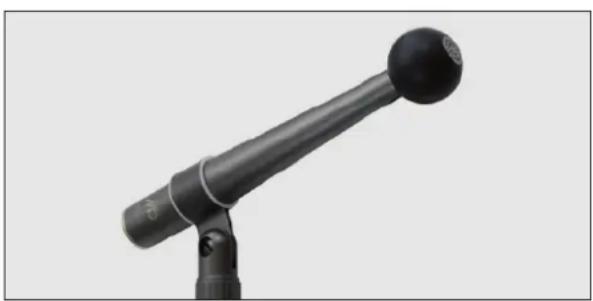
The condenser microphone M 221 unifies universal small diaphragm capsule technology with a metal diaphragm and a modular preamplifier. The use of a certificated measurement capsule combined with a preamplifier with 48 V phantom powering reaches a constant magnitude and phase response and transmission properties which are long-term stable.
APPLICATION
Because of the small capsule dimensions the M 221 is ideally suited for applications where a low interference with the sound field is demanded. It is usable as a main microphone for recordings which should include a certain amount of the room response. As well the M 221 is suited as a spot microphone for recording instruments very close where the low frequencies should be transmitted in detail and original. Moreover it can be used for multichannel main microphone arrangements like AB stereophony or decca tree. For these applications the microphone is ideal because of its precise and long-time stable transmission properties. The M 221 has an excellent transient response because of the pressure transducer capsule and is really suitable to record instruments with extreme transients. With the both different sized spherical corpuses a high frequency accentuation can be produced in an acoustical way to increase the presence and to compensate the high frequency roll-off in the diffuse sound field. The M 221 can operate also in unfavorable climate conditions especially referring the temperature and air humidity for which the accessory humidity adaptor TA 202 is purchasable.
natural_image
Close-up of a black adjustable microphone with a spherical head and stem (no text or symbols visible)
natural_image
Close-up of a black desktop microphone with a spherical head and stand (no text or symbols visible)ACOUSTICAL SPECIFICATIONS
The pick-up pattern is equivalent to the longitudinal direction of the microphone. As sound transducer a condenser capsule with a diameter of 12,5 mm and a very thin metal diaphragm is used. The pressure transducer capsule exhibits an omni-directional polar pattern without proximity effect. Because of the free field equalization the M 221 has a constant frequency response from 20 Hz up to 20 kHz ( ± 2 dB). The static pressure equalization between the capsule interior and the atmosphere goes through a vent to the preamplifier. Therefore the humidity adaptor TA 202 is usable to protect the microphone in application with high air humidity. The use of the M 221 with the spherical corpus KA 3 effects a frequency response accentuation which begins at approximately 1 kHz and goes constant at 3 dB from approximately 4 kHz up to 12 kHz. With the spherical corpus KA 4 the accentuation of the high frequencies starts also at approximately 1 kHz and goes constant at 3 dB between 3 kHz and 12 kHz.
ELEKCTRICAL SPECIFICATIONS
The transformerless circuit design of the electronic impedance converter with symmetrical output facilitates an output capability for sound pressures from 15 dB(A) up to 136 dB with a maximum of 0.5 % THD (total harmonic distortion). The microphone is connected by a standard 3-pin XLR-male plug with gold-plated pins which realizes the powering by an external 48 V phantom supply according to IEC 61938 with a current consumption of 6 mA.
MECHANICAL SPECIFICATIONS
The M 221 consists of a microphone capsule and a microphone preamplifier as independent mechanic parts which are connected to a complete microphone through a screw thread. Microphone capsule and microphone preamplifier have an identical overall diameter of 12,7 mm which enlarges to 21 mm over the length of the microphone preamplifier to the connection side of the microphone. The shape of this enlargement is designed for a minimum interference with the sound field. Microphone capsule and microphone preamplifier have together a length of 170,4 mm. On the connection side of the M 221 there are standard microphone holders mountable. To reach a higher attenuation against solid-born sound and impulses there are elastic holders and suspensions usable. The weight of the M 221 is 123 g what allows to use the microphone with stand mountings as well as to hang up the microphone from the ceiling without any problems.
DELIVERY
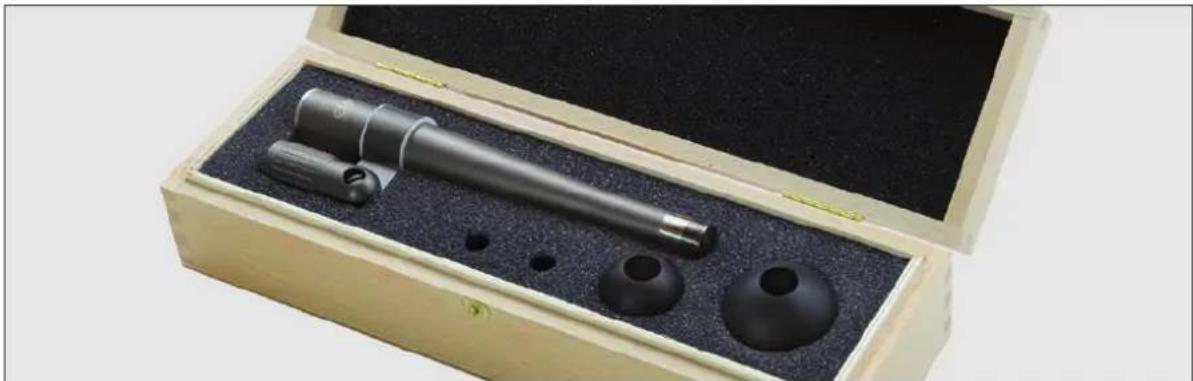
Microphone M 221 with the microphone holder MH 93.1 and spherical corpuses KA 3 and KA 4 in a wooden case
L x B x H 275 x 90 x 70 mm
dark bronze Order-No. 211103
natural_image
Open wooden box containing a mechanical tool with three black components and a small protrusion, no visible text or symbols.ACCESSORIES, optional
Windscreen, anthracite W 2 Order-No. 202407 Elastic suspension, dark bronze EH 93 Order-No. 202328 Microphone holder, turnable, dark bronze MH 93 Order-No. 202326 Connection cable C 70 Order-No. 202212
TECHNICAL SPECIFICATIONS
CE Certificate
| Polar pattern Omni | |
| Acoustic operating principle Pressure transducer | |
| Frequency range 20 ... 20000 Hz | |
| Sensitivity at 1 kHz 50 mV/Pa | |
| Output impedance 100 Ω | |
| Noise level CCIR 468-4 28 dB | |
| DIN EN 60268-4 15 dB(A) | |
| Signal-to-noise ratio A-weighted 79 dB | |
| Max. SPL for K < 0,5 % 136 dB | |
| Max. output level Ri = 1 kΩ | 18 dBu |
| Ri = 10 kΩ | 19 dBu |
| Dynamic range | 121 dB |
| power supply | 48 V ± 4 V |
| Current consumption | 5,5 mA |
| Output connector | XLR3M |
| Weight | 123 g |
| Length 170,4 mm | |
| Diameter connection side | 12,7 mm |
| Diameter capsule side | 21 mm |
DIAGRAMS

line
| Frequency (Hz) | Frequency response (dB) | | -------------- | ------------------------ | | 20 | 0 | | 50 | 0 | | 100 | 0 | | 200 | 0 | | 500 | 0 | | 1000 | 0 | | 2000 | 0 | | 5000 | 0 | | 10000 | 0 | | 20000 | -5 |Polar Patterns M 221

radar
| Angle | Value | |---|---| | 0° | -20 | | 30° | -10 | | 60° | -5 | | 90° | 0 | | 120° | 5 | | 150° | 10 | | 180° | 15 | | 210° | 20 | | 240° | 25 | | 270° | 30 | | 300° | 35 | | 330° | 40 | The chart displays a circular grid of angular positions (θ) with values ranging from -20 dB to +20 dB. The legend indicates '0.63 kHz' and '1 kHz'. The axis is labeled 'dB' but corresponds to the angular position.
radar
| Angle | Value | |---|---| | 0° | -10 | | 30° | -20 | | 60° | -20 | | 90° | -20 | | 120° | -20 | | 150° | -20 | | 180° | -20 | | 210° | -20 | | 240° | -20 | | 270° | -20 | | 300° | -20 | | 330° | -20 |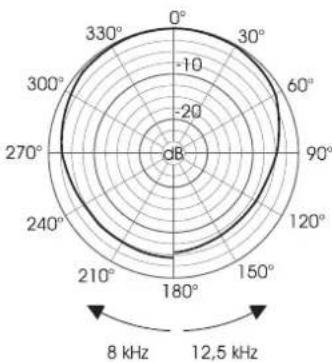
radar
| Angle | Value | |---|---| | 0° to 360° | -10 to 0 dB | | 30° to 60° | -10 to 0 dB | | 60° to 90° | -10 to 0 dB | | 90° to 120° | -10 to 0 dB | | 120° to 150° | -10 to 0 dB | | 150° to 180° | -10 to 0 dB | | 180° to 210° | -10 to 0 dB | | 210° to 240° | -10 to 0 dB | | 240° to 270° | -10 to 0 dB | | 270° to 300° | -10 to 0 dB | | 300° to 330° | -10 to 0 dB | The chart displays a single data series with values ranging from -10 to 0 dB. The angular axis is labeled in degrees, and the radial axis is labeled in dB. The value '8 kHz' is shown on the right side of the chart, and '12.5 kHz' is indicated by an arrow pointing rightward. The data appears to be a circular or radial plot with no explicit numerical labels or units provided.
radar
| Angle | Value | |---|---| | 0° | -10 | | 30° | -5 | | 60° | -10 | | 90° | -15 | | 120° | -20 | | 150° | -25 | | 180° | -30 | | 210° | -35 | | 240° | -40 | | 270° | -45 | | 300° | -50 | | 330° | -55 |


Brand : Microtech Gefell
Model : M221
Category : Microphone