Pick your language and provide your email: we'll send you a specifically translated version.
This manual is not available in your language
Product Type
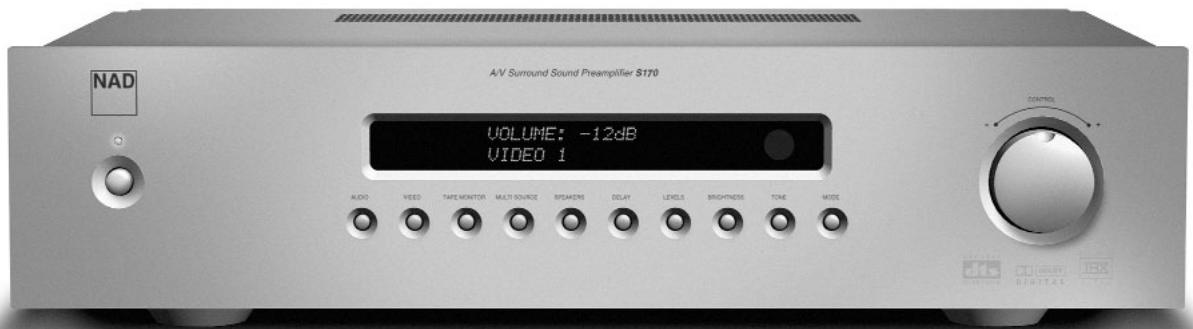
Surround Sound A/V Preamplifier
Brand
NAD
Model
S170
Decoding Formats
Dolby Digital, Dolby Pro Logic, DTS, THX Surround EX
Listening Modes
Mono, Stereo, Direct, Surround 6.1, Dolby Pro Logic, EARS, Analog Bypass
Analog Frequency Response
20 Hz - 20 kHz +/- 0.2 dB
THD+N
0.005%
Signal-to-Noise Ratio
>90 dB
Analog Input Impedance
16 kΩ / 100 pF
Maximum Input Level
3 V rms
Maximum Output Level
6 V rms
Output Impedance (Preamp)
56 Ω
Tone Controls
Bass +/-12 dB (20 Hz), Treble +/-12 dB (20 kHz)
Video Inputs
6 Composite, 6 S-Video, 1 Component
Digital Audio Inputs
3 Coaxial, 2 Optical, 1 BNC
Preamp Outputs
7.1 channels (L, R, C, LS, RS, LB, RB, Sub)
Connectivity
NAD Link, RS-232, 2 trigger 12V
Power Supply
Mains, detachable IEC cord
Dimensions (W x H x D)
450 x 97 x 285 mm (17 3/4 x 3 7/8 x 11 1/4 inches)
Net Weight
4.99 kg (11 lbs)
Remote Control Supplied
S70 LCD with page functions
MultiSource Function
Yes, with independent volume
Software Update
Via RS-232
Frequently Asked Questions - S170 NAD
How to connect a DVD player to the NAD S170?
Connect the coaxial or optical digital output of the DVD player to one of the S170's digital inputs (DIGITAL 1-3 or OPTICAL 1-2). Also connect the analog audio outputs of the player to the VIDEO 1-6 inputs according to your choice. For video, use a composite, S-Video or component connection. Then, in the menu Source Setup of the OSD, assign the corresponding digital input to the selected source.
How to configure speakers in the S170?
Access the menu Speaker Setup via the OSD. Set each speaker (Front, Center, Surround, Back) as Large (full range) or Small (crossover frequency at 80 Hz by default). If you have a subwoofer, set Subwoofer to Yes. You can also adjust the crossover frequency and activate the Enhanced Bass to always use the subwoofer.
What is the EARS mode and how to use it?
The mode EARS (Enhanced Ambience Recovery System) is a proprietary NAD listening mode that extracts natural ambiance from stereo recordings to recreate surround spatialization without artificial enhancement. To activate it, from the S70 remote, select MODE/MULTI.S then use the [Cursor up/down] keys to choose EARS among the available modes. It is particularly suitable for natural music recordings (classical, jazz).
How to adjust individual channel levels?
From the S70 remote, press LEVELS. Use the [Sub.W], [Center] and [Surr] key pairs to adjust the relative levels of the subwoofer, center and surround speakers. These settings add to the calibration levels in the menu Level Setup. For precise calibration, use an SPL meter and set each channel to 75 dB SPL (THX reference) using the built-in test signal.
How to update the S170 software?
Software updates are done via the port RS-232. Download the update file from the NAD website (www.NADelectronics.com) and use a straight serial cable to connect the S170 to a PC. Run the provided application to transfer the update. You can also contact your NAD dealer for assistance.
What to do if no sound comes out of the S170?
Check that the power cord is plugged in and the switch POWER is on. Ensure the function Tape Monitor is not activated. Check the audio cable connections and that the power amplifier is on. Also verify that the volume is not muted and that the correct source is selected.
How to use the MultiSource function to listen in another room?
Connect an amplifier to the outputs MULTISOURCE OUT on the back of the S170. From the remote, select MODE/MULTI.S then use the [MULTI.S] key to choose the audio source you want to play in the second zone (analog sources only). Use [M.S. VOL up/down] to adjust the volume independently of the main zone.
How to use presets on the S170?
The S170 has 5 presets. To configure one, go to the menu Audio Setup then Preset Setup. Adjust the tone levels (bass/treble) and relative channel levels (center, surround, subwoofer) to your preference. To recall a preset, from the S70 remote, select PRESET 1-5 then press the [Preset 1] to [Preset 5] key. The preset remains active until you recall another or enter standby.
How to adjust the Bass Limiter?
Access the menu Audio Setup and select Bass Limiter. Activate the test signal by setting Test to On. Gradually decrease the limiter value (in 1 dB steps) until you hear audible distortion, then increase it by 1 or 2 dB until the distortion disappears. This prevents your subwoofer from producing damaging distortion.
The S70 remote does not respond, what to do?
First check the batteries: they must be inserted correctly and not discharged. Ensure there is no obstacle between the remote and the IR sensor of the S170 (located on the front). Avoid direct sunlight or very strong ambient lighting on the front panel. If the problem persists, try restarting the S170 by unplugging it from the mains for a few minutes.
User questions about S170 NAD
0 question about this device. Answer the ones you know or ask your own.
Ask a new question about this device
No questions yet. Be the first to ask one.
Download the instructions for your Audio Preamplifier in PDF format for free! Find your manual S170 -
NAD and take your electronic device back in hand. On this page are published all the documents necessary for the use of your device. S170 by NAD.
USER MANUAL S170 NAD
AV Surround Sound Pre-amplifier
GB
Owner's Manual
CE
EXPLANATION OF GRAPHICAL SYMBOLS
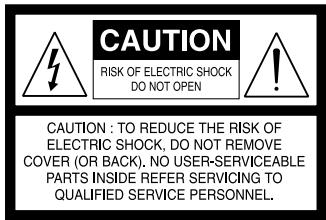
The lightning flash with arrowhead symbol, within an equilateral triangle, is intended to alert the user to the presence of uninsulated “dangerous voltage” within the product's enclosure that may be of sufficient magnitude to constitute a risk of electric shock to persons.
The exclamation point within an equilateral triangle is intended to alert the user to the presence of important operating and maintenance (servicing) instructions in the literature accompanying the appliance.
PRECAUTIONS
Read the Operating Instructions carefully and completely before operating the unit. Be sure to keep the Operating Instructions for future reference. All warnings and cautions in the Operating Instructions and on the unit should be strictly followed, as well as the safety suggestions below.
INSTALLATION
1 Water and Moisture - Do not use this unit near water, such as near a bathtub, washbowl, swimming pool, or the like.
2 Heat - Do not use this unit near sources of heat, including heating vents, stoves, or other appliances that generate heat. It also should not be placed in temperatures less than 5°C (41°F) or greater than 35°C (95°F).
3 Mounting surface - Place the unit on a flat, even surface.
4 Ventilation - The unit should be situated with adequate space around it so that proper ventilation is assured. allow 10 cm (4 in.) clearance from the rear and the top of the unit, and 5 cm (2 in.) from each side. - Do not place on a bed, rug, or similar surface that may block the ventilation openings. - Do not install the unit in a bookcase cabinet, or airtight rack where ventilation may be impeded.
5 Objects and liquid entry - Take care that objects or liquids do not get inside the unit through the ventilation openings.
6 Carts and stands - When placed or mounted on a stand or cart, the unit should be moved with care. Quick stops, excessive force, and uneven surfaces may cause the unit and cart to overturn or fall.
7 Condensation - Moisture may form on the CD pickup lens when:
- The unit is moved from a cold spot to a warm spot.
- The heating system has just been turned on.
- The unit is used in a very humid room.
- The unit is cooled by an air conditioner.
When this unit has condensation inside, it may not function normally. Should this occur, leave the unit for a few hours, then try to operate again.
8 Wall or ceiling mounting - The unit should not be mounted on a wall or ceiling, unless specified in the Operating Instructions.
WARNING! TO REDUCE THE RISK OF FIRE OR ELECTRONIC SHOCK, DO NOT EXPOSE THIS APPLIANCE TO RAIN OR MOISTURE
This product is manufactured to comply with the radio interference requirements of EEC DIRECTIVE 89/68/EEC and 73/23/EEC
ELECTRIC POWER
1 Power Sources - Connect this unit only to power sources specified in the Operating Instructions, and as marked on the unit.
2 Polarization - As a safety feature, some units are equipped with polarized AC power plugs which can only be inserted one way into a power outlet. If it is difficult or impossible to insert the AC power plug into an outlet, turn the plug over and try again. If it still does not easily insert into the outlet, please call a qualified service technician to service or replace the outlet. To avoid defeating the safety feature of the polarized plug, do not force it into a power outlet.
3 AC power cord - When disconnecting the AC power cord, pull it out by the AC power plug. Do not pull the cord itself.
- Never handle the AC power plug with wet hands, as this could result in fire or shock.
- Power cords should be routed to avoid being severely bent, pinched, or walked upon. Pay particular attention to the cord from the unit to the power socket.
- Avoid overloading AC outlets and extension cords beyond their capacity, as this could result in fire or shock.
4 Extension cord - To help prevent electric shock, do not use a polarized AC power plug with an extension cord, receptacle, or other outlet unless the polarized plug can be completely inserted to prevent exposure of the blades of the plug.
5 When not in use - Unplug the AC power cord from the AC outlet if the unit will not be used for several months or more. When the cord is plugged in, a small amount of current continues to flow to the unit, even when the power is turned off.
CAUTION
Modifications or adjustments to this product, which are not expressly approved by the manufacturer, may void the user's right or authority to operate this product.
MAINTENANCE
Clean the unit only as recommended in the Operating Instructions.
DAMAGE REQUIRING SERVICE
Have the unit serviced by a qualified service technician if
The AC power plug has been damaged.
• Foreign objects or liquid have gotten inside the unit.
The unit has been exposed to rain or water - The unit does not seem to operate normally.
The unit exhibits a marked change in performance.
The unit has been dropped, or the cabinet has been damaged
DO NOT ATTEMPT TO SERVICE THE UNIT YOURSELF
OWNER'S RECORD
For your convenience, record the model number and serial number (you will find them on the rear of your set) in the space provided below. Please refer to them when you contact your dealer in case of difficulty.
Model No.:
Serial No. :
TABLE OF CONTENTS
Safety Information ....2-3
Getting the Most from the NAD S170 .5
Unpacking and Setup ....6
What's in the Box....6
Choosing a Location....6
About the S170 7-8
E.A.R.S. 7
About THX....7
Ease of Use 7
Integration 7
Upgradability 8
About the S70 System Remote Control 8
Quickstart 9
Play a DVD Movie (or Music CD)....9
Front Panel 10
Attention! 10
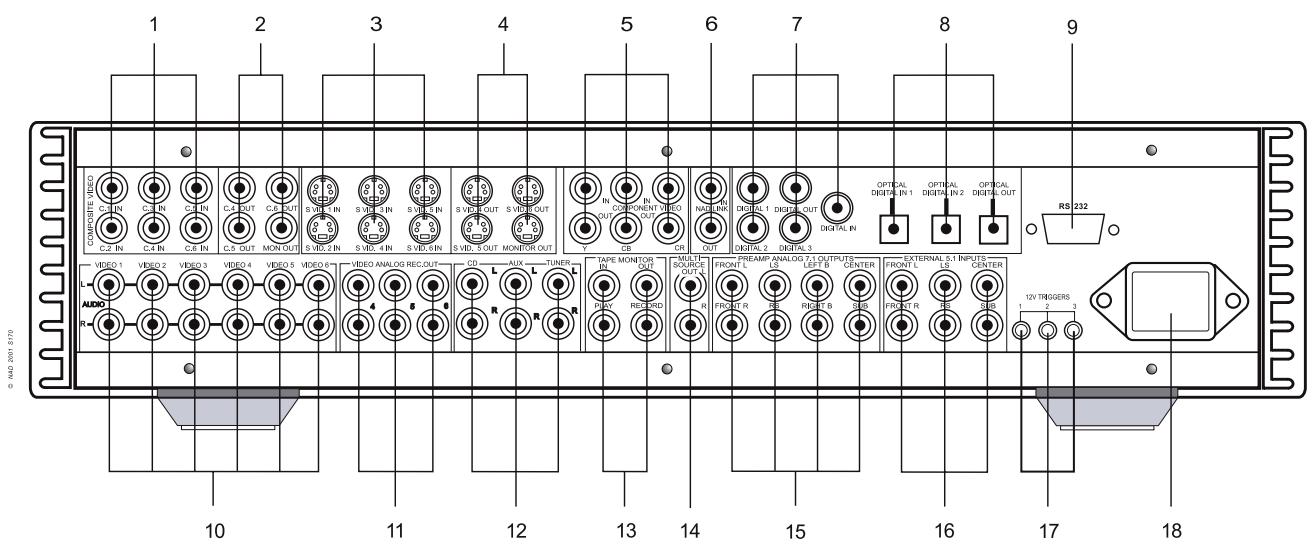
Rear Panel 11
Setting up the S170 12
Getting Started....12
Using the S70 Remote 12
Dealing With Hum and Noise 12
About the On-Screen Displays (OSD) and Front-Panel Readout ....13
Displaying the Menus 13
Configuring the S170 14-19
Display setup 14
Audio setup 15
Speaker Setup 17
Level setup....17
Delay setup 18
Source Setup 18
Trigger setup 19
Using theS170 .....20-28
Selecting Sources 20
Adjusting the Volume 20
Setting Listening Modes 21
Adjusting Channel Levels 24
Adjusting the Tone Controls 25
Using Presets 25
Front Panel Operations 26
Listening in a Remote Zone (MultiSource) 27
NAD Link 28
System Integration (RS-232) 28
Troubleshooting ....29
Specifications ....30
Thank you for choosing NAD.
The S170 A/V Surround Sound Preamplifier is one of the most technologically advanced surround-audio processor/preamplifiers yet devised, incorporating advanced, ultra-high-speed 32-bit digital signal processing, an architecture that is fully upgradeable (in both hardware and software), and extraordinarily precise 24-bit precision/96 kHz-sampling digital-to-analog conversion for all channels.
More importantly, it is among the most musically transparent and spatially accurate designs available, the culmination of everything we've learned, over a quarter-century, about music and home-theater sound reproduction. With our company's "Music First" design philosophy as its guiding design principle, we're confident that the S170 will make good on our promise to you of delivering both a state-of-the-art surround home-theater experience, and genuinely audiophile-quality music listening, for many years to come.
We urge you to take a few minutes now to read right through this manual. Investing a little time here at the outset might save you a good deal of time later, and is by far the best way to ensure that you make the most of your investment in the NAD S170, and get the most from this powerful and flexible home-theater component.
One more thing: We urge you to register your S170 ownership on the NAD Worldwide Web site:
HTTP://NADELECTRONICS.COM/W/REGISTRATION.HTML
This is by far the best way to ensure that we at NAD world headquarters can inform you of possible future software and firmware updates, changes that might significantly enhance the performance and utility of your S170. Please also send in your warranty card, so that your local NAD organization will have a record of your purchase, and save your original purchase receipt. This will assure you of warranty service in your area.
WHAT'S IN THE BOX
Packed with your S170 preamplifier you will find:
A removable AC cable (if you wish, any IEC-standard AC cable of suitable wattage may be substituted).
• 1 DC trigger cable.
The S70 remote controller with operating manual and 9v (PP-3) battery.
A pair of white cotton gloves—for handling your S170 during setup without fear of scratches or fingerprints marring its finish.
• This owner's manual.
SAVE THE PACKAGING
Please save the box and all of the packaging in which your S170 arrived. Should you move or otherwise need to transport your preamplifier, this is by far the safest container in which to do so. We've seen too many otherwise perfect components damaged in transit for lack of a proper shipping carton, so please: Save that box!
CHOOSING A LOCATION
We hope you will agree that the S170's finish quality and appearance earn it pride of place in any home theater or music system. Choose a location that is well ventilated (with at least several inches to both sides and behind), and that will provide a clear line of sight, within 25 feet/8 meters, between the preamp's front panel and your primary listening/viewing position—this will ensure reliable infrared remote control communications. Due to the S170's high-speed DSP hardware and high-current audio circuits it generates a modest amount of heat, but nothing that should trouble any adjacent components. It is perfectly safe to stack additional components atop the S170, or vice versa, but it is generally preferable (and considerably handsomer) if the S170 stands alone. The one exception is a power-amplifier or receiver, or any other unit that generates substantial heat: The S170 should not be stacked above or below any such component.
Though the S170 A/V preamp is among the most powerful and sophisticated digital-surround decoder/processors available, we worked hard to make it one of the most musically transparent home-theater components as well; this is what we mean by NAD's "Music First" design philosophy. Here are just a few examples:
The S170 employs the latest, most sonically pure high-performance FET components throughout its analog audio circuits
Exceedingly low output impedance from all channels (long an NAD hallmark) eliminates sonic impact from cables and amplifier input-impedances
Output muting is via reliable, sonically transparent gold-contact relays rather than sound-coloring electronics
Gold-surfaced connectors are employed throughout both internally and externally to ensure unimpeded signal transfer.
E.A.R.S.
A key element of the S170's unique musicality is NAD's proprietary Enhanced Ambience Recovery System (EARS). In sharp contrast to many "ambience-synthesis" music-surround modes, EARS exploits the S170's substantial DSP power to route the ambient content that is "encrypted" in virtually all natural-acoustic recordings to the appropriate main, center and surround speakers, without resorting to artificially generated reflections or regeneration. EARS' natural ambience yields a subtle but exceptionally effective surround mode that naturally enhances the spatial presentation in a fashion suitable for serious music listening.
On the digital side, the S170 combines extraordinarily high-speed DSP processing employing one of the most advanced high-speed DSP "engines" available, with fully 24-bit, 96 kHz-sampling-capable D/A converters (and A/D conversion for analog inputs processed for surround sound) for all channels. A single, high-precision master clock runs all digital circuits to eliminate the timing errors ("jitter") that otherwise occur between digital stages, compromising sonic performance. The result is legitimately state-of-the-art surround decoding from Dolby Digital and DTS sources in both 5.1-channel and 6.1/7.1-channel output modes, and genuinely superior sound quality in all modes.
ABOUT THX
The S170 preamplifier is certified by Lucasfilm Ltd. as meeting the rigorous requirements of its home THX/Ultra program for surround controllers. This means that it is capable of delivering an audio experience equal to that of the finest commercial cinemas when its superb fundamental performance is combined with the surround enhancements mandated by the THX/Ultra program.
EASE OF USE
While we expended enormous effort to ensure that the S170 preamplifier's sonic performance is second to none, we invested no less in making it powerfully easy to use. Its design is unusually simple for so sophisticated a component, and the S70 LCD remote controller's functioning is uniquely self-prompting and intuitive, as are the S170's own front-panel and on-screen displays. A simple yet powerful system of presets will permit you to fine-tune your listening setup for different conditions, and to recall these multiple parameters with a single keypress.
INTEGRATION
The S170 preamplifier offers extensive, flexible system-integration options through its two configurable DC triggers outputs, as well as via NAD's proprietary NAD Link inter-component communications protocol. Additionally, an RS-232 serial port stands ready to integrate the preamp with still more sophisticated controllers such as touch-screen systems and whole-house automation installations by offering two-way communication.
UPGRADABILITY
We engineered the S170 preamplifier with selectively modular construction. All of its digital-control and - processing “intelligence” is located on a single plug in module. This sophisticated yet accessible architecture simplifies servicing while maintaining signal-path integrity, making potential hardware upgrades possible. That said, given the S170's extraordinary processing power and speed we do not foresee the need for hardware upgrades at this time. Nevertheless, you may feel confident that the S170 will not become obsolete in the foreseeable future.
Software upgrades are a more likely scenario, and are easily accomplished via the high-speed RS-232 port on the rear panel of the S170. Owners who have registered their S170s on our international web site at www.NADelectronics.com will be advised of updates (see "Getting the Most from the NAD S170," above). Updates may be free of charge, or in some cases may require royalty payments for proprietary decoding systems and the like. Computer-savvy users can perform these upgrades by downloading the files (and an installer application) from our web-site, and uploading to the S170 by connecting the preamp's RS-232 port to the PC's serial port. (See "System Integration", page 26 for more detailed information). Alternatively, the NAD audio specialist from whom you purchased your S170 will assist you in performing software upgrades.
ABOUT THE S70 SYSTEM REMOTE CONTROL
Packed with your S170 is the NAD S70 LCD remote controller, accompanied by a short, dedicated operating manual covering its general function. We strongly recommend that you scan this manual and familiarize yourself with the S70's simple layout and operations before proceeding with setup of your S170 preamplifier; you will find that this process takes but a few minutes.
The S70 remote controller is a "paged" display; that is, each set of commands or functions shows a new array of icons on its LCD screen. This makes it a powerfully flexible commander; however, because we were careful to keep its menu structure very "shallow"— there are never more than three levels between any command and the uppermost, "top" screen—you will find it simple and intuitive to use.
Chances are, you will primarily use your S70 to command the S170 A/V preamp, but the remote can also operate other Silver Series and C-Series NAD components such as a CD player or recorder, cassette-tape component, and an AM/FM tuner. You will find the details of its function with these components in each of their owner's manuals.
In case you simply cannot wait to experience the performance of your new S170 preamplifier, we provide the following "Quickstart" instructions to get you underway. They assume that the DVD/CD player is connected to the VIDEO1 input and that the appropriate audio and video connections have been made.
PLAY A DVD MOVIE (OR MUSIC CD)
From the S70 remote's PREAMP menu, select [@ Source]; then press the [Source up] key until VIDEO 1 appears on the front-panel readout (and on-screen display, if this is enabled; see "Display setup," below). Use the S70 remote's [VOLUME up/down] keys to adjust the volume.
Start playback of the DVD/CD player. From the S70 remote's PREAMP menu, select [MODE/MULTI.S]; then press the [Mode •] key; the [Cursor up/down] keys will now cycle through all of the S170 listening modes that are available for the current input signal type (see "About the S170's Listening Modes," below).
Depending on the signals format and connections you have made, some listening modes may not yet be available (see "Configuring the S170", below). You may need to use the DVD player's on-screen menu system to select a surround-capable signal format.
Enjoy the movie or music, but be sure to set aside time to read this manual thoroughly and to set up, calibrate, and configure your S170 carefully.
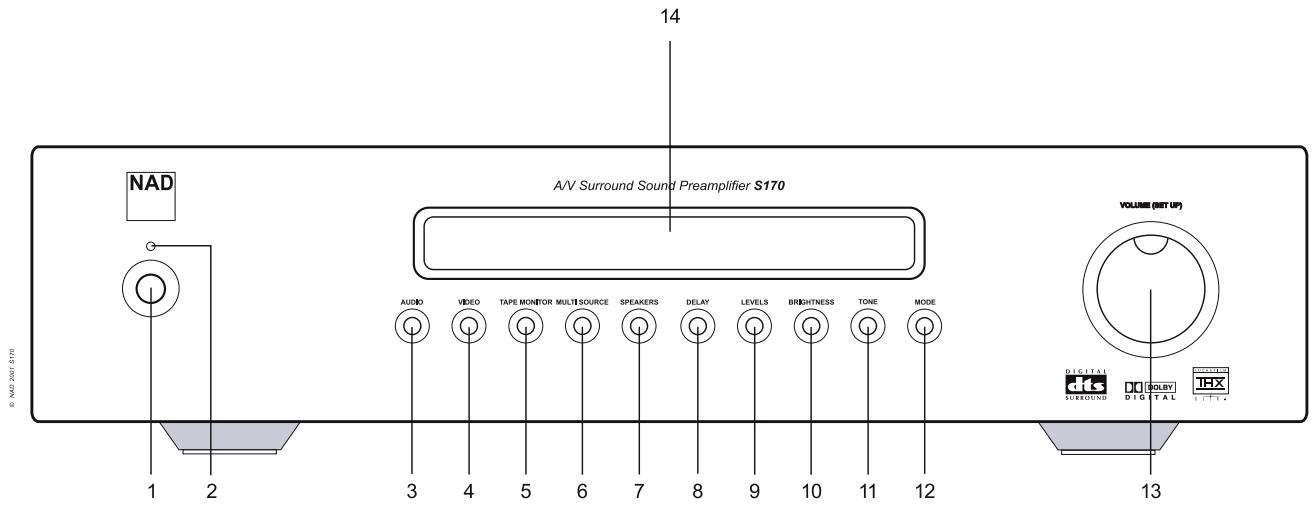
1 POWER: Switch off to disconnect the S170 from all AC power and exit the Standby mode. Switching POWER on both reconnects the AC and actively power-up the preamp.
2 STANDBY: Illuminates when the S170 is in the Standby mode (dark when preamp is on, or powered-off).
3 AUDIO: Press to select audio inputs sequentially using the VOLUME (SETUP) knob (see "Front Panel Operations," below).
4 VIDEO: Press to select audio inputs sequentially using the VOLUME (SETUP) knob (see "Front Panel Operations," below).
5 TAPE MONITOR: Press to engage the Tape Monitor loop. The signal present at the rear-panel TAPE MONITOR IN jacks will be heard (see "Front Panel Operations," below).
6 MULTISOURCE: Press to select the signal output by the rear-panel MULTISOURCE OUT jacks using the VOLUME (SETUP) knob (see "Listening in a Remote Zone," below).
7 SPEAKERS: Press to access the menu on the front-panel readout, and to select parameters using the using the VOLUME (SETUP) knob and subsequent presses of the SPEAKERS key (see "Configuring Your S170," and "Front Panel Operations," below).
8 DELAY: Press to access the menu on the front-panel readout, and to select parameters using the using the VOLUME (SETUP) knob and subsequent presses of the DELAY key (see "Configuring Your S170," and "Front Panel Operations," below).
9 LEVELS : Press to access the menu on the front-panel readout, and to select parameters using the using the VOLUME (SETUP) knob and subsequent presses of the LEVELS key (see "Configuring Your S170," and "Front Panel Operations," below).
10 BRIGHTNESS: Press to dim the S170's front-panel readout; press again to restore full brightness.
11 TONE: Press to adjust treble using the VOLUME (SETUP) knob; press again to adjust bass, and a third time to exit tone-control adjustment.
12 MODE: Press to select listening modes sequentially using the VOLUME (SETUP) knob (see "Setting Listening Modes," and "Front Panel Operations," below).
ATTENTION!
Please make all connections to your S170 preamplifier with the unit powered off or unplugged. (It is equally wise to power-down or unplug all associated components while making or breaking any signal or AC power connections.)
1 COMPOSITE VIDEO IN 1-6: Connect Video Inputs 1-6 to composite-video from source components (see "Source Setup," below).
2 COMPOSITE VIDEO OUT 4-6 OUT; MON OUT: Connect to composite-video record-inputs of recording components; connect MON OUT to the composite-video input of the video monitor/TV.
3 S VID1 IN - S VID6 IN: Connect Video Inputs 1-6 to S-Video from source components (see "Source Setup," below).
4 S VID4 OUT - SVID6 OUT; MON OUT: Connect to S-Video record-inputs of recording components; connect MON OUT to the S-Video input of the video monitor/TV.
5 COMPONENT VIDEO IN (upper), OUT (lower): Connect inputs to component-video signal or wide-band component video from a source component such as a DVD player or HDTV tuner; connect outputs to the component-video inputs of the video monitor/TV. Be sure to observe consistency in connecting the Y, CB, and CR jacks to the corresponding sources/inputs (see "Source Setup," below).
6 NAD LINK IN/OUT: Connect to the corresponding NAD Link jacks (input to output and vice versa) of compatible NAD components (see "NAD Link," below).
7 DIGITAL 1-3; DIGITAL IN; DIGITAL OUT: Connect DIGITAL 1-3 to coaxial S/PDIF-format digital sources such as CD or DVD players; connect DIGITAL IN to a high-quality S/PDIF-format source via BNC cabling; connect DIGITAL OUT to the coaxial S/PDIF digital input of a recording component such as a CD recorder, DAT deck, or computer soundcard (see "Source Setup," below).
8 OPTICAL DIGITAL IN 1-2; DIGITAL IN; OPTICAL DIGITAL OUT: Connect OPTICAL DIGITAL 1-2 to optical S/PDIF-format digital sources such as CD or DVD players; connect OPTICAL DIGITAL OUT to the optical S/PDIF digital input of a recording component such as a CD recorder, DAT deck, or computer soundcard.
9 RS-232: Connect to the RS-232 serial port of a home-automation system or personal computer (see "System Integration," below).
10 VIDEO 1-6 Analog Audio Inputs: Connect to stereo analog outputs of audio-video sources (see "Source Setup," below).
11 VIDEO ANALOG REC OUT 4-6: Connect to stereo analog inputs of recording audio-video components such as videocassette recorders.
12 CD, AUX, TUNER Inputs: Connect to stereo analog outputs of audio components.
13 TAPE MONITOR IN/OUT: Connect OUT to the stereo analog inputs, and IN to the outputs of an audio recording components such as a cassette deck or CD recorder, or of an analog audio processor such as a stereo equalizer.
14 MULTISOURCE OUT: Connect to the inputs of the stereo amplifier (integrated amp, receiver) that will power the remote-zone's loudspeakers (see "Listening in a Remote Zone," below).
15 PREAMP ANALOG 7.1 OUTPUTS: Connect L, R, and CENTER to the channel inputs of the power amplifier(s) driving the front, channels; connect LS and RS to the power amplifier driving the surround speakers and LEFT B and RIGHT B to that driving the surround-back speakers (if any); connect sub to the line input of a powered subwoofer or to the amplifier driving a passive sub (if any).
16 EXTERNAL 5.1 INPUTS: Connect to the corresponding analog audio outputs of a multichannel source component such as a DVD-Audio or multichannel SACD player. There is no bass-management or other processing available to these inputs; see "Selecting Sources," below.
17 12V TRIGGERS: Connect to the 12-volt trigger inputs of compatible components such as power amplifiers and projector lifts; see "Trigger Setup," below.
18 AC power inlet: Connect to the supplied IEC-standard removable AC power cord or a compatible cord.
GETTING STARTED
Before you make the first connection to your S170, you should have the arrangement of your listening room/home theater components and furniture mapped out, at least initially. Unfortunately, a discussion of the vital questions of loudspeaker placement and listening/viewing positions is beyond our scope here. Suffice it to say that these two questions will influence your system's ultimate performance every bit as powerfully as your selection of electronics and speakers. Your NAD audio specialist dealer will be happy to advise you, and to recommend reference materials.
USING THE S70 REMOTE
You will likely find it most convenient to use the S70 remote handset to configure your S170. The remote is a "paged" display; that is, each set of commands or functions shows a new "page" of icons on its LCD screen. The S70 is a powerful controller, but you will find it simple and intuitive to use thanks to its self-prompting LCD screen, and because we were careful to keep its menu structure very "shallow"—here are never more than three levels between any command and the uppermost, "top" screen.
DEALING WITH HUM AND NOISE
The S170 requires a grounded (3-prong) AC outlet. Employing a 3-to-2 adapter to eliminate the ground prong will not compromise electrical safety, but it may increase susceptibility to hum and noise. Hum and noise sometimes prove a challenge in complex, multichannel audio systems. Note these considerations to help prevent hum and noise problems:
Power all your system's audio component from AC outlets originating from the same circuit of your house wiring. As far as possible, power all audio components from the same outlet, or adjacent outlets on the same circuit. It may be useful to power video displays (and computers!) from outlets on another circuit, especially if that circuit is supplied from the other "leg" of the house wiring.
Do not bundle analog audio cables with AC power cables, or with coaxial digital-audio cables.
Employ high-quality, well-shielded audio cable throughout, and ensure that all connections are secure.
A pencil-eraser can be used to burnish copper- and gold-plated contacts to ensure good, low-resistance contact; specialized contact-cleaners can also be useful. Avoid unnecessary unplugging and replugging, since the gold (or copper) contact-plating of typical cable connectors, even very high-quality ones, is very thin and easily worn.
Track down hum/noise problems one component at a time, working backwards from the power amplifier(s). That is: Connect the speakers to the power amplifier only, and check for hum. Then connect the preamplifier alone (with no other components connected to the preamp) to the power and check for hum. Then connect one source component (a CD player, for example) to the preamplifier, and check for hum. At each stage, if hum/noise appears, examine the audio cabling and AC-power routing of the new component. In some cases, moving the new component's AC cord to a different outlet, or installing a ground-lift (3-to-2-prong adapter) on its power cord, will eliminate the hum.
The S170 preamplifier employs a simple, self-explanatory system of on-screen display "menus" that will appear on the connected video monitor/TV, useful both during setup and in day-to-day operation. While the OSDs are always helpful, it is also perfectly possible to operate (or even set up) the S170 without them, because the same basic data is always shown, though sometimes in shortened form, on the preamp's own front-panel readout.
DISPLAYING THE MENUS
Select the S70 remote's PREAMP screen (from the S70 main menu, press the remote key opposite the PREAMP LCD screen): Press the [OSD] key, then [Cursor >]. The OSD will appear on your video monitor/TV.
- If the OSD does not appear, check your Monitor Out connections, and/or the settings of the
NOTE
The OSD does not appear on the S170's component-video outputs
NAVIGATING THE OSD AND MAKING CHANGES
Use the remote's [Cursor up/down] keys to move up or down among any OSD menu's list of items; use the [Cursor <>] keys to change the parameter-value (setting) of any item; use the remote's [Enter] key to select an OSD menu item.
NOTE THAT:
Selecting the on-screen item from any on-screen menu (press the remote's [enter] key to select) returns "up" one level to the next-"higher" menu, or from the Main menu exits the OSD altogether.
Keying the S70 remote's LCD-labeled [Exit] key from any OSD menu performs two functions simultaneously: It exits the OSD altogether, turning off any and all current on-screen displays, while simultaneously recording your changes (if any) to the S170's memory; selecting from the Main menu also saves changes.
By contrast, keying the S70 remote's LCD-labeled [Cancel] key "quits" the OSD menu system altogether, from any menu, while abandoning any changes you have made since the last [Exit]/save operation.
This is worth repeating: the S70 remote's [Exit] key saves changes; its [Cancel] key abandons changes; the on-screen command moves up one level.
You may set up your S170's levels, modes, and options in any order; it is not necessary to follow the order employed here. However, it is advisable to begin by configuring the S170's on-screen display options, since certain of these will affect the options made available to other setup routines.
DISPLAY SETUP
From the S170 OSD's Main menu, select the item using the remote's [Cursor up/down], and [Enter] keys. Using the [Cursor <>] keys, set: to "NTSC" for North American use, or "PAL." for European use.
Using the same remote keys, set:
to "On" or "Off. When "Off" is selected, on-screen menus will appear against a blue background, obscuring the current video program (if any); when "On" is selected menus will appear in white text superimposed upon the current video program (if any).
to "Full," "Simple, or "Off." This controls how much information the S170 will display, monetarily, in on-screen text whenever powering on, selecting or changing a source or listening mode, or changing types of input signals. In "Full" mode a complete screen of data including input-name, audio-signal input, type, format, and listening mode, and video-signal type and input; in "Simple" mode, only input-name will appear. In "Off" mode no temporary on-screen info will be displayed.
NOTE
The S170 preamplifier passes video signals even when it is switched to "Standby." This permits video sources such as TeleText or Web-TV devices to be used even when the balance of the system is off.
- to "Both," "SVideo," "Compos." (composite-video), or "Off." This controls which video outputs will carry the S170's on-screen displays and menus. When "Both" is selected OSDs will be present on both the S-Video and composite-video Monitor Outputs; selecting "SVideo" or "Compos." confines on-screen displays to each output alone, and "Off" disables on-screen displays altogether. (In all cases, basic data remains readable via the S170's front-panel readout, so you can, for example, see what you're doing even with OSDs set to "Off.")
NOTE THAT:
OSDs do not appear on the component-video output
Enabling OSD for a video output causes the video source signals in that format to "pass through" the OSD circuitry. Critical videophiles may wish to disable the OSD on the SVideo output for the most critical viewing/recording functions, switching to a composite-video input for OSD use.
to "Feet" or "Meters." This selects by which measurement units you will enter your speaker-setup dimensions on the S170's menu page (see below).
AUDIO SETUP
The
BASS/TREBLE
From the
Bass/treble settings affect only the front channels (left, center, and right), and are active in all listening modes.
It is often better to "cut" (a minus setting) than boost (a plus setting); for a "warmer" overall sound try reducing Treble by a few dB instead of boosting Bass, and vice versa.
If you frequently find yourself selecting large tone control settings, you may be better served by reexamining your choice of loudspeakers, and your loudspeaker and listening-position locations to better exploit your room's acoustics.
LFE CHANNEL
The Low-Frequency Effects channel—the "point-one" channel in "5.1/6.1/7.1"—is active only with Dolby Digital or DTS multichannel sources. LFE is employed most often as a supplementary channel to enhance the dynamic range of very low-frequency sounds; it should not be confused with the S170's Subwoofer output-channel, which may carry most or all bass information from some or all channels, depending on the configuration of the menu page.
From the
- In most systems the LFE channel setting may be left at 0 dB (no change), because the S170's Bass Limiter (see below) will be set to prevent subwoofer overload. However, if your subwoofer's headroom is known to be limited, or if the low-frequency effects of film soundtracks generally seem excessive in your system, you might profitably try decreasing the setting by a modest degree.
THX DEFAULT
From the
NOTE
THX Surround EX creates a sixth, "center-back" channel intended for reproduction by one or more loudspeakers located behind the listening area. With recordings bearing the Dolby Surround EX mark, this delivers a specifically engineered center-back channel that is encoded into the left/right surround channels much as the center channel was encoded into the left/right front channels in matrix-encoded Dolby Surround mixes.
BASS LIMITER
The S170 incorporates a Bass Limiter that you can set to eliminate any chance of your subwoofer producing audible distortion. You will do this by auditioning a built-in test-noise signal the S170 sends to your subwoofer, and increasing the Bass Limiter's "headroom" setting to the point of audible distortion. The Bass Limiter now prevents any program-material signals exceeding this level from being sent to the subwoofer.
CONFIGURING THE BASS LIMITER
From the
Now use the remote's [Cursor up/down] keys to move to the item, and [Cursor <] to decrease the limiter setting by 1 dB increments. As you do, the test-noise from the subwoofer will increase in level. Listen for the point at which audible distortions (harshening, "clacking," "chuffing," or other extraneous elements) become evident, then use [Cursor >] to return (increase) the limiter level by 1 or 2 dB until the distortion ceases. This establishes the "distortion-free" limit for your current subwoofer setup. It is advisable to return and re-check your Bass Limiter setup after you have completed the Level Setup routines (see below).
Even after the Bass Limiter is set you may usefully engage its test-noise to "search and destroy" the room-rattles that are inevitably excited by high-level subwoofer output. (Window-treatments, electrical wall-plates, and hanging artwork are three common sources.)
Should you ever change subwoofers, or reposition your current subwoofer or listening position, you should repeat the Bass Limiter setup routine.
With a high-performance subwoofer, this routine can get rather loud. It is often best to await an opportune moment when spouses/children/pets are not at home to perform Bass Limiter setup fully.
PRESET SETUP
The S170 incorporates five "Presets," memory locations to which you may store five different combinations of tone-control and relative center/surround/subwoofer channel levels to suit different requirements. For example: You might configure Preset 1 for movie-surround with tone controls set to zero and relative channel levels left at their calibrated points, but set Preset 2 for music-surround listening with slightly elevated surround- and subwoofer-channel levels, slightly reduced center-channel levels, and modified bass or treble. Presets may be configured in any way, for any purpose you see fit.
CONFIGURING PRESETS
From the
NOTE THAT:
If surround-back speaker(s) are configured as present in the OSD menu (below), their levels will be controlled along with the surround-channels levels.
Once configured, a Preset remains unchanged until you edit it via the OSD menu.
A Preset applies regardless of what source is selected, or what listening mode is in operation
Cycling the S170 through its Standby mode will cancel any previously selected Preset, reverting both tone and all level settings to those set on the S70 remote's LEVELS or MODE/MULTI.S screens (below), or via the S170 preamp's
Channel levels stored in presets (or on the S70 remote's LEVELS screen, below) are added to the setup levels established on the S170 preamp's OSD menu. For example: if your establishes
at "-3 dB" and you dial in a Preset center-channel level of +2 dB, the net overall effect will be a center-channel level of -1 dB. By contrast, tone-control settings override
RECALLING PRESETS
From the S70 remote's PREAMP menu select the PRESET 1-5 item. Use the [●Preset 1] through [●Preset 5] keys to select the desired Preset; the number of the preset invoked will appear briefly on the OSD and the S170's front-panel display. (See also Using Presets, below)
SPEAKER SETUP
Every surround-sound system requires "bass-management" to direct low-frequency content from any or all channels to the speakers best able to reproduce it. In order for this function to operate correctly, it is very important that you correctly identify your speakers' capabilities.
We use the terms "Small" and "Large" (and "No"), but note that physical size may be irrelevant.
A "Small" speaker is any model without significant deep-bass response, that is, below about 80 Hz.
A "Large" speaker is any full-range model, that is, one with deep-bass response
A "No" speaker is one that is not present in your system. For example, you might not have any Back speakers installed; in that case, you would set the setup item to "No."
CONFIGURING SPEAKERS
From the OSD Main menu, select the item using the remote's [Cursor up/down], and [Enter] keys. Using the [Cursor <>] keys, set to "Large" or "Small." Using the same remote keys, set the
, , and to "Large," "Small," or "No," according to your system's loudspeaker population. Set to "Yes" only if you have a subwoofer connected to the S170's SUB preamp analog output jack.
NOTE THAT:
The S170 permits you to set Subwoofer to "Yes" even with "Large" front speakers: In this case, bass content from any channels you set to "Small" will be routed to both the subwoofer and to the front speakers; LFE-channel signal will pass only to the sub. You might want to try this arrangement way if your front speakers roll off naturally at about the 80 Hz crossover frequency and can handle strong bass signals without distortion or damage. In most systems using a subwoofer, setting front speakers to "Small" is usually the best option.
LEVEL SETUP
Setting the relative balance of your system's loudspeakers is perhaps the most important single function of setting up your S170. First, this process ensures that surround-sound recordings, whether music or film soundtracks, will play back with the balance of effects, music, and dialog that the artists intended. Second, if your system incorporates a subwoofer, it establishes a correct relationship between the volume of the subwoofer and the other speakers, and thus of low-frequencies (bass) to other sonic elements.
USING AN SPL METER
It is perfectly possible to perform the S170 Level setup routines "by ear," and an experienced ear will usually produce acceptably accurate results. However, the timbral differences among front, center, and surround speakers can make accurate level-matching difficult. Therefore, we strongly recommend the use of an inexpensive sound-pressure level (SPL) meter, such as Radio Shack part number 33-2050, for this task. It is quick, repeatable, and reliable. Ownership of such a meter may prove a very useful audio tool, or your NAD audio specialist may be able to help you with temporary use of a meter. Calibrating your system with an SPL meter also permits you to set its overall level so that, when the S170's Master Volume control is set to -0 ("reference level"), the playback in your home theater matches the loudness of the same film projected in a well-set-up commercial cinema. (Of course, you can still set the Master Volume wherever you like from day to day.)
The SPL meter should be placed at the primary listening position, at approximately the height of the seated listener's head. A tripod is very useful, but with a little duct-tape almost anything—a pole lamp, music-stand, or ladder-backed chair, for example—can do as well. Just be sure that no large acoustically reflective surfaces obstruct or are near the microphone element. Orient the meter with its microphone (usually at one end) pointing straight up toward the ceiling (not forward toward the speakers) and make sure that its "C" weighting scale is selected. To calibrate your system to play at the same objective loudness as a high-quality commercial cinema, set the meter to display 75 dB SPL. (On Radio Shack meters this necessitates either setting the meter to its 80 dB range and taking your readings at the -5 point, or selecting the 70 dB range and reading at the +5 point.
This 75 dB SPL point is the "official" cinema (and THX) reference level. However, we note that no law requires you to use this level, and in fact this reference seems too loud for some users for home cinema playback. Many people find instead that calibrating to 70 dB SPL is just about right.
CONFIGURING LEVELS
From the OSD Main menu, select the item using the remote's [Cursor up/down], and [Enter] keys. Activate the test-noise signal with the remote's [Test] key (third from the bottom); you will here a "surf" noise that cycles through your speakers, beginning with the left-front. (If you do not hear the test-noise, check your Audio Connections (above), and your OSD menu settings, (above.)
On the left-most column of the OSD you'll see an > pointing toward (if the > points to another other line, use the remote's [Cursor up/down] keys to move it to ). Now use the remote's [Cursor <>] keys to adjust the level of the noise output from the Left (left-front) speaker; the test-noise will automatically move there and the "level offset" reading on the right will change by 0.5 dB increments. If you are using an SPL meter, adjust the Left output to produce a reading of 75 dB SPL C-weighted (or whatever other reference level you have chosen to adopt).
If you are balancing levels "by ear" you will have to choose one speaker—usually the center—as a reference and adjust each of the others so that is "sounds as loud" as the reference.
Using the remote's [Cursor up/down] and [Cursor <>] keys, adjust each speaker in turn to produce the same SPL meter reading (or subjective loudness), within ±1 dB or better; the S170's ability to calibrate outputs by 0.5 dB steps should facilitate this precision.
NOTE THAT:
All speakers must be in their final locations before level-setting.
Your subwoofer (if any) should be set with its integral crossover defeated, or set to its highest-possible frequency if you are using the S170's SUBWOOFER output.
Due to the effects of room acoustics, matched-pair speakers (front; surround; back) will not always calibrate to exactly the same level offset readings.
If you are particularly meticulous, you may wish to come back and re-check your level setup after completing the Delay setup routine (below).
DELAY SETUP
Your system's channel-delay settings are a subtle but important refinement of your setup. By informing the S170 of the loudspeaker-to-listener dimensions of each speaker, it will automatically impose the correct delays for each channel, optimizing imaging, intelligibility, and surround-sound ambience. Enter your dimensions with precision within about 1 foot/30 cm.
CONFIGURING DELAYS
From the OSD Main menu, select the item using the remote's [Cursor up/down], and [Enter] keys. Using the [Cursor <>] keys, set to the distance between your principal listening position and the front surface of the front-right loudspeaker.
Using the same remote keys, set the remaining speakers, each to the distances of your system layout. Where a particular speaker is not present in your system, "None" will be displayed and no distance setting will be possible.
SOURCE SETUP
The S170 is equipped with nine total inputs: six audio-video inputs (labeled on the rear panel VIDEO1-6), and 3 audio-only inputs (labeled CD, AUX, and TUNER). There is also an audio-only TAPE MONITOR loop. For each input position of the S170, you may select a digital input to become active whenever that input is selected, and you may assign a 7-character name which will be displayed on the front-panel display and momentarily on the on-screen display whenever that input is selected.
💬 Hi! I'm your manual assistant.I know your NAD S170.
How can I help you? (use, settings, error codes, maintenance, explaining a step from the manual, etc.)💡 Examples :
• How do I use it ?
• Error code E3 ?
• How do I clean it ?