Chief Vintage (2014) - Motorcycle Indian - Free user manual and instructions
Find the device manual for free Chief Vintage (2014) Indian in PDF.


| Product Type | Motorcycle |
| Brand | Indian |
| Model | Chief Vintage (2014) |
| Engine Type | Thunder Stroke 111 V-Twin |
| Displacement | 1811 cc (111 cu in) |
| Fuel Capacity | 5.5 gallons (20.8 L) |
| Transmission | 6-speed overdrive |
| Length | 101.3 in (2573 mm) |
| Width (with mirrors) | 39.4 in (1001 mm) |
| Height | 55.5 in (1410 mm) |
| Seat Height | 26 in (660 mm) |
| Wheelbase | 68.5 in (1740 mm) |
| Curb Weight | 757 lbs (343 kg) |
| Fuel System | Electronic Fuel Injection (EFI) |
| Cooling System | Air-cooled with oil cooler |
| Primary Drive | Gear drive |
| Final Drive | Belt drive |
| Front Suspension | Telescopic fork, 4.7 in travel |
| Rear Suspension | Dual shocks, 3.7 in travel |
| Front Brake | Dual floating rotors, 300 mm |
| Rear Brake | Single floating rotor, 300 mm |
| Tire Size (Front) | 130/90B16 73H |
| Tire Size (Rear) | 180/65B16 81H |
| Oil Capacity (with filter) | 6.0 quarts (5.7 L) |
| Maintenance Interval | Every 5,000 miles (8,000 km) |
Frequently Asked Questions - Chief Vintage (2014) Indian
User questions about Chief Vintage (2014) Indian
0 question about this device. Answer the ones you know or ask your own.
Ask a new question about this device
Download the instructions for your Motorcycle in PDF format for free! Find your manual Chief Vintage (2014) - Indian and take your electronic device back in hand. On this page are published all the documents necessary for the use of your device. Chief Vintage (2014) by Indian.
USER MANUAL Chief Vintage (2014) Indian
text_image
Indian MOTORCYCLE 2014 RIDER'S MANUAL Indian Chief® Classic Indian Chief® Vintage Indian Chieftain™Indian
MOTORCYCLE
2014
RIDER'S
MANUAL
Indian Chief® Classic
Indian Chief® Vintage
Indian Chieftain™
California Proposition 65 Warning
This product contains or emits chemicals known to the state of California to cause cancer and birth defects or other reproductive harm.
Indian®
MOTORCYCLE
2014 Rider's Manual
Indian Chief® Classic
Indian Chief® Vintage
Indian Chieftain™
Copyright© 2013 Indian Motorcycle Company
All information contained within this publication is based on the latest product information available at the time of publication. Product improvements or other changes may result in differences between this manual and the motorcycle. Depictions and/or procedures in this publication are intended for reference use only.
No liability can be accepted for omissions or inaccuracies. Indian Motorcycle Company reserves the right to make changes at any time, without notice and without incurring obligation to make the same or similar changes to motorcycles previously built. Any reprinting or reuse of the depictions and/or procedures contained within, whether whole or in part, is expressly prohibited.
INDIAN®, INDIAN MOTORCYCLE® and CHIEF® are registered trademarks of Indian Motorcycle Company.
CHIEFTAIN™ is a trademark of Indian Motorcycle Company.
iPhone®, iPod®, iPod nano®, and iPod touch® are trademarks of Apple Inc., registered in the U.S. and other countries.
The Bluetooth® word mark and logos are registered trademarks owned by Bluetooth SIG, Inc. and any use of such marks by INDIAN MOTORCYCLE is under license. Other trademarks and trade names are those of their respective owners.
Pandora ^® is a registered trademark of Pandora Media, Inc.
Garmin® and zumo® are registered trademarks of Garmin Ltd. or its subsidiaries.
JCASE® is a registered trademark of Littelfuse, Inc.
Printed in U.S.A.
P/N 9925048
Table of Contents
Introduction....4
Safety 5
Reporting Safety Defects 16
Component Identification .....18
Instruments, Features & Controls.....22
Pre-Ride Inspections....57
Operation 67
Maintenance....79
Cleaning and Storage....120
Specifications 124
Warranty 130
Maintenance Log....141
Audio System (CHIEFTAIN) .....143
Index 171
Introduction
Congratulations on your purchase of a new INDIAN motorcycle. You have joined an elite family of motorcycle riders who have acquired a celebrated piece of American history by choosing to own an INDIAN motorcycle.
Your new motorcycle is the end result of true dedication and craftsmanship by our engineering, design and assembly teams. It was designed and manufactured to meet our goal of providing you with a high quality motorcycle that you can ride trouble-free for many years to come. We hope you will take as much pride in riding your new motorcycle as our team did in building it for you.
We urge you to read this rider's manual thoroughly. It contains information essential to safe riding and proper maintenance of your motorcycle.
Your authorized INDIAN MOTORCYCLE dealer knows your motorcycle best and should be consulted for service and assistance. Skilled technicians using advanced equipment and methods are best qualified to perform all major repairs and service your motorcycle may require.
INDIAN motorcycles comply with all federal, state and local safety and emission regulations for the area of intended sale.
Service and Warranty Information
Some procedures are beyond the scope of this manual. See your dealer to purchase an INDIAN MOTORCYCLE Service Manual. Some procedures provided in the service manual require specialized knowledge, equipment, and training. Be sure you have the required technical skills and tools that are needed before you attempt ANY service on your motorcycle. Please contact your authorized dealer before attempting any service work that is beyond your level of technical knowledge or experience, or if the work requires specialized equipment.
Operating Your Motorcycle Outside the U.S.A.
If you plan to operate your motorcycle in countries other than the USA and Canada:
- Service facilities or replacement parts may not be readily available.
- Unleaded gasoline may not be available. The use of leaded fuels will cause engine damage, damage to your emissions systems and voiding of your warranty.
- Gasoline may have a considerably lower octane rating. Improper fuel can cause engine damage.
About the Rider's Manual
WARNING
Failure to follow all recommended precautions and procedures could result in severe injury or death. Always heed all safety precautions and follow all operation, inspection and maintenance procedures outlined in this manual.
All references to RIGHT, LEFT, FRONT or REAR are from the operator's perspective when seated in a normal riding position. If you have questions about the operation or maintenance of your motorcycle after you've read this manual, please see your authorized dealer. To locate the nearest authorized INDIAN MOTORCYCLE dealer, visit the INDIAN MOTORCYCLE web site at www.indianmotorcycle.com.
Carefully read and understand the information found in the Safety section beginning on this page. To keep your motorcycle in peak condition on the road or in storage, understand and follow the procedures outlined in the Maintenance section beginning on page 79.
Bring the manual along when you ride. Following the precautions and procedures in the manual will add to your enjoyment and help keep you safe. If you lose or damage this manual, please purchase a new one through any authorized INDIAN MOTORCYCLE dealer. This rider's manual should be considered part of the motorcycle and should remain with the motorcycle when ownership changes.
Safety
Safety Symbols and Signal Words
The following signal words and symbols appear throughout this manual. Your safety and the safety of others is involved when these words and symbols are used. Become familiar with their meanings before reading the manual.

The safety alert symbol indicates a potential personal injury hazard.
DANGER
A DANGER indicates a hazardous situation that, if not avoided, will result in death or serious injury.
WARNING
A WARNING indicates a hazardous situation that, if not avoided, could result in death or serious injury.
CAUTION
A CAUTION indicates a hazardous situation that, if not avoided, could result in minor or moderate injury.
NOTICE
A NOTICE indicates a situation that could result in property damage.
NOTE
A NOTE indicates information that helps clarify procedures.
Safety Safe Riding Practices
WARNING
Improper use of this motorcycle can result in serious injury or death to you, your passenger and others. To minimize the risk of injury, read and understand the information contained in this section before operating the motorcycle. This section contains safety information specific to the INDIAN motorcycle, as well as information about general motorcycle safety. Anyone who rides the motorcycle (operators and passengers) must follow these safety precautions.
Motorcycling has inherent risks.
You can minimize those risks, but you can't eliminate them completely. Even if you're an experienced motorcycle operator or passenger, read all of the safety information in this manual before operating the motorcycle.
• Take a rider education course from the Motorcycle Safety Foundation or another qualified instructor. The course will help you develop or refresh your expertise in safe riding habits through instruction and riding. For information on Motorcycle Safety Foundation rider education courses in your area, call 1-800-446-9227 or visit www.msf-usa.org.
- Read and understand all information in this rider's manual.
- Observe all maintenance requirements specified in this manual. See the INDIAN MOTORCYCLE Service Manual or an authorized INDIAN MOTORCYCLE dealer.
Design characteristics affect how you should ride the motorcycle:
- The motorcycle is designed for on-road use with one rider and one passenger. Never exceed the GVWR or the GAWR. Refer to the Specifications section of this manual (page 124) or the Manufacturing Information/VIN label on the motorcycle frame for model-specific information.
- Riding off-road, riding with more than one passenger, or carrying weight exceeding the maximum weight rating can make handling difficult, which could cause loss of control.
- During the first 500 miles (800 km) of operation, follow all break-in procedures as outlined in the break-in section beginning on page 67. Failure to do so can result in serious engine damage.
- Some models include saddlebags, a windshield or a passenger backrest as standard equipment. To maintain stability, be prepared to reduce the operating speed of motorcycles equipped with these items.
Safety
Safe Riding Practices
Follow these general safe riding practices:
- Before each ride, perform the pre-ride inspections as outlined beginning on page 57. Failure to do so may result in damage to the motorcycle or an accident.
- Until you're thoroughly familiar with the motorcycle and all of its controls, practice riding where there is little or no traffic. Practice riding at a moderate speed on various road surfaces and in different weather conditions.
- Know your skills and limits, and ride within them.
- Allow only licensed, experienced operators to ride your motorcycle, and then only after they have become familiar with its controls and operation. Make sure all riders read and understand this rider's manual before riding.
- Do not ride when you're fatigued, ill or under the influence of alcohol, prescription drugs, over-the-counter drugs or any other drugs. Fatigue, illness, alcohol and drugs can cause drowsiness, loss of coordination and loss of balance. They can also affect your awareness and judgment.
-
If your motorcycle operates abnormally, correct the problem immediately. See the INDIAN MOTORCYCLE Service Manual or an authorized INDIAN MOTORCYCLE dealer.
-
Ride defensively, as if you are invisible to other motorists, even in broad daylight. A motorist's failure to see or recognize a motorcycle is the leading cause of automobile/motorcycle accidents. Ride where you're clearly visible to other motorists, and observe their behavior carefully.
- Be especially cautious at intersections, as these are the most likely places for an accident.
- To prevent loss of control, keep your hands on the handlebars and your feet on the footrests.
- Be aware that a highway bar is not designed to protect the rider from injury in a collision.
- Obey the speed limit and adjust your speed and riding technique based on road, weather and traffic conditions. As you travel faster, the influence of all other conditions increases, which can affect the motorcycle's stability and increase the possibility of losing control.
Safety Safe Riding Practices
- Reduce speed when:
- The road has potholes or is otherwise rough or uneven.
- The road contains sand, dirt, gravel or other loose substances.
- The road is wet, icy or oily.
- The road contains painted surfaces, manhole covers, metal grating, railway crossings or other slippery surfaces.
- The weather is windy, rainy or otherwise causing slippery or rapidly changing conditions.
- Traffic is heavy, congested, not allowing sufficient space between vehicles or otherwise not flowing smoothly.
- You are being passed in either direction by a large vehicle that may produce a wind blast in its wake.
- When approaching a curve, choose a speed and lean angle that allows you to pass through the curve in your own lane without applying the brakes. Excessive speed, improper lean angle or braking in a curve can cause loss of control.
- Ground clearance is reduced when the motorcycle leans. Do not allow components to contact the road surface when leaning the motorcycle in a curve, as this could cause loss of control.
-
Do not tow a trailer. Towing a trailer can make the motorcycle hard to handle.
-
Retract the sidestand fully before riding. If the sidestand is not fully retracted, it could contact the road surface and cause loss of control.
-
To maximize braking effectiveness, use the front and rear brakes together. Be aware of the following braking facts and practices:
-
The rear brake provides 40% of the motorcycle's stopping power, at most. Use the front and rear brakes together.
- To avoid skidding, apply the brakes gradually when the road is wet or rough, or contains loose or other slippery substances.
- If possible, avoid applying the brakes while making a turn. Motorcycle tires have less traction during turns, so braking will increase the possibility of skidding. Bring the motorcycle to the upright position before applying the brakes.
- With new pads and rotors, allow up to 250 miles (500 km) of operation in urban driving conditions (not highway cruising) to allow pads to mate with new rotors. Brakes should be used frequently. During this time brake performance will be less effective. Avoid using brakes harshly unless in an emergency. Brake efficiency will gradually increase during this seating period.
Anti-Lock Brake System Response
- When the anti-lock brakes engage during a braking event, the rider will feel pulsing at the brake levers. Continue to apply steady pressure to the brakes for the best stopping performance.
Safe Riding Practices
Carrying a Passenger
Do not carry a passenger unless the motorcycle is equipped with passenger seat and passenger footrests.
To carry a passenger safely:
- Do not exceed the gross vehicle weight rating (GVWR) for your motorcycle. Refer to the Specifications section of this manual (page 124) or the Manufacturing Information/VIN label on the motorcycle frame for model-specific information.
- Adjust ride height as needed. See pages 89-91.
-
Direct the passenger to hold onto you or to the passenger hand strap with both hands and to keep both feet on the passenger footrests. Do not carry a passenger who cannot place both feet firmly on the passenger footrests. A passenger who is not holding on properly, or who cannot reach the passenger footrests, can shift their body erratically, which can make the motorcycle hard to handle and cause loss of control.
-
Before riding, be sure your passenger knows safe riding procedures. Discuss any safety information unfamiliar to your passenger. A passenger who is unaware of safe riding procedures may distract you or make movements that make the motorcycle hard to handle.
- Adjust your riding style to compensate for the differences in handling, acceleration and braking caused by the additional weight of the passenger. Failure to do so can cause loss of control.
Safety
Safe Riding Practices
Protective Apparel
Wear protective apparel to decrease the risk of injury and increase riding comfort.
• Always wear a helmet that meets or exceeds established safety standards. Approved helmets in the USA and Canada bear a U.S. Department of Transportation (DOT) label. Laws in some areas require that you wear an approved helmet. Head injuries are the leading cause of fatalities in accidents involving motorcycles. Statistics prove that an approved helmet is the most effective protection in preventing or reducing head injuries.
- Wear eye protection to protect eyes from wind or airborne particles and objects. Laws in some areas require that you wear eye protection. We recommend that you wear approved Personal Protective Equipment (PPE) bearing markings such as VESC 8, V-8, Z87.1, or CE. Make sure protective eyewear is kept clean.
- All riders should wear bright or light-colored and/or reflective clothing to improve visibility to other motorists. A motorist's failure to see or recognize a motorcycle is the leading cause of automobile/motorcycle accidents.
- Wear gloves, a jacket, heavy boots and long pants to prevent or reduce injury from abrasions, lacerations or burns should the motorcycle fall. Wear boots with low heels, as high heels can catch on pedals or footrests. The combination of boots and pants should completely cover legs, ankles and feet, protecting skin from engine and exhaust system heat.
- Do not wear loose, flowing clothing or long boot laces, as they can catch on handlebars, levers or footrests, or they can become entangled in the wheels, causing loss of control and serious injury.
Safety
Use of Accessories
Because INDIAN MOTORYCLE cannot test and make specific recommendations concerning every accessory or combination of accessories sold, the operator is responsible for determining that the motorcycle can be safely operated with any accessories or additional weight. Use the following guidelines when choosing and installing accessories:
- Do not install accessories that impair operator visibility or the stability, handling or operation of the motorcycle. Before installing an accessory, be sure that it does not:
- reduce ground clearance when the motorcycle is either leaned or in a vertical position;
- limit suspension or steering travel or your ability to operate controls;
- displace you from your normal riding position;
- obscure lights or reflectors.
- Bulky, heavy or large accessories can cause instability (due to the lifting or buffeting effects of wind) and loss of control.
- Do not install electrical accessories that exceed the capacity of the motorcycle's electrical system. Never install higher wattage light bulbs than those supplied as original equipment. An electrical failure could result and cause hazardous loss of engine power or lights, or damage to the electrical system. See page 114.
- Use only genuine INDIAN MOTORYCLE accessories designed for your model.
- Do not exceed the gross vehicle weight rating (GVWR) for your motorcycle.
- Adjust ride height as needed. See pages 89-91.
Safety
Modifications
Modifying the motorcycle by removing any equipment or by adding equipment not approved by the manufacturer may void your warranty. Such modifications could make the motorcycle unsafe to ride and could result in severe injury to operator or passenger, as well as damage to the motorcycle. Some modifications may not be legal in your area of operation. If in doubt, contact your authorized INDIAN MOTORCYCLE dealer.
Parking the Motorcycle
When leaving the motorcycle unattended, turn the engine off. Park the motorcycle where people are not likely to touch the hot engine or exhaust system or place combustible materials near these hot areas. Do not park near a flammable source such as a kerosene heater or an open flame, where hot components could ignite combustible materials.
Park the motorcycle on a firm, level surface. Sloped or soft surfaces may not support the motorcycle. If you must park on a slope or soft surface, follow the precautions outlined on page 78.
Saddlebags
Whenever operating a motorcycle with saddlebags or cargo:
- Never ride at excessive speeds. Saddlebags and cargo, combined with the lifting or buffeting effects of wind, can make the motorcycle unstable and cause loss of control.
- Distribute weight evenly on each side of the motorcycle.
- Do not exceed the individual weight limit of each saddlebag.
- NEVER EXCEED GROSS VEHICLE WEIGHT RATING (GVWR) or the GROSS AXLE WEIGHT RATING (GAWR), regardless of whether or not the saddlebags are loaded to capacity. Exceeding the weight rating can reduce stability and handling and cause loss of control.
- Adjust ride height as needed. See pages 89-91.
Carrying Cargo
Use the following guidelines when attaching cargo or accessories to the motorcycle. Where applicable, these guidelines also refer to the contents of any accessories.
- Keep cargo and accessory weight to a minimum, and keep items as close to the motorcycle as possible to minimize a change in the motorcycle's center of gravity. Changing the center of gravity can cause loss of stability and handling and could cause loss of control.
- Adjust ride height as needed. See pages 89-91.
- Do not exceed the gross vehicle weight rating (GVWR) for your motorcycle.
- Distribute weight evenly on both sides of the motorcycle. Maintain even weight distribution by checking accessories and cargo to make sure they're securely attached to the motorcycle before riding and whenever you take a break from riding. Uneven weight distribution or sudden shifting of accessories or cargo while you're riding may cause difficult handling, loss of control and driving hazards for other motorists (if cargo falls from the motorcycle).
- For riding comfort and to ensure proper ground clearance, adjust rear shock air pressure as specified on the label located under the left side cover. See page 90.
- Do not attach large or heavy cargo such as sleeping bags, duffel bags or tents to the handlebars, front fork area or front fender. Cargo or accessories placed in these areas can cause instability (due to improper weight distribution or aerodynamic changes) and could cause loss of control. Such items can also block air flow to the engine and cause overheating that can damage the engine.
- Do not exceed the maximum cargo weight limit of any accessory (see accessory instructions and labels). Do not attach cargo to an accessory not designed for that purpose. Either circumstance could result in an accessory failure that could cause loss of control.
- Always obey posted speed limits.
- Do not attach anything to the motorcycle unless specifically designed for that purpose by INDIAN MOTORYCLE.
Safety
Transporting the Motorcycle
If you must transport the motorcycle:
- Use a truck or trailer. Do not tow the motorcycle with another vehicle, as towing will impair the motorcycle's steering and handling.
- Position and restrain the motorcycle in an upright position. If the motorcycle leans to one side, gasoline may leak from the fuel tank and result in a fire hazard or damage to the finish.
- Do not restrain the motorcycle using the handlebars.
- Loop tiedown straps (from the front) up and over the lower triple clamp, using care to not interfere with wiring and brake lines. Place tiedowns as wide apart as possible on the truck or trailer bed for best stability.
Fuel and Exhaust Safety
Always heed these fuel safety warnings when refueling or servicing the fuel system. For fueling procedures, see page 69.
WARNING
Gasoline is highly flammable and explosive under certain conditions.
• Always exercise extreme caution whenever handling gasoline.
• Always turn off the engine before refueling.
- Always refuel outdoors or in a well-ventilated area.
- Open the fuel cap slowly. Do not overfill the tank. Do not fill the tank neck.
- Do not smoke or allow open flames or sparks in or near the area where refueling is performed or where gasoline is stored.
Gasoline and gasoline vapors are poisonous and can cause severe injury.
- Do not swallow gasoline, inhale gasoline vapors, or spill gasoline. If you swallow gasoline, inhale more than a few breaths of gasoline vapor, or get gasoline in your eyes, see a physician immediately.
- If gasoline spills on your skin or clothing, immediately wash it off with soap and water and change clothing.
Exhaust gases contain carbon monoxide, a colorless, odorless gas that can cause loss of consciousness or death in a short time.
- Never start the engine or let it run in an enclosed area.
- Never inhale exhaust gases.
Safety Maintenance
Safety
WARNING
Failure to perform safety maintenance as recommended can result in difficult handling and loss of control, which could result in serious injury or death. Always perform the safety maintenance procedures as recommended in this manual. Perform maintenance and repairs promptly. See the INDIAN MOTORCYCLE Service Manual or an authorized INDIAN MOTORCYCLE dealer.
- Before each ride, perform the Pre-Ride Inspections. See page 57.
- Perform all periodic maintenance at the recommended intervals outlined in the Periodic Maintenance section beginning on page 81.
- Always maintain proper tire pressure, tread condition and wheel and tire balance. Inspect tires regularly and replace worn or damaged tires promptly. Use only approved replacement tires. See the Specifications section beginning on page 124.
-
Always ensure proper steering head bearing adjustment. Regularly inspect the rear shock absorber and the front forks for fluid leaks or damage. Make any necessary repairs promptly. See page 93.
-
Clean the motorcycle thoroughly to reveal items in need of repair.
- Fasteners must meet original specifications for quality, finish and type to ensure safety. Use only genuine INDIAN MOTORYCLE replacement parts, and ensure that all fasteners are tightened to the proper torque.
Electromagnetic Interference
This vehicle complies with European directive 97/24/EC Chapter 8 requirements, which is equivalent to Canadian ICES-002.
Safety
Gross Vehicle Weight Rating (GVWR)
WARNING! Exceeding the gross vehicle weight rating of your motorcycle can reduce stability and handling and could cause loss of control. NEVER exceed the GVWR of your motorcycle.
The maximum load capacity of your motorcycle is the maximum weight you may add to your motorcycle without exceeding the GVWR. This capacity is determined by calculating the difference between your motorcycle's GVWR and wet weight.
Refer to the Specifications section of this manual (page 124) or the Manufacturing Information/VIN label on the motorcycle frame for model-specific information.
When determining the weight you will be adding to your motorcycle, and to ensure you do not exceed the maximum load capacity, include the following:
- operator body weight
- passenger body weight
- weight of all riders' apparel and items in or on apparel
• weight of any accessories and their contents - weight of any additional cargo on the motorcycle
Reporting Safety Defects
If you believe that your vehicle has a defect that could result in a crash or cause injury or death, you should immediately inform the National Highway Traffic Safety Administration (NHTSA) in addition to notifying INDIAN MOTORYCLE in writing.
If NHTSA receives similar complaints, it may open an investigation, and if it finds that a safety defect exists in a group of vehicles, it may order a recall and remedy campaign. However, NHTSA cannot become involved in individual problems between you, your INDIAN MOTORCYCLE dealer or Indian Motorcycle Company.
To contact NHTSA, or obtain other information about motor vehicle safety, you may either call the Vehicle Safety Hotline toll-free at 1-888-327-4236 (TTY: 1-800-424-9153), visit the NHTSA web site at www.safercar.gov, or write to:
ADMINISTRATOR, NHTSA
1200 New Jersey Avenue, SE
West Building
Washington, DC 20590
Safety
Safety and Information Labels
Labels are model-specific and market-specific. Your motorcycle may not contain all of the labels shown.
- Vehicle Identification Number (VIN) (on side of steering head)
- Vehicle Emission Control Information (VECI)
- Noise Emission Control Information (NECI)
- Operator Warning/Fuel Recommendation
-
Saddlebag/Cargo Warning
-
Highway Bar Warning
- Shock Air Pressure Warning (CHIEFTAIN) (under side cover)
- Rear Wheel Service Warning (if equipped) (under side cover)
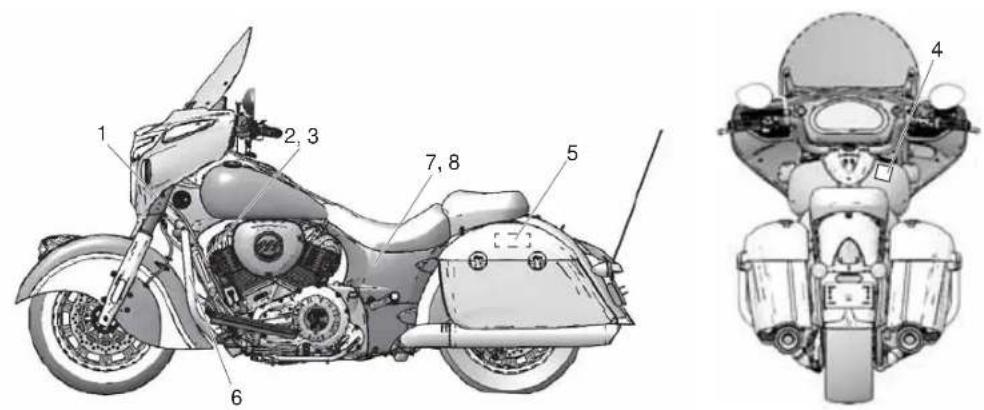
text_image
1 2, 3 7, 8 5 6 4Component Identification
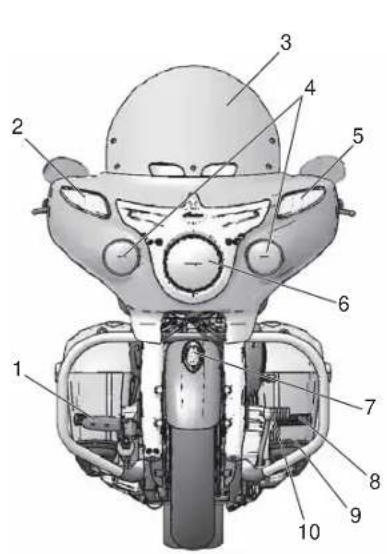
- Rear Brake Pedal
- Right Front Turn Signal
- Windshield (if equipped)
- Auxiliary Lights
- Left Front Turn Signal
- Headlight
- INDIAN MOTORYCLE War Bonnet
- Passenger's Foot Peg
- Driver's Footrest
- Gear Shifter
- Speakers
- Mirror
- 12-Volt Outlet (CHIEFTAIN)
- USB Cord (CHIEFTAIN)
- Taillight
- Right Rear Turn Signal
- Left Rear Turn Signal
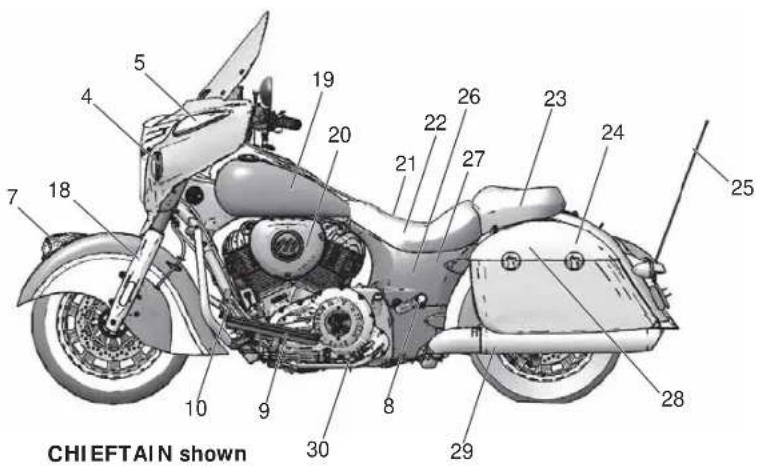
- Front Fork
- Fuel Tank
- Air Box Cover (Left)
- Driver's Seat
- Battery (under seat)
- Passenger Seat (if equipped)
- Saddlebag (if equipped)
- Radio Antenna (if equipped)
- Side Cover (Left)
- Shock Air Fill (CHIEFTAIN) (under cover)
- 12-Volt Outlet (CHIEFTAIN Saddlebag)
- Muffler
- Sidestand
text_image
Technical diagram of a motorcycle head with numbered parts for identification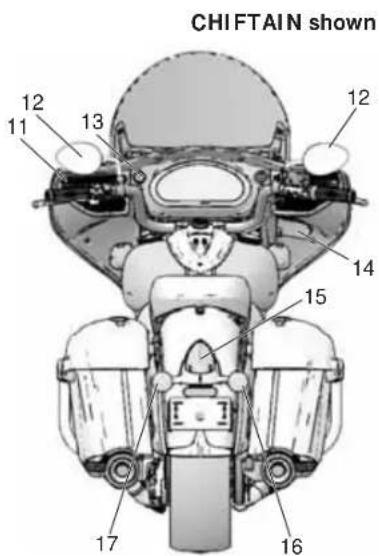
text_image
CHIFTAIN shown 12 13 12 11 14 15 16 17Component Identification
text_image
CHIEFTAIN shownComponent Identification Engine Identification Number
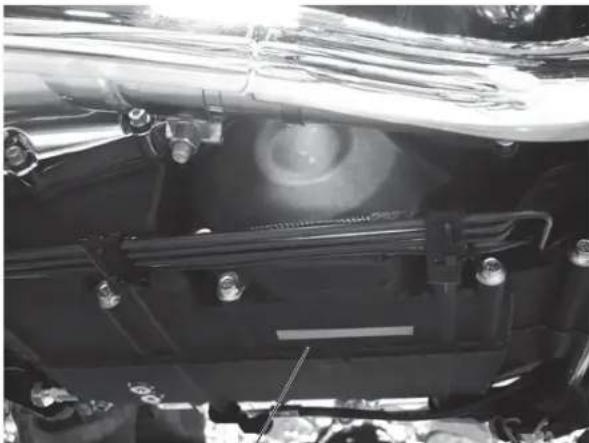
The engine number is stamped into the right crankcase beneath the balance shaft cover. The engine number is positioned behind the right floorboard with the engine installed in the frame. Record the number in the space provided on page 129.
natural_image
Close-up of a mechanical component with visible parts and mounting holes (no text or symbols)Engine Number
Component Identification
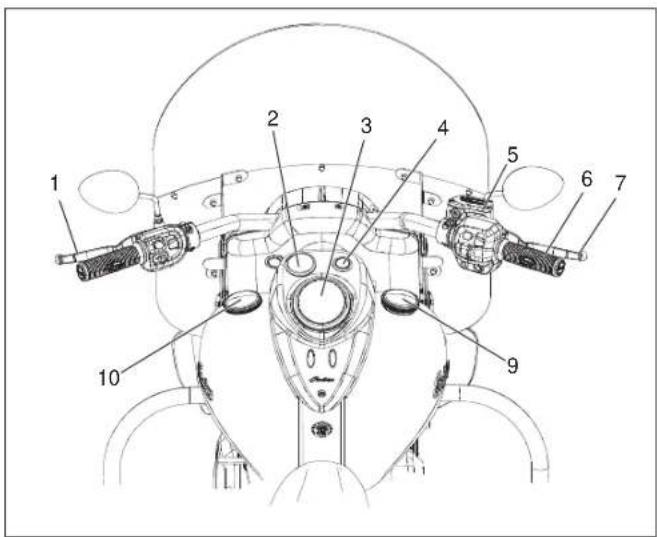
Console
- Clutch Lever
- Fuel Gauge (CHIEF)
- Instrument Cluster
- Power Switch/Security Light
- Front Brake Master Cylinder
- Throttle Control Grip
text_image
Technical diagram of a mechanical device with numbered components for identification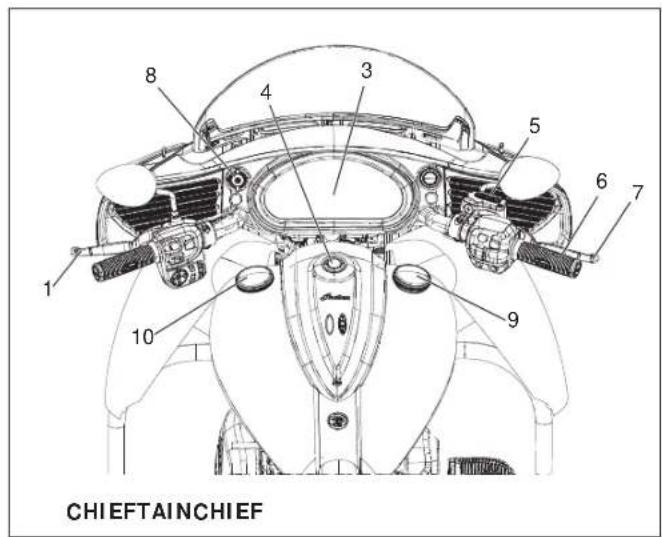
text_image
CHIEFTAINCHIEFInstruments, Features and Controls
Switches
text_image
Left Control High/Low Light Switch Turn Signal Switch Horn Switch CHIEFTAIN Audio Control Switches CHIEFTAIN Windshield Switches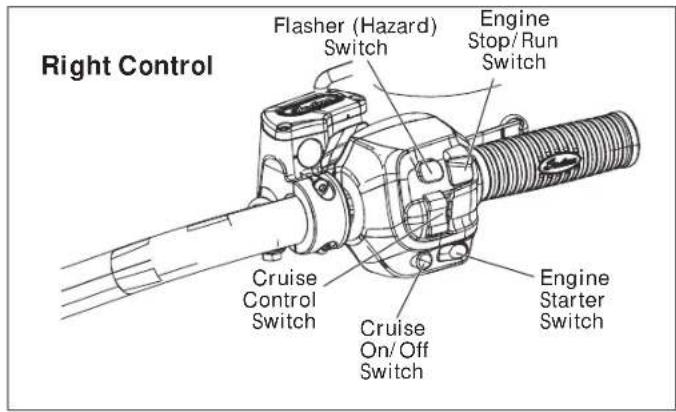
text_image
Right Control Flasher (Hazard) Switch Engine Stop/Run Switch Cruise Control Switch Cruise On/ Off Switch Engine Starter Switch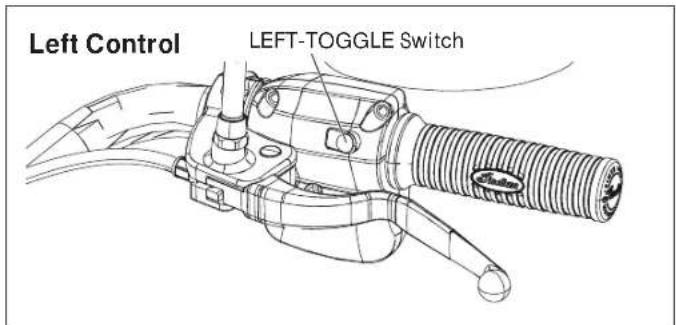
text_image
Left Control LEFT-TOGGLE Switch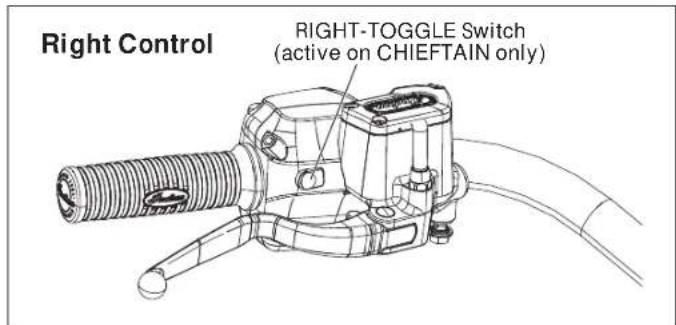
text_image
Right Control RIGHT-TOGGLE Switch (active on CHIEFTAIN only)Instruments, Features and Controls
Switches
text_image
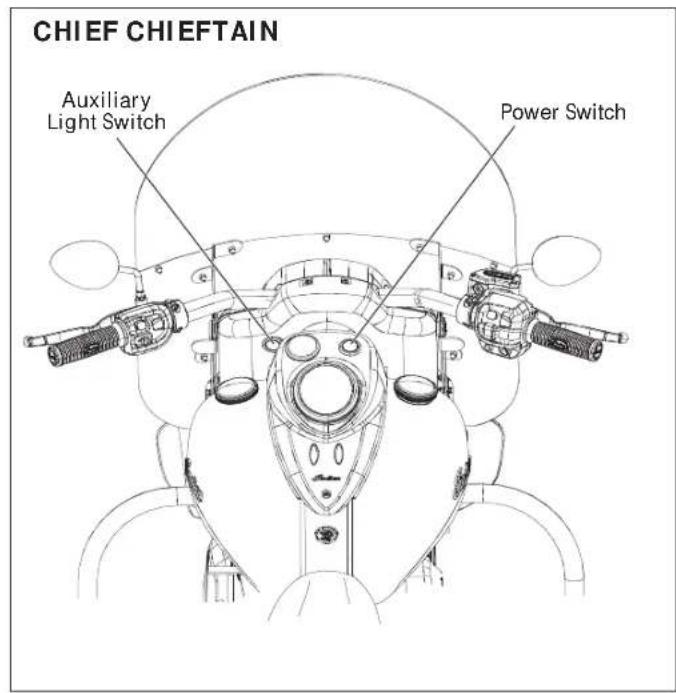
CHIEF CHIEFTAIN Auxiliary Light Switch Power Switch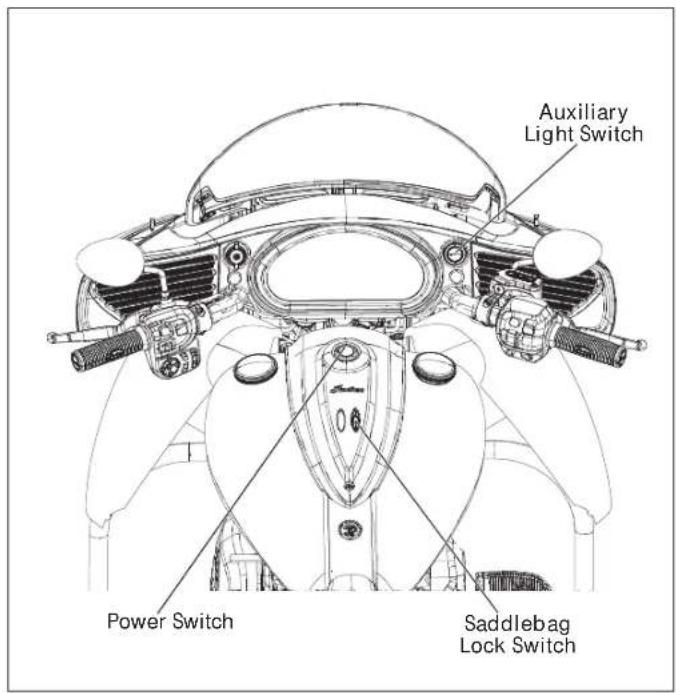
text_image
Auxiliary Light Switch Power Switch Saddlebag Lock SwitchInstruments, Features and Controls Switches
| Symbol | Switch Description | |
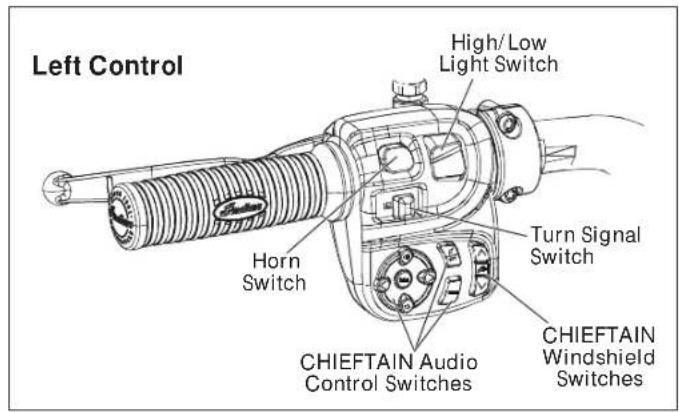
| [24HH6] | Emergency Flasher Switch (Hazard Switch) | The hazard switch activates and cancels the emergency flashers. See page 25. |
| [02ZK] | High/Low Headlight Beam Switch | The high/low headlight beam switch toggles the headlight between high beam and low beam. See page 27. |
| Auxiliary Light Switch | Press the auxiliary light switch to turn the auxiliary lights off or on. See page 27. | |
| [7ABC] | Horn Switch To sound | the horn, press the horn switch. |
 | Turn Signal Switch | Move the switch to the left to activate the left turn signals. Move the switch to the right to activate the right turn signals. A signal will deactivate automatically when speed or distance reach predetermined levels. To cancel a signal manually, move the switch to the center position and push it inward.Momentary Feature: Move the turn signal switch left or right and hold it in that position for at least one second. The momentary feature will activate and the signal will then cancel when the switch is released. |
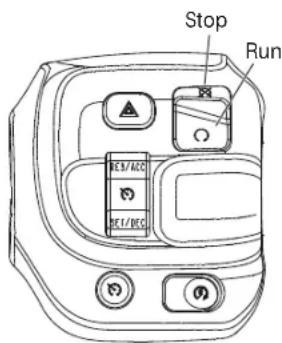
| [7WY] | Stop/Run Switch | Press the bottom of the switch (RUN) to allow the engine to start and run. Press the top of the switch (STOP) to stop the engine. See page 25. |
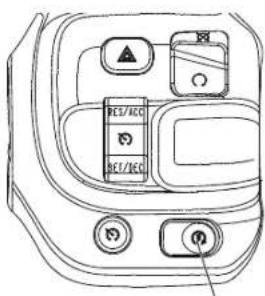
| [46ZW] | Starter Switch | Use the starter switch to start the engine. The engine stop/run switch must be in the RUN position. See page 26. |
 | Power Switch The power switch is located above the instrument gauge. Press and release the power switch to enable or disable all electrical power to the vehicle. See page 25. | |
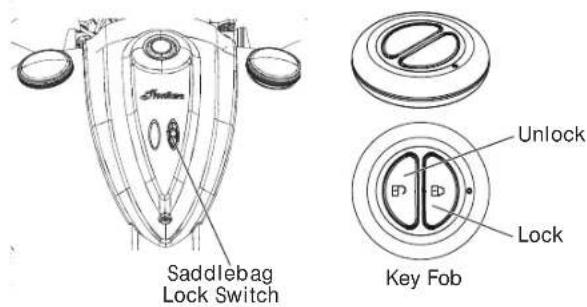
| Saddlebag Lock Switch | Press the lock switch to lock or unlock the saddlebags. The key fob can also be used to lock or unlock the saddlebags. | |
Switches
Power Switch
The power switch is attached to the fuel tanks on the center console. Press and release the power switch to enable or disable all electrical power to the vehicle. The power switch does not have to be on to start the engine. See page 26.
To disable all electrical power if the motorcycle is moving and the engine is running, press and hold the power switch for more than three (3) seconds.
Tip: To save battery power, the vehicle will power off after five minutes of inactivity.
Hazard Switch
The power switch must be ON to activate the flashers, but once activated, the flashers will continue to flash when the power switch is turned off. When the flashers are active, all four turn signals flash.
- Press the switch to activate the flashers.
- Press the switch again to cancel the flashers.
Instruments, Features and Controls
Engine Stop/ Run Switch
Use the engine stop/run switch to turn the engine off quickly.
- Press the top of the switch (STOP) to interrupt the circuits and stop the engine. The engine should not start or run when the switch is in the STOP position.
- Press the bottom of the switch (RUN) to complete the circuits and allow the engine to start and run.
Tip: The headlights and any accessories plugged into power ports will remain on until the power switch is turned off.
Audio System Switches
See page 143 for audio systems operation.
Cruise Control Switches
Refer to the Cruise Control section of this manual (beginning on page 76) for cruise control operation.
text_image
Stop RunInstruments, Features and Controls Switches
Engine Starter Switch
Read the engine starting procedures before starting the engine. See page 70.
The power switch does not have to be on to start the engine. Press and hold the starter switch to engage the one-touch starting feature, which activates the electrical system and starts the engine. The engine stop/run switch must be in the RUN position and the transmission must be in neutral.
text_image
Diagram of a vehicle air conditioner panel with labeled buttons and indicatorsStarter Switch
Keyless Ignition
When the electrical system is activated with either the power switch or the starter switch, the key fob must be within range. If the key fob is not detected, the security light and/or power switch will flash. The electrical system will automatically shut down.
The starter motor will not engage during this time. If a key fob is not available, your personal identification number (PIN) can be entered using the turn signal switches to unlock the security system. See page 114.
Saddlebag Lock Switch
If your model is equipped with electric saddlebag locks, the locks can be controlled by either the key fob or the lock switch on the console. When using the console lock switch, the key fob must be within range. If the key fob is not detected, the security light and/or power switch will flash. The system will not perform the lock or unlock command.
text_image
Saddlebag Lock Switch Unlock Lock Key FobSwitches
Ignition/ Light Switch
The headlights automatically come on when the engine is started.
WARNING! Motorcycle riders must remain as visible as possible at all times. To aid in this, the headlight must be on at all times. Do not modify the ignition/light switch wiring to circumvent the automatic headlight feature.
Toggle Switches
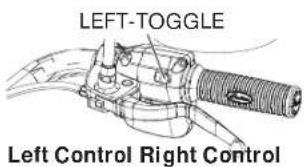
All models are equipped with toggle switches on the front side of the left and right handlebar controls. The LEFT-TOGGLE switch is active for all models. The RIGHT-TOGGLE switch is active only for CHIEFTAIN models.
The power switch must be ON. Use the switches to toggle through the modes of the multi-function display and to change settings in the display.
LEFT-TOGGLE
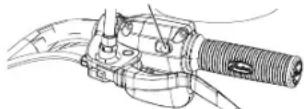
Left Control Right Control
RIGHT-TOGGLE
(Active for CHIEFTAIN only)
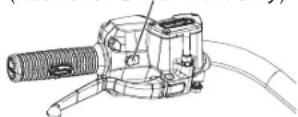
Instruments, Features and Controls
High/ Low Headlight Beam Switch
The high/low headlight beam switch toggles the headlight between high beam and low beam. To activate the high beam, press the upper portion of the switch. To activate the low beam, press the lower portion of the switch.
The headlights operate only when the engine is running. You can use the high/low headlight beam switch to override this function and allow the headlights to operate when the engine is not running. Turn the power switch on, then toggle the high/low headlight beam switch to turn the headlights on.
Auxiliary Light Switch
The auxiliary lights provide additional lighting on each side of the headlight. Some drivers prefer using the auxiliary lights when operating in foggy conditions or when passing a vehicle to help improve visibility to other motorists.
Press the auxiliary light switch to turn the auxiliary lights on or off. The auxiliary lights turn off when the power switch is turned off. The auxiliary lights automatically turn on when the engine starts if they were on when the engine was shut down.
Instruments, Features and Controls Instrument Cluster (CHIEF)
The instrument cluster includes the speedometer, indicator lamps and Multi-Function Display (MFD).
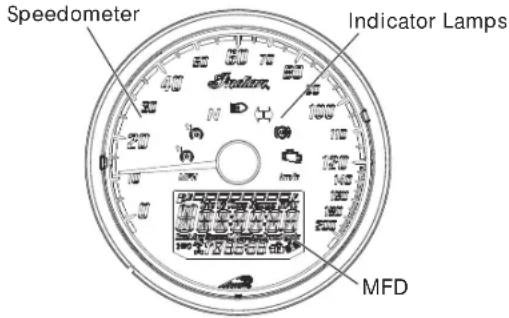
text_image
Speedometer Indicator Lamps MFDSpeedometer
The speedometer displays forward vehicle speed in either miles per hour or kilometers per hour.
Indicator Lamps
| Lamp | Indicates Condition | |
| N | Neutral The transmission is in neutral. | |
| ID | High Beam | The headlight switch is set to high beam. This indicator will flash if there is a problem with the low or high beam light. |
Indicator Lamps
| Lamp | Indicates Condition | |
| Turn Signal | The turn signal indicator flashes when the left, right, or both turn signals (hazard) are active. If there is a problem in the signal system, the lamps will flash at twice the normal rate. | |
| Cruise Control Status | Amber Lamp: Cruise control is enabled, but not set. Green Lamp: Cruise control is set to the desired speed. Read the safety and operation procedures before using cruise control. See page 76. | |
| Check Engine | If this lamp illuminates while the engine is running, see your dealer promptly. The light will remain on if the tilt sensor shuts down the engine. If abnormal sensor or engine operation is detected the light will remain on as long as the fault condition exists. Retrieve the error codes for diagnosis. See page 31. | |
| Anti-Lock Brakes Not Activated | The indicator remains on until the anti-lock system activates, which occurs when vehicle speed exceeds 6 MPH (10 km/h). When the lamp is illuminated, the anti-lock brakes will not activate, but the conventional brake system will continue to operate normally. | |
| MPH | Vehicle Speed | When standard mode is selected, speed displays in miles per hour. |
| km/h | When metric mode is selected, speed displays in kilometers per hour. | |
Instrument Cluster (CHIEF)
Multi-Function Display (M FD)
The power switch must be ON to access the MFD. Use the mode switches to toggle through the modes of the multifunction display and to change settings in the display.
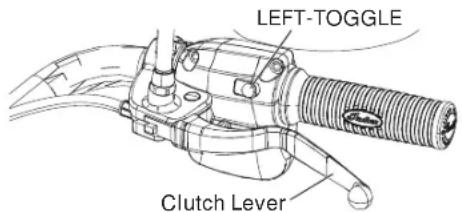
text_image
LEFT-TOGGLE Clutch LeverModes Available
Odometer Engine Speed
Trip Odometer 1 Average Fuel Economy
Trip Odometer 2 DC Voltage
Clock Ambient Air Temperature
Gear Indicator Fuel Range
Odometer
The odometer displays total distance traveled.
Instruments, Features and Controls
Trip Odometers
The trip odometers (Trip 1 and Trip 2) display total distance traveled since being reset. To reset a trip odometer, toggle to the trip odometer, then press and hold the LEFT-TOGGLE switch until the trip odometer resets to zero.
Engine Speed
Engine speed displays in revolutions per minute (RPM).
DC Voltage
The volt meter displays battery voltage. If the engine is not running, approximate battery voltage displays. If the engine is running, approximate charging voltage displays.
Gear Position
Gear position displays at all times while the engine is running, unless a fault occurs with the gear position sensor.
Temperature
The temperature area displays ambient air temperature.
Fuel Range
The fuel range displays the distance the motorcycle can travel on the remaining fuel in the fuel tank.
Average Fuel Economy
Average Fuel Economy displays as of the last time the mode was reset. To reset, press and hold LEFT-TOGGLE while viewing the fuel economy display.
Instruments, Features and Controls Instrument Cluster (CHIEF) Multi-Function Display (MFD)
Display Units (Standard/ Metric)
The display can be changed to display either standard or metric units of measurement.
| Standard Display | Metric Display | ||
| Distance Miles Kilometers | |||
| Fuel U.S. Gallons I = Imperial | Gallons | Liter = Liters | |
| Temperature Fahrenheit Celsius | |||
| Time 12-Hour Clock 24-Hour Clock | |||
- Turn the ignition off.
- Wait 10 seconds.
- Press and hold the LEFT-TOGGLE switch while pressing the power switch.
- When the display flashes the distance setting, tap the LEFT-TOGGLE switch to advance to the desired setting.
- Press and hold the LEFT-TOGGLE switch to save the setting and advance to the next display option.
- Repeat the procedure to change remaining display settings.
Clock
Tip: The clock must be reset any time the battery has been disconnected or discharged.
- Use the LEFT-TOGGLE switch to toggle to the odometer display.
- Press and hold the LEFT-TOGGLE switch until the hour segment flashes. Release the switch.
- With the segment flashing, tap the LEFT-TOGGLE switch to advance to the desired setting.
- Press and hold the LEFT-TOGGLE switch until the next segment flashes. Release the switch.
- Repeat steps 3-4 twice to set the 10-minute and 1-minute segments. After completing the 1-minute segment, step 4 will save the new settings and exit the clock mode.
Instruments, Features and Controls
Instrument Cluster (CHIEF)
Multi-Function Display (M FD)
Diagnostic Functionality
Certain conditions will cause an error message to display in the screen. If this occurs, please see your authorized dealer.
| Message Location Indicates | ||
| LO DC Voltage | Screen Voltage remains below | 11.0 volts for more than 10 seconds |
| OV DC Voltage | Screen Voltage remains above | 15.0 volts for more than 10 seconds |
| ERROR All Checksum error (gauge malfunction) | ||
Engine Error Codes
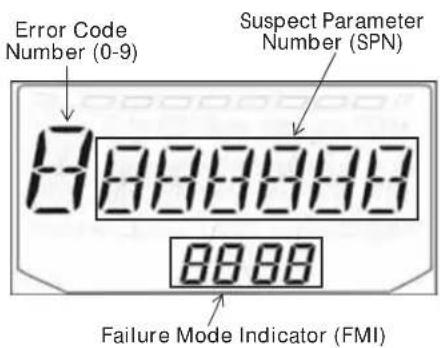
The error screen displays only when the CHECK ENGINE light is on or when it goes on and off during one ignition cycle. Error codes display only during the current ignition cycle. When the power switch is turned OFF, the code and message is lost, but will reappear if the fault reoccurs after restarting the engine.
If the CHECK ENGINE indicator lamp illuminates, retrieve the error codes from the display.
- If the error codes are not displayed, use the LEFT-TOGGLE switch to toggle until "Ck ENG" displays on the main line of the display.
- Press and hold the LEFT-TOGGLE switch to enter the diagnostics code menu.
- Record the three numbers displayed in the gear position, clock and odometer displays.
- See an authorized dealer for code details and diagnosis.
text_image
Error Code Number (0-9) Suspect Parameter Number (SPN) 8888888 8888 Failure Mode Indicator (FMI)Instruments, Features and Controls
Instrument Cluster (CHIEF)
Multi-Function Display (M FD)
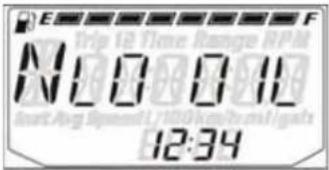
Low Oil Pressure Display
"LO OIL" displays under the following conditions.
| Condition Indicates Action Required | ||
| Engine oil pressure has dropped while the engine is running. | Oil pressure is below a safe operating pressure. | Stop the engine as soon as safely possible and check the oil level. If the oil level is sufficient, but “LO OIL” continues to display after restarting the engine, stop the engine immediately. |
text_image
E Trip 12 Time Range RPM NLO D OIL 12:34Instrument Cluster (CHIEFTAIN)
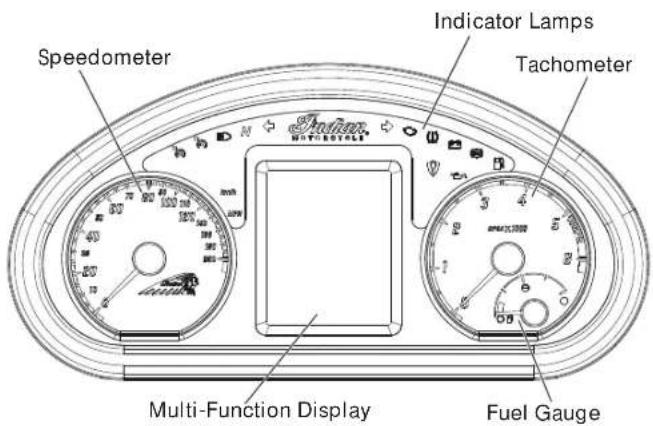
The instrument cluster includes the speedometer, tachometer, fuel gauge, indicator lamps and multi-function display (MFD).
text_image
Speedometer Indicator Lamps Tachometer Multi-Function Display Fuel GaugeInstruments, Features and Controls
Speedometer
The speedometer displays forward vehicle speed in either miles per hour or kilometers per hour.
Tachometer
The tachometer displays engine speed in revolutions per minute (RPM). A red line on the face of the gauge indicates the maximum safe engine speed.
Excessive engine speed can cause engine damage or failure, which could result in serious injury or death. Do not allow engine speed to exceed the red line.
Fuel Gauge
The fuel gauge displays fuel level. For the most accurate reading, sit on the motorcycle and bring it to the upright position.
Instruments, Features and Controls Instrument Cluster (CHIEFTAIN) Indicator Lamps
| Lamp Indicates Condition | ||
| N | Neutral The transmission is in neutral and the power switch is ON. | |
| MPH | Vehicle Speed | When standard mode is selected, speed displays in miles per hour. |
| km/h | When metric mode is selected, speed displays in kilometers per hour. | |
| High Beam | The headlight switch is set to high beam. This indicator will flash if there is a problem with the low or high beam light. | |
| Low Oil Pressure | This lamp illuminates when oil pressure drops below a safe operating pressure while the engine is running. If this lamp illuminates while the engine is running above idle speed, turn the engine off as soon as safely possible and check the oil level. If the oil level is correct and the lamp remains on after the engine is restarted, turn the engine off immediately. See your dealer. | |
| Low Fuel This lamp illuminates when approximately one gallon (3.8 liters) of fuel remains in the fuel tank. The LCD Display will switch into a Low Fuel Mileage Counter Mode to provide the rider with mileage tracking from the time the indicator was activated. | ||
| Turn Signal | One arrow flashes when the corresponding turn signal is activated. Both arrows flash when the hazard signal is activated. If there is a problem in the signal system, the lamps will flash at twice the normal rate. | |
Instruments, Features and Controls
Instrument Cluster (CHIEFTAIN)
Indicator Lamps
| Lamp | Indicates Condition | |
| Low Battery Voltage | This lamp illuminates when battery voltage is low. Turn non-essential accessories off to conserve power. Make sure the charging system is operating properly. See page 119. This lamp also illuminates with the security light and/or power switch when the key fob battery is low, and with the TPMS lamp when the TPMS sensor battery is low. | |
| Cruise Control Status | Amber Lamp: Cruise control is enabled, but not set. Green Lamp: Cruise control is set to the desired speed. Read the safety and operation procedures before using cruise control. See page 76. | |
| ABS Not Activated | The indicator remains on until the anti-lock system activates, which occurs when vehicle speed exceeds 6 MPH (10 km/h). When the lamp is illuminated, the anti-lock brakes will not activate, but the conventional brake system will continue to operate normally. | |
| Check Engine | This lamp illuminates briefly when the power switch is turned ON. This indicates proper function. If this lamp illuminates while the engine is running, see an authorized dealer promptly. The light will remain on if the tilt sensor shuts down the engine. If abnormal sensor or engine operation is detected the light will remain on as long as the fault condition exists. Retrieve the error codes for diagnosis. See page 40. | |
| Tire Pressure Monitoring System (TPMS) | The TPMS indicator illuminates if low tire pressure is detected. It will also illuminate along with the Low Battery Voltage indicator when TPMS battery power is low, requiring service. | |
| Security System Locked | This indicator lamp illuminates while the security system is searching for the key fob signal and when the security system is locked. The lamp flashes if the key fob is not detected within range or if the fob is not programmed properly. It also illuminates with the low battery voltage indicator when the key fob battery is low. | |
Instruments, Features and Controls Instrument Cluster (CHIEFTAIN) Multi-Function Display (MFD)
The power switch must be on or the engine must be running to view or change settings in the MFD. Use the LEFT-TOGGLE and RIGHT-TOGGLE switches to toggle through the modes of the multi-function display and to change settings in the display. See page 27.
text_image
LEFT-TOGGLE Left Control Right Control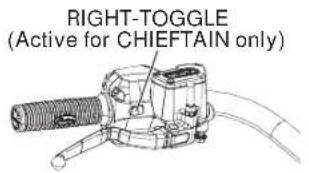
text_image
RIGHT-TOGGLE (Active for CHIEFTAIN only)Infotainment Display
There are four zones in the center display.
ZONE ONE (1) provides the time and outside air temperature. While the units for time and temperature can be changed, these items cannot be adjusted by the rider.
ZONE TWO (2) will always display audio system information.
ZONES THREE (3) and FOUR (4) will display vehicle/engine information.
| (1) | 7:30 | 75F |
| (2) | USBARTISTSONG TITLE | |
| (3) | TRIP 1MI | 205.5 |
| HR | 3.5 | |
| (4) | RANGE 25680 mi | 250 6 |
Tip: Zone three can be set to display expanded audio information. See page 39.
You can modify the items in zone four by changing the settings in the SET BOTTOM SCREEN menu. See page 45.
Instruments, Features and Controls
Instrument Cluster (CHIEFTAIN)
Zone Three Information
The following items can be displayed in Zone Three on the infotainment display:
- Trip 1 Hours/Distance
- Trip 2 Hours/Distance
- Fuel Economy
- Front/Rear Tire Pressure
• Engine Hours/Oil Life
• A v e r a g e S p e e d & B a t t e r y V o
- Expanded Radio Information
- Heated Grip Power Level (if equipped)
• Diagnostic Trouble Codes (DTCs)
Press LEFT-TOGGLE repeatedly to cycle through the Zone Three displays.
Trip 1 Hours/ Distance
Trip 1 Hours/Distance will display the total hours and distance in miles or kilometers.
-
Press and hold LEFT-TOGGLE to reset Trip 1 hours and distance to zero.
-
t Press LEFT-TOGGLE to cycle to the Trip 2 display.
Trip 2 Hours/ Distance
Trip 2 Hours/Distance will display the total hours and distance in miles or kilometers.
-
Press and hold LEFT-TOGGLE to reset Trip 2 hours and distance to zero.
-
Press LEFT-TOGGLE to cycle to Fuel Economy display.
| 7:30 | 75F |
| FM | 93.7 |
| TRIP 1MI | 205.5 |
| HR | 3.5 |
| RANGE 25025680 mi | 6 |
| 7:30 | 75F |
| FM | 93.7 |
| TRIP 2MI | 900.2 |
| HR | 21.2 |
| RANGE 25025680 mi | 6 |
Instruments, Features and Controls Instrument Cluster (CHIEFTAIN) Zone Three Information
Fuel Economy
This screen will display the current instant and average miles per gallon (MPG) or liters per 100 kilometers.
- Press and hold LEFT-TOGGLE to reset the average.
- Press LEFT-TOGGLE to cycle to the Front/Rear Tire Pressure display.
Front/ Rear Tire Pressure
This screen will display the current front and rear tire pressure in PSI or kPa.
- Press LEFT-TOGGLE to cycle to the Engine Hours/Oil Life display.
| 7:30 | 75F |
| FM | 93.7 |
| INSTANTMPG | 27.5 |
| AVERAGE | 34.5 |
| RANGE 25025680 mi | 6 |
| 7:30 | 75F |
| FM | 93.7 |
| FRONT PSI REAR | 36.1 40.2 |
| RANGE 25680 | 250 mi 6 |
Engine Hours/ Oil Life
This screen will display the total engine hours accumulated when the engine is running.
Engine oil life is also displayed. The rate at which oil life is reduced to 0% is determined by the following:
• Engine break-in period: 0-500 miles or 804 km
• Routine oil change intervals: Every 5,000 miles or 8,046 km
Tip: When engine oil life reaches 0%, change the engine oil and filter.
After changing the engine oil and filter:
- Press and hold LEFT-TOGGLE until the value begins to flash.
- Press and hold LEFT-TOGGLE to reset the engine oil life to 100%.
- Press LEFT-TOGGLE to display Average Speed/Battery Voltage screen.
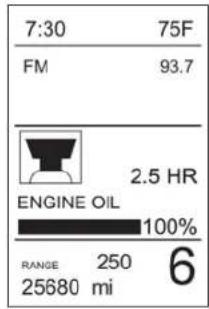
text_image
7:30 75F FM 93.7 2.5 HR ENGINE OIL 100% RANGE 250 6 25680 miInstrument Cluster (CHIEFTAIN)
Zone Three Information
Average Speed/ Battery Voltage
This screen displays the average motorcycle speed and current battery voltage.
- Press and hold LEFT-TOGGLE to reset the average speed.
- Press LEFT-TOGGLE to cycle to Expanded Audio Information.
Expanded Audio Information
In this mode, the display screen will dedicate zone three to the audio system and allow for up to six lines of audio system information.
Press LEFT-TOGGLE to cycle to:
- Heated Grips (if equipped)
• Diagnostic Trouble Codes (if present) - Trip 1 (top of men
| 7:30 | 75F |
| FM | 93.7 |
| AVG SPEED | 55 MPH |
| 12.9 VOLTS | |
| RANGE | 250 |
| 25680 mi | 6 |
| 7:30 | 75F |
| iPOD | |
| ARTIST | |
| SONG TITLE | |
| ALBUM TITLE | |
| u) | |
| RANGE | 250 6 |
| 25680 mi | |
Instruments, Features and Controls
Heated Grips (if equipped)
If heated grips are installed on the motorcycle, the Heated Grips display will show the current heated grip power level setting.
Tip: This screen will not appear if heated grips are not installed, or if the power level is set to zero.
- Press LEFT-TOGGLE to cycle Diagnostic Trouble Codes or the top of the menu.
| 7:30 | 75F |
| FM | 93.7 |
| HEATED GRIPS | |
| Power Level | 9 |
| RANGE | 250 |
| 25680 mi | 6 |
Instruments, Features and Controls Instrument (CHIEFTAIN)
Zone Three Information
Diagnostic Trouble Codes (DTCs)
If the CHECK ENGINE indicator is illuminated on the instrument cluster, this screen will display, indicating there are Diagnostic Trouble Codes (DTCs).
The error screen displays only when the CHECK ENGINE light is on and only during the current ignition cycle. DTCs will reappear only if the fault reoccurs after restarting the engine.
| 7:30 | 75F |
| FM | 93.7 |
| DTC | |
| SPN | 598 |
| FMI | 2 |
| RANGE | 250 |
| 25680 | mi |
Retrieving Error Codes
If the CHECK ENGINE indicator illuminates, you can retrieve the error codes from the DTC display.
- Press and hold LEFT-TOGGLE to enter the display screen.
TIp: The CHECK ENGINE icon will appear on the screen when in the DTC display mode. - Press LEFT-TOGGLE to cycle through the list of available codes.
- Record the SPN and FMI numbers.
- See an authorized INDIAN MOTORCYCLE dealer for code details and diagnosis.
- Press and hold LEFT-TOGGLE to exit.
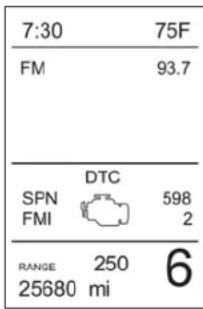
text_image
7:30 FM 93.7 SPN FMI DTC 598 2 RANGE 250 25680 mi 6Instrument Cluster (CHIEFTAIN) Instrument Cluster Setup
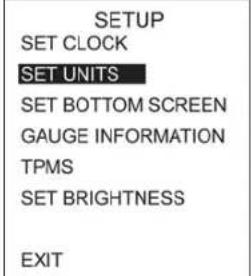
The instrument cluster setup menus allow the following actions:
- Set clock
- Set units (volume, temperature, clock type, pressure)
- Set bottom screen display (trip 1 distance, instant fuel economy, average fuel economy, and range)
• View instrument cluster software/hardware information - Set Tire Pressure Monitoring System (TPMS) (dealer only)
- Adjust infotainment display brightness
To access the instrument cluster setup menus:
- Place the transmission in neutral.
- Press and hold LEFT-TOGGLE and RIGHT-TOGGLE simultaneously until the SETUP menu appears on the display.
- Press RIGHT-TOGGLE repeatedly to cycle through the setup menu.
- Press LEFT-TOGGLE to enter the desired menu.
Instruments, Features and Controls
Setting the Clock
- With SET CLOCK highlighted on the setup menu, press LEFT-TOGGLE.
- Press LEFT-TOGGLE repeatedly to set the hours.
- Press RIGHT-TOGGLE to move to tens of minutes.
- Press LEFT-TOGGLE repeatedly to set the tens of minutes.
- Press RIGHT-TOGGLE to move to minutes.
- Press LEFT-TOGGLE repeatedly to set the minutes.
- Press RIGHT-TOGGLE to enter the time and move to EXIT.
- Press LEFT-TOGGLE to exit.
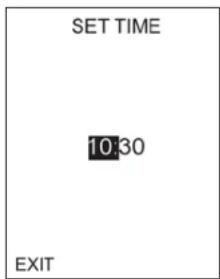
text_image
SET TIME 10:30 EXITInstruments, Features and Controls Instrument Cluster (CHIEFTAIN) Instrument Cluster Setup
Set Units
Use the SET UNITS menu to set the following items:
• DISTANCE: Miles or kilometers
• VOLUME: Gallon, Imperial Gallon or Liter
• TEMPERATURE: Fahrenheit or Celsius
• CLOCK TYPE: 12-hour or 24-hour
• PRESSURE: PSI or kPa
-
With SET UNITS highlighted on the setup menu, press LEFT-TOGGLE.
-
Press RIGHT-TOGGLE repeatedly to cycle through menu items.
-
Press LEFT-TOGGLE to enter the desired SET UNITS menu.
text_image
SETUP SET CLOCK SET UNITS SET BOTTOM SCREEN GAUGE INFORMATION TPMS SET BRIGHTNESS EXIT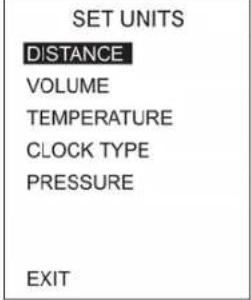
text_image
SET UNITS DISTANCE VOLUME TEMPERATURE CLOCK TYPE PRESSURE EXITSet Units - Distance Setting
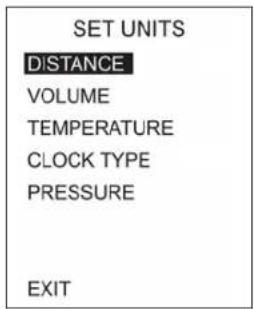
Use the DISTANCE menu to change the speedometer and distance units. Select either miles or kilometers.
- With DISTANCE highlighted in the SET UNITS menu, press LEFT-TOGGLE.
- Press RIGHT-TOGGLE to select miles or kilometers.
- Press LEFT-TOGGLE to set the desired setting.
- Press RIGHT-TOGGLE to select EXIT.
- Press LEFT-TOGGLE to exit.
text_image
SET UNITS DISTANCE VOLUME TEMPERATURE CLOCK TYPE PRESSURE EXIT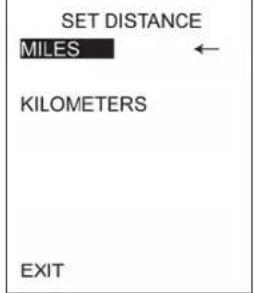
text_image
SET DISTANCE MILES ← KILOMETERS EXITInstrument Cluster (CHIEFTAIN) Instrument Cluster Setup
Set Units - Volume Settings
Use the VOLUME menu to change the instrument cluster volume units. Select gallon, imperial gallon or liter.
- With VOLUME highlighted in the SET UNITS menu, press LEFT-TOGGLE.
- Press RIGHT-TOGGLE to select gallon, imperial gallon, or liter.
- Press LEFT-TOGGLE to set the desired setting.
- Press RIGHT-TOGGLE to select EXIT.
- Press LEFT-TOGGLE to exit.
SET UNITS
DISTANCE
VOLUME
TEMPERATURE
CLOCK TYPE
PRESSURE
EXIT
SET VOLUME
GALLON

IMPERIAL GALLON
LITER
EXIT
Instruments, Features and Controls
Set Units - Temperature Settings
Use the TEMPERATURE menu to change the instrument cluster temperature units. Select Fahrenheit or Celsius.
- With TEMPERATURE highlighted in the SET UNITS menu, press LEFT-TOGGLE.
- Press RIGHT-TOGGLE to select fahrenheit or Celsius.
- Press LEFT-TOGGLE to set the desired setting.
- Press RIGHT-TOGGLE to select EXIT.
- Press LEFT-TOGGLE to exit.
SET UNITS
DISTANCE
VOLUME
TEMPERATURE
CLOCK TYPE
PRESSURE
EXIT
SET TEMPERATURE
FAHRENHEIT

CELCIUS
EXIT
Instruments, Features and Controls Instrument Cluster (CHIEFTAIN) Instrument Cluster Setup
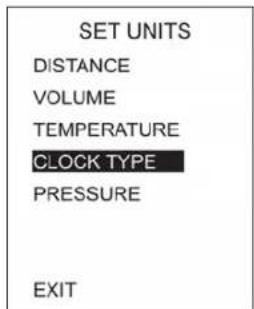
Set Units - Clock Type
Use the CLOCK TYPE menu to change the clock format. Select 12-hour or 24-hour format.
- With CLOCK TYPE highlighted in the SET UNITS menu, press LEFT-TOGGLE.
- Press RIGHT-TOGGLE to select 12 hour or 24 hour.
- Press LEFT-TOGGLE to set the desired clock format.
- Press RIGHT-TOGGLE to select EXIT.
- Press LEFT-TOGGLE to exit.
text_image
SET UNITS DISTANCE VOLUME TEMPERATURE CLOCK TYPE PRESSURE EXIT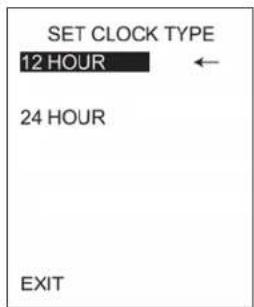
text_image
SET CLOCK TYPE 12 HOUR ← 24 HOUR EXITSet Units - Pressure
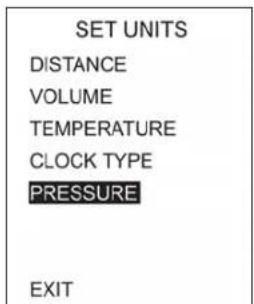
Use the PRESSURE menu to change the pressure display format. Select PSI or KPA.
- With PRESSURE highlighted in the SET UNITS menu, press LEFT-TOGGLE.
- Press RIGHT-TOGGLE to select PSI or KPA.
- Press LEFT-TOGGLE to set the desired pressure display format.
- Press RIGHT-TOGGLE to select EXIT.
- Press LEFT-TOGGLE to exit.
text_image
SET UNITS DISTANCE VOLUME TEMPERATURE CLOCK TYPE PRESSURE EXIT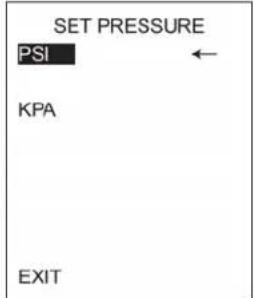
text_image
SET PRESSURE PSI ← KPA EXITInstrument Cluster (CHIEFTAIN)
Instrument Cluster Setup
Set Bottom Screen Menu
Use the SET BOTTOM SCREEN menu to display one of the following items in ZONE FOUR of the display screen:
- Trip 1 Distance
-
Instant Fuel
• Average Fuel
• Range -
With SET BOTTOM SCREEN highlighted on the setup menu, press LEFT-TOGGLE.
- Press RIGHT-TOGGLE repeatedly to cycle through menu items.
- Press LEFT-TOGGLE to enter the desired SET UNITS menu.
- Press RIGHT-TOGGLE to select EXIT.
- Press LEFT-TOGGLE to exit.
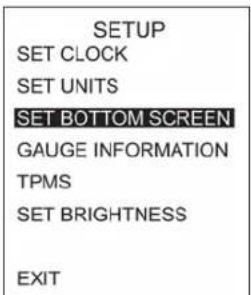
text_image
SETUP SET CLOCK SET UNITS SET BOTTOM SCREEN GAUGE INFORMATION TPMS SET BRIGHTNESS EXITSET BOTTOM SCREEN
TRIP 1 DISTANCE ←
INSTANT FUEL
AVERAGE FUEL
RANGE
EXIT
Instruments, Features and Controls
Trip 1 Distance Display
| TRIP 1 | 250.5 | N |
| 25680 | mi |
Instant Fuel Display
| INSTANT 29.5 | |
| 25680 mi | N |
Average Fuel Display
| AVERAGE 25.5 | N |
| 25680 mi |
Range Display
| RANGE 250.5 |
| 25680 mi |
Instruments, Features and Controls Instrument Cluster (CHIEFTAIN) Instrument Cluster Setup
Gauge Information
The instrument cluster hardware and software part and serial numbers are displayed on the Gauge Information menu.
- With GAUGE INFORMATION highlighted on the setup menu, press LEFT-TOGGLE.
- Press RIGHT-TOGGLE to select EXIT.
- Press LEFT-TOGGLE to exit.
| SETUP |
| SET CLOCK |
| SET UNITS |
| SET BOTTOM SCREEN |
| GAUGE INFORMATION |
| TPMS |
| SET BRIGHTNESS |
| EXIT |
| GAUGEINFORMATION |
| HW# |
| SW # |
| HW Ser# |
| EXIT |
Tire Pressure Monitoring System (TPMS) Setup
The TPMS setup menu allows your authorized INDIAN MOTORCYCLE dealer to register new tire pressure sensors.
| SETUP |
| SET CLOCK |
| SET UNITS |
| SET BOTTOM SCREEN |
| GAUGE INFORMATION |
| TPMS |
| SET BRIGHTNESS |
| EXIT |
Instrument Cluster (CHIEFTAIN)
Instrument Cluster Setup
Set Brightness
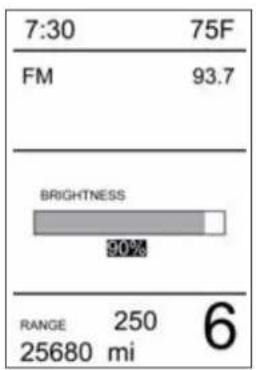
The brightness level of the instrument cluster and display screen can be adjusted. There are two methods to enter the Set Brightness menu.
METHOD 1:
This method bypasses the instrument cluster setup menu. The transmission does not have to be in neutral using this method.
-
Press and hold RIGHT- TOGGLE until the SET BRIGHTNESS menu appears.
-
Press RIGHT-TOGGLE repeatedly to adjust the instrument cluster brightness.
-
The menu will close after the desired brightness level is set.
text_image
7:30 75F FM 93.7 BRIGHTNESS 30% RANGE 250 6 25680 miInstruments, Features and Controls
METHOD 2:
- With SET BRIGHTNESS highlighted on the setup menu, press LEFT-TOGGLE.
- Press LEFT-TOGGLE repeatedly to adjust the brightness level from 0% to 100%.
- When the desired brightness level is set, press RIGHT-TOGGLE to select EXIT.
- Press LEFT-TOGGLE to exit.
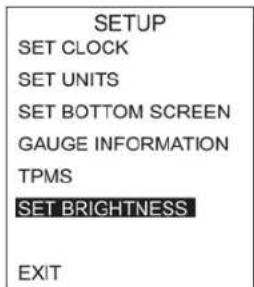
text_image
SETUP SET CLOCK SET UNITS SET BOTTOM SCREEN GAUGE INFORMATION TPMS SET BRIGHTNESS EXIT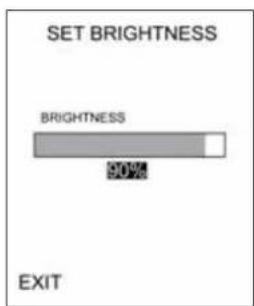
text_image
SET BRIGHTNESS BRIGHTNESS 50% EXITInstruments, Features and Controls Throttle Control Grip
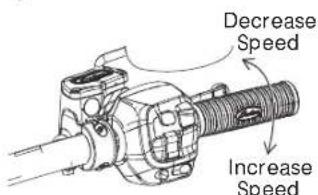
The throttle control grip is located on the right handlebar. Use the throttle control grip to control engine speed.
While seated in the proper riding position:
- Roll the grip rearward to open the throttle (increase engine speed
- Roll the grip forward to close the throttle (decrease engine speed and power).
The control grip is spring loaded. When you release the grip, the throttle returns to the idle position.
text_image
Decrease Speed Increase SpeedClutch Lever
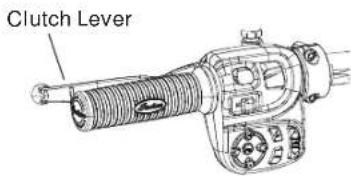
The clutch lever is located on the left handlebar. Disengage the clutch before shifting gears. For smooth clutch operation, pull the lever quickly and release it in a brisk but controlled manner.
text_image
Clutch Lever• To disengage the clutch, pull the lever toward the handlebar.
• To engage the clutch, release the lever in a brisk but controlled manner.
Gear Shift Lever
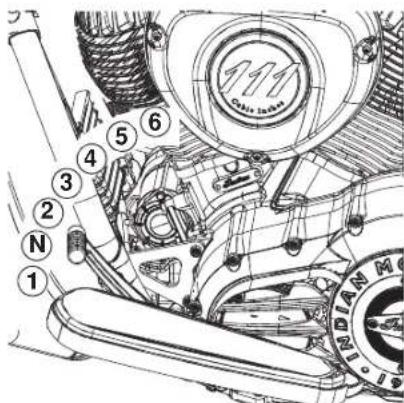
The gear shift lever is located on the left side of the motorcycle. Operate the lever with your foot.
- Press downward on the toe lever to shift to a lower gear.
- Lift upward on the toe lever to shift to a higher gear.
- Release the lever after each gear shift.
• See pages 72-74 for gear shifting procedures.
text_image
SOSA INDIA 1 2 3 4 5 6 N 1Instruments, Features and Controls Mirrors
Your vehicle is equipped with convex mirrors. Objects seen in a mirror may be closer than they appear. Always adjust mirrors before riding.
To adjust the mirrors, sit on the motorcycle in the anticipated riding position. Adjust the mirrors so that you can see a small portion of your shoulders in each mirror.
Tire Pressure Monitoring System (TPMS) (if equipped)
NOTICE: On models equipped with a TPMS, the sensors are located 180° from the valve stem. Use caution when servicing tires. To avoid damaging a sensor, break the bead at the valve stem, then at 90° and 270° from the valve stem as required.
With a TPMS, the pressure of each tire can be viewed in the MFD. If dashes display instead of a pressure value while traveling above 15 MPH (24 km/h), the system may not be functioning properly. See your dealer for service.
The TPMS warning indicator will illuminate if low tire pressure is detected. Always correct low tire pressure promptly. Always inspect tire pressure and condition before each ride. See page 61.
The TPMS display may indicate an increase in tire pressure while riding, a normal occurrence as tires warm up. Riding into colder conditions may result in a drop in tire pressure as tires cool down. Regardless of conditions, low tire pressures should always be corrected promptly.
Instruments, Features and Controls Sidestand
The sidestand is equipped with a safety switch that prevents operation of the motorcycle if the sidestand is deployed.
WARNING! An improperly retracted sidestand could contact the ground and cause a loss of control resulting in serious injury or death. Always retract the sidestand fully before operating the motorcycle.
To park the motorcycle, swing the end of the sidestand downward and away from the motorcycle until it is fully extended. Always turn the handlebars to the left for maximum stability. Lean the motorcycle to the left until the sidestand firmly supports the motorcycle.
CAUTION! If the motorcycle weight is not resting on the sidestand, it will not lock. In this situation, any movement of the motorcycle could cause the sidestand to retract slightly. If the sidestand is not in the full forward position when the motorcycle weight is rested on it, the motorcycle could fall over, possibly causing injury and damage to the motorcycle.
To retract the sidestand, straddle the motorcycle and bring it to the fully upright position. Swing the end of the sidestand upward and toward the motorcycle until it is fully retracted.
Saddlebags
Do not exceed the weight limit of each saddlebag. Always distribute weight evenly in each of the saddlebags.
Hard bag capacity is 22 pounds (10 kg) of cargo per side. Soft bag capacity is 15 pounds (6.8 kg) of cargo per side.
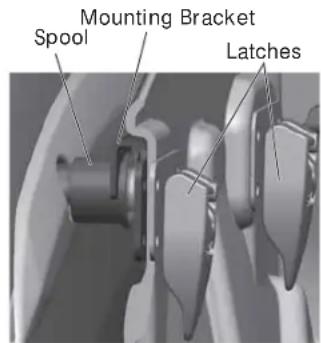
Soft Bag Removal
- Unbuckle the saddlebag lid clasps and open the lid.
- Flip the two quick-release latches upward.
- Tilt the saddlebag away from the fender and lift upward to remove it from the spools.
WARNING! Improper saddlebag installation can result in loss of control, accident and driving hazards for other motorists (if
text_image
Mounting Bracket Spool Latchessaddlebag falls from the motorcycle). Always make sure saddlebag mounting brackets are fully seated onto the spools before engaging latches.
- To reinstall, place the soft bag in position. Make sure the mounting bracket is seated fully on the spool. Make sure the rubber bushings on the latch pins are fully engaged in the spools.
- Engage the quick-release latches and flip them fully downward.
Saddlebags Hard Bag Removal
- Unlock the electric saddlebag locks (if equipped).
Tip: The provided key can also be used in the latch release buttons to manually unlock the saddlebag lids. - Remove the side cover.
- Disconnect the saddlebag lock electrical wiring near the seat.
- Press the lid latch release button and lift the saddlebag lid.
- Flip the two quick-release latches upward.
- Tilt the saddlebag away from the frame of the vehicle to remove it.
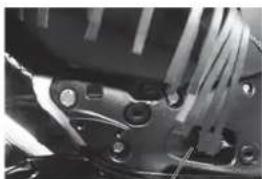
natural_image
Close-up of mechanical components with bolts and springs (no visible text or symbols)Electrical Connection
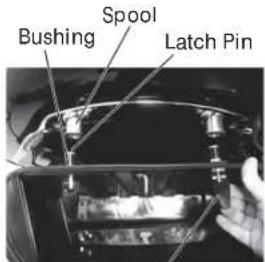
text_image
Bushing Spool Latch PinQuick-Release Latch
Instruments, Features and Controls
- To reinstall, place the hard bag in a fully seated position on the muffler.
NOTICE: To prevent damage to components, always make sure saddlebags are fully seated onto the muffler before engaging the latches.
-
Make sure the rubber bushings on the latch pins are fully engaged in the spools. Engage the quick-release latches and flip them fully downward.
-
Reconnect the electrical wiring.
-
Reinstall the side cover, using care to avoid damaging electrical wires.
Instruments, Features and Controls Windshield
Windshield Removal (CHIEF) (if equipped)
- If equipped with a quick-latch windshield, rotate the two latches upward.
- From the front of the motorcycle, pull firmly on the upper windshield to remove the windshield from the upper mounts, then pull the windshield upward and away from motorcycle.
- Reverse this procedure to reinstall the windshield. Rotate the latches fully downward to secure the windshield.
WARNING! Improper windshield installation can result in loss of control, accident and driving hazards for other motorists (if windshield falls from the motorcycle). Always make sure the windshield is fully seated before engaging latches.
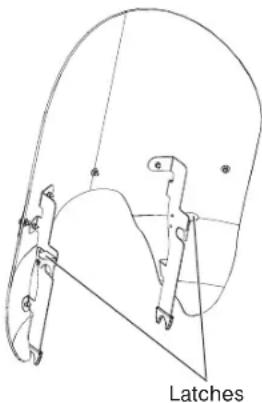
natural_image
Technical line drawing of a latch structure with labeled components (no text or symbols beyond label)Windshield Adjustment (CHIEFTAIN)
Use the windshield switch to adjust windshield height for the best wind deflection.
- Press the top of the switch to adjust the windshield upward.
- Press the bottom of the switch to adjust the windshield downward.
Instruments, Features and Controls
Brakes
Anti-Lock Brake System (ABS)
The anti-lock brake system automatically reduces or increases brake pressure as needed to provide optimum braking control, reducing the chance of wheel lock-up during hard braking events or when braking on rough, uneven, slippery or loose surfaces. See page 8.
- The anti-lock brake system cannot be turned off.
- The ABS indicator always illuminates when vehicle power is turned on. It remains illuminated until the anti-lock system activates, which occurs when vehicle speed exceeds 6 MPH (10 km/h).
- When the lamp is illuminated, the anti-lock brakes will not activate, but the conventional brake system will continue to operate normally.
- When the anti-lock brakes engage during a braking event, the rider will feel pulsing at the brake levers. Continue to apply steady pressure to the brakes for the best stopping performance.
- If the ABS light does not come on when the key is turned to the ON or PARK position, see your authorized INDIAN MOTORCYLE dealer for service.
Instruments, Features and Controls
Brakes
Anti-Lock Brake System (ABS)
- If the lamp continues to illuminate after vehicle speed exceeds 6 MPH (10 km/h), the ABS system is not functioning. See your INDIAN MOTORCYCLE dealer promptly for service.
- Operating with non-recommended tires or improper tire pressure may reduce the effectiveness of the anti-lock brake system. Always use the recommended size and type of tires specified for your vehicle. Always maintain the recommended tire pressure.
- The anti-lock brake system will not prevent wheel lockup, loss of traction or loss of control under all conditions. Always adhere to all safe motorcycle-riding practices as recommended.
- It is not unusual to leave tire marks on the road surface during a hard braking event.
- The anti-lock brake system does not compensate for or reduce the risks associated with:
- excessive speed
- reduced traction on rough, uneven or loose surfaces
- poor judgment
- improper operation
Instruments, Features and Controls
Brakes
The front brake lever activates the front brake calipers. The rear brake pedal activates the rear brake caliper. For maximum brake effectiveness, apply the front brake lever and the rear brake pedal together.
Front Brake Lever
The front brake lever is located on the right handlebar. This lever controls only the front brakes. The front brakes should be applied simultaneously with the rear brakes. To apply the front brake, pull the lever toward the handlebar. See page 75 for braking procedures.
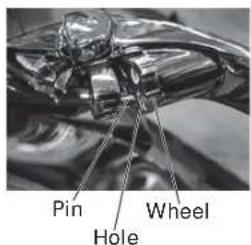
Front brake lever reach (distance to the hand grip) is adjustable.
text_image
Pin Wheel Hole- Gently push and hold the lever away from the hand grip. The adjuster wheel is located between the lever and the switch cube.
- To increase reach distance, rotate the adjuster to align a lower number of hash marks with the pin.
- To decrease the reach distance, rotate the adjuster to align a higher number of hash marks with the pin.
- Make sure the pin is fully seated into the selected hole.
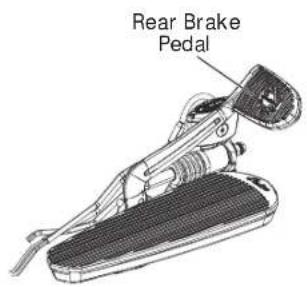
Rear Brake Pedal
The rear brake pedal is located on the right side of the motorcycle. Press downward on the rear brake pedal to apply the rear brake.
WARNING! Resting your foot on the brake pedal will cause excessive and premature wear of brake pads and reduced braking efficiency, which could result in severe injury or death.
See page 75 for braking procedures.
text_image
Rear Brake PedalInstruments, Features and Controls Fuel Cap
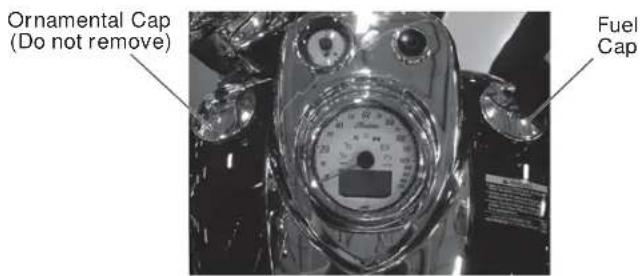
The fuel filler cap is located on the right side of the console. An ornamental cap is located on the left side of the console. Do not attempt to remove the ornamental cap.
text_image
Ornamental Cap (Do not remove) Fuel Cap- Turn the fuel cap counter-clockwise to remove it.
- See page 69 for fueling instructions.
- To tighten the cap, turn it clockwise until the seal compresses onto the tank, then continue to tighten until the cap ratchets several times.
Pre-Ride Inspections
To keep your motorcycle in safe operating condition, always perform the recommended pre-ride inspections before each ride. This is especially important before making a long trip and when removing the motorcycle from storage.
WARNING! Failure to perform the recommended pre-ride inspections could result in component failure while riding, which could result in serious injury or death. Always perform the pre-ride inspections before each ride. When inspection reveals the need for adjustment, replacement or repair, perform the service promptly, or see your authorized INDIAN MOTORCYCLE dealer for service.
WARNING! Read the entire Instruments, Features and Controls section of this manual before riding your motorcycle. A complete understanding of the features and capabilities of your motorcycle is essential to its safe operation. Anything less may result in serious injury or death.
You must be familiar with all instruments and controls to perform the pre-ride inspections.
Tip: During the pre-ride inspections you may use products that are potentially hazardous, such as oil or brake fluid. When using any of these products, always follow the instructions and warnings on the product packaging.
When inspections reveal the need for adjustment, replacement or repair:
• refer to the maintenance section of this manual (page 79)
• refer to the INDIAN MOTORCYCLE Service Manual
• or see your authorized INDIAN MOTORCYCLE dealer
Pre-Ride Inspections
Turn the power switch on and move the stop/run switch to RUN before performing the following electrical inspections. Turn the power switch off after completing these inspections. If inspection of any electrical item reveals component failure, repair or replace the component before operating the motorcycle.
| Item Inspection Procedure | |
| Electrical | |
| Headlamp Move the head | light switch from low beam to high beam to turn the lights on and verify operation of both beams. Start the engine. Switch to high beam. Verify that the high beam indicator comes on and that lamp brightness increases. |
| Taillight/Brakelight | Verify that the taillight and license plate light illuminate. Verify that the taillight lamps increase in brightness when the front brake lever is applied and also when the rear brake pedal is applied. |
| Turn Signals | Move the turn signal switch to the left. Verify that front and rear left turn signals flash, as well as the corresponding light on the indicator panel. Move the switch to the center position and push it inward to cancel the signal. Verify that the signals and the indicator light stop flashing. Repeat the procedure for the right turn signals. |
| Emergency Flashers | Press the hazard switch to activate the flashers. Verify that all four turn signals flash, as well as the lamps on the indicator panel. Turn the flashers off. Verify that all signals and indicator lamps stop flashing. |
| Horn Press the horn switch | Verify that the horn sounds loudly. |
| Neutral Indicator | Place the transmission in neutral. Verify that the neutral indicator lamp illuminates and that the letter “N” displays in the gear position display. |
| CHIEF Low Oil Pressure Display | Start the engine. Verify that “LO OIL” is not displayed in the MFD. |
| CHIEFTAIN Low Oil Pressure Display | Start the engine. Verify that the low oil pressure indicator is not illuminated. |
| Engine Stop/Run Switch | Start the engine. Move the stop/run switch to the STOP position. Verify that the engine stops. Attempt to restart the engine to verify that the engine WILL NOT start. |
Pre-Ride Inspections
| Item Inspection Procedure | |
| General | |
| Engine Oil Check the oil level. See page 60. | |
| Fuel Check the fuel level. See page 65. | |
| Fluid Leaks Check the vehicle and the ground/floor for any fuel, oil or hydraulic fluid leaks. | |
| Tires Inspect condition, pressure and tread depth. See page 61. | |
| Brake Operation Inspect pedal and lever movement. | |
| Brake Fluid Levels Check front and rear brake fluid levels. | |
| Brake Components Inspect hoses and connections. | |
| Throttle Inspect hand grip and throttle movement. | |
| Clutch Check lever operation and freeplay. | |
| Front Suspension Check for leaks, debris and damage. | |
| Steering Check for smooth operation by turning handlebars full left and full right. | |
| Rear Suspension | Check mounting and inspect for leaks. CHIEFTAIN: Check shock movement and air pressure, verify ground clearance. |
| Ride Height | Make sure preload is adjusted properly for load. See pages 88-91. |
| Rear Drive Belt | Check for wear or damage. Check drive belt tension. See pages 86-87. |
| Sidestand | Verify smooth operation, inspect pivot bolt and spring. |
| Fasteners | Inspect for loose, damaged or missing fasteners. |
| Mirrors | Adjust for proper rear view. |
Pre-Ride Inspections Engine Oil Level
With the semi-dry sump lubrication system, the engine oil level on the dipstick will fluctuate, depending on the motorcycle's position and engine speed when the engine is turned off. To ensure a proper reading of the engine oil level, follow all inspection procedures closely.
WARNING! Operating with insufficient, deteriorated or contaminated engine oil will cause accelerated wear and may result in engine or transmission seizure, which could result in loss of control and serious injury or death. Check the oil level frequently. We recommended checking the oil each time you refuel.
The engine must be at normal operating temperature when checking the oil level.
NOTICE: Oil level will NOT be accurate if checked on a cold engine. DO NOT ADD oil to bring level to the FULL mark on a cold engine, as this can result in overfilling.
The oil fill cap/dipstick is located on the left side of the motorcycle. A special tool is provided in the tool kit to assist with dipstick removal. Always use the recommended oil. See page 128.
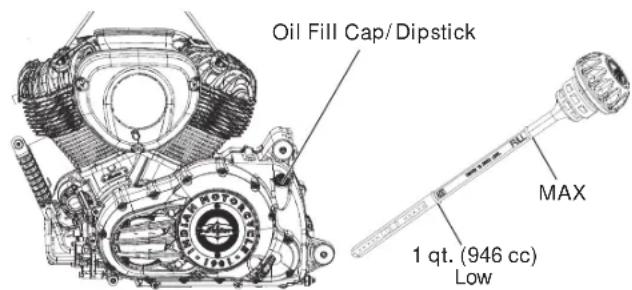
text_image
Oil Fill Cap/Dipstick MAX 1 qt. (946 cc) Low- Start the engine and allow it to run until it reaches normal operating temperature.
- Stop the engine and wait one minute before checking the oil level.
Tip: If the oil level is not checked within 3 minutes, repeat steps 1-2. - Position the motorcycle on level ground in the fully upright and centered position.
- Remove the dipstick and wipe it clean.
- Reinstall the dipstick until fully seated.
- Remove the dipstick and view the oil level.
- Add the recommended oil as needed to bring the level within the safe operating range (anywhere between the two marks on the dipstick with engine at operating temperature). If the oil level on the dipstick is anywhere in the safe range, do not add oil. Oil should be added only if the proper oil check procedure is followed AND the level is below the safe mark.
- Do not overfill. Overfilling can result in loss of engine performance and an oil-saturated air filter. Use a suction device to remove excess oil if overfilled.
Tip: The approximate volume between the ADD and FULL marks on the dipstick is 32 oz. (.94 l). - Repeat steps 1-7 to ensure the level is within the safe operating range.
- Reinstall the dipstick securely.
Pre-Ride Inspections
Tires
WARNING! Operating the motorcycle with incorrect tires, incorrect tire pressure or excessively worn tires could cause loss of control or accident. Underinflation can cause a tire to overheat and result in a tire failure. Always use the correct size and type of tires specified by INDIAN MOTORCYCLE for your vehicle. Always maintain proper tire pressure as recommended in the rider's manual and on safety labels.
Tire Pressure
Improper tire pressure can result in irregular tire wear, tire failure, reduced fuel economy and a poor riding experience. It can also affect handling and stopping ability.
Slow tire pressure loss over time is normal for a functional tire. Although a tire pressure monitoring system (TPMS) will alert the user to a low pressure condition (if equipped), always inspect tire pressure and condition before each ride.
Check tire pressure before riding, when the tires are cold. This will provide the most accurate reading, as riding warms the tires and increases tire air pressure. Tires remain warm for at least 3 hours after a ride. Do not adjust tire pressure immediately after riding. As tires cool, the pressure will drop and result in underinflation. Always check and adjust tire pressure when tires are cold.
Using a good quality pocket-style gauge, adjust tire pressure to the recommended pressure. See page 104.
Tire Condition
Inspect the tire sidewalls, road contact surface and tread base. If inspection reveals cuts, punctures, cracks or other wear or damage, replace the tire before riding. Always use the correct size and type of tires specified by INDIAN MOTORCYCLE for your vehicle.
Tire Tread Depth
Measure the tread depth near the center of the tread on both tires. See page 103. Replace any tire with a tread depth of less than 1/16 inch (1.6 mm).
Pre-Ride Inspections
Front Brake Fluid Level
-
Straddle the motorcycle and bring it to the fully upright position. Position the handlebars so that the fluid reservoir is level.
-
View the fluid level through the sight glass. The fluid should be clear. Replace cloudy or contaminated fluid.
-
The fluid level should be above the minimum indicator mark in the sight glass.
-
If the fluid level is low, inspect brake pads as outlined on pages 100-101. If pads are not worn beyond the service limit, inspect the brake system for leaks. Check for signs of brake fluid leaks around hoses, fittings, reservoir, and brake calipers.
-
Add brake fluid if necessary. See page 99.
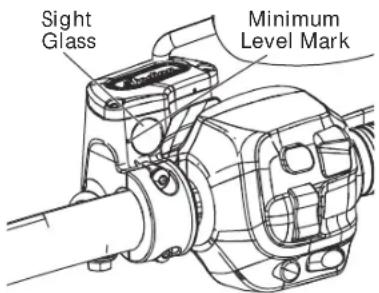
text_image
Sight Glass Minimum Level MarkFront Brake Lever
- Pull the front brake lever toward the handlebar and hold it. The lever should move freely and smoothly. The lever should feel firm and continue to feel firm until released.
- Release the lever. It should return to its rest position quickly when released.
- If the front brake lever fails to perform as stated, service the brake lever before riding.
Rear Brake Pedal
- Press downward on the rear brake pedal. It should move freely and smoothly. The pedal should feel firm and continue to feel firm until released.
- Release the pedal. It should return to its rest position quickly when released.
- If the rear brake pedal fails to perform as stated or travels too far before beginning to engage the brake, service the brakes before riding.
Pre-Ride Inspections
Rear Brake Fluid Level
The rear brake fluid reservoir is located near the rear brake pedal. View the reservoir level from the right side of the vehicle.
- Position the motorcycle on level ground in the fully upright position.
- View the brake fluid through the reservoir.
- The fluid should be clear. Replace cloudy or contaminated fluid.
- The fluid level should be above the minimum indicator mark on the reservoir body. Add brake fluid as needed. See page 98.
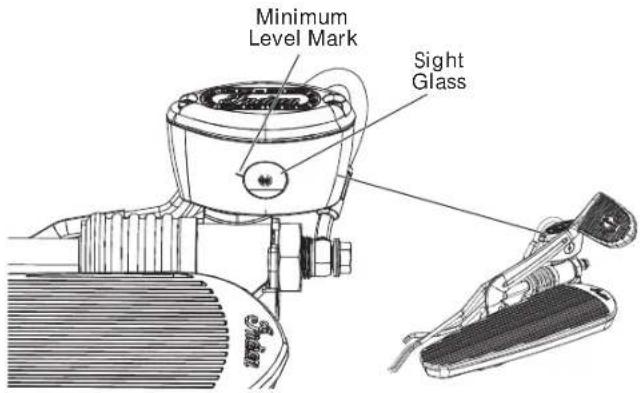
text_image
Minimum Level Mark Sight GlassBrake Lines
Inspect all brake hoses and connections for dampness or stains from leaking or dried fluid. Tighten any leaking connections to the proper torque values and replace components as necessary. See the INDIAN MOTORCYCLE Service Manual or an authorized INDIAN MOTORCYCLE dealer.
WARNING! Brake fluid leaks or low brake fluid levels could cause brake system failure, which could result in serious injury or death. Do not operate the vehicle with low brake fluid levels or when leaks are evident (dampness or stains from dried fluid). See your authorized INDIAN MOTORCYCLE dealer.
Pre-Ride Inspections Throttle
Rotate the throttle control grip. It should rotate smoothly from the rest position to the completely open position. It should return to the rest position quickly when released.
Mechanical Clutch
- Squeeze the clutch lever toward the handlebar and release it. It should move freely and smoothly, and it should return to the rest position quickly when released. If the lever fails to perform as stated, service the clutch lever before riding.
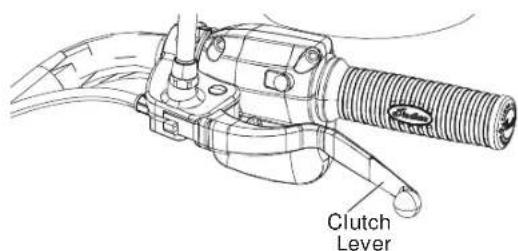
text_image
Clutch Lever- Freeplay (gap) is the amount of lever movement from the rest position to the point of cable resistance. Clutch lever freeplay should be 0.5-1.5 mm. Measure the gap between the clutch lever and the lever housing. See page 95. Adjust clutch lever freeplay if necessary.
Tip: The starter interlock switch is dependent on the clutch lever freeplay being set correctly to ensure activation of the clutch safety switch.
Pre-Ride Inspections
Front Suspension
Inspect the front forks for oil leaks or damage, and verify smooth suspension operation. See page 92.
Steering
- On level ground, straddle the motorcycle and bring it to the fully upright position. Turn the handlebars from stop to stop. The action should be smooth, but not loose.
- Make sure wires, hoses and control cables do not interfere with smooth steering.
Rear Suspension
Check the rear shock absorber mounting and inspect for leaks. See your dealer for service if you discover leaks or malfunction of any kind. See page 88.
CHIEFTAIN only: Check rear shock absorber movement and air pressure to ensure the correct amount of suspension travel and ground clearance. See page 90.
WARNING! Inadequate ground clearance could result in components contacting the ground, causing loss of control and serious injury or death. Always ensure ground clearance is at specification.
Rear Drive Belt
- Check drive belt tension. See pages 86-87.
Tip: The drive belt system must be cool, clean and dry to accurately measure belt tension (deflection). Do not measure belt tension when the belt or drive system is wet or when it is hot (such as immediately after riding). - Check the drive belt teeth for stones or other debris.
- Inspect drive belt condition. See page 87. If you discover cracks, broken teeth or frayed edges, replace the drive belt before riding. See the INDIAN MOTORCYCLE Service Manual or an authorized INDIAN MOTORCYCLE dealer.
Fuel Level
The fuel gauge displays fuel level. For the most accurate reading, sit on the motorcycle and bring it to the upright position.
Pre-Ride Inspections
Sidestand
- On level ground, straddle the motorcycle and bring it to the fully upright position.
- Move the sidestand up to the stored position and down to the fully extended position several times. It should move smoothly and quietly. Make sure the return spring holds the sidestand tightly in place when the sidestand is in the stored position. Adjust or replace a loose spring.
- Inspect the sidestand pivot bolt for looseness or wear. Tighten or replace a loose or worn bolt.
- Periodically test the sidestand safety switch for proper operation. With the transmission in gear and brakes applied, attempt to start the engine while the sidestand is down. The engine should NEVER start in any gear except neutral if the sidestand is down. If the engine starts during this test, see your dealer for service.
Fasteners
- Inspect the entire motorcycle chassis and engine for loose, damaged or missing fasteners.
- Tighten loose fasteners to the proper torque. See the INDIAN MOTORCYCLE Service Manual or an authorized INDIAN MOTORCYCLE dealer.
- Always replace stripped, damaged or broken fasteners before riding. Use genuine INDIAN MOTORCYCLE fasteners of equal size and strength.
Operation
The operation section of this manual describes how to ensure maximum performance and longevity through the proper care and operation of your motorcycle.
Important areas covered by the operation section include:
- Engine Break-In • Accelerating
- Fueling - Braking
- Starting the Engine • Stopping the Engine
- Shifting Gears • Parking
• Using Cruise Control (if equipped)
Tip: Even if you're an experienced motorcycle operator or passenger, read all of the safety information in this manual before operating the motorcycle. See page 5.
Engine Break-In
The engine break-in period for your motorcycle is the first 500 miles (800 km) of operation. During this break-in period, critical engine parts require special wear-in procedures so they seat and mate properly. Read, understand and follow all break-in procedures to ensure the long-term performance and durability of your engine.
NOTICE: Failure to properly follow the engine break-in procedures outlined in this manual can result in serious damage to the engine. Follow all break-in procedures carefully. Avoid full throttle operation and other conditions that may place an excessive load on the engine during the break-in period.
The more cautiously you treat your motorcycle during the break-in period, the more satisfied you will be with its performance later on. Overloading the engine at low RPM and/or running the engine prematurely at high RPM may result in damage to the pistons and/or other engine components.
Observe the following precautions during the break-in period:
- Upon initial start-up, do not allow the engine to idle for long periods as overheating can occur. See page 70.
- Avoid fast starts with wide open throttle. Drive slowly until the engine warms up.
- Avoid running the engine at extremely low RPM in higher gears (lugging the engine).
- Drive within the recommended operating speeds and gears. See page 68.
Operation
Engine Break-In
Operating Speeds and Gears
| Odometer | Break-in Procedure | |
| Miles Km | ||
| 0-90 | 0-145 | Do not operate for extended periods above 1/3 throttle or at any one throttle position. Vary engine speed frequently. |
| 91-300 | 146-483 | Do not operate for extended periods above 1/2 throttle or at any one throttle position. Vary engine speed frequently. |
| 301-500 484-800 Do not operate for extended periods above 3/4 throttle. | ||
| At 500 | At 800 | Perform the break-in maintenance outlined in the maintenance section of this manual. Break-in maintenance should be performed by an authorized INDIAN MOTORCYCLE dealer. Break-in maintenance must include inspection, adjustments, fastener tightening and an engine oil and filter change. Performing break-in maintenance at the required odometer reading helps ensure peak engine performance, minimal exhaust emissions and maximum service life of the engine. |
Operation
Fueling
Always dismount the motorcycle and refuel on level ground with the sidestand down. Review the fuel warnings. See page 14. Use only the recommended fuel. See page 128. Hold the nozzle while filling. Do not rest the weight of the nozzle and hose on the filler neck. Do not leave the nozzle unattended.
WARNING! Overflows or spilled gasoline could contact a hot engine or exhaust system and cause a fire, which could result in serious injury or death. Do not allow gasoline to contact hot components.
WARNING! Always remove the fuel cap slowly and fill the fuel tank slowly to prevent spillage. Do not overfill the fuel tank. Leave space in the tank to allow for the fuel to expand.
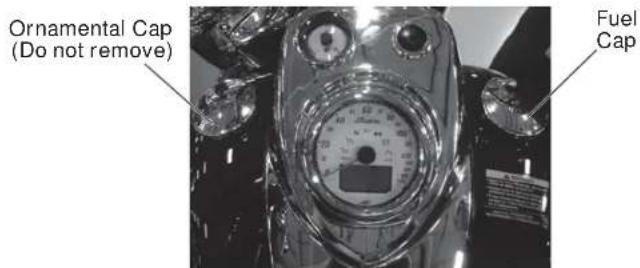
text_image
Ornamental Cap (Do not remove) Fuel Cap-
Turn the fuel cap counter-clockwise to remove it.
-
Insert the fuel nozzle into the fuel tank filler neck. The nozzle-stop at the bottom of the filler neck will prevent over-insertion.
-
Add fuel to the tank until it touches the bottom edge of the filler neck. The tank is full at this level.
- Always securely install the fuel cap before remounting the motorcycle. To tighten the cap, turn it clockwise until the seal compresses onto the tank, then continue to tighten until the cap ratchets several times.
NOTICE: Fuel can damage painted surfaces and plastic parts. If gasoline spills on the any part of the motorcycle, immediately rinse it off with water or wipe it dry with a clean cloth.
Priming the Fuel System
If the motorcycle runs out of fuel, prime the fuel system before attempting to restart the engine.
- Fill the fuel tank.
- Turn the power switch on.
- Move the engine stop/run switch to the RUN position.
- Allow the fuel pump to run until it stops (about 2 seconds).
- Move the engine stop/run switch to the STOP position.
- Repeat steps 3-5 four to five times.
- Move the engine stop/run switch to the RUN position.
- Start the engine. See page 70.
Operation Starting the Engine
The starter interlock system allows the engine to be started only when the transmission is in neutral, or when the transmission is in gear with the clutch disengaged (clutch lever pulled in). The engine should NEVER start in any gear except neutral if the sidestand is down. See page 50.
Tip: If the motorcycle runs out of fuel, prime the system before attempting to restart the engine. See page 69.
-
Perform the Pre-Ride Inspections. See page 57. Properly secure any cargo.
-
Straddle the motorcycle and bring it to the fully upright position. Retract the sidestand.
Tip: When the electrical system is activated with either the power switch or the starter switch, the key fob must be within range. See page 26.
-
Move the engine stop/run switch to the RUN position.
-
Shift the transmission to neutral.
-
Apply the front brakes. Disengage the clutch (pull the clutch lever fully toward the handlebar).
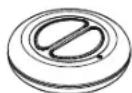
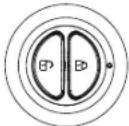
-
Press and hold the starter switch to engage the one-touch starting feature, which activates the electrical system and starts the engine. Another option is to turn the power switch on, and with the throttle closed, press and release the starter switch to start the engine. The starter motor will crank until the engine starts, but no more than 3 seconds. If the engine does not start, wait five seconds, then try again.
-
If starting a COOL engine, DO NOT open the throttle while starting. Idle speed is computer controlled and idle speed will adjust automatically depending on engine temperature and air temperature. Allow the engine to warm up for 30 seconds minimum at low RPM after starting. Do not run the engine above 2500 RPM. If starting a WARM engine, DO NOT open the throttle while starting.
-
If either the check engine indicator or the low oil pressure indicator (or display) remains on after the engine starts, stop the engine immediately. Refer to the low oil pressure indicator/display information on page 32 or 34.
NOTICE: Operating an engine with a misfire or non-firing cylinder can overheat the catalytic converter, which could result in catalytic converter damage and loss of emission control. DO NOT OPERATE the motorcycle if a misfire or non-firing cylinder exists.
(continued on next page)
Starting the Engine
- Leave the throttle closed and allow the engine to idle. Idle speed will gradually slow to normal as the engine warms to operating temperature.
Tip: Do not rev the engine or put the transmission in gear immediately after starting the engine. Allow the engine to idle for about 30 seconds after a warm start or at least one minute after a cold start (longer in cold weather). This will allow oil to reach all areas before the engine is put under load.
NOTICE: Do not run the engine at high RPM with the clutch disengaged or the transmission in neutral. Maximum safe engine speed is 5400 RPM. Never exceed the maximum safe RPM as this could result in serious engine damage.
NOTICE: The engine is air-cooled and requires unrestricted air flow to ensure proper operating temperature. Long periods of idling or traveling at very low speeds (such as during a parade) may overheat the engine, resulting in serious engine damage.
Operation
Operation Shifting Gears
WARNING! Forced shifting (with clutch engaged) could cause damage to the engine, transmission and drive train. Such damage could cause loss of control, which could result in serious injury or death. Always pull the clutch lever fully toward the handlebars to disengage the clutch before shifting gears.
This motorcycle is equipped with a six-speed transmission. Neutral is located between first and second gear.
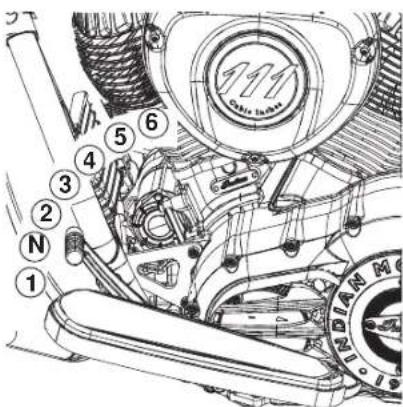
text_image
111 Guru Ball N 2 3 4 5 6 1Press downward on the toe lever to shift to a lower gear. Lift upward on the toe lever to shift to a higher gear. Release the clutch lever after each gear shift.
Shifting to neutral is easiest if the motorcycle is rolling slowly. To shift from first gear to neutral, gently lift the toe lever a half stroke.
Tip: The transmission is in neutral if you can move the motorcycle forward or rearward freely without disengaging the clutch. If the power switch is ON, the neutral indicator illuminates when the transmission is in neutral.
Shifting Gears While Stationary
To locate neutral when the motorcycle is stationary, use one of the following techniques to load and unload the transmission shift dogs, which allows them to disengage:
- With the clutch disengaged (lever pulled inward), shift into neutral while rocking the motorcycle forward and rearward.
- With the transmission in first gear, gently release the clutch until it just begins to engage. Apply upward pressure on the toe lever and quickly pull the clutch inward.
To shift gears when the motorcycle is stationary (engine may be running or stopped), disengage the clutch and apply slight pressure on the shift lever while rocking the motorcycle forward and rearward.
Operation
Shifting Gears Shifting Gears While Driving
- Start the engine. See page 70.
- With the engine at idle speed, apply the front brakes.
- Disengage the clutch (pull the clutch lever fully toward the handlebar).
- Push the toe lever downward until you feel it stop in first gear.
- Release the brake lever.
- Simultaneously release the clutch lever while opening the throttle (rolling the throttle control grip rearward) in one smooth motion. As the clutch begins to engage, the motorcycle will move forward.
- To shift to a higher gear, accelerate smoothly to the recommended shift point. See Recommended Shift Points chart. With a quick motion, simultaneously close the throttle completely and disengage the clutch. Raise the toe shift lever until you feel it stop at the next gear. Simultaneously release the clutch lever and open the throttle in one smooth motion.
Tip: Within the recommended speed ranges (see Recommended Shift Points chart), you can downshift to slow the motorcycle or to increase power. You may want to downshift when climbing a hill or passing. Downshifting also helps to decrease speed when combined with closing the throttle.
8. To shift to a lower gear (downshift), simultaneously pull the clutch lever toward the handlebar and close the throttle. Move the toe shift lever downward until you feel it stop at the next gear. Simultaneously release the clutch lever while opening the throttle.
WARNING! Downshifting improperly could cause transmission damage, loss of traction and loss of control, which could result in serious injury or death.
- Reduce speed before downshifting. Always downshift within the recommended shift points.
- Use extreme caution when downshifting on wet, slippery or other low traction surfaces. Release the clutch lever very gradually in these conditions.
- Avoid downshifting in a curve. Downshift before entering the curve.
Operation
Shifting Gears
Recommended Shift Points
| Upshifting (Accelerating) Downshifting (Decelerating) | |
| Gear Change Recommended Speed Gear Change Recommended Speed | |
| 1 to 2 15 MPH (24 km/h) 6 to 5 40 MPH (64 km/h) | |
| 2 to 3 25 MPH (40 km/h) 5 to 4 35 MPH (56 km/h) | |
| 3 to 4 35 MPH (56 km/h) 4 to 3 25 MPH (40 km/h) | |
| 4 to 5 45 MPH (72 km/h) 3 to 2 15 MPH (24 km/h) | |
| 5 to 6 50 MPH (80 km/h) 2 to 1 10 MPH (16 km/h) | |
Operation
Braking
Always allow sufficient stopping distance so that brakes can be applied gradually.
Tip: Applying slightly more front brake than rear brake generally provides the best braking performance.
1. To slow the motorcycle with the brakes, close the throttle and apply the front and rear brakes evenly and gradually.
Tip: When the anti-lock brakes engage during a braking event, the rider will feel pulsing at the brake levers. Continue to apply steady pressure to the brakes for the best stopping performance.
2. As the motorcycle slows, disengage the clutch, or downshift each time vehicle speed reaches a downshift point.
WARNING! Braking improperly could result in loss of control, which could result in serious injury or death. Avoid braking abruptly. Always apply the brakes gradually, especially on wet, slippery or other low traction surfaces. Avoid braking in a curve or turn. Bring the motorcycle to the upright position before applying the brakes.
Accelerating
Accelerate by opening the throttle (rolling the throttle control grip rearward). For even acceleration, open the throttle with a smooth, continuous motion. When you reach the recommended speed for upshifting, shift up one gear.
WARNING! Accelerating abruptly could cause your body to shift rearward suddenly, which could result in loss of control. Accelerating abruptly could also cause loss of control on low traction surfaces. Loss of control could result in serious injury or death. Always accelerate gradually, especially on wet, slippery or other low traction surfaces.
Stopping the Engine
Before stopping the engine, bring the motorcycle to a complete stop. Shift to neutral or disengage the clutch.
WARNING! Stopping the engine with the transmission in gear while the motorcycle is moving could cause loss of rear wheel traction or engine and transmission damage, which could cause loss of control and serious injury or death. Always stop the engine after the motorcycle is fully stopped and the transmission is in neutral. If the engine stops unexpectedly while the motorcycle is moving, guide the motorcycle to a safe location off the road and away from traffic. Turn the power switch off.
- When fully stopped, shift into neutral.
- Move the engine stop/run switch to the STOP position.
- Turn the power switch off.
Operation Using Cruise Control
The cruise control switches are located on the right handlebar. Read this section and understand how to safely operate this feature before using the cruise control.
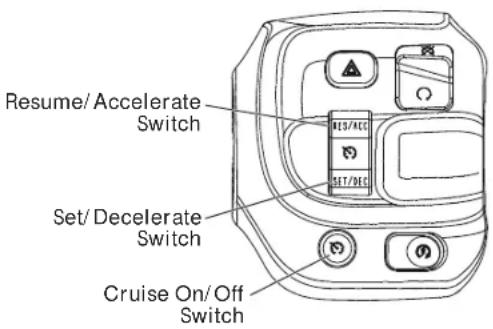
text_image
Resume/Accelerate Switch Set/Decelerate Switch Cruise On/Off SwitchWARNING! Improper operation of cruise control could cause loss of control and result in serious injury or death. Follow all cruise operation procedures carefully. Never use cruise control when roads are wet or slippery. Do not use cruise control when riding in heavy or congested traffic.
Cruise Control Tips
• Cruise control can be set in gears 4-6.
• Vehicle speed must be above 20 MPH (32 km/h).
- Set speed will vary slightly in hilly terrain.
- Cruise control will not resume a pre-set speed if the resulting acceleration or deceleration rate is too high or too low. For example, resuming a set speed from 40 MPH (64 km/h) while in 6th gear may cause cruise to disengage.
- Cruise control will not engage if brake lights are not operating properly.
- The clutch or either brake must have been activated at least once since the engine was started for the cruise control to function.
Operation
Using Cruise Control
Set Speed
- Press and release the cruise on/off switch. The amber cruise control indicator will illuminate in the instrument cluster. Cruise control is enabled, but not set.
- Accelerate to the desired speed and press the SET/DEC switch. The green cruise control indicator lamp will illuminate. Cruise control is set to the desired speed.
Resume Speed
After disengaging the cruise control with the brake, throttle or clutch, press the RES/ACC switch to return to the set speed.
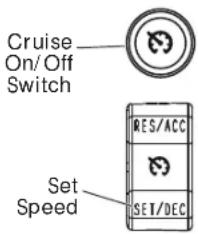
text_image
Cruise On/Off Switch RES/ACC Set Speed SET/DEC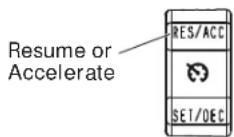
Accelerate
While cruise control is engaged, tap and release the RES/ACC switch to increase speed in approximately 1 MPH (1-2 km/h) increments. Press and hold the RES/ACC switch to accelerate to a new set speed (resets when switch is released).
Tip: If you use the throttle to accelerate and then release it, the cruise control will resume the previously set speed.
Decelerate
While cruise control is engaged, tap and release the SET/DEC switch to decrease speed in approximately 1 MPH (1-2 km/h) increments. Press and hold the SET/DEC switch to decelerate to a new set speed (resets when switch is released), or to the minimum cr (km/h).
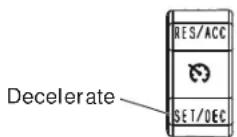
Cancel Cruise Control
To temporarily cancel the cruise control and allow use of the resume feature:
- apply the brakes or
- close the throttle
• disengage the clutch
To cancel the cruise control and erase the set speed from memory, press the cruise on/off switch.
Operation Parking
Choose a firm level surface to park the motorcycle.
- When fully stopped, shift into neutral.
- Stop the engine.
- Fully extend the sidestand.
- Turn the handlebars to the left and lean the motorcycle to the left until the sidestand firmly supports the motorcycle.
- Turn the power switch off.
Parking on a Slope
If parking on a slope is unavoidable, park with the front wheel uphill from the rear wheel. Place the transmission in first gear and position the motorcycle so that it is stable when it rests on the sidestand.
Parking on a Soft Surface
If parking on a soft surface is unavoidable, place a sidestand footrest under the foot of the sidestand to provide a firm surface. The sidestand footrest must be strong enough and large enough to support the motorcycle's weight without sinking into the parking surface.
Asphalt becomes soft in hot weather. A sidestand can sink into soft asphalt and the motorcycle may fall. When parking on asphalt in hot weather, use a sidestand footrest.
CAUTION! Hot engine and exhaust components can cause burns to skin and can ignite a fire if exposed to flammable materials. Always park the motorcycle clear of flammable materials and where people are not likely to contact hot components.
Safety During Service Procedures
Maintenance
WARNING
Failure to follow all recommended precautions and procedures could result in severe injury or death. Always heed all safety precautions and follow all operation, inspection and maintenance procedures outlined in this manual.
- Improperly installed or adjusted components can make the motorcycle unstable or hard to handle. Improperly installed electrical components can cause engine or electrical system failure. In either event, damage or serious injury could result. If you do not have the time, tools and expertise necessary to complete a procedure properly, please see your dealer for service.
- Review the safety-related maintenance information on page 15.
- Before beginning any maintenance procedure, read the instructions for the entire procedure.
-
Always position the motorcycle on a firm level surface before performing service. Make sure the motorcycle will not tip or fall while elevated or while on the sidestand. See page 116.
-
Hot engine and exhaust components can cause burns to skin and can ignite a fire if exposed to flammable materials. Always park the motorcycle clear of flammable materials and where people are not likely to contact hot components.
- Wear eye and face protection when using pressurized air.
- Never start the engine or let it run in an enclosed area. Engine exhaust fumes are poisonous and can cause loss of consciousness or death in a short time.
- During some procedures you may use potentially hazardous products such as oil or brake fluid. Always follow the instructions and warnings on the product packaging.
Maintenance
Proper maintenance assures the highest level of safety, durability and dependability for your motorcycle. Break-in maintenance is required to ensure warranty coverage and proper emissions system operation.
- Perform the break-in maintenance procedures motorcycle's odometer registers 500 miles (800 km). Please see your authorized dealer for this service.
- Perform the recommended periodic maintenance at the intervals specified in the periodic maintenance table beginning on page 82.
Road Tests
Before returning the motorcycle to regular use after performing service, road test it in a safe environment. Pay special attention to the proper fit and operation of all serviced components. Make any corrections or additional adjustments necessary to ensure safe vehicle performance.
Break-In Maintenance
Perform the break-in maintenance procedures when the motorcycle's odometer registers 500 miles (800 km). Please see your authorized dealer for this service.
Performing the break-in maintenance will help ensure optimum engine performance for the entire service life of the engine. Your dealer will change engine oil, inspect all fluids and serviceable components, ensure that all fasteners are tightened and make other adjustments as needed.
Major Maintenance
Major repairs typically require technical skills and specially designed tools. Emission system service requires special tools and training and should be performed by your dealer. See the INDIAN MOTORCYCLE Service Manual or an authorized INDIAN MOTORCYCLE dealer.
Periodic Maintenance
Inspect, clean, lubricate, adjust and replace parts as necessary. When inspection reveals the need for replacement parts, use genuine INDIAN MOTORCYCLE parts available from your dealer. Record service and maintenance information in the Maintenance Log beginning on page 141.
NOTICE: Use of non-recommended lubricants and components can result in damage to the motorcycle. Damage resulting from the use of non-recommended products is not covered by warranty.
Perform maintenance at the intervals specified in the periodic maintenance table beginning on page 82. Vehicles subjected to severe use must be inspected and serviced more frequently.
Severe Use Definition
• high speed operation for extended periods
- low speed operation for extended periods
• operation in dusty or otherwise adverse conditions
• operation in cold weather (temperatures below freezing)
Maintenance
Maintenance
Periodic Maintenance Table
| Odometer Reading in Miles (Kilometers) | |||||||||||||||||||||||
| ComponentSee table key below Page | 500 (800) | 2,500 (4,000) & every 5,000 (8,000) thereafter | 5,000 (8,000) | 10,000 (16,000) | 15,000 (24,000) | 20,000 (32,000) | 25,000 (40,000) | 30,000 (48,000) | 35,000 (56,000) | 40,000 (64,000) | 45,000 (72,000) | 50,000 (80,000) | |||||||||||
| Engine | Key Fob Battery** - - - - - - - - - - - - - - - - - - - - - - - - - - - - - - - - - - - - - - - - - - - - - - - - - - - - - - - - - - - - - - - - - - - - - - - - - - - - - - - - - - - - - - - - - - - - - - - - - - - - | - | |||||||||||||||||||||
| Engine Compression 116 I | - | - | I | I | I | - | - | ||||||||||||||||
| Engine Oil & Filter* 84 R | - | R | R | R | R | R | R | R | R | R | R | ||||||||||||
| Crankcase Vent | 93 | I | I | I | I | II | II | II | |||||||||||||||
| Engine Mount Fasteners | - I | - | - | - | - | - | - | - | |||||||||||||||
| Oil Lines/ Oil System Inspection | - I | I | I | I | II | II | II | ||||||||||||||||
| Air Filter | 86 | I | I | I | I | R | I | I | R | I | I | R | I | ||||||||||
| Exhaust System | 116 I | I | I | I | II | II | II | ||||||||||||||||
| Spark Plugs | 105 I | - | I | R | I | ||||||||||||||||||
| Chassis | Battery/ Connections | 110 | I | I | I | I | I | I | I | I | I | I | I | I | |||||||||
| Brake Fluid** | 98-99 | I | I | I | R | I | R | I | R | I | R | I | R | ||||||||||
| Brake Lines/ Brake Pads | 100 I | I | I | I | II | II | II | ||||||||||||||||
| Clutch Cable | 96 | I | - | I | L | I | L | I | L | I | L | I | L | ||||||||||
| Clutch Lever (Mechanical) | 95, 96 | L | - | I | L | I | L | I | L | I | L | I | L | ||||||||||
| Diagnostic Codes | - I | I | I | I | II | II | II | ||||||||||||||||
| Drive Belt (Rear) | 65, 87 | I | I | I | I | II | R | II | II | ||||||||||||||
| Drive Belt Tension Adjustment | - I | - I | See dealer or service manual for adjustment at indicated intervals and with each tire change thereafter. | ||||||||||||||||||||
| Electrical Equipment/ Switches | - I | I | I | I | II | II | II | ||||||||||||||||
| Evaporative Emission Control System (if equipped) | 94 | I | I | I | I | II | II | II | |||||||||||||||
| Maintenance Key: I = Inspect, clean, adjust, correct or replace if necessary; P = Perform; R = Replace/RebuildL = Lubricate w/ proper lubricant; * = Replace at specified interval or annually; ** = Replace as specified or every 2 years | |||||||||||||||||||||||
Maintenance
Periodic Maintenance Table
| ComponentSee table key below Page | 500 (800) | 2,500 (4,000) & every 5,000 (8,000) | 5,000 (8,000) | 10,000 (16,000) | 15,000 (24,000) | 20,000 (32,000) | 25,000 (40,000) | 30,000 (48,000) | 35,000 (56,000) | 40,000 (64,000) | 45,000 (72,000) | 50,000 (80,000) | |||||||||||
| Chassis | Fasteners 116 I | I I I I I I I I I | ||||||||||||||||||||||
| Front Brake Lever 99 L | I | L | L | L | L | L | L | ||||||||||||||||
| ABS Components 101 I | I | I | I | III | III | ||||||||||||||||||
| Front Fork Oil** 92 I | II | R | II | RI | |||||||||||||||||||
| Front Fork/ Axle | 92 I | I | I | I | III | III | |||||||||||||||||
| Fuel System/ Lines/ Fittings | 94 I | I | I | I | III | III | |||||||||||||||||
| Fuel Filter 85 - | - | - | - | - | - | - | - | - | - | - | R | ||||||||||||
| Gear Shift Lever | - | I | I | I | I | III | III | ||||||||||||||||
| Headlamp | 107 I | I | - | I | - | I | - | I | - | I | - | I | |||||||||||
| Rear Suspension Rocker | - | I | I | I | I | L | I | I | L | I | I | L | I | ||||||||||
| Rear Shock Unit | 65, 88 | I | I | I | I | III | III | R | |||||||||||||||
| Rear Wheel Alignment | 102 I | I | I | I | III | III | |||||||||||||||||
| Rear Brake Pedal | 97 I | I | I | I | III | III | |||||||||||||||||
| Road Test | 116 | P | P | P | P | P | P | P | P | P | P | P | P | ||||||||||
| Sidestand/ Sidestand Safety Switch | 66, 95 | L | I | L | I | III | III | ||||||||||||||||
| Steering Bearings 93 I | I | I | I | III | III | ||||||||||||||||||
| Suspension Linkage, Rear | - | I | I | I | I | III | III | ||||||||||||||||
| Swingarm/Rear Axle | 91 I | I | I | I | III | III | |||||||||||||||||
| Throttle Body | - | I | I | I | I | III | III | ||||||||||||||||
| Throttle Control Grip | - | L | I | L | L | L | L | L | L | ||||||||||||||
| Tires/Wheels/ Spokes | 102-104 | I | I | I | I | III | III | ||||||||||||||||
| Maintenance Key: I = Inspect, clean, adjust, correct or replace if necessary; P = Perform; R = Replace/ RebuildL = Lubricate w/ proper lubricant; * = Replace at specified interval or annually; ** = Replace as specified or every 2 years | |||||||||||||||||||||||
Maintenance Engine Oil/ Filter Change
Change the engine oil at the intervals specified in the periodic maintenance table beginning on page 82. Change the oil more frequently if the motorcycle is subjected to severe use, especially operation in cold weather. See page 81.
NOTICE: Failure to perform frequent oil changes during cold weather operation can result in condensation forming. Freezing condensation can result in plugged oil lines and serious engine damage.
The total amount of oil required for the oil and filter change is approximately 5.5 qts. (5.2 l). Follow all instructions carefully. Do not overfill.
NOTICE: After an oil change, the low oil pressure indicator may illuminate when the engine is started. If this occurs, do not increase RPM above idle speed until the indicator turns off. Operating above idle speed could result in damage to the engine.
-
Change the oil and filter when the engine is warm. If the engine is cold, start the engine and allow it to run at idle for at least 5 minutes.
-
Park the motorcycle with the sidestand down on a firm, level surface. If using a service lift, the motorcycle should be centered.
-
Clean the area around the two drain plugs. Place a drain pan under both drain plugs.
CAUTION! Hot oil can cause burns to skin. Do not allow hot oil to contact skin.
-
Remove the drain plugs. Allow the oil to drain completely.
-
Install new sealing washers on the drain plugs. The sealing surfaces on drain plugs and engine should be clean and free of burrs, nicks or scratches.
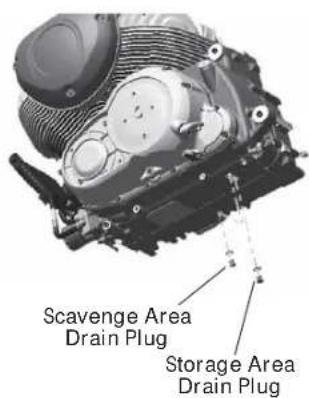
text_image
Scavenge Area Drain Plug Storage Area Drain Plug- Reinstall the drain plugs. Torque to 15 ft. lbs. (20 Nm).
CAUTION! Hot oil can cause burns to skin. Do not allow hot oil to contact skin. Wear leather gloves when handling hot components.
- Place shop towels beneath the oil filter. Using an oil filter wrench, turn the filter counter-clockwise to remove it.
Maintenance
Engine Oil/Filter Change
- Using a clean dry cloth, clean the filter sealing surface on the engine.
- Lubricate the o-ring on the new filter with a film of fresh engine oil. Check to make sure the o-ring is in good condition.
- Install the new filter and rotate it clockwise by hand until the filter gasket contacts the sealing surface, then turn it an additional 3/4 to one full turn.
- Remove the dipstick. Add only 4.5 qts. (4.25 l) of the recommended oil at this step. Do not overfill.
- Reinstall the dipstick securely.
- With the motorcycle in an upright, centered position, start the engine and run it at varied speeds up to 2500 RPM for approximately 3 minutes.
-
Stop the engine and add an additional one quart (.95 l) of engine oil. Do not overfill. Overfilling can result in loss of engine performance and an oil-saturated air filter. Use a suction device to remove excess oil if overfilled.
-
To ensure the oil level is within the safe operating range, re-check the oil level as outlined on page 60.
NOTICE: After an oil change, the low oil pressure indicator may illuminate when the engine is started. If this occurs, do not increase RPM above idle speed until the indicator turns off. Operating above idle speed could result in damage to the engine. - Dispose of used filter and oil properly.
- CHIEFTAIN: Reset the oil change life in the instrument gauge. See page 40.
Fuel Filter
The fuel filter is attached to the electric fuel pump located inside the fuel tank. See your authorized INDIAN MOTORCYCLE dealer for replacement.
Maintenance
Air Filter
The air box is located on the left side of motorcycle. Inspect the air filter often if riding in unusually wet or dusty conditions. Replace the filter at the intervals specified in the periodic maintenance table beginning on page 82.
- Remove the three air box cover screws and washers. Remove the cover.
- Remove the three air filter screws and remove the air filter assembly.
- Remove the air filter.
- Clean the filter sealing surface on the backing plate.
- Verify that the air box cover seal is properly seated in the groove around the outer edge of the air box backing plate.
- Position the air filter assembly against the air box backing plate.
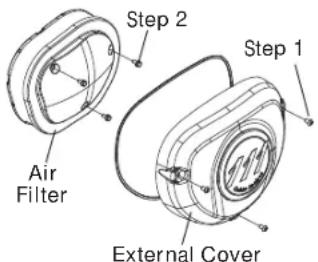
text_image
Step 2 Step 1 Air Filter External Cover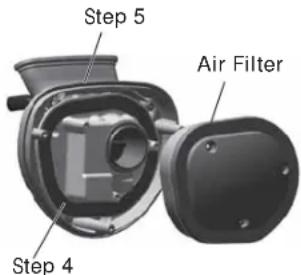
text_image
Step 5 Air Filter Step 4- Reinstall the three screws. Torque to specification.
Torque: 5 ft-lbs (7 Nm)
- Reinstall the external air box cover and screws. Torque to specification.
Torque: 7.4 ft-lbs (10 Nm)
NOTICE: A loose fitting cover or improperly installed filter element may allow debris to enter the engine which may cause premature engine wear.
Rear Drive Belt Cleaning
Cleaning the drive belt will maximize belt and sprocket life and minimize drive line noise. Clean the belt at every tire change. Clean the belt more often if riding in dirty, dusty or high debris environments.
- Mix a few drops of mild dish soap with a cup of warm water.
- Use a soft nylon brush to clean the belt and sprocket teeth with the soapy water. Clean well in corner areas where road debris and belt dust can collect.
- Rinse the belt with clear water, then dry thoroughly.
Tip: Do not inspect or adjust drive belt tension when the belt or drive system is wet or hot. Improper adjustment will result.
Maintenance
Rear Drive Belt Condition
Inspect the rear drive belt at the intervals specified in the periodic maintenance table beginning on page 82. Replace the drive belt if it is cracked or has broken teeth or frayed edges. No matter its condition, the drive belt should be replaced at periodic intervals. See the INDIAN MOTORCYCLE Service Manual or an authorized INDIAN MOTORCYCLE dealer.
DO NOT attempt to check belt tension if the belt has been exposed to rain or washing within a 24 hour period or if the vehicle has been run at operating temperature within the last four hours. Allow the vehicle to cool down to ambient temperature before measuring belt tension. Replace the drive belt and both sprockets as a set if the drive belt has over 5,000 miles (8,000 km) of service at the time of damage or failure.
Rear Drive Belt Wear Analysis
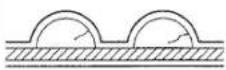 | 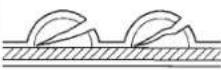 |  |  |
| Internal tooth cracks (hairline): OK to run, but monitor condition | External tooth cracks: Replace belt | Missing teeth: Replace belt | Chipping (not serious): OK to run, but monitor condition |
 |  | 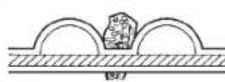 | 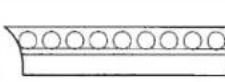 |
| Fuzzy edge cord: OK to run, but monitor condition | Hook wear: Replace belt | Stone damage: Replace belt if damage is on edge | Bevel wear (outboard edge only): OK to run, but monitor condition |
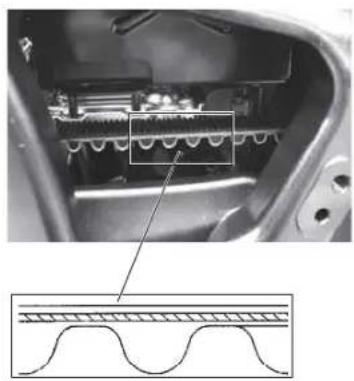
natural_image
Close-up of a mechanical component with internal wiring and a magnified inset showing waveform (no text or symbols)Maintenance
Rear Shock Preload (Ride Height) Inspection
Periodically inspect rear shock preload. For the most comfortable ride and proper ground clearance, adjust preload if ride height is out of specification.
- Verify that tire pressure is at specification. See page 104.
- Secure the motorcycle in an upright position by clamping the front wheel in a wheel vise.
- Remove the saddlebag (if equipped).
- Apply a strip of tape to the rear fender directly over the center of the rear axle.
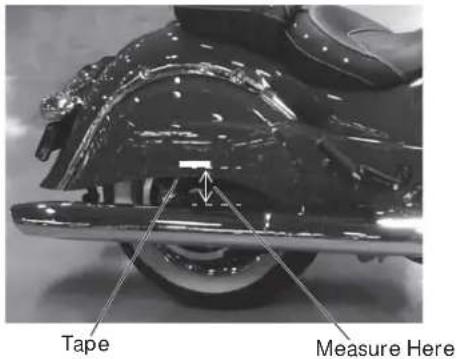
text_image
Tape Measure Here- Using a suitable lift, raise the motorcycle until the rear shock is completely extended.
- Measure the distance (in millimeters) from the center of the rear axle to the bottom of the tape. Record the results as measurement M1.
- Lower the motorcycle and remove the lift.
- Load the motorcycle with all intended cargo. Wearing your riding gear, bring the motorcycle to the upright position and sit on the operator's seat. If you plan to carry a passenger, have the passenger (with riding gear) sit on the passenger seat.
- Have an assistant measure in the same location. Record the results as measurement M2.
- Subtract measurement M2 from M1. The result is the measured rider sag. (M1-M2=Sag). Adjust preload as needed.
| Recommended Suspension Sag | Adjustment Procedure |
| CHIEF 35mm See page 89. | |
| CHIEFTAIN 45mm See page 90. |
Maintenance
Rear Shock Preload (Ride Height) Adjustment (CHIEF)
-
Park the motorcycle with the sidestand down on a firm, level surface. Remove all riders and cargo.
-
Remove the seat. See page 106.
Tip: Using the INDIAN MOTORCYCLE spanner wrench PV-46993 will make rear suspension adjustment significantly easier.
-
The upper spanner nut on the shock is the lock nut. The lower spanner nut is the adjuster nut. Loosen the lock nut by turning it counter-clockwise (as viewed from the top of shock) with the spanner wrench.
-
Spray a light lubricant on the adjuster nut where it contacts the spring.
-
Adjust shock preload by rotating the adjuster clockwise (as viewed from the top of shock) to INCREASE preload (firm) or counter-clockwise to DECREASE preload (softer).
-
Recheck the preload measurement after adjusting.
-
Tighten the lock nut securely against the adjuster nut.
-
Reinstall the seat.
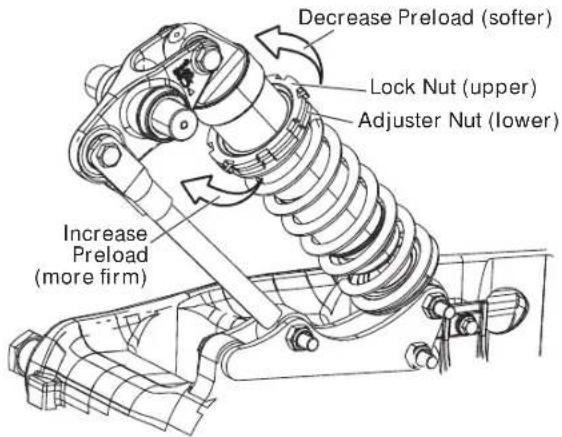
text_image
Decrease Preload (softer) Lock Nut (upper) Adjuster Nut (lower) Increase Preload (more firm)Maintenance
Shock Air Pressure (Ride Height) Adjustment (CHIEFTAIN)
For riding comfort and to ensure proper ground clearance, adjust rear shock air pressure. Refer to the label located on the inside of the left side cover. The label shows recommended pressures based on potential load weights. Always inspect and adjust shock preload (ride height) based on your actual load weight, in addition to adjusting shock air pressure. See page 88.
Follow these guidelines when adjusting:
- Park the motorcycle with the sidestand down on a firm, level surface. Remove all riders and cargo.
• DO NOT exceed 150 PSI (1034 kPa) in the shock. - Use the INDIAN MOTORYCLE Air Pump and Gauge (P/N PV-48909). Follow the instructions on the following pages.
If the recommended air pump is not available, use a gauge and a pressurized air source with a maximum line and gauge pressure of 150 PSI (1034 kPa). After using the alternate gauge, remove it quickly to minimize leakage. Expect to lose up to 5 PSI (24 kPa) with each pressure check. Use only a dry air source, such as a system with a water separator or air line dryer, to prevent moisture from entering the shock.
CAUTION! Air pressure increases VERY quickly when using pressurized air. Wear eye and face protection.
| Air Suspension Adjustment | ||
| Total Cargo & Occupant Weight (Ibs) | Air Pressure (psi) | MAX PRESSURE: 150 PSI |
| 0 | 0 | SELECT PRESSURE CORRESPONDING TO TOTAL CARGO AND OCCUPANT WEIGHT. REMOVE ALL PASSENGERS AND CARGO BEFORE SETTING/ CHECKING SHOCK PRESSURE. SET PRESSURE WITH BIKE ON SIDE STAND. |
| 150 0 | ||
| 175 0 | ||
| 200 0 | ||
| 225 10 | ||
| 250 23 | ||
| 275 30 | ||
| 300 38 | ||
| 325 48 | ||
| 350 60 | ||
| 375 71 | ||
| 400 85 | ||
| 425 100 | ||
| 450 122 | 7179871 | |
| 475 134 | ||
| 500 145 | ||
Maintenance
Shock Air Pressure (Ride Height) Adjustment (CHIEFTAIN)
-
Park the motorcycle with the sidestand down on a firm, level surface. Remove all riders and cargo.
-
Remove the left side cover. Remove the cap from the air fitting.
-
Determine the recommended rear shock air pressure. Refer to the label located on the inside of the left side cover.
-
Install the hose fitting of the recommended gauge securely onto the air fitting. Read the air pressure on the gauge.
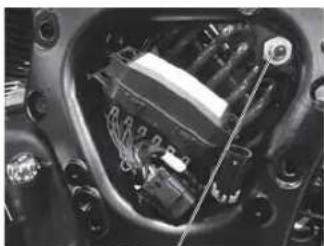
natural_image
Close-up of a mechanical component with internal wiring and housing (no visible text or symbols)Air Fitting
-
To reduce air pressure, push the bleed button on the gauge. Bleed pressure in small amounts until the desired pressure is attained.
-
To increase pressure, pump the handle until pressure increases to the desired amount.
CAUTION! DO NOT exceed 150 PSI (1034 kPa) in the shock.
- Remove the hose from the air fitting and reinstall the cap.
Tip: Expect to lose up to 5 PSI (24 kPa) with each pressure check.
- Repeat the preload inspection to verify proper preload. See page 88.
Swing Arm/ Rear Axle Inspection
-
Sit in the operator's seat and slowly bounce the rear suspension a few times. Make sure the suspension moves freely without binding. Listen for abnormal noises.
-
Elevate and support the motorcycle with the rear tire slightly off the floor. See page 116.
CAUTION! Make sure the motorcycle is stable when elevated. Injury may occur if the motorcycle tips or falls.
-
Grasp the rear wheel and attempt to move the wheel side-to-side. If there is movement at the front of the swingarm or in the axle area, see your dealer for service.
-
With the transmission in neutral, slowly rotate the rear wheel. If the wheel does not rotate smoothly, see your dealer for service.
Maintenance
Front Fork/ Suspension Inspection
- Place the motorcycle on the sidestand and inspect the front forks. If fork oil is present on the outer tube, do not ride the motorcycle. See your dealer for service before operating. If fork oil is present around the fork seals or inner tubes, replace the fork seals.
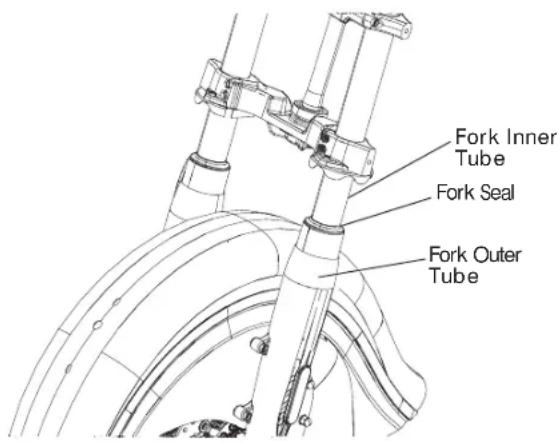
text_image
Fork Inner Tube Fork Seal Fork Outer Tube-
Clean the fork tubes to remove bugs, tar or buildup which may cause seal wear or leakage. Inspect the outer surfaces of the inner fork tubes for scratches or damage from foreign objects.
-
Straddle the motorcycle and bring it to the fully upright position. Apply the front brake and push downward (hard) on the handlebars several times. The front suspension should operate smoothly and quietly.
-
Fork oil condition and level affects front suspension performance and internal component wear. Replace fork oil at the recommended intervals. Special tools are required to perform this procedure. See the INDIAN MOTORCYCLE Service Manual or an authorized INDIAN MOTORCYCLE dealer.
Maintenance
Steering Head Inspection
- Elevate and support the motorcycle with the front tire slightly off the floor. See page 116.
CAUTION! Make sure the motorcycle is stable when elevated. Injury may occur if the motorcycle tips or falls.
-
Turn the handlebars from stop to stop. The action should be smooth but not loose. Make sure wires, hoses and control cables do not interfere with smooth steering.
-
Position the front wheel straight ahead. Grasp the front forks near the front axle and attempt to move the wheel front-to-back. If there is front-to-back movement at the steering head, see your dealer for service.
-
If steering binds, feels rough or uneven, or if movement is detected at the steering stem, see your dealer for service.
-
Rotate the front wheel and inspect for smooth rotation of front wheel bearings. If roughness or unusual sounds are present, see your dealer for service.
-
Turn handle bars full right or left and hold against the fork stop. Attempt to move front wheel side-to-side. If movement is observed, see your dealer for service.
Crankcase Breather Hoses
Inspect both breather hoses along their length and at both ends. Make sure hoses are not restricted, kinked, cracked or otherwise damaged. Replace any worn or damaged hoses.
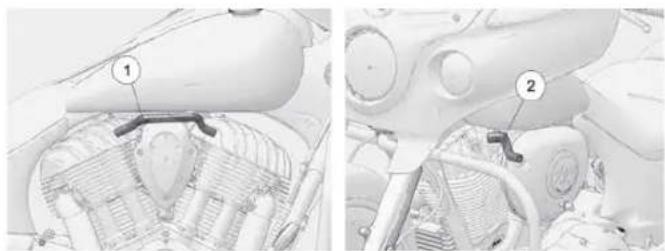
natural_image
Technical diagram of a motorcycle engine compartment showing internal components and parts (no text or labels)Maintenance
Evaporative Emission Control System (California Models)
- Inspect all evaporative emission control system hoses and connections. Make sure all connections are tight and locked.
- The canister is located under the rear fender. Make sure it is securely fastened to the mounting bracket.
- Inspect connections at the evaporative emissions canister to be sure they are secure. The vent line coming from the tank should be connected to the black port. The purge line should be connected to the gray or natural-colored port.
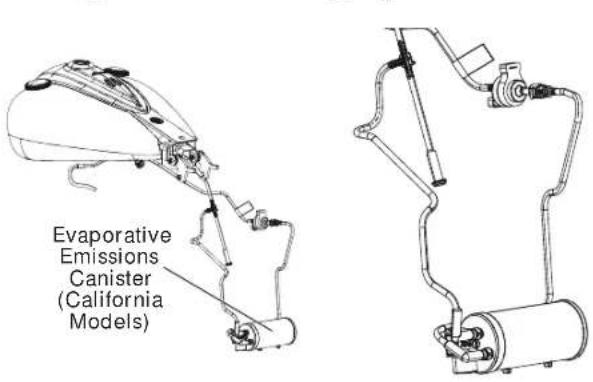
text_image
Evaporative Emissions Canister (California Models)Fuel System Components
- Inspect fuel hoses for cracks or damage.
- Inspect hose connections at the fuel tank and at the fuel rail for dampness or stains from leaks. The tank connection for the fuel line is under the tank console.
- The fuel system is under pressure and caution must be used when inspecting and servicing the fuel system. See the INDIAN MOTORCYCLE Service Manual or an authorized INDIAN MOTORCYCLE dealer.
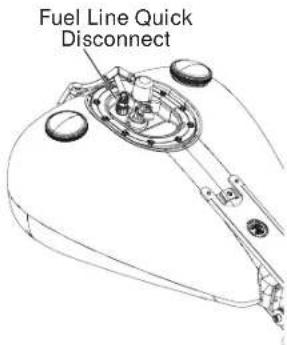
text_image
Fuel Line Quick DisconnectThrottle Control Inspection
- With the engine OFF, rotate the throttle control grip fully open and then release it. It should rotate smoothly from the rest position to the completely open position. It should return to the rest position quickly when released.
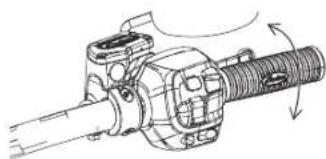
natural_image
Technical line drawing of a mechanical assembly with no visible text or symbols- Repeat the twist and release process with the handlebars turned fully right and fully left.
- Service the throttle system if throttle operation is not smooth or if throttle grip does not return properly. See the INDIAN MOTORCYCLE Service Manual or an authorized INDIAN MOTORCYCLE dealer.
Sidestand Lubrication
Periodically lubricate the sidestand bushing. See page 66 for sidestand inspections.
Maintenance
Mechanical Clutch Lever Freeplay
- Hold the clutch cable. The clutch cable adjuster nut is located alongside the left down-tube. Slide the rubber protective cover away from the lock nut. Loosen the lock nut.
- While holding the cable, turn the cable adjuster inward or outward until clutch lever freeplay is 0.5-1.5 mm.
- While holding the cable, tighten the adjuster lock nut securely.
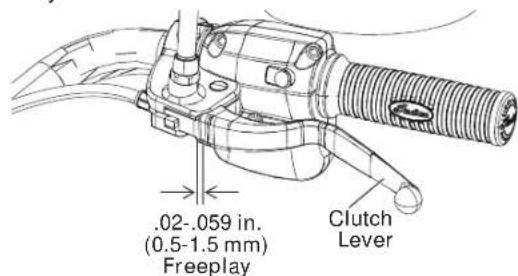
text_image
.02-.059 in. (0.5-1.5 mm) Freeplay Clutch Lever- Verify that the safety switch activates properly. The engine should not start in gear with the clutch lever released.
Tip: The starter interlock switch is dependent on the clutch lever freeplay being set correctly to ensure activation of the clutch safety switch.
Maintenance
Mechanical Clutch Lever Lubrication
- The clutch cable adjuster nut is located alongside the left down-tube. Slide the rubber protective cover away from the adjuster. Loosen the lock nut.
- Turn the cable adjuster completely inward to provide maximum lever freeplay.
- Remove the clutch lever c-clip and pin. Disconnect the clutch cable from the clutch lever.
- Remove any old grease and dirt from the lever and housing. Lubricate the clutch lever and pin with moly assembly grease or all-purpose grease.
- Reconnect the clutch cable. Reinstall the lever c-clip and pin.
- Adjust clutch lever freeplay. See page 95.
- Tighten the adjuster nut and slide the protective cover over the adjuster.
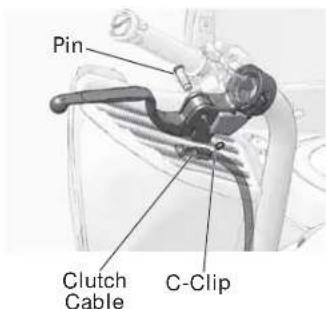
text_image
Pin Clutch Cable C-ClipMechanical Clutch Cable Lubrication
Lubricate control cable ends at the intervals recommended in the periodic maintenance table beginning on page 82.
NOTICE: External casings are factory-lubricated. Additional lubrication could be detrimental to cable performance.
Verify proper routing and smooth movement. Inspect for damage to the external casing, and inspect exposed cable wire for fraying, kinks or corrosion. Replace any damaged, sticky or sluggish cable.
- Disconnect the cable at the clutch lever and at the primary cover.
- Lubricate the barrel ends with all-purpose grease.
- Reconnect the cable and adjust freeplay as needed.
Maintenance
Rear Brake Pedal
- Lubricate the pivot bushing at the intervals recommended in the periodic maintenance table beginning on page 82. Also lubricate any time binding is evident. Use all-purpose grease.
- Inspect brake pads as outlined on page 100.
Brake Hoses/ Connections
Inspect all brake hoses and connections for dampness or stains from leaking or dried fluid. Tighten any leaking connections and replace components as necessary. See the INDIAN MOTORCYCLE Service Manual or an authorized INDIAN MOTORCYCLE dealer.
Brake Fluid Precautions
WARNING
Using the wrong fluid or allowing air or contaminants into the fluid system can damage the system seals or result in a malfunction that could lead to serious injury or death. Use only DOT 4 brake fluid from a sealed container.
Do not operate the front brake with the reservoir cover removed. Fluid could overflow from the reservoir and allow air to enter the system. Air in the brake system could cause the brakes to malfunction.
An over-full reservoir may cause brake drag or brake lock-up, which could result in serious injury or death. Maintain brake fluid at the recommended level. Do not overfill.
NOTICE: Brake fluid will damage painted surfaces and plastic parts. Always clean spilled brake fluid immediately with water and a mild detergent.
Maintenance Rear Brake Fluid
Change the brake fluid at the intervals recommended in the periodic maintenance table beginning on page 82. Always add brake fluid from a new, unopened container. Always use the recommended fluid. See page 128.
-
Position the motorcycle on level ground in the fully upright position.
-
The rear brake fluid reservoir is located near the rear brake pedal. View the reservoir from the right side of the vehicle.
-
Wipe the fluid container and the area around the reservoir cover with a clean cloth.
-
If the fluid level is low, inspect brake pads as outlined on page 100. If pads are not worn beyond the service limit, inspect the brake system for leaks.
-
Remove the cover and diaphragm. The fluid level should be above the minimum indicator mark on the reservoir body. Add brake fluid as needed. Do not overfill.
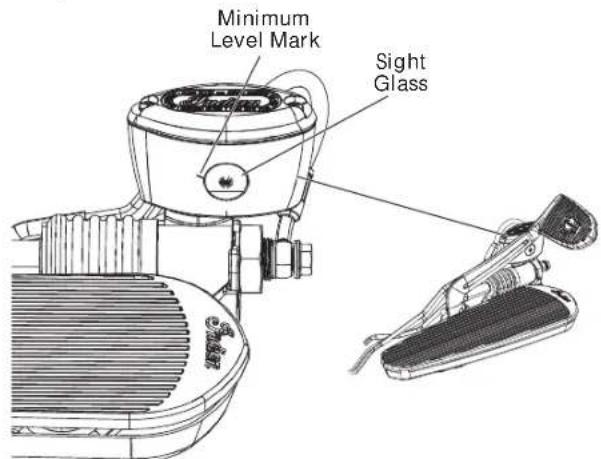
text_image
Minimum Level Mark Sight Glass-
Reinstall the cover and diaphragm.
-
Wipe away any fluid spills. Check for signs of brake fluid leaks around hoses, fittings, reservoir, and brake calipers.
Front Brake Lever
- See page 55 for front brake lever reach adjustments.
- Lubricate the pivot pin and brake lever hinge points at the intervals recommended in the periodic maintenance table beginning on page 82. Also lubricate any time binding is evident. Use all-purpose grease.
- Inspect brake pads as outlined on page 100.
Front Brake Fluid
Change the brake fluid at the intervals recommended in the periodic maintenance table beginning on page 82. Do not attempt to change the anti-lock brake system fluid. Please see your dealer for this service. Always add brake fluid from a new, unopened container. Always use the recommended fluid. See page 128.
- Position the motorcycle on level ground in the fully upright position. Position the handlebars so that the fluid reservoir is level. Wipe the fluid container and the area around the reservoir cover with a clean cloth.
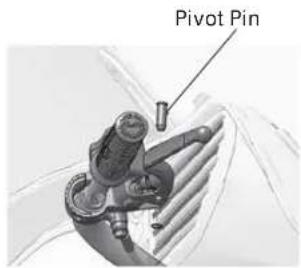
text_image
Pivot PinMaintenance
- If the fluid level is low, inspect brake pads as outlined on page 100. If pads are not worn beyond the service limit, inspect the brake system for leaks.
- To add fluid, remove the reservoir cover screws. Remove the cover and diaphragm.
- The fluid level should be above the minimum indicator mark in the sight glass. Add brake fluid as needed. Do not overfill.
- Reinstall the diaphragm, cover and screws.
Torque: 13 in-lbs (1.4 Nm)
- Wipe away any fluid spills. Check for signs of brake fluid leaks around hoses, fittings, reservoir and brake calipers. Check for deterioration of hoses.
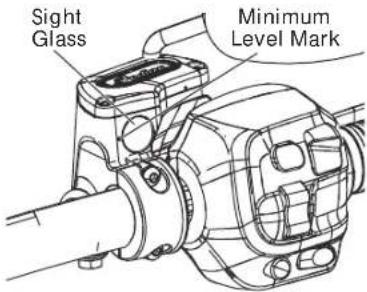
text_image
Sight Glass Minimum Level MarkMaintenance
Brake Disc Inspection/ Cleaning
-
Inspect brake discs for nicks, scratches, cracks or other damage. Inspect the thickness of each brake disc at four or more locations around the disc. If any disc is worn to the minimum thickness at the thinnest point, or if a disc is damaged, see your dealer for replacement.
-
Clean discs if minor squeaks develop due to dirt or dust. Apply brake cleaner to a clean shop towel and wipe the discs. DO NOT allow brake cleaner to contact painted or plastic parts. Read all precautions on the label.
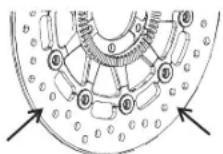
Inspect Surface
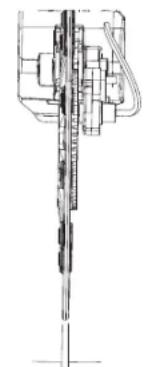
natural_image
Technical line drawing of a mechanical assembly (no text or symbols visible)Minimum
Thickness
Front: 4.5 mm
Rear: 6.5 mm
Brake Pads
Inspect each front brake pad on both sides of the front disc. Inspect each rear brake pad on both sides of the rear disc. Replace brake pads when the thinnest point of the friction material has worn to 1.0 mm. Please see your dealer for this service.
Tip: After replacing pads, allow up to 250 miles (500 km) of operation in urban driving conditions (not highway cruising) to allow pads to mate with new rotors. Brakes should be used frequently. During this time brake performance will be less effective. Avoid using brakes harshly unless in efficiency will gradually increase due
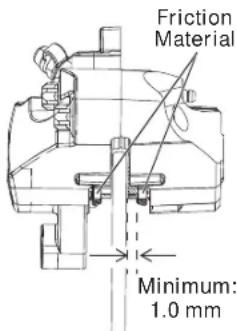
text_image
Friction Material Minimum: 1.0 mmWhen checking brake pad friction material thickness, check each brake caliper for dampness or stains from leaking or dried brake fluid. If inspection reveals signs of fluid leakage, do not operate the vehicle. See your dealer for service.
Brake Pads
Front Brake Pad Inspection
- Remove the two acorn nuts and one screw securing the protective caliper covers. Remove the covers.
- Use an inspection mirror, positioned at the front side of the caliper, to view the friction material.
- Reinstall the caliper covers.
Torque: 18 ft-lbs (24 Nm)
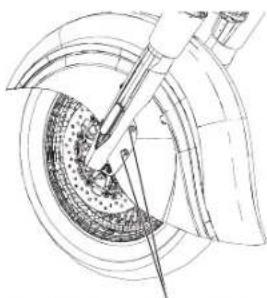
natural_image
Technical line drawing of a mechanical assembly with no visible text or symbolsFront Caliper Cover Nuts
Rear Brake Pad Inspection
- Position the motorcycle on the sidestand with the handlebars turned to the left.
- Use an inspection mirror, positioned at the front side of the caliper, to view the friction material.
Maintenance
Anti-Lock Brake System (ABS) Tone Ring/ Sensor Inspection
-
Visually inspect for damaged teeth on the front and rear ABS tone rings. Inspect for nicks and dents on the face of the teeth. The teeth edges should be consistent in appearance. If a tone ring is damaged, see your dealer for replacement as soon as possible.
-
Inspect for debris adhering to the end of the wheel speed sensors. If contaminati unable to visually insp face of the sensor betw to remove any potenti
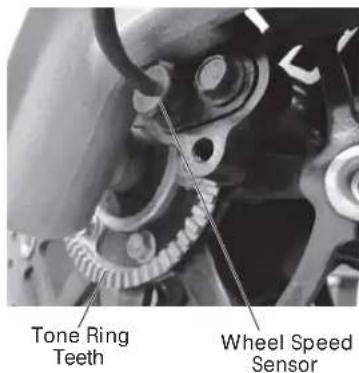
text_image
Tone Ring Teeth Wheel Speed SensorMaintenance
Wheel Spokes
Inspect both wheels for loose, bent, broken or missing spokes (if equipped). To identify loose spokes, grasp each spoke and try to move it side to side or up and down. All spokes should be equally tight and have the same amount of flex. Tighten loose spokes and replace bent, broken or missing spokes (see an authorized dealer).
WARNING! Spokes adjusted or replaced improperly could distort the wheel, make the motorcycle difficult to handle, and cause loss of control.
Wheel Inspection
Inspect both wheels for cracks or damage and replace damaged wheels promptly. Do not operate the motorcycle if wheels are damaged or cracked. See the INDIAN MOTORCYCLE Service Manual or an authorized INDIAN MOTORCYCLE dealer.
Wheel Alignment
Inspect rear wheel alignment at regular service intervals, whenever the rear wheel is removed and when the rear drive belt is adjusted. Please see your dealer for this service.
Front Wheel Installation
If the front wheel is removed for any reason, it must be reinstalled in the correct rotating direction.
Clean all wheel components before installation. Apply a light coat of all-purpose grease to the axle and both spacers.
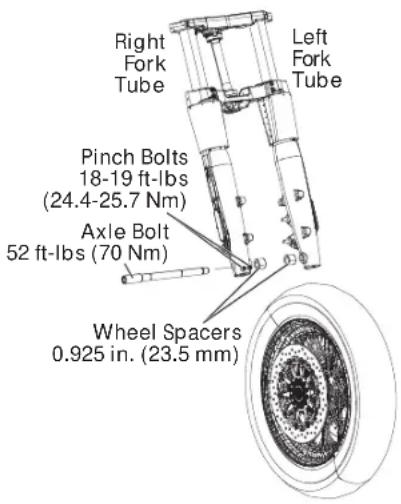
text_image
Right Fork Tube Left Fork Tube Pinch Bolts 18-19 ft-lbs (24.4-25.7 Nm) Axle Bolt 52 ft-lbs (70 Nm) Wheel Spacers 0.925 in. (23.5 mm)Maintenance
Tires
WARNING
Operating the motorcycle with incorrect tires, incorrect tire pressure or excessively worn tires could cause loss of control or accident. Underinflation can cause a tire to overheat and result in a tire failure. Always use the correct size and type of tires specified by INDIAN MOTORCYCLE for your vehicle. Always maintain proper tire pressure as recommended in the rider's manual and on safety labels.
Tire Replacement
NOTICE: On models equipped with a TPMS, the sensors are located 180^ from the valve stem. Use caution when servicing tires. To avoid damaging a sensor, break the bead at the valve stem, then at 90^ and 270^ from the valve stem as required.
Tires, rims, innertubes and air valves must be correctly matched to wheel rims. Use only the proper size tires specified with the same or higher load ratings. INDIAN MOTORYCLE-recommended tires provide proper clearance between fenders, swingarm, drive belts and other components. See the Specifications section beginning on page 124.
On models equipped with inertubes, inertubes MUST be replaced with new inertubes when tires are replaced. Use only the proper size inertubes.
WARNING! Mismatched tires, rims and air valves may result in damage to the tire bead during mounting or may allow the tire to slip off the rim, possibly resulting in tire failure.
Tire Condition
Inspect the tire sidewalls, road contact surface, and tread base for cuts, punctures, and cracking. Replace damaged tires immediately. See the INDIAN MOTORCYCLE Service Manual or an authorized INDIAN MOTORCYCLE dealer.
Tire Tread Depth
Replace any tire with a tread depth of less than 1/16 inch (1.6 mm).
Tread wear indicators are located in at least six places on the tread circumference and become visible at a tread depth of approximately 1/16 inch (1.6 mm). The tread wear indicators appear as a solid band across the tread.
You may also use a depth gauge or an accurate ruler to measure the depth of the center tire tread on both front and rear tires.
Maintenance
Tires
Tire Pressure
Always check and adjust tire pressure when tires are cold. Do not adjust tire pressure immediately after riding. Wait at least 3 hours after riding to check pressure. If pressure checked and adjusted while tires are warm, the pressure will drop as tires cool and result in underinflation.
Adjust tire pressure as recommended for the total weight of your intended load (see chart below). For more information, refer to the manufacturing information label located on the front frame downtube. See page 17.
WARNING! Do not exceed the maximum recommended inflation pressure to seat the bead. Tire or rim failure may result.
| Location Size | Brand Type | Recommended Pressure | |||
| Loads up to 200 lbs.(91 kg) | Loads up to vehicle's maximum load capacity | ||||
| Black Tires | |||||
| Front 130/90-B1 | 6 73H Dunlop Elite 3 36 psi (248 kPa) 36 psi (248 kPa) | ||||
| Rear 180/60-R1 | 6 80H Dunlop Elite 3 41 psi (283 kPa) 41 psi (283 kPa) | ||||
| White Wall Tires | |||||
| Front 130/90-B1 | 6 67H Dunlop American Elite 36 psi (248 kPa) 36 psi (248 kPa) | ||||
| Rear 180/65-B1 | 6 81H Dunlop American Elite 40 psi (276 kPa) 40 psi (276 kPa) | ||||
Maintenance
Spark Plugs
Inspect spark plugs after the break-in period and every 15,000 miles (24,000 km) thereafter. Replace spark plugs every 30,000 miles (48,000 km). Always replace spark plugs in pairs.
| Spark Plug Specifications | |
| Spark Plug Type NGK DCPR8E | |
| Spark Plug Gap .036 inch (.9 mm) | |
| Spark Plug Torque 12 ft-lbs (16.3 Nm) | |
- Make sure the engine has cooled to room temperature.
- Turn the power switch off.
- Pull upward on the spark plug boots (not the wires) to remove the boots.
CAUTION! Wear eye and face protection when using pressurized air.
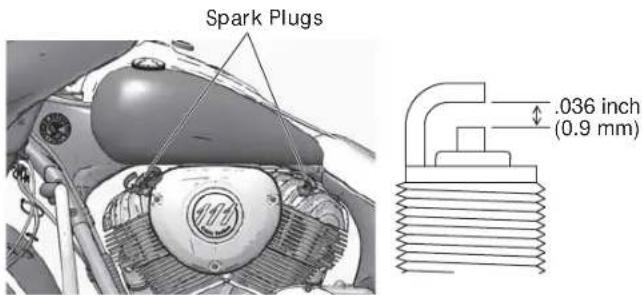
text_image
Spark Plugs .036 inch (0.9 mm)- To prevent debris from entering the spark plug holes, use compressed air to clean the area around the plugs before removing them.
Tool: 12 mm plug socket
Tip: Both spark plugs should have the same light or medium tan color deposits. The electrodes should be square with sharp edges.
- Reinstall the spark plugs or install new plugs.
- Reinstall the spark plug boots.
Side Covers
Remove the left side cover to access the tool kit, shock air fitting (if equipped), fuse box and diagnostic connector.
Remove both side covers to access the seat mounting fasteners and the electrical connections for the saddlebags.
- Pull outward at each corner of the side cover to disengage the three darts.
- Remove the side cover from the motorcycle.
- To reinstall the side cover, make sure each rubber grommet is properly positioned. Align each dart with the appropriate grommet and press inward firmly to secure each dart.
Maintenance
Seat Removal
Remove the seat to access the battery.
- Remove the left side cover to access the tool kit.
- Locate the seat mount brackets under the edge of the driver's seat. Remove the seat mount bolt from each side of the seat.
- Remove the rear bracket bolt, washer and nylon grommet from the passenger portion of the seat (if equipped).
- Lift the rear of the seat and pull rearward to disengage the front mounting tab of the seat from the frame mount. Do not allow the seat mount brackets to contact the rear fender.
Seat Installation
- Position the seat by inserting the seat mounting tab from rear to front into the mount on the top of the frame.
- Rotate the rear of the seat downward and position the side mount seat brackets onto the frame. Do not allow the seat mount brackets to contact the rear fender.
- On each side, thread the seat mount bolt through the seat mount bracket and into the frame. Torque seat bolts to specification.
Torque: 18 ft-lbs (13.5 Nm)
- Gently raise the rear bracket and reinstall the nylon grommet. Thread the rear bracket bolt and washer through the bracket and nylon grommet. Torque the bolt to specification.
Torque: 96 in-lbs (10.8 Nm)
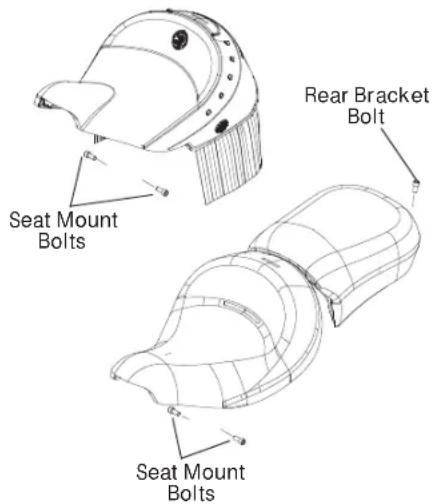
text_image
Seat Mount Bolts Rear Bracket Bolt Seat Mount BoltsMaintenance
Headlight Aim Inspection
On high beam, the center of highest intensity (appearing as a diamond shape) should be 7.5 in. (19 cm) lower than the headlamp bulb and centered straight ahead at 25 feet (7.6 m).
- Verify that tire pressure is at specification. See page 104.
- Verify that rear suspension ride height (preload) is at specification. See page 88.
- Position the motorcycle on a level surface with the headlight 25 feet (7.6 m) from a wall.
- With the operator and passenger (if applicable) on board, bring the motorcycle to the fully upright position.
- Start the engine and switch the headlamp to high beam. Observe the headlight aim on the wall.
- Make any necessary adjustments to headlight aim. See page 108.
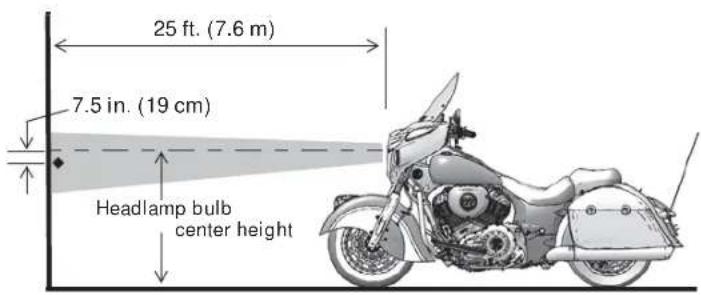
text_image
25 ft. (7.6 m) 7.5 in. (19 cm) Headlamp bulb center heightMaintenance Headlight Aim Adjustment
The headlamp adjustment screws are located inside the headlamp housing.
- CHIEFTAIN only: Remove the two headlight bezel screws and remove the bezel from the fairing. Reinstall the bezel after adjusting the headlamp.
Tool: M4 hex wrench or universal tool
- To adjust the headlamp vertically, tighten both top adjustment screws equally to adjust the beam downward. Loosen both screws equally to adjust the beam upward.
Tool: M4 hex wrench or universal tool
- To adjust the headlamp horizontally, loosen the left side screw to adjust the beam to the left. Loosen the right side screw to adjust the beam to the right.
Adjustment Screws
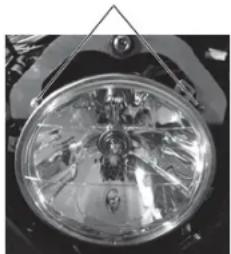
natural_image
Close-up of a circular mechanical component with reflective surfaces and a triangular handle (no visible text or symbols)Headlight Lamp Replacement (CHIEF)
- Remove the six bolts securing the front nacelle headlight shroud. Pull this piece forward to access the headlight.
-
Remove the sealing boot. Press the looped end of the wire bulb retainer clip and swing the end toward the center of the bulb to release it from the latch tab.
-
With the wire connector attached, pull the bulb out. Disconnect the wire harness.
-
Install the new bulb and secure the retainer.
Tip: Avoid touching a halogen lamp with bare fingers. Oil from your skin leaves a residue, causing a hot spot that will shorten the life of the lamp. If a lamp is touched, clean it thoroughly with denatured alcohol.
-
Reinstall the sealing boot. Make sure it seals tightly around the bulb base and lens to prevent condensation.
-
Reinstall the front nacelle headlight shroud.
-
Tighten the two (2) top bolts.
Torque: 36 in-lbs (4 Nm)
- Tighten the four (4) rear bolts.
Torque: 84 in-lbs (9.5 Nm)
Maintenance
Headlight Lamp Replacement (CHIEFTAIN)
- Remove the two bolts securing the front trim bezel to the fairing. Pull this piece forward to access the headlight.
- Remove the four screws securing the headlamp retaining ring. Remove the retaining ring.
Tool: Phillips screwdriver or universal tool - Remove the headlight assembly from the headlight carrier.
- Remove the sealing boot. Press the looped end of the wire bulb retainer clip and swing the end toward the center of the bulb to release it from the latch tab.
-
With the wire connector attached, pull the bulb out. Disconnect the wire harness.
-
Install the new bulb and secure the retainer.
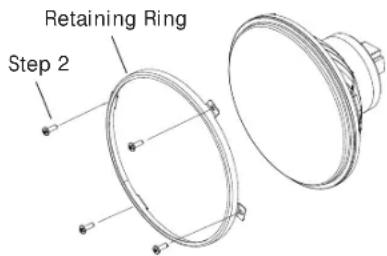
text_image
Retaining Ring Step 2Tip: Avoid touching a halogen lamp with bare fingers. Oil from your skin leaves a residue, causing a hot spot that will shorten the life of the lamp. If a lamp is touched, clean it thoroughly with denatured alcohol.
-
Reinstall the sealing boot. Make sure it seals tightly around the bulb base and lens to prevent condensation.
-
Reinstall the headlight assembly into the carrier, being sure to index the assembly properly.
-
Reinstall the retaining ring with the four screws.
-
Reinstall the sealing boot. Make sure it seals tightly around the bulb base and lens to prevent condensation.
- Reinstall the headlight assembly into the carrier, being sure to index the assembly properly.
- Reinstall the retaining ring with the four screws.
Torque: 12 in-lbs (1.4 Nm)
- Reinstall the front trim bezel and bolts.
Torque: 36 in-lbs (4 Nm)
Maintenance Battery
The motorcycle battery is a sealed, maintenance-free battery. Do not remove the battery cap strip for any reason. Keep the battery connections clean and tight at all times.
WARNING
Battery electrolyte is poisonous. It contains sulfuric acid. Serious burns can result from contact with skin, eyes or clothing.
Antidote:
External: Flush with water.
Internal: Drink large quantities of water or milk. Follow with milk of magnesia, beaten egg, or vegetable oil. Call physician immediately.
Eyes: Flush with water for 15 minutes and get prompt medical attention.
Batteries may produce explosive gases.
- Keep sparks, flame, cigarettes, etc. away.
- Ventilate when charging or using in an enclosed space.
• Always shield eyes when working near batteries - KEEP OUT OF REACH OF CHILDREN.
Battery Removal
- Remove the seat. See page 106.
WARNING! Improperly connecting or disconnecting battery cables can result in an explosion and cause serious injury or death. When removing the battery, always disconnect the negative (black) cable first. When reinstalling the battery, always connect the negative (black) cable last.
- Remove the fastener securing the battery cover to the frame crossmember.
- Lift the cover, with the attached electronic module in place, folding the wires toward the fuel tank.
Tool: 5 mm hex key wrench
- Remove the negative (-) battery cable from the battery terminal. Position the cable well clear of the terminal.
Tool: 10 mm wrench
- Remove the rubber cover from the positive (+) battery cable and remove the cable from the terminal. Position the cable well clear of the terminal.
- Remove the battery.
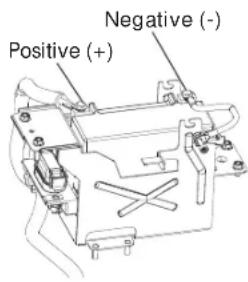
text_image
Positive (+) Negative (-)Maintenance
Battery Installation
WARNING! Improperly connecting or disconnecting battery cables can result in an explosion and cause serious injury or death. When removing the battery, always disconnect the negative (black) cable first. When reinstalling the battery, always connect the negative (black) cable last.
NOTICE: Do not remove the battery cables while the engine is running. Doing so may damage the Electronic Control Unit (ECM). Take great care not to reverse the battery leads when installing the battery. Reverse power applied to the ECM will damage it instantly.
- Inspect the battery box and cover for damage. Be sure pads are in good condition and properly located.
- Make sure cable ends and battery terminals are clean. Apply a light film of dielectric grease to the terminal bold threads.
-
Carefully position the battery into the battery box with the negative (-) terminal toward the front of the motorcycle.
-
Make sure the positive (+) cable is routed horizontally and perpendicular to the long side of the battery. Connect the positive (+) cable to the positive (+) battery terminal. Torque: 45 In-lbs (5 Nm)
- Install the negative (-) cable last. Route the starter ground cable beneath the frame ground cable on the negative battery terminal. Torque: 45 in-lbs (5 Nm)
- Reinstall the battery cover and fastener. Torque: 84 in-lbs (9.5 Nm)
- Reinstall the seat. See page 106.
Positive (+) Cable
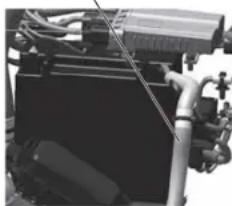
natural_image
Close-up of industrial machinery components with pipes and valves (no visible text or symbols)Maintenance
Battery Charging
If your motorcycle will not be used for a period of four (4) weeks or longer, a maintenance charger should be connected to the battery. A maintenance charger can be purchased through your authorized INDIAN MOTORCYCLE dealer.
- Following the charger manufacturer's instructions, use a battery charger designed for use with 12-volt batteries. The charger should have a maximum charging rate of 1.8 amps. Charge the battery for approximately 10 hours at a rate of 1.8 amps. If you use a taper or trickle charger, it will take longer to charge the battery.
- After charging the battery, allow the battery to sit 1-2 hours before checking the state of charge with a DC volt meter. The charge should be a minimum of 12.5 DC volts. Repeat the charging cycle if the charge is less than 12.5 DC volts. Replace the battery if it fails to reach 12.5 volts after the second charge.
Fuse Replacement
NOTICE: Use fuses with the recommended amperage to avoid damage to the electrical system.
Standard Fuses
The standard fuse box is located under the left side cover. This fuse box houses all standard service fuses and the automatic circuit breakers. Fuse application and size are provided on a label on the fuse box cover.
Tip: Use the fuse puller provided in the tool kit to remove a fuse.
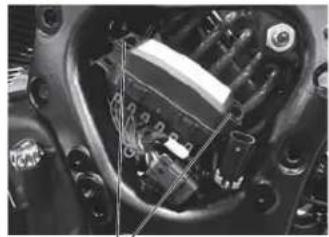
natural_image
Close-up of a mechanical component with visible wiring and mounting holes (no text or symbols)Fuse Box Cover Clips
- Remove the left side cover. See page 105.
- Release the locking tabs, then squeeze the upper and lower cover clips to remove the fuse box cover.
- After replacing a fuse, reinstall the fuse box cover and side cover.
Maintenance
High-Current Fuses
The JCASE® fuse box contains the high-current fuses for the chassis, vehicle control module and anti-lock brake system. This fuse box is located next to the battery box.
Fuse application and size are provided on a label on the fuse box cover.
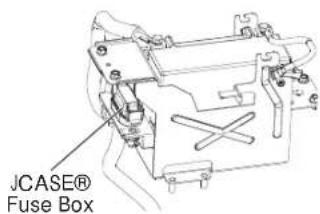
text_image
JCASE® Fuse BoxMaintenance Electrical Precautions
Be aware of the following precautions regarding the electrical system to avoid disruption of electrical signals and possible system malfunction.
- DO use ONLY genuine INDIAN MOTORYCLE parts and accessories designed for your model, and follow the instructions provided.
- DO use the accessory power jack provided (if equipped).
- If it is necessary to provide power to an item that does not use one of the previously mentioned power jacks, connect to the load side of the main circuit breaker (under the cover behind the oil cooler), and connect the ground wire to the engine ground at the front left side of the crankcase (near the circuit breaker).
- DO NOT splice or cut any wires.
- DO NOT tap in to any power or ground on the motorcycle unless specifically directed to do so by the INDIAN MOTORYCLE instructions that come with the kit.
- DO NOT back-probe electrical connectors on the vehicle unless directed to do so by the INDIAN MOTORCYCLE Service Manual.
- DO NOT power any accessories from the diagnostic connector (under left side cover).
Unlocking the Security System
If a key fob is not available, your personal identification number (PIN) can be entered using the turn signal switches to unlock the security system. Use the following guide to enter your valid PIN.
| Digit to Enter | Turn Signal Feature Used | Procedure |
| The number “0” CAN | CEL switch Press and | release |
| First digit (1-9) LEFT | turn switch Move and | releaseonce per digitvalue. See example below. |
| Second digit (1-9) RIGHT | HIT turn switch | |
| Third digit (1-9) LEFT | turn switch | |
| Fourth digit (1-9) RIGHT | HIT turn switch | |
| Example for entering the number 1024:LEFT - CANCEL - LEFT - LEFT - RIGHT - RIGHT - RIGHT | ||
Maintenance
Changing Your Security System PIN
To change your PIN, you must have either the key fob or your existing valid PIN available to gain access to the security system. If the key fob is not detected or is not available and you cannot remember your PIN, please see your INDIAN MOTORCYCLE dealer.
Please read the entire procedure before beginning.
- Turn the power switch on. Do NOT start the engine. The security light and/or power switch will turn on briefly until the key fob is detected or the valid PIN is entered.
- When the key fob is detected, the security light and/or power switch will turn off. Proceed to step 4. If the key fob is not available or is not detected, enter your valid PIN within 20 seconds. See page 114.
Tip: If the valid PIN is not entered within 20 seconds, the security light and/or power switch will flash for 10 seconds, then the system will shut down. Return to step 1 to try again. - When the PIN is accepted, the security light and/or power switch will turn off. Proceed to step 4.
- When the security light and/or power switch turns off, press and hold the turn signal CANCEL switch for 10 seconds. The security light and/or power switch will turn on to confirm access to the security system. Proceed to step 5 to enter your new PIN.
Entering Your New PIN
- Enter your new 4-digit PIN.
- If 4 digits are successfully entered, the security light and/or power switch will remain on and the horn will sound briefly. Proceed to step 7.
Tlp: If the 4-digit PIN is NOT successfully entered within 20 seconds, the security light and/or power switch will flash for 10 seconds, then the system exits the procedure. Return to step 1 to try again. - Re-enter the new 4-digit PIN. If this entry matches the first entry, the security light and/or power switch will turn off and the horn will sound briefly. Your new PIN has been saved.
Tip: If the second entry is not entered within 20 seconds or does not match the first entry, the security light and/or power switch will flash for 10 seconds, then the system exits the procedure. The new PIN was NOT saved. Continue to use your former valid PIN. Return to step 1 to try again.
Maintenance
Engine Compression Test
An engine compression test can be performed to monitor general engine condition. See the INDIAN MOTORCYCLE Service Manual or an authorized INDIAN MOTORCYCLE dealer.
Exhaust System Inspection
Check the exhaust system for stains from leaking exhaust gasses. Replace damaged or leaking exhaust gaskets. Check all exhaust system fasteners. Tighten loose clamps and fasteners. Do not overtighten. See the INDIAN MOTORCYCLE Service Manual or an authorized INDIAN MOTORCYCLE dealer.
Elevating the Motorcycle
WARNING! Serious injury or death can occur if the motorcycle tips or falls. Make sure the motorcycle will not tip or fall while elevated or while on the sidestand.
Some procedures require raising the motorcycle to remove weight from the component being inspected. Elevate the motorcycle by placing a stable, flat platform jack or lift mechanism on a firm, flat surface and lifting under the engine crankcase. The platform should be a minimum of 12 inches (30 cm) square. DO NOT attempt to lift the motorcycle without proper equipment. Always secure the motorcycle properly before lifting so it cannot tip or fall when elevated.
Road Test
Before returning the motorcycle to regular use, perform a road test in a safe area. Pay special attention to the proper fit and operation of all serviced components.
Make any corrections or additional adjustments promptly to ensure safe, reliable and enjoyable vehicle performance.
Fastener Inspection
-
Inspect the entire motorcycle chassis and engine for loose, damaged or missing fasteners. Tighten loose fasteners to the proper torque. See the INDIAN MOTORCYCLE Service Manual or an authorized INDIAN MOTORCYCLE dealer.
-
Always replace stripped, damaged or broken fasteners before riding. Use genuine INDIAN MOTORCYCLE fasteners of equal size and strength.
Fastener Torques
Some procedures and fastener torques are not listed in this manual. See the INDIAN MOTORCYCLE Service Manual or an authorized INDIAN MOTORCYCLE dealer.
Maintenance
Troubleshooting
For your personal safety, do not attempt inspection or repairs not fully described in this rider's manual. Contact an authorized dealer for service if you cannot determine the cause of a problem or if the inspection/repair exceeds your mechanical ability or tool resources. Do not perform any inspection or repair with the engine running.
Engine Cranks But Will Not Start
| Possible Cause Possible Remedy/ Action | |
| Low Fuel Verify fuel level | |
| Fuel Pump Inoperative Turn engine STOP switch to RUN. Turn the power switch on. The fuel pump should run momentarily and then stop. Check the fuel pump/ignition circuit breaker. See page 113. | |
| Battery Voltage Too Low Fully charge the battery. See page 112. | |
| Spark Plug(s) Fouled Inspect spark plugs. See page 105. | |
| Spark Plug Wire(s) Disconnected or Loose Be sure spark plug wires are securely fastened. | |
| Low Compression Please see your dealer for an engine compression test. | |
Starter Motor Clicks, Does Not Turn or Turns Slowly
| Possible Cause Possible Remedy/ Action | |
| Engine Stop/Run Switch in Stop Position Place switch in RUN position. | |
| Battery Discharged Fully charge the battery. See page 112. | |
| Battery Cables Loose or Corroded Inspect battery cables. | |
| Transmission In Gear Shift transmission into neutral or pull the clutch lever in to disengage the clutch. See starting procedures on page 70. | |
| Key Fob Not Authenticated | Make sure key fob is within range and that key fob battery voltage is not low. |
| Sidestand is Down With Transmission in Gear | Shift to neutral or retract the sidestand fully. |
Maintenance
Troubleshooting
Engine Starts But Misses or Runs Poorly
Tip: Turn engine OFF before inspecting any of these items.
| Possible Cause Possible Remedy/ Action | |
| Battery Discharged Fully charge the battery. See page 112. | |
| Battery Cables Loose or Corroded Inspect battery cables and connections. | |
| Spark Plug(s) Fouled Inspect spark plugs. See page 105. | |
| Spark Plug Wire(s) Loose or Wet Inspect spark plug wires, ensure dry/secure. | |
| Contaminated Fuel Inspect fuel for water/contamination. Please see your dealer. | |
| Engine Oil Level Incorrect Or Wrong Type Inspect level and quality of oil. See page 60. | |
| Loose, Broken, Shorted Ignition Coil Wires Inspect coil primary wires. Please see your dealer. | |
| Air Intake Restricted Inspect air filter. See page 86. | |
| Intake Leaks Inspect air box, throttle body and intake boot joints. | |
Shifting Difficulties or Hard to Find Neutral
| Possible Cause Possible Remedy/ Action | |
| Shift Linkage Bushings Dry Or Worn Lubricate shift linkage. | |
| Clutch Damage Replace clutch. | |
| Clutch Cable Not Adjusted Properly Please see your dealer for inspection and adjustment. | |
| Shift Linkage Not Adjusted Properly Please see your dealer for inspection and adjustment. | |
Maintenance
Troubleshooting
Battery Charging Rate Low or Battery Discharges
| Possible Cause Possible Remedy/ Action | |
| Loose/ Corroded Charging Circuit Connection | Check/clean battery cable connections. Check/clean charging circuit connections. Please see your dealer. |
| Accessory Load Exceeds Charge Rate Limit accessory operation when the engine is off. | |
| Improperly Wired Accessory (Current Draw) Please see your dealer to check charging system output and current draw. | |
Brake Noise/ Poor Brake Performance
Tip: See your dealer if brake performance does not return after these inspections.
| Possible Cause Possible Remedy/ Action | |
| Dust/Dirt On Brake Disc(s) Clean disc. See page 1 | 100. |
| Worn Pads Or Disc/Brake Disc Damage Inspect pads. See page 100. | |
| Brake Fluid Level Low Or Fluid Contaminated Inspect fluid level/fluid condition. See pages 62-63. | |
Anti-Lock Brake Light Remains Illuminated or Illuminates Intermittently
| Possible Cause Possible Remedy/ Action | |
| Blown fuse Check the fuses. See page 113. | |
| Loose or damaged pulse ring Inspect pulse ring for looseness or chipped teeth. | |
| Debris lodged in components Inspect wheel speed sensor and pulse ring for debris. | |
| Damage caused by debris Inspect wheel speed sensor for cracked housing. | |
| Damaged components | See service manual or authorized dealer. |
Cleaning and Storage Cleaning Products
This section provides tips on the very best way to clean, polish and preserve every surface of your beautiful new INDIAN motorcycle. We recommend the use of our new INDIAN MOTORCYCLE cleaning and polishing products and accessories, which have been specially designed to offer the best care possible for your INDIAN motorcycle.
In addition to the products recommended in this section for cleaning and polishing, INDIAN MOTORCYCLE also has specialty polishing products for:
- removing scratches, scuffs and swirls
• enhancing black and silver engines - cleaning engines, tires and wheels
- removing brake dust
After cleaning the motorcycle, inspect for damage to the painted surfaces. Repair chips or scratches promptly by applying INDIAN MOTORCYCLE touch-up paint to prevent corrosion.
For more information, or for answers to your cleaning and detailing questions, please see your INDIAN MOTORCYCLE dealer.
Washing the Motorcycle
NOTICE: Do not use pressurized water to wash the motorcycle. Water may seep in and deteriorate wheel bearings, brake caliper assemblies, brake master cylinders, electrical connectors, steering head bearings, and transmission seals. Do not direct any water stream at air intakes, exhaust outlets or electrical connectors.
Electrical components may be damaged by water. Do not allow water to contact electrical components or connectors.
- Before washing, make sure exhaust pipes are cool. Cover each pipe opening with a plastic bag secured with a strong rubber band. Check that the spark plugs, spark plug wire caps, oil fill cap and fuel caps are properly seated.
- Do not use abrasive cleaners.
- Rinse off as much dirt and mud as possible with water running at low pressure. Use as little water as possible when washing near the air intake or the exhaust pipe openings. Dry these components thoroughly before using the motorcycle.
- Clean the front fork tubes thoroughly to reduce fork seal wear and leakage.
- After washing, remove the rubber bands and plastic bags from the exhaust pipes. Start the engine and let it idle for a few minutes.
- Make sure the brakes are functioning properly before riding.
Windshield Care
Rinse the windshield with clean water to remove loose dirt and dust.
NOTICE: Do not use glass cleaners, water or soil repellents, and petroleum or alcohol based cleaners on the windshield, as these products can damage the windshield.
Leather Care
Leather must be cleaned and treated to properly maintain its quality appearance and extended life. Clean and treat leather more often under adverse conditions.
Use only cleaners and conditioners specifically designed for leather use.
- Use INDIAN MOTORYCLE Leather Care products.
- Do not clean leather with household soap or cleaners.
- Use high quality saddle soap or leather cleaner.
- Use of some leather treatment oils will darken distressed leather. Try a small amount on a hidden area first.
If you will not operate the motorcycle for more than 60 days, store the motorcycle to prevent damage to the fuel system and the battery and to protect components from corrosion or deterioration. During storage preparation you might use products that are potentially hazardous; such as fuel stabilizer. When using any of these products, follow the instructions and warnings on the product packaging.
Cleaning and Storage
Storage Area Preparation
Choose a dry, well-ventilated storage location, inside a garage or other structure if possible. The location should have a firm, flat surface and allow enough space for the motorcycle.
WARNING! Gasoline is highly flammable and explosive under certain conditions. Do not store the motorcycle in any area (in home or garage) where it could be near open flames, pilot lights, sparks or electric motors. Do not smoke in the storage area.
To best preserve tire condition:
- The storage area should have a relatively constant and moderate temperature.
- The storage surface should be free of oil and gasoline.
- The motorcycle should not be near a radiator or other heat source, or any type of electric motor.
Cleaning and Storage
Clean and Protect the Motorcycle
To prepare the motorcycle for storage, begin by cleaning it as outlined beginning on page 120. Wax painted surfaces and polish chromed and other metal surfaces. Apply protectant to exposed rubber, vinyl, and plastic parts.
Do not apply rubber protectant to the tire tread surfaces.
Fuel Stabilizer
Add fresh fuel to fill the fuel tank and add fuel stabilizer. Do not overfill.
Ride the motorcycle or start and run the engine for 15 minutes in a well ventilated area to distribute the stabilizer throughout the fuel system.
Tire Inflation
Inflate the tires to normal pressure. See page 104.
Engine Protection
Change the engine oil. See page 84.
Battery Care
- Remove the battery. See page 110.
- Clean the battery terminals first with a wire brush to remove any loose deposits.
- Wash the posts and the ends of the battery cables with a solution of one part baking soda to 16 parts water. Rinse with clean water and wipe dry.
- Apply a thin film of dielectric grease to the posts and cable connectors.
- Clean the outside of the battery with a solution of mild detergent and warm water.
- Store the battery in a dry area with a temperature of 32^ to 90^ F ( 0^ to 32^ C).
- While in storage, fully charge the battery once a month. See page 112.
Maintenance During Storage
During extended storage periods, maintain tire pressure and battery voltage at the recommended levels.
Cleaning and Storage
Rodents
Mice and other rodents are often the worst enemy of a stored motorcycle. If the motorcycle will be stored in an area where mice are a concern (particularly in rural areas, barns, sheds, etc.) be sure to take extra measures to deter their infestation. This may include placing a screen mesh over any intake or exhaust openings (just be sure to remember to remove them when you take the motorcycle from storage).
Park and Cover the Motorcycle
- Park the motorcycle in its storage location. Block the frame to take some of the weight off the front and rear wheels.
Tip: Starting the motorcycle periodically during storage is NOT recommended. Water vapor is a by-product of the combustion process, and corrosion may result unless the engine is operated long enough to bring the oil and exhaust system to normal operating temperature.
-
Secure a plastic bag over the (cooled) exhaust outlets to prevent moisture from entering the exhaust system.
-
Cover the motorcycle with a cover made from a durable, breathable material designed for storage. Covering the motorcycle helps protect it from dust and other airborne materials. The cover must be of a breathable material to prevent moisture from building up on the motorcycle which can cause oxidation of metal surfaces.
Removal From Storage
-
Install a fully charged battery.
-
Check the oil level. If the motorcycle was stored in an area subject to wide swings in temperature and humidity (such as outdoors), change the engine oil before starting the engine.
NOTICE: During storage, temperature and humidity changes can cause condensation to form in the crankcase and mix with engine oil. Running the engine with oil that contains condensation can cause engine damage.
-
Inspect the storage area for signs of fluid leaks. Identify and perform service to any leaking components.
-
Remove any intake or exhaust mesh covers installed for rodent protection.
-
Install new spark plugs if necessary.
-
Perform the pre-ride inspections. See page 57.
-
Perform a road test. See page 116.
-
Wash and polish the motorcycle. Wax, polish or apply protectant to appropriate components.
Specifications
| Model Year 2014 CHIEF CHIEFTAIN | ||
| Dimensions (Dimensions and specifications may vary with features, options and accessories) | ||
| Overall Length 102.7 in. (2609 mm) Classic | 103.3 in. (2625 mm) Vintage | 101.0 in. (2565 mm) |
| Overall Width 39.8 in. (1012 mm) 39.8 in. (1012 mm) | ||
| Overall Height 49.9 in. (1267 mm) Classic | 60.6 in. (1539 mm) Vintage | 60.2 in. (1530 mm) |
| Seat Height 26 in. (660 mm) 26 in. (660 mm) | ||
| Wheelbase 68.1 in. (1730 mm) 65.7 in. (1668 mm) | ||
| Ground Clearance 5.5 in. (140 mm) 5.6 in. (142 mm) | ||
| Rake (frame)/Trail 29°/6.1 in. (155 mm) 25°/5.9 in. (150 mm) | ||
| Weight | ||
| Dry Weight (without fuel/fluids) | 778 lbs. (354 kg) Classic801 lbs. (364 kg) Vintage | 815 lbs. (370 kg) |
| Wet Weight (with fuel/fluids) | 812 lbs. (369 kg) Classic835 lbs. (380 kg) Vintage | 848 lbs. (385 kg) |
| Gross Vehicle Weight Rating (GVWR) | 1260 lbs. (573 kg) | 1385 lbs. (630 kg) |
| Gross Axle Weight Rating (GAWR) | Front 485 lbs. (220 kg)Rear 775 lbs. (352 kg) | Front 500 lbs. (227 kg)Rear 885 lbs. (402 kg) |
| Maximum Load Capacity (riders, cargo, accessories) | 448 lbs. (204 kg) Classic425 lbs. (193 kg) Vintage | 537 lbs. (245 kg) |
Specifications
| Model Year 2014 CHIEF CHIEFTAIN | ||
| Capacities | ||
| Engine Oil 5.5 qts. (5.2 l) with filter at oil change 5.5 qts. (5.2 l) with filter at oil change | ||
| Fuel 5.5 gal. (20.8 l) 5.5 gal. (20.8 l) | ||
| Fuel Reserve (fuel light on) 1.0 gal. (3.8 l) 1.0 gal. (3.8 l) | ||
| Fork Oil 20.3 oz. (599 cc) 18.8 oz. (557 cc) | ||
| Engine | ||
| Engine Type ThunderStroke 111, Air Cooled | ||
| Configuration | V-Twin | |
| Displacement | 111 cu. in. (1811 cc) | |
| Cooling System | Air / Oil Cooler | |
| Compression Ratio | 9.5:1 | |
| Valve Train | 2 Valves Per Cylinder Hydraulic Lifters | |
| Bore and Stroke | 3.976" x 4.449" (101mm x 113mm) | |
| Fuel System/ Throttle Body Bore | Closed Loop Fuel Injection/54 mm | |
| Exhaust System | 1 into 2 with Catalytic Converter | |
| Rev Limit | 5400 RPM | |
| Idle RPM | 800 +/- 50 RPM Fully Warm | |
| Lubrication System | Semi-Dry Sump | |
| Spark Plug/ Gap | NGK DCPR8E/.034 inch (0.90 mm) | |
| Chassis | ||
| Front Suspension Type/ Travel | Telescopic Fork/4.68 in. (11.9 cm) | Telescopic Fork/4.68 in. (11.9 cm) |
| Front Fork Tube Diameter | 46 mm | 46 mm |
| Rear Suspension Type/ Travel | Single Shock/94mm | Single Shock/114mm |
| Swingarm | Cast Aluminum | |
| Front Brakes | Dual/Floating Rotor | |
| Rear Brakes | Caliper/Floating Rotor | |
Specifications
| Model Year 2014 CHIEF / CHIEFTAIN | |
| Drive System | |
| Primary Drive Gear Drive Wet Clutch | |
| Crank Gear 55 Teeth | |
| Clutch Gear 86 Teeth | |
| Clutch Type Wet, Multi-Plate | |
| Primary Reduction Ratio 1.564:1 | |
| Transmission Type 6 Speed/ Constant Mesh/Foot $hift | |
| 1st Gear Ratio 2.733:1 | |
| 2nd Gear Ratio 1.864:1 | |
| 3rd Gear Ratio 1.385:1 | |
| 4th Gear Ratio 1.103:1 | |
| 5th Gear Ratio 0.943:1 | |
| 6th Gear Ratio 0.811:1 | |
| Gear Shift Pattern 1 Down/5 Up | |
| Final Drive Type | Belt Drive, 152-Tooth |
| Transmission | 30-Tooth |
| Rear Wheel | 66-Tooth |
| Ratio | 2.2:1 |
| Overall Gear Ratio | |
| 1st Gear | 9.403:1 |
| 2nd Gear | 6.411:1 |
| 3rd Gear | 4.763:1 |
| 4th Gear | 3.796:1 |
| 5th Gear | 3.243:1 |
| 6th Gear | 2.789:1 |
Specifications
| Model Year 2014 CHIEF CHIEFTAIN | ||
| Wheels And Tires | ||
| Front Wheel Size/ Type 3.5 in. x 16 in. 40 Spoke 3.5 in. x 16 in. Cast Aluminum | ||
| Rear Wheel Size/ Type 5 in. x 16 in. 40 Spoke 5 in. x 16 in. Cast Aluminum | ||
| Front Tire Type/Size White 130/90-B16 67H American Elite Black 130/90-B16 73H Dunlop Elite 3 | ||
| Rear Tire Type/Size White 180/65-B16 81H American Elite Black 180/60-R16 80H Dunlop Elite 3 | ||
| Electrical | ||
| Alternator 710W @ 2000 RPM | ||
| Battery 12 volt, 18 amp/hour, 310 CCA (cold cranking amps) Sealed Glass Mat | ||
| Power Points Front - 10 amp maximum | Rear - 10 amp maximum(Combined - 10 amp maximum) | |
| Voltage Regulator | 14.4 volts/ 42 amp | |
| Lamps (all bulbs are 12 volt) | ||
| Headlight | H4 12V 60/55W LL | |
| Auxiliary Light | H8 35W (35W) | |
| Tail/ Brake Light | Non-serviceable LED | |
| Turn Signal | Non-serviceable LED | |
| License Plate | Non-Serviceable LED | |
| Front Fender Light | Non-Serviceable LED | |
| Speedometer | Non-Serviceable LED | |
| Indicator Lights | Non-Serviceable LED | |
Specifications Fuel Recommendation
For best performance, use only unleaded gasoline with a 91 pump octane minimum (R+M/2 Method). DO NOT USE E-85 GASOLINE OR GASOLINE CONTAINING METHANOL. Using E85 or gasoline/methanol blends can result in poor starting and driveability, engine damage and damage to critical fuel system components.
• Gasoline containing up to 15% Ethanol can be used
• Gasoline containing up to 15% Methyl Tertiary Butyl Ether (MTBE) can be used.
In the event that the recommended premium unleaded gasoline is not available and low octane fuel must be used, fill the fuel tank only partially with unleaded regular gasoline, then fill the tank fully with premium unleaded gasoline as soon as possible.
Engine Oil Recommendation
We recommend the use of INDIAN MOTORYCLE Premium Synthetic Blend 20W-40 Engine Oil for your motorcycle. This oil is formulated with synthetic-based oil and premium engine additive which have physical properties that meet API SM and ILSAC GF-4 specifications.
Do not blend oil additives with engine oil.
If oil must be added in an emergency and the recommended oil is not available, choose only a high-quality 20W-40 motorcycle oil. Change back to the recommended oil at the first opportunity.
NOTICE: Use of non-recommended lubricants can result in engine damage. Damage resulting from the use of non-recommended lubricants is not covered by warranty.
Fork Oil
We recommend the use of INDIAN MOTORCYCLE Fork Oil for your motorcycle.
Brake Fluid
We recommend the use of INDIAN MOTORCYCLE DOT 4 Brake Fluid for both brake master cylinders. DO NOT use DOT 5 silicone fluid.
Specifications
Identification Number Record
| Record important identification numbers below. | |
| Vehicle Identification Number (VIN) (see page 17) | |
| Engine Identification Number (see page 20) | |
Warranty
INDIAN MOTORCYCLE Warranty Policy
LIMITED WARRANTY
Indian Motorcycle Company, 2100 Highway 55, Medina, MN 55340 (INDIAN MOTORCYCLE) gives a ONE YEAR LIMITED WARRANTY on all components of your INDIAN motorcycle against defects in material or workmanship. This warranty covers parts and labor charges for repair or replacement of defective parts and begins on the date of purchase by the original retail purchaser. This warranty is transferable to another owner during the warranty period through an INDIAN MOTORCYCLE dealer, but any such transfer will not extend the original term of the warranty. The duration of this warranty may vary by international region based upon local laws and regulations.
EXTENDED SERVICE CONTRACT (ESC) NOT PART OF LIMITED WARRANTY
INDIAN MOTORCYCLE provides the original retail purchaser of this INDIAN motorcycle with a 5 year extended service contract (ESC) that begins at the time of registration. The ESC is separate from, has different terms and coverage, is not a part of, and has no effect on the terms, coverage, or duration of this Limited Warranty. Please review those terms and conditions for information regarding the ESC. In some circumstances, the ESC may not be transferred to a used or second-hand purchaser of this INDIAN motorcycle. INDIAN MOTORCYCLE makes no representations and disclaims all liability regarding the availability or transferability of the ESC to a used or second-hand purchaser.
REGISTRATION
At the time of sale, the Warranty Registration Form must be completed by your dealer and submitted to INDIAN MOTORCYCLE within ten days of purchase. Upon receipt of this registration, INDIAN MOTORCYCLE will record the registration for warranty. No verification of registration will be sent to the purchaser as the copy of the Warranty Registration Form will be your proof of warranty coverage. If you have not signed the original registration and received the customer copy, please contact your dealer immediately. NO WARRANTY COVERAGE WILL BE ALLOWED UNLESS YOUR MOTORCYCLE IS REGISTERED WITH INDIAN MOTORCYCLE. Initial dealer preparation and set-up of your motorcycle is very important in ensuring trouble-free operation. Purchasing a vehicle in the crate or without proper dealer set-up will void your warranty coverage.
INDIAN MOTORCYCLE Warranty Policy WARRANTY COVERAGE AND EXCLUSIONS: LIMITATIONS OF WARRANTIES AND REMEDIES
This INDIAN MOTORCYCLE limited warranty excludes any failures that are not caused by a defect in material or workmanship. THIS WARRANTY DOES NOT COVER CLAIMS OF DEFECTIVE DESIGN. This warranty also does not cover acts of God, accidental damage, normal wear and tear, abuse or improper handling. This warranty also does not cover any motorcycle, component, or part that has been altered structurally, modified, neglected, improperly maintained, or used for purposes other than for which it was designed.
This warranty excludes damages or failures resulting from: improper lubrication; improper engine timing; improper fuel; surface imperfections caused by external stress, heat, cold or contamination; operator error or abuse; improper component alignment, tension, adjustment or altitude compensation; snow, water, dirt or other foreign substance ingestion/contamination; improper maintenance; modified components; use of aftermarket or unapproved components, accessories, or attachments; unauthorized repairs; or repairs made after the warranty period expires or by an unauthorized repair center.
This warranty excludes damages or failures caused by abuse, accident, fire, or any other cause other than a defect in materials or workmanship and provides no coverage for consumable components, general wear items, or any parts exposed to friction surfaces, stresses, environmental conditions and/or contamination for which they were not designed or not intended, including but not limited to the following items:
- Wheels and tires • Filters • Fuel Injectors/Throttle body components
- Suspension components • Lubricants • Engine components
- Brake components • Bushings • Drive belts
- Seat components • Sealants • Hydraulic components and fluids
- Clutches and components
• Steering components - Batteries
- Coolants
- Bearings
• Finished and unfinished surfaces - Circuit breakers/Fuses
• Electronic components - Spark plugs
• Light bulbs/Sealed beam lamps
Warranty
INDIAN MOTORCYCLE Warranty Policy
LUBRICANTS AND FLUIDS
- Mixing oil brands or using non-recommended oil may cause engine damage. We recommend the use of INDIAN MOTORCYCLE engine oil.
- Damage or failure resulting from the use of non-recommended lubricants or fluids is not covered by this warranty.
This warranty provides no coverage for personal loss or expense, including mileage, transportation costs, hotels, meals, shipping or handling fees, motorcycle pick-up or delivery, replacement rentals, loss of vehicle use, loss of profits, or loss of vacation or personal time.
THE EXCLUSIVE REMEDY FOR BREACH OF THIS WARRANTY SHALL BE, AT INDIAN MOTORCYCLE'S OPTION, REPAIR OR REPLACEMENT OF ANY DEFECTIVE MATERIALS, COMPONENTS, OR PRODUCTS. THE REMEDIES SET FORTH IN THIS WARRANTY ARE THE ONLY REMEDIES AVAILABLE TO ANY PERSON FOR BREACH OF THIS WARRANTY. INDIAN MOTORCYCLE SHALL HAVE NO LIABILITY TO ANY PERSON FOR INCIDENTAL,
CONSEQUENTIAL OR SPECIAL DAM AGES OF ANY DESCRIPTION, WHETHER ARISING OUT OF EXPRESS OR IMPLIED WARRANTY OR ANY OTHER CONTRACT, NEGLIGENCE, OR OTHER TORT OR OTHERWISE. THIS EXCLUSION OF CONSEQUENTIAL, INCIDENTAL, AND SPECIAL DAM AGES IS INDEPENDENT FROM AND SHALL SURVIVE ANY FINDING THAT THE EXCLUSIVE REMEDY FAILED OF ITS ESSENTIAL PURPOSE.
THE IMPLIED WARRANTY OF FITNESS FOR A PARTICULAR PURPOSE IS EXCLUDED FROM THIS LIMITED WARRANTY. ALL OTHER IMPLIED WARRANTIES (INCLUDING BUT NOT LIMITED TO THE IMPLIED WARRANTY OF MERCHANTABILITY) ARE LIMITED IN DURATION TO THE ABOVE 12 MONTH WARRANTY PERIOD. INDIAN MOTORCYCLE DISCLAIM'S ALL EXPRESS WARRANTIES NOT STATED IN THIS WARRANTY. SOME STATES DO NOT PERMIT THE EXCLUSION OR LIMITATION OF INCIDENTAL OR CONSEQUENTIAL DAMAGES OR ALLOW LIMITATIONS ON THE DURATION OF IMPLIED WARRANTIES, SO THE ABOVE LIMITATIONS MAY NOT APPLY TO YOU IF INCONSISTENT WITH CONTROLLING STATE LAW.
Warranty
INDIAN MOTORCYCLE Warranty Policy HOW TO OBTAIN WARRANTY SERVICE
If your motorcycle requires warranty service, you must take it to an INDIAN MOTORCYCLE Servicing Dealer. When requesting warranty service you must present your copy of the Warranty Registration Form to the dealer. (THE COST OF TRANSPORTATION TO AND FROM THE DEALER IS YOUR RESPONSIBILITY). INDIAN MOTORCYCLE suggests that you use your original selling dealer; however, you may use any INDIAN MOTORCYCLE Servicing Dealer to perform warranty service.
In the Country where your motorcycle was purchased:
Warranty or Service Bulletin repairs must be done by an authorized INDIAN MOTORCYCLE dealer. If you move or are traveling within the country where your motorcycle was purchased, Warranty and Service Bulletin repairs may be requested from any authorized INDIAN MOTORCYCLE dealer.
Outside the Country where your motorcycle was purchased:
If you are traveling temporarily outside the country where your motorcycle was purchased, you should take your motorcycle to an authorized INDIAN MOTORCYCLE dealer. You must show the dealer photo identification from the country of the selling dealer's authorized location as proof of residence. Upon residence verification, the servicing dealer will be authorized to perform the warranty repair.
If you move:
If you move to another country, be sure to contact INDIAN MOTORCYCLE Customer Assistance and the customs department of the destination country before you move. Vehicle importation rules vary considerably from country to country. You may be required to present documentation of your move to INDIAN MOTORCYCLE in order to continue your warranty coverage. You may also be required to obtain documentation from INDIAN MOTORCYCLE in order to register your motorcycle in your new country. You should warranty register your motorcycle at a local INDIAN MOTORCYCLE dealer in your new country immediately after you move to continue your warranty coverage and to ensure that you receive information and notices regarding your motorcycle.
If you purchase from a private party:
If you purchase an INDIAN motorcycle from a private party, to be kept and used outside of the country in which the motorcycle was originally purchased, all warranty coverage will be denied. You must nonetheless register your motorcycle under your name and address with a local INDIAN MOTORCYCLE dealer in your country to ensure that you receive safety information and notices regarding your motorcycle.
Warranty
INDIAN MOTORCYCLE Warranty Policy
EXPORTED VEHICLES
EXCEPT WHERE SPECIFICALLY REQUIRED BY LAW, THERE IS NO WARRANTY OR SERVICE BULLETIN COVERAGE ON THIS VEHICLE IF IT IS SOLD OUTSIDE THE COUNTRY OF THE SELLING DEALER'S AUTHORIZED LOCATION. This policy does not apply to vehicles that have received authorization for export from INDIAN MOTORCYCLE. Dealers may not give authorization for export. You should consult an authorized dealer to determine this vehicle's warranty or service coverage if you have any questions. This policy does not apply to vehicles registered to government officials or military personnel on assignment outside the country of the selling dealer's authorized location. This policy does not apply to Safety Bulletins.
NOTICE
If your vehicle is registered outside of the country where it was purchased and you have not followed the procedure set above, your vehicle will no longer be eligible for warranty or service bulletin coverage of any kind, other than safety bulletins. Vehicles registered to Government officials or military personnel on assignment outside of the country where the vehicle was purchased will continue to be covered by the Limited Warranty.
Please work with your dealer to resolve any warranty issues. Should your dealer require any additional assistance, they will contact the appropriate person at INDIAN MOTORCYCLE.
This warranty gives you specific legal rights, and you may also have other rights which vary from state to state or in different countries. If any of the above terms are void because of federal, state, local law, all other warranty terms will remain in effect.
For questions call INDIAN MOTORCYCLE Customer Assistance:
United States & Canada: 1-877-204-3697
French: 1-800-268-6334
Warranty
INDIAN MOTORCYCLE Warranty Policy
Motorcycle Noise Regulation
Tampering with noise control systems is prohibited. Federal law prohibits the following acts or causing thereof:
- The removal or rendering inoperative by any person other than for the purposes of maintenance, repair, or replacement, of any device or element of design incorporated into any new vehicle for the purpose of noise control prior to its sale or delivery to the ultimate purchaser or while it is in use, or
- The use of the vehicle after such device or element of design has been removed or rendered inoperative by any person.
Among those acts presumed to constitute tampering are:
- Removal or puncturing of the muffler, baffles, header pipes, or any other component which conducts exhaust gasses.
- Removal or puncturing of any part of the intake system.
- Lack of proper maintenance.
- Replacing any moving part of the vehicle, or parts of the exhaust system or intake system, with parts other than those specified by the manufacturer.
This product should be checked for repair or replacement if the motorcycle noise has increased significantly through use. Otherwise, the owner may become subject to penalties under state and local ordinances.
Noise Emission Warranty
INDIAN MOTORCYCLE warrants that this exhaust system, at the time of sale, meets all applicable U.S. EPA Federal noise standards. This warranty extends to the first person who buys this exhaust system for purposes other than resale, and to all subsequent buyers.
Warranty claims should be directed to:
- An authorized INDIAN MOTORCYCLE dealer, or
• INDIAN MOTORCYCLE COMPANY, P.O. Box 47700, Hamel, MN 55340-9960
Warranty
Emissions Control System Warranty
INDIAN MOTORCYCLE COMPANY - Emission Control System Warranty Statement
Your Warranty Rights and Obligations
The California Air Resources Board and INDIAN MOTORCYCLE COMPANY (hereinafter INDIAN MOTORCYCLE) are pleased to explain the emission control system warranty on your 2014 or later INDIAN motorcycle. In California, new motor vehicles must be designed, built and equipped to meet the state's stringent anti-smog standards. INDIAN MOTORCYCLE must warrant the emission control system on your motorcycle for the periods of time listed below provided there has been no abuse, neglect or improper maintenance of your motorcycle. Your emission control system may include parts such as the fuel-injection system, the ignition system, catalytic converter and engine computer. Also included may be hoses, belts, connectors and other emission related assemblies. Where a warrantable condition exists, INDIAN MOTORCYCLE will repair your motorcycle at no cost to you, including diagnosis, parts and labor.
Manufacturer's Warranty Coverage
Class III motorcycles (280cc and larger): for a period of use of five (5) years or 30,000 kilometers (18,641 miles), whichever first occurs. If an emission-related part on your motorcycle is defective, the part will be repaired or replaced by INDIAN MOTORCYCLE. This is your emission control system DEFECTS WARRANTY.
Emission Control System Warranty
Owner's Warranty Responsibilities
As the motorcycle owner, you are responsible for the performance of the required maintenance listed in your Rider's manual. INDIAN MOTORCYCLE recommends that you retain all receipts covering maintenance on your motorcycle, but INDIAN MOTORCYCLE cannot deny warranty solely for the lack of receipts or for your failure to ensure the performance of all scheduled maintenance. You are responsible for presenting your motorcycle to an INDIAN MOTORCYCLE dealer as soon as a problem exists. The warranty repairs should be completed in a reasonable amount of time, not to exceed 30 days. As the motorcycle owner, you should be aware that INDIAN MOTORCYCLE may deny your warranty coverage if your motorcycle or part has failed due to abuse, neglect, improper maintenance or unapproved modifications.
If you have any questions regarding your warranty rights and responsibilities, you should contact INDIAN MOTORCYCLE COMPANY, P.O. Box 47700, Hamel, Minnesota 55340-9960, or the California Air Resources Board, P.O. Box 8001, 9528 Telstar Avenue, El Monte, CA 91734-8001.
INDIAN MOTORCYCLE COMPANY., (hereinafter INDIAN MOTORCYCLE) warrants that each new 2014 and later INDIAN motorcycle that includes as standard equipment a headlight, taillight and stoplight, and is street legal:
A. is designed, built and equipped so as to conform at the time of initial retail purchases with all applicable regulations of the United States Environmental Protection Agency, and the California Air Resources Board; and
B. is free from defects in material and workmanship which cause such motorcycle to fail to conform with applicable regulations of the United States Environmental Protection Agency or the California Air Resources Board for a period of use, depending on the engine displacement, of 12,000 kilometers (7,456 miles), if the motorcycle's engine displacement is less than 170 cubic centimeters; of 18,000 kilometers (11,185 miles), if the motorcycle's engine displacement is equal or greater than 170 cubic centimeters but less than 280 cubic centimeters; or of 30,000 kilometers (18,641 miles), if the motorcycle's engine displacement is 280 cubic centimeters or greater; or 5 (five) years from the date of initial retail delivery, whichever occurs first.
Warranty
Emissions Control System Warranty
I. Coverage
Warranty defects shall be remedied during customary business hours at any authorized INDIAN MOTORCYCLE dealer located within the United States of America in compliance with the Clean Air Act and applicable regulations of the United States Environmental Protection Agency and the California Air Resources Board. Any part or parts replaced under this warranty shall become the property of INDIAN MOTORCYCLE.
In the State of California only, emission-related warranted parts are specifically defined by the state's Emission Warranty Parts List. These warranted parts are: carburetor and internal parts; intake manifold; fuel tank; fuel injection system; spark advance mechanism; crankcase breather; air cutoff valves; fuel tank cap for evaporative emission controlled vehicles; oil filler cap; pressure control valve; fuel/vapor separator; canister; igniters; breaker governors; ignition coils; ignition wires; ignition points; condensers, and spark plugs if failure occurs prior to the first scheduled replacement; and hoses, clamps, fittings and tubing used directly in these parts. Since emission related parts may vary from model to model, certain models may not contain all of these parts and certain models may contain functionally equivalent parts. In the State of California only, Emission Control System emergency repairs, as provided for in the California Administrative Code, may be performed by other than an authorized INDIAN MOTORCYCLE dealer. An emergency situation occurs when an authorized INDIAN MOTORCYCLE dealer is not reasonably available, a part is not available within 30 days or a repair is not complete within 30 days. Any replacement part can be used in an emergency repair. INDIAN MOTORCYCLE will reimburse the owner for expenses, including diagnosis, not to exceed INDIAN MOTORCYCLE's suggested retail price for all warranted parts replaced and labor charges based on INDIAN MOTORCYCLE'S recommended time allowance for the warranty repair and the geographically appropriate hourly labor rate. The owner may be required to keep receipts and failed parts in order to receive compensation.
Warranty
Emission Control System Warranty
II. Limitations
The Emission Control System Warranty shall not cover any of the following:
A. Repair or replacement required as a result of:
- Accident
- Misuse
• Repairs improperly performed or replacements improperly installed - Use of replacement parts or accessories not conforming to INDIAN MOTORCYCLE specifications which adversely affect performance and/or
- Use in competitive racing or related events.
B. Inspections, replacement of parts, and other services and adjustments necessary for required maintenance
C. Any motorcycle on which the odometer mileage has been changed so that actual mileage cannot be readily determined.
Warranty
Emission Control System Warranty
III. Limited Liability
A. The liability of INDIAN MOTORCYCLE under this Emission Control System Warranty is limited solely to the remedying of defects in material or workmanship by an authorized INDIAN MOTORCYCLE dealer at its place of business during customary business hours. This warranty does not cover inconvenience or loss of use of the motorcycle or transportation of the motorcycle to or from the INDIAN MOTORCYCLE dealer. INDIAN MOTORCYCLE SHALL NOT BE LIABLE FOR ANY OTHER EXPENSES, LOSS OR DAMAGE, WHETHER DIRECT, INCIDENTAL, CONSEQUENTIAL OR EXEMPLARY ARISING IN CONNECTION WITH THE SALE OR USE OF OR INABILITY TO USE THE INDIAN MOTORCYCLE FOR ANY PURPOSE. SOME STATES DO NOT ALLOW THE EXCLUSION OR LIMITATION OF ANY INCIDENTAL OR CONSEQUENTIAL DAMAGES, SO THE ABOVE LIMITATIONS MAY NOT APPLY TO YOU.
B. NO EXPRESS EMISSION CONTROL SYSTEM WARRANTY IS GIVEN BY INDIAN MOTORCYCLE EXCEPT AS SPECIFICALLY SET FORTH HEREIN. ANY EMISSION CONTROL SYSTEM WARRANTY IMPLIED BY LAW, INCLUDING ANY WARRANTY OF MERCHANTABILITY OR FITNESS FOR A PARTICULAR PURPOSE, IS LIMITED TO THE EXPRESS EMISSION CONTROL SYSTEM WARRANTY TERMS STATED IN THIS WARRANTY. THE FOREGOING STATEMENTS OF WARRANTY ARE EXCLUSIVE AND IN LIEU OF ALL OTHER REMEDIES. SOME STATES DO NOT ALLOW LIMITATIONS ON HOW LONG AN IMPLIED WARRANTY LASTS SO THE ABOVE LIMITATIONS MAY NOT APPLY TO YOU.
C. No dealer is authorized to modify this INDIAN MOTORCYCLE Limited Emission Control System Warranty.
IV. Legal Rights
THIS WARRANTY GIVES YOU SPECIFIC LEGAL RIGHTS, AND YOU MAY ALSO HAVE OTHER RIGHTS WHICH VARY FROM STATE TO STATE.
V. This warranty is in addition to the INDIAN MOTORCYCLE Limited Motorcycle Warranty
VI. Additional Information
Any replacement part that is equivalent in performance and durability may be used in the performance of any maintenance or repairs. However, INDIAN MOTORCYCLE is not liable for these parts. The owner is responsible for the performance of all required maintenance. Such maintenance may be performed at a service establishment or by any individual. The warranty period begins on the date the motorcycle is delivered to an ultimate purchaser.
INDIAN MOTORCYCLE COMPANY
P.O. Box 47700
Hamel, M N 55340-9960
ATTN: Warranty Department
Maintenance Log
| Maintenance Performed Miles/ Km Notes Performed | by | ||
Maintenance Log
| Maintenance Performed Miles/Km Notes Performed | by | ||
Audio System
Audio System Introduction
Not all motorcycles are equipped with an audio system. Motorcycles equipped with an audio system may not be equipped with all components discussed in the audio section of this manual. Components not installed at the factory can be purchased from and installed by your INDIAN MOTORCYCLE dealer.
WARNING! Distracted driving can result in loss of control, collision or accident, which may result in serious injury or death. Avoid using any features and devices while driving that may take your attention away from the road and safe driving habits, even for a moment. Always keep both hands on the handlebars. When device operation is necessary, please use voice-activated devices.
Made for

iPod

iPhone

Bluetooth®
Works With
PANDORA®
iPod / iPhone Device Compatibility
Your radio will connect with the following iPod and iPhone models. Update your iPod and iPhone devices to the latest software before use.
Made for:
- iPhone 5 • iPod touch (3rd generation)
- iPhone 4S • iPod touch (2nd generation)
- iPhone 4 • iPod nano (7th generation)
- iPhone 3GS • iPod nano (6th generation)
- iPhone 3G • iPod nano (5th generation)
- iPod touch (5th generation) • iPod nano (4th generation)
- iPod touch (4th generation)
“Made for iPod” and “Made for iPhone” mean that an electronic accessory has been designed to connect specifically to iPod or iPhone, respectively, and has been certified by the developer to meet Apple performance standards. Apple is not responsible for the operation of this device or its compliance with safety and regulatory standards. Please note that the use of this accessory with iPod or iPhone may affect wireless performance.
Audio System
Audio System Introduction
Radio Frequencies
North America
• AM 520 to 1720 kHz
• FM 87.9 to 107.9 MHz
- WX 7 Channels
Europe
• FM 87.5 to 108.00 MHz
• MW 531 to 1602 kHz
• LW 153 to 279 kHz
North America Sources
• FM
• AM
- WX
- USB
• NAV
• BT
Europe/ Europe 50 Sources
• FM
• MW
• LW
- USB
• NAV
• BT
Japan/Taiwan Sources
• FM
• AM
- USB
• NAV
• BT
Australia Sources
• FM
• AM
• USB
• NAV
• BT
Audio Menu Options
- Bass
- Mid
- Treble
- F a d e r
• Automatic Volume Control (AVC)
• Audio Output - Bluetooth (BT) Setup
- Driver Device
• N A V A u d i o
• AM/FM Clear Preset
• Radio Broadcast Data System (RBDS)
Audio System Introduction Audio Controls
The audio controls are located on the left handlebar.
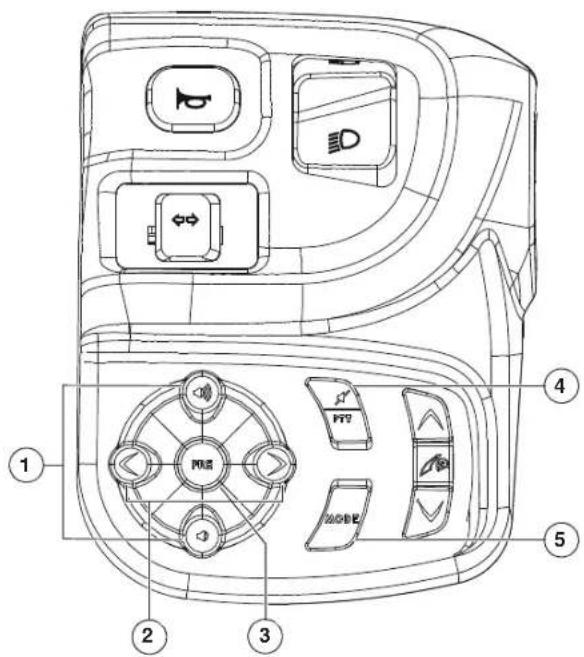
text_image
Technical diagram of a mobile phone control panel with labeled buttons and portsAudio System
| 1. Radio On/OffVolume +/-Menu Scroll |  VOL (+) VOL (+) VOL (-) VOL (-) |
| 2. TunerMusic Track SelectMenu Navigation |  TUNE (+) TUNE (+) TUNE (-) TUNE (-) |
| 3. Preset Button(Select/Enter Menus) |  PRESET PRESET |
| 4. MutePush-to-Talk (PTT)Voice Recognition | MUTE PTT PTT |
| 5. Mode Button |  MODE MODE |
Tip: Some mode menu options have sub-menus. Sources and menu options will be displayed only for installed components.
Audio System Audio System Introduction Instrument Cluster Audio Display
The audio system information is displayed in the center display on the instrument cluster. All audio system information is displayed in zones two (2) and three (3).
| 7:30 | 75F | |
| ZONE 2 | FM | 93.7 |
| ZONE 3 | TRIP 1MI | 210.3 |
| HR | 3.5 | |
| RANGE 25680 | 250mi |
USB Connector
A USB connector cord is located on the right side of the lower front fairing. A pouch is provided to hold your device while operating. This pouch is padded and tethered to the fairing to securely hold your device.
Tip: Device-to USB adapters are not supplied with motorcycle and must be purchased separately. Reference device owner's manual for USB accessory adapter information.
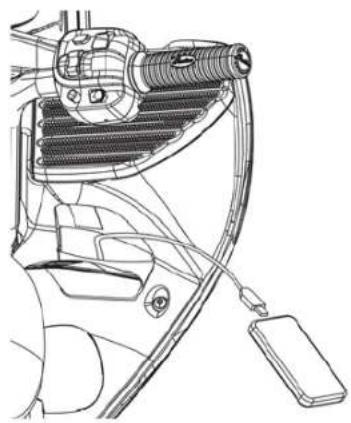
natural_image
Technical line drawing of a mechanical device with hoses and connectors (no text or symbols)Power and Volume Controls
Audio System Power
Turn the power switch ON to use the audio system. The screen will display "RADIO OFF".
| 7:30 | 75F |
| RADIO OFF | |
Tip: To prevent battery drain when the engine is not running, power will automatically turn off after 5 minutes.
To turn the audio system on, press and release MODE or one of the volume buttons.
The screen will display the last active entertainment source. The volume level when power is turned on will default to the level in use when power was last turned off (limited to level 15).
Audio System
Audio System Volume
Audio is active in either the speakers or the headsets. The volume controls will adjust the volume in the speakers or in the driver's Bluetooth headset.
Tip: On some headsets, the user must press (+) or (-) or rotate the volume dial on the headset controls to raise or lower volume.
Press 🔍 to adjust volume.
Turn the Radio Off
Press and hold until the radio turns off.
| 7:30 | 75F |
| VOLUME | 8 |
| 7:30 | 75F |
| RADIO OFF | |
Audio System Mute/ Push-To-Talk (PTT)
Press once to mute the audio system volume.
Press (or to un-mute the audio system volume.
Double press to activate voice recognition feature on a paired phone.
Low Voltage Mute
If the battery voltage drops to 10.5 +/- 0.5 volts, the radio will mute to reduce voltage drain on the battery. Full volume will be restored when the battery voltage returns to 11.5-12.5 volts. If battery voltage drops below 8.5 volts, the radio will turn off be available until the battery is fully
| 7:30 | 75F |
| MUTE | |
| LOW | |
| VOLTAGE |
Selecting Audio Sources
Press MODEatedly to choose the desired audio source. Each press changes the audio source as follows:
• FM
• AM
- MW (Europe only)
• LW (Europe only)
• WX (Weather) (North America only)
- USB
• NAV ( If enabled )
- Bluetooth Driver (if enabled)
FM source:
All models (shown with RBDS FULL)
| 7:30 | 75F |
| FM | 93.7 |
| 93X | |
| ARTIST |
AM source:
All models excluding Europe
| 7:30 | 75F |
| AM | 1500 |
Audio System
WX (Weather) source:
North America models only
USB sources:
All models
Flash memory connected
iPhone / iPod connected
Pandora® on iPhone / iPod only (Pandora is currently available only in the United States, Australia and New Zealand.)
| 7:30 | 75F |
| WX | 1 |
| 7:30 | 75F |
| USB | |
| ARTIST | |
| SONG TITLE |
| 7:30 | 75F |
| iPod | |
| ARTIST | |
| SONG TITLE |
| 7:30 | 75F |
| PANDORA | |
| ARTIST | |
| SONG TITLE |
Audio System Selecting Audio Sources
MW (Medium Wave) source:
Europe models only
LW (Long Wave) source:
Europe models only
NAV source:
All models (skipped if not enabled)
BT Driver source:
All models (skipped if not enabled)
| 7:30 | 75F |
| MW | 531 |
| 7:30 | 75F |
| LW | 153 |
| 7:30 | 75F |
| NAV |
| 7:30 | 75F |
| GARY'S IPOD | |
FM / AM / MW / LW Tuning
MW and LW radio sources are in Europe only.
- Press MODE repeatedly to choose the desired audio source.
- Use the tune buttons on the left control to tune radio stations. Press and release or to locate stations in single-step increments.
- Press and hold or to seek for radio stations. The radio will slew until the tune button is released. At that time, the radio will seek to the next strong radio station signal.
| 7:30 | 75F |
| FM | 93.7 |
| 93X | |
| ARTIST |
FM station shown with RBDS FULL on
Selecting Audio Sources
FM / AM / MW / LW Tuning
Memory Presets
The audio system features 15 user-defined presets for each tuner source for storing favorite stations.
- To set a preset, press MODE repeatedly until the desired source is active (FM, AM, MW, LW).
- Use or to tune a radio station.
- Press and hold . PRE
- Press or no cycle to an available preset location.
The preset location displays on the screen.
Tip: Saving a radio station without picking a location will save the station in the next available location. - When the desired location is displayed, press PRE
- The station will be stored.
Tip: If the desired preset location already contains a stored radio station, it will be overwritten by the new selection. - Prepare repeatedly scroll through the list of radio presets.
| 7:30 | 75F |
| P2 | 93.7 |
| to | |
| 7:30 | 75F |
| FM | 93.7 |
Audio System Selecting Audio Sources Weather Band (WX)
Weather band channels are broadcast by the National Oceanic and Atmospheric Administration (NOAA). NOAA operates more than 940 transmitters covering the United States, Puerto Rico, the U.S. Virgin Islands, the U.S. Pacific Territories and adjacent coastal waterways.
- Press MODE repeatedly button until WX source is selected.
Tip: Typically, only one weather band channel will be available for a given location. When traveling, if a channel becomes unavailable, search for another active channel.
- Press or to select a channel.
USB Audio Source
Connect the USB memory stick to the USB connector cable. The following music files are recognized by the radio:
- WAV
- OGG
- MP3
• F L A C
Music files not recognized by the radio will be ignored.
- Press and release MODE until USB is active. When USB is active, the console screen will display "USB" as the active source.
| 7:30 | 75F |
| USB | |
| ARTIST | |
| SONG TITLE |
- Press and hold or to select the next or the previous music folder. The folders display in alphabetical order.
- Press and release or to select the next or previous song.
Audio System
Selecting Audio Sources USB Audio Source - iPod / iPhone Connected
-
Connect a compatible iPod or iPhone device to the USB connector cable.
-
Press and release MODE until iPod is the active source.
When iPod is active, the console screen will display "iPod" as the active source.
| 7:30 | 75F |
| iPod | |
| ARTIST | |
| SONG TITLE |
Tuning/ FF - RW
- Press and release or to select the next or previous song.
- Press and hold or to fast forward or rewind.
Direct Song Selection
- Press and release to display currently playing track list.
- Press and release to scroll track list.
- Press and release or to select the new song choice and exit to active source display.
- Press to exit without selecting a new song track.
Category Select
- Press and hold up the category list appears.
Tip: Pandora will appear only if device is connected via USB and is capable of running Pandora. - To navigate the categories, press and release 📄. Press and hold to continuously scroll through
- Press and release ORE to select new category.
- Press and release MODE to exit to the main menu.
- To navigate from the category menu to the sub-category menu, press PRE >or .
- Press and release on to scroll.
- Press and release to select new subcategory and play the first song found. Press to browse the list of songs available.
- Press to navigate back to the subcategory or category selection.
| 7:30 | 75F |
| CATEGORY | |
| PLAYLIST | |
| ARTIST | |
| ALBUM | |
| PANDORA |
| 7:30 | 75F |
| ALTERNATIVECLASSIC ROCK80'S MUSIC | |
Audio System
Selecting Audio Sources
USB Audio Source - Pandora Internet Radio
Pandora® internet radio is available only when the user connects a compatible iPhone or iPod device to the radio using the USB connector.
Pandora internet radio is intended for use only in the United States, Australia and New Zealand. If licensing restrictions prevent Pandora from playing, "NOT AVAILABLE" displays.
| 7:30 | 75F |
| PANDORANOTAVAILABLE |
- Turn on the Pandora app. Connect a compatible iPhone or iPod device to the USB connector.
| 7:30 | 75F |
| PANDORA | |
| ARTIST | |
| SONG TITLE | |
- Press and release MODE Pandora is displayed in the screen.
Tip: If Pandora is the currently playing app on the device, the USB source displays information and enables features specific to the app. If it is not, you must select Pandora from the category menu. Press and hold PRE
-
To give a "THUMBS UP" for the current song, press and hold >>.
-
To give a "THUMBS DOWN" for the current song, Press and hold
When a commercial is playing, the screen will display the following information.
| 7:30 | 75F |
| THUMBS UP ARTIST SONG TITLE | |
| 7:30 | 75F |
| THUMBS DOWN ARTIST SONG TITLE | |
| 7:30 | 75F |
| PANDORA | |
Audio System
Selecting Audio Sources USB Audio Source - Pandora Internet Radio
- To skip forward to the next song, press and release
| 7:30 | 75F |
| PANDORASKIP TRACKSONG TITLE |
- When the skip limit is reached, "SKIP LIMIT REACHED" displays.
| 7:30 | 75F |
| PANDORASKIP LIMITREACHED |
- Press and release TORE bring up the station list. Use or do scroll through the list and then press POIE to select a new station.
| 7:30 | 75F |
| PANDORA | |
| ARTIST | |
| SONG TITLE |
- Press and hold iTunes category, or to select a different channel.
| 7:30 | 75F |
| CATEGORY | |
| ALBUM | |
| PANDORA | |
| ARTIST | |
| PLAYLIST |
- Press on to scroll through the list.
- Press and release FRE > to make a selection.
- When Pandora is selected, a list of available channels is displayed.
- Press to scroll through the list.
- Press and release FME to make a selection.
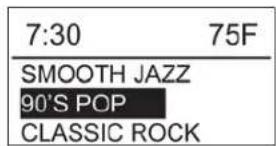
text_image
7:30 75F SMOOTH JAZZ 90'S POP CLASSIC ROCKAudio System Selecting Audio Sources NAV Source
Please read this manual and the GARMIN ZUMO 660 NAV MP3 information provided with your player to become familiar with all unit features and operation.
The audio integration kit must be installed to enable outputs from the NAV MP3 (such as navigation instructions or user-loaded MP3 media files) to play through the headsets or speakers. The unit is fully functional without the kit installed, but there will be no interface with the vehicle's audio system.
Navigation MP3 Operation Tips
- Signals coming from the NAV MP3 unit will override any source of the motorcycle's audio system to ensure navigation instructions are communicated when needed. The signals will also override the MP3 player.
- You must set volume levels within the NAV MP3 unit. Volume settings in the motorcycle's audio system control NAV MP3 volume, but navigation instructions may be difficult to hear if volume levels in the unit are set too low. See the GARMIN information for setting procedures. The recommended initial settings are 100/80/80: MASTER 100%, NAVIGATION 80%, MEDIA 80%.
- Pause or stop the MP3 player to switch to radio.
- If playing MP3 files from the GARMIN ZUMO 660 unit, you may need to turn down the “media volume” on the GARMIN unit to avoid distortion.
- NAV audio must be turned on in the mode menu in order to play MP3 music files from the GARMIN ZUMO 660 NAV unit.
- While in NAV source, only MP3 music stored on the GARMIN ZUMO 660 will play on the radio.
The power switch must be ON to use the audio system. Press and release MODENAV is the active source.
When navigation instructions are given, the music volume will be muted and "NAV" will be displayed on the line below the active source.
| 7:30 | 75F |
| NAV | |
Selecting Audio Sources Bluetooth Sources
Press and release MODE "BT DRIVE DEVICE" is displayed on the screen.
Tip: Make sure the BT volume on your device is turned all the way up.
Bluetooth Source - Driver
When a device is paired and connected to the Driver Device location, selecting this mode will stream music to the radio.
When Driver Device is turned on, "NO AUDIO" will be displayed as the radio resumes connection with the device.
When a device is paired but not connected to a BT source location, "NOT FOUND" will be displayed.
| 7:30 | 75F |
| GARY'S IPOD | |
When a device is paired to a BT source and is in the process of connecting to the radio, "CONNECTING" will be displayed.
"SEARCHING" will be displayed when the radio is looking for music files on the paired device.
| 7:30 | 75F |
| IPOD | |
| CONNECTING |
| 7:30 | 75F |
| IPODSEARCHING | |
Audio System Voice Recognition Mode
The radio features voice recognition when a driver headset is connected and turned on. Radio Bluetooth functionality is dependent on the capabilities of the device. Please see your device's user manual.
Tip: Make sure the BT volume on your device is turned all the way up.
The device's signal and battery strength are shown on the display with a range of zero to five (0-5), with "5" representing maximum strength.
Initiating a Phone Call
To initiate a phone call, double-press to request voice recognition mode.
Speak phone commands into microphone. Press and release PRE or double-press or wire in voice recognition mode to re-send or resume voice recognition request.
When the phone call is initiated, "DIALING" and either the caller ID or "OUTGOING CALL" will be displayed.
Press MODE to cancel outgoing call if desired.
| 7:30 | 75F |
| DROID RAZRVOICE COMMAND | |
| ACTIVATE: PRESETCANCEL: MODE SIGNAL 5 BATT 5 | |
Full screen mode shown
| 7:30 | 75F |
| DROID RAZROUTGOING CALLDIALING | |
When the call is answered, the screen will display "CONNECTED". Press and release MODE to end the phone call.
Receiving/ Answering Phone Calls
When a phone is paired to DRIVER DEVICE, the audio system will allow the driver to either answer or reject an incoming phone call.
When an incoming phone call is received, the screen will display the information of the caller.
Press PtoAnswer the call.
Press MODElect the call.
To end the phone call, press MODE
| 7:30 | 75F |
| DROID RAZR(123) 456-7890 CONNECTED | |
| END CALL: MODE SIGNAL 5 BATT 5 | |
Full screen mode shown
| 7:30 | 75F |
| SCOTT PHONE123-456-7890 OR CALLIDINCOMING CALLANSWER: PRESETREJECT: MODE SIGNAL 5 BATT 5 | |
Full screen mode shown
| 7:30 | 75F |
| SCOTT PHONE | |
| 123-456-7890 | |
| CONNECTED | |
Voice Recognition Mode Error Messages
If your phone receives an incoming call, but you do not have your headsets connected, the incoming call information and “CANNOT ANSWER” displays.
Press P#E to seod the incoming call to voice mail.
| 7:30 | 75F |
| DROID RAZR(123) 456-7890INCOMING CALLCANNOT ANSWERDRIVER HEADSETNOT CONNECTED | |
If you attempt to initiate a phone call, but you do not have your headsets connected, "HEADSET NOT CONNECTED" displays.
| 7:30 | 75F |
| DROID RAZRVOICE COMMANDERRORDRIVER HEADSETNOT CONNECTED | |
Audio System
Siri Eyes Free
Your radio's voice command mode supports the Siri Eyes Free feature on select iPhone models so you can use Siri without having to look at the screen. For example:
"Play songs by..."
"Get directions to..."
"Read my notifications"
"Send a message to..."
For additional commands, consult your device's owner's manual.
Siri is available on iPhone 4S, iPhone 5, iPad (3rd and 4th generations), iPad mini and iPod touch (5th generation), and requires internet access. Siri may not be available in all languages or in all areas, and features may vary by area. Cellular data charges may apply.
For more information about Siri Eyes Free, visit: www.apple.com/ios/siri/.
Audio System Audio Mode Menus Entering Mode Menu
- Press and hold the system enters the audio system mode menus.
-
Press and release two channels through the following menu items, shown in order of display:
-
Bass
• Mid - Treble
- F a d e r
• Automatic Volume Control (AVC)
• Audio Output Select - Bluetooth Setup
-
Bluetooth Drive Device
• N A V A u d i o
• FM/AM Tuner Clear Presets
• Radio Broadcast Data System (RBDS) -
At the RBDS screen, press and release to modern to the beginning of the mode menu list.
Exiting Mode Menu
Exit the screen and return to the default display in one of two ways:
-
Wait 10 seconds. The system will automatically exit.
-
Press > or to exit.
Bass Setting
Press 🔍 to adjust.
Press and release NODEove to next selection.
Mid Setting
Press 🔍 to adjust.
Press and release NODE to next selection.
Treble Setting
Press 🔒 to adjust.
Press and release MODE to next selection.
| 7:30 | 75F |
| BASS+6 |
| 7:30 | 75F |
| MID | |
| -1 |
| 7:30 | 75F |
| TREBLE+4 |
Audio System
Audio Mode Menus
Fader Setting
- Press on to adjust speaker fader balance.
- Use the fader adjustment menu to control audio sound balance between front and rear speakers.
Tip: Fader setting menu not shown if headsets are selected as the output.
| 7:30 | 75F |
| FADER0 |
- Press and release MODE to next selection.
Automatic Volume Control (AVC)
When set, this feature will lower or raise the speaker/headset volume automatically, based on vehicle speed.
-
Off: No Adjustment
• Low: Least aggressive setting
• Medium: Moderate setting
• High: Most aggressive setting -
Press or to adjust the automatic volume settings.
-
Press and release to move to next selection.
Audio Output Select
Use the audio output select menu to direct the audio output to either the external speakers or headsets.
- Speakers
-
Headsets
-
Press on to adjust.
-
Press and release tMODE to the next selection.
| 7:30 | 75F |
| AUDIO OUT | |
| SPEAKERS | |
| HEADSETS | |
Audio System Audio Mode Menus Bluetooth Setup
Tip: The Bluetooth setup menu is not available when the motorcycle is moving or when the screen is set to display Diagnostic Trouble Codes (DTCs).
Bluetooth Setup allows the user to pair and unpair the headset and devices.
- To access Bluetooth Setup, Press and hold MODEcess the audio menu.
- Press and release MODE "BLUETOOTH SETUP" is displayed.
- Press and release to access the Bluetooth Setup Menu options.
| 7:30 | 75F |
| BLUETOOTHSETUP | |
| RANGE 25025680 mi | N |
Bluetooth Setup M enu
The Bluetooth Setup Menu provides the following selections:
- DRIVE H-SET: Pair/unpair driver headset(s)
- DRIVE DEVICE: Pair/unpair driver device(s)
-
EXIT: Exit Bluetooth Setup Menu
-
Press and release to scroll through the list.
-
Press and release to select an item.
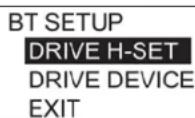
Audio Mode Menus
Bluetooth Setup M enu
Bluetooth Setup Notes
- The Bluetooth Setup Menu will display "C" next to each position when there is either a headset or device connected.
• Each Bluetooth position can have a maximum of three devices paired to that location. To add another device, you must remove one or all of the pa - Only one device can be connected at any given time.
- During audio system power-up, the radio will search through the list of paired devices and make connections to one of each pairing position.
Tip: Turning the source off in the MODE MENU will not prevent the device from connecting; it only prevents it from appearing on the audio source loop. This allows a device to be paired and connected only for the purpose of receiving phone calls. - Left hand audio controls are limited to basic functions when devices are connected via Bluetooth.
- To maintain full left hand audio controls, connect the device to the USB cable.
C DRIVE H-SET
C DRIVE DEVICE
EXIT
Audio System
BT SETUP
Audio System Audio Mode Menus Bluetooth Setup Menu
Driver Headset Pairing
Incoming phone calls cannot be answered if driver headset is not connected. Press and release PWE to SODE the calls to voice mail.
- Press and hold to access the audio menu.
-
Press and release MODE "BLUETOOTH SETUP" is displayed.
-
Press and release to access the Bluetooth Setup Menu options.
-
In the Bluetooth Setup Menu, press 📄 to make a selection. Select DRIVE H-SET.
-
Press and release .PRE
-
Press to select ADD H-SET. Tip: Sena SMH10 motorcycle Bluetooth headsets are recommended. Reference the headset user manual to enable Bluetooth pairing.
The radio will search for the headset.
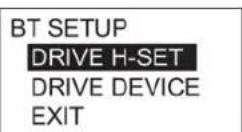
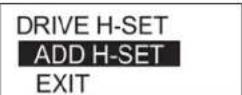
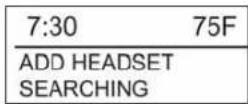
-
When the headset is found, its name will be displayed.
-
Press and release to pair the headset with the radio.
-
The radio will display "PAIRING" during the pairing process.
Tip: If prompted to enter a pairing code, find the code in the headset user's manual.
Use to enter the digits 0-9. Press and release PRenter the number and move to the next digit. Default codes are typically: "0000" or "1234".
"PAIRED" is displayed on the screen when the radio has successfully paired the headset.
| 7:30 | 75F |
| ADD HEADSETSENA SMH10EXIT | |
| 7:30 | 75F |
| SENA SMH10PAIRING | |
| 7:30 | 75F |
| SENA SMH10 PAIRED |
Audio Mode Menus
Bluetooth Setup M enu
Driver Device Pairing
The radio can be paired with Bluetooth devices such as smart phones.
- In the Bluetooth Setup Menu, press
- Set device to "Discoverable Mode" before starting the pairing procedure.
- Select DRIVE DEVICE.
- Press and release .PRE
-
Use or to scroll to ADD DEVICE.
-
Press and release TORE select.
The radio will search for the device. When the device is found, its name will display.
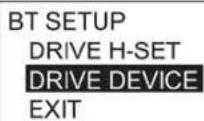
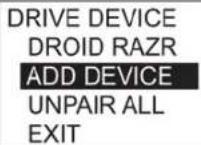
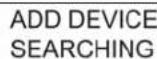
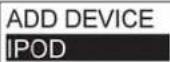
Audio System
- Press and release topair the device with the radio.
Tip: If prompted to enter a pairing code, find the code in the headset user's manual.
Use or
IPOD PAIRING
Press and release PRE to enter the number and move to the next digit. Default codes are typically: "0000" or "1234".
- "PAIRED" is displayed on the screen when the radio has successfully paired the device.
IPOD PAIRED
Audio System
Audio Mode Menus
Bluetooth Setup Menu
Unpairing/Reconnecting Devices
Tip: The following steps reference the DRIVE H-SET as an example. Unpairing other devices follows the same procedures.
- In the Bluetooth Setup Menu, use
or to make a selection. Select DRIVE H-SET.
-
Press and release .PRE
-
To unpair ALL of the devices in the DRIVE H-SET location, press or to select UNPAIR ALL, and then press PRE
-
Press or no select NO or YES. Select YES, and then press and release P=unpair all devices.
The radio will unpair all of the devices from this location and return to the ADD H-SET screen.
BT SETUP DRIVE H-SET DRIVE DEVICE EXIT
DRIVE H-SET SCALA RIDER G9 SENA SMH10 UNPAIR ALL EXIT
UNPAIR ALL DRIVE H-SET NO YES
DRIVE H-SET ADD H-SET EXIT
-
To unpair individual devices in the DRIVE H-SET location, press and release 🔒 to select the device you want to unpair.
-
Press and release to select the device.
-
Press and release to select UNPAIR.
-
Push and release to repair the device.
"UNPAIRED" will be displayed after the device is removed from the list.
The radio will return to the DRIVE H-SET device location.
- To connect a different paired device at a location, select that device and press PRE select it. Select RECONNECT. Press PRE.
DRIVE H-SET
C SCALA RIDER G9
SENA SMH10 SCALA RIDER G9 UNPAIR ALL EXIT
SCALA RIDER G9 RECONNECT
UNPAIR EXIT
SCALA RIDER G9 UNPAIRING
SCALA RIDER G9 UNPAIRED
DRIVE H-SET SENA SMH10 UNPAIR ALL EXIT
SCALA RIDER G9 RECONNECT UNPAIR EXIT
Audio System
Audio Mode Menus Bluetooth Driver Device
| 1. Press on to turn the DRIVER BT device source ON or OFF.SOURCE ONSOURCE OFF | 7:30 | 75F |
| DRIVE DEVICESOURCE OFFSOURCE ON | ||
- Press and release two rows to the next selection.
NAV Audio
- Press on to turn the NAV AUDIO source ON or OFF.
- Press and release MODE move to the next selection.
Tuner Clear Presets
- To clear all FM or AM radio station presets, press 🔒 to select FM or AM clear presets.
- Press to clear the presets for the desired tuner band.
- Press and release MODE move to the next selection.
| 7:30 | 75F |
| NAV AUDIO | |
| OFF | |
| ON | |
| 7:30 | 75F |
| FM | |
| CLEAR | |
| PRESETS |
| 7:30 | 75F |
| FM | |
| PRESETS | |
| CLEARED |
Radio Broadcast Data System (RBDS)
| 7:30 | 75F |
| RBDSFULLONOFF |
• OFF
• ON (Station name only)
• FULL (Station name + radio text)
- Press and release MODE to move to the top of the MODE menu list.
Audio System Audio System Diagnostics
The audio system diagnostic menu allows the following actions for you or your INDIAN MOTORCYCLE dealer:
• View radio software version
• Perform left hand audio control key pad tests
- Set radio tuner location
• View vehicle speed
Diagnostic Menu
To access the diagnostic menu:
- Press and hold to turn the radio off.
- Turn the power switch OFF.
- Turn the power switch ON.
-
Press and hold for several seconds.
-
This screen will appear if steps 1-3 were performed correctly.
Tip: If you do not see this screen, perform steps 1-3 again.
- Press and release tMODE move to Key Pad Diagnostics.
| 7:30 | 75F |
| RADIO | |
| SW 1.00A HW1 | |
| BOOT V 1.00A | |
Audio System Diagnostics
Key Pad Diagnostics
Key pad diagnostics allows the user to the test the function of each button on the left hand audio control block.
- Press and release each of the audio control buttons to test the function of each button.
- Observe the display after each button is pressed. The screen will display the button name by its function. If nothing displays, the button is not working. See your authorized dealer for service.
| 7:30 | 75F |
| VOL UP |
- Press and release MODEve to Tuner Location Settings.
Audio System
Tuner Location Settings
The radio tuner can be set to the geographical location where the motorcycle will be driven.
The following settings can be chosen under the Tuner Location Settings menu:
| 7:30 | 75F |
| TUNERLOCATIONNORTH AMERICA | |
• NORTH AMERICA (USA/CANADA/MEXICO)
• EUROPE
• EUROPE 50
• J A P A N
• AUSTRALIA
• T A I W A N
-
Press and release on to make a new selection.
-
Turn the power switch OFF, then ON to save the new tuner location.
Audio System Audio System Diagnostics Speed Diagnostic
The Speed Diagnostic menu displays vehicle speed.
Use this menu to verify the radio system is receiving a speed signal from the vehicle control module.
| 7:30 | 75F |
| SPEED | |
| 0 MPH | |
| 0 KPH |
- Press and release MODE return to the radio hardware/ version display screen.
- To exit the audio system diagnostics menu, press and release or to return to the RADIO OFF screen.
Audio Compliance Information
FCC and Industry Canada Compliance Statement
This equipment complies with FCC radiation exposure limits set forth for an uncontrolled environment. This equipment should be installed and operated with minimum distance of 20 cm between the radiator and your body.
This device complies with Industry Canada license-exempt RSS standard(s). Operation is subject to the following two conditions: (1) this device may not cause interference, and (2) this device must accept any interference, including interference that may cause undesired operation of the device.
Japan Compliance Statement
This device contains a radio module with certification number:
text_image
R 209-J00052Index
A
About the Rider's Manual.... 5
ABS. 53-54
ABS Tone Ring/Sensor Inspection ..... 101
ABS, How to Respond 8
Accelerating 75
Accessories, Safety Considerations .... 11
Air Filter 86
Anti-Lock Brake System 53-54
Anti-Lock Brake System Response ..... 8
Apparel for Riding 10
Audio Mode Menus.... 160-167
Audio Source Selection 149-157
Audio Switches 25
Audio System 143-146
Audio System Diagnostics ..... 168-170
B
Battery
| Charging | 112 |
| Installation | 111 |
| Removal | 110 |
| Safety Warnings | 110 |
Brake Fluid Level, Front Brake 62
Brake Fluid Level, Rear Brake 63
Brake Fluid, Front Brake. 99
Brake Fluid, Rear Brake 98
Brake Lever Inspection.... 62
Brake Lever, Front Brakes ..... 55, 99
Brake Line Inspection.... 63
Brake Pad Inspection 100-101
Brake Pedal Inspection.... 62
B
Brake Pedal Lubrication 97
Brake Pedal, Rear Brakes ..... 55
Brakes
ABS Tone Ring/Sensor Inspection. 101
Anti-Lock Brake System ..... 53-54
Brake Fluid Precautions .....97
Brake Lever Inspection 62
Brake Line Inspection 63
Brake Pad Inspection..... 100-101
Brake Pedal Inspection....62
Disc Inspection/Cleaning ..... 100
Front Brake Fluid 62,99
Front Brake Lever 55,99
Hoses/Connections 97
Lubrication 97
Rear Brake Fluid 63,98
Rear Brake Pedal 55
Braking....75
Break-In Maintenance....80
Break-in Procedure....68
Break-In, Engine 67-68
Breather Hose Inspection....93
C
Cargo Distribution 13
Cargo Safety 13
Check Engine Indicator (CHIEF).....31
Cleaning Products....120
Clock, Resetting 30
Clutch Cable Lubrication, Mechanical .. 96
Clutch Inspection, Mechanical.....64
C
Clutch Lever 48
Clutch Lever Freeplay, Mechanical.....95
Clutch Lever Lubrication, Mechanical...96
Compliance, Vehicle 15
Console Components 21
Cruise Control Operation....76-77
Cruise Control Switches 25
D
Diagnostic Functionality 31
Display Units, Standard/Metric ..... 30
Drive Belt
Cleaning....86
Condition 87
Wear Analysis 87
Drive Belt Inspection, Rear....65
E
Electrical Precautions 114
Elevating the Motorcycle ..... 116
Emission Control System 94
Engine Break-In. 67-68
Engine Compression Test 116
Engine Identification Number ..... 20
Engine Oil Change 84-85
Engine Starter Switch 26
Engine Stop/Run Switch 25
Engine, Starting.... 70-71
Engine, Stopping....75
Equipment Modifications 12
Error Codes, Engine (CHIEF) ..... 31
Exhaust Safety 14
Exhaust System Inspection....116
Index
F
Fastener Inspection....66,116
Fastener Torques....116
Fluid
Brake Fluid Specifications.....128
Engine Oil Specifications ..... 128
Fork Oil Specifications ..... 128
Fluid Change
Engine Oil 84
Engine Oil/Filter 85
Fluid Level
Engine Oil. 60
Front Brake....62
Front Brake Fluid 99
Rear Brake 63
Rear Brake Fluid....98
Fork Inspection 92
Front Wheel Installation 102
Fuel Cap....56
Fuel Filter....85
Fuel Gauge, CHIEFTAIN. 33
Fuel Handling Safety....14
Fuel Level....65
Fuel Recommendation 128
Fuel System Inspection....94
Fuel System, Priming 69
Fueling 69
Fuse Replacement....113
G
Gasoline Handling Safety 14
Gear Shift Lever....49
Gear Shifting 72-74
Gross Vehicle Weight Rating ..... 16
GVWR....16
H
Hazard Switch 25
Headlight Aim Adjustment ..... 108
Headlight Aim Inspection....107
Headlight Lamp Replacement (CHIEF) . 108
Headlight Lamp Replacement (CHIEFTAIN)
109
High/Low Headlight Beam Switch ..... 27
|
Identification Number Record ..... 129
Ignition, Key Fob 26
Ignition, Keyless 26
Indicator Lamps, CHIEF 28
Indicator Lamps, CHIEFTAIN ..... 34-35
Instrument Cluster, CHIEF 28.-32
Instrument Cluster, CHIEFTAIN ..... 33-47
L
Labels, Information 17
Labels, Safety....17
Leather Care 121
Light Switch, Auxiliary Lights. 27
M
Maintenance
Break-In Maintenance 80
Major Maintenance 80
Periodic Maintenance 81-83
Maintenance for Safety 15
Maintenance Log 141
Maintenance, Required.... 15
Major Maintenance 80
Metric Display 30
MFD, CHIÉFTAIN. 36
Mirrors 49
Modifications, Vehicle.... 12
Motorcycle Safety Foundation 6
Multi-Function Display (MFD), CHIEF 29-32
Multi-Function Display, CHIÉFTAIN.... 36
0
Oil Change, Engine Oil/Filter ..... 84-85
Oil Level, Engine Oil 60
Oil Recommendation.... 128
P
Parking 78
Parking on a Slope 78
Parking on a Soft Surface. 78
Parking the Motorcycle.... 12
Passenger, Carrying Safely 9
Periodic Maintenance 81-83
Power Switch 25
Preload Adjustment, Rear Shock (CHIEF) 89
Preload Inspection, Rear Shock ..... 88
Index
R
Rear Axle Inspection.... 91
Refueling Safety 14
Ride Height Adjustment (CHIEF).....89
Ride Height Adjustment (CHIEFTAN) 90-91
Ride Height Inspection.... 88
Riding Safety 6-10
Road Testing 80,116
S
Saddlebag Lock Switch 26
Saddlebag Removal, Hard Bag ..... 51
Saddlebag Removal, Soft Bag ..... 50
Saddlebags 50-51
Saddlebags, Using Safely.... 12
Safety Defects, Reporting to NHTSA .... 16
Safety Gear 10
Safety Symbols 5
Seat Installation.... 106
Seat Removal.... 106
Security System
Changing Your PIN 115
Unlocking With PIN 114
Service Manual 4
Severe Use. 81
Shift Points 74
Shifting Gears 72-74
Shock Air Pressure (CHIEFTAN) .... 90-91
Shock Preload Adjustment (CHIEF) .... 89
Shock Preload Inspection.... 88
Side Covers, Removal/Installation .... 105
Sidestand.... 50
Sidestand Inspection 66
S
Sidestand Lubrication....95
Signal Words 5
Spark Plugs 105
Specifications.... 124-128
Speedometer, CHIEF 28
Speedometer, CHIEFTAIN....33
Steering Head Inspection....93
Steering Inspection....65
Storage
Battery Care....122
Clean/Protect the Motorcycle .... 122
Engine Protection 122
Fuel Stabilizer 122
Maintenance During 122
Motorcycle Cover 123
Removal From 123
Rodents....123
Storage Area 121
Tire Inflation....122
Suspension Inspection, Front. . . . 65, 91-92
Suspension Inspection, Rear ..... 65
Swing Arm Inspection....91
Switches 22-27
Audio Switches....25
Auxiliary Light Switch ..... 27
Cruise Control Switches ..... 25
Engine Starter Switch 26
Engine Stop/Run Switch 25
Hazard Switch....25
High/Low Headlight Beam Switch .. 27
Ignition/Light Switch 27
Power Switch 25
Saddlebag Lock....26
Toggle Switches....27
T
Tachometer, CHIEFTAIN 33
Testing After Servicing....80, 116
Throttle Control Inspection 95
Throttle Inspection 64
Tires
Condition 103
Recommended Pressure 104
Recommended Type 104
Replacement 103
Tire Condition 61
Tire Pressure 61
Tire Pressure Monitoring System . . . 49
Tire Tread Depth 61
Tread Depth 103
Wheel Inspection....102
Toggle Switches 27
Tone Ring/Sensor Inspection, ABS .... 101
Transporting the Motorcycle ..... 14
Troubleshooting 117-119
W
Washing the Motorcycle....120
Weight Capacity 16
Wheel Alignment 102
Wheel Inspection 102
Wheel Installation, Front. 102
Wheel Spoke Inspection....102
Windshield....52
Windshield Adjustment (CHIEFTAIN) . . . 52
Windshield Care....121
Windshield Removal (CHIEF) .....52
Indian
MOTORCYCLE
To locate your nearest dealer, visit www.indianmotorcycle.com
Indian Motorcycle Company 2100 Hwy 55
Medina, MN 55340
Phone 877-204-3697
Part No. 9925048 Rev 01
Printed in USA