DDW496W - Dishwasher DANBY - Free user manual and instructions
Find the device manual for free DDW496W DANBY in PDF.


User questions about DDW496W DANBY
0 question about this device. Answer the ones you know or ask your own.
Ask a new question about this device
Download the instructions for your Dishwasher in PDF format for free! Find your manual DDW496W - DANBY and take your electronic device back in hand. On this page are published all the documents necessary for the use of your device. DDW496W by DANBY.
USER MANUAL DDW496W DANBY
Read and follow all safety rules and operating instructions before first use of this product.
PRÉCAUTION:
natural_image
Illustration of a Danby microwave oven with control panel and door (no text or symbols on main body)COUNTERTOP DISHWASHER
Table of Contents ....1
LAVE-VAISSELLE À COMPTOIR
| Page | |
| Unit Parts Identification | 1 |
| Important Safety Instructions | 2 |
| Installation | 3 |
| Water Pressure | 3 |
| Connecting & Disconnecting Instructions | 3 |
| Care and Maintenance | 4 |
| Features | 5 |
| Operating Tips | 6 |
| Program Summary/Selection | 6 |
| Common Problems and Solutions | 7 |
| Warranty | 8 |
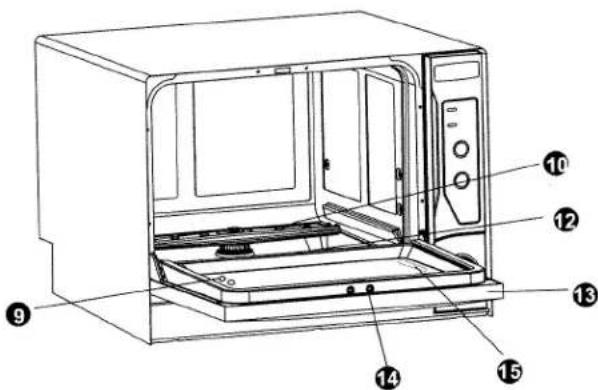
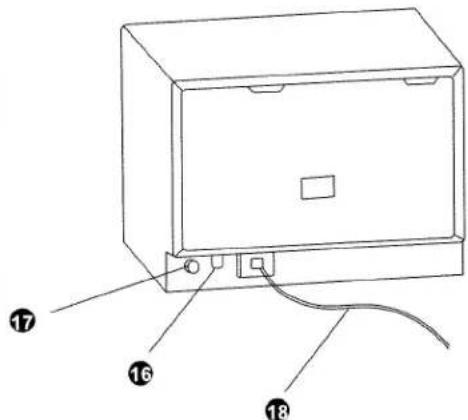
Unit Part Identification
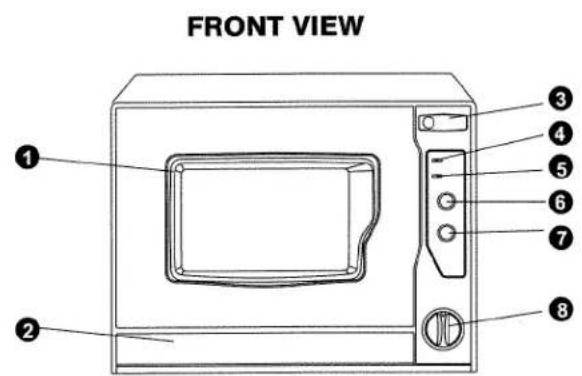
FRONT VIEW
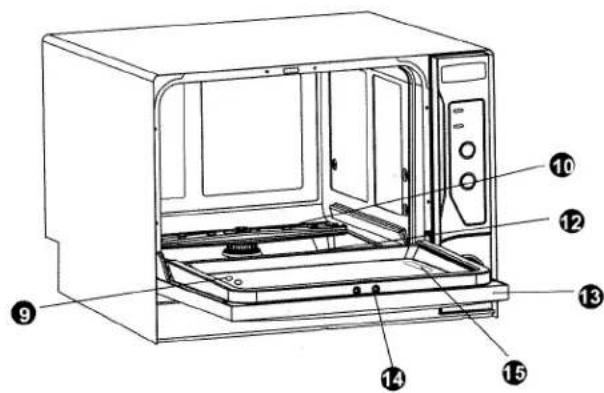
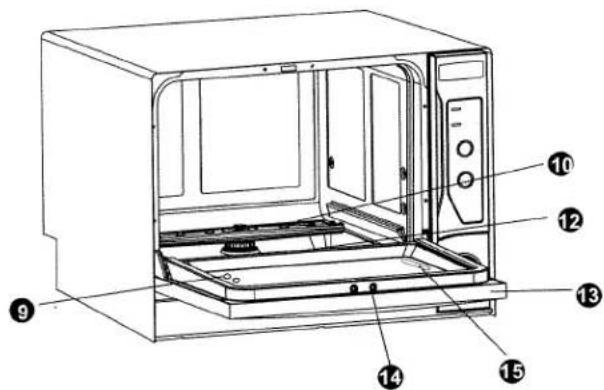
INSIDE VIEW
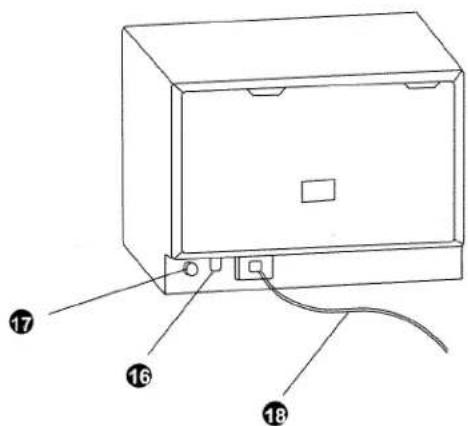
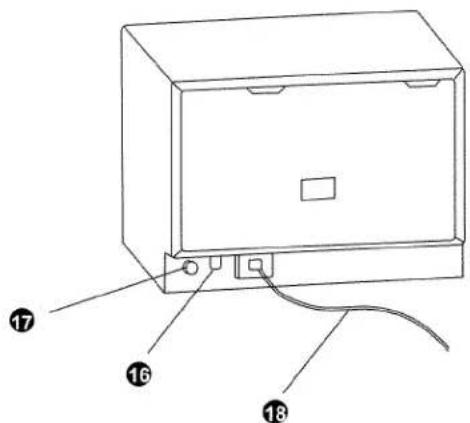
REAR VIEW
- WINDOW
- FRONT PANEL
- DOOR RELEASE BUTTON
- PILOT LIGHT (POWER ON/OFF)
- PILOT LIGHT (SANI-WASH)
- SANI-WASH/ECONO BUTTON
- POWER (ON/OFF) BUTTON
- PROGRAM/TIMER SELECTOR
- RINSE AGENT DISPENSER
- SPRAY ARM
-
DISH RACK (NOT SHOWN)
11a.SILVERWARE BASKET (NOT SHOWN) -
FILTER
- DOOR ASSEMBLY
- DOOR LATCH MECHINISM
- DETERGENT (INDENT) LOCATION
- DRAIN HOSE CONNECTION
- WATER INLET CONNECTION
- POWER CORD
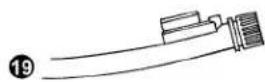
- QUICK CONNECT HOSE ASSEMBLY
IMPORTANT SAFETY INSTRUCTIONS

WARNING

When using your dishwasher, follow basic safety precautions
- Read all instructions before using the dishwasher.
- Use the dishwasher only for its intended function.
- Use only detergents or wetting agents recommended for use in a dishwasher and keep them out of the reach of children.
- Do not use regular liquid detergent.
When loading items to be washed:
- Locate sharp items so that they are not likely to damage the door seal.
- Load sharp knives with the handles up to reduce the risk of cut-type injuries.
- Do not wash plastic items unless they are marked "dishwasher safe" or the equivalent.
For plastic items not so marked, check the manufacturer's recommendations.
- Do not touch the heating element during or immediately after use.
- Do not operate your dishwasher unless all enclosure panels are properly in place.
- Do not tamper with controls.
- Do not abuse, sit on, or stand on the door or dish-rack of the dishwasher.
• To reduce the risk of injury, do not allow children to play in or on a dishwasher. - Under certain conditions, hydrogen gas may be produced in a hot-water system that has not been used for two weeks or more. HYDROGEN GAS IS EXPLOSIVE. If the hot-water system has not been used for such a period, before using the dishwasher turn on all hot-water faucets and let the water flow from each for several minutes. This will release any accumulated hydrogen gas. As hydrogen gas is flammable, do not smoke or use an open flame during this time.
- Remove the door to the washing compartment when removing an old dishwasher from service or discarding it.
SAVE THESE INSTRUCTIONS

WARNING

Instructions pertaining to a risk of fire, electric shock, or injury to persons.
Electrical Instructions:
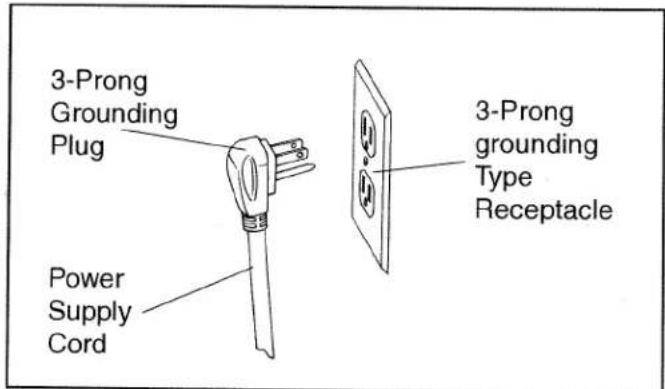
An electrical supply of 120 volts AC only, 60Hz is required. For your personal safety, the appliance must be grounded. This appliance is equipped with a power supply cord having a 3-prong grounding plug. To minimize possible shock hazards it must be plugged into a matching 3-prong grounding type electrical outlet.
Grounding Instructions:
This appliance must be grounded. In the event of a malfunction or breakdown, grounding will reduce the risk of electric shock by providing a path of least resistance for electric current. This appliance is equipped with a cord having an equipment-grounding conductor and a grounding plug. The plug must be plugged into an appropriate outlet that is installed and grounded in accordance with all local codes and ordinances.
Installation Instructions

WARNING

A hose that attaches to a sink spray can burst if it is installed on the same water line as the dishwasher. If your sink has one, it is recommended that the hose be disconnected and the hole plugged.
If your existing faucet adapter is not compatible with the "quick connect" hose assembly supplied;
- Connect the faucet adapter (included with dishwasher) to your faucet.
-
If your faucet is inclusive of a male" type (threaded) connection, use only the standard rubber washer (0.2"/5mm thick) supplied inside adapter. Remove the second (0.2"/5mm thick) rubber washer.
-
If your faucet is inclusive of a "female" type (threaded) connection, both rubber washers (0.2"/5mm) must be installed inside the tap adapter.
- The minimum height clearance required to install your dishwasher on a countertop surface with overhead cupboards is 17-1/4" (43.8 cm)
- Make sure there is an electrical supply (outlet) within distance of the electrical power supply cord. (6 feet /182.8 cm).
- Make sure the water supply faucet connection is within distance of the (fill & drain) hose assembly (6 feet / 182.8cm).
- The dishwasher must be installed on a "solid" level surface.
- To level the dishwasher, adjust the 4 level screws (feet) under the dishwasher.
Water Pressure
For best operating results, incoming water pressure should be between 15 and 120 pounds per square inch (psi).
FOR BEST RESULTS:
Your dishwasher cleans by spraying a mixture of hot clean water and detergent (under pressure) against the soiled surface of dishes. The water is pumped through a rotating spray arm, drained through a filter removing food and soiled particles and pumped back through the spray arm.
Soiled water is pumped out and replaced with clean water at the end of each cycle. (the number of times depends on the cycle being used) For best cleaning results, the water temperature must be at least 130^ F ( 55^ C). To prevent dishwasher damage, the temperature of the incoming water supply should not exceed 160^ F ( 71^ C).
Connecting your Dishwasher
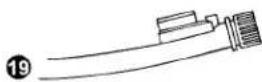
Your dishwasher comes equipped with a "quick connect" (fill & grain) hose assembly.
A quick connect faucet adapter must be installed on the faucet before you can connect the dishwasher. This adapter is included inside your dishwasher.
The quick connect faucet adapter is compatible with faucets inclusive of either male (exterior) and female (interior) threaded faucet connections.
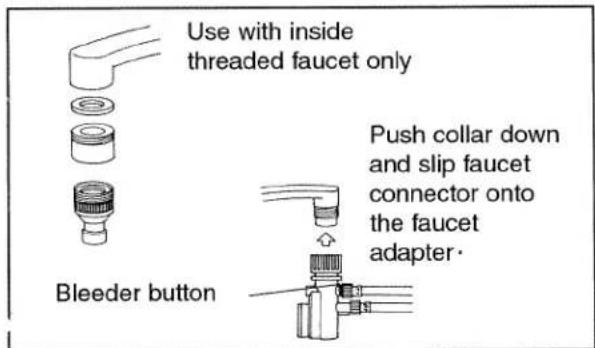
- Screw the faucet adapter onto the faucet. (check for leaks, use Teflon tape to eliminate if necessary)
- Connect the open end of the drain hose to the drain port connection at the back of the dishwasher cabinet.
- Connect the hot water inlet hose to the water inlet valve at the back of the dishwasher cabinet. (do not over-tighten to avoid damage to threads)
- Attach the quick-connect onto the faucet adapter, by pulling down the (outer) locking collar of the quick connect, while pushing the quick connect upward up onto the faucet adapter.
- When the quick-connect snaps onto the faucet adapter, release the locking collar. Verity the connection is secure.
- Slowly open the hot water line and check for any sign of water leaks at all hose connections.
If leaks are located, immediately close the water supply and repair the hose connections.

IMPORTANT

Once you open the water supply line, (even if it is closed immediately thereafter) the water inlet hose will be pressurized.

IMPORTANT

To relieve water pressure from inside the water inlet hose. Make sure the water line (faucet) is closed. Press and hold the "red" pressure relief button on the quick connect assembly, until the flow of water stops.

WARNING

FAILURE TO RELIEVE WATER PRESSURE BEFORE DISCONNECTING THE QUICK CONNECT ASSEMBLY FROM THE FAUCET, WILL RESULT IN BACK-PRESSURE OVER-SPRAY. THE TEMPERATURE OF INCOMING WATER CAN BE VERY HOT AND BACK PRESSURE OVER-SPRAY COULD CAUSE SEVERE BURNS AND/OR SCALDING.

CAUTION

DO NOT LET CHILDREN DISCONNECT THE DISHWASHER. Close supervision of children is always important around appliances.
NOTE: Hard Water conditions will adversely effect washability performance of your dishwasher. Hard Water conditions will also contribute to "Lime" (white film substance) deposits and/or "Scaling" on the stainless steel surface of the dishwasher tub and "Heater Element" located in the sump underneath the removable filter screen. To assist in minimizing these conditions, it is recommended to periodically operate/rinse the inside of the dishwasher (empty) using 1 cup of white vinegar. (at least once a week)
Disconnecting your Dishwasher
- Close the hot water supply at the faucet.
- Disconnect the power supply cord.
- Remember to release the water pressure inside the fill hose. Press and hold the "red" pressure relief button on the quick connect unit until the flow of water stops.
- Disconnect the quick connect hose assembly from the faucet, by pulling down on the (outer) locking collar.
Loading your Dishwasher
The dishwasher is designed to receive a standard "4 piece" plate setting consisting of the following:
• 4 Dinner Plates
- 4 Fruit Bowls
• 4 Cups & Saucers
• 4 Dinner Forks
• 4 Dinner Knives
• 4 Salad Forks
- 4 Teaspoons
• 4 Bread & Butter Plates
• 2 Serving Spoons
• 1 Serving Fork
- NOTE: For ease of loading/unloading large size dinner plates from the dish rack it may be necessary to (temporarily) remove the silverware basket. When loading/unloading is complete, return the silverware basket to its original position.
Preparing your Dishes for Washing
- Scrape off all solid food particles from the dishes.
- Remove excessive quantities of oil or grease.
• Empty any liquids from glasses and cups. - All dishes should be thoroughly rinsed before being placed inside the dishwasher.
NOTE: Dishes with dried-on foods are more difficult to wash and may not come clean in a normal wash cycle.
Using the Right Detergent
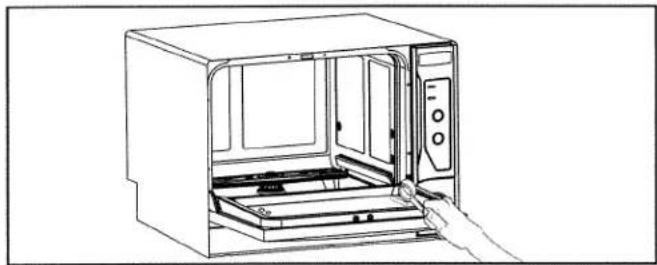
Use only detergent specifically made for use in dishwashers, as other types will cause oversudsing. If your detergent is old and/or lumpy, throw it away. Old detergent loses its washing power. Lumpy detergent won't dissolve.
natural_image
Line drawing of a microwave oven with a hand inserting a tray into the interior (no text or symbols)How Much Detergent Should You Use
That depends if your water is "hard" or "soft".
HARD WATER REQUIRES MORE DETERGENT TO GET DISHES CLEAN.
SOFT WATER REQUIRES LESS DETERGENT TO GET DISHES CLEAN.
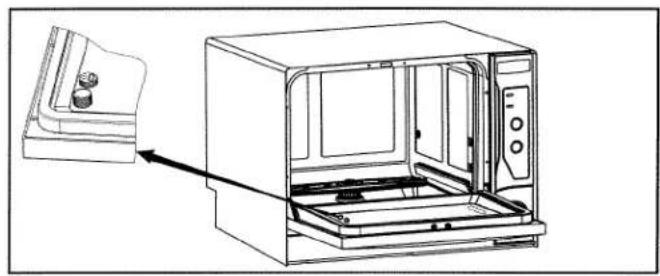
- The recessed detergent area located on the inside door panel will hold approximately 20 grams/0.7oz (1/2 spoon) of detergent.
Using a Rinsing Agent
You can help prevent unsightly spots on dishes and glassware and reduce drying time by using a rinse agent. A rinse agent is specially formulated to rinse away food and detergent residues that can be left behind on your dishes. Used regularly, a rinse agent will automatically provide you with cleaner dishes every time you wash.
- To fill the rinse agent dispenser, unscrew the dispenser cap located on the inner door. Add the rinse agent slowly into the container until it just reaches the bottom of the filling cap inside the dispenser opening. Replace the cap. The dispenser automatically releases the rinse agent into the final rinse water at the end of the wash cycle. The dispenser holds approximately 125 ml (4.2 fl.oz.) of rinse agent.
natural_image
Technical line drawing of a laboratory oven with internal compartments and a side view showing a component (no text or symbols)Pre-Rinse Feature
The "Pre-Rinse" is a convenience feature that allows dishes to be rinsed, if you don't have a full load ready to be washed. (preventing foods from becoming dried/caked on the dish surface) It is not necessary to add detergent to the dishwasher during the Pre-Rinse cycle. However, due to the short duration of the pre-rinse cycle, (6 minutes only) make sure the incoming water supply is hot. Open the hot water faucet and run till hot, before connecting the dishwasher.

IMPORTANT

Your dishwasher is not a "garburator", clean off large particles of food sediments before placing dishes in the dishwasher.
Using the "Sani Wash" Feature
The "Sani-Wash" feature gives you the option of washing/drying dishes at very high water temperatures. When activated, the "Sani-Wash" feature energizes a heating element that will raise and maintain the internal water temperature of the dishwasher at 158°F (70°C).

CAUTION

Water temperatures this high can cause severe burns/scalding. Always exercise extreme care when opening and/or entering the dishwasher during the Sani-Wash cycle.
To activate this feature, push the "Sani" button on the control panel.
- Push button "in" = the "Sani-Wash" feature is activated. (Sani-Wash indicator light remains illuminated during the entire cycle)

WARNING

For the drain system to operate properly. The highest distance between the faucet quick connect and base of the dishwasher, should not exceed 15cm (6")
Using the "Econo" Feature
The "Econo" feature gives you the option of washing dishes at "normal" incoming water tank temperature. (usually between 130°\~140°F / 54.4°\~60°C)
When activated, the "Econo" feature "de-energizes" (by-passes) the heating element.
To activate the "Econo" feature push the "Sani/Econo" button on the control panel.
- Push button "out" the "Econo" feature is activated. (Sani-Wash indicator light remains off)

IMPORTANT

When the "Econo" feature is activated, drying time for the dishes will be increased. The dishes dry by a "convection" method only. To speed-up the drying time, suggest you leave the dishwasher door partially open after the program is complete. This will allow humidity from within to escape. Push the door open button and the door pops opens to a pre-set convection dry position.
Operating Instructions
To operate the dishwasher;
- Attach the quick connect hose assembly to the faucet.
- Push the door release button to open the door.
- Place the dishes on the dishrack and cutlery inside the cutlery basket.
- Fill the detergent area on inner door panel. (approx. 20 grams/0.7oz 1/2 spoon)
NOTE: If using the "Pre-Rinse" cycle only, it is not necessary to add detergent.
- Close the door firmly.
- Open the hot water faucet.
-
Turn the selector switch to the desired wash program. (Pre-Rinse, Normal, Short)
-
Push the power (on/off) button.
-
Push Button in = power on.
-
Push Button out = power off.
The power light will illuminate indicating the machine is receiving power. -
The dishwasher stops automatically at the end of the program. Both the power light and sani-wash light will remain illuminated, until the power (on/off) button is switched off.
NOTE: At the beginning of each cycle, the dishwasher always starts in the "drain" mode. This is because the drain pump always retains a small amount of water (in the sump) from the previous (last) cycle. This is necessary to keep the pump primed.
Therefore, don't be alarmed if you see a small amount of water being pumped-out from the drain hose prior to the start of the regular wash cycle. (THIS IS NORMAL)
Program Summary/Selection
PRE-RINSE
| Water Temperature: | Incoming Water (Tank Temperature) |
| Program Duration: | 6 Minutes |
| Water Consumption: | 2.4 liters / 0.63US/gal. |
NORMAL/SANI-WASH
| Water Temperature: | 158°F/70°C |
| Program Duration: | 48 Minutes |
| Water Consumption: | 8.6 liters / 2.27 US/gal. |
NORMAL/ECONO
| Water Temperature: | Incoming Water(Tank Temperature) |
| Program Duration: | 37 Minutes |
| Water Consumption: | 8.6 liters / 2.27 US/gal. |
SHORT/SANI-WASH
| Water Temperature: | 158°F/70°C |
| Program Duration: | 26 Minutes |
| Water Consumption: | 6.5 liters / 1.7 US/gal. |
SHORT/ECONO
| Water Temperature: | Incoming Water (Tank Temperature) |
| Program Duration: | 23 Minutes |
| Water Consumption: | 6.5 liters / 1.7 US/gal. |
| Common Dishwashing Problems and Solutions | ||
| PROBLEM | POSSIBLE CAUSE | POSSIBLE SOLUTION |
| Dishwasher will not start | ·Dishwasher not receiving electrical power.·Door is unlatched.·Dishwasher not level. | ·Check electrical connection Fuse/circuit breaker.·Close and latch door.·Level unit. |
| Dishes not clean | ·Improper loading.·Spray arm not rotating freely.·Not enough detergent and/or improper detergent being used.·Improperly prepared dishes.·Water inlet hose kinked/bent due to improper installation. | ·Arrange dishes so spray action reaches all surfaces.·Do not overload dishwasher.·Check spray arm to make sure nothing (i.e. cutlery) is obstructing spray arm rotation.·Check if filter screen has become dislodged and obstructing spray arm rotation.·Use more dishwasher detergent.·Do not use detergent that is hard or caked.·Use only a recommended dishwasher detergent.·Excess food soil and liquids should be removed from dishes before loading.·Eliminate kink or bend from inlet hose. |
| Chipping or breaking glassware | ·Improper loading of dishes. | ·Do not overload dishrack. Load glasses on the upper rack only, not over dishrack pins. Glasses loaded over dishrack pins are not properly supported and subject to damage. |
| Water remains in bottom of dishwasher | ·A small amount of water (in sump area) is normal.·Excessive amount of water; Cycle not completed. | ·This is necessary to keep the pump primed and is drained automatically at the beginning of each cycle.·Allow dishwasher to complete full cycle. |
Table des matières
Page
VUE INTÉRIEURE
VUE DE L'ARRIÈRE
-
UNE FENÊTRE
-
PANNEAU AVANT
-
DÉCLENCHEUR DE PORTE
-
LAMPE TÉMOIN (POWER ON/OFF)
-
LAMPE TÉMOIN (SANI-WASH)
-
BOUTON SANI-WASH/ECONO
-
BOUTON DE MISE EN MARCHE (ON/OFF)
-
PROGRAMMATEUR PROGRAM/TIMER
-
DISTRIBUTEUR DE PRODUIT DE RINÇAGE
-
BRAS GICLEUR
-
PANIER
11A. PANIER À COUVERTS
-
FILTRE
-
MONTAGE DE LA PORTE
-
LOQUET DE PORTE
-
DISTRIBUTEUR DE DÉTERGENT (CREUX)
-
RACCORD DU TUYAU DE VIDANGE
-
RACCORD DE CONDUITE D'EAU
-
CORDON D'ALIMENTATION
-
MONTAGE DE CONDUITE D'EAU À RACCORD RAPIDE
IMPORTANTES CONSIGNES DE SÉCURITÉ

PRÉCAUTION

natural_image
Line drawing of a microwave oven with a hand inserting a tray into the chamber (no text or symbols)natural_image
Technical line drawing of a 3D oven or rack unit with an inset showing a small component (no text or symbols present)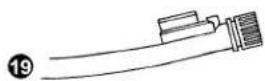
VISTA POR DENTRO
VISTA DESDE ATRÁS