
AVENT SCF902 - Breast pump PHILIPS - Free user manual and instructions
Find the device manual for free AVENT SCF902 PHILIPS in PDF.


| Product Type | Manual Breast Pump |
| Brand | Philips Avent |
| Model | SCF902 |
| Operation | Manual (hand-operated) |
| Dimensions | Approx. 20 x 10 x 10 cm (7.9 x 3.9 x 3.9 in) |
| Weight | Approx. 200 g (7.1 oz) |
| Material | BPA-free polypropylene and silicone |
| Included Accessories | Pump body, bottle, teat, cap, sealing disc, and cleaning brush |
| Bottle Capacity | 125 ml (4.4 oz) or 260 ml (9.1 oz) depending on variant |
| Power Source | None (manual) |
| Main Function | Expression of breast milk |
| Stimulation Mode | Gentle massage cushion to stimulate let-down |
| Cleaning | All parts dishwasher safe (top rack); sterilizable |
| Safety Certifications | BPA-free, phthalate-free, food-grade silicone |
| Spare Parts Availability | Yes, individual parts replaceable (valves, membranes, bottles) |
| Warranty | 2 years (manufacturer) |
| Compatible With | Philips Avent Natural baby bottles and storage containers |
| Ergonomic Handle | Yes, designed for comfortable grip |
| Number of Parts to Clean | 5 main parts (pump body, bottle, teat, cap, sealing disc) |
Frequently Asked Questions - AVENT SCF902 PHILIPS
User questions about AVENT SCF902 PHILIPS
0 question about this device. Answer the ones you know or ask your own.
Ask a new question about this device
Download the instructions for your Breast pump in PDF format for free! Find your manual AVENT SCF902 - PHILIPS and take your electronic device back in hand. On this page are published all the documents necessary for the use of your device. AVENT SCF902 by PHILIPS.
USER MANUAL AVENT SCF902 PHILIPS
Always there to help you
Register your product and get support at
www.philips.com.cn/AVENT

natural_image
Product photo of a medical device with AVENT brand label, showing its internal structure and control panel (no readable text beyond branding)EN
User manual
1
ZH-CN
用户手册
16
Contents
1 Important 2
2 Introduction 4
3 Overview 5
4 Clean and sterilize 6
5 Assemble 6
6 Use your pump 8
Before using the pump 8
To begin pumping 9
To pause pumping 10
Store your breast milk 11
Feed your baby with your
expressed milk 11
7 Hints to help you succeed 12
8 When to express milk 12
Right times of the day to express your milk 12
9 Troubleshooting 13
10 Recycling 15
11 Guarantee and service 15
1 Important
Read this user manual carefully before using your Philips AVENT single electronic breast pump, and save the user manual for future reference. You can also find this user manual at Philips website: www.philips.com/support

Warnings
• Always unplug from the power socket immediately after use.
- Do not use the breast pump while bathing.
- Do not place or store the breast pump where it can fall or be pulled into a bath or sink.
- Do not place or drop the pump motor, silicone tube, and power adapter into water or other liquids.
- Do not reach for a product that has fallen into water. Unplug from the power socket immediately.
• Children should be supervised to ensure that they do not play with the appliance. Place the appliance where children or pets is not reachable.

Warnings
- Before each use, check the breast pump, including the power adapter for signs of damage. Never operate the breast pump if it has a damaged plug, not working properly, has been dropped or damaged, or has been submerged in water.
- The power cord is irreplaceable. Discard it if is damaged, including the power adapter.
- Only use accessories recommended by Philips AVENT.
- Only use the power adapter supplied with the product.
- Make sure the breast pump, including the power adapter, is not exposed to extreme heat or placed in direct sunlight.
- Do not use the breast pump outdoors.
- There are no user serviceable parts inside the pump. Do not attempt to open, service, or repair the breast pump yourself.
- The parts of the pump which come directly into contact with milk are personal care items, and should not be shared between mothers.

Warnings
- Do not attempt to remove the pump body from the breast while under vacuum. Switch the breast pump off, and break the seal between your breast and the pump funnel with your finger, then remove the pump from your breast. You can also pull off the silicone tube from the motor or the cap to release the vacuum.
- Never use while pregnant as pumping can induce labor.
- Never use when sleepy or drowsy.
- This appliance is not intended for use by persons including children with reduced physical, sensory or mental capabilities, or lack of experience or knowledge, unless they have been given supervision or instruction concerning use of the appliance by a person responsible for their safety.
- If expressing becomes painful, stop and consult your breastfeeding advisor or healthcare professional.
- Do not use the breast pump in the presence of flammable anaesthetic mixtures with air, with oxygen, or with nitrous oxide.
-
Although the breast pump is compliant with applicable EMC directives, it may still be susceptible to excessive emissions and/or may interfere with more sensitive equipment.
-
The product should not be left unattended when plugged into a power socket.
- Never drop or insert any foreign object into any opening or the silicone tube.
- Do not shorten the the silicone tube.
- Before you connect the breast pump to the power, make sure that the voltage of the product corresponds to the local power voltage.
- Wash, rinse, and sterilize the appropriate pump parts before each use.
- Do not use antibacterial, abrasive cleaners, or detergents when cleaning breast pump parts.
- Never put the breast pump motor in water or sterilizer, as you can cause permanent damage to the pump.
- If the vacuum generated is uncomfortable or cause pain, switch off the breast pump, break the seal between the breast and the pump funnel with your finger, and then remove the pump from your breast. You can also pull off the silicone tube from the motor or the cap to release the vacuum.
- Do not continue pumping for more than five minutes at a time if no result is achieved.
- The product should not be left unattended when plugged into a power socket.
- Never drop or insert any foreign object into any opening or the silicone tube.
- Do not shorten the the silicone tube.
- Before you connect the breast pump to the power, make sure that the voltage of the product corresponds to the local power voltage.
- Wash, rinse, and sterilize the appropriate pump parts before each use.
- Do not use antibacterial, abrasive cleaners, or detergents when cleaning breast pump parts.

Cautions
- Never use any accessories or parts from other manufacturers or that Philips AVENT does not specifically recommend. If you use such accessories or parts, your guarantee becomes invalid.
- Do not use the breast bump if the silicone diaphragm appears to be damaged or broken.
Replace the silicone diaphragm. See chapter "Guarantee and service" for information on how to obtain replacement parts. - Never use feeding teats as dummies, pacifiers, or soothers. Make sure that the teething baby does not bite the teat too long. The continuous and prolonged bite will damage the teat. For hygiene reasons, replace teats after three months of use. Use only Philips AVENT teats and bottles together.
2 Introduction
Congratulations on your purchase and welcome to Philips AVENT! To fully benefit from the support that Philips AVENT offers, register your product at www.philips.com.cn/AVENT.
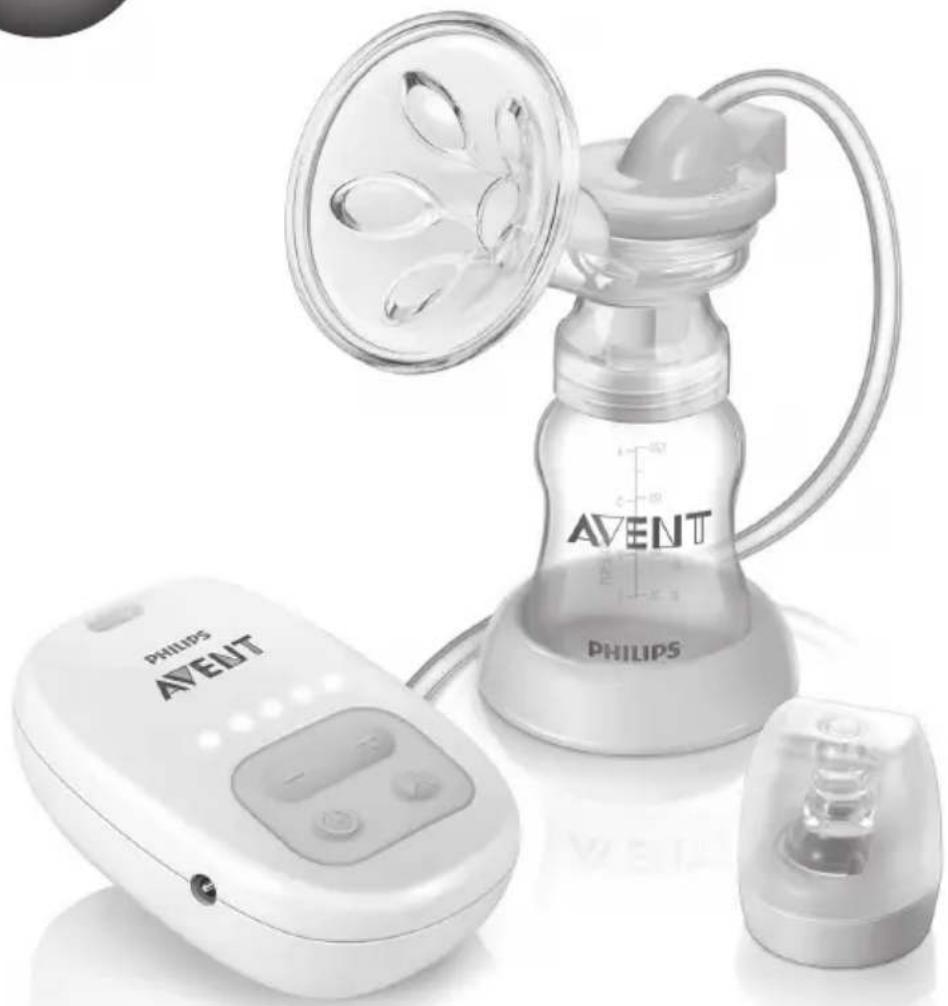
This Philips AVENT single electric breast pump is small and lightweight, and can be carried around easily. The Let-down Massage Cushion naturally imitates your baby's suckling action to provide fast milk flow - silently, comfortably, and gently. The five suction modes allow you to choose the suitable suction strength, so you can express your milk comfortably and thoroughly. This breast pump is also designed to separate the milk flow from air flow, which keeps milk out of the silicone tube. This ensures your milk is hygienic, and makes the pump easy to keep clean.
Doctors recommend that breast milk is the best nutrition for babies during the first year, combined with solid food after the first six months, You milk is specially adapted to your baby's needs and contains antibodies which help protect your baby against infection and allergies. Your single electric breast pump will help you breast-feed longer. You can express and store your milk so that - whether you are out for a few hours, taking a well deserved rest, or back at work - your baby can still enjoy the benefits of your breast milk, even if you cannot be there to give it yourself. As the pump is easy to assemble, silent and discreet, you can take it with you anywhere, allowing you to express milk at your own convenience and maintain your milk supply.
3 Overview
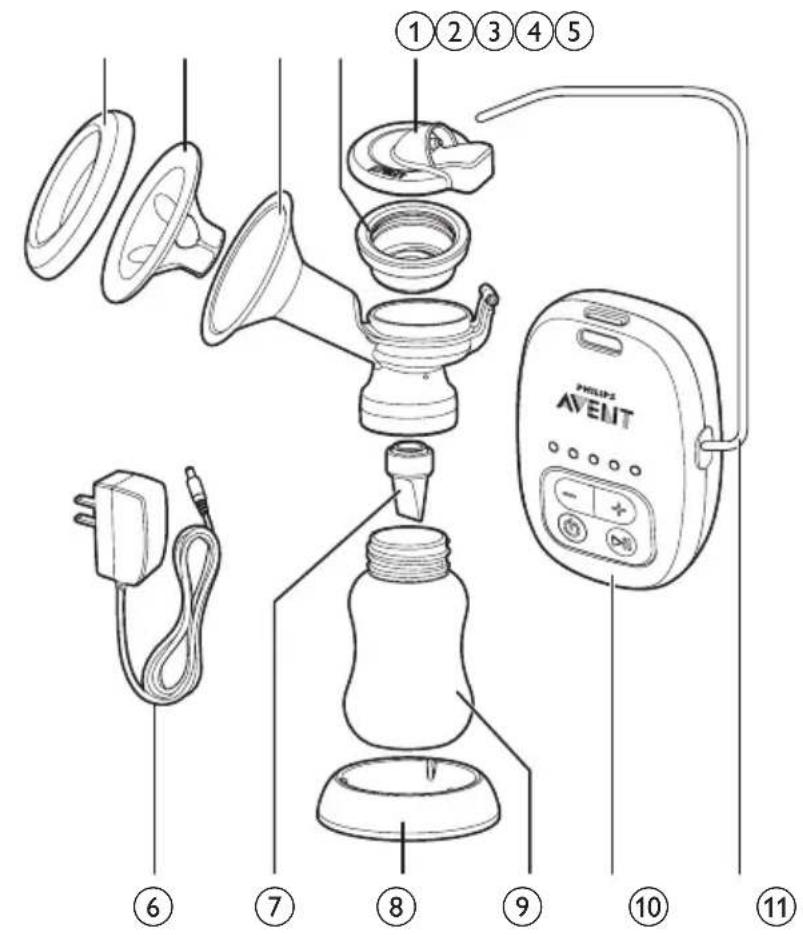
| 1 | Cap |
| 2 | Silicone diaphragm (x2) |
| 3 | Pump body |
| 4 | Let-down Massage Cushion |
| 5 | Pump cover |
| 6 | Power adapter |
| 7 | Valve |
| 8 | Stand |
| 9 | Bottle (120 ml) |
| 10 | Pump motor |
| 11 | Silicone tube |
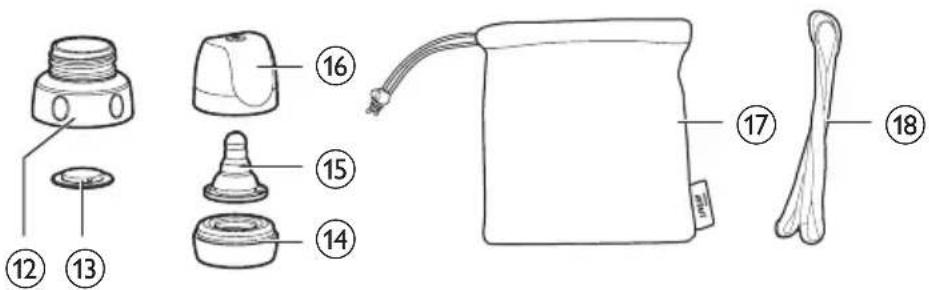
| 12 | Adaptor ring for wide neck bottles |
| 13 | Sealing disc |
| 14 | Screw ring |
| 15 | Teat (0m+) |
| 16 | Dormal cap |
| 17 | Pouch |
| 18 | Sling |
4 Clean and sterilize
Before you use your breast pump for the first time and for every time, you must disassemble, wash, and sterilize all the breast pump parts that come into contact with your breast milk. (see ②, ③, ④, ⑤, ⑦, ⑨ in Overview chapter)

Warning
- Never wash or sterilize the pump motor, the silicone tube, the cap, and the power adapter. These components do not come into contact with your breast milk. You can wipe the pump motor clean with a soft cloth.
You can also use the dishwasher (top rack only) or hand wash in warm, soapy water, and then rinse thoroughly. We recommend you to sterilize all the necessary parts in our Philips AVENT steam sterilizer, or by boiling for 5 minutes.

Caution
- Take care when cleaning the valve and the silicone diaphragm. If it gets damaged, your breast pump will not function properly. - To clean the valve, rub it gently between your fingers in warm soapy water. Do not insert objects as this may cause damage.
5 Assemble
To assemble the pump, follow the steps below.

Note
• Make sure that you clean and sterilize the pump as instructed in this user manual.
• Make sure that you assemble the pump correctly as instructed in this user manual.
- To avoid leakage remove the residue around the rim before assembling. Put the bottle onto the pump body, and do not over-tighten.
- Wash your hand thoroughly before you take sterilized components.
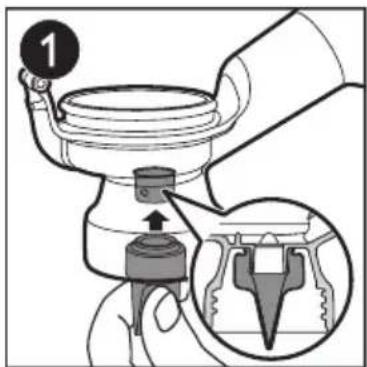
1 Insert the valve into the pump body from underneath.
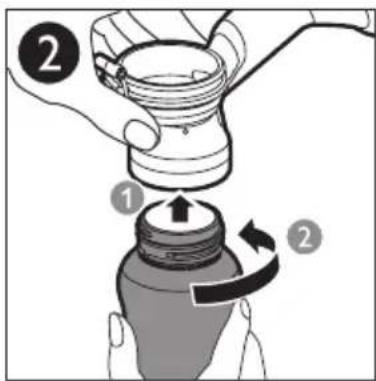
2 Put the bottle onto the pump body and turn it anticlockwise to fix it. Do not over-tighten when assembling the bottle to the pump body.

Note
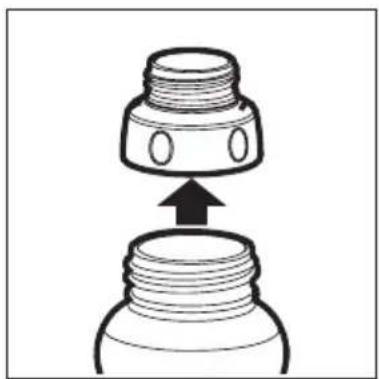
• If you use a Philips AVENT wide neck bottle, put on the adaptor ring.
natural_image
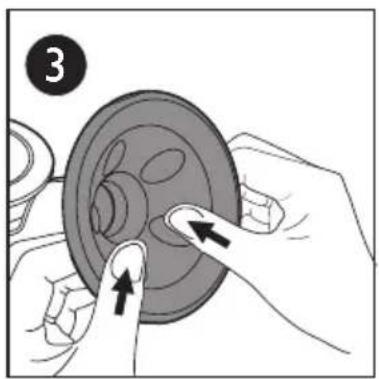
Diagram of a mechanical component with a cylindrical head and threaded base, showing an upward arrow (no text or symbols)3 Insert the Let-down Massage Cushion into the pump funnel and press the rim to ensure a perfect seal.
natural_image
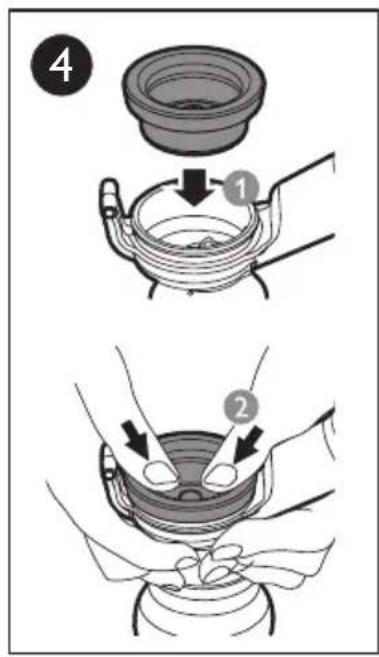
Illustration of hands operating a mechanical pulley or wheel component (no text or symbols visible)4 Put the silicone diaphragm onto the pump body and press the rim to make sure a perfect seal.

Note
• It is easier if assembled wet.
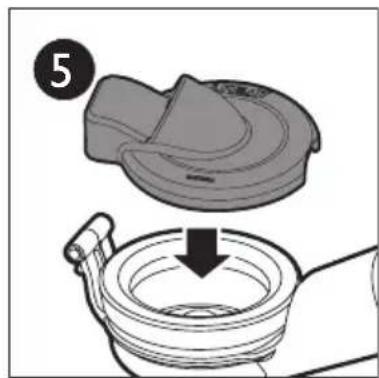
5 Firmly push the cap onto the silicone diaphragm, so that it sites securely on top of the silicone diaphragm.
natural_image
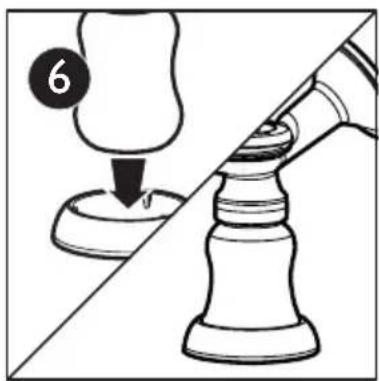
Illustration of a hand holding a small mechanical component with a circular arrow indicating downward motion (no text or symbols)6 To make the bottle stands stable, insert it into the stand.
natural_image
Illustration of a chess piece being inserted into a chess ball, showing the process (no text or symbols)
Note
• To prevent toppling, insert the bottle into the stand after each use.
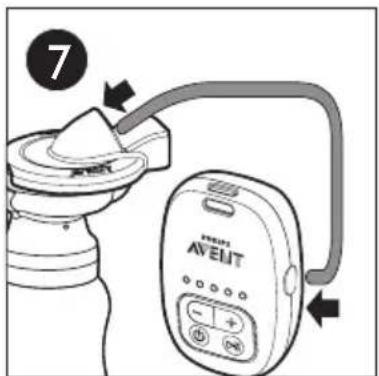
7 Connect the silicone tube to the cap and the motor firmly.
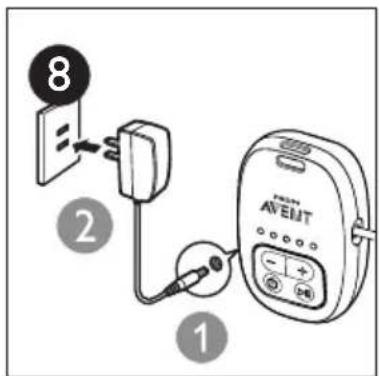
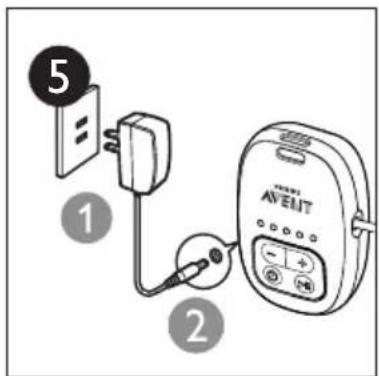
8 Connect the power adapter to the pump motor, and then insert the power plug to the power socket.

Tip
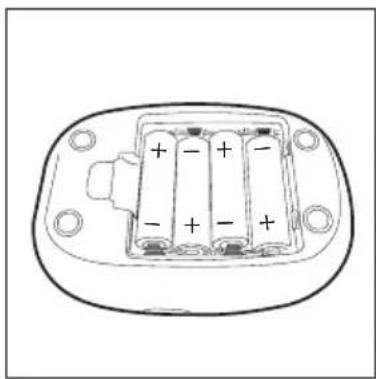
- For battery operation, open the rear cover of the motor unit in the direction indicated by the marks. Insert four new 1.5V AA alkaline batteries into the battery housing. Reattach the rear cover to the motor unit.

Note
- A new set of batteries provides up to 2.5 - 3 hours of operation. If you have inserted batteries in the battery housing of the motor unit and plug in the adapter, the breast pump will run from the main power supply. The batteries cannot be charged in the unit.
natural_image
Diagram of an electrical component with three cylindrical tanks and mounting holes (no text or symbols)6 Use your pump
Before using the pump
- Wash your hands thoroughly, and make sure your breasts are clean. Gently squeeze a little milk from each nipple to make sure that milk ducts are not blocked.
• Make sure you follow the steps in "Clean and sterilize" and "Assemble" chapters to clean, sterilize, and assemble the breast pump.
- Relax in a comfortable chair, leaning slightly forward (use cushions to support your back). Make sure that you have a glass of water nearby.
To begin pumping
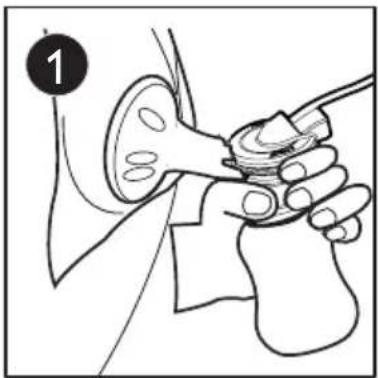
1 Press the funnel and the Let-down massage cushion of the pump firmly against your breast. Make sure that no air escape; otherwise there is no suction.
natural_image
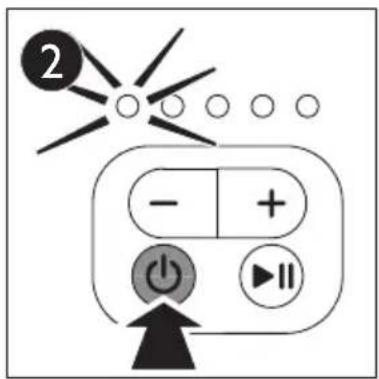
Illustration of a medical procedure showing a hand holding a tool near an open foot (no text or symbols present)2 Press the on/off button &to switch on your pump. → The breast pump automatically starts up with the lowest level to gently stimulate, and the left light on the pump motor will illuminate. You begin to feel the suction on your breast.
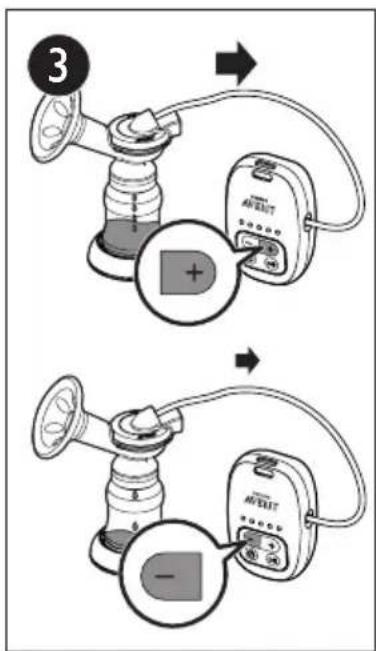
3 Once your milk starts flowing, you can press suction increase button +or
suction decrease button – to adjust and find your exact comfort level.
- Press the suction increase button + to deeper the suction.
- Press the suction decrease button to lower the suction.
→ There are altogether five modes. the number of lights will increase or decrease according to the vacuum mode selected.

Note
- You do not need to use the deepest suction mode, only use the modes that are comfortable for you.
4 When you have finished expressing, press the on/off button Ⓞto switch off your pump. Carefully remove the pump body from your breast.
5 Disconnect the the power plug to the power socket, and then disconnect the power adapter from the pump motor.
6 Unscrew the bottle from the pump body ready for feeding or storage. Clean the other used parts of the breast pump according to the instructions in chapter "Clean and Sterilize".

Caution
- Do not continue pumping for more than 5 minutes at a time if there is no result. Try expressing at another time during the day.
- If the process becomes very uncomfortable or painful, stop using the pump, and consult your breastfeeding advisor.
- Never tilt the breast pump when the milk has reached the maximum line on the bottle. Replace with a new bottle before re-pumping to avoid spillage.

Note
- If you can express more than 120 ml each time, use the 240ml Philips AVENT milk bottle for storage to avoid spillage.
- If the breast pump is on but there is no operation for 30 minutes, it will automatically shut down.

Tip
- Place the pump motor on a stable and flat surface, or hang up steadily with the included sling, to avoid any accidental drops when in use. If not, this may pull the pump body off from the breast and cause injury.
To pause pumping
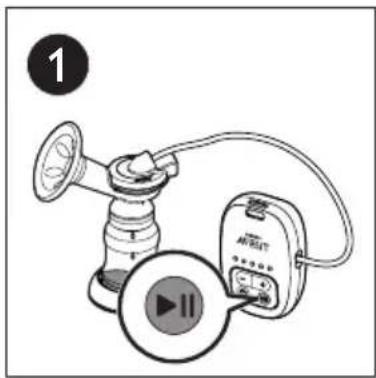
This breast pump has a pause function, and you can press the pause button
▶II to pause pumping if at any time the suction becomes uncomfortable, there is a need to change the bottle, reposition the pump on the breast, or change side.
1 When the breast bump is in a particular suction mode, press pause button ▶ will pause the pumping. → The respective light will flash to remind you of the selected suction mode.
natural_image
Illustration of a portable electronic device with a speaker and control panel (no text or symbols)
Note
- When the breast pump is in pause, pressing the suction increase button + or suction decrease button - cannot adjust the suction mode.
2 Press the pause button ▶ again to continue the pumping with the suction mode selected before pausing.
Store your breast milk

Caution
• Never refreeze breast milk.
- Do not mix fresh breast milk to already frozen milk.
• Always discard any left over milk at the end of a feed.

Note
- Only store the milk collected with a sterile pump.
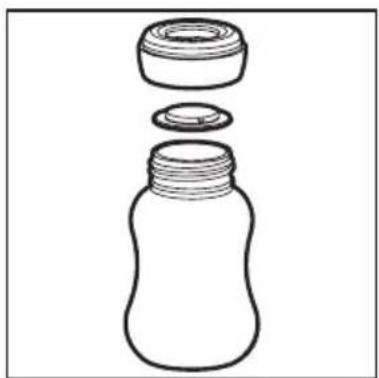
1 After you have expressed your milk, unscrew the pump body from the Philips AVENT bottle. 2 Store expressed milk in cleaned and sterilized Philips AVENT bottles fitted with sealing discs. Put them in the fridge or freezer immediately.
- You can store expressed breast milk in the refrigerator for up to 48 hours (not in the door) or in the freezer for up to 3 months.
- Label the bottles with date and time.
• Use up the older milk first.
natural_image
Line drawing of a baby bottle with a lid and cap, showing internal structure (no text or symbols)Feed your baby with your expressed milk
- If you use Philips AVENT bottle to store breast milk, make sure to remove the sealing disc and assemble the Philips AVENT teat for feeding. - Place the frozen breast milk in the refrigerator to defrost overnight. In case of an emergency, you can defrost the milk in a bowl of hot water. Use up the defrosted breast milk within 24 hours after defrosting.
About heating up the breast milk:
- Heat the bottle with in a bowl of hot water, or using Philips AVENT bottle and baby food warmer to safely heat up the milk.

Caution
- Remember! Always check milk or food temperature before feeding.
- Never heat breast milk in a microwave as this may destroy valuable nutrients and antibodies. In addition, the uneven heating may cause hot spots in the liquid which could cause burns to the throat.
- Never immerse a frozen bottle in boiling water to avoid crack or split.
7 Hints to help you succeed
The single electronic breast pump is easy to use. Take some practice, and you will soon get used to expressing milk.
- Choose a time when you are not rushed nor interrupted easily.
• Having your baby or a photograph of your baby nearby can help encourage your milk to flow. - Before expressing milk, place a warm towel onto your breast, and lightly massage for a few minutes. This encourages milk flow, and ease the pain of your breast.
- Warmth and relaxation can encourage milk flow. Try expressing after a warm bath or shower.
- Try expressing from one breast while your baby is feeding from the other, or continue expressing just after a feed.
- Repositioning the pump on the breast from time to time can help stimulate your milk flow.

Tip
- Practice with your pump to find the best pumping techniques for you. If the process becomes painful, stop and consult your breast-feeding advisor.
8 When to express milk
If possible, wait until your milk supply and breast-feeding schedule are well established, normally at least 2-4 weeks after birth, unless told otherwise by your doctor or breast-feeding advisor. The exceptions are:
• If you are expressing milk for your baby to be given in hospital.
- If your breasts are engorged (painful or swollen). You can express a small amount of milk before or between feeds to east the pain, and to help your baby latch on more easily.
- If you have sore or cracked nipples and you may wish to express your milk until they are healed.
- If you are separated from your baby and wish to continue to breast-feed when you are reunited. You should express your milk regularly to stimulate your milk supply.
Right times of the day to express your milk
- Early in the morning when you breasts are full, just before or after your baby's first feed.
• After a feed, if your baby has not emptied both breasts. - Between feeds or in a break if you have returned to work.
9 Troubleshooting
Problem Solution
| Lack of suction | Check that all components are assembled correctly and that the valve is in positioned correctly.Make sure that the cap, the diaphragm, and the Let-down Massage Cushion are fitted securely to the pump body and a perfect seal is created.The air pressure in your region is too low, this may affect the suction.Make sure the silicone tube is firmly connected to the cap and the motor, without twisting. |
| No milk being expressed | Make sure the pump is assembled correctly, and the suction is created.Relax and try again; as expression may improve with practice.Refer to the “Hints to help you succeed” section. |
| Pain in the breast area when expressing | You may be pumping too hard. You do not need to use all the suction that the pump can generate but the comfortable modes.Press the suction decrease button – to lower down the suction intensity.Consult your health professional/ breast feeding advisor. |
| Milk is drawn up the Let-down Massage Cushion | Remove and refit the Let-down Massage Cushion.Make sure that it is installed correctly and firmly.Try leaning lightly forward. |
| Cracking/Discoloring | Avoid contact antibacterial or abrasive detergents/cleaners.Combinations of detergents, cleaning products, sterilization solution, softened water, and temperature fluctuations may cause the plastic to crack. If any crack is found, stop using the pump immediately. Contact Philips AVENT Consumer Care center for spare components.Food coloring can discolor components, but this will not affect your usage.Keep all the components away from the source of heat or direct sunlight as it can discolor components. |
| Components broken or lost | Contact Philips AVENT Consumer Care center for spare components. See back cover for contact details. |
| Pump not responding | Make sure the pump is correctly assembled and press the on/off button ⏻ to switch on.Make sure the cables between the pump and the power socket are correctly connected. |
| Pump lights are showing low voltage warning | If the five lights on the motor are sequentially flashing and the pump motor automatically stop functioning, this means the breast pump is in low voltage protection mode. If you use batteries to supply power, press the on/off button ⏻ to switch off. Replace with new batteries and switch the pump on again.When using the power adapter to supply power, make sure it is connected properly, then switch the pump on again. If this problem persists, contact the Consumer Care center for help. |
| Pump light is flashing abnormally | If the five pump lights are flashing non-stop, press the on/off button ⏻ to switch off. Check that all components are assembled correctly. If the assembling is correct, but the problem persists after switching on again, contact the Consumer Care center for help. |
If you are unable to solve the problem with the provided information, contact the Philips AVENT Consumer Care staffs. You can also consult your health professional or breast-feeding advisor.
10 Recycling
Batteries contain substances that may pollute the environment. Do not throw away batteries with the normal household waste, but dispose them at an official collection point for batteries. Do not throw away the appliance with the normal household waste. Please get to know the local regulation for electrical and electronic products. By disposing in a correct way, you help to avoid causing impact of environment and human health.
11 Guarantee and service
Philips Consumer Lifestyle guarantees its products under correct usage for a period of one year after the date of purchase. If any defect due to faulty materials and workmanship occurs within this one year guarantee period, Philips Consumer Lifestyle will repair or replace the product at its expense. For repair or replacement, make sure to provide convincing proof, for instance by means of a receipt, that the day on which service is claimed is within the guarantee period.
The guarantee only covers the breast pump motor and power adapter. It does not cover non-electrical parts, accessories and consumable parts. The guarantee does not cover shipping and handling fees, and on-site services fees either.
If you need service or information, or if you have a problem, please contact the Philips AVENT Consumer Care center or call the China Consumer Hotline: 4008 800 008 (there are local call charges).
Website: http://www.philips.com/support
目录

注
natural_image
Diagram of a mechanical component with a cylindrical top and flanged base, showing an upward arrow (no text or symbols)natural_image
Illustration of hands operating a mechanical pulley with arrows indicating motion (no text or symbols)natural_image
Illustration of a hand holding a small mechanical component with a magnified view showing internal structure (no text or symbols)natural_image
Illustration of a chess piece being inserted into a chess ball, showing the chess piece being inserted (no text or symbols present)
注

提示
natural_image
Diagram of an electrical component with three batteries and mounting holes (no text or symbols)6 使用吸乳器
在使用吸乳器前
natural_image
Illustration of a hand holding a medical device with a foot, no text or symbols present2 按电源开关键 ⏻ 启动吸乳器。
natural_image
Illustration of a portable electronic device with a speaker and control panel (no text or symbols)三注
natural_image
Line drawing of a baby bottle with a lid and cap, showing internal structure (no text or symbols)用吸出的母乳喂食婴儿
Specifications are subject to change without notice
All rights reserved.
技术规格如有变更,恕不另行通知。