
ERB 21880 NXE - Fridge ECG - Free user manual and instructions
Find the device manual for free ERB 21880 NXE ECG in PDF.


| Product Type | Refrigerator-Freezer Combination |
| Brand | ECG |
| Model | ERB 21880 NXE |
| Voltage | 220-240 V, 50 Hz |
| Cooling System | Total No Frost |
| Refrigerant | R600a (Isobutane) |
| Climate Class | T/ST/N/SN (10°C to 43°C) |
| Defrosting | Automatic (No Frost) |
| Interior Lighting | LED |
| Reversible Door | Yes |
| Adjustable Feet | Yes |
| Number of Refrigerator Shelves | 3 (approx.) |
| Number of Freezer Drawers | 3 (approx.) |
| Egg Rack | Yes |
| Quick Cooling Function | Yes (Super cool) |
| Display Type | LED with touch buttons |
| Warranty | 24 months |
| Spare Parts Availability | 7 years |
| Energy Efficiency Class | Not specified |
| Net Capacity | Not specified |
Frequently Asked Questions - ERB 21880 NXE ECG
User questions about ERB 21880 NXE ECG
0 question about this device. Answer the ones you know or ask your own.
Ask a new question about this device
Download the instructions for your Fridge in PDF format for free! Find your manual ERB 21880 NXE - ECG and take your electronic device back in hand. On this page are published all the documents necessary for the use of your device. ERB 21880 NXE by ECG.
USER MANUAL ERB 21880 NXE ECG
natural_image
Simple line drawing of a door with two rectangular panes, no text or symbols presentEnglish
Deutsch
Čeština
Slovenčina
ERB 21880 NXE
COMBINATION REFRIGERATOR
INSTRUCTION MANUAL
KÜHL-GEFRIERKOMBINATION
BEDIENUNGSANLEITUNG
KOMBINOVANÁ CHLADNIČKA
NÁVOD K OBSLUZE
KOMBINOVANÁ CHLADNIČKA
NÁVOD NA OBSLUHU
SAFETY INSTRUCTIONS
Read carefully and save for future use!
Warning: The safety measures and instructions, contained in this manual, do not include all conditions and situations possible. The user must understand that common sense, caution and care are factors that cannot be integrated into any product. Therefore, these factors shall be ensured by the user/s using and operating this appliance. We are not liable for damages caused during shipping, by incorrect use, voltage fluctuation or the modification or adjustment of any part of the appliance. To protect against a risk of fire or electric shock, basic precautions shall be taken while using electrical appliances, including the following:
- Make sure the voltage in your outlet corresponds to the voltage provided on the appliance label and that the socket is properly grounded. The outlet must be installed in accordance with applicable electrical codes according to EN.
- Do not operate the device if the cord is damaged. All repairs or adjustments including cord replacements must be carried out by a professional service centre! Do not remove the protective covers from the appliance; there is a risk of electric shock!
- Protect the appliance against direct contact with water and other liquids, to prevent potential electric shock. Do not immerse cord or plug in water!
- Do not use the appliance in humid environments or in areas where there may be gas leakage or contact with an explosive atmosphere. Do not touch the cord or the device with wet hands. Risk of electric shock.
- The power cord must remain accessible once the device is installed. Do not shorten the cable and do not use splitters in electric outlets. Do not allow the cord to touch hot surfaces or place the cord over sharp edges.
- Do not switch the appliance on or off by plugging in or pulling out the power supply plug. Do not remove the power cord from the
outlet by yanking the cord. Unplug the power cord from the outlet by grasping the plug.
- Do not insert any objects into the device or place any objects on the device (e.g. vases, cups, etc.). Never cover the ventilation openings!
- Do not use other electrical appliances or freezing equipment in the appliance.
- If this appliance is replacing an old appliance with a lock, make the lock of the old appliance inoperational to prevent children from locking themselves inside (e.g. when playing).
- Do not use mechanical devices or other artificial means to speed up defrosting. Do not use electrical appliances in the food storage area. Protect the cooling circuit of the appliance against damage.
- Do not allow children to play with the appliance. Also, they may not sit on the shelves and hang on the door of the appliance.
- Do not use sharp metal objects to remove ice in the refrigerator, as they can damage the freezing circuits and cause irreparable damage to the equipment. If necessary, use a plastic scraper.
- Do not store explosive materials such as sprays with propellant in the appliance.
- Do not place containers (glass bottles or cans) with liquids in the freezer. The container could burst.
- Bottles containing liquids with high alcohol content must be properly closed and placed vertically when stored.
- Do not expose the appliance to direct sunlight, do not use it outside and do not expose it to rain.
- Do not touch the cooling surfaces with wet hands. Risk of injury.
- Do not consume the ice removed from the freezer.
- This appliance is designed for domestic use and for use in similar places, such as:
- Kitchenettes in shops, offices and other workplaces
- appliances used by guests in hotels, motels and other residential areas.
- appliances used in bed and breakfast residences
- This appliance may be used by children under 8 years of age and older and persons with reduced physical, sensory or mental capabilities or lack of experience and knowledge if supervised or instructed to use the appliance in a safe manner and understand the potential hazards. Children shall not play with the appliance. User cleaning and maintenance must not be performed by unsupervised children.
- Children aged 3 to 8 years can insert and remove food from refrigerating appliances.
- Child supervision is essential to prevent them from playing with the appliance.
- The manufacturer is not liable for any damage caused by improper grounding/use.
-
It is necessary to keep free the ventilation openings in the cover or in the construction of the appliance.
To prevent food contamination, please follow these recommendations: -
Opening the door for a long time can cause a significant increase in the temperature inside the appliance.
- Regularly clean surfaces and accessible drainage systems that may come into contact with food.
- Clean water containers if not used for 48 h; flush the water system connected to the water supply if the water has not flowed for 5 days.
- Store raw meat and fish in the refrigerator in suitable containers so that they do not come into contact with or drip into other foodstuffs.
- Two-star freezing compartments are suitable for storing pre-frozen food, storing or making ice cream and making ice cubes.
- One-, two- and three-star compartments are not suitable for freezing fresh food.
- If the refrigerating appliance is left empty for a long time, turn it off, defrost, clean, dry and leave the door open to prevent mold formation inside the appliance.
RISK OF FIRE!
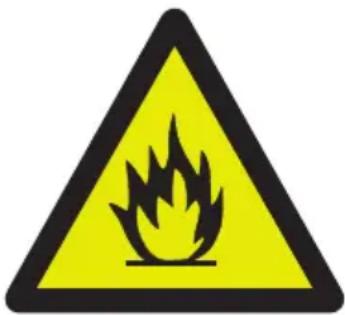
WARNING: RISK OF FIRE/FLAMMABLE MATERIALS
This appliance contains R600a (isobutane coolant), natural (natural) gas that is very environmentally friendly but flammable. When transporting and installing the appliance it is necessary to ensure that none of the parts of the cooling circuit is damaged. In case of damage limit the flame and ventilate for several minutes the space where the appliance is located.
The cooling system contains high-pressure coolant. Do not manipulate the system. It must only be repaired by a qualified person.
When replacing the interior lighting of the refrigerator, always unplug the refrigerator - otherwise there is a risk of electric shock. • If the replacement of the interior lighting is too complicated for you, contact your service representative. • If the products are equipped with LEDs, do not remove the lighting cover and LED yourself. – contact your service representatives.
REPLACING THE LED BULB: Do not remove the indicator cover or indicator yourself when the internal or external LEDs no longer operate. Contact the service representatives.
Do not replace the LED lighting yourself. Contact the service representatives.
INSTALLING AND OPERATING YOUR REFRIGERATOR
Before using the refrigerator, you must pay attention to the following points:
- The operating voltage of your refrigerator is 220-240 V at 50Hz.
- The power cable of your refrigerator has a grounded plug. This outlet must be grounded in a grounded plug that has a fuse of at least 16 amps. If you do not have a socket that meets this requirement, have it installed by a qualified electrician.
- We are not liable for any damage that may occur due to ungrounded usage.
- Place the refrigerator where it will not be exposed to direct sunlight.
- Your appliance must be at least 50 cm from an oven, gas oven or burners and must be at least 10 cm from an electric oven.
- Your refrigerator must not be used outdoors or left in the rain.
- When your refrigerator is placed near the freezer, there must be a distance of at least 2 cm between them to prevent the formation of moisture on the outside surface.
- Position the refrigerator so that there is a free space in the back and on the sides of min. 10 cm. Do not place anything on the refrigerator and place it in a suitable location so that there is at least 30 cm above the top.
- The adjustable front legs must be adjusted to a suitable height so that the freezer can operate stably and correctly. You can adjust the feet by turning them clockwise (or in the opposite direction). This must be done before placing food in the refrigerator.
- Before using the freezer, wipe all internal surfaces and drawers with a cloth immersed in warm water with a teaspoon of baking soda, then rinse with clean water and dry. Replace all parts after cleaning.
Climate class and significance: see information sheet
T (tropical): This freezer is intended for use in ambient temperatures from 16 °C to 43 °C.
ST (subtropical): This freezer is intended for use in ambient temperatures from 16 °C to 38 °C.
N (normal): This freezer is intended for use in ambient temperatures from 16 °C to 32 °C.
SN (subnormal): This freezer is intended for use in ambient temperatures from 10 °C to 32 °C.
| Climatic classes Surrounding |
| T 16 up to 43°C |
| ST 16 up to 38°C |
| N 16 up to 32°C |
| SN 10 up to 32°C |
Before using the refrigerator
- Allow the freezer to stand for 3 hours before connecting it for the first time or after transporting it. Otherwise, the compressor could be damaged.
- Your refrigerator may smell at the first start; odour disappears as soon as cooling starts.
Information about the new cooling technology
Refrigerators-freezers with the new refrigerating technology have a different system than static refrigerators-freezers. In the case of conventional refrigerator-freezers, moist air is blown into the freezer and the water evaporating from the food turns into ice in the freezer compartment. In order to remove this frost, in other words, to defrost, the refrigerator must be disconnected from the power supply. During defrosting, the user must put the food away and remove the remaining ice and accumulated ice.
In the case of freezers equipped with new cooling technology, the situation is quite different. Cool and dry air is dispersed in the freezer compartment by means of a fan. The cold air is thus easily dispersed throughout the space - even between the shelves, and the food is frozen properly and evenly. And no frost forms.
The configuration in the refrigerator compartment will be almost the same as in the freezer compartment. The air dispersed by the fan at the top of the refrigerator compartment is cooled as it passes through the gap behind the duct. In order to successfully complete the cooling process in the refrigerator compartment, air is
released at the same time through the openings in the duct. The vents on the duct are designed for even air distribution in the space.
Since no air passes between the refrigerator and the freezer, no odors are mixed.
This makes the refrigerator with new cooling technology easy to use and offers you both a large volume and an aesthetic appearance.
This appliance is not intended for use as a built-in device.
Door opening reversal
- Turn off the refrigerator and remove all objects from the compartments in the door.
- Remove the upper hinge cover, disconnect the cables, upper hinge and hole cover on the other side. Remove the refrigerator door.
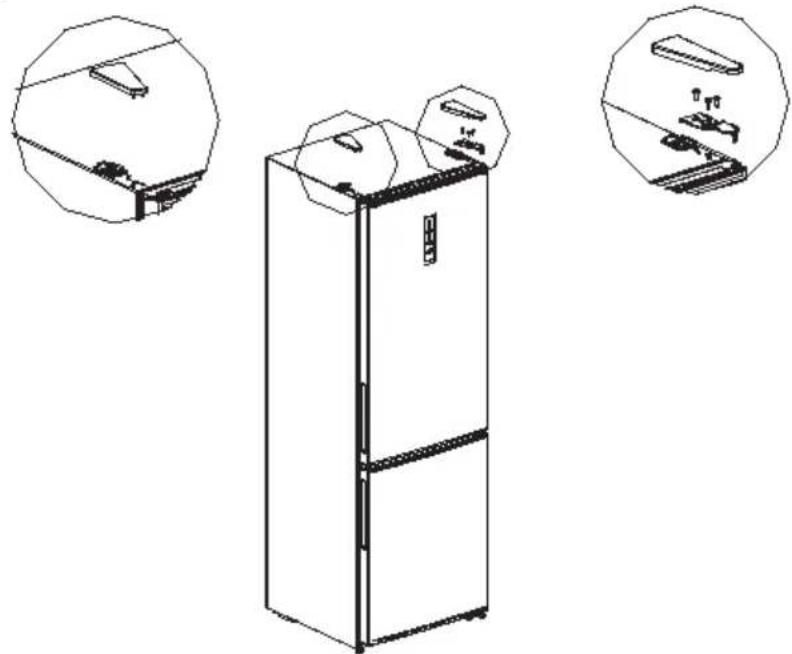
natural_image
Line drawing of a refrigerator with three inset views showing internal components (no text or symbols)- Remove the center hinge, screws, hole caps and remove the freezer door.
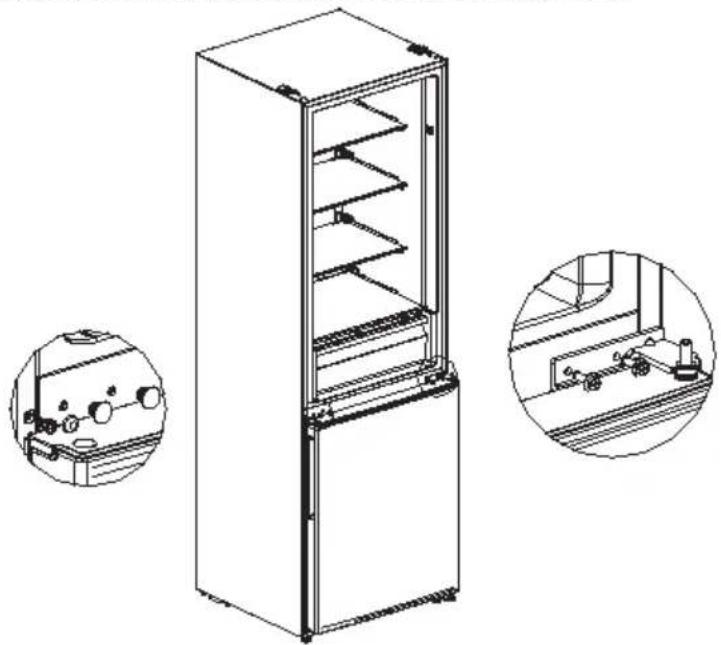
natural_image
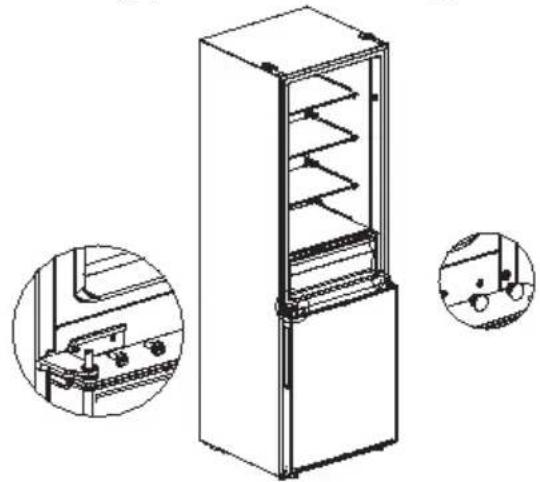
Line drawing of a refrigerator with internal shelves and two circular insets showing close-ups of equipment (no text or symbols)- Remove the bottom hinge, hole caps and screws, install the bottom hinge shaft on the other side of the bottom hinge, and then install the hinge on the other side.
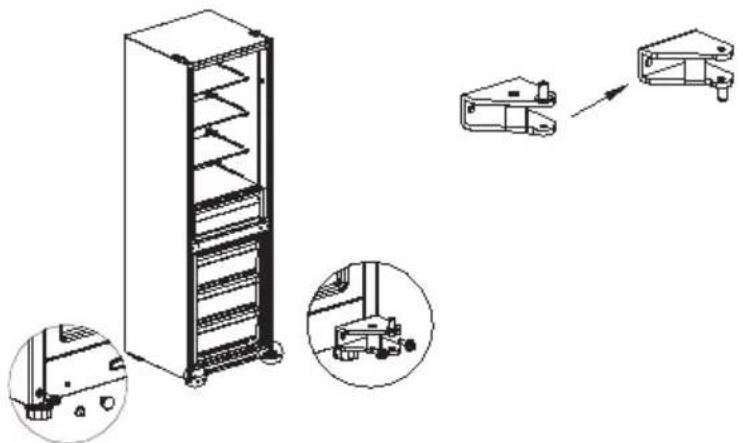
natural_image
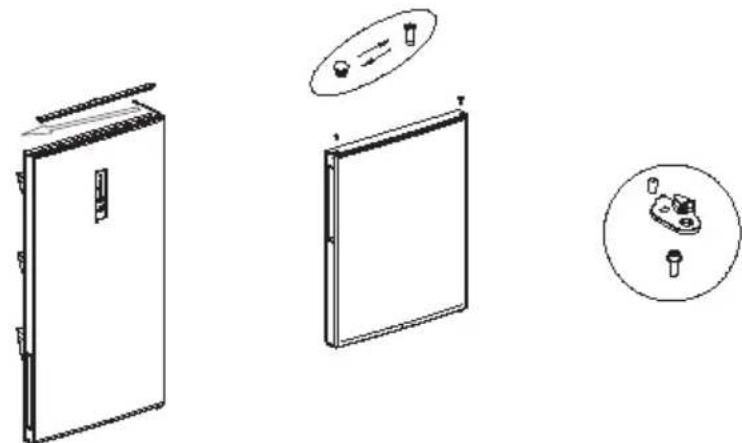
Technical line drawing of a server rack unit with three views of its internal components (no text or symbols present)- Remove the screws, sleeve tube and plug on the bottom front cover of both door bodies and install them one after the other on the other side of the door bodies (the plug must be replaced from the included bag). Then remove the upper radiator door end cover and connect the wiring harness to the other side of the door body. Finally, install the radiator door upper hinge sleeve tube in the hole on the other side of the upper radiator door end cover.
natural_image
Technical line drawings of three views of a door panel with internal components (no text or symbols)- Install the freezer door on the lower hinge, install the middle hinge, screws and screw hole covers.
natural_image
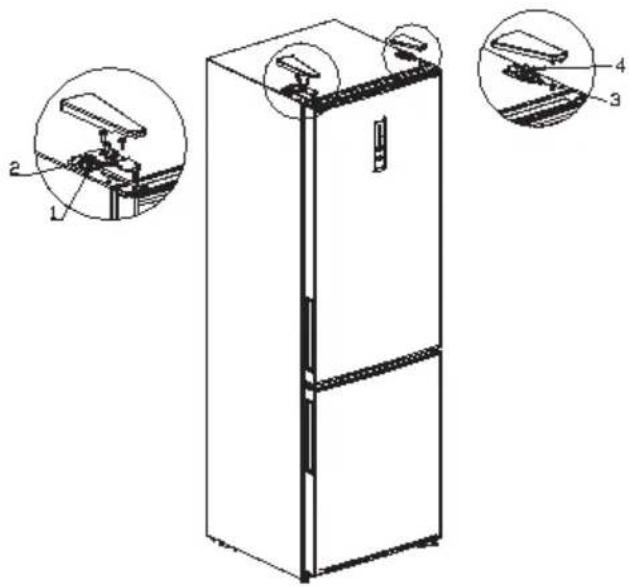
Technical line drawing of a refrigerator with internal shelves and side views (no text or symbols)- Place the refrigerator compartment body on the center hinge, then install the top hinge on the other side of the cabinet, finally connect the terminal, 2 for the signal wires on the top hinge side and terminals 3 and 4 on the other side, and cover the hinge cover and hole cover.
DESCRIPTION OF THE APPLIANCE AND ACCESSORIES
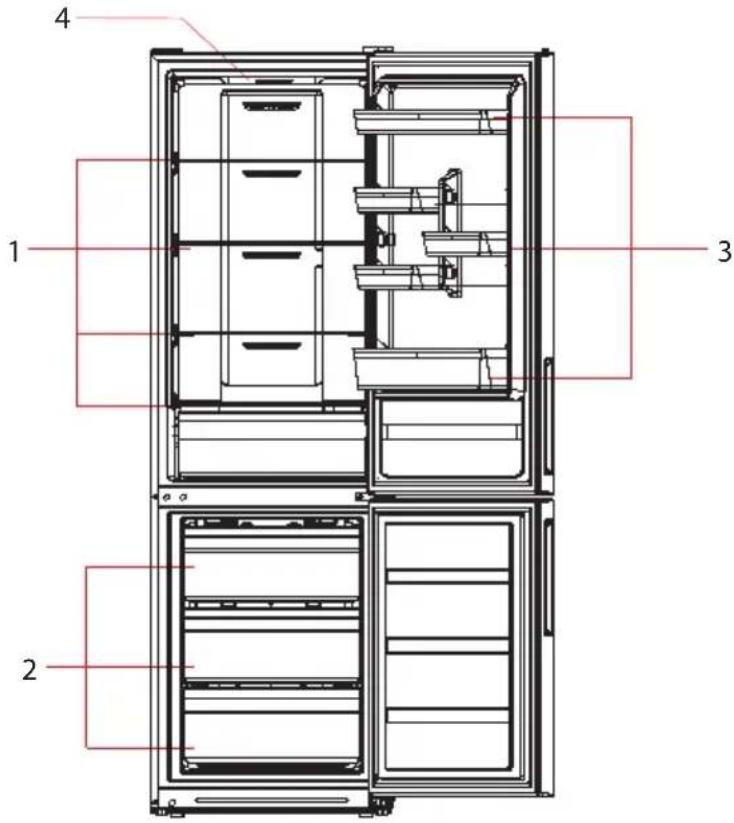
This presentation is for information only and concerns the components of the appliance. Parts may differ depending on the model.
1) Refrigerator shelves
2) Freezer boxes
3) Door compartments
4) LED lighting
Display and control panel
External display / External control
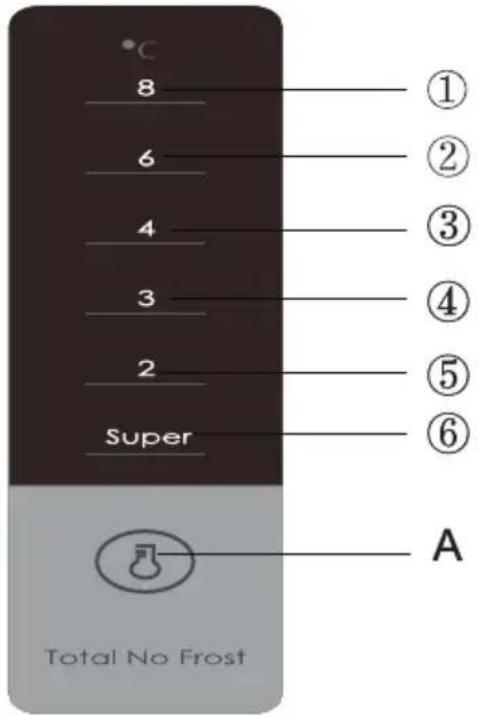
Button A
Used to set the temperature.
Temperature setting screen
The ① to ⑥ button show the individual temperature settings.
Display
After switching on the refrigerator, the display (including the buttons) will be fully lit for 3 s, and then the refrigerator will run according to the temperature setting 3.
When a malfunction occurs, the combined malfunction code is displayed (cyclically on the display) using the appropriate LED indicators. If there is no malfunction, the current temperature setting will be shown on the LED display.
Malfunction codes
The following warnings on the display indicate refrigerator malfunctions. Although the refrigerator can operate without problems even with these malfunctions, it is always necessary to contact an authorized service center.
Lit indicators ① and ②: Temperature sensor circuit error
Lit indicators ① and ③: Defrost sensor circuit error
Lit indicators ① and ④: Ambient temperature sensor error
Lighting (if available)
When the product is plugged in for the first time, the interior lighting may be delayed by 1 minute due to opening tests.
After connecting the appliance to the mains, all symbols on the display will light up for 3 seconds, the default setting of the cooling space is +4^ . The default freezer temperature is -15^
Temperature settings
- The default refrigerator temperature is set to +4^ C .
- To set the temperature, press the temperature change button on the display.
- The desired temperature is set within about 15 seconds.
- As the temperature in the refrigerator increases, the temperature in the freezer automatically increases, and conversely, the colder it is in the refrigerator, the lower the temperature in the freezer.
Quick cooling function
Set the fast cooling mode by setting the temperature to indicator 6 (SUPER).
The fast cooling indicator lights up and the refrigerator cools down to 2^ C. After 150 minutes, the quick cooling function automatically shuts off. You can turn off the fast cooling function earlier by setting a different cooling temperature.
Note concerning the temperature setting
- Your temperature setting will not be cleared if there is a power failure.
- It is not recommended to use the refrigerator in an environment where the ambient temperature is below 16^ .
- The temperature must be set in accordance with the frequency with which the door is opened and the amount of food stored in the refrigerator.
- Your refrigerator must be operated for 24 hours at a given ambient temperature without interruption to allow it to cool completely. Do not open the refrigerator door frequently and do not put too much food in it at this time.
- The 5 minute delay function is used to prevent damage to the refrigerator compressor when you unplug and then reconnect it or when there is a power failure. Your refrigerator starts working normally after 5 minutes.
- Your refrigerator is designed to operate at the intervals specified in the standards, in accordance with the class indicated on the information tag. We do not recommend starting your refrigerator outside the stated limits, so that you can achieve effective cooling.
- This appliance is designed for use at an ambient temperature of 16^ C - 38^ C .
CLEANING AND MAINTENANCE
• Make sure that the refrigerator is unplugged before you start cleaning it.
- Do not clean the refrigerator with running water.
- You can wipe the inside with a soft cloth and a sponge soaked in warm water with detergent.
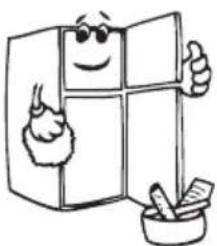
natural_image
Cartoon illustration of a smiling refrigerator with hands giving thumbs up and a bowl of food nearby (no text or symbols)- Remove the individual parts and wash them with water and detergent. Do not wash in the dishwasher.
- Never use flammable, explosive or corrosive cleaning agents, such as thinner, gasoline, acid, for cleaning.
- You must clean the condenser with a brush once a year to save energy and increase productivity.
Warning: Make sure that your refrigerator is unplugged during the cleaning.
Defrosting
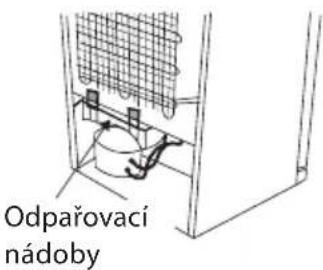
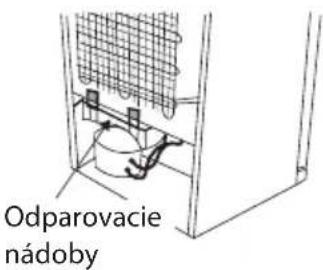
Your refrigerator performs fully automated defrosting. The water accumulated as a result of defrosting passes into the evaporating vessel and there evaporates on its own.
Replacing the LED indicator
Replacement of the LED must be performed by an authorized service center or other person qualified to do so.
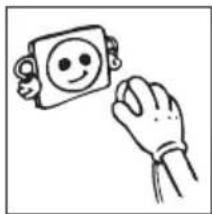
natural_image
Simple line drawing of a hand holding a smiling emoji-shaped object (no text or symbols)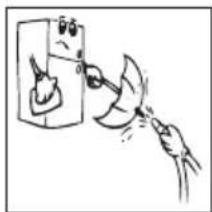
natural_image
Simple line drawing of a hand cleaning a box with a knife (no text or symbols)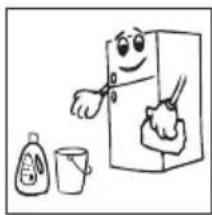
natural_image
Cartoon illustration of a smiling refrigerator with hands cleaning it, accompanied by a small bottle and cup (no text or symbols)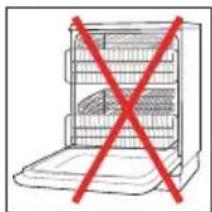
natural_image
Simple line drawing of a refrigerator with a red X mark on the door (no text or symbols)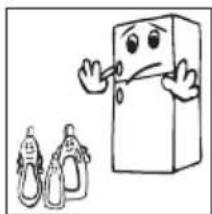
natural_image
Cartoon illustration of a refrigerator with two baby figurines (no text or symbols)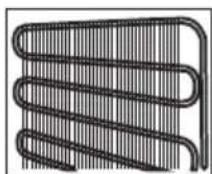
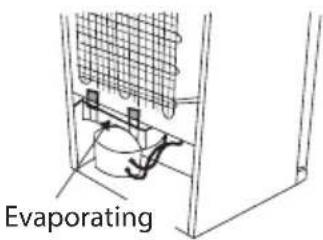
Evaporating containers
FOOD DISTRIBUTION IN THE APPLIANCE
Refrigerator
- Setting the refrigerator temperature to 4^ will be sufficient to achieve normal operating conditions.
-
To reduce humidity and consequent increase of ice, never place there liquids in unsealed containers. Frost tends to accumulate in the coldest parts of the evaporator and therefore more frequent defrosting is required.
-
Never put warm foods in the refrigerator. Hot food must be allowed to cool to room temperature and adequate air circulation must be ensured in the refrigerator compartment.
- Nothing should touch the back wall, as this will cause ice to accumulate and the packages may stick to the back wall. Do not open the refrigerator door too frequently.
- Place meat and cleaned fish (wrapped in bags or plastic wrap) that you consume within 1-2 days in the bottom of the refrigerator (above the crisper), as this is the coldest part and this will ensure the best storage conditions.
- You can put fruits and vegetables in the crisper unpacked.
- Under normal operating conditions, it is sufficient to adjust the refrigerator temperature setting to +4^ .
- The temperature of the refrigerator compartment should be between 0-8 °C, fresh food is icy and rotting at temperatures below 0 °C, and at temperatures above 8 °C the amount of bacteria increases and the food spoils.
- Do not put hot food in the refrigerator; let it cool down to room temperature.
• Hot foods raise the temperature of the refrigerator and can cause food poisoning or unnecessary spoilage. - Meat, fish and similar foods should be stored in the chiller and vegetables in the vegetable compartment (if available).
- To avoid cross-contamination, do not store meat products with fruits and vegetables.
- Food in the refrigerator should be stored in closed containers or other suitable containers so as not to release odors and moisture into the refrigerator.
| Food Storage length | Which part of the refrigerator to use for storing | |
| Fruits and vegetables 1 week In the crisper drawer (no packaging) | ||
| Meat and fish 2–3 days | Covered with plastic wrap or bags or in a meat box (on a glass shelf) | |
| Fresh cheese 3–4 days On a special shelf in the door | ||
| Butter and margarine 1 week On a special shelf in the door | ||
| Bottled products, milk and yogurt | Until the expiration date recommended by the manufacturer. | On a special shelf in the door |
| Eggs 1 month In the egg rack | ||
| Cooked food All shelves | ||
Freezer
- Please use a freezer for long-term storage of frozen food and ice making.
- To achieve maximum freezer capacity, use glass shelves at the top and middle. Place a lower basket in the bottom.
- To achieve ideal appliance performance and maximum freezing capacity, set the refrigerator to 4 °C for 24 hours before placing fresh food in the freezer.
• Usually, changing the setting to 2^ C for 24 hours is sufficient when fresh food is placed in the freezer. You can lower the setting if necessary after 24 hours. - Do not place in foods which you want to freeze close to already frozen foods.
- The foods you want to freeze (meat, ground meat, fish, etc.) must be divided into portions before freezing to allow them to be consumed at one time.
- Once the foods are thawed, do not freeze them again. This could cause you health problems, such as food poisoning.
• Do not put hot food in the freezer, let it cool down first. This would disrupt the deep freezing of other foods. -
When you buy frozen food, make sure that it has been frozen under suitable conditions and that the packaging is not damaged.
-
When storing frozen food, the storage conditions stated on the packaging must be observed. If no explanation is given, the food must be consumed as soon as possible.
- If the frozen food became damp and felt uncomfortable, the food could have been stored in unsuitable conditions and spoiled as a result. Do not buy this type of food!
- The length of storage of frozen food depends on the ambient temperature, the frequency of door opening, the thermostat setting, the type of food and the time that has elapsed between the purchase of the food and its placement in the freezer. Always follow the packaging instructions and never exceed the stated storage time.
- Note that it is not easy to open the freezer door immediately after closing. That is entirely normal. Once the pressure is even, the door can be opened easily.
Important note:
- Frozen foods can be cooked just like fresh foods after thawing. If they are not cooked after thawing, they must NEVER be re-frozen.
- The taste of some types of spices in cooked dishes (anise, basil, parsley, wine vinegar, ginger, garlic, mustard, thyme, pepper, marjoram, etc.) changes and intensifies during long-term storage. Therefore, only a small amount of spice should be added to the frozen food or the spice can only be added after thawing.
- The storage time depends on the oil used. Suitable oils are margarine, veal tallow, olive oil, butter and unsuitable are peanut oil and lard.
- Food in liquid form must be frozen in plastic containers, other food must be frozen in plastic foils or bags.
TRANSPORT AND RELOCATION
- The original packaging and foam (optional) must be kept for relocation.
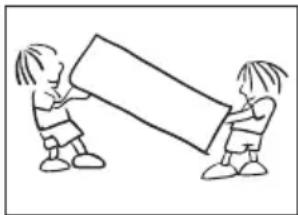
- You must secure the refrigerator in the packaging, using straps or strong cables, and follow the transport instructions that are on the packaging.
- Remove moving parts (shelves, accessories, vegetable compartments, etc.) or fasten them in the refrigerator with straps to prevent bumping them during relocation and transport.
natural_image
Simple line drawing of two children holding a large rectangular object (no text or symbols)Transport the refrigerator in vertical position.
Moving the door
- The door opening direction can be changed for models without handles.
- If the opening direction of your freezer is to be changed, you must contact the nearest authorized service center and request a change of opening direction.
BEFORE CONTACTING THE AFTER SALES SERVICE
Check notices
Your refrigerator warns you if any of the parts are not working. In this case, the LED around the button will flash and an audible alert will sound.
| Error type M | Meaning Why What to do | ||
| SR Error alert | Some part/Some parts are out of order. | Contact the service as soon as possible. | |
If your refrigerator does not work:
- Has there been a power failure?
• Is the plug inserted properly? - Is the fuse of the socket where the plug is inserted burned out?
- Was there a problem with the outlet? To check this, plug the refrigerator into an outlet you know is working.
If your freezer doesn't cool enough:
• Is the temperature setting correct?
- Are the refrigerator doors opened frequently and left open for a long time?
• Is the refrigerator door properly closed?
- Have you put food in the refrigerator that is in contact with the back of the refrigerator, thus preventing air circulation?
- Isn't the refrigerator filled too much?
- Is there enough space between the refrigerator and the wall?
- Is the ambient value within the range of values specified in the operating instructions?
If the food in your refrigerator is overcooled
• Is the temperature setting correct?
- Isn't there too much food in the freezer? If so, your refrigerator may cool the food too much, and it will run longer to cool the food.
If your refrigerator is too noisy:
To maintain the set cooling level, the compressor is activated from time to time. The noise that comes out of the refrigerator at such a moment is perfectly normal. When the desired cooling level is reached, the noise is automatically reduced. If the noise persists:
- Is your appliance stable? Are the feet adjusted?
• Is there an obstacle behind the refrigerator? - Are vibrating the shelves or the dishes? In this case, move the shelves and / or dishes.
- The objects located on your refrigerator are vibrating.
sounds:
Cracking sound (ice cracking):
• During automatic defrosting.
- When the appliance is heated or cooled (due to expansion of the material).
Short crack: You will hear this sound when the thermostat turns the compressor on and off.
Compressor noise (normal motor sound): This noise means that the compressor works normally. The compressor can cause more noise for a short time after it starts.
Bubbling sound: This sound is caused by refrigerant flow in the system tubes.
Sound of running water: Normal sound of running water flowing into the evaporator during defrosting. This sound can be heard during defrosting.
Air blowing sound (normal fan sound): This sound can be heard in the No-Frost refrigerator during normal system operation due to air circulation.
If moisture forms in the refrigerator:
- Were the foods properly packed? Were the containers well dried before being placed in the refrigerator?
- Does the refrigerator door open often? When the door is opened, moisture in the air in the room enters the refrigerator. In particular, if the humidity in the room is high, the more often the refrigerator door is opened, the more often moisture will accumulate.
- It is normal for water drops to form on the rear wall of the refrigerator during automatic defrosting. (For static models)
If the door is does not properly open and close:
- Does the packaging of food prevent the door from closing?
- Were the shelves, drawers and accessories in the refrigerator door installed correctly?
• Is the door seal worn or damaged?
• Is the refrigerator standing on a flat surface?
If the edges of the refrigerator that are in contact with the door are hot:
Especially in summer (warm weather), the joint surfaces may become hot during compressor operation, which is normal.
Important notes:
- After a sudden power failure or after the appliance has been disconnected, the compressor protection function is activated because the gas in the cooling system has not yet stabilized. This is normal, the refrigerator will restart after about 4 or 5 minutes.
- The cooling unit of your refrigerator is hidden in the back wall. This may cause drops of water or frost on the back of your refrigerator due to the operation of the compressor at specified intervals. This is normal. If the frost is not excessive, defrosting is not necessary.
- If you will not use the refrigerator for an extended period of time (e.g. during vacation), disconnect it. Clean the refrigerator according to the instructions in section 4 and leave the door open to prevent the accumulation of moisture and odors.
- The purchased appliance is intended for household use and can only be used in the home environment and for specified purposes. It is not suitable for commercial or public use. If the user uses the appliance in a way that is contrary to the above functions, we emphasize that the manufacturer and the seller are not responsible for any repairs and failures during the warranty period.
- If the problem persists after you followed the instructions above, contact an authorized service center.
POWER SAVING TIPS
- Install the appliance in a cool, well ventilated room, but not in direct sunlight or near a heat source (radiator, stove, etc.). Otherwise, use an insulation board.
- Allow hot food and beverages to cool before placing them in the appliance.
- When thawing food, put it in the refrigerator. The low temperature of frozen foods will help cool the refrigerator compartment. You will save energy. If the frozen food is thawed outside, it's a waste of energy.
- Beverages must be covered when placed in. Otherwise, the humidity in the appliance will increase. And everything will take longer. Covering the beverages also helps to preserve the taste and aroma.
- When inserting food and beverages, open the appliance door as short time as possible.
- Keep the covers of the various parts in the appliance closed (crisper, chiller, etc.).
- The door seal must be clean and flexible. Replace it when worn.
USE AND DISPOSAL OF WASTE
Wrapping paper and corrugated paperboard – deliver to scrapyard. Packing foil, PE bags, plastic elements – throw into plastic recycling containers.
DISPOSAL OF PRODUCTS AT THE END OF LIFETIME
Disposal of electric and electronic equipment (valid in EU member countries and other European countries with an implemented recycling system)
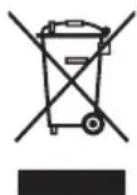
The represented symbol on the product or package means the product shall not be treated as domestic waste. Hand over the product to the specified location for recycling electric and electronic equipment. Prevent negative impacts on human health and the environment by properly recycling your product. Recycling contributes to preserving natural resources. For more information on the recycling of this product, refer to your local authority, domestic waste processing organization or store, where you purchased the product.
08/05
This product complies with EU directives on electromagnetic compatibility and electrical safety. This product meets the requirements for heavy metals in electrical equipment.

The operating instructions are available on the website.
Changes of text and technical parameters reserved.
Old refrigerators and freezers contain insulating gases and freezing medium, which must be disposed of. Entrust the disposal to a competent local waste disposal service. If in doubt, contact your local authorities or your vendor. Make sure that the pipes of the cooling unit, which will be removed by the appropriate waste disposal, service are not damaged.
• Please refer to the attached Warranty Sheet or www.ecg-electro.eu for professional service of this product.
- The warranty for this product is 24 months.
- Spare parts listed in EU 2019/2019 are available for 7 years.
- You can access the product database, where model information is stored (according to EU 2019/2016) by reading the QR code on the energy label.
SICHERHEITSHINWEISE
WARNUNG:BRANDGEFAHR/BRENNBARE STOFFE
natural_image
Line drawing of a refrigerator with three inset views showing internal components (no text or symbols)natural_image
Technical line drawing of a refrigerator with internal shelves and two circular insets showing mechanical components (no text or symbols)natural_image
Technical line drawing of a server rack with three views of the rack and a close-up of its internal components (no text or symbols)natural_image
Technical line drawings of three views of a closed book or notebook: front, top, and side (no text or symbols)natural_image
Technical line drawing of a refrigerator with internal shelves and side views (no text or symbols)natural_image
Cartoon illustration of a smiling refrigerator with sunglasses and a bowl, giving thumbs up (no text or symbols)natural_image
Simple line drawing of a hand holding a smiling emoji-shaped object (no text or symbols)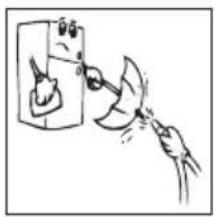
natural_image
Simple line drawing of a hand using a tool to clean or brush a small object inside a container (no text or symbols)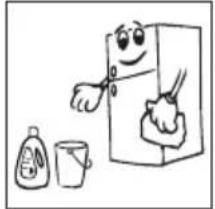
natural_image
Cartoon illustration of a smiling refrigerator with food items nearby (no text or symbols)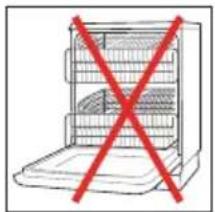
natural_image
Simple line drawing of a refrigerator with a red X mark on the door (no text or symbols)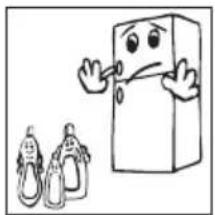
natural_image
Cartoon illustration of a smiling rectangular character with a surprised expression and two baby figures nearby (no text or symbols)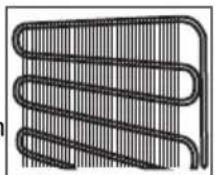
Abtauen
natural_image
Simple line drawing of two children pulling a large rectangular object together (no text or symbols)VÝSTRAHA: NEBEZPEČÍ OHNĚ / HOŘLAVÉ MATERIÁLY
INSTALACE A OBSLUHA VAŠÍ CHLADNIČKY
natural_image
Line drawing of a refrigerator with three inset views showing internal components (no text or symbols)natural_image
Technical line drawing of a refrigerator with internal shelves and two circular insets showing mechanical components (no text or symbols)natural_image
Technical line drawing of a server rack unit with three views of its internal components (no text or symbols present)natural_image
Technical line drawings of three views of a door panel with internal components (no text or symbols)natural_image
Technical line drawing of a refrigerator with internal shelves and side views (no text or symbols)Čeština
POPIS SPOTŘEBIČE A PŘÍSLUŠENSTVÍ
natural_image
Cartoon illustration of a smiling refrigerator with hands giving thumbs up and a bowl of food beside it (no text or symbols)natural_image
Simple line drawing of a hand holding a smiling emoji-shaped object (no text or symbols)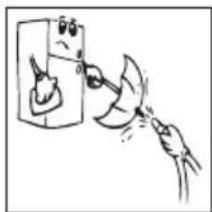
natural_image
Simple line drawing of a hand cleaning a box with a knife (no text or symbols)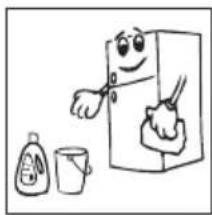
natural_image
Cartoon illustration of a smiling refrigerator with hands cleaning it, accompanied by a small bottle and cup (no text or symbols)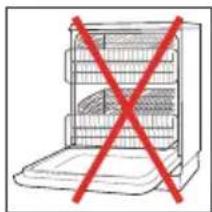
natural_image
Simple line drawing of a refrigerator with a red X mark on the door (no text or symbols)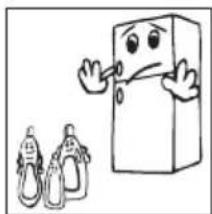
natural_image
Cartoon illustration of a refrigerator with two baby figurines nearby (no text or symbols)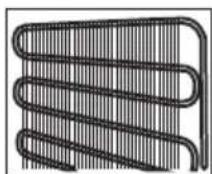
natural_image
Simple line drawing of two children pulling a large rectangular object (no text or symbols)Chladničku prévážejte kolmo.
Přemístění dveří
VÝSTRAHA:NEBEZPEČENSTVOOHŇA/ HORĽAVÉ MATERIÁLY
natural_image
Line drawing of a refrigerator with three inset views showing internal components (no text or symbols)natural_image
Technical line drawing of a refrigerator with internal shelves and side views showing mechanical components (no text or symbols)natural_image
Technical illustration of a rack-mounted device with internal compartments and external housing, shown in three views (no text or symbols present)natural_image
Technical line drawings of three views of a closed book or notebook: front, top, and side (no text or symbols present)natural_image
Technical line drawing of a refrigerator with internal shelves and side views (no text or symbols)OPIS SPOTREBIČA A PRÍSLUŠENSTVA
natural_image
Cartoon illustration of a smiling character giving thumbs up next to a door, with a bowl and utensils nearby (no text or symbols)natural_image
Simple line drawing of a hand holding a smiling emoji-shaped object (no text or symbols)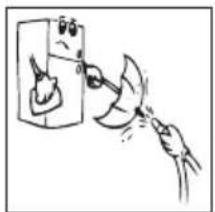
natural_image
Simple line drawing of a hand using a tool to clean or store items (no text or symbols)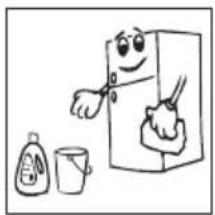
natural_image
Cartoon illustration of a smiling refrigerator with hands cleaning it, accompanied by a small bottle and cup (no text or symbols)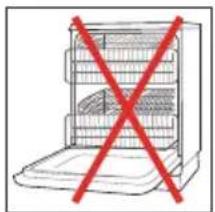
natural_image
Illustration of a refrigerator with a red X symbol crossed out, no text or symbols present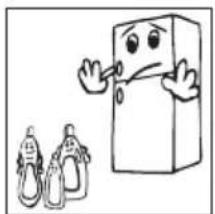
natural_image
Cartoon illustration of a baby bottle and two other baby bottles, no text or symbols present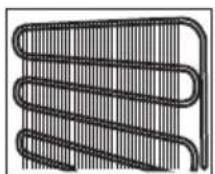
ROZMIESTNENIE POTRAVÍN V SPOTREBIČI
Chladnička
natural_image
Simple line drawing of two children holding a large rectangular object (no text or symbols)Chladničku prevážajte kolmo.
Premiestnenie dverí
- ERB 21880 NXE
- SAFETY INSTRUCTIONS
- Read carefully and save for future use!
- RISK OF FIRE!
- WARNING: RISK OF FIRE/FLAMMABLE MATERIALS
- INSTALLING AND OPERATING YOUR REFRIGERATOR
- Climate class and significance: see information sheet
- Before using the refrigerator
- Information about the new cooling technology
- This appliance is not intended for use as a built-in device.
- Door opening reversal
- DESCRIPTION OF THE APPLIANCE AND ACCESSORIES
- Display and control panel
- External display / External control
- Button A
- Temperature setting screen
- Display
- Malfunction codes
- Lighting (if available)
- Temperature settings
- Quick cooling function
- Note concerning the temperature setting
- CLEANING AND MAINTENANCE
- Defrosting
- Replacing the LED indicator
- FOOD DISTRIBUTION IN THE APPLIANCE
- Refrigerator
- Freezer
- Important note:
- TRANSPORT AND RELOCATION
- Transport the refrigerator in vertical position.
- Moving the door
- BEFORE CONTACTING THE AFTER SALES SERVICE
- Check notices
- If your refrigerator does not work:
- If your freezer doesn't cool enough:
- If the food in your refrigerator is overcooled
- If your refrigerator is too noisy:
- sounds:
- Cracking sound (ice cracking):
- If moisture forms in the refrigerator:
- If the door is does not properly open and close:
- If the edges of the refrigerator that are in contact with the door are hot:
- Important notes:
- POWER SAVING TIPS
- USE AND DISPOSAL OF WASTE
- DISPOSAL OF PRODUCTS AT THE END OF LIFETIME
- SICHERHEITSHINWEISE
- WARNUNG:BRANDGEFAHR/BRENNBARE STOFFE
- Abtauen
- VÝSTRAHA: NEBEZPEČÍ OHNĚ / HOŘLAVÉ MATERIÁLY
- INSTALACE A OBSLUHA VAŠÍ CHLADNIČKY
- POPIS SPOTŘEBIČE A PŘÍSLUŠENSTVÍ
- Chladničku prévážejte kolmo.
- Přemístění dveří
- VÝSTRAHA:NEBEZPEČENSTVOOHŇA/ HORĽAVÉ MATERIÁLY
- OPIS SPOTREBIČA A PRÍSLUŠENSTVA
- ROZMIESTNENIE POTRAVÍN V SPOTREBIČI
- Chladnička
- Chladničku prevážajte kolmo.
- Premiestnenie dverí
Brand : ECG
Model : ERB 21880 NXE
Category : Fridge