
H 395 B - Built-in oven MIELE - Free user manual and instructions
Find the device manual for free H 395 B MIELE in PDF.


| Brand | Miele |
| Model | H 395 B |
| Product type | Built-in oven |
| Cooking type | Fan forced, convection, bottom heat, top heat, grill, rotisserie, etc. |
| Capacity | 75 L (estimated) |
| Dimensions (W x H x D) | 724 x 597 x 610 mm (cutout) |
| Power supply | 120/240 V, 60 Hz, 30 A (US model) |
| Cooking functions | 18 functions including Bake, Convection Bake, Surround, Browning, Intensive, Auto Roast, Convection Roast, Surround Roast, Broil, Maxi Broil, Convection Broil, Rotisserie, Defrost, Proof, Dehydrate, Sabbath, Master Chef, Favorites |
| Automatic programs | Master Chef with presets by food type and weight |
| Cooking probe | Yes, roasting probe for core temperature measurement |
| Rotisserie | Yes, motorized rotisserie spit |
| Interior lighting | Halogen bulb 12 V, 10 W |
| Control type | LCD screen with soft key controls |
| Display | LCD, adjustable brightness and contrast |
| Timer | Two independent timers (99 min 59 s max) |
| Delayed start function | Yes, up to 23 h 59 min |
| Sabbath function | Yes, keep warm up to 72 h |
| Cleaning | PerfectClean coating on walls, drip tray, etc.; catalytic liner at bottom |
| Child safety | Yes, mechanical lock under the control panel |
| Included accessories | Rack, drip tray, anti-splash, grease filter, probe, rotisserie spit, glide opener |
Frequently Asked Questions - H 395 B MIELE
User questions about H 395 B MIELE
0 question about this device. Answer the ones you know or ask your own.
Ask a new question about this device
Download the instructions for your Built-in oven in PDF format for free! Find your manual H 395 B - MIELE and take your electronic device back in hand. On this page are published all the documents necessary for the use of your device. H 395 B by MIELE.
USER MANUAL H 395 B MIELE
Operating instructions
Oven
H 395 B
H 396 B
To prevent accidents
and machine damage,
read these instructions
before installation or use.
IMPORTANT SAFETY INSTRUCTIONS 4
Guide to the oven....7
Guide to the display....8
Oven accessories 9
Wire rack....9
Roasting pan....9
Anti-splash tray 9
Grease filter 10
Roast probe 10
Rotisserie 10
Slide opener 10
Locking the oven 11
Using the oven display 12
SETTINGS 13
Language 14
Clock 14
Temperatures 15
Oven Light 16
Temperature °F/°C 16
Display 16
Tone Options 17
Reset 19
Before using the oven 20
Using the oven 22
Selecting a function 22
Adjusting the oven temperature 23
Preheating 24
Delay Start 25
Desired End Time 26
Interrupting cooking 27
Turning off the oven 27
At the end of cooking 27
Setting the timer 28
Guide to the functions 29
BAKE 30
ROAST 35
Roasting tips 38
Using the roast probe 39
MASTER CHEF 43
BROIL 46
Broiling tips 51
FAVORITES 52
SABBATH 53
DEHYDRATE 54
PROOF 55
DEFROST 56
Defrosting tips 56
Cleaning 57
Accessories 57
PerfectClean 58
Removing the oven door....60
Removing the runners. 61
Lowering the upper heating element 62
Catalytic liners 63
Changing the light bulb 65
Frequently asked questions 68
Technical Service....69
Optional accessories....70
Caring for the environment 72
Disposal of the packing materials 72
Disposal of an old appliance....72
Electrical connection....73
Appliance and Cut-out Dimensions 74
Installing the oven 75
This appliance is intended for residential use only.
Only use the appliance for its intended purpose. The manufacturer cannot be held responsible for damages caused by improper use of this oven.
This appliance complies with current safety requirements. Improper use of the appliance can lead to personal injury and material damage.
Read all instructions before installing or using the oven for the first time.
Keep these operating instructions in a safe place and pass them on to any future user.
Installation
Before installation, make sure that the voltage and frequency listed on the data plate correspond with the household electrical supply. This data must correspond to prevent injury and machine damage. Consult a qualified electrician if in doubt.
Be certain your appliance is properly installed and grounded by a qualified technician.
To guarantee the electrical safety of this appliance, continuity must exist between the appliance and an effective grounding system. It is imperative that this basic safety requirement be met. If there is any doubt, have the electrical system of the house checked by a qualified electrician.
The manufacturer cannot be held responsible for damages caused by the lack, or inadequacy of, an effective grounding system or the failure to adhere to national and local electrical codes.
The oven is not to be operated until it has been properly installed within cabinetry.
Installation, maintenance and repair work should be performed by an authorized service technician. Work by unqualified persons could be dangerous and may void the warranty.
Before installation or service, disconnect the power supply to the work area by removing the fuse, "tripping" the circuit breaker, or shutting off the power main.
Oven use
⚠ WARNING: Ovens can produce high temperatures that can cause burns.
■ Prevent children from touching the appliance when in use. Use heat-resistant oven mitts when placing items in the oven, turning them, or removing them from the oven. The upper heating element and oven racks can become very hot and cause burns. To prevent burns, always place oven racks at their desired height while the oven is cool. Always open the door carefully. Allow hot air or steam to escape before placing or removing food. To prevent burns, allow the heating element to cool before cleaning by hand. The door gasket is essential for a good seal. Care should be taken not to rub, damage or move the gasket. The door gasket should only be cleaned with a solution of warm water and soap. Only clean parts listed in this manual.
Caution: Heating elements may be hot even though they are not glowing. During and after use, do not let clothing or other flammable materials come in contact with heating elements or interior surfaces of the oven until they have had sufficient time to cool. External parts of the oven such as the door glass, vents, and control panel can become hot. Do not block any vent openings. Do not let metal objects (aluminum foil, metal pans) or the meat probe come in contact with the heating element. Do not slide pots or pans on the oven floor. This could scratch and damage the surface. Do not lean, sit, or place heavy items on the open oven door. Only use the Miele roast probe supplied with the oven. Contact Miele's Technical Service Department if you need to purchase a new probe. To prevent damage, remove the roast probe from the oven when it is not being used. Do not heat unopened containers of food in the oven, as pressure may build up and cause them to explode.
Never add water to food on a hot tray or pan or directly onto food in a hot oven. The steam created could cause serious burns or scalds. This oven must only be used for cooking. Do not use it as a dryer, kiln, dehumidifier, etc. Fumes or vapors given off by glues, plastics or flammable liquids and materials could be hazardous. Never store flammable liquids and materials in, above or under an oven, or near cooking surfaces.
General notes
Do not use a steam cleaner to clean the oven. Steam could penetrate electrical components and cause a short circuit. Children should not be left alone or unattended in an area where an oven is in use. Never allow children to sit or stand on any part of the oven. Caution: Do not store items of interest to children in cabinets above an oven. Children climbing on the oven to reach these items could be injured. Do not leave the oven unattended when cooking with oils or fats, they can be a fire hazard if overheated.
Do not use water on grease fires! Smother the fire with a properly rated dry chemical or foam fire extinguisher. - Wear proper clothing. Loose-fitting or hanging garments should never be worn while using the oven. Do not use the oven to heat the room. Make certain that the power cords of small appliances do not come in contact with or get caught in the oven door. Use only dry, heat resistant potholders. Moist or damp potholders used on hot surfaces may result in steam burns. Do not let potholders come in contact with oils. Do not substitute towels or other bulky items for potholders. Always make sure food is cooked thoroughly before eating. It is recommended to cover all cooked food that is left in the oven to be kept warm. This will prevent moisture from condensing on the interior of the oven.
Disposal of an old oven
When discarding an old oven, disconnect it from the power supply and cut off the power cord. Remove the door to prevent trapping hazards.
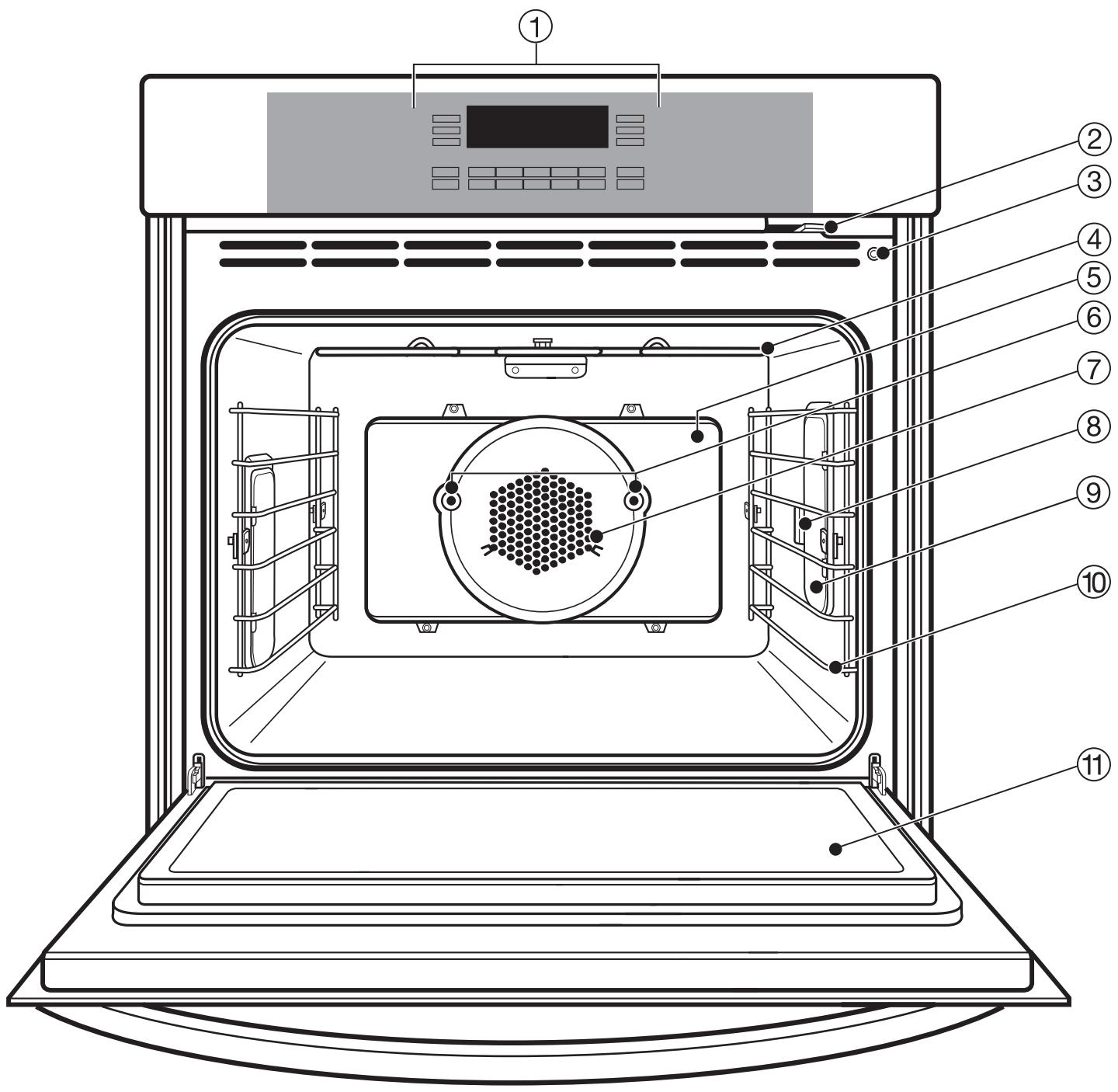
① Control panel ② Child safety lock ③ Door contact switch* ④ Upper heating element ⑤ Catalytic liner ⑥ Rotisserie motors
⑦ Convection fan ⑧ Roast probe socket ⑨ Light ⑩ Non-tip, six level runners ⑪ Oven door
*This switch shuts off the heating element and convection fan when the door is opened during use.
![graph TD A["12:32"] --> B["ON"] A --> C["OFF"] A --> D["Timer"] A --> E["Clear"] B --> F["B"] B --> G["C"] B --> H["D"] C --> I["E"] C --> J["F"] C --> K["G"] C --> L["B"]](/content/2025/01/84805/images/3779ed4650baf4310782a6e9af2884c9f1138c1ee964c26620b4374ff9e0d047.jpg)
Ⓐ Display
Shows the time or the functions.
⑧ Touch controls
To select or set a function.
© "ON" touch control
To turn the oven on.
(D) "OFF" touch control
To turn the oven off.
E Keypad
To enter times or temperatures.
F "Clear" touch control
To delete the last entry or to clear menu items.
© "Timer" touch control
to set a timer independent of an oven function.
Wire rack
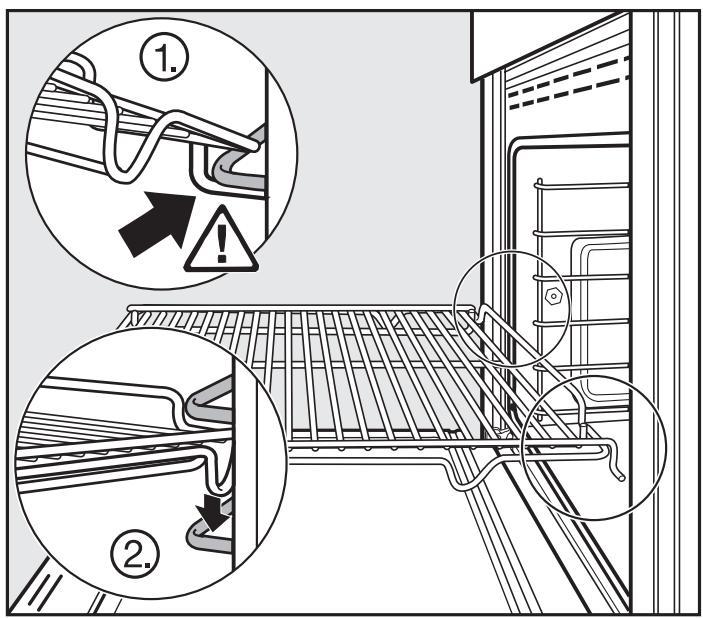
The racks have non-tip safety notches which prevent them from being pulled out completely while the oven is in use.
When inserting a rack, always check that the safety notches are at the rear of the oven.
The rack can only be removed by raising it upwards and then pulling out.
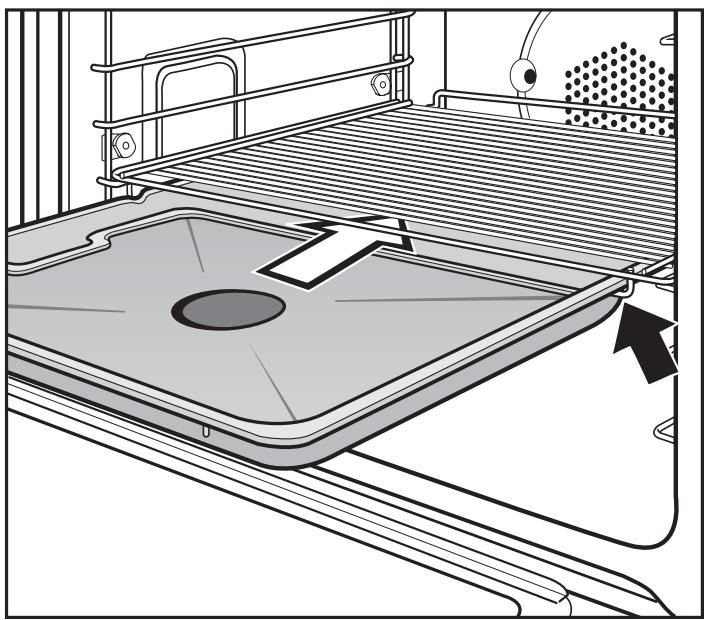
Roasting pan
The roasting pan is ideal for catching drippings from meat or poultry roasted or broiled directly on the rack.
Slide the roasting pan onto the rail below the wire rack. See illustration.
It can also be used as a baking tray.
The roasting pan is coated with PerfectClean enamel and can be easily cleaned with a sponge and dish soap.
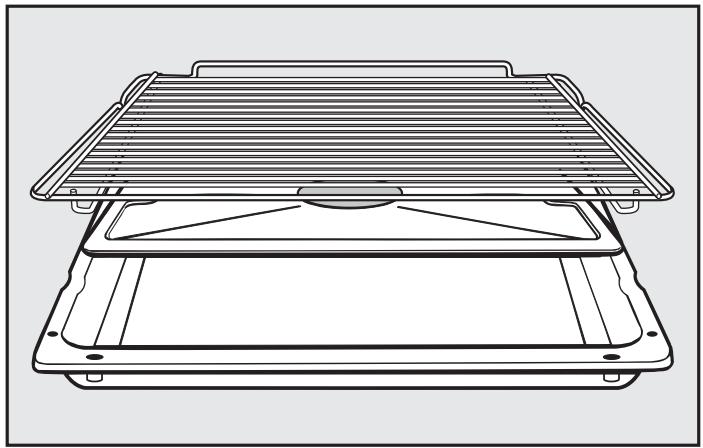
Anti-splash tray
The anti-splash tray may be placed in the roasting pan to reduce splattering of drippings from meat or poultry.
The anti-splash tray is coated with PerfectClean enamel and can be easily cleaned with a sponge and dish soap.
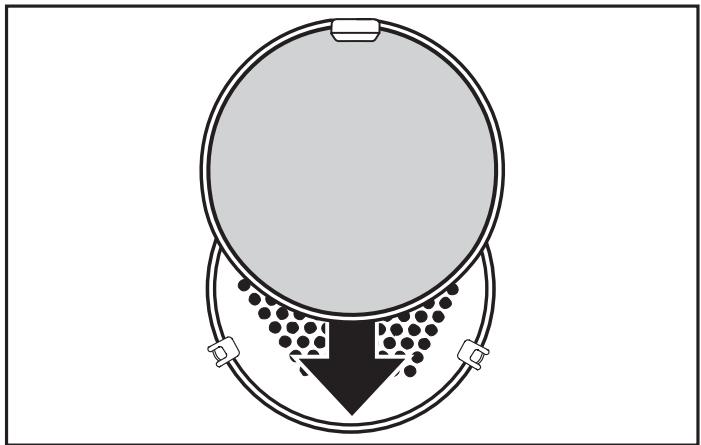
Grease filter
The filter helps to keep the oven fan clean from moisture and grease.
When roasting or broiling, insert the grease filter in front of the fan opening.
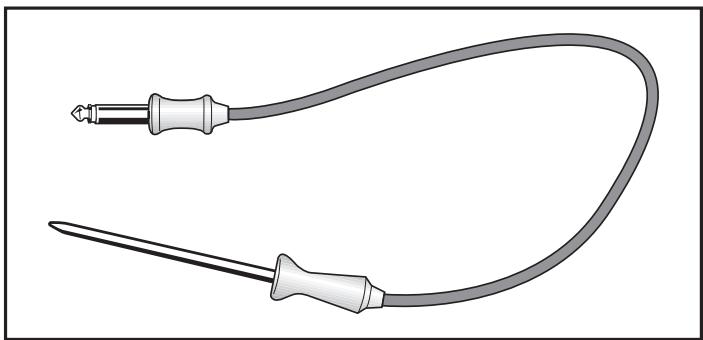
Roast probe
The roast probe reliably monitors the core temperature of meat and poultry during a roasting function.
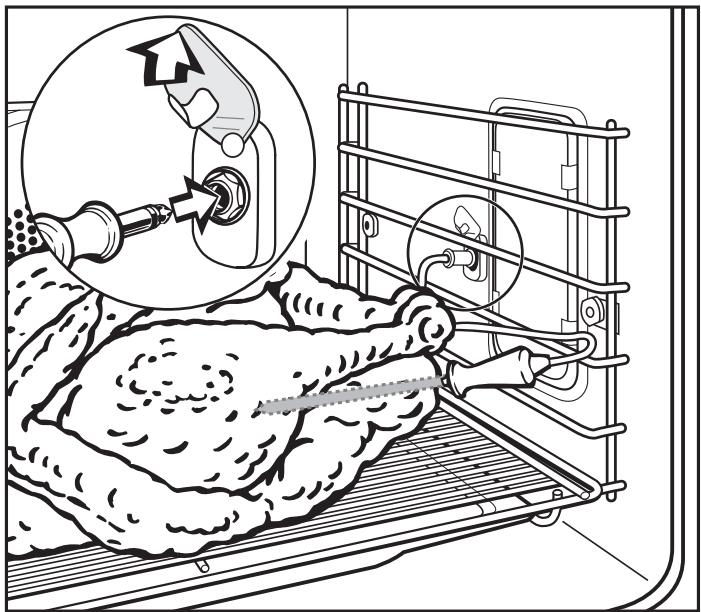
The long pointed end of the probe is inserted into the thickest portion of the meat while the short end of the probe is inserted into the roast probe socket.
Rotisserie
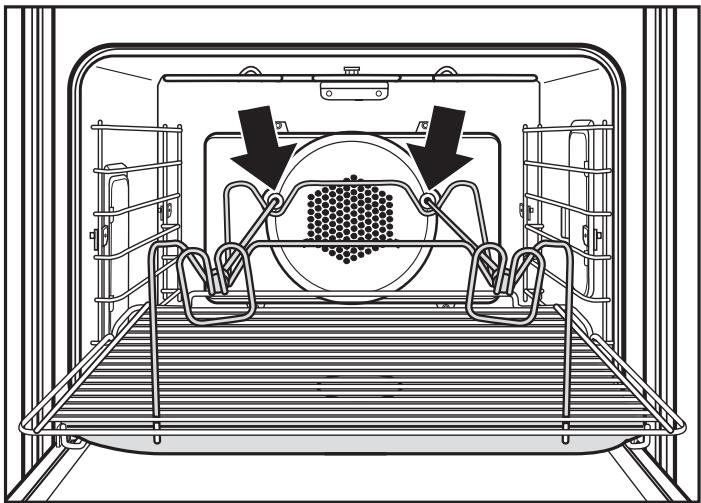
The rotisserie evenly broils and adds a finishing touch to items such as stuffed meat, poultry, and kebabs by gently turning the skewers during the broiling function.
The skewers are inserted into the rotisserie motors in the back panel.
Slide opener
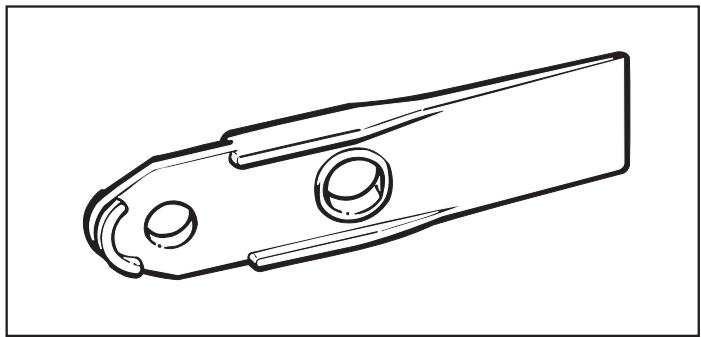
The slide opener is necessary for removing the light cover when changing a light bulb.
The flat end of the slide opener is wedged beneath the light cover to pry it off.
Child safety lock
The child safety lock can be activated to prevent children from operating the oven or to conserve standby power when the oven will not be used for some time (e.g. vacation).
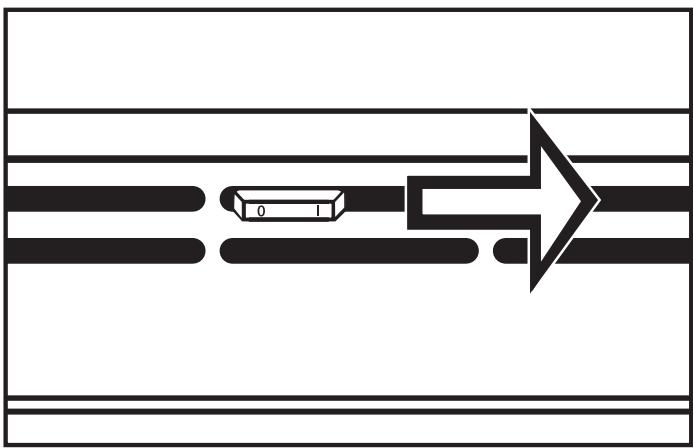
The child safety lock is located below the right side of the control panel, only visible when the door is open.
To activate the child safety lock:
■ Slide the lock to position "0".
The oven cannot be operated now. The clock will not be displayed.
To deactivate the child safety lock:
■ Slide the lock to position "I".
The oven can now be used. The clock will be displayed.
Note: If the child safety lock is activated for more than 4 days, the oven clock will have to be reset.
This oven uses soft key technology and an LCD display for the selection of a function.
To select a function, touch the control next to the displayed function. The arrow next to each function points to its corresponding control.
■ Touch the "ON" control to activate the display.
Additional functions are displayed by touching the "more" control.
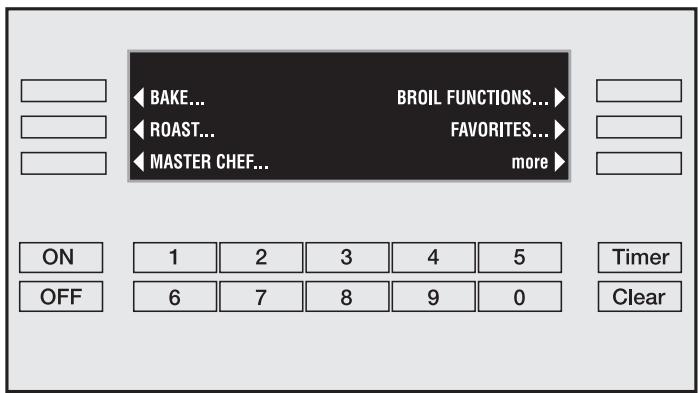
The previous display can be recalled by touching the "back" control.
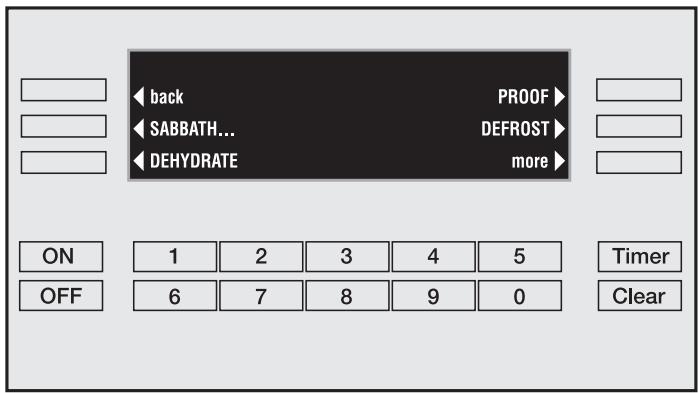
Dots after a function indicate a sub-menu.
The sub-menu will appear when the function is selected.
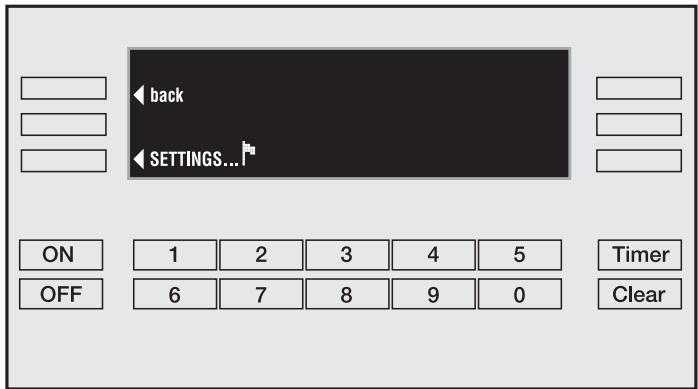
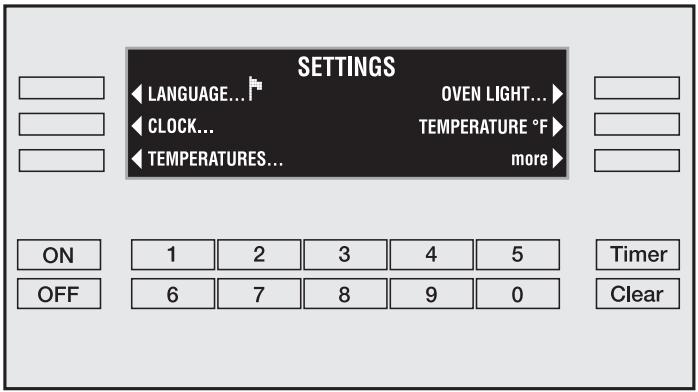
The default oven settings can be changed in the function "SETTINGS". In this function you can customize the oven to suit your preferences. Settings may be adjusted by touching the appropriate touch control.
Available settings:
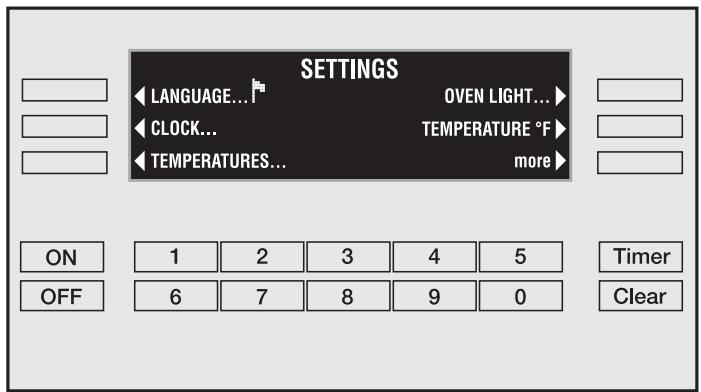
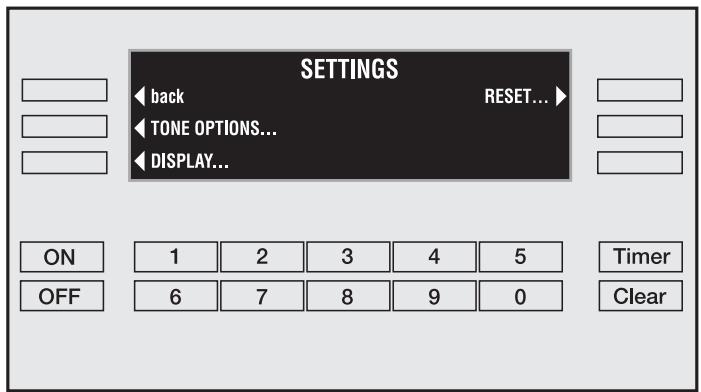
Language
Select the touch control next to the desired language and confirm by touching "OK".
The symbol indicates the "Language" setting. If you accidentally select an unfamiliar language, simply look for the symbol. Touch the control next to the flag symbol and select your language of choice.

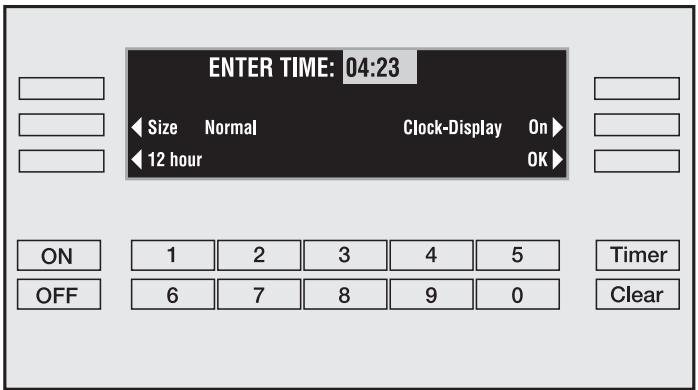
Clock
"Enter Time" appears in the display.
Enter the current time using the keypad.
Different settings can be selected by touching the control next to the option:
- the size of the clock display Size Normal Size Large
- the time format 12 hour 24 hour
- whether or not the time is displayed Clock-Display On Clock-Display Off Touch the "OK" control to confirm the entries.
If power to the oven is cut off for more than 4 days, the clock will have to be reset.
Temperatures
The default temperature of each function can be adjusted within the range shown below. If a temperature out of the range is selected, the oven will revert to the default temperature.
Touch the control of the function whose default temperature you wish to alter. Enter the new default temperature using the keypad.
The next time this function is selected, the new temperature will be used.
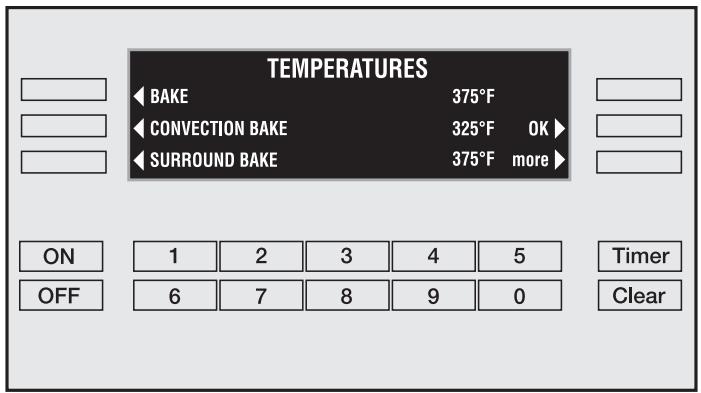
| Function | °F | °C | ||
| default | range | default | range | |
| Bake | 375 °F | 200-500°F | 190 °C | 100-260°C |
| Convection Bake | 325 °F | 125-500°F | 160 °C | 50-260°C |
| Surround Bake | 375 °F | 125-550°F | 190 °C | 50-290°C |
| Browning | 375 °F | 200-500°F | 190 °C | 100-260°C |
| Intensive | 325 °F | 200-500°F | 160 °C | 100-260°C |
| Auto Roast | 325 °F | 200-425°F | 160 °C | 100-210°C |
| Convection Roast | 325 °F | 125-500°F | 160 °C | 50-260°C |
| Surround Roast | 400 °F | 175-550°F | 200 °C | 80-290°C |
| Broil | no default | 400-575°F | no default | 200-300°C |
| Maxi Broil | no default | 400-575°F | no default | 200-300°C |
| Convection Broil | no default | 200-500°F | no default | 100-260°C |
| Rotisserie | no default | 400-575°F | no default | 200-300°C |
| Defrost | 75 °F | 75-125°F | 25 °C | 25-50°C |
Oven Light
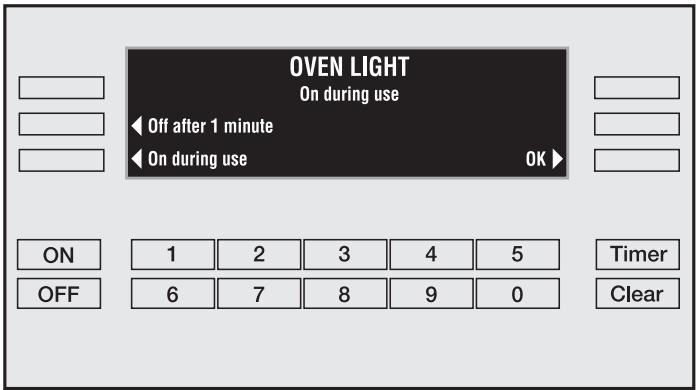
The "on" duration of the oven light can be altered.
■ Touch the control of the light setting you wish to choose. - "Off after 1 minute" The light goes off after the first minute of a function. - "On during use" The oven light remains lit during a function.
The selected setting will appear in the display.
■ Touch the "OK" control to confirm the selection.
Temperature °F/°C
All oven temperatures can be displayed in either Fahrenheit or Celsius degrees. ■ Touch the "TEMPERATURE" control to toggle between °F and °C.
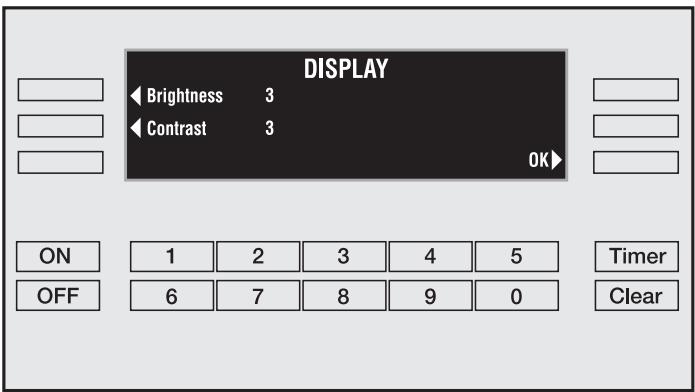
Display
The brightness and contrast of the oven display can be adjusted by touching the controls next to "Brightness" and "Contrast".
Tone Options
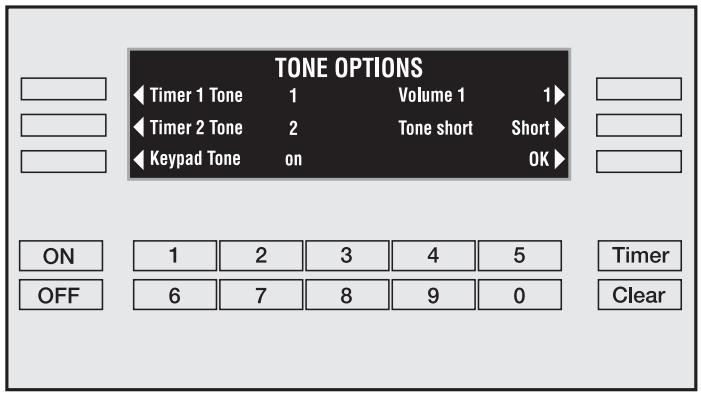
Unique tones may be set for each of the two timers to differentiate the timers from an oven function tone.
"Timer 1" and "Timer 2"
The tone of Timer 1 and Timer 2 can be set to one of five tone options.
■ Select "Timer 1 Tone" or "Timer 2 Tone" by touching the corresponding control to the left.
With every touch on the respective control, another tone will sound and the display will show the tone number. For example, Timer1 Tone1.
Select the tone for each timer.
"Keypad Tone"
The keypad can be set to make a sound with every touch of a control.
Touch the "Keypad tone" control to toggle between the on and off settings.
"Volume"
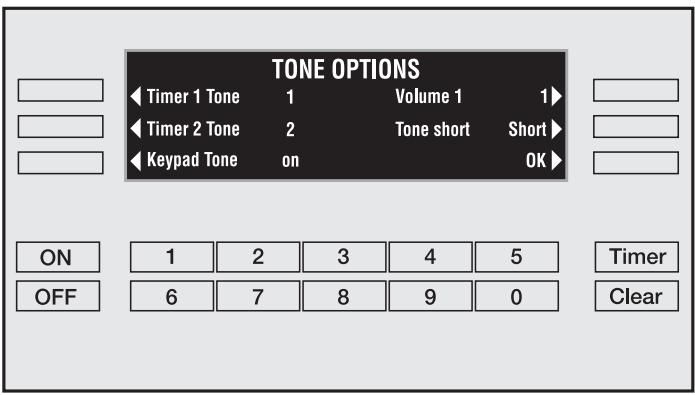
This control adjusts the volume of the tone options.
Touch the "Volume" control until you hear the desired volume.
"Tone Short / Long"
The duration of the timer and oven tones can be modified.
- "Tone short" will beep in quick succession when an oven signal or the oven timer sounds.
- "Tone long", a continuous tone will sound when an oven signal or the oven timer sounds. Touch the "Tone" control to toggle between the short and long setting. Touch the "OK" control to confirm the "TONE OPTIONS" entries.
When the tone sounds to indicate an oven signal or the timer, touch any number on the keypad to turn off the tone.
Reset
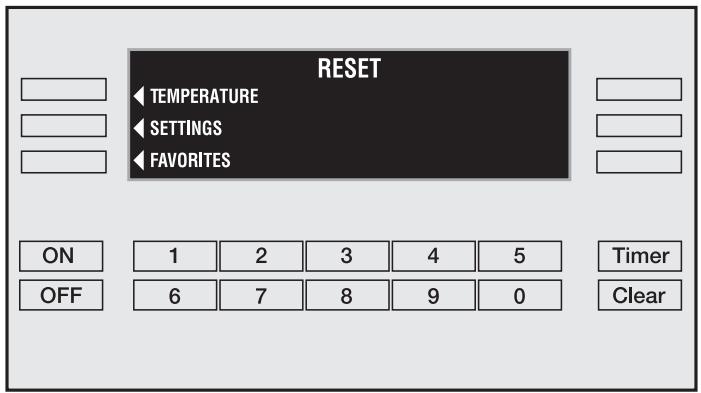
The factory settings of the oven can be restored through the "RESET" function.
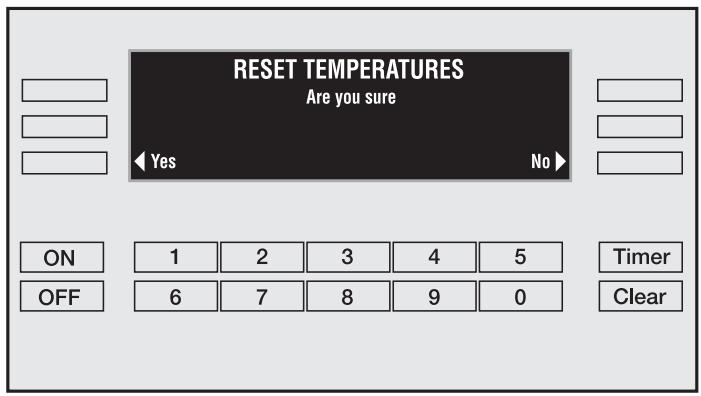
Reset Temperatures
If the request is confirmed with "yes", all changed temperatures will be restored to the factory default setting.
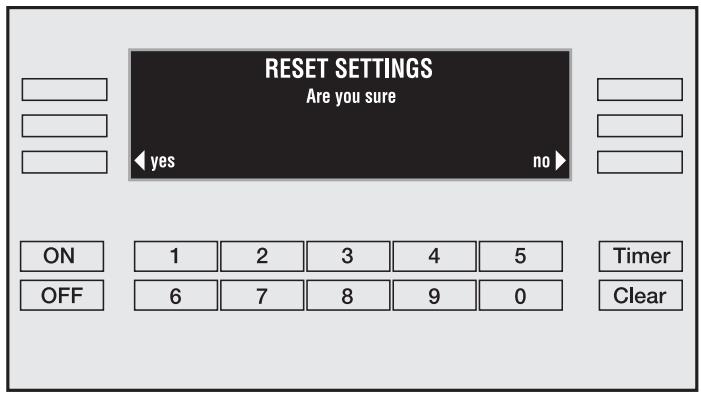
Reset Settings
If the request is confirmed with "yes", all changed settings will be restored to the factory default settings.
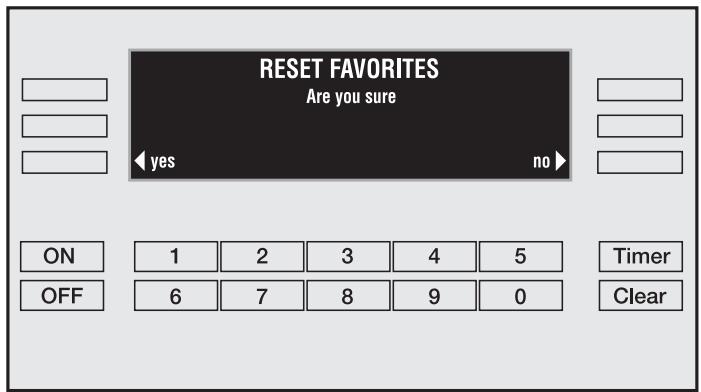
Reset Favorites
If the request is confirmed with "yes", all "favorite" entries will be deleted. Once deleted, these entries cannot be restored.
Heat the oven
New ovens may have a slight odor during the first few uses. To eliminate the odor quickly, the oven should be operated at a high temperature for 2 hours.
Before heating the oven, remove all accessories and labels from the oven.
Make sure the room is well ventilated during this process.
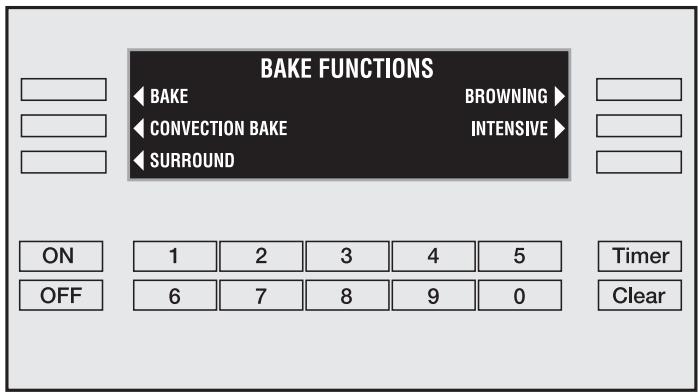
Touch the "ON" control. Select function "BAKE".
Select "CONVECTION BAKE".
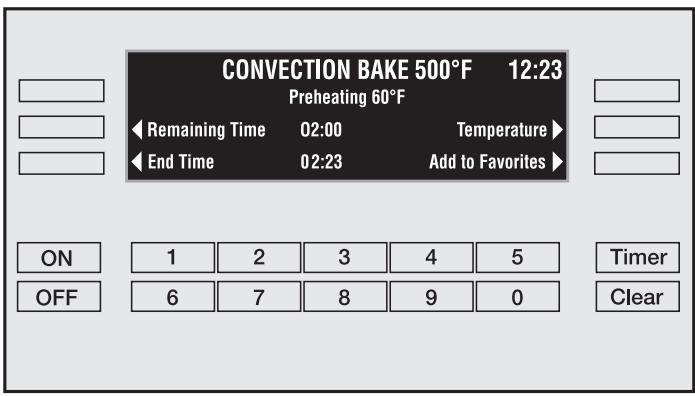
Select "Temperature".
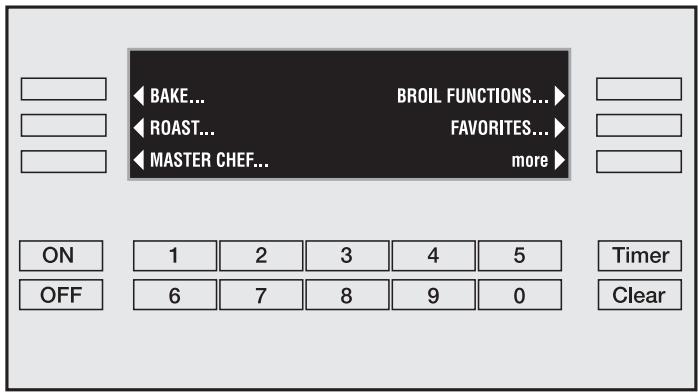
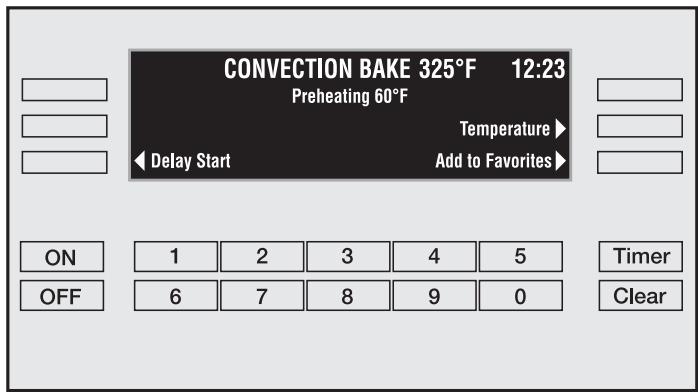
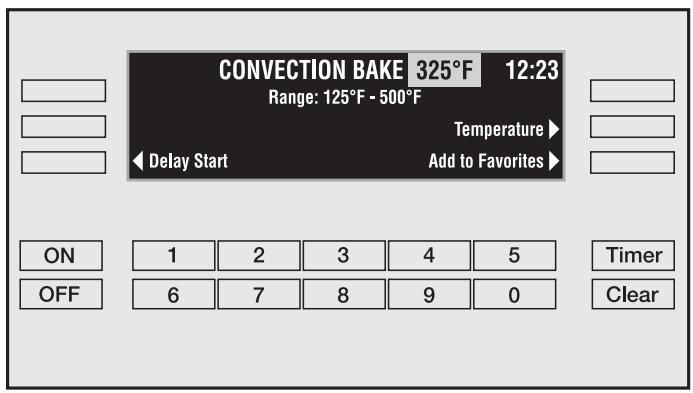
Set the temperature to 500°F (260°C) using the keypad.
Set the timer to run the oven for 2 hours by touching the "Delay Start" control.
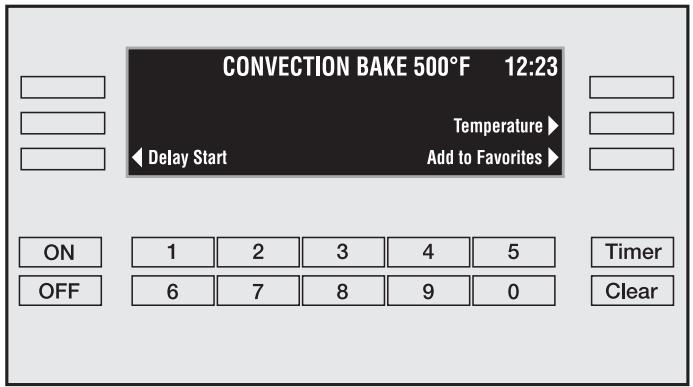
Select "Duration". Set the duration by entering "2", "0", "0" using the keypad.
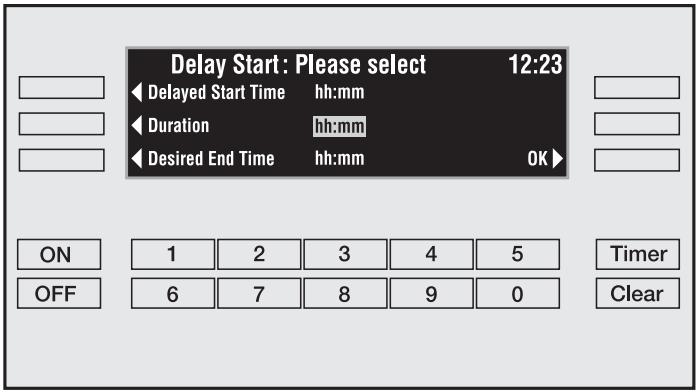
Touch the control to the right of "OK".
The oven will run for 2 hours and the countdown will appear in the display.
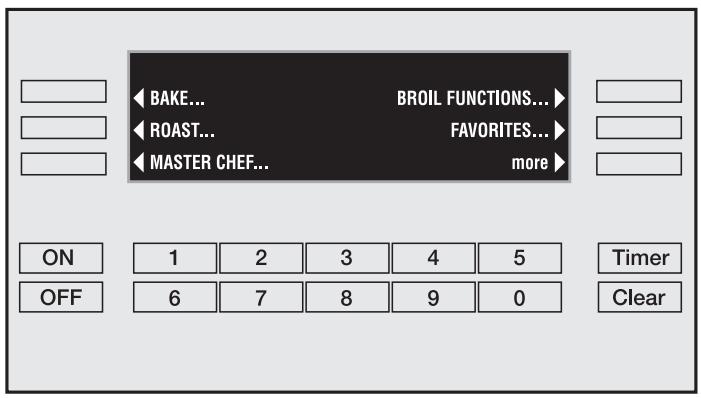
Selecting a function
Touch the "ON" control to activate the display. Touch the control next to the function you wish to select.
For example, touch the control to the left of the word "BAKE" to select this function.
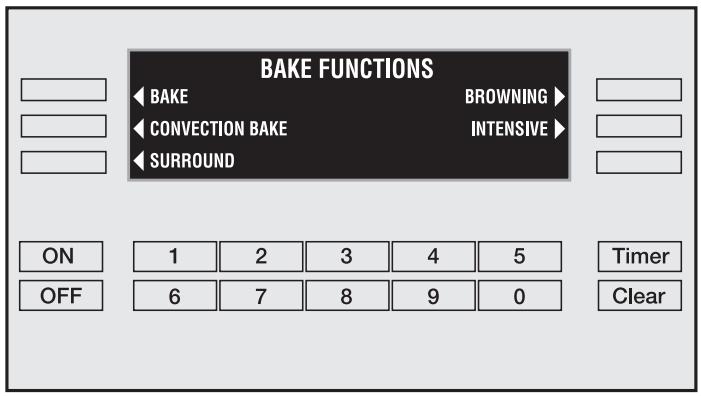
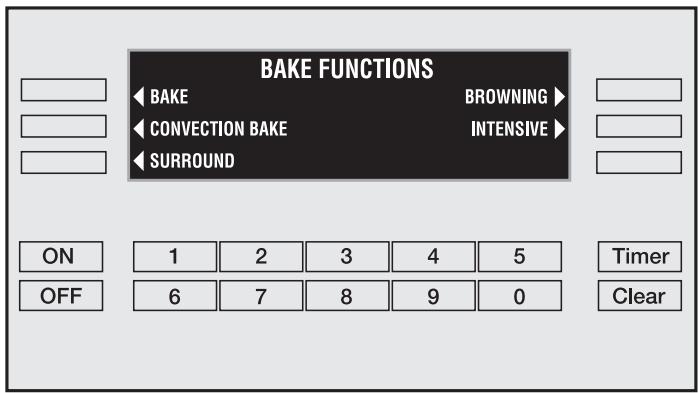
The "BAKE" function submenu will appear in the display.
Touch the control next to the submenu function you wish to select.
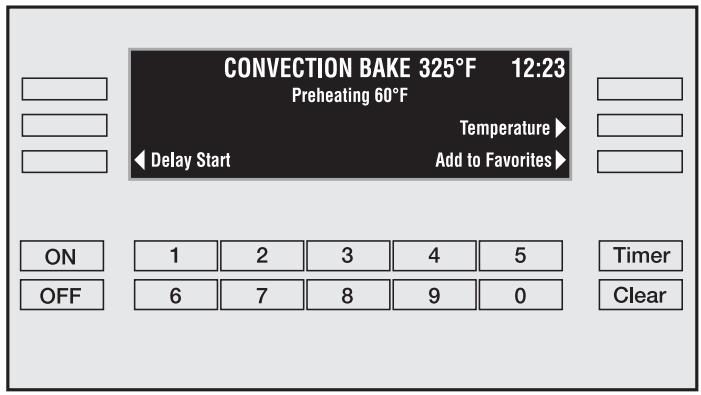
For example, touch the control left of "CONVECTION BAKE".
The "CONVECTION BAKE" function will appear in the display.
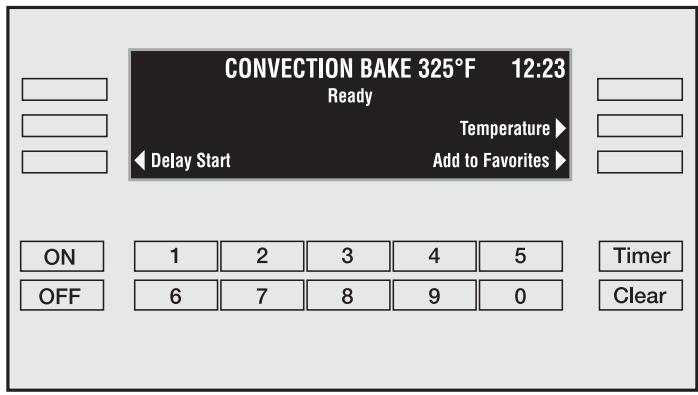
The default temperature of 325 °F (160 °C) will be displayed next to the function name.
Adjusting the oven temperature
This oven has been factory tested for the optimum operating temperature of each function. This temperature can be adjusted if needed.
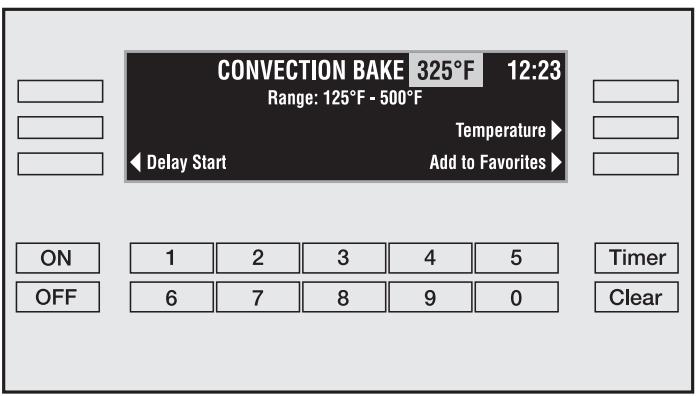
Touch the control to the right of "Temperature".
The temperature will be highlighted in the display.
Enter the new temperature using the keypad.
The oven will heat to the adjusted temperature.
Preheating
For proper cooking results, most recipes call for a preheated oven.
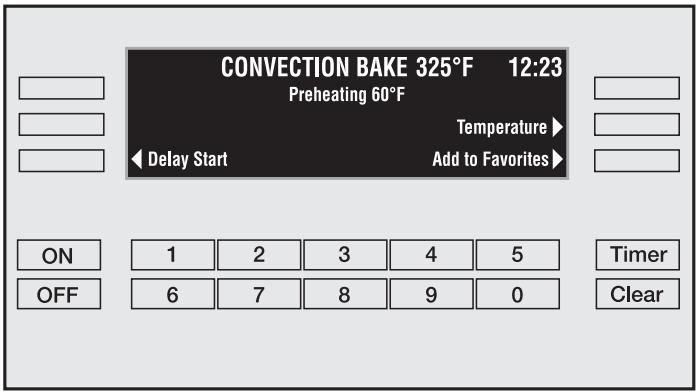
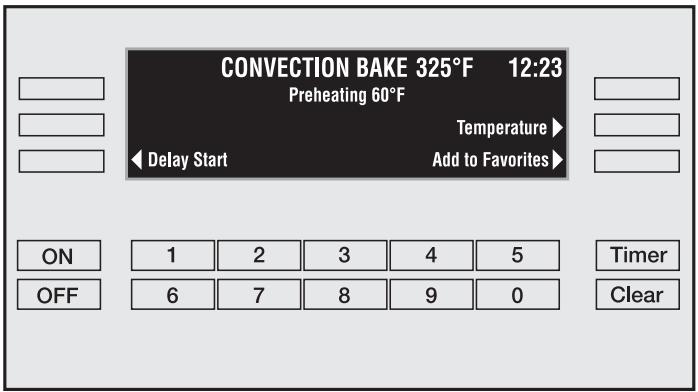
After a temperature has been selected, the rising temperature can be viewed in the display.
"Preheating" will show in the display until the oven has reached the selected temperature.
A tone will sound once the oven has finished preheating.
Place the food in the oven once the temperature has been reached.
The oven should not be preheated when using "AUTO ROAST".
Delay Start
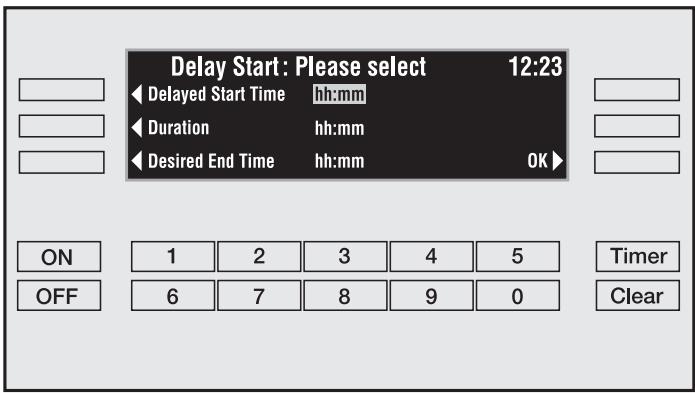
This feature allows you to delay the start of a function, from 1 minute to 23 hours 59 minutes, so that the cooking process begins at a specified time.
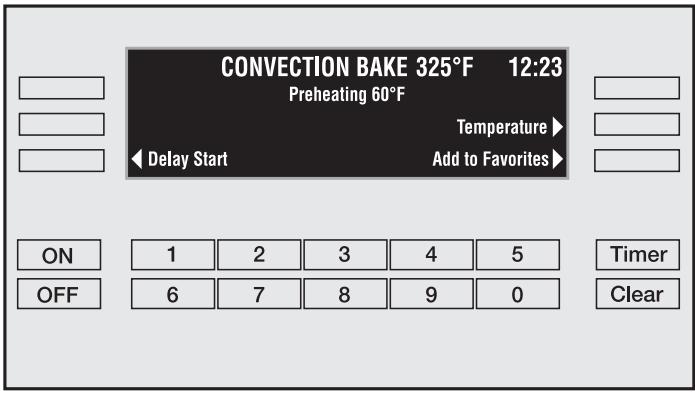
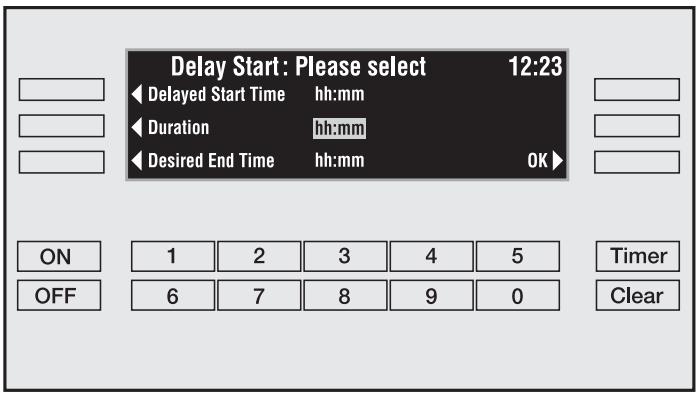
Touch the control left of "Delay Start".
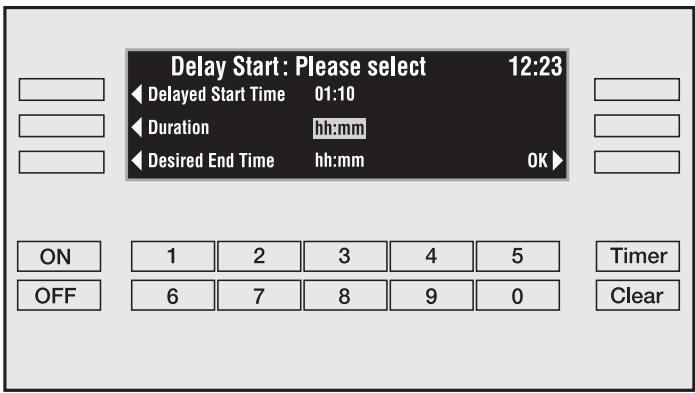
Touch the control to the left of "Delayed Start Time" and enter a start time.
For example, "01:10" for the function to start cooking at 1:10.
Touch the control to the left of "Duration" and enter the cooking time.
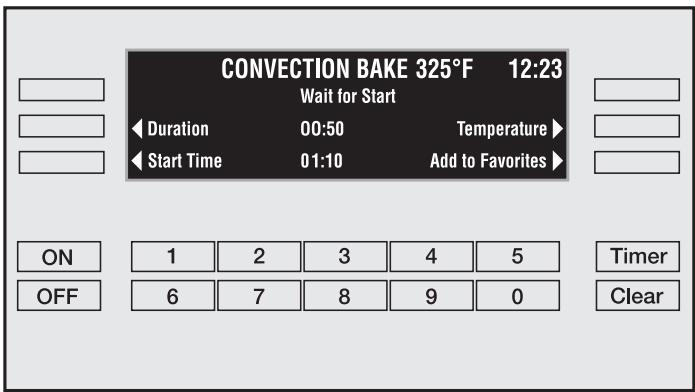
For example, "00:50" for the function to run 50 minutes.
The "duration" must be entered for this feature to operate correctly.
Confirm the entries by touching the "OK" control or cancel by touching "Clear".
The end time will automatically be calculated.
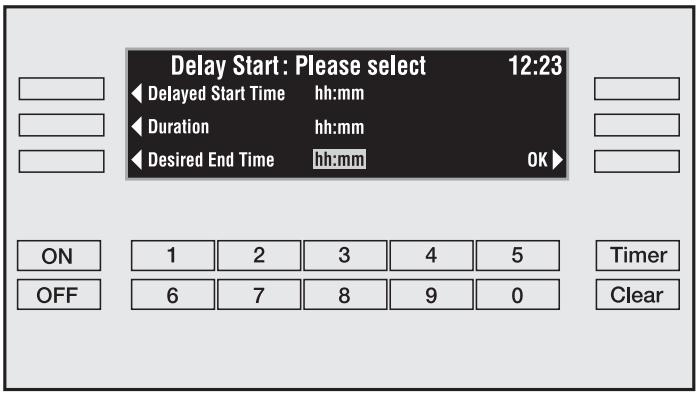
Desired End Time
The desired end time allows you to set the actual time you would like cooking to complete. This time is limited to 24 hours from the current time.
Touch the control left of "Delay Start".
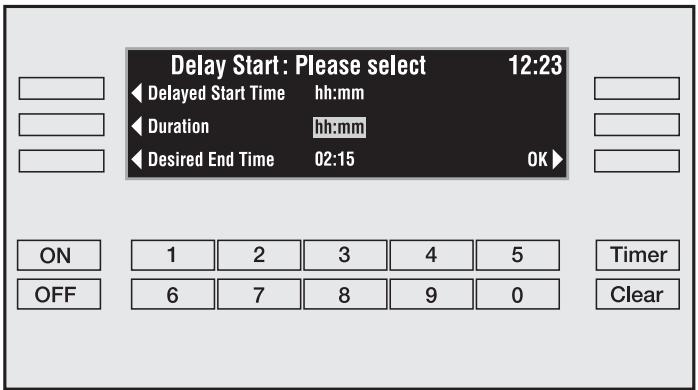
Touch the "Desired End Time" control and enter the desired end time.
For example, "02:15" for the function to finish cooking at 2:15.
Touch the "Duration" control and enter the cooking time.
For example, "01:30" for 1 hour and 30 minutes.
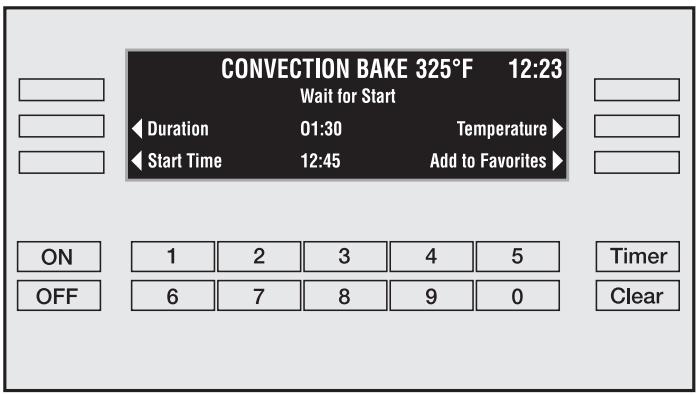
If a duration time is entered, a delayed start time will automatically be calculated.
If no duration time is entered, the oven will calculate a duration based on the current time.
Confirm the entry by touching the "OK" control or cancel by touching "Clear".
Interrupting cooking
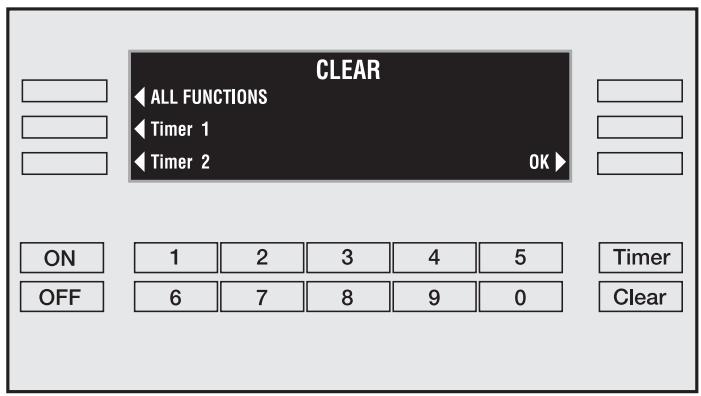
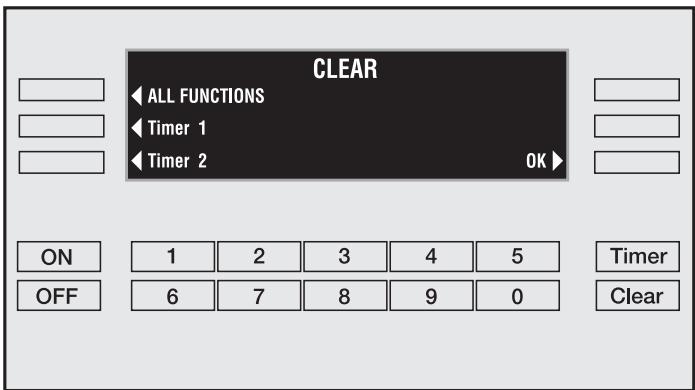
Touch the "Clear" control. Select which option you wish to clear.
Turning off the oven
Touch the "OFF" control.
The oven will turn off and the time of day will appear in the display.
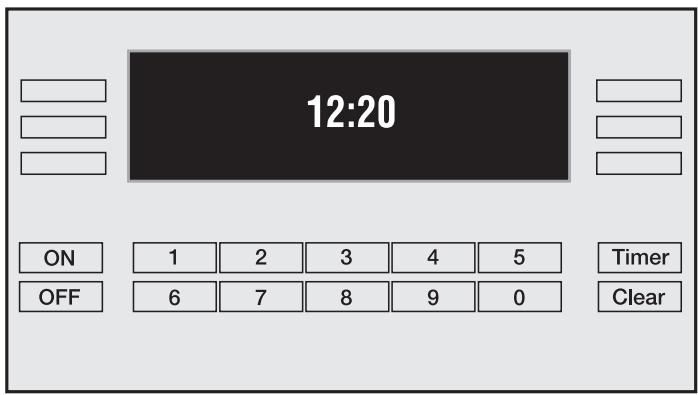
At the end of cooking
- a tone will sound.
- "Ready" will appear in the display under the function name.
- the oven will shut off automatically.
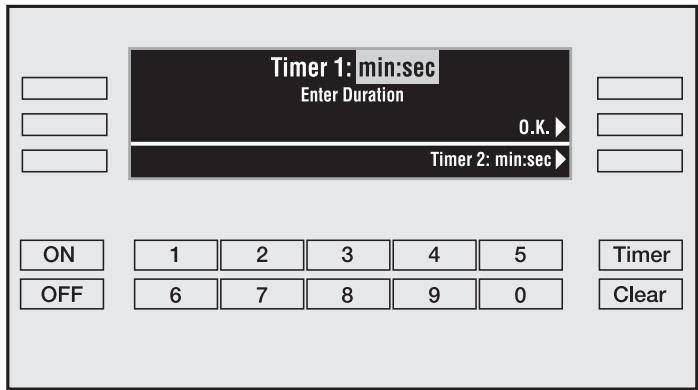
Setting a timer
The timer can be used to time any activity in the kitchen and can be set independently of a cooking function.
Two alarms (Timer1 and 2) can be selected simultaneously.
A maximum time of 99 minutes and 59 seconds can be selected.
To set a timer:
Touch the "Timer" control. Use the keypad to enter the desired time in minutes and seconds.
The second timer can be set in the same way as the first.
The count down of Timer 1 and 2 is shown in the lower area of the display.
At the end of the timed period, a tone sounds.
■ Touch "Clear" to cancel the timer tone.
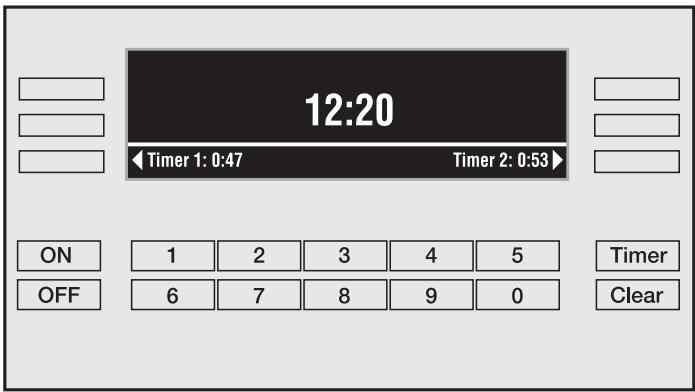
To cancel the timer:
■ Touch the "Clear" control. ■ Touch the control for the timer to be cancelled or to cancel both timers and a running function touch "ALL FUNCTIONS". ■ Touch "OK".
Guide to the functions
BAKE
Default temperature . . . . 375°F (190°C)
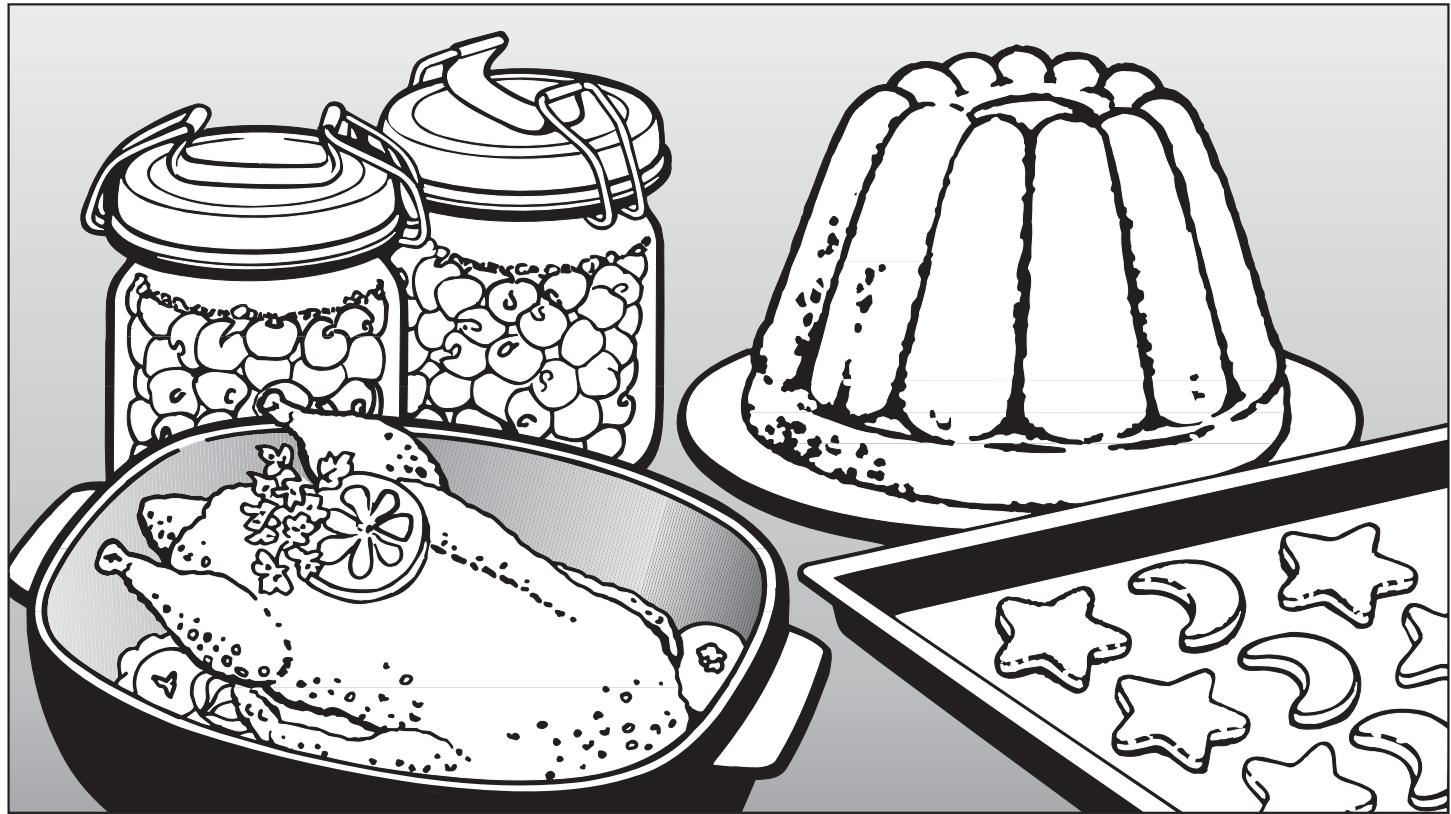
The "BAKE" function works by heating food from below. This is similar to the "bake mode" of a conventional oven.
Use this function for:
- cakes,
- baked apples,
- quick breads,
- spare ribs.
The recommended positions are the 2nd or 3rd runners from the bottom.
CONVECTION BAKE
Default temperature . . . . 325°F (160°C)
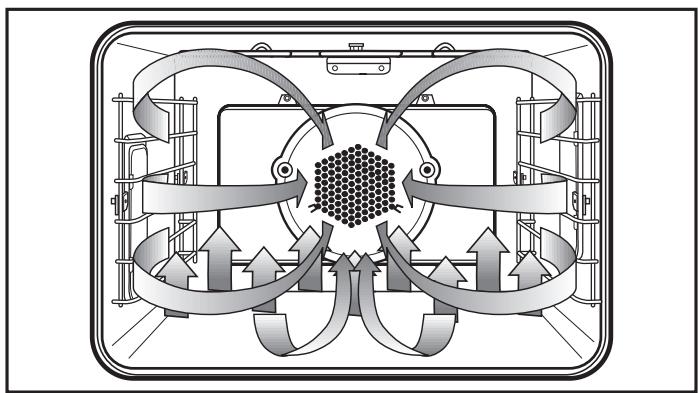
This function actively circulates heated air throughout the oven cavity for a constant baking temperature.
Use this function for:
- cookies, cakes
- soufflés, casseroles, quiche
- frozen dinners
- salmon, lobster tails
- meat loaf, prime rib
When using the convection function, several runner levels can be used at the same time.
The recommended positions are:
1 tray = 1st runner from the bottom; 2 trays = 1st and 4th runners from the bottom; 3 trays = 1st, 3rd, and 5th runners from the bottom
When baking 3 trays of cookies or small cakes at the same time, remove the respective tray when the desired browning is reached.
As a general rule, the temperature of a recipe not designed for baking in a convection oven should be lowered by 25°F (15°C).
Remember to remove the grease filter from the fan opening when baking pastries. If the filter is not removed, increase the baking time.
SURROUND
Default temperature.... 375°F (190°C)
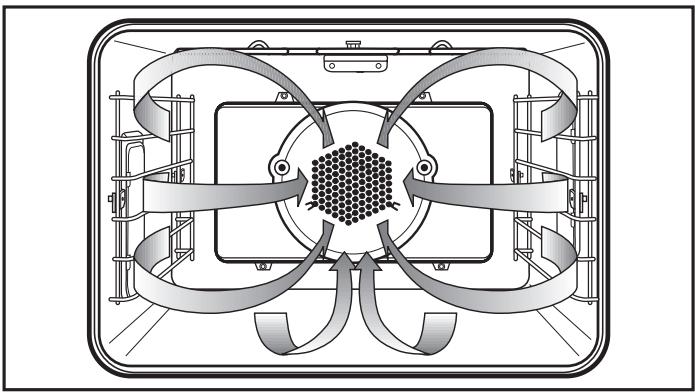
The "SURROUND" function is a premium conventional baking mode.
The oven heats with both the upper and lower heating elements without the convection fan.
Use this function for:
- cookies, cakes
- angel food cake,
- cream puffs, -meringue.
The recommended positions are the
1st or 2nd runners from the bottom.
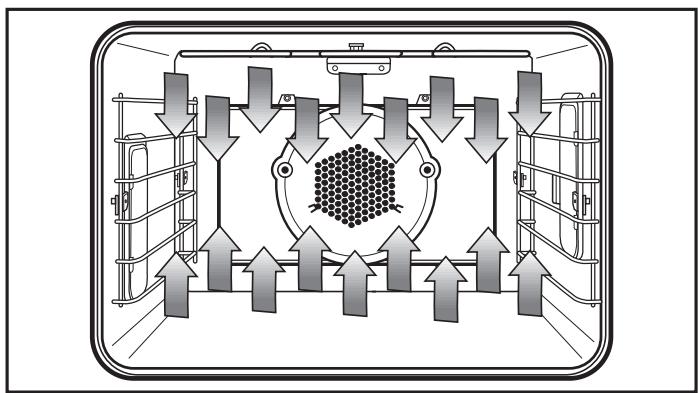
BROWNING
Default temperature ..... 375°F (190°C)
In the "BROWNING" function, food is heated from above.
Use this function for:
- browning meringue,
- melting a cheese topping,
- dense quick bread.
The recommended position is the 4th runner from the bottom.
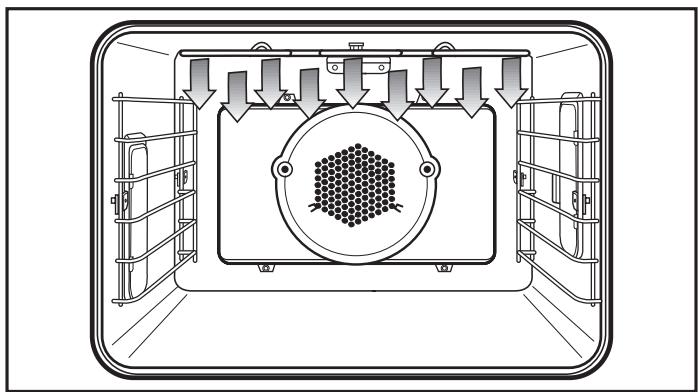
INTENSIVE
Default temperature . . . . 325°F (160°C)
The "INTENSIVE" function generates heat from the lower heating element. The oven's fan gently circulates the heated air to create a brick oven environment.
Use this function for:
- baked potatoes, french fries,
- pizza, stromboli,
- brisket, pot roast,
- cheesecake, pies.
Use the 1st runner from the bottom.
Should the bottom of the food burn, raise the rack to a higher runner.
When using "INTENSIVE", recipe temperatures should be lowered by 25°F (15°C).
Intensive is not recommended for roasting or shallow baking.
Since only the lower heating element is used, bake only on one level. Do not bake on the oven floor.
Remove the grease filter from the fan opening. If the filter is not removed, increase the baking time.
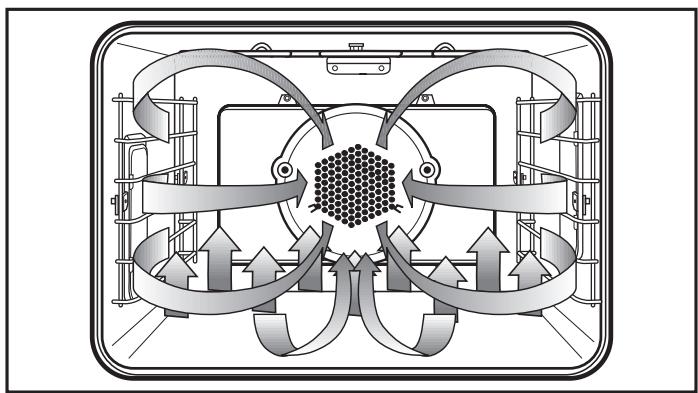
AUTO ROAST
Default temperature . . . . 325°F (160°C)
This premium convection function heats the oven to a high temperature to sear the meat, retaining moisture and tenderness.
Once the oven cavity temperature has exceeded the set temperature,
"Searing" will appear in the display.
Once the meat is seared, the function returns to the selected temperature.
Use this function for:
– large cuts of meat,
- poultry.
The recommended position is the 1st runner from the bottom.
The oven should not be preheated when using "AUTO ROAST".
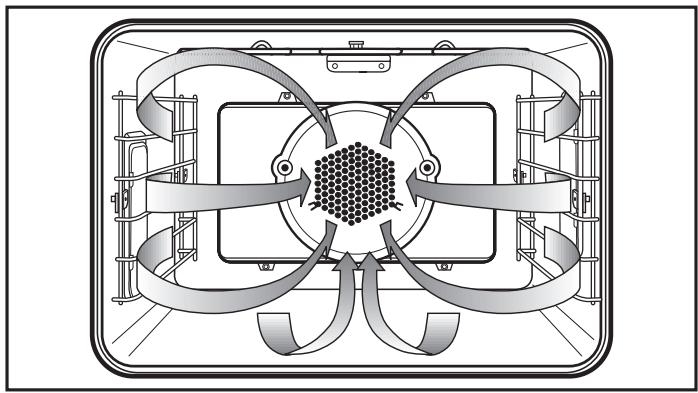
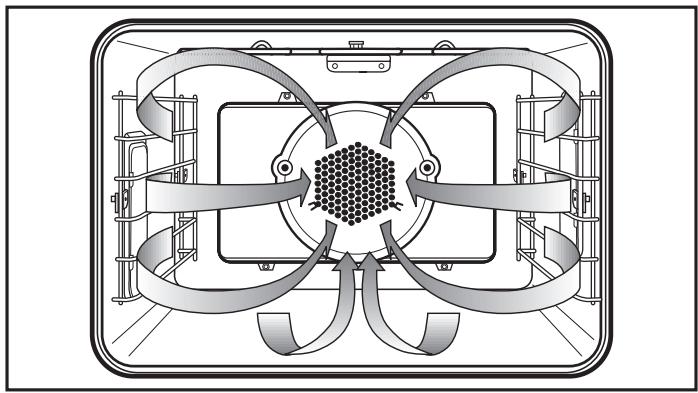
CONVECTION ROAST
Default temperature . . . . 325°F (160°C)
This function uses the convection fan to actively circulate heated air throughout the oven.
This function does not spike the oven temperature for searing.
Use this function for:
- chicken pieces,
- small poultry,
- small cuts of meat,
- fish.
When using the convection function, it is possible to roast simultaneously on multiple runner levels.
The recommended positions are:
1 tray = 1st runner from the bottom; 2 trays = 1st and 3rd runners from the bottom; 3 trays = 1st, 2nd, and 5th runners from the bottom
SURROUND ROAST
Default temperature ..... 400°F (200°C)
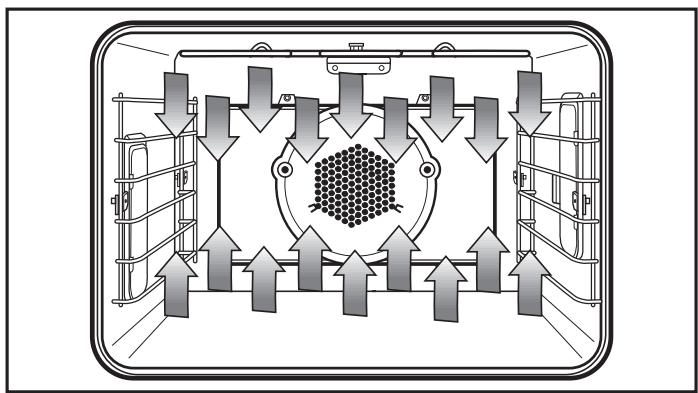
"SURROUND ROAST" is a conventional roasting program for traditional recipes.
Use this function for:
- pot roast,
- leg of lamb,
- pork loin.
The recommended position is the 2nd runner from the bottom.
Roasting tips
- Always install the grease filter in the back of the oven before roasting.
- The larger the cut of meat to be roasted, the lower the temperature that should be used. The roasting process will take a little longer, but the meat will be cooked evenly and the outside will become crisp.
- Use the roast probe for accurate cooking temperatures and best results.
Roasting in a covered pot
When roasting in a covered pot, increase the recipe temperature by 70°F (20°C).
Season the meat and place in the pot. Add some butter or margarine or a little oil. Add about 1/2 cup of water when roasting a large piece of meat or roasting poultry with a high fat content.
Roasting on the rack
Add a little oil to very lean meat or place a few strips of bacon on top to help retain moisture. Place a little water in the roasting pan on the rack below the meat to catch drippings.
Roasting poultry
For crispy skin, baste the poultry ten minutes before the end of cooking with salt water.
Using the roast probe
The roast probe reliably monitors the roasting process. The tip of the probe continuously measures the core temperature of the meat or poultry.
When the selected core temperature is reached, the oven automatically shuts off.
The roast probe can be used with the following functions:
- AUTO ROAST
- CONVECTION ROAST
- SURROUND ROAST
- CONVECTION BROIL
Using the roast probe:
Prepare the meat as usual, and put it into the oven (in a pot or on the rack).
Roasting bags or aluminum foil may be used, but only when left open at the ends. Insert the probe into the meat or poultry through the opened end of the foil or bag.
Insert the probe into the middle of the meat. Make sure that the probe does not touch any bones and is not located in a fatty portion of the meat. Improper insertion of the probe could shut the oven off too early.
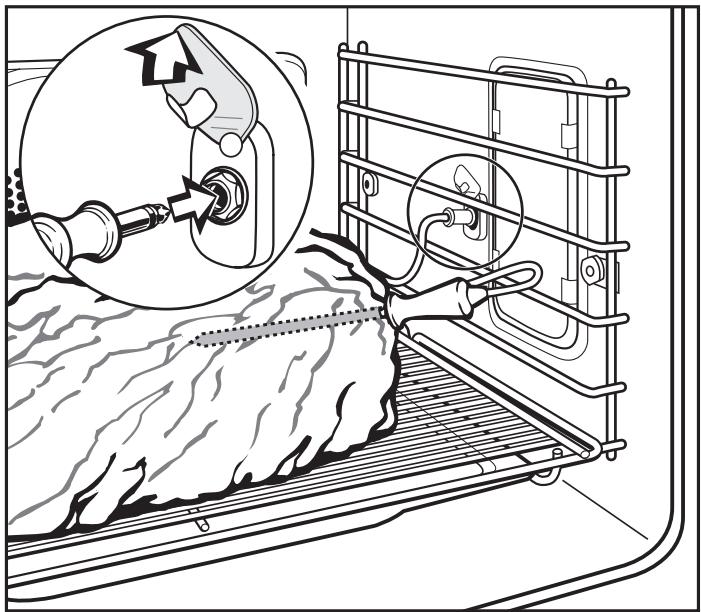
When roasting poultry, the best place to insert the probe is in the thickest part of the bird between the thigh and body.
Insert the short end of the roast probe into the socket on the right side of the oven so it clicks into place.
Select a roasting function.
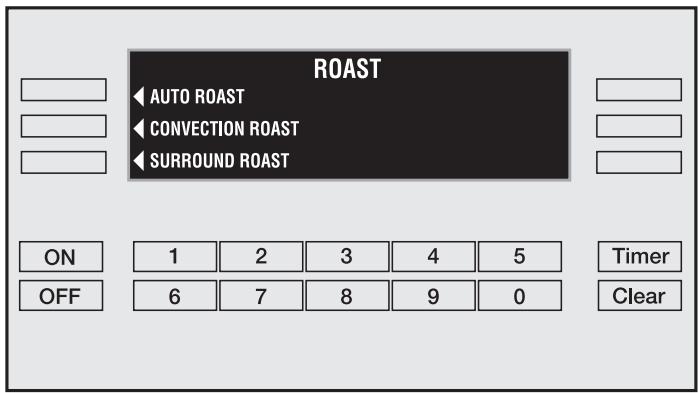
For example, "AUTO ROAST".
The default temperature and the probe (core) temperature, once inserted, will show in the oven display.
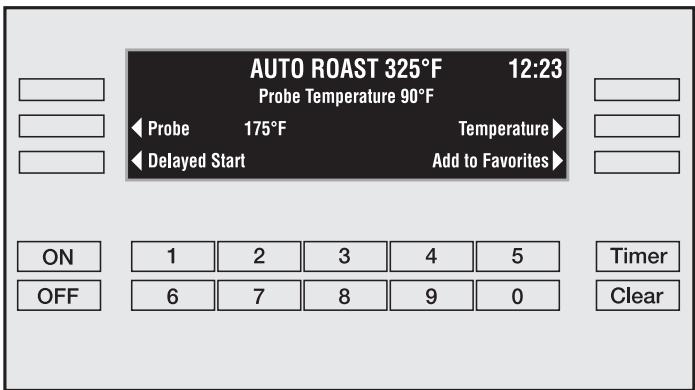
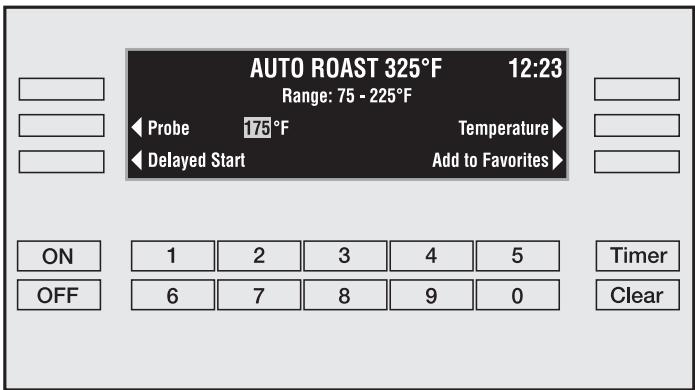
To adjust the core temperature:
Touch the control to the left of "Probe". Enter the new core temperature using the keypad.
The start of roasting can also be delayed at this time.
Touch the "Delayed Start" control.
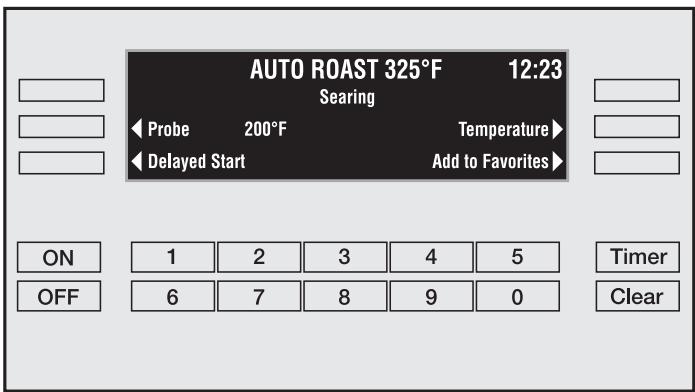
Enter the desired start time of the roasting process using the keypad.
For example, roasting should start at 2 o'clock.
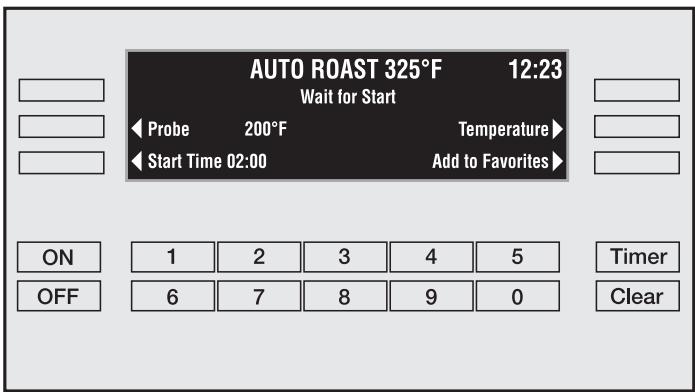
At the end of cooking, when the selected core temperature has been reached, a tone will sound.
The tone can be cancelled by touching "Clear".
Please note:
When finished, cover the meat with aluminium foil and allow to stand for 10 minutes. During this time, the core temperature will rise 10°F (5°C).
If the temperature probe is left in the food at the end of the cooking process, the oven display will show the core temperature first increasing and then decreasing.
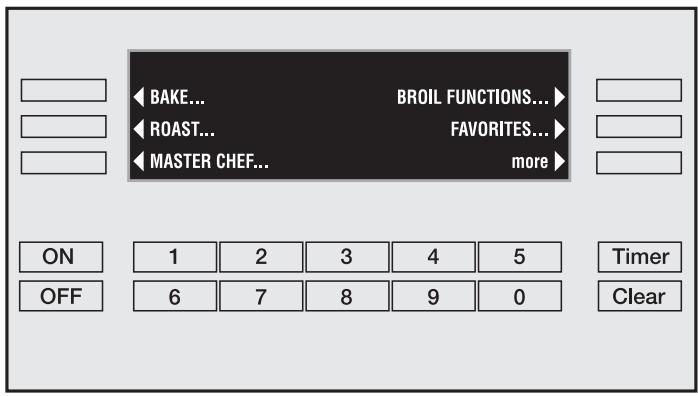
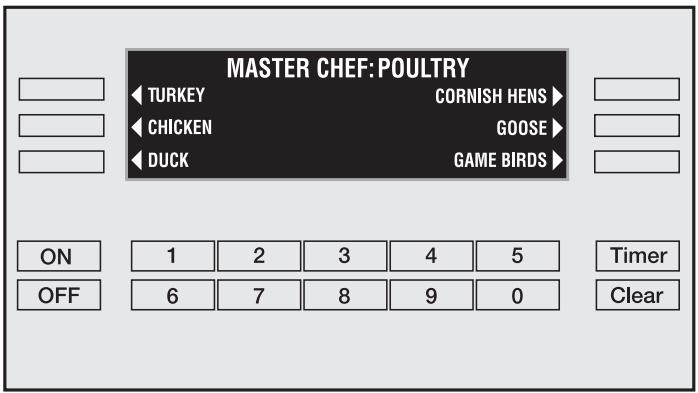
The "MASTER CHEF" function contains an easy to use list of preset functions of commonly cooked foods such as pizza, chicken, french fries.
Touch the "MASTER CHEF" control to view the list of preset functions.
Touch the control of the function you wish to select.
For example, to cook a 12 lb turkey you would select "POULTRY".
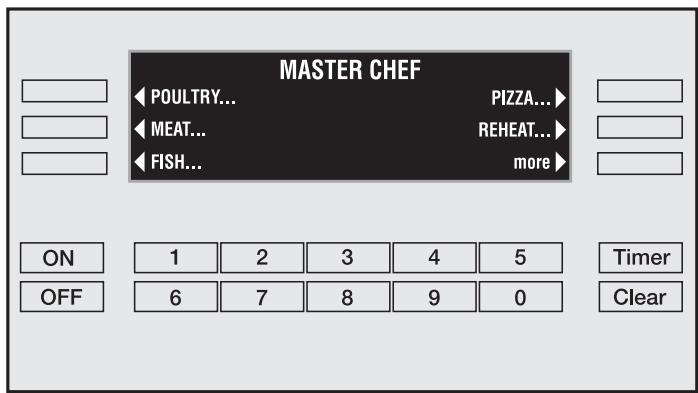
Touch the control to the left of "Turkey".
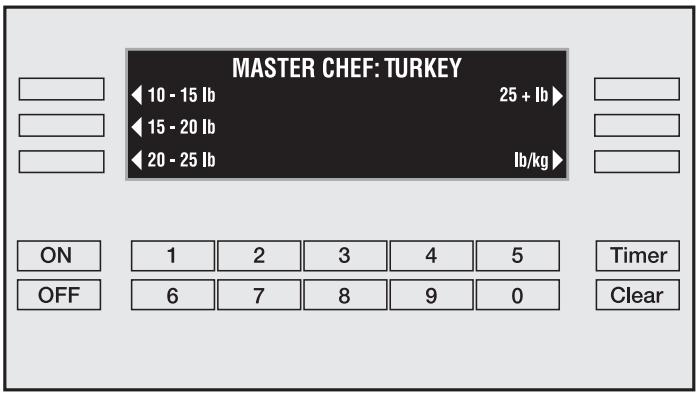
Touch the control that corresponds to the weight of the turkey, "10 - 15 lb".
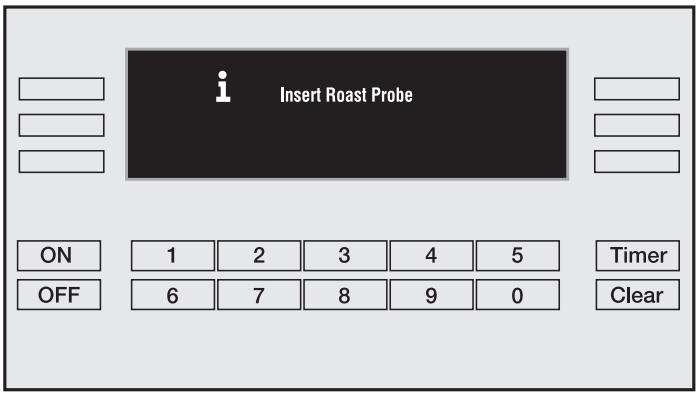
Insert the roast probe into the turkey and into the roast probe socket.
The remaining cooking time can be monitored in the display.
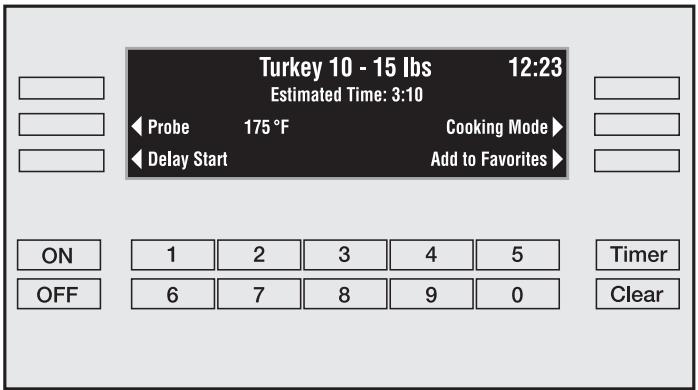
To view the settings of a "MASTER CHEF" function, touch the control for "Cooking Mode".
MASTER CHEF Functions
POULTRY
Turkey
10 - 15 lb
15 - 20 lb
20 - 25 lb
25+ lb
Chicken
Cordon Bleu
Whole: 0-5 lb
Whole: 5+ lb
Cutlets
Parts
Duck
3 - 5 lb
5+ lb
Cornish Hens
1 - 2 lb
Goose
5 - 10 lb
10 - 15 lb
Game birds
0 - 2 lb
2 - 4 lb
MEAT
Beef
Roast
Prime Rib
Pot Roast
Steaks
London Broil
Pork
Loin Roast
Blade Roast
Crown Roast
Cooked Ham
Natural Ham
Chops
Veal
Rolled Roast
Loin Roast
Rib Roast
Chops
Lamb
Leg
Rack
Half Shank
Half Sirloin
FISH
Steaks
Fillets
Whole
Lobster Tails
Paella
Shrimp
PIZZA
Fresh
Frozen
Self-Rising
Stromboli
Calzone
REHEAT
Pizza
Banquet Pan
Casserole
BAKED
GOODS
Fruit Pies
Layer Cakes
Cookies
Soufflé
Sponge Cake
Muffins
POTATOES
Baked
French Fries
BROIL
No default temperature
Only the inner part of the upper heating element is used for a smaller area of intense heat from above. This function is excellent for broiling or searing small quantities.
Use this function for:
- chops, – small or thin pieces of meat,
- browning small dishes.
The recommended position is the 5th runner from the bottom.
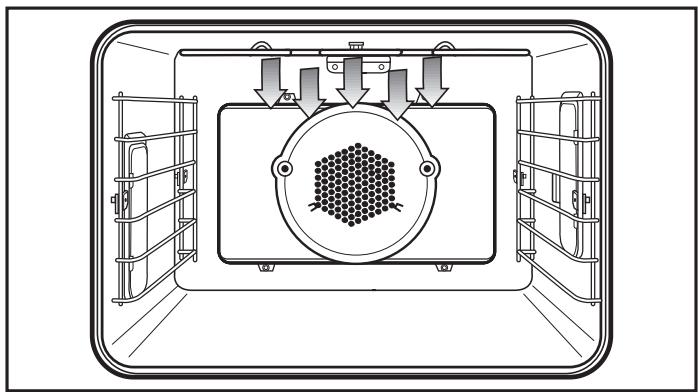
MAXI BROIL
No default temperature
The entire upper heating element is used for intense heating from above. This function gives excellent browning and searing results.
Use this function for:
- london broil,
- chops, – large quantities of meat,
- browning large dishes.
The recommended position is the 4th and 5th runner from the bottom.
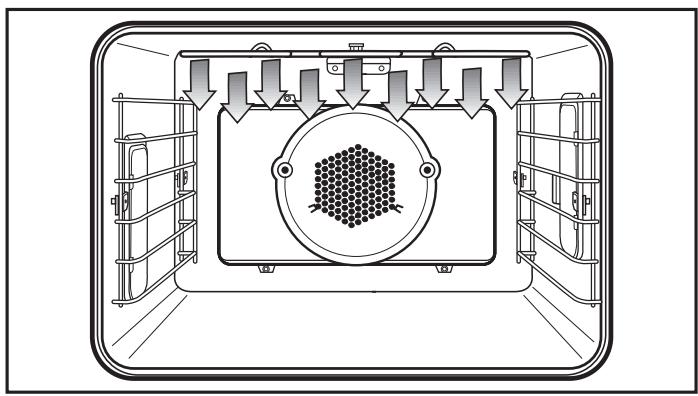
CONVECTION BROIL
No default temperature
Hot air from the upper heating element is distributed over the food by the fan. This enables a lower temperature than conventional broiling to be used.
Use this function for:
- steak,
- lamb.
The recommended position is the 2nd runner from the bottom.
Always insert the grease filter over the convection fan in the back of the oven when using this function.
The roast probe can be used in this function to monitor the meat's core temperature. Refer to "ROAST/ Using the roast probe" for more information.
![graph TD A["Top Section"] --> B["Inner Process"] B --> C{Central Chamber} C --> D["Upper Layer"] C --> E["Lower Layer"] D --> F["Loop Back to Center"] E --> F F --> G["Output"] style C fill:#f9f,stroke:#333,stroke-width:2px](/content/2025/01/84805/images/8e5b8dd47707d464d3f002436bb0262061f47088d5e5e5316e24570a64f51d65.jpg)
No default temperature
The "ROTISSERIE" function broils meat or poultry while turning it on a spit for even cooking results.
Use this function for:
- poultry,
- stuffed meat,
- kebabs.
The roast probe cannot be used at the same time as the rotisserie. The cable could wind around the rotisserie and be damaged.
![graph TD A["Top Section"] --> B["Inner Process"] B --> C{Central Chamber} C --> D["Upper Layer"] C --> E["Lower Layer"] D --> F["Loop Back to Center"] E --> F F --> G["Output"] style C fill:#f9f,stroke:#333,stroke-width:2px](/content/2025/01/84805/images/b2671509972513dc611226f532e456b2862762029dbdc12bc57cbf953ef4c419.jpg)
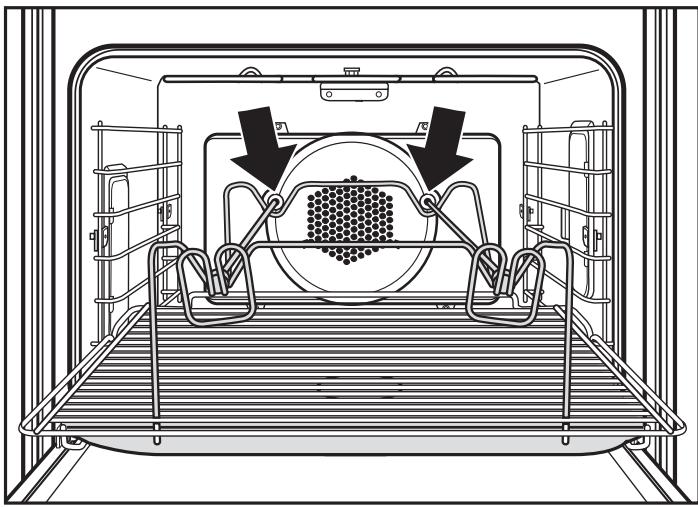
Secure meat or poultry on the skewers.
(Poultry legs should be tied together to prevent them from catching on the heating element.)
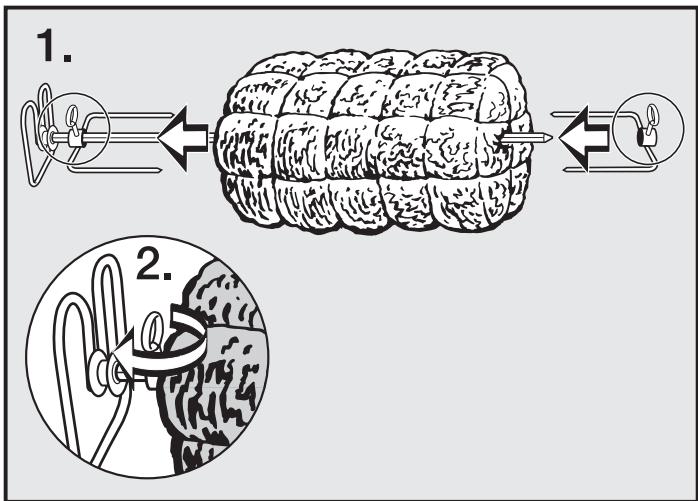
Assemble the rotisserie as shown. Put the rotisserie in the oven, using the lowest level runner.
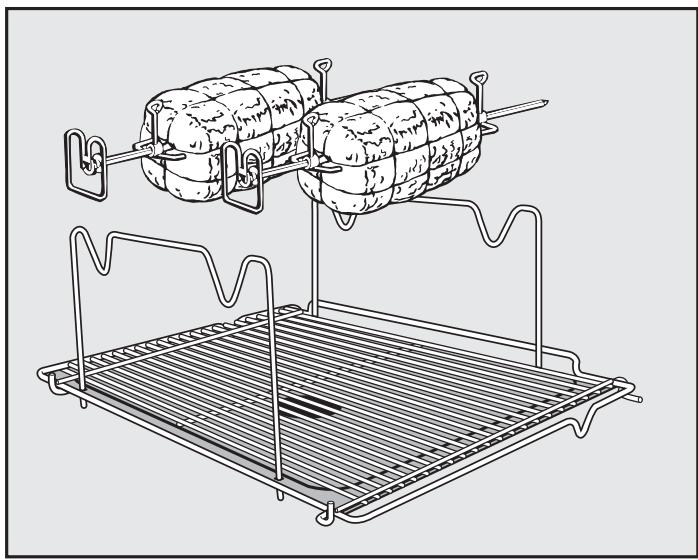
Insert the spits into the grill motors at the back of the oven. Select "ROTISSERIE". When the oven door is closed, the spits will rotate.
Broiling tips
- To ensure even cooking, it is best to broil foods of a similar thickness at the same time. Most items should be turned halfway through broiling.
- To determine how far through a thick piece of meat has been cooked, press down on its surface with a spoon.
If the surface presses down easily and with little resistance to the spoon, it is "rare".
If there is some resistance, it is "medium".
If there is great resistance, it is "well done".
If you often cook a recipe with the same settings (function, times, temperature) you can save those settings as a "favorite" for easy recall.
To save a favorite:
■ Enter the function, temperature and cooking times of the recipe. The oven will begin heating.
■ Touch the "Add to Favorites" control.
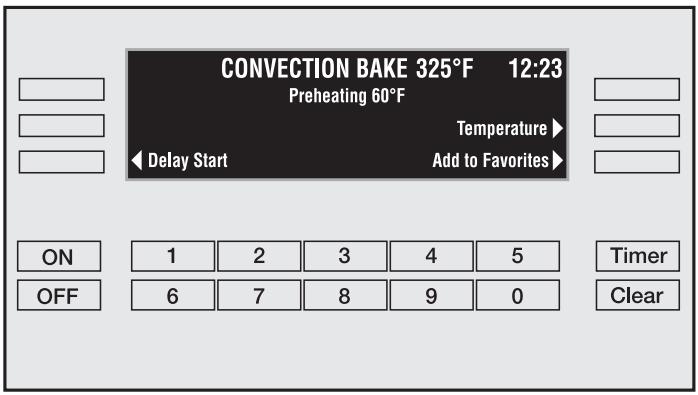
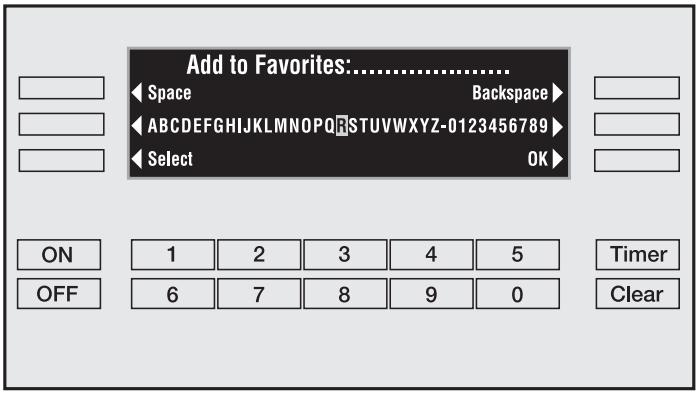
Your "favorite" must be named before it can be saved to the memory.
■ Enter the letters and numbers of the name by touching the controls left and right of the alpha-numeric list. Confirm each character entry by touching the "Select" control.
■ Touch the "OK" control when naming is complete to save the "favorite" to memory.
Your "favorite" can now be recalled from the "FAVORITES" list. When selected, the oven will automatically use the saved settings.
■ Touch "Clear" to cancel the running function if you are not cooking.
SABBATH
Default temperature ..... 375°F/190°C
For religious observance, the oven can be set to run for the duration of the Sabbath. There will be no visual change to the control panel and the clock will not be displayed.
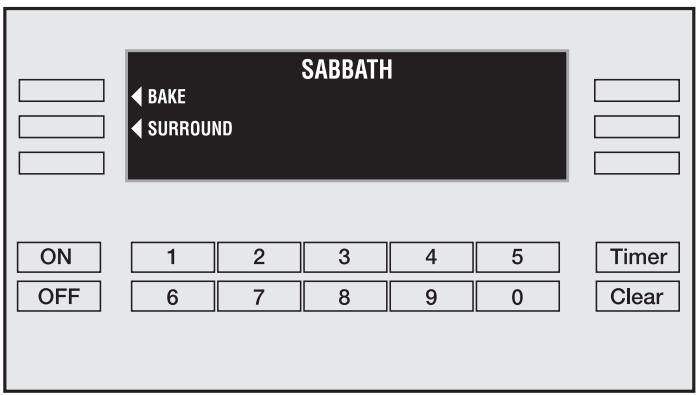
In this function, only "BAKE" and "SURROUND" are available.
Select the desired Sabbath function while the door is closed.
The oven will stay in "Hold" mode until the oven door is opened again.
Open the oven door. Place the food in the oven. Close the oven door.
After a 5 minute delay, the oven will start heating until the set temperature is reached. This temperature will be held constant for 72 hours.
Once the Sabbath function has started the settings can not be changed. The oven can only be turned off with the "ON/OFF" control.
At the end of Sabbath
After 72 hours, the oven will shut off and "F 55" will appear in the display.
Turn the oven off to reset it to normal operation.
DEHYDRATE
Default temperature ..... 175°F (80°C)
This function is for dehydrating fruits, vegetables and herbs.
A constant low temperature and the fan maintain the ideal conditions for the long dehydration process.
For best results, blot food with a paper towel before dehydrating.
Foods to be dehydrated should be placed directly on the oven racks or on a drying screen (not supplied with oven.)
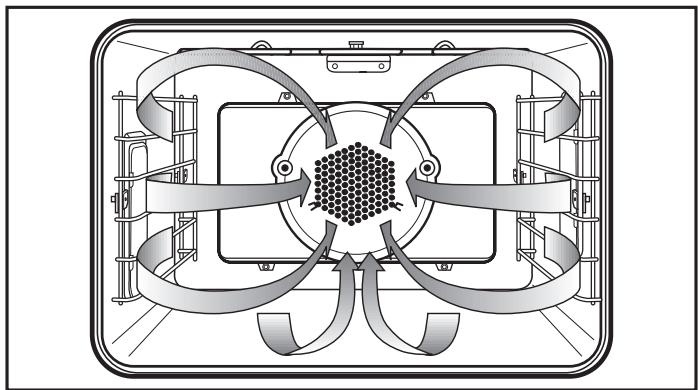
Default temperature ..... 125°F (50°C)
The warm environment created in the proof function will allow you to effectively proof dough. This function maintains a low temperature perfect for yeast to rise.
Place the dough in a large bowl on the oven rack positioned at the lowest runner level. Keep the oven door closed during this process.
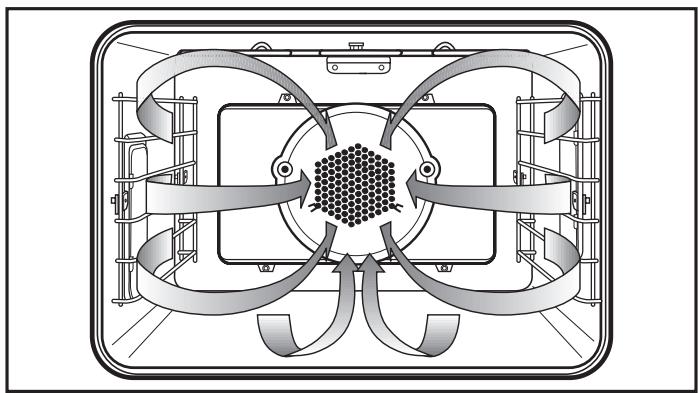
DEFROST
Default temperature ..... 75°F (25°C)
This function allows you to defrost food at a constant temperature.
Defrosting times depend on the type and weight of the food, and at what temperature it was deep-frozen.
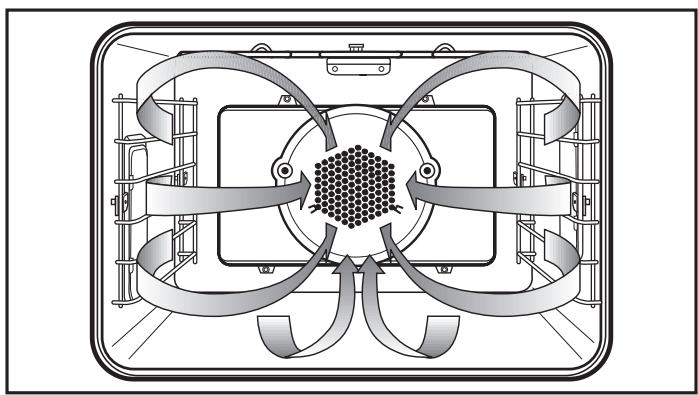
Defrosting tips
- Remove the frozen food from the packaging and place in the roasting pan or into an appropriate dish.
- Meat and poultry should be fully thawed before cooking. Do not use the liquids from defrosting.
- Fish does not need to be fully defrosted before cooking. Defrost so that the surface is soft enough to absorb herbs and seasoning.
- Cook all food immediately after defrosting.
Appliance front
The glass front of the appliance and the control area can be cleaned with glass cleaner when cool.
Stainless steel
Stainless steel surfaces can be cleaned using a non-abrasive stainless steel cleaner.
To help prevent resoiling, a conditioner for stainless steel can also be used. Apply sparingly with even pressure.
Accessories
Roast probe
Wash with soapy water and a sponge. Rinse under running water.
Do not submerge the roast probe in water. Do not clean the roast probe in the dishwasher.
Grease filter
Clean with liquid dish soap and hot water, or in the dishwasher.
Depending on the detergent, cleaning the grease filter in a dishwasher may cause permanent discoloration of the filter surface. Performance of the filter will not be affected.
Rotisserie
Clean with liquid dish soap and hot water, or in the dishwasher.
PerfectClean
The revolutionary PerfectClean enamel is a smooth, nonstick surface that cleans up easily with a sponge.
The following have been treated with "PerfectClean":
- oven walls,
- roasting pan,
- anti-splash tray,
- runners. ■ Do not clean items with PerfectClean in a dishwasher. Dishwasher detergents may damage the enamel. ■ Clean after each use with a sponge and a solution of hot water and liquid dish soap. ■ Do not use abrasive cleaners, ceramic cleaners, metal scourers, or oven cleaners on PerfectClean surfaces. ■ After cleaning, rinse thoroughly with water. The water should run off the surface easily. Any residue will hinder this effect. ■ Stubborn baked on grease may need to be soaked first to loosen deposits. ■ Clean up spills on PerfectClean surfaces as soon as possible to prevent stains. ■ Spilt fruit juices may permanently discolor surfaces. This discoloration is permanent but will not affect the efficiency of the enamel.
Cleaning the oven cavity by hand
⚠️ Danger of burns! Allow the oven to cool before cleaning.
To make cleaning easier
- remove the oven door,
- remove the runners, – lower the upper heating element.
■ Clean the oven surfaces with a solution of hot water and liquid dish soap and a sponge or soft nylon brush.
Do not use abrasive cleaning agents, hard brushes, metal scouring pads, steel wool, knives or other abrasive materials.
Do not use oven sprays on any part of this oven.
■ Dry surfaces before reassembly.
Removing the oven door
Please note: the oven door is quite heavy. It should be gripped firmly at the sides when being removed or refitted.
■ Open the door fully. ■ Flip up the locking clamps on each door hinge.
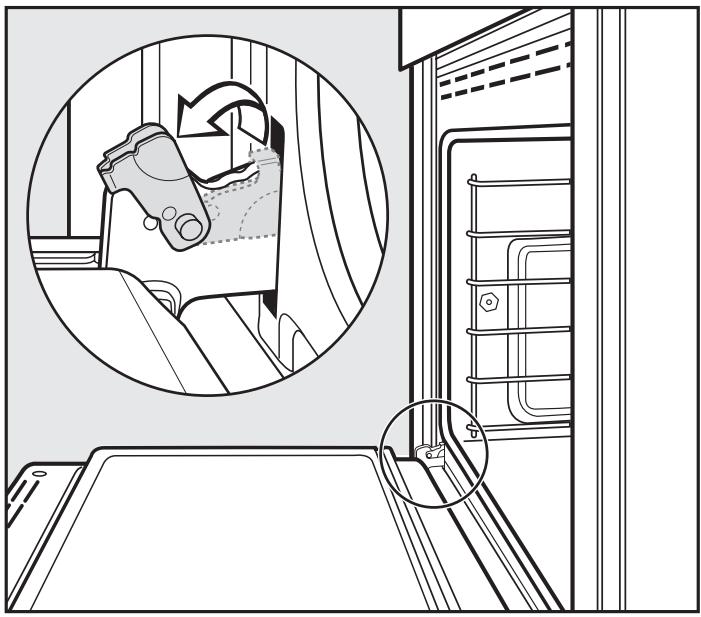
■ Slowly shut the door until the protruding clamps stop the movement. Pull the door upward. See illustration.
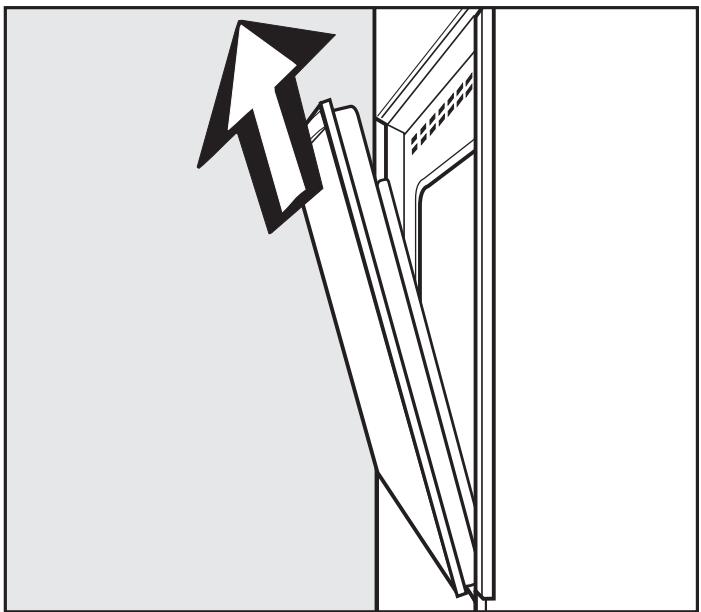
Refitting the oven door
■ Insert the door onto the hinges and open the door completely. ■ Flip the locking clamps down.
Check that the locking clamps are flipped down when the door is reinstalled. Otherwise, on closing the door, the hinges could work loose from the guide holes and cause damage.
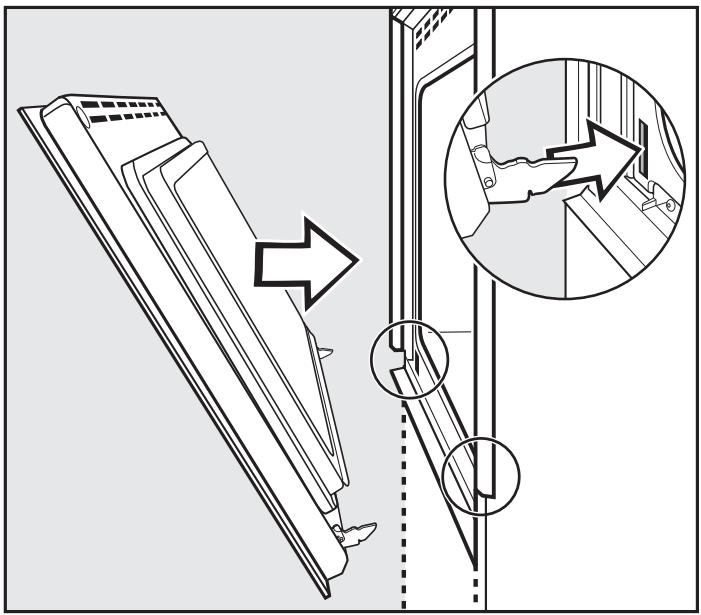
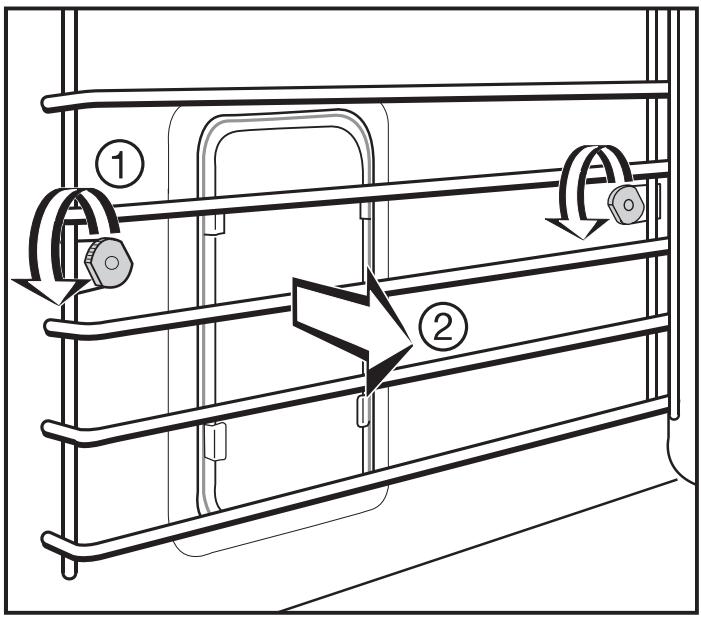
Removing the runners
■ Turn the two screws, ①, counterclockwise and remove. ■ Remove the runners, ②, from the oven by pulling them away from the oven wall.
Reassemble in the reverse order, ensuring all parts are correctly in place.
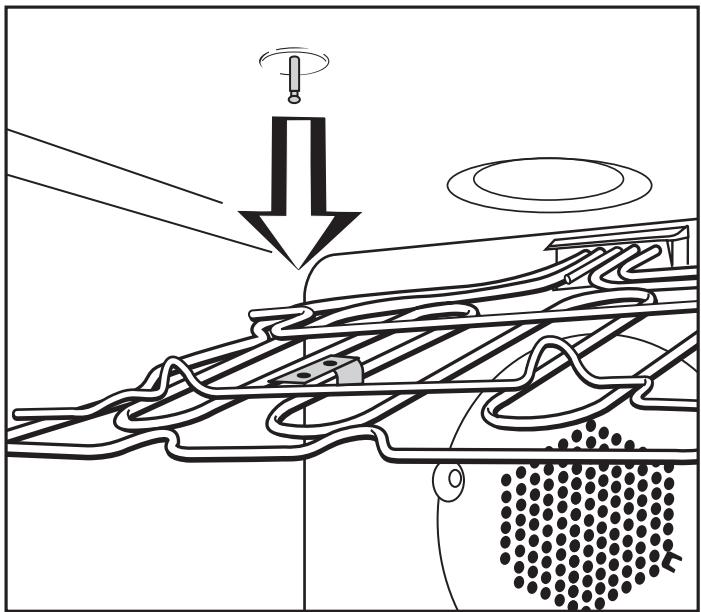
Lowering the upper heating element
■ Remove the runners first. ■ Loosen the wing nut.
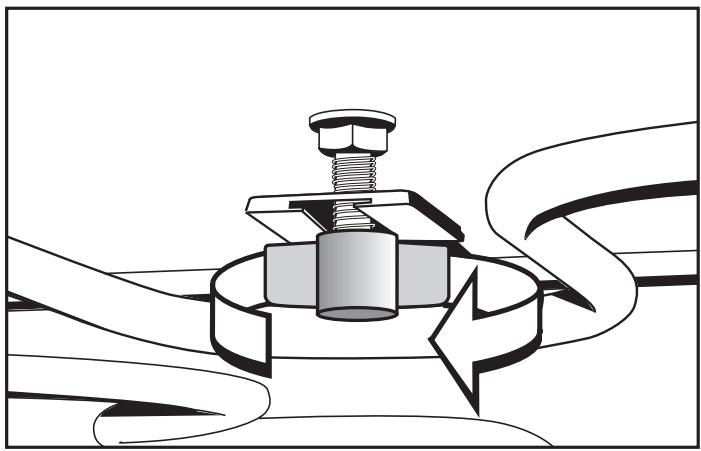
■ Gently lower the element.
Catalytic liners
Circulating air in the oven deposits oil and fat on the back of the oven. These deposits are burnt off from the catalytic liner when the temperature of the oven reaches over 400°F/200°C.
Cleaning at high temperatures:
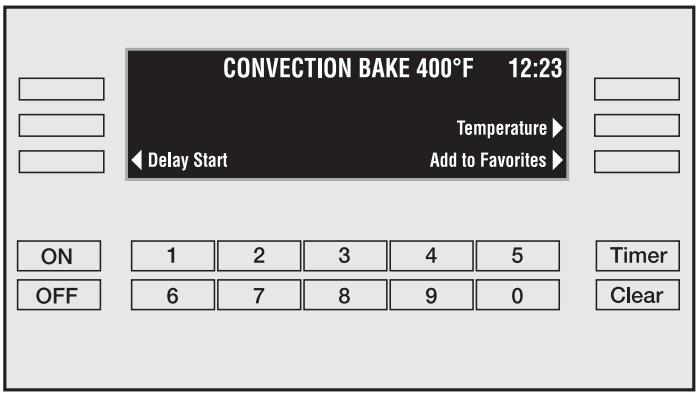
■ Touch the "ON" control. ■ Select function "BAKE".
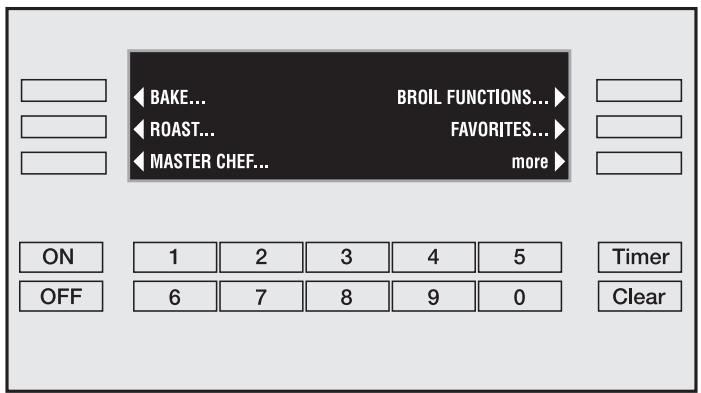
■ Select "CONVECTION BAKE".
■ Select "Temperature". ■ Adjust the function temperature to 400° F ( 200° C).
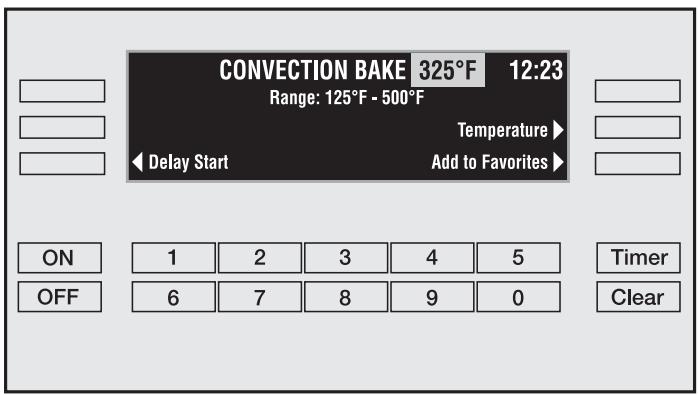
■ Touch the "Delay Start" control. ■ Select "Duration" and set the duration for 1 hour. More time may be needed if the oven is heavily soiled. ■ Touch "OK".
If the catalytic liner is damaged, a replacement may be purchased from your Miele dealer or the Technical Service Department.
⚠️ To reduce the risk of electric shock, disconnect this appliance from the power supply by shutting off the power main or tripping the circuit breaker.
Changing the light bulb
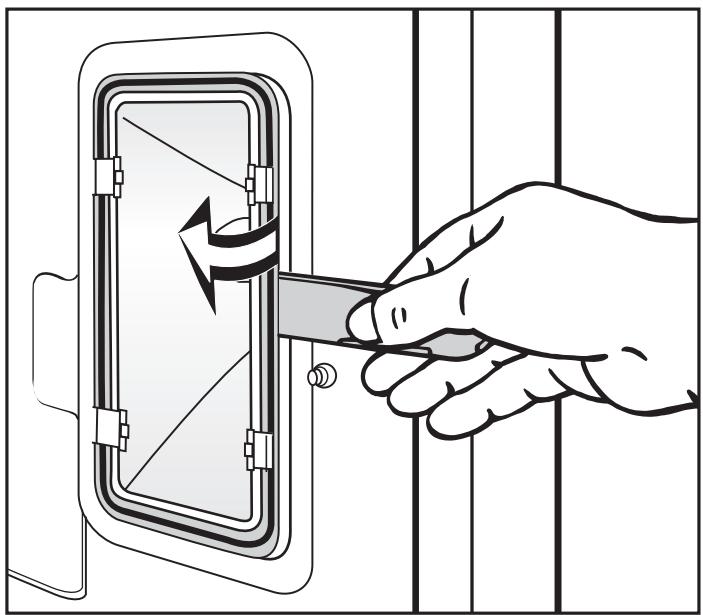
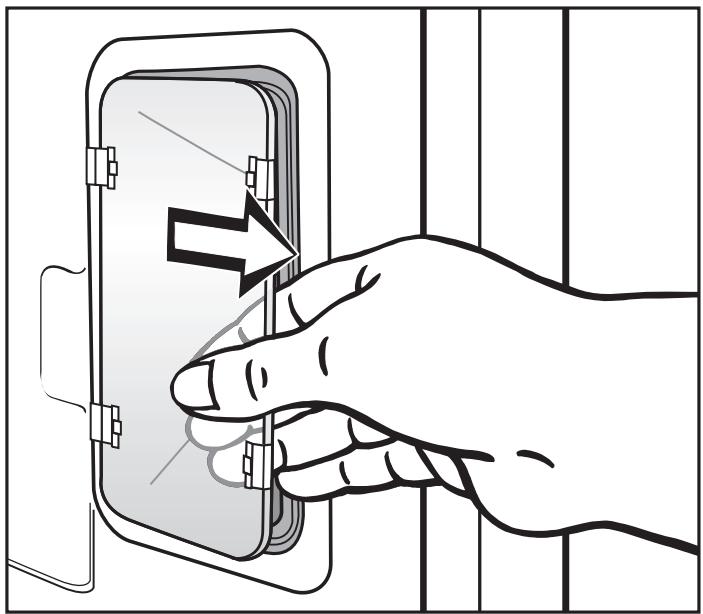
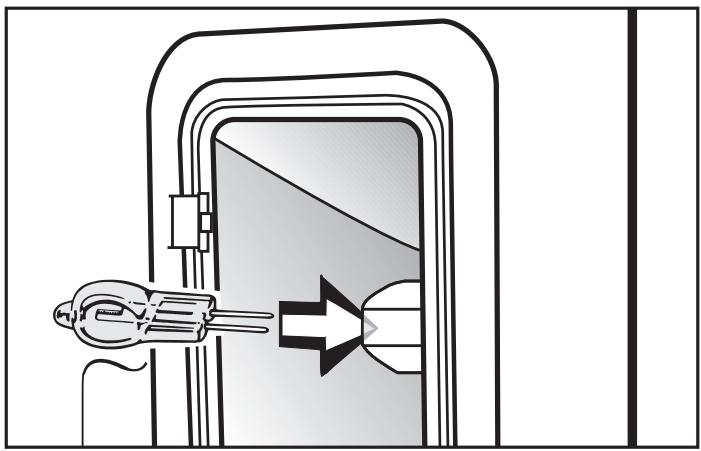
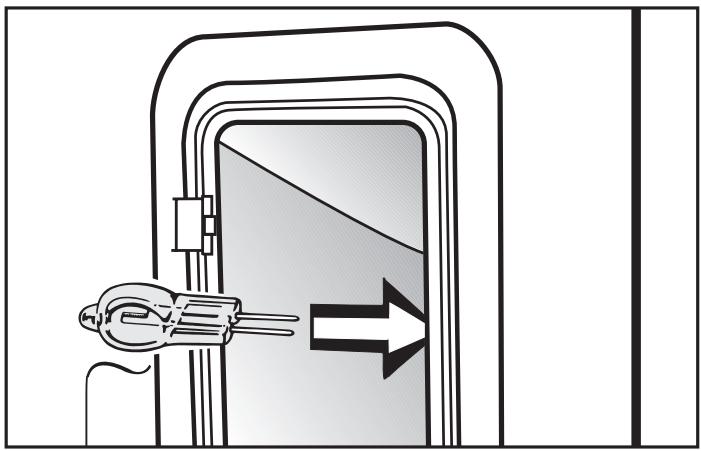
■ Remove the runners. ■ Spread a dishtowel on the oven floor to protect the enamel, in case the light cover falls. ■ Insert the supplied slide opener between the light cover and the metal frame of the light along the edge closest to the oven door. ■ Pry the light cover out of the metal frame.
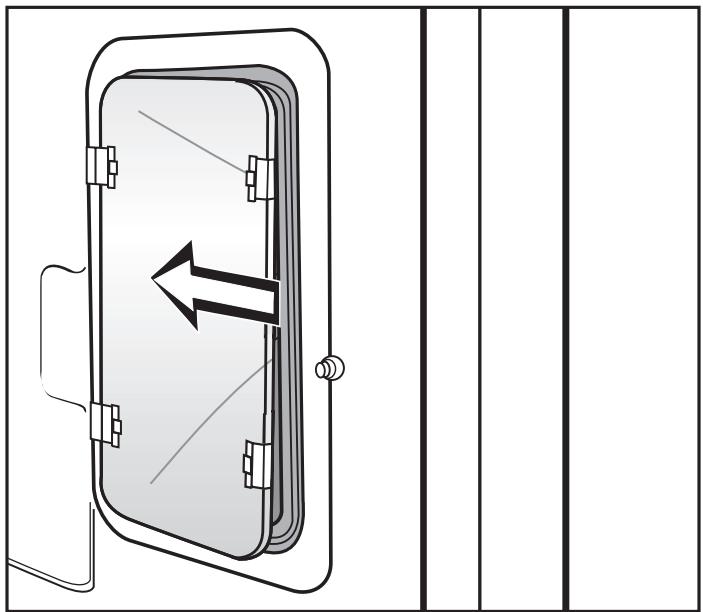
■ Slide the light cover out of the two clamps secured to the metal frame.
Do not bend these metal clamps. The clamps and the reflector could be damaged.
On some models the bulb cover is connected to the light cover so you will have to remove it as one piece.
■ Replace the halogen bulb.
Only use a 12 V, 10 W, 572°F (300°C) heat resistant, Osram, type w818 bulb.
Do not touch the new light bulb with your fingers; touching the bulb will reduce its life. Follow the bulb manufacturer's instructions.
with bulb cover
without bulb cover
Put the light cover back in place with the notch to the rear of the metal clamps.
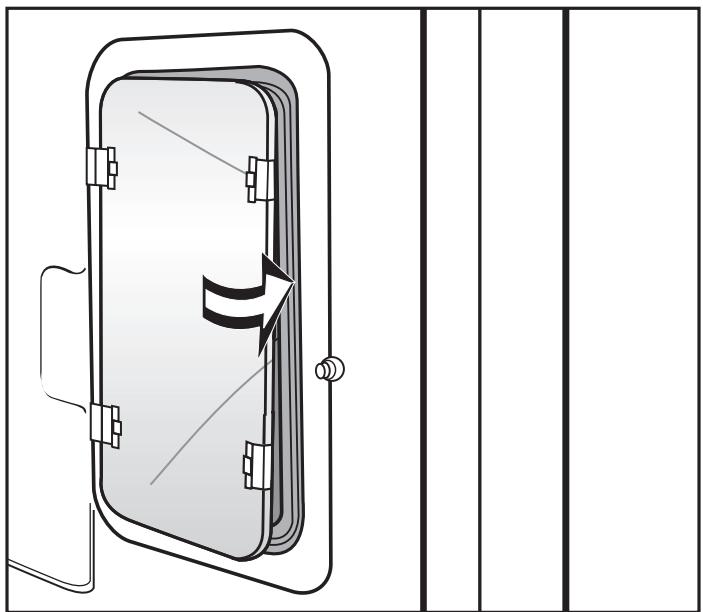
Press the light cover in to the metal frame.
Reassemble the runners.
Frequently asked questions
What if the oven does not heat?
| Possible fault | Fix |
| The child safety lock is activated. | Deactivate the child safety lock. |
| The circuit breaker has tripped. | Check the breaker. |
| The delay start has been set. | Cancel the delay start. |
| The door is not fully closed. | Close the door firmly. |
Why is there no noise when the oven door is opened during operation?
This is normal. If the door is opened during operation, a safety contact switch causes the heating elements and the fan to shut off.
Should a noise be heard after turning the oven off?
This is normal. The fan will continue to run for a short time to cool the oven. When the oven has cooled sufficiently, the fan will turn off automatically.
Why is the display dark when the oven is first turned on?
| Possible fault | Fix |
| The clock display has been turned off. | Turn the display on: Touch "ON".Select "Settings" - "Clock" - "Display on". |
What if the time of day can not be entered after a power failure?
| Possible fault | Fix |
| The child safety lock is set to "0". | Slide the child safety lock to "I". |
What if cakes and cookies are not cooked enough?
| Possible fault | Fix |
| The grease filter was not removed. | If the grease filter is not removed, increase baking by 10 to 15 minutes. |
Why is there uneven browning?
| Possible fault | Fix |
| Oven not preheated. | Allow the oven to preheat. |
| Oven temperature too high. | Lower the oven temperature. |
| Grease filter was not removed. | Remove the grease filter next time. |
| Shiny or thin pans were used. | Use dark, matte finish pans. |
What if a 3 digit code ("F" followed by two numbers) appears in the display?
| Possible fault | Fix |
| An electronic fault has occurred. | Call Technical Service for assistance. |
| "F 55" the oven has shut down or the Sabbath function has finished. | Turn off the oven to reset it to normal operation. |
In the event of a fault which you cannot easily fix yourself, please contact the Miele Technical Service Department
USA 1-800-999-1360
When contacting Technical Service, please quote the serial number and model of your oven. This information is visible on the silver data plate along the right side of the oven.
The following accessories are available for purchase from your Miele Dealer or Technical Service.
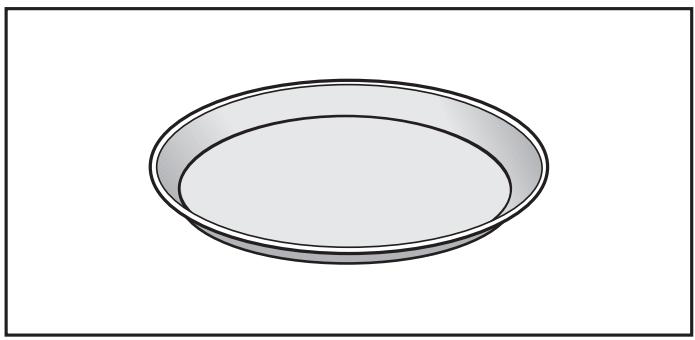
Pizza pan
This circular pan is suitable for cooking fresh or frozen pizzas, flat cakes, tarts, and baked desserts.
Part# 05 182 760
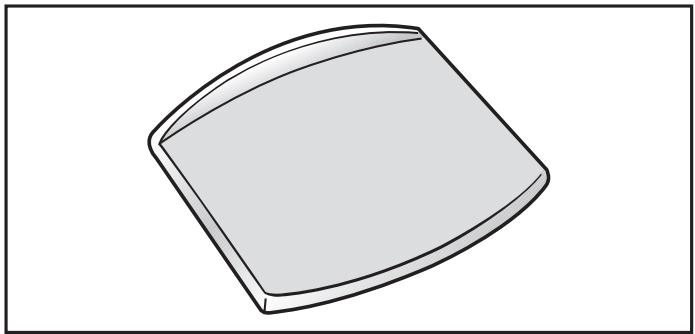
Pizza stone
The pizza stone is ideal for baking dishes with a crisp bottom like pizza and bread.
Part # 22 996 071
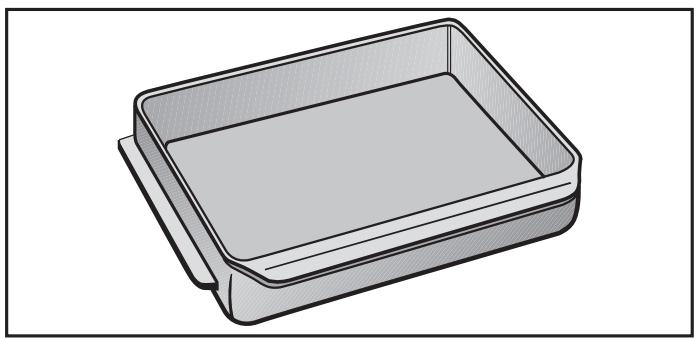
Deep sided universal oven dish
The deep sided universal oven dish has a special non-stick coating. A lid is also available separately.
Small dish part# 22 99 6078
Large dish part# 22 99 6077
INSTALLATION INSTRUCTIONS
Disposal of the packing materials
The cardboard box and packing materials protect the appliance during shipping. They have been designed to be biodegradable and recyclable.
Ensure that any plastic wrappings, bags, etc. are disposed of safely and kept out of the reach of children. Danger of suffocation!
Disposal of an old appliance
Old appliances may contain materials that can be recycled. Please contact your local recycling authority about the possibility of recycling these materials.
Ensure the appliance presents no danger to children while being stored for disposal. Before discarding an old appliance, unplug it from the outlet and cut off its power cord. Remove any doors to prevent trapping hazards.
⚠️ CAUTION: Before servicing, disconnect the power supply by either removing the fuse, shutting off the power main or manually "tripping" the circuit breaker.
Installation work and repairs should only be performed by a qualified technician in accordance with all applicable codes and standards. Repairs and service by unqualified persons could be dangerous and the manufacturer will not be held responsible.
Before connecting the appliance to the power supply, make sure that the voltage and frequency listed on the data plate correspond with the household electrical supply. This data must correspond to prevent machine damage. Consult an electrician if in doubt.
Only operate the appliance after it has been installed into cabinetry.
Installer:
Please leave these instructions with the consumer.
Power supply
The oven is equipped with a 6 ft. (2.2 m) flexible power cord consisting of 4 wires ready for connection to a dedicated 3 pole, 4 wire grounded power supply:
- 120/240 V, 60 Hz, 30 A fuse rating or
- 120/208 V*, 60 Hz, 30 A fuse rating *A conversion kit is necessary for the installation of a 208 V oven. Please contact Technical Service for details.
Black wire: connect to L1 (hot)
Red wire: connect to L2 (hot)
White wire: connect to N (neutral)
Green wire: connect to GND (ground)
A dedicated line and junction box should be used to connect the oven to a 30 A circuit.
Connection details are also given on the diagram located on the top of the oven.
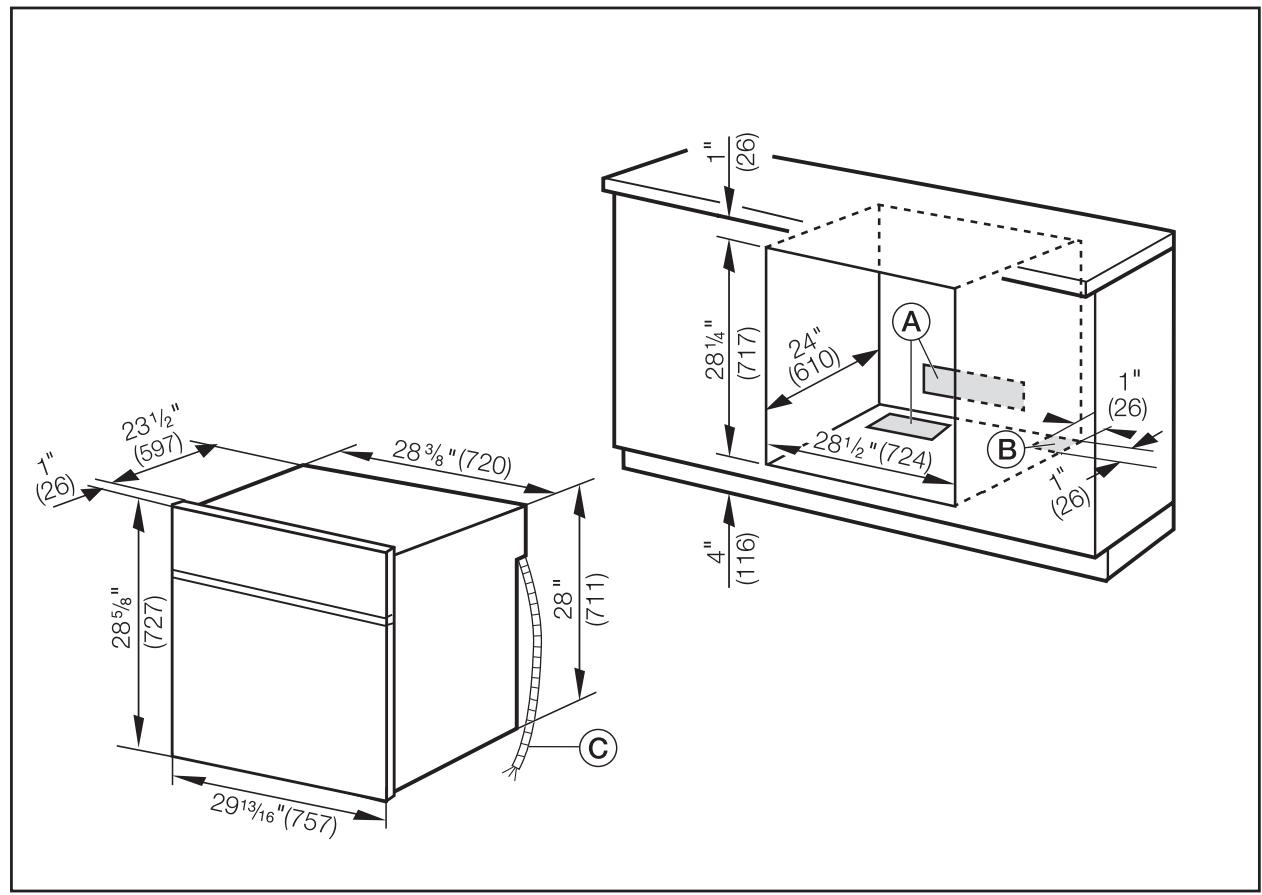
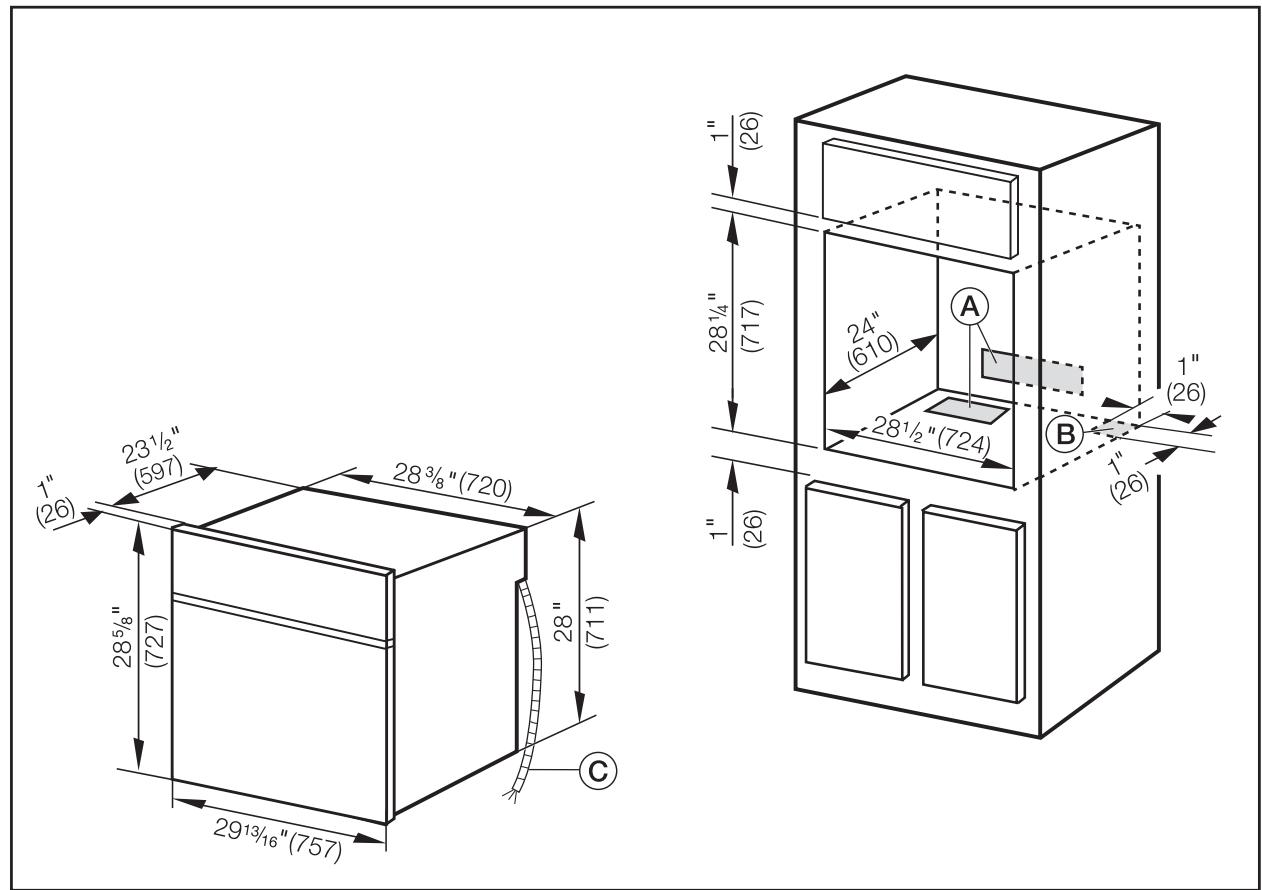
Ⓐ Vent (min. 24" 2 / 150 cm 2 ) cut-out possible at rear or platform of cabinet ⑧ Cut-out for power cord (min. 1"2 / 3 cm²) © Power cord
The oven must be installed into cabinetry and be supported from underneath.
For proper heat ventilation a 12" x 2" (30 cm x 5 cm) opening must be made at the rear of the cabinet or to the rear of the platform under the oven.
Do not insulate the cabinet. This will prevent proper ventilation.
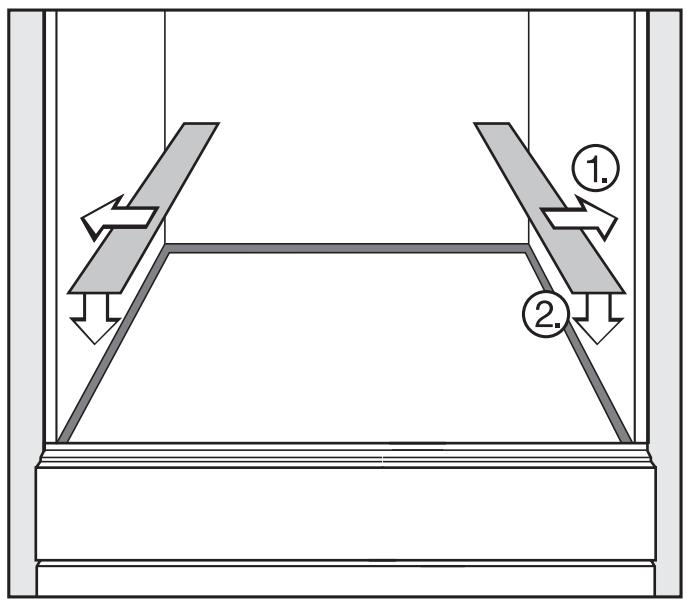
■ Adhere the skid plates to the cabinet floor.
■ Prepare the door for removal. Flip up the locking clamps on each door hinge.
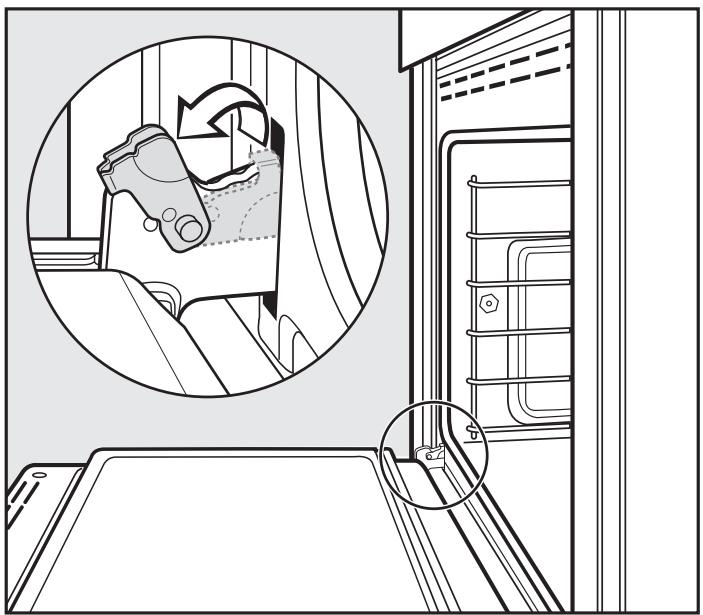
■ Slowly shut the door until the protruding clamps stop the movement. Pull the door upward.

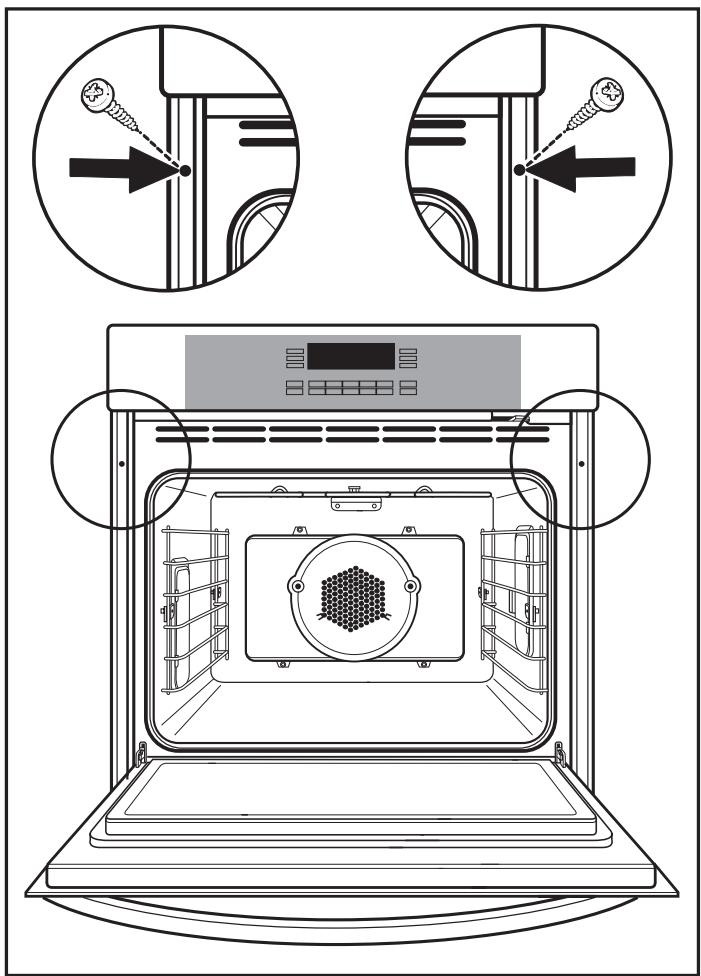
■ Connect the oven to the electrical supply. ■ Slide the oven into the cabinet and align. ■ Reinstall the door. ■ Open the oven door and locate the two mounting screw holes in the oven frame. Mark and drill 6 mm pilot holes. Secure the oven to the cabinetry by inserting screws through the frame and into the cabinetry.
Set the time
"Enter Time: hh:mm" will appear in the display once the oven is connected to electricity.
■ Set the current time using the keypad. ■ Save the time by touching the control to the right of "OK".
Miele, Inc.

National Headquarters
9 Independence Way
Princeton, NJ 08540
Phone: 800-843-7231
609-419-9898
Fax: 609-419-4298
www.mieleusa.com
Technical Service & Support Nationwide
Phone: 800-999-1360
Fax: 888-586-8056
Miele Limited

National Headquarters
55G East Beaver Creek Road
Richmond Hill, ON L4B 1E5
Phone: 800-643-5381
905-707-1171
Fax: 905-707-0177
www.miele.ca
info@miele.ca (general enquiries)
professional@miele.ca (commercial enquiries)
Mielecare National Service
Phone: 800-565-6435
905-850-7456
Fax: 905-850-6651
service@miele.ca (Tech. Service)


- OPERATING INSTRUCTIONS
- OVEN
- IMPORTANT SAFETY INSTRUCTIONS
- GUIDE TO THE OVEN
- GUIDE TO THE DISPLAY
- OVEN ACCESSORIES
- LOCKING THE OVEN
- USING THE OVEN DISPLAY
- SETTINGS
- BEFORE USING THE OVEN
- USING THE OVEN
- SETTING THE TIMER
- GUIDE TO THE FUNCTIONS
- ROAST
- INSTALLATION
- OVEN USE
- GENERAL NOTES
- DISPOSAL OF AN OLD OVEN
- WIRE RACK
- ROASTING PAN
- ANTI-SPLASH TRAY
- GREASE FILTER
- ROAST PROBE
- ROTISSERIE
- SLIDE OPENER
- CHILD SAFETY LOCK
- TO ACTIVATE THE CHILD SAFETY LOCK
- TO DEACTIVATE THE CHILD SAFETY LOCK
- LANGUAGE
- CLOCK
- TEMPERATURES
- OVEN LIGHT
- TEMPERATURE °F/°C
- DISPLAY
- TONE OPTIONS
- TIMER 1" AND "TIMER
- KEYPAD TONE
- VOLUME
- TONE SHORT / LONG
- RESET
- RESET TEMPERATURES
- RESET SETTINGS
- RESET FAVORITES
- HEAT THE OVEN
- SELECTING A FUNCTION
- ADJUSTING THE OVEN TEMPERATURE
- PREHEATING
- DELAY START
- DESIRED END TIME
- INTERRUPTING COOKING
- TURNING OFF THE OVEN
- AT THE END OF COOKING
- SETTING A TIMER
- TO CANCEL THE TIMER
- BAKE
- CONVECTION BAKE
- SURROUND
- BROWNING
- INTENSIVE
- AUTO ROAST
- CONVECTION ROAST
- SURROUND ROAST
- ROASTING TIPS
- ROASTING IN A COVERED POT
- ROASTING ON THE RACK
- ROASTING POULTRY
- USING THE ROAST PROBE
- PLEASE NOTE
- MASTER CHEF FUNCTIONS
- POULTRY
- TURKEY
- CHICKEN
- DUCK
- CORNISH HENS
- GOOSE
- GAME BIRDS
- MEAT
- BEEF
- PORK
- VEAL
- LAMB
- FISH
- PIZZA
- REHEAT
- BAKED
- GOODS
- POTATOES
- BROIL
- MAXI BROIL
- CONVECTION BROIL
- BROILING TIPS
- SABBATH
- AT THE END OF SABBATH
- DEHYDRATE
- DEFROST
- DEFROSTING TIPS
- APPLIANCE FRONT
- STAINLESS STEEL
- ACCESSORIES
- PERFECTCLEAN
- CLEANING THE OVEN CAVITY BY HAND
- TO MAKE CLEANING EASIER
- REMOVING THE OVEN DOOR
- REFITTING THE OVEN DOOR
- REMOVING THE RUNNERS
- LOWERING THE UPPER HEATING ELEMENT
- CATALYTIC LINERS
- CLEANING AT HIGH TEMPERATURES
- CHANGING THE LIGHT BULB
- FREQUENTLY ASKED QUESTIONS
- WHY IS THERE NO NOISE WHEN THE OVEN DOOR IS OPENED DURING OPERATION
- SHOULD A NOISE BE HEARD AFTER TURNING THE OVEN OFF
- PIZZA PAN
- PIZZA STONE
- DEEP SIDED UNIVERSAL OVEN DISH
- DISPOSAL OF THE PACKING MATERIALS
- DISPOSAL OF AN OLD APPLIANCE
- INSTALLER
- POWER SUPPLY
- SET THE TIME
- NATIONAL HEADQUARTERS
- TECHNICAL SERVICE & SUPPORT NATIONWIDE
- MIELECARE NATIONAL SERVICE
Brand : MIELE
Model : H 395 B
Category : Built-in oven