
GZ-205 - Kettle Guzzanti - Free user manual and instructions
Find the device manual for free GZ-205 Guzzanti in PDF.


| Type of product | Electric kettle |
| Brand | Guzzanti |
| Model | GZ-205 |
| Color | Stainless steel / Black (typical) |
| Housing material | Stainless steel |
| Power supply | 220-240 V ~ 50/60 Hz |
| Power consumption | 2200 W |
| Capacity | 1.7 L |
| Temperature settings | 6 preset: 70°C, 80°C, 85°C, 90°C, 95°C, 100°C |
| Keep warm function | Yes, up to 30 minutes |
| Boil-dry protection | Yes, automatic shut-off |
| Scale filter | Removable, washable |
| Cordless | Yes (360° rotation base) |
| Indicator lights | Yes, for power and keep warm |
| Cleaning instructions | Wipe with damp cloth; do not immerse |
| Safety features | Auto shut-off, boil-dry protection, cool-touch handle |
| Weight | Approx. 1 kg |
| Dimensions (L x W x H) | Approx. 22 x 15 x 25 cm |
| Warranty | Standard manufacturer warranty |
| Certifications | CE, RoHS |
Frequently Asked Questions - GZ-205 Guzzanti
User questions about GZ-205 Guzzanti
0 question about this device. Answer the ones you know or ask your own.
Ask a new question about this device
Download the instructions for your Kettle in PDF format for free! Find your manual GZ-205 - Guzzanti and take your electronic device back in hand. On this page are published all the documents necessary for the use of your device. GZ-205 by Guzzanti.
USER MANUAL GZ-205 Guzzanti
natural_image
Symbol of a trash bin crossed with two diagonal lines, no text or numbers presentDÔLEŽITÉ BEZPEČNOSTNÉ POKYNY
natural_image
Symbol of a trash bin crossed with two diagonal lines, no text or numbers presentnatural_image
Symbol of a trash bin crossed with no text or numbers, representing waste sorting or disposal (no text present)
natural_image
Symbol of a trash bin crossed with no text or numbers, representing waste sorting or disposal (no text present)natural_image
Symbol of a trash bin crossed with no text or numbers, representing waste sorting or disposal (no text present)natural_image
Symbol of a trash bin crossed with two diagonal lines, no text or numbers presentWhen using an electrical appliance, basic safety precautions should always be taken, including the following:
- READ ALL INSTRUCTIONS.
- Do not touch hot surfaces. Use handle.
- To protect against fire, electric shock and injury to persons, DO NOT IMMERSE CORD, plug OR base UNIT in water or other liquids.
- Close supervision is necessary when any appliance is used by or near children.
- Unplug from outlet when not in use and before cleaning. Allow to cool before putting on or taking off parts, and before cleaning appliance.
- Do not operate any appliance with a damaged cord or plug, or after the appliance has malfunctioned or has been damaged in any manner. Return appliance to the nearest authorized service Facility for examination, repair or adjustment.
- Do not use outdoors.
- Do not let power cord hang over edge of table or counter, or touch hot surfaces.
- Do not place on or near a hot gas or electric burner, or in a heated oven
- Always attach the plug to the appliance first, then plug cord into wall outlet. To disconnect, push switch to off, then remove plug from wall outlet.
- Do not use appliance for other than intended use.
- Scalding may occur if the lid is removed during the heating cycle.
Button Sketches
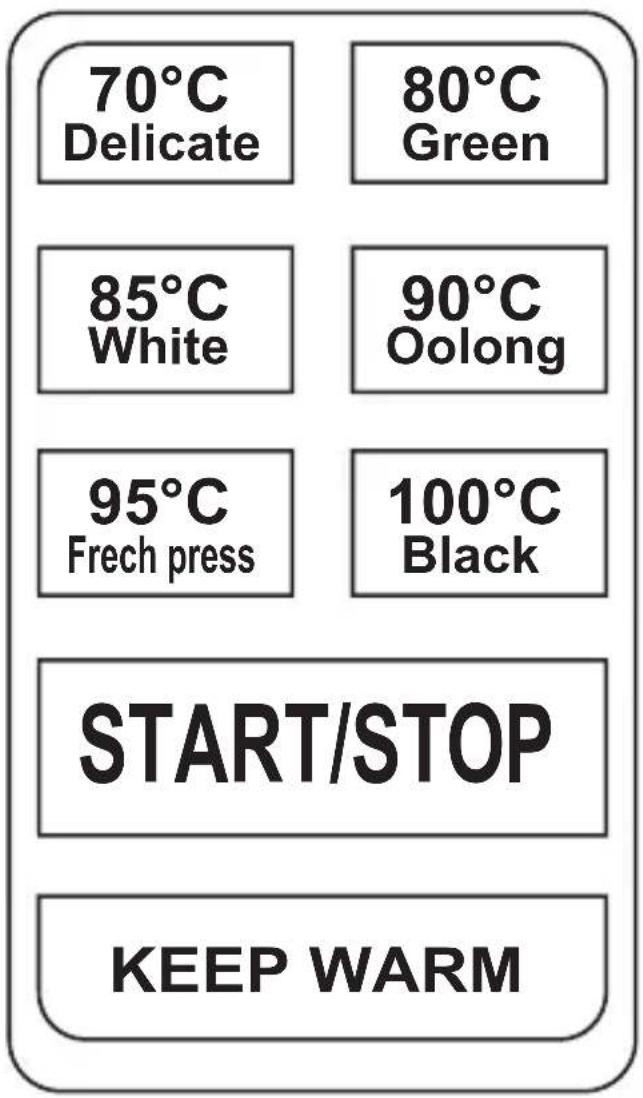
Button stretch for European standard
- 6 different temperature gears: 1) Celsius system: 70 °C, 80 °C, 85 °C, 90 °C, 95 °C, 100 °C.
- Keeping Warm
- Warning tone for button pressing and indicator light on automatically.
The Button-Press function
1) For European standard:
- „70 °C“ button: Press this button, the target water temperature will be set at 70 °C;
- „80 °C“ button: Press this button, the target water temperature will be set at 80 °C";
- „85 °C“ button: Press this button, the target water temperature will be set at 85 °C;
- „90 °C“ button: Press this button, the target water temperature will be set at 90 °C;
- „95 °C“ button: Press this button, the target water temperature will be set at 95 °C";
- „100 °C“ button: Press this button, water will be heated to boiling;
- „START“ button: Power on, start working, power off;
- „Keep WARM“ button: Start or turn off warm function;
Operating Instructions
Preparatory work: Put the kettle base on the stable countertop and plug into at nominal voltage. Add water to the kettle for heating and keep water below the Max mark of water line.
- When plug in the kettle, all the working indicator lights will turn on (called complete inspection), the buzzer will have a warning sound and then go into the standby mode.
- When in standby mode, if pressing down any one of the temperature buttons, the corresponding temperature will be set. Then it begins to heat water by pressing down "START/STOP". When reaches the target temperature, it will stop working.
- When in standby mode, it will directly heat water to boiling by only pressing "START/STOP" button.
- When in standby mode, by pressing down "KEEP WARM" button, the kettle will go into the "keep warm" mode. At this time, if you then press "START/STOP" button, the temperature will go up, after reaching the target temperature, it will go into "KEEP WARM" mode which lasts for 30 minutes.
-
When the kettle is on working, by pressing other temperature button, you can choose to set the corresponding temperature. Such as, by pressing "KEEP WARM" button, the "KEEP WARM" function can be started or stopped. By pressing "START/STOP" button, current working can be stopped.
-
The "KEEP WARM" mode will last for 30 minutes, and then the kettle will stop working and go into the standby mode.
- The theory of "KEEP WARM" function: The kettle will keep the water warm by controlling on-off heating. When the kettle begins to heat up, the light ring on the inner kettle bottom will be bright. On the contrary, without heating, without bright lights.
Boil-dry protection
Your kettle is equipped with boil☐ dry protection. If it starts heating without enough water in the unit, the heater will automatically shut off to avoid damaging the heating element. The lights will flash and the unit will beep to alert you. Once the kettle has cooled down, lift it off the base, then replace it to reset and restart the heating cycle.
A brief history of tea
The origins of tea can be traced back nearly 5,000 years to a legendary emperor of China. a prolific herbalist, it is believed that leaves from some twigs he was burning floated into a boiling kettle of water. The results were delicious, and tea was invented. The hot beverage flourished throughout southern Asia; the Dutch East India Company introduced it to Europe in the late 17th century. From there it spread to the American colonies and the rest of the world!
Types of tea
There are many types of teas, the most popular being black, oolong, green and white. all teas come from the same warm-weather evergreen plant: the Camellia sinensis, or tea plant. Tisane or “herbal” teas can be a mixture of just about anything: herbs, flowers, spices, seeds, etc. There are also varieties of tea that are real teas with spices or other flavorings blended in. Earl grey, for instance, is black tea with bergamot peel or oil added.
The benefits of tea
Tea is more popular than ever. And every cup is brimming with benefits: natural vitamins, minerals, and antioxidants. Drinking tea has actually been found to be better for you than drinking water. It rehydrates your body and its healthy antioxidants may offer protection against a wide range of diseases.
Tea can be an invigorating start to the morning, a soothing break from a busy day, or a comfortable way to unwind and relax each evening – it all adds up to a healthy mind, body, and spirit.
The art of steeping tea
Great care is taken to create every tea's unique character. Each tea should be brewed at the right temperature to properly savor and appreciate all the natural and aromatic flavors and benefits. More delicate teas risk burning at general steeping temperatures; this variety should be steeped at a lower temperature to optimize flavors. Below is a chart with our suggested steeping temperatures and times.
Tea steeping table
| Type Steep time | |
| Delicate tea 1-2 min. | |
| Green tea 2-3 min. | |
| White tea 2-3 min. | |
| Oolong tea 3-4 min. | |
| French press 4-5 min. | |
| Black and herbal tea 3-5 min. |
Cleaning and care
Unplug your kettle and allow it to cool before cleaning. Wipe the kettle and base of unit with a soft, damp cloth. be sure that the electric kettle socket is kept dry. Dry all parts after every use. Never immerse kettle or power base in water. Any other servicing should be performed by an authorized service representative.
Removable scale filter
This kettle has a scale filter inside for clean water. The filter can be removed by grasping it and pulling upward. Run under hot water and rub with a clean cloth or brush. Replace the filter; it will snap back into place.
DISPOSAL OF USED ELECTRICAL AND ELECTRONIC EQUIPMENT
natural_image
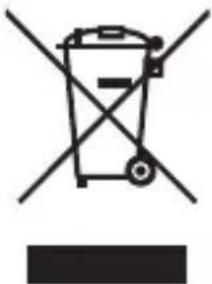
Symbol of a trash bin crossed with no visible text or labelsThis symbol on products or original documents means that used electric or electronic products must not be added to ordinary municipal waste. For proper disposal, renewal and recycling hand over these appliances to determined collection points. Alternatively, in some European Union states or other European countries you may return your appliances to the local retailer when buying an equivalent new appliance. Correct disposal of this product helps save valuable natural resources and prevents potential negative effects on the environment and human health, which could result from improper waste disposal. Ask your local authorities or collection facility for more details. In accordance with national regulations penalties may be imposed for the incorrect disposal of this type of waste.
For business entities in European Union states
If you want to dispose of electric or electronic appliances, ask your retailer or supplier for the necessary information.
Disposal in other countries outside the European Union.
This symbol is valid in the European Union. If you wish to dispose of this product, request the necessary information about the correct disposal method from the local council or from your retailer.
- DÔLEŽITÉ BEZPEČNOSTNÉ POKYNY
- Button Sketches
- Button stretch for European standard
- The Button-Press function
- 1) For European standard:
- Operating Instructions
- Boil-dry protection
- A brief history of tea
- Types of tea
- The benefits of tea
- The art of steeping tea
- Cleaning and care
- Removable scale filter
- DISPOSAL OF USED ELECTRICAL AND ELECTRONIC EQUIPMENT
- For business entities in European Union states
- Disposal in other countries outside the European Union.
Brand : Guzzanti
Model : GZ-205
Category : Kettle