
Μ 720SW - Waterproof digital camera OLYMPUS - Free user manual and instructions
Find the device manual for free Μ 720SW OLYMPUS in PDF.


User questions about Μ 720SW OLYMPUS
0 question about this device. Answer the ones you know or ask your own.
Ask a new question about this device
Download the instructions for your Waterproof digital camera in PDF format for free! Find your manual Μ 720SW - OLYMPUS and take your electronic device back in hand. On this page are published all the documents necessary for the use of your device. Μ 720SW by OLYMPUS.
USER MANUAL Μ 720SW OLYMPUS
Detailed explanation for each function such as camera buttons and menus is separately provided.
natural_image
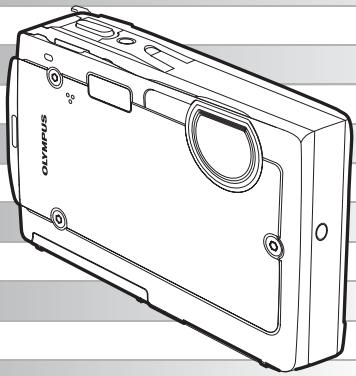
Line drawing of a digital camera module with no visible text or symbols- Thank you for purchasing an Olympus digital camera. Before you start to use your new camera, please read these instructions carefully to enjoy optimum performance and a longer service life. Keep this manual in a safe place for future reference.
- We recommend that you take test shots to get accustomed to your camera before taking important photographs.
- In the interest of continually improving products, Olympus reserves the right to update or modify information contained in this manual.
- The screen and camera illustrations shown in this manual were produced during the development stages and may differ from the actual product.
Search for a topic ▶▶▶ Table of Contents
P. 3
Contents
How to use this manual.... 2
Contents 3
1 Button operations....8
Test out the functions of the camera buttons by following the illustrations and actually trying them out on the camera.
POWER button....Turning the camera on and off 8
Shutter button .... Shooting pictures 8
/SCN button (Shooting).... Switching the shooting mode 9
Shooting still pictures 9
(K)....Shooting pictures using digital image stabilization 9
SCN ..... Shoot pictures by selecting a scene according to the situation 9
Search for a term ▶▶▶Index
P. 80
Index
Red-eye reduction flash ..... 12
Fill-in flash 12
④ Flash off 12
Super macro mode 13
Macro mode 13
button (print) 13
OK button (OK/FUNC) 10
/SCN button (Shooting) .... 9
▶ button ( playback) ..... 10
△ button (exposure compensation) 12
button (self-timer/erase) .. 12
button (flash mode) 12
button (macro) 13
BEEP 32
BGM 22
BLACK & WHITE 24
BRIGHTNESS 25
C
CALENDAR 24, 25
Calendar display 11
CAMERA MENU 19
Card 21,31,74
Card access lamp .....52, 62, 76
CCD 34,70
Close-up playback Q 11
Cloudy day 19
Search by Objective ▶▶▶ Shooting tips and information
P. 57
5 Getting to know your camera better
Shooting tips and information
Tips before you start taking pictures
The camera does not turn on even when a battery is loaded
The battery is not fully charged
- Charge the battery with the charger.
The battery is temporarily unable to function because of the cold
- Battery performance declines in low temperatures, and the charge may not be sufficient to turn on the camera. Remove the battery and warm it by putting it in your pocket for a while.
No picture is taken when the shutter button is pressed
How to use this manual.... 2
Contents 3
1 Button operations....8
Test out the functions of the camera buttons by following the illustrations and actually trying them out on the camera.
POWER button....Turning the camera on and off 8
Shutter button .... Shooting pictures 8
/SCN button (Shooting).... Switching the shooting mode 9
Shooting still pictures 9
(◀)....Shooting pictures using digital image stabilization 9
SCN ..... Shoot pictures by selecting a scene according to the situation 9
▶ button (Playback) .... Viewing still pictures/Selecting playback mode 10
Arrow pad (△▽◇).... 10
OK FUNC button (OK/FUNC) 10
P/AUTO....Shooting pictures with automatic settings 10
MENU button (MENU).... 11
Zoom button.... Zooming while shooting/close-up playback 11
button Changing picture brightness 12
button Flash shooting 12
button....Shooting with self-timer / Erasing images 12
Shooting with self-timer.... 12
Erasing pictures 13
button.... Shooting pictures close to the subject 13
button.... Printing pictures 13
2 Menu operations....14
Learn everything about the menus, from basic operations to the functions of each menu and their various settings.
About the menus.... 14
Using the menus.... 15
Shooting mode menu.... 17
IMAGE QUALITY .... Changing the image quality 17
RESET ......Change the shooting functions back to default settings 18
SCN (Scene) ..... Shooting pictures by selecting a scene according to the situation 18
CAMERA MENU 19
WB ....Adjusting the color of a picture 19
ISO....Changing the ISO sensitivity 19
DRIVE ...... Continuous shooting 20
ESP/☐....Changing the area for measuring the brightness of a subject 20
DIGITAL ZOOM ....Zooming in on your subject 20
AF MODE.... Changing the focusing area 21
Recording sound with still pictures 21
PANORAMA .......Creating a panoramic picture 21
Playback mode menu 22
SLIDESHOW ...... Playing back pictures automatically 22
MOVIE PLAY.... Playing back movies 23
CALENDAR ...... Playing back the pictures in a calendar format 24
INDEX...... Viewing the pictures as a thumbnail 24
EDIT 24
Changing the size of pictures 24
REDEYE FIX....Fixing the red-eye in pictures 24
BLACK & WHITE ...... Changing pictures to black and white 24
SEPIA ...... Changing pictures to a sepia tone 24
FRAME ...... Synthesize the frame and the picture 24
TITLE ...... Synthesize the title and the picture 25
CALENDAR ...... Synthesize the calendar using the picture 25
BRIGHTNESS..... Change the brightness of the picture 25
SATURATION....Change the vividness of the picture 25
INDEX...... Making an index picture from a movie 25
PRINT ORDER.... Making print reservations (DPOF) 26
PLAYBACK MENU 26
Oπ.... Protecting pictures 26
Rotating pictures 26
Adding sound to still pictures 26
ALBUM ENTRY ...... Adding pictures to an album 27
ERASE......Erase selected pictures/Erase all pictures 28
SEL. IMAGE......Erase by selecting the single-frame 28
ALL ERASE .. Erase all the pictures in the internal memory and the card 28
ALBUM ...... See the pictures registered in the album 28
Album playback menus 29
SEL. ALBUM......See other album 29
PLAYBACK MENU 30
UNDO ENTRY .... Undoing album entries 30
SELECT JACKET ...... Selecting the jacket 30
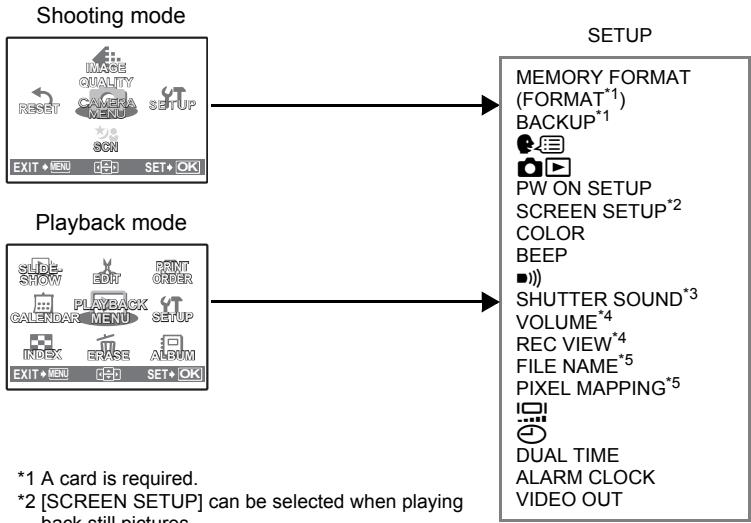
SETUP menus.... 31
MEMORY FORMAT (FORMAT) Formatting the internal memory or card 31
BACKUP ..... Copying pictures in the internal memory to the card 31
Selecting a display language 32
▶ ...... Using Shooting button / Playback button to turn on the camera 32
PW ON SETUP ...... Setting the startup screen and volume 32
SCREEN SETUP ..... Registering a picture as the startup screen 32
COLOR .... Setting the color of the menu screens 32
BEEP..... Adjust the volume of beep when the button is pressed 32
■))....Adjust the volume of camera warning sound 32
SHUTTER SOUND ..... Selecting the sound of the shutter button 33
VOLUME ...... Adjusting the volume during playback 33
REC VIEW ......Viewing pictures immediately 33
FILE NAME ....Resetting the file names of pictures 33
PIXEL MAPPING ...... Adjusting the image processing function 34
Adjusting the monitor brightness 34
Setting the date and time 34
DUALTIME ...... Setting the date and time in another time zone 35
ALARM CLOCK ....Setting alarms 35
VIDEO OUT ...... Playing back pictures on a TV 36
3 Printing pictures 37
Learn how to print pictures you have taken.
Direct printing (PictBridge) 38
Using the direct printing function.... 38
EASY PRINT 38
Other print modes and print settings (CUSTOM PRINT).... 40
Print settings (DPOF).... 43
How to make print reservations 43
Single-frame reservation.... 44
All-frame reservation.... 44
Resetting print reservation data 45
4 Connecting the camera to a computer ..... 46
Learn how to transfer pictures to a computer and save them.
Flow 46
Using OLYMPUS Master 46
What is OLYMPUS Master? 46
Install the OLYMPUS Master software 47
Connecting the camera to a computer 50
Start up the OLYMPUS Master software.... 51
Displaying camera images on a computer 52
Downloading and saving images 52
Viewing still pictures and movies.... 54
Printing pictures 55
To download and save images to a computer without using OLYMPUS Master ... 56
5 Getting to know your camera better ....57
Find out more about your camera and learn what to do when you have a question regarding operations.
Shooting tips and information 57
Tips before you start taking pictures 57
The camera does not turn on even when a battery is loaded ..... 57
No picture is taken when the shutter button is pressed 57
The date and time have not been set 58
Shooting tips 58
Focusing on the subject 58
Subjects that are difficult to focus on 58
Taking pictures without blurring 59
Taking pictures without the flash.... 59
The picture is too grainy.... 59
Taking pictures with the correct color 60
Taking pictures of a white beach or snow scene 60
Taking pictures of a subject against backlight 60
Additional shooting tips and information 61
Increasing the number of pictures that can be taken 61
Using a new card 62
Lamp indicators.... 62
Extending the useful life of the battery 62
Functions that cannot be selected from menus 63
Selecting the optimal record mode.... 63
To return the settings of functions to default settings.... 63
Playback help.... 64
The red-eye cannot be fixed 64
The picture cannot be registered in the album.... 64
Playback tips.... 64
Playing back the picture in the internal memory 64
Quickly displaying a desired picture.... 64
Erasing sound recorded to still pictures 64
Viewing pictures on a computer 65
Viewing the entire picture on a computer screen 65
When you get an error message on the camera 66
Functions available in shooting modes and scenes 68
Glossary of terms.... 70
6 Miscellaneous 72
Read about convenient functions and safety precautions on how to use your camera more effectively.
Camera care 72
Battery and charger 73
Useful use of the accessories.... 74
The card.... 74
AC adapter 76
Safety Precautions.... 77
Index.... 80
1 Button operations
text_image
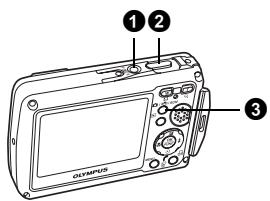
①② OCHENSUS ③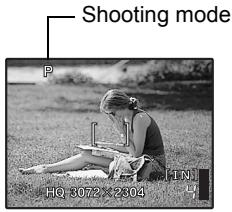
text_image
Shooting mode HQ 3072 23041 POWER button
Turning the camera on and off
Power on: The camera is turned on in the shooting mode.
- Monitor turns on
- The lens cover opens.
② Shutter button
Shooting pictures
Shooting still pictures
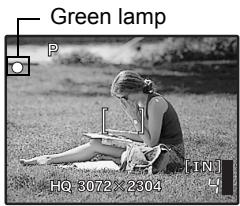
Press the 📄/〈〉/SCN button to select the shooting mode from P, AUTO, (〈〉) or SCN, and lightly press the shutter button (halfway). The green lamp lights when the focus and exposure are locked (focus lock). Now press the shutter button all the way (fully) to shoot a picture.
text_image
Green lamp P HQ 3072 X 2804 INJLocking the focus and then composing the shot (focus lock)
Compose your picture with the focus locked, and then fully press the shutter button to shoot a picture.
- When the green lamp blinks, the focus is not adjusted properly. Try locking the focus again.
text_image
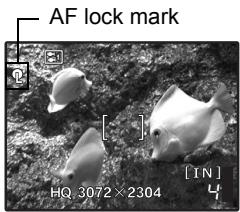
AF lock mark HQ 3072 × 2304Locking the focus position (AF lock)
When the scene is ⚙1, ⚙4, or ⚙½, you can lock the focus position by pressing ▽. Press ▽ again to cancel the AF lock.
“SCN (Scene) Shooting pictures by selecting a scene according to the situation” (P. 18)
Recording movies
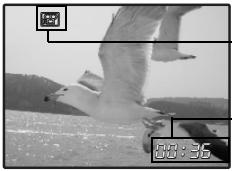
Press the 📄/〈翻〉/SCN button to set the shooting mode to SCN and select from the shooting scene. The sound is recorded at the same time. Lightly press the shutter button to lock the focus, and then press the shutter button to start recording. Press the shutter button again to stop recording.
natural_image
Black-and-white photo of a person walking on a grassy field with hills in the background (no visible text or symbols)This lights red during movie recording.
The remaining recording time is displayed. When the remaining recording time reaches 0, recording stops.


button (Shooting)
Switching the shooting mode
Set the mode to the shooting mode. Press the 📄/(( )//SCN button repeatedly, the shooting mode changes as follows: P/AUTO -> ( )// - > SCN.
- The camera is turned on only by pressing the 📷/(( SCN ) button.
“Using Shooting button / Playback button to turn on the camera” (P. 32)

Shooting still pictures
The camera determines the optimum settings and shoots the picture.

Shooting pictures using digital image stabilization
This function stabilizes the blur caused by a moving subject or camera movement when taking pictures.
- By switching to the other mode, most settings will be changed to the default settings of each mode.

Shoot pictures by selecting a scene according to the situation
You can shoot pictures by selecting a scene according to the situation.
Change the scene to another one
- Press the MENU button to select [SCN] from the top menu, and change it to another scene.
- By switching to the other scene, most settings will be changed to the default settings of each scene.
text_image
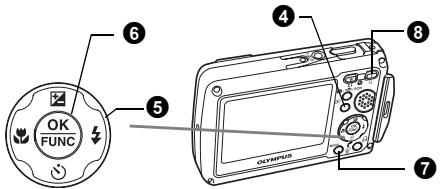
OK FUNC ⑥ ⑤ ④ ⑧ OYMPUS ⑦4 button (Playback) Viewing still pictures/Selecting playback mode
The last picture taken is displayed.
- Press the arrow pad (◀) to view other pictures.
- Use the zoom button to switch among close-up playback, index display and calendar display.
Movie playback "MOVIE PLAY Playing back movies" (P. 23)
- The camera is turned on only by pressing the ▶ button.
“Using Shooting button / Playback button to turn on the camera” (P. 32)
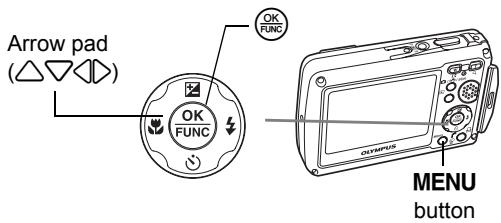
⑤ Arrow pad (△▽◇)
Use the arrow pad to select scenes, playback picture, and the items on the menus.
6 OK FUNC button (OK/FUNC)
Displays the function menu and sets the functions often used in shooting mode. This button is also used to confirm your selection.
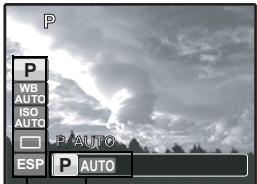
The functions you can set with the function menu
P/AUTO.... Shooting pictures with automatic settings
Use P/AUTO to select the shooting mode from P (Program auto) and AUTO (Full auto mode).
| P (Program auto) | The camera automatically sets the optimum aperture value and shutter speed for the brightness of the subject. |
| AUTO (Full auto mode) | The camera automatically sets white balance and ISO sensitivity in addition to the aperture and shutter speed. |
“WB Adjusting the color of a picture” (P. 19)
"ISO Changing the ISO sensitivity" (P. 19)
"DRIVE Continuous shooting" (P. 20)
"ESP/● Changing the area for measuring the brightness of a subject" (P. 20)
Function menu
text_image
P WB AUTO ISO AUTO P AUTO ESP P AUTO
: Select the setting items.
⑦ MENU button (MENU)
Displays the top menu.
8 Zoom button
Zooming while shooting/close-up playback
Shooting mode: Zooming in on your subject
Optical zoom: 3×
Zoom out: Press W on the zoom button.
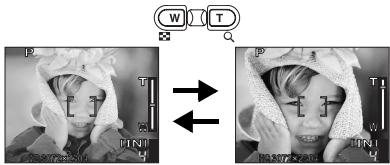
text_image
Medical imaging comparison showing a child's face with measurement scales and a hand gesture, alongside a directional arrow indicating rotation.Zoom in: Press T on the zoom button.
Playback mode: Switching the picture display Single-frame playback
- Use the arrow pad ( ) to browse pictures.
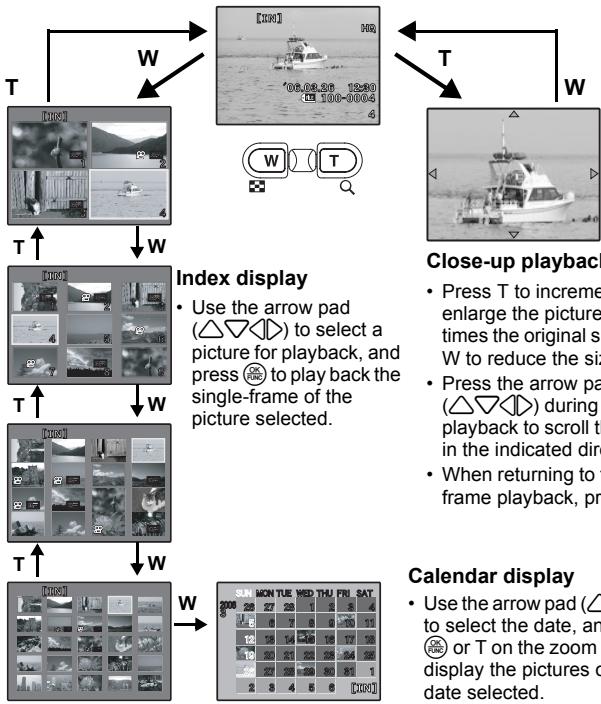
flowchart
graph TD
    A["Start"] --> B{Index display}
    B -->|T| C["View 1"]
    B -->|W| D["View 2"]
    C --> E["Add 1 to 2 views"]
    D --> F["Add 2 views"]
    E --> G["Select a picture for playback, press to play back the single-frame of the picture selected."]
    F --> H["Select a single-frame photo on the frame playback."]
    G --> I["Select a single-frame photo on the frame playback."]
    H --> J["Close-up playback"]
    I --> J
    J --> K["Press T to increase to enable the picture times the original size W to reduce the size"]
    J --> L["Press the arrow pad (△▽◇) during playback to scroll the indicated direction"]
    J --> M["When returning to frame playback, press to action"]
    J --> N["Calendar display"]
    N --> O["Use the arrow pad (△▽◇) to select the date, and screen or T on the zoom to display the pictures of a date selected."]
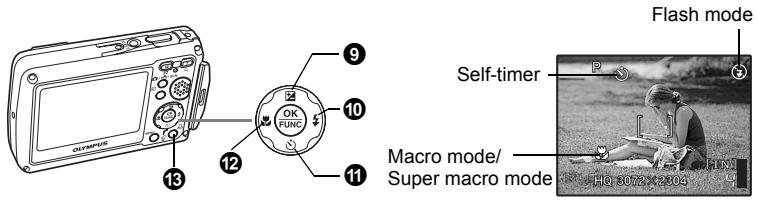
text_image
Flash mode Self-timer Macro mode/ Super macro mode HQ 3072X2804⑨ △+ button
Changing picture brightness
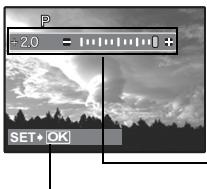
text_image
P +2.0 - 100% SET OKActivate the setting contents.
Press the △ button in shooting mode to adjust the exposure.
- Adjustable from - 2.0EV to +2.0 EV
: Brighten : Darken
10 ▷↓ button
Flash shooting
Press the ▷↓ button in shooting mode to select the flash mode. Press OK FORC for setting.
| AUTO (Auto-flash) | The flash fires automatically in low light or backlight conditions. |
| ○ Red-eye reduction flash | This emits pre-flashes for red-eye reduction. |
| ↓ Fill-in flash | The flash fires regardless of the available light. |
| ♣ Flash off | The flash does not fire even in low light conditions. |
11 ▽/ button
Shooting with self-timer / Erasing images
Shooting with self-timer
Press the ▽/按钮 button in shooting mode to select on and off of the self-timer. Press OK FOR setting.
| ON | After the setting, press the shutter button fully. |
| OFF | Cancel the self-timer. |
- The self-timer lamp lights for approximately 10 seconds, blinks for approximately 2 seconds, and then the picture is taken.
- To cancel the self-timer, press the ▽/按钮 button.
- Self-timer shooting is automatically canceled after one shot.
Erasing pictures
Display the picture you want to erase one by one in the playback mode and press the ⏰/💡 button.
- Once erased, pictures cannot be restored. Check each picture before erasing to avoid accidentally erasing pictures you want to keep.
"Protecting pictures" (P. 26) - A single image cannot be erased during the close-up playback / index playback.


button
Shooting pictures close to the subject
Press the ◀ button in shooting mode to select the macro mode. Press OK RUN for setting.

Macro mode
This mode lets you shoot from as close as 20cm/7.8 in. (when the zoom is set for the zoom-out angle) and as close as 30cm/11.8 in. (when the zoom is set for the zoom-in angle) to your subject.

Super macro mode
This mode lets you shoot from as close as 7 cm/2.7 in. to your subject.


button
Printing pictures
In playback mode, press the ☐ button to display the picture you want to print out. "EASY PRINT" (P. 38)
2 Menu operations
text_image
Arrow pad (△▽▽▽) OK FUNC OK FUNC OK FUNC OLYMPUS MENU buttonAbout the menus
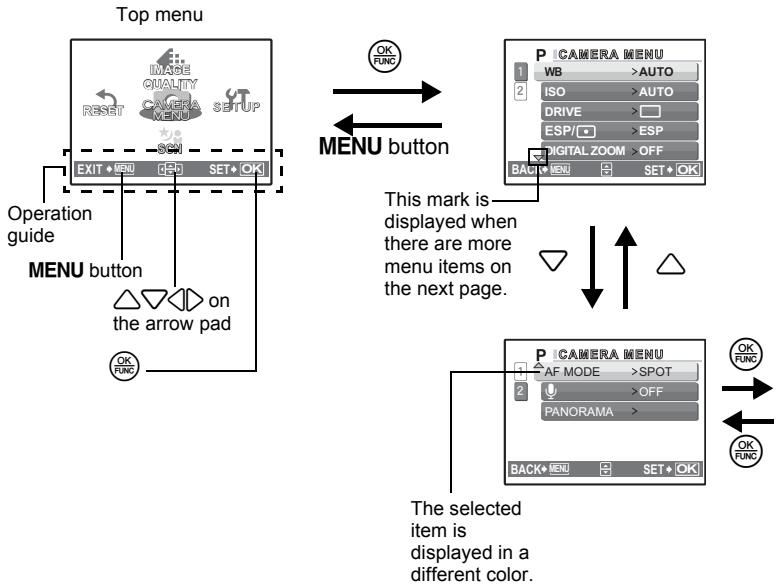
Press the MENU button to display the top menu.
The items displayed on the top menu differ according to the mode.

flowchart
graph TD
    A["Top menu in the shooting mode"] --> B["• When [CAMERA MENU"], [PLAYBACK MENU], [EDIT], [ERASE], or["SETUP"] is selected, the menu corresponding to the respective functions is displayed.]
    C["Top menu in the playback mode"] --> D["• PLAYBACK MENU"]
    D --> E["• > OFF"]
    D --> F["> 0°"]
    D --> G["> ALBUM ENTRY >"]
    H["Menu displayed when [CAMERA MENU"] is selected] --> I["Back+Menu + SET+OK"]
    J["Menu displayed when [PLAYBACK MENU"] is selected] --> K["Back+Menu + SET+OK"]
Using the menus
Use the arrow pad (△▽◀) and Ⓗ to set menu items.
This explains how to use the menus with the [AF MODE] setting as an example.
Select the shooting mode or playback mode.
- Press the 📄/SCN button to set the shooting mode to P.
1 Press the MENU button to display the top menu, and then press OK FUNC.
- [AF MODE] is on a menu in [CAMERA MENU]. Press OK FUNC.
- To display other menus, use the arrow pad (△▽◇) to select a menu, and press OK FUNC.
- To close the top menu, press the MENU button.
2 Press △▽ to select a setting, and press OK FUNC.
- [AF MODE] is the sixth menu item, so press ▽ five times, and then press OK FUNC.
- Unavailable settings cannot be selected.
flowchart
graph TD
    A["Top menu"] --> B["Operation guide"]
    B --> C["MENU button"]
    C --> D["ON Arrow Pad"]
    D --> E["EXIT ⬤️ MENU"]
    E --> F["SET ⬤️ OK"]
    F --> G["SET"]
    G --> H["SET+OK"]
    H --> I["SET+OK"]
    I --> J["SET+OK"]
    J --> K["SET+OK"]
    K --> L["SET+OK"]
    L --> M["SET+OK"]
    M --> N["SET+OK"]
    N --> O["SET+OK"]
    O --> P["SET+OK"]
    P --> Q["SET+OK"]
    Q --> R["SET+OK"]
    R --> S["SET+OK"]
    S --> T["SET+OK"]
    T --> U["SET+OK"]
    U --> V["SET+OK"]
    V --> W["SET+OK"]
    W --> X["SET+OK"]
    X --> Y["SET+OK"]
    Y --> Z["SET+OK"]
    Z --> AA["SET+OK"]
    AA --> AB["SET+OK"]
    AB --> AC["SET+OK"]
    AC --> AD["SET+OK"]
    AD --> AE["SET+OK"]
    AE --> AF["SET+OK"]
    AF --> AG["SET+OK"]
    AG --> AH["SET+OK"]
    AH --> AI["SET+OK"]
    AI --> AJ["SET+OK"]
    AJ --> AK["SET+OK"]
    AK --> AL["SET+OK"]
    AL --> AM["SET+OK"]
    AM --> AN["SET+OK"]
    AN --> AO["SET+OK"]
    AO --> AP["SET+OK"]
    AP --> AQ["SET+OK"]
    AQ --> AR["SET+OK"]
    AR --> AS["SET+OK"]
    AS --> AT["SET+OK"]
    AT --> AU["SET+OK"]
    AU --> AV["SET+OK"]
    AV --> AW["SET+OK"]
    AW --> AX["SET+OK"]
    AX --> AY["SET+OK"]
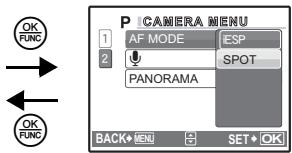
3 Press △▽ to select a setting, and press OK FUNC.
- Select the [AF MODE] from [iESP] and [SPOT] and then press OK FUNC.
- The menu item is set and the previous menu is displayed.
text_image
OK FUNC P CANERA MENU 1 AF MODE ESP 2 SPOT PANORAMA BACK+Menu SET+OK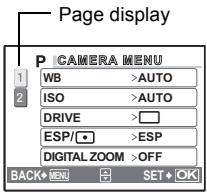
text_image
Page display P CAMERA MENU WB >AUTO ISO >AUTO DRIVE >□ ESP/ □ >ESP DIGITAL ZOOM >OFF BACK→Menu → SET→OKWhen there are more menu items on the next page, press ◀ on the procedure 2 screen to move the cursor to the page display.
Press △▽ to change the page.
To return to the previous page, press ▷ or ⒽFUNC.
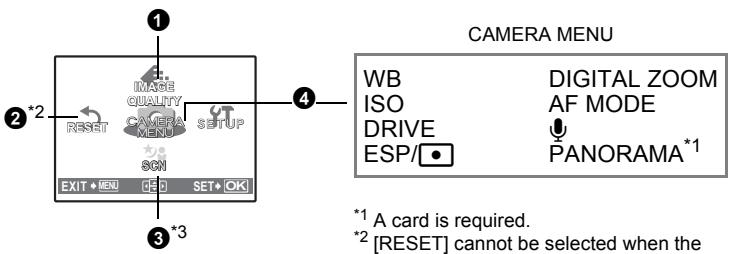
text_image
CAMERA MENU WB DIGITAL ZOOM ISO AF MODE DRIVE ESP/● PANORAMA *1 *2 *3 #2 *3 MASE QUALITY RESET CAMERA MENU SETUP EXIT MENU SET OK *1 A card is required. *2 [RESET] cannot be selected when the*1 A card is required.
^2 [RESET] cannot be selected when the shooting mode is set to SCN or ( ).
^3 SCN can be selected when the shooting mode is set to SCN.
“SETUP menus” (P. 31)
- Some menu cannot be selected according to the shooting mode.
“Functions available in shooting modes and scenes” (P. 68) - The factory default settings are displayed in gray ( ).
① IMAGE QUALITY
Changing the image quality
Still picture image quality and their applications
| Image quality/Image size | Compression | Application | |
| SHQ | 3072 × 2304 | Low compression | This is useful for printing large images on full-size paper. |
| HQ | 3072 × 2304 | Standard compression | This is useful for performing computer image processing, such as contrast adjustment and red-eye correction. |
| SQ1 | 2560 × 1920 | Standard compression | This is useful for postcard-sized prints. |
| 2304 × 1728 | This is useful for computer editing such as rotating or adding text to a picture. | ||
| 2048 × 1536 | |||
| SQ2 | 1600 × 1200 | Standard compression | This is useful for viewing pictures on a computer. |
| 1280 × 960 | |||
| 1024 × 768 | This is useful for sending as e-mail attachments. | ||
| 640 × 480 | Low compression | ||
Movie image quality
| Image quality/Image size | |
| SHQ | 640 × 480 |
| HQ | 320 × 240 |
| SQ | 160 × 120 |
NO /YES
Restore shooting functions back to default settings. The mode dial has to be set to 📄 (P or AUTO) in order to restore default settings.
Functions for returning the settings to the original when the reset function is executed
| Function | Factory default setting | Ref. Page |
| Flash | AUTO | P. 12 |
| OFF | P. 12 | |
| 0.0 | P. 12 | |
| OFF | P. 13 | |
| IMAGE QUALITY | HQ | P. 17 |
| WB | AUTO | P. 19 |
| ISO | AUTO | P. 19 |
| DRIVE | P. 20 | |
| ESP/☐ | ESP | P. 20 |
| DIGITAL ZOOM | OFF | P. 20 |
| AF MODE | SPOT | P. 21 |
| OFF | P. 21 |
③ SCN (Scene)
Shooting pictures by selecting a scene according to the situation
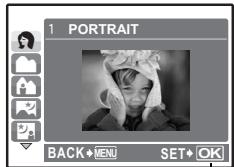
The scene selection screen displays sample images and the shooting mode to best suit the situation.
- By switching to the other scene, most settings will be changed to the default settings of each scene.
Scene selection
text_image
1 PORTRAIT BACK→MENU SET→OKPress OK FUNC to decide the scene.
[☐ SHOOT & SELECT1] / [☐ SHOOT & SELECT2]
- Press and hold the shutter button to shoot sequential pictures. After shooting pictures, select the ones you want to erase, put the √ to them, and press ⏰/⌘ button to erase them.
![OLYMPUS Μ 720SW - [☐ SHOOT & SELECT1] / [☐ SHOOT & SELECT2] - 1](/content/2025/01/84378/images/360459b06dcd2ed207b6f93567d42939fba8968da926396a7b8cdc6112ee3806.jpg)
text_image
BACK+ NEW SET+ OK ERASE+Selected picture
Press ◇ to scroll through the pictures.
Pictures with a √ mark are erased.
Select the pictures to be erased.
4 CAMERA MENU
WB ....Adjusting the color of a picture
| AUTO | The white balance is adjusted automatically for natural color, regardless of the light source. | |
| Sunny day | For shooting under a clear sky. | |
| Cloudy day | For shooting under a cloudy sky. | |
| Tungsten light | For shooting under tungsten lighting. | |
| Fluorescent lamp 1 | For shooting under daylight fluorescent lighting. (This type of lamp is mainly used in homes.) | |
| Fluorescent lamp 2 | For shooting under a neutral white fluorescent lamp. (This type of lamp is mainly used in desk lamps.) | |
| Fluorescent lamp 3 | For shooting under a white fluorescent lamp. (This type of lamp is mainly used in offices.) |
ISO....Changing the ISO sensitivity
| AUTO | Sensitivity is automatically adjusted according to the conditions of the subject. |
| 64/100/200/400/800/1600 | A low value lowers the sensitivity for daylight shooting of clear, sharp pictures. The higher the value, the better the camera's light sensitivity and ability to shoot with a fast shutter speed and in low light conditions. However, high sensitivity introduces noise into the resulting picture, which may give it a grainy appearance. |
DRIVE...... Continuous shooting
| Shoots 1 frame at a time when the shutter button is pressed. | |
| Focus, exposure and white balance are locked at the first frame. The sequential shooting speed varies depending on the record mode setting. | |
| Pictures can be taken at a faster speed than normal sequential shooting. |
You can take a sequence of pictures at one time while holding down the shutter button. The camera will take pictures in sequence until you release the shutter button.
- In high speed sequential shooting, [IMAGE QUALITY] will be limited to below [2048 × 1536] .
ESP/☐ ...... Changing the area for measuring the brightness of a subject
| ESP | Meters the brightness at the center of the monitor and the surrounding area separately to create a picture with balanced brightness. When taking pictures against strong backlight, the center of the picture may appear dark. |
| Only the center of the monitor is metered. Suitable for taking a picture of the subject in the center of the monitor against backlight. |
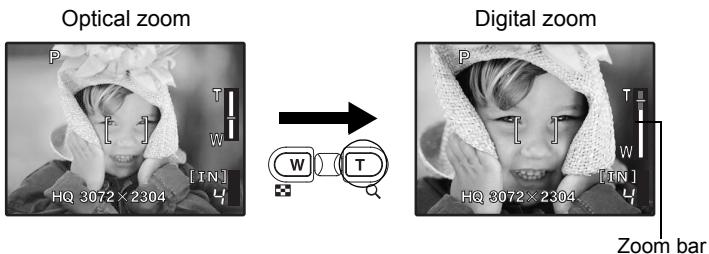
DIGITAL ZOOM...... Zooming in on your subject
OFF /ON
The digital zoom can be used to take close-up pictures with stronger magnification than the optical zoom. (Optical zoom × Digital zoom: the maximum 15x)
text_image
Optical zoom Digital zoom P T W [1N] HQ 3072×2304 W T HQ 3072×2304 Zoom barWhite area: The optical zoom area Red area: The digital zoom area
| iESP | The camera determines which subject within the screen to focus on. Even when the subject is not in the center of the screen, focusing is possible. |
| SPOT | Focus selection is based on the subject within the AF target mark. |

Recording sound with still pictures
OFF /ON
Recording starts about 0.5 seconds after the shutter button is released and lasts about 4 seconds.
When recording, aim the camera microphone at the source of the sound you want to record.
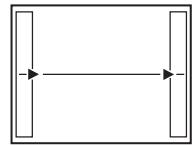
PANORAMA....Creating a panoramic picture
Panorama shooting lets you create a panoramic picture, using the OLYMPUS Master software from the provided CD-ROM. An Olympus xD-Picture Card is required for panorama shooting.
flowchart
graph LR
    A[" "] --> B[" "]
    C[" "] --> D[" "]
Connects pictures from left to right
natural_image
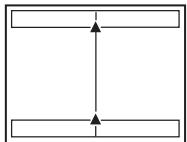
Simple geometric diagram with two horizontal rectangles and a vertical arrow, no text or symbols presentConnects pictures from bottom to top
▷: The next picture is connected at the right edge.
The next picture is connected at the left edge.
△: The next picture is connected at the top.
▽: The next picture is connected at the bottom.
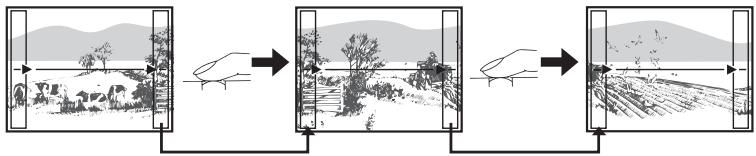
Use the arrow pad (△▽◀) to specify at which edge you want to connect the pictures, and then compose your shots so that the edges of the pictures overlap. The part of the previous picture where it will be joined to the next picture does not remain in the frame. You have to remember what the part in the frame looked like and take the next picture so it overlaps.
flowchart
graph LR
    A["Grain Field with Grassland"] --> B["Water Treatment"]
    B --> C["Crop Yield"]
Panorama shooting is possible for up to 10 pictures. Press MENU button to exit panorama shooting.
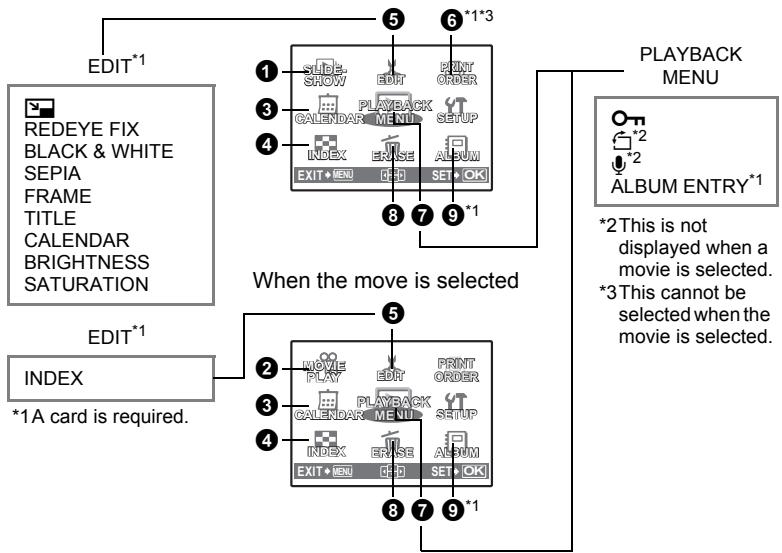
When a still picture is selected
flowchart
graph TD
    A["EDIT*1"] --> B["REDEYE FIX"]
    B --> C["BLACK & WHITE"]
    C --> D["SEPIA"]
    D --> E["FRAME"]
    E --> F["TITLE"]
    F --> G["CALENDAR"]
    G --> H["BRIGHTNESS"]
    H --> I["SATURATION"]
    J["When the move is selected"] --> K["INDEX"]
    K --> L["*1A card is required."]
    M["PLAYBACK MENU"] --> N["ALBUM ENTRY*1"]
    O["5"] --> P["5"]
    Q["6"] --> R["6*1*3"]
    S["7"] --> T["7"]
    U["8"] --> V["8*1"]
    W["9"] --> X["9*1"]
    Y["2"] --> Z["2"]
    AA["3"] --> AB["3"]
    AC["4"] --> AD["4"]
    AE["5"] --> AF["5"]
    AG["6"] --> AH["6*1*3"]
    AI["7"] --> AJ["7"]
    AK["8"] --> AL["8*1"]
    AM["9"] --> AN["9*1"]
“SETUP menus” (P. 31)
- The factory default settings are displayed in gray ( ).
① SLIDESHOW
Playing back pictures automatically
text_image
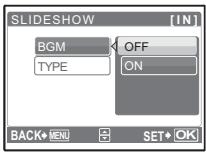
SLIDESHOW [IN] BGM TYPE OFF ON BACK→MENU SET→OK• Set [BGM] to [ON] or [OFF].
- Select the transition effect between pictures from [TYPE].
- Only the first frame of each movie is displayed.
- After setting [BGM] and [TYPE], press OK FUNC to start the slideshow.
- Press OK or MENU button to cancel the slideshow.
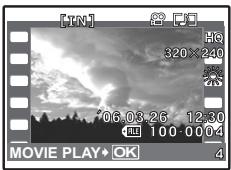
Select [MOVIE PLAY] from the top menu, and press OK FUNC to play back the movie. Another option is to select a picture with the movie icon (☐), and press OK FUNC to play back the movie.
natural_image
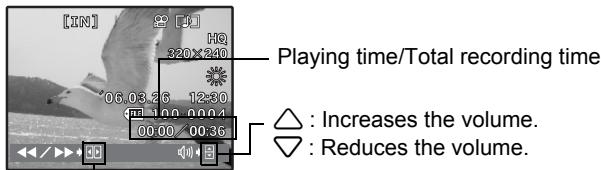
Black and white photo of a dramatic lightning strike over a cloudy sky, captured through a filmstrip (no text or symbols on the image itself)Operations during movie playback
text_image
【IN】 HQ 320×240 Playing time/Total recording time 05.03.26 12:30 100.00.04 00.00 00.36 ▲ : Increases the volume. ▼ : Reduces the volume.▷: Each time you press the button, the playback speed changes in the following order: 2×; 20×; and back to 1×.
: Plays the movie in reverse. Each time you press the button, the playback speed changes in the following order: 2×; 20×; and back to 1×.
- Press Ⓞ to pause the playback.
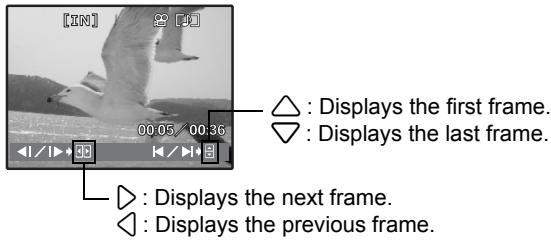
Operations during pause
text_image
[IN] [J] 00:05 00:36 Displays the first frame. Displays the last frame. Displays the next frame. Displays the previous frame.- To resume the movie, press OK FUNC.
- To cancel the playback of the movie in the middle of it or during pause, press the MENU button.
③ CALENDAR
Playing back the pictures in a calendar format
This function lets you play back the pictures in a calendar format by the date of recording.
“Zoom button Zooming while shooting/close-up playback” (P. 11)
4 INDEX
Viewing the pictures as a thumbnail
This function lets you view the pictures in 9 frames at the same time.
“Zoom button Zooming while shooting/close-up playback” (P. 11)
5 EDIT
This function lets you edit still pictures saved on a card and store them as new pictures.
Changing the size of pictures
640 × 480 /320 × 240
This changes the image size of a picture and saves it as a new file.
REDEYE FIX....Fixing the red-eye in pictures
This function corrects the red-eye look that often occurs when taking pictures with a flash.
BLACK & WHITE....Changing pictures to black and white
This changes the picture to black and white and saves it as a new file.
SEPIA ....Changing pictures to a sepia tone
This changes the picture to sepia and saves it as a new file.
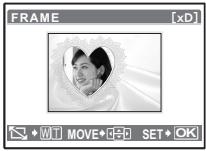
FRAME......Synthesize the frame and the picture
This function lets you select the frame, and synthesize the frame and the picture, and store it as a new picture.
natural_image
Frame selection interface with heart-shaped photo frame and action buttons (no text or symbols on the frame itself)- Select a frame with ◀ and press Ⓗ/FUNC.
- Select the picture to be synthesized with the frame with ◀, and press OK FUNC. (Press △▽ to turn the picture 90 degrees clockwise or 90 degrees counterclockwise.)
- Press the arrow pad (△▽◀) and the zoom button to adjust the position and size of the picture, and press OK FUNG.
TITLE ...... Synthesize the title and the picture
This function lets you select the title, synthesize the title and the picture, and store it as a new picture.

text_image
TITLE [xD] Thank You SET OK- Select the picture with ◀, and press Ⓞ
- Select the title with ◇, and press OK △▽. (Press △▽ to turn the title 90 degrees clockwise or 90 degrees counterclockwise.)
- Press the arrow pad (△▽◀) and the zoom button to adjust the position and size of the title, and press OK FUNC.
- Set the color of the title with the arrow pad (△▽◀), and press OK/FUNC.
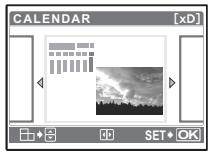
CALENDAR...... Synthesize the calendar using the picture
This function lets you select the calendar, synthesize the calendar and the picture, and store it as a new picture.
text_image
CALENDAR [xD] SET OK- Select the picture with ◇, and press Ⓞ
- Select the calendar with ◇, and press OK FUNG. (Press △▽ to turn the picture 90 degrees clockwise or 90 degrees counterclockwise.)
- Set the date of the calendar, and press OK FUNC.
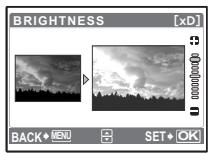
BRIGHTNESS......Change the brightness of the picture
This function lets you adjust the brightness of the picture, and store it as a new picture.
text_image
BRIGHTNESS [xD] 00:00:00:00 BACK→MENU SET→OK- Select the picture with ◇, and press Ⓗ/FUNC.
- Adjust the brightness with △▽, and press ⓄOK FUNC.
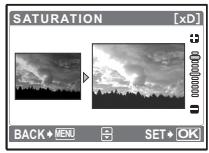
SATURATION ......Change the vividness of the picture
This function lets you adjust the vividness of the picture, and store it as a new picture.
text_image
SATURATION [xD] 00000000 BACK+Menu + SET+OK- Select the picture with ◀, and press ⓄOK/FUNC.
- Adjust the vividness with △▽, and press ⓄOK/FUNC.
INDEX......Making an index picture from a movie
This extract 9 frames from a movie and saves them as a new picture (INDEX).
6 PRINT ORDER
Making print reservations (DPOF)
This function allows you to save printing data (the number of prints and the date and time information) with the pictures stored on the card.
"Print settings (DPOF)" (P. 43)
⑦ PLAYBACK MENU
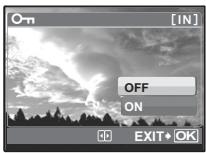
Oπ....Protecting pictures
OFF /ON
text_image
ON [IN] OFF ON EXIT+ OKProtected pictures cannot be erased with [ERASE]/[SEL.IMAGE]/[ALL ERASE], but they are all erased by formatting.
- Select the picture with ◇, and protect it by selecting [ON] with △. You can protect several frames in succession.
Rotating pictures
+90° / 0° / -90°
Pictures taken with the camera held vertically are displayed horizontally. This function lets you turn such pictures so that they are displayed vertically. New picture orientations are saved even when the power is turned off.
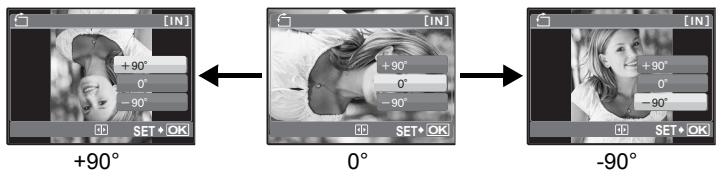
text_image
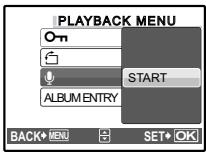
[IN] +90° 0° -90° SET•OK [IN] +90° 0° -90° SET•OK 0° -90° SET•OK -90°Adding sound to still pictures
text_image
PLAYBACK MENU START Album ENTRY BACK→ MENU SET→ OKSound is recorded for about 4 seconds.
- When [START] is displayed, aim the camera microphone at the source of the sound you want to record, and press OK PUNC.
- Recording starts and the [BUSY] bar is displayed during recording.
Pictures recorded to the card can be organized by sorting them into albums.
Pictures stored in the internal memory cannot be entered in albums.
“Album playback menus” (P. 29)
Select the album entry method
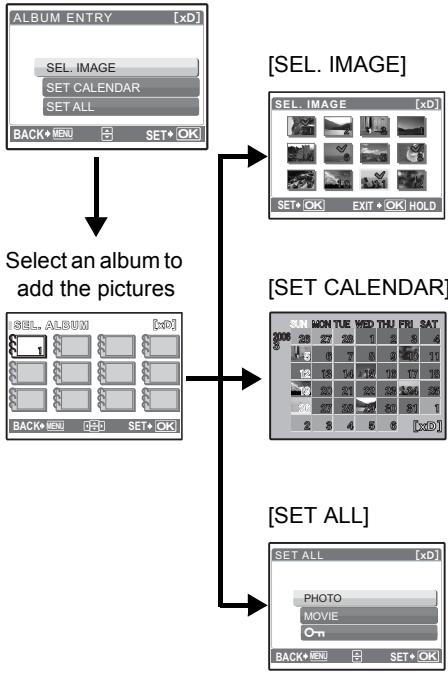
flowchart
graph TD
    A["ALBUM ENTRY [xD"]] --> B["Select an album to add the pictures"]
    B --> C["SET ALL [xD"]]
    C --> D["SET ALL"]
    style A fill:#f9f,stroke:#333
    style D fill:#bbf,stroke:#333
Select one frame at a time for entry
- Use the arrow pad (△▽◇) to select a picture, and press OK to add √.
- Press OK FUNC again to cancel the selection.
- When the selection is completed, press OK FUNC for a while.
Add pictures taken on the same day
Use the arrow pad (△▽◇) to select the date with pictures to enter in the album, and press OK FUNC.
Select all still images, all protected images, or all movies.
Protected pictures cannot be erased. Cancel protection before erasing protected pictures. Once erased, pictures cannot be restored. Check each picture before erasing to avoid accidentally erasing pictures you want to keep.
- When erasing the picture in the internal memory, do not insert the card into the camera.
- When erasing the picture from the card, insert a card into the camera in advance.
SEL. IMAGE ....Erase by selecting the single-frame
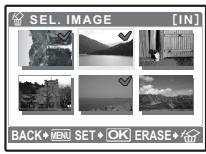
text_image
SEL. IMAGE [IN] BACK+ MENU SET+ OK ERASE+- Use the arrow pad (◀) to select the picture, and press OK to put √.
- To cancel the selection, press ⓄOK FUNC again.
- When the selection is completed, press 🔊 button.
- Select [YES], and press ⓄOK/FUNC.
ALL ERASE......Erase all the pictures in the internal memory and the card
- Select [YES], and press Ⓞ

ALBUM
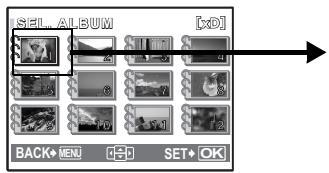
See the pictures registered in the album
Use the arrow pad (△▽◇) to select an album, and press OK FUNC.
Use the arrow pad (◀) to display picture you want.
text_image
SEL ALBUM BACK+ MENU SET+ OK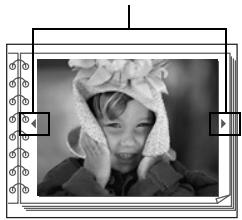
natural_image
Black-and-white photo of a smiling child wearing a knitted hat, framed within a decorative frame (no text or symbols visible)Album playback menus
- A card is required.
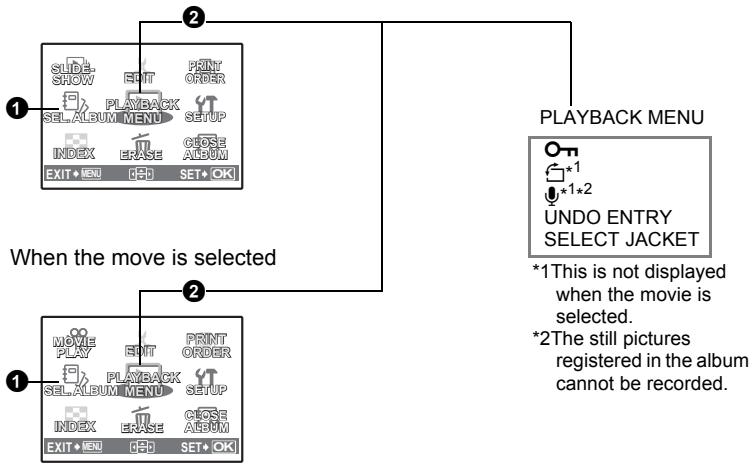
When the still picture is selected
flowchart
graph TD
    A["SLIDE SHOW"] --> B["PLAYBACK MENU"]
    C["PRINT ORDER"] --> B
    D["SELECT ALBUM"] --> B
    E["INDEX"] --> F["EXP"]
    G["CLOSE"] --> H["ABUM"]
    I["EXIT"] --> J["SET OK"]
    K["PLAYBACK MENU"] --> L["UNDO ENTRY SELECT JACKET"]
    M["When the move is selected"] --> N["PLAYBACK MENU"]
    O["When the move is selected"] --> P["PLAYBACK MENU"]
    Q["When the move is selected"] --> R["PLAYBACK MENU"]
    S["When the move is selected"] --> T["PLAYBACK MENU"]
    U["When the move is selected"] --> V["PLAYBACK MENU"]
    W["When the move is selected"] --> X["PLAYBACK MENU"]
    Y["When the move is selected"] --> Z["PLAYBACK MENU"]
    AA["When the move is selected"] --> AB["PLAYBACK MENU"]
    AC["When the move is selected"] --> AD["PLAYBACK MENU"]
    AE["When the move is selected"] --> AF["PLAYBACK MENU"]
    AG["When the move is selected"] --> AH["PLAYBACK MENU"]
    AI["When the move is selected"] --> AJ["PLAYBACK MENU"]
    AK["When the move is selected"] --> AL["PLAYBACK MENU"]
    AM["When the move is selected"] --> AN["PLAYBACK MENU"]
    AO["When the move is selected"] --> AP["PLAYBACK MENU"]
    AQ["When the move is selected"] --> AR["PLAYBACK MENU"]
    AS["When the move is selected"] --> AT["PLAYBACK MENU"]
    AU["When the move is selected"] --> AV["PLAYBACK MENU"]
    AW["When the move is selected"] --> AX["PLAYBACK MENU"]
    AY["PLAYBACK MENU"] --> AZ["*1 This is not displayed when the movie is selected."]
    BA["PLAYBACK MENU"] --> BB["*2 The still pictures registered in the album cannot be recorded."]
“SLIDESHOW Playing back pictures automatically” (P. 22)
"MOVIE PLAY Playing back movies" (P. 23)
"Print settings (DPOF)" (P. 43)
"SETUP menus" (P. 31)
“ERASE Erase selected pictures/Erase all pictures (P. 28)
① SEL. ALBUM
See other album
To switch albums, select the desired album from [SEL. ALBUM].
“ALBUM See the pictures registered in the album” (P. 28)
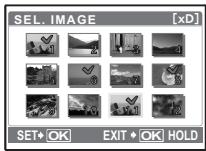
UNDO ENTRY....Undoing album entries
Even if a picture is removed from an album, the picture remains in the card.
SEL. IMAGE
text_image
SEL. IMAGE [xD] SET* OK EXIT * OK HOLDSelect one frame at a time to undo.
- Press the arrow pad (△▽◀) to select a picture, and press OK RUNC to add √.
- Press OK FUNC again to cancel the selection.
- When the selection is completed, press Ⓞ for a while.
UNDO ALL
Undo all pictures in the album
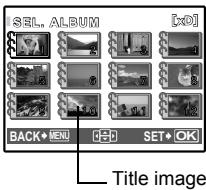
SELECT JACKET......Selecting the jacket
text_image
SEL. ALBUM [xD] BACK ◆ MENU [●] SET ◆ OK Title imageYou can change the jacket (first frame in the album) to be displayed on the album selection screen.
Other album menus


Protecting pictures" (P. 26)

Rotating pictures" (P. 26)
flowchart
graph TD
    A["Shooting mode"] --> B["SETUP"]
    C["Playback mode"] --> B
    B --> D["MEMORY FORMAT (FORMAT*1)"]
    B --> E["BACKUP*1"]
    B --> F["PW ON SETUP"]
    B --> G["SCREEN SETUP*2"]
    B --> H["COLOR"]
    B --> I["BEEP"]
    B --> J["SHUTTER SOUND*3"]
    B --> K["VOLUME*4"]
    B --> L["REC VIEW*4"]
    B --> M["FILE NAME*5"]
    B --> N["PIXEL MAPPING*5"]
    B --> O["DUAL TIME"]
    B --> P["ALARM CLOCK"]
    B --> Q["VIDEO OUT"]
*1 A card is required.
*2 [SCREEN SETUP] can be selected when playing back still pictures.
*3 [SHUTTER SOUND] can be selected when shooting still pictures.
*4 You cannot select this item when taking movies.
*5 You cannot select this item in playback mode.
MEMORY FORMAT (FORMAT)...... Formatting the internal memory or card
All existing data, including protected pictures, are erased when the internal memory or card is formatted. Make sure that you save or transfer important data to a computer before formatting the card.
- Make sure there is no card inserted in the camera when formatting the internal memory.
- When the internal memory is formatted, the data of the frames and titles downloaded with the provided OLYMPUS Master software will be deleted.
- Be sure that the card is inserted in the camera when formatting the card.
- Before using non-Olympus cards or cards which have been formatted on a computer, you must format them with this camera.
BACKUP...... Copying pictures in the internal memory to the card
Insert the optional card into the camera. Copying data does not erase the picture in the internal memory.
- It takes some time to back up data. Check if the battery is not empty before starting the copy, or use the AC adapter.


Selecting a display language
You can select a language for on-screen display. Available languages vary depending on the area where you purchased this camera.
You can add other languages to your camera with the provided OLYMPUS Master software.


Using Shooting button / Playback button to turn on the camera
| YES | Pressing the 📄/〈〈〉〉/SCN button turns on the camera and starts the camera in the shooting mode.Pressing the ▶ button turns on the camera and starts the camera in the playback mode. |
| NO | The power is not turned on. To turn on the camera, press the POWER button. |
PW ON SETUP.... Setting the startup screen and volume
| SCREEN | OFF (No picture is displayed.) | / 1 / 2 (The picture registered with [SCREEN SETUP] is displayed.) |
| VOLUME | OFF (No sound) / LOW | / HIGH |
You can select the volume level and the picture displayed when the camera is turned on. If [SCREEN] is set to [OFF], [VOLUME] cannot be set.
- Even if [SCN] is set to [MUSEUM], the camera emits beep by turning off and then on the camera when [LOW] or [HIGH] is selected for [VOLUME] of [PW ON SETUP].
If you do not want to emit beep, set [VOLUME] to [OFF] in advance.
SCREEN SETUP......Registering a picture as the startup screen
Still pictures in the internal memory or the card can be registered to screen [2] for [PW ON SETUP].
If a picture is already registered, the [IMAGE EXISTING] screen is displayed asking if you want to cancel the currently registered picture and register a new one.
COLOR.... Setting the color of the menu screens
| NORMAL | /BLUE | /BLACK | /PINK |
BEEP ....Adjust the volume of beep when the button is pressed
| OFF (No sound) / | LOW | / HIGH |
■))))....Adjust the volume of camera warning sound
| OFF (No sound) / | LOW | / HIGH |
| OFF (No sound) | ||
| 1 | LOW / HIGH | |
| 2 | LOW / HIGH | |
| 3 | LOW / HIGH | |
VOLUME.... Adjusting the volume during playback
OFF (No sound) / LOW / HIGH
REC VIEW......Viewing pictures immediately
| OFF | The picture being recorded is not displayed. This is useful when you want to prepare for your next shot while the previous picture is being recorded. |
| ON | The picture being recorded is displayed. This is useful for making a brief check of the picture you have just taken. You can resume shooting while the picture is still being displayed. |
FILE NAME......Resetting the file names of pictures
| RESET | This method is useful when grouping files on separate cards. The file number and folder number are reset every time a new card is inserted in the camera. The folder number returns to [No. 100] and the file number returns to [No. 0001]. |
| AUTO | This method is useful when you want to manage all your files with sequential numbers.Even if a new card is inserted, the folder number and file number are retained from the previous card. This helps you to manage multiple cards. |
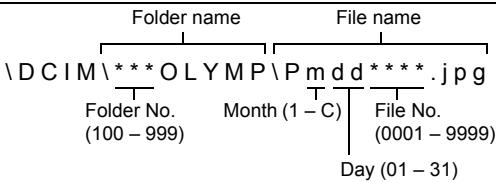
File names and their folder names for recorded pictures are automatically generated by the camera. File names and folder names respectively include file numbers (0001 to 9999) and folder names (100 to 999), and are named as follows.
text_image
Folder name File name \DCIM\***OLYMP\Pmdd****.jpg Folder No. (100 - 999) Month (1 - C) File No. (0001 - 9999) Day (01 - 31)Month: Jan. – Sep. = 1 – 9, Oct. = A, Nov. = B, Dec. = C
PIXEL MAPPING ....Adjusting the image processing function
The pixel mapping feature allows the camera to check and adjust the CCD and image processing functions. It is not necessary to operate this function frequently. Approximately once a year is recommended. Wait at least one minute after taking or viewing pictures to allow the pixel mapping function to perform properly. If you turn the camera off during pixel mapping, start again. Select [PIXEL MAPPING]. When [START] is displayed, press OK.
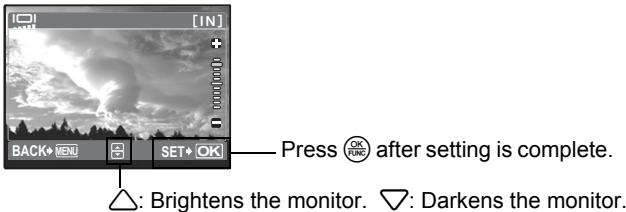
Adjusting the monitor brightness
text_image
[IN] BACK→MENU SET→OK Press Ⓧ after setting is complete. △: Brightens the monitor. ▽: Darkens the monitor.Setting the date and time
The date and time is saved with each image, and is used in the file name.
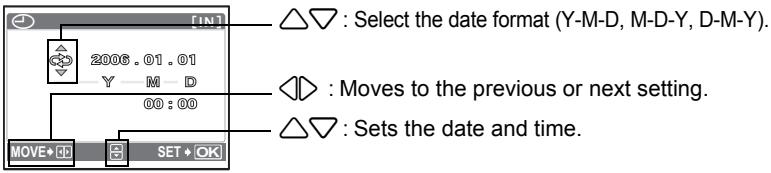
text_image
IN 2006.01.01 Y-M-D 00:00 MOVE←→ SET←OK Select the date format (Y-M-D, M-D-Y, D-M-Y). Moves to the previous or next setting. Sets the date and time.- The first two digits of the year are fixed.
- The time is displayed in the 24-hour format.
- For a more accurate setting, press OK FUNC when the time signal hits 00 seconds.
DUALTIME....Setting the date and time in another time zone
| OFF | Switches to the date and time set in [∅]. |
| ON | Switches to the date and time set in [DUALTIME]. When setting the dual time, select [ON], and then set the time. |
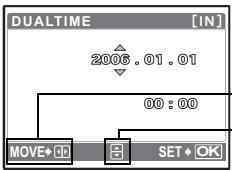
text_image
DUALTIME [IN] 2006.01.01 00:00 MOVE→ SET→OK◇: Moves to the previous or next setting.
△▽: Sets the date and time.
- The date format is the same as that set with [∅].
- The first two digits of the year are fixed.
- The time is displayed in the 24-hour format.
- For a more accurate setting, press OK FUNC when the time signal hits 00 seconds.
ALARM CLOCK....Setting alarms
| OFF | No alarm is set or alarm is canceled. |
| ONE TIME | Alarm is activated once. |
| DAILY | Alarm is activated daily at the set time. |
- When [∅] has not been set, [ALARM CLOCK] is not available.
- When [DUALTIME] is set to [ON], the alarm sounds according to the dual time date and time setting.
Setting an alarm
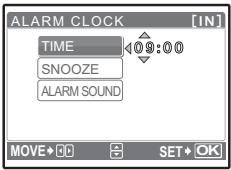
text_image
ALARM CLOCK [IN] TIME SNOOZE ALARM SOUND MOVE→OK SET→OK- Select [ONE TIME] or [DAILY], and set the alarm time.
- You can set snooze or alarm sounds and volume.
| TIME | Sets the alarm time. | |
| SNOOZE | OFF | No snooze is set. |
| ON | Alarm is activated every 5 minutes, up to 7 times. | |
| ALARM SOUND | 1 LOW / MID / HIGH | |
| 2 LOW / MID / HIGH | ||
| 3 LOW / MID / HIGH | ||
Operating, shutting off and checking the alarm
- Operating the alarm:
Turn off the camera. The alarm only operates when the camera is off. - Shutting off the alarm:
While the alarm is sounding, press any button to shut off the alarm and turn off the camera. Note that pressing the POWER button, 📄/⟨¶⟩/SCN button or ▶ button will turn the camera on. (Pressing the 📄/⟨¶⟩/SCN button and ▶ button will turn the camera on only when [▶] is set to [YES].)
When [SNOOZE] is set to [ON] at this time, the setting will be canceled. When [SNOOZE] is [OFF], the alarm stops automatically and the camera turns off after 1 minute of no operation.
VIDEO OUT ......Playing back pictures on a TV
NTSC / PAL
The factory default settings differ according to the region where the camera is sold.
To play back camera images on a TV, set the video output according to your TV's video signal type.
- TV video signal types by country/region Check the video signal type before connecting the camera to the TV.
NTSC: North America, Taiwan, Korea, Japan
PAL: European countries, China
Playing back pictures on a TV
Turn off the camera and the TV before connecting.
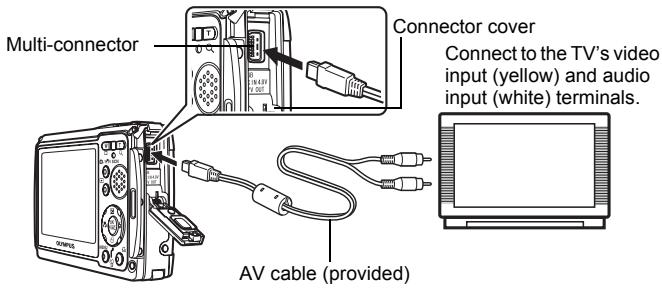
text_image
Multi-connector Connector cover Connect to the TV's video input (yellow) and audio input (white) terminals. AV cable (provided)Settings on the camera
Press the ▶ button to turn on the camera.
- The last picture taken is displayed on the TV. Use the arrow pad (◀) to select the picture you want to display.
Settings on the TV
Turn the TV on, and set it to video input mode.
- For details of switching to video input, refer to your TV's instruction manual.
3 Printing pictures
You can print out the pictures you have taken.
If you print the pictures at home, you can either connect the camera directly to the printer or you can connect the camera to a computer and download the pictures to the computer first.
If you go to a photo store, it is a good idea to store the print reservation data on the card first. With print reservation, you can print out pictures easily either at home using a personal DPOF-compatible printer or at a photo store that supports DPOF. DPOF is a standard format used to record automatic print information from digital cameras. It allows you to store data such as which pictures you want to print and the number of prints so that you can print pictures automatically at home or at a photo store.
This chapter explains direct printing and print reservations.
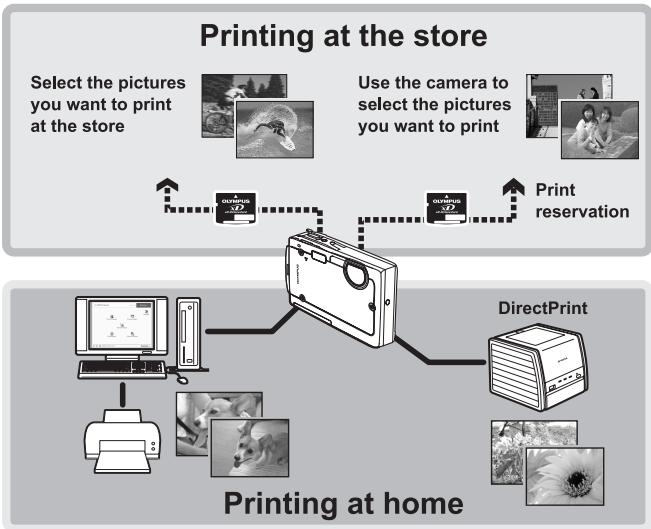
flowchart
graph TD
    A["Select the pictures you want to print at the store"] --> B["Print reservation"]
    C["Use the camera to select the pictures you want to print"] --> B
    D["DirectPrint"] --> B
    B --> E["Printing at home"]
Direct printing (PictBridge)
Using the direct printing function
By connecting the camera to a PictBridge-compatible printer, you can print out pictures directly. Select the pictures you want to print and the number of prints on the camera's monitor.
To find out if your printer is compatible with PictBridge, refer to the printer's instruction manual.
What is PictBridge?
A standard for connecting digital cameras and printers of different makers and printing out pictures directly.
• Available printing modes, paper sizes etc., vary depending on the printer you use. Refer to the instruction manual for your printer.
- For details of printing paper types, ink cassettes, etc., refer to the printer's instruction manual.
EASY PRINT
[EASY PRINT] can be used to print out the picture displayed on the monitor. The selected picture is printed using the standard settings of your printer. The date and file name are not printed.
STANDARD
All printers that support PictBridge have standard print settings. If [STANDARD] is selected on the settings screens (P.40 to 41), pictures are printed according to these settings. Refer to the printer's instruction manual for its standard settings or contact the printer manufacturer.
1 Display the picture you want to print out on the LCD monitor in the playback mode.
2 Turn the printer on and plug the USB cable provided with the camera into the multi-connector of the camera and the printer's USB port.
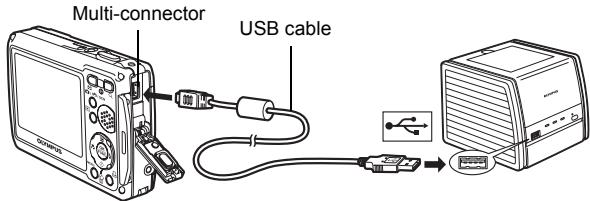
text_image
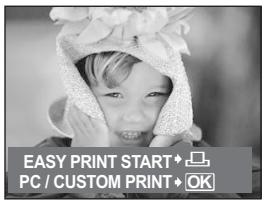
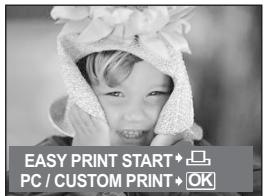
Multi-connector USB cable- The [EASY PRINT START] screen is displayed.
- For details of how to turn the printer on and the position of the USB port, refer to the printer's instruction manual.
3 Press □ button.
- Printing starts.
- When printing is finished, the picture selection screen is displayed. To print another picture, press ◀ to select a picture, and press □ button.
- When you are finished, disconnect the USB cable from the camera with the picture selection screen displayed.
4 Remove the USB cable from the camera.
5 Remove the USB cable from the printer.
text_image
EASY PRINT START♦ PC / CUSTOM PRINT♦ OK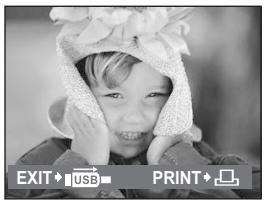
text_image
EXIT←USB→ PRINT←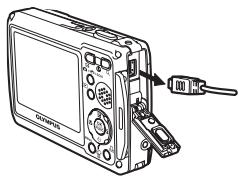
natural_image
Line drawing of a DSLR camera with an attached cable, showing no text or symbols on the device itself.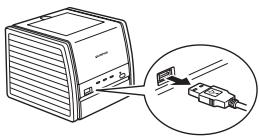
natural_image
Illustration of a desktop computer with an icon showing a USB cable being inserted (no text or symbols present)You can use [EASY PRINT] even when the camera is turned off or in shooting mode. With the camera turned off or in shooting mode, connect the USB cable. The selection screen for the USB connection is displayed. Select [EASY PRINT].
“EASY PRINT” Step 3 (P. 39), “CUSTOM PRINT” Step 2 (P. 40)
Other print modes and print settings (CUSTOM PRINT)
1 Display the screen being indicated on the right according to the procedure 1 and 2 in P. 38, and press OK FUNC.
2 Select [CUSTOM PRINT], and press OK FUNC.
text_image
EASY PRINT START♦ PC / CUSTOM PRINT♦ OK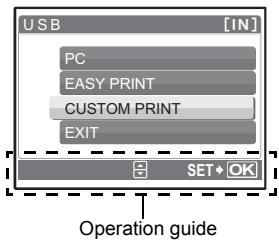
text_image
USB [IN] PC EASY PRINT CUSTOM PRINT EXIT SET OK Operation guide3 Make the print settings according to the operation guide.
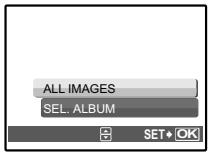
Selecting the picture to print (available only when a card is inserted)
text_image
ALL IMAGES SEL. ALBUM SET+ OK| ALL IMAGES | Allows you to select from all pictures in the card to print. |
| ALBUM | Select an album and the pictures in the album to print. |
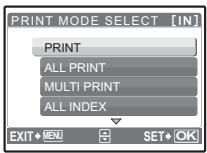
Selecting a print mode
text_image
PRINT MODE SELECT [IN] PRINT ALL PRINT MULTI PRINT ALL INDEX EXIT+Menu SET+OK| Prints the selected picture. | |
| ALL PRINT | Prints all the pictures stored in the internal memory or the card. |
| MULTI PRINT | Prints one picture in multiple layout format. |
| ALL INDEX | Prints an index of all the pictures stored in the internal memory or the card. |
| PRINT ORDER | Prints the pictures according to the print reservation data on the card. If no print reservations have been made, this option is not available. "Print settings (DPOF)" (P. 43) |
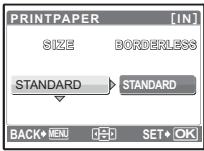
Setting the print paper
text_image
PRINTPAPER SIZE BORDERLESS STANDARD STANDARD BACK→MENU SET→OK| SIZE | Choose from the available paper sizes on your printer. |
| BORDERLESS | Select framed or unframed. In [MULTI PRINT] mode, you cannot select the frame. |
| OFF (☐) | The picture is printed inside a blank frame. |
| ON (☐) | The picture is printed filling the entire page. |
| PICS/SHEET | Available in [MULTI PRINT] mode only.The number of prints that can be printed vary depending on the printer. |

Note
- If the [PRINTPAPER] screen is not displayed, [SIZE], [BORDERLESS] and [PICS/SHEET] are set to [STANDARD].
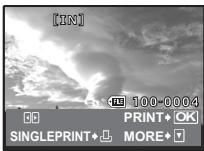
Selecting the picture to print
text_image
[IN] 100-0004 PRINT→OK SINGLEPRINT→↓ MORE→↓| Prints one copy of the selected picture. When [SINGLE PRINT] or [MORE] has been selected, a single copy or more copies are printed. | |
| SINGLE PRINT | Makes a print reservation for the displayed picture. |
| MORE | Sets the number of prints and data to be printed for the displayed picture. |
Press ◀ to select the picture you want to print. You can also use the zoom button and select a picture from the index display.
Setting the number of prints and data to be printed
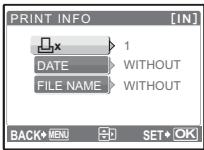
text_image
PRINT INFO [IN] 1 DATE WITHOUT FILE NAME WITHOUT BACK→MENU SET→OK| ☐× | Sets the number of prints. You can select up to 10 prints. |
| DATE (☐) | If you select [WITH], pictures are printed with the date. |
| FILE NAME (☐) | If you select [WITH], pictures are printed with the file name. |
4 Select [OK], and press Ⓞ
- Printing starts.
- When printing is finished, the [PRINT MODE SELECT] screen is displayed.
![OLYMPUS Μ 720SW - Select [OK], and press Ⓞ - 1](/content/2025/01/84378/images/2031ed5e303464a27068d9f3ea4090832a1534721a0e16abd77ca8398d6584b3.jpg)
text_image
PRINT OK CANCEL BACK→MENU SET→OKTo cancel printing
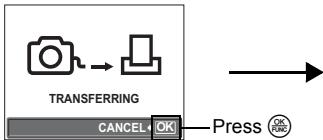
flowchart
graph LR
    A["Image"] --> B["Document"]
    B --> C["Press OK/OK按钮"]
    style A fill:#f9f,stroke:#333
    style B fill:#ccf,stroke:#333
    style C fill:#cfc,stroke:#333
Screen during data transfer
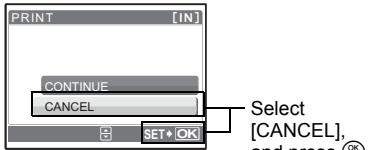
text_image
PRINT [IN] CONTINUE CANCEL SET• OK Select [CANCEL]. and pressSelect [CANCEL], and press OK FUNC.
5 In the [PRINT MODE SELECT] screen, press MENU button.
- A message is displayed.
![OLYMPUS Μ 720SW - In the [PRINT MODE SELECT] screen, press MENU button. - 1](/content/2025/01/84378/images/4d5f9c7a9fa25101597b1212b530cbcda26c88925b311cfbabb8dcc7ca74e4b2.jpg)
text_image
PRINT MODE SELECT [IN] PRINT ALL PRINT MULTI PRINT ALL INDEX EXIT MENU SET OK6 Disconnect the USB cable from the camera.
- The camera turns off.
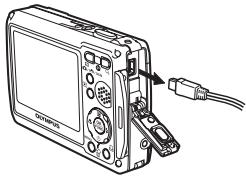
natural_image
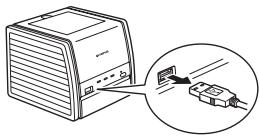
Line drawing of a digital camera module with an external cable and connector (no text or symbols)7 Disconnect the USB cable from the printer.
text_image
Diagram showing a server connected to a device via an interface, with an arrow pointing to the device.Print settings (DPOF)
How to make print reservations
Print reservation allows you to save printing data (the number of prints and the date and time information) with the pictures stored on the card.
Only the images stored on the card can be reserved to print. Insert a card with recorded pictures into the camera before making print reservations.
Pictures with print reservations can be printed using the following procedures.
Printing using a DPOF-compatible photo store.
You can print the pictures using the print reservation data.
Printing using a DPOF-compatible printer.
Printing is possible directly from a card containing print reservation data, without using a computer. For more details, refer to the printer's instruction manual. A PC card adapter may also be necessary.

Note
- DPOF reservations set by another device cannot be changed by this camera. Make changes using the original device. If a card contains DPOF reservations set by another device, entering reservations using this camera may overwrite the previous reservations.
- You can make DPOF print reservations for up to 999 images per card.
- Not all functions may be available on all printers, or at all photo stores.
To use print services without using DPOF
- Pictures stored in the internal memory cannot be printed at a photo store. The pictures need to be copied to a card before taking them.
“BACKUP Copying pictures in the internal memory to the card” (P. 31)
Single-frame reservation
Follow the operation guide to make a print reservation for a selected picture.
1 Press the MENU button in the playback mode and display the top menu.
2 Select [PRINT ORDER] ▶ [☐], and press OK FUNC.
- Playing back the album:Top menu ▶ [PRINT

Operation guide
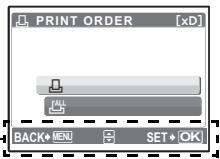
text_image
PRINT ORDER [xD] BACK→MENU SET→OK3 Press ◇ to select the frames for print reservations, and then press △▽ to set the number of prints.
- You cannot make print reservations for pictures with 🔊.
- Repeat Step 3 to make print reservations for other pictures.
4 When you finish making print reservations, press OK FUNC.
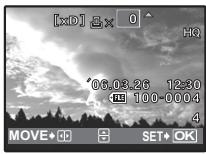
text_image
[xD] ▲x 0 HQ '06.03.26 12:30 100-0004 4 MOVE•+ + SET• OK5 Select the date and time print setting, and press OK FUNC.
NO The pictures are printed without the date and time.
DATE The selected pictures are printed with the shooting date.
TIME The selected pictures are printed with the shooting time.
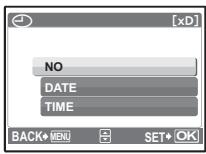
text_image
[xD] NO DATE TIME BACK→ MENU SET→ OK6 Select [SET], and press OK FUNC.
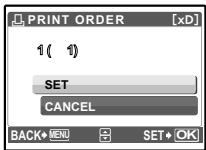
text_image
PRINT ORDER [xD] 1( 1) SET CANCEL BACK→MENU SET→OKAll-frame reservation
Reserves all the pictures stored on the card. The number of prints is set at one print per picture.
1 Press the MENU button in the playback mode and display the top menu.
2 Select [PRINT ORDER] ▶ [ALL], and press OK FUNC.
- Playing back the album:Top menu ▶ [PRINT ORDER] ▶ [ALL]
3 Select the date and time setting, and press OK FUNC.
NO The pictures are printed without the date and time.
DATE All pictures are printed with the shooting date.
TIME All pictures are printed with the shooting time.
4 Select [SET], and press OK FUNC.
Resetting print reservation data
You can reset all the print reservation data or just for selected pictures.
1 Select top menu ▶ [PRINT ORDER], and press OK FUNC.
- Playing back the album:Top menu ▶ [PRINT ORDER]
To reset the print reservation data for all the pictures
2 Select [☐] or [ALL], and press OK FUNC.
3 Select [RESET], and press OK FUNC.
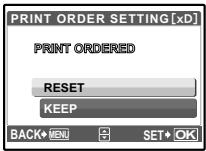
text_image
PRINT ORDER SETTING [xD] PRINT ORDERED RESET KEEP BACK→MENU SET→OKTo reset the print reservation data for a selected picture
2 Select [☐], and press Ⓞ
3 Select [KEEP], and press OK FUNC.
4 Press ◀ to select the picture with the print reservations you want to cancel, and press ▽ to decrease the number of prints to 0.
- Repeat Step 4 to cancel print reservations for other pictures.
5 When you are finished canceling print reservations, press OK FUNC.
6 Select the date and time setting, and press OK FUNC.
- The setting is applied to the remaining pictures with print reservations.
7 Select [SET], and press OK FUNC.
4 Connecting the camera to a computer
Flow
Using the USB cable provided with your camera, you can connect the camera and computer and download (transfer) the images to your computer using the OLYMPUS Master software, also provided with the camera.
Prepare the following items before starting.

OLYMPUS
Master
CD-ROM
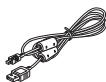
USB cable
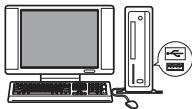
natural_image
Illustration of a desktop computer setup with monitor, keyboard, and tower (no text or symbols)Computer equipped with a USB port
Install the OLYMPUS Master software
P. 47
Connect the camera to the computer using the USB cable
P. 50
Start up the OLYMPUS Master software
P. 51
Download image files to the computer
P. 52
Disconnect the camera from the computer
P. 52
Using OLYMPUS Master
What is OLYMPUS Master?
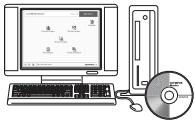
OLYMPUS Master is application software for editing images taken with a digital camera on a computer. Installing it on your computer lets you do the following:
- Download images from the camera or other media
- View images and movies
You can run a slideshow and play back sound.
- Manage images
You can organize your images using the calendar display. Search the image you want by date or keyword.
- Edit images
You can rotate images, trim them and change the size.
- Edit images with the filter and correction functions
text_image
Illustration of a desktop computer setup with monitor, keyboard, CD, and DVD, showing app icons and labels- Print images
You can print images and make indexes, calendars and postcards.
● Make panoramic images
You can make panoramic images using pictures taken in panorama mode.
For details of other functions and operations, refer to the "Help" guide and OLYMPUS Master reference manual.
Install the OLYMPUS Master software
Before installing the OLYMPUS Master software, please confirm that your computer is compatible with the following system requirements.
For newer operating systems, please refer to the Olympus web site as shown on the back cover of this manual.
Operating environment
Windows
| OS | Windows 98SE/Me/2000 Professional/XP |
| CPU | Pentium III 500 MHz or later |
| RAM | 128 MB or more (at least 256 MB is recommended) |
| Hard disk capacity | 300 MB or more |
| Connector | USB port |
| Monitor | 1,024 × 768 pixels, 65,536 colors or more |

Note
- Data transfer is only guaranteed on computers with a factory installed OS.
- To install the software in Windows 2000 Professional/XP, you must log on as a user with administrators' privileges.
- Internet Explorer and QuickTime 6 or later should be installed on your computer.
- Windows XP corresponds to Windows XP Professional/Home Edition.
- Windows 2000 corresponds to Windows 2000 Professional.
- If you are using Windows 98SE, the USB driver is installed automatically.
Macintosh
| OS | Mac OS X 10.2 or later |
| CPU | Power PC G3 500 MHz or later |
| RAM | 128 MB or more (at least 256 MB is recommended) |
| Hard disk capacity | 300 MB or more |
| Connector | USB port |
| Monitor | 1,024 × 768 pixels, 32,000 colors or more |

Note
- Operation is only guaranteed on a Macintosh equipped with a built-in USB port.
- QuickTime 6 or later and Safari 1.0 or later must be installed.
- Be sure to remove the media (drag & drop onto the trash icon) before performing the following operations. Failure to do so could result in unstable computer operation and the need to reboot.
- Disconnect the cable connecting the camera to the computer
- Turn off the camera
- Open the camera's battery compartment/card cover
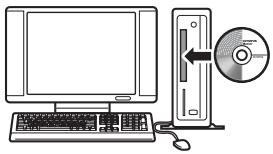
1 Insert the CD-ROM into the CD-ROM drive.
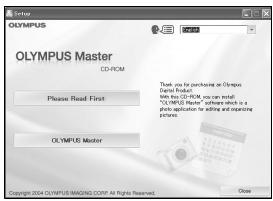
- The OLYMPUS Master setup screen is displayed.
- If the screen is not displayed, double-click the "My Computer" icon and click the CD-ROM icon.
natural_image
Illustration of a desktop computer setup with monitor, keyboard, CD, and mouse (no text or symbols)2 Click "OLYMPUS Master".
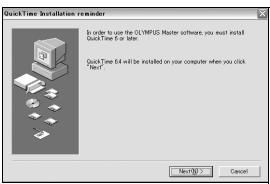
- The QuickTime installation screen is displayed.
- QuickTime is required to use OLYMPUS Master. If the QuickTime screen is not displayed, QuickTime 6 or later is already installed on the computer. In this case, go to step 4.
text_image
OLYMPUS OLEYMPUS MASTER CD-ROM Please Read First OLYMPUS Master Thank you for purchase on Olympus Durable Product. With the OLYMPUS Master's version 1.0, we can read the product in this version. You can use a photo application for adding and expressing products.3 Click "Next" and follow the on-screen instructions.
- When the QuickTime licensing agreement is displayed, read the agreement and click "Agree" to proceed with the installation.
- The OLYMPUS Master installation screen is displayed.
text_image
QuickTime Installation reminder It order to use the OLIMPUS Master software, you must install QuickTime 6.0 in time. QuickTime 64 will be installed on your computer when you click "Next?" No OK? Cancel4 Follow the on-screen instructions.
- When the OLYMPUS Master licensing agreement is displayed, read the agreement and click "Yes" to proceed with the installation.
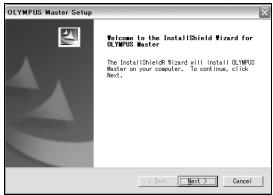
- When the "User Information" dialog box is displayed, enter your "Name" and "OLYMPUS Master Serial Number"; select your region and click "Next". Refer to the sticker on the CD-ROM package for the serial number. - When the DirectX licensing agreement is displayed, read the agreement and click "Ye
text_image
OLYMPUS Master Setup Welcome to the InstallShield Wizard for OLYMPUS Master The InstallShield Wizard will install OLYMPUS Master in your computer. To continue, click Next.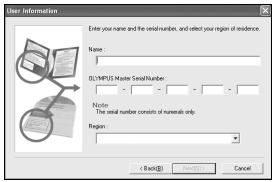
text_image
Enter your name and the serial number, and select your region of residence. Name: OLYMPUS Master Serial Number: Facute The serial number consists of numerals only: Region: 1 Bank 2 Cancel- A screen asking whether or not you want to install Adobe Reader is displayed. Adobe Reader is required to read the OLYMPUS Master instruction manual. If this screen is not displayed, Adobe Reader is already installed on your computer. To install Adobe Reader, click "OK".
5 Follow the on-screen instructions.
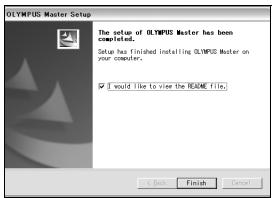
- The screen confirming that installation is completed is displayed. Click "Finish".
6 Select the option to restart immediately when the screen asking you if you wish to restart the computer is displayed and click "OK".
- The computer restarts.
- Remove the CD-ROM from the CD-ROM drive and store it.
text_image
OLYMPUS Master Setup The setup of OLYMPUS Master has been completed. Setup has finished installing OLYMPUS Master on your computer. ✓ I would like to view the HOME File.Macintosh
1 Insert the CD-ROM into the CD-ROM drive.
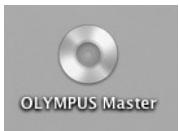
- The CD-ROM window is displayed.
- If the CD-ROM window is not displayed, double-click the CD-ROM icon on the desktop.
text_image
OLYMPUS Master2 Double-click on the desired language folder.
3 Double-click the "Installer" icon.
• The OLYMPUS Master installer starts up.
- Follow the on-screen instructions.
- When the OLYMPUS Master licensing agreement is displayed, read the agreement and click “Continue” and then “Agree” to proceed with the installation.
- The screen confirming that installation is completed is displayed.

4 Click "Finish".
- The first screen is displayed.
5 Click "Restart".
- The computer restarts.
- Remove the CD-ROM from the CD-ROM drive and store it.
Connecting the camera to a computer
1 Make sure the camera is turned off.
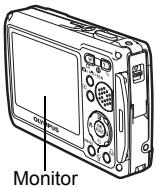
- The monitor is off.
- The lens cover is closed.
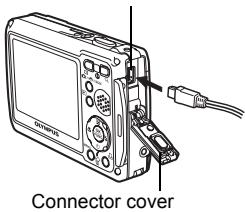
2 Connect the multi-connector on the camera to the USB port on the computer using the provided USB cable.
- Refer to your computer's instruction manual to locate the position of the USB port.
- The camera turns on automatically.
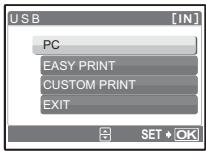
- The monitor turns on and the selection screen for the USB connection is displayed.
text_image
GEO PLUS MonitorMulti-connector
text_image
Connector cover3 Select [PC], and press OK FUNC.
4 The camera is recognized by the computer.
- Windows
When you connect the camera to your computer for the first time, the computer attempts to recognize the camera. Click "OK" to exit the message that is displayed. The camera is recognized as a "Removable Disk".
- Macintosh
The iPhoto program is the default application for managing digital images. When you connect your digital camera for the first time, the iPhoto application starts automatically, so close this application and start OLYMPUS Master.
text_image
USB PC EASY PRINT CUSTOM PRINT EXIT SET OK
Note
- The camera functions are disabled while the camera is connected to a computer.
- Connecting the camera to a computer via a USB hub may cause unstable operation. In this case, do not use a hub, but connect the camera directly to the computer.
Start up the OLYMPUS Master software
Windows
1 Double-click the "OLYMPUS Master" icon 📋 on the desktop.
- The main menu is displayed.
- When OLYMPUS Master is started up for the first time after installation, the “Registration” dialog box is displayed before the main menu. Follow the prompts and fill in the registration form.
Macintosh
1 Double-click the "OLYMPUS Master" icon in the "OLYMPUS Master" folder.
- The main menu is displayed.
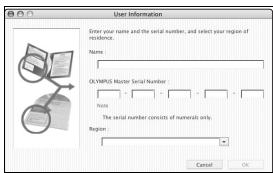
- When OLYMPUS Master is started up for the first time, the “User Information” dialog box is displayed before the main menu. Enter your “Name” and “OLYMPUS Master Serial Number”, and select your region.
- After the “User Information” dialog box, the “Registration” dialog box is displayed. Follow the prompts and fill in the registration form.
text_image
User Information Enter your name and the serial number, and select your region of residence. Name: OLVMUS Master Serial Number Note The serial number consists of minerals only. Region: Cancel OKOLYMPUS Master main menu
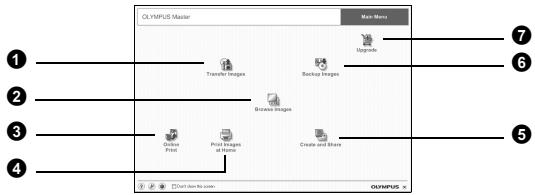
text_image
OLYMPUS Master Main Menu Transfer Images Backup Images Browse Images Print Image Print Image Print Image Create and Share 1 2 3 4 5 6 7 8 9 10 11 12 13 14 15 16 17 18 19 20 21 22 23 24 25 26 27 28 29 30 31 32 33 34 35 36 37 38 39 40 41 42 43 44 45 46 47 48 49 50 51 52 53 54 55 56 57 58 59 60 61 62 63 64 65 66 67 68 69 70 71 72 73 74 75 76 77 78 79 80① "Transfer Images" button
Downloads images from the camera or other media.
② "Browse Images" button
The "Browse" window is displayed.
③ "Online Print" button
The online print window is displayed.
④ "Print Images at Home" button
The print menu is displayed.
⑤ "Create and Share" button Displays the editing menu.
⑥ "Backup Images" button Creates backup images.
⑦ "Upgrade" button
Displays window for optional upgrade to OLYMPUS Master Plus.
To exit OLYMPUS Master
1 Click "Exit" ✗ on the main menu.
- OLYMPUS Master is exited.
Displaying camera images on a computer
Downloading and saving images
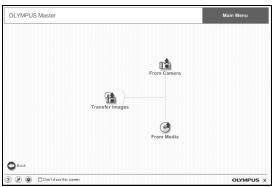
1 Click "Transfer Images" 📋 on the OLYMPUS Master main menu.
- The menu for selecting the source is displayed.
2 Click "From Camera"
- The window for selecting images is displayed. All the images in the camera are displayed.
flowchart
graph TD
    A["Front Camera"] --> B["Transfer Images"]
    B --> C["Power Media"]
    C --> D["Output"]
    style A fill:#f9f,stroke:#333
    style B fill:#ccf,stroke:#333
    style C fill:#cfc,stroke:#333
    style D fill:#fcc,stroke:#333
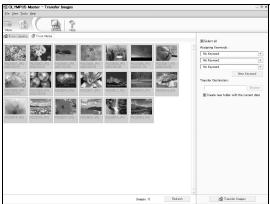
3 Select the image files and click "Transfer Images".
- A window indicating that the download is complete is displayed.
text_image
C:\V-100\Movie - Movie Images File Edit View Help Share this image Share this image Share this image Share this image Share this image Share this image Share this image Share this image Share this image Share this image Share this image Share this image Share this image Share this image Share this image Share this image Share this image Share this image Share this image Share this image Share this image Share this image Share this image Share this image Share this image Share this Image Share this Image Share this Image Share this Image Share this Image Share this Image Share this Image Share this Image Share this Image Share this Image Share this Image Share this Image Share this Image Share this Image Share this Image Share this Image Share this Image Share this Image Share this Image Share this Image Share this Image Share this Image Share this Image Share this Image Share this Image Share this image4 Click "Browse images now."
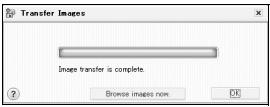
- The downloaded images are displayed in the browse window.
- To return to the main menu, click "Menu" in the "Browse" window.
text_image
Transfer Images Image transfer is complete. Browse images now OKTo disconnect the camera
1 Make sure that the card access lamp has stopped blinking.
Card access lamp
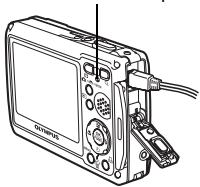
natural_image
Line drawing of a device with ports and cables, no visible text or symbols2 Make the following preparations for disconnecting the USB cable.
Windows 98SE
① Double-click the “My Computer” icon and right-click the “Removable Disk” icon to display the menu.
② Click "Eject" on the menu.
Windows Me/2000/XP
① Click the "Unplug or Eject Hardware" icon ≧ in the system tray.
② Click the message that is displayed.
③ When a message is displayed saying that the hardware can be ejected safely, click "OK".
Macintosh
① The trash icon changes to the eject icon when the "Untitled" or "NO_NAME" icon on the desktop is dragged. Drag and drop it on the eject icon.
3 Disconnect the USB cable from the camera.
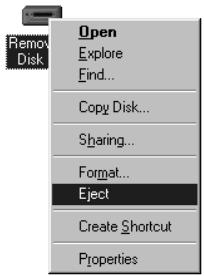
text_image
Open Explore Find... Copy Disk... Sharing... Format... Eject Create Shortcut Properties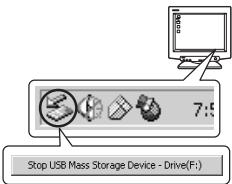
text_image
Stop USB Mass Storage Device - Drive(F:)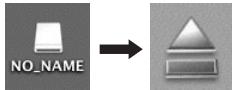
text_image
NO_NAME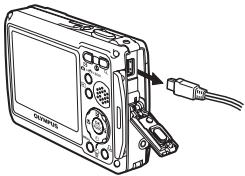
natural_image
Line drawing of a digital camera module with an external cable, showing ports and wiring (no text or symbols)
Note
- Windows Me/2000/XP: When you click “Unplug or Eject Hardware”, a warning message may be displayed. Make sure that image data is not being downloaded from the camera and that all applications are closed. Click the “Unplug or Eject Hardware” icon again and disconnect the cable.
Viewing still pictures and movies
1 Click "Browse Images" 📋 on the OLYMPUS Master main menu.
- The "Browse" window is displayed.
2 Double-click the still picture thumbnail that you want to view.
Thumbnail
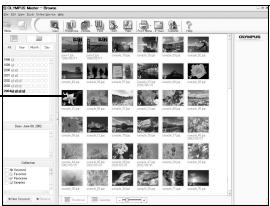
text_image
Screenshot of a software interface showing image selection panel with thumbnails and file list- Olympus Master switches to view mode and the picture is enlarged.
- To return to the main menu, click "Menu" in the "Browse" window.
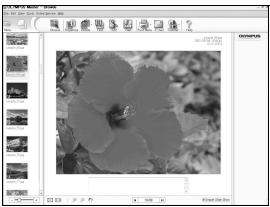
natural_image
Black-and-white photo of a flower with visible petals and surrounding foliage, displayed within an image editing software interface (no text or symbols on the flower itself)To view a movie
1 Double-click the movie thumbnail that you want to see in the "Browse" window.
- Olympus Master switches to view mode and the first frame of the movie is displayed.
2 To play back the movie, click the playback button at the bottom of the screen.
The names and functions of the controller parts are shown below.

text_image
00:00:00 1 2 3 4 5 6 7 8| Item | Description | |
| 1 | Playback slider | Move the slider to select a frame. |
| 2 | Time display | Displays the time that has elapsed during playback. |
| 3 | Playback (pause) button | Plays the movie. Functions as the pause button during playback. |
| 4 | Back button | Displays the previous frame. |
| 5 | Forward button | Displays the next frame. |
| 6 | Stop button | Stops playback and returns to the first frame. |
| 7 | Repeat button | Plays the movie repeatedly. |
| 8 | Volume button | Displays the volume adjustment slider. |
Printing pictures
Pictures can be printed from the photo, index, postcard and calendar menus. The explanation below uses the photo menu.
1 Click "Print Images at Home" menu.

on the OLYMPUS Master main
- The print menu is displayed.
2 Click "Photo" .
- The "Photo Print" window is displayed.
3 Click "Settings" in the "Photo Print" window.
- The printer settings screen is displayed. Make the necessary printer settings.
4 Select a layout and size.
- To print the date and time with your image, check the box next to "Print Date", and select between "Date" and "Date & Time".
5 Select the thumbnail image that you want to print and click "Add".
- A preview of the selected image is displayed on the layout.
6 Select the number of copies.
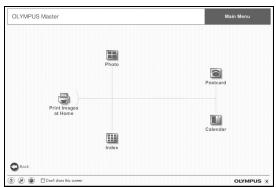
flowchart
graph TD
    A["Phone"] --> B["Print Change at Home"]
    B --> C["Calendar"]
    C --> D["Print Change at Home"]
    D --> E["Print Change at Home"]
    style A fill:#f9f,stroke:#333
    style B fill:#ccf,stroke:#333
    style C fill:#cfc,stroke:#333
    style D fill:#fcc,stroke:#333
    style E fill:#cff,stroke:#333
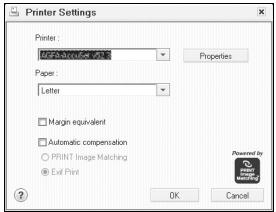
text_image
Printer Settings Printer: USSS3000541.41 Properties Paper: Letter Margin equivalent Automatic compensation PRINT Image Matching Exit Print OK Cancel Powered by
text_image
Screenshot of a 3D modeling software interface showing tool panels and a blank canvas with Chinese labels.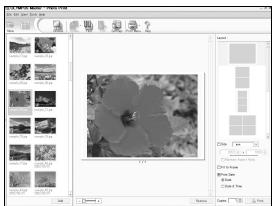
natural_image
Screenshot of a photo editing software interface showing a flower image and tool panels (no readable text or symbols in the main image area)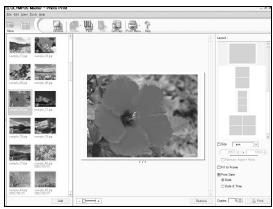
natural_image
Screenshot of a photo editing software interface showing a grayscale flower image with no visible text or symbols on the flower itself.7 Click "Print".
- Printing starts.
- To return to the main menu, click "Menu" in the "Photo Print" window.
To download and save images to a computer without using OLYMPUS Master
This camera is compatible with USB mass storage. You can connect the camera to your computer using the USB cable provided with the camera to download and save images without using OLYMPUS Master. The following environment is required to use the USB cable to connect the camera to your computer.
Windows: Windows 98SE/Me/2000 Professional/XP
Macintosh: Mac OS 9.0 to 9.2/X

Note
- If your computer is running Windows 98SE, you will need to install the USB driver. Before connecting the camera to your computer with the USB cable, double-click the files from the following folders on the provided OLYMPUS Master CD-ROM.
(Drive name): \USB\INSTALL.EXE
- Data transfer is not guaranteed in the following environments, even if your computer is equipped with a USB port.
• Windows 95/98/NT 4.0
• Windows 98SE upgrades from Windows 95/98
• Mac OS 8.6 or earlier
- Computers with a USB port added by means of an extension card, etc.
- Computers without a factory-installed OS and home-built computers
5 Getting to know your camera better
Shooting tips and information
Tips before you start taking pictures
The camera does not turn on even when a battery is loaded
The battery is not fully charged
- Charge the battery with the charger.
The battery is temporarily unable to function because of the cold
- Battery performance declines in low temperatures, and the charge may not be sufficient to turn on the camera. Remove the battery and warm it by putting it in your pocket for a while.
No picture is taken when the shutter button is pressed
The camera is in sleep mode
- To save battery power, the camera automatically goes into sleep mode and the monitor turns off if there is no operation when the camera is turned on (when the lens cover opens and the monitor is on). No picture is taken even if the shutter button is fully pressed in this mode. Operate the zoom button or other buttons to restore the camera from sleep mode before taking a picture. If the camera is left for 15 minutes, it automatically turns off (the lens cover closes and the monitor turns off). Press the POWER button to turn the camera on.
The mode is set to the playback mode
- This mode displays the recorded picture on the LCD monitor. Let's press the 📷/〈〈〉〉/SCN button to set the mode to the shooting mode.
The flash is charging
- Wait until the (flash charge) mark stops blinking before taking the picture.
The memory gauge is full
- No pictures can be taken when the memory gauge is full. Wait until there is space in the memory gauge.
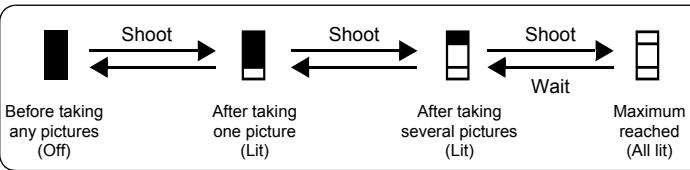
flowchart
graph LR
    A["Before taking any pictures (Off)"] -->|Shoot| B["After taking one picture (Lit)"]
    B -->|Shoot| C["After taking several pictures (Lit)"]
    C -->|Shoot| D["Maximum reached (All lit)"]
    C -->|Wait| D
The date and time have not been set
The camera has been used in the same conditions from the time of purchase
- No date and time have been set for the camera at the time of purchase. Set the date and time before using the camera.


Setting the date and time" (P. 34)
The battery has been pulled out of the camera.
- The date and time settings will be returned to the factory default settings if the camera is left without batteries for approximately 1 day. Before taking important pictures, check that the date and time settings are correct.
Shooting tips
Focusing on the subject
There are several ways to focus, depending on the subject.
When the subject is not in the center of the frame
- Place the subject in the center of the frame, lock the focus on the subject, and then recompose your picture.
- Set [AF MODE] to [iESP].

"AF MODE Changing the focusing area" (P. 21)
The subject is moving quickly
- Focus the camera on a point roughly the same distance away as the subject you want to shoot (by pressing the shutter button halfway), and then recompose your picture and wait for the subject to enter the frame.
Subjects that are difficult to focus on
- Under certain types of conditions, it is difficult to focus using auto focus. The green lamp on the monitor lights, allowing you to check if the focus is locked.
The green lamp blinks. The subject cannot be brought into focus.
Subject with low contrast
Subject with an extremely bright area in the center of the frame
Subject without vertical lines
The green lamp lights, but the subject cannot be brought into focus.
Subjects at different distances
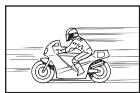
Fast-moving
subject
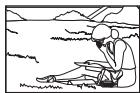
The subject is not in the center of the frame
In these cases, focus (focus lock) on an object with high contrast at the same distance as the intended subject, recompose your shot and then take the picture. If the subject has no vertical lines, hold the camera vertically and focus the camera using the focus lock function by pressing the shutter button halfway, and then return the camera to the horizontal position while keeping the button pressed halfway and take the picture.
Taking pictures without blurring
Hold the camera correctly and press the shutter button gently to shoot the picture. You can reduce the blurring when shooting the picture in ( ) mode.
The factors that can cause the picture to blur are as follows:
- When you use the optical zoom, digital zoom, or zoom at such higher magnifications to shoot the picture
- When the shutter speed is set low to shoot a dark subject
- When the flash cannot be used or when a low shutter speed set SCN mode is selected
Taking pictures without the flash
The flash fires automatically when there is insufficient light. If the subject is too far away, the flash may have no effect. Here is how to take pictures without the flash in this type of situation.
Set the camera to ( ) mode
- Because the sensitivity of the CCD increases automatically, you can hold the camera and take pictures in darker places with the flash off.
“《《》》” Shooting pictures using digital image stabilization” (P. 9)
Increase the [ISO] setting
- Increase the value of the [ISO] setting.
“ISO Changing the ISO sensitivity” (P. 19)
The picture is too grainy
There are several factors that can cause the picture to appear grainy.
Using the digital zoom to take close-up pictures
- With the digital zoom, part of the image is cropped and enlarged. The greater the magnification, the grainier the picture appears.
“DIGITAL ZOOM Zooming in on your subject” (P. 20)
Increasing the ISO sensitivity
- When you increase the [ISO] setting, “noise”, which appears as spots of unwanted color or unevenness in the color, can be introduced and give the picture a grainy appearance. This camera is equipped with a function to allow shooting at high sensitivity while suppressing noise; however, increasing the ISO sensitivity creates grainier pictures than when using a lower sensitivity.
“ISO Changing the ISO sensitivity” (P. 19)
Taking pictures with the correct color
- The reason why there are differences between the colors in a picture and the actual colors taken and the actual color is the light source illuminating the subject. [WB] is the function that allows the camera to determine the correct colors. Normally, the [AUTO] setting provides the optimal white balance, but depending on the subject, it may be better to experiment with changing the [WB] setting.
- When the subject is in the shade on a sunny day
- When the subject is illuminated by both natural light and indoor lighting, such as when near a window
- When there is no white in the center of the frame
“WB Adjusting the color of a picture” (P. 19)
Taking pictures of a white beach or snow scene
- Take pictures with 📋 in SCN mode. Suitable for taking pictures on a sunny day at the beach or in the snow.
“SCN (Scene) Shooting pictures by selecting a scene according to the situation” (P. 18)
- Often, bright subjects (such as snow) turn out darker than their natural colors. Adjust [☒] toward [+] to make these subjects closer to their real shades. Conversely, when you are shooting dark subjects, it can be effective to adjust toward the [-]. Sometimes, using the flash may not produce the brightness (exposure) that was intended.
“△ button Changing picture brightness” (P. 12)
Taking pictures of a subject against backlight
- With [ESP/☐] set to [☐], the picture can be taken based on the brightness at the center of the monitor without being affected by the light in the background.
“ESP/Changing the area for measuring the brightness of a subject” (P. 20)
- Set the flash to [⚡] to activate fill-in-flash. You can shoot a subject against backlight without the face of the subject appearing dark. [⚡] is effective for shooting against backlight and under fluorescent and other artificial lightening.
"button Flash shooting" (P. 12)
Increasing the number of pictures that can be taken
There are two ways to record the pictures you take with this camera.
Recording pictures to the internal memory
- Pictures are recorded to the internal memory, and when the number of storable still pictures reaches 0, you must connect the camera to a computer to download the pictures, and then erase the pictures from the internal memory.
Using a card (optional)
- Pictures are recorded to the card when inserted in the camera. When the card is full, you download the pictures to a computer, and then either erase the pictures from the card or use a new card.
- Pictures are not recorded to the internal memory when a card is inserted in the camera. Pictures in the internal memory can be copied to the card using the [BACKUP] function.

"BACKUP Copying pictures in the internal memory to the card" (P. 31) "The card" (P. 74)
Number of storable still pictures and recording length of movies
Still pictures
| Image quality | Image size | Number of storable still pictures | |||
| Internal memory | Using a 128 MB card | ||||
| With sound | Without sound | With sound | Without sound | ||
| SHQ | 3072 × 2304 | 5 | 5 | 36 | 36 |
| HQ | 3072 × 2304 | 11 | 11 | 71 | 73 |
| SQ1 | 2560 × 1920 | 15 | 16 | 102 | 105 |
| 2304 × 1728 | 19 | 19 | 124 | 128 | |
| 2048 × 1536 | 23 | 24 | 156 | 163 | |
| SQ2 | 1600 × 1200 | 28 | 30 | 185 | 194 |
| 1280 × 960 | 43 | 46 | 285 | 307 | |
| 1024 × 768 | 64 | 71 | 420 | 469 | |
| 640 × 480 | 97 | 116 | 614 | 726 | |
Movie
| Image quality | Image size | Recording length (Sec.) | |
| Internal memory | Using a 128 MB card | ||
| SHQ | 640 × 480(15 frames/sec.) | 17 | 112 |
| HQ | 320 × 240(15 frames/sec.) | 50 | 333 |
| SQ | 160 × 120(15 frames/sec.) | 129 | 848 |
Using a new card
- If you use a non-Olympus card or a card used for another application, such as for a computer, the message [CARD ERROR] is displayed. To use this card with this camera, use the [FORMAT] function to format the card.

"MEMORY FORMAT (FORMAT) Formatting the internal memory or card" (P. 31)
Lamp indicators
This camera uses several lamps to indicate the camera status.
| Lamp | Status |
| Self-timer lamp | The lamp lights for approximately 10 seconds, blinks for approximately 2 seconds, and then the picture is taken. |
| Card access lamp | Blinking: A picture is being recorded, the camera is reading a movie, or images are being downloaded (when connected to a computer).Do not do any of the following while the card access lamp is blinking. Doing so may prevent the image data from being saved and render the internal memory or card unusable.Open the battery compartment/card coverRemove the battery.Connect or disconnect the AC adapter. |
| Green lamp of the LCD monitor | Lit: The focus and exposure are locked.Blinking: The focus and exposure are not locked.Release your finger from the shutter button, re-position the AF target mark on the subject and press the shutter button halfway again. |
Extending the useful life of the battery
- Performing any of the following operations when not actually taking pictures can deplete the battery power.
• Repeatedly pressing the shutter button halfway
• Repeatedly using the zoom
- To save battery power, turn off the camera whenever it is not in use.
Functions that cannot be selected from menus
- Some items may not be selectable from the menus when using the arrow pad ( ).
- Items that cannot be set with the current shooting mode
- Items that cannot be set because of an item that has already been set: [s], [FLASH MODE], etc.
- Items that cannot be set because the pictures taken by other camera will be edited.
- Some functions cannot be used when there is no card in the camera.
[PANORAMA], [FORMAT], [BACKUP], [PRINT ORDER], [▼■], [REDEYE FIX], [BLACK & WHITE], [SEPIA], [FRAME], [TITLE], [CALENDAR], [BRIGHTNESS], [SATURATION], [ALBUM ENTRY], ALBUM
Selecting the optimal record mode
A record mode expresses a combination of desired image size and compression level. Use the following examples to help determine the optimal record mode when shooting.
To print large images on full-size paper/To edit and process images on a computer
- [SHQ] or [HQ]
To print postcard-size images
• [SQ1]
To send as an e-mail attachment or post on a web site
• [SQ2]
“IMAGE QUALITY Changing the image quality” (P. 17)
To return the settings of functions to default settings
- If the settings such as [IMAGE QUALITY] or flash settings (excluding ^ and SCN) are changed according to the shooting, the changed settings can be maintained even after the power is turned off. To return the settings to default settings, execute [RESET].
“RESET Change the shooting functions back to default settings” (P. 18)
Playback help
The red-eye cannot be fixed
- Depending on the picture, the red-eye may not be fixed. Also, parts except the eye may be fixed.
The picture cannot be registered in the album
- Up to 200 pictures can be registered in each album.
- The same picture cannot be registered in several albums.
Playback tips
Playing back the picture in the internal memory
- When a card has been inserted in the camera, the picture in the internal memory cannot be played back. Pull out the card before operating the camera.
Quickly displaying a desired picture
- Use the album function. You can create up to 12 albums and enter the pictures on a card to the albums. To view the pictures, press the MENU button in the playback mode, and then select an album from the top menu to play back. The same picture cannot be entered in multiple albums.

"ALBUM ENTRY Adding pictures to an album" (P. 27)
"ALBUM See the pictures registered in the album" (P. 28)
- Press W on the zoom button to view the pictures as thumbnails (index display) or in a calendar format (calendar display).

"Zoom button Zooming while shooting/close-up playback" (P. 11)
Erasing sound recorded to still pictures
- Once sound is added to a picture, it is not possible to erase the sound. In this case, make a re-recording with silence. Sound recording is not possible if there is insufficient space in the internal memory or on the card.

“Adding sound to still pictures” (P. 26)
Viewing the entire picture on a computer screen
The size of the picture displayed on a computer screen changes depending on the computer settings. When the monitor setting is 1,024 × 768 and you are using Internet Explorer to view a picture with an image size of 2,048 × 1,536 at 100%, the entire picture cannot be viewed without scrolling. There are several ways you can view the entire picture on the computer screen.
View the picture using image browsing software
• Install the OLYMPUS Master software from the provided CD-ROM.
Change the monitor setting
- The icons on the computer desktop may be rearranged. For details of changing the settings on your computer, refer to the computer's instruction manual.
When you get an error message on the camera...
| Monitor indication | Possible cause | Corrective action |
| CARD ERROR | There is a problem with the card. | This card cannot be used. Insert a new card. |
| WRITE-PROTECT | Writing to the card is prohibited. | The recorded image has been protected (read-only) on a computer. Download the image to a computer and cancel the read-only setting. |
| MEMORY FULL | The internal memory has no available memory and cannot store any new data. | Insert a card or erase unwanted data. Before erasing, backup the data of important pictures using the card, or download such pictures to a computer. |
| CARD FULL | The card has no available memory and cannot store any new data. | Replace the card or erase unwanted data. Before erasing, download important pictures to a computer. |
| NO PICTURE | There are no pictures in the internal memory or on the card. | The internal memory or the card contains no pictures. Record pictures. |
| PICTUREERROR | There is a problem with the selected picture and it cannot be played back on this camera. | Use image processing software to view the picture on a computer. If that cannot be done, the image file is damaged. |
| CARD-COVER OPEN | The battery compartment/card cover is open. | Close the battery compartment/card cover. |
 BATTERY EMPTY BATTERY EMPTY | The battery is empty. | Charge the battery. |
Y/M/D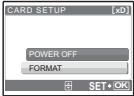 | When the camera is used for the first time or the battery has been removed for a long time, the date and time are on the factory default setting.This card cannot be used in this camera. Or, the card is not formatted. | Set the date and time.Format the card or replace. Select [POWER OFF] and press Ⓞ. Insert a new card. Select [FORMAT] ▶ [YES] and press Ⓞ. All data on the card is erased. |
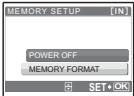 | There is an error in the internal memory. | Select [MEMORY FORMAT] ▶ [YES] and press Ⓞ. All data in the internal memory is erased. |
 NO CONNECTION NO CONNECTION | The camera is not connected to the printer correctly. | Disconnect the camera and connect it again correctly. |
| [045T]NO PAPER | There is no paper in the printer. | Load some paper in the printer. |
 NO INK NO INK | The printer has run out of ink. | Replace the ink cartridge in the printer. |
 | The paper is jammed. | Remove the jammed paper. |
| SETTINGSCHANGED | The printer's paper tray has been removed or the printer has been operated while changing settings on the camera. | Do not operate the printer while changing settings on the camera. |
| [03AD]PRINT ERROR | There is a problem with the printer and/or camera. | Turn off the camera and printer. Check the printer and remedy any problems before turning the power on again. |
| [08K2]CANNOT PRINT | Pictures recorded on other cameras may not be printed on this camera. | Use a computer to print. |
Functions available in shooting modes and scenes
Some functions cannot be set in certain shooting modes. For more details, refer to the table below.
Grayed out areas (☐) in the SCN column indicate that to enable the shooting scene in SCN mode, there are restrictions to the functions that can be set.
“Functions with restrictions in shooting scenes” (P. 69)
Functions available in shooting modes
| Function\Shooting mode | [IMAGE] | () | SCN | |
| P | AUTO | |||
| √ | √ | √ | √ | |
| Flash | √ | √ | √ | |
| √ | √ | √ | ||
| √ | √ | √ | ||
| Optical zoom | √ | √ | √ | |
| WB | √ | — | √ | √ |
| ISO | √ | — | — | |
| DRIVE | √ | — | √ | |
| √ | — | √ | ||
| IMAGE QUALITY | √ | √ | √ | |
| DIGITAL ZOOM | √ | — | √ | |
| AF MODE | √ | — | √ | |
| √ | — | √ | ||
| PANORAMA | √ | — | √ | |
| MEMORY FORMAT(FORMAT) | √ | √ | √ | √ |
| BACKUP | √ | √ | √ | √ |
| √ | √ | √ | √ | |
| √ | √ | √ | √ | |
| PW ON SETUP | √ | √ | √ | √ |
| COLOR | √ | √ | √ | √ |
| BEEP | √ | √ | √ | |
| √ | √ | √ | ||
| SHUTTER SOUND | √ | √ | √ | |
| REC VIEW | √ | √ | √ | |
| FILE NAME | √ | √ | √ | √ |
| PIXEL MAPPING | √ | √ | √ | √ |
| √ | √ | √ | √ | |
| √ | √ | √ | √ | |
| DUALTIME | √ | √ | √ | √ |
| Function\Shooting mode | [IMAGE] | ( ) | SCN | |
| P | AUTO | |||
| ALARM CLOCK | √ | √ | √ | √ |
| VIDEO OUT | √ | √ | √ | √ |
| √ | √ | √ | — | |
| FRAME ASSIST | √ | √ | √ | — |
Functions with restrictions in shooting scenes
| SceneFunction | |||||||||||||||||
| Flash | √ | √ | √ | √ | — | √ | — | — | — | — | — | — | ^*5 | √ | √ | √ | — |
| √ | ^*1 | ^*1 | √ | √ | ^*1 | ^*1 | ^*1 | √ | √ | — | √ | √ | √ | — | √ | √ | |
| √ | √ | √ | √ | √ | √ | √ | √ | √ | √ | √ | — | — | ^*4 | — | ^*4 | √ | |
| Optical zoom | √ | √ | √ | √ | √ | — | √ | √ | √ | √ | √ | √ | √ | √ | — | √ | √ |
| ISO | — | — | — | — | — | — | — | — | — | — | — | — | — | √ | √ | — | — |
| DRIVE | √ | √ | — | √ | — | √ | — | — | √ | √ | — | — | — | √ | √ | √ | — |
| ESP/☐ | √ | √ | √ | √ | √ | — | √ | √ | √ | √ | √ | √ | √ | √ | √ | √ | √ |
| IMAGE QUALITY | √ | √ | √ | √ | ^*2 | √ | √ | √ | √ | √ | ^*3 | ^*2 | √ | √ | √ | √ | √ |
| DIGITAL ZOOM | √ | √ | √ | √ | — | — | √ | √ | √ | √ | √ | — | √ | √ | √ | √ | √ |
| AF MODE | √ | √ | √ | √ | √ | — | √ | — | √ | √ | √ | √ | √ | √ | √ | √ | — |
| √ | √ | √ | √ | √ | √ | √ | √ | √ | √ | — | — | — | √ | √ | √ | — | |
| PANORAMA | √ | √ | √ | √ | √ | — | √ | √ | √ | √ | — | — | — | √ | √ | √ | — |
| BEEP | √ | √ | √ | √ | √ | √ | √ | √ | — | √ | √ | √ | √ | √ | √ | √ | √ |
| √ | √ | √ | √ | √ | √ | √ | √ | — | √ | √ | √ | √ | √ | √ | √ | √ | |
| SHUTTER SOUND | √ | √ | √ | √ | √ | √ | √ | √ | — | √ | √ | √ | √ | √ | √ | √ | — |
| REC VIEW | √ | √ | √ | √ | √ | √ | √ | √ | √ | √ | — | — | — | √ | — | √ | — |
*1 [s] is not available.
*2 Only the picture quality below [2048 x 1536] is available.
*3 The picture quality is fixed to [640 x480].
*4 AF lock is on.
*5 Excluding [∅].
Glossary of terms
Aperture
The adjustable lens opening which controls the amount of light that enters the camera. The larger the aperture, the shorter the depth of field and the fuzzier the background. The smaller the aperture, the greater the depth of field and the sharper the background. Larger aperture values indicate smaller apertures, and smaller aperture values indicate larger apertures.
CCD (Charge-Coupled Device)
This converts light passing through the lens into electrical signals. On this camera, light is picked up and converted into RGB signals to build a single image.
Contrast Detection Method
This is used to measure the distance to the subject. The camera determines if the image is focused by the level of contrast in the subject.
Conventional Photograph
This refers to recording images using silver halide (the method for recording images in conventional, non-digital photography). This system is in contrast to still video and digital photography.
DCF (Design Rule for Camera File System)
A standard for image files by the Japan Electronics and Information Technology Industries Association (JEITA).
DPOF (Digital Print Order Format)
This is for saving desired print settings on digital cameras. By entering which images to print and the number of copies of each, the user can easily have the desired images printed by a printer or print lab that supports the DPOF format.
Eclipsing (Vignetting)
This refers to when an object obscures part of the field of view so that the whole subject is not photographed. Vignetting also refers to when the image seen through the viewfinder does not exactly match the image shot through the objective lens, so the photographed image includes objects not seen through the viewfinder. In addition, vignetting can occur when an incorrect lens hood is used, causing shadowing to appear in the corners of the image.
ESP (Electro-Selective Pattern) Light Metering/Digital ESP Light Metering
This determines the exposure by metering and calculating the light levels in the center and other areas of the image separately.
EV (Exposure Value)
A system for measuring exposure. EV0 is when the aperture is at F1 and the shutter speed is 1 second. The EV then increases by 1 each time the aperture increases by one F stop or the shutter speed increases by one increment. EV can also be used to indicate brightness and ISO.
Exposure
The amount of light used to capture an image. The exposure is determined by the time the shutter is open (shutter speed) and the amount of light that passes through the lens (aperture).
Image size
The size of an image expressed by the number of pixels that make up the image. For instance, a picture taken with an image size of 640 × 480 fills the computer screen when the monitor setting is 640 × 480 . However, if the monitor setting is 1,024 × 768 , the picture only takes up part of the screen.
ISO
A method for indicating film speed by the International Organization for Standardization (ISO) (ex.gISO100h). Higher ISO values indicate greater sensitivity to light, so images can be exposed even in low-light conditions.
JPEG (Joint Photographic Experts Group)
A compression format for still images. Photographs (pictures) taken using this camera are recorded onto the card in JPEG format. By downloading these images to a computer, users can edit them using graphics application software or view the images using an Internet web browser.
NTSC (National Television Systems Committee) / PAL (Phase Alternating Line)
Television formats. NTSC is mainly used in Japan, North America and Korea. PAL is mainly used in Europe and China.
PictBridge
A standard for connecting digital cameras and printers of different makers and printing out pictures directly.
Pixels
A pixel is the smallest unit (dot) used to make up an image. Clear large-sized printed images require millions of pixels.
Program auto
Also called Program AE mode. The camera automatically sets the best shutter speed and aperture for the shot.
Sleep mode
A mode designed to save battery life. The camera automatically enters the sleep mode if you do not operate it for a certain time. To exit the sleep mode, use any button on the camera (shutter button, arrow pad (△▽◀), etc.).
TFT (Thin-Film Transistor) Color Monitor
A transistor color monitor constructed using thin-film technology.
Camera care
Cleaning the camera
Exterior:
- Wipe gently with a soft cloth. If the camera is very dirty, soak the cloth in mild soapy water and wring well. Wipe the camera with the damp cloth and then dry it with a dry cloth. If you have used the camera at the beach, use a cloth soaked in clean water and wrung well.
Monitor:
- Wipe gently with a soft cloth.
Lens:
- Blow dust off the lens with a commercial blower, then wipe gently with a lens cleaner.
Battery/Charger:
- Wipe gently with a soft, dry cloth.

Note
- Do not use strong solvents such as benzene or alcohol, or chemically treated cloth.
- Mold may form on the lens surface if the lens is left dirty.
Storage
- When storing the camera for extended periods, remove the battery, AC adapter and card, and keep in a cool, dry place that is well ventilated.
- Periodically insert the battery and test the camera functions.

Note
- Avoid leaving the camera in places where chemical products are handled since this may result in corrosion.
Battery and charger
● This camera uses one Olympus lithium ion battery (LI-42B or LI-40B). No other type of batteries can be used.
● Power consumption by the camera varies depending on which functions are used.
● During the conditions described below, power is consumed continuously and the battery becomes exhausted quickly.
- The zoom is used repeatedly.
- The shutter button is pressed halfway repeatedly in shooting mode, activating the auto focus.
- A picture is displayed on the monitor for an extended period of time.
- The camera is connected to a computer or printer.
● Using an exhausted battery may cause the camera to turn off without displaying the battery level warning.
● The rechargeable battery is not fully charged at the time of purchase. Charge the battery fully with the LI-40C charger before use.
● The provided rechargeable battery usually takes approximately 300 minutes to charge.
● Never use any charger other than the LI-40C.
● The charger can be used within the range of AC 100 V to AC 240 V (50/60 Hz). When using the charger abroad, you may need a plug adapter to convert the plug to the shape of the AC wall outlet. For details, ask at your local electrical shop or travel agent.
● Do not use travel voltage converters as they could damage your charger.
Useful use of the accessories
The card
Pictures can be recorded on the optional card.
The internal memory and card are the camera's media for recording pictures, similar to film in a film camera.
Pictures recorded to the internal memory or card can be easily erased on the camera or processed using a computer.
Unlike portable storage media, the internal memory cannot be removed or exchanged.
The number of recordable pictures can be increased by using a card with a larger capacity.
① Index area
You can use this space to write the contents of the card.
② Contact area
The part where the data transferred from the camera enters the card.
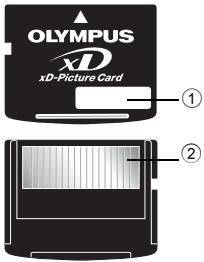
text_image
OLYMPUS XD xD-Picture Card ① ②Compatible cards
xD-Picture Card (16MB - 1GB)
Using the internal memory or card
You can confirm on the monitor whether the internal memory or card is being used during shooting and playback operations.
Shooting mode
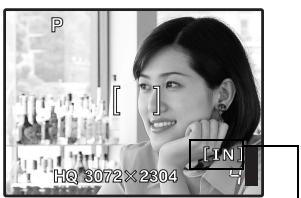
text_image
P HQ 3072×2304Playback mode
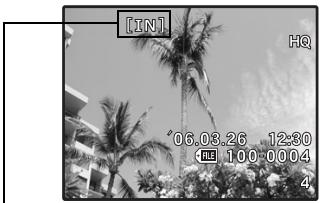
natural_image
Black-and-white photo of palm trees and a building with no visible text or symbolsMemory indicator
Inserting and removing the card
1 Turn off the camera
2 Open the battery compartment/card cover.
Inserting the card
3 Orient the card as shown, and insert it into the card slot as shown in the illustration.
- Insert the card straight in.
- Insert the card until it clicks into place.
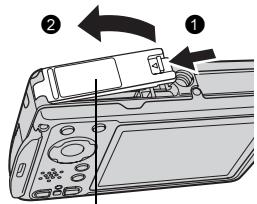
text_image
Diagram of a device rear panel with labeled components and directional arrows indicating movement or assembly.Battery compartment/card cover
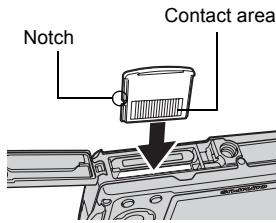
text_image
Notch Contact areaRemoving the card
3 Push the card all the way in and release slowly.
- The card protrudes slightly and stops.
- Grasp the card and remove.
4 Close the battery compartment/card cover.
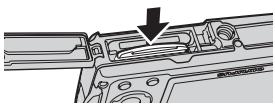
natural_image
Technical diagram of a mechanical component with an arrow indicating a process or assembly (no text or symbols present)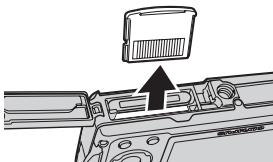
natural_image
Diagram of a mechanical component with an arrow indicating assembly or insertion (no text or symbols present)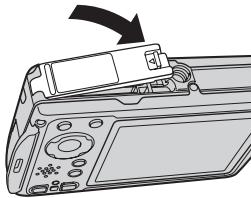
natural_image
Diagram of a camera module with an arrow indicating rotation or change (no text or symbols present)
Note
- The card access lamp blinks while the camera is reading the images. Reading of images may take some time. Do not open the battery compartment/card cover while the card access lamp is blinking. Doing so may damage the data in the internal memory or the card and render the internal memory or card unusable.
Card access lamp
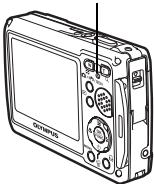
natural_image
Line drawing of a Olympus digital camera with control panel and antenna (no text or symbols)AC adapter
An AC adapter is useful for time-consuming tasks such as image downloads to a computer or when running a slideshow for a long period of time. To use an AC adapter for this camera, the multi-adapter (CB-MA1/accessory) is required. Do not use any other AC adapter with this camera.

Note
- Do not remove or load the battery or connect or disconnect the AC adapter or the multi-adapter while the camera is turned on. Doing so could affect the camera's internal settings or functions.
- The AC adapter can be used within the range of AC 100 V to AC 240 V (50/60 Hz).
- When using abroad, you may need a plug adapter to convert the plug to match the AC wall outlet. For details, ask at your local electrical shop or travel agent.
- Do not use travel voltage converters as they could damage your AC adapter.
- The water resistant feature of the camera won't be activated when the AC adapter is used.
- Be sure to read the instruction manual for the AC adapter.
Caution for Usage Environment
- To protect the high-precision technology contained in this product, never leave the camera in the places listed below, no matter if in use or storage:
- Places where temperatures and/or humidity are high or go through extreme changes. Direct sunlight, beaches, locked cars, or near other heat sources (stove, radiator, etc.) or humidifiers.
• In sandy or dusty environments. - Near flammable items or explosives.
- In wet places, such as bathrooms or in the rain. When using products with weatherproof designs, read their manuals as well.
• In places prone to strong vibrations. - Never drop the camera or subject it to severe shocks or vibrations.
- When mounted on a tripod, adjust the position of the camera with the tripod head. Do not twist the camera.
- Do not touch electric contacts on cameras.
- Do not leave the camera pointed directly at the sun. This may cause lens or shutter curtain damage, color failure, ghosting on the CCD, or may possibly cause fires.
- Do not push or pull severely on the lens.
- Before storing the camera for a long period, remove the battery. Select a cool, dry location for storage to prevent condensation or mold from forming inside the camera. After storage, test the camera by turning it on and pressing the shutter release button to make sure that it is operating normally.
- Always observe the operating environment restrictions described in the camera's manual.
Battery Handling Precautions
- This camera uses a lithium ion battery specified by Olympus. Do not use any other type of battery. For safe and proper use, read the battery's instruction manual carefully before using it.
- If the battery's terminals get wet or greasy, camera contact failure may result. Wipe the battery well with a dry cloth before use.
- Always charge a battery when using it for the first time, or if it has not been used for a long period.
- When operating the camera with battery power at low temperatures, try to keep the camera and spare battery as warm as possible. A battery that has run down at low temperatures may be restored after it is warmed at room temperature.
- The number of pictures you can take may vary depending on the shooting conditions or battery.
- Before going on a long trip, and especially before traveling abroad, purchase extra batteries. A recommended battery may be difficult to obtain while traveling.
- Please recycle batteries to help save our planet's resources. When you throw away dead batteries, be sure to cover their terminals and always observe local laws and regulations.
LCD Monitor
- Do not push the monitor forcibly; otherwise the image may become vague, resulting in a playback mode failure or damage to the monitor.
- A strip of light may appear on the top/bottom of the monitor, but this is not a malfunction.
- When a subject is viewed diagonally in the camera, the edges may appear zigzagged on the monitor. This is not a malfunction; it will be less noticeable in playback mode.
- In places subject to low temperatures, the LCD monitor may take a long time to turn on or its color may change temporarily. When using the camera in extremely cold places, it is a good idea to occasionally place it in a warm place. An LCD monitor exhibiting poor performance due to low temperatures will recover in normal temperatures.
- The LCD used for the monitor is made with high-precision technology. However, black spots or bright spots of light may appear constantly on the LCD Monitor. Due to its characteristics or the angle at which you are viewing the monitor, the spot may not be uniform in color and brightness. This is not a malfunction.
Legal and Other Notices
- Olympus makes no representations or warranties regarding any damages, or benefit expected by using this unit lawfully, or any request from a third person, which are caused by the inappropriate use of this product.
- Olympus makes no representations or warranties regarding any damages or any benefit expected by using this unit lawfully which are caused by erasing picture data.
Disclaimer of Warranty
- Olympus makes no representations or warranties, either expressed or implied, by or concerning any content of these written materials or software, and in no event shall be liable for any implied warranty of merchantability or fitness for any particular purpose or for any consequential, incidental or indirect damages (including but not limited to damages for loss of business profits, business interruption and loss of business information) arising from the use or inability to use these written materials or software or equipment. Some countries do not allow the exclusion or limitation of liability for consequential or incidental damages, so the above limitations may not apply to you.
- Olympus reserves all rights to this manual.
Warning
Unauthorized photographing or use of copyrighted material may violate applicable copyright laws. Olympus assumes no responsibility for unauthorized photographing, use or other acts that infringe upon the rights of copyright owners.
Copyright Notice
All rights reserved. No part of these written materials or this software may be reproduced or used in any form or by any means, electronic or mechanical, including photocopying and recording or the use of any type of information storage and retrieval system, without the prior written permission of Olympus. No liability is assumed with respect to the use of the information contained in these written materials or software, or for damages resulting from the use of the information contained therein. Olympus reserves the right to alter the features and contents of this publication or software without obligation or advance notice.
FCC Notice
• Radio and Television Interference
Changes or modifications not expressly approved by the manufacturer may void the user's authority to operate this equipment. This equipment has been tested and found to comply with the limits for a Class B digital device, pursuant to Part 15 of the FCC Rules. These limits are designed to provide reasonable protection against harmful interference in a residential installation.
This equipment generates, uses, and can radiate radio frequency energy and, if not installed and used in accordance with the instructions, may cause harmful interference to radio communications.
However, there is no guarantee that interference will not occur in a particular installation. If this equipment does cause harmful interference to radio or television reception, which can be determined by turning the equipment off and on, the user is encouraged to try to correct the interference by one or more of the following measures:
- Adjust or relocate the receiving antenna.
- Increase the distance between the camera and receiver.
- Connect the equipment to an outlet on a circuit different from that to which the receiver is connected.
- Consult your dealer or an experienced radio/TV technician for help. Only the OLYMPUS-supplied USB cable should be used to connect the camera to USB enabled personal computers (PC).
Any unauthorized changes or modifications to this equipment would void the user's authority to operate.
Red-eye reduction flash ..... 12
↓ Fill-in flash 12
④ Flash off 12
Super macro mode ..... 13
Macro mode 13
button (print) 13
OK button (OK/FUNC) 10
/SCN button (Shooting) .... 9
▶ button ( playback) ..... 10
△ button (exposure compensation) 12
button (self-timer/erase) .. 12
button (flash mode) 12
button (macro) 13
A
AC adapter 76
AF lock 8
AF MODE 21
ALARM CLOCK ⬆ 35
ALBUM 28
ALBUM ENTRY 27
Album playback menus 29
ALL ERASE 28
ALL INDEX 40
ALL PRINT 40
All-frame reservation [ALL] 44
Arrow pad (△▽◇) 10
AUTO (Auto-flash) 12
AUTO (Full auto mode) 10
AUTO (ISO) 19
AUTO (WB) WB AUTO 19
Auto focus 58
AV cable 36
B
BACKUP 31
Battery 73,75
Battery compartment/card cover .. 75
BEEP 32
BGM 22
BLACK & WHITE 24
BRIGHTNESS 25
C
CALENDAR 24, 25
Calendar display 11
CAMERA MENU 19
Card 21,31,74
Card access lamp ..... 52, 62, 76
CCD 34,70
Close-up playback Q ..... 11
Cloudy day 19
COLOR 32
Compression 17
Connector cover 36,50
CUSTOM PRINT 40
D
Date and time ⏻ 34
Digital image stabilization ( ) ..... 9
DIGITAL ZOOM 20
Direct printing 38
DPOF 43,70
DRIVE 20
DUALTIME 35
E
EASY PRINT 38
EDIT 24
Erase 28
Erasing pictures 13
Error message 66
ESP 20,70
ESP/20
EV 12,70
Exposure compensation ☒ ..... 12
F
FILE NAME 33
Flash charge 57
Flash mode 12
Fluorescent lamp 1/2/3 123..19
Focus 8,9
Focus lock 8
FORMAT 31
FRAME 24
Frame number 30
Function menu 10
H
High speed sequential shooting 20
HQ 17
|
iESP 21
IMAGE QUALITY 17
Image size 17,70
INDEX 24,25
Index display 11
Internal memory 31
ISO 19,71
J
JPEG 71
L
Lithium ion battery 73
M
MENU button (MENU) ..... 11, 14
MEMORY FORMAT .... 31
Memory gauge 57
Menu 14
Microphone 26
Monitor brightness adjustment 34
MOVIE PLAY 23
MULTI PRINT 40
Multi-connector ..... 36, 38, 50
N
NTSC 36,71
Number of storable still pictures . . . 61
0
OLYMPUS Master 46
Optical zoom 11, 20
P
P (Program auto) 10
P/AUTO 10
PAL 36,71
PANORAMA 21
PC 50
PictBridge 38,71
Picture rotation ↩ 26
PIXEL MAPPING 34
Pixels 71
PLAYBACK MENU 22
Playback mode ▶ 22
Playback on a TV 36
Playing time/Total recording time .. 23
POWER button 8
Press fully 8
Press halfway 8
PRINT ORDER □ 26
Print settings □ 43
Printing pictures 37
Program auto 10,71
Protect 0π 26
PW ON SETUP 32
R
REC VIEW 33
Recording length 61
Recording sound 26
Recording sound with still pictures ♪
21
REDEYE FIX 24
Remaining recording time 9
RESET 18
Resizing 24
S
SCN (Scene) 9, 18
SATURATION 25
SCREEN SETUP 32
SEL. ALBUM 29
SEL. IMAGE 27, 28, 30
SELECT JACKET 30
Selecting a language 🔒 ..... 32
Self-timer lamp 12,62
Self-timer ⚙ 12
SEPIA 24
Sequential shooting □...... 20
SET ALL 27
SET CALENDAR 27
SETUP menus 31
SHOOT & SELECT 1/2 □, □... 19
Shooting mode 11, 17
Shooting movies 9
Shooting still pictures 📄 8
SHQ 17
Shutter button 8
SHUTTER SOUND 33
Single-frame erase 🏠 28
Single-frame reservation □ ..... 44
Single-frame shooting □ ..... 20
Sleep mode 57, 71
SLIDESHOW 22
SPOT (AF MODE) 21
Spot metering ☐ 20
SQ 17
SQ1 17
SQ2 17
STANDARD 38
Sunny day 🙏 19
T
TITLE 25
Top menu 14
Tungsten light ⚙ 19
Turning on the camera 📷 .... 32
TYPE 22
U
Under Water Macro 8
Under Water Snap ⚙ 8
Under Water Wide1 8
UNDO ALL 30
UNDO ENTRY (ALBUM ENTRY) .. 30
USB cable .....38, 46, 50, 53
USB driver 47,56
V
VIDEO OUT 36
VOLUME 33
W
Warning sound ■)) 32
White balance WB 19
X
xD-Picture Card 21,74
Z
Zoom 11,20
Zoom button 11
OLYMPUS®
http://www.olympus.com/
OLYMPUS IMAGING CORP.
Shinjuku Monolith, 3-1 Nishi-Shinjuku 2-chome, Shinjuku-ku, Tokyo, Japan
OLYMPUS IMAGING AMERICA INC.
Two Corporate Center Drive, P.O. Box 9058, Melville, NY 11747-9058, U.S.A. Tel. 631-844-5000
Technical Support (USA)
24/7 online automated help: http://www.olympusamerica.com/support
Phone customer support: Tel. 1-888-553-4448 (Toll-free)
Our phone customer support is available from 8 am to 10 pm
(Monday to Friday) ET
E-Mail: distec@olympus.com
Olympus software updates can be obtained at: http://www.olympus.com/digital
OLYMPUS IMAGING EUROPA GMBH
Premises: Wendenstrasse 14-18, 20097 Hamburg, Germany
Tel: +49 40-23 77 3-0 / Fax: +49 40-23 07 61
Goods delivery: Bredowstrasse 20, 22113 Hamburg, Germany
Letters: Postfach 10 49 08, 20034 Hamburg, Germany
European Technical Customer Support:
Please visit our homepage http://www.olympus-europa.com
or call our TOLL FREE NUMBER*: 00800 - 67 10 83 00
for Austria, Belgium, Denmark, Finland, France, Germany, Italy, Luxemburg, Netherlands, Norway, Portugal, Spain, Sweden, Switzerland, United Kingdom
* Please note some (mobile) phone services providers do not permit access or request an additional prefix to +800 numbers.
For all European Countries not listed and in case that you can't get connected to the above mentioned number, please make use of the following
CHARGED NUMBERS: +49 180 5 - 67 10 83 or +49 40 - 237 73 899
Our Technical Customer Support is available from 9 am to 6 pm MET (Monday to Friday)