
LS-10 - Audio recorder OLYMPUS - Free user manual and instructions
Find the device manual for free LS-10 OLYMPUS in PDF.


| Product type | Digital audio recorder |
| Brand | Olympus |
| Model | LS-10 |
| Dimensions (approx.) | 130 x 40 x 18 mm |
| Weight (approx.) | 100 g (with batteries) |
| Power supply | 2 AAA batteries (LR03) or USB AC adapter |
| Main functions | MP3/WAV recording, built-in stereo microphone, built-in speaker, noise reduction, playback, headphone listening |
| Storage capacity | Internal memory (2 GB) + microSD/SDHC card |
| Recording formats | MP3 (32-320 kbps), WAV (16-bit/44.1 kHz) |
| Connectivity | USB 2.0 (mini-USB), 3.5 mm headphone jack, 3.5 mm external microphone jack |
| Maintenance and cleaning | Clean the device with a soft, dry cloth. Do not use solvents |
| Safety | Do not expose to moisture, shocks, or extreme temperatures. Only use recommended batteries |
| Spare parts and repairability | Batteries, headphones, USB cable, remote control (optional). Repair by authorized center |
| General information | Portable stereo recorder ideal for conferences, interviews, and voice notes |
Frequently Asked Questions - LS-10 OLYMPUS
User questions about LS-10 OLYMPUS
0 question about this device. Answer the ones you know or ask your own.
Ask a new question about this device
Download the instructions for your Audio recorder in PDF format for free! Find your manual LS-10 - OLYMPUS and take your electronic device back in hand. On this page are published all the documents necessary for the use of your device. LS-10 by OLYMPUS.
USER MANUAL LS-10 OLYMPUS
Linear PCM Recorder INSTRUCTIONS

Introduction
- The contents of this document may be changed in the future without advanced notice. Contact our Customer Support Center for the latest information relating to product names and model numbers.
- The utmost care has been taken to ensure the integrity of the contents of this document. In the unlikely event that a questionable item, error, or omission is found, please contact our Customer Support Center.
- Any liability for passive damages or damage of any kind occurred due to data loss incurred by a defect of the product, repair performed by the third party other than Olympus or an Olympus authorized service station, or any other reason is excluded.
Trademarks and registered trademarks
- IBM and PC/AT are the trademarks or registered trademarks of International Business Machines Corporation.
- Microsoft, Windows and Windows Media are registered trademarks of Microsoft Corporation.
- Macintosh and iTunes are the trademarks of Apple Inc.
- The SD logo is a trademark.
- The SDHC logo is a trademark.
MPEG Layer-3 audio coding technology licensed from Fraunhofer IIS and Thomson. - EUPHONY MOBILE™ is a trademark of DiMAGIC Corporation.
- DVM™ is a trademark of DiMAGIC Corporation.
Other product and brand names mentioned herein may be the trademarks or registered trademarks of their respective owners.




Table of Contents
Introduction
Table of Contents. 3
Safe and Proper Usage 4
1 Getting Started
Main Features 6
Identification of Parts 7
Display (LCD Panel) 8
Inserting Batteries. 9
Using the AC Adapter 10
Power Supply 11
HOLD 11
Setting Time and Date [Time & Date] 12
Changing the Time and Date. 13
Inserting and Ejecting a Card 14
Inserting a Card 14
Ejecting a Card 15
Notes on the Folders 16
About the Folders for Voice Recordings 16
About the Folder for Music Playback 17
Selecting the Folders and Files 18
2 About Recording
Before Recording. 19
Turn the Microphone Toward the Original Sound Source. 19
Recording 20
Listening While Audio is Recorded 24
Set the Low Cut Filter 24
Microphone Sensitivity 24
Recording from External Microphone or Other Devices 25
3 About Playback
Playingback. 27
Playback Through Earphone 30
How to Begin Segment Repeat Playback.....30
Erasing 32
Erasing One File at a Time 32
Erase All Files from a Folder 32
4 Menu Setting
Menu Setting Method 34
Formatting the Recorder [Format] 43
Rearranging Files [Replace]. 45
5 Using the Recorder on Your PC
Operating Environment 46
Connecting to Your PC. 47
Disconnecting from Your PC 48
Transfer the Voice Files to Your PC 49
Using Windows Media Player 50
Window Names. 50
Copying Music from CD. 51
Transferring Music File to the Recorder 52
Copying Voice File to the CD 55
Using iTunes 57
Window Names. 57
Copying Music from CD. 58
Transferring Music File to the Recorder 59
Copying Voice File to the CD 60
Using as External Memory of the PC 61
6 Other Information
Alarm Message List. 62
Troubleshooting 63
Technical Assistance and Support 65
Accessories (optional) 65
Specifications 66
Safe and Proper Usage
Before using your new recorder, read this manual carefully to ensure that you know how to operate it safely and correctly. Keep this manual in an easily accessible location for future reference.
- The warning symbols indicate important safety related information. To protect yourself and others from personal injury or damage to property, it is essential that you always read the warnings and information provided.
General Precautions
- Do not leave the recorder in hot, humid locations such as inside a closed automobile under direct sunlight or on the beach in the summer.
- Do not store the recorder in places exposed to excessive moisture or dust.
- Do not use organic solvents such as alcohol and lacquer thinner to clean the unit.
- Do not place the recorder on top of or near electric appliances such as TVs or refrigerators.
- Avoid recording or playing back near cellular phones or other wireless equipment, as they may cause interference and noise. If you experience noise, move to another place, or move the recorder further away from such equipment.
- Avoid sand or dirt. These can cause irreparable damage.
-
Avoid strong vibrations or shocks.
-
Do not disassemble, repair or modify the unit yourself.
- Do not operate the unit while operating a vehicle (such as a bicycle, motorcycle, or go-cart).
- Keep the unit out of the reach of children.
- When mounting the recorder to a tripod, turn the screws on the tripod side without turning the recorder itself.
Recorded content in memory may be destroyed or erased by operating mistakes, unit malfunction, or during repair work.
It is recommended to back up and save important content to other media such as a computer hard disk.
Any liability for passive damages or damage of any kind occurred due to data loss incurred by a defect of the product, repair performed by the third party other than Olympus or an Olympus authorized service station, or any other reasons is excluded from the Olympus's liability.
Batteries
Warning
- Batteries should never be exposed to flame, heated, short-circuited or disassembled.
- Do not attempt to recharge alkaline, lithium or any other non-rechargeable batteries.
- Never use any battery with a torn or cracked outer cover.
- Keep batteries out of the reach of children.
- If you notice anything unusual when using this product such as abnormal noise, heat, smoke, or a burning odor:
① remove the batteries immediately while being careful not to burn yourself, and;
② call your dealer or local Olympus representative for service.
AC Adapter
Warning
- Do not attempt to disassemble, repair or modify the AC adapter in any way.
- Keep foreign objects including water, metal, or flammable substances from getting inside the product.
- Do not moisten the AC adapter or touch it with a wet hand.
- Do not use the AC adapter in the vicinity of flammable gas (including gasoline, benzine and lacquer thinner).
In case
- ... the internal parts of the AC adapter are exposed because it has been dropped or otherwise damaged:
- ... the AC adapter is dropped in water, or if water, metal flammable substances or other foreign objects get inside it:
- ... you notice anything unusual when using the AC adapter such as abnormal noise, heat, smoke, or a burning odour:
① do not touch any of the exposed parts;
② immediately disconnect the power supply plug from the power outlet, and;
③ call your dealer or local Olympus representative for servicing. Continued use of the AC adapter under these circumstances could result in electric shock, fire or injury.
Main Features
- Utilizes a high sensitivity, low noise stereo microphone capable of faithfully capturing the original sound.
Machined metal components are utilized in the housing for the built-in stereo microphone, resulting in a design built with special features in mind while also achieving a construction which is resistant to vibration. Furthermore, by turning the microphone itself 90^ outwards you can produce recordings with a natural and expansive stereo feel to them.
- Equipped with a high sound quality amplifier circuit.
Utilizes a low noise amplifier circuit, allowing you to produce high sound quality recordings with low noise.
Supports the linear PCM format, which is capable of recording sound quality equivalent to or surpassing CD-level.
Capable of realistically recording various different sound sources. High resolution recording at a high sampling frequency and bit count equivalent or superior to that of a music CD (Sampling frequency 44.1 kHz, Bit count 16bit) is possible (P.34, P.36).
Supports a wide range of recording formats. Can handle the MP3 format (MPEG-1/ MPEG-2 Audio Layer 3), and the Windows Media Audio (WMA) format.
In supporting the MP3 and WMA formats, this device can save files in a highly compressed manner, thereby allowing for extended recording times (P.34, P.36). In addition, when connected to an external device, the recorder can encode incoming analog audio signals without a PC (P.26).
Supports high capacity recording media. Starting with its 2 GB built-in flash memory, can also record onto an SD Card (commercially available) (eP.14).
Check the Olympus website regarding SD cards which are confirmed operation with this recorder (E P.65).
- Equipped with a variety of features that support audio recording.
With this recorder you can customize a variety of recording functions such as the recording level and microphone sensitivity to suit the recording conditions and personal preferences (P.34, P.36). - Allows for system upgrades through enhanced options and equipment. Further enhances the pleasure of recording (P65).
- Can playback WAV, WMA, and MP3 format files sent from a computer in addition to files recorded by the device itself. Can be enjoyed as a music player at any time. Can hold approximately 500 music files (WMA 128 kbps/4 minutes per song conversion) (P.27, P.28, P.50, P.57).
Supports USB 2.0. Hi-Speed, which enables high-speed data transmission as an external memory device for your computer.
By connecting the computer with the USB, pictures, text data, etc. can be saved, and utilized to carry data (P.49, P.61).
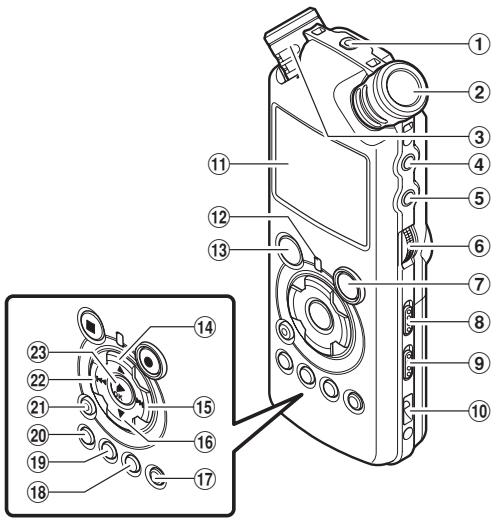
① REMOTE jack
Connect the receiver for the exclusive remote control set RS30W (optional). This enables operation of the main unit's record and stop functions through the remote control.
② Built-in stereo microphone (R)
③ Built-in stereo microphone (L)
④ LINE IN jack
⑤ MIC jack
⑥REC LEVEL dial
⑦REC ● button Recording ind
MIC SENSE HIGH/LOW switch
⑨ LOW CUT ON/OFF switch (Auto Gain Control)
⑩ Trap hole
⑪ Display (LCD panel)
⑫ PEAK indicator light (LED)
STOP button
14▲button
15▶I button
16▼ button
⑰ LIST button
18 MENU button
19 A-B REPEAT button
20 Fn button
② ERASE button
221 button
23 OK button
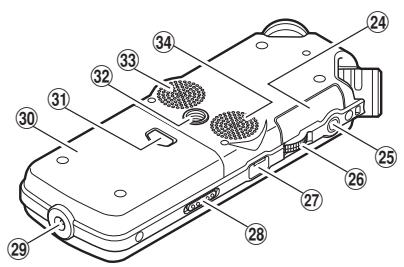
24 Card cover
25 EAR jack
26 VOLUME dial
2 USB terminal
28 POWER/HOLD switch
29 Power jack
30 Battery cover
③ Battery cover release button
③ Tripod socket
Built-in stereo speaker (R)
34 Built-in stereo speaker (L)
Display (LCD Panel)
Folder List Display
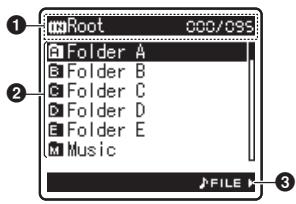
1 Root folder indicator
Folder indicator
Recording media indicator or folder indicator/ Root folder name/ Current file number/ Total number of recorded files in the folder
2 Folder name
3 Guide indicator
File List Display
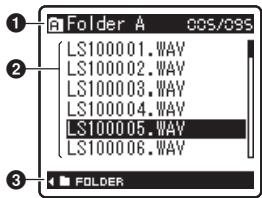
1 Folder/ File indicator
Folder name/ Current file number/ Total number of recorded files in the folder
2 File name
3 Guide indicator
File Display
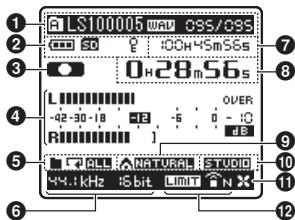
1 Folder/ File indicator
Folder name/ File name/ File format/ Current file number/ Total number of recorded files in the folder
Battery indicator
Recording media indicator
[100] Built-in flash memory
[SD] SD card
Erase lock indicator
Record/Playback status indicator
4 Level meter
⑤Playback Mode indicator
Recording mode indicator
During recording mode:
Remaining recording time
During playback or stop mode:
File length
During recording mode:
Elapsed recording time
During playback mode:
Elapsed playingback time
[EPUPHONY] indicator
[Reverb] indicator
1 [LowCutFilter] indicator
12 [Limiter] indicator
[Zoom Mic] indicator
Inserting Batteries
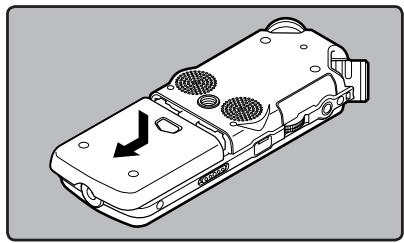
1 Press the battery cover release button, and then slide the battery cover open while lightly pressing down on it.
2 Insert two AA batteries with the correct and polarities.
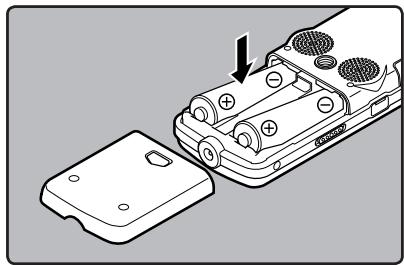
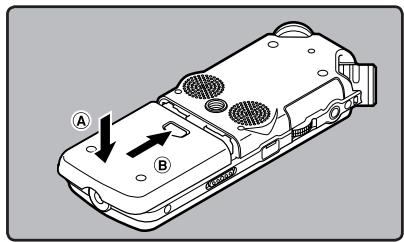
3 Close the battery cover completely by pressing to the direction A, then sliding to the direction B.
4 Slide the POWER/HOLD switch in the direction indicated by the arrow, and turn the power on.
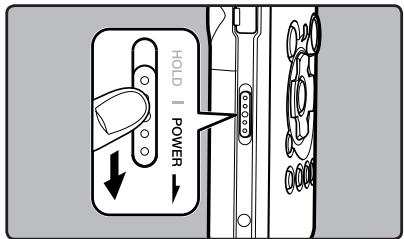
- If the [hour] indicator flashes in the display, see "Setting Time and Date [Time & Date]" (E&P P.12).
Replacing batteries
The battery indicator on the display changes as the batteries lose power.

- When [ ] appears on the display, replace the batteries as soon as possible. When the battery is too weak, [ ] and [ Battery Low] appears on the display and the recorder shuts down.
- When changing batteries, AA alkaline batteries or Olympus Ni-MH Rechargeable Batteries are recommended.
Ni-MH Rechargeable Battery
Ni-MH rechargeable batteries B-01 4PE (optional) from Olympus can be used in the recorder. Use them with the Olympus Ni-MH Rechargeable Battery Charger B-90SU (optional) (For U.S.A. and Canada) or BU-90SE (optional) (For Europe) (E3 P.65).
Notes
- Manganese battery may not be used in this recorder.
- This recorder cannot charge rechargeable batteries.
- Be sure to turn off power of the recorder before replacing the batteries (P.11). Unloading the batteries while the recorder is in use may corrupt the file. If you are recording into a file and the batteries run out, you will lose your currently recorded file because the file header will not be able to close. It is crucial to change the batteries once you see only one Hash mark in the battery icon.
- If it takes longer than 15 minutes to replace the dead battery or if you take the battery in and out repeatedly at short intervals, you may have to reset the time when you have loaded a fresh battery (P.12).
- Remove the batteries if you are not going to use the recorder for an extended period of time.
- When playing a voice/music file, the recorder may be reset due to the reduction of the voltage output of the battery depending on the volume level even if [f=0] is displayed in the battery indicator. In this case, lower the volume of the recorder.
Using the AC Adapter
Plug the AC adapter (optional) into a household power outlet and connect the power plug to the recorder's power connector (DC 5V). Always turn the recorder's power off before connecting.
If the AC adapter is plugged in while recording using batteries, it may not be possible to play back the voice data being recorded.
- Check the Olympus website regarding AC adapters which can be used with this recorder.
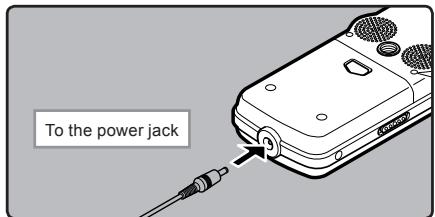
Warning
Always turn the recorder's power off before connection or disconnection.
- When the AC adapter is not in use, disconnect the power supply plug from the power outlet.
- Use only the correct power supply voltage as indicated on the adapter.
- Do not use the AC adapter when connecting the recorder to the USB port.
Power Supply
When the recorder is not being used, turn the power off to reduce battery consumption to a minimum. Even if the power is turned off, existing data, mode settings, and clock settings will be maintained.
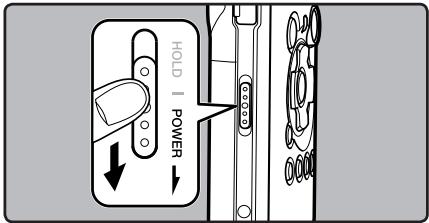
Turning On the Power:
While the recorder's power is off, slide the POWER/HOLD switch in the direction indicated by the arrow.
- The display will turn on, and the power will be turned on.
- The resume function will bring the recorder back to the stop position in memory before power was turned off.
- When the batteries are removed from the recorder the resume function's stopped position will be erased.
Turning Off the Power:
Slide the POWER/HOLD switch in the direction indicated by the arrow for 1 second or longer.
- The display shuts off and the power will be turned off.
- The resume function remembers the stop position before the power is turned off.
Power save mode [Auto Power Off]
If the recorder is stopped/not used for over 10 minutes (initial setting) while the power is turned on, the power will be turned off (P.34, P.40).
- If any button is pressed prior to the battery turning off, the elapsed time count will start over again until this function takes effect.
HOLD
If you bring the POWER/HOLD switch to the [HOLD] position, the current conditions will be preserved, and all buttons will be disabled. This feature is useful when the recorder has to be carried in a bag or pocket.
Set the recorder to HOLD mode
Slide the POWER/HOLD switch to the [HOLD] position.
- After [Hold] appears on the display, the recorder is set to HOLD mode.
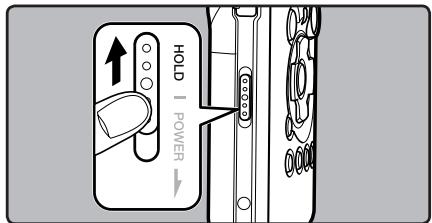
Exit HOLD mode
Slide the POWER/HOLD switch to the A position.
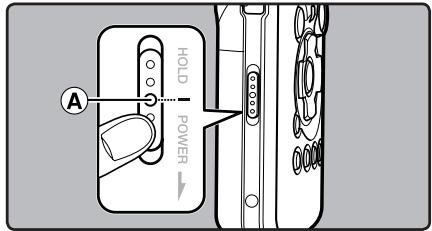
Notes
- If you press any button in HOLD mode, the clock display flashes for 2 seconds, but it will not operate the recorder.
-
If HOLD is applied during playback (recording), operation is disabled with the playback (recording) state unchanged (When playback has ended and the recording has ended due to the remaining memory being used up, it will stop).
-
The recorder can be effectively operated via its switch and dial, as well as the connected exclusive remote control set RS30W (optional), even when it is in HOLD mode.
Setting Time and Date [Time & Datel
If you set the time and date beforehand, the information when the file is recorded is automatically stored for each file. Setting the time and date beforehand enables easier file management.
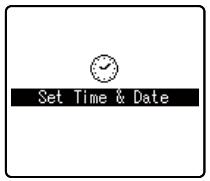
When you use the recorder for the first time after purchasing it, or when the batteries have been inserted without the device having been used in a long time, the [Set Time & Date] will appear. When the [hour] is flashing, conduct the setup from Step 1.
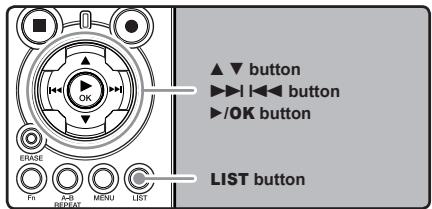
1 Press the or I button to select the item to set.
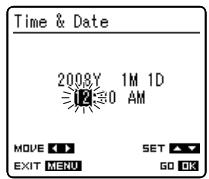
Select the item from [hour],[minute],[year][month] and [day] with a flashing point
2 Press the or button to set. Follow the same steps by pressing t
or button to select the next item, and press the or button to set.
- You can select between 12 and 24 hour display by pressing the LIST button while setting the hour and minute.
Example: 10:38 P.M

- You can select the order of the [year], [month], [day] by pressing the LIST button while setting them.
Example: January 7, 2008
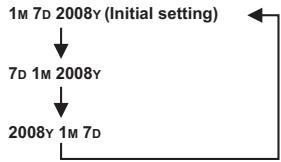
Press the OK button to complete the setup screen.
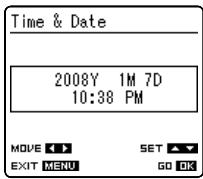
The clock will start from the set date and time. Press the OK button according to the time signal.
Note
- If you press the OK button during the setup operation, the recorder will save the items that were set to that point.
Changing the Time and Date
While the recorder is during stop mode, press and hold the STOP button to display the Time and Date, Remaining Memory and File Format.
If the Time and Date is not correct, set it using the procedure below.
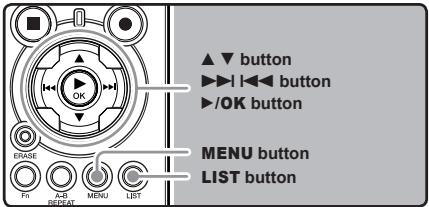
1 While the recorder is during stop mode, press the MENU button.
- The menu will appear on the display. You can also change to [Others] screen by using the settings tab (P.34).
2 Press the or button to select [Time & Date].
![OLYMPUS LS-10 - Press the or button to select [Time & Date]. - 1](/content/2025/01/84083/images/a39db4a3a1e63d4b49a2493bbbc76af5016fb1ff99cc0eceb85f35ce8c365f96.jpg)
[Time & Date] will appear on the display
Press the OK or I button.
- [hour] will flash on the display, indicating the start of the Time and Date setup process.
The following steps are the same as Step 1 through Step 3 of "Setting Time and Date [Time & Date]" (e- P.12).
4 Press the MENU button to close the menu screen.
Inserting and Ejecting a Card
This recorder can be used with commercially available SD Cards as well as the built-in flash memory.
Inserting a Card
1
e e
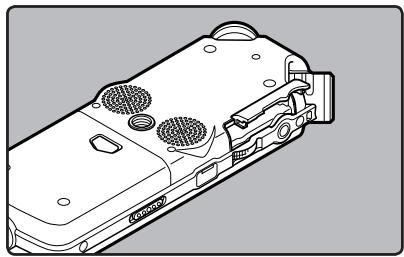
1 While the recorder is during stop mode, open the card cover.
2 Face the card the correct way and insert it into the card slot as shown in the diagram.
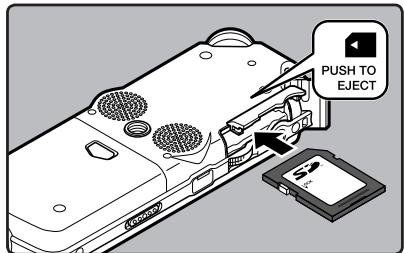
- Insert the card keeping it straight.
- The card stops with a click when it is inserted all the way.
- Inserting the card the wrong way or at an angle could damage the contact area or cause the card to jam.
- If the card is not inserted all the way, data may not be written to the card.
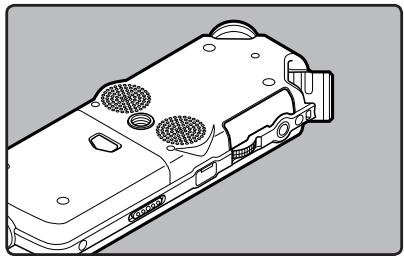
3 Close the card cover securely.
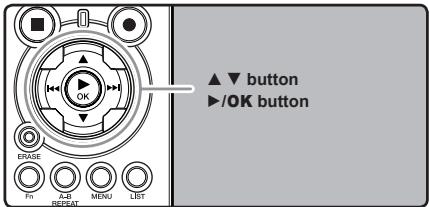
4 When you are recording to a card, press the or button and select [Yes].
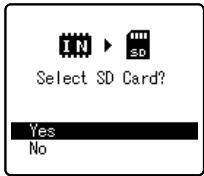
When you insert the card, the recording media changeover display will appear
Press the OK button to complete the setup screen.
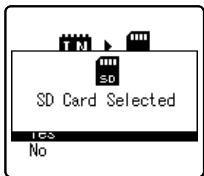
Notes
It is possible to switch the recording media over to the built-in flash memory (P.34, P.39).
- In some cases cards which have been formatted (initialized) by another device, such as a computer, cannot be recognized. Be sure to format them with this recorder before using (P.43).
- When attempting to perform operations such as rewriting the contents of an SD Card in cases where the card has been write protected, [SD Card Locked] will appear. The playback operation can be performed, but the write protection must first be turned off when overwriting the contents on the card.
- Cards that are not to SD standards, such as multimedia cards, may not be used.
Ejecting a Card
1 While the recorder is during stop mode, open the card cover.
2 Push the card inward to unlock it, and let it eject partially.
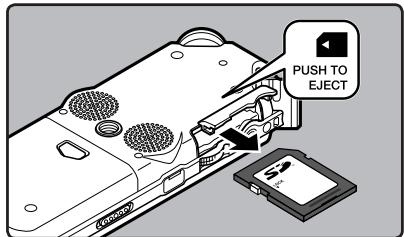
The card is visibly out of the slot and can be removed safely.
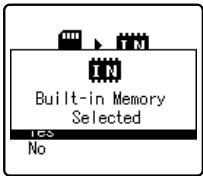
When [MemorySelect] is set to [SD Card], [Built-in Memory Selected] will appear
3 Close the card cover securely.
Note
- Releasing your finger quickly after pushing the card inward may cause it to eject forcefully out of the slot.
About the SD Card
When the SD Card is write protected, there will be a display reading [SD Card Locked]. Before inserting the card, turn off the write protection function. Check the Olympus website regarding SD cards which are confirmed operation with this recorder (P.65).
If the write protection switch is facing the [LOCK] direction, recording and other functions cannot be carried out
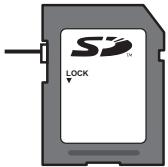
Notes
- The recorder may not recognize correctly on some SD cards. In this case, remove the card then put it again to see if the recorder recognizes the card.
- The processing performance reduces in a SD card when you repeat writing and delete. In this case, format the SD card (P.43).
Notes on the Folders
The built-in flash memory or the SD Card can be used for the recording media. Regardless of the recording media, voice files and music files are separated into folders for voice recordings and folders for music playback that are organized in a branching tree-style and saved.
About the Folders for Voice Recordings
[Folder A] - [Folder E] are the folders for voice recordings. When recording with the recorder, select any one of the five folders and then record.
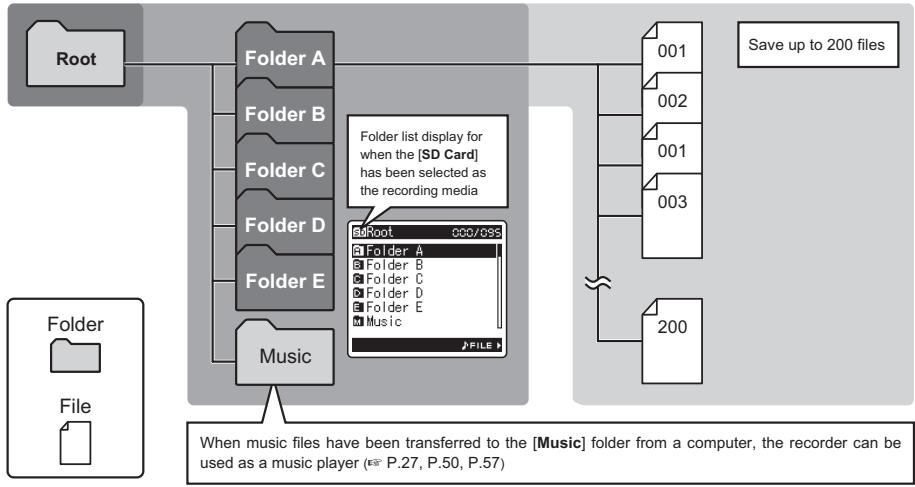
File names will be automatically created for files recorded by this recorder.
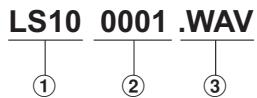
①User ID: The name that has been set on the Digital Voice Recorder.
② File number: A file number is consecutively assigned regardless of the changes in the recording media.
③ Extension: These are the file name extensions for the recording format when recording with this device.
- Linear PCM format .WAV
- MP3 format .MP3
WMA format .WMA
About the Folder for Music Playback
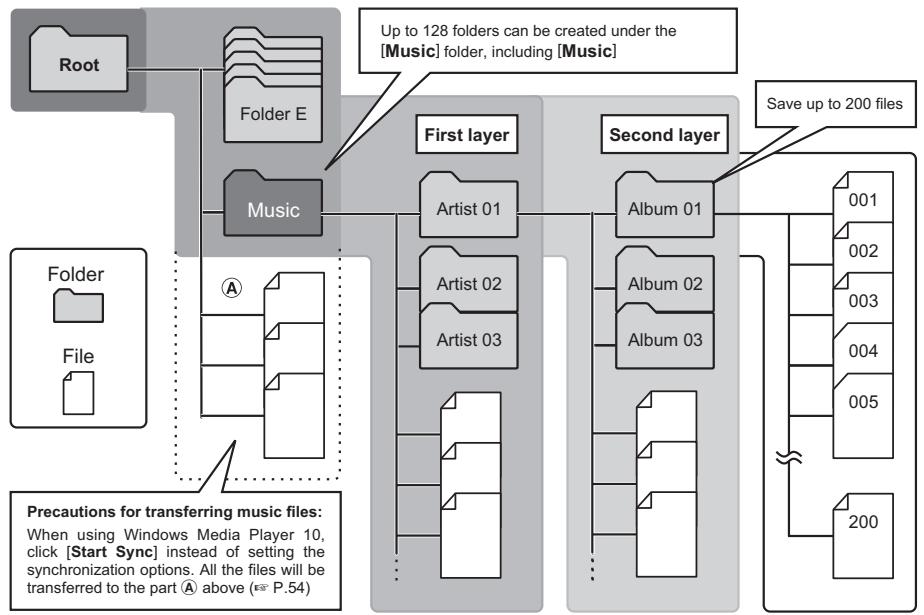
When transferring music files to the device using Windows Media Player, a folder is automatically created within the music playback folder which has a layered structure as shown in the diagram below. Music files that are in the same folder can be rearranged in preferential order and replayed (P.45).
Selecting the Folders and Files
Change folders while the operation is stopped. For information on the layered structure of the folders, see the section entitled "Notes on the Folders" (E5 P.16, P.17).
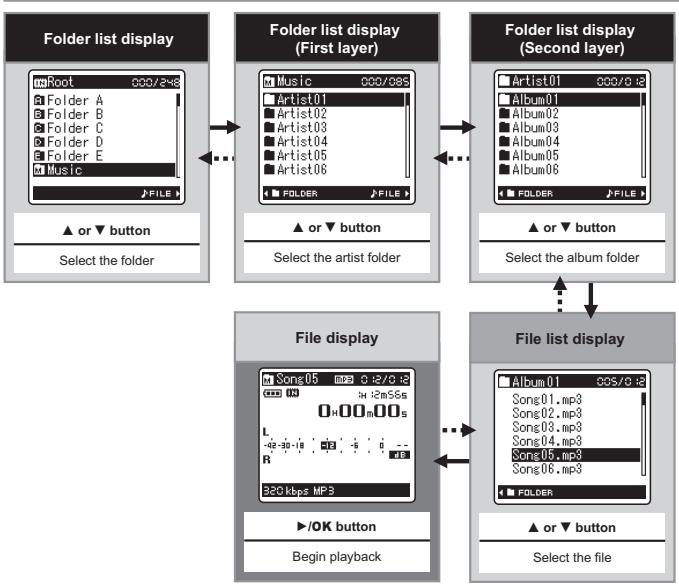
Operation of the folders for music playback
■ Moving through the levels
/OK button

Each time you press this it opens the folder or file selected in the list display and proceeds down one level. The list display screen can be operated by the button
LIST button
Return

Each time you press this it returns up one level. The list display can be operated by the button
List display
The folders and files recorded in this recorder are displayed
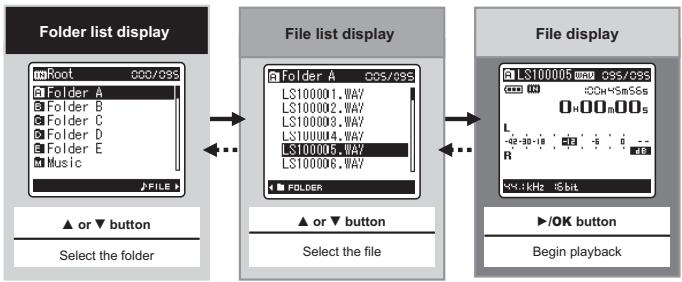
Operation of the folders for voice recordings
File display
Information of the selected file is displayed. Enters in playback standby mode
About Recording
Before Recording
Getting Ready
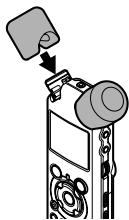
Affix the windscreen:
Start recording after attach the windscreen (included within) to the microphone. The noise may occur even if a windscreen is attached when forcing wind blows against a microphone.

Select the media for recording:
The built-in flash memory as well as an SD Card can be used (e P.14, P.34, P.39).
Select the recording format:
Recording can be performed through the linear PCM format, as well as the WAV, MP3 and WMA formats (P.34, P.36).
Turn the Microphone Toward the Original Sound Source
Turn the built-in stereo microphone in the direction that you would like to record. Placing the built-in stereo microphone over the display is the proper position for performing stereo recording. If it is below the display when recording then proper stereo recording cannot be performed because the position of the original sound will be recorded in reverse phase.
Original sound source
When recording with the built-in microphone:
Turn the microphone in the direction of the source to be recorded.
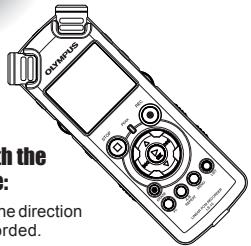
About the built-in stereo microphone:
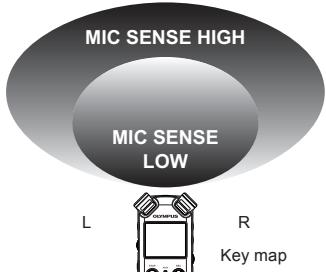
The direction of capturing sound by the microphone can be changed with the MIC SENSE HIGH/LOW switch (P.24).
On mounting:
Accurate adjustments of the microphone's angle and the like can be made when the device is affixed to a commercially available tripod used for cameras.
Before starting recording, select a folder between A to E. These five folders can be selectively used to distinguish the kind of recording; for example, Folder A might be used to store private information, while Folder B might be dedicated to holding business information.
1 Select the recording folder (P.16 to P.18).
How to change folders:
① Pressing the LIST button at the file display while stopped will return you to the next higher level. Pressing the LIST button repeatedly will bring you to the folder list display.
② Pressing button or at the folder list display will select the folders for voice recordings.
- Newly recorded audio will be saved as the last file in the selected folder.
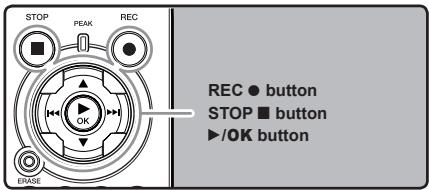
2 Press the REC button and prepare to record.
- Turn the microphone in the direction of the source to be recorded.
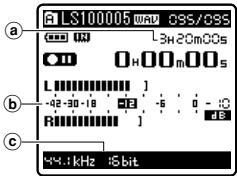
(a) Remaining recording time
b Level meter (change according to the recording level and recording function settings)
Recording mode
- The recording indicator light will flash and [O] will appear on the display.
- [Rec Mode] cannot be changed in the recording standby mode or while recording. Configure this while the recorder is stopped (εP.34, P.36).
- The various functions related to recording can be configured to suit the recording conditions (P.34, P.36, P.37).
- The level indicator position of the level meter will change in accordance with the switching of the various settings related to recording. Confirm the recording level through the level meter after switching the settings.
3 Adjust the recording level by using the REC LEVEL dial.
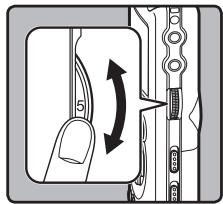
This can be adjusted in a range from [0] to [10]. The larger the number on the dial is the higher the recording level will be, and the indicator position of the level meter will grow larger as well
- This recorder is designed to be able to record cleanly and evenly, even in recording conditions such as when the volume of the source sound changes significantly. However, even higher sound quality recordings can be achieved by adjusting the recording level manually.
- If too big sound is input, the noise may occur even if [Rec Level] is set to [Auto] or [Limiter On]. In this case, the [PEAK] indicator light is not light up which will inform of the excess input. To ensure successful recordings, we recommend that you test the record function and volume before use.
- When the [Rec Level] is set to [Auto] the recording level will be adjusted automatically. Set the [Rec Level] to [Manual] when using the recording level adjustment function and the limiter function (P.34, P.36).
Actually producing the sound you would like to record:
- When a loud sound is produced the level meter will swing all the way over to the right while recording and the red [PEAK] indicator lamp will turn on. When this happens the sound will be recorded in a distorted manner since the recording level is too high.
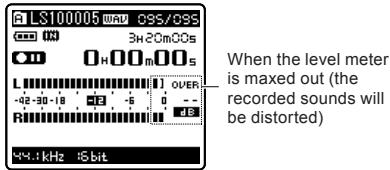
- When a loud noise is produced, adjust the recording level so that the level meter remains in the vicinity of [-6].
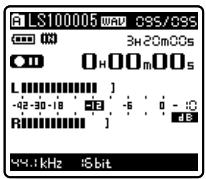
Example of conditions where the recording level has been lowered and the excess input has been adjusted
4 Press the REC button again will begin recording.
- [O] will appear on the display.
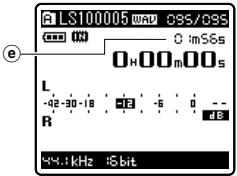
Elapsed recording time
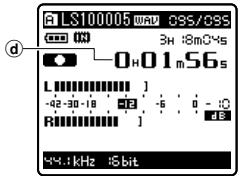
5 Press the STOP button to stop recording.
- [O] will go out on the display.
File length
Notes
- When an SD Card is inserted in the recorder, be sure to confirm the recording media as either the [Built-in Memory] or the [SD Card] so that there is no mistake (P.34, P.39).
- When attempting to perform operations such as rewriting the contents of an SD Card in cases where the card has been write protected, [SD Card Locked] will appear. The playback operation can be performed, but the write protection must first be turned off when overwriting the contents on the card (E8 P.15).
- If you select a folder other than A through E and press the REC ● button, an [illegal Folder] message will flash. Select a folder from A through E and start recording again.
- When remaining recording time is less than 60 seconds, the [PEAK] indicator light starts flashing in amber. When the recording time is decreasing to 30 or 10 seconds, the light flashes faster.
- [Folder Full] will appear when the folder capacity is full. Delete any unnecessary files before recording any further (P.32).
- [Memory Full] will appear when the memory is full. Change the recordable media or delete any unnecessary files before recording any further (P.32, P.34, P.39).
-
When the recording button of the exclusive remote control RS30W (optional) is pressed once, recording will start immediately.
-
Depending on the sound recording mode and the status of record media, the data transfer to the media cannot be done in time during recording and the skipped sound may be recorded. In this case, [Data Write Error] will appear during recording or when the recording is finished. After transferring the data to the PC, format the record media.
We recommend the media to be formatted before recording.
Pause
While the recorder is during recording mode, press the REC button.
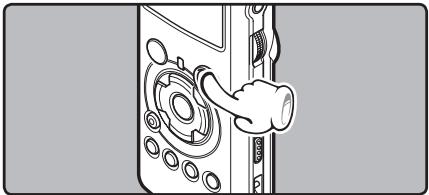
- [OM] will appear on the display.
- The recorder will time out after 60 minutes when left in "Rec Pause".
Resume Recording:
Press the REC button again.
- Recording will resume at the point of interruption.
To quickly check on the recorded contents
While the recorder is during recording mode, press the /0K button.
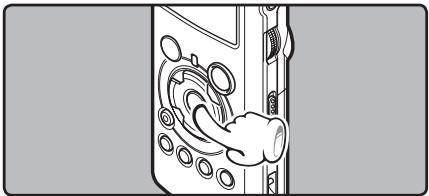
- [ ] will appear on the display.
- Stop recording and the file that was just recorded will be played back.
Recommended settings by recording condition
The recorder is set up so that it can perform high quality recording equivalent to that of a music CD right away. The various functions relating to recording can be configured in detail to suit the recording conditions.
| Recording settings | Recording condition | |||||
| Indoor musical performance | Band performance in a practice studio | Performance in a vast hall, etc. | Outdoor environment sounds like wild birds singing, railroad noises, etc. | Conferences with large crowds in vast meeting venues | Conferences with a few people indoors | |
| Recording level* (€ P.20) | When the [Rec Level] is set to [Manual] you can adjust the recording level. Adjust while looking at the level meter | |||||
| Microphone sensitivity (€ P.24) | [LOW] | [HIGH] | ||||
| Low Cut Filter (€ P.24) | [OFF] | [ON] | ||||
| [Rec Mode] (€ P.34, P.36) | The recording level can be adjusted to suit the volume of the original sound | |||||
| [Rec Level] (€ P.34, P.36) | You can configure whether to adjust the recording level automatically or to adjust it manually. When the [Rec Level] is set to [Manual] you can configure the limiter function | |||||
| [Zoom Mic] (€ P.34, P.36) | The directivity of the built-in stereo microphone can be set according to the source to be recorded | |||||
| [Rec Monitor] (€ P.34, P.37) | Select whether or not to output the recording monitor sound from the EAR jack | |||||
| [Plug-inPower] (€ P.34, P.37) | Select whether or not to use the plug-in power function according to the external microphone connected to the MIC jack | |||||
- When the [Rec Level] is set to [Auto] the recording level will be adjusted automatically. When this happens, the recording level adjustment function and limiter function will not work (e-5 P.20, P.34, P.36).
Listening While Audio is Recorded
If you start recording after inserting the earphone into the EAR jack on the recorder, you can hear the sound being recorded. The recording monitor volume can be adjusted by using the VOLUME dial.
Connect the earphone to the EAR jack on the recorder.
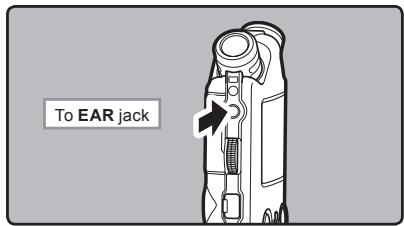
After recording has started, you can hear the sound being recorded through the earphone. If the earphone is connected, no sound will come from the speaker.
Notes
- Recording level cannot be controlled using the volume button.
- When using the earphones, do NOT set the volume too high. Listening at very high volume may lead to hearing loss.
- Do not place earphones near a microphone as this may cause feedback.
- When the external speaker is connected while recording, there is a risk that audio feedback will occur. It is recommended that you use earphones for the recording monitor, or turn [Rec Monitor] to [Off] while recording (P.34, P.37).
- When [Rec Monitor] is set to [Off] no sound will come out of the earphones while you are recording (P.34, P.37).
Set the Low Cut Filter
The recorder has a Low Cut Filter function to minimize low-frequency sounds and record voices more clearly. This function can reduce noise from air conditioners, projectors and other similar noises.
Slide the LOW CUT ON/OFF switch and select [ON] or [OFF].
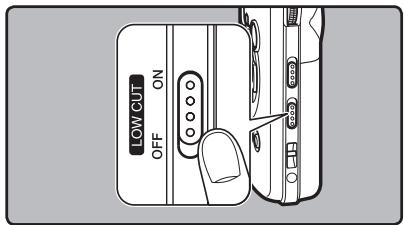
[ON]: Enables the Low Cut Filter function.
[OFF]: Disables this function.
Microphone Sensitivity
Microphone sensitivity is adjustable to meet recording needs.
Slide the MIC SENSE HIGH/LOW switch and select [HIGH] or [LOW].
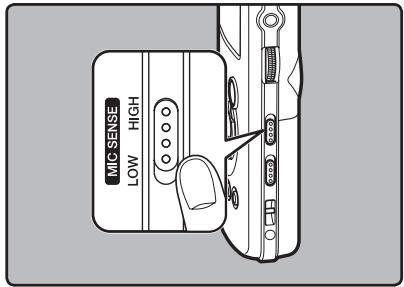
[HIGH]:
This is a highly sensitive mode which can record surrounding noises.
[LOW]:
This is the standard level of microphone sensitivity. Select this mode for cases where the volume of the source sound is high, such as a band performance.
Note
- When you would like to clearly record a speaker's voice, set the recorder to [LOW] and hold its built-in stereo microphone close to the speaker's mouth (5-10 cm) before recording.
Recording from External Microphone or Other Devices
The external microphone and other devices can be connected and the sound can be recorded. Connect as follows by the device to be used.
- Do not plug and unplug devices into the recorder's jack while it is recording.
Recording with External Microphone:
Connect an external microphone to the MIC jack of the recorder.
- When recording while an external monaural microphone is connected, sound will only be recorded by the L-channel.
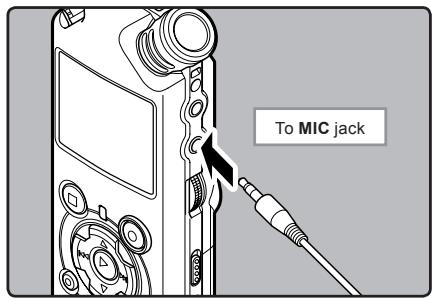
Applicable External Microphones [optional] [P.65]
Stereo microphone: ME51S
The ME51S Stereo microphone comes in a set with an extension cord and a clip.
2 channel microphone (non-directional): ME30W These are highly sensitive non-directional micro phones supported by plug-in power which are well-suited to recording musical performances.
Highly sensitive noise-cancellation monaural microphone (unidirectional): ME52W
This microphone is used to record sound at a distance while minimizing surrounding noise.
Tie clip microphone (non-directional): ME15
Small concealing microphone with a tie-clip.
Telephone pickup: TP7
Earphone type microphone can be plugged into your ear while phoning. The voice or conversation over the phone can be clearly recorded.
Notes
- The built-in microphone will become inoperable when an external microphone is plugged into the recorder's MIC jack.
- Microphones supported by plug-in power can also be used. When the plug-in power function is set to [On] power will be supplied by the device to the microphone (E P.34, P.37).
- Turn the plug-in power function to [Off] when an external microphone not supported by plug-in power is connected, as there is the risk that noise may be generated while recording (E8 P.34, P.37).
- Do not connect the connecting cord to the LINE IN jack when recording from external microphone with this recorder.
Recording the Sound of Other Devices with This Recorder:
The sound can be recorded when connecting to the audio output terminal (earphone jack) of the other device, and the LINE IN jack of the recorder with the connecting cord KA334 (included within) for dubbing.
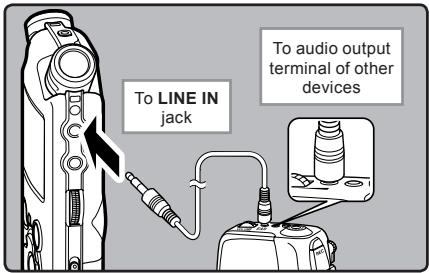
Notes
- If you are unable to produce a clear recording with this recorder even after adjusting the recording level (e P.20), this could potentially be because the output level for the connected devices is too high or too low. When external devices are connected, perform a test recording and then adjust the output level for the external devices.
- Do not connect the connecting cord to the MIC jack when recording sound from other device with this recorder.
Recording the Sound of This Recorder with Other Devices:
The sound of this recorder can be recorded to other devices when connected to the audio input terminal (line jack) of other devices and the EAR jack of this recorder, with the connecting cord KA334 (included within) for dubbing.
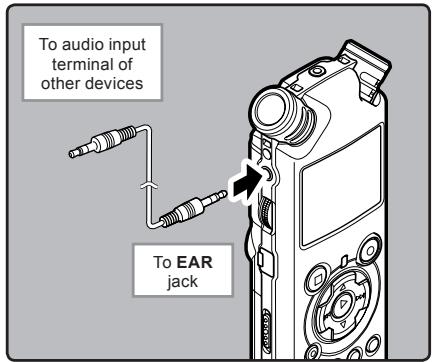
Notes
- When you adjust the various sound quality settings related to playback on the recorder, the audio output signal sent out from the EAR jack will change as well (E5 P.34, P.38).
- In case of recording on other devices without a line input, the input may be too large to control when the audio is input to the microphone jack. In this case, use the connecting cord KA333 (optional) with attenuation resistance (P.65).
About Playback
Playingback
The recorder can playback WAV, MP3 and WMA format files. To playback a file recorded with other machines, you need to transfer (copy) it from a computer.
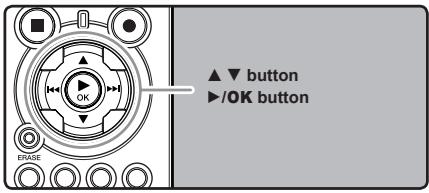
1 Select the folder which contains the files to be played back (P.16 to P.18).
How to change folders:
1 Pressing the LIST button at the file display while stopped will return you to the next higher level. Pressing the LIST button repeatedly will bring you to the folder list display.
② Pressing button ▲ or ▼ at the folder list display will select the folders for voice recordings and press the▶按钮.
2 In the File list display, press the or button to select the file that you want to playback.
- In the File display, press the or button to select a file.
3 Press the OK button to start playback.
- [ ] will appear on the display.
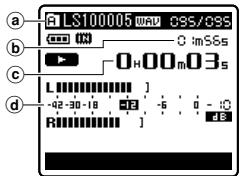
a Folder name/ File name/ File format/ Current file number/ Total number of recorded files in the folder
File length
Elapsed playingback time
Level meter
4 Set it to a comfortable listening volume by using the VOLUME dial.
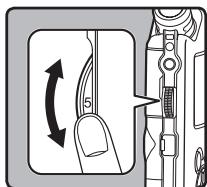
The volume can be adjusted within a range from [0] to [10]. The larger the number on the dial is the higher the volume will be
5 Press the STOP or OK button at any point you want to stop the playback.
- [ ] will go out on the display.
- This will stop the file being played back midway. When the resume function is activated the stopped location will be registered, even if the power is turned off. The next time the power is turned on, playback may be resumed from the registered stopped location.
- When the batteries are removed from the recorder the resume function's stopped position will be erased.
Settings relating to playback
| Segment repeat (P.30) | This allows you to repe- edly playback part of a file during playback |
| [Play Mode] (P.34, 37) | [File] [File Repeat] [Folder] [Folder Repeat] [All] [All Repeat] |
| [Reverb] (P.34, 38) | [Normal] [Studio] [Club] [Hall] [Dome] |
| [EUPHONY] (P.34, 38) | [Normal] [Natural] [Wide] [Power] |
| [Replace] (P.45) | This changes the order of the files in the selected folder. It is useful for playing back files in a preferred or- der while in normal playback mode etc. |
About music file
In cases where the recorder is unable to playback music files that have been transferred to it, check to make sure that the sampling rate and bit rate are in the range where playback is possible. Combinations of sampling rates and bit rates for music files which the recorder can playback are given below.
| File format | Sampling frequency | Bit rate |
| WAV format | 44.1 kHz, 48 kHz, 96 kHz | 16 bit or 24 bit |
| MP3 format | MPEG1 Layer3: 32 kHz, 44.1 kHz, 48 kHzMPEG2 Layer3: 16 kHz, 22.05 kHz, 24 kHz | From 8 kbps up to 320 kbps |
| WMA format | 16 kHz, 22 kHz, 32 kHz, 44.1 kHz, 48 kHz | From 16 kbps up to 256 kbps |
- Variable bitrate MP3 files (in which conversion bitrates can vary) may not play properly.
- For WAV files, this recorder can only play back those in the linear PCM format. WAV files other than these cannot be played back.
This recorder is compatible with Microsoft Corporation DRM9, but not with DRM10. - It is possible to playback the WMA files which are created by the Olympus Digital Voice Recorder.
Forwarding
While the recorder is during stop mode in the file display, press and hold the button.
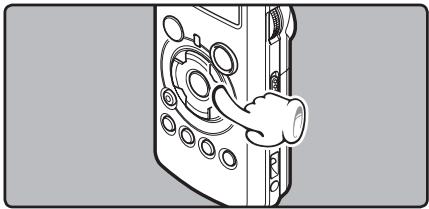
- [ ] will appear on the display.
- If you release the▶ button, it will stop. Press the OK button to start playingback from where it was stopped.
While the recorder is during playback mode, press and hold the button.
- When you release the▶按钮 the recorder will resume normal playback.
- The recorder stops when it reaches the end of the file. Continue pressing the button to proceed with the cue from the beginning of the next file.
Rewinding
While the recorder is during stop mode in the file display, press and hold the button.
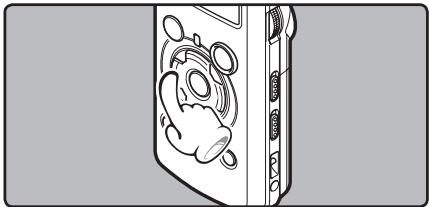
- [ ] will appear on the display.
- If you release the button, it will stop. Press the OK button to start playingback from where it was stopped.
While the recorder is during playback mode, press and hold the button.
- When you release the button the recorder will resume normal playback
- The recorder stops when it reaches the beginning of the file. Continue pressing the! button to proceed with the review from the end of the previous file.
Locating the Beginning of the File

While the recorder is during stop mode or playback mode, press the button.
- The recorder skips to the beginning of the next file.
While the recorder is during playback mode, press the button.
- The recorder skips to the beginning of the current file.
While the recorder is during stop mode, press the 1 button.
- The recorder skips to the beginning of the previous file. If the recorder stops the midway of the file, return to the beginning of the file.
While the recorder is during playback mode, press the button twice.
- The recorder skips to the beginning of the previous file.
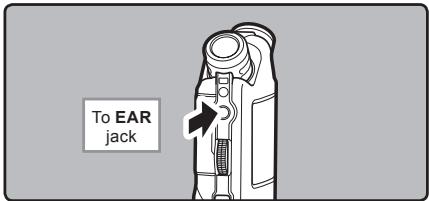
Playback Through Earphone
Anearphone can be connected to the EAR jack of the recorder for listening.
- When the earphone is used, the recorder speaker will be switched-off.
Notes
- To avoid irritation to the ear, insert the earphone after turning down the volume level.
- When you listen with the earphone during playback, do not raise the volume too much. It may cause hearing impairment and decrease in hearing ability.
How to begin segment repeat playback
This function enables repeated playback of part of the file being played.
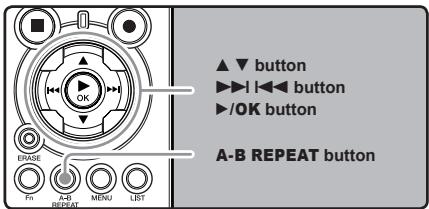
1 Select a file that has a segment you would like to play back repeatedly (P.16 to P.18).
2 In the File list display, press the or button to select the file.
- In the File display, press the or button to select a file.
Press the OK button to start playback.
4 Press the A-B REPEAT button at the point you want to start segment repeat playback.
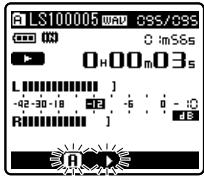
[ ] will flash on the display
- Fast forwarding and rewinding (e.g. P.29) can be conducted when [] is flashing in the same manner as during normal playback, and you can quickly proceed as far as the end position.
- When it reaches to the end of the file while [] is flashing, the point will become the end position, and repeat playback will start.
5 Press the A-B REPEAT button again at the position where you want to end segment repeat playback.
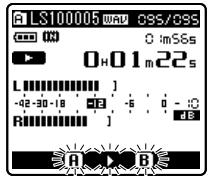
- The recorder repeatedly plays back the segment until the segment repeats playback is cancelled.
Cancel the segment repeat playback function
Pressing any of the following buttons will release the segment repeat playback.
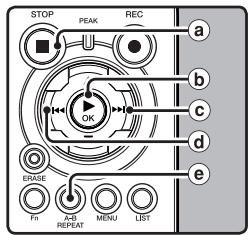
Press the STOP button
Pressing the STOP button will release segment repeat playback, and stop playback.
Press the /0K button
Pressing the /0K button will release segment repeat playback, and stop playback
Press the button
Pressing the button will release segment repeat playback, and cue to the beginning of the next file.
Press the I button
Pressing the button will release segment repeat playback, and reverse to the beginning of the current file.
Press the A-B REPEAT button
Pressing the A-B REPEAT button will release segment repeat playback, and playback continues without repeating.
Erasing One File at a Time
A selected file can be erased from a folder.
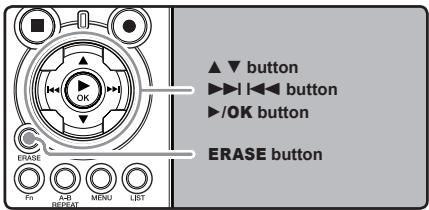
1 Select the folder which contains the files you want to erase (P.16 to P.18).
2 In the File list display, press the or button to select the file you want to erase.
In the File display, press the or button to select a file.
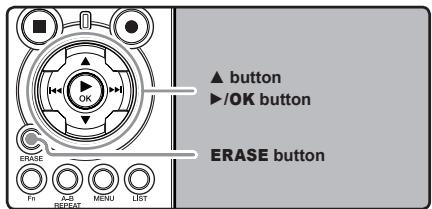
3 While the recorder is during stop mode, press the ERASE button.
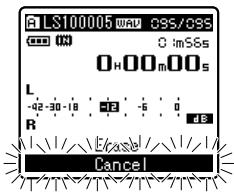
[Cancel] will flash on the display
Press the button to select [Erase].
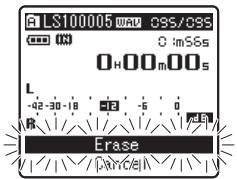
5 Press the OK button.
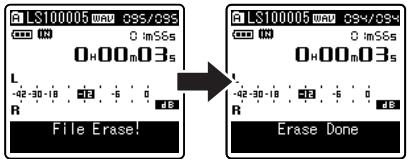
- The display changes to [File Erase!] and erasing will start.
- [Erase Done] is displayed when the file is erased. File numbers will be reassigned automatically.
Erase All Files from a Folder
All files in a folder can be erased simultaneously. The locked files (P.34, P.39) and the files set to read-only on the PC will not be erased.
1 Select the folder that you want to erase (P.16 to P.18).
2 While the recorder is during stop mode, press the ERASE button twice.
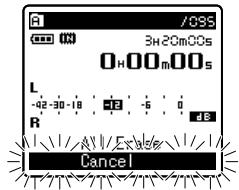
[Cancel] will flash on the display
3 Press the button to select [All Erase].
4 Press the OK button.
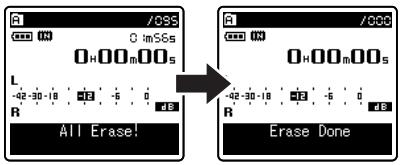
- The display changes to [All Erase!] and erasing will start. [Erase Done] is displayed when the files are erased.
Notes
- An erased file cannot be restored. When an SD Card is inserted in the recorder, be sure to confirm the recording media as either the [Built-in Memory] or the [SD Card] so that there is no mistake (E3 P.34, P.39).
- When attempting to perform operations such as rewriting the contents of an SD Card in cases where the card has been write protected, [SD Card Locked] will appear. The playback operation can be performed, but the write protection must first be turned off when overwriting the contents on the card (eP P.15).
- The locked files and files set as read-only cannot be erased (P.34, P.39).
- If an action is not selected within eight seconds on the [Cancel], [Erase] or [All Erase] screens, the recorder will return to stop status.
- Never perform operations such as the following while processing, as they may damage the data. In addition, replace the batteries with two new ones in order to ensure that the batteries will not run out while processing.
①Turning off the power while processing.
② Removing the batteries while processing.
3 Remove the [SD Card] during processing when it is being used as the recording media.
Performing any of these operations may damage the data.
- You cannot delete folders through the recorder.
Menu Setting Method
Items in menus are categorized by tabs, so select a tab first and move to a desired item to quickly set it. You can set each menu item as follows.
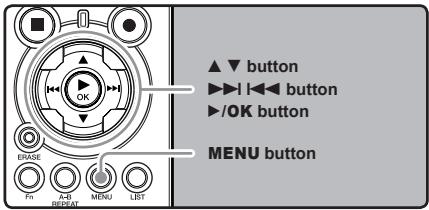
1 While the recorder is during stop mode, press the MENU button.
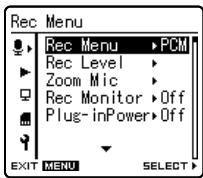
The menu will appear on the display
- Menu items can be set during a recording or playback (P.42).
2 Press the or button to move to the item to be set (P.36 to P.42).
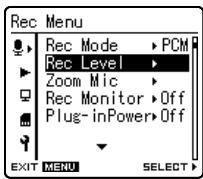
Setup using a tab:
① Press the button for each item to move to a tab.
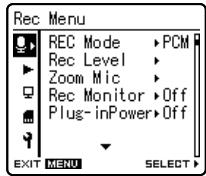
② Press the or button to move to the tab that contains the item you want to set.
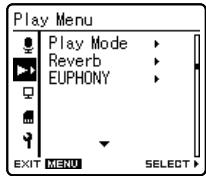
③ Press the OK or button to move to the item you want to set.
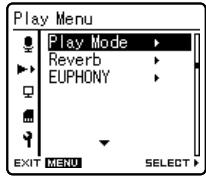
Press the OK or button.
- Moves to the setting of the selected item.
4 Press the or button to change the setting (P.36 to P.42).
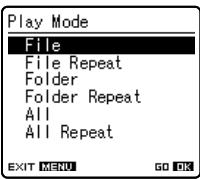
Press the OK button to complete the setup screen.
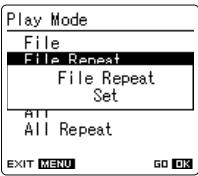
- You will be informed that the settings have been established via the screen.
- Pressing the button without pressing the OK button will cancel the settings and return you to the previous screen.
6 Press the MENU button to close the menu screen.
- When in the menu screen during recording or playback, pressing the 14 or MENU button will allow you to return to the playback screen without interrupting recording or playback.
Notes
- The recorder will stop if you leave it idle for 3 minutes during a menu setup operation, when a selected item is not applied.
- When entering menu settings during recording or playback, the menu settings will be cancelled if 8 seconds elapse with no buttons being pressed.
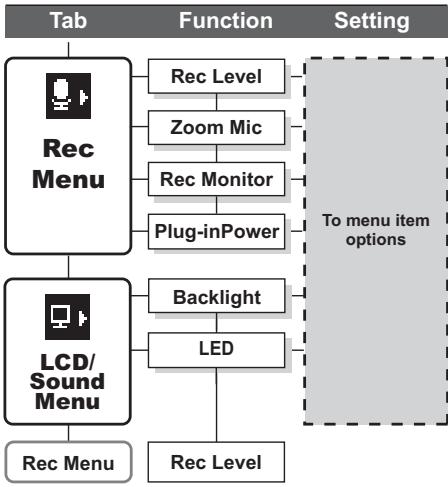
Rec Menu
| Rec Mode | The recorder can record in the linear PCM format. High resolution recording at a high sampling rate and high bit rate equivalent or superior to that of a music CD is possible. Moreover, it also supports the MP3 and WMA formats. 1. Select the recording format. Setting: [PCM]: This is an uncompressed audio format which is used for music CDs and the like. [MP3]: MPEG is the international standard established by a working group of the ISO (International Organization for Standardization). [WMA]: This is an audio compression encoding method that was developed by the Microsoft Corporation in the US. 2. Select the recording rate. Setting: [PCM]: [96kHz/24bit] to [44.1kHz/16bit] [MP3]: [320kbps] to [128kbps] [WMA]: [160kbps] to [64kbps] · When the recording format is set to the MP3 or WMA formats, the sampling rate will be encoded and processed at 44.1 kHz. · When a high recording rate setting is used the file capacity will increase. Make sure that the amount of memory remaining is sufficient before recording (±5P.39). · If the directional microphone function is used, you cannot change the [PCM] setting in the [Rec Mode] other than [44.1 kHz/16 bit]. You use the all modes in the [MP3] or [WMA] of the [Rec Mode]. |
| Rec Level | You can configure whether to adjust the recording level automatically or to adjust it manually. 1. Select the Recording level setting. Setting: [Manual]: Recording is performed by manually adjusting the recording level. When the [Rec Level] is set to [Manual] you can configure the limiter function. [Auto]: Recording is performed by automatically adjusting the recording level. This is useful for when you will be recording right away. 2. Select the Limiter setting. Setting: This recorder is equipped with a limiter function that corrects the recording level down to an appropriate range in cases where a loud noise is suddenly picked up. This prevents distortion caused by an excessive recording level. [Limiter On]: Enables the limiter function, thus preventing distortion when recording. [Limiter Off]: Disables this function. · When the [Rec Level] is set to [Auto] the recording level will be adjusted automatically. Set the [Rec Level] to [Manual] when using the recording level adjustment function and the limiter function. |
| Zoom Mic | The directional microphone function utilizes DiMAGIC's (DiMAGIC Co., Ltd.) DiMAGIC Virtual Microphone (DVM) technology. DVM is an audio pickup system which allows you to record by focusing on sound from any direction. From expansive stereo recording to high directivity recording, DVM represents the latest in directional control methods that allow you to switch to a single exclusive microphone. Setting: [Off]: Enables this function. [Wide]: Recording by an expansive stereo sound. [Standard]: Recording by the natural stereo sound which has no medium getting away [Narrow]: Recording by a directivity stereo sound. [Zoom]: Recording with monaural, however you can record high directivity sound. · The directional microphone function has been designed so that this capability will be elicited only with the built-in stereo microphone. Please note that the recorder will become unable to record normally when using other commercially available microphones. · You can use directional microphone only when the [PCM] setting in the [Rec Mode] is set to [44.1 kHz/16 bit]. |
Rec Menu (Continued)
| Rec Monitor | Select whether or not to output audio while recording from the earphone jack. Setting: [On]: Enables the recording monitor function. Sound will be output from the EAR jack. [Off]: Disables this function. Sound will not be output from the EAR jack. · When the external speaker is connected while recording, there is a risk that audio feedback will occur. It is recommended that you use earphones for the recording monitor, or turn [Rec Monitor] to [Off] while recording (€-P.24). · When [Rec Monitor] is set to [Off] no sound will come out of the earphones while you are recording (€-P.24). |
| Plug-inPower | External microphones which are supported by plug in power can also be used. Whether or not to supply power to external microphones can be configured. Setting: [On]: When the plug-in power function is activated, power will be supplied to the connected external microphone. Select this when external microphones supported by plug-in power are connected (€-P.25). [Off]: Enables this function. Select this when external microphones not supported by plug-in power are connected. · Turn the plug-in power function to [Off] when an external microphone not supported by plug-in power is connected, as there is the risk that noise may be generated while recording. · Phantom power cannot be supplied, even when the plug in power function is set to [On]. |
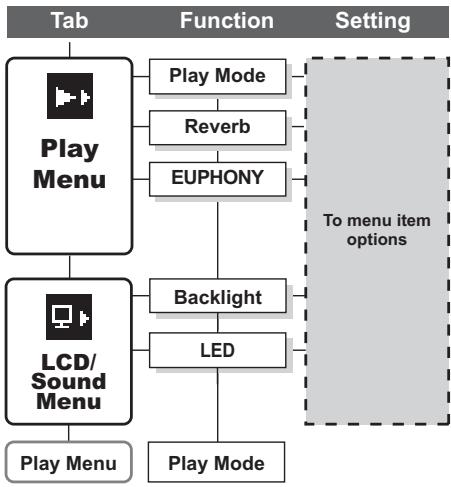
Play Menu
| Play Mode | There are six play modes. You can select whether to play by file or folder, or all files stored in the recorder. Setting: [File]: Stop after playing back the current file. [File Repeat]: Play the current file repeatedly. [Folder]: Play files continuously in the current folder until the last file and stop. [Folder Repeat]: Play all files in the current folder continuously. [All]: Play all files in the selected memory continuously and stop. [All Repeat]: Play all files in the selected memory continuously and repeatedly. • In [File] mode, when the recorder comes to the end of the last file in the folder, [End] flashes for two seconds on the display and the recorder stops at the start of the last file. • In [Folder] mode, when the recorder comes to the end of the last file in the folder, [End] flashes for two seconds on the display and the recorder stops at the start of the first file in the folder. • In [All] mode, after playing the last file in the folder, the recorder will start playing from the first file in the next folder. When it comes to the end of the last file in the recorder, [End] flashes for two seconds on the display and the recorder stops at the start of the first file in the recorder. |
Play Menu (Continued)
| Reverb | You can enjoy the reverberant sound of various space sizes such as from the recording studio to the dome. Setting: [Normal]: Enables the reverb function. Select this when playing back original sounds as they are. [Studio] [Club] [Hall] [Dome]: Select the preferred acoustical environment. • When playing back WAV format files using these playback results, the sampling rate and bit rate will be converted downward from 96 kHz to 48 kHz and 24 bit to 16 bit, respectively. • This function is only available during playback. This recorder cannot perform recording by using the playback results. • When you adjust the various sound quality settings related to playback on the recorder, the audio output signal sent out from the EAR jack will change as well. |
| EUPHONY | This recorder is equipped with "EUPHONY MOBILE", the latest in surround sound systems which combines bandwidth correction, expansion technology, and virtual acoustical source processing technology. In addition to its natural, expansive feel, the recorder is equipped with the exceptional feature wherein listeners are less prone to developing an compressed or closed-in feel, or to growing tired over extended listening. On top of this, listeners are less prone to developing an oppressed or closed-in feel, or to growing tired over extended listening. Level adjustments of the [EUPHONY] setting can be set to four stages according to preference. Setting: [Normal]: Enables this function. Select this when playing back original sounds as they are. [Natural]: This mode achieves natural bandwidth correction and acoustical field expansion. [Wide]: This mode has an even more expansive feel. [Power]: This mode focuses more on lower sound registers. • When playing back WAV format files using these playback results, the sampling rate and bit rate will be converted downward from 96 kHz to 48 kHz and 24 bit to 16 bit, respectively. • This function is only available during playback. This recorder cannot perform recording by using the playback results. • When you adjust the various sound quality settings related to playback on the recorder, the audio output signal sent out from the EAR jack will change as well |
LCD/Sound Menu
| Backlight | The display will remain lit for about 10 (Initial setting) seconds when a button on the recorder is pressed. Setting: [5 seconds] [10 seconds] [30 seconds] [60 seconds] [Always on]: Set the length of time that the backlight will remain lit. [Off]: Enables this function. The backlight will not light up. |
| Contrast | Display contrast can be adjusted in 12 levels. Setting: You can adjust the LCD display contrast level from [01] to [12]. |
LCD/Sound Menu (Continued)
LED
You can set it so the LED indicator light does not turn on.
Setting:
[On]: LED light will be set.
[Off]: Disables this function. LED light will be cancelled.
Memory Menu
MemorySelect
When an SD Card is inserted you can select to record to either the built-in flash memory or to the SD Card (≈ P.14).
Setting:
[Built-in Memory]: Built-in flash memory.
[SD Card]: SD Card.
- When attempting to perform operations such as rewriting the contents of an SD Card in cases where the card has been write protected, [SD Card Locked] will appear. The playback operation can be performed, but the write protection must first be turned off when overwriting the contents on the card (P.15).
Memory Info.
The recordable capacity remaining and overall capacity of the recording media can seen from the menu screen.
- When no SD Card is inserted only information for the built-in flash memory will seen.
- The domain area which uses the administrative files which the recorder uses is included in the remaining capacity for the recording media. For SD cards in particular, in addition to this administrative domain the administrative domain area for the SD card is added in as well. Owing to this, the remaining capacity will be displayed as less than the card's specified capacity, yet this is not abnormal.
Others
Lock
Locking a file keeps important data from being accidentally erased. Locked files are not erased when you select to erase all files from a folder (*P.32).
Setting:
[On]: Locks the file and prevents it from being erased.
[Off]: Disables this function. Unlocks the file and allows it to be erased.
- Select the files to be locked in advance before operating the menu.
- When attempting to perform operations such as rewriting the contents of an SD Card in cases where the card has been write protected, [SD Card Locked] will appear. The playback operation can be performed, but the write protection must first be turned off when overwriting the contents on the card ( 串 P.15).
Others (Continued)
| AutoPowerOff | Forgetting to turn the power off can be prevented. If the recorder remains in stop mode for over 10 minutes (Initial setting) while the power is turned on, the power will be turned off. Setting: [5 minutes] [10 minutes] [30 minutes] [60 minutes]: Set the length of time before the power will be turned off. [Off]: Enables this function. • If any button is pressed, the elapsed time count before the power turns off will start over again. |
| Fn Setting | When functions are registered in the Fn button, each time the Fn button is pressed, you can set or change the menu of registered function. Setting: [Off]: No functions will be allocated to the button. [Rec Mode] (€ P.36) [Rec Level]: (€ P.36) [Zoom Mic] (€ P.36) [Play Mode] (€ P.37) [Reverb] (€ P.38) [EUPHONY] (€ P.38) [MemorySelect] (€ P.39) [Property] (€ P.41) [Light] (€ P.38) |
| To call up a registered function: When the Fn button is pressed, menu setting display of registered function will appear: [Rec Mode]: [PCM] [MP3] [WMA]: The recording rate can be configured for each file format. [Rec Level]: [Manual] [Auto]: You can configure whether to adjust the recording level automatically or to adjust it manually. When the [Rec Level] is set to [Manual] you can configure the limiter function. [Zoom Mic]: [Off] [Wide] [Standard] [Narrow] [Zoom] [Play Mode]: [File] [File Repeat] [Folder] [Folder Repeat] [All] [All Repeat] [Reverb]: [Normal] [Studio] [Club] [Hall] [Dome] [EUPHONY]: [Normal] [Natural] [Wide] [Power] [MemorySelect]: [Built-in Memory] [SD card] [Property]: File and folder information can be confirmed from the menu screen. Each time the Fn button is pressed, the setting of registered function is changed: [Light]: [On] [Off]: Select backlight on or off by pressing the Fn button. • When the registered function is [Rec Mode], [MemorySelect], or [Property], these will not function if the Fn button is pressed during recording or playback. While the recorder is during stop mode, press the Fn button. | |
Others (Continued)
| Menu Reset | This returns the functions back to their initial settings (factory default). Setting: [Start]: Returns the settings to their initial values. [Cancel]: Takes you back to the [Others]. After resetting the settings, the time settings and file numbers will be preserved from before the reset and will not return to their initial settings. Menu settings after setting reset (initial settings). | |||
| ■ Rec Menu [Rec Mode] Recording format [PCM] Recording rate [44.1kHz/16bit] [Rec Level] Recording level [Manual] Limiter function [Limiter On] [Zoom Mic] [Rec Monitor] [Plug-inPower] Play Menu [Play Mode] Reverb] [EUPHONY] | ■ LCD/Sound Menu [Backlight] [Contrast] [LED] ■ Memory Menu [MemorySelect] ■ Others [AutoPowerOff] [Fn Setting] | [10 seconds] [06] [On] [Built-in Memory] [10 minutes] [Off] | ||
| System Info. | You can check the recorder's information on the menu screen. [Model Name], [Version] and [Serial Number] appears on the display. | |||
| Property | File and folder information can be confirmed from the menu screen. When the file is selected: [Name] [Date] [Size] [Length] and [File Format] will appear on the display. When the folder is selected: [Name] and [Date] will appear on the display. Select the files for which you would like to confirm information in advance before operating the menu. | |||
Setting menu during recording
Setting menu during playback
Formatting the Recorder IFormatl
If you format the recorder, all files will be removed and all function settings will return to defaults except date and time settings. Transfer any important files to a computer before formatting the recorder.
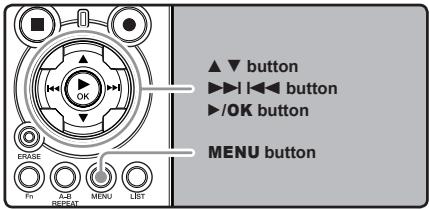
1 While the recorder is during stop mode, press the MENU button.
- The menu will appear on the display. You can also change to [Memory Menu] screen by using the settings tab (E&P P.34).
Press the or button to select [Format].
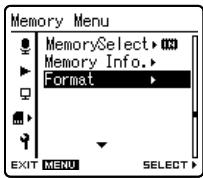
[Format] will appear on the display
Press the /OK or button.
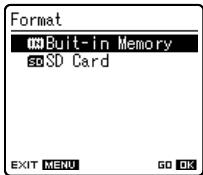
4 Press the or button to select the recording media to format.
- When formatting an SD Card, cancel the write protection function before inserting the card into the recorder (E53-P.15).
5 Press the OK button.
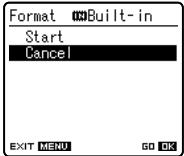
[Cancel] will appear on the display
6 Press the button to select [Start].
Press the OK button.
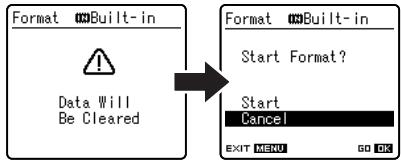
After the [Data Will Be Cleared] message is on for two seconds, [Cancel] will turn on.
Press the button again to select [Start].
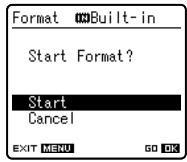
Press the OK button.
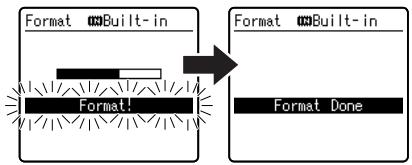
- Formatting begins and [Format !] flashes on the display.
- [Format Done] appears when formatting ends.
Notes
- When an SD Card is inserted in the recorder, be sure to confirm the recording media as either the [Built-in Memory] or the [SD Card] so that there is no mistake (P.34, P.39).
- When attempting to perform operations such as rewriting the contents of an SD Card in cases where the card has been write protected, [SD Card Locked] will appear. The playback operation can be performed, but the write protection must first be turned off when overwriting the contents on the card (P.15).
- Never perform operations such as the following while processing, as they may damage the data. In addition, replace the batteries with two new ones in order to ensure that the batteries will not run out while processing.
①Turning off the power while processing.
② Removing the batteries while processing.
③ Remove the [SD Card] during processing when it is being used as the recording media.
Performing any of these operations may damage the data.
- Never format the recorder from a PC.
- Once the recorder is formatted, the music files with DRM may not be transferred to the recorder again.
- When the recorder is formatted, all the saved data, including locked files and read-only files, are erased.
After formatting, recorded audio file names may start from [0001]. - When returning the settings for the functions to their initial settings, use the [Menu Reset] (P.34, P.41).
- Formatting on the recorder will be Quick Format. If you format the SD card, information of file management is refreshed and the data inside the SD card is not deleted completely. When handing over and disposing the SD card, be careful about the data leakage from the SD card. We recommend the SD card to be destroyed when you dispose the SD card.
Rearranging files [Replace]
You can move a file in a folder to change the order of playback. First select the folder (file) for which you want to change the playback order.
![OLYMPUS LS-10 - Rearranging files [Replace] - 1](/content/2025/01/84083/images/c2689f9a670c6b6339782c83d1b777a1a183c54116a2957b863eda9b6bf17144.jpg)
1 Select the folder for which you would like to rearrange the song order (P.16 to P.18).
2 While the recorder is during stop mode, press the MENU button.
- The menu will appear on the display. You can also change to [Others] screen by using the settings tab (E3 P.34).
3 Press the or button to select [Replace].
Press the /0K or button.
![OLYMPUS LS-10 - Rearranging files [Replace] - 2](/content/2025/01/84083/images/e3d6c8c457d3d70684d57c259ac28574793d74f3cb2f81fbf45d032e15c0ed96.jpg)
Press the or button to select the file you want to move.
Press the /OK or button.
![OLYMPUS LS-10 - Rearranging files [Replace] - 3](/content/2025/01/84083/images/7c973c3e9099444ec118f427328168b4c0c6cb04653c117f8bfe63881e4dd94e.jpg)
- The cursor will flash to confirm that the file can be moved.
Press the or button to select the location to move it to.
![OLYMPUS LS-10 - Rearranging files [Replace] - 4](/content/2025/01/84083/images/95912e111ee2d6f2a75b80dcf6ead054480f7fbe16a4e65ca55549b1f9141d19.jpg)
Press the /OK button to complete the setup screen.
![OLYMPUS LS-10 - Rearranging files [Replace] - 5](/content/2025/01/84083/images/153e343b3f3ea7470ca46f76279b25a4980f27af3cd9fb873b079e31a6cc6fa5.jpg)
- If there are more files to move, repeat Steps 5 through 8.
- Pressing the button without pressing the OK button will cancel the settings and return you to the previous screen.
9 Press the MENU button to close the menu screen.
Note
- When attempting to perform operations such as rewriting the contents of an SD Card in cases where the card has been write protected, [SD Card Locked] will appear. The playback operation can be performed, but the write protection must first be turned off when overwriting the contents on the card (E8 P.15).
Using the Recorder on Your PC
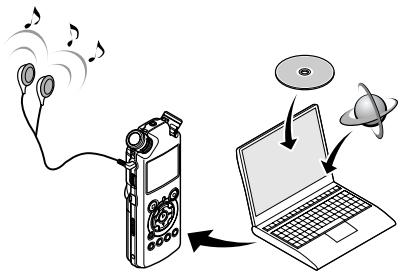
By being connected to a PC, the recorder enables you to do the following:
- You can transfer files recorded with this recorder to a computer, play them back, and manage them by using Windows Media Player or iTunes (P.50, P.57).
- In addition to its uses as an IC recorder and a music player, this recorder can also be used as external memory for a computer by storing data from a computer and reading it back out (P.49, P.61).
Operating Environment
Windows
Operating System:
Microsoft Windows 2000/XP/Vista (Standard Installation)
Compatible PC's:
Windows PC's equipped with more than one free USB port
Macintosh
Operating System:
Mac OS 10.2.8 ~ 10.5 (Standard Installation)
Compatible PC's:
Apple Macintosh series equipped with more than one free USB port
Notes
- This is an operational environment for saving the files recorded by this recorder to your PC with USB connection.
To check the operational environment of [Steinberg CUBASE LE4] software, see a supplied separate sheet. - Even if operational environment is satisfied, we do not support such as 64-bits OS, the multi-boot environment and self-modified PC's.
Precautions on using the recorder connected to a PC
- When you are downloading a file from the recorder or uploading a file to the recorder, do not remove the USB cable even if the screen is indicating you can. Data is still being transferred while the [PEAK] indicator light is blinking. When removing the USB cable, be sure to follow the description in P.48. If the USB cable is removed before the drive is stopped, data may not be successfully transferred.
- On a PC, do not format the drive of the recorder. Initialization is not successfully achieved on a PC. For initialization, follow the instructions in the [Format] screen of the recorder (E&P P.43).
- Folder (directory) names appeared by file management tools such as Explorer attached to Microsoft Windows is different from the folder names that can be set with the recorder.
- If folders or files stored on the recorder are moved or renamed by using a file management tool such as Explorer, the order of files may be changed or files may become unrecognizable
- Data can be written or uploaded to the recorder even though the attribute of the recorder drive is shown as Read-only by the operating system of the PC.
- As the noise may cause adverse effects on electronics devices nearby the recorder, unplug the earphone when you connect the recorder to a PC.
Copyright and Copyright Protection Feature (DRM)
By the Copyright Act, any voice/music files and music CDs downloaded from the Internet without the copyright holder's permission may not be reproduced, distributed, publicized/re-publicized on the Internet, or converted into WMA or MP3 files for the purpose of commercial business or sale.
A WMA file may be provided with DRM (Digital Right Management) for copyright protection. DRM limits the file to copy or distribute music files that are converted (ripped) from a music CD or downloaded from music distribution services. To transfer a WMA file with DRM to the recorder, you need to use appropriate methods such as Windows Media Player. Copying the music files with DRM purchased from online music distribution service to a portable device such as this recorder may be restricted.
Note
This recorder is compatible with Microsoft Corporation DRM9, but not with DRM10.
Connecting to Your PC
1 Boot the PC.
2 Connect the USB connecting cable to the USB port of the PC.
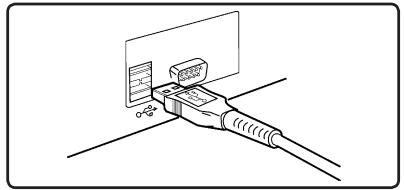
3 Confirm that the recorder has stopped and connect a USB connection cable to the connection port on the side of recorder.
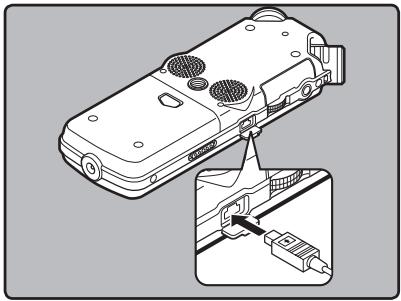
Windows:
When you open [My Computer], it will be recognized by the drive name [LS_10] (Built-in flash memory) and [Removable Disk] (SD card).
Macintosh:
When you connect the recorder to a Mac OS, it will be recognized by the drive name [LS_10] on the desktop. When an SD card is inserted it will be recognized by the drive name [Untitled].
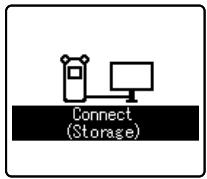
[Connect (Storage)] is appeared on recorder if the USB cable is connected
Note
- Be sure to use the attached dedicated cable for the USB connection cable. If any other company's cable is used, it cause problems. Also, please do not connect this dedicated cable to any other company's product.
Disconnecting from Your PC
Windows
1 Click the on the task bar located at the lower-right corner of the screen. Click [Safely Remove Hardware].

- The drive letter will differ depending on the PC being used.
2 When the safe to remove hardware window appears, click [OK].
3 Disconnect the USB connection cable.
Macintosh
1 Move the drive icon for this recorder that is appear on the desktop to the garbage bin by Drag & Drop it.
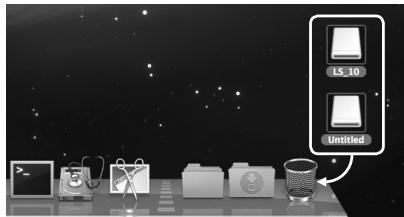
- When you connect the recorder to a Mac OS, it will be recognized by the drive name [LS_10] on the desktop. When an SD card is inserted it will be recognized by the drive name [Untitled].
2 Disconnect the USB cable.
Notes
- NEVER disconnect the USB while the [PEAK] indicator light is flashing. If you do, the data will be destroyed.
- When the recorder is connected to a PC, the power will be supplied from the USB cable.
Refer to the user's manual for your PC regarding the USB port on your PC. - Be sure that you connect the USB cable either directly to the USB port on your PC.
- Be sure to push the cable connector all the way in. Otherwise, the recorder may not operate properly.
- When connecting the recorder through an USB hub the operation may become unstable. In such cases, refrain from using a USB hub.
Transfer the Voice Files to Your PC
The 5 voice folders of this recorder are appeared as [DSS_FLDA], [DSS_FLDB], [DSS_FLDC], [DSS_FLDD] and [DSS_FLDE], and the recorded voice files are saved in these folders.
Windows
1 Connecting the recorder to your PC (P.47).
2 Open the Explorer window.
3 Open the [LS_10] folder.
- When you open [My Computer], it will be recognized by the drive name [LS_10] (Built-in flash memory) and [Removable Disk] (SD card) (The drive letter will differ depending on the PC being used).
4 Copy the data.
5 Disconnecting the recorder to your PC (P.48).
Macintosh
1 Connecting the recorder to your PC (P.47).
- When you connect the recorder to a Mac OS, it will be recognized by the drive name [LS_10] on the desktop. When an SD card is inserted it will be recognized by the drive name [Untitled].
2 Double-click on [LS_10] icon on the desktop.
3 Copy the data.
4 Disconnecting the recorder to your PC (P.48).
Drive name and folder name when a personal computer is connected:
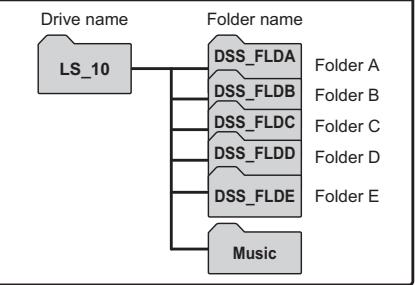
Built-in flash memory
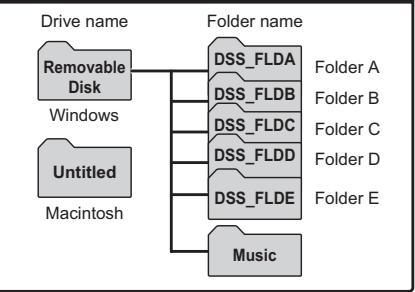
SD card
Notes
- While transmitting data, [Busy] is appeared, and the [PEAK] indicator light flashes. NEVER disconnect the USB while the [PEAK] indicator light is flashing. If you do, the data will be destroyed.
- In the Windows operational environment 24 bit WAV format files cannot be played back.
- When a sound board of your PC does not support to 24 bit, the recorder cannot play the software supporting to 24 bit correctly.
- In the Mac OS operational environment, WMA format files cannot be played back.
Using Windows Media Player
Music files that have been imported to your computer from music CDs and acquired over the Internet can be transferred to and played back with this recorder. It supports WAV, MP3, and WMA format music files.
By using Windows Media Player, music files from music CDs can be converted (ripped) (P.51) and music files that you have bought from any music distribution sites can be easily transferred to the recorder. P.52, P.53).
Window Names
Windows Media Player 11
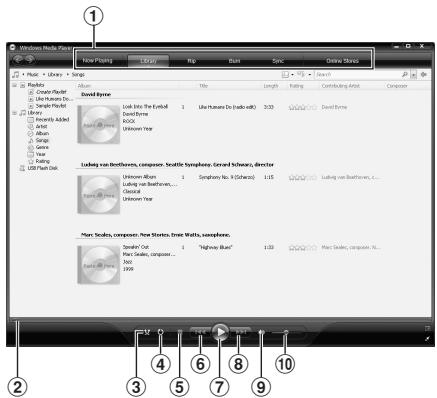
① Features taskbar
② Seek slider
③ Shuffle button
④ Repeat button
⑤ Stop button
(6) Previous button
⑦ Play button
⑧ Next button
⑨Mute button
Volume slider
Windows Media Player 10
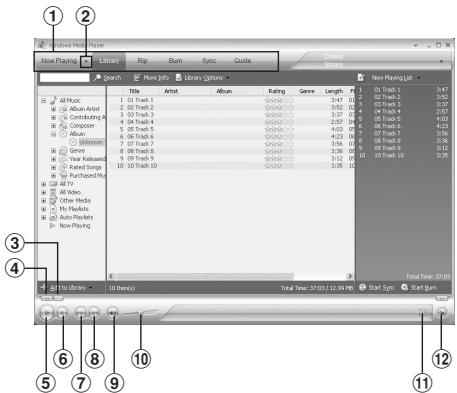
① Features taskbar
② Quick Access Panel button
③ Seek slider
④ Rewind button
⑤ Play button
⑥ Stop button
⑦ Previous button
⑧ Next button
Mute button
Volume slide
⑪ Shuffle/Repeat button
⑫ Fast Forward button
Copying Music from CD
1 Insert CD into the CD-ROM drive, and start Windows Media Player.
2 From the Features taskbar, click [Rip] menu.
- After clicking [Rip] menu, click [View Album Info] for Windows Media Player 10 as necessary.
- If Internet connectivity is available, CD information is searched.
3 Put a check mark on the music file that you want to copy.
Click [Start Rip].
For Windows Media Player 10 Click [Rip Music].
- Files copied to a PC are stored in WMA format. Music files copied are categorized by artist, album, genre, etc. and added to the play list.
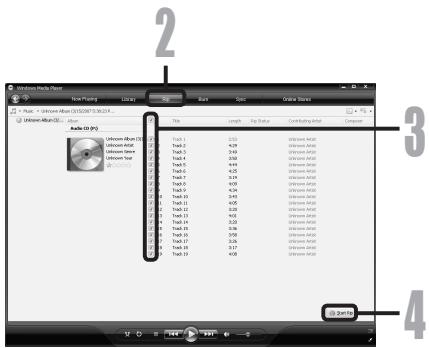
Windows Media Player 11
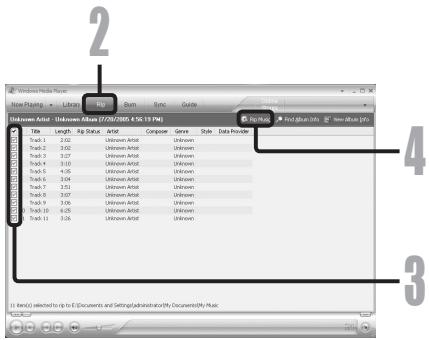
Windows Media Player 10
Transferring Music File to the Recorder
You can transfer the music files saved in your PC to this recorder. For how to copy the music files from the CD to your PC, see "Copying Music from CD" (P.51).
Windows Media Player 11
1 Connect the recorder to a PC, and start Windows Media Player.
2 From the Features taskbar, click [Sync].
3 Click [Sync] menu again to select [DVR] [Advanced Options] [Set Up Sync], and set as follows.
- Click on the [Create folder hierarchy on device] to check. 1 2
- The folder with artist name or album name is automatically created. This will make you find the file you want to listen to more easily.
1 If [Create folder hierarchy on device] is checked by default, click to uncheck the box once, and click it again to check.
2 After the synchronous transfer to the recorder, a file named "WMPInfo.xml" is created. If you delete this file, the *1 may need to be set again.
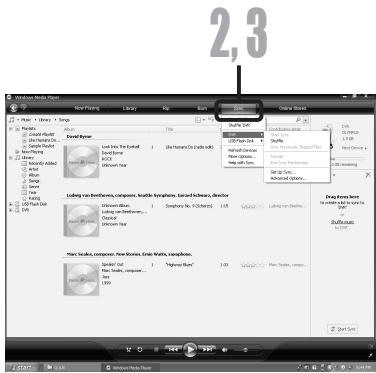
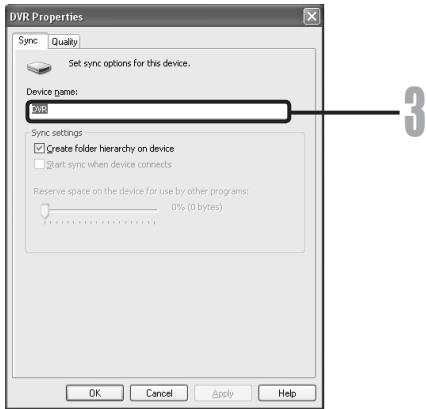
4 Select the desired category from [Library] on the left, and select music files or albums to transfer to the recorder, and Drag & Drop them in [Sync List] on the right.
5 Click [Start Sync].
The file is transferred to the recorder.
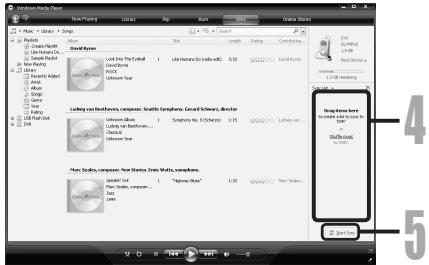
Windows Media Player 10
1 Connect the recorder to a PC, and start Windows Media Player.
2 From the Features taskbar, click [Sync].
3 From the pull down menu on the left side window, select the play list to be transferred to the recorder, and put the check marks on the music file that you want to transfer.
The order of music pieces can be changed by Drag & Drop of the music file in the play list displayed.
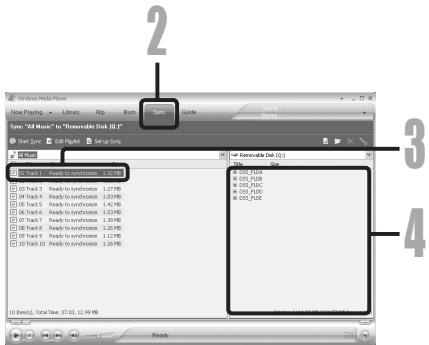
4 From the pull down menu on the right side window, select the drive corresponding to the recorder.
The recorder is recognized as a Removable Disk.
5 Click [ ] on the upper right corner, and set the synchronization options.
- Click on the [Create folder hierarchy on device] to check. 1 2
- The folder with artist name or album name is automatically created. This will make you find the file you want to listen to more easily.
1 If [Create folder hierarchy on device] is checked by default, click to uncheck the box once, and click it again to check.
2 After the synchronous transfer to the recorder, a file named "WMPInfo.xml" is created. If you delete this file, the *1 may need to be set again.
6 Click [Start Sync]. The file is transferred to the recorder.
- The file is transferred to the recorder. The music file transferred to the recorder is displayed in Item on Device.
![OLYMPUS LS-10 - Click [Start Sync]. The file is transferred to the recorder. - 1](/content/2025/01/84083/images/2b9a6cbf80e1bd9d69a114aac2f170728430fad25aaffc9d4e1aca34cc4c9a33.jpg)
![OLYMPUS LS-10 - Click [Start Sync]. The file is transferred to the recorder. - 2](/content/2025/01/84083/images/e75a1a12cdf3aa419c8cf999d3d8935a181e5f754ddc4c816d940d829421a6de.jpg)
Notes
- Copying the music files with DRM purchased online music distribution service to a portable device such as this recorder may be restricted.
- To transfer the files by using Windows Media Player 9, check the Olympus website.
- If the music files are transferred to the recorder until it reaches to the maximum memory, the message [Cannot make the system file. Connect to PC and delete unnecessary file] may appear on this recorder's display. In such a case, erase the files to make free space (hundreds of KB to dozens of MB depending on the music file sizes) for the management file. (The more capacity for the management file will be necessary as the number of the music files increases).
Copying Voice File to the CD
You can transfer the voice files in the recorder to your PC and copy them to CD. For how to copy the voice files from the recorder to your PC, see "Transfer the Voice Files to Your PC" (E8 P.49).
Windows Media Player 11
1 Insert the blank CD-R/RW into the CD-R/RW drive, and start Windows Media Player.
2 From the Features taskbar, click the [Burn] menu.
3 Select the desired category from [Library] on the left, and select voice files or albums to copy to the CD-R/RW, and Drag & Drop them in [Burn List] on the right.
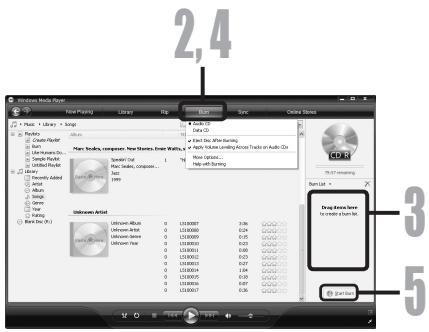
Click [Burn] menu again, and select [Audio CD] or [Data CD].
When [Audio CD] is selected:
- A file is converted and copied in CD-DA in order to play it by the audio equipment which can play CD-R/RW.
When [Data CD] is selected:
- Copying files with the format to be recorded.
5 Click [Start Burn].
Windows Media Player 10
1 Insert the blank CD-R/RW into the CD-ROM drive, and start Windows Media Player.
2 From the Features taskbar, click [Burn] menu.
- Click [Burn] as needed after clicking [Edit Playlist] menu.
- You can change the order of tracks by Drag & Drop files.
3 Put a check mark on the voice files that you want to copy.
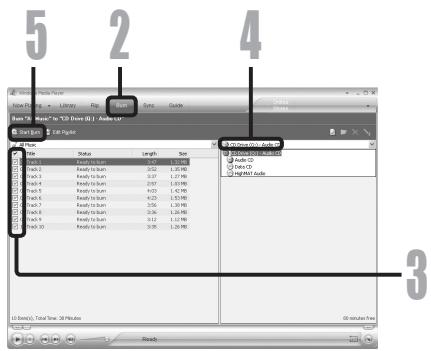
4 Select format of CD before clicking [Start Burn].
When [Audio CD] is selected:
- A file is converted and copied in CD-DA in order to play it by the audio equipment which can play CD-R/RW.
When [Data CD] is selected: - Copying files with the format to be recorded.
5 Click [Start Burn].
Window Names
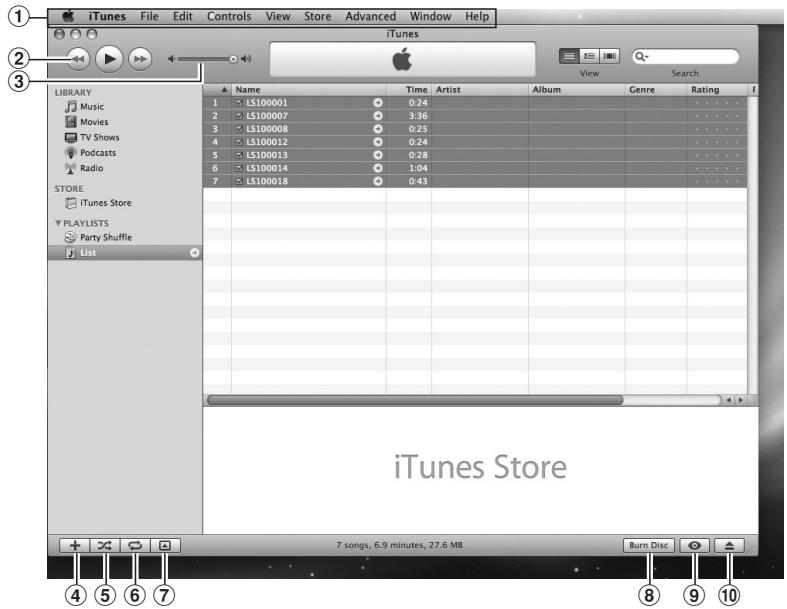
① Features taskbar
② Rewind button/Playback, Pause button/ Fast Forward button
③ Volume slide
④ Playlist addition button
⑤ Shuffle button
⑥ Repeat button
⑦ Display change button
⑧Disc create button
⑨ Browse button
10 Disc eject button
Copying Music from CD
1 Insert the CD into the CD-ROM drive, and start iTunes.
2 Click [iTunes] [Preferences].
3 Click [Advanced] tag.
4 Click [Importing] to set the file format and bit rate for copying music files to your PC, and click [OK].
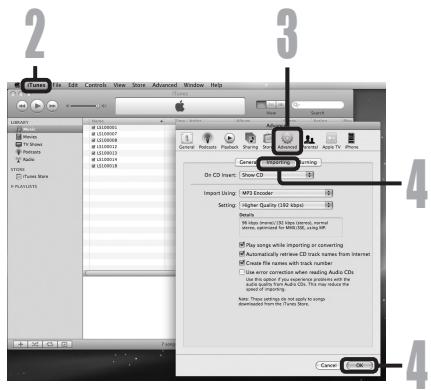
[Import Using]:
- Set the file format for copying music file from a CD.
[Setting]: - Set the bit rate for copying music file from a CD.
5 Put a check mark on the music files that you want to copy.
6 Click [Import CD].
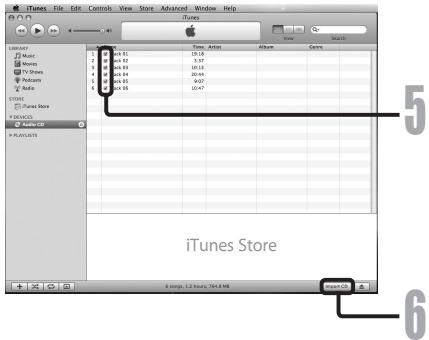
Transferring Music File to the Recorder
You can transfer the voice files in the recorder to your PC and copy them to CD. For how to copy the music files from the CD to your PC, see "Copying Music from CD" (P.58).
1 Connect the recorder to a PC, and start iTunes.
2 Select the play list to be transferred to the recorder, and put the check marks on the music files that you want to transfer.
- The order of music pieces can be changed by Drag & Drop of the music file in the play list displayed.
3 Double-click the corresponding drive with the recorder, and open [MUSIC] folder.
- When you connect the recorder to a Mac OS, it will be recognized by the drive name [LS_10] on the desktop. When an SD card is inserted it will be recognized by the drive name [Untitled].
- Copy to [MUSIC] folder of the recorder when transferring the music file.
- You can create up to 2 hierarchies in the [MUSIC] folder. And up to 128 folders can be made including [MUSIC] folder.
- Up to 200 files can be stored in each folder.
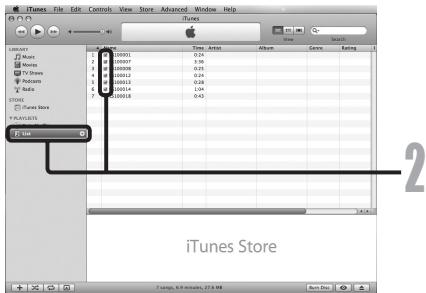
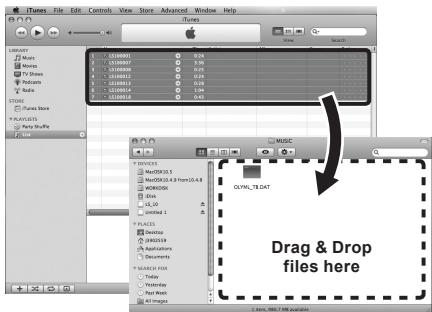
Select the desired files, and Drag & Drop them to [MUSIC] folder.
Copying Voice File to the CD
You can copy the voice files saved in the recorder to CD. For how to copy the voice files from the recorder to your PC, see "Transfer the Voice Files to Your PC" (P.49).
1 Insert the CD-R/RW into the CD-R/RW drive, and start iTunes.
2 Click [iTunes] [Preferences].
3 Click [Advanced] tag.
4 Click [Burning] to set the CD format for copying voice files to CD-R/RW, and click [OK].
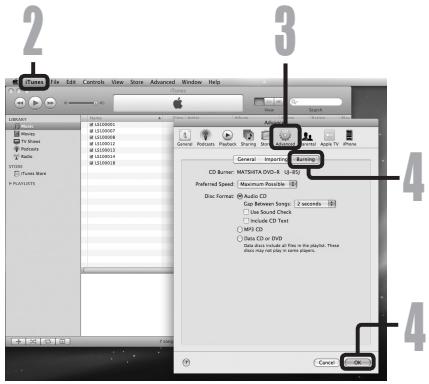
When [Audio CD] is selected:
- A file is converted and copied in CD-DA in order to play it by the audio equipment which can play CD-R/RW.
When [MP3 CD] is selected: - Copying in MP3 format.
When [Data CD] is selected: - Copying files with the format to be recorded.
5 Select the desired playlist, and put a check mark on the voice files to copy to the CD-R/RW.
6 Click [Burn Disc].
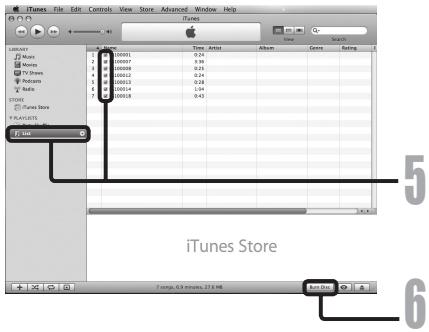
Using as External Memory of the PC
In addition to its uses as an IC recorder and a music player, this recorder can also be used as external memory for a computer by storing data from a computer and reading it back out.
With the recorder connected to your PC, you can download data from the memory to your PC and upload data stored on your PC to the memory.
Windows
1 Connecting the recorder to your PC (P.47).
2 Open the Explorer window.
Open the [LS_10] folder.
- When you open [My Computer], it will be recognized by the drive name [LS_10] (Built-in flash memory) and [Removable Disk] (SD card) (The drive letter will differ depending on the PC being used).
4 Copy the data.
5 Disconnect the USB connection cable (P.48).
Macintosh
1 Connecting the recorder to your PC (P.47).
- When you connect the recorder to a Mac OS, it will be recognized by the drive name [LS_10] on the desktop. When an SD card is inserted it will be recognized by the drive name [Untitled].
2 Double-click on [LS_10] icon on the desktop.
3 Copy the data.
4 Disconnect the USB connection cable (P.48).
Note
- While transmitting data, [Busy] is displayed, and the [PEAK] indicator light flashes. NEVER disconnect the USB while the [PEAK] indicator light is flashing. If you do, the data will be destroyed.
Alarm Message List
| Message | Meaning | Explanation | Action |
| Battery Low | Low battery power. | Battery power is getting low. | Replace with new batteries (€3 P.9). |
| File Protected | Erase-locked. | Tried to delete a locked file. | Unlock the file (€3 P.34, P.39). |
| Illegal Folder | Not an audio-recording folder. | Recording has been attempted with a [Music] folder. | Select a folder from [A] through to [B] and try recording again (€3 P.16 to P.18, P.20). |
| Folder Full | Folder full. | The folder is full of files (maximum of 200 files). | Erase unnecessary files (€3 P.32). |
| Memory Error | Error in the memory. | Error in the memory. | This is a malfunction, so go to the store where you purchased the recorder or an Olympus service station for repair (€3 P.65). |
| SD card is not recognized correctly. | Remove the SD card then put it again (€3 P.14 to P.15). | ||
| Licence Mismatch | Illegally copied file. | The music files copied illegally. | Erase the file (€3 P.32). |
| Memory Full | Zero remaining memory. | No remaining memory. | Erase unnecessary files (€3 P.32). |
| No File | No file. | No files were found in the folder. | Select another folder (€3 P.16 to P.18). |
| SD Card Locked | Card Locked. | The SD Card is set to write protection. | Undo the SD Card's write protection setting and then try again (€3 P.15). |
| Format Error | Formatting error. | There was an error while formatting the recorder's memory. | Reformat the memory (€3 P.43). |
| Can't Make The System File. Connect To PC And Delete Unnecessary File | The management file cannot be created. | The file for management cannot be created due to a shortage of capacity for remaining memory. | Connect the recorder to a computer and delete any unnecessary files. |
| Data Write Error | The data is not written correctly in the memory. | Data writing to memory cannot be done in time and the recorded sound skips. | Format the memory (€3 P.43). |
Troubleshooting
| Symptom | Probable cause | Action |
| Nothing appears on the display | The batteries are not loaded properly. | Verify that the batteries' polarities ⊙ and ⊙ are correct (⊕ P.9). |
| Battery power is getting low. | Replace with new batteries (⊕ P.9). | |
| The power is off. | Turn the power on (⊕ P.11). | |
| Won't start | Battery power is getting low. | Replace with new batteries (⊕ P.9). |
| The power is off. | Turn the power on (⊕ P.11). | |
| The recorder is in HOLD mode. | Release the recorder from HOLD (⊕ P.11). | |
| Unable to record | Low remaining memory. | Erase unnecessary files (⊕ P.32). |
| The maximum number of files has been reached. | Change to the another folder (⊕ P.16 to P.18, P.20). | |
| The SD Card is set to write protection. | Undo the SD Card's write protection setting and then try again (⊕ P.15). | |
| No sound picked up by the built-in microphone | An external microphone or external device is connected. | Detach all external microphones and external devices connected to the LINE IN jack and the MIC jack (⊕ P.25, P.26). |
| Unable to record through an external microphone | An external device is connected to the LINE IN jack. | Detach the connecting cord from the recorder. |
| An external microphone supported by plug-in power is connected but [Plug-in Power] is set to [Off]. | Set [Plug-inPower] to [On] when an external microphone supported by plug-in power is connected (⊕ P.34, P.37). | |
| No playback tone heard | The earphone is connected. | Unplug the earphones to use the internal speaker. |
| The volume level is set to [0]. | Adjust the volume level (⊕ P.27). | |
| Recording level too low | The recording level has not been ad-justed. | Adjust the recording level and then try recording once more (⊕ P.20). |
| The microphone sensitivity is too low. | Set the microphone sensitivity to [HIGH] mode and try again (⊕ P.24). | |
| This could potentially be because the recording level and output level for the connected external devices are too low. | If you cannot record clearly even after adjusting the recording level, then adjust the output level for the connected devices (⊕ P.20). | |
| Recording level too high | The recording level has not been ad-justed. | Adjust the recording level and then try recording once more (⊕ P.20). |
| This could potentially be because the recording level and output level for con- nected external devices are too high. | If you cannot record clearly even after adjusting the recording level, then adjust the output level for the connected devices (⊕ P.20). | |
| Voice files are not recorded in stereo | The connected external microphone is monaural. | When recording while an external monaural microphone is connected, sound will only be recorded by the L-channel. |
| Cannot find the recorded Voice File | Wrong recording media or folder. | Switch to the correct recording media or folder (€P.16 to P.18, P.20, P.34, P.39). |
| Noise heard during play-back | The recorder was shaken during recording. | —— |
| The recorder was placed near a cell phone or fluorescent lamp while recording or during playback. | Move the recorder. | |
| The settings of the connected external microphone do not correspond to those of the recorder. | When a microphone not supported by the plug-in power function is connected, turn the [Plug-inPower] setting to [Off] (€P.34, P.37). | |
| Unable to erase | The file is locked. | Unlock the file (€P.34, P.39). |
| The file is read-only. | Cancel the read-only setting of the file on the PC. | |
| Unable to hear any sound from the earphone through the recording monitor | The [Rec Monitor] is set to [Off]. | Turn the [Rec Monitor] setting to [On] (€P.34, P.37). |
| Noise is audible through the recording monitor | Acoustic feedback is occurring. | When the built-in speaker amps and the like are connected there is a risk that audio feedback will occur while recording. It is recommended that you use earphones for the recording monitor, or turn the [Rec Monitor] to [Off] while recording (€P.34, P.37). |
| Conduct adjustments like separating the earphones from the microphone farther, do not point the microphone at the earphones, lower the volume on the recording monitor, and so on. |
Technical Assistance and Support
The following are contact information for technical support for Olympus recorders and software only.
Technical Hotline Number in the U.S. and Canada 1-888-553-4448
- User Support E-mail address in the U.S. and Canada distec@olympus.com
Technical Hotline Number in Europe Toll free number: 00800 67 10 83 00
available for Austria, Belgium, Denmark, Finland, France, Germany, Italy, Luxembourg, Netherlands, Norway, Portugal, Spain, Sweden, Switzerland, United Kingdom
Charged numbers for the Rest of Europe
+491805671083
+4940237734899
- User Support E-mail address in Europe
dss/support@olympus-europa.com
Accessories (optional)
Stereo microphone: ME51S
The ME51S stereo microphone comes in a set with an extension cord and a clip.
2 channel microphone (non-directional): ME30W
Two ME30 monaural microphones come in a set with a miniature tripod and a connection adapter. These are highly sensitive non-directional microphones supported by plug-in power which are well-suited to recording musical performances.
Highly sensitive noise-cancellation monaural microphone (unidirectional): ME52W
This microphone is used to record sound at a distance while minimizing surrounding noise
Tie clip microphone (non-directional): ME15
Small concealing microphone with a tie-clip.
Telephone pickup: TP7
Earphone type microphone can be plugged into your ear while phoning. The voice or conversation over the phone can be clearly recorded.
Ni-MH rechargeable battery and charger set: B-90SU (For U.S.A. and Canada)
BU-90SE (For Europe)
B-90SU or BU-90SE comes with an Ni-MH rechargeable battery charger and 4 Ni-MH rechargeable batteries B-01 4PE as a pack. This charger can quick charge Olympus AA or AAA Ni-MH rechargeable batteries.
Ni-MH rechargeable battery: B-01 4PE (Europe only)
4 Ni-MH rechargeable batteries B-01 4PE as a pack. High-efficiency rechargeable long life batteries.
Connecting cord: KA333
Connecting cord which has stereo mini-plugs (p3.5) with resistance at both ends. Use to connect from the earphone jack output of the recorder to the microphone input jack when recording.
Converting plug adapters (PA331/PA231) which convert to the monaural mini plug ( 3.5) or monaural mini plug ( 2.5) are also enclosed.
Exclusive remote control set: RS30W
(Scheduled for release in Spring 2008)
When the receiver is plugged into the REMOTE jack the recorder's recording and stop functions can be operated through the remote control. The receiving position can be adjusted, thereby allowing you to operate the recorder from various different angles.
General points
Recording format:
Linear PCM (Pulse Code Modulation)
MP3 (MPEG-1/MPEG-2 Audio Layer3)
WMA (Windows Media Audio)
Input level:
MIC SENSE HIGH/LOW switch is set to [HIGH]: -59 dBv
MIC SENSE HIGH/LOW switch is set to [LOW]: -39 dBv
LINE IN jack input:
-6dBv
Maximum headphone output:
3mW + 3mW (at load of 16
70 mV (according to EN 50332-2)
Recording medium:
Built-in NAND FLASH memory (2 GB)
SD card (512 MB to 8 GB)
Speaker:
Built-in 16 mm round dynamic speaker
MIC jack:
0 3.5 mm mini-jack, impedance 2 kΩ
LINE IN jack:
0 3.5 mm mini-jack, impedance 78 kΩ (approx.)
EAR jack:
3.5 ~mm mini-jack, impedance 8 or more
Maximum working output)
200 mW + 200 mW (8 Ω speaker)
Input power requirement:
Batteries: Two AA batteries (LR6 or ZR6) or Two Ni-MH rechargeable batteries
External power supply: AC adapter 5 V
External dimensions:
131.5mm× 48mm× 22.4mm
(without protrusions)
Weight:
165 g (including alkaline batteries)
Overall frequency response:
LINE IN Jack (During recording or playback mode):
Linear PCM format
| Recording mode | Overall frequency response |
| 96 kHz | 20 Hz to 44 kHz |
| 48 kHz | 20 Hz to 23 kHz |
| 44.1 kHz | 20 Hz to 21 kHz |
MP3 format
| Recording mode | Overall frequency response |
| 320 kbps | 50 Hz to 20 kHz |
| 256 kbps | 50 Hz to 20 kHz |
| 128 kbps | 50 Hz to 17 kHz |
WMA format
| Recording mode | Overall frequency response |
| 160 kbps | 50 Hz to 19 kHz |
| 128 kbps | 50 Hz to 19 kHz |
| 64 kbps | 50 Hz to 15 kHz |
■ Built-in stereo speaker (During recording mode):
70 Hz to 20 kHz
However, when recording by the MP3 format or the WMA format, the upper limit value of the frequency response depends on each recording mode (see above diagram).
Guide to recording times
Linear PCM format:
| Recording mode | Built-in flash memory (2 GB) | SD card | ||||
| 512 MB | 1 GB | 2 GB | 4 GB | 8 GB | ||
| 96 kHz 24 bit | 55 min. | 10 min. | 25 min. | 55 min. | 1 h. 50 min. | 3 h. 45 min. |
| 96 kHz 16 bit | 1 h. 25 min. | 20 min. | 40 min. | 1 h. 20 min. | 2 h. 50 min. | 5 h. 45 min. |
| 48 kHz 24 bit | 1 h. 55 min. | 25 min. | 55 min. | 1 h. 50 min. | 3 h. 50 min. | 7 h. 40 min. |
| 48 kHz 16 bit | 2 h. 55 min. | 40 min. | 1 h. 25 min. | 2 h. 50 min. | 5 h. 45 min. | 11 h. 30 min. |
| 44.1 kHz 24 bit | 2 h. 5 min. | 30 min. | 1 h. | 2 h. | 4 h. 10 min. | 8 h. 20 min. |
| 44.1 kHz 16 bit | 3 h. 10 min. | 45 min. | 1 h. 30 min. | 3 h. 5 min. | 6 h. 15 min. | 12 h. 35 min. |
MP3 format:
| Recording mode | Built-in flash memory (2 GB) | SD card | ||||
| 512 MB | 1 GB | 2 GB | 4 GB | 8 GB | ||
| 320 kbps | 14 h. 10 min. | 3 h. 30 min. | 7 h. | 13 h. 50 min. | 28 h. | 55 h. 40 min. |
| 256 kbps | 17 h. 45 min. | 4 h. 20 min. | 8 h. 50 min. | 17 h. 20 min. | 35 h. | 69 h. 40 min. |
| 128 kbps | 35 h. 35 min. | 8 h. 50 min. | 17 h. 40 min. | 34 h. 50 min. | 70 h. 10 min. | 139 h. 30 min. |
WMA format:
| Recording mode | Built-in flash memory (2 GB) | SD card | ||||
| 512 MB | 1 GB | 2 GB | 4 GB | 8 GB | ||
| 160 kbps | 27 h. 50 min. | 6 h. 50 min. | 13 h. 50 min. | 27 h. 10 min. | 54 h. 50 min. | 109 h. |
| 128 kbps | 34 h. 45 min. | 8 h. 30 min. | 17 h. 20 min. | 34 h. | 68 h. 40 min. | 136 h. 20 min. |
| 64 kbps | 69 h. 35 min. | 17 h. 20 min. | 34 h. 50 min. | 68 h. 10 min. | 137 h. 20 min. | 272 h. 50 min. |
Notes
- The above values are strictly rough guides.
- Variations in the available recording time will arise as there may be differences in the available memory depending on the card.
- Caution is required, since the differences in the available recording time will increase when the bit count and bit rate are low.
- Available recording time may be shorter if many short recordings are made. (The displayed available recording time and recorded time are approximate indications).
- The maximum capacity for a single file is limited to approx. 4 GB for WMA and MP3, and approx. 2 GB for Linear PCM format (WAV).
- For WMA format files, the file length for a single file is limited to a maximum length of approx. 26 hours and 40 minutes. For this reason, it will differ from the continuous recording time for a single file.
Guide to battery life
Alkaline batteries:
| Recording mode | Built-in stereo microphone (During recording mode) | Built-in stereo speakers (During playback mode) | |
| Linear PCM format | 96 kHz 24 bit | 8 h. | 13 h. |
| 44 kHz 16 bit | 12 h. | 26 h. | |
Ni-MH Rechargeable batteries:
| Recording mode | Built-in stereo microphone (During recording mode) | Built-in stereo speakers (During playback mode) | |
| Linear PCM format | 96 kHz 24 bit | 10 h. | 26 h. |
| 44.1 kHz 16 bit | 16 h. | 35 h. | |
Notes
- The above values are strictly rough guides.
- Battery life is measured by Olympus. It varies greatly according to the type of batteries used and the conditions of use.
Declaration of Conformity
Model Number :LS-10
Trade Name : DIGITAL VOICE REORDER
Responsible Party : OLYMPUS IMAGING AMERICA INC.
Address : 3500 Corporate Parkway, P.O. Box 610, Center Valley, PA 18034-0610, U.S.A.
Telephone Number :1-888-553-4448
This device Complies with Part 15 of the FCC Rules. Operation is subject to the following two conditions: (1) This device may not cause harmful interference, and (2) this device must accept any interference received, including interference that may cause undesired operation.

Tested To Comply
With FCC Standards
FOR HOME OR OFFICE USE
Canadian RFI
This digital apparatus does not exceed the Class B limits for radio noise emissions from digital apparatus as set out in the Radio Interference Regulations of the Canadian Department of Communications.
For customers in Europe

"CE" mark indicates that this product complies with the European requirements for safety, health, environment and customer protection.

This symbol [crossed-out wheeled bin WEEE Annex IV] indicates separate collection of waste electrical and electronic equipment in the EU countries. Please do not throw the equipment into the domestic refuse. Please use the return and collection systems available in your country for the disposal of this product.
Applicable Product : LS-10

(Premises/Goods delivery) Wendenstrasse 14-18, 20097 Hamburg, Germany. Tel. 040-237730
(Letters) Postfach 10 49 08. 20034 Hamburg, Germany.
OLYMPUS UK LTD.
Vision House 19, Colonial Way Watford Hertfordshire WD24 4JL, United Kingdom. Tel. 01923-83-1100
http://www.olympus.com/