
HWC31GCIA - Wine cellar Hanseatic - Free user manual and instructions
Find the device manual for free HWC31GCIA Hanseatic in PDF.


| Product Type | Wine Cooler |
| Brand / Model | Hanseatic HWC31GCIA |
| Item Number | 92625406 |
| Total Capacity | 31 bottles (0.75 L) |
| Dimensions (Height × Width × Depth) | 865 mm × 380 mm × 570 mm |
| Unloaded Weight | 31 kg |
| Rated Power | 65 W |
| Supply Voltage / Frequency / Current | 220-240 V ~ / 50 Hz / 0.8 A |
| Protection Class | I |
| Climate Class | SN, N, ST (+10°C to +38°C) |
| Refrigerant | R600a (isobutane), 18 g |
| Temperature Range | +5°C to +22°C (41°F to 72°F) |
| Number of Shelves | 4 removable bottle shelves |
| Max Load per Shelf | 8 bottles |
| Door Hinge | Reversible (right/left) |
| Interior Light | LED, switchable |
| Control Panel | Touch keys with temperature display (Celsius/Fahrenheit) |
| Child Lock | Yes (safety lock) |
| Defrosting | Automatic (no manual defrost required) |
| Installation Type | Freestanding or under worktop (not built-in) |
| Spare Parts Availability | At least 7 years after model end-of-life; door seals 10 years |
Frequently Asked Questions - HWC31GCIA Hanseatic
User questions about HWC31GCIA Hanseatic
0 question about this device. Answer the ones you know or ask your own.
Ask a new question about this device
Download the instructions for your Wine cellar in PDF format for free! Find your manual HWC31GCIA - Hanseatic and take your electronic device back in hand. On this page are published all the documents necessary for the use of your device. HWC31GCIA by Hanseatic.
USER MANUAL HWC31GCIA Hanseatic
natural_image
Line drawing of a refrigerator with open doors and shelves, no text or symbols presentGebrauchsanleitung
Weinkühlschrank
Inhaltsverzeichnis

natural_image
Line drawing of a refrigerator with open doors and shelves (no text or symbols)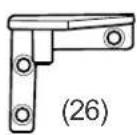
Lieferumfang
natural_image
Line drawing of a multi-level refrigerator with circular compartments and ventilation grilles (no text or symbols)
WARNUNG
natural_image
Simple geometric diagram showing a rectangle with a smaller square inside, labeled 'D' on the top left (no other text or symbols)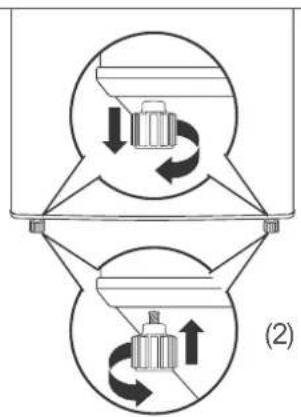
flowchart
graph TD
    A["Top Path"] --> B["Left Loop"]
    B --> C["Right Loop"]
    C --> D["Bottom Path"]
    D --> E["Left Loop"]
    E --> F["Right Loop"]
    F --> G["Bottom Path"]
    style A fill:#f9f,stroke:#333
    style G fill:#f9f,stroke:#333
natural_image
Line drawing of an open refrigerator with shelves and doors (no text or symbols)natural_image
Line drawing of a refrigerator with open doors and shelves, no text or symbols presentUser manual
Wine refrigerator
Table of contents

Please read through the safety instructions and user manual carefully before using the appli-
ance. This is the only way you can use all the functions reliably and safely. Be absolutely sure to also observe the national regulations in your country, which are also valid in addition to the regulations specified in this user manual.
Keep all safety notices and instructions for future reference. Pass all safety notices and instructions on to the subsequent user of the product.

You can find more information on setting up the appliance and starting it up for the first time
from page EN-18.
Delivery.... EN-3
Package contents ..... EN-3
Check the delivery ..... EN-3
Packaging tips ..... EN-3
Safety EN-4
Intended use..... EN-4
Explanation of terms/symbols ..... EN-4
Definitions ...... EN-4
Safety notices.... EN-4
Appliance parts ..... EN-10
Operation .....EN-11
Before getting started . . . . . . . . . . . EN-11
Key tones....EN-11
Switching the appliance on and off .EN-11
Safety lock (child safety lock) ..... EN-12
Setting the temperature ..... EN-12
Changing the temperature unit . . . EN-12
LED light EN-12
Interior equipment ..... EN-13
Storing bottles EN-14
Filling the appliance ..... EN-14
Maximum storage capacity ..... EN-15
Maintaining quality ..... EN-15
Care and maintenance ..... EN-16
Checking and cleaning the door seals.... EN-16
Cleaning the exterior ..... EN-16
Cleaning the back of the appliance ..... EN-16
Defrosting the appliance ..... EN-16
Cleaning the inside of the appliance.... EN-17
Replacing the LED light ..... EN-17
Start-up EN-18
About climate categories ..... EN-18
Before starting to use the appliance.... EN-18
Moving and unpacking ..... EN-18
Choosing a suitable location ..... EN-19
Setting up and adjusting the appliance (free standing appliance) EN-20
Integrating the appliance into a kitchen unit.... EN-22
Basic cleaning EN-22
Connecting the appliance ..... EN-22
Changing the door hinges ..... EN-23
Troubleshooting table ..... EN-26
Service EN-27
Advice, complaints and orders . . . . EN-27
Repairs and spare parts ..... EN-27
Environmental protection ..... EN-28
Disposing of old electrical devices in an environmentally-friendly manner.... EN-28
Our contribution to the protection of the ozone layer . . . . . . . . . . . EN-28
Product fiche concerning
Regulation (EU) No 2019/2016.....EN-29
Technical specifications ..... EN-29
Delivery
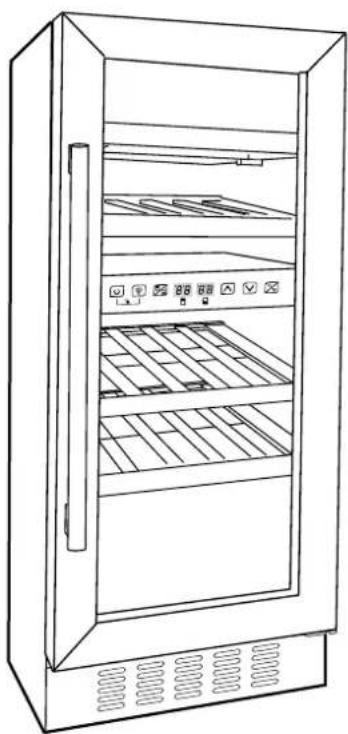
natural_image
Line drawing of a refrigerator with open doors and shelves (no text or symbols)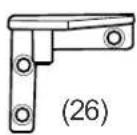
Package contents
1× Wine refrigerator
4× bottle shelf
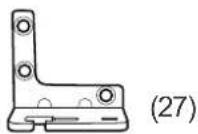
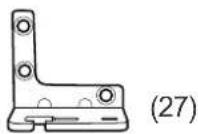
1× Lower hinge for left stop (27)
1× Upper hinge for left stop (26)
1× User manual
Check the delivery
- Move the appliance to a suitable place and unpack it (see "Start-up" on page EN-18).
- Remove all parts of the packaging, plastic profiles, tape and foam padding.
- Check that the delivery is complete.
- Check whether the appliance was damaged during transit.
- If the delivery is incomplete or the appliance has been damaged during transport, please contact our Service department (see page EN-27).

WARNING!
Risk of electric shock! Never use a damaged appliance.
Packaging tips

If you have sufficient space, we recommend keeping the packaging, at least during the warranty period. If
the appliance needs to be sent out for repairs, only the original packaging will provide sufficient protection.
Should you choose not to keep the packaging, please dispose of it in an environmentally friendly way.
Safety
Intended use
The appliance is intended solely for storing wine (max. 31 bottles).
This appliance is designed for use at ambient temperatures of +10 °C to +38 °C.
The appliance is designed for use in private households and is not designed for commercial use or multiple use (e.g.: use by several parties in a block of flats).
The appliance is not suitable for storing blood reserves, medical products, laboratory samples, etc.
This refrigerator is not designed for use as a built-in appliance.
The interior light must only be used to illuminate the interior of the appliance. It is not suitable for lighting a room.
People who are unable to operate the appliance safely due to their physical, sensory or mental abilities or lack of knowledge must be supervised during use.
Do not make any technical changes to the appliance.
Use the appliance exclusively as described in this user manual. Any other use is deemed improper and may result in damage to property or even personal injury. The manufacturer accepts no liability for damage caused by improper use.
Explanation of terms/symbols
The following symbols can be found in this user manual.

WARNING
This symbol indicates a hazard with a medium level of risk which, if not avoided, could result in death or serious injury.

CAUTION
This symbol indicates a hazard with a low level of risk which, if not avoided, could result in minor or moderate injury.

NOTICE
This symbol warns against possible damage to property.

This symbol refers to useful additional information.

Caution: Fire hazard/flammable materials!
Definitions
“Food” refers to foods, ingredients and drinks including wine and other things mainly intended for consumption, which require refrigeration at certain temperatures.
Safety notices
In this chapter you will find general safety notices which you must always observe for your own protection and that of third parties. Please also observe the warning notices in the individual chapters.
Risks in handling household electrical appliances

WARNING
Risk of electric shock!
Touching live parts may result in severe injury or death.
■ Only use the appliance indoors. Do not use in wet rooms or in the rain.
■ Do not operate or continue to use the appliance, if it
– shows visible signs of damage, e.g. the supply cord is defective,
- starts smoking or there is a smell of burning,
- makes unfamiliar noises.
In such cases, remove the mains plug from the socket or unscrew/isolate the fuse and contact our service department (see page EN-27).
■ The appliance corresponds to protection class I and may only be connected to a plug with a protective conductor that has been properly installed. When connecting, make sure that it has the right voltage. More detailed information about this can be found on the nameplate.
■ To disconnect this appliance from the power supply, pull the mains plug out of the socket. The appliance must therefore be connected to an easily accessible socket so that it can be quickly disconnected from the power supply in the event of breakdown.
- If the mains plug is no longer accessible after connecting it, an all-pole disconnecting device complying with overvoltage category III must be connected into the house wiring with a contact gap of at least 3 mm; consult
a qualified professional if necessary (see "Service" on page EN-27).
- When installing the appliance, ensure that the mains cable does not become pinched or damaged. Do not kink the supply cord or lay it over sharp edges.
- Keep the supply cord away from naked flames and hot surfaces.
■ Always pull on the mains plug and not the mains cable.
■ Never touch the mains plug with wet hands.
■ Never immerse the supply cord or plug in water or any other liquids.
■ If the mains cable of the appliance is damaged, it must be replaced by the manufacturer, the customer service department or a similarly qualified person in order to prevent hazards.
■ Independent or improper repairs made to the appliance may cause damage to property and personal injury; any liability and warranty claims will be forfeited. Never try to repair a defective or suspected defective appliance yourself.
- Inspections and repairs to the appliance may only be carried out by authorised specialists. If in doubt, contact our service department (see page EN-27).
■ This appliance contains electrical and mechanical parts which are essential for protection against potential sources of danger. Only parts corresponding to the original appliance specifications may be used for repairs.
- In the event of a fault, as well as before extensive cleaning, pull out the mains plug or isolate/unscrew the fuse.
- Do not put any objects in or through the housing openings, and also make sure that children cannot insert any objects in them.
- Do not remove the covers from the interior lighting. Do not attempt to replace the interior lighting. If in doubt, contact our service department (see page EN-27).
- Check the appliance regularly for damage.
Fire hazard!
Improper handling of the appliance can lead to fire and damage to property.
- Do not connect to a timer or a separate remote-controlled system for distance monitoring and control.
- Do not locate multiple portable socket outlets or portable power supplies at the rear of the appliance.
Risks associated with using refrigerants

WARNING
Risk of fire and explosion!
Your appliance's refrigeration circuit contains the environmentally friendly, but fl ammable refrigerant R600a (isobutane).
-
Do not use mechanical devices or other means to accelerate the defrosting process, other than those recommended by the manufacturer. For example, do not use any electric heating equipment, knives or devices with an open flame such as a candle. The thermal insulation and the interior are scratch and heat-sensitive and can melt.
-
Do not use electrical appliances inside the food storage compartments of the appliance, unless they are of the type recommended by the manufacturer.
- Keep the appliance away from open flames and hot surfaces.
■ Mechanical intervention in the refrigeration system must only be carried out by authorised specialists. - Do not damage the refrigerant circuit, e.g. by puncturing the refrigerant channels of the condensate evaporator with sharp objects, bending the piping, or cutting open the insulation.
■ Ensure that none of the cooling fins or tubes on a refrigerator are damaged prior to the point of proper disposal.
■ Refrigerant is fl ammable when spurting out and can damage the eyes. In this case, rinse your eyes in clean water and seek medical assistance immediately. - To prevent the formation of a fl am-mable gas-air mixture in the event of a leakage in the refrigeration circuit, the installation space must have a minimum size of 1 m ^3 per 8 g of refrigerant in compliance with the EN 378 standard. The amount of re-frigerant contained in your appliance can be found on the type plate.
■ To avoid the formation of sparks, do not pull out the mains plug in the event of a gas leak.
■ Dispose of old electrical appliances at an authorised collection or return point.
■ Only use original accessories.
Risks associated with chemical substances

CAUTION
Danger of explosion!
Improper handling of chemical substances can lead to explosions.
- Do not store explosive substances such as aerosol cans with a fl ammable propellant in this appliance.
- Do not store explosive substances or spray cans with flammable propellants inside the appliance as they may create ignitable gas-air mixtures.
■ Never use defrosting sprays to defrost. They can generate explosive gases.
Risks to children

WARNING
Risk of suffocation!
Children can become entangled in the packaging fi lm or swallow small parts and suffocate.
- Do not allow children to play with the packaging fi lm.
■ Prevent children from pulling small parts from the device or taking them out of the accessory bag and putting them in their mouths. - When disposing of the appliance, ensure that children cannot suffocate inside the appliance (e.g. do not remove the fridge and freezer drawers, unscrew the door/cover).
Risks for certain groups of people

CAUTION
Danger to children and people with impaired physical, sensory or mental abilities!
■ This appliance can be used by children aged from 8 years and above and persons with reduced physical, sensory or mental capabilities or lack of experience and knowledge if they have been given supervision or instruction concerning use of the appliance in a safe way and understand the hazards involved. Children aged from 3 to 8 years are allowed to load and unload refrigerating appliances.
■ Children must not be allowed to play with the appliance.
■ Cleaning and user maintenance may not be performed by children without supervision.
■ Make sure children do not have unsupervised access to the appliance.
Risks associated with using refrigerators

WARNING
Fire hazard!
Improper handling of the appliance can lead to fire and property damage.
- Keep ventilation openings, in the appliance enclosure or in the built-in structure, clear of obstruction.
- Do not place the appliance directly against the wall. Adhere to minimum distances (see “Choosing a suitable location” on page EN-19).

CAUTION
Health hazard!
Inappropriate use of this appliance can harm your health.
■ Opening the door for long periods can cause a significant increase of the temperature in the compartments of the appliance.
■ Clean regularly surfaces that can come in contact with food and accessible drainage systems.
■ If the refrigerating appliance is left empty for long periods, switch it off, defrost, clean, and dry it, and leave the door open to prevent mould developing within the appliance.
The appliance may not operate properly if exposed to low ambient temperatures for extended periods of time. This can then lead to an increase in temperature inside the appliance.
■ Always ensure the prescribed ambient temperature is maintained (see "Intended use" on page EN-4).
Risk of injury!
Improper handling of the appliance may result in injury.
■ The appliance is heavy and bulky. Seek the help of another person when moving the appliance and changing the door hinges.
- Check that entry route and installation location are free of obstacles (e.g. closed doors or objects lying on the floor).
■ Wear protective gloves when moving/installing the appliance and changing the door hinges.
■ Bases, doors, etc. must not be used as steps or for support purposes.
■ Do not place any heavy objects on the appliance.
■ Take care to prevent the risk of tripping when laying the mains cord.
Risk of damage

NOTICE
If the appliance has been transported horizontally, lubricant from the compressor may get into the cooling circuit.
- Do not tilt the appliance more than 45° or lay it on its side.
- Allow the cooling unit to stand upright for 2 hours before start-up. The lubricant will flow back into the compressor during this time.
Improper handling of the appliance can lead to property damage.
■ Do not use the door to pull or lift the appliance.
- The appliance must only be placed on a level and fi rm surface. The surface must be strong enough to support the appliance's weight when fully laden.
- Do not operate the appliance near sinks, taps or containers filled with liquids such as vases, aquariums, etc. Make sure that the appliance does not get wet.
■ Make sure that the ventilation slots are not covered.
■ The maximum load of 8 bottles per bottle shelf must not be exceeded.
■ Do not use sharp or pointed objects to unpack it.
-
Do not use electrical appliances inside the food storage compartments of the appliance, unless they are of the type recommended by the manufacturer.
■ Do not use mechanical devices or other means to accelerate the defrosting process, other than those recommended by the manufacturer.
■ When cleaning, please note: -
Never use harsh, granular, soda, acid, solvent-based or abrasive cleaners. These attack the plastic surfaces. All-purpose cleaners with a neutral pH are recommended.
- Door seals and plastic parts are sensitive to oil and grease. Remove contaminants as quickly as possible.
- Do not clean the appliance parts in the dishwasher.
– Use only soft cloths for cleaning.
- Wait 5 minutes after switching off. Only then switch the appliance on again.
Appliance parts
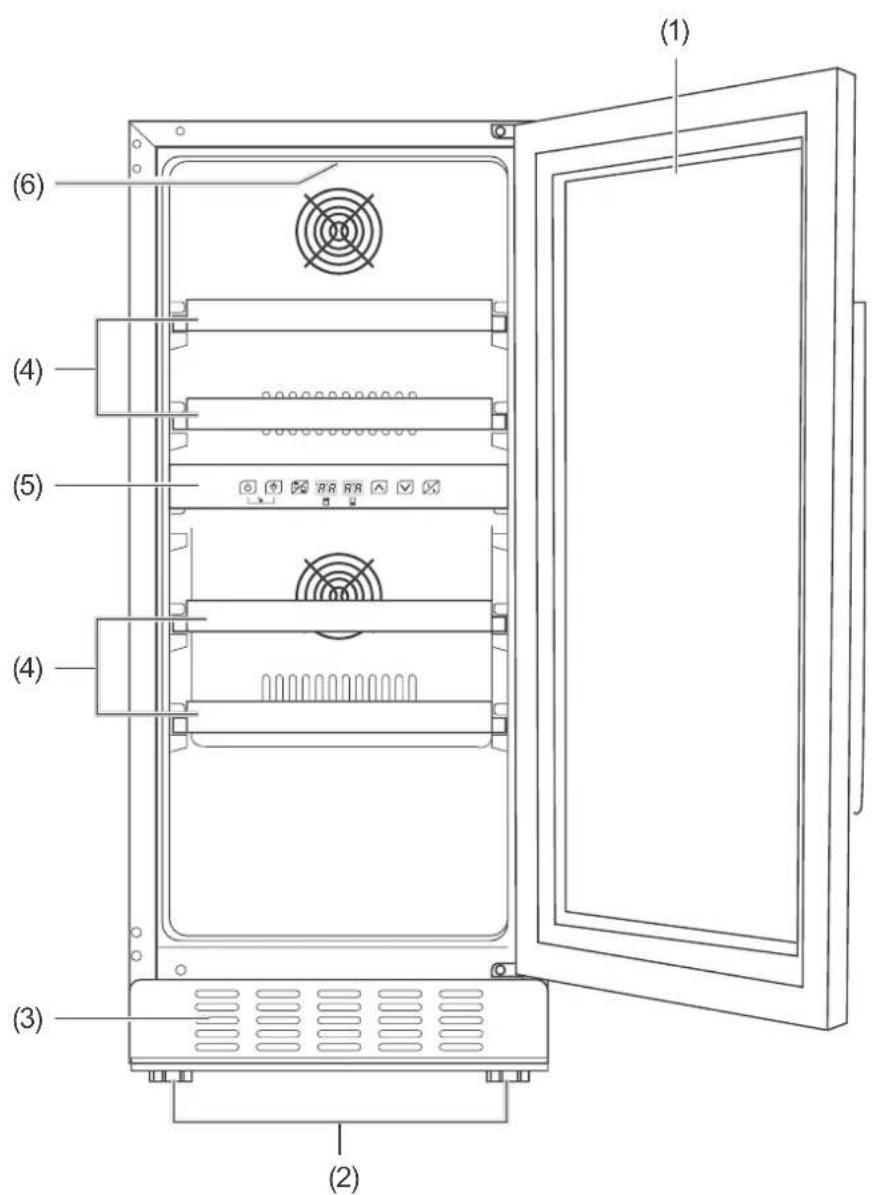
(1) Glass door
(2) Screw feet
(3) Ventilation slits
(4) Bottle shelves
(5) Control panel
(6) LED light
Operation
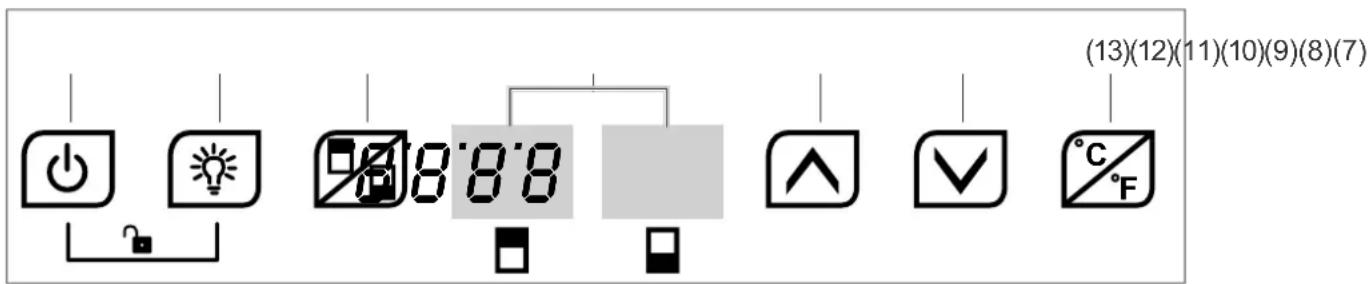
(7) ☐ Switch on/off appliance
(8) ☐ Switch light on/off
(9) ☐ Select temperature zone (top/bottom)
(10) Temperature indicator
(11) ▲ Increase temperature
(12) ☑ Reduce temperature
(13) ☑ Change temperature unit between Celsius and Fahrenheit.
Before getting started
- Read the "Safety" chapter from page EN-4.
- Set up and connect the appliance as described in chapter "Start-up" from page EN-18.
Key tones
Each time you press one of the keys numbered (7) to (9) and (11) to (13), you will hear a beep. This tells you that the appliance has registered your keypress.
Switching the appliance on and off
Switching on for the first time
- If you have not already done so, insert the mains plug into an easily accessible and properly installed socket (220–240 V\~ / 50 Hz).
The temperature indicator (10) will show the current internal temperatures,
– left for the upper zone,
– right for the lower zone.
You will hear the compressor start to work, and the appliance will begin cooling.
The appliance is switched on.
Switching on
- Press and hold the key (7) briefly.
A beep will sound.
The temperature indicator (10) will show the current internal temperatures,
– left for the upper zone,
- right for the lower zone.
You will hear the compressor start to work, and the appliance will begin cooling.
The appliance is switched on.
Switching off
- Press and hold the key (7) briefly.
The temperature indicator (10) will go out. The compressor will not work and the appliance will stop cooling. The appliance is switched off.
Safety lock (child safety lock)
The appliance is equipped with a safety lock. When this is activated, no settings can be changed.
- To activate the safety lock, press the ⏻ (7) and Ⓤ(8) keys at the same time.
A beep will sound. The safety lock is now activated. - To deactivate the safety lock, press the ⏻ (7) and Ⓦ(8) keys again at the same time.
A beep will sound. The safety lock is now deactivated.
Setting the temperature

WARNING
Health hazard!
The appliance may not operate properly if exposed to low ambient temperatures for extended periods of time. This can then lead to an increase in temperature inside the appliance.
■ Always ensure the prescribed ambient temperature is maintained (see "Intended use" on page EN-4).
Select an internal temperature to suit the wine. Further information on the optimum storage temperature can be found in the section “Maintaining quality” on page EN-15.
You can set the appliance to a temperature from +5 °C to +22 °C (41 °F to 72 °F).
The temperature for the lower range can only be set equal to or higher than the temperature in the upper range.
If the same temperature is set in the upper and lower ranges, the actual temperature in the lower range is 1 to 2 degrees higher than the actual temperature in the upper range.
- Select the desired interior zone by pressing the ☐ key (9)
– once for the upper zone. The left-hand temperature indicator (10) will flash.
– twice for the lower zone.
- The right-hand temperature indicator (10) will flash.
As long as the temperature indicator is flashing, you can set the temperature.
- The temperature of the selected zone can be – increased by pressing the key (11) until the desired temperature is displayed. – reduced by pressing the √ key (12) until the desired temperature is displayed.
After a short while the flashing will stop and the desired temperature will be set.
The appliance will adjust itself to the set temperature while showing the current internal temperature.

If you set a lower temperature, you will need higher cooling performance.
This increases the energy consumption.
Changing the temperature unit
You can choose whether the internal temperature is displayed in Celsius or in Fahrenheit.
The small green symbol on the top right next to the temperature indicator (10) lets you identify the current setting.
- To change the unit, press an hold the key (13).
LED light
- To switch the LED on or off, press the ☐ key (8).
Interior equipment
The bottle shelves (4) can be removed.
Removing the shelves
- Lift the rear of the bottle shelf (4) slightly and pull it out. In doing so make sure that the spacers (16) slide into the guide rails (17).
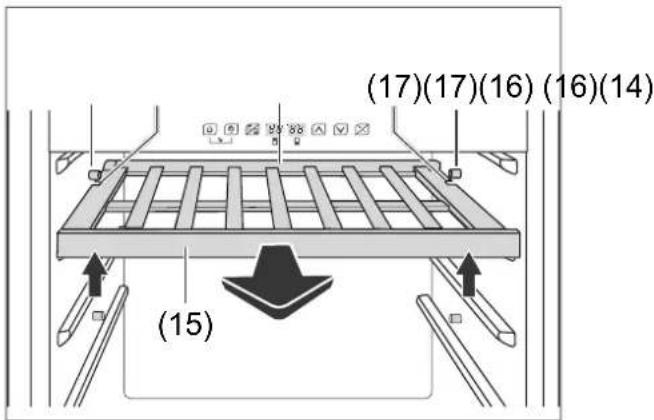
Inserting the shelves
- Turn the bottle shelf (4) so that the front rails (15) and back rails (14) are facing up.
- Insert the bottle shelf (4) into the side brackets and slide it all the way back. In doing so make sure that the spacers (16) slide into the guide rails (17).
Storing bottles
natural_image
Line drawing of a multi-level refrigerator with circular compartments and ventilation grilles (no text or symbols)
WARNING
Danger of explosion!
Improper handling of the appliance can lead to explosions.
- Do not store explosive substances or spray cans with flammable propellants inside the appliance, as they may cause ignitable gas-air mixtures to explode.

CAUTION
Health hazard!
Inappropriate use of this appliance can harm your health.
■ Opening the door for long periods can cause a significant increase of the temperature in the compartments of the appliance.
■ Clean regularly surfaces that can come in contact with food and accessible drainage systems.
- If the refrigerating appliance is left empty for long periods, switch it off, defrost, clean, and dry it, and leave the door open to prevent mould developing within the appliance.
Filling the appliance
The following tips show you how you can store foods in your appliance to keep them in the best possible condition over the longest possible period. They will help prevent food from being wasted.
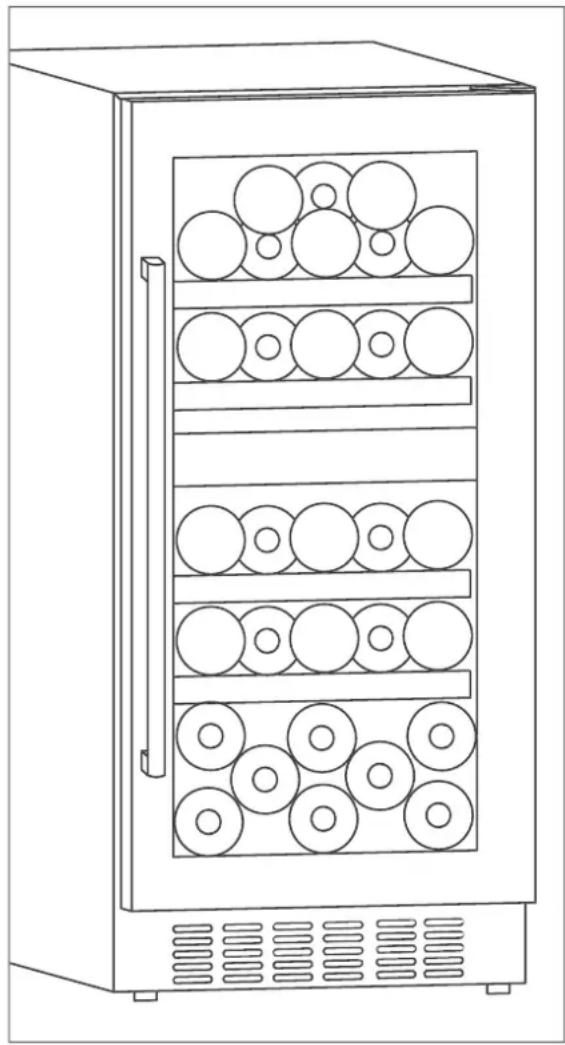
- Lay bottles in the slots between the wooden rails on the bottle shelves (4).
The bottle tops should be facing the glass door (1). - Make sure that the bottles do not directly touch the interior walls of appliance or the glass door.
- Remove the packaging (e.g. cardboard) before placing items in the appliance.
- Systematically fill the appliance so the wine you want is easy to reach so that you do not have to move the wine bottles around a lot.
- Only store strong alcohol standing upright and closed tightly.
- Make sure that the appliance is at least 70 % filled in order to counteract fluctuations in temperature.
Maximum storage capacity
! NOTICE
Risk of damage!
Damage may be caused to the appliance by placing too much weight on the bottle shelves.
■ The maximum load of 8 bottles per shelf must not be exceeded.
The appliance is designed to only hold a certain number of 0.75 l bottles (see "Intended use" on page EN-4).
- Store only as many bottles as provided for.
Maintaining quality Storage temperature
The optimum storage temperature varies depending on the type of wine, due to the fact that wines have different shelf lives and age differently. A temperature setting that is too high or too low can reduce the shelf life of your wine. This leads to greater food waste.
| Wine Storage temperature | |
| Semi-sparkling wine | +6 °C to +10 °C |
| Sparkling wine | +10 °C |
| White wine | +10 °C to +12 °C |
| Red wine | +12 °C to +14 °C |
| Rosé wine | +12 °C to +16 °C |
Avoid strong and frequent variations in temperature.
- Ensure that there is enough space between the bottles to promote the circulation of air inside the appliance.
- The appliance's interior temperatures can increase and lead to increased energy consumption
- if the glass door is opened frequently or for a prolonged period.
- if the temperature falls below or exceeds the prescribed interior temperature.
- if a large number of bottles is put into storage at once.
- if the appliance's nominal capacity is exceeded.
Storage period
The storage periods of wines differs and is dependent on many factors. Use the following storage periods as a general guideline:
| Wine Storage period | |
| Rosé wine, light red wine 1 to 2 years | |
| White wine 3 to 5 years | |
| Red wine | approx. 6 years |
| Very sweet wines | +15 years |
Additional factors
- Make sure to move the wine as little as possible during storage. Frequently moving the wine around can lead to rapid ageing.
- Ensure that the wine is kept as far away as possible from light and stored in the dark.
- Do not turn the LED light (6) on frequently. Exposure to light can affect the taste of wine.
Care and maintenance

WARNING
Risk of electric shock!
Touching live parts may result in severe injury or death.
■ Before cleaning, pull the mains plug out of the socket.
- When pulling out the mains plug, always take hold of the mains plug itself and never the mains cord.

CAUTION
Danger to children and people with impaired physical, sensory or mental abilities!
■ Cleaning and user maintenance must not be carried out by children unless they are supervised.
Risk of injury!
Sharp-edged appliance parts beneath the appliance may lead to cuts.
■ Exercise caution when cleaning the appliance.

NOTICE
Risk of damage!
The surfaces and appliance parts can be damaged through improper handling.
■ Never use harsh, granular, soda, acid, solvent-based or abrasive cleaners. These attack the plastic surfaces. All-purpose cleaners with a neutral pH are recommended.
■ Door seals and plastic parts are sensitive to oil and grease. Remove contaminants as quickly as possible.
■ Only use soft cloths.
Checking and cleaning the door seals
The door seals must be checked regularly so that no air can enter the appliance.
- To test them, clamp a thin piece of paper in various places. The paper should be difficult to pull through at all points.
- If the seal is not uniform everywhere: Warm the seal in the appropriate places in front of you with a hair dryer and pull it out with your fingers.
- Only clean dirty seals with clean water.
Cleaning the exterior
– Painted surfaces
Use only light pH-neutral soapy water.
- Stainless steel surfaces
Use special stainless steel cleaner from a specialist shop. Never use polish.
Cleaning the back of the appliance
Dust deposits on the back of the appliance can affect the appliance's performance and lead to increased energy consumption.
- Remove dust and clean the back of the appliance and the compressor once or twice a year. Use a soft brush to do this.
Defrosting the appliance
Thawing is not necessary as the temperatures inside the appliance do not drop beneath freezing point.
Cleaning the inside of the appliance
NOTICE
Risk of damage!
The interior of the appliance can get damaged by improper handling.
- Do not clean the appliance parts in the dishwasher.
- Disconnect the mains plug from the socket.
- Take out the wine bottles and temporarily store them in a cool room.
- Remove the bottle shelves (4).
- Wipe off all parts with a damp cloth. Use lukewarm rinsing water to remove stubborn stains. Wipe down with clean water.
- Dry all parts thoroughly.
- Wash the interior with warm water and washing-up liquid. When wiping clean, add a few drops of vinegar to the water to prevent mould from forming.
- Wipe the interior dry and leave the glass door (1) open for a while to air.
- Clean the door seal with clean water only. It is sensitive to oil and grease.
- Replace all removed parts.
- Put the wine bottles back in the appliance.
- Insert the mains plug into a properly installed socket.
Replacing the LED light
! WARNING
Risk of electric shock!
Touching live parts may result in severe injury or death.
■ Do not remove the LED light covers.
■ Do not attempt to replace the LED light yourself.
Maintenance-free LEDs are used to light the appliance.
Should the LED light (6) ever malfunction, contact an authorised professional (see "Service" on page EN-27).
Start-up
About climate categories
- Always ensure the prescribed ambient temperature is maintained (see “Intended use” on page EN-4).
Climate category means that the appliance is intended for operation at the specified ambient temperature (see table “climate categories”). If the room temperature drops significantly below this, the unit will not switch on as often. This indicates that an unwelcome increase in temperature may occur.
| “Climate categories” table | ||
| Zone description Code Definition | ||
| Extended temperate zone SN | This refrigerator is designed for use at ambient temperatures of +10 °C to +32 °C. | |
| Temperate zone N | This refrigerator is designed for use at ambient temperatures of +16 °C to +32 °C. | |
| Subtropical zone ST | This refrigerator is designed for use at ambient temperatures of +16 °C to +38 °C. | |
| Tropical zone T | This refrigerator is designed for use at ambient temperatures of +16 °C to +43 °C. | |
Before starting to use the appliance
Re-read the "Safety" chapter from page EN-4.
Moving and unpacking

WARNING
Risk of suffocation!
Children can become entangled in the packaging fi lm or swallow small parts and suffocate.
■ Do not allow children to play with the packaging fi lm.
■ Prevent children from pulling small parts off the appliance or taking them out of the accessory bag and putting them in their mouths.

CAUTION
Risk of injury!
Improper handling of the appliance may result in injury.
■ The appliance is heavy and bulky. Seek the help of another person when moving the appliance.
■ Bases, doors, etc. must not be used as steps or for support purposes.

NOTICE
Risk of damage!
Improper handling of the appliance may result in damage.
■ Do not tilt the appliance more than 45°.
- Do not use sharp or pointed objects to unpack it.
- When unpacking the appliance, never damage the insulation material on the back of the appliance.
- Move the appliance using a dolly or with a second person.
- Unpack the appliance and carefully remove all packaging, plastic moulding, adhesive strips, protective film and foam padding from the inside, outside and back of the appliance.
Choosing a suitable location

WARNING
Risk of fire and explosion!
Your appliance's refrigeration circuit contains the environmentally-friendly, but fl ammable refrigerant R600a (isobutane).
- Keep the appliance away from open flames and hot surfaces.
Dangers from the refrigerant!
- Do not damage the refrigerant circuit, for example by piercing the refrigerant channels of the condensate vaporiser with sharp objects, bending the tubing, etc.
■ Refrigerant is fl ammable when spurting out and can damage the eyes. In this case, rinse your eyes in clean water and seek medical assistance immediately.

NOTICE
Risk of damage!
The appliance may not operate properly if exposed to low ambient temperatures for extended periods of time. This can then lead to an increase in temperature inside the appliance.
■ Always ensure the ambient temperature is kept within the specified range (see “Intended use” on page EN-4)
- To prevent the formation of a flammable gas-air mixture in the event of a leakage in the refrigeration circuit, the installation space must have a minimum size of 4.5m^3 .
- The appliance must only be placed on a level and firm surface. The surface must be strong enough to support the appliance's weight when fully laden.
- Suitable locations are dry, well-ventilated areas that are cool if possible.
- Unsuitable locations are ones with direct sunlight or which are directly next to an oven, hob or radiator.
– The following minimum distances must be maintained:
– from electrical hobs 20 cm
– from oil and coal burning stoves 100 cm
– from other cooling appliances 20 cm
– from washing machines/ dishwashers 20 - If you would like to reduce these distances, you can fit an insulation plate between the appliances.
- If underfloor heating is installed at the setup location, place the cooling appliance on an insulation plate made from solid material.
Setting up and adjusting the appliance (free standing appliance)
! NOTICE
Risk of damage
If the ventilation slits are covered, the heat from inside the appliance cannot be properly expelled.
■ Make sure that the ventilation slots are not covered.
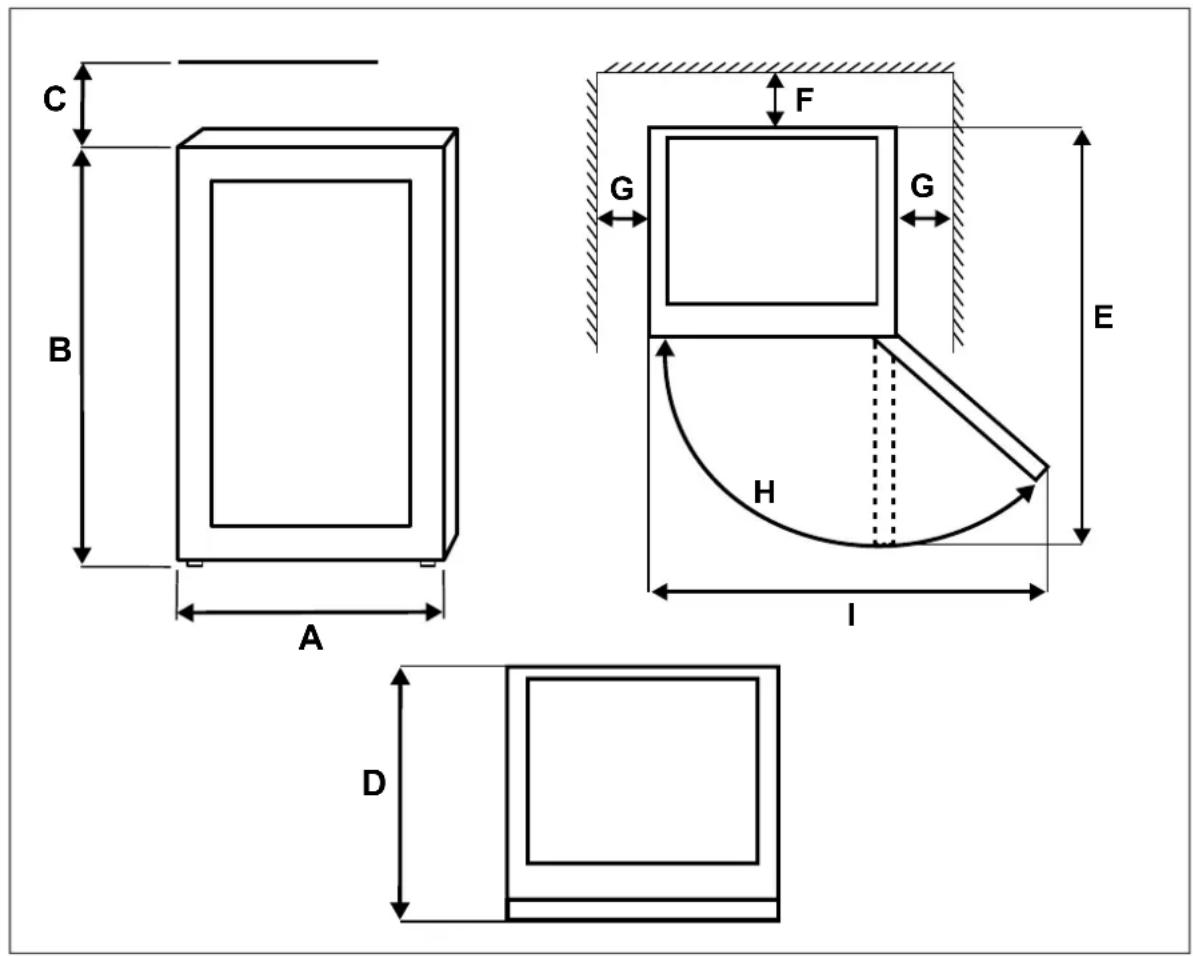
Space required when setting up as a free standing appliance
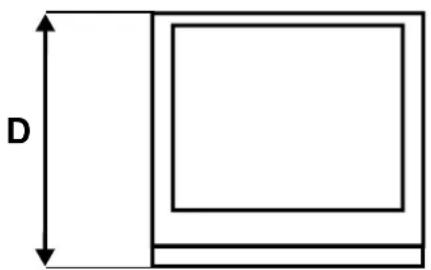
A: 380 mm B: 865 mm
C: 100 mm D: 570 mm
E: 920 mm F: 100 mm
G: 50 mm H: 130°
l: 630 mm
- Place the appliance on as flat and as firm a base as possible.
- Check the position with a spirit level.
flowchart
graph TD
    A["Device with upper circular component"] --> B{Flow Direction}
    B --> C["Upper circular component"]
    C --> D["Bottom circular component"]
    D --> E["Downward Flow"]
    style A fill:#f9f,stroke:#333
    style C fill:#bbf,stroke:#333
    style D fill:#bfb,stroke:#333
-
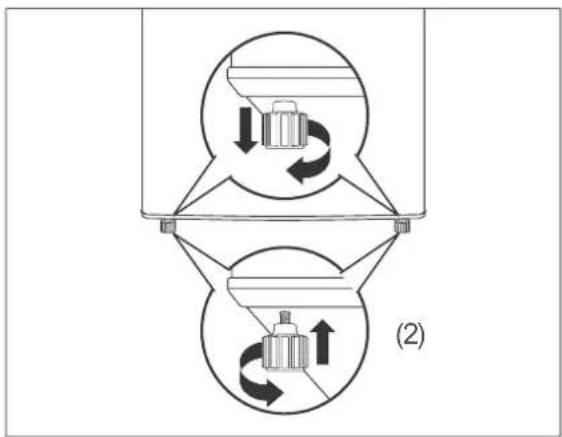
Level out any unevenness on the ground using the four screw feet.
-
Close the glass door (1).
- Tilt the appliance backwards slightly and screw/unscrew the screw feet (2).
- Tilt the appliance slightly forward and screw in/unscrew the screw feet.
- Stand the appliance back up again and check the alignment with a spirit level. Repeat the process until the appliance is standing up vertically. The appliance should not move when opening the glass door.
Integrating the appliance into a kitchen unit

NOTICE
Risk of damage!
If the ventilation slits are covered, the heat from inside the appliance cannot be properly expelled.
■ Make sure that the ventilation slots are not covered.
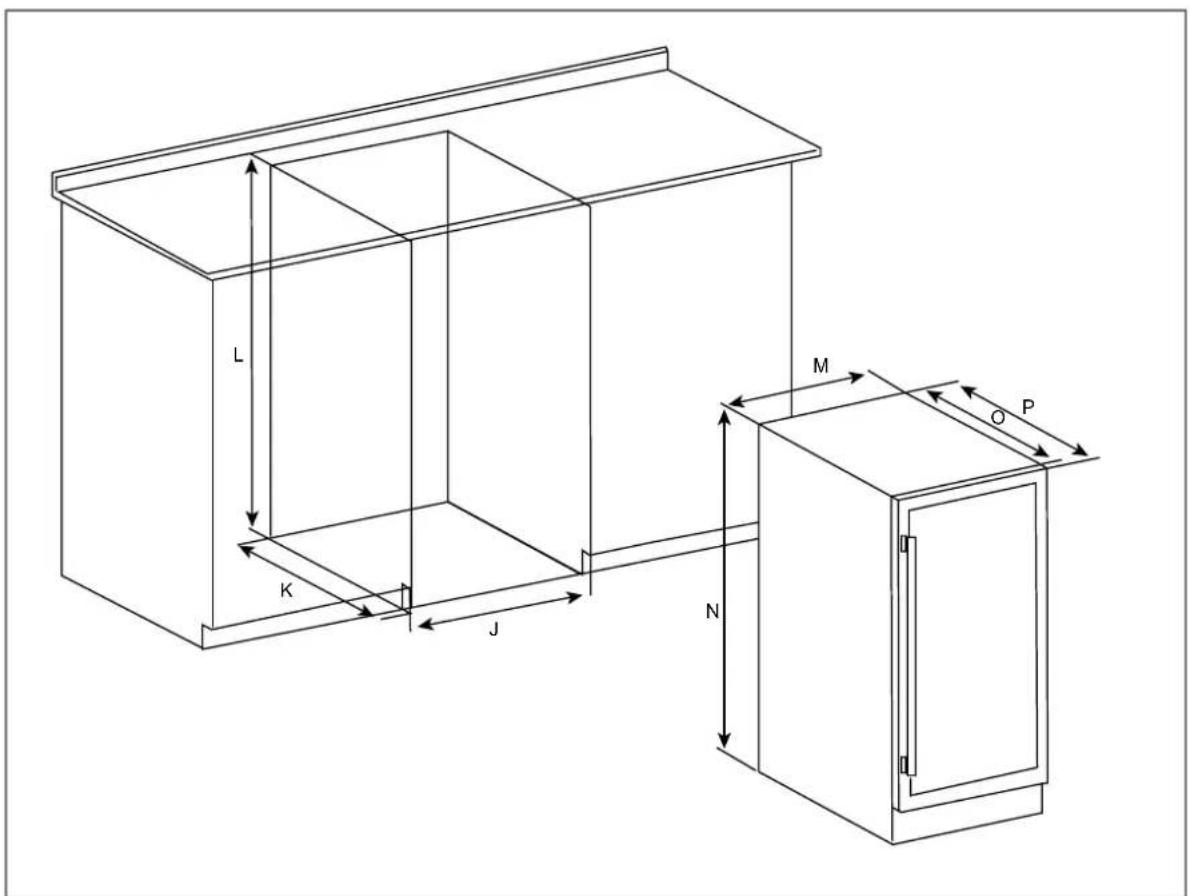
Space required for installing the appliance under a worktop
J: 385 mm K: 575 mm
L: 870 mm M: 380 mm
N: 865 mm O: 520 mm
P: 570 mm
- First connect it to the power.
- Slide the appliance into the recess. Make sure that the mains cord does not become trapped.
Basic cleaning
To remove the odour that comes with all new appliances, clean the appliance before using it (see “Care and maintenance” on page EN-16).
Connecting the appliance

WARNING
Risk of electric shock!
Touching live parts may result in severe injury or death.
■ Do not operate or continue to operate the appliance if it
– shows visible signs of damage, e.g. the power cord is defective,
- starts smoking or there is a smell of burning,
- makes unfamiliar noises.
In such cases, remove the mains plug from the socket and contact our Service department (see page EN-27).
- Do not connect to a timer or a separate remote-controlled system for distance monitoring and control.
- Do not kink or pinch the mains cord or lay it over sharp edges. This can result in a break in the cable.

CAUTION
Fire hazard!
Improper handling of the appliance can lead to fire and property damage.
- Only connect the appliance to a properly installed and earthed electric socket. Do not connect to a multi-socket extension cable or a multi-socket plug.
NOTICE
Risk of damage!
If the cooling unit has been transported horizontally, lubricant from the compressor may get into the cooling circuit.
- Allow the appliance to stand upright for approx. 2 hours after transport and before connecting. This allows the lubricant enough time to flow back into the compressor.
- Insert the mains plug into an easily accessible and properly installed socket (220–240 V\~/50 Hz). The temperature indicator (10) will light up. The appliance is switched on.

You will find all important information about operation from page EN-11.
Changing the door hinges
CAUTION
Risk of injury!
The glass door is very heavy.
- Ask another person, if needed, to help you with attaching or removing the glass door.
! NOTICE
Risk of damage!
Improper handling of the appliance may result in damage.
- Do not tilt the appliance more than 45°.
■ Do not lay it on its side.
Depending on the space conditions, you can change the direction of the door hinges on your appliance. This work, however, requires you to have a certain degree of craftsmanship skills. Please read the following steps completely before changing the hinges.
You will need the following tools to change the door hinges:
– medium size cross-tip screwdriver
– medium size flat-headed screwdriver
- Ensure that the appliance is not connected to the power supply.
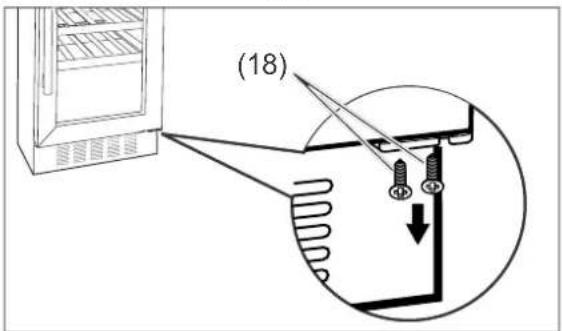
- Unscrew the two screws (18) from the lower hinge.
natural_image
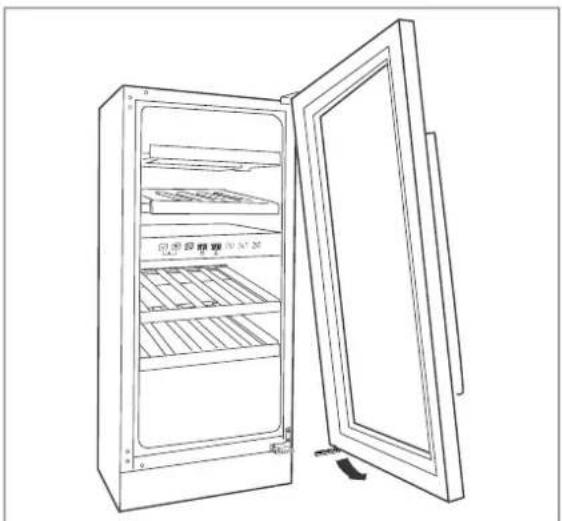
Line drawing of an open refrigerator with shelves and doors (no text or symbols)- Open the glass door and remove it.
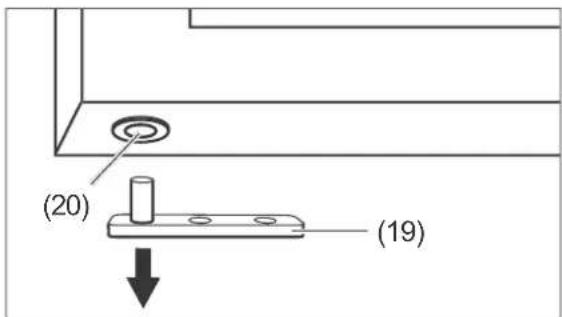
- Pull the hinge plate (19) out of the plastic insert (20) at the bottom edge of the glass door.
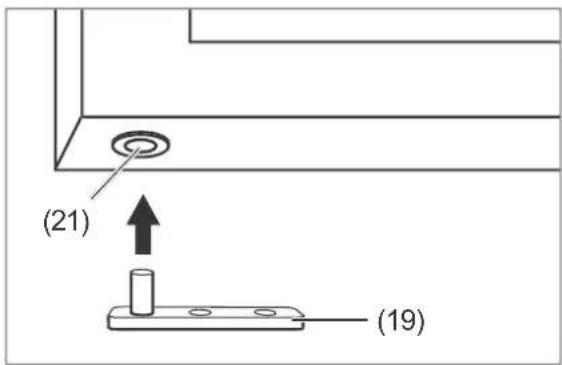
- Rotate the glass door 180^ and place the hinge plate (21) into the plastic insert (19) here.
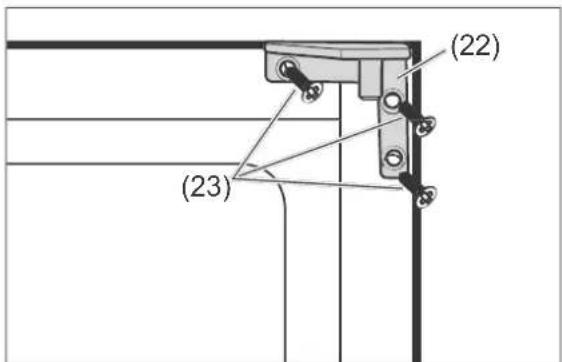
- Unscrew the three screws (23) on the upper hinge (22) and remove it.
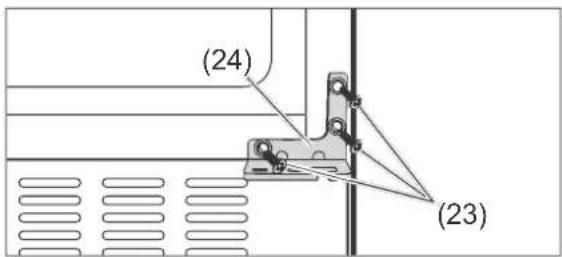
- Unscrew the three screws (23) on the lower hinge (24) and remove it.
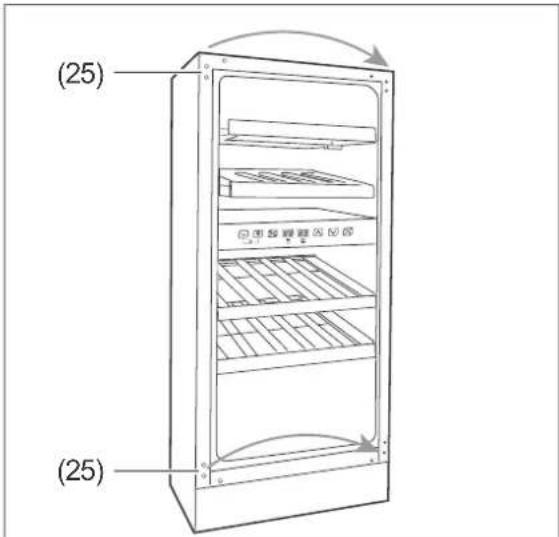
- Remove the 6 dummy plugs (25) from the threaded holes above and below and place them into the threaded holes on the opposite side.
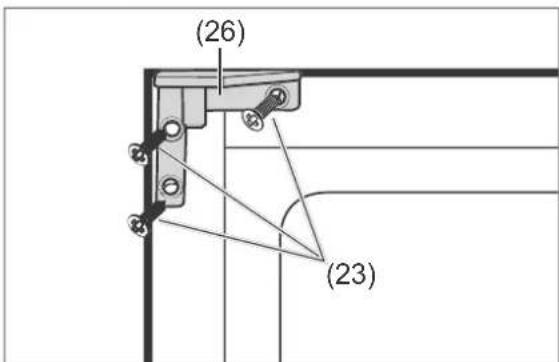
- Screw the supplied upper hinge for the left stop (26) using the screws (23).
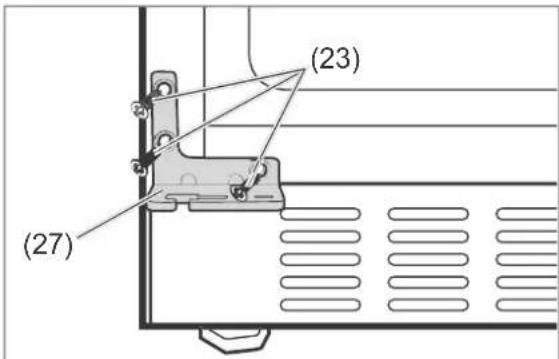
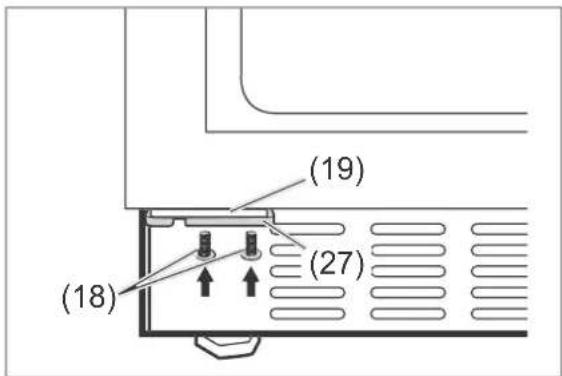
- Screw the supplied lower hinge for the left stop (27) on the other side using the screws (23).
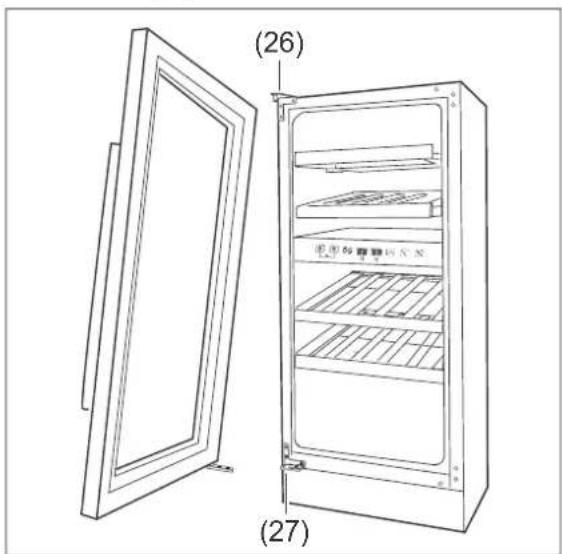
- Place the glass door first in the top hinge (26), then in the bottom hinge (27). Close the glass door.
-
Screw the hinge plate (19) to the lower hinge (27) with the screws(18).
-
Check whether the doors open and close easily. If necessary, adjust it slightly.
Troubleshooting table
Malfunctions can occur in all electrical appliances. This does not necessarily mean there is a defect in the appliance. For this reason, please check the tables to see if you can correct the malfunction.

WARNING
Risk of electric shock in case of improper repair!
Never try to repair a defective or suspected defective appliance yourself. You can put your own and future users" lives in danger. Only authorised specialists are allowed to carry out this repair work.
| Problem Possible cause Solutions, tips, explanations | ||
| Compressor OFF, control element OFF. | No electricity to socket. Check the socket with another appliance. | |
| Mains plug is loose. Check the tightness of the mains plug. | ||
| Compressor OFF, control element ON. | Desired temperature has been reached. | Further cooling not required. When the inside temperature rises, the compressor automatically switches on. |
| Appliance cools too quickly. | Temperature has been set too low. | Select a higher setting (see “Setting the temperature” on page EN-12). |
| The appliance doesn’t cool sufficiently. | Temperature has been set too high. | Select a lower setting (see “Setting the temperature” on page EN-12). |
| Door not tightly closed or door seal is not completely tight. | See “Checking and cleaning the door seals” on page EN-16. | |
| The appliance is near a heat source or sunlight. | Place insulation plate between the appliances or change location. | |
| Minimum distances not maintained (too short). | Adhere to the minimum wall distances (see “Choosing a suitable location” on page EN-19). | |
| Too many bottles of wine stored. | Do not exceed the maximal bottle number (see “Intended use” on page EN-4). | |
| Ambient temperature too low or too high. | Adjust ambient temperature (see “Intended use” on page EN-4). | |
| Compressor seems defective. | Set the temperature to 5 °C (41 °F). If the compressor does not switch on within an hour, please contact our Service department (see page EN-27). | |
| Appliance is making a noise. | Operating noises are functional and are not a sign of malfunction. | Humming: Refrigeration unit is running. |
| Flowing noise: Refrigerant is flowing through the pipes. | ||
| Clicking: Compressor is switching on or off. | ||
| Disturbing noises. Check that it is stable. | ||
Service
Please note! You are responsible for the condition of the appliance and its proper use in the household.
- If you call out for customer service due to an operating error, you will incur charges, even during the guarantee/warranty period.
The statutory warranty of 24 months applies for this article.
– Damage resulting from non-compliance with this manual unfortunately cannot be recognised.
In order for us to help you quickly, please tell us:
| Name of appliance Model Order number | ||
| hanseatic Wine refrigerator HWC31GCIA 92625406 |
Advice, complaints and orders
Please contact your mail order company's customer service centre if
– the delivery is incomplete,
– the appliance is damaged during transport,
– you have questions about your appliance,
- a malfunction cannot be rectified using the troubleshooting table,
– you would like to order further accessories.
Repairs and spare parts
Spare parts are available for a minimum period of seven years after the final version of the model has been placed on the market. Door seals are available for a period of ten years.
Customers in Germany
- Please contact our technical service: Phone +49 (0) 40 36 03 31 50
Customers in Austria
- Please contact your mail order company's customer service centre or product advice centre.
Environmental protection
Disposing of old electrical devices in an environmentally-friendly manner
Electrical appliances contain harmful substances as well as valuable resources.
Every consumer is therefore required by law to dispose of old electrical appliances at an authorised collection or return point. They will thus be made available for environmentally-sound, resource-saving recycling.
You can dispose of old electrical appliances free of charge at your local recycling centre.
Please contact your dealer directly for more information about this topic.
Our contribution to the protection of the ozone layer

100 % CFC and HFC-free refrigerants and foaming agents were used in this appliance. This protects the ozone lay-reduces the greenhouse effect.
Product fiche concerning Regulation (EU) No 2019/2016
The product fiche for your device is available online.
Go to https://eprel.ec.europa.eu and enter the model identifier for your device to access the product fiche.
The model identifier for your device can be found in the Technical Specifications.
Technical specifications
| Item number | 92625406 |
| Name of appliance | Wine Cooler |
| Model identifier | HWC31GCIA |
| Device measurements (Height × Width × Depth) | 865 mm × 380 mm × 570 mm |
| Unloaded weight | 31 kg |
| Refrigerant | R600a |
| Filling capacity refrigerant | 18 g |
| Foaming agent | cyclopentane |
| Rated power | 65 W |
| Supply voltage / frequency / rated current | 220 - 240 V ~ / 50 Hz / 0,8 A |
| Protection class | I |
| Climate class: SN-N-ST. This appliance is intended to be used at an ambient temperature between +10 °C and +38 °C. | |
- Inhaltsverzeichnis
- Lieferumfang
- WARNUNG
- Table of contents
- Delivery
- Package contents
- Check the delivery
- WARNING!
- Packaging tips
- Safety
- Intended use
- Explanation of terms/symbols
- WARNING
- CAUTION
- NOTICE
- Definitions
- Safety notices
- Risks in handling household electrical appliances
- Risk of electric shock!
- Fire hazard!
- Risks associated with using refrigerants
- Risks associated with chemical substances
- Risks to children
- Risks for certain groups of people
- Risks associated with using refrigerators
- Health hazard!
- Risk of injury!
- Risk of damage
- Appliance parts
- Operation
- Before getting started
- Key tones
- Switching the appliance on and off
- Switching on for the first time
- Switching on
- Switching off
- Safety lock (child safety lock)
- Setting the temperature
- Changing the temperature unit
- LED light
- Interior equipment
- Removing the shelves
- Inserting the shelves
- Storing bottles
- Filling the appliance
- Maximum storage capacity
- ! NOTICE
- Maintaining quality Storage temperature
- Storage period
- Additional factors
- Care and maintenance
- Risk of damage!
- Checking and cleaning the door seals
- Cleaning the exterior
- Cleaning the back of the appliance
- Defrosting the appliance
- Cleaning the inside of the appliance
- Replacing the LED light
- ! WARNING
- Start-up
- About climate categories
- Before starting to use the appliance
- Moving and unpacking
- Choosing a suitable location
- Setting up and adjusting the appliance (free standing appliance)
- Integrating the appliance into a kitchen unit
- Basic cleaning
- Connecting the appliance
- Changing the door hinges
- Troubleshooting table
- Service
- Advice, complaints and orders
- Repairs and spare parts
- Customers in Germany
- Customers in Austria
- Environmental protection
- Disposing of old electrical devices in an environmentally-friendly manner
- Our contribution to the protection of the ozone layer
- Product fiche concerning Regulation (EU) No 2019/2016
Brand : Hanseatic
Model : HWC31GCIA
Category : Wine cellar