
KDC-X696 - Car stereo KENWOOD - Free user manual and instructions
Find the device manual for free KDC-X696 KENWOOD in PDF.


User questions about KDC-X696 KENWOOD
0 question about this device. Answer the ones you know or ask your own.
Ask a new question about this device
Download the instructions for your Car stereo in PDF format for free! Find your manual KDC-X696 - KENWOOD and take your electronic device back in hand. On this page are published all the documents necessary for the use of your device. KDC-X696 by KENWOOD.
USER MANUAL KDC-X696 KENWOOD
text_image
Designed for Windows Media™

text_image
Bluetooth®Made for


works with
PANDORA®
internet radio
Take the time to read through this instruction manual.
Familiarity with installation and operation procedures will help you obtain the best performance from your new CD-receiver.
For your records
Record the serial number, found on the back of the unit, in the spaces designated on the warranty card, and in the space provided below. Refer to the model and serial numbers whenever you call upon your Kenwood dealer for information or service on the product.
Model KDC-BT652U/ KDC-X696 Serial number ____
US Residents Only
Register Online
Register your Kenwood product at www.Kenwoodusa.com
Safety 3
Maintenance
Preparation 4
How to attach/detach the faceplate
How to reset your unit
How to prepare the remote controller (RC-405)
Getting Started 5
Canceling the display demonstration
Setting the demonstration mode
Adjusting the clock
Initial settings before operations
Basic Operations 6
Listening to the Radio 8
Direct Access Tuning using the remote controller (RC-405)
Using the remote controller (RC-405)
Adjust [SETTINGS] mode settings
Listening to the other external components 9
Listening to a Disc/ USB device/ iPod 10
Start playing a disc
Start playing a USB device or iPod
Removing the USB device or iPod
Selecting Repeat Play
Selecting Random Play
All Random Play
Selecting a folder/track/file
Alphabet Search for iPod
Direct Music Search using the remote controller (RC-405)
Using the remote controller (RC-405)
Selecting App & iPod Control Mode
Adjust [SETTINGS] mode settings
Listening to Pandora® internet radio 14
Listening to Pandora® internet radio
Removing the iPhone
Station Search mode
Using the remote controller (RC-405)
Getting Started of Bluetooth 16
Registering your Bluetooth device with this unit (Pairing)
Registering from Bluetooth devices (Pairing)
Operation of Hands-Free Phoning 18
Making a Call
Make a Voice Dialing Call
Receiving a Call
During a Call
Switching between Two Connected Cellphones
Clearing the disconnection message
Downloading the Phone Book
Using the remote controller (RC-405)
Listening to a Bluetooth Audio 21
Selecting Repeat Play
Selecting Random Play
Bluetooth Setup 22
Selecting the Bluetooth Device
Bluetooth Device Registration Test
Bluetooth Setup
Function settings 24
Installation/connection 26
Troubleshooting 30
Specifications 33
WARNING
Stop the car before operating the unit.
Important to know...
■ To prevent a short circuit, never put or leave any metallic objects (such as coins or metal tools) inside the unit.
■ Caution: Adjust the volume so that you can hear the sound outside the car. Driving with the volume adjusted to a too high level may cause an accident.
■ Condensation: When the car is air-conditioned, moisture may collect on the laser lens. This may cause disc read errors. In this case, remove the disc and wait for the moisture to evaporate.
■ The illustrations in this manual are examples used to explain more clearly how the controls are used. Therefore, what appears on the illustrations may differ from what appears on the actual equipment.
■ If you experience problems during installation, consult your Kenwood dealer.
■ When you purchase external components, check with your Kenwood dealer to make sure that they work with your model and in your area.
Maintenance
Cleaning the unit: Wipe off the dirt on the panel with a dry silicon or soft cloth. Failure to observe this precaution may result in damage to the monitor or unit.
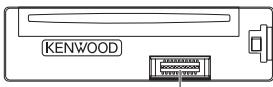
Cleaning the connector: The unit may not function properly if the connector between the unit and faceplate are dirty. Detach the faceplate and clean the connector with a cotton swab gently, being careful not to damage the connector.
text_image
KENWOODConnector (on the reverse side of the faceplate)
■ The "AAC" logo is a trademark of Dolby Laboratories.
■ The Bluetooth word mark and logos are owned by the Bluetooth SIG, Inc. and any use of such marks by JVC KENWOOD Corporation is under license. Other trademarks and trade names are those of their respective owners.
■ "Made for iPod" and "Made for iPhone" mean that an electronic accessory has been designed to connect specifically to iPod or iPhone, respectively, and has been certified by the developer to meet Apple performance standards. Apple is not responsible for the operation of this device or its compliance with safety and regulatory standards. Please note that the use of this accessory with iPod or iPhone may affect wireless performance.
■ iPhone, iPod, iPod classic, iPod nano, and iPod touch are trademarks of Apple Inc., registered in the U.S. and other countries.
■ PANDORA, the PANDORA logo, and the Pandora trade dress are trademarks or registered trademarks of Pandora Media, Inc., used with permission.
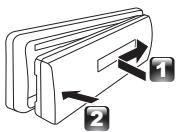
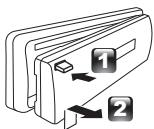
How to attach/detach the faceplate
text_image
Diagram showing a device with labeled parts 1 and 2, indicating directional flow or movement.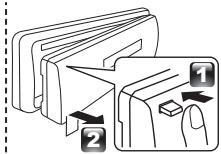
text_image
Diagram illustrating a hand inserting a card into a folder, labeled with arrows and numbered parts.■ Do not expose the faceplate to direct sunlight, excessive heat, or humidity. Also avoid places with too much dust or the possibility of water splashing.
- Keep the faceplate in its casing while detached.
■ The faceplate is a precision component of the unit and can be damaged by shocks or jolts.
■ To prevent deterioration, do not touch the terminals of the unit and faceplate with your fingers.
How to reset your unit
flowchart
graph TD
    A["Step 1"] --> B["Step 2"]
    B --> C["End"]
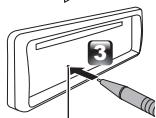
If this unit fails to operate properly, press the reset button.
The unit returns to the factory settings when the reset button is pressed.
text_image
Diagram showing a tool interacting with a labeled object marked '3', likely illustrating a precision or positioning instruction.Reset button
How to prepare the remote controller (RC-405)
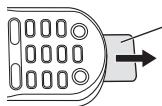
When you use the remote controller for the first time, pull out the insulation sheet.
natural_image
Diagram of a device with grid layout and directional arrow (no text or symbols)Insulation sheet
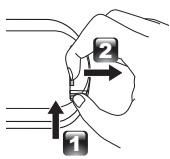
If the effectiveness of the remote controller decreases, replace the battery.
text_image
Diagram showing hand positioning with numbered arrows and directional arrows indicating movement or force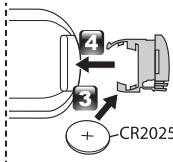
text_image
4 3 + CR2025Caution:
■ Do not set the remote control in hot places such as on the dashboard.
■ Lithium battery.
Danger of explosion if the battery is incorrectly replaced. Replace only with the same or equivalent type.
■ The battery pack or batteries shall not be exposed to excessive heat such sunshine, fire or the like.
- Keep battery out of reach of children and in original package until ready to use. Dispose of used batteries promptly. If swallowed, contact a physician immediately.
CALIFORNIA, USA ONLY
This product contains a CR Coin Cell Lithium Battery which contains Perchlorate Material – special handling may apply.
See www.dtsc.ca.gov/hazardouswaste/perchlorate
Canceling the display demonstration
The display demonstration is always turned on unless you cancel it.
When you turn on the power (or after you reset the unit), the display shows:
[CANCEL DEMO] → [PRESS] → [VOLUME KNOB]
1 Press the volume knob.
[YES] is selected as the initial setup.
2 Press the volume knob again to confirm. [DEMO OFF] appears.
If no operation is done for about 15 seconds or if you turn the volume knob to select [NO] in step 2, [DEMO MODE] appears and the display demonstration starts.
Setting the demonstration mode
1 Press the volume knob to enter [FUNCTION].
2 Turn the volume knob to select [DEMO MODE], then press to enter.
3 Turn the volume knob to select [ON] or [OFF].
If [ON] is selected, display demonstration starts if no operation is done for about 20 seconds.
4 Hold ↩ to finish the procedure.
Adjusting the clock
1 Press the volume knob to enter [FUNCTION] mode.
2 Turn the volume knob to select [SETTINGS], then press to enter.
3 Turn the volume knob to select [CLOCK], then press to enter.
4 Turn the volume knob to select [CLOCK ADJUST], then press to enter.
Clock hour flashes on the display.
5 Turn the volume knob to adjust the hour, then press to enter minute adjustment. Clock minutes flashes on the display.
6 Turn the volume knob to adjust the minute, then press to confirm.
Press ◀◀◀ / ▶▶◀ to move between the hour and minute adjustment.
7 Hold ➕ to finish the procedure.
Initial settings before operations
1 Press ⏻ SRC to enter [STANDBY] mode.
2 Press the volume knob to enter [FUNCTION] mode.
3 Turn the volume knob to select [INITIAL SET], then press to enter.
4 Turn the volume knob to make a selection, then press to confirm. See table below for selection.
5 Hold ↩ to finish the procedure.
| Item | Selectable setting (Preset: *) |
| PRESET TYPE | NORMAL*:Memorizes one station for each preset button in each band (FM1/ FM2/ FM3/ AM).;MIX:Memorizes one station for each preset button regardless of the selected band (FM1/ FM2/ FM3/ AM). |
| KEY BEEP | ON*/OFF:Activates/deactivates the keypress tone. |
| PANDORA SRC | ON*:Allows you to select “PANDORA” source by connecting an iPhone or iPod touch (with the Pandora® internet radio application).;OFF:Disables “PANDORA” in source selection. |
| BUILT-IN AUX | ON*:Enables “AUX” in source selection. Sound of the connected external component is produced through the car speakers.;OFF:Disables “AUX” in source selection. |
| CD READ | 1*:Automatically distinguishes between audio file disc and music CD.;2:Forces to play as a music CD. No sound can be heard if an audio file disc is played. |
| SP SELECT | OFF*/5/4/6×9/6/OEM:Selects the speaker size for optimum performance. |
| F/W UP xx.xx | YES:Starts upgrading the firmware.;NO*:Cancels (upgrading is not activated).For details on how to update the firmware, see: www.kenwood.com/cs/ce/ |
Basic Operations
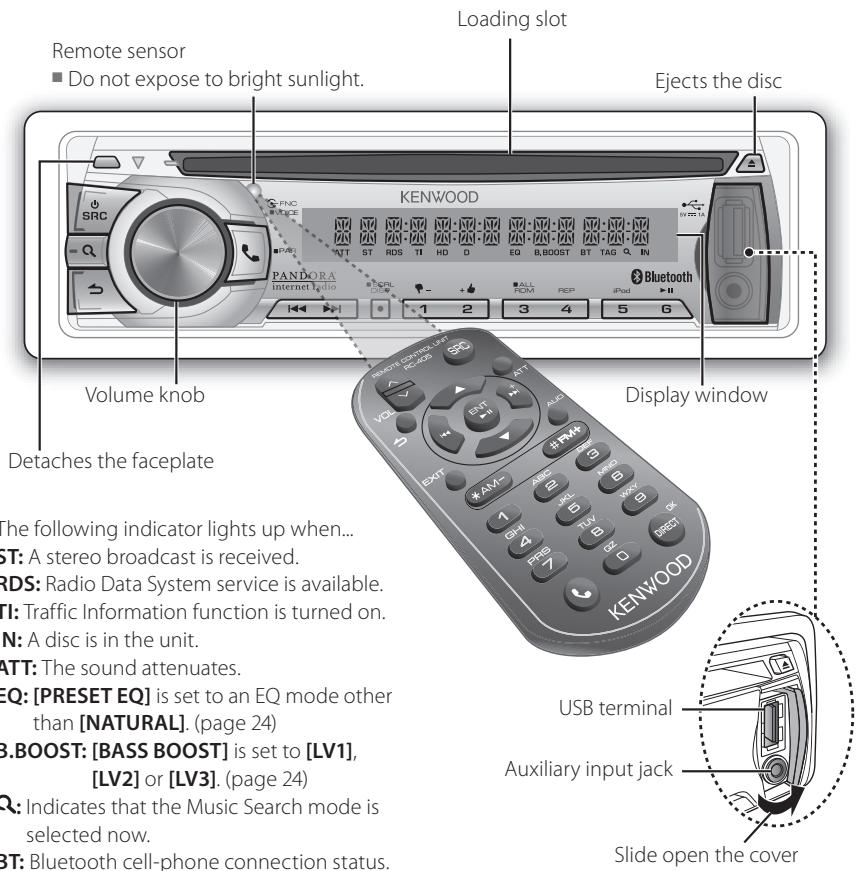
text_image
Remote sensor ■ Do not expose to bright sunlight. Loading slot Ejects the disc KENWOOD PANORA internet radio 1 2 3 4 5 6 Volume knob Display window Detaches the faceplate USB terminal Auxiliary input jack Slide open the cover The following indicator lights up when... ST: A stereo broadcast is received. RDS: Radio Data System service is available. TI: Traffic Information function is turned on. IN: A disc is in the unit. ATT: The sound attenuates. EQ: [PRESET EQ] is set to an EQ mode other than [NATURAL]. (page 24) B.BOOST: [BASS BOOST] is set to [LV1], [LV2] or [LV3]. (page 24) R: Indicates that the Music Search mode is selected now. BT: Bluetooth cell-phone connection status.When you press or hold the following button(s)...
| Main unit | Remote controller | General operation |
| SRC | — | ■ Turns on.■ Turns off if pressed and held. |
| SRC | Selects the available sources (TUNER, BT AUDIO, USB or iPod, PANDORA, CD, AUX, STANDBY), if the power is turned on.• If the source is ready, playback also starts.• “PANDORA” is selectable only when an iPhone or iPod touch (with the Pandora® internet radio application) is connected and [ON] is selected for [PANDORA SRC]. (page 5)• “iPod” or “CD” is selectable only when an iPod is connected or a disc is loaded. | |
| Volume knob (turn) | VOL^^ | Adjusts the volume level. |
| ▲/▼ | Selects items. | |
| Volume knob (press) | ENT ▶II | Confirms selection. |
| — | ■ Enters [FUNCTION] settings.■ Start voice recognize of cell-phone if pressed and held. | |
| Q | ▲/▼ | Enters Music Search mode. |
| *AM- / #FM+ | Selects the FM bands (FM1/ FM2/ FM3) or AM when “TUNER” is selected as the source. | |
| 1 (▶-) / 2 (▶+) | Selects the previous/ next folder. | |
| 6 (▶II) | ENT ▶II | Pauses/resumes playback of a disc/ USB device/ iPod/ Pandora/ Bluetooth Audio. |
| |◀◀/▶▶| | |◀◀/+▶▶| | ■ Searches for radio station.■ Selects track/file.■ Fast-forwards/fast-backwards tracks/files if pressed and held. |
| SCRL DISP | — | ■ Changes the display information.■ Scrolls the display information if pressed and held.■ Enters clock adjustment mode directly (page 5) if pressed and held while in clock display screen. |
| ■ Enters Bluetooth mode. (page 18)■ Press to answer an incoming call. | ||
| — | Enters Bluetooth pairing mode if pressed and held. (page 16) | |
| — | AUD | Enters [AUDIO CONTROL] settings directly. |
| — | ATT | Attenuates the sound.• To return to the previous level, press the button again. |
| Returns to the previous item. | ||
| EXIT | Exit from setting mode. | |
| — | • Press and hold ▶ on the main unit will also exit from the setting mode. |
text_image
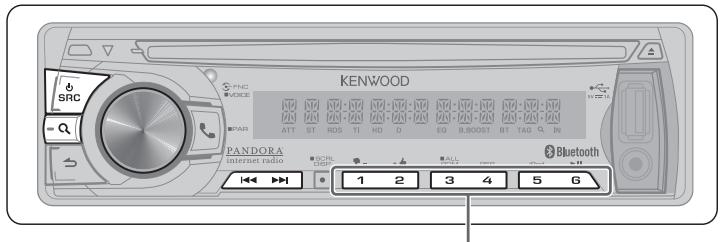
KENWOOD PANDRA internet radio 1 2 3 4 5 6■ Press and hold to memorize the current station.
■ Press briefly to recall memorized station.
1 Press ⏻ SRC to select "TUNER".
2 Press Q repeatedly to select a band (FM1/ FM2/ FM3/ AM).
3 Press |◀◀ / ▶▶▶ to search for a station.
■ The tuning mode can be changed. Refer to
Direct Access Tuning using the remote controller (RC-405)
1 Press FM+ / AM- to select a band.
2 Press DIRECT to enter Direct Access Tuning mode.
“----” appears.
3 Press the number buttons to enter the frequency.
4 Press I◄◄/ +►►I to search for the frequency.
■ To cancel Direct Access Tuning mode, press
If no operations is done for 10 seconds after step 3, Direct Access Tuning is automatically canceled.
Using the remote controller (RC-405)
FM+ / *AM- : Selects band.
|◀◀ / +▶▶ | : Selects station.
1 - 6 : Selects preset station.
Adjust [SETTINGS] mode settings
While listening to the radio...
1 Press the volume knob to enter [FUNCTION] mode.
2 Turn the volume knob to select [SETTINGS], then press to enter.
3 Turn the volume knob to make a selection, then press to confirm. See table below for selection.
4 Hold ↩ to finish the procedure.
| Item | Selectable setting (Preset: *) |
| SEEK MODE | AUTO1*: Automatically search for a station. ; AUTO2: Search in the order of the stations in the preset memory. ; MANUAL: Manually search for a station. |
| AUTO MEMORY | YES: Automatically starts memorizing 6 stations with good reception. ; NO*: Cancels (automatic memorizing is not activated). (Selectable only if [NORMAL] is selected for [PRESET TYPE].) (page 5) |
| MONO SET | ON: Improves the FM reception (but the stereo effect may be lost). ; OFF*: Cancels (stereo effect resumes). |
| PTY SEARCH | Selects the available Program Type (page 9). Then, press ◀◀/▶▶I to start searching. |
| TI | ON: The traffic information automatically when the traffic bulletin starts. ; OFF*: Cancels. (Not applicable if “AM” is selected) |
■ [TI], [PTY SEARCH] is selectable only when the source is "FM".
■ [TI]: If other playback source is selected, these settings are selectable under [TUNER SET] item. (page 25)
■ Available Program Type:
SPEECH; MUSIC; NEWS; INFORM; SPORTS; TALK; ROCK; CLS (classic) ROCK; ADLT (adult) HIT; SOFT RCK (rock); TOP 40; COUNTRY; OLDIES; SOFT, NOSTALGA; JAZZ; CLASSICL; R & B; SOFT R&B; LANGUAGE; REL (religious) MUSC; REL (religious) TALK; PERSNLTY (personality); PUBLIC; COLLEGE; HABL_ESP (spanish talk); MUSC-ESP (spanish music); HIP-HOP; WEATHER The unit will search for the Program type categorized under [SPEECH] or [MUSIC] if selected.
[SPEECH] : Roman typeface item. ; [MUSIC] : Italic typeface item.
- The Radio Data System feature won't work where the service is not supported by any broadcasting station.
If the volume is adjusted during reception of traffic information, the adjusted volume is memorized automatically. It will be applied the next time Traffic Information function is turned on.
Listening to the other external components
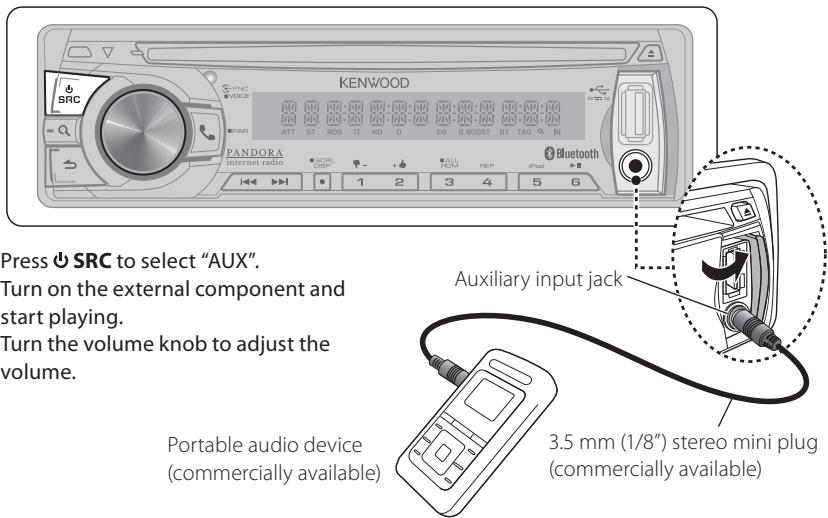
Preparation : Make sure [ON] is selected for [BUILT-IN AUX]. (page 5)
text_image
KENWOOD PANDORA internet radio OCDRL DSP - + - AIU FCH FEP iPod Bluetooth Press ⬇ SRC to select "AUX". Turn on the external component and start playing. Turn the volume knob to adjust the volume. Portable audio device (commercially available) Auxiliary input jack 3.5 mm (1/8") stereo mini plug (commercially available)Listening to a Disc/ USB device/ iPod
text_image
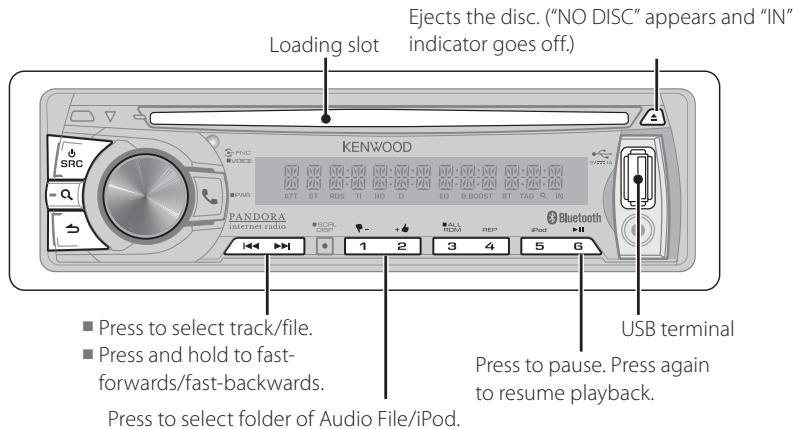
Loading slot Ejects the disc. ("NO DISC" appears and "IN" indicator goes off.) KENWOOD PANORA INTERNET RADIO Bluetooth USB terminal ■ Press to select track/file. ■ Press and hold to fast- forwards/fast-backwards. Press to select folder of Audio File/iPod. Press to pause. Press again to resume playback.Start playing a disc
1 Press ⏻ SRC to turn on the power.
2 Insert a disc into the loading slot.
Playback starts automatically.
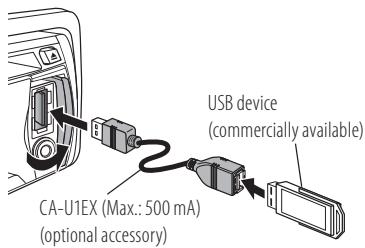
Start playing a USB device or iPod
1 Press ⏻ SRC to turn on the power.
2 Slide open the cover.
3 Connect a USB device or iPod to the USB terminal.
The source automatically switches, and playback starts.
text_image
USB device (commercially available) CA-U1EX (Max.: 500 mA) (optional accessory)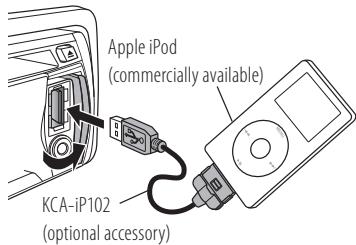
text_image
Apple iPod (commercially available) KCA-iP102 (optional accessory)Removing the USB device or iPod
1 Press Ⓧ SRC to select a source other than "USB", "iPod" or "PANDORA".
2 Remove the USB device or iPod.
Selecting Repeat Play
Press number button 4 (REP) repeatedly to make a selection.
Audio CD : TRACK REPEAT, REPEAT OFF
Audio File :
FILE REPEAT, FOLDER REPEAT, REPEAT OFF iPod :
FILE REPEAT, REPEAT OFF
Selecting Random Play
Press number button 3 (ALL RDM) repeatedly to make a selection.
Audio CD : DISC RANDOM, RANDOM OFF
Audio File/ iPod :
FOLDER RANDOM, RANDOM OFF
All Random Play
Press and hold number button 3 (ALL RDM).
Pressing this button again plays songs in the normal mode starting.
Audio File/ iPod :
ALL RANDOM, RANDOM OFF
■ Changes the iPod browsing item to "songs".
Selecting a folder/track/file
1 Press Q to enter Music Search mode. "SEARCH" appears, then the current file name appears on the display.
2 Turn the volume knob to select a folder/track/file, then press to confirm.
■ To skips songs, press I◀◀/▶▶I. Holding I◀◀/▶▶I skips songs at 10% regardless of the setting made. (page 12)
This operation is effective only for the iPod or KENWOOD Music Editor media.
■ To return to the root folder (audio file), top menu (iPod) or first track (audio CD), press 5.
■ To return to the previous folder, press ↗.
■ To cancel the Music Search mode, press and hold ↗.
- < or > on the display indicates that preceded/next item is available.
Alphabet Search for iPod
1 Press Q to enter Music Search mode. "SEARCH" appears.
2 Turn the volume knob to select a category, then press to confirm.
3 Press Q again to enter alphabet search mode.
"SEARCH <_ >" appears.
4 Turn the volume knob to select the character to be searched for.
5 Press I◀◀ / ▶▶▶ to move to the entry position.
You can enter up to three characters.
6 Press the volume knob to start searching. After this step, see step 2 of
■ To return to the Music Search mode, press ↗.
■ To cancel the Music Search mode, press and hold ↗.
■ A longer searching time is required if there are many songs or playlists in the iPod.
■ To search for a character other than A to Z and 0 to 9, enter only “*”.
■ The article (a, an, the) of songs name will be skipped during search.
Direct Music Search using the remote controller (RC-405)
- Not available if Random Play, KENWOOD Music Editor media, iPod playback is selected.
1 Press DIRECT to enter Direct Music Search mode. “--” appears.
2 Press the number buttons to enter the track number.
3 Press |◀◀ / +▶▶I to search for the music.
■ To cancel the Direct Music Search mode, press ↩ or EXIT.
Using the remote controller (RC-405)
In playback mode:
FM+ / *AM- : Selects folder.
|◀◀ / +▶▶ | : Selects track/file.
ENT ▶ II : Pauses/resumes playback.
▲ / ▼ : Enter Music Search mode.
In Music Search mode:
ENT▶II : Confirms selection.
▲ / ▼ : Selects folder/file/track.
: Returns to the previous folder.
Selecting App & iPod Control Mode
Press number button 5 (iPod) repeatedly to make a selection.
MODE ON :
Control iPod from the iPod *. "APP&iPod MODE" appears on the display.
MODE OFF: Control iPod from the unit.
* You can still control play/pause, select files, fast-forward/reverse files from the unit.
Adjust [SETTINGS] mode settings
While listening to an iPod or KENWOOD Music Editor media ...
1 Press the volume knob to enter [FUNCTION] mode.
2 Turn the volume knob to select [SETTINGS], then press to enter.
3 Turn the volume knob to select [SKIP SEARCH], then press to enter.
4 Turn the volume knob to make a selection, then press to confirm.
0.5% (initial)/ 1%/ 5%/ 10% : Sets the ratio of skip when searching for a song in Music Search mode.
(Holding ◀◀◀ / ▶▶◀I skips songs at 10% regardless of the setting made.)
5 Hold ↩ to finish the procedure.
Handling discs
■ Do not touch the recording surface of the disc.
■ Do not stick tape etc. on the disc, or use a disc with tape stuck on it.
■ Do not use any accessories for the disc.
■ Clean the disk by moving the cloth outward from the center of the disc.
■ Clean the disc with a dry silicon or soft cloth. Do not use any solvents.
■ When removing a disc from this unit, pull it out horizontally.
■ If the center hole or outside rim of a disc has burrs, remove them before inserting a disc.
Discs that cannot be used
■ This unit can only play the CDs with:


■ A disc that is not round.
■ A disc with coloring on the recording surface or a disc that is dirty.
■ You cannot play a Recordable/ReWritable
About the Audio file
■ Playable Audio files: MP3 (.mp3), WMA (.wma), AAC-LC (.m4a)
■ Playable disc media: CD-R/RW/ROM
■ Playable disc file formats: ISO 9660 Level 1/2, Joliet, Romeo, Long file name.
■ Playable USB devices: USB mass storage class
■ Playable USB device file systems: FAT16, FAT32
disc that has not been finalized. (For the finalization process, refer to the instruction manual that came with your disc writing software or your disc recorder.)
■ 3-inch CD cannot be used. An attempt to insert using an adapter can cause malfunction.
Although the audio files are complied with the standards listed above, the play maybe impossible depending on the types or conditions of media or device.
■ Detailed information and notes about the playable audio files are stated in an online manual on the following site: www.kenwood.com/cs/ce/audiofile/
About the USB device
■ This unit can play audio files stored on a USB mass storage class device.
■ Install the USB device in the place where it will not prevent you from driving your vehicle properly.
■ You cannot connect a USB device via a USB hub or multi card reader.
■ Make sure all important data has been backed up to avoid losing the data.
■ Connecting a cable whose total length is longer than 5 m can result in abnormal playback.
■ This unit cannot recognize a USB device whose rating is other than 5 V and exceeds 500 mA.
■ When connecting the USB device, use of the CA-U1EX (option) is recommended. The maximum current consumption of the CA-U1EX is 500 mA.
About compatible iPod/iPhone
Made for
– iPod touch (4th generation)
- iPod touch (3rd generation)
- iPod touch (2nd generation)
– iPod touch (1st generation)
- iPod classic
- iPod with video
– iPod nano (6th generation)
– iPod nano (5th generation)
- iPod nano (4th generation)
– iPod nano (3rd generation)
- iPod nano (2nd generation)
– iPod nano (1st generation)
- iPhone 4S
- iPhone 4
- iPhone 3GS
- iPhone 3G
- iPhone
(As of January 2012)
■ Latest compatible list of iPod/iPhone.
For details, see:
www.kenwood.com/cs/ce/ipod
■ Types of available control vary depending on the type of connected iPod. For details, see above URL.
■ The word "iPod" appearing in this manual indicates the iPod or iPhone connected to this unit with a connection cable, KCA-iP102 (optional accessory).
If you start playback after connecting the iPod, the music that has been played by the iPod is played first.
In this case, "RESUMING" is displayed without displaying a folder name, etc.
Changing the browse item will display a correct title, etc.
■ You cannot operate the iPod if "KENWOOD" or "✓" displayed on the iPod.
About "KENWOOD Music Editor"
This unit supports the PC application "KENWOOD Music Editor Light ver1.1" or later.
- When you use the audio file with database information added by the "KENWOOD Music Editor Light ver1.1", you can search for a file by title, album or artist name using the function mentioned in Music Search (page 11).
In the Instruction manual, the term "Music Editor media" is used to mean the device
that contains audio files with database information added with KENWOOD Music Editor.
■ "KENWOOD Music Editor Light ver1.1" is available from the following web site: www.kenwood.com/cs/ce/
For further information on "KENWOOD Music Editor Light ver1.1", refer to the site above or the application help.
Listening to Pandora® internet radio
Preparation : Make sure [ON] is selected for [PANDORA SRC]. (page 5)
text_image
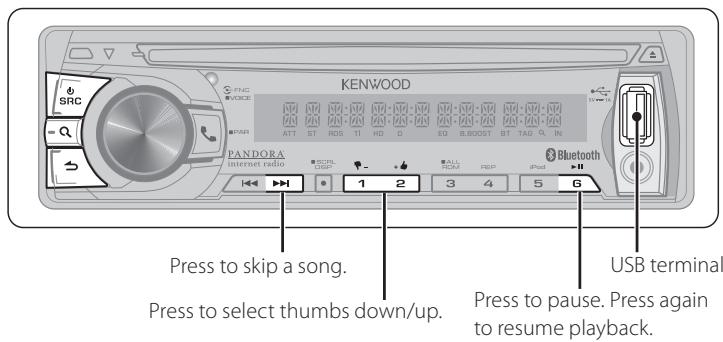
KENWOOD PANDORA internet radio 1 2 3 4 5 6 USB terminal Press to skip a song. Press to select thumbs down/up. Press to pause. Press again to resume playback.Listening to Pandora® internet radio
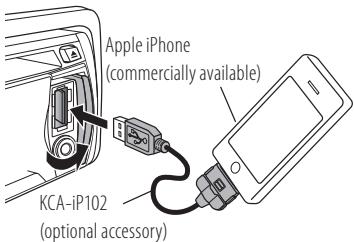
1 Open the Pandora® application on your device.
2 Slide open the cover.
3 Connect an iPhone to the USB terminal. The source switches, and broadcasting starts automatically from your current station.
text_image
Apple iPhone (commercially available) KCA-iP102 (optional accessory)■ To select thumbs down/up, press number button 1 (✗ - )/ 2 (♦ + ).
■ To skip a song, press ▶▶▶I.
■ To pause or resume playback, press number button 6 (▶II).
Removing the iPhone
1 Press Ⓧ SRC to select a source other than "PANDORA" or "iPod".
2 Remove the iPhone.
Station Search mode
While listening to "PANDORA" source...
1 Press Q to enter Station Search mode.
2 Turn the volume knob to select [A-Z] (stations are displayed in alphabetical order) or [BY DATE] (stations are displayed in date order), then press to enter.
3 Turn the volume knob to select a desired station, then press to confirm.
Using the remote controller (RC-405)
In playback mode:
+▶▶I : Skips a song.
ENT▶II : Pauses/resumes playback.
▲ / ▼ : Enter Station Search mode.
In Station Search Mode:
▲ / ▼ : Selects [A-Z] or [BY DATE]. • Selects item.
ENT▶II : Confirms selection.
EXIT : Cancels Station Search mode.
About Pandora® internet radio
Requirements for listening to the PANDORA® internet radio are as follows:
■ Use an Apple iPhone or iPod touch running under iOS3 or later.
■ Search for "Pandora" in the Apple iTunes App Store to find and install the most current version of the Pandora® application on your device.
■ iPhone/ iPod touch connected to this unit with a KCA-iP102.
In the application on your device, log in and create an account with Pandora. (If you are not already a registered user, an account can also be created at www.
pandora.com.)
■ Internet connection by 3G, EDGE, or WiFi.
■ Pandora® is available only in the U.S.
Because Pandora® is a third-party service, the specifications are subject to change without prior notice. Accordingly, compatibility may be impaired or some or all of the services may become unavailable.
■ Some functions of Pandora® cannot be operated from this unit.
For issues using the application, please contact Pandora® at pandora-support@pandora.com
text_image
KENWOOD PANDORA Internet radio Bluetooth iPod 5 6 5 4 3 2 1 2 1 2 1 2 1 2 1 2 1 2 1 2 1 2 1 2 1 2 1 2 1 2 1 2 1 2 1 2 1 2 1 2 1 2 1 2 1 2 1 2 1 2 1 2 1 2 1 2 SPCPL CSPD ALL RCKI RDP iPod iHPress and hold to pairing mode.
Registering your Bluetooth device with this unit (Pairing)
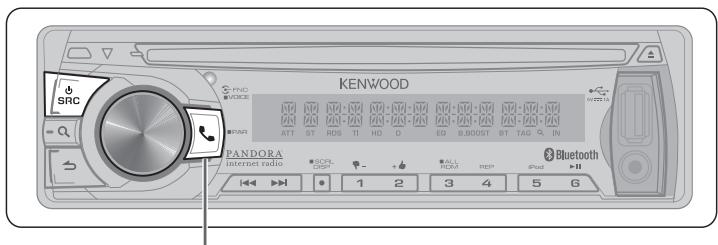
1 Press and hold 🔔 to enter pairing mode "PAIRING" is displayed.
■ Any of the following is displayed depending on Bluetooth device registration condition:
- "PLEASE PAIR YOUR PHONE": When registering a Bluetooth device for the first time.
- “(device name)”: When a Bluetooth device has already been registered.
- "DEVICE FULL": When a maximum of five Bluetooth devices have already been registered.
■ To cancel the pairing mode, press 🔔.
When registering a Bluetooth device for the first time (Registering a Bluetooth device)
2 "PLEASE PAIR YOUR PHONE" is displayed.
3 Start registering this unit by operating the Bluetooth device.
By operating the Bluetooth device, register the hands-free unit or audio unit (pairing). Select "KENWOOD BT CD/R-5T1" from the list of found units.
4 Input the PIN code ("0000") in the Bluetooth device.
Check that registration is complete on the Bluetooth device. PIN code is set to "0000" as the default. You can change this
code. Refer to [PIN CODE EDIT] under
5 "(device name)" is displayed. Press the volume knob.
6 The receiver is connected to a Bluetooth device, with "HF CONNECT" or "AUD CONNECT" displayed, and exits the pairing mode.
If an error code is displayed during paring, see
When a Bluetooth device has already been registered, or maximum of five Bluetooth devices have already been registered (Selecting a Bluetooth device)
2 "(device name)" or "DEVICE FULL" is displayed.
3 Turn the volume knob to select a Bluetooth device name.
■ To register a new Bluetooth device, select "[PAIRING]", then go to "When registering a Bluetooth device for the first time."
4 Press the volume knob.
5 Turn the volume knob to select the profile for the device to connect.
■ "HANDSFREE"/ "AUDIO": The device can be connected using either a hands-free or audio profile.
"HF/AUD": The device is can be connected using both hands-free and audio profiles.
6 Press the volume knob to set up the Bluetooth device.
■ “*H*A (device name)”: The selected Bluetooth device is busy.
■ "-H-A (device name)": The selected Bluetooth device is on standby.
■ "(blank) (device name): The Bluetooth device is deselected.
If two cell-phones or an audio player have already been selected, deselect one device before selecting a new Bluetooth device.
• "H" (HFP) or "A" (A2DP) indicates the corresponding profile.
7 Press 📊 to exit pairing mode.
Deleting the registered Bluetooth device
2 "(device name)" or "DEVICE FULL" is displayed.
3 Turn the volume knob to select a Bluetooth device name.
4 Press and hold the volume knob to delete the selected cell-phone.
"DELETE" is displayed.
5 Turn the volume knob to select "YES", then press to confirm.
"COMPLETED" is displayed.
6 Press 🔔 to exit easy pairing mode.
Registering from Bluetooth devices (Pairing)
1 Press ⏻ SRC to turn on the power.
2 Start registering this unit by operating the Bluetooth device.
By operating the Bluetooth device, register the hands-free unit or audio unit (pairing). Select "KENWOOD BT CD/R-5T1" from the list of found units.
3 Input the PIN code ("0000") in the Bluetooth device.
Check that registration is complete on the Bluetooth device. PIN code is set to "0000" as the default. You can change this code. Refer to [PIN CODE EDIT] under
4 By operating the Bluetooth device, start hands-free connection.
■ If there are 5 or more Bluetooth devices registered, you cannot register a new Bluetooth device.
About the Cell-Phone
■ Version: Bluetooth Standard Ver. 2.1+EDR
Profile:
HFP (Hands Free Profile)
SPP (Serial Port Profile)
OPP (Object Push Profile)
PBAP (Phone book Access Profile)
A2DP (Advanced Audio Distribution Profile)
AVRCP (Audio/Video Remote Control Profile)
For the cell-phones verified for compatibility, access the following URL: www.kenwood.com/cs/ce/bt/
■ The units supporting the Bluetooth function have been certified for conformity with the Bluetooth Standard following the procedure prescribed by Bluetooth SIG. However, it may be impossible for such units to communicate with your cell-phone depending on its type.
Operation of Hands-Free Phoning
Preparation : You need to register your cell-phone before using it with this unit. (page 16)
Built-in microphone (KDC-BT652U only)
text_image
KENWOOD PAN DORA WIRE AT RADIO 1 2 3 4 5 6■ Press to enter Bluetooth mode.
■ Press to answer an incoming call.
■ Press and hold to memorize the current phone number.
■ Press briefly to recall memorized phone number.
Making a Call
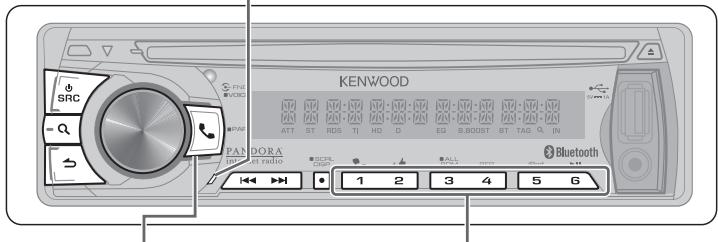
1 Press 📋 to enter Bluetooth mode.
2 Turn the volume knob to select a dialing method, then press to enter.
■ Operation method of each mode is described below.
- "PHONE BOOK": Calling a Number in the Phone Book
- "OUTGOING"/ "INCOMING"/ "MISSED CALLS": Calling a Number in the Call Log
- "NUMBER DIAL": Dialing a Number
– Speed Dialing (Preset Dial) - "DVC PRIORITY": Displays the main and sub cell-phones. Turn the volume knob to switch between the main and sub cell-phones displayed.
■ Switches between name and phone number, press DISP.
■ To return to the Bluetooth mode, press and hold ↗.
■ To cancel the Bluetooth mode, press 📞.
Calling a Number in the Phone Book
2 Turn the volume knob to select "PHONE BOOK", then press to enter.
3 Press Q to enter alphabet search mode.
4 Turn the volume knob to select the character to be searched for.
■ To move to the next row, press ◀◀◀ / ▶▶▶.
■ To return to the Phone Book mode, press ↗.
5 Press the volume knob to start searching.
6 Turn the volume knob to select a name and category.
■ To move to the next character, press I◀◀ / ▶▶▶I.
7 Press the volume knob to make a call.
■ To use the Phone Book, it must be downloaded to this unit in advance. Refer to
■ During search, a non-accent character such as "u" is searched for instead of an accent character such as "ü".
■ If "TRANSFER PB" is displayed, download the Phone Book.
- "DL PB MODE" is displayed.
- By operating the cell-phone, send the phone book data to this unit.
- When downloading is completed, return to Phone Book operation.
- To cancel the download mode, press ↗.
■ If the Phone Book is downloaded manually, its entries can be deleted.
- Press and hold the volume knob in step 6.
- Turn the volume knob.
- Deleting one entry: "DELETE ONE" is displayed.
- Deleting all entries: "DELETE ALL" is displayed. Press the volume knob. Turn the volume knob to select "YES", then press to confirm.
- Press the volume knob. "COMPLETE" is displayed.
- Press the volume knob to return to Phone Book operation.
Calling a Number in the Call Log
2 Turn the volume knob to select the "OUTGOING" (outgoing call), "INCOMING" (incoming call), or "MISSED CALLS" (missed call), then press to enter.
3 Turn the volume knob to select a name or phone number.
4 Press the volume knob to make a call.
If your cell-phone cannot download the Phone Book automatically, the outgoing call log, incoming call log, and missed call log contain only the calls dialed from or received by this unit.
Dialing a Number
2 Turn the volume knob to select "NUMBER DIAL", then press to enter.
3 Turn the volume knob to select the phone number
■ To move to the next digit, press ▶▶▶I.
■ To delete the last digit, press ◀◀◀.
■ Press number button (1 - 0), #(FM+), *(AM-), or +(▶▶) on the remote controller.
4 Press the volume knob to make a call.
■ Press OK on the remote controller.
■ You can input max 32 digits.
Speed Dialing (Preset Dial)
2 Press number button (1 - 6).
3 Press the volume knob to make a call.
Registering in the preset dial number list
2 Enter the phone number with reference to the following:
Dialing a Number/ Calling a number in the call log/ Calling a number in the Phone Book.
3 Press and hold number button (1 - 6).
Make a Voice Dialing Call
You can make a voice call using the voice recognition function of your cell-phone.
1 Press and hold the volume knob to start voice recognize.
"VOICE TAG" is displayed.
2 Pronounce the name registered in the cell-phone.
Make a call.
■ To cancel the voice recognize, press and hold the volume knob.
■ If "NO SUPPORT" is displayed, your cell-phone does not support the voice recognition function.
■ If "N/A VOICE TAG" is displayed, your cell-phone cannot start voice recognition.
If your voice cannot be recognized, a message is displayed. Press and hold the volume knob to terminate voice recognition. Retry it again from the beginning.
■ Audio sound is not output during voice recognition.
Receiving a Call
Answering a Phone Call
Press 📞 or the volume knob.
■ The following operations disconnect the line: Insert a CD. Connect a USB device.
■ The name of the calling party is displayed if it has already been registered in the Phone Book.
Rejecting an Incoming Call
Press ⏻ SRC.
During a Call
Disconnecting a Call
Press or SRC.
Switching to the Private Mode
Press number button 6 to switches between Private talk ("PRIVATE TALK") and Hands-free talk ("HANDS FREE").
Adjusting the Voice Volume during a Call
Turn the volume knob.
Switching between Two Connected Cell-phones
1 Press to enter Bluetooth mode.
2 Press and hold 📞.
■ You cannot switch between the connected cell-phones during downloading of the Phone Book.
■ Only the main cell-phone from which you can make a call.
■ Both the main and sub cell-phones can receive an incoming call.
If the other cell-phone receives an incoming call while you are talking on the active cell-phone, you must finish the current call to answer the incoming call to the other cell-phone.
If the main cell-phone is disconnected when it is taken out of the vehicle, the sub cell-phone becomes the main cell-phone if it is held connected. When the disconnected cell-phone is brought back into the vehicle, it is reconnected as the sub cell-phone.
Clearing the disconnection message
Press 📞 to "HF DISCONCT" disappears.
Downloading the Phone Book
To download automatically
If the cell-phone supports a phone book synchronization function, the phone book is downloaded automatically after Bluetooth connection.
■ Setting on the cell-phone may be required.
■ Up to 1000 phone numbers can be registered for each registered cell-phone.
■ Up to 32 digits can be registered for each phone number along with up to 20* characters representing a name.
(* 20: Number of alphabetical characters. Fewer characters can be input depending on the type of characters.)
If no phone book data is found in the unit even after the compete display, your cellphone may not support a phone book data automatic downloading function. In this case, try downloading manually.
To download from the cell-phone manually Use this procedure when your cell-phone does not support the Phone Book Access Property (PBAP).
1 Press to enter Bluetooth mode.
2 Turn the volume knob to select [SETTINGS], then press to enter.
3 Turn the volume knob to select [TRANSFER PB], then press to enter. "DL PB *** is displayed.
4 By operating the cell-phone, send the phone book data to this unit
By operating the cell-phone, download the phone book data to this unit.
5 When downloading is completed, press the volume knob.
■ The manually downloaded phone book data can contain up to 400 phone numbers.
■ When you switch between the connected cell-phones, the manually downloaded phone book data is deleted.
■ To cancel downloading of the phone book data, operate the cell-phone.
Using the remote controller (RC-405)
Making a call:
: Enter Bluetooth mode.
▲ / ▼ : Selects a dialing method.
ENT ▶ II : Enter dialing mode.
DIRECT : Make a call.
1 — 6 : Selects preset dial.
0 — 9 : Input a digit in number dial mode.
FM+ : Input “#” in number dial mode.
*AM- : Input "*" in number dial mode.
+▶▶I : Input "+" in number dial mode.
◀◀ : Clear the entered phone number.
Receiving a call:
: Answer the call.
During a call:
SRC : End the call.
ENT▶II: Switch between the private talk mode and the hands-free talk mode.
Listening to a Bluetooth Audio
Preparation : You need to register your audio player before using it with this unit. (page 16)
text_image
KENWOOD PANDORA internet radio Bluetooth 1 2 3 4 5 6■ Press to select file.
■ Press and hold to fast-forwards/fast-backwards.
Press to pause. Press again to resume playback.
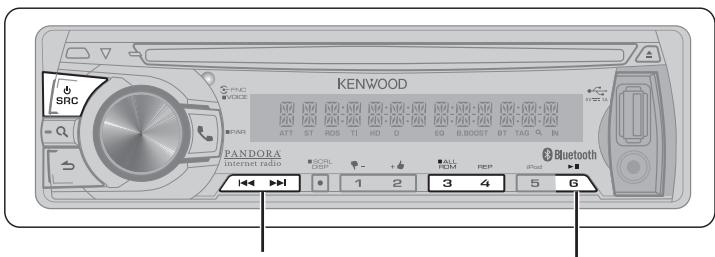
1 Press ⏻ SRC to select "BT AUDIO".
2 Press |◀◀ / ▶▶▶ to selects a file.
■ Bluetooth audio players that do not support AVRCP (Audio/Video Remote Control Profile) cannot be used with this unit. Operate from the audio player.
■ Some functions cannot be operated from the Bluetooth audio player.
■ Speakers from which audio is output change depending on the Bluetooth setting "BT HF/AUDIO". The default is Front. (page 23)
Selecting Repeat Play
Press number button 4 (REP) repeatedly to make a selection.
FILE REPEAT, REPEAT OFF
Selecting Random Play
Press number button 3 (ALL RDM) repeatedly to make a selection.
RANDOM ON, RANDOM OFF
Selecting the Bluetooth Device
1 Press to enter Bluetooth mode.
2 Turn the volume knob to select [SETTINGS], then press to enter.
3 Turn the volume knob to select [PAIRING], then press to enter.
4 Turn the volume knob to select [PHONE SELECT] or [AUDIO SELECT], then press to enter.
5 Turn the volume knob to select a Bluetooth device name.
6 Press the volume knob to set up the Bluetooth device.
■ “* (device name)”: The selected Bluetooth device is busy.
■ “- (device name)”: The selected Bluetooth device is on standby.
■ "(blank) (device name)": The Bluetooth device is deselected.
■ If two cell-phones or an audio player have already been selected, deselect one device before selecting a new Bluetooth device.
7 Hold ➕ to finish the procedure.
■ To cancel the Bluetooth mode, press 📞.
Bluetooth Device Registration Test
You can check whether your Bluetooth device can be registered using this unit.
1 Press and hold 🔔 to enter pairing mode "PAIRING" is displayed.
2 "PLEASE PAIR YOUR PHONE" is displayed.
- When "(device name)" is displayed, select "[PAIRING]" and press the control knob.
-
When "DEVICE FULL" is displayed, delete a Bluetooth device and retry.
-
Turn the volume knob to select the Bluetooth device, then press and hold to confirm.
-
Turn the volume knob to select "YES", then press to confirm.
3 Start registering this unit by operating the Bluetooth device.
By operating the Bluetooth device, register the hands-free unit or audio unit (pairing).
Select "KENWOOD BT CD/R-5T1" from the list of found units.
4 Input the PIN code ("0000") in the Bluetooth device.
Check that registration is complete on the Bluetooth device. PIN code is set to "0000" as the default. You can change this code. Refer to [PIN CODE EDIT] under
5 "(device name)" is displayed. Press and hold the volume knob.
"BT TEST" is displayed.
6 The connection result, "OK" or "NG", is displayed.
■ "PAIRING": Registration to this unit
■ "HF CNT": Hands-free phoning
■ "AUD CNT": Audio playback
■ "PB DL": Phone Book downloading
7 Press 📞 to exit pairing mode.
■ Data (Phone Book, etc.) of the cell-phone checked for connection does not remain in this unit.
Bluetooth Setup
1 Press 📞 to enter Bluetooth mode.
2 Turn the volume knob to select [SETTINGS], then press to enter.
3 Turn the volume knob to make a selection, then press to confirm.
■ See table below for selection.
■ Repeat step 3 until the desired item is selected/activated.
■ Press ➕ to return to the previous item.
4 Hold to finish the procedure.
■ To cancel the Bluetooth mode, press 📞.
| Item | Selectable setting (Preset: *) |
| PAIRING | |
| PHONE SELECT | Selects a cell-phone connection. (For details, see page 22.) |
| AUDIO SELECT | Selects a Bluetooth audio player connection. (For details, see page 22.) |
| DEVICE DELETE | Cancel registration of the Bluetooth device.Turn the volume knob to select the Bluetooth device, then press to confirm.Turn the volume knob to select “YES”, then press to confirm. “DELETE” is displayed. |
| TRANSFER PB | (For details, see page 20.) |
| DETAILED SET | |
| PIN CODE EDIT | Specify the PIN code required when registering this unit using the Bluetooth device. By default, “0000” is specified.Turn the volume knob to select the number.To move to the next digit, press ▶▶▶.To delete the last digit, press ◀◀◀.Press the volume knob to register a PIN code. “COMPLETED” is displayed. |
| AUTO ANSWER | OFF: Does not answer the phone call automatically. ; 0: Automatically answers the phone call at once. ; 1 – 8 * —99: Automatically answers the phone call after lapse of 1 – 99 seconds. |
| RECONNECT | ON*: Automatically reconnects the selected Bluetooth device when radio wave becomes strong enough, even after it is disconnected. ; OFF: Cancels.When this function is turned ON, the Bluetooth device is reconnected if it has been disconnected by selecting [PHONE SELECT]/ [AUDIO SELECT]. |
| BT HF/AUDIO | FRONT*: Outputs audio from the front-left and front-right speakers.;ALL: Outputs audio from the all speakers. |
| CALL BEEP | ON*: Sets whether to output a beep from the speaker when a call comes in. ; OFF: Cancels. |
| BT F/W UPDATE | Display the firmware version and update the firmware. |
| MIC GAIN | 1 — 8 *(KDC-BT652U) — 12 *(KDC-X696) — 15: Adjust the sensitivity of the microphone for telephone call or adjusts the voice of the caller. |
Function settings
1 Press ⏻ SRC to select a source other than "STANDBY".
2 Press the volume knob to enter [FUNCTION] mode.
3 Turn the volume knob to select [AUDIO CONTROL] or [SETTINGS], then press to enter.
4 Turn the volume knob to make a selection, then press to confirm.
■ See table below for selection.
■ Repeat step 4 until the desired item is selected/activated.
■ Press → to return to the previous item.
5 Hold ↩ to finish the procedure.
[AUDIO CONTROL] : While listening to any source except in STANDBY state or Bluetooth mode.
| Item | Selectable setting (Preset: *) | ||
| SUB-W LEVEL | -15 — 0 * — +15: Adjusts the subwoofer output level. | ||
| BASS LEVEL | -8 — 0 * — +8: Source tone memory: Adjusts the level to memorize in each source. (Before making an adjustment, select the source you want to adjust.) | ||
| MID LEVEL | |||
| TRE LEVEL | |||
| EQ PRO | KDC-X696 only | ||
| BASS ADJUST | BASS CTR FRQ | 60/ 80/ 100 */ 200: Selects the center frequency. | |
| BASS LEVEL | -8 — 0 * — +8: Adjusts the level. | ||
| BASS Q FACTOR | 1.00 */ 1.25/ 1.50/ 2.00: Adjusts the quality factor. | ||
| BASS EXTEND | ON: Turns on the extended bass. ; OFF*: Cancels. | ||
| MID ADJUST | MID CTR FRQ | 0.5K/ 1.0K */ 1.5K/ 2.5K: Selects the center frequency. | |
| MID LEVEL | -8 — 0 * — +8: Adjusts the level. | ||
| MID Q FACTOR | 0.75/ 1.00 */ 1.25: Adjusts the quality factor. | ||
| TRE ADJUST | TRE CTR FRQ | 10.0K/ 12.5K */ 15.0K/ 17.5K: Selects the center frequency. | |
| TRE LEVEL | -8 — 0 * — +8: Adjusts the level. | ||
| PRESET EQ | NATURAL */ USER/ ROCK/ POPS/ EASY/ TOP40/ JAZZ/ POWERFUL: Selects a preset sound mode suitable to the music genre. (Selects [USER] to use the customized bass, middle, and treble settings.) | ||
| BASS BOOST | B.BOOST LV1/ B.BOOST LV2/ B.BOOST LV3: Selects your preferred bass boost level. ; OFF*: Cancels. | ||
| LOUDNESS | LOUDNESS LV1 */ LOUDNESS LV2: Selects your preferred low and high frequencies boost to produce a well-balanced sound at a low volume level. ; OFF: Cancels. | ||
| BALANCE | L15 — 0 * — R15: Adjusts the left and right speaker output balance. | ||
| FADER | R15 — 0 * — F15: Adjusts the rear and front speaker output balance. | ||
| SUBWOOFER SET | ON*: Turns on the subwoofer output. ; OFF: Cancels. | ||
| DETAILED SET | |||
| HPF | THROUGH*: All signals are sent to the front speaker. ;100/ 120/ 150 (HZ): Frequencies lower than the specified value are cut off. | ||
| LPFSUBWOOFER | THROUGH*: All signals are sent to the subwoofer. ;85/ 120/ 160 (HZ): Frequencies higher than the specified value are cut off. | ||
| SUB-W PHASE | REVERSE (180°)/ NORMAL (0°)*: Selects the phase angle of the subwoofer output to be in line with the speaker output for optimum performance. (Selectable only if a setting other than [THROUGH] is selected for [LPF SUBWOOFER].) | ||
| Item | Selectable setting (Preset: *) |
| SUPREME SET | ON*: Creates realistic sound by interpolating the high-frequency components that are lost in AAC/ MP3/ WMA audio compression. ; OFF: Cancels. (Selectable only when playback an AAC/ MP3/ WMA disc or a USB device, except iPod.) (Selectable only if “CD”/ “USB” is selected as the source.) |
| VOLUME OFFSET | -8 — 0 * — +8 (for AUX) ; -8 — 0 * (for other sources): Presets the volume adjustment level of each source. The volume level will automatically increase or decrease when you change the source. (Before making an adjustment, select the source you want to adjust.) |
■ Select a source before making a source tone memory adjustment, [EQ PRO].
■ [SUB-W LEVEL/ LPF SUBWOOFER/ SUB-W PHASE] is selectable only if [SUBWOOFER SET] is set to [ON].
[SETTINGS]
| Item | Selectable setting (Preset: *) |
| AUX NAME SET | AUX */ TV/ VIDEO/ GAME/ PORTABLE/ DVD: Selects the desired name for the connected component. (Selectable only if “AUX” is selected as the source.) |
| CLOCK | |
| CLOCK ADJUST | (For details, see page 5.) |
| TIME SYNC | ON: Synchronizes the Radio Data System station time data and the unit’s clock. ; OFF*: Cancels. |
| DISPLAY | |
| DISP DIMMER | ON: Dims the display illumination. ; OFF*: Cancels. |
| TEXT SCROLL | AUTO */ ONCE: Selects to scroll the display information automatically, or scroll only once. ; OFF: Cancels. |
| BT DVC STATUS | You can display the connection status, signal strength, and battery level of Bluetooth device.HF-CON: Connection status for cell-phone. ; AD-CON: Connection status for BT Audio. ; BATT: Battery level of cell-phone. ; SIGNAL: Signal strength of cell-phone. |
| TUNER SET | TI: Selectable only if any source other than tuner source is selected. (For details, see page 8.) |
Installation/connection
Part list:
Ⓐ Faceplate....(×1)
⑧ Escutcheon....(×1)
© Mounting sleeve....(×1)
(D) Wiring harness....(×1)
⑤ Removal tool....(×2)
⑤ Flat head screw (for Nissan cars)....(×4)
© Round head screw (for Toyota cars)......(×4)
⑧ Microphone (3 m) (KDC-X696 only)......(×1)
Basic procedure
1 Remove the key from the ignition switch, then disconnect the terminal of the car battery.
2 Make proper input and output wire connections.
→
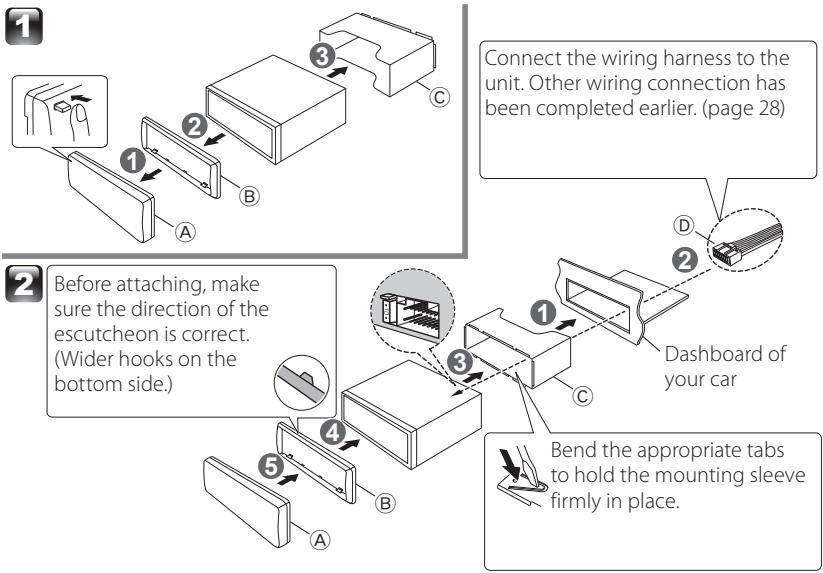
3 Install the unit to your car.
→
4 Reconnect the ⊖ terminal of the car battery.
5 Reset the unit. (page 4)
⚠ Warning
■ The unit can only be installed in a car with a 12 V DC power supply, negative ground.
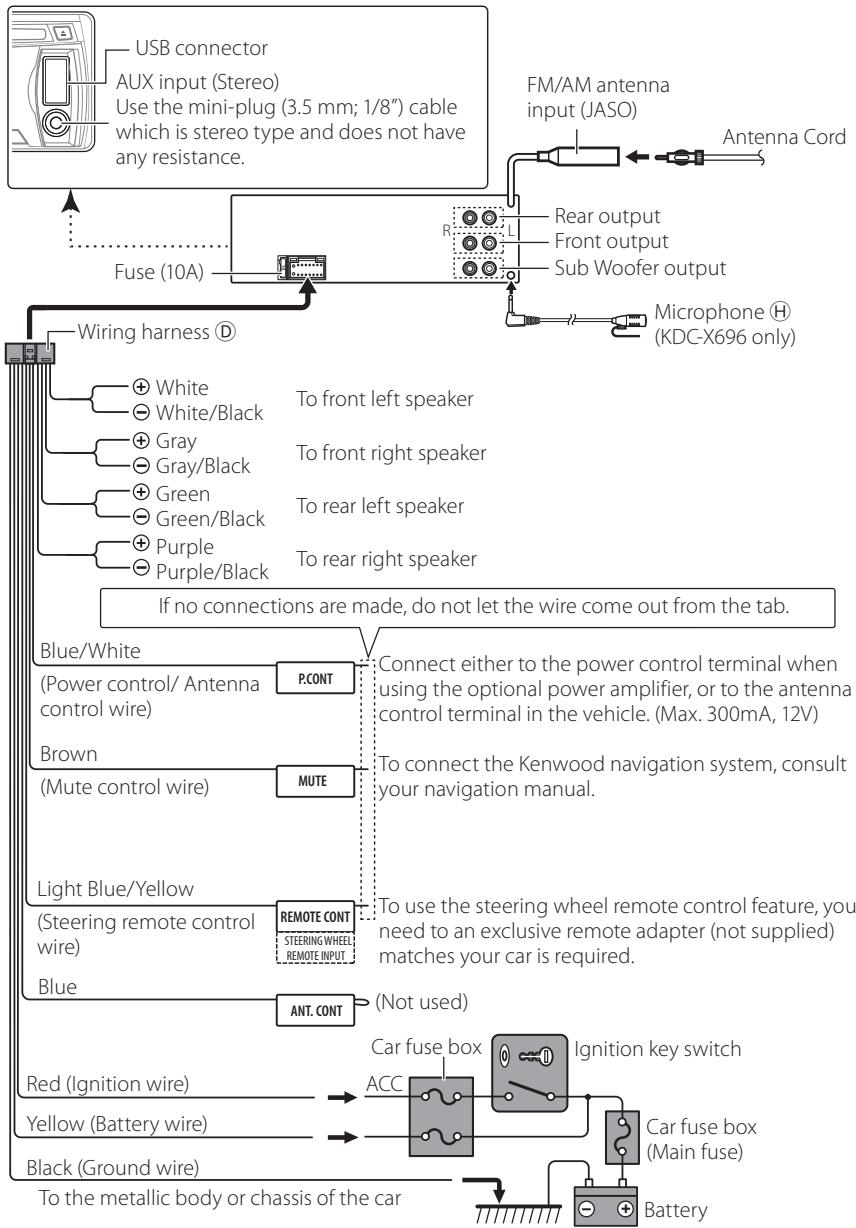
If you connect the ignition wire (red) and the battery wire (yellow) to the car chassis (ground), you may cause a short circuit, that in turn may start a fire. Always connect those wires to the power source running through the fuse box.
- Disconnect the battery's negative terminal and make all electrical connections before installing the unit.
■ Insulate unconnected wires with vinyl tape or other similar material. To prevent a short circuit, do not remove the caps on the ends of the unconnected wires or the terminals.
- Be sure to ground this unit to the car's chassis again after mounting.
If the power is not turned ON ("PROTECT" is displayed), the speaker wire may have a short-circuit or touched the chassis of the vehicle and the protection function may have been activated. Therefore, the speaker wire should be checked.
Caution
If your car's ignition key switch does not have an ACC position, connect the ignition wires to a power source that can be turned on and off with the ignition key. If you connect the ignition wires to a constant-voltage power source, as with battery wires, the battery may die.
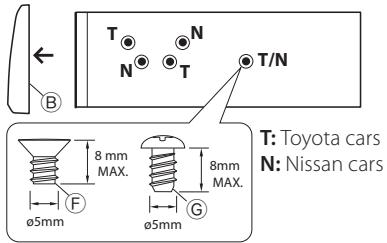
■ Do not use your own screws. Use only the screws provided.
■ Install this unit in the console of your vehicle. Make sure the faceplate will not hit the lid of the console (if any) when closing and opening.
■ After the installing the unit, check whether the brake lamps, blinkers, wipers, etc. on the car are working properly.
■ Mount the unit so that the mounting angle is 30^ or less.
If the fuse blows, first make sure the wires are not touching other parts to cause a short circuit, and then replace the old fuse with one with a new the same rating.
■ Connect the speaker wires correctly to the corresponding terminals. The unit may be damaged or fail to work if you share the ⏰ wires or ground them to any metal part in the car.
■ When only two speakers are being connected to the system, connect the connectors either to both the front output terminals or to both the rear output terminals (do not mix front and rear).
Mounting and wiring this product requires skills and experience. For safety's sake, leave this work to professionals.
If you experience problems during installation, consult your Kenwood dealer.
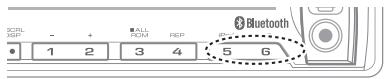
■ Reception may become poor if there are metal objects near the Bluetooth antenna.
text_image
CTRL RSP - + ALL ROM RSP IP 1 2 3 4 5 6 BluetoothBluetooth antenna unit
For Good Reception
To assure good reception, note the following:
■ Communicate with the cell-phone within the line-of-sight distance of 10 m (30 ft). The communication range becomes shorter depending on the surrounding environment. The communication range also becomes shorter when there is an obstacle between this unit and the cell-phone. The above maximum communication range (10 m) is not always assured.
■ A broadcast station or walkie-talkie located nearby can interfere with communication due to a too strong signal.
CAUTION
Install this unit in the console of your vehicle.
Do not touch the metal part of this unit during and shortly after the use of the unit. Metal part such as the heat sink and enclosure become hot.
flowchart
graph TD
    A["USB connector"] --> B["AUX input (Stereo)"]
    B --> C["Use the mini-plug (3.5 mm; 1/8") cable which is stereo type and does not have any resistance."]
    C --> D["Fuse (10A)"]
    D --> E["Wiring harness"]
    E --> F["White"]
    E --> G["White/Black"]
    E --> H["Gray"]
    E --> I["Gray/Black"]
    E --> J["Green"]
    E --> K["Green/Black"]
    E --> L["Purple"]
    E --> M["Purple/Black"]
    D --> N["To front left speaker"]
    D --> O["To front right speaker"]
    D --> P["To rear left speaker"]
    D --> Q["To rear right speaker"]
    D --> R["If no connections are made, do not let the wire come out from the tab."]
    R --> S["Blue/White"]
    S --> T["(Power control/ Antenna control wire)"]
    S --> U["Brown"]
    U --> V["(Mute control wire)"]
    S --> W["Light Blue/Yellow"]
    W --> X["(Steering remote control wire)"]
    W --> Y["Blue"]
    Y --> Z["ANT. CONT"]
    Z --> AA["Red (Ignition wire)"]
    Z --> AB["Yellow (Battery wire)"]
    Z --> AC["Black (Ground wire)"]
    Z --> AD["To the metallic body or chassis of the car"]

    subgraph Internal Components
        AE["FM/AM antenna input (JASO)"] --> AF["Antenna Cord"]
        AF --> AG["Rear output"]
        AF --> AH["Front output"]
        AF --> AI["Sub Woofer output"]
        AJ["Microphone H (KDC-X696 only)"] --> AK["Analog port"]
        AL["Car fuse box"] --> AM["ACC"]
        AN["Ignition key switch"] --> AO["Car fuse box (Main fuse)"]
        AP["Battery"] --> AQ["Ground"]
    end

    AE --> AF
    AF --> AG
    AG --> AH
    AH --> AI
    AI --> AJ
    AJ --> AK
    AK --> AL
flowchart
graph TD
    A["1 Pinning"] --> B["2 Wiring Harness"]
    B --> C["3 Connection to unit"]
    C --> D["4 Window"]
    D --> E["5 Rear"]
    E --> F["6 Elbow"]
    F --> G["7 Back Left"]
    G --> H["8 Elbow Right"]
    H --> I["9 Rear Left"]
    I --> J["Before attaching, correct direction of escutcheon is correct. (Wider hooks on the bottom side)."]
    J --> K["3 Dashboard of your car"]
    K --> L["4 Elbow Right"]
    L --> M["5 Rear Left"]
    M --> N["6 Elbow Right"]
    N --> O["7 Back Left"]
    O --> P["8 Elbow Right"]
    P --> Q["9 Rear Left"]
    Q --> R["10 Back Left"]
    R --> S["11 Elbow Right"]
    S --> T["12 Back Left"]
    T --> U["13 Elbow Right"]
    U --> V["14 Back Left"]
    V --> W["15 Elbow Right"]
    W --> X["16 Back Left"]
    X --> Y["17 Elbow Right"]
    Y --> Z["18 Back Left"]
    Z --> AA["19 Elbow Right"]
    AA --> AB["20 Back Left"]
    AB --> AC["21 Elbow Right"]
    AC --> AD["22 Back Left"]
    AD --> AE["23 Elbow Right"]
    AE --> AF["24 Back Left"]
    AF --> AG["25 Elbow Right"]
    AG --> AH["26 Back Left"]
    AH --> AI["27 Elbow Right"]
    AI --> AJ["28 Back Left"]
Installing without using the mounting sleeve (Japanese car)
1 Remove the mounting sleeve and escutcheon Ⓑ from the unit.
2 Align the holes in the unit (on both sides) with the vehicle mounting bracket and secure the unit with the supplied screws.
text_image
T: Toyota cars N: Nissan cars 8 mm MAX. 8mm MAX. Ø5mm Ø5mmRemoving the unit
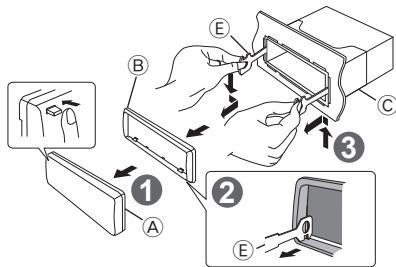
1 Detach the faceplate Ⓐ.
2 Engage the catch pin on the removal tools Ⓔ into the holes on both sides of the escutcheon Ⓑ, then pull it out.
3 Insert the removal tools Ⓔ deeply into the slots on each side, then follow the arrows instructions as shown on the right.
text_image
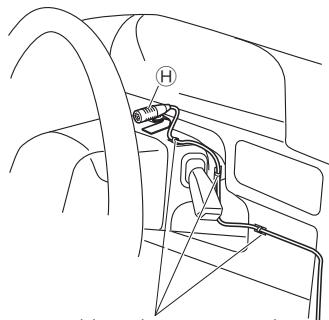
Diagram illustrating a device operation sequence with labeled steps A, B, C, and E for assembly or cleaning.1 Check the installation position of the microphone Ⓗ.
2 Remove oil and other dirt from the installation surface.
3 Install the microphone.
4 Wire the microphone cable up to the hands-free box with it secured at several positions using tape or the like.
■ Install the microphone as far away as possible from the cell-phone.
natural_image
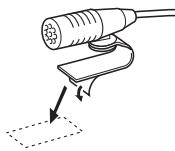
Diagram of a handheld device with a curved handle and arrow indicating motion or force (no text or symbols)Peel off the release coated paper of double-face adhesive tape to secure the microphone on the place shown above.
text_image
H Figures 1, 2, 3, 4, 5, 6, 7, 8, 9, 10, 11, 12, 13, 14, 15, 16, 17, 18, 19, 20, 21, 22, 23, 24, 25, 26, 27, 28, 29, 30, 31, 32, 33, 34, 35, 36, 37, 38, 39, 40, 41, 42, 43, 44, 45, 46, 47, 48, 49, 50, 51, 52, 53, 54, 55, 56, 57, 58, 59, 60, 61, 62, 63, 64, 65, 66, 67, 68, 69, 70, 71, 72, 73, 74, 75, 76, 77, 78, 79, 80, 81, 82, 83, 84, 85, 86, 87, 88, 89, 90, 91, 92, 93, 94, 95, 96, 97, 98, 99Fix a cable with a commercial item of tape.
natural_image
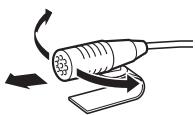
Diagram of a cable being inserted into a plug, showing motion arrows (no text or symbols)Turn the microphone toward the driver.
Troubleshooting
| Symptom | Remedy/Cause |
| Sound cannot be heard. | Adjust the volume to the optimum level. / Check the cords and connections. |
| “PROTECT” appears and no operations can be done. | Check to be sure the terminals of the speaker leads are covered with insulating tape properly, then reset the unit. If “PROTECT” does not disappear, consult your nearest service center. |
| The unit does not work at all. | Reset the unit. |
| Radio reception is poor. / Static noise while listening to the radio. | Connect the antenna firmly. / Pull the antenna out all the way. |
| “IN” flashes. | The CD player is not operating properly. Reinsert the disc properly. If the condition did not improve, turn off the unit and consult your nearest service center. |
| CD-R/CD-RW cannot be played back and tracks cannot be skipped. | Insert a finalized CD-R/CD-RW (finalize with the component which you used for recording). |
| Disc sound is sometimes interrupted. | Stop playback while driving on rough roads. / Change the disc. / Check the cords and connections. |
| “NA FILE” appears. | The unit is playing an unsupported audio file. |
| “NO DISC” appears. | Insert a playable disc into the loading slot. |
| “TOC ERROR” appears. | The CD is quite dirty. / The CD is upside-down. / The CD is scratched a lot. Try another disc instead. |
| “ERROR 99” appears. | The unit is malfunctioning for some reason. Press the reset button on the unit. If the “ERROR 99” code does not disappear, consult your nearest service center. |
| “COPY PRO” appears. | A copy-protected file is played. |
| “READ ERROR” appears. | Copy the files and folders for the USB device again. If the error message is still displayed, initialize the USB device or use other USB devices. |
| “NO DEVICE” appears. | No USB device is connected. Connect a USB device, and change the source to USB again. |
| “NO MUSIC” appears. | The connected USB device contains no playable audio file. |
| “NA DEVICE” appears. | Connect a supported USB device, and check the connections. |
| “iPod ERROR” appears. | Reconnect the iPod. / Confirm that the software for the iPod is the latest version. / Reset the iPod. |
| Noise is generated. | Skip to another track or change the disc. |
| Tracks cannot play back as you have intended them to play. | Playback order is determined when files are recorded. |
| “READING” keeps flashing. | Longer readout time is required. Do not use too many hierarchies and folders. |
| Elapsed playing time is not correct. | This is caused by how the tracks are recorded. |
| The number of songs contained in “SONGS” category of this unit is different from that contained in “SONGS” category of iPod. | Podcast files are not counted in this unit as this unit does not support the playback of podcast files. |
| Correct characters are not displayed (e.g. album name). | This unit can only display letters (upper case), numbers, and a limited number of symbols. |
Pandora
| Symptom | Remedy/Cause |
| “PANDORA ERR 5” appears. | Thumb up/down operation has failed. |
| “NO SKIPS” appears. | The skip count limit has been exceeded. |
| “CHK DEVICE” appears. | Check the Pandora® application on the iPhone/iPod touch. |
Bluetooth
| Symptom | Remedy/Cause |
| The hands-free talk volume is low. | The hands-free talk volume can be adjusted independently. Adjust it during hands-free talk. [MIC GAIN] of(page 22). |
| No beep is heard at reception of an incoming call. | No beep is heard depending on the type of your cell-phone. The [CALL BEEP] of(page 22) is set ON. |
| Voice is not recognized. | ■ The vehicle window is open. If the surrounding noise is large, voice cannot be recognized properly. Close the vehicle windows to reduce noise.■ Small voice. If voice is too small, it cannot be recognized properly. Speak into the microphone a little more loudly and naturally.■ The person uttering the voice tag is not the one who registered the it. Only the voice of the person who registered the voice tag can be recognized. |
| “NO NUMBER” appears. | The calling party does not notify a caller ID. / There is no phone number data. |
| “NO DATA” appears. | There is no outgoing call list. / There is no incoming call list. / There is no missed call list. / There is no phone book list. / Data is not contained in the phone book. |
| “NO ENTRY” appears. | The cell-phone has not been registered (pairing). |
| “HF DISCONCT” appears. | The unit cannot communicate with the cell-phone. |
| “AUD DISCONCT” appears. | The unit cannot communicate with the audio player. |
| “HF ERROR 07” appears. | The memory cannot be accessed. Turn off the power and on again. If this message still appears, press the reset button on the control unit. |
| “HF ERROR 68” appears. | The unit cannot communicate with the cell-phone. Turn off the power and on again. If this message still appears, press the reset button on the control unit. |
| “HF ERROR 89” appears. | Update of the Bluetooth firmware has failed. Retry it. |
| “UNKNOWN” appears. | The Bluetooth device cannot be detected. |
| “DEVICE FULL” appears. | 5 Bluetooth device have already been registered. No more Bluetooth device cannot be registered. |
| “PIN CODE NG” appears. | The PIN code is wrong. |
| “CONNECT NG” appears. | The unit cannot be connected to the device. |
| “PAIRING NG” appears. | Pairing error. |
| “NO ACTIVE DVC” appears. | No cell-phone is connected. Connect your cell-phone before starting voice recognition. |
| The sound from the Bluetooth audio player is discontinuous. | Another Bluetooth device is affecting the Bluetooth communication. Turn off another Bluetooth device. Move another Bluetooth device away from this unit.Another Bluetooth device or profile is used for communication. The downloading of the Phone book disconnects the sound. |
FM tuner section
Frequency range (200 kHz space): 87.9 MHz — 107.9 MHz
Usable sensitivity (S/N=26 dB): 11.2 dBf (1 μV/75 Ω)
Quieting sensitivity (DIN S/N = 46 dB): 19.2 dBf (2.5 μV/75 Ω)
Frequency response (±3 dB): 30 Hz — 15 kHz
Signal-to-Noise ratio (MONO): 63 dB
Stereo separation (1 kHz): 40 dB
AM tuner section
Frequency range (10 kHz space): 530 kHz — 1,700 kHz
Usable sensitivity (S/N=20 dB): 31 dBμ (36 μV)
CD player section
Laser diode: GaAlAs
Digital filter (D/A): 8 Times Over Sampling
D/A converter: 24 Bit
Spindle speed: 500 rpm — 200 rpm (CLV)
Wow & Flutter: Below Measurable Limit
Frequency response (±1 dB): 20 Hz — 20 kHz
Total harmonic distortion (1 kHz): KDC-X696: 0.008 % KDC-BT652U: 0.01 %
Signal-to-Noise ratio (1 kHz): KDC-X696: 110 dB KDC-BT652U: 105 dB
Dynamic range: 93 dB
AAC decode: AAC-LC ".m4a" files
MP3 decode: Compliant with MPEG-1/2 Audio Layer-3
WMA decode: Compliant with Windows Media Audio
USB interface
USB standard: USB1.1/2.0 (Full speed)
Maximum supply current: DC 5 V = 1 A
File system: FAT16/ 32
AAC decode: AAC-LC ".m4a" files
MP3 decode: Compliant with MPEG-1/2 Audio Layer-3
WMA decode: Compliant with Windows Media Audio
Bluetooth section
Technology: Bluetooth Ver. 2.1+EDR Certified
Frequency: 2.402 GHz – 2.480 GHz
Output Power: +4 dBm (MAX), 0 dBm (AVE) Power Class 2
Maximum Communication range: Line of sight approx. 10m (32.8 ft)
Profile: HFP (Hands Free Profile), SPP (Serial Port Profile), OPP (Object Push Profile), PBAP (Phonebook Access Profile), A2DP (Advanced Audio Distribution Profile), AVRCP (Audio/Video Remote Control Profile)
Audio section
Maximum output power: 50 W × 4
Full bandwidth power (at less than 1 % THD): 22 W × 4
Speaker impedance: 4 Ω — 8 Ω
Tone action: Bass: 100 Hz ±8 dB Middle: 1 kHz ±8 dB Treble: 12.5 kHz ±8 dB
Preout level / load (CD): KDC-X696: 4,000 mV/ 10 kΩ KDC-BT652U: 2,500 mV/ 10 kΩ
Preout impedance: ≤ 600 Ω
Auxiliary input section
Frequency response (±3 dB): 20 Hz — 20 kHz
Input maximum voltage: 1,200 mV
Input impedance: 10 kΩ
General
Operating voltage: 14.4 V (10.5 V — 16 V allowable)
Maximum current consumption: 10 A
Installation size (W × H × D): 182 mm × 53 mm × 160 mm (7-3/16" × 2-1/16" × 6-5/16")
Weight: 2.9 lbs (1.3 kg)
Subject to change without notice.
TABLE DES MATIERES
Sécurité 35
Entretien
Préparation 36
Installation/raccordement 58
■ The "AAC" logo is a trademark of Dolby Laboratories.
La marque et les logos Bluetooth appartiennent à Bluetooth SIG, Inc. et toute utilisation de ces marques par JVC Kenwood Corporation est sous licence. Les autres marques et appellations commerciales appartiennent à leurs propriétaires respectifs.
■ "Made for iPod" and "Made for iPhone" mean that an electronic accessory has been designed to connect specifically to iPod or iPhone, respectively, and has been certified by the developer to meet Apple performance standards. Apple is not responsible for the operation of this device or its compliance with safety and regulatory standards. Please note that the use of this accessory with iPod or iPhone may affect wireless performance.
■ iPhone, iPod, iPod classic, iPod nano, and iPod touch are trademarks of Apple Inc., registered in the U.S. and other countries.
■ PANDORA, the PANDORA logo, and the Pandora trade dress are trademarks or registered trademarks of Pandora Media, Inc., used with permission.
text_image
Diagram illustrating two-step folding or reassembly process of a wallet, labeled with arrows and numbered components.text_image
Diagram showing two labeled components (1 and 2) with arrows indicating direction or flow, likely illustrating a process or system.text_image
Diagram showing a tool interacting with a labeled component, marked with number 3 and an arrow indicating direction.|◀◀ / +▶▶ | :Choisit la station.
natural_image
Line drawing of a handheld electronic device with a cable and ports (no text or symbols)- iPod touch (4th generation)
- iPod touch (3rd generation)
- iPod touch (2nd generation)
- iPod touch (1st generation)
- iPod classic
- iPod with video
- iPod nano (6th generation)
- iPod nano (5th generation)
- iPod nano (4th generation)
- iPod nano (3rd generation)
- iPod nano (2nd generation)
- iPod nano (1st generation)
- iPhone 4S
- iPhone 4
- iPhone 3GS
- iPhone 3G
- iPhone
FILE REPEAT, REPEAT OFF
RANDOM ON, RANDOM OFF
Installation/raccordement
Liste de pièces:
text_image
Diagram illustrating a hand holding a device with labeled steps A, B, C, and E, showing directional arrows and component placement.natural_image
Diagram of a handheld device with a curved handle and arrow indicating motion or force (no text or symbols)natural_image
Diagram of a cable being inserted into a plug, showing motion arrows (no text or symbols)Section Disque Compact
Diode laser: GaAlAs
Standard USB: USB1.1/2.0 (Full speed)
Courant d'alimentation maximum: DC 5 V --- 1 A
■ The "AAC" logo is a trademark of Dolby Laboratories.
■ La marca denominativa y los logos de Bluetooth son propiedad de Bluetooth SIG, Inc. y cualquier uso de dichas marcas por JVC KENWOOD Corporation está sujeto a los términos de licencia. El resto de marcas comerciales y nombres comerciales corresponden a sus respectivos propietarios.
■ "Made for iPod" and "Made for iPhone" mean that an electronic accessory has been designed to connect specifically to iPod or iPhone, respectively, and has been certified by the developer to meet Apple performance standards. Apple is not responsible for the operation of this device or its compliance with safety and regulatory standards. Please note that the use of this accessory with iPod or iPhone may affect wireless performance.
■ iPhone, iPod, iPod classic, iPod nano, and iPod touch are trademarks of Apple Inc., registered in the U.S. and other countries.
■ PANDORA, the PANDORA logo, and the Pandora trade dress are trademarks or registered trademarks of Pandora Media, Inc., used with permission.
natural_image
Diagram of a closed book with two arrows indicating direction, no text or symbols present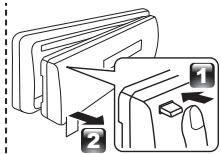
text_image
Diagram illustrating a device's internal structure with labeled parts and directional arrows indicating movement or interaction.text_image
Diagram showing a tool interacting with a labeled component, marked with number 3 and an arrow indicating direction.Botón de reposición
natural_image
Pure diagram of a connector with internal slots and an arrow pointing to it (no text or symbols)Lámina aislante
text_image
Diagram showing hand positioning with numbered arrows and directional indicators, likely illustrating a motion or positioning concept.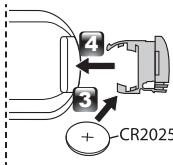
text_image
4 3 + CR2025⚠️ Precaución:
FILE REPEAT, REPEAT OFF
RANDOM ON, RANDOM OFF
text_image
Diagram illustrating a hand holding a device with labeled steps A, B, C, and E, showing directional arrows and component placement.text_image
Technical diagram showing a car interior with labeled component 'H' and cable connectionsnatural_image
Diagram of a handheld device with a plug and arrow indicating action (no text or symbols)natural_image
Diagram of a cable being inserted into a plug, showing motion arrows (no text or symbols)This equipment may generate or use radio frequency energy. Changes or modifications to this equipment may cause harmful interference unless the modifications are expressly approved in the instruction manual. The user could lose the authority to operate this equipment if an unauthorized change or modification is made.
FCC NOTE
This equipment has been tested and found to comply with the limits for a Class B digital device, pursuant to Part 15 of the FCC Rules. These limits are designed to provide reasonable protection against harmful interference in a residential installation. This equipment may cause harmful interference to radio communications, if it is not installed and used in accordance with the instructions. However, there is no guarantee that interference will not occur in a particular installation. If this equipment does cause harmful interference to radio or television reception, which can be determined by turning the equipment off and on, the user is encouraged to try to correct the interference by one or more of the following measures:
■ Reorient or relocate the receiving antenna.
■ Increase the separation between the equipment and receiver.
■ Connect the equipment into an outlet on a circuit different from that to which the receiver is connected.
■ Consult the dealer or an experienced radio/TV technician for help.
■ Contains Transmitter Module FCC ID : XQN-BTR60X
■ Contains Transmitter Module IC : 9688A-BTR601
IC (Industry Canada) Notice
Operation is subject to the following two conditions:
(1) This device may not cause interference, and
(2) this device must accept any interference, including interference that may cause undesired operation of the device.
The term "IC:" before the certification/registration number only signifies that the Industry Canada technical specification were met.
CAUTION
This equipment complies with FCC/IC radiation exposure limits set forth for an uncontrolled environment and meets the FCC radio frequency (RF) Exposure Guidelines in Supplement C to OET65 and RSS-102 of the IC radio frequency (RF) Exposure rules. This equipment has very low levels of RF energy that it deemed to comply without maximum permissive exposure evaluation (MPE). But it is desirable that it should be installed and operated keeping the radiator at least 20cm or more away from person's body (excluding extremities: hands, wrists, feet and ankles).
Under Industry Canada regulations, this radio transmitter may only operate using an antenna of a type and maximum (or lesser) gain approved for the transmitter by Industry Canada. To reduce potential radio interference to other users, the antenna type and its gain should be so chosen that the equivalent isotropically radiated power (e.i.r.p.) is not more than that necessary for successful communication.
Note de 'IC (Industrie Canada)
Use of controls or adjustments or performance of procedures other than those specified herein may result in hazardous radiation exposure.
In compliance with Federal Regulations, following are reproductions of labels on, or inside the product relating to laser product safety.
JVC KENWOOD Corporation
2967-3, ISHIKAWA-MACHI,
THIS PRODUCT CMPLIES WITH DHHS RULES 21 CFR SUBCHAPTER J IN EFFECT DATE OF MANUFACTURE.
Location : Top Panel