GP2600 - Generator Wacker Neuson - Free user manual and instructions
Find the device manual for free GP2600 Wacker Neuson in PDF.


| Brand | Wacker Neuson |
| Model | GP2600 |
| Product Type | Portable Generator |
| Power Output (Rated) | 2300 W |
| Power Output (Maximum) | 2600 W |
| Voltage | 120 V / 240 V |
| Frequency | 60 Hz |
| Engine Type | 4-Stroke, OHV, Single Cylinder |
| Engine Displacement | 196 cc |
| Fuel Type | Unleaded Gasoline |
| Fuel Tank Capacity | 3.6 L |
| Run Time at 50% Load | Approx. 10 hours |
| Starting System | Recoil Start (Manual) |
| Outlets | 2x 120V GFCI Duplex, 1x 240V Twist-Lock |
| Noise Level (at 7m) | 67 dBA |
| Dimensions (L x W x H) | 610 x 460 x 460 mm |
| Dry Weight | 42 kg |
| Fuel Consumption (Full Load) | 1.5 L/h |
| Oil Capacity | 0.6 L |
| Oil Type | SAE 10W-30 (API SJ or higher) |
| Spark Plug Type | F7RTC or equivalent |
| Circuit Breaker | Yes, overload protection |
| Low Oil Shutdown | Yes |
| Frame Material | Steel with anti-vibration mounts |
| Warranty | 2 years limited |
Frequently Asked Questions - GP2600 Wacker Neuson
User questions about GP2600 Wacker Neuson
0 question about this device. Answer the ones you know or ask your own.
Ask a new question about this device
Download the instructions for your Generator in PDF format for free! Find your manual GP2600 - Wacker Neuson and take your electronic device back in hand. On this page are published all the documents necessary for the use of your device. GP2600 by Wacker Neuson.
USER MANUAL GP2600 Wacker Neuson
Type GP2600 Non-CARB
Document 5000186126
Date 1115
Version 03
Language EN
| Copyright notice | © Copyright 2015 by Wacker Neuson Production Americas LLCAll rights, including copying and distribution rights, are reserved.This publication may be photocopied by the original purchaser of the machine. Any other type of reproduction is prohibited without express written permission from Wacker Neuson Production Americas LLC.Any type of reproduction or distribution not authorized by Wacker Neuson Production Americas LLC represents an infringement of valid copyrights. Violators will be prosecuted. |
| Trademarks | All trademarks referenced in this manual are the property of their respective owners. |
| Manufacturer | Wacker Neuson Production Americas LLCN92W15000 Anthony AvenueMenomonee Falls, WI 53051 U.S.A.Tel: (262) 255-0500 · Fax: (262) 255-0550 · Tel: (800) 770-0957www.wackerneuson.com |
| Original instructions | This Operator's Manual presents the original instructions. The original language of this Operator's Manual is American English. |
GP 2600 Foreword
Foreword
SAVE THESE INSTRUCTIONS—This manual contains important instructions for the machine models listed below. These instructions must be followed during installation and maintenance of the generator (and battery, if equipped).
Machines covered in this manual
| Machine Item Number | |
| GP 2600 0620088 |

DANGER
Carbon monoxide. Using a generator indoors CAN KILL YOU IN MINUTES. Generator exhaust contains carbon monoxide (CO). This is a poison you cannot see or smell. If you can smell the generator exhaust, you are breathing CO. But even if you cannot smell the exhaust, you could be breathing CO.
▶ NEVER use a generator inside homes, buildings, garages, crawlspaces, or other partly enclosed areas. Deadly levels of carbon monoxide can build up in these areas. Using a fan or opening windows and doors does NOT supply enough fresh air.
▶ ONLY use a generator outside, and far away from homes, buildings, windows, doors, and vents. Windows, doors, and vents can pull in generator exhaust.
▶ Point the engine exhaust away from homes, buildings, windows, doors, and vents. Also, point the engine exhaust away from combustible materials.
Even when you use a generator correctly, CO may leak into the home or building. ALWAYS use a battery-powered or battery-backup CO alarm in the home or building.
▶ If you start to feel sick, dizzy, or weak after the generator has been running, move to fresh air RIGHT AWAY. See a doctor. You could have carbon monoxide poisoning.

wc_gr010970
Machine identification
A nameplate listing the model number, item number, revision number, and serial number is attached to this machine. The location of the nameplate is shown above.
Serial number (S/N)
For future reference, record the serial number in the space provided below. You will need the serial number when requesting parts or service for this machine.
Serial Number:
Machine documentation
■ From this point forward in this documentation, Wacker Neuson Production Americas LLC will be referred to as Wacker Neuson.
- Keep a copy of the Operator's Manual with the machine at all times.
■ Use the separate Parts Book supplied with the machine to order replacement parts.
■ Refer to the separate Repair Manual for detailed instructions on servicing and repairing the machine.
■ If you are missing any of these documents, please contact Wacker Neuson to order a replacement or visit www.wackerneuson.com.
■ When ordering parts or requesting service information, be prepared to provide the machine model number, item number, revision number, and serial number.
Expectations for information in this manual
■ This manual provides information and procedures to safely operate and maintain the above Wacker Neuson model(s). For your own safety and to reduce the risk of injury, carefully read, understand, and observe all instructions described in this manual.
■ Wacker Neuson expressly reserves the right to make technical modifications, even without notice, which improve the performance or safety standards of its machines.
■ The information contained in this manual is based on machines manufactured up until the time of publication. Wacker Neuson reserves the right to change any portion of this information without notice.
■ The illustrations, parts, and procedures in this manual refer to Wacker Neuson factory-installed components. Your machine may vary depending on the requirements of your specific region.
GP 2600 Foreword
CALIFORNIA Proposition 65 Warning
Combustion exhaust, some of its constituents, and certain vehicle components contain or emit chemicals known to the State of California to cause cancer and birth defects or other reproductive harm.
Laws pertaining to spark arresters
NOTICE: State Health Safety Codes and Public Resources Codes specify that in certain locations spark arresters be used on internal combustion engines that use hydrocarbon fuels. A spark arrester is a device designed to prevent accidental discharge of sparks or flames from the engine exhaust. Spark arresters are qualified and rated by the United States Forest Service for this purpose. In order to comply with local laws regarding spark arresters, consult the engine distributor or the local Health and Safety Administrator.
Manufacturer's approval
This manual contains references to approved parts, attachments, and modifications. The following definitions apply:
■ Approved parts or attachments are those either manufactured or provided by Wacker Neuson.
■ Approved modifications are those performed by an authorized Wacker Neuson service center according to written instructions published by Wacker Neuson.
■ Unapproved parts, attachments, and modifications are those that do not meet the approved criteria.
Unapproved parts, attachments, or modifications may have the following consequences:
■ Serious injury hazards to the operator and persons in the work area
- Permanent damage to the machine which will not be covered under warranty Contact your Wacker Neuson dealer immediately if you have questions about approved or unapproved parts, attachments, or modifications.
Foreword GP 2600
Foreword
3
1 Safety Information 9
1.1 Signal Words Used in this Manual 9
1.2 Machine Description and Intended Use 10
1.3 Operating Safety 11
1.4 Operator Safety while Using Internal Combustion Engines 15
1.5 Service Safety 16
2 Labels 18
2.1 Label Locations 18
2.2 Label Meanings 19
3 Lifting and Transporting 22
4 Operation 24
4.1 Preparing the Machine for First Use 24
4.2 Determining Power Requirements 25
4.3 Positioning the Generator for Operation 26
4.4 Generator Derating 28
4.5 Grounding the Generator 29
4.6 Operating Heavy Loads 29
4.7 Use of Extension Cords 30
4.8 Control Panel 31
4.9 Ground Fault Interrupt (GFI / GFCI) 32
4.10 Circuit Breaker 32
4.11 Before Starting 33
4.12 Starting 34
4.13 Stopping 34
4.14 Emergency Shutdown Procedure 35
5 Maintenance 36
5.1 Maintaining the Emission Control System 36
5.2 Periodic Maintenance Schedule 36
5.3 Engine Oil 37
5.4 Servicing the Air Cleaner 38
5.5 Spark Plug 39
5.6 Storage 40
Table of Contents
GP 2600
6 Troubleshooting 41
7 Technical Data 42
7.1 Generator 42
7.2 Engine 43
8 Emission Control Systems Information and Warranty 45
8.1 Emission Control System Background Information ....45
8.2 Limited Defect Warranty for Wacker Neuson
Emission Control Systems ....46
9 Schematics 50
9.1 Wire Colors ....50
9.2 Electrical Schematic 50
GP 2600 Safety Information
1 Safety Information
1.1 Signal Words Used in this Manual
This manual contains DANGER, WARNING, CAUTION, NOTICE, and NOTE signal words which must be followed to reduce the possibility of personal injury, damage to the equipment, or improper service.

This is the safety alert symbol. It is used to alert you to potential personal hazards.
▶ Obey all safety messages that follow this symbol.

DANGER
DANGER indicates a hazardous situation which, if not avoided, will result in death or serious injury.
▶ To avoid death or serious injury from this type of hazard, obey all safety messages that follow this signal word.

WARNING
WARNING indicates a hazardous situation which, if not avoided, could result in death or serious injury.
▶ To avoid possible death or serious injury from this type of hazard, obey all safety messages that follow this signal word.

CAUTION
CAUTION indicates a hazardous situation which, if not avoided, could result in minor or moderate injury.
▶ To avoid possible minor or moderate injury from this type of hazard, obey all safety messages that follow this signal word.
NOTICE: Used without the safety alert symbol, NOTICE indicates a situation which, if not avoided, could result in property damage.
Note: A Note contains additional information important to a procedure.
Safety Information GP 2600
1.2 Machine Description and Intended Use
This machine is a portable electric power source. The Wacker Neuson Portable Generator consists of a tubular steel frame surrounding a fuel tank, a gasoline engine, a control panel, and an electric alternator. The control panel includes controls and receptacles. As the engine runs, the generator converts mechanical energy into electric power. The operator connects loads to the electric power receptacles.
This machine is intended for the purpose of supplying electrical power to connected loads. Refer to the product specifications for the output voltage and frequency of this generator, and the maximum output power limit of this generator.
This machine has been designed and built strictly for the intended use described above. Using the machine for any other purpose could permanently damage the machine or seriously injure the operator or other persons in the area. Machine damage caused by misuse is not covered under warranty.
The following are some examples of misuse:
■ Connecting a load that has voltage and frequency requirements that are incompatible with the generator output
■ Overloading the generator with a load that draws excessive power during either continuous running or start-up
- Operating the generator in a manner that is inconsistent with all federal, state and local codes and regulations
■ Using the machine as a ladder, support, or work surface
■ Using the machine to carry or transport passengers or equipment
■ Operating the machine outside of factory specifications
- Operating the machine in a manner inconsistent with all warnings found on the machine and in the Operator's Manual.
This machine has been designed and built in accordance with the latest global safety standards. It has been carefully engineered to eliminate hazards as far as practicable and to increase operator safety through protective guards and labeling. However, some risks may remain even after protective measures have been taken. They are called residual risks. On this machine, they may include exposure to:
■ Heat, noise, exhaust, and carbon monoxide from the engine
■ Fire hazards from improper refueling techniques
■ Fuel and its fumes
■ Electric shock and arc flash
■ Personal injury from improper lifting techniques
To protect yourself and others, make sure you thoroughly read and understand the safety information presented in this manual before operating the machine.
GP 2600 Safety Information
1.3 Operating Safety

DANGER
Carbon monoxide. Using a generator indoors CAN KILL YOU IN MINUTES. Generator exhaust contains carbon monoxide (CO). This is a poison you cannot see or smell. If you can smell the generator exhaust, you are breathing CO. But even if you cannot smell the exhaust, you could be breathing CO.
▶ NEVER use a generator inside homes, buildings, garages, crawlspaces, or other partly enclosed areas. Deadly levels of carbon monoxide can build up in these areas. Using a fan or opening windows and doors does NOT supply enough fresh air.
▶ ONLY use a generator outside, and far away from homes, buildings, windows, doors, and vents. Windows, doors, and vents can pull in generator exhaust.
▶ Point the engine exhaust away from homes, buildings, windows, doors, and vents. Also, point the engine exhaust away from combustible materials.
Even when you use a generator correctly, CO may leak into the home or building. ALWAYS use a battery-powered or battery-backup CO alarm in the home or building.
▶ If you start to feel sick, dizzy, or weak after the generator has been running, move to fresh air RIGHT AWAY. See a doctor. You could have carbon monoxide poisoning.

WARNING
Risk of electric shock or electrocution.
▶ Do not operate this generator in rain, snow, or standing water.
Operator training
Before operating the machine:
- Read and understand the operating instructions contained in all manuals delivered with the machine.
■ Familiarize yourself with the location and proper use of all controls and safety devices.
■ Contact Wacker Neuson for additional training if necessary.
When operating this machine:
- Do not allow improperly trained people to operate the machine. People operating the machine must be familiar with the potential risks and hazards associated with it.
Operator qualifications
Only trained personnel are permitted to start, operate, and shut down the machine. They also must meet the following qualifications:
■ have received instruction on how to properly use the machine
■ are familiar with required safety devices
The machine must not be accessed or operated by:
■ children
■ people impaired by alcohol or drugs
Safety Information GP 2600
| Application area | Be aware of the application area.■ Keep unauthorized personnel, children, and pets away from the machine.■ Remain aware of changing positions and the movement of other equipment and personnel in the application area/job site.Be aware of the application area.■ Do not operate the machine in areas that contain flammable objects, fuels, or products that produce flammable vapors. |
| Safety devices, controls, and attachments | Only operate the machine when:■ All safety devices and guards are in place and in working order.■ All controls operate correctly.■ The machine is set up correctly according to the instructions in the Operator's Manual.■ The machine is clean.■ The machine's labels are legible.To ensure safe operation of the machine:■ Do not operate the machine if any safety devices or guards are missing or inoperative.■ Do not modify or defeat the safety devices.■ Only use accessories or attachments that are approved by Wacker Neuson. |
| Safe operating practices | When operating this machine:■ Remain aware of the machine's moving parts. Keep hands, feet, and loose clothing away from the machine's moving parts.When operating this machine:■ Do not operate a machine in need of repair.■ Do not consume the operating fluids used in this machine. Depending on your machine model, these operating fluids may include water, wetting agents, fuel (gasoline, diesel, kerosene, propane, or natural gas), oil, coolant, hydraulic fluid, heat transfer fluid (propylene glycol with additives), battery acid, or grease. |
| Personal Protective Equipment (PPE) | Wear the following Personal Protective Equipment (PPE) while operating this machine:■ Close-fitting work clothes that do not hinder movement■ Safety glasses with side shields■ Hearing protection■ Safety-toed footwear |
GP 2600 Safety Information
Installing as backup power
Special hazards exist when installing this machine as a backup power supply. Improper connection of generator to a building's electrical system can allow electrical current from the generator to backfeed into utility lines. This may result in electrocution of utility workers, fire, or explosion.

WARNING
Backfeed from the generator into the public power distribution system can cause serious injury or death to utility workers!
Connections to a building's electrical system must be made by a qualified electrician and comply with all applicable laws and electrical codes.
If connected to a building's electrical system, the generator must meet the power, voltage, and frequency requirements of the equipment in the building. Differences in power, voltage, and frequency requirements may exist and improper connection may lead to equipment damage, fire, and personal injury or death.
Transporting and installing the machine
■ Never allow untrained personnel to operate or service the generator. The generator set should be set up by a certified electrician.
■ Do not stand under the machine while it is being hoisted or moved.
■ Do not attach equipment to the machine when it is suspended.
■ Always transport the generator in an upright position.
■ Always position and operate the generator on a firm, noncombustible, level surface.
■ Always make certain the machine is well-grounded and securely fastened to a good earthen ground per national and local regulations.
■ Always remove all tools, cords, and other loose items from the generator before starting it.
General Safety
- Do not operate the generator when open containers of fuel, paint, or other flammable liquids are near.
■ Do not operate the generator, or tools attached to the generator, with wet hands. - Do not run the electrical cords under the generator, or over vibrating or hot parts.
- Do not enclose or cover the generator when it is in use or when it is hot.
- Do not overload the generator. The total amperage of the tools and equipment attached to the generator must not exceed the load rating of the generator.
■ Do not operate the machine in snow, rain, or standing water.
■ Do not stand on the machine.
Generator vibration
Generators vibrate in normal use. During and after the use of the generator, inspect the generator as well as extension cords and power supply cords connected to it for damage from vibration.
■ Have damaged items repaired or replaced as necessary.
- Do not use plugs or or cords that show signs of damage such as broken or cracked insulation or damaged blades.
Safety Information GP 2600
After use
■ Store the machine properly when it is not being used. The machine should be stored in a clean, dry location out of the reach of children.
Cleaning
When cleaning and servicing the machine:
- Keep the machine clean and free of debris such as leaves, paper, cartons, etc.
- Keep the labels legible.
When cleaning the machine:
■ Do not clean the machine while it is running.
■ Never use gasoline or other types of fuels or flammable solvents to clean the machine. Fumes from fuels and solvents can become explosive.
GP 2600 Safety Information
1.4 Operator Safety while Using Internal Combustion Engines

WARNING
Internal combustion engines present special hazards during operation and fueling. Failure to follow the warnings and safety standards could result in severe injury or death.
Read and follow the warning instructions in the engine owner's manual and the safety guidelines below.

DANGER
▶ Carbon monoxide. Using a generator indoors CAN KILL YOU IN MINUTES. Generator exhaust contains carbon monoxide (CO). This is a poison you cannot see or smell. If you can smell the generator exhaust, you are breathing CO. But even if you cannot smell the exhaust, you could be breathing CO.
Refueling safety
When refueling the engine:
■ Do not smoke.
- Do not refuel if the generator is sitting in a truck fitted with a plastic bed liner. Static electricity can ignite the fuel or fuel vapors.
■ Do not refuel a hot or running engine.
■ Do not refuel the engine near an open flame.
When refueling the engine, always:
■ Refill the fuel tank in a well-ventilated area.
■ Replace the fuel tank cap after refueling.
Operating safety
When operating the generator:
- Check the fuel lines and the fuel tank for leaks and cracks before starting the engine.
■ Do not run the machine if fuel leaks are present or the fuel lines are loose.
■ Do not run the engine near open flames. - Do not start the engine if fuel has spilled or a fuel odor is present. Move the generator away from the spill and wipe the generator dry before starting.
■ Do not smoke while operating the machine.
Safety Information GP 2600
1.5 Service Safety
Service training
Before servicing or maintaining the machine:
- Read and understand the instructions contained in all manuals delivered with the machine.
■ Familiarize yourself with the location and proper use of all controls and safety devices.
■ Only trained personnel shall troubleshoot or repair problems occurring with the machine.
■ Contact Wacker Neuson for additional training if necessary.
When servicing or maintaining this machine:
- Do not allow improperly trained people to service or maintain the machine. Personnel servicing or maintaining the machine must be familiar with the associated potential risks and hazards.
Precautions
Follow the precautions below when servicing or maintaining the machine.
- Read and understand the service procedures before performing any service to the machine.
- All adjustments and repairs must be completed before operating the machine. Do not operate the machine with a known problem or deficiency.
■ All repairs and adjustments shall be completed by a qualified technician.
■ Turn off the machine before performing maintenance or making repairs. - Remain aware of the machine's moving parts. Keep hands, feet, and loose clothing away from the machine's moving parts.
■ Re-install the safety devices and guards after repair and maintenance procedures are complete.
Machine modifications
When servicing or maintaining the machine:
■ Use only accessories/attachments that are approved by Wacker Neuson.
When servicing or maintaining the machine:
■ Do not defeat safety devices.
- Do not modify the machine without the express written approval of Wacker Neuson.
Replacing parts and labels
■ Replace worn or damaged components.
■ Replace all missing and hard-to-read labels.
- When replacing electrical components, use components that are identical in rating and performance to the original components.
- When replacement parts are required for this machine, use only Wacker Neuson replacement parts or those parts equivalent to the original in all types of specifications, such as physical dimensions, type, strength, and material.
GP 2600 Safety Information
| Cleaning | When cleaning and servicing the machine:■ Keep the machine clean and free of debris such as leaves, paper, cartons, etc.■ Keep the labels legible.When cleaning the machine:■ Do not clean the machine while it is running.■ Never use gasoline or other types of fuels or flammable solvents to clean the machine. Fumes from fuels and solvents can become explosive. |
| Personal Protective Equipment (PPE) | Wear the following Personal Protective Equipment (PPE) while servicing or maintaining this machine:■ Close-fitting work clothes that do not hinder movement■ Safety glasses with side shields■ Hearing protection■ Safety-toed footwearIn addition, before servicing or maintaining the machine:■ Tie back long hair.■ Remove all jewelry (including rings). |
| Precautions | ■ Do not allow water to accumulate around the base of the machine. If water is present, move the machine and allow the machine to dry before servicing.■ Do not service the machine if your clothing or skin is wet.■ Always turn the engine off before servicing the machine. If the engine has electric start, disconnect the negative terminal on the battery before servicing the machine.■ Always let the engine cool before transporting or servicing the machine. |
Labels GP 2600
2 Labels
2.1 Label Locations
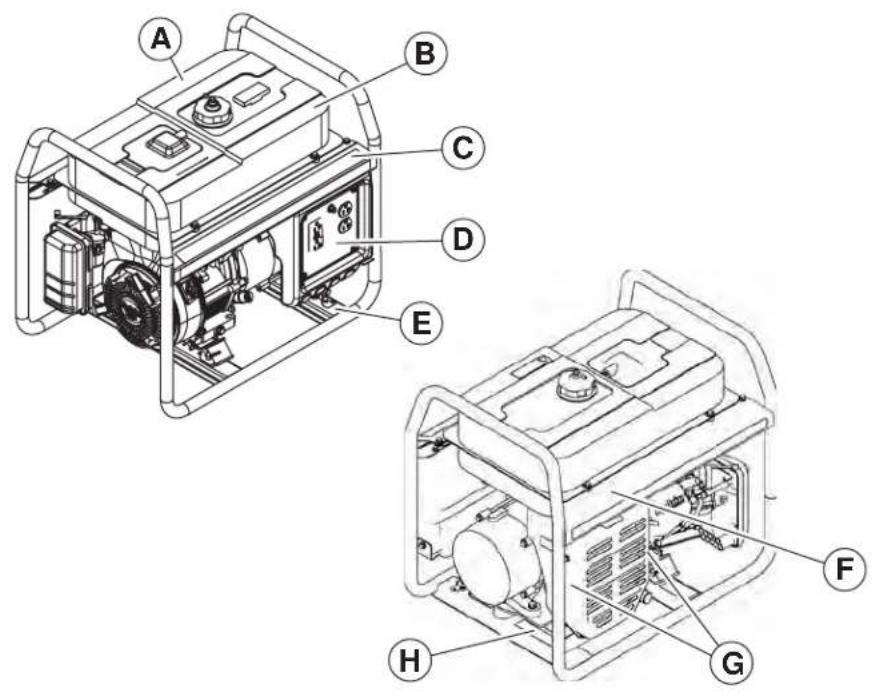
wc_gr010945
GP 2600 Labels
2.2 Label Meanings
| A DANG | 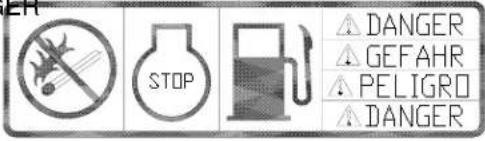 | Asphyxiation hazard.Engines emit carbon monoxide.Do not run the machine indoors or in an enclosed area.NEVER use inside a home or garage, EVEN IF doors and windows are open.Only use OUTSIDE and far away from windows, doors, and vents.Read the Operator's Manual.No sparks, flames, or burning objects near the machine.Stop the engine before refueling. |
| B |  | |
| — Use | Itered gasoline fuel. | Check the fuel level. |
| — Open | 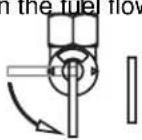 | |
| — Clos |  | |
| — Turn |  | |
Labels GP 2600
| — Pull |  | |
| — Oper |  | |
— Turn the switch to “OFF”.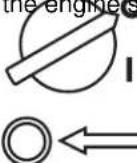 | ||
— Closed valve. | ||
| C |   DANGERUsing a generator indoors CAN KILL YOU IN MINUTES. Generator exhaust contains carbon monoxide. This is a poison you cannot see or smell. DANGERUsing a generator indoors CAN KILL YOU IN MINUTES. Generator exhaust contains carbon monoxide. This is a poison you cannot see or smell. | |
— NEVER use inside a home or garage, EVEN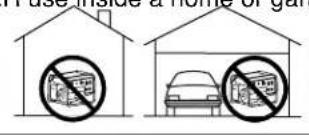 | IF doors and windows are open. | |
— Only operate the generator OUTSIDE, and far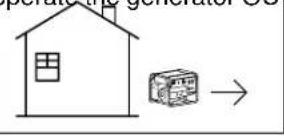 | away from homes, buildings, windows, doors, and vents. Always point the engine exhaust away from homes, buildings, windows, doors, vents, and combustible materials during use. | |
GP 2600 Labels
| — WARI | 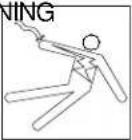 | To reduce the risk of electrical shock and arc flash, read the Operator's Manual. Improper connection of the generator to a building's electrical system can allow electrical current from the generator to backfeed into utility lines. This may result in electrocution of utility workers, fire, or explosion. Connections to a building's electrical system must be made by a qualified electrician and comply with all applicable laws and electrical codes. | ||
| D DANC |  |  | Improper connection of generator to a building's electrical system can allow electrical current from the generator to backfeed into utility lines. The may result in electrocution of utility workers, fire, or explosion. Connections to a building's electrical system must be made by a qualified electrician and comply with all applicable laws and electrical codes. | Improper connection of generator to a building's electrical system can allow electrical current from the generator to backfeed into utility lines. This may result in electrocution of utility workers, fire, or explosion. Connections to a building's electrical system must be made by a qualified electrician and comply with all applicable laws and electrical codes. |
| E Electri | 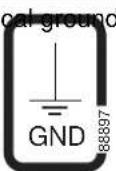 | |||
| F WARN | 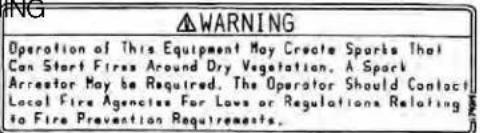 | Operation of this equipment may create sparks that can start fires around dry vegetation. A spark arrester may be required. The operator should contact local fire agencies for laws or regulations relating to fire prevention requirements. | ||
| G WAR | 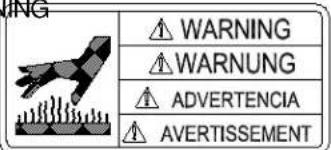 | Hot surface | ||
| H This machine may be covered by one or more U.S. PAT. Nos.: OTHER U.S. AND FOREIGN PATENTS PENDING | patents. | |||
Lifting and Transporting GP 2600
3 Lifting and Transporting
Lifting the Machine
This generator, while compact, is heavy enough to cause injury if proper lifting techniques are not used. Observe the following guidelines when lifting the generator.
- Do not attempt to lift and carry the generator unassisted. Use appropriate lifting equipment such as slings, chains, hooks, ramps, or jacks.
■ Make sure lifting equipment is attached securely and has enough weight-bearing capacity to lift or hold the generator safely.
■ Remain aware of the location of other people nearby when lifting the generator.
Transporting the Machine
Observe the following guidelines when transporting the generator to and from the job site.
- Allow the engine to cool before transporting the generator.
- Drain the fuel tank.
■ Close the fuel valve.
■ Ensure that the generator is securely strapped down in the transport vehicle to prevent it from sliding or tipping. - Do not refuel the generator in or on the transport vehicle. Move the generator to its operating location and then fill the fuel tank.
GP 2600 Lifting and Transporting
Notes
Operation GP 2600
4 Operation

DANGER
Carbon monoxide. Using a generator indoors CAN KILL YOU IN MINUTES. Generator exhaust contains carbon monoxide (CO). This is a poison you cannot see or smell. If you can smell the generator exhaust, you are breathing CO. But even if you cannot smell the exhaust, you could be breathing CO.
▶ NEVER use a generator inside homes, buildings, garages, crawlspaces, or other partly enclosed areas. Deadly levels of carbon monoxide can build up in these areas. Using a fan or opening windows and doors does NOT supply enough fresh air.
▶ ONLY use a generator outside, and far away from homes, buildings, windows, doors, and vents. Windows, doors, and vents can pull in generator exhaust.
▶ Point the engine exhaust away from homes, buildings, windows, doors, and vents. Also, point the engine exhaust away from combustible materials.
Even when you use a generator correctly, CO may leak into the home or building. ALWAYS use a battery-powered or battery-backup CO alarm in the home or building.
▶ If you start to feel sick, dizzy, or weak after the generator has been running, move to fresh air RIGHT AWAY. See a doctor. You could have carbon monoxide poisoning.

WARNING
Risk of electric shock or electrocution.
▶ Do not operate this generator in rain, snow, or standing water.
4.1 Preparing the Machine for First Use
- Make sure all loose packaging materials have been removed from the machine.
- Check the machine and its components for damage. If there is visible damage, do not operate the machine! Contact your Wacker Neuson dealer immediately for assistance.
- Take inventory of all items included with the machine and verify that all loose components and fasteners are accounted for.
- Attach component parts not already attached.
- Add fluids as needed and applicable, including fuel, engine oil, and battery acid.
- Move the machine to its operating location.
GP 2600 Operation
4.2 Determining Power Requirements
This generator is designed to operate single-phase, 60 Hz appliances running at 120 VAC. Check the nameplate or label provided on tools and appliances to make sure their power requirements match the power output of the generator.
Some appliances and tools require a surge of current when starting. This means that the amount of power needed to initially start the equipment is larger than the power required to keep it running. The generator must be capable of supplying this “surge” current. Other types of appliances require more power than is actually stated on their nameplate.
The information in “Approximate Starting Power Requirements” is offered only as a general guideline to help you in determining power requirements for different types of equipment. Check with your nearest Wacker Neuson Dealer, or contact the manufacturer or dealer of the tool or appliance, with questions regarding its power requirements.
NOTICE: If a tool or appliance does not reach full speed within a few seconds when switched on, turn it off immediately to avoid damage.
Approximate Starting Power Requirements
- Incandescent lights and appliances such as irons and hot plates, which use a resistive-type heating element, require the same wattage to start and run as is stated on their nameplates.
■ Fluorescent and mercury lamps require 1.2–2 times their stated wattage to start.
■ Electrical motors and many types of electrical tools often require a large starting current. The amount of starting current depends on the type of motor and its use. - Most electrical tools require 1.2–3 times their stated wattage for starting.
- Loads such as submersible pumps and air compressors require a very large force to start. They need as much as 3–5 times the wattage stated on the nameplate in order to start.
If the wattage is not given for a particular tool or appliance, it can be calculated by multiplying its voltage and amperage requirements:
Single Phase: VOLTS x AMPS = WATTS
Operation GP 2600
4.3 Positioning the Generator for Operation

DANGER
Carbon monoxide. Using a generator indoors CAN KILL YOU IN MINUTES. Generator exhaust contains carbon monoxide (CO). This is a poison you cannot see or smell. If you can smell the generator exhaust, you are breathing CO. But even if you cannot smell the exhaust, you could be breathing CO.
▶ Do not operate this generator unless it is properly positioned. Read and obey all instructions provided below.

WARNING
Risk of electric shock or electrocution.
▶ Do not operate this generator in rain, snow, or standing water.
Requirements
Position the generator according to the following requirements.

wc_gr010480
These instructions continue on the next page.
GP 2600 Operation
Continued from the previous page.
- Do not operate the generator anywhere inside a home or building. This includes the garage (c), entryway, porch, or sunroom (d), living area or work space (e), or basement or crawl space (f). Operating the generator inside a home or building can be fatal even if fans, open doors, or open windows are used for ventilation.
- ONLY use a generator outside (a), and far away from homes, buildings, windows, doors, and vents. Windows, doors, and vents can pull in generator exhaust.
- Point the engine exhaust (b) away from homes, buildings, windows, doors, and vents. Also, point the engine exhaust away from combustible materials.
■ Position the generator on firm, level ground so that it will not slide or shift.
CO Detectors/Alarms
Install CO detectors/alarms in all areas that may be occupied by people or animals while the generator is operating. CO detectors/alarms provide an extra measure of protection against this poison that you cannot see or smell.
Install battery-operated CO detectors/alarms or plug-in CO detectors/alarms with battery backup, according to the manufacturer's instructions. CO detectors/alarms should be certified to the requirements of the latest safety standards (UL 2034, IAS 6-96, or CSA 6.19.01). Test the CO detector/alarm batteries regularly according to the manufacturer's instructions.
Operation GP 2600
4.4 Generator Derating
All generators are subject to derating for altitude and temperature. Internal combustion engines, unless modified, run less efficiently at higher altitudes due to the reduction of air pressure. This translates into a lack of power and thus reduction in generator output. Temperature affects both engine and generator performance. As temperature increases, an engine will run less efficiently and more resistance will be found in electrical components. Therefore, as the temperature increases, the output of the generator decreases. Altitude also affects the cooling capacity of air—the higher the altitude the less dense the air is and thus the lower its ability to transfer heat.
For every increase in altitude of 500 m (1650 ft.) above 1000 m (3300 ft.), the output of the generator will be reduced by 3%. For every increase of 5° C ( 9° F) in ambient temperature above 40° C ( 104° F), the output of the generator will be reduced by 3%. Use the tables shown for altitude and temperature deration factors. It may be necessary to consider both altitude and ambient temperature deration factors to determine true generator output.
| Ambient Temperature °C (°F) | Derate Factor | |
| 45 (113) 3 % 0.97 | ||
| 50 (122) 6 % 0.94 | ||
| 55 (131) 9 % 0.91 | ||
| 60 (140) 12 % 0.88 |
| Altitude m (ft) | Derate Factor | |
| 1500 (4900) 3 % 0.97 | ||
| 2000 (6600) 6 % 0.94 | ||
| 2500 (8200) 9 % 0.91 | ||
| 3000 (9900) 12 % 0.88 | ||
| 3500 (11500) 15 % 0.85 | ||
| 4000 (13100) 18 % 0.82 |
GP 2600 Operation
4.5 Grounding the Generator
Location A ground connection (a) is located on the generator frame.

wc_gr010579
Function This ground connection is used for electrically grounding the generator when necessary to comply with the National Electrical Code and other federal, state, and local regulations. For grounding requirements in your area, consult with a qualified electrician, electrical inspector, or local agency having jurisdiction over electrical compliance.
■ If the generator is used at a construction site, there may be additional regulations which must be observed.
- In some areas, generators are required to be registered with local utility companies.
■ There is a conductor between the generator (stator neutral winding) and the frame.
4.6 Operating Heavy Loads
Limit operations requiring the maximum rated output of 2600 Watts to 20–30 minutes. For continuous operation, do not exceed the continuous rated output of 2250 Watts.
NOTICE: DO NOT exceed the current limit specified on the control panel for any receptacle.
Operation GP 2600
4.7 Use of Extension Cords
When a long extension cord is used to connect an appliance or tool to the generator, a voltage loss occurs—the longer the cord, the greater the voltage loss. This results in less voltage being supplied to the appliance or tool and increases the amount of current draw or reduces performance. A heavier cord with a larger wire size will reduce the voltage loss.

Damaged extension cords can cause electrical shock, resulting in serious injury or death. DO NOT use worn, bare, or frayed cords. Replace damaged cords immediately.
Use the chart below as a guide for selecting proper cable size.
| Current Load in Watts Maximum Cable Length in Feet | ||||||
| (Amps) 120V 240V #10 #12 #14 #16 | ||||||
| 2.5 300 | 600 1000. 600 375 250 | |||||
| 5 600 | 1200 | 500 300 200 125 | ||||
| 7.5 900 | 1800 | 350 200 125 100 | ||||
| 10 1200 | 2400 | 250 150 100 — | ||||
| 15 | 1800 | 3600 | 150 | 100 | 65 | — |
| 20 | 2400 | 4800 | 125 | 75 | 50 | — |
Use only extension cords rated for outdoor use and equipped with a third-wire ground.
NOTICE: Operating equipment at low voltage can cause it to overheat.
GP 2600 Operation
4.8 Control Panel
| Ref. | Description Ref. Description | ||
| a | GFI duplex receptacle—120V d GFI test button | ||
| b | Circuit breaker—20A e GFI reset button | ||
| c | Duplex receptacle—120V | f | Engine ON-OFF switch |

wc_gr010580
Operation GP 2600
4.9 Ground Fault Interrupt (GFI / GFCI)
The 120V, 20 Amp receptacle (a) is equipped with a ground fault circuit interrupt (GFI). The GFI shuts off the power to the receptacle when a ground fault occurs to a piece of equipment attached to the generator. This GFI also protects the second 120V, 20A receptacle (c).
The GFI should be tested for proper operation every time the generator is used.
To test GFI:
Start generator. Push TEST button (d) on receptacle in. The RESET button (e) will pop out. Power is now off at the receptacle. If the RESET button does not pop out, the GFI is not working. Do not run generator until the problem can be corrected. To restore power to receptacle, push the RESET button in.
Note: If the RESET button pops out during operation, stop the generator and check it and equipment for defects.
4.10 Circuit Breaker
The generator is also protected by a 20-Amp circuit breaker (b) located on the control panel.
The circuit breaker protects the generator from severe overloads or short circuits. If the circuit breaker opens, turn the engine off immediately and determine the cause before restarting. Check the appliances and tools attached to the generator for defects and make sure their power requirements do not exceed the power rating of the generator or the current limit of the receptacles.
When the circuit breaker opens, the breaker button will pop out. To reset circuit breaker, push button in.
GP 2600 Operation
4.11 Before Starting

DANGER
▶ Carbon monoxide. Using a generator indoors CAN KILL YOU IN MINUTES. Generator exhaust contains carbon monoxide (CO). This is a poison you cannot see or smell. If you can smell the generator exhaust, you are breathing CO. But even if you cannot smell the exhaust, you could be breathing CO.
- Read and understand the safety and operating labels and instructions at the beginning of this manual.
- Inspect the generator for any signs of damage which may affect operation or pose a safety hazard.
- Check:
■ oil level in engine
■ fuel level
■ condition of air cleaner
■ tightness of external fasteners
■ condition of fuel lines.
Note: The engine is equipped with an oil alert system. If the oil level in the engine drops too low, the engine will not start.
- Fill the fuel tank with fresh, regular, unleaded grade gasoline. DO NOT use an oil/gas mixture. The use of gasohol or any fuel containing more than 10% ethanol is not recommended. Consult the engine owner's manual for complete fuel specifications.
NOTICE: Fill the tank after placing the machine on level ground.
Using gasoline / ethanol blends
This portable generator is not for use with gasoline / ethanol blends with over 15% ethanol.
Operation GP 2600
4.12 Starting
- Ensure that the generator is properly installed in an outdoor location. See Sections Installation and Operator Safety while using Internal Combustion Engines for installation warnings and safety guidelines.
- Disconnect all loads from the generator.
- Open the fuel valve (a1).
Note: If the engine is cold, move the choke lever to the closed position (b2). If the engine is hot, set the choke to the open position (b1).
- Turn the engine switch to "ON" (c1).
- Pull the starter rope (d).
Note: If the oil level in the engine is low, the red LED at the engine switch will light and the engine will not start. If this happens, check the oil level and add oil as needed.
- Open the choke as the engine warms (b1).
- Allow the engine to warm up a few minutes before attaching loads.

wc_gr010581
4.13 Stopping
- Turn off and disconnect all tools and appliances attached to the generator.
- Turn the engine switch to "OFF" (c2).
- Close the fuel valve (a2).
Note: To stop the engine quickly in an emergency, turn the engine switch to "OFF" (c2).
GP 2600 Operation
4.14 Emergency Shutdown Procedure
Procedure
If a breakdown or accident occurs while the machine is operating, follow the procedure below:
- Stop the engine.
- Turn off the fuel supply.
- Disconnect tools from the machine.
- Allow the machine to cool.
- Contact the rental yard or machine owner for further instructions.
5 Maintenance
5.1 Maintaining the Emission Control System
Normal maintenance, replacement, or repair of emission control devices and systems may be performed by any repair establishment or individual; however, warranty repairs must be performed by a dealer/service center authorized by Wacker Neuson. The use of service parts that are not equivalent in performance and durability to authorized parts may impair the effectiveness of the emission control system and may have a bearing on the outcome of a warranty claim.
5.2 Periodic Maintenance Schedule
The table below lists basic machine and engine maintenance. Tasks designated with check marks may be performed by the operator. Tasks designated with square bullet points require special training and equipment.
Refer to the engine owner's manual for additional information.
| Daily before starting | After first 20 hr | Every 50 hr | Every 100 hr | Every 300 hr | |
| Check the fuel level. | √ | ||||
| Check the engine oil level. | √ | ||||
| Inspect the air filter. Replace as needed. | √ | ||||
| Check external hardware. | √ | ||||
| Check condition of the fuel lines. Replace when necessary. | √ | ||||
| Clean the air cleaner element. 1 | ■ | ||||
| Inspect the shockmounts for damage. | √ | ||||
| Change the engine oil. 1 | ■ | ■ | |||
| Clean the sediment cup or fuel strainer. | ■ | ||||
| Check and clean the spark plug. | ■ | ||||
| Check and adjust the valve clearance. | ■ | ||||
| Clean the fuel tank. 1 | ■ |
1 Service more frequently in dusty conditions.
GP 2600 Maintenance
5.3 Engine Oil
- Drain the oil while the engine is still warm.
- Remove the oil filler plug (a) and the drain plug (b) to drain the oil.
Note: In the interests of environmental protection, place a plastic sheet and a container under the machine to collect any liquid that drains off. Dispose of this liquid in accordance with environmental protection legislation. - Install the drain plug.
- Fill the engine crankcase with the recommended oil up to the level of the plug opening (c). See section Technical Data for oil quantity and type.
- Install the oil filler plug.

wc_gr010582

WARNING
Most used oil contains small amounts of materials that can cause cancer and other health problems if inhaled, ingested, or left in contact with skin for prolonged periods of time.
▶ Take steps to avoid inhaling or ingesting used engine oil.
▶ Wash skin thoroughly after exposure to used engine oil.
Maintenance GP 2600
5.4 Servicing the Air Cleaner
Service the air cleaner frequently to prevent carburetor malfunction.
NOTICE: NEVER run the engine without the air cleaner. Severe engine damage will occur.

WARNING
Explosion and fire hazards.
▶ Never use gasoline or other types of low flash point solvents for cleaning the air filter. Use only compressed air, mild detergent, and warm water.
To service:
- Remove the air cleaner cover (a). Inspect the element (b) for holes or tears. Replace the element if it is damaged.
- Wash the foam element (b) in a solution of mild detergent and warm water. Rinse it thoroughly in clean water. Allow the element to dry thoroughly. Soak the element in clean engine oil and squeeze out excess oil.

wc_gr010583
GP 2600 Maintenance
5.5 Spark Plug

Clean or replace the spark plug as needed to ensure proper operation. Refer to your engine owner's manual.
The muffler becomes very hot during operation and remains hot for a while after stopping the engine. Do not touch the muffler while it is hot.
Note: Refer to section "Technical Data" for the recommended spark plug type and the electrode gap setting.
- Remove the spark plug and inspect it.
- Replace the spark plug if the insulator is cracked or chipped.
- Clean the spark plug electrodes with a wire brush.
- Set the electrode gap (a).
- Tighten the spark plug securely.
NOTICE: A loose spark plug can become very hot and may cause engine damage.

wc_gr000028
Maintenance GP 2600
5.6 Storage

Before storing the generator for a long period of time:
- Close the fuel valve and remove and empty the sediment cup or fuel strainer.
- Disconnect the fuel line from the carburetor. Place the open end of the fuel line into a suitable container and open the fuel valve to drain the fuel from the tank.
Gasoline is extremely flammable. Drain the fuel tank in a well-ventilated area. Do not drain the fuel tank in an area with flames or sparks.
- Loosen the drain screw on the carburetor and drain any remaining fuel from the carburetor.
- Change the engine oil.
- Remove the spark plug and pour approximately 30 ml (1 ounce) of clean engine oil into the cylinder. Crank the engine a few turns to distribute the oil to the inside of the cylinder walls.
- Pull the starter rope slowly until resistance is felt and leave the handle in this position. This ensures that the intake and exhaust valves are closed.
- Store the generator in a clean, dry area.
GP 2500A Troubleshooting
6 Troubleshooting
| Problem / Symptom Reason / Remedy | |
| If engine doesn't start, check that: | ■ Engine switch is on “Start”.■ Fuel valves under fuel tank and on engine are open.■ Fuel tank has fuel.■ Choke lever is in correct position. Choke should be closed when starting a cold engine.■ All loads are disconnected from generator.■ Spark plug is in good condition.■ Spark plug cap is tight.■ Engine oil level is adequate. |
| If engine starts but there is no power at receptacles, check that: | ■ Circuit breaker is closed.■ Connector from generator to control panel is tight. |
| If engine starts but runs erratically, check that: | ■ Hose routing from the fuel tank to the engine is correct. For proper operation, the hose must run through the bushing in the lifting bracket. Refer to the Parts Book for illustration. |
| If the GFCI trips when a load is connected, check that: | ■ The connected equipment may be wired incorrectly or faulty. Contact equipment supplier.■ See section Determining Power Requirements. |
Technical Data GP 2600
7 Technical Data
7.1 Generator
| MachineItem No. | GP 26000620088 | |
| Generator | ||
| Maximum output W 2600 | ||
| Continuous output W 2250 | ||
| Type Single voltage, single phase, | Auto voltage regulator system | |
| AC voltages available volts | phase | 1201ø |
| Frequency Hz 60 | ||
| Power factor 1.0 | ||
| AC receptacles:125V GFI duplex125V duplex | AA | 2020 |
| Main circuit breaker A 20 | ||
| L x W x H mm (in.) | 615 x 435 x 545 | (24.2 x 17 x 21.5) |
| Weight (dry) | kg (lb) | 47.7 (105) |
GP 2600 Technical Data
7.2 Engine
Engine Power Rating
Net power rating per SAE J1349. Actual power output may vary due to conditions of specific use.
| MachineItem No. | GP 26000620088 | |
| Engine | ||
| Engine type 4-stroke, overhead valve, | single cylinder | |
| Engine make Wacker Neuson | ||
| Engine model WM 170 | ||
| Max. rated power @ rated speed kW (Hp) 4.2 (5.7) @ 4000 rpm | ||
| Spark plug NGK BR6HS (Champion RL86C) | ||
| Electrode gap mm (in.) 0.6–0.7 (0.024–0.028) | ||
| Operating speed rpm 3600 | ||
| Air cleaner type Dual Element | ||
| Engine lubrication | oil grade | SAE 10W30, SJ or higher |
| Engine oil capacity | I (qt) | 0.6 (20) |
| Fuel | type | Regular unleaded gasoline |
| Fuel tank capacity | I (gal) | 15 (4) |
| Fuel consumption | I (qt)/hr | 1.47 (1.55) |
| Running time - continuous load | hr | 10.2 |
Technical Data GP 2600
Notes
Emission Control Systems Information and Warranty
8 Emission Control Systems Information and Warranty
The Emission Control Warranty and associated information is valid only for the U.S.A., its territories, and Canada.
8.1 Emission Control System Background Information
Introduction
Wacker Neuson spark-ignited engines/equipment must conform with applicable Environmental Protection Agency (EPA) emissions regulations. There are two types of emissions that fall under these regulations: 1) exhaust, and 2) evaporative. These regulations require that manufacturers warrant the emission control systems for defects in materials and workmanship.
Furthermore, EPA regulations require all manufacturers to furnish written instructions describing how to operate and maintain the engines/equipment including the emission control systems. This information is provided with all Wacker Neuson engines/equipment at the time of purchase.
Exhaust Emissions
The combustion process produces carbon monoxide, oxides of nitrogen, and hydrocarbons. Control of hydrocarbons and oxides of nitrogen is very important because, under certain conditions, they react to form photochemical smog when subjected to sunlight. Carbon monoxide does not react in the same way, but it is toxic.
Wacker Neuson utilizes lean carburetor settings and other systems to reduce the emissions of carbon monoxide, oxides of nitrogen, and hydrocarbons.
Evaporative Emissions
Evaporative emissions are fuel emissions and generally include emissions that result from permeation of fuel through the fuel-system materials or from ventilation of the fuel system.
Wacker Neuson utilizes low-permeation fuel lines and fuel tanks where applicable to reduce evaporative emissions.
Problems that may affect Emissions
If any of the following symptoms arise, have the engine/equipment inspected and repaired by a Wacker Neuson dealer/service center.
■ Hard starting or stalling after starting
■ Rough idling
■ Misfiring or backfiring under load
■ Afterburning (backfiring)
■ Presence of black exhaust smoke during operation
■ High fuel consumption
Emission Control Systems Information and Warranty
Tampering and Altering
Tampering with or altering the emission control system may increase emissions beyond the legal limit. If evidence of tampering is found, Wacker Neuson may deny a warranty claim. Among those acts that constitute tampering are:
■ Removing or altering of any part of the air intake, fuel, or exhaust systems.
- Altering or defeating the speed-adjusting mechanism causing the engine to operate outside its design parameters.
8.2 Limited Defect Warranty for Wacker Neuson Emission Control Systems
The Emission Control Warranty is valid only for the U.S.A., its territories, and Canada.
Wacker Neuson Sales Americas, LLC, N92 W15000 Anthony Avenue, Menomonee Falls, WI 53051, (hereinafter “Wacker Neuson”) warrants to the initial retail purchaser, and each subsequent owner, that this engine/equipment, including all parts of its emission control systems, have been designed, built, and equipped to conform at the time of initial sale to all applicable emission regulations of the U.S. Environmental Protection Agency (EPA), and that the engine/equipment is free of defects in materials and workmanship which would cause this engine/equipment to fail to conform to EPA regulations during its warranty period.
Wacker Neuson is also liable for damages to other engine/equipment components caused by a failure of any warranted parts during the warranty period.
Limited Defect Warranty Period for Wacker Neuson Emission Control Systems
The warranty period for this engine/equipment begins on the date of sale to the initial purchaser and continues for a minimum of two (2) years. For the warranty terms for your specific engine/equipment, visit wackerneuson.com.
Any implied warranties are limited to the duration of this written warranty.
What is covered
Wacker Neuson recommends the use of genuine Wacker Neuson parts, or the equivalent, whenever maintenance is performed. The use of replacement parts not equivalent to the original parts may impair the effectiveness of the engine/equipment emission controls systems. If such a replacement part is used in the repair or maintenance of the engine/equipment, assure yourself that such part is warranted by its manufacturer to be equivalent to the parts offered by Wacker Neuson in performance and durability. Furthermore, if such a replacement part is used in the repair or maintenance of the engine/equipment, and an authorized Wacker Neuson dealer/service center determines it is defective or causes a failure of a warranted part, the claim for repair of the engine/equipment may be denied. If the part in question is not related to the reason the engine/equipment requires repair, the claim will not be denied.
Emission Control Systems Information and Warranty
For the components listed in the following table, an authorized Wacker Neuson dealer/service center will, at no cost to you, make the necessary diagnosis, repair, or replacement necessary to ensure that the engine/equipment complies with the applicable EPA regulations. All defective parts replaced under this warranty become property of Wacker Neuson.
Exhaust Emissions
| Systems Covered Components | |
| Fuel metering system Carburetor and internal parts | |
| Exhaust system Catalytic muffler (if applicable) | |
| Air induction system Air filter housing | |
| Ignition system Flywheel magneto | |
| Miscellaneous parts associated with the exhaust emission control system | Tubing |
| Fittings | |
| Seals | |
| Gaskets | |
| Clamps | |
* Indicates expendable maintenance items. Warranted only to first scheduled replacement point.
Emission Control Systems Information and Warranty
Evaporative Emissions
| Systems Covered Components | |
| Evaporative control system Fuel tank (if applicable) | |
| Miscellaneous parts associated with the evaporative emission control system | Clamps |
| Gaskets | |
| Mounting brackets | |
What is not covered
■ Failures other than those resulting from defects in material or workmanship.
■ Any systems or parts which are affected or damaged by owner abuse, tampering, neglect, improper maintenance, misuse, improper fueling, improper storage, accident and/or collision; the incorporation of, or any use of, add-on or modified parts, or unsuitable attachments, or the alteration of any part.
- Replacement of expendable maintenance items made in connection with required maintenance services after the item's first scheduled replacement as listed in the maintenance section of the engine/equipment operator's manual, such as spark plugs and filters.
■ Incidental or consequential damages such as loss of time or the use of the engine/equipment, or any commercial loss due to the failure of the engine/equipment.
■ Diagnosis and inspection charges that do not result in warranty-eligible service being performed.
■ Any non-authorized replacement part, or malfunction of authorized parts due to use of-non authorized parts.
Emission Control Systems Information and Warranty
Owner's Warranty Responsibility
The engine/equipment owner is responsible for the performance of the required maintenance listed in the Wacker Neuson engine/equipment operator's manual. Wacker Neuson recommends that all receipts covering maintenance on the engine/equipment be retained, but Wacker Neuson cannot deny warranty coverage solely for the lack of receipts or for the failure to ensure the performance of all scheduled maintenance.
Normal maintenance, replacement, or repair of emission control devices and systems may be performed by any repair establishment or individual; however, warranty repairs must be performed by an authorized Wacker Neuson dealer/service center.
The engine/equipment must be presented to an authorized Wacker Neuson dealer/service center as soon as a problem exists. Contact Wacker Neuson Product Support Department (1-800-770-0957) or visit wackerneuson.com to find a dealer/service center in your area, or to answer questions regarding warranty rights and responsibilities.
How to Make a Claim
In the event that any emission-related part is found to be defective during the warranty period, you shall notify Wacker Neuson Product Support Department (1-800-770-0957, or technical.support@wackerneuson.com, or wackerneuson.com), and you will be advised of the appropriate dealer/service center where warranty repair can be performed. All repairs qualifying under this limited warranty must be performed by an authorized Wacker Neuson dealer/service center.
You must take your Wacker Neuson engine/equipment along with proof of original purchase date, at your expense, to the authorized Wacker Neuson dealer/service center during their normal business hours.
For owners located more than 100 miles from an authorized dealer/service center (excluding the states with high-altitude areas as identified in 40 CFR Part 1068, Appendix III), Wacker Neuson will pay for pre-approved shipping costs to and from an authorized Wacker Neuson dealer/service center.
Claims for repair or adjustment found to be caused solely by defects in material or workmanship will not be denied because the engine/equipment was not properly maintained and used.
The warranty repairs should be completed in a reasonable amount of time, not to exceed 30 days.
Schematics GP 2600
9 Schematics
9.1 Wire Colors
| Wire Colors | |||||||
| B Black | R Red Y Yellow | low Or Orange | |||||
| G Green | T Tan Br | Brown | Pr Purple | ||||
| L | Blue | V | Violet | Cl | Clear | Sh | Shield |
| P Pink | W | White | Gr Gray | LL Light blue | |||
9.2 Electrical Schematic
| Ref. | Description | Ref. | Description | Ref. | Description |
| A | Generator | B | Control Box | C | Engine |
| Ref. | Description | Ref. | Description |
| 1 | Main stator winding | 7 | Duplex receptacle—120V |
| 2 | Secondary winding | 8 | Engine stop switch module |
| 3 | Rotor winding | 9 | Oil level sender |
| 4 | Automatic voltage regulator | 10 | Coil |
| 5 | 20A circuit breaker | — | — |
| 6 | GFI duplex receptacle—120V | — | — |
A
B

C

wc_gr004573
Important: For spare parts information, please see your Wacker Neuson Dealer, or visit the Wacker Neuson website at http://www.wackerneuson.com/.

- GP 2600 FOREWORD
- FOREWORD
- DANGER
- MACHINE IDENTIFICATION
- SERIAL NUMBER (S/N)
- MACHINE DOCUMENTATION
- EXPECTATIONS FOR INFORMATION IN THIS MANUAL
- CALIFORNIA PROPOSITION 65 WARNING
- LAWS PERTAINING TO SPARK ARRESTERS
- MANUFACTURER'S APPROVAL
- 1 SAFETY INFORMATION 9
- 2 LABELS 18
- 3 LIFTING AND TRANSPORTING 22
- 4 OPERATION 24
- 5 MAINTENANCE 36
- TABLE OF CONTENTS
- GP 2600
- 6 TROUBLESHOOTING 41
- 7 TECHNICAL DATA 42
- 8 EMISSION CONTROL SYSTEMS INFORMATION AND WARRANTY 45
- 9 SCHEMATICS 50
- GP 2600 SAFETY INFORMATION
- 1 SAFETY INFORMATION
- 1.1 SIGNAL WORDS USED IN THIS MANUAL
- WARNING
- CAUTION
- SAFETY INFORMATION GP 2600
- 1.2 MACHINE DESCRIPTION AND INTENDED USE
- 1.3 OPERATING SAFETY
- OPERATOR TRAINING
- OPERATOR QUALIFICATIONS
- INSTALLING AS BACKUP POWER
- TRANSPORTING AND INSTALLING THE MACHINE
- GENERAL SAFETY
- GENERATOR VIBRATION
- AFTER USE
- CLEANING
- 1.4 OPERATOR SAFETY WHILE USING INTERNAL COMBUSTION ENGINES
- REFUELING SAFETY
- OPERATING SAFETY
- 1.5 SERVICE SAFETY
- SERVICE TRAINING
- PRECAUTIONS
- MACHINE MODIFICATIONS
- REPLACING PARTS AND LABELS
- LABELS GP 2600
- 2 LABELS
- 2.1 LABEL LOCATIONS
- GP 2600 LABELS
- 2.2 LABEL MEANINGS
- LIFTING AND TRANSPORTING GP 2600
- 3 LIFTING AND TRANSPORTING
- LIFTING THE MACHINE
- TRANSPORTING THE MACHINE
- GP 2600 LIFTING AND TRANSPORTING
- OPERATION GP 2600
- 4 OPERATION
- 4.1 PREPARING THE MACHINE FOR FIRST USE
- GP 2600 OPERATION
- 4.2 DETERMINING POWER REQUIREMENTS
- APPROXIMATE STARTING POWER REQUIREMENTS
- 4.3 POSITIONING THE GENERATOR FOR OPERATION
- REQUIREMENTS
- CO DETECTORS/ALARMS
- 4.4 GENERATOR DERATING
- 4.5 GROUNDING THE GENERATOR
- 4.6 OPERATING HEAVY LOADS
- 4.7 USE OF EXTENSION CORDS
- 4.8 CONTROL PANEL
- 4.9 GROUND FAULT INTERRUPT (GFI / GFCI)
- TO TEST GFI
- 4.10 CIRCUIT BREAKER
- 4.11 BEFORE STARTING
- 4.12 STARTING
- 4.13 STOPPING
- 4.14 EMERGENCY SHUTDOWN PROCEDURE
- PROCEDURE
- 5 MAINTENANCE
- 5.1 MAINTAINING THE EMISSION CONTROL SYSTEM
- 5.2 PERIODIC MAINTENANCE SCHEDULE
- GP 2600 MAINTENANCE
- 5.3 ENGINE OIL
- MAINTENANCE GP 2600
- 5.4 SERVICING THE AIR CLEANER
- TO SERVICE
- 5.5 SPARK PLUG
- 5.6 STORAGE
- GP 2500A TROUBLESHOOTING
- 6 TROUBLESHOOTING
- TECHNICAL DATA GP 2600
- 7 TECHNICAL DATA
- 7.1 GENERATOR
- GP 2600 TECHNICAL DATA
- 7.2 ENGINE
- ENGINE POWER RATING
- EMISSION CONTROL SYSTEMS INFORMATION AND WARRANTY
- 8 EMISSION CONTROL SYSTEMS INFORMATION AND WARRANTY
- 8.1 EMISSION CONTROL SYSTEM BACKGROUND INFORMATION
- INTRODUCTION
- EXHAUST EMISSIONS
- EVAPORATIVE EMISSIONS
- PROBLEMS THAT MAY AFFECT EMISSIONS
- TAMPERING AND ALTERING
- 8.2 LIMITED DEFECT WARRANTY FOR WACKER NEUSON EMISSION CONTROL SYSTEMS
- LIMITED DEFECT WARRANTY PERIOD FOR WACKER NEUSON EMISSION CONTROL SYSTEMS
- WHAT IS COVERED
- WHAT IS NOT COVERED
- OWNER'S WARRANTY RESPONSIBILITY
- HOW TO MAKE A CLAIM
- SCHEMATICS GP 2600
- 9 SCHEMATICS
- 9.1 WIRE COLORS
- 9.2 ELECTRICAL SCHEMATIC
Brand : Wacker Neuson
Model : GP2600
Category : Generator