MP15 - Vibratory plate Wacker Neuson - Free user manual and instructions
Find the device manual for free MP15 Wacker Neuson in PDF.


| Product Type | Vibratory Plate Compactor |
| Model | MP15 |
| Brand | Wacker Neuson |
| Overall Dimensions (L x W x H) | 1000 mm x 500 mm x 800 mm |
| Weight | 75 kg |
| Power Source | Gasoline engine (Honda GX160 or equivalent) |
| Engine Power | 4.0 kW (5.5 hp) |
| Centrifugal Force | 15 kN |
| Operating Speed | 90 m/min |
| Vibration Frequency | 90 Hz |
| Plate Size (L x W) | 600 mm x 400 mm |
| Compaction Depth | Up to 300 mm (depends on soil) |
| Fuel Tank Capacity | 3.5 L |
| Oil Capacity | 0.6 L |
| Maintenance | Daily: check oil, air filter, fuel level; clean plate surface; inspect for loose bolts. Every 50 hrs: change oil, clean/replace air filter. Every 200 hrs: replace spark plug, check belt tension. |
| Safety Features | Engine stop switch, vibration dampened handle, protective frame for engine |
| Spare Parts | Available via Wacker Neuson dealers: belts, filters, spark plugs, handle grips, base plate |
| Repairability | User-serviceable with basic tools; major repairs should be done by authorized service center |
| Certifications | CE, EPA (depending on market) |
Frequently Asked Questions - MP15 Wacker Neuson
User questions about MP15 Wacker Neuson
0 question about this device. Answer the ones you know or ask your own.
Ask a new question about this device
Download the instructions for your Vibratory plate in PDF format for free! Find your manual MP15 - Wacker Neuson and take your electronic device back in hand. On this page are published all the documents necessary for the use of your device. MP15 by Wacker Neuson.
USER MANUAL MP15 Wacker Neuson
5000403539 02 0911

| Copyright notice | © Copyright 2012 by Wacker Neuson Corporation.All rights, including copying and distribution rights, are reserved.This publication may be photocopied by the original purchaser of the machine. Any other type of reproduction is prohibited without express written permission from Wacker Neuson Corporation.Any type of reproduction or distribution not authorized by Wacker Neuson Corporation represents an infringement of valid copyrights. Violators will be prosecuted. |
| Trademarks | All trademarks referenced in this manual are the property of their respective owners. |
| Manufacturer | Wacker Neuson Manila IncorporatedLot 2,Blk 1 Phase , PEZA Drive, First Cavite Industrial Estate, Brgy. Langkaan Dasmariñas, Cavite, Philippines 4126Tel: +63-(0)2-580-7136 Fax: +63-(0)2-580-7122www.wackerneuson.com |
| Translated instructions | This Operator's Manual presents a translation of the original instructions. The original language of this Operator's Manual is American English. |
MP15 Table of Contents
Foreword 3
1. Emission System Control Information 4
2. Safety Information 5
2.1 Laws Pertaining to Spark Arresters 5
2.2 Operating Safety 6
2.3 Operator Safety while using Internal Combustion Engines 7
2.4 Service Safety 8
2.5 Label Locations 9
2.6 Warning and Informational Labels 10
3. Technical Data 12
3.1 Engine Data 12
3.2 Machine Data 13
3.3 Sound and Vibration Measurements 13
3.4 Dimensions 14
4. Operation 15
4.1 Recommended Fuel 15
4.2 Application 15
4.3 Before Starting 15
4.4 To Start 16
4.5 To Stop 16
4.6 Operation 17
MP15 Table of Contents
5. Maintenance 18
5.1 Periodic Maintenance Schedule 18
5.2 Spark Plug 20
5.3 Air Cleaner 21
5.4 Engine Oil 22
5.5 Drive Belt 23
5.6 Exciter Lubrication 24
5.7 Cleaning Plate 24
5.8 Lifting Machine 25
5.9 Transporting Machine 26
5.10 Storage 26
5.11 Troubleshooting 27
CALIFORNIA
Proposition 65 Warning:

Engine exhaust, some of its constituents, and certain vehicle components, contain or emit chemicals known to the State of California to cause cancer and birth defects or other reproductive harm.
Foreword
This manual provides information and procedures to safely operate and maintain this Wacker Neuson model. For your own safety and protection from injury, carefully read, understand and observe the safety instructions described in this manual.
Keep this manual or a copy of it with the machine. If you lose this manual or need an additional copy, please contact Wacker Neuson Corporation. This machine is built with user safety in mind; however, it can present hazards if improperly operated and serviced. Follow operating instructions carefully! If you have questions about operating or servicing this equipment, please contact Wacker Neuson Corporation.
The information contained in this manual was based on machines in production at the time of publication. Wacker Neuson Corporation reserves the right to change any portion of this information without notice.
All rights, especially copying and distribution rights, are reserved.
Copyright 2012 by Wacker Neuson Corporation.
No part of this publication may be reproduced in any form or by any means, electronic or mechanical, including photocopying, without express written permission from Wacker Neuson Corporation.
Any type of reproduction or distribution not authorized by Wacker Neuson Corporation represents an infringement of valid copyrights and will be prosecuted. We expressly reserve the right to make technical modifications, even without due notice, which aim at improving our machines or their safety standards.
Emission Control System Information
1 Emission Control Systems Information and Warranty
The Emission Control Warranty and associated information is valid only for the U.S.A., its territories, and Canada.
1.1 Emission Control Systems Warranty Statement
See the supplied engine owner's manual for the applicable exhaust and evaporative emission warranty statement.
MP15 Safety Information
2. Safety Information
This manual contains DANGER, WARNING, CAUTION, NOTICE, and NOTE signal words which must be followed to reduce the possibility of personal injury, damage to the equipment, or improper service.

This is the safety alert symbol. It is used to alert you to potential personal injury hazards. Obey all safety messages that follow this symbol to avoid possible injury or death.

DANGER indicates a hazardous situation which, if not avoided, will result in death or serious injury.

WARNING indicates a hazardous situation which, if not avoided, could result in death or serious injury.

CAUTION indicates a hazardous situation which, if not avoided, could result in minor or moderate injury.
NOTICE: Used without the safety alert symbol, NOTICE indicates a situation which, if not avoided, could result in property damage.
Note: Contains additional information important to a procedure.
2.1 Laws Pertaining to Spark Arresters
Notice: State Health Safety Codes and Public Resources Codes specify that in certain locations spark arresters be used on internal combustion engines that use hydrocarbon fuels. A spark arrester is a device designed to prevent accidental discharge of sparks or flames from the engine exhaust. Spark arresters are qualified and rated by the United States Forest Service for this purpose.
In order to comply with local laws regarding spark arresters, consult the engine distributor or the local Health and Safety Administrator.
MP15 Safety Information
2.2 Operating Safety

Familiarity and proper training are required for the safe operation of the machine. Machines operated improperly or by untrained personnel can be hazardous. Read the operating instructions contained in this manual and the engine manual, and familiarize yourself with the location and proper use of all controls. Inexperienced operators should receive instruction from someone familiar with the machine before being allowed to operate it.
2.2.1 Do not allow anyone to operate this equipment without proper training. People operating this equipment must be familiar with the risks and hazards associated with it.
2.2.2 Do not touch the engine or muffler while the engine is on or immediately after it has been turned off. These areas get hot and may cause burns.
2.2.3 Do not use accessories or attachments that are not recommended by Wacker Neuson. Damage to equipment and injury to the user may result.
2.2.4 NEVER operate the machine with the beltguard missing. Exposed drive belt and pulleys create potentially dangerous hazards that can cause serious injuries.
2.2.5 Never leave the machine running unattended.
2.2.6 Be sure operator is familiar with proper safety precautions and operation techniques before using machine.
2.2.7 Always wear protective clothing appropriate to the job site when operating the machine.
2.2.8 Wear hearing protection when operating equipment.
2.2.9 Close fuel valve on engines equipped with one when machine is not being operated.
2.2.10 Store the machine properly when it is not being used. The machine should be stored in a clean, dry location out of the reach of children.
2.2.11 Always operate machine with all safety devices and guards in place and in working order. Do not modify or defeat safety devices. Do not operate machine if any safety devices or guards are missing or inoperative.
2.2.12 Read, understand, and follow procedures in the Operator's Manual before attempting to operate the machine.
MP15 Safety Information
2.3 Operator Safety while using Internal Combustion Engines

Internal combustion engines present special hazards during operation and fueling. Read and follow the warning instructions in the engine owner's manual and the safety guidelines below. Failure to follow the warnings and safety standards could result in severe injury or death.
2.3.1
DO NOT run the machine indoors or in an enclosed area such as a deep trench unless adequate ventilation, through such items as exhaust fans or hoses, is provided. Exhaust gas from the engine contains poisonous carbon monoxide gas; exposure to carbon monoxide can cause loss of consciousness and may lead to death.
2.3.2 Do not smoke while operating the machine.
2.3.3 Do not smoke when refueling the engine.
2.3.4 Do not refuel a hot or running engine.
2.3.5 Do not refuel the engine near an open flame.
2.3.6 Do not spill fuel when refueling the engine.
2.3.7 Do not run the engine near open flames.
2.3.8 Refill the fuel tank in a well-ventilated area.
2.3.9 Replace the fuel tank cap after refueling.
2.3.10 ALWAYS check the fuel lines and the fuel tank for leaks and cracks before starting the engine. Do not run the machine if fuel leaks are present or the fuel lines are loose.
MP15 Safety Information
2.4 Service Safety

A poorly maintained machine can become a safety hazard! In order for the machine to operate safely and properly over a long period of time, periodic maintenance and occasional repairs are necessary.
2.4.1 Do not attempt to clean or service the machine while it is running. Rotating parts can cause severe injury.
2.4.2 Do not crank a flooded engine with the spark plug removed on gasoline-powered engines. Fuel trapped in the cylinder will squirt out the spark plug opening.
2.4.3 Do not test for spark on gasoline-powered engines if the engine is flooded or the smell of gasoline is present. A stray spark could ignite the fumes.
2.4.4 Do not use gasoline or other types of fuels or flammable solvents to clean parts, especially in enclosed areas. Fumes from fuels and solvents can become explosive.
2.4.5 Keep the area around the muffler free of debris such as leaves, paper, cartons, etc. A hot muffler could ignite the debris and start a fire.
2.4.6 Replace worn or damaged components with spare parts designed and approved by Wacker Neuson.
2.4.7 Disconnect the spark plug on machines equipped with gasoline engines, before servicing, to avoid accidental start-up.
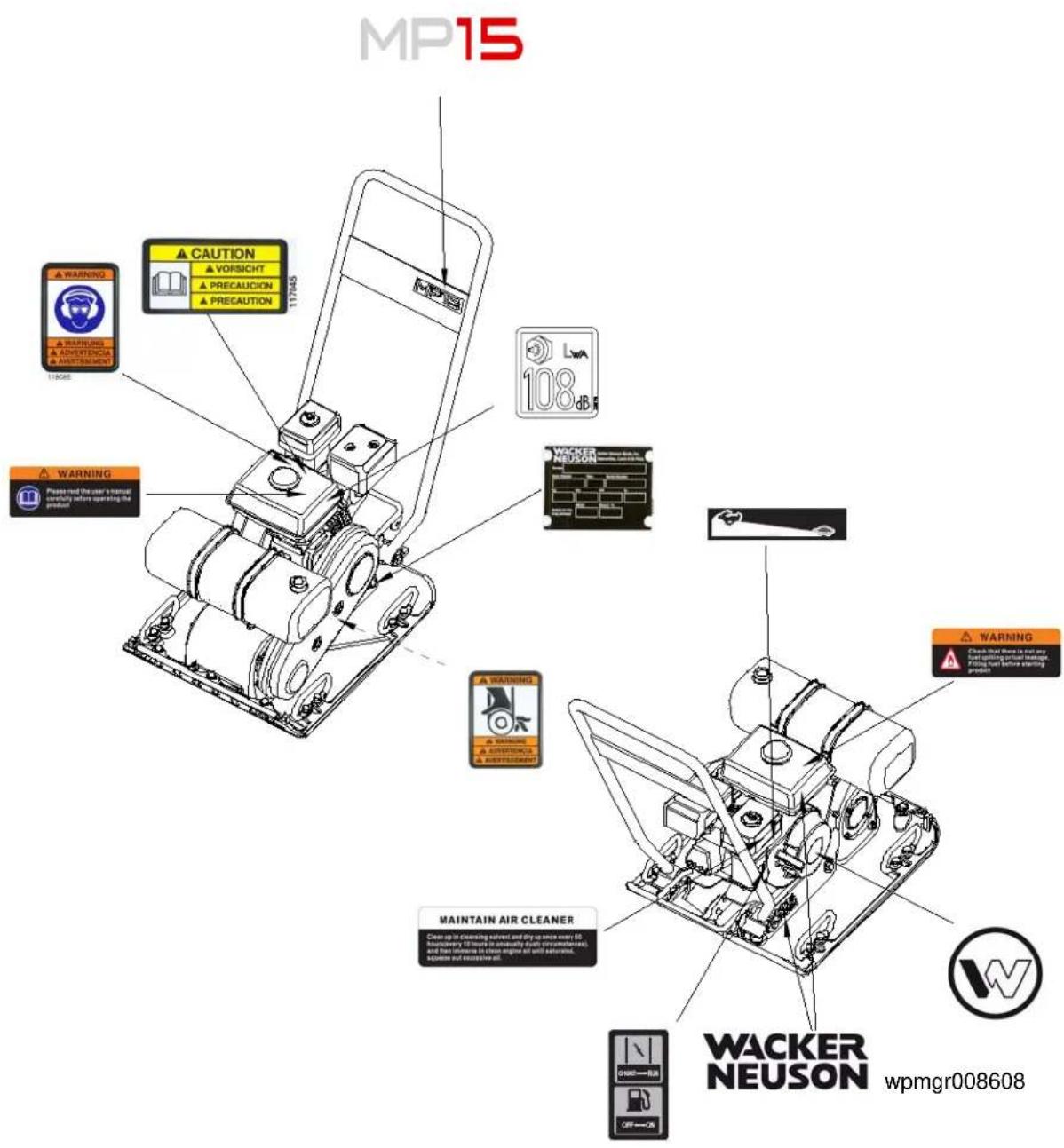
2.4.8 Keep the machine clean and labels legible. Replace all missing and hard-to-read labels. Labels provide important operating instructions and warn of dangers and hazards.
MP15 Safety Information
2.5 Label Locations
MP15 Safety Information
2.6 Warning and Informational Labels
Wacker Neuson machines use international pictorial labels where needed. These labels are described below.
| Label Meaning | |
 11805 11805 | WARNING!Always wear hearing and eye protection when operating this machine. |
 | Please read the user's manual carefully before operating the product. |
 | Guaranteed sound power level in dB(A). |
 | WARNING!Hand injury if caught in moving belt.Always replace beltguard. |
  | Check that there is not any fuel spilling or fuel leakage. Filling fuel before starting product. |
 | Throttle control lever:Turtle = Idle or SlowRabbit = Full or Fast |
MP15 Safety Information
| Label Meaning | |
| MAINTAIN AIR CLEANERClean up in cleansing solvent and dry up once every 50 hours(every 10 hours in unusually dusty circumstances). and then immerse in clean engine oil until saturated, squeeze out excessive oil. | Clean up in cleansing solvent and dry up once every 50 hours(every 10 hours in unusually dusty circumstances). and then immerse in clean engine oil until saturated, squeeze out excessive oil. |
 | Company logo |
| WACKER NEUSON | Company label |
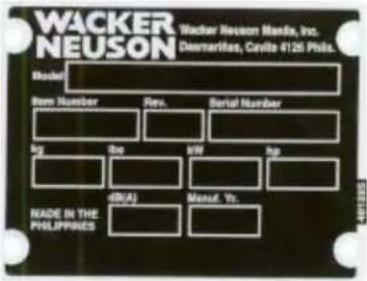 | A nameplate listing the model number, item number, revision number, and serial number is attached to each unit. Please record the information found on this nameplate so it will be available should the nameplate become lost or damaged. When ordering parts or requesting service information, you will always be asked to specify the model number, item number, revision number, and serial number of the unit. |
| U.S. PAT. Nos.:OTHER U.S. AND FOREIGN PATENTS PENDING | This machine may be covered by one or more patents. |
MP15 Technical Data
3. Technical Data
3.1 Engine Data
Engine Power Rating
Net power rating per SAE J1349. Actual power output may vary due to conditions of specific use.
| MP150630131 | ||
| Engine | ||
| Engine Make Wacker Neuson | ||
| Engine Model WN6 | ||
| Max. rated power @ rated speed | kW (Hp) | 3.5 (4.7) @ 3600 rpm |
| Spark Plug P6TC | ||
| Electrode Gap | mm (in.) | 0.6 - 0.8 (0.024 - 0.031) |
| Operating speed | rpm | 3600 |
| Air Cleaner | type | oil air cleaner |
| Engine Lubrication | oil grade | SAE 15W-40 |
| Engine Oil Capacity | ml (oz.) | 0.6 (0.02) |
| Fuel | type | Regular unleaded gasoline |
| Fuel Tank Capacity | I (qts.) | 3.6 (3,7) |
| Valve Clearance (cold) | ||
| Inlet: | mm (in.) | 0.10 - 0.15 (0.004 - 0.006) |
| Outlet: | 0.15 - 0.20 (0.006 - 0.008) | |
MP15 Technical Data
3.2 Machine Data
| MP150630131 | ||
| Plate | ||
| Weight | kg (lbs.) | 81 (179) |
| Water Tank Capacity | l (qts.) | 7.3 (7.7) |
| Exciter Speed | rpm | 5800 ± 100 |
| Exciter Lubrication | ml (oz.) | 240 (8)Automatic transmission fluidDextron III/Mercon or equivalent |
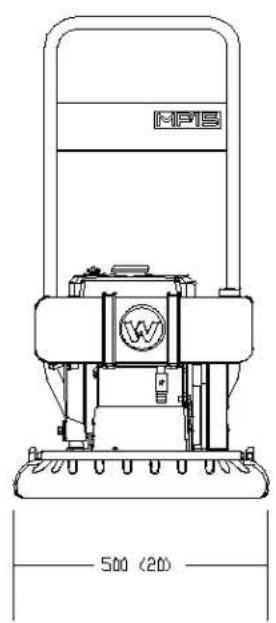
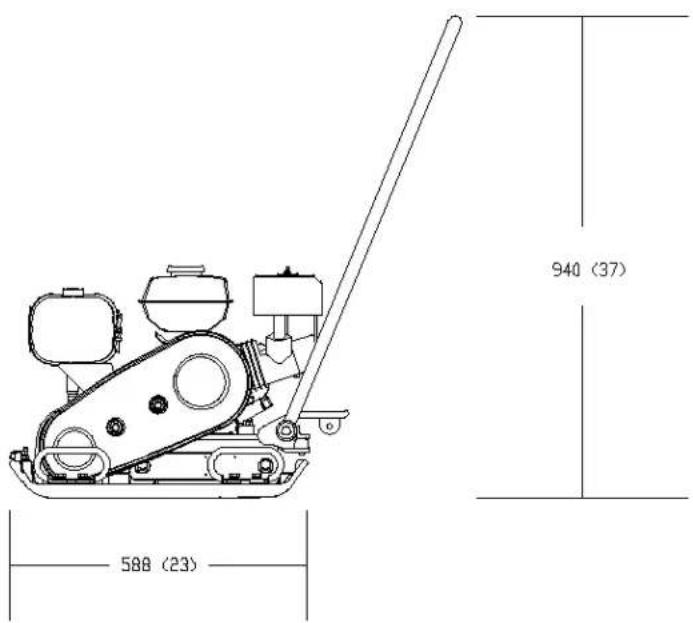
| Dimensions | mm (in.) | 588 (23) x 500 (20) x 940 (37) |
3.3 Sound and Vibration Measurements
The required sound specification, Paragraph 1.7.4.f of 89/392/EEC Machinery Directive, is:
- the guaranteed sound power level (L WA ) = 108 dB(A).
- the sound pressure level at operator's location (L pA ) = 96 dB(A).
These sound values were determined according to ISO 3744 for the sound power level ( LWA ) and ISO 6081 for the sound pressure level ( LpA ) at the operator's location.
The weighted effective acceleration value, determined according to EN ISO 5349, is approximately 4.50 m/s2 .
The sound and vibration measurements were obtained with the machine operating on crushed gravel at nominal engine speed.
MP15 Technical Data
3.4 Dimensions
mm (in.)
wpmgr008609
MP15 Operation
4. Operation
4.1 Recommended Fuel
The engine requires regular grade unleaded gasoline. Use only fresh, clean gasoline. Gasoline containing water or dirt will damage fuel system. Consult engine owner's manual for complete fuel specifications.
4.2 Application
This plate is designed for compacting loose, granular soils, gravel, and paving stones. It is intended to be used in confined areas and areas next to structures such as walls, curbs, and foundations. Plates equipped with water tanks can be used for compacting asphalt.
This plate is not recommended for compacting cohesive soils with a heavy clay content. For cohesive soil, use a vibratory rammer or sheepsfoot roller.
4.3 Before Starting
4.3.1 Read and understand the safety and operating instructions at the beginning of this manual.
4.3.2 Check:
- Oil level in the engine
- Fuel level
• Condition of the air cleaner - Tightness of the external fasteners
• Condition of the fuel lines
MP15 Operation
4.4 To Start
See Graphic: wpm_gr008613
4.4.1 Turn the fuel cock to the "ON" (OPEN) position (a1).
Note: If engine is cold, move choke lever to close position (b1). If engine is hot, set choke to open position (b2).
4.4.2 Move the governor lever to left a little (c1).
4.4.3 Turn the engine switch to "ON" postion. (d1)
4.4.4 Pull starter rope (e).
Note: Don't allow the starter grip to snap back against the engine. Return it gently to prevent damage to the starter.
4.4.5 Preheat the engine and push back the choke lever to the "OPEN" position (f1).
4.4.6 Move the throttle lever to proper position to make the gasoline engine run at required velocity. (g1)
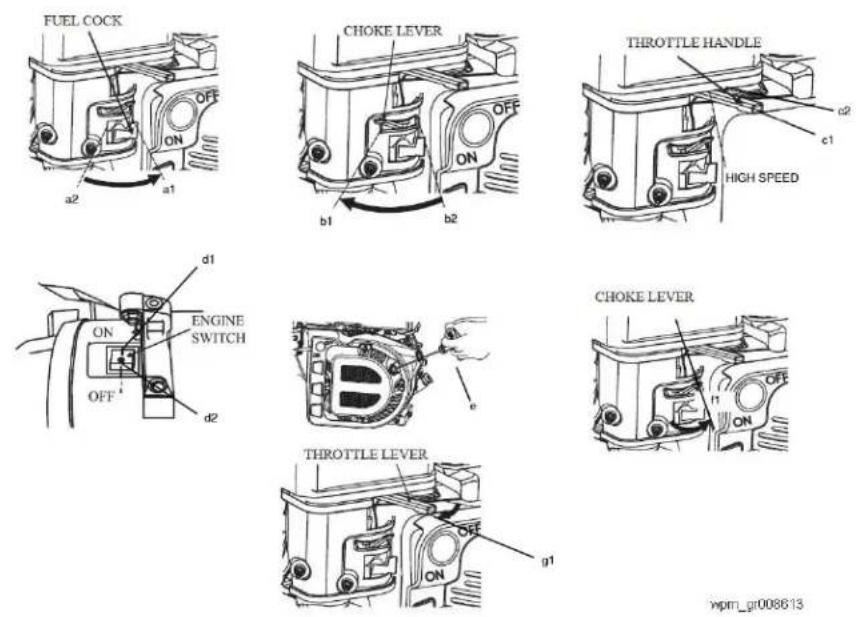
vpm_gr008613
4.5 To Stop
See Graphic: wpm_gr008613
4.5.1 Push right the throttle lever to low speed position (c2).
4.5.2 Push the engine switch to the "OFF" position (d2).
4.5.3 Set the fuel cock to "OFF" position (a2).
MP15 Operation
4.6 Operation
Run the engine at full throttle and allow the plate to pull itself along at its normal speed. When operating on an incline it may be necessary to assist the plate by pushing it forward slightly. When operating downhill hold the plate back slightly, if it begins to pick up speed. Depending on the material being compacted, three or four passes are recommended to achieve the best compaction.
While a certain amount of moisture in the soil is necessary, excessive moisture may cause soil particles to stick together and prevent good compaction. If soil is extremely wet, allow it to dry somewhat before compacting.
If soil is so dry as to create dust clouds while operating plate, some moisture should be added to the ground material to improve compaction. This will also reduce service to the air filter.
For compacting asphalt, use a water tank to wet the asphalt and the underside of plate. This will prevent asphalt material from sticking. Two passes are usually sufficient to ensure good compaction.
When using the plate on paving stones, attach a pad to the bottom of the plate to prevent chipping or grinding surface of stones. A special polyurethane pad designed for this purpose is available as an optional accessory.
NOTICE: DO NOT operate the plate on concrete or on extremely hard, dry, compacted surfaces. The plate will jump rather than vibrate and could damage both the plate and the engine.
MP15 Maintenance
5. Maintenance
5.1 Periodic Maintenance Schedule
5.1.1 Engine Maintenance
The chart below lists basic engine maintenance. Refer to the engine manufacturer's Operation Manual for additional information.
| Daily before starting | After first 20 hrs. | Every 2 weeks or 50 hrs. | Every month or 100 hrs. | Every year or 300 hrs. | |
| Check fuel level. | ■ | ||||
| Check engine oil level. | ■ | ||||
| Inspect fuel lines. | ■ | ||||
| Inspect air filter. Replace as needed. | ■ | ||||
| Clean air cleaner elements. | ■ | ||||
| Change engine oil. | ■ | ■ | |||
| Clean engine cooling fins. | ■ | ||||
| Clean sediment cup / fuel filter. | ■ | ||||
| Check and clean spark plug. | ■ | ||||
| Check and adjust valve clearance. | ■ | ||||
| Change exciter oil. | ■ |
MP15 Maintenance
5.1.2 Machine Maintenance
The chart below lists basic machine maintenance.
| Daily before starting | After first 20 hrs. | Every 2 weeks or 50 hrs. | Every month or 100 hrs. | Every year or 300 hrs. | |
| Check external hardware. | ■ | ||||
| Check and adjust drive belt. | ■ | ■ | |||
| Inspect shockmounts for damage. | ■ | ||||
| Replace shockmounts as needed. | ■ | ||||
| Change exciter oil. | ■ |

Note: When machine is being used in asphalt, it is highly recommended that shockmounts are replaced every year or after 300 hours of usage.
MP15 Maintenance
5.2 Spark Plug
See Graphic: wpm_gr008620
In order to ensure the engine normal running, gap of the spark plug must be correct and no deposit around the spark plug.

The muffler becomes very hot during operation and remains hot for a while after stopping the engine. Do not touch the muffler while it is hot.
Note: Refer to section "Technical Data" for the recommended spark plug type and the electrode gap setting.
5.2.1 Remove the spark plug cap.
5.2.2 Clear away dirt around the spark plug base.
5.2.3 Dismantle the spark plug with a spark plug wrench.
5.2.4 Visually check the spark plug. Clean with a steel brush. If the insulator is damaged, replace the spark plug instead.
5.2.5 Measure the spark plug clearance with a feeler. The clearance should be 0.7 - 0.8 mm. If adjustment is necessary, bend the side electrode carefully.
5.2.6 Check if the spark plug gasket is in good conditions. In order to screw thread misplace, screw in by hand.
5.2.7 Screw on the spark plug to the bottom first by hand and then screw in by a spark plug wrench and compress the gasket.
5.2.8 If a new spark plug is used, more 1/2 turns after compressing the gasket.
5.2.9 If reinstalling the used spark plug, just more twist 1/8 - 1/4 turns.
NOTICE: A loose spark plug can become very hot and may cause engine damage.

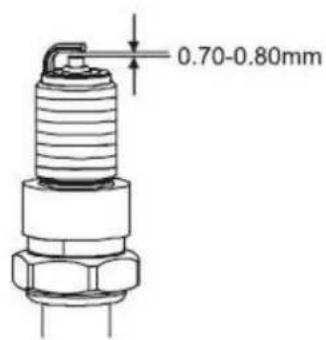
wpm_gr008620
MP15 Maintenance
5.3 Air Cleaner
See Graphic: wpmgr008845
A dirty air cleaner can restrict air flowing into the carburetor. To keep the carburetor in good working conditions, please service the air cleaner periodically. If operating the engine in extremely dusty area, the job should be done more often.
NOTICE: NEVER clean the air cleaner element with gasoline or low flash-point detergents, or explosion may happen.

NEVER run the engine without an air cleaner, because air with dirt and dust entering the engine can speed up the engine wear.
WARNING
To service:
5.3.1 Remove the air cleaner cover (a) off and take the element out.
5.3.2 Wash the foam element (b) with detergent and warm water (or non-flammable or high flash-point cleansing solvents) and dry up.
5.3.3 Clean the air cleaner cover and inner surface with wet cloth, be careful not to allow the dust entering into the carburetor.
5.3.4 Reinstall the element and put the air cleaner cover on.

wpmar00884
MP15 Maintenance
5.4 Engine Oil
See Graphic: wpm_gr008622
Drain the engine oil rapidly and completely out when the engine is hot.
5.4.1 Turn off the oil filler cap and drain plug to drain engine oil thoroughly. reinstall the drain plug and screw in securely.
Note: Do not dump oil containers or discarded engine oil into rubbish boxes or onto the ground. For the sake of environmental protection, we suggest you take in discarded engine oil with a closed container and bring to local recycling station.
5.4.2 Fill the specified engine oil up to the lower level mark.
5.4.3 Reinstall the oil filler cap

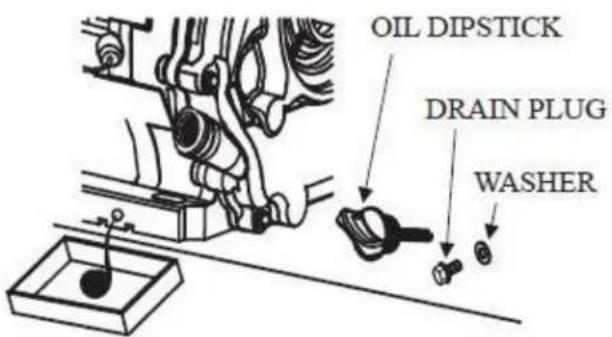
wpm_gr008622
MP15 Maintenance
5.5 Drive Belt
See Graphic: wpmgr008610
On new machines or after installing a new belt, check the belt tension after first 20 hours of operation. Check and adjust the belt every 50 hours thereafter.
To adjust the belt:
5.5.1 Loosen the two screws (a) on the beltguard, then remove the beltguard, keeping the screw assemblies captured on the beltguard.
5.5.2 Loosen the four nuts (b) which hold the engine to the console, and the screw (c) which holds the beltguard back to the console.
5.5.3 Slide the engine backward (towards the handle) to tighten the belt, forward to loosen the belt.
5.5.4 Adjust the belt so that it deflects 10–13 mm (d) when pressed midway between the belt pulleys.
5.5.5 Make sure that the clutch pulley (f) and the exciter pulley (e) are in alignment. Place a straight edge against the exciter pulley (e) and move the engine so that the two pulleys are parallel.
5.5.6 Torque all nuts and screws to 20.5 Nm as you reassemble the machine.

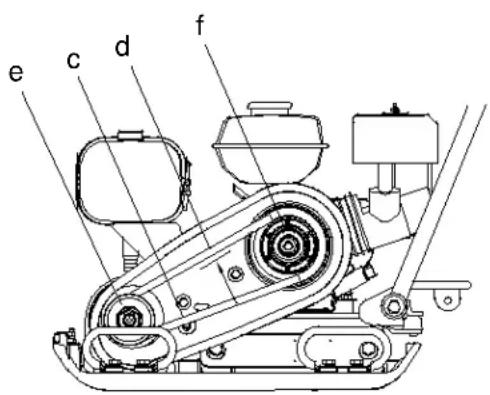
wpmgr008610
MP15 Maintenance
5.6 Exciter Lubrication
See Graphic: wpmgr006018
The bearings in the exciter assembly are splash lubricated and rotate at very high speed. It is important to maintain the exciter oil at the correct level and change it regularly.
Check oil level in exciter every 50 hours of operation.
To check oil level, place plate on a flat, level surface. Remove the drain plug (a) with seal ring (b). Oil level should be at drain plug threads. Add oil as required.
Change exciter oil every 300 hours of operation.
To drain oil, remove plug (a) from end of exciter and tilt plate up.
Note: In the interests of environmental protection, place a plastic sheet and a container under the machine to collect any liquid which drains off. Dispose of this liquid in accordance with environmental protection legislation.
Place plate on a level surface and add oil through plug opening until oil reaches the drain plug threads. See Technical Data.
NOTICE: DO NOT overfill. Too much oil in the exciter can reduce performance and damage the drive belt.
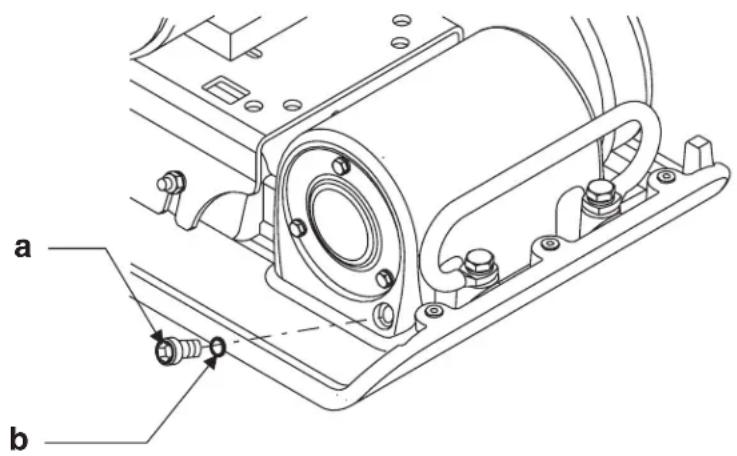
wpmgr006018
5.7 Cleaning Plate
Clean plate after use to remove dirt, stones, and mud caught under the engine console. If plate is being used in a dusty area, check engine cylinder cooling fins for heavy dirt accumulation. Keep engine cylinder fins clean to prevent engine from overheating.
MP15 Maintenance
5.8 Lifting Machine
See Graphic: wpmgr008611
See Technical Data for weight of the machine.
To lift machine manually:
5.8.1 Stop the engine.
5.8.2 Obtain help from a partner and plan the lift.

To avoid burns or fire hazards, let the engine cool before transporting the machine or storing it indoors. Turn the fuel valve to the off position and keep the engine level to prevent fuel from spilling.
5.8.3 Grasp machine by the lifting handles (a) and (b).
5.8.4 Lift machine as shown.

To reduce risk of back injury while lifting, keep feet flat on ground and shoulder width apart. Keep head up and back straight.


wpmgr008611
MP15 Maintenance
5.9 Transporting Machine
See Graphic: wpmgr008612

To avoid burns or fire hazards, let engine cool before transporting machine or storing indoors.
5.9.1 Turn fuel valve to the off position and keep the engine level to prevent fuel from spilling.
5.9.2 Tie down machine on vehicle to prevent machine from sliding or tipping over. Tie machine to vehicle at points shown on graphic.

wpmgr008612
5.10 Storage
If plate is being stored for more than 30 days:
5.10.1 Remove loose stones and dirt from plate.
5.10.2 Clean engine cylinder cooling fins.
5.10.3 Clean or replace air filter.
5.10.4 Change exciter oil.
5.10.5 Change engine oil and follow procedures described in engine manual for engine storage.
5.10.6 Cover plate and engine and store in a clean, dry area.
MP15 Maintenance
5.11 Troubleshooting
| Problem / Symptom Reason / Remedy | |
| Plate does not develop full speed. Poor compaction. | ·Engine throttle control not completely open.·Throttle control not adjusted correctly.·Ground too wet, plate sticking. Allow soil to dry before compacting.·Drive belt loose or worn, slipping on pulleys. Adjust or replace belt. Check that engine mounting bolts are tight.·Exciter bearings binding. Check condition and level of oil in exciter. Add or change oil.·Air filter clogged with dust, reducing engine performance. Clean or replace air filter.·Engine speed too low. Check engine speed with tachometer. Adjust or repair engine to run at correct speed. Refer to engine manual. |
| Engine running, no vibration · Engine throttle not open.·Drive belt loose or broken. Adjust or replace.·Clutch damaged. Inspect and replace clutch.·Engine speed too low. Check engine speed.·Too much oil in exciter. Adjust oil to correct level. | |
| Plate jumps or compacts unevenly. | ·Ground surface too hard.·Shockmounts loose or damaged. |
- MP15 TABLE OF CONTENTS
- FOREWORD 3
- EMISSION SYSTEM CONTROL INFORMATION 4
- SAFETY INFORMATION 5
- TECHNICAL DATA 12
- OPERATION 15
- MAINTENANCE 18
- CALIFORNIA
- PROPOSITION 65 WARNING
- FOREWORD
- EMISSION CONTROL SYSTEM INFORMATION
- 1 EMISSION CONTROL SYSTEMS INFORMATION AND WARRANTY
- 1.1 EMISSION CONTROL SYSTEMS WARRANTY STATEMENT
- MP15 SAFETY INFORMATION
- SAFETY INFORMATION
- 2.1 LAWS PERTAINING TO SPARK ARRESTERS
- 2.2 OPERATING SAFETY
- 2.3 OPERATOR SAFETY WHILE USING INTERNAL COMBUSTION ENGINES
- 2.4 SERVICE SAFETY
- 2.5 LABEL LOCATIONS
- 2.6 WARNING AND INFORMATIONAL LABELS
- MP15 TECHNICAL DATA
- TECHNICAL DATA
- 3.1 ENGINE DATA
- ENGINE POWER RATING
- 3.2 MACHINE DATA
- 3.3 SOUND AND VIBRATION MEASUREMENTS
- 3.4 DIMENSIONS
- MP15 OPERATION
- OPERATION
- 4.1 RECOMMENDED FUEL
- 4.2 APPLICATION
- 4.3 BEFORE STARTING
- 4.4 TO START
- 4.5 TO STOP
- 4.6 OPERATION
- MP15 MAINTENANCE
- MAINTENANCE
- 5.1 PERIODIC MAINTENANCE SCHEDULE
- 5.1.1 ENGINE MAINTENANCE
- 5.1.2 MACHINE MAINTENANCE
- 5.2 SPARK PLUG
- 5.3 AIR CLEANER
- WARNING
- 5.4 ENGINE OIL
- 5.5 DRIVE BELT
- 5.6 EXCITER LUBRICATION
- 5.7 CLEANING PLATE
- 5.8 LIFTING MACHINE
- 5.9 TRANSPORTING MACHINE
- 5.10 STORAGE
- 5.11 TROUBLESHOOTING
Brand : Wacker Neuson
Model : MP15
Category : Vibratory plate