
GOM711B - Microwaves GORENJE - Free user manual and instructions
Find the device manual for free GOM711B GORENJE in PDF.


| Product Type | Built-in Microwave Oven with Grill and Convection (Combined) |
| Model | GOM711B |
| Brand | Gorenje |
| Control Type | Rotary knob and touch keys |
| Display | Digital with clock and menu |
| Microwave Power Levels | 90 W, 180 W, 360 W, 600 W, 750 W, 1000 W |
| Microwave Power | 1000 W (max) |
| Cooking Modes | Microwave, Auto (preset recipes), Quickies, Defrost, Aqua Clean |
| Step Cooking | Up to 3 steps (combine different modes) |
| Timer Functions | Duration, End time, Minute minder (up to 10 hours) |
| Child Lock | Yes, via LOCK key |
| Interior Light | Yes, automatic and manual control |
| Cooling Fan | Yes, continues after use |
| Oven Door Safety Switch | Deactivates microwaves when door opens |
| Oven Cavity Material | Special enamel coating |
| Accessories Included | Glass baking dish, wire guides |
| Number of Shelf Levels | 4 (wire guides) |
| Aqua Clean Function | Yes, for easy cleaning |
| My Recipes Storage | Up to 10 user-defined programs |
| Language Selection | Multiple languages (preset English) |
| Power Supply | 230 V / 50 Hz |
| Rated Power (approx.) | 1450 W (microwave only?) – not specified exactly |
| Dimensions (H x W x D) | Not specified in manual, typical built-in size |
| Weight | Not specified in manual |
Frequently Asked Questions - GOM711B GORENJE
User questions about GOM711B GORENJE
0 question about this device. Answer the ones you know or ask your own.
Ask a new question about this device
Download the instructions for your Microwaves in PDF format for free! Find your manual GOM711B - GORENJE and take your electronic device back in hand. On this page are published all the documents necessary for the use of your device. GOM711B by GORENJE.
USER MANUAL GOM711B GORENJE
DETAILED INSTRUCTIONS
We thank you for your
trust and the purchase of our appliance.
This detailed instruction manual is supplied to make the use of this product easier. The instructions should allow you to learn about your new appliance as quickly as possible.
Make sure you have received an undamaged appliance. If you do find transport damage, please contact the seller from which you purchased the appliance, or the regional warehouse from which it was supplied. The telephone number can be found on the invoice or on the delivery note.
Instructions for installation and connection are supplied on a separate sheet.
Instructions for use are also available at our website:
www.gorenje.com / < http://www.gorenje.com />
| INTRODUCTION | |
| 4 MICROWAVE OVEN7 Technical specifications8 Control unit (depending on the model)10 IMPORTANT SAFETY INSTRUCTIONS13 Before connecting the oven: | |
| 14 BEFORE USING THE APPLIANCE FOR THE FIRST TIME15 SWITCHING ON THE APPLIANCE FOR THE FIRST TIME | PREPARING THE APPLIANCE FOR THE FIRST USE |
| 16 STEPS OF THE COOKING PROCESS (1-7)16 Step 1: CHOOSING THE BASIC COOKING MENUS AND SETTINGS19 Step 2: TIMER FUNCTIONS - DURATION20 Step 3: STEP COOKING22 Step 4: START THE COOKING PROCESS22 Step 5: END THE COOKING PROCESS AND SWITCHING OFF THE OVEN24 Step 6: SELECTING ADDITIONAL FUNCTIONS26 Step 7: CHOOSING THE GENERAL SETTINGS28 DESCRIPTIONS OF SYSTEMS (COOKING MODES) AND COOKING TABLES | COOKING STEPS |
| 33 MAINTENANCE & CLEANING34 CONVENTIONAL OVEN CLEANING34 USING THE AQUA CLEAN FUNCTION TO CLEAN THE OVEN35 REMOVING AND CLEANING THE WIRE GUIDES36 REPLACING THE BULB | MAINTENANCE & CLEANING |
| 37 TROUBLESHOOTING TABLE38 DISPOSAL | TROUBLE-SHOOTING |
| 39 COOKING TEST | OTHER |
(DESCRIPTION OF THE OVEN AND EQUIPMENT - DEPENDING ON THE MODEL)
The figure represents one of the built-in appliance models. Since the appliances for which these instructions were drawn up may have different equipment, some functions or equipment may be described in the manual that may not be present in your appliances.
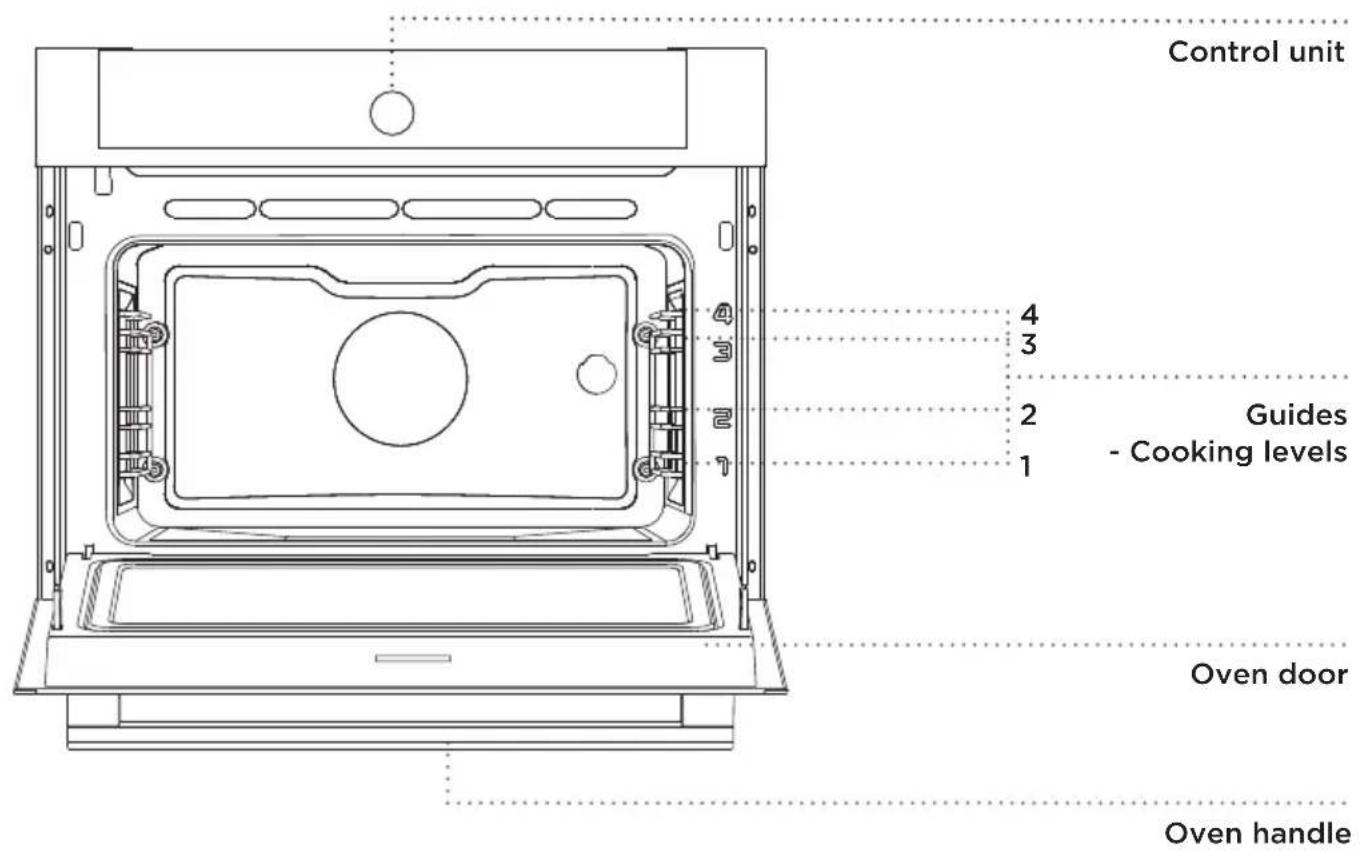
WIRE GUIDES
The wire guides allow preparation of the food on four levels (please note that the levels/guides are counted from the bottom up).
OVEN DOOR SWITCH
The switches deactivate the microwave heating when the oven door is opened during the cooking process. When the door is closed, the switches turn the microwaves back on.
COOLING FAN
The appliance is fitted with a cooling fan that cools the housing and the appliance control panel.
After the oven is switched off, the cooling fan continues to operate for a short while in order to provide additional cooling for the oven. (Extended operation of the cooling fan depends on microwave operation time.)
OVEN EQUIPMENT AND ACCESSORIES

natural_image
Line drawing of a rectangular basin with two curved cutouts (no text or symbols)Use the GLASS BAKING DISH for cooking with microwaves. It can also be used as a serving tray.
natural_image
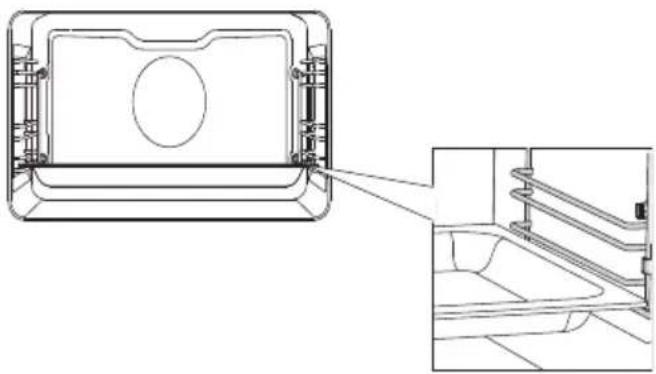
Technical line drawing of a mechanical component with an inset detail view (no text or symbols)In case of wire guides, the tray should always be inserted into the groove between the two wire profiles.

Never use the grid, the shallow baking sheet or the deep baking tray or any other metal part or accessory when operating a system with microwaves!
TECHNICAL SPECIFICATIONS
(DEPENDING ON THE MODEL)

A Serial number
B Code/ID
C Type
D Brand
E Model
F Technical data
G Compliance symbols
The rating plate indicating the basic information about the appliance is located at the edge of the oven and it is visible when the oven door is opened.
CONTROL UNIT
(Depending on the model)
MICROWAVES
AUTOMATIC
QUICKIES
Auto




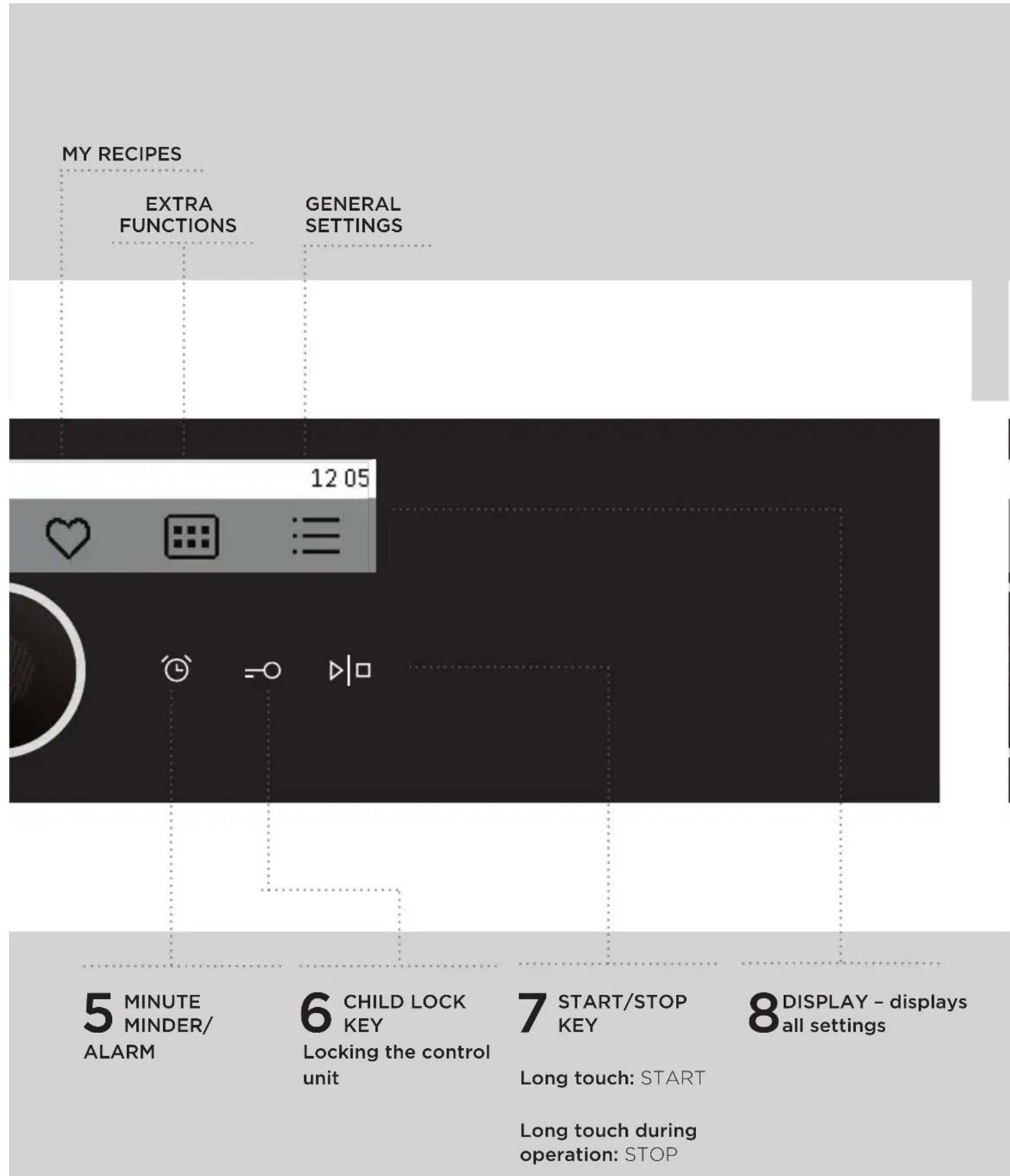
1 ON/OFF KEY
Touch briefly to return to previous menu.
Touch and hold to return to main menu.
4 Selection and CONFIRMATION KNOB
Select the setting by rotating the knob.
Confirm your selection by pressing the knob.
NOTE:
The keys will respond better if you touch them with a larger area of your fingertip. Each time you press a key, this will be acknowledged by a short acoustic signal.
CAREFULLY READ THE INSTRUCTIONS AND SAVE THEM FOR FUTURE REFERENCE.
This appliance may only be used by children aged 8 years and above and persons with reduced physical, sensory or mental capabilities or lack of experience and knowledge if supervision or instructions are provided to them concerning use of the appliance in a safe way and if they understand the hazards involved. Do not let the children play with the appliance. Cleaning and user maintenance shall not be made by children without supervision.
WARNING: The appliance and some of its accessible parts may become very hot during use. Be careful not to touch the heaters. Children younger than 8 years should be constantly supervised.
The appliance becomes very hot during use. Be careful not to touch the oven heaters.
WARNING: The accessible parts of the appliance may become hot during use. Children should be kept away from the oven.
Only use the temperature probe recommended for use in this oven.
WARNING: Before replacing the light bulb, make sure the appliance has been disconnected from the power mains, in order to prevent the hazard of an electric shock.
Do not use abrasive cleaners or sharp metal scrapers to clean the oven as they may damage the finish or the protective enamel coating. Such damages may lead to cracking of the glass.
Do not use steam cleaners or high pressure cleaners to clean the appliance as this may result in an electric shock.
The appliance is not intended to be controlled with external timers or special control systems.
The appliance is intended for household use. Do not use it for any other purpose, such as room heating, drying of pets or other animals, paper, fabrics, herbs etc. as this may lead to injury or fire hazard.
If the power cords of other appliances located near this appliance are caught in the oven door, they may be damaged, which may in turn result in a short circuit. Therefore, keep the power cords of other appliances at a safe distance.
If the power cord is damaged, it should be replaced by the manufacturer or an authorized service technician, in order to avoid hazard.
Do not line the oven walls with aluminium foil and do not place baking trays or other cookware on the oven bottom. Aluminium foil would prevent air circulation in the oven, hinder the cooking process, and ruin the enamel coating.
Oven door become very hot during operation. A third glass is installed for extra protection, reducing the temperature of the outside surface (only with some models).
Oven door hinges may be damaged when under excessive load. Do not place heavy pans on open oven door and do not lean against open oven door when cleaning the oven cavity. Never stand on the open oven door and do not let children to sit on it.
Appliance operation is safe with and without tray guides.
Make sure the vents are never covered or obstructed in any other way.
Safe use of the microwave oven
WARNING: If your oven allows combined operation (microwaves combined with other cooking modes), do not allow the children to use the oven without supervision of an adult person since the oven will reach very high temperatures in such operation modes.
WARNING: If the door or door sealing is damaged, do not use the oven until it is repaired by an adequately trained service technician.
WARNING: It is hazardous for anyone other than a competent person to carry out any service or repair operation which involves removal of the cover that protects against exposure to microwave radiation.
WARNING: Liquids and other foods must not be heated in sealed containers since they are liable to explode.
Heed the minimum distance between the upper edge of the oven and the nearest object above it.
The appliance is intended for use in households and similar environments, such as:
- staff pantries in stores and other working environments;
- family farms;
- accommodation units for guests at hotels, motels, and other accommodation or lodging establishments;
- bed and breakfast establishments.
The microwave oven is intended for heating food and beverages. Drying food or clothing and heating of hot packs or pads, slippers, sponges, moist cloths etc. may result in injury, ignition, or fire.
Only use utensils suitable for use in microwave ovens.
When heating food in plastic or paper containers, keep an eye on the oven as such packaging may ignite.
Microwave heating of beverages can result in delayed eruptive boiling; therefore take care when handling the container with the heated beverage.
The contents of baby bottles and baby food jars should be shaken or stirred and their temperature checked before feeding in order to avoid burns.
Eggs in their shell should not be heated in microwave ovens since they may explode even after microwave heating has ended.
If you observe smoke, switch off or unplug the appliance and keep the oven door closed in order to stifle any flames.
Always use oven mitts to remove dishes from the oven. Some pots, pans, or trays absorb the heat of foods and therefore become very hot.
Make sure to only use the cookware that is suitable for use in a microwave oven.
Do not use cookware made of steel or cookware with golden or sliver rims.
Do not leave any accessories or utensils in your oven when it is off. To avoid damage, do not switch on an empty oven.
Do not use receptacles made of porcelain, ceramics, or clay, if there are pores in the material
or if the inside is not glazed. Once heated up, the moisture that would penetrate these pores could cause cracking. Only use the cookware intended for use in a microwave oven.
Always read and observe the instructions for heating in a microwave oven, specified on the food packaging.
Be careful when heating alcohol-containing food, as a combustible mixture of alcohol and air may form inside the oven. Open the door carefully.
When using the microwave or the combined microwave and convection functions, use of metallic cookware, forks, spoons, knives or metal clips/fasteners for frozen food is not recommended.
After heating, stir the food or leave it to rest until the heat is evenly distributed.
Regularly clean the oven and remove any food residues. Failure to maintain cleanliness in the oven may result in deterioration of its surfaces. This can negatively affect the useful life of the appliance and lead to potentially dangerous situations.
BEFORE CONNECTING THE OVEN:

Carefully read the instructions for use before connecting the appliance. Repair or any warranty claim resulting from incorrect connection or use of the appliance shall not be covered by the warranty.
BEFORE USING THE APPLIANCE FOR THE FIRST TIME
Upon receiving the appliance, remove all parts, including any transport equipment, from the oven. Clean all accessories and utensils with warm water and regular detergent. Do not use any abrasive cleaners.
Before using the oven for the first time, heat it with the upper and lower heater system at 200 °C for approximately one hour. The characteristic "new appliance" scent will be released; make sure the room is well ventilated.
MICROWAVE FUNCTION
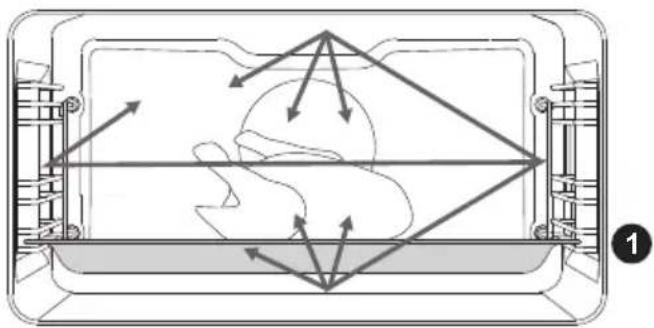
Microwaves are used for cooking, roasting, and defrosting of food. They allow quick and efficient cooking without changing the colour or shape of the food.
Microwaves are a type of electromagnetic radiation. Such radiation is commonly found in our environment in the form of radio-electric waves, light or infrared rays. Their frequency is in the 2,450 MHz range.
natural_image
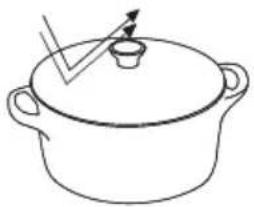
Diagram of a mechanical or electrical component with directional arrows indicating flow or movement, no readable text or symbols present.Their behaviour:
- They are reflected by metals.
- They travel through all other materials.
- They are absorbed by water, fat and sugar molecules.
natural_image
Line drawing of a cooking pot with lid and side handles, no text or symbols present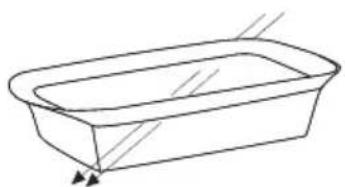
natural_image
Simple line drawing of a rectangular basin with a downward arrow indicating depth (no text or symbols)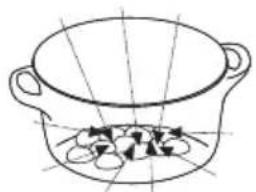
natural_image
Simple line drawing of a cooking pot with food items inside (no text or symbols)When food is exposed to microwaves, the molecules begin to move rapidly, thereby generating heat.
The microwaves penetrate approximately 2.5 centimeters deep into the food. If the food is thicker, the core of the food will be cooked by conduction, as in conventional cooking.

Never use or activate a microwave system if the oven is empty.
SWITCHING ON THE APPLIANCE FOR THE FIRST TIME
SETTING THE CLOCK
After connecting your appliance or after an extended power outage, 12:00 will flash on the display.
Set the time of day.

Confirm each setting by pressing the KNOB.

Press the KNOB to set the time.

Turn the KNOB and first set the TICK.

The oven will also work if the clock is not set. However, timer functions are not available in this case (see chapter Setting the Timer Functions). After a few minutes of idling, the appliance will switch to standby mode.
CHANGING THE CLOCK SETTING
Clock settings may be changed when no timer function is activated (see chapter CHOOSING THE GENERAL SETTINGS).
SELECTING THE LANGUAGE
If you are not happy with the language in which the messages on the display are presented, select another one. English is the preset language.

Rotate the KNOB and select your language from the list. CONFIRM the selection.
The main menu will appear.
STEPS OF THE COOKING PROCESS (1-7)
STEP 1: CHOOSING THE BASIC COOKING MENUS AND SETTINGS
The process of preparing food in your oven can be controlled in several ways:
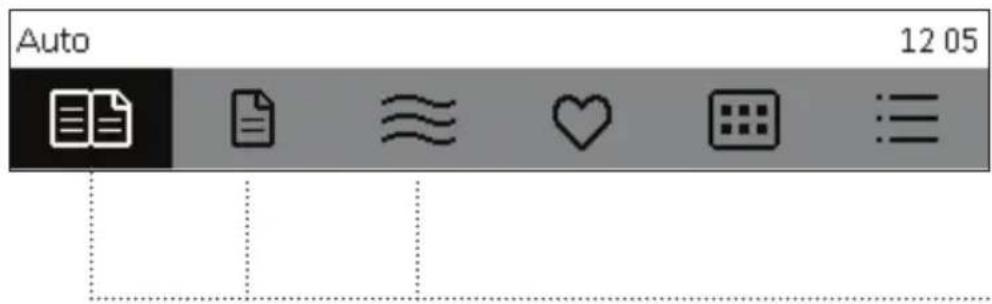
Rotate the KNOB and select the symbol. The symbol will turn white.
The NAME of the selected menu will appear at the top.

Confirm each setting by pressing the KNOB.

Automatic mode
In this mode, first select the type of food and the desired dish.
This is followed by automatic setting of the quantity and level of doneness.
The program offers a large choice of preset recipes reviewed by professional chefs and nutrition experts.

Quickies
This mode offers a selection of preset cooking procedures for particular dishes. The cooking procedures can also be changed.

Microwaves
This mode is suitable for cooking, roasting, and defrosting of food.
A) COOKING BY SELECTING THE TYPE OF FOOD (Auto mode and Quickies mode)

Confirm each setting by pressing the KNOB.
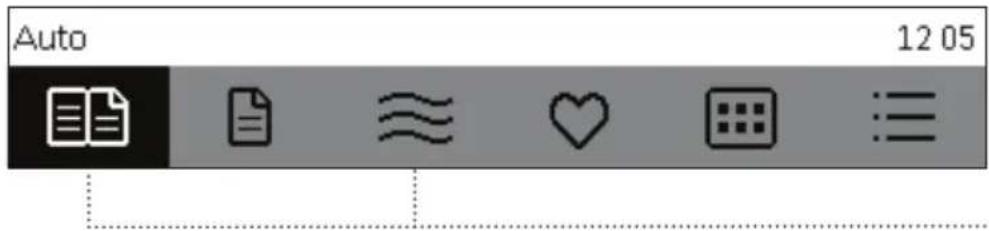
Rotate the KNOB and select the Auto mode. Confirm the setting by pressing on the KNOB.

Select the type of food and the dish. Confirm the selection.
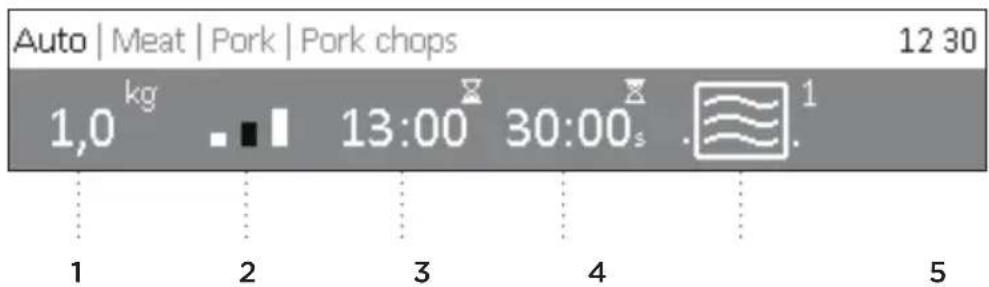
Preset values will appear. Rotate the KNOB and confirm by pressing the KNOB to change these settings.
1 Amount
2 Doneness
3 Delayed start
4 Cooking duration
5 Cooking system and recommended level

When in the Auto and Rapid mode, choose the duration or system symbol to open Professional mode (see section on COOKING BY SELECTING THE OPERATING DE).
Touch the START/STOP key to start oven operation. All selected settings are indicated on the display.
B) COOKING WITH MICROWAVES

Confirm each setting by pressing the KNOB.

Rotate the KNOB and select Microwaves. Confirm the setting by pressing on the KNOB.

Select the settings by rotating the KNOB and pressing it to confirm.
1
2
3
4
5
1 Microwave system
2 Cooking power
3 Cooking duration
4 Delayed start
5 Step mode (see section STEP COOKING)
In microwave systems, the timer function - delayed start is not available.
Touch the START/STOP key to start oven operation.
Selected settings and the time counting down will be displayed on the display unit.
POWER LEVEL USE
| 1000 W • Quickly reheating beverages, water and dishes containing a large volume of liquid.• Cooking dishes with high water content (soups, sauces etc.). |
| 750 W • Cooking fresh or frozen vegetables. |
| 600 W • Melting chocolate.• Cooking fish and seafood; reheating on two levels.• Cooking dried beans at low heat.• Reheating and cooking of delicate egg-based dishes. |
| 360 W • Low-heat cooking of dairy products or jams. |
| 180 W • Manual defrosting; softening butter or ice cream. |
| 90 W • Defrosting cream-filled pastry. |
STEP 2: TIMER FUNCTIONS - DURATION

The "Duration" setting can be selected in the basic Microwave mode.
Setting the cooking time
In this mode, you can define the duration of oven operation (cooking time). Set the desired cooking time and confirm the setting. (Maximum operating time is 10 hours.)
Cooking end time is adjusted accordingly.
Press START to start the cooking process. All selected settings are indicated on the display.
All timer functions can be cancelled by setting the time to "O".

After the set time expires, the oven will automatically stop operating (end of cooking). An acoustic signal will be heard which you may turn off by pressing the ALARM key. After one minute, the acoustic signal will be switched off automatically.
After a few minutes of idling, the appliance will switch to standby mode. The time of day will appear.
STEP 3: STEP COOKING
This mode allows you to combine three different cooking modes successively in a single cooking process.
Choose different settings to cook your food just the way you want it.

The "Step Cook" setting can be selected in the basic Microwave mode. Confirm the setting by pressing on the KNOB.

Select: Step 2, Step 3 Confirm the settings by pressing on the KNOB.

The first step is already selected.

Set the cooking power and time. Confirm the selection with the check mark by pressing the KNOB.

Total cooking time - end.
Cooking power and duration of the selected step
Current step
Touch the START symbol to turn on the oven. The oven starts operating immediately, with the settings defined in Step 1. (A strip at the bottom of the display indicates the cooking step currently in progress.) After the set cooking time elapses, Step 2 and then Step 3 are activated, if specified.

If you wish to delete a step during operation, turn the KNOB, choose the step and cancel it by confirming the X mark. This can only be done with steps that have not started yet.
STEP 4: START THE COOKING PROCESS
The START/STOP key will flash before the start of the cooking process.
Start the cooking process by briefly touching the START key.
Rotate the KNOB to change the current settings during cooking.

natural_image
Pure graphical symbol of a play button (triangle and square) on dark background, no text or numbers presentSTEP 5: END THE COOKING PROCESS AND SWITCHING OFF THE OVEN
Start the cooking process by pressing the START/STOP key and holding it for a while.
When the cooking process is complete, the display will read: "Program complete. Bon appétit!"

Turn the KNOB to display the End menu with a display of symbols.
End!
Select the icon and complete the cooking process. Main menu will appear on the display.

Extend the cooking time
Cooking time can be extended by selecting the icon. New cooking end time can be selected (see chapter Timer Functions).

Add to my recipes
This mode allows you to save the selected settings into the oven memory and use them again at a later time.
SAVING USER-DEFINED PROGRAMS (MY RECIPES)

Choose the symbol and enter the name by rotating the KNOB and confirming respective letters. If necessary, delete a character using the arrow; use the check mark or touch the START/STOP key to confirm the name. Select the type of food.

Select the type of food. Press the KNOB to save your settings.
Your favourite recipes that you have previously stored in the memory can be retrieved and used at any time. Choose the process and the settings in the main menu by selecting the Symbol.

Preset values will appear which you can still change.
Confirm and touch the START key to start the oven operation.

Up to 10 recipes can be stored in the memory.
DELETING A RECIPE
Select the recipe to be deleted. Press and hold the KNOB to delete the recipe; an acoustic signal will be sounded.
STEP 6: SELECTING ADDITIONAL FUNCTIONS

Choose Extra in the main menu to display the extra/additional function menu.

Some functions are not available with some systems; an acoustic signal will indicate such cases.

Aqua clean
Use it to remove stains. Pour 0.6 l of water into a glass or shallow baking dish and insert it into the lower guide. After 4 minutes, food residues on the enamel surfaces will have softened and they will be easy to wipe off with a damp cloth.
Use this function when the oven has fully cooled down! (See chapter CLEANING AND MAINTENANCE.)
Defrosting
In this mode, the air will circulate without any heaters operating. Only the fan will be activated. Use this function to slowly defrost frozen food (cakes, pastry, bread, rolls, and deep-frozen fruit). By selecting the relevant symbol you may specify the type of food, weight, or defrosting start and end time.
Halfway through the defrost time, the pieces should be turned over, stirred and separated if they were frozen together.
When the cooking process is complete, the display will read: "Program complete. Bon appétit!"

Turn the KNOB to display the End menu with a display of symbols.
CHILD LOCK
Activate it by touching the LOCK key (key symbol). The following message will appear on the display: "Child lock activated." Touch the key again to deactivate the child lock.
If the child lock is activated with no timer function engaged (only clock is displayed), then the oven will not operate. If the child lock is activated after a timer function has been set, then the oven will operate normally; however, it will not be possible to change the settings.
When the child lock is activated, systems (cooking modes) or additional functions cannot be changed. Only the cooking/baking/roasting process can be stopped or switched off.
Child lock remains active after the oven is switched off. To select a new system, the child lock must first be deactivated.
OVEN LIGHTING
Oven lighting is switched on automatically when the door is opened or when the oven is switched on.
After the end of the cooking process or when the door is closed, the light will remain on for another minute.
The light inside the oven can be switched on or off by pressing the LIGHT key.
SETTING THE MINUTE MINDER
The minute minder can be used independently of the oven operation. Activate it by pressing the key. The longest possible setting is 10 hours. When the time expires, an acoustic signal will be heard which you may turn off by touching any key. After one minute, the acoustic signal will be switched off automatically.
STEP 7: CHOOSING THE GENERAL SETTINGS

Choose Settings in the main menu to display the menu for various settings.

Rotate the KNOB to navigate the menu. Confirm each setting by pressing the KNOB.
Language
Select the language for the text on the display.
Time
Set the time of day after the appliance is connected to the power mains for the first time or after being disconnected from the power mains for a longer period of time (more than one week). Set the CLOCK - time. Set the display mode in the "Time Design" field: digital or analogue.
Sound
Loudness of the acoustic signal can be set when no timer function is activated (only the time of day is displayed). In this menu, you can set the following: loudness.

Display
In this menu, you can set the following:
Lighting
Night mode - specify the time until which you wish the display to be dimmed.

Setting during the cooking process
In this menu, you can set the following:
Oven lighting during operation - oven lighting is switched off when oven door is opened during operation.
Other settings
Factory settings

After a power outage or after switching off the appliance, all extra user settings are restored.
DESCRIPTIONS OF SYSTEMS (COOKING MODES) AND COOKING TABLES
If your desired food cannot be found in the cooking table, find information for similar food.
The information displayed applies to cooking in a single level.
Cooking times are rough estimates and may vary subject to some conditions.
When cooking larger chunks of meat, vegetables, or pastry, a lot of steam will be generated inside the oven, which in turn may condense on the oven door. This is a normal phenomenon which will not affect the operation of the appliance. After the cooking process, wipe the door and the door glass dry.
MICROWAVES
natural_image
Technical diagram of a mechanical component with internal structure and directional arrows (no text or symbols)
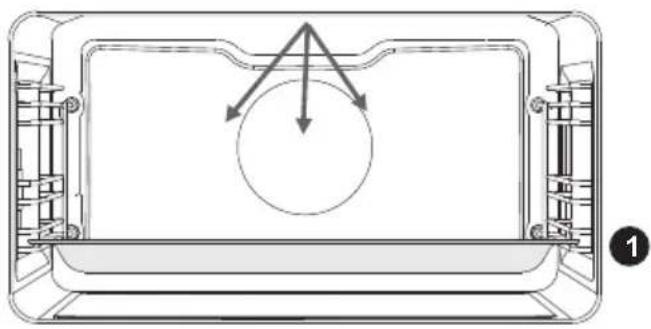
Microwaves are used for cooking and defrosting.
Power levels: 90, 180, 360, 600, 750, 100 W.
Place the glass baking dish into the 1st guide.
Defrosting
| Type of food Weight | (g) | Power (W) | Defrosting time (min) |
| MEAT | |||
| Minced meat ** 500 90 35-45 | |||
| Meat in pieces ** 500 90 20-30 | |||
| Steaks ** 500 90 20-30 | |||
| Whole pieces of meat ** 1000 90 70-80 | |||
| Poultry portions ** 500 90 25-35 | |||
| Whole fish ** 200 90 15-20 | |||
| PASTRY | |||
| Bread ** | 1000 90 20-25 | ||
| Bread rolls ** 500 90 | 10-15 | ||
| Walnut cake ** 500 90 15-25 | |||
| Fruit cake ** | 500 90 | 15-25 | |
| FRUIT AND VEGETABLE | |||
| Fruit | 500 | 90 | |
| Vegetable | 500 90 20-30 | ||
** Turn halfway through the cooking process.
Separate individual pieces. After the end of the process, leave the food at room temperature for 10 to 20 minutes to allow the heat to be evenly distributed in the food.
Reheating
| Type of food Weight | (g) | Power (W) | Defrosting time (min) |
| FOOD | |||
| Steaks 300 g 600 3-5 | |||
| Whole fish 200 g 600 3-5 | |||
| Mixed vegetable * 500 g 600 3-5 | |||
| Side dishes * 500 g 600 3-5 | |||
| Sauces * 500 g 600 2-4 | |||
| Soups/stews * 5 dl 750 2-4 | |||
| Pizza 500 g 600 2-4 | |||
| Chicken medallions 500 g 600 2-4 | |||
| Open sandwiches / 600 2-4 | |||
| Popcorn | 90 g | 1000 2-4 | |
| Melting chocolate | 100 g | 600 2-4 | |
| Butter softening | 250 g | 180 | 2-4 |
| Baby bottle 2 dl 360 3-4 | |||
| Baby food | 4 dl 180 | 2-3 | |
| BEVERAGE | |||
| Water | 2 dl | 1000 | 1-2 |
| Coffee | 2 dl | 1000 | 1-2 |
| Mulled wine | 2 dl | 1000 | 1-2 |
| Milk | 2 dl | 1000 | 1-2 |
* Stir the food several times during reheating.
Cooking
| Type of food Weight | (g) | Power (W) | Cooking time (min) |
| MEAT | |||
| Chicken thighs ** 1000 600 20-30 | |||
| Chicken wings ** 1000 600 15-25 | |||
| Chicken braised in sauce * | 500 1000 15-25 | ||
| Chicken - whole ** 1500 600 45-60 | |||
| Pork roast ** 1000 600 45-60 | |||
| Pork chops ** 500 750 25-35 | |||
| Steaks ** 500 1000 10-20 | |||
| Meat loaf | 700 | 600 | 25-35 |
| Meatballs * | 1000 1000 10-20 | ||
| Fish ** | 200 | 600 15-20 | |
| DESSERTS | |||
| Chocolate soufflé | 6 | 360 | 12-17 |
| Cheese soufflé | glass baking dish | 750 15-20 | |
| Fruit purée glass baking dish | 750 | 12-17 | |
| Custard creams | glass baking dish | 360 | 23-28 |
| Type of food | Weight (g) | Water addition | Power (W) | Cooking time (min) |
| VEGETABLE | ||||
| Potatoe | 500 | 1 tablespoons/100 g | 1000 | 13-18 |
| Eggplant / aubergines | 500 | 1 tablespoons/100 g | 600 | 13-18 |
| Courgettes | 500 | 1 tablespoons/100 g | 360 | 10-15 |
| Carrots | 500 | 1 tablespoons/100 g | 1000 | 10-15 |
| Onions | 200 | 1 tablespoons/100 g | 1000 | 5-10 |
| String beans | 500 | 1 tablespoons/100 g | 750 | 10-15 |
| Broccoli | 1000 | 1 tablespoons/100 g | 750 | 10-15 |
| Bell peppers | 500 | 1 tablespoons/100 g | 1000 | 8-13 |
| Caulifl ower | 1000 | 1 tablespoons/100 g | 750 | 18-23 |
| Leeks | 200 | 1 tablespoons/100 g | 1000 | 10-15 |
| Brussels sprout | 500 | 1 tablespoons/100 g | 1000 | 10-15 |
| Type of food Weight | (g) | Water addition Power (W) Cooking time (min) |
| Button mushrooms / Champignons | 500 1 tablespoons/100 g 1000 10-15 | |
| Asparagus 500 1 tablespoons/100 g 750 5-10 | ||
| Peas 500 1 tablespoons/100 g 750 25-30 | ||
| Cabbage 500 1 tablespoons/100 g 750 15-20 |
| SIDE DISHES | ||||
| Rice 200 Ratio food to liquit 1:2 750 | 15-20 | |||
| Pasta | 200 Ratio food to liquit 1:2 750 | 10-15 | ||
| Whole grain pasta | 200 | Ratio food to liquit 1:2 | 1000 | 10-15 |
| Oatmeal | 500 | Ratio food to liquit 1:2 | 1000 | 5-10 |
| Brown rice | 200 Ratio food to liquit 1:2 750 | 25-30 | ||
| Risotto | 500 | Ratio food to liquit 1:2 | 750 | 20-25 |
| Couscous | 250 | Ratio food to liquit 1:2 | 1000 | 3-8 |
| Polenta | 250 | Ratio food to liquit 1:3 | 1000 | 5-10 |
| Millet | 250 | Ratio food to liquit 1:3 | 1000 | 10-15 |
| Type of food | Weight (g) | Power (W) | Cooking time (min) |
| FROZEN PRODUCTS | |||
| Meat loaf | 700 600 | 35-45 | |
| Chicken - whole ** | 1500 | 600 | 55-65 |
| Pork roast ** | 1000 | 600 | 50-60 |
| Chicken medallions ** | 500 | 750 | 10-15 |
| Mixed vegetable * | 500 | 750 | 10-20 |
| Fish ** | 200 600 | 10-15 | |
* Stir the food several times during reheating.
** Turn halfway through the cooking process.

Be sure to unplug the appliance from the power supply and wait for the appliance to cool down.
Children should not clean the appliance or perform maintenance tasks without proper supervision.
Aluminium finish
Clean the aluminium finish with non-abrasive liquid cleaners intended for such surfaces. Apply the cleaner onto a wet cloth and clean the surface. Then, rinse the surface with water. Do not apply the cleaner directly onto the aluminium finish.
Do not use abrasive cleaners or sponges.
Note: The surface should not come into contact with oven cleaning sprays as this may result in visible and permanent damage.
Stainless steel sheet front side of the housing
(depending on the model)
Clean this surface only with a mild detergent (soapsuds) and a soft sponge that will not scratch the finish. Do not use abrasive cleaners or cleaners containing solvents as they may damage the housing finish.
Lacquer-coated surfaces and plastic parts
(depending on the model)
Do not clean the knobs and buttons, door handles, stickers, and rating/type plates with abrasive cleaners or abrasive cleaning materials, alcohol-based cleaners, or with alcohol. Immediately remove any stains with a soft non-abrasive cloth and some water, in order to avoid damaging the surface.
You may also use cleaners and cleaning materials intended for such surfaces as instructed by their respective manufacturers.
Appliance door
The door is attached to the appliance and may not be removed. Also, the door may not be disassembled or otherwise tapered with.

The aluminium-coated surfaces should not come into contact with oven cleaning sprays as this may result in visible and permanent damage.
CONVENTIONAL OVEN CLEANING
You may use the standard cleaning procedure to clean stubborn dirt in the oven (using cleaners or an oven spray). After such cleaning, rinse the cleaner residues thoroughly.
Clean the oven and the accessories after each use to prevent the dirt from burning into the surface. The easiest way to remove fat is by using warm soapsuds while the oven is still warm.
With stubborn dirt and grime, use conventional oven cleaners. Rinse the oven thoroughly with clean water to remove all cleaner residue.
Never use aggressive cleaners, abrasive cleaners, abrasive sponges, stain and rust removers etc.
Clean the accessories (baking sheets and trays, grids etc.) with hot water and detergent.
The oven, the oven cavity and the baking trays are lined with a special enamel coating for a smooth and resistant surface. This special coating makes cleaning at room temperature easier.
USING THE AQUA CLEAN FUNCTION TO CLEAN THE OVEN
Pour 0.6 l of water into a glass or shallow baking dish and insert it into the lower guide.

Choose "Extra/ Additional Functions" in the main menu and select the Aqua Clean symbol.

Press the START key.

After 4 minutes, food residues on the oven enamel walls will have softened and they will be easy to clean with a damp cloth.

Use the Aqua Clean function when the oven has fully cooled down.
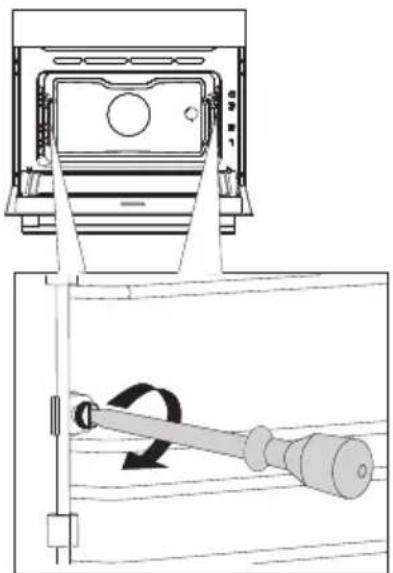
REMOVING AND CLEANING THE WIRE GUIDES
Only use conventional cleaners to clean the guides.
natural_image
Technical diagram showing a mechanical assembly with a rotating shaft and housing (no text or symbols)1 Undo the screw. Use a screwdriver.
natural_image
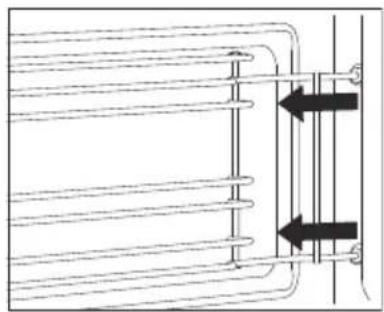
Pure electrical circuit lines without any symbols2 Remove the guides from the holes in the back wall.
natural_image
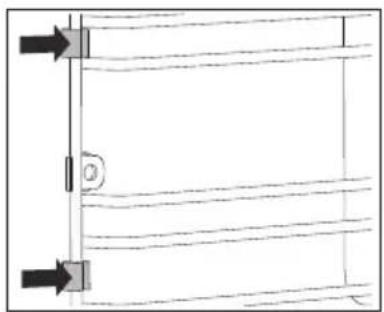
Pure schematic diagram of a vertical structure with horizontal lines and arrows, no text or symbols presentTake care not to lose the spacers fitted on the wire guides. Replace the spacers after cleaning; otherwise, sparks may appear.

After cleaning, re-tighten the screws on the guides with a screwdriver.
When replacing the wire guides, make sure you mount them on the same side they were installed on prior to removal.
REPLACING THE BULB
The bulb is a consumable and therefore not covered by warranty. Before changing the bulb, remove the trays, the grid, and the guides.
Use a Phillips (cross) screwdriver.
(Halogen lamp: G9, 230 V, 25 W)
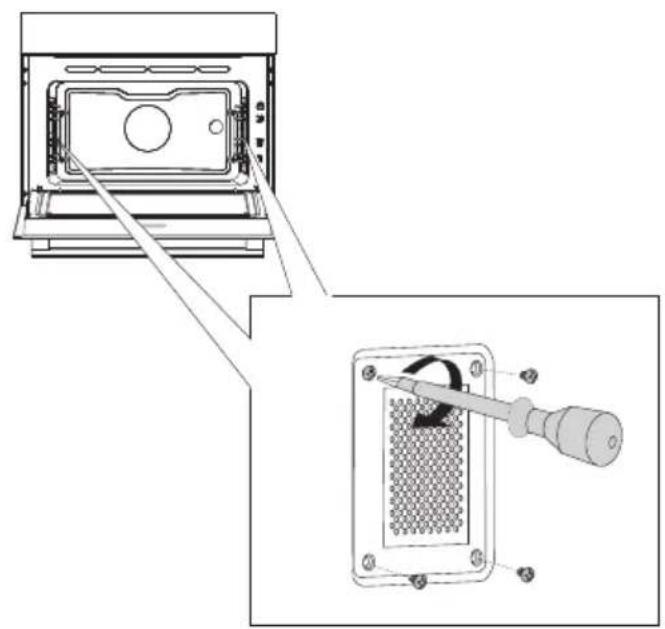
1 Undo the four screws on the cover. Remove the cover and the glass.
natural_image
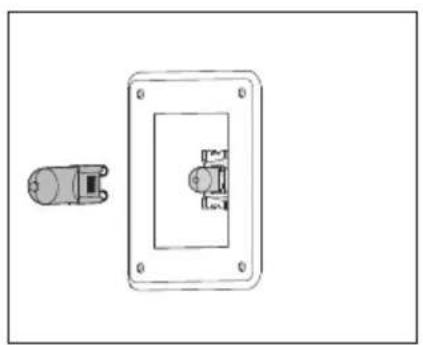
Technical line drawing of a mechanical component with a cylindrical shaft and rectangular housing (no text or symbols)2 Remove the halogen light bulb and replace it with a new one.
Use protection to avoid burs.
natural_image
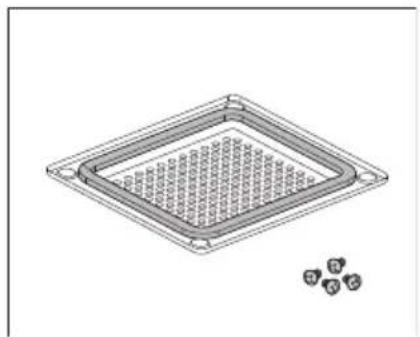
Isometric view of a square mechanical component with internal grid structure and mounting holes (no text or symbols)There is a gasket on the cover which should not be removed. Do not allow the gasket to be detached from the cover. The gasket should fit correctly onto the oven cavity wall.

Firmly re-tighten the screws on the cover using a screwdriver; otherwise, sparks may appear.
TROUBLESHOOTING TABLE
| Problem/error Solution | |
| There is no response of the sensors; the display is frozen. | Disconnect the appliance from the power mains for a few minutes (undo the fuse or switch off the main switch); then, reconnect the appliance and switch it on. |
| The main fuse in your home trips often. | Call a service technician. |
| The oven lighting does not work. | The process of changing the light bulb is described in the chapter.Cleaning and Maintenance. |
| The pastry is underdone. Did you choose the right temperature and heating system?Is the oven door closed? | |
| Error code is displayed:ERRXX ... * XX denotes the number/code of the error. | There is an error in the electronic module operation.Disconnect the appliance from the power mains for a few minutes. Then, reconnect it and set the time of day.If the error is still indicated, call a service technician. |
| Sparks appear in the oven. | Make sure all covers of the lights are fastened and that all spacers are fitted on the wire guides.Make sure the guides are correctly placed in the appliance. |
If the problems persist despite observing the advice above, call an authorized service technician. Repair or any warranty claim resulting from incorrect connection or use of the appliance shall not be covered by the warranty. In this case, the user will cover the cost of repair.

Before the repair, disconnect the appliance from the power mains (by removing the fuse or by removing the plug from the wall outlet).
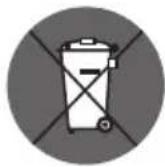
Packaging is made of environmentally friendly materials that can be recycled, disposed of, or destroyed without any hazard to the environment. To this end, packaging materials are labelled appropriately.
The symbol on the product or its packaging indicates that the product should not be treated as normal household waste. The product should be taken to an authorized collection center for waste electric and electronic equipment processing.
Correct disposal of the product will help prevent any negative effects on the environment and health of people which could occur in case of incorrect product removal. For detailed information on removal and processing of the product, please contact the relevant municipal body in charge of waste management, your waste disposal service, or the store where you bought the product.
We reserve the right to any changes and errors in the instructions for use.
Food tested in compliance with the EN 60350-1 standard.
Microwave cooking
| Dish Equipment | Guide (from | the bottom) | Power (W) | Cooking time (min) | System |
| Egg custard, 1000 g | Glass container, dimension 25x25 cm, uncovered + glass baking dish | 1360 23-28 |  | ||
| Sponge cake | Round glass con-tainer, diameter 22 cm, uncovered + glass baking dish | 1360 22-25 |  | ||
| Meatloaf, 900 g | Glass container, di-mensions 25x 12.5 cm, uncovered + glass baking dish | 1 | 600 10 |  | |
| Defrost meat (minced meat), 500 g | 12-15 | ||||
| Defrost meat (minced meat), 500 g | Glass baking dish 1 | 180 8 |  | ||
| 90 15-17 | |||||
| Defrosting raspberries, 250 g | Glass container, uncovered + glass baking dish | 1180 7-7.30 |  |
Combined microwave cooking
| Dish Equipment Guide | (from the bottom) | Temperature (°C) | Power (W) | Cooking time (min) | System | |
| Potato gratin | Round glass container, diameter 22 cm, uncovered + glass baking dish | 1190 | 600 | 25-30 |  | |
| Cake | Round glass container, diameter 22 cm, uncovered + glass baking dish | 1180 | 180 | 22-25 |  | |
| Chicken (1,2 kg)* | Glass container, uncovered + glass baking dish | 1 | 210-220 | 360 | 45-55 |  |
Degrees of doneness for meat
| TYPE OF MEAT Core temperature (°C) | |
| BEEF | |
| Raw 40-45 | |
| Rare 55-60 | |
| Medium 65-70 | |
| Well done 75-80 | |
| VEAL | |
| Well done 75-85 | |
| PORK | |
| Medium 65-70 | |
| Well done 75-85 | |
| LAMB | |
| Well done 79 | |
| MUTTON | |
| Raw 45 | |
| Rare 55-60 | |
| Medium 65-70 | |
| Well done 80 | |
| GOAT MEAT | |
| Medium 70 | |
| Well done 82 | |
| POULTRY | |
| Well done 82 | |
| FISH | |
| Well done 65-70 | |
gorenje+

- DETAILED INSTRUCTIONS
- We thank you for your
- (DESCRIPTION OF THE OVEN AND EQUIPMENT - DEPENDING ON THE MODEL)
- WIRE GUIDES
- OVEN DOOR SWITCH
- COOLING FAN
- OVEN EQUIPMENT AND ACCESSORIES
- TECHNICAL SPECIFICATIONS
- CONTROL UNIT
- NOTE:
- CAREFULLY READ THE INSTRUCTIONS AND SAVE THEM FOR FUTURE REFERENCE.
- Safe use of the microwave oven
- BEFORE CONNECTING THE OVEN:
- BEFORE USING THE APPLIANCE FOR THE FIRST TIME
- MICROWAVE FUNCTION
- SWITCHING ON THE APPLIANCE FOR THE FIRST TIME
- SETTING THE CLOCK
- CHANGING THE CLOCK SETTING
- SELECTING THE LANGUAGE
- STEPS OF THE COOKING PROCESS (1-7)
- STEP 1: CHOOSING THE BASIC COOKING MENUS AND SETTINGS
- Automatic mode
- Quickies
- Microwaves
- A) COOKING BY SELECTING THE TYPE OF FOOD (Auto mode and Quickies mode)
- B) COOKING WITH MICROWAVES
- STEP 2: TIMER FUNCTIONS - DURATION
- Setting the cooking time
- STEP 3: STEP COOKING
- STEP 4: START THE COOKING PROCESS
- STEP 5: END THE COOKING PROCESS AND SWITCHING OFF THE OVEN
- End!
- Extend the cooking time
- Add to my recipes
- SAVING USER-DEFINED PROGRAMS (MY RECIPES)
- DELETING A RECIPE
- STEP 6: SELECTING ADDITIONAL FUNCTIONS
- Aqua clean
- Defrosting
- CHILD LOCK
- OVEN LIGHTING
- SETTING THE MINUTE MINDER
- STEP 7: CHOOSING THE GENERAL SETTINGS
- Language
- Time
- Sound
- Display
- Lighting
- Setting during the cooking process
- Other settings
- DESCRIPTIONS OF SYSTEMS (COOKING MODES) AND COOKING TABLES
- Aluminium finish
- Stainless steel sheet front side of the housing
- Lacquer-coated surfaces and plastic parts
- Appliance door
- CONVENTIONAL OVEN CLEANING
- USING THE AQUA CLEAN FUNCTION TO CLEAN THE OVEN
- REMOVING AND CLEANING THE WIRE GUIDES
- REPLACING THE BULB
- TROUBLESHOOTING TABLE
Brand : GORENJE
Model : GOM711B
Category : Microwaves