 ManualGo.com
GR-DVL145 - Video camera JVC - Free user manual and instructions
Find the device manual for free GR-DVL145 JVC in PDF.


Download the instructions for your Video camera in PDF format for free! Find your manual GR-DVL145 - JVC and take your electronic device back in hand. On this page are published all the documents necessary for the use of your device. GR-DVL145 by JVC.
USER MANUAL GR-DVL145 JVC
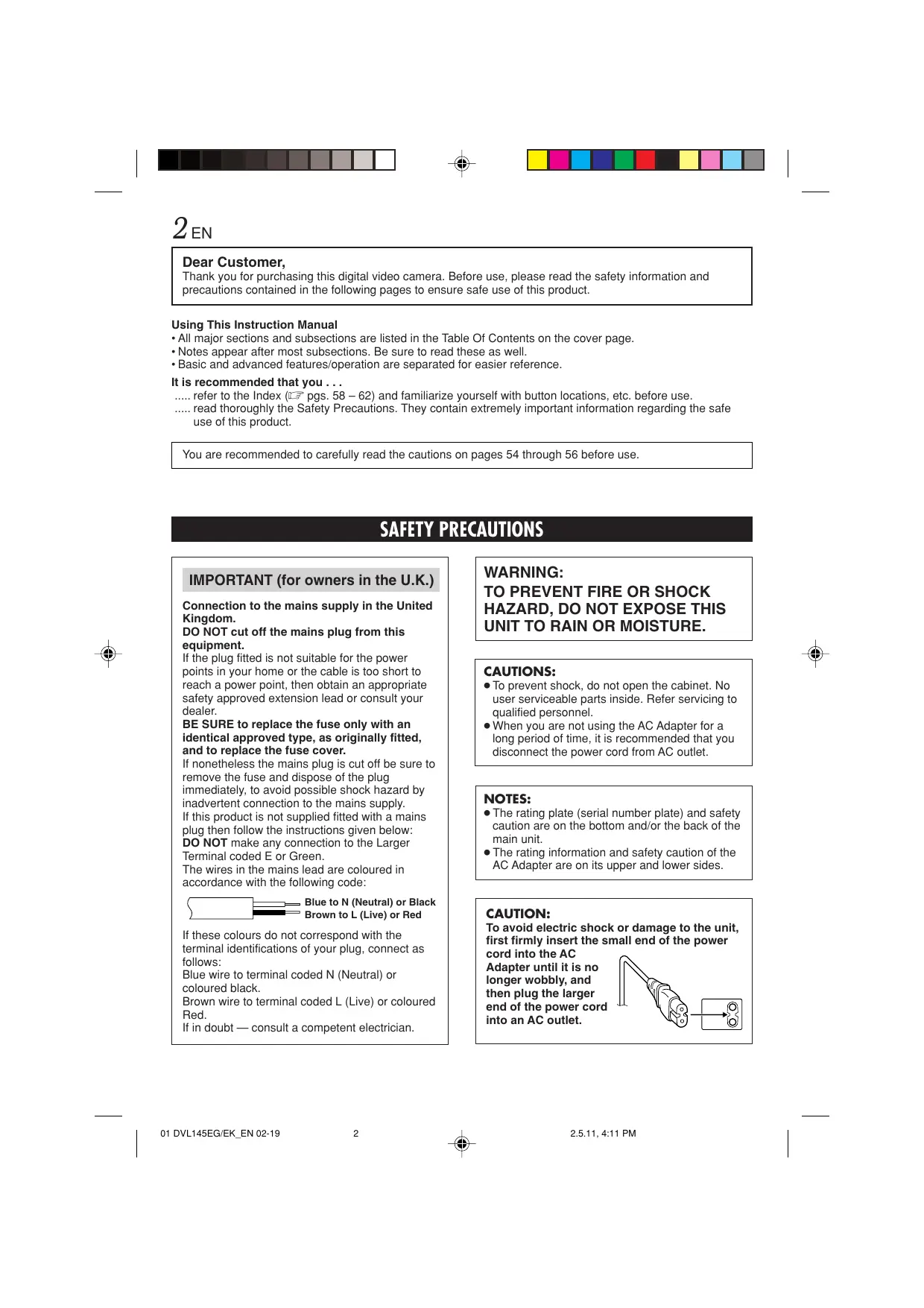
2EN Dear Customer, Thank you for purchasing this digital video camera. Before use, please read the safety information and precautions contained in the following pages to ensure safe use of this product. Using This Instruction Manual + All major sections and subsections are listed in the Table Of Contents on the cover page. + Notes appear after most subsections. Be sure to read these as well + Basic and advanced features/operation are separated for easier reference. It is recommended that you … refer to the Index (7 pgs. 58 — 62) and familiarize yourself with button locations, etc. before use...… read thoroughly the Safety Precautions. They contain extremelÿ important information regarding the safe use of this product. | You are recommended to carefully read the cautions on pages 54 through 56 before use. SAFETY PRECAUTIONS IMPORTANT (for owners in the U.K.) Connection to the mains supply in the United Kingdom. DO NOT cut off the mains plug from this equipment. If the plug fitted is not suitable for the power points in your home or the cable is too short to reach a power point, then obtain an appropriate safety approved extension lead or consult your dealer. BE SURE to replace the fuse only with an identical approved type, as originally fitted, and to replace the fuse cover. I nonetheless the mains plug is cut off be sure to remove the fuse and dispose of the plug immediately, to avoid possible shock hazard by inadvertent connection to the mains supply. Hthis product is not supplied fitted with a mains plug then follow the instructions given below: DO NOT make any connection to the Larger Terminal coded E or Green. The wires in the mains lead are coloured in accordance with the following code: (EE — Blue to N (Neutral) or Black ) Brown to L (Live) or Red If these colours do not correspond with the terminal identifications of your plug, connect as follows: Blue wire to terminal coded N (Neutral) or coloured black. Brown wire to terminal coded L (Live) or coloured Red. in doubt — consult a competent electrician.
UNIT TO RAIN OR MOISTURE. CAUTIONS: e To prevent shock, do not open the cabinet. No user serviceable parts inside. Refer servicing to qualified personnel. e When you are not using the AC Adapter for a long period of time, it is recommended that you disconnect the power cord from AC outlet. NOTES: e The rating plate (serial number plate) and safety caution are on the bottom and/or the back of the main unit. e The rating information and safety caution of the AC Adapter are on its upper and lower sides. CAUTION: To avoid electric shock or damage to the unit, first firmly insert the small end of the power
Adapter until it is no longer wobbly, and then plug the larger end of the power cord ! into an AC outlet.
D ____-BBSEE] e CESSER TITD EN 3 CAUTIONS: + This camcorder is designed to be used with PAL-type colour television signals. it cannot be used for playback with a television of a different standard. However, live recording and LCD monitor/viewtinder playback are possible anywhere. e Use the JVC BN-V408U/V416U/V428U battery packs and, to recharge them or to supply power to the camcorder from an AC outlet, use the provided multi-voltage AC Adapter and Power Cord. (An appropriate conversion adapter may be necessary to accommodate different designs of AC outlets in different countries.) When the equipment is installed in a cabinet or on a shelf, make sure that it has sufficient space on all sides to allow for ventilation (10 cm or more on both sides, on top and at the rear). Do not block the ventilation holes. {ifthe ventilation holes are blocked by a newspaper, or cloth etc. the heat may not be able to get out.) No naked flame sources, such as lighted candles, should be placed on the apparatus. When discarding batteries, environmental problems must be considered and the local rules or laws governing the disposal of these batteries must be followed strictiy. The apparatus shall not be exposed to dripping or splashing. Do not use this equipment in a bathroom or places with water. Also do not place any containers filled with water or liquids (such as cosmetics or medicines, flower vases, potted plants, cups etc.) on top of this unit. (If water or liquid is allowed to enter this equipment, fire or electric shock may be caused.) SOME DOS AND DON'TS ON THE SAFE USE OF EQUIPMENT This equipment has been designed and manufactured to meet international safety standards but, like any electrical equipment, care must be taken if you are to obtain the best results and safety is to be assured. Do read the operating instructions before you attempt to use the equipment. DO ensure that all electrical connections (including the mains plug, extension leads and interconnections between pieces of equipment) are properly made and in accordance with the manufacturer's instructions. Switch off and withdraw the mains plug when making or changing connections. DO consult your dealer if you are ever in doubt about the installation, operation or safety of your equipment. DO be careful with glass panels or doors on equipment. DONT continue to operate the equipment if you are in any doubt about it working normally, or i it is damaged in any way — switch off, withdraw the mains plug and consult your dealer. DON'T remove any fixed cover as this may expose dangerous voltages. DON'T leave equipment switched on when it is unattended unless it is specifically stated that it is designed for unattended operation or has a standby mode. Switch off using the switch on the equipment and make sure that your family knows how to do this. Special arrangements may need to be made for infirm or handicapped people. DONT use equipment such as personal stereos or radios so that you are distracted from the requirements of road safety. I is illegal to watch television wkhilst driving DON'T listen to headphones at high volume, as such use can permanentiy damage your hearing. DONT obstruct the ventilation of the equipment, for example with curtains or soft furnishings. Overheating will cause damage and shorten the life of the equipment. DONT use makeshift stands and NEVER fix legs with wood screws — to ensure complete safety always fit the manufacturer's approved stand or legs with the fixings provided according to the instructions. DONT._allow electrical equipment to be exposed to rain or moisture. ABOVE ALL — NEVER let anyone especially children push anything into holes, slots or any other opening in the case — this could result in a fatal electrical shock: — NEVER guess or take chances with electrical equipment of any kind — it is better to be safe than sorry!
01 DVLI4SEG/EK EN 02-19 3 25.11.41 PM
D ____-BBSEE] e CESSER TITD ÆEN SAFETY PRECAUTIONS Do not point the lens or the viewiinder directly into the sun. This can cause eye injuries, as well as lead to the malfunctioning of internal circuitry. There is also a risk of fire or electric shock. CAUTION! The following notes concern possible physical damage to the camcorder and to the user. When carrying, be sure to always securely attach and use the provided shoulder strap. Carrying or holding the camcorder by the viewfinder and/or the LCD monitor can result in dropping the unit, or in a malfunction: Take care not to get your finger caught in the cassette holder cover. Do not let children operate the camcorder, as they are particularly susceptible to this type of injury. Do not use a tripod on unsteady or unlevel surfaces. It could tip over, causing serious damage to the camcorder. CAUTION! Connecting cables (Audio/Video, S-Video, etc.) to the camcorder and leaving the unit on top of the TV is not recommended, as tripping on the cables will cause the camcorder to fall, resulting in damage. MoN" PAL = This camcorder is designed exclusively for the digital video cassette. Only cassettes marked ““JN"” can be used with this unit. Before recording an important scene ... make sure you only use cassettes with the Mini DV mark ““IN". remember that this camcorder is not compatible with other digital video formats. .. remember that this camcorder is intended for private consumer use only. Any commercial use without proper permission is prohibited. (Even if you record an event such as a show, performance or exhibition for personal enjoyment, it is strongly recommended that you obtain permission beforehand.)
& Core Filter ® (for optional S-Video cable T7 pg. 6 for attachment) NOTE: In order to maintain optimum performance of the camcorder, provided cables may be equipped with one or more core filer. If a cable has only one core filer, the end that is closest to the filter should be connected to the camcorder.
How To Attach The Lens Cap To protect the lens, attach the provided lens cap to the camcorder as shown in the illustration. NOTE: To confirm the lens cap is on correctly make sure the cap is flush to the camera.
01 DVLI4SEG/EK EN 02-19 5 25.11.41 PM
Gen [ à How To Attach The Core Filter Attach the Core Filter(s) (if provided with your model 17 pg. 5) to an optional cable(s). The Core Filter reduces interference. Stopper Pr Wind once Release the Run the cable through the Core Filter, leaving approx. Close the Core Filter until it stoppers on both | 3 cm of cable between the cable plug and the Core Filter. | clicks shut ends of the Core | Wind the cable once around the outside of the Core Filter Filter. as shown in the illustration. + Wind the cable so that it is not slack. NOTE: Take care not to damage the cable. KL J = When connecting cables, attach the end with the Core Filter to the camcorder. AUTOMATIC DEMONSTRATION Automatic Demonstration takes place when “DEMO MENU/BRIGHT Wheel MODE” is set to “ON” (factory-preset). # Automatic Demonstration starts when there is no operation for about 3 minutes after the Power Switch is set to “@" or “@" and no cassette is in the camcorder. = Performing any operation during the demonstration stops the demonstration temporarily. 1f no operation is performed for more than 3 minutes after that, the demonstration will resume. m “DEMO MODE" remains “ON” even if the camcorder power is turned off. = To cancel Automatic Demonstration: . Set the Power Switch to “@" while pressing down the Lock Button located on the switch and press the MENU/BRIGHT Sub Menu wheel in. The Menu Screen appears. Rotate the MENU/BRIGHT wheel to select “C2 SYSTEM" and press it. The SYSTEM Menu appears. DEMO MODE --Ur Rotate the MENU/BRIGHT wheel to select "DEMO MODE" and press it. The Sub Menu appears. Rotate the MENU/BRIGHT wheel to select “OFF” and press it. Rotate the MENU/BRIGHT wheel to select ®J RETURN", and press it twice. The normal screen appears. Lock Button Power Switch
NOTE: I you do not detach the Lens Cap, you cannot see the actual changes of the Automatic Demonstration activated on the LCD monitor or viewfinder.
Power This camcorder's 2-way power supply system lets you choose the most appropriate source of power. Do not use provided power supply units with other equipment.
CHARGING THE BATTERY PACK
1 Tilt the viewfinder upward (©). With the arrow on the battery pack pointing downward, push the battery pack slightiy against the battery pack mount (), then slide down the battery pack until it locks in place (©). 2 Settne Power Suitoh to “OFF”. Connect the AC Adapter to the camcorder (4), then connect the Power Cord to the AC Adapter (£ 3 Plug the Power Cord into an AC outlet (). The CHARGE lamp on the camcorder blinks to indicate charging has started Æ ren the CHARGE lamp stops blinking but stays lit, charging is finished. Unplug the Power Cord from the AC outiet. Disconnect the AC Adapter from the camcorder. To Detach The Battery Pack … … Press BAT. RELEASE and pull out the battery pack. NOTE: lfthe protective cap is attached to the battery pack, remove it first. During charging, the camcorder cannot be operated. « Charging is not possible ifthe wrong type of battery is used. When charging the battery pack for the first time or after a long storage period, tne CHARGE lamp may not light. In this case, remove the battery pack from the camcorder, then try charging again. lfthe battery operation time remains extremely short even after having been fully charged, the battery is worn out and needs to be replaced. Please purchase a new one. e Using the optional AA-V40EG or AA-V40EK AC Power Adapter/Charger, you can charge the BN-V408U/ V416U/V428U battery pack without the camcorder. However, it cannot be used as an AC adapter. For other notes, L7 pl 25.11,412PM
En 9 ATTENTION Before detaching the power source, make sure that the camcorder's power is tumed off. Failure to do so can result in a camcorder malfunction. NOTES:
USING THE BATTERY PACK
Perform step 1 of"CHARGING THE BATTERY PACK" (T7 pg. 8). Approximate recording time e Recording time is reduced significantly under the Batery LCD monitor on | Viewfinder on following conditions: pacl + Zoom or Record-Standby mode is engaged BN-V408U Th. 1 hr. 15 min. repeatedly. EN-V41EU + The LCD monitor is used repeatedly. il 2hrs. 2hrs. 30 min. (optional) + The playback mode is engaged repeatedly. + Before extended use, it is recommended that you BN-V428u 3hrs. 80 min Ahrs. 20 min. prepare enough battery packs to cover 3 times the (optional) planned shooting time. BN-V840U (optional) Shrs. 6 hrs. 10 min. | | EN-V8seu This. 8 hrs. 40 min (optional) INFORMATION The extended-use battery pack kit is a set composed of a battery pack and AC Power Adapter/Charger: VU-V840 KIT : BN-V840U battery pack & AA-V15EG or AA-V15EK AC Power Adapter/Charger VU-V856 KIT : BN-V856U battery pack & AA-V80EG or AA-V80EK AC Power Adapter/Charger Read the kits instruction manual before using. Also, by using the optional JVC VC-VBN856Ù DC Cord, it will be possible to connect BN-V84OU or BN-V856U battery packs to the camcorder and supply power directly to the camcorder. AC Adapter connector _ X Lithium-ion is vulnerable in colder temperatures.
Use the AC illustration) NOTES: Adapter (connect as shown in the + The provided AC Adapter features automatic voltage selection in the AC range from 110 V to 240 V. « For other notes, About Batteries DANGER! Do not attempt to take the batteries apart, or expose them to flame or excessive heat, as it may cause a fire WARNING! or explosion. Do not allow the battery or its terminals to come in contact with metals, as this can result in a Short cireuit and possibly start a fire. The Benefits Of Lithium-lon Batteries Lithium-ion battery packs are small but have a large power capacity. However, when one is exposed to cold temperatures (below 10°C), its usage time becomes shorter and it may cease to function. If this happens, place the battery pack in your pocket or other warm, protected place for a short time, then re- attach it to the camcorder. As long as the battery pack itself is not cold, it should not affect performance. {if you're using a heating pad, make sure the battery pack does not come in direct contact with it.)
Grip Adjustment À Separate the Velcro strip. 2 Pass your right hand through the loop and grasp the grip. S Aciust your thumb and fingers through the grip, to easily operate the Recording Start/Stop button and Power Switch and Power Zoom Lever. Be sure to fasten the Velcro strip to your preference. Viewfinder Adjustment À settne Pouer Suitoh to *B” or “M while pressing down the Lock Button located on the switch 2 Tum the Dioptre Adjustment Control until the indications in the viewfinder are clearly focused. Shoulder Strap Attachment À make sure the battery pack is removed. Following the illustration, thread the strap through the eyelet (), then fold it back and thread it through the buckle () Repeat the procedure to attach the other end of the strap to the other eyelet (®) located under the Grip Strap . Confirm the strap is not twisted. Tripod Mounting CAUTION When attaching the camcorder to a tripod, extend its legs to stabilise the camcorder. lt is not advised to use small sized tripods. This may cause damage to the unit by falling over. To attach the camcorder to a tripod, align the direction stud and screw to the mounting socket and Stud hole on the camcorder. Then tighten the screw clockwise. Some tripods are not equipped with studs. 25.11,412PM
en 11 MENU/BRIGHT Wheel Date/Time Settings Power Lamp The date/time is recorded onto the tape at all times, but its display can be turned on or off during playback (7 pg. 36, 37). 1 Set the Power Switch to “M while pressing down the Lock Button located on the switch. The power lamp lights and the camcorder is turned on. 2 Press the MENU/BRIGHT wheel in to access the Menu Screen. S Rotate the MENU/BRIGHT wheel to select “BI DISPLAY”. Press it and the DISPLAY Menu appears. Æ Rotate the MENU/BRIGHT wheel to select D | *CLOCK ADJ.". Press it and “day” is highlighted. Rotate the MENU/BRIGHT wheel to input the day. Press it. Repeat to input the month, year, hour and Power Switch Display minute. TRWIPE/FADER_ OFF Rotate the MENU/BRIGHT wheel to select “4 RETURN", and press it twice. The Menu Screen closes. NOTE: Even if you select “CLOCK ADJ’, if the parameter is not highlighted the camcorder's internal clock continues to operate. Once you move the highlight bar to the first date/ time parameter (day), the clock stops. When you finish setting the minute and press the MENU/BRIGHT wheel in, the date and time begin operation from the date and DISPLAY Menu time you just set.
- To Protect Valuable Recordings ... … slide the erase protection tab on the back of the tape in the direction of “SAVE”. This prevents the tape from being recorded over. To record on this tape, slide the tab back to “REC” before loading it. Be sure to press only the section labeled “PUSH HERE" to close the cassette holder: touching other parts may cause your finger to get caught in the cassette holder, resulting in injury or product damage. NOTES: Loading/Unloading À Cassette The camcorder needs to be powered up to load or eject a cassette. À side and hold OPEN/EJECT in the direction of the arrow then pull the cassette holder cover open until it locks. The cassette holder opens automatically. + Do not touch internal components. 2 insert or remove a tape and press “PUSH HERE” to close the cassette holder. + Once the cassette holder is closed, it recedes automatically. Wait until it recedes completely before closing the cassette holder cover. + When the batterys charge is low, you may not be able to close the cassette holder cover. Do not apply force. Replace the battery with a fully charged one before continuing S ciose the cassette holder cover firmiy until it locks into place. Approximate recording time Recording mode Tape sP LP 30 min. 30 min. 45 min. 60 min. 60 min. 90 min. 80 min. 80 min. 120 min. + Ittakes a few seconds for the cassette holder to open. Do not apply force. li you wait a few seconds and the cassette holder does not open, close the cassette holder cover and try again. If the cassette holder stil does not open, turn the camcorder off then on again. ‘ Ifthe tape does not load properiy, open the cassette holder cover fully and remove the cassette. À few minutes later, insert it again. ‘+ When the camcorder is suddenly moved from a cold place to a warm environment, wait a short time before opening the cassette holder cover. + Closing the cassette holder cover before the cassette holder comes out may cause damage to the camcorder. + Even when the camcorder is switched off, a cassette can be loaded or unloaded. After the cassette holder is closed with the camcorder switched off, however, it may not recede. It is recommended to turn the power on before loading or unloading ‘+ When resuming recording, once you open the cassette holder cover a blank portion will be recorded on the tape or a previously recorded scene will be erased (recorded over) regardless of whether the cassette holder came out or not. See page 18 for information about recording from the middle of a tape.
01 DVLH45EG/EK EN 02-19 1
Recording Mode Setting Set the tape recording mode depending on your preference. 1 Set the Power Switch to “(M while pressing down the Lock Button located on the switch. The power lamp lights and the camcorder is turned on. 2 Press the MENU/BRIGHT wheel in. The Menu Screen appears. Rotate the MENU/BRIGHT wheel to select “B CAMERA and press it. The CAMERA Menu appears. Æ Rotate the MENU/BRIGHT wheel to select "REC MODE" and press it. The Sub Menu appears. Select “SP” or “LP” by rotating the MENU/BRIGHT wheel and press it. Rotate the MENU/BRIGHT wheel to select “t RETURN", and press it twice. The Menu Screen closes. + Audio Dubbing (-7 pg. 43) and Insert Editing {7 pg. 44) are possible on tapes recorded in the SP mode. +“LP” (Long Play) is more economical, providing
1.5 times the recording time.
NOTES: e lfthe recording mode is switched during recording, the playback picture wil be blurred at the switching point. e itis recommended that tapes recorded in the LP mode on this camcorder be played back on this camcorder. e During playback of a tape recorded on another camcorder, blocks of noise may appear or there may be momentary pauses in the sound. 25.11,4:12PM
| BRENT + CESNSNEN DUR |
Basic Recording NOTE: You should already have performed the procedures listed below. If not, do so before continuing. e Power (T7 pg. 8) rip Adjustment (7 pg. 10) « Viewfinder Adjustment (17 pg. 10) « Load À Cassette (r7 pg. 12) « Recording Mode Setting (17 pg. 13) À Remove the lens cap. 2 setine Power Switch to “&' or “M” while pressing down the Lock Button located on the switch: Shooting while using the LCD monitor: Make sure the LCD monitor is fully open. Tik it upward/ downward for best viewability. Shooting while using the viewfinder: Close the LCD monitor. + The power lamp lights and the camcorder enters the Record-Standby mode. PAUSE" is displayed. 3 Press the Recording Start/Stop Button. “€ÿREC" appears while recording is in progress. To Stop Recording . … press the Recording Start/Stop Button. The camcorder re-enters the Record-Standby mode. To Adjust The Brightness Of The Display .… … rotate the MENU/BRIGHT wheel until the bright level indicator on the display moves and the appropriate brightness is reached. NOTES: « lfthe Record-Standby mode continues for 5 minutes, the camcorder's power shuts off automatically. To turn the camcorder on again, set the Power Switch to “OFF”, then back to “ ES” or “QD”. e The image will not appear simultaneously on the LCD monitor and the viewfinder. t will appear in the viewinder when the LCD monitor is in the lock position, and it will appear on the LCD monitor when fully extended. + When a blank portion is left between recorded scenes on the tape, the time code is interrupted and errors may occur when editing the tape. To avoid this, refer to “Recording from the middle of a tape” (17 pg. 18). «To turn the beep sounds off, 17 pg. 32, 34. For other notes, 25.11,4:12PM
RECORDING_(cont.) Recording To turn on the camcorder, set the Power Switch to any operation mode except “OFF”while pressing down the Lock Button located on the switch. Power Switch Power lamp When the Power Switch is set to “E}”, “EN” appears. When set to “(M " or “PLAY”, there is no indication.
01 DVLHA5EG/EK_EN 02-19 16
JOURNALISTIC SHOOTING in some situations, different shooting angles may provide more dramatic results. Hold the camcorder in he desired position and tit the LCD monitor in the most convenient direction. It can rotate 270° (90° downward, 180° upward). SELF-RECORDING You can shoot yourself while viewing your own image in the LCD monitor. Open the LCD monitor and til it upward 180° so that it faces forward, then point the lens toward yourself and start recording. Operation Mode Choose the appropriate operation mode according to your preference using the Power Switch. Power Switch Position & (Manual): Alows you to set various recording functions using the Menus. If you want more creative capabilties than Full Auto recording, try this mode. A (Full Auto): Alows you to record using NO special effects or manual adjustments. Suitable for standard recording. OFF: Alows you to switch off the camcorder. PLAY: - Allows you to play back a recording on the tape. + Allows you to transfer a still image recorded on ihe tape to a computer. 25.11,412PM
FEATURE: Zooming PURPOSE: To produce the zoom in/out effect, or an instanta- neous change in image magnification. OPERATION: Zoom In Slide the Power Zoom Lever towards ‘T” Zoom Out Slide the Power Zoom Lever towards “W”. = The further you slide the Power Zoom Lever, the quicker the zoom action. NOTES: « Focusing may become unstable during Zooming. In this case, set the zoom while in Record-Standby, lock the focus by using the manual focus {7 pg. 29), then zoom in or out in Record mode. + Zooming is possible to a maximum of 700X, or it can be switched to 16X magnification using the optical zoom (17 pg. 33). + Zoom magnification of over 16X is done through Digital image processing, and is therefore called Digital Zoom + During Digital zoom, the quality of image may sufier. e Macro shooting (as close as approx. 5 cm to the subject) is possible when the Power Zoom Lever is set all the way to ‘W”. Also see ‘TELE MACRO" in the Menu Screen on page 34. 25.11,4:12PM
D ____-BBSEE] e CESSER TITD 18e RECORDING (cont.)
Time Code During recording, a time code is recorded on the tape. This code is to confirm the location of the recorded scene on the tape during playback. If recording starts from a blank portion, the time code begins counting from “00:00:00” {minute:second:frame). If recording starts from the end of a previously recorded scene, the time code continues from the last time code number. If during recording a blank portion is left partway through the tape, the time code is interrupted. When recording is resumed, the time code starts counting up again from “00:00:00”. This means the camcorder may record the same time codes as those existing in a previously recorded scene. To prevent this, perform “Recording From The Middle of À Tape” below in the following cases: + When shooting again after playing back a Display recorded tape. : + When power shuts off during shooting. Frames are not displayed + When a tape is removed and re-inserted during during recording. shooting. l_pinutes + When shooting using a partially recorded tape. + When shooting on a blank portion located T— Seconds partway through the tape. Frames + When shooting again after shooting a scene ns : then opening/closing the cassette holder cover. 12:34:24 (25 frames = 1 second) Recording From The Middle Of A Tape
1. Play back a tape or use Blank Search (r7 pg. 22) to find the spot at which you want to start recording,
then engage the Still Playback mode (T7 pg. 19).
2. Set the Power Switch to “E3" or “M” while pressing down the Lock Button located on the switch, then
start recording, NOTES: + The time code cannot be reset + During fast-forwarding and rewinding, the time code indication does not move smoothly. + The time code is displayed only when ‘TIME CODE" is set to “ON” (17 pg. 35, 37) When a blank portion is recorded on a tape Time code Already recorded scene Blank Newly recorded scene À À À Shooting start point Shooting stop point Shooting start point Proper recording Already recorded scene New scene Latest scene À À À Shooting start point Shooting start point Shooting start point L J
0 DVLH4SEG/EK EN 02-19 18 25411,412PM
PLAYBACK En 19 Play/Pause Button (>/1) Power Zoom Lever Normal Playback (VOL) Rewind Button (44). À Loca tape (L7 pg. 12). Fast-Forward 2 Set the Power Suitch to “PLAY while pressing doun Stop Button (ms! 9 top Button (m) Bution (>>) the Lock Button located on the switch, To start playback, press »/IL. + To stop playback, press mt + Press 4 to rewind, or »x to fast-forward the tape during Stop mode. To Control The Speaker Volume . ….. slide the Power Zoom Lever (VOL.) towards “+” to turn up the volume, or towards “-" to turn down the volume. Speaker NOTES: _ lf Stop mode continues for 5 minutes when power is supplied from a battery, the camcorder shuts off automatically. To turn on again, set the Power Switch to “OFF”, then to “PLAY” < The playback picture can be viewed in the LCD monitor, viewtinder or on a connected TV (17 pg. 20). + You can also view the playback picture on the LCD monitor with it flipped over and pushed against the camera body. + LCD monitorviewtinder indications: + When power is supplied from a battery: the * 1” battery pack remaining power indicator is displayed. When power is supplied from an AC outlet: * 1" does not appear. + During Stop mode, none of the indications are displayed. + When a cable is connected to the AV connector, the sound is not heard from the speaker. Still Playback: Pauses during playback. à
1) Press »/M during playback. ©
2) To resume normal playback, press »/I again
still playback continues for more than about 3 minutes, the camcorder's Stop mode is automatically engaged. After 5 minutes in the Stop mode, the camcorder's power is automatically turned off. When »/H is pressed, the image may not pause immediately while the camcorder stabilises the still image. Shuttle Search: Allows high-speed search in either direction.
1) Press »> for forward or #< for reverse search during playback.
2) To resume normal playback, press »
During playback, press and hold << or »>. The search continues as long as you hold the button. Once you release it, normal playback resumes. + Aslight mosaic effect appears on screen during Shuttle Search. This is not a malfunction. Frame-By-Frame Playback: Allows frame-by-frame search
1) Engage Still Playback.
2) Rotate the MENU/BRIGHT wheel towards “+” for forward Frame-By-Frame Playback, or towards “-" for
reverse Frame-By-Frame Playback during Still Playback. + To resume normal playback, press »/1 ATTENTION During Shuttle Search, parts of the picture may not be clearly visible, particularly on the left side of the screen.
Yellow to VIDEO IN —l —+ White to AUDIO LIN
Connector VCR cover* ane TD —+ | To S-VIDEO To S-VIDEO IN *_ When connecting the cables, open this cover.
- The Audio cable is not required for watching still images only. If your TV/VCR has a 21-pin connector Use the provided Cable Adapter. When the S-Video cable is not used Audio/Video cable Yellow Gale plug to RCA plug] (provided) pi White to + : Red to | TVorvcR À vw AUDIO L KT Camcorder CE ei To S-IDEO S-Video cable To SN «yc«cves" (optional) Video Out Select Switch
- The Audio cable is not required for watching still images only. NOTE: Set the video out select switch of the cable adapter as required: Y/C __: When connecting to a TV or VCR which accepts Y/C signals and uses an S-Video cable. CVBS : When connecting to a TV or VCR which does not accept Y/C signals and uses an audio/video cable.
01 DVLH45EG/EK_EN 20-39 20 2.5.11,4:26 PM
À make sure all units are turned of. 2 connect the camoorder to a TV or VCR as shown in the illustration (7 pg. 20). If using a VCR … go to step 3. If not … go to step 4. S connect the VCR output to the TV input, referring to your VCR's instruction manual. & Turn on the camcorder, the VCR and the TV. 5 setthe VCR to its AUX input mode, and set the TV to its VIDEO mode. To choose whether or not the following displays appear on the connected TV .… + Date/Time set *DATE/TIME" to “AUTO”, “ON” or “OFF” in the Menu Screen (r7 pg. 36). + Time Code en set "TIME CODE" to “ON” or “OFF” in the Menu Screen (T7 pg. 36) + Playback Sound Mode, Tape Speed And Tape Running Displays for tape playback a set "ON SCREEN" to “LCD” or “LCD/TV” in the Menu Screen (r7 pg. 36).
01 DVLI4SEG/EK EN 20-39 21
EN 21 eitis recommended to use the AC Adapter as the power supply instead of the battery pack (17 pg. 9). To monitor the picture and sound from the camcorder without inserting a tape, set the camcorder's Power Switch to * EX” or"), then set your TV to the appropriate input mode: e Make sure you adjust the TV sound volume to its minimum level to avoid a sudden burst of sound when the camcorder is turned on. «li you have a TV or speakers that are not specially shielded, do not place the speakers adjacent to the TV s interference will occur in the camcorder playback picture. e While the AudioWVideo cable is connected to the AV connector, sound cannot be heard from the speaker.
Blank Search Helps you find where you should start recording in the middle of a tape to avoid time code interruption UF pg. 18). À Load a tape (7 pg. 12). 2 Set the Power Switch to “PLAY” while pressing down the Lock Button located on the switch. S press BLANK SEARCH +*BLANK SEARCH” appears blinking and the camcorder automatically starts reverse or forward shuttle search, then stops at the spot which is about 3 seconds of tape before the beginning of the detected blank portion. To cancel Blank Search midway 2 press mL. NOTES: ein step 3, ifthe current position is at a blank portion the camcorder searches in the reverse direction, and if the current position is at a recorded portion the camcorder searches in the forward direction «Blank Search does not work if"HEAD CLEANING REQUIRED. USE CLEANING CASSETTE” has appeared with the tape. lfthe beginning or end of the tape is reached during Blank Search, the camcorder stops automatically. + A blank portion which is shorter than 5 seconds of tape may not be detected. e The detected blank portion may be located between recorded scenes. Before you start recording, make sure there is no recorded scene after the blank portion.
24EN FOR RECORDING NOTES: ‘+ During Night-Scope, the following functions or settings cannot be activated and its indicator blinks or goes out: + Some modes of “Programme AE With Special Effects” pg. 24, 25). “GAIN UP” in the CAMERA Menu (17 pg. 33). “DIS” in the MANUAL Menu (7° pg.33). ‘+ During Night-Scope, it may be difficult to bring the camcorder into focus. To prevent this, use of manual focus and/or a tripod is recommended MENU/BRIGHT Wheel Lock Button Power Switch NIGHT SCOPE Button
01 DVLH45EG/EK_EN 20-39 24
Night-Scope Makes dark subjects or areas even brighter than they would be under good natural lighting. Although the recorded image is not grainy, it may look as if it is strobing due to the slow shutter speed. 1 Set the Power Switch to “(M while pressing down the Lock Button located on the switch. 2 Press NIGHT SCOPE so that the Night-Scope indicator “E"appears. + The shutter speed is automatically adjusted to provide up to 30 times sensitivity. +“A" appears beside “If” while the shutter speed is being automatically adjusted. To Deactivate Night-Scope .… … press NIGHT SCOPE again so that the Night- Scope indicator disappears. Programme AE With Special Effects 1 Set the Power Switch to “(M while pressing down the Lock Button located on the switch. 2 Press the MENU/BRIGHT wheel in. The Menu Screen appears. S Rotate the MENU/BRIGHT wheel to select “E1 PROGRAM AE”, then press it. Æ Rotate the MENU/BRIGHT wheel to select the desired mode (r7 pg. 25), then press it. Selection is complete. Press the MENU/BRIGHT wheel in again. The Menu Screen closes. + The PROGRAM AE Menu disappears and the selected mode is activated. The selected mode indicator appears. To Deactivate The Selected Mode... . select “OFF” in step 4. NOTES: + Programme AE with special effects can be changed during recording or during Record-Standby. + Some modes of Programme AE special effects cannot be used during Night-Scope. IMPORTANT Some modes of Programme AE with special effects cannot be used with certain Fade/Wipe Effects (7 pg. 26, 27). If an unusable mode is selected, its indicator blinks or goes out
SHUTTER 1/50-The shutter speed is fixed at 1/50th of a second. Black bands that usually appear when shooting a TV screen become narrower. 120-The shutter speed is fixed at 1/120th of a second. The flickering that occurs when shooting under a fluorescent light or mercury-vapour lamp is reduced. & SPORTS (Variable (2) Shutter Speed: 1/250 — 1/4000) This setting allows fast-moving images to be captured one frame at a time, for vivid, stable slow- motion playback. The faster the shutter speed, the darker the picture becomes. Use the shutter function under good lighting conditions. SNOW Compensates for subjects that may otherwise appear too dark when shooting in extremely bright surroundings such as in the snow. SPOTLIGHT Compensates for subjects that may otherwise appear too bright when shooting under extremely strong direct lighting such as spotlights. NOTE: “SPOTLIGHT" has exposure control (: same effect as -3 with the Makes evening scenes look more natural. White Balance (-7 pg. 31) is initially set to: can be changed to your desired setting. When Twilight is chosen, the camcorder automatically adjusts the focus from approx. 10 m to infinity. From less than 10 m, adjust the focus manually.
[@ sepiA Recorded scenes have a brownish tint like old photos. Combine this with the Cinema mode for a classic look.
Like black and white films, your footage is shot in B/W. Used together with the Cinema mode, it enhances the “classic film” effect.
=, STROBE Your recording looks like a series of consecutive snapshots. SLOW (Slow Shutter) Lights dark subjects or areas even brighter than they would be under good natural lighting. Use “SLOW" only in dark areas. 21 SLOW 4x Slow Shutter raises light sensitivity to allow shooting in dark environments. NOTES: + When using "SLOW, the image takes on a strobe- like effect. e When using "SLOW, it may be dificult to bring the camcorder into focus. To prevent this, use of manual focus and/or a tipod is recommended.
26e e CESSER TITD FOR RECORDING (cont.) IMPORTANT Some Fade/Wipe Effects cannot be used with certain modes of Programme AE with special effects (7 pg. 24, 25). If an unusable Fade/Wipe Effect is selected, its indicator blinks or goes out. MENU/BRIGHT Wheel Power Switch Lock Button Recording Start/Stop Button
01 DVLH45EG/EK_EN 20-39 26
Fade/Wipe Effects These effects let you make pro-style scene transitions. Use them to spice up the transition from one scene to the next. Fade or Wipe works when tape recording is started or when you Stop recording. 1 Set the Power Switch to “M” while pressing down the Lock Button located on the switch. 2 Press the MENU/BRIGHT wheel in. The Menu Screen appears. S Rotate the MENU/BRIGHT wheel to select “Le WIPE/FADER', then press it. Æ Rotate the MENU/BRIGHT wheel to select the desired function, then press it. Selection is complete. Press the MENU/BRIGHT wheel in again. + The WIPE/FADER Menu disappears and the effect is reserved. The indicator representing the selected effect appears. 5 press the Recording Start Stop Button to activate the Fade-in/out or Wipe-in/out. To Deactivate The Selected Effect .… select “OFF” in step 4. NOTE: You can extend the length of a Fade or Wipe by pressing and holding the Recording Start/Stop Button.
Fade in to a colour screen from a black and white screen, or fade out from colour to black and white WIPE — CORNER Wipe in on a black screen from the upper right to the lower left comer, or wipe out from lower left to upper right, leaving a black screen WIPE — WINDOW The scene starts in the centre of a black screen and wipes in toward the comers, or comes in from the corners, gradually wiping out to the centre. WIPE — SLIDE Wipe in from right to left, or wipe out from left to right. WIPE — DOOR Wipe in as the two halves of a black screen open to the left and right, revealing the scene, or wipe out and the black screen reappears from left and right to cover the scene. WIPE — SCROLL The scene wipes in from the bottom to the top of a black screen, or wipes out from top to bottom, leaving a black screen.
WIPE — SHUTTER Wipe in from the centre of a black screen toward the top and bottom, or wipe out from the top and bottom toward the centre leaving a black screen.
FOR RECORDING (cont.) Lock Button Power Switch Display Menu Screen SNAP MODE FULL Snapshot mode with no frame PIN-UP Pin-Up mode FRAME Snapshot mode with frame There is the sound effect of a shutter closing.
01 DVLH45EG/EK_EN 20-39 28
Snapshot This feature lets you record still images that look like photographs onto a tape.
SNAPSHOT MODE SELECTION
1 Set the Power Switch to “M” while pressing down the Lock Button located on the switch. 2 Press the MENU/BRIGHT wheel in. The Menu Screen appears. Rotate the MENU/BRIGHT wheel to select “A CAMERA". Press it and the CAMERA Menu appears. Æ Rotate the MENU/BRIGHT wheel to select “SNAP MODE”, then press it. 5 Rotate the MENU/BRIGHT wheel to select the desired Snapshot mode, then press it Rotate the MENU/BRIGHT wheel to select “4 RETURN" and press it twice. The Menu Screen closes. SNAPSHOT RECORDING À Press SNAPSHOT. PHOTO” appears while the snapshot is being taken. If you press during Record-Standby … “PHOTO” appears and a still image will be recorded for approx. 6 seconds, then the camcorder re-enters the Record-Standby mode I you press during Recording … “PHOTO” appears and à still image will be recorded for approx. 6 seconds, then the normal recording resumes. + Regardiess of the Power Switch position (* EX” or “(M)”, Snapshot recording takes place using the selected Snapshot mode. Motor Drive Mode Keeping SNAPSHOT pressed provides an effect similar to serial photography. (Interval between still images: approx. 1 second) NOTES: «To remove the shutter sound, 7 *BEEP” on pg. 32, 34. li Snapshot recording is not possible, PHOTO" blinks when SNAPSHOT is pressed. e li Programme AE with special effects (17 pg. 24) is engaged, certain modes of Program AE with special effects are disabled during Snapshot recording. In such a case, the icon blinks. e li SNAPSHOT is pressed when “DIS” is set to “ON” {7 pg. 33), the Stabiliser will be disabled. e During playback as well all Snapshot modes are available. The shutter sound is not heard. + During Snapshot recording, the image displayed in the viewinder may be partially missing. However, there is no efiect in the recorded image. + When a cable is connected to the AV connector, the shutter sound is not heard from the speaker, however it is recorded onto the tape.
En 29 Focus detection zone While focusing on a further While focusing on a nearer subject subject
FEATURE: Auto Focus PURPOSE: The camcorder's Full Range AF system offers continuous shooting ability from close-up (as close as approx 5 cm to the subject) to infinity. However, correct focus may not be obtainable in the situations listed below (in these cases use manual focusing): + When two subjects overlap in the same scene. + When illumination is low.* + When the subject has no contrast (difference in brightness and darkness), such as a flat, one-colour wall, or à clear, blue sky.” + When a dark object is barely visible in the viewfinder.* + When the scene contains minute patterns or identical patterns that are regularly repeated. + When the scene is affected by sunbeams or light reflecting off the surface of a body of water. + When shooting a scene with à high-contrast background.
- The following low-contrast warnings appear blinking: 4, 4, > and & NOTES: ‘ lfthe lens is smeared or blurred, accurate focusing is not possible. Keep the lens clean, wiping with a piece of soft cloth if it gets dirty. When condensation occurs, wipe with a soft cloth or wait for it to dry naturally. ‘+ When shooting a subject close to the lens, zoom out first (7 pg. 17). If zoomed-in in the auto focus mode, the camcorder may automatically zoom out depending on the distance between the camcorder and the subject. This will not occur when “TELE MACRO" (7 pg. 34) is activated. FEATURE: Manual Focus PURPOSE: To obtain correct focus. OPERATION:
1) you are using the viewfinder, you should already have made the necessary viewfinder adjustments
2) Set the Power Switch to “M” while pressing down the Lock Button located on the switch, then press
FOCUS (r7 pgs. 58 and 59, ) FOCUS Button). The manual focus indicator appears.
3) To focus on a farther subject, rotate the MENU/BRIGHT wheel towards “+”. “>” appears and blinks.
To focus on a nearer subject, rotate the MENU/BRIGHT wheel towards “-". * €” appears and blinks.
4) Press the MENU/BRIGHT wheel in. Focus adjustment is complete.
To reset to Auto Focus, press FOCUS twice or set the Power Switch to “E3”. I FOCUS is pressed once, the camcorder will enter the focus adjustment mode again NOTES: + Be sure to focus the lens in the maximum telephoto position when you use {he Manual Focus mode. If you focus in on a subject in the wide-angle position, sharply focused images cannot be obtained when zoomed up because the depth-of-field is reduced at longer focal lengihs: ‘+ When the focus level cannot be adjusted any further or closer, “ 4 or“ &” will blink.
FOR RECORDING (cont.) Exposure Control Manual exposure adjustment is recommended in the following situations: + When shooting using reverse lighting or when the background is too bright. + When shooting on a reflective natural background such as at the beach or when sking. + When the background is overly dark or the subject light. À setine Power Switch to "@ while pressing down the Lock Button located on the switch. 2 Press the MENU/BRIGHT wheel in. The Menu Screen appears. S Rotate the MENU/BRIGHT wheel to select EXPOSURE", then press it & hotte the MENU/BRIGHT wheel to select “MANUAL'”, then press it. The Menu Screen disappears. The exposure control indicator appears. 5 Rotate the MENU/BRIGHT wheel towards “+” to brighten the image, or towards “-" to darken the image. (maximum +6) G press the MENU/BRIGHT wheel in. Exposure adjustment is complete. To Return To Automatic Exposure Control .… … Select “AUTO” in step 4. Or, setthe Power Switch to‘m”. To Brighten The Subject Quickly … press BACKLIGHT. EX is displayed and the subject is brightened. If pressed again, disappears and the brightness returns to the previous level. +43 exposure has the same effect as the BACKLIGHT Button. + Using BACKLIGHT may cause the light around the subject to become too right and the subject to become white. + Backlight compensations is also available when the Power Switch is set to “E3”. NOTE: You cannot use the manual exposure control at the same time with backlight, spotight (7 pg. 25) compensation and'SNOW” (
01 DVLH45EG/EK_EN 20-39 30
Iris Lock Use this function in the following situations + When shooting a moving subject. + When the distance to the subject changes (so its size in the LCD monitor or the viewfinder changes), such as when the subject is backing away. + When shooting on a reflective natural background such as at the beach or when sking. + When shooting objects under a spotlight + When zooming. When the subject is close, keep the iris locked. Even when the subject moves away from you, the image will not darken or brighten. Before the following steps, perform steps 1 through 4 of “Exposure Control”. 5 Adiust z00m so that the subject fils the LCD monitor or the viewfinder, then press and hold the MENU/BRIGHT wheel for over 2 seconds. The exposure control indicator and “8” appear. Press the MENUBRIGHT wheel in, “(B" changes to and the iris is locked. Iris lock indicator. BACKLIGHT Button (m) To Return To Automatic Iris Control …. . rotate MENU/BRIGHT to display “AUTO” then press it in step 4. The exposure control indicator and “@” disappear. Or, set the Power switch to To Lock The Exposure Control And The Iris … … after step 4 of “Exposure Control”, adjust the exposure rotating the MENU/BRIGHT wheel. Then lock the iris in step 5 of “Iris Lock”. For automatic locking, rotate the MENU/BRIGHT wheel to select “AUTO”, then press it in step 4. The iris becomes automatic after about 2 seconds. ris Like the pupil of the human eye, it contracts in welllit environments to keep too much light from entering, and dilates in dim environments to allow in more light.
EN 1 White Balance Adjustment A term that refers to the correctness of colour reproduction under various lighting. If the white balance is correct, all other colours will be accurately reproduced. The white balance is usually adjusted automatically. However, more advanced camcorder operators control this function manually to achieve a more professional colour/tint reproduction. À setine Power Switch to “@ while pressing down the Lock Button located on the switch. 2 Press the MENU/BRIGHT wheel in. The Menu Screen appears. S Rotate he MENU/BRIGHT wheel to select “2 W.BALANCE”, then press it. The W.BALANCE Menu appears. Æ hotate the MENU/BRIGHT wheel to select the desired mode. “AUTO” . White balance is adjusted automatically (factory preset). White balance is set manually. Outdoors on a sunny day. Outdoors on a cloudy day. A video light or similar type of lighting is used. 5 press the MENU/BRIGHT wheel in. Selection is complete. Press the MENU/BRIGHT wheel in again The Menu Screen closes and the selected mode indicator except AUTO" appears. “æ CLOUD”. {et HALOGE! To Return To Automatic White Balance en select “AUTO” in step 4. Or, set the Power Switch tom”. NOTE: White balance cannot be used when Sepia or Monotone (EF pg. 25) is activated. 01 DVLI4SEG/EK EN 20-39 si Manual White Balance Operation Perform Manual White Balance when shooting under various types of lighting. Follow steps 1 through 4 of the white balance adjustment, and select “1 MWB". Hold a sheet of plain white paper in front of the subject. Adjust zoom or position yourself so that the white paper fills the screen. S Press the MENU/BRIGHT wheel in until 124 begins blinking rapidiy. When the setting is completed, 11 resumes normal blinking, Æ Press the MENUIBRIGHT wheel in twice. The Menu Screen closes and the Manual White Balance indicator K%4 is displayed. MENU/BRIGHT Wheel Power Switch NOTES: ein step 2, it may be difficult to focus on the white paper. In such a case, adjust focus manual} (17 pg. 29). + À subject can be shot under various types of lighting conditions indoors (natural flourescent, candlelight, etc.). Because the colour temperature is different depending on the light source, the subject tint will difier depending on the white balance settings. Use this function for a more natural result. + Once you adjust white balance manuall, the setting is retained even if the power is turned off or the battery removed. 25.11,4:27 PM
For Recording Menu This camcorder is equipped with an easy-to-use, on-screen menu system that simplifies many of the more detailed camcorder settings (77 pg. 33 — 35). 1 Set the Power Switch to “M” while pressing down the Lock Button located on the switch. 2 Press the MENU/BRIGHT wheel in. The Menu Screen appears. S Aotate the MENU/BRIGHT weel to select the desired function menu, and press it. The selected function menu appears. Æ Function menu seting depends on the function. If you have selected “1 WIPE/FADER”, “FA PROGRAM AE”, “E1 EXPOSURE” or “Æ2 W. BALANCE” … see pg. 33. If you have selected “ E CAMERA”. MANUAL”, “ [A SYSTEM” or [5] DISPLAY”... 5 Rotate the MENU/BRIGHT wheel to select the desired function and press it. The Sub Menu appears. Then, rotate the MENU/BRIGHT wheel to select the parameter, and press it. Selection is complete. Rotate the MENU/BRIGHT wheel to select “À RETURN’ and press it twice. The Menu Screen closes. + The X icon represents “END”. NOTE: When the Menu Screen is left on for a couple of minutes, a residual image may be left on the screen and it may take several seconds for the residual image to disappear. This is not due to any defect of the unit.
Refer to “Fade/Wipe Effects” (17 pg. 26, 27).
Refer to “Programme AE With Special Effect pg. 24, 25). EXPOSURE Refer to “Exposure Control” and “ris Lock” (T7 pg. 30)
Refer to “White Balance Adjustment” and “Manual White Balance Operation” (7 pg. 31) REC MODE Allows you to set the tape recording mode (SP or LP) depending on your preference (7 pg. 13) SOUND MODE 12BIT Enables tape recording of stereo sound on four separate channels, and is recommended for use when performing audio dubbing. (Equivalent to the 32 kHz mode of previous models) 16BIT Enables tape recording of stereo sound on two separate channels. (Equivalent to the 48 kHz mode of previous models) ZOOM B CAMERA 16x When set to “16X" while using digital zoom, the zoom magnification will reset to 16X since digital zoom will be disengaged. 40X Allows you to use the Digital Zoom. By digitally processing and magnifying images, zooming is possible from 16X (the optical zoom limit), to a maximum of 40X digital magnification 700X Allows you to use the Digital Zoom. By digitally processing and magnifying images, zooming is possible from 16X (the optical zoom limit), to a maximum of 700X digital magnification. SNAP MODE Refer to “Snapshot” (T7 pg. 28) GAIN UP OFF Allows you to shoot dark scenes with no picture brightness adjustment. AGC The overall appearance may be grainy, but the image is bright. The shutter speed is automatically adjusted (1/25 — 1/200 sec.). Shooting a subject in low or poor lighting at 1/25 sec. shutter speed provides a brighter image than in the AGC mode, but the subject's movements are not smooth or natural. The overall appearance may be grainy. While the shutter speed is being automatically adjusted, * is displayed. DIS EJ MANUAL OFF ON in To compensate for unstable images caused by camera-shake, particularly at high magnitication. NOTES: < Accurate stabilisation may not be possible if hand shake is excessive, or under the following conditions: + When shooting subjects with vertical or horizontal stripes. + When shooting dark or dim subjects. + When shooting subjects with excessive backlighting. + When shooting scenes with movement in various directions. + When shooting scenes with low-contrast background. + Switch off this mode when recording with the camcorder on a tripod. e The “ny” indicator blinks or goes out if the Stabiliser cannot be used. DS : Factory-preset NOTES: Settings made in the “Æ CAMERA" Menu remain effective whether the Power Switch is set to “or “(M)”. However, the menu settings can be changed only when the Power Switch is set to “ (M”. The “IF MANUAL" settings are effective only when the Power Switch is set to “M”.
D ____-BBSEE] e CESSER TITD 34e USING MENUS FOR DETAILED ADJUSTMENT (cont.) Menu Screen Explanations (cont.) TELE OFF Usually the distance to a subject where the lens is in focus depends on the MACRO zoom magnification. Unless there is a distance more than 1m to the subject, the lens is out of focus at the maximum telephoto setting. When set to “ON”, ON you can shoot a subject as large as possible at a distance of approx. 60 cm. + Depending on the zoom position, the lens may go out of focus. WIDE OFF Records with no change in the screen ratio. For playback on a TV with a MODE normal screen ratio 3 CINEMA | Insert black bands at the top and bottom of the screen. During playback on < = wide-screen TVs, the black bands at the top and bottom of the screen are cut z and the screen ratio becomes 16:9. CT appears. When using this mode, refer É to your wide-screen TV‘ instruction manual. During playback/recording on 4:3 TVS/LCD monitorWiewtinder, black bands are inserted at the top and bottom ot E the screen and the image appears like a letterboxed 16:9 movie. SQUEEZE | For playback on TVs with an aspect ratio of 16:9. Naturally expands the image Œ to fitthe screen without distortion. [f] appears. When using this mode, refer to your wide-screen TV' instruction manual. During playback/recording on 4:3 TVS/LCD monitorWiewtinder, the image is elongated vertically. WIND OFF Disengages the function which cuts down on noise created by wind. ur ON € | Helps cut down on noise created by wind. *@\" appears. The quality ofthe sound will change. This is normal. S|BEEP |OFF Even though not heard while shooting, shutter sound is recorded on the tape. 5 BEEP The beep sounds when the power is tumed on or off, and at the beginning and end 2 of recording. Also to activate the shutter sound effect (-7 pg. 28). E MELODY | Instead of a beep, a melody sounds when any operation is performed. lt also activates the shutter sound effect (7 pg. 28). [y : Factory-preset NOTES: + The ‘IE MANUAL" settings are effective only when the Power Switch is set to “M”. “FA SYSTEM" functions which are set when the Power Switch is set to “M” are also applied when the Power Switch is set to PLAY" (E7 pg. 36). 01 DVLH45EG/EK_EN 20-39 En 2.5.11,4:27 PM
EN 9D DEMO MODE FA SYSTEM OFF Automatic demonstration will not take place.
Demonstrates certain functions such as Programme AE with special effects, etc.. and can be used to confirm how these functions operate. Demonstration starts in the following cases: + When the Menu Screen is closed after “DEMO MODE" is turned “ON”. + With “DEMO MODE" set to “ON”, if there is no operation for about 3 minutes after the Power Switch is set to “EX” or “M”. Performing any operation during the demonstration stops the demonstration temporarily. If no operation is performed for more than 3 minutes after that, the demonstration will resume. NOTES: © fa tape is in the camcorder, the demonstration cannot be turned on. « “DEMO MODE" remains “ON” even if the camcorder power is turned off. e If“DEMO MODE" remains ‘ON, some functions will not be available. After viewing demo, set to “OFF”. CAM RESET CANCEL Does not reset all settings to the factory-preset. EXECUTE Resets all settings to the factory-preset.
SCREEN LCD Keeps the camcorder's display (except the date, time and time code) from appearing on the connected TV screen LCD/TV Makes the camcorder's display appear on screen when the camcorder is connected to a TV. DATE/ TIME I] DISPLAY OFF The date/time does not appear. AUTO Displays the date/time for approx. 5 seconds in the following cases: + When the Power Switch is set from “OFF” to “3” or “M”. + When tape playback starts. The camcorder displays the date“time when scenes are recorded. + When the date is changed during tape playback.
The date/time is always displayed. TIME CODE OFF Time code is not displayed.
Time code is displayed on the camcorder and on the connected TV. Frame numbers are not displayed during recording. CLOCK ADJ. Allows you to set the current date and time (E7 pg. 11). DA : Factory-preset NOTES: SYSTEM" and “(1 DISPLAY" functions which are set when the Power Switch is set to “M” are also applied nen the Power Switch is set to “PLAY” (r
pg. 36). “CLOCK ADJ." only appears when the Power Switch is set to + Setings made in the“ [B1 DISPLAY" Menu remain effective even when the Power Switch is set to “EN”. However, the menu settings can be changed only when the Power Switch is set to “(M)”.
SGEN USING MENUS FOR DETAILED ADJUSTMENT (cont.) MENU/BRIGHT Wheel For Playback Menu Power Switch À Settne Poer Switch to "PLAY" while pressing down the Lock Button located on the switch. 2 Press the MENU/BRIGHT wheel in. The Menu Screen appears. S Rotate the MENU/BRIGHT wheel to select the desired function menu, and press it. The selected function menu appears. Æ Rotate the MENU/BRIGHT wheel to select the desired function, and press it to display the Sub Menu. Lock Button 5 Rotate the MENU/BRIGHT wheel to select the desired parameter and press it. Selection is complete. Recording Start/Stop Button 6 rotate the MENU/BRIGHT wheel to select “4 RETURN" and press it twice to close the Menu Screen. Display HV IDEO SOUND MODE ï ET NoGe Menu Screen Explanations [@DISPLAY > SOUND MODE | #7 pa. 37. O[2e8mmone |c7pg.37. SPRECMODE | Allows you to setthe tape recording mode (SP or LP) E depending on your preference {7 pg. 13).
SOUND MODE — STEREO 1 1 5
É) 12B1T MODE = sou 1 2 CS »© ch setting is linked with “IB1 DISPLAY" or E| «ca SYSTEM, which appears when the Power EX Switch is set to g. 34, 35). x | The parameters are he same as in the à | description on pg. 34, 85.
EN 97 Playback Sound During tape playback, the camcorder detects the sound mode in which the recording was made, and plays the sound back. Select the type of sound to accompany your playback picture. According to the menu access explanation on pg. 36, select “SOUND MODE” or “12BIT MODE” from the Menu Screen and set it to the desired parameter. STEREO Sound is output on both “L” and “R" channels in stereo.
SOUND MODE mo L Sound from the “L” channel is output. SOUND R Sound from the “R” channel is output. MIX Original and dubbed sounds are combined and output in stereo on both “L''and “R” channels. 12BIT MODE DSSUNDA original sound is output on both “L” and “R” channels in stereo. SOUND 2 Dubbed sound is output on both “L” and “R” channels in stereo. [EN : Factory-preset NOTES: + The “SOUND MODE” setting is available for both 12-bit and 16-bit sound. (In previous models’ functions, “12-bit” is called "32 kHz” and “16-bit’ is called *48 kHz”) e The camcorder cannot detect the sound mode in which the recording was made during fast-fonward or rewind. During playback the sound mode is displayed in the upper left corner. Display ON SCREEN setting: For playback sound, tape DATETIME setting: TIME CODE setting: speed and tape running. For date/time. For time code. T2BTTTSOUNDT >
17:30 (B 12:34:24 Frames* Seconds Minutes *25 frames = 1 second
seras Lil video out select switch. To AUDIO, VIDEO** and connectors Cable Adapter (provided) H your VCR has a SCART connector, use the provided cable adapter. + When connecting the cables, open ihis cover. #* Connect when an S-Video cable is not used.
01 DVLH45EG/EK_EN 20-39
Dubbing To À VCR À Following the ilustration, connect the camcorder and the VCR. Also refer to pg. 20 and 21. 2 set the camcorders Power Switch to “PLAY” while pressing down the Lock Button located on the switch, tu on the VCR's power, and insert the appropriate cassettes in the camcorder and the VCR. S Engage the VCR'S AUX and Record-Pause modes, Æ Engage the camcorders Play mode to find a spot just before the edit-in point. Once it is reached, press »/H on the camcorder. 5 press »A1 on the camoorder and engage the VCR's Record mode. G engage the VCR'S Record-Pause mode and press »/II on the camcorder. 7 epeat steps 4 through 6 for additional editng, then stop the VCR and camcorder when finished. NOTES: «As the camcorder starts to play your footage it will appear on your TV. This wil confirm the connections and the AUX channel for dubbing purposes. « Before you start dubbing, make sure that the indications do not appear on the connected TV. If they do, they are being recorded onto the new tape: « Set the video out select switch of the cable adapter as required: Y/C : When connecting to a TV or VCR which accepts Y/C signals and uses an S-Video cable CVBS : When connecting to a TV or VCR which does not accept V/C signals and uses an audioWideo cable To choose whether or not the following displays appear on the connected TV … + Date/Time set"DATE/TIME" to “AUTO”, “ON” or “OFF” in the Menu Screen (T7 pg. 36) + Time Code … set TIME CODE" to ON" or “OFF” in the Menu Screen (7 pg. 36). + Playback Sound Mode, Tape Speed And Tape Running Displays … set ‘ON SCREEN’" to "LCD" or “LCD/TV” in the Menu Screen (r7 pg. 36).
Dubbing To À Video Unit Equipped With A DV Connector (Digital Dubbing) is also possible to copy recorded scenes from this camcorder onto another video unit equipped with a DV connector. Since a digital signal is sent, there is little if any image or sound deterioration. À make sure al units are tumed of. Connect this camcorder to a video unit equipped with a DV input connector using a DV cable as shown in the illustration. 2 set ihis camoorders Power Switch to “PLAY” while pressing down the Lock Button located on the switch, turn on the video units power, and insert the appropriate cassettes in this camcorder and the video unit. S Press » to play back the source tape Æ ie watching the playback on the monitor, engage the DV connector-equipped video units record mode from the spot on the source tape you want to begin recording. NOTES: eitis recommended to use the AC Adapter as the power supply instead of the battery pack (17 pg. 9). lfthe remote control is used when both the player and recorder are JVC video units, both units will perform the same operation. To prevent this from happening, press the buttons on both units. e lfa blank portion or disturbed image is played back on the player during dubbing, the dubbing may stop so that an unusual image is not dubbed + Even though the DV cable is connected correctiy, sometimes the image may not appear in step 4. If this occurs, turn off the power and make connections again. elf“Playback Zoom” (17 pg. 42) or “Snapshot” is attempted during playback, only the original playback image recorded on the tape is output from the DV OUT connector. + When using a DV cable, be sure to use the optional JVC VC-VDV204U DV cable. 25.11,4:27 PM
Lock hole The Full-Function Remote Control Unit can operate this camcorder from a distance as well as the basic operations (Playback, Stop, Pause, Fast-Fonward and Rewind) of your VCR. It also makes additional playback functions possible. Installing The Battery (RM-V7OOU, optional) The remote control uses one lithium battery (CR2025) À There are 2 ways to pull the battery holder out ot the RM-V7OOU. @ : Pull out the battery holder while sliding the lock hole. : Pinch the release tab and pull out the battery holder. 2 insert the battery in the holder, and be sure to have the “+” mark visible. S side the holder back in until you hear a click. + Read the caution concerning lithium batteries in the RM-V7OOU instruction manual. Remote sensor When using the remote control, be sure to point it at the remote sensor. The transmitted beam's approximate effective distance for indoor use is 5m. The transmitted beam may not be effective or may cause incorrect operation outdoors or when the remote sensor is directly exposed to sunlight or powerful lighting.
(See) RM-V700U (optional) Buttons Functions With the camcorder's Power Sriteh set to the camera position (“ 3” or With the camcorder's Power Switch set to “PLAY”. © PAUSE IN Connector‘ © MBR SET Button‘ © INT. TIME Button* SELF TIMER Button‘ © REC TIME Button* ANIM. Button © FF Button Forward, Forward Shuttle Search {7 pg. 19) © REW Button Rewind, Reverse Shuttle Search € pg. 19) © PAUSE Button Pause (17 pg. 19) © PLAY Button Playback start (7 pg. 19) © Infrared beam transmitting window Transmits the beam signal © START/STOP Button Functions the same as the Recording Star/Stop Button on the camcorder. © VISS Button‘ @ ZOOM (T/W) Buttons Zoom infout (7 pg. 17) Zoom infout (r7 pg. 42) ©® VCR CTL Button* © A.DUB Button 17 pg.43 © STOP Button Stops (7 pg. 19) @ INSERT Button — L7 pg. 44 © R.AEDIT Buttons* —
01 DVLHA5EG/EK_EN 40-63 4
FEATURE: Playback Zoom PURPOSE: To magnity the recorded image up to 44X at any time during playback. OPERATION:
1) Press PLAY (>) to find the scene of interest.
2) Press the Zoom Buttons (T/W) on the remote
control. Make sure the remote control is pointed atthe camcorders remote sensor. Pressing T zooms in = To end zoom, press and hold W until magnification returns to normal. Or, press STOP (im) and then press PLAY (>) NOTES: + Zoom can also be used during stl| playback. + Due to ditital image processing, the quality of the image may suffer.
en 43 Display Audio Dubbing Audio Dub Standby mode The audio track can be customized oniy when recorded in the 12-bit mode (7 pg. 33). NOTES: + Audio Dubbing is not possible on a tape recorded in 16- bit audio, on a tape recorded in the LP mode or on a blank portion of a tape. «To perform Audio Dubbing while watching on the television, make connections (17 pg. 20). Play back the tape to locate the point where Speaker editing will start, then press PAUSE (11). Power Switch 2 Wie hoc press PAUSE ( S Press PLAY (>), then begin narrating”. Speak into the microphone. + To pause dubbing, press PAUSE (11) Æ 0 end Audio Dubbing, press PAUSE (11), then STOP (8) To hear the dubbed sound during playback … set 12BIT MODE" to “SOUND 2° or “MIX" in the Menu Screen (r7 pg. 36, 37) NOTES: + Sound is not heard from the speaker during Audio Dubbing « When editing onto a tape that was recorded at 12-bit, the old and new soundiracks are recorded separately. li you dub onto a blank space on the tape, the sound may be disrupted. Make sure you only edit recorded areas. e lffeedback or howling occurs during TV playback, move the camcorder's microphone away from the TV, or turn down the TV's volume. li you change from 12-bit to 16-bit in mid-recording and then use the tape for Audio Dubbing, it is not effective from the point where 16-bit recording began. e During Audio Dubbing, when the tape moves to scenes recorded in the LP mode, scenes recorded in 16-bit audio or a blank portion, Audio Dubbing stops A.DUB (#) on the remote control, IS" appears. (7 pg. 62). RM-VOOU (optional) ADUB PAUSE. STOP PLAv-]
Insert Editing You can record a new scene into a previously recorded tape, replacing a section of the original recording with minimal picture distortion at the in and outpoints. The original audio remains unchanged. NOTES: « Before performing the following steps, make sure that “TIME CODE" is set to “ON” in the Menu Screen (7 pg. 35, 37). «Insert Editing is not possible on a tape recorded in the LP mode or on a blank portion of a tape. + To perform Insert Editing while watching in the television, make connections (17 pg. 20). À Pay back the tape, locate the Edit-Out point and press PAUSE (11). Contirm the time code at this point (7 pg. 35, 87). Press REW (4<) until the Edit-In point is located, then press PAUSE (It) S press and hold INSERT (C) on the remote control, then press PAUSE (1). “HO” and the Time Code (min.:sec.) appear and the camcorder enters Insert-Pause mode. Æ Press STARTISTOP to begin editing. + Confirm the insert at the time code you checked in step 1. + To pause editing, press START/STOP. Press it again to resume editing. 5 ro end insert Editng, press START/STOP, then STOP (8) NOTES: + Programme AE with special effects (17 pg. 24, 25) can be used to spice up the scenes being edited during Insert Editing. e During Insert Editing, the date and time information changes. li you perform Insert Editing onto a blank space on the tape, the audio and video may be disrupted. Make sure you only edit recorded areas. e During Insert Editing, when the tape moves to scenes recorded in the LP mode or a blank portion, Insert Edting tops (7 pg. 62)
Connection To À Personal Computer This camcorder can transfer still images to a PC with a DV connector by using software equipped with the PC or commercially available software. À Make sure the camcorder and PC are tumed of. 2 Connect the camcorder to your PC using the appropriate cable as shown in the illustration. To DV OUT Turn the camcorder's Power Switch to “PLAY” while pressing down the Lock Button located on the switch and turn on the PC. + Refer to the instruction manual of the software on how to transfer a still image to the PC. Æ \iinen finished, turn off the PC first, then the camcorder. NOTES: eitis recommended to use the AC Adapter as the power supply instead of the battery pack (17 pg. 9). + The date/ime information cannot be captured into the Core filter Refer to the instruction manuals of the PC and Software. + The still images can also be transferred to a PC with a To DV DV connector-equipped capture board. connector « When using a DV cable, be sure to use the optional JVC VC-VDV206U or VC-VDV204U DV cable depending on the type of DV connector (4 or 6 pins) on the PC, or use the DV cable provided with the capture board. The system may not work properly depending on the PC or capture board you are using Core filter Power Switch DV cable (optional) PC with DV connector
| BRENT + CESNSNEN DUR |
DETAILS en 47 O Perform charging where the temperature is between 10°C and 35°C. 20°C to O Charging times are for a fully discharged battery pack. O Charging time varies according to the ambient temperature and the status of O To avoid interference with reception, do not use the AC Adapter near a radio. O Since the AC Adapter processes electricity internally, it becomes warm O The following operation stops charging: 25°C is the ideal temperature range for charging. If the environment is too cold, charging may be incomplete. the battery pack during use. Be sure to use it only in well-ventilated areas. + Set the Power Switch to “PLAY”, “EJ” or “D”. + Disconnect the AC adapter from the camcorder. + Unplug the AC adapter from the AC outlet. + Detach the battery from the camcorder. “ RECORDING (7 pg-. 15, 16) O When you use the LCD monitor outdoors in direct sunlight, the LCD monitor O The cassette holder cannot be opened unless a power supply is attached. O There may be a delay after you open the cassette holder cover until the O Once the cassette holder is closed, it recedes automatically. Wait until it O When the Recording Start/Stop button is pressed, it may take a few seconds O The time required to calculate and display the remaining tape length, and the O “TAPE END" appears when the tape reaches its end, and the power goes off may be difficult to see. If this happens, use the viewfinder instead. cassette holder opens. Do not use force recedes completely betore closing the cassette holder cover. before actual recording stars. actually starts recording. Starts rotating when the camcorder accuracy of the calculation, may vary according to the type of tape used. automatically if left in this condition for 5 minutes. ‘TAPE END” also appears when a cassette at its end is loaded.
D ____-BBSEE] & 48 EN TROUBLESHOOTING I, after following the steps in the chart below, the problem still exists, please consult your nearest JVC dealer. beginning. The camcorder is a microcomputer-controlled device. External noise and interference (from a TV, a radio, etc.) might prevent it from functioning properly. In such cases, first disconnect its power supply unit (battery pack, AC Adapter, etc.) and wait a few minutes; and then re-connect it and proceed as usual from the EX No power is supplied. + The power is not connected properiy. + The battery is dead.
SYMPTOM POSSIBLE CAUSES CORRECTIVE ACTION
+ Connect the AC Adapter securely (7 pg. 9). + Replace the dead battery with a fully charged one (r7 pg. 8, 9).
appears. + The date/time is not set. + The built-in clock battery has run out and the previously set date/time has been erased. + Set the date/time (7 pg. 11). + Consult your nearest JVC dealer for replacement. El Recording cannot be performed. + The tape’s erase protection tab is set to “SAVE”. + The Power Switch is set to “PLAY” or “OFF”. +“TAPE END” appears. + The cassette holder cover is open + Set the tape's erase protection tab to "REC" (T7 pg. 12). + Set the Power Switch to “EX” or “@' (7 pg. 16) + Replace with new cassette (7 pg. 12). - Close the cassette holder cover. EI There is no picture. + The camcorder is not getting power, or Some other malfunction exists. + Turn the camcorder's power off and on again (T7 pg. 16). EI The focus does not adjust automatically. + Focus is set to the Manual mode. + The recording was done in a dark place, or the contrast was low. + The lens is dirty or covered with condensation. + Set Focus to the Auto mode (7 pg. 29). + Clean the lens and check the focus again (7 pg. 53). HE The cassette will not load properly. + The cassette is in the wrong position. + The battery's charge is low. + Set it in the right position (7 pg. 12). + Install a fully charged battery (CF pg. 8, 9) Snapshot mode cannot be used. + The Squeeze mode is selected - Disengage the Squeeze mode (7 pg. 34).
SYMPTOM POSSIBLE CAUSES CORRECTIVE ACTION
E ïhe colour of Snapshot looks strange. + The light source or the subject does not include white. Or there are various different light sources behind the subject. + The Sepia or Monotone mode is activated. : Find a white subject and compose your shot so that it also appears in the frame (T7 pg. 28). + Turn off Sepia and Monotone (CF pg. 24, 25). E The image taken using Snapshot is to0 dark. + Shooting was performed under backlt conditions. + Press the BACKLIGHT Button (7 pg. 30): I The image taken using Snapshot is too bright. + The subject is too bright. + Set“PROGRAM AE” to “SPOTLIGHT” in the Menu Screen (7 pg. 24) El Digital Zoom does not work. +16X optical zoom is selected. + Set “ZOOM" to “40X" or *700X" in the Menu Screen (T7 pg. 33). EB The Black & White Fader does not work. + The Sepia or Monotone mode is activated. + Turn off Sepia and Monotone (CF pg. 24, 26). I Even when Slow Shutter is not selected, the image looks like it is activated. + When shooting in the dark, the unit becomes highly sensitive to light and the image takes on an effect similar to Slow Shutter. + If you want the lighting to look more natural, set GAIN UP to “AGC” or “OFF” in the Menu Screen (T7 pg. 33). I] White Balance cannot be activated. + The Sepia or Monotone mode is activated. + Turn off Sepia or Monotone before setting White Balance (T7 pg. 25, 31). I When shooting a subject illuminated by bright light, vertical lines appear. + This is a result of exceedingly high contrast, and is not a malfunction. I When the screen is under direct sunlight during shooting, the screen becomes red or black for an instant. + This is not a malfunction.
SYMPTOM POSSIBLE CAUSES CORRECTIVE ACTION
During recording, the date/ time does not appear. +“DATE/TIME" is set to “OFF” in the Menu Screen. + Set “DATE/TIME" to “ON” in the Menu Screen (r7 pg. 35). Time code does not appear. *“TIME CODE" is set to “OFF” in the Menu Screen. + Set "TIME CODE" to “ON" in the Menu Screen (r7 pg. 35, 36). Images on the LCD monitor appear dark or whitish. + In places subject to low tempera- ture, images become dark due to the characteristics of the LCD monitor. When this happens, the displayed colours differ from those that are actually recorded. This is not a defect of the camcorder. + When the LCD monitors fluores- cent light reaches the end ot its service life, images on the LCD monitor become dark. Consult your nearest JVC dealer. + Adjust the brightness and angle of the LCD monitor (rpg. 15, 16). Æ The rear of the LCD monitor is hot. + The light used to illuminate the LCD monitor causes it to become hot. + Close the LCD monitor to turn it or set the Power Switch to “OFF” and let the unit cool down. The indicators and the image colour on the LCD monitor are not clear. + This may occur when the surface or the edge of the LCD monitor is pressed The LCD monitor or viewfinder indications blink. + Certain Fade/Wipe effects, certain modes of Programme AE with special effects, “DIS” and other functions that cannot be used together are selected at the same time + Re-read the sections covering Fade/Wipe effects, Programme AE with special effects and “DIS” (CF pg. 24 - 27, 33)
SYMPTOM POSSIBLE CAUSES CORRECTIVE ACTION
FA Coloured bright spots appear all over the LCD monitor or the viewtinder. + The LCD monitor and the view- finder are made with high-precision technology. However, black spots or bright spots of light (red, green or blue) may appear constantiy on the LCD monitor or the viewtinder. These spots are not recorded on the tape. This is not due to any defect of the unit. (Effective dots: more than 99.99 %) E] During recording, sound cannot be heard. + This is normal FE Play, Rewind and Fast- Forward functions do not work. + The Power Switch is set to “ES” or
+ Set the Power Switch to “PLAY” (7 pg. 19). E The LCD monitor image is distorted. + During playback of the unrecorded portion, High-speed Search and still playback, LCD monitor indications appear distorted. This is not a defect. Images on the LCD monitor are jittery. + The speaker volume is too great. + Turn the speaker volume down (7 pg. 19). E] Blocks of noise appear during playback, or there is no playback picture and the screen becomes blue. + Clean the video heads with an optional cleaning cassette (7 pg. 55):
SYMPTOM POSSIBLE CAUSES CORRECTIVE ACTION
The LCD monitor, the viewtinder and the lens have become dirty (ex. fingerprints). + Wipe them gently with soft cloth. Wiping strongly can cause damage (7 pg. 53). An unusual mark appears. + Check the section of the manual that explains LCD monitor/ viewtinder indications ( pg. 60 — 62) An error indication (E01, E02 or 06) appears. + À malfunction of some kind has occurred. In this case the camcorder's functions become unusable. + Remove the power supply (battery pack, etc.) and wait a few minutes for the indication to clear. When it does, you can resume using the camcorder. the indication remains even though you repeat the above two or three times, please consult your nearest JVC dealer. Do not eject the cassette. This will cause damage to the tape. An error indication (E03 or E04) appears. + À malfunction of some kind has occurred. In this case the camcorder's functions become unusable.
- Eject the cassette once and re- insert it, then check if the indication clears. When it does, you can resume using the camcorder. If the indication remains even though you repeat the above two or three mes, please consult your nearest JVC dealer. The charger indicator on the camcorder does not light. + The temperature of the battery is extremely high/lowr. + Charging is difficult in places subject to extremely high/low temperatures. + To protect the battery, it is recommended to charge it in places with a temperature of 10°C to 35°C (7 pg. 54). When the image is printed from the printer, a black bar appears at the bottom of the screen. + This is not a malfunction. + By recording with “DIS” activated ( pg. 33) this can be avoided. When the camcorder is. connected via the DV connector, the camcorder does not operate. + The DV cable was plugged/ unplugged with power turned on. + Tu the camcorder's power off and on again, then operate it.
USER MAINTENANCE EN 23 After Use À um off the camcorder. 2 Side and hold OPEN/ÆEJECT in the direction of the arrow, then pull the cassette holder cover open until it locks. The cassette holder opens automatically. Remove the cassette. S Press ‘PUSH HERE” to close the cassette holder. + Once the cassette holder is closed, it recedes automatically. Wait until it recedes completely before closing the cassette holder cover. 4 Tiltthe viewfinder upward (1). Press BAT. RELEASE () and remove the battery pack (©) . Cassette holder Cassette holder cover OPEN/ÆEJECT Switch BAT. RELEASE Button
01 DVLI4SEG/EK EN 40-63 53
Cleaning The Camcorder À clean the exterior, wipe gentiy with a sott cloth. Put the cloth in diluted mild soap and wring it well to wipe off heavy dirt. Then wipe again with a dry cloth. 2 Press PUSH OPEN and open the LCD monitor. Wipe gentiy with a soft cloth. Be careful not to damage the monitor. Close the LCD monitor. S 0 clean the lens, blow it with a blower brush, then wipe gently with lens cleaning paper. To clean the viewfinder, raise it to the vertical position. Open the viewfinder cleaning hatch in the direction of the arrow @. 5 insert a lens blower or soft cloth into the gap at the bottom of the viewtinder and clean the interior of the viewfinder with it @. 6 ciose the hatoh. Tit the viewtinder back to the horizontal position. NOTES: e Avoid using strong cleaning agents such as benzine or alcohol. « Cleaning should be done only after the battery pack has been removed or other power units have been disconnected e Mould may form if the lens is left dirty. « When using a cleaner or chemically treated cloth refer to the cautions of each product. Hatch Lens blower
D4En CAUTIONS Battery Packs The supplied battery pack is a lithium-ion battery. Before using the supplied battery pack or an optional battery pack, be sure to read the following cautions:
1. To avoid hazards …
.. do not burn. .. do not short-circuit the terminals. When transporting, make sure the provided battery cap is attached to the battery. If the battery cap is misplaced, carry the battery in a plastic bag. do not modify or disassemble. . do not expose the battery to temperatures exceeding 60°C, as this may cause the battery to overheat, explode or catch fire. .… use only specified chargers.
2. To prevent damage and prolong service life .…
.. do not subject to unnecessary shock. … charge in an environment where temperatures are within the tolerances shown in the chart below. This is a chemical reaction type battery— cooler temperatures impede chemical reaction, while warmer temperatures can prevent complete charging. .… store in a cool, dry place. Extended exposure to high temperatures will increase natural discharge and shorten service life. … fully charge and then fully discharge the battery every 6 months when storing the battery pack over a long period time. .. remove from charger or powered unit when not in use, as some machines use current even when switched of NOTES: + itis normal for the battery pack to be warm after charging, or after use. Temperature Range Specifications Terminals Charging 10°C to 35°C Operation 0°C to 40°C SIOTAge 10°C to 30°C Recharging time is based on room temperature of 20°C. ‘+ The lower the temperature, the longer recharging takes.
01 DVLHA5EG/EK_EN 40-63 54
To properly use and store your cassettes, be sure to read the following cautions:
… make sure the cassette bears the Mini DV mark. .. be aware that recording onto prerecorded tapes automatically erases the previously recorded video and audio signals. .. make sure the cassette is positioned properly when inserting. . do not load and unload the cassette repeatediy without allowing the tape to run at all. This slackens the tape and can result in damage. . do not open the front tape cover. This exposes the tape to fingerprints and dust.
2. Store cassettes …
away from heaters or other heat sources. - out of direct sunlight. . where they won't be subject to unnecessary shock or vibration: . where they won't be exposed to strong magnetic fields (such as those generated by motors, transformers or magnets). . vertically, in their original cases. 25.11, 4:59 PM
1. To prevent damage to the LCD monitor,
DO NOT push it strongly or apply any shocks. place the camcorder with the LCD monitor on the bottom.
2. To prolong service life.
.. avoid rubbing it with coarse cloth.
3. Be aware of the following phenomena for LCD
monitor use. These are not malfunctions: + While using the camcorder, the surface around the LCD monitor and/or the back of the LCD monitor may heat up. + If you leave power on for a long time, the surface around the LCD monitor becomes hot.
. open the camcorder's chassis. . disassemble or modify the unit. . Short-cireuit the terminals of the battery pack. Keep it away from metallic objects when not in use. _ allow inflammables, water or metallic objects to enter the unit. . remove the battery pack or disconnect the power supply while the power is on. - leave the battery pack attached when the camcorder is not in use.
2. Avoid using the unit …
. in places subject to excessive humidity or dust: . in places subject to soot or steam such as near a cooking stove. . in places subject to excessive shock or vibration. . near a television set. . near appliances generating strong magnetic or electric fields (speakers, broadcasting antennas, etc.) . in places subject to extremely high (over 40°C) or extremely low (under 0°C) temperatures.
3. DO NOT leave the unit …
. in places of over 50°C. - in places where humidity is extremely low {below 35%) or extremely high (above 80%). . in direct sunlight. . in a closed car in summer. . near a heater.
4. To protect the unit, DO NOT.
- allow it to become wet. . drop the unit or strike it against hard objects. - subject it to shock or excessive vibration during transportation. . keep the lens directed at extremely bright objects for long periods. … expose the lens to direct sunlight. - carry it by holding the LCD monitor or the viewfinder. . swing it excessively when using the shoulder strap or the grip.
5. Dirty heads can cause the following problems:
+ No picture during playback. + Blocks of noise appear during playback + During recording or playback, the Head Clog Warning indicator “@” appears. + Recording cannot be performed properiy. In such cases, use an optional cleaning cassette. Insert it and play back. If the cassette is used more than once consecutively, damage to the video heads may result. After the camcorder plays back for about 20 seconds, it stops automatically. Also refer to the cleaning cassette’s instructions. ff, after using the cleaning cassette, the problems still exist, consult your nearest JVC dealer. Mechanical moving parts used to move the video heads and video tape tend to become dirty and worn out over time. In order to maintain a clear picture at all times, periodic check-ups are recommended after using the unit for about 1,000 hours. For periodic check-ups please consult your nearest JVC dealer.
01 DVLHA5EG/EK_EN 40-63 56
About moisture condensation « You have observed that pouring a cold liquid into a glass will cause drops of water to form on the glass’ outer surface. This same phenomenon occurs on the head drum of a camcorder when it is moved from a cool place to a warm place, after heating a cold room, under extremely humid conditions or in a place directly subjected to the cool air from an air conditioner. « Moisture on the head drum can cause severe damage to the video tape, and can lead to internal damage to the camcorder itself. Serious malfuncti ing If malfunctioning occurs, stop using the unit immediately and consult your local JVC dealer. The camcorder is a microcomputer-controlled device. External noise and interference (from a TV, a radio, etc.) might prevent it from functioning properly. In such cases, first disconnect its power supply unit (battery pack, AC Adapter, etc.) and wait a few minutes and then re-connect it and proceed as usual from the beginning. 25.11, 4:59 PM
SPECIFICATIONS Power supply Power consumption LCD monitor off, viewfinder on LCD monitor on, viewfinder off Dimensions (W x H x D) Weight Operating temperature Operating humidity Storage temperature Pickup Lens Filter diameter LCD monitor Viewfinder Speaker Format Signal format Recording/Playback format Cassette Tape speed Maximum recording time {using 80 min. cassette) S-Video Output
ange without notice.
Controls (D Monitor Open Button [PUSH OPEN]
© Battery Release Button IBAT. RELEASE] … (© + MENU Wheel [+, -, PUSH] _ + LCD Monitor BRIGHT (Brightnese) Control [+ - . .. @ Snapshot Button [SNAPSHOT] … + Power Zoom Lever [T/W].. + Speaker Volume Control [VOL.] + FOCUS Button . T7 pg. 29 + BLANK SEARCH Button C7 pg. 22 + Stop Button [1] … T7 pg. 19 + BACKLIGHT Button . T7 pg. 30 9 + Rewind Button [4] . T7 pg. 19 + NIGHT SCOPE Button () Play/Pause Button [»/I1].… D Fast-Forward Button [»>] @) Power Switch
07 pg. 19 ) Recording Start/Stop Button 17 pg. 15 @ Lock Button 07 pg. 16 ® OPEN/EJECT Switch . 0 pg. 12 Connectors The connectors @ to @ are located beneath a cover. ® Audio/Video Output Connector [AV]... T7 pg. 20, 38 ® S-Video Output Connector [S-VIDEO] ……. CF pg. 20, 38 © DC Input Connector © Digital Video Connector [DV OUT] (Link) . … IF pg. 39, 45 *i.Link refers to the IEEE 1394-1995 industry specification and extensions thereot. The & logo is used for products compliant with the i.Link standard. pg- 8,9 01 DVLI4SEG/EK EN 40-63 se Indicators [2] CHARGE Lamp 7 pg. 8 E1] Power Lamp pg. 15, 16 Other Parts FA Stereo Microphone … IF pg. 43 FÆ Viewtinder . … 17 pg. 10 Æ] Viewfinder Cicaning Hatch LF pg. 53 F3 Shoulder Strap Eyelets . LF pg. 10 3 Grip Strap … LF pg. 10 + Remote Sensor … CF pg. 40 + Camera Sensor Be careful not to cover this area, a sensor necessary for shooting is built-in here. Æ1 LCD Monitor pg. 15, 16 Æ Speaker … 17 pg. 19 Battery Pack Mount … El Stud Hole … ÆB Tripod Mounting Socket er po. 10 [7 pg. 10
e CESSER TITD INDEX indications LCD Monitor/Viewfinder Indications During Recording ( à O8 | (Em LP 50min 40x IT O— r—® &—3 @——s © © Î OH TS l @ b L D, (D Appears when the Power Switch is set to “EM”. @) Appears when in the Squeeze or Cinema mode. CF pg. 16) @) + I : Appears when Night-Scope is engaged. () Rotates while the tape is running. UF p9.24) (3) Displays the recording mode (SP or LP). + SKA : Appears when “GAIN UP" is set to € “AUTO” and the shutter speed is being Displays the tape remaining time. automatically adjusted. C7 pg. 33) + “REC” appears during recording @ Appears when the white balance is adjusted + “PAUSE” appears during Record-Standby (7 pg. 31) mode. ( + “4":Appears when the exposure is adjusted + *PHOTO" appears when taking a Snapshot. {7 pg- 30) (LF pg. 28) + En: Appears when backlight compensation is @ Appears when the Insert Editing (©) or Insert used. (7 pg. 30) Editing Pause (HO) mode is engaged.(r7 pg. 44) (@) Displays the selected Programme AE with special (© Appears when the wind cut mode is engaged to effects. (7 pg. 24) cut down on noise created by wind. (r7 pg. 34) @) Appears when the iris is locked. (EF pg-. 30) () + BRIGHT : Displays the brightness of the LCD Appears when Digital Image Stabiliser (“DIS”) is engaged CF pg. 33) Approximate zoom ratio: Appears during z00ming. CF pg. 17) Appears during zooming. @ Zoom level indicator CF pg. 17) Displays the selected Fade/Wipe effect. (7 pg. 26, 27)
01 DVLHA5EG/EK_EN 40-63 60
monitor. ( pg. 15) + SOUND : Displays the sound mode for approx. 5 seconds after turning on the camcorder. CF pg. 33) (3) Displays the date/time. CF pg- 11) @) Appears when the focus is adjusted manually. (7 pg. 29) @) Displays the Time Code. UF pg. 18, 35) 25.11, 5:00 PM
LCD Monitor /Viewfinder Indications During Playback
D ____-BBSEE] & 62 en INDEX Indications (cont.) Warning Indications Indications Function Displays the battery remaining power. Remaining power level: high — (555 Œss Remaining power level: exhausted As the battery power comes close to nil, the battery indicator © blinks. When the battery power is exhausted, power turns off automatically. [eol Appears when no tape is loaded. C7 pg. 12) CHECK TAPE'S ERASE | Appears when the erase protection tab is set to “SAVE” while the Power PROTECTION TAB Switch is set to “ E” or “(M)”. 7 pg. 12) HEAD CLEANING REQUIRED USE CLEANING CASSETTE Appears if dirt is detected on the heads during recording or playback. Use an optional cleaning cassette. C7 pg. 55) Appears if condensation oceurs. When this indication is displayed, wait more than 1 hour until condensation disappears.
PROTECTION TAB> CONDENSATION OPERATION PAUSED PLEASE WAIT Appears if a tape is not loaded when the Recording Start/Stop Button or TAPE! SNAPSHOT Buton Is pressed ville the Power Switch 1 set to “3” or TAPE END Appears when the tape ends during recording or playback. C7 pg.47) DIFFERENT Appears if a tape in another format is loaded. FORMATTED TAPE « Appears when the date/time is not set. C7 pg. 11) SET DATE/TIME! + Appears when the built-in clock battery runs out and the previously set dateftime is erased. Consult your nearest JVC dealer for replacement. LENS COVER Appears for 5 seconds after power is turned on if the lens cap is attached. à. DUB ERROR! Appears if Audio Dubbing is attempted on a blank portion ofatae. 9.4) À. DUB ERROR! Apparre Audio Dubbing is attemptad on a tapa racordd in the LP mode <CANNOT DUB og. 43) ON A LP AECORDED TAPE> | + Appears if Audio Dubbing is attempted on a tape recorded in 16-bit auto. <CANNOT DUB (7 pg. 43) ON A 16BIT « Appears if A. DUB (&) on the remote control is pressed when the erase RECORDING> protection tab is set to “SAVE”. C7 pg. 43) INSERT ERROR! Appears if Insert Editing is attempted on a blank portion of a tape. PROTECTION TAB> {7 pg- 44) INSERT ERROR! < Appears if Insert Editing is attempted on a tape recorded in the LP mode. <CANNOT EDIT C7 pg. 44) ON A LP RECORDED TAPE> | + Appears if INSERT (C) on the remote control is pressed when the erase <CHECK TAPE’S ERASE protection tab is set to “SAVE”. C7 pg. 44) E01, E02 or E06
REATTACH BATTERY The error indications (E01, E02 or E06) show what type of malfunction has occured. When an error indication appears, the camcorder turns off automatically. Remove the power supply (battery, etc.) and wait a few minutes for the indication to clear. When it does, you can resume using the camcorder. the indication remains, consult your nearest JVC dealer. E03 or E04
REINSERT TAPE The error indications (E03 or E04) show what type of malfunction has occured. When an error indication appears, the camcorder turns off automatically. Eject the cassette once and re-insert it, then check if the dication clears. When it does, you can resume using the camcorder. If the indication remains, consult your nearest JVC dealer.