
Altos R720 - Server ACER - Free user manual and instructions
Find the device manual for free Altos R720 ACER in PDF.


| Product Type | Server |
| Brand | Acer |
| Model | Altos R720 |
| Form Factor | 2U Rackmount |
| Dimensions (approx.) | 17.2 x 3.5 x 28 inches (437 x 89 x 711 mm) |
| Weight (approx.) | 40 lbs (18 kg) |
| Power Supply | 1-2 x 750W hot-swap redundant (1+1) |
| Processor | Up to two dual-core Intel Xeon 5000 sequence, 1066/1333 MHz FSB |
| Memory | 8x DDR2 FBDIMM slots, max 16 GB, 533/667 MHz |
| Storage | Up to 6 hot-plug SAS/SATA HDDs, slim-line optical, optional FDD/tape |
| RAID Support | Integrated SAS RAID (0,1,5,10,50) with optional cache and BBU |
| Networking | Dual Gigabit Ethernet (Intel 82563EB) |
| Expansion Slots | Low profile: 2x PCIe x8; Full height: 1x PCI-X 133 + 2x PCIe x8 or 3x PCI-X |
| Management | IPMI 2.0 BMC, optional ARMC/3 |
| Cooling | Up to 6 hot-swap redundant system fans |
| Operating Systems | Windows Server 2003/2000, Red Hat & SUSE Linux, EM64T support |
| Maintenance Features | Tool-less access, hot-swap drives/fans/PSU, diagnostic LED panel |
| Safety Compliance | FCC Class A, ICES-003, Class 1 Laser, UL/CE |
| General Information | User Guide included, Acer EasyBUILD DVD for OS installation |
Frequently Asked Questions - Altos R720 ACER
User questions about Altos R720 ACER
0 question about this device. Answer the ones you know or ask your own.
Ask a new question about this device
Download the instructions for your Server in PDF format for free! Find your manual Altos R720 - ACER and take your electronic device back in hand. On this page are published all the documents necessary for the use of your device. Altos R720 by ACER.
USER MANUAL Altos R720 ACER
Acer Altos R720 Series
User's Guide
Copyright © 2006 Acer Incorporated All Rights Reserved.
Acer Altos R720 Series User's Guide
Changes may be made periodically to the information in this publication without obligation to notify any person of such revision or changes. Such changes will be incorporated in new editions of this manual or supplementary documents and publications. This company makes no representations or warranties, either expressed or implied, with respect to the contents hereof and specifically disclaims the implied warranties of merchantability or fitness for a particular purpose.
Record the model number, serial number, purchase date, and place of purchase information in the space provided below. The serial number and model number are recorded on the label affixed to your server. All correspondence concerning your unit should include the serial number, model number, and purchase information.
No part of this publication may be reproduced, stored in a retrieval system, or transmitted, in any form or by any means, electronic, mechanical, photocopy, recording, or otherwise, without the prior written permission of Acer Incorporated.
Acer Altos R720
Model Name : ____
Part Number: ____
Purchase Date: ____
Place of Purchase:
Acer and the Acer logo are registered trademarks of Acer Inc. Other company's product names or trademarks are used herein for identification purposes only and belong to their respective companies.
Notices
FCC notice
Class A equipment
This device has been tested and found to comply with the limits for a Class A digital device pursuant to Part 15 of the FCC Rules. These limits are designed to provide reasonable protection against harmful interference when the equipment is operated in a commercial environment. This equipment generates, uses, and can radiate radio frequency energy, and if not installed and used in accordance with the instructions, may cause harmful interference to radio communications. Operation of this equipment in a residential area is likely to cause harmful interference, in which case the user will be required to correct the interference at personal expense.
However, there is no guarantee that interference will not occur in a particular installation. If this device does cause harmful interference to radio or television reception, which can be determined by turning the device off and on, the user is encouraged to try to correct the interference by one or more of the following measures:
- Reorient or relocate the receiving antenna.
- Increase the separation between the device and receiver.
- Connect the device into an outlet on a circuit different from that to which the receiver is connected.
- Consult the dealer or an experienced radio/television technician for help.
Notice: Shielded cables
All connections to other computing devices must be made using shielded cables to maintain compliance with FCC regulations.
Notice: Peripheral devices
Only peripherals (input/output devices, terminals, printers, etc.) certified to comply with the Class A limits may be attached to this equipment. Operation with noncertified peripherals is likely to result in interference to radio and TV reception.

Caution! Changes or modifications not expressly approved by the manufacturer could void the user's authority, which is granted by the Federal Communications Commission, to operate this server.
Use conditions
This part complies with Part 15 of the FCC Rules. Operation is subject to the following two conditions: (1) this device may not cause harmful interference, and (2) this device must accept any interference received, including interference that may cause undesired operation.
Notice Canadian users
This device does not exceed the Class A limits for radio noise emissions from digital apparatus set out in the interference-causing equipment standard entitled “Digital Apparatus” ICES-003 of the Canadian Department of Communications.
Laser compliance statement
The DVD-ROM drive in this server is a laser product. The optical drive's classification label (shown below) is located on the drive.
CLASS 1 LASER PRODUCT
CAUTION: INVISIBLE LASER RADIATION WHEN OPEN. AVOID EXPOSURE TO BEAM.
Important safety instructions
Read these instructions carefully. Save these instructions for future reference.
1 Follow all warnings and instructions marked on the product.
2 Unplug this product from the wall outlet before cleaning. Do not use liquid cleaners or aerosol cleaners. Use a damp cloth for cleaning.
3 Do not use this product near water.
4 Do not place this product on an unstable cart, stand, or table. The product may fall, causing serious damage to the product.
5 Slots and openings on the back or bottom side of the chassis are provided for ventilation; to ensure reliable operation of the product and to protect it from overheating, these openings must not be blocked or covered. The openings should never be blocked by placing the product on a bed, sofa, rug, or other similar surface. This product should never be placed near or over a radiator or heat register, or in a built-in installation unless proper ventilation is provided.
6 This product should be operated from the type of power indicated on the marking label. If you are not sure of the type of power available, consult your dealer or local power company.
7 Do not allow anything to rest on the power cord. Do not locate this product where persons will walk on the cord.
8 If an extension cord is used with this product, make sure that the total ampere rating of the equipment plugged into the extension cord does not exceed the extension cord ampere rating. Also, make sure that the total rating of all products plugged into the wall outlet does not exceed the fuse rating.
9 Never push objects of any kind into this product through the chassis slots as they may touch dangerous voltage points or short out parts that could result in a fire or electric shock. Never spill liquid of any kind on the product.
10 Do not attempt to service this product yourself, as opening or removing covers may expose you to dangerous voltage points or other risks. Refer all servicing to qualified service personnel.
11 Unplug this product from the wall outlet and refer servicing to qualified service personnel under the following conditions:
a When the power cord or plug is damaged or frayed
b If liquid has been spilled on the product
c If the product has been exposed to rain or water
d If the product does not operate normally when the operating instructions are followed. Adjust only those controls that are covered by the operating instructions since improper adjustment of other controls may result in damage and will often require extensive work by a qualified technician to restore the product to normal condition.
e If the product has been dropped or the chassis has been damaged f If the product exhibits a distinct change in performance, indicating a need for service.
12 Replace the battery with the same type as the product's battery we recommend. Use of another battery type may present a risk of fire or explosion. Refer battery replacement to a qualified service technician.
13 Warning! Batteries may explode if not handled properly. Do not disassemble or dispose of them in fire. Keep them away from children and dispose of used batteries promptly.
Important safety instructions v
1 System tour 1
Features summary 3
External and internal structure 7
Front bezel 7
Front panel 8
Rear panel 13
Internal components 16
System boards 17
Mainboard 17
Backplane and mid-plane board 19
System diagnostic LEDs 22
System jumpers 23
2 System setup 25
Setting up the system 27
Pre-installation requirements 27
Connecting peripherals 28
Turning on the system 29
Power-on problems 30
Configuring the system OS 31
Turning off the system 32
3 System upgrade 33
Installation precautions 35
ESD precautions 35
Pre-installation instructions 35
Post-installation instructions 36
Opening the server 37
Unlocking the front bezel 37
Removing and installing the front bezel 38
Removing and installing the top cover 40
Removing and installing the CPU air duct
Removing the CPU air dam
Removing and installing the air baffles
Removing and installing storage devices
Removing and installing a hard disk drive
Removing and installing a slim-line optical drive
Installing and removing a FDD
Installing a tape drive
Installing a sixth HDD
Removing and installing a PCI card
Removing and installing the PCI riser assembly
Removing and installing the PCI riser board
Removing and installing a PCI card
Replacing a system fan
Upgrading the CPU 74
CPU upgrading guidelines 74
Upgrading the system memory 77
Memory module installation guidelines 77
DDR2 module population order 78
Installing and removing a power supply 81
Removing and installing an ARMC/3 module 84
Removing and installing the SAS
mid-plane board 87
Removing and installing the SAS/SATA backplane board 89
Configuring the integrated SAS hardware RAID
components 91
Removing and installing the RAID activation key 91
Removing and installing the RAID cache 92
Removing and installing the RAID BBU 94
4 BIOS setup 97
BIOS setup 99
Entering BIOS setup 100
Using the BIOS menus 102
Main 102
Advanced 104
Security 119
Server Management 121
Boot Options 125
Boot Manager 128
Error Manager 129
Exit 130
Upgrading the BIOS 132
5 Troubleshooting 133
Troubleshooting 135
Resetting the system 135
Problems following initial system installation 135
First steps checklist 136
Hardware diagnostic testing 137
Verifying proper operation of key system lights 137
Specific problems and corrective actions 138
Error beep codes 146
BIOS POST error beep codes 146
ARMC/3 module error beep codes 148
Diagnostic POST code LEDs 149
Appendix A: Acer Altos R720
rack installation guide 155
Setting up the system rack 157
System rack installation 159
Vertical mounting hole pattern 160
Installing the system into the rack 161
Appendix B: SAS hardware RAID
configuration 169
Configuring the integrated SAS hardware RAID 171
Index
173
X
1 System tour
The Acer Altos R720 is a 2U rack optimized server that features single or dual-core Intel Xeon processors, fully buffered DIMMs, integrated SAS RAID, standard-based server management, and server-oriented embedded I/O. Remote monitoring and management functions are also included, providing a new level of user tools for server administration.
This chapter provides a brief overview of the system hardware, including illustrations with component identification.
Features summary
Listed below are the system's key features:
Processor
- Supports two dual-core Intel® Xeon™ processors 5000 sequence with 2 x 2 MB L2 cache and 1066 MHz or 1333 MHz front side bus speed
- Extended Memory 64-bit Technology • Enhanced Intel SpeedStep Technology • Execute Disable Bit Technology
Chipset
- Intel 5000P Memory Controller Hub (north bridge)
- Intel ESB2-E (Enterprise South Bridge) I/O Controller (south bridge)
Memory
- Quad memory channels
- Eight DDR2 FBDIMM (fully buffered DIMM) slots • Supports 512 MB, 1 GB, and 2 GB DDR2-533/667 MHz FBDIMM
- Memory reliability, availability, serviceability, usability, and manageability (RASUM) features
- Memory error detection and correction
- Memory scrubbing
- Retry on correctable errors • Memory built-in self test
- x4 SDDC (Single Device Data Correction) for memory error detection and correction
Media storage
- Slim-line IDE CD-ROM drive
- Slim-line 3.5-inch floppy disk drive (optional) • Supports one to six hot-plug SAS/SATA hard disk drives
- Sixth drive bay can be configured to support either a: -Hot-plug SAS/SATA hard disk drive
-3.5-inch half-height tape drive
SAS controller
• LSI SAS 1068 3Gb/s SAS controller • Supports integrated SAS RAID • Supports RAID levels 0, 1, 5, 10, and 50 - Requires RAID activation key - Requires DDR2-400 registered ECC DIMM (mini DIMM) for RAID cache - Supports RAID BBU (Battery Backup Unit). Available as an upgrade option.

Note: After installing the RAID activation key and RAID cache DIMM, the system BIOS setup allows you to enable the hardware RAID solution. For detailed installation instructions, see "Configuring the integrated SAS hardware RAID components" section on page 91.
You can also install a RAID BBU to improve fault tolerance by enhancing protection of data in the RAID cache in the event of power failure. For more information on how to install a RAID BBU, see "To install the RAID BBU" section on page 95.
Networking
- Intel 82563EB Gigabit controller with dual ports • Supports Intel I/O Acceleration Technology
PCI I/O
- Low profile riser slot
- Two x8 PCI Express slots (with x4 throughput)
• Full height riser slot
- Option 1: One 64-bits/133 MHz/3.3 V PCI-X slot + Two x8 PCI Express slots (with x4 throughput)
- Option 2: Three 64-bits/133 MHz/3.3 V PCI-X slots
- Option 3: Three 64-bits/66 MHz/100 MHz/133 MHz PCI-X slots
Graphic interface
• ATI® ES1000 video controller with 16MB DDR SDRAM
Baseboard Management Controller
- Integrated BMC
- IPMI (Intelligent Platform Management Interface) 2.0 compliant
• Supports ARMC/3 (Acer Remote Management Card/3) (optional)
Power supply
- Supports one to two 750-watts hot-swap (1+1) redundant power supply modules with dual AC line cord
System fan
• Supports one to six hot-swap redundant system fans
I/O ports
- Front
- VGA/monitor port
- USB 2.0 port
- Rear
- PS/2 keyboard port
- PS/2 mouse port
- Serial port (RJ-45)
- Two Gigabit (10/100/1000 Mbps) LAN ports (RJ-45)
- Server management port (10/100 Mbps) (RJ-45) [1]
- VGA/monitor port
- Two USB 2.0 ports
Operating system and utilities
- Operating system options:
- Microsoft Windows Server 2003, x64 edition • Microsoft Windows Server 2003
- Microsoft Windows 2000 Advanced Server • Red Hat Enterprise Linux 4.0 • Red Hat Enterprise Linux 4.0, EM64T • SUSE Linux Enterprise Server 9.0 • SUSE Linux Enterprise Server 9.0, EM64T
• ASM (Acer Server Manager) [2]
- Easy Build [2]
External and internal structure
Front bezel
The front bezel provides an interface for system management via status LED indicators. The light pipes on the backside of the front bezel allow the system status LEDs to be monitored when the front bezel is closed. A front bezel lock is provided to prevent unauthorized access to hard drives, peripheral devices and the control panel.

A Security keylock E Status/fault indicator

B LAN2 status

indicator
F System ID indicator

C LAN1 status

indicator
G HDD (hard disk drive)

activity indicator
D

P
0
w
e
For details on how to remove the front bezel, see "To remove the front bezel" section on page 38.
Front panel

Item Icon Component Item Icon Component
| A Slim-line optical drive or FDD bay | I HDD activity indicator | |
| B Tape drive filler panel | J System ID indicator | |
| C Tape drive or Sixth hot-plug HDD bay | K System ID button ID | |
| D VGA/monitor port L Reset button [5XHH] | // | |
E LAN2 status  indicator indicator | M USB 2.0 ports | |
| F LAN1 status [2506] indicator | N | NMI button |
G Power indicator O  | Power button | |
| H Status/fault [2446] indicator | P | Hot-plug HDD bay |
* The dual purpose drive bay is covered by two filler panels. To configure the drive bay to support a sixth hot-plug SAS HDD see page 62 or a tape drive go to page 60.
Front panel control button functions
Below table lists the functions of the front panel control buttons.
Item Function
| NMI button Puts the server in a halt-state for diagnostic purposes. | |
| Reset button Press to reset the system. | |
| Power button Press to turn the system power on and off. | |
| System ID button Press to turn the system ID LED on and off. | |
| Hot-plug HDD carrier latch | Press to release the carrier lever. |
Front panel LED indicators
The illustration below shows the LED indicators available on the control panel and hot-plug HDD.

| Item | LED indicator | Color Status Description |
| A LAN2statusindicator | Green, on Link Link between system and network. | |
| Green, off Idle | ||
| Green, blinkingActive Network access | ||
| B LAN1statusindicator | Green, on Link Link between system and network. | |
| Green, off Idle | ||
| Green, blinkingActive Network access | ||
| Item | LED indicator | Color Status Description | ||
| C | P o Sleep indicator | Green, off Power off System is not powered on. | ||
| Green, on Power on System has power applied to it. | ||||
| Green, off S4/S5 System is in ACPI S4 or S5 state (power off). | ||||
| Green, blinking | S1 System is in ACPI S1 state (sleep mode). | |||
| Green, on S0 System is in ACPI S0 state (legacy power on). | ||||
| D Status/ fault indicator | Green, on Ready System booted and ready. | |||
| Green, blinking | Degraded condition | CPU disabledSystem memory mapped out or disabled by BIOS.Non-redundant power supply operation. | ||
| Amber, on Critical condition | Critical temperature, voltage, or fan threshold crossing.Critical power supply failure.System unable to power up due to incorrectly installed CPU or incompatible CPU.One or more of the drive status fault LEDs are asserted on the hot-swap backplane board.System memory uncorrectable ECC error.Fatal uncorrectable bus errors. | |||
| D Status/ fault indicator (cont.) | Amber, blinking | Non-critical condition | · Non-critical temperature, voltage, or fan threshold crossing. · Chassis intrusion · Change in system memory configuration. · Change in CPU configuration. | |
| E HDD activity indicator | Green, blinking | HDD is active. | ||
| Green, off No HDD activity. | ||||
| F System ID indicator | Blue, on System identification is active. | |||
| Blue, off System identification is disabled. | ||||
| G | H o HDD activity indicator | Amber, - flashing | p l | HDD is active. |
| Amber + Green, alternate flashing | · HDD is powered on and rebuilding RAID. · HDD is powered on and is in a fault condition. | |||
| Amber, flashing | HDD is not powered on and is in a fault condition. | |||
| Off • No HDD is installed. | · HDD is initiated but has no current activity. | |||
Rear panel

Item Component Item Component
| A Low profile PCI expansion slots | G Diagnostic POST (power-on self-test) code indicators |
| B Full height PCI expansion slots | H USB 2.0 ports |
| C Hot-swap redundant power supply module1 | I VGA/monitor port |
| D Hot-swap redundant power supply module AC input connector | J Gigabit LAN ports (10/100/1000 Mbps) |
| E Power supply module bay filler panel | K DB9 serial port A |
| F Server management port (10/100 Mbps)(RJ-45) cover2 | L PS2 keyboard and mouse ports |
1 The system power can be configured to support non-redundant (1+0) configuration.
2 Reserved for remote management of server. This requires the installation of an ARMC/3 module.
Rear panel LED indicators
The illustration below shows the LED indicators located on the rear panel.

| Item | LED indicator | Function/ Status | Color Description | |||
| A Hot-swap power supply module status indicator | No power Off No AC power to the power supply. | |||||
| AC OK indicator | Green, on System has power applied to it. | |||||
| Green, blinking | AC power cord is plugged into an active AC power source. | |||||
| Fault indicator | Amber • No AC power.• Power supply critical event (i.e, failure, fuse blown, fan failed, etc.) causing shutdown | |||||
| Amber, blinking | Power supply displays warning event (i.e., high temperature, high power, high current, slow fan, etc.) | |||||
| B Diagnostic POST code indicators* | Trouble-shooting system | Green/Red/ Amber, on | Assists in troubleshooting a system hang during POST process.Identifies the last POST process to be executed. | |||
| Item | LED indicator | Function/ Status | Color | Description | ||
| C System ID indicator | ID Blue, on System identification is active. | |||||
| Blue, off System identification is disabled. | ||||||
| D System status/fault indicator | Ready Green, on System booted and ready. | |||||
| Degraded Green, blinking | CPU or DIMM disabled. | |||||
| Critical condition | Amber, on Critical power supply, blower, voltage, or temperature failure. | |||||
| Non-critical condition | Amber, blinking | Redundant power supply or blower failure.Non-critical blower, voltage, and temperature failure. | ||||
| E LAN port indicators (left) | Speed | Green/ Amber, Off | 10 Mbps connection | |||
| Green, On 100 Mbps connection | ||||||
| Amber, On 1000 Mbps connection | ||||||
| (right) Status | Green, On Network link is detected. | |||||
| Green, Off | No network connection. | |||||
| Green, Blinking | Transmit or receive activity. | |||||
* For more information on how to troubleshoot during a system hang, refer to the Diagnostic POST Code table on page 149.
Internal components

Item Component Item Component
A SAS/SATA backplane board F Mainboard
B Air baffles G Memory modules
C Power distribution module H CPU air duct
D Power supply module I System fans
E Riser card assembly J Bridge board
System boards
Mainboard
The mainboard becomes accessible once you open the system. It should look like the figure shown below.

Item Description Item Description
A Rolling BIOS jumper AA USB connector
B Intel ESB2-E I/O Controller BB Control panel board connector
| Item | Description | Item | Description |
| C Diagnostic POST code indicators | CC SATA 0 connector | ||
| D Full height riser slot DD SATA 1 connector | |||
| E Low profile riser slot EE SATA 2 connector | |||
| F USB ports FF SATA 3 connector | |||
| G VGA/Monitor port GG SATA 4 connector | |||
| H System ID indicator HH SATA 5 connector | |||
| I System status indicator II Integrated SATA hardware | |||
| RAID activation key connector | |||
| J | Gigabit LAN1 and LAN 2 ports | JJ | ARMC/3 module connector |
| K | Serial B port | KK | System recovery settings jumper block |
| L PS2 mouse (top) and keyboard (bottom) port | LL Chassis intrusion connector | ||
| M | Serial B configuration jumper | MM | 3-pin IPMB (Intelligent Platform Management Bus) header |
| N DIMM slots | NN 4-in LCP (Link Control Protocol)/AUX (Auxiliary) IPMB header | ||
| O | Intel 5000P MCH | OO | Serial A header |
| P CPU socket 1 | PP NIC module connector | ||
| Q | CPU socket 2 | ||
| R CPU fan 1 connector | |||
| S CPU voltage regulator | |||
| T CPU fan 2 connector | |||
Item Description Item Description
U Bridge board connector
V IDE optical drive connector
W +12 V CPU power connector
X AC power connector
Y Battery
Z Power supply signal connector
* Reserved for remote management of server. This requires installation of an ARMC/3 module.
Backplane and mid-plane board
SAS/SATA backplane board
Front view

Item Description Item Description
A Optical drive connector C Control panel connector
B USB connector D SAS/SATA connectors
Rear view

Item Description Item Description
| A Flex bay power cable connector | D Backplane power connector | ||||||||||
| B Flex bay data cable connector | E Mid-plane connectors | ||||||||||
| C | I | D | E | c | o | n | n | e | c | t | o |
SAS mid-plane board
Item Description Item Description
A Fan 1 power connector G Integrated SAS hardware
RAID BBU (battery backup unit) connector
B Fan 2 power connector H Mid-plane power connector
C Fan 3 power connector | Fan 6 power connector
D Fan 4 power connector J Fan 5 power connector
E Integrated SAS hardware
RAID activation key connector
K Thumbscrew
F Bridge board connector
System diagnostic LEDs

Item Description Item Description
A Diagnostic POST code indicators*
E, F CPU error indicator
B System ID indicator G 5-volt standby present
indicator
C System status indicator
D DIMM error indicator
* For more information on how to troubleshoot during a system hang, refer to the Diagnostic POST code table on page 149.
System jumpers

Jumper name Settings Function
| J1D2 | 1-2 (default) | Password enabled |
| Password clear | 2-3 | Password disabled/cleared |
| J1D3 | 1-2 (default) | BIOS clear CMOS |
| Clear CMOS | 2-3 | Forced CMOS clear |
| J3H1 | 1-2 | Force lower bank |
| BIOS select | 2-3 (default) | Normal operation |
| J1D1 | 1-2 (default) | BMC force update disabled |
| BMC force update mode | 2-3 | BMC force update enabled |
| J8A3 | 1-2 | DCD (Data Carrier Detect) to DTR (Data Terminal Ready) signal |
| Serial B port (RJ-45) | 3-4 (default) | DSR (Data Set Ready) to DTR signal |
2 System setup
This chapter gives you instructions on how to set up the system. Procedures on how to connect peripherals are also explained.
Setting up the system
Pre-installation requirements
Selecting a site
Before unpacking and installing the system, select a suitable site for the system for maximum efficiency. Consider the following factors when choosing a site for the system:
- Near a grounded power outlet
- Clean and dust-free
- Stable surface free from vibration • Well-ventilated and away from sources of heat
- Secluded from electromagnetic fields produced by electrical devices such as air conditioners, radio and TV transmitters, etc.
Checking the package contents
Check the following items from the package:
- Acer Altos R720 system
- Acer EasyBUILD
- Acer Altos R720 accessory box
If any of the above items are damaged or missing, contact your dealer immediately.
Save the boxes and packing materials for future use.
Connecting peripherals

Caution! The server operates on 100-127/200-240 VAC only. Do not connect the system to an incorrect voltage source.
Refer to the illustration below for specific connection instructions on the peripherals you want to connect to the system.
![graph TD A["Mouse"] --> B["Serial B"] B --> C["Network"] C --> D["NIC1 10/100/1000 Mbps"] C --> E["Video"] C --> F["USB"] B --> G["Keyboard"]](/content/2026/05/817798/images/1a922f6de9b85d93f2337c906d540d17d052eba7ac48ad4757242f2aae7fe06e.jpg)

Note: Consult the operating system manual for information on how to configure the network setup.
Turning on the system
After making sure that you have properly set up the system and connected all the required cables, you can now power on the system.

Note: After plugging in the AC power cord, allow the system to warm up for 30 seconds or until the Status/fault LED on the control panel stops blinking before turning on the system. Refer to "Front panel LED indicators" on page 10 for the location of the Status/fault LED.
To power on the system:
1. If the bezel is locked, unlock it. See "Unlocking the front bezel" section on page 37. 2. Remove the front bezel. See "To remove the front bezel" section on page 38. 3. Press the power button on the control panel.

The system starts up and displays a welcome message on the monitor. After that, a series of POST messages appears.

Note: If the system does not turn on or boot after pressing the power button, go to the next section for the possible causes of the boot failure.
If the POST finds any problems, the system will emit a beep code followed by an error message displayed on the monitor. Aside from the POST messages, you can determine if the system is in good condition by checking if the following occurred:
- Power indicator on the front panel lights up (green)
- Num Lock, Caps Lock, and Scroll Lock indicators on the keyboard light up
Power-on problems
If the system does not boot after you have applied power, check the following factors that might have caused the boot failure.
- The external power cord may be loosely connected.
Check the power cord connection from the power source to the power supply module AC input connector on the rear panel. Make sure that the power cord is properly connected to the power source and to the AC input connector.
- No power comes from the grounded power outlet.
Have an electrician check your power outlet.
- Loose or improperly connected internal power cables.
Check the internal cable connections. If you are not confident to perform this step, ask a qualified technician to assist you.

Warning! Make sure all power cords are disconnected from the electrical outlet before performing this task.
- The ARMC/3 module is not installed in the server, or not properly seated.
Check the ARMC/3 module connection. Make sure the ARMC/3 module is properly connected to the mainboard. For more information on how to install the ARMC/3 module, see "To install an ARMC/3 module" section on page 85.

Note: If you have gone through the preceding actions and the system still fails to boot, ask your dealer or a qualified technician for assistance.
Configuring the system OS
The Altos R720 comes with Acer EasyBUILD™ that allows you to conveniently install your choice of operating system. To start using EasyBUILD, follow the steps below.
1. Locate the EasyBUILD DVD included in the system package. 2. With the system turned on, gently press the CD-ROM drive Stop/Eject button. 3. When the disc tray slides open, insert the EasyBUILD DVD with the label or title side of the disc facing upward.

Note: When handling the disc, hold it by the edges to avoid smudges or fingerprints.
4. Gently press the disc down to make sure that it is properly inserted.

Caution! While pressing the disc, be careful not to bend the disc tray. Make sure that the disc is properly inserted before closing the disc tray. Improper insertion may damage both the disc and the CD-ROM drive.
5. Gently press the drive Stop/Eject button again to close the disc tray. 6. The Acer EasyBUILD sequence begins. Follow all onscreen instructions.
For more information, refer to the EasyBUILD Installation guide.

Note: EasyBUILD DVD supports Windows Server 2003 and Red Hat Linux operating system only.
Windows or Linux OS CD is needed when you install the OS with the EasyBUILD DVD.
Turning off the system
There are two ways by which you can turn off the server. These include:
- If you are using a Windows OS on your server, you can turn off the server by clicking the Start button, point to Shut Down..., select Shut down from the drop-down window then click on OK. You can then turn off all peripherals connected to your server.
If you are using another OS, refer to the OS documentation for instructions on how to shut down the OS.
- If you cannot shut down the server, press the power button for at least four seconds. Quickly pressing the button may put the server in a Suspend mode only.
3 System upgrade
This chapter discusses the precautionary measures and installation procedures you need to know to upgrade the system.
Installation precautions
Before you install any server component, we recommend that you read the following sections. These sections contain important ESD precautions along with pre-installation and post-installation instructions.
ESD precautions
Electrostatic discharge (ESD) can damage the processor, disk drives, expansion boards, motherboard, memory modules and other server components. Always observe the following precautions before you install a server component:
1 Do not remove a component from its protective packaging until you are ready to install it. 2 Wear a wrist grounding strap and attach it to a metal part of the server before handling components. If a wrist strap is not available, maintain contact with the server throughout any procedure requiring ESD protection.
Pre-installation instructions
Perform the steps below before you open the server or before your remove or replace any component:
1 Turn off the system and all the peripherals connected to it. 2 Unplug all cables from the power outlets. 3 Place the system unit on a flat, stable surface. 4 Open the system according to the instructions on page 37. 5 Follow the ESD precautions described in this section when handling a server component. 6 Remove any hardware structure or cable that block access to the component you must replace or upgrade.
See the following sections for specific installation instructions on the component you want to install.

Warning! Failure to properly turn off the server before you start installing components may cause serious damage. Do not attempt the procedures described in the following sections unless you are a qualified service technician.
Post-installation instructions
Perform the steps below after installing a server component.
1. Make sure that all components are installed according to the described step-by-step instructions. 2. Reinstall all components or cables that have been previously removed. 3. Reinstall the top cover. 4. Reinstall the front bezel. 5. Connect the necessary cables. 6. Turn on the system.
Opening the server

Caution! Before you proceed, make sure that you have turned off the system and all peripherals connected to it. Read the "Pre-installation instructions" on page 35.
You need to open the server before you can install additional components. The front bezel and top cover are removable to allow access to the system's internal components. Refer to the following sections for instructions.
Unlocking the front bezel
A security lock secures the front bezel to protect the system unit from unauthorized access.
Insert the key into the lock and turn it clockwise.

Removing and installing the front bezel
To remove the front bezel:
1. If the bezel is locked, unlock it. 2. Disconnect any cables attached to the control panel. 3. Grasp the front bezel at the outer edge and pull it straight out.

To install the front bezel:
1 Line up the center notch on both ends of the bezel with the center guide on the rack handles.
2 Slide the front bezel onto the chassis until it clicks into place.

Removing and installing the top cover
To remove the top cover:
1 Observe the ESD precautions and pre-installation instructions described on page 35.
2 Remove the screw located on the top cover (A).
3 Press and hold the blue release button (B), then slide the cover toward the back of the chassis until the cover disengages with the slots on the chassis (C).
4 Insert your finger in the notch (D), then lift the top cover away from the server and put it aside for reinstallation later.

To install the top cover:
1 Observe the ESD precautions and pre-installation instructions described on page 35.
2 Place the top cover on the chassis so that the tabs on the cover align with the slots on the chassis.
3 Slide the top cover toward the front of the chassis until it is fully closed (A).
4 Replace the screw on the top cover (B).

Removing and installing the CPU air duct

Caution! Always operate your server with the CPU air duct installed to ensure reliable and continued operation.
To remove the CPU air duct:
You will need to remove the CPU air duct to perform the following procedures:
- Removing and installing a CPU air dam
- Removing and installing the PCI riser assembly
- Removing and installing the PCI riser board
- Removing and installing the PCI card
- Removing and installing a CPU
- Removing and installing a memory module
- Removing and installing an ARMC/3 module
1 Observe the ESD precautions and pre-installation instructions described on page 35.
2 Lift the CPU air duct from the chassis.

To install the CPU air duct:
1 Observe the ESD precautions and pre-installation instructions described on page 35.
2 Place the CPU air duct over the two processor sockets. The front edge of the air duct should touch the front fan module and the top of the installed air duct should be flush with the top of the power supply.

Caution! Do not pinch or unplug cables that may be near or under the air duct.

3 Observe the post-installation instructions described on page 36.
Removing the CPU air dam
To remove the CPU air dam:

Important: Do not remove the CPU air dam if only one processor is installed. Do not remove the memory air deflector. If two processors are installed, remove the CPU air dam. If installing full-height DIMMs, remove the memory air deflector.
1 Observe the ESD precautions and pre-installation instructions described on page 35. 2 Turn the CPU air duct over (A). 3 Slide the air dam's slotted holes off the duct pins, then gently pull the air dam from the air duct (B).

4 Store it in a protective packaging.
Removing and installing the air baffles

Caution! Always operate your server with both the air baffles installed to ensure reliable and continued operation.
Your server is equipped with two air baffles: one small air baffle attached to the drive cage area and one large air baffle attached between the backplane board and the power supply. You will need to remove the smaller air baffle to perform the following procedures.
- Removing and installing the SAS mid-plane board
- Removing and installing the SAS/SATA backplane board
- Configuring the integrated SAS hardware RAID components
To remove the small air baffle:
1 Observe the ESD precautions and pre-installation instructions described on page 35.
2 Detach the air baffle from the chassis.

To remove the large air baffle:
1 Observe the ESD precautions and pre-installation instructions described on page 35.
2 Note how the cables are routed over and under the air baffle. You will need to re-route these cables later.
3 Disengage the air baffle and pull it out of the chassis.

To install the small air baffle:
1 Observe the ESD precautions and pre-installation instructions described on page 35.
2 Engage the air baffle into its chassis slot.

3 Observe the post-installation instructions described on page 36.
To install the large air baffle:
1 Observe the ESD precautions and pre-installation instructions described on page 35. 2 Lower the air baffle into the chassis and snap it into the mainboard standoff. 3 While setting the baffle into place, route the cables beneath it appropriately.

4 Observe the post-installation instructions described on page 36.
Removing and installing storage devices
The system supports 3.5-inch and 5.25-inch storage devices. The system comes pre-installed with one hot-plug SAS hard disk drive and an optical drive. An optional floppy drive, tape drive, or sixth hot-plug HDD can also be added to the server.

Caution! To maintain proper system cooling, filler panels must be installed if a device is not replaced.
Removing and installing a hard disk drive
The server supports up to five hot-plug SAS drives (six with an optional sixth drive board). Use only Acer-qualified SAS HDDs. To purchase a SAS HDD, contact your local Acer representative.

Caution! To ensure proper airflow and server cooling, all drive bays must contain either a carrier with a hard drive installed in it or a hard disk carrier cover.
Determining drive status
Each HDD carrier features a bi-color LED indicator to display the hard drive status. If you are replacing a failed HDD, determine which drive has failed by checking the drive status LED. For more information on how to determine the drive status, refer to "Front panel LED indicators" on page 10.
To remove a HDD:
1 Observe the ESD precautions described on page 35. 2 If you are removing a failed HDD, determine which drive has failed by checking the drive status LED. 3 Press the green HDD carrier latch to open the drive (A).
4 Pull out the lever and slide the carrier from the chassis (B).

5 Place the HDD carrier on a clean, static-free work surface.
6 If you are replacing a hard disk, remove the four screws that secure the hard disk to the HDD carrier, then remove the disk from the HDD carrier.
Keep the screws for later HDD installation.
To install a HDD:

Note: To purchase a HDD carrier, contact your local Acer representative.
1 Perform steps 1 to 4 listed on the "To remove a HDD" section on page 48.
2 Remove the four screws that secure the air baffle to the HDD carrier (A).
3 Remove the air baffle from the HDD carrier (B).

4 Save the air baffle and screws for later use.
5 Set any jumpers and/or switches on the drive according to the drive manufacturer's instructions.
6 Install a hard disk on the HDD carrier, then secure it with the four screws (A) that came with the HDD carrier (B).

7 With the lever still extended, slide the HDD carrier all the way into the drive bay (A). Do not push on the lever until it begins to close by itself.
8 When the lever begins to close by itself, push on it to lock the drive assembly into place (B).

Removing and installing a slim-line optical drive

Note: The slim-line optical drive is not hot-swappable. Before removing or replacing the drive, you must first power down the server, unplug the AC power cord from the system, and turn off all peripherals devices connected to the server.

Caution! To maintain proper system cooling, a filler panel must be installed if a device is not installed in the bay.
To remove a slim-line optical drive:
1 Observe the ESD precautions and pre-installation instructions described on page 35. 2 Press the blue release lever to unlock the optical drive tray (A) and remove the optical drive tray assembly from the server (B). 3 Slide the optical drive tray out through the front of the server (C).

4 Remove the screw that secures the interposer board to the optical drive tray.

5 Pull the interposer board to remove it, then store the board in a protective packaging.

6 Press downward on the side of the tray (A) and disengage the drive from the two metal tabs on the opposite side of the tray (B).
7 Lift the optical drive out of the tray (C).

8 Store the optical drive tray for future use.
9 Install the filler panel into the drive bay.

If installing a new optical drive, see succeeding section.
To install a slim-line optical drive:
1 Observe the ESD precautions and pre-installation instructions described on page 35. 2 If necessary, remove the old optical drive. See previous section. 3 If a filler panel is installed, remove it from the drive bay. 4 Remove the new drive from its protective packaging. 5 Plug the interposer board into the matching connector on the rear of the optical device.

Note: Make sure the interposer board fits the alignment pin on drive tray.

6 Install the new optical drive into the optical drive tray by aligning the two holes on the left edge of the optical device with the two metal tabs in the tray (A).
7 Lower the right side of the device into the tray until it clicks into place (B).

8 Secure the interposer board to the optical drive tray with the screw supplied with the optical drive kit.

9 Slide the optical drive tray into the front opening in the server (A). Make sure the back end of the interposer board plugs into the matching connector on the backplane board (B).
10 Verify that the blue release lever on the tray locks into place.
11 For installing an optional USB floppy drive, note the location of the USB connector (C) on the backplane board and refer "To install a FDD in a converted HDD bay" section on page 56 for installation instructions.

12 Observe the post-installation instructions described on page 36.
Installing and removing a FDD
You can choose to install a FDD into either the slim-line optical drive bay or the top, left-hand HDD bay, directly beneath the slim-line drive bay.
To install a FDD in the optical drive bay:

Note: Refer to the FDD documentation for additional installation requirements.
1 Observe the ESD precautions and pre-installation instructions described on page 35. 2 If necessary, remove the old FDD. See "To remove a FDD from the optical drive bay" section on page 59. 3 If a filler panel is installed, remove it from the drive bay. 4 Remove the new FDD from its protective packaging. 5 Install the new FDD into the drive tray by aligning the two holes on the left edge of the FDD with the two metal tabs in the tray. 6 Lower the right side of the FDD into the tray until it clicks into place. 7 Slide the drive tray into the front opening in the server. 8 Verify that the blue release lever on the tray locks into place. 9 Plug the data cable into the USB connector on the backplane board. 10 Observe the post-installation instructions described on page 36.
To install a FDD in a converted HDD bay

Caution! If you need to install a FDD into a converted HDD bay, you must install the FDD in the top, left-hand HDD bay, directly beneath the slim-line drive bay.
1 Observe the ESD precautions and pre-installation instructions described on page 35. 2 If necessary, remove the hot-plug HDD carrier. See "To remove a HDD" section on page 48.
3 Remove the slim-line optical drive. See "To remove a slim-line optical drive" section on page 51.
4 If a drive carrier cover is installed, remove the cover from the drive bay.
5 Place the diskette drive conversion carrier on a clean, static-free work surface.
6 Remove the four screws that secure the rails to the diskette drive conversion carrier kit.

7 Slide the new FDD into the drive carrier, inserting the rear of the drive first, with the underside of the drive facing down.
8 Align the holes in the sides of the FDD with the holes in the drive carrier (A).

9 Secure the FDD into the carrier with the two screws that came with your diskette drive conversion kit.

10 Attach the slide rails to the sides of the carrier using the four screws that you removed earlier.

11 Slide the carrier assembly into the upper-left HDD bay into the front opening in the server (A).
12 Plug the data drive cable into the USB connector on the backplane board (B).

13 Observe the post-installation instructions described on page 36.
To remove the FDD from the optical drive bay:
1 Observe the ESD precautions and pre-installation instructions described on page 35.
2 Disconnect the data cable from the USB connector on the backplane board.
3 Press the blue release lever to unlock the FDD tray and remove the FDD tray assembly from the server.
4 Slide the tray out through the front of the server.
5 Press downward on the side of the tray and disengage the drive from the two metal tabs on the opposite side of the tray.
6 Lift the FDD out of the tray.
7 Store the FDD tray for future use.
8 Install the filler panel into the drive bay. If installing a new FDD, see "To install a FDD in the optical drive bay" section on page 56 for installation instructions.
To remove the FDD from a converted HDD bay:
1 Observe the ESD precautions and pre-installation instructions described on page 35.
2 Disconnect the data cable from the USB connector on the backplane board (A).
3 Press the blue release latch on the rear of the drive carrier.
4 Slide the drive carrier out through the front of the server (B).

5 Remove the four screws securing the two rails to the carrier, then lift the rails from the carrier.
6 Install an empty hot-plug HDD carrier or a filler panel into the HDD bay. If installing a new FDD, see "To install a FDD in a converted HDD bay" section on page 56 for instructions.

Caution! The filler panel must be installed to maintain proper system cooling.
Installing a tape drive
To install a tape drive into the server, make sure you have the following items:
- Tape drive kit • 3.5-inch half-height tape drive
To purchase a tape drive kit, contact your local Acer representative.

Caution! Before installing a tape drive into the server, make sure the sixth hot-plug HDD or the sixth drive board is not installed on the backplane board.
To install a tape drive
1 Observe the ESD precautions and pre-installation instructions described on page 35. 2 Using a long screwdriver push the tape drive filler panel out from the inside of the chassis.

3 Remove the empty HDD carrier from the sixth drive bay. See "To remove a HDD" section on page 48.

4 Attach the tape drive to the tape drive carrier (A), then secure the tape drive into the carrier with the four screws (B) that are included in the tape drive carrier kit.

5 Slide the tape drive assembly into the combined tape drive or sixth drive bay until the carrier clicks into place.

6 Plug the data cable to the rear of the tape drive. 7 Connect the other end of the data cable to the data cable connector on the rear of the backplane board. 8 Plug the power cable to the rear of the device. 9 Connect the other end of the power cable to the power cable connector on the rear of the backplane board. 10 Observe the post-installation instructions described on page 36.
Installing a sixth HDD

Caution! Before installing a sixth HDD into the server, make sure a tape drive is not installed or occupying the sixth drive bay.
To install a sixth HDD:
1 Observe the ESD precautions and pre-installation instructions described on page 35. 2 Using a long screwdriver, push the tape drive filler panel out from the inside of the chassis.
3 Remove the empty HDD carrier from the sixth drive bay. See "To remove a HDD" section on page 48.

4 Slide the sixth HDD bracket into the backplane board.

5 Align the option sixth HDD board with the matching holes in the backplane board.
6 Carefully move the board down to seat the board in the backplane, then secure it with two screws supplied with the sixth HDD bracket kit.

Note: Make sure the board seats securely into the plastic retainer at the bottom of the opening in the backplane board.

7 Install a hot-plug HDD into the sixth HDD bay. See "To install a HDD" section on page 49 for installation instructions. 8 Observe the post-installation instructions described on page 36.
Removing and installing a PCI card

Note: The PCI riser assembly includes an intrusion switch that engages the system cover. The intrusion switch is provided to allow server management software to monitor removal of the top cover from the server.

Caution! The PCI riser assembly must be installed to maintain proper airflow inside the server.
Removing and installing the PCI riser assembly
PCI riser boards are installed in a removable PCI riser assembly. This section explains how to access the PCI riser assembly and remove and install PCI cards.
To remove the PCI riser assembly:
1 Observe the ESD precautions and pre-installation instructions described on page 35. 2 Remove the CPU air duct. Perform the instructions described in "To remove the CPU air duct" section on page 42. 3 Disconnect any cables attached to an installed PCI card. 4 Grasp both riser latches with thumb and forefinger, then pull up to release the riser assembly (A).
5 Lift the riser assembly from the chassis (B).

6 Place the riser assembly on a clean, static-free work surface. 7 Add or remove PCI cards. 8 Observe the post-installation instructions described on page 36.
To install the PCI riser assembly:
1 Observe the ESD precautions and pre-installation instructions described on page 35.
2 Lower the PCI riser assembly (A), aligning the three hooks on the back edge of the riser assembly with the matching slots on the rear of the chassis (B).

3 Press down on the assembly until the three hooks on the rear of the riser assembly engage the chassis back panel slots.
4 Connect the cables to the installed PCI card.
5 Observe the post-installation instructions described on page 36.
Removing and installing the PCI riser board
The PCI riser assembly has two PCI riser boards that support five PCI cards.
- Low profile riser board: two PCI Express x8 slots (with x4 throughput)
- Full height riser board: two PCI Express x8 slots (with x4 throughput) and one PCI-X 133 MHz slot
PCI riser boards can be replaced if they fail or if you require a different option.
To remove a PCI riser board
1 Observe the ESD precautions and pre-installation instructions described on page 35. 2 Remove the CPU air duct. Perform the instructions described in "To remove the CPU air duct" section on page 42. 3 Remove the PCI riser assembly from the server. See "To remove the PCI riser assembly" section on page 65. 4 Remove any installed PCI cards from the riser board. See "To remove a PCI card" section on page 69. 5 Press the blue release lever at the end of the PCI riser board (A). 6 While holding the lever in, press firmly on the other end of the board to disengage the board from the assembly (B). 7 Remove the riser board from the PCI riser assembly (C).

8 Store the riser board in an antistatic protective wrapper.
9 Repeat steps 4 through 7 to remove the other riser board.
10 Observe the post-installation instructions described on page 36.
To install a PCI riser board:
1 Observe the ESD precautions and pre-installation instructions described on page 35.
2 Remove the CPU air duct. Perform the instructions described in "To remove the CPU air duct" section on page 42.
3 Remove the PCI riser assembly from the server. See "To remove the PCI riser assembly" section on page 65.
4 While holding the blue release lever in (A), align the holes in the PCI riser board with the retention pins on the riser assembly.
5 Slide the riser board toward the left (B), then release the blue lever to lock the board in place.

6 Observe the post-installation instructions described on page 36.
Removing and installing a PCI card
To remove a PCI card:
1 Observe the ESD precautions and pre-installation instructions described on page 35. 2 Remove the CPU air duct. Perform the instructions described in "To remove the CPU air duct" section on page 42. 3 Remove the PCI riser assembly from the server. See "To remove the PCI riser assembly" section on page 65. 4 Open the rear retention clip by pushing the blue slide upward (A) and rotating clip to the fully open position. 5 When removing a full height PCI riser board, open the full length PCI card retention clip on the front of the riser assembly by rotating it 90 degrees outward (B).

Note: The install sequence for low profile PCI cards on the opposite side of the riser assembly is the same.
6 Pull up the card to remove it (C), then store the card in an antistatic protective wrapper.

7 Observe the post-installation instructions described on page 36.
To install a PCI card

Note: When installing PCI-X cards into the full height riser board, the cards must be installed starting with the top slot first, followed by the middle and then the bottom. Any card populated in the bottom PCI slot will cause the bus to operate at 66 MHz.
1 Observe the ESD precautions and pre-installation instructions described on page 35.
2 Remove the CPU air duct. Perform the instructions described in "To remove the CPU air duct" section on page 42.
3 Remove the PCI riser assembly from the server. See "To remove the PCI riser assembly" section on page 65.
4 Open the rear retention clip by pushing the blue slide upward (A) and rotating clip to the fully open position.
5 When removing a full height PCI riser board, open the full length PCI card retention clip on the front of the riser assembly by rotating it 90 degrees outward (B).
6 Remove the filler panel (C), if installed.
7 Insert the PCI card into the selected slot (D). Make sure the card is properly seated.

8 Close both retention clips.
9 Observe the post-installation instructions described on page 36.
Replacing a system fan
The system fans on the server can be individually replaced or hot-swapped in the event of failure. To provide adequate cooling in the chassis, at least 3 fans must be installed to the server. Each fan is equipped with an LED to indicate a fan failure condition. If the system fan LED is on, the fan assembly needs to be replaced. The system fan LED remains off during normal operation.
The system ships out with only three system fans installed. The server allows for installation of 3 more additional system fans in the event of a fan failure.
System fans must be installed in the following order:

Warning! To ensure proper system cooling, the replacement of a failed system fan should be completed within one minute.
Caution! Hot-swap operations should be performed only if a failure occurs in the system fan assembly.
1 Observe the ESD precautions described on page 35.
2 Identify the defective fan. If a fan has failed the system fan LED will be lit.
3 Grasp the defective fan and lift it up the fan bay.

4 Install the new fan by sliding the new fan into an empty fan socket.

5 Observe the post-installation instructions described on page 36.
Upgrading the CPU
The server supports two dual-core Intel Xeon processors 5000 sequence with 2 x 2 MB L2 cache and 1066 MHz or 1333 MHz FSB.
CPU upgrading guidelines
When installing CPUs the following must be observed:
- Use only Acer-qualified CPUs. • Each CPU socket include a CPU and heat sink combination.
- When two CPUs are installed, both should have identical revision, core voltage, and speed values.
- When only one CPU is installed, it must be installed in CPU 1 socket.
To remove a CPU:
If you are replacing a CPU on the system, the heat sink must first be removed.

Important: Before removing a CPU from the mainboard, make sure to create a backup file of all important data.
1 Observe the ESD precautions and pre-installation instructions described on page 35.

Warning! The heat sink becomes very hot when the system is on. NEVER touch the heat sink with any metal or with your hands.
2 Remove the CPU air duct. Perform the instructions described in "To remove the CPU air duct" section on page 42. 3 Locate the CPU you want to remove.
4 Loosen the four screws on the heat sink.

5 Lift the heat sink to remove it.
6 Place the heat sink upside down on a flat surface.

Note: Wipe off the thermal grease from both the heat sink and processor using an alcohol pad.
7 Pull the CPU socket retainer lever handle down and away from the socket to release it.

8 Lift the load plate.
9 Pull out the CPU from the socket, then store it in an anti-static bag.
To install a CPU:
1 Perform steps 1 to 3 of the "To remove a CPU:" section.
2 If a heat sink is installed, remove it.
3 Push the socket retainer lever handle down and away from the socket to release it, then pull the lever to a fully open, upright position.
4 Lift the load plate (A) and remove the protective socket cover (B).

5 Remove the CPU from its protective packaging.
6 Position the CPU over the socket (A), making sure the CPU cutouts match the socket notches, then insert the CPU into the socket (B).

7 Close the load plate (A), then press the retainer lever down to lock the load plate in place (B, C).

8 If the heat sink does not have thermal grease on the bottom, apply thermal grease to the heat sink base.
9 Set the heat sink on the processor, aligning the four screws in the heat sink with the screw sockets in the chassis.
10 Tighten the screws approximately one full turn at a time until each is evenly tightened. Do not fully tighten one screw at a time.
11 Observe the post-installation instructions described on page 36.
Upgrading the system memory
Altos R720 supports eight DDR2 fully buffered DIMM slots. Each slot supports 512 MB, 1 GB, and 2GB DDR2-533/667 FBDIMM. The maximum memory capacity is 16 GB.
Memory module installation guidelines
The following rules apply when installing memory modules to the server:
- The system must have a minimum of one 512 MB FBDIMM installed. When installing additional memory, refer to the tables on "DDR2 module population order" on page 78 for proper population order.
- Use only DDR2 FBDIMMs. Other DIMMs will not fit into the socket. Attempts to force a non-DDR2 FBDIMM into a socket will damage the slot or the FBDIMM.
- Hold FBDIMMs only by the edges. Do not touch the components or gold edge connectors. Install FBDIMMs with gold-plated edge connectors only.
DDR2 module population order
| Branch 0 Branch 1 | ||||||||
| Channel A Channel B Channel C Channel D | ||||||||
| DIMM A1 | DIMM A2 | DIMM B1 | DIMM B2 | DIMM C1 | DIMM C2 | DIMM D1 | DIMM D2 | |
| 512 MB | ||||||||
| 512 MB | 512 MB | |||||||
| 512 MB | 512 MB | 512 MB | 512 MB | |||||
| 512 MB | 512 MB | 512 MB | 512 MB | 512 MB | 512 MB | |||
| 512 MB | 512 MB | 512 MB | 512 MB | 512 MB | 512 MB | 512 MB | 512 MB | |
| 1 GB | ||||||||
| 1 GB | 1 GB | |||||||
| 1 GB | 1 GB | 1 GB | 1 GB | |||||
| 1 GB | 1 GB | 1 GB | 1 GB | 1 GB | 1 GB | |||
| 1 GB | 1 GB | 1 GB | 1 GB | 1 GB | 1 GB | 1 GB | 1 GB | |
| 2 GB | ||||||||
| 2 GB | 2 GB | |||||||
| 2 GB | 2 GB | 2 GB | 2 GB | |||||
| 2 GB | 2 GB | 2 GB | 2 GB | 2 GB | 2 GB | |||
| 2 GB | 2 GB | 2 GB | 2 GB | 2 GB | 2 GB | 2 GB | 2 GB | |
To install DIMMs

Caution! Use extreme care when installing a DIMM. Applying too much pressure can damage the connector. DIMMs are keyed and can be inserted in only one way.

Note: The number labels next to the DIMM slots correspond to proper installation sequence.
1. Observe the ESD precautions and pre-installation instructions described on page 35. 2. Remove the CPU air duct. Perform the instructions described in "To remove the CPU air duct" section on page 42. 3. Locate the DIMM slots on the mainboard. 4. Open the clips on the DIMM slot(s) (A). 5. Align (B) then insert the DIMM into the socket (C).
6. Press the holding clips inward to lock the DIMM in place (D).


Note: The DIMM slot is slotted to ensure proper installation. If you insert a DIMM but it does not fit easily into the socket, you may have inserted it incorrectly. Reverse the orientation of the DIMM and insert it again.
7. Observe the post-installation instructions described on page 36.
To remove DIMMs
Before you can install a new DIMM in a socket, first remove any previously installed DIMM from that socket.

Important: Before removing any DIMM from the mainboard, make sure to create a backup file of all important data.

Caution! Use extreme care when removing DIMMs. Too much pressure can damage the connector. Apply only enough pressure on the plastic levers to release the DIMM.
1 Observe the ESD precautions and pre-installation instructions described on page 35. 2 Press the holding clips on both sides of the DIMM slot outward to release the DIMM (A). 3 Gently pull the DIMM upward to remove it from the DIMM slot (B).

4 Observe the post-installation instructions described on page 36.
To reconfigure the system memory:
The system automatically detects the amount of memory installed. Run the BIOS setup to view the new value for total system memory and make a note of it.
Installing and removing a power supply
The server has two hot-swap power supply module bays on the rear panel that accept hot-swap redundant power supply modules. The system ships out with only a single power supply module installed. You have the option to purchase an extra power supply module to provide the system with a redundant power source. A redundant power configuration enables a fully-configured system to continue running even if one power supply module fails.
| WARNING! To reduce the risk of personal injury or damage to the equipment, the installation of power supply modules should be referred to individuals who are qualified to service server systems and are trained to deal with equipment capable of generating hazardous energy levels. | |
| WARNING! To reduce the risk of personal injury from hot surfaces, observe the thermal labels on each power supply module. You can also consider wearing protective gloves. | |
| WARNING! To reduce the risk of personal injury from electric shock hazards, do not open the power supply modules. There are no serviceable parts inside the module. | |
| Caution! Electrostatic discharge can damage electronic components. Make sure that you are properly grounded before handling a power supply module. | |
| Caution! Due to chassis airflow disruption, a power supply bay should never be vacant for more than two minutes when the server is powered on. Exceeding five minutes might cause the system to exceed the maximum acceptable temperature and possibly damage the system components. | |
| Caution! The power supply is only hot-swappable if you have a redundant system with two power supplies installed. If you only have one power supply installed, before removing or replacing the power supply, you must first take the server out of service, turn off all peripheral devices connected to the system, turn off the system by pressing the power button, and unplug the AC power cord from the system or wall outlet. |
To install a power supply module
1 If a filler panel is installed, press the release lever (A) and use the finger hole to remove the filler panel out of the bay (B).

2 Insert the power supply module into the power supply bay until it locks into place.

3 Plug the power cord into the DC receptacle on the power supply.
4 Verify that the LED on the power supply are functioning. Refer to the "Rear panel LED indicators" on page 14 for more information.
To remove a power supply module

Caution! Power supply hot-swap operations should be performed only if a failure occurs in the power supply.
1 If there are more than one power supply modules installed, determine which power supply module has failed. Refer to the "Rear panel LED indicators" on page 14 for more information.
2 Remove the AC power cord from the power supply being replaced.
3 Press the power supply latch to release the power supply module from the chassis (A).
4 Pull the power supply module out of the server (B).

5 Install a new power supply module or install a filler panel to the empty bay.

Removing and installing an ARMC/3 module
The optional ARMC/3 module provides server management firmware and functionality to the system.
To remove an ARMC/3 module:
1 Observe the ESD precautions and pre-installation instructions described on page 35. 2 Remove the CPU air duct. Perform the instructions described in "To remove the CPU air duct" section on page 42.
3 Remove the NIC module.
a Pull up the module to remove it from the connector. b Remove the three standoffs from the mainboard, then keep the standoffs for later NIC module installation.

4 Hold the module both by the finger grip loop and by the opposite corner (A).

Caution: Do not bend or twist the module.
5 Pull up the module to remove it from the connector (B).

6 Observe the post-installation instructions described on page 36.
To install an ARMC/3 module:

Note: Prior to installing the ARMC/3 module, you must remove the server management port cover module cover on the rear of the server.
1 Observe the ESD precautions and pre-installation instructions described on page 35. 2 Remove the CPU air duct. Perform the instructions described in "To remove the CPU air duct" section on page 42. 3 Insert the standoff into the hole in the ARMC/3 module. The standoff installs on the bottom side of the module (A).
4 Attach the module to the ARMC/3 module connector on the mainboard and snap the standoff into the matching hole on the mainboard (B).

5 Install the NIC module.
a Install the three standoffs to the mainboard.
b Attach the module to the NIC module connector on the mainboard and matching standoff holes.

6 Observe the post-installation instructions described on page 36.
Removing and installing the SAS mid-plane board
To remove the SAS mid-plane board:
1 Observe the ESD precautions and pre-installation instructions described on page 35.
2 Remove the air baffles. See "To remove the small air baffle" section on page 45.
3 Make sure all hot-plug HDD carriers are removed from the drive bay. For instructions, see "To remove a HDD" section on page 48.
4 Disconnect all cables attached to the SAS mid-plane board.
5 Hold the SAS mid-plane board by its edges, then slide it back to release it from the backplane board (A).
6 Lift the mid-plane board over the retention clips (B) and out of the chassis (C).

7 Store the mid-plane board in an antistatic protective wrapper.
8 Observe the post-installation instructions described on page 36.
To install the SAS mid-plane board
1 Observe the ESD precautions and pre-installation instructions described on page 35.
2 Remove the air baffles. See "To remove the small air baffle" section on page 48.
3 Position the mid-plane board over the retention clips (A).
4 Slide it forward (B) and insert the mid-plane into the backplane connector (C).
5 Connect the cables to the mid-plane board.

6 Observe the post-installation instructions described on page 36.
Removing and installing the SAS/SATA backplane board
To remove the SAS/SATA backplane board:
1 Observe the ESD precautions and pre-installation instructions described on page 35.
2 Remove the air baffles. See "To remove the small air baffle" section on page 45.
3 Make sure all hot-plug HDD carriers are removed from the drive bay. For instructions, see "To remove a HDD" section on page 48.
4 Disconnect all cables attached to the backplane board.
5 Remove the SAS mid-plane board. See previous section.

Note: To prevent damage to your system, make sure to remove the mid-plane board first before attempting to remove the backplane board.
6 Hold the backplane board by its edges, then lift it from the chassis.

7 Store the backplane board in an antistatic protective wrapper.
8 Observe the post-installation instructions described on page 36.
To install the SAS/SATA backplane board:
1 Observe the ESD precautions and pre-installation instructions described on page 35.
2 Remove the air baffles. See "To remove the small air baffle" section on page 45.
3 Make sure all hot-plug HDD carriers are removed from the drive bay. For instructions, see "To remove a HDD" section on page 48.
4 Hold the backplane board only by the edges. Do not push or pull on any components on the backplane. Set the backplane in place at the front of the server system, with the sides of the board resting in the guides at the left and right sides of the server unit.
5 Slide the backplane board into the server system guides at the left and right sides of the server system until the pins at the left and right sides of the backplane bracket are fully inserted into the matching holes in the server system.

6 Observe the post-installation instructions described on page 36.
Configuring the integrated SAS hardware RAID components
The system supports hardware RAID through the SAS mid-plane and backplane board. The server platform supports RAID 0, 1, 5, 10, and 50 levels. Functionality for hardware RAID is enabled by using the following components:
- RAID activation key
- RAID cache
There is also an option to install the RAID BBU. If power to the storage I/O processor drops below specifications, the RAID BBU maintains the contents of the DIMM by keeping the DIMM in self-refresh mode until power is restored. After power is restored, data can be safely written to drives, maintaining the integrity of the disk array.
Removing and installing the RAID activation key
To remove the RAID activation key:
1. Observe the ESD precautions and pre-installation instructions described on page 35. 2. Remove the air baffles. See "To remove the small air baffle" section on page 45. 3. Insert the tip of a small flat-bladed screwdriver under the plastic tab on the retainer holding the activation key to the SAS mid-plane board. 4. Gently push down to detach the activation key.

5. Store the activation key in an anti-static bag. 6. Observe the post-installation instructions described on page 36.
To install the RAID activation key:
1. Observe the ESD precautions and pre-installation instructions described on page 35. 2. Remove the RAID activation key from its protective packaging. 3. Align then insert the activation key into the RAID activation key connector on the SAS mid-plane board.

4. Observe the post-installation instructions described on page 36.
Removing and installing the RAID cache
To remove the RAID cache:
1. Observe the ESD precautions and pre-installation instructions described on page 35. 2. Remove the air baffles. See "To remove the small air baffle" section on page 45. 3. Press the holding clips on both sides of the slot outward to release the RAID cache (A).
4. Gently pull the RAID cache upward to remove it from the slot (B).

5. Close the clips.
6. Replace the air baffles and CPU air duct.
7. Observe the post-installation instructions described on page 36.
To install the RAID cache:
1 Observe the ESD precautions and pre-installation instructions described on page 35.
2 Remove the air baffles. See "To remove the small air baffle" section on page 45.
3 Locate the RAID cache memory (DDR-2) slot on the SAS mid-plane board.
4 Open the clips on the slot.
5 Align then insert the RAID cache into the slot (A).
6 Press the holding clips inward to lock the RAID cache in place (B).

Note: Both the RAID activation key and the RAID cache are required to activate the hardware RAID. For instructions on installing the RAID activation key, see page 92.

7 Observe the post-installation instructions described on page 36.
Removing and installing the RAID BBU
To remove the RAID BBU:
1 Observe the ESD precautions and pre-installation instructions described on page 35.
2 Remove the air baffles. See "Removing and installing the air baffles" section on page 42.
3 Disconnect the battery cable from the SAS mid-plane board (A) and detach it from the chassis (B).

4 Remove the battery holder from the chassis.
5 Open the battery holder (A), then detach the cable inside the battery pack (B).

6 Remove the RAID BBU from the chassis.
7 Replace the air baffles and CPU air duct.
8 Observe the post-installation instructions described on page 36.
To install the RAID BBU
1 Observe the ESD precautions and pre-installation instructions described on page 35.
2 Remove the air baffles. See "To remove the small air baffle" section on page 45.
3 Open the battery holder (A), then connect the cable inside the battery pack (B).

4 Secure the battery cable to its chassis holder (A).
5 Attach the cable to the RAID BBU connector on the SAS mid-plane board (B).

6 Engage the hooks on the back of the battery into the matching chassis tabs, then slide it toward the power supply to lock into place. 7 Connect the power cable between the BBU and the mid-plane board. 8 Replace the air baffles and CPU air duct. 9 Observe the post-installation instructions described on page 36.
4 BIOS setup
This chapter gives information about the system BIOS and discusses how to configure the system by changing the settings of the BIOS parameters.
BIOS setup
BIOS setup is a hardware configuration program built into the system's Basic Input/Output System (BIOS). Since most systems are already properly configured and optimized, there is no need to run this utility. The BIOS setup utility stores basic settings for your server. You will need to run this utility under the following conditions:
- When changing the system configuration
- When a configuration error is detected by the system and you are prompted ("Run Setup" message) to make changes to the BIOS setup

Note: If you repeatedly receive Run Setup messages, the battery may be bad. In this case, the system cannot retain configuration values in CMOS. Ask a qualified technician for assistance.
- When redefining the communication ports to prevent any conflicts
- When changing the password or making other changes to the security settings
BIOS setup loads the configuration values in a battery-backed nonvolatile memory called CMOS RAM. This memory area is not part of the system RAM which allows configuration data to be retained when power is turned off.
Before you run BIOS setup, make sure that you have saved all open files. The system reboots immediately after you close the setup.
Entering BIOS setup
Power on the server to start the system POST process. During bootup, press F2 to enter the BIOS setup screen.

Note: You must press F2 while the system is booting. This key does not work during any other time.
There are several tabs on the setup screen corresponding to the eight primary BIOS menus.
- Main
- Advanced
- Security
- Server Management
- Boot Options
- Boot Manager
- Error Manager
- Exit
The parameters on the screens shown in this User's Guide display default system values. These values may not be the same as those in the system.
Note the following reminders when moving around the setup screen.
- Use the Left and Right arrow keys to move to the next page or to return to the previous screen. Use the Up and Down arrow keys to select an item. Use the + and - keys to select an option.

Note: You can configure a parameter that is enclosed in square brackets. Grayed-out items have fixed settings and are not user-configurable.
Use the Enter key to display a submenu screen.

Note: When a parameter is preceded by a [>], it means that a submenu screen is available.
- Press F1 for General Help on using the BIOS setup.
- Press F9 to load the default configuration.
- Press F10 to save changes and close the BIOS setup.
- Press Esc to close the BIOS setup.
In the descriptive table following each of the screen illustrations, settings in boldface are the default and suggested parameter settings.
Using the BIOS menus
Main
The Main menu displays basic and important information about the system. This information is necessary for troubleshooting and may be required when asking for technical support. These entries are for your reference only and are not user-configurable.
The System Date and System Time parameters let you define the system's time and date settings. The real-time clock keeps the system date and time. After setting the date and time, you do not need to enter them every time you turn on the system. As long as the internal battery remains good and connected, the clock continues to keep the date and time accurately even when the power is off.
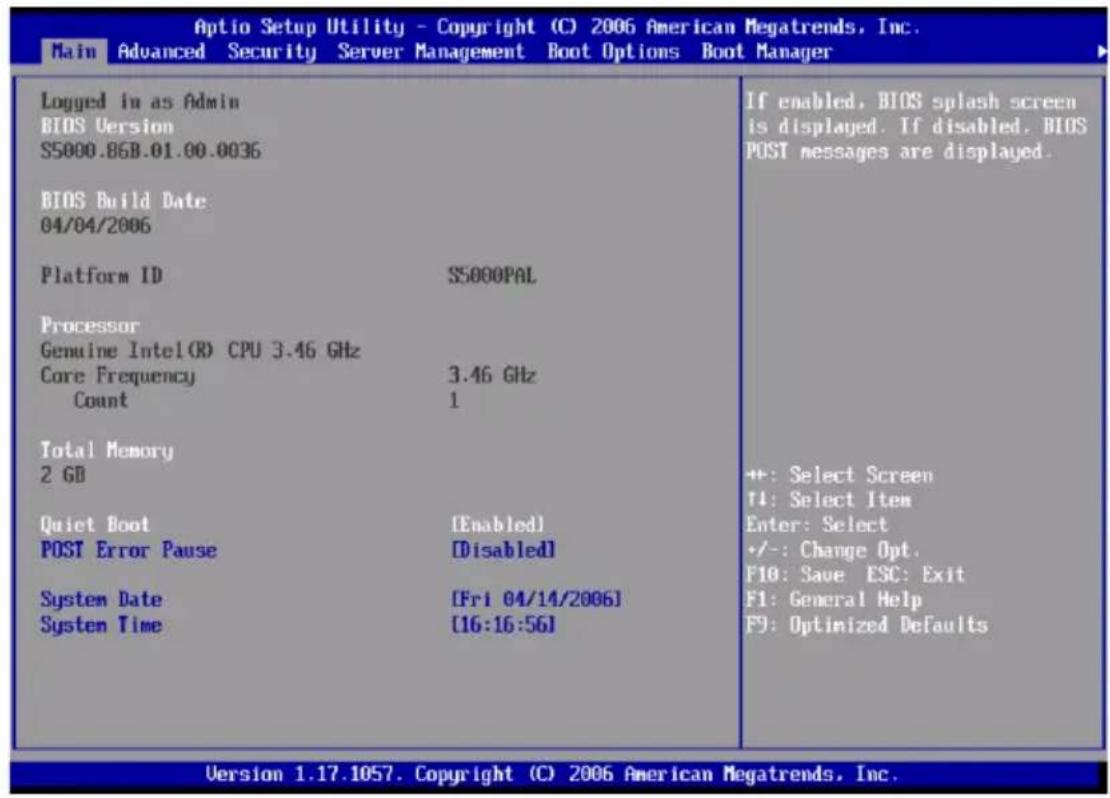
Parameter Description Option
BIOS Version Version of the BIOS.
BIOS Build Date
Date BIOS was created.
Parameter Description Option
| Processor Specification of the processor currently installed in the server. | ||
| Total Memory Indicates the size of the system memory. | ||
| Quiet Boot When Enabled, the BIOS splash screen is displayed during startup.When Disabled, the diagnostic messages are displayed during startup. | EnabledDisabled | |
| POST Error Pause | If Enabled, the system will pause if an error is found during POST. | EnabledDisabled |
| System Date Sets the date following the month-day-year format. Valid values for weekday, month, day, and year are:Month: Jan, Feb, Mar, Apr, May, Jun, Jul, Aug, Sep, Oct, Nov, DecDay: 1 to 31Year: 1998 to 2099 | ||
| System Time Sets the time following the hour-minute-second format. Valid values for hour, minute, and second are:Hour: 00 to 23Minute: 00 to 59Second: 00 to 59 | ||
Advanced
The Advanced menu contains parameter values that define how the system behaves on startup.

Warning! Be cautious in setting parameter values in the Advanced menu as any incorrect value may cause the system to malfunction.
Press Enter to enter the submenu screen of the parameters shown in the screen below.

Processor
The Processor submenu displays CPU settings such as type, actual speed, cache size and other CPU related settings.
| ProcessorCore Frequency 3.46 GHzSystem Bus Frequency 1.06 GHzHyperThreading Technology [Enabled]Enhanced Speedstep Technology [Enabled]Dual Core [Enabled]Virtualization Technology [Disabled]Execute Disable Bit [Enabled]Hardware Prefetcher [Enabled]Adjacent cache line prefetch [Enabled] | Enables or disables Intel® HyperThreading technology on the processor(s). Contact your OS vendor regarding OS support of this feature. | |
| Processor Re-Test [Disabled] | ||
| ► Processor 1 Information► Processor 2 Information | +: Select ScreenT4: Select ItemEnter: Select+/-: Change Opt.F10: Save ESC: ExitF1: General HelpF9: Optimized Defaults | |
Parameter Description Option
| Core Frequency Indicates the processor clock speed. | ||
| System Bus Frequency | Indicates the processor front side bus speed. | |
| Hyper Threading Technology | Enables or disables the Hyper-Threading Technology function of the processor. | EnabledDisabled |
| Enhanced Intel SpeedStep Technology | When set to Auto, this feature allows the OS to reduce power consumption.When set to Disabled, the system operates at maximum CPU speed. | AutoDisabled |
| Dual Core Enables or disables the secondary processor core. | EnabledDisabled | |
Parameter Description Option
| Virtualization Technology | Enables or disables the system to run multiple operating systems and applications in different partition. | Disabled Enabled |
| Execute Disable Bit | When Enabled, the processor disables code execution when a worm attempts to insert a code in the buffer preventing damage and worm propagation.When Disabled, the processor forces the Execute Disable Bit feature flag to always return to 0.Note: This parameter is hidden if the processor does not support this function. | Enabled Disabled |
| Hardware Prefetcher | Enables or disables the speculative prefetch unit within the processor(s).Note: Changing this feature may affect system performance. | Enabled Disabled |
| Adjacent Cache Line Prefetch | When Enabled, cache lines are fetched in pairs (even line + odd line)When Disabled, only current cache line required is fetched.Note: Changing this feature may affect system performance. | Enabled Disabled |
| Processor Re-Test | When Enabled, all processors will be activated and retested on the next boot. This option will be automatically reset to disable on the next boot. | Disabled Enabled |
| Processor # Information | Press Enter to access the Processor # Information submenu. |
Processor # Information
The screen below appears when you select the Processor #1 or 2 Information menu.

Memory
The Memory submenu displays the total amount of memory installed, the number of memory modules installed, and the current memory configuration.

Parameter Description
| Total Memory Indicates the total amount of onboard memory. The memory size is automatically detected by BIOS during the POST. If you install additional memory, the system automatically adjusts this parameter to display the new memory size. | |
| Effective Memory | Indicates the total effective memory installed in the server. |
| Current Configuration | Displays the current memory configuration. |
| Configure Memory RAS and Performance | Press Enter to access the Configure Memory RAS and Performance submenu. |
Parameter Description
DIMM
Indicates the DIMM and DIMM slot status.
information
Configure Memory RAS and Performance
The screen below appears when you select the Configure Memory RAS and Performance menu. This submenu allows you to view memory configuration details and configure the memory modules in the server.
| Optio Setup Utility - Copyright (C) 2006 American Megatrends, Inc. Advanced | ||
| Configure and View Memory BAS | If Auto, for 1066 MHz FSB CPU freq. all DIMMs set to 533. For 1333 MHz FSB CPU freq. all DIMMs set to 667 if all DIMMs 667 capable.If 533 selected, force all DIMMs to 533 regardless of CPU FSB freq.If 667 selected, force all DIMMs to 667 regardless of CPU FSB freq, if all DIMMs 667 capable.+: Select ScreenT4: Select ItemEnter: Select+/-: Change Opt.F10: Save ESC: ExitF1: General HelpF9: Optimized Defaults | |
| Capabilities | ||
| DIMM Data Transfer Rate | [Autol] | |
| Thermal Throttling | [Enabled] | |
| AMB Thermal Sensor | [Enabled] | |
Parameter Description Option
DIMM Data
Transfer Rate
When set to Auto, the data transfer
rate for all DIMMs will be set to 533 (for 1066 MHz FSB CPU frequency) or 667
MHz (for 1333 MHz FSB CPU frequency).
When set to 533, the data transfer rate for all DIMMs will be forced to 533 MHz regardless of FSB frequency.
When set to 667, the data transfer rate for all DIMMs will be forced to 667 MHz regardless of FSB frequency.
Auto
533
667
Parameter Description Option
| Thermal Throttling | Enables or disables thermal throttling. When disabled, the chipset and BIOS will not perform any electrical throttling on overheated DIMMs. | Enabled Disabled |
| AMB Thermal Sensor | Controls the operation of the thermal sensors on the advanced memory buffers. When disabled, thermal throttling option will also be disabled. | Enabled Disabled |
ATA Controller
The ATA Controller submenu lets you define the parameter settings related to the hard disk(s).
![Optio Setup Utility - Copyright (C) 2006 American Megatrends, Inc. Advanced ATA Controller Onboard PATA Controller [Enabled] Onboard SATA Controller [Enabled] SATA Mode [Enhanced] AHCI Mode [Disabled] Configure SATA as RAID [Disabled] Primary IDE Master [Not Installed] Primary IDE Slave DU-20E-N - A…](/content/2026/05/817798/images/8353d60d37daa7088ee33ee4b516548ec6e53ec25772bf9559fc7e8d58bef68f.jpg)
Parameter Description Option
| Onboard PATA Controller | Enables or disables the integrated parallel ATA controller. | EnabledDisabled |
| Parameter Description Option | ||
| Onboard SATA Controller | Enables or disables the integrated Serial ATA controller. | EnabledDisabled |
| SATA Mode When set to Enhanced, it will enable all SATA connectors as individual connectors.When set to Legacy, it will enable primary and secondary channels on SATA connectors. | EnhancedLegacy | |
| AHCI Mode Enables or disables access to all six SATA connectors via the AHCI (Advanced Host Controller Interface) Option ROM. AHCI is an interface specification that allows the storage driver to enable advanced SATA features such as Native Command Queuing and hot plug.Note: Requires an AHCI aware OS. | DisabledEnabled | |
| Configure SATA as RAID | Enables or disables the software RAID technology Option ROM within the ESB2-E controller. | DisabledEnabled |
| Primary IDE Master | Indicates the controller that is set as primary master. | |
| Primary IDE Slave | Indicates the controller that is set as primary slave. | |
| SATA Port 0, 1, 2, 3 | Indicates the SATA HDD connected to the SATA connector. | |
Mass Storage
The Mass Storage submenu displays the status of the mass storage controller.
![Optio Setup Utility - Copyright (C) 2006 American Megatrends, Inc. Advanced Mass Storage SAS Controller [Enabled] SAS Option ROM [Enabled] Configure SAS as SW RAID [Disabled] ROMB Setup Activation Key Enable or Disable SAS Controller +:-: Select Screen +1: Select Item Enter: Select +/-: Change Opt.…](/content/2026/05/817798/images/7b5717c26d2c3f8e2774b6730dd9eb53d8c541a04d4d1991bd1aa935e3e8e5eb.jpg)
| Parameter Description Option | ||
| SAS Controller | Enables or disables the SAS controller. | EnabledDisabled |
| SAS Option ROM | If enabled, initializes the the embedded SAS device Option ROM. | EnabledDisabled |
| Configure SAS as SW RAID | Enables or disables the Embedded Server RAID Technology on the SAS connectors. | DisabledEnabled |
| ROMB setup Indicates if integrated RAID is enabled or not. | ||
| RAID Activation Key | Indicates if the RAID activation key is installed or not. | |
Serial Port
The Serial Port submenu lets you define the parameter settings for the system's serial port.
![Optio Setup Utility - Copyright (C) 2006 American Megatrends, Inc. Advanced Serial Port Serial A Enable [Enabled] Address [3F8] IRQ [4] Enables or disables Serial A port. +: Select Screen T4: Select Item Enter: Select +/-: Change Opt. F10: Save ESC: Exit F1: General Help F9: Optimized Defaults Versi…](/content/2026/05/817798/images/b286ff0a2fcf437216752ba3a3291ac94beb9da8677f79b30ec8289d0013ecc8.jpg)
| Parameter Description Option | |
| Serial A Enable Enables or disables the onboard serial A port. | EnabledDisabled |
| Address Set the base I/O address for the serial B port. | 2F83E82E83F8 |
| IRQ Set the interrupt request line for the serial B port. | 34 |
USB Configuration
The USB Configuration submenu allows you to specify settings for USB devices.
![Optio Setup Utility - Copyright (C) 2006 American Megatrends, Inc. Advanced USB Configuration USB Devices Enabled: 3 Drives. 1 Keyboard. 1 Mouse. 1 Hub USB Controller [Enabled] Legacy USB Support [Enabled] Port 60/64 Emulation [Disabled] USB Mass Storage Device Configuration Device Reset timeout [20…](/content/2026/05/817798/images/41fa3c385c65173468cadb866136f39de62bcd07775ba77feec3bf3a0cda060e.jpg)
Parameter Description Option
| USB Controller Enables or disables the USB controller. | Enabled | |
| If disabled, all the USB controllers will be turned off and inaccessible to the OS. | Disabled | |
| Legacy USB Support | Enables or disables the support for legacy USB devices. | Enabled |
| Disabled | ||
| Port 60/64 Emulation | Enables or disables the I/O port 60/64h emulation support.This parameter is enabled for complete USB keyboard legacy support for non-USB aware OS. | Enabled |
| Disabled | ||
| Device Reset Timeout | Select the number of seconds POST waits for the USB mass storage device after the start unit command. | 20 Sec |
| 10 Sec | ||
| 30 Sec | ||
| 40 Sec | ||
Parameter Description Option
| Storage Emulation | When set to Auto, USB mass storage devices with less than 530 MB will be emulated as a floppy and the remaining as hard drives.The Forced FDD option can be used to force a formatted HDD to boot as a FDD. | AutoFloppyForced FDDCD-ROMHard Disk |
| USB 2.0 Controller Mode | Sets the transfer rate at Hi Speed (480 Mbps) or Full Speed (12 Mbps). | High SpeedLow Speed |
PCI
The PCI submenu lets you specify settings that are related to the onboard controllers. It enables or disables the ROM scan of a device installed in the selected PCI slot. It also enables or disables posting of a 16-bit legacy ROM from the plug-in fiber channel card.
| PCI | This selects the amount of memory that is reserved for PCI address space below 4GB for PCI devices. It should be used if your OS does not support PAE and you want to maximize the memory that your OS can use. For more information refer to technical documentation. | |
| PCI memory napped I/O Space | [2.5GB] | |
| Onboard Video | [Enabled] | |
| Dual Monitor Video | [Disabled] | |
| Onboard NIC ROM | [Enabled] | |
| NIC1 MAC Address | 000E0C4DD096 | |
| NIC2 MAC Address | 000E0C4DD097 | |
| IO Acceleration Technology | [Enabled] | |
| Parameter Description Option | ||
| PCI Memory Mapped IO Space | This selects the amount of memory that is reserved for PCI address space below 4GB for PCI devices. | 2.5 GB3.0 GB3.5 GB |
| Onboard Video Enables or disables the onboard VGA controller. | EnabledDisabled | |
| Dual Monitor Video | Select a graphic controller as a primary boot device.Note: This parameter will be disabled when the Onboard Video is set to Disabled. | DisabledEnabled |
Parameter Description Option
| Onboard NIC ROM | Enables or disables both channels of the embedded LAN.Note: If disabled, NIC1 and NIC2 cannot be used to boot the system. | EnabledDisabled |
| NIC 1 or 2 MAC Address | Indicates the media access control of the system's LAN controller. | |
| I/OAcceleration Technology | Enables or disables the onboard LAN's I/O Acceleration Technology. | EnabledDisabled |
System Acoustic and Performance Configuration
The System Acoustic and Performance Configuration submenu lets you set the system fan performance option.
![Aptio Setup Utility - Copyright (C) 2006 American Megatrends, Inc. Advanced System Acoustic and Performance Configuration Set Fan Profile [Performance] Altitude [301m - 900m] Select the Fan Control Profile that will be used to cool the system. +/-: Change Opt. F10: Save ESC: Exit F1: General Help F9…](/content/2026/05/817798/images/bc51b28fe9c95a7b31c1d6e97ed3925f0d8f78ab83851031cd2e926b5c4b4980.jpg)
Parameter Description Option
| Set Fan Profile | Select the Fan Control Profile that will be used to cool the system. | Performance |
| Altitude When set to less than 300 m(<= 980 ft), it will provide the best performance option for servers operating at or near sea level.When set to 301m - 900m (980 ft - 2950 ft), it will provide the best performance option for servers operating at moderate altitudes above sea level.When set to higher than 900m (>2950 ft), it will provide the best performance option for servers operating at high elevations above sea level. | 301 m - 900 mLess than 300 mHigher than 900 m | |
Security
The Security menu allows you to safeguard and protect the system from unauthorized use by setting up access passwords.
![Aptio Setup Utility - Copyright (C) 2006 American Megatrends, Inc. Main Advanced Security Server Management Boot Options Boot Manager Administrator Password Not Installed User Password Not Installed Admin Password User Password Front Panel Lockout [Disabled] Sets administrative password with maximum…](/content/2026/05/817798/images/0ef37017c76c321ea1a8ca9f78f4fb2cbbcad8c4c6431b5d79f729b45a614c89.jpg)
| Parameter Description Option | ||
| Administrator Password | Prevents unauthorized access to the BIOS setup utility. | Not InstalledInstalled |
| User Password | Secures the system against unauthorized use. Once you set this password, you have to type it whenever you boot the system. User password is available only when an Administrator password is set. | Not InstalledInstalled |
| Administrator Password | Press Enter to change the Administrator password. | |
| User Password | Press Enter to change the User password. | |
Parameter Description Option
| Front Panel Lockout | When Enabled, the front panel power and reset buttons will be locked. The power and reset operation must be controlled via system management interface. | Disabled Enabled |
To set an Administrator/User password
1 Use the up/down keys to highlight a password parameter (Set Administrator Password or Set User Password) then press Enter.
A password box will appear.
2 Type a password then press Enter.
The password may consist of up to seven alphanumeric characters (A-Z, a-z, 0-9).
3 Retype the password to verify the first entry then press Enter again.
After setting the password, the system automatically sets the chosen password parameter to Installed.
To change the Administrator/User password
1 Use the up/down keys to highlight either change password parameters (Change Administrator Password or Change User Password) then press Enter. 2 Type the original password then press Enter. 3 Type a new password then press Enter. 4 Retype the password to verify the first entry then press Enter again.
To remove the User password
1 Use the up/down keys to highlight the Clear User Password parameter then press Enter. 2 Enter the current password then press Enter. 3 Press Enter twice without entering anything in the new and confirm password fields.
After doing this, the system automatically sets the User password parameter to Not Installed.
Server Management
The Server Management submenu lets you specify the appropriate settings for the system's event handling function.
The system event log enables you to record and monitor events that occur in the system (eg., system temperature changes, fan stops, over-temperature, over-voltage, fan failures, etc.).
![Aptio Setup Utility - Copyright (C) 2006 American Megatrends, Inc. Main Advanced Security Server Management Boot Options Boot Manager Assert NMI on SERR [Enabled] Assert NMI on PERR [Enabled] Resume on AC Power Loss [Stay Off] Clear System Event Log [Disabled] FRD-2 Enable [Enabled] O/S Boot Watchdo…](/content/2026/05/817798/images/e11525972f7750c7d63454fa84528123626d168e97b90d36f2ae36ee21bcc0b0.jpg)
Parameter Description Option
| Assert NMI on SERR | Enables or disables the PCI bus SERR (system error) support. | EnabledDisabled |
| Assert NMI on PERR | Enables or disables the PCI bus PERR (parity error) support.Note: This parameter is disabled when the NMI on SERR is disabled. | EnabledDisabled |
| Parameter Description Option | ||
| Resume on AC Power Loss | Defines the mode of operation if a power loss occurs.When set to Stay Off, the system remains off after power shutdown.When set to Last State, the system returns to the state it was prior to the AC power loss.When set to Reset, the system will turn on after power is restored. | Stay OffLast StateReset |
| Clear System Event Log | Deletes all events in the System Event Log. | |
| FRB-2 Enable When Enabled, the BMC (Baseboard Management Controller) will reset the system if BIOS does not complete the POST before the FRB-2 (Fault Resilient Booting) timer expires. | EnabledDisabled | |
| O/S Boot Watchdog Timer | Enables or disables the BIOS timer. It helps to determine if the OS has loaded successfully or followed the OS boot watchdog timer policy.The BIOS timer can only be shut off using the management software after the OS loads. | DisabledEnabled |
| Console Redirection | Press Enter to access the Console Redirection submenu. | |
| System Information | Press Enter to access the System Information submenu. | |
Console Redirection
The Console Redirection submenu lets you enable or disable the console redirection parameters for server management tasks over the serial port.
![Aptio Setup Utility - Copyright (C) 2006 American Megatrends, Inc. Server Management Console Redirection Console Redirection [Disabled] Select the serial port over which console redirection should take place. +/-: Change Opt. F10: Save ESC: Exit F1: General Help F9: Optimized Defaults Version 1.17.1…](/content/2026/05/817798/images/41d1947c3051211ea98c1bdad4483e3268316d30c2144bddb0723b1553f61d21.jpg)
System Information
The System Information submenu displays basic information about the server unit.

Boot Options
The Boot Options menu allows you to set the BEV device priority during system bootup. It also displays information about the installed storage devices.
![Aptio Setup Utility - Copyright (C) 2006 American Megatrends, Inc. Boot Options. BEU Device #1 [IBA GE Slot 0700 v...], BEU Device #2 [IBA GE Slot 0701 v...]. Sets the boot order of Bootstrap Entry Vector Devices. BEU devices are devices which have a bootable Option ROM such as add-in or onboard NIC…](/content/2026/05/817798/images/86baec6ff4cfc1a613553bfd05f4fe48805888071fe0f67b0bef44041437196a.jpg)
Parameter Description Option
BEV Device # Sets the boot order of the Bootstrap
Entry Vector Devices. BEV devices are
devices which have a bootable Option
ROM such as a network card or onboard network controller.
Press Enter to access the BEV Device # submenu.
BEV Device #
The BEV Device # submenu lets you specify the preferred settings for system bootup.
![Aptio Setup Utility - Copyright (C) 2006 American Megatrends, Inc. Main Advanced Security Server Management Boot Options Boot Manager. Boot Timeout 10. Boot Option #1 [Primary Slave CDROM], Boot Option #2 [AMI Virtual F1...], Boot Option #3 [IBA GE Slot 0700 v...], Boot Option #4 [(Bus 04 Dev OE)PCI…](/content/2026/05/817798/images/e5b22c6bc3e7a90bf9b00ae23348b49001b9c53e547c01bd99471ddf3dbac6ee.jpg)
Parameter Description Option
| Boot Timeout Sets the automatic boot time-out value. | 10 | |
| Note: A value of 65535 will disable the timeout completely. | 1 | |
| Boot Option 1 Sets the device from which the system will first attempt to boot up. | ||
| Boot Option 2 Sets the device from which the system will attempt to boot up when the first attempt failed. | ||
| Boot Option 3, 4, or 5 | Sets the device from which the system will attempt to boot up when the first, second, third, and fourth attempts failed. | |
Parameter Description Option
| CD-ROM Order Specifies the boot device priority sequence for available CD drives. | |
| Floppy Order Specifies the boot device priority sequence for available FDD. | |
| BEV Device Order | Specifies the boot device priority sequence for available BEV devices. |
Boot Manager
The Boot Manager menu lets you set the device priority during system bootup. The server will attempt to boot from the first device on the list. If the first device is not available, it will continue down the list until it reaches an available device. Select a boot option, then press Enter.
![Aptio Setup Utility - Copyright (C) 2006 American Megatrends, Inc. Main Advanced Security Server Management Boot Options Boot Manager. Launch EFI Shell, Primary Slave CDROM, AMI Virtual Floppy 1.00, IBA GE Slot 0700 v1236, (Bus 04 Dev 0E)PCI RAID Adapter, [EFI Shell]. Boot system using selected item…](/content/2026/05/817798/images/0920869cca9c8599dbbe81c30a3b3de7ff21c0b81615e87b60fa73f043787ba2.jpg)
Error Manager
The Error Manager menu lets you view the system POST errors detected by the system.

Exit
The Exit menu displays the various options to quit from the BIOS setup. Highlight any of the exit options then press Enter.

Parameter Description
| Save Changes and Exit Saves changes made and close the BIOS setup. | |
| Discard Changes and Exit Discards changes made and close the BIOS setup. | |
| Save Changes Saves changes made in the BIOS setup. | |
| Discard Changes Discards all changes made in the BIOS setup. | |
| Restore Defaults Loads the default settings for all BIOS setup parameters. Setup defaults are quite demanding in terms of resources consumption. If you are using low-speed memory chips or other kinds of low-performance components and you choose to load these settings, the system might not function properly. | |
| Save as User Default Values | Saves current values to be restored later. |
Parameter Description
Restore User Default Values
Restores previously saved user default values.
Upgrading the BIOS
The upgrade utility allows you to upgrade the BIOS in the flash memory. To prepare to upgrade the BIOS, you need to record the current BIOS settings and download the BIOS image file to a temporary folder on your hard drive or a USB flash memory device.
To record the current BIOS settings:
1. Run BIOS setup. See "Entering BIOS setup" on page 100. 2. Write down the current settings in the BIOS setup utility.
To download the BIOS image file:
Download the image file to a temporary folder on your hard drive or a USB flash memory device.

Note: Review the instructions and release notes that are provided in the Readme file distributed with the BIOS image file before attempting a BIOS upgrade. The release notes contain critical information regarding jumper settings, specific fixes, or other information to complete the upgrade.
To upgrade the BIOS:
Follow the instructions in the Readme file that came with the BIOS upgrade. When the update completes, remove the bootable media from which you performed the upgrade.

Note: Do not power down the system during the BIOS update process. The system will reset automatically when the BIOS update process is completed. You may encounter a CMOS checksum error or other problem after reboot. If this happens, shut down the system and boot it again. CMOS checksum errors require that you enter Setup, check your settings, save your settings, and exit Setup.
5 Troubleshooting
This chapter provides possible solutions for specific problems. If you cannot correct the problem, contact your local Acer representative or authorized dealer for assistance.
Troubleshooting
This chapter helps you identify and solve problems that might occur while you are using the system.
For any issue, first ensure that you are using the latest firmware and files. Firmware upgrades include updates for BIOS, the BMC, and the hot-swap controller. In addition to the server firmware and files, make sure to update any drivers used for components you have installed in your system, such as video drivers, network drivers and SAS drivers.
If you are unable to resolve your server problems on your own, contact your dealer or local Acer representative for assistance.
Resetting the system
Before going through in-depth troubleshooting, attempt first to reset the system using one of the methods below.
To do this, press
| Soft boot reset to clear the system memory and reload the operating system. | Ctrl+Alt+Del |
| Clear system memory, restart POST, and reload the OS. Reset button | |
| Cold boot reset. Turn the system power off and then on.This clears system memory, restarts POST, reloads the OS and halts power to all peripherals. | Power button |
Problems following initial system installation
Problems that occur at initial system startup are usually caused by an incorrect installation or configuration. Hardware failure is a less frequent cause. If the problem you are experiencing is with a specific software application, see "There is problem with the application software" on page 143.
First steps checklist
- Is AC power available at the wall outlet?
- Are the power supplies plugged in? Check the AC cable(s) on the back of the chassis and at the AC source.
- Are all cables correctly connected and secured?
- Is the processor fully seated in the socket on the mainboard?
- Are all standoffs in the proper location and not touching any components, causing a potential short?
- Are all expansion boards fully seated in their slots on the PCI riser assembly?
- Are all jumper settings on the mainboard correct?
- Are all jumper and switch settings on expansion boards and peripheral devices correct? If applicable, ensure that there are no conflicts - for example, two expansion boards sharing the same interrupt.
- Are all peripheral devices installed correctly?
- Are all device drivers properly installed?
- Are the configuration settings made in the BIOS setup correct?
- Is the operating system properly loaded? Refer to the operating system documentation.
- Did you press the system power button on the front panel to turn the server on (power indicator should be lit)?
- Is the system power cord properly connected to the system and plugged into an outlet for 100-127 V or 200-240 V?
- Are all integrated components from the tested components lists? Check the tested memory, and chassis lists, as well as the supported hardware and operating system list.
Hardware diagnostic testing
This section provides a more detailed approach to identifying a hardware problem and locating its source.

Caution! Before disconnecting any peripheral cables from the system, turn off the system and any external peripheral devices. Failure to do so can cause permanent damage to the system and/or the peripheral device.
1. Turn off the system and all external peripheral devices. Disconnect each device from the system, except for the keyboard and the video monitor. 2. Make sure the system power cord is plugged into a properly grounded AC outlet. 3. Make sure your video display monitor and keyboard are correctly connected to the system. Turn on the video monitor. Set its brightness and contrast controls to at least two thirds of their maximum ranges (see the documentation supplied with your video display monitor). 4. If the operating system normally loads from the hard disk drive, make sure there is no diskette in the FDD or disc in the optical drive. 5. If the power indicator does light, attempt to boot from a diskette or disc. 6. Turn on the system. If the power indicator does not light, see "Power indicator does not light" on page 138.
Verifying proper operation of key system lights
As POST determines the system configuration, it tests for the presence of each mass storage device installed in the system. As each device is checked, its activity light should turn on briefly. Check if the HDD activity indicator lights briefly. If not, see "HDD activity indicator does not light" on page 139.
Confirming loading of the OS
Once the system boots up, the operating system prompt appears on the screen. The prompt varies according to the operating system. If the operating system prompt does not appear, see "No Characters Appear on Screen" on page 143.
Specific problems and corrective actions
The following contains specific problems that may arise during the use of your server. Possible solutions are listed for each problem.
Power indicator does not light.
Do the following:
- Make sure the power button on the control panel is turned on.
- Make sure the power cord is connected correctly.
- Make sure that the wall outlet has power. Test it by plugging another device.
- Remove all expansion cards and see if the system boots. If successful, add the cards back in one at a time with a reboot between each addition.
- Make sure the memory modules comply with the system requirements.
- Make sure the memory modules have been populated according to the system requirements.
- Remove and reseat the memory modules.
- Make sure the CPU comply with the system requirements.
- Make sure the CPU is populated according to the system requirements.
- Remove and reseat the CPU.
- Make sure the chassis standoffs are installed only below mounting holes. Misplaced standoffs may have contact to the pins on the bottom of the mainboard and cause a short.
Server boot does not complete POST
Do the following:
- Make sure the CPU is properly seated.
- Check the BIOS release notes to ensure the BIOS installed on the platform supports the stepping and the family of processors currently installed.
Server does not recognize all of the processors installed
Do the following:
- Make sure the CPU is properly seated.
- Make sure the CPU complies with the system requirements.
- Make sure the CPU is populated according to the system requirements.
- Remove and reseat the CPU.
FDD activity indicator does not light.
Do the following:
- Make sure the FDD and interposer board are properly connected.
- Check that relevant switches and jumpers for the FDD are set correctly.
- Check that the FDD is properly configured.
HDD activity indicator does not light.
Do the following:
- Make sure the drive is not disabled in the BIOS setup utility.
- Make sure the drive is compatible.
- Make sure you have not exceeded the power budget for the server.
If you have installed one or more hard drives in the system, do the following:
- Make sure the power and signal cables are connected correctly.
- If using a sixth HDD, make sure the sixth HDD board is properly installed to the backplane board and HDD is plugged into connectors on the sixth HDD board. Check that the relevant switches and jumpers on the hard drive are set correctly. Refer to drive documentation for more information.
ODD (optical disk drive) activity indicator does not light.
Do the following:
- Make sure the ODD and interposer board are properly connected.
- Check that relevant switches and jumpers on the drive are set correctly.
- Check that drive is properly configured.
- Check that onboard IDE controller is enabled in the BIOS setup.
ODD tray cannot be ejected.
- Insert the tip of a paperclip into the small hole on the ODD drive. Slowly pull the tray out from the drive until the tray is fully extended then remove the disc.
ODD drive cannot read a disc.
Do the following:
- Make sure you are using the correct type of disc.
- Make sure the disc is properly seated in the drive.
- Make sure the disc is unscratched.
- Make sure ODD and interposer board are properly connected.
Hard drives are not recognized.
Do the following:
- Make sure the disk controller is not disabled in the BIOS setup.
- Make sure the drive is compatible.
Bootable CD drive is not detected.
Make sure the Boot Options setting in the BIOS setup utility is configured to allow the CD drive to be the first bootable device.
New memory modules installed are not detected.
Do the following:
- Make sure the memory modules are properly seated on the DIMM slots.
- Make sure the memory modules comply with the system requirements.
- Make sure the memory modules have been populated according to the system requirements.
External device connected to a USB connector does not work.
Do the following:
- Reduce the number of external devices connected to a USB hub.
- Refer to the documentation that came with the device.
Server cannot connect to a network
- Make sure the network cable is securely attached to the correct connector at the system rear panel.
- Try a different network cable.
- Make sure you are using the correct and the current drivers.
- Make sure the driver is loaded and the protocols are bound.
Problems with the network
Network status indicator does not light.
Do the following:
- Check the cabling and network equipment to make sure that all cables are properly connected.
- Reinstall the network drivers.
- Try another port or hub on the switch.
Diagnostics pass but the connection fails.
Make sure the network cable is securely attached.
The controller stopped working when an adapter was installed.
- Make sure the cable is connected to the port from the onboard network controller.
- Make sure the other adapter supports shared interrupts and your OS supports shared interrupts.
- Try reseating the adapter.
The adapter stopped working without apparent cause.
- Try reseating the adapter first, then try a different slot if necessary.
- The network files driver may be corrupt or deleted. Delete and reinstall the drivers.
- Run the diagnostics.
Network activity indicator does not light.
Do the following:
- Make sure the correct network drivers are loaded on the system.
• Network might be idle. Try accessing the server.
Server hangs when the drivers are loaded.
Change the PCI interrupt settings.
There is a problem with the application software.
Do the following:
- Verify that the software is properly configured for the system. Refer to the software installation and operation documentation for instructions on setting up and using the software.
- Try a different version of the software to see if the problem is with the copy you are using.
- Make sure all cables are properly connected.
- If other software runs correctly on the system, contact your vendor about the defective software.
No characters appear on the screen.
Check the following:
- Is the keyboard functioning? Test it by turning the "Num Lock" function on and off to make sure the Num Lock light is functioning.
- Is the video monitor plugged in and turned on? If you are using a switch box, is it switched to the correct system?
- Are the brightness and contrast controls on the video monitor properly adjusted?
- Is the video monitor signal cable properly installed?
- Does this video monitor work correctly if plugged into a different system?
- Is the onboard video controller enabled in the BIOS setup?
- Remove all expansion cards and see if the system boots. If successful, add the cards back in one at a time with a reboot between each addition.
- Make sure the memory modules comply with the system requirements.
- Make sure the memory modules have been populated according to the system requirements.
- Remove and reseat the memory modules.
- Make sure the CPU complies with the system requirements.
- Make sure the CPU is populated according to the system requirements.
If you are using a video controller board, do the following:
1. Verify that the video works using the onboard video controller.
2. Verify that the video controller board is fully seated in the mainboard connector.
3. Reboot the system for changes to take effect.
4. If there are still no characters on the screen after you reboot the system and POST emits a beep code, write down the beep code you hear. This information is useful for your service representative.
5. If you do not receive a beep code and characters do not appear, the video display monitor or video controller may have failed. Contact your service representative or authorized dealer for help.
Characters are distorted or incorrect.
Check the following:
- Are the brightness and contrast controls properly adjusted on the video monitor? Refer to the documentation that came with the video monitor.
- Are the video monitor's signal and power cords properly connected?
- Is the video monitor working correctly when plugged into a different system?
System cooling fan does not rotate properly.
If the system cooling fan is not operating properly, it is an indication of possible system component failure.
Check the following:
- Is the power indicator lit? If not, see "Power indicator does not light." on page 138.
- Have any of the fan motors stopped? Use the server management subsystem to check the fan status.
- Have your fans speeded up in response to an overheating situation?
- Have your fans speeded up in response to a fan that has failed?
Error beep codes
BIOS POST error beep codes
The following table lists the POST error beep codes. Prior to system video initialization, BIOS uses these beep codes to inform you of error conditions. The beep code occurs only when a critical error occurs or when the BIOS fails to boot to the operating system. Not all error conditions are supported by the BIOS beep codes.
| Number of Beeps | Description |
| 1, 2, or 3 Memory error | |
| 4 – 7 or 9 – 11 | Fatal error indicating a possible serious system problem |
| 8 Video error | |
Troubleshooting BIOS POST error beep codes
The following table lists the possible beep codes that may occur while using the system and is followed by solutions to the situation.
Number of beeps Troubleshooting action
1, 2, or 3 • Make sure the memory modules are properly seated on the DIMM slots.
- Make sure the memory modules comply with the system requirements.
- Make sure the memory modules have been populated according to the system requirements.
4-7, 9-11 • Indicates a fatal error. Consult your dealer or local Acer representative for assistance.
- If beep codes are generated even when all PCI cards are absent, consult your system manufacturer's technical support.
- Check for a malfunctioning expansion card. If beep codes are not generated when all expansion cards are absent, one of the expansion cards is causing the malfunction. Insert the cards back into the system, booting the system between each card addition, until the beeps occur again to reveal the malfunctioning card.
8 • Make sure the video adapter is properly seated on the expansion slot.
- If the video adapter is an integrated part of the mainboard, the board may be faulty.
ARMC/3 module error beep codes
In addition to the beep codes above, additional beep codes are provided if an ARMC/3 module is installed. The management modules provide the following additional beep codes.
Beep Code
Reason for the beeps and action to take
1 Control panel CMOS clear has been initiated.
1-5-1-1 Processor failure. Reseat or replace the failed processor.
1-5-2-1 No processor is installed or the CPU 1 socket is empty. Reseat or replace the failed processor.
1-5-2-3 Processor configuration error or CPU 1 socket is empty. Reseat or replace the failed processor. In a two-processor system, make sure the processors are identical.
1-5-2-4 Front side bus selects configuration error
1-5-4-2 AC power unexpectedly lost
1-5-4-3 Chipset control failure
1-5-4-4 Power control failure
Diagnostic POST code LEDs
During the system boot process, BIOS executes a number of platform configuration processes, each of which is assigned a specific hex code number. As each configuration routine is started, BIOS will display the given POST code to the diagnostic POST code LEDs found on the rear of the mainboard. To assist in troubleshooting a system hang during the POST process, the diagnostic LEDs can be used to identify the last POST process to be executed.
Each POST code will be represented by a combination of colors from the four LEDs. The LEDs are capable of displaying three colors: green, red, and amber. Each bit in the upper nibble is represented by a red LED and each bit in the lower nibble is represented by a green LED. If both bits are set in the upper and lower nibbles then both red and green LEDs are lit, resulting in an amber color. If both bits are clear, then the LED is off.
Diagnostic LED placement diagram![graph LR A["Back edge of server board"] --> B["USB Port"] A --> C["USB Port"] B --> D["Diagnostic LEDs"] C --> D D --> E["LSB MSB"] D --> F["Terminal"]](/content/2026/05/817798/images/64d0b847cd962557a6c88074e0f6681c1b58157a3b55da1f0faab8535373bf2f.jpg)
The following table lists the possible POST codes that may be displayed on the Diagnostic POST code LEDs during system initialization.
| Checkpoint code | Diagnostic LED DecoderG=Green, R=Red, A=AmberMSB LSB | Description |
| Host Processor | ||
| 0x10h OFF OFF OFF R Power-on initialization of the host processor (bootstrap processor) | ||
| 0x11h OFF OFF OFF A Host processor cache initialization(including AP) | ||
| 0x12h OFF OFF G R Starting application processorinitialization | ||
| 0x13h OFF OFF G A SMM initialization | ||
| Chipset | ||
| 0x21h OFF OFF R G Initializing a chipset component | ||
| Memory | ||
| 0x22h OFF OFF A OFF Reading configuration data frommemory (SPD on DIMM) | ||
| 0x23h OFF OFF A G Detecting presence of memory | ||
| 0x24h OFF G R OFF Programming timing parameters inthe memory controller | ||
| 0x25h OFF G R G Configuring memory parameters inthe memory controller | ||
| 0x26h OFF G A OFF Optimizing memory controllersettings | ||
| 0x27h OFF G A G Initializing memory, such as ECC init | ||
| 0x28h G OFF R OFF Testing memory | ||
| PCI Bus | ||
| 0x50h OFF R OFF R Enumerating PCI busses | ||
| 0x51h OFF R OFF A Allocating resources to PCI busses | ||
| 0x52h OFF R G R Hot Plug PCI controllerinitialization | ||
| 0x53h OFF R G A Reserved for PCI bus | ||
| 0x54h OFF A OFF R Reserved for PCI bus | ||
| 0x55h OFF A OFF A Reserved for PCI bus | ||
| 0x56h OFF A G R Reserved for PCI bus | ||
| 0x57h OFF A G A Reserved for PCI bus | ||
| USB | ||
| 0x58h G R OFF R Resetting USB bus | ||
| 0x59h G R OFF A Reserved for USB devices | ||
| Checkpoint code | Diagnostic LED Decoder | |
| G=Green, R=Red, A=Amber | Description | |
| MSB LSB | ||
ATA / ATAPI / SATA
| 0x5Ah G R G R Resetting PATA / SATA bus and all devices |
| 0x5Bh G R G A Reserved for ATA |
SMBUS
| 0x5Ch G A OFF R Resetting SMBUS |
| 0x5Dh G A OFF A Reserved for SMBUS |
Local Console
| 0 | x | 7 | 0 | h | O | F | F | R | R | R | R |
| 0x71h OFF R R A Disabling the video controller |
| 0x72h OFF R A R Enabling the video controller |
Remote Console
| 0 | x | 7 | 8 | h | G | R | R | R | R | e | s |
| 0x79h G R R A Disabling the console controller |
| 0x7Ah G R A R Enabling the console controller |
Keyboard (PS/2 or USB)
| 0x90h R OFF OFF R Resetting the keyboard |
| 0x91h R OFF OFF A Disabling the keyboard |
| 0x92h R OFF G R Detecting the presence of the keyboard |
| 0x93h R OFF G A Enabling the keyboard |
| 0x94h R G OFF R Clearing keyboard input buffer |
| 0x95h R G OFF A Instructing keyboard controller torun Self Test (PS/2 only) |
Mouse (PS/2 or USB)
| 0x98h A OFF OFF R Resetting the mouse |
| 0x99h A OFF OFF A Detecting the mouse |
| 0x9Ah A OFF G R Detecting the presence of mouse |
| Checkpoint code | Diagnostic LED DecoderG=Green, R=Red, A=AmberMSB LSB | Description |
| 0x9Bh A OFF G A Enabling the mouse | ||
| Fixed Media | ||
| 0xB0h R OFF R R Resetting fixed media device | ||
| 0xB1h R OFF R A Disabling fixed media device | ||
| 0xB2h R OFF A R Detecting presence of a fixedmedia device (IDE hard drivedetection, etc.) | ||
| 0xB3h R OFF A A Enabling / configuring a fixedmedia device | ||
| Removable Media | ||
| 0xB8h A OFF R R Resetting removable media device | ||
| 0xB9h A OFF R A Disabling removable media device | ||
| 0xBAh A OFF A R Detecting presence of a removablemedia device (IDE CDROMdetection, etc.) | ||
| 0xBCh A G R R Enabling/configuring a removablemedia device | ||
| Boot Device Selection | ||
| 0xD0 R R OFF R Trying boot device selection | ||
| 0xD1 R R OFF A Trying boot device selection | ||
| 0xD2 R R G R Trying boot device selection | ||
| 0xD3 R R G A Trying boot device selection | ||
| 0xD4 R A OFF R Trying boot device selection | ||
| 0xD5 R A OFF A Trying boot device selection | ||
| 0xD6 R A G R Trying boot device selection | ||
| 0xD7 R A G A Trying boot device selection | ||
| 0xD8 A R OFF R Trying boot device selection | ||
| 0xD9 A R OFF A Trying boot device selection | ||
| 0XDA A R G R Trying boot device selection | ||
| Checkpoint code | Diagnostic LED Decoder | |||||||||
| G=Green, R=Red, A=Amber | Description | |||||||||
| MSB | LSB | |||||||||
| 0xDB A R G A Trying boot device selection | ||||||||||
| 0xDC A A OFF R Trying boot device selection | ||||||||||
| 0 | x | D | E | A | A | G | R | T | r | y |
| 0 | x | D | F | A | A | G | A | T | r | y |
| Pre-EFI Initialization (PEI) Core | ||||||||||
| 0 | x | E | 0 | h | R | R | R | O | F | F |
| initialization modules (PEIM) | ||||||||||
| 0xE2h R R A OFF Initial memory found, configured,and installed correctly | ||||||||||
| 0 | x | E | 1 | h | R | R | R | G | R | e |
| use (PEIM) | ||||||||||
| 0xE3h R R A G Reserved for initialization moduleuse (PEIM) | ||||||||||
| Driver Execution Environment (DXE) Core | ||||||||||
| 0xE4h R A R OFF Entered EFI driver execution phase(DXE) | ||||||||||
| 0xE5h R A R G Started dispatching drivers | ||||||||||
| 0xE6h R A A OFF Started connecting drivers | ||||||||||
| DXE Drivers | ||||||||||
| 0 | x | E | 7 | h | R | A | A | G | W | a |
| 0xE8h A R R OFF Checking password | ||||||||||
| 0xE9h A R R G Entering BIOS setup | ||||||||||
| 0xEAh | A R A OFF Flash update | |||||||||
| 0 | x | E | E | h | A | A | A | O | F | F |
| silent boot is enabled. | ||||||||||
| 0 | x | E | F | h | A | A | A | G | U | n |
| resume failure | ||||||||||
| Runtime Phase/EFI Operating System Boot | ||||||||||
| 0xF4h | R A R R Entering Sleep state | |||||||||
| 0xF5h | R A R A Exiting Sleep state | |||||||||
| Checkpoint code | Diagnostic LED DecoderG=Green, R=Red, A=AmberMSB LSB | Description |
| 0xF8h A R R R Operating system has requested EFI to close boot services (Exit Boot Services has been called) | ||
| 0xF9h A R R A Operating system has switched to virtual address mode (Set Virtual Address Map has been called) | ||
| 0xFAh A R A R Operating system has requested the system to reset (Reset System has been called) | ||
| Pre-EFI Initialization Module (PEIM)/Recovery | ||
| 0x30h OFF OFF R R Crisis recovery has been initiated because of a user request | ||
| 0x31h OFF OFF R A Crisis recovery has been initiated by software (corrupt flash) | ||
| 0x34h OFF G R R Loading crisis recovery capsule | ||
| 0x35h OFF G R A Handing off control to the crisis recovery capsule | ||
| 0x3Fh G G A A Unable to complete crisis recovery. | ||
Appendix A: Acer Altos R720 rack installation guide
This appendix shows you how to set up the Altos R720 server in a rack mount configuration.
Setting up the system rack

Important! Observe the electrostatic discharge (ESD) precautions indicated on page 35 when performing the following procedures. Do not attempt the procedures described in the following sections unless you are a qualified technician.
Equipment rack precautions
Follow the rack manufacturer's safety and installation instructions for proper rack installation.
The following additional rack safety installation measures should be considered:
- Anchor the equipment rack
The equipment rack must be anchored to an unmovable suitable support to prevent the rack from falling over when one or more systems are fully extended out of the rack assembly. You must also consider the weight of any other devices installed in the rack assembly. The equipment rack must be installed according to the manufacturer's instructions.
- Main AC power disconnect
You are responsible for installing an AC power disconnect for the entire rack unit. This main disconnect must be readily accessible, and it must be labeled as controlling power to the entire unit, not just to the system(s).
- Earth ground the rack installation
To avoid the potential for an electrical shock hazard, the rack assembly itself must be suitably earth grounded, according to your local regional electrical codes. This typically will require the rack to have its own separate earth ground. We recommend you consult your local approved electrician.
• Elevated operating ambient temperature
The maximum operating temperature of the system is 35 °C (95 °F). Careful consideration should be given to installing the system in an environment compatible with the 35 °C (95 °F) maximum ambient temperature.
- Reduced airflow
The amount of airflow required for the safe operation of the equipment should not be compromised when installing the system in a rack.
- Mechanical loading
Exercise care when mounting the system in a rack to avoid any accidents.
- Circuit overloading
Appropriate consideration should be given when connecting the supply circuit to the system to avoid any circuit overload. The system name plate rating should be used when addressing concerns about circuit overload.
System rack installation
The Altos R720 server system should be mounted into a rack. A tool-less rack rail and CMA (cable management arm) kit is available for installing system to a rack cabinet.
The figure below shows the Altos R720 server in a rack-mount position.

Vertical mounting hole pattern
The four vertical rails of the system rack contain mounting holes arranged in a manner shown in the figure below:

The system occupies 2U in the rack. Count the U positions and hole numbers from the bottom up.
The distance from the center of two holes with closer spacing to the center of the next pair is equivalent to 1U.

Note: The unit of measurement used in this guide is "U" (1U = 1.75 inches or 44.45 mm). The total sum of the heights of all components in the rack measured in "U" cannot exceed the height of the rack. For more information, refer to the documentation that came with the system rack.
When installing components, you must start your measurement from the center of the two holes with closer spacing. Otherwise, the screw holes on the component may not match those on the rack.
Installing the system into the rack

Caution! To minimize the chances of injuries, make sure that two or more people help in installing the server.
To install the system into a four-post rack
1 Remove the inner rails from the mounting rails.
(1) Extend the inner rail from the mounting rail until the rail release latch clicks. (2) Depress the release latch (A) and slip the inner rail out (B).

(3) Do the same thing to the other mounting rail.

Caution! To avoid personal injury, care should be taken when pressing the inner rail release latches and sliding the component into the rack.
2 Attach the inner rails to both sides of the server.
Align the screw holes of the inner rail to the server screws (A), then slide rails to the left until the rails lock into place with an audible click (B).

3 Install the mounting rails to the rack posts.
(1) Determine the vertical position in the rack. Refer to "Vertical mounting hole pattern" on page 160 for more information. (2) Align and insert the mounting rails into the rack posts' mounting holes (A). (3) Make certain the proper mounting holes on rack post are selected. (4) Use two metal screws supplied with the kit to secure the front and rear mounting rail to the rack (B). (5) Do the same thing to the other mounting rail.

(6) Fully extend the mounting rails on the rack.

4 Install the server into the rack.

Caution! To avoid personal injury, care should be taken when pressing the inner rail release latches and sliding the component into the rack.
(1) Carefully align the inner rails attached to the server with the fully extended mounting rails on the rack. (2) Press the release latch on both sides of the server (A). (3) Insert the inner rails into the mounting rails, then push the server into the rack until you hear a click sound (B). (4) Secure the server to the rack using two metal screws (C).

5 Attach the CMA (cable management arm) to the rear of the server.
The CMA allows you to tie-wrap all cables to and from the system. As you slide the system in and out of the rack, the CMA collapses and extends, keeping the cables untangled and attached to the system.
(1) Insert the smaller CMA extension into the rear of the left inner rail (A1). (2) Insert the larger CMA extension into the rear of left mounting rail (A2). (3) Insert the CMA extension connector into the rear of the right mounting rail (B1). (4) Insert the CMA arm connector into the blue plastic cutout on the CMA extension connector (B2). (5) Attach the cable clips into the appropriate mounting holes in the CMA (C).

(6) Connect the power, peripheral and networking cables into their appropriate ports. Refer to "Connecting peripherals" on page 28 for detailed instructions.
(7) Route all cables through the cable clips.

Appendix B: SAS hardware RAID configuration
This appendix shows you how to create a RAID volume with integrated SAS hardware RAID.
Configuring the integrated SAS hardware RAID
This section briefly shows how to create RAID with integrated SAS hardware RAID.
Starting integrated SAS hardware RAID configuration utility
To start Integrated SAS hardware RAID Configuration Utility, press CTRL+G when you see the RAID BIOS during POST. After POST finished, the Adapter Selection page will show on the screen. Click Start to launch the configuration menu.
Loading factory default setting
1 In the Configuration menu, select Adapter Properties. The current adapter settings appear. 2 Change the setting of Set Factory Defaults from No to Yes, then click Submit. 3 Press to reboot the server.
Creating and Initializing a RAID Volume
1 Launch the Configuration menu.
2 Select Configuration Wizard.
3 Select Add Configuration (default) and click Next.
4 Select Custom Configuration (default) and click Next.
5 Select the drives that you want to add into the array using the key.
6 After you select the drives, click Accept Array then Next.
7 Select the RAID level you want to use, create the logical volume by specifying the size at Select Size and click Accept to create the logical volume.
8 After you create the logical volumes on all of the RAID volume, click Accept and Yes to save the configuration.
9 Click Yes to initialize the new logical drives. The logical drives will be listed. 10 Click Home to go back to the configuration menu. 11 Now you can reboot the system and install the Operating System. Select Exit and click Yes. 12 Press to reboot the system.
Assigning a hot spare disk
1 Launch the Configuration menu. 2 Select a free disk marked as Ready and listed under Physical Drives. 3 Select Make Hotspare and click Go. 4 Click Home to return to the Configuration menu. The disk will be marked as Hotspare in pink and listed under Physical Drives.
Index
A
air baffles
installing 45
removing 45
ARMC/3 module
installing 85
removing 84
B
BIOS menus
Advanced 104
ATA Controller 110
Mass Storage 112
Memory 108
Configure Memory RAS
and Perfor-
mance 109
PCI 116
Processor 105
Processor Information
107
Serial Port 113
System Acoustic and Performance Configuration
118
USB Configuration 114
Boot Manager 128
Boot Options 125
BEV Device # 126
Devices
LAN 118
Error Manager 129
Exit 130
Main 102
Security 119
changing password 120
removing password 120
Supervisor password 119
User password 119
Server Management 121
Console Redirection 123
System Information 124
BIOS setup 99
entering 100
C
configuring the system OS 31
CPU
installing 75
removing 74
CPU air dam
removing 44
CPU air duct
installing 43
removing 42, 43
D
DIMM module
installation guidelines 77
DIMMs
installing 78
removing 79
F
FDD in converted HDD bay
installing 56
removing 59
front bezel 7
installing 38
removing 38
front panel 7, 8
control buttons 9
LED indicators 10
front panel control button
function 9
H
hardware RAID components 91
HDD
installing 49
removing 48
hot-plug
power supply 81
|
installing
ARMC/3 module 85
CPU 75
CPU air duct 43
DIMMs 78
FDD in converted HDD bay 56
front bezel 39
HDD 49
interposer board 53
large air baffle 47
NIC module 86
optical drive 53
PCI card 70
PCI riser assembly 67
PCI riser board 68
power supply
RAID activation key 92
RAID BBU 95
SAS mid-plane board 88
SAS/SATA backplane board 90
sixth HDD 62
slim-line FDD 56
small air baffle 46
tape drive 60
top cover 41
internal components 16
interposer board
installing 53
removing 52
L
large air baffle installing 47 removing 46
M
memory 81 reconfiguring 80
N
NIC module installing 86 removing 84
0
opening the system 37 installing the front bezel 39 installing the top cover 41 removing the front bezel 38 removing the top cover 40
optical drive installing 53 removing 51
P
PCI card installing 70 removing 69
PCI riser assembly installing 67 removing 65
PCI riser board installing 68 removing 68
peripherals 28 power cord 29
power supply installing 82 removing 83
processor upgrade guidelines 74
R
rack installing 161 rack installation 155 mounting pattern 160 precautions 157
RAID activation key installing 92 removing 91
RAID BBU installing 95 removing 94
RAID cache removing 92 RAID configuration 169
SAS hardware RAID utility assign hot spare 172 create RAID Volume 171 using SAS hardware RAID utility 171
rear panel 13 LED indicators 14
removing ARMC/3 module 84 CPU 74 CPU air dam 44 CPU air duct 42 DIMMs 79 FDD in converted HDD bay 59 front bezel 38 HDD 48 interposer board 52 large air baffle 46 NIC module 84 optical drive 51 PCI card 69 PCI riser assembly 65 PCI riser board 68 power supply 83 RAID activation key 91 RAID BBU 94 RAID cache 92 SAS mid-plane board 87 SAS/SATA backplane board 89 slim-line FDD 59 small air baffle 45 top cover 40 replacing system fan 72
S
SAS mid-plane board installing 88 removing 87 SAS/SATA backplane board installing 90 removing 89 setting up the system 27 preinstallation requirements 27
sixth HDD installing 62
slim-line FDD installing 56 removing 59
small air baffle installing 46 removing 45
specification BMC 5 chipset 3 graphic interface 5 I/O ports 5 media storage 3 memory subsystem 3 networking 4
os 6
PCI I/O 4
power supply 5
processor 3
SAS mid-plane board 4
serial ATA port 4
system fan 5
system boards 17
backplane 19
SAS backplane board 19
mainboard 17
mid-plane board
SAS mid-plane board 21
system diagnostic LEDs 22
system fan
replacing 72
system features 3
system jumpers 23
system memory
reconfiguring 80
system tour 1
system upgrade 33
ESD precautions 35
installation precautions 35
post-installation instructions 36
preinstallation instructions 35
T
tape drive
installing 60
top cover
installing 41
removing 41
troubleshooting 133
confirming loading of the OS 138
hardware diagnostic testing 137
POST error codes 147
problems 138
adapter stopped working 142
cannot connect to a network 141
cannot detect bootable drive 141
cannot detect memory 141
cannot eject DVD/CD tray 140
cannot read DVD/CD 140
controller stopped working 142
DVD/CD drive no light 140
HDD LED no light 139
HDD not recognized 141
initial system installation 135
LAN LED no light 142
network connection fails 142
no characters on screen 143
no video 142
power indicator no light 138
Processors not recognized 139
server boot does not complete POST 139
system fans do not rotate 144
resetting the system 135
verifying key system lights 137
turning off the system 32
Turning on the system 29
Power-on problems 30
U
Upgrading the BIOS 132


- ACER ALTOS R720 SERIES
- USER'S GUIDE
- NOTICES
- FCC NOTICE
- CLASS A EQUIPMENT
- NOTICE: SHIELDED CABLES
- NOTICE: PERIPHERAL DEVICES
- USE CONDITIONS
- NOTICE CANADIAN USERS
- LASER COMPLIANCE STATEMENT
- IMPORTANT SAFETY INSTRUCTIONS
- SYSTEM TOUR
- SYSTEM SETUP
- SYSTEM UPGRADE
- FEATURES SUMMARY
- PROCESSOR
- CHIPSET
- MEMORY
- MEDIA STORAGE
- INCH HALF-HEIGHT TAPE DRIVE
- SAS CONTROLLER
- NETWORKING
- PCI I/O
- GRAPHIC INTERFACE
- BASEBOARD MANAGEMENT CONTROLLER
- POWER SUPPLY
- SYSTEM FAN
- I/O PORTS
- OPERATING SYSTEM AND UTILITIES
- EXTERNAL AND INTERNAL STRUCTURE
- FRONT BEZEL
- FRONT PANEL
- FRONT PANEL CONTROL BUTTON FUNCTIONS
- FRONT PANEL LED INDICATORS
- REAR PANEL
- REAR PANEL LED INDICATORS
- INTERNAL COMPONENTS
- ITEM COMPONENT ITEM COMPONENT
- SYSTEM BOARDS
- MAINBOARD
- ITEM DESCRIPTION ITEM DESCRIPTION
- BACKPLANE AND MID-PLANE BOARD
- SAS/SATA BACKPLANE BOARD
- SYSTEM DIAGNOSTIC LEDS
- SYSTEM JUMPERS
- SETTING UP THE SYSTEM
- PRE-INSTALLATION REQUIREMENTS
- SELECTING A SITE
- CHECKING THE PACKAGE CONTENTS
- CONNECTING PERIPHERALS
- TURNING ON THE SYSTEM
- POWER-ON PROBLEMS
- WARNING! MAKE SURE ALL POWER CORDS ARE DISCONNECTED FROM THE ELECTRICAL OUTLET BEFORE PERFORMING THIS TASK
- CONFIGURING THE SYSTEM OS
- TURNING OFF THE SYSTEM
- INSTALLATION PRECAUTIONS
- ESD PRECAUTIONS
- PRE-INSTALLATION INSTRUCTIONS
- POST-INSTALLATION INSTRUCTIONS
- OPENING THE SERVER
- UNLOCKING THE FRONT BEZEL
- REMOVING AND INSTALLING THE FRONT BEZEL
- TO INSTALL THE FRONT BEZEL
- REMOVING AND INSTALLING THE TOP COVER
- TO REMOVE THE TOP COVER
- REMOVING AND INSTALLING THE CPU AIR DUCT
- REMOVING THE CPU AIR DAM
- REMOVING AND INSTALLING THE AIR BAFFLES
- TO INSTALL THE LARGE AIR BAFFLE
- REMOVING AND INSTALLING STORAGE DEVICES
- REMOVING AND INSTALLING A HARD DISK DRIVE
- DETERMINING DRIVE STATUS
- TO REMOVE A HDD
- REMOVING AND INSTALLING A SLIM-LINE OPTICAL DRIVE
- TO REMOVE A SLIM-LINE OPTICAL DRIVE
- INSTALLING AND REMOVING A FDD
- INSTALLING A TAPE DRIVE
- TO INSTALL A TAPE DRIVE
- INSTALLING A SIXTH HDD
- TO INSTALL A SIXTH HDD
- REMOVING AND INSTALLING A PCI CARD
- REMOVING AND INSTALLING THE PCI RISER ASSEMBLY
- REMOVING AND INSTALLING THE PCI RISER BOARD
- TO REMOVE A PCI RISER BOARD
- TO INSTALL A PCI RISER BOARD
- REPLACING A SYSTEM FAN
- UPGRADING THE CPU
- CPU UPGRADING GUIDELINES
- UPGRADING THE SYSTEM MEMORY
- MEMORY MODULE INSTALLATION GUIDELINES
- TO INSTALL DIMMS
- INSTALLING AND REMOVING A POWER SUPPLY
- TO INSTALL A POWER SUPPLY MODULE
- REMOVING AND INSTALLING AN ARMC/3 MODULE
- REMOVING AND INSTALLING THE SAS MID-PLANE BOARD
- TO INSTALL THE SAS MID-PLANE BOARD
- REMOVING AND INSTALLING THE SAS/SATA BACKPLANE BOARD
- CONFIGURING THE INTEGRATED SAS HARDWARE RAID COMPONENTS
- REMOVING AND INSTALLING THE RAID CACHE
- REMOVING AND INSTALLING THE RAID BBU
- TO REMOVE THE RAID BBU
- TO INSTALL THE RAID BBU
- BIOS SETUP
- ENTERING BIOS SETUP
- USING THE BIOS MENUS
- MAIN
- PARAMETER DESCRIPTION OPTION
- ADVANCED
- PROCESSOR # INFORMATION
- PARAMETER DESCRIPTION
- CONFIGURE MEMORY RAS AND PERFORMANCE
- ATA CONTROLLER
- MASS STORAGE
- SERIAL PORT
- USB CONFIGURATION
- PCI
- SYSTEM ACOUSTIC AND PERFORMANCE CONFIGURATION
- SECURITY
- TO SET AN ADMINISTRATOR/USER PASSWORD
- TO CHANGE THE ADMINISTRATOR/USER PASSWORD
- TO REMOVE THE USER PASSWORD
- SERVER MANAGEMENT
- CONSOLE REDIRECTION
- SYSTEM INFORMATION
- BOOT OPTIONS
- BEV DEVICE
- BOOT MANAGER
- ERROR MANAGER
- EXIT
- UPGRADING THE BIOS
- TROUBLESHOOTING
- RESETTING THE SYSTEM
- PROBLEMS FOLLOWING INITIAL SYSTEM INSTALLATION
- FIRST STEPS CHECKLIST
- HARDWARE DIAGNOSTIC TESTING
- VERIFYING PROPER OPERATION OF KEY SYSTEM LIGHTS
- CONFIRMING LOADING OF THE OS
- SPECIFIC PROBLEMS AND CORRECTIVE ACTIONS
- SERVER BOOT DOES NOT COMPLETE POST
- SERVER DOES NOT RECOGNIZE ALL OF THE PROCESSORS INSTALLED
- FDD ACTIVITY INDICATOR DOES NOT LIGHT
- HDD ACTIVITY INDICATOR DOES NOT LIGHT
- ERROR BEEP CODES
- BIOS POST ERROR BEEP CODES
- TROUBLESHOOTING BIOS POST ERROR BEEP CODES
- NUMBER OF BEEPS TROUBLESHOOTING ACTION
- ARMC/3 MODULE ERROR BEEP CODES
- BEEP CODE
- REASON FOR THE BEEPS AND ACTION TO TAKE
- DIAGNOSTIC POST CODE LEDS
- APPENDIX A: ACER ALTOS R720 RACK INSTALLATION GUIDE
- SETTING UP THE SYSTEM RACK
- EQUIPMENT RACK PRECAUTIONS
- SYSTEM RACK INSTALLATION
- VERTICAL MOUNTING HOLE PATTERN
- INSTALLING THE SYSTEM INTO THE RACK
- TO INSTALL THE SYSTEM INTO A FOUR-POST RACK
- APPENDIX B: SAS HARDWARE RAID CONFIGURATION
- CONFIGURING THE INTEGRATED SAS HARDWARE RAID
- LOADING FACTORY DEFAULT SETTING
- CREATING AND INITIALIZING A RAID VOLUME
- INDEX
- A
- B
- C
- D
- F
- H
- L
- M
- N
- P
- R
- S
- T
- U
Brand : ACER
Model : Altos R720
Category : Server