
W385 - Smartphone MOTOROLA - Free user manual and instructions
Find the device manual for free W385 MOTOROLA in PDF.


| Product Type | Feature Phone |
| Brand | Motorola |
| Model | W385 |
| Dimensions (HxWxD) | 89 x 47 x 22 mm |
| Weight | 92 g |
| Display Type | Internal TFT, 65K colors |
| Display Size | 1.8 inches |
| Resolution | 128 x 160 pixels |
| External Display | Monochrome, 96 x 80 pixels |
| Camera | 1.3 MP, 1280x1024 pixels |
| Video Recording | QCIF @ 15fps |
| Battery Type | Removable Li-Ion |
| Battery Capacity | 860 mAh |
| Standby Time | Up to 300 h |
| Talk Time | Up to 6 h |
| Network | GSM 850/900/1800/1900, GPRS |
| Connectivity | Bluetooth 1.2, USB 1.1 |
| Memory Card Slot | microSD, up to 2 GB |
| Internal Memory | 10 MB |
| Messaging | SMS, MMS |
| Radio | FM radio with RDS |
| Colors Available | Black, Silver |
| SAR Value | 1.09 W/kg (head) |
Frequently Asked Questions - W385 MOTOROLA
User questions about W385 MOTOROLA
0 question about this device. Answer the ones you know or ask your own.
Ask a new question about this device
Download the instructions for your Smartphone in PDF format for free! Find your manual W385 - MOTOROLA and take your electronic device back in hand. On this page are published all the documents necessary for the use of your device. W385 by MOTOROLA.
USER MANUAL W385 MOTOROLA
Thanks for purchasing the Motorola W385 CDMA wireless phone! It's a hot-looking phone that's affordable to own.
My Phone, My Way – It's your phone—make it that way. Customize your home screen with personal pictures, change wallpapers, and use your favorite song as your ringtone.
Freedom from Wires – Tired of being wired? With Bluetooth® wireless technology, you're free to do more, from almost anywhere.
Share Your Life—Take digital photos and send them to your friends who can't be with you.
Cool Vertical External Display– At a glance you can see time and date, check phone status, and view indicators for calls and other events.
Here's a quick anatomy lesson.
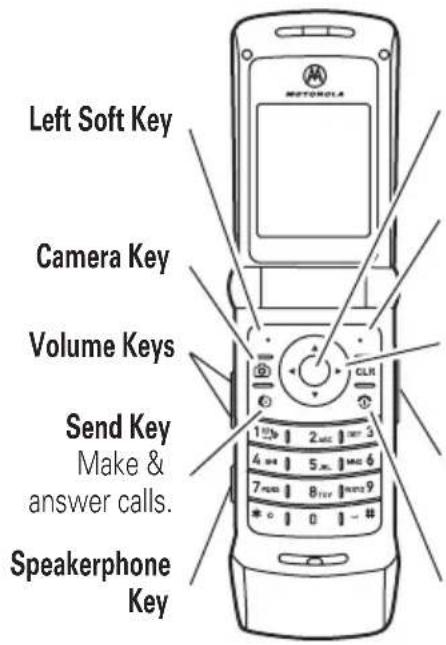
Center Select Key
Open menus, select menu items.
Right Soft Key
Navigation Key
Navigate menus.
Voice Key
Power/End Key
Turn on/off, hang up, exit menus.
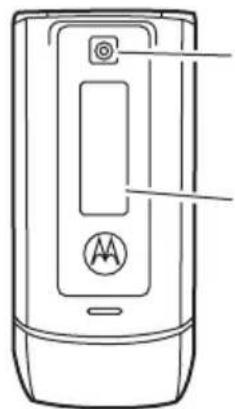
natural_image
Line drawing of a mobile phone casing with a door and logo (no text or symbols)Camera Lens
External Display
Home Screen Main Menu
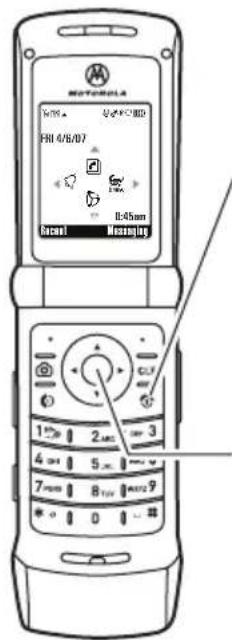
①
Press & hold the Power Key 📊, or until the display lights up, to turn on your phone.
②
Press the Center Key to open the Main Menu.
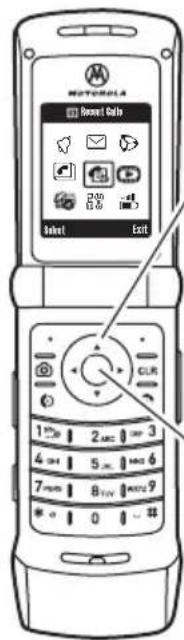
③
Press the Navigation Key ◦ left, right, up, or down to highlight a menu option.
④
Press the Center Key ◆ to select the option.
Motorola, Inc.
Consumer Advocacy Office
1307 East Algonquin Road
Schaumburg, IL 60196
www.hellomoto.com
1-800-331-6456 (United States)
1-888-390-6456 (TTY/TDD United States for hearing impaired)
1-800-461-4575 (Canada)
Certain mobile phone features are dependent on the capabilities and settings of your service provider's network. Additionally, certain features may not be activated by your service provider, and/or the provider's network settings may limit the feature's functionality. Always contact your service provider about feature availability and functionality. All features, functionality, and other product specifications, as well as the information contained in this user's guide are based upon the latest available information and are believed to be accurate at the time of printing. Motorola reserves the right to change or modify any information or specifications without notice or obligation.
MOTOROLA and the Stylized M Logo are registered in the US Patent & Trademark Office. All other product or service names are the property of their respective owners. The Bluetooth trademarks are owned by their proprietor and used by Motorola, Inc. under license. Microsoft, Windows and Windows Me are registered trademarks of Microsoft Corporation; and Windows XP is a trademark of Microsoft Corporation.
© Motorola, Inc. 2007.
Caution: Changes or modifications made in the radio phone, not expressly approved by Motorola, will void the user's authority to operate the equipment.
Software Copyright Notice
The Motorola products described in this manual may include copyrighted Motorola and third-party software stored in semiconductor memories or other media. Laws in the United States and other countries preserve for Motorola and third-party software providers certain exclusive rights for copyrighted software, such as the exclusive rights to distribute or reproduce the copyrighted software. Accordingly, any copyrighted software contained in the Motorola products may not be modified, reverse-engineered, distributed, or reproduced in any manner to the extent allowed by law. Furthermore, the purchase of the Motorola products shall not be deemed to grant either directly or by implication, estoppel, or otherwise, any license under the copyrights, patents, or patent applications of Motorola or any third-party software provider, except for the normal, non-exclusive, royalty-free license to use that arises by operation of law in the sale of a product.
Manual Number: 6809515A05-0
contents
menu map 7
Use and Care 9
essentials 10
about this guide.... 10
battery tips 11
install the battery..... 12
charge the battery ..... 12
turn it on & off 13
make a call 13
answer a call 13
adjust volume 14
change the call alert ..... 14
view your phone number ... 14
call a stored phone
number 15
tips & tricks 15
basics 17
home screen....17
menu shortcuts ..... 19
enter text 20
external display ..... 24
handsfree speaker ..... 25
codes & passwords.....26
lock & unlock phone.....27
lock external keys ..... 27
if you forget a code ..... 27
airplane mode 28
customize 29
alert styles ..... 29
answer options ..... 30
wallpaper 30
set screen saver ..... 30
talking phone 31
AGPS & your location..... 31
AGPS limitations & tips ... 32
conserve battery 33
calls 34
change active line.... 34
automatic redial ..... 34
emergency calls.... 34
AGPS during an
emergency call.... 35
recent calls.... 36
notepad 36
return a missed call ..... 37
attach number 37
speed dial.... 37
one-touch dial.... 37
contents
entertainment 38
take a photo 38
fun & games 39
messages 40
send a multimedia
message 40
receive a multimedia
message 41
voicemail.... 42
more messaging features...43
connections 45
cable connections ..... 45
Bluetooth® connections.... 45
TTY operation 50
data & fax calls ..... 51
other features 52
advanced calling ..... 52
contacts 53
personalize 57
call times & data volumes... 63
handsfree 64
network 66
personal organizer ..... 67
security 69
service & repairs ..... 70
SAR Data 71
Safety Information.... 74
Industry Canada Notice .... 78
FCC Notice 78
Warranty 79
Hearing Aids. 83
WHO Information.... 84
Registration 84
Export Law 85
Recycling Information ..... 85
Perchlorate Label 86
Privacy and Data Security . . . 86
Driving Safety.... 87
index 89
menu map
main menu

Alert Styles
- Style
- Style Detail

Messaging
• Voicemail
- Create Message
- Message Inbox
- Drafts
- Outbox
- Quick Text
- Browser Alerts
- Templates
- Send to PixPlace

Web Browser

Contacts

Recent Calls
- Received
- Dialed
- Notepad
- Call Times
- Data Times
• Data Volumes

Media Gallery
- Camera
- Pictures
- Sounds

Tools
- Calculator
- Datebook
- Voice Records
• Alarm Clock - Airplane Mode

Settings
- (see next page)

Phone Status
• My Tel. Number
- Active Line
- Battery Meter
- Software Update
- Other Information
This is the standard main menu layout.
Your phone's menu may be different.
settings menu

Personalize
• Home Screen
- Main Menu
- Voice Dial Setup
- Skin
- Greeting
- Wallpaper
- Screen Saver
- Sound Settings

In-Call Setup
- In-Call Timer
- Answer Options
- Msg Alert

Security
- Phone Lock
- External Key Lock
- Lock Application
- Restrict Calls
- New Passwords

Initial Setup
- SpeakerPhone
- Auto Redial
- Display Timeout
- Backlight
- Power Tone
- TTY Setup
- Sc r o l l
- Language
- Battery Save
- Brightness
- External Display
• D T M F - Hyphenation
- Master Reset
- Master Clear

Network
- Current Network
- Set Mode
- Service Tone
- Call Drop Tone
- Roam Alert

Car Settings
- Auto Answer
- Auto Handsfree
- Power-off Delay
- Charger Time

Headset
- Auto Answer
• Voice Dial

Location

Connection
- Incoming Call
- Bluetooth Link
Use and Care
To care for your Motorola phone, please keep it away from:

liquids of any kind dust and dirt
Don't expose your phone to water, rain, extreme humidity, sweat, or other moisture. If it does get wet, don't try to accelerate drying with the use of an oven or dryer, as this may damage the phone.

extreme heat or cold cleaning solutions
Avoid temperatures below 0^ C/ 32^ F or above 45^ C/ 113^ F.
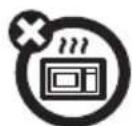
microwaves the ground
Don't try to dry your phone in a microwave oven.
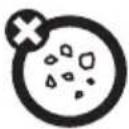
Don't expose your phone to dust, dirt, sand, food, or other inappropriate materials.

To clean your phone, use only a dry soft cloth. Don't use alcohol or other cleaning solutions.

Don't drop your phone.
Use and Care
essentials
CAUTION: Before using the phone for the first time, read the Important Safety and Legal Information included in the gray-edged pages at the back of this guide.
about this guide
This guide shows how to locate a menu feature as follows:
Find it: ◆ > [RECENT CALLS] > Dialed
This means that, from the home screen:
1 Press the center key 🔊 to open the menu.
essentials
2 Press the navigation key ⬤ to scroll to 📁 Recent Calls, and press the center key ⬤ to select it.
3 Press the navigation key ◆ to scroll to Dialed, and press the center key ◆ to select it.
| symbols | |
| This means a feature is network/subscription dependent and may not be available in all areas. Contact your service provider for more information. | |
| This means a feature requires an optional accessory. | |
battery tips
Battery life depends on the network, signal strength, temperature, features, and accessories you use.
- Always use Motorola Original batteries and chargers. The warranty does not cover damage caused by non-Motorola batteries and/or chargers.
- New batteries or batteries stored for a long time may take more time to charge.
- When charging your battery, keep it near room temperature.
- When storing your battery, keep it uncharged in a cool, dark, dry place.
- Never expose batteries to temperatures below 0^ C ( 32^ F) or above 45^ C ( 113^ F). Always take your phone with you when you leave your vehicle.

- It is normal for batteries to gradually wear down and require longer charging times. If you notice a change in your battery life, it is probably time to purchase a new battery.

Contact your local recycling center for proper battery disposal.
Warning: Never dispose of batteries in a fire because they may explode.
Before using your phone, read the battery safety information in the "Safety and General Information" section included in this guide.
To save battery life:
- Adjust the backlight to turn off more quickly (see page 60).
- Turn off Bluetooth® power when you aren't using it (see page 46).
install the battery
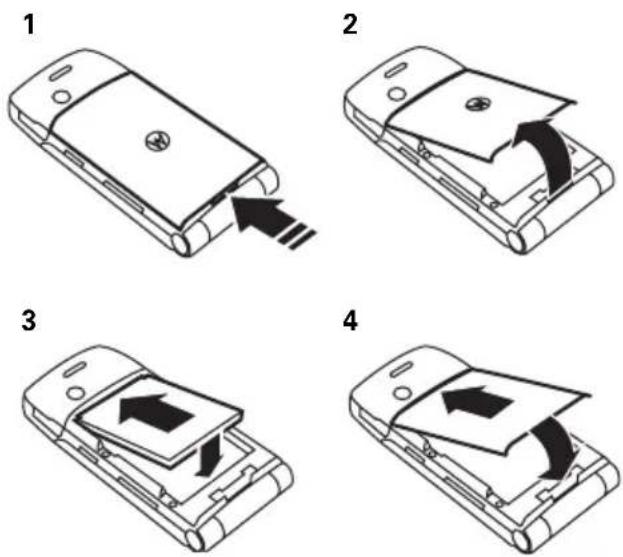
charge the battery
New batteries are shipped partially charged. Before you can use your phone, you need to install and
charge the battery. Some batteries perform best after several full charge/discharge cycles.
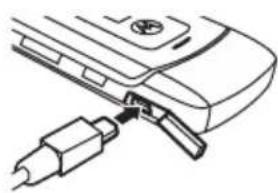
To charge using the charger:
1 Insert the charger into the USB connector on your phone as shown.
natural_image
Line drawing of a car's front panel with plug and cable (no text or symbols)2 Plug the other end of the charger into the appropriate electrical outlet.
3 When your phone displays Charge Complete, remove the charger.
Tip: Relax! You can safely leave the charger connected to the phone after charging is complete. This will not damage the battery.
When you charge the battery, the battery level indicator at the upper right of the screen shows charging progress. At least one segment of the
indicator must be visible to ensure full phone functionality while charging.
To charge from your computer:

You can also charge the battery by connecting a cable from your phone's mini-USB port to a high-power USB connector on a computer (not a low-power one, such as the USB connector on your keyboard or bus-powered USB hub). Typically, USB high-power connectors are located directly on your computer.
Both your phone and your computer must be turned on, and you must have correct software drivers installed on your computer. Cables and software drivers are available in Motorola Original™ data kits, sold separately.
turn it on & off
To turn on your phone, press and hold 📷 for a few seconds or until the display turns on. If prompted, enter your four-digit unlock code.
To turn off your phone, press and hold 🔒 for two seconds.
make a call
Enter a phone number and press 🔒 to make a call.
To "hang up," close the flip or press 🔒.
answer a call
When your phone rings and/or vibrates, open the flip or press 🔒 to answer.
To "hang up," close the flip or press.
adjust volume
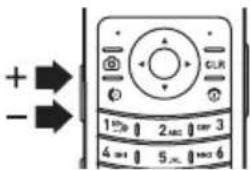
Press the volume keys up or down to:
• increase or decrease
earpiece volume
during a call
- increase or decrease ringer volume when the home screen is visible (with the flip open)
• turn off an incoming call alert
change the call alert
flip open
From the home screen, press the down volume key to switch to lower call alert volume, then vibrate, and finally silent alert. Press the up volume key to cycle back from silent alert to vibrate and then to the lowest alert volume setting.
flip closed
Press the up or down volume key, then press the smart/speakerphone key to scroll through alert styles: Loud, Soft, Vibrate, Vibrate then Ring, and Silent. Alert styles are shown on the external display.
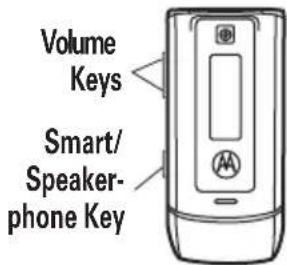
After scrolling to the desired alert style, press the up or down volume key to save the setting and return to the home screen.
view your phone number
Find it:

Tip: Want to see your phone number while you're on a call? Press Options > My Tel. Number.
call a stored phone number
Find it: ◆ > Contacts
1 Scroll to the entry you want to call.
Shortcut: In Contacts, press keypad keys to enter the first letters of an entry. You can also press
※ and # to see the entries you use frequently, or entries in other categories.
2 Press 🔒 to call the entry.
tips & tricks
From the home screen (page 17), you can use these shortcuts:
| To... Do this... | |
| see your phone number | Press \# . |
| redial a number | Press , then scroll to the number you want to call and press again. |
| turn off a call alert | Press the volume keys to turn off a call alert before answering the call. |
| use menu shortcuts | If you see menu icons in the middle of your home screen, press ◆◆ left, right, up, or down to open the menu for the corresponding icon (see page 19). |
| store a phone number | Enter a phone number, and press Store. Enter a name and other details for the phone number. (To select a highlighted item, press the center key ◆◆.) Press Done to store the number and other information. |
| To... Do this... | |
| get phone updates | You can find out if your phone can be updated at: http://hellomoto.com/updateTo install a software update you have downloaded: > Phone Status > Software Update > Install NowNote:Software updates do not affect your phonebook entries or other personal entries. |
basics
See page 1 for a basic phone diagram.
home screen
The home screen displays when you are not on a call or using the menu. You must be in the home screen to make a call.
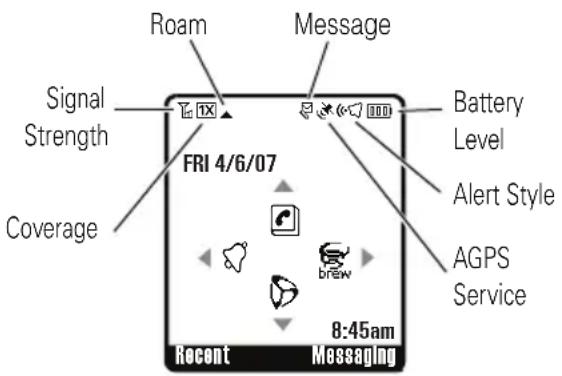
Note: Your home screen may look different than the screen shown here.
Soft key labels show the current soft key functions. For soft key locations, see page 1.
Status indicators can show at the top of the home screen. (Indicators and alerts are discussed in the next section.)
system status indicators
| indicator | |
| Signal Strength | Vertical bars show the strength of the network connection. |
| ▲ Roaming | Phone is in digital coverage area and is roaming off network. |
basics
| indicator | |
| Digital | Phone is in CDMA digital coverage area. |
| 1X 1X | Phone is in a 1x-RTT coverage area. |
| Missed Call | You received an unanswered call. |
| Data Call, Tethered, or Embedded WAP/BREW Application | Shows during data call, tethered mode, or WAP/BREW application. |
| No Service | Phone is in area with no service coverage. |
| TTY | Phone is in TTY mode (see page 50). |
| indicator | |
| Voice Call/Incoming Call | Shows during an active voice call. |
| LocationOff | Location is set to Off. |
| LocationOn | Location is set to Location On. |
| PhoneLocked | Phone is locked. |
| BatteryLevel | Battery charge level. The more bars, the greater the charge. |
| SoundsLoud | Style (in Alert Styles) is set to Loud. |
| SoundsSoft | Style (in Alert Styles) is set to Soft. |
| AllSounds Off | Style (in Alert Styles) is set to Silent. |
| Vibrate On | Style (in Alert Styles) is set to Vibrate. |
| Sound on, Vibrate On | Style (in Alert Styles) is set to Vibe then Ring. |
| Speakerphone On | Speakerphone is on. |
| New Text Message | You have a new text message. |
| New Voicemail Message | You have a new voicemail message. |
| Airplane Mode | Airplane Mode is turned on. (You cannot make or answer calls, but you can use other non-calling features of your phone.) |
| Bluetooth Connection Active | Your phone is paired to another Bluetooth® device. |
menu shortcuts
Your phone displays four menu icons in the middle of the home screen.
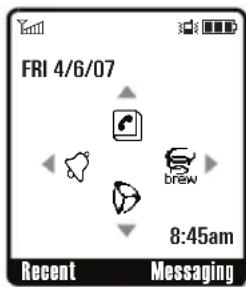
Press ⬇ left, right, up, or down to open the menu for the corresponding icon.
You can change the menu icons that appear in the home screen, or choose not to display icons in the home screen (see page 61).
enter text
set entry modes
Multiple text entry modes make it easy for you to enter names, numbers, and messages:
| entry mode | |
| Primary | Enter text using the method you set. |
| Numeric | Enter numbers only (see page 23). |
| Symbol | Enter symbols only (see page 23). |
| Secondary | Enter text using the method you set. |
To set up Primary or Secondary entry mode:
1 Press Options in any text entry screen.
2 Scroll to Text Setup and press Select.
3 Scroll to Primary Text or Secondary Text and press Change.
4 Scroll to one of these methods and press Select:
| entry method | |
| iTAP English | Phone predicts English words as you press keys (see page 22). |
| iTAP Español | Phone predicts Spanish words as you press keys. |
| iTAP Portuguêsse | Phone predicts Portuguese words as you press keys. |
| Tap English | Enter letters and numbers by pressing a key one or more times (see page 21). |
| Tap Extended | Enter letters, numbers, and symbols by pressing a key one or more times (see page 21). |
Your phone may not contain all of the languages listed above.
When you select Primary or Secondary entry mode, the phone will use the method you assigned to that mode.
20 basics
To select a text entry mode:
Press Options in any text entry screen, scroll to and select Change Text Mode #, then scroll to and select the desired entry mode.
entry mode indicators
When you select Primary or Secondary entry mode, these indicators identify the entry setting:
| primary secondary | ||
| ab1 | ab2 | Tap, no capital letters |
| Ab1↑ | Ab2↑ | Tap, capitalize next letter only |
| AB1↑ | AB2↑ | Tap, all capital letters |
| ab1□ | ab2□ | iTAP®, no capital letters |
| Ab1↑ | Ab2↑ | iTAP, capitalize next letter only |
| AB1↑ | AB2↑ | iTAP, all capital letters |
The indicators for Numeric and Symbol entry modes are:
| non-text entry mode | |
| 123 | numeric mode |
| @% | symbol mode |
capitalization
Press 0 in a text entry screen to change text case.
tap method
This is the standard method for entering text.
Regular Tap method cycles through the letters and numbers of the key you press. The Tap Extended method cycles through letters, numbers, and symbols. If Tap or Tap Extended is not available as the Primary or Secondary entry mode, see page 20.
1 Press a key one or more times to select a letter, number, or symbol.
2 Repeat the step above to enter more characters.
When you enter three or more characters in a row, your phone may guess the rest of the word. For example, if you enter prog, you might see:
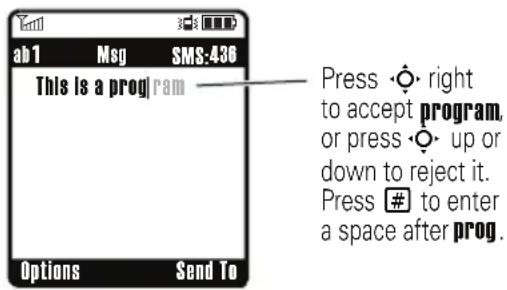
Press ◆ right to accept a word, ◆ up or down to reject a word, or # to insert a space. If you want a different word, continue pressing keys to enter the remaining characters.
Press ⬇ left or right to move the flashing cursor left or right in a text message.
The first character of every sentence is capitalized. If necessary, press ◆ down to
change the character to lowercase before the cursor moves to the next position.
If you don't want to save your text or text edits, press 🔒 to exit without saving.
iTAP® method
The iTAP software combines your key presses into common words, and predicts each word as you enter it. This can be faster than Tap method because your phone combines the key presses into common words. If iTAP method is not available as the Primary or Secondary entry mode, see page 20.
1 Press keypad keys to show possible letter combinations at the bottom of the screen.
2 Scroll left or right to highlight a combination.
3 Press Select to lock a highlighted combination.
You can press keys to add more letters to the end of the combination.
22 basics
or
Press ✝ to enter the highlighted combination when it spells a word. A space is inserted after the word.
If you enter a word your phone does not recognize, your phone stores the word as a new word option. When your phone runs out of phone memory for unrecognized words, it deletes the oldest word to add new words.
numeric method
In a text entry screen, press ✕ to switch entry methods until your phone displays the 123 (numeric) indicator.
Enter the numbers you want. When finished, press ✝ to switch to another entry method.
symbol method
In a text entry screen, press ✕ to switch entry methods until your phone displays the @% (symbol) indicator.
1 Press a key one or more times to show possible symbol combinations at the bottom of the screen.
2 Scroll left or right to highlight the symbol you want.
3 Press Select to enter the highlighted symbol.
delete letters & words
Place the cursor to the right of the text you want to delete, then press CLR to delete a letter at a time. Press and hold CLR to delete all text:
external display
When your phone is closed, the external display shows the time, date, status indicators, and notifications for incoming calls and other events. For a list of phone status indicators, see page 17.
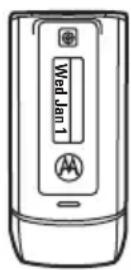
Tip: To change external display orientation, press ⬆ > Settings > InitialSetup > External Display > Left Orientation or Right Orientation.
set phone alert style
To set the phone alert style in the external display:
1 With the flip closed, press a volume key to display Style: style name.
2 Press the smart/speakerphone key repeatedly until you see the style you want.
3 Press a volume key to return to the home screen.
24 basics
return unanswered call
Your phone keeps a record of your unanswered calls, and the external display shows X Missed Calls, where X is the number of missed calls.
Tip: Since the microphone and earpiece are hidden when the phone flip is closed, you'll have to use a headset or other handsfree device to make and receive calls.

Note: The use of wireless phones while driving may cause distraction. Discontinue a call if you can't concentrate on driving. Additionally, the use of wireless devices and their accessories may be prohibited or restricted in certain areas. Always obey the laws and regulations on the use of these products.
1 Press the smart/speakerphone key (see illustration) to see the received calls list.
2 Press the volume keys to scroll to an unanswered call.
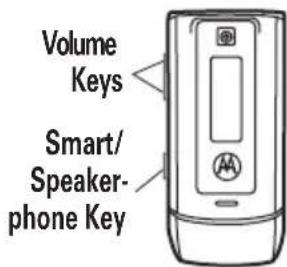
- To call the number with a headset connected to your phone, press and hold the smart/speakerphone key.
• To exit without calling, press the smart/speakerphone key briefly.
handsfree speaker
Note: You must open your phone's flip to activate the speakerphone.
To activate the speakerphone
during a call (with the flip open), press and hold the
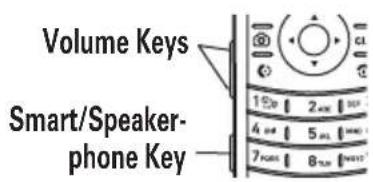
smart/speakerphone key. You will see Spkrphone On and hear a soft audio alert.
To end the call, press 📋. You will see Call Ended and hear a soft audio alert.
The handsfree speaker stays on until you press and hold the smart/speakerphone key again or turn off the phone. You will see Spkrphone Off.
You can also set your phone to turn off the speakerphone automatically after twenty seconds of inactivity:
Find it: ◆ > Settings > Initial Setup
1 Scroll to SpeakerPhone and press Change.
2 Scroll to 20 sec timeout and press Select.
basics
To use the speakerphone with your phone's flip closed:
1 Open the flip, then press and hold the smart/speakerphone key to turn on the speakerphone.
2 Enter then number you want to call and press 🔒.
3 When the call connects, close the flip and continue your conversation.
4 To end the call, press and hold the smart/speakerphone key. You will see Call Ended and hear a soft audio alert.
codes & passwords
Your phone's four-digit unlock code is originally set to 1234 or to the last four digits of your phone number. The six-digit security code is originally set to 000000. Your service provider may reset these codes before
you get your phone. If your service provider didn't change these codes, you should change them to prevent others from accessing your personal information. The unlock code must contain four digits. The security code must contain six digits.
To change a code or password
Find it: ◆> Settings > Security > New Passwords
Select the type of code you want to change, enter the old code when prompted, then enter the new code.
If you forget your unlock code: At the Enter Unlock Code prompt, try entering 1234 or the last four digits of your phone number. If that doesn't work:
If you forget your security code, contact your service provider.
lock & unlock phone
You can lock your phone manually or set it to lock automatically whenever you turn it off.
To lock or unlock your phone, you need the four-digit unlock code. A locked phone still rings or vibrates for incoming calls or messages, but you have to unlock it to answer.
You can make emergency calls on your phone even when it is locked (see page 34).
To lock your phone
Find it: ◀> Settings > Security > Phone Lock > Lock Now or Automatic Lock
Enter the four-digit unlock code, then pressOk.
To unlock your phone
When you see Enter Unlock Code, enter your four-digit unlock code and press Ok.
lock external keys

You can lock your phone's external keys to prevent accidental key presses.
To lock the external keys automatically after a specified time:
Find it: ◆> Settings > Security > External Key Lock
1 With Timer: highlighted, press Change.
2 Scroll to 2 seconds, 4 seconds, or 8 seconds, and press Select. To turn off the automatic key lock, selectOff.
To lock the external keys while the flip is closed, press and hold the smart/speakerphone key.
if you forget a code
Your phone's four-digit unlock code is set at the factory to 1234 or to the last four digits of your phone number. The six-digit security code is set to 000000.
basics
If you forget your security code, contact your service provider.
airplane mode
Note: Consult airline staff about the use of Airplane Mode during flight. Turn off your phone whenever instructed to do so by airline staff.
Airplane mode turns off your phone's calling features in situations where wireless phone use is prohibited. You can use the phone's other non-calling features when Airplane Mode is turned on.
Find it: Tools > Airplane Mode
Airplane Mode > On or Off
Your phone can prompt you to activate or deactivate each time you turn on the phone:
Find it: Tools > Airplane Mode > Prompt At Startup
On or Off
customize
alert styles
Your phone rings and/or vibrates to notify you of an incoming call or to signal certain other events. This ring or vibration is called an alert.
set a style
Find it: ◆ > ⚙ Alert Styles
1 Scroll to Style and press Change or the center key ◀.
2 Scroll to an alert style and press Select or the center key ◆.
set alerts
Your phone includes alerts for Calls, Inbox, Voicemail, Alarms, Data Calls, File Transfer, Fax Calls, and Reminders.
You can specify a detailed setting for each type of alert:
Find it: ◆ > 🔍 Alert Styles
1 Scroll to style Detail and press Change or the center key ◆.
2 Scroll to an alert type and press Change or the center key ◆.
3 Scroll to a detail setting and press Select or the center key ◆.
Note: As you scroll through settings, your phone plays a sample of each one you highlight.
customize
answer options
To turn on or turn off an answer option:
Find it: s > Settings In-Call SetupAnswer Options
Select Multi-keyOpen To Answerpress Changthen select Our Off
wallpaper
Set a photo, picture, or animation as a wallpaper (background) image in your home screen.
Press S > Settings Personalize Wallpaper
To select a wallpaper image
1 Scroll to Picture and press Change view available pictures.
2 Scroll to the picture you want and press the center key s .
Select (Nonto) turn off wallpaper.
customize
To adjust wallpaper image layout
1 Scroll to Layout and press Change
2 Scroll to Centefileor Fit-to-screend press Select
set screen saver
Set a photo or picture as a screen saver image.
The screen saver image displays when the flip is open and no activity is detected for a specified time period. The image shrinks to fill the display, if necessary.
Tip: Turn off the screen saver to extend battery life.
Find it: s > Settings> Personalize Screen Saver
To select a screen saver image
1 Scroll to Picture and press Change view available pictures.
2 Scroll to the picture you want and press Select Select (None) turn off the screen saver.
To set how long your phone must be inactive before it displays the screen saver.
1 Scroll to Delay and press Change.
2 Scroll to 1 minute, 2 minutes, or 10 minutes, and press Select. Select Off if you don't want a screen saver.
talking phone
Your phone can speak aloud the name of a Contacts entry when you highlight that entry. Your phone can also speak the digits you type as you enter a number to call.
Find it: ◀> Settings > Personalize > Sound Settings
To set up the talking phone function:
1 Scroll to Talking Phone Settings and press Change.
2 Scroll to Contact List Entries or Keypad Digits and press Change.
3 Scroll to On and press Select.
To activate the talking phone function:
1 Scroll to Talking Phone and press Change.
2 Scroll to On and press Select.
AGPS & your location
Your phone uses the Automatic Location Information (ALI) feature, along with AGPS satellite signals, to tell the network where you are physically located.
When ALI is set to Location > On, your phone shows the (ALI on) indicator. Services may use your known location to provide useful information (for example, driving directions, or the location of the nearest bank). Your phone prompts you when the network or a service asks for your location. You can refuse at this point.
When ALI is set to Location > Off, your phone displays the (ALI off) indicator, and the phone does not send location information unless you call the emergency phone number (such as 911).
Find it: ◆▶ > Settings > Location > On or Off
To view or change the location transmission status of your phone during a call, press ⬇ > Location.
AGPS limitations & tips
Your phone uses Assisted Global Positioning System (AGPS) satellite signals to estimate

your location. If your phone cannot find strong satellite signals, your AGPS might be slower, less accurate, or it might not work at all. AGPS provides only an approximate location, often within 150 feet (45 meters) but sometimes much farther from your actual location.
To improve AGPS accuracy:
- Go outside and away from underground locations, covered vehicles, structures with metal or concrete roofs, tall buildings, and foliage. Indoor performance might improve if you move closer to windows, but some window sun shielding films can block satellite signals.
- Move away from radios, entertainment equipment, and other electronic devices that might interfere with or block AGPS satellite signals.
- If your phone has a retractable antenna, extend the antenna.
- Hold your phone away from your body, and point the phone antenna toward the sky. Do not cover the antenna area with your fingers.
AGPS uses satellites controlled by the U.S.
government and subject to changes implemented in accordance with the Department of Defense AGPS user policy and the Federal Radio Navigation Plan.
These changes might affect AGPS performance.
conserve battery
Your phone includes a light sensor and a Battery Save setting to extend battery life. When you turn on Battery Save, your phone automatically turns off the keypad backlight when it detects sufficient ambient light.
Blocking the sensor can cause the backlight to turn on and off intermittently.
Find it: ◆ > Settings > Initial Setup Battery Save
customize
calls
To make and answer calls, see page 13.
change active line

If you have more than one phone number, you can switch from one line to another.
Find it: ◀▶ > 📋 Phone Status > Active Line
automatic redial
When you receive a busy signal, your phone displays Call Failed, Number Busy.

When you turn on automatic redial, your phone automatically redials a busy number for four minutes. When the call connects, your phone rings or vibrates once, displays Redial Successful, and completes the call.
Find it: ◀> > Settings > Initial Setup Auto Redial
When automatic redial is turned off, you can manually activate the feature to redial a phone number. When you hear a fast busy signal and see Call Failed, press 📄 or RETRY.
emergency calls
Your service provider programs one or more emergency phone numbers, such as 911, that you can call under any circumstances, even when your phone is locked.
Note: Emergency numbers vary by country. Your phone's preprogrammed number(s) may not work in all locations, and sometimes an emergency call cannot
be placed due to network, environmental, or interference issues.
1 Enter the emergency number.
2 Press ☐ to call the emergency number.
AGPS during an emergency call
When you make an emergency call, your phone can use Assisted Global Positioning

System (AGPS) satellite signals to tell the emergency response center your approximate location.
The AGPS feature has limitations, so always tell the emergency response center your best knowledge of your location. Remain on the phone for as long as the emergency response center instructs you.
AGPS might not work for emergency calls:
- Your phone's AGPS feature must be turned on (see page 31).
- Your local emergency response center might not process AGPS location information. For details, contact your local authorities.
For best results:
- Go outside and away from underground locations, covered vehicles, structures with metal or concrete roofs, tall buildings, and foliage. Indoor performance might improve if you move closer to windows, but some window sun shielding films can block satellite signals.
- Move away from radios, entertainment equipment, and other electronic devices that might interfere with or block AGPS satellite signals.
If your phone cannot find strong AGPS satellite signals, the location of the nearest cell tower in contact with your phone is automatically provided to the emergency response center.
recent calls
Your phone keeps lists of the calls you recently received and dialed, even if the calls didn't connect. The lists are sorted from newest to oldest calls. The oldest calls are deleted as new calls are added.
Tip: Press 📋 from the home screen to view the Recent Calls list.
Find it: ◆ > 📋 Recent Calls
1 Scroll to Received or Dialed and press Select.
2 Scroll to an entry.
3 Press 📋 to call the number.
To see call details (like time and date), press the center key ◆.
Press Options to open a menu that can include: Store, Delete, Delete All, Send Message, Add Digits, Attach Number.
notepad
Your phone stores the most recent digits you entered in notepad memory. These digits can be a number that you called ar a number that you entered and want to save for later.
To retrieve a number stored in the notepad
Find it: ◀>Recent Calls >Notepad
Press 🔒 to call the number.
Press Options to open the Options menu to attach a number or insert a special character.
Press Store to create a new Contacts entry with the number already entered in the No. field.
return a missed call
Your phone keeps a record of your unanswered calls, and shows X Missed Calls, where X is the number of missed calls.
1 Press View to see the received calls list.
2 Scroll to the call you want to return and press 🔒.
attach number
While dialing (with digits visible on the display), press Options, then scroll to and select Attach Number to attach a number from Contacts or a recent calls list.
speed dial
Each entry you store in Contacts is assigned a unique speed dial number.
Tip: To see the speed dial number for an entry, press the center key ◆, select Contacts, then scroll to the entry and press ◆.
To speed dial a number:
1 Enter the speed dial number for the entry you want to call and press #.
2 Press ☐ to call the number.
one-touch dial
To call a Contacts entry 1 through 9, press and hold the single-digit speed dial number (key 1 through 9) for that entry for one second.
entertainment
take a photo
Your camera lens is on the back of your phone when the phone is open (see page 1). To get the sharpest photos, wipe the lens clean with a dry cloth before you take a photo.
To activate your phone's camera:
Find it: ◀▶ Media Gallery > Camera
Tip: You can also activate your phone's camera by pressing the camera key 📷.
Your phone displays the active viewfinder image:
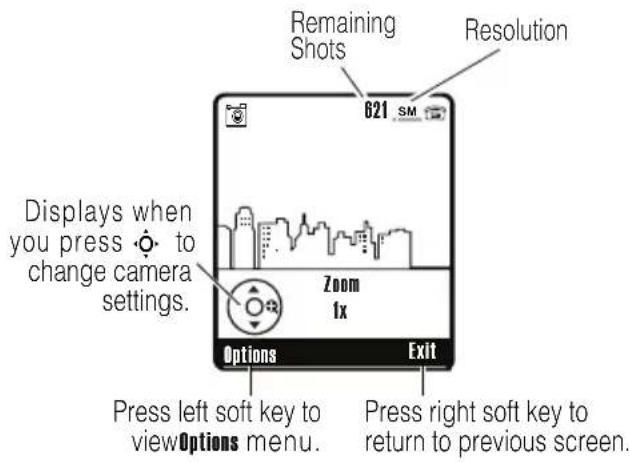
1 Point the camera lens at the camera subject. Press ⬇ up and down to zoom in and out.
Press Options to open a menu that includes these options: Go To Pictures, Auto-Timed Capture, Camera Setup, Free Space, Capture Title.
2 Press the camera key 📷 to take the photo.
3 Press Options, then select Store Only, Discard, or Apply As. or
Press Send to save photo and go to the Send Options screen. Then select Send in Message or Send to PixPlace.
fun & games
launch micro-browser
Find it: ◆ > Web Access

manage pictures
Find it: ◀> ▶ Media Gallery > Pictures
To view a picture, scroll to the picture title and press the center key ◆.
Press Options to select open a menu that can include these options: Send, Apply As, Create New, Manage, Mark, Categories, Assign to Category, Free Space, Properties, Pictures Setup.
manage sounds
Find it: ◆ > ▶ Media Gallery > Sounds
To play a sound, scroll to the sound title and press the center key ⬆.
Press Options to open a menu that can include these options: Send, Apply As, Create New, Manage, Mark, Categories, Free Space, Properties, Sounds Setup.
send a multimedia message

A multimedia message contains embedded media objects (possibly including photos, pictures, animations, sounds, and voice records). You can send a multimedia message to other wireless phones with multimedia messaging capabilities and to email addresses.
create & send message
Find it: ◆> > Messaging > Create Message
1 Press Options.
2 Scroll to Change to MMS and press Select. When prompted to Change Msg Type?, press Yes.
messages
3 Press Options.
4 Scroll to Insert and press Select.
5 To insert a stored multimedia object, scroll to Picture, Voice Record, or Sound, and press Select. Then scroll to the desired object and press Insert.
or
To take and insert a new photo, scroll to New Picture and press Select. Take the photo and pressInsert.
6 Enter message text.
Press Options to open a menu that can include these options: Insert, Preview, Change to SMS/MMS, Page Options, Sending Options, Message Details Cancel Message, Save to Drafts, Save as Template, Editing Options, Change Text Mode #, Text Setup.
7 Press Send To.
8 Scroll to each entry you want to receive the message and press the center key ◆.
To enter a new number or email address to receive the message, press Options, then scroll to Enter Number or Enter Email and press Select. Enter the number or email address and press Ok.
9 Press Send to send the message.
or
Press Options, then scroll to and select Sending Options to open the Msg Options menu (which can includeCc, Bcc, Subject, Attachments, Priority, Delivery Report, and Delivery) or scroll to and select Message Details to see message statistics. When finished, press Send to send the message.
or
Press Options, then scroll to and select Save to Drafts to save the message to the Drafts folder or Abort Message to cancel the message.
receive a multimedia message

When you receive a multimedia message, your phone plays an alert and displays the ☑ (message waiting) indicator and a New Message notification.
Open the flip and press READ to read the message immediately, or save it in your Message Inbox for viewing later.
To read messages in your Message Inbox:
Find it: ◆> Messaging > Message Inbox
1 Scroll to the message you want to read.
2 Press the center key ⬆ to open the message. Your phone displays the media object, then the message.
Multimedia messages can contain different media objects:
- Photos, pictures, and animations are displayed when you read the message.
- A sound file begins playing when the message text is displayed. Use the volume keys to adjust the volume.
- If the message includes an attached file, select the file indicator or filename and press VIEW (for an image file), PLAY (for a sound file), or OPEN (for an object such as a CONTACTS or datebook entry or an unknown file type).
voicemail
Your network stores the voicemail messages you receive. To listen to your messages, call your voicemail number.

Note: Your service provider may give you additional information about using voicemail.
When you receive a voicemail message, your phone shows the voicemail message indicator ☑ and New Voicemail. Press Call to listen to the message.
To check voicemail messages later:
Find it: ◀> Messaging > Voicemail
Press 📷 (send key) to call your voicemail number.
Your phone may prompt you to store your voicemail phone number. If you don't know your voicemail number, contact your service provider.
more messaging features
features
send text message

Messaging > Create Message
Press Options to perform other actions.

view sent message

Messaging > Outbox
Scroll to a message and press the center key ◀.
Press Options to perform other actions.

read received message

Messaging >Message Inbox
Scroll to a message and press the center key ◆.
Press Options to perform other actions.

features
use text template
Text Templates are prewritten text that you can select and send as messages.


Messaging > Templates > Text Templates
To insert a template in a message scroll to the template and press the center key ◆,
To create a template, press Options, then scroll to Create New and press Select
To edit a template, scroll to the template and press Options, then scroll to Edit and press Select.
use multimedia template

Messaging > Templates
Multimedia Templates

Scroll to the template you want to insert and press the center key ⬆, then press Send To.
| features |
drafts ➤> Messaging >DraftsScroll to a message and press the center key➤.You can edit the message when you view it.Press Options to perform other actions. ➤> Messaging >DraftsScroll to a message and press the center key➤.You can edit the message when you view it.Press Options to perform other actions. |
erase messages Delete all messages or only messages fromthe Outbox or Drafts folder:➤> MessagingPress Options, then scroll to and select Erase Messages.Scroll to All, Outbox, or Drafts.To delete Outbox messages automatically aftera specified time, press Options, then scroll to andselect Setup. Scroll to and select Outbox Setup. Delete all messages or only messages fromthe Outbox or Drafts folder:➤> MessagingPress Options, then scroll to and select Erase Messages.Scroll to All, Outbox, or Drafts.To delete Outbox messages automatically aftera specified time, press Options, then scroll to andselect Setup. Scroll to and select Outbox Setup. |
| features |
store message objects  Go to a multimedia message slide, or highlight an object in a letter, then press Options.Select Save Picture or Save Sound. Go to a multimedia message slide, or highlight an object in a letter, then press Options.Select Save Picture or Save Sound. |
view browser alerts  View special notifications from your Web browser: ◀> Messaging > Browser Alerts View special notifications from your Web browser: ◀> Messaging > Browser Alerts |
set up messaging  ◀> MessagingPress Options, then scroll to and select Setup. Scroll to and select Message Setup, Voicemail Setup, or Outbox Setup. ◀> MessagingPress Options, then scroll to and select Setup. Scroll to and select Message Setup, Voicemail Setup, or Outbox Setup. |
connections
cable connections

Your phone has a mini-USB port so you can connect it to a computer.
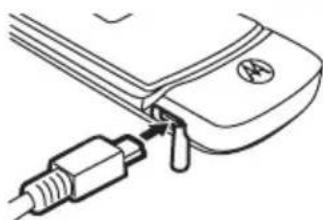
natural_image
Line drawing of a device with a plug inserted into a cable (no text or symbols)Note: Motorola
Original™ data cables and supporting software are sold separately. Check your computer to determine the type of cable you need. To make data calls through a connected computer, see page 51.
If you use a USB cable connection:
- Make sure to connect the phone to a high-power USB port on your computer (not a low-power one such as the USB port on your
keyboard or bus-powered USB hub). Typically, USB high-power ports are located directly on your computer.
Note: If you connect your phone to a low-power USB port, the computer may not recognize your phone.
• Turn on your phone and the computer.
Bluetooth® connections

Your phone supports Bluetooth wireless connections. You can connect your phone to a Bluetooth headset or car kit, or connect to another device to transfer files.
Your phone currently supports there Bluetooth profiles:
- Headset—Connect a Bluetooth enabled headset and a computer or other Bluetooth enabled device such as a mobile phone.
- Handsfree—Use a gateway device to place and receive calls for a handsfree device. For example, an vehicle handsfree kit could use a mobile phone as a gateway device.
- Dial Up Networking (DUN)—Access the Internet and other dial-up services with a Bluetooth wireless connection.
- Serial Port Profile (SPP)—Set up virtual serial ports and connect two Bluetooth enabled devices.
- OBEX (Object EXchange) profiles—File Transfer Profile (FTP) and Object Push Profile
(OPP) for user-generated content (image), and vCard (OPP only).
Note: This phone does not support all OBEX profiles.
For more Bluetooth wireless connections support information, go to www.motorola.com/Bluetoothsupport.
Note: All multimedia (video player, audio player, shutter tones) will play from the speakerphone when your phone is connected to another Bluetooth device.
For maximum Bluetooth security, always connect Bluetooth devices in a safe, private environment, away from other devices with Bluetooth connection capabilities.
turn Bluetooth power on/off
Set Bluetooth power to be on whenever the phone is on.
Find it: ◆> Settings > Connection > Bluetooth Link
Setup
1 Scroll to Power and press Change.
2 Scroll to On and press Select.
Note: To extend battery life, set Bluetooth power to Off when not in use. If you turn Bluetooth power Off, your phone will not connect to other Bluetooth devices until you turn Bluetooth power On and reconnect.
place phone in discovery mode
Allow an unknown Bluetooth device to discover your phone:
Find it: ◆ > Settings > Connection > Bluetooth Link > Find Me
pair with other device

Note: If you want to use your Motorola Bluetooth headset with both an audio device and your phone, use your phone's Bluetooth menus to connect the phone with the headset. If you establish the connection by pressing a button on the
headset, or if you allow the headset to connect automatically by turning it on, you may experience unexpected results.
Before you try to connect to another Bluetooth device, make sure your phone's Bluetooth power is On and the device is in pairing or bonding mode (see the user guide for the device you are attempting to pair with). You can connect your phone with only one device at a time.
Find it: ◆ > Settings > Connection > Bluetooth Link
Handsfree > [Look For Devices]
Note: If your Bluetooth power is not turned on, your phone will prompt you to turn it on.
Your phone lists the devices it finds within its range. If your phone is already connected to a device, your phone lists that device and identifies it with a √ (in-use indicator).
1 Scroll to a device in the list.
2 Press the center key ◆ to connect the device.
3 If the device requests permission to bond with your phone, press YES and enter the device PIN code to create a secure connection with the device. (The PIN code is typically set to 0000.)
Note: See the instructions that came with your device for the device's PIN code and other information about the device.
When the connection is made, the ✪ (Bluetooth) indicator or a Bluetooth message displays in the home screen.
connect to handsfree device during a call

Note: You must have already paired with the device (see page 47).
Press Options, then select Connect Bluetooth.
Note: You can't switch to a headset or car kit if you are already connected to a Bluetooth device.
copy files to other device

You can move or copy a multimedia object (such as a picture or sound file), or copy a Contacts entry, from your phone to a computer or other device.
Note: You can't copy or move some copyrighted objects.
1 Connect to the other device (see page 47).
2 On your phone, scroll to the object or Contacts entry that you want to copy and press Options.
3 For multimedia objects, scroll to the object and press the center key ⬆. Press Options, then scroll to Manage and press Select. Scroll to Move or Copy and press Select.
or
For a Contacts entry, scroll to the entry and press Options. Scroll to Send Contact and press Select, then scroll to Bluetooth and press Select.
4 Select the device name, or select [Look For Devices] to search for a device.
If your phone could not copy the file to the other device, make sure the device is on and ready in discoverable mode (see the user's guide for the device). Also, make sure the device is not busy with another similar Bluetooth connection.
receive file from other device

Note: If you do not see the Bluetooth indicator ⚙ at the top of the display, turn on your phone's Bluetooth power (see page 46).
1 Place your phone near the device, and send the file from the device. (If necessary, refer to the user's manual for the device for instructions.)
If your phone and the sending device don't recognize each other, place your phone in discovery mode so the sending device can locate it (see page 47).
2 When prompted to accept the sent object, scroll to Yes or Grant and press the center key 🔊.
Your phone notifies you when the transfer is complete. If necessary, press Save to save the file.
disconnect from device
Scroll to Bluetooth and select Off.

set Bluetooth options
Find it: ◆▶> Settings > Connection
Bluetooth Link > Setup

TTY operation

You can use an optional TTY device with your phone to send and receive calls. You must plug the TTY device into the phone's headset jack and set the phone to operate in one of three TTY modes.
When your phone is in TTY mode, during an active call your phone displays the international TTY mode, the international TTY symbol, and the mode setting.
notes on TTY operation
- Use a TSB-121 compliant cable (provided by the TTY device manufacturer) to connect the TTY device to the phone.
- Set the phone volume to level 4 (middle setting) for proper operation. If you experience a high number of incorrect characters, adjust the volume as needed to minimize errors.
- For optimal performance, your phone should be at least 12 inches (30 centimeters) from the TTY device. Placing the phone too close to the device may cause high error rates.
TTY setup
Find it: ◆> Settings > Initial Setup
1 Scroll to TTY Setup and press Change.
2 Scroll to a TTY Setup option and press Select.
| option | |
| Voice | Set/return to standard voice mode. |
| TTY | Transmit and receive TTY characters. |
| VCO | Receive TTY characters but transmit by speaking into phone microphone. |
| HCO | Transmit TTY characters but receive by listening to phone earpiece. |
When you set your phone to a TTY mode, it operates in that mode whenever the TTY device is connected.
data & fax calls

To specify next call as a data or fax call:

Find it: ◆ > Settings > Connection
Incoming Call
1 Scroll to Next Call and press Change.
2 Select Normal, Data In Only, or Fax In Only.
To send data or a fax connect your phone to the device, then place the call through the device application.
To receive data or a fax connect your phone to the device, then answer the call through the device application.
other features
advanced calling
| features |
| conference callDuring a call, dial the next number, press [IMAGE], then press [IMAGE] again. |
| restrict calls[IMAGE]> Settings > Security > Restrict CallsWhen prompted, enter the unlock code (see page 26) and press Ok. Select Outgoing Calls or Incoming Calls and press Change. With Allow highlighted, press Change, then select All, None, or Contacts. |
features
DTMF Tones
Your phone can send Dual Tone Multi Frequency (DTMF) tones for calling card calls or other automated touch-tone calls.

Scroll to DTMF, press Change then select Short. Long, or Off.
contacts
features
create entry


To enter information, scroll to an entry field and press the center key ⚙️. You must enter a number. You can also enter the following: First Name, Last Name, Nickname, number Type (Mobile, Home, Work, Fax, Pager, Other), Email, email Type (Personal, Work, Other), URL, Postal Address, postal address Type (Home, Work, Other), Category (General, Friends, Family, Work), Ringer ID, Picture, Birthday.
Press Done to save entry information.
view entry
Scroll to the entry and press the center key ◀.
To perform other actions, scroll to the entry and press Options to open the Phonebook Menu.
features
call entry


Contacts
Scroll to the entry you want to call and press 📄
edit entry


Contacts
Scroll to the entry, press Options, then scroll to Edit Contact and press Select.
delete entry


Contacts
Scroll to the entry, press Options, then scroll to Delete Contact and press Select.
| features |
| assign ringer ID to entryAssign a ring alert (ringer ID) to an entry:◆> □ContactsScroll to the entry, press Options, then scroll to Edit Contact and press Select.Scroll to Ringer ID and press the center key ◆. Scroll to a ringer ID and press Select or the center key ◆.Note: As you scroll through ringer IDs, your phone plays a sample of each one you highlight. |
| activate ringer IDsActivate ringer IDs assigned to Contacts entries:◆> □Alert Styles > Style Detail > Ringer IDs |
| features |
| set picture ID for entryAssign a photo or picture to show when you receive a call from an entry:➤ > ContactsScroll to the entry, press Options, then scroll to Edit Contact and press Select. Scroll to Picture and press the center key➤.To take a new photo to use as a picture ID, scroll to Take Picture and press SelectTo select a saved picture or photo as a picture ID, scroll to Select Picture, press Change, then scroll to a picture and press Select or the center key➤. |
features
set speed dial number for entry


Contacts
Scroll to the entry, press Options, then scroll to Add to Speed Dial and press Select. Scroll to the speed dial number you want to assign to the entry and press Select.
add more numbers or email addresses to entry
Enter additional phone numbers or email addresses to a Contacts entry:


Contacts
Scroll to the entry, press Options, then scroll to Edit Contact and press Select. Press Options, then scroll to Add Number or Add Email and press Select.
features
view entries by picture or list
Set your phone to display Contacts entries with their picture IDs or as text only:


Contacts
Press Options, then scroll to Setup and press Select.
Scroll to View by, press Change, then select Picture or List and press Select.
sort entries


Contacts
Press Options, then scroll to Setup and press Select.
Scroll to Sort by, press Change, then scroll to First Name or Last Name and press Select.
features
add, delete, or edit category

Press Options, then scroll to Manage Contacts and press Select Scroll to Edit Categories and press Select.
To edit or delete a category scroll to the category and press Options, then scroll to Edit Category or Delete Category and press Select.
To add a new category, scroll to [New Category] and press the center key ◆:
features
filter entries
View only entries that include an email address, or view only entries in a category you specify.

Press Options, then scroll to Filter by and press Select. To view only entries with email addresses scroll to Email and press Select. To view only entries in a category you specify, scroll to Category and press Select, then scroll the category you want and press Select.
The Filter by setting is cleared when you exit Contacts. The next time you select Contacts, your phone shows all entries.
personalize
voice commands
You can place calls and complete other actions by speaking commands to your phone.
1 Press and release the voice key on the right side of the phone. Your phone displays and speaks Say a command, followed by a list of voice commands.
2 Say one of the commands listed in the following table. Your phone performs the corresponding action.
features
Call
Call a Contacts entry whose name you speak, or to a phone number you speak.
features
Send Msg
Send a message to a Contacts entry whose name you speak, or to a phone number you speak.
For more information on sending a message, see pages 40 and 43.
Lookup
Look up a Contacts entry by speaking its name.
Go To
Use a voice shortcut to access the phone app (application or function):
Voicemail, Camera, Redial, Received Calls
Check
View information on an item:
Tip: Speak the name of a Contacts entry exactly as it is listed. For example, to call the mobile number for an entry named Bill Smith, say "Call Bill Smith mobile." (If the entry includes only one number for Bill Smith, say "Call Bill Smith.")
Tip: Speak numbers at a normal speed and volume. Pronounce digits distinctly. Don't pause between digits.
voice command setup
1 Press and release the voice key on the right side of the phone.
2 Press Settings, then scroll to an option and press Select.
voice recognition settings
Choice Lists
If your phone is not sure that it has correctly identified a name or number that you speak, it displays up to three choices and prompts you to confirm the correct one.
To specify when choice lists appear:
Automatic—Display a list of choices from multiple alternatives.
Always On—Always display a list of choices when there are multiple alternatives.
Always Off—Never display a choice list. The phone chooses from the best alternatives.
voice recognition settings
Sensitivity
Fine tune the phone's ability to recognize voice commands.
Sensitivity too strict—Phone will often reject voice commands and display “Please repeat ...” or “No match found.” Adjust Sensitivity toward Reject Less.
Sensitivity too forgiving—Phone will have many false activations (indicating that it detects a wrong match). Adjust Sensitivity toward Reject More.
Digit Dialing
Adapt digit dialing to your voice:
Adapt Digits—Improve recognition of spoken phone numbers. Adaptation takes about sixty seconds.
Reset Digits—Erase any previous adaptation and reset to the factory default. If you have not adapted digits, this option appears in grey (not available).
voice recognition settings
Sound
Turn playback on or off for prompts, names, and numbers. Adjust speed and volume of name playback.
Prompts—Turn playback on or off for prompts such as "Say a command."
Digits—Turn playback on or off for digits (for example, when confirming a phone number).
Names—Turn playback on or off for names.
Name Settings—Adjust speed and volume of name playback.
more personalizing features
| features |
| brightness |
| ◀●> Settings > InitialSetup > Brightness |
| display timeoutSet how long the display stays turned on.Note: If you set Display Timeout to Off, your display backlight will never turn off. This will greatly reduce your battery's life.◀●> Settings > InitialSetup > Display Timeout |
| backlightSet how long the display and keypad backlights stay on, or turn off backlights to extend battery life.◀●> Settings > InitialSetup > Backlight |
| features |
| call & key volumesAlert Styles > Style DetailScroll to Ring Volume or Key Volume and press Change. |
| power toneSet phone to play a tone when you power it on:Settings > InitialSetup > Power Tone |
| greetingChange the greeting that appears when you turn on your phone:Settings > Personalize > Greeting |
| scrollSet the scroll bar to Up/Down or Wrap Around in menu lists:Settings > InitialSetup > Scroll |
features
message alerts
Set whether you receive message alerts during a call:
- > Settings > In-Call Setup > MSG Alert
skin
Choose a phone skin that sets the look and feel of your phone's screen:
- > Settings > Personalize > Skin
menu language
- > Settings > Initial Setup Language
show or hide menu icons
Show or hide menu icons in the home screen.
◀ > Settings > Personalize > Home Screen > Home Keys
Icons
features
change home screen menu icons
Change the menu icons that display in the home screen.
- > Settings > Personalize > Home Screen > Home Keys
Scroll to Up, Down, Right, or Left, and press Change, then select a menu.
change home screen soft key labels
◀ > Settings > Personalize > Home Screen > Home Keys
Scroll to Left Soft Key or Right Soft Key and press Change, then select a menu or function.
| features |
| menu viewDisplay the main menu as icons or a numbered list:◆> Settings > Personalize > Main Menu > ViewWhen the menu is displayed as a numbered list, press the center key ◆, then the number key for the menu you want. |
| change menu order◆> Settings > Personalize > Main Menu > Reorder |
| master resetReset all options except unlock code, security code, and lifetime timer:◆> Settings > Initial Setup > Master ResetTo reset all options, you need to enter theSecurity Code (000000). |
| features |
| master clearReset all options except unlock code, security code, and lifetime timer, and clear all user settings and entries:Warning: This option erases all user-entered information in your phone memory, including Contacts entries and downloaded files. Once you erase the information, it cannot be recovered. It resets all options to their factory settings except for the unlock code, security code, and lifetime timer.●> Settings > Initial Setup Master ClearTo reset all options, you need to enter the Security Code (000000). |
call times & data volumes
Network connection time is the elapsed time from the moment you connect to your service provider's network to the moment you end the call by pressing 🔒. This time includes busy signals and ringing.
The amount of network connection time you track on your resettable timer may not equal the amount of time for which you are billed by your service provider. For billing information, please contact your service provider directly.
features
set in-call timer
◀ > 📁 Settings > In-Call Setup > In-Call Timer
Select Display or Beep and press Change.

features
view call times

Recent Calls > Call Times

Scroll to Last Call, Dialed, Received, All Calls, or Lifetime, and press Select.
view data times

Recent Calls > DataTimes

Scroll to Recent Data Session or All Data Sessions, press Select then scroll to Internal Data Session, External Data Session, or Total Time and press Select.
reset all data times

Recent Calls > DataTimes

All DataSessions > Reset All
| features |
| view data volumesRecent Calls > DataVolumesScroll to Recent Data Session or All Data Sessions, press Select, then scroll to Internal Data Session, External Data Session, or Total Data Transferred and press Select. |
| reset all data timesRecent Calls > DataTimesAll DataSessions > Reset All |
handsfree
Note: The use of wireless devices and their accessories may be prohibited or restricted in certain
areas. Always obey the laws and regulations on the use of these products.
| features |
| accessory volume settings (car kit or headset)During an active call, press your phone’s up or down volume keys. |
| external speakerphoneTo activate a connected external speakerphone during a call, press the smart/speakerphone key on the left side of the phone. |
| auto answer (car kit or headset) ⬆ > Settings > Car Settings or HeadsetScroll to Auto Answer and press Change. |
features
voice dial (headset)

Enable voice dial with headset send/end key:
Settings > Headset
Scroll to Voice Dial and press Change.
auto handsfree (car kit)

Automatically route calls to a car kit when connected:
Settings > Car Settings
Scroll to Auto Handsfree and press Change.
features
power-off delay(car kit)

Set the phone to stay on for a period of time after the ignition is switched off:
Settings > Car Settings
Scroll to Power-off Delay and press Change.
charger time (car kit)

Charge phone after vehicle ignition is switched off:
Settings > Car Settings
Scroll to Charger Time and press Change.
network
| features | |
view current network | |
| >Settings >NetworkWith Current Network highlighted, press View. | |
adjust network settings | |
| >Settings >NetworkScroll to Set Mode and press Change. | |
set service tones Set phone to beep whenever the network registration status changes: Set phone to beep whenever the network registration status changes: | |
| >Settings >NetworkScroll to Service Tone and press Change. | |
| features |
set call drop tone Set phone to play an alert tone whenever the network drops a call. (Because digital networks are so quiet, a call drop alert may be your only indication that a call was dropped.)➤ > Settings > NetworkScroll to Call Drop Tone and press Change. Set phone to play an alert tone whenever the network drops a call. (Because digital networks are so quiet, a call drop alert may be your only indication that a call was dropped.)➤ > Settings > NetworkScroll to Call Drop Tone and press Change. |
roam alert Set phone to play an alert tone whenever it roams outside of your home network:➤ > Settings > NetworkScroll to Roam Alert and press Change. Set phone to play an alert tone whenever it roams outside of your home network:➤ > Settings > NetworkScroll to Roam Alert and press Change. |
personal organizer
features
add datebook event
Tools > Datebook

Scroll to a day and press Options, then scroll to New and press Select.
view or edit datebook event
- > Tools > Datebook

Scroll to a day and press the center key ⬤, then scroll to an event and press the center key ⬤. To edit the event, press Options, then select Edit.
event reminder
Press View to view an event reminder. Press Exit to dismiss an event reminder.

features
copy datebook event
Copy a datebook event to another date and/or time:

Tools > Datebook
Scroll to a day and press the center key ⬆, then scroll to an event and press Options. Scroll to Copy and press Select.
set alarm
- > Tools > Alarm Clock

turn off alarm
Press Off or 📞.

| features |
| create voice recordNote:Recording phone calls is subject to varying state and federal laws regarding privacy and recording of conversations.Tools > Voice RecordsScroll to [New Voice Record] and press the center key, then press and hold the voice key (on the right side of the phone) and begin recording. Release the voice key when finished. |
| play voice recordTools > Voice RecordsScroll to a voice record and press the center key. |
| features | |
| calculatorCalculate numbers:Tools > Calculator | |
| convert currencyTools > CalculatorPress Options, then scroll to Exchange Rate and pressSelect. Enter an exchange rate and press Ok. Enter an amount to convert and press Options. Scroll to Convert Currency and press Select | |
security
features
lock application

Settings > Security > Lock Application
When prompted, enter the unlock code and press
Ok. Scroll to an application and press Change.
service & repairs
If you have questions or need assistance, we're here to help.
Go to www.motorola.com/consumer/support, where you can select from a number of customer care options. You can also contact the Motorola Customer Support Center at 1-800-331-6456 (United States), 1-888-390-6456 (TTY/TDD United States for hearing impaired), or 1-800-461-4575 (Canada).
Specific Absorption Rate Data
This model wireless phone meets the government's requirements for exposure to radio waves.
Your wireless phone is a radio transmitter and receiver. It is designed and manufactured not to exceed limits for exposure to radio frequency (RF) energy set by the Federal Communications Commission (FCC) of the U.S. Government and by the Canadian regulatory authorities. These limits are part of comprehensive guidelines and establish permitted levels of RF energy for the general population. The guidelines are based on standards that were developed by independent scientific organizations through periodic and thorough evaluation of scientific studies. The standards include a substantial safety margin designed to assure the safety of all persons, regardless of age or health.
The exposure standard for wireless mobile phones employs a unit of measurement known as the Specific Absorption Rate, or SAR. The SAR limit set by the FCC and by the Canadian regulatory authorities is 1.6 W/kg. ^1 Tests for SAR are conducted using standard operating positions accepted by the FCC and by Industry Canada with the phone transmitting at its highest certified power level in all tested frequency bands. Although the SAR is determined at the highest certified power level, the actual SAR level of the phone while operating can be well below the maximum value. This is because the phone is designed to operate at multiple power levels so as to use only the power required to reach the network. In general, the closer you are to a wireless base station, the lower the power output.
Before a phone model is available for sale to the public in the U.S. and Canada, it must be tested and certified to the FCC and Industry Canada that it does not exceed the limit established by each government for safe exposure. The tests are performed in positions and locations (e.g., at the ear and worn on the body) reported to the FCC and available for review by Industry Canada. The highest SAR value for this model phone when tested for use at the ear is 1.54 W/kg, and when worn on the body, as described in this user guide, is 1.13 W/kg. (Body-worn measurements differ among phone models, depending upon available accessories and regulatory requirements). ^2
While there may be differences between the SAR levels of various phones and at various positions, they all meet the governmental requirements for safe exposure. Please note that improvements to this product model could cause differences in the SAR value for later products; in all cases, products are designed to be within the guidelines.
SAR Data
Additional information on Specific Absorption Rates (SAR) can be found on the Cellular Telecommunications & Internet Association (CTIA) Web site:
http://www.phonefacts.net
or the Canadian Wireless Telecommunications Association (CWTA) Web site:
http://www.cwta.ca
- In the United States and Canada, the SAR limit for mobile phones used by the public is 1.6 watts/kg (W/kg) averaged over one gram of tissue. The standard incorporates a substantial margin of safety to give additional protection for the public and to account for any variations in measurements.
- The SAR information includes the Motorola testing protocol, assessment procedure, and measurement uncertainty range for this product.

natural_image
Abstract black and white geometric logo with stylized letter M (no text or symbols)MOTOROLA
Important Safety and Legal Information
Safety and General Information
This section contains important information on the safe and efficient operation of your mobile device. Read this information before using your mobile device.*
Exposure to Radio Frequency (RF) Energy
Your mobile device contains a transmitter and receiver. When it is ON, it receives and transmits RF energy. When you communicate with your mobile device, the system handling your call controls the power level at which your mobile device transmits.
Your Motorola mobile device is designed to comply with local regulatory requirements in your country concerning exposure of human beings to RF energy.
Operational Precautions
For optimal mobile device performance and to be sure that human exposure to RF energy does not exceed the guidelines set forth in the relevant standards, always follow these instructions and precautions.
External Antenna Care
If your mobile device has an external antenna, use only a Motorola-supplied or approved replacement antenna. Use of unauthorized antennas, modifications, or attachments could damage the mobile device and/or may result in your device not complying with local regulatory requirements in your country.
DO NOT hold the external antenna when the mobile device is IN USE. Holding the external antenna affects call quality and may cause the mobile device to operate at a higher power level than needed.
Product Operation
When placing or receiving a phone call, hold your mobile device just like you would a landline phone.
If you wear the mobile device on your body, always place the mobile device in a Motorola-supplied or approved clip, holder, holster, case, or body harness. If you do not use a body-worn accessory supplied or approved by Motorola—or if you hang your mobile device from a lanyard around your neck—keep the mobile
device and its antenna at least 2.5 centimeters (1 inch) from your body when transmitting.
When using any data feature of the mobile device, with or without an accessory cable, position the mobile device and its antenna at least 2.5 centimeters (1 inch) from your body.
Using accessories not supplied or approved by Motorola may cause your mobile device to exceed RF energy exposure guidelines. For a list of Motorola-supplied or approved accessories, visit our Web site at: www.motorola.com.
RF Energy Interference/Compatibility
Nearly every electronic device is subject to RF energy interference from external sources if inadequately shielded, designed, or otherwise configured for RF energy compatibility. In some circumstances your mobile device may cause interference with other devices.
Follow Instructions to Avoid Interference Problems
Turn off your mobile device in any location where posted notices instruct you to do so.
In an aircraft, turn off your mobile device whenever instructed to do so by airline staff. If your mobile device offers an airplane mode or similar feature, consult airline staff about using it in flight.
Implantable Medical Devices
If you have an implantable medical device, such as a pacemaker or defibrillator, consult your physician before using this mobile device.
Persons with implantable medical devices should observe the following precautions:
- ALWAYS keep the mobile device more than 20 centimeters (8 inches) from the implantable medical device when the mobile device is turned ON.
• DO NOT carry the mobile device in the breast pocket. - Use the ear opposite the implantable medical device to minimize the potential for interference.
- Turn OFF the mobile device immediately if you have any reason to suspect that interference is taking place.
Read and follow the directions from the manufacturer of your implantable medical device. If you have any questions about using your mobile device with your implantable medical device, consult your health care provider.
Driving Precautions
Check the laws and regulations on the use of mobile devices in the area where you drive. Always obey them.
When using your mobile device while driving, please:
- Give full attention to driving and to the road. Using a mobile device may be distracting. Discontinue use if you can't concentrate on driving.
- Use handsfree operation, if available.
- Pull off the road and park before making or answering a call if driving conditions so require.
- Do not place a mobile device in the airbag deployment area.
Responsible driving practices can be found in the "Smart Practices While Driving" section in this user's guide and/or at the Motorola Web site: www.motorola.com/callsmart.
Note: The use of wireless phones while driving may cause distraction. Discontinue a call if you can't concentrate on driving. Additionally, the use of wireless devices and their accessories may be prohibited or restricted in certain areas. Always obey the laws and regulations on the use of these products.
Operational Warnings
Obey all posted signs when using mobile devices in public areas.
Potentially Explosive Atmospheres
Areas with potentially explosive atmospheres are often but not always posted and can include fueling areas such as below decks on boats, fuel or chemical transfer or storage facilities, or areas where the air contains chemicals or particles, such as grain dust, or metal powders.
When you are in such an area, turn off your mobile device, and do not remove, install, or charge batteries. In such areas, sparks can occur and cause an explosion or fire.
Symbol Key
Your battery, charger, or mobile device may contain symbols, defined as follows:
| Symbol Definition | ||
 | Important safety information follows. | |
 | Do not dispose of your battery or mobile device in a fire. | |
 | Your battery or mobile device may require recycling in accordance with local laws.Contact your local regulatory authorities for more information. | |
 | Do not throw your battery or mobile device in the trash. | |
| Li Ion BATT ⊕ | Your mobile device contains an internal lithium ion battery. | |
 | Do not let your battery, charger, or mobile device get wet. | |
 | Listening at full volume to music or voice through a headset may damage your hearing. | |
Batteries and Chargers
Caution: Improper treatment or use of batteries may present a danger of fire, explosion, leakage, or other hazard. For more information, see the "Battery Use & Battery Safety" section in this user's guide.
Choking Hazards
Your mobile device or its accessories may include detachable parts, which may present a choking hazard to small children. Keep your mobile device and its accessories away from small children.
Glass Parts
Some parts of your mobile device may be made of glass. This glass could break if the product is dropped on a hard surface or receives a substantial impact. If glass breaks, do not touch or attempt to remove. Stop using your mobile device until the glass is replaced by a qualified service center.
Seizures/Blackouts
Some people may be susceptible to epileptic seizures or blackouts when exposed to flashing lights, such as when playing video games. These may occur even if a person has never had a previous seizure or blackout.
If you have experienced seizures or blackouts, or if you have a family history of such occurrences, please consult with your
physician before playing video games or enabling a flashing-lights feature (if available) on your mobile device.
Discontinue use and consult a physician if any of the following symptoms occur: convulsion, eye or muscle twitching, loss of awareness, involuntary movements, or disorientation. It is always a good idea to hold the screen away from your eyes, leave the lights on in the room, take a 15-minute break every hour, and stop use if you are very tired.
Caution About High Volume Usage

Listening at full volume to music or voice through a headset may damage your hearing.
Repetitive Motion
When you repetitively perform actions such as pressing keys or entering finger-written characters, you may experience occasional discomfort in your hands, arms, shoulders, neck, or other parts of your body. If you continue to have discomfort during or after such use, stop use and see a physician.
Safety Information
Industry Canada Notice to Users
Operation is subject to the following two conditions: (1) This device may not cause interference and (2) This device must accept
any interference, including interference that may cause undesired operation of the device. See RSS-GEN 7.1.5.
FCC Notice to Users
The following statement applies to all products that have received FCC approval. Applicable products bear the FCC logo, and/or an FCC ID in the format FCC-ID:xxxxxx on the product label.
Motorola has not approved any changes or modifications to this device by the user. Any changes or modifications could void the user's authority to operate the equipment. See 47 CFR Sec. 15.21.
This device complies with part 15 of the FCC Rules. Operation is subject to the following two conditions: (1) This device may not cause harmful interference, and (2) this device must accept any interference received, including interference that may cause undesired operation. See 47 CFR Sec. 15.19(3).
This equipment has been tested and found to comply with the limits for a Class B digital device, pursuant to part 15 of the FCC Rules. These limits are designed to provide reasonable protection against harmful interference in a residential installation. This
equipment generates, uses and can radiate radio frequency energy and, if not installed and used in accordance with the instructions, may cause harmful interference to radio communications. However, there is no guarantee that interference will not occur in a particular installation. If this equipment does cause harmful interference to radio or television reception, which can be determined by turning the equipment off and on, the user is encouraged to try to correct the interference by one or more of the following measures:
• Reorient or relocate the receiving antenna.
- Increase the separation between the equipment and the receiver.
- Connect the equipment to an outlet on a circuit different from that to which the receiver is connected.
- Consult the dealer or an experienced radio/TV technician for help.
Motorola Limited Warranty for the United States and Canada
What Does this Warranty Cover?
Subject to the exclusions contained below, Motorola, Inc. warrants its telephones, pagers, messaging devices, and consumer and professional two-way radios (excluding commercial, government or industrial radios) that operate via Family Radio Service or General Mobile Radio Service, Motorola-branded or certified accessories sold for use with these Products ("Accessories") and Motorola software contained on CD-ROMs or other tangible media and sold for use with these Products ("Software") to be free from defects in materials and workmanship under normal consumer usage for the period(s) outlined below. This limited warranty is a consumer's exclusive remedy, and applies as follows to new Motorola Products, Accessories and Software purchased by consumers in the United States or Canada, which are accompanied by this written warranty:
Products and Accessories
| Products Covered Length of Coverage | |
| Products and Accessories as defined above, unless otherwise provided for below. | One (1) year from the date of purchase by the first consumer purchaser of the product unless otherwise provided for below. |
| Decorative Accessories and Cases. Decorative covers, bezels, PhoneWrap^TM covers and cases. | Limited lifetime warranty for the lifetime of ownership by the first consumer purchaser of the product. |
| Monaural Headsets. Ear buds and boom headsets that transmit mono sound through a wired connection. | Limited lifetime warranty for the lifetime of ownership by the first consumer purchaser of the product. |
| Consumer and Professional Two-Way Radio Accessories. | Ninety (90) days from the date of purchase by the first consumer purchaser of the product. |
Warranty
Products Covered Length of Coverage
| Products and Accessories that are Repaired or Replaced. | The balance of the original warranty or for ninety (90) days from the date returned to the consumer, whichever is longer. |
Exclusions
Normal Wear and Tear. Periodic maintenance, repair and replacement of parts due to normal wear and tear are excluded from coverage.
Batteries. Only batteries whose fully charged capacity falls below 80% of their rated capacity and batteries that leak are covered by this limited warranty.
Abuse & Misuse. Defects or damage that result from: (a) improper operation, storage, misuse or abuse, accident or neglect, such as physical damage (cracks, scratches, etc.) to the surface of the product resulting from misuse; (b) contact with liquid, water, rain, extreme humidity or heavy perspiration, sand, dirt or the like, extreme heat, or food; (c) use of the Products or Accessories for commercial purposes or subjecting the Product or Accessory to abnormal usage or conditions; or (d) other acts which are not the fault of Motorola, are excluded from coverage.
Use of Non-Motorola Products and Accessories. Defects or damage that result from the use of Non-Motorola branded or
certified Products, Accessories, Software or other peripheral equipment are excluded from coverage.
Unauthorized Service or Modification. Defects or damages resulting from service, testing, adjustment, installation, maintenance, alteration, or modification in any way by someone other than Motorola, or its authorized service centers, are excluded from coverage.
Altered Products. Products or Accessories with (a) serial numbers or date tags that have been removed, altered or obliterated; (b) broken seals or that show evidence of tampering; (c) mismatched board serial numbers; or (d) nonconforming or non-Motorola housings, or parts, are excluded from coverage.
Communication Services. Defects, damages, or the failure of Products, Accessories or Software due to any communication service or signal you may subscribe to or use with the Products Accessories or Software is excluded from coverage.
Software
| Products Covered Length of Coverage | |
| Software. Applies only to physical defects in the media that embodies the copy of the software (e.g. CD-ROM, or floppy disk). | Ninety (90) days from the date of purchase. |
Exclusions
Software Embodied in Physical Media. No warranty is made that the software will meet your requirements or will work in combination with any hardware or software applications provided by third parties, that the operation of the software products will be uninterrupted or error free, or that all defects in the software products will be corrected.
Software NOT Embodied in Physical Media. Software that is not embodied in physical media (e.g. software that is downloaded from the internet), is provided "as is" and without warranty.
Who Is Covered?
This warranty extends only to the first consumer purchaser, and is not transferable.
What Will Motorola Do?
Motorola, at its option, will at no charge repair, replace or refund the purchase price of any Products, Accessories or Software that does not conform to this warranty. We may use functionally equivalent reconditioned/refurbished/pre-owned or new Products, Accessories or parts. No data, software or applications added to your Product, Accessory or Software, including but not limited to personal contacts, games and ringer tones, will be reinstalled. To avoid losing such data, software and applications please create a back up prior to requesting service.
How to Obtain Warranty Service or Other Information
| USA Phones | 1-800-331-6456Pagers1-800-548-9954Two-Way Radios and Messaging Devices1-800-353-2729 |
| Canada All Products1-800-461-4575 | |
| TTY | 1-888-390-6456 |
| For Accessories and Software, please call the telephone number designated above for the product with which they are used. | |
You will receive instructions on how to ship the Products, Accessories or Software, at your expense, to a Motorola Authorized Repair Center. To obtain service, you must include: (a) a copy of your receipt, bill of sale or other comparable proof of purchase; (b) a written description of the problem; (c) the name of your service provider, if applicable; (d) the name and location of the installation facility (if applicable) and, most importantly; (e) your address and telephone number.
Warranty
What Other Limitations Are There?
ANY IMPLIED WARRANTIES, INCLUDING WITHOUT LIMITATION THE IMPLIED WARRANTIES OF MERCHANTABILITY AND FITNESS FOR A PARTICULAR PURPOSE, SHALL BE LIMITED TO THE DURATION OF THIS LIMITED WARRANTY, OTHERWISE THE REPAIR, REPLACEMENT, OR REFUND AS PROVIDED UNDER THIS EXPRESS LIMITED WARRANTY IS THE EXCLUSIVE REMEDY OF THE CONSUMER, AND IS PROVIDED IN LIEU OF ALL OTHER WARRANTIES, EXPRESS OR IMPLIED. IN NO EVENT SHALL MOTOROLA BE LIABLE, WHETHER IN CONTRACT OR TORT (INCLUDING NEGLIGENCE) FOR DAMAGES IN EXCESS OF THE PURCHASE PRICE OF THE PRODUCT, ACCESSORY OR SOFTWARE, OR FOR ANY INDIRECT, INCIDENTAL, SPECIAL OR CONSEQUENTIAL DAMAGES OF ANY KIND, OR LOSS OF REVENUE OR PROFITS, LOSS OF BUSINESS, LOSS OF INFORMATION OR DATA, SOFTWARE OR APPLICATIONS OR OTHER FINANCIAL LOSS ARISING OUT OF OR IN CONNECTION WITH THE ABILITY OR INABILITY TO USE THE PRODUCTS, ACCESSORIES OR SOFTWARE TO THE FULL EXTENT THESE DAMAGES MAY BE DISCLAIMED BY LAW.
Some states and jurisdictions do not allow the limitation or exclusion of incidental or consequential damages, or limitation on the length of an implied warranty, so the above limitations or exclusions may not apply to you. This warranty gives you specific legal rights, and you may also have other rights that vary from state to state or from one jurisdiction to another.
Laws in the United States and other countries preserve for Motorola certain exclusive rights for copyrighted Motorola software such as the exclusive rights to reproduce and distribute copies of the Motorola software. Motorola software may only be copied into, used in, and redistributed with, the Products associated with such Motorola software. No other use, including without limitation disassembly of such Motorola software or exercise of the exclusive rights reserved for Motorola, is permitted.
Hearing Aid Compatibility with Mobile Phones
Some Motorola phones are measured for compatibility with hearing aids. If the box for your particular model has "Rated for Hearing Aids" printed on it, the following explanation applies.
When some mobile phones are used near some hearing devices (hearing aids and cochlear implants), users may detect a buzzing, humming, or whining noise. Some hearing devices are more immune than others to this interference noise, and phones also vary in the amount of interference they generate.
The wireless telephone industry has developed ratings for some of their mobile phones, to assist hearing device users in finding phones that may be compatible with their hearing devices. Not all phones have been rated. Phones that are rated have the rating on their box or a label on the box.
The ratings are not guarantees. Results will vary depending on the user's hearing device and hearing loss. If your hearing device happens to be vulnerable to interference, you may not be able to use a rated phone successfully. Trying out the phone with your hearing device is the best way to evaluate it for your personal needs.
M-Ratings: Phones rated M3 or M4 meet FCC requirements and are likely to generate less interference to hearing devices than phones that are not labeled. M4 is the better/higher of the two ratings.
T-Ratings: Phones rated T3 or T4 meet FCC requirements and are likely to be more usable with a hearing device's telecoil ("T Switch" or "Telephone Switch") than unrated phones. T4 is the better/higher of the two ratings. (Note that not all hearing devices have telecoils in them.)
Hearing devices may also be measured for immunity to this type of interference. Your hearing device manufacturer or hearing health professional may help you find results for your hearing device. The more immune your hearing aid is, the less likely you are to experience interference noise from mobile phones.
Hearing Aids
Information from the World Health Organization
Present scientific information does not indicate the need for any special precautions for the use of mobile phones. If you are concerned, you may want to limit your own or your children's RF
exposure by limiting the length of calls or by using handsfree devices to keep mobile phones away from your head and body.
Source: WHO Fact Sheet 193
Further information: http://www.who.int./peh-emf
Product Registration
Online Product Registration:
direct.motorola.com/hellomoto/Motosupport/source/registration.asp
Product registration is an important step toward enjoying your new Motorola product. Registering helps us facilitate warranty service, and permits us to contact you should your product require an update or other service. Registration is for U.S. residents only and is not required for warranty coverage.
Please retain your original dated sales receipt for your records. For warranty service of your Motorola Personal Communications Product you will need to provide a copy of your dated sales receipt to confirm warranty status.
Thank you for choosing a Motorola product.
Export Law Assurances
This product is controlled under the export regulations of the United States of America and Canada. The Governments of the United States of America and Canada may restrict the exportation
or re-exportation of this product to certain destinations. For further information contact the U.S. Department of Commerce or the Canadian Department of Foreign Affairs and International Trade.
Caring for the Environment by Recycling

This symbol on a Motorola product means the product should not be disposed of with household waste.
Disposal of your Mobile Device and Accessories
Please do not dispose of mobile devices or electrical accessories (such as chargers, headsets, or batteries) with your household waste. These items should be disposed of in accordance with the national collection and recycling schemes operated by your local or regional authority. Alternatively, you may return unwanted mobile devices and electrical accessories to any Motorola Approved Service Center in your region. Details of Motorola approved
national recycling schemes, and further information on Motorola recycling activities can be found at: www.motorola.com/recycling
Disposal of your Mobile Device Packaging and User's Guide
Product packaging and user's guides should only be disposed of in accordance with national collection and recycling requirements. Please contact your regional authorities for more details.
Export Law
California Perchlorate Label
Some mobile phones use an internal, permanent backup battery on the printed circuit board that may contain very small amounts of perchlorate. In such cases, California law requires the following label:
Privacy and Data Security
Motorola understands that privacy and data security are important to everyone. Because some features of your mobile device may affect your privacy or data security, please follow these recommendations to enhance protection of your information:
- Monitor access —Keep your mobile device with you and do not leave it where others may have unmonitored access. Lock your device's keypad where this feature is available.
- Keep software up to date —If Motorola or a software/application vendor releases a patch or software fix for your mobile device which updates the device's security, install it as soon as possible.
- Erase before recycling —Delete personal information or data from your mobile device prior to disposing of it or turning it in for recycling. For step-by-step instructions on how to delete all personal information from your device, see the section entitled "master clear" or "delete data" in this user's guide.
"Perchlorate Material – special handling may apply. See www.dtsc.ca.gov/hazardouswaste/perchlorate."
There is no special handling required by consumers.
Note: For information on backing up your mobile device data before erasing it, go to www.motorola.com and then navigate to the "downloads" section of the consumer Web page for "Motorola Backup" or "Motorola Phone Tools."
- Understanding AGPS —In order to comply with emergency caller location requirements of the FCC, certain Motorola mobile devices incorporate Assisted Global Positioning System (AGPS) technology. AGPS technology also can be used in non-emergency applications to track and monitor a user's location—for example, to provide driving directions. Users who prefer not to permit such tracking and monitoring should avoid using such applications.
If you have further questions regarding how use of your mobile device may impact your privacy or data security, please contact Motorola at privacy@motorola.com, or contact your service provider.
Smart Practices While Driving
Drive Safe, Call Smart ^SM
Check the laws and regulations on the use of mobile devices and their accessories in the areas where you drive. Always obey them. The use of these devices may be prohibited or restricted in certain areas. Go to www.motorola.com/callsmart for more information.
Your mobile device lets you communicate by voice and data—almost anywhere, anytime, wherever wireless service is available and safe conditions allow. When driving a car, driving is your first responsibility. If you choose to use your mobile device while driving, remember the following tips:
- Get to know your Motorola mobile device and its features such as speed dial and redial. If available, these features help you to place your call without taking your attention off the road.
- When available, use a handsfree device. If possible, add an additional layer of convenience to your mobile device with one of the many Motorola Original handsfree accessories available today.
- Position your mobile device within easy reach. Be able to access your mobile device without removing your eyes from the road. If you receive an incoming call at an

inconvenient time, if possible, let your voice mail answer it for you.
- Let the person you are speaking with know you are driving; if necessary, suspend the call in heavy traffic or hazardous weather conditions. Rain, sleet, snow, ice, and even heavy traffic can be hazardous.
- Do not take notes or look up phone numbers while driving. Jotting down a "to do" list or going through your address book takes attention away from your primary responsibility—driving safely.
- Dial sensibly and assess the traffic; if possible, place calls when your car is not moving or before pulling into traffic. If you must make a call while moving, dial only a few numbers, check the road and your mirrors, then continue.
- Do not engage in stressful or emotional conversations that may be distracting. Make people you are talking with aware you are driving and suspend conversations that can divert your attention away from the road.
- Use your mobile device to call for help. Dial 911 or other local emergency number in the case of fire, traffic accident, or medical emergencies.*
Driving Safety
- Use your mobile device to help others in
emergencies. If you see an auto accident, crime in progress, or other serious emergency where lives are in danger, call 911 or other local emergency number, as you would want others to do for you.* - Call roadside assistance or a special
non-emergency wireless assistance number when
necessary. If you see a broken-down vehicle posing no serious hazard, a broken traffic signal, a minor traffic accident where no one appears injured, or a vehicle you know to be stolen, call roadside assistance or other special non-emergency wireless number.*
index
1X indicator 18
911 indicator 18
A
accessories 10
airplane mode 28
airplane mode indicator 19
alarm clock 67
alert
set 29
turn off 15
alert style
setting 24, 29
answer a call 13, 30
B
backlight 60
battery
conserve 33
battery level indicator 18
battery life, extend 11
Bluetooth connection indicator 19
Bluetooth connections 45
connect during call 48
copy files 48
disconnect 49
edit device properties 49
make phone discoverable 47
pair with device 47
receive files 49
set options 49
turn power on 46
brightness 60
browser 39
C
cables 45
calculator 68
call
answer 13, 30
end 13
external speakerphone 64
make 13
call times 63
caller ID 54
capitalize text 21
car kit 64
center select key 2
codes 26, 27
conference call 52
conserve battery 33
contacts 53
add number 55
call entry 53
create entry 53
filter by catergory 56
filter by email address 56
ringer IDs, activate 54
set entry view 55, 56
set speed dial 55
sort entries 55
view entry 53
D
data call 51
volume meters 64
data call/tethered/embedded
WAP/BREW indicator 18
data times
reset 63, 64
view 63
dial a phone number 13
dialed calls 36
digital indicator 18
display 17
brightness 60
display timeout 60
drafts folder 44
DTMF tones 52
E
emergency number 34
end a call 13
end key 2, 13
enter Unlock Code message 26
export regulations 85
external display 24
F
fax call 51
flip 13
G
greeting 60
H
handsfree speaker 25
handsfree use 64
headset 25
accessory, using 64
hearing aid compatibility 83
home screen 17
icons 61
soft key indicators 61
|
indicators
1X 18
911 18
airplane mode 19
battery level 18
Bluetooth connection 19
data call/tethered/embedded WAP/BREW 18
digital 18
location on 18
message 19
no service 18
phone locked 18
roaming 17
signal strength 17
sound on, vibrate on 19
sounds loud 18
sounds off (silent) 18
sounds soft 18
speakerphone 19
text entry mode 21
TTY 18
uanswered call 18
vibrate on 19
voice call 18
iTAP text entry method 22
K
key volume 60
L
location on indicator 18
lock
phone 27
M
make a call 13
master clear 62
master reset 62
menu
change order 62
icons, show or hide 61
language 61
scroll 60
show icons or list 62
message
drafts 44
erase 44
setup 44
store message objects 44
text message 43
text template 43
view sent message 43
message indicator 19
messages
alerts 61
Missed Calls message 37
N
navigation key 2, 10
network
adjust settings 66
call drop tone 66
roam alert 66
service tones 66
view current network 66
no service indicator 18
notepad 36
number. See phone number
numeric entry method 23
0
optional accessory 10
optional feature 10
P
passwords. See codes
perchlorate label 86
phone
network
call drop tone 66
service tones 66
network settings, adjust 66
network, view current 66
talking phone 31
update software 16
phone locked indicator 18
phone number 14
picture ID 54
power key 2, 13
power tone 60
R
received calls 36
recent calls 36
redial 15
restrict calls 52
return a call 24, 37
ring style. See alert style
ring volume 60
ringer ID 54
roam alert 66
roaming indicator 17
s
safety information 74
safety tips 87
security code 26
send key 2, 13
shortcuts 15
signal strength indicator 17
silent mode 24
skin 61
smart key 24, 25
soft keys 17
indicators 61
sound on, vibrate on indicator 19
sounds loud indicator 18
sounds off (silent) indicator 18
sounds soft indicator 18
speakerphone
automatic answer 64
speakerphone indicator 19
speakerphone, external activating 64
store your number 14
style 29
symbol entry mode 23
T
tap text entry method 21
telephone number. See phone number
text entry 20
capitalization 21
entry mode indicators 21
text template 43
tips & tricks 15
TTY indicator 18
turn on/off 13
U
unanswered call indicator 18
unlock
phone 26, 27
unlock code 26, 27
update phone 16
USB cables 45
V
vibrate mode 24
vibrate on indicator 19
voice call indicator 18
voice commands 57
call 57
find contacts entry 57
send text message 57
setup 58
shortcuts 57
voice dial 65
voicemail 42
voicemail message indicator 42
volume
key 60
ring 60
W
wallpaper 30
warranty 79
WHO information 84
Y
your phone number 14
U.S. patent Re. 34,976

motorola W385
Guía del usuario
HELLOMOTO
Consumer Advocacy Office
1307 East Algonquin Road
Schaumburg, IL 60196
www.hellomoto.com
© Motorola, Inc. 2007.
natural_image
Line drawing of a mobile phone showing the cable and keypad (no text or symbols)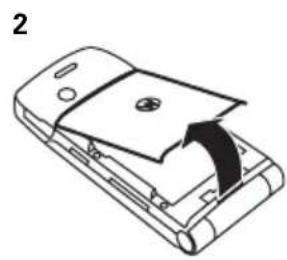
natural_image
Line drawing of a mobile phone showing the cable being inserted into a slot (no text or symbols)3
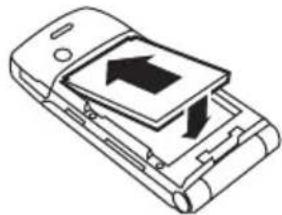
natural_image
Line drawing of a mobile phone with an open top showing an arrow indicating direction (no text or symbols)4
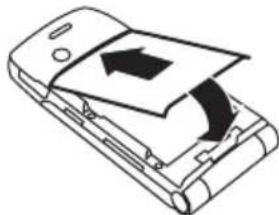
natural_image
Diagram of a mobile phone showing the left side of its screen with an arrow indicating the page direction (no text or symbols present)cargar la batería
natural_image
Line drawing of a car's front bumper with a plug inserted (no text or symbols)aspectos esenciales
natural_image
Line drawing of a device with a plug inserted into a cable (no text or symbols)[Phone Icon] Directorio tel
natural_image
Abstract black and white geometric logo with stylized letter M (no text or symbols)MOTOROLA
www.motorola.com/callsmart
direct.motorola.com/hellomoto/Motosupport/source/registration.asp
- Center Select Key
- Right Soft Key
- Navigation Key
- Voice Key
- Power/End Key
- Camera Lens
- External Display
- www.hellomoto.com
- Software Copyright Notice
- contents
- entertainment 38
- messages 40
- connections 45
- other features 52
- service & repairs ..... 70
- SAR Data 71
- Safety Information.... 74
- Industry Canada Notice .... 78
- FCC Notice 78
- Warranty 79
- Hearing Aids. 83
- WHO Information.... 84
- Registration 84
- Export Law 85
- Recycling Information ..... 85
- Perchlorate Label 86
- Privacy and Data Security . . . 86
- Driving Safety.... 87
- index 89
- menu map
- main menu
- Alert Styles
- Messaging
- Web Browser
- Contacts
- Recent Calls
- Media Gallery
- Tools
- Settings
- Phone Status
- settings menu
- Personalize
- In-Call Setup
- Security
- Initial Setup
- Network
- Car Settings
- Headset
- Location
- Connection
- Use and Care
- liquids of any kind dust and dirt
- extreme heat or cold cleaning solutions
- microwaves the ground
- essentials
- about this guide
- battery tips
- To save battery life:
- install the battery
- charge the battery
- To charge using the charger:
- To charge from your computer:
- turn it on & off
- make a call
- answer a call
- adjust volume
- change the call alert
- flip open
- flip closed
- view your phone number
- call a stored phone number
- tips & tricks
- basics
- home screen
- system status indicators
- menu shortcuts
- enter text
- set entry modes
- To set up Primary or Secondary entry mode:
- basics
- To select a text entry mode:
- entry mode indicators
- capitalization
- tap method
- iTAP® method
- basics
- or
- numeric method
- symbol method
- delete letters & words
- set phone alert style
- basics
- return unanswered call
- handsfree speaker
- To activate the speakerphone
- To use the speakerphone with your phone's flip closed:
- codes & passwords
- To change a code or password
- lock & unlock phone
- To lock your phone
- To unlock your phone
- lock external keys
- To lock the external keys automatically after a specified time:
- if you forget a code
- airplane mode
- customize
- set a style
- set alerts
- answer options
- wallpaper
- To select a wallpaper image
- To adjust wallpaper image layout
- set screen saver
- To select a screen saver image
- To set how long your phone must be inactive before it displays the screen saver.
- talking phone
- To set up the talking phone function:
- To activate the talking phone function:
- AGPS & your location
- AGPS limitations & tips
- To improve AGPS accuracy:
- conserve battery
- calls
- change active line
- automatic redial
- emergency calls
- AGPS during an emergency call
- notepad
- return a missed call
- attach number
- speed dial
- To speed dial a number:
- one-touch dial
- entertainment
- take a photo
- fun & games
- manage sounds
- send a multimedia message
- create & send message
- receive a multimedia message
- voicemail
- more messaging features
- features
- send text message
- view sent message
- read received message
- use text template
- use multimedia template
- connections
- cable connections
- Note: Motorola
- Bluetooth® connections
- turn Bluetooth power on/off
- place phone in discovery mode
- pair with other device
- connect to handsfree device during a call
- copy files to other device
- receive file from other device
- disconnect from device
- set Bluetooth options
- TTY operation
- notes on TTY operation
- TTY setup
- data & fax calls
- other features
- advanced calling
- DTMF Tones
- create entry
- view entry
- call entry
- edit entry
- delete entry
- set speed dial number for entry
- add more numbers or email addresses to entry
- view entries by picture or list
- sort entries
- filter entries
- voice commands
- Call
- Send Msg
- Lookup
- Go To
- Check
- voice command setup
- voice recognition settings
- Choice Lists
- Sensitivity
- Digit Dialing
- Sound
- more personalizing features
- message alerts
- skin
- menu language
- show or hide menu icons
- change home screen menu icons
- change home screen soft key labels
- call times & data volumes
- view data times
- reset all data times
- handsfree
- personal organizer
- add datebook event
- view or edit datebook event
- event reminder
- copy datebook event
- set alarm
- turn off alarm
- lock application
- service & repairs
- Specific Absorption Rate Data
- This model wireless phone meets the government's requirements for exposure to radio waves.
- http://www.phonefacts.net
- http://www.cwta.ca
- MOTOROLA
- Important Safety and Legal Information
- Safety and General Information
- Exposure to Radio Frequency (RF) Energy
- Operational Precautions
- External Antenna Care
- Product Operation
- RF Energy Interference/Compatibility
- Follow Instructions to Avoid Interference Problems
- Implantable Medical Devices
- Driving Precautions
- Operational Warnings
- Potentially Explosive Atmospheres
- Symbol Key
- Batteries and Chargers
- Choking Hazards
- Glass Parts
- Seizures/Blackouts
- Caution About High Volume Usage
- Repetitive Motion
- Industry Canada Notice to Users
- FCC Notice to Users
- The following statement applies to all products that have received FCC approval. Applicable products bear the FCC logo, and/or an FCC ID in the format FCC-ID:xxxxxx on the product label.
- Motorola Limited Warranty for the United States and Canada
- What Does this Warranty Cover?
- Exclusions
- Who Is Covered?
- What Will Motorola Do?
- What Other Limitations Are There?
- Hearing Aid Compatibility with Mobile Phones
- Information from the World Health Organization
- Product Registration
- Export Law Assurances
- Caring for the Environment by Recycling
- Disposal of your Mobile Device and Accessories
- Disposal of your Mobile Device Packaging and User's Guide
- California Perchlorate Label
- Privacy and Data Security
- Smart Practices While Driving
- Drive Safe, Call Smart SM
- index
- A
- B
- C
- D
- E
- F
- G
- H
- |
- K
- L
- M
- N
- 0
- P
- R
- s
- T
- U
- V
- W
- Y
- HELLOMOTO
- cargar la batería
- direct.motorola.com/hellomoto/Motosupport/source/registration.asp
Brand : MOTOROLA
Model : W385
Category : Smartphone