Ortho Plus - Uncategorized Ilford - Free user manual and instructions
Find the device manual for free Ortho Plus Ilford in PDF.


User questions about Ortho Plus Ilford
0 question about this device. Answer the ones you know or ask your own.
Ask a new question about this device
Download the instructions for your Uncategorized in PDF format for free! Find your manual Ortho Plus - Ilford and take your electronic device back in hand. On this page are published all the documents necessary for the use of your device. Ortho Plus by Ilford.
USER MANUAL Ortho Plus Ilford
ILFORD ORTHO Plus black and white film was originally designed as a high-resolution copy film, however it is suitable for other in camera applications including high quality portrait and landscape photography. The blue and green sensitivity enables the film to be handled in deep red safelight and allows processing by inspection where required.
For copy work this versatile film allows you to fine-tune the contrast by the choice of developer, the exposure given and the development time making it possible to achieve an accurate reproduction of most black and white originals, or to maintain a clean background in copies of combined line and continuous tone originals.
For use as a high-resolution camera film, Ortho Plus can be processed to pictorial contrast. Its lack of red sensitivity is often unimportant for many subjects and can even give an unusual / desirable effect to images having red or orange hues (reds appear much darker than normal).
Ortho Plus 35mm film is coated on 0.125mm/5-mil acetate base and is available in 36 exposure DX coded cassettes, suitable for all 35mm cameras. NB Cassettes are DX coded for ISO 80 (Daylight)
Ortho Plus 120 roll film is coated on 0.125mm/5-mil acetate base and is edge numbered 1 to 19. The base has excellent anti-halation properties.
Ortho Plus sheet film is coated on 0.180mm/7-mil polyester base with an anti-halation backing which clears during development. The emulsion faces the user when sheet film is held in the position shown opposite.

natural_image
Empty white square with a thin black border and a small circular mark at the top (no text or symbols)If processed and stored properly, ORTHO Plus film has excellent archival storage properties.
EXPOSURE RATING
The figures below, which apply to ORTHO Plus film developed to normal contrast in ILFORD ID-11 developer, provide a guide to exposure:
Daylight sources ISO 80/20°
Tungsten sources ISO 40/17°
135 Cassettes are DX Coded ISO 80. For tungsten work a manual ISO setting of 40 should be used. Alternatively, a 1 stop exposure correction can be made.
SPECTRAL SENSITIVITY
Wedge spectrogram to tungsten light (2850K)
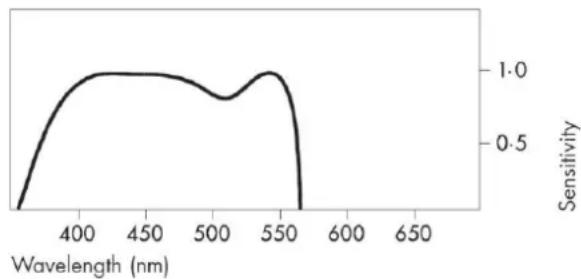
line
| Wavelength (nm) | Sensitivity | | --------------- | ----------- | | 380 | 0.0 | | 400 | 0.8 | | 450 | 1.0 | | 500 | 0.9 | | 550 | 1.0 | | 600 | 0.0 | | 650 | 0.0 |FILTER FACTORS
The factors quoted below give a practical guide to the increase in exposure necessary when using the filters listed. For other types of filters, follow the instructions given by the filter manufacturer.
| Daylight | Tungsten | |
| 104 Alpha (yellow) | 2.5 | 1 |
| 109 Delta (deep yellow) | 5.5 | 3 |
| 304 Tricolour Blue | 3 | 5 |
| 404 Tricolour Green | 8 | 4.5 |
MAKING LONG EXPOSURES
For exposures between 1 and 1/10 000 second, no adjustments are needed for reciprocity law failure.
When exposures longer than 1 second are given, ORTHO Plus film, along with other films, needs to be given more exposure than indicated by a meter. Use the graph to calculate the increased exposure time which should be given once the measured time is known.
The graph is based on the formulae Ta = Tm^1.25
Ta = Adjusted Time
Tm = Measured Time
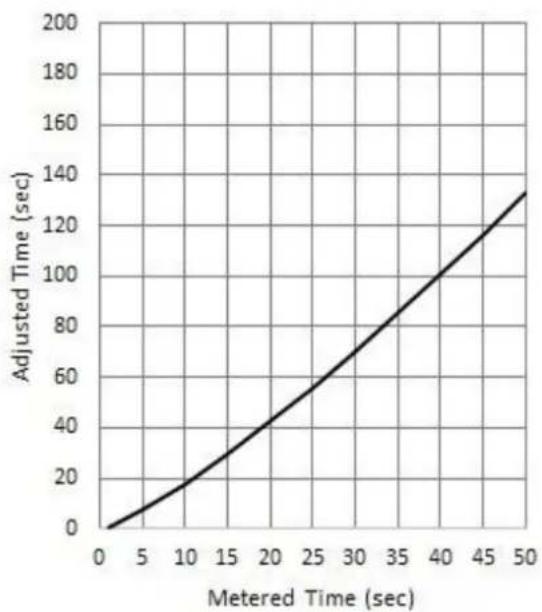
line
| Metered Time (sec) | Adjusted Time (sec) | | ------------------- | ------------------- | | 0 | 0 | | 5 | 10 | | 10 | 20 | | 15 | 30 | | 20 | 40 | | 25 | 50 | | 30 | 60 | | 35 | 70 | | 40 | 80 | | 45 | 90 | | 50 | 100 |CHOOSING THE BEST ILFORD DEVELOPER FOR THE JOB
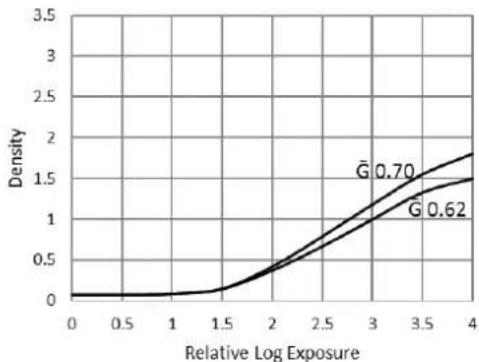
The table below gives development times in minutes for the stated contrast (Gbar). Development times may be altered if a different contrast is needed. Gbar 0.62-0.70 would be considered normal for in camera use.
| Pictorial Contrast | °C / °F | Min:Sec | |||
| Developer | Dilution | Temp | Gbar 0.62 | to | Gbar 0.70 |
| ILFOTEC DDX | 1+4 | 20/68 | 10.30 | 13.00 | |
| ILFOSOL 3 | 1+9 | 20/68 | 5:00 | 6:30 | |
| 1+14 | 20/68 | 7:00 | 8:30 | ||
| ID11 | Stock | 20/68 | 08:00 | 10:00 | |
| 1+1 | 20/68 | 10:30 | 13:00 | ||
| 1+3 | 20/68 | 16:00 | 20:00 | ||
| MICROPHEN | Stock | 20/68 | 9:00 | 12:00 | |
| 1+1 | 20/68 | 11:30 | 14:30 | ||
| 1+3 | 20/68 | 13:30 | 17:00 | ||
| PERCEPTOL | Stock | 20/68 | 13:00 | 16:00 | |
| ILFOTEC HC | 1+15 | 20/68 | 4:00 | 5:00 | |
| 1+31 | 20/68 | 6:00 | 8:00 | ||
| ILFOTEC DD | 1+4 | 24/75 | 5:30 | 6:30 | |
| ILFOTEC RT RAPID | 1+1+2 | 26/79 | 1:05 | 2:07 | |
| 1+1+5 | 26/79 | 1:18 | 2:33 | ||
| Intermediate Contrast | Gbar 0.80 | to | Gbar 1.00 | ||
| PQ Universal | 1+9 | 20/68 | 4:00 | 12:00 | |
| High Contrast | Gbar 1.2 | to | Gbar 1.80 | ||
| PHENISOL | 1+4 | 20/68 | 3:00 | 10:00 | |
Note For dish/tray development with continuous agitation, reduce these times by 15%.
Processing at Different Temperatures
ORTHO Plus film can be processed over a range of temperatures. Development times at temperatures other than 20^ C/68°F may be calculated from the chart below. For example, if 4 minutes at 20^ C/68°F is recommended, the time at 23^ C/73°F will be 3 minutes and the time at 16^ C/61°F will be 6 minutes.
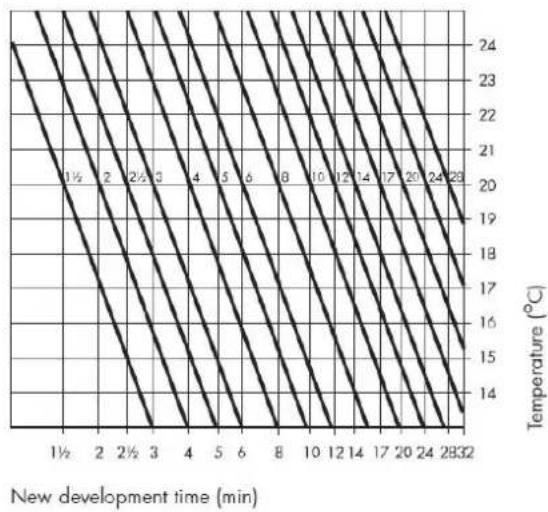
line
| New development time (min) | Temperature (°C) | | -------------------------- | ---------------- | | 1½ | 24 | | 2 | 23 | | 2½ | 22 | | 3 | 21 | | 4 | 20 | | 5 | 19 | | 6 | 18 | | 8 | 17 | | 10 | 16 | | 12 | 15 | | 14 | 14 | | 17 | 15 | | 20 | 16 | | 24 | 17 | | 2832 | 18 |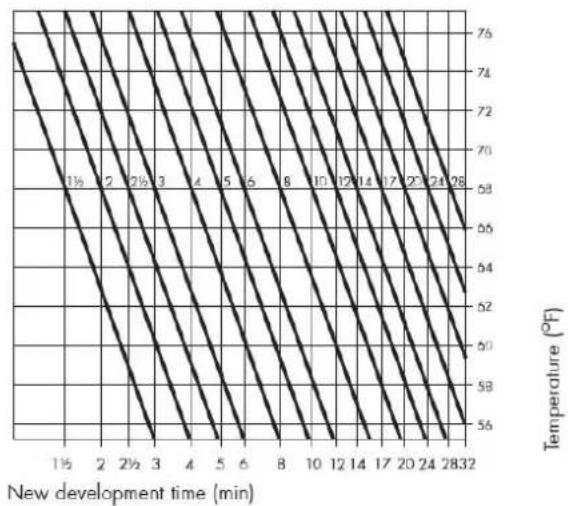
line
| New development time (min) | Temperature (°F) | | -------------------------- | ---------------- | | 1½ | 76 | | 2 | 74 | | 2½ | 72 | | 3 | 70 | | 4 | 68 | | 5 | 66 | | 6 | 64 | | 8 | 62 | | 10 | 60 | | 12 | 58 | | 14 | 56 | | 17 | 54 | | 20 | 52 | | 24 | 50 | | 28 | 48 | | 32 | 46 |CHARACTERISTIC CURVES
Pictorial Contrast
line
| Relative Log Exposure | Density (Ḡ) | Density (G) | | --------------------- | ------------ | ----------- | | 3.5 | 0.70 | 0.62 |ORTHO Plus film developed in ILFORD ID-11 (stock) for 8 & 10min at 20°C/68°F with intermittent agitation.
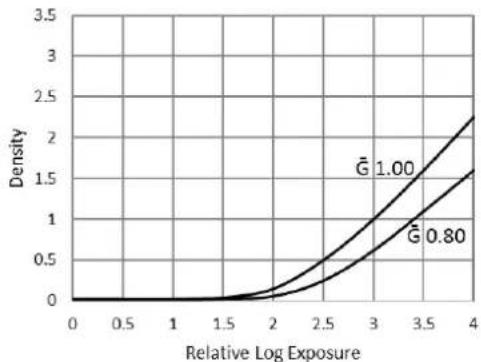
Intermediate Contrast
line
| Relative Log Exposure | Density (Ḡ = 1.00) | Density (Ḡ = 0.80) | | --------------------- | ------------------- | ------------------- | | 0 | 0 | 0 | | 1.5 | ~0.1 | ~0.05 | | 2 | ~0.3 | ~0.1 | | 2.5 | ~0.7 | ~0.3 | | 3 | ~1.2 | ~0.6 | | 3.5 | ~1.8 | ~0.9 | | 4 | ~2.3 | ~1.2 |ORTHO Plus film developed in ILFORD PQU (1+9) for 4 & 12min at 20°C/68°F with intermittent agitation.
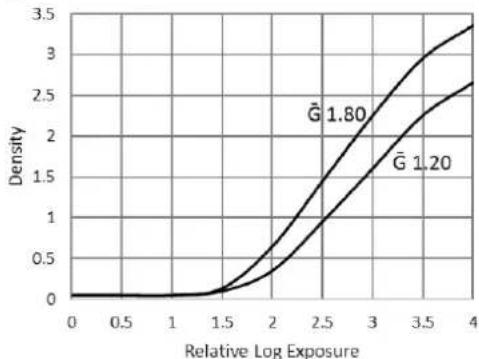
High Contrast
line
| Relative Log Exposure | Density (G̃ = 1.80) | Density (G̃ = 1.20) | | --------------------- | ------------------- | ------------------- | | 0 | 0 | 0 | | 1.5 | ~0.1 | ~0.05 | | 2.5 | ~1.5 | ~1.0 | | 3.5 | ~3.0 | ~2.5 | | 4 | ~3.5 | ~3.0 |ORTHO Plus film developed in ILFORD PHENISOL (1+4) for 3 & 10min at 20°C/68°F with intermittent agitation.
PROCESSING
Ortho Plus can be processed in all types of processing equipment including spiral tanks, rotary processors, dishes/trays, deep tanks and automatic processors. Standard capacity figures and replenishment rates can be maintained. Ortho Plus is very robust in processing and will tolerate less than ideal processing conditions. Also, it will not contaminate the processing chemicals.
Safelight recommendations
Either total darkness or use an ILFORD 906 (dark red) safelight illuminated by a 15 watt bulb. As a precaution against fogging and resultant reduced image contrast, a minimum distance of 1· 2m / 4ft between the safelight and the working area is recommended. For best results, keep safelight exposure to a minimum.
Agitation
Intermittent agitation is recommended for use in spiral tanks and deep tanks. With spiral tanks, invert the tank four times during the first 10 seconds, then invert the tank four times again during the first 10 seconds of each further minute. Otherwise, follow the recommendations given by the processing equipment manufacturer. For sheet film, continuous agitation is recommended in dishes/trays by rocking the dish/tray.
Stop, fix, wash and rinse
For best results it is recommended that all process solutions are kept at the same temperature or at least within 5^ C ( 9^ F) of the developer temperature.
Stop Bath
After development the film can be rinsed in water but we recommend that an acid stop bath is used such as ILFORD ILFOSTOP (with indicator dye). ILFOSTOP is also recommended for all machine processing applications. When tanks or dishes (trays) of process solutions are in use a stop bath immediately stops development and reduces carry over of excess developer into the fixer bath. This helps to maintain the activity and prolong the life of the fixer solution.
| ILFORD ILFOSTOP | |
| Dilution | 1+19 |
| Temperature Range | 18-24°C (64-75°F) |
| Time (sec) at 20°C (68°F) | 10 |
| Capacity, films per litre(unreplenished) | 15x (135-36), 120 or 20.3x25.4cm (8x10in) |
The process time given is the minimum required, if necessary, a longer time may be used and should not cause any process problems provided it is not excessive.
Fix
The recommended fixers are ILFORD RAPID FIXER or ILFORD HYPAM FIXER.
Wash
Wash the films in running water for 5–10 minutes at a temperature within 5^ C ( 9^ F) of the process temperature. Or see note below for greater economy when using spiral tanks.
| ILFORD RAPID OR HYPAM FIXERS | |
| Dilution | 1+4 |
| Temperature Range | 18-24°C (64-75°F) |
| Time (mins) at 20°C (68°F) | 2-5 |
| Capacity (films per litre, unreplenished) | 24x (135-36), 120 or 20.3x25.4cm (8x10in) |
Note: For spiral tank use, the following method of washing is recommended. This method of washing is faster, uses less water yet still gives negatives suitable for long term storage.
After fixing, fill the spiral tank with water at the same temperature, +/- 5^ (9°F), as the processing solutions and invert it five times. Drain the water away and refill. Invert the tank ten times. Once more drain the water away and refill. Finally, invert the tank twenty times and drain the water away.
Rinse
For a final rinse use ILFORD ILFOTOL wetting agent added to water, it helps the film to dry rapidly and evenly. Start by using 5ml per litre of rinse water (1+200), however the amount of ILFOTOL used may need some adjustment depending on the local water quality and drying method. Too little or too much wetting agent can lead to uneven drying. Remove excess rinse solution from the film before drying.
Drying
Dry ORTHO Plus film at 30–40°C/86-104°F in a drying cabinet or at room temperature in a clean dust-free area.
STORAGE
Store ORTHO Plus film in a cool (10–20°C/50-68°F), dry place in its original packaging. ORTHO Plus film may be stored in a fridge/freezer but allow plenty of time for the film to acclimatise prior to use.
Exposed film
Once exposed, process ORTHO Plus film as soon as practical. Ideally before one month. Exposed films should always be stored in cool, dry conditions - as recommended above.
Negatives
Store processed negatives in a cool (10–20°C/50-68°F), dry place, in the dark. Suitable storage sleeves include those made of cellulose triacetate, Mylar, paper (pH6.5–7.5) or inert polyester.
A wide range of information sheets are available which describe and give guidance on using ILFORD PHOTO products. Some product information sheets might not be available in your country.
HARMAN technology Limited, ILFORD Way, Mobberley,
Knutsford, Cheshire WA16 7JL, England
www.ilfordphoto.com