SFX 200 - Photographic film Ilford - Free user manual and instructions
Find the device manual for free SFX 200 Ilford in PDF.


| Product Type | Black and white photographic film |
| Brand | Ilford |
| Model | SFX 200 |
| Film Speed (ISO) | 200/24° |
| Formats Available | 35mm (36 exposures), 120 roll film (edge numbers 1–19) |
| Base Material | Grey acetate |
| Base Thickness | 0.125 mm / 5 mil |
| Spectral Sensitivity | Extended red sensitivity up to 740 nm, panchromatic |
| Recommended Filters | Yellow, orange, red (Kodak Wratten equivalents); deep red for dramatic effects |
| Developer Compatibility | All normal developers; ILFORD ID-11, DD-X, ILFOSOL 3, MICROPHEN, PERCEPTOL, etc. |
| Processing Equipment | Spiral tanks, rotary processors, deep tanks, automatic processors |
| Processing Temperature Range | 16–24°C (61–75°F) typical; chart for other temperatures |
| Agitation | Intermittent: 4 inversions in first 10 sec, then 4 inversions each minute |
| Safelight Requirement | Total darkness; do not use safelight |
| Exposure Latitude | Wide; bracket exposures ±2 stops from TTL reading with filter |
| Contrast | Wide tonal range; negatives of average contrast with standard development |
| Storage (unexposed) | Cool (10–20°C / 50–68°F), dry place; refrigerate/freeze with acclimation |
| Storage (exposed) | Process as soon as possible; store cool and dry |
| Storage (negatives) | Cool, dry, dark; use cellulose triacetate, Mylar, or inert polyester sleeves |
| Typical Applications | Creative photography, landscapes, portraits, townscapes, architecture; best in bright sunlight or tungsten studio lighting |
| DX Coding | Yes (35mm cassettes) |
Frequently Asked Questions - SFX 200 Ilford
User questions about SFX 200 Ilford
0 question about this device. Answer the ones you know or ask your own.
Ask a new question about this device
Download the instructions for your Photographic film in PDF format for free! Find your manual SFX 200 - Ilford and take your electronic device back in hand. On this page are published all the documents necessary for the use of your device. SFX 200 by Ilford.
USER MANUAL SFX 200 Ilford
ILFORD SFX 200 is a medium speed black and white camera film for creative photography. It has extended red sensitivity (up to 740nm) and is especially suited for use with a red filter to create special effects. For example, by using a very deep red filter, skies can be rendered almost black, and most green vegetation almost white. Its unusual tonal rendition ensures interesting results for a range of subjects, including portraits, landscapes, townscapes and architecture.
Best results are obtained in bright sunshine, or in the studio under tungsten lighting.
SFX also has full panchromatic sensitivity to ensure good pictorial contrast with or without the use of a filter. It has a wide exposure latitude and is compatible with all normal developers. It has a wide tonal range.
AVAILABILITY
SFX 200 film is coated on 0.125mm/5-mil grey acetate base which gives good halation protections. SFX 200 is available in 36 exposure DX coded cassettes, suitable for all 35mm cameras. SFX 200 is also available as 120 roll film, edge numbered 1 to 19.
EXPOSURE RATING
SFX 200 has a speed rating of ISO 200/24° to daylight.
The ISO speed rating was measured using ILFORD ID-11 developer at 20^ C/68°F with intermittent agitation in a spiral tank.
It should be noted that the exposure index (EI) range recommended for SFX 200 is based on a practical evaluation of film speed and is not based on foot speed, as is the ISO standard.
SPECTRAL SENSITIVITY
Wedge spectrogram to tungsten light (2850K)
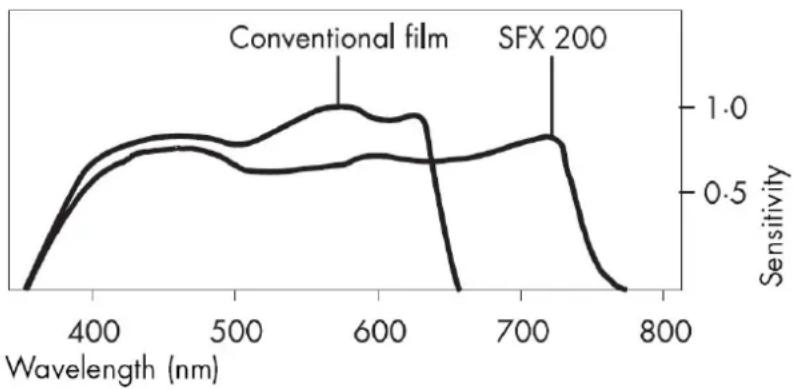
line
| Wavelength (nm) | Conventional film | SFX 200 | | --------------- | ----------------- | ------- | | 400 | ~0.8 | ~0.7 | | 500 | ~1.0 | ~0.8 | | 600 | ~1.1 | ~0.9 | | 700 | ~0.9 | ~0.8 | | 800 | ~0.5 | ~0.3 |USE OF FILTERS
SFX 200 film can be used with yellow, orange or red filters, but the effect seen will depend on its transmission characteristics. The redder the filter, the more dramatic the effect. With very dark filters, exposure times can be very long, so the use of a tripod is recommended. Below is a guide to filter factors for various filter colours.
Filter Factors
| Filter Kodak Wratten (or equivalent) | Filter Colour | Filter Factor | Exposure Increase (Stops) | |||
| 3 Very Light Yello | w | 2 | 1 | |||
| 8 | Yellow | 2 | 1 | 13 | ||
| 12 | Deep | w | Yello 2.3 | 113 | ||
| 15 Very Deep Yello | w | 2.4 | 113 | |||
| 21 | Orange | 2.4 | 113 | |||
| 23a | Reddish | Orange | 2.5 | 113 | ||
| 25 | Red | 2.8 | 1 | 12 | ||
| 29 | Deep | Red | 3 | 1 | ||
| 89B | Very | Deep | Red | 16 | 4 | |
LOADING THE CAMERA
SFX 200 must be loaded in subdued light. Unlike true infra-red film, it is not necessary to load it in total darkness.
FOCUSING
With some lenses, red light focuses at a slightly different point to other visible light. With these lenses, there may be a shift when focusing in white light compared with red light. However, it is almost impossible to focus a camera with a deep red filter in place.
With short to moderate focal length lenses, this difference can easily be accommodated by stopping down to the smallest working aperture. Some lenses, particularly apochromatic (APO) designs, may need no correction.
EXPOSURE
A certain amount of experimentation is needed when first using this film. As a guide, bracket exposures by +/-2 stops from the TTL reading with the filter in place, or the meter reading with the filter factor applied.
Note The TTL metering on some common cameras can under expose by up to 1 1/2 stops with deep red or orange filters in place.
If you want to check the TTL metering system on your camera before starting, set the metering system of the camera to El 200/24, and with your filter in place – make a series of exposures up to ± 2 stops from the indicated exposure. After processing, decide which is the best negative and re-set the camera if necessary. As an example, the correct exposure in bright sunlight with a deep red filter is around 1/30 ^th second at f5.6.
CHARACTERISTIC CURVE
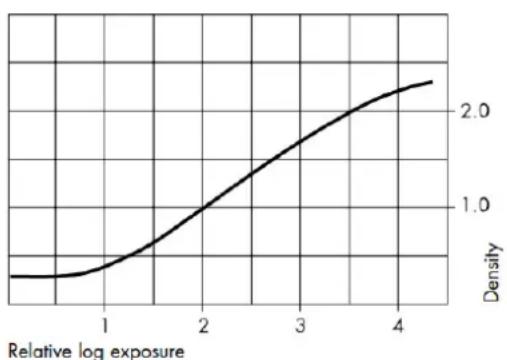
line
| Relative log exposure | Density | | --------------------- | ------- | | 0 | 0.5 | | 1 | 0.7 | | 2 | 1.0 | | 3 | 1.8 | | 4 | 2.2 |SFX 200 film developed in ILFORD ID-11 stock for 10 minutes at 20°C/68°F with intermittent agitation.
PROCESSING
SFX 200 can be processed in all types of processing equipment, including spiral tanks, rotary processors, deep tanks and automatic processors. Standard capacity figures and replenishment rates can be maintained.
SFX 200 is very robust in processing and will tolerate less than ideal processing conditions. Also, it will not contaminate the processing chemicals.
DEVELOPMENT TIMES
The table on page 4 gives development times for both manual and machine processing. These times will produce negatives of average contrast – suitable for printing in all enlargers.
The development times are intended as a guide and may be altered if a different result in needed.
For manual processing in spiral tanks and deep tanks, the development times are based on intermittent agitation. Where continuous agitation is used for manual processing, and for use in rotary processors without a pre-rinse - reduce the spiral tank development times by up to 15%.
Generally, a pre-rinse is not recommended, as it can lead to uneven processing.
CHOOSING THE BEST ILFORD DEVELOPER FOR THE JOB
Manual processing Spiral tank, dish/tray, deep tank Including rotary processors
| Liquid | r | Powde | |
| Best overall image quality | |||
| EI 200/24 | ILFOTEC DD-X | ID-11 (stock) | |
| EI400/27 | ILFOTEC DD-X | ID-11 (stock) | |
| EI800/30 | ILFOTEC DD-X | ID-11 (stock) | |
| Finest grain | ILFOTEC DD-X | PERCEPTOL | |
| Maximum sharpness | ILFOSOL 3 (1+9) | ID-11 (1+1) | |
| Maximum film speed | ILFOTEC DD-X | MICROPHEN (stock) | |
| Economy | ILFOTEC LC29 (1+29) ID-11 (1+1) | MICROPHEN (1+1) | |
| One-shot convenience | ILFOSOL 3 (1+9) | ID-11 (1+1) | |
| ILFOTEC DD-X | MICROPHEN (1+1) | ||
| Replenishable | ILFOTEC DD-X ID-11 | ||
Machine Processing
| Dip and dunk | ILFOTEC DDID-11 | Best overall image quality (liquid) and long tank lifeBest overall image quality (powder) and long tank life |
| Short leader | ILFOTEC RT RAPID | Rapid processing, best o verall image quality and long tank life. |
| Roller transport | ILFOTEC RT RAPID | Rapid processing |
| 35mm and Roll Film | ||||
| ILFORD developer Dilution | Meter setting (EI) | |||
| 200/24 | 400/27 | 800/30 | ||
| Spiral tank, deep tank, dip and dunk machines (min/20°C/68°F) | ||||
| ILFOTEC DD-X | 1+4 | 10 | 14 | - |
| ILFOSOL 3 | 1+9 | 6 | 8 | 12 |
| 1+14 | 9 | 1312 | - | |
| ILFOTEC HC 1+15 | 5 | 7 | 1012 | |
| 1+31 | 9 | 13 | ||
| ILFOTEC LC29 | 1+9 | 5 | 7 1012 | |
| 1+19 | 9 | 13 | 19 | |
| 1+29 | 11 | - | - | |
| ID-11 | stock | 10 | 14 | 18 |
| 1+1 | 17 | - | - | |
| MICROPHEN | stock | 812 | 1012 | 1412 |
| 1+1 | 1512 | 19 | - | |
| PERCEPTOL | stock | 1412 | - | - |
| 1+1 | 20 | - | - | |
Non-ILFORD Developers (min/20°C/68°F)
| Developer | Dilution | Meter setting (EI) | ||
| 200/24 | 400/27 | 800/30 | ||
| Kodak D-76 | stock | 10 | 1212 | 1612 |
| 1+1 | 1412 | - | - | |
| Kodak HC-110 | A | 5 | 7 | 1012 |
| B | 9 | 13 | 19 | |
| Kodak T-Max | 1+4 | 812 | 1012 | 1212 |
| Tetenal Ultrafin | 1 + 10 | 10 | 13 | - |
| Kodak Xtol | stock | 7 | 11 | - |
Dip and dunk machines (min/24°C/75°F)
| ILFOTEC DD | 1+4 | 812 | 1112 14 | |
| Kodak T-Max RS | stock | 6 | 7 | 9 |
| Kodak Xtol | stock | 7 | 9 1112 |
ILFOLAB FP40, roller transport and short leader machines (sec/26°C/79°F)
| ILFOTEC RT RAPID | 1+1+2 | 54 | 65 88 |
| 1+1+5 | 65 | 90 120 |
Note. Development times may need adjusting to suit individual processing systems and working practices. If an established system is producing good results, adjust the recommended development times until the desired contrast level is obtained. Development times in other manufacturers' developers are included for your convenience and are only a general guide. Other manufacturers can and do change their product specifications from time to time, and the development times may change as a result.
PROCESSING
Processing at Different Temperatures
SFX 200 film can be processed over a range of temperatures. Approximate development times at temperatures other than 20^ C/68°F may be calculated from the charts below. For example, if 4 minutes at 20^ C/68°F is recommended, the time at 23^ C/73°F will be 3 minutes and the time at 16^ C/61°F will be 6 minutes.
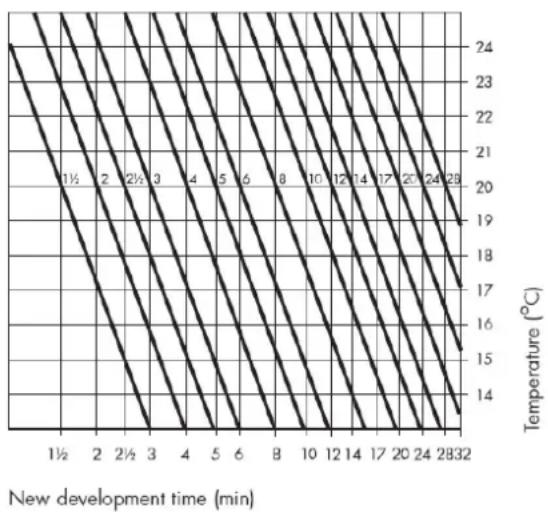
line
| New development time (min) | Temperature (°C) | | :--- | :--- | | 1½ | 24 | | 2 | 23 | | 2½ | 22 | | 3 | 21 | | 4 | 20 | | 5 | 19 | | 6 | 18 | | 8 | 17 | | 10 | 16 | | 12 | 15 | | 14 | 14 | | 17 | 15 | | 20 | 16 | | 24 | 17 | | 28 | 18 | | 32 | 19 |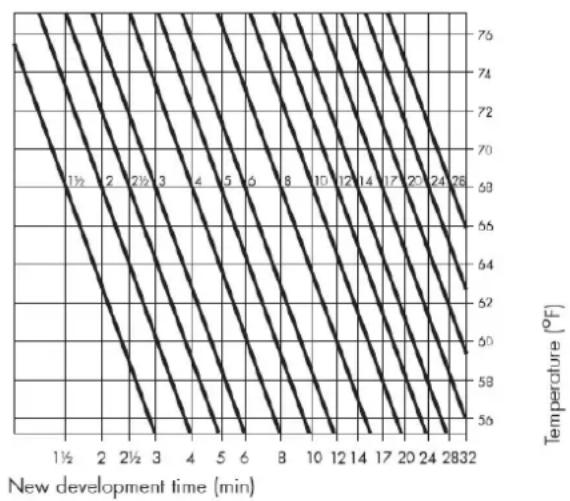
line
| New development time (min) | Temperature (°F) | | :--- | :--- | | 1½ | 75 | | 2 | 74 | | 2½ | 73 | | 3 | 72 | | 4 | 71 | | 5 | 70 | | 6 | 69 | | 8 | 68 | | 10 | 67 | | 12 | 66 | | 14 | 65 | | 17 | 64 | | 20 | 63 | | 24 | 62 | | 28 | 61 | | 32 | 60 |PROCESSING
SFX 200 can be processed in all types of processing equipment including spiral tanks, rotary processors, deep tanks and automatic processors. Standard capacity figures and replenishment rates can be maintained.
Safelight recommendations
Handle SFX 200 film in total darkness.
Agitation
Intermittent agitation is recommended for use in spiral tanks and deep tanks. With spiral tanks, invert the tank four times during the first 10 seconds, then invert the tank four times again during the first 10 seconds of each further minute. Otherwise, follow the recommendations given by the processing equipment manufacturer.
Stop, fix, wash and rinse
For best results it is recommended that all process solutions are kept at the same temperature or at least within 5^ C ( 9^ F) of the developer temperature.
Stop Bath
After development the film can be rinsed in water, but we recommend that an acid stop bath is used such as ILFORD ILFOSTOP (with indicator dye). ILFOSTOP is also recommended for all machine processing applications. When tanks or dishes (trays) of process solutions are in use a stop bath immediately stops development and reduces carry over of excess developer into the fixer bath. This helps to maintain the activity and prolong the life of the fixer solution.
ILFORD ILFOSTOP
| Dilution | 1+19 |
| Temperature Range 18-24°C (64-75°F) | |
| Time (sec) at 20°C (68°F) 10 | |
| Capacity (films per litre, unreplenished) | 15x (135-36) |
Fix
The recommended fixers are ILFORD RAPID FIXER or ILFORD HYPAM FIXER.
Wash
Wash the films in running water for 5–10 minutes at a temperature within 5^ C ( 9^ F) of the process temperature. Or see note below for greater economy when using spiral tanks.
ILFORD RAPID OR HYPAM FIXERS
| Dilution | 1+4 |
| Temperature Range 18–24°C (64–75°F) | |
| Time (mins) at 20°C (68°F) 2-5 | |
| Capacity (films per litre, unreplenished) | 24x (135-36) |
Note: For spiral tank use, the following method of washing is recommended. This method of washing is faster, uses less water yet still gives negatives suitable for long term storage.
After fixing, fill the spiral tank with water at the same temperature, ±5^ ( 9^ ), as the processing solutions and invert it five times. Drain the water away and refill. Invert the tank ten times. Once more drain the water away and refill. Finally, invert the tank twenty times and drain the water away.
Rinse
For a final rinse use ILFORD ILFOTOL wetting agent added to water, it helps the film to dry rapidly and evenly. Start by using 5ml per litre of rinse water (1+200), however the amount of ILFOTOL used may need some adjustment depending on the local water quality and drying method. Too little or too much wetting agent can lead to uneven drying. Remove excess rinse solution from the film before drying.
Drying
To avoid drying marks, use a clean squeegee or chamois cloth to wipe SFX 200 film before hanging it to dry. Dry SFX 200at 30–40°C/86-104°F in a drying cabinet or at room temperature in a clean dust-free area.
STORAGE
For immediate use, store SFX 200 in a cool (10–20°C/50-68°F), dry place in its original packaging. SFX 200 may be stored in a fridge/freezer but allow plenty of time for the film to acclimatise prior to use.
Exposed film
Once exposed, process SFX 200 as soon as practical. Exposed films should always be stored in cool, dry conditions - as recommended above.
Negatives
Store processed negatives in a cool (10–20°C/50-68°F), dry place, in the dark. Suitable storage sleeves include those made of cellulose triacetate, Mylar, paper (pH6.5–7.5) or inert polyester.
A wide range of fact sheets is available which describe and give guidance on using ILFORD PHOTO products. Some products in this fact sheet might not be available in your country.
HARMAN technology Limited, Ilford Way, Mobberley, Knutsford, Cheshire WA16 7JL, England www.ilfordphoto.com