XP2 Super 400 - Uncategorized Ilford - Free user manual and instructions
Find the device manual for free XP2 Super 400 Ilford in PDF.


User questions about XP2 Super 400 Ilford
0 question about this device. Answer the ones you know or ask your own.
Ask a new question about this device
Download the instructions for your Uncategorized in PDF format for free! Find your manual XP2 Super 400 - Ilford and take your electronic device back in hand. On this page are published all the documents necessary for the use of your device. XP2 Super 400 by Ilford.
USER MANUAL XP2 Super 400 Ilford
XP2 SUPER is a sharp, fast, fine grain black and white film. It can be used for any photographic subject, but ensures excellent results when there is a wide subject brightness range.
XP2 SUPER is easy to expose, has and extremely wide exposure latitude and gives exceptionally sharp, crisp prints. The excellent highlight and shadows of XP2 SUPER give enhanced negative contrast for optimum black and white print quality.
XP2 SUPER is easy to process. It is a black and white film which is processed in C41 type processing chemicals alongside colour negative films.
XP2 SUPER is very easy to print. Negatives are printed on black and white paper in the same way as conventional black and white negatives.
WHY XP2 SUPER IS DIFFERENT
XP2 SUPER is a chromogenic film. This means that the dyes which make up the image are formed during development rather than being present in the film or added later.
The extremely wide exposure latitude of XP2 SUPER is the result of the unique relationship between exposure and grain in chromogenic films.
The best balance of sharpness and grain is obtained when XP2 SUPER is exposed at EI 400/27. However, down-rated or overexposed XP2 SUPER negatives have finer grain, the opposite of that expected and obtained with conventional films. Up-rated or underexposed XP2 SUPER negatives have only a slight loss in quality. Furthermore, standard C41 processing is recommended for the whole of the exposure range.
XP2 SUPER 35mm film is coated on 0.125mm/5-mil acetate base and is available in 24 or 36 exposure cassettes, or in bulk lengths of 30.5 metres (100ft). XP2 SUPER 35mm film is supplied in DX coded cassettes, suitable for all 35mm cameras.
XP2 SUPER roll film is coated on 0.110mm/4-mil clear acetate base with an anti-halation backing which clears during development. It is available in 120 lengths and is edge numbered 1 to 19.
EXPOSURE RATING
XP2 SUPER film has a speed rating of ISO 400/27° (400ASA, 27DIN, EI 400/27) to daylight. The ISO speed rating was measured using standard C41 processing. Although rated at ISO 400/27°, XP2 SUPER can be exposed over the range EI 50/18–800/30. When higher speed is needed, XP2 SUPER can be rated at up to EI 800/30. For finer grain, when speed is less important, rate the film at EI 200/24, although for finest grain it can be rated as low as EI 50/18 if required.
The practical implications of this wide exposure range are very important. XP2 SUPER can be exposed at a setting to suit the job. The benefit of variable speed also provides security against inadvertent over- or underexposure.
It should be noted that the exposure index (EI) recommended for XP2 SUPER is based on a practical evaluation of film speed and is not based on foot speed, as is the ISO standard.
CHOOSING THE RIGHT FILM SPEED FOR THE JOB
| Best overall quality | EI |
| Finer grain (with easy printing) | EI 200/24 |
| Finest grain (but with denser negatives) | EI 50/18 |
400/27
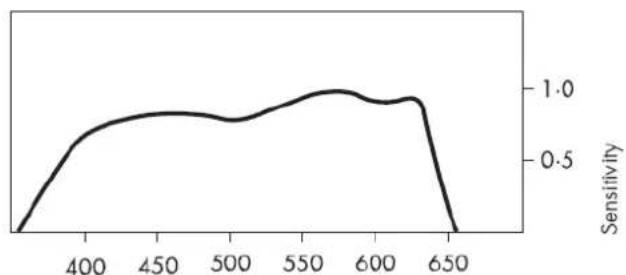
SPECTRAL SENSITIVITY Wedge spectrogram to tungsten light (2856K)
line
| X | Sensitivity | | ---- | ----------- | | 350 | 0.0 | | 400 | 0.5 | | 450 | 0.7 | | 500 | 0.8 | | 550 | 0.9 | | 600 | 0.8 | | 650 | 0.0 |Wavelength nm
FILTER FACTORS
XP2 SUPER film may be used with all types of filters (e.g. colour, polarising and neutral density filters) in the usual way. Follow the instructions given by the filter manufacturer.
The exposure increase in daylight may vary with the angle of the sun and the time of day. In the late afternoon or the winter months, when daylight contains more red light, green and blue filters may need slightly more exposure than usual.
Cameras with through-the-lens metering will usually adjust the exposure automatically when using filters. With some automatic exposure cameras, the correction given for deep red and orange filters can produce negatives under exposed by as much as 1½ stops.
MAKING LONG EXPOSURES
For exposures between 1 and 1/10 000 second, no adjustments are needed for reciprocity law failure.
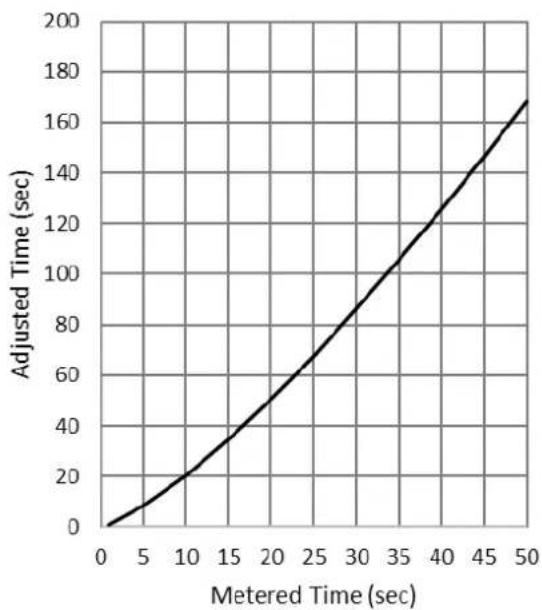
When exposures longer than 1 second are given, XP2 SUPER, along with other films, needs to be given more exposure than indicated by a meter. Use the graph to calculate the increased exposure time which should be given once the metered time is known.
The graph is based on the formulae Ta = Tm ^1.31
Ta = Adjusted Time
Tm = Metered Time
line
| Metered Time (sec) | Adjusted Time (sec) | | ------------------- | ------------------- | | 0 | 0 | | 5 | 10 | | 10 | 20 | | 15 | 35 | | 20 | 50 | | 25 | 65 | | 30 | 80 | | 35 | 100 | | 40 | 120 | | 45 | 140 | | 50 | 170 |CHARACTERISTIC CURVE
line
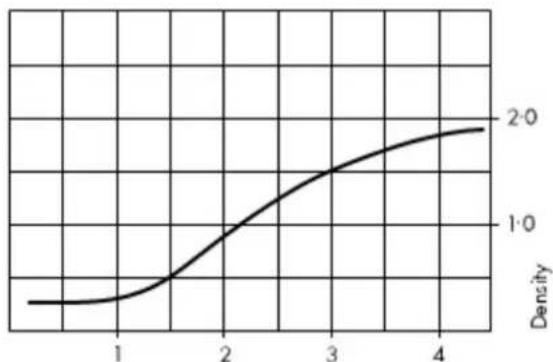
| x | Density | |---|---------| | 1 | ~0.5 | | 2 | ~1.0 | | 3 | ~1.8 | | 4 | ~2.0 |Relative log exposure
XP2 SUPER film processed through standard C41 type chemicals. This curve is representative of 35mm film and roll film
PROCESSING
XP2 SUPER film is processed in the standard C41 colour negative film process. XP2 SUPER film can be processed alongside all makes of colour negative film. For selecting which negatives to enlarge on black and white paper, the processing lab can supply proof prints on colour paper.
Safelight recommendations
Handle XP2 SUPER film in total darkness.
C41 type processing
XP2 SUPER film is fully compatible with C41 type processing chemicals, both replenished (e.g. in dip and dunk or roller transport processors) and unreplenished (e.g. in spiral tanks or with Jobo one-shot rotary processing). The film can be put through standard C41 lines with no adjustment to processing speed, temperature or replenishment rates – see "Replenishment rates".
A benefit of using a professional C41 type processing service for XP2 SUPER film is that the high level of quality control needed with the professional C41 process should always ensure well processed negatives.
XP2 SUPER film will not affect the quality of the colour material processed or the equilibrium of the processing chemicals. Any proportion of XP2 SUPER film to colour negative film can be used in a C41 processing line, while retaining a stable system. Reusable C41 type chemicals, which have been used to process XP2 SUPER film, can be used to process colour negative film, with no loss of quality in subsequent films.
Replenishment rates
Set replenishment rates for XP2 SUPER film as if it is an ISO 200/24° colour negative film, regardless of how it was exposed.
Push processing
Push processing is not recommended as, unlike conventional ISO 400/27° films, no practical increase in film speed is achieved when XP2 SUPER film is push processed. But XP2 SUPER film can be exposed at EI 800/30 and given standard processing.
Conventional processing
We do not recommend conventional black and white processing for use with XP2 SUPER film since advantages such as grain free images and scanning with ICE will be lost. However, users have reported that a good quality image may be obtained using conventional black and white chemistry.
Drying
To avoid drying marks, use a clean squeegee or chamois cloth to wipe XP2 SUPER film before hanging it to dry. Dry XP2 SUPER at 30–40°C/86-104°F in a drying cabinet or at room temperature in a clean dust-free area.
STORAGE
For immediate use, store XP2 SUPER in a cool (10–20°C/50-68°F), dry place in its original packaging. XP2 SUPER may be stored in a fridge/freezer but allow plenty of time for the film to acclimatise prior to use.
Exposed film
Once exposed, process XP2 SUPER as soon as practical. Exposed films should always be stored in cool, dry conditions - as recommended above.
Negatives
Store processed negatives in a cool (10–20°C/50-68°F), dry place, in the dark. Suitable storage sleeves include those made of cellulose triacetate, Mylar, paper (pH6.5–7.5) or inert polyester.
SCANNING
A big advantage of using XP2 SUPER is that that Digital Image Correction and Enhancement (Digital ICE) can be used to remove dust and scratches automatically from the image. Digital ICE cannot be used with conventional black and white films as the silver particles reflect the Infra Red light used for detection in the same way as dust particles.
PRINT MAKING
XP2 SUPER negatives are printed in the same way as conventional black and white negatives. They have superb image quality which will ensure exceptional quality prints, even from subjects with a wide brightness range. Prints from XP2 SUPER negatives have a full range of tones including excellent highlight and shadow detail. XP2 SUPER is designed for use with all black and white papers. For best results, print XP2 SUPER on one of the range of ILFORD MULTIGRADE variable contrast papers.
Negative appearance
Correctly processed XP2 SUPER negatives are usually pink or red-brown and slightly darker than other black and white negatives. Although the exact image colour will depend on the method of processing such variations will not usually affect the image quality.
Processed XP2 SUPER negatives will lose their overall pink colour when washed for a particularly long time or when exposed for long periods to daylight. This affects neither image quality nor printing time. It is caused by the bleaching of the small amount of sensitising dye that remains in the emulsion after processing.
Emulsion side identification
Unlike most black and white negatives, the emulsion side of XP2 SUPER has a glossy surface. To ensure that negatives are correctly positioned emulsion-side down in the enlarger, check that the frame numbers are projected onto the baseboard the right way around.
Film contrast
XP2 SUPER negatives have a dye image. Unlike the conventional black and white negative image, which is made up of silver, the contrast of a dye image is virtually unaffected by the system of enlarger illumination used. In the majority of cases, XP2 SUPER negatives can be printed on the same grade of paper regardless of enlarger type. With certain enlargers, however, for example cold cathode, a change of grade may be needed.
PROOF PRINTS
Proof prints on colour paper are usually supplied by the processing lab with the negatives. These are ideal for deciding which negatives to print on black and white paper. Proof prints made from XP2 SUPER negatives on colour paper can either be close-to-neutral black and white prints, or colour toned monochrome prints. For easy printing on colour paper, it is advisable to expose the whole film at the same meter setting, although if necessary selected frames on a single film can be up or down-rated to suit individual needs.
Labs already set up to produce proof prints from XP2 negatives do not need to make any changes. The dedicated printer set-up negatives and sample prints, available from ILFORD, can be used by labs for XP2 SUPER. These make it easy for labs to obtain proof prints on colour paper from SUPER negatives.
STORAGE
Unexposed Film
Store unexposed film in the same way as colour film, ie in a cool (10–20°C/50–68°F), dry place in its original packaging.
Exposed film
As with any film, once exposed, process XP2 SUPER as soon as practical. Images on exposed but unprocessed film will not degrade during normal working periods, ie, up to a month, when stored in a cool (10–20°C/50–68°F), dry place.
Negatives
Store processed negatives in a cool (10–20°C/50–68°F), dry place, in the dark. Suitable negative storage sleeves include those made of cellulose triacetate, Mylar, paper (pH6·5–7·5) or inert polyester.
A wide range of fact sheets is available which describe and give guidance on using ILFORD PHOTO products. Some products in this fact sheet might not be available in your country.
HARMAN technology Limited, Ilford Way, Mobberley,
Knutsford, Cheshire WA16 7JL, England
www.ilfordphoto.com