
IAN 86426 - Bottes CRIVIT - Free user manual and instructions
Find the device manual for free IAN 86426 CRIVIT in PDF.


| Product type | Inflatable boat |
| Brand | CRIVIT |
| Model | IAN 86426 |
| Dimensions (L x W x H) | approx. 272 x 130 x 56 cm |
| Weight without accessories | approx. 6,100 g |
| Maximum payload | 260 kg |
| Maximum number of persons | 3 |
| Operating pressure | 0.04 bar (40 mbar) |
| Material | PVC |
| Design category | D (sheltered waters) |
| Area of use | Up to 300 m from shore, wind force ≤4, waves ≤0.5 m |
| Delivery contents | Boat, 2 oars, 2 drip rings, 2 screw valves, rope 680 cm, rope 200 cm, control ruler, repair kit, storage bag, marine bag, manual |
| Number of air chambers | 3 (safety, floor, buoyancy) |
| Valve type | Screw valves and stop valve |
| Care and cleaning | Rinse with fresh water and mild soap, dry completely, store deflated flat |
| Repairs | Use the included repair kit, patch with 1.25 cm margin, wait 12 h before reinflating |
| Safety | Wear a certified life jacket, do not use in strong wind, distribute load, avoid sharp objects |
| Warranty | 3 years from date of purchase (material and manufacturing defects) |
| After-sales service | CH: 0842 665566 (0.08 CHF/min.), email: deltasport@lidl.ch |
| Spare parts | Available during the warranty period |
| Disposal | Recyclable, follow local regulations, keep out of reach of children |
Frequently Asked Questions - IAN 86426 CRIVIT
User questions about IAN 86426 CRIVIT
0 question about this device. Answer the ones you know or ask your own.
Ask a new question about this device
Download the instructions for your Bottes in PDF format for free! Find your manual IAN 86426 - CRIVIT and take your electronic device back in hand. On this page are published all the documents necessary for the use of your device. IAN 86426 by CRIVIT.
USER MANUAL IAN 86426 CRIVIT
natural_image
Illustration of an inflatable raft with two poles and a small boat, no text or symbols visible on the raft itself.SCHLAUCHBOOT
DELTA-SPORT HANDELSKONTOR OMSH
G32041

03/2019
3.10 Spod N: 516044 INSHCRN
DE AT CH
SCHLAUCHBOOT
Bedienungsonleitung
IT CH
CANOTTO
Istruzioni d'uso
HGH
CANOT PNEUMATIQUE
Instructions for use


M M O
Before reading, yield out the illustration page and get to know all of the functions of your unit.
GS Instructions and Safety Notice
Pogna 20
Page 26

IAN 311060IAN 311060
DE AT CH
FR IT ON
DE AT CH
Lieferumfang 8
Technische Daten 8
Verwendete Symbole 8
Scope of delivery 26
Technical data 26
Symbols used 26
Intended use 26
Safety instructions 26 - 28
Danger to life 26
Risk of injury 26 - 27
Avoiding material damage 27 - 28
Assembly 28-29
Assembling the screw-on valves 28
Inflation 28
Inflation sequence 28
Filling the air chambers 28 - 29
Accessories 29
Assembling the paddles 29
Cord 29
Duffel bag 29
Storage bag 29
Disassembling the dinghy 29
Transport 30
Storage, cleaning 30
Repairs 30
Information on disposal 30
Notes on the guarantee and
service handling 30-31
With your purchase you have decided to buy a high-quality product. Familiarise yourself with the product before first use.

To do so, carefully read and comply with the following instruction manual.
Use the product only as described and for the uses indicated.
Keep this manual handy.
When passing the product on to third persons hand over all documents also.
They contain important details regarding the product, its assembly, operation and care, as well as safety rules. Since water sport always involves risks, having precise information regarding the product prevents possible personal injury or even fatalities.
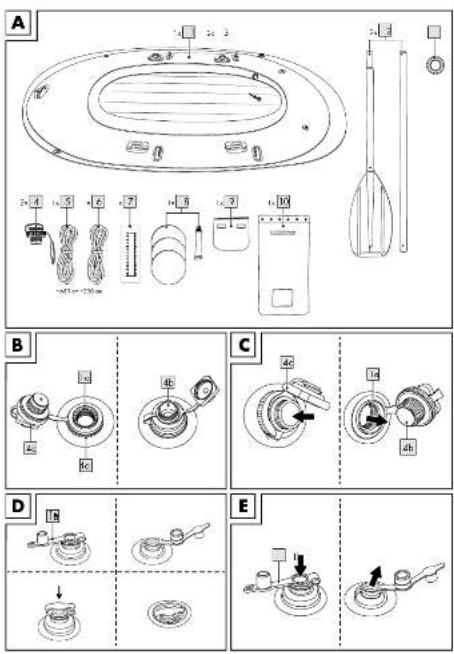
Scope of delivery (fig. A)
1 x dinghy (1)
2 x paddle (2)
2 x drip ring (3)
2 x screw-on valve (4)
1 x cord 680cm (5)
1 x cord 200cm (6)
1 x control ruler (7)
1 x repair set (8)
1 x storage bag (9)
1 x duffel bag (10)
1 x instruction manual
Technical data
Dinghy dimensions:
approx. 272 x 130 x 56cm (l x w x h)
Paddle dimensions: approx. 155cm (l)
Weight without accessories: approx. 6.100g
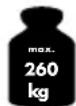
Maximum load
Symbols used

Date of manufacture (month/year): 03/2019

Permissible operating pressure

Labels on the dinghy

number of people allowed: 3
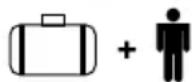
permissible payload: 260kg (573.30lbs)

Sheltered shore area up to 300m. Beware of offshore wind and currents!
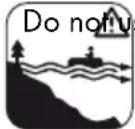
se in wind forces gre- ater than 4 and/or when there are waves higher than 0.5m!
Intended use
This product has been developed for private use. Design category D "sheltered waters": Designed for voyages in sheltered coastal waters, small bays, small lakes, rivers, and canals when conditions up to and including wind force 4 and significant wave heights up to and including 0.3m can be experienced, with occasional waves of 0.5m maximum height, for example from passing vessels.
Safety instructions
The dinghy is a piece of water sport equipment that is certified and safe. We nevertheless urge you to adhere to the following rules and regulations:

Danger to life!
- Never leave children unsupervised with the packaging material. There is danger of suffocation.
- Never let children play with the product without supervision.

Risk of injury!
Beware of offshore winds!
Beware of offshore currents!
- Make sure that people and cargo are always distributed uniformly in the boot to avoid the risk of capsizing.
- Pay attention to the information on the nameplate, the permissible load capacity and number of people as well as the warning instructions.
- Always comply with local navigation regulations.
- Do not bring any sharp or pointed objects on board.
- The dinghy should be protected against contact with any dangerous liquids or acids. This can cause irreparable damage.
- Protect the dinghy from heat and fire! Be careful with lit cigarettes!
- To avoid damage to the hull, make sure that the dinghy does not run onto rocky ground.
- Should damage occur to one of the three air chambers when you are on the water, under no circumstances must you abandon the dinghy. The buoyancy of the two intact air chambers will be sufficient to keep the dinghy safely above water.
- Under no circumstances should the product be transported by vehicle when inflated.
- Never leave your dinghy in the water unoccupied. It will drift away faster than it can be reached by swimming.
- Before using always make sure that you have the paddles with you since you may otherwise not be able to manoeuvre the dinghy properly.
- Do not make any technical modifications to your dinghy. Modifications of any kind put operation of the dinghy at risk.
- Never use the product when under the influence of alcohol, drugs or medications.
- Never overestimate your strength and when paddling conserve the strength in your muscles in such a way that you can easily paddle back again over the distance you have covered.
Stay in sheltered shore areas within 300m and beware of changing winds and currents that may make it significantly harder for you to navigate.
WARNING!
Your caution and self-awareness when on the water are extremely important. Never overestimate your strength and navigational skills! Always stay close to shore! Be aware of what the weather conditions are and pay attention to storm warnings or any flares!
WARNING!
Please always comply with the safety regulations and the current local provisions for lakes and open bodies of water, and for your own safety always wear a certified life jacket.
WARNING!
Avoid using sunscreen and skin care products containing alcohol. Sunscreen and skin care products containing alcohol can cause the colour coating of this PVC inflatable product to peel. This can lead to stains on your body, your clothing and other objects that are in contact.
WARNING!
If someone falls overboard they should always climb back on board via the bow or the stern because there is a high risk of capsizing when trying to board from the sides.
Avoiding material damage!
- All inflatables are susceptible to cold. For this reason never unfold and inflate the product at a temperature lower than 15^
- In the event that the air pressure increases in the hot sun, it must be balanced accordingly by letting out air.
- Make sure that the product, especially when inflated, does not come into contact with stones, gravel, or sharp objects and does not rub or scrape against anything; this can cause damage to the plastic foil.
-
Use only the correct pump adapters to insert into the safety valves. The valves might otherwise be damaged.
-
Do not over-inflate because you then risk tearing open the welded seams. Close the valves properly after inflating.
- Avoid contact with sharp, hot , pointed, or dangerous objects.
Assembly
Follow the individual assembly steps in the order indicated. If the correct sequence for inflating the three air chambers is not followed the pressure may be distributed unevenly.
This can lead to instability of the dinghy and adversely affect its handling characteristics.
- Assembly should always be performed by two adults because of the product's size.
- Select a smooth and clean surface with enough space to unfold the dinghy. Check that all the individual parts are there and in good order and condition.
- After assembling for the second time the dinghy should be inspected for any possible damage, holes, and tears and these should be sealed as described in the section "Repairs". Once you are on the water it is no longer possible to remedy any damage.
- Do not over-inflate the air chambers in order not to overstretch the foil.
- Make sure that the inflated dinghy does not come into contact with stones or other sharp objects and become damaged.
Assembly the screw-on valves (fig. B)
The chambers and of the dinghy are each provided with a threaded opening for the enclosed screw-on valves (4) provided.
- Pull the loop (4a) of the valve over the threaded opening (1a) so that it lies firmly in the groove provided for that purpose.
- Turn the base (4b) clockwise into the threaded opening.
Inflation
WARNING!
- Follow the correct sequence when inflating the air chambers.
- The recommended operating pressure is 0.04bar (= 40mbar = 0.58psi).
- Avoid inflating the air chambers too much because there is the risk of over-stretching the welded seams or even tearing them open.
- To inflate the product use standard commercial foot pumps or double-stroke piston pumps with matching adapter attachments, and where applicable a pressure gauge.
- To inflate the product do not use a compressor or compressed air bottle.
This can lead to damage to the product.
• Always inflate all air chambers fully.
Inflation sequence
Inflate the air chambers in the following sequence:
-
- Safety chamber with screw-on valve 1
-
- Bottom chamber with plug valve 2
-
- Flotation chamber with screw-on valve 3
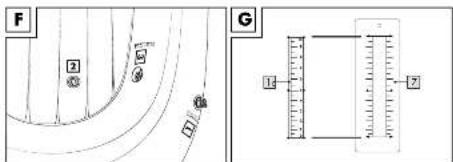
Note: The air chambers are marked with the corresponding numbers on the dinghy.
(1) fig. F).
Filling the air chambers
IMPORTANT!
The PVC material expands somewhat after the product is inflated for the first time and does not return to its original condition. Remember that the specifications may vary slightly depending on the load and outside temperature.
- To inflate the product use standard commercial foot pumps or double-stroke piston pumps with matching adapter attachments, and where applicable a pressure gauge.
1. Safety chamber with screw-on valve
- Open by turning the seal cap (4c) of the screw-on valve (4) anticlockwise (fig. B).
-
Inflate the safety chamber 1 until the length of the imprinted measuring strip matches that of the control ruler (fig. G).
-
Turn the seal cap (4c) of the screw-on valve (4) clockwise to close it again.
Note: The safety chamber 1 is not yet inflated fully.
2. Bottom chamber with plug valve
- Open the upper part of the valve seal (1b) (fig. D).
- Inflate the bottom chamber 2 until it feels firm and no more folds can be seen in the material.
Note: When you press with your thumb against the air chamber it should still give a little.
Note: If you do not have a valve adapter that fits, the bottom chamber can also be filled using the next smallest adapter by means of a special diaphragm valve.
- Close the valve seal and push in the valve by pressing lightly (fig. D).
3. Flotation chamber with screw-on valve
- Open by turning the seal cap (4c) of the screw-on valve (4) anticlockwise (fig. B).
- Inflate the flotation chamber 3 until the measuring strip on the nameplate matches the scale on the control ruler.
- Turn the seal cap (4c) of the screw-on valve (4) clockwise to close it again.
Note: Both the flotation chamber and the safety chamber are now filled taut. The measuring strip on the safety chamber how no longer matches the control ruler (7). This is correct and is intentionally so.
Accessories
Assembling the paddles
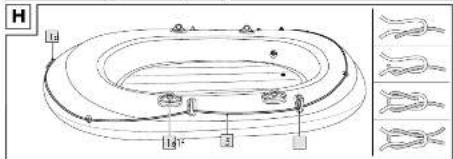
Note: When using the dinghy on the water the paddles may not be released from the rowlocks (1e) but instead must remain in the rowlocks (1e) secured against loss (fig. H)!
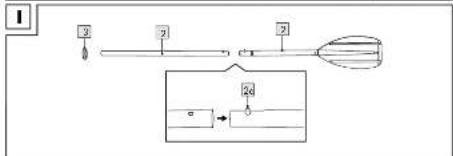
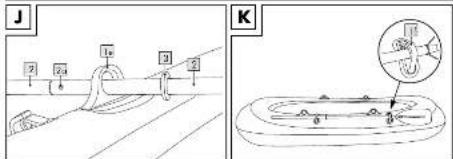
- Connect the two paddle tubes (2). The locking button (2a) must then snap in audibly and visibly (fig. 1).
- Push the end of the tube through the rowlock (1e) and secure the paddle by sliding a drip ring (3) on (fig. J).
- Repeat the process for the second paddle on the other side of the dinghy.
Cord (fig. H)
Attach the 680cm cord (5) to the grommets on the dinghy.
-
Begin at the stern and lead the cord (5) around the dinghy through the grommets provided for that purpose.
-
Secure the cord with a reef knot.
Duffel bag (fig. L)
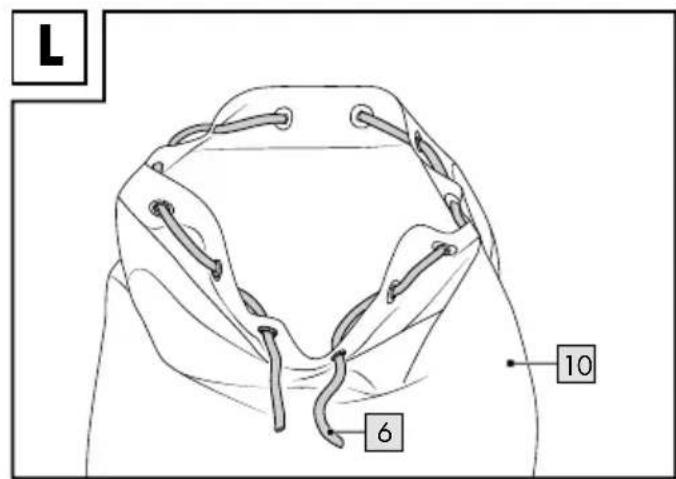
The product comes with a duffel bag (10) in which the dinghy can be stowed for transport and for storage.
To close use the 200cm cord (6). The duffel bag can also be used on board to keep provisions, clothing, etc. protected against splash.
Note: Remember that the duffel bag is not watertight. Do not stow any sensitive objects such as cameras in the duffel bag.
For use on board remove the cord and roll the top end up flat. Then close the duffel bag using the hook-and-loop fasteners.
Storage bag (fig. M)
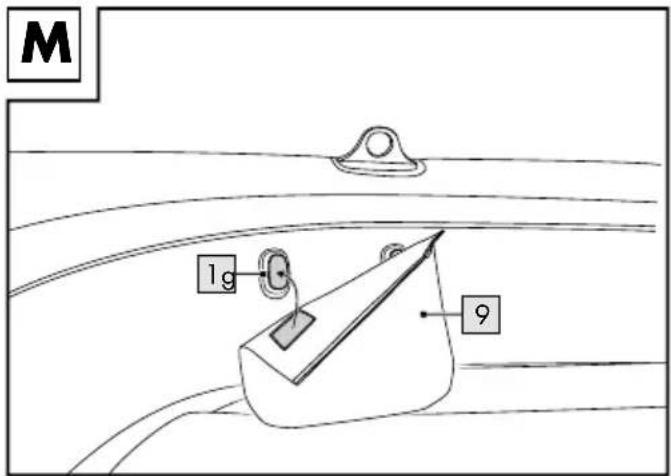
In addition, the product also comes with a splash-proof storage bag (9) which is attached by the hook-and-loop fasteners (1g) to the inside wall of the dinghy. Smaller items can be stowed in the storage bag.
Note: Remember that the duffel bag is not watertight. Do not stow any sensitive items in the bag.
Disassembling the dinghy
Remove the paddles from the rowlocks (1e).
Deflating
Deflate the dinghy as follows:
- To deflate the bottom chamber 2 pull the plug valve out of the recess and open the lower part of the valve (fig. E).
- To deflate air chambers with screw-on valves, unscrew the screw-on valves from the base and let the air out completely (fig. C).
Disassembling the paddles
- Push each locking button down (2a).
- Pull both paddle tubes apart.
Transport
- Always have two people transport the dinghy; use the cord on the stern and the carry handle (1d) on the bow (fig. H) for this purpose.
- Attach the paddles to the respective paddle retainers (1f) on the side of the dinghy (fig. K).
Storage, cleaning

WARNING!
Use only care products containing no acid or petroleum components and never use silicon-based products.
Always store the product deflated and clean and dry at room temperature and out of the reach of rodents.
The valves should always be closed during storage. Make sure that the product is stored flat, not twisted.
- Clean your dinghy thoroughly each time after use by rinsing it with clean water and mild soap to get rid of salt crystals, grains of sand, and other tiny contaminants. Then allow it to dry completely.
- Let the air out of all air chambers completely.
- Fold the dinghy up carefully.
Repairs

WARNING!
When there is more serious damage you should not under any circumstance perform repairs yourself.
You can repair minor damage with the repair set (8) supplied.
- Let the air out of the dinghy completely and clean the location in question using an alcohol-based solution. Use fine sandpaper to roughen the area around the tear or hole.
- Trim a patch that covers the damaged area and overlaps by 1.25cm on all sides.
- Apply the adhesive to the location on the dinghy and also to the patch. Allow the adhesive to air out a little.
- Press the patch down firmly with something soft.
Note: Be sure to work on an even surface without wrinkles or folds. Gently remove any air bubbles with a rounded object, working from the inside towards the outside.
5. After repairs wait at least 12 hours before inflating the dinghy again.
Information on disposal
Dispose of the item and its packaging materials in accordance with current local regulations. Packaging materials like e.g. foil bags must be kept away from children. Keep the packaging materials out of reach of children.

Dispose of the equipment and packaging in an environmentally-friendly manner.

The recycling code is used to identify various materials for recycling. The code consists of the recycling symbol – which not to represent the recycling cycle – and a or which identifies the material.
Notes on the guarantee and service handling
The product was produced with great care and under constant supervision. You receive a three-year warranty for this product from the date of purchase. Please retain your receipt.
The warranty applies only to material and workmanship and does not apply to misuse or improper handling. Your statutory rights, especially the warranty rights, are not affected by this warranty.
With regard to complaints, please contact the following service hotline or contact us by e-mail. Our service employees will advise as to the subsequent procedure as quickly as possible. We will be personally available to discuss the situation with you.
Any repairs under the warranty, statutory guarantees or through goodwill do not extend the warranty period. This also applies to replaced and repaired parts. Repairs after the warranty are subject to a charge.
IAN: 311060
GB Service Great Britain
Tel.: 0800 404 7657
E-Mail: deltasport@lidl.co.uk

- SCHLAUCHBOOT
- DE AT CH
- To do so, carefully read and comply with the following instruction manual.
- Scope of delivery (fig. A)
- Technical data
- Symbols used
- Intended use
- Safety instructions
- Danger to life!
- Risk of injury!
- WARNING!
- Avoiding material damage!
- Assembly
- Assembly the screw-on valves (fig. B)
- Inflation
- Inflation sequence
- Filling the air chambers
- IMPORTANT!
- Safety chamber with screw-on valve
- Bottom chamber with plug valve
- Flotation chamber with screw-on valve
- Accessories
- Assembling the paddles
- Cord (fig. H)
- Duffel bag (fig. L)
- Storage bag (fig. M)
- Disassembling the dinghy
- Deflating
- Disassembling the paddles
- Transport
- Storage, cleaning
- Use only care products containing no acid or petroleum components and never use silicon-based products.
- Repairs
- When there is more serious damage you should not under any circumstance perform repairs yourself.
- Information on disposal
- Notes on the guarantee and service handling
Brand : CRIVIT
Model : IAN 86426
Category : Bottes