
EL-W506/W516/W546 - Calculator SHARP - Free user manual and instructions
Find the device manual for free EL-W506/W516/W546 SHARP in PDF.


User questions about EL-W506/W516/W546 SHARP
0 question about this device. Answer the ones you know or ask your own.
Ask a new question about this device
Download the instructions for your Calculator in PDF format for free! Find your manual EL-W506/W516/W546 - SHARP and take your electronic device back in hand. On this page are published all the documents necessary for the use of your device. EL-W506/W516/W546 by SHARP.
USER MANUAL EL-W506/W516/W546 SHARP
Thank you for purchasing the SHARP Scientific Calculator Model EL-W506/W516/W546.
About the calculation examples (including some formulas and tables), refer to the calculation example sheet. Refer to the number on the right of each title in the manual for use.
After reading this manual, store it in a convenient location for future reference.
Notes:
- Some of the models described in this manual may not be available in some countries.
- This product uses a period as a decimal point.
Operational Notes
- Do not carry the calculator around in your back pocket, as it may break when you sit down. The display is made of glass and is particularly fragile.
- Keep the calculator away from extreme heat such as on a car dashboard or near a heater, and avoid exposing it to excessively humid or dusty environments.
- Since this product is not waterproof, do not use it or store it where fluids, for example water, can splash onto it. Raindrops, water spray, juice, coffee, steam, perspiration, etc. will also cause malfunction.
- Clean with a soft, dry cloth. Do not use solvents or a wet cloth.
- Do not drop it or apply excessive force.
- Never dispose of batteries in a fire.
- Keep batteries out of the reach of children.
- For the sake of your health, try not to use this product for long periods of time. If you need to use the product for an extended period, be sure to allow your eyes, hands, arms, and body adequate rest periods (about 10–15 minutes every hour).
If you experience any pain or fatigue while using this product, discontinue use immediately. If the discomfort continues, please consult a doctor.
- This product, including accessories, may change due to upgrading without prior notice.
NOTICE
- SHARP strongly recommends that separate permanent written records be kept of all important data. Data may be lost or altered in virtually any electronic memory product under certain circumstances. Therefore, SHARP assumes no responsibility for data lost or otherwise rendered unusable whether as a result of improper use, repairs, defects, battery replacement, use after the specified battery life has expired, or any other cause.
- SHARP will not be liable nor responsible for any incidental or consequential economic or property damage caused by misuse and/or malfunctions of this product and its peripherals, unless such liability is acknowledged by law.
◆ Press the RESET switch (on the back), with the tip of a ball-point pen or similar object, only in the following cases:
- When using for the first time
• After replacing the battery
• To clear all memory contents - When an abnormal condition occurs and all keys are inoperative
Do not use an object with a breakable or sharp tip. Note that pressing the RESET switch erases all data stored in memory.
If service should be required on this calculator, use only a SHARP servicing dealer, SHARP approved service facility, or SHARP repair service where available.
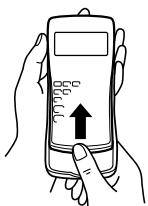
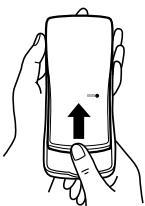
Hard Case
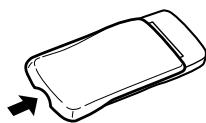
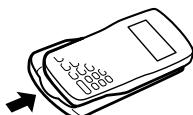
Remove the hard case, holding it with your fingers in the positions shown below.
DISPLAY
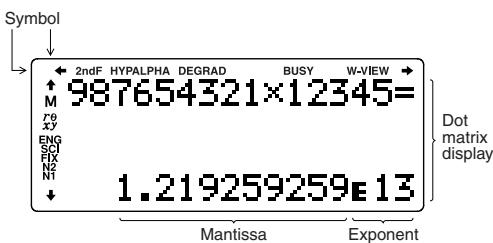
text_image
Symbol ↑ 2ndF HYPALPHA DEGRAD BUSY W-VIEW → ↑ 987654321×12345= M r76 X7 ENG SCI FIX N2 N1 1.219259259e13 Dot matrix display Mantissa Exponent- During actual use, not all symbols are displayed at the same time.
- Only the symbols required for the usage currently being explained are shown in the display and calculation examples in this manual.
←/→: Indicates that some contents are hidden in the ↑/↓ directions shown.
2ndF: Appears when 2ndF is pressed, indicating that the functions shown in orange are enabled.
HYP: Indicates that hyp has been pressed and the hyperbolic functions are enabled. If 2ndF arc hyp is pressed, the symbols 2ndF HYP appear, indicating that inverse hyperbolic functions are enabled.
ALPHA: Indicates that ALPHA, STO or RCL has been pressed, and entry (recall) of memory contents and recall of statistics can be performed.
DEG/RAD/GRAD: Indicates angular units.
BUSY: Appears during the execution of a calculation.
W-VIEW: Indicates that the WriteView editor is selected.
M: Indicates that a numerical value is stored in the independent memory (M).
r/xy : Indicates the mode of expression for results in CPLX mode.
ENG/SCI/FIX/N2/N1: Indicates the notation used to display a value and changes by SET UP menu. N1 is displayed on-screen as "NORM1", and N2 as "NORM2".
BEFORE USING THE CALCULATOR
When using for the first time, press the RESET switch (on the back), with the tip of a ball-point pen or similar object.
Adjusting the Display Contrast
Press 2ndF SET UP 3, then + or - to adjust the contrast. Press ON/C to exit.
Power On and Off
Press ON/C to turn the calculator on. The data that was on-screen when the power was turned off will appear on the display.
Press 2ndF OFF to turn the calculator off.
Key Notations Used in this Manual
In this manual, key operations are described as follows:

To specify e^x : 2ndF e^x
To specify In: In
To specify E: ALPHA E
- Functions that are printed in orange above the key require 2ndF to be pressed first before the key. When you specify the memory, press ALPHA first. Numbers for input values are not shown as keys, but as ordinary numbers.
- Functions that are printed in gray adjacent to the keys are effective in specific modes.
- The multiplication operator “X” is differentiated from the letter “X” in this manual as follows:
To specify the multiplication operator: ✗
To specify the letter "X": ALPHA x
The WriteView and Line Editors
This calculator has the following two editors in NORMAL mode: WriteView and Line. You can select between them in the SET UP menu.
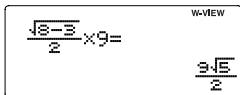
The WriteView editor (default)
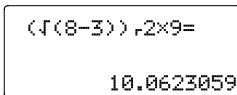
The Line editor
Notes:
- The WebView Editor is only available in NORMAL mode.
- In certain calculation examples, where you see the LINE symbol, the key operations and calculation results are shown as they would appear in the Line editor.
Clearing the Entry and Memories
*1 Press ON/C STO and then choose a memory to clear one variable memory.
*2 Formula memories and definable memories. See "Memory Calculations".
*3 Statistical data (entered data)
*4 Matrix memories (matA, matB, matC, and matD)
*5 List memories (L1, L2, L3, and L4)
*6 Cleared when changing between sub-modes in STAT mode.
*7 See "Memory clear key".
*8 The username you stored using the name display function will be cleared as well.
Memory clear key
Press 2ndF M-CLR to display the menu.
- To initialize the display settings, press 0. The parameters are set as follows:
- Angular unit: DEG
• Display notation: NORM1 - N-base: DEC
- To clear all variables and memories (A–F, M, X, Y, F1–F4, D1–D4, ANS, STAT, matA–D, and L1–L4) at once, press 1 0.
- To RESET the calculator, press 2 0. The RESET operation will erase all data stored in memory and restore the calculator's default settings. You can do the same thing by pressing the RESET switch on the back of the calculator.
Mode Selection

text_image
NORMAL mode: MODE 0 (default)
Used to perform arithmetic operations and function calculations.
STAT mode: MODE 1
Used to perform statistical operations.
DRILL mode: MODE 2
Used to practice math and multiplication table drills.
CPLX mode: MODE 3
Used to perform complex number calculations.
MATRIX mode: MODE 4
Used to perform matrix calculations.
LIST mode: MODE 5
Used to perform list calculations.
EQUATION mode: MODE 6
Used to solve equations.
SET UP Menu
Press 2ndF SETUP to display the SET UP menu.
Press ON/C to exit the SET UP menu.
| <SET UP>W-VIEW | |
| 0:DRG | 1:FSE |
| 2:EDITOR | 3:CTRST |
| 4:---- | 5:NAME |
Determination of the angular unit
The following three angular units (degrees, radians, and grads) can be specified.
DEG (°): 2ndF SETUP 0 0 (default)
RAD (rad): 2ndF SET UP 0 1
GRAD (g): 2ndF SET UP 0 2
Selecting the display notation and decimal places

Five display notation systems are used to display calculation results: Two settings of Floating point (NORM1 and NORM2), Fixed decimal point (FIX), Scientific notation (SCI), and Engineering notation (ENG).
- When 2ndF SET UP 1 0 (FIX) or 2ndF SET UP 1 2 (ENG) is pressed, "TAB(0–9)?" will be displayed and the number of decimal places (TAB) can be set to any value between 0 and 9.
- When 2ndF SETUP 1 1 (SCI) is pressed, "SIG(0–9)?" will be displayed and the number of significant digits can be set to any value between 0 and 9. Entering 0 will set a 10-digit display.
Setting the floating point number system in scientific notation
Two settings are used to display a floating-point number: NORM1 (the default) and NORM2. A number is automatically displayed in scientific notation outside a preset range:
• NORM1 (2ndF SET UP 1 3): 0.000000001 ≤ |x| ≤ 9,999,999,999
• NORM2 (2ndF SET UP 1 4): 0.01 ≤ |x| ≤ 9,999,999,999
Selecting the editor
Two editors are available in NORMAL mode:
• The WebView editor (W-VIEW): 2ndF SET UP 2 0 (default)
- The Line editor (LINE): 2ndF SETUP 2 1
Note: Any entries will be cleared when you change the editor.
Adjusting the display contrast
Press 2ndF SET UP 3, then + or - to adjust the contrast. Press ON/C to exit.
Insert and overwrite entry methods
When using the Line editor, you can change the entry method from "INSERT" (the default) to "OVERWRITE".
After you switch to the overwrite method (by pressing 2ndF SET UP 4 1), the triangular cursor will change to a rectangular one, and the number or function underneath it will be overwritten as you make entries.
Name display function
You can save a username in this calculator. When you turn the power off, the saved username is displayed momentarily.
Up to 32 characters may be saved, split over two lines.
Entering and editing the username:
-
Press 2ndF SET UP 5. The editing screen appears with a flashing cursor.
-
Use ▲ and ▼ to scroll
through the available characters. The following characters can be entered (listed in the order that they appear):
Letters (A to Z, uppercase only), numbers (0 to 9), slash (/), hyphen (-), colon (:), apostrophe ('), comma (.), period (.), and space ().
Press 2ndF ▲ to jump to "A", and press 2ndF ▼ or ON/C to jump to the space.
- Pressing ◀ or ▶ moves the cursor to the left or right. To modify a character, use ◀ or ▶ to move the cursor to the character, then select another character using ▲ or ▼.
Press 2ndF or 2ndF to jump to the beginning of the first line or the end of the second.
-
Repeat steps 2 and 3 above to continue entering characters.
-
Press = to save.
Note: Press 2ndF CA in the editing screen to clear all the characters.
ENTERING, DISPLAYING, AND EDITING THE EQUATION 2
The WriteView Editor
Entry and display
In the WebView editor, you can enter and display fractions or certain functions as you would write them.
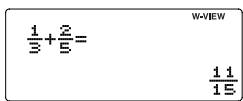
Notes:
- The WebView editor can only be used in NORMAL mode.
- If the equation grows too large, it may extend off the edge of the display after you obtain the result. If you want to see the entire equation, press ◀ or ▶ to return to the editing screen.
Displaying calculation results
When possible, calculation results will be displayed using fractions, , and . When you press CHANGE, the display will cycle through the following display styles:
- Mixed fractions (with or without ) improper fractions (with or without ) decimal numbers
- Proper fractions (with or without ) decimal numbers
- Irrational numbers (square roots, fractions made using square roots) decimal numbers
Notes:
- In the following cases, calculation results may be displayed using :
• Arithmetic operations and memory calculations
• Trigonometric calculations
| Entry value | |
| DEG | multiples of 15 |
| RAD | multiples of 112 |
| GRAD | multiples of 503 |
- In trigonometric calculations, when entering values such as those in the table to the right, results may be shown using .
• Calculation results may extend
off the edges of the screen. You can see those parts by pressing ◀ or ▶ (depending on whether the left or right portion is hidden). - Improper/proper fractions will be converted to and displayed as decimal numbers if the number of digits used in their expression is greater than nine. In the case of mixed fractions, the maximum number of displayable digits (including integers) is eight.
- If the number of digits in the denominator of a fractional result that uses is greater than three, the result is converted to and displayed as a decimal number.
The Line Editor
Entry and display
In the Line editor, you can enter and display equations line by line.
Notes:
$$ \sqrt {2} \times \sqrt {3} = $$
$$ 2. 4 4 9 4 8 9 7 4 3 $$
- Up to three lines of text may be viewed on the screen at one time.
- If the length of the equation exceeds three lines, parts of it may be hidden from view after calculation. If you want to see the rest of the equation, press ◀ or ▶ to return to the editing screen.
- In the Line editor, calculation results are displayed in decimal form or line fraction notation if possible.
Editing the Equation
Just after obtaining an answer, pressing ◀ brings you to the end of the equation and pressing ▶ brings you to the beginning. Press ◀, ▶, ▲, or ▼ to move the cursor. Press 2ndF ◀ or 2ndF ▶ to jump the cursor to the beginning or the end of the equation.
In the WebView editor, you can use ▲ and ▼ to move the cursor up and down—between the numerator and denominator, for example.
Back space and delete key
To delete a number or function, move the cursor to the right of it, then press BS. You can also delete a number or function that the cursor is directly over by pressing 2ndF DEL.
The MATH Menu
Other functions may be available on this calculator besides those printed on the key pad. These functions are accessed using the MATH menu. The MATH menu has different contents for each mode.
Press MATH to display the MATH menu. For example, in NORMAL mode, you can call the functions shown on the right.
| <MATH> | |
| 0:CTLG | 1:ALGB |
| 2:SOLVER | 3:ENG |
| 4:+sec | 5:+min |
Notes:
- When the ↑ or ↓ symbols are displayed, you can use ▲ or ▼ to display any hidden menu items.
- MATH does not function when entering values or items in STAT, MATRIX, LIST, or EQUATION modes, or into solver functions or simulation calculations.
The CATALOG Menu
Using the CATALOG menu, you can select functions and variables that are available for what you are doing in the currently selected mode. To display the CATALOG menu, press MATH 0.
- Press ▲ or ▼ to move the cursor (✗) and press ENTER to select.
- Press ◀ or ▶ to scroll up or down.
- Press 2ndF ▲ or 2ndF ▼ to jump to the first or last item.
Note: You cannot bring up the CATALOG menu when entering values or items in STAT, MATRIX, LIST, or EQUATION modes, or into solver functions or simulation calculations.
Multi-line Playback Function

This calculator is equipped with a function to recall previous equations and answers in NORMAL or CPLX modes. A maximum of 340 characters can be stored in memory. When the memory is full, stored equations will be deleted to make room, starting with the oldest.
Pressing ▲ will display the previous equation. Further pressing ▲ will display preceding equations (after returning to the previous equation, press ▼ to view equations in order). In addition, 2ndF ▲ can be used to jump to the oldest equation, and 2ndF ▼ to jump to the newest one.
- To edit an equation after recalling it, press ◀ or ▶.
- The multi-line memory will be cleared by the following operations:
2ndF CA, mode change, RESET, N-base conversion, angular unit conversion, editor change (2ndF SET UP 2 0 or 2ndF SET UP 2 1), and memory clear (2ndF M-CLR 1 0).
- Equations that have one result require an additional eleven characters' worth of memory to store in order to hold the result.
- In addition to the amount of memory needed to store an equation, the WriteView editor will require a certain amount for the sake of display.
- Equations also include calculation ending instructions, such as “=”.
Priority Levels in Calculation
This calculator performs operations according to the following priority:
① Fractions (1 r 4, etc.) ② ∠, Engineering prefixes
③ Functions preceded by their argument (x^-1, x^2, n!, etc.)
④ y^x, x ⑤ Implied multiplication of a memory value (2Y, etc.)
⑥ Functions followed by their argument (sin, cos, (−), etc.)
⑦ Implied multiplication of a function (2sin30, A 14 , etc.) ⑧ nCr, nPr, cv ⑨ ×, ÷ ⑩ +, - ⑪ AND ⑫ OR, XOR, XNOR ⑬ =, M+, M-, M, ▶DEG, ▶RAD, ▶GRAD, DATA, rθ, xy, and other calculation ending instructions
- If parentheses are used, parenthesized calculations have precedence over any other calculations.
SCIENTIFIC CALCULATIONS
- Press MODE 0 to select NORMAL mode.
- In each example, press ON/C to clear the display first. Unless otherwise specified, calculation examples are performed in the WebView editor (2ndF SET UP 2 0) with the default display settings (2ndF M-CLR 0).
Arithmetic Operations

- The closing parenthesis ( ) just before = or M+ may be omitted.
Constant Calculations

- In constant calculations, the addend becomes a constant. Subtraction and division are performed in the same manner. For multiplication, the multiplicand becomes a constant.
- In constant calculations, constants will be displayed as K.
- Constant calculations can be performed in NORMAL or STAT modes.
Functions

- Refer to the calculation examples for each function.
- In the Line editor, the following symbols are used:
- : to indicate an expression's power. ( y^x , 2ndF e^x , 2ndF 10^x )
- I: to separate integers, numerators, and denominators. (a/b, 2ndF ^b/c )
- When using 2ndF _a or 2ndF abs in the Line editor, values are entered in the following way:
- logn (base, value)
- abs value
- logn (base, value) - abs value
Integral/Differential Functions

Integral and differential calculations can be performed in NORMAL mode.
Note: Since integral and differential calculations are performed based on the following equations, correct results may not be obtained, in certain rare cases, when performing special calculations that contain discontinuous points.
Integral calculation (Simpson's rule):
$$ \begin{array}{c} \mathsf {S} = \frac {1}{3} h {f (a) + 4 {f (a + h) + f (a + 3 h) + \dots + f (a + (\mathsf {N} - 1) h) } \ \quad + 2 {f (a + 2 h) + f (a + 4 h) + \dots + f (a + (\mathsf {N} - 2) h) } + f (b) } \end{array} \left( \begin{array}{l} h = \frac {b - a}{\mathsf {N}} \ \mathsf {N} = 2 n \ a \leq x \leq b \end{array} \right) $$
Differential calculation: f'(x)=(x+2)-f(x-2)dx
Performing integral calculations
- Press dx .
-
Specify the following parameters: range of integral (initial value (a), end value (b)), function with variable x, and number of subintervals (n).
You do not need to specify the number of subintervals. If the number of subintervals is not specified, the default value of n = 100 will be used. -
Press = .
Notes:
- Parameters are entered in the following way:
WriteView editor:
_a^b function[, subintervals]dx
Line editor:
f(function, a, b[, subintervals]) - Integral calculations, depending on the integrands and subintervals included, require longer calculation time. During calculation, the BUSY symbol will be displayed. To cancel calculation, press ON/C.
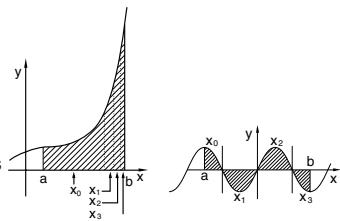
Note that there will be greater integral errors when there are
large fluctuations in the integral values during minute shifting of the integral range and for periodic functions, etc., where positive and negative integral values exist depending on the interval.
text_image
y a x₀ x₁ b x x₂ x₃ x₀ y x₂ b x a x₁ x₃For the former case, divide integral intervals as small as possible. For the latter case, separate the positive and negative values. Following these tips will allow you to obtain results from calculations with greater accuracy and will also shorten the calculation time.
Performing differential calculations
- Press 2ndF d/dx.
-
Specify the following parameters: function with variable x, value of x, and minute interval (dx).
You do not need to specify the minute interval. If the minute interval is not specified, it will automatically be set to 10^-5 (while x = 0), or |x| × 10^-5 (while x 0 ). -
Press = .
Note: Parameters are entered in the following way:
WriteView editor:
$$ \left. \frac {d (\text { function })}{d x} \right| _ {x = \text { value of } x [, \text { minute interval } ]} $$
Line editor:
d / dx (function, value of x[ , minute interval])
Σ Function

The function returns the cumulative sum of a given expression from an initial value to an end value in NORMAL mode.
Performing calculations
- Press 2ndF Σ.
-
Specify the following parameters: initial value, end value, function with variable x , and increment (n). You do not need to specify the increment. If the increment is not specified, the default value of n = 1 will be used.
-
Press = .
Note: Parameters are entered in the following way:
WriteView editor:
end value
Σ(function[, increment]) x = initial value
Line editor:
Σ(function, initial value, end value[, increment])
Random Function
The random function has four settings. (This function cannot be selected while using the N-base function.) To generate further random numbers in succession, press ENTER. Press ON/C to exit.
Random numbers
A pseudo-random number, with three significant digits from 0 up to 0.999, can be generated by pressing 2ndF RANDOM 0 ENTER.
Note: In the WebView editor, if the result is not 0 it can be shown as a fraction or decimal using CHANGE.
Random dice
To simulate a die-rolling, a random integer between 1 and 6 can be generated by pressing 2ndF RANDOM 1 ENTER.
Random coin
To simulate a coin flip, 0 (heads) or 1 (tails) can be randomly generated by pressing 2ndF RANDOM 2 ENTER.
Random integer
An integer between 0 and 99 can be generated randomly by pressing 2ndF RANDOM 3 ENTER.
Angular Unit Conversions

Each time 2ndF is pressed, the angular unit changes in sequence.
Memory Calculations

| Mode | ANS | M, F1–F4 | A–F, X, Y | D1–D4 |
| NORMAL | ||||
| STAT | ||||
| CPLX | × | |||
| MATRIX | ||||
| LIST |
○: Available X: Unavailable
Temporary memories (A–F, X and Y)
Press STO and a variable key to store a value in memory. Press RCL and a variable key to recall the value from that memory. To place a variable in an equation, press ALPHA and a variable key.
Independent memory (M)
In addition to all the features of temporary memories, a value can be added to or subtracted from an existing memory value. Press ON/C STO M to clear the independent memory (M).
Last answer memory (ANS)
The calculation result obtained by pressing ☐ = or any other calculation ending instruction is automatically stored in the last answer memory.
When the calculation result is in matrix or list form, the full matrix or list is not stored into ANS memory. Only the value of the element covered by the cursor is stored.
Notes:
- Calculation results from the functions indicated below are automatically stored in the X or Y memories replacing any existing values.
- r, xy : X memory (r or x), Y memory (θ or y)
- Two x' values from a quadratic regression calculation in STAT mode: X memory (1:), Y memory (2:)
- Use of RCL or ALPHA will recall the value stored in memory using up to 14 digits.
Formula memories (F1–F4)
You can store expressions in formula memories (F1–F4). Storing a new expression in a memory space will automatically replace any content that may already exist there.
Notes:
- Expressions that are stored from the WriteView editor cannot be recalled from within the Line editor, and vice versa.
- You can only recall expressions stored from the Line editor when entering values or items in STAT, MATRIX, LIST, or EQUATION modes, or into solver functions or simulation calculations.
- Any recalled expressions will overwrite any expressions that are currently being entered.
- You cannot store formulas in formula memories when entering values or items in STAT, MATRIX, LIST, or EQUATION modes, or into solver functions or simulation calculations.
Definable memories (D1–D4)
You can store functions or operations in definable memories (D1–D4).
- To store a function or operation, press STO, followed by a definable memory key (D1, D2, D3, or D4), followed by the operation you want to store. Menu-related operations, such as 2ndF SETUP, cannot be stored. Press ON/C to return to the previous display.
- To call a stored function or operation, press the corresponding memory key. Calling a stored function will not work if the function that is called would be unusable in the current context.
- Any functions or operations that are stored in a definable memory will be replaced when you save a new one into that memory.
- You cannot store functions or operations in definable memories when entering values or items in STAT, MATRIX, LIST, or EQUATION modes, or into solver functions or simulation calculations.
Chain Calculations

The previous calculation result can be used in the subsequent calculation. However, it cannot be recalled after entering multiple instructions or when the calculation result is in matrix/list format.
Fraction Calculations

Arithmetic operations and memory calculations can be performed using fractions. In NORMAL mode, conversion between a decimal number and a fraction can be performed by pressing CHANGE.
Notes:
- Improper/proper fractions will be converted to and displayed as decimal numbers if the number of digits used in their expression is greater than nine. In the case of mixed fractions, the maximum number of displayable digits (including integers) is eight.
- To convert a sexagesimal value to a fraction, first convert it by pressing 2ndF DEG.
Binary, Pental, Octal, Decimal, and Hexadecimal Operations (N-base)

Conversions can be performed between N-base numbers in NORMAL mode. The four basic arithmetic operations, calculations with parentheses, and memory calculations can also be performed, along with the logical operations AND, OR, NOT, NEG, XOR, and XNOR on binary, pental, octal, and hexadecimal numbers.
Conversion to each system is performed with the following keys:
2ndF ← BIN (“BIN” appears), 2ndF ← PEN (“PEN” appears), 2ndF ← OCT (“OCT” appears), 2ndF ← HEX (“HEX” appears), 2ndF ← DEC (“BIN”, “PEN”, “OCT”, and “HEX” disappear)
Note: The hexadecimal numbers A–F are entered by pressing , ^x , ^2 , , , and (x,y) .
In the binary, rental, octal, and hexadecimal systems, fractional parts cannot be entered. When a decimal number having a fractional part is converted into a binary, rental, octal, or hexadecimal number, the fractional part will be truncated. Likewise, when the result of a binary, rental, octal, or hexadecimal calculation includes a fractional part, the fractional part will be truncated. In the binary, rental, octal, and hexadecimal systems, negative numbers are displayed as a complement.
Time, Decimal, and Sexagesimal Calculations 14
You can convert between decimal and sexagesimal numbers, and from sexagesimal numbers to seconds or minutes. In addition, the four basic arithmetic operations and memory calculations can be performed using the sexagesimal system. Notation for sexagesimal is as follows:
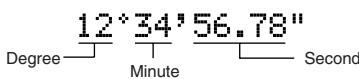
text_image
12°34'56.78" Degree——— Minute——— SecondCoordinate Conversions

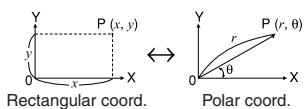
- Before performing a calculation, select the angular unit.
- The calculation result is automatically stored in the X and Y memories (r or x in X memory, and or y in Y memory).
- The results of coordinate conversions will be displayed as decimal numbers even in the WriteView editor.
text_image
Y P (x, y) y 0 x Rectangular coord. ↔ Y P (r, θ) 0 θ X P (r, θ)Physical Constants and Metric Conversions

Calculations using physical constants
To recall a constant, press CNST, then select a physical constant from the list. (Each item is labeled with a 2-digit number.)
- To scroll up or down the list of constants, press ▲ (◀) or ▼ (▶).
Use 2ndF ▲ (◀) or 2ndF ▼ (▶) to jump to the first or last page.
- Enter the first digit of the 2-digit item number to jump to the page containing the number that begins with that digit.
- When you enter the second digit, the constant is displayed automatically according to the display and decimal placement settings.
- Physical constants can be recalled in NORMAL (excluding N-base), STAT, CPLX, MATRIX, LIST, and EQUATION modes.
- The following table lists the physical constants. See the calculation example sheet for physical constant symbols and units.
Note: Physical constants and metric conversions are based on the 2006 CODATA recommended values, or on the 1995 Edition of the “Guide for the Use of the International System of Units (SI)” released by NIST (National Institute of Standards and Technology).
| No. | Constant | No. | Constant |
| 01 | Speed of light in vacuum | 27 | Stefan-Boltzmann constant |
| 02 | Newtonian constant of gravitation | 28 | Avogadro constant |
| 03 | Standard acceleration of gravity | 29 | Molar volume of ideal gas (273.15 K, 101.325 kPa) |
| 04 | Electron mass | 30 | Molar gas constant |
| 05 | Proton mass | 31 | Faraday constant |
| 06 | Neutron mass | 32 | Von Klitzing constant |
| 07 | Muon mass | 33 | Electron charge to mass quotient |
| 08 | Atomic mass unit-kilogram relationship | 34 | Quantum of circulation |
| 09 | Elementary charge | 35 | Proton gyromagnetic ratio |
| 10 | Planck constant | 36 | Josephson constant |
| 11 | Boltzmann constant | 37 | Electron volt |
| 12 | Magnetic constant | 38 | Celsius Temperature |
| 13 | Electric constant | 39 | Astronomical unit |
| 14 | Classical electron radius | 40 | Parsec |
| 15 | Fine-structure constant | 41 | Molar mass of carbon-12 |
| 16 | Bohr radius | 42 | Planck constant over 2 pi |
| 17 | Rydberg constant | 43 | Hartree energy |
| 18 | Magnetic flux quantum | 44 | Conductance quantum |
| 19 | Bohr magneton | 45 | Inverse fine-structure constant |
| 20 | Electron magnetic moment | 46 | Proton-electron mass ratio |
| 21 | Nuclear magneton | 47 | Molar mass constant |
| 22 | Proton magnetic moment | 48 | Neutron Compton wavelength |
| 23 | Neutron magnetic moment | 49 | First radiation constant |
| 24 | Muon magnetic moment | 50 | Second radiation constant |
| 25 | Compton wavelength | 51 | Characteristic impedance of vacuum |
| 26 | Proton Compton wavelength | 52 | Standard atmosphere |
Metric conversions
Enter a value to be converted, then press 2ndF CONV, and select a metric conversion by entering its 2-digit number.
- The metric conversion list is used in the same manner as the list of physical constants.
- Unit conversions can be performed in NORMAL (excluding N-base), STAT, MATRIX, LIST, and EQUATION modes.
- The following table lists units used in metric conversion. See the calculation example sheet for the metric conversion reference table.
| No. | Remarks | No. | Remarks | |
| 01 | in | : inch | 23 | fl oz(US): fluid ounce (US) |
| 02 | cm | : centimeter | 24 | mL : milliliter |
| 03 | ft | : foot | 25 | fl oz(UK): fluid ounce (UK) |
| 04 | m | : meter | 26 | mL : milliliter |
| 05 | yd | : yard | 27 | cal _th : calorie _th |
| 06 | m | : meter | 28 | J : joule |
| 07 | mi | : mile | 29 | cal _15 : calorie (15°C) |
| 08 | km | : kilometer | 30 | J : joule |
| 09 | n mi | : nautical mile | 31 | cal _IT : calorie _IT |
| 10 | m | : meter | 32 | J : joule |
| 11 | acre | : acre* ^1 | 33 | hp : horsepower (UK) |
| 12 | m ^2 | : square meter | 34 | W : watt |
| 13 | oz | : ounce (avoirdupois) | 35 | ps : horsepower (metric) |
| 14 | g | : gram | 36 | W : watt |
| 15 | lb | : pound (avoirdupois) | 37 | (kgf/cm ^2 ) |
| 16 | kg | : kilogram | 38 | Pa : pascal |
| 17 | °F | : degree Fahrenheit | 39 | atm : atmosphere |
| 18 | °C | : degree Celsius | 40 | Pa : pascal |
| 19 | gal (US): gallon (US) | 41 | (1 mmHg = 1 Torr) | |
| 20 | L : liter | 42 | Pa : pascal | |
| 21 | gal (UK): gallon (UK) | 43 | (kgf·m) | |
| 22 | L : liter | 44 | N·m : newton meter | |
*1 based on US survey foot
Calculations Using Engineering Prefixes

Calculation can be executed in NORMAL mode (excluding N-base) using the following 9 types of prefixes.
| Prefix | Operation | Unit | |
| k | (kilo) | MATH 3 0 | 10^3 |
| M | (Mega) | MATH 3 1 | 10^6 |
| G | (Giga) | MATH 3 2 | 10^9 |
| T | (Tera) | MATH 3 3 | 10^12 |
| m | (milli) | MATH 3 4 | 10^-3 |
| μ | (micro) | MATH 3 5 | 10^-6 |
| n | (nano) | MATH 3 6 | 10^-9 |
| p | (pico) | MATH 3 7 | 10^-12 |
| f | (femto) | MATH 3 8 | 10^-15 |
Modify Function

Decimal calculation results are internally obtained in scientific notation, with up to 14 digits in the mantissa. However, since calculation results are displayed in the form designated by the display notation and the number of decimal places indicated, the internal calculation result may differ from that shown in the display. By using the modify function (2ndF MDF), the internal value is converted to match that of the display, so that the displayed value can be used without change in subsequent operations.
- When using the WebView editor, if the calculation result is displayed using fractions or irrational numbers, press CHANGE to convert it to decimal form first.
- The modify function can be used in NORMAL, STAT, MATRIX, or LIST modes.
Simulation Calculation (ALGB)

If you have to find values consecutively using the same expression, such as plotting a curve line for 2x^2 + 1 , or finding the variable values for 2x + 2y = 14 , once you enter the expression, all you have to do is to specify the value for the variable in the equation.
Usable variables: A–F, M, X and Y
- Simulation calculations can only be executed in NORMAL mode.
- Calculation ending instructions other than = cannot be used.
Performing calculations
- Press MODE 0.
- Input an expression with at least one variable.
- Press MATH 1.
- The variable entry screen will appear. Enter a value, then press ENTER to confirm. The calculation result will be displayed after you have entered a value for each variable used in the equation.
- After completing the calculation, press MATH 1 to perform calculations using the same equation.
- Variables and numerical values stored in the memories will be displayed in the variable entry screen. If you do not want to change any values, simply press ENTER.
- Performing simulation calculation will cause values in memory to be overwritten with new values.
Solver Function

The solver function finds the value for x that reduces the entered expression to zero.
- This function uses Newton's method to obtain an approximation. Depending on the function (e.g. periodic) or start value, an error may occur (ERROR 02) due to there being no convergence to the solution for the equation.
- The value obtained by this function may include a margin of error. If it is larger than acceptable, recalculate the solution after changing the "Start" and dx values.
- Change the "Start" value (e.g. to a negative value) or dx value (e.g. to a smaller value) if:
- no solution can be found (ERROR 02).
- more than two solutions appear to be possible (e.g. a cubic equation).
• to improve arithmetic precision. - The calculation result is automatically stored in the X memory.
- Press ON/C to exit the solver function.
Performing solver function
- Press MODE 0.
- Input an expression with an x variable.
- Press MATH 2.
- Enter a "Start" value and press ENTER. The default value is "0".
- Enter a dx value (minute interval).
- Press ENTER.
STATISTICAL CALCULATIONS
Statistical calculations can be performed in STAT mode.
There are eight sub-modes within STAT mode. Press MODE 1, then press the number key that corresponds to your choice:
0 (Stat 0 [SD]): Single-variable statistics
1 (Stat 1 [LINE]): Linear regression
2 (Stat 2 [QUAD]): Quadratic regression
3 (Stat 3 [E_EXP]): Euler exponential regression
4 (Stat 4 [LOG]): Logarithmic regression
5 (Stat 5 [POWER]): Power regression
6 (Stat 6 [INV]): Inverse regression
7 (Stat 7 [G_EXP]): General exponential regression
Statistical Calculations and Variables

The following statistics can be obtained for each statistical calculation (refer to the table below):
Single-variable statistical calculation
Statistics of ① and the value of the normal probability function.
Linear regression calculation
Statistics of ① and ②. In addition, the estimate of y for a given x (estimate y' ) and the estimate of x for a given y (estimate x' ).
Quadratic regression calculation
Statistics of ① and ②, and coefficients a, b, c in the quadratic regression formula y = a + bx + cx^2 . (For quadratic regression calculations, no correlation coefficient (r) can be obtained.) When there are two x' values, each value will be displayed with “1.” or “2:”, and stored separately in the X and Y memories.
Euler exponential regression, logarithmic regression, power regression, inverse regression, and general exponential regression calculations
Statistics of ① and ②. In addition, the estimate of y for a given x and the estimate of x for a given y. (Since the calculator converts each formula into a linear regression formula before actual calculation takes place, it obtains all statistics, except coefficients a and b, from converted data rather than entered data.)
| 1 | Mean of samples (x data) | |
| sx | Sample standard deviation (x data) | |
| σx | Population standard deviation (x data) | |
| n | Number of samples | |
| Σx | Sum of samples (x data) | |
| Σx2 | Sum of squares of samples (x data) | |
| 2 | Mean of samples (y data) | |
| sy | Sample standard deviation (y data) | |
| σy | Population standard deviation (y data) | |
| Σy | Sum of samples (y data) | |
| Σy2 | Sum of squares of samples (y data) | |
| Σxy | Sum of products of samples (x, y) | |
| r | Correlation coefficient | |
| a | Coefficient of regression equation | |
| b | Coefficient of regression equation | |
| c | Coefficient of quadratic regression equation |
- Use ALPHA and RCL to perform a variable calculation in STAT mode.
- CHANGE does not function in STAT mode.
Data Entry and Correction

Before entering new data, clear the memory contents (2ndF CA).
Data entry
Single-variable data
Data DATA
Data (x,y) frequency (To enter multiples of the same data)
Two-variable data
Data x (x,y) data y DATA
Data x(x,y) data y(x,y) frequency DATA (To enter multiples of the same data x and y )
Note: Up to 100 data items can be entered. With the single-variable data, a data item without frequency assignment is counted as one data item, while an item assigned with frequency is stored as a set of two data items. With the two-variable data, a set of data items without frequency assignment is counted as two data items, while a set of items assigned with frequency is stored as a set of three data items.
Data correction
Correction before pressing DATA immediately after a data entry:
Delete incorrect data with ON/C, then enter the correct data.
Correction after pressing DATA:
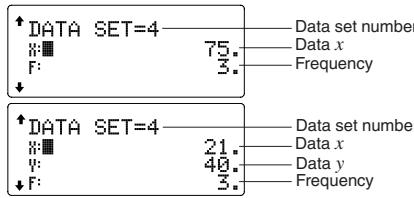
Use ▲ and ▼ to display the previously entered data set.
Press ▼ to display the data set in ascending (oldest first) order. To reverse the display order to descending (latest first), press the ▲ key. Press 2ndF ▲ or 2ndF ▼ to jump the cursor to the beginning or end of the data set.
Each data set is displayed with "X:", "Y:", or "F:".
text_image
DATA SET=4 8: 75. F: 3. ↓ Data set number Data x Frequency ↑ DATA SET=4 8: 21. y: 40. ↓ F: 3.Display and move the cursor to the data item to be modified by using ▲ and ▼, enter the correct value, then press DATA or ENTER.
- To delete a data set, display and move the cursor to an item of the data set to delete by using ▲ and ▼, then press 2ndF CD. The data set will be deleted.
- To add a new data set, press ON/C to exit the display of previously entered data and input the values, then press DATA.
Statistical Calculation Formulas

| Type | Regression formula |
| Linear | y = a + bx |
| Quadratic | y = a + bx + cx^2 |
| Euler exponential | y = a · e^bx |
| Logarithmic | y = a + b · x |
| Power | y = a · x^b |
| Inverse | y = a + b 1x |
| General exponential | y = a · b^x |
An error will occur when:
- The absolute value of the intermediate result or calculation result is equal to or greater than 1 × 10^100 .
• The denominator is zero. - An attempt is made to take the square root of a negative number.
- No solution exists in the quadratic regression calculation.
Normal Probability Calculations

In STAT mode, the three probability density functions can be accessed under the MATH menu, with a random number used as a normal distribution variable.
Notes:
- P(t) , Q(t) , and R(t) will always take positive values, even when t < 0 , because these functions follow the same principle used when solving for an area.
- Values for P(t) , Q(t) , and R(t) are given to six decimal places.
- The standardization conversion formula is as follows:
$$ t = \frac {x - \bar {x}}{\sigma x} $$
DRILL MODE
Math Drill: MODE 2 0
Math operation questions with positive integers and 0 are displayed randomly. It is possible to select the number of questions and operator type.
Multiplication Table (× Table): MODE 2 1
Questions from each row of the multiplication table (1 to 12) are displayed serially or randomly.
To exit DRILL mode, press MODE and select another mode.
Using Math Drill and × Table
- Press MODE 2 0 for Math Drill or MODE 2 1 for X Table.
- Math Drill: Use ▲ and ▼ to select the number of questions (25, 50, or 100).
✗ Table: Use ▲ and ▼ to select a row in the multiplication table (1 to 12). - Math Drill: Use ◀ and ▶ to select the operator type for questions (+, -, ×, ÷, or +-×÷). ✗ Table: Use ◀ and ▶ to select the order type (“Serial” or “Random”).
-
Press ENTER to start.
When using Math Drill or × Table (random order only), questions are randomly selected and will not repeat except by chance. -
Enter your answer. If you make a mistake, press ON/C or BS to clear any entered numbers, and enter your answer again.
-
Press ENTER.
-
If the answer is correct, “” appears and the next question is displayed.
- If the answer is wrong, “✗” appears and the same question is displayed. This will be counted as an incorrect answer.
-
If you press ENTER without entering an answer, the correct answer is displayed and then the next question is displayed. This will be counted as an incorrect answer.
-
Continue answering the series of questions by entering the answer and pressing ENTER.
- After you finish, press ENTER and the number and percentage of correct answers are displayed.
- Press ENTER to return to the initial screen for your current drill.
Math Drill sample
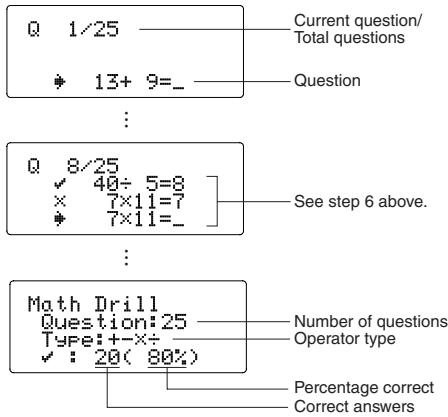
text_image
Q 1/25 • 13+ 9=_ Current question/ Total questions Question : Q 8/25 ✓ 40÷ 5=8 × 7×11=7 • 7×11=_ See step 6 above. : Math Drill Question:25 Type:+-x÷ ✓ : 20( 80%) Number of questions Operator type Percentage correct Correct answers× Table sample
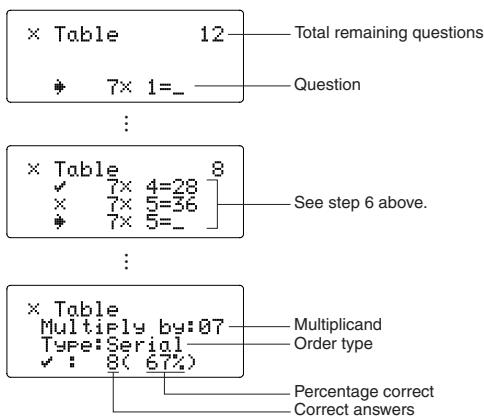
text_image
Table 12 7× 1=_ Total remaining questions Question ... × Table 8 ✓ 7× 4=28 × 7× 5=36 ★ 7× 5=_ See step 6 above. ... × Table Multiply by:07 Type: Serial ✓ : 8( 67%) Multiplicand Order type Percentage correct Correct answersRanges of Math Drill Questions
The range of questions for each operator type is as follows.
- Addition operator: "0 + 0" to "20 + 20"
- Subtraction operator: "0 - 0" to "20 - 20"; answers are positive integers and 0.
× Multiplication operator: “1 × 0” or “0 × 1” to “12 × 12”
÷ Division operator: "0 ÷ 1" to "144 ÷ 12"; answers are positive integers from 1 to 12 and 0, dividends of up to 144, and divisors of up to 12. -
- × ÷ Mixed operators: Questions within all the above ranges are displayed.
COMPLEX NUMBER CALCULATIONS

To carry out addition, subtraction, multiplication, and division using complex numbers, press MODE 3 to select CPLX mode. Results of complex number calculations are expressed using two systems:
① 2ndF →xy: Rectangular coordinate system (The xy symbol appears.)
② 2ndF →rθ: Polar coordinate system (The rθ symbol appears.)
Complex Number Entry
① Rectangular coordinates
x-coordinate + y-coordinate i or x-coordinate + i y-coordinate
② Polar coordinates
r r: absolute value : argument
- On selecting another mode, the imaginary part of any complex number stored in the independent memory (M) and the last answer memory (ANS) will be cleared.
- A complex number expressed in rectangular coordinates with the y-value equal to zero, or expressed in polar coordinates with the angle equal to zero, is treated as a real number.
- Press MATH 1 to return the complex conjugate of the specified complex number.
MATRIX CALCULATIONS

You can store and calculate up to four matrices containing up to four rows and four columns each in MATRIX mode.
MATRIX MODE
0.
Press MODE 4 to enter MATRIX mode.
Note: You can use the MATH menu in MATRIX mode to edit, recall, and store matrices, as well as to call matrix-specific functions.
Entering and Storing Matrices
Before performing matrix calculations, a matrix must be created. Follow the steps below to enter and store matrices.
- Press MODE 4 to enter MATRIX mode.
- Press MATH 2 to bring up the matrix entry screen.
- Any matrix data remaining in the buffer, along with any previously entered, loaded, or calculated matrix data, will be displayed.
- Define the matrix dimensions (up to four rows by four columns) by entering the required dimensions using the number keys and pressing ENTER.
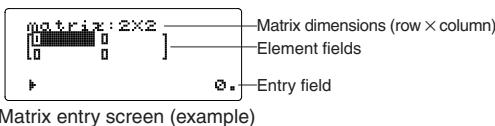
text_image
matrix: 2×2 Matrix dimensions (row × column) Element fields Entry field Matrix entry screen (example)-
Enter each element in the matrix by entering a value in the entry field and pressing ENTER.
-
Each matrix element can display up to seven digits (the decimal point counts as one digit). If an element exceeds seven digits in length, it may be displayed in exponent notation within the matrix.
-
A maximum of three rows by three columns can be displayed at one time. Use ▲, ▼, ◀, and ▶ to move the cursor through the matrix.
-
When you have entered a value for each element, press ON/C to exit the matrix entry screen.
- Press MATH 4 and select a memory (matA–matD) to store the newly-created matrix in.
Modifying a stored matrix
- To load a stored matrix into the matrix entry screen, press MATH 3, then select the memory (matA–matD) that holds the matrix you wish to modify.
- Loading new data into the screen will automatically replace any data that may already exist there.
- Using the matrix entry screen, you can modify the values of elements in the matrix. Assign new values wherever necessary and press ENTER after each one.
- If you wish to modify the number of rows or columns, first press ON/C MATH 2. You can then enter new values for the matrix dimensions.
- When you have finished making changes, press ON/C to exit the matrix entry screen.
- Press MATH 4 and select a memory (matA–matD) to store the newly-created matrix in.
Using Matrices in Calculations
Matrices stored in memories (matA–matD) can be used in arithmetic calculations (with the exception of division between matrices) and calculations that use x^3 , x^2 , and x^-1 . You can also use the following matrix-specific functions that are available in the MATH menu.
| dim (matrix name, row, column) | Returns a matrix with dimensions changed as specified. |
| fill (value, row, column) | Fills each element with a specified value. |
| cumul matrix name | Returns the cumulative matrix. |
| aug (matrix name, matrix name) | Appends the second matrix to the first matrix as new columns. The first and second matrices must have the same number of rows. |
| identity value | Returns the identity matrix with specified value of rows and columns. |
| rnd_mat (row, column) | Returns a random matrix with specified values of rows and columns. |
| det matrix name | Returns the determinant of a square matrix. |
| trans matrix name | Returns the matrix with the columns transposed to rows and the rows transposed to columns. |
| mat→list(MATH 7) | Creates lists with elements from the left column of each matrix. (matA→L1, matB→L2, matC→L3, matD→L4)Mode changes from MATRIX mode to LIST mode. |
| matA→list(MATH 8) | Creates lists with elements from each column of the matrix. (matA→L1, L2, L3, L4)Mode changes from MATRIX mode to LIST mode. |
Notes:
- When the matrix entry screen is displayed, you cannot perform matrix calculations because the MATH menu is not available.
- If the calculation result is a matrix, it will be displayed in the matrix entry screen (note that this replaces any existing data in the buffer). To store the calculation result, first press ON/C to exit the matrix entry screen. Press MATH 4 and select a memory (matA–matD) to store the newly-created matrix in.
- When the calculation results are in matrix form, pressing neither ◀ nor ▶ will bring you back to the original expression.
LIST CALCULATIONS

You can store and calculate up to four lists of up to sixteen elements each in LIST mode.
LIST MODE
0.
Press MODE 5 to enter LIST mode.
Note: You can use the MATH menu in LIST mode to edit, recall, and store lists, as well as to call list-specific functions.
Entering and Storing Lists
Before performing list calculations, a list must be created. Follow the steps below to enter and store lists.
- Press MODE 5 to enter LIST mode.
- Press MATH 2 to bring up the list entry screen.
- Any list data remaining in the buffer, along with any previously entered, loaded, or calculated list data, will be displayed.
- Define the list size (up to sixteen elements) by entering a value using the number keys and pressing ENTER.
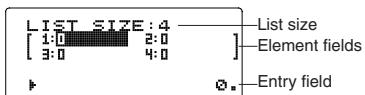
List entry screen (example)
-
Enter each element in the list by entering a value in the entry field and pressing ENTER.
-
Each list element can display up to eight digits (the decimal point counts as one digit). If an element exceeds eight digits in length, it will be displayed in exponent notation within the list.
-
A maximum of six elements can be displayed at one time. Use ▲, ▼, ◀, and ▶ to move the cursor through the list.
-
When you have entered a value for each element, press ON/C to exit the list entry screen.
-
Press MATH 4 and select a memory (L1–L4) to store the newly-created list in.
Modifying a stored list
- To load a stored list into the list entry screen, press MATH 3, then select the memory (L1–L4) that holds the list you wish to modify.
- Loading new data into the screen will automatically replace any data that may already exist there.
- Using the list entry screen, you can modify the values of elements in the list. Assign new values wherever necessary and press ENTER after each one.
- If you wish to modify the size of a list, first press ON/C MATH 2. You can then enter new values for the list size.
- When you have finished making changes, press ON/C to exit the list entry screen.
- Press MATH 4 and select a memory (L1–L4) to store the newly-created list in.
Using Lists in Calculations
Lists stored in memories (L1–L4) can be used in arithmetic calculations and calculations that use x^3 , x^2 , and x^-1 . You can also use the following list-specific functions that are available in the MATH menu.
| sortA list name | Sorts list in ascending order. |
| sortD list name | Sorts list in descending order. |
| dim (list name, size) | Returns a list with size changed as specified. |
| fill (value, size) | Enters the specified value for all items. |
| cumul list name | Sequentially cumulates each item in the list. |
| df_list list name | Returns a new list using the difference between adjacent items in the list. |
| aug (list name, list name) | Returns a list appending the specified lists. |
| min list name | Returns the minimum value in the list. |
| max list name | Returns the maximum value in the list. |
| mean list name | Returns the mean value of items in the list. |
| med list name | Returns the median value of items in the list. |
| sum list name | Returns the sum of items in the list. |
| prod list name | Returns the multiplication of items in the list. |
| stdDv list name | Returns the standard deviation of the list. |
| vari list name | Returns the variance of the list. |
| o_prod (list name, list name) | Returns the outer product of 2 lists (vectors). |
| i_prod (list name, list name) | Returns the inner product of 2 lists (vectors). |
| abs_list list name | Returns the absolute value of the list (vector). |
| list→mat(MATH 7) | Creates matrices with left column data from each list. (L1→matA, L2→matB, L3→matC, L4→matD)Mode changes from LIST mode to MATRIX mode. |
| list→matA(MATH 8) | Creates a matrix with column data from each list. (L1, L2, L3, L4→matA)Mode changes from LIST mode to MATRIX mode. |
Notes:
- When the list entry screen is displayed, you cannot perform list calculations because the MATH menu is not available.
- If the calculation result is a list, it will be displayed in the list entry screen (note that this replaces any existing data in the buffer). To store the calculation result, first press ON/C to exit the list entry screen. Press MATH 4 and select a memory (L1–L4) to store the newly-created list in.
- When the calculation results are in list form, pressing neither nor will bring you back to the original expression.
EQUATION SOLVERS

The results obtained by these functions may include a margin of error.
Simultaneous Linear Equations
Simultaneous linear equations with two unknowns (2-VLE) or with three unknowns (3-VLE) may be solved using the following functions.
① 2-VLE: MODE 6 0
$$ \left[ \begin{array}{l} a _ {1} x + b _ {1} y = c _ {1} \ a _ {2} x + b _ {2} y = c _ {2} \end{array} \right. $$
$$ | D | = \left| \begin{array}{c} a _ {1} b _ {1} \ a _ {2} b _ {2} \end{array} \right| $$
② 3-VLE: MODE 6 1
$$ \left[ \begin{array}{l} a _ {1} x + b _ {1} y + c _ {1} z = d _ {1} \ a _ {2} x + b _ {2} y + c _ {2} z = d _ {2} \ a _ {3} x + b _ {3} y + c _ {3} z = d _ {3} \end{array} \right. $$
$$ \left| \mathsf {D} \right| = \quad \left| \begin{array}{l} a _ {1} b _ {1} c _ {1} \ a _ {2} b _ {2} c _ {2} \ a _ {3} b _ {3} c _ {3} \end{array} \right| $$
- If the determinant D = 0 , an error occurs.
- If the absolute value of an intermediate result or calculation result is 1 × 10^100 or more, an error occurs.
Solving simultaneous linear equations
- Press MODE 6 0 or MODE 6 1.
-
Enter the value for each coefficient ( a_1 , etc.).
-
Coefficients can be entered using ordinary arithmetic operations.
- To clear the entered coefficient, press ON/C.
-
Press ▲ or ▼ to move the cursor up or down through the coefficients. Press 2ndF ▲ or 2ndF ▼ to jump to the first or last coefficient.
-
When all coefficients have been entered, press ENTER to solve the equation.
- While the solution is displayed, press ENTER or ON/C to return to the coefficient entry display. To clear all the coefficients, press 2ndF CA.
Quadratic and Cubic Equations
Quadratic (ax^2 + bx + c = 0) or cubic (ax^3 +bx^2 +cx + d = 0) equations may be solved using the following functions.
① Quadratic equation solver: MODE 6 2
② Cubic equation solver: MODE 6 3
Solving quadratic and cubic equations
- Press MODE 6 2 or MODE 6 3.
- Coefficients for these equations can be entered in the same manner as those for simultaneous linear equations.
ERRORS AND CALCULATION RANGES
Errors
An error will occur if an operation exceeds the calculation ranges, or if a mathematically illegal operation is attempted. When an error occurs, pressing ◀ or ▶ automatically moves the cursor back to the place in the equation where the error occurred. Edit the equation or press ON/C or 2ndF CA to clear the equation.
Error codes and error types
ERROR 01: Syntax error
- An attempt was made to perform an invalid operation.
$$ \text { Ex. } 2 \boxed {+} \boxed {-} 5 \boxed {=} $$
ERROR 02: Calculation error
- The absolute value of an intermediate or final calculation result equals or exceeds 10^100 .
- An attempt was made to divide by zero (or an intermediate calculation resulted in zero).
- The calculation ranges were exceeded while performing calculations.
ERROR 03: Nesting error
- The available number of buffers was exceeded. (There are 10 buffers* for numeric values and 64 buffers for calculation instructions).
* 5 buffers in CPLX mode, and 1 buffer for matrix/list data.
ERROR 04: Data over error
• Data items exceeded 100 in STAT mode.
ERROR 07: Definition error
- Matrix/List definition error or the attempted entering of an invalid value.
ERROR 08: DIM unmatched error
- Matrix/List dimensions inconsistent while calculating.
ERROR 09: Invalid DIM error
- Size of matrix/list exceeds calculation range.
ERROR 10: Undefined error
- Undefined matrix/list used in calculation.
Alert Messages

Cannot delete!
- The selected item cannot be deleted by pressing BS or 2ndF DEL in the WebView editor.
$$ \text { Ex. } \boxed {2 \mathrm{ndF}} \boxed {\sqrt {5}} \boxed {\blacktriangleright} \boxed {x ^ {2}} \boxed {\blacktriangleleft} \boxed {\mathrm{BS}} $$
In this example, delete the exponent before attempting to delete the parentheses.
Cannot call!
- The function or operation stored in definable memory (D1 to D4) cannot be called.
Ex. An attempt was made to recall a statistical variable from within NORMAL mode.
- Expressions stored in formula memories (F1 to F4) cannot be called.
Buffer full!
- The equation (including any calculation ending instructions) exceeded its maximum input buffer (159 characters in the Martin View editor or 161 characters in the Line editor). An equation may not exceed its maximum input buffer.
Calculation Ranges

- Within the ranges specified, this calculator is accurate to ± 1 of the 10th digit of the mantissa. However, a calculation error increases in continuous calculations due to accumulation of each calculation error. (This is the same for y^x, x , n! , e^x , In, Matrix/List calculations, etc., where continuous calculations are performed internally.) Additionally, a calculation error will accumulate and become larger in the vicinity of inflection points and singular points of functions.
- Calculation ranges
±10^-99 to ±9.999999999 × 10^99 and 0.
If the absolute value of an entry or a final or intermediate result of a calculation is less than 10^-99 , the value is considered to be 0 in calculations and in the display.
Display of results using
Calculation results may be displayed using when all of the following conditions are met:
- When intermediate and final calculation results are displayed in the following form:
$$ \pm \frac {a \sqrt {b}}{e} \pm \frac {c \sqrt {d}}{f} $$
- When each coefficient falls into the following ranges:
$$ 1 \leq a < 1 0 0; 1 < b < 1, 0 0 0; 0 \leq c < 1 0 0; $$
$$ 1 \leq d < 1, 0 0 0; 1 \leq e < 1 0 0; 1 \leq f < 1 0 0 $$
- When the number of terms in the intermediate and final calculation results is one or two.
Note: The result of two fractional terms that include will be reduced to a common denominator.
BATTERY REPLACEMENT
Notes on Battery Replacement
Improper handling of batteries can cause electrolyte leakage or explosion. Be sure to observe the following handling rules:
- Make sure the new battery is the correct type.
- When installing, orient the battery properly as indicated in the calculator.
- The battery is factory-installed before shipment, and may be exhausted before it reaches the service life stated in the specifications.
Notes on erasure of memory contents
When the battery is replaced, the memory contents are erased. Erasure can also occur if the calculator is defective or when it is repaired. Make a note of all important memory contents in case accidental erasure occurs.
When to Replace the Battery
If the display has poor contrast or nothing appears on the display when ON/C is pressed in dim lighting, even after adjusting the display contrast, it is time to replace the battery.
Cautions
- An exhausted battery left in the calculator may leak and damage the calculator.
- Fluid from a leaking battery accidentally entering an eye could result in serious injury. Should this occur, wash with clean water and immediately consult a doctor.
- Should fluid from a leaking battery come in contact with your skin or clothes, immediately wash with clean water.
- If the product is not to be used for some time, to avoid damage to the unit from a leaking battery, remove it and store in a safe place.
- Do not leave an exhausted battery inside the product.
- Keep batteries out of the reach of children.
- Explosion risk may be caused by incorrect handling.
- Do not throw batteries into a fire as they may explode.
Replacement Procedure
- Turn the power off by pressing 2ndF OFF.
- Remove the two screws. (Fig. 1)
- Slide the battery cover slightly and lift it to remove.
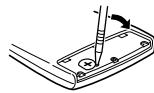
- Remove the used battery by prying it out with a ball-point pen or other similar pointed device. (Fig. 2)
- Install one new battery. Make sure the “+” side is facing up.
- Replace the cover and screws.
- Press the RESET switch (on the back) with the tip of a ball-point pen or similar object.
- Adjust the display contrast. See "Adjusting the Display Contrast".
- Make sure that the display appears as shown below. If the display does not appear as shown, remove the battery, reinstall it, and check the display once again.
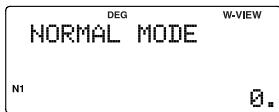
text_image
DEG NORMAL MODE N1 0.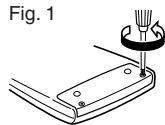
Fig. 2
Automatic Power Off Function
This calculator will turn itself off to save battery power if no key is pressed for approximately 10 minutes.
SPECIFICATIONS
| Calculation features: | Scientific calculations, complex number calculations, equation solvers, statistical calculations, etc. |
| Drill features: | Math Drill and Multiplication Table |
| Display: | 96 × 32 dot matrix liquid crystal display |
| Display of calculation results: | |
| Mantissa: 10 digitsExponent: 2 digits | |
| Internal calculations: | Mantissas of up to 14 digits |
| Pending operations: | 64 calculations 10 numeric values(5 numeric values in CPLX mode, and 1 numeric value for Matrix/List data.) |
| Power source: | Built-in solar cells 1.5 V (DC) : Backup battery(Alkaline battery (LR44 or equivalent) × 1 ) |
| Operating time:(varies according to use and other factors) | Approx. 3,000 hours when continuously displaying 55555. at 25^ ( 77^ ), using the alkaline battery only |
| Operating temperature: | 0^ - 40^ ( 32^ - 104^ ) |
| External dimensions: | 79.6 mm ( W ) × 161.5 mm ( D ) × 15.5 mm ( H ) 3-1/8" ( W ) × 6-11/32" ( D ) × 5/8" ( H ) |
| Weight: | Approx. 102 g (0.23 lb) (including battery) |
| Accessories: | Battery × 1 (installed), operation manual, calculation examples, and hard case |
FOR MORE INFORMATION ABOUT SCIENTIFIC CALCULATORS
Visit our Web site.
http://sharp-world.com/calculator/
WriteView
EL-W506
EL-W516
EL-W546
CALCULATION EXAMPLES
EXEMPLES DE CALCUL
ANWENDUNGSBEISPIELE
EJEMPLOS DE CÁLCULO
EXEMPLOS DE CÁLCULO
ESEMPI DI CALCOLO
REKENVOORBEELDEN
PÉLDASZÁMÍTÁSOK
PŘÍKLADY VÝPOČTŮ
RÄKNEEXEMPEL
LASKENTAESIMERKKEJÄ
UDREGNINGSEKSEMPLER
ตัวอย่างการดำเนวลม
نماذج للحسابات
CONTOH-CONTOH PERHITUNGAN
계산 예
SHARP CORPORATION
PRINTED IN CHINA / IMPRIMÉ EN CHINE / IMPRESO EN CHINA
07HGK (TINSZ1308EHZZ)
1 SET UP
| 100000 ÷ 3 = | |||||
| [NORM1] | ON/C= | 100000CHANGES | ÷3 | 33'333.33333 | |
| → [FIX: TAB 2] | 2ndF | SET UP | 10 | 2 | 33'333.33 |
| → [SCI: SIG 2] | 2ndF | SET UP | 11 | 2 | 3.3E04 |
| → [ENG: TAB 2] | 2ndF | SET UP | 12 | 2 | 33.33E03 |
| → [NORM1] | 2ndF | SET UP | 13 | 33'333.33333 | |
| 3 ÷ 1000 = | |||||
| [NORM1] | ON/CCHANGES | 3 ÷ 1000 | ÷ | 1000 | = |
| → [NORM2] | 2ndF | SET UP | 14 | 3.E-03 | |
| → [NORM1] | 2ndF | SET UP | 13 | 0.003 | |
2 CHANGE
| 25 + 34 = | ON/C 2 a/b 5 ▶+ a/b 3 ▶ 4= | 1 320 |
| CHANGE | 2320 | |
| CHANGE | 1.15 | |
| CHANGE | 1 320 | |
| 3 × 5 = | 2ndF √ 3 ▶ ×2ndF √ 5 = | 15 |
| CHANGE | 3.872983346 | |
| 2 ÷ 3 + 5 ÷ 5 = | 2ndF √ 2 ▶ ÷ 3+ 2ndF √ 5 ▶÷ 5 = | 35 + 5215 |
| CHANGE | 0.918618116 |
| sin45= | 45 = | 22 |
| 0.707106781 | ||
| 2^-10.5 [rad] = | 2ndF UP 0 1 2 (2ndF) (^-1) 0.5 = | 23 |
| 2.094395102 |
3 ▲ ▼
| 2ndF CA | 0. | |
| 1 3(5+2)= | 3 (5 + 2) = | 21. |
| 2 3×5+2= | 3 × 5 + 2 = | 17. |
| 3 (5+3)×2= | (5 + 3) × 2 = | 16. |
| →1 | 2ndF ▲ | 21. |
| →2 | ▼ | 17. |
| →3 | ▼ | 16. |
| →2 | ▲ | 17. |
4 + - × ÷ ( ) (-) Exp
| 45 + 285 ÷ 3 = | ON/C=45+285÷3= | 140. |
| (18 + 6) ÷ (15 - 8) = | (18+6)=(15-8= | 337 |
| 42 × -5 + 120 = | 42×(-)5+120= | -90 |
| (5 × 10^3) ÷ (4 × 10^-3) = | 5Exp3÷4Exp(-)3= | 1'250'000. |
5
| 34+57= | 34+57= | 91. |
| 45+57= | 45= | 102. |
| 68×25= | 68×25= | 1'700. |
| 68×40= | 40= | 2'720. |
| 6 | sin | cos | tan | ^-1 | ^-1 | ^-1 | hyp | arc hyp | |
| ln | log | _a x | e^x | e | 10^x | x^-1 | x^2 | x^3 | |
| y^x | x | [3] | n! | nPr | nCr | % | abs |
| 2ndF M-CLR 0 | 0. | |
| sin60 [°] = | ON/C sin 60 = | 32 |
| CHANGE | 0.866025403 | |
| cos 4 [rad] = | 2ndF SET UP 0 1cos 2ndF a/b 4 = | 22 |
| CHANGE | 0.707106781 |
| ^-1 1 [g] = | 2ndF | SET UP | 0 | 2 |
| 2ndF | ^-1 | 1 | = | |
| 2ndF | SET UP | 0 | 0 |
| (cosh 1.5 + sinh 1.5)^2 = |c:c:c ON/C & ( & hyp & cos \ 1.5 & + & hyp & sin \ 1.5 & ) & ^2 & = | 20.08553692 |
| ^-1 57 = | |c:c 2ndF & arch hyp & tan \ 5 & ÷ & 7 \ = | 0.895879734 |
| 20 = | |c & 20 \ = | 2.995732274 |
| log50 = | 50 = | 1.698970004 |
| _216384 = | 2ndF _ax 2 ▶ 16384 = | 14. |
| LINE | 2ndF | _a X | 2 | (x,y) | 16384 | ) |
| = |
| e^3 = | 2ndF e^x 3 = | 20.08553692 |
| 1 ÷ e = | 1 ÷ ALPHA = | 0.367879441 |
| 10^1.7 = | 2ndF 10^-x 1.7 = | 50.11872336 |
| 16 + 17 = | 6 2ndF ^-1 + 7 2ndF ^-1 = | 1342 |

| 8^-2 - 3^4 × 5^2 = | 8 y^x (—) 2 ▶— 3 y^x 4 ▶× 5 x^2 = | -2024 6364 |
| CHANGE | - 12959964 | |
| CHANGE | -2'024.984375 | |
| LINE | 8 y^x (—) 2 —3 y^x 4 × 5 x^2 = | -2'024.984375 |
| CHANGE | -2024r63r64 | |
| CHANGE | -129599r64 | |
| (12^3)14 = | ( 12 y^x 3▶ ) y^x 1 a/b 4 = | 6.447419591 |
| LINE | ( 12 y^x 3 ) y^x 1 a/b 4 = | 6.447419591 |
| 8^3 = | 8 2ndF x^3 = | 512. |
| 49 - ^481 = | 2ndF 49 ▶ — 4 2ndF 81 = | 4. |
| LINE | 2ndF 49 — 4 2ndF 81 = | 4. |
| ^327 = | 2ndF 27 = | 3. |
| 4! = | 4 2ndF n! = | 24. |
| 10P_3 = | 10 2ndF nPr 3 = | 720. |
| 5C_2 = | 5 2ndF nCr 2 = | 10. |
| 500 × 25% = | 500 × 25 2ndF % | 125. |
| 120 ÷ 400 = ?% | 120 ÷ 400 2ndF % | 30. |
| 500 + (500 × 25%) = | 500 + 25 2ndF % | 625. |
| 400 - (400 × 30%) = | 400 — 30 2ndF % | 280. |
| |5 - 9| = | 2ndF abs 5 — 9 = | 4. |
| LINE | 2ndF abs ( 5 — 9 ) = | 4. |
- The range of the results of inverse trigonometric functions
- Plage des résultats des fonctions trigonométriques inverses
- Der Ergebnisbereich für inverse trigonemetrische Funktionen
- El rango de los resultados de funciones trigonométricas inversas
- Gama dos resultados das trigonométricas inversas
- La gamma dei risultati di funzioni trigonometriche inverse
- Het bereik van de resultaten van inverse trigonometrie
- Az inverz trigonometriai funkciók eredmény-tartománya
- Rozsah výsledků inverzních trigonometrických funkcí
- Omfång för resultaten av omvända trigonometriska funktioner
- Käänteisten trigonometristen funktioiden tulosten alue
- Område for resultater af omvendte trigonometriske funktioner
- พิสัยของผลลัพท์ของฟังกชั้นตรีโกนเมตริกผกผัน
| 9DRG▶ | ||
| 90^ [rad] | ON/C 90 2ndF DRG▶ | 12 |
| → [g] | 2ndF DRG▶ | 100. |
| → [°] | 2ndF DRG▶ | 90. |
| sin^-1 0.8 = [^] | 2ndF sin^-1 0.8 = | 53.13010235 |
| → [rad] | 2ndF DRG▶ | 0.927295218 |
| → [g] | 2ndF DRG▶ | 59.03344706 |
| → [°] | 2ndF DRG▶ | 53.13010235 |
| 10ALPHA RCL STO M+ M- ANS F1 F2 F3F4 D1 D2 D3 D4 | ||||||
| 8 × 2 M | ON/C 8 × 2 STO M | 16. | ||||
| 24 ÷ (8 × 2) = | 24 ÷ ALPHA M = | 112 | ||||
| (8 × 2) × 5 = | ALPHA M × 5 = | 80. | ||||
| 0 M | ON/C STO M | 0. | ||||
| \150 \times 3 \Rightarrow M_1 | 150 \times 3M+ | 450. | ||||
| +) \250: M_1 + 250 M_2 | 250 M+ | 250. | ||||
| -) M_2 × 5% | RCL M × 5 2ndF %2ndF M- | 35. | ||||
| M = | RCL M | 665. | ||||
| \1 = ¥110 (110 \Rightarrow Y) | 110STO Y | 110. | ||||
| ¥26,510 =? | 26510 ÷ ALPHA Y= | 241. | ||||
| \2,750 = ? | 2750 \timesALPHA Y= | 302'500. | ||||
| r = 3 cm (r ⇒ Y) | 3STO Y | 3. | ||||
| \pi r^2 = ? | 2ndF \piALPHA Y\chi^2=CHANGE | 28.27433388 | ||||
| \frac{24}{4 + 6} = 2\frac{2}{5}...(A) | 24 \div (4 + 6) = | 2\frac{2}{5} | ||||
| 3 \times (A) + 60 \div (A) = | 3 \timesALPHA ANS + 60÷ ALPHA ANS = | 32\frac{1}{5} | ||||
| \pi r^2 \Rightarrow F1 | 2ndF \piALPHA Y\chi^2STO F1 | ⇒F1 | ||||
| r = 3 cm (r ⇒ Y) | 3STO Y | 3. | ||||
| [IMAGE] V = ? | RCL F1 × 4÷ 3 = CHANGE | 37.69911184 | ||||
| sinh^{-1} \Rightarrow D1 | STO D1 2ndF arch hyp sin | |||||
| sinh^{-1}0.5 =$ | D1 0.5 = 0.481211825 | |||||
| 6 + 4 = ANS | ON/C 6 + 4 = | 10. |
| ANS + 5 = | + 5 = | 15. |
| 8 × 2 = ANS | 8 × 2 = | 16. |
| ANS ^2 = | x^2 = | 256. |
| 44 + 37 = ANS | 44 + 37 = | 81. |
| = | 2ndF = | 9. |
| 3 12+43= | ON/C 3 2ndF ab/c 1 ▼ 2▶ + a/b 4 ▼ 3 = | 4 56 |
| CHANGE | 296 | |
| CHANGE | 4.833333333 | |
| LINE | 3 a/b 1 a/b 2+ 4 a/b 3 = | 4r5r6* |
| CHANGE | 29r6 | |
| CHANGE | 4.833333333 | |
| 10^23= | 2ndF 10^x 2 a/b 3 = | 4.641588834 |
| (75)^5= | 7 a/b 5 ▶ y ^x 5 = | 168073125 |
| LINE | 7 a/b 5 y ^x 5 = | 16807r3125 |
| 318= | 2ndF [3]1 a/b 8 = | 12 |
| 64225= | 2ndF 64 a/b 225 = | 815 |
| 2^33^4= | 2 2ndF ^3 a/b 3 y ^x 4 = | 881 |
| LINE | 2 2ndF ^3 a/b ( 3 y ^x 4 ) = | 8r81 |
| 1.22.3= | 1.2 a/b 2.3 = | 1223 |
| 1^2'3''2= | 1 D'M'S 2 D'M'S 3 a/b 2 = | 0°31'1.5" |
| 1× 10^32× 10^3= | 1 Exp 3 a/b 2 Exp 3 = | 12 |
| 7⇒A | ON/C 7 STO A | 7. |
| 4A= | 4 a/b ALPHA A = | 47 |
| 1.25+25= | 1.25 + 2 a/b 5 = | 11320 |
| CHANGE | 3320 | |
| CHANGE | 1.65 | |
| LINE | 1.25 + 2 a/b 5 = | 1.65 |
| CHANGE | 1r13r20 | |
| CHANGE | 33r20 |
* 4r5r6 = 4 56
| DEC (25) → BIN | ON/C2ndF | 2ndF↔BIN | ↔DEC | 25 | BIN | 11001 |
| HEX (1AC) | 2ndF | ↔HEX | 1 A C | |||
| → BIN | 2ndF | ↔BIN | BIN | 110101100 | ||
| → PEN | 2ndF | ↔PEN | PEN | 3203 | ||
| → OCT | 2ndF | ↔OCT | OCT | 654 | ||
| → DEC | 2ndF | ↔DEC | 428. | |||
| (1010 – 100)× 11 =[BIN] | 2ndF1010=100= | ↔BIN(—)×11= | BIN | 10010 | ||
| BIN (111)→ NEG | NEG | 111= | BIN | 1111111001 | ||
| HEX (1FF) +OCT (512) = | 2ndF2ndF512 | ↔HEX↔OCT= | 1 FF+ | OCT | 1511 | |
| HEX (?) | 2ndF | ↔HEX | HEX | 349 | ||
| 2FEC – 2C9E⇒ M1 | ON/C2ndF— | STO↔HEX2 C9 E | M2 F ECM+ | HEX | 34E | |
| +) 2000 – 1901⇒ M2 | 2000M+ | — | 1901 | HEX | 6FF | |
| M = | RCLON/C | MONC | MSTO | M | HEX | A4D |
| 1011 AND 101 =[BIN] | 2ndFAND | ↔BIN101 | 1011= | BIN | 1 | |
| 5A OR C3 =[HEX] | 2ndFC3 | ↔HEX= | 5 AOR | HEX | DB | |
| NOT 10110 =[BIN] | 2ndF10110 | ↔BIN= | NOT | BIN | 1111101001 | |
| 24 XOR 4 =[OCT] | 2ndF4 | ↔OCT= | 24 XOR | OCT | 20 | |
| B3 XNOR 2D =[HEX] | 2ndF2 D | ↔HEX= | B3 XNOR | HEX | FFFFFFFF61 | |
| → DEC | 2ndF | ↔DEC | -159. |
14 D°M'S ←DEG
| 7°31'49.44"→[10] | ON/C 7 D'M'S 31 D'M'S49.44 2ndF ↔DEG | 7 6631250 |
| 123.678→[60] | 123.678 2ndF ↔DEG | 123°40'40.8" |
| 3h 30m 45s +6h 45m 36s = [60] | 3 D'M'S 30 D'M'S 45+ 6 D'M'S 45 D'M'S36 = | 10°16'21." |
| 1234°56'12" +0°0'34.567" = [60] | 1234 D'M'S 56 D'M'S12 + 0 D'M'S 0D'M'S 34.567 = | 1234°56'47." |
| 3h 45m - 1.69h= [60] | 3 D'M'S 45 - 1.69 =2ndF ↔DEG | 2°3'36." |
| sin 62°12'24" = [10] | sin 62 D'M'S 12 D'M'S24 = | 0.884635235 |
| 24°→["] | 24 D'M'S MATH 4 | 86'400. |
| 1500"→['] | 0 D'M'S 0 D'M'S 1500MATH 5 | 25. |
15 →rθ →xy (x,y)
| x = 6 \ y = 4 r = \ = [^] | |cc ON/C & 6 & ^3_(x,y) \ 2ndF & r 4 | r: | 7.211102551 |
| θ: | 33.69006753 | ||
| r = 14 \ = 36 [^ ] x = \ y = | 14 \ 2ndF 36 | X: | 11.32623792 |
| Y: | 8.228993532 |
16 CNST CONV
| V_0 = 15.3 m/s | ON/C | 15.3 | × | 10 | + | |
| t = 10 s | 2 | 2ndF | ^-1 | × | CNST | 03 |
| V_ot + 12 gt^2 = ? m | × | 10 | ^2 | = | ||
| CHANGE | 643.3325 | |||||
| 125 yd = ? m | ON/C | 125 | 2ndF | CONV | 05 | = |
| CHANGE | CHANGE | 114.3 |
- Physical constants and metric conversions are shown in the tables.
- Les constantes physiques et les conversions des unités sont indiquées sur les tableaux.
- Physikalische Konstanten und metriche Umrechnungen sind in der Tabelle aufgelistet.
- Las constants físicas y conversiones métricas son mostradas en las tables.
- Constantes físicas e conversões métricas estão mostradas nas tablelas.
- La constanti fisiche e le conversioni delle unità di misura vengono mostrate nella tabella.
- De natuurconstanten en metrische omrekeningen staan in de tabellen hiernaast.
- A fizikai konstansok és a metrikus átváltások a táblázatokban találhatók.
- Fyzikální konstanty a převody do metrické soustavy jsou uvedeny v tabulce.
- Fysikaliska konstanter och metriska omvandlingar visas i tabellerna.
- Fysikaaliset vakiot ja metrimuunnokset näkyvät taulukoista.
- Fysiske konstanter og metriske omskrivninger vises i tabellen.
- ค่าคงที่ทางฟิลิกส์และการแปลงหน่วยเมตริกแสดงไว้ในตาราง
| → [FIX, TAB = 1] | ON/C 2ndF SETUP 1 0 1 | 0.0 |
| 5 ÷ 9 = ANS | 5 ÷ 9 = | 59 |
| CHANGE | 0.6 | |
| ANS × 9 = | × 9 = *1 | 5.0 |
| 5 ÷ 9 = | 59 | |
| CHANGE | 0.6 | |
| → [MDF] | 2ndF MDF | 35 |
| ANS × 9 = | × 9 = *2 | 525 |
| CHANGE CHANGE | 5.4 | |
| → [NORM1] | 2ndF SETUP 1 3 | 5.4 |
^*159×9=5.55555555555555×10^-1×9
^*235×9=0.6×9
19 MATH (ALGB)
| f(x) = x^3 - 3x^2 + 2 | ON/CALPHA \ - 2ndF X^3 \ 3 ALPHA X ^2 \ + 2 | |
| x = -1 | MATH1(-)1ENTER | -2. |
| x = -0.5 | MATH1(-)0.5ENTER | 118 |
| ^2 + B^2 | 2ndF \\+ ALPHA \ ALPHA B ^2 \ ^2 | |
| A = 2, B = 3 | MATH12 ENTER3 ENTER | 13 |
| A = 2, B = 5 | MATH1ENTER5 ENTER | 29 |
20 MATH (SOLVER)
| sin x - 0.5 | ON/C | sin | ALPHA | x | - | 0.5 |
| Start = 0 | MATH | 2 | 0 | ENTER | ENTER | 30. |
| Start = 180 | ENTER | 180 | ENTER | ENTER | 150. |
| 21 | DATA | (x,y) | sx | x | n | x | x^2 | ||
| sy | y | y | y^2 | xy | r | a | b | c | |
| x' | y' |
| MODE 1 02ndF CA | Stat 0 [SD] | 0. | |
| DATA95 | 95 DATA | DATA SET= | 1. |
| 80 | 80 DATA | DATA SET= | 2. |
| 8075757550 | DATA | DATA SET= | 3. |
| 75 ( x,y ) 3 DATA | DATA SET= | 4. | |
| 50 DATA | DATA SET= | 5. | |
| = | RCL | = 75.71428571 | |
| σx = | RCL σx | σx = 12.37179148 | |
| n = | RCL n | n= | 7. |
| Σx = | RCL Σx | Σx = | 530. |
| Σx^2 = | RCL Σx^2 | Σx^2 = | 41'200. |
| sx = | RCL sx | sx= | 13.3630621 |
| sx^2 = | x^2 = | sx^2 = | 178.5714286 |
| (95 - )sx × 10 + 50 = | (95 -ALPHA )÷ ALPHA sx× 10 + 50= | 64.43210706 | |
| DATA | MODE 1 12ndF CA | Stat 1 [LINE]0. | |
| x | y | ||
| 2 | 5 | 2 ,(x,y) 5 DATA | DATA SET= 1. |
| 2 | 5 | DATA | DATA SET= 2. |
| 12 | 24 | 12 ,(x,y) 24 DATA | DATA SET= 3. |
| 21 | 40 | 21 ,(x,y) 40 ,(x,y) 3 | DATA SET= 4. |
| 21 | 40 | DATA | |
| 15 | 25 | 15 ,(x,y) 25 DATA | DATA SET= 5. |
| a = | RCL a | a= | 1.050261097 |
| b = | RCL b | b= | 1.826044386 |
| r = | RCL r | r= | 0.995176343 |
| sx = | RCL sx | sx= | 8.541216597 |
| sy = | RCL sy | sy= | 15.67223812 |
| x = 3 y' = ? | 3 2ndF y' | 3y' | 6.528394256 |
| y = 46 x' = ? | 46 2ndF x' | 46x' | 24.61590706 |
| DATA | MODE 1 22ndF CA | Stat 2 [QUAD] | ||
| x | y | 0. | ||
| 12 | 41 | 12 '(x,y) 41 DATA | DATA SET= | 1. |
| 8 | 13 | 8 '(x,y) 13 DATA | DATA SET= | 2. |
| 5 | 2 | 5 '(x,y) 2 DATA | DATA SET= | 3. |
| 23 | 200 | 23 '(x,y) 200 DATA | DATA SET= | 4. |
| 15 | 71 | 15 '(x,y) 71 DATA | DATA SET= | 5. |
| a = | a= | 5.357506761 | |
| b = | b= | -3.120289663 | |
| c = | c= | 0.503334057 | |
| x = 10 → y' = ? | 10 2ndF ' | 10y' | 24.4880159 |
| y = 22 → x' = ? | 22 2ndF ' | 22x' | |
| 1: | 9.63201409 | ||
| 2: | -3.432772026 |
22 DATA (x,y) ▲ ▼ CD
| MODE 1 02ndF CA | Stat 0 [SD] | 0. | |
| DATA | |||
| 20 | 20 DATA | DATA SET= | 1. |
| 30 | 30 DATA | DATA SET= | 2. |
| 40 | 40 3(x,y) 2 DATA | DATA SET= | 3. |
| 40 | |||
| 50 | 50 DATA | DATA SET= | 4. |
| DATA | ||
| 30 | 2ndF CD DATA SET= 3. | |
| 45 | 45 DATA X: 45. | |
| 45 | 3 DATA F: ■ 3. | |
| 45 | ||
| 60 | 60 DATA X: 60. | |
ON/C
23
$$ \overline {{x}} = \frac {\Sigma x}{n} $$
$$ \sigma x = \sqrt {\frac {\Sigma x ^ {2} - n \overline {{x}} ^ {2}}{n}} $$
$$ s x = \sqrt {\frac {\Sigma x ^ {2} - n \overline {{x}} ^ {2}}{n - 1}} $$
$$ \begin{array}{l} \sum x = x _ {1} + x _ {2} + \dots + x _ {n} \ \sum x ^ {2} = x _ {1} ^ {2} + x _ {2} ^ {2} + \dots + \end{array} $$
$$ \overline {{y}} = \frac {\Sigma y}{n} $$
$$ \sigma y = \sqrt {\frac {\Sigma y ^ {2} - n \overline {{y}} ^ {2}}{n}} $$
$$ s y = \sqrt {\frac {\Sigma y ^ {2} - n \overline {{y}} ^ {2}}{n - 1}} $$
$$ \begin{array}{l} \sum x y = x _ {1} y _ {1} + x _ {2} y _ {2} + \dots + x _ {n} y _ {n} \ \sum y = y _ {1} + y _ {2} + \dots + y _ {n} \ \sum y ^ {2} = y _ {1} ^ {2} + y _ {2} ^ {2} + \dots + y _ {n} ^ {2} \end{array} $$
24 MATH (→t, P(, Q(, R()
$$ P (t) = \frac {1}{\sqrt {2 \pi}} \int_ {- \infty} ^ {t} e ^ {- \frac {x ^ {2}}{2}} d x $$
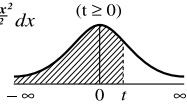
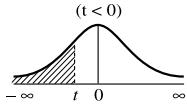
$$ Q (t) = \frac {1}{\sqrt {2 \pi}} \int_ {0} ^ {t} e ^ {- \frac {x ^ {2}}{2}} d x $$
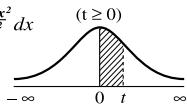
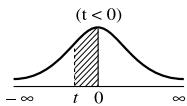
$$ R (t) = \frac {1}{\sqrt {2 \pi}} \int_ {t} ^ {\infty} e ^ {- \frac {x ^ {2}}{2}} d x $$
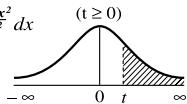
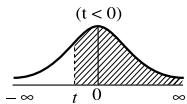
| DATA | |
| x | F |
| 20 | 1 |
| 30 | 3 |
| 40 | 5 |
| 50 | 8 |
| 60 | 13 |
| 70 | 10 |
| 80 | 7 |
| 90 | 3 |
| MODE | 1 | 0 | Stat 0 [SD] | |
| 2ndF | CA | 0. | ||
| 20 '(x,y) | 1 | DATA | DATA SET= | 1. |
| 30 '(x,y) | 3 | DATA | DATA SET= | 2. |
| 40 '(x,y) | 5 | DATA | DATA SET= | 3. |
| 50 '(x,y) | 8 | DATA | DATA SET= | 4. |
| 60 '(x,y) | 13 | DATA | DATA SET= | 5. |
| 70 '(x,y) | 10 | DATA | DATA SET= | 6. |
| 80 '(x,y) | 7 | DATA | DATA SET= | 7. |
| 90 '(x,y) | 3 | DATA | DATA SET= | 8. |
$$ \overline {{x}} = $$
$$ \boxed {\mathrm{RCL}} \boxed {\bar {x}} \quad \overline {{x}} = 6 0. 4 $$
$$ \sigma x = $$
$$ \boxed {\mathrm{RCL}} \boxed {\sigma x} \quad \sigma x = 1 6. 4 8 7 5 7 1 0 8 $$
$$ x = 3 5 \rightarrow P (t)? $$
$$ \begin{array}{c c c} \text {MATH} & 2 & 3 5 \text {MATH} \ \text {)} & = & 0. 0 6 1 7 1 3 \end{array} $$
$$ x = 7 5 \rightarrow Q (t)? $$
$$ \begin{array}{c c} \boxed {\text {MATH}} & 3 \ \boxed {\text {)}} & = \end{array} 7 5 \boxed {\text {MATH}} \boxed {1} \quad 0. 3 1 2 0 6 1 $$
$$ x = 8 5 \rightarrow R (t)? $$
$$ \begin{array}{c c} \boxed {\text {MATH}} & \boxed {4} \ \boxed {\text {)}} & \boxed {=} \end{array} 8 5 \boxed {\text {MATH}} \boxed {1} \quad 0. 0 6 7 8 4 5 $$
$$ t = 1. 5 \rightarrow R (t)? $$
$$ \boxed {\text { MATH }} \boxed {4} 1. 5 \boxed {}) = 0. 0 6 6 8 0 7 $$
25 MODE (CPLX)
| MODE 3 | |
| (12-6i)+(7+15i) | 12 - 6 i + 7 + 15 i |
| -(11+4i)= | - ( 11 + 4 i) |
| = | |
| 6×(7-9i) | 6 × ( 7 - 9 i ) |
| ×(-5+8i)= | × ( (-) 5 + 8 i ) |
| = | |
| 16×(sin30°+icos30°)÷(sin60°+icos60°)= | 16 × ( sin 30 + icos 30 ) ÷ ( sin 60+ i cos 60 ) |
| + i cos 60 ) | |
| = | |
| y | |
| A | 2ndF →rθ 8 ∠ 70 + 12 ∠ |
| r1 | 25 = 18.5408873 |
| θ1 θ2 | ∠42.76427608 |
| B | |
| x | |
| r1=8, θ1=70° | |
| r2=12, θ2=25° | |
| →r=? , θ=?° | |
| 1 + i r = ?, = ?^ | 2ndF xy 1 + =1. +1.i |
| 2ndF r 1.414213562 45. |
| (2 - 3i)^2 = | 2ndF xy ( 2 - 3 ) ^2 = | -5.-12.i |
| 11+i = | ( 1 + i ) 2ndF X^-1 \ = \ 0.5-0.5i |
| CONJ(5+2i) = | MATH 1 ( 5 + 2 i ) \ = \ 5.-2.i |

MODE (MATRIX)
| 1 & 2 \ 3 & 4 matA | MODE 4MATH 2 2 2 ENTER1 ENTER 2 ENTER 3 ENTER 4 ENTERON/C MATH 4 0 | ||||
| 3 & 1 \ 2 & 6 matB | MATH 2 ENTER3 ENTER 1 ENTER 2 ENTER 6 ENTERON/C MATH 4 1 | ||||
| matA × matB = | ON/C MATH 1 0 ×[7 13]MATH 1 1 = [17 27] | ||||
| matA ^-1 = | ON/C MATH 1 0[−2 12ndF ^-1 = [1.5 -0.5] | ||||
| dim (matA, 3, 3) = | ON/C MATH 5 0[MATH 1 0 ( _(x,y) ) 3( _(x,y) ) = [1 2 03 4 00 0 0] | ||||
| fill (5, 3, 3) = | ON/C MATH 5 1 5( _(x,y) ) 3 ( _(x,y) ) = [5 5 55 5 55 5 5] | ||||
| cumul matA = | ON/C MATH 5 2[MATH 1 0 = [1 24 6] | ||||
| aug (matA, matB) = | ON/C MATH 5 3 MATH1 0 ( _(x,y) ) MATH[1 2 3 13 4 2 6] | ||||
| identity 3 = | ON/C MATH 5 4 3[1 0 00 1 00 0 1] | ||||
| rnd_mat (2, 3) = | ON/C MATH 5 5 2 ( _(x,y) ) 3(=) | ||||
| det matA = | ON/C MATH 6 0[MATH 1 0 = [3 2-2. | ||||
| trans matB = | ON/C MATH 6 1[MATH 1 1 = [3 21 6] | ||||
| mat → list | ON/C MATH 7[MATH 3 0 [1:1 2:3]ON/C MATH 3 1 [1:3 2:2] | ||||

MODE (LIST)
| {2,7,4}⇒L1 | MODE 5MATH 2 3 ENTER2 ENTER 7 ENTER 4 ENTERON/C MATH 4 0 | |||||
| {-3,-1,-4}⇒L2 | MATH 2 ENTER(—) 3 ENTER (—) 1 ENTER (—) 4 ENTERON/C MATH 4 1 | |||||
| L1+L2= | ON/C MATH 1 0 + [1:-1 2:6]MATH 1 1 = [3:0] | |||||
| sortA L1= | ON/C MATH 5 0 MATH [1:2 2:4]1 0 = [3:7] | |||||
| sortD L1= | ON/C MATH 5 1 MATH [1:7 2:4]1 0 = [3:2] | |||||
| dim (L1,5)= | ON/C MATH 5 2 MATH [1:2 2:7]1 0 ('x,y) 5 ) [3:4 4:0= ] | |||||
| fill (5,5)= | ON/C MATH 5 3 5 [1:5 2:5('x,y) 5 ) = [3:5 4:55:5] | |||||
| cumul L1= | ON/C MATH 5 4 MATH [1:2 2:9]1 0 = [3:13] | |||||
| df_list L1= | ON/C MATH 5 5 MATH [1:5 2:-3]1 0 = | |||||
| aug (L1,L2)= | ON/C MATH 5 6 MATH [1:2 2:7]1 0 ('x,y) MATH 1 [3:4 4:-3]1 ) = [5:-1 6:-4] | |||||
| min L1= | ON/C MATH 6 0 MATH[1:2 2:9]1 0 = [3:13] | |||||
| max L1= | ON/C MATH 6 1 MATH[1:2 2:9]1 0 = [3:13] | |||||
| mean L1= | ON/C MATH 6 2 MATH[1:2 2:7]1 0 = [3:4 4:-3]1 ) = [5:-1 6:-4] | |||||
| med L1= | ON/C MATH 6 3 MATH[1:2 2:9]1 0 = [3:13] | |||||
| sum L1= | ON/C MATH 6 4 MATH[1:2 2:9]1 0 = [3:13] | |||||
| prod L1= | ON/C MATH 6 5 MATH[1:2 2:9]1 0 = [3:13] | |||||
| stdDv L1= | ON/C MATH 6 6 MATH[1:2 2:9]1 0 = [3:13] | |||||
| vari L1= | ON/C MATH 6 7 MATH[1:2 2:9]1 0 = [3:13] | |||||
| o_prod (L1, L2) = | ON/C MATH 6 8MATH 1 0 (x,y)MATH 1 1 )= | [1:-24 2:-43:19] |
| i_prod (L1, L2) = | ON/C MATH 6 9MATH 1 0 (x,y)MATH 1 1 )= | -29. |
| abs_list L2 = | ON/C MATH 6 AMATH 1 1 = | 5.099019514 |
| list → matA | ON/C MATH 8MATH 3 0 | [2 -37 -14 -4] |

MODE (2-VLE, 3-VLE, QUAD, CUBIC)
| MODE 6 0 | ||
| 2x + 3y = 4 | 2 ENTER 3 ENTER 4 ENTER | |
| 5x + 6y = 7 | 5 ENTER 6 ENTER 7 | |
| x = ? | ENTER | X: -1. |
| y = ? | Y: 2. | |
| (D) = ? | D: -3. | |
| MODE 6 1 | ||
| x + y - z = 9 | 1 ENTER 1 ENTER (-) 1 ENTER 9 ENTER | |
| 6x + 6y - z = 17 | 6 ENTER 6 ENTER (-) 1 ENTER 17 ENTER | |
| 14x - 7y + 2z = 42 | 14 ENTER (-) 7 ENTER 2 ENTER 42 | |
| x = ? | ENTER | X: 3.238095238 |
| y = ? | Y: -1.638095238 | |
| z = ? | Z: -7.4 | |
| (D) = ? | D: 105. | |
| MODE 6 2 | ||
| 3x^2 + 4x - 95 = 0 | 3 ENTER 4 ENTER (-) 95 | |
| x = ? | ENTER | X= 5. |
| 1: -6.3333333333 | ||
| 2: -6.3333333333 | ||
| 5x^3 + 4x^2 + 3x + 7 = 0 | MODE 6 3 | |
| 5 ENTER 4 ENTER 3 ENTER 7 | ||
| x = ? | ENTER | X= -1.233600307 |
| 1: 0.216800153 | ||
| ±1.043018296i | ||

| Function keysTouches de fonctionFunktionstastenTeclas de funciónTeclas de funçãoTasti di funzioneFunctietoetsenFüggvénybillentyűkTlačítka funkcíFunktionstangenterFunktionäppäimetFunktionstaster \( \bar{u} }^{*} \\ ( 0, 0, 0, 0, 0, 0, 0, 0, 0, 0, 0, 0, 0, 0, 0, 0, 0, 0, 0, 0, 0, 0, 0, 0, 0, 0, 0, 0, 0, 0, 0, 0, 0, 0,0,0,0,0,0,0,0,0,0,0,0,0,0,0,0,0,0,0,0,0,0,0,0,0,0,0,0,0,0,0,0,0,0,0,0,0,0,0,0,0,0,0,0,0,0,0,0,0,0,0 ,0,0,0,0,0,0,0,0,0,0,0,0,0,0,0,0,0,0,0,0,0,0,0,0,0,0,0,0 |
* The amount of memory used for the display in the WriteView editor, measured in characters (excluding entered values, denoted in the chart by “☐”).
For Australia/New Zealand only:
For warranty information please see www.sharp.net.au.

Attention: Your product is marked with this symbol. It means that used electrical and electronic products should not be mixed with general household waste. There is a separate collection system for these products.
ENGLISH


A. Information on Disposal for Users (private households)
- In the European Union
Attention: If you want to dispose of this equipment, please do not use the ordinary dust bin!
Used electrical and electronic equipment must be treated separately and in accordance with legislation that requires proper treatment, recovery and recycling of used electrical and electronic equipment.
Following the implementation by member states, private households within the EU states may return their used electrical and electronic equipment to designated collection facilities free of charge*. In some countries* your local retailer may also take back your old product free of charge if you purchase a similar new one. *) Please contact your local authority for further details.
If your used electrical or electronic equipment has batteries or accumulators, please dispose of these separately beforehand according to local requirements.
By disposing of this product correctly you will help ensure that the waste undergoes the necessary treatment, recovery and recycling and thus prevent potential negative effects on the environment and human health which could otherwise arise due to inappropriate waste handling.
- In other Countries outside the EU
If you wish to discard this product, please contact your local authorities and ask for the correct method of disposal.
For Switzerland: Used electrical or electronic equipment can be returned free of charge to the dealer, even if you don't purchase a new product. Further collection facilities are listed on the homepage of www.swico.ch or www.sens.ch.
B. Information on Disposal for Business Users.
- In the European Union
If the product is used for business purposes and you want to discard it:
Please contact your SHARP dealer who will inform you about the take-back of the product. You might be charged for the costs arising from take-back and recycling. Small products (and small amounts) might be taken back by your local collection facilities.
For Spain: Please contact the established collection system or your local authority for take-back of your used products.
- In other Countries outside the EU
If you wish to discard of this product, please contact your local authorities and ask for the correct method of disposal.