
EL-501W - Calculator SHARP - Free user manual and instructions
Find the device manual for free EL-501W SHARP in PDF.


User questions about EL-501W SHARP
0 question about this device. Answer the ones you know or ask your own.
Ask a new question about this device
Download the instructions for your Calculator in PDF format for free! Find your manual EL-501W - SHARP and take your electronic device back in hand. On this page are published all the documents necessary for the use of your device. EL-501W by SHARP.
USER MANUAL EL-501W SHARP
SCIENTIFIC CALCULATOR
MODEL EL-501W
OPERATION MANUAL
PRINTED IN CHINA / IMPRIMPÉ EN CHINE / IMPRESO EN CHINA
04AGK (TINSE0496THZZ)
INTRODUCTION
Thank you for purchasing the SHARP Scientific Calculator Model EL-501W.
About the calculation examples (including some formulas and tables), refer to the reverse side of this English manual.
Refer to the number on the right of each title on the manual for use.
After reading this manual, store it in a convenient location for future reference.
Operational Notes
- Do not carry the calculator around in your back pocket, as it may break when you sit down. The display is made of glass and is particularly fragile.
- Keep the calculator away from extreme heat such as on a car dashboard or near a heater, and avoid exposing it to excessively humid or dusty environments.
- Since this product is not waterproof, do not use it or store it where fluids, for example water, can splash onto it. Raindrops, water spray, juice, coffee, steam, perspiration, etc. will also cause malfunction.
- Clean with a soft, dry cloth. Do not use solvents or wet cloth.
- Do not drop it or apply excessive force.
- Never dispose of batteries in a fire.
- Keep batteries out of the reach of children.
- This product, including accessories, may change due to upgrading without prior notice.
SHARP will not be liable nor responsible for any incidental or consequential economic or property damage caused by misuse and/or malfunctions of this product and its peripherals, unless such liability is acknowledged by law.
Press the RESET switch (on the back), with the tip of a ball-point pen or similar object, only in the following cases. Do not use an object with a breakable or sharp tip. Note that pressing the RESET switch erases all data stored in memory.
- When using for the first time
After replacing the batteries
- To clear all memory contents
- When an abnormal condition occurs and all keys are inoperative.
If service should be required on this calculator, use only a SHARP servicing dealer, SHARP approved service facility, or SHARP repair service where available.
Hard Case
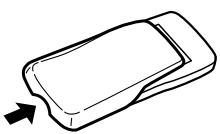
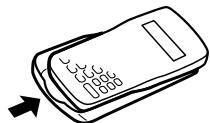
DISPLAY
- Floating point system
2ndF HYP DEG RAD GRAD ( ) BIN OCT HEX CPLX STAT

- Scientific notation system
2ndF HYP DEG RAD GRAD ( ) BIN OCT HEX CPLX STAT

Mantissa
Exponent
(During actual use not all symbols are displayed at the same time.) If the value of mantissa does not fit within the range ± 0.000000001 - ± 9999999999 , the display changes to scientific notation. The display mode can be changed according to the purpose of the calculation.
2ndF : Appears when (2ndF) is pressed, indicating that the functions shown in orange are enabled.
HYP : Indicates that hyp has been pressed and the hyperbolic functions are enabled. If 2ndF (arc.hyp) are pressed, the symbols "2ndF HYP" appear, indicating that inverse hyperbolic functions are enabled.
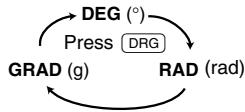
DEG/RAD/GRAD: Indicates angular units and changes each time DRG is pressed. The default setting is DEG.
( ) : Appears when a calculation with parentheses is performed by pressing ( ) .
BIN : Indicates that 2ndF BIN has been pressed. Binary system mode is selected.
OCT : Indicates that 2ndF OCT has been pressed. Octal system mode is selected.
HEX : Indicates that 2ndF HEX has been pressed. Hexadecimal system mode is selected.
CPLX : Indicates that (2ndF) (CPLX) has been pressed. Complex number mode is selected.
STAT : Indicates that 2ndF STAT has been pressed. Statistics mode is selected.
M : Indicates that a numerical value is stored in the independent memory.
E : Appears when an error is detected.
BEFORE USING THE CALCULATOR
Key Notation Used in this Manual
In this manual, key operations are described as follows:
Aπ
To specify A (HEX): A

To specify
:2ndF
π
To specify Exp
Exp
Functions that are printed in orange above the key require 2ndF to be pressed first before the key. Numbers are not shown as keys, but as ordinary numbers.
Power On and Off
Press ON/C to turn the calculator on, and OFF to turn it off.
Clearing Numbers
【1】
- Press ON/C to clear the entries except for a numerical value in the independent memory and statistical data.
- Press CE to clear the number entered prior to use of function key.
- In case of one digit correction of the entered number, press (right shift key).
Priority Levels in Calculation
This calculator performs operations according to the following priority:
① Functions such as sin, x^2 , and %
② y^x, x
③ × , ÷
④ +, -
⑤ = ,M+ and other calculation ending instruction
- Calculations which are given the same priority level are executed in sequence.
- If parentheses are used, parenthesized calculations have precedence over any other calculations.
- Parentheses can be continuously used up to 15 times unless pending calculations exceed 4.
INITIAL SET UP
Mode Selection
Normal mode: ON/C
Used to perform arithmetic operations and function calculations. BIN, OCT, HEX, CPLX and STAT are not displayed.
Binary, Octal, Decimal, or Hexadecimal system mode: 2ndF BIN, 2ndF OCT, 2ndF DEC or 2ndF HEX
Complex number mode: 2ndF (CPLX)
Used to perform arithmetic operations with complex numbers. To clear this mode, press 2ndF CPLX
Statistics mode: 2ndF STAT
Used to perform statistical calculations. To clear this mode, press (2ndF STAT).
When executing mode selection, statistical data will be cleared even when reselecting the same mode.
- By pressing OFF or Automatic power off function, the mode is cleared and returned to the normal mode.
Selecting the Display Notation and Decimal Places
- When calculation result is displayed in the floating point system, pressing F--E displays the result in the scientific notation system.
Pressing F-E once more displays the result again in the floating point system.
- Pressing 2ndF TAB and any value between 0 and 9 specifies the number of decimal places in the calculation result.
To clear the setting of decimal places, press 2ndF TAB
100000÷3=
[Floating point] ON/C 100000÷3 = 33333.33333
[TAB set to 2] 2ndF TAB 2 33333.33
[Scientific notation] F--E 3.3304
[Floating point] F→E 2ndF TAB 33333.33333
- If the value for floating point system does not fit in the following range, the calculator will display the result using scientific notation system:
0.00000001≤|x|≤999999999
Determination of the Angular Unit
In this calculator, the following three angular units (degrees, radians, and grads) can be specified.
SCIENTIFIC CALCULATIONS
Calculate in the normal mode.
In each example, press ON/C to clear the display.
Arithmetic Operations [2]
- The closing parenthesis just before = or + may be omitted.
- When entering only a decimal place, it is not necessary to press 0 before .
Constant Calculations [3]
- In the constant calculations, the addend becomes a constant. Subtraction and division are performed in the same manner. For multiplication, the multiplicand becomes a constant.
Functions [4]
Refer to the calculation examples of each function.
- For most calculations using functions, enter numerical values before pressing the function key.
Random Numbers
A pseudo-random number with three significant digits can be generated by pressing 2ndF (RANDOM). Random number generation is not possible when binary/octal/hexadecimal system mode is set.
Angular Unit Conversions [5]
Each time 2ndF DRQ are pressed, the angular unit changes in sequence.
Memory Calculations [6]
This calculator has one independent memory (M). It is available in the normal mode and binary, octal, hexadecimal system mode.
- The independent memory is indicated by the three keys: STO, RCL, M+.
Before starting a calculation, clear the memory by pressing ON/C and STO. - A value can be added to or subtracted from an existing memory value. When subtracting a number from the memory, press (+/-) and + .
- The contents of the memory are retained even when the calculator is turned off. A value stored in memory will thus remain until it is changed or until the batteries run out.
Chain Calculations [7]
This calculator allows the previous calculation result to be used in the following calculation.
The previous calculation result will not be recalled after entering multiple instructions.
Time, Decimal and Sexagesimal Calculations [8]
This calculator performs decimal-to-sexagesimal conversion and sexagesimal-to-decimal conversion. In addition, the four basic arithmetic operations and memory calculations can be carried out using the sexagesimal system.
Notation for sexagesimal is as follows:
![SHARP EL-501W - Time, Decimal and Sexagesimal Calculations [8] - 1](/content/2025/01/79178/images/d7f05597b1e7a3255f25c73979e3a5b859c4dbc868c8cfa45c3f0ac75faf1278.jpg)
Note: When the calculation or conversion result is converted, a residual may occur.
- Before performing a calculation, select the angular unit.
![SHARP EL-501W - Time, Decimal and Sexagesimal Calculations [8] - 2](/content/2025/01/79178/images/0091e1178c49a40c939c8676f376235c00db1cba6a866cceec72054e7ef073ea.jpg)
![SHARP EL-501W - Time, Decimal and Sexagesimal Calculations [8] - 3](/content/2025/01/79178/images/862e72529743c7014eddac7240e20efd6022a50cadf23d2fc87a5e2444657ec6.jpg)
Rectangular coord.
Polar coord.
BINARY, OCTAL, DECIMAL, AND HEXADECIMAL OPERATIONS (N-BASE) [10]
This calculator can perform the four basic arithmetic operations, calculations with parentheses and memory calculations using binary, octal, decimal, and hexadecimal numbers.
When performing calculations in each system, first set the calculator in the desired mode before entering numbers.
It can also perform conversions between numbers expressed in binary, octal, decimal and hexadecimal systems.
Conversion to each system is performed by the following keys:
2ndF BIN :Converts to the binary system. "BIN" appears.
2ndF OCT:Converts to the octal system. "OCT" appears.
2ndF HEX : Converts to the hexadecimal system. "HEX" appears.
2ndF DEC :Converts to the decimal system. "BIN", "OCT", and "HEX" disappear from the display.
Conversion is performed on the displayed value when these keys are pressed.
Note: In this calculator, the hexadecimal numbers A - F are
entered by pressing A B C D E entered by pressing = p ^x DEG and , and displayed as follows:
In the binary, octal, and hexadecimal systems, fractional parts cannot be entered. When a decimal number having a fractional part is converted into a binary, octal, or hexadecimal number, the fractional part will be truncated. Likewise, when the result of a binary, octal, or hexadecimal calculation includes a fractional part, the fractional part will be truncated. In the binary, octal, and hexadecimal systems, negative numbers are displayed as a complement.
COMPLEX NUMBER CALCULATIONS [11]
To carry out addition, subtraction, multiplication, and division using complex numbers, press 2ndF CPLX to select the complex number mode.
- A complex number is represented in the a + bi format. The "a" is the real part while the "bi" is the imaginary part. When inputting the real part, after inputting the number press . When inputting the imaginary part, after inputting the number press . To obtain the result press = .
- Immediately after completing calculation, you can recall the value of the real part with , and the value of the imaginary part with .
- If the complex numbers are represented as polar coordinates, press 2ndF xy after they are input with a and b.
Press 2ndF STAT to select statistics mode.
The following statistics can be obtained:
| x̄ | Mean of samples (x data) |
| sx | Sample standard deviation (x data) |
| σx | Population standard deviation (x data) |
| n | Number of samples |
| Σx | Sum of samples (x data) |
| Σx2 | Sum of squares of samples (x data) |
Data Entry and Correction
Entered data are kept in memory until 2ndF (STAT) or OFF are pressed. Before entering new data, clear the memory contents.
[Data Entry]
Data DATA
Data × frequency DATA (To enter multiples of the same data)
[Data Correction]
Correction prior to pressing DATA
Delete incorrect data with ON/C.
Correction after pressing DATA:
Reenter the data to be corrected and press 2ndF CD
- The number displayed after pressing DATA or (2ndF CD) during data entry or correction is the number of samples (n) .
Statistical Calculation Formulas [13]
In the statistical calculation formulas, an error will occur when:
- the absolute value of the intermediate result or calculation result is equal to or greater than 1 × 10^100 .
- the denominator is zero.
- an attempt is made to take the square root of a negative number.
ERROR AND CALCULATION RANGES
Errors
An error will occur if an operation exceeds the calculation ranges, or if a mathematically illegal operation is attempted. In the case of an error, the display will show "E".
An error can be cleared by pressing ON/C
Calculation Ranges [14]
- Within the ranges specified, this calculator is accurate to ± 1 of the least significant digit of the mantissa. However, a calculation error increases in continuous calculations due to accumulation of each calculation error. (This is the same for y^x , x , e^x , ln , etc., where continuous calculations are performed internally.)
Additionally, a calculation error will accumulate and become larger in the vicinity of inflection points and singular points of functions.
Calculation ranges
± 10^-99 ± 9.999999999 × 10^99 and 0.
If the absolute value of an entry or a final or intermediate result of a calculation is less than 10^-99 , the value is considered to be 0 in calculations and in the display.
BATTERY REPLACEMENT
Notes on Battery Replacement
Improper handling of batteries can cause electrolyte leakage or explosion. Be sure to observe the following handling rules:
- Replace both batteries at the same time.
- Do not mix new and old batteries.
- Make sure the new batteries are the correct type.
- When installing, orient each battery properly as indicated in the calculator.
- Batteries are factory-installed before shipment, and may be exhausted before they reach the service life stated in the specifications.
When to Replace the Batteries
If the display has poor contrast, the batteries require replacement.
Caution
- Fluid from a leaking battery accidentally entering an eye could result in serious injury. Should this occur, wash with clean water and immediately consult a doctor.
- Should fluid from a leaking battery come in contact with your skin or clothes, immediately wash with clean water.
- If the product is not to be used for some time, to avoid damage to the unit from leaking batteries, remove them and store in a safe place.
- Do not leave exhausted batteries inside the product.
- Do not fit partially used batteries, and be sure not to mix batteries of different types.
- Keep batteries out of the reach of children.
- Exhausted batteries left in the calculator may leak and damage the calculator.
- Explosion risk may be caused by incorrect handling.
- Do not throw batteries into a fire as they may explode.
Replacement Procedure
- Turn the power off by pressing OFF
- Loosen both screws and remove the battery cover. (Fig. 1)
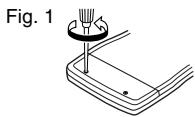
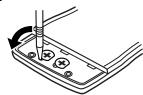
Fig. 2
- Remove the used batteries then replace with two fresh batteries with the positive sides (+) facing up. (Fig. 2)
- Replace the battery cover and screws.
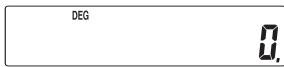
- Press ON/C
- Make sure that the display appears as shown below. If the display does not appear as shown, reinstall the batteries and check the display once again.
Automatic Power Off Function
This calculator will turn itself off to save battery power if no key is pressed for approximately 8 minutes.
SPECIFICATIONS
| Calculations: | Scientific calculations, binary/octal/hexadecimal number calculations, complex number calculations, statistical calculations, etc. |
| Internal calculations: | Mantissas of up to 10 digits |
| Pending operations: | 4 calculations |
| Power source: | 3V ≈ (DC): Alkaline batteries (LR44) × 2 |
| Power consumption: | 0.0005 W |
| Operating time: | Approx. 3000 hours when continuously displaying 55555. at 25°C (77°F). Varies according to use and other factors. |
| Operating temperature: | 0°C – 40°C (32°F – 104°F) |
| External dimensions: | 78.6 mm (W) × 144 mm (D) × 11.6 mm (H) 3-3/32" (W) × 5-21/32" (D) × 15/32" (H) |
| Weight: | Approx. 75 g (0.17 lb) (Including batteries) |
| Accessories: | Batteries × 2 (installed), operation manual, quick reference card and hard case |
FOR MORE INFORMATION ABOUT SCIENTIFIC CALCULATOR
Visit our Web site.
http://sharp-world.com/calculator/
CALCULATION EXAMPLES
ANWENDUNGSBEISPIELE
EXAMPLES DE CALCUL
EJEMPLOS DE CÁLCULO
EXEMPLOS DE CÁLCULO
ESEMPI DI CALCOLO
REKENVOORBEELDEN
PELDASZÁMÍTÁSOK
PRIKLADY VYPOCTU
RAKNEEXEMPEL
LASKENTAESIMERKKEJA
PIMMEPbI BbIyNCJIeHnI
UDREGNINGSEKSEMPLER
#
Lw
计算例子
CONTOH-CONTOH PENGHITUNGAN
CONTOH-CONTOH PERHITUNGAN
【1】ON/C CE 一
| 3× | 3 X | 3. |
| ON/C | 0. | |
| 4×5 | 4 X 5 | 5. |
| DAFA | CE | 0. |
| 4×6+7= | 6 + 7 = | 31. |
| 134 | 134 | 134. |
| ↓A | → → | 1. |
| 123 | 23 | 123. |
| 34→43 | 3 yx 4 (2ndF) : = | 64. |
【2】+ - X÷()++Exp
| 45+285+3= | ON/C 45 + 285 ÷ 3 = | 140. |
| 18+6/15-8= | ( 18 + 6 ) ÷ ( 15 - 8 = | 3.428571429 |
| 42×(-5)+120= | 42 × 5 +/- 120 = | -90. |
| (5×10³)÷(4×10⁻³)= | 5 Exp 3 ÷ 4 Exp 3 +/- = | 1250000. |
【3】
| 34+57= | 34 + 57 = | 91. |
| 45+57= | 45 = | 102. |
| 79-59= | 79 - 59 = | 20. |
| 56-59= | 56 = | -3. |
| 56÷8= | 56 ÷ 8 = | 7. |
| 92÷8= | 92 = | 11.5 |
| 68×25= | 68 × 25 = | 1700. |
| 68×40= | 40 = | 2720. |
| [4] | sin | cos | tan | sin-1 | cos-1 | tan-1 | π | DRG | hyp |
| arc hyp | In | log | ex | 10x | 1/x | x2 | √ | y^x | |
| x√y | 3√ | n! | % |
| sin60[°] = | ON/C 60 sin | 0.866025403 |
| cosπ/4[rad] = | DRG (2ndF) π ÷ 4 = cos | 0.707106781 |
| tan-11=[g] | DRG 1 2ndF (tan-1 DRG | 50. |
| (cosh 1.5 + sinh 1.5)2 = | ON/C (1.5 hyp cos + 1.5 hyp sin x² | 20.08553692 |
| tanh-15/7 = | 5 ÷ 7 = 2ndF (arc hyp tan | 0.895879734 |
| In 20 = | 20 ln | 2.995732274 |
| log 50 = | 50 log | 1.698970004 |
| e³ = | 3 (2ndF e^x) | 20.08553692 |
| 10^1.7 = | 1.7 (2ndF 10^x) | 50.11872336 |
| 1/6 + 1/7 = | 6 (2ndF 1/x) + 7 (2ndF 1/x) = | 0.309523809 |
| 8^-2 - 3^4 × 5^2 = | 8 y^x 2 +/- - 3 y^x 4 x 5 x^2 = | -2024.984375 |
| (12^3)^4 = | 12 y^x 3 y^x 4 (2ndF 1/x) = | 6.447419591 |
| √49 - 4/81 = | 49 √ - 81 (2ndF x/y) 4 = | 4. |
| 3√27 = | 27 (2ndF 3√) | 3. |
| 4! = | 4 (2ndF n!) | 24. |
| 500×25%= | 500 x 25 (2ndF % = | 125. |
| 120÷400=?% | 120 ÷ 400 (2ndF % = | 30. |
| 500+(500×25%)= | 500 + 25 (2ndF % = | 625. |
| 400-(400×30%)= | 400 - 30 (2ndF % = | 280. |
The range of the results of inverse trigonometric functions
- Der Ergebnisbereich für inverse trigonometrische Funktionen
- Plage des résultats des fonctions trigonométriques inverses
- El rango de los resultados deiones trigonometricas inversas
Gama dos resultados das trigonometricas inversas
- La gamma dei risultati di funzioni trigonometriche inverse
- Het bereik van de resultaten van inverse trigonometrie
- Az inverz trigonometriali funkciók eredmény-tartománya
- Rozsah yvsledku inverznich trigonometrickych funkci
- Omfäng für resultaten av omvända trigonometriskaFUNKTER
Känteisten trigonometristen fungktioden tulosten alue
Диаразон pe3ynbtaTOb 6paTbIx TpuroHOMTePnuecknxФункuni
- Omrade for resultater af omvende trigonometriske Funktioner
·
aessal llll jll
- 反三角函数计算结果的范围
- Julat basil fungsi trigonometri songsang
- Kisaran haben fungsi trigonometri inversi
| θ = sin-1x, θ = tan-1x | θ = cos-1x | |
| DEG | -90 ≤ θ ≤ 90 | 0 ≤ θ ≤ 180 |
| RAD | -π/2 ≤ θ ≤ π/2 | 0 ≤ θ ≤ π |
| GRAD | -100 ≤ θ ≤ 100 | 0 ≤ θ ≤ 200 |
【5】DRG
| 90°→[rad] | ON/C 90 (2ndF) DRG | 1.570796327 |
| →[g] | 2ndF DRG | 100. |
| →[°] | 2ndF DRG | 90. |
| sin-10.8 = [°] | 0.8 (2ndF sin-1) | 53.13010235 |
| →[rad] | 2ndF DRG | 0.927295218 |
| →[g] | 2ndF DRG | 59.03344706 |
| →[°] | 2ndF DRG | 53.13010235 |
【6】RCL STO M+
| ON/C STO 8 × 2 = STO | 16. | |
| 24÷(8×2)= | 24 ÷ RCL = | 1.5 |
| (8×2)×5= | RCL × 5 = | 80. |
| ON/C STO | ||
| 12+5 | 12 + 5 = M+ | 17. |
| - ) 2+5 | 2 + 5 = (+/-) M+ | -7. |
| +12×2 | 12 × 2 = M+ | 24. |
| M | RCL | 34. |
| 1= ¥140 | 140 (STO) | 140. |
| ¥33,775=? | 33775 ÷ RCL = | 241.25 |
| $2,750=¥? | 2750 × RCL = | 385000. |
| r = 3cm | 3 (STO) | 3. |
| πr2 = ? | 2ndF π × RCL | |
| X2 = | 28.27433388 |
【7】
| 6+4=ANS | ON/C 6 + 4 = |
| ANS+5 | + 5 = |
| 44+37=ANS | 44 + 37 = |
| √ANS= | √ |
【8】
DEG DMS
| 12°39'18"05 → [10] | ON/C 12.391805 DEG | 12.65501389 |
| 123.678 → [60] | 123.678 2ndF DMS | 123.404080 |
| sin62°12'24" = [10] | 62.1224 DEG sin | 0.884635235 |
【9】
a b
→rθ 一xy
| x=6→r= y=4→θ=[°] | ON/C 6 a 4 b | |
| 2ndF →rθ [r] | ||
| b [θ] | ||
| a [r] | ||
| r=14→θ=36[°] | 14 a 36 b | |
| 2ndF →xy [x] | ||
| b [y] | ||
| a [x] | ||
【10】
BIN
OCTHEXDEC
| DEC(25)→BIN | ON/C 2ndF ⇌ DEC 25 2ndF ⇌ BIN | 11001. |
| HEX(1AC) | ON/C 2ndF ⇌ HEX 1AC | |
| → BIN | 2ndF ⇌ BIN | 110101100. |
| → OCT | 2ndF ⇌ OCT | 654. |
| → DEC | 2ndF ⇌ DEC | 428. |
| BIN(1010-100) | ON/C 2ndF ⇌ BIN (1010 - 100) | |
| ×11 = | X 11 = | 10010. |
| HEX(1FF)+ | ON/C 2ndF ⇌ HEX 1FF 2ndF ⇌ OCT + | |
| OCT(512)= | 512 = | 1511. |
| HEX(?) | 2ndF ⇌ HEX | 349. |
| 2FEC- | ON/C STO 2ndF ⇌ HEX 2FEC - | |
| 2C9E=(A) | 2C9E M+ | 34E. |
| +)2000- | 2000 - | |
| 1901=(B) | 1901 M+ | 6FF. |
| (C) | RCL | A4d. |
| → DEC | 2ndF ⇌ DEC | 2637. |

[11]


| CPLX | |||||||
| 2ndF | CPLX | 0. | |||||
| (12-6i) + (7+15i) | 12 | a | 6 | +/- | b | + | 7 a |
| -(11+4i) = | - | 11 | a | 4 | b | = | 8. |
| b | 5. | ||||||
| a | 8. | ||||||
| 6×(7-9i) × (-5+8i) = | 6 | a | x | 7 | a | 9 | +/- b x |
| 5 | +/- | a | 8 | b | = | 222. | |
| b | 606. | ||||||
| 16×(sin30°+icos30°)/(sin60°+icos60°) = 16 a x 30 sin a 30 cos b ÷ 60 sin a 60 cos b = 13.85640646 b = 8. | |||||||
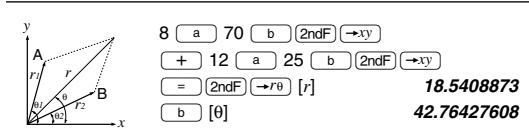
$$ \begin{array}{l} r 1 = 8, \theta 1 = 7 0 ^ {\circ} \ r 2 = 1 2, \theta 2 = 2 5 ^ {\circ} \ \end{array} $$
$$ \downarrow $$
$$ r = ?, \theta = ? ^ {\circ} $$
| (1+i) | 1 a 1 b = | 1. |
| ↓ | 2ndF → rθ [r] | 1.414213562 |
| r=?,θ=?° | b [θ] | 45. |

[12]


[14]
| DATA | STAT | |
| 95 | 2ndF STAT | 0. |
| 80 | 95 DATA | 1. |
| 80 | 80 X 2 DATA | 3. |
| 75 | 75 X 3 DATA | 6. |
| 75 | 50 DATA | 7. |
| 75 | ||
| 50 | ||
| x̅= | x̅ | 75.71428571 |
| σx= | 2ndF σx | 12.37179148 |
| n= | n | 7. |
| Σx= | 2ndF Σx | 530. |
| Σx2= | 2ndF Σx2 | 41200. |
| sx= | SX | 13.36330621 |
| sx2= | X2 | 178.5714286 |
| DATA | 2ndF STAT 2ndF STAT | STAT 0. | |
| 30 | 30 DATA | 1. | |
| 40 | 40 X 2 DATA | 3. | |
| 40 | 50 DATA | 4. | |
| 50 | |||
| ↓ | 50 2ndF CD | 3. | |
| 40 X 2 2ndF CD | 1. | ||
| DATA | |||
| 30 | |||
| 45 | |||
| 45 | 45 X 3 DATA | 4. | |
| 45 | 60 DATA | 5. | |
| 60 | |||
[13]
$$ \begin{array}{l} \bar {x} = \frac {\sum x}{n} \ \sigma x = \sqrt {\frac {\sum x ^ {2} - n \bar {x} ^ {2}}{n}} \ s x = \sqrt {\frac {\sum x ^ {2} - n \bar {x} ^ {2}}{n - 1}} \ \Sigma x = x _ {1} + x _ {2} + \dots + x _ {n} \ \Sigma x ^ {2} = x _ {1} ^ {2} + x _ {2} ^ {2} + \dots + x _ {n} ^ {2} \ \end{array} $$
| Function | Dynamic range |
| Funktion | zulässiger Bereich |
| Fonction | Plage dynamique |
| Función | Rango dinámico |
| Função | Gama dinâmica |
| Funzioni | Campi dinamici |
| Functie | Rekencapaciteit |
| Függvény | Megengedett számítási tartomány |
| Funkce | Dynamický rozsah |
| Funktion | Definitionsmráde |
| Funktio | Dynaaminen ala |
| Фунkitsя | Дианамочесné диапазон |
| Funktion | Dynamikomráde |
| πεντίνηση | πεντίνησηνιρονηση |
| λιλήλι | λιδύμαλινησης |
| 函数 | 取值范围 |
| Fungsi | Julat dinamik |
| Fungsi | Kisaran dinamis |
| sin x, tan x | DEG: |x| ≤ 4.499999999 × 10^10 (tan x : |x| ≠ 90 (2n-1))* |
| RAD: |x| ≤ 785398163.3 (tan x : |x| ≠ π/2 (2n-1))* | |
| GRAD: |x| ≤ 4.999999999 × 10^10 (tan x : |x| ≠ 100 (2n-1))* | |
| cos x | DEG: |x| ≤ 4.500000008 × 10^10 |
| RAD: |x| ≤ 785398164.9 | |
| GRAD: |x| ≤ 5.000000009 × 10^10 | |
| sin^-1x, cos^-1x | |x| ≤ 1 |
| tan^-1x, ^3√x | |x| < 10^100 |
| ln x, log x | 10^-99 ≤ x < 10^100 |
| ex | -10^100 < x ≤ 230.2585092 |
| 10^x | -10^100 < x < 100 |
| sinh x, cosh x | |x| ≤ 230.2585092 |
| tanh x | |x|<10^100 |
| sinh^-1 x | |x|<5×10^99 |
| cosh^-1 x | 1≤x<5×10^99 |
| tanh^-1 x | |x|<1 |
| x^2 | |x|<10^50 |
| √x | 0≤x<10^100 |
| 1/x | |x|<10^100 (x≠0) |
| n! | 0≤n≤69* |
| →D.MS→DEG | |x|<1×10^100 |
| x, y→r, θ | |x|, |y|<10^50 |y/x|, x^2+y^2<10^100 |
| r, θ→x, y | 0≤r<10^100 DEG: |θ|<4.5×10^10 RAD: |θ|≤785398163.3 GRAD: |θ|<5×10^10 |
| DRG▲ | DEG→RAD, GRAD→DEG: |x|<10^100 RAD→GRAD: |x|<π/2×10^98 |
| y^x | • y>0: -10^100 < x Iny ≤ 230.2585092 • y=0: 0<x<10^100 • y<0: x=n (0<x|1: x=n-1, x≠0)*, -10^100 < x In|y|≤230.2585092 |
| x√y | • y>0: -10^100 < x Iny ≤ 230.2585092 (x≠0) • y=0: 0<x<10^100 • y<0: x=2n-1 (0<x|1: x=n, x≠0)*, -10^100 < x In|y|≤230.2585092 |
| (A+Bi)+(C+Di)(A+Bi)-(C+Di) | |A±C|<10^100 |B±D|<10^100 |
| (A+Bi)×(C+Di) | (AC-BD)<10^100 (AD+BC)<10^100 |
| (A+Bi)÷(C+Di) | AC+BD/C^2+D^2<10^100 BC-AD/C^2+D^2<10^100 C^2+D^2≠0 |
| →DEC | DEC: |x|≤9999999999 |
| →BIN | BIN: 1000000000 ≤ x≤1111111111 0≤x≤111111111 |
| →OCT | OCT: 4000000000 ≤ x≤7777777777 0≤x≤3777777777 |
| →HEX | HEX: FDABF41C01≤x≤FFFFFFFF 0≤x≤2540BE3FF |
*n:integer/ganzeZahlen/entier/entero/inteiro/intero/geheel getal/egesz szamok /celé císlo/heltal/kokonaisluku/üenbe/heltal/ 一 一 一 一 一 一 一 整数/integer/bilangan bulat
In Europe:
This equipment complies with the requirements of Directive 89/ 336/EEC as amended by 93/68/EEC.