
880-138 - Sphygmomanometer Marquant - Free user manual and instructions
Find the device manual for free 880-138 Marquant in PDF.


| Product Type | Blood pressure monitor |
| Brand | Marquant |
| Model | 880-138 |
| Measurement Method | Oscillometric |
| Measurement Range (Blood Pressure) | 20 – 260 mmHg |
| Measurement Range (Pulse) | 40 – 199 beats/minute |
| Accuracy (Blood Pressure) | ±3 mmHg |
| Accuracy (Pulse) | ±5% |
| Display | LCD digital display |
| Power Supply | 4 x AA batteries (1.5V) |
| Dimensions | Approx. 120 x 90 x 30 mm |
| Weight (including batteries) | Approx. 300 g |
| Cuff Size | 22 – 36 cm (arm circumference) |
| Memory Storage | Up to 60 readings |
| Functions | Automatic inflation, irregular heartbeat detection, WHO classification indicator |
| Cleaning | Wipe with a soft dry cloth; do not immerse in water |
| Safety | CE marked, medical device for home use |
| Spare Parts Available | Replacement cuffs can be purchased separately |
| Repairability | Not user-serviceable; contact authorized service center |
| General Information | Portable device for upper arm measurement, suitable for adults |
Frequently Asked Questions - 880-138 Marquant
User questions about 880-138 Marquant
0 question about this device. Answer the ones you know or ask your own.
Ask a new question about this device
Download the instructions for your Sphygmomanometer in PDF format for free! Find your manual 880-138 - Marquant and take your electronic device back in hand. On this page are published all the documents necessary for the use of your device. 880-138 by Marquant.
USER MANUAL 880-138 Marquant
User Instructions for Blood Pressure Monitor
880-138

natural_image
Medical device displaying blood pressure monitor with digital display and a black blood pressure monitor attached to the left (no visible text or symbols on device body)SV Bruksanvisning i original
NO Bruksanvisning i original
EN Operating instructions in original
SVENSKA 4
SÄKERHETSANVISNINGAR 4
Special safety instructions 36
TECHNICAL DATA....37
DESCRIPTION 37
Blood pressure....37
Parts....39
USE 39
Before use....39
Functions and features 39
Inserting the batteries 40
Setting the date/time and voice function.... 40
Choice of units, mmHg/kPa 41
Display of WHO's classification of blood pressure 41
Using the wrist sleeve 41
Measuring 42
Blood pressure measuring....42
Displaying memory items....42
Emptying the memory 42
MAINTENANCE 43
TROUBLESHOOTING 43
Guidelines and manufacturer's certificate concerning electromagnetic radiation 44
Guidelines and manufacturer's certificate concerning electromagnetic immunity.... 44
Guidelines and manufacturer's certificate concerning electromagnetic immunity.... 45
SÄKERHETSANVISNINGAR

Visning av who:s klassificering av blodtryck
Diastoliskt tryck
Referensmaterial: Journal of
hypertension 1999. vol 17 No. 2

flowchart
graph TD
    A["■"] --> B["Hypertoni grad 1 (förhöjt blodtryck)"]
    A --> C["Hypertoni grad 2 (kraftigt förhöjt blodtryck)"]
    A --> D["Hypertoni grad 3 (kraftigt förhöjt blodtryck)"]
    A --> E["Högt–normalt"]
    A --> F["Normalt"]
    A --> G["Optimalt"]
natural_image
Line drawing of a human leg with a heart symbol placed on the knee, no text or labels present
natural_image
Line drawing of a hand gripping a piece of wood or metal (no text or symbols)Mätning

VIKTIGT!
natural_image
Illustration of a bottle, a plastic container, and a rectangular box with a cross mark (no text or symbols)FELSÖKNING
natural_image
Line drawing of a human leg with a heart symbol placed on the knee, no text or labels present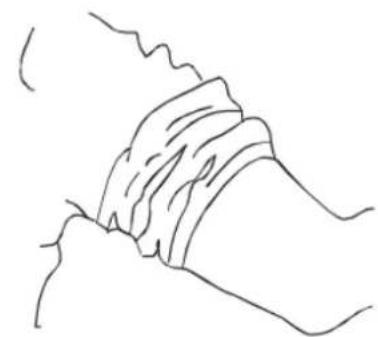
natural_image
Line drawing of a hand gripping a piece of wood or metal (no text or symbols)Måling
VIKTIG!
natural_image
Illustration of a bottle, a plastic container, and a rectangular box with a cross mark (no text or symbols)FEILS∅KING

natural_image
Line drawing of a human leg with a heart symbol placed on the knee, no text or labels present
natural_image
Line drawing of a hand gripping a piece of paper or tape (no text or symbols)Pomiar
WAŻNE!
natural_image
Illustration of a bottle, a plastic container, and a rectangular device with a cross mark (no text or symbols)WYKRYWANIE USTEREK
Read the User Instructions carefully before use.
• The following symbols are used in these User Instructions to highlight important instructions.
Symbols

Indicates a potentially dangerous situation that could lead to personal injury and/or material damage if the instructions are not followed.

Indicates a potentially dangerous situation that could lead to material damage if the instructions are not followed.

BF type, patent applied for part.

Read the User Instructions.
Always follow the recommendations of your doctor. Do not attempt to diagnose or treat any complaints yourself. This could be dangerous.Do not use the unit for first aid, to assess your health status, or for  IMPORTANT:continuous monitoring. IMPORTANT:continuous monitoring. |  |
| The unit is not intended to be used by persons (children or adults) with any form of functional disorders, or by persons who do not have sufficient experience or knowledge on how to use it, unless they have received instructions concerning the use of the unit from someone who is responsible for their safety. |  |
| The unit must only be used as it is intended to be used and in accordance with these instructions. Otherwise there is a risk of personal injury and/or material damage. | |
| Do not use mobile phones in the vicinity of the unit. Do not use the unit in or near magnetic fields. | |
| Do not dismantle the unit, or attempt to modify or repair it.This could damage the unit and cause malfunctioning. |  |
Special safety instructions
Batteries
- Remove the batteries if the unit is not going to be used for 3 months, or more.
-
Insert new batteries with the correct polarity.
-
Do not bend the wrist sleeve or air hose too hard.
- Hold the plastic plug when releasing the air hose. Do not pull the hose.
- Do not expose the unit to knocks and blows.
- Put the wrist sleeve on before starting the unit.
- Only use spare parts and accessories recommended by the manufacturer. The use of other accessories can cause personal injury and/or material damage.
- Contact your dealer if you have any problems or questions.
TECHNICAL DATA
Measurement method Oscillometric measurement
Display Digital LCD display
Measurement range Pressure: 30–280 mmHg
Pulse: 40–199 spm
Precision Static pressure ± 3 mmHg
Pulse: ± 5%
Memory 90 memory items
Power supply 4 x 1.5 V AA batteries
Operating conditions 5 to 40°C, 30–80% RH
Atmospheric pressure: 80–106 kPa
Storage conditions -20 to 55°C, 10–93% RH
Atmospheric pressure: 50–106 kPa
Dimensions (W x H x D) Approx. 100 x 150 x 65 mm
Weight Approx. 430 g without batteries
Classification BF type
Wrist circumference 22–32 cm
* Technical data may be subject to change without prior notice.
- Type of protection against electric shock: EQUIPMENT WITH INTERNAL POWER SUPPLY.
- Safety class, protection against electric shock: BF TYPE, PATENT APPLIED FOR PART.
- Duty cycle: CONTINUOUS OPERATION:
- The equipment is not suitable for use in the vicinity of equipment of the AP and APG category.
IMPORTANT:
Failure to comply with the conditions below could prevent the unit from achieving the specified performance data.
Operating conditions: 5 to 40°C, 30–80% RH
Storage conditions: -20 to 55°C, 10–93% RH
DESCRIPTION
The blood pressure monitor works with oscillometric measurement. The unit is intended for professional or domestic use, for measuring and display of diastolic and systolic blood pressure and pulse by means of an air-filled wrist sleeve.
The unit complies with the requirements for electromagnetic compatibility in accordance with EN60601-1-2, safety standards in accordance with EN60601-1, and performance requirements in accordance with EN1060-1. EN1060-3, specified in directive 93/42/EEC.
Blood pressure
1. What is blood pressure?
Blood pressure is the pressure exerted by the blood on the inner walls of the arteries. Systolic pressure occurs when the heart contracts. Diastolic pressure occurs when the heart expands.
Blood pressure is often given in millimetres of mercury column, mmHg. To find out what your normal blood pressure is, you measure the blood pressure in the morning before you have eaten or begun to be active.
2. What is high blood pressure and how do you treat it?
High blood pressure that is not treated can lead to many health problems, including strokes and heart attacks.
Lifestyle can influence blood pressure. High blood pressure can be treated with medicine under the direction of a doctor.
The following measures can help to counteract high blood pressure.
- Do not smoke.
- Reduce intake of fat and salt.
- Avoid overweight.
• Exercise regularly. - Undergo regular health checks.
3. Why measure blood pressure at home?
Many people feel anxious when measuring blood pressure at the doctor's, which can result in the measured value being 25 to 30 mmHg higher than if it was measured at home. When measuring at home the measured value is not influenced to the same extent by external circumstances, which makes the readings more accurate.
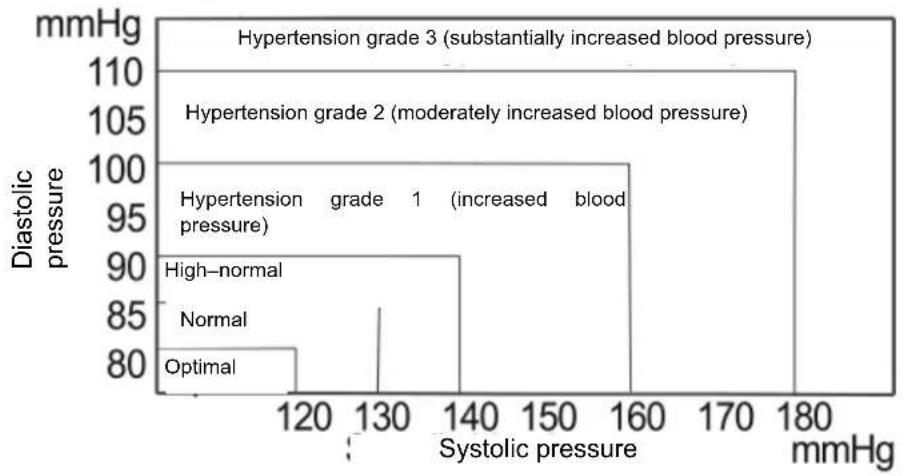
4. WHO's classification of blood pressure
The World Health Organisation (WHO) has established limiting values for blood pressure, without reference to age, which are indicated in the table below.
5. Variations in blood pressure
A person's blood pressure can vary by up to 30 to 50mmHg during the day. For persons with high blood pressure, their blood pressure can vary even more.
Blood pressure normally increases during physical exertion, and is lowest during sleep. Individual measurement results can therefore be misleading. Note your normal blood pressure and take measurements at the same time each day. A lot of measurements provide a better overview of variations in blood pressure.
Always make a note of the date and time for blood pressure measurements. Ask your doctor to help you interpret the results.
Reference material: Journal of Hypertension 1999, Vol 17 No. 2
bar
| Hypertension grade | Systolic pressure (mmHg) | Diastolic pressure (mmHg) | | :--- | :--- | :--- | | Hypertension grade 1 | 140 | 90 | | Hypertension grade 2 | 160 | 100 | | Hypertension grade 3 | 180 | 110 | | Optimal | 120 | 80 | | Normal | 130 | 85 |Typical variation during the day (measured at 5 minute intervals).

line
| Time | Blood pressure (mmHg) | |------|------------------------| | 12 | ~70 | | 15 | ~60 | | 18 | ~70 | | 21 | ~70 | | 24 | ~150 | | 03 | ~30 | | 06 | ~50 | | 09 | ~150 |Parts

- DC connection
- Air connection
- Blood pressure sleeve MEM
- Air hole
- SET button
- Power switch
- Memory button MEM
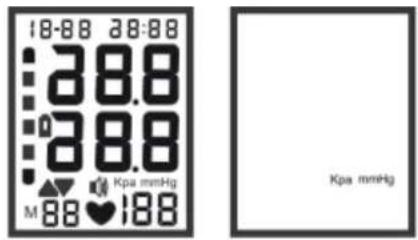
- WHO's classification of blood pressure
- Battery indicator
-
Inflation/ Pressure relief
-
Memory location
- Indication of irregular pulse
- Pulse
- Number of heart beats per minute
- Voice On/Off
- Pressure unit
- Diastolic pressure
- Systolic pressure
- Hour/minute
- Month/day
USE
Before use
- Do not attempt to make a diagnosis on the basis of the measured values. Allow a doctor or other medically trained person who is familiar with your health to interpret blood pressure measurements.
- If you are regularly taking medicine, ask your doctor what is the best time to take your blood pressure. NEVER change your prescribed medication without consulting a doctor.
- Persons with irregular or unstable peripheral circulation as a result, for example, of diabetes, liver problems or stiff arteries, can get different results if their blood pressure is measured at the wrist or the upper arm.
• The unit is only intended for adults. Consult a doctor before using the unit on children. - Never use the unit in the vicinity of equipment such as televisions, microwave ovens, X-ray equipment or mobile phones – this can lead to incorrect results.
- The unit must not be used for diagnosis, treatment or continuous monitoring of acute conditions or operations.
- Wash your hands before use.
- If the sleeve is too tight or you experience discomfort, press the power switch immediately to relieve the pressure.
Functions and features
- 90 measurements can be saved in the memory.
• Large, comprehensible LCD display. -
Display of WHO's classification of blood pressure.
-
Easy to use – one press of the button for automatic measuring and registering of measured values, including the date and time.
• Switches off automatically after 1 minute if there is no activity.
Inserting the batteries

- Remove the battery cover.
- Insert new batteries in the battery compartment with the correct polarity.
- Replace the battery cover. Only use AA batteries.
Recycle used batteries in accordance with local regulations.
IMPORTANT:
- Insert the batteries with the polarity shown in the battery compartment.
- Replace all the batteries when the battery indicator ⚙ flashes in the display. Do not mix old and new batteries. This could cause malfunctioning or damage the batteries. The battery indicator will also stop working.
- The battery time gets shorter at low ambient temperatures.
- Remove the batteries if the unit is not going to be used for some time.
• Otherwise there is a risk that battery leakage will damage the unit. - Only use batteries recommended by the manufacturer. The supplied batteries are intended for trial usage, and may have a shorter battery life.
Setting the date/time and voice function
- Press the SET button.
- Keep the SET button pressed until the year digits flash in the display.
- Press the MEM button to set the year. Press SET to save the setting and activate the month setting.

- Press the MEM button to set the month. Repeat these steps to set the day/hours/minutes and voice function On/Off. "ON" indicates that the function is active, "OF" that it is inactive (only for units with voice function).

Choice of units, mmHg/kPa
The unit can show blood pressure in mmHg or kPa. The default setting is mmHg.
Press the power switch for 5 seconds to activate setting the unit of measurement.
The selected unit is also applied in the memory items.
Display of WHO's classification of blood pressure

Using the wrist sleeve
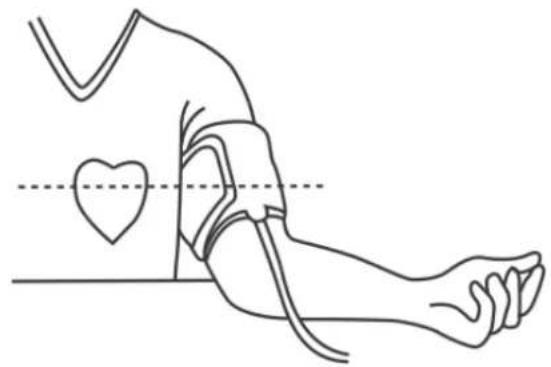
- Place the sleeve around the upper arm, 2–3 cm above the elbow, as shown in the diagram. Place the sleeve directly against the skin – clothing can result in incorrect measurements.
- A rolled up cuff that squeezes the upper arm can affect the measurement result.
- Fasten the sleeve with the Velcro strip so that it sits firmly and comfortably. Place the arm on the table with the palm up, so that the sleeve is level with the heart. Check that the hose is not clinched.

natural_image
Line drawing of a human leg with a heart symbol placed on the knee, no text or labels present
natural_image
Line drawing of a hand gripping a piece of wood or metal (no text or symbols)Measuring
Follow the instructions below to obtain the most accurate results.
- Sit comfortably at a table. Allow the arm to rest on the table.
- Relax for 5 to 10 minutes before measuring.
- Place the blood pressure sleeve level with the heart.
- Sit still and quietly until the measurement is completed.
- Do not take measurements immediately after exercising or a bath. Rest for 20–30 minutes before measuring.
- Measure your blood pressure at about the same time each day.
Blood pressure measuring
- Put on the wrist sleeve as explained above.
- Press the power switch. All the icons are shown on the display for 2 seconds, after which 0 or the last measurement result is shown.
- Start the measurement. The sleeve inflates automatically. The marking (♥) is shown on the display. The measurement result is shown when the measurement is complete.


Displaying memory items
Press the MEM button. The last saved memory item is displayed. Browse up with MEM button, or down with the SET button.
When the unit is switched off you can press the MEM button to show the last measurement result.
Emptying the memory
To empty the memory, press the MEM button for 5 seconds. No is shown in the display to indicate that all memory items have been deleted.

MAINTENANCE
- Follow the instructions below to keep the unit in good condition.
- Store the unit in the case when not in use.
- Do not fold the wrist sleeve too hard.
- The Velcro strip can damage the inside surface of the sleeve.

- Clean the unit and sleeve with a soft, dry cloth.
- Do not use abrasive or solvent-based detergents.
IMPORTANT:
- Do not immerse the unit or its components in water or any other liquid. Do not expose the unit to moisture, extreme temperatures or direct sunlight.
- Store the unit and its components in a safe place.
- Do not expose the unit to knocks and blows.
- Remove the batteries if the unit is not going to be used for 3 months, or more. Replace all the batteries at the same time.

natural_image
Illustration of a bottle, a plastic container, and a rectangular box with a cross mark (no text or symbols)TROUBLESHOOTING
The troubleshooting chart will help you identify the causes of common problems and how they can be rectified. Contact your dealer if you cannot rectify the problem by using the troubleshooting chart.
| PROBLEM/ERROR CODE POSSIBLE CAUSE ACTION | ||
| Nothing is displayed when you press the power switch, or the battery indicator flashes | No batteriesThe batteries are discharged.The batteries have the wrong polarity | Insert the batteriesInsert new batteriesInsert the batteries with the correct polarity |
| E1: The air pressure does not rise correctly | The blood pressure sleeve is leaking | Replace the sleeve |
| E3: The inflation pressure is too high | Contact your dealer | |
| E2, E4: Movement during the measuring | The arm or body moved during the measurement | Sit still in the correct posture and measure again |
| The battery indicator is displayed | The batteries are discharged. | Insert new batteries |
| Unreasonably high value is shown for systolic or diastolic pressure | The sleeve was held lower than the heartThe sleeve was not fitted properlyYou moved or spoke during the measurement | Stay in the correct posture and measure again. |
| Unreasonably low value is shown for systolic or diastolic pressure | The sleeve was held higher than the heartYou moved or spoke during the measurement | |
Guidelines and manufacturer's certificate concerning electromagnetic radiation
| The blood pressure monitor is intended to be used in electromagnetic environments in accordance with the specifications below. It is incumbent on the customer or the person using the blood pressure monitor to ensure that the electromagnetic environment in which it is used complies with these specifications. | ||
| Emission test | Compliance | Guidelines for electromagnetic environment |
| Radio frequency radiation CISPR 11 | Group 1 Radio | frequency energy is only used in the blood pressure monitor for the internal functions in the product. The emitted radio frequency radiation is therefore very low and the probability of it causing interference in nearby electronic equipment is low. |
| Radio frequency radiation CISPR 11 | Class B The blood pressure monitor is suitable for use in apartments and similar environments, directly connected to low voltage networks for the distribution of electricity to apartment buildings. | |
| Overtones IEC 61000-3-2 | Not applicable | |
| Voltage fluctuation/flicker IEC 61000-3-3 | Not applicable | |
Guidelines and manufacturer's certificate concerning electromagnetic immunity
| The blood pressure monitor is intended to be used in electromagnetic environments in accordance with the specifications below. It is uncumbent on the customer or the person using the blood pressure monitor to ensure that the electromagnetic environment in which it is used complies with these specifications. | |||
| Immunity test Test level | as perIEC 60601 | Compliance level Guidelines for electromagnetic environment | |
| Electrostatic discharge (ESD)IEC 61000-4-2 | ±6 kV on contact ±8 kV over air gap | ±6 kV on contact ±8 kV over air gap | The floor surface should consist of wood, concrete or clinker. In rooms with floors covered with synthetic material the relative air humidity should be at least 30%. |
Guidelines and manufacturer's certificate concerning electromagnetic immunity
| The blood pressure monitor is intended to be used in electromagnetic environments in accordance with the specifications below. It is incumbent on the customer or the person using the blood pressure monitor to ensure that the electromagnetic environment in which it is used complies with these specifications. | |||
| Immunity test Test level as per IEC 60601 | Compliance level Guidelines | for electromagnetic environment | |
| Conducted radio frequency interference IEC 61000-4-6 | 3 V rms150 kHz to80 MHz | 3 V Portable and mobile radio communication equipment must not used nearer to any part of the blood pressure monitor or its leads than the recommended minimum distance in accordance with the equation applicable for the transmitter in question.Recommended minimum distance d = 1.2 d = 1.2 80 MHz to 800 MHz d = 2.3 800 MHz to 2.5 GHzwhere P is the maximum output specified by the transmitter manufacturer in watts (W) and d is the recommended minimum distance in metres (m).The field strength from a permanent radio transmitter, determined by electromagnetic measurement in situ, should be less than the specified compliance level for the respective frequency range ^b .Interference can occur in the vicinity of equipment marked with the symbol:((+) ) | |
| Emitted radio frequency interference IEC 61000-4-3 | 3 V/m80 MHz till2.5 GHz | 3 V/m | |
Note: 1: The higher frequency range is applicable at 80 MHz and 800 MHz.
Note: 2: These guidelines do not apply in all situations. Electromagnetic radiation can be affected by absorption in and reflection against building structures and other objects, such as people.
^a The field strength from permanent transmitters, e.g. base stations for mobile phones and wireless telephony, communication radios, amplitude or frequency modulated radio and television broadcasting cannot be predicted theoretically with a practical degree of accuracy. In those cases where electromagnetic environmental impact from permanent radio transmitters is important, measurement of electromagnetic field strength in situ should therefore be taken into consideration. If the measured field strength in the place where the blood pressure monitor is used exceeds the applicable, above specified compliance levels for radio frequency radiation, the blood pressure monitor should be tested and checked to verify that it is working properly. Additional measures may be necessary if incorrect or abnormal functionality is observed, for example the realignment or repositioning of the blood pressure monitor.
^b In the frequency range 150 kHz to 80 MHz the field strength should be less than 3 V/m.
Jula reserves the right to make changes. In the event of problems, please contact our service department.
www.jula.com
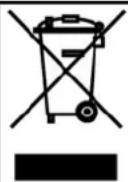
Care for the environment!
Must not be discarded with household waste! This product contains electrical or electronic components that should be recycled.
Leave the product for recycling at the designated station e.g. the local authority's recycling station.
- SVENSKA 4
- SÄKERHETSANVISNINGAR 4
- SÄKERHETSANVISNINGAR
- Visning av who:s klassificering av blodtryck
- Mätning
- VIKTIGT!
- FELSÖKNING
- Måling
- VIKTIG!
- FEILS∅KING
- Pomiar
- WAŻNE!
- WYKRYWANIE USTEREK
- Read the User Instructions carefully before use.
- Symbols
- Special safety instructions
- Batteries
- TECHNICAL DATA
- IMPORTANT:
- DESCRIPTION
- Blood pressure
- What is blood pressure?
- What is high blood pressure and how do you treat it?
- Why measure blood pressure at home?
- WHO's classification of blood pressure
- Variations in blood pressure
- USE
- Before use
- Functions and features
- Inserting the batteries
- Setting the date/time and voice function
- Choice of units, mmHg/kPa
- Display of WHO's classification of blood pressure
- Using the wrist sleeve
- Measuring
- Blood pressure measuring
- Displaying memory items
- Emptying the memory
- MAINTENANCE
- TROUBLESHOOTING
- Care for the environment!
Brand : Marquant
Model : 880-138
Category : Sphygmomanometer