
SFE720XI - Electric oven SAUTER - Free user manual and instructions
Find the device manual for free SFE720XI SAUTER in PDF.


| Product type | Built-in electric oven |
| Dimensions (W x H x D) | Approximately 595 x 595 x 560 mm |
| Weight | Approximately 32 kg |
| Power supply | Single-phase 220-240 V ~ 50/60 Hz, fuse 16 A |
| Power cable | H05 RR-F, H05 RN-F or H05 VV-F, 3 conductors of 1.5 mm² (L, N, earth) |
| Total power | Approximately 2.5 kW (estimated) |
| Capacity | Approximately 70 liters (estimated) |
| Programmer | Electronic with digital display, timer, immediate and programmed cooking |
| Cooking functions | Convection, Traditional, Pulsed bottom heat, Traditional ECO, Pulsed grill, Maxi grill, EASY COOK (automatic cooking) |
| Grill+ | Browning function at end of cooking (5 min) |
| ECO cooking | Energy saving up to 20% |
| Interior lighting | 1 bulb 15 W, socket E14, 300 °C |
| Cleaning | Catalytic walls optional, manual cavity cleaning |
| Safety | Automatic shut-off after 10h, door lock (not specified), fan cooling |
| Supplied accessories | Anti-tip grid, multi-purpose tray, cake pan |
| Repairability index | Not communicated |
| Spare parts availability | Bulb and power cable available from after-sales service |
Frequently Asked Questions - SFE720XI SAUTER
User questions about SFE720XI SAUTER
0 question about this device. Answer the ones you know or ask your own.
Ask a new question about this device
Download the instructions for your Electric oven in PDF format for free! Find your manual SFE720XI - SAUTER and take your electronic device back in hand. On this page are published all the documents necessary for the use of your device. SFE720XI by SAUTER.
USER MANUAL SFE720XI SAUTER
EN GUIDE TO INSTALLATION

We cook so well together
Oven
SFE 720
fauter

02
Dear Customer,
You have just acquired a SAUTER oven and we would like to thank you.
We have invested all our dedication and know-how in this appliance so that it would best meet your needs. With innovation and performance, we designed it to be always easy to use.
In the SAUTER product range, you will also find a wide choice of microwaves, cooking hobs, ventilation hoods, cookers, dishwashers, washing machines, driers, fridges and freezers, that you can coordinate with your new SAUTER oven.
Visit our website www.sauter-electromenager.com where you will find all of our products, as well as useful and complementary information.
SAUTER
We cook so well together
As part of our commitment to constantly improving our products, we reserve the right to make changes to them based on technical advances to their technical and functional features and appearance.

Warning:
Before installing and using your appliance, please carefully read this Guide to lation and Use, which will allow you to quickly familiarise yourself with its operation.
TABLE OF CONTENTS
EN
1 / NOTICES TO THE USER
- Safety Recommendations 04
·Environment 05
2 / INSTALLING YOUR APPLIANCE
Choice of location 06
Building in 06
- Electrical connection 07
- Changing the power cable 08
3 / DESCRIPTION OF YOUR APPLIANCE
• Introduction to your oven 09
Description of the accessories 10
Description of your programmer 11
4/USING YOUR APPLIANCE
Using the programmer 12
o How to set the time 12
。How to change the time 12
Immediate cooking 13
- Programmed cooking 14
Economic cooking 16
Grill+ 17
。Use of the timer function 18
Display brightness 18
5/OVEN COOKING MODES 19
6 / CARING FOR AND CLEANING YOUR APPLIANCE
- Cleaning the outer surfaces 20
- Changing the catalitic walls 21
7/TROUBLESHOOTING 22
- Changing the bulb 23
8/EASY COOK ADVANTAGES AND PRINCIPLES 24
EASY COOK cooking modes 26
- Tips and hints 27
A few recipes 28
EN 1 /NOTICES TO THE USER
Warning
Keep this user guide with your appliance. If the appliance is ever sold or transferred to another person, ensure that the new owner receives the user guide. Please become familiar with these recommendations before installing and using your oven. They were written for your safety and the safety of others.
SAFETY RECOMMENDATIONS
- This oven was designed for use by private persons in their homes. It is intended solely for cooking foodstuffs. This oven does not contain any asbestos-based components.
- This appliance is to be used by adults. Make sure that children do not touch it and that they do not treat it as a toy. Make sure that they do not touch the appliance's control panel.
- When you receive the appliance, unpack or have it unpacked immediately. Give it an overall inspection. Make note of any concerns or reservations on the delivery slip and make sure to keep a copy of this form.
- Your appliance is intended for standard household use. Do not use it for commercial or industrial purposes or for any other purpose than that for which it was designed.
- Do not modify or attempt to modify any of the characteristics of this appliance. This would be dangerous to your safety.
- Keep small children away from the appliance while it is in use. Thus you will prevent them from burning themselves by tipping over cookware. Moreover, the front of your appliance is hot during use and during cleaning (pyrolysis).
- Never pull your appliance by the door handle.
-
Before using your oven for the first time, heat it up while empty for approximately 15 minutes. Ensure that the room is sufficiently ventilated. You may notice a particular odour or a small amount of smoke. All of this is normal.
-
During cooking, ensure that the door of your oven is firmly closed so that the seal can properly fulfil its function.
- When in use, the appliance becomes hot. Do not touch the heating elements located inside the oven. You are at risk of incurring serious burns.
- When inserting or removing your dishes from the oven, do not bring your hands near to the upper heating elements; use insulated cooking mitts.
- After cooking, do not touch the cookware (grid, turnspit, etc.) with bare hands
- Never place aluminium paper directly in contact with the bottom element (See the "Description of your oven" chapter), the accumulated heat could cause deterioration of the enamel.
- Do not place heavy items on the open oven door; ensure that children cannot climb or sit on it.
- To avoid damaging the control panel of your appliance, do not leave the door open when the oven is functioning or still hot.
- The oven must be turned off for all attempts to clean the cavity.
- Intensive and prolonged use of the appliance may require additional ventilation achieved by opening the window or increasing the power of the mechanical fan.
- In addition to the accessories provided with your oven, only use dishes that are resistant to high temperatures (follow manufacturer's instructions).
- After using your oven, ensure that all the controls are in the off position.
- Never use steam or high-pressure devices to clean the oven (requirement imposed by electrical safety).
- For your safety, your oven is equipped with an AUTOMATIC STOP, if you forget to turn off your oven by mistake. After 10 hours of operation, the AS (Automatic Stop) feature is activated and your oven stops running. AS appears instead of the time and a series of 2 successive beeps is emitted for a short time.
1 /NOTICES TO THE USER
EN
- CARE FOR THE ENVIRONMENT
- This appliance's packing materials are recyclable. Recycle them and play a role in protecting the environment by depositing them in municipal containers provided for this purpose.
-
Your appliance also contains many recyclable materials. It is therefore marked with this logo to indicate that used appliances must not be mixed with other waste. Recycling of the appliances organised by your manufacturer will thus be undertaken in optimum conditions, in accordance with European directive 2002/96/CE relative to electrical and electronic equipment waste. Consult your city hall or your retailer to find the drop-off points for used appliances that is nearest to your home.
-
We thank you for your help in protecting the environment.
Warning Installation
Warning
Installation should only be performed by qualified installers and technicians.
This appliance complies with the following European directives:
- Low Voltage Directive 73/23/CEE modified by directive 93/68/CEE for attribution of CE approval.
- Electromagnetic Compatibility Directive 89/336/CEE modified by directive 93/68/CEE for attribution of CE approval.
- CE Regulation 1935/2004 concerning materials and objects designed to come into contact with foodstuffs.
EN 2 / INSTALLING YOUR APPLIANCE
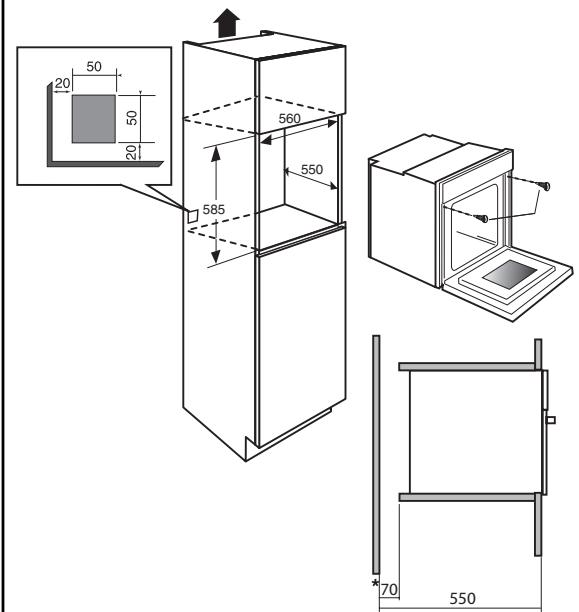
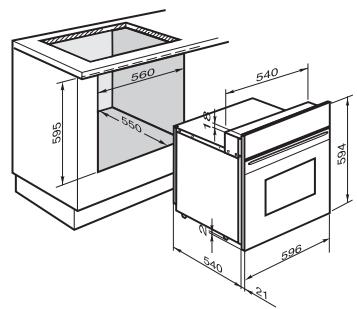
Fig. 01
CHOICE OF LOCATION
The diagrams above indicate the dimensions of a cabinet that would be acceptable for your oven.
The oven can be installed under a work top or in a column of cabinetry (open* or closed) having the appropriate dimensions for built-in installation (see adjacent diagram).
Your oven has optimised air circulation that allows it to achieve remarkable cooking and cleaning results if the following guidelines are respected:
- Centre the oven in the cabinet so as to guarantee a minimum distance of 5mm between the appliance and the neighbouring cabinet.
- The destination cabinet must be made of or coated with a material that is heat resistant.
- For greater stability, attach the oven in the cabinet with two screws through the holes
provided for this purpose on either side of the front side panels (fig.1).
- BUILD-IN
To do this:
1) Remove the rubber screw covers to access the mounting holes.
2) Drill a 0.2mm hole in the cabinet panel to avoid splitting the wood.
3) Attach the oven with the two screws.
4) Replace the rubber screw covers (they also serve to absorb the shock caused by closing the oven door).
(^*) If the cabinet is open, its opening must be 70~mm (maximum).

Tip
To be certain that you have properly installed your appliance, do not hesitate to call on a household appliance specialist.
2 / INSTALLING YOUR APPLIANCE
EN
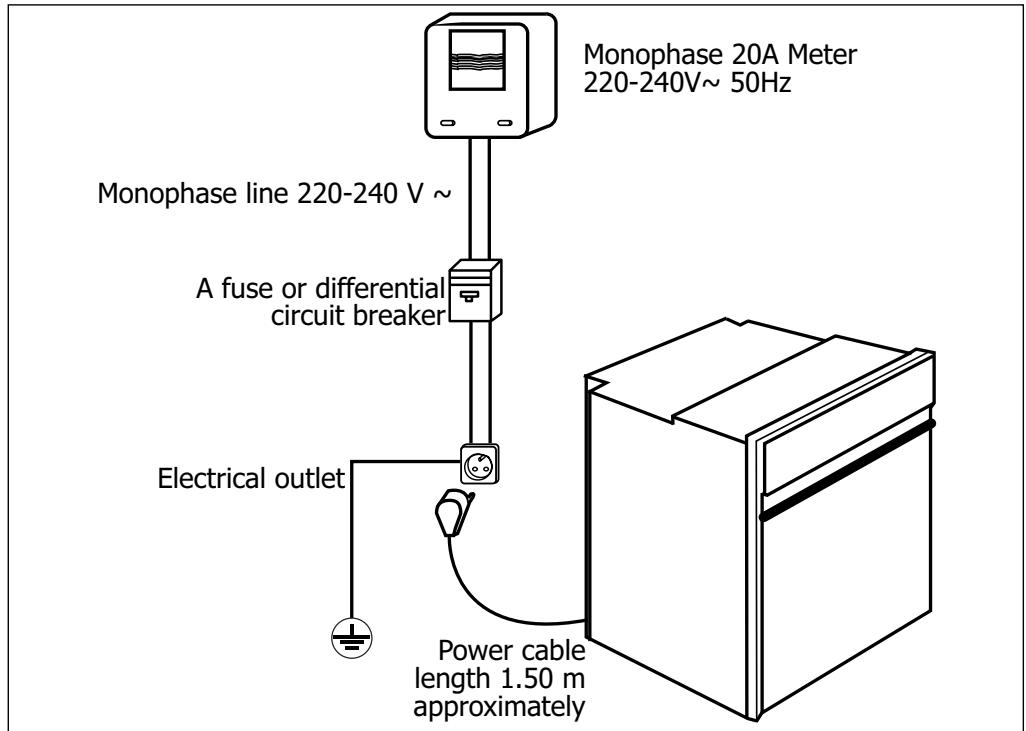
ELECTRICAL CONNECTION
Electrical safety must be provided by a correct build-in. During build-in and maintenance operations, the appliance must be unplugged from the electrical grid; fuses must be cut off or removed.
The electrical connections are made before the appliance is installed in its housing.
Ensure that:
- the electrical installation has sufficient voltage,
-the electrical wires are in good condition - the diameter of the wires complies with the installation requirements.
Your oven must be connected with a power cord (standardised) with three 1.5mm^2 conductors (1ph + 1N + ground) that must be connected to a monophase 220 - 240V net
work via a CEI 60083 standardised receptacle (1ph + 1N + ground lead) or an all-pole cut-off device, in compliance with installation regulations.

Warning
The safety wire (green-yellow) is connected to the appliance's terminal 1三 and must be connected to the ground lead of the electrical set-up.
In the case of a hook-up with electrical outlet, it must be accessible after installation.
The fuse in your set-up must be 16 amperes. If the power cable is damaged, it must be replaced by a cable or a special kit available from the manufacturer or its After-Sales Service Department.
EN
2 / INSTALLING YOUR APPLIANCE
Warning
We cannot be held responsible for any accident resulting from an inexistent, defective or incorrect ground lead.
If the electrical installation at your residence requires any changes in order to hook up your Appliance, call upon a professional electrician.
If the oven malfunctions in any way, unplug the appliance or remove the fuse corresponding to the sector there the oven is hooked up.
CHANGING THE POWER CORD
- The power cable (H05 RR-F, H05 RN-F ou H05 VV-F) must be of sufficient length to be connected to the build-in oven while it sits on the floor in front of the cabinet.
To do this the appliance must be disconnected from the electrical network: - Open the inspection flap located at the lower right of the back cover by unscrewing the two screws, then pivot the inspection flap.
- Strip 12 mm along each wire of the new power cable.
- Carefully twist together the strands.
- Loosen the screws from the terminal board and remove the power cord to be replaced.
- Introduce the power cable through the side of the cover in the cable clip located to the right of the terminal board.
- All the strands of the electricity wires must be captured under the screws.
- The phase wire on the L terminal.
- The green-yellow coloured ground wire should be connected to the terminal (12) .
- The neutral conductor (blue) on the N terminal.
Screw down tightly the screws on the terminal board and check the connection by pulling on each wire. - Attach the cable with the cable clip located to the right of the terminal board.
- Close the inspection flap using the two screws.
3 / DESCRIPTION OF YOUR APPLIANCE
EN
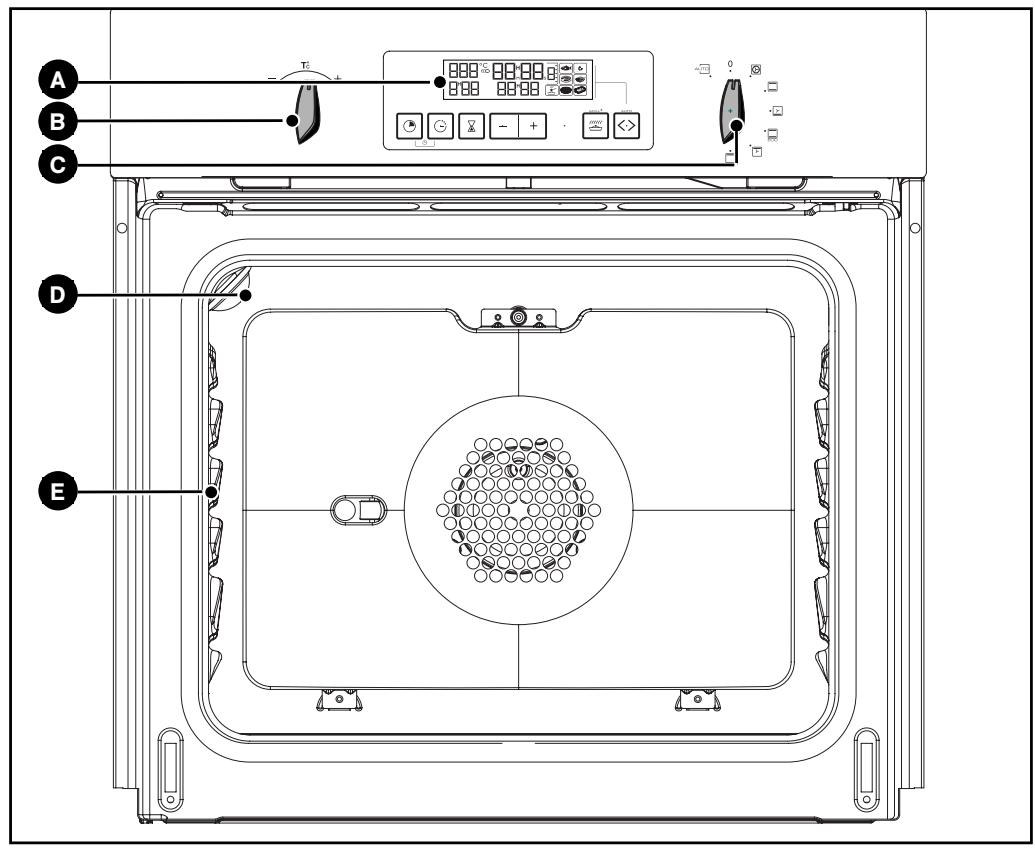
INTRODUCTION TO YOUR OVEN
A Programmer
B Temperature selector
C Function selector
Lamp
E Shelf support indicator
Tip This Guide to Installation and Use is valid for several models. Minor differences in details and fittings may emerge between your appliance and the descriptions provided.
EN
3 / DESCRIPTION OF YOUR APPLIANCE
- ACCESSORIES
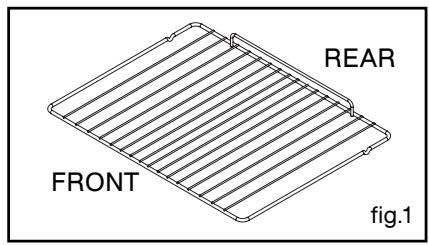
- Anti-tipping safety grid (fig.1)
The grid can be used to hold all dishes and moulds containing foodstuffs to be cooked or browned.
It can be used for barbecues (to be placed directly on the grid).
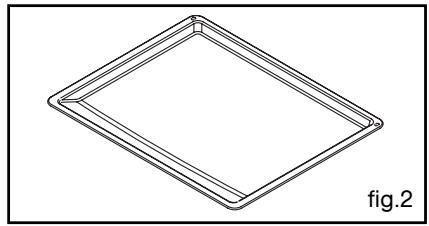
- Multi-purpose dish (fig.2)
Inserted under the grid, it catches barbecue juices and grease. It can also be used half-full of water for double-boiler cooking methods. Avoid placing roasts or meats directly in the dish because you are certain to have major spattering on the oven walls.
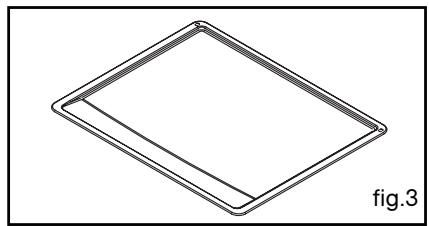
- Cake dish (fig.3)
It serves as a cake dish and has a sloped edge. It is used for cooking pastries such as cream puffs, meringues, madeleines, puff pastry, etc.

Tip
To clean dishes coated with anti-adhesive enamel, let them col before cleaning them manually with a dish soap. Avoid scouring sponges. Do not cut on it with a knife or a metallic pizza cutter; use plastic or silicone utensils instead.
- PRESENTATION OF THE PROGRAMME SELECTOR
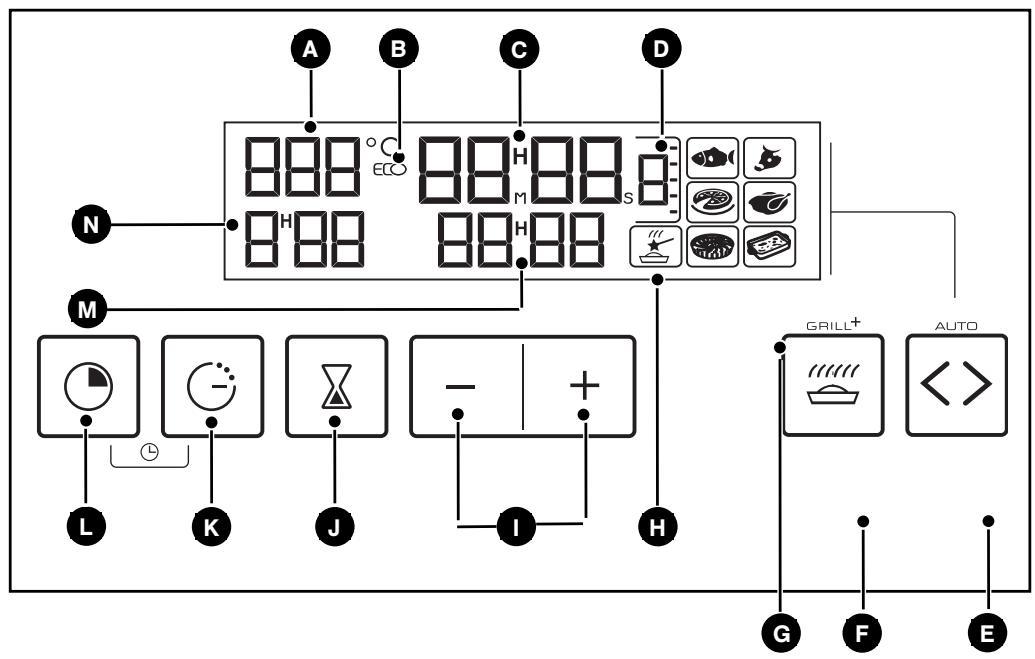
Temperature display
B ECO indicator (cooking and self-cleaning)
Time and duration display
D Shelf number indicator
E EASY COOK function button
F GRILL+ button
EASY COOK plates indicator
EASY COOK indicator
Touch controls for setting time
J Timer touch control
K Cooking end time touch control
Cooking time touch control
M Cooking end time indicator
Cooking time indicator
EN 4 / USING YOUR APPLIANCE
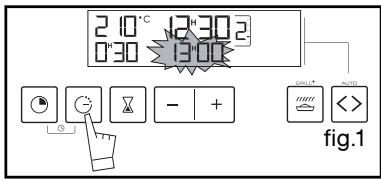
How to set the time.
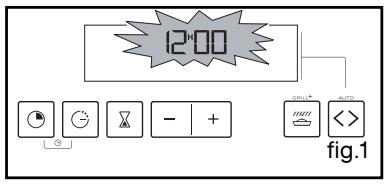
- When the power is on
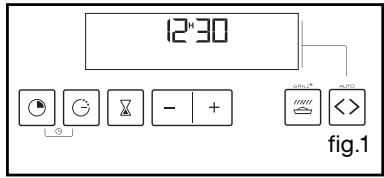
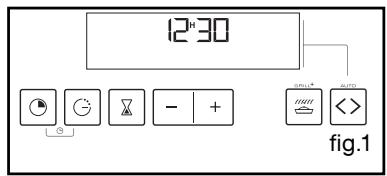
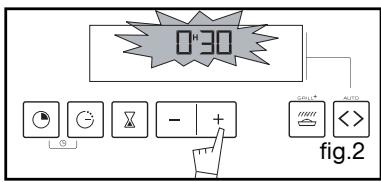
The display flashes 12:00. (fig.1)
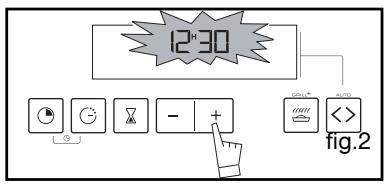
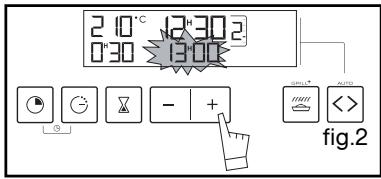
Set the time by pressing the + or - buttons (continued pressure on the button runs through the numbers quickly) (fig.2).
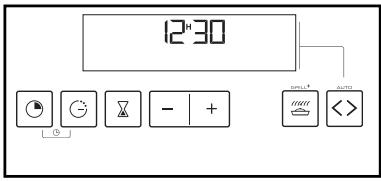
Example: 12:30
The adjusted time is automatically recorded after a few seconds.
The display stops flashing.
How to change the time.
- To reset the time on the clock
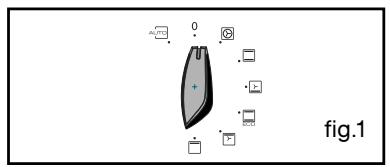
The function selector must be in position 0 (fig. 1).
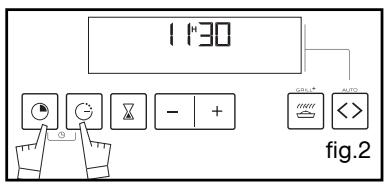
Press buttons " ⑥ " and ⑤ at the same time for a few seconds (fig.2), then release them when the time of day begins to flash. The sound of beeping shows that you can set it now.
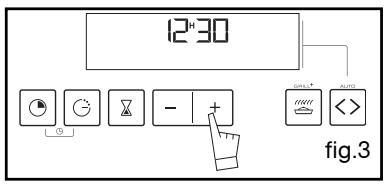
Adjust the time setting using the ^+ or - buttons (fig.3).
The adjusted time is automatically recorded after a few seconds.
4 / USING YOUR APPLIANCE
EN
- Immediate cooking
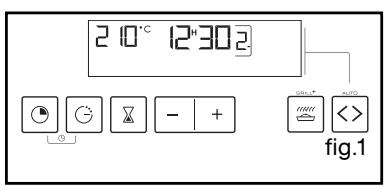
- The analog programmer should display only the time;
It should not be flashing (fig 1).
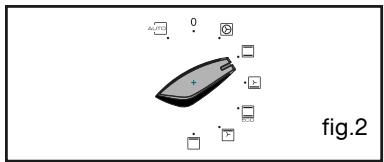
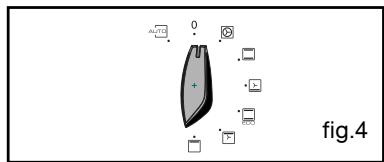
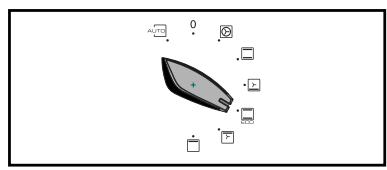
Turn the function selector to the position of your choice.
Example: position (fig.2).
Your oven will offer you the best temperature for this type of cooking.
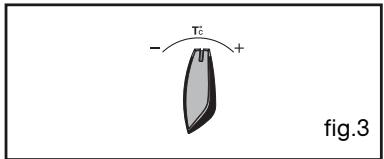
You can also adjust the temperature by moving the temperature selection knob to + or (fig.3)
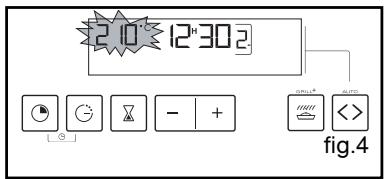
Example: temperature reference 210^ (fig.4).
Put your plate in the oven following the recommendations provided.
After doing this, the oven heats up, and the temperature indicator flashes.
A series of beeps will be emitted when the oven reaches the selected temperature.
The temperature stops flashing.

Warning
After a cooking cycle, the cooling fan continues to operate for a period of time to guarantee good oven reliability.

Warning
All cooking is done with the door closed.

Warning
Do not hang a towel or cloth on the oven handle.
EN 4 / USING YOUR APPLIANCE
PROGRAMMED COOKING
- Cooking with immediate start and programmed cooking time
- Select the cooking mode desired and adjust the temperature (fig.1).
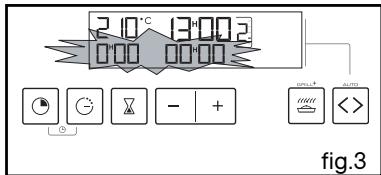
- Press the " " button until the cooking time indicator starts to flash.
The display flashes 0:00 to tell you that you can now set it (fig.2).
- Press the + or - button to set the time you require.
Example: 30 min cooking (fig.3).
The cooking time is automatically recorded after a few seconds.
The display stops flashing.
Time counting takes place immediately after setting.
After these three steps, the oven heats up:
A series of beeps will be emitted when the oven reaches the selected temperature.
At the end of cooking (end of programmed time),
- the oven switches off,
- 0:00 flashes (fig.4).
- A series of beeps is emitted for a few minutes. Press any button to stop the beeping.
The display goes back to showing the time of day by moving the function selector back to 0 (fig.5).
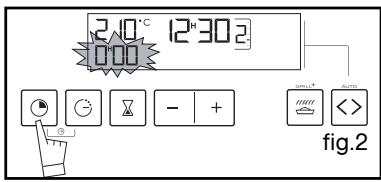
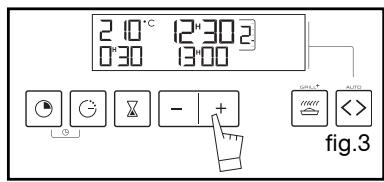
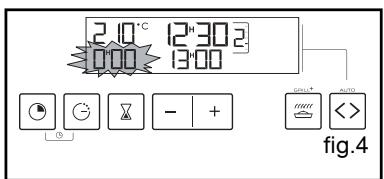
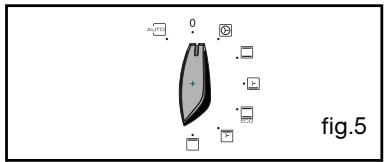
4 / USING YOUR APPLIANCE
EN
PROGRAMMED COOKING
- Cooking with delayed start and selected end time
Proceed as with programmed cooking.
- After setting the cooking time, press the "按钮 until the end cooking time indicator flashes.
The end cooking time display to indicate that setting is now possible (fig.1).
- Press the + or - button to set the cooking time you require.
Example: end cooking at 1:00 pm (fig.2).
The end of cooking is automatically recorded after a few seconds,
The display stops flashing.
After these 3 actions, the start of cooking is delayed so that cooking will end at 1:00 pm.
At the end of cooking (end of programmed time),
- the oven switches off,
- 0:00 and the cooking time flash (fig.3).
- A series of beeps is emitted for a few minutes. Press any button to stop the beeping.
The display goes back to showing the time of day by moving the function selector back to 0 (fig.4).
EN 4 / USING YOUR APPLIANCE
ECONOMIC \* COOKING
-
The analog programmer should display only the time (fig.1).
-
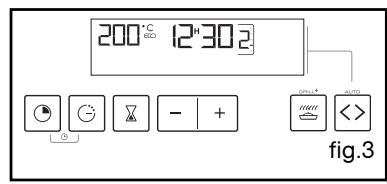
Rotate the function selector to the " " POSITION. L'The "ECO" indicator comes on on the display (fig.2).
- Place your plate in the oven as recommended on the display.
Example: position " l -> shelf 1 or 2 recommended (fig.3).
- Your oven recommends the optimal temperature for the chosen cooking mode at 200^ .
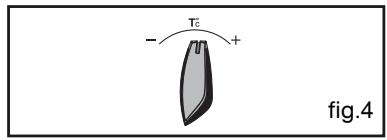
But you can adjust it by moving the temperature selector to ^+ or -fig.4).
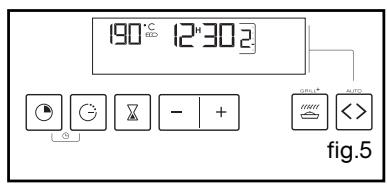
Example: position " " adjusted to 190°C (fig.5).
The temperature indicator flashes. Three beeps will indicate to you that the set temperature has been reached.
*This position makes it possible to save up to 20% energy while still offering identical cooking results.
The ECO position is used for energy labelling.

Warning
After a cooking cycle, the cooling fan continues to operate for a period of time to guarantee good oven reliability.
4 / USING YOUR APPLIANCE
EN
GRILL
- This function allows you to combine the chosen cooking method with a function that "browns" your dish at the end of cooking; this can be accomplished by turning on the grill for the last five minutes of the programme.
It is only active for the following cooking functions:"
This function can be programmed at the start of cooking by adding 5 minutes to the cooking time or simply at the end of cooking by pressing the " " button.
-
Set the cooking mode chosen and if necessary adjust the temperature.
-
Press the "GRILL+ button, cooking time flashes at 0:05 (this cooking time is the minimum required to activate the " function in the cooking sequence chosen).
-
Press the + or - buttons to adjust the total cooking time. The cooking time is recorded automatically after a few seconds; the display stops flashing.
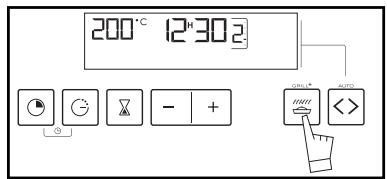
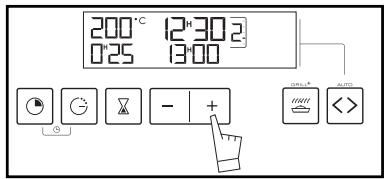
- After these 3 actions, the oven heats up and the icon " " lights up, shwoing you that the function is in operation.
Do not put plates too close to the grill so they don't brown too fast. Follow 1^st or 2^nd steps (starting from the bottom).
Sample dishes:
- Gratins on pasta, cauliflower, endives, shellfish, crumbles, etc.
Programming examples: Onion soup au gratin:
- Select the cooking sequence and temperature: 180^ , the programme: “ 等 ” and the time: 25 minutes.
The stock will be heated for 20 minutes and browning will carry on for the remaining 5 minutes.

Warning
Every time the function selector is rotated, the function is deactivated "

Tip
It is possible to activate or deactivate this option at any point during cooking by adjusting the “[knob].
You can also activate this function with delayed cooking.
EN 4 / USING YOUR APPLIANCE
- USE OF THE TIMER FUNCTION
- The programme selector on your oven can be used as a separate timer which can be used when the oven is off.
In this case, the timing display takes priority over the time of day display.
-
Press the " l " button (fig.1) until it reads 0.00.
-
Adjust the time chosen by pressing + or - (fig.2) buttons until you reach the time required (maximum 60 minutes).
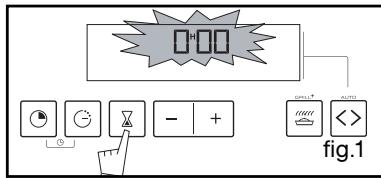
The display stops flashing and the timer starts, counting the time in seconds. Once the time has elapsed, the timer sounds a series of beeps to let you know. Press any button to stop the beeping.

Warning
It is possible to change or cancel the timer programme at any time.
You can adjust the brightness of your display. To do this:
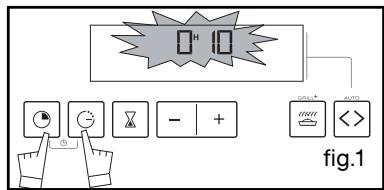
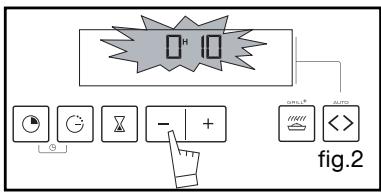
- Set and validate the time on your programme selector at 0:10 (fig.1).
- Press buttons + and - at the same time for ten seconds or so until "CO" is displayed in order to go back to setting mode (fig.2).
- Press buttons + or - to obtain the brightness you require.
Once you have set the brightness to the level you require, wait a few seconds and reset the programme selector to the time of day.
- Cooking is controlled by the heating element located at the back of the oven and by the fan.
- Preheating unnecessary except for cooking programmes requiring very short times (biscuits on several levels).
- Recommended for preserving tenderness in meats, vegetables and fish and for multiple cooking on up to three levels.

TRADITIONAL
(recommended temperature 240^ - Min 35^ Max - 275^ )
- Cooking controlled by the upper and lower heating elements with no fan.
- Requires preheating before the dish is placed in the oven.
- Recommended for slow, gentle cooking: tender game meat, etc. To seal roasts of red meat. To simmer in a covered stew pan dishes that were begun on the hob (coq au vin, stew, etc.).

PULSED BOTTOM ELEMENT
(recommended temperature 205^ -Min 35^ Max-275.C)
- Cooking is controlled by the bottom element combined with a slight dose of the grill and with the fan.
- Cooking heat from the bottom with a small amount of heat from the top. Place the grid on the lowest shelf support.
- Recommended for moist dishes (quiches, juicy fruit tarts, etc.). The crust will be thoroughly cooked on the bottom. Recommended for dishes that rise (cake, brioche, kouglof, etc.) and for soufflés that will not be stuck by a crust formed on the top.
Cooking multiple items on up to three levels.

TRADITIONAL ECO
(recommended temperature 200^ - Min 35^ Max - 275. C)
- Cooking controlled by the upper and lower heating elements with no fan.
- This position makes it possible to save approximately 25% while maintaining cooking properties. The ECO position is used for the energy label performance.
- You will save energy throughout the cooking cycle, but the time may be slower.

PULSED GRILL
(recommended temperature 200^ - Min. 180^ - Max. 230^ )
- Cooking is controlled alternately by the upper element and the fan.
- Preheating unnecessary. Roasts and poultry that are juicy crispy and all over.
- Recommended for all poultry or roasts to seal and cook through leg roast, beef ribs. For preserving tenderness in fillets of fish.

HIGH GRILL
(recommended temperature 275^ - Min 180^ Max -275^)
- Cooking controlled by the upper element without the fan.
- Preheat the oven for five minutes. Slide the drip tray onto the lower shelf support to collect greases.
-
Recommended for grilling chops, sausages, slices of bread, prawns placed on the grid.
-
Programme(s) used to obtain the results indicated on the energy label in compliance with European standard EN 50304 and in accordance with European Directive 2002/40/CE.
EN
6 / CARING FOR AND CLEANING YOUR APPLIANCE
- CLEANING THE OUTER SURFACES
To clean the window of the electronic timer, as well as the oven door, use a soft cloth moistened with a glass cleaner.
Do not use abrasive cleaning products or hard, metallic scrubbers to clean the oven's glass door, which could scratch the surface and cause the glass to shatter.
To preserve your appliance, we recommend that you use Clearit cleaning products.

Professional expertise serving individuals
Clearit offers you professional products and solutions designed for the daily care of your household appliances and kitchens.
They are on sale at your regular retailer, along with a complete line of accessories and consumable products.
- CHANGING THE CATALYTIC WALLS (OPTIONAL)
Before commencing disassembly, allow the appliance to cool down and check that the cooking selector switch is in the 0 position.
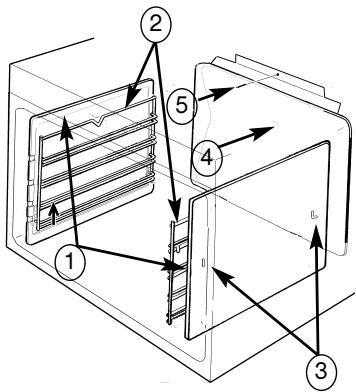
Lateral walls (1)
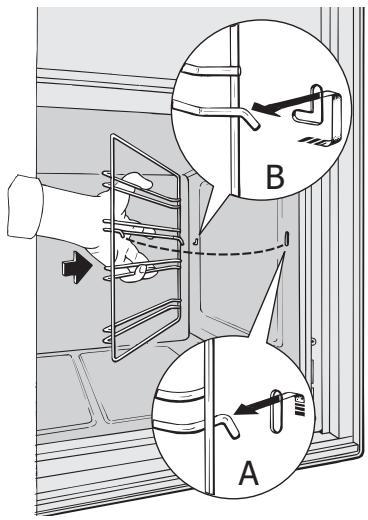
Unhook the wire shelf support (2) at the front by lifting it (diagram A). Pull the shelf support structure towards you, lifting it so as to unhook the rear attachment (diagram B). Remove it from the 2 holes (3) in the catalytic wall and from the oven cavity. Then remove the catalytic wall (1). Replace the new elements (wall and/or shelf supports) by performing the operation in reverse.
Back wall (4)
Before performing this operation, unplug the oven.
Completely unscrew the screw (5) located at the top of the back wall. Tilt the wall forwards in order to remove it from the oven cavity. Position the new panel by reversing these steps.
Plug in the oven again.

Warning
- The oven must be turned off when cleaning inside the cavity.
EN 7 / TROUBLESHOOTING
If you have a doubt about the correct functioning of your oven, this does not necessarily mean that there is a malfunction. In any event, check the following items:
| YOU OBSERVE THAT... | POSSIBLE CAUSES | WHAT SHOULD YOU DO? |
| The oven is not heating. | - The oven is not connected to the power supply. - Your fuse is out of order. - The selected temperature is too low. | → Plug in your oven. → Replace the fuse in your electrical set-up and check its capacity (16A). → Increase the selected temperature. |
| The oven light is not working. | - The light is out of order. - The oven is not connected or the fuse is not working. | → Change the bulb. → Plug in your oven or change the fuse. |
| Your oven starts beeping. | - During cooking. - At the end of a cooking cycle. | → The recommended temperature of your choice has been reached. → Your programmed cooking cycle is finished. |

- Repairs to your appliance should only be performed by professionals. Non-standard repairs may be a source of danger for the user.

Tip
In all circumstances, if your efforts are not sufficient, contact the After-Sales Service Department without delay.
7 / TROUBLESHOOTING
EN

Warning
- Disconnect your oven before performing any task on the bulb to avoid the risk of electric k and, if necessary, let the appliance cool down.

Tip
To unscrew the port and the bulb, use a rubber glove, which will make disassembly easier.
CHANGING THE BULB
The bulb is located on the ceiling of your oven's cavity.
a) Unplug the oven.
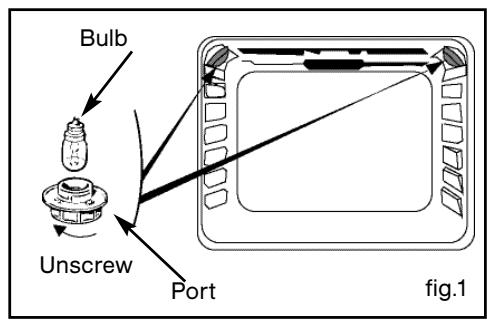
b) Unscrew the lighting port (fig.1).
c) Unscrew the bulb in the same direction.
Bulb specifications:
-15W
-220-240V\~
-300°C
-E14cap
d) Replace the bulb then reposition the port and reconnect your oven.
EN
ADVANTAGES AND PRINCIPLES
Using the “ AUTO ” function means you no longer have to select the temperature and cooking time
These two parameters are automatically calculated by your oven in order to give you optimal cooking.
This " AUTO "cooking mode takes place in 2 steps:
1) The first step (acquisition) during which the oven will use its electronic sensors to record the specific cooking data for your dish.
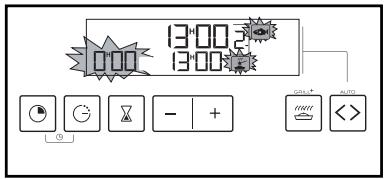
This step is represented by flashing in the right-hand area of the display: this may take between 5 and 40 minutes depending on cooking mode chosen.
DO NOT OPEN THE DOOR DURING THIS PHASE or you may disturb the recording of data.
2) In the second step (calculation, the oven sets the cooking time necessary. The icon for the " 空 " animation appears. The oven shows the cooking time remaining as well as the actual time at the end of cooking. If you wish to interrupt the dish (basting, turning the piece of food, etc) you may open.
3) At the end of cooking you will hear a series of beeps.
HOW TO USE THE APPLIANCE
a) Instant cooking:
Position the cooking selector on the "AUC" function.
Using the <> button, choose the dish.
Place it on the shelf recommended on the display. Close the door. The oven begins cooking.
The seeking procedure begins, shown by the animation on the display: a time is suggested.
When cooking is complete, the oven emits several beeps.
b) Delayed cooking:
Position the cooking selector on "ALTO".
Choose your dish by pressing the <> button.
Place your dish in the oven and close the door
Position the mode selector on "G".
Press the + or - buttons to set the end cooking time desired.
Example.: End of cooking 1:00 pm.
After these actions, the start of cooking is delayed.
The cooking end time is estimated based on the average basic time. Just as for immediate cooking, this time will be optimised during the cooking programme; therefore, the time may vary by a few minutes (over or under) compared to the initial time selected.
8 / “EASY COOK” ADVANTAGES AND PRINCIPLES
EN
TIPS
As soon as the icon " 1002 " stops flashing, you may open the oven door
If, however, you open the door while the icon is lit, your oven sounds a warning beep and the dish icons flash.
Cooking in " AUTO" mode MUST START WITH THE OVEN COLD, you should wait until the oven has completely cooled down before beginning a second cooking cycle in this mode (if you do not, the cooking time indicators, "..." and the dishes flash on the display, while a series of beeps will prevent you from starting to cook).
IF AN OPERATING FAULT OCCURS
| YOU SHOULD CHECK THAT... | THE CAUSES POSSIBLE | WHAT SHOULD YOU DO? |
| Beeping + the EASY COOK icon flashes | - You have opened the door during the seek stage : the programme is cancelled. - The oven is hot | →Allow the oven to cool down before re-starting cooking. |
EN
EASY COOK COOKING MODES

FISH
Whole fish (sea bream, hake, trout, mackerel, etc.) with herbs and spices and white wine, roast fish
TIPS :
- use this function for whole fish, cooked in the dish (for grilled fish or fish cooked in foil, the oven must be preheated).

ROAST BEEF
Roast beef (rare to medium rare)
TIPS
- If you prefer meat well-done, opt for a traditional cooking function.
- take the roast from the refrigerator at least 1 hour before beginning cooking (see tips on the next page). Remove most of the bacon strips, place the roast on an earthenware dish with a little water and a teaspoonful of oil. Add salt only when cooking is finished.

PIZZA
- fresh ready-made pizza
- ready to use pizza bases
- special pizza bases
- frozen pizza (rolled in cheese, small loaves (packed)
TIPS :
- put it on the grill for a crispy crust
- put it on the enamel plate to get a soft crust.

CHICKEN
- chickens from 1 kg to 1.8 kg
- duckling, guinea fowl, etc.
TIPS :
- spit cooking: don't forget to put a drip tray on the first shelf to catch the fat.
- cooking in a dish: preferably made of earthenware to avoid grease spattering
- prick the poultry skin to avoid spattering.

TARTS
- Fresh tarts
- Frozen tarts
Quiches - Raw frozen meat pastries
TIPS :
- use a non-stick aluminium mould: the pastry will be crisper underneath I
- ready-made frozen tarts and quiches: remove the aluminium tray before putting them on the grill

VEGETABLES
tomatoes, stuffed peppers
- lasagna (fresh or frozen)
- cottage pie, brandade, pastry gratins, etc.
TIPS :
- carefully match the size of your plate to the amount you have to cook to prevent the juice boiling over.
TIPS AND HINTS
EN
FISH
When you buy fish, the smell should be pleasant and not too fishy.
The body should be firm and rigid and the scales should be firmly stuck to the skin; the eye should be bright and rounded and gills will appear shiny and moist.
BEEF (MEAT IN GENERAL)
It is essential to take all meat out of the refrigerator well before cooking: cold-hot temperature shocks toughen meat; this way you will produce a roast beef that is golden outside, red inside and warm in the middle. Do not salt before cooking: salt absorbs the blood and dries out the meat. Use a spatula to turn the meat: if you prick it the blood will drain away. Always let meat sit after cooking for 5 to 15 minutes: wrap it in a sheet of aluminium and place it just inside a warm oven: this way the blood, drawn to the outside, will flow back and moisten the roast.
Use earthenware roasting dishes: glass promotes grease spattering.
Do not cook in the enamelled drip tray.
PIZZA
To prevent cheese or tomato sauce from dripping in the oven, you can place a piece of greaseproof paper between the grill and the pizza.
CHICKEN
Carefully match the plate to the size of the chicken so that the grease doesn't burn.
TARTS/QUICHES
Do not use glass and porcelain dishes, they are too thick and make cooking time longer, preventing the base from turning crisp and golden.
With fruit, the bottom of the tart is in danger of becoming soggy: just add a few spoonfuls of fine semolina, crushed biscuit crumbs, almond powder or tapioca, which will absorb the juice during cooking.
With high-water content or frozen vegetables (leeks, spinach, broccoli or tomatoes) you can sprinkle on a tablespoon of cornmeal.
VEGETABLES
To make a smoother potato gratin, the potatoes should be precooked cut into medallions in milk or milk and cream for about twenty minutes.
To make stuffed tomatoes: after having cut open a head, remove the seeds, salt the inside and put them back on the grill so that they drain before you stuff them.
EN A FEW RECIPIES
FISH
Black sea bream with dry cider :
1 black sea bream weighing 1.5kg
500 g button mushrooms.
2 tart apples.
2 shallots
2 tablespoons of heavy cream
100 g butter.
1/2 litre cider. Salt, pepper.
Clean and scale the fish. Place it in a buttered dish on the finely minced shallots and sliced mushrooms. Add the cider, salt and pepper and a few knobs of butter. Place it in the oven. Cook the apples in unpeeled quarters in the butter. When cooking is complete, transfer the fish to a warm dish, strain the juice and deglaze the dish with the cream.
Add the cream to the juice, serve with apples and mushrooms.
ROAST BEEF Accompanying sauces.
PARSLEY SAUTERNES or ROQUEFORT SAUCE
Sauté 2 tablespoons of minced shallots in the butter.
Add 10 cl Sauternes, let it evaporate.
Add 100g Roquefort, let it melt slowly.
Add 20 cl liquid cream, salt, pepper. Bring to a boil.
COGNAC sauce with PINK PEPPER
Sauté 2 tablespoons of minced shallots in the butter.
Add 15 cl Sauternes, let it evaporate.
Add the yolk of an egg, 1 spoonful of ketchup, 200g of butter Salt, pepper.
While beating, add 3 spoonfuls of Cognac and 1 teaspoonful of crushed red berries.
FRUITY PEAR sauce with CRESS
Cook 1 pear, covered in white wine. Drain, mix.
Blanch 1/2 bunch of cress, drain, chop.
Sauté 1 tablespoon of chopped shallots in the butter.
Moisten with the cooking juices. Evaporate off.
Add the pear, the cress and 20 cl of liquid cream.
Salt, pepper, lightly boil.
Place in the oven. Cut the unpeeled apples into quarters and simmer them in the butter. When cooking is complete, transfer the fish to a warm dish, strain the juice and deglaze the dish with the cream.
Add the cream to the juice, serve with apples and mushrooms.
PIZZA
Base:1pizzacrust
*vegetable: 6 tablespoons tomato sauce + 100 g diced zucchini + 50 g diced bell peppers + 50 g sliced eggplant + 2 small sliced tomatoes + 50 g shredded gruyere + oregano + salt + pepper.
*roquefort and smoked ham: 6 tablespoons tomato sauce + 100 g smoked ham + 100 g roquefort in small chunks + 50 g walnuts + 60 g shredded gruyere.
*sausage and fromage blanc : 200 g drained fromage blanc spread on the crust + 4 sausages, sliced + 150 g ham, slivered + 5 olives + 50 g shredded gruyere + oregano + salt + pepper.
A FEW RECIPIES
EN
CHICKEN
Stuff with a good bunch of fresh tarragon or coat it with a mixture made of 6 cloves of crushed garlic and a big pinch of salt and a few peppercorns.
TARTS / QUICHES
Non-stick aluminium mould 30~cm in diameter.
Glazed puff-pastry apple tart :
1 puff pastry base spread out with its sheet, pricked with a fork.
200 ml cream brought to a boil with a vanilla bean.
2 beaten eggs with 30g sugar, add the cooled cream.
2 apples cut into cubes rolled in 70g crushed pralines.
Remove the cream and the apples. Place in the oven.
QUICHES
Base : 1 aluminium mould, diameter 27 to 30 cm
1 pressed base, ready to use
3 beaten eggs + 50 cl heavy cream
salt, pepper, nutmeg.
Assorted garnishes:
200 g of precooked bacon pieces,
or - 1 kg cooked endives + 200 g shredded gouda
or - 200 g broccoli + 100 g larding bacon + 50 g blue cheese
or- 200g of salmon +100g of drained cooked spinach
VEGETABLES
Tomatoes stuffed with hot goat's cheese.
8 tomatoes
300g of fresh goat's cheese
4 soupspoons of olive oil
1 small bunch of fine herbs (chives or basil)
Salt, pepper.
Wash the tomatoes, remove the core and carefully remove the pulp.
Turn them around to drain them well.
Using a fork, mix the cheese and olive oil, add the fine herbs chopped mint, salt and pepper
Replace the stalk and arrange them on a plate. Place in the oven.
Serve warm on a bed of green salad.