
MilkPerfection CM 6360 - Coffee maker MIELE - Free user manual and instructions
Find the device manual for free MilkPerfection CM 6360 MIELE in PDF.


| Product Type | Fully automatic coffee machine with integrated milk system |
| Brand | Miele |
| Model | MilkPerfection CM 6360 |
| Dimensions (W x H x D) | 251 x 359 x 427 mm |
| Net Weight | 9.9 kg |
| Mains Connection | AC 220-240 V, 50 Hz, 10 A fuse |
| Power Consumption (Standby) | < 0.1 W (networked standby < 0.5 W) |
| Pump Pressure | Max. 15 bar |
| Water Container Capacity | 1.8 L |
| Bean Container Capacity | Approx. 300 g |
| Milk Container Capacity | 0.5 L (milk flask) |
| Drip Tray Capacity | 0.8 L |
| Waste Container Capacity | Max. 10 portions of coffee grounds |
| Central Spout Height Adjustment | 80-140 mm |
| Grinder Type | Steel conical grinder, 5 settings |
| Maximum Ground Coffee Dose | 12 g |
| WiFi Frequency | 2.4 GHz (max. transmission power < 100 mW) |
| Special Functions | DoubleShot, 2 portions, Coffee pot (up to 1 L), Profiles, MobileStart, TeaTimer, Expert mode |
| Performance Modes | Eco, Barista, Latte, Party |
| Cleaning Intervals | Daily: drip tray, water container, milk system; Weekly: central spout, brew unit; As prompted: descaling, degreasing |
| Safety Features | System lock, child safety, automatic shut-off, overheat protection |
| Included Accessories | Milk siphon, milk flask with lid, cleaning brush, starter set of cleaning products |
| Connectivity | Miele@home, remote control, RemoteUpdate |
| Warranty | 2 years (UK, requires activation) |
| Compliance | EU Directive 2014/53/EU |
Frequently Asked Questions - MilkPerfection CM 6360 MIELE
User questions about MilkPerfection CM 6360 MIELE
0 question about this device. Answer the ones you know or ask your own.
Ask a new question about this device
Download the instructions for your Coffee maker in PDF format for free! Find your manual MilkPerfection CM 6360 - MIELE and take your electronic device back in hand. On this page are published all the documents necessary for the use of your device. MilkPerfection CM 6360 by MIELE.
USER MANUAL MilkPerfection CM 6360 MIELE
Operating instructions Coffee machine
natural_image
Black-and-white photo of a coffee cup, a glass of milk, and a teacup on saucers with chopsticks (no text or symbols visible)To avoid the risk of accidents or damage to the appliance it is essential to read these instructions before it is installed and used for the first time.
The packaging material used protects the machine during transportation. Please retain the original box and polystyrene pieces so that you can pack the machine securely, should you need to transport it in the future.
Disposing of your old appliance
Electrical and electronic appliances often contain valuable materials. They also contain specific materials, compounds and components, which were essential for their correct function and safety. These could be hazardous to human health and to the environment if disposed of with your domestic waste or if handled incorrectly. Please do not, therefore, dispose of your old appliance with your household waste.
Please dispose of it at your local community waste collection / recycling centre for electrical and electronic appliances, or contact your dealer or Miele for advice. You are also responsible for deleting any personal data that may be stored on the appliance being disposed of. Please ensure that your old appliance poses no risk to children while being stored prior to disposal.
Caring for the environment 2
Warning and Safety instructions.... 6
Product description 15
Controls and indicators 17
Operation.... 19
Symbols in the display 20
Miele@home 21
Before using for the first time 22
Filling the water container 24
Filling the coffee bean container 25
Switching on and off 26
Cup heating.... 27
Adjusting the central spout to the correct cup height.... 28
Making drinks 29
Making coffee with and without milk.... 29
Milk preparation.... 30 Using a milk carton with the milk siphon .... 30
Making a coffee.... 32
Cancelling a drink.... 32
DoubleShot.... 32
Making 2 portions (☐ sensor control).... 33
Coffee pot.... 33
Making coffee drinks with ground coffee.... 34
Adding ground coffee.... 34
Tea 35
TeaTimer.... 36
Making tea.... 36
Dispensing warm or hot water 37
Expert mode.... 38
Grinder setting.... 39
Adjusting the fineness of grind.... 39
Parameters.... 40
Displaying and changing parameters.... 40
Portion size.... 40
Quantity of coffee.... 41
Brewing temperature 41
Pre-brewing the ground coffee.... 41
Profiles.... 42
Creating profiles 42
Making drinks stored in a profile 42
Changing drinks within a profile.... 42
Editing profiles.... 42
Setting when the profile should change.... 42
Changing the name 43
Deleting a profile 43
MobileStart 44
Settings 45
Displaying and changing Settings.... 45
Language.... 45
Timer: switch off after.... 45
TeaTimer 45
Volume...... 45
Display brightness.... 45
Lighting.... 45
Info (display information) 45
Altitude 45
Performance mode.... 45
Eco mode 46
Barista mode 46
Latte mode 46
Party mode 46
Water hardness 46
System lock 🔒 47
Miele@home 48
Remote control.... 48
RemoteUpdate 48
Software version....49
Showroom programme (Demo mode).... 49
Factory defaults.... 49
Cleaning and care 50
Overview of cleaning intervals.... 50
Cleaning by hand or in the dishwasher.... 51
Unsuitable cleaning agents 52
Drip tray and waste container 53
Cleaning the drip tray cover 54
Water container 54
Removing and cleaning the water container filter.... 55
Dismantling and cleaning the central spout.... 55
Cleaning the steam jet.... 57
Cleaning the milk pipework and rinse valve.... 57
Cleaning the milk siphon 59
Cleaning the milk flask 59
Bean container and ground coffee chute 59
Cleaning the casing....60
Opening the "Maintenance" menu 60
Rinse the appliance....60
Rinsing the milk pipework 60
Cleaning the milk pipework (maintenance programme).... 61
Degreasing the brew unit and cleaning the interior.... 62
Descaling the machine 64
Problem solving guide 66
Messages in the display.... 66
Unusual performance of the coffee machine 69
Unsatisfactory results....77
Transporting the machine.... 79
Evaporating the coffee machine....79
Packing the machine 79
After sales service and warranty 80
Contact in the event of a fault 80
Warranty 80
Accessories 81
Saving energy 82
Electrical connection 83
Installation.... 84
Appliance dimensions.... 85
Technical data.... 86
Conformity declaration 87
This coffee machine complies with all the stipulated safety requirements. Inappropriate use can, however, lead to personal injury and material damage.
Read the operating instructions carefully before using the coffee machine. They contain important information on the installation, safety, use and maintenance of the appliance. This prevents both personal injury and damage to the coffee machine.
In accordance with standard IEC 60335-1, Miele expressly and strongly advises that you read and follow the instructions in the chapter on installing and connecting the coffee machine as well as the safety instructions and warnings.
Miele cannot be held liable for injury or damage caused by non-compliance with these instructions.
Keep these operating instructions in a safe place and pass them on to any future owner.
Correct application
This coffee machine is intended for home use.
This coffee machine is not intended for outdoor use.
This coffee machine must not be used at altitudes above 2000 m.
It must only be used as a domestic appliance to make espresso, cappuccino, latte macchiato, tea etc. Any other use is not permitted.
This coffee machine can only be used by people with reduced physical, sensory or mental capabilities, or lack of experience and knowledge, if they are supervised whilst using it, or have been shown how to use it in a safe way and recognise and understand the consequences of incorrect operation.
Safety with children
⚠️ Danger of burning and scalding on the dispensing spouts.
Children's skin is far more sensitive to high temperatures than that of adults.
Ensure children do not touch hot surfaces of the coffee machine or place parts of their body under the dispensing spouts.
▶ Install the coffee machine where it is out of the reach of children.
Children under 8 years of age must be kept away from the coffee machine and the mains connection cable and plug/socket.
Children aged 8 and older may only use the coffee machine without supervision if they have been shown how to use it in a safe manner.
Children aged 8 and older must be aware of the potential dangers caused by incorrect operation.
▶ Please supervise children in the vicinity of the coffee machine and do not allow them to play with it.
▶ Young children must not be allowed to clean the coffee machine at all. Cleaning may only be carried out by children 8 years of age or older under the supervision of an adult.
Remember that coffee and espresso are not suitable drinks for children.
Danger of suffocation! Whilst playing, children may become entangled in packaging material (such as plastic wrapping) or pull the packaging material over their head, presenting the risk of suffocation. Keep packaging material away from children.
Technical safety
A damaged coffee machine is dangerous. Check it for any visible damage before setting it up. Never attempt to use a damaged coffee machine.
To avoid the risk of damage to the machine, make sure the connection data (voltage and frequency) on the data plate corresponds to the household supply, before connecting the machine to the mains supply. Consult a qualified electrician if in any doubt.
The electrical safety of this coffee machine can only be guaranteed when correctly earthed. It is essential that this standard safety requirement is met. If in any doubt please have the electrical installation tested by a qualified electrician.
▶ Reliable and safe operation of the coffee machine can only be guaranteed if it is connected to the mains electrical supply.
Do not connect the machine to the mains electricity supply by a multi-socket adapter or an extension lead. These are a fire hazard and do not guarantee the required safety of the appliance.
The coffee machine must not be used in a non-stationary location (e.g. on a ship).
▶ Unplug the machine from the power supply immediately if you notice any damage or smell scorching, for example.
▶ Ensure that the mains connection cable cannot be pinched or damaged by any sharp edges.
The mains connection cable should not hang down. Someone could trip over it with the risk of injury and damage the machine.
▶ Only use the coffee machine in rooms where the ambient temperature is between +10 °C and +38 °C.
▶ Position the coffee machine at a height of at least 850 mm from the floor.
Danger of overheating. Please ensure that there is adequate ventilation around the coffee machine. Do not cover the coffee machine with tea towels etc. while it is in use.
If the coffee machine is installed behind a closed furniture front, it may only be used with the furniture door open (see “Installation” for the minimum niche size). Heat and moisture can build up behind the furniture front when closed. This can result in damage to the appliance and/or furniture unit. Do not close the furniture front while the coffee machine is in use. Leave the furniture door open until the coffee machine has cooled down completely.
▶ Protect the coffee machine from water and water spray. Do not immerse the machine in water.
▶ Repairs and other work by unqualified persons to the machine and the connection cable could be dangerous. The manufacturer cannot be held liable for unauthorised work. Repairs may only be carried out by a Miele authorised service technician.
While the machine is under warranty, repairs should only be undertaken by a Miele authorised service technician. Otherwise the warranty is invalidated.
The coffee machine must be disconnected from the electricity supply during repair work.
▶ Never open the outer casing of the machine. Tampering with electrical connections or components and mechanical parts is highly dangerous to the user and can cause operational faults or electric shock.
Correct use
⚠️ Danger of burning and scalding on the dispensing spouts. The liquids and steam dispensed are very hot.
Keep well away from the area underneath the spouts when hot liquids and steam are being dispensed.
Do not touch hot components.
Hot liquid or steam could spatter from the spouts. Ensure that the central spout is clean and fitted correctly.
Water in the drip tray can also be very hot. Take care when emptying it.
⚠️ Danger of injury to the eyes.
Never look directly at the lighting or use optical instruments to look at it.
▶ Please note the following regarding water:
- The water quality must conform to the requirements for drinking water in the country in which the coffee machine is being used.
- Only use cold, fresh tap water to fill the water container. Hot or warm water or other liquids can damage the coffee machine.
- Change the water every day to prevent a build-up of bacteria.
- Do not use carbonated water.
Only fill the bean container with roasted espresso/coffee beans. Do not fill the bean container with coffee beans which have been treated with additives or with ground coffee.
Do not fill the bean container with any type of liquid.
Do not use green (unroasted) coffee beans or mixtures of coffee beans which contain green coffee beans. Green coffee beans are very hard and still contain residual moisture. These can damage the coffee machine grinder as soon as grinding begins.
Do not use coffee beans which have been treated with caramel, sugar or other substances including sugary liquids. Sugar will damage the coffee machine.
▶ Only fill the coffee chute with ground coffee beans.
Do not use any caramelised ready ground coffee. The sugar in the coffee will stick to and block the brew unit of the coffee machine. The cleaning tablets for degreasing the brew unit will not remove this type of deposit.
▶ Only use milk without additives. Additives in milk usually contain sugar and this will stick to the milk pipework.
If using dairy milk make sure that it has been pasteurised.
When making tea, please follow the instructions on the packaging.
Do not place flaming alcohol mixtures underneath the central spout. The flames could ignite plastic components and cause them to melt.
Do not use naked flames, e.g. a candle, on or near the coffee machine. The coffee machine could catch fire with the risk of the fire spreading.
The machine must not be used for cleaning objects.
Accessories and spare parts
▶ Miele can only guarantee the safety of the machine when original Miele spare parts are used. Faulty components must only be replaced by genuine Miele original spare parts.
▶ Only use original Miele accessories. If other parts are used, warranty, performance and/or product liability claims will be invalidated.
▶ Miele will guarantee to supply functional spare parts for a minimum of 10 years and up to 15 years following the discontinuation of your coffee machine.
Cleaning and care
▶ Refer to the relevant instructions in “Cleaning and care”.
Clean the coffee machine and the milk flask (supplied as standard, depending on model) daily, particularly before using for the first time.
All parts of the milk system need to be cleaned thoroughly and regularly. Milk contains bacteria which proliferate rapidly with inadequate cleaning.
Do not use a steam cleaner to clean this machine. Steam could reach electrical components and cause a short circuit.
▶ Descale the coffee machine regularly depending on the water hardness level in your area. Descale the machine more frequently in areas with very hard water. Miele cannot be held liable for damage arising from insufficient descaling, the use of incorrect descaling agent or the use of descaling agent which is not of the appropriate concentration.
▶ Degrease the brew unit regularly with Miele cleaning tablets. Depending on the natural oil content of the coffee used, the brew unit can become blocked quite quickly.
▶ Used coffee grounds should be disposed of with the organic rubbish or on the compost heap. Do not empty them down the sink, as they could block it.
For machines with stainless steel surfaces:
Do not use sticky notes, adhesive tape, masking tape or other types of adhesive on the stainless steel surfaces.
Stainless steel surfaces are susceptible to scratching. Even magnets can cause scratches.
text_image
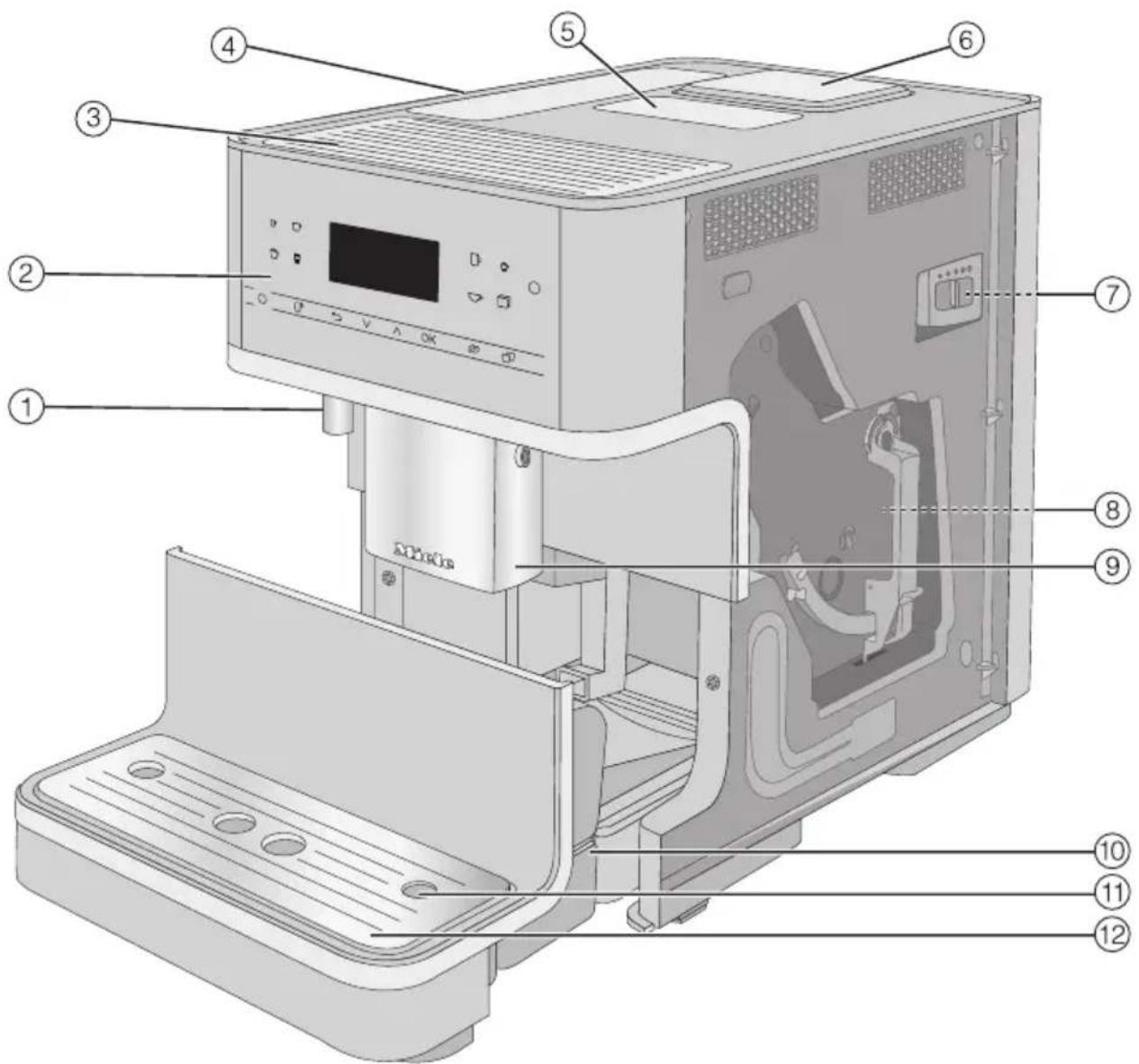
Labeled diagram of a M80s printer internal structure with numbered components① Hot-water spout
② Control panel
③ Cup heater*
④ Water container
⑤ Ground coffee chute
⑥ Bean container
⑦ Grinder setting (behind the appliance door)
⑧ Brew unit (behind the appliance door)
⑨ Height-adjustable central spout
⑩ Drip tray with lid and waste container
⑪ Milk pipework aperture
⑫ Lower panel with drip tray cover
* depending on model: CM 6360, CM 6560
text_image
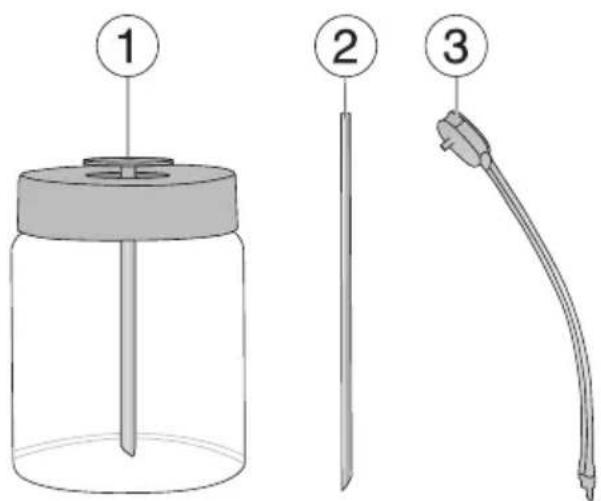
Diagram showing three labeled parts of a laboratory instrument: a jar with a cap, a rod inserted into a tip, and a medical catheter attached.① Milk flask*
② Milk siphon
③ Milk pipework with rinse valve
* depending on model: CM 6360, CM 6560
flowchart
graph TD
    A["1"] --> B["3"]
    B --> C["2"]
    C --> D["3"]
    D --> E["4"]
    E --> F["5"]
    F --> G["6"]
    G --> H["7"]
    H --> I["8"]
    I --> J["9"]
    J --> K["10"]
    K --> L["11"]
    L --> M["Power Control Icon"]
    N["OK"] --> O["V"]
    O --> P["^"]
    P --> Q["Switch"]
    R["Light Grey Area"] --> S["Table Area"]
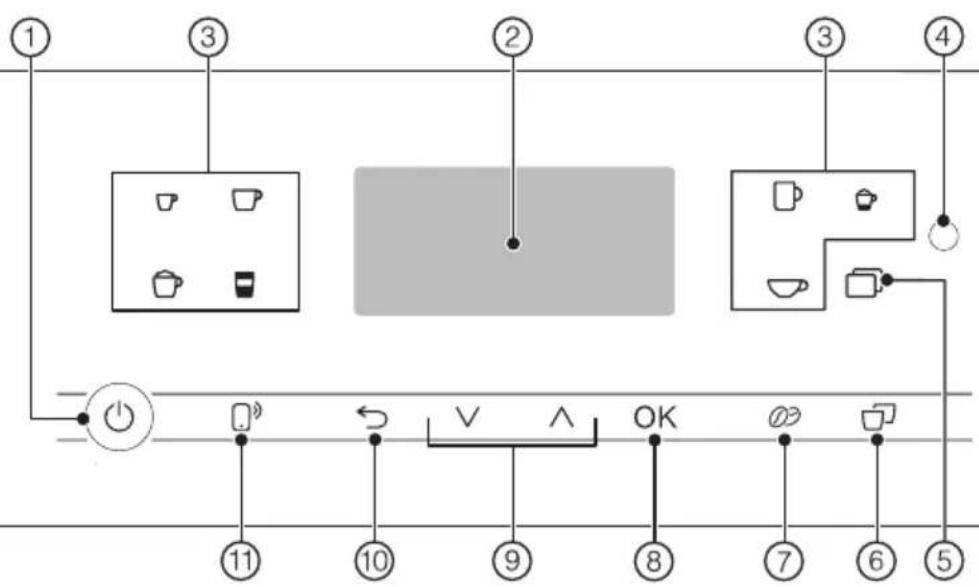
① On/Off button ⏻
For switching coffee machine on and off
② Display
For showing information about the current action or status
③ Drink buttons
For making drinks
④ Optical interface
(For Miele Customer Service Department only)
⑤ Sensor control
- For making other drinks: ristretto, cappuccino italiano, flat white, café au lait, hot milk and milk froth, hot water, warm water, coffee pot function
- Maintenance programmes
- Profiles
- Settings
⑥ “2 portions” 📋 sensor
For dispensing 2 portions of a drink at once
⑦ "DoubleShot" sensor
For making a particularly strong and aromatic coffee by using twice as much ground coffee but the same amount of water
⑧ OK sensor
For confirming display messages and saving settings
⑨ Arrow buttons ∧ ∨
For scrolling through lists, selecting entries or changing values
⑩ “Back” ⇔ sensor
For returning to the previous menu and cancelling unwanted actions
⑪ MobileStart sensor control
For activating the Remote start option for making drinks via the Miele app
Drink button symbols
To operate the coffee machine, touch the sensors with your finger.
An audible signal is generated each time a sensor is touched. You can adjust the volume of the signal tones or switch the tones off (see “Settings – Volume”).
Drinks menu
When the following appears in the display, you are in the drinks menu: Select drink.
Miele
Select drink
You can find more drinks in the Further menu (☐ sensor control).
Selecting a menu and navigating within a menu
To select a menu, touch the relevant sensor control, e.g. the ☐ sensor control.
Miele
Other drinks
Profiles
Maintenance
You will then be able to start an action or change settings in the menu. A bar on the right-hand side of the display indicates that further options or text are available.
To select a menu option, keep pressing the ∧∨ arrow buttons until the option you want is highlighted.
As soon as you reach a confirmable value, message or setting, the OK sensor control will light up orange.
Touch the OK sensor control to confirm your selection.
The setting which is currently selected in a list will have a tick √ beside it.
Exiting a menu or cancelling an action
To exit the current menu, touch the sensor.
Alternatively, touch the lit orange sensor again to return to the drinks menu.
Symbols in the display
The following symbols may also appear in the display in addition to the text:
Symbol Explanation
| This symbol indicates the “Settings” menu and the “Language” menu option. | |
| This symbol indicates that there is additional information and advice about using the coffee machine. Select OK to confirm the information. | |
| This symbol appears if the system lock is activated.Operation is locked. | |
| The TeaTimer minute minder has been started (see “Tea - TeaTimer”). The remaining brewing time is shown next to the symbol. | |
| This symbol appears while the appliance is being descaled.(This symbol can also be found on the water container: fill up to this mark). | |
| If Miele@home has been activated for the coffee machine, these symbols represent the quality/status of the WiFi connection, indicating the strength in increments from strong to not connected. |
Your coffee machine is equipped with an integrated WiFi module.
To use this feature, you will need:
- A WiFi network
- The Miele app
- A Miele user account. You can create a user account via the Miele app.
The Miele app will guide you through the process of connecting your coffee machine to your home WiFi network.
Once your coffee machine is connected to your WiFi network, you can use the app to carry out activities such as the following:
- Calling up information on the operating status of your coffee machine
- Changing settings on your coffee machine
- Controlling your coffee machine remotely
Connecting your coffee machine to your WiFi network will increase energy consumption, even when the machine is switched off.
Before installing the coffee machine in its final location, ensure that the signal from your WiFi network is strong enough.
Availability of the WiFi connection
The WiFi connection shares a frequency range with other appliances (including microwave ovens and remote control toys). This can give rise to sporadic or
even complete connection failures. Therefore, the availability of featured functions cannot be guaranteed.
Miele@home availability
The ability to use the Miele app depends on the availability of the Miele@home service in your country.
The Miele@home service is not available in every country.
For information about availability, please visit www.miele.com.
Miele App
The Miele App is available to download free of charge from the Apple App Store ^® or from the Google Play Store ^TM .


text_image
QR code image containing encoded data, no visible human-readable textBefore using for the first time
■ Remove any notices from the machine.
natural_image
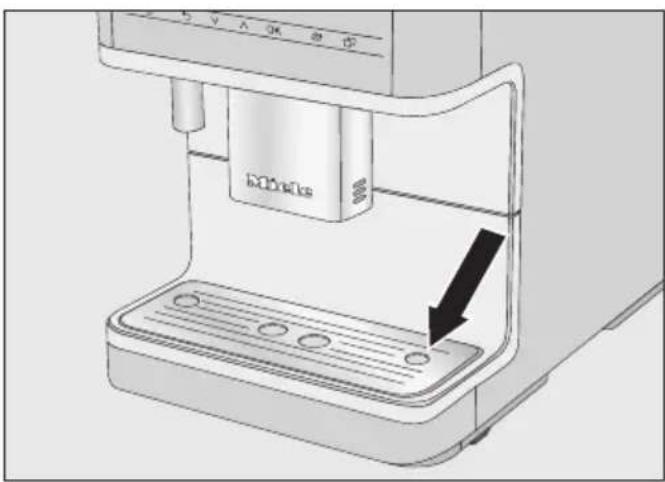
Diagram of a 3D printer presser with a black arrow indicating the press, showing no text or symbols on the device itself.■ Remove the protective foil from the drip tray cover and place the drip tray cover into the lower panel.
- Place the coffee machine on a flat surface that is not sensitive to water (see “Installation”).
Clean the appliance before filling it with water and coffee beans. Refer to the relevant instructions in "Cleaning and care"; for example, clean the bean container with a soft, dry cloth.
■ Clean the water container, the bean container and the central spout.
■ Remove the water container and fill it with fresh, cold tap water. Only fill the water container up to the “max.” marker and then refit it in the machine.
■ Take the lid off the bean container, fill it with roasted coffee beans and replace the lid.
■ Insert the plug of the coffee machine into the socket.
Switching on for the first time
■ Press the On/Off button ⏻ if nothing is visible on the display.
Selecting the display language
■ Select the desired display language.
You might also be asked for your location.
Setting up the network (Miele@home)
You can connect your coffee machine to your home WiFi network.
The following appears in the display during set-up: Set up "Miele@home"
Tip: You can also choose to set up Miele@home for your coffee machine at a later point. In this case, select Skip.
■ Make sure that your WiFi network signal is sufficiently strong in the place where you want to set up your coffee machine.
■ Touch Continue.
■ Select the connection method you wish to use.
■ Follow the instructions provided in the coffee machine display and in the Miele app.
Connection successfully established. will appear in the display.
■ Touch Continue to proceed with the set-up.
Setting the water hardness level
Contact your local water supplier to find out your local water hardness range if necessary.
More information can be found under "Settings – Water hardness".
■ Enter your local water hardness (in °dH) and confirm with OK.
Selecting the Performance mode
You can select the appropriate mode to suit your personal preferences (see "Settings – Performance mode").
- Eco mode: This is an energy-saving mode.
- Barista mode: This mode has been optimised for unadulterated coffee enjoyment.
- Latte mode: In this mode, milk-based drinks can be prepared within a much shorter space of time.
■ Select the desired mode and confirm with OK.
Your machine has been successfully set up and is ready for use.
■ Confirm with OK.
The coffee machine heats up and rinses the pipework. The water used for rinsing will run out of the central spout.
■ Before preparing milk for the first time, rinse the milk pipework (see "Cleaning and care – Rinsing the milk pipework").
Please note that the full aroma of the coffee and typical crema will not develop fully until several coffees have been made.
To ensure that any coffee residues from the factory testing process are removed from the brewing system, please throw away the first 2 cups of coffee when using the coffee machine for the first time.
Switch the coffee machine off with the On/Off button ⏻. Do not unplug the power plug to switch off the coffee machine. If you unplug the coffee machine from the mains supply while using it for the first time, you will have to set it up for use again.
For the first coffee drinks, a larger quantity of coffee beans is ground and powder from the coffee grounds may adhere to the lid of the drip tray.
Filling the water container

Risk to health due to minated water.
Bacteria can develop in water which has been sitting in the water container for too long and is a risk to your health.
Change the water in the water container every day.

Risk of damage due to incorrect tion.
Unsuitable liquids such as hot or warm water or other liquids can damage the coffee machine.
Bottled mineral water leaves too much limescale in the coffee machine.
Only use cold, fresh tap water to fill the water container.
natural_image
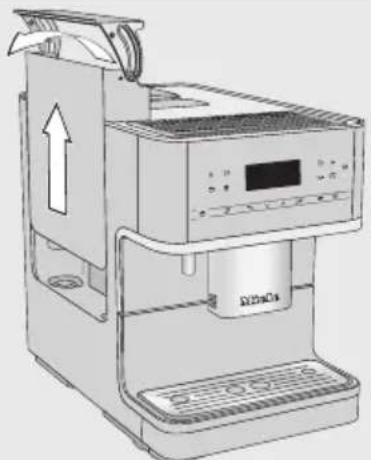
Illustration of a coffee maker with control panel and upward arrow indicating motion (no text or symbols)■ Press the lid on the right side.
■ Pull the water container up by the lid to remove it.
■ Fill the water container with fresh, cold drinking water up to the max. mark.
■ Reinsert the water container.
If the water container sits a little too high or at an angle, check whether the surface under the water container is soiled. This will prevent the dispenser valve from attaching correctly and water can leak out. Clean the surface underneath the water container if necessary.
Coffee or espresso can be made from whole roasted coffee beans which are freshly ground in the coffee machine for each portion. This requires the coffee bean container to be filled with coffee beans.
Alternatively, you can make coffee drinks with ready ground coffee.

Risk of damage to the grinder to incorrect operation.
The coffee machine will be damaged if the bean container is filled with unsuitable substances such as liquids, ground coffee or coffee beans treated with caster sugar, caramel or similar.
In addition, green (unroasted) coffee beans or mixtures of coffee beans which contain green coffee beans can damage the grinder. Green coffee beans are very hard and still contain residual moisture. These can damage the coffee machine grinder as soon as grinding begins.
Only put roasted coffee beans in the bean container.
Tip: You can use a nut or seed grinder to grind green coffee beans. These types of grinder generally have a rotating stainless steel blade. You can then add the ground green coffee one portion at a time to the ground coffee chute and make the desired coffee drink.
natural_image
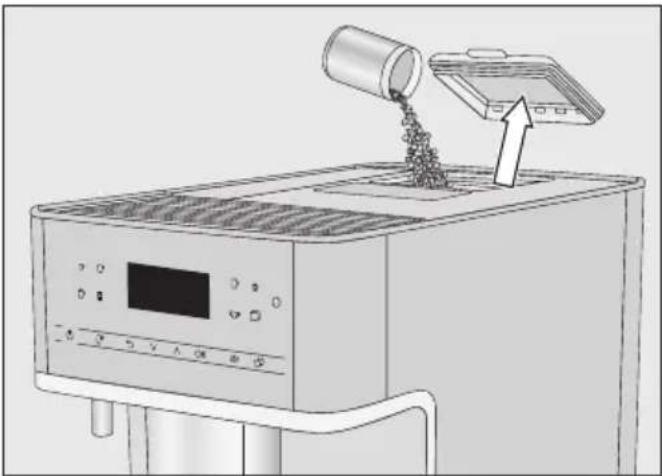
Line drawing of a food processing machine with a container pouring granular material into a tray (no text or symbols)■ Take the lid off the coffee bean container.
■ Fill the container with roasted coffee beans.
■ Replace the lid.
Tip: Only add enough beans to last for a few days.
Contact with air causes coffee beans to lose their aroma.
Switching the coffee machine on
■ Touch the On/Off button ⏻.
The coffee machine heats up and rinses the pipework. Hot water will run out of the central spout.
When Select drink appears in the display, you can make drinks.
If the coffee machine is already at operating temperature, rinsing will not take place.
If you do not touch any sensor control or run any maintenance programmes, the display will switch itself off after approx. 7 minutes to save energy. The OK sensor control will flash on and off as long as the coffee machine is switched on.
■ Touch one of the sensor controls to wake the coffee machine up again to make a drink.
Switching the coffee machine off
■ Touch the On/Off button ⏻.
If coffee has been dispensed, the coffee machine will rinse the pipework automatically before switching off.
Switching off for longer periods of time
If the coffee machine is not going to be used for a while, e.g. if you are going on holiday, remember to do the following:
■ Empty the drip tray, the waste container and the water container.
■ Clean all parts thoroughly, including the brew unit.
■ If necessary, switch off the coffee machine and unplug it to disconnect it from the power supply.
(depending on model: CM 6360, CM 6560)
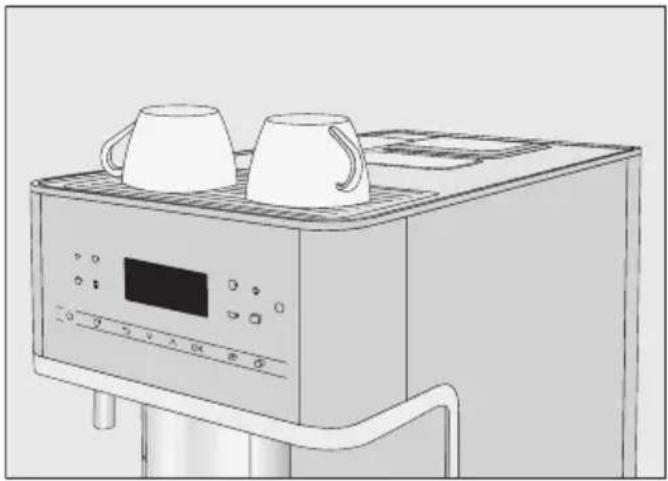
Cups should always be pre-heated to allow the flavour of the coffee to develop and its temperature to be retained.
You can pre-heat cups or glasses on the cup heating surface on the top of the coffee machine.
When the cup heating surface is activated, the cup rest will be heated continually until the coffee machine is switched off.
Switching the cup heater on or off
■ Touch the ☐ sensor control.
■ Select Settings | Cup heating.
■ Select the option you want and confirm with OK.
The setting is now saved.
Pre-heating cups
natural_image
Line drawing of a modern toaster with two mugs and a digital display (no text or symbols)■ Arrange the cups or glasses on the cup heating surface on the top of the coffee machine.
Adjusting the central spout to the correct cup height
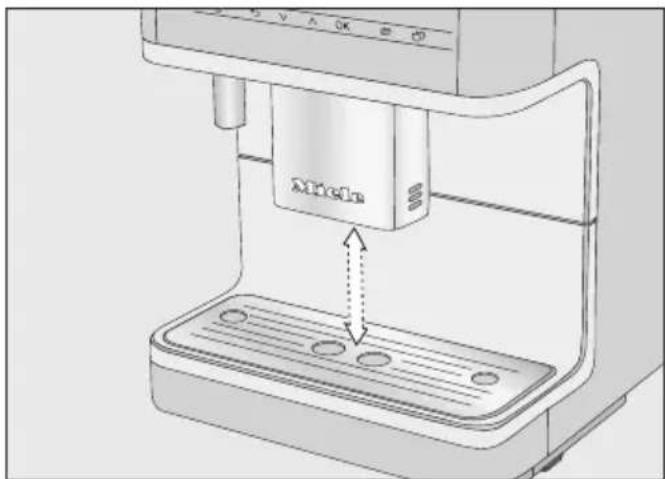
You can adjust the central spout to suit the height of the cup you are using so that the coffee or espresso will not cool down as quickly and the crema will have a better consistency.
natural_image
Technical illustration of a sewing machine with a central device and base platform (no text or symbols)■ Pull the central spout down until it is at the same level as the rim of the cup.
Alternatively, push the central spout up until there is enough room to fit a larger cup or mug underneath.
⚠️ Danger of burning and scalding on the dispensing spouts.
The liquids and steam dispensed are very hot and can cause scalding.
Keep well away from the area underneath the spouts when hot liquids and steam are being dispensed.
Do not touch hot components.
Making coffee with and without milk
The following drinks can be made:
- Ristretto is a strong, concentrated espresso. It is prepared with the same amount of coffee as for an espresso but with a lot less water.
- Espresso is a strong aromatic coffee with a thick hazelnut brown coloured froth – known as the crema – on top. We recommend using espresso-roasted coffee beans to make an espresso.
- Coffee differs from espresso by the increased amount of water and the roast of the beans. We recommend using coffee beans of the correct roast to make the coffee.
- Long coffee is a coffee with considerably more water.
- Cappuccino consists of approx. 2 thirds milk froth and 1 third espresso.
-
Latte macchiato consists of 1 third each of hot milk, milk froth and espresso.
-
Caffè latte consists of espresso and hot milk.
- Cappuccino italiano has the same proportions of milk froth and espresso as a cappuccino. The difference is that the espresso is added first and then the milk froth.
- Espresso macchiato is an espresso with a small amount of milk froth on top.
- Flat white is a special variety of cappuccino that contains significantly more espresso than milk froth for an intensive coffee aroma.
- Café au lait is a French style of coffee consisting of coffee and milk froth. Café au lait is usually served in a bowl.
Hot milk or milk froth can also be made.
Milk preparation
Milk or milk alternatives (e.g. soya milk) containing added sugar can clog up the milk pipe and the rest of the milk pipework. Residues from unsuitable liquids can interfere with milk preparation.
The milk used must not contain any additives.
Only use pasteurised cow's milk.
If you have not made any milk drinks for a while, rinse the milk pipework thoroughly before making the first drink.
Tip: Using cold cow's milk (< 10 °C) with a protein content of at least 3 % will produce the perfect milk froth. You can select milk with a fat content according to preference. With whole milk (at least 3.5 % fat), the milk froth will be slightly creamier than with low-fat milk.
You can prepare milk with the milk siphon or milk flask (included in the scope of delivery depending on the model).
natural_image
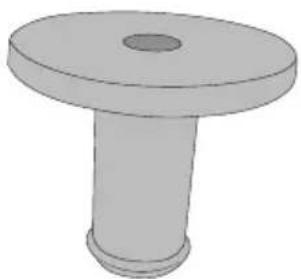
3D rendered image of a mechanical component with a flanged top and cylindrical base (no text or symbols)There is one connecting piece included in the scope of delivery which can be inserted either into the milk siphon or into the milk flask lid.
The appliance is supplied with the connecting piece either enclosed
separately or inserted into the milk flask lid (depending on the model). The connecting piece is easy to push out from the inside of the milk flask lid.
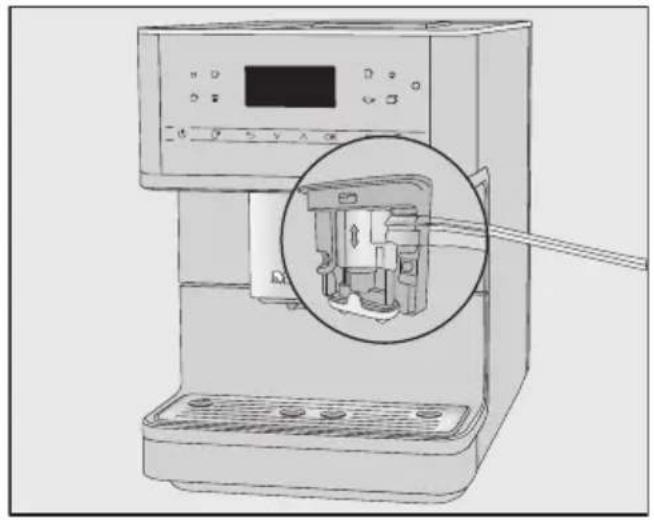
The “seam” on the milk pipework and on the central spout makes it easier to assemble it correctly.
natural_image
Technical line drawing of a digital kitchen appliance with an inset close-up showing internal components (no text or symbols)Using a milk carton with the milk siphon
The milk siphon enables you to prepare milk directly from milk cartons or other suitable containers.
natural_image
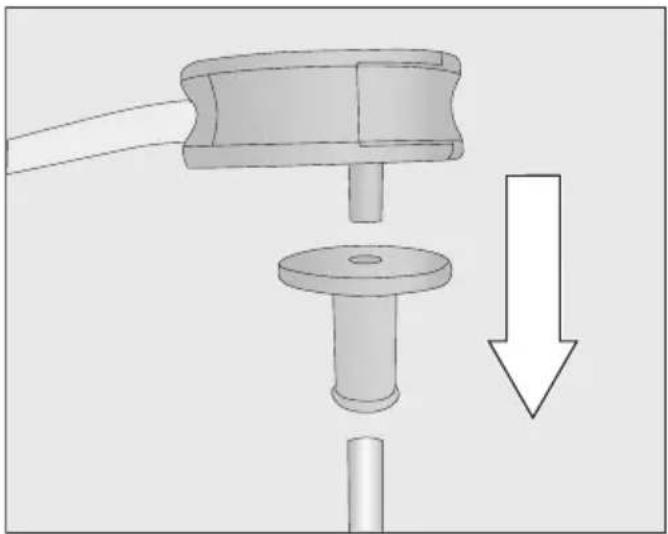
Mechanical assembly diagram showing a lever pressing down on a cylindrical component with a downward arrow indicating motion (no text or symbols)■ First insert the connecting piece onto the long stainless steel tube. Make sure that the slanted end of the stainless steel tube is pointing downwards.
■ Attach the rinse valve to the connecting piece.
natural_image
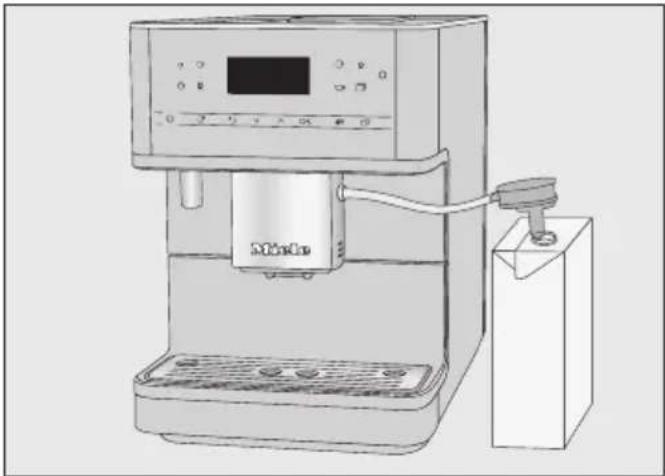
Line drawing of a coffee machine with control panel and side arm (no text or symbols)■ Open the milk carton and dip the milk siphon into the milk. Place the milk carton to the right next to the coffee machine.
■ Connect the milk pipework to the aperture in the central spout.
Tip: Rinse the milk siphon under running water after use.
The milk flask
depending on model: CM 6360, CM 6560
Milk is not cooled in the milk flask. For high-quality milk froth, always use cold milk (< 10 °C).
text_image
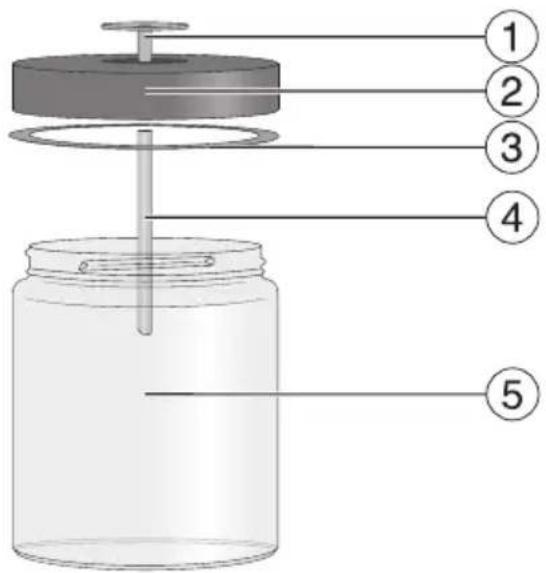
Diagram of a laboratory glass jar with numbered parts for identification① Connecting piece
② Lid
③ Sealing ring
④ Stainless steel tube
⑤ Glass
Using the milk flask
■ Insert the connecting piece into the lid from above until everything sits flush.
■ Connect the stainless steel tube to the inside of the lid. Make sure that the slanted end of the stainless steel tube is pointing downwards.
■ Fill the milk flask with milk up to a maximum of 2 cm below the rim. Seal the milk flask with the lid.
natural_image
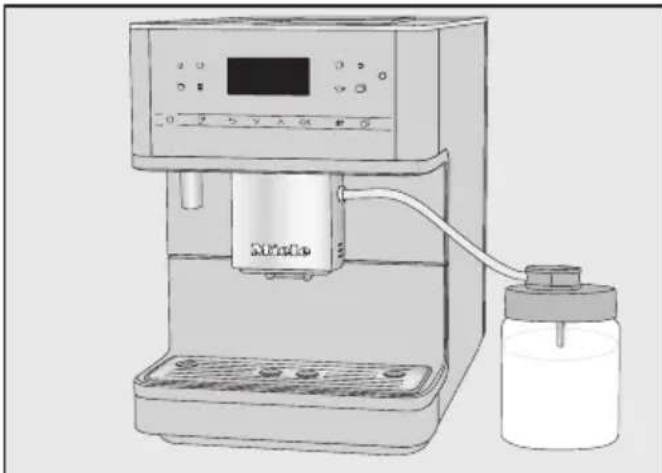
Line drawing of a milk tea machine with control panel and water bottle (no text or symbols)■ Place the milk flask to the right next to the coffee machine.
■ Attach the milk pipework rinse valve to the milk flask lid.
■ Connect the milk flask to the coffee machine by attaching the milk pipework to the aperture in the central spout.
If you have not made any milk drinks for a while, rinse the milk pipework thoroughly before making the first drink.
Making a coffee
natural_image
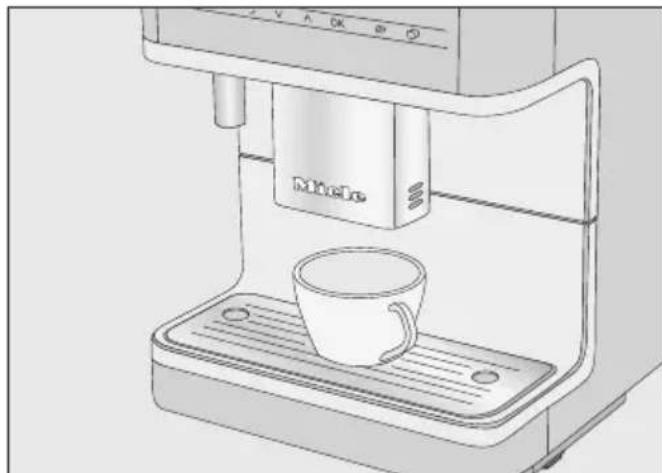
Line drawing of a coffee maker with a cup on a base (no text or symbols)■ Place a cup under the central spout.
■ Select a drink: touch the sensor control for the drink you want. Or select a drink from the Further | Other drinks menu (☐ sensor control).
Dispensing will start.
Cancelling a drink
■ Touch the lit orange symbol on the control panel again.
When preparing drinks with several ingredients (e.g. latte macchiato) you can cancel each of the individual components prematurely.
■ Touch OK when Stop appears in the display.
DoubleShot
Select the DoubleShot Ⓤ function if you would like a particularly strong and aromatic coffee. In this case, more coffee beans will be ground and brewed halfway through the brewing process. The shorter extraction time means that fewer unwanted aromas and bitter compounds will be released.
DoubleShot can be activated for all drinks apart from "Ristretto".
Making a DoubleShot 02 of coffee
■ Press the Ⓞ sensor control immediately before or after you start making a drink.
Dispensing starts and the ① sensor control lights up. 2 portions of coffee beans will be ground and brewed.
Making 2 portions (☐ sensor control)
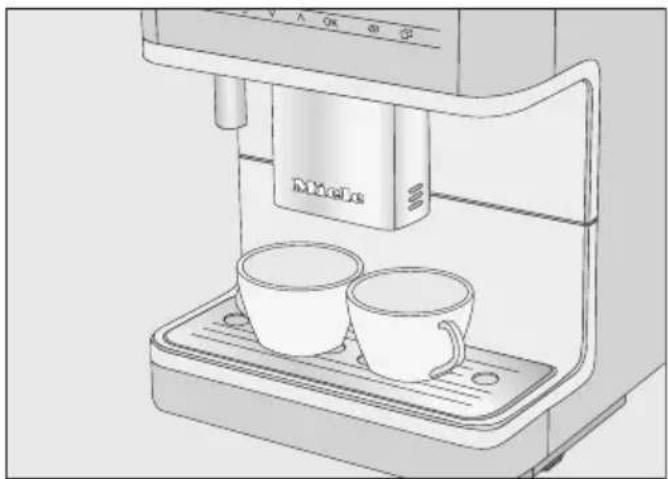
You can dispense 2 portions of a drink into 1 large cup or into 2 cups at the same time.
natural_image
Line drawing of a coffee machine with two cups on a tray (no text or symbols)■ Place a cup under each of the coffee dispensers in the central spout.
■ Press the ☐ sensor control immediately before or after you start making a drink.
The ☐ sensor control lights up.
The dispensing starts and 2 portions of the desired drink will be dispensed.
Coffee pot
You can make several cups of coffee one after the other automatically with the Coffee pot function (maximum of 1 litre).
The drinks menu is displayed.
Tip: Make sure that the bean and water containers have enough beans and water inside them before starting the Coffee pot function.
■ Place a sufficiently large container under the central spout.
■ Touch the ☐ sensor control.
■ Select Further | Other drinks | Coffee pot and confirm with OK.
■ Select the number of cups you want (3 to 8).
Each portion of coffee will be brewed and dispensed individually. You can follow the process in the display.
Cancelling a drink
■ Touch the ☐ sensor control.
Making coffee drinks with ground coffee
To make drinks using ready ground coffee, add a portion of ground coffee to the ground coffee chute.
This allows you to make a decaffeinated coffee if the bean container is already filled with regular coffee beans, for example.
Only 1 portion of coffee or espresso can be made at a time when using ready ground coffee.
Place a maximum of 12 g in the ground coffee chute. If too much ground coffee is added, the brew unit will not be able to process the coffee.
Adding ground coffee
The coffee machine will use all the ground coffee which has been added to the chute to make the next coffee.
natural_image
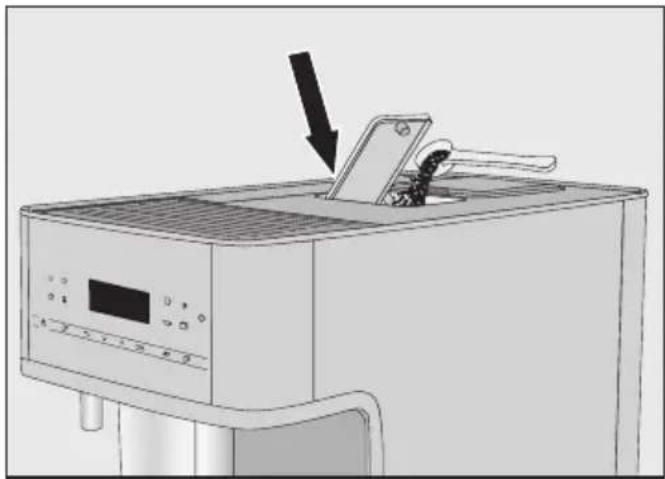
Line drawing of a kitchen appliance with a downward arrow indicating a component (no text or symbols present)■ Open the ground coffee chute.
Place a maximum of 12 g in the ground coffee chute.
■ Add ready ground coffee to the chute.
■ Close the coffee chute.
Making coffee with ground coffee
The following appears in the display: Use ground coffee?
■ Select Yes and confirm with OK.
You can now select which type of drink you would like to make with ground coffee.
■ Place a cup under the central spout.
■ Select a drink.
The coffee will now be made.
If you select No and confirm this with OK, the ground coffee will be disposed of in the waste container without being brewed. The appliance rinses.
Tea
The coffee machine is not intended for commercial or scientific purposes. Temperatures given are approximate and can vary according to ambient conditions.
To make tea, you can select from the following options:
- Japanese tea is a high-quality green tea which boasts a fine, fresh, "green" taste.
Dispensed temperature: approx. 60 °C, brewing time: approx. 1,5 minutes
- White tea is a green tea where only the young buds of the tea plant are used and processed very gently. White tea has a particularly mild taste.
Dispensed temperature: approx. 63 °C, brewing time: approx. 2 minutes
- Green tea gets its green colour from the leaves of the tea plant. The tea leaves are either roasted or steamed depending on the region. Green tea can be infused multiple times.
Dispensed temperature: approx. 74 °C, brewing time: approx. 2,5 minutes
- Black tea gets its dark colour and characteristic taste from the fermentation of tea leaves. Black tea can be enjoyed with a little lemon or milk.
Dispensed temperature: approx. 78 °C, brewing time: approx. 3 minutes
- Herbal tea is an aromatic infusion drink made up of dried leaves or fresh parts of plants.
Dispensed temperature: approx. 78 °C, brewing time: approx. 8 minutes
- Fruit tea is made from dried pieces of fruit and/or parts of plants, e.g. rose hip. The taste of the drink varies according to which plants are used and how they are blended. Lots of fruit teas are also flavoured. Dispensed temperature: approx. 78 °C, brewing time: approx. 8 minutes
The type of tea determines the preset temperature.
The respective dispensing temperatures are the ones that Miele recommends for making the types of tea concerned.
You can adjust the dispensing temperatures used for the individual teas by customising the brewing temperature (see “Parameters – Brewing temperature”). A temperature increment of approximately 2 °C makes a noticeable difference.
Whether you use loose tea leaves, blended tea or tea bags depends on your own personal preference.
Follow the instructions for making tea on the tea packaging.
The amount of tea required varies from one type of tea to another. Always follow the recommendations of the manufacturer on the packaging or of the retailer. You can adjust the amount
of water according to the type of tea and the size of the cup (see “Portion size”).
TeaTimer
You can use the TeaTimer function to start a minute minder when making tea. There is a preset brewing time for the type of tea selected. You can adjust the preset brewing time (up to a maximum of 14:59 minutes). The changed brewing time is saved.
While the brewing time is counting down, you can continue to use the coffee machine as normal. After the brewing time has elapsed, a buzzer will sound and the 🔔 symbol will flash.
Setting the TeaTimer
You can choose between the following options:
- Automatic: The TeaTimer starts automatically once the water has been dispensed.
- Manual: Once the water has been dispensed, you have the option of starting the TeaTimer.
The drinks menu is displayed.
■ Touch the ☐ sensor.
■ Select Settings | TeaTimer.
■ Select the setting you want and confirm with OK.
Making tea
Touch the 🚽 sensor control to access the menu containing the various types of tea.
The drinks menu is displayed.
■ Pour loose tea into a tea filter or similar, or take a tea bag from the packet.
■ Place the tea filter or the tea bag in the tea cup.
natural_image
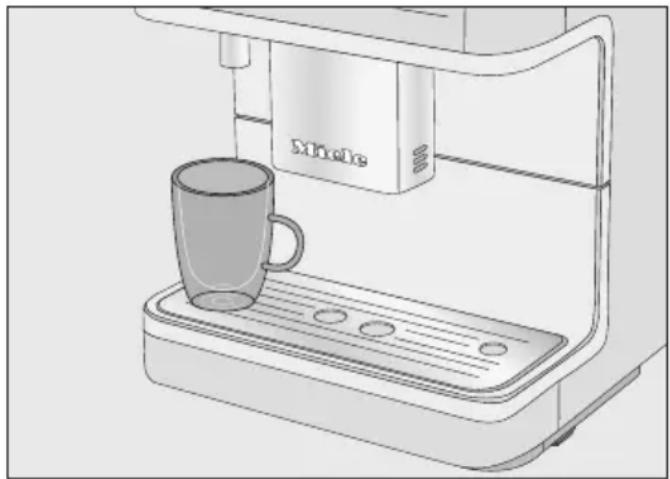
Line drawing of a coffee machine with a mug and tray (no text or symbols)■ Place the cup under the hot water spout.
■ Touch the 📋 sensor control.
■ Select the type of tea you want and confirm your choice with OK.
Hot water will be dispensed into the cup.
If the TeaTimer | Automatic setting has been selected, the minute minder for the brewing time will start running once the water has been dispensed.
Starting the TeaTimer manually
TeaTimer appears in the display as soon as the water has been dispensed.
■ Touch OK.
The editor will open with a suggested time.
■ Change the brewing time if required and confirm with OK.
After the brewing time has elapsed, a buzzer will sound and the 🔔 symbol will flash.
■ Remove the tea filter or tea bag when the desired brewing time has elapsed.
Dispensing warm or hot water
Danger of burning and scalding on the hot water spout. The liquids and steam dispensed are very hot and can cause scalding.
Keep well away from the area underneath the spouts when hot liquids and steam are being dispensed.
Do not touch hot components.
You can choose between the following options:
- Hot water at approx. 80 °C
- Warm water at approx. 60 °C
The drinks menu is displayed.
■ Place a suitable container underneath the hot water spout.
■ Touch the ☐ sensor control.
■ Select Other drinks and choose between warm or hot water.
■ Confirm with OK.
Dispensing will start.
The Expert mode function allows you to change the portion size while the drink is being made. The setting will not be saved and will only apply for the current drink.
Switching Expert mode on and off
The drinks menu is displayed.
■ Touch the ☐ sensor.
■ Select Settings | Expert mode.
■ Select the option you want.
■ Confirm with OK.
The setting is now saved.
Expert mode: changing the portion size
The drinks menu is displayed.
The portion size can only be changed when the respective ingredient is being processed while the drink is being made.
If you select DoubleShot Ⓞ or 2 portions ☐, Expert mode cannot be used to change the portion size.
■ Select a drink.
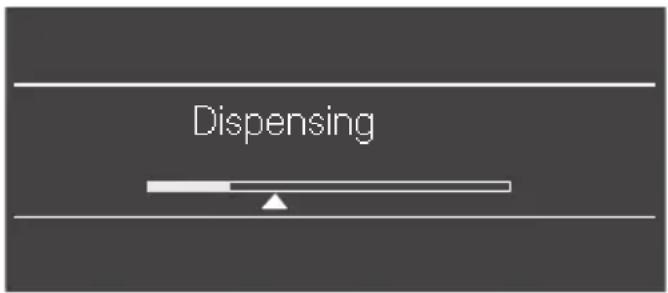
Dispensing will start. You can adjust the portion size while it is being dispensed, e.g. individually change the amount of hot milk, milk froth and espresso for a latte macchiato.
text_image
Dispensing■ Use the ∧ arrow buttons and the ∨ indicator (small triangle) to adjust as required.
The grinder setting determines the contact time between the ground coffee and the water, known as the extraction time. When the ideal grinder setting is selected, the machine dispenses a perfect cup of coffee with a fine, hazelnut-brown crema.
The grinder setting you select will be used for all coffee drinks.
There are various ways to tell whether the coffee grinder is set correctly.
The grinder setting is too coarse if the coffee or espresso is watery and tastes acidic. The crema is very pale.
Set a finer grinder setting.
The grinder setting is too fine if the coffee or espresso tastes too bitter and the crema is dark brown.
Set a coarser grinder setting.
Only adjust the grinder one setting at a time.
Start making a new drink to grind beans again. Adjust the grinder setting one setting at a time again.
Adjusting the fineness of grind
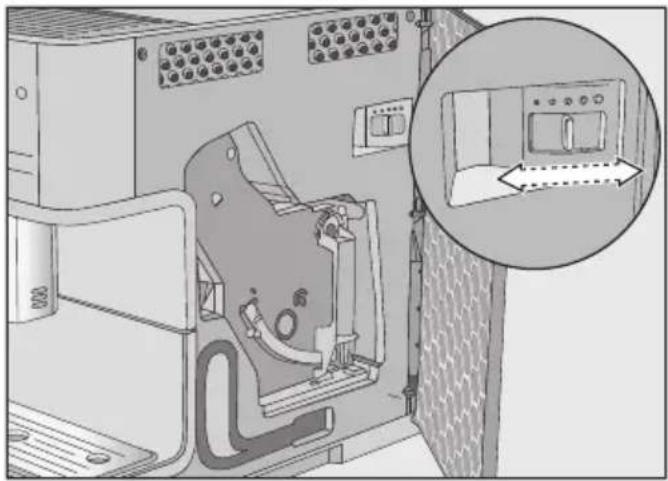
■ Open the appliance door.
natural_image
Technical diagram of an internal device with a magnified inset showing a control panel and directional arrow (no text or symbols)■ Push the slide control a maximum of one setting to the left (for finer grinding) or to the right (for coarser grinding).
■ Close the appliance door.
■ Empty the drip tray and the waste container.
■ Make one cup of coffee.
Adjust the grinder setting again, if required.
The altered grinder setting will not be used until after the second coffee has been dispensed.
Displaying and changing parameters
You can change the portion size for all drinks.
In addition, you set the quantity of coffee, the brewing temperature and pre-brewing for each coffee drink individually.
■ Touch □ and then select Parameters.
■ Select a drink and confirm with OK.
The parameters that can be changed for this drink are displayed.
Once you have selected a drink, the current settings for the following appear: Amount of coffee, Brew temperature and Pre-brewing.
The Portion size menu option is displayed in the first line. If you select Portion size and confirm with OK, the drink will be dispensed immediately.
■ Select the parameter you want.
■ Change the setting as required and confirm with OK.
The setting is now saved.
Portion size
The flavour of the coffee produced depends not only on the type of coffee, but also on the amount of water used. You can programme the amount of water for all drinks (apart from the Coffee pot function) to suit the size of your cups and/or the type of coffee you are using.
For coffee drinks that use milk, you can not only set the amount of espresso or coffee but also the amount of milk or milk froth to be dispensed with these drinks.
A maximum portion size can be programmed for each type of drink. Dispensing stops once this has been reached. The maximum possible portion size is then saved by the machine for this type of drink.
If the water container becomes empty whilst making a drink, the coffee machine will stop programming the portion size. The portion size will not be saved.
Changing the portion size
■ Place a cup under the central spout.
■ Select Portion size and confirm with OK.
The desired drink will be made and Save will appear in the display.
■ When the cup is filled up to the level you want, touch OK.
If you want to change the portion size for coffee made with milk, the ingredients which make up the drink will be saved one after the other while the drink is being made.
■ When the quantity for each ingredient reaches the level you want, touch OK.
The programmed portion size will now be dispensed every time that particular drink is selected.
Tip: For the drinks pictured on the control panel, you can change the portion size by pressing and holding the button down while the drink is being dispensed. To do this, keep the drinks sensor pressed until the machine starts dispensing. During dispensing, Save appears in the display.
Quantity of coffee
The coffee machine can grind and brew 6-14 g of coffee beans per cup. The greater the quantity, the stronger the coffee.
The quantity of coffee is too low if the espresso or coffee lacks body.
Increase the quantity of coffee so that more ground coffee is brewed.
The quantity of coffee is too high if the espresso or coffee tastes bitter.
Decrease the quantity of coffee so that less ground coffee is brewed.
Tip: If the coffee is too strong for you or it tastes bitter, try a different type of bean.
Brewing temperature
The brewing temperature must be adapted to the beans you are using and how they are roasted. It also varies depending on whether you are making espresso or coffee.
Some bean types are sensitive to high brewing temperatures, resulting in an impaired taste. If your coffee tastes bitter, the brewing temperature you have selected might be too high.
Espresso is usually brewed at higher temperatures.
Pre-brewing the ground coffee
When the pre-brewing function is turned on, the ground coffee is first moistened with a little hot water. The ground coffee swells a little. The remaining amount of water is then pressed through the moistened coffee grounds shortly after. If your coffee tastes too bland and you want to add some spice and richness, try the “Pre-brewing” function. Depending on the type of coffee used, pre-brewing can intensify the taste.
You can set a short or long duration for pre-brewing or turn the “Pre-brewing” function off completely.
Tip: We particularly recommend using the “Pre-brewing” function to make coffee.
In addition to the Miele drinks menu (Miele profile), you can create individual profiles to cater for different tastes and preferences.
Within the profile, you can adjust the portion sizes and parameters individually for all drinks.
The name of the current profile is shown in the top left of the display.
Creating profiles
■ Touch the ☐ sensor control and select Profiles. Confirm with OK.
The Profiles menu opens.
■ Select Create profile.
The editor will open in the display.
Entering a name
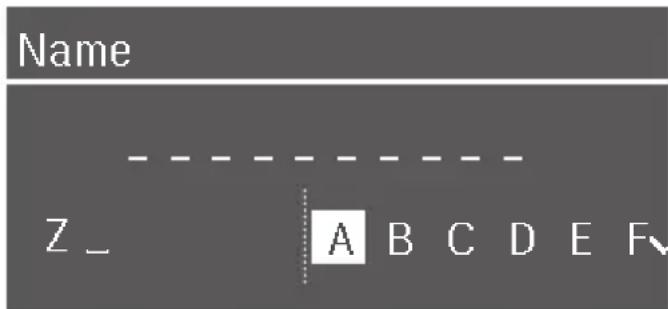
Letters and numbers are entered using the ∧ and ∨ arrow buttons. You can choose between upper and lower case letters.
text_image
Name Z_ A B C D E F- To enter a character, highlight the one you want and confirm your choice with OK.
- To delete a character, touch the sensor control.
- To save the name, select the tick √ and confirm with OK.
■ Enter the profile name.
Tip: It is best to select short names.
The profile has been created.
Making drinks stored in a profile
■ Touch the ☐ sensor control and select Profiles. Confirm with OK.
■ Select the profile you want.
■ Select the drink you want.
The machine starts dispensing the drink.
Changing drinks within a profile
When you change the parameters of a drink within a profile, these settings only apply to the active profile. The settings for drinks contained within other profiles remain unaffected.
■ Select the profile you want.
The name of the selected profile is shown in the top left of the display.
You can now change the drinks individually.
Editing profiles
Once you have created at least one profile, you can rename, delete or set when the profile should change in the Profiles menu.
■ Select Edit and confirm with OK.
You can now edit the selected profile.
Setting when the profile should change
You can choose between the following options:
- Manual: The selected profile will remain active until you select another one.
- After each use: The machine will revert to the Miele profile whenever a drink is dispensed.
- When switched on: The Miele profile will be displayed whenever the coffee machine is switched on, regardless of which profile was selected before the machine was last switched off.
■ Select Change profile and confirm with OK.
■ Select the option you want and confirm with OK.
Changing the name
This option can only be selected if a profile has been allocated in addition to the Miele standard profile.
■ Select Change name and confirm with OK.
■ Change the name as required (see also “Creating profiles”).
Deleting a profile
This option can only be selected if a profile has been allocated in addition to the Miele standard profile.
■ Select Delete profile and confirm with OK.
■ Select the profile you wish to delete.
■ Select Yes and confirm with OK.
The profile will be deleted.
With MobileStart you can, for example, start making a drink via the Miele app.
You will only be able to use MobileStart if Miele@home has been set up for your coffee machine.
⚠️ Danger of burning and scalding on the dispensing spouts.
If liquids or steam are dispensed while the machine is unsupervised, persons may burn themselves if they place body parts under the central spout or touch hot components.
Ensure that no one, especially children, can be harmed if the machine is operated without supervision.
Milk is not cooled in the milk container. If you want to start making a drink with milk using the app, make sure that the milk is sufficiently cold (< 10 °C).
If the coffee machine is being operated manually, it cannot be operated via the app. Operation on the appliance takes precedence.
To start making drinks remotely, Mobile Start must be activated. Make sure that the coffee machine is ready to use, for example check that the water container is sufficiently filled. Place a sufficiently large, empty cup under the central spout.
If you are making a drink with MobileStart, you will be notified of drink dispensing with acoustic and optical signals. These signals cannot be changed or switched off.
Switching MobileStart ☐ on and off
If you want to use MobileStart ☐, the Remote control option must be switched on.
The drinks menu is displayed.
■ Touch the ☐ sensor.
The ☐) sensor lights up. You can now starting making a drink via the app. Follow the prompts for doing this.
Displaying and changing Settings
The drinks menu is displayed.
■ Touch the ☐ sensor control.
■ Select Settings ▶ and touch OK.
■ Select the menu option that you want to display or change.
■ Confirm with OK.
■ Change the setting as required and confirm with OK.
Some settings which can be found in the Settings menu are described in their separate sections in the operating instructions.
Language
You can select the language (and location variant of that language) for all display text.
Tip: If you select the wrong language by mistake, you can find the "Language" option again via the ▶ symbol.
Timer: switch off after
If none of the sensors have been touched or no drink has been made, the coffee machine will switch itself off after 20 minutes to save energy.
You can change this to another time (can be set between 20 minutes and 9 hours).
TeaTimer
You can use the TeaTimer to start a minute minder when making tea (see "Making drinks – TeaTimer").
Volume
You can set the volume of the buzzer and keypad tones (segment bar).
Display brightness
You can set the display brightness (segment bar).
Lighting
You can change the brightness of the lighting while the coffee machine is switched on or off.
You can also specify how long the lighting should stay on for when the machine is switched off (adjustable between 15 minutes and 9 hours).
Info (display information)
You can display the number of drinks dispensed so far and how many more can be dispensed until the maintenance programmes have to be run.
Altitude
If the coffee machine is installed at high altitudes, the lower air pressure will cause the water to boil at a lower temperature. You can set the local altitude of the machine to ensure that the correct temperatures are achieved.
Performance mode
You can select the appropriate performance mode for how you use your machine. Eco mode is set by default.
Eco mode
Eco mode is an energy-saving mode. The system does not heat up until someone starts making a drink.
Barista mode
This performance mode has been optimised for unadulterated coffee enjoyment. Users can enjoy coffee-based drinks without any delay as the coffee machine remains heated to the brewing temperature. This mode consumes more energy than Eco mode.
Latte mode
This performance mode has been optimised for preparing milk. Milk-based drinks can be prepared within a much shorter space of time. This mode consumes more energy than Eco mode and Barista mode.
Party mode
This Performance mode has been configured for the occasional intensive use of the coffee machine, e.g. for family get-togethers.
Clean the coffee machine thoroughly after intensive use, particularly the milk pipework. It may be necessary to descale the coffee machine and degrease the brew unit.
Please note the following information about Party mode:
- Cleaning status messages or cleaning prompts are suppressed and delayed until the machine is next switched on.
- The timer Switch off after is deactivated. The coffee machine switches off 6 hours after the last sensor was pressed.
- The cup light remains permanently switched on at the maximum brightness level for as long as the coffee machine stays switched on.
Water hardness
Programme the coffee machine to the water hardness level of your area so that it functions correctly and does not get damaged.
Contact your local water supplier to find out your local water hardness range if necessary.
If you are using bottled drinking water, e.g. mineral water, select settings according to the calcium content. The calcium content is specified on the label of the bottle in mg/l Ca^2+ or ppm (mg Ca^2+/l ).
Do not use carbonated water.
The hardness level is set to 21^ dH by default.
| Water hardness Calcium content mg/l Ca^2+ or ppm ( mg Ca^2+/l ) | Settings | ||
| °dH mmol/l | |||
| 1 0.2 | 7 1 | ||
| 2 0.4 | 14 2 | ||
| 3 0.5 | 21 3 | ||
| 4 0.7 | 29 4 | ||
| 5 0.9 | 36 5 | ||
| 6 1.1 | 43 6 | ||
| 7 1.3 | 50 7 | ||
| 8 1.4 | 57 8 | ||
| 9 1.6 | 64 9 | ||
| 10 1.8 | 71 10 | ||
| 11 2.0 | 79 11 | ||
| 12 2.1 | 86 12 | ||
| 13 2.3 | 93 13 | ||
| 14 2.5 | 100 14 | ||
| 15 2.7 | 107 15 | ||
| 16 2.9 | 114 16 | ||
| 17 3.0 | 121 17 | ||
| 18 3.2 | 129 18 | ||
| 19 3.4 | 136 19 | ||
| 20 3.6 | 143 20 | ||
| 21 3.8 | 150 21 | ||
| 22 3.9 | 157 22 | ||
| 23 4.1 | 164 23 | ||
| 24 4.3 | 171 24 | ||
| 25 4.5 | 179 25 | ||
| 26 4.6 | 186 26 | ||
| 27 4.8 | 193 27 | ||
| 28 5.0 | 200 28 | ||
| 29 5.2 | 207 29 | ||
| Water hardness C | Calcium content mg/l Ca^2+ or ppm ( mg Ca^2+/l ) | Settings | |
| °dH mmol/l | |||
| 30 5.4 | 214 30 | ||
| 31 5.5 | 221 31 | ||
| 32 5.7 | 229 32 | ||
| 33 5.9 | 236 33 | ||
| 34 6.1 | 243 34 | ||
| 35 6.3 | 250 35 | ||
| 36 6.4 | 257 36 | ||
| 37-45 6 | 6-8.0 258- | 321 37-45 | |
| 46-60 8 | 2-10.7 | 322-429 46-60 | |
| 61-70 | 10.9-12.5 | 430-500 61-70 | |
Tip: If your water hardness is >21 °dH (3.8 mmol/l), we recommend using bottled drinking water instead (< 150 mg/l Ca ^2+ ). This will mean your coffee machine will need to be descaled less often and there will be less impact on the environment because less descaler will be used.
System lock

You can lock the coffee machine to prevent it being used without your knowledge, by children, for example.
Temporarily deactivating the system lock 🔒
■ Press and hold OK for 6 seconds.
The system lock is reactivated when the coffee machine is next switched off.
Miele@home
The following options may appear under Miele@home:
- Set up: This option only appears if the coffee machine has never been connected to a WiFi network or if the network configuration has been reset.
- Deactivate*/Activate*: The settings for the WiFi network are retained, but the network is switched on or off.
- Connection status*: Information about the WiFi connection is displayed. The symbols indicate the strength of the connection.
- Set up again*: The settings for the current WiFi network will be reset. The WiFi connection will be set up from scratch.
- Reset*: The WiFi is switched off and the settings for the current WiFi network will be reset.
The network configuration should be reset whenever the coffee machine is being disposed of or sold, or if a used coffee machine is being put into operation. This is the only way to ensure that all personal data has been removed and the previous owner will no longer be able to access the coffee machine.
* This menu option appears if Miele@home has been set up and the coffee machine has – where applicable – been connected to a WiFi network.
Remote control
The remote control option appears when the coffee machine is connected to a WiFi network.
You can change the coffee machine settings, for example, in the Miele app when remote control is switched on. To start making a drink via the app, MobileStart must be activated as well.
The remote control function is switched on by default.
RemoteUpdate
The RemoteUpdate menu option is only displayed and can only be selected if the requirements for using Miele@home have been met.
The RemoteUpdate function allows the software on your coffee machine to be updated. If an update is available for your coffee machine, it will automatically download it. Updates will not be installed automatically. They must be initiated manually.
If you do not install an update, you can continue to use your coffee machine in the usual way. However, Miele recommends installing updates.
Activating/deactivating
The RemoteUpdate function is activated by default. Available updates will be downloaded automatically but will only be installed if you initiate installation manually.
Deactivate RemoteUpdate if you do not want any updates to be downloaded automatically.
Running a RemoteUpdate
Information about the content and scope of an update is provided in the Miele app.
A message will appear in your coffee machine display if a software update is available.
You can install the update immediately or postpone this until later. When the coffee machine is switched on again, you will be reminded about the update.
Deactivate RemoteUpdate if you do not want to install the update.
The update may take several minutes.
Please note the following information about the RemoteUpdate function:
- You will only receive a message when an update is available.
- Once an update has been installed, it cannot be undone.
- Do not switch the coffee machine off during the update. Otherwise, the update will be aborted and will not be installed.
- Some software updates can only be carried out by the Miele Customer Service Department.
Software version
The “Software version” menu option is intended for the Miele Customer Service Department. You do not need this information for domestic use.
Showroom programme (Demo mode)
Do not activate this function for domestic use.
The Showroom programme | Demo mode function enables the coffee machine to be demonstrated in shops or showrooms. In this mode, the appliance lights up but no drinks can be prepared and no maintenance programmes can be run.
You can activate demo mode without commissioning the appliance for the first time. Switch the coffee machine on and off again. Press the control for 5 seconds straight away. Demo mode is activated.
Factory defaults
You can reset the coffee machine to its factory default settings.
The following will not be reset:
- The number of drinks dispensed and the appliance status (No. of portions until appliance needs descaling, ... brew unit needs degreasing)
- Language
- Profiles and the associated drinks
- Miele@home
Cleaning and care

Risk to health due to inadequate cleaning
Heat and moisture inside the coffee machine can cause coffee residues to become mouldy and/or milk residues to go off and pose a risk to health. Carefully clean the coffee machine regularly.
Overview of cleaning intervals
Recommended frequency What do I have to clean / maintain?
| Daily(at the end of the day) | Water container |
| Waste container | |
| Drip tray and drip tray cover | |
| Milk flask | |
| Milk siphon | |
| Once a week(more often if heavily soiled) | Central spout |
| Milk pipework rinse valve and connecting pieces (with cleaning brush) | |
| Brew unit | |
| Interior area underneath the brew unit | |
| Casing (especially important immediately after descaling) | |
| Once a month Bean container and ground coffee chute | |
| When prompted Degrease the brew unit (1 cleaning tablet) | |
Cleaning by hand or in the dishwasher
The brew unit is not dishwasher safe.
Clean the brew unit by hand only under warm running water. Do not use washing-up liquid or any other cleaning agent.
The following components must be cleaned by hand only:
- Central spout stainless steel cover
- Brew unit
- Water container lid
- Bean container lid
- Lower panel
⚠️ Risk of damage as a result of excessively high dishwasher temperatures.
Components may be ruined (e.g. may become warped) if washed in a dishwasher at temperatures higher than 55 °C.
For dishwasher-safe components, always select dishwasher programmes with a maximum temperature of 55 °C.
Contact with natural dyes such as those found in carrots, tomatoes and ketchup may discolour the plastic parts in the dishwasher. This discolouration does not affect the stability of the parts.
The following components are dishwasher safe:
- Drip tray and lid
- Drip tray cover
- Waste container
- Water container
- Central spout (without stainless steel cover)
- Milk pipework with rinse valve
- Milk siphon
- Milk flask with lid (included depending on model)
Danger of burning and scalding on hot components or by hot liquids.
Components can become very hot during operation. Touching hot components can cause burning. The liquids and steam dispensed are very hot and can cause scalding.
Keep well away from the area underneath the spouts when hot liquids and steam are being dispensed.
Always allow the coffee machine to cool down before cleaning it.
Please be aware that water in the drip tray can also be very hot.
⚠️ Risk of damage due to moisture ingress.
The steam from a steam cleaning appliance could reach live electrical components and cause a short circuit.
Do not use a steam cleaner to clean the coffee machine.
It is important to clean the machine regularly, as the used coffee grounds will soon go mouldy. Milk residues can go off and can block the milk pipework.
Unsuitable cleaning agents
Contact with unsuitable cleaning agents can alter or discolour the external surfaces. All surfaces are susceptible to scratching.
Remove all cleaning agent residues immediately. To protect the machine and surrounding surfaces from damage, make sure you remove any spillages or splashes of descaler immediately.
To avoid damaging the surfaces, do not use:
- Cleaning agents containing soda, ammonia, acids or chlorides
- Solvent-based cleaning agents
- Cleaning agents containing descaling agents (unsuitable for cleaning the casing)
- Stainless steel cleaners
- Dishwasher cleaning agents (unsuitable for cleaning the casing)
- Glass cleaning agents
- Cleaning agents for ceramic glass hobs
- Oven cleaner
- Abrasive cleaning agents, e.g. powder cleaners and cream cleaners
- Hard, abrasive sponges, e.g. pot scourers, brushes or sponges which have been previously used with abrasive cleaning agents
- Eraser stain remover blocks
- Sharp metal scrapers
- Steel wool or stainless steel wire scourers
Drip tray and waste container
Clean the drip tray and waste container every day to avoid unpleasant smells and mildew.
The waste container is located in the drip tray. Water from rinsing also collects in the waste container.
A prompt will appear in the coffee machine display when the drip tray and/or the waste container is full and needs to be emptied. Empty the drip tray and the waste container.

Danger of burning!
If the rinsing process has just finished, wait a while before removing the drip tray from the coffee machine. The water used for rinsing will continue to run out of the coffee spouts for a while.
Remove the drip tray and the waste container while the coffee machine is switched on. Otherwise the message Empty and refit the drip tray and the waste container will appear in the display even though the drip tray and/or the waste container are not filled to the maximum level.
■ Push the central spout up as far as it will go.
text_image
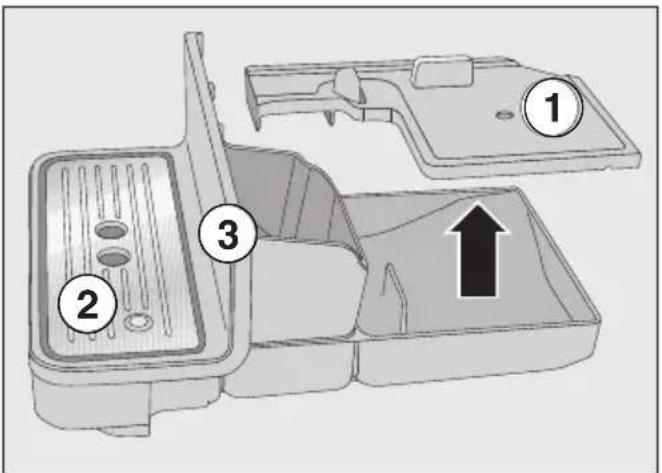
Technical diagram of a mechanical component with numbered parts and an upward arrow indicating direction■ Pull the drip tray carefully out of the coffee machine. Take the lid ① off.
■ Empty the drip tray and the waste container.
■ Remove the drip tray cover ② and lower panel ③.
■ Clean all parts thoroughly.
Clean the lower panel by hand only using hot water, a little washing-up liquid and a soft cloth.
All other parts are dishwasher-safe.
■ Clean the inside of the appliance underneath the drip tray.
■ Reassemble all parts and place the drip tray back in the coffee machine.
Make sure the drip tray has been pushed right into the appliance as far as it will go.
Cleaning the drip tray cover
■ Remove the drip tray cover.
■ The drip tray cover can be cleaned in the dishwasher, or by hand using warm water and a little washing-up liquid.
■ Dry the drip tray.
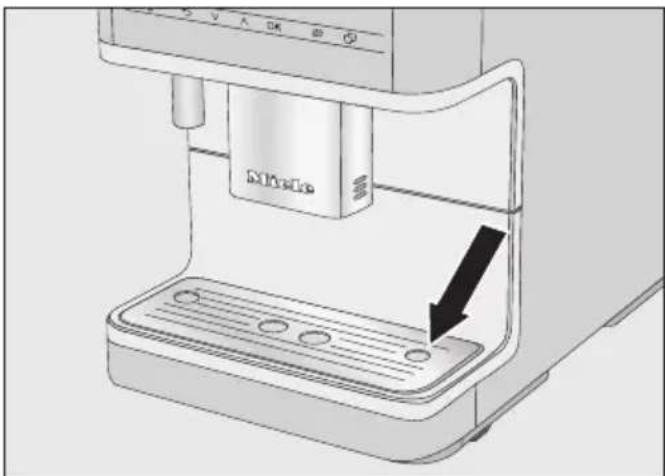
natural_image
Diagram of a sewing machine with a black arrow indicating a sewing step (no text or symbols present)■ Refit the drip tray. Make sure that the drip tray cover is correctly fitted (see picture).
Water container
Clean the water container lid by hand only using warm water and a little washing-up liquid.
Clean the water container every day. You can clean the water container in the dishwasher once a week.
■ Press on the mark on the water container lid.
■ Pull the water container up by the lid to remove it.
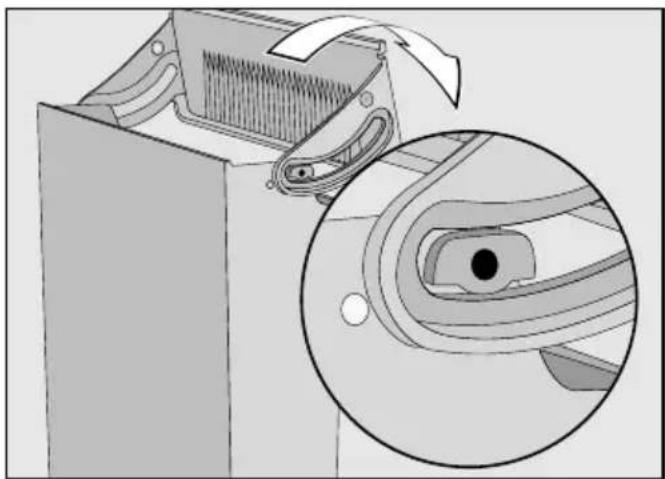
natural_image
Diagram of a refrigerator interior showing heat sink and door handle, with an inset close-up highlighting the interior structure (no text or symbols)■ Remove the lid from the container and wash it by hand.
■ The water container can be cleaned in the dishwasher, or by hand using hot water and a little washing-up liquid. After cleaning, dry the water container.
■ Carefully clean and dry the surface the water container sits on, taking special care to clean the recesses properly.
■ Reassemble the water container.
Make sure that the valve, the underside of the water container and the surface the water container sits on are clean. Otherwise the water container will not sit correctly.
Removing and cleaning the water container filter
Clean the water container filter once a month.
The water container filter is located under the water container.
■ Remove the water container.
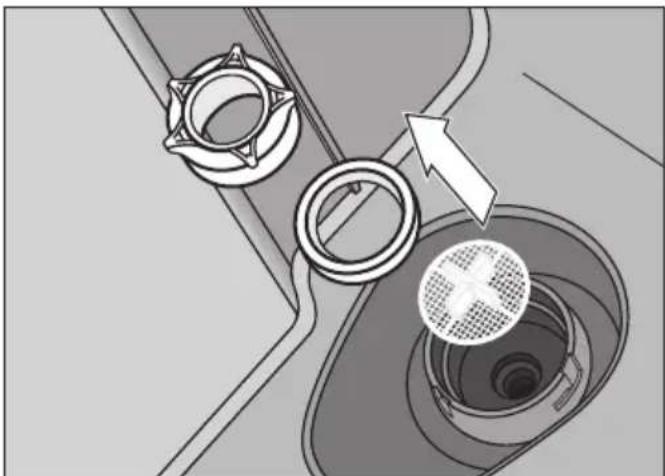
natural_image
Diagram showing mechanical components and a directional arrow, no text or symbols present■ Unscrew the cap. Remove the sealing ring and the filter.
■ Rinse all parts carefully under running water.
■ Then replace the water container filter (with the cross facing upwards) and then the sealing ring. Finally screw the cap back on tightly.
■ Replace the water container.
Dismantling and cleaning the central spout
Clean the central spout's stainless steel cover by hand only, using warm water and a little washing-up liquid.
All other parts are dishwasher-safe.
- Use the supplied cleaning brush for parts that are difficult to reach, e.g. in the dispensing unit.
- Stubborn soiling is easier to clean if you soak the individual components overnight in water and washing-up liquid. Rinse the components under running water afterwards.
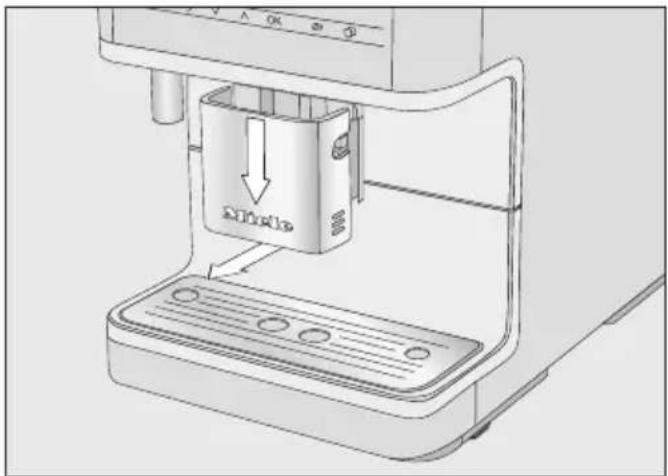
natural_image
Technical line drawing of a printer or printer with a central device and base platform (no text or symbols visible)■ Push the central spout right down and remove the stainless steel cover by pulling it off towards you.
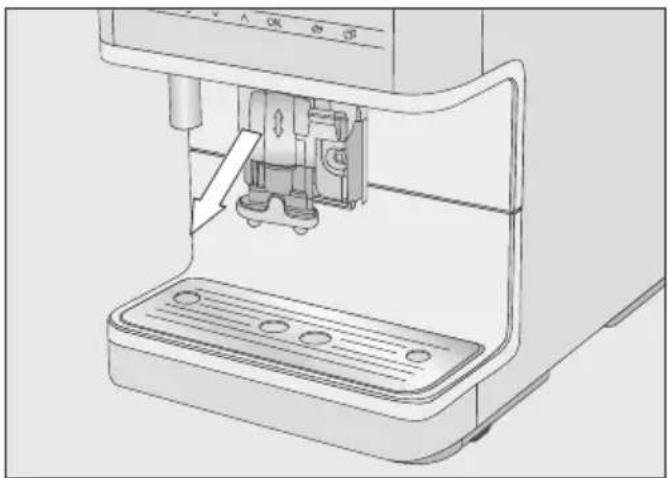
natural_image
Technical line drawing of a 3D printer with control panel and base platform (no text or symbols)■ Remove the dispensing unit to the front.
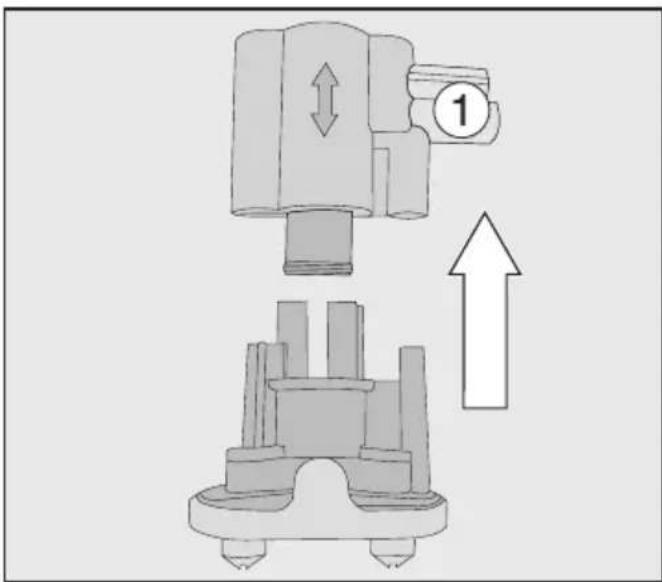
natural_image
Mechanical assembly diagram showing two components with directional arrows, no text or symbols present■ Pull off the upper silicone section with the aperture for the milk pipework ①.
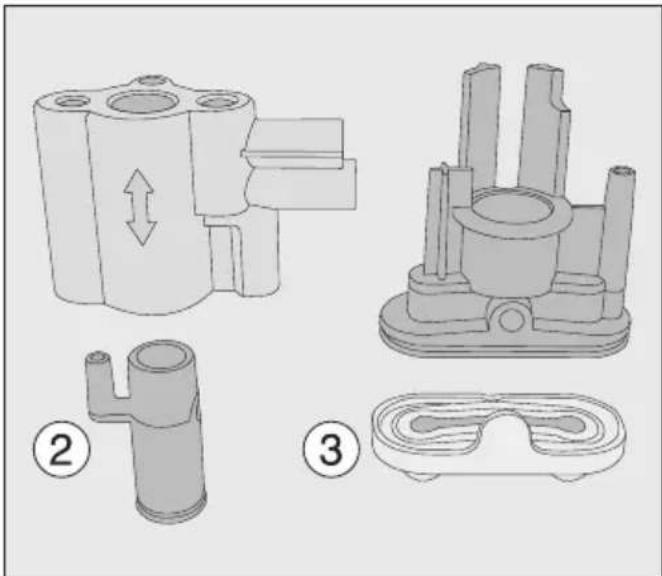
natural_image
Four technical illustrations of mechanical components with no visible text or symbols■ The grey silicone section contains a black, cylindrical component ②. Pull out the black component.
■ Remove the dispensing spouts ③.
■ Clean all parts thoroughly.
natural_image
Technical diagram of a printer's internal structure showing a base platform and internal components (no text or symbols)■ Clean the surfaces of the central spout with a damp cloth.
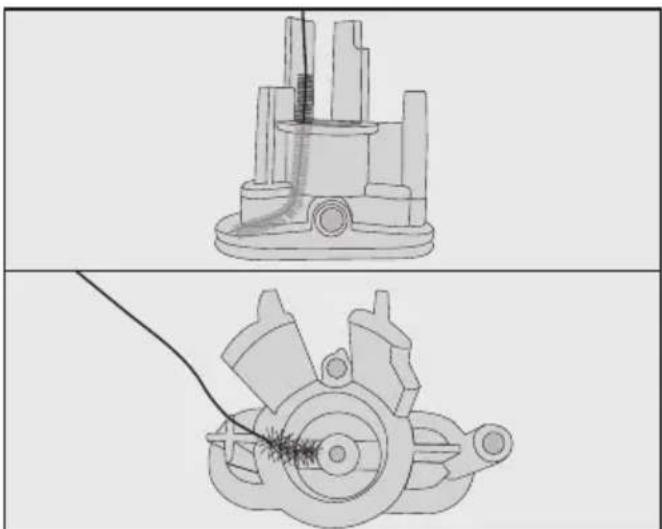
To effectively remove coffee deposits, clean the coffee pipework with the cleaning brush once a month.
natural_image
Technical line drawing of a mechanical device with internal components and a wire, no text or symbols present■ Angle the cleaning brush slightly and clean both spouts from above and below.
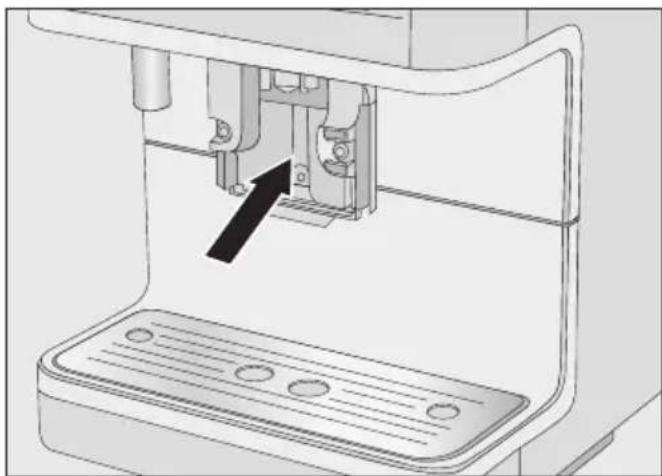
Reassembling the central spout
The dispensing unit is easier to reassemble if the individual parts are dampened with water.
■ Fit the dispensing unit back together. Push the spouts ③ firmly all the way round so that the dispensing unit is firmly seated in the groove.
■ Refit the dispensing unit onto the central spout.
■ Replace the stainless steel cover and connect the milk pipework if required.
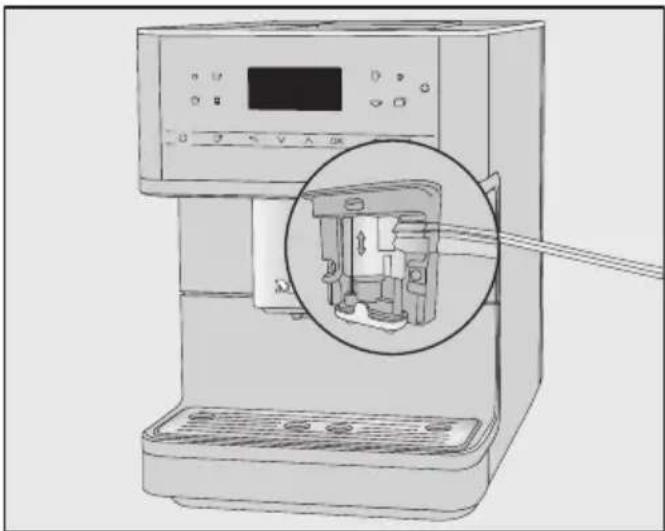
natural_image
Line drawing of a digital kitchen appliance with a magnified inset showing internal components (no text or symbols)Tip: The "seam" on the milk pipework and on the central spout makes it easier to assemble.
Cleaning the steam jet
Clean the steam jet once a month.
■ Push the central spout right down and remove the stainless steel cover by pulling it off towards you.
■ Remove the dispensing unit to the front.
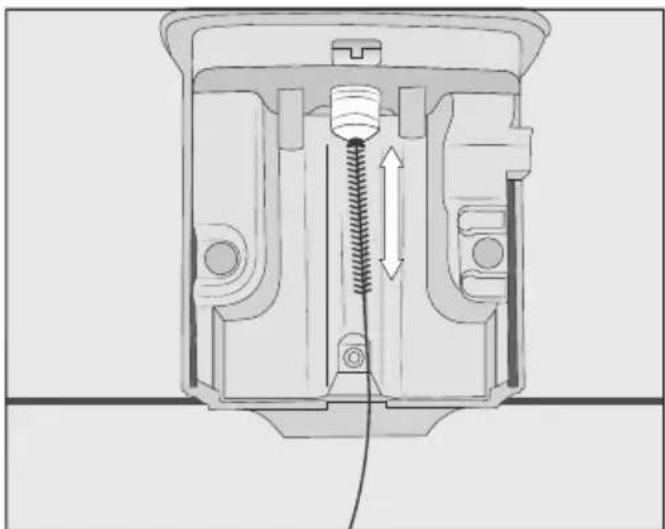
natural_image
Cross-sectional diagram of a mechanical component with internal spring and housing (no text or labels)Push the cleaning brush a max. of 1 cm into the steam jet.
■ Clean the steam jet with the cleaning brush.
■ Push the dispensing unit back into the central spout and replace the stainless steel cover.
Cleaning the milk pipework and rinse valve
Risk of damage due to incorrect cleaning.
The silicone plug can be damaged by pointed objects, e.g. also the cleaning brush, and stop working.
Do not use pointed objects, e.g. a needle, for cleaning.
Only clean the silicone plug under running water and/or in the dishwasher. Do not use the cleaning brush supplied with the appliance.
Clean the rinse valve and milk pipework once a week.
Cleaning and care
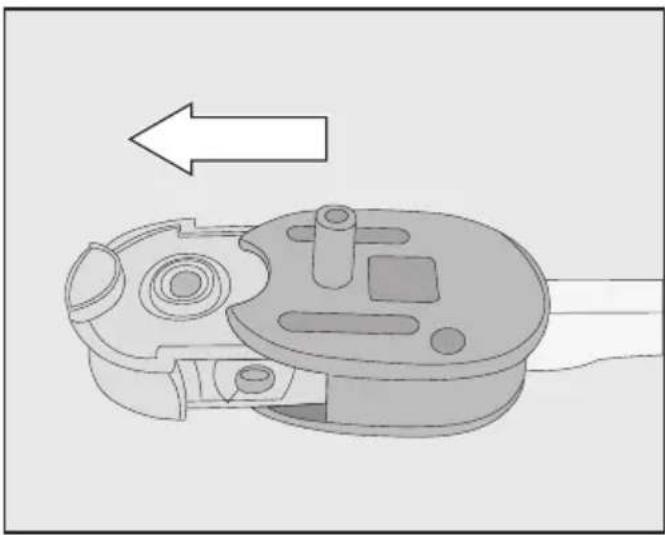
natural_image
Mechanical component diagram showing a piston and housing assembly with an arrow indicating direction (no text or symbols)■ Pull the silicone plug out of the rinse valve body.
■ Rinse the silicone plug under running water before placing the component in the dishwasher.
Risk of damage to the silicone plug Be sure to remove the silicone plug before cleaning the rinse valve body with a cleaning brush or similar utensil.
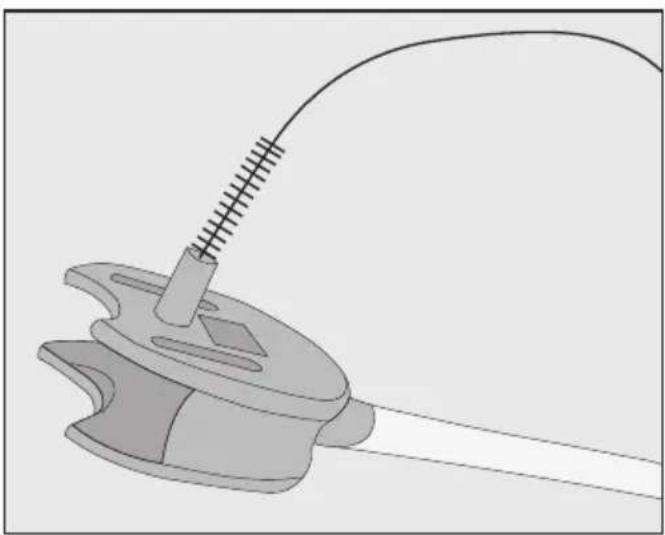
natural_image
Diagram of a mechanical component with a spring-like spring attached to a base, showing no text or symbols.■ Use the brush to clean the rinse valve body under running water to remove any milk residues.
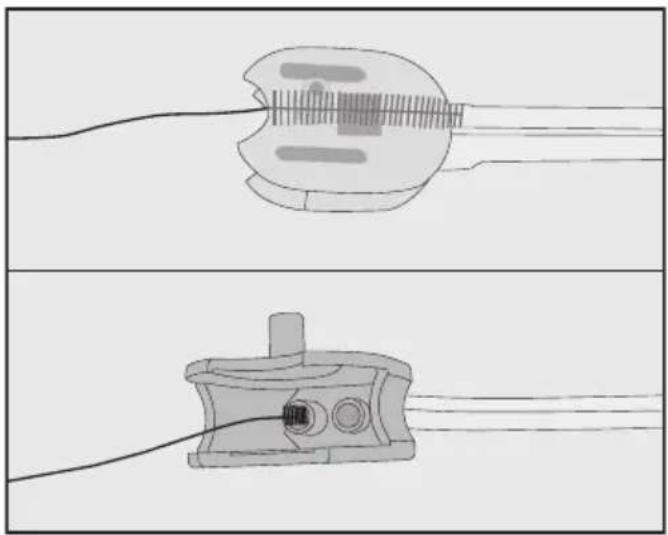
natural_image
Two technical diagrams showing a mechanical component with internal features and wiring, no text or symbols present.■ Clean also the hose connections in the rinse valve body. To do this, insert the cleaning brush into both openings and move the brush back and forth.
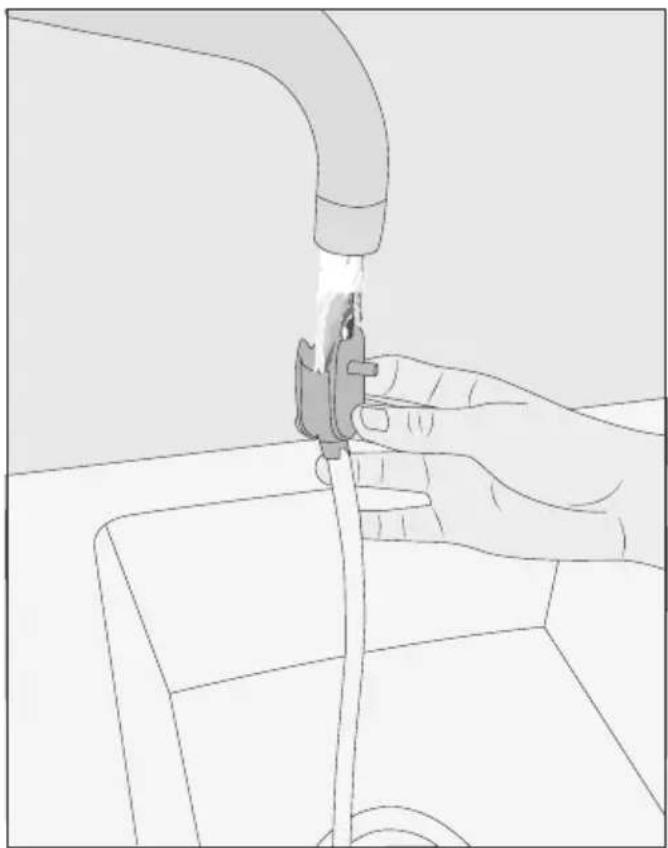
natural_image
Line drawing of a hand using a tool to clean or wash water from a pipe (no text or symbols)■ Rinse the milk pipework and the rinse valve body under running water.
■ Clean all components in a dishwasher.
Tip: Alternatively, you can soak the individual components overnight in water and washing-up liquid. Rinse the components under running water afterwards.
■ Reassemble the rinse valve.
Cleaning the milk siphon
Clean the milk siphon every day.
■ Rinse the milk siphon under running water.
■ Remove the connecting piece from the stainless steel tube.
■ Clean the individual components in a dishwasher.
Tip: Alternatively, you can soak the individual components overnight in water and washing-up liquid. Rinse the components under running water afterwards.
Cleaning the milk flask
Clean the milk flask every day in a dishwasher or by hand using warm water and a little washing-up liquid.
■ Unscrew the lid from the milk flask and remove the stainless steel tube.
■ Place all milk flask components in a dishwasher.
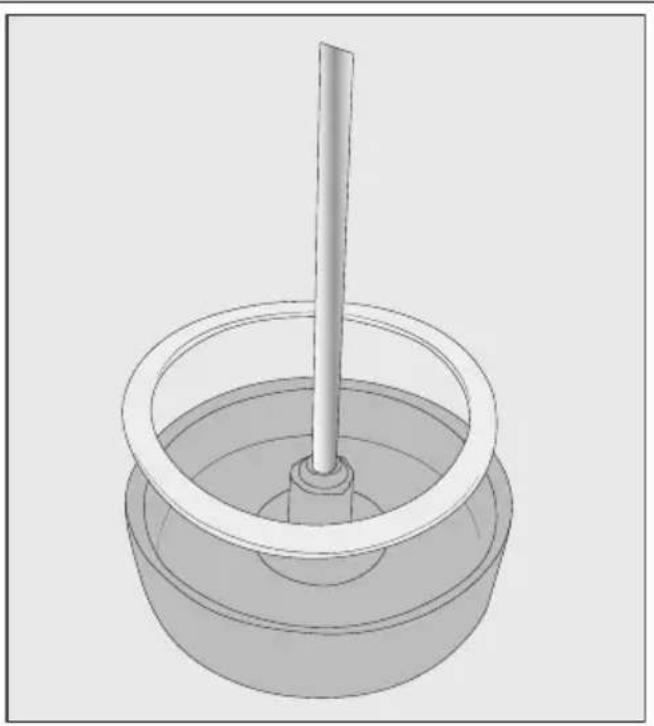
natural_image
3D technical illustration of a mechanical component with a central shaft and concentric rings (no text or symbols)If necessary, you can remove the connecting piece and sealing ring from the milk flask lid. Once you have removed the stainless steel tube, the connecting piece is easy to push out from the inside of the lid. Clean the individual components in a dishwasher.
Bean container and ground coffee chute
Danger of injury from the grinder! Switch off the coffee machine and disconnect it from the power supply before cleaning the bean container.
Coffee beans contain oils which can deposit on the walls of the bean container and hinder the flow of the beans. Therefore, clean the bean container regularly with a soft, dry cloth.
■ Open the bean container.
■ Remove any coffee beans.
■ Clean the bean container with a soft, dry cloth.
The bean container can now be refilled.
If necessary, clean the ground coffee chute:
■ Open the coffee chute and remove any ground coffee residue.
Tip: Use a vacuum cleaner to remove any coffee residues from the bean container and the ground coffee chute.
Cleaning the casing
If soiling is allowed to stay on for a long time or there is contact with unsuitable cleaning agents, surfaces can alter or discolour.
Remove any soiling immediately.
Ensure that any splashes of descaler are wiped up immediately.
■ Switch the coffee machine off.
■ Clean the appliance front with a clean soft sponge and a solution of warm water and washing-up liquid. Then wipe it all dry using a soft cloth.
Tip: You can also clean the appliance casing with the Miele all purpose microfibre cloth.
Opening the "Maintenance" menu
You can find the maintenance programmes in the Maintenance menu. Run the relevant maintenance programme when the prompt to do so appears in the display.
Tip: To save you having to empty the drip tray too often and to catch any splashes, you can place the a container under the central spout.
■ Touch □.
■ Select Maintenance and confirm with OK.
You can now select a maintenance programme.
Rinse the appliance
If you have made a coffee drink, the coffee machine will rinse the coffee pipework automatically before switching off.
You can also start the Rinse the appliance function manually.
Rinsing the milk pipework
If you have not made any milk drinks for a while, rinse the milk pipework thoroughly before making the first drink.
■ Touch □.
■ Select Maintenance | Rinse the milk pipework and confirm with OK.
Place rinsing valve in drip tray will appear on the display.

natural_image
Diagram of a 3D printer with a circular inset showing a device component (no text or symbols)■ Insert the rinse valve into the right aperture in the drip tray cover and confirm with OK.
The milk pipework will now be rinsed.
Cleaning the milk pipework (maintenance programme)
The Clean the milk pipework maintenance programme lasts for approx. 15 minutes.
You need 1 stick of cleaning agent for milk pipework for the maintenance programme.
■ Touch □.
■ Select Maintenance | Clean the milk pipework.
■ Confirm with OK.
The process will start.
■ Follow the instructions in the display.
Remove the water container. Fill it with cleaning solution (see Operating instructions) and replace it. will appear in the display.
Preparing the cleaning solution
For optimal cleaning results, we recommend Miele cleaning agent for milk pipework. The cleaning agent has been specially developed for use with Miele coffee machines and prevents damage to the appliance from unsuitable cleaning agents.
You can order the cleaning agent for milk pipework via the Miele webshop, the Miele Customer Service Department (see the end of this booklet for contact details) or from your Miele dealer.
■ Place 1 stick of milk pipework cleaning agent in a container and add 300 ml of lukewarm water. Stir the solution with a spoon until the cleaning agent powder has fully dissolved.
■ Remove and empty the water container.
■ Pour the prepared cleaning solution into the water container. Replace the water container.
■ Follow the additional instructions given in the display.
If prompted to do so in the display, rinse the water container thoroughly with clean water. Make sure that no cleaning agent is left in the water container. Fill the water container with water.
The cleaning process is complete when the drinks menu appears.
Degreasing the brew unit and cleaning the interior
Depending on the natural oil content of the coffee used, the brew unit can become blocked quite quickly. It must be degreased regularly in order to ensure aromatic coffee and trouble-free operation of the coffee machine.
We recommend using Miele cleaning tablets to clean the brew unit. These have been specially developed for degreasing the brew unit in Miele coffee machines and prevent subsequent damage.
The cleaning tablets are available to order via the Miele webshop, the Miele Customer Service Department (see the end of this booklet for contact details) or from your Miele dealer.
The maintenance programme for degreasing the brew unit lasts for approx. 10 minutes.
You need 1 cleaning tablet for the maintenance programme.
After 200 portions have been dispensed, a message prompting you to degrease the brew unit will appear in the display.
■ Confirm the message with OK.
This message will keep being displayed until the brew unit has been degreased.
Degreasing the brew unit
■ Touch the ☐ sensor control.
■ Select Maintenance | Degrease the brew unit.
■ Confirm with OK.
The maintenance programme will then start.
■ Follow the instructions in the display.
Cleaning the brew unit and interior
Clean the brew unit by hand only with warm water. Do not use any cleaning agents. The moving parts of the brew unit are lubricated.
Cleaning agents will damage the brew unit.
To ensure good tasting coffee and to prevent the formation of microbes in the machine, remove and clean the brew unit under running water once a week.
Rinse the brew unit by hand and clean inside the machine will appear in the display.
■ Open the appliance door.
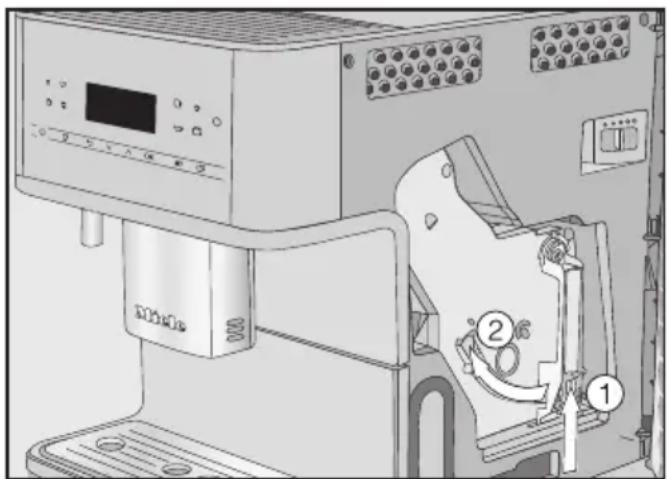
text_image
Technical diagram of a machine with labeled parts, showing control panel and internal components■ Press and hold the button under the brew unit handle ① and, whilst doing so, turn the handle to the left ②.
■ Carefully pull the brew unit out of the coffee machine.
When you have removed the brew unit, do not change the position of the handle on the brew unit.
■ Clean the brew unit by hand under warm running water without using cleaning agent.
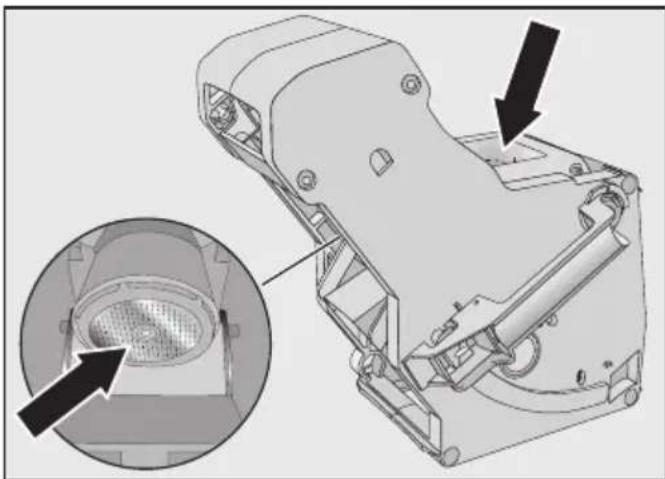
natural_image
Technical diagram of a mechanical device with an inset close-up showing internal components (no text or symbols)■ Clean any coffee residue off the brew unit filter.
■ Dry the funnel to prevent ground coffee sticking to it the next time a coffee is made.
Make sure you regularly remove any damp ground coffee residues to prevent the build-up of mould.
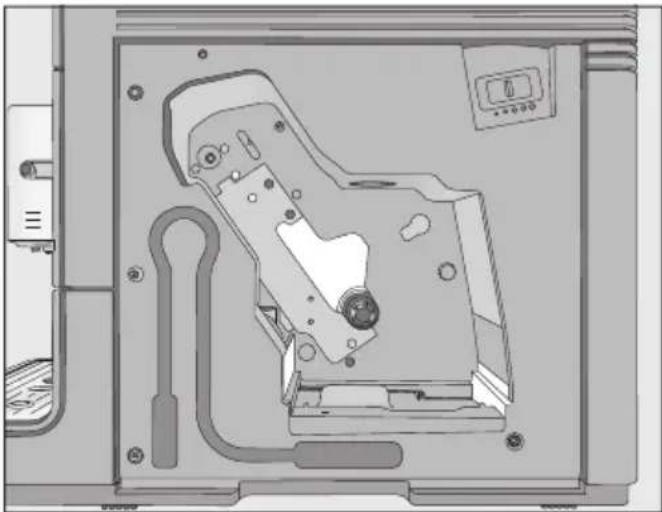
natural_image
Technical diagram of a mechanical device interior showing internal components and mounting points (no text or symbols)■ Clean the inside of the coffee machine. Make sure that the areas highlighted in the illustration are cleaned especially well.
Tip: Use your vacuum cleaner to remove dry ground coffee residues.
Dropping a cleaning tablet into the brew unit
Insert brew unit containing tablet. Close the door, will appear in the display.
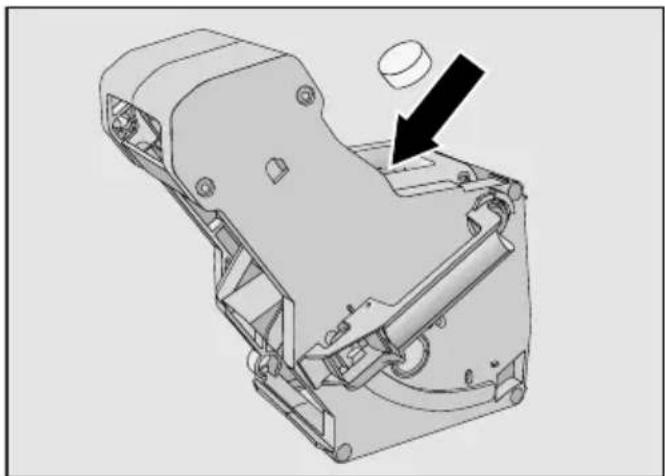
natural_image
Mechanical assembly diagram showing a component with a black arrow pointing to a specific part (no text or symbols present)■ Drop a cleaning tablet into the top of the brew unit (arrow).
■ Push the brew unit containing the cleaning tablet back into the coffee machine.
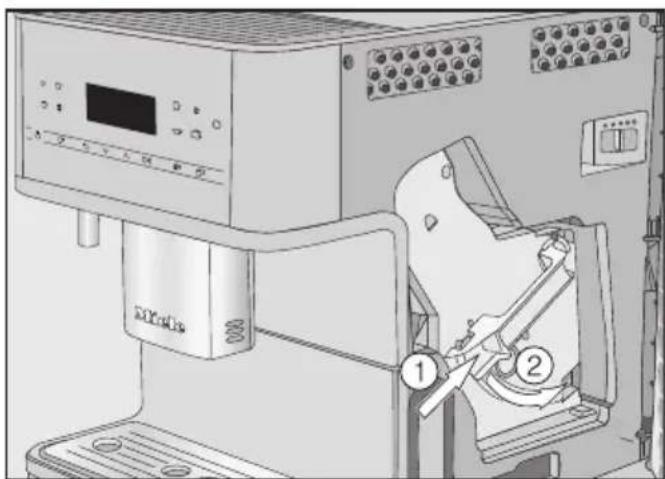
text_image
Technical diagram of a machine with labeled parts and numbered annotations indicating components.■ Press the button under the handle of the brew unit ① and, whilst doing so, turn the handle to the right ②.
■ Close the appliance door.
■ Follow the further instructions given in the display.
The cleaning process is complete when the drinks menu appears.
Descaling the machine
Risk of damage from spilt descaling solution.
Sensitive surfaces and/or natural floors can suffer damage.
Wipe up any spillages of descaling agent immediately.
Limescale builds up in the coffee machine through use. How often the appliance needs to be descaled will depend on the water hardness level in your area. Limescale must be removed regularly.
The appliance will guide you through the descaling process. Various messages will appear in the display, e.g. you will be prompted to empty the drip tray or fill the water container.
Descaling must be carried out. The process takes approx. 15 minutes.
The coffee machine will give you plenty of warning when it needs to be descaled. As of this point, the display will indicate how many more drinks can be made before descaling becomes absolutely essential. This number is indicated whenever a drink is made.
■ Confirm the message with OK.
When the number of remaining portions reaches 0, the coffee machine will lock out.
You can switch the coffee machine off if you do not want to run the descaling programme at this point in time. You can not make any drinks until the machine has been descaled.
Descale the appliance will appear on the display.
■ Confirm with OK.
The process will start.
■ Follow the instructions in the display.
If the operating temperature is too high for the descaling process, the coffee machine cools down. No separate message is shown on the display during the cooling phase.
When Fill the water container with lukewarm water and descaling agent up to the ⚗ symbol and replace it appears in the display, proceed as follows.
Preparing the descaling solution
For optimum descaling results, we recommend using the Miele descaling tablets provided.
The descaling tablets have been specially developed for Miele coffee machines.
Other descalers, which contain other acids besides citric acid and/or other undesirable substances, such as chlorides for example, can cause damage to the product. Moreover, the descaling result required cannot be guaranteed if the descaling solution was not of the appropriate concentration.
Miele descaling tablets are available to order via the Miele webshop, from the Miele Customer Service Department (see the end of this booklet for contact details) or from your Miele dealer.
You will need 1 descaling tablet to descale the machine.
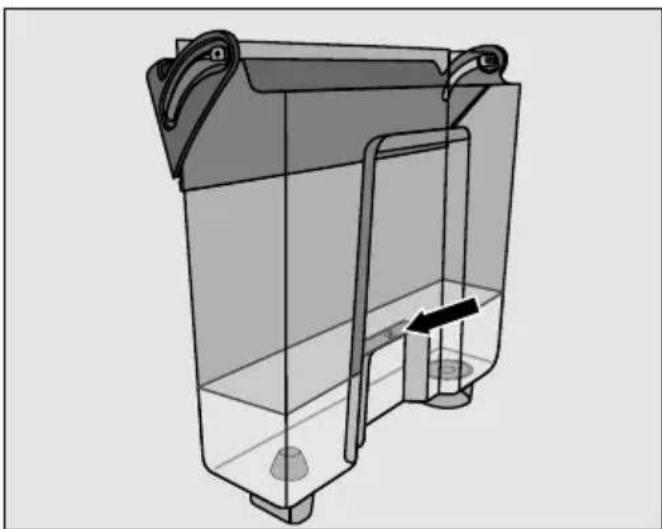
natural_image
3D technical diagram of a mechanical component with internal structure and mounting features (no text or symbols)■ Add 1 descaling tablet to the water container.
■ Fill the water container to the Ⓧ mark with lukewarm water.
Follow the instructions for the descaler mixing ratio carefully. Do not fill the water container with too much or too little water. Otherwise, the descaling process will be cancelled prematurely.
Carrying out descaling
■ Reinsert the water container.
■ Follow the additional instructions given in the display.
When Fill the water container up to the descaling symbol and replace it. Close the door. appears in the display:
■ Remove the water container and rinse it thoroughly with clean water. Ensure that no descaling solution residue remains in the water container. Fill the water container at least up to the ⬆ mark with fresh drinking water.
The descaling process is complete when the drinks menu appears.
Many malfunctions and faults that can occur in daily operation can be easily remedied. Time and money will be saved because a service call will not be needed.
The following guide may help you to find the reason for a malfunction or a fault, and to correct it.
Messages in the display
Error messages must be confirmed with OK, otherwise the message can reappear in the display even though the problem has been remedied.
Follow the instructions which appear in the display to remedy the problem.
If after this, the fault message appears in the display again, contact Miele Service.
| Problem Cause and remedy | |
| F1, F2,F80, F82 | There is an internal fault.■ Switch the coffee machine off with the On/Off button ⏻. Wait for approximately 1 hour before switching the appliance back on again. |
| F41, F42, F74, F77, F235,F236 | There is an internal fault.■ Switch the coffee machine off with the On/Off button ⏻. Wait for approximately 2 minutes before switching the appliance back on again. |
| F10, F17 No water or very | little water is being drawn in.■ Remove the water container. Fill the water container with fresh tap water and reinsert the water container.■ Remove and clean the water container filter (see “Cleaning and care – Removing and cleaning the water container filter”). |
| F73 orCheck the brew unit | The brew unit cannot be positioned correctly.■ Switch the coffee machine off with the On/Off button ⏻.■ Switch off at the wall socket and unplug the coffee machine. Wait for two minutes before inserting the plug back in the socket and switching on.■ Remove the brew unit and rinse under warm running water.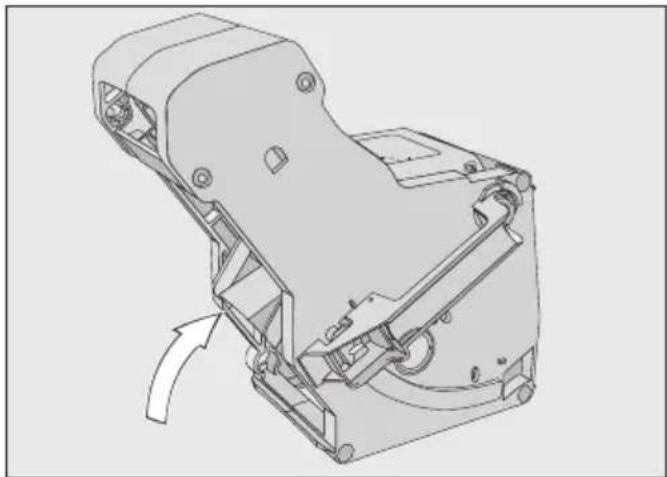 ■ Push the coffee ejector of the brew unit into the correct position.■ Do not fit the brew unit. Close the appliance door and switch the coffee machine on with the On/Off button ⏻.This will initialise the brew unit drive and put it back into the start position.■ When Insert the brew unit appears in the display, put the brew unit back in the appliance. Close the appliance door. ■ Push the coffee ejector of the brew unit into the correct position.■ Do not fit the brew unit. Close the appliance door and switch the coffee machine on with the On/Off button ⏻.This will initialise the brew unit drive and put it back into the start position.■ When Insert the brew unit appears in the display, put the brew unit back in the appliance. Close the appliance door. |
| Too much ground coffee There | re is too much ground coffee in the ground coffee chute.The brew unit cannot compact ground coffee if more than 12 g (2 level spoonfuls) of ground coffee are added to the coffee chute. The ground coffee will be emptied into the waste container and the fault message will appear in the display.■ Switch the coffee machine off with the On/Off button ⏻.■ Remove and clean the brew unit (see “Removing the brew unit and cleaning it by hand”).■ Remove the ground coffee inside the coffee machine, e.g. with a vacuum cleaner.■ Place a maximum of 12 g of coffee in the ground coffee chute. |
| There is too much ground coffee in the ground coffee chute.Certain types of coffee produce a lot of coffee when they are ground. Usually this is because the grinder is set too coarse and the maximum quantity of coffee is set.■ Set the grinder to a finer setting.■ Select a smaller quantity of coffee.If the coffee is still not to your taste, e.g. too weak, try another type of bean. |
Unusual performance of the coffee machine
| Problem Cause and remedy | |
| The display remains dark when the coffee machine is turned on using the On/Off button ⏻. | The On/Off button ⏻ was not held for long enough.■ Touch and hold the On/Off button ⏻ for at least 3 seconds. |
| The plug is not inserted in the socket correctly.■ Insert the plug into the socket. | |
| The fuse has tripped because the coffee machine, voltage or another appliance is defective.■ Switch off at the wall socket and unplug the coffee machine.■ Contact a qualified electrician or the Miele Customer Service Department. | |
| The lighting remains off after the coffee machine has been switched on. | The lighting has been switched off.■ Switch the lighting on (see “Settings - Lighting”). |
| The lighting is faulty.■ Call Service. | |
| The coffee machine turns off suddenly. | The factory set switch-off time (20 minutes) or the switch-off time you have programmed has been reached.■ If required, you can select a new switch-off time (see “Settings - Timer”). |
| The plug is not inserted in the socket correctly.■ Insert the plug into the socket. | |
| The sensors do not react to touch.The coffee machine cannot be operated. | There is an internal fault.■ Disconnect the machine from the power supply by removing the plug from the socket. |
| The display is hard to see or not able to be read. | The display brightness has been set too low.■ Change this setting (see “Settings”). |
| Fill and replace the water containerappears in the display even though the water container is full and in the machine. | The water container is not in the correct position.■ Remove the water container and push it back in again.■ Remove and clean the water container filter (see “Cleaning and care – Removing and cleaning the water container filter”). |
| The water container was not correctly filled and refitted for descaling.■ Fill the water container to the descaling symbol⇨and restart the descaling programme. | |
| Fill and replace the water containerappears after switching on even though the container is filled and fitted in the machine. The appliance does not rinse. | The coffee machine needs descaling.■ Switch the coffee machine off with the On/Off button ⏻. Wait approx. 1 hour.■ Switch the appliance back on again. As soon as Heating-up phase appears, touch the □ sensor control and then select Descale the appliance.■ Descale the coffee machine. |
| After switching on the machine the message Empty the drip tray and the waste containerappears even though they are both empty. | This is not a fault.When the drip tray and waste container are emptied, the internal counter is not reset after the coffee machine has been switched off. Empty the drip tray and the waste container appears in the display even though the drip tray and the waste container are not filled to the maximum. |
| Problem Cause and remedy | |
| Neither milk nor milk froth comes out of the central spout. | The milk pipework was connected incorrectly to the central spout.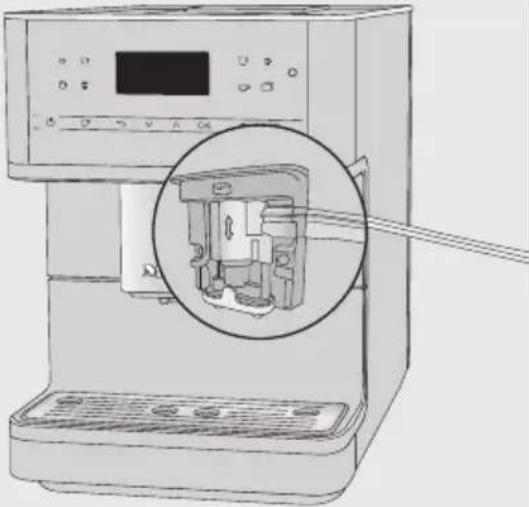 The seam on the milk pipework, central spout and on the rinse valve makes it easier to assemble.■ Check whether the milk pipework is correctly connected to the central spout. The seam on the milk pipework, central spout and on the rinse valve makes it easier to assemble.■ Check whether the milk pipework is correctly connected to the central spout. |
| The milk pipework is blocked.■ Clean the central spout and milk pipework carefully with the brush. | |
| Empty the drip tray and the waste containerappears in the display, even though the drip tray has been emptied. | This is not a fault. The drip tray was not properly removed and/or replaced too quickly. |
| Insert the drip tray and the waste containerappears in the display even though both are fitted. | The drip tray is not in the correct position and is therefore not detected.■ Empty the drip tray and the waste container. Reassemble all parts and push the drip tray back as far as it will go in the coffee machine. |
| Problem Cause and remedy | |
| The waste container is overflowing even though the drip tray and waste container have been emptied following each reminder. | The drip tray has probably been removed without the waste container being emptied.Removing the drip tray resets the internal counter for emptying the waste container.■ Always empty the waste container if you remove the drip tray. |
| Certain types of beans produce a lot of coffee when they are ground, meaning that larger coffee pucks are pressed.■ Adapt the quantity of coffee and grinder setting if necessary.■ Empty the waste container more often than indicated in the display. | |
| Fill the bean container appears in the display even though the bean container has just been filled. | This is not a fault.■ Confirm the message with OK. |
| Insufficient coffee beans are getting into the grinder.Have you used a dark roast?This type of coffee bean is often more oily. These oils can cling to the inside of the coffee bean container and hinder the flow of beans.■ Make a coffee and observe whether the coffee beans drop into the coffee bean container.■ Clean the coffee bean container more often if you are using a darker, more oily bean.Try other types of coffee bean which are less oily. | |
| The coffee machine does not rinse itself when turned on. | This is not a fault.If the coffee machine is already at operating temperature, rinsing will not take place. |
| Coffee dispensing is repeatedly interrupted and the message Fill the bean container appears in the display. | This is not a fault.The brew unit has not detected the ground coffee.Certain types of coffee produce a small amount of coffee when they are ground. Usually this is because the grinder is set too fine and the minimum quantity of coffee is set.■ Confirm the message with OK.If the coffee is too strong for you or tastes bitter, try a different type of coffee beans.If the display appears with all types of coffee:■ Set the grinder to a coarser setting (see “Grinder setting”).■ Select a larger quantity of coffee.Don't forget to check any drinks changed in “Profiles”. |
| If the message only appears when dispensing certain drinks:■ Check the quantity of coffee set for this drink (see “Quantity of coffee”). Select a larger quantity of coffee.■ You may also need to set a coarser grinder setting. | |
| The descaling process was started inadvertently. | The descaling programme cannot be stopped once OK has been touched.It must now be completed through to the end. This is a security setting to fully descale the coffee machine. It ensures a long service life and that your coffee machine is functioning correctly.■ Descale the coffee machine (see “Descaling the appliance”). |
Problem solving guide
| Problem Cause and remedy | |
| Coffee is not flowing out of the central spout. Or coffee is only being dispensed via one spout. | The central spout has a blockage.■ Rinse the coffee pipework (see “Cleaning and care – Rinsing the appliance”).Is there still no coffee flowing out of the central spout or is it only dispensed via one side?■ Dismantle the central spout and clean all parts carefully. Use the supplied cleaning brush for parts that are difficult to reach.■ Make sure all parts are reassembled correctly. |
| The brew unit is blocked.■ Degrease the brew unit (see “Cleaning and care – Degreasing the brew unit and cleaning the interior”). | |
| Problem Cause and remedy | |
| The milk sputters when it is dispensed. Hissing noises can be heard when milk is being heated up or frothed. Although the milk should be frothed, only hot milk comes out of the central spout. | The milk pipework was not correctly fitted.■ Pay attention to the seam on the double hose when you connect the milk pipework into the central spout.■ If you have disconnected the milk pipework from the rinse valve: the double hose has different diameters. Make sure all parts are assembled correctly. |
| The milk temperature is too high. Good milk froth can only be achieved with cold milk (below 10 °C).■ Check the temperature of the milk. | |
| The central spout is not fitted correctly and is taking in air. Or the spouts are blocked.■ Check whether the central spout has been assembled correctly. Make sure that all parts are tightly connected to one another.■ Clean the central spout. Knead the spouts under running water to loosen any soiling. | |
| The milk pipework, connecting pieces, the stainless steel tube of the milk flask or the milk siphon are blocked.■ Clean all parts carefully with the cleaning brush. | |
The steam jet on the central spout has a blockage.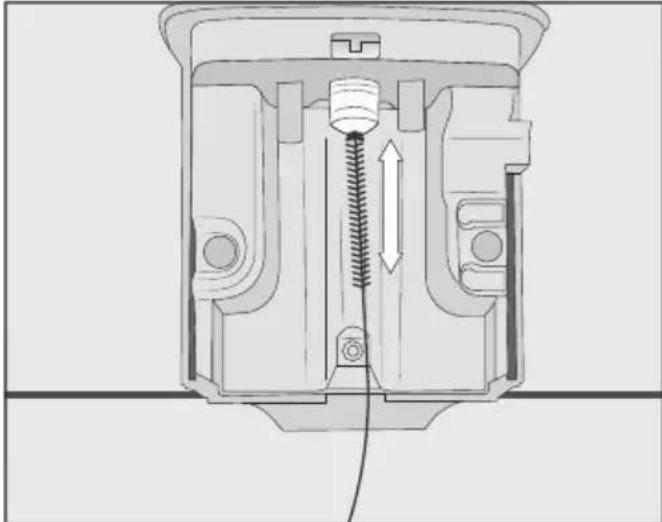 ■ Clean the steam jet with the cleaning brush (see illustration). ■ Clean the steam jet with the cleaning brush (see illustration). | |
Problem solving guide
| Problem Cause and remedy | |
| Coffee grounds have settled on the lid of the drip tray and in the interior around the brew unit. | This is not a fault.The movement of the brew unit during the brewing process can cause some ground coffee to fall around it. The type of beans used, the fineness of the ground coffee and the quantity of coffee ground also affect the quantity. Important! Clean the inside of the coffee machine regularly to prevent mould etc.Check whether the quantity of coffee is set too high. |
| The display lights up but the coffee machine does not heat up and no drinks are made.The coffee machine cannot be turned off. | The Demo mode for demonstrating the coffee machine in the showroom has been activated.■ Deactivate Demo mode. |
Unsatisfactory results
| Problem Cause and remedy | |
| The coffee is not hot enough. | The cup has not been pre-heated.The smaller the cup and the thicker its sides, the more important it is to pre-heat it.■ Pre-heat the cups, e.g. using the cup heating (depending on model). |
| The brewing temperature has been set too low.■ Set a higher brewing temperature. | |
| The filters in the brew unit are blocked.■ Remove the brew unit and clean it by hand.■ Degrease the brew unit. | |
| The heating-up time is getting longer, the amount of water being dispensed is incorrect and the coffee machine is not performing properly. Coffee flows very slowly out of the central spout. | The coffee machine needs descaling.■ Descale the coffee machine. |
| The quantity of dispensed coffee has changed. | The brew unit is blocked.■ Degrease the brew unit (see “Cleaning and care – Degreasing the brew unit and cleaning the interior”). |
| The consistency of the milk froth is unsatisfactory. | The milk temperature is too high. Good milk froth can only be achieved with cold milk (below 10 °C).■ Check the temperature of the milk in the milk flask. |
| The milk pipework is blocked.■ Clean the central spout and milk pipework with the brush. |
Problem solving guide
| Problem Cause and remedy | |
| The coffee grinder makes a louder noise than usual. | The coffee bean container has become empty during the grinding process.■ Fill the coffee bean container with fresh beans. |
| There may be foreign objects such as plastic or stones in amongst the coffee beans.■ Switch the coffee machine off immediately. Call Service. | |
| The coffee flows too quickly into the cup. | The coffee is too coarsely ground.■ Set the grinder to a finer setting (see “Grinder setting”). |
| The coffee is dispensed too slowly into the cup. | The brew unit is blocked.■ Degrease the brew unit (see “Cleaning and care – Degreasing the brew unit and cleaning the interior”). |
| There is no crema on the coffee or espresso. | The coffee beans are no longer fresh. If roasted coffee beans are stored open for too long, the carbon dioxide gradually escapes from the coffee beans. The crema is no longer formed during dispensing.Of course, you can still use the coffee beans. |
If you are not going to use the coffee machine for an extended period of time, e.g. whilst on holiday, or if it needs to be moved, a number of procedures will need be carried out to ensure its safety.
- Empty and clean the coffee bean container
- Empty and clean the water container
- Evaporate the coffee machine
- Clean the inside of the machine
- Pack the machine securely
Evaporating the coffee machine
The coffee machine should be evaporated before it is stored for a long period of time or transported any distance – particularly at temperatures below freezing.
Evaporating the appliance involves removing all traces of water from the system to prevent the risk of water and frost damage.
■ Touch the ☐ sensor control.
■ Select Further | Settings | Showroom programme | Evaporate.
The cleaning process cannot be cancelled. It must be completed through to the end.
■ Select Yes and confirm with OK.
■ Follow the instructions in the display.
Caution! Danger of burning and scalding on the dispensing spouts! Hot steam is discharged.
When the display goes out, the machine has finished evaporating.
■ Switch off the coffee machine and unplug it to disconnect it from the power supply.
■ Clean the drip tray and waste container.
Packing the machine
The coffee machine should only be packed when it is clean and dry. Residues of coffee grounds can cause scratches on surfaces. Coffee and milk residues or water can cause a build-up of bacteria.
Use the original packaging including polystyrene blocks to pack the coffee machine.
Also pack the operating instructions so that they are available when the coffee machine is next used.
Contact in the event of a fault
In the event of any faults which you cannot remedy yourself, please contact your Miele dealer or the Miele Customer Service Department.
You can book a Miele Customer Service Department call-out online at www.miele.com/service.
Contact information for the Miele Customer Service Department can be found at the end of this document.
Please quote the model identifier and serial number of your appliance (Fabr./SN/Nr.) when contacting the Miele Customer Service Department. This information can be found on the data plate.
Please note that telephone calls may be monitored and recorded for training purposes and that a call-out charge will be applied to service visits where the problem could have been resolved as described in this booklet.
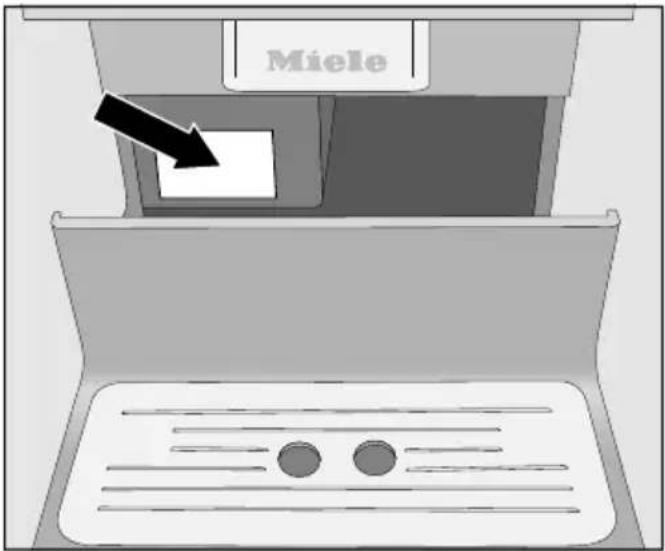
text_image
MieleWarranty
For information on the appliance warranty specific to your country please contact Miele. See back cover for address.
In the UK, your appliance warranty is valid for 2 years from the date of purchase. However, you must activate your cover by calling 0330 160 6640 or registering online at www.miele.co.uk.
These products and other useful accessories can be ordered via the Miele webshop, from Miele (see back cover for contact details) or from your Miele dealer.
Accessories supplied
- Starter set "Miele appliance care"
Various cleaning products are supplied depending on model.
- Cleaning brush
for cleaning the milk pipework
- Milk siphon
For preparing milk directly from the sales packaging
- Milk flask with lid
For storing and preparing milk (included depending on model)
Optional accessories
Miele accessories and cleaning and conditioning products are available for your coffee machine.
- Microfibre cloth
for removing finger marks and light soiling
- Cleaning tablets
for degreasing the brew unit
- Descaling tablets
for descaling the water pipework
- Milk flask with lid
For storing and preparing milk
- CJ Jug 1.0 l
Insulated flask for coffee or tea (pot function)
- Miele Black Edition One for all
Whole coffee beans – perfect for making espresso, café crema and speciality coffees with milk
- Miele Black Edition Espresso
Whole coffee beans – perfect for making espresso
- Miele Black Edition Café Crema
Whole coffee beans – perfect for making coffee
- Miele Black Edition Decaf
Whole coffee beans – perfect for making decaffeinated speciality coffees
The following tips can help you save energy and money as well as care for the environment:
- Operate the coffee machine in Eco mode.
- Switch the coffee machine off with the On/Off button ⏻ if it is not going to be used for a while.
- Change the setting for the Switch off after timer to 20 minutes. The coffee machine will then switch itself off 20 minutes after the last drink was made or a sensor control was touched.
- If you only want to pre-heat your cups occasionally, you can switch the cup heating surface off. You can use hot water to pre-heat the cups.
Before connecting the coffee machine, make sure that the connection data on the data plate (voltage and frequency) matches that of the electricity supply. This data must match in order to avoid the risk of damage to the coffee machine. If in any doubt, consult a qualified electrician.
The required connection data is provided on the data plate. The data plate can be seen on the left-hand side of the machine when the drip tray is pulled out.
The appliance is supplied with a mains cable ready for connection to an AC 220–240 V 50 Hz supply.
The coffee machine must be connected to the mains supply via a suitable earthed socket. Connection must comply with national and local safety regulations (BS 7671 in the UK).
The fuse rating must be at least 10 A.
The socket should be next to the appliance and easily accessible where possible.
Do not connect the coffee machine to the mains electricity supply using a multi-socket adapter or an extension lead. These do not guarantee the required safety of the machine (fire risk).
Do not connect the coffee machine to a stand-alone inverter. Stand-alone inverters are used for autonomous power supply, e.g. a solar power system. Power surges could trigger the Auto switch off function. This could damage the electronic module.
The coffee machine must not be used with “energy saving plugs”. These reduce the amount of energy supplied to the appliance, causing it to overheat.
If the mains connection cable is faulty, it must only be replaced by a qualified electrician in order to avoid a hazard.

Danger of overheating due to cient ventilation.
If the coffee machine is not sufficiently ventilated, the appliance can overheat.
Please ensure that there is adequate ventilation around the coffee machine.
Do not cover the coffee machine with tea towels etc. while it is in use.
If the coffee machine is installed behind a closed furniture front, heat and moisture can build up behind the furniture front when closed. This can result in damage to the coffee machine and/or furniture unit.
Do not close the furniture front while the coffee machine is in use.
Please observe the following installation instructions:
- The location of the machine must be dry and well ventilated.
- The ambient temperature of the room in which the machine is used must be between 10 °C and 38 °C.
- The machine must be set up on a level surface. The surface must be water resistant.
If the machine is installed in a niche, the niche must provide the following minimum dimensions:
Height 508 mm
Width 450 mm
Depth 555 mm
When setting up the machine: make sure that the service panel can be fully opened so that the brew unit can be removed with ease when required.
■ The machine must be set up in the niche such that it sits flush with the front edge of the niche.
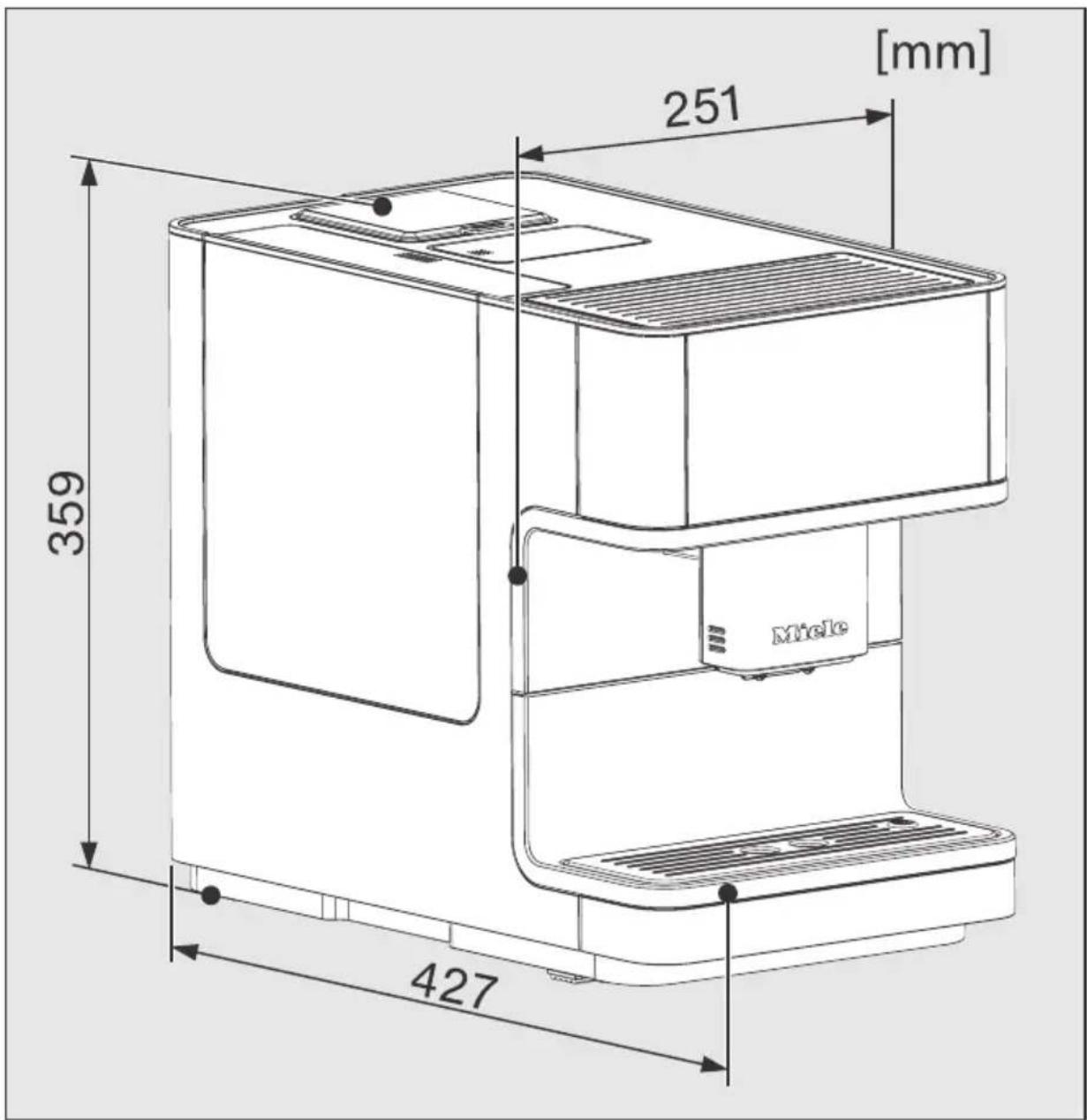
text_image
251 [mm] 359 Miele 427Technical data
| Electricity consumption in standby: < 0.1 W | |
| Electricity consumption in networked standby: | < 0.5 W |
| Pump pressure: Max. 15 bar | |
| Through-flow heater: 1 stainless steel thermo block | |
| Dimensions (W x H x D): 251 x 359 x 427 mm | |
| Net weight: 9.9 kg | |
| Mains connection cable length: 140 cm | |
| Water container capacity: | 1.8 l |
| Bean container capacity: | Approx. 300 g |
| Milk container capacity: 0.5 l | |
| Drip tray capacity: | 0.8 l |
| Waste container capacity: | Max. 10 portions of coffee grounds |
| Central spout: Height adjustable from 80-140 mm | |
| Grinder: Steel conical grinder | |
| Grinder setting: 5 settings | |
| Ground coffee amount: Max. 12 g | |
| Frequency band: 2.400–2.4835 GHz | |
| Max. transmission power < 100 mW | |
| (The milk flask is supplied with the CM 6360, CM 6560.) | |
Miele hereby declares that this coffee machine complies with Directive 2014/53/EU.
The complete text of the EU declaration of conformity is available from one of the following internet addresses:
- Products, Download from www.miele.co.uk
- For service, information, operating instructions etc: go to www.miele.co.uk/domestic/ customer-information-385.htm and enter the name of the product or the serial number
United Kingdom
Miele Co. Ltd., Fairacres, Marcham Road, Abingdon, Oxon, OX14 1TW
Tel: 0330 160 6600, Internet: www.miele.co.uk/service, E-mail: info@miele.co.uk
Australia
Miele Australia Pty. Ltd.
ACN 005 635 398
ABN 96 005 635 398
1 Gilbert Park Drive
Knoxfield, VIC 3180
Tel: 1300 464 353
Internet: www.miele.com.au
China Mainland
Miele Electrical Appliances Co., Ltd.
1-3 Floor, No. 82 Shi Men Yi Road
Jing' an District
200040 Shanghai, PRC
Tel: +86 21 6157 3500
Fax: +86 21 6157 3511
E-mail: info@miele.cn,
Kowloon Bay, Hong Kong
Tel:(852)26101025
Fax: (852) 3579 1404
Email:
customerservices@miele.com.hk
Website: www.miele.hk
India
Miele India Pvt. Ltd.
1st Floor, Copia Corporate Suites,
Commercial Plot 9,
Mathura Road, Jasola,
New Delhi - 110025
E-mail: customercare@miele.in
Website: www.miele.in
Ireland
Miele Ireland Ltd.
2024 Bianconi Avenue
Citywest Business Campus
Dublin 24
Tel: (01) 461 07 10
Fax: (01) 461 07 97
E-Mail: info@miele.ie
Internet: www.miele.ie
Malaysia
Miele Sdn Bhd
Suite 12-2, Level 12
Menara Sapura Kencana
Petroleum
Solaris Dutamas No. 1
Jalan Dutamas 1
50480 Kuala Lumpur, Malaysia
Phone: +603-6209-0288
Fax: +603-6205-3768
New Zealand
Miele New Zealand Limited
IRD 98 463 631
8 College Hill
Freemans Bay, Auckland 1011
New Zealand
Tel: 0800 464 353
Internet: www.miele.co.nz
Singapore
Miele Pte. Ltd.
29 Media Circle
11-04 ALICE@Mediapolis
Singapore 138565
sTel: +65 6735 1191
Fax: +65 6735 1161
E-Mail: info@miele.com.sg
Internet: www.miele.sg
South Africa
Miele (Pty) Ltd.
63 Peter Place
Bryanston 2194
P.O. Box 69434
Bryanston 2021
Tel: (011) 875 9000
Fax: (011) 875 9035
E-mail: info@miele.co.za
Internet: www.miele.co.za
Thailand
Miele Appliances Ltd.
BHIRAJ TOWER at EmQuartier
43rd Floor Unit 4301-4303
689 Sukhumvit Road
North Klongton Sub-District
Vadhana District
Bangkok 10110, Thailand
United Arab Emirates
Miele Appliances Ltd.
Showroom 1
Eiffel 1 Building
Sheikh Zayed Road, Umm Al She
P.O. Box 114782 - Dubai
Tel. +971 4 3044 999
Fax. +971 4 3418 852
800-MIELE (64353)