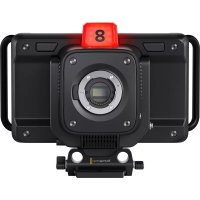
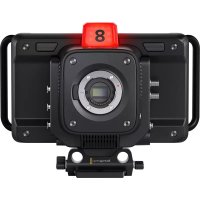
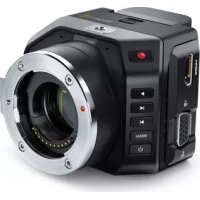
Micro Studio Camera 4K - Camera Blackmagic Design - Free user manual and instructions
Find the device manual for free Micro Studio Camera 4K Blackmagic Design in PDF.


| Product Type | Compact Broadcast Camera |
| Sensor | Ultra HD (4K) |
| Lens Mount | Micro Four Thirds (MFT) with active electronic control |
| Video Formats | 720p50/59.94/60, 1080i50/59.94/60, 1080p23.98/24/25/29.97/30/50/59.94/60, 2160p23.98/24/25/29.97/30 |
| SDI Output | 6G-SDI (requires DIN 1.0/2.3 to BNC adapter) |
| HDMI Output | HDMI 1.4, 10-bit 4:2:2 1080p |
| Audio Input | 3.5mm stereo mic/line input (switchable) |
| Headphone/Talkback | 3.5mm jack for iPhone/Android headsets |
| Remote Control | Via SDI (ATEM switchers), LANC, S.Bus (Futaba), RS-422 (PTZ), and expansion port |
| Tally | Front tally light (white/green/red/orange) with adjustable brightness |
| Power Source | LP-E6/LP-E6N battery or 12V external power via expansion port |
| Battery Life | Approximately 1 hour with LP-E6 (estimated, not specified) |
| Dimensions | Approximately 100 x 100 x 100 mm (estimated from compact design) |
| Weight | Approximately 500 g (estimated, with battery) |
| Firmware Update | Via USB Mini-B port and Blackmagic Camera Setup software |
| Accessories Included | Expansion cable with power, reference, LANC, PTZ, B4, and S.Bus connectors |
| Optional Accessories | SFP optical module for long-distance connections |
| Warranty | 12 months limited |
| Compliance | RoHS, CE, FCC (implied) |
Frequently Asked Questions - Micro Studio Camera 4K Blackmagic Design
User questions about Micro Studio Camera 4K Blackmagic Design
0 question about this device. Answer the ones you know or ask your own.
Ask a new question about this device
Download the instructions for your Camera in PDF format for free! Find your manual Micro Studio Camera 4K - Blackmagic Design and take your electronic device back in hand. On this page are published all the documents necessary for the use of your device. Micro Studio Camera 4K by Blackmagic Design.
USER MANUAL Micro Studio Camera 4K Blackmagic Design
Installation and Operation Manual
Blackmagic Studio Cameras
September 2018
English, 日本語, Français, Deutsch, Español, 中文, 한국어, Русский, Italiano, Português and Türkçe.
Languages
To go directly to your preferred language, simply click on the hyperlinks listed in the contents below.
English 3
日本語 63
Français 124
Deutsch 185
Español 246
中文 307
한국어 368
Русский 429
Italiano 490
Português 551
Türkçe 612
natural_image
Circular portrait photo of a smiling man in a dark shirt against a gray background (no text or symbols)Welcome
Thank you for purchasing a Blackmagic Studio Camera!
We are extremely excited to have designed the Blackmagic Studio Camera and Micro Studio Camera 4K. Ever since I was a teenager I have loved live production, it's so exciting!
Traditionally cameras with talkback and tally were very expensive and physically large, so hard to manage. We really wanted to solve this problem by designing a more compact camera that included all the talkback, tally and camera control features of physically much larger cameras.
That's why the Blackmagic Studio Camera was developed. We wanted to build a much smaller camera for portability, however normally small cameras have small tiny screens. We did not want that. What we really wanted was a much larger viewfinder! The result is Blackmagic Studio Camera, a small broadcast camera with a very large viewfinder that's wonderful to use! Precise focus and framing are so easy with a viewfinder this large!
Of course you get tally indicators, talkback, of course a fantastic quality camera with flexible MFT lens mount. It's everything you need in a complete package! You can plug in larger wind protected microphones even with phantom power and with user installable optical fiber, you can add an SFP module when you need to run your camera miles away from your switcher! If you need, you can even add a HyperDeck Shuttle and use the camera for general production use!
Blackmagic Micro Studio Camera 4K takes the small size and capability of Blackmagic Studio Camera even further! This tiny camera pairs an amazing Ultra HD sensor with an incredibly tiny chassis and a host of remote control options. Now you can capture broadcast production footage from previously impossible locations, all with complete control from an ATEM switcher or via custom remote.
We hope you use your new camera for some amazing live productions and produce some fantastic looking work! We are extremely excited to see what creative work you produce!
Grant Petty
Grant Petty
CEO Blackmagic Design
Contents
Blackmagic Studio Cameras
Getting Started 5 Connecting to Video Switchers 29
Attaching a Lens 5 Connecting to Recorders 30
Turning Your Camera On 5 Remote Record 30
Connecting to a switcher 6 RAW SDI Output 30
Camera Features 8 Connecting Tally using the Blackmagic Studio Camera Features 8 Blackmagic 3G-SDI Shield for Arduino 31
Blackmagic Micro Studio Blackmagic Camera Setup 33
Camera 4K Features 10 Attaching Accessories 34
Camera Connections 13 Sun Shade 34
Blackmagic Studio Camera – Left Side 13 Other Accessories 34
Blackmagic Studio Camera – Right Side 14 Using ATEM Software Control 35
Blackmagic Micro Introducing Camera Control 35
Studio Camera 4K – Left Side 15 Using Camera Control 37
Blackmagic Micro DaVinci Resolve Primary Studio Camera 4K – Right Side 16 Color Corrector 41
Customization 17 PTZ Control over SDI 43
Blackmagic Micro Studio Camera 4K Expansion Cable 17 VISCA commands 44 PTZ with Blackmagic 3G-SDI
Wiring diagram for the Shield for Arduino 45
Blackmagic Micro Studio Controlling your Arduino 46
Camera 4K Expansion Cable 18 Developer Information 49
Settings 19 Blackmagic SDL Camera
Camera Settings 19 Control Protocol 48
Audio Settings 21 Example Protocol Packets 56
Monitoring Settings 22 Blackmagic Embedded
Studio Settings 24 Tally Control Protocol 57
Remote Settings 25 RAW SDI Output 58
Button Settings 27 Help 61
Camera Video Output 29 Warranty 62
Getting Started
Attaching a Lens
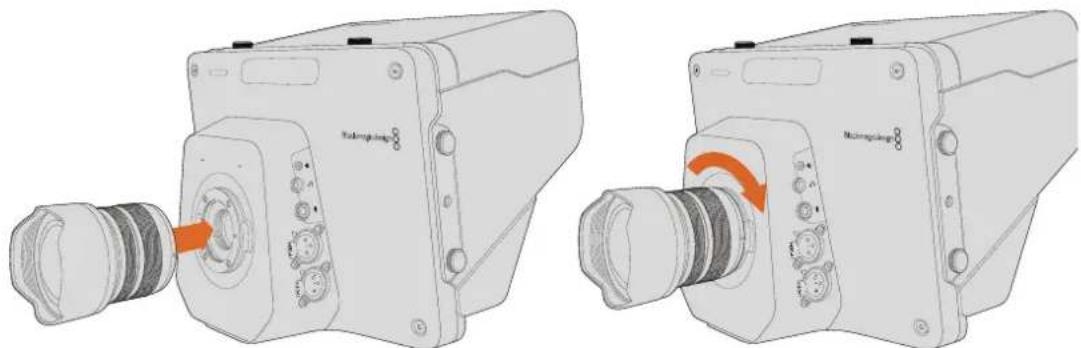
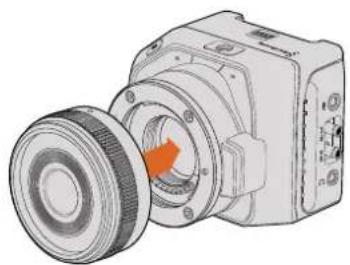
Getting started with your Blackmagic Studio Camera or Blackmagic Micro Studio Camera 4K is as simple as attaching a lens and turning the camera on. To remove the protective dust cap from the lens mount, hold down the locking button and rotate the cap counterclockwise until it is released. We recommend you always turn off your Blackmagic camera prior to attaching or removing a lens.
To attach a lens:
1 Align the dot on your lens with the dot on the camera mount. Many lenses have either a blue, red or white dot or some other indicator.
2 Twist the lens clockwise until it locks into place.
3 To remove the lens, hold down the locking button, rotate the lens counterclockwise until its dot or indicator reaches the 12 o'clock position and gently remove.
When no lens is attached to the camera, the lens mount is exposed to dust and other debris so you'll want to keep the dust cap on whenever possible.
natural_image
Illustration of two industrial camera modules with orange arrows indicating rotation or adjustment (no text or symbols present)Attaching and removing a lens on Studio Camera.
natural_image
Technical illustration of a mechanical device with a pulley and housing (no text or symbols)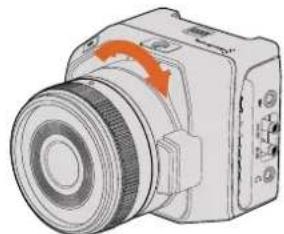
natural_image
Illustration of a camera module with an orange arrow indicating rotation (no text or symbols)Attaching and removing a lens on Micro Studio Camera 4K.
Turning Your Camera On
1 Press the power button below the LCD. On Blackmagic Studio Camera and Studio Camera 4K models, the live camera image will appear on the LCD.
2 Press and hold the power button to switch off the camera.
TIP Blackmagic Studio Camera HD and Studio Camera 4K have internal batteries that can be charged using the supplied power adapter. These camera can be charged and operated while connected via external power and will switch between power sources without interruption. Blackmagic Studio Camera 2 and Studio Camera 4K 2 does not contain an internal battery and does not need to be charged.
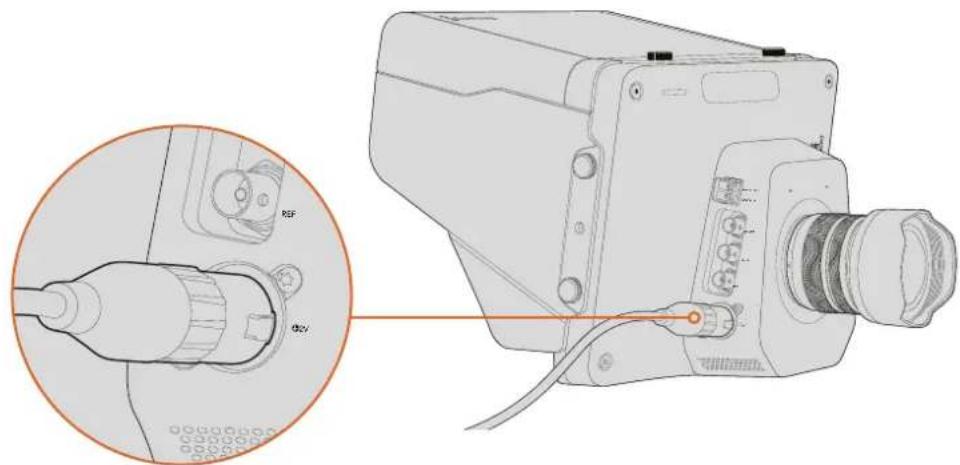
Micro Studio Camera 4K accepts LP-E6 and LP-E6N batteries, which can be charged with an external battery charger or slowly trickle charged by the camera. The camera can also be charged and operated via external power and will switch between power sources automatically if external power is interrupted. External power is provided via the Micro Studio Camera 4K's expansion port.
1 Press the power button on the right hand side of the camera. The tally light will glow white to indicate the camera is on.
2 Press and hold the power button to switch off your camera.
That's all there is to getting started. You can now connect your camera to a switcher, or ATEM Converter, and start creating your live production!
natural_image
Technical illustration of a mechanical device with an inset close-up showing internal components (no text or symbols)Use the supplied power adapter to power the Studio Camera.
Connecting to a switcher
Your Blackmagic Studio Camera and Micro Studio Camera 4K can be remotely controlled from an ATEM switcher via SDI for fast, interactive camera control during your live production.
Connecting via SDI
1 Connect your Blackmagic Studio Camera's and Micro Studio Camera 4K's SDI output to any SDI input on the ATEM switcher.
2 Connect any one of the ATEM switcher's SDI outputs, except down converted or multi view outputs, to your Studio Camera's SDI program input. Camera control signals are not sent via the multi view and down converted SDI outputs.
TIP If you have the optional SFP Optical Module installed, you can use optical fiber to connect your Blackmagic Studio Camera to an ATEM Switcher. This is great for long cable runs as optical fiber can carry a signal up to 28 miles.
An ATEM Studio Converter or ATEM Talkback Converter 4K is required to complete the connection to your ATEM Switcher. For more information on optical fiber setup refer to the 'connection diagrams' section in the ATEM Converters manual.
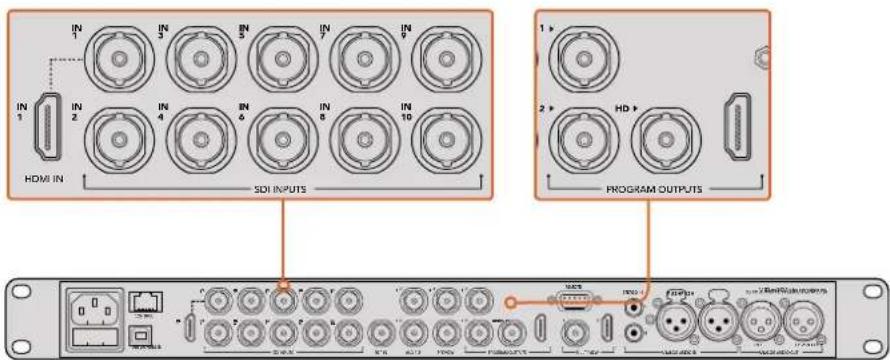
To connect your camera to an ATEM switcher, simply plug your camera's SDI output into any of your switcher's SDI inputs. For camera control, plug any of the ATEM switcher's non down-converted outputs to your camera's program SDI input. A quick and easy way to plug your switcher into the camera is to connect one of the switcher's program outputs.
Setting Button Mapping and Tally
Open ATEM Software Control Preferences and set the switcher's button mapping settings to make sure you are switching the right camera with correct tally.
To set the mapping settings:
1 Click on the menu bar at the top of the screen and open the ATEM Software Control Preferences.
2 Click on the 'Mapping' tab and check the buttons correspond with the correct input. For example, because your Studio Camera is connected to input 1 on your switcher, 'Button 1' should be set to 'Input 1: Camera 1'.
3 On your Blackmagic Studio Camera, press 'Menu'. Navigate to Studio Settings>Camera Number and set it to match the switcher input. In this example, your Studio Camera is connected to Cam 1 on the ATEM switcher, so the camera number must also be set to 1. This ensures tally is sent to the correct camera.
Now that everything is plugged in and mapping is set, you can check that the program output can be monitored on your camera and confirm that tally is working. A fast way to check is to press the program button on your Blackmagic Studio Camera, then switch color bars to the program output on your ATEM switcher. If you see color bars on your camera, you know the program output is working properly with your camera.
Now switch camera 1 to the program output. The tally light on the Studio Camera should now illuminate. If not, double check your camera number is set to the corresponding input on the switcher, and that the mapping settings in the switcher are correct.
Using Camera Control
Your Blackmagic Studio Camera can be controlled from an ATEM switcher using the Camera Control feature in ATEM Software Control.
Launch ATEM Software Control and click on the 'Camera' button located at the bottom of the software window to open the camera control page. You will see a row of labeled camera controllers containing tools to adjust and refine each camera's image. Camera 1 is labelled 'Cam 1.' If the camera is switched to the program output it will display a red 'On Air' status.
Inside the 'Cam 1' controller you can make camera adjustments including color correction, lens control on compatible lenses, camera settings and more. For more details on how to use the camera control features, refer to the 'using ATEM software control' section for more information.
Connecting to a Recorder
You can also connect your Blackmagic Studio Camera to an external recorder, for example a Blackmagic HyperDeck Studio disk recorder for indoor studio recording. Or even mount a HyperDeck Shuttle or Blackmagic Video Assist to your studio camera and loop through to the switcher for ISO recordings during an outside broadcast.
That's all there is to getting started! Live production is exciting and your Blackmagic Studio Camera is designed to give you an easy and fun experience. Please keep reading the manual to learn about all the different features and settings on your Blackmagic Studio Camera.
Camera Features
Blackmagic Studio Camera Features
Front Panel
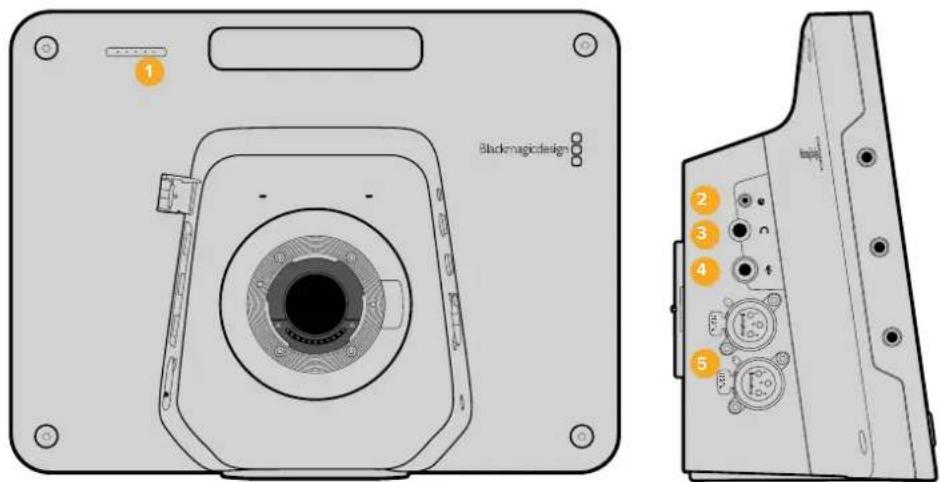
1 Front Tally Light
Indicates to the on-air talent which camera is currently "live". See the 'monitoring settings' section in this manual for more details.
Left Panel
2 LANCRemote
2.5mm stereo jack for LANC remote control supports iris, zoom and focus control.
3 AviationHeadphones
0.25" TRS connector for monitoring PGM and control room audio with aviation style headsets.
4 Headphones Microphone Input
0.206" TRS connector for talking to the control room with aviation style headsets.
5 Audiolnputs
2 x 1/4" balanced XLR connectors for audio input. Refer to the 'Blackmagic Studio Camera - left side' section in this manual for more details.
Right Panel
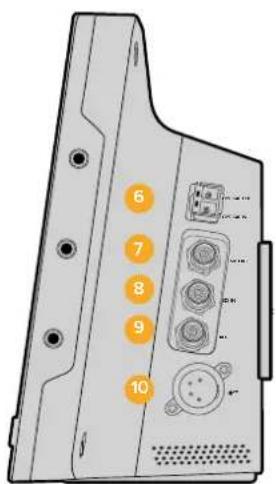
6 Optical Input/Output
Optical input and output allows cable runs of up to 28 miles when the optional SFP optical module is fitted.
7 SDI Out
SDI output for connecting to a switcher or other device.
8 SDI In
SDI input allows the camera operator to view the Program (PGM) output.
9 Reference Input
Allows multiple cameras to be genlocked to a blackburst or tri-level reference signal.
10 Power
12 – 24V power input for power supply and battery charging, where applicable. Refer to the 'Blackmagic Studio Camera - right side' section in this manual for more details.
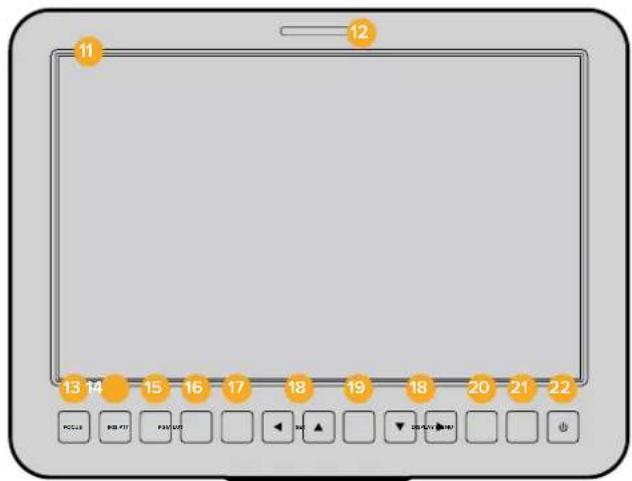
Rear Panel
11 10" LCD
Monitor live camera output or program output, or view the menu. See the 'monitoring settings' in this manual for more details.
12 Rear Tally Light
When lit, it indicates to the camera operator that their camera is currently live.
13 Focus Button
Press once to auto focus or twice to display focus peaking on the LCD.
14 Iris Button
Press once for auto exposure.
15 Push To Talk Button (PTT)
Press and HOLD to talk. Press twice in quick succession for hands free communication. Press again to revert to the default behavior.
16 Program (PGM) Button
Press to toggle between live camera output and program output from a switcher control room.
17 Look Up Table (LUT) Button
Currently not implemented.
18 Menu Navigation Buttons
Navigate the menu on the LCD.
19 Set Button
Use this button to confirm your menu selections.
20 Display Button
Press this button to toggle overlays on and off.
21 Menu Button
Access the menu on the LCD.
22 Power Button
Press the power button to turn on the Blackmagic Studio Camera. Press and hold the button to turn the camera off. Refer to the 'button settings' section in this manual for more details.
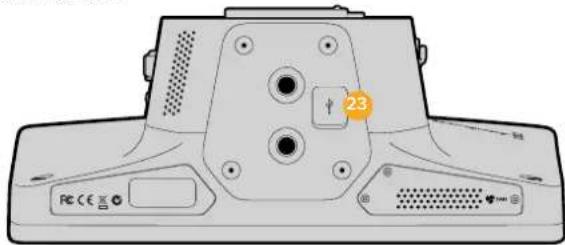
Bottom Panel
23 USB Connector
USB Mini-B port for camera firmware updates. See 'Blackmagic Camera Setup' section in this manual.
natural_image
Front view of a computer monitor case with buttons and ports (no readable text or symbols)Blackmagic Micro Studio Camera 4K Features
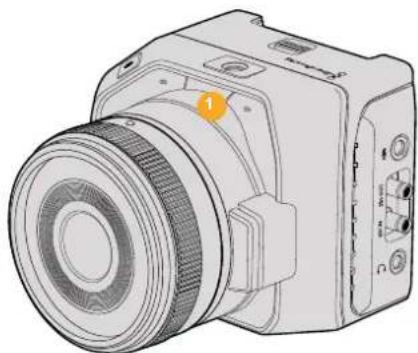
Front Panel
natural_image
Technical line drawing of a camera module with lens and control knobs (no text or symbols)1 Tally Light
The Tally light indicates to on air talent which camera is currently 'live,' as well as alerting the operator to the status of the camera.
The following scenarios are possible:
| White Powered | |
| Green Preview | |
| Red Live | |
| Alternating red and orange Battery low when live | |
| Alternating white and orange Battery low | |
You can adjust the brightness of the tally light in Micro Studio Camera 4K's settings. See the 'camera settings' section for more information.
Left Panel
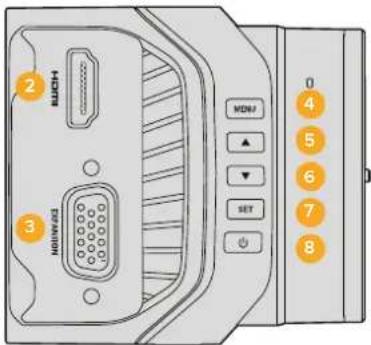
2 HDMI Out
The HDMI output lets you preview your video output and navigate the camera menus using external monitors such as Blackmagic Video Assist. Output resolution is always 1080HD, unless you have 720p selected, in which case the output resolution will also be 720p. You can choose to display overlays such as frame guides, a histogram, and audio levels. See the 'monitoring settings' section in this manual for more details.
3 Expansion Port
DB-HD15 connector. Used for external power input and a range of remote control options as well as reference input. See the section 'Blackmagic Micro Studio Camera 4K Expansion Cable' for details.
4 Menu Button
Use the menu buttons to access the camera's built in menu which can be displayed on an attached HDMI display.
5 Up Button
Use the button to navigate menus.
6 Down Button
Use this button to navigate menus.
7 Set Button
Use this button to confirm your menu selections.
8 Power Button
Press the power button to turn on the Blackmagic Micro Studio Camera 4K. Press and hold the button to turn the camera off.
Right Panel
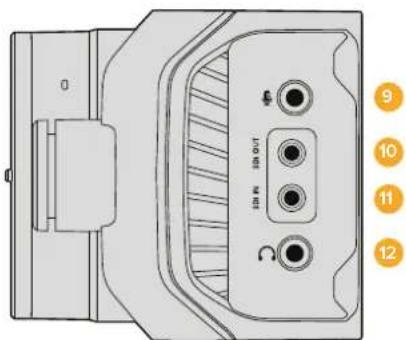
9 Analog Audio In
3.5mm stereo audio input, switchable between microphone and line-level input in menu.
10 SDI Out
SDI output for connecting to a switcher, external recorder or other device.
11 SDI In
SDI input allows camera control via ATEM switchers or the Blackmagic 3G-SDI Shield for Arduino.
12 Headphone / Talkback
3.5mm jack for talkback with iPhone and Android style headsets. Double press the play/pause button on your headset to toggle talkback on and press it once again to turn talkback off.
Rear Panel
natural_image
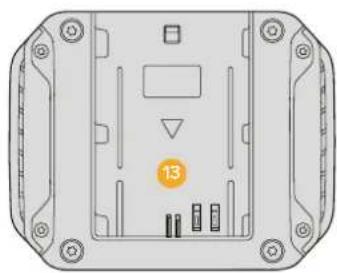
Front view of a device casing with labeled components (no readable text or symbols)13 Battery Slot
Blackmagic Micro Studio Camera 4K comes with one LP-E6 battery which fits into this slot. The battery will be trickle charged while the camera is connected to power via its expansion port.
Top Panel
natural_image
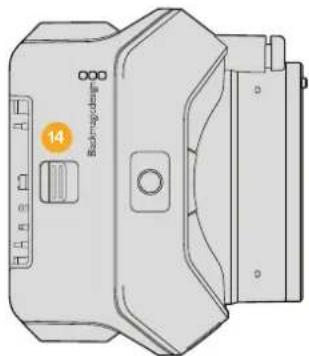
Technical line drawing of a mechanical device with no visible text or symbols14 Battery Release
Slide forward to release the battery.
Bottom Panel
natural_image
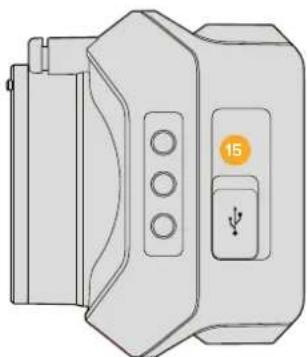
Illustration of a handheld device with three circular buttons and a numeric display (no text or symbols)15 USB Connector
USB port for camera firmware updates.
See the 'Blackmagic Camera Setup' section in this manual.
Camera Connections
Blackmagic Studio Camera – Left Side
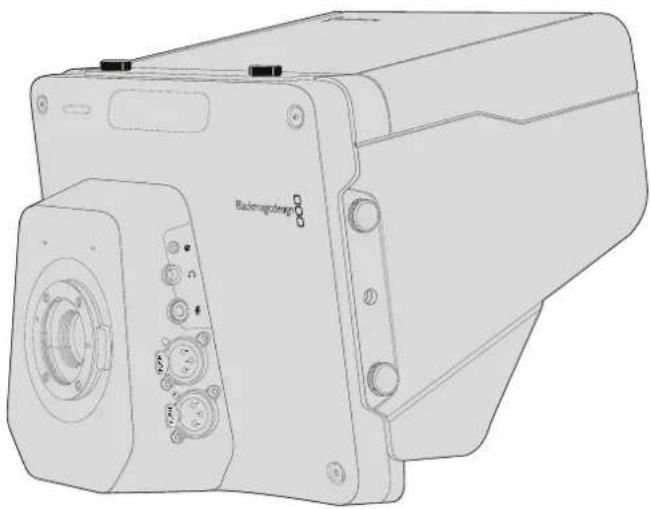
natural_image
Technical line drawing of a mechanical device with labeled ports and mounting holes (no readable text or symbols)LANC Remote Control
The remote port on your camera is used to remotely control lens focus, iris and zoom adjustments when using a compatible lens. The port takes a 2.5 mm stereo jack using the standard LANC protocol.
Active MFT lenses allow you to control the zoom servo with a LANC controller. The following lenses are currently supported:
- Panasonic Lumix G X Vario PZ 14-42mm f/3.5-5.6 Power O.I.S. Lens
- Panasonic Lumix G X Vario PZ 45-175mm f/4.0-5.6 Zoom O.I.S. Lens
- Olympus M.Zuiko Digital ED 12-50mm f/3.5-6.3 EZ Micro 4/3 Lens
- Olympus M.Zuiko Digital ED 14-42mm f/3.5-5.6 EZ Micro 4/3 Lens
Headphones Output
For monitoring program and control room audio with aviation style headsets with "fixed wing" connectors. Aviation headsets range from single ear models for use in studio environments to full size noise cancelling models which are suitable for loud concerts or sporting events. Audio is taken from channel 15 and 16 of the incoming SDI signal. Channels 15 and 16 are rarely if ever used during production and so are very suitable to serve for the audio talkback.
Headphones Microphone Input
For talking to the control room with aviation style headsets. Audio is embedded into channel 15 and 16 of the SDI signal output.
Audio Inputs
Two channels of professional balanced analog audio is supported via XLR connectors. Use the audio menu to set the input levels for each channel. The inputs support both mic level inputs and line level inputs and the input type is also selected from the audio menu. Audio is embedded into channel 1 and 2 of the SDI stream.
Blackmagic Studio Camera – Right Side
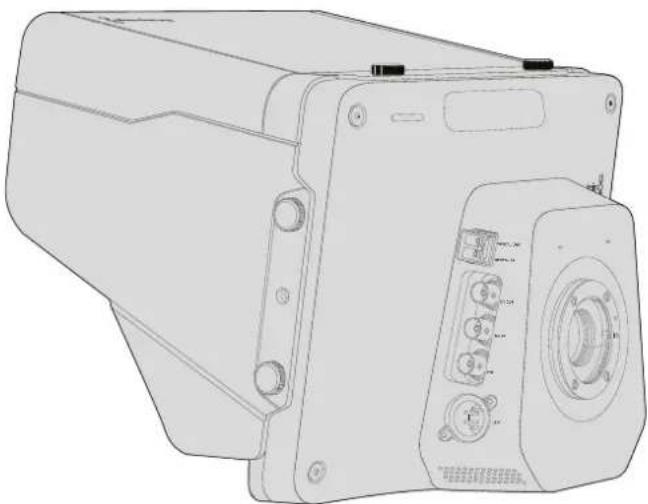
natural_image
Technical line drawing of a mechanical device with mounting holes and a central component (no text or symbols)Optical Input/Output
For optical fiber input and output, you will need to install an optional optical fiber SFP module. This lets you connect industry standard LC connectors, supporting 3G-SDI on Studio Camera HD, and 6G-SDI on Studio Camera 4K. Optical fiber cable is widely available because it's the same cable used in computer networking. Optical fiber allows cable runs of up to 28 miles which is more than enough for even the most demanding outside broadcast event.
If both optical and SDI inputs are connected, the output from the device which was connected first will be used. To purchase an optical fiber SFP module for your Blackmagic Studio Camera, contact your nearest Blackmagic Design reseller. You can find your nearest reseller on our website at www.blackmagicdesign.com/resellers.
SDI Out
Use the SDI Out connector to output 10-bit 4:2:2 video to professional SDI video equipment such as routers, monitors, SDI capture devices and broadcast switchers. Blackmagic Studio Camera HD supports 3G-SDI, and Studio Camera 4K supports 12G-SDI.
SDI In
The SDI input allows the camera operator to view the Program (PGM) output. Simply press the PGM button to toggle between live camera output and Program output from a switcher control room.
If both optical and SDI inputs are connected, the output from the device which was connected first will be used. If you're using the Studio Camera to record to a device such as the Blackmagic Hyperdeck Shuttle, the output from the Hyperdeck can be connected to the SDI input so you can playback what you have just recorded.
Reference Input
This allows multiple cameras to be genlocked to a blackburst or tri-level reference signal. Genlocking cameras to an external reference signal helps to prevent timing errors which may result in the picture jumping when switching between different cameras.
Power
Use the 12 - 24V power input for connecting your power supply and to charge the internal battery in Blackmagic Studio Camera HD and Blackmagic Studio Camera 4K. When the battery in these cameras is charged it will power the camera for up to 4 hours on Studio Camera HD, and up to 3 hours on Studio Camera 4K.
Blackmagic Studio Camera 2 and Studio Camera 4K 2 do not have internal batteries.
Blackmagic Micro Studio Camera 4K – Left Side
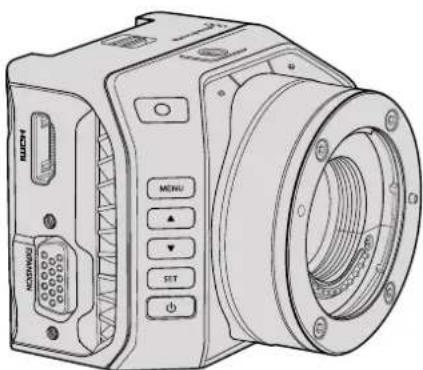
natural_image
Line drawing of a digital camera module with control buttons (no text or symbols)HDMI Output
The HDMI port on your Blackmagic Micro Studio Camera 4K outputs 10-bit 4:2:2 1080p video with 2 channels of audio for monitoring purposes. You can connect any HD capable HDMI monitor, such as Blackmagic Video Assist, to frame and focus shots as well as navigating the Micro Studio Camera 4K's menus.
The frame rate of the HDMI output will match the format of the camera. For example, if the camera is set to 2160p30, the HDMI output will be 1080p30.
When connected to an ATEM switcher, Blackmagic Micro Studio Camera 4K provides a two stage tally indicator on a monitor connected via the camera's HDMI output. The monitor displays a green border when switched to the preview output of the switcher, and red when switched to the program output.
Expansion Port
Blackmagic Micro Studio Camera 4K's small size makes it easy to capture unique shots from close to the action or difficult to reach spots. While your Micro Studio Camera 4K can be easily tucked away out of sight, the same can't always be said of a camera operator. So being able to remotely control your camera is important to making full use of its tiny size.
You can adjust some settings on Micro Studio Camera 4K via SDI input with an ATEM Switcher, as detailed in the section ‘Introducing Camera Control’ in this manual. However, the majority of control options are provided by the expansion port.
Blackmagic Micro Studio Camera 4K's DB-HD15 connector provides a wide range of connections, including power, LANC remote, pan, tilt, zoom and genlock via the expansion cable included. We encourage you to use a wide range of easily available cables to access specific features, or to solder your own custom connections and adapt the Micro Studio Camera 4K to your needs. See the 'Blackmagic Micro Studio Camera 4K Expansion Cable' section in this manual for more information.
Blackmagic Micro Studio Camera 4K – Right Side
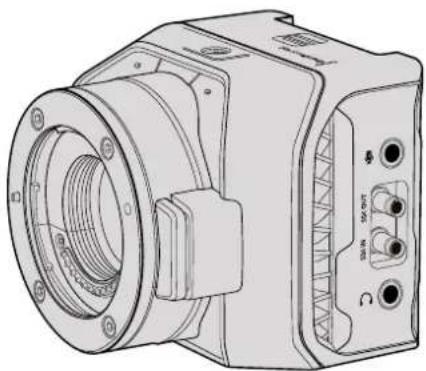
natural_image
Technical line drawing of a mechanical device with no visible text or symbolsAnalog Audio In
The 3.5mm stereo audio connector accepts microphone or line level audio. You can switch between these options in the camera's 'audio settings' menu. It's important to select the appropriate setting or your audio may sound too quiet or too loud.
SDI Out
Use the SDI out connector to output 10-bit 4:2:2 video to professional SDI video equipment such as routers, monitors, SDI capture devices and broadcast switchers. Blackmagic Micro Studio Camera 4K supports 6G-SDI. You will need a DIN 1.0/2.3 to BNC adapter cable to connect to devices with full size BNC connectors.
SDI In
Use the SDI in connector to control your Micro Studio Camera 4K via ATEM switchers. Refer to the section 'Introducing Camera Control' for information about which controls are available.
TIP You can also control your Micro Studio Camera via a Blackmagic 3G-SDI Shield for Arduino. The shield embeds the same Blackmagic control data packets in the SDI signal as you would get with an ATEM switcher. This means by connecting the program return feed from any SDI switcher, through the shield to the SDI input on your camera, you can access all the same Blackmagic camera controls you get with ATEM switchers.
Headphone / Talkback audio
The 3.5mm headphone / talkback input lets you talk to the control room with iPhone or Android style headsets. Double press the play/pause button on your headset to enable talkback, and press once to disable. Audio is embedded into channel 15 and 16 of the SDI signal output.
Customization
Blackmagic Micro Studio Camera 4K Expansion Cable
There are two ways to access the expansion port's functions. You can use the expansion cable that comes with your Micro Studio Camera 4K, or solder your own custom connectors.
The expansion cable provides connectors for the following control options.
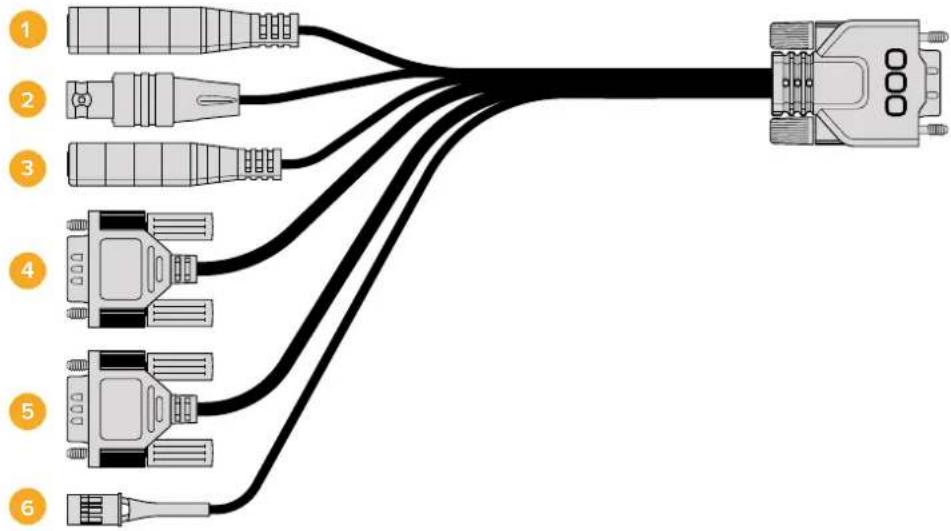
Blackmagic Micro Studio Camera 4K expansion cable.
1 Power Input
The 12V power input connects via a DC jack and provides power to the Micro Studio Camera 4K, as well as trickle charging any batteries attached. When mains power is supplied, the camera will automatically turn on.
2 Reference Input
This allows multiple cameras to be genlocked to a blackburst or tri-level reference signal. Genlocking cameras to an external reference signal helps to prevent timing errors which may result in the picture jumping when switching between different cameras.
3 LANC
Connect wired LANC remote controllers to the 2.5mm jack for controlling functions like zoom, iris adjustment, and focus from a tripod arm when using compatible lenses.
4 Pan Tilt Zoom
The RS-422 connector is used to relay pan tilt zoom commands received by Micro Studio Camera 4K from its SDI input to a motorized head.
Refer to the 'PTZ Control over SDI' section for more information about PTZ control.
5 B4 Communication
The DB-9 connector allows you to power and control B4 broadcast lenses attached to the Micro Studio Camera 4K via an MFT to B4 adapter. To control a compatible B4 lens, simply connect the optional Digital B4 Control Adapter cable to the cable from the lens, then connect the other end to the DB-9 serial connector on your expansion cable.
You can adjust settings such as iris, focus and zoom in the same way you would an active MFT lens, either via an ATEM switcher using the 'camera control' page, or via other remote control interfaces that can be connected to the Micro Studio Camera 4K expansion cable. For a list of supported B4 digital lenses, refer to the Blackmagic Design support center at www.blackmagicdesign.com/support/faq/59011
6 S.Bus Digital Servo
By connecting to a compatible S.Bus receiver using the Futaba J cable, you have 17 S.Bus remote channels where features of the camera can be assigned to and remotely controlled. Channel 18 is reserved as a reset switch so that the camera can be reset to its default exposure settings. These features can include focus, servo zoom, iris control and other such features. For more information about mapping functions to S.Bus remote channels, see the 'Remote Settings' section of this manual.
Wiring diagram for the Blackmagic Micro Studio Camera 4K Expansion Cable
When using Blackmagic Micro Studio Camera 4K's expansion port you may only want to access one or two functions. For example, you may want to control an attached B4 Broadcast Lens while simultaneously receiving 12V power and a reference signal. It's easy to make a connector that will give you just these functions without the clutter of additional, unused connectors.
Use the following diagram when wiring the expansion cable included or use it as an example for how you can wire up the connections on your own custom cable correctly. The full range of available pins are listed under group P1, while the subsets used for particular functions, as well as their layout within the appropriate connectors, are shown in groups P2 through P7.
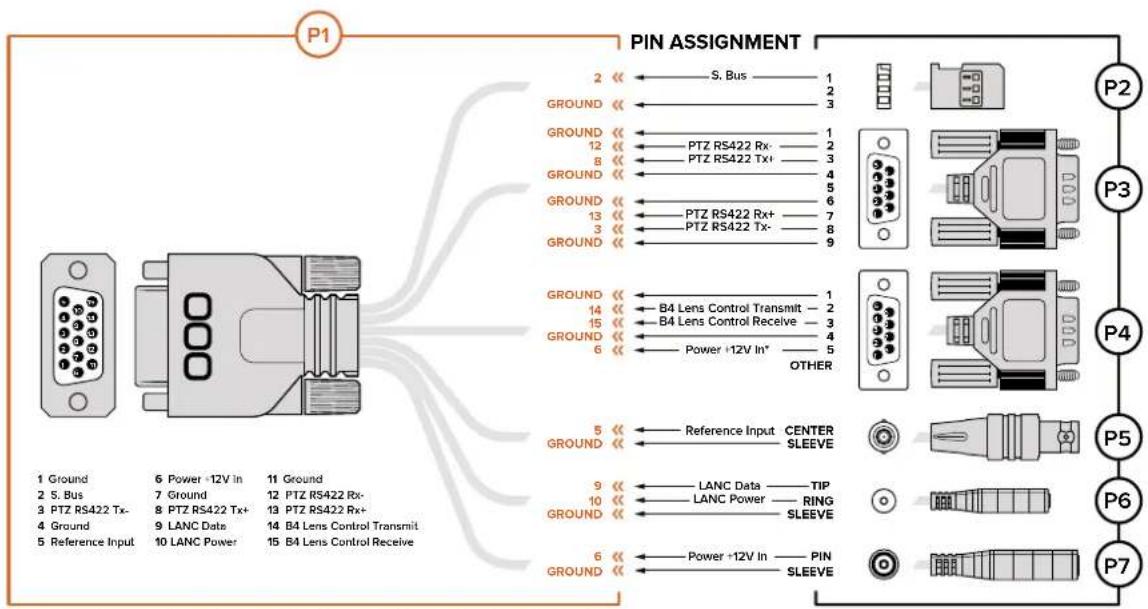
* Power Input to the camera is also used to power the lens. Beware of applying excessive voltages if you're using your own power supply to avoid damage to the lens.
Settings
You can change settings on your Blackmagic camera to get the best picture, such as video format, shutter speed and white balance, plus you can adjust audio levels, monitoring settings, and studio tally and talkback settings for effective communication with the control room.
This section of the manual contains detailed information on each of the settings in your camera.
Camera Settings
To configure the camera settings on your Blackmagic Studio Camera or Blackmagic Micro Studio Camera 4K, press the 'menu' button. Use the menu navigation buttons to highlight items and press the 'set' button to confirm your selection.
If you are using the Micro Studio Camera 4K, you will need to connect an external monitor via the camera's HDMI port to view menu settings.
Video Format
Select your desired video format using the navigation buttons. For example, to select between 1080p and 1080i formats, press the left or right arrow buttons to progress through the format options. Press the 'set' button to confirm the format you want.
A list of supported video formats is provided later in this section.
Gain
Gain settings are helpful when you are shooting in low light conditions. The default setting on Blackmagic Studio Camera is 0dB and gain can be increased in 6dB increments up to 18dB. Gain settings on Blackmagic Micro Studio Camera 4K range from -12dB to +12dB and can be increased in 6dB increments. The 0dB setting is the default setting with no gain added to the picture.
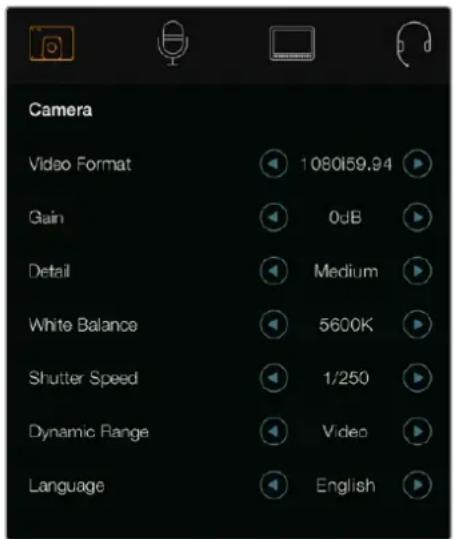
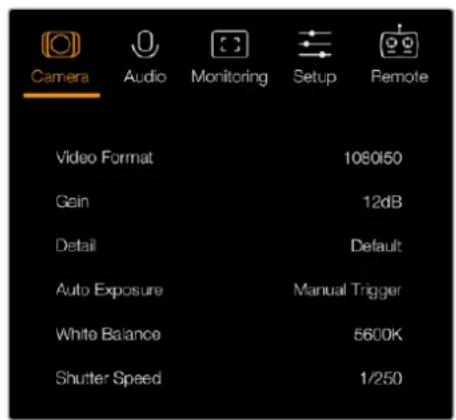
Camera settings – Blackmagic Studio Camera Blackmagic Micro Studio Camera 4K
Detail
Use this setting to sharpen your image live from your Studio Camera. Decrease or increase the level of sharpening by selecting 'off' or 'default' for low sharpening, 'medium' and 'high'.
Auto Exposure
Blackmagic Micro Studio Camera 4K gives you several auto exposure options.
Iris
Maintains a constant shutter speed while changing the aperture to achieve a constant exposure.
Shutter
Maintains a constant aperture while changing the shutter speed to achieve a constant exposure.
Iris + Shutter
Maintains the correct exposure levels by adjusting the aperture. If the maximum or minimum available aperture is reached and exposure still cannot be maintained, Micro Studio Camera 4K will begin adjusting the shutter speed to keep exposure constant.
Shutter + Iris
Maintains the correct exposure levels by adjusting the shutter speed. If the maximum or minimum available shutter speed is reached and exposure still cannot be maintained, Micro Studio Camera 4K will begin adjusting the aperture to keep exposure constant.
Manual Trigger
Iris aperture and shutter speed are set manually and exposure may vary with changing light conditions.
White Balance
Eighteen white balance presets are selectable for a variety of color temperature conditions.
- 2500, 2800, 3000, 3200, 3400, 3600, 4000, 4500 and 4800K for various conditions under tungsten, incandescent or fluorescent light, or under dull natural light including candle light, sunrise/sunset, morning, and after noon light.
- 5000, 5200, 5400 and 5600K for outdoors on a clear, sunny day.
- 6000, 6500, 7000, 7500 and 8000K for a variety of daylight conditions.
Shutter Speed
Shutter speed complements the gain setting by regulating the amount of light on the sensor. There are 15 different shutter speeds available ranging from 1/50 sec to 1/2000 sec.
Blackmagic Studio Cameras Supported Video Formats
| Blackmagic Studio Camera | Blackmagic Studio Camera 4K | Blackmagic Micro Studio Camera 4K |
| 720p50 720p50 720p50 | ||
| 720p59.94 720p59.94 720p59.94 | ||
| 720p60 720p60 720p60 | ||
| 1080i50 1080i50 1080i50 | ||
| 1080i59.94 1080i59.94 1080i59.94 | ||
| 1080i60 1080i60 1080i60 | ||
| 1080p23.98 1080p23.98 1080p23.98 | ||
| 1080p24 1080p24 1080p24 | ||
| 1080p25 1080p25 1080p25 | ||
| 1080p29.97 1080p29.97 1080p29.97 | ||
| 1080p30 1080p30 1080p30 | ||
| 1080p50 1080p50 1080p50 | ||
| 1080p59.94 1080p59.94 1080p59.94 | ||
| 1080p60 1080p60 1080p60 | ||
| -2160p23.98 2160p23.98 | ||
| -2160p24 2160p24 | ||
| -2160p25 2160p25 | ||
| -2160p29.97 2160p29.97 | ||
| -2160p30 2160p30 | ||
| -2160p50 - | ||
| -2160p59.94 - | ||
| -2160p60 - |
Audio Settings
To adjust audio input and audio monitoring settings on your Blackmagic Studio Camera, press the 'menu' button and select the microphone icon to the left of the display. Use the menu navigation buttons to highlight menus and use the 'set' button to confirm your selection.
Automatic Gain Control
Blackmagic Micro Studio Camera 4K features an automatic audio gain control setting that lets camera adjust the audio recording levels. It automatically reduces the audio gain levels if the input level gets too loud and subtly raises it if it is too low.
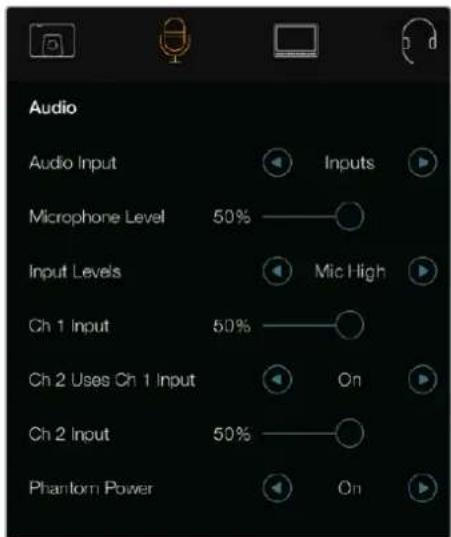
Audio settings – Blackmagic Studio Camera.
Audio Input
Switches audio between using the camera's internal microphone and the XLR audio connectors.
Microphone Level
Microphone input adjusts the recording levels of the built in microphone. Move the audio slider left or right to increase or decrease levels. Studio Camera has a built in stereo microphone. The built in microphone records to audio channels 1 and 2 when no external audio source is connected.
Input Level
External audio connectors support audio at microphone level or line level. Select Line when connecting external audio equipment such as an audio mixer or amplifier. Select the mic low or mic high setting depending on the signal strength of your microphone. It's important to select the appropriate level to avoid your external audio sounding almost inaudible or too hot and distorted. Set the external audio input levels by using the left and right arrows.
Ch 1 Input
Move the audio slider icon left or right to increase or decrease levels for channel 1. The external audio input overrides the built in microphone and is output to audio channel 1.
Ch 2 Uses Ch 1 Input
Select 'on' if you want to embed channel 1 external audio into channels 1 and 2 of the SDI or the optional optical fiber output. This is the same as connecting input 1 to both audio channels in the camera and is useful when using microphones with a single mini audio output and you need to connect both stereo audio channels to it. Select this setting to off if you want channel 1 audio to remain on one channel only and channel 2 will take audio from the channel 2 audio input, which is preferred when using stereo audio sources.
Ch 2 Input
Move the audio slider icon left or right to increase or decrease levels for channel 2.
The external audio input overrides the built in microphone and is output to audio channel 2.
Phantom Power
Phantom power supplies power through microphone cables and is a convenient power source for condenser microphones. Enable or disable phantom power for studio cameras with XLR inputs by navigating to the 'audio' menu and selecting on or off using the arrow buttons. Phantom power is automatically disabled when the 'line input level' setting is selected. Be sure to wait at least 10 seconds for phantom power to discharge after disconnecting before plugging in a self powered microphone. Older ribbon type microphones are not suitable for phantom power usage.
Monitoring Settings
To adjust the display settings for the LCD, press the 'menu' button and select the monitor icon. Use the menu navigation buttons to highlight menus and use the 'set' button to confirm your selection.
HDMI Meters
Blackmagic Micro Studio Camera 4K gives you the option to select which meters you want to display on the HDMI output.
Histogram
The histogram shows the contrast between whites and blacks along a horizontal scale. The left edge of the histogram displays shadows, or blacks, and the far right displays highlights, or whites. When you close or open the lens aperture, you'll notice the information in the histogram moves to the left or right accordingly.
This setting toggles the histogram on and off. When on, this will appear in the bottom right corner of an attached monitor when 'HDMI overlays' are set to on.
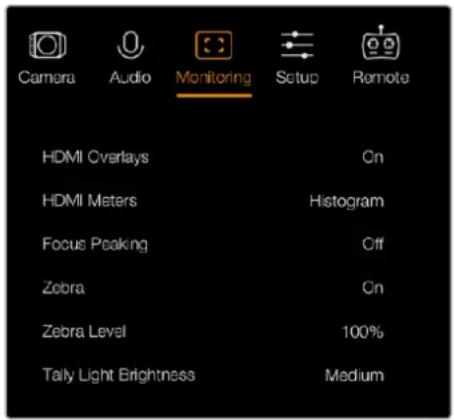
Monitoring settings - Blackmagic Micro Studio Camera 4K.
Audio
The audio meter represents the current volume of left and right audio channels in two horizontal bars. Left is on top, right is on the bottom. If your audio levels rise too high, your audio peaks can be clipped and you will hear distortion in your audio. To avoid this, adjust the audio gain on your camera until your audio levels stay within safe levels.
This setting toggles the audio meter on and off. When on, this will appear in the bottom left corner of an attached monitor when 'HDMI overlay' are set to on.
HDMI Overlays
This setting is only available on Micro Studio Camera 4K. When set to 'on,' HDMI video output will include frame guides and information about the camera settings and identity, as well as any meters enabled via the 'HDMI meters' setting.
Brightness
Move the slider icon left or right to adjust brightness settings for the LCD. The default setting is 60%.
Zebra
Blackmagic Cameras have a zebra feature which gives an indication of exposure levels. Diagonal lines will appear across any part of the video that exceeds the zebra exposure level. Turn zebra on and select the desired zebra warning level by using the left and right arrows. The default setting is medium.
Focus Peaking
Allows you to change the level of focus peaking. The settings include: off, low, medium and high. Adjust this setting when you are using a very sharp lens and the peaking covers the entire image. The default setting is medium.
Front Tally Brightness
Changes the brightness of the front tally light. Settings include: off, low, medium and high. The default setting is medium.
Rear Tally Brightness
Changes the brightness of the rear tally light. Settings include: low, medium and high. The default setting is medium.
Tally Light Brightness
Changes the brightness of the tally light on Micro Studio Camera 4K. The default setting is medium but you can also set it to high, low or off.
If you have set the tally brightness to 'off', the tally light will illuminate when your camera is powered on, and then will turn off shortly afterwards.
Display Battery Percentage
Some LP-E6 batteries can tell the camera their charge levels directly via digital serial communication. If this option is enabled, you can display the battery levels for Micro Studio Camera 4K using a percentage value instead of graphical bars. However, if you find the percentage display inaccurate, you can switch back to using graphical bars which measures of the state of charge directly off the battery.
Studio Settings
To adjust the display settings for the LCD, press the 'menu' button and select the headphones icon. Use the menu navigation buttons to highlight menus and use the 'set' button to confirm your selection.
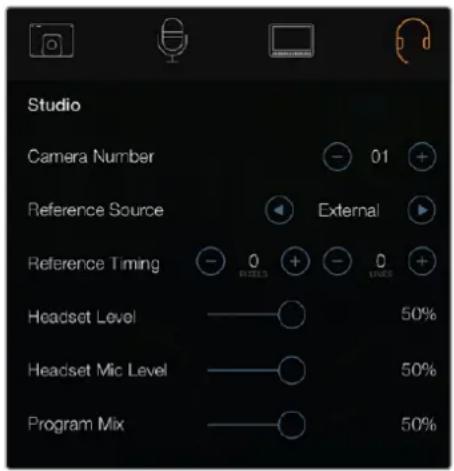
Studio settings – Blackmagic Studio Camera.
NOTE Blackmagic Micro Studio Camera 4K provides these settings in the menu titled 'Setup'.
Camera Number
If you want your Studio Camera to receive tally signals from an ATEM switcher, you'll need to set the camera number on your camera. This ensures the switcher sends the tally signal to the correct camera. The camera number can be set to a value of 1-99. The default setting is 1.
TIP You can also connect the program return feed from any SDI switcher to your camera via a Blackmagic 3G-SDI Shield for Arduino and display tally on each camera. All SDI switchers that have open collector tally outputs are configurable for tally using the Blackmagic 3G-SDI Shield for Arduino. Refer to the section titled 'Connecting tally using the Blackmagic 3G-SDI Shield for Arduino' for more information.
Reference Source
Used to select the genlock source. The Studio Camera can lock to program SDI input or external genlock source. If using an external genlock source, be aware that changing that source will most likely cause a glitch as the camera locks to the new source.
On Blackmagic Micro Studio Camera 4K, the HDMI overlays will display 'REF' on screen when a valid reference source is detected and the camera is locked to it.
Reference Timing
Allows you to manually adjust the reference timing on a line or pixel basis.
Headset Level
Move the volume slider left or right to increase or decrease audio monitoring levels. The default setting is 50%.
Headset Mic Level
Move the volume slider left or right to increase or decrease audio microphone input levels. The default setting is 50%.
Program Mix
Changes the balance of camera sound to talkback sound. The headphones will output audio following what is displayed on the LCD. For instance, if you are in camera view, camera audio is heard. And if you are in program view, program audio is heard. The default setting is 0%.
Remote Settings
Blackmagic Micro Studio Camera 4K features an additional menu for setting remote functions using the S.Bus protocol. This protocol uses 1 connection to control up to 17 channels, and each of these channels can be mapped to a specific camera function. S.Bus receivers and decoders can be found in most major hobby stores online as they are often used for radio remote control of airplane and helicopter models.
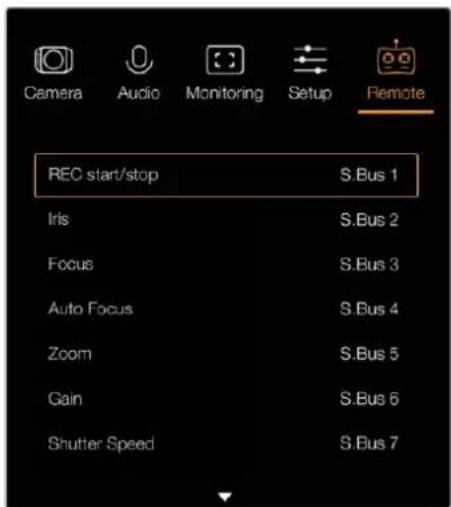
Remote settings – Blackmagic Micro Studio Camera 4K.
Assigning Camera Functions to S.Bus Channels
If you are using S.Bus to control your Blackmagic Micro Studio Camera 4K, you can use the 'remote' menu to assign the following functions to individual S.Bus channels:
- Trigger record
- Iris
- Focus
- Auto focus
- Zoom
Gain - Shutter speed
- White balance
- Audio levels
Frame rate
To assign functions to individual S.Bus channels, simply select the function you wish to control and assign an available channel using the 'up,' 'down' and 'set' buttons.
Standard radio transmitters for remote control vehicles that support the S.Bus protocol are usually setup with control ranges built into their controller output, so that all you need to do is assign camera functions to the correct individual S.Bus channels for remote control of your camera functions.
You can also use the S.Bus protocol to develop your own sophisticated custom control solutions.
Developing a Custom Controller
If you would like to develop your own custom camera control solutions, you can use the S.Bus input on the expansion cable as a way to interface camera functions on Blackmagic Micro Studio Camera 4K.
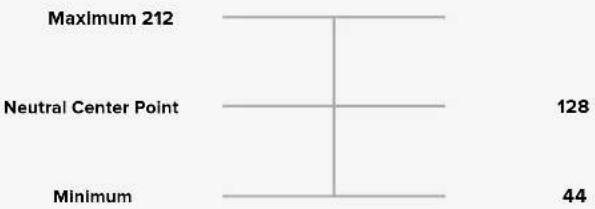
When sending commands via the S.Bus input to Micro Studio Camera 4K, the input values will need to be between 44 and 212 in order to be interpreted by the camera. A value of 128 is considered to be the midpoint or neutral position when using a radio control transmitter.
The way in which specific commands are sent to the camera will depend upon how you have mapped the camera functions to your controller.
There are two ways to map the commands to the controls.
- The first type maps settings to specific ranges of the input so that sending a value within a certain range will trigger a particular setting.
For example, the f-stop settings on a lens from f1.8 to f22 will be distributed along the entire range of 44 to 212. Sending a value between 44 and 51 would set the lens to f1.8. These values will then continue along the entire range so that sending a value between 206 and 212 would select f22. Zoom and focus changes are controlled the same way.
- The second type of control registers any change from the neutral value of 128 to a value above or below and then back to the neutral point. This will be considered by the camera as a valid toggle signal, which increases or decreases the assigned settings. Settings like the REC trigger, autofocus, gain, shutter speed, white balance and frame rate work on this basis.
You could assign camera functions to a control like a spring loaded joystick which snaps back to a neutral center point after each movement up or down. In this example a value of 44 would represent the maximum downward position of the joystick and 212 would represent the maximum upward position, while the center functions as a neutral point with a value of 128.
boxplot
| Category | Value | |---|---| | Maximum 212 | 128 | | Neutral Center Point | 44 | The chart displays a single numerical value for 'Maximum 212' on the vertical axis, which is derived from the box plot. The horizontal axis is unlabeled but implies a comparison between the two groups.For example, if your gain settings are mapped to a joystick in this way, then after each upward movement of the joystick it would return to the neutral point in the center which toggles the camera to increase gain by one increment, say from 0dB to 6dB.
You could also send this same information in numerical form to another type of controller that uses numerical values. In this case you would send a value of 128, followed by a value above 128 such as 212, and then back to 128 again. The camera will register this as an increment command and change the gain from 0dB to 6dB.
The way in which you assign commands will depend upon the kind of control system that you are using to control your camera and the type of control that you want to assign. Spring loaded controls that snap back to a neutral point are very common on radio control transmitters for model aircraft and drones.
If you are using a Futaba style remote control, some functions will be more suited to the rotating dials or analogue sticks, whilst other functions will be more suited to the switches.
Button Settings
Adjusting Lens Settings
Blackmagic Studio Camera supports electronic lens control, which allows you to adjust lens settings such as aperture and auto focus. The focus peaking feature creates a green edge around the sharpest parts of the image so you can easily confirm your focus. Focus peaking is only visible on the LCD and does not affect the SDI output.
Focus Button
When using the Studio Camera with an auto focus lens, press the focus button for focus peaking or auto focus. Press the focus button once to auto focus. A quick double press of the focus button activates focus peaking.
When using a manual lens, press the focus button once for focus peaking.
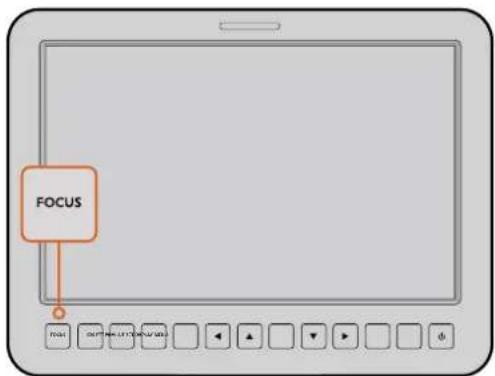
Press the focus button
once to auto focus.
A quick double press
of the focus button
activates focus peaking.
Iris Button
When using video dynamic range settings, a single press of the iris button will set an average exposure based on the highlights and shadows in your shot. When using film dynamic range settings, pressing the iris button sets your exposure to accommodate the brightest highlight in your shot. To set your aperture manually on your Studio camera, press the up and down menu navigation buttons.
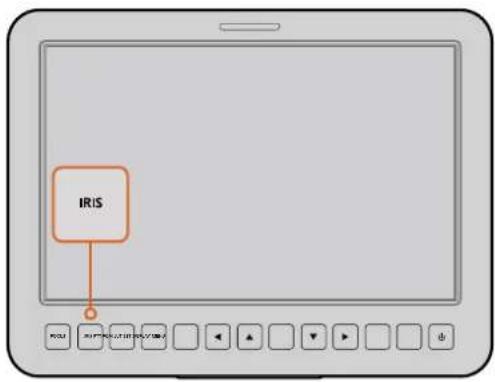
Press the iris button for auto exposure or use the up and down navigation controls for manual exposure.
Additional Settings
Push to Talk (PTT) Button
When doing live production it is vital that camera operators can talk to the director and others within the control room. Simply press and hold the button to begin talking. Press twice in quick succession for hands free communication. Press again to revert to the default behavior.
Program (PGM) Button
It is sometimes important for camera operators to see the program output, rather than just the view from their own camera. Press the button to toggle between live camera output and the program output from a switcher control room. You can use either the SDI input, or user upgradable optical fiber input to connect your external video source.
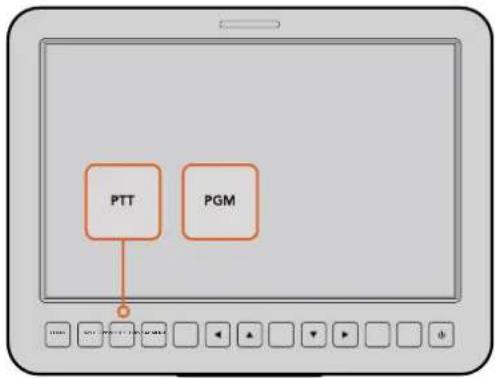
The Studio Camera features settings like PTT and PGM which are essential for live production.
Look Up Table (LUT) Button
Currently not implemented.
Left, Up, Down, Right Buttons
Use these buttons to navigate the menus.
Set Button
Use this button to confirm your menu selections.
Display Button
Press this button to display useful information on your Studio Camera's 10" monitor, including:
Frame guides with camera and lens settings such as camera number, video format and frame rate, shutter speed, white balance, battery life, gain setting and f-stop number.
Press the Disp button again to turn overlays off and monitor the image only. Overlays are visible on the 10" monitor. The SDI output is always clean.
NOTE Blackmagic Studio Camera 2 and Studio Camera 4K 2 do not have internal batteries so will not display battery life remaining.
Menu Button
Press this button to bring up the menu and then use the arrow buttons to navigate.
Power Button
Press the power button to turn on the Blackmagic Studio Camera. Press and hold to turn the camera off.
Camera Video Output
Connecting to Video Switchers
Blackmagic Studio Cameras output 10-bit 4:2:2 video so you can connect to broadcast switchers and other SDI video equipment. With the user upgradable SFP module installed you can connect via optical fiber, which means ATEM Camera Converters are not required at the camera end.
If you're using a Blackmagic Studio Camera HD or Studio Camera 4K, you can easily view the Program (PGM) output from the switcher by connecting it to your Studio Camera's SDI input, or to the optical fiber input when the user upgradable SFP module is installed.
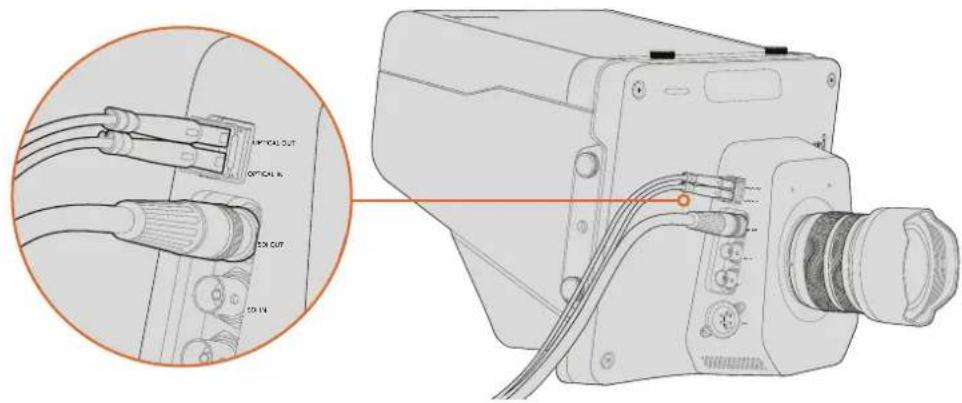
Connect your Studio Camera to a switcher via SDI, or via optical fiber with user upgradable SFP module installed
Blackmagic Studio Camera also features a reference input which allows multiple cameras to be genlocked to a blackburst or tri-level reference signal. Genlocking cameras, VTRs and other devices to an external reference signal helps to eliminate timing errors which may result in the picture jumping when switching between different sources.
Connecting to Recorders
If you simply wish to record your Studio Camera's output, you can connect the SDI output to the SDI input of an SSD recorder such as the Blackmagic HyperDeck Shuttle. The SDI output from the HyperDeck can then be connected to the Studio Camera's SDI input, so you can view your recordings on the camera's LCD.
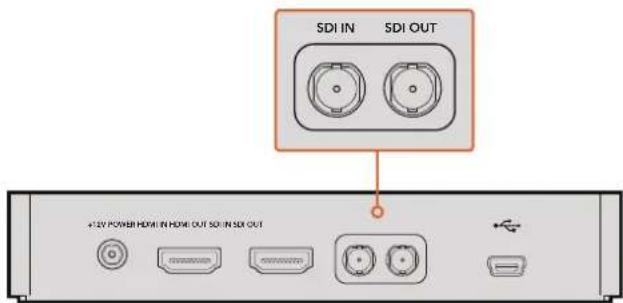
Connect the camera's SDI output to the HyperDeck's SDI input and connect the HyperDeck's SDI output to the camera's SDI input to view your recordings.
Remote Record
Blackmagic Micro Studio Camera 4K automatically sends a signal via the SDI or HDMI output that will trigger recording when connected to equipment that supports the trigger record feature, such as Blackmagic Video Assist.
To trigger recording on your external equipment, you can connect a hand grip with a record trigger switch to your camera via the LANC or S.Bus connectors on the expansion cable.
Then when you press record on the hand grip, your external equipment will start recording, and will stop recording when you press record again.
You will also need to set your equipment to enable SDI or HDMI trigger recording to make sure it responds to the trigger signal from your Micro Studio Camera 4K.
The Blackmagic SDI Control Protocol can also be used to trigger remote recording.
For more details, refer to the developer information section in this manual.
RAW SDI Output
Blackmagic Micro Studio Camera 4K also has a 'RAW' mode which outputs bayered sensor data over the SDI output. This allows you to perform your own debayering of the image data from the sensor.
For more information refer to the 'RAW SDI Output' section in the developer information section in this manual.
Connecting Tally using the Blackmagic 3G-SDI Shield for Arduino
If you are using an SDI switcher with a tally output connector, you can connect the tally outputs to a Blackmagic 3G-SDI Shield for Arduino to send tally signals to your Blackmagic Studio Cameras. This means you can still get tally on your Blackmagic cameras via the SDI program return feed even if you aren't using an ATEM switcher.
For example, the switcher's parallel tally port connects to pins D2 - D9 of your Blackmagic shield and the shield's SDI output is connected to all Blackmagic cameras via a distribution amplifier, such as a Blackmagic Mini Converter SDI Distribution. This way you can send tally to 8 separate Blackmagic cameras.
The Blackmagic camera number must match the switcher's tally outputs, which means you may need to wire a custom connector to make sure the pins correspond to each camera number. The common GND from the switcher's tally connector must be connected to the GND pin of the Blackmagic 3G-SDI Shield.
Below is a configuration example showing how the Blackmagic camera numbers match the tally outputs from the switcher, which are then connected to the pins on the Blackmagic 3G-SDI Shield for Arduino.
| Blackmagic Camera Number Switcher Input Number Arduino Pin | |
| 11 D2 | |
| 2 2 D3 | |
| 3 3 D4 | |
| 4 4 D5 | |
| 5 5 D6 | |
| 6 6 D7 | |
| 7 7 D8 | |
| 8 8 D9 | |
The example sketch below shows how the Blackmagic 3G-SDI Shield for Arduino is programmed to send a tally signal to the camera that has been switched to the program output. All SDI switchers that have open collector outputs are configurable for tally using the Blackmagic 3G-SDI Shield for Arduino. For more information, download the Blackmagic 3G-SDI Shield for Arduino. instruction manual from the Blackmagic Design support center at www.blackmagicdesign.com/support.
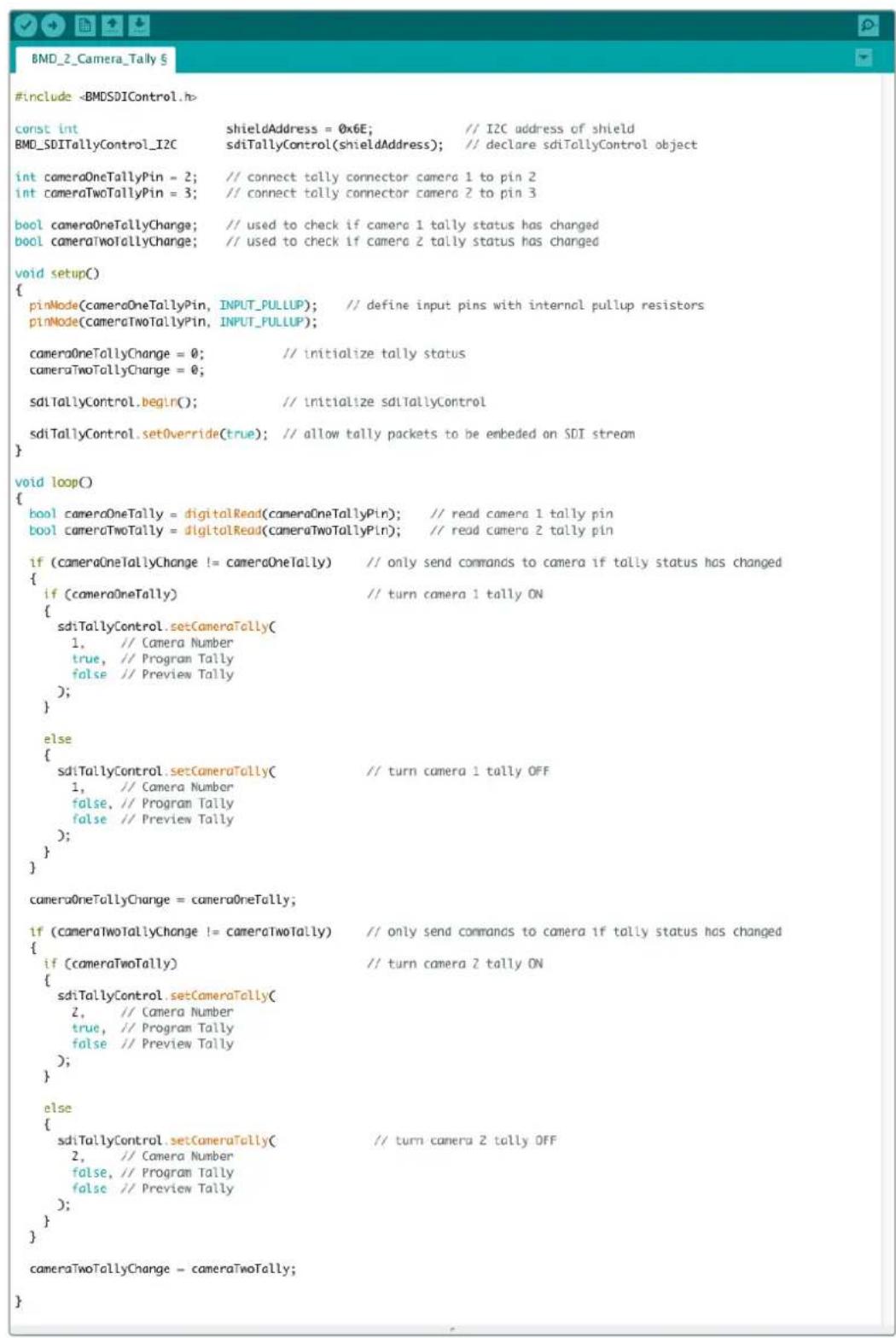
The example sketch above shows how the Blackmagic 3G-SDI Shield for Arduino is programmed to detect a tally signal for input 1 or 2 via the switcher's tally output, and then embed that tally signal into the shield's SDI output. The tally light on the corresponding camera will then illuminate.
Blackmagic Camera Setup
How to Update Your Camera Software on Mac OS X
After downloading the 'Blackmagic Camera Setup' software, unzip the downloaded file and double click on the .dmg disk image file. Launch the 'Blackmagic Camera Setup' installer and follow the onscreen instructions.
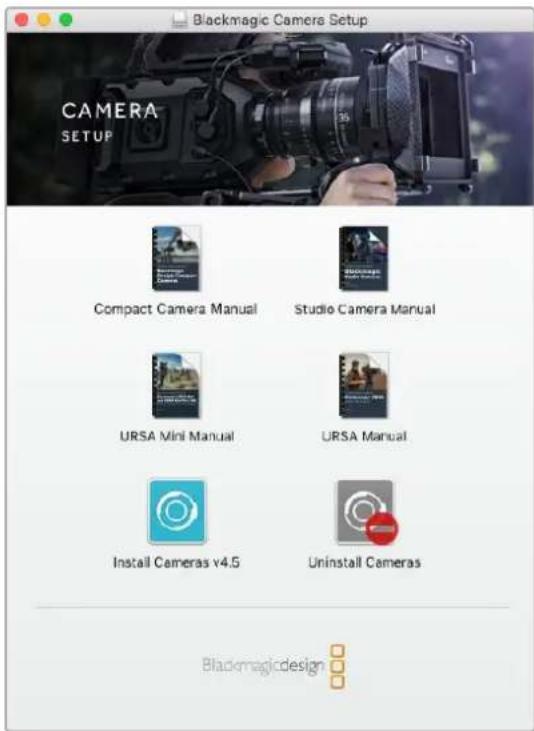
Blackmagic Camera Setup software.
How to Update Your Camera Software on Windows
After downloading the 'Blackmagic Camera Setup' software and unzipping the downloaded file, you should see a 'Blackmagic Camera Setup' installer window. Double click on the installer icon and follow the onscreen prompts to complete the installation.
After the installation is complete, click on the Windows 'start' menu, and go to 'all programs'. Click on the Blackmagic Design folder to open the Blackmagic Camera setup software and instruction manuals.
How to Update your Camera's Internal Software
After installing the latest Blackmagic Camera setup software on your computer, connect a USB cable between the computer and your camera. The Mini-B USB 2.0 port is located on the underside of the camera.
Launch 'Blackmagic Camera Setup' and follow the onscreen prompts to update the camera software.
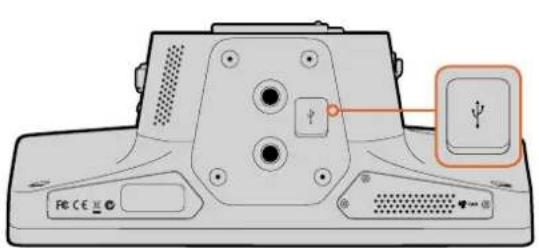
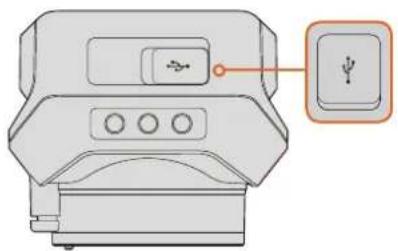
natural_image
Diagram of a device with a USB switch and control buttons, no text or symbols presentThe Mini-B USB 2.0 ports are located on the underside of the cameras.
Attaching Accessories
Sun Shade
The Studio Cameras include a foldable sun shade to shade the LCD in bright conditions and ensure optimum viewing is possible at all times.
1 Locate the 6 thumbscrews that are included with your Studio Camera.
2 Align the holes in the sun shade with the camera's mounting points and screw in 2 thumbscrews to the top and each side of the camera to firmly secure the sun shade.
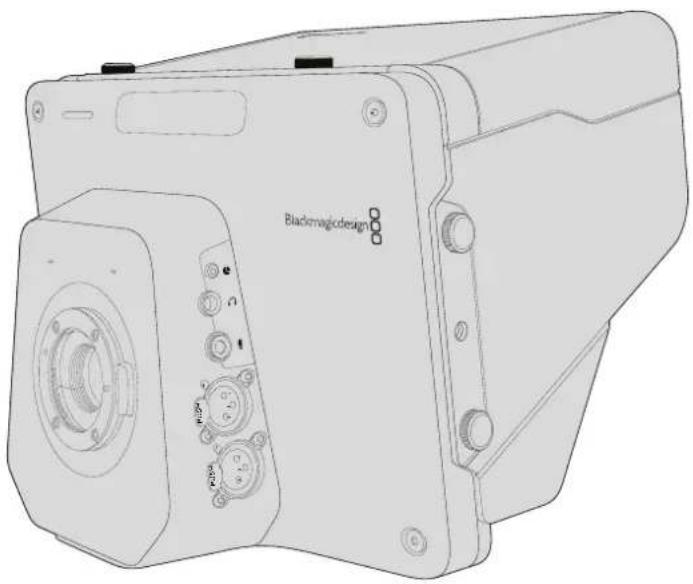
natural_image
Line drawing of a black magic device with control knobs and buttons (no text or symbols)Other Accessories
For studio use, you might want to mount the camera on a pedestal and add rails for large broadcast lenses and teleprompters. For outside broadcast use, your may want to attach microphones, external batteries, or LANC remote controllers. The camera includes two 3/8" mounting points on the bottom, and ten 1/4" mounting points on the sides and the top. This means you have the flexibility to customize your rig for any size production.
Using ATEM Software Control
Introducing Camera Control
Your Blackmagic Studio Camera can be controlled from an ATEM switcher using the Camera Control feature in ATEM Software Control. Clicking on the Camera button opens the camera control feature. Settings such as iris, gain, focus and zoom control are easily adjusted using compatible lenses, plus you can color balance cameras and create unique looks using the DaVinci Resolve primary color corrector.
The ATEM switcher control works by broadcasting camera control packets via all the non down converted SDI outputs of an ATEM switcher. So this means you can connect an SDI output of an ATEM switcher to your camera's video input, your camera will detect the control packets in the SDI link and allow you to control features in the camera itself. You can control your camera via both regular SDI, or via user upgradable optical fiber when the SFP module is installed.
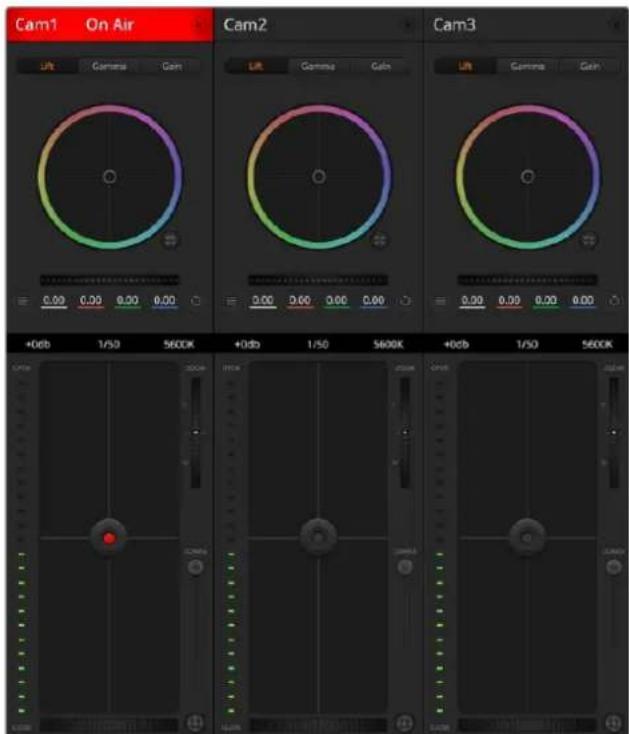
ATEM Camera Control.
Connecting via SDI
1 Connect your Blackmagic Studio Camera's SDI Out to any SDI In on the ATEM switcher.
2 Connect any one of the ATEM switcher's SDI outputs, except down converted or multi view outputs, to your Studio Camera's SDI In. Camera control signals are not sent via the multi view and down converted SDI outputs.
3 On your Blackmagic Studio Camera, press Menu. Navigate to Studio Settings>Camera Number and set it to match the switcher input. For example, if studio camera 1 is connected to Cam 1 on the ATEM switcher, the camera number must also be set to 1. This ensures tally is sent to the correct camera.
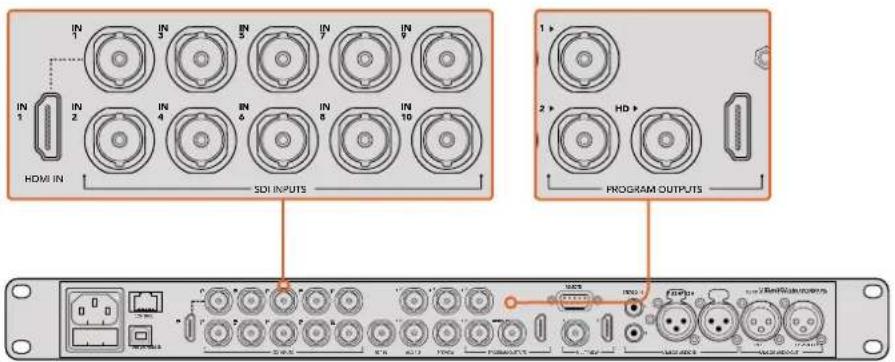
Connect your Blackmagic Studio Camera to any of the ATEM switcher's SDI inputs.
Connecting via Optical Fiber
1 With the user upgradable optical fiber SFP module installed in your Studio Camera, connect the Optical Out/In to the Optical Out/In on an ATEM Studio Converter.
2 Connect a suitable SDI out from ATEM Studio Converter to any SDI In on the ATEM switcher.
3 Connect any one of the ATEM switcher's SDI outputs, except down converted or multi view outputs to ATEM Studio Converter's SDI In. Camera control signals are not sent via the multi view and down converted SDI outputs.
4 On your Blackmagic Studio Camera, press Menu. Navigate to Studio Settings>Camera Number and set it to match the switcher input. For example, if studio camera 1 is connected to Cam 1 on the ATEM switcher, your camera number must also be set to 1. This ensures tally is sent to the correct camera.
Open ATEM Software Control Preferences and set the switcher's button mapping to make sure you are switching the right camera with correct tally. Now you have a video connection from the switcher to your Blackmagic Studio Camera, you can also get the advantage of live tally indicators on your camera, as well as being able to view the program feed of the switcher by pressing your camera's PGM button.
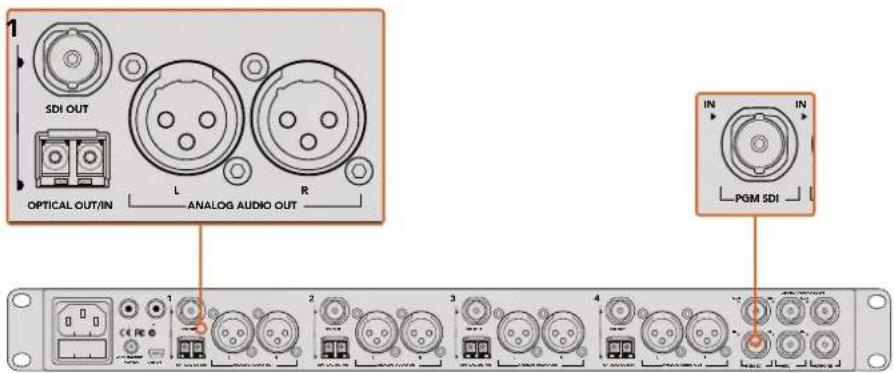
Connect multiple Blackmagic Studio Cameras via optical fiber using an ATEM Studio Converter.
Using Camera Control
Launch ATEM Software Control and click on the Camera button located at the bottom of the software window. You'll see a row of labeled camera controllers containing tools to adjust and refine each camera's image. The controllers are easy to use. Simply click the buttons using your mouse, or click and drag to adjust.
Camera Control Selection
The button row at the top of the camera control page lets you select the camera number you would like to control. If you have more cameras that fit onto the window size, or you are running the color corrector window, then you can use these buttons to select between which camera you would like to control. If you are using an Aux output for monitoring your camera control, pushing these buttons to change the camera to control will also send that camera's video output to the Aux output. Your chosen Aux output for camera control can be set in the general switcher settings.
Channel Status
The channel status at the top of each camera controller displays the camera label, On Air indicator and lock button. Press the lock button to lock all the controls for a specific camera. When on air, the channel status illuminates red and displays the On Air alert.
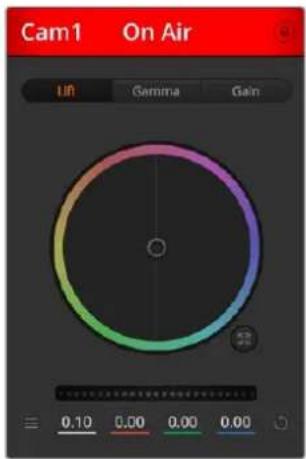
Each camera controller displays the channel status so you know which camera is on air. Use the color wheels to adjust each YRGB channel's lift, gamma and gain settings.
Color Wheel
The color wheel is a powerful feature of the DaVinci Resolve color corrector and used to make color adjustments to each YRGB channel's lift, gamma and gain settings. You can select which setting to adjust by clicking on the three selection buttons above the color wheel.
Master Wheel
Use the master wheel below the color wheel to make contrast adjustments to all YRGB channels at once, or luminance only for each lift, gamma or gain setting.
Camera Settings
The camera settings button near the bottom left of the master wheel lets you turn on the color bars feature in Blackmagic Studio Cameras, Micro Studio Cameras and URSA mini, plus adjust detail settings for each camera's picture signal.
Show/Hide Color Bars
Blackmagic cameras have a color bars feature built in which you can turn on or off by selecting 'show' or 'hide' color bars. This feature can be very useful for visually identifying individual cameras while setting up for your live production. Color bars also provide an audio tone so you can easily check and set the audio levels from each camera.
Detail
Use this setting to sharpen the image from your cameras live. Decrease or increase the level of sharpening by selecting: Detail off, detail default for low sharpening, medium detail, and high detail.
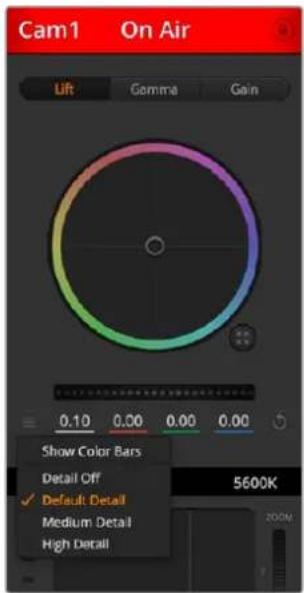
The camera settings button lets you turn color bars on or off and adjust the in-camera sharpening of connected Blackmagic cameras.
Reset Buttons
The reset button near the bottom right of each camera controller lets you easily choose color correction settings to reset, copy or paste. Each color wheel also has its own reset button. Press to restore a setting to its default state, or copy/paste a setting. Locked controllers are not affected by the Paste feature.
The master reset button on the bottom right corner of the color corrector panel lets you reset lift, gamma and gain color wheels plus Contrast, Hue, Saturation and Lum Mix settings. You can paste color correction settings to camera controllers individually, or all cameras at once for a unified look. Iris, focus, coarse and pedestal settings are not affected by the Paste feature. When applying Paste to all, a warning message will appear asking you to confirm your action. This is so you don't accidentally paste new settings to any unlocked cameras that are currently on air.
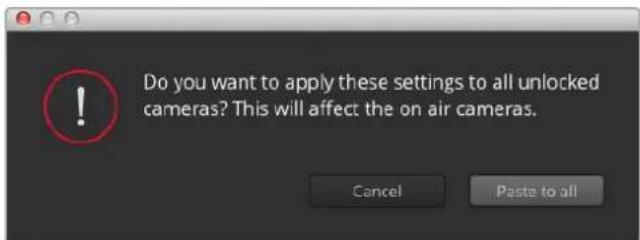
When applying Paste to all, a warning message will appear asking you to confirm your action. This is so you don't accidentally paste new settings to any unlocked cameras that are currently on air.
Iris/Pedestal Control
The iris/pedestal control is located within the cross hairs of each camera controller. The control illuminates red when its camera is on air.
To open or close the iris, drag the control up or down. Holding the shift key allows only iris adjustments.
To darken or lift the pedestal, drag the control left or right. Holding the command key on a Mac, or the Control key on Windows, allows only pedestal adjustments.
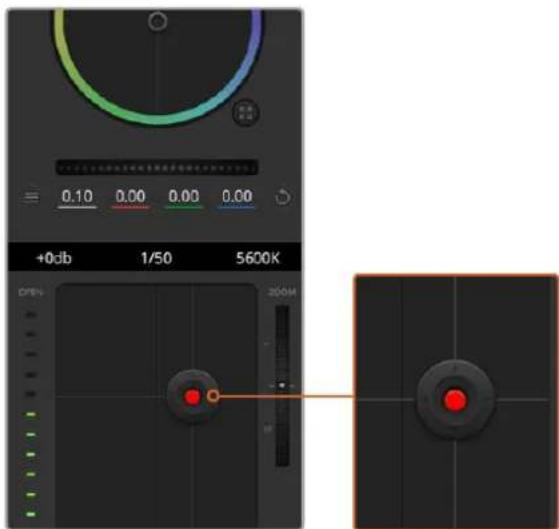
The iris/pedestal control illuminates red when its respective camera is on air.
Zoom Control
When using compatible lenses with an electronic zoom feature, you can zoom your lens in and out using the zoom control. The controller works just like the zoom rocker on a lens, with telephoto on one end, and wide angle on the other. Click on the zoom control, located above the coarse slider, and drag up to zoom in, or drag down to zoom out.
If your lens does not have active lens control or your camera does not support zoom control via the SDI camera control protocol then these settings will have no effect. If you are using Blackmagic Studio Camera or Blackmagic Studio Camera 4K, please make sure you have updated your camera software to v1.9.11 or later to ensure your camera has support for controlling MFT lenses with active zoom.
Coarse Setting
The coarse setting is located to the left of the iris/pedestal control and is used to limit the iris range. This feature helps you prevent over exposed images from going to air.
To set your coarse threshold, completely open the iris using the iris control, then drag the coarse setting up or down to set optimum exposure. Now when you adjust the iris, the coarse threshold will prevent it from going above optimum exposure.
Iris Indicator
The iris indicator is located to the right of the iris/pedestal control and displays a visual reference so you can easily see how open or closed the lens aperture is. The iris indicator is affected by the coarse setting.
Auto Focus Button
The auto focus button is located at the bottom left corner of each camera controller. Press to automatically set the focus when you have an active lens that supports electronic focus adjustments. It's important to know that while most lenses support electronic focus, some lenses can be set to manual or auto focus modes, and so you need to ensure your lens is set to auto focus mode. Sometimes this is set by sliding the focus ring on the lens forward or backward.
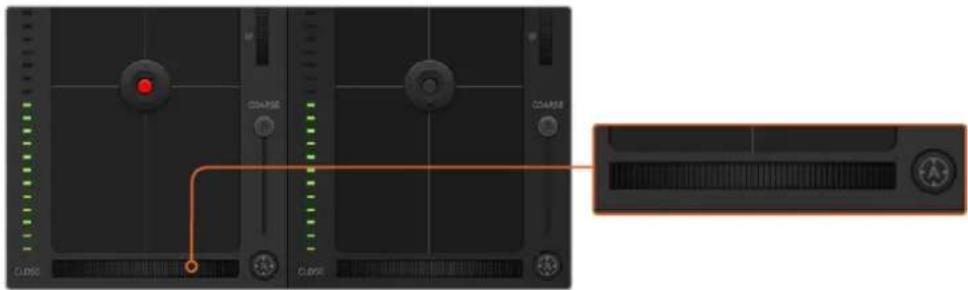
Click on the auto focus button or drag the manual focus adjustment left or right to focus a compatible lens.
Manual Focus Adjustment
When you want to adjust the focus on your camera manually, you can use the focus adjustment located at the bottom of each camera controller. Drag the wheel control left or right to manually adjust focus while viewing the video feed from the camera to ensure your image is nice and sharp.
Camera Gain
The camera gain setting allows you to turn on additional gain in your camera. This is important when you are operating in low light conditions and need extra gain in the front end of your camera to avoid your images being under exposed. You can decrease or increase gain by clicking on the left or right arrows on the dB gain setting.
You can turn on some gain when you need it, such as outdoor shoots when the light fades at sunset and you need to increase your image brightness. It's worth noting that adding gain will increase noise in your images.
Shutter Speed Control
The shutter speed control is located in the section between the color wheel and the iris/ pedestal control. Decrease or increase the shutter speed by hovering your mouse pointer over the shutter speed indicator and then clicking on the left or right arrows.
If you see flicker in lights you can decrease your shutter speed to eliminate it. Decreasing shutter speed is a good way to brighten your images without using camera gain because you are increasing the exposure time of the image sensor. Increasing shutter speed will reduce motion blur so can be used when you want action shots to be sharp and clean with minimal motion blur.
White Balance
The white balance setting next to the shutter speed control can be adjusted by clicking on the left or right arrows on each side of the color temperature indicator. Different light sources emit warm or cool colors, so you can compensate by adjusting the white balance. This ensures the whites in your image stay white.
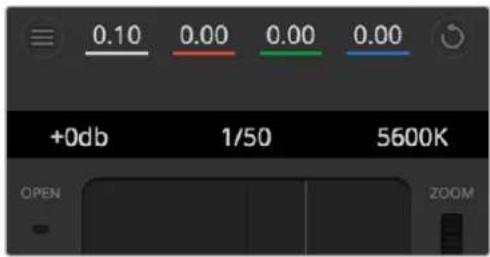
Hovering your mouse pointer over the gain, shutter speed and white balance indicators reveal arrows you can click on to adjust their respective settings.
DaVinci Resolve Primary Color Corrector
If you have a color correction background, then you can change the camera control from a switcher style CCU interface to a user interface that's more like a primary color corrector on a post production color grading system.
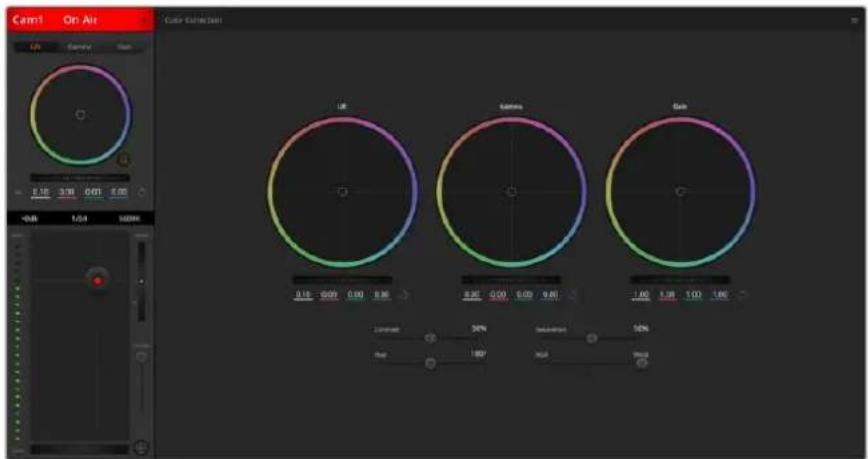
Click on the DaVinci Resolve primary color corrector button to expand the color correction window and adjust settings.
Color Wheels
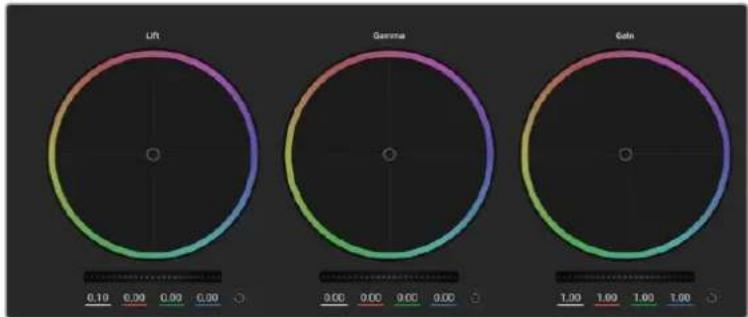
The Lift/Gamma/Gain controls allow tonally specific yet overlapping regions of adjustment. In photographic terms lift, gamma and gain corresponds to shadows, mid tones and highlights.
radar
| Metric | Value | |--------|-------| | Lift | 0.10 | | Gamma | 0.00 | | Gain | 1.00 |Lift, gamma and gain color wheels in the color corrector panel.
Use the color wheels in the following ways to make fine or aggressive adjustments:
- Click and drag anywhere within the color ring: Note that you don't need to drag the color balance indicator itself. As the color balance indicator moves, the RGB parameters underneath change to reflect the adjustments being made to each channel.
- Shift-Click and drag within the color ring: Jumps the color balance indicator to the absolute position of the pointer, letting you make faster and more extreme adjustments.
- Double-click within the color ring: Resets the color adjustment without resetting the master wheel adjustment for that control.
- Click the reset control at the upper-right of a color ring: Resets both the color balance control and its corresponding master wheel.
Master Wheels
Use the master wheels below the color wheels to adjust each YRGB channels' lift, gamma and gain controls.
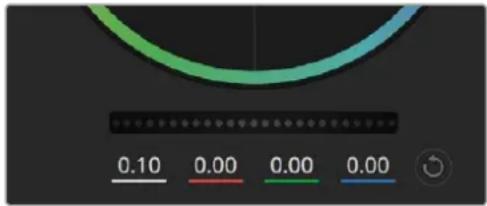
Adjust the master wheels by dragging the wheel control left or right.
To make adjustments using the master wheel:
- Drag the master wheel left or right: Dragging to the left darkens the selected parameter of the image, dragging to the right lightens that parameter. As you make an adjustment, the YRGB parameters underneath change to reflect the adjustment you're making. To make a Y-only adjustment, hold down the ALT or Command key and drag left or right. Because the color corrector uses YRGB processing, you can get quite creative and create unique affects by adjusting the Y channel only. Y channel adjustments work best when the Lum Mix setting is set to the right side to use YRGB processing vs the left side to use regular RGB processing. Normally, most DaVinci Resolve colorists use the YRGB color corrector as you get a lot more control of color balance without affecting overall gain, so you spend less time getting the look you want.
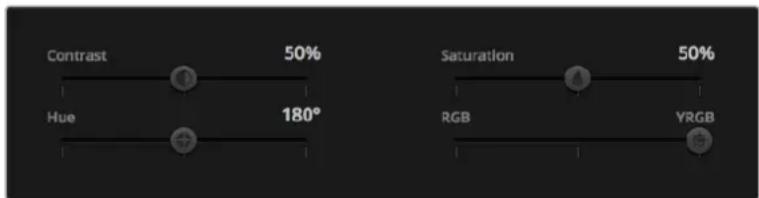
Drag the sliders left or right to adjust Contrast, Saturation, Hue and Lum Mix settings.
Contrast Setting
The Contrast setting gives you control over the distance between the darkest and lightest values of an image. The effect is similar to making opposing adjustments using the lift and gain master wheels. The default setting is 50%.
Saturation Setting
The Saturation setting increases or decreases the amount of color in the image. The default setting is 50%.
Hue Setting
The Hue setting rotates all hues of the image around the full perimeter of the color wheel. The default setting of 180 degrees shows the original distribution of hues. Raising or lowering this value rotates all hues forward or backward along the hue distribution as seen on a color wheel.
Lum Mix Setting
The color corrector built into your Blackmagic Studio Camera is based on the DaVinci Resolve primary color corrector. DaVinci has been building color correctors since the early 1980's and most Hollywood films are color graded on DaVinci Resolve than any other method.
This means the color corrector built into your Blackmagic Studio Camera has some unique and creatively powerful features. The YRGB processing is one of those features.
When color grading, you can choose to use RGB processing, or YRGB processing. High end colorists use YRGB processing because you have more precise control over color and you can independently adjust the channels with better separation and more creative options.
When the Lum Mix control is set to the right side, you have the 100% output of the YRGB color corrector. When you have the Lum Mix control set to the left side, you get 100% output of the RGB corrector. You can set the Lum Mix to any position between the left and right to get a blend of output from both the RGB and YRGB correctors.
Which is the correct setting to use? That's up to you, as color correction is a pure creative process and there is no right and wrong, and the best setting is what you like the most and what you think looks good!
Synchronizing Settings
When connected, camera control signals are sent from the ATEM switcher to your Blackmagic Studio Camera. If a setting is accidentally adjusted from your Studio Camera, camera control will automatically reset that setting to maintain synchronization.
PTZ Control over SDI
Blackmagic Micro Studio Camera 4K supports PTZ output in the form of VISCA commands, which can be sent to a compatible motorized head. By using a Blackmagic 3G-SDI Shield for Arduino, you can send pan, tilt and zoom commands over SDI to your Blackmagic Micro Studio Camera 4K. Your camera will then translate these SDI camera control protocol commands into the VISCA protocol, and send them to a compatible motorized head via the 9-pin connector on the expansion cable labelled 'PTZ control'.
This means that you can use one SDI cable in a live production environment, to send camera control commands to remotely control any setting in the camera, as well as send PTZ commands to a compatible motorized head to control pan and tilt. The pan and tilt commands will be sent by your Blackmagic Micro Studio Camera 4K to the motorized head, whereas lens related commands such as iris, focus and zoom commands will be sent to the active lens that is connected to the camera.
The commands that the Micro Studio Camera 4K can accept over SDI are:
- Lens Zoom
- Lens Focus
- Lens Iris
- Pan Tilt
- Memory Set
- Memory Recall
- Memory Reset
These commands are referenced in the 'Blackmagic SDI Control Protocol' section in this manual. Most PTZ heads support the setting and recalling of their positions but it is a good idea to check which commands are supported by each PTZ head manufacturer.
The commands that are output through the 'PTZ control' connector in the form of VISCA commands are:
- CAM_Memory
- Pan-tiltDrive
VISCA commands
| Pan-tiltDrive | Up 8x 01 06 01 VV WW 03 01 FF | VV:Pan speed 01 to 18WW:Tilt speed 01 to 17YYYY:Pan position F725 to 08DB(center 0000)ZZZZ:Tilt position FE70 to 04B0(image flip: OFF) (center 0000)Tilt position FB50 to 0190(image flip: ON) (center 0000) | |
| Down 8x 01 06 01 VV WW 03 02 FF | |||
| Left 8x 01 06 01 VV WW 01 03 FF | |||
| Right 8x 01 06 01 VV WW 02 03 FF | |||
| UpLeft 8x 01 06 01 VV WW 01 01 FF | |||
| UpRight 8x 01 06 01 VV WW 02 01 FF | |||
| DownLeft 8x 01 06 01 VV WW 01 02 FF | |||
| DownRight 8x 01 06 01 VV WW 02 02 FF | |||
| Stop 8x 01 06 01 VV WW 03 03 FF | |||
| AbsolutePosition | 8x 01 06 02 VV WWOY OY OY OY OZ OZ OZ OZ FF | ||
| RelativePosition | 8x 01 06 03 VV WWOY OY OY OY OZ OZ OZ OZ FF | ||
| Home OY OY OY OY OZ OZ OZ FF | |||
| Reset 8x 01 06 05 FF | |||
| CAM_Memory | Reset 8x 01 04 3F 00 Op FF | p:Memory number (=0 to 5)Corresponds to 1 to 6 on theremote commander. | |
| Set | 8x 01 04 3F 01 Op FF | ||
| Recall 8x 01 04 3F 02 Op FF | |||
Compatible motorized heads include the following:
- KXWell KT-PH180BMD
- PTZOptics PT-Broadcaster
• RUSHWORKS PTX Model 1
PTZ with Blackmagic 3G-SDI Shield for Arduino
Using the Blackmagic 3G-SDI Shield with an Arduino board, a joystick and a switch, you can control a PTZ head via Blackmagic Micro Studio Camera 4K.
To connect Blackmagic Micro Studio Camera 4K to the Blackmagic Design 3G-SDI shield
1 Connect the Blackmagic Design 3G-SDI shield to an Arduino board.
2 Connect your custom shield to the Arduino board.
TIP This means the Blackmagic Design 3G-SDI shield will be the middle component, sandwiched between the Arduino board and your custom Arduino shield for PTZ control. The PTZ joystick and buttons can be built into your custom Arduino shield, or connected to this shield externally.
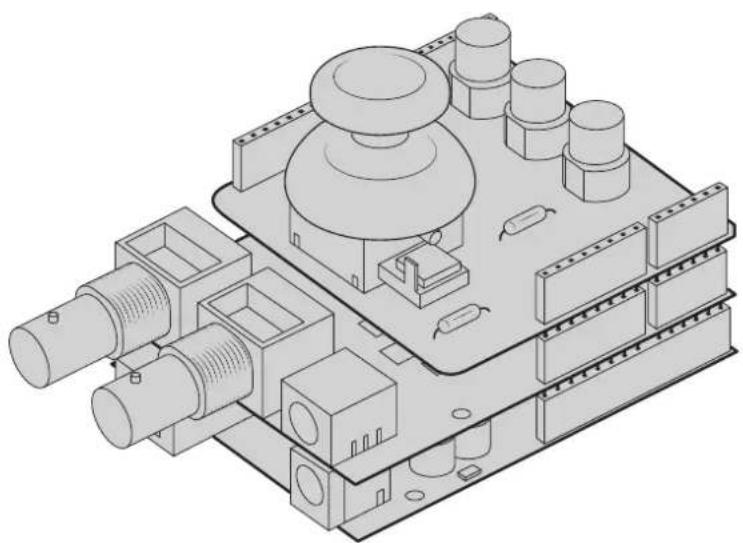
natural_image
Isometric technical drawing of an electronic device with multiple ports and modules (no text or symbols)The Blackmagic Design 3G-SDI shield is the middle component between the Arduino board and your custom shield for PTZ control
3 Attach the SDI output connector from the shield to the SDI input on your Blackmagic Micro Studio Camera 4K and set the camera as camera number 1.
The joystick is mapped as follows:
- X axis adjusts the PTZ head's pan.
- Y axis adjusts the PTZ head's tilt.
- Pressing the joystick button tells the PTZ head to store the current X, Y position in memory.
- Pressing the switch recalls the stored position.
Controlling your Arduino
The following sketch demonstrates a simple example of using a joystick and button with an Arduino board and the Blackmagic 3G-SDI Shield for Arduino, to control a PTZ head via a Blackmagic Micro Studio Camera 4K.
![PT2 Example 5 Include -BHDSDIControl.hx /* * Blockmagic Design 3G-SDI Shield Example Sketch * Init sketch demonstrates using a custom sketch which contains a joystick and buttons, to control a connected camera. * * The joystick is mapped as follows: * - X axis adjusts the horizontal movement of the pan tilt head * - Y axis adjusts the vertical movement of the pan tilt head * * The three buttons are mapped as follows: * - Button 1, switches the current pan tilt position in memory location 1 * - Button 2, recalls the board pan tilt position from memory location 2 * - Button 3, resets the pan tilt position from memory location 4 * * * Setup Status: * 1) Connect the Blockmagic Design 3G-SDI Shield to an Arduino board; * 2) Connect the custom shield to the Arduino board; * 3) Attach a camera's SDI input connector to the output SOC connection of * the shield. Configure the camera as control number 1; * 4) Connect the X pin FT2 Control converter to the VISCA input of the FT2 mode being controlled; * 5) Build and run the example switch. // Hardware pin mappings const int joystickPin = A2; const int joystickPin = A1; const int buttonPin = 5; const int buttonPin = 6; const int buttonPin = 7; // Blockmagic Design SOZ control shield globals const int shieldAddress = 0x8; BMD SUICameraControl i2C sdiCameraControl(shieldAddress); // Button debouwring globals unsigned long lostStableButtonTime[32]; int remButtonLevel[32]; int stableButtonLevel[47]; flock panTiltValues[] = {1.0, 1.0}; void setup() { // Configure digital inputs pirMode(Button1Pin , INPUT_PULLUP); pirMode(Button2Pin , INPUT_PULLUP); pirMode(Button3Pin , INPUT_PULLUP); // Set up the BMD SOZ control library sdiCameraControl.begin(); // The shield supports up to 40000r, use faster // I2C speed to reduce latency Wire.setClock(400000); // Enable both tally and control overrides sdiCameraControl.setOverride(true); void loop() { if (getButtonStableEdge(button2Pin) = true) { intill t memoryValues[] = { 1, // Store memory 0, // First slot }; sdiCameraControl.writeCommandIntA( 1, 11, 1, 0, memoryValues ); } if (getButtonTableEdge(button2Pin) = true) { intill t memoryValues[] = { 2, // Recall memory 0, // Second slot }; sdiCameraControl.writeCommandIntA( 1, 11, 1, 0, memoryValues ); } }](/content/2026/05/760583/images/b856b573ef8114880d576182accad903429fda31d3bc573951ebf2d99bd99994.jpg)
![if (getButtonStableEdge(butterSPin) == true) { intX1 + memoryValues[] = { 0, // Reset memory 0, // First slot }; seliCameraControl.writeCommandInputX2 1, 11, 1, 0, memoryValues }; float panFiltValues[] = {0.0, 0.0}; int currentJoystickY = getJoystickAxisPercent(JoystickXPin); if (currentJoystickY > 15 || currentJoystickY < -15) { panFiltValues[0] = (float)currentJoystickY / 100.0; } int currentJoystickX = getJoystickAxisPercent(JoystickXPin); if (currentJoystickX > 15 || currentJoystickX < -15) { panFiltValues[1] = (float)currentJoystickX / 100.0; } sdiCameraControl.writeCommandInputX2{ 1, // Destination: Camera 1 11, // Category: External Device 0, // Parum: Fun Tilt Speed 0, // Operation: Set Absolute, panFiltValues // Values }; int getJoystickAxisPercent(int analogPin) { // Reads the joystick axis on the given analog pin as a [-100 - 100] scaled value int rowAnalogValue = analogRead(analogPin); int scolcdAnalogValue = map(rowAnalogValue, 0, 1023, 100, 100); // Consider values close to zero as zero, so that when the joystick is // contained it reports zero even if it is slightly mis-aligned if (dim(scaledAnalogValue) = 100) { scolcdAnalogValue = 0; } return scaledAnalogValue; } bool getButtonStableEdge(int digitalPin) { // Detects debounced edges (i.e. prefixes and reverses) of a button bool previousLevel = stableButtonLevels[digitalPin]; bool newLevel = getButtonShableLevel(digitalPin); return previousLevel != newLevel; } int getButtonStableLevel(int digitalPin) { // Reads a digital pin and filters it, returning the stable button position int pinLevel = digitalRead(digitalPin); unsigned long currentTime = millis(); // If the button is rapidly changing (bouncing) during a press, keep // resetting the last stable time count if (pinlevel != readButtonLevels[digitalPin]) { lastStableButtonTime[digitalPin] = currentTime; readButtonLevels[digitalPin] = pinLevel; } // Once the button has been stable Pin if ((currentTime lastStableButtonTime[digitalPin]) > 20) { stableButtonLevels[digitalPin] = pinLevel; } return stableButtonLevels[digitalPin]; }](/content/2026/05/760583/images/1bcaa0f579c52c666f5e5f89edacf18cfa34e3517d967da8b41036b80fb6bc66.jpg)
Developer Information
Blackmagic SDI Camera Control Protocol
Version 1.3
If you are a software developer you can use the SDI Camera Control Protocol to construct devices that integrate with our products. Here at Blackmagic Design our approach is to open up our protocols and we eagerly look forward to seeing what you come up with!
Overview
The Blackmagic SDI Camera Control Protocol is used by ATEM switchers, Blackmagic 3G-SDI Shield for Arduino and the Blackmagic Camera Control app to provide Camera Control functionality with supported Blackmagic Design cameras. Please refer to the 'Understanding Studio Camera Control' chapter section of this manual, or the ATEM Switchers Manual and SDK manual for more information. These can be downloaded at www.blackmagicdesign.com/support.
This document describes an extensible protocol for sending a uni directional stream of small control messages embedded in the non-active picture region of a digital video stream. The video stream containing the protocol stream may be broadcast to a number of devices. Device addressing is used to allow the sender to specify which device each message is directed to.
Assumptions
Alignment and padding constraints are explicitly described in the protocol document. Bit fields are packed from LSB first. Message groups, individual messages and command headers are defined as, and can be assumed to be, 32 bit aligned.
Blanking Encoding
A message group is encoded into a SMPTE 291M packet with DID/SDID x51/x53 in the active region of VANC line 16.
Message Grouping
Up to 32 messages may be concatenated and transmitted in one blanking packet up to a maximum of 255 bytes payload. Under most circumstances, this should allow all messages to be sent with a maximum of one frame latency.
If the transmitting device queues more bytes of message packets than can be sent in a single frame, it should use heuristics to determine which packets to prioritize and send immediately. Lower priority messages can be delayed to later frames, or dropped entirely as appropriate.
Abstract Message Packet Format
Every message packet consists of a three byte header followed by an optional variable length data block. The maximum packet size is 64 bytes.
| Destination device (uint8) | Device addresses are represented as an 8 bit unsigned integer. Individual devices are numbered 0 through 254 with the value 255 reserved to indicate a broadcast message to all devices. |
| Command length (uint8) | The command length is an 8 bit unsigned integer which specifies the length of the included command data. The length does NOT include the length of the header or any trailing padding bytes. |
| Command id (uint8) | The command id is an 8 bit unsigned integer which indicates the message type being sent. Receiving devices should ignore any commands that they do not understand. Commands 0 through 127 are reserved for commands that apply to multiple types of devices. Commands 128 through 255 are device specific. |
| Reserved (uint8) | This byte is reserved for alignment and expansion purposes. It should be set to zero. |
| Command data (uint8[]) | The command data may contain between 0 and 60 bytes of data. The format of the data section is defined by the command itself. |
| Padding (uint8[]) | Messages must be padded up to a 32 bit boundary with 0x0 bytes.Any padding bytes are NOT included in the command length. |
Receiving devices should use the destination device address and or the command identifier to determine which messages to process. The receiver should use the command length to skip irrelevant or unknown commands and should be careful to skip the implicit padding as well.
Defined Commands
Command 0 : change configuration
| Category (uint8) | The category number specifies one of up to 256 configuration categories available on the device. |
| Parameter (uint8) | The parameter number specifies one of 256 potential configuration parameters available on the device. Parameters 0 through 127 are device specific parameters. Parameters 128 though 255 are reserved for parameters that apply to multiple types of devices. |
| Data type (uint8) | The data type specifies the type of the remaining data. The packet length is used to determine the number of elements in the message. Each message must contain an integral number of data elements. |
Currently defined values are:
| 0: void / boolean | A void value is represented as a boolean array of length zero.The data field is a 8 bit value with 0 meaning false and all other values meaning true. |
1: signed byte Data elements are signed bytes
2: signed 16 bit integer Data elements are signed 16 bit values
3: signed 32 bit integer Data elements are signed 32 bit values
4: signed 64 bit integer Data elements are signed 64 bit values
5: UTF-8 string Data elements represent a UTF-8 string with no terminating character.
Data types 6 through 127 are reserved.
| 128: signed 5.11 fixed point | Data elements are signed 16 bit integers representing a real number with 5 bits for the integer component and 11 bits for the fractional component.The fixed point representation is equal to the real value multiplied by 2^11 .The representable range is from -16.0 to 15.9995(15 + 2047/2048). |
Data types 129 through 255 are available for device specific purposes.
| Operation type (uint8) | The operation type specifies what action to perform on the specified parameter. Currently defined values are: |
| 0: assign value | The supplied values are assigned to the specified parameter. Each element will be clamped according to its valid range. A void parameter may only be 'assigned' an empty list of boolean type. This operation will trigger the action associated with that parameter. A boolean value may be assigned the value zero for false, and any other value for true. |
| 1: offset / toggle value | Each value specifies signed offsets of the same type to be added to the current parameter values. The resulting parameter value will be clamped according to their valid range. It is not valid to apply an offset to a void value. Applying any offset other than zero to a boolean value will invert that value. |
Operation types 2 through 127 are reserved.
Operation types 128 through 255 are available for device specific purposes.
| Data (void) | The data field is 0 or more bytes as determined by the data type and number of elements. |
The category, parameter, data type and operation type partition a 24 bit operation space.
| Group | ID | Parameter | Type | Index | Minimum | Maximum | Interpretation |
| Lens | 0.0 | Focus | fixed16 | - | 0 | 1 | 0.0 = near, 1.0 = far |
| 0.1 | Instantaneous autofocus | void | - | - | - | trigger instantaneous autofocus | |
| 0.2 | Aperture (f-stop) | fixed16 | - | -1 | 16 | Aperture Value (where fnumber = sqrt(2^AV)) | |
| 0.3 | Aperture (normalised) | fixed16 | - | 0 | 1 | 0.0 = smallest, 1.0 = largest | |
| 0.4 | Aperture (ordinal) | int16 | - | 0 | n | Steps through available aperture values from minimum (0) to maximum (n) | |
| 0.5 | Instantaneous auto aperture | void | -- -- | trigger instantaneous auto aperture | |||
| 0.6 | Optical image stabilisation | boolean | - | - | - | true = enabled, false = disabled | |
| 0.7 | Set absolute zoom (mm) | int16 | - | 0 | max | Move to specified focal length in mm, from minimum (0) to maximum (max) | |
| 0.8 | Set absolute zoom (normalised) | fixed16 - 0 1 | Move to specified focal length: 0.0 = wide, 1.0 = tele | ||||
| 0.9 | Set continuous zoom (speed) | fixed16 - -1 +1.0 | Start/stop zooming at specified rate: -1.0 = zoom wider fast, 0.0 = stop, +1 = zoom tele fast | ||||
| Video | 1.0 Video mode int8 | 0 = frame rate - - 24,25,30,50,60 | |||||
| 1 = M-rate - - 0 = regular, 1 = M-rate | |||||||
| 2 = dimensions - - | 0 = NTSC, 1 = PAL, 2 = 720, 3 = 1080, 4 = 2k, 5 = 2k DCI, 6 = UHD | ||||||
| 3 = interlaced - - | 0 = progressive, 1 = interlaced | ||||||
| 4 = Color space | - - 0 = YUV | ||||||
| 1.1 | Gain | int8 | 1 | 16 | 1 = 100 ISO, 2 = 200 ISO, 4 = 400 ISO, 8 = 800 ISO, 16 = 1600 ISO | ||
| 1.2 | Manual White Balance | int16 | 0 = color temp | 2500 | 10000 | Color temperature In K | |
| int16 | 1 = tint | -50 | 50 | tint | |||
| 1.3 | Set auto WB | void | - | - - | Calculate and set auto white balance | ||
| 1.4 | Restore auto WB | void | - | - - | Use latest auto white balance setting | ||
| 1.5 | Exposure (us) | int32 | 1 | 42000 | time in us | ||
| 1.6 | Exposure (ordinal) | int16 | - | 0 n | Steps through available exposure values from minimum (0) to maximum (n) | ||
| 1.7 Dynamic Range Mode int8 enum | - | 0 1 | 0 = film, 1 = video, | ||||
| 1.8 | Video sharpening level | int8 enum | - | 0 3 | 0 = off, 1 = low, 2 = medium, 3 = high | ||
| 1.9 | Recording format | int16 | 0 = file frame rate | - | - | fps as integer (eg 24, 25, 30, 50, 60, 120) | |
| 1 = sensor frame rate | - | - | fps as integer, valid when sensor-off-speed set (eg 24, 25, 30, 33, 48, 50, 60, 120), no change will be performed if this value is set to 0 | ||||
| 2 = frame width | - - in pixels | ||||||
| 3 = frame height | - - in pixels | ||||||
| 4 = flags | - - [0] = file-M-rate | ||||||
| - | - | [1] = sensor-M-rate, valid when sensor-off-speed-set | |||||
| - - [2] = sensor-off-speed | |||||||
| - - [3] = interlaced | |||||||
| - - [4] = windowed mode | |||||||
| 1.10 | Set auto exposure mode | int8 | - | 0 4 | 0 = Manual Trigger, 1 = Iris, 2 = Shutter, 3 = Iris + Shutter, 4 = Shutter + Iris | ||
| 1.11 | Shutter angle | int32 | - | 100 | 36000 | Shutter angle in degrees, multiplied by 100 | |
| 1.12 | Shutter speed | int32 | - | 24 | 2000 | Shutter speed value as a fraction of 1, so 50 for 1/50th of a second | |
| 1.13 | Gain | Int8 | - | -128 | 127 | Gain in decibel (dB) | |
| 1.142.0 Mic level fixed16 - 0 1 | ISO | int32 | - | 0 2147483647 ISO value | 0.0 = minimum,1.0 = maximum | ||
| Audio | |||||||
| 2.1 Headphone level fixed16 - 0 1 | 0.0 = minimum,1.0 = maximum | ||||||
| 2.2 | Headphone program mix | fixed16 | - | 0 | 1 | 0.0 = minimum,1.0 = maximum | |
| 2.3 | Speaker level | fixed16 | - | 0 | 1 | 0.0 = minimum,1.0 = maximum | |
| 2.4 | Input type | int8 | - | 0 | 2 | 0 = internal mic,1 = line level input,2 = low mic level input,3 = high mic level input | |
| 2.5 Input levels | fixed16 | [0] ch0 | 0 1 | 0.0 = minimum,1.0 = maximum | |||
| [1] ch1 0 1 | 0.0 = minimum,1.0 = maximum | ||||||
| 2.6 | Phantom power | boolean | - | - | - | true = powered,false = not powered | |
| Output | 3.0 Overlay enables | uint16bit field | --- | bit flags:[0] = display status,[1] = display frame guidesSome cameras don't allowseparate control of frameguides and status overlays. | |||
| 3.1 | Frame guides style(Camera 3.x) | int8 | [0] = frameguides style | 0 | 8 | 0 = HDTV, 1 = 4:3, 2 = 2.4:1,3 = 2.39:1, 4 = 2.35:1,5 = 1.85:1, 6 = thirds | |
| 3.2 | Frame guides opacity(Camera 3.x) | fixed16 | [1] = frameguide opacity | 0.1 | 1 | 0.0 = transparent,1.0 = opaque | |
| 3.3 | Overlays(replaces .1 and .2above fromCameras 4.0) | int8 | [0] = frameguides style | - | - | 0 = off, 1 = 2.4:1, 2 = 2.39:1,3 = 2.35:1, 4 = 1.85:1, 5 = 16:9,6 = 14:9, 7 = 4:3 | |
| [1] = frameguide opacity | 0 100 | 0 = transparent,100 = opaque | |||||
| [2] = safe areapercentage | 0 100 | percentage of full frameused by safe area guide(0 means off) | |||||
| [3] = grid style | -- | bit flags: [0] = display thirds,[1] = display cross hairs,[2] = display center dot | |||||
| Display | 4.0 | Brightness fixed16 - 0 1 | 0.0 = minimum,1.0 = maximum | ||||
| 4.1 | Overlay enables | int16bit field | --- | 0x4 = zebra | |||
| --- | 0x8 = peaking | ||||||
| --- | |||||||
| 4.2 | Zebra level | fixed16 - 0 1 | 0.0 = minimum,1.0 = maximum | ||||
| 4.3 | Peaking level | fixed16 | - | 0 | 1 | 0.0 = minimum,1.0 = maximum | |
| 4.4 | Color bars display time (seconds) | int8 | -0 30 | 0 = disable bars, 1-30 = enable bars with timeout (s) | |||
| 4.5 | Focus Assist | int8 | [0] = focus assist method | - | - | 0 = Peak,1 = Colored lines | |
| [1] = focus line color | - | - | 0 = Red,1 = Green,2 = Blue,3 = White,4 = Black | ||||
| Tally | 5.0 | Tally brightness | fixed16 | - | 0 | 1 | Sets the tally front and tally rear brightness to the same level.0.0 = minimum,1.0 = maximum |
| 5.1 | Front tally brightness | fixed16 | - | 0 | 1 | Sets the tally front brightness.0.0 = minimum,1.0 = maximum | |
| 5.2 | Rear tally brightness | fixed16 | - | 0 | 1 | Sets the tally rear brightness.0.0 = minimum,1.0 = maximumTally rear brightness cannot be turned off | |
| Reference | 6.0 | Source | int8 enum | - | 0 | 2 | 0 = internal,1 = program,2 = external |
| 6.1 | Offset | int32 | - | - | - | +/- offset in pixels | |
| Configuration | 7.0 | Real Time Clock | int32 | [0] time | - | - | BCD - HHMMSSFF (UCT) |
| [1] date | - | - | BCD - YYYYMMDD | ||||
| 7.1 | System language | string | - | - | - | ISO-639-1 two character language code | |
| 7.2 | Timezone | int32 | - | - | - | Minutes offset from UTC | |
| 7.3 | Location | int64 | [0] latitude | - | - | BCD - sDDDdddddddddd where s is the sign:0 = north (+), 1 = south (-);DD degrees, ddddddddddd decimal degrees | |
| [1] longitude[0] red -2 2 default 0.0 | -- | BCD - sDDDdddddddddd where s is the sign: 0 = west(-), 1 = east (+); DDD degrees, ddddddddddd decimal degrees | |||||
| Color Correction | 8.0 Lift Adjust fixed16 | ||||||
| [1] green -2 2 default 0.0 | |||||||
| [2] blue -2 2 default 0.0 | |||||||
| [3] luma | -2 2 default 0.0 | ||||||
| 8.1 Gamma Adjust fixed16 | [0] red -4 4 | default 0.0 | |||||
| [1] green -4 4 | default 0.0 | ||||||
| [2] blue -4 4 | default 0.0 | ||||||
| [3] luma | -4 | 4 | default 0.0 | ||||
| 8.2 | Gain Adjust | fixed16 | [0] red 0 16 default 1.0 | ||||
| [1] green 0 16 default 1.0 | |||||||
| [2] blue 0 16 default 1.0 | |||||||
| [3] luma | 0 16 default 1.0 | ||||||
| 8.3 | Offset Adjust | fixed16 | [0] red -8 8 default 0.0 | ||||
| [1] green -8 8 default 0.0 | |||||||
| [2] blue -8 8 default 0.0 | |||||||
| [3] luma | -8 8 default 0.0 | ||||||
| 8.4 Contrast Adjust fixed16 | [0] pivot | 0 | 1 | default 0.5 | |||
| [1] adj | 0 2 default 1.0 | ||||||
| 8.5 | Luma mix | fixed16 | - | 0 | 1 | default 1.0 | |
| 8.6 Color Adjust fixed16 | [0] hue | -11 | default 0.0 | ||||
| [1] sat 0 2 default 1.0 | |||||||
| 8.7 | Correction Reset Default | void | - | - | - | reset to defaults | |
| Media | 10.0 Codec | int8 enum | [0] = basic codec - - | 0 = RAW,1 = DNxHD,2 = ProRes,3 = Blackmagic RAW | |||
| [1] = codec variant | - | - | RAW:0 = Uncompressed,1 = lossy 3:1,2 = lossy 4:1 | ||||
| - | - | ProRes:0 = HQ,1 = 422,2 = LT, 3 = Proxy,4 = 444, 5 = 444XQ | |||||
| - | - | Blackmagic RAW:0 = Q0,1 = Q5,2 = 3:1,3 = 5:1,4 = 8:1,5 = 12:1 | |||||
| 10.1 Transport mode int8 | [0] = mode | -- | 0 = Preview,1 = Play,2 = Record | ||||
| [1] = speed | -- | -ve = multiple speeds backwards,0 = pause,+ve = multiple speeds forwards | |||||
| [2] = flags | -- | 1<<0 = loop,1<<1 = play all,1<<5 = disk1 active,1<<6 = disk2 active,1<<7 = time-lapse recording | |||||
| [3] = active storage medium | - | - | 0 = CFast card,1 = SD | ||||
| PTZ Control | 11.0 | Pan/Tilt Velocity | fixed 16 | [0] = pan velocity | -1.0 | 1.0 | -1.0 = full speed left,1.0 = full speed right |
| [1] = tilt velocity -1.0 | 1.0 | -1.0 = full speed down,1.0 = full speed up | |||||
| 11.1 | Memory Preset | int8 enum | [0] = preset command | - | - | 0 = reset,1 = store location,2 = recall location | |
| int8 | [1] = preset slot | 0 5 - | |||||
Example Protocol Packets
| Operation | Packet Length Byte | ||||||||||||||||
| 0 | 1 | 2 | 3 | 4 | 5 | 6 | 7 | 8 | 9 | 10 | 11 | 12 | 13 | 14 | 15 | ||
| header | |||||||||||||||||
| destination | length | command | reserved | category | parameter | type | operation | ||||||||||
| trigger instantaneous auto focus on camera 4 | 8 4 4 0 0 0 1 0 0 | ||||||||||||||||
| turn on OIS on all cameras 12 255 5 0 0 0 6 | 0 0 1 0 0 0 | ||||||||||||||||
| set exposure to 10 ms on camera 4 (10 ms = 10000 us = 0x00002710) | 12 | 4 | 8 | 0 | 0 | 1 | 5 | 3 | 0 | 0x10 | 0x27 | 0x00 | 0x00 | ||||
| add 15% to zebra level (15 % = 0.15 f = 0x0133 fp) | 12 | 4 | 6 | 0 | 0 | 4 | 2 | 128 | 1 | 0x33 | 0x01 | 0 | 0 | ||||
| select 1080p 23.98 mode on all cameras | 16 | 255 | 9 | 0 | 0 | 1 | 0 | 1 | 0 | 24 | 1 | 3 | 0 | 0 | 0 | 0 | 0 |
| subtract 0.3 from gamma adjust for green & blue (-0.3 ~= 0xfd9a fp) | 16 | 4 | 12 | 0 | 0 | 8 | 1 | 128 | 1 | 0 | 0 | 0x9a | 0xfd | 0x9a | 0xfd | 0 | 0 |
| all operations combined | 76 | 4 | 4 | 0 | 0 | 0 | 1 | 0 | 0 | 255 | 5 | 0 | 0 | 0 | 6 | 0 | 0 |
| 1 | 0 | 0 | 0 | 4 | 8 | 0 | 0 | 1 | 5 | 3 | 0 | 0x10 | 0x27 | 0x00 | 0x00 | ||
| 4 | 6 | 0 | 0 | 4 | 2 | 128 | 1 | 0x33 | 0x01 | 0 | 0 | 255 | 9 | 0 | 0 | ||
| 1 | 0 | 1 | 0 | 24 | 1 | 3 | 0 | 0 | 0 | 0 | 0 | 4 | 12 | 0 | 0 | ||
| 8 | 1 | 128 | 1 | 0 | 0 | 0x9a | 0xfd | 0x9a | 0xfd | 0 | 0 | ||||||
Blackmagic Embedded Tally Control Protocol
Version 1.0 (30/04/14)
This section is for third party developers or anybody who may wish to add support for the Blackmagic Embedded Tally Control Protocol to their products or system. It describes the protocol for sending tally information embedded in the non-active picture region of a digital video stream.
Data Flow
A master device such as a broadcast switcher embeds tally information into its program feed which is broadcast to a number of slave devices such as cameras or camera controllers. The output from the slave devices is typically fed back to the master device, but may also be sent to a video monitor.
The primary flow of tally information is from the master device to the slaves. Each slave device may use its device id to extract and display the relevant tally information.
Slave devices pass through the tally packet on their output and update the monitor tally status, so that monitor devices connected to that individual output may display tally status without knowledge of the device id they are monitoring.
Assumptions
Any data alignment / padding is explicit in the protocol. Bit fields are packed from LSB first.
Blanking Encoding
One tally control packet may be sent per video frame. Packets are encoded as a SMPTE 291M packet with DID/SDID x51/x52 in the active region of VANC line 15. A tally control packet may contain up to 256 bytes of tally information.
Packet Format
Each tally status consists of 4 bits of information:
uint4
bit 0: program tally status (0=off, 1=on)
bit 1: preview tally status (0=off, 1=on)
bit 2-3: reserved (0x0)
The first byte of the tally packet contains the monitor device tally status and a version number.
Subsequent bytes of the tally packet contain tally status for pairs of slave devices. The master device sends tally status for the number of devices configured/supported, up to a maximum of 510.
struct tally
uint8
bit 0: monitor device program tally status (0=off, 1=on)
bit 1: monitor device preview tally status (0=off, 1=on)
bit 2-3: reserved (0b00)
bit 4-7: protocol version (0b0000)
uint8[0]
bit 0: slave device 1 program tally status (0=off, 1=on)
bit 1: slave device 1 device preview tally status (0=off, 1=on)
bit 2-3: reserved (0b00)
bit 4: slave device 2 program tally status (0=off, 1=on)
bit 5: slave device 2 preview tally status (0=off, 1=on)
bit 6-7: reserved (0b00)
uint8[1]
bit 0: slave device 3 program tally status (0=off, 1=on)
bit 1: slave device 3 device preview tally status (0=off, 1=on)
bit 2-3: reserved (0b00)
bit 4: slave device 4 program tally status (0=off, 1=on)
bit 5: slave device 4 preview tally status (0=off, 1=on)
bit 6-7: reserved (0b00)
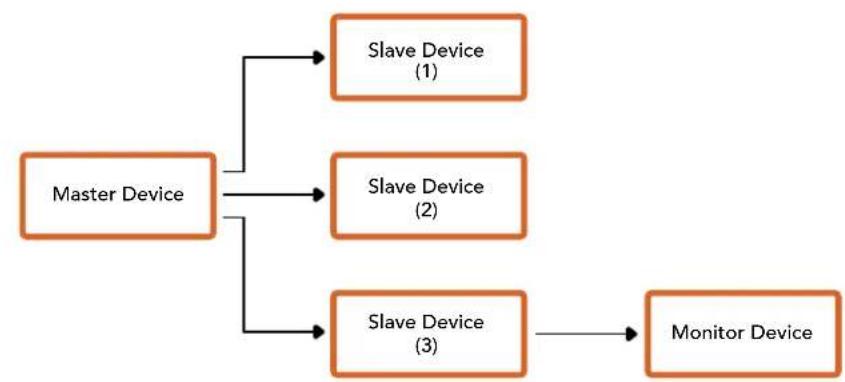
flowchart
graph TD
    A["Master Device"] --> B["Slave Device (1)"]
    A --> C["Slave Device (2)"]
    A --> D["Slave Device (3)"]
    D --> E["Monitor Device"]
| Byte 7 | MSB 6 5 4 3 | 2 10 LSB | ||||||
| 0 | Version(0b0) | Version(0b0) | Version(0b0) | Version(0b0) | Reserved(0b0) | Reserved(0b0) | MonitorPreview | MonitorProgram |
| 1 | Reserved(0b0) | Reserved(0b0) | Slave 1Preview | Slave 1Program | Reserved(0b0) | Reserved(0b0) | Slave 0Preview | Slave 0Program |
| 2 | Reserved(0b0) | Reserved(0b0) | Slave 3Preview | Slave 3Program | Reserved(0b0) | Reserved(0b0) | Slave 2Preview | Slave 2Program |
| 3 ... |
RAW SDI Output
If you would like to perform your own debayering of the image data from Blackmagic Micro Studio Camera 4K, you can use the 'RAW' mode to output bayered sensor data over the SDI output.
This mode packs raw data into the pixels of a regular UltraHD 422 frame size, to enable transmission through a standard SDI output.
The data can be recorded as an uncompressed QuickTime movie using a disk recorder capable of uncompressed 10-bit recording.
TIP Camera raw media formats are so named because they capture raw color space data directly from the sensor. Raw image data cannot be displayed visually, and must be debayered or demosaiced to convert the original raw data into image data that can then be used in an image processing pipeline like DaVinci Resolve.
Note that Blackmagic DaVinci Resolve does not support the debayering of raw data from Blackmagic Micro Studio Camera 4K.
Enabling RAW mode:
1 Press menu and select the 'setup' page.
2 Navigate to 'RAW SDI Output' and select 'on'.
Resolution and Bit Depth
The resolution of the RAW frame is 3872 pixels x 2192 lines, which includes a border that surrounds the image data. Most users discard this border after debayering, as it can contain image artifacts on the outer edges.
The RAW data at pixel number 16 inside the horizontal and vertical corners will therefore correspond with the corner of the Ultra HD frame when the camera is outputting 3840 x 2160 in the non RAW mode. The bit depth of each pixel will be 12 bits.
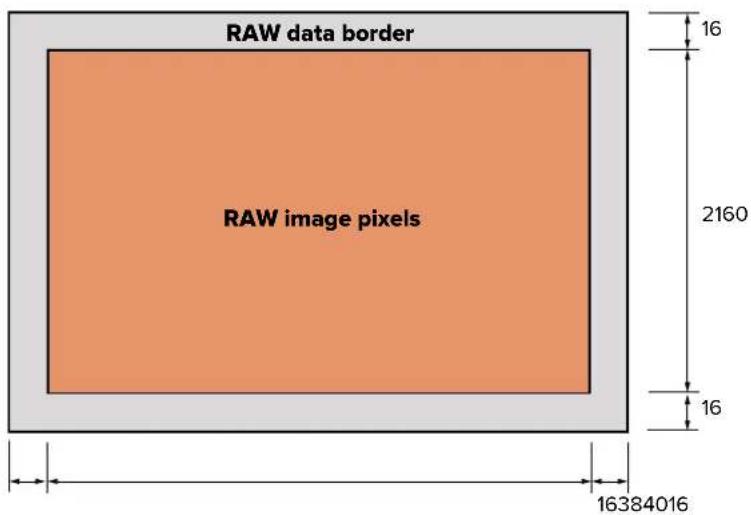
Bayer Alignment
The bayer pattern of the RAW frame provides information required for debayering the raw data output by Blackmagic Micro Studio Camera 4K. The bayer alignment of the RAW frame is GRBG or green, red, blue, green.
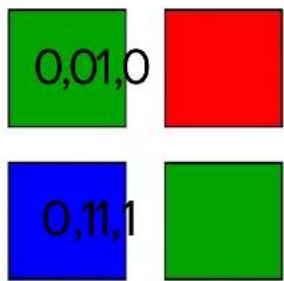
Packing
Packing describes the way in which the raw data is packed or arranged. It is important to understand the way that the data has been packed so that it can be unpacked correctly. The RAW frame will be packed into the active picture area of a standard UHD 422 SDI frame, using the following repeated packing scheme:
| 9876543210 | |||||||
| SDI(0,0) CB | 0 1 RAW (0,0)[7:0] | ||||||
| SDI(0,0)Y | 0 1 RAW(1,0)[3:0] RAW(0,0)[11:8] | ||||||
| SDI(1,0) CR | 0 1 RAW(1,0)[11:4] | ||||||
| SDI(1,0) Y | 0 1 RAW (2,0)[7:0] | ||||||
| SDI(2,0) CB | 0 1 RAW(3,0)[3:0] RAW(2,0)[11:8] | ||||||
| SDI(2,0) Y | 0 1 RAW(3,0)[11:4] | ||||||
Horizontal and vertical blanking will be unchanged from regular SDI output mode.
As shown above, four RAW pixels will be packed into three SDI pixels, so each Ultra HD line will contain 3840 × 4/3 = 5120 RAW pixels and the entire RAW frame will be carried in the first 1658 lines of the 2160 active SDI lines. The remainder of the pixels in the SDI frame will be set to 0x100 for both Y and C.
The RAW SDI frame should be captured as uncompressed 422 data and unpacked according to the table above.
Recording the RAW signal
The data can be recorded as an uncompressed 10-bit YUV recording using a 6G-SDI capable product, such as one of the following:
- UltraStudio 4K
- UltraStudio 4K Extreme 3
- DeckLink 8K Pro
- DeckLink 4K Extreme 12G
- DeckLink Studio 4K
- DeckLink SDI 4K
- DeckLink Mini Recorder 4K
Unpacking the RAW data:
Once you have a QuickTime recording of the RAW data, you will need to unpack the signal to perform your own debayering of the image data from the sensor.
Help
Getting Help
The fastest way to obtain help is to go to the Blackmagic Design online support pages and check the latest support material available for your camera.
Blackmagic Design Online Support Pages
The latest manual, software and support notes can be found at the Blackmagic Design support centre at www.blackmagicdesign.com/support.
Contacting Blackmagic Design Support
If you can't find the help you need in our support material, please use the "Send us an email" button on the support page for your camera to email a support request. Alternatively, click on the "Find your local support team" button on the support page and call your nearest Blackmagic Design support office.
Checking the Software Version Currently Installed
To check which version of Blackmagic Camera Setup software is installed on your computer, open the About Blackmagic Camera Setup window.
- On Mac OS X, open Blackmagic Camera Setup from the Applications folder. Select About Blackmagic Camera Setup from the application menu to reveal the version number.
- On Windows, open Blackmagic Camera Setup from your Start menu or Start Screen. Click on the Help menu and select About Blackmagic Camera Setup to reveal the version number.
How to Get the Latest Software Updates
After checking the version of Blackmagic Camera Setup software installed on your computer, please visit the Blackmagic Support Center at www.blackmagicdesign.com/support to check for the latest updates. While it is usually a good idea to run the latest updates, it is wise to avoid updating any software if you are in the middle of an important project.
Battery Replacement
The Studio Camera's built in battery is not user-serviceable. Should the battery require replacement, you will need to send it to your nearest Blackmagic Design service center for replacement. If the camera is outside of its warranty period, the battery replacement will incur a small service fee for the cost of the battery, labor and return of the camera to you. Please contact Blackmagic Design Support to find out details of where to send your camera, how to package it safely and how much the replacement will cost in your country.
NOTE Blackmagic Studio Camera 2 and Blackmagic Studio Camera 4K 2 do not have internal batteries.
Warranty
12 Month Limited Warranty
Blackmagic Design warrants that this product will be free from defects in materials and workmanship for a period of 12 months from the date of purchase. If a product proves to be defective during this warranty period, Blackmagic Design, at its option, either will repair the defective product without charge for parts and labor, or will provide a replacement in exchange for the defective product.
In order to obtain service under this warranty, you the Customer, must notify Blackmagic Design of the defect before the expiration of the warranty period and make suitable arrangements for the performance of service. The Customer shall be responsible for packaging and shipping the defective product to a designated service center nominated by Blackmagic Design, with shipping charges pre paid. Customer shall be responsible for paying all shipping charges, insurance, duties, taxes, and any other charges for products returned to us for any reason.
This warranty shall not apply to any defect, failure or damage caused by improper use or improper or inadequate maintenance and care. Blackmagic Design shall not be obligated to furnish service under this warranty: a) to repair damage resulting from attempts by personnel other than Blackmagic Design representatives to install, repair or service the product, b) to repair damage resulting from improper use or connection to incompatible equipment, c) to repair any damage or malfunction caused by the use of non Blackmagic Design parts or supplies, or d) to service a product that has been modified or integrated with other products when the effect of such a modification or integration increases the time or difficulty of servicing the product. THIS WARRANTY IS GIVEN BY BLACKMAGIC DESIGN IN LIEU OF ANY OTHER WARRANTIES, EXPRESS OR IMPLIED. BLACKMAGIC DESIGN AND ITS VENDORS DISCLAIM ANY IMPLIED WARRANTIES OF MERCHANTABILITY OR FITNESS FOR A PARTICULAR PURPOSE. BLACKMAGIC DESIGN'S RESPONSIBILITY TO REPAIR OR REPLACE DEFECTIVE PRODUCTS IS THE WHOLE AND EXCLUSIVE REMEDY PROVIDED TO THE CUSTOMER FOR ANY INDIRECT, SPECIAL, INCIDENTAL OR CONSEQUENTIAL DAMAGES IRRESPECTIVE OF WHETHER BLACKMAGIC DESIGN OR THE VENDOR HAS ADVANCE NOTICE OF THE POSSIBILITY OF SUCH DAMAGES. BLACKMAGIC DESIGN IS NOT LIABLE FOR ANY ILLEGAL USE OF EQUIPMENT BY CUSTOMER. BLACKMAGIC IS NOT LIABLE FOR ANY DAMAGES RESULTING FROM USE OF THIS PRODUCT. USER OPERATES THIS PRODUCT AT OWN RISK.
Copyright 2018 Blackmagic Design. All rights reserved. 'Blackmagic Design', 'DeckLink', 'HDLink', 'Workgroup Videohub', 'Multibridge Pro', 'Multibridge Extreme', 'Intensity' and 'Leading the creative video revolution' are registered trademarks in the US and other countries. All other company and product names may be trade marks of their respective companies with which they are associated.