
Nitro WG325.KIT - Saw WORX - Free user manual and instructions
Find the device manual for free Nitro WG325.KIT WORX in PDF.


| Product type | Battery-powered pruning saw |
| Brand | Worx |
| Model | Nitro WG325.KIT |
| Rated voltage | 20 V max (18 V nominal) |
| Battery type | Lithium-ion 20 V, recommended WA3669 (2.0 Ah) |
| Recommended charger | WA3881 (2.0 A) |
| Guide bar length | 12 cm (5 inches) |
| Chain speed | 10 m/s (32.8 ft/s) |
| Chain pitch | 7.6 mm (0.3 inch) |
| Number of drive links | 28 |
| Chain gauge | 1.1 mm (0.043 inch) |
| Extension tube length | 125 cm (49.2 inches) |
| Maximum cutting height | 275 cm (108.3 inches) |
| Tool weight (without battery) | 1.1 kg (2.4 lb) |
| Extension tube weight | 0.9 kg (2.0 lb) |
| Power supply | 20 V battery (not included) |
| Main functions | Cutting branches and wood up to the diameter of the guide bar |
| Maintenance and cleaning | Clean the guide bar groove, sharpen the chain with a 3 mm round file at 30°, lubricate with guide bar and chain oil |
| Safety | Low kickback chain, anti-kickback guide bar, safety lock, retractable protection, on/off trigger |
| Spare parts and repairability | Replacement chain WA0142, extension tube WA0151, Worx-specific guide bar and chain; repair by authorized center |
| General information | Outdoor use only; do not use in rain; store in a dry place out of reach of children |
Frequently Asked Questions - Nitro WG325.KIT WORX
User questions about Nitro WG325.KIT WORX
0 question about this device. Answer the ones you know or ask your own.
Ask a new question about this device
Download the instructions for your Saw in PDF format for free! Find your manual Nitro WG325.KIT - WORX and take your electronic device back in hand. On this page are published all the documents necessary for the use of your device. Nitro WG325.KIT by WORX.
USER MANUAL Nitro WG325.KIT WORX
natural_image
Technical line drawing of a mechanical tool with chains and gear (no text or symbols)BRUSHLESS MOTOR
| Cordless Pruning Saw | EN | P03 |
| Scie d’élagage sans fil | F | P23 |
| Sierra de podar inalámbrica | ES | P39 |

natural_image
Completely dark image with no visible content, text, or symbols.TABLE OF CONTENTS
- SAFETY INSTRUCTIONS
- COMPONENT LIST
- TECHNICAL DATA
- INTENDED USE
- ASSEMBLY
- OPERATION
- TROUBLESHOOTING TABLE
1. SAFETY INSTRUCTIONS PRODUCT SAFETY
WARNING: Some dust created by power sanding, sawing, grinding, drilling and other construction activities contains chemicals known to the state of California to cause cancer, birth defects or other reproductive harm. Some examples of these chemicals are:
- Lead from lead-based paints;
- Crystalline silica from bricks and cement and other masonry products;
- Arsenic and chromium from chemically-treated lumber.
Your risk from these exposures varies, depending on how often you do this type of work. To reduce your exposure to these chemical: work in a well ventilated area, and work with approved safety equipment, such as those dust masks that are specially designed to filter out microscopic particles.
WARNING: This product can expose you to chemicals including lead and Di(2-ethylhexyl) phthalate (DEHP) which are known to the State of California to cause cancer and birth defects or other reproductive harm. For more information go to www.P65Warnings.ca.gov.
GENERAL POWER TOOL SAFETY WARNINGS
WARNING Read all safety warnings, instructions, illustrations and specifications provided with this power tool. Failure to follow all instructions listed below may result in electric shock, fire and/or serious injury. Save all warnings and instructions for future reference.
The term "power tool" in the warnings refers to your mains-operated (corded) power tool or battery-operated (cordless) power tool.
1) Work area safety
a) Keep work area clean and well lit. Cluttered or
dark areas invite accidents.
b) Do not operate power tools in explosive atmospheres, such as in the presence of flammable liquids, gases or dust. Power tools create sparks which may ignite the dust or fumes.
c) Keep children and bystanders away while operating a power tool. Distractions can cause you to lose control.
2) Electrical safety
a) Power tool plugs must match the outlet. Never modify the plug in any way. Do not use any adapter plugs with earthed (grounded) power tools. Unmodified plugs and matching outlets will reduce risk of electric shock.
b) Avoid body contact with earthed or grounded surfaces, such as pipes, radiators, ranges and refrigerators. There is an increased risk of electric shock if your body is earthed or grounded.
c) Do not expose power tools to rain or wet conditions. Water entering a power tool will increase the risk of electric shock.
d) Do not abuse the cord. Never use the cord for carrying, pulling or unplugging the power tool. Keep cord away from heat, oil, sharp edges or moving parts. Damaged or entangled cords increase the risk of electric shock.
e) When operating a power tool outdoors, use an extension cord suitable for outdoor use. Use of a cord suitable for outdoor use reduces the risk of electric shock.
f) If operating a power tool in a damp location is unavoidable, use a residual current device (RCD) protected supply. Use of an RCD reduces the risk of electric shock.
3) Personal safety
a) Stay alert, watch what you are doing and use common sense when operating a power tool. Do not use a power tool while you are tired or under the influence of drugs, alcohol or medication. A moment of inattention while operating power tools may result in serious personal injury.
b) Use personal protective equipment. Always wear eye protection. Protective equipment such as dust mask, non-skid safety shoes, hard hat, or hearing protection used for appropriate conditions will reduce personal injuries.
c) Prevent unintentional starting. Ensure the switch is in the off-position before connecting to power source and/or battery pack, picking up or carrying the tool. Carrying power tools with your finger on the switch or energising power tools that have the switch on invites accidents.
d) Remove any adjusting key or wrench before turning the power tool on. A wrench or a key left
attached to a rotating part of the power tool may result in personal injury.
e) Do not overreach. Keep proper footing and balance at all times. This enables better control of the power tool in unexpected situations.
f) Dress properly. Do not wear loose clothing or jewellery. Keep your hair and clothing away from moving parts. Loose clothes, jewellery or long hair can be caught in moving parts.
g) If devices are provided for the connection of dust extraction and collection facilities, ensure these are connected and properly used. Use of dust collection can reduce dust-related hazards.
h) Do not let familiarity gained from frequent use of tools allow you to become complacent and ignore tool safety principles. A careless action can cause severe injury within a fraction of a second.
4) Power tool use and care
a) Do not force the power tool. Use the correct power tool for your application. The correct power tool will do the job better and safer at the rate for which it was designed.
b) Do not use the power tool if the switch does not turn it on and off. Any power tool that cannot be controlled with the switch is dangerous and must be repaired.
c) Disconnect the plug from the power source and/or remove the battery pack, if detachable, from the power tool before making any adjustments, changing accessories, or storing power tools. Such preventive safety measures reduce the risk of starting the power tool accidentally.
d) Store idle power tools out of the reach of children and do not allow persons unfamiliar with the power tool or these instructions to operate the power tool. Power tools are dangerous in the hands of untrained users.
e) Maintain power tools and accessories. Check for misalignment or binding of moving parts, breakage of parts and any other condition that may affect the power tool's operation. If damaged, have the power tool repaired before use. Many accidents are caused by poorly maintained power tools.
f) Keep cutting tools sharp and clean. Properly maintained cutting tools with sharp cutting edges are less likely to bind and are easier to control.
g) Use the power tool, accessories and tool bits etc. in accordance with these instructions, taking into account the working conditions and the work to be performed. Use of the power tool for operations different from those intended could result in a hazardous situation.
h) Keep handles and grasping surfaces dry, clean and free from oil and grease. Slippery handles
and grasping surfaces do not allow for safe handling and control of the tool in unexpected situations.
5) Battery tool use and care
a) Recharge only lith the charger specified by the manufacturer. A charger that is suitable for one type of battery pack may create a risk of fire when used with another battery pack.
b) Use poler tools only lith specifically designated battery packs. Use of any other battery packs may create a risk of injury and fire.
c) When battery pack is not in use, keep it away from other metal objects, like paper clips, coins, keys, nails, screws or other small metal objects, that can make a connection from one terminal to another. Shorting the battery terminals together may cause burns or a fire.
d) Under abusive conditions, liquid may be ejected from the battery; avoid contact. If contact accidentally occurs, flush !ith later. If liquid contacts eyes, additionally seek medical help. Liquid ejected from the battery may cause irritation or burns.
e) Do not use a battery pack or tool that is damaged or modified. Damaged or modified batteries may exhibit unpredictable behaviour resulting in fire, explosion or risk of injury.
f) Do not expose a battery pac& or tool to fire or excessive temperature. Exposure to fire or temperature above 265 °F (130 °C) may cause explosion.
g) Follow all charging instructions and do not charge the battery pack or tool outside the temperature range specified in the instructions. Charging improperly or at temperatures outside the specified range may damage the battery and increase the risk of fire.
6) Service
a) 'a*e your po!er tool ser*iced by a qualified repair person using only identical replacement parts. This will ensure that the safety of the power tool is maintained.
b) Never service damaged battery packs. Service of battery packs should only be performed by the manufacturer or authorized service providers.
1) General pruning saw safety warnings:
a) Keep all parts of the body away from the saw chain when the pruning saw is operating. Before you start the pruning saw, make sure the saw chain is not contacting anything. A moment of inattention while operating pruning saws may cause entanglement of your clothing or body with the saw chain.
b) Hold the pruning saw by insulated gripping surfaces only, because the saw chain may
contact hidden wiring. Saw chains contacting a "live" wire may make exposed metal parts of the pruning saw "live" and could give the operator an electric shock.
c) Wear safety glasses protection. Further protective equipment for hearing, head, hands, legs and feet is recommended. Adequate protective clothing will reduce personal injury by flying debris or accidental contact with the saw chain.
d) Do not operate a pruning saw, on a ladder, from a rooftop, or any unstable support. Operation of a pruning saw in this manner could result in serious personal injury.
e) Always keep proper footing and operate the pruning sa! only !hen standing on fixed, secure and level surface. Slippery or unstable surfaces may cause a loss of balance or control of the pruning saw.
f) When cutting a limb that is under tension, be alert for spring back. When the tension in the wood fibres is released, the spring loaded limb may strike the operator and/or throw the pruning saw out of control.
g) Use extreme caution when cutting brush and saplings. The slender material may catch the saw chain and be whipped toward you or pull you off balance.
h) Carry the pruning saw by the front handle with the pruning saw switched off and away from your body. When transporting or storing the pruning sa!, allays fit the guide bar co*er.
Proper handling of the pruning saw will reduce the likelihood of accidental contact with the moving saw chain.
i) Follow instructions for lubricating, chain tensioning and changing the bar and chain. Improperly tensioned or lubricated chain may either break or increase the chance for kickback.
j) Cut wood only. Do not use pruning saw for purposes not intended. For example: do not use pruning saw for cutting metal, plastic, masonry or non-wood building materials. Use of the pruning saw for operations different than intended could result in a hazardous situation.
k) This pruning saw is not intended for tree felling. Use of the pruning saw for operations different than intended could result in serious injury to the operator or bystanders.
I) Do not operate a pruning saw in a tree unless you have been specifically trained to do so. Operation of a pruning saw in a tree without proper training could increase the risk of serious personal injury.
m) Follow all instructions when clearing jammed material, storing or servicing the pruning saw. Make sure the switch is off and the battery pack is removed. Unexpected actuation of the
pruning saw while clearing jammed material or servicing may result in serious personal injury.
n) Recommendation that the first-time user should, as a minimum, practise cutting logs on a saw-horse or cradle.
0) Recommendation to have sharpening and maintenance of the saw chain performed by authorised service centres.
2) Causes and operator prevention of kickback:
Kickback may occur when the nose or tip of the guide bar touches an object, or when the wood closes in and pinches the saw chain in the cut. Tip contact in some cases may cause a sudden reverse reaction, kicking the guide bar up and back towards the operator.
Pinching the saw chain along the top of the guide bar may push the guide bar rapidly back towards the operator.
Either of these reactions may cause you to lose control of the saw which could result in serious personal injury. Do not rely exclusively upon the safety devices built into your saw. As a pruning saw user, you should take several steps to keep your cutting jobs free from accident or injury. &ickback is the result of pruning saw misuse and/or incorrect operating procedures or conditions and can be avoided by taking proper precautions as given below:
a) 7aintain a firm grip, lith thumbs and fingers encircling the pruning saw handles, and position your body and arm to allow you to resist kickback forces. Kickback forces can be controlled by the operator, if proper precautions are taken. Do not let go of the pruning saw.
b) Do not overreach and do not cut above shoulder height. This helps prevent unintended tip contact and enables better control of the pruning saw in unexpected situations.
c) Only use replacement bars and chains specified by the manufacturer. Incorrect replacement guide bars and saw chains may cause chain breakage and/or kickback.
d) Follow the manufacturer's sharpening and maintenance instructions for the saw chain. Decreasing the depth gauge height can lead to increased kickback.
FOR PRUNING SAW WITH THE EXTENDED POLE SAFETY WARNINGS
Important Safety Instructions
WARNING: Read all safety warnings and instructions. Failure to follow the warnings and instructions may result in electric shoc&, fire and8or serious injury.
FOR ALL PRODUCTS:
1) Avoid Dangerous Environment - Don't use products in damp or wet locations.
2) Don't Use In Rain.
3) Keep Children Away - All visitors should be kept at a distance from work area.
4) Dress Properly - Do not wear loose clothing or jewelry. They can be caught in moving parts. Use of rubber gloves and substantial footwear is recommended when working outdoors. Wear protective hair covering to contain long hair.
5) Use Safety Glasses - Always use face or dust mask if operation is dusty.
6) Use Right Product - Do not use product for any job except that for which it is intended.
7) Don't Force Product - It will do the job better and with less likelihood of a risk of injury at the rate for which it was designed.
8) Don't Overreach - Keep proper footing and balance at all times.
9) Stay Alert - Watch what you are doing. Use common sense. Do not operate product when you are tired.
10) Store Idle Products Indoors - When not in use, products should be stored indoors in dry, and high or locked-up place - out of reach of children.
11) Maintain Product With Care - Keep cutting edge sharp and clean for best performance and to reduce the risk of injury. Follow instructions for lubricating and changing accessories. Keep handles dry, clean, and free from oil and grease.
12) Check Damaged Parts - Before further use of the product, a guard or other part that is damaged should be carefully checked to determine that it will operate properly and perform its intended function. Check for alignment of moving parts, binding of moving parts, breakage of parts, mounting, and any other condition that may affect its operation. A guard or other part that is damaged should be properly repaired or replaced by an authorized service center unless indicated elsewhere in this manual.
FOR ALL BATTERY – OPERATED GARDENING PRODUCTS
- Prevent unintentional starting. Ensure the switch is in the off-position before connecting to battery pack, picking up or carrying the product. Carrying the product with your finger on the switch or energizing product that have the switch on invites accidents.
- Disconnect the battery pack from the product before making any adjustments, changing accessories, or storing product. Such preventive safety measures reduce the risk of starting the product accidentally.
- Recharge only with the charger specified by the
manufacturer .A charger that is suitable for one type of battery pack may create a risk of fire when used with another battery pack.
4. Use products only with specifically designated battery packs. Use of any other battery packs may create a risk of injury and fire.
5. When battery pack is not in use, keep it away from other metal objects, like paper clips, coins, keys, nails, screws or other small metal objects, that can make a connection from one terminal to another. Shorting the battery terminals together may cause burns or a fire.
6. Under abusive conditions, liquid may be ejected from the battery; avoid contact. If contact accidentally occurs, flush with water. If liquid contacts eyes, additionally seek medical help. Liquid ejected from the battery may cause irritation or burns.
7. Do not use a battery pack or product that is damaged or modified. Damaged or modified batteries may exhibit unpredictable behavior resulting in fire, explosion or risk of injury.
8. Do not expose a battery pack or product to fire or excessive temperature. Exposure to fire or temperature above 130^ C ( 265^ F) may cause explosion.
9. Follow all charging instructions and do not charge the battery pack or product outside of the temperature range specified in the instructions. Charging improperly or at temperatures outside of the specified range may damage the battery and increase the risk of fire.
10. Have servicing performed by a qualified repair person using only identical replacement parts. This will ensure that the safety of the product is maintained.
11. Do not modify or attempt to repair the product or the battery pack (as applicable) except as indicated in the instructions for use and care.
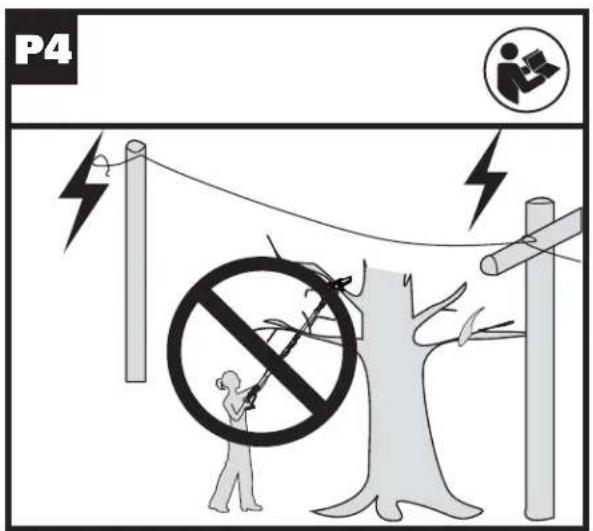
2. WARNING – Do not operate near electrical power lines. The unit has not been designed to provide protection from electric shock in the event of contact with overhead electric lines, Consult local regulations for safe distances from overhead electric power lines and ensure that the operating position is safe and secure before operating the saw chain pole pruner.
a) Keep all parts of the body away from the saw chain. Make sure the switch is off when clearing jammed material. Saw chain continues to move after the switch is turned off. A moment of inattention while operating the pole pruner may result in serious personal injury.
b) Carry the pole pruner by the handle with the saw chain stopped. When transporting or storing the pole pruner, always fit the saw chain device cover. Proper handling of the pole pruner will
reduce possible personal injury from the saw chain.
c) Hold the pole pruner by insulated gripping surfaces only, because the saw chain may contact hidden wiring or its own cord. A saw chain contacting a "live" wire may make exposed metal parts of the pole pruner "live" and could give the operator an electric shock.
d) Keep cable away from cutting area. During operation the cable may be hidden in shrubs and can be accidentally cut by the saw chain.
e) Do not use the pole pruner in bad weather conditions, especially when there is a risk of lightning. This decreases the risk of being struck by lightning.
f) To reduce the risk of electrocution, never use near any electrical power lines. Contact with or use near power lines may cause serious injury or electric shock resulting in death.
g) Always use two hands when operating the pole pruner. Hold the pole pruner with both hands to avoid loss of control.
h) Always use head protection when operating the pole pruner overhead. Falling debris can result in serious personal injury.
SAFETY WARNINGS FOR BATTERY PACK
a) Do not dismantle, open or shred cells or battery pack.
b) Do not expose battery pac& to heat or fire. A*oid storage in direct sunlight.
c) Do not short-circuit a battery pack. Do not store battery packs haphazardly in a box or drawer where they may short-circuit each other or be short-circuited by conductive materials. When battery pack is not in use, keep it away from other metal objects, like paper clips, coins, keys, nails, screws or other small metal objects, that can make a connection from one terminal to another. Shorting the battery terminals together may cause burns or a fire.
d) Do not subject battery pack to mechanical shock.
e) In the event of battery leaking, do not allow the liquid to come into contact with the skin or eyes. If contact has been made, wash the affected area with copious amounts of water and seek medical advice.
f) Do not use any battery pack which is not designed for use with the equipment.
g) Keep battery pack out of the reach of children.
h) Always purchase the battery pack recommended by the device manufacturer for the equipment.
I) Keep battery pack clean and dry.
j) Wipe the battery pack terminals with a clean dry cloth if they become dirty.
k) Battery pack needs to be charged before use. Always use the correct charger and refer to the manufacturer's instructions or equipment manual for proper charging instructions.
I) Do not leave battery pack on prolonged charge when not in use.
m) After extended periods of storage, it may be necessary to charge and discharge the battery pack several times to obtain maximum performance.
n) Recharge only lith the charger specified by Worx. Do not use any charger other than that specifically pro*ided for use lith the equipment.
o) Retain the original product literature for future reference.
p) Use only the battery pack in the application for which it was intended.
q) Remove the battery from the equipment when not in use.
r) Dispose of properly.
s) Do not mix cells of different manufacture, capacity, size or type within a device.
t) Keep the battery away from microwaves and high pressure.
SAVE THESE INSTRUCTIONS
Instructions concerning the proper techniques for limbing and cross-cutting
1. Limbing a tree
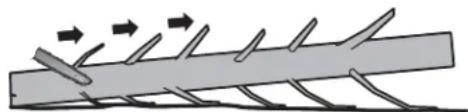
Limbing is removing the branches from a fallen tree. When limbing leave larger lower limbs to support the log off the ground. Remove the small limbs in one cut as illustrated in Figure 1. Branches under tension should be cut from the bottom up to avoid binding the pruning saw.
natural_image
Diagram of a mechanical or electrical component with directional arrows indicating motion (no text or symbols)Figure 1
2. Bucking a log
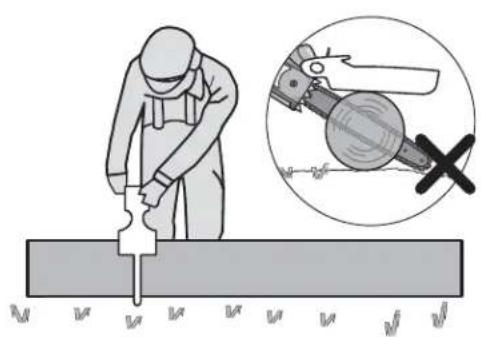
Bucking is cutting a log into lengths. It is important to make sure your footing is firm and your weight is evenly distributed on both feet. When possible, the log should be raised and supported by the use of limbs, logs or chocks. Follow the simple directions for easy cutting.
When the log is supported along its entire length as illustrated in Figure 2, it is cut from the top (overbuck), avoid contacting ground as this will greatly reduce the chain sharpness.
Cordless Pruning Saw EN
natural_image
Illustration of a person using a tool to cut a surface, with an inset showing a mechanical component (no text or symbols present)Figure 2
When the log is supported on one end, as illustrated in 8 figure 3, cut 1/3 the diameter from the underside (underbuck) (1). 'hen make the finished cut by overbucking (2) to meet the first cut.
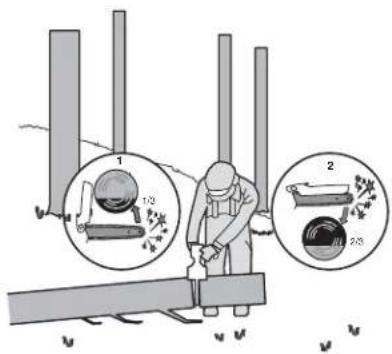
Figure 3
When the log is supported on both ends, as illustrated in 8 figure Q, cut 1/3 the diameter from the top (overbuck) (1). 'hen make the finished cut by underbucking (2) the lower 2/3 to meet the first cut.
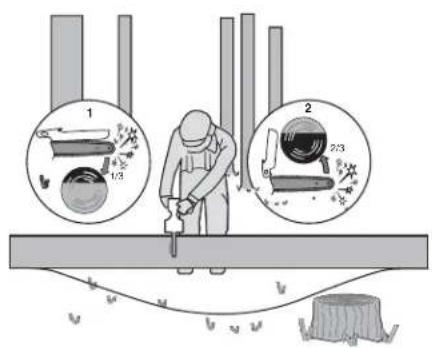
Figure 4
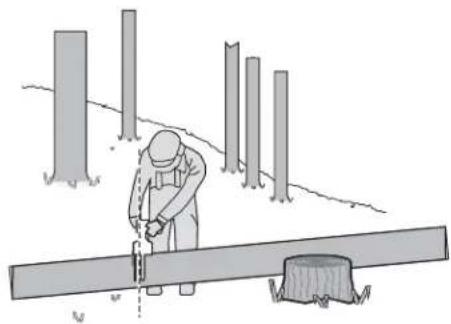
When bucking on a slope always stand on the uphill
side of the log, as illustrated in Figure 5. When "cutting through", to maintain complete control release the cutting pressure near the end of the cut without relaxing your grip on the pruning saw handles. Don't let the chain contact the ground. After completing the cut, wait for the saw chain to stop before you move the pruning saw. Always stop the motor before moving from tree to tree.
natural_image
Illustration of a person using a saw to cut a tree stump, with no text or symbols present.Figure 5
SYMBOLS
 | 'o reduce the risk of injury, user must read instruction manual |
 | Wear ear protection |
 | Wear eye protection |
 | Wear dust mask |
 | Wear head protection |
 | Wear protective footwear |
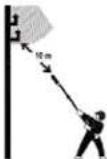 | Warning of danger from overhead electric-power lines |
Cordless Pruning Saw EN
 | Do not expose to rain |
 | Do not burn |
 | Batteries may enter water cycle if disposed improperly, which can be hazardous for ecosystem. Do not dispose of waste batteries as unsorted municipal waste. |
 Li-Ion Li-Ion | Li-Ion battery, battery must be recycled |
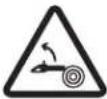 | Beware of pruning saw kickback and avoid contact with bar tip |
 | Wear protective gloves |
 | Lock |
 | Unlock |
 | call ^2 recycle®POSITEC Inc. has established a partnership with the RBRC Corporation to recycle any Positec batteries with the RBRC-call2recycle seal. For environmental protection, please do not discard batteries in the trash. After the batteries' life cycle is ended, then please call 1-800-822-8837 for a free service that will properly dispose of the battery. |
Cordless Pruning Saw EN
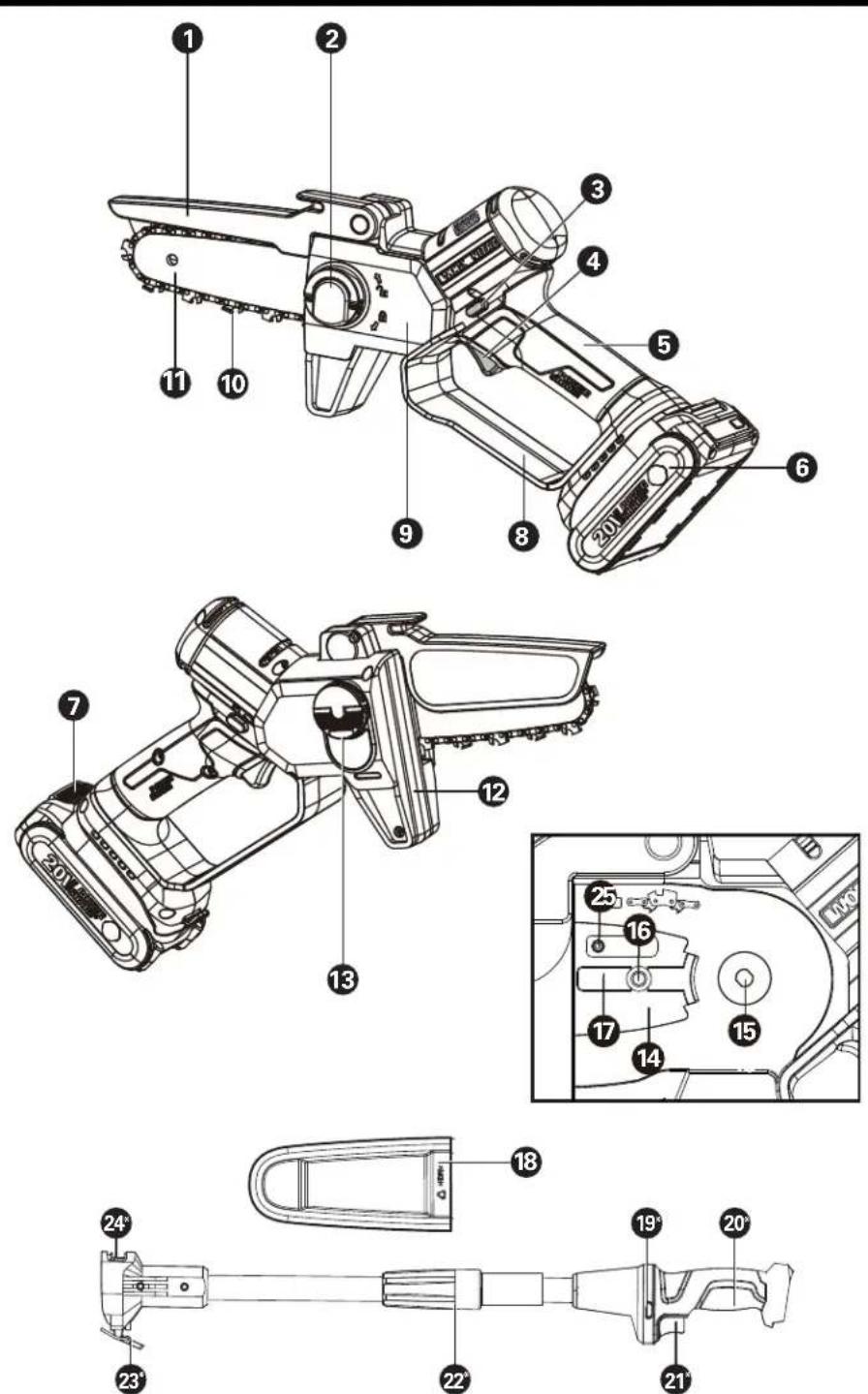
Not all the accessories illustrated or described are included in standard delivery.
* Not all the accessories illustrated or described are included in standard delivery.
3. TECHNICAL DATA
Type WG325 WG325.X (3 - designation of machinery, representative of battery-operated pruning saw)
| WG325 WG325.X ** |
| Voltage | 20 V --- Max.*** |
| Bar length | 5 inch (12 cm) |
| Chain speed | 32.8 ft/s(10m/s) |
| Chain pitch | 0.3 inch (7.6 mm) |
| Number of chain drive links | 28 |
| Chain gauge | 0.043 inch (1.1 mm) |
| Adaptive chain type | WA0142 |
| Adaptive guide bar type | WA0151 |
| Extension pole length | 49.2 inch (125 cm) |
| Maximum cutting height | 108.3 inch (275 cm) |
| Extension pole weight | 2.0 lbs (0.9 kg) |
| Machine weight (chain & bar included) (bare tool) | 2.4lbs(1.1kg)(bare tool weight) |
**The "X" noted at the end of the model number is a placeholder that represents a variation to the original model (kit contents or packaging change). "X" may be replaced with any number from "1" to "999" or English letter "A" to "Z" or "M1" to "M9".
*** Voltage measured without workload. Initial battery voltage reaches maximum of 20 volts. Nominal voltage is 18 volts.
SUGGESTED BATTERIES AND CHARGERS
| Category | Type | Capacity |
| 20V Battery | WA3669 | 2.0 Ah |
| 20V Charger | WA3881 | 2.0 A |
We recommend that you purchase your accessories from the same store that sold you the tool. Refer to the accessory packaging for further details. Store personnel can assist you and offer advice.
natural_image
Illustration of a hand using a tool to cut a flat surface, with icons indicating 'Person' and gloves (no text or symbols on the diagram itself)4. INTENDED USE
- The pruning saw is intended for cutting only wood and branches up to a diameter corresponding to the length of the pruning saw guide bar.
- The pruning saw must be used at ground level or from a suitable platform that is completely stable and secure.
- The pruning saw is intended for outdoor use only.
- The pruning saw is not intended for any other use
- Mounting of parts on the pruning saw is authorized only for original or manufacturer-approved spare parts (chain guides or saw chains for example) as well as for authorized chain guide / saw chain combinations as indicated in the manual.
- The user is responsible for any accident resulting from improper use or unauthorized modification of the pruning saw.
5. ASSEMBLY
WARNING! Do not install the battery pack before it has been completely assembled. Always use gloves when handling the chain.
MOUNTING THE SAW CHAIN
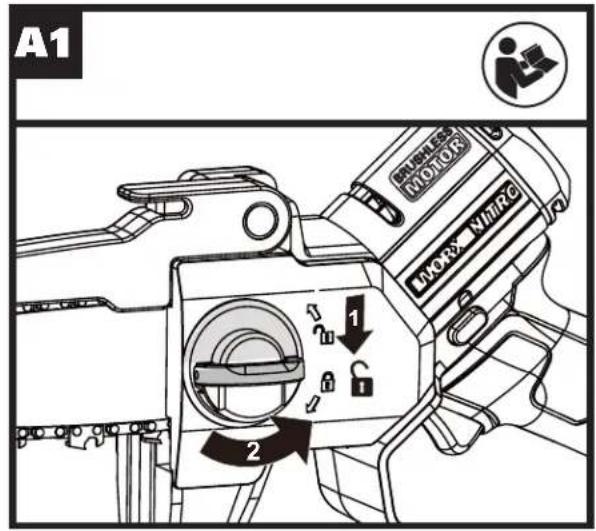
- Unpack all parts carefully. Remove the Housing-Cover by turning the Housing-Cover Knob in a counterclockwise direction. (See Fig. A1)
- Place the pruning saw on a solid, level surface.
- Use only genuine Worx Chains or those recommended for Guide Bar.
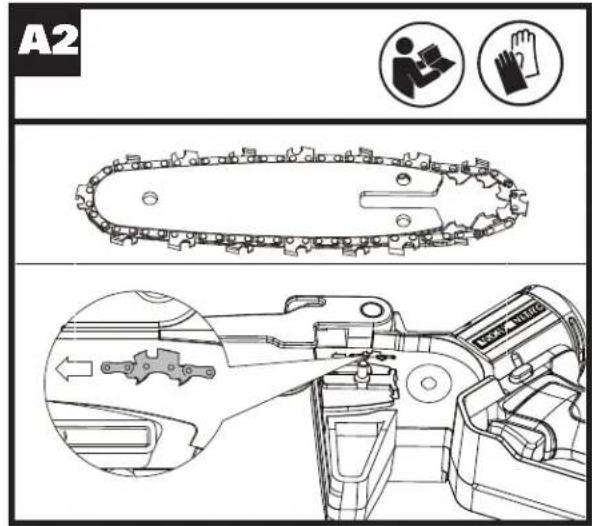
- Slide the Chain in the slot around the Guide Bar. Ensure the Chain is in correct running direction by comparing it to the chain icon on the Guide Bar, or referring to the chain direction symbol found on the saw body. (See Fig. A2)
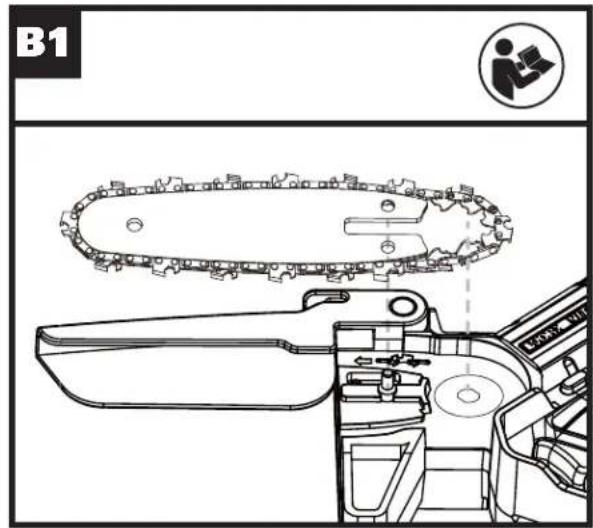
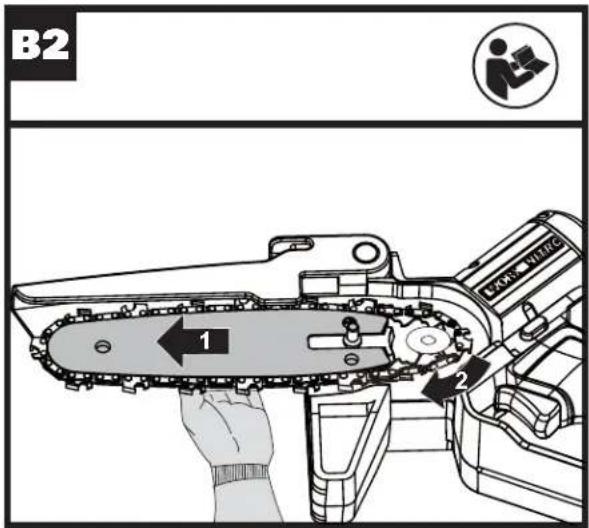
- Fit the Chain onto the Drive Sprocket, so that the Fastening Bar Bolt and the Bar Locating Tab on the Bar 9ad fit into the keyway of the opening on the Guide Bar. (See Fig. B1, B2)
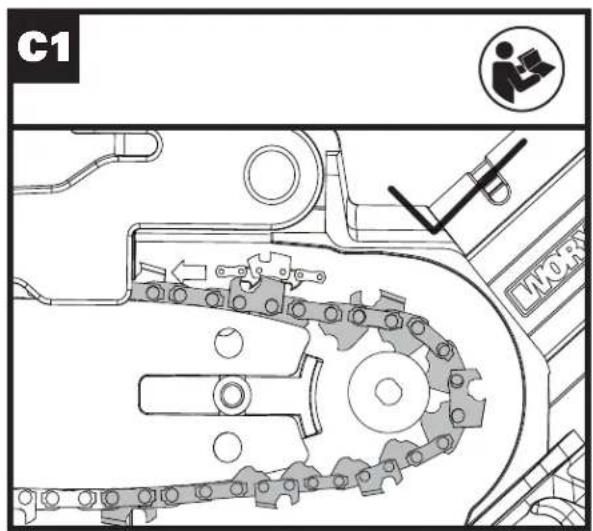
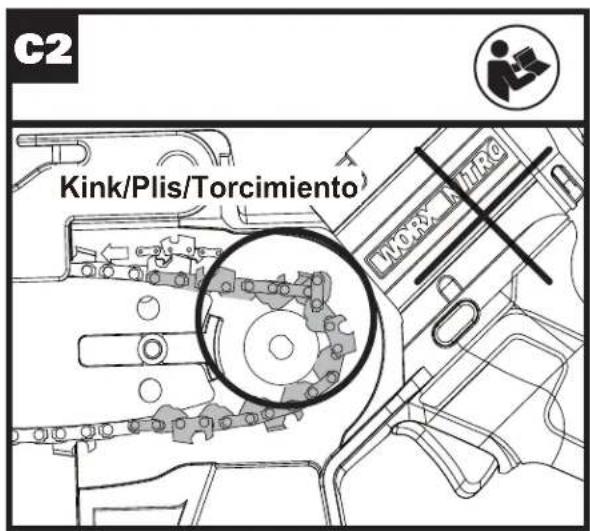
- Assure all parts are seated properly. Make sure the drive links are fully seated in the Drive Sprocket (See Fig. C1), avoiding a kink as shown in Fig. C2. If kink occurs, pick up the Chain at the Guide Bar just ahead of the kink and then pull the kink out.
NOTE: Chain should rotate freely and be free of kinks.
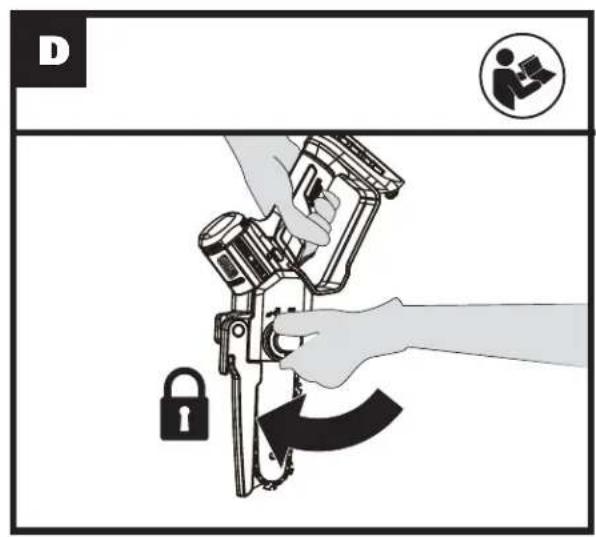
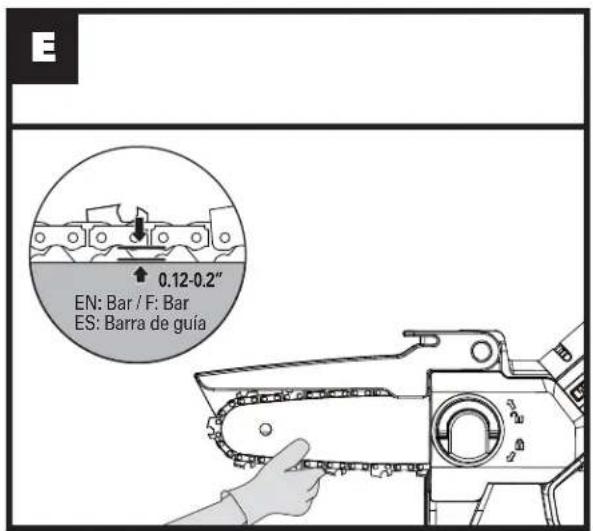
- Fit the Housing Cover. Tilt the guide bar forward where the guide bar tip is pushed in an vertically downward direction. This will remove slack from the chain. The correct chain tension is reached when the chain can be raised approx. Half the drivelink depth from the guide bar in the center. This should be done by using one hand to raise the chain against the weight of the machine. Then tighten the Housing Cover by turning the Housing-Cover Knob clockwise until it is tight.
(See Fig. D)
NOTE: The chain is properly tensioned when it can be lifted off of the Guide Bar and the drivelink is within the rail of the Guide Bar. (See Fig. E)
NOTE: The chain will stretch while cutting and lose proper tension. When the chain becomes loose, completely unscrew the Housing-Cover Knob or turn the knob around three full turns in a counter-clockwise direction, then retighten the Housing-Cover Knob to properly reset the chain tension by repeating Steps 1-7 listed above.
NOTE: New saw chains will stretch. Check the chain tension frequently when first used and tighten when the Chain becomes loose around the Guide Bar.
ASSEMBLING THE EXTENSION POLE
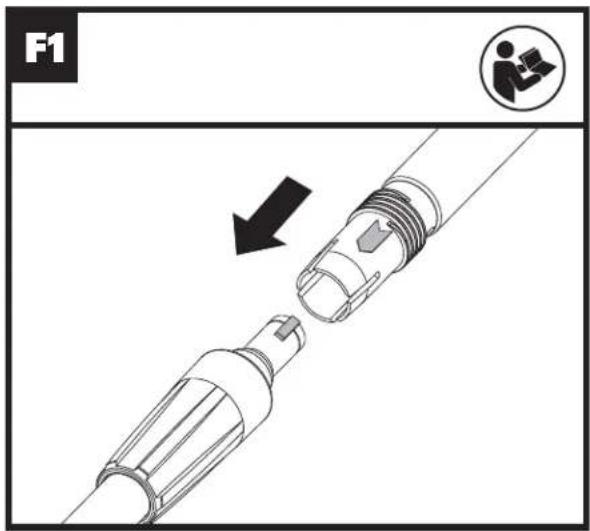
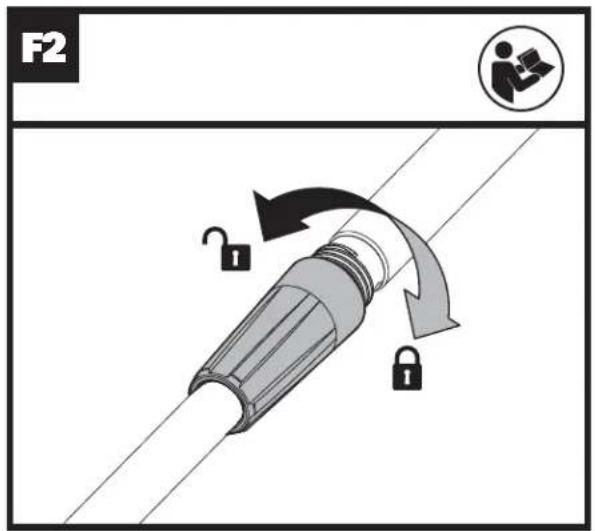
Align and insert the handle of extension pole into the shaft. Rotate the Locking Collar clockwise to lock. (See Fig. F1, F2)
NOTE: Make sure that the shaft is firmly locked in place.
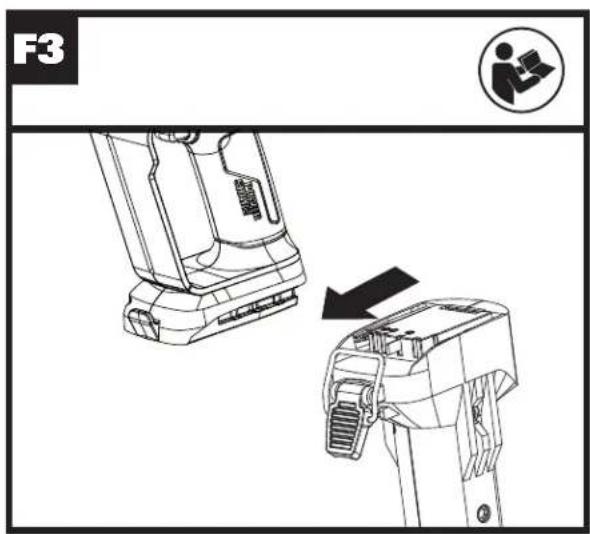
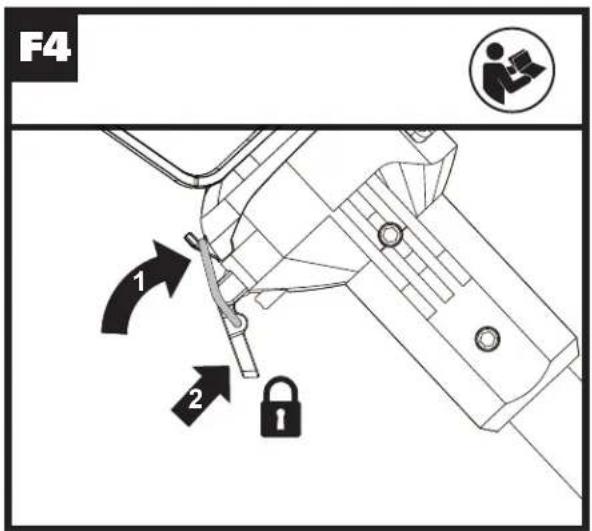
ASSEMBLING THE EXTENSION POLE TO THE MACHINE (See Fig F3, F4)
Step 1: Align and insert the extension pole into the saw.
Step 2: Hang the buckle on the hook of the saw. Press the Clamping Lever to tighten the extension pole to the machine.
NOTE: Make sure the extension pole is locked into position securely before operation.
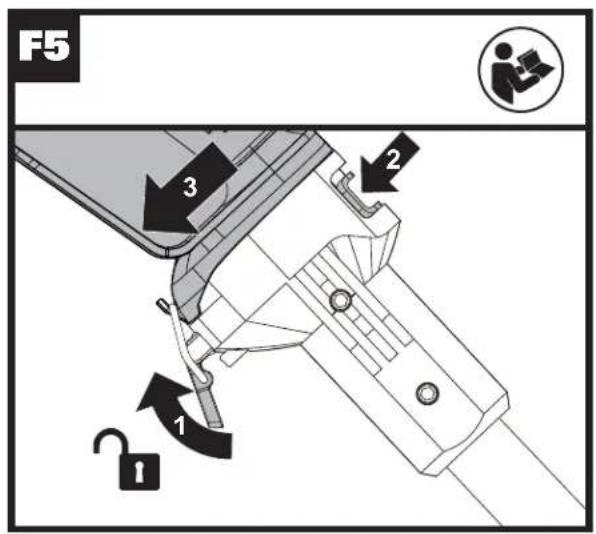
REMOVING THE EXTENSION POLE (See Fig. F5)
Loosen the Clamping Lever to release the buckle. Press the Extension Pole Release Button to disconnect the extension pole with the saw.
WARNING! When using this machine with the Extension Pole, make sure that the battery pack has been removed.
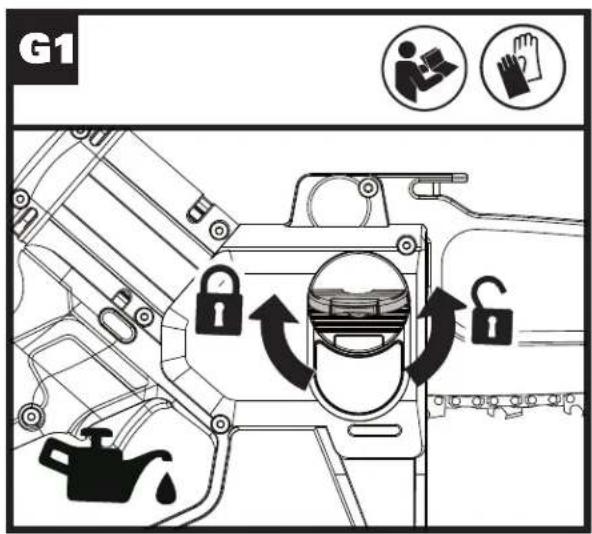
LUBRICATION (See Fig.G1, G2)
Important: The Pruning Saw is not filled with oil. It is essential to fill with oil before use. Never operate the Pruning Saw without chain oil or at an empty oil tank level, as this will result in extensive damage to the product.
NOTE: Chain life and cutting capacity depend on optimum lubrication. Therefore, the chain should be oiled before operation.
Filling oil tank (See Fig.G1):
WARNING: Removing the battery pack before filling the oil tank.
- Set Pruning Saw on any suitable surface with oil filler cap facing upward.
- Clean area around the oil filler cap with cloth and
Cordless Pruning Saw EN
unscrew the cap by turning it counter-clockwise.
- Add bar and chain oil until tank is full.
Q. Avoid dirt or debris entering oil tank, refit oil filler cap and tighten by turning clockwise until hand tight.
IMPORTANT: To allow venting of the oil tank, small breather channels are provided between the oil filler cap and the strainer, to prevent leakage, and ensure machine is left in a horizontal position when not in use. It is important to use bar and chain lubricant (not provided) that is formulated to perform over a wide temperature range with no dilution required. This can be found at the location where you purchased this saw or your local hardware store. Do not use dirty, used or otherwise contaminated oils. Damage may occur to the bar or chain. Use of non approved oil will void the warranty. Do not swallow. If swallowed, call a physician immediately. Keep out of reach of children. Store away from heat or open flame.
Checking the Automatic Oiler
WARNING: Cutting edges on chain are sharp. Use protective gloves.
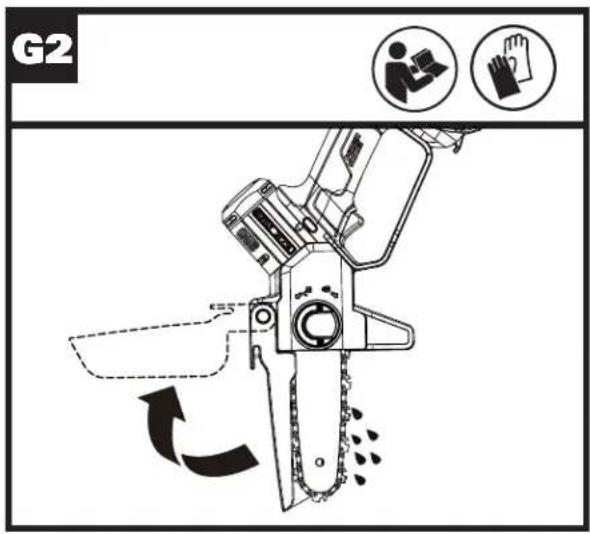
Lift the Retractable Guard to the maximum position for lubrication after filling up the oil tank. (See Fig.G2) Proper functioning of the automatic oiler can be checked by running the Pruning Saw and pointing the tip of the guide chain bar towards a piece of cardboard or paper on the ground. If an increasing oil pattern develops on the cardboard, the automatic oiler is operating fine. If there is no oil pattern, despite a full oil reservoir, contact WorxNitro customer service agent or WorxNitro approved service agent.
Caution: Do not touch the ground with the chain. Ensure safety clearance of 40cm.
6. OPERATION
WARNING! The charger and battery pack are specially designed to work together so do not attempt to use any other devices. Never insert or allow metallic objects into your charger or battery pack connections because of an electrical failure and hazard will occur.
NOTE: Your battery pack is UNCHARGED and you must charge once before use.
The battery charger supplied is matched to the Li-ion battery installed in the machine. Do not use another battery charger.
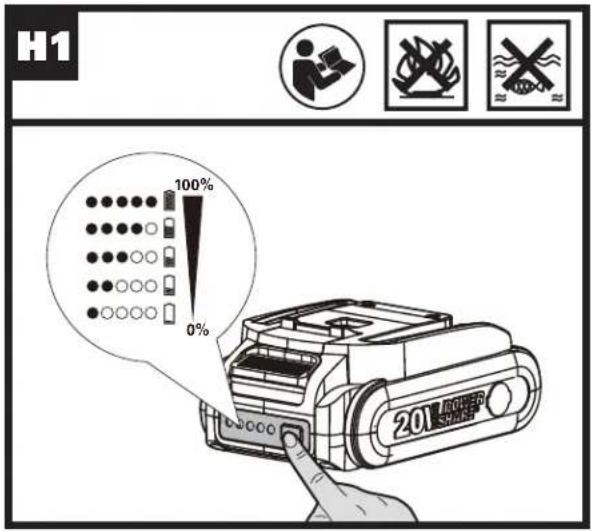
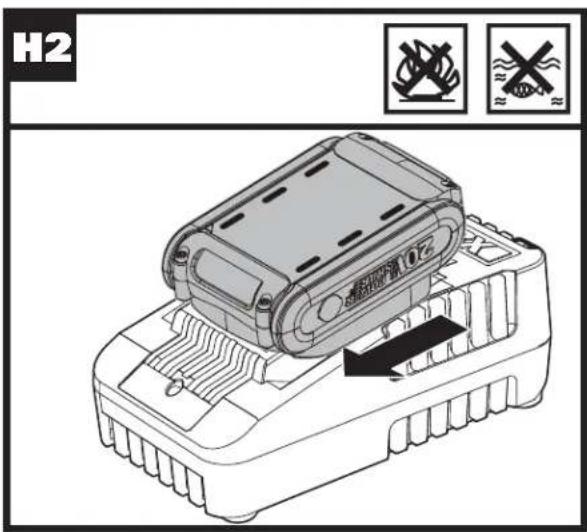
(1) CHARGING YOUR BATTERY PACK (See Fig. H1, H2)
The Li-ion battery is protected against deep discharging. When the battery is empty, the machine is switched off by means of a protective circuit. In a warm environment or after heavy use, the battery pack may become too hot to permit charging. Allow time for the battery to cool down before recharging.
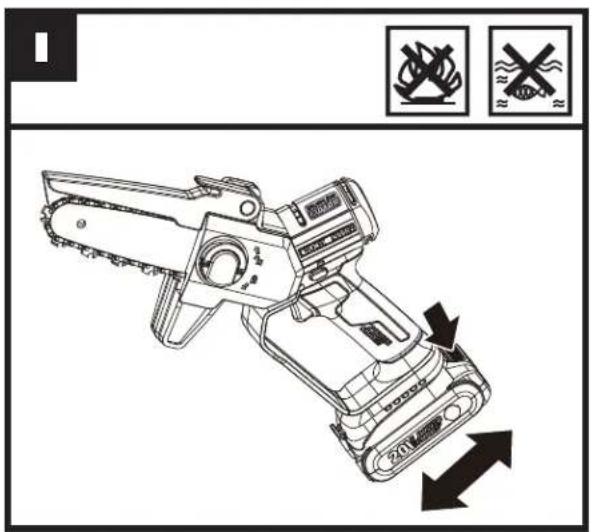
(2) TO REMOVE OR INSTALL BATTERY PACK (See Fig. I)
Depress the Battery Pack Release Button to remove the Battery Pack from your tool. After recharging, insert the Battery Pack into the battery port. A simple push and slight pressure will be sufficient until a click is heard. Check to see if the battery is fully secured.
NOTE: When removing the battery pack, hold it firmly to avoid dropping and injury.
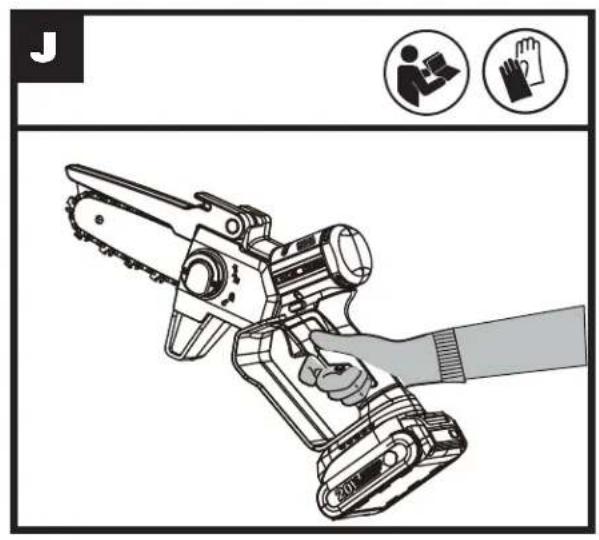
(3) HOLDING AND CONTROLLING THE PRUNING SAW (See Fig. J)
Hold and control the pruning saw with one hand on the Grip Area – wrap your thumb around the Grip Area.
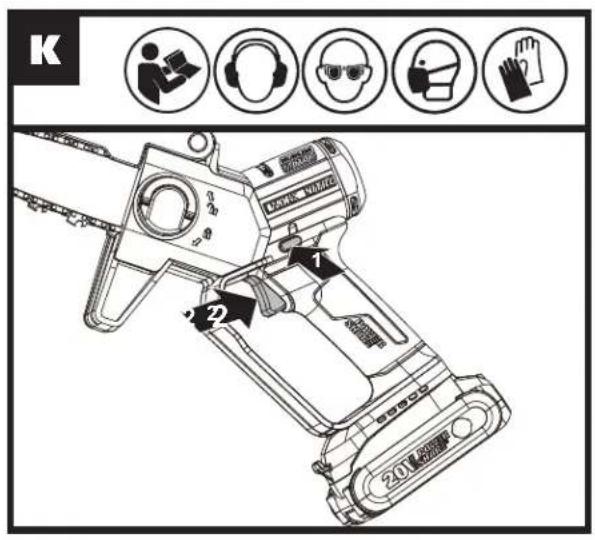
- SWITCHING ON AND OFF (See Fig. K)
ATTENTION: Check the battery pack before using your cordless tool. Only use the battery pack listed in the accessories section.
For switching on the tool, press the Lock-Out Button, then fully press the On/Off 'rigger and hold in this position. The Lock-Out Button can now be released.
For switching off, release the On/Off 'rigger.
- CUTTING
IMPORTANT: Check recent replaced chain tension about every 10 minutes during operation.
(1) Installing the battery pack into the machine.
(2) Make sure section of log to be cut is not laying on the ground. This will keep the chain from touching the ground as it cuts through the log. Touching the ground while the Chain is moving is dangerous and will dull the Chain.
(3) When ready to make a cut, push the Lock-Out Button completely in with the right thumb and squeeze the trigger. This will turn saw on. Releasing the trigger will turn the saw off. Make sure the saw is running at full speed before starting a cut.
(4) When starting a cut, slowly place moving chain against the wood. The wood should be as close to the saw body as possible. Hold saw firmly in place to avoid possible bouncing or skating (sideways movement) of saw.
(5) Guide the saw using light pressure and do not
put excessive force on the saw, letting the saw do its work. The motor will overload and can burn out. It will do the job better and safer at the rate for which it was intended.
(6) Remove the saw from a cut with the saw running at full speed. Stop the saw by releasing the On/off Trigger. Make sure the chain has stopped before setting the saw down.
(7) Keep practicing on scrap logs in a secure working area until you are comfortable, using a fluid motion and a steady cutting rate.
Kickback Safety Devices On This Saw
This saw has a low-kickback chain and reduced kickback Guide Bar. Both items reduce the chance of kickback. However, kickback can still occur with this saw.
The following steps will reduce the risk of kickback.
- Keep all safety items in place on saw. Make sure they work properly.
- Do not overreach or cut above shoulder height.
- Keep solid footing and balance at all times.
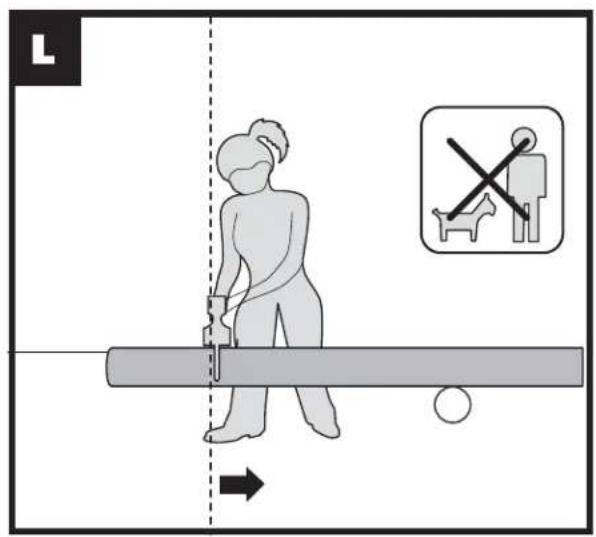
- Stand slightly to the left side of saw. This keeps your body from being in direct line with chain.
- Do not let Guide Bar nose touch anything when chain is moving.
- Never try cutting through two logs at same time. Only cut one log at a time.
- Do not bury the Guide Bar nose or try plunge cut (boring into wood using Guide Bar nose).
- Watch for shifting of wood or other forces that may pinch chain.
- Use extreme caution when reentering a previous cut.
- Use only the low-kickback chain and Guide Bar that were supplied with this pruning saw or recommended.
- Never use a dull or loose chain. Keep chain sharp with proper tension.
How to use Saw Safely
- Use the pruning saw only with secure footing.
- Hold the pruning saw at the right-hand side of your body (See Fig. L).
- The Chain must be running at full speed before it makes contact with the wood.
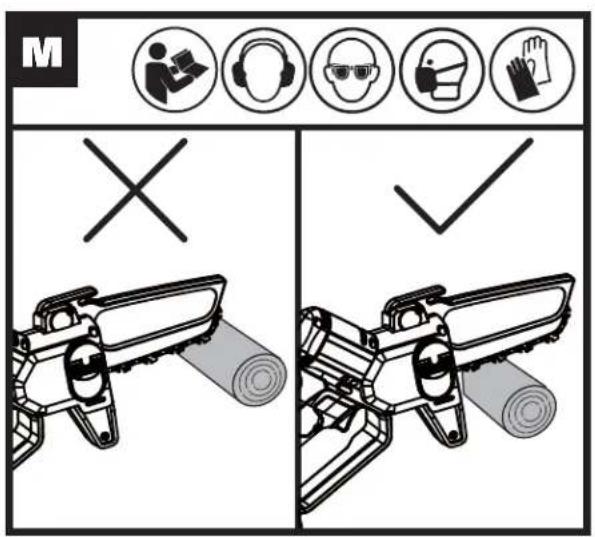
- Use the Base Plate to secure the saw onto the wood before starting to cut.
- Use the Base Plate as a leverage point while cutting. (See Fig. M)
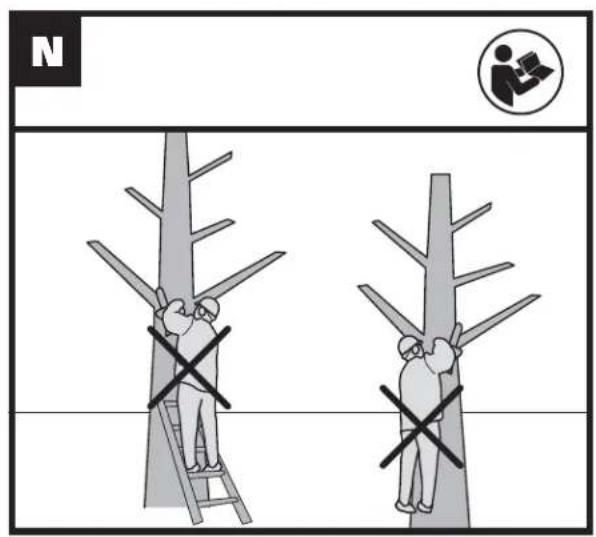
- Do not operate the saw with arms fully extended, attempt to saw areas which are difficult to reach, or stand on a ladder while sawing. (See Fig. N)
Never use the pruning saw above shoulder height.
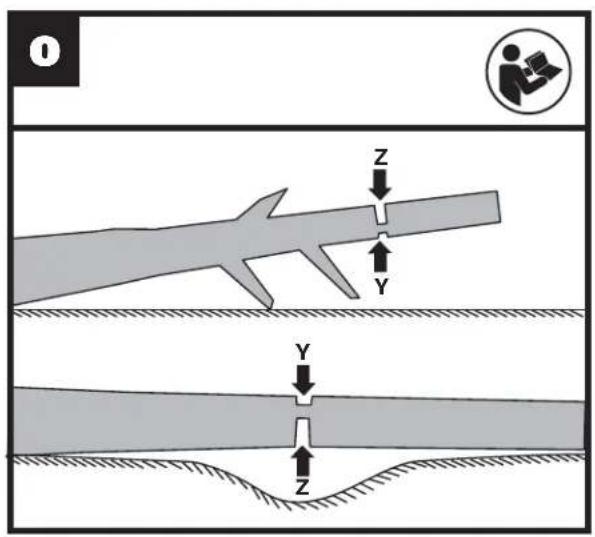
Cutting wood under tension (See Fig. 0)
WARNING: When cutting a limb that is under tension, use extreme caution. Be alert for wood springing back. When wood tension is released, limb could spring back and strike operator causing severe injury or death.
When sawing logs supported on both ends, start the cut from above(Y) about 1/3 of the diameter into the log (overbuck) and then finish the cut (Z) from below, in order to avoid contact of the pruning saw with the ground. When sawing logs supported on only one end, start the cut from below (Y) about 1/3 of the diameter into the log (underbuck) and finish the cut from above (Z) in order to avoid log splitting or jamming of the pruning saw.
Cutting with extension pole
- Install the battery pack into the machine.
- Before cutting a high branch, consider all the same points detailed in the previous section "Trimming Branches" but pay particular attention to the likely path of the falling branch.
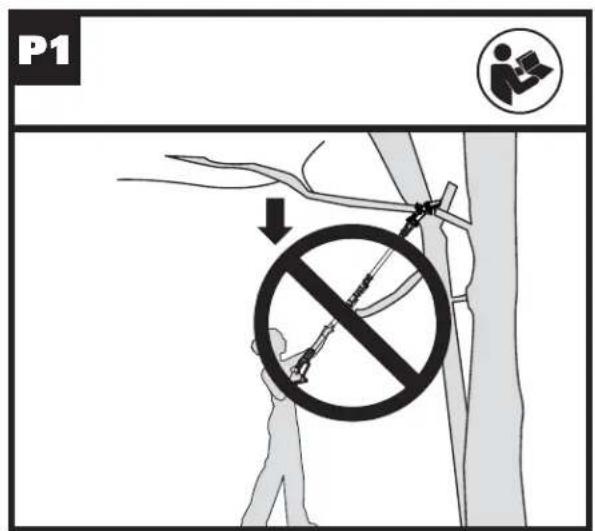
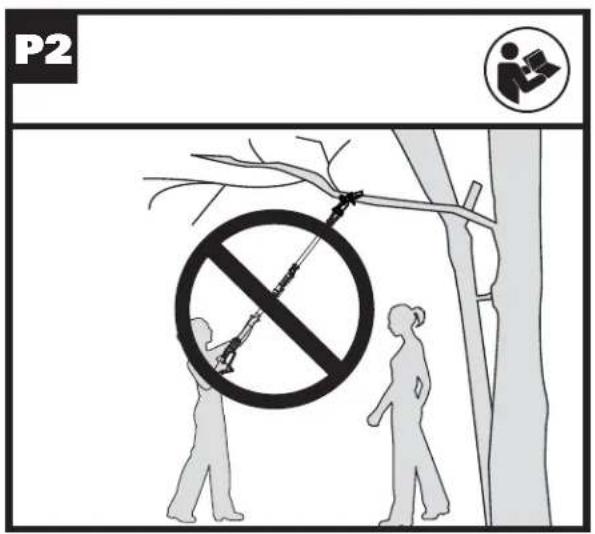
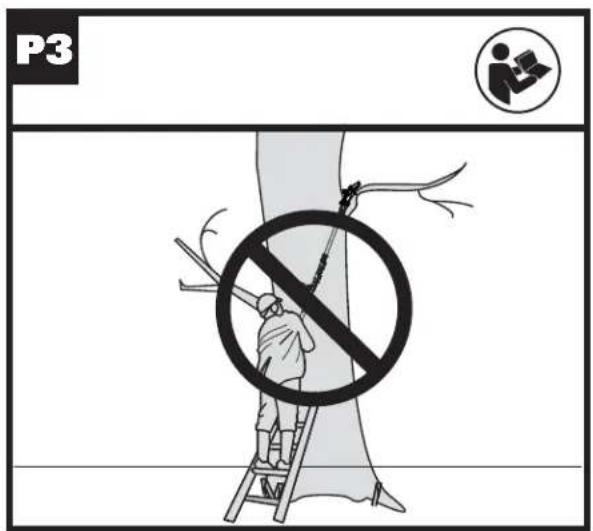
WARNING: Do not stand directly below a branch being cut. Keep bystanders far away. Do not stand on a ladder or other type of unstable support while using the tool. Do not use the tool near cable, electrical power or telephone lines. Keep 3m away from all power lines. (See Fig. P1-P4)
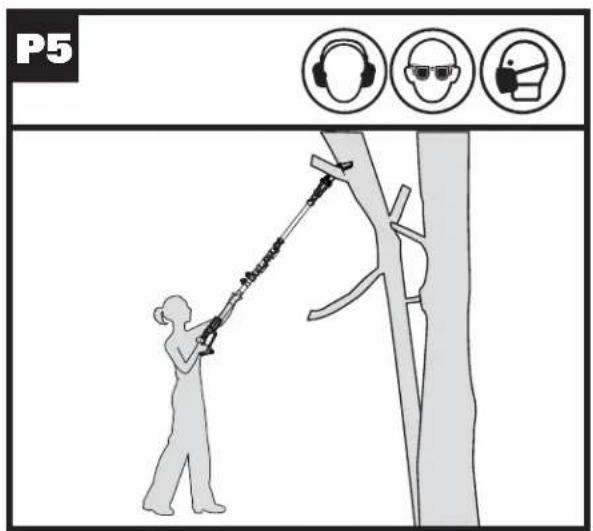
- Use both hands to grip Pole Saw. Use only designated grip areas when operating Pole Saw (See Fig. P5). Use firm grip. Thumbs and fingers must wrap around Pole Saw handle and pole.
- Make sure your footing is firm. Keep feet apart. Divide your weight evenly on both feet.
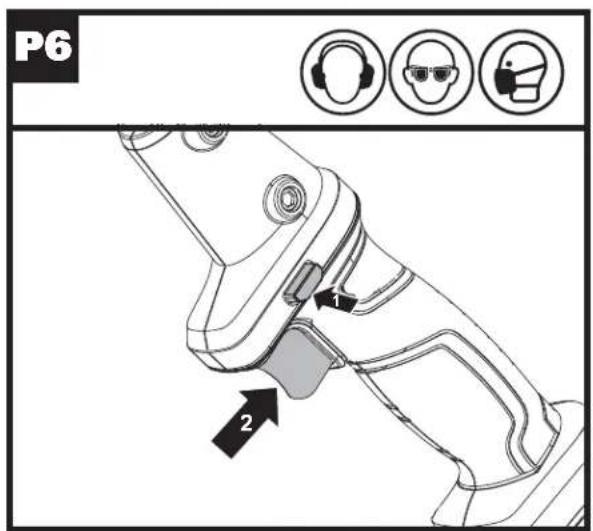
- When ready to make a cut, press the Lock-out Button, then fully press the On/off Trigger (See Fig. P6). This will turn Pole Saw on. Releasing On/off Trigger will turn Pole Saw off. Make sure saw is running at full speed before starting a cut.
- When starting a cut, place moving chain against wood. Hold Pole Saw firmly in place to avoid possible bouncing or skating (sideways movement) of saw.
- Guide Pole Saw using light pressure. Do not force Pole Saw. The motor will overload and can burn out. It will do the job better and safer at the rate for which it was intended.
- Remove Pole Saw from a cut with saw running at full speed. Stop Pole Saw by releasing trigger. Make sure chain has stopped before setting Pole Saw down.
CLEAN RESIDUAL OIL AFTER OPERATION
Lift the Retractable Guard to the maximum position for 3 to 5 times. (See Fig.G2)
NOTE: The Oil Outlet cannot be faced towards people. The Chain and Guide bar should be faced down.
SAW MAINTENANCE
Follow maintenance instructions in this manual. Proper cleaning of saw and chain and Guide Bar maintenance can reduce chances of kickback. Inspect and maintain saw after each use. This will increase the service life of your saw.
NOTE: Even with proper sharpening, risk of kickback can increase with each sharpening.
MAINTENANCE AND STORAGE OF PRUNING SAW
-
Remove the battery pack
-
When not in use
• Before moving from one place to another - Before servicing
- Before changing accessories or attachments, such as saw chain and guard
- Inspect pruning saw before and after each use. Check saw closely if guard or other part has been damaged. Check for any damage that may affect operator safety or operation of saw. Check for alignment or binding of moving parts. Check for broken or damaged parts. Do not use pruning saw if damage affects safety or operation. Have damage repaired by authorized service center. To locate an authorized service center, visit www.worx.com.
- Maintain pruning saw with care.
- Never expose saw to rain or direct moisture.
- Keep chain sharp, clean, and lubricated for better and safer performance.
- Follow steps outlined in this manual to sharpen chain.
- Keep handles dry, clean, and free of oil and grease.
- Keep all screws and nuts tight.
- When servicing, use only identical replacement parts.
- When not in use, always store pruning saw
- in a high or locked place, out of children's reach
- in a dry place
• with Bar and Housing Cover in place
Bar Maintenance
To maximize bar life, the following bar maintenance is recommended.
The bar rails that carry the chain should be cleaned before storing the tool or if the bar or chain appear to be dirty.
The rails should be cleaned every time the chain is removed.
To clean the Bar rails.
- Remove Housing-Cover, Bar and Chain. (see section ASSEMBLY)
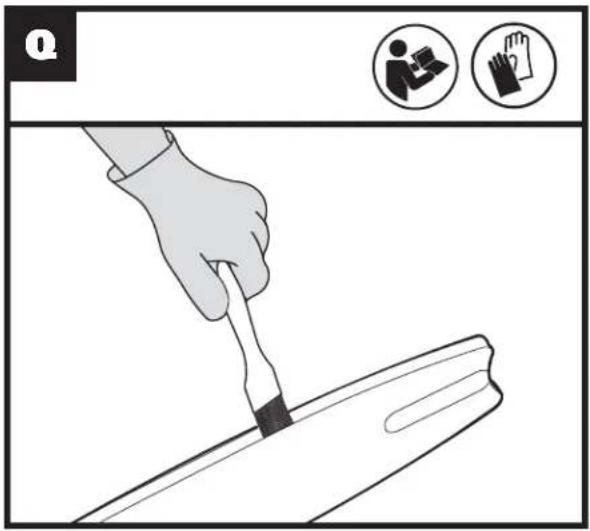
- Using a wire brush, screwdriver or similar tool, clear the residue from the inner groove of the bar. (See Fig. Q)
- Make sure to clean oil passages thoroughly.
Conditions which require Chain and Guide Bar maintenance:
- Saw cuts to one side or at an angle.
- Saw has to be forced through the cut.
- Inadequate supply of oil to the bar and chain.
Check the condition of the Guide Bar each time the chain is sharpened. A worn Guide Bar will damage the chain and make cutting difficult.
After each use, remove the battery pack, clean all sawdust from the Guide Bar and sprocket hole.
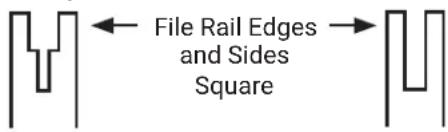
When rail top is uneven, use a flat file to restore square edges and sides.
Worn Groove Correct Groove
Replace the Guide Bar when the groove is worn, the Guide Bar is bent or cracked, or when excess heating or burring of the rails occurs. If replacement is necessary, use only the Guide Bar specified for your saw in the repair parts list or on the decal located on the pruning saw.
Replacing Bar & Chain
Replace chain when cutters are too worn to sharpen or when chain stops. Only use replacement chain noted in this manual.
Inspect Guide Bar before sharpening chain. A worn or damaged Guide Bar is unsafe. A worn or damaged Guide Bar will damage chain. It will also make cutting harder.
SHARPENING SAW CHAIN
WARNING:
Remove the battery pack before servicing.
Severe injury or death could occur from electrical shock or body contact with moving chain.
Cutting edges on chain are sharp. Use protective gloves when handling chain.
Select a diameter of 3mm round file to suit the chain pitch. 'he file is held at the correct filing angle of 30° to the guide bar.
Keep chain sharp. Your saw will cut faster and more safely. A dull chain will cause undue sprocket, Guide Bar, chain, and motor wear. If you must force chain into wood and cutting creates only sawdust with few large chips, chain is dull.
FOR BATTERY TOOLS
The ambient temperature range for the use and storage of tool and battery is 0 °C-45°C (32°F - 113°F).
The recommended ambient temperature range for the charging system during charging is 0 °C-40 °C (32 °F - 104 °F).
Cordless Pruning Saw EN
7. TROUBLESHOOTING TABLE
The following table gives checks and actions that you can perform if your machine does not operate correctly. If these do not identify/remedy the problem, contact your service agent.

WARNING: Switch off and remove the battery pack before investigating fault.
| Symptom Possible Cause Remedy | ||
| Chainsaw fails to operate | Battery charge is depleted. | Charge the battery pack. |
| Chainsaw operates intermittently | Over heating | Temporarily stop usage and let the tool cool down in a cool, ventilated location. |
| Applying too much pressure while cutting. | Apply relatively less pressure while cutting | |
| Loose connection. | Contact service agent 1-866-354-Worx (9679). | |
| Internal wiring defective. | ||
| On/off 'rigger defective. | ||
| Debris is clogged between chain and housing cover. | Remove battery. Remove housing cover and clear/dislodge any debris that may have accumulated between the bar/chain and housing cover. | |
| Chain/chain bar over-heats | Chain is over tensioned | Adjust chain tension |
| Chain is not properly oiling. Oil reservoir may be empty | Add oil to oil reservoir. If it is still not oiling, remove battery and check to ensure the oil outlet is clear of debris. | |
| Chainsaw rips, vibrates, does not saw properly | Chain tension too loose | Adjust chain tension |
| Dull chain Sharpen | chain or replace | |
| Chain worn out | Replace chain | |
| Chain teeth are facing in the wrong direction | Reassemble with chain in correct direction | |
TABLE DES MATIÈRES
- INSTRUCTIONS DE SÉCURITÉ
- LISTE DES ÉLÉMENTS
- DONNÉES TECHNIQUES
- UTILISATION PRÉVUE
- ASSEMBLAGE
- OPÉRATION
- ENTRETIEN DE LA SCIE
- TABLEAU DE DÉPANNAGE
1. INSTRUCTIONS DE SÉCURITÉ SÉCURITÉ DU PRODUIT
natural_image
Diagram of a mechanical or fluidic component with directional arrows indicating flow or movement (no text or symbols)Fig. 1
2. TRONÇONNAGE D'UNE BILLE
Fig. 3
Fig. 4
natural_image
Illustration of a person using a saw to cut a tree stump, with no text or symbols present.Fig. 5
SYMBOLES
Not all the accessories illustrated or described are included in standard delivery.
Rainure usée Rainure conforme
natural_image
Diagram of a mechanical or electrical component with directional arrows indicating motion (no text or symbols)Figura. 1
natural_image
Illustration of a person using a tool to cut a surface, with an inset showing a mechanical component (no text or symbols present)Figura. 2
Figura. 3
Not all the accessories illustrated or described are included in standard delivery.
Copyright © 2022, Positec. All Rights Reserved.