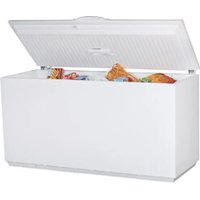
TF 117.1-IB - Freezer Novamatic - Free user manual and instructions
Find the device manual for free TF 117.1-IB Novamatic in PDF.


User questions about TF 117.1-IB Novamatic
0 question about this device. Answer the ones you know or ask your own.
Ask a new question about this device
Download the instructions for your Freezer in PDF format for free! Find your manual TF 117.1-IB - Novamatic and take your electronic device back in hand. On this page are published all the documents necessary for the use of your device. TF 117.1-IB by Novamatic.
USER MANUAL TF 117.1-IB Novamatic
text_image
Technical diagram of a refrigerator with numbered parts and control panel labelstext_image
Technical diagram showing a mechanical component with labeled parts 1 and 2, including a rotation arrow indicating rotational motion.
text_image
10 cm -1,5 cm A B -1,5 cmnatural_image
Simple circular diagram with a diagonal line and triangular pointer, no text or symbols present.Lagerung
natural_image
Illustration of hands handling a tray with granular material, no text or symbols present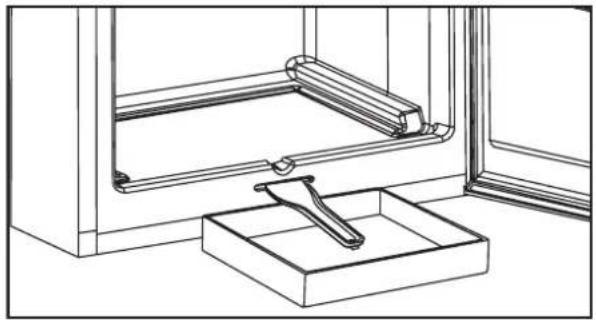
natural_image
Technical line drawing of a mechanical assembly or mounting bracket with a base and clamping tool (no text or symbols)text_image
Technical diagram showing mechanical assembly with labeled parts and a magnified inset of a bracket assembly detail.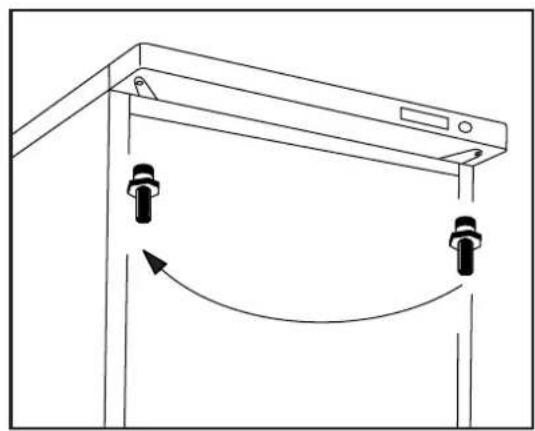
natural_image
Simple line drawing of a mechanical assembly with two hanging components and an arrow indicating motion (no text or symbols)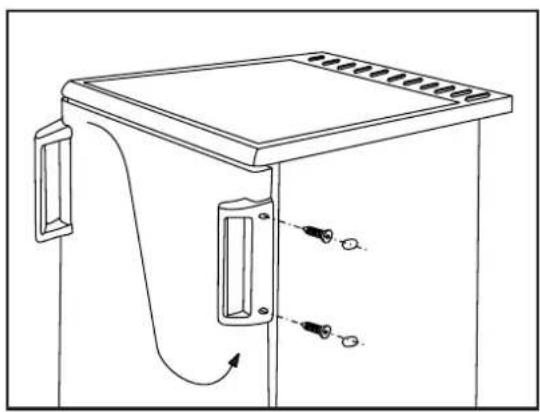
natural_image
Line drawing of a mechanical device with a handle and internal components, no text or symbols presentLagerzeittabelle
text_image
Technical diagram of a refrigerator with numbered parts and air conditioning system labelstext_image
Technical diagram of a mechanical bracket with labeled parts and rotation arrow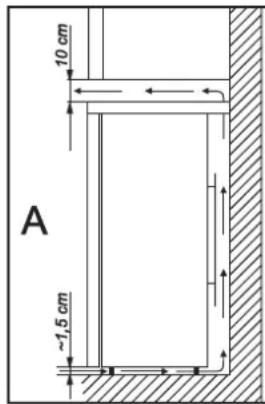
text_image
10 cm A ~1.5 cm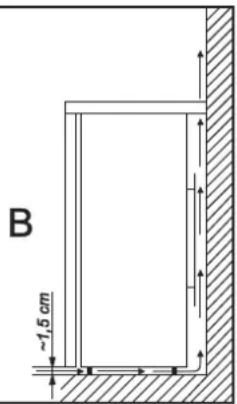
text_image
B ~1,5 cmnatural_image
Simple circular diagram with a diagonal line and triangle inside, no text or symbols present.Stockage
natural_image
Illustration of hands processing granular material into a container on an inclined conveyor (no text or symbols)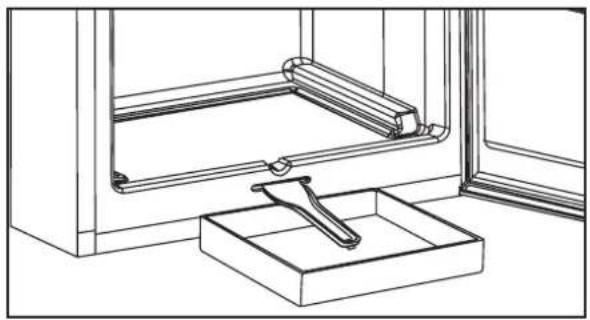
natural_image
Line drawing of a cabinet interior with a handle and tray, no text or symbols presenttext_image
Technical diagram showing assembly of a mechanical component with labeled parts and an inset close-up view.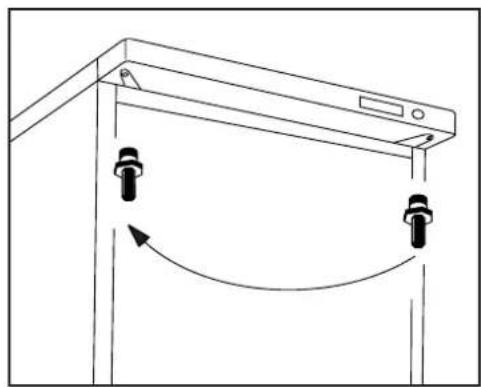
natural_image
Pure mechanical diagram showing a lever mechanism with two hanging weights and an arrow indicating motion (no text or symbols)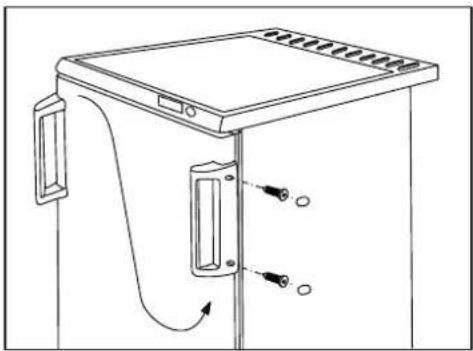
natural_image
Line drawing of a kitchen appliance with handle, door, and outlet (no text or symbols)Temps de stockage
text_image
Technical diagram of a refrigerator with numbered parts and air conditioning system labelstext_image
Technical diagram showing a mechanical component with numbered parts and rotation arrow indicating motion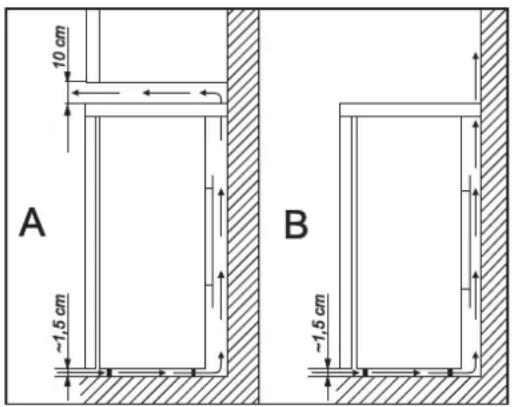
text_image
10 cm A ~1,5 cm B ~1,5 cm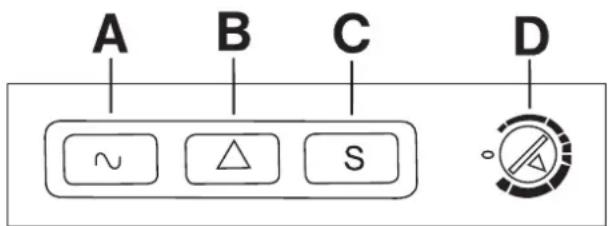
text_image
A B C D ~ △ SIT
Messa in funzione
natural_image
Simple circular diagram with a diagonal line and triangular symbol inside, no text or labels present.Conservazione
natural_image
Illustration of hands handling a container filled with granular material inside a tray (no text or symbols)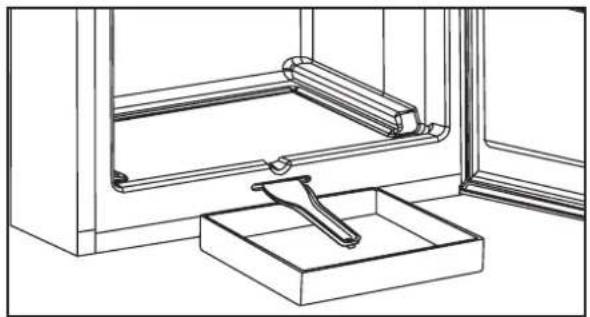
natural_image
Line drawing of a mechanical assembly with a bracket and base plate (no text or symbols)text_image
Technical diagram showing assembly of a mechanical bracket with bolted connections and a close-up of the component detail.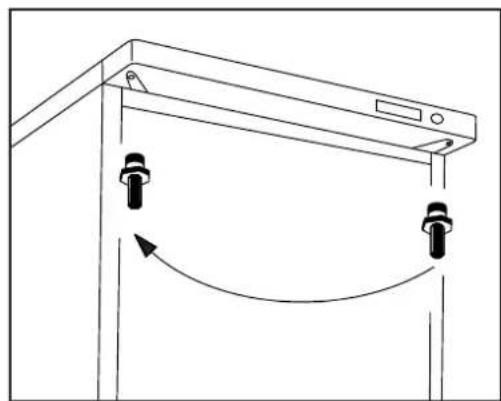
natural_image
Simple line drawing of a mechanical bracket with two hanging clips and a curved arrow indicating motion (no text or symbols)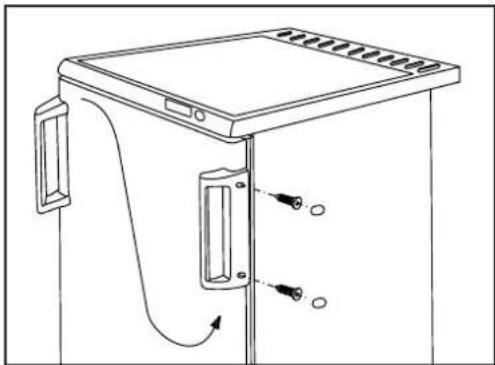
natural_image
Line drawing of a door with handle and outlet, showing internal components and a curved arrow indicating motion (no text or symbols)Before installing and using the appliance read this user's instruction book carefully. It contains safety precautions, hints, information and ideas. If the refrigerator is used in compliance with the instructions written, it will operate properly and provide you with greatest satisfaction.
The symbols below help you to find things more easily:

Safety precautions
Warnings and information at this symbol serve safety for you and your appliance.

Hints, useful information

Environmental information

Symbol for ideas
At this symbol ideas can be found according to food and its storing.

The symbol on the product or on its packaging indicates that this product may not be treated as household waste. Instead it shall be handed over to the applicable collection point for the recycling of electrical and electronic equipment. By ensuring this product is disposed of correctly, you will help prevent potential negative consequences for the environment and human health, which could otherwise be caused by inappropriate waste handling of this product. For more detailed information about recycling of this product, please contact your local city office, your household waste disposal service or the shop where you purchased the product.
Contents
Important safety information 40
General safety precautions 40
Precautions for child safety 40
Safety precautions for installation 40
Safety precautions for isobutane 40
Instructions for the User 41
General information 41
Description of the appliance, main parts....41
Instructions for the Installer....42
Technical data 42
Transportation, unpacking 42
Cleaning 42
Placement 42
Switch and indicator unit 43
Putting it into use 44
Controlling the temperature 44
Freezing 44
Storing 44
How to make ice cubes 45
Some useful information and advice ....45
Hints and ideas ....45
How to save energy 45
The appliance and environment ....45
Maintenance 46
Defrosting 46
Regular cleaning 46
When the refrigerator is not in use 47
Trouble shooting 47
Change of door opening direction 48
Electrical connection 48
Storage time chart 49
Warranty and service 49
Guarantee conditions 49
Service and spare parts ....49

Important safety information
General safety precautions
- Keep these instructions and they should remain at the appliance when moving away or changing owner.
- This appliance is designed for storing and freezing food, domestic use according to these instructions only.
- Specialised companies that are qualified to do so by the manufacturer must carry out service and repairs including repairing and changing the power cord. Accessory parts supplied by them should be used only for repairing. Otherwise the appliance can be damaged or can cause other damage or injury.
- The appliance is out of circuit only in that case if the plug is removed from the socket. Before cleaning and maintenance always unplug it (do not get it by the cable). If the socket is difficult to reach, switch off the appliance by cutting off the current.
• Power cord must not be lengthened.
- Make sure that the power plug is not squashed or damaged by the back of the fridge/freezer.
- A damaged power plug may overheat and cause a fire.
- Do not place heavy articles or the fridge/freezer itself on the power cord.
- There is a risk of a short circuit and fire.
- Do not remove the power cord by pulling on its lead, particularly when the fridge/freezer is being pulled out of its niche.
- Damage to the cord may cause a short-circuit, fire and/or electric shock.
- If the power cord is damaged, it must be replaced by a certified service agent or qualified service personnel.
- If the power plug socket is loose, do not insert the power plug.
- There is a risk of electric shock or fire.
- When cleaning, defrosting, taking out frozen food or ice tray do not use sharp, pointed or hard devices, as they can cause damage to the appliance.
- Be careful not to allow liquids to the temperature control, switch gear and indicator respectively.
- Ice and ice-cream can cause hurt if they are eaten immediately after removal from the frozen food compartment.
- After dissolving frozen food must not be refrozen, it must be used up as soon as possible.
- Store pre-packed frozen food in accordance with the frozen food manufacturer's instructions.
- You must not make defrosting faster with any electric heating appliance or chemicals.
- Do not make hot pot touch the plastic parts of the freezer.
- Do not store flammable gas and liquid in the appliance because they may explode.
- Do not put carbonated drinks, bottled drinks and bottled fruits into the freezer.
Precautions for child safety
- Do not allow children to play with the packaging of the appliance. Plastic foil can cause suffocation.
- Adults must handle the appliance. Do not allow children to play with it or its controlling parts.
- If you are discarding the appliance pull the plug out of the socket, cut the connection cable (as close to the appliance as you can) and remove the door to prevent playing children to suffer electric shock or to close themselves into it.
- This appliance is not intended for use by persons (including children) with reduced physical sensory or mental capabilities, or lack of experience and knowledge, unless they have been given supervision or instruction concerning use of the appliance by a person responsible for their safety.
Safety precautions for installation
- Put the appliance to the wall to avoid touching or catching warm parts (compressor, condenser) to prevent possible burn.
- When moving the appliance take care of the plug not to be in the socket
- When placing the appliance take care not to stand it on the power cord.
- Adequate air circulation should be around the appliance, lacking this leads to overheating. To achieve sufficient ventilation follow the instructions relevant to installation.
Safety precautions for isobutane
Warning
- The refrigerant of the appliance is isobutane (R600a) that is inflammable and explosive to a greater extent.
- Keep ventilation openings, in the appliance enclosure or in the built-in structure, clear of obstruction.
- Do not use mechanical devices or other means to accelerate the defrosting process, other than those recommended by the manufacturer.
- Do not damage the refrigerant circuit.
- Do not use electrical appliances inside the food storage compartments of the appliance, unless they are of the type recommended by the manufacturer.
For the safety of life and property keep the precautions of these user's instructions as the manufacturer is not responsible for damages caused by omission.
Instructions for the User
General information
The official designation of the appliance is home freezer. According to this the appliance is suitable for storing frozen and deep-frozen food, freezing products in quantity given in the user's instructions at home and making ice.
The appliance can meet the requirements of standards between different temperature limits according to the climate class. The letter symbol for climate class can be found on the data plate.
Description of the appliance, main parts
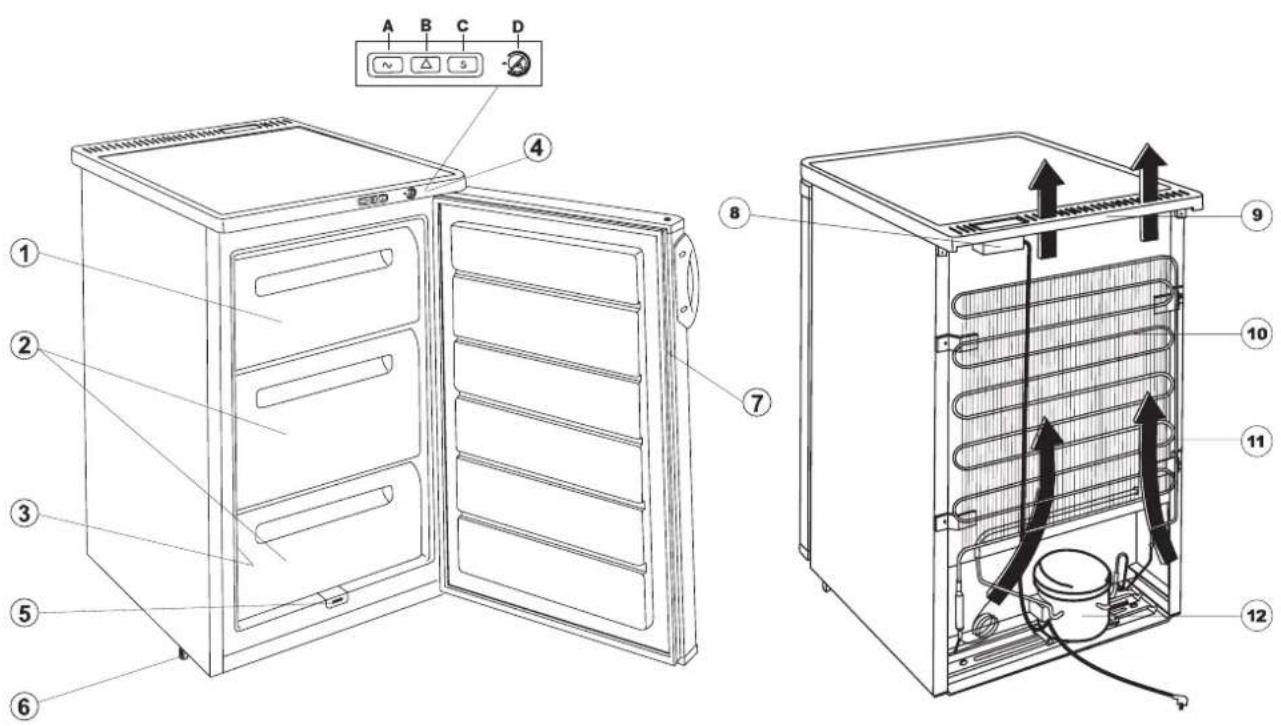
text_image
Technical diagram of a refrigerator with numbered parts and air conditioning system labels- Freezing compartment
- Storage compartments
- Data plate
- Switching and indicator unit
A) Green indicator lamp
B) Red indicator lamp
C) Yellow indicator lamp and freezer switch
D) Temperature control knob
- Defrost water outlet
- Adjustable legs
- Door gasket
- Temperature controller
-
Air grid
-
Condenser
- Direction of air flow
- Compressor
Instructions for the Installer
Technical data
| Model | TF 117.1-IB |
| Gross capacity (l) | 110 |
| Net capacity (l) | 91 |
| Width (mm) | 550 |
| Height (mm) | 850 |
| Depth (mm) | 600 |
| Energy consumption (kWh/day)(kWh/year) | 0.507185 |
| Energy class, according to EU Standards | A+ |
| Freezing capacity (kg/24h) | 12 |
| Rising time (h) | 22 |
| Rated current (A) | 0,8 |
| Weight (kg) | 39 |
Transportation, unpacking
i It is recommended to deliver the appliance in original packaging, in vertical position considering the protective warning on packaging.
After each transportation the appliance must not be switched on for approx. 2 hours.
Unpack the appliance and check if there are damages on it. Report possible damages immediately to the place you bought it. In that case retain packaging.
Cleaning
Remove every adhesive tape, which ensure the parts not to move in the appliance.
Wash the inside of the appliance using lukewarm water and mild detergent. Use soft cloth.
After cleaning wipe out the inside of the appliance.
Placement
The ambient temperature has an effect on the energy consumption and proper operation of the appliance. When placing, take into consideration that it is practical to operate the appliance between ambient temperature limits according to the climate class that is given in the chart below and can be found in the data label.
| Class of climate Ambient temperature | |
| SN +10 ... +32 °C | |
| N +16 ... +32 °C | |
| ST +16 ... +38 °C | |
| T +16 ... +43 °C |
If the ambient temperature goes below the lower data the temperature of the cooling compartment can go beyond the prescribed temperature.
If the ambient temperature goes beyond the upper data this means longer operating time of the compressor, increasing temperature in the freezer or increasing energy consumption.
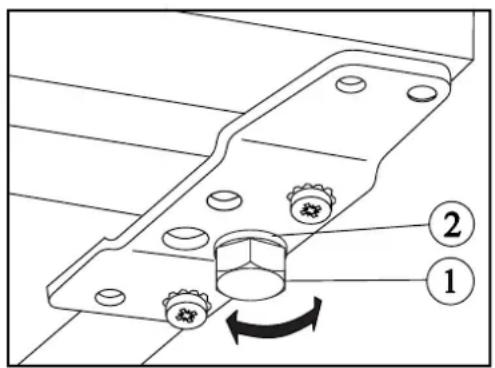
When placing the appliance ensure that it stands level. This can be achieved by two adjustable feet (1) at the bottom in front. 1-1 piece of distance washers (2) are accessories of the adjustable feet. If levelling the appliance requires, these washers can be removed.
Do not stand the appliance on a sunny place or close to a radiator or cooker.
If it is unavoidable because of furnishing and the appliance has to be stood near a cooker take these minimum distances into consideration:
- In case of gas or electric cooker 3 cm must be left, when it is less put a 0,5 - 1 cm non-flam insulation between the two appliances.
- In case of oil or coal-fired stove the distance must be 30 cm since they give off more heat.
The refrigerator is designed to operate when it is totally pushed to the wall.

When placing the refrigerator keep minimal distances recommended in figure.
A : placing it under a wall-cupboard
B : placing it freely
text_image
Technical diagram showing a mechanical component with labeled parts 1 and 2, including a rotation arrow indicating rotational motion.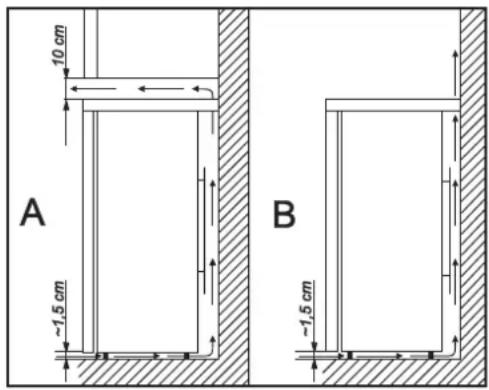
text_image
10 cm A ~1.5 cm B ~1.5 cmSwitch and indicator unit
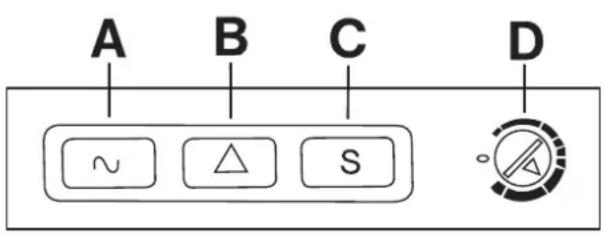
For the usage of the switching and indicator unit see chapters "Putting it into use", "Controlling the temperature" and "Freezing".
Components of the appliance are as follows:
A) Green indicator lamp
This lamp lights when the appliance is under power, i.e. the mains plug is in the mains socket.
B) Red indicator lamp
It lights up depending on the temperature inside the appliance.
It lights for a short time when starting the appliance, placing fresh food into it and when the temperature control knob has been turned in direction to lower temperatures.
It lights permanently when the temperature inside the appliance is too high (overloaded with warm food, door stayed open or the door seal does not close properly) or possibly the appliance was broken down.
C) Yellow indicator lamp and freezer switch
In the switched-on state of the switch (pops up and lights by pressing) the compressor operates continuously thus providing for the coldest interior temperature - achievable by the freezer - needed for freezing.
D) Temperature control knob
This knob is provided for setting and changing the temperature inside the appliance.
text_image
A B C D ~ △ SGB
Putting it into use
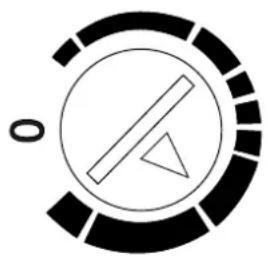
Put the plug into the mains socket. Turn the thermostatic control knob according to the figure. This time the red lamp starts giving light, the compressor starts and cooling begins shortly.
When the red light goes out the temperature is sufficient and the appliance is suitable for storing frozen and deep-frozen foods.
Controlling the temperature
The thermostatic controller interrupts the operation of the appliance automatically for more or less time depending on the setting then restarts it assuring the required temperature.
Setting the thermostat knob can be done practically with a coin. Turning the control knob clockwise cooling becomes more and more intensive.
In the appliance -18 °C or lower temperature can be reached if the thermostat knob is set according to the figure.
The thermostat can be switched off („0“ position), which means breaking the circuit of the compressor i.e. stopping cooling.
The temperature coming about in the freezer is effected by not only the position of the thermostatic control and the ambient temperature, but frequency of door openings and the quantity of food put into it, etc.
In maximum position of the thermostat - in case of increased demand e.g. during heatwaves - the compressor may operate continually. This does not cause damages to the appliance.
Freezing
Freezing different products should always be done in the freezing compartment after proper preparation.
Move frozen food from the top drawer into the other two drawers. For maximum freezing performance remove the top drawer and then place the foods to be frozen directly on the evaporator. In case of freezing smaller food volumes you do not need to remove the drawer.
Switch on the freezer switch (pops up and lights by pressing) 4 hours before freezing food of small quantities and about 24 hours before freezing products of larger quantities. This time the compressor operates continuously to reach the temperature necessary for freezing.
Place in the foods to be frozen and let the appliance operate for about 24 hours as written above.
Then push the fast freezer switch again (the yellow light will go out and the switch turns to its original position).
Move the fresh frozen food into the top drawer and insert the drawer in the appliance in its working position.
Storing
It is practical to replace frozen products into the storing compartments after freezing has finished so that to make room in the freezing compartment for another freezing.
natural_image
Abstract circular graphic with a diagonal line and triangle inside, surrounded by segmented black segments (no text or symbols)In large quantities of food are to be stored, remove the baskets except the lowermost one from appliance and place food on the shelves.
Intermediate freezing does not deteriorate foods already stored.
How to make ice cubes
To make ice cubes fill the enclosed ice cube tray with water and put it to the frozen food compartment. Wetting the bottom of the tray and setting thermostatic control knob to maximum stage can shorten preparing time. After finishing do not forget to reset the thermostatic control to the suitable stage.
Ready ice cubes can be taken out of the tray under running water then twist or hit it.
i Some useful information and advice
- After opening and closing the door of freezer vacuum will rise inside the appliance because of the low temperature. So wait 2-3 minutes after closing the door - if you want to open it again - while inner pressure equalises.
- Take care of operating the freezer at a position of thermostatic control so that the inside temperature can never go beyond -18 °C, since temperature higher than this can deteriorate frozen foods.
- It is practical to make sure of faultless operation of the appliance daily so as to notice possible failure in time and prevent deterioration of frozen foods.
Hints and ideas
In this chapter practical hints and ideas are given about how to use the appliance to reach maximum energy saving and there is environmental information about the appliance as well.

How to save energy
- Avoid putting the appliance in a sunny place and near anything that gives off heat.
- Be sure that the condenser and the compressor are well ventilated. Do not cover the sections where ventilation is.
- Wrap products in tightly closing dishes or cling film to avoid building up unnecessary frost.
- Avoid products put in the freezer compartment to touch foods already frozen.
- Do not leave the door open longer than necessary and avoid unnecessary openings.
- Put warm foods into the appliance only when they are at room temperature.
- The condenser must be kept clean.

The appliance and environment
This appliance does not contain gasses which could damage the ozone layer, in either its refrigerant circuit or insulation materials. The appliance shall not be discarded together with the urban refuse and rubbish. Avoid damaging the cooling unit, especially at the rear near the heat exchanger. Information on your local disposal sites may be obtained from your municipal authorities.
The materials used on this appliance marked with the symbol are recyclable.
GB
Maintenance
Defrosting
Bleeding part of the moisture of cooling chamber in form of frost and ice goes with the operation of the appliance.
Thick frost and ice has an insulating effect, so it reduces cooling efficiency as the temperature increases, it needs more energy, at a certain thickness it does not allow the door of the freezing compartment to open, possibly the door can be broken.
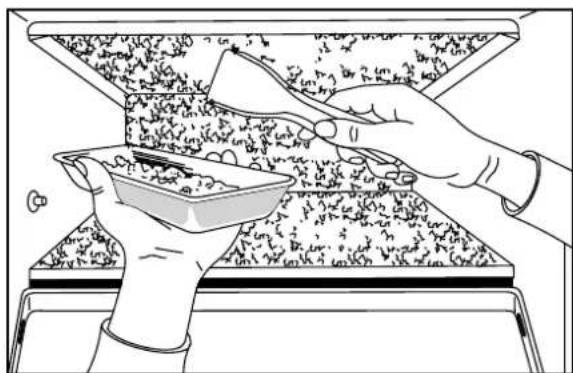
It is possible to scrape off and remove smaller frost and ice with the enclosed ice scraper.
The tray in figure is not a piece of accessories to the appliance!
When ice coating is so thick that it can not be removed with the frost scraper defrosting is necessary. Its frequency depends on usage.
How to defrost it:
Disconnect the appliance from the electrical supply. If the plug is not accessible turn the temperature control knob to "0" position.
Take the frozen foods out of the appliance and put them into a basket lined with paper or cloth. Store them in a possibly cool place or replace them into a frozen or fresh food compartment of a refrigerator.
Leave the door open.
Sweep off the melting water occasionally with a cloth or sponge in direction of sides which gathers in the outlet channel practically formed in the bottom of the appliance and can be removed as follows:
Put a tray high enough in front of the appliance. Insert the plastic scraper into the defrost water outlet according to the picture. Defrost water will flow into the tray through the outlet.
Defrosting process can be made quicker by placing a pot or dish filled with warm water to the cooling plate formed as a shelf.
After defrosting wipe the surfaces and push defrost water outlet back.
Apply voltage to the appliance.
Turn the temperature control knob to a medium position and leave to run.
After the red light has gone out put the foods back.
Regular cleaning
It is practical to clean the inside of the freezer and defrost it at a time.
Household cleaner or soap must not be used.
After breaking the circuit wash the appliance using lukewarm water and wipe it.
Clean the door gasket with clean water.
After cleaning apply voltage to the appliance.
It is recommended to remove the dust and dirt collected on the back of the appliance and the condenser
natural_image
Illustration of hands processing granular material into a container (no text or symbols)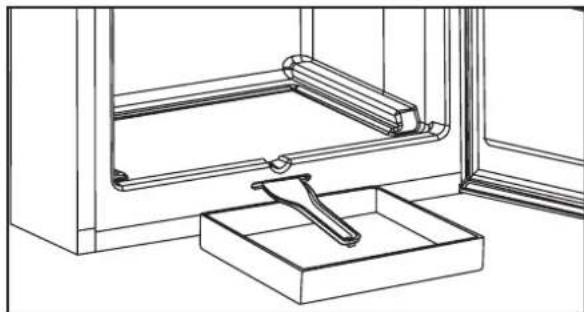
natural_image
Line drawing of a cabinet with a tray and a handle, no text or symbols presentonce or twice a year.
When the refrigerator is not in use
In case the appliance will not be used for a long time follow these steps:
Remove plug from the mains socket.
Remove foods from the refrigerator.
Defrost and clean it as written before.
Leave the door open to avoid a build up of air inside.
Trouble shooting
During operation of the appliance some smaller but annoying trouble can often occur, which does not require calling a technician out. In the following chart information is given about them to avoid unnecessary charges on service.
We draw your attention that operation of appliance goes with certain sounds (compressor- and circulating sound). This is not trouble, but means normal operation.
We draw it to your attention again that the appliance operates discontinuously, so the stopping of compressor does not mean being no-current. That is why you must not touch the electrical parts of the appliance before removing it from the mains socket.
| Problem | Possible cause | Solution |
| The appliance does not cool sufficiently | Thermostatic control is set too low.Before freezing the appliance was not precooled sufficiently.Large-sized food was put in.Too many foods to be frozen were put in.Warm foods were put in.Door is not shut properly. | Set higher position.Pre-cool the appliance for enough time.Cut up food.Put fewer foods to be cooled.Put foods max. at room temperature.Check if the door is shut. |
| The appliance cools too hard | The thermostatic control is set too high. | Set lower position. |
| The appliance does not cool at all | Plug is not connected to the mains socket properly.There is no voltage in the mains socket Thermostatic control is in „0” position. | Check if the connection is proper.Check if there is voltage.Check setting of thermostatic control. |
| The appliance is noisy | The appliance is not supported properly. | Check if the appliance stands stable (all the four feet should be on the floor). |
As much as the advice does not lead to result, call the nearest brand-mark service.
GB
Change of door opening direction
Should the setting-up place or handling demand it, door-opening direction can be refitted from right-handed to left-handed.
Following operations are to be done on the basis of figures and explanations:
- Break the circuit of the appliance.
- Tilt back the appliance carefully so that the compressor can not touch the floor. It is recommended to ask another person for help, who can keep the appliance at this position safely.
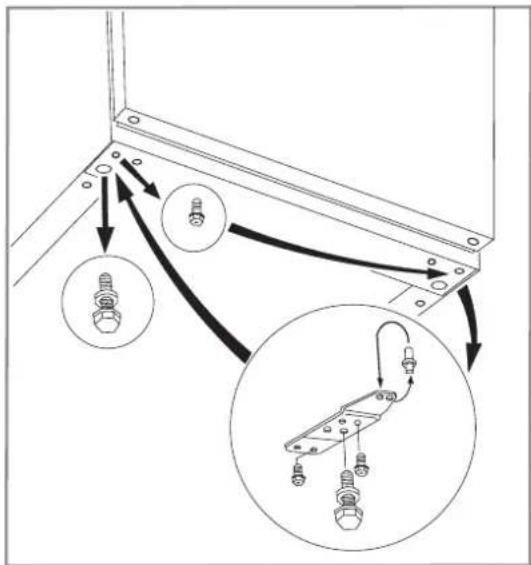
- Unscrew the adjustable feet situated on both sides (2 pieces), in addition the screws fixing the lower door holders (2 pieces) and the screw on the other side respectively.
- Put over the pin in the lower door holding plate in the direction of the arrow.
• Take the door off. - Unscrew the top door holding pin and put it on the other side.
• Fit the door to the top door holding pin. - Fix the bottom door holders on the other side being careful that the edge of the door is parallel with the side of cupboard.
- Then screw in the one screw in the place set free on the other side as well as the adjustable feet (2 pieces) and set up the box.
- Put over the handle and the plastic nails on the other side.
- Put the appliance to its place, set it level and apply voltage to it.
In case you do not want to perform the procedures above, call the nearest brand-mark service. Technicians will accomplish the refitting expertly for charge.
Electrical connection
This refrigerator is designed to operate on a 230-240 V AC (\~) 50 Hz supply.
The plug must be put into a socket with protective contact. If there is no such, it is recommended to get an electrician to fit an earthed socket in compliance with standards near the refrigerator.

This appliance complies with the following E.E.C. Directives:
- 73/23 EEC of 19.02.73 (Low Voltage Directive) and subsequent modifications,
- 89/336 EEC of 03.05.89 (Electromagnetic Compatibility Directive) and subsequent modifications.
- 96/57 EEC - 96/09/03 (Energy Efficiency Directive) and its subsequent amendments
text_image
Technical diagram showing assembly of a mechanical component with bolted parts and a close-up of its internal structure.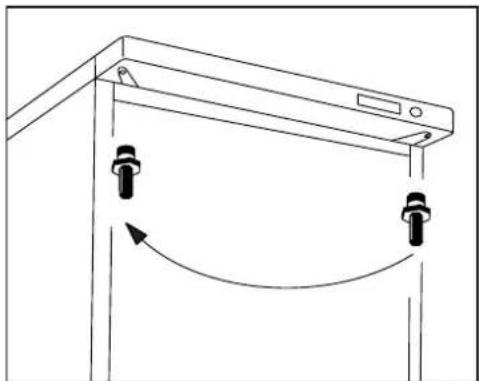
natural_image
Simple line drawing of a mechanical bracket with two hanging clips and an arrow indicating motion (no text or symbols)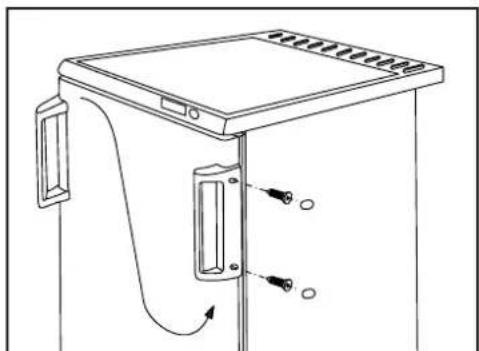
natural_image
Line drawing of a kitchen appliance with handle, door, and outlet (no text or symbols)Storage time chart
Storage time of deep-frozen and frozen products
| Foods -18°C | |
| Vegetables:green beans, green peas, mixed vegetables, marrow, corn, etc. 12 months | |
| Ready-cooked foods:vegetable dish, trimmings, with meat, etc. 12 months | |
| Ready-cooked foods:sirloin steaks, stew from knuckle of ham, meat from pig pudding, etc. 6 months | |
| Foods from potatoes, pasta:mashed potato, gnocchi, dumpling, pasta filled with jam, chips 12 months | |
| Soups:meat-broth, soup from green beans, soup from green peas, etc. 6 months | |
| Fruits:sour cherry, cherry, gooseberry, fruit cream, mashed maroon 12 months | |
| Meat:chicken, duck, goose 5 monthsfillets, tuna fish 6 months | |
| Popsicle, ice-cream 3 weeks |
Warranty and service
Guarantee conditions
Service and spare parts
If calling the service is unavoidable, announce the trouble at a brand-mark service nearest to your place.
When announcing the appliance has to be identified according to its data label.
The data label of the appliance is stuck to the wall of the interior beside the vegetable box in the fresh food compartment in the bottom on the left side. All necessary data are there which are needed to the service announcement (type, model, serial number, etc.). Note here the data from the data label of your appliance:
| Model | |
| Product No. | |
| Serial No. | |
| Date of purchase: |
The manufacturer reserves the right to make any changes in the products.
Fust® Dipl. Ing. Ing. dipl.
Unsere Kundendienst-Telefonnummer: Le numéro de téléphone de notre service après-vente: Il nostro numero di telefono del servizio clientela: Our customer service telephone number:
0848 559 111
oder unter ou sur Internet oppure su Internet or in the internet
www.fust.ch
| Dipl. Ing. FUST AG | Dipl. Ing. FUST AG | Dipl. Ing. FUST AG | Ing. dipl. FUST SA | Dipl. Ing. FUST AG | Ing. dipl. FUST SA |
| Buchental 4 Riedmoosstrasse An der Rheinstrasse Hyper-Fust Romanel Centre Kantonstrasse 79 Via Campagna 1 | |||||
| 9245 Oberbüren | 3172 Niederwangen-Bern | 4414 Füllinsdorf | 1032 Romanel-sur-Lausanne | 3931 Visp-Eyholz | 6512 Giubiasco-Bellinzona |
| Tel. (071) 955 50 50 | Tel. (031) 980 11 11 | Tel. (061) 906 95 00 | Tél. (021) 643 09 70 | Tel. (027) 948 12 40 | Tel. (091) 850 10 20 |
| Dipl. Ing. FUST AG | Dipl. Ing. FUST AG | Dipl. Ing. FUST AG | Dipl. Ing. FUST AG | Dipl. Ing. FUST AG | Ing. dipl. FUST SA |
| Quaderstr. 22. | Mythen-Center | Im Jelmoli, Seidengasse 1 | Badenerstrasse 109 | Multimedia-Factory | Rue de Rive 3 |
| 7000 Chur | 6430 Schwyz | 8004 Zürich | 8004 Zürich | beim Shopping-Center | 1204 Genève |
| Tel. (081) 257 19 30 | Tel. (041) 818 70 50 | (044) 225 77 11 1 | (044) 295 60 70 0 | 6020 Emmenbrücke | Tél. (022) 817 03 80 |
| Tel. (041) 268 67 40 | |||||
Sowie in über 100 weiteren Filialen in Ihrer Nähe/plus de 100 filiales dans votre proximité/più di 100 filiali nelle vostre vicinanze /as in over 100 other branches nearby