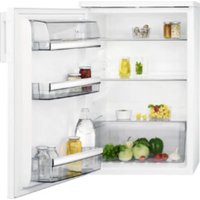
ATC1522 - Fridge AEG - Free user manual and instructions
Find the device manual for free ATC1522 AEG in PDF.


User questions about ATC1522 AEG
0 question about this device. Answer the ones you know or ask your own.
Ask a new question about this device
Download the instructions for your Fridge in PDF format for free! Find your manual ATC1522 - AEG and take your electronic device back in hand. On this page are published all the documents necessary for the use of your device. ATC1522 by AEG.
USER MANUAL ATC1522 AEG
natural_image
Simple geometric shape: a vertical rectangle on a plain white background, enclosed in a gray border (no text or symbols)INHALTSVERZEICHNIS
www.aeg.com/webselfservice
natural_image
Line drawing of a hand using a tool to lift a wooden plank (no text or symbols)
natural_image
Technical line drawing of a mechanical assembly with two stacked components and upward arrows indicating motion (no text or symbols)5.2 Energiespartipps
natural_image
Diagram showing a hand holding a tool inside a circular frame with rotational arrows, no text or symbols present.natural_image
Illustration of a hand using a tool to adjust or install a component, with arrows indicating motion (no text or symbols)8. MONTAGE

WARNUNG!
natural_image
Technical line drawing of a metal bracket with bolts and a hexagonal nut (no text or symbols)8.4 Standort

text_image
Technical diagram showing mechanical assembly with labeled parts and magnified views of componentstext_image
Diagram illustrating a mechanical or electrical system with labeled components and directional arrows, including a magnified inset showing rotational motion.www.aeg.com/webselfservice

natural_image
Line drawing of a hand using a wooden plank to lift a flatboard (no text or symbols)
natural_image
Technical line drawing of a mechanical assembly with two stacked components and upward arrows indicating motion (no text or symbols)5. CONSEILS
natural_image
Diagram showing a hand holding a tool inside a circular device with rotational arrows, no text or symbols present.natural_image
Illustration of a hand using a tool to apply a screwdriver to a surface, with arrows indicating motion (no text or symbols)natural_image
Technical line drawing of a metal bracket with bolt holes and a cube attachment (no text or symbols)8.4 Emplacement

text_image
Technical diagram showing mechanical assembly with bolted connections and component disassembly stepstext_image
Technical diagram showing a mechanical assembly with labeled components and a magnified inset illustrating the motion of a valve or valve mechanism.www.aeg.com/webselfservice
natural_image
Line drawing of a hand using a tool to lift a wooden plank (no text or symbols)
natural_image
Technical line drawing of a mechanical assembly with two stacked components and upward arrows indicating motion (no text or symbols)5. CONSIGLI E SUGGERIMENTI UTILI
natural_image
Diagram showing a hand holding a tool inside a circular frame with rotational arrows, no text or symbols present.natural_image
Illustration of a hand using a dropper to apply a tool to a component, with arrows indicating motion (no text or symbols)natural_image
Technical line drawing of a metal bracket with bolt holes and a cube attachment (no text or symbols)text_image
Technical diagram showing mechanical assembly with labeled parts and directional arrows indicating motion or assembly steps.text_image
Diagram illustrating a mechanical or electrical system with labeled components and directional arrows, including a magnified inset showing rotational motion.Thank you for choosing this AEG product. We have created it to give you impeccable performance for many years, with innovative technologies that help make life simpler features you might not find on ordinary appliances. Please spend a few minutes reading to get the very best from it.
Visit our website for:

Get usage advice, brochures, trouble shooter, service information:
www.aeg.com/webselfservice

Register your product for better service:
www.registeraeg.com

Buy Accessories, Consumables and Original spare parts for your appliance:
www.aeg.com/shop
CUSTOMER CARE AND SERVICE
Always use original spare parts.
When contacting our Authorised Service Centre, ensure that you have the following data available: Model, PNC, Serial Number.
The information can be found on the rating plate.
⚠ Warning / Caution-Safety information
i General information and tips
Environmental information
Subject to change without notice.
1. ⚠️ SAFETY INFORMATION
Before the installation and use of the appliance, carefully read the supplied instructions. The manufacturer is not responsible for any injuries or damages that are the result of incorrect installation or
usage. Always keep the instructions in a safe and accessible location for future reference.
1.1 Children and vulnerable people safety
- This appliance can be used by children aged from 8 years and above and persons with reduced physical, sensory or mental capabilities or lack of experience and knowledge if they have been given supervision or instruction concerning the use of the appliance in a safe way and understand the hazards involved.
- Do not let children play with the appliance.
• Children shall not carry out cleaning and user maintenance of the appliance without supervision. - Keep all packaging away from children and dispose of it appropriately.
1.2 General Safety
- This appliance is intended to be used in household and similar applications such as:
- Farm houses; staff kitchen areas in shops, offices and other working environments
- By clients in hotels, motels, bed and breakfast and other residential type environments
- Keep ventilation openings, in the appliance enclosure or in the built-in structure, clear of obstruction.
- Do not use mechanical devices or other means to accelerate the defrosting process, other than those recommended by the manufacturer.
- Do not damage the refrigerant circuit.
- Do not use electrical appliances inside the food storage compartments of the appliance, unless they are of the type recommended by the manufacturer.
- Do not use water spray and steam to clean the appliance.
- Clean the appliance with a moist soft cloth. Only use neutral detergents. Do not use abrasive products, abrasive cleaning pads, solvents or metal objects.
- Do not store explosive substances such as aerosol cans with a flammable propellant in this appliance.
- If the supply cord is damaged, it must be replaced by the manufacturer, its Authorised Service Centre or similarly qualified persons in order to avoid a hazard.
2. SAFETY INSTRUCTIONS
2.1 Installation

WARNING!
Only a qualified person must install this appliance.
- Remove all the packaging and the transit bolts.
- Do not install or use a damaged appliance.
- Follow the installation instructions supplied with the appliance.
• Always take care when moving the appliance as it is heavy. Always use safety gloves and enclosed footwear. - Make sure the air can circulate around the appliance.
- At first installation or after reversing the door wait at least 4 hours before connecting the appliance to the power supply. This is to allow the oil to flow back in the compressor.
- Before carrying out any operations on the appliance (e.g. reversing the door), remove the plug from the power socket.
- Do not install the appliance close to radiators or cookers, ovens or hobs.
- Do not install the appliance where there is direct sunlight.
- Do not install this appliance in areas that are too humid or too cold, such as the construction appendices, garages or wine cellars.
- When you move the appliance, lift it by the front edge to avoid scratching the floor.
2.2 Electrical connection

WARNING!
Risk of fire and electric shock.
• The appliance must be earthed.
- Make sure that the parameters on the rating plate are compatible with the electrical ratings of the mains power supply.
• Always use a correctly installed shockproof socket. - Do not use multi-plug adapters and extension cables.
- Make sure not to cause damage to the electrical components (e.g. mains plug, mains cable, compressor). Contact the Authorised Service Centre or an electrician to change the electrical components.
- The mains cable must stay below the level of the mains plug.
- Connect the mains plug to the mains socket only at the end of the installation. Make sure that there is access to the mains plug after the installation.
- Do not pull the mains cable to disconnect the appliance. Always pull the mains plug.
2.3 Use

WARNING!
Risk of injury, burns, electric shock or fire.
- Do not change the specification of this appliance.
- Do not put electrical appliances (e.g. ice cream makers) in the appliance unless they are stated applicable by the manufacturer.
- Be careful not to cause damage to the refrigerant circuit. It contains isobutane (R600a), a natural gas with a high level of environmental compatibility. This gas is flammable.
- If damage occurs to the refrigerant circuit, make sure that there are no
flames and sources of ignition in the room. Ventilate the room.
- Do not let hot items to touch the plastic parts of the appliance.
- Do not store flammable gas and liquid in the appliance.
- Do not put flammable products or items that are wet with flammable products in, near or on the appliance.
- Do not touch the compressor or the condenser. They are hot.
2.4 Internal lighting

WARNING!
Risk of electric shock.
- The type of lamp used for this appliance is for household appliances only. Do not use it for house lighting.
2.5 Care and cleaning

WARNING!
Risk of injury or damage to the appliance.
- Before maintenance, deactivate the appliance and disconnect the mains plug from the mains socket.
- This appliance contains hydrocarbons in the cooling unit. Only a qualified person must do the maintenance and the recharging of the unit.
3. OPERATION
3.1 Switching on
Insert the electrical plug into a wall socket.
Turn the temperature regulator clockwise to a medium setting.
3.2 Switching off
To turn off the appliance, turn the temperature regulator to the "O" position.
3.3 Temperature regulation
The temperature is automatically regulated.
To operate the appliance, proceed as follows:
- Regularly examine the drain of the appliance and if necessary, clean it. If the drain is blocked, defrosted water collects in the bottom of the appliance.
2.6 Service
• To repair the appliance contact an Authorised Service Centre.
- Use original spare parts only.
2.7 Disposal

WARNING!
Risk of injury or suffocation.
- Disconnect the appliance from the mains supply.
- Cut off the mains cable and discard it.
- Remove the door to prevent children and pets to be closed inside of the appliance.
- The refrigerant circuit and the insulation materials of this appliance are ozone-friendly.
- The insulation foam contains flammable gas. Contact your municipal authority for information on how to discard the appliance correctly.
-
Do not cause damage to the part of the cooling unit that is near the heat exchanger.
-
turn the Temperature regulator towards lower settings to obtain the minimum coldness.
- turn the Temperature regulator towards higher settings to obtain the maximum coldness.

A medium setting is generally the most suitable.
However, the exact setting should be chosen keeping in mind that the temperature inside the appliance depends on:
- room temperature
• how often the door is opened
• the quantity of food stored
• the location of the appliance.

If the ambient temperature is high or the appliance is fully loaded, and the appliance is set to the lowest temperature, it may run continuously causing frost to form on the rear wall. In this case the dial must be set to a higher temperature to allow automatic defrosting and therefore reduced energy consumption.
4. DAILY USE

WARNING!
Refer to Safety chapters.
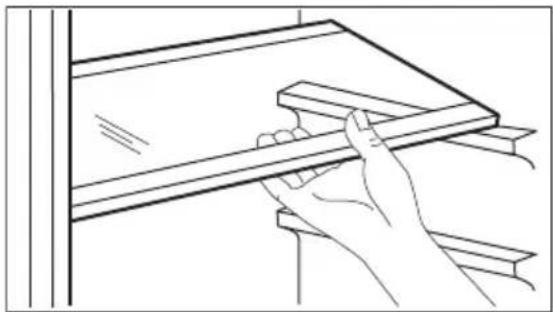
4.1 Movable shelves
The walls of the refrigerator are equipped with a series of runners so that the shelves can be positioned as desired.
natural_image
Line drawing of a hand holding a wooden plank, no text or symbols present
Do not move the glass shelf above the vegetable drawer to ensure correct air circulation.
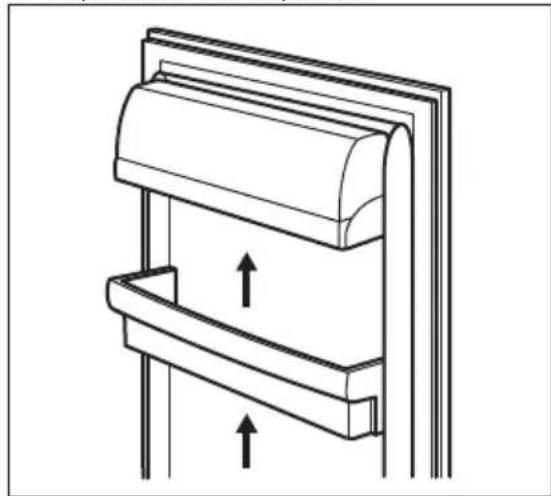
4.2 Positioning the door shelves
To permit storage of food packages of various sizes, the door shelves can be placed at different heights.
5. HINTS AND TIPS
5.1 Normal operating sounds
The following sounds are normal during operation:
- Gradually pull the shelf in the direction of the arrows until it comes free.
- Reposition as required.
natural_image
Technical line drawing of a mechanical assembly with two stacked components and upward arrows indicating motion (no text or symbols)- A faint gurgling and bubbling sound from coils sound when refrigerant is pumped.
-
A whirring and pulsating sound from the compressor when refrigerant is pumped.
-
A sudden cracking noise from inside appliance caused by thermic dilatation (a natural and not dangerous physical phenomenon).
- A faint click noise from the temperature regulator when the compressor switches on or off.
5.2 Hints for energy saving
- Do not open the door frequently or leave it open longer than absolutely necessary.
- If the ambient temperature is high and the Temperature Regulator is set to low temperature and the appliance is fully loaded, the compressor may run continuously, causing frost or ice on the evaporator. If this happens, set the Temperature Regulator toward warmer settings to allow automatic defrosting and so a saving in electricity consumption.
5.3 Hints for fresh food refrigeration
To obtain the best performance:
• do not store warm food or evaporating liquids in the refrigerator
- do cover or wrap the food, particularly if it has a strong flavour
- position food so that air can circulate freely around it
5.4 Hints for refrigeration
Useful hints:
- Meat (all types): wrap in a suitable packaging and place it on the glass shelf above the vegetable drawer. Store meat for at most 1-2 days.
- Cooked foods, cold dishes: cover and place on any shelf.
- Fruit and vegetables: clean thoroughly and place in a special drawer. Bananas, potatoes, onions and garlic must not be kept in the refrigerator if not packed.
- Butter and cheese: place in a special airtight container or wrap in an aluminium foil or a polythene bag to exclude as much air as possible.
- Bottles: close with a cap and place on the door bottle shelf, or (if available) on the bottle rack.
6. CARE AND CLEANING

WARNING!
Refer to Safety chapters.
6.1 General warnings

CAUTION!
Unplug the appliance before carrying out any maintenance operation.

This appliance contains hydrocarbons in its cooling unit; maintenance and recharging must therefore only be carried out by authorized technicians.

The accessories and parts of the appliance are not suitable for washing in a dishwasher.
6.2 Cleaning the interior
Before using the appliance for the first time, the interior and all internal accessories should be washed with lukewarm water and some neutral soap to remove the typical smell of a brand-new product, then dried thoroughly.

CAUTION!
Do not use detergents, abrasive powders, chlorine or oil-based cleaners as they will damage the finish.
6.3 Periodic cleaning

CAUTION!
Do not pull, move or damage any pipes and/or cables inside the cabinet.

CAUTION!
Take care of not to damage the cooling system.

CAUTION!
When moving the cabinet, lift it by the front edge to avoid scratching the floor.
The equipment has to be cleaned regularly:
- Clean the inside and accessories with lukewarm water and some neutral soap.
- Regularly check the door seals and wipe clean to ensure they are clean and free from debris.
- Rinse and dry thoroughly.
- If accessible, clean the condenser and the compressor at the back of the appliance with a brush. This operation will improve the performance of the appliance and save electricity consumption.
6.4 Defrosting of the refrigerator
Frost is automatically eliminated from the evaporator of the refrigerator compartment every time the motor compressor stops, during normal use. The defrost water drains out through a trough into a special container at the back of the appliance, over the motor compressor, where it evaporates.
7. TROUBLESHOOTING

WARNING!
Refer to Safety chapters.
7.1 What to do if...
| Problem Possible cause Solution | ||
| The appliance does not operate. | The appliance is switched off. | Switch on the appliance. |
| The mains plug is not connected to the mains socket correctly. | Connect the mains plug to the mains socket correctly. | |
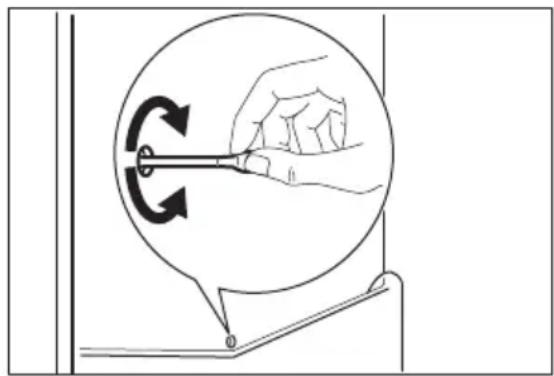
It is important to periodically clean the defrost water drain hole in the middle of the refrigerator compartment channel to prevent the water overflowing and dripping onto the food inside.
natural_image
Diagram showing a hand holding a tool inside a circular frame with rotational arrows, no text or symbols present.6.5 Periods of non-operation
When the appliance is not in use for long periods, take the following precautions:
- Disconnect the appliance from electricity supply.
- Remove all food.
- Clean the appliance and all accessories.
- Leave the door/doors open to prevent unpleasant smells.

WARNING!
If you want to keep the appliance switched on, ask somebody to check it once in a while to prevent the food inside from spoiling in case of a power failure.
| Problem Possible cause Solution | ||
| There is no voltage in themains socket. | Connect a different electrical appliance to the mains socket. Contact a qualified electrician. | |
| The appliance is noisy. The appliance is not supported properly. | Check if the appliance stands stable. | |
| The lamp does not work. The lamp is in stand-by. Close and open the door. | ||
| The lamp is defective. Refer to "Replacing the lamp". | ||
| The compressor operates continually. | Temperature is set incorrectly. | Refer to "Operation" chapter. |
| Many food products to be frozen were put in at the same time. | Wait a few hours and then check the temperature again. | |
| The room temperature is too high. | Refer to climate class chart on the rating plate. | |
| Food products placed in the appliance were too warm. | Allow food products to cool to room temperature before storing. | |
| The door is not closed correctly. | Refer to "Closing the door". | |
| Water flows on the rear plate of the refrigerator. | During the automatic defrosting process, frost melts on the rear plate. | This is correct. |
| Water flows into the refrigerator. | The water outlet is clogged. | Clean the water outlet. |
| Food products prevent that water flows into the water collector. | Make sure that food products do not touch the rear plate. | |
| Water flows on the floor. The melting water outlet is not connected to the evaporative tray above the compressor. | Attach the melting water outlet to the evaporative tray. | |
| Door is misaligned or interferes with ventilation grill. | The appliance is not levelled. | Refer to "Levelling". |
| The temperature in the appliance is too low/too high. | The temperature regulator is not set correctly. | Set a higher/lower temperature. |
| The door is not closed correctly. | Refer to "Closing the door". | |
| The food products' temperature is too high. | Let the food products temperature decrease to room temperature before storage. | |
| Many food products are stored at the same time. | Store less food products at the same time. | |
| The door has been opened often. | Open the door only if necessary. | |
| There is no cold air circulation in the appliance. | Make sure that there is cold air circulation in the appliance. | |
| There is too much condensed water on the rear wall of the refrigerator. | Door was opened too frequently. | Open the door only when necessary. |
| Door was not closed completely. | Make sure the door is closed completely. | |
| Stored food was not wrapped. | Wrap food in suitable packaging before storing it in the appliance. | |
| Door does not open easily. You attempted to re-open the door immediately after closing. | Wait a few seconds between closing and re-opening of the door. | |

If the advice does not lead to the desired result, call the nearest Authorized Service Centre.
7.2 Replacing the lamp

The appliance is equipped with a long-life LED interior light.

It is strongly recommended to use original spare parts only.

Use LED bulbs (E14 base) only. The maximum power is shown on the lamp unit.

CAUTION!
Disconnect the plug from the mains socket.
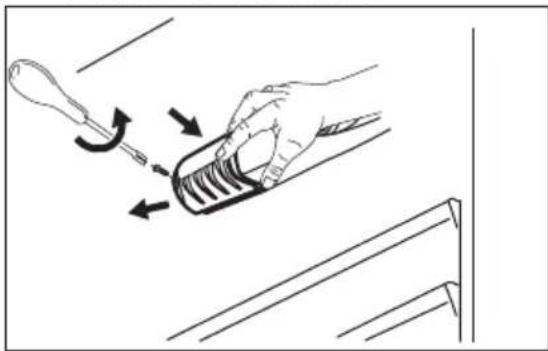
- Using a screwdriver, remove the screw from the lamp cover.
- Detach the lamp cover in the direction of the arrows.
natural_image
Illustration of a hand using a screwdriver to lift a screwdriver into a slot (no text or symbols)-
Replace the lamp with the one that has identical characteristics and is specifically designed for household appliances.
-
Reassemble the lamp cover.
- Tighten the screw to the lamp cover.
- Connect the plug to the mains socket.
- Open the door. Make sure that the light switches on.
7.3 Closing the door
- Clean the door gaskets.
- If necessary, adjust the door. Refer to "Installation".
8. INSTALLATION

WARNING!
Refer to Safety chapters.
8.1 Positioning
Install the appliance in a dry, well ventilated indoors where the ambient temperature corresponds to the climate class indicated on the rating plate of the appliance.
| Climate Ambient temperature class |
| SN +10°C to + 32°C |
| N +16°C to + 32°C |
| ST +16°C to + 38°C |
| T +16°C to + 43°C |

Some functional problems might occur for some types of models when operating outside of that range. The correct operation can only be guaranteed within the specified temperature range. If you have any doubts regarding where to install the appliance, please turn to the vendor, to our customer service or to the nearest Authorised Service Centre.
8.2 Rear spacers
You can find the two spacers in the bag with documentation.
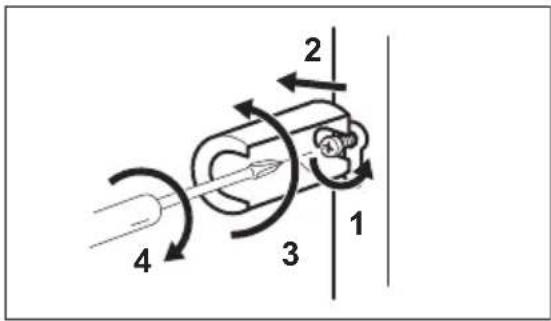
- Release the screw.
- Engage the spacer below the screw.
- Turn the spacer to the right position.
-
Tighten again the screws.
-
If necessary, replace the defective door gaskets. Contact the Authorised Service Centre.
text_image
1 2 3 48.3 Levelling
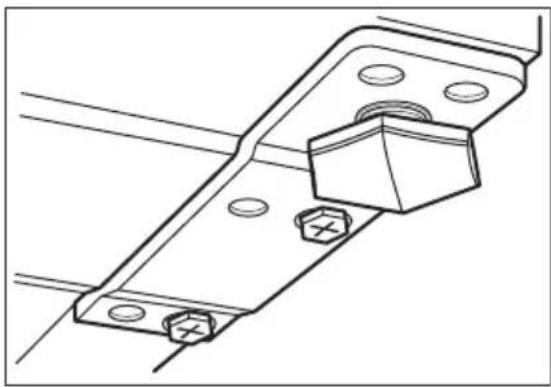
When placing the appliance ensure that it stands level. This can be achieved by two adjustable feet at the bottom in front.
natural_image
Technical line drawing of a metal bracket with bolts and a cube component (no text or symbols)8.4 Location

It must be possible to disconnect the appliance from the mains power supply; the plug must therefore be easily accessible after installation.
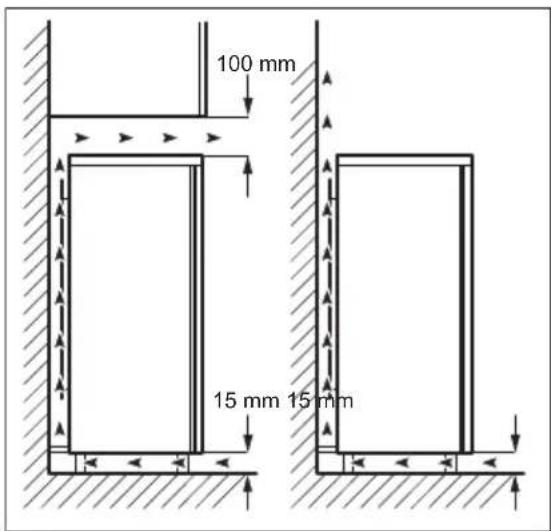
The appliance should be installed well away from sources of heat such as radiators, boilers, direct sunlight etc. Ensure that air can circulate freely around the back of the cabinet. To ensure best performance, if the appliance is positioned below an overhanging wall unit, the minimum distance between the top of the cabinet and the wall unit must be at least 100 mm. Ideally, however, the
appliance should not be positioned below overhanging wall units. Accurate levelling is ensured by one or more adjustable feet at the base of the cabinet.
text_image
100 mm 15 mm 15 mm8.5 Door reversibility

WARNING!
Before carrying out any operations, remove the plug from the power socket.

CAUTION!
To carry out the following operations, we suggest that this be made with another person that will keep a firm hold on the doors of the appliance during the operations.
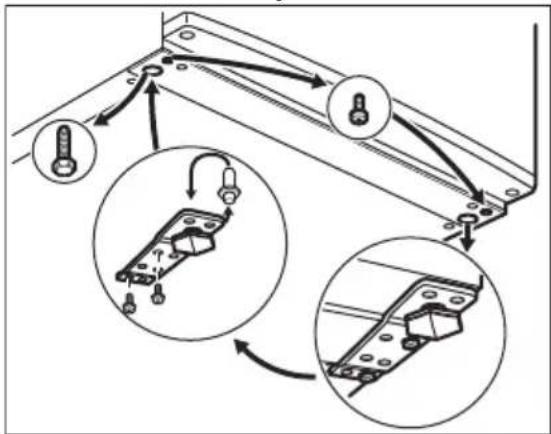
- Tilt back the appliance carefully so that the compressor cannot touch the floor.
- Unscrew both adjustable feet.
text_image
Technical diagram showing mechanical assembly with labeled parts and directional arrows indicating motion or assembly steps.- Unscrew the screws of the door bottom hinge.
- Take off the appliance door by pulling it slightly downwards.
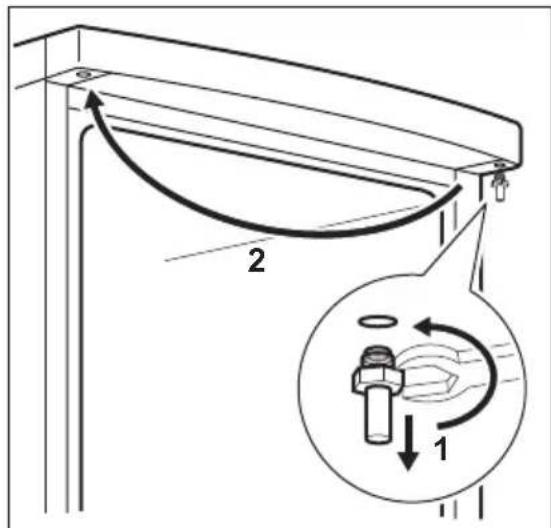
- Unscrew the top door hinge pin of the appliance then screw it back on the other side.
text_image
Technical diagram showing a mechanical assembly with labeled components and a magnified inset illustrating rotational motion.- Fit the appliance door on the upper door hinge pin.
- Remove the lower hinge. Put over the pin in the direction of the arrow.
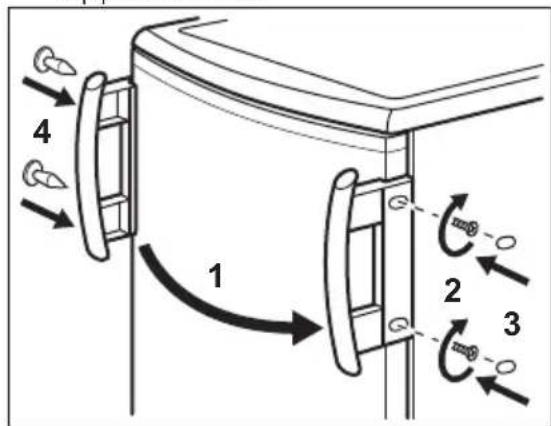
- Unscrew and install the screw on the opposite side.
- Install the lower hinge on the opposite side leaving the position of the door unchanged.
- Screw in the one screw in the place set free on the other side as well as the adjustable feet (2 pieces).
- Remove and install the handle on the opposite side.
text_image
1 2 3 4
CAUTION!
Reposition, level the appliance, wait for at least four hours and then connect it to the power socket.

Do a final check to make sure that:
- All screws are tightened.
• The magnetic seal adheres to the cabinet.
• The door opens and closes correctly.
If the ambient temperature is cold (i.e. in Winter), the gasket may not fit perfectly to the cabinet. In that case, wait for the natural fitting of the gasket.
In case you do not want to carry out the above mentioned operations, contact the nearest
Authorised Service Centre.
The Authorised Service specialist will carry out the reversibility of the doors at your cost.
9. TECHNICAL DATA
9.1 Technical data
| Height mm 850 |
| Width mm 595 |
| Depth mm 635 |
| Voltage Volts 230 - 240 |
| Frequency Hz 50 |
The technical information is situated in the rating plate, on the external or
internal side of the appliance and in the energy label.
10. CH GUARANTEE
Customer Service Centres
| Point of Service | ||
| Industriestrasse 105506 Mägenwil | Le Trési 61028 Préverenges | Via Violino 116928 Manno |
| Point of Service | |
| Morgenstrasse 1313018 Bern |  |
| Zürcherstrasse 204E9000 St. Gallen | |
| Seetalstrasse 116020 Emmenbrücke | |
| Schlossstrasse 14133 Pratteln | |
| Comercialstrasse 197000 Chur | |
Spare parts service Industriestrasse 10, 5506 Mägenwil, Tel. 0848 848 111
Specialist advice/Sale Badenerstrasse 587, 8048 Zürich, Tel. 044 405 81 11
Warranty For each product we provide a two-year guarantee from the date of purchase or delivery to the consumer (with a guarantee certificate, invoice or sales receipt serving as proof). The
guarantee covers the costs of materials, labour and travel. The guarantee will lapse if the operating instructions and conditions of use are not adhered to, if the product is incorrectly installed, or in the event of damage caused by external influences, force majeure, intervention by third parties or the use of non-genuine components.
11. ENVIRONMENTAL CONCERNS
Recycle materials with the symbol ☐ Put the packaging in relevant containers to recycle it. Help protect the environment and human health by recycling waste of electrical and electronic appliances. Do not dispose of appliances marked with the symbol ☒ with the household waste. Return the product to your local recycling facility or contact your municipal office.

For Switzerland:
Where should you take your old equipment?
Anywhere that sells new equipment or hand it in to official SENS collection points or official SENS recycling firms.
The list of official SENS collection points can be found at www.erecycling.ch
CE