
DCP-J132W, DCPJ132W - Multifunction Printer BROTHER - Free user manual and instructions
Find the device manual for free DCP-J132W, DCPJ132W BROTHER in PDF.


User questions about DCP-J132W, DCPJ132W BROTHER
0 question about this device. Answer the ones you know or ask your own.
Ask a new question about this device
Download the instructions for your Multifunction Printer in PDF format for free! Find your manual DCP-J132W, DCPJ132W - BROTHER and take your electronic device back in hand. On this page are published all the documents necessary for the use of your device. DCP-J132W, DCPJ132W by BROTHER.
USER MANUAL DCP-J132W, DCPJ132W BROTHER
Advanced User's Guide
MFC-J245
DCP-J132W
User's Guides and where do I find them?
| Which Guide? | What's in it? | Where is it? |
| Product Safety Guide | Read this Guide first. Please read the Safety Instructions before you set up your machine. See this Guide for trademarks and legal limitations. | Printed / In the box |
| Quick Setup Guide | Follow the instructions for setting up your machine and installing the drivers and software for the operating system and connection type you are using. | Printed / In the box |
| Basic User's Guide | Learn the basic Fax (MFC-J245), Copy and Scan operations, and how to replace consumables. See troubleshooting tips. | Printed / In the box1 |
| Advanced User's Guide | Learn more advanced operations: Fax (MFC-J245), Copy, security features (MFC-J245), printing reports, and performing routine maintenance. | PDF file / CD-ROM |
| Software and Network User's Guide2 | This Guide provides instructions for Scanning, Printing, PC-Fax (MFC-J245) and other operations that can be performed by connecting your Brother machine to a computer. You can also find useful information about using the Brother ControlCenter utility, using your machine in a network environment, and frequently used terms. | HTML file/CD-ROM |
| AirPrint Guide(DCP-J132W) | This Guide provides information for using AirPrint to print from OS X v10.7.x, 10.8.x and your iPhone, iPod touch, iPad, or other iOS device to your Brother machine without installing a printer driver. | PDF file / Brother Solutions Center3 |
| Google Cloud Print Guide(DCP-J132W) | This Guide provides details on how to use Google Cloud PrintTM services for printing over the Internet. | PDF file / Brother Solutions Center3 |
| Mobile Print/Scan Guide for Brother iPrint&Scan(DCP-J132W) | This Guide provides useful information about printing from your mobile device and scanning from your Brother machine to your mobile device when connected to a Wi-Fi network. | PDF file / Brother Solutions Center3 |
This may differ depending on your country.
2 Network features are not supported with MFC-J245.
3 Visit us at http://solutions.brother.com/.
Table of Contents
1 General setup 1
IMPORTANT NOTE 1
Memory Storage 1
Automatic Daylight Saving Time (MFC model) 1
Sleep Mode 2
Auto Power Off (DCP model). 2
LCD 3
Changing the LCD language (depending on your country) 3
LCD Contrast 3
Mode Timer (MFC model) 4
2 Security features (MFC model) 5
TX Lock 5
Setting and changing the TX Lock password 5
Turning TX Lock on/off 6
3 Sending a fax (MFC model) 7
Additional sending options 7
Sending taxes using multiple settings 7
7 Stop faxing 7
Contrast 7
Changing the fax resolution 8
Additional sending operations 9
Sending a fax manually 9
- Sending a fax at the end of a conversation 9
Dual Access (Monochrome only) 9
- Broadcasting (Monochrome only) 9
Real Time Transmission 11
Overseas Mode 11
Checking and cancelling waiting jobs 12
4 Receiving a fax (MFC model) 13
Memory Receive (Monochrome only) 13
Printing a fax from the memory 13
PC-Fax Receive (Windows®) 13
Turning off Memory Receive operation 14
Changing Memory Receive operations 14
Additional receiving operations 15
Out of Paper Reception 15
1 Printing a reduced incoming fax 15
Receiving a fax at the end of a conversation 15
5 Dialling and storing numbers (MFC model) 16
Voice operations 16
BT Call Sign (U.K. only) 16
Additional dialling operations 17
Combining Speed Dial numbers 17
Additional ways to store numbers 18
Setting up Groups for Broadcasting 18
Changing or deleting a Group 18
6 Printing reports 20
Fax reports (MFC model) 20
Transmission Verification Report 20
Fax Journal (activity report) 20
Reports 21
How to print a report 21
7 Making copies 22
Copy options 22
Stop copying 22
Changing copy speed and quality 22
Enlarging or reducing copies 23
Making N in 1 copies or a poster (Page Layout) 24
2 in 1 ID copy (Page Layout) 25
Sorting copies 26
Adjusting Density 27
Remove Background Colour 27
A Routine maintenance 28
Cleaning and checking the machine 28
Cleaning the outside of the machine 28
Cleaning the machine's printer platen 29
Cleaning the paper feed rollers 30
Cleaning the paper pick-up rollers 31
Checking the ink volume 32
Packing and shipping the machine 32
B Glossary 35
C Index 38
1 General setup
IMPORTANT NOTE
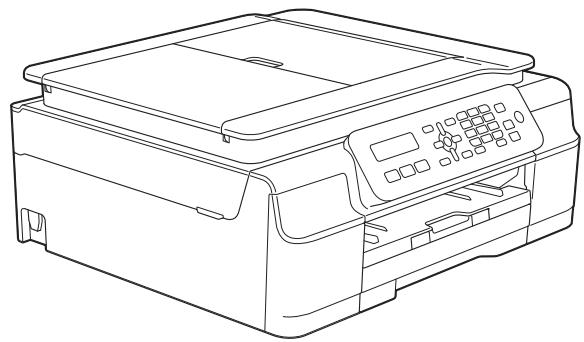
Most of the illustrations in this User's Guide show the MFC-J245.
Memory Storage
Even if there is a power failure, you will not lose your menu settings because they are stored permanently. Temporary settings (such as Contrast, Overseas mode, and so on) will be lost. You may have to reset the date and time.
Automatic Daylight Saving Time (MFC model)
You can set the machine to change automatically for daylight saving time. It will set itself forward one hour in the spring and backward one hour in the autumn. Make sure you have set the correct date and time in the Date&Time setting.
1 Press Menu, 0, 1, 2.
Press or to choose On or Off. Press OK.
3 Press Stop/Exit.
Sleep Mode
You can choose how long the machine will remain idle before it goes into Sleep Mode (up to 60 minutes). The timer will restart if any operation is carried out on the machine.
(MFC-J245)
1 Press Menu, 2, 6.
Press ▲ or ▼ to choose 1 Min, 2 Mins, 3 Mins, 5 Mins, 10 Mins, 30 Mins or 60 Mins. Press OK.
3 Press Stop/Exit. (DCP-J132W)
Press Menu.
Press or to choose 0. Initial Setup. Press OK.
Press or to choose 3. Sleep Mode. Press OK.
Press ▲ or ▼ to choose 1 Min, 2 Mins, 3 Mins, 5 Mins, 10 Mins, 30 Mins or 60 Mins, which is the length of time the machine is idle before entering Sleep Mode. Press OK.
5 Press Stop/Exit.
Auto Power Off (DCP model)
The Auto Power Off feature will turn off the machine after it has been in Sleep Mode for the number of hours you set. When this feature is Off, the machine will remain in Sleep Mode and not turn itself off.
The default setting is 1hour.
NOTE
(DCP-J132W only)
The machine will not power off automatically when:
- the machine is connected to a wireless network
- WLAN Enable is set to On.
Press Menu.
Press ▲ or ▼ to choose 0. Initial Setup. Press OK.
Press ▲ or ▼ to choose 5. Auto Power Off. Press OK.
4 Press or to choose 1hour, 2hours, 4hours, 8hours or Off. Press OK.
Press Stop/Exit.
LCD
Changing the LCD language (depending on your country)
You can change the LCD language.
(MFC-J245)
Press Menu, 0, 0.
Press or to choose your language. Press OK.
Press Stop/Exit.
(DCP-J132W)
Press Menu.
Press ▲ or ▼ to choose 0. Initial Setup. Press OK.
Press ▲ or ▼ to choose 0. Local Language. Press OK.
Press or to choose your language. Press OK.
5 Press Stop/Exit.
LCD Contrast
If you are having difficulty reading the LCD, try changing the contrast setting.
(MFC-J245)
Press Menu, 2, 5.
Press or to choose Light or Dark. Press OK.
3 Press Stop/Exit. (DCP-J132W)
Press Menu.
Press ▲ or ▼ to choose 0. Initial Setup. Press OK.
Press ▲ or ▼ to choose 2. LCD Contrast. Press OK.
Press ▲ or ▼ to choose Light or Dark. Press OK.
5 Press Stop/Exit.
Mode Timer (MFC model)
The machine's control panel has three temporary mode keys: FAX, SCAN and COPY. You can change the amount of time the machine takes after the last SCAN or COPY operation before it returns to FAX mode. If you choose Off, the machine stays in the mode you used last.

Press Menu, 2, 1.
Press ▲ or ▼ to choose 0 Sec, 30 Secs,1 Min,2 Mins,5 Mins or Off. Press OK.
Press Stop/Exit.
2
Security features
(MFC model)
TX Lock
TX Lock lets you prevent unauthorized access to the machine.
While TX Lock is On, the following operations are available:
Receiving taxes
PC-Fax Receive1
(If PC-Fax Receive was already On)
1 While the TX Lock feature is turned on, your machine will receive faxes and store them in its memory. Then, when TX Lock is turned off, the faxes will be sent to your chosen PC.
While TX Lock is On, the following operations are NOT available:
Operation from the control panel
PC printing
NOTE
If you forget the TX Lock password, contact Brother customer service for support.
Setting and changing the TX Lock password
NOTE
If you have already set the password, you will not need to set it again.
Setting the password
Make a careful note of your password.
Press Menu, 3, 0, 1.
2 Enter a four-digit number for the password. Press OK.
3 When the LCD shows Verify:, re-enter the password. Press OK.
4 Press Stop/Exit.
Changing the password
Press Menu, 3, 0, 1.
Press or to choose Set Password. Press OK.
3 Enter a four-digit number for the old password. Press OK.
4 Enter a four-digit number for a new password. Press OK.
When the LCD shows Verify:, re-enter the password. Press OK.
6 Press Stop/Exit.
Turning TX Lock on/off
Turning TX Lock on
Press Menu, 3, 0, 1.
Press ▲ or ▼ to choose Set TX Lock. Press OK.
3 Enter the registered four-digit password. Press OK. The machine goes offline and the LCD shows TX Lock Mode.
Turning TX Lock off
Press Menu.
2 Enter the registered four-digit password. Press OK. TX Lock is turned off.
NOTE
If you enter the wrong password, the screen shows Wrong Password and stays offline. The machine will stay in TX Lock Mode until the registered password is entered.
3
Sending a fax
(MFC model)
Additional sending options
Sending faxes using multiple settings
When you send a fax, you can choose a combination of settings, such as
Fax Resolution, Contrast, Glass ScanSize, Overseas Mode, and Real Time TX.
Some settings are only available when sending mono faxes.
1 Load your document.
Press (FAX).
3 Choose a setting you want to change in the Setup Send menu (Menu, 3, 2). Press OK.
Choose the option you want for the setting. Press OK.
5 Do one of the following:
Press 1 to change another setting.
Press 2 when you have finished choosing your settings. Go to step ⑥.
6 Enter the fax number.
Press Mono Start or Colour Start.
NOTE
Some settings are temporary and the machine returns to its default settings after you send a fax.
Stop faxing
To stop faxing, press Stop/Exit.
Contrast
If your document is very light or very dark, you may want to change the contrast. For most documents, the factory setting Auto can be used. Auto chooses the suitable contrast for your document.
Choose Light when sending a light document. Choose Dark when sending a dark document.
1 Load your document.
Press (FAX).
Press Menu, 3, 2, 2.
4 Press or to choose Auto, Light or Dark. Press OK.
Press 2 so you can continue sending your fax.
6 Enter the fax number.
Press Mono Start or Colour Start.
NOTE
Even if you choose Light or Dark, the machine will send the fax using the Auto setting in either of the following conditions:
- When you send a colour fax.
- When you choose Photo as the Fax Resolution.
Changing the fax resolution
The quality of a fax can be improved by changing the fax resolution. Resolution can be changed for the next fax or for all faxes.
To change the fax resolution for the next fax
1 Load your document.
Press (FAX).
Press Fax Resolution then or to choose the resolution. Press OK.
4 Enter the fax number.
Press Mono Start or Colour Start.
To change the default fax resolution
1 Load your document.
Press (FAX).
Press Menu, 3, 2, 1.
Press or to choose the resolution you want. Press OK.
Press 2 so you can continue sending your fax.
6 Enter the fax number.
7 Press Mono Start or Colour Start.
NOTE
You can choose four different resolution settings for monochrome faxes and two for colour.
| Monochrome | |
| Standard | Suitable for most typed documents. |
| Fine | Good for small print and transmits a little slower than Standard resolution. |
| S.Fine | Good for small print or artwork and transmits slower than Fine resolution. |
| Photo | Use when the document has varying shades of grey or is a photograph. Photo has the slowest transmission. |
| Colour | |
| Standard | Suitable for most typed documents. |
| Fine | Use when the document is a photograph. Transmits a little slower than Standard resolution. |
If you choose S. Fine or Photo and then use the Colour Start key to send a fax, the machine will send the fax using the Fine setting.
Additional sending operations
Sending a fax manually
Manual transmission lets you hear the dialling, ringing and fax-receiving tones while sending a fax.
NOTE
To send a multi-page fax, use the ADF.
1 Load your document.
Press (FAX).
3 To listen for a dial tone, pick up the handset of the external telephone.
4 Dial the fax number using the external telephone.
When you hear the fax tones, press Mono Start or Colour Start. If you are using the scanner glass, press 1 to send the fax.
Replace the handset of the external phone.
Sending a fax at the end of a conversation
At the end of a conversation, you can send a fax to the other party before you both hang up.
1 Ask the other party to wait for fax tones (beeps) and then to press the Start or Send key before hanging up.
2 Load your document.
Press (FAX).
4 Press Mono Start or Colour Start.
If you are using the scanner glass, press 1 to send a fax.
5 Replace the handset of the external phone.
Dual Access (Monochrome only)
You can dial a number and start scanning the fax into memory—even when the machine is sending from memory, receiving faxes or printing PC data. The LCD shows the new job number.
The number of pages you can scan into the memory will vary depending on the data that is printed on them.
NOTE
If the Out of Memory message appears, press Stop/Exit to cancel or Mono Start to send the pages scanned so far.
Broadcasting (Monochrome only)
Broadcasting is automatically sending the same fax message to more than one fax number. You can include Groups, Speed Dial numbers, and up to 50 manually dialled numbers in the same broadcast.
After the broadcast is finished, a Broadcast Report will be printed.
Before you begin the broadcast
Speed Dial numbers must be stored in the machine's memory before they can be used in a broadcast. (See Basic User's Guide: Storing Speed Dial numbers.)
Group numbers must also be stored in the machine's memory before they can be used in a broadcast. Group numbers include many stored Speed Dial numbers for easier dialling. (See Setting up Groups for Broadcasting on page 18.)
How to broadcast a fax
1 Load your document.
Press (FAX).
3 Enter a number. Press OK. You can use either a Group or a manually using the dial pad.
Repeat step ③ until you have entered all the fax numbers to be included in the broadcast.
Press Mono Start.
Faxing from the ADF
The machine starts scanning the document.
Faxing from the scanner glass
When the LCD asks you Next Page?, do one of the following:
To send a single page, press 2 (or press Mono Start again).
The machine starts sending the document.
To send more than one page, press 1 and place the next page on the scanner glass.
Press OK.
The machine starts scanning the page. (Repeat this step for each page.)
After all the pages have been scanned, press 2 or Mono Start to begin faxing.
NOTE
- If you did not use up any of the numbers for Groups, you can "broadcast" taxes to as many as 90 different numbers.
- The machine's available memory will vary depending on the types of jobs in the memory and the numbers used for broadcasting. If you broadcast to the maximum amount of numbers available, you will not be able to use Dual Access.
- If the Out of Memory message appears, press Stop/Exit to cancel or Mono Start to send the pages scanned so far.
Cancelling a Broadcast in progress
Press Menu, 3, 5.
The LCD will show the fax number or name being dialled and the Broadcasting job number.
Press or to choose the Broadcasting job number.
3 Press OK.
The LCD will ask you the following question:
1.Clear 2.Exit
4 To cancel the broadcast, press 1.
Press Stop/Exit.
Real Time Transmission
When you are sending a fax, the machine will scan the documents into the memory before sending. Then, as soon as the telephone line is free, the machine will start dialling and sending.
Sometimes, you may want to send an important document immediately, without waiting for the machine to scan it into memory. You can set Real Time TX to On for all documents or Next Fax Only for the next fax only.
Sending in real time for all faxes
Press (FAX).
Press Menu, 3, 2, 3.
Press or to choose On (or Off). Press OK.
4 Press 2 so you can continue sending your fax.
5 Load your document.
6 Enter the fax number.
Press Mono Start or Colour Start.
Sending in real time for the next fax only
Press (FAX).
Press Menu, 3, 2, 3.
Press ▲ or ▼ to choose Next Fax Only. Press OK.
Press ▲ or ▼ to choose Next Fax:Off or Next Fax:On.
Press OK.
Press 2 so you can continue sending your fax.
7 Load your document.
8 Enter the fax number.
Press Mono Start or Colour Start.
NOTE
- If you are sending a colour fax or if the memory is full and you are sending a monochrome fax from the ADF, the machine will send the document in real time (even if Real Time TX is set to Off).
- In Real Time Transmission, the automatic radial feature does not work when you are using the scanner glass.
- If the memory is full, faxes from the scanner glass cannot be sent until you clear some of the memory.
Overseas Mode
If you are having difficulty sending a fax overseas due to possible interference on the telephone line, we recommend that you turn on Overseas Mode. After you send a fax using this feature, the feature will automatically turn itself off.
1 Load your document.
Press (FAX).
Press Menu, 3, 2, 4.
4 Press or to choose On (or Off). Press OK.
Press 2 so you can continue sending your fax.
6 Enter the fax number.
Press Mono Start or Colour Start.
Checking and cancelling waiting jobs
You can check which jobs are still waiting in the memory to be sent, or cancel a job. (If there are no jobs, the LCD shows No Jobs Waiting.)
Press Menu, 3, 5.
Any waiting jobs appear on the LCD.
2 Do one of the following:
Press or to scroll through the jobs and choose the job you want to cancel.
Press OK and then press 1 to cancel the job.
Press 2 to exit without cancelling.
3 When you have finished, press Stop/Exit.
4
Receiving a fax (MFC model)
Memory Receive (Monochrome only)
Memory Receive lets you receive taxes while you are away from the machine.
You can only use one Memory Receive operation at a time:
PC-Fax Receive
Off
You can change your selection at any time. If received faxes are still in the machine's memory when you change the Memory Receive operation, a message will appear on the LCD. (See Turning off Memory Receive operation on page 14.)
Printing a fax from the memory
If you have chosen PC-Fax Receive, your machine will receive and store your faxes in its memory when your PC is turned off. To print faxes from the memory, follow the instructions.
1 Press Menu, 3, 4.
Press Mono Start.
Press Stop/Exit.
NOTE
When you print a fax from the memory, the fax data will be erased from your machine.
PC-Fax Receive (Windows®)
If you turn on the PC-Fax Receive feature, your machine will store received faxes in the memory and send them to your PC. You can then use your PC to view and store these faxes.
Even if you have turned off your PC (for example, at night or at the weekend), your machine will receive and store your faxes in its memory.
When you start your PC and the PC-FAX Receiving software runs, your machine transfers the faxes to your PC.
To transfer the received faxes to your PC you must have the PC-FAX Receiving software running on your PC.
(See Software and Network User's Guide.)
If you choose Backup Print:On, the machine will also print the fax.
Press (FAX).
Press Menu, 3, 1, 7.
Press ▲ or ▼ to choose PC Fax Receive. Press OK.
4 Press or to choose Backup Print:On or Backup Print:Off. Press OK.
5 Press Stop/Exit.
NOTE
PC-Fax Receive is not supported by Mac OS.
- Before you can set up PC-Fax Receive, you must install the MFL-Pro Suite software on your PC. Make sure your PC is connected and turned on.
(See Software and Network User's Guide.)
- If you get an error message and the machine cannot print the faxes in the memory, you can use this setting to transfer your faxes to your PC. (See Basic User's Guide: Transferring your faxes or Fax Journal report.)
- When you receive a colour fax, your machine prints the colour fax at your machine but does not send the fax to your PC.
Turning off Memory Receive operation
1 Press

(FAX).
Press
Menu, 3, 1, 7.
3 Press
or to choose Off. OK.
4 Press
Stop/Exit.
NOTE
The LCD will show you more options if there are still received faxes in the machine's memory. (See Changing Memory Receive operations on page 14.)
Changing Memory Receive operations
If there are received faxes in your machine's memory when you change the Memory Receive operation, the LCD will ask you one of the following questions:
If all the received faxes have already been printed
Erase All Doc?
- If you press 1 (Yes), faxes in the memory will be erased before the setting changes.
- If you press 2 (No), faxes in the memory will not be erased and the setting will be remain unchanged.
If unprinted faxes remain in the memory
■ Print All Fax?
- If you press 1 (Yes), faxes in the memory will be printed before the setting changes. If a backup copy has already been printed, it will not be printed again.
- If you press 2 (No), faxes in the memory will not be printed and the setting will be unchanged.
The LCD will ask you the following question:
Send Fax to PC?
- If you press 1 (Yes), faxes in the memory will be sent to your PC before the setting changes. You will be asked if you want to turn on Backup Print. (For more information, see PC-Fax Receive (Windows®) on page 13.)
- If you press 2 (No), faxes in the memory will not be erased or transferred to your PC and the setting will be unchanged.
Additional receiving operations
Out of Paper Reception
As soon as the paper tray becomes empty during fax reception, the LCD shows No Paper Fed. Put some paper in the paper tray. (See Basic User's Guide: Loading paper and other print media.)
If you don't put paper in the paper tray, the machine will continue receiving the fax. The remaining pages will be stored in the memory, if enough memory is available.
Further incoming faxes will also be stored in memory until the memory is full. To print the faxes, put fresh paper in the tray. When the memory is full, the machine will stop answering calls.
Printing a reduced incoming fax
If you choose on, the machine reduces each page of an incoming fax to fit on one sheet of A4 or Letter size paper. The machine calculates the reduction ratio by using the page size of the fax and your Paper Size setting.
(See Basic User's Guide: Paper Size.)

Press

(FAX).

Press Menu, 3, 1, 6.

Press or to choose On (or Off). Press OK.

Press Stop/Exit.
Receiving a fax at the end of a conversation
At the end of a conversation, you can ask the other party to send you a fax before you both hang up. Make sure the ADF is empty.

Ask the other party to place the document in their machine and to press the Start or Send key.

When you hear the other machine's CNG tones, press Mono Start or Colour Start on your machine.

Press 2 to choose Receive to receive the fax.

Replace the handset of the external telephone.
5
Dialling and storing numbers (MFC model)
Voice operations
You can use your extension or external telephone to dial voice calls.
BT Call Sign (U.K. only)
This feature of the machine lets you use the BT Call Sign subscriber service which allows you to have at least two separate telephone numbers on one telephone line. Each telephone number has its own distinctive ringing pattern, so you know which telephone number is ringing. This is one way you can have a separate telephone number for your machine.
Your machine has a BT Call Sign compatible distinctive ringing function, allowing you to dedicate a second telephone number (on the same telephone line) just for receiving faxes.
NOTE
- You can switch BT Call Sign off temporarily, then turn it back on. When you get a new fax number, make sure you reset this function. This machine will automatically answer incoming calls that use your new fax number.
- When you set the BT Call Sign feature to On, the receive mode is set to Manual automatically. Manual mode will not respond to incoming telephone calls, since the number you use for telephone calls will use the normal ring pattern.
To enable the machine to work with BT Call Sign (with your external telephone only)
1 Press Menu 3, 0, 2.
Press or to choose On (or Off). Press OK.
3 Press Stop/Exit.
NOTE
If you turn off BT Call Sign, the receive mode stays in Manual. You will need to set receive mode again. (See Basic User's Guide: Choose the Receive Mode.)
Additional dialling operations
Combining Speed Dial numbers
Sometimes, you may want to choose from several long-distance carriers when you send a fax. Rates may vary depending on the time and destination. To take advantage of low rates, you can store the access codes of long-distance carriers and credit card numbers as Speed Dial numbers. (See Basic User's Guide: Storing Speed Dial numbers.)
You can store these long dialling sequences by dividing them and setting them up as separate Speed Dial numbers in any combination.
You can even include manual dialling using the dial pad.
For example, you might have stored '01632' on Address Book: #03 and '960555' on Address Book: #02. You can use them both to dial '01632-960555' as shown in the following example:
Press (FAX).
Press (Address Book).
Press or to choose Search. Press OK.
4 Enter#, 03.
Press (Address Book).
6 Enter#, 02.
Press Mono Start or Colour Start. You will dial '01632-960555'.
To temporarily change a number, you can use the dial pad to manually substitute part of the number. For example, to change the number to '01632-960556', you could enter the number (#03 '01632') using
Address Book, choose Search, press OK, press #, 03, and then press '960556' using the dial pad.
NOTE
If you must wait for another dial tone or signal at any point in the dialling sequence, create a pause in the number by pressing Redial/Pause. Each key press adds a 3.5 second delay. You can press Redial/Pause as many times as needed to increase the length of the pause.
Additional ways to store numbers
Setting up Groups for Broadcasting
A Group, which is stored in a Speed Dial location, allows you to send the same fax message to many fax numbers by pressing

(FAX), (Address Book),
Search, OK, #, the two-digit location number and Mono Start.
(See Broadcasting (Monochrome only) on page 9.)
First, you'll need to store each fax number in a Speed Dial location. (See Basic User's Guide: Storing Speed Dial numbers.) Then you can include them as numbers in the Group. Each Group uses a Speed Dial location. You can have up to six Groups, or you can assign up to 39 numbers to a large Group.
1 Press

(FAX).
Press
Press (Address Book) and or to choose Setup Groups. Press OK.
3 Usef
Use the dial pad to enter the two-digit Speed Dial location number you want to add to the Group. Press OK.
4 Usef
Use the dial pad to enter a Group number (1 to 6). Press OK.
5 To add Speed Dial numbers follow the instructions below:
For example, for Speed Dial numbers #05 and #09. Press
Address Book), 05,
Address Book), 09.
The LCD shows:
G01:#05#09
6 Press OK when you have finished adding numbers.
Use the dial pad to enter a name (up to 16 characters) for the Group. (For help entering letters, see Basic User's Guide: Entering Text.) Press OK.
NOTE
You can print a list of all the Speed Dial numbers. (See Reports on page 21.)
Changing or deleting a Group
You can change the Speed Dial numbers in a Group. To delete a Group, delete all of its Speed Dial numbers.
1 Press

(FAX).
Press
(Address Book) and or to Setup Groups.
3 Use the
dial pad to enter the two-digit dial location number for the you want to change. K.
4 Do one of the following:
Press 1 to change the added Group.
Press 2 to return to ③ to enter another Speed Dial location number.
Press Stop/Exit to exit without making a change.
5 Add or delete the Speed Dial numbers in the Group.
To add Speed Dial numbers, press or to position the cursor under a blank space.
Press (Address Book) and enter the Speed Dial number you want to add to the Group using the dial pad.
To delete Speed Dial numbers, press or to position the cursor under the Speed Dial number you want to delete, and then press Clear.
6 Press OK when you have finished adding or deleting Speed Dial numbers.
7 Enter the new Group name (up to 16 characters) using the dial pad. (For example, type "NEWCLIENTS".) (For help entering letters, see Basic User's Guide: Entering Text.) Press OK.
NOTE
How to change the stored name or number:
If you want to change a character, press or to position the cursor under the character you want to change, and then press Clear. Re-enter the character.
6
Printing reports
Fax reports (MFC model)
You can use the Menu keys to set up the Transmission Verification Report and the Journal Period.
Transmission Verification Report
You can use the Transmission Verification Report as proof that you sent a fax. (See Basic User's Guide: Transmission Verification Report.)
Fax Journal (activity report)
You can set the machine to print a journal at specific intervals (every 50 faxes; every 6, 12 or 24 hours; or every 2 or 7 days). If you set the interval to Off, you can still print the report by following the steps in How to print a report on page 21. The factory default is Every 50 Faxes.
Press Menu, 3, 3, 2.
Press or to choose an interval. Press OK.
(If you choose 7 days, the LCD will ask you to choose the first day for the 7-day countdown.)
If you choose Every 50 Faxes, go to step 4.
6, 12, 24 hours, 2 or 7 days
The machine will print the report at the chosen time and then erase all jobs from its memory. If the machine's memory is filled with the maximum 200 jobs before the time you chose has passed, the machine will print the Journal early and then erase all jobs from the memory. If you want an extra report before it is due to print, you can print it without erasing the jobs from the memory.
Every 50 Faxes
The machine will print the Journal when the machine has stored 50 jobs.
3 Enter the time to start printing in 24-hour format.
Press OK.
(For example: enter 19:45 for 7:45 PM.)
4 Press Stop/Exit.
Reports
The following reports are available:
XMIT Verify (MFC model)
Prints a Transmission Verification Report for your last transmission.
Address Book (MFC model)
Prints a list of names and numbers stored in the Address Book memory, in numerical order.
Fax Journal (MFC model)
Prints a list of information about the last incoming and outgoing taxes. (TX: Transmit.) (RX: Receive.)
■ User SettingsPrints a list of you
Network Config (DCP-J132W)
Prints a list of your Network settings.
■ WLAN Report (DCP-J132W)
Prints a WLAN connection report.
■ Caller ID (MFC model)
Prints a list of the available Caller ID information about the last 30 received faxes and telephone calls.
How to print a report
(MFC-J245)
1 Press Menu, 5.
2 Do one of the following:
Press or to choose the report you want. Press OK.
Enter the number of the report you want to print.
Press Mono Start.
4 Press Stop/Exit.
(DCP-J132W)
Press Menu.
Press ▲ or ▼ to choose Print Reports. Press OK.
Press or to choose the report you want to print. Press OK.
4 Press Mono Start.
Press Stop/Exit.
7
Making copies
Copy options
You can change the copy settings temporarily for the next copy.
The machine returns to its default settings after being idle for 1 minute.
Press Copy Options or Copy Quality ^1 and then press or to choose the copy settings you want. Press OK.
When you have finished choosing settings, press Mono Start or Colour Start.
1 DCP models only
Stop copying
To stop copying, press Stop/Exit.
Changing copy speed and quality
You can choose different settings to change the speed and quality of your copies. The factory default is Normal.
If you choose Normal you can only choose Plain Paper in Paper Type.
Normal
Normal is the recommended mode for ordinary print outs. This produces good copy quality with good copy speed.
Best
Use Best mode to copy precise images, such as photographs. This provides the highest resolution and slowest speed.
(MFC-J245)
1 Load your document.
Press (COPY).
3 Enter the number of copies you want.
4 Press Copy Options and or to choose Quality. Press OK.
Press ▲ or ▼ to choose Normal or Best. Press OK.
If you do not want to change additional settings, press Mono Start or Colour Start.
To change the default setting, follow the instructions below:
Press Menu, 4, 1.
Press ▲ or ▼ to choose Normal or Best. Press OK.
3 Press Stop/Exit. (DCP-J132W)
1 Load your document.
2 Enter the number of copies you want.
Press Copy Quality repeatedly to choose Normal or Best.
4 Press Mono Start or Colour Start.
To change the default setting, follow the instructions below:
Press Menu.
Press or to choose 2. Copy. Press OK.
Press ▲ or ▼ to choose 3. Quality. Press OK.
Press ▲ or ▼ to choose Normal or Best. Press OK.
Press Stop/Exit.
Enlarging or reducing copies
You can choose an enlargement or reduction ratio. If you choose Fit to Page, your machine will adjust to the size you set in Paper Size.
(MFC-J245)
1 Load your document.
Press (COPY).
3 Enter the number of copies you want.
4 Press Copy Options and or to choose Enlarge/Reduce. Press OK.
Press ▲ or ▼ to choose the enlargement or reduction ratio you want. Press OK.
NOTE
If you chose Custom (25-400%), enter an enlargement or reduction ratio from 25% to 400%.
| 198% 10x15cm→A4 |
| 186%10x15cm→LTR |
| 141% A5→A4 |
| 100% |
| 97% LTR→A4 |
| 93% A4→LTR |
| 83% LGL→A4 |
| 69% A4→A5 |
| 47% A4→10x15cm |
| Fit to Page |
| Custom(25-400%) |
If you do not want to change additional settings, press Mono Start or Colour Start.
(DCP-J132W)
1 Load your document.
2 Enter the number of copies you want.
3 Press Enlarge/Reduce.
Press or to choose the enlargement or reduction ratio you want. Press OK.
NOTE
If you chose Custom (25- 400%), press ▲ or ▼ repeatedly to enter an enlargement or reduction ratio from 25% to 400%.
| 198% 10x15cm→A4 |
| 186%10x15cm→LTR |
| 141% A5→A4 |
| 100% |
| 97% LTR→A4 |
| 93% A4→LTR |
| 83% |
| 69% A4→A5 |
| 47% A4→10x15cm |
| Fit to Page |
| Custom(25-400%) |
Press Mono Start or Colour Start.
NOTE
- Page Layout is not available with Enlarge/Reduce - MFC-J245 (Enlarge/Reduce - DCP-J132W).
- Page Layout, Sort and Remove Bkg. Clr are not available with Fit to Page.
- Fit to Page does not work correctly when the document on the scanner glass is skewed by more than 3 degrees. Using the document guidelines on the left and top, place your document in the upper-left corner, with the document face down on the scanner glass.
- Fit to Page is not available when using the ADF1.
1 MFC models only
Making N in 1 copies or a poster (Page Layout)
The N in 1 copy feature can help you save paper by letting you copy two or four pages onto one printed page.
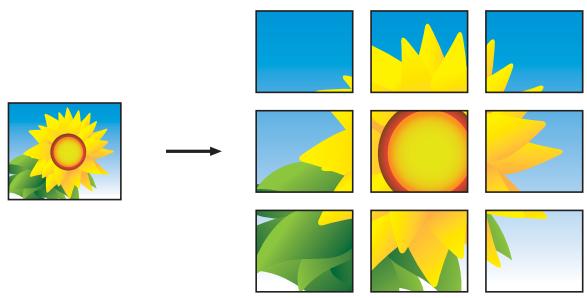
You can also produce a poster. When you use the poster feature, your machine divides your document into sections, then enlarges the sections so you can assemble them into a poster. If you want to print a poster, use the scanner glass.
NOTE
Sort, Enlarge/Reduce - MFC-J245
(Enlarge/Reduce - DCP-J132W) and
Remove Bkg. Clr are not available with
Page Layout.
1 Load your document.
2 (MFC model)
Press (COPY).
3 Enter the number of copies you want. 1
1 You can only make one copy at a time when you are using Poster layout.
Press Copy Options and or to choose Page Layout. Press OK.
Press or to choose Off(1in1), 2in1(P), 2in1(L), 4in1(P), 4in1(L), Poster(3x3) or 2in1(ID) Press OK.
1 For information about 2 in 1 (ID), see 2 in 1 ID copy (Page Layout) on page 25.
If you do not want to change additional settings, press Mono Start or Colour Start to scan the page.
If you placed the document in the ADF ^1 or are making a poster, the machine scans the document and starts printing.
1 MFC models only
If you are using the scanner glass, go to step ⑦.
7 (MFC-J245)
After the machine has scanned the page, press 1 to scan the next page. (DCP-J132W)
After the machine has scanned the page, press to scan the next page.
8 Place the next page on the scanner glass. Press OK to scan the page.
Repeat steps 7 and 8 for each page of the layout.
9 (MFC-J245)
After all the pages have been scanned, press 2 to finish. (DCP-J132W)
After all the pages have been scanned, press to finish.
NOTE
- Make sure the paper size is set to A4 or Letter.
- You can only make one colour copy at a time.
- You can only make one Poster copy at a time.
- Poster copy is not available when using transparencies.
• (P) means Portrait and (L) means Landscape.
Place the document face down in the direction shown below:
2in1(P)

2in1(L)

4in1(P)

4in1(L)

Poster (3x3)
NOTE
The poster copies have overlapping portions so that you can easily paste them together.
2 in 1 ID copy (Page Layout)
You can copy both sides of your identification card onto one page, keeping the original card size. Make sure the paper size is set to A4 or Letter.
NOTE
You can copy an identification card to the extent permitted under applicable laws. (See Product Safety Guide: Unlawful use of copying equipment.)
1 Place your identification card face down near the left corner of the scanner glass as shown in the illustration.
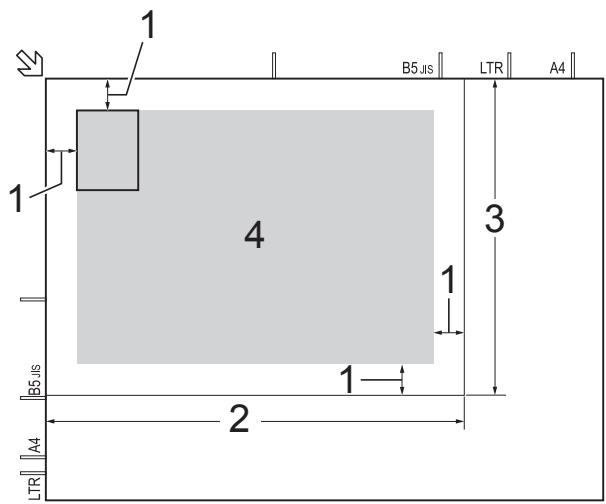
1 3 mm or greater (top, left)
2 210 mm
3 148 mm
4 scannable area
2 (MFC model)
Press (COPY).
3 Enter the number of copies you want.
Press Copy Options and or to choose Page Layout. Press OK.
Press or to choose 2in1 (ID). Press OK.
Press Mono Start or Colour Start. The machine starts scanning one side of the identification card.
7 (MFC-J245) After the machine has scanned one side, press 1. Turn over the identification card and press OK to scan the other side. (DCP-J132W) After the machine has scanned one side, press - Turn over the identification card and press OK to scan the other side.
NOTE
- Sort, Enlarge/Reduce - MFC-J245 (Enlarge/Reduce - DCP-J132W) and Remove Bkg. Clr are not available with 2in1(ID).
- You can only make one colour copy at a time.
Sorting copies
You can sort multiple copies. Pages will be sorted in the order 123, 123, 123, and so on. We recommend you load single-sided documents in the ADF ^1 for sorting copies. For 2-sided documents and books, use the scanner glass.
1 MFC models only
1 Load your document.
(MFC model) Press (COPY).
3 Enter the number of copies you want.
4 Press Copy Options and or to choose Stack/Sort. Press OK.
Press or to choose Sort. Press OK.
If you do not want to change additional settings, press Mono Start or Colour Start. If you placed the document in the ADF 1, the machine scans the document and starts printing.
1 MFC models only
If you are using the scanner glass, go to step ⑦.
7 (MFC-J245) After the machine scans the page, press 1 to scan the next page. (DCP-J132W) After the machine scans the page, press to scan the next page.
8 Place the next page on the scanner glass. Press OK to scan the page. Repeat steps 7 and 8 until all the pages have been scanned.
(MFC-J245) Press 2 to finish scanning. The machine starts printing. (DCP-J132W) Press to finish scanning. The machine starts printing.
NOTE
Fit to Page and Page Layout are not available with Sort.
Adjusting Density
You can adjust the copy density to make copies darker or lighter.
1 Load your document.
2 (MFC model) Press (COPY).
3 Enter the number of copies you want.
4 Press Copy Options and or to choose Density. Press OK.
Press or to make a lighter or darker copy. Press OK.
If you do not want to change additional settings, press Mono Start or Colour Start.
Remove Background Colour
Removes the background colour of the document when copying. This can save ink and help you read the document clearly.
NOTE
This function is for use only when making colour copies. The background colour is automatically removed for all monochrome copies.
1 Load your document.
(MFC model) Press (COPY).
3 Enter the number of copies you want.
4 Press Copy Options and or to choose Remove Bkg. Clr. Press OK.
Press ▲ or ▼ to choose Low, Medium, High or Off. Press OK.
6 Press Colour Start.
NOTE
Fit to Page and Page Layout are not available with Remove Bkg. Clr.
A
Routine maintenance
Cleaning and checking the machine
Cleaning the outside of the machine
Clean the LCD screen as follows:
IMPORTANT
DO NOT use any type of liquid cleaners (including ethanol).
Press and hold down
to turn the
machine off. The LCD will show
Shutting Down for a few seconds before the power goes off.
Clean the LCD screen with a dry, soft lint-free cloth.
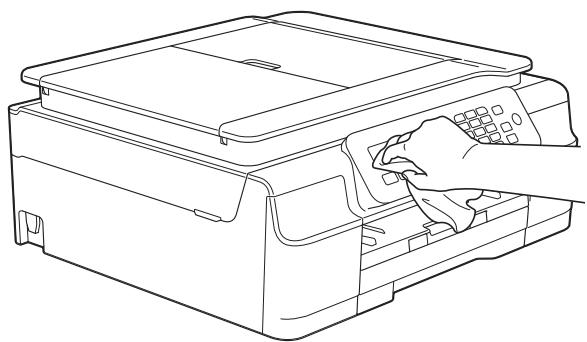
Clean the outside of the machine as follows:
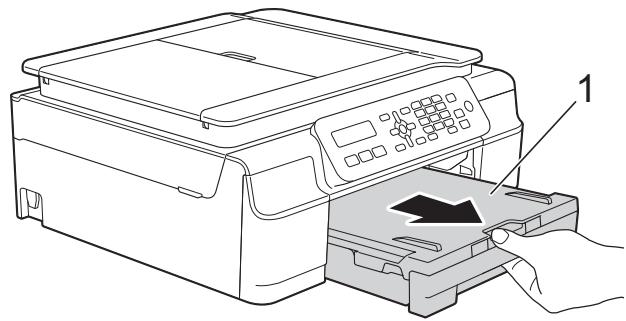
IMPORTANT
- Use neutral detergents. Cleaning with volatile liquids, such as thinner or benzine, will damage the outside surface of the machine.
DO NOT use cleaning materials that contain ammonia.
DO NOT use isopropyl alcohol to remove dirt from the control panel. It may crack the panel.
Pull the paper tray (1) completely out of the machine.
Wipe the outside of the machine with a dry, soft lint-free cloth to remove dust.
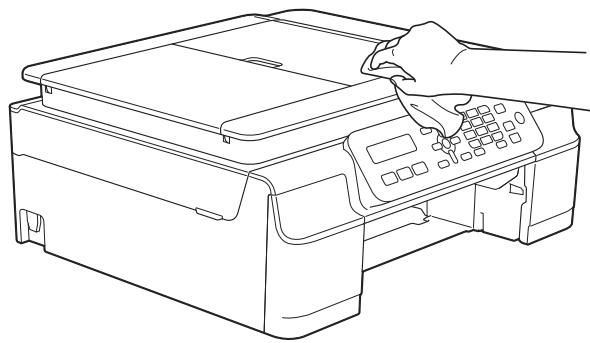
3 Lift the output paper tray cover and remove anything that is stuck inside the paper tray.
Wipe the inside and outside of the paper tray with a dry, soft lint-free cloth to remove dust.
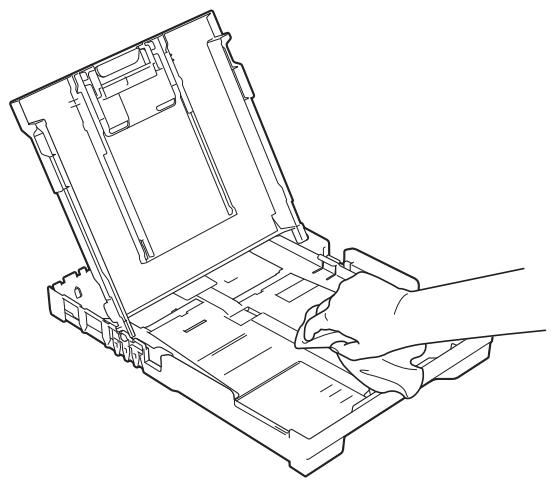
5 Close the output paper tray cover and put the paper tray firmly back in the machine.
Cleaning the machine's printer platen
WARNING

Be sure to unplug the machine from the electrical socket before cleaning the printer platen to avoid an electrical shock.
1 Place both hands under the plastic tabs on both sides of the machine to lift the scanner cover into the open position.
Clean the machine's printer platen (1) and the area around it, wiping off any scattered ink with a dry, soft lint-free cloth.
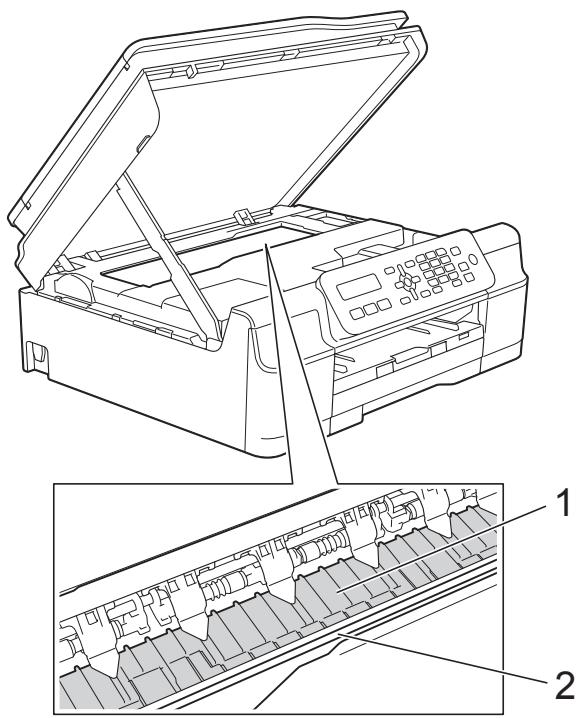
IMPORTANT
DO NOT touch the encoder strip (2). Doing this may cause damage to the machine.
3 Lift the scanner cover to release the lock. Gently push the scanner cover support down and close the scanner cover using both hands.
4 Re-connect the power cord.
Cleaning the paper feed rollers
If the paper feed rollers are stained with ink, it may cause paper feed problems.
Unplug the machine from the electrical socket. Pull the paper tray (1) completely out of the machine.
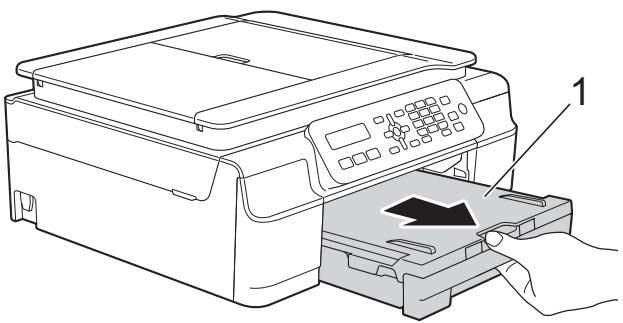
NOTE
If the paper support flap is open, close it, and then close the paper support.
Clean the Paper Feed Rollers (1) with a soft lint-free cloth slightly moistened with water, using a side-to-side motion. After cleaning, wipe the rollers with a dry, soft lint-free cloth to remove all moisture.
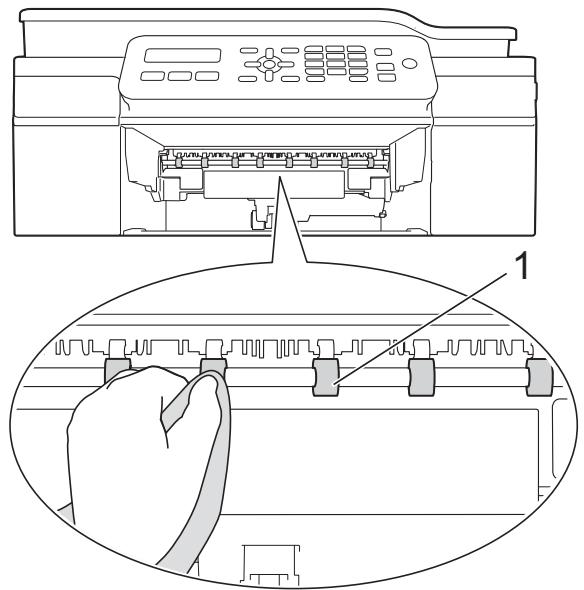
3 Put the paper tray firmly back in the machine.
4 Re-connect the power cord.
NOTE
Do not use the machine again until the rollers are completely dry. Using the machine before the rollers are dry may cause paper feed problems.
Cleaning the paper pick-up rollers
1 Unplug the machine from the electrical socket.
Pull the paper tray completely out of the machine.
NOTE
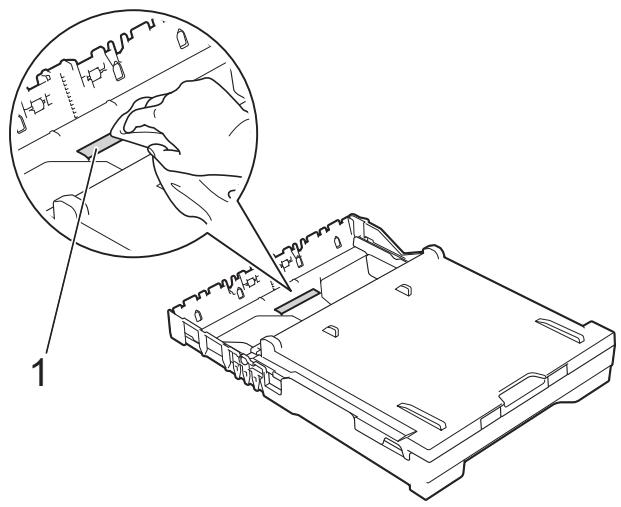
If the machine has been feeding multiple pages when there are only a few sheets of paper left in the tray, clean the Base Pad (1) with a soft lint-free cloth slightly moistened with water.
After cleaning, wipe the pad with a dry, soft lint-free cloth to remove all moisture.
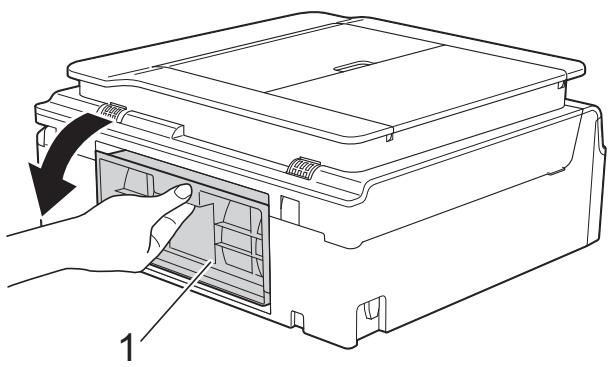
3 Open the Jam Clear Cover (1) at the back of the machine.
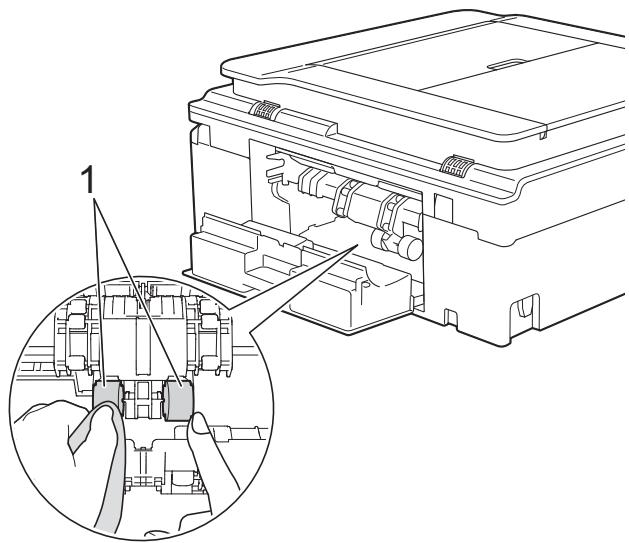
4 Clean the Paper Pick-up Rollers (1) with a soft lint-free cloth slightly moistened with water.
Slowly turn the rollers so that the whole surface is cleaned.
After cleaning, wipe the rollers with a dry, soft lint-free cloth to remove all moisture.
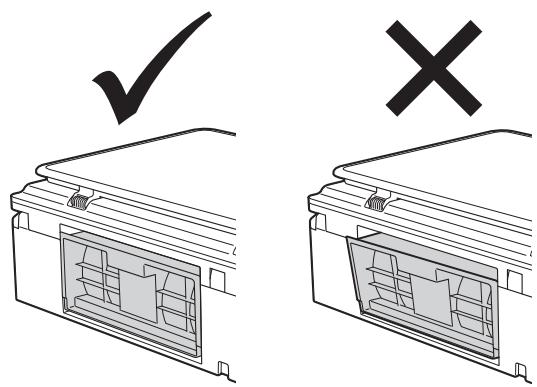
5 Close the Jam Clear Cover. Make sure the cover is closed completely.
Put the paper tray firmly back in the machine.
7 Re-connect the power cord.
Checking the ink volume
You can check the amount of ink that is left in the cartridge.
(MFC-J245)
Press Menu, 1, 3.
The LCD shows the ink volume.
Press or to choose the colour you want to check.
4 Press Stop/Exit.
(DCP-J132W)
Press Menu.
Press ▲ or ▼ to choose 1. Ink. Press OK.
Press ▲ or ▼ to choose 3. Ink Volume. Press OK.
The LCD shows the ink volume.

Press or to choose the colour you want to check.
5 Press Stop/Exit.
NOTE
You can check the ink volume from your computer.
(See Software and Network User's Guide.)
Packing and shipping the machine
When you transport the machine, use the packing materials that came with your machine. Follow the instructions below to correctly package your machine. Damage caused to your machine during transit may not be covered by your warranty.
The machine should be adequately insured with the carrier.
IMPORTANT
It is important to allow the machine to "park" the print head after a print job. Listen carefully to the machine before unplugging it to make sure that all mechanical noises have stopped. Not allowing the machine to finish this parking process may lead to print problems and possible damage to the print head.
Unplug the machine from the electrical socket.
Place both hands under the plastic tabs on both sides of the machine to lift the scanner cover into the open position. Then unplug the machine from the telephone wall socket and take the telephone line cord out of the machine.
Unplug the interface cable from the machine, if it is connected.
4 Lift the scanner cover (1) to release the lock. Gently push the scanner cover support down (2) and close the scanner cover (3) using both hands.
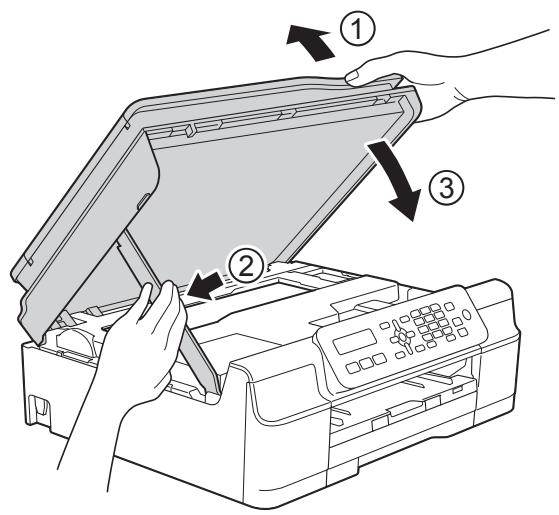
CAUTION
Be careful not to pinch your fingers when you close the scanner cover.
5 Open the ink cartridge cover.
6 Remove all four ink cartridges. Press the ink release lever above each cartridge to release it. (See Basic User's Guide: Replacing the ink cartridges.)
Install the orange protective part, and then close the ink cartridge cover.
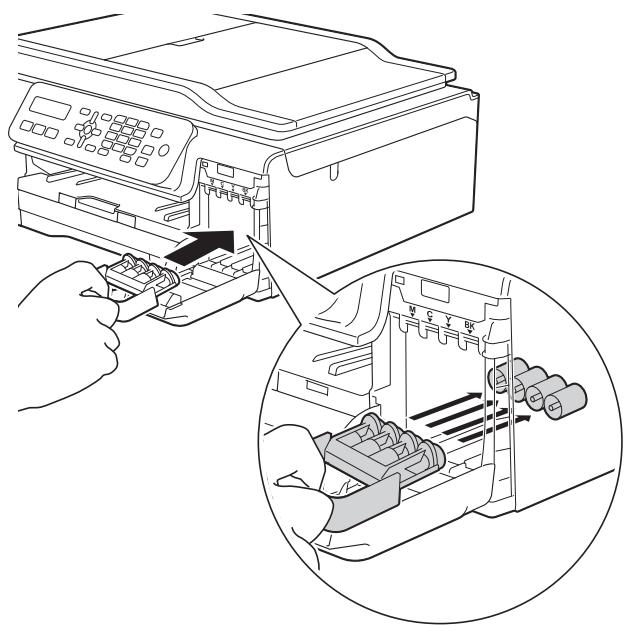
IMPORTANT
- Make sure the plastic tab on the left side of the orange protective part (1) locks securely into place (2).
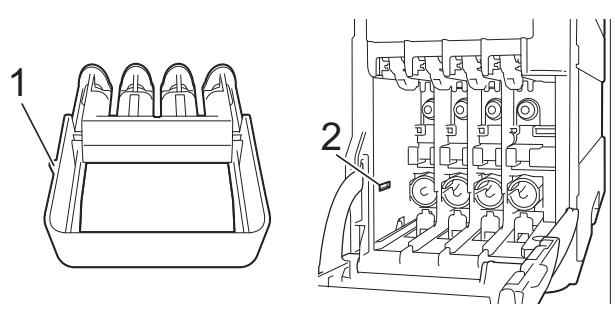
- If you are not able to find the orange protective part, ship the machine without it. DO NOT install the ink cartridges as an alternative before shipping.
8 Wrap the machine in the bag.
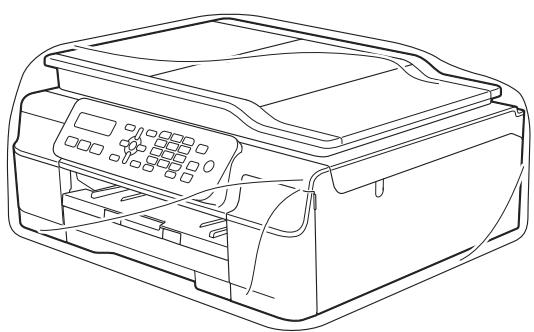
9 Pack the machine and the printed materials in the original carton with the original packing material as shown in the illustration.
Do not pack the used ink cartridges in the carton.
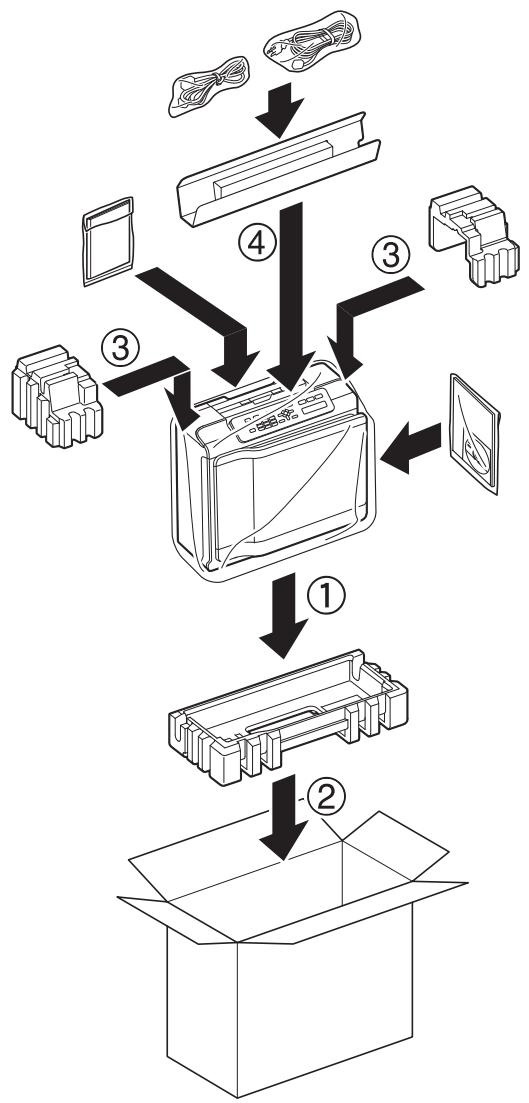
10 Close the carton and tape it shut.
B
Glossary
This is a comprehensive list of features and terms that appear in Brother manuals. Availability of these features depends on the model you purchased.
Address Book
Your list of Speed Dial and Group names and numbers that you have stored for easy dialling.
ADF (automatic document feeder)
The document can be placed in the ADF and scanned one page at a time automatically.
Auto Reduction
Reduces the size of incoming taxes.
Automatic fax transmission
Sending a fax without picking up the handset of an external telephone.
Automatic Redial
A feature that enables your machine to redial the last fax number after five minutes if the fax did not go through because the line was busy.
Beeper Volume
Volume setting for the beep when you press a key or make an error.
Brightness
Changing the Brightness makes the whole image lighter or darker.
Broadcasting
The ability to send the same fax message to more than one location.
Caller ID
A service purchased from the telephone company that lets you see the number (or name) of the party calling you.
CNG tones
The special tones (beeps) sent by fax machines during automatic transmission to tell the receiving machine that a fax machine is calling.
Coding method
Method of coding the information contained in the document. All fax machines must use a minimum standard of Modified Huffman (MH). Your machine is capable of greater compression methods, Modified Read (MR), Modified Modified Read (MMR) and JPEG, if the receiving machine has the same capability.
Colour Enhancement
Adjusts the colour in the image for better print quality by improving sharpness, white balance and colour density.
Communication error (Comm. Error)
An error during fax sending or receiving, usually caused by line noise or static.
Compatibility group
The ability of one fax unit to communicate with another. Compatibility is assured between ITU-T Groups.
Contrast
Setting to compensate for dark or light documents, by making faxes or copies of dark documents lighter and light documents darker.
Density
Changing the Density makes the whole image lighter or darker.
Dual Access
Your machine can scan outgoing faxes or scheduled jobs into the memory at the same time it is sending a fax from memory, receiving or printing an incoming fax.
ECM (Error Correction Mode)
Detects errors during fax transmission and resends the pages of the fax that had an error.
Extension telephone
A telephone using the same line as your fax but plugged into a separate wall socket.
External telephone
A TAD (telephone answering device) or telephone that is connected to your machine.
F/T Ring Time
The length of time that the Brother machine rings (when the Receive Mode setting is Fax/Tel) to notify you to pick up a voice call that it answered.
Fax Detect
Enables your machine to respond to CNG tones if you interrupt a fax call by answering it.
Fax Journal
Lists information about the last 200 incoming and outgoing taxes. TX means Transmit. RX means Receive.
Fax tones
The signals sent by sending and receiving fax machines while communicating information.
Fax/Tel
You can receive faxes and telephone calls. Do not use this mode if you are using a telephone answering device (TAD).
Fine resolution
Resolution is 203 × 196 dpi. It is used for small print and graphs.
Greyscale
The shades of grey available for copying, scanning and faxing photographs.
Group number
A combination of Speed Dial numbers that are stored in a Speed Dial location for Broadcasting.
Innobella™
Innobella™ is a range of genuine consumables offered by Brother. For best quality results, Brother recommends Innobella™ ink and paper.
Journal Period
The pre-programmed time period between automatically printed Fax Journal reports. You can print the Fax Journal report on demand without interrupting the cycle.
LCD (Liquid Crystal Display)
The display screen on the machine that shows interactive messages during On-Screen Programming and shows the date and time when the machine is idle.
Manual fax
When you lift the handset of your external telephone you can hear the receiving fax machine answer before you press Mono Start or Colour Start to begin sending the fax.
Memory Receive
Receives taxes into the machine's memory when the machine is out of paper.
Menu mode
Programming mode for changing your machine's settings.
OCR (optical character recognition) (MFC model)
Nuance™ PaperPort™ 12SE or Presto! PageManager software application converts an image of text to text you can edit.
Overseas Mode
Makes temporary changes to the fax tones to accommodate noise and static on overseas telephone lines.
Pause
Allows you to place a 3.5 second delay in the dialling sequence while you are dialling using the dial pad or while you are storing Speed Dial numbers. Press Redial/Pause key on the control panel as many times as needed for longer pauses.
Photo resolution (Mono only)
A resolution setting that uses varying shades of grey for the best representation of photographs.
Pulse
A form of rotary dialling on a telephone line.
Real Time Transmission
When the memory is full, you can send faxes in real time.
Remaining jobs
You can check which jobs are waiting in memory and cancel jobs individually.
Remote Activation Code
Press this code (* 5 1) when you answer a fax call on an extension or external telephone.
Remote Deactivation Code
(For Fax/Tel mode only)
When the machine answers a voice call, it pseudo/double-rings. You can pick up at an extension telephone by pressing this code (# 51).
Resolution
The number of vertical and horizontal lines per inch. (See Standard resolution, Fine resolution, Super Fine resolution and Photo resolution.)
Ring Delay
The number of rings before the machine answers in Fax Only and Fax/Tel modes.
Ring Volume
Volume setting for the machine's ring.
Scanning
The process of sending an electronic image of a paper document to your computer.
Search
A numerical or alphabetical electronic listing of stored Speed Dial and Group numbers.
Settings Tables
At-a-glance instructions that show all the settings and options that are available for setting up your machine.
Speed Dial
You can set up names and numbers for easy dialling.
Standard resolution
203 × 98 dpi (monochrome).
203 × 196 dpi (colour). It is used for regular sized text and the quickest transmission.
Station ID
The stored information that appears on the top of faxed pages. It includes the sender's name and fax number.
Super Fine resolution (Mono only)
203 × 392 dpi. Best for very small print and line art.
TAD (telephone answering device)
You can connect an external TAD to your machine.
Temporary settings
You can choose certain options for each fax transmission and copy without changing the default settings.
Tone
A form of dialling on the telephone line used for touch-tone telephones.
Transmission
The process of sending faxes over the phone lines from your machine to the receiving fax machine.
User Settings
A printed report that shows the current settings of the machine.
WLAN Report
A printed report that shows the result of the WLAN Connection.
XMIT Report (Transmission Verification Report)
A listing for each fax sent, that shows its date, time and number.
C
Index
Numerics
2 in 1 ID Copy 25
A
Access codes, storing and dialling 17
Address Book
Broadcasting (Group dial) 9
Cancelling a Broadcast 10
changing Groups 18
deleting Groups 18
setting up Groups for Broadcasting ...18
using Groups 9
Apple Macintosh
See Software and Network User's Guide.
B
Broadcasting 9
setting up Groups for 18
C
Caller ID
Caller ID History report 21
Cancelling
jobs awaiting redial 12
Cleaning
paper feed rollers 30
primer platen 29
ControlCenter
See Software and Network User's Guide.
Copy
2 in 1 ID 25
density 27
enlarge/reduce 23
page layout (N in 1) 24
poster 24
quality 22
remove background colour 27
sort 26
using ADF 26
D
Dialling
access codes and credit card
numbers 17
Groups (Broadcasting) 9
Dual Access 9
F
Fax Storage
printing from memory 13
turning off 14
Fax, from PC
See Software and Network User's Guide.
Fax, stand-alone
receiving
at end of conversation 15
into PC 13
into the memory 15
out of paper reception 15
printing from memory 13
reducing to fit on paper 15
sending 7
at end of conversation 9
Broadcasting 9
cancelling from memory 12
contrast 7
from memory (Dual Access) 9
manual 9
overseas 11
Real Time Transmission 11
Resolution 8
G
Groups for Broadcasting 18
1
ID Copy 25
Ink cartridges
checking ink volume 32
L
LCD (Liquid Crystal Display)
Contrast 3
Language 3
M
Macintosh
See Software and Network User's Guide.
Manual
transmission 9
Memory Storage 1
Mode, entering
Timer 4
N
Network
Printing
See Software and Network User's Guide.
Scanning
See Software and Network User's Guide.
Nuance™ PaperPort™ 12SE
See Software and Network User's Guide.
Also see Help in the PaperPort™ 12SE application.
P
Packing and shipping the machine 32
Power failure 1
Presto! PageManager
See Software and Network User's Guide.
Also see Help in the Presto! PageManager application.
fax from memory 13
report 21
Printing
See Software and Network User's Guide.
R
Reducing
copies 23
incomingfaxes 15
Remote Setup
See Software and Network User's Guide.
Reports 20
Address Book 21
Caller ID history 21
Fax Journal 21
Journal Period 20
how to print 21
Network Configuration 21
Transmission Verification 20, 21
User Settings 21
WLAN Report 21
Resolution
setting for next fax 8
S
Scanning
See Software and Network User's Guide.
Shipping the machine 32
Sleep Mode 2
T
Troubleshooting
checking ink volume 32
TX Lock
turning on/off 6
W
Windows®
See Software and Network User's Guide.
Wireless Network
See Quick Setup Guide and Software and Network User's Guide.
brother
Visit us on the World Wide Web http://www.brother.com/
These machines are approved for use in the country of purchase only. Local Brother companies or their dealers will only support machines purchased in their own countries.